New Dawn – World's Most Unusual Magazine

Category: Secret History

  • Assassination of the Humanitarian Princess: The Killing of Diana

    Assassination of the Humanitarian Princess: The Killing of Diana

    This article was published in New Dawn Special Issue Vol 9 No 1 (February 2015)

    1992 was the year that the relationship between Princess Diana and other senior British royals changed irreversibly. In June Diana collaborated with UK author Andrew Morton in a book which exposed Prince Charles’ relationship with his lover Camilla Parker-Bowles and Diana’s mistreatment by senior members of the royal family. The reaction was swift. Within 11 days of the book’s publication Diana received a bombshell letter from her father-in-law, Prince Philip. The letter alarmed her and Morton says that she sought out a solicitor to help draft a reply.1

    Within months the Queen had moved to set up the royal Way Ahead Group – a committee dedicated to helping the royal family deal with major issues and planning the way forward. Its first meeting was held in November 1992 and in the following month the Queen requested the formal separation between Charles and Diana. This was announced in the House of Commons on 9 December.

    In October 1995 Princess Diana penned a note in which she stated that she feared for her life and believed Prince Charles was “planning ‘an accident’ in my car.”2 She left the note with her butler, Paul Burrell, for safe-keeping. Later that month Diana met with her lawyer, Lord Victor Mishcon. He wrote the next morning that Diana had told him efforts could be made to “get rid of her… by some accident in her car such as pre-prepared brake failure.”3 Mishcon had this note typed up and kept it in his safe.

    Five days after that lawyer’s meeting Diana pre-recorded the famous ‘Panorama’ interview with BBC journalist Martin Bashir. In the program – which went to air on 20 November – Diana declared “there were three of us in this marriage,” that she doubted Charles could adapt to being King, recounted her mistreatment by the royals, and stated she was a “very strong person” who would “fight to the end.”4

    Diana also told several friends and family that she feared for her life and believed she could be killed in “an accident.”

    Later that month her fears were vindicated when the brakes in her regularly-serviced Audi failed as she drove through the streets of London. She wrote about it to her close friends. Simone Simmons said she received a letter that said: “The brakes on my car have been tampered with. If something does happen to me it will be MI5 or MI6.”5

    The month following the ‘Panorama’ interview, just seven days before Christmas, Diana received a hand-written letter from the Queen requesting her to divorce Prince Charles.

    The decree absolute came into effect on 28 August 1996, but it was much more than a marital divorce. The Queen also moved to strip the princess of her HRH title and effectively remove her from the royal family.

    Earlier, in March, Diana had been driving in London when she was hit by an out of control Fiat Uno. Her driver’s door was smashed in and witnesses said it was amazing she escaped unhurt. Although the police investigated this crash, their report has never been released.

    Diana Starts Campaigning to Eradicate Landmines

    Then around July 1996 Diana started taking an interest in the worldwide scourge of unexploded landmines and began collecting information and building a dossier on the industry. Her primary concern was humanitarian – to help the victims and to campaign for the eradication of all landmines.

    In January 1997, launching her involvement in the campaign, Diana made a highly-publicised visit to Angola – this was the nation with the highest number of victims. She was filmed walking through minefields and stated that she sought to “focus world attention on this… largely neglected issue.”6

    The following month she received a high-profile death threat. During a phone call from Nicholas Soames, Britain’s Minister of the Armed Forces, Diana was told to drop her anti-landmines campaign. Soames went on to say: “You never know when an accident is going to happen.”7

    Although shaken, Diana told her friend Simone Simmons – who witnessed the call – that she was undeterred: “We must do something. We cannot allow this slaughter to continue.”8

    Diana’s anti-landmine dossier grew in size to become several inches thick and she left copies with Simmons and another friend, Elsa Bowker. Her butler Paul Burrell said it contained “every fact of the landmine mission.”9

    On 12 June 1997, just under 12 weeks before she died, Diana delivered a landmark speech at the Royal Geographic Society in London. She outlined the nature and scope of the landmine problem, she talked about the “evil that men do” and spoke about her vision to “end this plague on Earth.”10

    Meeting the Al Fayeds

    It was around this time Princess Diana accepted an offer from long-time family friend and owner of Harrods, Mohamed Al Fayed, to holiday with his family at his St Tropez villa in mid-July. The offer extended to Diana and her two sons, William and Harry. At that time Al Fayed was viewed by the British Establishment as a person of ill-repute – he had recently been heavily involved in the “cash for questions” scandal that helped bring about the downfall of Britain’s Tory Government in May 1997.

    Both these actions – Diana’s increasingly public determination to eradicate the mines and taking William, the future King of England, on holiday with the Al Fayeds – were seen as a major challenge to the Establishment.

    In the following days two critical high-level decisions were made.

    First, senior royals called a special unscheduled meeting of the Way Ahead Group (WAG), chaired by the Queen. This meeting took place on 23 July and was preceded two weeks earlier by a special preparatory meeting attended by senior royal household officials, including the Queen’s private secretary, Robert Fellowes. The preparatory meeting was held on 8 July – three days before Diana and the princes left on the contentious Al Fayed holiday – and the full WAG meeting occurred on 23 July – three days after the holiday had concluded.

    The second decision was for an arrangement to be made for friend of Diana, Rosa Monckton, to organise a holiday with Princess Diana. Monckton was a person who had two very close connections to MI6 – her brother Anthony was a MI6 officer working in Zagreb and her husband Dominic Lawson was a MI6 agent who was editor of the Sunday Telegraph.

    Whilst in Hong Kong Monckton called Diana and arranged a one-on-one yachting holiday around the Greek islands, to take place in mid-August.

    Diana, William and Harry left for the St Tropez holiday on 11 July, amidst a storm of controversy. Following their return nine days later, a romance developed between Diana and Mohamed Al Fayed’s son, Dodi.

    On 30 July Diana broke off her nearly two year relationship with boyfriend Hasnat Khan and the following day left with Dodi on a week-long Mediterranean cruise.

    Their romance blossomed throughout August, interrupted only by two events – the pre-arranged Monckton cruise and Diana’s three-day anti-landmine visit to Bosnia on 8 August.
    [alert type=”info” dismiss=”no”]If you appreciate this article, please consider a subscription to New Dawn magazine.[/alert]

    Monckton Cruises with Diana for Intel

    Diana and Monckton left for the Greek islands on the 15th – “it was just the two of us” Monckton later told the inquest.11 What she didn’t say was that their hired 20 metre boat, the Della Grazia, was shadowed by three super-yachts chartered by MI6, the Marala, the Sunrise and the Sea Sedan. These were used as decoys to distract the media – who were not looking for a smaller vessel, and despite a massive search, never actually found the boat Monckton and Diana were on.12

    This strategy provided Monckton with five uninterrupted days on the ocean – time to seek inside information on Diana’s thoughts and intentions, to satisfy her intelligence masters.

    Diana and Monckton returned from that holiday on 20 August – and 11 days later Diana lay dead in a Paris hospital.

    On 22 August Diana and Dodi departed from Stansted airport headed for their final Mediterranean cruise. The two lovers would never see England again.

    The following day they visited Repossi’s jewellery store in Monte Carlo. Diana saw and liked an engagement ring from the “Tell Me Yes” range. Dodi later arranged for that same ring to be transferred to Repossi’s Paris – he purchased it from there just hours before the couple died.

    Diana and Dodi finished up their cruise in Sardinia and on the afternoon of Saturday, 30 August, they flew from Olbia to Paris, landing at Le Bourget airport at 3.20pm.

    They were met by French police who provided an escort for the initial part of the journey into the city.13 The police later denied they were aware of Diana’s presence in France, falsely claiming the first they knew she was there was when they heard about the crash that occurred later that night.14

    Threatened by Large, Dark Motorbikes

    During that journey and other travels through the streets of Paris that evening the couple’s Mercedes was threatened by large, dark motorbikes, some carrying pillions. Witnesses in the car and back-up Range Rover described these bikes as “behaving dangerously.”15 The Mercedes driver, Philippe Dourneau, said they were “coming from all angles, from front and behind – they were all over the place.”16 They took many flash photos on these trips – none of which have ever been published. The evidence indicates they were operating as fake paparazzi, helping to create an environment where later the real paparazzi could be falsely held culpable for the crash.

    Initially the couple travelled to Villa Windsor and then into the city, arriving at the Ritz Hotel – owned by Mohamed Al Fayed – at 4.35pm. Whilst there Diana made phone calls and had her hair done and Dodi visited Repossi’s and purchased the engagement ring.

    They left the hotel at 7pm, heading for Dodi’s apartment near the Arc de Triomphe. Once in the apartment – where their luggage had earlier been taken from the airport – the couple relaxed, showered and prepared to leave for dinner, which was to be back at the Ritz.

    They left for the hotel at 9.30pm. Didier Gamblin was on security at the apartment and said the fake paparazzi went “completely crazy” and “set off like lunatics to follow the car.”17

    Ritz CCTV records Diana and Dodi arriving at the front entrance of the hotel at 9.50pm. They initially went to the restaurant for dinner, but were stressed from the intimidating actions of the fake paparazzi and soon moved themselves upstairs to the sanctuary of the Imperial Suite.

    The Decoy Plan – But Who Planned It?

    It is after this that a decoy plan surfaced – a plan to leave for the return trip to the apartment from the rear of the hotel in a third car, whilst the primary Mercedes and the back-up Range Rover sat outside the front entrance, acting as decoys to divert the paparazzi.

    Dodi approved a plan for the use of a third car to leave from the rear – but he was not told there would be no back-up car, only one bodyguard and a driver who was not licensed to chauffeur.

    The evidence indicates the plan was devised by intelligence officers working from outside the hotel, employing two of the Ritz’s senior staff as agents – Henri Paul, the acting head of security and Claude Roulet, the vice-president of the hotel.

    Henri Paul was the designated chauffeur – but he was not a driver, had never driven any Ritz guests in his 11 years at the hotel, and did not possess the required chauffeur’s ‘Grande Remise’ licence. To top it off, his best friend, Claude Garrec, told the police Henri didn’t like driving and “If he could avoid [it] he would.”18

    Henri Paul had been receiving large sums of money from sources unknown in the months leading up to the crash. He had links to French and British intelligence agencies and on the night of his death was carrying 12,565FF ($2,500) on his person.

    The third car was the only other car available – a Mercedes S280 with untinted windows, whose regular driver was Olivier Lafaye. Every evening Lafaye would finish work, return to the Ritz and park his vehicle in the same section of the Vendôme car park. He told the police that the other chauffeurs took their vehicles home – he was the only one without a garage.19

    On that Saturday evening Lafaye parked his Mercedes S280 at 8.15pm. At 8.20 Claude Roulet is shown on CCTV leaving the Ritz Hotel. It is likely Roulet pointed out this Mercedes to other agents, who then had ample time to tamper with the vehicle prior to its final departure after midnight. Later evidence revealed that Diana – a person who many witnesses said always wore her seat belt – was sitting in the right rear seat with a jammed belt.20

    Henri Paul departed from the hotel at 7.01pm, but quickly returned at 10.06 following the couple’s arrival. After 11pm he made four separate visits to the paparazzi waiting out the front of the Ritz. Henri was providing regular updates on how long it would be before the couple appeared. It was essential to the MI6 plan that the paparazzi were still present when Diana and Dodi departed – they would try to follow the car and later be falsely blamed for the behaviour of the fake paparazzi, the assassins.

    Detailed Account of Diana’s Final Fatal Journey

    The Mercedes S280 departed from the rear of the Ritz Hotel at 12.18am – there was no back-up car, only one bodyguard, untinted windows and at least one jammed seat belt in the back.

    Some paparazzi were outside the rear and they immediately followed. Those out the front were quickly alerted and some of them joined the pursuit at the Place de la Concorde, where the Mercedes was held up by red lights.

    Large unidentified motorbikes also joined in from around the Concorde. The Mercedes was pressured by constant flashing of cameras – many photos were taken but they have never been published.

    The principal car left quickly from Concorde and witnesses on the riverside expressway saw a speeding Mercedes surrounded by several large, dark motorbikes. As the vehicle approached the exit it would take to head for Dodi’s apartment, a blocking motorbike was seen on its right.

    Failure to make the appropriate exit forced the Mercedes S280 towards the Alma Tunnel. As it neared the tunnel one witness saw the motorbikes “in a cluster, like a swarm around the Mercedes.”21 People saw photos being taken – again unpublished.

    Two separate witnesses saw the Mercedes – which was already in the left lane – overtaken on the left by one of the motorbikes carrying a pillion. At the same time, just as Henri entered the tunnel, he was confronted on the right by a slow-moving white Fiat Uno straddling the two lanes.

    As the motorbike got in front, a bright flash was seen and Henri immediately lost control of the Mercedes. A split-second later the Mercedes side-swiped the Uno and then zig-zagged left, right and left before crashing into the 13th central pillar of the tunnel, at around 100 kph.

    The car bounced back from the pillar, swung around 180 degrees and came to rest near the wall, facing the tunnel entrance.

    It was 12.23am on Sunday, 31 August 1997.

    Witnesses saw motorbikes and cars fleeing the tunnel – even though it is against the law in France to not stop and render assistance. None of the fleeing vehicles – including the white Fiat Uno – has ever officially been identified. And none of the drivers or riders have ever come forward.

    The two people on the driver’s side – Henri Paul and Dodi Fayed – died on impact, and the two on the passenger’s side – Princess Diana and bodyguard Trevor Rees-Jones – survived the crash.

    The French ambulance service (SAMU) immediately started receiving calls from passers-by. Dr. Arnaud Derossi was manning the phones and he allocated an ambulance carrying Dr. Jean-Marc Martino.

    That ambulance left the Necker Hospital base at 12.28am and arrived at the crash scene at 12.40am. It took 12 minutes to travel 2.3 km – Diana’s ambulance travelled to the scene at around 11½ kph.

    Upon arriving Martino straightaway phoned the base and spoke to Dr. Derossi, who then immediately left the base heading to the crash scene. It was left to an auxiliary to notify the base’s off-duty doctor, Marc Lejay, who was asleep at the time.22

    Death by Doctors?

    Princess Diana was heard talking by several witnesses, saying “Oh my God” and “what’s happened?”23 When the doctor performed the standard Glasgow Coma test to assess her condition in the car, she scored very well – 14 on a scale of 15.24

    However there was reason to suggest there could be an internal injury – Diana had been involved in a fatal, high speed crash and wasn’t wearing a seat belt. This possibility was confirmed after Diana was finally transferred into the ambulance, 43 minutes after the crash. The initial examination revealed there was thoracic trauma bruising.25

    From that point it became even more imperative that Diana was transferred immediately to a hospital – the thoracic trauma was a clear sign there could be a life-threatening internal injury.

    Instead though, these two doctors – Martino and Derossi – tarried. The ambulance remained in the Alma Tunnel until 1.41am, one hour and 18 minutes after the crash.

    And worse, they poured catecholamine into her to increase her blood pressure (BP), even though the BP was 70 and high enough to comfortably make the 5 km trip to the hospital.

    And on top of that, Dr. Derossi informed the base there was “nothing for the thorax,” twice, even though he already was aware of the thoracic trauma.26 This ensured the hospital would not have a thoracic specialist on hand when Diana arrived.

    After leaving the scene the ambulance travelled at what one witness described as “walking pace.”27 Then within sight of the hospital gates it stopped for five minutes. A journalist who followed the ambulance described it as “rocking” while stationary.28 He also witnessed a doctor transferring from the front to the back.29

    Whatever they were doing inside the ambulance, it required four people – Drs Martino, Derossi and two interns (Barbara Kapfer and a person called “Fadi”).

    There has never been a credible explanation for a stoppage so close to the hospital.

    Martino delivered Diana to the La Pitié Salpêtrière Hospital at 2.06am – it was now one hour and 43 minutes since the crash.

    Six minutes after arriving Princess Diana stopped breathing. She would never breathe again, despite the best efforts of the hospital’s doctors.

    Dr. Bruno Riou ticked the suspicious death box on the death certificate.30 The public prosecutor’s office was then forced to order an autopsy, which was conducted by Professor Dominique Lecomte. She found no suspicious circumstances.

    Dr. Riou was never asked why he was suspicious.

    Conflicting Evidence Points to the Cover-Up

    Later that morning Professor Lecomte carried out an autopsy on the driver, Henri Paul. Samples taken were tested early the following day – the results indicated the driver had a blood alcohol concentration (BAC) of 1.74, three times over the French limit.

    This conflicted with evidence in the hotel prior to the departure of the Mercedes. Many witnesses testified that Henri was not drunk and this was supported by the CCTV footage, which showed him walking and acting normally.

    Later testing revealed the blood had a carbon monoxide (CO) level of 20.7%. The combination of elevated BAC and CO meant Henri would have been incoherent, had a migraine headache and found it impossible to stay upright.

    Yet that is not what the CCTV and witnesses saw.

    A close analysis of Professor Lecomte’s autopsy of Henri Paul reveals she made at least 58 errors in her conduct and documentation.31 The police files reveal there were two lots of documentation for the one autopsy – each recording different samples taken and differing body measurements, weight and height.32

    The evidence points to two bodies being in the room at the time of the autopsy – one was Henri Paul’s and the other was a person who had died in a fire with smoke inhalation.

    Samples were taken from both bodies, but kept separate. The other person’s samples were used for the BAC testing and years later Henri’s true samples were used for DNA testing. The DNA-tested samples were never BAC tested and the BAC-tested samples were never DNA tested.

    The paparazzi and Henri Paul were fraudulently set up to take the blame for the death of Princess Diana.

    The truth is that the crash was orchestrated by MI6 (with assistance from the CIA and France’s DGSE and DST) on the orders of senior members of the British royal family, with the acquiescence of Tony Blair, Jacques Chirac and Bill Clinton – the leaders of the three leading Western arms-dealing nations.

    Diana Princess of Wales – our humanitarian princess – was murdered in one of the most shocking inter-governmental operations followed by one of the most extensive cover-ups of our time.

    The late John Morgan wrote two explosive books exposing the conspiracy to murder Princess Diana. Information on How They Murdered Princess Diana: The Shocking Truth, and Paris-London Connection: The Assassination of Princess Diana, can be found at princessdianadeaththeevidence.weebly.com. Both books can be purchased from Amazon.com.

    [alert type=”success” dismiss=”no”]If you appreciate this article, please consider subscribing to help maintain this website.[/alert]

    Footnotes

    1. Andrew Morton, Diana: In Pursuit of Love, Michael O’Mara Books, 2004, 76
    2. Inquest evidence: INQ0010117
    3. Inquest evidence: INQ0006335
    4. ‘The Panorama Interview’, BBC, 20 November 1995, www.bbc.co.uk/news/special/politics97/diana/panorama.html
    5. Simone Simmons with Ingrid Seward, Diana: The Last Word, St Martin’s Press, 2005, 179
    6. www.youtube.com/watch?v=rU0APrqxUxc
    7. Diana: The Last Word, 178-180
    8. Ibid., 180
    9. Inquest transcripts: 16 Jan 08: 27.11
    10. ‘Responding To Landmines: A Modern Tragedy And Its Consequences’ by Diana, Princess Of Wales. Keynote Address at a one day seminar co-hosted by the Mines Advisory Group and the Landmine Survivors Network, London, 12 June 1997, http://gos.sbc.edu/d/diana.html
    11. Inquest transcripts: 13 Dec 07: 139.18
    12. ‘The Media Swarm Greek Isles, In Search Of Diana’, Philadelphia Inquirer, 18 August 1997
    13. Rene Delorm, Diana & Dodi: A Love Story, Tallfellow Press, 1998, 154
    14. Inquest transcripts: 14 Nov 06 statement read out 21 Nov 07: 57.22
    15. Inquest transcripts: Kez Wingfield: 2 Sep 97 Statement read out 18 Dec 07: 145.9
    16. Inquest transcripts: 3 Sep 97 Statement read out 29 Oct 07: 67.17
    17. Inquest transcripts: 3 Oct 97 Statement read out 7 Mar 08: 103.14
    18. Paget Report, 14 December 2006, 162-3
    19. Paget Report, 14 December 2006, 244-5
    20. Paget Report, 14 December 2006, 421
    21. Paget Report, 14 December 2006, 439
    22. Inquest transcripts: 11 Dec 07: 7.13
    23. An example: Xavier Gourmelon: Paget Report, 14 December 2006, 513
    24. Inquest evidence: INQ0004774
    25. Inquest transcripts: 24 Jan 08:124.16; Inquest evidence: INQ0004774
    26. Inquest transcripts: 11 Dec 07: 14.9, 28.23
    27. Inquest transcripts: Pierre Suu: 28 Feb 06 Statement read out 11 Mar 08: 150.4
    28. Inquest transcripts: Thierry Orban: 23 Sep 97 Statement read out 17 Oct 07: 13.7
    29. Inquest transcripts: Thierry Orban: 23 Sep 97 Statement read out 17 Oct 07: 13.3; Pierre Suu:28 Feb 06 Statement read out 11 Mar 08: 150.22
    30. Prof. Bruno Riou, Witness Statement, 7 March 2006, reproduced in Diana Inquest: The Documents the Jury Never Saw, edited by John Morgan, 2010, 375-6
    31. John Morgan, Cover-Up of a Royal Murder: Hundreds of Errors in the Paget Report, 2007, 188-194
    32. John Morgan, Diana Inquest: The French Cover-Up, 2010, 50-68

    © New Dawn Magazine and the respective author.
    For our reproduction notice, click here.
  • Who Did Kill Rasputin?

    Who Did Kill Rasputin?

    From New Dawn Special Issue Vol 8 No 3 (June 2014)

    Before the First World War the Russian royal family, the Romanovs, were heavily involved in occult activities. In the years between 1900 and 1905, the French occultist Dr. Gerard Encausse (Papus) made several visits to Russia for undisclosed reasons. In fact, he had been personally invited to the country by Tsar Nicholas II and was holding magical séances at the royal palace in St Petersburg for the tsar and his German-born wife, the Tsarina Alexandra. Both were interested in Spiritualism and the occult.

    Dr. Encausse was a member of a French magical society called the Kabbalistic Order of the Rosy Cross (CORC). This was founded in France in 1888, the same year as the famous Order of the Golden Dawn in England. Dr. Encausse claimed to have been initiated into a Golden Dawn lodge in Paris run by Samuel Liddell Macgregor Mathers and his wife Moina. The Marquis Stanilas de Guaita and Josephin Peladan, two prominent French occultists, had created the CORC. Peladan had been born into an eccentric and fanatical Roman Catholic family who were supporters of the restoration of the French monarchy. His brother, Adrien, practised as a homeopathic doctor and had many wealthy and titled patients. He claimed to have been initiated in 1858 into a secret Rosicrucian order in Toulouse which had survived since the Middle Ages.

    At the magical rituals held at the royal palace, Dr. Encausse attempted to conjure up the tsar’s dead father, Alexander III, who was also interested in Spiritualism. In fact, Alexander had invited the English medium D.D. Home to Russia to hold séances attended by aristocrats and members of the royal court.

    In the early 1900s Russia was on the brink of revolution. There were riots in the streets, strikes, and rumours of mutiny in the armed forces. Against this turbulent background of civil disorder, the weak Tsar Nicholas II sought advice from the ‘Other Side’ on how to handle the situation. The message that came back from the spirits advised the tsar to resist the subversive and revolutionary forces threatening his throne, or he would lose control of Russia and topple from power. If the tsar did not take immediate action to deal with the deteriorating situation, then his authority and rule would be seriously undermined.

    Despite this warning, Nicholas refused to act decisively and with the outbreak of the First World War in August 1914, the situation spiralled out of control as the spirits had predicted. This led to Nicholas losing his throne and eventually his life at the hands of Bolshevik revolutionaries. The vengeful Bolsheviks massacred his family and seized power from the democratic government set up after the tsar abdicated.

    After his last visit to St Petersburg in 1905, Dr. Encausse stayed in contact with the tsar, and the occultist and the monarch exchanged letters at regular intervals. In this correspondence, they discussed various esoteric matters of mutual interest. However, Dr. Encausse confided to his fellow occultists that in his opinion Nicholas was a weak and easily influenced person who relied too much on his spiritual sources. The French magician believed that the tsar should instead listen more to his ministers and take their advice on the day-to-day running of the country.

    The ‘Mad Monk’

    The French occultist became particularly worried about how the tsar and tsarina had fallen under what he regarded as the malefic influence of a charismatic wandering ‘holy man’ called Grigory Yefimovich Rasputin. Rumoured to have been involved with the unorthodox religious sect known as the Khlysty or ‘People of God’, Rasputin managed to be invited to the royal court. As a result, he became the spiritual advisor, friend and confidante of the Tsarina Alexandra and also forged relationships with other Russian aristocrats.

    The Khlysty were a neo-Gnostic sect condemned by the Russian Orthodox Church because of their practices of flagellation and sexual indulgence to make contact with God and achieve spiritual enlightenment. At this time there were many quasi-religious sects in Russia and numerous wandering holy men and healers such as Rasputin.

    How much the tsarina knew of Rasputin’s background is not known, but she must have been aware he was using his personal charm and hypnotic powers to seduce many of her female courtiers. Although there is no evidence they had a sexual affair, Alexandra seems to have been infatuated with the unkempt ‘holy man’. She was in awe of his magical powers after he used his healing abilities to save the life of her haemophiliac son, the heir to the imperial throne. From then on, she would not allow anyone to say a bad word against him.

    Despite his wild physical appearance, Rasputin exerted a strange power over women, especially wealthy ones. It was said this was due to his ability to withhold orgasm for long periods. One aristocratic lady said the experience of making love with Rasputin was so pleasurable that she actually fainted during it. Such comments have led some writers to suggest the ‘Mad Monk’, as his enemies dubbed him, was a skilled adept in Tantric techniques from Eastern occultism and a practitioner of sex magic.

    Many friends of the Romanov royal family and members of the Russian government warned the tsar that Rasputin’s influence over his wife was sinister and evil. Dr. Encausse also wrote to Nicholas and warned him that in Kabbalistic terms the holy man was an unholy vessel like Pandora’s famous box of misfortune. As such, he contained all the “vices, crimes and filth of the common Russian people.” Prophetically, the French occultist said if the vessel was ever broken (i.e. Rasputin was killed) all its “dreadful contents will spill across Russia” destroying everything they touch.

    [alert type=”info” dismiss=”no”]If you appreciate this article, please consider a subscription to New Dawn magazine.[/alert]

    Prelude to The Great War

    In the 1900s it was widely expected there would soon be a war involving the major European powers. It was alleged that at a secret conference in Brussels, attended by leading Freemasons and members of secret societies as early as 1905, a plot had been hatched to bring down the Romanovs along with the other crowned heads of Europe. As the Great War approached, it was believed Rasputin was their secret weapon in achieving this aim.

    The First World War broke out in August 1914 following the assassination of Archduke Franz Ferdinand and his wife the Archduchess Sophia of the Austro-Hungarian Empire. When they were killed in Sarajevo, Bosnia by members of a secret society of Serbian nationalists known as the Order of the Black Hand, Rasputin warned the tsar not to let Russia get involved in a war with Germany. The monk predicted that if the Russian armed forces joined with those of Britain and France against Germany and their Ottoman and Austro-Hungarian allies, the country would suffer “a terrible defeat.” In the violent civil disorder to follow, the monarchy would fall from power. For once, the tsar ignored the advice of his ‘spiritual sources’ and committed the imperial Russian army and navy to the allied cause against Germany.

    Following the assassinations in Sarajevo, Tsarina Alexandra sent Rasputin several urgent telegrams asking for his advice about the international situation. Rasputin replied that on no account should Mother Russia get involved if, as was widely expected, war broke out among the major European powers. If she did, “It will be the finish of all things.” It is presumed Rasputin was not aware Russian secret agents had been implicated in the assassination plot. Allegedly, the Russian military attaché in Belgrade had paid 8,000 roubles to the leaders of the Order of the Black Hand. The attaché had also told them that Tsar Nicholas II would support the cause of Serbian nationalism if war broke out between Russia and the Austro-Hungarian-German alliance.

    It was also rumoured that in early 1914 representatives of the Black Hand had secretly met with members of the politically subversive French Masonic lodge of the Grand Orient at the Hotel St Jerome in Toulouse, France. At this meeting the assassination of Austro-Hungarian Emperor Franz Joseph and Archduke Ferdinand had been discussed. The plot was organised by the Black Hand with renegade elements of French Masonry and allegedly had the tacit support of the Russian tsar. The idea was to create the right conditions for a war between the European monarchies leading to their destruction, although why Nicholas II would support the anti-royalist plan remains unclear as he had all to lose from it.

    Following the murder of Franz Ferdinand and his wife, Kaiser Wilhelm told the Austro-Hungarian ambassador in Berlin that military force had to be used to neutralise Serbian nationalism and he offered his country’s support in any action the empire decided to take. The Kaiser quoted intelligence reports that suggested Russia would not intervene. On 28 July 1914, four weeks after the assassinations, the Austro-Hungarian Empire declared war on Serbia. In response to this, Tsar Nicholas ordered the Russian army to mobilise. The Kaiser warned the tsar that unless his forces stood down he would mobilise German troops. Five days later, when this ultimatum had been ignored, Germany declared war on Russia and the First World War began.

    When war was declared, Rasputin said if he had not been ill he would have travelled to St Petersburg to see the tsar personally. If this had happened, he boasted, Russia would never have entered the war and he would have single-handedly changed the course of world history. The pro-war elements claimed Rasputin was a pacifist and a pro-German traitor. It was even said the holy man was a secret agent working for the German intelligence service. The Germans had allegedly planted him in the royal palace to give the tsar and tsarina false advice and counsel.

    As the war dragged on, the rising casualties at the front and food shortages at home led to strikes and riots, and open hostility to the Romanovs surfaced among the population. This unrest was aided and abetted by the subversive activities of left-wing socialist and revolutionary agitators who wanted to replace the existing regime with a worker’s republic. Rasputin meanwhile had received a psychic premonition of impending doom and believed his life was under threat. In 1916 he wrote to the tsar spelling out the consequences to Russia and the Romanov dynasty if he was killed. He said should he be murdered by common assassins who were Russian peasants, whom he described as his “brothers,” the royal family would have nothing to fear. If, however, his killers were aristocrats, then “brother will kill brother” and no nobles would be left in the country.

    Several political factions in Russia had previously attempted to stop Rasputin’s influence on the royal family by violent means. In 1913 a conspiracy was revealed to kidnap the mystic monk, castrate him because of his sexual activities, and then kill him. Rasputin, however, was tipped off about the plot and managed to evade capture.

    A year later, on 19 July, a prostitute attacked Rasputin while he was holidaying at the Black Sea resort of Yalta, later to be the meeting place of the Allied wartime leaders towards the end of the Second World War. The prostitute stabbed Rasputin in the stomach, but despite losing a considerable amount of blood, he managed to survive the attack. When questioned by police, the woman said she had tried to murder the so-called ‘holy man’ because he was a heretic and ‘fornicator’ who had seduced a nun. She was diagnosed as unfit to stand trial due to insanity and was committed to a mental hospital. This appears to be an official cover-up.

    Significantly perhaps, the assassination attempt on Rasputin occurred only weeks after the murder in Sarajevo of Archduke Franz Ferdinand and his wife by members of the Black Hand secret society.

    Enter the SIS

    Rasputin’s prediction of his own death came eerily true in December 1916, when a group of right-wing aristocrats conspired with the British Secret Intelligence Service (MI6 or Military Intelligence Department Six) to kill him. The SIS was a branch of the Foreign Office set up in 1909. According to Michael Smith’s book Six: A History of Britain’s Secret Intelligence Service: Part 1: Murder and Mayhem 1909-1939, at the beginning of the First World War the head of SIS in London, known by the code letter ‘C’, made overtures to the Russian intelligence service. This was because of serious British concerns about the commitment of Tsar Nicholas II to the war effort. In September 1914, ‘C’ was granted permission by the Foreign Office in London and the Russian government to send several military officers to set up a SIS bureau in Petrograd, the new name for St Petersburg. Its name had been changed because the original sounded too German.

    One of the SIS officers, Lieutenant Stephen Alley, was a fluent Russian speaker who had been born in a village near Moscow. Before the war he worked in Russia for the Maikop & General Petroleum Trust, an American oil company owned by the future US president Herbert Hoover. The company was building a new oil pipeline across southern Russia to a port on the Black Sea. When war broke out, Lt Alley left the company and joined the British Army. He was then recruited by military intelligence, joining the SIS. Because of his Russian background, Lt Alley was sent to Petrograd posing as a military attaché to the British Embassy.

    The British intelligence officer soon discovered there were members of the Russian government, especially in the Ministry of Foreign Affairs, who were worried about the way the war was going. Some went so far as to support a separate peace treaty with Germany. Apparently there had been several clandestine meetings between officials of the two countries at the Russian and German embassies in Rome. It was said the Grand Duke of Hesse in Germany had even been in personal touch with the German-born tsarina. He had urged her to use her influence with her husband and members of the Russian government to seek a peace agreement.

    In November 1915, Lt Alley was in charge of what the SIS Russian bureau termed ‘background intelligence operations’. Two other officers, who had been recently sent out from SIS’s London headquarters, assisted him. One of them, Lt Oswald Rayner, was originally given the task of secretly opening and examining telegrams and letters. The SIS was particularly interested in the activities of neutral Swedish shipping companies believed to be supplying goods to Germany in defiance of the Royal Navy’s blockade.

    Before joining the Secret Service, Rayner had worked in Finland, then a Grand Duchy of the Russian Empire. He taught English and befriended a wealthy local couple who funded his further education at Oxford University, where he studied modern languages. At Oxford, he became friendly with Prince Feliks (Felix) Yusupov, a member of one of the wealthiest and most influential aristocratic families in Russia. Rayner then worked as a correspondent for The Times newspaper in London and later joined the civil service where he became a friend of the future wartime prime minister, David Lloyd George. When war broke out in 1914, Rayner joined the British Army. He was commissioned as an officer and assigned to ‘special duties’ with the SIS. Like Lt Alley, his fluency in Russian had him sent to Petrograd to join the British Secret Service unit operating in the city.

    With persistent rumours circulating that the Russian government was keen to make peace with Germany, the SIS began to focus on the specific stories about Grigory Rasputin, his alleged involvement in a pro-German anti-war peace movement and his peculiar influence over the tsarina. Their intelligence suggested the holy man was either the leader or at the very least a leading mover in a so-called ‘peace party’ made up of politically prominent Russians.

    As a result, several right-wing pro-war elements within the Russian aristocracy were counter-plotting to remove Rasputin permanently so he could not influence the tsar and tsarina with his views. One of these conspirators, a member of the Duma or Russian parliament, Vladimir Purishkevich, approached a SIS officer offering information on the plot. He told the officer a plan had been drawn up to “liquidate Rasputin.” At the time, the officer was unaware that three of his SIS colleagues, Alley, Rayner and an ex-Indian Army officer Captain John Dymoke Scale, were in fact closely involved in the plot to kill Rasputin.

    Lt Alley and Capt Scale had become suspicious of the tsarina’s close relationship with her spiritual advisor. Knowledge of Rasputin’s pro-German sentiments was common knowledge by 1916. Even The Times accused him of being a Germanophile whose influence at the Russian royal court was described as both “potent” and “baleful.” Capt Scale described Rasputin as a “drunken debaucher” who was adversely influencing Russian government policy and “clogging the war machine.” It was becoming evident the Mad Monk had to be neutralised, and this could only be achieved by his death.

    The Plot to Kill Rasputin

    The key figure in any British Secret Service involvement in a plot to terminate Rasputin with ‘extreme prejudice’ would be Lt Oswald Rayner. This was because of his long friendship with Prince Yusupov who was the leader of the conspirators. The prince invited the holy man to a ‘party’ at his family’s palace on the banks of the River Neva in Petrograd. Yusupov persuaded his wife, Princess Irina, the niece of Tsar Nicholas, to lure the monk to the party, although she was not actually going to be present. It was a typical British Secret Service ‘honey-trap’ operation that has been carried out many times since. Also present at the party was a prominent aristocrat, the Grand Duke Dimitry Pavlovich, the tsar’s second cousin; an army officer, Lieutenant Syukhotin, who was a close friend of the prince; Vladimir Purishkevich; an army medic Dr. Stanilaus de Lazoret – and the SIS officer Lt Oswald Rayner.

    The usual version of events is that Rasputin was first given some small chocolate cakes and wine laced with cyanide. When these had no apparent effect, he was shot in the chest at close range with a revolver. The holy man apparently survived this, attacked his would-be killers and managed to escape from the house. The assassins pursued him and he was shot three more times. His body was then bundled into a car and driven to the Petrovsky Bridge over the River Neva, where it was thrown into the icy waters. Despite the poison and several gunshot wounds, Rasputin was still alive, if barely, when he was tossed into the river and drowned.

    In reality, when Rasputin arrived at the prince’s home he was given copious amounts of alcohol until he was drunk. He was then tortured, beaten with a leather cosh on the testicles. There may have been a sexual element to this, but the aim was to get Rasputin to confess to his anti-war activities and name the other pro-German conspirators involved. Finally, he was shot several times using at least three different weapons. It is alleged that Rayner used his standard Secret Service issue Webley revolver to fire the last shot that finally finished off Rasputin. His body was then disposed through a hole in the ice of the frozen river.

    It is not clear if the senior officer running the SIS Russian bureau in Petrograd was fully aware of the involvement of Rayner and the other British officers in Rasputin’s murder. He expressed total surprise at the news when relaying it to ‘C’ in London. There is indication the three SIS officers had not received official sanction for the operation. They acted without London’s approval because they feared that the plan for a Russian peace treaty with Germany was well advanced. In fact, under torture Rasputin had even named a date in January 1917 when it would be signed.

    Two of the three SIS officers seemed to have been quickly posted elsewhere. Capt Scale was not even in Russia when the operation was carried out. He had already been sent to Romania to assist in a SIS operation to prevent the invading German army from capturing and using the oilfields and grain stores in the country by sabotaging them. He was later to return to Petrograd where rumours were still rife that the British Secret Service had somehow been involved in Rasputin’s death.

    Lt Oswald Rayner was transferred to SIS’s Stockholm office, but Lt Alley stayed in Russia and took over as head of the bureau. He eventually was given the role of liaison officer with the new provisional government and had the task of persuading them to keep the faith by pursuing the war with Germany. He was later sacked from SIS for allegedly refusing to carry out an order to assassinate one of the Bolshevik revolutionary leaders – Josef Stalin. The real reason was said to be that ‘C’ in London wanted to get rid of Lt Alley. It is possible this was because of the lieutenant’s alleged involvement in the plot to torture and murder Rasputin.

    The reaction to and consequences of the death of the Mad Monk were immediate, confirming the holy man’s own predictions about the event at the hands of the aristocracy. The Russian peasantry held him in great regard and reverence. When the news of his violent death spread, he was treated like a religious martyr and the finger of suspicion was pointed at the royal palace. Following the murder, rumours began to circulate of a right-wing coup by army officers to oust Tsar Nicholas II because he was a weak leader who was losing the war for Russia. The secret police investigated these stories, but in fact the real threat to the tsar’s continued rule and precarious position came from extreme left-wingers and, ironically, the supporters of a liberal democratic form of government.

    Fall of the Monarchy

    In March (or February by the Old Calendar still used in Russia) 1917, food riots broke out in Petrograd and other major Russian cities. Troops sent to put them down instead sided with the hungry demonstrators and joined them in their protest. As law and order broke down, a new liberal democratic provisional government was appointed to run the country. Faced with widespread and mounting criticism and a violent reaction to his policies, Nicholas decided the best thing for the country was to abdicate in favour of his younger brother, Grand Duke Michael. Unfortunately, the new tsar did not have the support or confidence of the peasants and, more importantly, the police and armed forces. In turn, Michael was forced to abdicate and he passed his executive powers to the provisional government. This move was widely applauded in Western capitals, as it was mistakenly believed that Russia was entering a new era of democracy replacing the autocratic rule of the tsars.

    Unfortunately, divided by internal disputes and trying to fight an increasingly unpopular war, the provisional government ruled for only eight months until November (or October) 1917. During this short period of democratic rule, it did manage to promote freedom of speech, religious worship and assembly and ended the censorship of the press. This freedom was short lived as in July 1917 a group of soldiers, sailors and Bolsheviks attempted to seize Petrograd. They were only prevented from doing so by the intervention of regular army units who were still loyal to the provisional government.

    Kaiser Wilhelm, himself interested in Spiritualism with an extensive private library of occult books, also decided to interfere in Russia’s internal affairs. He allowed the Bolshevik revolutionary leader Vladimir Illyich Lenin to return to Russia from Switzerland via Germany with his followers in a sealed train. Lenin promised Kaiser Wilhelm that if he managed to seize power by overthrowing the provisional government the war would be ended. On his arrival in Russia, Lenin was greeted by jubilant crowds and finally on 7 November (October) 1917, the Bolsheviks seized power. Troops from the garrison in Petrograd mutinied and, assisted by sailors and an armed workers’ militia called the Red Guard, they stormed the Winter Palace.

    Russia’s New Government

    The Bolshevik revolution was not bloodless by any means as in 1918 fighting broke out between the new Soviet government and the so-called ‘White Russians’ led by aristocrats still loyal to the monarchy. The Allies intervened and American, British, French and Italian troops landed on Russian soil. Their mission was to help the White Russians in the civil war and to seize materials stored in the ports of Archangel and Murmansk so they would not fall into the hands of the Germans. From October 1919 until January 1920, Allied forces blockaded the Russian coast and supplied the White Russians with military equipment.

    Despite their intervention, the Allies failed to prevent the ultimate defeat of the White Russian forces and the eventual establishment of the Soviet Union. In 1918, Tsar Nicholas, his wife and their children were brutally murdered by the Bolsheviks in the cellar of a house in Ekaterinburg, where they had been held captive. Rasputin’s prediction had come true. Nicholas had tried to seek asylum in Britain, but his cousin King George V, persuaded by his government, refused him and his family refuge. The king never fully recovered from the guilt he felt over the matter. Ironically, one of the first acts of the new Bolshevik regime was to ban all religious sects, occult groups and secret societies that had flourished in imperial Russia under the rule of the Romanov dynasty.

    [alert type=”general” dismiss=”no”]This article was published in New Dawn Special Issue Vol 8 No 3.[/alert]

    [alert type=”success” dismiss=”no”]If you appreciate this article, please consider subscribing to help maintain this website.[/alert]

    © New Dawn Magazine and the respective author.
    For our reproduction notice, click here.
  • The Great Beast on Politics: Aleister Crowley’s Thelemic State Revealed

    The Great Beast on Politics: Aleister Crowley’s Thelemic State Revealed

    From New Dawn Special Issue Vol 10 No 3 (June 2016)

    For those who believe the spiritual realm intersects with the mundane, there are a multitude of references across time and place that warn of a spiritual ‘combat’. Saint Paul and John of Patmos spoke of such things, as did Hopi elders, Jeremiah, the Hindu holy texts, the Voluspa of the Norse, the Muslim historical philosopher Ibn Khaldun, and our Western counterparts Oswald Spengler and Julius Evola, as well as René Guénon who wrote of the present era as the ‘reign of quantity’. Many thinkers such as Evola, Guénon and Rudolf Steiner, speaking from first-hand experiences, identified a conspiracy by ‘Black Adepts’ to enslave humanity to matter (the physical realm), detached from the cosmos and separated from the Divine.

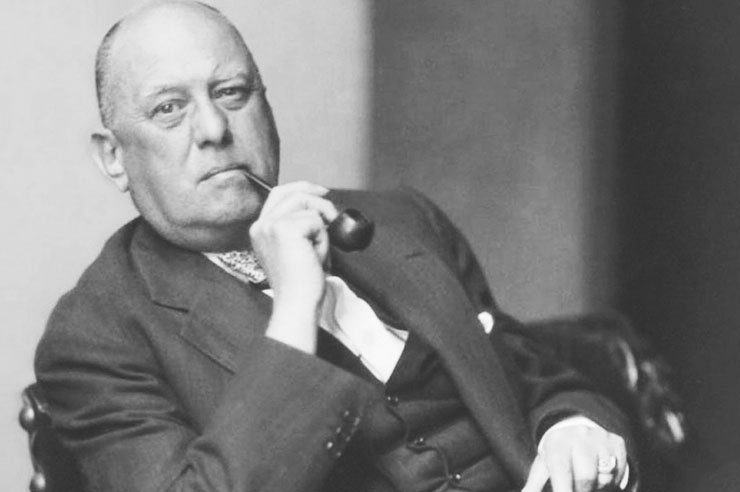
    Among those who warned of this increasing dehumanisation was the ‘infamous’ British occultist Aleister Crowley, scourge of respectable English society during the 1920s, portrayed by the tabloid press as a ‘Satanist’ and ‘the wickedest man in the world’, but also an operative for the British secret service in both the major 20th century world wars.1 Far from being a ‘Black Magician’, Crowley sought to oppose the ‘Black Adepts’ in what he, along with Steiner, Evola and Guénon, et al, saw as an occult war. Crowley’s doctrine, when applied to the political, social and economic spheres, is contrary to that of the Anti-Traditionalist and Counter-Traditionalist currents addressed by Evola and Guénon. Thelema is aristocratic rather than communistic, despite incongruous allusions by Crowley to Adam Weishaupt and the Illuminati.2 Thelema is the antithesis of Illuminism, Jacobinism, secular humanism and other such currents that emerged from Freemasonry.

    Crowley explained that while the Yellow School “stands aloof,” “the Black School and the White are always more or less in active conflict.”3 He wrote of the nexus between the Black School and Freemasonry, and how Masonry had been taken over and redirected by the Black Masters and their adepts. According to Crowley:

    The meaning of masonry has either been completely forgotten or has never existed, except insofar as any particular rite might be a cloak for political or even worse intrigue.4

    Crowley also referred to English Masons “in official relationship with certain masonic bodies whole sole raison d’etre is anti-clericalism, political intrigue and trade benefit,” despite English Masonry supposedly eschewing such motives.5

    Thelema & Nietzsche

    To the mass movements and doctrines that were sprouting in the name of ‘the people’ but can only result in tyranny, Crowley offered what he intended to be the religion of a new Aeon, Thelema, the Greek word for Will.

    “There is no law but do what thou wilt”6 is the dictum of Thelema, misunderstood precisely for what it is not: anarchism and ego-driven individualism of the type promoted by the ‘Black Adepts’ in the name of democracy, liberalism, human rights and other popular clichés designed to fracture and deconstruct society as a dialectical process for reconstructing a ‘new world order’. Crowley unequivocally stated that “do what thou wilt” “must not be regarded as individualism run wild.”7

    The essence of Thelema is the philosophy of Friedrich Nietzsche. Crowley lists Nietzsche as one of the ‘saints’ of Thelema in the Gnostic Catholic Mass.8 It is Nietzsche dressed up with mysticism and religious garb. But Nietzsche also presented his doctrines in quasi-religious and mystical ways, calling his most well-known book after the name of the founder of Zoroastrianism, Zarathustra, and writing Thus Spoke Zarathustra in the style of an Old Testament prophet. The dictum of Nietzsche’s Zarathustra is Will. The means of achieving one’s will is through “self-overcoming”9 that requires the sternest discipline upon oneself. Nietzsche wrote in opposition to Darwinian evolution,10 stating that human evolution would be willed, not the result of random genetic mutations. This next step of human evolution would result – if able to ‘cross the abyss’ of self-destruction – in the Over-Man. In this – misconceptions to the contrary – one is most brutal towards oneself, not others.

    True Self

    Schooled in the occult by the Hermetic Order of the Golden Dawn, where Egyptian mythology was in vogue, Crowley coated Thelema with a largely Egyptian façade. His ‘bible’, ‘The Book of the Law’, Liber Legis, an automatic writing scripted in Cairo by Crowley in 1904, is said to be a transmission from “the Gods” through an entity named Aiwass, or Aiwaz, depending on the numerological significance, which Crowley on other occasions referred to as his own ‘Holy Guardian Angel’, or ‘Higher Self’.

    In Thelema this is the ‘True Self’. The only purpose in life is to discover one’s True Self and follow that path regardless of the hardships; equivalent to Nietzsche’s self-overcoming, the individual’s battle against his or her own weaknesses and all obstacles that stand in the way of following one’s path. This requires, states Crowley, the harshest self-discipline, and is far removed from hedonism and self-indulgence. It is what the Muslims call the ‘greater Jihad’, the fight within oneself. It does not justify any sociopathic disregard for others.

    Thelema’s other primary dictum is “Every man and every woman is a star.”11 Since every star has its own orbit, the course of one’s star should not, if the law of Thelema is correctly applied, conflict with another’s orbit or the path of a True Self. Again Crowley was clear: “The highest are those who have mastered and transcended accidental environment… There is a good deal of the Nietzschean standpoint in this verse.”12

    Thelema, in recognising that everyone has a True Self, does not recognise that the brightness of all stars is equal. Hence, Thelema eschews socialist and other neo-Jacobin – and New Age – ideologies that demand universal equality. Again, Crowley is clear when describing Thelema as a stellar religion, “reflecting the highly organised structure of the universe,” which includes “stars that are of greater magnitude and brilliance than the rest.”13 Equality is rejected: “The is no creature on earth the same. All the members, let them be different in their qualities, and let there be no creature equal with another.”14

    Thelema was intended for the creation of a new aristocracy, one neither blood nor money based, but the merit of one’s own struggle. Crowley advocated the Nietzschean revival of a “master morality and a slave morality,”15 meaning that the great mass of people would always have servile characteristics, hence, “the slaves shall serve”:16 their characteristics are to follow those who are innately aristocratic and capable of fulfilling their True Will to the fullest extent. The masses are “that canting, whining, servile breed of whipped dogs which refuses to admit its deity”; “the natural enemy of good government.”17 The new aristocracy would be able to pursue long-range goals without the encumbrances of pandering to democratic whims.18 This aversion to mass politics shuns the democratic vote, “the principle of popular election [being] a fatal folly,” resulting in the election of “mediocrity”: “the safe man, the sound man, and therefore never the genius, the man of progress and illumination.”19

    [alert type=”info” dismiss=”no”]If you appreciate this article, please consider a subscription to New Dawn magazine.[/alert]

    Thelemic State

    That is not to say any Thelemic state would be a crushing tyranny as per socialism. To the contrary, Crowley eschewed all levelling doctrines. He shared the views of other creative types of the time, including his arch rival in the Golden Dawn, W.B. Yeats, and the Italian philosopher Julius Evola, that all arising mass movements including Bolshevism, Fascism, and the emerging consumer society with its cultural levelling, were very much negative developments.

    Thelema was also intended as a fighting creed or more aptly, a knightly creed, to wage a Thelemic holy war against creeds that aim to suppress freedom. The ‘new Aeon’ is, after all, one of ‘force and fire’, presided over by the hawk-headed god Horus. Crowley saw an era of conflict preceding the new Aeon, in which the new “aristocrats” would be in conflict with the masses: “and when the trouble begins, we aristocrats of freedom, from castle to the cottage, the tower or the tenement, shall have the slave mob against us.”20 Again one sees the focus for the new aristocracy on character rather than either wealth or birth; a new aristocracy that, like Nietzsche’s Over-Man, emerges through struggle.

    Crowley described a government following a Thelemic course as one in which, far from a hedonistic free-for-all, “set[s] limits to individual freedom. For each man in this state which I propose is fulfilling his own True Will by his eager Acquiescence in the Order necessary to the Welfare of all, and therefore of himself also.”21

    Crowley advocated the organic state, or what was in his time known as corporatism, of which Fascism was an effort. The doctrine of the organic or corporate state (as in corpus, or body) was a broad movement across the world, often influenced by Catholic social doctrine as a vestige of Tradition, contending with both capitalism and Bolshevism. In the organic state, as the term implies, society is regarded as analogous to a living organism: the government is the brain co-ordinating each organ (classes, professions), while the body is composed of cells (individuals). This organic conception of society parallels Traditional societies, as explained by Evola,22 in which the socio-economic structure was a pyramidal hierarchy with the guilds at its foundation. Again, Crowley was specific, describing the organic state very cogently:

    In the body every cell is subordinated to the general physiological Control, and we who will that Control do not ask whether each individual Unit of that Structure be consciously happy. But we do care that each shall fulfil its Function, with Contentment, respecting his own task as necessary and holy, not envious of another’s. For only mayst thou build up a Free State, whose directing will shall be to the Welfare of all.23

    In fulfilling one’s True Will the individual (cell) contributes to the social organism. This is a Traditional view of society where every individual’s calling is a reflection of his character as part of the cosmos. Anything subverting this order, such as class struggle – “not envious of another’s” task as Crowley put it – could be described as a cancer in the social organism, disrupting the correct function of the cells and organs of society.

    The socio-economic structure of a Thelemic state would return to the guilds as in Medieval society, in which work is not economic drudgery but one’s divine calling. There was no class struggle in the Medieval world, whether of a capitalist or Marxist nature. Economic competition was alien to the Medieval mind. In the European Medieval period, guilds were the fundamental organs of society. Crowley alluded to the guilds when describing the structure of his magickal order, Ordo Templi Orientis (OTO):

    Before the face of the Areopagus24 stands an independent Parliament of Guilds. Within the Order, irrespective of Grade, the members of each craft, trade, science, or profession form themselves into a Guild, making their own laws, and prosecute their own good, in all matters pertaining to their labour and means of livelihood. Each Guild chooses the man most eminent in it to represent it before the Areopagus of the eighth Degree, and all disputes between the various guilds are argued before that Body, which will decide according to the grand principles of the Order.25

    Crowley’s OTO is here seen as a society in microcosm. Crowley’s ideas on the organic state, and the role of the arts, are most closely reflected in the very brief time of the Free State of Fiume, created by Italian war hero and eminent man of letters, Gabrielle D’Annunzio. The Free State of Fiume attracted idealists from all over Italy – Anarchists, Fascists, Futurists and Traditionalists – into a remarkable experiment,26 albeit one that seems to have been oddly unmentioned by Crowley, despite existing when he was present in Italy (1920).

    Economics of Leisure & Art

    Crowley said that once obligations to the social order are met, there should be “a surplus of leisure and energy” that can be spent “in pursuit of individual satisfaction.”27 Again, we hark back to the pre-industrial epoch of Europe, when the artisan and peasant in a village-based economy, worked according to his social obligations, but had an abundance of leisure that today seems utopian.

    Such a renewed social order would include a realistic approach to money as a means of exchange rather than as the commodity it became over the course of centuries. As mentioned in New Dawn,28 Crowley addressed the issue:

    What is money? A means of exchange devised to facilitate the transactions of business. Oil in the engine. Very good then: if instead of letting to flow as smoothly and freely as possible, you baulk its very nature, you prevent it from doing its True Will. So every “restriction” on the exchange of wealth is a direct violation of the Law of Thelema.29

    It seems likely that Crowley was introduced to new economic theories through A. R. Orage, editor of The New Age, from whence T.S. Eliot, Ezra Pound and the New Zealand poet Rex Fairburn also learned about economics.30

    In a Thelemic state, one might envisage usurers being dragged through the streets and pilloried in stocks, if not worse, and then declared a literal outlaw.

    Once the material needs of the people are met there would be leisure to pursue higher callings in life. It suggests the ‘self-realisation’ and ‘hierarchy of human needs’ model of the humanistic psychology of Maslow et al, if one seeks a current theory.

    Again, this returns to a bygone era where the peasantry and townsfolk had an abundance of holy-days. The work week was five and a half days.

    People also rested on the day of the patron saint of their guild and of their parish, and there was, of course, a complete holiday on Sundays and on holy days of obligation. These were very numerous in the Middle Ages – 30 to 33 a year, according to the province.31

    The work day was based on sun-rise and sun-set, which meant fewer working hours during winter, and a few hours longer in summer. Popular theatre was lively, and actors were widely drawn from the village folk. Not only religious themes but burlesque, satire, romance and history were themes.

    Crowley proposes a state in which people are free to pursue higher cultural attainments.

    These things being first secured, thou mayst afterward lead them to the Heavens of Poesy and Tale, of Music, Painting and Sculpture, and into the love of the mind itself, with its insatiable Joy of all Knowledge.32

    Realising that ‘stars’ are of unequal brilliance, Crowley condemned “the cant of democracy,” stating it was “useless to pretend that men are equal,” and that most are content to “stay dull.”33 Given every opportunity, most would be content satisfying their material needs, with no horizons beyond “ease and animal happiness.” Those whose True Wills are to ascend the social hierarchy would form “a class of morally and intellectually superior men and women.”34

    Crowley addressed the problems of the machine age, relevant to the present technocratic era, where man is becoming an economic cog. What Crowley said about industrialisation is prescient in light of the modern technological age, with its ongoing dehumanisation and life increasingly virtual and detached from interpersonal bonds, whether individual, family, or community. Paradoxically, the oligarchic interests promoting all this do so behind catchcries of ‘brotherhood’ and a ‘new world order’. Hence Crowley, like Oscar Wilde,35 W.B. Yeats, et al, lamented the destruction of craftsmanship that proceeded apace after the Industrial Revolution. One might say prior to that since the mercantile spirit of the Reformation made economics the master, again in the name of ‘freedom’. Crowley wrote:

    Machines have already nearly completed the destruction of craftsmanship. A man is no longer a worker but a machine-feeder. The product is standardised; the result mediocrity… Instead of every man and every woman being a star, we have an amorphous population of vermin.36

    Today, in place of the machine-feeder there is the data-feeder, while products remain standardised, including the arts, aggravated by mass techno-entertainment.

    Crowley’s vision was that of the Thelemite as Knight fighting every tyranny that suppressed the human will:

    We have to fight for freedom against oppressors, religious, social or industrial, and we are utterly opposed to compromise, every fight is to be a fight to the finish; each one of us for himself, to do his own will, and all of us for all, to establish the law of Liberty… Let every man bear arms, swift to resent oppression… generous and ardent to draw sword in any cause, if justice or freedom summon him.37

    It seems we still await the emergence of such Knights of Thelema, although one suspects that like Yukio Mishima, the modern age Samurai, these Knights would be quickly liquidated by the weapons of mass destruction in the hands of religious lunatics, whether in the name of Jesus, Allah or YHWH, leaving little scope for chivalric combat.

    [alert type=”general” dismiss=”no”]This article was published in New Dawn Special Issue Vol 10 No 3.[/alert]

    [alert type=”success” dismiss=”no”]If you appreciate this article, please consider subscribing to help maintain this website.[/alert]

    Footnotes

    1. Richard Spence, ‘The Magus was a Spy: Aleister Crowley and the Curious Connections Between Intelligence and the Occult’, New Dawn 105, November-December 2007, 25-30
    2. Weishaupt is listed as a ‘saint’ in Crowley’s Gnostic Catholic mass. Magick in Theory and Practice, Samuel Weiser, 1984, 430
    3. Aleister Crowley, Magick Without Tears, Falcon Press, 1983, 66
    4. Crowley, 1986, 68-69. Crowley also writes here of Masonic ‘Christian’ degrees being changed in the USA to enable the initiation of ‘Jewish bankers’.
    5. Crowley, The Confessions of Aleister Crowley, Routledge & Kegan Paul, 1986, 697. Rudolf Steiner was also similarly critical of English Masonry.
    6. Crowley, Liber Legis, Samuel Weiser, 1976, 3:60
    7. Crowley, The Law is for All, Falcon Press, 1985, 321
    8. Crowley, Magick, 430
    9. Friedrich Nietzsche, Thus Spoke Zarathustra, Penguin Books, 1969, 136-138
    10. KR Bolton, ‘Nietzsche Contra Darwin’, in Southgate, ed., Nietzsche: Thoughts & Perspectives, Vol. 3, Black Front Press, 2011, 5-19
    11. Liber Legis, 1: 3
    12. Crowley, The Law is for All, 175
    13. Crowley, The Law is for All, 143-145
    14. Crowley, The Law is for All, 228
    15. Friedrich Nietzsche, Beyond Good & Evil, Penguin, 1984, 175
    16. Liber Legis, 2: 58
    17. Crowley, The Law is for All, 192
    18. Crowley, The Law is for All, 193
    19. Crowley, Liber CXCIV, ‘OTO. An intimation with references to the Constitution of the Order’, para. 10, The Equinox, Vol. III, No. 1, 1919
    20. Crowley, The Law is for All, 192
    21. Crowley, The Book of Wisdom or Folly, Samuel Weiser, 1991, Liber Aleph Vel CXI, De Ordine Rerum, clause 39
    22. Julius Evola, Men Above the Ruins, Inner Traditions, 2002, 224-234
    23. Crowley, The Law is for All, 251-252
    24. Supreme court.
    25. Crowley, ‘OTO. An intimation with references to the Constitution of the Order’, para. 21
    26. Bolton, Artists of the Right, Counter-Currents Publishing, 2012, 27-30
    27. Crowley, The Law is for All, 230
    28. Bolton, ‘A Secret History of Money Power’, New Dawn Special Issue Vol. 10, No. 2, 55, 58
    29. Crowley, Magick Without Tears, Falcon Press, 1983, 346
    30. Bolton, New Dawn, 58
    31. Hugh O’Reilly, ‘Medieval Work and Leisure’,
      www.traditioninaction.org/History/A_021_Festivals.htm
    32. Crowley, The Law is for All, 251
    33. Crowley, The Law is for All, 192
    34. Crowley, The Law is for All, 227
    35. Oscar Wilde, The Soul of Man Under Socialism, Black House Publishing, 2012
    36. Crowley, The Law is for All, 281
    37. Crowley, The Law is for All, 317

    © New Dawn Magazine and the respective author.
    For our reproduction notice, click here.
  • The Untold Story of China’s Rise

    The Untold Story of China’s Rise

    This article was published in New Dawn Special Issue Vol 9 No 1 (Feb 2015)

    There are many untold stories about China’s rise. Initially, this story will begin almost four decades ago, but it will ultimately reach back as far as four millennia. It will close with the conclusion that we have today only witnessed the beginning of China’s rise.

    We begin in 1976 when the Australian Ambassador in Beijing completed a Dispatch exploring the implications for Australia were China to emulate Japan at that time and grow its economy by 10 percent each year. In Mao Zedong’s last year and at the end of the Cultural Revolution, this seemed improbable to most foreign policy officers, but Prime Minister Malcolm Fraser liked the Dispatch and used it to shape Australia’s China policy.

    The case for such rapid Chinese economic growth was based on a simple perception. After following Japan closely in the 1960s and as an Embassy officer who had studied economics at university, I was convinced that Japan’s unprecedented economic growth had little to do with the simple application of Western economic principles. Rather, it needed to be explained by distinctive cultural qualities.

    Considering much of Japan’s sense of civilisation, including the characters used in its language and the nature of its administrative class, derived from China, it was hard to see why the vast home of East Asian civilisation, China, would settle for second best, behind its off-shore, smaller neighbour. Moreover, by this time other Asian communities with a strong sense of Chinese tradition and civilisation were beginning to show the potential for economic growth similar to Japan.

    This line of thought poses many problems for the Western mind and for Western leaders. The implied irrelevance of ideologies like Capitalism and Communism has major implications not only for economic thought but also for political rhetoric and strategy.

    Consequently, although there was an emerging interest in the relationship between ‘Asian values’ and economic performance in the 1980s and 1990s, this was effectively killed off by the 1997 Asian Financial Crisis (AFC). A torrent of triumphalism about the failure of ‘Asian values’, Asian ‘crony capitalism’ and an associated unhealthy relationship between government and business seemed to discredit forever everything associated with the phrase ‘Asian values’. As a consequence, there has been little real follow up on the thought that inspired the 1976 Beijing Dispatch, although a public R G Neale Lecture in the Australian Department of Foreign Affairs and Trade in 2007, 31 years later, commended the foresight of the Dispatch.

    Even that lecture neglected to mention three books informed by the same insight that had used experience in Japan to predict China’s future rise. The Confucian Renaissance (1989), The Tyranny of Fortune: Australia’s Asian Destiny (1997), and A Confucian Daoist Millennium? (2007) were easily ignored as curiosities of no concern to men entrusted with practical commercial and political responsibilities.

    A decade after the 1997 AFC and a year after the 2007 R G Neale Lecture, the 2008 Global Financial Crisis revealed Western ‘crony capitalism’ to be far worse than the Asian version. Moreover, by this time Asia had again grown stronger. China had deftly managed Western attempts to exploit the AFC and was becoming the flag bearer of an Asian economic miracle that was transforming the global order. With typical discretion, however, this was branded ‘China’s peaceful rise’ and even used the 2008 Beijing Olympic Games to distract the attention of the West from its own rapidly declining economic power.

    In retrospect, global order has been discreetly reshaped since the American defeat and occupation of Japan in 1945 by the astute utilisation of China’s ancient cultural wisdom. This wisdom involved a form of ‘conquest through service’. It was first executed by Japan, then by other Asian communities and finally, and most critically and definitively, by China. Most remarkably, this strategy has continued, unrecognised by Western communities and their leaders for almost three quarters of a century.

    To a significant degree, this failure has been the unintended product of a political/intellectual strategy of ‘intellectual apartheid’ that marginalised and ridiculed in the Western mind all cultures but those shaped by the European Enlightenment and its ‘universal values’. By closing its own minds to the possibility of an alternative, more politically, administratively and strategically advanced culture, the West effectively ensured its own decline.

    While it might be suggested Australia used the 1976 Beijing Ambassador’s Dispatch to fully capitalise on the Asian economic miracle, this would be an exaggeration. Despite much rhetoric over more than half a century about being part of Asia, Australian leaders remain totally uneducated in terms of the Chinese classics that define Asian wisdom and success, and have done nothing to introduce such education for younger Australians. In addition, they have mirrored the folly of other Western nations in allowing themselves to be ‘conquered by service’, that is, for Australia, by the service of easily accessible and lucrative export markets.

    This may have been less insidious than in America and Europe, which have largely been stripped of their industry, technology and labour skills and left bankrupt and dependent on fiat currencies (printed paper serving as money) with less and less asset backing. Like Western communities in general, however, Australians have shown themselves to be incapable of understanding the irrelevance of their ideologies and, most importantly, their thought cultures in comprehending the transformation of the 21st century global community.

    The Source of Asian & Chinese Wisdom & Strategy

    It is critical to understand the sense in which Asia’s rise has been China’s rise. Everywhere in East and South East Asia, administrative and commercial elites are shaped and informed by Chinese tradition, classical wisdom and historical experience. This may be directly as in Japan, Korea, Vietnam and Singapore. Or it may be through elite minorities in the rest of the region, where Chinese traditions of education and thought set standards of excellence that other ethnicities must match to be competitive. Moreover, none of these peoples have been influenced in any comparable manner by their brief exposure to Western corporate and commercial intrusion and assertion.

    Today, there is a robust revival of traditional Chinese classical education in China and these other regions of Asia. In academies defined by ancient practices, children from the age of three learn the classics by rote and can recite whole chapters word perfect by the age of five.

    The best learning years of three to six are devoted to mastering texts in their original language from more than two thousand years ago. These texts are then effectively left in charge of shaping and guiding thought and life experience from a very early age. Early familiarity with classical Chinese language ensures ready access to China’s long, rich and continuously recorded historical experience.

    When one reflects on the content of the Confucian Analects, the Daodejing and the Book of Changes, it becomes obvious that this thought has many qualities not found in the Western tradition. Moreover, it is also evident the habit and discipline of learning that is nurtured at such an early age can be easily focused on mastering Western thought and tradition, but as an alternative and mostly less profound option. Consequently there are many educated Asians who are truly bicultural and capable of thinking and acting alternatively in competing thought cultures. For several reasons, there are very few, if any, comparably skilled Westerners.

    This poses a daunting challenge for most Western peoples. First, China has a thought culture that guides more than two billion people in East and South East Asia but that is little, if at all, understood in the West. Second, it also has deftly placed itself at the strategic and financial centre of new, potentially global initiatives like the BRICS Bank, an expanding Shanghai Cooperation Organisation and a transformative Eurasian trade zone. Third, it is becoming indisputably the world’s largest economy with the strongest financial reserves and almost certainly the global leader in educational depth and excellence as well as technological productivity. None of this fits comfortably with the mythologies that have guided the Anglo American powers over recent centuries in working towards a New World Order.

    All this is the contemporary manifestation of the renaissance of the world’s most remarkable continuous civilisation. Despite almost unanimous denial in Western communities, and, it must be recognised, much of the rest of the world, it is already impossible to think about the future in an informed and positive manner without basing one’s thought on the central and authoritative role that will be played by cities like Beijing and Shanghai.

    Even more important, wherever one goes in China, most parts of Asia and many parts of the world, it will be most advantageous to understand the pervasive and definitive role being played in contemporary affairs by the Chinese classics, Chinese history and Chinese political and commercial culture. Yet this will be made difficult by a common modesty, humility and discretion that characterises the behaviour of the classically educated Chinese gentleman or ‘junzi’.

    The Character of China’s Modern Rise

    In a major sense, it is a mistake to speak of China’s rise. It is more appropriate to speak of China’s renaissance. Until the Opium Wars in the middle of the 19th century, China had led the world in technology and economic production for much of human history. By the middle of the 20th century Mao Zedong’s revolution had begun to lay the foundations of China’s renaissance. This renaissance became apparent a little over a quarter of a century later when Deng Xiaoping took charge.

    The major new feature of contemporary China is the fact that the Anglo American powers have constructed a nascent global order and that China’s renaissance must take place at the centre of this global interconnectedness. This is the truly unique character of China’s contemporary rise, or renaissance. It is something which other powers have made unavoidable and not something that China’s leaders have taken the initiative in bringing about.

    Consequently, there is much in the rise of contemporary China that can only be understood by examining the interaction of modern Western influence with the renaissance of traditional Chinese culture. Until now, the impact of Western influence seems to have been dominant. Yet China’s success is only truly explicable in terms of the way in which its traditional culture has equipped it to out-strategise and out-compete the West.

    Equally, much Chinese activity has been dictated by imperatives imposed by the West’s modernity. Yet, as China becomes stronger, more independent and more Chinese in its choices, it is likely to expose many Western initiatives to profound re-evaluation.

    One needs only to look at the harm done to the environment, water, air, food and medicine by Western corporate imperatives to see possible benefits in this development. Of course, China today is a poor advertisement, having embraced many of these corporate imperatives in its rush to build its economy, re-establish its own cultural autonomy and gain some control over its future. It has, however, now largely achieved that and has the capacity to address such issues.

    China’s own traditions of law and government would seem much better designed to correct harmful corporate imperatives than common practices in Western democracies. Large corporations have increasingly demonstrated the capacity to write the policies and laws of elected governments through lobbyists, media influence, industry expertise and political funding, often with little regard to harm inflicted on the well-being of communities.

    In fact, exposure to the Chinese classics, history and political culture highlights the reality that many features of contemporary Anglo American civilisation have derived first from the imperial adventures of British corporations like the East India Company and more recently from the related initiatives of American corporations within a global institutional order constructed after victory in World War II.

    The rise of China and its Asian and other allies suggests that many Anglo American practices, values and priorities are likely to be reassessed from perspectives that have the capacity to surprise and marginalise today’s certainties. The failure of Anglo American strategists to understand vulnerabilities in their own culture and to explore the strengths of a culture with the world’s most outstanding historical record has led to both Western decline and Eastern rise. It is hard to see this situation now being reversed.

    Western peoples now have a diminishing period of time in which to educate and prepare themselves for a predictable future where past certainties and comforts will be subject to re-evaluation. The existing global order has been constructed on assertions of the superiority of Western values but these have proven vulnerable before an Asian challenge. It is still too early to outline the likely outcome of this competitive interaction of competing cultures but an understanding of traditional Chinese culture will be essential if Chinese approaches to the West are to be evaluated with any hope of strategic insight, accuracy and success.

    Classical Chinese Values

    China’s 21st century rise can only be appreciated in the context of the teachings of its classics. As already remarked, these are undergoing a revival of popularity as the foundation for shaping life and thought from a very early age. It must also be understood in the context of learnings from the use of those classics across several millennia, copiously recorded as a continuous account of the achievements and failings of the Chinese people. It is also critical to recognise that the fundamentals of traditional Chinese social, legal, economic and political behaviour are often very different from those of the modern West. Moreover, Western values are unlikely to have gained in authority from their failure to defend and preserve a position that seemed beyond challenge only several decades ago.

    It is also essential to appreciate that Chinese words and ideas rarely translate accurately into English or other European languages. The reverse also applies, as the respective cultures and histories are too different to allow simple verbal equivalences. Yet, even if one begins the examination of Chinese classics in translation, it is immediately apparent that the Western mind is entering unfamiliar territory. For instance, the first three lines of the Confucian Analects read in English translation:

    Is it not a pleasure, having learnt something, to try it out at due intervals?

    Is it not a joy to have like-minded friends come from afar?

    It is not gentlemanly not to take offence when others fail to appreciate your abilities?

    It is hard to deny that this seems immediately to be a strange way to commence perhaps China’s greatest classic text. A number of comments may be made. First, the Analects illustrate clearly the difficulty of translating Chinese, particularly classical Chinese, into contemporary English. Second, the Analects are best rote learned in the original language at an early age and then used as needed as a remarkable collection of guiding wisdom throughout life. Third, the Analects exude a type of practical, searching humility that contrasts starkly with the sense of intellectual or philosophical pride and superiority evident in key Greek classics.

    Nevertheless, having recognised those stumbling blocks for the Western reader in a foreign language, it is clear the text places the highest authority in life on a lifetime of practical education, on the cultivation of diverse and far-reaching friendships or networks and on the ultimate virtue in human life of humility. These qualities are readily identifiable in Asian elites and, as will be explained further, are fundamental to Asian strategic wisdom.

    It should also be remarked that the Analects and the Book of Changes constantly use the family and its continuity over time as a central organising theme that illustrates intuitively the importance of the group over the individual. This echoes the distinctive character of China’s flood story four thousand years ago. This does not show God’s preservation of a virtuous man but rather the virtuous man’s preservation of his community, through the practical construction of canals and embankments.

    This family and group focus serves to highlight something strange, even corrupting, about the contemporary West’s prioritising of the individual, freedom and equality. It is possible to see this fragmenting both family and society and working to reduce much of life to a quantitative calculation among contending individuals. Certainly, the group coherence of Asian economies seems to have played a central role in their success.

    The first two lines of the Daodejing also reward reflection, reading:

    The Dao which one can explain is not the unchanging Dao.

    The Name which one can name is not the unchanging Name.

    From personal experience, I know that it is possible to struggle with these words for twenty years and still be bemused by their meaning. Yet, then, in a flash they can assume a meaning that changes the whole character of one’s thought. For me, this was to conclude that while words, ideas, concepts, rational structures and theoretical frameworks can be critical in organising the thoughts of the human brain and in communicating between human beings, they do not capture the full organic complexity and dynamism of the natural world. In my experience, the Western tradition with its central role of belief, whether in Plato’s transcendent forms, the Church’s God, the Enlightenment’s ‘universal values’ or the economist’s marketplace, nurtures a type of rigid attachment to abstract ideas and theories which impose limits on practical opportunities if they do not fit established thought patterns.

    The Six Secret Teachings of Jiang Taigong, a strategist and general who helped King Wen establish the Zhou Dynasty three thousand years ago, needs to be mentioned here even if it is not one of the more commonly referenced classical or strategic texts. It contains Twelve Civil Offensives that detail how a weaker party can overcome a more powerful adversary, simply through disciplined humility. This explains the provision of a service that conquers, first through cultivating dependency and later vulnerability.

    Once familiar with East Asia and with the contents of this text, it becomes almost impossible not to conclude that it has been this strategic thought that made Asia rich and the West bankrupt since 1945. In particular, Japan’s behaviour in the face of defeat and occupation seems to have followed meticulously the prescriptions of this work as it built the foundations of its economic rise. Other Asian communities familiar with the work, and ‘conquest through service’, did not find it hard to follow Japan’s example.

    A comment on the importance of historical literacy and awareness also directs attention to an area where China has a strength that is little understood in the West, where end of empire talk often refers back almost two thousand years to the Roman Empire. The more recent Austro-Hungarian or Ottoman ends of empire are rendered irrelevant because of the fragmented character of Western experience and consciousness. In China, however, the sense of history embraces at least six major and a number of smaller end of empire experiences over the past two thousand years.

    A television series on the mid 19th century Han General Ceng Guofeng, who saved the Qing Dynasty and its Manchu aristocrats from the Taiping rebels, can be revealing. It shows Manchu aristocrats whose sense of privilege and certainty does not allow them to address the mounting challenges to their world in any coherent or strategic manner. It is remarkable how this invites comparison with contemporary Wall Street bankers and their neglect of the mounting challenges to their political certainties, all defined by the incestuous preoccupations of New York and Washington.

    It should also be noted that Chinese language and history are enriched with thousands of words and expressions that simply do not translate into English. One example is the opposing expressions ‘junzi’ (gentleman) and ‘xiaoren’ (small or petty man). Neither bracketed translation is adequate. ‘Junzi’ might be said to refer to those humbled and refined by classical knowledge and suitable for administrative responsibility. ‘Xiaoren’ refers to those with an eye to a quick, and possible nasty, profit. It is not difficult to raise a laugh with a Chinese friend by saying that an American MBA qualifies one to be a ‘xiaoren’, making an easy target for a ‘junzi’ aware of Jiang Taigong’s civil offensives.

    Any outline of Chinese classics, history and culture can hardly scratch the surface of this world. Many Chinese today understand it poorly, but all of China’s leaders since 1949, including Mao Zedong [see ‘Mao’s Communism’ on page 58], were deeply educated in it and this is unlikely to be any different with future leaders.

    The Challenges Inherent in the Untold Story of China’s Rise

    A recent American response to the challenge of civilisation posed by China’s rise has been remarkably misguided. It involves ramping up a campaign of misleading allegations against the Chinese attempt to share their understanding of civilisation through the expert and financial support of Confucius Institutes. This suggests that a continuing denial of obvious realities will characterise much of the Western response to China’s economic and cultural renaissance.

    In some ways, the challenge that confronts the West is comparable with that which confronted distant peoples colonised by the European people’s use of corporate organisation and aggressive technology to enhance their wealth several centuries ago. It is less violent but it is just as incomprehensible in terms of the familiar mythologies that shape Western certainties.

    History suggests that the Chinese custom of tributary states is much more benign and enriching than the West’s colonising or ‘civilising mission’. Yet this is dependent on an acceptance of reality in a peaceful and constructive way. Despite a widespread continuing assumption of Western pre-eminence, there is already much evidence there is little prospect of reversing established trends of growing Chinese strength and declining Western capacity. This seems true, whether in terms of political, military, technological or economic influence. Moreover, there is growing evidence that we have only seen the beginning of China’s rise, or renaissance.

    Any realistic assessment of the challenges ahead now needs to address questions related to the movement from the certainties of an Anglo American global order to the probabilities of a reborn Chinese civilisation that influences events in all parts of an interconnected global community. Policies that are already publicly understood, although minimally reported in mainstream Western media, make it clear that China is taking the lead in the construction of major infrastructure like very-fast trains, in the transformation of Siberia and Eurasia through unprecedented initiatives, in investing globally in previously undeveloped natural resources, and in acting independently of institutional forms long established and reinforced by Anglo American authority.

    The continued denial or distortion of such realities will only compound mistakes and misjudgments that have already damaged Western interests. Despite major failings in Australia’s response to China’s rise, its experience and that of other Western peoples offers evidence there can be as many opportunities as challenges in this rapidly changing environment. Political, commercial, educational and other leaders need to take the initiative. After all, Anglo American corporate and commercial culture has proven uncompetitive in a world where it made the rules. It is unlikely to do better in a world where it no longer makes the rules.

    An expectation and insistence that China conform with the often self-serving Anglo American norms of recent history can only prove increasingly counter-productive. In contrast, rewards will be won by those who display humility and initiative and commit to the arduous toil of mastering, if only in a limited way, the untold story of China’s remarkable economic and cultural rise, or renaissance.

    [alert type=”success” dismiss=”no”]If you appreciate this article, please consider subscribing to help maintain this website.[/alert]

    © New Dawn Magazine and the respective author.
    For our reproduction notice, click here.
  • A Secret History of Money Power

    A Secret History of Money Power

    From New Dawn Special Issue Vol 10 No 2 (May 2016)

    The most hated sort [of moneymaking], and with the greatest reason, is usury, which makes a gain out of money itself, and not from the natural use of it. For money was intended to be used in exchange, but not to increase at interest. And this term usury which means the birth of money from money, is applied to the breeding of money, because the offspring resembles the parent. Wherefore of all modes of making money this is the most unnatural.
    – Aristotle (384-322 BCE)1

    Aristotle’s definition of usury is perhaps the most cogent ever made. Usury, as originally defined, is any money made from a loan. The Christian and particularly Catholic opposition to usury was founded on the dictum in the Gospel of Luke about giving without expecting anything in return, and on the Old Testament precepts against charging interest.

    Opposition to usury seems to have been instinctive in many diverse civilisations and cultures, with an intuition it is something unnatural, parasitic and outright sinful. When a civilisation accepts usury as normal business practice, as does Western civilisation, it is symptomatic of an advanced cycle of decay.

    The Vedic scripts of ancient India (2000-1400 BCE) call the “usurer” kusidin, a lender charging interest. Brâhmanas (priests) and Kshatriyas (warriors) were prohibited from practicing usury. The Sacred Laws of the Aryas states:

    God weighed in the scales the crime of killing a learned Brâhmana against the crime of charging interest; the slayer of the Brâhmana remained at the top, the charger of interest sank downwards.2

    As in the Western and Classical civilisations, the definition of usury was compromised over time. By the second century CE the Laws of Manu defined usury as beyond a “legal” interest rate, after which the interest cannot be recovered. The fact there is now a legal rate of interest, rather than an outright prohibition, indicates compromise of the type that arose in Western Christendom and Classical Greece and Rome. Additionally, like the exemption of the Jews from laws on usury under Mediaeval Christendom, the Hindu merchant caste were permitted trade in usury:

    To invest money on interest, to be a jeweller, to tend cattle, tillage and trade – these are declared as occupations for the Vaisya caste.3

    Siddharta Gautama Buddha offered a more unequivocal stance:

    One discerns wrong livelihood as wrong livelihood, and right livelihood as right livelihood. And what is wrong livelihood? Scheming, persuading, hinting, belittling, and charging interest. This is wrong livelihood.4

    Plutarch (46–127 CE), in his essay “Against Running In Debt, Or Taking Up Money Upon Usury,” described usurers as “wretched,” “vulture-like,” and “barbarous.” Cato the Elder (234–149 BCE) compared usury to murder. Cicero (106–43 BCE) stated, “these profits are despicable which incur the hatred of men, such as those of… lenders of money on usury.”

    Contemporary financial analysts Sidney Homer, who worked for Salomon Bros., and Professor Richard Sylla, in their historical study of interest rates, state that the first known law on the issue was that of Hammurabi, 1800 BCE, during first dynasty Babylonia, who set the maximum rate of interest at 33⅓% per annum “for loans of grain, repayable in kind, and at 20% per annum for loans of silver by weight.”5 Sumerian documents, circa 3000 BCE, “show the systematic use of credit based on loans of grain by volume and loans of metal by weight. Often these loans carried interest.”

    As early as 5000 BCE in the Middle East, dates, olives, figs, nuts, or seeds of grain were probably lent to serfs, poor farmers, or dependants, and an increased portion of the harvest was expected to be returned in kind…. Earliest historic rates were reported in the range of 20–50% per annum for loans of grain and metal.6

    In Greece, 600 BCE, Solon established laws on interest when excessive debt caused economic crisis. Likewise, in Rome the “Twelve Tables” of 450 BCE, establishing the foundations of Roman law, after pervasive debt was causing servitude and crisis, established a maximum interest rate of 8⅓% per annum. When Brutus tried to charge the City of Salmais 48% for a loan, Cicero reminded him that the legal maximum was 12%. The interest rate was often 4%. Some Greek “loan sharks” charged 25% per annum, and even 25% per day.7

    In the Old Testament, Jews were prohibited from usury: “Thou shalt not lend upon usury to thy brother; usury of money; usury of victuals; usury of anything that is lent upon usury” (Deut. 23:19). Critically, for history, the Jews were allowed to charge usury to non-Jews: “Unto a stranger thou mayest lend upon usury; but unto thy brother thou shalt not lend upon usury, that the Lord thy God may bless thee in all that thou settest thine hand to in the land whither thou goest to possess it” (Deut. 23:20).

    Those prohibitions, as well as the general ethical character of the New Testament, and the Classical heritage including the Aristotlean, inherited by the Catholic Church, established the basis for Catholic social doctrine in which opposition to usury was a key element. In 325 CE the Council of Nicaea banned usury among clerics. Under Emperor Charlemagne (768–814 CE) the prohibition was extended to laymen. Here usury simply meant the extraction of more than what was lent. This is in accord with what Jesus in the Gospel of Luke (6:35) stated, that one should not expect back more than one gives. In 1139, the Second Lateran Council in Rome declared usury theft, and usurers would have to give restitution. In the 12th and 13th centuries, strategies that concealed usury were also condemned. In 1311 the Council of Vienne declared that anyone claiming usury not a sin was a heretic and should be excommunicated.8

    Dante (1265–1321) placed usurers in the seventh rung of Hell, where the usurer would spend eternity with a heavy bag of money around his neck. Dante wrote:

    From each neck there hung an enormous purse, each marked with its own beast and its own colours like a coat of arms. On these their streaming eyes appeared to feast.9

    But the Church often allowed the Jews to practice usury. Moreover, when laws against usury slackened the pretext was an adaptation of Deut. 23:20, allowing Christian lenders to charge usury on loans to non-Christians, such as Muslims, who for their part were also forbidden usury, which the Qur’an calls the sin of riba (Al-Baqarah, 2:275). Likewise, the loophole for the Muslim lender has been that of being able to charge a “fee” for a loan, rather than interest.

    The Church attitude from Medieval times was inconsistent – in some places usury remained prohibited while in other places what was instead called “interest” was permitted and justified for the recovery of “losses” by the lender, such as late payment. Hence the Lombards who, like the Jews, also became identified with money-lending, did not charge “usury” but “interest” as high as 100%. Genoa became a centre of merchant banking where usury was pursued and the Church felt powerless to act.

    In Medieval England personal loans could range from 52-120% a year, depending on collateral. Frederick the Fair of Austria was borrowing at 80%, while merchants in Italy could borrow at 5-10%. The Crown of Spain was paying 40% for short-term loans, while Dutch merchants could borrow at 1¼%.10

    Usury Triumphant

    The Reformation ushered in a revolt against the traditional order of Europe. The Protestant attitude towards usury was in flux but soon clarified with Zwingli, Luther and Calvin stating there are circumstances in which usury is acceptable. Under the division of Church and State, economic theorists began to write in defence of usury as a “progressive” form of commerce, laying the basis for the amoral merchant outlook that now grips most of the world. Money-lending was defended as a “service,” a concept that is, of course, now taken for granted by almost everyone, as argued by the French jurist Molinaeus in his 16th century Treatise on Contracts and Usury. The Church banned Molinaeus’ book and forced him into exile, but his ideas spread. It is significant that England was the first to establish a legal rate of interest, at 10%, in 1545 under Henry VIII, after he embraced the Reformation. According to Homer and Sylla:

    During the Reformation many Protestant leaders defended interest and credit. As a result, the usury doctrine, which had held a firm grip on Jews and Christians for 2,000 years, was weakened and finally deserted.11

    A century later the focus on economic thinking shifted to Holland where usury was defended as productive and essential by economic theorists such as Claudius Salmasius (1588–1653). Holland became the centre of banking, and the model for the Bank of England. English utilitarian philosophers such as Adam Smith and Jeremy Bentham who wrote A Defence of Usury, justified the social utility of usury. Other fathers of English economics, David Ricardo, Jean Baptiste Say and John Stuart Mill, went further in stating there should be no restraints on contracting parties in money-lending.

    In the 17th century the Bank of England was founded as a private institution lending to the state. The Napoleonic war plunged Europe into colossal debt with its subsequent social, moral and political devastation. It set the pattern for the “modern age.” This era of revolutionary upheaval throughout Europe, reaching to its far off colonies, and ending with Napoleon’s defeat in 1815, saw the rise of the Rothschilds and other money-lenders to become the real masters of Europe. While Metternich of Austria tried to establish a new social order for Europe based around Throne and Altar, the real rulers would henceforth be the bankers. Historian Adam Zamoyski writes:

    Every government in Europe taxed whatever it could to pay off war time borrowing. Britain had spent more in real terms than it would on the First World War, and its national debt was astronomical. Russia’s had multiplied by twenty times between 1801 and 1809, and would more than double again by 1822. Austria was technically bankrupt: over the next three decades an average of 30 per cent of state revenue would be siphoned off to service this debt.12

    Zamoyski states that the five Rothschild brothers (who had been placed strategically throughout the capitals of Europe by their father Mayer Amschel Rothschild):

    and particularly James in Paris and Salomon in Vienna, had lent most of the governments of Europe, and particularly those of Austria and France, large sums of money in return for government bonds… Metternich had close links with Rothschild, who had resolved many difficulties for him in the past and who had now arranged for his mother-in-law’s 400,000-franc debt to be written off.13

    As for the Church’s traditional bulwark against usury:

    The Papal states were bankrupt by 1832, and Metternich saved the pope by persuading the Viennese banking house of Rothschild to provide him with a loan.14

    The Great Depression & Social Credit

    Moving forward in history to the Great Depression of 1929-1939. This spurred a widespread awakening among all sectors of society as to the character of the banking system. Proponents of a “new” yet traditional economics began appearing in many lands across the world around the same time. During the 1930s Major C.H. Douglas’ lectures on Social Credit impacted on nations such as Britain, Canada, New Zealand, Japan, Norway and Australia (see ‘What is Social Credit?’ on page 53). The famous New Zealand Labour politician John A. Lee remarked that the problems of credit and banking were discussed widely everywhere, in pubs, on buses, in the home. The First Labour Government in New Zealand was largely elected on the issue of banking.

    Who now, in this era of universal communications and education, gives five minutes to such questions, especially in pondering how to exercise one’s futile vote? Our grandparents and great grandparents, although they might not have gone to school beyond the primary level, knew immensely more about such matters than subsequent generations. They saw the effects of “poverty amongst plenty.”

    As the Hermetic dictum goes: “As above so below.” What occurs in the mundane, earthly realm is a manifestation of a spiritual dichotomy. As discussed at the start of this article, the great philosophers, the primary religions, and most civilisations during those eras in which they remained attuned to their original divine origins, knew that money was a source of “evil” if it was permitted to be used beyond its original purpose and assume a power of its own. The Bible succinctly references the “love of money” as “a root of all kinds of evils”:

    But those who desire to be rich fall into temptation, into a snare, into many senseless and harmful desires that plunge people into ruin and destruction. For the love of money is a root of all kinds of evils. (I Tim. 6:9-10).

    Paul stated this fight is against more than terrestrial powers, but those emanating from another realm:

    For we wrestle not against flesh and blood, but against principalities, against powers, against the rulers of the darkness of this world, against spiritual wickedness in high places. (Eph. 6: 12)

    Like the great religious codes that formed the spiritual foundations of civilisations over millennia and across the Earth, those who have sought a return to traditional values cannot but see the role of usury and money as a commodity in the demise of our spiritual, moral and cultural being.

    The influential English occultist Aleister Crowley, founder of the religion and philosophy of Thelema, was fully awake to the character of money, writing:

    What is money? A means of exchange devised to facilitate the transition of business. Oil in the engine. Very good then: if instead of letting it flow as smoothly and freely as possible, you baulk its very nature; you prevent it from doing its True Will. So every restriction on the exchange of wealth is a direct violation of the Laws of Thelema.15

    Apparently Social Credit is Thelemic. This might be more than coincidence. While it is reasonable to suppose that Crowley was aware of the strictures on usury by traditional religions, Crowley knew of A.R. Orage’s literary and political journal The New Age. Orage was a guild-socialist, and a prominent Fabian. He was also a follower of Russian mystic G.I. Gurdjieff, and had been a theosophist to the point of being called “The Mystic of Fleet Street.”16

    Orage was the most avid and earliest promoter of Major C.H. Douglas’ Social Credit theory, and had a primary influence on the doctrine. Ezra Pound and New Zealand poet Rex Fairburn were familiarised with Major Douglas’ ideas through Orage. They would both become lifelong champions of Social Credit as the means by which the rule of Mammon could be dethroned and culture again allowed to bloom. For Orage the economic question had to be dealt with for spiritual rebirth to succeed. Hence, his commitment to both Gurdjieff and Social Credit were part of the same process. T.S. Eliot, who also adopted Social Credit, stated of Orage, whom he met in 1922:

    [A]ny real change for the better meant a spiritual revolution; and he [Orage] said that no spiritual revolution was of any use unless you had a practical economic scheme.17

    Get the issue this article appears in

    Kibbo Kift & the Green Shirts

    In Britain, John Hargrave’s Kibbo Kift woodcraft movement was a particularly unusual development into what became one of the most militant Social Credit movements of the Depression era: the Green Shirts. Among those who publicly supported the Green Shirts was the “father of tank warfare,” Gen. J. F. C. Fuller, who had previously been one of Crowley’s most avid supporters, but who later turned to Sir Oswald Mosley and the British Union of Fascists while retaining his interest in mysticism and the esoteric. Fuller is quoted on a Hargrave leaflet as stating:

    The science of credit is the secret of the limitation of wars. Therefore I welcome Social Credit, because in the clearest terms it reveals this secret to all.18

    Hargrave, or White Fox, his nom de plume in Scouting journals, was a 26 year old war veteran and Commissioner for Woodcraft and Camping in Baden Powell’s movement when he and other Scout masters formed the Kindred of the Kibbo Kift. The term derives from archaic Kentish meaning “a proof of great strength.” The movement was inspired by Medievalism, Saxon heritage, Indian totemism, and other archaic influences. Folkmoots and Althings were organised in heathen tradition, with initiates wearing green, home-made Saxon-like tunics. Training included woodcraft, the forming of craft guilds, cultural development and the use of Norse and Saxon type rituals. Kinsmen were organised into Clans and Tribes.

    Hargrave’s experiences as a sergeant with the stretcher-bearers in the world war (he was at the time a pacifist from a Quaker family) led to his belief that civilisation had failed and that only a few individuals could recreate themselves by withdrawing from corrupt industrial society. One can see the raison d’etre of Kibbo Kift with its harking back to pre-industrial and pre-capitalist English society to reinstate values that were beyond materialism and aligned with nature and the folk. The moral, social, political, and economic crises of the world had evoked a similar movement across Germany in the Wandervogel of young people who hiked through the country, singing as they went and forging a new camaraderie. Indeed, there were contacts between the two. Hargrave’s woodcraft books had been translated into German, and Kinsmen attended Wandervogel camps.

    Employed as a draughtsman for an advertising agency, in 1923 Hargrave was introduced by the agency to Major C.H. Douglas. While Kibbo Kift enabled its members to devote themselves to a life as individuals cleansed of the corruption of industrial civilisation by harking back to a pre-capitalist ethos, Hargrave saw that Social Credit could free the whole of society.

    Hargrave wrote:

    Half our problem is psychological and the other half is economic. The psychological complex of industrial mankind can only be released by solving the economic impasse.

    The conclusion is similar to Orage’s concerns. By 1927 most Kibbo Kift leaders had converted to Social Credit.

    In 1930 the Legion of the Unemployed was established in Coventry. In 1931 the legion adopted a military style green shirt and beret. Soon the Legion was affiliated to Hargrave’s movement as the Green Shirts of Kibbo Kift. At the annual Kindfest of January 1931 Hargrave stated it was the duty of Kibbo Kift to break the power of the “money mongers.” This could not be done by party politics but by a movement to show the people “that absolute, that religious, that military devotion to duty without which no great cause was ever brought to a successful issue.” In 1932 Kibbo Kift adopted the green shirt uniform, and the name was changed to the Green Shirt Movement for Social Credit.

    Hargrave advocated a new strategy. Social Credit until then had been quietly discussed in study groups and written of in journals of limited circulation. A militant campaign would break the silent treatment of the press, and take the issue to the streets, with marches, street corner meetings, banners and drums, publicity stunts and tabloid newspapers. Major Douglas gave the movement his approval.

    With opposition from both the news media and the Communists, the Green Shirts were noted for their discipline and order in the face of provocation. They joined or organised hunger marches and demonstrations by the unemployed workers’ movement. On 9 June 1932 the first open air meeting of the Green Shirts was held in Lewisham High Street. From then until October 1934, numerous meetings and demonstrations were held, and hundreds of thousands of newspapers sold and leaflets distributed.

    With the end of the war, the Social Credit Party was reactivated, and a Social Credit Envangel formed. Despite the constant activism, mass apathy reigned in the post-war world. After a poor showing of votes in April 1951 for Hargrave, the Social Credit Party was dissolved.

    One of the enduring Social Credit movements founded during the Depression era is the Pilgrims of St. Michael based in Quebec, Canada. The Pilgrims are among the few movements to maintain the original crusading zeal of the Social Crediters and other opponents of usury, perhaps due to the religious basis and character of their crusade.

    Ignorance of the dire effects of usury is all pervasive in this era where Mammon stands victorious over most of the Earth, where everyone from the individual credit-card holder to entire states groan under compounding mountains of debt as never before. Burdened by debt is, we are assured by politicians, bankers and economists, actually regarded as normal, until an individual or entire nation defaults. Then the bailiffs arrive, or there is an embargo or even a war.

    The Austrian philosopher and social reformer Rudolf Steiner referred to the present worldly dispensation as the “Ahrimanic” power, the aim being to enchain humanity to matter. One cannot break Mammon without breaking the system that upholds its power: usury.

    [alert type=”general” dismiss=”no”]This article was published in New Dawn Special Issue Vol 10 No 2.[/alert]

    [alert type=”success” dismiss=”no”]If you appreciate this article, please consider subscribing to help maintain this website.[/alert]

    Footnotes

    1. Aristotle, Politics (Book I: 10: 5)
    2. The Sacred Laws of the Aryas, Part II, Ch. 2: 40-42
    3. Parasara smrti 1.63
    4. Sermon on the Eightfold Path, Majjhima Nikaya Suttra, 117:5
    5. Sidney Homer & Richard Sylla, A History of Interest Rates, Wiley, 2005
    6. Ibid.
    7. Ibid.
    8. www.papalencyclicals.net/Councils/ecum15.htm#can29
    9. Inferno, Canto XVII
    10. Homer & Sylla, Op. cit.
    11. Ibid., 77
    12. Adam Zamoyski, Phantom Terror, Harper Collins, 2014, 97
    13. Ibid., 384-385
    14. Ibid., 473
    15. Aleister Crowley, Magick Without Tears, Falcon Press, 1983, 346
    16. Paul Beekman Taylor, Gurdjieff and Orage: Brothers in Elysium, Weiser Books, 2001, 14
    17. Ibid., 19
    18. “These Names Make Social Credit News,” Hargrave, Green Shirts/Social Credit Party of Great Britain.

    © New Dawn Magazine and the respective author.
    For our reproduction notice, click here.