New Dawn – World's Most Unusual Magazine

Category: Secret History

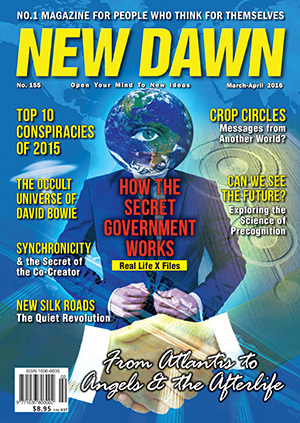
  • From Atlantis to Angels & the Afterlife: The Adventurous Life of Writer Ptolemy Tompkins

    From Atlantis to Angels & the Afterlife: The Adventurous Life of Writer Ptolemy Tompkins

    From New Dawn 155 (Mar-Apr 2016)

    The spiritual, the occult, the paranormal – these things have never sat well with the mainstream press. If they pay attention to such things, it is usually only briefly and with an eye to ridicule. Not surprisingly, the majority of writers on these topics are arrogant ignoramuses.

    This situation may be changing. A small cohort of writers has been developing who are willing to look intelligently, objectively, and engagingly at levels of reality that consensus opinion would rather ignore or condemn.

    One of these writers is Ptolemy Tompkins. The son of Peter Tompkins, best-known for his 1970s bestseller The Secret Life of Plants, Ptolemy (named after an ancient Gnostic philosopher, not the proponent of the geocentric theory) grew up in a world of the marvellous in the ’60s and ’70s, the heyday of the New Age. His stepbrother, Nicholas Vreeland, is a prominent Tibetan Buddhist abbot and was the subject of the 2014 film Monk with a Camera, which also features interviews with Ptolemy.

    As a writer, Ptolemy has staked out his own ground in these areas. His first book, Paradise Fever: Growing Up in the Shadow of the New Age, was a chronicle of his life and times as a child of the human potential movement. His other works include The Beaten Path: Field Notes on Getting Wise in a Wisdom-Crazy World; This Tree Grows out of Hell: Mesoamerica and the Search for the Magical Body; The Modern Book of the Dead: A Revolutionary Perspective on Death, the Soul, and What Really Happens in the Life to Come; and The Divine Life of Animals: One Man’s Quest to Discover Whether the Souls of Animals Live On.

    Ptolemy has also collaborated with Eben Alexander, M.D., on his bestselling books Proof of Heaven: A Neurosurgeon’s Journey into the Afterlife and The Map of Heaven: How Science, Religion, and Ordinary People Are Proving the Afterlife. For a number of years Ptolemy worked as a staff editor for the inspirational American magazines Guideposts and Angels on Earth. His latest book Proof of Angels: The Definitive Book on the Role of Angels and the Surprising Role They Play in Our Lives was published in February 2016. No matter what subject he covers, his prose is always fresh, lively, and candid.

    Ptolemy and I have been friends for several years, linked both by common interests and a number of mutual acquaintances. I conducted this e-mail interview with him in October 2015.

    RICHARD SMOLEY(RS): You had quite an upbringing. Your father, Peter Tompkins, was the author of The Secret Life of Plants and a well-known explorer of the metaphysical. What was it like to grow up in that environment?

    PTOLEMY TOMPKINS (PT): He was the coauthor, actually. His coauthor, Chris Bird, and his wife, Lois, were over at the Barn, the converted cow barn I grew up in, all the time. Chris was a great guy – bearish and jolly, and given to histrionics almost as much as my dad was. For the author photo for The Secret Life of Plants, it was decided that the two would look good posed among plants, so they had a shoot at the botanical gardens in DC. The two of them were arguing five minutes into the shoot.

    RS: What were some of the most interesting (and/or famous) personalities that you met when you were young?

    PT: I missed the night Liv Ullman came by for dinner. My dad was very taken with her. Ali McGraw was around a little bit, for reasons I don’t remember. In ’78 my father and my stepmother, Betty Vreeland, brought me along for a trip to Morocco during my spring break. I was in tenth grade at the time, and while in Tangier we went over to an old writer friend of Betty’s, a guy named Paul Bowles, who I’d never heard of. Bowles, astonishingly, had hash, and everyone had some social hits of it after dinner, as was the standard back then. I hardly ever opened my mouth at that age, or smiled either. But the hash was so strong, I’d never had anything like it. I retired to a corner of the living room and sort of dropped through a floor into a world of stoned-ness I’d not had any idea existed. My tendency at the time was to regard all the famous and fancy people my dad met with withering teenage disdain, but there was something about Bowles that I liked. He seemed oddly unphony. I rediscovered him in my early twenties as a reader. I think he’s one of the great prose stylists. As an adult, thinking back on that visit one day, I asked my dad what he’d thought of Bowles. “A bit potty,” my dad said. A typical response.
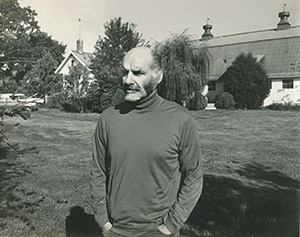
    Peter Tompkins, author of best selling titles in the fields of metaphysics and ancient mysteries, and co-author of The Secret Life of Plants. This photo, taken in 1971, is of Peter at the ‘Barn’, where Ptolemy grew up. Image courtesy of Ptolemy Tompkins

    RS: Your father had an amazing life in his own right. Wasn’t he an American spy behind the lines in Rome during World War II?

    PT: Yes, my dad was behind the lines. He wrote a book on it, A Spy in Rome. He posed as a Roman Fascist, and once had the SS officer in charge of finding him (they knew there was a spy somewhere about) over for dinner. He made him an omelette, an obvious luxury at the time, and the officer detailed the tortures they had in store for the American spy once they found him. Of course the rest of life pales a bit after something like that.

    RS: Your father at one point was vigorously engaged in the search for Atlantis. Could you talk a little about what it was like to take part in it? 

    PT: “Taking part” is probably an exaggeration. I was around. My dad was convinced that the Edgar Cayce readings about the rising of Atlantis were correct. He spent thousands and thousands of dollars photographing the limestone formations off Bimini – the so-called “Bimini Road.” My father loved the idea of Atlantis returning because he wanted the world to become a kind of new Eden. He was a true father of the New Age in this sense – he had the core New Age belief that the world once was, and would be again, a better place. But not better in some mundane sense, but in the sense of being elevated back into a spiritualised condition that it had fallen away from. That’s what the Bimini stuff was all about. Generally speaking, one had to be naked during the filming. There were often times when I was the only one aboard the various boats he hired with a bathing suit on. It drove my dad nuts.

    RS: With all of your exposure to the New Age counterculture, what things would you say are the most valuable that you learned?

    PT: My father taught me the fathomlessly valuable lesson that the mundane world we see around us isn’t all there is, and that if we’re impatient with the limitations of existence as it presents itself now, we are so with good reason. Deep within, we know there’s more. My dad was a pain in the neck to a lot of people. He was far from a perfect person, and he was, I’d say, genuinely a touch mad. But he had a certain nobility of character. He was, in his misguided and often destructive way, truly a great man. Many people think that about their fathers, of course. I think one of the reasons I’ve always been comfortable criticising and making fun of him is because I’m so convinced he had that core of greatness.

    RS: You’ve worked intensively with Eben Alexander in writing his two books, Proof of Heaven and Map of Heaven. Eben is best known for a long and powerful near-death experience he had when he was in a coma in 2008. Could you say a little bit about how you see his experience and how you regard him personally?

    PT: One belief about the world I hold very strongly is that, as the New Age adage has it, everything is significant. The problem, or rather the challenge, it seems to me, lies in celebrating that fact even when the significance one encounters is problematic. It’s great when you find a parking space just when you need one, but that doesn’t mean the world is some giant pinball machine rigged in your favour. Sometimes the odd synchronicities and resonances of life are much more challenging. In the case of Eben, my biggest struggle was just how similar my relationship to him was to my relationship to my dad. I was eleven when The Secret Life of Plants transformed my life overnight, and I got to see the effects of that kind of instant celebrity very close up. Yet at the same time I myself was completely invisible.

    The same thing happened with Proof of Heaven. I worked like a demon to get that book in shape for publication. It took me about four months, and by the time it was done, it was, experientially speaking, my book, not Eben’s. A great portion of the writing in it is by me, not Eben. At the same time, the book describes Eben’s life and his experience. I did not make anything up, and I had full faith in Eben’s honesty. When the book came out and went right to the top of the bestseller lists, and Eben was praised for his fine writing style, etc., I found myself in a situation that really did feel somewhat choreographed. Another person was being praised through the roof beams for a book that I had in large part written. I had, I realised, a couple of options, the only sensible one of which was to be completely unfazed by it. Who wants to be the kind of person who raises their hand at the back of class and says, “Hey, that was my idea, not his!” It began to seem quite clear to me, as the success of the book continued, that I should view the whole thing as a kind of lesson in humility. T.S. Eliot, in the Quartets, says that humility is endless. If T.S. Eliot says that, who am I to argue? So I just made a point of trying to celebrate the success of the book, the good that it was doing, and not get caught up in picayune gripes about not getting the attention myself.
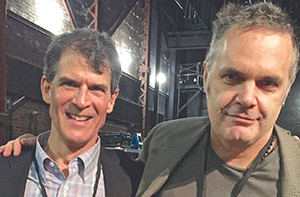
    Eben Alexander and Ptolemy at the Marion Institute in 2014. A great portion of the writing in Alexander‘s Proof of Heaven is by Ptolemy. Image courtesy of Ptolemy Tompkins

    It worked pretty well until that article came out in Esquire magazine which purported to rip the veil away and expose Eben as the calculating phony he really was. The article was full of errors, and made a very brief mention of me, three or four lines, most of them incorrect. I thought: Jesus, here this guy wants to discredit Eben, and he won’t even do me the service of using me as a tool to do so? Somehow I found this really irritating. Eben – again, like my dad – is a great guy, but he’s also frustrating.

    In the end, I came away feeling that his experience was true. There was something about the way he described it in our phone interviews that just made something in me click. It resonated. More than anything else, it reminded me of the visionary journeys made by a number of Persian mystics. One of my favourite books is Spiritual Body and Celestial Earth, an anthology of these experiences compiled and edited by the great French scholar of Islam, Henry Corbin. There were details in Eben’s narrative that brought that book to mind in a truly extraordinary way. Every detail of his journey, from his beginning in the subterranean murk to his meeting with the sister/angel figure to his journey beyond that meeting into the “dazzling darkness” where he encounters God… All of this was just so wildly resonant, and I somehow just knew he couldn’t have been making it up.

    RS: Could you talk about your own beliefs on the afterlife, for example as you discuss them in The Modern Book of the Dead?

    PT: For most of my adult and semiadult life, I have been obsessed with the idea of personal survival. That the you that is really you, and the me that is really me, does not fade away or fall apart with the death of the body, but continues on. Most importantly, I have been taken up with the idea that survival is above all else personal and individual. Nicholas Berdyaev, the Russian writer and philosopher, wrote a three-word sentence that sums all this up: “Personality is indestructible.”

    I was around in the ’70s when my stepbrother Nicholas Vreeland, the Buddhist abbot, first became interested in Buddhism. I looked up to Nicky a great deal, and as he wandered into Buddhist practice, I wandered into one Buddhist book after another. At first I was hugely taken with what I read. But gradually, something began to bother me. I realised the Buddhist focus on the unreality of self at all levels was something I could not accept. The key feature of life, for me, was that it was personal. People are personal, but so are animals and, for that matter trees and plants, just like my father said. Corbin said that in the world above this one, the primary question we ask about what we see there is not “what” but “who,” because up there, everything is a “who.” This is the root of why children love cartoons and fairy tales where everything is personalised, animated – that is, given an anima. The Buddhist suggestion that the self is actually not individual and eternal but aggregate and passing… well, by the time I was in my early twenties I found myself in open rebellion against this idea. I didn’t dislike Buddhism, and I continued to read Buddhist books. At the highest level, I do believe all faiths converge. But I believe that the level where this happens is, quite simply, so high that talking about it from our present vantage point is essentially impossible. I’ll tell you this: if there’s one belief I know I will absolutely never abandon, it is the value of personality – of the individual being. The fact that we, each of us, are both eternal and personal strikes me as the most interesting fact there is.

    RS: Another book of yours is The Divine Life of Animals. Many people are convinced that animals (especially their pets) do have a kind of afterlife. What did you discover in looking into this topic, and what do you think the truth is?

    PT: The Divine Life of Animals arose out of an article I wrote for a magazine called Guideposts where I worked for many years. The article was called “Will My Pet Go to Heaven?”, and it is not exactly a masterpiece of metaphysical speculation. What I discovered working at Guideposts is that there are a lot of wonderful people out there in America, and the world at large, who love their pets deeply and suffer intensely when they lose them. Imagine a woman living in, say, Iowa. Her husband served in World War II, and they live a long, happy, and traditional American middle-class life. Then, as so often happens, the husband dies first, and the wife, alone and heartbroken, begins to rely more and more on the company of her pet – a dog, let’s say. Then the dog dies. Suffering deeply, this woman turns to her clergyperson for reassurance that, just as her husband did not simply blip into nonexistence but exists still, in a world beyond this one, so too does her pet. Alas, her clergyperson, following a long (but far from unanimous) tradition among Christians, tells her that no, there are no dogs in heaven. This has the predictable result of devastating the woman. After all, she relies on her clergyperson for answers to the big questions, and what he or she says, she believes.

    I determined to marshal some evidence that the Christian faith (the faith of the vast majority of Guideposts readers) is far from unanimous on this point. The article received a mind-boggling number of letters in response. Some of these were from cranky by-the-book types assuring me I was wrong, but the vast majority were from people who had suffered the loss of a pet and were vastly grateful to hear, from a source they trusted, that there was more to the picture – that the essence of their pets had indeed survived. There’s a very popular poem called “The Rainbow Bridge” that describes how when a person dies, they will cross the Rainbow Bridge and be greeted by all the animals they have ever loved. This poem is saccharine to the point where it actually does hurt my teeth to read it. And yet, hidden beneath all the maple syrup, there is a core truth: there is a bridge between this world and the worlds above this one, and when we depart from this world, we do not vanish into an impersonal mush, but into a world that is specific and personal just as this world is, only more so. So that’s what I ended up enlarging into The Divine Life of Animals.

    Unfortunately – or perhaps just unavoidably – once I secured a contract for the book, I made it the kind of book I like. That is to say, a more complex one than most of those nice ladies who read Guideposts wanted. This has always been my problem as a writer. I’m too fancy for the people who like simple books, and too simple for the people who like fancy ones. So it goes!
    RS: Your latest book is called Proof of Angels, and you’ve spent a lot of time thinking and writing about people’s encounters with angels. What do you think about angels?

    PT: I think angels are real, and I wish I knew more about them. During my decade at Guideposts, I wrote regularly for Guideposts’ sister magazine, Angels on Earth. Once again, it has a readership largely composed of what you might call conventional, old-fashioned Christians. The original meaning of “angel” is, of course, “messenger,” and what chiefly interests me about angels is the way in which the appearance of one can instantly transform a person’s view of reality. You can’t really use the word “angel” anymore and have it convey any kind of genuine charge. It’s been too much doused in the maple syrup of market-driven spiritual writing (a problem that I know I myself contributed to). But originally, angels were beings characterised by their numinousness, their power, and what you might call their awfulness, taking the root of that word in its original sense, as something inducing awe.

    A crucial key to believing in angels today is to believe in demons too. This is much easier to do, or at least much easier for me to do, because while I bog down when I try to read Augustine or Aquinas on angels, I am riveted when a contemporary writer like Louis Proud or Joe Fisher describe their interactions with demonic beings. The whole succubus/incubus business, with people engaging in what, to hear them talk, is entirely satisfactory sexual congress with nonphysical beings, I find fascinating. There is much literature on this subject, and so much is just so believable. So belief in demons is a great sort of gateway drug to belief in angels.

    One of the single most momentous events in my adult life came when a friend demonstrated to me beyond all doubt that Ouija boards work. With patience and the right circumstances, the planchette really does move, and decidedly individual personalities, or subpersonalities, come through. Who or what are these entities? I don’t know. Is it a good idea to get involved with such entities? I would say no. But is there something real going on here? Absolutely. I’ve had it proved to me, and no one could de-convince me of what I experienced. So I’m very grateful to the demonic world. It had a hand in breaking down my culturally engrained positivist/materialist tendencies that were hardwired into me as a member of modern culture. I see a little more of the real world – the world that is partially material but in much larger part spiritual – as a result of that brief flirtation with the murkier levels of the spiritual world.

    RS: In this whole field, how do you personally separate fact from imagination?

    PT: I think one of the absolutely central keys to accepting the reality of the spiritual world is understanding that all perception is a collaborative event. We are co-builders of everything we see and experience. Ordinary, mundane reality is a creation that takes a fantastically complex amount of work on the part of our brains and unconscious minds to put together. The notion that anything we encounter in our world is just “there” and that we are seeing it objectively, with no help from our imaginative faculty, is, as Coleridge tried so hard to tell us, absurd. The world is a labyrinth, and separating the real from the unreal is a task that greets us anew each day when we wake up (and, if we listen to the traditions, one which will continue to challenge us after we die, only more intensely).

    What to hang on to in this carnival of mirrors? I think the Hungarian Anthroposophist Georg Kühlewind was on to something very important when he said that if we experienced the reality of ourselves – the inner “I” that is our true identity – with the concreteness that we experience an object that we can touch and feel in the material world, most of our problems would vanish. In line with that, I think I’d say that the first thing to do to stay oriented in the maze of existence – both incarnate and disincarnate – is to come to an unshakable belief in the reality of ourselves. Before we can believe anything “out there” can be real, we have to believe – to know – that we ourselves are real. The whole initiatory tradition, from Greece on back to Egypt and who knows where, seems to have that as its primary argument. I’d say that’s what my dad believed, so in that and many another respect, I’m very much his son.

    Ptolemy’s books – including his latest Proof of Angels – are available from all good bookstores and online retailers. His website is www.ptolemytompkins.com.

    Photos of Peter Tompkins/Ptolemy Tompkins courtesy of Ptolemy Tompkins.

    [alert type=”general” dismiss=”no”]This article was published in New Dawn 155.[/alert]

    [alert type=”success” dismiss=”no”]If you appreciate this article, please consider subscribing to help maintain this website.[/alert]

    © New Dawn Magazine and the respective author.
    For our reproduction notice, click here.
  • Who Are The Controllers?

    Who Are The Controllers?

    From New Dawn 156 (May-June 2016)

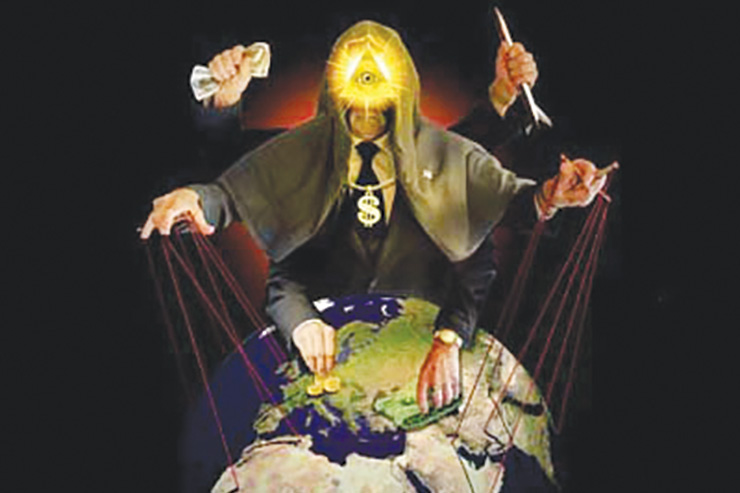
    In the West, we’ve all been spoon fed the idea that we are free citizens of sovereign countries, where our democratically elected governments rule according to the peoples’ wishes. If that’s not achieved, it’s usually explained as being due to misfortunes such as crises, security threats or wars, or the stupidity of our governments. The few people that doubt these explanations, or even suspect hidden hands behind the occurrences of our time or the official narrative of our history, are easily dismissed as conspiracy nuts.

    Our Rulers in Ancient Times

    For sure, there were no hidden hands when humanity was in its “pre-history,” predating our “real history” as seen by most. For about 200,000 years our ancestors lived in small nomadic communities, sharing the food obtained by hunting and gathering. Problems, plans and rules were settled in probably long discussions, where the opinions were usually harmonised until a consensus was reached. Our pre-historic world was ruled by highly sovereign people.

    Things started to change about 10,000 years ago with the revolutionary innovations of crop and livestock farming. Many communities became sedentary and small villages grew bigger. The makers of tools, clothes, pottery or art had to barter with the people producing food. At some point, money such as shells or clay tablets came in as a handy substitute for bartering. Then silver and gold coins appeared, and inevitably, some people became poorer and others richer. Next, people with a surplus started to lend their money to people in need of it. At times as a favour, but usually against interest.

    It was then discovered that even a small percentage of interest applied over a few years would quickly double a debt, e.g. 10% over seven years. Thus, the treacherous power of usury revealed itself, capable of destroying the fabric of any egalitarian society. The ancient knowledge of the wreckage caused by usury led to its prohibition in the three Abrahamic religions: Christianity, Islam and Judaism. Today, it’s still forbidden in Islam.

    Through usury, the first bankers of Babylon became so wealthy and powerful that they controlled kings and priests. Commercial laws were drawn up that protected the elite and even gave them the right to treat conquered people as a commodity: Big Slavery, in multi-colour, became a key business. After the fall of Babylon, other empires like the Persian, the Phoenician and the Roman came and went. In all, the question “who rules the world” was easy to answer.

    Fast Forward to the Middle Ages

    In the Middle Ages, Europe was overtly ruled by a landed aristocracy that kept rural people in feudal serfdom, obliging them to deliver part of their harvest in exchange for protection. The dominating religion was Catholicism, which forbade usury. Yet, there was a high demand for money lending, and only Jews were permitted to do so (however, they were religiously forbidden to lend money to other Jews). They were among the few people skilled in writing and accounting, and through their networks large amounts of money could be lent to high-placed debtors. Lending was a very lucrative business, but also risky as guarantees were often feeble. Taxing of subordinates was commonly used to solve the problem. This unpopular task was often left to the lenders, and such tax-farming activities caused them to be hated by the people. After earlier expulsions elsewhere, the Inquisition threw the Jews out of Spain in 1492 and out of Portugal in 1496. Because of their capital and international networks, they were welcomed in Holland and Venice.

    In the early 1600s, Holland was a rising star, while Venice – the richest, oldest and probably most perfidious European empire – was struggling to recover from an extermination attempt by the Cambrai league of European forces. Using a new shipping route around Africa, the Portuguese were taking over part of their lucrative Asia trade. Besides, Venice was not well located for business with the newly discovered and already booming (via stolen gold and silver) Americas. Hence, an endeavour was started to develop a new and larger empire, with safer and better located bases on the Atlantic coast in Holland and England. These Protestant lands were usury-friendly, and thus promising grounds for the development of a novel, less risky lending system. The participants were the ambitious Giovani faction of Venetian oligarchs (as empire specialists), rich Sephardic Jews expelled from Spain and Portugal (as financial specialists), and opportunistic Anglo-Dutch Protestant nobility and aristocracy (as puppets and profiteers).

    The ground for this tripartite project had been prepared from the early 1500s when the Venetian oligarchy’s divide-and-rule policy supported the Protestant revolution in Northern Europe.1 Venice also aided the new Protestant Dutch Republic in its long struggle with Catholic Spain (1568–1648), and later had a heavy hand in the instigation of the disastrous 30-year war between European Protestants and Catholics (1618–48).2

    Venetian and Sephardic capital and knowledge was an important driver behind the British and Dutch East India companies (established around 1600), with Venetian banking experience transferred to the Dutch Venice as the Bank of Amsterdam (1609). Stock of these and other companies was traded at the Amsterdam and London stock exchanges. Amsterdam even offered call and put options, which led to the tremendous collapse of the Tulip bubble in 1637. With a little Sephardic-Venetian help, the tiny Dutch Republic was catapulted into global empire and its Golden Century. In the meantime, Britain was being prepared for its future role as a much greater and safer base. Both countries took over the Venetian trade in slaves, silver and gold bullion, and drugs, and were also active in piracy and the colonisation of faraway lands – yes, to spread Christianity, no moral dilemmas here!

    Later, in the 17th century, Venetian-Sephardic sponsoring enabled the take-over of Britain by Oliver Cromwell. They also financially backed an expensive invasion army led by Dutch puppet William III of Orange that led to the overthrow of King James II of England, known to history as the 1688 Glorious Revolution. Six years later, the Bank of England was established as a private bank with a monopoly on the emission of money as interest-bearing debt. Very quickly, the war-eager William got the State highly indebted to the new bank. At the same time, tax laws were installed to guarantee repayment by the State and eliminate risk for the bankers. Of course, the State could have produced its own money without having to pay any interest or taxing its people, but that was clearly not part of the deal made by corrupt governors. The outcome was the heavy but hidden golden crown on the tripartite endeavour that had started almost two centuries before. The bankers were the new rulers of the world, but for the first time in history they were invisible to the people: hereafter, usury was extended covertly and gradually to all citizens, including to those without bank loans.

    Aided by Dutch finance capital, Britain soon became the dominant world power, and the channel for widespread international usury systems, both overt and covert. The only exception were some Muslim countries (one reason why they are being destroyed since 9/11). The great deceptive and controlling power of the money masters behind the scenes is best illustrated by the incredible fact that until very recently, almost nobody ever questioned this system: neither economists, governments or investigative journalists, nor political parties, not even die-hard socialists or Marxists!

    [alert type=”info” dismiss=”no”]If you appreciate this article, please consider a subscription to New Dawn magazine.[/alert]

    Project for a New World Order (NWO)

    During the 19th century, one family became the controller of finance capitalism, both overtly in the British Empire and Europe, and covertly in the USA via their fronts, the Morgan and Kuhn-Loeb banks. From their headquarters in The City of London, the Rothschilds accumulated probably half of the world’s wealth, not only via hidden usury, but also from open usury on loans to kings, countries and corporations. It was only a matter of time before the Rothschild banking family teamed up with the American Rockefellers and their Big Oil companies.5

    In the early 20th century, the Rothschilds, Rockefellers and their global corporations and networks were more powerful than any country on earth. According to then US President Woodrow Wilson: “Some of the biggest men in the United States are afraid of something. They know there is a power somewhere, so organised, so subtle, so watchful, so interlocked, so complete, so pervasive that they had better not speak above their breath when they speak in condemnation of it.” That power bribed politicians (including Wilson and subsequent US presidents), infiltrated opposition and media, corrupted governments, and hijacked science. To join their games, you had to sell your soul to the devil, and suddenly doors or markets opened, careers or stocks soared, and you made loads of money!

    Moreover, banker shrewdness got most of the dirty work done through subordinates and the raw power of money: empires, their armies and secret services; the mafia; the military and industry; and even idealistic or revolutionary movements. And it even worked on the small people, as our decisions often favour money and not life. These elites financed wars and political assassination, often manufacturing events (i.e. false flags attacks) to provoke conflict in their favour. This power was utilised extensively last century – over 140 million deaths – as part of a strategy to guarantee their position at the top.

    The step-by-step multi-generation NWO project has been masterly outlined by Richard K. Moore in his article A Brief History of the New World Order.

    “WWI was the epochal event that began an identifiable program toward a new world order, a single global hierarchy… under the control of elite financiers… Britain was no longer the obvious choice, as the base for a global power grab. So the decision was made to shift hegemony from London to Washington… WWI was the making of America, as a world power… While Europeans and Brits were being slaughtered in their millions, Americans were experiencing boom times, leading into its golden age of the roaring 1920s… allies were encumbered by astronomical debt to the American Treasury and to the banking elite…

    “We could say that America won WWI, and all of Europe lost – and lost big. The Europeans were bound to pay America huge sums for the privilege of having devastated one another… Britain had won the battle for Europe, for a while; America had won the battle for strongest nation, for a longer while – but it was the banking elite who won the war – for discretionary power over the future course of world affairs.”6

    The once secret story of the staging of WWI is told in Hidden History: The Secret Origins of the First World War by Jim Macgregor and Gerry Doherty.7 A secret elite of the British empire prepared the operation. Should the Sarajevo trigger have failed, a backup scenario was in place – the sudden discovery of German weapons they’d smuggled to Ireland. The Rothschild and Rockefeller-controlled oil companies could have shut off Germany and its war machine at once, but that never happened. When, in 1915, a food shortage threatened to stop Germany fighting, the banksters quickly guaranteed them a massive supply through the fake Belgium Relief Commission, led by their agent and ‘philanthropist’ Herbert Hoover – later to become US president. Thus, the genocide could go on, resulting in 17 million deaths and 20 million wounded, often severely mutilated.8

    Naturally, the Machiavellian banksters “never let a good crisis go to waste.” With the same chutzpah, they helped instigate other important NWO projects under the cover of WWI such as the Bolshevik Revolution in Russia, the League of Nations (precursor for the United Nations) and the Balfour Declaration, the opening move for the Zionist Israel project. After the war, thousands of agents were used in a massive cover-up operation, again directed by Herbert Hoover who filled his new Institution at Stanford University with shiploads of documents from all corners of Europe. In the early 1920s he was involved in another ‘humanitarian effort’ to save the Soviet Union from starvation – while at the same time preserving a future ‘arch enemy’.

    After four pointless – for the people – years of war, the Germans were forced to take all blame. At the Versailles ‘Peace’ Conference, the bankers guaranteed debt repayment and the conditions for their next NWO project, WWII. In excerpts from the same article by Richard Moore:

    “WWI had been such a successful project that planning began immediately for a grander sequel, another giant step toward a new world order. In the early 1920s, still in the days of the Weimar Republic, a team of Krupp engineers were secretly tasked with a project: come up with designs for a line of military equipment suitable for a war twenty years from now. Thus were conceived the advanced weapons that served the Reich so well when the time came. Even though Germany was destitute, and treaty-bound not to rearm, someone knew, and told Krupp, that all this would change – and within the designated timeframe…. Hitler was a project of the Anglo-American bankers. His charismatic brilliance was noticed early… and immense profits were made by investing in the German rearmament process… [see Conjuring Hitler by Guido Preparata] The WWII project achieved all of its objectives admirably. While having fought only marginally, and suffered negligible casualties – in comparison with the other major combatants – the US emerged with an intact infrastructure, 40% of the world’s wealth and industrial capacity, control of the seven seas, a monopoly on atomic weapons, strategic footholds in the Middle East oil sheikdoms, and general popular acclaim as the heroic champion of democracy. Quite naturally, the world’s eyes turned to Washington for leadership in shaping the postwar world.

    “And America was ready with a blueprint. The bankers had selected a committee, from their Council on Foreign Relations, and sent it over to the White House to design the postwar architecture. America was now secured as a hegemonic base of operations, more viable for that role than Britain had been, and it was time to move forward with the next phase of the new-world-order project. Thus were launched, promptly after the war ended, the Bretton Woods globalist institutions – the UN, IMF, and World Bank – the early foundation stones for an eventual one-world government.”

    The Power to Turn Truth on Its Head

    The banksters’ unimaginable power of deceit turned the truth upside down, making into heroes the very instigators of these destructive wars. How on earth did they manage that? Through control of the mainstream media, science and academia (in particular history and economics), the education system and the entertainment industry. That’s how they shape our perception of the present and the past, and that’s how the majority of people are kept in ignorance of these machinations. When the truth is finally heard, it’s difficult to grasp because the lies are so big, the scope so vast, and the real events of history so different to what we’ve been told. To wake up and accept the truth about the situation, and acknowledge we’ve been duped, most people go through the painful process of cognitive dissonance,9 which is like losing part of your identity.

    Today, much disinformation comes via the Internet, false and dead-end paths to keep you distracted and away from the truth: the conspiracy for world domination has variously been linked to the Jesuits, the Jews, the Illuminati, the British, the Zionists, the Nazis, the Freemasons, etc. These groups have indeed been involved but always as pawns and dupes of the banksters. History reveals the banksters hold no loyalty to any race, nation, group or religion. They are their own gods, all others their slaves, either classified as useful fools or useless eaters to be reduced in numbers.

    The next enemy project had been long on the waiting list: Islamic extremism! ‘Court’ scientist Samuel Huntington prepared the public with his The Clash of Civilizations, its message spread by more than a hundred think tanks. Then came 9/11, the war on terror, and the erosion of civil rights in all so-called Western democracies. Ever since, under the guise of bringing ‘democracy’ to former dictatorships, the playing field for their New World Order is being levelled by the removal of the last few independent countries.10

    What Can We Do?

    The future, as designed by the masters of this ‘global plantation’, would look like Huxley’s Brave New World or Orwell’s 1984.11 If we know who rules the world, the big question then becomes: what we can do to protect our already weakened freedoms? My answer is anything that empowers the people and their nations, favours life and not money, and makes us less dependent on the Big Banks and Big Corporations:

    • Strive for prohibition of war, because wars in modern times are bankster-designed wars.
    • Return sovereignty to our nations, with proper international relations and leagues for peace and collaboration, as US president John F Kennedy and Gandhi wanted.
    • Spread the true story of our world and its wars, which should be included in our education systems, media and the science of history.
    • Less corporate and bank control: no cashless societies or predatory corporate trade agreements like TPP or TTIP (these are about “power” not trade).12 Stop projects to give all poor people in developing countries a bank account or a microcredit. Get out of debt to banks as soon as possible, also an important safety measure in a troubled future.
    • Set up interest-free money systems as proposed by Margrit Kennedy and her successors, e.g. Positive Money, www.positivemoney.org.
    • Oppose more loss of privacy by SMART-meters, the Internet-of-Things, human microchip implants (RFIDs), laws to increase the surveillance powers of authorities, etc.
    • Turn off the controlled mainstream media and inform yourself through independent journalists, writers, and magazines.
    • Go organic and/or grow your own: not only healthy for you and the environment but also independent of Big Agriculture, dangerous GMOs, and oil-derived pesticides and fertilizers.13
    • Support local initiatives like renewable energy generation, food markets, health services, and insurance schemes.
    • Keep a healthy lifestyle and avoid Big Pharma solutions whenever you can.14

    A massive wake-up by “we, the people” is urgently required if we are to end this wicked game. Spread the word and engage in peaceful action!

    [alert type=”general” dismiss=”no”]This article was published in New Dawn 156.[/alert]

    [alert type=”success” dismiss=”no”]If you appreciate this article, please consider subscribing to help maintain this website.[/alert]

    Footnotes

    1. Through the handling of Luther by Venetian-trained Spalatin, and by Francesco Zorzi of Venice who advised Henry VIII in England to abolish Catholicism and also bringing novel ship building techniques to England.
    2. See also Webster Tarpley’s Against Oligarchism, http://tarpley.net/online-books/against-oligarchy/
    3. According to the Positive Money website www.positivemoney.org, “Positive Money is a movement to democratise money and banking so that it works for society and not against it. Our current financial system has left us with the highest personal debt in history, unaffordable housing, worsening inequality, high unemployment and banks that are subsidised and underwritten with taxpayers’ money. We believe that these problems have a common root: money.”
    4. See www.margritkennedy.de and Dr. Margrit Kennedy’s article ‘If money rules the world, who rules money?’ at www.margritkennedy.de/media/art_forum_csr_international_1_2008_28.pdf
    5. See James Corbett’s video www.corbettreport.com/how-big-oil-conquered-the-world/
    6. ‘A Brief History of the New World Order’ by Richard K. Moore, www.serendipity.li/capitalism/new_world_order.htm
    7. See also their blog www.firstworldwarhiddenhistory.wordpress.com & ‘The Secret Origins of the First World War’ by Gerry Docherty & Jim Macgregor in New Dawn Special Issue Vol 9 No 1.
    8. See The Iboga Visions by Jim Macgregor.
    9. The dictionary definition of cognitive dissonance: “the state of having inconsistent thoughts, beliefs, or attitudes, especially as relating to behavioural decisions and attitude change.”
    10. See Richard Moore’s Full Spectrum Dominance, www.serendipity.li/capitalism/full_spectrum_dominance.htm
    11. See also Richard Moore’s The Elite Plan, www.serendipity.li/capitalism/prognosis_2012.htm
    12. ‘The Predators Behind the TPP (14 Oct. 2015)’, www.karelvanwolferen.com/49-the-predators-behind-the-tpp-14-oct-2015/
    13. The hijacking of world agriculture is covered in Seeds of Destruction by F. William Engdahl.
    14. See Peter Gotzsche’s book Deadly Medicine and Organized Crime and read Eustace Mullins’ Murder by Injection, www.whale.to/x/Murder by Injection.Eustace Mullins.pdf

    © New Dawn Magazine and the respective author.
    For our reproduction notice, click here.

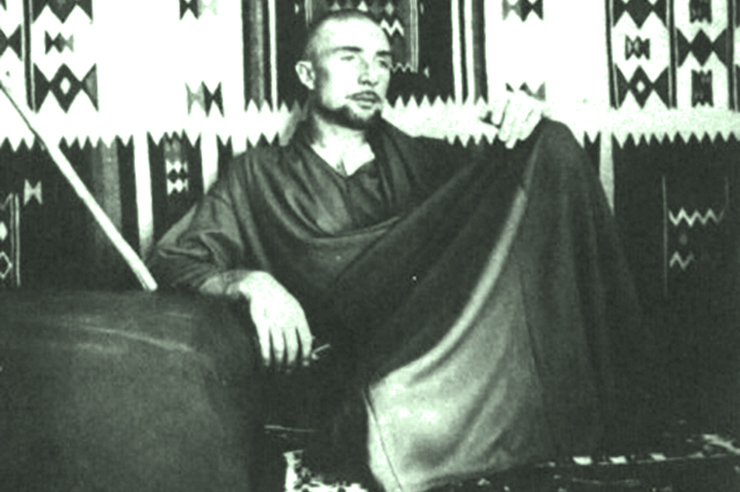
  • Nothing Is True, Everything is Permitted: The Untold Story of Brion Gysin

    Nothing Is True, Everything is Permitted: The Untold Story of Brion Gysin

    From New Dawn 154 (Jan-Feb 2016)

    If Brion Gysin had not existed, it probably would have been necessary to invent him, as the saying goes. Pre-eminent multimedia psychedelic shaman of the latter-half of the twentieth century, Gysin was something of a jack-of-all-trades: artist, calligrapher, entrepreneur, kinetic sculptor, novelist, performance artist, photographer, poet, raconteur, restaurateur, and traveller in this-and-other worlds. Brion did it all.

    Even a brief list of the names he crossed paths with sounds like a veritable who’s who: Laurie Anderson, Francis Bacon, David Bowie, Paul Bowles, Ira Cohen, Ornette Coleman, Max Ernst, Marianne Faithfull, Leonor Fini, Jean Genet, Keith Haring, Billie Holliday, Brian Jones, Timothy Leary, Iggy Pop, Genesis P-Orridge, Patti Smith, Gore Vidal – and, of course, his long-term friend and collaborator, William Burroughs – are among the friends, fellow-travellers and sometimes collaborators that have spoken of their admiration for the man and his work. As his biographer, John Geiger, wrote:

    Brion Gysin may be the most influential cultural figure of the twentieth century that most people have never heard of.

    ‘Brion Gysin’ was originally John Clifford Brian Gysin, born 19 January 1916 in Taplow, Buckinghamshire, England. He never knew his English-born father, who had emigrated to Canada, just in time to marry and father a child, before joining up and getting sent back to Europe to die in the First World War. After moving back to Edmonton in Canada with his young widowed mother, Gysin always preferred to stress his Swiss ancestry via his paternal grandfather, but even then he would complain later in life concerning the ‘delivery’ of his birth:

    Wrong address! Wrong address! There’s been a mistake in the mail. Send me back. Wherever you got me, return me. Wrong time, wrong place, wrong colour.

    The young Gysin wanted to “have adventures and see visions” and figured that Paris was the place. Moving there at 18, his career as a painter should have got off to a spectacular start: a chance encounter with Marie-Beth Aurenche – then still the first Mrs Max Ernst – gave access to the hottest scene in town, the Surrealists. Without formal art tuition, Gysin got some basic tips from the Argentinian spitfire, Leonor Fini, but the main lesson came from visiting Ernst’s studio and seeing that the objective was “to make the paint make the painting.” Barely 19, Gysin was soon invited to exhibit alongside Ernst, Fini, and Valentine Hugo – as well as Dali, Magritte and Picasso – but before the show’s opening his work was taken down by poet Paul Eluard, on orders of the ‘Pope’ of Surrealism, André Breton. Gysin never really found out why, but he was sure the fact he had just come out as homosexual had something to do with it. Whatever the reason, it was a crushing blow.

    Disillusioned, Gysin took off travelling, first to Greece and then Algeria. On his return to the States in 1939 he met a number of former Surrealists who had fled war in Europe. He shared a studio with the Chilean Roberto Matta, the beginning of a lifelong friendship, and also worked on Broadway as a scene painter, befriending the successful songwriter John La Touche. A lifelong enthusiast of cannabis, Gysin also started to hang out and ‘turn on’ with Black Jazz musicians such as Billie Holliday. Another significant connection was Eileen Garrett, celebrated society medium and psychic, whose abilities landed her in trouble with the authorities. During a séance, Garrett had apparently been contacted by the spirit of the captain of the British dirigible R-101, who gave such convincing details concerning the airship’s terrible crash that she was arrested under the Official Secrets Act on suspicion of espionage!

    “That’s My Music!”

    Serving during the Second World War, Gysin became a naturalised American, changing his name officially from ‘Brian’ to ‘Brion’. In the army Gysin was sent on a 18-month course to learn Japanese, including calligraphy, later to have a major impact on his art. He also met Tex Hanson, grandson of Josiah Hanson – inspiration and basis for Harriet Beecher Stowe’s 1852 bestselling novel Uncle Tom’s Cabin. Through this friendship and the access it gave him to the world of Black Canadians, Gysin wrote To Master – A Long Goodnight, which was published in 1946 thanks to Eileen Garrett. This and the related text, A History of Slavery in Canada, won Gysin one of the first-ever Fullbright Scholarships. He used the money to travel to Tangier, Morocco with his new friend, composer and novelist Paul Bowles. Together they would explore the trance music of the ecstatic brotherhoods, and one day in 1950, attending a festival on the beach outside Tangier, Gysin had what would be for him a decisive encounter:

    …it was the first time I’d seen large groups of people going into trance – [that in itself] was enough to have kept my attention, but beyond and above all of that I heard this funny little music, and I said: “Ah! That’s my music! – I just want to hear that music for the rest of my life. I wanna hear it every day all day.”

    It turned out to be the music of the Master Musicians of Joujouka, a collective of Berber Sufi trance musicians originating from the small village of that name, south of Tangier in the foothills to the west of the Rif Mountains in northern Morocco. As Gysin would later write in respect of his first encounter with the stirring, primal, hypnotic music of reeds, pipes, and goat-skin drums:

    Magic calls itself The Other Method for controlling matter and knowing space. In Morocco, magic is practiced more assiduously than hygiene though, indeed, ecstatic dancing to music of the brotherhoods may be called a form of psychic hygiene. You know your music when you hear it one day. You fall into line and dance until you pay the piper.

    After managing to attend the Festival of Bou Jeloud in Joujouka for the first time, Gysin recognised that:

    Their secret, guarded even from them, was that they were still performing the Rites of Pan under the ragged cloak of Islam.

    Gysin’s interpretation was that Bou Jeloud was an avatar of the Greek god Pan that survived from pagan times, as had been put forward by the pioneering socio-biologist, Edvard Westermarck, in his 1933 study Pagan Survivals in Mohammedan Civilization. So, the “magical music” of the Master Musicians was, quite literally, a manifestation of the Pipes of Pan.

    Meeting William S. Burroughs

    In Tangier, Gysin would also meet the American writer William S. Burroughs – who later became his greatest friend and collaborator – but at first neither made a particularly favourable impression. Burroughs was still in the throes of a full-on heroin addiction, and had not yet written the monstrous masterpiece, Naked Lunch, that would make his name. He dismissed Gysin as catering – quite literally – to Tangier’s expat community of “uppity queens” with his restaurant, The 1001 Nights. It boasted Arab dancing boys, an in-house residency by the Master Musicians of Joujouka, and Gysin’s friend Hamri – ‘The Painter of Morocco’ – was main cook. It all ended in tears, though. Brion would later tell how he had been the target of a curse intended to oust him from his business:

    …while getting the restaurant ready I found a magic object, which was an amulet of sorts, a rather elaborate one with seeds, pebbles, shards of broken mirror, seven of each, and a little package in which there was a piece of writing, and the writing when deciphered by friends who didn’t even want to handle it, because of its magic qualities, which even educated Moroccans were not anxious to get in touch with, but it said something like, an appeal to one of the devils of fire, the devil of smoke – to take Brion away from this house: as the smoke leaves this chimney may Brion leave this house and never return…

    The Third Mind

    Relocating to Paris, after briefly enjoying the hospitality of the Princess Ruspoli, Gysin moved to completely the other end of the social spectrum, moving in to the nameless fleapit hotel at 9 Rue Gît-le-Cœur in the Latin Quarter. It was here in Paris that Gysin would run into Burroughs again, and this time they hit it off. Burroughs, likewise, moved into the so-called ‘Beat Hotel’ and the two of them embarked on their own equivalent of the poet Rimbaud’s “sustained and systematic derangement of all the senses” – the psychic fusion they referred to as “The Third Mind.” Gysin helped steer his new friend through the emotional rapids of heroin withdrawal, and allowed Burroughs to watch him at work on his art. Burroughs was wide open without the safety blanket of junk, and Gysin felt vulnerable and exposed working in front of his new friend. He rarely if ever let people see him paint, saying it was a more private act than masturbation. It must have been incredibly raw bonding indeed. It was as if the first cut-up they created together, this “project for disastrous success” as they called it, was with their very souls: and it was out of this commingling that all their subsequent collaborations would proceed. The very notion of ‘The Third Mind’ was itself a kind of psychic cut-up, named for the idea in Napoleon Hill’s 1937 self-help book, Think and Grow Rich:

    No two minds ever come together without, thereby, creating a third, invisible, intangible force which may be likened to a third mind.

    The atmosphere around Burroughs and Gysin in those early days at the Beat Hotel was steeped in the occult, with daily experiments in mirror-gazing, scrying, trance and telepathy, all fuelled by a wide variety of mind-altering drugs. Scrying is the very old and almost universal practice of gazing into a crystal ball, mirror, or other reflective surface, so as to access a form of spirit vision, usually for the purpose of divination. Brion conducted scrying marathons, sitting cross-legged in front of the mirrored armoire in his tiny room for up to 36 hours, tears streaming down his face from unblinking eyes, as friends passed the occasional cigarette, cup of coffee, or joint to help keep him going. He described how:

    …you see great galleries of characters, running through… scientists… in their sort of 19th century labs… whole events or whole scenes sort of frozen… And faces which never existed, and great chieftains of unknown races, and so forth and so on, going back and back further and further in time and history… after certainly more than 24 hours of staring… where there seemed it was a limited area that one could see only a certain distance into, uh, where everything was covered with a gently palpitating cloud of smoke which would be about waist-high… that was the end, there was nothing beyond that…

    From tales of Hassan-i Sabbāh, Old Man of the Mountain and Master of the Assassins, to magic and music in Morocco, Brion was a spellbinding storyteller. As psychedelic guru Timothy Leary later wrote:

    Brion dispenses blessings, visions, communications, poetic sermons, and wicked gossip – the world of the occult is his planet. Gysin is one of the great hedonic mystic teachers.

    [alert type=”info” dismiss=”no”]If you appreciate this article, please consider a subscription to New Dawn magazine.[/alert]

    The Cut-Up Technique

    September 1959, and Brion Gysin was using a Stanley knife to cut through paper to make mounts for some drawings he was working on. In the process Gysin sliced into copies of the New York Herald Tribune spread out as a cutting mat. Seeing the various strips of paper and reading the chance combinations his blade had produced, he laughed so uproariously the neighbours were concerned for his sanity. When Burroughs returned, Gysin showed him the results – almost as an afterthought, “an amusing Surrealist diversion” – but Burroughs was immediately struck by the technique and its potential:

    The cut up method brings to writers the collage which has been used by painters for fifty years. And used by the moving and still camera… And photographers will tell you that often their best shots are accidents… writers will tell you the same. The best writing seems to be done almost by accident but writers until the cut up method… had no way to produce the accident of spontaneity. You cannot will spontaneity. But you can introduce the unpredictable spontaneous factor with a pair of scissors.

    Gysin himself felt that, ultimately, he was unable to make the cut-ups work for him the way they worked for Burroughs. Instead, he focused more on permutations: he would take short, simple phrases and run them through every conceivable combination and juxtaposition, producing hypnotic, mantra-like formulae, such as:

    Come to free the words
    To free the words come
    Free the words to come
    The words come to free
    Words come to free thee!

    But even with such an apparently impersonal process as this, Brion the self-mythologiser was able to see occult forces at work, claiming:

    The permutations discovered me – because permutations have been around for a long time; in the whole magic world permutations are part of the Cabalistic secret…

    The notion of ‘Cabalistic secrets’ also applied to the latest developments in Gysin’s visual art: he had begun painting calligraphic works, based on the writing of Japanese in vertical columns and Arabic to be read right-to-left, overlaid in grids inspired by the very ‘magic square’ that had been used to curse him in Tangier. The results ranged from the subtle to the truly complex, each uniquely his own. As the painter George Condo would later remark:

    [Gysin] built up an authentic Eastern painting in an authentic Western manner.

    The Dreamachine

    A startling visionary experience Gysin had in the back of a bus in December 1958 lead to the next experimental revelation. As he recorded in his diary:

    Had a transcendental storm of colour visions today in the bus going to Marseilles. We ran through a long avenue of trees and I closed my eyes against the setting sun. An overwhelming flood of intensely bright colours exploded behind my eyelids: a multidimensional kaleidoscope whirling out through space. I was swept out of time. I was out in a world of infinite number. The vision stopped abruptly as we left the trees. Was that a vision? What happened to me?

    When Burroughs later read The Living Brain by W. Grey Walter, he made the connection with his friend’s strange visionary experience immediately. Walter, an American-born British neurophysiologist, had been researching the effect of controlled flicker on states of consciousness via the use of precisely calibrated stroboscopes, and with the help of early EEG equipment had put forward a model of varying brainwave frequencies corresponding to different states of consciousness. Apparently a flicker rate of 8-to-13 cycles a second induced what Walter dubbed “alpha rhythms” which “predominantly originate… during wakeful relaxation with closed eyes” and, interestingly, also during REM sleep (i.e. during dreaming.) Obviously Brion had experienced a spontaneously-occurring flicker experience, no doubt caused by the exact rhythm of the sunlight flickering through the trees as the bus drove past, thought Burroughs. The question was, though, how to reliably reproduce the flicker effect? The answer came from their young friend, Ian Sommerville, a gifted mathematician, who had also read Walter’s book, and wrote:

    I have made a simple flicker machine; a slotted cardboard cylinder which turns on a gramophone at 78 rpm with a light bulb inside. You look at it with your eyes shut and the flicker plays over the eyelids. Visions start with a kaleidoscope of colours on a plane in front of the eyes and gradually become more complex and beautiful, breaking like surf on a shore until whole patterns of colour are pounding to get in…

    Gysin was quick to promote both the ‘Dreamachine’ and his discovery of it – going so far as to register a patent, Procedure and apparatus for the production of artistic visual sensations (although many later felt that the credit really should have gone to Sommerville.) Ever the charismatic raconteur and self-mythologiser, Gysin spun a web of wonder about “his” flicker device, creating a suitably esoteric and esteemed pedigree, telling interviewers:

    …one knows of cases – in French history, Catherine de Medici for example, had Nostradamus sitting up on the top of a tower… and he used to sit up there and with the fingers of his hands spread like this would flicker his fingers over his closed eyes, and would interpret his visions in a way which were of influence to her in regard to her political powers… they were like instructions from a higher power… Peter the Great also had somebody who sat on the top of a tower and flickered his fingers like that across his closed eyelids…

    Of course, it was too good to be true. For all that the “cosmonauts of inner space” of the Beat Hotel thought that the Dreamachine could be “the drugless turn-on of the 60s” illuminating the world for the price of a light-bulb, it was never really going to have the kind of mass appeal they might have hoped for. Marianne Faithfull – who would meet Gysin for tea in Mayfair during her “lost years” – recalled her first impressions of the Dreamachine, and her answer gives some sense of the associations that probably stopped the device from catching on commercially:

    I remember going to an exhibition of Brion Gysin, and there was the Dreamachine… I mean I knew it was really special ‘cos I think I was tripping… Only a magical creature could think up something like that – it is like a wonderful idealistic idea, but you know it’s never gonna fly…

    Here To Go

    In his 1969 novel The Process, Gysin declared rather grandly:

    Of course the sands of Present Time are running out from under our feet. And why not? The Great Conundrum: ‘What are we here for?’ is all that ever held us here in the first place. Fear. The answer to the Riddle of the Ages has actually been out in the street since the First Step in Space. Who runs may read but few people run fast enough. What are we here for? Does the great metaphysical nut revolve around that? Well, I’ll crack it for you, right now. What are we here for? We are here to go!

    In 1974 Gysin was hit badly by a diagnosis of cancer, followed first by unsuccessful cobalt treatment and then a colostomy. He returned to Paris “to die” he said – but eventually began to rally, and with the help and encouragement of friends resumed work. He wrote to William Burroughs:

    …I have decided to come back and finish my life’s work. Like the Old Chinese Painter I intend to work on to the point where I can bow three times and disappear into my picture.

    At the recommendation of David Bowie, Iggy Pop looked up Brion in Paris, later remembering: “Brion Gysin – what a beautiful guy. His painting is beautiful. He was a real human being.” English Cut-Up writer Terry Wilson recorded interviews with Gysin for what would become his definitive statement, Here To Go: Planet R-101, and also helped edit The Last Museum. New York graffiti artist Keith Haring visited Brion and later paid this moving tribute:

    I feel honoured to have known Brion and shared a short but timeless moment of our lives. He was my teacher, a role he took on with great passion. Perhaps the greatest teacher I will ever have, for he taught by example…

    Others that made the pilgrimage to Paris to see Gysin included Genesis P-Orridge and Peter ‘Sleazy’ Christopherson of Industrial music pioneers Throbbing Gristle. They had been vocal about the influence of Burroughs, Gysin, Cut-Ups and the Third Mind from the beginning, and continued to pay tribute in successive projects Psychic TV and Coil. P-Orridge would later write, “Gysin was a transmediator, a 20th century renaissance man, a multi-media explorer and innovator,” and also that he and Burroughs were “cultural alchemists and practicing magicians,” while Christopherson’s partner in Coil, John Balance, simply acknowledged “Brion Gysin is a Teacher.” After his death, in a video tribute recorded for the Dublin Here To Go Show in 1992, Burroughs stated unequivocally:

    Brion Gysin is the only man I have ever respected, the only person of either sex. He was completely enigmatic because he was completely himself.

    In the final analysis, Gysin was perhaps right to complain that, as well as being born the “wrong colour” in the “wrong place,” he had also been born in the “wrong time”: what becomes more clear with each passing decade is that the single biggest misfortune of his various lives and careers was to have been born too soon. Brion Gysin is a prime example of the 21st century magical multimedia artist, psychedelic explorer, and techno-shaman, and he belongs to the Future. His Time is Now.

    I talk a new language. You will understand. I talk about the springs and traps of inspiration. Who Runs May Read.
    – Brion Gysin (1916–1986)

    [alert type=”general” dismiss=”no”]This article was published in New Dawn 154.[/alert]

    [alert type=”success” dismiss=”no”]If you appreciate this article, please consider subscribing to help maintain this website.[/alert]

    FURTHER READING

    Back In No Time: The Brion Gysin Reader, ed. Jason Weiss (Wesleyan Univ. Press, 2001)

    Brion Gysin: Dream Machine by L. Hoptman, w/ J. Geiger, J. Grauerholz, et al. (Merrell, 2010)

    Brion Gysin: Tuning in to the Multimedia Age, ed. J. Ferez Kuri (Thames & Hudson, 2003)

    Here To Go: Planet R-101 by Brion Gysin & Terry Wilson (RE/Search, 1982; Creation, 2001)

    The Last Museum by Brion Gysin (Grove/Atlantic, 1986)

    Nothing Is True, Everything Is Permitted: The Life of Brion Gysin by John Geiger (Disinformation, 2005)

    The Process by Brion Gysin (Jonathan Cape, 1969; Overlook, 2005)

    The Third Mind by William S. Burroughs & Brion Gysin (Viking, 1978; Grove, 1982)

    William S. Burroughs, Throbbing Gristle, Brion Gysin, ed. Vale & Juno (RE/Search, 1982)

    © New Dawn Magazine and the respective author.
    For our reproduction notice, click here.

  • The Compass & The Crescent: Secret Societies of the Muslim Freemasons

    The Compass & The Crescent: Secret Societies of the Muslim Freemasons

    From New Dawn Special Issue Vol 9 No 4 (Aug 2015)

    Freemasonry burst onto the world stage early in the 18th century, spreading across the globe with remarkable speed. With Lodges established everywhere from London to India, and from America to the West Indies, Freemasons established the first truly global network by the end of the century.

    Although English-speaking Freemasons considered themselves loyal subjects of their respective nations, they also saw themselves as part of a great brotherhood that transcended national borders, class, race, ethnicity, and even religion. This contradiction guaranteed that conflict eventually arose within Freemasonry’s ranks over its role in the world, and who could, and who could not, be made a member.

    The first recorded initiation of a Jew into a Masonic Lodge is that of Edward Rose in 1732. Members of non-monotheistic faiths (such as Hinduism) faced more resistance, and the issue was not resolved until the 19th century.

    Masonic Lodges were sometimes used, unofficially, by colonial powers (especially Britain and France) as part of diplomatic efforts. Initiating foreign dignitaries and even members of monarchies into Freemasonry helped cement relations between the two negotiating countries.

    The Shah of Persia’s ambassador, Askeri-Khan, was initiated into Freemasonry in Paris in November 1808. He was impressed enough to have discussed the possibility of founding a Lodge in Isphahan, Persia (Iran). Two years later, in London, Mirza Abul Hassan Khan, Minister to the Court of Persia, was made a Freemason.

    Things could be more difficult abroad, however, and the issue finally came to a head in 1865. Prosonno Coomar Dutt, a Hindu, had petitioned Lodge Courage with Humanity for initiation into the fraternity. In turn, the Master of the Lodge sought permission from the Provincial Grand Master, Hugh David Sandeman, who refused, citing “social considerations.” Around the same time, Said-ud-Dowlah, a Muslim prince, had been initiated into a Lodge of British Freemasons in Kanpur, India. Sandeman had officially refused permission for the initiation to take place, and, on learning about it, suspended two leaders of the Lodge for insubordination.

    The exclusion of the two men, on the basis of race and religion, became a heated issue inside Freemasonry in India. Before the end of 1864 the news reached the United Grand Lodge of England, which subsequently decreed that Hindus and Muslims could be admitted into the fraternity to foster “brotherhood between man and man.” And they would also be exposed to “true religion and enlightenment.”

    Despite the snobbery, and even revulsion, expressed by some Freemasons, Masonic intellectuals had long been interested in ancient and non-Western religion and its symbolism. During the 18th century, Freemasons developed a vast number of rituals, many of them esoteric or alchemical in nature. A century later, many of these ceased to be performed, or “worked,” and they faded into history. Others were compiled into Rites, some of which competed for prestige, or to be regarded as the most authentic. Notably, one 19th century Masonic Degree interpreted the Christian acronym I.N.R.I. as “India, Nature, Regeneration, Ignorance.” The Freemason had to overcome ignorance, and the “source of knowledge,” according to the Degree, was India.

    Late in the same century a new force emerged in the East: anti-colonialism and national independence. There is a certain irony in the fact that two of the early figures in the push for Indian independence from Britain and for the revival of Buddhism in Sri Lanka had also been involved with Freemasonry, at least to some extent. The enigmatic Madame Helena Blavatsky, head of the Theosophical Society, had been granted a charter for a co-Masonic Order by British esoteric Freemason John Yarker. Colonel Henry Steel Olcott, the Theosophical Society’s number two, had also entered Freemasonry as a young man.

    We will return to Yarker later, but here it is worth mentioning that Blavatsky and Olcott felt profound respect for the cultures they encountered in Asia, and were at the forefront of the independence movements in India and Sri Lanka. Although largely forgotten today, Olcott helped establish a Buddhist school system in Sri Lanka, and petitioned for greater rights for the country’s Buddhists (who were being culturally ‘cleansed’ so that Christian missionaries could proselytise more effectively). He also wrote a Buddhist catechism and helped design the international Buddhist flag, both of which are still in use.

    Abd al-Qadir & Anti-Colonial Politics

    Even before Blavatsky reached India, Freemasonry had already been intertwined with anti-colonial politics in the Middle East. Abd al-Qadir al-Jazairi (1808-1883), Sufi, resistance fighter, and Emir of Mascara in northwest Algeria, joined a Masonic Lodge in Egypt in 1864 after striking up a correspondence with a French Lodge. Other important figures to join the Masonic fraternity included the founding father of pan-Islamic anti-colonial politics, Sayyid Jamal ad-Din al-Afghani, the Grand Mufti of Egypt Muhammad ‘Abduh, and Shaykh Abdullah Quilliam, a convert to Islam and advocate for the rights of Muslims under the British Empire. Why would Muslim activists join Freemasonry during this period?

    Abd al-Qadir, a descendent (sharif) of the Prophet of Islam, was born into a family of prominence in the Qadiriyya Order of Sufism. His father, the head of the Order, seems to have been keen that his son be well travelled and educated in the faith. During 1826-27, the two men journeyed to Mecca for the hajj, visiting Cairo, Damascus and Baghdad along the way. This afforded Abd al-Qadir the opportunity to meet and discuss with scholars of different Sufi traditions, and to gain a deeper understanding of the esoteric and philosophical traditions within Islam.

    This relatively idyllic time was cut short in 1830, with the French invasion of Algeria. Abd al-Qadir’s father initially led the resistance against the colonial power, but when he was too old to continue al-Qadir took over his responsibilities. Despite all efforts, tens of thousands of Algerians were killed, many due to the scorched earth policy of the French who destroyed orchards and crops, causing many to starve.

    Abd al-Qadir was forced to sue for peace in 1847. Taken to France and placed under house arrest, he devoted himself to the study of the works of Sufi master Ibn al-Arabi. In 1855 he was given permission to resettle in Damascus. There, with a small Algerian entourage, al-Qadir established a salon for discussing Sufi writings. He also began teaching the Qura’n and Sunnah at the Umayyad mosque. In 1860 anti-Christian riots broke out in the city. Abd al-Qadir sheltered a number of Christians at his home, and used his armed entourage to protect them. Already respected abroad (Paris’s Asiatic Society registered Abd al-Qadir as a Fellow prior to his departure from France), his actions won the Algerian Sufi new accolades. Among those now taking an interest in Abd al-Qadir was Henry IV, a Masonic Lodge under the jurisdiction of the French Grand Orient.

    The Lodge wrote to Abd al-Qadir, telling him Freemasons believed both in God and the immortality of the soul, and implored him to affiliate. Before this, the Sufi had thought Freemasons were mischief-makers. After the introduction, al-Qadir corresponded with the Lodge and four years later, in 1864, he visited Alexandria, Egypt, where he was initiated into the Lodge of the Pyramids, which acted on behalf of the French Lodge. The relationship ended the following year, however, when he visited Henry IV in Paris. Al-Qadir was troubled to discover that instead of wanting to learn from Islamic spirituality, the brethren were only interested in convincing the Sufi to act as an ambassador for Grand Orient Freemasonry, which was becoming increasingly secular.

    Al-Afghani’s Secret Society

    A few years later, founding father of pan-Islamic, anti-colonial politics Sayyid Jamal al-Din al-Afghani would join the Masonic ‘Craft’ in Egypt. Born in Shia-majority Persia, al-Afghani, as his name suggests, presented himself as an Afghan, and, by implication, an adherent of Sunni Islam, the largest branch of the religion. Despite his lifelong pan-Islamic activism, al-Afghani associated with Babis, Christians, Jews, and secularists, including the Reverend Louis Sabunji, publisher of the London-based al-Nahlah (“The Bee”) newspaper. (It may be worth noting that G.I. Gurdjieff claimed the existence of a Sufi Brotherhood called Sarmoung, often translated as “Bee.”) Another of al-Afghani’s collaborators was Muhammad ‘Abduh (1849-1905), who would go on to become the Grand Mufti of Egypt.

    Al-Afghani became a Freemason in May 1875, and began attending different Lodges, including three Italian Lodges in Cairo. He seems to have held a favourable impression of the fraternity, believing it a revolutionary influence in the world, and a brotherhood bound by the ideal of liberty. Al-Afghani convinced many of his collaborators to join, but apparently to his surprise and dismay attempts to discuss politics inside the Lodges were brushed aside. When the Prince of Wales – Grand Master for England – visited Cairo and was addressed at one Lodge meeting as “Crown Prince,” Al-Afghani was unimpressed. Inside the Lodge, Brothers were regarded as compatriots and equals, “on the level,” but not the Prince of Wales.

    Al-Afghani formed his own National Lodge, affiliating it with the Grand Orient of France. One of the most liberal Masonic jurisdictions, the Grand Orient dropped the requirement of belief in God in 1877. (This remains a requirement in “regular” Lodges of the English-speaking world, though men of all different faiths, and agnostics and Deists, are eligible for admission.) A number of al-Afghani’s students, as well as intellectuals, journalists, army officers, and members of the ulema (Islamic scholars) joined up.

    The National Lodge created several committees to approach Egypt’s ministries, to agitate for better treatment of Egyptian civil servants and officers (who earned a fraction of the Europeans employed in the same capacity). The political agitation alarmed the authorities, and on 24 August 1879, charged with heading a secret society aimed at ‘corrupting’ religion and the world, al-Afghani was seized by the police and put on a ship bound for India. Remarkably, he was undeterred, and spent subsequent years living in different countries (including France), agitating against the colonial powers. He called for Muslims to unite behind a Caliph, and published his journal al-‘Urwat al-wuthqa’. During the following decade, al-Afghani also inserted himself into the politics of Persia.

    Between 1888 and 1889, the Shah of Persia granted a number of concessions to the British. In particular, the tobacco concession that gave the colonial power the right to produce, sell, and export the country’s entire tobacco crop for a period of fifty years. The Shah received a quarter of the tobacco profit, annually, plus a five percent dividend, but the arrangement caused problems for small traders, and even for the ulema, some of whom owned land on which tobacco was grown. Al-Afghani denounced the agreement, and the open hostility from various quarters eventually led the Shah to cancel the concession. Ever the revolutionary, al-Afghani published a pamphlet in 1891 accusing the Shah of selling Persia to the “infidel” and he was once again exiled.

    This was not the end of the pan-Islamic activist’s involvement in Persia. Although now resident in Istanbul, al-Afghani controlled a secret society in Tehran. Two of its members were charged with sedition and given each an 18th month sentence. After his release, one of these two men, Mirza Riza Kirmani, visited al-Afghani in Istanbul. Returning to his home country in disguise, Kirmani assassinated the Shah, Nasir al-Din, on 30 April 1896.

    This wasn’t the first secret society in Persia. Mirza Malkam Khan, an Armenian associate of al-Afghani’s, and a nominal convert to Islam, founded the Faramushkhana (House of Forgetting) in Tehran in 1858.

    Khan had been initiated into the Grand Orient Lodge Sincere Amitie in Paris, in a mass induction of Persian ambassadors a year earlier. The Faramushkhana was modelled on Freemasonry, but it had an explicit political agenda: to marry the political understanding of the West with the religious faith of the East. In order to convince Muslims, it would be claimed that Islam was the originator of modern Western ideas, and this fact had been forgotten over time. Unsurprisingly, the Faramushkhana provoked fierce objections from the religious scholars, though Khan’s aim was, again, to empower Muslims to stand up to the West, not to Westernise Islam.

    Islamising Freemasonry

    Interest in pre-Christian and non-Western cultures, religions, Gnosticism, and symbolism proliferated early on in Freemasonry. During the 18th century, as it spread across Europe, Freemasonry incorporated Hermeticism, Rosicrucianism, Egyptology and chivalry, into various rituals. Before the end of the 19th century, the premier British Masonic journal Ars Quatuor Coronatorum had published articles on Hindu “Brahminical Initiation,” the swastika (a Hindu, Buddhist, and pre-Christian European symbol), the Qabala, and “West African Secret Tribal Societies,” among many other articles on similar themes.

    Already by this time Islam had left its impression on several societies tied to Freemasonry. The Ancient Arabic Order of the Nobles Mystic of the Shrine (better known as the Shriners or the Shrine) had been founded in New York, as had a rival group called the Mystic Order of the Veiled Prophets of the Enchanted Realm (better known as the Grotto). Both required members to be Freemasons. Both adopted the fez as part of its official dress – in the former case, a red one with an Islamic-inspired crescent and the name of the Shriner temple on it, and in the latter case a black one bearing the image of a turbaned figure.

    The Grotto’s nomenclature, ritual, and symbolism was based on the poem “The Veiled Prophet of Khorassan” by Thomas Moore (1779-1852). It focuses on al-Mokanna, the Veiled Prophet Hakem ben Haschem, who lived between the 7th and 8th centuries, and blended Islam with the pre-Islamic Persian religion of Zoroastrianism.

    The Shrine was created by Dr. Walter M. Fleming, with the assistance of Charles T. McClenachan and some other Freemasons, in or around 1870, and its first temple – Mecca Temple – was established in New York. Although long known for its intentionally clownish parades through small suburban towns, some early histories of the Shrine claim a more esoteric origin: the Bektashi Order of Sufi Islam.

    There were more serious attempts to introduce Islamic mysticism to Freemasons and spiritual adventurers in the West. After his failed attempt to scale Kanchenjunga, the world’s third largest mountain, in 1905, Freemason and magus Aleister Crowley (1875-1947) left the Himalayas and headed to Calcutta where he prepared to return to his native England via Persia. Part of Crowley’s preparation was to immerse himself in Sufi literature and to begin writing his “Ghazals of Ishtar,” imitating the style of the Sufis though instead focused on the ancient Babylonian and Assyrian goddess.

    The project turned into The Scented Garden of Abdullah The Satirist of Shiraz. Though his least known work, Crowley, never a shrinking violet, claimed it transcended the Bhagavad Gita and the Tao Te Ching. The work had to be published pseudonymously since it included homoerotic and Gnostic content. The English magus chose the name ‘Abdullah al Haji’ who he claimed was active during the 17th century. Despite the ruse, most copies of The Scented Garden were seized and destroyed by customs during import to Britain from Crowley’s printer in Paris.

    Notably, Crowley says in the text that he cannot discuss the inner working of Sufism, “if only because I am a Freemason.” The implication is, of course, that the two are in some way connected or at least kindred.

    Crowley wasn’t the first English Freemason to see similarity between the Craft and Islam. In 1872, Kenneth MacKenzie founded the Order of Ishmael, on the authority of an Arab in Paris. In theory, at least, Christians (excluding Catholics), Hindus, Zoroastrians, Muslims, and others could be initiated, though the highest of its 36 Degrees was titled “Submission,” the literal translation of Islam (submission to the Will of Allah). John Yarker, a very active and influential figure in the underground esoteric Masonic scene, appears to have been involved in the project – which may have existed more on paper than in practice. Yarker played a role in the ‘fringe’ Masonic life of William Henry Quilliam (1856-1932), better known as Shaykh Abdullah Quilliam.

    Shaykh Abdullah Quilliam & Freemasonry

    Quilliam converted to Islam as a young man, and went on to become an influential figure in Muslim political life in Britain. Believing in the creation of an international Muslim brotherhood, Quilliam agitated for the rights of Muslims under the British Empire, and attempted to expel prejudice against Islam – which had a bad image in Britain during his lifetime. Besides this, the shaykh founded the first mosque in Britain, as well as an Islamic education centre and publishing house to disseminate literature on Islam.

    His activities won him the attention of the Ottoman Empire, which appointed him Shaykh ul-Islam for the British Isles, and funded some of his work. At the same time, Quilliam was active in both regular Freemasonry and the ‘fringe’ Masonic societies of the Sat Bhai (which was influenced by Hindu mysticism) and the Swedenborgian Rite. More significantly, Quilliam was undoubtedly the founder of the Ancient Order of Zuzimites, which adopted the structure of the Masonic Craft Ritual and the symbolism of pharaonic Egypt.

    Quilliam seems to have understood that Freemasonry was more sympathetic to Islam than mainstream society in the English-speaking world. Indeed, some important Masonic journals, which he wrote for, noted his Islamic credentials. It is highly likely that, like Abd al-Qadir and many other Muslims who joined Masonic Lodges, he saw the fraternity as offering the possibility of a transcending of religious and ethnic boundaries – and as a Muslim in a Christian country he would have been all too aware. Perhaps, like Crowley, he saw some manifestations of Islam and Freemasonry as compatible.

    Whatever the case, it is extremely significant that some of the more important and radical Muslim activists sought initiation into Freemasonry during the 19th century, and that some Freemasons and societies linked to Freemasonry were, in turn, influenced by Islam. These historical episodes may have been almost entirely forgotten, but whether we like it or not, these influential individuals and groups helped shape the world we live in today.

    [alert type=”general” dismiss=”no”]This article was published in New Dawn Special Issue Vol 9 No 4.[/alert]

    [alert type=”success” dismiss=”no”]If you appreciate this article, please consider subscribing to help maintain this website.[/alert]

    © New Dawn Magazine and the respective author.
    For our reproduction notice, click here.
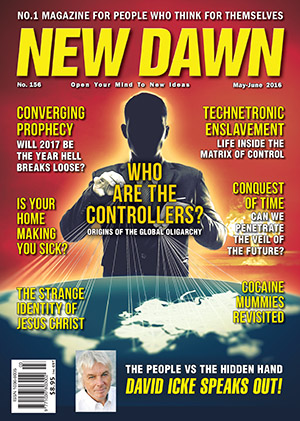
  • Brothers of the Shadows: Overlords of Chaos

    Brothers of the Shadows: Overlords of Chaos

    From New Dawn Special Issue Vol 9 No 4 (Aug 2015)

    Who controls the past controls the future. Who controls the present controls the past.
    – George Orwell, 1984

    Back in 1893, an elusive Englishman named Charles George Harrison (b.1855) delivered a series of six lectures to the Berean Society, a London based association of Christian esotericists. Harrison, described as a “mysterious and unknown figure,” was an English occultist and Anglican Christian. A record of his lectures can found in the book The Transcendental Universe. What is clear is that C.G. Harrison had access to highly sensitive information and a good deal of inside knowledge of world changes then being engineered by certain circles in England.

    In his second lecture Harrison spoke of “the next great European war” and of how the “national character” of the Slavic peoples would “enable them to carry out experiments in Socialism, political and economical, which would present innumerable difficulties in Western Europe.” The “next great European war” points to what would be the First World War of 1914-18, while the “experiments in Socialism” predict the 1917 Bolshevik Revolution which brought about the Soviet Union, one of the boldest and bloodiest politico-economic experiments in human history. Harrison said the plan of a particular secret elite, which he doesn’t mention by name, was that “the Russian Empire must die that the Russian people may live.” It is amazing to consider these truly prescient words were spoken in 1893, 21 years before the First World War and 24 years before the Russian Revolution. Today we know that in 1917 Bolshevik leader Vladimir Lenin was transported from Zurich, then the banking capital of the world, to Russia in a train loaded with gold and weapons to start the revolution.

    Discussing C.G. Harrison’s extraordinary foreknowledge, Sevak Gulbekian asks:

    How could he [Harrison] know about the forthcoming War as well as the “experiments in Socialism,” which would take a grip on Russia and its surrounding states for most of the twentieth century? If he was not, as he claimed, a “practical occultist” himself, it is reasonable to assume he had contact with people who were, and who had access to the malign plans…1

    Another significant piece of information coinciding with Harrison’s insights into the future is a cartoon map of Europe printed in the Christmas 1890 edition of the satirical English weekly, The Truth. Over the map is written: “The Kaiser’s Dream.” It showed wherever monarchies had been up to that time, there were going to be republics. The Austro-Hungarian Empire of the venerable Hapsburg monarchy had disappeared, as had the centuries old Russian Empire. Over the territory of Russia we read the words “Russian Desert.” In addition, Germany is identified with the words “German Republics”! Commenting on this map from 1890, Sevak Gulbekian notes:

    This map signifies not only a foreknowledge – similar to Harrison – of the fate of Russia to become a cultural as well as an economic ‘desert’, but also of the future splitting of Germany into ‘republics’. The magazine’s editor, Henry LabouchEre, was a Freemason. Was his remarkable foresight pure luck, or once again did he have some inside knowledge of future plans to shape the world?

    Why destroy the Hapsburg Empire? The influence of the Catholic Hapsburgs, as heirs of the Holy Roman Empire, was felt through all Europe. As Catholic Europe’s most important royal house they posed a particular obstacle to Britain’s plans for the Continent. Austria-Hungary, along with the ruling Hapsburg dynasty, had to be wiped off the map in order to create a patchwork of small states in Eastern Europe. These could be easily manipulated by London. Count Arthur Polzer Hoditz, director of the cabinet of the last Austro-Hungarian emperor stated in his memoirs that, “the destruction of the Hapsburg Empire was carefully prepared.” Late 20th century research reveals the suicide in 1889 of Crown Prince Rudolf, the Hapsburg Emperor Franz Joseph’s only son and heir, was a planned political assassination. Less than a decade later in 1898 the Empress Elizabeth was brutally murdered by a secret society member in Geneva. And the killing in 1914 of Emperor Franz Joseph’s nephew Franz Ferdinand in Sarajevo by a member of the Serbian secret society of the Black Hand, had as its immediate consequence the outbreak of the First World War.

    The occultist Rudolf Steiner (1861-1925), who knew a great deal about the mysterious nexus of politics and the occult, mentioned the above map in a talk given in Switzerland at the height of the First World War. He said the map, as a secret document, was in existence since the last decades of the 19th century. This is the same time as the British imperialist Cecil Rhodes was laying the foundations for “a secret society with but one object, the furtherance of the British Empire, and the bringing of the whole uncivilised world under British rule…” According to the American historian Carrol Quigley in his book Tragedy and Hope, Cecil Rhodes set up such a secret society known as the “Society of the Elect” in 1889.

    Sevak Gulbekian explains Rudolf Steiner’s perspective thus:

    Behind the outer façade of world affairs, suggested Steiner, the machinations of occult groups or ‘brotherhoods’ were at work. Certain of these brotherhoods had wanted the Great War to take place, and had manipulated events to bring it about. In doing this, they sought to protect the dominant economic position of the English-speaking world, and in turn to crush the ‘mediating’ role of Central European powers such as Germany, the Austro-Hungarian empire, and so on.

    These occult brotherhoods – small groups of men who met together in ‘lodges’ and practiced ceremonial magic as a means of achieving certain goals – originated from the English-speaking (Anglo-Saxon) world and were allied, in particular, with Anglo-American interests. Their aim was to extend Anglo-American influence across the globe, and to ensure the predomination of Anglo-American culture. Furthermore, they sought to extend its superiority into the distant future; essentially to ensure that the present state of affairs continues evermore.

    Rudolf Steiner in one of his lectures about the influence of secret societies on politics says that in the Slavic peoples there lies a “special future.” He believed at some point in the future a cultural-spiritual highpoint would be reached in the Slavic countries, principally Russia. This is apparently known to the Anglo-Saxon occult brotherhoods which seek to manipulate these powers and bring them directly under British domination. Steiner’s revelations, based in part on his intimate involvement with Europe’s leading secret societies, help explain the major events of the 20th century. Two world wars, the partition of Europe into the Anglo-American dominated West and the Soviet controlled East, the decades long ‘stand-off’ between Eastern communism and Western capitalism in the ‘Cold War’, the collapse of the USSR and the declaration of an Anglo-American dominated unipolar world, can all be traced to the dark intrigues of the Brothers of the Shadows.

    [alert type=”general” dismiss=”no”]This article was published in New Dawn Special Issue Vol 9 No 4.[/alert]

    [alert type=”success” dismiss=”no”]If you appreciate this article, please consider subscribing to help maintain this website.[/alert]

    Footnote

    1. ‘Brothers of the Shadows: A Perspective on Conspiracies’ by Sevak Gulbekian, New Dawn 86 (September-October 2004)

    © New Dawn Magazine and the respective author.
    For our reproduction notice, click here.