New Dawn – World's Most Unusual Magazine

Category: Secret History

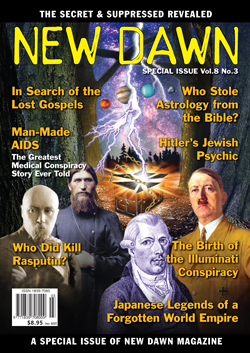
  • Erik Jan Hanussen: Hitler’s Jewish Psychic

    Erik Jan Hanussen: Hitler’s Jewish Psychic

    From New Dawn Special Issue Vol 8 No 3 (June 2014)

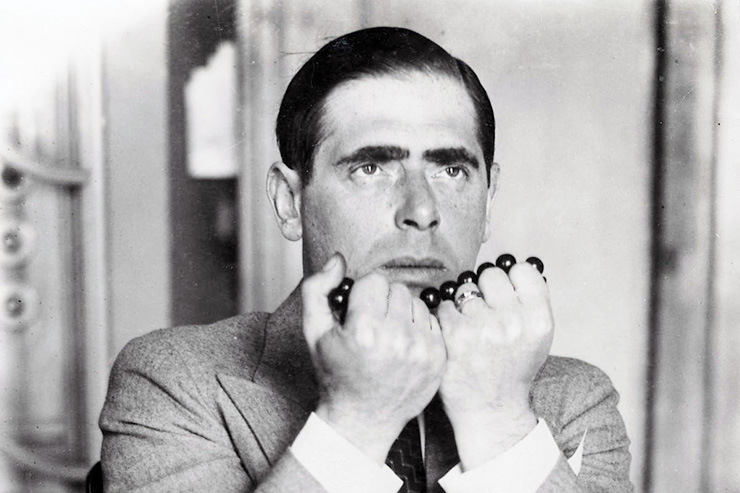
    On the morning of 7 April 1933, south of Berlin, workmen came upon a grisly discovery. Near the road that linked the German capital to the town of Baruth was the bullet-riddled body of a man, dressed in evening clothes. Death had come, execution-style, from two shots to the head. Beyond that, it was hard to tell much. The corpse was maggot-ridden, and animals had gnawed the face making it practically unrecognisable. Investigation by Berlin police Kriminalrat Hermann Albrecht quickly determined that the deceased was Erik Jan Hanussen, a well-known Berlin clairvoyant, astrologer and public figure who had gone missing two weeks earlier.

    The critical questions, of course, were who killed Hanussen and why. It seemed the dead man had many enemies. Rival psychics, embittered ex-employees, jilted lovers, cuckolded husbands, blackmailed victims, and underworld denizens all had reasons to wish him dead. Albrecht perhaps wisely concluded that the psychic had been “taken for a ride” by Berlin gangsters.1 The case remained unsolved.

    As Albrecht certainly knew, Hanussen’s real assassins were members of the Nazi Brownshirts (SA) organisation in Berlin. This was odd, because up to his demise, Hanussen was a conspicuous friend of many Nazis, not to mention a Party member and an honorary member of the SA. He knew Adolf Hitler himself and his accurate, pro-Nazi predictions had earned Hanussen the nicknames “The Prophet of the Third Reich,” “The Nazi Rasputin,” “Hitler’s Nostradamus,” and others. Odder still was the fact that Hanussen was a Jew.

    Hanussen’s story is fascinating, improbable and perplexing and has been dissected in various biographies, perhaps most notably Mel Gordon’s Erik Jan Hanussen: Hitler’s Jewish Clairvoyant (2001) and Arthur J. Magida’s The Nazi Séance: The Strange Story of the Jewish Psychic in Hitler’s Circle (2011).2

    This article will offer a brief overview of Hanussen’s career, but focus attention on a few questions that merit closer examination. First, are there any clues to Hanussen’s talents and behaviour to be found in his family background? Was Hanussen involved in espionage, or did he have any connection to intelligence services? Finally, what was the nature of his relationship with the future Fuhrer?

    Who Was “Erik Jan Hanussen”?

    Hanussen wasn’t Hanussen at all. His true name was Hershmann Chaim (later Hermann) Steinschneider. He was born in Vienna in 1889, the son of Siegfried Steinschneider, a ne’er-do-well Jewish vaudevillian and travelling salesman. Herschmann’s birth was registered in Prossnitz (today Prostejov in the Czech Republic), the Moravian town which was the traditional home of the Steinschneiders. The family and the place have interesting histories.

    In the 18th century, Prossnitz had a thriving Jewish community which produced an impressive array of rabbis and Talmudic scholars. Among these were Rabbis Daniel Prossnitz the Younger and his son Aaron Daniel Prossnitz, who adopted the surname Steinschneider. Both were vunder-rebbes reputed to have “magical and curative” powers.3 Mel Gordon speculates that Steinschneider, meaning “stone-cutter” or “stone tailor,” derived from Aaron Daniel’s practice of making Kabbalistic paper amulets from carved stone blocks.4

    But all was not as it seemed in Prossnitz. The town’s Jewish community was a hotbed of the Sabbatian heresy, a secretive sect which revered the 17th century “Messiah” Sabbatai Zevi.5 Sabbatians not only regarded Zevi as the Messiah, but also followed his antinomian teachings that advocated the deliberate transgression of Jewish Law and a Gnostic-like idea of “redemption through sin.”6 Moreover, Prossnitz was infiltrated by the even more radical and occultic Frankist sect whose practices included orgiastic rituals.7 In the opinion of Gershom Scholem, Sabbatian influence completely subverted Orthodox rabbinic culture in Prossnitz.8 One infamous proselytizer of Sabbatian beliefs was Judah Leib (Loebele) Prossnitz who claimed to be able to invoke the Shekinah (the Divine Presence), a stunt he pulled off with a back-lit set that made magical letters appear on his chest.9

    The trick sounds very much like something Hanussen might have tried two centuries later. But, given that he never lived in Prossnitz, how much could he have been influenced by its sectarian culture? Rabbi Marvin Antelman alleges that the Steinschneiders were a “Sabbatian family” and singles out Hanussen’s great uncle Moritz Steinschneider as a prime example.10 Hanussen doubtless learned something about Prossnitz from his father. He did visit, and amazed locals by performing an exorcism on a milk maid.11 Consciously or not, Hanussen’s later behaviour, from his denial of his Jewish roots, to his rejection of sexual and other mores, obsession with mysticism, and even his association with virulent anti-Semites, all more or less conformed to the Sabbatian-Frankist mould.

    A fundamental problem in dealing with Hanussen pre-1920s is that most of what is known about him comes from a single source, his 1930 autobiography, Meine Lebenslinie (“My Lifeline”). To call it self-aggrandising is an understatement, though it seems accurate enough as regards time and place. The author dances around the matter of ethnic origins, stating that he was born in Vienna (true), not in Denmark, Sicily or Tarnopol, the latter a largely Jewish town in the far reaches of the old Empire.12 If he is to be believed, his psychic powers first manifested in the womb, when he willed his unwed parents to marry.13

    Hermann “Harry” Steinschneider followed in his father’s footsteps and spent his youth travelling around Central Europe with circuses and vaudeville shows where he rubbed-elbows with fortune-tellers, strongmen, hypnotists, magicians and faith-healers. He picked up many of their tricks, invented a few his own, and put together a stage act based on mind-reading and hypnotism. He also ventured into journalism. In the years before WWI, he worked for a notorious Viennese scandal-sheet, Der Blitz, which earned most of its income by taking money to keep stories out of its pages.14 Steinschneider would apply this lesson well in his subsequent career.

    During the war, Harry served in the Austro-Hungarian Army where his evident talents as a mind-reader and dowser got him out of the trenches and into cushy duty in the rear. He even organised a séance or two. Whether this was proof of genuine extra-sensory ability or just clever trickery was, as always, a matter of opinion.

    Steinschneider played around with several aliases, among them Siegfried Krakauer and Saul Absolom Herschwitter, which still carried a strong hint of Semitic ancestry.15 Around 1919, he finally latched onto Erik Jan Hanussen, claiming to be a Dane of noble background whose telepathic powers led him to become a showman, psychic investigator and student of the occult. There was, of course, nothing Danish about him, and no one seems to have taken the role too seriously, least of all Hanussen. On a 1919 visit to Prague, he openly boasted of his “Czech-Jewish” heritage.16 Hanussen was whatever the circumstances best suited he should be.

    In postwar Vienna, he earned notoriety as a stage mentalist and hypnotist. He even tried his hand at movie star in the low-budget Hypnose (“Hypnosis”) in which he portrayed a clairvoyant gumshoe battling the evil schemes of a Svengali swami. He earned more attention, and money, playing psychic detective in real life. His most famous case involved mysterious thefts from the printing bureau of the Austrian State Bank. Newly-printed bills were vanishing and authorities were at a loss to explain how. Hanussen solved the case by the simple deduction that the caper had to be an inside job. He correctly fingered the culprits which led to the recovery of most of the purloined notes.17

    His crime-solving exploits, however, earned him the enmity of Vienna’s Polizeidirektion who suspected him, not without reason, of either setting-up crimes he purported to solve or being privy to inside information. But Hanussen found at least one champion among the police. Dr. Leopold Thoma was a psychoanalyst, paranormal researcher, and chief of the Psychologische Abteilung of the Viennese police. In 1921 he formed his own Institut fur Kriminal Telepatische Forschung (“Criminal Telepathic Research”). His and Hanussen’s paths would cross again a few years later.

    When Viennese authorities cracked down on the exhibition of hypnotism, Hanussen looked for greener pastures. With Austrian tobacco magnate Hans Hauser, Hanussen became part of a scheme to sell surplus military equipment to the Greeks who at the time were engaged in a bitter war against the nascent Turkish Republic. The affair reeks of international intrigue, though Hanussen’s job, supposedly, was to use his hypnotic power as added leverage in negotiations.18

    It may be significant that in the Balkan tobacco trade, Hauser almost certainly dealt with the Tobacco Company Ltd, a British firm which also happened to “provide cover in Europe for S.I.S [MI6] agents and ex-employees of the secret service.”19 Moreover, the British backed the Greeks, while the French, Italians and Soviets quietly supplied weapons to the Turks. Hanussen recalled that he and a companion were refused landing on the Italian controlled island of Rhodes on suspicion that they were Greek spies.20 His subsequent wanderings through the Levant and North Africa added much to his knowledge of Eastern mysticism but also provided ample opportunity for spying. He claimed to have aided Egyptian police in combating a ring of hashish smugglers, though one has to wonder if it wasn’t Hanussen doing the smuggling.21

    In 1924, Hanussen crossed the Atlantic for an American tour but found Yankee audiences largely unresponsive to his act. In Europe, however, especially in Germany, Hanussen became a big draw and by 1928 billed himself as the “Wizard of the Ages” and expanded his repertoire to include, palmistry, graphology and astrology.22 His bread and butter, however, remained mind-reading. Typically, audience members handed written questions to an assistant and the Amazing Hanussen divined the query and the answer through his mental powers – plus a secret code between him and the assistant. He continued to consult in criminal cases, among them the “Vampire of Düsseldorf,” a serial murderer who terrorised the city during 1929-30. He also offered private readings to rich clients and allegedly became an “adviser to European royalty.”23

    Fame, however, drew opposition. In 1928, a prosecutor in the Czechoslovak town of Leitmeritz charged Hanussen with fraud and larceny, basing his case on the fact that clairvoyance did not exist. In a long, public trial Hanussen won acquittal by successfully demonstrating his “powers” to the judge, or by faking them so well no one could catch him.24

    [alert type=”info” dismiss=”no”]If you appreciate this article, please consider a subscription to New Dawn magazine.[/alert]

    Berlin & Hanussen’s Rise to Power

    By 1930, Hanussen pitched his tent more or less permanently in Berlin where he became a celebrity of the first order and a symbol of the decadent hedonism of the dying Weimar Republic. His ability to gain such recognition is all the more remarkable given the competition. The German Capital was home to thousands of seers, hypnotists, faith-healers, and mystics of one variety or another.25 His lavish performances at the La Scala and other theatres were attended by the likes of Marlene Dietrich, Sigmund Freud, Peter Lorre, Fritz Lang – and Hermann Goering. Hanussen acquired fancy cars, a yacht, and an airplane, as well as a small publishing empire of books, magazines and newspapers which tirelessly promoted him, his products and his predictions.

    His wealth was enhanced through blackmail (harkening back to his Blitz days) and influence peddling. Dubbed by Mel Gordon the “Magister Ludi of Sex,” Hanussen hosted, and secretly filmed, private séances that attracted a heady mix of politicians, aristocrats, movie stars and industrialists.26 The affairs catered to all sexual persuasions, and some guests wound up in compromising positions which they were willing to pay to keep quiet.27 He also extended private loans to “special friends,” among them prominent Nazis such as Wolf Heinrich Graf von Helldorf, chief of the SA organisation in Berlin, a libertine, degenerate gambler and reputed connoisseur of the “black arts.”28

    Whatever his occult abilities, Hanussen was a clever, unscrupulous and venal character who insinuated himself into the confidence of important people in Germany, and elsewhere. He clearly had a talent, one way or another, for obtaining secret information. His currency as an informant only increased when he gained access to Hitler. All this made the phony Dane an asset that any intelligence agency would have been anxious to exploit.

    Interestingly, another occultist making his home in Berlin during 1930-32 was the notorious Aleister Crowley. Crowley had a long connection to British intelligence, and part of his purpose in Germany was watching and reporting on certain individuals.29 Given Hanussen’s prominence and his proclaimed expertise in hypnotism and tantric sex, there is no way the Great Beast would have ignored him. Oddly, there is no discernible mention in Crowley’s period diaries of Hanussen or anything relating to him.30

    However, they were not without indirect connections. By 1930, the aforementioned Dr. Leopold Thoma had again cropped up in Hanussen’s life and become one of his closest collaborators. Thoma was well-acquainted with fellow Austrian psychoanalyst Alfred Adler, a man Crowley claimed to know personally and to work with in Berlin.31 Moreover, Thoma became pals with Dr. Alexander Cannon, another psychiatrist, paranormal researcher and friend of Crowley who crossed paths with Hanussen.32 Cannon, sometimes dubbed the “Yorkshire Yogi” or the “leader of black magic in England,” would later face accusations of being a Nazi sympathiser and German spy.33 Last, but not least, the phony Dane was a confidant of Hanns Heinz Ewers, a German writer and occultist who was at the time a fervent Nazi with access to Hitler plus an old associate of Crowley.34 Thus, the latter had a number of channels through which he could have gleaned information from or about Hanussen.

    The Crowley-Hanussen connection may be at the root of René Guénon’s later assertion that the Beast infiltrated Hitler’s circle and made himself a “secret counsellor” of the Nazi leader.35 There is no indication that Crowley got anywhere near the future Fuhrer, but Hanussen certainly did.

    There is also the possibility that Thoma was working for Austrian intelligence. The Vienna Polizeidirektion, with which he remained connected, was involved in intelligence and counterintelligence activity.36 Finding out what was on the mind of native son Adolf Hitler would have been a high priority. Hanussen, again, could have been a very valuable source of information.

    In 1933, Pierre Mariel, a writer with ties to French intelligence, authored (as “Teddy Legrand”) a curious book, Les Sept Tetes du Dragon Vert (“The Seven Heads of the Green Dragon”). It claimed to reveal the machinations of an international conspiracy which, among others things, was behind Hitler’s rise to power. Hanussen appears thinly disguised as the “Man with the green gloves,” an agent of the conspiracy.37 Years later, in a book on Nazi occultism, Mariel, writing as “Werner Gerson,” claimed that “Hanussen was a spy for Britain” based on the alleged admission of ex-British agent John Goldsmith.38 If there were no spy agencies exploiting Hanussen, there certainly should have been.

    Hanussen & Hitler

    Exactly when and how Hanussen met Hitler is a matter of uncertainty and debate. Writer Juri Lina asserts, improbably, that their association began in 1920.39 Gordon argues that the pair met, via Helldorf, in late June or early July 1932. Palacios thinks the intermediary may have been Ewers and that the meeting occurred towards the end of 1932, while Magida wonders if the two ever met at all.40 In 1943, Walter Langer compiled a “Psychological Profile” of Hitler for the American OSS. One of his sources was dissident Nazi Otto Strasser, himself a former admirer of Hanussen, who reported that “during the early 1920’s Hitler took regular lessons in speaking and in mass psychology from a man named Hamissen [sic] who was also a practicing astrologer and fortune teller.”41 In his own writing, Strasser simply puts the meeting in the “post-war period” and describes Hanussen as a “super-clairvoyant” who acted as Hitler’s “medium.”42 In World Diary, contemporary American journalist Quincy Howe identifies 1930 as the year in which Hitler “constantly consulted a Jewish hypnotist who had changed his name from Steinschneider to Hanussen.”43

    By 1932, however, what Adolf wanted from the psychic wasn’t elocution lessons but glimpses into the future. As early as 1930, Hanussen had prophesied that Germany would receive a dictator of radical-socialist stripe, though his publications satirised politicians, including Hitler. That changed in early 1932. Hitler was running for president against the incumbent, Paul von Hindenburg. Hanussen predicted that Hindenburg would win (he did) but that Hitler would become chancellor within a year. From this point on, Hanussen and his publications took a decidedly pro-Nazi stance.

    However, the incident that may most have attracted Hitler’s notice, as it did other’s, had nothing to do with politics. In May 1932 racers gathered in Berlin for the AVUS Grand Prix. One of them was young Czech nobleman Georg Christian von Lobkowicz. A few days before the race, Hanussen prophesied that Lobkowicz would have a fiery accident. A few minutes into the event, his Mercedes racer crashed, killing him instantly.44 Investigation showed the tragedy was the result of a freak mechanical failure. Even Hanussen’s most stubborn doubters were hard-pressed to explain how he could have faked this. Enemies were not above suggesting that the psychic connived to sabotage Lobkowicz’s car, possibly in league with gamblers. The young Czech also had caught the fancy of a woman Hanussen desired, so jealously was another possible motive. To most, though, the crash was proof positive that the Dane really was a seer. Arthur Magida wonders if through years of mental discipline, Hanussen had actually developed some psychic ability.45

    A meeting with Hitler followed soon after and Hanussen assured jittery Adolf he need not worry about the upcoming elections. Sure enough, the Nazis scored a huge success in the July balloting, doubling their seats to become the biggest party in the Reichstag. On New Years Day 1933, Hanussen cast a horoscope and declared Hitler would be Chancellor by months end. That, too, came to pass.
    Palace of the Occult & The Reichstag Fire

    Hanussen seemed at the peak of his power. He wasn’t just associating with Nazis, he was one. Even his trusted secretary, Ismet Dzino, was a Party and SA man. In addition to being the favoured soothsayer of the new regime, he was about to open his opulent Palace of the Occult. The Capital’s elite clamoured for invitations. But there was trouble brewing. His tilt to the Nazis earned Hanussen the enmity of the Communist press which had published proof of his Jewish ancestry. Hanussen did his best to brush off the matter and his Nazi pals like Helldorf remained steadfast, for the time being anyway.

    The Palace of the Occult opened its doors on the evening of 26 February. In a semi-private séance, one of Hanussen’s mediums, a former actress, Maria Paudler, had a fateful vision. In a trance, she claimed to see a “great building” on fire.46 The press attributed the prediction to Hanussen himself. Less than 20 hours later, the Reichstag was ablaze. The Nazis blamed the fire on a Communist plot and rammed through emergency powers that gave Hitler dictatorial control. Berlin police arrested Marinus van der Lubbe, a Dutchman with Communist connections and a history of arson. The general assumption is that the Nazis were behind the blaze and used van der Lubbe as a patsy. Kugel suggests that the hypnotic puppet master controlling the Dutchman was Hanussen.47 Gerson/Mariel suggests another possibility: that the psychic instigated the fire at the behest of someone who wanted to discredit Hitler. If so, the plot backfired badly.48

    By mid-March, most of Hanussen’s Nazi friends, including Helldorf, found themselves ousted or re-assigned. On 24 March, a brace of SA dragged the psychic to Gestapo headquarters for questioning. They cut him loose, but the next evening three men snatched him off the street, and he was never seen alive again. The easiest guess is that the Nazis killed Hanussen because they discovered he was a Jew, but it really makes no sense. Evidence of his Hebraic origins had been available for months, and his Party comrades had not rejected him. There was no compelling reason for them to do so now. Another theory, that Helldorf and others murdered him to escape their debts, ignores the fact that they would be killing the golden goose. There is no indication Hanussen made any attempt to collect his debts or that he was unwilling to loan more.

    Hanussen’s demise is almost certainly tied to the Reichstag Fire, but there could be more to it. Most of Hanussen’s Nazi contacts were linked to the SA, and most of them to Ernst Roehm, Hitler’s only remaining serious rival. Just over a year later, Hitler and the SS would kill Roehm and dozens more SA leaders in the so-called Night of the Long Knives. Several, including Roehm, were ex-associates of Hanussen. Helldorf escaped, but took part in anti-Hitler intrigues and died for his part in the failed 1944 assassination attempt on the Fuehrer. In contrast the three SA men later identified as Hanussen’s killers all survived to perish in WWII and one of them, Rudolf Steinle, rose to become an officer of the Gestapo and the SS. Hanussen, therefore, may have been an early casualty of intra-Nazi intrigues.

    An interesting epilogue to the story involves Hanussen’s secretary, Ismet Dzino. Variously described as a Bosnian, Turk or Lebanese, he married a young Englishwoman, Grace Cameron, against his master’s advice. Hanussen warned him that if they married, she would die and Dzino would become a murderer and suicide.49 The Gestapo arrested Dzino immediately after Hanussen’s death, but Grace, using her contacts at the British Embassy, secured his release. According to a report in a Swiss paper, they later appeared in London where Dzino told friends that the Gestapo was after him because he possessed “important documents about the friendship of his master with certain Nazi leaders.”50 The documents remained in London, but Dzino and wife took up residence in Vienna. Did Dzino or his wife have links to British intelligence? Who took charge of the documents? Did Crowley or Cannon play any part in this?

    In Austria, Dzino fell on hard times and eked out a living as croupier. He became possessed by jealously which drove Grace to flee. In September 1937, he talked her into a reunion where he shot her, their four-year-old son and then turned the gun on himself. Hanussen’s prediction came true.

    There was the inevitable rumour that the corpse wasn’t Hanussen, that the Trickster avoided his enemies by again changing form and disappearing. It’s another doubtful, but intriguing, possibility.

    [alert type=”general” dismiss=”no”]This article was published in New Dawn Special Issue Vol 8 No 3.[/alert]

    [alert type=”success” dismiss=”no”]If you appreciate this article, please consider subscribing to help maintain this website.[/alert]

    Footnotes

    1. “Seer Who Foretold Hitler’s Rise Found Slain,” New York Times (9 April 1933), 12, and “Hellseher-Leiche im Wald – Vor 80 Jahren wurde Erik Jan Hanussen von einem SA-Kommando nahe Zossen erschossen,” Maerkische Allgemeine (Online), 21 March 2013 (accessed 10 April 2014).
    2. German readers should also consult Wilfried Kugel’s Hanussen: Die wahre Geschichte des Hermann Steinschneider (1998), and for Spanish readers there is also Jesus Palacios, Erik Jan Hanussen, la vida y los tiempos del mago de Hitler (2005).
    3. Mel Gordon, Erik Jan Hanussen: Hitler’s Jewish Clairvoyant. Los Angeles: Feral House, 2001, 4.
    4. Ibid.
    5. “Prossnitz,” The Jewish Encyclopedia (1906), www.jewishencyclopedia.com/articles/12394-prossnitz (10 April 2014). The sect name is also commonly rendered Sabbatean.
    6. Gershom Scholem, “Redemption Through Sin,” The Messianic Idea in Judaism. New York: Schocken, 1971, 78-141.
    7. Ibid. and Jay Michaelson, “Heretic of the Month: Jacob Frank.” American Jewish Life Magazine (March/April 2007), www.ajlmagazine.com/content/032007/heretic.html (28 March 2014).
    8. Scholem, 141.
    9. “Prossnitz, Loebele (Prostiz),” The Jewish Encyclopedia (1906), www.jewishencyclopedia.com/articles/12395-prossnitz-lobele-prostiz (10 April 2014).
    10. Marvin S. Antelman, To Eliminate the Opiate, Vol. 1. Jerusalem, 1974, 137.
    11. Gordon, 40-41.
    12. Hanussen, Meine Lebenslinie (orig. 1930), Kindle edition, Frankfurt a. M.: Wunderkammer Verlag, 2012, location 74.
    13. Ibid.
    14. Markus Kompa (with Wilfried Kugel), “Erik Jan Hanussen – Hokus-Pokus-Tausendsassa.” Telepolis Magazin, www.heise.de/tp/artikel/27/27562/1.html (10 April 2014).
    15. Hanussen, Ibid.
    16. Gordon, 77.
    17. Hanussen, loc. 2359-2434.
    18. Hanussen, loc. 2447-2482.
    19. Robin Lockhart, Reilly: Ace of Spies. New York: Penguin Books, 1984, 136n.
    20. Hanussen, loc. 2977.
    21. Kugel, 60.
    22. Kompa. Ibid.
    23. New York Times, Ibid.
    24. “Clairvoyant Proves Power in Czech Court,” New York Times (29 May 1930), 8.
    25. Gordon, 181.
    26. Mel Gordon, Voluptuous Panic: The Erotic World of Weimar Berlin. Los Angeles: Feral House, 2008, 216.
    27. Kompa, Ibid.
    28. Gordon, Hanussen, 213, and Kompa, Ibid.
    29. Richard B Spence, Secret Agent 666: Aleister Crowley, British Intelligence and the Occult. Los Angeles: Feral House, 2008, 210-213.
    30. My thanks to William Breeze and the OTO Archives for this information.
    31. Spence, 214-215.
    32. Gordon, Hanussen, 252. After the Nazis came to power, Cannon (and maybe Crowley) helped Thoma emigrate to Britain.
    33. “Edward VIII’s Links to a Mystic,” BBC News (6 Dec. 2008). http://news.bbc.co.uk/2/hi/uk_news/7767919.stm.
    34. Werner Gerson (Pierre Mariel), “Mage ou Espion?,” in Le Nazisme: societe secrete. Paris: J’ai Lu, 1972, http://humanisme.canalblog.com/archives/2010/08/22/18871564.html (10 April 2014) and Gordon, Hanussen, 195. Like most of Hanussen’s Nazi associates, Ewers later was an outcast from the Party.
    35. Guénon to Marcelo Motta, 1949, as quoted in Giorgio Galli, Hitler e il nazismo magico. Milan: Rizzoli, 1989, 129.
    36. Mario Muigg, “Geheim-und-Nachrichten-Dienste in und aus Oesterriech, 1918-1938.” SIAK-Journal, #3 (2007), 64-72.
    37. Richard B. Spence, “Behold the Green Dragon: The Myth and Reality of an Asian Secret Society.” New Dawn 112 (Jan-Feb 2009), 69.
    38. Gerson, Ibid.
    39. Juri Lina, Architects of Deception. Stockholm: Referent, 2004, 422.
    40. “Jesus Palacios nos habla sobre el mago de Hitler.” Akasico (1 April 2006), www.akasico.com/noticia/492/Ano/Cero-Entrevistas/Jesus-Palacios-nos-habla-sobre-el-mago-de-Hitler.html (19 April 2014); Arthur J. Magida, The Nazi Séance: The Strange Story of the Jewish Psychic in Hitler’s Circle. New York: Palgrave Macmillan, 2011, 169-170.
    41. Walter C. Langer, A Psychological Profile of Adolf Hitler: His Life and Legend. Washington, DC: Office of Strategic Services [1943], 9. www.nizkor.org/hweb/people/h/hitler-adolf/oss-papers/text/profile-index.html (3 April 2014).
    42. Otto Strasser, Hitler and I. London: Jonathan Cape, 1940, 37.
    43. Quincy Howe, World Diary, 1929-1934. New York: McBride, 1934, 54.
    44. “Motor Race Tragedy,” Singapore Free Press and Mercantile Advertiser (24 May 1932), 9.
    45. Magida, 138.
    46. Geoffrey Ashe, Encyclopedia of Prophecy. Santa Barbara: ABC-Clio, 2001. 99.
    47. Kugel, 231-234.
    48. Gerson, Ibid.
    49. Gordon, Hanussen, 254.
    50. “Après avoir tue sa femme et sa fils, l’ancien secretarie du mage Hanussen se suicide a Vienne,” L’Impartiale (29 Sept. 1937), 3.

    © New Dawn Magazine and the respective author.
    For our reproduction notice, click here.
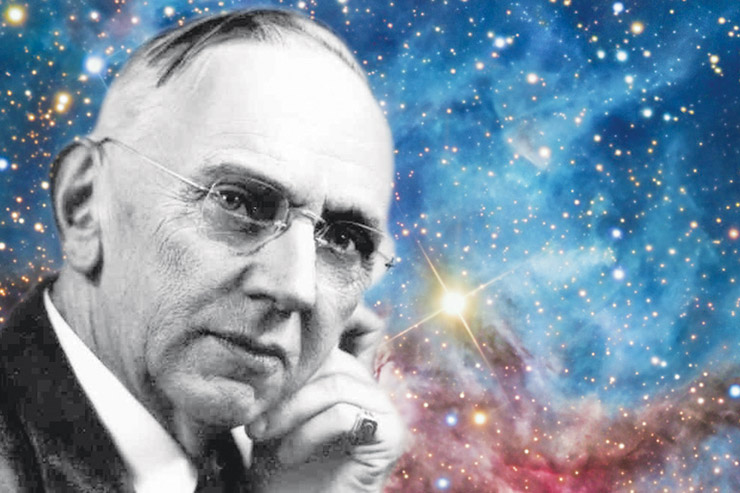
  • Edgar Cayce: Ordinary Man, Extraordinary Messenger

    Edgar Cayce: Ordinary Man, Extraordinary Messenger

    From New Dawn 150 (May-June 2015)

    The year 1910 marked a turning point in Western spirituality. It saw the deaths of some of the most luminous religious thinkers of the nineteenth century, including psychologist-seeker William James; popular medium Andrew Jackson Davis; and Christian Science founder Mary Baker Eddy. These three figures deeply impacted the movements in positive thinking, prayer healing, and psychical research.

    Their death that year was accompanied by the rise to prominence of a new religious innovator – a figure who built upon the spiritual experiments of the nineteenth century to shape the New Age* culture of the dawning era.

    In autumn of 1910 The New York Times brought the first major national attention to the name of Edgar Cayce, a young man who later became known as the “father of holistic medicine” and the founding voice of alternative spirituality.

    The Sunday Times of 9 October 1910 profiled the Christian mystic and medical clairvoyant in an extensive article and photo spread: Illiterate Man Becomes a Doctor When Hypnotized. At the time Cayce (pronounced “Casey”), then 33, was struggling to make his way as a commercial photographer in his hometown of Hopkinsville, Kentucky, while delivering daily trance-based medical “readings” in which he would diagnose and prescribe natural cures for the illnesses of people he had never met.

    Cayce’s method was to recline on a sofa or day bed, loosen his tie, belt, cuffs, and shoelaces, and enter a sleep-like trance; then, given only the name and location of a subject, the “sleeping prophet” was said to gain insight into the person’s body and psychology. By the time of his death in January 1945, Cayce had amassed a record of more than 14,300 clairvoyant readings for people across the nation, many of the sessions captured by stenographer Gladys Davis.

    In the 1920s, Cayce’s trance readings expanded beyond medicine (which nonetheless remained at the core of his work) to include “life readings,” in which he explored a person’s inner conflicts and needs. In these sessions Cayce employed references to astrology, karma, reincarnation, and number symbolism. Other times, he expounded on global prophecies, climate or geological changes, and the lost history of mythical cultures, such as Atlantis and Lemuria. Cayce had no recollection of any of this when he awoke, though as a devout Christian the esotericism of such material made him wince when he read the transcripts.

    Contrary to news coverage, Cayce was not illiterate, but neither was he well educated. Although he taught Sunday school at his Disciples of Christ church – and read through the King James Bible at least once every year – he had never made it past the eighth grade of a rural schoolhouse. While his knowledge of Scripture was encyclopaedic, Cayce’s reading tastes were otherwise limited. Aside from spending a few on-and-off years in Texas unsuccessfully trying to use his psychical abilities to strike oil – he had hoped to raise money to open a hospital based on his clairvoyant cures – Cayce rarely ventured beyond the Bible Belt environs of his childhood.

    Since the tale of Jonah fleeing from the word of God, prophets have been characterised as reluctant, ordinary folk plucked from reasonably satisfying lives to embark on missions that they never originally sought. In this sense, if the impending New Age – the vast culture of Eastern, esoteric, and therapeutic spirituality that exploded on the US national scene in the 1960s and 70s – was seeking a founding prophet, Cayce could hardly be viewed as an unusual choice, but, historically, as a perfect one.

    * The term “New Age” is often used to denote trendy or fickle spiritual tastes. I do not share in that usage. I use New Age to reference the eclectic culture of therapeutic and experimental spirituality that emerged in the late-twentieth century.

    A Seer in Season

    It was this Edgar Cayce – an everyday man, dedicated Christian, and uneasy mystic – whom New England college student and future biographer Thomas Sugrue encountered in 1927. When Sugrue met Cayce, the twenty-year-old journalism student was not someone who frequented psychics or séance parlours. Sugrue was a dedicated Catholic who had considered joining the priesthood. Deeply versed in world affairs and possessed of an iron determination to break into news reporting, Sugrue left his native Connecticut in 1926 for Washington and Lee University in Lexington, Virginia, which was then one of the only schools in the nation to offer a journalism degree to undergraduates. (Sugrue later switched his major to English literature, in which he earned both bachelor’s and master’s degrees in four years.)

    As a student, Sugrue rolled his eyes at paranormal claims or talk of ESP. Yet Sugrue met a new friend at Washington and Lee who challenged his preconceptions: the psychic’s eldest son, Hugh Lynn Cayce. Hugh Lynn had planned to attend Columbia but his father’s clairvoyant readings directed him instead to the old-line Virginia school. (The institution counted George Washington as an early benefactor.) Sugrue grew intrigued by his new friend’s stories about his father – in particular the elder Cayce’s theory that one person’s subconscious mind could communicate with another’s. The two freshmen enjoyed sparring intellectually and soon became roommates. While still cautious, Sugrue wanted to meet the agrarian seer.

    Edgar and his wife Gertrude, meanwhile, were laying new roots about 250 miles east of Lexington in Virginia Beach, a location the readings had also selected. The psychic spent the remainder of his life in the Atlantic coastal town, delivering twice-daily readings and developing the Association for Research and Enlightenment (A.R.E.), a spiritual learning centre that remains active there today.

    Accompanying Hugh Lynn home in June 1927, Sugrue received a “life reading” from Cayce. In these psychological readings, Cayce was said to peer into a subject’s “past life” incarnations and influences, analyse his character through astrology and other esoteric methods, and view his personal struggles and aptitudes. Cayce correctly identified the young writer’s interest in the Middle East, a region where Sugrue later issued news reports on the founding of the modern state of Israel. But it wasn’t until Christmas of that year that Sugrue, upon receiving an intimate and uncannily accurate medical reading, became an all-out convert to Cayce’s psychical abilities.

    Sugrue went on to fulfil his aim of becoming a journalist, writing from different parts of the world for publications including the New York Herald Tribune and The American Magazine. But his life remained interwoven with Cayce’s. Stricken by debilitating arthritis in the late 1930s, Sugrue sought help through Cayce’s medical readings. From 1939 to 1941, the ailing Sugrue lived with the Cayce family in Virginia Beach, writing and convalescing. During these years of close access to Cayce – while struggling with painful joints and limited mobility – Sugrue completed There Is a River, the sole biography written of Cayce during his lifetime, now available in a new edition. When the book first appeared in 1942 it brought Cayce national attention that surpassed even the earlier Times coverage.

    Documenting the Prophet

    Sugrue was not Cayce’s only enthusiast within the world of American letters. There Is a River broke through the sceptical wall of New York publishing thanks to a reputable editor, William Sloane, of Holt, Rinehart & Winston, who experienced his own brush with the Cayce readings.

    In 1940, Sloane agreed to consider the manuscript for There Is a River. He knew the biography was highly sympathetic, a fact that did not endear him to it. Sloane’s wariness faded after Cayce’s clairvoyant diagnosis helped one of the editor’s children. Novelist and screenwriter Nora Ephron recounted the episode in a 1968 New York Times article.

    “I read it,” Sloane told Ephron. “Now there isn’t any way to test a manuscript like this. So I did the only thing I could do.” He went on:

    A member of my family, one of my children, had been in great and continuing pain. We’d been to all the doctors and dentists in the area and all the tests were negative and the pain was still there. I wrote Cayce, told him my child was in pain and would be at a certain place at such-and-such a time, and enclosed a check for $25. He wrote back that there was an infection in the jaw behind a particular tooth. So I took the child to the dentist and told him to pull the tooth. The dentist refused – he said his professional ethics prevented him from pulling sound teeth. Finally, I told him he would have to pull it. One tooth more or less didn’t matter, I said – I couldn’t live with the child in such pain. So he pulled the tooth and the infection was there and the pain went away. I was a little shook. I’m the kind of man who believes in X-rays. About this time, a member of my staff who thought I was nuts to get involved with this took even more precautions in writing to Cayce than I did, and he sent her back facts about her own body only she could have known. So I published Sugrue’s book.

    Many literary journalists and historians since Sugrue have traced Cayce’s life. Journalist and documentarian Sidney D. Kirkpatrick wrote the landmark record of Cayce in his 2000 biography Edgar Cayce. Historian K. Paul Johnson crafted a deeply balanced and meticulous scholarly analysis of Cayce with the 1998 Edgar Cayce in Context. And the intrepid scholar of religion Harmon Bro – who spent nine months in Cayce’s company toward the end of the psychic’s life – produced insightful studies of Cayce as a Christian mystic in his 1955 University of Chicago doctoral thesis (a groundbreaking work of modern scholarship on an occult subject) and later in the 1989 biography Seer Out of Season. While Harmon Bro died in 1997, his family has a long – and still active – literary involvement with Cayce. Bro’s mother, Margueritte, was a pioneering female journalist in the first half of the twentieth century who brought Cayce national attention in her 1943 profile in Coronet magazine: “Miracle Man of Virginia Beach.” Bro’s wife June and daughter Pamela actively teach and interpret the Cayce ideas today.

    There exist many other works on Cayce – it would take several paragraphs to appreciate the best of them. But it was Sugrue, an accomplished print journalist who worked and convalesced with Cayce for several years, who fully – and this word is chosen carefully – captured Cayce’s goodness.

    Sugrue’s historical Edgar Cayce is the man who grew from being an awkward, soft-voiced adolescent to a national figure who never quite knew how to manage his fame – and less so how to manage money, often foregoing or deferring his usual $20 fee for readings, leaving himself and his family in a perpetual state of financial precariousness. In a typical letter from 1940, Cayce replied to a blind labourer who asked about paying in instalments: “You may take care of the [fee] any way convenient to your self – please know one is not prohibited from having a reading… because they haven’t money. If this information is of a divine source it can’t be sold, if it isn’t then it isn’t worth any thing.”

    Sugrue also captured Cayce as a figure of deep Christian faith struggling to come to terms with the occult concepts that ran through his readings beginning in the early 1920s. This material extended to numerology, astrology, crystal gazing, modern prophecies, reincarnation, karma, and the story of mythical civilisations, including Atlantis and prehistoric Egypt. People who sought readings were intrigued and emotionally impacted by this material as much as by Cayce’s medical diagnoses. What’s more, in readings that dealt with spiritual and esoteric topics – along with the more familiar readings that focused on holistic remedies, massage, meditation, and natural foods – there began to emerge the range of subjects that formed the parameters of therapeutic New Age spirituality in the latter twentieth century.

    [alert type=”info” dismiss=”no”]If you appreciate this article, please consider a subscription to New Dawn magazine.[/alert]

    Esoteric Philosopher

    Cayce did more than assemble a catalogue of the dawning New Age. The spiritual ideas running through his readings, combined with his own intrepid study of Scripture, supplied the basis for a universal approach to religion, which, in various ways, also spread across American culture. Sugrue captures this especially well in chapter fifteen, which recounts Cayce’s metaphysical explorations with an Ohio printer and Theosophist named Arthur Lammers. Cayce’s collaboration with Lammers, which began in the autumn of 1923 in Selma, Alabama, marked a turn in Cayce’s career from medical clairvoyant to esoteric philosopher.

    Licking his wounds after his failed oil ventures, Cayce had resettled his family in Selma where he planned to resume his career as a commercial photographer. He and Gertrude, who had long suffered her husband’s absences and unsteady finances, enrolled their son Hugh Lynn, then sixteen, in Selma High School. The family, now including five-year-old Edgar Evans, settled into a new home and appeared headed for some measure of domestic normalcy. All this got upturned in September, however, when the wealthy printer Lammers arrived from Dayton. Lammers had learned of Cayce during the psychic’s oil-prospecting days. He showed up at Cayce’s photo studio with an intriguing proposition.

    Lammers was both a hard-driving businessman and an avid seeker in Theosophy, ancient religions, and the occult. He impressed upon Cayce that the seer could use his psychical powers for more than medical diagnoses. Lammers wanted Cayce to probe the secrets of the ages: What happens after death? Is there a soul? Why are we alive? Lammers yearned to understand the meaning of the pyramids, astrology, alchemy, the “Etheric World,” reincarnation, and the mystery religions of ancient Egypt, Greece, and Rome. He felt certain that Cayce’s readings could part the veil shrouding the ageless wisdom.

    After years of stalled progress in his personal life, Cayce was enticed by this new sense of mission. Lammers urged Cayce to return with him to Dayton, where he promised to place the Cayce family in a new home and financially care for them. Cayce agreed, and uprooted Gertrude and their younger son, Edgar Evans. Hugh Lynn remained behind with friends in Selma to finish out the school term. Lammers’s financial promises later proved elusive and Cayce’s Dayton years, which preceded his move to Virginia Beach, turned into a period of financial despair. Nonetheless, for Cayce, if not his loved ones, Dayton also marked a stage of unprecedented discovery.

    Cayce and Lammers began their explorations at a downtown hotel on 11 October 1923. In the presence of several onlookers, Lammers arranged for Cayce to enter a trance and to give the printer an astrological reading. Whatever hesitancies the waking Cayce evinced over arcane subjects vanished while he was in his trance state. Cayce expounded on the validity of astrology even as “the Source” – what Cayce called the ethereal intelligence behind his readings – alluded to misconceptions in the Western model. Toward the end of the reading, Cayce almost casually tossed off that it was Lammers’s “third appearance on this [earthly] plane. He was once a monk.” It was an unmistakable reference to reincarnation – just the type of insight Lammers had been seeking.

    In the weeks ahead, the men continued their readings, probing into Hermetic and esoteric spirituality. From a trance state on 18 October, Cayce laid out for Lammers a whole philosophy of life, dealing with karmic rebirth, man’s role in the cosmic order, and the hidden meaning of existence:

    In this we see the plan of development of those individuals set upon this plane, meaning the ability (as would be manifested from the physical) to enter again into the presence of the Creator and become a full part of that creation. Insofar as this entity is concerned, this is the third appearance on this plane, and before this one, as the monk. We see glimpses in the life of the entity now as were shown in the monk, in his mode of living. The body is only the vehicle ever of that spirit and soul that waft through all times and ever remain the same.

    These phrases were, for Lammers, the golden key to the mysteries: a theory of eternal recurrence, or reincarnation, that identified man’s destiny as inner refinement through karmic cycles of rebirth, then reintegration with the source of Creation. This, the printer believed, was the hidden truth behind the Scriptural injunction to be “born again” so as to “enter the kingdom of Heaven.”

    “It opens up the door,” Lammers told Cayce. “It’s like finding the secret chamber of the Great Pyramid.” He insisted that the doctrine that came through the readings synchronised the great wisdom traditions: “It’s Hermetic, it’s Pythagorean, it’s Jewish, it’s Christian!” Cayce himself wasn’t sure what to believe. “The important thing,” Lammers reassured him, “is that the basic system which runs through all the mystery traditions, whether they come from Tibet or the pyramids of Egypt, is backed up by you. It’s actually the right system…. It not only agrees with the best ethics of religion and society, it is the source of them.”

    Lammers’s enthusiasms aside, the religious ideas that emerged from Cayce’s readings did articulate a compelling theology. Cayce’s teachings sought to marry a Christian moral outlook with the cycles of karma and reincarnation central to Hindu and Buddhist ways of thought, as well as the Hermetic concept of man as an extension of the Divine. Cayce’s references elsewhere to the causative powers of the mind – “the spiritual is the LIFE; the mental is the BUILDER; the physical is the RESULT” – melded his cosmic philosophy with tenets of New Thought, Christian Science, and mental healing. If there was an inner philosophy unifying the world’s religions, Cayce came as close as any modern person in defining it.

    Cayce’s “Source”

    Religious traditionalists could rightly object: Just where are Cayce’s “insights” coming from? Are they the product of a Higher Power or merely the overactive imagination of a religious outlier? Or, worse, are his phrases the type of muddle-fuddle produced by haunts at Ouija board sessions?

    Cayce himself wrestled with these questions. His response was that all of his ideas, whatever their source, had to square with Gospel ethics in order to be judged vital and right. Cayce addressed this in a talk that he delivered in his normal waking state in Norfolk, Virginia, in February of 1933, just before he turned fifty-six:

    Many people ask me how I prevent undesirable influences entering into the work I do. In order to answer that question let me relate an experience I had as a child. When I was between eleven and twelve years of age I had read the Bible through three times. I have now read it fifty-six times. No doubt many people have read it more times than that, but I have tried to read it through once for each year of my life. Well, as a child I prayed that I might be able to do something for the other fellow, to aid others in understanding themselves, and especially to aid children in their ills. I had a vision one day which convinced me that my prayer had been heard and answered.

    Cayce’s “vision” has been described differently by different biographers. Sugrue recounts the episode occurring when Cayce was about twelve in the woods outside his home in western Kentucky. Cayce himself places it in his bedroom at age thirteen or fourteen. One night, this adolescent boy who had spoken of childhood conversations with “hidden friends,” and who hungrily read through Scripture, knelt by his bed and prayed for the ability to help others.

    Just before drifting to sleep, Cayce recalled, a glorious light filled the room and a feminine apparition appeared at the foot of his bed telling him: “Thy prayers are heard. You will have your wish. Remain faithful. Be true to yourself. Help the sick, the afflicted.”

    Cayce did not realise until years later what form his answered prayers would take – and even in his twenties it took him years to adjust to being a medical clairvoyant. As his new powers took shape he laboured to use Scripture as his moral vetting mechanism. Yet he consistently attributed his information to the “Source” – another subject on which he expanded at Norfolk:

    As a matter of fact, there would seem to be not only one, but several sources of information that I tap when in this sleep condition. One source is, apparently, the recording that an individual or entity makes in all its experiences through what we call time. The sum-total of the experiences of that soul is “written,” so to speak, in the subconscious of that individual as well as in what is known as the Akashic records. Anyone may read these records if he can attune himself properly.

    Cayce’s concept of the “Akashic records” is derived from ancient Vedic writings, in which akasha is a kind of universal ether. This idea of universal records was popularised to Westerners in the late nineteenth-century through the work of occult philosopher, world traveller, and Theosophy co-founder Madame H.P. Blavatsky.

    A generation before Cayce, Blavatsky told of a hidden philosophy at the core of the historic faiths – and of a cosmic record bank that catalogs all human events. In Blavatsky’s 1877 study of occult philosophy, Isis Unveiled, the Theosophist described an all-pervasive magnetic ether that “keeps an unmutilated record of all that was, that is, or ever will be.” These astral records, wrote Blavatsky, preserve “a vivid picture for the eye of the seer and prophet to follow.” Blavatsky equated this archival ether with the “Book of Life” from Revelation.

    Returning to the topic in her massive 1888 study of occult history, The Secret Doctrine, Blavatsky depicted these etheric records in more explicitly Vedic terms (having spent several preceding years in India). In the first of her two-volume study, Blavatsky referred to “Akâsic or astral-photographs” – inching closer to the term “Akashic records” as used by Cayce.

    Cayce was not the first channeller to credit the “Akashic records” as his source of data. In 1908, a retired Civil War chaplain and Church of Christ pastor named Levi H. Dowling said that he clairvoyantly channelled an alternative history of Christ in The Aquarian Gospel of Jesus the Christ. In Dowling’s influential account, the Son of man travels and studies throughout the religious cultures of the East before dispensing a message of universal faith that encompasses all the world’s traditions. Dowling, too, attributed his insights to the “Akashic records,” accessed while in a trance state in his Los Angeles living room.

    Cayce, like Blavatsky, equated akasha with the Scriptural Book of Life. This was an example of how Cayce harmonised the exotic and unfamiliar themes of his readings with his Christian worldview. In a similar vein, he reinterpreted the ninth chapter of the Book of John, in which Christ heals a man who had been blind from birth, to validate ideas of karma and reincarnation. When the disciples ask Christ whether it was the man’s sins or those of his parents that caused his affliction, the Master replies enigmatically: “Neither hath this man sinned, nor his parents: but that the works of God should be made manifest in him” (John 9:3). In Cayce’s reasoning, since the blind man was born with his disorder, and Christ exonerates both the man and his parents, his disability must be karmic baggage from a previous incarnation. Cayce made comparable interpretations of passages from Matthew and Revelation.

    In another effort to unite the poles of different traditions, Cayce elsewhere associated his esoteric search with Madame Blavatsky’s. On four occasions he reported being visited by a mysterious, turbaned spiritual master from the East – one of the mahatmas, or great souls, whom Blavatsky said had guided her.

    The Legacy

    Neither Cayce nor Sugrue lived long enough to witness the full reach of Cayce’s ideas. The psychic died at age sixty-seven in Virginia Beach on 3 January 1945, less than three years after There Is a River first appeared. Sugrue updated the book that year. After struggling with years of illness, the biographer died at age forty-five on 6 January 1953 at the Hospital for Joint Diseases in New York.

    The first popularisations of Cayce’s work began to appear in 1950 with the publication of Many Mansions, an enduring work on reincarnation by Gina Cerminara, a longtime Cayce devotee. But it wasn’t until 1956 that Cayce’s name took full flight across the culture with the appearance of the sensationally popular book The Search for Bridey Murphy by Morey Bernstein. Sugrue’s editor Sloane, having since warmed to parapsychology, published both Cerminara and Bernstein.

    Bernstein was an iconic figure. A Coloradan of Jewish descent and an Ivy League-educated dealer in heavy machinery and scrap metal, he grew inspired by Cayce’s career – partly through the influence of Sugrue’s book – and became an amateur hypnotist. In the early 1950s, Bernstein conducted a series of experiments with a Pueblo, Colorado, housewife who, while under a hypnotic trance, appeared to regress into a past-life persona: an early nineteenth-century Irish country girl named Bridey Murphy. The entranced homemaker spoke in an Irish brogue and recounted to Bernstein comprehensive details of her life more than a century earlier.

    Suddenly, reincarnation – an ancient Vedic concept about which Americans had heard little before World War II – was the latest craze, ignited by Bernstein, an avowed admirer of Cayce, to whom the hypnotist devoted two chapters in his book.

    In the following decade, California journalist Jess Stearn further ramped up interest in Cayce with his 1967 bestseller, Edgar Cayce, The Sleeping Prophet. With the mystic sixties in full swing, and the youth culture embracing all forms of alternative or Eastern spirituality – from Zen to yoga to psychedelics – Cayce, while not explicitly tied to any of this, rode the new vogue in alternative spirituality. During this time, Hugh Lynn Cayce emerged as a formidable custodian of his father’s legacy, presiding over the expansion of the Virginia Beach-based Association for Research and Enlightenment, and shepherding to market a new wave of instructional guides based on the Cayce teachings, from dream interpretation to drug-free methods of relaxation to the spiritual uses of colours, crystals, and numbers. Cayce’s name became a permanent fixture on the cultural landscape.

    The 1960s and 70s also saw a new generation of channelled literature – Cayce himself originated the term channel – from higher intelligences such as Seth, Ramtha, and even the figure of Christ in A Course in Miracles. The last was a profound and enduring lesson series, channelled beginning in 1965 by Columbia University research psychiatrist Helen Schucman.

    A concordance of tone and values existed between Cayce’s readings and A Course in Miracles. Cayce’s devotees and the Course’s wide array of readers discovered that they had a lot in common; members of both cultures blended seamlessly, attending many of the same seminars, growth centres, and metaphysical churches.

    Likewise, a congruency emerged between Cayce’s world and followers of the twelve steps of Alcoholics Anonymous. Starting in the 1970s, twelve-steppers of various stripes became a familiar presence at Cayce conferences and events in Virginia Beach.

    Cayce’s universalistic religious message dovetailed with the purposefully flexible references to a Higher Power in the “Big Book,” Alcoholics Anonymous, written in 1939. AA cofounder Bill Wilson, his wife Lois, his confidant Bob Smith, and several other early AAs were deeply versed in mystical and mediumistic teachings. Whether they viewed Cayce as an influence is unclear. But all three works – the Cayce readings, A Course in Miracles, and Alcoholics Anonymous – demonstrated a shared sense of religious liberalism, an encouragement that all individuals seek their own conception of a Higher Power, and a permeability intended to accommodate the broadest expression of religious outlooks and backgrounds.

    The free-flowing tone of the therapeutic spiritual movements of the twentieth and early twenty-first centuries had a shared antecedent, if not a direct ancestry, in the Cayce readings.

    Sugrue provided an irreplaceable record of Cayce’s development as a spiritual messenger and pioneer. The biographer captured the seer as the person who Cayce himself said he was: An ordinary man who struggled with his apparent psychical abilities and the universal religious ideas that travelled through him.

    But Sugrue’s work accomplished more than just that. His portrait of Cayce, in its own right, became a formative document of New Age spirituality. In exploring Cayce’s career, Sugrue highlighted and popularised core themes from the Cayce readings – including past-life experiences, alternative medical treatments, the imperative of the individual spiritual search, and the idea of religion as a practical source of healing.

    Sugrue demonstrated how Cayce – a committed Christian, a Sunday school teacher, and, by his own reckoning, an everyday man – developed into the founding prophet of Aquarian Age spirituality. In capturing the drama and events of Cayce’s journey, Sugrue elevated the clarity and endurance of the seer’s message.

    [alert type=”general” dismiss=”no”]This article was published in New Dawn 150.[/alert]

    [alert type=”success” dismiss=”no”]If you appreciate this article, please consider subscribing to help maintain this website.[/alert]

    © New Dawn Magazine and the respective author.
    For our reproduction notice, click here.
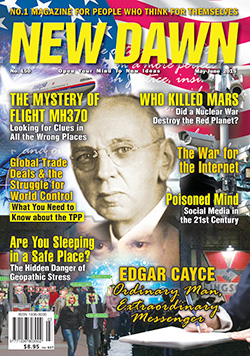
  • The Bogomils: Europe’s Forgotten Gnostics

    The Bogomils: Europe’s Forgotten Gnostics

    From New Dawn 106 (Jan-Feb 2008)

    Few people in the modern world have heard of the Bogomils, who existed during a seven-century time span in and around Bulgaria. Although almost forgotten, they represent an important movement that should be studied by anyone interested in Gnosticism, spiritual freedom, the Cathars of France (who succeeded them), and the history of religions.

    For most of their existence, from the mid 900’s to the late 1400’s CE, the Bogomils sought to restore the earliest and purest form of Christianity. Since their beliefs were considered a threat to the Church they experienced intense persecution.

    Their original home was probably in Macedonia and from there they spread throughout the Byzantine Empire, ultimately flourishing in Bulgaria, Serbia, and Bosnia. Their spiritual descendants were the better-known Cathars, so the extent of their influence reached as far as Italy and into southern France.1 Attacked over the centuries with both fire and sword by Catholic and Orthodox Christians, they finally surrendered – but to Islam rather than Christianity.2

    Origins

    Bogomilism was named after its founder, Bogomil, whose name means “friend of God” or “beloved of God.” He was a village priest who lived in the Macedonian mountains during the reign of Peter (927-968), a fact confirmed by two early Bulgarian manuscripts that are still extant.3

    The Bogomils’ long history had actually begun in the previous century. When Khan Boris I accepted a Christian baptism in 864, Greek missionaries soon arrived. Christianity spread rapidly, but many resisted and dissent began to spread.

    The Byzantine Empire was familiar with large groups of dissenters and usually deported them. As historian Donald M. Nicol explains, “Where heresy was widespread in a district, State officials would come and forcibly remove the population of whole villages to other parts of the Empire, where they would be swamped, or, it was rather hoped, converted by their new neighbours.”4 Instead of deporting recalcitrant Bulgarians, however, the Byzantines chose to resettle a group of Armenian heretics known as Paulicians on the Bulgarian frontier in 872. This was a mistake. Instead of adopting Orthodoxy, the Paulicians spread their Manichaean doctrines, which espoused a dualistic struggle between the forces of good and evil in the cosmos. Their beliefs strongly influenced the formation of the Bogomils and by about 950 Bogomilism had been born.

    Rituals and Beliefs

    Instead of having priests a group of elders were chosen by lot to lead each Bogomil service. Therefore, all interested believers had the potential to lead. Their meetings were held in any home or structure, or even outside, as they believed that God did not confine Himself to stone buildings designated by humans. The spirit of God, indwelling in every human heart, could be brought anywhere and recognised as such. This was a clear threat to the Church. Its popularity was also a threat. Bogomilism spread rapidly because a portion of the brethren’s earnings went to the poor, the sick, and toward the support of those who travelled and spread the Gospel.

    The early Bogomils rejected the Old Testament, relying primarily on the New Testament. The later Byzantine Bogomils accepted the Psalms and the sixteen books of the Prophets. Their version of worship was an effort to exemplify the beliefs of the Primitive Church in its purest form, before Christianity added to it. The Trinity was considered to be an illusion and rejected (overwhelming scriptural evidence shows this is a false doctrine; the concept never appears in the earliest Christian teachings). The cross was considered evil, having been the instrument used to kill Christ. They asked, “If someone killed the king’s son with a piece of wood, do you think the king would regard the weapon as holy?” Using the Sign of the Cross was also rejected; they preferred the Lord’s Prayer because it fails to support or glorify the murder of a spiritual leader.

    They rejected beliefs in the Second Coming, the Last Judgment, and the resurrection of the dead. They all relate to the redemption of the material body, and the Bogomils viewed matter as the principle of evil. Like the older Gnostics before them, they believed that the godly “spark” or spirit of man has been trapped in this evil, material world. To be united with God, man must avoid contact with the world of flesh. Therefore the “elect” abstained from sexual intercourse, meat, and wine, a practice that was successfully maintained throughout the greater part of Bogomil history.

    While the elect practiced such austerities, they accused the Orthodox clergy of idleness, drinking, and robbery – which in large part was probably true. The Bogomils contended that the Orthodox had forfeited the right to be called Christians because of their behaviour, and saw themselves as the true Christians of the time.

    To become a Bogomil required a simple two-part initiation, known as “the Baptism of Christ through the Spirit” in contrast to the Orthodox baptism, which the Bogomils rejected as being of St. John and by water only.5 The candidate was prepared through prayer, fasting, and confession of sins. At the ceremony the presiding authority laid the Gospel of John on the candidate’s head; then they invoked the Holy Spirit and said the Lord’s Prayer together. A probationary period of abstinence from sex, wine, red meats, and food with blood (except for fish) followed. Once completed, the initiate returned for the second part of the process by coming before the assembly. He faced the east, at which point the Gospel of John and the hands of the brethren present were laid on his head and a hymn of thanksgiving was sung. According to at least one scholar, it is possible that an initiate was declared a Bogomil upon completion of the first part, and completing part two moved him up from the rank of “believer” to that of the “perfect” or “chosen.”

    One of the major differences between the Bogomils and the Orthodox concerned their views of evil:

    The church teaches that God is the source of all perfection and that the whole world, visible and invisible, is His creation. Yet one does not need to be a philosopher to observe that in this world of ours moral and physical evil – suffering, cruelty, decay, death – is abundantly present. How then can God, the Supreme Good, be the cause of suffering and evil? Must He be held responsible for wars, epidemics, the oppression of the poor by the rich?… The Bogomils had an answer which was at least logical and consistent: evil and pain are inherent in this world because this world is the creation of the Evil One.6

    [alert type=”info” dismiss=”no”]If you appreciate this article, please consider a subscription to New Dawn magazine.[/alert]

    History and Persecutions

    Constantinople

    By 1050 the Bogomils had spread to the Byzantine Empire. Euthymius Zigabenus, a favourite monk of the emperor, returned from a journey and found the heresy had infested his monastery. Euthymius set out to uncover the heresy.

    One captured Bogomil, Diblatius, revealed under torture the names of high-ranking Bogomils, including their supreme leader, Basil, who had taught for over 50 years. Basil was approached through underhanded means. The Emperor Alexius and his brother pretended to be interested in converting to Bogomilism. As Basil was questioned in the palace, a secretary hid behind a curtain and took notes, documenting all that was said. When a full confession had been made, Alexius threw back the curtain and arrested him.

    Basil’s core followers and twelve main disciples were caught. Many refused to recant, so Alexius announced that all Bogomils would be burnt alive, but had a choice between being burnt on a pyre with a cross or on a pyre without one. Those who chose the cross were released as having proven their orthodoxy. The others were returned to prison, where they were subjected to daily exhortations to convert. Those who persisted in their beliefs stayed imprisoned for life, but, Anna adds, “were amply supplied with food and clothing.”7

    Basil was arrested in 1111 and burnt in either 1118 or 1119. A huge pyre was built in the Hippodrome where large crowds attended events. He had the choice of walking to a large wooden cross instead of the fire. Refusing the cross, he was thrown into the fire. Basil’s death ended Bogomil influence in Constantinople.

    With all the years of conflict between the Bogomils and the Orthodox Byzantines, it is amazing that there was only one public execution of Bogomils in the Byzantine Empire. As Obolensky observes, “It is to Alexius’s everlasting credit that in his dealings with heretics he used the weapon of persuasion in preference to any other.”8

    Bosnia

    In the late 1100’s the Bogomils were badly persecuted in Serbia, but Bosnia was a safe haven. The first great ruler in Bosnia was Kulin, the “Great Ban” (ban was the title given to local representatives of the Hungarian kings). His reign, from 1180 to 1204, was known for its prosperity. Bogomilism was hugely prevalent, involving many nobles and landowners. They formed a “Bosnian Church” of their own, headed by a “bishop” and served by a semi-monastic body of devotees who acted as missionaries.9 The biggest surprise was when Kulin himself and the Roman Catholic Bishop of Bosnia became Bogomils, shocking the Roman church. The papacy and the Catholic king of Hungary pressured Kulin to recant (under threat of war), which he did in 1203. In spite of Kulin’s “change of heart,” Bogomilism continued to grow and flourish.

    When Kulin died in 1204 the worried Pope appointed a Roman Catholic Ban. A group of missionaries arrived to convert the Bosnians. The result? The Roman Catholic Ban converted to Bogomilism and Bogomil churches spread like wildfire – not only in Bosnia, but in Slavonia, Croatia, Istria, Dalmatia and Carniola. As for the papal missionaries, by 1221 there were no other priests in Bosnia except for Bogomils.

    In 1222 Hungary invaded in what was to be the first of at least three crusades against the Bogomils, fashioned after the Albigensian Crusades in France. The Bosnians immediately threw the Roman Catholic Ban out of the country and appointed a Bogomil leader named Ninoslav. The war continued for years as a stalemate. Ninoslav received the same pressure to convert to Catholicism as Kulin did and complied, but the entire country saw through the same façade from before and continued being Bogomils without batting an eye. The warfare smashed up the countryside but whenever the invaders withdrew, the Bogomils went back to their faith, backed by the strength and prosperity of the people.

    By the late 1200’s, after more failed attempts, Hungary chose not to invade Bosnia. Frustrated voices in Rome began grumbling that Hungary herself should be the object of a crusade.

    In 1322, the powerful Subic family was toppled and Stephen Kotromanic, a Bogomil, was elected as ban. He successfully acquired the principality of Hum (later called Herzegovina) in 1326, foiling Serbian and Hungarian attempts and giving Bosnia access to the sea for the first time in its history. Its prosperous farms and mining operations now had a direct sea route for export. This was a hugely successful country, teeming with heretics. It was only a year earlier that the Pope had written to Kotromanic saying, “Knowing that thou art a faithful son of the Church, we therefore charge thee to exterminate the heretics in thy dominions,… their speech crawleth like a crab, and they creep in with humility, but in secret they kill, and are wolves in sheep’s clothing,” etc.

    Let’s read this again. Who was, in actuality, the one trying to “kill in secret,” by sending a letter to the king, asking that he “exterminate” his own people? A close study of the papacy and its history will expose almost as much corruption as the mafia. Those familiar with papal history will not find these tactics to be of any great surprise.

    Bulgaria

    The Bulgarian Tsar Boril, who ruled from 1207-1218, detested the Bogomils. He had usurped the throne, having driven the rightful heir, John Asen II, out of the country and into Russia. Anti-heretical laws were issued and carried out in 1211, making these events almost simultaneous with the Crusade against the Cathars in the West. 10 Many heretics were tried and went to prison.

    Followers of John Asen II dethroned Boril in 1218 and blinded him, restoring the rightful heir to the throne. Asen, who ruled from 1218-1241, is considered the greatest of all Bulgarian monarchs, and under his reign Bulgarian civilisation reached its peak.

    During Boril’s reign the Bogomils had supported the absent Asen, and John never forgot it. They now enjoyed complete protection and freedom under him, suggesting a link between Bulgaria’s greatness and the protection and support of the Bogomils. Pope Gregory IX complained to the king of Hungary (of which Bulgaria was a satellite) about the kind treatment the heretics were receiving. A crusade was attempted in 1235, but failed miserably.

    It was no coincidence that under the rule of John Asen II Bulgarian civilisation reached its peak. Bosnia achieved similar greatness while allowing the Bogomils to flourish. These were immensely successful nations that were Gnostic in character and belief. What gives any foreign country or pope the right to dictate what a certain nation’s beliefs should be when they are at the height of their civilisation and quite happy internally?

    The Cathar Legacy

    Bogomilism entered Russia, but its biggest influence was on the Cathars of southern France. Cathar origins have been traced to Bogomil missionaries who are believed to have passed through the Dalmatian coast and northern Italy to reach France in the tenth and eleventh centuries.11 Most serious researchers consider Catharism a direct legacy of the Bogomils. A lesser camp contends that the Cathars were formed independently by long-established Manichaean schools in France, then connected with the Bogomils at the end of the eleventh century.

    According to the late Romanian scholar Ioan Couliano, this difference stems from two distinct Cathar groups that existed, “…one that was simply Bogomil, and another one that preached a radical dualism of intellectual origin, made up of a concoction of Origenism and Manichaeism…. The two types of Catharism may not share common doctrines but they have similar ethics, stemming from Bogomilism.”12 Couliano reveals how this second Cathar group, in his view, also originated in the Balkans.

    Bogomilism directly influenced the Cathars by the twelfth century. In his book Aion, C.G. Jung mentions a heretical document that was found in the Archives of the Inquisition at Carcassonne, France. This work, he says, “concerns an alleged revelation which Christ’s favourite disciple John was vouchsafed as he ‘rested in the Lord’s bosom’.” Jung notes that this Latin text contained the Old Bulgarian word osob, which means something like “individuality” or “personality.” He also mentions how the Cathars, like the author of this text (hinting at two distinct persuasions), regarded the Devil as creator of this world and of man.13

    Jung’s account clearly resembles Obolensky’s description of the Cathar Secret Book, also known as the Liber Sancti Johannis or the Faux Evangile. It is “…a dialogue between Jesus Christ and His favourite disciple John the Evangelist. At the Last Supper St. John leans on the breast of his Master and questions Him on the origin of the world, the spiritual life, and the end of all things.”14 To the Bogomils, the books of John have always been the most revered. Moreover, on the Carcassonne manuscript the Inquisitors had written, “This is the Secret Book of the Heretics of Concoresso, brought from Bulgaria by Nazarius, their bishop, full of errors.”15

    The Cathar Secret Book thus is a Latin translation of a Slavonic work (only parts of which survive in the original) brought to the West by a high-ranking Bogomil named Nazarius. Hence the Bogomils, if not directly responsible for the Cathars’ teachings, at least provided a strong influence on them.

    This resemblance extends to similar initiatory prayer ceremonies and a number of doctrines, including an exclusive preference for the Lord’s Prayer, the disavowal of marriage, a rejection of the doctrine of the physical Incarnation, an emphasis on asceticism, opposition to the instituted church, and belief in the Devil as a son of God who is the unjust ruler of this world, and more.

    During the Albigensian crusades many Cathars reportedly found refuge in Bosnia. Reniero Sacconi, an Italian Inquisitor, stated that the Church of the Cathari extended from the Black Sea to the Atlantic. The Black Sea flanks the Balkans, where no official Cathar settlements had ever been established. He made this statement at least four years before the Cathar crusades began, so it reflects contact not only in time of need, but out of long-standing spiritual roots.

    The Cathars were brutally attacked in the Albigensian crusade starting 1208. By 1244 more than one million Cathars had been slaughtered in France. In 1209, for example, the Catholic bishop of Citeaux ordered the entire population of Beziers, a Cathar city of 20,000, put to death and their city destroyed. A minority of Catholics died because the papal legate ordered his soldiers, who wanted to save them, “Kill them all; God will sort them out.” In the Balkans murders did occur but the mass extermination of entire towns, including women and children, was not considered.

    The greatest time in the nations of Bosnia and Bulgaria was when this form of heresy was allowed to thrive, without outside interference. The Languedoc area of southern France, home of the Cathars, was equally prosperous before the Church launched its persecutions. This wealth and success may have been what drew their attention. Most of the nobles were Cathars, upper class children attended Cathar schools, literacy rates were the highest in Europe, citizens were the most educated in France, there was less class distinction, and Christians and Cathars lived peacefully together without considering themselves enemies before the Church cast its hawkish gaze upon them. This successful way of life was virtually the same blueprint, passed down from the Bogomils.

    Decline

    By the fourteenth century Bogomilism was in decline, partly because of what Obolensky calls the “general moral decline of the age,” partly because of the influence of Messalianism.16 The name comes from a Syriac word meaning “those who pray.” Their primary belief was that all are born with an indwelling demon that can be driven out only through prayer (rather than through baptism, as Orthodox Christians believed). For those who had expelled their demons, sin was no longer possible, so many Messalians indulged in sexual excesses that were frowned upon by their Orthodox opponents. They lived in strict poverty, did no manual labor, and women were allowed to teach among them.

    The Messalians entered Bulgaria during the eighth and ninth centuries and influenced Bogomilism strongly when it arose. The two sects existed separately up to and during the eleventh, but a fusion began to occur in the following century to the point where the two sects were fused completely together by the fourteenth century. The influence of the Messalians, with their extreme sexual indulgence, caused the Bogomils to lose their strongly puritanical streak.

    Hungary finally defeated Bosnia in 1408. 126 of Bosnia’s wealthiest and most influential noblemen were beheaded and thrown into the Bosna River from the rocks of Doboj. Remaining nobles like King Sigismund’s chief Bogomil opponent, Hrvoje, surrendered in early 1409.

    As a reward he was allowed to retain his former acquisitions, along with his title of Duke of Split, and he was appointed by Sigismund as his lieutenant in Bosnia. He also received possessions in Hungary, namely Pozega together with its county and its seigneury of Segesd in Somogy.17

    This arrangement didn’t last. In 1413 Hrvoje, whose outpost was in southern Bosnia, attacked Herzegovina, a neighbouring Hungarian protectorate. Sigismund immediately confiscated all of Hrvoje’s lands and declared him a rebel. The extensive lands of Hrvoje accepted their direct Hungarian seizure without a fuss, but Hrvoje did not. His protest to Hungarian barons went on deaf ears so Hrvoje, now an outcast, turned to the Turks.

    The Turks had made their first invasion into Bosnia in 1386 and from then on continued with raids and invasions. They took a permanent foothold in part of southern Bosnia around 1414, about the same time Hrvoje recruited them. In the winter of 1413-1414 combined forces of Bogomils and Turks took a number of castles back from the Hungarians. A larger merged force then went after the Hungarians. In 1415 they crushed the Hungarian army a few miles from the rocks of Dojob, in the battle of Usora. Most of the Hungarian soldiers were killed; those who survived were ransomed for a huge sum. This one battle devastated Hungary so badly that their influence in the region was reduced to almost nothing, and it took more than a decade for them to successfully return and restore some influence.

    Throughout the fifteenth century the Turks continued their expansion. Constantinople fell in 1453, Serbia, which had briefly regained its independence, was retaken in 1459, and a final invasion of Bosnia occurred in 1463. The last Bosnian king, Tomasevic, was the first and last to have been originally crowned with the approval of the Catholic Church. He was beheaded along with many of his supporting nobles in 1463.

    Many Bogomils welcomed the invasion. Having suffered continual persecution by both the Orthodox and Roman Catholic churches, “they preferred to be conquered by the Sultan than converted by the Pope.”18 The new rulers encouraged their subjects to convert to Islam; those who did were allowed to retain their land and feudal privileges. Some enjoyed even higher status: serfs who converted to Islam became free peasants. On the other hand, Christians who did not convert became serfs without rights of property or citizenship under Moslem law. As one source puts it, “In Bosnia and Herzegovina Christians were crushed and exploited both by Turks who became landowners and by their own converted upper classes.”19

    Who were these converted upper classes? Often they were Bogomil nobles. Retaining their own language, “they displayed the customary zeal of converts and out-Ottomaned the Ottomans in their religious fanaticism,” becoming, at times, “keener in the cause of Islam than the Commander of the Faithful himself.”20 By the end of the fifteenth century the Bogomils had merged into the general Muslim population.

    If the Church had made a deal with the Bogomils as had been done with Islam, allowing them spiritual freedom within the Christian fold, things might have been different. Hungary was continually manipulated as an invading force in Bosnia when everyone (Hungarians, Bosnians and Rome) could have fought against the Ottomans rather than fighting against each other. The spread of Islam could have been thwarted or diminished. Rebecca West summed it up well: “Had it not been for the intolerance of the Papacy we would not have had Turkey in Europe for five hundred years.”21

    Deunov and Aivanhov

    In more recent times we have had two Bulgarian-born mystics, Peter Deunov and his disciple Omraam Mikhael Aivanhov, who claim a spiritual descent from the Bogomils. They cannot be strictly classified as Bogomils, but could have been blood descendants, and their teachings clearly carry on in the same spirit.

    Peter Deunov (1864-1944) received a doctorate in theology in America before returning to Bulgaria, where he became a venerated saint. By the time of his death he had over 40,000 followers despite being accused by the Bulgarian clergy of corrupting the people. Deunov’s teachings are still practiced in at least 26 countries worldwide.

    Deunov’s student, Omraam Mikhael Aivanhov (1900-1986), left Bulgaria in 1938 to settle in France, but remained a devoted disciple for his entire life. Author Georg Feuerstein states, “Through Peter Deunov, who resuscitated the ancient gnostic heritage of his homeland, Aivanhov was in touch with a powerful lineage going back to the Bogomils of the tenth century A.D. and earlier gnostic schools.”22

    Aivanhov shared a similar interpretive style with the Bogomils, looking at the Bible in a deeper, more mystical sense. He spoke of many ancient truths, previously lost, that he felt were expressed in the Scriptures. Feuerstein calls him “a master at the task of interpreting the ancient esoteric lore to his contemporaries who have all but forgotten their own heritage of wisdom.”23

    The Bogomils are gone today. Their achievements have never been well known in the West, but remain an important part of Gnostic and religious history, showing us how one group with determination can not only survive, but flourish for hundreds of years in the midst of persecution.

    [alert type=”general” dismiss=”no”]This article was published in New Dawn 106.[/alert]

    [alert type=”success” dismiss=”no”]If you appreciate this article, please consider subscribing to help maintain this website.[/alert]

    Footnotes:

    1. Dmitri Obolensky, The Byzantine Commonwealth: Eastern Europe, 500-1453 (New York: Praeger, 1971), pp. 125-6.
    2. Will Durant, The Age of Faith (New York: Simon & Schuster, 1950), p. 769.
    3. James Hastings, ed., Encyclopedia of Religion and Ethics, vol. 1 (New York: Charles Scribner’s Sons, 1928), p. 784.
    4. Donald M. Nicol, Church and Society in the Last Centuries of Byzantium (London: Cambridge University Press, 1979), pp. 101-02.
    5. Dmitri Obolensky, The Bogomils (London: Cambridge University Press, 1948), p. 215.
    6. Obolensky, The Byzantine Commonwealth, p. 122.
    7. Quoted in Obolensky, The Bogomils, p. 203.
    8. Ibid., p. 205.
    9. H.C. Darby, R.W. Seton-Watson, et al., A Short History of Yugoslavia (London: Cambridge University Press, 1966), p. 59.
    10. Obolensky, The Bogomils, p. 234.
    11. Ioan P. Couliano, The Tree of Gnosis (New York: HarperCollins, 1992), p. 41.
    12. Ibid.
    13. C.G. Jung, Aion: Researches into the Phenomenology of the Self, trans. R.F.C. Hull (Princeton: Princeton University Press, 1959), pp. 145-48.
    14. Obolensky, The Bogomils, p. 227.
    15. Steven Runciman, The Medieval Manichee (Cambridge, England: Cambridge University Press, 1947), p. 108.
    16. The Bogomils, p. 264.
    17. Pal, Engel, The Realm of St. Stephen: A History of Medieval Hungary, 895-1526, trans. by Tamas Palosfalvi, (I.B. Tauris, Hungary, 2001), p. 234.
    18. Phyllis Auty, Yugoslavia (New York: Walker and Co., 1965), p. 50.
    19. Ibid.
    20. Darby, Seton-Watson, et al., p. 64.
    21. Rebecca West, Black Lamb and Grey Falcon: A Journey through Yugoslavia (MacMillan & Co., London, 1942), p. 301.
    22. Georg Feuerstein, The Mystery of Light: The Life and Teaching of Omraam Mikhael Aivanhov (Sandy, Utah: Passage Press, 1994), ms. p. 318.
    23. Ibid, p. 334.

    © New Dawn Magazine and the respective author.
    For our reproduction notice, click here.
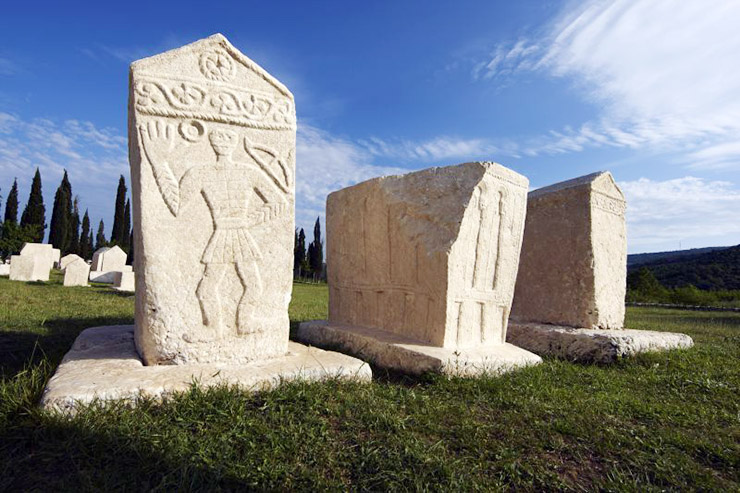
  • Pope Francis & the Prophecies of St Malachy

    Pope Francis & the Prophecies of St Malachy

    From New Dawn 142 (Jan-Feb 2014)

    We think of prophecy as a revealing of information that can include warnings or spiritual insights. In the Old Testament, prophets were revered and the wisdom they imparted considered of the highest authority. They acted as a conduit to divine revelation as the will of God was revealed to them through communication with the Holy Spirit.

    Christianity was built upon a Messianic figure whose coming was prophesied in the Old Testament books of Daniel and Isaiah. Yet in recent times, prophecy has fallen out of favour within the Church. Respect is still given to the biblical prophets such as Isaiah and St John of Patmos, to who is attributed the Book of Revelation, but the Catholic Church has refused to condone any post-biblical prophetic utterance as being true regardless of the source.

    In spite of this, seers continued to add to the great body of prophetic work throughout history. Hildegard von Bingen, Nostradamus, numerous saints and even some of the popes were compelled to share their visions of the future. The accuracy of some of their prophecies cannot be denied.

    An example was Mother Shipton, a 16th century English prophetess who appeared to have a clear vision of the 20th century and the Second World War. Her writings include: “Carriages without horses shall go. Around the world thoughts shall fly, in the twinkling of an eye. Underwater men shall walk, women will dress like men and trousers wear, and cut off all their locks of hair. When pictures look alive with movements free. When ships, like fishes, swim beneath the sea. When men, outstripping birds, can soar the sky, then half the world, deep-drenched in blood, shall die.”

    Shipton’s writings have an apocalyptic feel and like many prophecies, biblical or otherwise, share a common theme in describing the End Times. This is known to Christians as eschatology.

    Another widely accepted example of prophecy concerns the Great Fire of London. Three famous seers, Nostradamus, Mother Shipton and the astrologer William Lilly, all predicted a fire would engulf London in 1666. Astrologer Lilly was so accurate in his divination that he was able to name the actual day the fire would start, and as a result he was arrested and dragged before Parliament accused of having caused it himself. He managed to prove otherwise and was set free.

    The above examples were not a matter of coincidence or luck, nor were the seers attempting to gain fame or credibility. They were simply communicating these foresights as inevitable facts of what had been revealed to them through divination or vision.

    Members of the Catholic Church also continued to produce prophecies by those blessed with visions and among these stood St Malachy of Armagh, a devout Catholic bishop who helped to reform Ireland during the dark days of the 12th century.

    St Malachy

    According to the historian Cucherat, Malachy received a vision during a visit to Rome wherein he had witnessed every pope from that day to the Last Judgement. Known as the ‘Prophecies of the Popes’, these were recorded as 112 brief Latin descriptions, which were clues to the identities of the popes from medieval times to present day. The prophecies conclude with the last pope whom Malachy predicted would oversee the end of the papacy and the fall of the Roman Catholic Church.

    It is said that Malachy bestowed these prophecies upon the then current pope after which they were deposited in the Vatican and remained hidden for nearly 400 years.

    The Release

    The prophecies were rediscovered in the Vatican archive in 1590, and published in 1595 by Arnold Wion in his publication Lignum Vitae. Wion claimed these were the authentic prophecies as had been penned in the 12th century by St Malachy.

    The sudden ‘rediscovery’ of the prophecies in the 16th century allowed them to be used as propaganda in the campaign to promote Pope Gregory XIV to the throne. Since that time, debate has raged over whether the prophecies were a fabrication purely invented for this purpose. However, when studying the accuracy of the prophecies from both before and after publication, it seems unlikely they are complete fakes.

    Accuracy

    When the prophecies were published in 1595, the corresponding pope for each prophecy up to that date was known and could easily be identified. In the centuries since then, many have poured over these sayings seeking evidence of a connection in the lives of subsequent popes. The brevity of the text in the Latin phrases allows for some room for interpretation, but many are very specific and in no way as vague as one might expect. For a document that is at least 400 years old, there has always been a certain degree of accuracy.

    A possible explanation for this would have been if the papal elections were somehow influenced by the prophecies, but there are many examples that refute this.

    The prophecy for Pope Pius VII could not have been contrived. His reign coincided with the rise of Napoleon whose fame and power overshadowed the pope considerably. The prophecy for the time of Pius was “rapacious eagle,” and the eagle was the symbol by which Napoleon was identified.

    Another important example of the accuracy of the prophecies is the reign of Pope Benedict XV (1914-1922) in which he witnessed the Bolshevik Revolution outlaw Catholicism in Russia, the 1918 Spanish Flu pandemic that ravaged Europe and the outbreak of the First World War which killed a further 20 million people. His correlating prophecy was “religion depopulated.” It must be noted these world events could not have been averted so it would not have mattered which pope reigned during this time. The prophecy is linked to the timing of historic events and not to the man, but it is clear the link to the pope could not have been contrived in any way.

    Other prophecies were also based upon external factors such as the location of the conclave, historic events or feast days that coincide with the election. Clement IX (1667-1669) was prophesied as the “Swan constellation.” He was elected in the ‘Chamber of Swans’ within the Vatican, but any cardinal could have been elected in that place and would have fitted the prophecy. This does not invalidate the prediction, but it changes the focus from the identity of the individual to the environment.

    Further evidence for the sustained accuracy of the prophecies can be seen in Pope Clement XIII (1758-1769), whose prophecy was “Rose of Umbria.” Clement was a former governor in Umbria which has a rose for its state emblem. Pope John XXIII (1958-1963), whose prophecy described him as “priest and mariner,” was previously the Cardinal of Venice, and Pope Leo XIII (1878-1903) is described in the prophecies as “Light in the heavens.” His coat of arms shows a shooting star. This example and numerous others are accurate 700 years after the time of being inscribed, and 400 years following publication.

    Pope Innocent XII (1691-1700), whose prophecy translates as “Rake in the door” had the surname Rastrello, Italian for rake, and originally had a rake on his family coat of arms. This has to be the most accurate and one of the hardest to contrive. Innocent’s election came at the end of a very difficult five-month-long conclave, so it is unlikely his selection was a simple attempt to fulfil prophecy.

    The Final Pope

    The ‘Prophecies of the Popes’ join that long tradition of apocalyptic prophecy by concluding with a final pope, “Peter the Roman” who is destined to witness the destruction of Rome and the Last Judgement.

    In the final persecution, the seat of the Holy Roman Church will be occupied by Peter the Roman, who will feed the sheep through many tribulations, and when these things are finished, the city of seven hills will be destroyed, and the formidable Judge will judge His people. The End.

    According the ‘Prophecies of the Popes’, the time of the last pope is finally upon us.

    On 13 March 2013 Jorge Mario Bergoglio, hailing from Argentina, became the first non-European pope for 1,300 years. As Pope Francis, he is proving popular, as his displays of humility and focus on poverty are fast becoming the stuff of legend.

    The identification of Pope Francis as Peter the Roman requires no great leap of deduction. Members of the Curia are automatically referred to as being Roman, having held a position in the Vatican administration. Bergoglio previously held five such positions in the Roman Curia. The links to the ‘Peter’ aspect of the prophecy were less clear until Bergoglio chose his papal name from Saint Francis of Assisi, whose full name was Francesco di Pietro di Bernardone – Pietro meaning Peter.

    There is a precedent for this with Pope Paul IV who was elected in 1555. The prophecy described him as “from the faith of Peter.” Paul’s middle name was Peter.

    Challenging Times

    The timing of the ‘many tribulations’ of the prophecy may also seem apposite as there are many challenges on the horizon that threaten to unseat the new pope and bring to an end one of the oldest institutions in the world. For nearly 2,000 years the Catholic Church has been besieged by persecution and threats of invasion, but in recent years those armies have receded and been replaced by the judgments of the press and public opinion.

    The three main challenges facing the Catholic Church today are the exodus of members from both the priesthood and congregation, corruption within the Vatican bank and the scandal of child abuse.

    In terms of addressing the loss of the faithful, Pope Francis can speak directly to the wider audience of disillusioned priests and parishioners. His Argentinian birth and Jesuit background is well suited to stemming the exodus from Catholicism sweeping through South America where over 75 million Christians have converted to Pentecostalism.

    Poverty is a huge issue between the clergy of South America and the Vatican as there is so much wealth in Rome, and yet, so many Catholics worldwide are mired in destitution. Pope Francis is devoted to alleviating the suffering caused by poverty, and as Archbishop of Argentina, he refused to live in the palace assigned to that role and would travel on public transport to visit the poorest people in slums and prisons.

    He may have good intentions for mitigating poverty, but first he will need to put the Vatican finances in order in the wake of the banking scandals that dogged his predecessor, Pope Benedict XVI. There is also a possibility that in terms of financial fluidity, Pope Francis may find the Vatican coffers are already empty, and he cannot easily sell off the family silver.

    Conclusion

    Pope Francis is well suited to address the challenges facing the Catholic Church, but in the shadow of a 700-year-old prophecy, he may find that fate has other plans for him. Christianity is an apocalyptic religion and it might be within reach of its conclusion: the Rapture clothed in death and destruction.

    We can only wonder if the Roman Curia will truly embrace that of prophecy, or if they are hoping to maintain the status quo.

    In the end, they might not have a choice.

    Rob Howells is the author of The Last Pope: Francis and the Fall of the Vatican (Watkins, 2013), available from all good bookstores and online retailers. He sheds new light on the prophecies of St. Malachy to reveal that Francis will be the final pope of the Catholic Church.

    [alert type=”general” dismiss=”no”]This article was published in New Dawn 142.[/alert]

    [alert type=”success” dismiss=”no”]If you appreciate this article, please consider subscribing to help maintain this website.[/alert]

    © New Dawn Magazine and the respective author.
    For our reproduction notice, click here.
  • Gallipoli: The Untold Story – ‘The first casualty of war is truth’

    Gallipoli: The Untold Story – ‘The first casualty of war is truth’

    From New Dawn 149 (Mar-Apr 2015)

    The truth about Gallipoli has, unlike its victims, been buried deep. Historians like Peter Hart who describe it as “an idiocy generated by muddled thinking”1 are justified in their anger, but not their conclusions. The campaign was conceived in London as a grotesque, Machiavellian strategy to fool the Russians into believing that Britain was attempting to capture Constantinople for them. The paradox of its failure lay in its success. Gallipoli was purposefully designed to fail.

    A secret cabal of immensely rich and powerful men – the Secret Elite – was formed in England in 1891 with the explicit aim of expanding the British Empire across the entire globe. They planned a European war to destroy Germany as an economic, industrial and imperial competitor and, to that end, drew France then Russia into an alliance termed the Entente Cordiale. Their massive land armies were needed to crush Germany. France would be rewarded with Alsace and Lorraine, while Russia was conned into believing she would get Constantinople.2 Thereafter, seizing the Ottoman capital became a “widespread obsession, bordering on panic” in St Petersburg.3

    Had Britain encouraged the friendship of Turkey in 1914, the disaster of Gallipoli would never have happened.4 The Turks generally disliked the Germans and their growing influence,5 and made three separate attempts to ally with Britain. They were rebuffed on each occasion.6 They also pleaded in vain with the French to accept them as an ally,7 and protect them against their old enemy, Russia.8 Poor fools. The French and British alliance with Russia was at the expense of the Turks, not an alliance with the Turks to save them from Russia. Britain and France planned to carve up the oil rich Ottoman Empire. To that end, the Turks had to be pushed into the German camp and defeated.

    In July 1914 the majority of the Turkish cabinet was still well disposed towards Britain,9 but their faith was shattered by the seizure of two battleships being built for them in England. As an essay in provocation it was breathtaking.10 “If Britain wanted deliberately to incense the Turks and drive them into the Kaiser’s arms she could not have chosen more effective means.”11 Winston Churchill (a loyal servant of the Secret Elite) seized the dreadnoughts because they were “vital to Britain’s naval predominance.”12 The truth ran much deeper.

    Back in February, Russia laid plans for her Black Sea fleet to take Constantinople by landing 127,500 troops and heavy artillery from Odessa. Arrival of the dreadnoughts from England would destroy this plan.13 Russia’s Foreign Minister Sazonov issued a thinly veiled warning to London on 30 July: “It is a matter of the highest degree of importance that… these ships must be retained in England.”14 Fearful that Russia would renege on her commitment to war should the ships be released, the Secret Elite withheld them. It kept Russia on board and helped drive Turkey into the German camp (they signed a treaty on 2 August), but it created a major problem. How to prevent the Russian Black Sea fleet from seizing Constantinople? Two German warships provided the answer. On 4 August, while off the coast of Algeria, the battle cruiser Goeben and attendant light cruiser Breslau received orders to head for Constantinople.

    Vastly outnumbered (73 to 2) by French and British warships, the escape of the German cruisers to Constantinople, 1,200 miles away, is described as a “fiasco of tragic errors” by “fumbling” British Admirals.15 The British Admiralty supposedly had no idea where they were heading, but the reality was very different. On 3 August, Kaiser Wilhelm telegraphed King Constantine to say that both warships would be proceeding to Constantinople. This information was transmitted to London,16 and to the British naval mission in Athens.17 Naval Intelligence in London had intercepted and decrypted the actual encoded message from Berlin to Goeben: “Alliance concluded with Turkey. Goeben and Breslau proceed to Constantinople.” The Admiralty knew,18 but relayed information to the Mediterranean fleet that “was either useless or inaccurate.”19 Goeben and Breslau were allowed to escape in order to neutralise the Russian Black Sea fleet. Foreign Secretary Sazonov was outraged that the Royal Navy had failed to prevent it.20

    The Ottoman Ambassador in Berlin summed it up perfectly: “Considering the displeasure and complications which a Russian attack on Constantinople would produce in England, the British navy having enabled the German ships to take cover in the Sea of Marmora, has, with the Machiavellianism characteristic of the Foreign Office, foiled any possibility of action by the Russian Black Sea Fleet.”21 Safe arrival of the Goeben rendered a Russian amphibious operation well-nigh impossible,22 and the British Ambassador at Constantinople admitted that their presence served British interests, since “they protected the straits against Russia.”23

    On 9 September Admiral Arthur Limpus, head of the British naval mission in Turkey, was recalled. Turkey, although still neutral, closed and mined the Dardanelles. In late October Goeben and Breslau bombarded Sevastopol and other Black Sea ports. Infuriated, Tsar Nicholas insisted on war with Turkey and the seizure of Constantinople for Russia. British and French fears that he would make peace with Germany if Constantinople was denied him gave the Tsar overwhelming diplomatic leverage, and it was agreed that Turkey must now be brought into the war.24

    War Declared & the Secret Elites Initiate Gallipoli Campaign

    On 2 November Russia declared war on Turkey. Britain and France followed suit three days later. “November 1914 brought a kind of holy war fever to the Russian Foreign Ministry.”25 With over one million Russian casualties for no gain, anti-war protests and revolution stalked the streets of Petrograd. In London, fear of Russia signing a peace treaty with Germany loomed large. How was Russia to be kept in the war with the promise of Constantinople, without actually allowing it? The solution, an attack on Gallipoli, was fraught with pitfalls. The Tsar had to be tricked into believing Britain was generously responding in his hour of need by mounting an all-out effort to take Constantinople for Russia.

    The Gallipoli campaign supposedly arose from an urgent call for help from the Russian commander-in-chief Grand Duke Nikolay Nikolaevich on 31 December. Would Britain create a diversion to relieve pressure on Russian troops fighting in the Caucasus?26 This widely held view is wrong. The suggestion came not from Nikolaevich, but from the British military attaché at Petrograd, Sir John Hanbury-Williams. Intimately linked to the Secret Elite and their leader Lord Alfred Milner,27 Hanbury-Williams was frequently in close contact with Nikolaevich. He expressed anxiety about Russia’s domestic morale, but never even mentioned the Dardanelles. It was Hanbury-Williams who planted the idea of a British demonstration against the Ottoman Empire.28 Next day this was presented to the British War Council and magically transformed into a desperate plea for help from Russia.

    Having already decided their strategy to keep the Russians out of Constantinople, the Secret Elite now cleverly made it appear that the idea came from Russia. It was all pre-planned, “long before any kind of military imperative in the Ottoman theatre was apparent.”29 The Secretary of the Committee for Imperial Defence, Maurice Hankey, proposed a solution that met all requirements, and it is no coincidence that Hankey was himself a member of the Secret Elite.30 The Gallipoli campaign would be mounted as a sop to the Russians, but set up to fail.

    Days later the military dynamic changed. The Turkish 3rd Army was decimated in the Caucasus and, irrespective of whose suggestion it had been, there was no need whatsoever for any British intervention to help Russia. Nonetheless, on 20 January Britain informed Russia that she would undertake not just a demonstration, but a complete operation to penetrate the Dardanelles and Gallipoli. The Russians desperately wanted to take part, but were told to concentrate all efforts against Germany on the Eastern Front. The Secret Elite moved into top gear. An objective that required long months of careful preparation was rushed ahead at breakneck speed with disregard for the basic prerequisites for success.

    Churchill assumed command and chose men for their ineptitude rather than ability. He turned to Vice-Admiral Sackville Carden, recently appointed commander of the Mediterranean Squadron after years in a desk-bound job, as superintendent of the Malta dockyards. Slow and ineffective,31 Carden was tasked with drawing up a plan for a naval attack on the Dardanelles, and relaying it to Churchill within days for presentation to a War Council meeting.32 On 15 January Carden was informed that his plan had been accepted33 and that he would be in command. What had happened? The ‘plan’, rapidly cobbled together on the back of an envelope by a second rate officer, was to be used as the blueprint for the Gallipoli campaign. The reluctant Carden was given no option other than to get on with it,34 and was effectively set up to take the blame when it failed. For fail it must.

    Rear-Admiral Arthur Limpus, an eminently more experienced and knowledgeable man who had spent years in Turkey advising on all naval matters, including the defence of the Dardanelles, was overlooked.35 Here was the man “who knew the Turks and the Dardanelles intimately,”36 yet Churchill shunned him because “the Turks might be offended” and it would be “unfair and unduly provocative” to place in command a man with an inside knowledge of the Turkish fleet.37 Limpus “knew all their secrets,”38 and more about the Dardanelles and the Turkish navy than any other naval officer, yet we are asked to believe that he wasn’t given command because it was considered ungentlemanly – “not quite cricket.”39 Limpus had been sent to the Malta dockyards to sit at Carden’s old desk. Outrageous stupidity or cold calculation?

    Limpus was opposed to Churchill’s plan,40 stressing that the first stage must be an amphibious landing, not a naval attack.41 He was not alone in his opposition. In 1906, naval chiefs considered a naval assault too risky.42 Any attack on Gallipoli would “have to be undertaken by a joint naval and military expedition,”43 and Churchill himself stated in 1911 that it was “no longer possible to force the Dardanelles.”44 Rear-Admiral Carden was ignorant of the fact that any chance of success at Gallipoli was absolutely dependent on a combined naval and military operation. Without long, detailed joint planning, and a sufficient number of troops, it was impossible. Lord Kitchener, the British Secretary of State for War, refused to make troops available and Carden was ordered to proceed with a naval attack.

    The Russians were turning the screw. Pressure for immediate action influenced the War Council’s decision.45 On 14 February, Sazonov stated that the time for moderation had passed. Tsar Nicholas agreed, informing the French ambassador that his people were making terrible sacrifices in the war without reward. Constantinople must be incorporated into his empire.46 Sazonov implied to the British ambassador that he would resign, and be replaced by Sergei Witte, a pro-German sympathiser who would immediately seal a treaty with Germany.47 All warnings against a purely naval attack were ignored. The navy’s objective was to “bombard and take the Gallipoli peninsula with Constantinople as the objective.”48 After the disastrous failure the Dardanelles Commission asked, “How can a fleet take a peninsula? And how could it have Constantinople as its objective? If this meant… that the Fleet should capture and occupy the city, then it was absurd.”49 It was all absurd.

    Naval bombardment of the outer forts of the Dardanelles began on 19 February and ran for six days. It caused some damage but destroyed all hope of surprise and merely led the Turks to strengthen their defences.50 The main naval attack took place on 18 March. On the previous day Vice-Admiral De Robek had to take charge when Carden suffered a nervous breakdown. It was no surprise. He was never fitted for the task and felt completely undermined by the Admiralty’s refusal to provide custom-built minesweepers. They were utterly essential but he was given only North Sea trawlers that could barely make headway against the strong 5-6 knot current. Eight powerful destroyers, which could have been fitted with sweeps, remained idle that fateful day while the officers sat playing cards,51 and only two out of a total of 387 mines were cleared.52 A fleet of 16 British and French battleships bombarded the coast, but were unable to penetrate the minefield and six battleships were sunk or disabled by mines. The Bouvet sank within two minutes with over 600 men trapped inside. It was the disaster predicted as far back as 1906.

    [alert type=”info” dismiss=”no”]If you appreciate this article, please consider a subscription to New Dawn magazine.[/alert]

    A Campaign That Could Never Succeed

    Orchestrated chaos shrouded a campaign that could never succeed. Kitchener meantime had changed his mind and agreed to make troops available for a combined attack, but the naval assault had gone ahead before their arrival. Maurice Hankey, acting more as strategic adviser to the War Council than its Secretary,53 stated, “combined operations require more careful preparation than any other class of military enterprise. All through our history such attacks have failed when the preparations have been inadequate.”54 He listed ten points to be met if a joint attack was to succeed. Was he saying, “it will fail as long as we do not take the following measures”? According to the War Council minutes, Hankey’s plan was not even discussed.55 In the event, every point he made was studiously ignored.

    Military leadership, like naval, was barely functional. General Sir Ian Hamilton, a man in the twilight of his career who “knew little of the Dardanelles, the Turkish army or of modern warfare,” was chosen to command.56 Scared of Kitchener, and hamstrung by his long-subservience,57 he noted in his diary, “It is like going up to a tiger and asking for a small slice of venison.” During the Boer War he had witnessed Kitchener respond to an officer’s appeal for reinforcements by taking half his troops away.58 The genial Hamilton, like poor Carden, was a scapegoat made to order.

    Summoned by Kitchener on 12 March, Hamilton was brusquely informed, “We are sending a military force to support the fleet now at the Dardanelles and you are to have command.” Hamilton was stunned, later admitting, “My knowledge of the Dardanelles was nil, of the Turk nil, of the strength of my own forces next to nil.” When asked if a squadron of modern aircraft with experienced pilots and observers could be made available, Kitchener testily replied, “Not one.” 150,000 men was the minimum required strength for the task, but Kitchener insisted that “half that number” would do handsomely.59 No attempt was made to co-ordinate intelligence about the defences at Gallipoli, not even at strategic level.60 Hamilton was given a cursory briefing, two small tourist guidebooks and old, inaccurate maps.61 Detailed reports from Admiral Limpus and Lieutenant-Colonel Charles Cunnliffe-Owen, another officer with considerable knowledge of Gallipoli, were kept from him.62 Hamilton set off within 48 hours, together with some inexperienced members of staff who did not even know “how to put on their uniforms.”63 So much for detailed preparation.

    The chaos continued. There was no discussion, no plan, no naval/military coordination. Indeed, it was a worse situation than preceded the naval operation.64 Gallipoli was to be invaded with a mixed force of 80,000 men from Britain, France and the Empire. Raw Anzac troops and unseasoned French recruits were to be thrown into battle for the first time. Marshall Joffre, the French commander-in-chief, was profoundly opposed to the whole operation and initially refused to provide troops. Political expediency forced his hand.65 A French army Colonel who had spent years in Constantinople also opposed the attack, but like everyone else with intimate knowledge of the area, its topography and defences, he was dismissed.66 Lieutenant-Colonel Cunnliffe-Owen, the British military attaché at Constantinople in 1914, who had personally conducted a detailed survey of Gallipoli, was likewise deliberately overlooked. In London when staff were being scratched together for Hamilton’s team, Cunnliffe-Owen was passed over. His detailed reports on the peninsula were never shown to General Hamilton.67

    Kitchener agreed to the deployment of 18,000 men from the British army’s 29th Division. Its commander, Shaw, had served with distinction at Mons and was considered a highly competent and “impressively professional soldier.” Two days before leaving for Gallipoli, when continuity was all-important, Shaw was inexplicably replaced by Major-General Hunter-Weston. He immediately rejected his allocated ship because it lacked first class accommodation, and was transferred to the luxury liner Andania.68 Major-General Shaw suffered the same fate as Admiral Limpus. A competent, knowledgeable man was rejected in favour of Hunter-Weston, a laughing-stock in the British Army,69 spectacularly incompetent, and “one of the most brutal commanders of the First World War.”70 Ask yourself, what was going on?

    Hamilton arrived to find his army scattered in confusion over much of the Mediterranean. Some battalion commanders couldn’t trace their companies. Ships came from Britain with such poorly written orders that captains did not know their destination.71 On their arrival at Mudros, the ships were found to be loaded in a shambolic fashion, and had to be taken 700 miles to Egypt to be unloaded and repacked.72 Such was the lack of preparation that even the simplest questions could not be answered. “Was there drinking water on Gallipoli? What roads existed? Were troops to fight in trenches or the open? What sort of weapons were required? What was the depth of water off the beaches? What sort of boats were needed to get the men, the guns and stores ashore? What casualties were to be expected? How were they to be got off to the hospital ships? It was simply a case of taking whatever came to hand and hoping for the best.”73

    An “Amateurish, Do-It-Yourself Cock-Up”

    You couldn’t make it up. There was a shortage of guns, ammunition, aircraft and, above all, troops. Hamilton’s requests for additional supplies and reinforcements were either ignored or refused.74 Gallipoli veteran Charles Watkins described the campaign as an “amateurish, do-it-yourself cock-up.”75 It was designed to be exactly that. The quality of preparation and leadership guaranteed it. General Ian Hamilton was the Secret Elite’s Patsy-in-Chief, unwittingly abetted by the incompetent Admiral Carden. These were the men chosen to fail.

    The Gallipoli landings went ahead on 25 April 1915 with the terrible slaughter and wounding of many incredibly brave young men, dispensable pawns on Imperial Britain’s chessboard. Despite the fleet now having some thirty powerful destroyers equipped to sweep the mines, and many officers totally confident that the fleet could now get through, no further attempt was made to force the Dardanelles. The navy would play no further part other than ferrying the men ashore, taking off the wounded, and providing a safe haven off-shore for the likes of Hunter-Weston. Successful mine sweeping had always been the key to a successful naval assault, and with the new minesweepers and a clear run through to the Straits, the fleet could have greatly assisted the army with controlled bombardments of Turk positions from within the channel. It would, of course, also have been able to cripple Goeben and Breslau. For the above stated reasons, that would not be allowed to happen.

    For years knowledgeable men had insisted that a well planned and resourced combined naval and military attack was the only type of operation that might succeed, but never at any point in the entire Gallipoli campaign was a joint assault carried out. The elites in London ordered the shambolic attack by the navy when they knew it was bound to fail, and now ordered an equally shambolic attack by the army in the full knowledge that it too could never succeed.

    Gallipoli was a lie within the lie that was the First World War. The campaign ended in military defeat, but geo-strategic victory for the British Empire. By late 1915, with Russian forces pushed back on the eastern front and any likelihood of their intervention in Constantinople gone, the British government began planning withdrawal from the corpse strewn peninsula. The last Allied troops were taken off on 9 January 1916, leaving behind 62,266 of their comrades. The majority of the dead on both sides have no known graves. Many of the 11,410 Australians and New Zealanders who died76 suffered unspeakable deaths, deliberately sacrificed on the altar of British imperialism.

    Get the issue this article appears in

    A Myth Obscures the terrible Truth

    Over the last century, in both Britain and Australia, Gallipoli has been turned into a heroic-romantic myth,77 a myth promoted by court historians and pliant journalists in order to hide the stark truth. It was a ruse, a sop to the Russians to keep them in the war in the belief that allied forces would capture Constantinople on their behalf. Put into the hands of incompetent generals and admirals, starved of troops, determined leadership, ill-equipped, ill-advised and certain to fail, the attack on Gallipoli as an integral part of the imperial strategy was a stunning success.

    We are aware of at least one renowned Gallipoli historian and writer in Australia who agrees with our thesis. Like us, he proposes that “it was the intention of the British and French governments of 1915 to ensure that the Dardanelles and the Gallipoli campaign would not succeed” and was “conceived as a ruse to keep the Russians in the war…” He believes that while the proposition has circumstantial evidence to support it, there is “little or no documentary evidence.”78 He is very unlikely to find it. As revealed in our book Hidden History: The Secret Origins of the First World War, masses of crucial documents relating to the First World War were shredded or burned, or have been kept hidden away to this very day in a high security establishment at Hanslope Park in England. The individuals responsible for the war, responsible for Gallipoli, were many things, but they weren’t so stupid as to leave incriminating evidence lying around. Historians in Australia and New Zealand must stop protecting their comfortable careers and start acknowledging the terrible truth about Gallipoli. Peddling mythology as truth is an insult to the memory of those brave young men.

    Just as in Britain, the Government of Australia seeks to be the guardian of public memory, choreographing commemoration into celebration,79 ritually condemning war while the rhetoric gestures in the opposite direction.80 The War Memorial in Sydney’s Hyde Park proudly exhorts, “Let Silent Contemplation Be Your Offering,” yet the deafening prattle of political expediency mocks the valiant dead with empty words and lies. Don’t be fooled. Those young men died for the imperial dreams of wealthy manipulators, not for ‘freedom’ or ‘civilisation’. They died deceived, expendable, and in the eyes of the power-brokers, the detritus of strategic necessity. Remember that.

    To read exclusive extracts from their book Hidden History: The Secret Origins of the First World War, including their latest research on Gallipoli, please visit the authors’ blog at firstworldwarhiddenhistory.wordpress.com. Hidden History is available from all good bookstores and online retailers.

    The authors contributed the article “The Secret Origins of the First World War” to New Dawn Special Issue Vol 9 No 1.

    [alert type=”general” dismiss=”no”]This article was published in New Dawn 149.[/alert]

    [alert type=”success” dismiss=”no”]If you appreciate this article, please consider subscribing to help maintain this website.[/alert]

    Footnotes

    1. Peter Hart, Gallipoli, vii
    2. David Fromkin, A Peace to End All Peace, The Fall of the Ottoman Empire and the Creation of the Modern Middle East, 138; Niall Ferguson, The Pity Of War, 61
    3. Sean McMeekin, The Russian Origins of the First World War, p.28.
    4. J Laffin, The Agony of Gallipoli, 3
    5. Robert Rhodes James, Gallipoli, 8
    6. Hew Strachan, The First World War, 102
    7. Friedrich Stieve, Isvolsky and the World War, 177
    8. W W Gottlieb, Studies in Secret Diplomacy, 34
    9. Dan Van Der Vat, The Dardanelles Disaster, 28
    10. L A Carlyon, Gallipoli, 42
    11. Gottlieb, Studies, 42
    12. W.S. Churchill, The World Crisis, 221-2
    13. Sean McMeekin, The Russian Origins of the First World War, 30-34
    14. Ibid., 102
    15. Ulrich Trumpener, ‘The Escape of the Goeben and Breslau’, Canadian Journal of History, September 1971, 171
    16. Ibid., 178-9
    17. Geoffrey Miller, The Straits, ch. 16
    18. Alberto Santini, ‘The First Ultra Secret: The British Cryptanalysis in the Naval Operations of the First World War’, Revue Internationale d’Histoire Militaire, Vol. 63, 1985, 101
    19. Ulrich Trumpener, ‘The Escape of the Goeben and Breslau’, Canadian Journal of History, September 1971, 181-7
    20. Gottlieb, Studies, 45
    21. Ibid., 46
    22. McMeekin, The Russian Origins, 105-106
    23. Strachan, The First World War, Vol. 1, 674
    24. McMeekin, The Russian Origins, 96-97
    25. Ibid., 115
    26. Ronald P Bobroff, Roads to Glory, Late Imperial Russia and the Turkish Straits, 125
    27. Carroll Quigley, The Anglo-American Establishment, 56
    28. McMeekin, The Russian Origins, 129-30
    29. Ibid., 121
    30. Quigley, Anglo-American Establishment, 313
    31. Tim Travers, Gallipoli, 20-21
    32. Laffin, The Agony, 21-22
    33. Robin Prior, Gallipoli, The End of A Myth, 22
    34. Ibid., 52
    35. Rhodes James, Gallipoli, 63
    36. B. H. Liddell Hart, History of the First World War, 213
    37. Laffin, The Agony, 9
    38. Alan Moorehead, Gallipoli, 60
    39. Michael Hickey, Gallipoli, 27
    40. Harvey Broadbent, Gallipoli, The Fatal Shore, 21
    41. Laffin, The Agony, 9
    42. Memorandum by the General Staff, 19 December 1906, National Archives, PRO. CAB/4/2/92
    43. Hickey, Gallipoli, 28
    44. James, Gallipoli, 3-4
    45. Broadbent, Gallipoli, The Fatal Shore, 28
    46. Ronald P Bobroff, Roads to Glory, Late Imperial Russia and the Straits, 126-131
    47. McMeekin, The Russian Origins, 130-131
    48. Laffin, The Agony, 15-22
    49. Moorehead, Gallipoli 40
    50. Laffin, The Agony, 31
    51. Travers, Gallipoli, 29
    52. Prior, Gallipoli, 53
    53. Stephen Roskill, Hankey, Vol. 1, 156
    54. Ibid., 163
    55. War Council Minutes, 19 March, 1915, CAB 42/2
    56. Prior, Gallipoli, 67
    57. Peter Hart, Gallipoli, 63
    58. Laffin, The Agony, 39
    59. Ibid., 30
    60. Ibid., 19
    61. Ibid., 31
    62. Hickey, Gallipoli, 67
    63. Laffin, The Agony, 31
    64. Prior, Gallipoli, 70
    65. Laffin, The Agony, 35
    66. Edmond Delage, The Tragedy of the Dardanelles, 109
    67. Laffin, The Agony, 12-13
    68. Hickey, Gallipoli, 57-58
    69. Denis Winter, Haigs Command, 140
    70. Prior, Gallipoli, 80
    71. Laffin, The Agony, 31
    72. Moorehead, Gallipoli, 90
    73. Prior, Gallipoli, 242
    74. Moorehead, Gallipoli, 117
    75. Laffin, The Agony, 217
    76. Prior, Gallipoli, 242
    77. Jenny Macleod, Reconsidering Gallipoli, 7-14
    78. ‘Gallipoli: one great deception?’ by Harvey Broadbent, ABC, 29 Sep 2010, www.abc.net.au/news/2009-04-24/30630
    79. James Brown, Anzacs Long Shadow, 19-22
    80. Marilyn Lake and Henry Reynolds, What’s Wrong With Anzac? The Militarisation of Australian History, 8

    © New Dawn Magazine and the respective author.
    For our reproduction notice, click here.