New Dawn – World's Most Unusual Magazine

Category: Secret History

  • The Secret History of Astrology

    The Secret History of Astrology

    From New Dawn 141 (Nov-Dec 2013)

    The history of astrology is in many ways the history of a polemic. The question of whether astrology works, as crucial as it is, is soon buried under other issues, such as what this might have to say about human free will and whether the stars and planets that govern our fates are benign, malevolent, or neither. These issues have been debated for thousands of years.

    Before we get into them, however, we should probably begin with why astrology is the way it is. To do this, we have to imagine what ancient people saw and how they explained it. In the first place, they would have found that there are seven bodies in the sky that move (or, as we would say today, appear to move) around the earth. These are the sun and the moon as well as five planets: Mercury, Venus, Mars, Jupiter, and Saturn. The rest of the planets are invisible (except for Uranus, under some circumstances) to the naked eye.

    The number seven is significant: probably there is no other number that has so much lore and mystery about it. But the explanations for its importance are never very clear. Of all the reasons given for the prominence of seven, there is only one that makes a great deal of sense. In his magisterial History of Magic and Experimental Science, Lynn Thorndike writes, “The number seven was undoubtedly of frequent occurrence, of a sacred and mystic character, and virtue and perfection were ascribed to it. And no one has succeeded in giving any satisfactory explanation for this other than the rule of the seven planets over our world.”

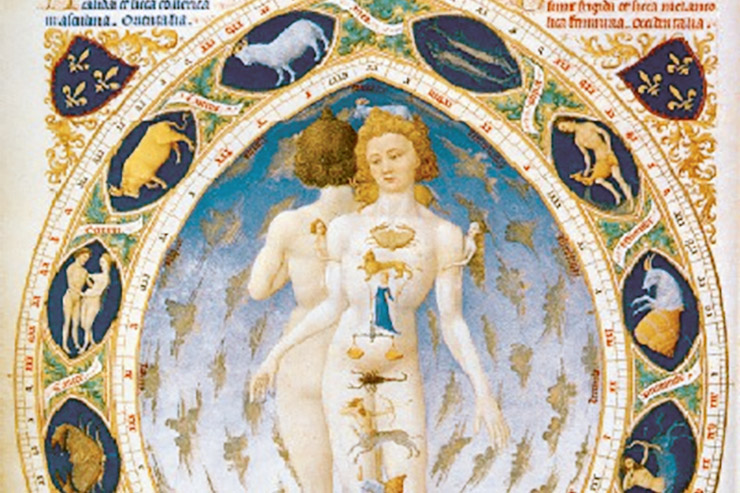
    So we have a system of seven planets, imagined as moving in concentric spheres around the earth. Of these, the most important is the sun; the second is the moon. Ancient humans observed that the sun appeared to move in a tight band of the sky, known as the ecliptic. By the time it made a full circuit, returning to the same point in the sky, somewhat more than twelve cycles of the moon had passed. (The solar year is 365.242 days long; the lunar year is 354.37 days.) Thus there were slightly more than twelve moons in a solar year, making the solar and lunar years extremely hard to reconcile. But twelve was the closest whole number to the truth, so it seemed reasonable to make a year with twelve months. It also made sense to divide the ecliptic into twelve parts. These were marked out by constellations, which were given specific names, mostly of animals. They are now the twelve signs of the zodiac.

    The Evolution of Astrology in History

    When did people start to make these calculations? When was this system set up? It appears that we owe to the Egyptians the schema of a twelve-month solar year (they added some intercalary days to the twelve lunar months to make up the full 365). But the most common and consistent traditions say that astrology itself came from Mesopotamia. The time is somewhat harder to fix, but one consideration might tell us something. Over the years the sun moves slightly in relation to the constellations of the zodiac, and every 2,150 years the sign in which the vernal (Spring) equinox appears will change. The full cycle, the time the sun takes to return to the same point in the zodiac (known as a Platonic year, because Plato was the first to mention it, in his dialogue the Timaeus) is approximately 25,800 years.

    The starting point of the zodiac is placed at the vernal equinox – 0 degrees of Aries. But at the vernal equinox (from the perspective of the northern hemisphere, where astrology developed), the sun does not rise with 0 degrees of Aries behind it, and it has not done so for a long time – not, in fact, since around 2000 BCE. (Today it rises with either Pisces or Aquarius in the background, depending upon whom you ask). Since this is the natural starting-point of the zodiac, we can assume that whoever set up this system must have begun here. We can speculate that astrology as we know it arose in Mesopotamia around 2000 BCE.

    And, in fact, the earliest evidence we have for astrology does indeed come from that part of the world. Although the Roman author Pliny the Elder cites a claim that the Babylonians were following and recording the stars for 490,000 years, the earliest astrological evidence we have is from the second millennium BCE. It consists of omen lists, which correlate various natural events, particularly the positions of the planets, with events on earth. Here is one example: “When the Moon occults Jupiter…, that year a king will die (or) an eclipse of the sun and moon will take place. A great king will die. When Jupiter enters the midst of the Moon there will be want in Abarrú” – and so on.

    Notice two things about this prediction. In the first place, it focuses on great events, like a famine or the death of a king. There was not yet any personal astrology as we know it. In the second place, the reasoning was inductive: when one thing happened, another thing was going to happen. While this was not, strictly speaking, scientific reasoning, it was like scientific reasoning in that it attempted to correlate one thing – the relations of planets – with another thing – events on earth. There was probably very little theorising about causes, that is, about why one thing should affect the other. But then, as Western philosophy has found again and again, the concept of causation is an extremely problematic one to this day. (For more on this, see my book The Dice Game of Shiva, chapter 4.)

    It was the Greeks who made astrology into what we know today. In his History of Western Astrology, Jim Tester contends that the twelve equal signs as we know them from Aries to Pisces was standardised in the fifth century BCE, at the time of Greece’s Golden Age. And it was definitely the Greeks who (at least in the West) first came up with the concept of natal (birth) astrology (or, to use the scholarly name, genethlialogy).

    While looking at all this, it’s important to remember that the sciences were not distinguished as they are today. Astrology and astronomy were the same discipline, and two of the greatest Greek astronomers, Hipparchus of Nicaea and Claudius Ptolemy, were also astrologers. (Astronomers also tended to be astrologers up to the seventeenth century.) Meteorology was part of the same package, and the planets were used to predict the weather. Aristotle in his Politics tells of the Greek philosopher Thales, who “knew by his skill in the stars while it was yet winter that there would be a great harvest of olives in the coming year; so, having a little money, he gave deposits for the use of all the olive-presses in Chios and Miletus, which he hired at a low price because no one bid against him. When the harvest-time came, and many were wanted all at once and of a sudden, he let them out at any rate which he pleased, and made a quantity of money. Thus he showed the world that philosophers can easily be rich if they like, but that their ambition is of another sort.”

    Medicine, too, had a link to astrology. The ancient and widespread idea that the human being, the microcosm, corresponds to the universe, the macrocosm, led the Greeks to assign the signs of the zodiac to different parts of the body. Aries, the first sign, was assigned the head; to Pisces, the last, were ascribed the feet. This enabled physicians to diagnose illnesses and prescribe treatments based on the patient’s horoscope and the positions of the planets. The connection between astrology and medicine lasted a long time, up until the eighteenth century. Before then, even sceptics admitted that it was useful to consult the stars for medical purposes. And astrologers who were attacked for the inaccuracy of their predictions retorted that the doctors did no better.

    It was natal horoscopes that gained the most ground, and they became popular in the last centuries BCE and in the early centuries of the Common Era. This period, which saw the rise of Hellenistic civilisation in the Mediterranean world, was, like ours, a time of tremendous technical and intellectual progress. It was also a time of political consolidation: small, previously independent states were united, first under Alexander the Great and his heirs, and later under the Roman Empire. As in our age, the world became more integrated – and the individual occupied a smaller piece of it.

    These facts may explain the tremendous rise in those centuries in devotion to the goddess Tyche or Fortuna – Fortune – whose caprices seemed to reflect a world where the individual was under the dominion of powers far away. It was also the time when personal astrology – particularly the natal horoscope – established its place in Western culture. People began to see their fates in more deterministic ways than they had done in previous centuries.

    ‘Gods’ & Planetary Spheres

    In those days, as we’ve seen, the planets were believed to surround the earth in concentric spheres. The soul taking incarnation in a birth was thought to descend through each of these planetary spheres in turn, assuming characteristics of that sphere as it passed. The relations of the planets to one another, and their place in the zodiac, thus dictated individual fate and character.

    Few modern astrologers would say this is why their art works, but on the other hand, there are also few other explanations that are much clearer or more sensible. We can take this idea of the soul’s descent as a metaphor for how one’s character may be fixed by the planets in the zodiac. Like most metaphors, it casts some light on what it portrays – and at the same time, it is only a metaphor.

    The history of astrology, as I’ve suggested, is the history of polemic, and just from looking at what I’ve just said above, we can see one of the bases for this polemic. The soul descends through the realms of the planets, and in those days the planets were gods. Plato in his Timaeus said that it was the gods of the planets that formed human beings, not the true, high God above (who, according to Plato, is himself perfect and could not have formed imperfect things like humans). Plato’s pupil Aristotle also held that the planets were subordinate gods.

    If this is true, then exactly who are these gods and how are they disposed toward us? Already in Plato the planetary gods are ambiguous figures, responsible for both the good and the evil in our natures. Later thinkers were to paint them in even more negative terms. The Hermetic texts – writings of late antiquity said to preserve the wisdom of the Egyptians – portrayed the keepers of these heavenly gates as the sources of vice in the human character. One Hermetic text describes the liberation of the soul at death as an ascent through the planetary spheres (as opposed to birth, when the soul descends): “Then the human being rushes up through the cosmic framework, at the first zone surrendering the energy of increase and decrease; at the second, evil machination, a device now inactive,” and so on through the seven spheres. Each sphere has a vice that is connected with its respective planet – “energy of increase and decrease” being connected with the moon, which waxes and wanes throughout the month, and “evil machination” with Mercury, the god of cleverness. The Gnostics, too, saw these intermediary planetary powers as inimical “archons” that imprisoned humankind spiritually.

    This ambiguous, or inimical, nature of the planetary gods led some to criticise astrology. Plotinus, the Neoplatonic philosopher of the third century CE, argued that if the planets are gods, it is absurd to conclude they can do evil (as some planets, particularly Mars and Saturn, are said to do). As a matter of fact Plotinus did not reject astrology entirely, allowing that it was useful for divination, because the planets are part of the cosmos and serve to reflect its harmony as a whole. But then his critique was not directed at astrology as such; the section of his Enneads discussing this matter is entitled “Are the Stars Causes?”, indicating it was the causative aspect of the planets that he had problems with. (Again we see how problematic the idea of causation can be.)

    Free Will Vs Fate

    By contrast, Plotinus’s disciple Porphyry embraced astrology (he even wrote a three-volume work on the subject, now lost). Dealing with the issue of free will versus fate, Porphyry used some of Plato’s texts to argue for a kind of mix between the two: the soul chooses its fate before incarnation, but this fate, immutable once one is born on earth, is reflected in the horoscope.

    Origen, a third-century church father, also focuses on free will. Like most Christian theologians, he is at pains to uphold the doctrine of free will and opposes anything that might challenge it. Yet he too stops short of rejecting astrology altogether, because if he did, he would have to reject natural philosophy as a whole (into which astrology was intricately interwoven at the time).

    Origen also contends that astrologers, in order to make perfectly accurate predictions, would have to be able to calculate horoscopes very precisely – within four minutes or so. The technology of the time did not allow them to do this; time was kept by sundials and water-clocks, which were not precise enough. Nor were astronomical observations. Hence, Origen said, astrology could not work.

    If we back away and look at this issue from a distance, we can actually see that, given what we know now, astrology should not have worked much of the time, given the limitations of the observations of the stars (there were no telescopes), and given the fact that the outer planets were unknown. To this we can add likely mathematical errors made by astrologers themselves, which must have been extremely common in all periods. In the sixteenth century, the celebrated prophet Nostradamus was derided by his astrological peers for his sloppiness in calculating charts.

    In any event, Christianity has always had an ambivalent, and frequently critical, posture towards astrology. Astrology and its practitioners were condemned when they came too close to sorcery and when they seemed to be criticising the doctrines of free will and divine sovereignty. But the science of the stars remained an important part of the medieval curriculum, partly because it was an integral part of the system of the seven “liberal arts” that the Catholic Church inherited from classical antiquity. (There is a persistent rumour that the pope’s bathtub in the Vatican is adorned with the signs of the zodiac, but I have not been able to verify this.)

    Although I could go into more detail about the history of astrology from late antiquity to the present, in fundamental ways the debate has not changed much. Some issues certainly have faded away. No one regards the planets as gods anymore, so we do not wonder about whether they are personally good or evil. And computers make it possible to calculate charts with extreme accuracy, either with one of the many dedicated software packages on the market or through many free sites on the Internet (astrodienst.com being one of the best-known). Finally, while the issue of free will versus determinism continues to haunt us, it does not have quite the theological weight that it once did. We no longer feel quite so obliged to justify the ways of God to man as people did a couple of centuries ago.

    Scientific Efforts to Validate Astrology

    Nonetheless, we are still forced to ask, does astrology work? Has there been any genuine scientific effort to test the validity of astrology? There haven’t been terribly many. Some studies have attempted to correlate astrological charts with the results of personality tests, without positive results (but of course that presupposes the personality tests themselves have anything more than a vague degree of accuracy). One famous study, designed by Shawn Carlson at the University of California at Berkeley and whose results were published in 1985 in the journal Nature, concluded from such indications that there was no validity to astrology. But a statistical reevaluation of Carlson’s findings by Suitbert Ertel, professor of psychology at the University of Gőttingen, that was published in the Journal of Scientific Exploration in 2009, reversed Carlson’s conclusions and argued the study validated astrology instead.

    Another famous case involved the French researcher Michel Gauquelin, who attempted to correlate planetary positions in birth charts with success in certain professions. He calculated the charts of nearly 1,100 members of the French Academy of Medicine to see if any planetary aspects showed up beyond the range of statistical probability. And indeed Gauquelin found that physicians had Saturn in prominent positions in their charts far more than could be explained by chance. A study he conducted on athletes showed a similar “Mars effect” for them.

    Gauquelin’s findings were vigorously – and viciously – attacked by the clique of “sceptical inquirers.” Some of these actually attempted to replicate Gauquelin’s findings – and corroborated them. But then these supposedly objective scientists changed the parameters of their own study to alter the results and make Gauquelin look wrong, causing great scandal even in the community of sceptics.

    The heat and vitriol generated by these studies prove one thing and one thing only: that we are a long way from any true scientific evaluation of astrology. Astrologers – and a large section of the public – believe in it, while sceptics mock it at every chance. In order to have genuinely trustworthy results, those who actually want to find out the truth would have to outnumber those who are angling for their own pet conclusions – and I suspect that they do not.

    Speaking for myself, I am not a scientist and have not done any scientific studies on this or any other subject, but I have often been struck by the validity of astrology, both for my personal life and for a perspective on larger events. To take one example, in 2001 I decided to cast a chart for the presidency of George W. Bush, based on the time of his inauguration in Washington. I noticed that Mars was badly aspected. “My God!” I thought. “It looks like we’re going to have a war.” (Mars is the planet of war.) Then I told myself, “That’s ridiculous. Who are we going to go to war with?” Events to come provided the details.
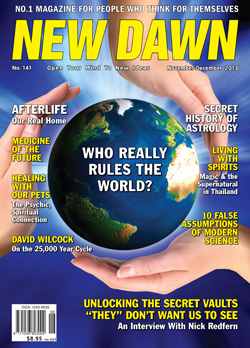
    Get the issue this article appears in

    How Astrology is Supposed to Work

    Another question remains. If astrology does work, how does it work? Tradition held that the planets send out certain vibratory influences that affect events on earth. Scoffers retort that the gravitational pull of the planets (apart from the sun and moon) is too small to have any influence whatsoever on us on earth. That may or may not be the case: the old occult theory did not talk about gravitational effects per se, and actually predated Newton’s theory of gravity. In any event, today it’s probably more common to explain astrology through C.G. Jung’s concept of synchronicity – which he defined as an “acausal connecting principle” between apparently unrelated events. In his essay “Synchronicity,” Jung discussed astrology. He conducted a study of several hundred married couples, and found that cases in which the husband’s sun or ascendant was conjunct the wife’s moon (classical markers for marriage) occurred three times more often than would be predicted by chance.

    Nevertheless, Jung’s theory leaves a great deal to be desired. Synchronicity, as he describes it, is not strictly acausal; rather it posits a hidden cause – the psychic forces Jung called the archetypes that underlies apparently unrelated but significant events. And so we return to that bane of sceptics – occult causes. But then Newton’s gravity, when it first appeared, was also derided by the sceptics of the day as an occult cause.

    We are pushed toward one final, and highly disturbing, conclusion – one that I have already hinted at in this article. The notion of cause and effect is in itself extremely problematic. The classic critique came from the Scottish philosopher David Hume. He said that when looking at things that were said to be causes, he saw no property they had in common (as, say, red or round objects do). From this he concluded that causation was a relation, and this relation consisted of “constant conjunction.” One event follows another (sometimes after an interruption) on a regular basis, so we infer that the one caused the other. The German philosopher Immanuel Kant, who said he had been roused by Hume from his “dogmatic slumber,” went on to argue that causation does not exist in the world as it really is, but rather is an innate “category,” or feature, of the human mind that leads us to perceive reality this way.

    No one has ever really refuted Hume’s and Kant’s conclusions. Science, it is true, is somewhat humbler and more furtive about asserting causal relations than it used to be: it tends to speak in terms of association rather than causation – “smoking was associated with lung cancer in X cases” rather than “smoking caused cancer in X cases” – but this only points up the strength of the philosophers’ criticisms. Whether it’s a matter of determining the causes of cancer or of asking whether the planets can presage a war, we are left with “constant conjunction.” In that respect, we haven’t gone far beyond the Babylonians.

    [alert type=”general” dismiss=”no”]This article was published in New Dawn 141.[/alert]

    [alert type=”success” dismiss=”no”]If you appreciate this article, please consider subscribing to help maintain this website.[/alert]

    Sources

    Aristotle, The Basic Works of Aristotle, Edited by Richard McKeon, Random House, 1941

    Brian P. Copenhaver, ed. and trans., Hermetica: The Greek Corpus Hermeticum and the Latin Asclepius in a New English Translation with Notes and an Introduction, Cambridge University Press, 1992

    Ken McRitchie, “Reappraisal of 1985 Carlson Study Shows Support for Astrology,” Center of the Universe at the Edge of the World website; theworldedge.blogspot.com/2009/07/reappraisal-of-1985-carlson-study-finds.html

    Claudius Ptolemy, Tetrabiblos, Translated by F.E. Robbins, Loeb Classical Library, 1940

    Jim Tester, A History of Western Astrology, Boydell, 1987

    Lynn Thorndike, A History of Magic and Experimental Science, vol. 1, Columbia University Press, 1923

    © New Dawn Magazine and the respective author.
    For our reproduction notice, click here.
  • Who is Afraid of Conspiracy Theories?

    Who is Afraid of Conspiracy Theories?

    From New Dawn Special Issue Vol 7 No 6 (Dec 2013)

    In his book Philosophical Investigations, philosopher of science Ludwig Wittgenstein demonstrated that words are more than designations or labels. They are signals in a context of activity, and are invested with many assumptions about the roles and social status of speakers and listeners.

    In the 20th century, men often called women “girls.” This term, while indeed referring to something real – to women – was more than merely a label; it was demeaning and implicitly conveyed a subservient status. Wittgenstein called the common sense view of words standing for things, the “naming theory of language.” However, he pointed out, if words were merely labels, you could not teach language to children. If you pointed at a table and said “table,” how would a child know you are referring to the piece of furniture and not to the rectangular shape of its top, or the table’s colour, or its hardness, or any number of other attributes? Language is taught in the context of activity. You say to the child, “the cup is on the table,” “slide the cup across the table top,” “I am setting the table for dinner,” and slowly the child learns what a table is and how the word table is used.

    Wittgenstein’s observation may seem simple, but it posed a profound challenge to all of Western philosophy since Plato, who had asked: What is beauty? What is truth? What is justice? Wittgenstein’s critique of the naming theory of language suggested these were the wrong questions. What needs philosophical investigation is who uses such words in what circumstances and with what implications.

    The term conspiracy theory did not exist as a phrase in everyday conversation before 1964. The conspiracy theory label entered the lexicon of political speech as a catchall for criticisms of the Warren Commission’s conclusion that US President Kennedy was assassinated by a lone gunman with no assistance from, or foreknowledge by any element of the United States government. Since then, the term’s prevalence and range of application have exploded. In 1964, the year the Warren Commission issued its report, the New York Times published five stories in which conspiracy theory appeared. In recent years, the phrase has occurred in over 140 New York Times stories annually. On Amazon.com, the term is a book category that includes in excess of 1,300 titles. In addition to books on conspiracy theories of particular events, there are conspiracy theory encyclopedias, photographic compendiums, website directories, and guides for researchers, sceptics and debunkers.

    Initially, conspiracy theories were not an object of ridicule and hostility. Today, however, the conspiracy theory label is employed routinely to dismiss a wide range of anti-government suspicions as symptoms of impaired thinking akin to superstition or mental illness. For example, in his 2007 book on the assassination of President Kennedy, former prosecutor Vincent Bugliosi says people who believe JFK conspiracy theories are “as kooky as a three dollar bill in their beliefs and paranoia.” Similarly, in Among the Truthers, Canadian journalist Jonathan Kay refers to 9/11 conspiracy theorists as “political paranoiacs” who have “lost their grip on the real world.” Making a similar point, if more colourfully, in his popular book Wingnuts journalist John Avlon refers to conspiracy believers as “moonbats,” “Hatriots,” “wingnuts,” and the “Fright Wing.”

    As these examples illustrate, conspiracy deniers adhere unwittingly to the naming theory of language. They assume that what qualifies as a conspiracy theory is self-evident. In their view, the phrase conspiracy theory as it is conventionally understood, simply names this objectively identifiable phenomenon. Conspiracy theories are supposedly easy to spot because they posit secret plots that are too wacky to be taken seriously. Indeed, the theories are deemed so far-fetched they require no reply or rejoinder; they are objects of derision, not ideas for discussion. In short, while ridiculing conspiracy beliefs, conspiracy deniers take the conspiracy theory concept itself for granted.

    This is remarkable, not to say shocking, because the concept is both fundamentally flawed and in direct conflict with English legal and political traditions. As a label for irrational political suspicions about secret plots by powerful people, the concept is obviously defective because political conspiracies in high office do, in fact, happen. Officials in the Nixon administration did conspire to steal the 1972 presidential election. Officials in the Reagan administration did participate in a criminal scheme to sell arms to Iran and channel profits to the Contras, a rebel army in Nicaragua. The Bush-Cheney administration did collude to mislead Congress and the public about the strength of its evidence for Iraqi weapons of mass destruction. If some conspiracy theories are true, then it is nonsensical to dismiss all unsubstantiated suspicions of elite intrigue as false by definition.

    This fatal defect in the conspiracy theory concept makes it all the more surprising that most scholars and journalists have failed to notice that their use of the term to ridicule suspicions of elite political criminality betrays the civic ethos inherited from British legal and political traditions. The Magna Carta placed limitations on the King, guaranteed trial by one’s peers, assigned historic revenue sources to London, and in other ways recognised the dangers of unrestrained political authority. More generally, the political institutions of the English speaking peoples presuppose political power is a corrupting influence which makes political conspiracies against the people’s interests and liberties almost inevitable. One of the most important questions in Western political thought is how to prevent top leaders from abusing their powers to impose arbitrary rule or tyranny. The men and women who fought for citizens’ rights, the rule of law, and constitutional systems of checks and balances would view today’s norms against conspiratorial suspicion as not only arrogant, but also dangerous and historically illiterate.

    The founders of English legal and political traditions would also be shocked that conspiracy deniers attack and ridicule individuals who voice conspiracy beliefs, and yet ignore institutional purveyors of conspiratorial ideas, even though the latter are the ideas that have proven truly dangerous in modern history. Since at least the end of World War II, the citadel of theories alleging nefarious political conspiracies has been, not amateur investigators of the Kennedy assassination and other political crimes and tragedies, but political elites and governments. In the first three decades of the post-World War II era, officials asserted that communists were conspiring to take over the world, Western governments were riddled with Soviet spies, and various social movements of the 1960s were creatures of Soviet influence. More recently, Western governments have accepted US claims that Iraq was complicit in 9/11, failed to dispose of its biological weapons, and attempted to purchase uranium in Niger so it could construct nuclear bombs. Although these ideas were untrue, they influenced millions of people, fomented social panic, fuelled wars, and resulted in massive loss of life and destruction of property. If conspiracy deniers are so concerned about the dangers of conspiratorial suspicions in politics and civic culture, why have they ignored the conspiracism of top politicians and administrators?

    In my book Conspiracy Theory in America, I reorient analysis of the phenomenon that has been assigned the derisive label of conspiracy theory. In a 2006 peer-reviewed journal article, I introduced the concept of State Crimes Against Democracy (SCAD) to displace the term conspiracy theory. I say displace rather than replace because SCAD is not another name for conspiracy theory; it is a name for the type of wrongdoing which the conspiracy theory label discourages us from speaking. Basically, the term conspiracy theory is applied pejoratively to allegations of official wrongdoing that have not been substantiated by public officials themselves.

    Deployed as a derogatory putdown, the label is a verbal defence mechanism used by political elites to suppress mass suspicions that inevitably arise when shocking political crimes benefit top leaders or play into their agendas, especially when those same officials are in control of agencies responsible for preventing the events in question, or for investigating them after they have occurred. It is only natural to wonder about possible deception when a US president and vice president bent on war in the Middle East are warned of impending terrorist attacks, and yet fail to alert the public or increase the readiness of their own and allies’ armed forces. Why would people not expect answers when Arabs with poor piloting skills manage to hijack four planes, fly them across the eastern United States, somehow evade America’s multilayered system of air defence, and then crash two of the planes into the World Trade Center in New York City and one into the Pentagon in Washington, DC? By the same token, it is only natural to question the motives of President Bush and Vice President Cheney when they dragged their feet investigating this seemingly inexplicable defence failure and then, when the investigation was finally conducted, they insisted on testifying together, in secret, and not under oath. Certainly, citizen distrust can be unwarranted and overwrought, but often citizen doubts make sense. People around the world are not crazy to want answers when a US president is assassinated by a lone gunman with mediocre shooting skills who manages to get off several lucky shots with an old bolt-action carbine that had a misaligned scope. Why would there not be doubts when an alleged assassin is apprehended, publicly claims he is just a patsy, interrogated for two days but no one makes a recording or even takes notes, and then shot to death at point-blank range while in police custody at police headquarters?

    In contrast, the SCAD construct does not refer to a type of allegation or suspicion; it refers to a special type of transgression: an attack from within on the political system’s organising principles. For these extremely grave crimes, English legal and political traditions use the term high crime and included in this category is treason and conspiracies against the people’s liberties. SCADs, high crimes, and antidemocratic conspiracies can also be called elite political crimes and elite political criminality. The SCAD construct is intended not to supersede traditional terminology or monopolise conceptualisation of this phenomenon, but rather to add a descriptive term that captures, with some specificity, the long-recognised potential for representative democracy to be subverted by people on the inside – the very people who have been entrusted to uphold the constitutional order.

    If political conspiracies in high office do, in fact, happen; if it is therefore unreasonable to assume conspiracy theories are, by definition, harebrained and paranoia; if constitutional systems of checks and balances are based on the idea that power corrupts and elite political conspiracies are likely; if, because it ridicules suspicion, the conspiracy theory label is inconsistent with the traditional Western ethos of vigilance against conspiracies in high office; if, in summary, the conspiracy theory label is unreasonable and dangerous, how did the label come to be used so widely to begin with?

    Most people will be shocked to learn the conspiracy theory label was popularised as a pejorative term by the Central Intelligence Agency (CIA) in a global propaganda program initiated in 1967. This program was directed at criticisms of the Warren Commission Report. The propaganda campaign called on media corporations and journalists around the world to criticise conspiracy theorists and raise questions about their motives and judgments. The CIA informed its contacts that “parts of the conspiracy talk appear to be deliberately generated by communist propagandists.” In the shadows of McCarthyism and the Cold War, this warning about communist influence was delivered simultaneously to hundreds of well-positioned members of the press in a global CIA propaganda network, infusing the conspiracy theory label with powerfully negative associations. In my book, I refer to this as the “conspiracy theory conspiracy.”

    For a more detailed exposition on the above, read Prof. Lance DeHaven-Smith’s Conspiracy Theory in America (University of Texas Press, 2013), available from all good bookstores and online retailers.

    [alert type=”general” dismiss=”no”]This article was published in New Dawn Special Issue Vol 7 No 6.[/alert]

    [alert type=”success” dismiss=”no”]If you appreciate this article, please consider subscribing to help maintain this website.[/alert]

    © New Dawn Magazine and the respective author.
    For our reproduction notice, click here.
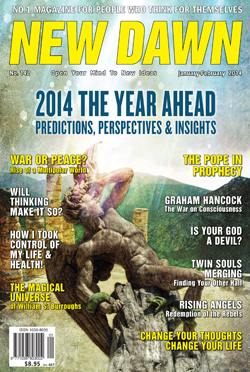
  • The Magical Universe of William S. Burroughs

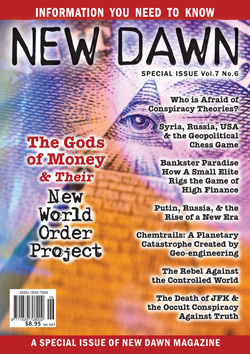
    The Magical Universe of William S. Burroughs

    From New Dawn 142 (Jan-Feb 2014)

    When the American writer William S. Burroughs passed away at the ripe old age of 83 back in August 1997, the media coverage was definitely more in keeping with his status as a counter-cultural icon than it was for his literary fame – or infamy – alone. All the usual well-rehearsed lines were trotted out, about how he was the Harvard-educated product of the WASP elite and scion of the family that founded the Burroughs Corporation, who had turned his back on it all to become a junkie queer, trawling the steaming jungles of South America, sleazy ‘Interzone’ of Tangiers, and shady back-streets of Paris and London for drugs and boys. That somewhere along the line he became an unlikely mentor to Jack Kerouac, Allen Ginsberg and the Beats, who had opened the way for the Cultural Revolution of the 1960s.

    William Burroughs had originally exploded onto the literary scene back in 1959 with his breakthrough novel, Naked Lunch, causing hip critics everywhere to claim they had seen the future – even if nobody was really sure that they understood it. With his three-piece suit, glasses, hat and raincoat, Burroughs seemed like the ultimate undercover hipster, and that voice certainly didn’t hurt: pitched somewhere between T.S. Eliot and W.C. Fields, mixing camp twang and knowing drawl with the educated tones of an old-fashioned Southern gentleman. From the moment he received that ultimate 1960s imprimatur of cool, being included by The Beatles on the cover of Sgt. Pepper (he’s in there between Marilyn Monroe and Fred Astaire), William Burroughs was the rock rebel’s choice of Literary Outlaw: from David Bowie and Jimmy Page to Patti Smith and Tom Waits, experimental bands like Throbbing Gristle, Psychic TV, and Coil, even Nirvana’s Kurt Cobain – generations of alternative rock stars have collaborated and paid homage.

    Norman Mailer once famously said that William S. Burroughs was, “The only American novelist living and working today who may conceivably be possessed of genius,” and as often as this was repeated down the years, Burroughs himself was at pains to point out that it was not saying he had genius or was a genius, but that he may at times had been lucky enough to be possessed by genius. When I interviewed him at the October Gallery in London in 1988, he had this to say on the subject:

    To me ‘genius’ is the nagual: the uncontrollable – unknown and so unpredictable – spontaneous and alive. You could say the magical.

    The fact that his answer uses a term, nagual, derived from the world of the Yaqui Indian sorcerer, as described by Carlos Castaneda in The Teachings of Don Juan and subsequent books, is telling indeed…

    There is also another kind of ‘possession’ that was very much a concern for William Burroughs, Man and Writer. From an early age, as much as he felt a definite sense of being ‘Other’ and not really belonging or fitting in anywhere, as much as he knew he was homosexual, he also believed in the idea of the Magical Universe. He was aware that an integral part of that universe was that there were inimical – even hostile – forces that threaten us, that may need to be bargained with and from time-to-time appeased, and that one of the dangers posed is that of possession:

    My concept of possession is closer to the medieval model than to modern psychological explanations, with their dogmatic insistence that such manifestations must come from within and never, never, never from without (as if there were some clear-cut difference between inner and outer). I mean a definite possessing entity.

    Later, in the foreword for the autobiographical Queer (written in the 1950s but unpublished until 1985), Burroughs talks about the appalling circumstances of the so-called ‘William Tell’ shooting accident that caused the death of his common-law wife, Joan Vollmer:

    I live with the constant threat of possession, and a constant need to escape from possession, from Control. So the death of Joan brought me in contact with the invader, the Ugly Spirit, and manoeuvred me into a lifelong struggle, in which I have had no choice except to write my way out.

    The simple truth is that William Burroughs had always been a scribbler: in numerous articles and interviews he describes at length his literary efforts from childhood on, and the somewhat precocious sense that the bookish, physically awkward, shy young Billy had of himself as an aspirant writer – an image that was as hopelessly Romantic as it was coloured by a flouting of moral convention:

    As a young child I wanted to be a writer because writers were rich and famous. They lounged around Singapore and Rangoon smoking opium in a yellow pongee silk suit. They sniffed cocaine in Mayfair and they penetrated forbidden swamps with a faithful native boy and lived in the native quarter of Tangier smoking hashish and languidly caressing a pet gazelle.

    The Cut-Up Technique

    As well as the monstrous masterpiece that is Naked Lunch, William Burroughs is perhaps also best remembered for championing the experimental technique of the ‘cut-ups’ – what appears to be at first glance the almost ludicrously simple idea of introducing collage techniques into writing. Collage, in all its various forms, may very well be the pre-eminent creative breakthrough of the 20th century: for better or worse, such techniques probably more accurately mirror the way the world is experienced by most people in an increasingly accelerated, fragmentary, and seemingly random datascape. Sampling, montage, collage: these methods really do come closer to representing or expressing what the facts of perception are for most of us in this post-technological, post-modernist, information overload. As William Burroughs put it again and again throughout his career:

    As soon as you walk down the street… or look out the window, turn a page, turn on the TV – your awareness is being cut: that sign in the shop window, that car passing by, the sound of the radio… Life IS a cut-up.

    Almost from the beginning, there was another aspect to the cut-ups acknowledged just as emphatically: they had the potential to be oracular. To William Burroughs, who would undoubtedly become the greatest champion of the technique, they introduced an element of randomness and also of Time: as he would later put it, whereas the basis of fiction was “once upon a time” – with the cut-ups it was “once in future time.”

    Among Burroughs’ earliest cut-ups were phrases that meant nothing at the time, but in hindsight took on an eerie prescience. This was like the seemingly arbitrary content of dreams, which lead Burroughs to speculate:

    Perhaps events are pre-written and pre-recorded and when you cut word lines the future leaks out.

    In Here to Go: Planet R101, Brion Gysin described how Burroughs would work with the material – and I think his choice of words is instructive:

    On the wall hangs a nest of three wire-trays for correspondence which I gave him to sort out his cut-up pages. Later, this proliferated into a maze of filing cases filling a room with manuscripts cross-referenced in a way only Burroughs could work his way through, more by magic dowsing than by any logical system. How could there be any? This was a magic practice he was up to, surprising the very springs of creative imagination at their source.

    The cut-ups would get a more public airing when UK publisher John Calder arranged for Burroughs to appear at the Edinburgh Conference in August 1962. After Burroughs stole the show with his presentation of an attempted “new mythology for the Space Age” – and an explanation of the innovative techniques that had made it possible, the cut-ups and their further extension in the newly-developed fold-in – a curious comparison was made by Stephen Spender, who queried the analogy between science and writing:

    It sounds to me like a rather medieval form of magic rather than modern science.

    It is in fact informative to compare this with a statement Burroughs made himself, in which his comparison of cut-ups with mediumship is explicit:

    Cut ups often come through as code messages with special meaning for the cutter. Table tapping? Perhaps.

    Experiments in Magic – Subverting Control

    It is to be remembered that the atmosphere around Burroughs and Gysin in those early days at the Beat Hotel at 9 Rue Gît-le-Cœur in the Latin Quarter of Paris was steeped in the occult, with daily experiments in mirror-gazing, scrying, trance and telepathy, all fuelled by a variety of mind-altering drugs. It is not surprising to think they may have considered these new developments in such terms.

    Burroughs, for all his Harvard education and intellect, also possessed a worldview that was informed – you might even say overshadowed – by a fear and fascination with the supernatural that had been shaped in childhood, and stayed with him ever since. His first biographer, Ted Morgan, states in Literary Outlaw that the single most important thing about Burroughs was his belief in what he referred to as “the Magical Universe.” Gysin himself was naturally inclined to intrigue and mystery, and come back from Morocco full of tales of black magic, curses and possession. Burroughs was an all-too-eager audience for the spellbinding storyteller. He felt his own travels in exotic parts had opened his eyes to a Bigger Picture:

    Now anyone who has lived for any time in countries like Morocco where magic is widely practiced has probably seen a curse work. I have.

    When Gysin, allegedly in trance, told Burroughs, “The Ugly Spirit shot Joan because…,” he thought he had the answer that no amount of psychoanalysis or self-examination had been able to provide: the unforgiveable slip that caused the death of his common-law wife, Joan Vollmer, come about because he was literally possessed by an evil spirit. This was indeed a War Universe, and Brion had identified The Enemy. If the Word was indeed the basic mechanism or unit of Control – the ‘virus’ by which Control or the Ugly Spirit exerted its malevolent influence – then surely a real understanding of the Word, what words are and what can be done with them – was essential.

    All these explorations and obsessions were not merely diversions, experiments for artistic or literary amusement, or the creation of novelty, but part of a deadly struggle with unseen, invisible – perhaps even evil – psycho-spiritual enemies. The only hope for deprogramming and self-liberation was to subvert the methods of Control and its various agencies, understand the tools used so that they could become weapons to turn back on the Control Machine itself.

    Gradually, as the 1960s progressed, it was clear the cut-ups were an idea whose time had come. Helped by Burroughs and Gysin’s gradually emerging status as counter-culture gurus, their ideas and influence began to spread. By the 1970s William Burroughs was the epitome of hip as far as drug savvy musos with literary pretensions were concerned: a coked-out David Bowie explained how he used “the Burroughs cut-up method” in Alan Yentob’s 1974 BBC profile, Cracked Actor, and then demonstrated it (badly). His friend Brian Eno would name a track ‘Dead Finks Don’t Talk’ as a nod to Burroughs’ Dead Fingers Talk, but would also look for ways to introduce chance with his Obliques Strategies, a set of cryptic aphorisms intended to encourage creative solutions by lateral thinking. Jimmy Page would be interviewed by Burroughs for Crawdaddy magazine, and as the clarion call of Punk was heard in New York, Patti Smith was the first to cheer the return of the Beat Godfather to his native land.

    [alert type=”info” dismiss=”no”]If you appreciate this article, please consider a subscription to New Dawn magazine.[/alert]

    Genesis P-Orridge

    Around the same time that Punk was emerging in the UK, another home-grown genre drawing inspiration from Burroughs, Gysin and the cut-ups was the ‘Industrial’ music of Throbbing Gristle (TG) and related bands like Cabaret Voltaire and later, 23 Skidoo. TG prime-mover Genesis P-Orridge had actually met Burroughs while he was living on Duke Street in London in the early 1970s, and he and band-mate Peter ‘Sleazy’ Christopherson were directly inspired by the Outsider stance of the ‘Literary Outlaw’ as much as they were influenced by his theories. Along with Chris Carter and Cosey Fanni Tutti, P-Orridge and Christopherson would help to invent a new genre of music they dubbed ‘Industrial’ – stripping back music even further than the back-to-basics of Punk to create a kind of Garage musique concrète, in which the processing and manipulation of found sound was a key part of the semi-improvised mayhem that was as often sonic assault as it was about the alchemy of sound.

    When P-Orridge first visited Burroughs on Duke Street in 1973, he asked him, “Tell me about magick?” and whether or not he still used cut-ups in writing. Burroughs replied, “No, I don’t really have to anymore, because my brain has been rewired so it does them automatically.” He cracked open a bottle of Jack Daniels, poured them both a stiff drink, then put on the TV to watch The Man From U.N.C.L.E., explaining, “Reality is not really all it’s cracked up to be, you know…” He then began hopping through the channels on the TV with the remote – at the same time mixing in pre-recorded cut-ups from the Sony tape-recorder – until P-Orridge was experiencing a demonstration of cut-ups and playback in real-time – right there where he was sitting:

    I was already being taught. What Bill explained to me then was pivotal to the unfolding of my life and art: Everything is recorded. If it is recorded, it can be edited. If it can be edited then the order, sense, meaning and direction are as arbitrary and personal as the agenda and/or person editing. This is magick.

    As part of his explanation, Burroughs showed P-Orridge one of his journal scrapbooks in which he had posted two photos: a simple black and white street scene, with the relevant building clearly visible, and then another beneath it from which he had carefully sliced out the ‘target’ with a razor blade, gluing the two halves of the photo back together so as to create an image of the street with the offending institution removed. The same principle could clearly be applied to photos of people that you wanted to ‘excise’ from your life, he said. These principles would have a profound effect on P-Orridge and Christopherson, as well as many of the ‘anti-musicians’ and sound-artists that they would collaborate with or inspire in their turn. It wasn’t just the sonic application of the cut-ups with tape-recorders, but rather the whole approach to challenging conventional wisdom, deprogramming the self from the imposed beliefs and values of mainstream society.

    After TG had split, P-Orridge and Christopherson went on to form ‘Psychic Television Limited’ – with its attendant Conceptual Art gag masquerading as fan club pretending to be a cult, ‘Thee Temple ov Psychick Youth’, or TOPY as it was known. For a while there was an inner circle that revolved around a strange hybrid of the ideas of occultists Aleister Crowley and Austin Osman Spare regarding consciousness alteration, dream control, and sex-magic. The life and work of Burroughs and Gysin, with their cut-ups, Dreamachine, playback, and Third Mind equally offered a kind of toolkit for similar ends. It looked like if the Revolution was going to be televised after all, then Psychic TV were going to be first in line to put in their bid for the franchise…

    But all too soon cracks began to show, and P-Orridge and Christopherson parted company: Sleazy with partner John Balance to create a whole new world of magick and music as Coil, Genesis to develop PTV increasingly in the direction of Rave music. Each would continue finding ways to apply the cut-up methods of sampling, cut-and-paste and appropriation to the development of new music. TOPY became increasingly an umbrella for New Age Merry Prankster-style utopian tribalism, and Gen’s role as figurehead for these disparate anti-movements, and the cultural memes he was engineering – from cut-ups and sex-magick, to tattooing, piercing, and body modification – inevitably lead to conflict with the authorities, and P-Orridge had to flee England for a life of exile in the United States. Eventually he would come to perhaps the most radical application of his interpretation of the ideas of Burroughs and Gysin of all: Pandrogeny, in which P-Orridge and his spouse Lady Jaye would literally try and cut-up gender.

    Engaging the Magical Universe

    When I first met William S. Burroughs in London at the time of The Final Academy series of events in 1982, I asked him about magic, and whether he would care to recommend any books on the subject. Without hesitation, he mentioned Dion Fortune’s Psychic Self-Defense, even though he qualified it as “a bit old-fashioned.” As he began to talk of black magic and curses in North Africa, travelling with medicine men up the Amazon, and describing his experiments with tape-recordings and playback on the streets of London’s West End and in the midst of the 1968 Chicago Democrat’s Convention and ensuing riots, I realised that for Burroughs this was utterly real. He told me about a dream he had as a young man, working as an exterminator in Chicago: watching from a helpless out-of-body point of view floating above the bed as his body got up and went out with some unknown and sinister purpose that he was powerless to influence… with a shudder, he told me that possession was “still the basic fear.”

    Even towards the end of his life, William S. Burroughs’ engagement with the Magical Universe (and struggle against the Ugly Spirit) did not wane. The magical, psychic, spiritual and occult appear in his later fiction like never before, from depictions of astral travel and “sex in the Second State” to descriptions of actual rituals, referencing everything from Crowley and the Golden Dawn to the myths of ancient Egypt and even the Necronomicon… all interwoven with increasingly ‘neo-pagan’ concerns for the environment, the impact on Man and Nature of the Industrial Revolution with its emphasis on ‘quantity, not quality’ and standardisation – as well as perceived turning points in history. His adoption of the ancient Egyptian model of the Seven Souls, continuing development of a very personalised myth of Hasan-i Sabbah and the Assassins of Alamut, made him of increasing interest and relevance to the new occultists who were emerging from successive generations of counter-culture that Burroughs had helped to shape through the example of his Life and Work.

    There was also still the loss, the pain, and – perhaps more than ever – the Ugly Spirit. After settling in Lawrence, Kansas – a small university town, far from the distractions and temptation of New York, and very much a reminder of his mid-Western background in St. Louis, Burroughs became friends with William Lyon, a Professor of Anthropology who had been apprenticed to Sioux medicine man Black Elk. A full sweat-lodge purification ceremony was arranged in an attempt to evict the Ugly Spirit, which was described by the shaman as:

    A spirit with a white skull face, but no eyes, and sort of… wings.

    Burroughs was impressed by the “strength and heart” of the medicine man, and felt that just to clearly identify the enemy in such terms was in itself something of a victory:

    If you see it, you gain control of it. It’s just a matter of, well, if you see it outside, it’s no longer inside.

    In the early 1990s, the elderly Burroughs was initiated into the Illuminates of Thanateros, the leading Chaos Magic group. Perhaps this was not such a surprising development. Chaos Magic clearly felt a debt to Burroughs and his peers, sharing many of the same concerns as Thee Temple ov Psychick Youth: demystifying magic, yet at the same time distilling the best from Aleister Crowley and Austin Osman Spare, while taking advantage of the latest ideas emerging in computers, maths, physics and psychology.

    With the experiments started at the Beat Hotel that he then took out onto the streets of London, Paris and New York, William S. Burroughs was recognised as a pioneer and precursor: and with the later connections established through a younger generation of artist-occultists, the link from ‘cosmonaut of inner space’ to ‘psychonaut’ was assured.

    For more information about Matthew Levi Stevens, please see http://whollybooks.wordpress.com. The book-length version of his The Magical Universe of William S. Burroughs is available from Mandrake of Oxford. To order go here: http://mandrake.uk.net/the-magical-universe-of-william-s-burroughs/

    [alert type=”general” dismiss=”no”]This article was published in New Dawn 142.[/alert]

    [alert type=”success” dismiss=”no”]If you appreciate this article, please consider subscribing to help maintain this website.[/alert]

    © New Dawn Magazine and the respective author.
    For our reproduction notice, click here.
  • Sister Veni Cooper-Mathieson: Pioneer Thinker & Metaphysical Teacher

    Sister Veni Cooper-Mathieson: Pioneer Thinker & Metaphysical Teacher

    From New Dawn 141 (Nov-Dec 2013)

    Australia has a long tradition of self-help literature and much of it was written, in the early years, by colourful characters who embraced a hodgepodge of new and progressive ideas which included Theosophy, New Thought, Swedenborgianism, Socialism, Christian Science, temperance, vegetarianism and marriage reform. This connection between minority religious and social philosophies and ideas of individual mental development was to be observed across the Western world from the late 19th century, though the connection often surprises modern readers.

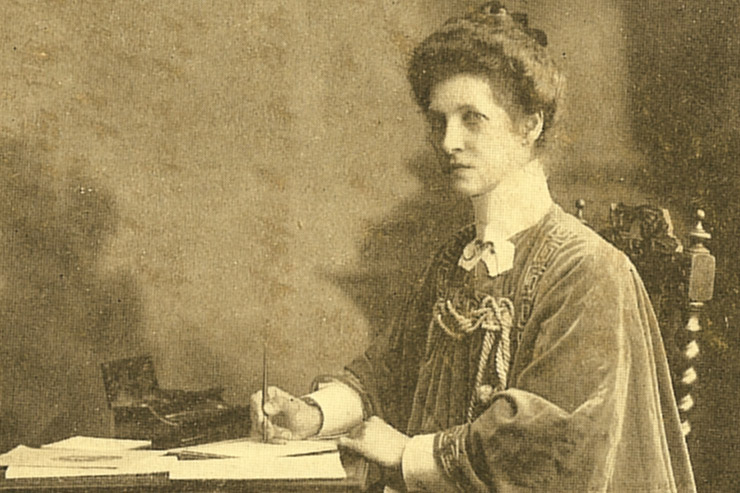
    One of the greatest characters to have written and taught in early 20th century Australia called herself Sister Veni Cooper-Mathieson (1867–1943). She was a prolific, if highly eccentric, author in the field of self-help, a true pioneer who perambulated through most of the cities of Australia peddling her New Thought philosophy.

    A polymath in outlook, Sister Veni saw Australia as ripe for the development of new ideas about religion and mental development. She anthropomorphised, and at times even eroticised, a country she saw as being undeveloped, writing in her 1904 book Australia! Land of the Dawning:

    “Still no man knoweth thee, O! Virgin Land! No hand hath yet uncovered thy secret parts, nor eye searched out thy hidden mysteries. In thy fair bosom thou holdest treasures unknown and even undreamed of.”

    Australia was, for her, a metaphor for the individual, all of us containing vast and unexplored richnesses and possibilities, though few men knoweth them. In this same book she set out her vision of Australia as a “lovely virgin freshly risen from the waves,” ready to lead the world in these new philosophies, quickly to become a universal “City of Refuge.”

    She was a serial religious entrepreneur who posited herself as a thoroughly modern woman. “Sister,” in her case, did not connote any membership of a Catholic religious order. The usage was in fact common among non-conformist religious groups, as best exemplified in the person of the American Pentecostalist preacher Aimee Semple McPherson, known lovingly across the world as “Sister Aimee,” founder of the International Church of the Foursquare Gospel. Sister Aimee was herself a visitor to Australia in 1922, and I suspect her name and example would have been well known to Sister Veni long before that visit.

    Sister Veni made her living publishing books and journals, conducting lecture series and correspondence courses and overseeing spiritual libraries, study centres and healing rooms, the latter which saw her eventually fall foul of the Australian law. Any close examination of her output, and of mentions of her in the contemporary press, proves that Sister Veni was somewhat luckless. She was pursued doggedly by the authorities across Australia who seemed convinced that she was a fraud. She moved from city to city, and frequently found trouble with the police.

    The Tasmanian authorities, for example, looked askance at Sister Veni’s claims to be a medical practitioner. After she had offered a young constable treatment for his bad back, which involved her blowing across a damp flannel draped over his naked form, she was arrested and charged with fraudulent practise.

    Sister Veni was a charismatic teacher, writer and leader in what was already recognised as a traditional American mould, and it is highly likely her slightly dictatorial and grandiloquent style got in the way of her attracting a genuinely popular following in the always-cynical Australia.

    Her writing is littered with colourful and grandiose references to the Christ ideal, a central idea of New Thought (as it was of Christian Science). From the turn of the 20th century till the advent of the First World War, she was a prolific publisher of New Thought journals in the various state capitals she moved between. In organs such as 1913’s ‘The Healer’ (“A monthly publication devoted to the teaching of the true science of life, health and happiness”), Sister Veni variously bullied, lectured and bamboozled her readers with these new ideas, relying heavily on biblical quotation and Christian imagery to make her point.

    Interestingly, Sister Veni was also much involved in questions relating to women. She wrote on Woman’s Emancipation (1904), and, like the Adelaide Theosophist and eccentric Agnes Benham before her, was concerned that a correct conception of marriage is essential to personal and social spiritual development. She wrote that unless a marriage is a, “true spiritual union there is no marriage in the sight of the most High God, for he deals with us purely as spiritual beings.”

    This idea is lifted directly from the 18th century Swedish mystic Emanuel Swedenborg, who taught of the importance of true spiritual marriages, in which bonds are unbroken even in the afterlife, where married couples will spend an eternity in heaven together. For Sister Veni marriage was mostly a prison for women, and true spiritual companionship was rare. Most marriages, she opined, were useless because they were based on temporal considerations.

    She advocated what she called “Free Unions,” unvisited by state intervention, in which the children of love matches might be raised in a spirit of genuine affection, and which might allow couples to dissolve their bonds with ease if it might be discovered that theirs is not, in fact, a spiritual marriage in the eyes of the most High God.

    She was also the founder of the White Cross Moral Reform Crusade, a group for young women that met in Sydney’s Domain and required of its members a pledge of chastity and “womanly modesty.” This group was formed as a reaction to what Sister Veni perceived as a “defiling and debasing atmosphere of lust.” This atmosphere was, she asserted, “robbing our women of their womanhood, undermining the health, strength and beauty of our girls. It is a menace to the home-life of the future, to the stability of the Nation, and the true development of the coming generations.”

    Moral destitution was a by-product of an insufficiently exercised mind and body, and Sister Veni saw the ideas of New Thought as a way out of this low point in human history caused, in part, by the hypocrisies of older religious frameworks. An advancing era of personal responsibility would save young people from their destructive lusts. Basically, this was a group advocating sexual abstinence among young people to avoid the social and health problems of early pregnancy and venereal disease.

    Again this kind of connection to self-improvement might seem unlikely, more associated, perhaps, with the puritan fundamentalism of mainstream Protestant groups of the times like the Methodists and Presbyterians. But this was a direct copy of a similar movement among New Thought women in America. The movement had from its earliest days made a neo-gnostic connection between sexual purity and spiritual advancement.

    This wonderfully inspired and energetic woman has, until recently, been almost lost from Australia’s history books. Historians, writers and academics have traditionally been hostile to expressions of overt spirituality, and have dismissed important figures such as Sister Veni Cooper-Mathieson as quacks unworthy of serious examination. But perhaps a new generation of thinkers will recognise these fascinating figures as the great pioneers they were, and re-instate them as important figures in literary and cultural history.

    [alert type=”general” dismiss=”no”]This article was published in New Dawn 141.[/alert]

    [alert type=”success” dismiss=”no”]If you appreciate this article, please consider subscribing to help maintain this website.[/alert]

    © New Dawn Magazine and the respective author.
    For our reproduction notice, click here.
  • Sean Stone Speaks Out

    Sean Stone Speaks Out

    From New Dawn 147 (Nov-Dec 2014)

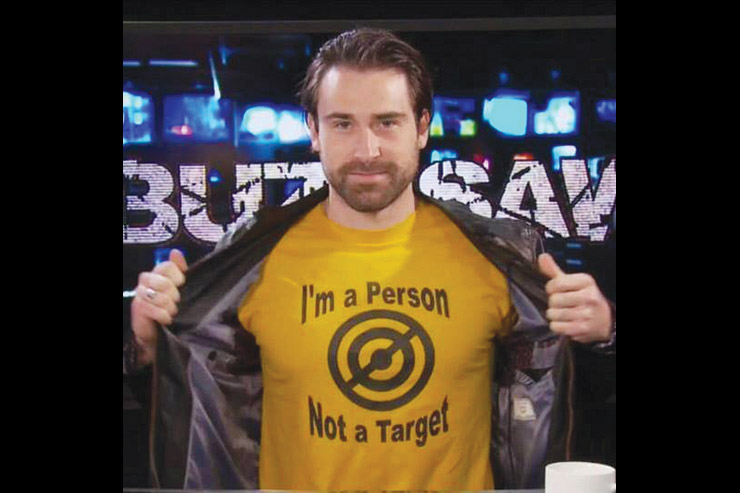
    As a post-2012 digitally-networked generation rushes headlong into a juncture between an ever-growing global corporatocracy, an ever-worsening financial barometer, never-ending military adventures and the drumbeats of World War III, an alternative dialogue on the Internet continues to grow thanks to ardent truthseekers like, among others, Luke Radkowski of We Are Change, Mel Fabregas of Veritas Radio, Alex Jones of InfoWars, and Sean Stone, the host of Buzzsaw, a weekly interview program broadcast on TheLip.TV.

    Buzzsaw’s library of guests cover a broad range of topics that strike at the heart of our current human predicament – former World Bank lawyer and whistleblower Karen Hudes, Public Enemy’s Professor Griff (on Illuminati influence in the music industry), former Mossad agent Juval Aviv, Kerry Cassidy of Project Camelot, economic ‘hitman’ John Perkins, and Bilderberg exposer Daniel Estulin, among many others. In his Buzzsaw interviews, Mr. Stone takes the conversation to spaces the mainstream media dare not tread.

    Some may be familiar with Mr. Stone as an actor, writer, producer and director of a number of Hollywood films, like his latest, Greystone Park, a horror film based on his true life experiences searching for the supernatural in an abandoned psychiatric hospital. Others may know him as the son of controversial filmmaker Oliver Stone, or as the co-host during the final season of Jesse Ventura’s ‘Conspiracy Theory’ on TruTV. For some, their first exposure to Sean Stone may have been on Fox’s ‘O’Reilly Factor’ where he elaborated on Iranian President Mahmoud Ahmedinejad’s stance on Israel and the Holocaust, intending to give more depth to a man that the mainstream media tends to paint one-dimensionally as a ‘fanatic’. At a young 29 years of age, Mr. Stone is not only accomplished in the public arena, he’s also developed a deep spiritual foundation to his character that is well beyond his years.

    Mr. Stone, like his father, is obviously not one to back down from controversy. Rather, he is one of the few to take a stand in a clearly whitewashed media climate. While it might be no surprise that TV shows are referred to as programs, Mr. Stone and Buzzsaw are doing their part to de-program.

    – Marc Star

    MARC STAR (MS): All of us truth seekers have experienced some process of awakening. What was yours?

    SEAN STONE (SS): In one capacity, I started to awaken at 10-years-old when my father took me to India and Tibet on a vacation, and he taught me about the third eye. He showed me these monks who were meditating in Tibet and taught me about levels of patience and the principles of meditation. We were confronted with the extreme poverty of a place like India, where we saw a child die, literally, in the street. The mother just couldn’t feed the child anymore and it died, right there. In India, it feels like a million people within a square mile – the city blocks are filled with squalor and filth. There’s some wealth, but a lot of misery. On one level I awakened to the extreme material contradictions on our planet, along with the spiritual possibilities of existence.

    But what does the third eye mean to a 10-year-old? The idea that you have a spiritual life, that you’re open to a higher power, or a higher meaning, despite all of these random, mundane acts of existence – you live, you suffer, you die. But what is it about?

    I’ve always been on that trajectory of seeking out deeper meanings and deeper understandings. In junior high and high school, I was interested in history – and questioning the official accounts of history because my father had helped introduce these topics. When you’re 13 or 14 and you start watching a film like JFK… I would re-watch it and watch it again because there are so many things about how our country is really run and how people are manipulated to believe these fairy tales by the media and by the mainstream way of thinking.

    So you start to take that awakening into politics and history and eventually you come across the deeper questions in history that intersect with secret societies – the banking cartels, the masonic groups, for example. Masonry is obviously a very broad range of people, although many of the most influential people in history have been Masons – but then there are obviously more secretive orders.

    Then you look at the spiritual teachings and you come across the Gnostic sects within Christianity, the Sufis in Islam, the Kabbalists in Judaism, and you start to wonder, okay if there is this lineage of secret teachings in the spiritual sense, then what do I need to understand on this planet that is deeper than what the eyes and ears tell you.

    That, I think, is the general journey of awakening. It went from the historical and intellectual sense of researching and doing my thesis at Princeton on the New World Order to an actual confrontation into the mystical and magical – because you can study the magical, you can study these sects of Illuminati, there’s all sorts of reports and accounts of them practicing rituals and magic. Then you actually confront these mystical, fantastic things – and that’s what happened when I went to Greystone Park, which is the basis of my recent film.

    I started to seek out these haunted locations and once you’ve entered these places, once you’ve entered that realm, you start to hear things that are not meant to be there – phantom voices and screams. You get phone calls. And you get all these things along the way of your journey that make you realise, okay, there is more going on than what you can read in a book to understand.

    MS: How was your thesis on the New World Order received at Princeton?

    SS: At Princeton you have a thesis advisor and a secondary reader. My advisor was cool with my approach throughout the process because the approach was very rational. It was all predicated on either primary or secondary sources. The topic of the thesis was to research Henry Kissinger’s mentor, William Yandell Elliott, who was the Professor Emeritus of Politics at Harvard for about 40 years. He had trained all these guys from the Bundys, to Kissinger, to [Zbigniew] Brzezinski, to [Samuel] Huntington. Even [John F] Kennedy was in his class. This guy is obviously a tremendous figure and I was looking at his intellectual trajectory – he was basically recruited into the Round Table circles at Oxford.

    The Round Table goes back to the Rhodes/Milner plan which, Cecil Rhodes stated in his will, was to re-incorporate America back into the British Empire. And that’s pretty much what the New World Order was about. It was about transcending the old formation of the British Empire into a new multinational system of power whereby you ultimately move toward one-world consolidation of government, of finance, of legal controls, and even the worldview becomes increasingly consolidated by Anglo-American morality.

    That’s something you can trace. People like Carroll Quigley have done the work, in Tragedy and Hope, to lay out for us what was going on. Quigley was a professor at Georgetown who had the credentials and the reputation that he could say it and people either absorbed it and understood it, like [Bill] Clinton, or were not intellectual enough to have read it, or they tried to ignore him.

    So when it came to my thesis, I was relying on people like him and the primary sources I came across, even digging into William Yandell Elliott’s correspondence and his own writings to understand how they envisioned this empire that was predicated on controlling the resources of the planet, and using these organisations like the United Nations and other formations to control those resources without putting too much of an American hand into the equation. It’s the idea of the informal empire. It’s the idea you don’t want to make your position too well known. It’s like creating the invisible hand in world affairs.

    The British Empire is to my mind that invisible hand that people don’t want to talk about to this day. They think it’s over, and yet no, there’s a reason why the City of London is still the centre of finance and the pound sterling is still the strongest currency in the world. This empire still exists. It’s a commonwealth now with tremendous influence. The Queen is probably one of the biggest landholders in the world. The Crown holdings are immense. They have assets in all of these major corporations that own the resources of the planet.

    It’s not a trivial thing to talk about the British Empire. You see the continuance of the influence of people like Tony Blair in the creation of the second Iraq war, for example, with the Niger documents. Or the British policy regarding, as Blair stated, the end of nation states. Around ‘99 or 2000 in Chicago he said there would be an end to the Treaty of Westphalia; there will be no more nation states. That’s exactly what we’re talking about. The destruction of the nation state and the preference of the empire, which is now corporate – or a corporate structure – to the idea of a sovereign nation state.

    MS: This is an agenda that many out there aren’t yet ready to accept as true. Do you find yourself surrounded by awakened people, or by brick walls?

    SS: I feel like in life, the interesting thing is, when you start to take a stand, and you send out signals to the universe of who you are and what you’re doing here, you tend to attract people that are on your wavelength. The universe intersects you with those who are basically on the level that you’re on. I’m always shocked by the level of ignorance that I find when I turn on the TV or when I do go outside of where I operate, and recognise there are a lot of sleepwalkers on the planet. But within myself and the circles I keep, I find that I tend to attract those who are more open minded.

    MS: You seem to be a perfect fit as the host of Buzzsaw – with a well-versed background on politics, spirituality and the conspiracy. How did you end up in that seat?

    SS: As I was completing my film, I met Tyrel Ventura, Jesse’s son. Tyrel had been a producer on ‘Conspiracy Theory’. They were about to shoot their final season and Jesse was dealing with this lawsuit against the TSA [Transportation Security Administration]. The TSA had been harassing him because of the metal in his body, and he felt there should be a more respectful way of treating a governor when going through these searches at the airport. So he was suing TSA and he couldn’t fly. As a result, Tyrel became a main point person for the show, and I met with Tyrel about coming on the show as his cohort. We would become the two main co-hosts doing the research, travel and investigation on camera. Based on my experience with ghost hunting and exploring these haunted places, and having researched on my own all the different theories regarding the alien presence on the planet and my familiarity with that world, they hired me. Tyrel and I became the two chief hosts of ‘Conspiracy Theory’ for season three.

    That season was delayed a year because it was pretty controversial. Even though it doesn’t get into the topics of the political conspiracy, it did get into the topics of time travel, reptilians, the agenda of weapons in space – all these things that people might find more ‘far out’. Yet I think it struck a nerve to the point where, as opposed to the first two seasons of ‘Conspiracy Theory’ where you had buses and billboards promoting the show, the third season was delayed a year, and then they didn’t even put up any advertising for it. It felt to me like TruTV wanted the show to go away. And sure enough, after the third season it was over.

    I was contacted by Will Gibson, Mel Gibson’s son, who works for The Lip, an online TV station. They were looking for content, so Tyrel and I came up with Buzzsaw, as a spin-off of ‘Conspiracy Theory’, where Tyrel and Tabetha Wallace would do the news on a weekly basis and I would do the interviews. I felt it was an elaboration of what we did on ‘Conspiracy Theory’, because when you’re doing a show like ‘Conspiracy Theory’, which is reality TV, you go in there with the intention of doing an interview and you come away with something that’s cut up and sensationalised to keep your audience hooked into the idea of some kind of imminent threat. There were a lot of stories I wanted to recount, from people like David Icke or Anthony Sanchez, about Dulce, but I didn’t have the time on ‘Conspiracy Theory’ to do it. Buzzsaw gives me a platform to actually go deeper into those interviews and conduct the long form discussions we now have.

    Buzzsaw is now an archive of these 30-to-60 minute shows that people can look at and listen to at their own leisure. As long as the Internet is around, people will be able to go back and see what Sean Stone interviewed David Icke about in 2013. What did all these people have to say at that time in history. If you look at it as a whole, we have amassed a great wealth of knowledge on topics from everything from economics to the alien agenda to spiritual issues like what are we doing on Earth, to politics and history.

    MS: All of these topics meet at a very important place right now – that is, the suppression and control of information in order to keep humanity fenced within carefully guarded reality. It makes it even harder to get at the truth when those who have the most influence over the information flow are disseminating disinformation. On a path of inquiry such as this, how does one discern?

    SS: That’s an issue that even scientists deal with, this issue of empirical knowledge based on senses – and our senses are inherently flawed. They are designed to give us a very limited understanding of this universe. Which reality do you want to believe? Do you want to believe in a relativistic understanding of the universe? But even that has its limitations. Do you want to understand what’s going on in the realm of antimatter, dark matter and dark energy – the invisible forces? Do you want to hypothesise about that? Do you want to hypothesise about string theory and how many different dimensions are interacting with our own reality at any moment? Quantum theory and how that affects fantastic experiences that people have in this life – this relationship between consciousness to reality, that we are actually creating reality as we go through it, which, philosophically, is an old Kabbalistic/Gnostic understanding of the universe, that man is actually creating the universe as we go along.

    It goes back really to who you are and what you choose to believe – who you are as a person. That’s what I went through with Greystone Park, my film. The film was an expression of the experiences I had in places like Greystone, the mental hospital, where I’m breaking into these haunted places and trying to decipher for myself, what did I see? Did I really see something fly by itself? Did a piece of wood really fly by itself? Or was that a gust of wind that I didn’t account for? Were those really voices and screams I heard or was it something planted to scare me? Was this a government psy-op to fuck with my mind?

    That’s what the film tries to go towards, this notion of… is this an expression of the mind or is it something external? I believe that it’s a mixture of both. I believe our minds are actually creating the external reality. But not everybody can understand that. So people go back to their safe zone where there is an external reality, it’s quantifiable, it’s based on cause and effect, you can measure it and account for everything that occurs. Then there’s the more spiritual, quantum sense of reality in which reality is internal, we are creating/manifesting it and miracles can occur. There are things that are inexplicable to human understanding – but not to say that within a universal science they can’t be accounted for. But within our realm of understanding, we don’t have the knowledge to understand everything that occurs. It really boils down to who you are. I can’t answer that for anyone else.

    MS: What you’re doing is potentially a threat to the established system. Do you feel you are stepping into dangerous territory? Do you feel observed?

    SS: I feel I’ve been observed probably my whole life, before I even realised it. But again, the real question is, who actually runs this system? There are people who think they run the system – and there are certain tools and access to finance, for example. But I believe there is a higher order of powers on this planet. I don’t think humans are ultimately in control. When it comes to what is considered extraterrestrial, or extrahuman, in its origin that actually could exist interdimensionally, for example, then you’re talking about a higher level of consciousness that actually may find it necessary for people like me to play my role.

    I believe very much what Shakespeare wrote. Shakespeare, whoever he was, was a Rosicrucian. He indicated a lot of esoteric knowledge through the plays. When he talks about all the world is a stage, the idea that we’re each just actors in this play, it’s very true. I don’t believe that anything happens without our higher Self, our higher Soul, knowing what we’re getting ourselves into and allowing it to occur.

    To me there is no real danger or threat. It’s just a performance. This is just a film. This timeline is just one reel of the film. When it comes to an end, we’re not done. We go somewhere else. We’ll play our role somewhere else. So it’s really most important for us to be true and honest to who we are and to serve our mission here. And that’s, I think, the best thing you can do – not to run and hide or be afraid of these powers, or believe that money or materialism is going to save you because you’re not going to last here regardless. You’re not going to last more than maybe a hundred years on this planet. So really what you’re doing is affecting eternity, it’s not affecting just this moment.

    MS: Why all of the secrecy at the top of this potentially non-human control structure?

    SS: While there are certain nefarious agendas, at the same time there are certain agendas that are beyond human understanding. The universe is structured around order, geometrically, around the nature of light. Where the stars are in alignment to the Earth creates a certain hologram, a certain type of reality. That’s constantly shifting.

    When the age comes to an end, as it did with Pisces, and we enter Aquarius, there is going to be a different shift and awakening with consciousness even if people don’t believe it – look technologically what is occurring because of the access phones and computers give us to each other, allowing us to connect physically in ways that historically maybe sorcerers or wizards or witches could possibly do with astral projection and remote viewing. The consciousness of the planet is connecting. What will occur is not necessarily for me to predict, but I do believe there are many reasons for secrecy, one being if you know the ending it will affect the way you play the game. You might get lazy. You might want to almost check yourself out of your actions because, in a sense, you want to feel like you have free will. And free will is a very important premise for this whole thing to occur. So there has to be a certain level of secrecy.

    But again, when it comes to the more nefarious powers, say like the banking side of things, it’s not necessarily a secret anymore. People know things like the Federal Reserve system is a private operation by certain bankers, but we’re going along with it because at the end of the day we feel safer within the system as it is now created than the potential system that will come about from its dissolution. Sometimes you have to wait for the actual collapse to occur before you can actually introduce the solution. There are very few people who are strong and brave enough to take the leap into another possible reality or another future without being forced to do so.

    MS: Earlier this year on your program Buzzsaw you did a somewhat ‘prophetic’ interview with former Mossad operative Juval Aviv in which he stated we’re heading “toward a third world war.” In recent months we’ve witnessed civil war in eastern Ukraine, the downing of MH17, the merciless Israeli bombardment of Gaza, and an escalation of conflict in the Middle East with the rise of the “Islamic State.” Where do you think we’re heading and what forces are driving current events? Are we on the road to World War III?

    SS: Some people will say that we’ve been on the road to World War III as soon as World War II came to an end, because if you believe that the Albert Pike letters to [Giusseppe] Mazzini in the 19th century were actual letters and not apocryphal, then he talks about three world wars, and the third world war being predicated on the State of Israel-Middle East clash of religions and the end of the Judeo-Christian worldview and the entry of Luciferianism.

        I didn’t do anything prophetic with the Juval interview. We just talked about what we can see occurring. People are not very astute sometimes. They get so caught up in the moment, they don’t actually watch the overall shape of the geopolitical climate. You know that a collapse is imminent because the financial structure is predicated on derivatives that far exceeds the productivity of all the nations on the planet. Sooner or later that financial system is going to come to an end. The banks have become so large, they’re too large to collapse. But at the end of the day, if they don’t collapse, then something has to occur to shift them into a new order.

    During the Juval interview I mentioned I had been told directly by people in the military, high level intelligence people, to inform people you know in Israel to leave, Israel’s about to get hit, war is coming. This was in April. So when they have this incident with the kids who get kidnapped, and they turn that incident into a war against Gaza, against Hamas, people think this is just a random act. No, these things are created. These events are created because there is a plan. Unfortunately, people are not planners, they’re not conspirators themselves. When you’re a filmmaker, for example, you know how things are planned because you work on it, you write scripts. I have a script that was written in 2009 that dealt with what occurred in St. Louis just a few months ago with the Ferguson incident. My story had to do with rioting in the suburbs of St. Louis, predicated on racial violence and the black community feeling repressed and offended by police actions in the killing of a young black kid.

    These kind of things are not difficult to understand if you have an imagination to create it. But the problem is, most people are so caught up in their momentary activities they don’t have the imagination to see a different future. When you are in a position of power and you have money and influence, as leaders of countries and their associates – people that go to conferences like Bilderberg, the Bohemian Club, that belong to the Trilateral Commission and read and write their reports – they have time to imagine, they have time to create, they have time to formulate scenarios.

    Whether or not World War III is coming is impossible to say because you could also say Obama has missed certain marks in that regard. Maybe he didn’t escalate the crisis with Russia quick enough over the Ukraine; maybe they didn’t utilise the Israel situation to escalate into a full on war between Hezbollah and Israel; maybe this Islamic State is actually bringing the United States, Iran and Russia together against a common enemy. I can’t tell you what’s coming because, again, I believe we’re all involved in creating our own reality and I believe that whatever occurs is ultimately going to be for the best spiritual interest of mankind.

    MS: What are your feelings on the BRICS alliance and its impact on the rest of the world?

    SS: I look at it as a welcome divestment from a US dollar based hegemony in the world. And what the BRICS states have been talking about. For example, China and Russia talking about an Earth defence shield, going back to Star Wars, talking about nuclear fusion based technologies. I’m shocked at the eventual impoverishment coming to this country because of the collapse of our industry and infrastructure. We don’t have any sensibility when it comes to the idea of high tech industries that require not just computer skills, but also industrial skills. Let’s do Mag-Lev rail, let’s go do fission and fusion processes to generate energy, let’s orient ourselves towards exploring space and terraforming other planets, let alone this one. All of these endeavours will help us better understand our own situation in the cosmos.

    I do think there is a private sector that is heavily involved in space exploration, in the stargates, in Tesla-type technologies, and that’s being hidden and suppressed. That’s a crime against humanity to have that level of technology and understanding and not share, not educate your people, and let them fall into this level of ignorance where they’re only focused on the newest reality TV show, the next award ceremony, and they’re not actually endeavouring and wanting to be scientists. Kids are not growing up wanting to be scientists and presidents and astronauts anymore. They just want to be basketball players or a celebrity of some kind. That’s all they see, as far as someone to emulate. There’s a quote from Prince Ea’s rap song recently. He says the people we are imitating now, sixty years ago we would have said were an embarrassment. You would have called them out as examples of what not to be. And that’s the problem. We’ve flipped our society, our cultural intelligence, our social instinct to educate our young. We’ve flipped it all on its head.

    When I see the BRICS nations talking about fusion, talking about investments in nuclear-based technologies, talking about missions to the Moon, Mars and beyond, and defending the Earth from comets and things like this, more power to them, because someone has to do it. The United States and the Western hemisphere have fallen off the map in that regard.

    MS: Ultimately, though, doesn’t this breakaway civilisation that is behind every one of these topics have its influence, not just in the West, but in Russia and China as well?

    SS: Of course. But again, we’re dealing with an issue we don’t quite understand. We’re dealing with cultures that are influenced by various parties. The Western world has been influenced by the Roman/Babylonian empire. That’s our cultural heritage here in the West. Russia has a slightly different cultural heritage, also splintered from Rome. The East Roman empire became basically what is Russian, but there is also something Slavic in the soul, in the spirit. The Chinese also have a mixture of Mongol, Khan and Hun blood. So there are different spiritual traditions in every part of the world. And that has something to do with the non-human entities that I’m talking about.

    In regard to the idea that non-human entities are only some kind of Draco reptilians that rule the entire planet, I don’t think that’s quite accurate. I think there are different aliens, or what would be considered alien beings on this planet from different worlds. But again they tie into the various bloodlines. And so the white, Aryan Western world is of a different blood group and spiritual orientation than the Russians, than the Chinese, than the Africans. Maybe that’s what some of this warring has to do with – the fact of different soul groupings and different motivations for what is desired by different species.

    MS: It’s a difficult puzzle to piece together once you go beyond physical reality.

    SS: Even within physical reality because you start to deal with psyches. One of the things that fascinated me about studying history was trying to actually determine someone’s action. You think that person’s predictable, they’re a machine. They’re not a machine, they have a psyche. What’s actually going through their mind when they make a decision? Is it the interest of the council to take certain actions and they’re just following their duty? Or did they have a fight with their wife that morning and they’re in a bad mood when they make a decision? Or do they just really want to screw somebody over, somebody they’re pissed off with, so they make a decision against what the other person is saying. It’s always difficult to understand because whether it’s non-human or it’s psychic, we don’t know exactly what’s in someone else’s mind. Could it be a so-called alien influence in that person’s mind? Just as well as saying it’s their brain that’s functioning. What is a brain? It’s not a computer. People think it’s a computer. And yet what’s going on in the mind is much more complex than what a computer can imagine, because you’re dealing with emotions, you’re dealing with instincts, you’re dealing with intellect, memory and possible visions of the future.

    MS: Have any of your guests on Buzzsaw blown your mind, or shattered any beliefs?

    SS: I’ve never had that experience of having someone I talked to shatter my belief. I think that people can challenge the things you believe and make you go back and re-assess. But I think I’m too open minded to not have at least heard a point of view. I think there is very little that can be told to me that would completely shock me. I feel like I’ve heard just about every possible thesis of history and reality at this point, believe it or not. The only issue is what is provable. So for a show like Buzzsaw, it’s very hard for a guest to prove something. Unless a guest were to transform into an alien being on the program, I would not be shocked by what they tell me.

    What we’ve done is compile a nice assembly of material that you can look at this post-2012 time period, let’s say, as a historical moment and we’ve touched upon most of the major events from the world historical stage. When people look back at the show’s archive of interviewees, you’d have a certain picture of what was going on here on Earth.

    MS: What is the heart of matter?

    SS: The heart of the matter is the human heart. The heart of the matter really is you, as a human being, your consciousness is affecting this reality. You’re creating this reality. You’re part of it. I think the trouble is many times we’re walking through life as though it were a rehearsal, as though we are conforming to the laws, rules and behaviours that we’ve either been told or have absorbed into us, as opposed to feeling a way through a situation, walking into a room and feeling the energy in that room, facing someone and feeling the energy that they’re giving you. I think the more we connect to the heart, that heart chakra, that place of our emotional knowledge and intelligence, I think the more we’ll have an authentic existence.

    [alert type=”general” dismiss=”no”]This article was published in New Dawn 147.[/alert]

    [alert type=”success” dismiss=”no”]If you appreciate this article, please consider subscribing to help maintain this website.[/alert]

    © New Dawn Magazine and the respective author.
    For our reproduction notice, click here.