New Dawn – World's Most Unusual Magazine

Category: Secret History

  • The Money Masters: Behind the Global Debt Crisis

    The Money Masters: Behind the Global Debt Crisis

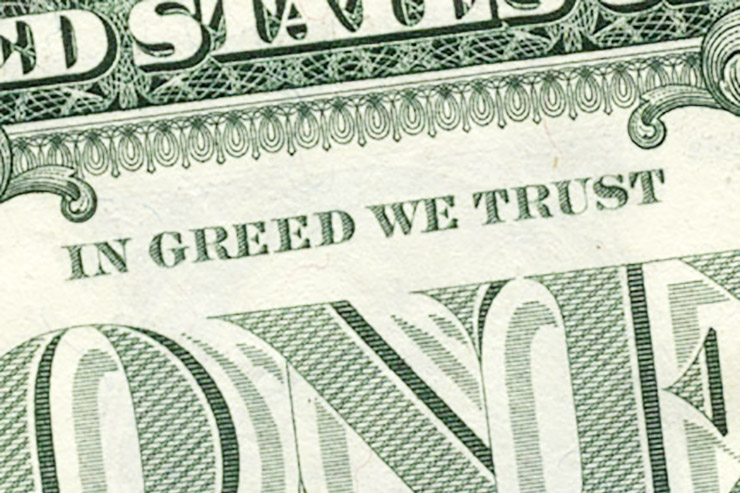
    In the US, we see untold millions suffering from the impact of mass foreclosures and unemployment; in Greece, Spain, Portugal, Ireland, and Italy, stringent austerity measures are imposed upon the whole population; all coupled with major banking collapses in Iceland, the UK and the US, and indecent bail-outs of “too-big-to-fail” bankers (Newspeak for too powerful to fail).

    No doubt, the bulk of the responsibility for these debacles falls squarely on the shoulders of caretaker governments in these countries that are subordinated to Money Power interests and objectives. In country after country, that comes together with embedded corruption, particularly evident today in the UK, Italy and the US.

    As we assess some of the key components of today’s Global Financial, Currency and Banking Model in this article, readers will hopefully get a better understanding as to why we are all in such a crisis, and that it will tend to get much worse in the months and years to come.

    Foundations of a Failed and False Model

    Hiding behind the mask of false “laws” allegedly governing “globalised markets and economies,” this Financial Model has allowed a small group of people to amass and wield huge and overwhelming power over markets, corporations, industries, governments and the global media. The irresponsible and criminal consequences of their actions are now clear for all to see.

    The “Model” we will briefly describe, falls within the framework of a much vaster Global Power System that is grossly unjust and was conceived and designed from the lofty heights of private geopolitical and geo-economic1 planning centres that function to promote the Global Power Elite’s agenda as they prepare their “New World Order” – again, Newspeak for a Coming World Government.2

    Specifically, we are talking about key think tanks like the Council on Foreign Relations, the Trilateral Commission, the Bilderberg Group, and other similar entities such as the Cato Institute (Monetary Issues), American Enterprise Institute and the Project for a New American Century that conform an intricate, solid, tight and very powerful network, engineering and managing New World Order interests, goals and objectives.

    Writing from the stance of an Argentine citizen, I admit we have some “advantages” over the citizens of industrialised countries as the US, UK, European Union, Japan or Australia, in that over the last few decades we have had direct experience of successive catastrophic national crises emanating from inflation, hyper-inflation, systemic banking collapse, currency revamps, sovereign debt bond mega-swaps, military coups and lost wars…

    Finance vs the Economy

    The Financial system (i.e., a basically unreal Virtual, symbolic and parasitic world), increasingly functions in a direction that is contrary to the interest of the Real Economy (i.e., the Real and concrete world of work, production, manufacturing, creativity, toil, effort and sacrifice done by real people). Over the past decades, Finance and the Economy have gone their totally separate and antagonistic ways, and no longer function in a healthy and balanced relationship that prioritises the Common Good of We the People. This huge conflict between the two can be seen, amongst other places, in today’s Financial and Economic System, whose main support lies in the Debt Paradigm, i.e., that nothing can be done unless you first have credit, financing and loans to do it. Thus, the Real Economy becomes dependent on and distorted by the objectives, interests and fluctuations of Virtual Finance.3

    Debt-Based System

    The Real Economy should be financed with genuine funds; however with time, the Global Banking Elite succeeded in getting one Sovereign Nation-State after another to give up its inalienable function of supplying the correct quantity of National Currency as the primary financial instrument to finance the Real Economy. That requires decided action through Policies centred on promoting the Common Good of We The People in each country, and securing the National Interest against the perils posed by internal and external adversaries.

    Thus, we can better understand why the financial “law” that requires central banks to always be totally “independent” of Government and the State has become a veritable dogma. This is just another way of ensuring that central banking should always be fully subordinated to the interests of the private banking over-world – both locally in each country, as well as globally.

    We find this to prevail in all countries: Argentina, Brazil, Japan, Mexico, the European Union and in just about every other country that adopts so-called “Western” financial practice. Perhaps the best (or rather, the worst) example of this is the United States where the Federal Reserve System is a privately controlled institution outright, with around 97% of its shares being owned by the member banks themselves (admittedly, it does have a very special stock scheme), even though the bankers running “Fed” do everything they can to make it appear as if it is a “public” entity operated by Government, something that it is definitely not.

    One of the Global Banking Over-world’s permanent goals is – and has been – to maintain full control over all central banks in just about every country, in order to be able to control their public currencies.4 This, in turn, allows them to impose a fundamental (for them) condition whereby there is never the right quantity of public currency to satisfy the true demand and needs of the Real Economy. That is when those very same private banks that control central banking come on scene to “satisfy the demand for money” of the Real Economy by artificially generating private bank money out of nothing. They call it “credits and loans” and offer to supply it to the Real Economy, but with an “added value” (for them): (a) they will charge interest for them (often at usury levels) and, (b) they will create most of that private bank money out of thin air through the fractional lending system.

    At a Geo-economic level, this has also served to generate huge and unnecessary public sovereign debts in country after country all over the world. Argentina is a good example, whose Caretaker Governments are systematically ignorant and unwilling to use one of the sovereign state’s key powers: the issuance of high power non-interest generating Public Money (see below for a more detailed definition). Instead, Argentina has allowed IMF (International Monetary Fund) so-called “recipes” that reflect the global banking cartel’s own interests to be imposed upon it in fundamental matters like what are the proper functions of its Central Bank, sovereign debt, fiscal policy, and other monetary, banking and financial mechanisms, that are thus systematically used against the Common Good of the Argentine People and against the National Interest of the country.

    This system and its dreadful results, now and in the past, are so similar in so many other countries – Brazil, Mexico, Greece, Ireland, Iceland, UK, Portugal, Spain, Italy, Indonesia, Hungary, Russia, Ukraine… that it can only reflect a well thought-out and engineered plan, emanating from the highest planning echelons of the Global Power Elite.

    Fractional Bank Lending

    This banking concept is in use throughout the world’s financial markets, and allows private banks to generate “virtual” Money out of thin air (i.e., scriptural annotations and electronic entries into current and savings accounts, and a vast array of lines of credit), in a ratio that is 8, 10, 30, 50 times or more larger than the actual amount of cash (i.e., public money) held by the bank in its vaults. In exchange for lending this private “money” created out of nothing, bankers collect interest, demand collateral with intrinsic value and if the debtor defaults they can then foreclose on their property or other assets.

    The ratio that exists between the amount of Dollars or Pesos in its vaults and the amount of credit private banks generate is determined by the central banking authority which fixes the fractional lending leverage level (which is why controlling the central bank is so vital strategically for private banker cartels). This leverage level is a statistical reserve based on actuarial calculations of the portion of account holders who in normal time go to their banks or ATM machines to withdraw their money in cash (i.e., in public money notes). The key factor here is that this works fine in “normal” times, however “normal” is basically a collective psychology concept intimately linked to what those account holders, and the population at large, perceive regarding the financial system in general and each bank in particular.

    So, when for whatever reason, “abnormal” times hit – i.e., every time there are (subtly predictable) periodic crises, bank runs, collapses and panics, which seem to suddenly explode as happened in Argentina in 2001 and as is now happening in the US, UK, Ireland, Greece, Iceland, Portugal, Spain, Italy and a growing number of countries – we see all bank account holders running to their banks to try to get their money out in cash. That’s when they discover that there is not enough cash in their banks to pay, save for a small fraction of account holders (usually insiders “in the know” or “friends of the bankers”).

    For the rest of us mortals “there is no more money left,” which means that they must resort to whatever public insurance scheme may or may not be in place (e.g., in the US, the state-owned Federal Deposit Insurance Corporation that “insures” up to US$250,000 per account holder with taxpayer money). In countries like Argentina, however, there is no other option but to go out on the streets banging pots and pans against those ominous, solid and firmly closed bronze bank gates and doors. All thanks to the fraudulent fractional bank lending system.

    Investment Banking

    In the US, so called “Commercial Banks” are those that have large portfolios of checking, savings and fixed deposit accounts for people and companies (e.g., such main street names as CitiBank, Bank of America, JPMorganChase, etc.; in Argentina, we have Standard Bank, BBVA, Galicia, HSBC and others). Commercial Banks operate with fractional lending leverage levels that allow them to lend out “virtual” dollars or pesos for amounts equal to 6, 8 or 10 times the cash actually held in their vaults; these banks are usually more closely supervised by the local monetary authorities of the country.

    A different story, however, we had in the US (and still have elsewhere) with so-called global “Investment Banks” (those that make the mega-loans to corporations, major clients and sovereign states), over which there is much less control, so that their leveraging fractional lending ratios are far, far higher. This greater flexibility is what allowed investment banks in the US to “make loans” by, for example, creating out of thin air 26 “virtual” Dollars for every real Dollar in cash they held in their vaults (i.e., Goldman Sachs), or 30 virtual Dollars (Morgan Stanley), or more than 60 virtual Dollars (Merrill Lynch until just before it folded on 15 Sept 2008), or more than 100 virtual Dollars in the cases of collapsed banks Bear Stearns and Lehman Brothers.5

    Private Money vs Public Money

    At this point in our review, it is essential to very clearly distinguish between two types of Money or Currency:

    Private Money – This is “Virtual” Money created out of thin air by the private banking system. It generates interests on loans, which increases the amount of Private money in (electronic) circulation, and spreads and expands throughout the entire economy. We then perceive this as “inflation.” In actual fact, the main cause of inflation in the economy is structural to the interest-bearing fractional lending banking system, even among industrialised countries. The cause of inflation nowadays is not so much the excessive issuance of Public Money by Government as all so-called banking experts would have us believe but, rather, the combined effect of fractional lending and interest on private banking money.

    Public Money – This is the only Real Money there is. It is the actual notes issued by the national currency entity holding a monopoly (i.e., the central bank or some such government agency) and, as Public Money, it does not generate interest, and should not be created by anyone other than the State. Anybody else doing this is a counterfeiter and should end up in jail because counterfeiting Public Money is equivalent to robbing the Real Economy (i.e., “we, the working people”) of their work, toil and production capabilities without contributing anything in return in terms of socially productive work. The same should apply to private bankers under the present fractional lending system: counterfeiting money (i.e., creating it out of thin air as a ledger entry or electronic blip on a computer screen) is equivalent to robbing the Real Economy of its work and production capacity without contributing any counter-value in terms of work.

    Why We Have Financial Crises

    A fundamental concept that lies at the very heart of the present Financial Model can be found in the way huge parasitic profits on the one hand, and catastrophic systemic losses on the other, are effectively transferred to specific sectors of the economy, throughout the entire system, beyond borders and public control.

    As with all models, the one we suffer today has its own internal logic which, once properly understood, makes that model predictable. The people who designed it know full well that it is governed by grand cycles having specific expansion and contraction stages, and specific timelines. Thus, they can ensure that in bull market times of growth and gigantic profits (i.e., whilst the system, grows and grows, is relatively stable and generates tons of money out of nothing), all profits are privatised making them flow towards specific institutions, economic sectors, shareholders, speculators, CEO and top management & trader bonuses, “investors”, etc who operate the gears and maintain the whole system properly tuned and working.

    However, they also know that – like all roller coaster rides – when you reach the very top, the system turns into a bear market that destabilises, spins out of control, contracts and irremediably collapses, as happened to Argentina in 2001 and to the better part of the world since 2008, then all losses are socialised by making Governments absorb them through the most varied transference mechanisms that dump these huge losses onto the population at large (whether in the form of generalised inflation, catastrophic hyperinflation, banking collapses, bail-outs, tax hikes, debt defaults, forced nationalisations, extreme austerity measures, etc).

    The Four-sided Global “Ponzi” Pyramid Scheme

    As we know, all good pyramids have four sides, and since the Global Financial System is based on a “Ponzi” Pyramid Scheme, there’s no reason why this particular pyramid should not have four sides as well.

    Below is a summary of the Four-side Global “Ponzi” Pyramid Scheme that lies at the core of today’s Financial Model, indicating how these four “sides” function in a coordinated, consistent, and sequential manner.

    Side One – Create Public Money Insufficiency. This is achieved, as we explained above, by controlling the National Public entity that issues public money. Its goal is to demonetise the Real Economy so that the latter is forced to seek “alternative funding” for its needs (i.e., so that it has no choice but to resort to private bank loans).

    Side Two – Impose Private Banking Fractional Lending Loans. This, as we said, is virtual private money created out of thin air on which bankers charge interest – often at usury levels – thus generating enormous profit for “investors,” creditors and all sorts of entities and individuals who operate as parasites living off other people’s work. This would never have been the case if each local central bank were to flexibly generate the correct quantity of Public Money necessary to satisfy the needs of the Real Economy in each country and region.

    Side Three – Promote a Debt-Based Economic System. In fact, the whole Pyramid Model is based on being able to promote this generalised paradigm that falsely states that what really “moves” the private and public economy is not so much work, creativity, toil and effort of workers, but rather “private investors,” “bank loans” and “credit” – i.e., indebtedness. With time, this paradigm has replaced the infinitely wiser, sounder, more balanced and solid concept of corporate profit being reinvested and genuine personal savings being the foundation for future prosperity and security. Pretty much the way Henry Ford, Sr. originally grew his most successful company.

    Today, however, Debt reigns supreme and this paradigm has become entrenched and embedded into people’s minds thanks to the mainstream media and specialised journals and publications, combined with Ivy League universities’ Economics Departments that have all succeeded in imposing such “politically correct” thinking with respect to financial matters, especially those relating to the proper nature and function of Public Money.

    The facts are that this Model generates unnecessary loans so that banking creditors can receive huge profits, which includes promoting uncontrolled, unwarranted and often pathological consumerism, which goes hand in hand with the increasing abandonment of the traditional value of “saving for a rainy day.”

    Such debts having political and strategic goals rather than merely financial ones, are usually given a thin layer of “legality” so that they may be imposed by the creditor on the debtor (i.e., in the case of The Merchant of Venice, the bond entered into between Antonio and Shylock giving the latter the legal right to a pound of the former’s flesh; in the case of chronically indebted countries like Argentina, such “legality” is achieved through a complex public debt laundering6 mechanism carried out by successive formally “democratic” Caretaker Governments to this very day).

    Side Four – Privatisation of Profits/Socialisation of Losses. Lastly, and knowing full well that, in the long run, the numbers of the entire Cycle of this Model never add up, and that the whole system will inevitably come crashing down, the Model imposes a highly complex and often subtle financial, legal and media engineering that allows privatising profits and socialising losses. In Argentina, this cycle has become increasingly visible for those who want to see it, because in our country the local “Ponzi” Pyramid Cycle lasts on average 15 to 17 years, i.e., we’ve had successive collapses involving brutal devaluation (1975), hyperinflation (1989) and systemic banking collapse (2001), however in the industrialised world, that cycle was made to last almost 80 years (i.e., three generations spanning from 1929 to 2008).

    Conclusions

    The fundamental cause of today’s on-going global financial collapse that exerts massive distortions over the Real Economy – and the ensuing social hardship, suffering and violence – is clear: Virtual Finance has usurped a pedestal of supremacy over the Real Economy, which does not legitimately belong to it. Finance must always be subordinated to, and in the service of, the Real Economy just as the Economy must heed the law and social needs of the Political Model executed by a Sovereign Nation-State (as we back-engineer this entire system, we thus understand why it is necessary for the Global Power Elite to first erode the sovereign Nation-State and to eventually do away with it altogether, in order to achieve its monetary, financial and political ends).

    In fact, if we look at matters in their proper perspective, we will see that most national economies are pretty much intact, in spite of having been badly bruised by the financial collapse. It is Finance that is in the midst of a massive global collapse, as this Model of “Ponzi” Finance has grown into a sort of malignant “cancerous tumour” that has now “metastasised,” threatening to kill the whole economy and social body politic, in just about every country in the world, and certainly in the industrialised countries.

    The above comparison of today’s financial system with a malignant tumour is more than a mere metaphor. If we look at the figures, we will immediately be able to see signs of this financial “metastasis.” For example, The New York Times in their 22 September 2008 edition explains that the main trigger of the financial collapse that had exploded just one week earlier on 15 September was, as we all know, mismanagement and lack of supervision over the “Derivatives” market. The Times then went on to explain that twenty years earlier, in 1988, there was no derivatives market; by 2002 however, Derivatives had grown into a global 102 trillion Dollar market (that’s 50% more than the Gross Domestic Product of all the countries in the world, the US, EU, Japan and BRICS nations included), and by September 2008, Derivatives had ballooned into a global 531 trillion Dollar market. That’s eight times the GDP of the entire planet! “Financial Metastasis” at its very worst. Since then, some have estimated this Derivatives global market figure to be in the region of One-Quadrillion Dollars…

    Naturally, when that collapse began, the caretaker governments in the US, European Union and elsewhere, immediately sprang into action and implemented “Operation Bail-out” of all the mega-banks, insurance companies, stock exchanges and speculation markets, and their respective operators, controllers and “friends.” Thus, trillions upon trillions of Dollars, Euros and Pounds were given to Goldman Sachs, Citicorp, Morgan Stanley, AIG, HSBC and other “too big to fail” financial institutions… which is newspeak for “too powerful to fail”, because they hold politicians, political parties and governments in their steel grip.

    All of this was paid with taxpayer dollars or, even worse, with uncontrolled and irresponsible issuance of Public Money bank notes and treasury bonds, especially by the Federal Reserve Bank which has, in practice, technically hyper-inflated the US Dollar: “Quantitative Easing” they call it, which is Newspeak for hyperinflation.

    So far, however, like the proverbial Naked Emperor, nobody dares to state this openly. At least not until some “uncontrolled” event triggers or unmasks what should by now be obvious to all: Emperor Dollar is totally and completely naked.7 When that happens, we will then see bloody social and civil wars throughout the world and not just in Greece and Argentina.

    By then, however, and as always happens, the powerful bankster clique and their well-paid financial and media operators, will be watching the whole hellish spectacle perched in the safety and comfort of their plush boardrooms atop the skyscrapers of New York, London, Frankfurt, Buenos Aires and Sao Paulo…
    [alert type=”general” dismiss=”no”]This article was published in New Dawn 128.[/alert]

    [alert type=”success” dismiss=”no”]If you appreciate this article, please consider subscribing to help maintain this website.[/alert]

    Footnotes

    1. The concept of “Geoeconomics” was coined by the New York-based Council on Foreign Relations, through a studies group honouring Maurice Greenberg, the financier who was for decades CEO of American International Group (AIG) which collapsed in 2008 and had strong conflict-of-interest ties with major insurance and reinsurance broker Marsh Group whose CEO was his son Jeffrey. Both father and son were indicted for fraud by then New York Attorney General Elliot Spitzer. Spitzer would later pay a very heavy price for this after becoming Governor of New York State when someone “discovered” his sex escapades which were quickly blown up into a major scandal by The New York Times

    2. We have described the basic Global Power Elite structure, model and objectives in our e-Book The Coming World Government: Tragedy & Hope?, available through www.asalbuchi.com.ar.

    3. For more information, see the Third Pillar of the Second Republic Project “Reject the Debt-Based Economy” on www.secondrepublicproject.com.

    4. Some notable exceptions: Today: Libya, Iran, Syria, China; In the past: Peron’s Argentina, Germany and Italy in the 30’s and 40’s….  Are we seeing a pattern here?

    5. See The New York Times, 22 September 2008

    6. See White Paper comparing Debt Laundering mechanisms to Money Laundering mechanisms, lodged under Pillar No 3 “Reject the Debt-Based Economy” of Second Republic Project in www.secondrepublicproject.com.

    7. This is more fully described in the author’s book The Coming World Government: Tragedy & Hope?, in the chapter “Death & Resurrection of the US Dollar”. Details on www.asalbuchi.com.ar. Also available upon request by E-mail: salbuchi@fibertel.com.ar.

    © New Dawn Magazine and the respective author.
    For our reproduction notice, click here.
  • Perfidious Albion: An Introduction to the Secret History of the British Empire

    Perfidious Albion: An Introduction to the Secret History of the British Empire

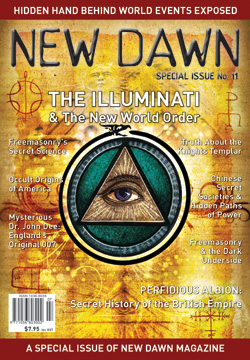
    From New Dawn Special Issue 11 (Mar 2010)

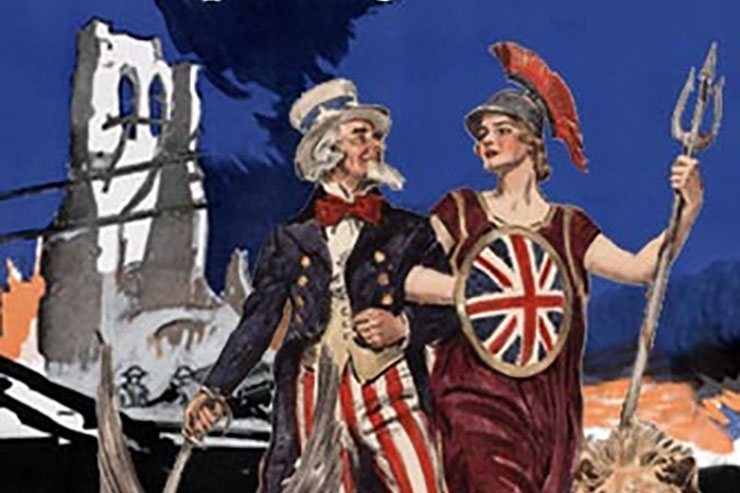
    Perfidious Albion – “Treacherous England,” “Faithless England,” or, if you prefer, “Dirty, Low-down, Sneaky England” – is commonly assumed to derive from the French La Perfide Albion. The epithet’s best known appearance is in the 1793 poem “L’ere de Francais” by the Marquis de Ximenez. The year is not without significance. In February 1793, the increasingly radical and beleaguered French Republic declared war on Britain, and Ximenez exhorted his revolutionary countrymen to carry the fight to the enemy’s shores. One wonders what he would have made of the theory, advance many years later, that the very Revolution he praised was the clandestine handiwork of Perfide Albion.

    In any event, the good Marquis was hardly the first or the last to invoke the term. References to something of the kind date back to the late Middle Ages. In 1919, Canon Charles O’Neil enshrined it in the lyrics of “Foggy Dew,” which lauded Ireland’s Easter Rebellion. The Spanish, recalling the ill-fated Armada and the depredations of Sir Francis Drake, speak of Perfida Albion, the Italians of Perfida Albione, and the Germans of Perfides Albion. In any language, it boils down to the same thing: the English displayed a special knack for underhanded behaviour and more that they were damned good at it.

    Is such sniping just the reflexive bitterness of losers, or was the rise and success of the British Empire really abetted by dirty tricks and not just hardy seamen, stiff upper lips and the will of the Almighty? If so, much of the dirty work falls into that category loosely termed espionage or “secret service.” But the English did not invent spying, which if not the world’s second oldest profession, must be the third. Nor can it be that Britain’s alleged sin was simply putting its interests above that of any other nation, be it friend or foe. What other country can really claim to have done otherwise, and why should anyone expect them to?

    Of course, we are talking about more than mere intelligence gathering; suborning treason, inciting rebellion, even war, not to mention blackmail and assassination are neither the least nor the greatest crimes of which Perfidious Albion stands accused. Indeed, some might argue that the British Empire was born and maintained through a pact with the Devil himself. In any case, the likes of Stephen Dorril and Robin Ramsay argue that the long history of skulduggery manifests the hand of a British “Secret State” which continues to guide the policies and destiny of the United Kingdom.1

    The notion than England possessed a special talent for deceit and underhandedness may be a myth, but it has proved an effective and enduring one. After all, though the Empire is gone, the most famous secret agent in the world, James Bond, remains a Briton. The long list of historical figures who stand accused of being Albion’s tools (whether they knew it or not) includes Christopher Marlowe, Benjamin Franklin, Karl Marx, Leon Trotsky and Adolf Hitler. Those who, to one degree or another, definitely were, include Aleister Crowley, Harry Houdini, Benito Mussolini and Noel Coward. What follows will take a necessarily very selective look at some of the persons and events involved in Britain’s clandestine affairs from the era of Elizabeth I to the Second World War. Some may be familiar, others definitely obscure, but each played a part in the Secret History of the British Empire.

    Sir Francis Walsingham

    Credit for creating the first “regular” English secret service usually goes to Elizabeth I’s spymaster, Sir Francis Walsingham.2 He faced a predicament shared by many of his successors; the need to combat both external and internal threats and the collaboration of the two. In the case of the Protestant Walsingham and his Protestant Queen, the unifying factor among their enemies was devotion to Catholicism. Walsingham battled this menace by recruiting agents at home and abroad and waging an aggressive campaign of counter-subversion. His most successful weapon was the provocateur or “mole” who penetrated and compromised hostile conspiracies. He also followed the maxim that England’s enemy’s enemy was her friend, or at least an exploitable tool. In addition to Protestant sympathisers and dissident Catholics, he is also supposed to have enlisted the help of witches, sorcerers and atheists in Albion’s cause.3

    Little surprise that one of Walsingham’s better known operatives was an Elizabethan occultist whose interests included hermeticism, alchemy, astrology and conversing with “angels.” This was Dr. John Dee (1527–1608), a man whose encoded signature – a stylised representation of handled spectacles – was later appropriated by Ian Fleming for his “007.”4 Among other things, Dee was a prophet of England’s Manifest Destiny. He allegedly coined the term “Britannia” and conjured up the image of the small island kingdom as the centre of a world-girdling maritime empire.

    While Dee served Walsingham well, he was first and foremost a scholar and seems to have lacked the ruthless quality often required of a secret agent. Thus, it surely was Walsingham’s hand that in 1582 steered Edward Kelley into his path. Dee wished to commune with the spirits but lacked mediumistic powers. Kelley had them – or claimed to – and the pair formed a team which endured for some seven years. Kelley was a dubious character, a convicted forger and counterfeiter whose occult interests included necromancy and maybe outright diabolism.5 Since the angels “spoke” through Kelley, and Dee was inclined to do whatever they decreed, Kelley was ideally positioned to “manage” Dee. Kelley would have had no qualms about doing whatever Walsingham required. Little wonder that some three centuries later another English occultist-spy, Aleister Crowley, would proclaim himself the reincarnation of Edward Kelley.

    Dee and Kelley’s most important mission was their extended visit to Central Europe in the 1580s. This brought them to the court of Habsburg Emperor Rudolf II, nephew of England’s nemesis, Philip II of Spain, and host to a dangerous cabal of Catholic exiles. Kelley ultimately infiltrated and betrayed this group and their co-conspirators in England. Dee ingratiated himself (and by extension, Kelley) to Rudolf by providing the Emperor with rare tomes of esoterica. Dee is generally assumed to have sold Rudolf a very strange volume later dubbed the Voynich Manuscript after the book dealer who rediscovered it in the early 20th century.6 It is an illustrated manuscript depicting mysterious plants and rituals and written in an unknown and indecipherable alphabet. Among the multitude of theories about the book is one that holds Dee concocted it as cryptographic experiment based on the angelic or “Enochian” revelations received through Kelley.

    Britain’s Alliance with the Jews

    Half a century after Dee’s death, England was under a very different political regime but facing a remarkably similar security predicament. In the mid-1650s, power rested in the hands of a Puritan dictator, Lord Protector Oliver Cromwell. Cromwell’s principle enemies were the royalist partisans of the dethroned Stuarts who brewed sedition at home and plotted abroad with the Catholic kings of Spain and France.

    At this time there lived in London a wealthy Portuguese-Spanish merchant named Antonio Fernandez de Carvajal. In fact, Carvajal was a Marrano or crypto-Jew, a descendent of Iberian Jews compelled to accept Catholicism in the previous century. Like many of his secret co-religionists, Carvajal hated Spain and all it stood for. He also sought to legitimise his and other crypto-Jews’ status in England and permit other Sons of Judah to live there openly. The obstacle was Edward I’s 1290 Edict of Expulsion which forbade Jews to dwell in England. In 1655, Carvajal arranged for Rabbi Menasseh ben Israel to come from Amsterdam and make a personal appeal to Cromwell. The Lord Protector formally repealed the Edict two years later. Part of the quid pro quo was that Carvajal put Cromwell’s agents in contact with a far-flung network of “Jewish Intelligencers” who operated in the Netherlands, the Levant, Spanish America and inside Spain itself.7 As early as 1656 this secret alliance proved its value when Carvajal’s agents exposed royalist intrigues in Holland.

    Jump ahead 260 years and British agents in the Middle East, among them a certain T. E. Lawrence, were being aided by another network of Jewish spies, this one the Zionist NILI ring which worked against the Ottoman Turks.8 At the same time, Albion’s operatives spun visions of independence before the Arabs while quietly plotting to divide up the whole region with France. The leading light of the NILI ring, Aaron Aaronsohn perished in a mysterious plane crash over the English Channel in 1919. As in the later cases of the Duke of Kent (1942) and General Wladyslaw Sikorski (1943), suspicious minds saw the hidden hand of Perfidious Albion ridding itself of an “inconvenience.”9

    At the very least, had Edward I’s Edict remained in force, British history would have been very different. No Rothschilds would have lent their weight to London’s financial might, no Benjamin Disraeli would have become prime minister, nor would a Polish Jew named Shlomo Rozenblium have become Sidney Reilly, the Ace-of-Spies.

    The French Revolution has spawned its share of conspiracy theories. Perhaps the most resilient of these is the “Illuminati-Masonic Conspiracy” promoted by Abbe Augustin de Barruel in his Memoirs Illustrating the History of Jacobinism (1797–98) and John Robison’s Proofs of a Conspiracy against All Religions and Governments of Europe… (1797). Both writers point accusing fingers at the recently disbanded Bavarian Illuminati who, they allege, infiltrated French Freemasonry and spawned the head-chopping excesses of the Jacobins. It is worth noting that both Barruel and Robison wrote their books in Britain and that the government of Sir William Pitt the Younger embraced and promoted their ideas. At the very least, Pitt exploited the conspiracy theory to effectively discredit and demonise the French Revolution.

    In the 20th century, the doggedly anti-British researchers associated with Lyndon Larouche’s Executive Intelligence Review argue that the hidden hand of England both helped to get the Revolution rolling and steered it into the hands of the fanatical Jacobins. In modern parlance, it was all a “destabilisation” effort designed to cripple France economically and politically. Even the storming of the Bastille was part of the plot.10 In the “Bestial British Intelligence of Shelburne and Bentham,” Jeffrey Steinberg singles out Lord Shelburne (William Petty) the evil genius of the venture who used the monetary power of the East India Company to carry out a silent coup against weak King George III.11 According to this view, British intelligence ever since has been the tool of the same secret power. If so, were the works of Barruel and Robison sponsored disinformation designed to divert attention away from the real conspiracy to a manufactured one?

    Throughout the 19th and early 20th centuries, the British secret services had to negotiate a shifting landscape of alliances and real or potential enemies. In the 1850s, Britain joined traditional foe France in the Crimean War against Russia, but in the 1890’s France allied itself with Russia, a combination that was almost as troubling to Britain as it was to the rising power on the block, Germany. Up to the first years of the 20th century, Tsarist Russia remained the Empire’s #1 adversary, but when, after 1900, the Germans embarked on the creation of a big navy, British interests demanded an alliance with France (1904) and subsequently Russia (1907).

    Of course, just because you were allied to someone, didn’t mean you would or should stop spying on them. To better manage intelligence operations, a War Office Intelligence Division appeared in 1873. The Admiralty followed suit with a Foreign Intelligence Committee in 1882 which became the Naval Intelligence Department (NID) a few years later.

    William Melville

    Nevertheless, the man who was the closest thing to a British spymaster in the late 19th century, and who arguably laid the basis for British intelligence in the 20th, came from the London Metropolitan Police – Scotland Yard. His name was William Melville and he was, of all things, a Catholic Irishman from County Kerry. Originally a baker, Melville entered the Metropolitan Police in 1872 and ten years later joined its new Irish Branch. The latter was designed to combat Fenian conspiracies, particularly bomb attacks in London. Despite his background, Melville became an implacable enemy of the Irish rebels and a bitter foe of anarchists and radicals generally.

    In 1887, Melville was involved in ferreting out the so-called Jubilee Plot in which a Fenian cabal aimed to blow up Queen Victoria and most of her cabinet in Westminster Abbey.12 The key instigator turned out to be a British agent. Much the same emerged five years later when Melville masterminded the destruction of the Walsall Plot in which a group of anarchist workmen went to prison for scheming to build a bomb. Once again, the man at the centre of plot turned out to be one of Melville’s provocateurs.13

    Befitting a servant of Perfidious Albion, such deviousness did not go unrewarded. In 1893 Melville became Superintendent of Special Branch and earned an almost mythical reputation as the ever-watchful guardian of public order. Always on the lookout for new angles in trickery and deception, in 1900 Melville enlisted the talents of American magician Harry Houdini. He even inveigled Houdini to spy for him during his tours of Germany and Russia.14

    Still, this did not inhibit Melville from establishing cooperative arrangements with the secret services of those very same countries. In 1901, he worked with German agents to forestall an assassination attempt against Kaiser Wilhelm II at Queen Victoria’s funeral.15 He evolved a more elaborate relationship with Pyotr Rachkovsky, the equally cunning chief of the Russian Government’s Okhrana section in Paris. Melville’s men spied on Russian exiles in London, while Rachkovsky supplied Melville with intelligence gleaned from radical circles on the Continent. They even shared agents.

    A case in point is the Pilenas brothers, Casimir and Peter. They were Lithuanian subjects of the Russian Empire who fled to London in the 1890s and moved in revolutionary circles. Casimir became a spotter and informant for Scotland Yard around 1896 and he and his brother worked as London operatives for the Okhrana.16 Their recruiter was one of Melville’s officers, Michael Thorpe who also, with Melville’s approval, worked for Rachkovsky.

    The Okhrana came to doubt the Pilenas’ reliability and cut them loose in 1913. This may have had something to do with their peripheral involvement in a sensational robbery-murder in London in December 1910. The so-called Houndsditch Murders resulted from a botched burglary attempt by a group of Latvian-Russian anarchists.17 Three policemen were shot dead and not long after two of the suspects died in a fiery shoot-out in the East End’s Sidney Street. Despite what first appeared to be overwhelming evidence, the surviving robbers were all acquitted. One reason for the acquittals may have been that there was one or more police agents among the accused.

    The group’s shadowy ringleader, “Peter the Painter,” was never found, but among those suspected was Peter Pilenas who conveniently left England for America just days before the robbery went down. Peter soon was followed to the States by brother Casimir. When the First World War broke out, British intelligence in New York re-mobilised him as an agent, and he similarly returned to Albion’s service (if he ever left) in 1939.

    There is something fishy about the Houndsditch/Sidney Street business, and the suspicion that it involved State-inspired provocation is not unjustified. In that respect, a not insignificant detail is that the Home Secretary who personally oversaw the Sidney Street shoot-out was Winston Churchill, a man who some believe “had already sealed an indissoluble bond” with the Realm’s secret services.18

    Melville resigned his Scotland Yard post in October 1903 but immediately opened a private detective agency under the name William Morgan. In fact, Melville’s outfit was a cut-out for the War Office and served the Empire’s secret needs at home and abroad. Basically, Melville’s agents did the Empire’s dirty work under a cover of complete deniability. In 1909, most of his organisation was subsumed into two new agencies created to handle domestic and foreign intelligence (what would become MI5 and MI6) and Melville served as MI5’s Chief Detective until his real retirement in 1917.

    Sidney George Reilly

    One of Melville’s most notable recruits was the Russo-Polish Jew mentioned earlier, Shlomo, or Salomon, Rozenblium. He would be much better known as Sidney George Reilly. His career is too convoluted to summarise here, but among other things, he is frequently cited as the role model for James Bond.19 Like so many things about Reilly, it turns out to have no basis in fact. In reality, Reilly was more a confidence man than a spy, and his loyalty to Britain, or anything else, was doubtful. A report on his character in early 1918 concluded that he was “a shrewd businessman of undoubted ability, but without patriotism or principles and therefore not to be recommended for any position which requires loyalty….”20 Other terms applied to him included “untrustworthy” and “unscrupulous.” Among the few things said in his favour was that he had excellent sources of information and “connections in almost every country.”21 Reilly liked to hint of his connections to the “Occult Octopus,” his name for the more secretive aspects of international business and finance.22

    Nevertheless, despite his mercenary reputation, or maybe because of it, in the spring of 1918 the chief of London’s Secret Intelligence Service (SIS or MI6), chose Reilly to undertake an ultra-secret mission inside newly Bolshevised Russia. The main fruit of this venture was the so-called Lockhart or Ambassadors’ Plot which reached its crescendo in late August of that year. The plot centred on a plan, spearheaded by Reilly, to subvert the Latvian troops guarding the Kremlin and use them in a palace coup against Lenin’s government. The goal was less the total overthrow of the Red regime than a change in its leadership, and there is little doubt that an almost simultaneous, but botched, effort to kill Lenin was connected.23 The Latvian gambit abruptly fell apart with the result that all the Allied secret services in Russia were compromised. Reilly and his British colleagues escaped unscathed, but his American counterpart, the unlikely named Xenophon Kalamatiano, was not so lucky. He alone was tried, convicted and imprisoned by the Bolsheviks for three gruelling years. To his dying day Kalamatiano maintained that Reilly had deliberately betrayed him and other Allied agents.24 What he never seemed quite sure of was why.

    Sidney Reilly disappeared on another mission to Russia in the fall of 1925. According to contradictory Soviet accounts, either he was executed soon after his capture or almost two years later. In London there were routine denials and whispers of defection. In what purports to be an account of his interrogation, Reilly emphatically states that there had been no British agents in Russia since 1919.25 It may be that one purpose of Reilly’s mission was to convince his Soviet captors that this was true. Persons in London may have willingly sacrificed Reilly to make that point.

    It was vital that the Soviets believe him, because nothing could be further from the truth. As researcher Phil Tomaselli has unearthed, from the fall of 1919 through at least mid-1923, MI6 received scores of reports, many very detailed, from a source with access to the highest levels of the Soviet Government. The source was also particularly well-versed in the secret collaboration between the Russians and the German military. Codenamed D-57, the agent’s identity was carefully disguised; indeed, it is not clear whether D-57 was an individual or a network of informants. As far as can be determined, the information provided was reliable.

    D-57 was only a part of a much more extensive British intelligence operation in Red Russia. As a 1927 American military intelligence summary put it, “Just what agencies are maintained [by the British] in Russia, of course, cannot be found out, but according to recent Soviet claims, which are undoubtedly exaggerated, the British have an extensive system of espionage in that country.”26 Actually, the Soviets were not hallucinating. London had intelligence officers imbedded in its trade and diplomatic missions, and in the ranks of private firms operating in Russia. Through the 1920s, a super-secret MI6 station existed in Moscow, though, like D-57, it remains completely unacknowledged in that agency’s official history.27 Why? Why would such a seemingly outstanding success be covered-up? Could it be that to reveal the story of D-57 and related affairs would also reveal some darker secrets of the Empire, those that must forever remain in the file of Things That Never Happened?

    Dr. Cornelius Herz

    The Soviets were not the only ones who had to fret about the nefarious activities of English spies. The French had ample reason to maintain a healthy paranoia about L’Intelligence Service. Around 1877, a certain Dr. Cornelius Herz appeared in Paris. Although supposedly born in France, Herz claimed American citizenship, but his origins are, to say the least, obscure. He used his not inconsiderable wealth, the source of which was also a mystery, to dabble in finance and politics, initially to great success. He cultivated political figures in the Third Republic, most notably the sabre-rattling General Georges Ernest Boulanger, who almost staged a coup against the Republican regime at the end of the 1880s. Herz also befriended a rising politico named Georges Clemenceau, the future “Tiger of France.”

    However, Herz’s little empire came crashing down when, along with another wheeler-dealer, the Baron de Reinach, he became mixed-up in the Panama Canal Scandal that hit France at the beginning of the 1890s. The Scandal, which included charges of bribery and official malfeasance, rocked the Republic to its foundations. To avoid prosecution, Herz, like others implicated, fled aboard, but it was the place of refuge he chose that raised eyebrows. Herz decamped to England in 1892 where, despite vigorous French efforts to force his extradition, he remained safe and silent until his rather untimely (some might argue convenient) death six years later.28 In France it became an article of faith that Herz had been an “agent-of-influence” of Perfide Albion and that his aim all along was to destabilise the Third Republic any way he could. Some of his critics charged that Herz was nothing less than the “chief of the Intelligence Service in France.”29 Herz, naturally, denied any such thing.

    It was not lost on certain persons, among the outspoken anti-semite Eduoard Drumont, that Herz and Reinach were Jews, and this played into another scandal that hit the Republic in 1894 and raged for several years – the infamous Dreyfus Affair. By 1898–99, it had polarised France into pro- and anti-Dreyfusard camps and again brought the Third Republic to the brink of collapse. Britain’s secret services were not above fishing in these troubled waters. One man who thought the Republic’s crisis might be his opportunity was Victor Bonaparte, Prince Napoleon, or as die-hard Bonapartists referred to him, Napoleon V. From his exile in Belgium, he boasted of organising a march on Paris to seize control and restore order. Among the surviving records of War Office Intelligence, there is reference to the fact that in May 1901, British agents met with Prince Napoleon in Holland where they “sounded out” his views about affairs in France and elsewhere.30 So, the Empire’s agents now connived with the heir of the man they had worked so hard to bring down almost ninety years before.

    Basil Zaharoff

    Some thought it more than coincidence that just as Herz’s star began to fade, another foreigner of mysterious wealth and provenance popped up in Paris.31 This was Basil Zaharoff, who had already gone through half a dozen aliases and careers in places as far ranging as Constantinople, London, Cyprus and America.32 No one was certain, or ever would be, whether Zaharoff was of Greek, Jewish, or Russian origin. He established a special relationship with British interests in the 1870s and that endured, to one degree or another, until his death in Monte Carlo in 1936. In the interim, Sir Basil, as he was later known, earned infamy and vast wealth as the world’s paramount arms dealer or, as the less charitable termed him, the “Merchant of Death.” Zaharoff later spread his tentacles into ship-building, banking, radio communications and, perhaps most prescient of all, oil. The basis of his business success was what he called the “System.” In essence, this involved selling arms to both sides in a conflict and even instigating conflicts when need or opportunity arose.

    Zaharoff maintained an official residence in Paris and was rewarded by the French with enrolment in the Legion of Honor. But it was London which gave him an Order of the British Empire and a Knight Grand Cross of the Bath for his special services. Sir Basil was intimately connected with the British-owned Vickers firm and British politicians like future Prime Minister David Lloyd George.33 His influence reached its peak during the First World War. According to T. P. O’Connor, “Allied statesmen and leaders were obliged to consult with him before planning any great attack.”34 He was also rumoured to operate a private intelligence service which put the French Surete to shame.35 His legion of sub-agents allegedly included the above-mentioned Sidney Reilly and arch-schemer Ignatius Trebitsch-Lincoln.36 French investigative journalist Roger Menevee, the first to attempt a biography of Zaharoff, was convinced that not only was he a key British asset, but also was a kingpin in a shadowy “International Oligarchy” which dominated the world’s economy. One can only wonder how that connected to Reilly’s “Occult Octopus” or to the “High Cabal” alluded to by Winston Churchill.37 Was Zaharoff a manifestation of the link between British imperial interests and some sort of “Illuminati”? If so, who was running who?

    Yet another example of British spying on France, this one in the wake of the First World War, provides a little comic relief. In December 1925, the Surete arrested three male British subjects and two French female accomplices on charges of espionage. All were convicted in subsequent proceedings. The leading figure in the case, Capt. John Henry Leather, and his two colleagues, Ernest Phillips and William Fischer, were employees of the Paris office of the Burndept Wireless Co. They also all had recent backgrounds in British military intelligence. As of 1925, in fact, Leather was still attached to MI2(b), the War Office outfit handling intelligence in Western Europe.38

    The Foreign Office, Air Ministry and Admiralty ritually denied any connection to the men. Naturally, no one asked the “Agency That Didn’t Exist,” MI6. But there was no doubt about the guilt of Leather and his pals. Their undoing came about because he and Fischer had developed rival romantic interests in one of the French femmes, Marthe Moreuil, better known as “Mlle. Foxtrot,” whom they had used to coax information out of smitten French officers. For reasons never made clear, Moreuil tossed a packet of love letters out the window of a train, but managed to include a stash of compromising documents. These were retrieved by a curious farmer who dutifully turned them over to authorities. The main target of the Leather gang’s espionage was the French air force, then reckoned by London as the only air force that could pose a threat to Britain.39

    Sir William Wiseman

    British intrigues in France pale in comparison with those conducted in America during and between the two World Wars. In the fall of 1918 Sir William Wiseman, who for the past three years had headed the MI1c (MI6) station in New York, assured his Chief that “the details and extent of our organisation [the Americans] have never known, and don’t know to this day.”40 Sir William and his colleagues had conducted an aggressive, devious and very successful campaign against German operations in the US as well as the Irish and Indian nationalists with whom the Germans plotted. For instance, in 1917 San Francisco, British agents instigated a high-profile mass prosecution of Indians and Germans in the so-called “Hindu Conspiracy Trial.”41

    No small part of this success was due to the fact that Wiseman and friends were able to finesse or coerce the collaboration of ostensibly neutral Americans. A vital part of this network of influence was the financial alliance between the British Crown and the 500-lb. gorilla of American finance, J.P. Morgan & Co.42 With utter disregard for policies in Washington, the Morganites aligned themselves with London in 1914 and used their clout to compel other American firms to do likewise. In this regard, Wiseman’s pre- and postwar career as an investment banker is not insignificant. It again smacks of Reilly’s “Occult Octopus,” and that is fitting because Reilly, along with Aleister Crowley and Casimir Pilenas, was among Wiseman’s small army of agents and informants.

    By far Wiseman’s greatest achievement was his cultivation of the man who arguably was the second most powerful man in Washington, President Wilson’s confidential adviser and all-around eminence grise, Col. Edward Mandell House. The English-educated House was probably London’s man from start, and he had close ties to the Morgan interests. Wiseman credited House with making the President believe that Britain and America were joined in a “special relationship” to combat German militarism and that Wilson needed to consider British views and needs ahead of any others.43 Wiseman could credit himself and his organisation with achieving the Great Work of British imperial alchemy in the First World War – bringing America into the war.

    Some American officials, among them J. Edgar Hoover, were bothered by the fact that British intelligence operations on American shores did not cease on 11 Nov. 1918.44 Not only did British surveillance of Irish and others continue, but so did their meddling in US immigration matters and the blatant collection of commercial information. Wiseman’s replacements took a keen interest in the American radical scene and infiltrated agents into the nascent US Communist movement. Some British agents were even accused of funding radical activity.45 In 1920, then British Director of Intelligence Sir Basil Thomson admitted that his organisation had enticed one of the leaders of the Communist Party of America, Louis Fraina, into London’s employ.46

    William Wiseman returned to New York soon after the war and joined one of Wall Street’s biggest investment banks, Kuhn, Loeb & Co. In the 1930s, he became the firm’s point man in Hollywood and used his influence to encourage a favourable portrayal of the British Empire in American films. He never ceased to be Albion’s agent-of-influence. When war again broke out in 1939, Sir William was back in the saddle where he conducted back door negotiations with German and Japanese diplomats and helped set up the British Security Coordination (BSC) later headed by Sir William Stephenson.47 Following the pattern established by Wiseman in the last war, the BSC ran roughshod over American neutrality laws while it mounted a vast propaganda campaign aimed once again at bringing the US into the fray. Among those recruited for this effort was the influential press and radio columnist, Walter Winchell.48

    As noted, the above examples barely scratch the surface in exploring the exploits of British intelligence and the “secret history” of the Empire it served. However, they hopefully offer a little glimpse of the history, reasoning and methods of Perfidious Albion.

    [alert type=”general” dismiss=”no”]This article was published in New Dawn Special Issue 11.[/alert]

    [alert type=”success” dismiss=”no”]If you appreciate this article, please consider subscribing to help maintain this website.[/alert]

    Lead image courtesy of www.micahwright.com.

    Footnotes:

    1. See, for example, Dorril and Ramsay’s Smear: Wilson and the Secret State, London: HarperCollins, 1992 and, more broadly, Lobster: The Journal of Parapolitics.
    2. See Stephen Budiansky, Her Majesty’s Spymaster: Elizabeth I, Sir Francis Walsingham and the Birth of Modern Espionage, New York: Viking, 2005.
    3. Ellen Wilson, “Raleigh’s Secret Society: Sir Walter Raleigh’s ‘School of Night’ in Elizabethan England” (7 May 2008), www.tudorhistory.suite101.com/article.cfm/the_school_of_night.
    4. Richard Deacon, John Dee: Scientist, Geographer, Astrologer and Secret Agent to Elizabeth I, London: Frederick Muller, 1968, 5.
    5. Ibid., 123-125.
    6. For a good overview, see Rene Zandbergen, “The Voynich Manuscript,” www.voynich.nu. The dealer, a Pole named Wilfrid Voynich, also happened to be an early associate of Sidney Reilly.
    7. Lucien Wolf, “Cromwell’s Jewish Intelligencers,” in C. Roth (ed.), Essays in Jewish History, London: Jewish Historical Society of England, 1934, 93-112.
    8. Ronald Florence, Lawrence and Aaronsohn: T. E. Lawrence, Aaron Aaronsohn and the Seeds of the Arab-Israeli Conflict, New York: Viking (2008).
    9. Ben Cohen, “The Amazing Life of Aaron Aaronshon,” The Daily Banter (14 Aug. 2007), www.thedailybanter.com/tdb/palestine/.
    10. Pierre Boudry, “Jean-Sylvain Bailly: The Benjamin Franklin of the French Revolution,” www.schillerinstitute.org/educ/hist/bailly.html.
    11. Jeffrey Steinberg, “The Bestial British Intelligence of Shelburne and Bentham,“ www.hiddenmysteries.org/conspiracy/history/bestialbrits.shtml.
    12. Andrew Cook, M: MI5’s First Spymaster, Stroud, Gloucestershire: Tempus, 2004, 60-63.
    13. Ibid., 87-93.
    14. William Kalush and Larry Sloman, The Secret Life of Houdini: The Making of America’s First Superhero, New York: Atria, 2006, 99-101, 135.
    15. Cook, 134-135.
    16. Hoover Institution Archives, Stanford, CA, Okhrana Records, IIIf, Deep Cover Agents – Russian, (L-Z).
    17. See Donald Rumbelow, The Houndsditch Murders and the Siege of Sidney Street, London: MacMillan, 1973.
    18. Guido Preparata, Conjuring Hitler: How Britain and America Made the Third Reich, London: Pluto Press, 2005, 109.
    19. Donald McCormick, 17F: The Life of Ian Fleming. London: Peter Owen, 1993, 208.
    20. UK, Secret Intelligence Service (MI6), File CX 2616, CX 023100, 13 March 1918.
    21. Ibid., CX 023996, 20 March 1918.
    22. Gill Bennett, Churchill’s Man of Mystery: Desmond Morton and the World of Intelligence, London: Routledge, 2007, 61.
    23. Re the “Lockhart Plot,” see Richard B. Spence, Trust No One: The Secret World of Sidney Reilly, Los Angeles: Feral House, 2002, 200-229.
    24. Richard B. Spence, “The Tragic Fate of Kalamatiano: America’s Man in Moscow,” International Journal of Intelligence and CounterIntelligence, Vol. 12, #3 (Fall 1999), 354.
    25. Richard B. Spence, (ed.), “Sidney Reilly’s Lubianka ‘Diary’, 30 October – 4 November 1925,” Revolutionary Russia, Vol. 8, #2 (December 1995), 183.
    26. U.S. National Archives, Records of the Military Intelligence Division (MID), 9944-A-81, G-2 Report 6110, “England (military)”, 5 July 1927.
    27. Phil Tomaselli, “C’s Moscow Station – The Anglo-Russian Trade Mission as Cover for SIS in the Early 20s,” Intelligence and National Security, Vol. 17, #3 (Sept. 2002), 173-180, and Tomaselli to author.
    28. “Dr. Cornelius Herz Dead,” New York Times (7 July 1898), 7.
    29. Charles Rochat-Cenisse, Roi des Armes: La Vie Mysterieuse de Basile Zaharoff. Bienne: Editions du Chandlier, 1943, 77.
    30. U.K. National Archives, Intelligence Department Records, HD3/111, Pt. 1.
    31. Rochat-Cenisse, 76-77.
    32. Donald McCormick, Peddler of Death: The Life and Times of Sir Basil Zaharoff, New York: Holt, Rinehart, Winston, 1965, 22-47.
    33. Ibid., 98-99.
    34. Ibid., 150.
    35. George Tallas and Anthony Stephen, Peddler of Wars: The Sir Basil Zaharoff Story, Bloomington, IN: AuthorHouse, 2007, vii.
    36. Re Trebitsch, see: Richard B. Spence, “The Mysteries of Trebitsch-Lincoln: Con-Man, Spy, ‘Counter-Initiate’?”, New Dawn, #116 (Sept-Oct 2009).
    37. Moss David Posner, “The High Cabal,” The American Chronicle (15 Sept. 2005), www.americanchronicle.com/articles/view/2406.
    38. Phil Tomaselli, Tracing Your Secret Service Ancestors, Barnsley, S. Yorkshire: Penn & Sword, 2009, 123
    39. Ibid., 124.
    40. Yale University, Sterling Library Special Collections, Sir William Wiseman Papers, Box 6, File 174, Wiseman to Chief, 6 Sept. 1918, 2.
    41. Richard B. Spence, “Englishman in New York: the SIS American Station, 1915-21,” Intelligence and National Security, Vol. 19, #3 (Autumn 2004), 518-919.
    42. Richard B. Spence, “Sidney Reilly in America, 1914-1917,” Intelligence and National Security, Vol. 10, #1 (Jan. 1995), 95.
    43. Spence, “Englishman in New York,” 523.
    44. MID, 9944-A-178, “British Espionage in the United States,” 15 Feb. 1921, 1-2.
    45. U.S. Department of Justice, Bureau of Investigation Investigative Files, #8000-357986, “Emma Goldman, Alexander Berkman, Mina Lowensohn,” 29 December 1919, 16-17.
    46. MID, “British Espionage in the United States,” 6.
    47. William Stephenson, British Security Coordination: The Secret History of British Intelligence in America, 1940-45, New York: Fromm International, 1999, 233-235.
    48. Thomas E. Mahl, Desperate Deception: British Covert Operations in the United States, 1939-44, Dulles, VA: Brassey’s, 1998, 202.

    © New Dawn Magazine and the respective author.
    For our reproduction notice, click here.
  • New Dawn & the Tradition of Alternative Publishing

    New Dawn & the Tradition of Alternative Publishing

    This article was published in New Dawn 126 (May-June 2011)

    The origins and influences for a publication as rich and manifold as New Dawn are difficult to trace in any simplistic way, particularly for someone who has come to write for it comparatively late in its development, but all the same a few things can be said.

    There has always been a market for publications that cater to the human need to explore the unknown and reach beyond the categories of conventional knowledge and experience. The Theosophist, founded by the noted occultist H.P. Blavatsky in 1879 and dedicated to exploring a wide range of esoteric traditions, is an example from the nineteenth century. In London in 1887, Blavatsky, with fellow Theosophist Mabel Collins, founded another journal, Lucifer, which survived for ten years and whose provocative title has ensured Blavatsky’s notoriety among conservative Christians to this day. Another London-based publication – and one of the most distinguished and fascinating specimens from the early twentieth century – was the monthly Occult Review. Published intermittently between 1905 and 1951, it featured contributors like magus Aleister Crowley; Arthur Edward Waite, co-creator of the Rider-Waite Tarot deck; and Paul Brunton, author of works such as The Hidden Teaching behind Yoga.

    A noted predecessor on the European continent was the French review Planète (“Planet”), published by Louis Pauwels and Jacques Bergier as a follow-up to the sensational success of their 1959 book Morning of the Magicians (first published in English as The Dawn of the Magicians in 1962). The spirit of Pauwels’ and Bergier’s venture could be summed up by this quote from Morning of the Magicians:

    Trends of thought that escape the notice of the trained observer; writings and works to which the sociologist pays scant attention, together with social phenomena that he considers too insignificant or too odd to worry about, are perhaps a sure indication of events to come than facts that are there for all to see and the openly expressed opinions and general trend of thinking which cause him serious concern.

    And so it has turned out to be, not only for the general public but even for those who are supposed to be in the know. American readers are by now used to reading headlines that say “US Surprised by Developments in [insert nation],” and Tim Weiner’s Legacy of Ashes: The History of the CIA tells an uninterrupted story of bungling and incompetence in practically every area that much-feared organisation has touched. The good news: if you’re worried about it, it’s probably not that important. The bad news: watch out for things you never even thought of worrying about. One could argue that the role of a genuine alternative press is precisely to register and discuss these things we have never heard of.

    In any event, the reach of Planète, which was published between 1961 and 1972, extended into fields such as sociology, futurology, and even literary fiction: Planète was the magazine that first brought the Argentinian author Jorge Luis Borges to a wide public.

    Gnosis & Alternative Media in the US

    The alternative press in the United States today owes a great deal to the 1960s counterculture, whose ornate psychedelic newspapers, bizarre and hilarious underground comics, and publications like The Whole Earth Catalog set the tone for alternative publishing for the next generation. For a period extending from the mid-’70s to the mid-’90s, publications such as Co-Evolution Quarterly (a spinoff of The Whole Earth Catalog), New Age Journal, Yoga Journal, were investigating the burgeoning spiritual scene in a way that was both sympathetic and critical: many a hypocritical guru got his comeuppance from these magazines. Jay Kinney, an editor for Co-Evolution Quarterly who was also an underground cartoonist, started an influential journal of the Western spiritual traditions in 1985, called Gnosis. Gnosis took its inspiration from a number of influences, some of them (the psychology of C.G. Jung) comparatively well known, others (Gnosticism, the science fiction of Philip K. Dick) then quite obscure.

    Gnosis, of which I was editor from 1990 to 1999, with Jay Kinney as publisher and editor-in-chief, was a freewheeling and eclectic quarterly whose contributors included witches, Satanists, Gnostic bishops, and Eastern Orthodox priests. It had the great advantage of being under the auspices of the nonprofit Lumen Foundation, an organisation dedicated to little else than publishing Gnosis. The fact that there was no organisation with its own agenda looking over our shoulders meant that we could publish what we liked. Gnosis dedicated each issue to a specific theme – the ones dedicated to G.I. Gurdjieff and psychedelic spirituality were among our best-sellers. This approach enabled us to go into topics in depth and from a number of different angles, but it had certain commercial disadvantages. Many readers found it more expedient to buy individual issues that interested them (and avoid buying ones that didn’t) rather than subscribing.

    Gnosis was able to keep going on an infinitesimal budget until the late 1990s, which saw many casualties among the ranks of small alternative magazines. The 1970s and 1980s had been comparatively good years for these publications in the US. The burgeoning capacity of the Macintosh computer for design and a comparatively low postage rate made it possible for little magazines to grow and even thrive, but toward the end of the century the situation changed dramatically. Independent bookstores – which were major vendors of these magazines – began to fail as two large chains, Barnes & Noble and Borders, began to monopolise the bookselling business. As a result, many small, independent magazine distributors – themselves children of the ’60s – began to collapse as well, often owing publishers tens of thousands of dollars. At the same time, the proliferation of the Internet was robbing print media of a great deal of their glamour. It was in this atmosphere that Gnosis closed its doors in 1999. Some larger magazines in the field, notably New Age Journal (today called Body + Soul) and Yoga Journal, taking the hint from their heavily female demographics, survived by recasting themselves into ladies’ lifestyle magazines.

    The situation remains to this day. The bookstore chains have retrenched somewhat – Borders filed for bankruptcy this year – but their place has been taken by the Internet giant Amazon, and while independent bookstores are said to be making a comeback, this is a trend that is hardly noticeable to the average reader. For someone of my generation (I was born in 1956), it seems particularly sad that old harbour of refuge for free spirits – the metaphysical bookstore – has more or less vanished. These bookstores were an odd lot, ranging from the superb to the ludicrous. I remember going into one in San Francisco’s North Beach in 1980 and overhearing a conversation that the clerk – a fat lady with eyes made up like a cat’s – was having on the phone. “Well,” she was telling her interlocutor, somewhat impatiently, “we really would have to know what the curse was for…”

    Others – Weiser’s in New York, the Bodhi Tree in West Hollywood, even one called The Mystic Eye, on the edge of Harvard Square, which I frequented as an undergraduate – were meccas proffering incense fumes and esoteric knowledge in thick blue volumes to many whose spiritual aspirations did not fit under any known denominational rubric.

    Most of these shops are gone now; even New York City, which prides itself on its rich cultural texture as well as on its eccentrics, has only one left. Other parts of the English-speaking world have not been exempt from the trend; London’s largest and most respected esoteric bookshop, Watkins, was closed temporarily in early 2010 until it was bailed out by investors.

    In intellectual terms, one major influence on New Dawn has clearly been the British writer and philosopher Colin Wilson, whose persistent investigations into the mind’s unknown capacities – which Wilson calls Faculty X – have inspired countless readers to explore such figures as Crowley, Gurdjieff, and Gregory Rasputin, not to mention the more conventional themes of existentialism and phenomenology. Indeed Wilson started out focusing on mainstream thought in his first book, The Outsider, published in 1956, when he was only twenty-four, but he was fair-minded enough to remain open to alternative views of reality, and covered these sympathetically and brilliantly in later works including The Occult (1969).

    James Webb

    The occult is rejected knowledge. It may be knowledge which is actively rejected by an Establishment culture, or knowledge which voluntarily exiles itself from the courts of favour because of its recognised incompatibility with the prevailing wisdom. The word “occult” means “hidden,” and in this idea lies the key to the occult’s forbidding appearance. Something may be hidden because of its immense value, or reverently concealed from the prying eyes of the profane. But this hidden thing may also have achieved its sequestered position because the Powers That Be have found it wanting. Either it is a threat and must be buried, or simply useless, and so forgotten.

    – James Webb, The Occult Underground

    Another influential writer on the occult, James Webb (1946-1980), was neither so open-minded nor so lucky. His works, such as The Occult Underground and The Occult Establishment, are tainted by a curious smug disdain for their subject matter, perhaps influenced by his background: unlike the self-educated Wilson, Webb had a conventional upper-class British education at Harrow and Cambridge. Wilson, who wrote a never-published introduction to The Occult Establishment, observed that the object of Webb’s books was “to demonstrate that ‘the occult’ is merely a curious aberration of the human mind, a proof that man has failed to outgrow primitive superstition, and that one of his most incorrigible characteristics is his longing for the comfort offered by fake messiahs and gurus.”

    Webb was nevertheless influential, if not in promoting esoteric themes, at least in presenting them and fitting them into a larger picture of Western cultural currents. In a preface to The Occult Underground, he contended that “to ignore the occult revival of the 19th century is to ignore a large slice of modern intellectual development, and that the proper understanding of the workings of the occult mind explains much which has puzzled commentators on the history of the last fifty years as well.” Webb’s books explore figures such as Blavatsky and the Theosophists, Jiddu Krishnamurti, the French occultists Éliphas Lévi and Joséphin Péladan, as well as the occult influences on more celebrated figures such as William Butler Yeats and Adam Mickiewicz, who is generally regarded as Poland’s greatest poet.

    Webb’s last book, The Harmonious Circle: The Lives and Work of G.I. Gurdjieff, P.D. Ouspensky, and Their Followers, was published in 1979, and as a whole reflects both Webb’s strengths and weaknesses as an observer of the esoteric scene. It is thorough and for the most part accurate, and in many ways remains the best treatment of the Gurdjieff-Ouspensky milieu, but like Webb’s other works it is flawed by a condescension toward its subject matter as well as by occasional wild lapses of judgment. In an early chapter, Webb bizarrely tries to prove that Gurdjieff was the same person as Ushe Narzunoff, a Central Asian adventurer, an argument that falls apart as soon as one looks at two photographs of the men (helpfully reproduced in Webb’s book), which display the obviously Asiatic Narzunoff and the equally obviously Caucasian Gurdjieff. (Webb claims, unconvincingly, that the photos were doctored.)

    The Harmonious Circle was written in a phase of Webb’s life when he was confronting mental breakdown. Joyce Collin-Smith, sister-in-law of Ouspensky’s disciple Rodney Collin, recalls that at one point he phoned her “saying he was being ‘persecuted’ by his publishers and adding wildly that the French Freemasons had got it in for him.” Moreover, he was no longer quite so capable of treating his material with upper-class British disdain. In a letter to Collin-Smith from this period, he writes, “My life has just emerged from a nightmare…. I had a full scale nervous breakdown, with hallucinations, visions, and a fine repertoire of subjectively supernatural experiences. Hoist with my own petard, I would say. Despite the undoubtedly hallucinatory nature of many of my experiences, a residue remains which I simply have to take seriously. I can’t fit all the altered states of consciousness into one system. Gnosticism and some of the Indian systems seem to provide the best framework.” Not long thereafter he put a shotgun to his head and killed himself.

    Webb’s work, though flawed in certain respects, had the great advantage of drawing together many disparate strands of history and thought and weaving them together into a readable and intelligent portrait, and as such he stands as an important precursor not only of New Dawn but of the burgeoning trend, led by Antoine Faivre, emeritus professor at the Sorbonne, to study esotericism as a legitimate part of the Western legacy.

    Other influences on New Dawn clearly include another Australian publication, Nexus, which has been published since 1986 and, by its own description, covers “health breakthroughs, future science and technology, suppressed news, free energy, religious revisionism, conspiracy, the environment, history and ancient mysteries, the mind, UFOs, paranormal and the unexplained.” Another, less recognised influence was Critique, a magazine published by Bob Banner out of Santa Rosa, California, in the late 1980s, whose subtitle, “Exposing Consensus Reality,” has been echoed by New Dawn’s “Challenging Consensus Reality.”

    What is Consensus Reality?

    What, then, is the consensus reality that New Dawn is challenging? It is the idea, reinforced by mainstream media and mainstream thought, that the truth occupies a narrow bandwidth of reality that coincides with the obvious, the predictable, and the knowledge that is supposedly proven and unassailable. We have already seen one good reason for challenging this conventional notion of reality: it has huge blind spots, which are exposed every time some totally unforeseen development – sudden invasions, political upheavals over entire regions, shocking and inexplicable attacks by terrorist groups – shakes the world. The standards of normalcy do not help us very much when we are confronted with these events, which occur precisely when things are not normal – when ordinary systems of justice and economic distribution cease to operate; when large masses of people have no influence on political authority; when individuals feel that their only chance to make their voices heard is through violence. The fact that such incidents occur – and occur with such frequency – indicates that the mainstream perspective is, if not completely wrong, at least seriously incomplete.

    Sixteen years ago, in a 1995 interview with GROK magazine, New Dawn editor David Jones observed, “Look at the profile of a ‘successful’ journalist. They know to write within the accepted parameters. They don’t dare say that the ‘emperor has no clothes…’ They certainly don’t want to upset the consensus reality. They’d be out of a job. If you are a mainline journalist you stay on safe ground between the well-defined goal posts…. If you want to be acceptably different you write about the environment…You express outrage over human rights violations a thousand miles away, and put an Amnesty International sticker on your car… That’s your limit.”

    “On the immediate level,” Jones added, “New Dawn strives to present the ‘other side of the story.’ And this is just not a convenient cliché.” Regarding the AUM Supreme Truth group, a Japanese new religious movement that carried out a nerve gas attack on the Tokyo subway system in 1995, Jones said, “The underlying premise of the Establishment media reporting is ‘Oh, these people are a crazy religious cult, ipso facto they’re guilty…. Hey, everyone knows people with strong religious convictions are potential mass-murderers.’ In response, New Dawn asks, ‘What is going on here?… What do these AUM Supreme Truth people actually believe, where are they coming from, and what is their motive, if any?’ Invariably, when you start to dig beneath the sensationalised radio, TV, and newspaper stories, a bigger picture begins to form.” In order to enable readers to draw their own conclusions, New Dawn published the AUM Supreme Truth’s statement of its motives for its acts. (At more or less the same time, Gnosis did something similar, reprinting the official statements of the Solar Temple, a French cult nineteen of whose members had committed mass suicide in October 1994.)

    New Dawn started in the aftermath of the 1991 Gulf War, one of the strangest and most ambiguous wars of recent decades. Saddam Hussein’s invasion of Kuwait in 1990 was on the surface a clear-cut act of aggression, but serious questions remain about the US government’s response to border tensions that had been between Kuwait and Iraq before the invasion took place. At that time, April Glaspie, then American ambassador to Iraq, told Hussein, “We have no opinion on the Arab-Arab conflicts, like your border disagreement with Kuwait…. [US Secretary of State] James Baker has directed our official spokesmen to emphasise this instruction.” While the US maintained that this did not give Hussein, then an American protégé, carte blanche to invade, he clearly took it as such. Was this merely a colossal blunder on the part of the US State Department? Was it the result of some grand but nefarious strategy for bringing Saddam, and Iraq, to heel?

    “New Dawn made its appearance at this time as a photocopied 32-page desktop published zine,” Jones recalls. “Our first issues dwelt on the US war crimes in the Gulf conflict, the dangers of a so-called New World Order run by the UN Security Council on behalf of the big Western powers, economic exploitation of the nations of the global South, and the role of intelligence agencies in international affairs.

    “Over the following months we expanded into other ‘controversial’ areas such as the CIA’s involvement in the drug trade, international terrorism, banking, and the subversion of sovereign nations. Gradually our subscription list grew and we had enough money to actually print the magazine. By May 1992 we were printing 1,000 copies of a bimonthly 40-page New Dawn magazine.”

    Over the years, New Dawn gave similar coverage to Libya’s alleged role in the Lockerbie airline bombing of 1988; the Federal Bureau of Investigation’s assault on the Branch Davidian compound in Waco, Texas, in 1993; and the bombings of the Oklahoma City US federal building in 1995.

    “It can be a painful experience having your cherished beliefs and conditioned prejudices upset,” Jones observed in the GROK interview. “Depending on a person’s ‘conditioned thinking’ New Dawn, at various times, has been called ‘extreme left-wing,’ ‘extreme right-wing,’ ‘nazi,’ ‘anarchist’, ‘bizarre’ and ‘crazy’… You name it. Christian fundamentalists see Satan, rightists condemn us as left-wing radicals and doctrinaire leftists denounce us as fascist loonies. Our response is, ‘Look in the mirror… what do you see?’

    “One prominent Melbourne professional ‘skeptic’ angrily denounced New Dawn on his radio program. Despite the fact that what he said was simply incorrect, it revealed more about his thought-processes or lack of them.” (This last remark serves as a reminder that self-proclaimed “skeptics” and “skeptical inquirers” are among the most bigoted and closed-minded individuals on the current cultural scene.)

    New Dawn Readers

    If none of these appellations quite fits, who, then, are New Dawn’s readers? In the first place, they are probably independent-minded. Because so much of the material in the magazine challenges political shibboleths on all bands of the political spectrum, readers of this magazine are likely to be neither left-wing nor right-wing in any pure sense of those terms. And this is an important point. There is often a demand for consistency in one’s political beliefs, but this kind of consistency usually amounts to buying one’s beliefs wholesale: if you agree with the left (or the right) on issue X, you are automatically expected to agree with it on issue Y. On the face of it, however, there is no reason that the right, the left, or the centre should have the monopoly on truth. In fact a reasonable person might agree with the American philosopher Ken Wilber, who once observed that no one is brilliant enough to be completely wrong.

    Jones has pointed out that New Dawn readers “want something more… Something that transcends the ‘modern’ values, concepts, and relationships that are totally incompatible with nature, as well as with their own inner aspirations, capacities, and identity.

    “We’ve got nonconformist, renegade Christians, Muslims, and New Agers. A good percentage of readers are seriously interested in metaphysics, and many would believe, like Camille Paglia, that God is humanity’s most important invention. As expected, New Dawn readers are hyperskeptical of the mainline media and prefer to buy their reading matter at obscure bookshops. There’s a high level of interest in all things alternative, particularly related to health, new science and religion. New Dawn readers don’t feel themselves ‘victims’, just people out to handle the problems of this life, with their sights set on something higher.”

    And it may be in the hands of just such people that the destiny of humankind lies. We live in an age that is threatened not so much by the possible triumph of the wrong ideology as by the triumph of ideologues as a whole. Their opposites are free men and women who have abandoned the mental crutches of credos and slogans and taken the responsibility to think and act for themselves.

    The Russian esotericist Boris Mouravieff, writing in the 1960s, said that the hope of the world lies in what he called the “new man,” the individual who is intellectually, emotionally, and spiritually awake. Can these new men and women be found among the readership of New Dawn? Of course I have no way of knowing. But I remain convinced that those who will form the vanguard of humanity over the next century, and who represent the best prospects for the human race, will share many of the values that New Dawn readers hold most dear.
    [alert type=”general” dismiss=”no”]This article was published in New Dawn 126.[/alert]

    [alert type=”success” dismiss=”no”]If you appreciate this article, please consider subscribing to help maintain this website.[/alert]

    © New Dawn Magazine and the respective author.
    For our reproduction notice, click here.
     

  • The Enlightened Ones: The Illuminati and the New World Order

    The Enlightened Ones: The Illuminati and the New World Order

    From New Dawn Special Issue 11 (Autumn 2010)

    The world is governed by far different personages from what is imagined by those who are not behind the scenes.
    – Benjamin Disraeli, nineteenth century British prime minister, in a speech to Parliament

    On 1 May 1776, the year of the beginning of the American revolution against British colonial rule, a young university professor, Adam Weishaupt (1748–1830), from Bavaria, founded the Order of Perfectibilists, later to become world famous as the Illuminati or ‘Enlightened Ones’.

    Weishaupt’s family had Jewish ancestry, but he was brought up in the Roman Catholic faith and educated by the Jesuits. His father died when he was seven and he was fostered by his godfather, a German aristocrat called Baron Ickstett. Although schooled by priests from the Society of Jesus, the young boy spent hours in his godfather’s extensive library reading learned works on philosophy and science. As an undergraduate at university, Weishaupt studied the ancient Greek Eleusian Mysteries and the mystical doctrines of the Greek philosopher Pythagoras. Even at this young age he was thinking about forming a secret society based on the pagan mystery schools. He later wrote:

    At a time, however, when there was no end of making game of and abusing secret societies, I planned to make use of this human foible for a real and worthy goal, for the benefit of people. I wished to do what the heads of the ecclesiastical and secular authorities ought to have done by virtue of their offices.

    Adam Weishaupt became a lay professor in canon law at the Jesuit-run University of Ingoldstat near Munich while still a young man. His sudden rise to prominence in the university and his radical views caused consternation among the Jesuit priests. This led him to become involved in many bitter disputes with them about matters pertaining to religion.

    In 1774 in either Hanover or Munich Weishaupt became interested in Freemasonry. However, he was disappointed in what he found, believing the Freemasons did not understand Masonry’s occult significance, and refused to accept its roots in the ancient pagan religions. In 1777, he finally joined the Masonic Lodge of the Strict Observance Rite in Munich, which practised a form of neo-Templar-Masonry.

    At this time the Order of Perfectibilists also became known as the Order of Illuminists or the Order of the Illuminati, sometimes known to its members as the Society of the Hidden Hand. Illuminati was the plural of the Latin Illuminatus, from illumino meaning lighten or enlighten, or ‘enlightened one’, a term used to describe the initiates of the pagan Mysteries. At first the Order had only five members who were radical freethinkers, but they soon attracted the attention of Bavarian society and within ten years of its foundation there were over 2,000 members.

    Illuminism spread from Ingoldstat all over Bavaria and then to other German regions such as Saxony, Westphalia and Franconia that were at the time ruled by feudal princes. It was also exported abroad to the Austria-Hungarian Empire, France and Italy. The Illuminati’s membership was largely drawn from the middle and upper classes and in this respect it is ironic that revolutionary movements are seldom started by the working-class. Instead, they are usually led by intellectuals and disenchanted members of the ruling power elite. Members of the Illuminati allegedly included doctors, teachers, lawyer, judges, university professors, priests, police and military officers, and aristocrats such as Duke Ferdinand of Brunswick, Duke Ernst of Gotha, Duke Karl of Saxe-Weiner, Prince Augustus of Saxe-Gotha, Prince Carl of Hesse, and Baron Dalberg.

    The inclusion of these aristocratic and royal rulers in its membership roll seems strange considering the aims of the Illuminati. Adam Weishaupt’s personal vision was a utopian pacifist society without monarchy, private property, social inequality, national identity and religious affiliation. In this new state people would live together in harmony in a universal brotherhood based on peace, free love, spiritual wisdom, intellectual and scientific knowledge, and equality. According to Weishaupt’s doctrine in his own words:

    Salvation does not lie where strong theories are defended by swords, where the smoke of censers ascends to heaven, or where thousands of strong men pace the rich fields of harvest. The revolution which is about to break [the French Revolution] will be sterile. It is not complete.

    The Illuminati’s main targets for criticism were the rule of the European royal families, the power of the Roman Catholic Church and the rich landowners who kept the peasants in a feudal state of servitude and poverty. According to its enemies, this doctrine was represented in the oath of allegiance taken by new members when they joined the Order. They allegedly promised to hate and resist, “The altar [the Church] and the throne [monarchy] and to crush the God of the Christians and utterly extirpate the kings of Earth.”

    Initiation into the Illuminati

    The anti-royalist and anti-clerical nature of the Illuminati was also reflected in its initiation ceremony. The candidate was led into a small room where, in front of an empty throne, a table stood with the traditional symbols of kingship – a sceptre, sword and crown – on it. The candidate was invited to pick up these objects, but if he did then he would be refused entry into the Order. Having passed this test, he was led into a second room with a table draped in black cloth. On this table were a plain wooden cross and a red Phrygian cap as worn by initiates of the ancient Mithraic Mysteries. The cap was given to the initiate and he was told to wear it proudly as it was worth far more than the crown of any king.

    New members were called Minervals, from the pagan goddess of wisdom Minerva, and the Order’s primary symbol was a wreath of oak leaves surrounding an owl sitting on an open book. This represented the essential combination of wisdom and knowledge, and the owl was also the sacred bird of Minerva. This symbol was made into a pendant that the Illuminati could wear secretly under their ordinary everyday clothes. It is tempting to see a connection between this emblem and the giant statue of an owl that features in the modern rituals at Bohemian Grove in California. At this private estate an annual gathering of male politicians, businessmen and media executives takes place, and it is claimed by some conspiracy theorists to be an Illuminati front.

    Adam Weishaupt believed in the eventual redemption of humanity and the restoration of human beings to the state of perfection that is supposed to have existed before the Fall and the expulsion of Adam and Eve from the Garden of Eden. He also believed this redemption was only obtainable by following the esoteric teachings preserved by the pagan mystery schools who were the guardians of the Ancient Wisdom. Both men and women could become members of the Illuminati and they were taught religious freedom, and the choice to follow any or no religious belief. To live without the moral straitjacket of the sexually puritanical and corrupt Church was their birthright as human beings.

    How the Illuminati Recruited and Expanded Across Europe

    The new member was expected to recruit others into the Order like a modern form of pyramid selling. Because of Weishaupt’s involvement with Freemasonry, it was decided to use the movement to spread the Illuminati message and members were encouraged to join Masonic lodges. In 1780 Baron Adolf Franz Freidrich Knigge (1752–1796), a German diplomat, was initiated as an Illuminist. He was already a Freemason and under his direction Illuminism spread throughout the Masonic lodges of Europe. He also introduced several degrees or grades of initiation into the Order. These grades were Novice, Minerval, Illuminatus Minor, Illuminatus Major, Knight, Priest, and Magus. A Priest for instance was a person who taught the other members the occult sciences, philosophy, history, politics and the arts and crafts.

    Weishaupt established a network of Illuminist agents throughout Europe with access to prominent politicians, priests and cardinals, nobility and royalty. They reported back to the Grand Master of the Illuminati supplying him with intelligence and gossip collected and used for his own personal purpose. It is possible the aim was to blackmail people in powerful positions and thereby control them. By this time his enemies were claiming Weishaupt had decided his utopian anarcho-libertarian society could not be achieved peacefully. Allegedly he began plotting to overthrow the monarchies and governments of Europe using force if necessary.

    In 1784 Baron Knigge and Adam Weishaupt quarrelled about the direction of the Order and this coincided with the exposure by police spies of an alleged Illuminist plot to overthrow the ruling Habsburg dynasty of the Austro-Hungarian Empire. In the same year a royal edict was issued by Duke Karl Theodor, the ruling elector of Bavaria and a prince of the Holy Roman Empire, banning membership of all secret societies not officially recognised by the state. This edict specifically mentioned the Order of Perfectibilists, which was described as a renegade branch of Freemasonry.

    Soldiers, police officers, judges, university professors, schoolteachers and anyone working for the civil service were forced to admit to their membership of secret societies and had to either leave or be dismissed from their posts. In 1785 Adam Weishaupt was removed from his own position at the University of Ingoldstat and banished from the city of Munich to live in the countryside on a state pension. He moved to Regensburg where he was protected by Duke Ernst of Saxe-Gotha, an ancestor of the present British royal family who are of German descent. In World War I they changed their family name from Saxe-Gotha-Coburg to the House of Windsor after anti-German protests.

    In October 1786 the Bavarian authorities seized a cache of Illuminati secret documents from the home of a member of the diplomatic corp, Xavier Zwack, in Landstut and the castle of Sondersdorf belonging to Baron Bassus, both prominent members of the Illuminati. These were published in Munich in 1787 under the title Einige Originalschiften des Illuminaton Ordens. They revealed the full extent of the Illuminati’s alleged plans to destroy Christianity, topple the monarchy, overthrow the civil governments of Europe and eventually extend their influence worldwide. Even though it was claimed these documents were blatant forgeries, as a result of their publication the Order was legally prohibited and membership of it could result in the death penalty.

    Many critics of the Illuminati saw its ‘hidden hand’ behind both the French and American Revolutions in the eighteenth century and believed it survived underground after its prohibition. The fact that Adam Weishaupt lived for another forty-three years in apparent obscurity led to speculation the Illuminati also survived. One of the founders of the French Revolution, the Comte de Mirabeau, was rumoured to have been a secret Illuminist. Some claim the plan for the original uprising to storm the Bastille prison in Paris that sparked the Revolution was discussed and agreed at a closed session of the Grand Masonic Convention in 1782. Count Mirabeau is supposed to have addressed the delegates and said his aim was to destroy the French monarchy and the Roman Catholic Church in France. In its place he said a “religion of love” would be established to replace it. In fact, during the French Revolution religious observance was temporally replaced with the secular worship of the Goddess of Liberty.

    Groups Claiming to Inherit the Mantle of the Illuminati

    Following the prohibition of the Order of Perfectibilists, several occult secret societies claimed to have inherited its mantle and to be carrying on its work. These included the Society of Illuminists founded in Avignon in the late 1780s by the unlikely partnership of an excommunicated Catholic priest and a Polish count. It later changed its name to the Academy of True Free Masons when it moved its headquarters from Avignon to Montpelier. Although it is rumoured the group still existed in 1812, it actually stopped functioning during the French Revolution and the Reign of Terror that followed it.

    The Concordists were a Russian secret society founded around 1790 as the alleged successor of the Bavarian Illuminati. They were suppressed in turn in the early 1800s by the Russian government who outlawed them as a subversive political organisation. In the early 1900s a journalist and spy for the Prussian secret police called Albert Karl Theodor Reuss (1855–1923) used a charter of authority supplied by the English Freemason John Yarker to establish a new Academy of Masonry. The Academy was later amalgamated into the Ordo Templi Orientis, the Order of the Eastern Temple or Order of Oriental Templars founded by high-ranking German Freemason Karl Kellner.

    The OTO was connected with John Yarker’s Masonic Ancient and Primitive Rite of Memphis and Mizraim and was supposed to possess the key to all the Masonic-Hermetic mysteries. Kellner claimed to have been taught these ‘secrets’ by three Eastern adepts. Theodor Reuss is mostly remembered today for initiating the notorious twentieth century occultist and magician Aleister Crowley into the OTO in 1912. The Great Beast 666, as he called himself, and known to the sensational newspapers as ‘The Wickedest Man in the World’ (surely not compared with his contemporaries Stalin and Hitler?) became the head of the Order in Britain and Europe. He claimed that the OTO was a Rosicrucian-Illuminatist group descended from the Bavarian Illuminati. Crowley was also a long-term secret agent working for MI6 or the British Secret Intelligence Service.

    In the twentieth century the alleged surviving Illuminati in its various clandestine forms was seen as the eminence gris behind World Wars I & II, the Bolshevik Revolution and fall of the Romanovs in Russia in 1917, and the rise of both communism and fascism in Europe in the 1920s and 1930s. It was widely believed by conspiracy theorists that the organisation would back any political group or doctrine or social movement and indulge in left and right-wing politics to achieve its age-old aims. Because Adam Weishaupt was of Jewish descent, the Illuminati became connected with Zionism, the international banking system, and even the entertainment industry and Hollywood where Jews are prominent.

    In the modern world the Illuminati have been seen as a major factor and influence in international power politics, allegedly fomenting wars, civil disorder and revolutions in their attempt to establish a one-world government. They have variously been seen behind the contrasting ideologies of globalism and neo-conservatism, multiculturism, environmentalism and ‘green’ politics, the 1960s ‘permissive society’, and the New Age spiritual movement. The Illuminati have also been held responsible for the fall of the Soviet Union (which paradoxically they are supposed to have created) and the military policing actions by the United Nations, the Anglo-American alliance and NATO since the end of World War II.

    It is claimed the draconian anti-terrorism laws introduced by Western governments in the wake of 9/11 and the emergence in recent years of a ‘Big Brother’ electronic surveillance society, where human rights and freedoms are restricted or infringed, is the work of the Illuminati from behind the scenes. Organisations such as the European Union (EU), the proposed North American Union (NAU) of the USA, Canada and Mexico, the UN, and the World Bank, are seen as Illuminati projects.

    Secret ‘Shadow Government’ Groups

    So-called ‘shadow government’ groups such as the Council on Foreign Relations (CFR), the Bilderberg Group and the Trilateral Commission set up after World War II, are also said to be fronts for the modern manifestation of the Illuminati. The CFR was founded in 1921 by Colonel Edward House, a political advisor to President Woodrow Wilson and financed by wealthy international bankers. Colonel House was denounced by his political enemies as a Marxist seeking to establish a socialist government in the USA leading to a one-world government. Paradoxically before World War II the CFR was accused of supporting and financing the rise of Hitler and the Nazi party in Germany. After the war it was labelled a populariser of international socialism through the UN. The CFR’s apparently contradictory political aims were explained by conspiracy buffs as typical of the Illuminati fronts that use both left and right politics. That is why the organisation recruited its US members from both the Democrat and Republican parties.

    Allegedly, another sinister arm of the modern ‘shadow government’ and the Illuminati is said to be the Bilderberg Group. Founded in May 1954, it held its first meeting at the Bilderberg Hotel in Osterbeck near Arnhem in the Netherlands. The Bilderberg Group was organised with the support of the CIA by Dr. Joseph Retinger, a mysterious figure involved in international Freemasonry and secret intelligence work, and Prince Bernard of the Dutch royal family. In 1946 Retinger told a meeting of the CFR in London that his personal political vision was a united Europe as a bulwark against anti-Americanism and communism. His plans took a step forward eight years later when the Bilderberg Group began its annual meetings attended by representatives of the business world, international banking, the media, the military-industrial complex and politics.

    Few people attending Bilderberg meetings have ever talked publicly about what happened or what was discussed. However, Denis Healey, a larger-than-life character who was Chancellor of the Exchequer in the Labour government of the 1970s, once let the proverbial cat out of the bag in a television interview. Asked what the Bilderberg Group was, Healey admitted its ultimate political aim was “a single community throughout the world” or a one-world government.

    The 2009 Bilderberg Conference was held from 14-17 April at a hotel in a town near Athens, Greece. Among the participants were the queen of the Netherlands, former prime ministers and prominent government ministers from the host country Greece, the USA, the United Kingdom, Turkey, Belgium, the Netherlands and France, representatives of NATO, the UN, the American National Security Agency (NSA), directors of international banks, and the World Trade organisation, and the editors of national and international financial newspapers and magazines.

    According to conspiracy theorists and professional Bilderberg watchers, those who attended this meeting apparently agreed to produce a false picture for the public of imminent economic recovery from the global recession and banking crisis. The attendees were to encourage banks and private investors to put their money back into the stock markets. The plan is apparently to create a new financial crisis in 2010 that will plunge the world into a deeper and more serious recession than we have so far experienced. This would cause high levels of unemployment and civil disorder and pave the way for more draconian laws to control the population. Eventually the situation would get so bad that martial law would have to be declared and there would be calls for a one-world government to be set up to restore global order. The meeting also allegedly backed the Lisbon treaty, which will eventually create a European federal super-state or United States of Europe with a single currency, the Euro.

    In his State of the Union address in January 1991, President George H. Bush told US Congress the impending Gulf War to liberate the oil-state of Kuwait from Iraqi occupation was part of a new “big idea” he called the New World Order. He described it as bringing together diverse nations in a common cause to achieve “the universal aspirations of humankind, peace and security, freedom and the rule of law.” Many of those who heard or read the address interpreted President Bush’s remarks as a coded reference to the Illuminati’s aim of a global government.

    With the election of the first black president in American history, Barack Obama, in November 2008, it seemed as if the neo-con forces with their New World Order agenda had been defeated. It was widely predicted by media commentators and political experts that America was entering a new stage in its development, a time of hope and change when the discredited right-wing policies of the neo-cons would be consigned to the garbage can of history. This was illustrated by postcards on sale in the UK showing the new president as a shining knight on a white horse. The picture was simply captioned ‘Hope’.

    It has been pointed out that for the first time in a generation there appeared to be no known links between President Obama and ‘shadow government’ groups such as the Bilderbergers. However, rumours of a secret tryst between Senator Hilary Clinton and Senator Obama in Virginia during the Bilderberg Group meeting of 2008 held in that state raised suspicions. It was suggested both politicians may have secretly attended the meeting. Also several prominent members of the Obama administration have been identified as Bilderberg attendees and members of the CFR and Trilateral Commission, which as its name suggests brings together leading past and present politicians from Europe, the United States and Japan. This is not surprising considering that, Illuminati front or not, the so-called ‘shadow government’ acts as a training and recruiting agency for the Western world’s aspiring politicians.

    This ongoing story of the Illuminati, and the secret societies claiming to succeed it, is one of a conflict between opposing forces seeking ultimate power for different reasons. It exposes a sinister agenda on those who have hijacked democracy and the idealistic concept of a utopian form of government guaranteeing real freedom to all its citizens. It is a noble concept corrupted for selfish political purposes using xenophobia, religious intolerance and fear as its weapons of choice.

    The modern heirs of the Illuminati, if that is what they really are, are hardly ‘enlightened ones’ as they are only interested in the acquisition of personal power, the suppression of knowledge, and the control of the masses who they want to keep in a state of ignorance. However, there is still hope that genuine initiates of the Ancient Wisdom are working secretly behind the scenes of international politics to improve our modern world and lead it to a brighter future.

    [alert type=”general” dismiss=”no”]This article was published in New Dawn Special Issue 11.[/alert]

    [alert type=”success” dismiss=”no”]If you appreciate this article, please consider subscribing to help maintain this website.[/alert]

    © New Dawn Magazine and the respective author.
    For our reproduction notice, click here.
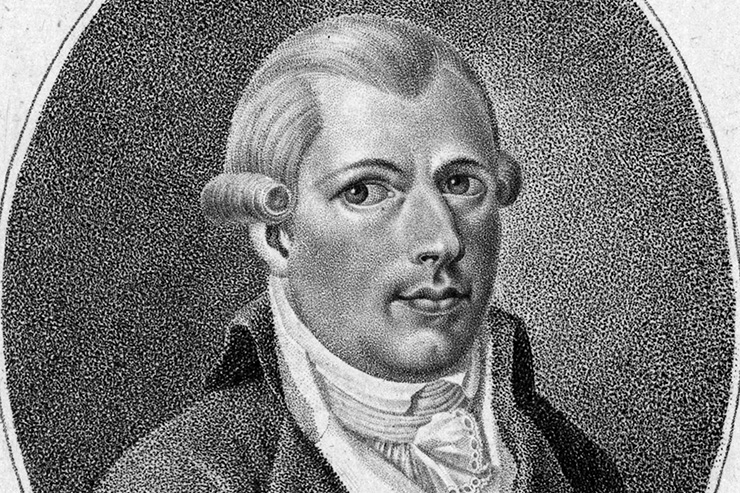
  • The Mysteries of Trebitsch-Lincoln: Con-man, Spy, ‘Counter-Initiate’?

    The Mysteries of Trebitsch-Lincoln: Con-man, Spy, ‘Counter-Initiate’?

    From New Dawn 116 (Sept-Oct 2009)

    Whatever else may be said about Ignatius Timothy Trebitsch-Lincoln, few can match his resume. He started life in Hungary in 1879 as plain Ignacz Trebitsch, the son of a prosperous orthodox Jewish family. He ended it sixty-four years later in Shanghai as the Abbot Chao Kung. Or at least he probably did. In between, using innumerable aliases, Trebitsch played the parts of actor, petty thief, convicted forger, Christian missionary, Anglican curate, Buddhist monk, member of Parliament, oil tycoon, fugitive, self-proclaimed genius, international spy, adviser to warlords and arch-conspirator. And those are just the ones we can be sure of.

    Trebitsch’s picaresque career has spawned at least a half-dozen biographies, including his own Autobiography of an Adventurer (1932). By far the most thorough is Bernard Wasserstein’s 1988 The Secret Lives of Trebitsch Lincoln. But even Wasserstein’s diligent detective work cannot fill in all the blanks. His portrait of Trebitsch, as with most of the other biographies, is a chameleon-like megalomaniac whose quest for fame and fortune mostly ended in failure and disappointment. Trebitsch comes off as a mentally-unstable confidence man; a mendacious, back-stabbing scoundrel.

    I. T. Trebitsch-Lincoln was all those things, but he may have been something more. While anything he claimed, or anything claimed about him, must be taken with a large dose of salt, the standard view of Lincoln may be too quick to dismiss some “unsupported” assertions as pure fantasy.

    In contrast, writers such as French esotericist Rene Guenon and Jean Robin, see a more secretive and sinister side to Trebitsch. To Guenon, Trebitsch was an obvious “agent of the Counter-Initiation,” a tool of hidden forces which sought to thwart and misdirect human enlightenment. Robin puts him in the service of the dreaded “72 Unknown Superiors” whose manifestations included the mysterious Green Dragon Society.1 Robin, among others, even makes him an influence on the up-and-coming Adolf Hitler.2 Historian Guido Preparata dubs Trebitsch a “midwife to Nazism.”3 Preparata also insists that Trebitsch was “neither a spy nor an imposter, [but] in all likelihood was, like [Alexander Helphand] Parvus one of those ‘specialists’ fluent in the art of subversion, who were part of a wider network of mercenaries fascinated in one form or another by the ways of power.”4 It’s an intriguing possibility, to say the least, but not one easy to prove.

    Trebitsch-Lincoln’s career is much too long and convoluted to summarise in this article. It will focus instead on two areas of mystery regarding his person and actions. First, to what degree was Trebitsch actually involved in espionage? Next, what were his links to the realm of secret societies and the occult and how did these influence his fascination with Buddhism and Tibet?

    Trebitsch-Lincoln the Spy

    Wasserstein sees Trebitsch’s secret agent exploits as largely imaginary and finds “not a shred of convincing evidence” that Mr. Lincoln engaged in espionage prior to World War I.5 However, clandestine activities, by their very nature, are difficult to pin down. Done right, they should not leave incriminating records.

    A firm proponent of Trebitsch’s spy career is British writer Donald MacCormick, aka Richard Deacon. If Wasserstein seldom strays from the security (false security?) of official documentation, McCormick eagerly embraces informal and undocumented sources, including rumour and hearsay. However, MacCormick was a British naval intelligence officer and had first-hand experience with the clandestine world and its inhabitants.

    McCormick suspects that Trebitsch’s early religious conversions and travels (1897-1902) provided cover for some sort of intelligence gathering, though for just who is uncertain.6 The same may apply to his later conversion to Buddhism.

    McCormick accepts Trebitsch’s claim to have early on visited South America, whereas Wasserstein observes that there is “no independent corroboration of this story.”7 McCormick links Trebitsch to Argentina and a Welsh immigrant there named Isaac Roberts. Roberts, claims McCormick, introduced young Mr. Trebitsch to an up-and-coming British politician, David Lloyd George.8 McCormick further argues that Trebitsch’s pre-war investigations into European social conditions were really political intelligence gathering for Lloyd George.9 McCormick alleges that Trebitsch served Lloyd George as a secret adviser on oil, a realm that also brought him into contact with, and possibly the employment of, the infamous “Merchant of Death,” Basil Zaharoff.10 Another source puts Trebitsch among Zaharoff’s intimates as early as 1909, though there is, of course, no real evidence.11 According to McCormick, who quotes Isaac Roberts, a “triangular association” existed among Zaharoff, Lloyd George and Trebitsch based on the fact that “each knew a secret about the other.”12 Zaharoff, for instance, knew that Trebitsch was a spy, and not just for himself and the little Welshman, but also for the Germans. McCormick believes that Trebitsch began selling information to the Germans as early as 1911.

    World War I was a turning point for Trebitsch. From his arrival in London around 1897, he had pursued a path which led him into the Anglican Church, secured him British nationality and culminated in 1910 with his election to Parliament. In 1914, things took a very different path. Trebitsch committed forgery and then compounded his difficulties with a blundering attempt to play double agent for British and German intelligence. Fleeing to the neutral USA, he made a splash in New York with his sensational and very anti-British Confessions of an International Spy. This purported to reveal the secret origins of the war and Britain’s underhanded part in them. After arrest and long delay, and a headline-grabbing jailbreak, he was extradited to Britain in 1916 where he was convicted and imprisoned on the forgery charge. In the years following, Mr. Lincoln’s hatred of England was matched only by His Majesty’s loathing of him. Or so it seemed.

    A contrary view holds that Trebitsch’s estrangement from Britain was all part of an elaborate cover scheme. According to this, Trebitsch remained a secret British agent for many years, perhaps for the rest of his life. That regular British officialdom had no inkling of this and vilified and harassed him at every turn was just as it should be; as an apparent enemy of the British Empire, he thus gained the attention and confidence of the Empire’s real foes.

    It seems a ludicrous idea, yet there are things that give pause. For instance, in December 1914 Admiral William Reginald “Blinker” Hall, chief of the Admiralty’s Naval Intelligence Division, caught Trebitsch red handed in the clumsy attempt to double-deal the British and Germans. Instead of arresting him, however, Hall suggested that Trebitsch take advantage of the time remaining on his passport and go to New York. Given that Trebitsch was about to be picked-up for forgery, it was good and timely advice.

    As noted, in the States Trebitsch turned his hand to anti-British propaganda and also tried to ingratiate himself with the Kaiser’s officials and spies. This was precisely the modus operandi employed by a British operative who arrived in America just a few months before Trebitsch – Aleister Crowley. While Crowley never lived down his outwardly treasonous behaviour, he also suffered no retribution from the British Government whose employee he was. This does not stop Rene Guenon from labelling Trebitsch and Crowley as “brothers” both as double-agents for London and Berlin and as agents of the Counter-Initiation.13 Of course, in stark contrast to Crowley, Trebitsch ended up in prison. The simple answer may be that Trebitsch was a real turn-coat while Crowley only pretended to be one. Or, it may be that while the self-proclaimed Beast was successful in penetrating the German apparatus in the US, Trebitsch was not. His German associates seem to have thought so little of him that one of them turned him for the reward. So, was Trebitsch’s extradition and trial really damage control to cover and punish a failed agent?

    The notion that Trebitsch was and remained a British agent seems especially popular in French circles. According to McCormick, the French held him in suspicion since 1914 when they detected him sniffing out oil in Algeria, presumably for Perfide Albion.14 Guenon accepted the notion, noting later links between Trebitsch and British agents in Central Asia. As late as 1937, French writer Robert Boucard labelled Trebitsch an agent of L’Intelligence Service alongside T. E. Lawrence and Gertrude Bell.15

    Trebitsch’s name does pop up alongside Lawrence’s in some late 20s press reports. In January 1929, the Indian Government felt obliged to issue an official denial regarding the alleged involvement of the two adventurers in recent troubles in Afghanistan.16 Trebitsch was supposed to be fishing in these waters as a Soviet agent – a charge, as we will see, that surfaces elsewhere.

    The staunchest advocate of the Trebitsch-as-British-agent theory is Guido Preparata. He points in particular to Trebitsch’s post-war shenanigans in Germany. Preparata even wonders whether Trebitsch was ever in a British prison or simply kept on ice waiting a new assignment. Wasserstein clearly documents Lincoln’s jail time, but he and Preparata do agree that Trebitsch was stripped of his British nationality and booted from England in the summer of 1919.

    He landed on his feet, as he always did, in post-war Berlin where the fragile Weimar Republic clung to power. Somehow, he wormed his way into the confidence of a cabal of right-wing conspirators. In March 1920, in the so-called Kapp Putsch, the plotters seized control of Berlin, only to back down and flee a few days later. Trebitsch briefly basked in the limelight as press chief of the revolutionary regime and dreamed of becoming its future propaganda minister (a la Goebbels).

    Trebitsch’s precise role in the Kapp affair is murky. Some dismiss him as a mere hanger-on, but a contemporary report reaching American intelligence labelled him the “organiser of the Kapp Putsch” and “the leader of the whole Revolution.”17 Robin believes that Trebitsch played a critical role in his brief alliance with the German militarists by convincing them that the Reich’s “road to glory” lay in the East, an idea that coincidentally or deliberately meshed with the concept of Lebensraum proclaimed by another early influence on the Nazis, “Geopolitician” Karl Haushofer.18 Robin sees Trebitsch, like Haushofer, as a source of “inspiration” for Hitler and the Nazis and, as such, another representative of the “72 Greens” or “Unknown Superiors.”19 The latter, he claims, were linked to the shadowy Green Dragon Society and the legendary kingdom of Agharthi.

    The Hitler-Trebitsch web is spun more elaborately by Hennecke Kardel who insists that in the early 20s Trebitsch Lincoln was identical with Moses Pinkeles, a mysterious Jew who allegedly helped fund the early Nazi movement.20 Just who or what Pinkeles actually was remains an intriguing question, but it seems clear that he was not Trebitsch who was otherwise occupied adventuring and spying in China.

    Preparata has another take on Trebitsch’s role in the Kapp business. He believes that the British used Trebitsch as “an agent steeped in counter-insurgency tactics and disinformation to thwart, expose and burn all the monarchist conspiracies against the Weimar Republic.”21 Preparata cites a British report which provocatively suggests that Trebitsch came to Germany at the instigation or with the encouragement of then Secretary for War Winston Churchill.22 Another reference to Trebitsch-Churchill collusion appears in a March 1921 US military intelligence report which unambiguously declares that I. T. T. Lincoln “was and still is an English agent.”23 Planned or not, Trebitsch soon fell out with his monarchist co-conspirators and absconded with their documents which he sold to the Czech Government.

    One “friend” he preserved from the Kapp misadventure was a Prussian officer, Max Bauer. In the aftermath of the Putsch, Bauer surfaced in Moscow as a military adviser to the Red Army. His presence there was related to the secret collusion between the German and Soviet militaries, but there also is reason to suspect that Bauer acted as an agent of Soviet military intelligence in Germany and later in China. Preparata has Bauer and Trebitsch conniving with the Soviets as far back as 1919 and it is more than curious that the duo escaped post-Putsch Berlin with papers supplied by the Soviet Embassy.24

    Was Mr. Lincoln also a Red agent? In 1919 British authorities delayed his departure from England until a short-lived Bolshevik regime in Hungary collapsed supposedly because they feared he would return to his homeland and join the Revolution. The aforementioned US intelligence report claims that when the rightist Kapp plot began to lose momentum, Trebitsch shifted gears and began “working to bring about Bolshevism in Germany.” Then again, by helping to undermine both the socialist Weimar regime and its right-wing opponents, Trebitsch may have been serving Moscow’s interests all along. More accusations of Bolshevik intrigue show up in reports reaching the US Bureau of Investigation. In April 1921, word came that Trebitsch was “actively engaged in the ‘Red Movement’” and “working in the interest of the Soviet Government in Austria and Hungary.”25 US officials were concerned by reports that he was coming to the States.

    Trebitsch-Lincoln the Occultist

    In October, under the name of Patrick Keelan, he did just that, but he was soon on to China. There, he became adviser and financial agent to a succession of warlords and likely peddled influence and information for anyone who would pay him. McCormick contends that Trebitsch worked for German interests in China which gains credibility from one of the “acquaintances” he made on the voyage to New York. This was Albert T. Otto, a German-American businessman who apparently was so impressed by Keelan/Trebitsch that he handed him some $50,000.26 Otto, however, was himself a man with an interesting history. Prior to 1917 he had been a representative of the Krupp armaments firm in the US and subsequently came under investigation as a German agent.27 He may have played the same part in 1921 by serving as a cut-out for Berlin’s financing of Trebitsch.

    In the East, Trebitsch found someone else interested in his services: the Japanese. “Lincoln had long been watched and even courted by some Japanese secret agents,” says McCormick, among them Col. Kenji Doihara, the so-called “Lawrence of Manchuria” and a key figure in the secretive Black Dragon Society which served Imperial Japan’s espionage and subversive interests.28 McCormick believes that Trebitsch became an “active co-conspirator” with the Black Dragons, and that may not have been all.29

    To get a handle on this and other connections, we need to look at Trebitsch’s known and alleged links to the occult. The first reference is about 1898, soon after his nominal conversion to Christianity. Briefly returning to Hungary, he “evidenced an interest in esoteric religion by becoming editor of a spiritualist paper.”30 A few years later, as an Anglican curate in Appledore, Kent, Trebitsch reportedly encountered Harold Beckett, an ex-Indian Army officer who became the young clergyman’s Western “initiator.”31 Beckett allegedly had contact with Continental occults such as Maitre Philippe and his pupil, Gerard “Papus” Encausse. Among the secrets Beckett supposedly revealed was that in each generation there were only seventy-two “true men.”32 Whether Trebitsch believed that he was one of these elect, or whether they were the same as the “72 Unknown Superiors” is also unclear. With this kind of guidance, claims Serge Hutin, Trebitsch went on to join numerous secret societies including the Freemasons, the Ordo Templi Orientis and Chinese triads.33

    Nothing more is heard of his esoteric leanings until October 1925 when he underwent a “mystical experience” in a hotel room in Tientsin. “I made a great renunciation, I quitted the world,” he declared.34 What he embraced, however, was not Buddhism but Theosophy, that amalgam of Eastern-mysticism-for-Westerners concocted by Helena Petrovna Blavatsky.

    Trebitsch’s revelation awoke in him a burning desire to visit Tibet, the Holy Land of mystics and seekers of various stripes. He repeatedly petitioned British authorities to allow him to reach Tibet via India, only to be turned down each time. Whether he ever accessed Tibet through Chinese territory is unknown, but remains an intriguing possibility.

    Trebitsch’s interest in Buddhism and Central Asia actually dated as far back as 1916. While awaiting extradition in New York, he boasted that before the war he had been “an active spy in Central Asia, working as a Buddhist monk.”35 Moreover, he claimed to have come up with a scheme to foment a “grand religious revival in the East,” which would destroy British power in Asia.36 One must wonder whether his 1925 conversion was simply the emergence of a long-prepared plan.

    Tibet, of course, was widely perceived as the strategic high ground of the Eurasian landmass and figured in Haushofer’s theory of “geo-politics.” In the mid-20s, British, Soviet, German and Japanese agents all maneuvered for influence and advantage there, and Trebitsch would not have been the only operative to try to do so under the guise of religion.37

    Instead of the Land of Eternal Snows, Trebitsch next surfaced in Sri Lanka as a novice in a Buddhist monastery. What brought him out of this splendid seclusion was the imminent execution in England of his eldest son, convicted of murder. Thanks again to the obstruction of British officialdom, he was unable to reach the boy before he hanged but claimed that he had been in psychic communication with his doomed son as well as his spiritual teacher back in Sri Lanka.38

    Over the next several years, Trebitsch continuously shuttled between the Far East and Europe, his purposes and finances remaining, as ever, vague. In August 1926, he arrived in New York under the name of Hermann Ruh, a German engineer. His declared destination was Japan, but before proceeding there he spent months in San Francisco lodged in a Japanese hotel and studying with Zen master Nyogen Senzaki. This brings us back to McCormick’s charge that Trebitsch had fallen in with Japanese intelligence, and again raises the spectre of the mysterious Green Dragon. As discussed in a previous article for New Dawn, there is no consensus on what the Green Dragon Society was, or if it even existed, but there is persistent linking of the Society with Japan and Zen Buddhism. It is worth noting that Karl Haushofer is alleged to have been one of only two or three Westerners admitted to the Green Dragon Society.39 Was Ignatius Trebitsch-Lincoln one of the others? Under the name of the Lama Dordji Den, Trebitsch is even invoked in Teddy Legrand’s (Pierre Mariel) 1933 novel, Les Sept Tetes du Dragon Vert (“The Seven Heads of the Green Dragon”) which purports to reveal the Dragon as a sinister international conspiracy bent on world domination.40

    Trebitsch’s whereabouts c. 1928-30 is especially hazy. He is identified in places as far flung as Shanghai, Tibet, Afghanistan, and perhaps most intriguing of all, Nice, France. According to Robin, Trebitsch, again as Dordji Den, lived there in the Villa Bleue.41 Overseen by a wealthy Swedish countess, the Villa was said to be the meeting place of occultists and “grand adepts” from across Europe. While there, Trebitsch reportedly impressed the denizens with his “magnetic [hypnotic?] powers” and received, in turn, access to further secret knowledge.42 While Trebitsch certainly was in France in 1929 and likely in Nice, there is no solid proof of the Villa Bleue’s existence.

    Trebitsch is further alleged to have received initiation as Dordji Den at the Sera Monastery outside Lhasa.43 In fact, he supposedly received two initiations in Tibet, the second in 1930. This flies in the face of Wasserstein’s research which finds no demonstrable evidence that Trebitsch ever reached Tibet, and shows quite conclusively that he received the title of bhikkhu, or monk, at the Pao-hua Shan Monastery, near Nanking, in May 1931. It was here that he acquired the new name of Chao Kung, to which he promptly added the prefix of “The Venerable.” So, was Dordji Den just a figment of Guenon’s and others’ imaginations, someone else entirely, or was Trebitsch initiated three times. And initiated into what, exactly?

    Trebitsch-Lincoln a Bodhisattva

    Trebitsch surely demonstrated more commitment to Buddhism than he did to his previous religious affiliations. Barely a week after his ordination as monk, he received elevation to the rank of bodhisattva. In preparation for this, he endured the painful branding of twelve small stars on his scalp which represented the dozen spokes of the Wheel of Becoming. He also embraced a strict vegetarian diet and ever after only appeared in public in his monk’s robes.

    In the summer of 1932, the newly-minted Chao Kung again sailed for Europe. His first stop was Marseilles where he was met by a delegation of Buddhists from Nice. These he apparently knew from his visit four years earlier. He remained in Nice for a few weeks and then headed for his real destination – Berlin.

    Germany in the fall of 1932 was living through the death throes of the Weimar Republic. Hitler’s Nazi Party had scored huge gains in recent elections and in a few months he would be named chancellor. Riding high at the same time was the popular psychic Erik Jan Hanussen, a favourite of the Nazis until his predictions came a bit too close to home. Hanussen (like Trebitsch, of Jewish origin) was at least aware of Chao Kung’s presence in Berlin and publicly defended his reputation in the psychic’s newsletter.44 Also said to be haunting Berlin at this time was the mysterious “Man (or Lama) with the Green Gloves,” an Asiatic mystic variously linked to Tibetan adepts, the Green Dragon or even said to be Trebitsch himself.45

    The new Nazi regime refused to renew Trebitsch’s visa, and he was forced to return to Shanghai in early 1933. However, his European trip was not without some success; he brought back to China a dozen or so acolytes, including several from the Nice group. Now in command of his own tiny sect, he proclaimed himself abbot. His band of followers was formally initiated in the autumn of that year.

    Curiously, among the attendees at the initiation was the Soviet ambassador to China, Dmitrii Bogomolov. While Wasserstein dismisses this and other details as “probably coincidental,” Trebitsch’s name continued to be linked with Soviet officials or agents throughout the 30s.46 For instance, in 1936 Trebitsch was reported to make regular visits to the Chinese offices of Wostvag, a German trading firm that was a known front for the Comintern and Soviet military intelligence.

    His name also continued to pop up in relation to Japanese agents and interests. McCormick claims that Trebitsch played an obscure part in drawing the ex-Manchu Emperor Pu-Yi into the Japanese camp and installing him as the puppet-ruler of Manchuria.47 Wasserstein acknowledges allegations that Trebitsch was a friend and confidant of Pu-Yi but again notes that there is no documentary evidence to back them up.

    In 1934 the Venerable Chao Kung formed the League of Truth which aimed to promote Trebitsch’s personal blend of Buddhism. Its insignia was a reverse swastika over two hemispheres. Some argue that he conjured up the sect as a new tool in his war with the British Empire and, perhaps, to better serve his employers in Tokyo.48 Oddly, it also was in 1934 that he made his last attempt to enter Britain. He got as far as Liverpool before being arrested and put on a boat back towards Shanghai. On the way he was interrogated by Japanese police in Kobe. Of course, this also provided an ideal cover for an intelligence debriefing.

    He never stopped trying to reach Tibet. Around 1935, he joined forces with a Russian-born adventurer named Gene Roubin (another Soviet connection?) who actually had visited Tibet for one dubious purpose or another. Three years later, alarming but unsubstantiated reports reached British officials in China that the determined Trebitsch was on his way to Lhasa claiming to be the simultaneous reincarnations of the Dalai and Panchen Lamas!49

    In the late 30s, Chao Kung established a more or less permanent home in Shanghai. Soon after the outbreak of World War II, he grandiosely issued a call for world peace. He demanded the immediate resignation of the British French, German and Soviet governments (but not Japan’s) and warned that “otherwise, the Tibetan Buddhist Supreme Masters… will unchain forces and powers whose very existence are unknown to you and against whose operations you are consequently helpless.”50 Was he speaking on behalf of the “72” or the masters of Agharthi, or was he just blowing his own horn? In any case, the warring leaders paid him no heed.

    In wartime Shanghai, Trebitsch collaborated with Nazi and Japanese officials. In 1942 he was reported to be part of a “group of fifth columnists who broadcast propaganda talks from Japanese secret radio stations in Tibet.”51 The chief of the German XRGS radio station in Shanghai definitely did solicit him to go to Tibet and set up propaganda broadcasts aimed at India. Trebitsch is also known to have collaborated with the Abwehr’s station in Shanghai, Buero Siefkin, which in 1941 informed Berlin that Chao Kung had long been a member of the “Grand Council of Yellow Cap Lamas” who exercised great influence in Tibet and India.52 He even won the confidence of the Gestapo’s local representative, Joseph “The Butcher of Warsaw” Meisinger who concocted a half-baked scheme to send Trebitsch to Berlin.

    But so far as can be determined, Trebitsch never left Shanghai. He died there in the Japanese-run General Hospital on 6 October 1943. Reportedly, he feared being poisoned. Rumours spread that he had committed suicide or had been murdered by his erstwhile Nazi friends. Naturally enough, tales also surfaced that he still lived. McCormick notes one that appeared in the Times of Ceylon after the war stating that the former member of parliament had been sighted in Darjeeling, India, living peacefully on the doorstep of Tibet.

    Whether or not Ignatius Timothy Trebitsch Lincoln was more than a venal megalomaniac remains a debatable proposition and probably will never be definitively settled. Myths and speculation clearly outnumber facts where he is concerned, but it also seems likely that the known facts alone do not tell the whole story. The possibility that he may have been among the most secret of British secret agents is tantalising as is his apparent connection to Soviet intelligence. So too are the hints that he was in contact with or at least aware of higher, secretive powers at work in the world. Whether these were the lords of Guenon’s “counter-initiation” we will never know for sure and, perhaps, neither did Trebitsch.

    [alert type=”general” dismiss=”no”]This article was published in New Dawn 116.[/alert]

    [alert type=”success” dismiss=”no”]If you appreciate this article, please consider subscribing to help maintain this website.[/alert]

    Footnotes:

    1. Jean Robin, Hitler: l’elu du dragon (Paris: Guy Tredaniel, 2009), 140

    2. Ibid., 77, and Serge Hutin, Governantes Invisiveis e Sociedades Secretas (Sao Paulo: Hemus, 2004), 46.

    3. Guido Preparata, Conjuring Hitler: How Britain and America Made the Third Reich (Ann Arbor, MI: Pluto Press, 2005), 111.

    4. Ibid., 102.

    5. Bernard Wasserstein, The Secret Lives of Trebitsch Lincoln (New York: Penguin Books, 1988), 122.

    6. Richard Deacon, A History of the British Secret Service (New York: Taplinger, 1969), 197.

    7. Wasserstein, 31.

    8. Deacon, BSS, 198.

    9. Ibid., 198-199.

    10. Ibid., BSS, 199.

    11. George Tallas and Anthony Stephen, Peddler of Wars: Sir Basil Zaharoff Story (Bloomington, IN: Author-House, 2007), 83.

    12. Donald McCormick, Peddler of Death: The Life and Times of Sir Basil Zaharoff (New York: Holt, Rinehart & Winston, 1965), 10.

    13. Rene Guenon to Rene Schneider, 13 Sept. 1936.

    14. Deacon, BSS, 199.

    15. Robert Boucard, Paris Soir, (24 Oct. 1937).

    16. “Afghan Throne,” The Argus [Melbourne)] (24 Jan. 1929), 7.

    17. Investigative Case Files of the Bureau of Investigation (BI), #202600-1356, “Trebitsch Lincoln and the Kapp Putsch,” AmMission, Budapest, c. 1920.

    18. Robin, 94.

    19. Ibid., 90, 140.

    20. Hennecke Kardel, Adolf Hitler—Founder of Israel (San Diego: Modjeskis Society, 1996), 53-54.

    21. Preparata, 90.

    22. Ibid., 108.

    23. BI, #202600-1356-2, 5 March 1921, Col. Smith, MID to Baley, BI.

    24. Preparata, 106, and BI, #202600-1356, “Trebitsch Lincoln and the Kapp Putsch.”

    25. BI, #202600-1356, Baley to B. Morton, 22 April 1921.

    26. Wasserstein, 231.

    27. BI, #200975, Senes Detective Bureau to BI, 20 May 1918.

    28. Richard Deacon, Kempei Tai: A History of the Japanese Secret Service (New York: Beaufort Books, 1983),134-135.

    29. Ibid., 134

    30. Wasserstein, 35.

    31. Hutin, 28.

    32. Robin, 103.

    33. Hutin, 46.

    34. Wasserstein, 256.

    35. David Lampe and Laszlo Szenasi, The Self-Made Villain: A Biography of I. T. Trebitsch-Lincoln (London: Cassell, 1961), 79.

    36. Ibid.

    37. See, Richard Spence, “Red Star over Shambhala: Soviet, British and American Intelligence & the Search for Lost Civilization in Central Asia,” New Dawn, #109 (July-Aug. 2008), 53-58.

    38. Bernard Grant, To the Four Corners. London: Hutchinson & Co., 1933, 181.

    39. Wulf Schwartzwaller, The Unknown Hitler (New York: Berkley Books, 1990), 100.

    40. Richard Spence, “Behold the Green Dragon: The Myth and Reality of an Asian Secret Society,” New Dawn, #112 (Jan.-Feb. 2009), 71.

    41. Robin, 95-96.

    42. Ibid.

    43. Ibid.

    44. Mel Gordon, Erik Jan Hanussen: Hitler’s Jewish Clairvoyant (Los Angeles: Feral House, 2001), 224.-225

    45. Hutin, 47, and “El Lama de los Guantes Verdes,” www.bolinfodecarlos.com.ar/020906_lama_guantes.htm.

    46. Wasserstein, 301.

    47. Deacon, BSS, 151.

    48. “Trebitsch Lincoln, el Espia Ingles Que Se Convirtio en Enemigo de la Gran Bretana,” Prensa (23 Feb. 1936).

    49. Wasserstein, 306-307.

    50. Ibid., 309.

    51. Lampe, 204.

    52. Wasserstein, 311.

    © New Dawn Magazine and the respective author.
    For our reproduction notice, click here.