New Dawn – World's Most Unusual Magazine

Category: Secret History

  • The Captain Cook Conspiracy

    The Captain Cook Conspiracy

    From New Dawn 113 (Mar-Apr 2009)

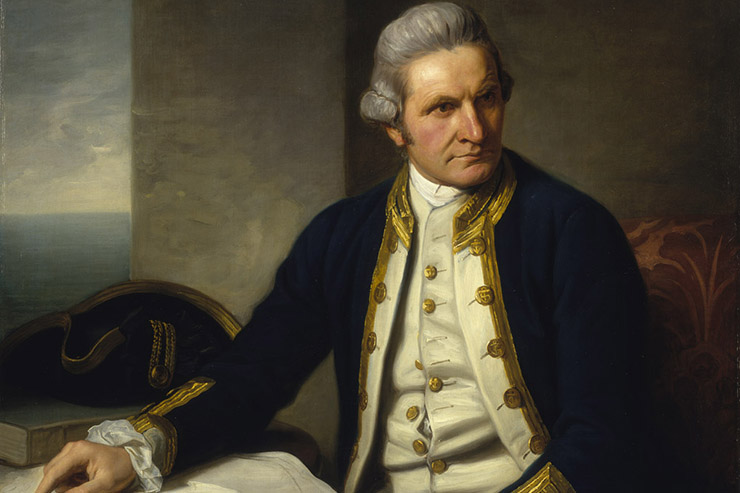
    Historians and archaeologists consistently ignore solid evidence that Captain James Cook was not the first European to discover Australia while government agencies regularly prohibit access to shipwreck sites which would uncover proof for this assertion.

    Why is the true history of Australia being covered up? Why does history treat Captain Cook so kindly, despite the fact that in his later years he was an extraordinarily irritable man who, over the most trivial matters, did not hesitate to flog crew members or burn down entire native villages?

    And even though all of the expeditions he led ended in partial or complete failure, Cook is generally, almost universally, lauded as the greatest of navigators and his expeditions seen as milestones in navigation history – and on top of all that it is claimed Cook discovered Australia.

    Lately the claim has been modified a bit as most people now know that the Dutch were sailing along the coastline of west Australia a couple of hundred years before James Cook was born, and of course Abel Tasman sailed along the south of Australia (then called New Holland) and landed on Tasmania. We also know that the Indonesians traded with the Northern Australian Aborigines for at least 400 years before Cook. And most people now know that the Portuguese were trading out of Timor since the 15th century.

    So now we say Captain Cook discovered the east coast of Australia, or did he? And why does it matter if he did or did not?

    It matters because history shapes our world view, our culture and our social structures. If we believe a description of the past to be true when in fact it is false, our view of how we arrived at the present is flawed, which in turn allows powerful social structures and groups to exist which might not otherwise be able to justify their existence. This is why Japan avoids including true histories of World War II in its schools’ curriculum.

    The idea that an Englishman discovered Australia is fundamental to the maintenance of the notion of Australia as a pre-dominantly white Anglo-Saxon society. There are several subtle messages laying behind the notion of Captain Cook, the great English navigator, sailing around the world and discovering the vast continent of Australia. One of these was important in the 19th and early 20th centuries, affirming the inherent superiority of English society and technology as a justification of the British Empire’s dominion over much of the planet. Another was fundamental to the English claims of ownership of Australia, all of Australia, even though Cook only discovered the east coast.

    The British discovery of Australia also underpins Australia’s belief that the British system of government is the best, better than, say, the French or Spanish systems. Likewise, Australia’s legal system, both civil and criminal, is British as is the way we structure our police and miliary forces etc., not because they are the best ways of doing things but because they are the British way. Thus it has been important that the myth of the great Captain Cook was propagated and perpetuated over the last 200 years. Yet there were other nations who also had valid claims on Australia: the Dutch, the French and, importantly, the Spanish, England’s old nautical enemy.

    The story of Captain Cook was propagated where ever the English could plant the seed, certainly throughout the British Empire and by default most of North America, but is it the truth? Was Captain Cook the first European to discover Australia, even just the east coast?

    The answer in a nutshell is no. It’s as simple as that. Ask any Spaniard and he or she will tell you that Captain Cook used stolen Spanish maps to navigate his way around the Pacific. He also used copies of Abel Tasman’s maps, which he acknowledged because at the time Tasman’s maps were readily available. He does not acknowledge the Spanish maps, however when Cook arrived in Hawaii (which he claims to have been the first European to discover) he was recognised and greeted as a returning god, a god who had visited those islands many years before bringing the Hawaiians knowledge of agriculture. They recognised Cook as this god because he sailed a ship just like the one their previous visitor had sailed, and of which they still made venerated models. A tall, multi-masted ship with huge sails and no paddles: these were models of a Spanish ship.

    Cook was quick to see the advantages of being mistaken for a god and pretended to be that god in order to restock his ships with food and water. Sadly for Cook he overplayed his hand and over-taxed the generosity and tolerance of the Hawaiians who realised they had been both duped and exploited, and as a result killed Cook, then cooked and ate him. (Yes Cook got cooked.)

    The Spanish, who left the Hawaiians on better terms than Cook, had been regularly sailing the Pacific for about 300 years before Cook entered that vast ocean. Their presence there was the result of the combined efforts of Christopher Columbus and Ferdinand Magellan and Spain’s interest in maritime exploration, in the search of new lands. The Spanish ships sailed mostly from Mexico or Peru to Manila following a course utilising favourable winds and currents that flowed from east to west between 5 and 10 degrees south of the Equator until they reached Guam where they restocked with water and other supplies before the final leg of their journey to the Philippines. This was a treasure trade route vital to the Spanish and Mexican economies. Silver, gold and jewels were taken from the slave mines of South America to Manila in huge galleons where they were traded for silks, porcelains and other goods out of China and Asia. This was called the Manila galleon trade and each ship, and there were a number every year, carried enough wealth to equal a king’s ransom.

    The Spanish considered the Pacific and everything in it, including Australia, their property and felt completely secure in their Pacific domain until Sir Francis Drake sailed around Cape Horn and began pillaging the Spanish treasure fleets there.

    The Spanish Empire had been built around maritime exploration and expansion. It is inconceivable that Spanish ships sailed the Pacific Ocean for 300 years and not discovered a continent the size of Australia. But where is the proof?

    The Dieppe Maps
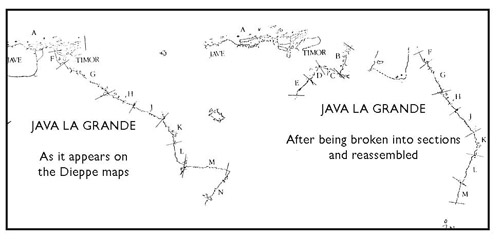
    Dieppe map

    The first and most obvious piece of proof which is continually ignored by mainstream Australian historians is a well known collection called the Dieppe maps, a set of maps made in the town of Dieppe in France in the 16th century. These provide clear proof of either Spanish or Portuguese exploration of Australia’s east coast at least two hundred years before Captain Cook. The maps clearly show the east coast of Australia as well as almost all the rest of Australia’s coastline. In the Dieppe maps the name given to the Australian continent is “Java la Grande.”

    The Dieppe maps have proved to be actual copies of Portuguese maps; another similar set of maps are the Dauphin maps after a series of copies of the Dieppe maps made for the French Dauphin. Also there is the Vallard map which is essentially the same map as the Dieppe and Dauphin maps.

    The Dauphin maps are elaborately decorated, not for any scientific or geographical reason but simply to make the maps more interesting to his Royal Highness the Prince Dauphin – an important thing to remember as many historians attempting to discredit these maps cite the images used in the decorations to dismiss the cartographic accuracy of the Dauphin maps.

    When considering the Dieppe maps one should remember just how important navigation maps were in the European world of 400 years ago. It was the “Age of Exploration,” a historic time of maritime expansion, of empire building, of ruthless exploitation and greed. It was an age of conquest, trade, navies and more greed.

    The rulers and populations of the European nations wanted wealth, whatever it took. The pathways to wealth were on the sea and those who possessed the navigation maps showing how to travel those pathways held the keys to unimagined riches.

    In those days (up until the 19th century) the information contained in items such as the Dieppe and Dauphin maps was often priceless, top secret, government property, and jealously guarded as the plans to nuclear weapons or interplanetary space travel might be guarded today. For this reason various nations and their captains contrived ways of concealing the information contained within their maps – maps in code so to speak. Cracking the secret code of those ancient Dieppe maps was the work of Australian Army map maker and surveyor Brigadier Lawrence Fitzgerald O.B.E., a man of genius largely ignored by mainstream academia.
    Brigadier Lawrence Fitzgerald

    Fitzgerald with his extensive practical and theoretical experience with maps and map making could clearly see there were sections of the Dieppe maps that resembled Australia’s coastline but there were also sections that did not. After considerable research the Brigadier discovered that the maps which ancient navigators used on ships were not in the form we generally think of – that is a huge rolled up sheet of parchment or paper that covered the Captain’s entire table. No, they were in sections on separate sheets generally kept loose in a folio or even in separate folios. To protect the information in the maps, should they fall into rival hands, the maps did not join up neatly or even had small components to make reassembling and interpreting the maps difficult or impossible if the keys to the codified maps were not available.

    Brigadier Fitzgerald realised that he only had to divide the Dieppe maps into the appropriate sections and then discover how to reassemble them in the correct order. This he did and in his book Java la Grande he clearly shows that the Portuguese had accurately and extensively mapped the Australian coastline more than 200 years before Cook. His work is largely ignored, even ridiculed, by most Australian and British historians. Why?

    The next question most people ask is: “If the Spanish and/or the Portuguese visited Australia before Cook, why are there no archaeological traces of them?” The answer is simple: “There are many.” But they are ignored, covered up, or hidden.

    Possible Pre-Cook Shipwrecks

    Sand miners uncovered the remains of an oak ship under the sand on a beach near Byron Bay. The ship was reburied in the sandmining process but a private citizen paid for a piece of timber retrieved from the ship to be carbon-dated by an independent laboratory. The results came back that the wood (oak) dated to the 16th century. Archaeologists from the University of New England, Armidale, New South Wales got excited and they organised for a magnetometer survey of the area. The ship was relocated under the sand and a dig planned to excavate it and solve the mystery. A week before the dig was scheduled to begin word came high in the New South Wales government that the dig could not proceed, and it was stopped. There were no reasons given. That was in 1995, and the shipwreck is still sitting there under the sand.

    Another example is a shipwreck buried under the sand dunes at Facing Island near Gladstone, Queensland. This shipwreck was seen after a storm in the early 19th century but its location was lost when the sand covered it again. A 5 feet (1700 mm) long bronze cannon with the date of 1596 stamped on it and other artefacts were found around Gladstone in the mid 19th century and the subject of articles in the early Australian press, several essays, investigations and books.

    In the late 1990’s the wreck on Facing Island was again exposed for a few days by a cyclone. Fortunately a fisherman saw it and took photographs as well as noting the shipwreck’s location, all of which he gave to the local Maritime Museum. The Maritime Museum, with suitably qualified personnel, applied to the government for a permit to investigate the shipwreck. The application was refused and a warning given that anyone attempting to excavate or otherwise investigate the wreck would face prosecution under the draconian penalties of Australia’s “Historic Shipwrecks Act.” The wreck is still buried under the sand on Facing Island.

    The list of possible pre-Cook shipwrecks is long and includes the “Mahogany ship” at Warrnambool. In the case of the Mahogany ship, the fact that it is described as being built of mahogany indicates it was built in either South America or the Caribbean as this is the only area that mahogany trees grow. As it was an old wreck in 1836 when it was first seen, it could only have been of Portuguese (Brazil) or Spanish (the rest of South America) origins.

    The Stradbroke Island Galleon in Queensland is a ship built of European oak about 30 metres long. It lays in a peat swamp where it was first seen in the 1860s and which the local Aborigines said had been in the swamp a long time. In the case of the Stradbroke galleon, we actually have historic records of Aboriginal oral traditions that report the arrival of the shipwreck victims in an Aboriginal camp and even the fact that one of them was named Juan!

    Both of these shipwrecks have an extensive presence on the Internet so I will not go into detail about them here; a simple Google search will bring up a wealth of information.

    Another ancient shipwreck was noted by Governor Oxley in 1821 off the beach at Fingal Head in Northern NSW. There is also a shipwreck at Caravel Creek in the Hinchenbrook Channel in Queensland and the list goes on.

    Pre-Cook Artefacts

    Apart from the pre-Cook shipwrecks there are numerous artefacts that have been found scattered around the sites of these wrecks or actually taken off the wrecks in the early days before the government actively intervened to suppress information about possible pre-Cook shipwrecks.

    For example, coins were found on the beach where the Mahogany ship is buried. These have generally been described as Spanish coins but I would guess they could be Portuguese as they have never been identified by experts.

    In the case of the Stradbroke Island Galleon there have been coins, a sailor’s dirk, a brass walking stick head dated by experts to Spain or Portugal in the 16th century, a rapier sword blade, a ship’s bell and various other items.

    A lead weight has been found by a university geologist while digging for pumice in undisturbed sand strata on Fraser Island, Queensland. This lead weight was accurately dated as having been laid down on Fraser Island over 400 years ago and, using radioactive isotope fingerprinting, the lead can be proved to have come from mines in the south of France.

    A bronze 16th century Portuguese cannon is on display at the Queensland Maritime Museum in Brisbane, which was found on the Great Barrier Reef. And the list goes on and on.

    Australian History

    Why is all this evidence ignored by Australian historians and archaeologists? Why does the government continue to block the excavation of possible pre-Cook sites?

    Until the Mabo court case and the granting of Aboriginal Land Rights, the obvious reason would have been the legal implications allowing a challenge to Cook’s pronouncement that Australia was Terra Nullus – unoccupied land. It was this proclamation that allowed Britain to occupy Australia without entering into negotiations with its existing occupants, the Aborigines.

    After Mabo this reason no longer applies and an even sillier, pettier motive may exist: the defence of reputations. Many Australian historians and archaeologists have for so long scoffed at the idea any nation reached and explored the east coast of Australia before Cook that they have entrenched themselves in their position. There is no way for them to change their “official” position without admitting they ignored solid scientific evidence in defence of a historic status quo. In universities and museums there are professors and doctors of history and archaeology who have painted themselves into a corner by systematically deriding all those who present theories or evidence that Cook was not the first European to discover and explore Australia. They use their influence and position to block any attempts to get the final proof they are wrong, proof that would require history books to be re-written and leave reputations in tatters.

    History shows us that these attempts to falsify history, to block discovery, ultimately fail. It’s only a question of time.

    Greg Jefferys is the author of the book The Stradbroke Island Galleon, The Mystery of the Ship in the Swamp, which is available as an e-book.

    [alert type=”general” dismiss=”no”]This article was published in New Dawn 113.[/alert]

    [alert type=”success” dismiss=”no”]If you appreciate this article, please consider subscribing to help maintain this website.[/alert]

    © New Dawn Magazine and the respective author.
    For our reproduction notice, click here.
  • Behold the Green Dragon: The Myth & Reality of an Asian Secret Society

    Behold the Green Dragon: The Myth & Reality of an Asian Secret Society

    From New Dawn 112 (Jan-Feb 2009)

    History certainly has no shortage of enigmatic or controversial brotherhoods, orders, lodges and societies. The Knights Templar, for instance, are a perennial object of fascination and speculation. Whether the Templars were the inspiration for the no less controversial Freemasons, a band of depraved heretics or the innocent victims of a conspiracy born of greed and envy remains a topic of lively debate.

    What no one can contest, however, is that the Knights existed. The beginning and formal end of the Order can be dated with precision, and the names of its leaders are a matter of historical record. Even a dubious organisation like the Priory of Sion can be shown to have had a genuine, if recent, existence, though its claims to centuries of tradition and hidden influence remain unsubstantiated. But there are other groups which seem to exist only in that gray zone between reality and imagination, ones whose origins, number, scope and purpose remain maddeningly vague.

    One such entity is the quasi-mythical Green Dragon Society (GDS), also known as the Order of the Green Dragon or simply the Green Dragon. It most often is mentioned as a Japanese secret society, but that is not necessarily the whole story. Other evidence, or at least allegation, argues that its true origins lay in China or Tibet and that its influence extended to the power centres of Tsarist Russia and Nazi Germany. Historical figures from the Emperor Hirohito, to Adolf Hitler to Rasputin have been tied to the Green Dragon, legitimately or not. The waters have been further muddied by role-playing games which have combined the Society with H. P. Lovecraft’s Cthulhu Mythos and other fictional elements. Determining what is “real” and what is the playful figment of someone’s imagination can be tricky.

    What follows will not solve the mystery of the Green Dragon, but it will try to separate fact from fiction and explain where claims and information came from. In doing so, it will offer a tantalising glimpse into a mysterious organisation that may have played a significant role in shaping modern history.

    Enter the Black Dragon

    The simplest explanation for the Green Dragon Society is that it is a muddled reference to the better known, and definitely real, Black Dragon Society (BDS) or Kokuryukai. The BDS first appeared about 1901 and was an offshoot of another, older Japanese secret society, the Black Ocean or Genyosha. Like its parent, the Black Dragon was a militant, “ultra-nationalist” body which worked to expand Imperial Japan’s influence on the Asian mainland. The BDS initially concentrated on combating Russian interests in the vast Chinese province of Manchuria. Indeed, the Society took its name from the “Black Dragon” or Amur River which separated Manchuria and Siberia. The Black Dragon’s network of spies and saboteurs took an active part in the subsequent Russo-Japanese War (1904-05) and the Black Dragons later expanded their operations and influence throughout Asia and Europe and even the Americas.

    The nominal founder and leader of the Black Dragon was Ryohei Uchida, but the true master, or “darkside emperor,” was Uchida’s shadowy and sinister mentor, Mitsuru Toyama, also a founding member of Genyosha. He reputedly was steeped in “extreme Eastern religious beliefs.”1 That suggests the mysticism and occultism attributed the Green Dragon Society. Might the scheming and secretive Toyama have played a guiding role in both societies?

    Were the Black and Green Dragons, if not one and the same, two sides of the same conspiratorial coin? For instance, just as the Black Dragon (Amur) River delineated the northern limit of Manchuria, further south the much smaller Qinglong or Green Dragon River roughly followed the dividing line between Manchuria and China proper. If the Black Dragon Society was primarily anti-Russian in its focus, might the Green Dragon have been anti-Chinese or anti-Western? While the Black Dragon focused on the political side, did the Green deal with the more secretive occult realm?

    One obscure but important reference which clearly distinguishes between the Black and Green societies appears in the memoir of Chinese strongman Chiang Kai-shek’s “second wife,” Ch’en Chieh-ju.2 She recalls that her husband contemplated a “completely secret system of private investigators” and considered as models the “Green and Black Dragon Societies of Japan and the Triad societies of Shanghai.”3 Thus, in Chiang’s mind at least, the two Dragons were entirely separate (though not necessarily unrelated), Japanese, and appropriate models for secret intelligence gathering.

    As noted, the Black Dragon Society was heavily involved in spying and the kindred spheres of propaganda and subversion. As such, it basically functioned as an extension of the Imperial Army’s “special organ,” the Tokumu Kikan. Not to be outdone in anything, the Japanese Imperial Navy maintained its own secret service, the Joho Kyoko. Just as the Army utilised the Black Dragon to augment or handle its “special needs,” might the Navy have used the Green Dragon in the same way?

    Trevor Ravenscroft & Karl Haushofer

    The identification of the Green Dragon as a fundamentally mystical order most evidently appears in Trevor Ravenscroft’s 1973 The Spear of Destiny. It is not insignificant that Ravenscroft was a follower of Anthroposophy and its founder Rudolf Steiner, and his book is a distinctly Anthroposophist take on the nefarious occult forces behind Hitler and his Nazi Regime. Ravenscroft firmly connects the Green Dragon to German geo-politician and mystic Karl Haushofer, one of Hitler’s presumed spiritual mentors. According to Ravenscroft, Professor Haushofer “gained… extraordinary gifts through membership of the Green Dragon Society of Japan in which the mastery of the Time Organism and the control of the life forces in the human body is the central aim of ascending degrees of initiation.” Ravenscroft adds that “one of the highest tests of this type of initiation in the Green Dragon Society demands the capacity to control and direct the life force in plants in a somewhat similar manner to the former powers of the Atlantean people.” “Only two other Europeans have been permitted to join this Japanese Order,” [and who, one wonders, were they?] continues Ravenscroft, “which demands oaths of secrecy and obedience of far more strict and uncompromising nature than similar secret societies in the Western world.”4

    The major problem with all this is that Ravenscroft’s sources are hazy or non-existent. He likely took a cue from the 1960 work of Louis Pauwels and Jacques Bergier, The Morning of the Magicians. Those authors claim that Haushofer “is said [by whom?] to have been initiated into one of the most important secret Buddhist societies and to have been sworn, if he failed in his ‘mission,’ to commit suicide in accordance with the time-honoured ceremonial.”5 Assuming this to be an allusion to the above GDS, we are still faced with the lack of any identifiable source for the authors’ information.

    Ravenscroft goes on the claim that members of the Green Dragon Society set-up shop in 1920s Germany and there joined forces with a group of Tibetan monks called the “Society of Green Men.” The latter were, in fact, the “Adepts of Agharti and Schamballah” and their leader was a mysterious “Man with the Green Gloves.”6 It also turns out that the Green Dragons and the Green Men had “been in astral communication for hundreds of years.”7 The united brethren soon established communication with the rising Herr Hitler.

    Others have since elaborated on the above by turning the Green Dragons into an “inner cabal” of both Genyosha and the Black Dragon, and making them “but an outpost of a much larger conspiracy based on the even more secretive group known and the Green Men.”8 While fascinating, such assertions appear not to have any basis in hard fact.

    But that is not to say they may not have a germ of truth. For instance, there was an occult figure in late Weimar Berlin sometimes referred to as the “Magician with the Green Gloves” who did become a short-lived soothsayer for Hitler and the Nazi Party. He was no Tibetan but, of all things, a Jew who went under the name of Erik Jan Hanussen. When he became inconvenient by accurately predicting the Reichstag Fire (or arranging it), his erstwhile Nazi pals killed him.9

    Likewise, there could very well be something to a Green Dragon-Tibet connection. A green dragon, or Zhug, plays an important role in Tibetan mythology where it symbolises the “God of Thunder… bravery and all-conquering force.”10 More to the point, perhaps, a Japanese Buddhist monk named Ekai Kawaguchi made two visits to Tibet in the years before World War I, around the same time Haushofer was in Tokyo. On the surface, Kawaguchi seemed a simple religious devotee, but he is known to have had contact with at least one Japanese secret agent while in the Land of Eternal Snows, Narita Yasuteru, as well as an operative of British Indian intelligence.11 Kawaguchi also had links to Annie Besant and her Theosophist sect, another group accused of subversion and general skullduggery.12 More significantly, Kawaguchi was a devotee of Zen Buddhism.

    In his 1989 The Unknown Hitler, Wulf Schwarzwaller claims that Haushofer was a master of various Eastern mystical traditions and “had familiarised himself with the Zen teachings of the Japanese Society of the Green Dragon.”13 More recent sources emphasise the Green Dragon’s intimate association with Zen, specifically its Soto branch, and claim that the “Green Dragon has had a tradition of secret propagation,” whatever that means.14

    The Buddhist connection may offer some important clues. Buddhism originated in India and spread to Tibet and China, and from there to Japan. Zen (Cha’an) doctrine also had its roots in China. One of the most revered Buddhist “saints” in Japan is Kukai, an 8th-9th century mystic who spent years studying in China. Interestingly, his main place of enlightenment was the Green Dragon Temple in Xian where he was trained in occult, tantric traditions originating in Tibet. Returning to Japan, Kukai incorporated these into his version of True Land (Shingon) Buddhism.15 The problem is that Shingon was and is quite distinct from Zen, so which, if either, is connected to the Green Dragon?

    To further complicate the picture, there are numerous references to a Chinese Green Dragon Society. Most are linked to the martial arts. Green Dragon kung fu societies are active throughout the world, but most appear to be of fairly recent origin. Oddly enough, during the 1960s, the Chicago-based Green Dragon Society was locked in a bitter feud with the rival Black Dragon Society! One version of the Chinese Green Dragon’s history pegs it as a Taoist secret society formed in response to the 17th century persecutions launched by the Jesuit-influenced Emperor Kiang Hsi. According to this, the secret society emerged from the Pure Thought Mystical School of Tao, and along with an implacable hatred for the Manchu Dynasty, it remained dedicated to the “practice of Taoist Alchemy and Immortalist Techniques.”16 That sounds a bit like what Ravenscroft described. The Green Dragon also reputedly operated under numerous aliases and disguises. A secretive and even sinister Green Dragon Society also shows up in at least two martial arts films: ‘The Deadly Sword’ (1978) and ‘Seven Promises’ (1980). Finally, a Green Society or Green Gang was (and arguably still is) a major force in the Chinese underworld.

    So, could there be two Green Dragon Society’s, one Japanese and Buddhist and the other Chinese and Taoist? This much seems clear: the inter-pollination of Chinese and Japanese Buddhism, and the sects and secret societies they spawned, is centuries old. Within that context, just about anything is possible.

    Other oddments, which may or may not mean anything, include the fact that during his marriage to another wife, Chiang Kai-shek paid a visit to a Green Dragon monastery. The late scholar Charles Rice, after sifting through everything he could find on the Green Dragon Society, wondered whether it might be nothing more than the karate club of the Japanese Emperor’s Imperial Guard!17 Strangest of all, perhaps, is a 2004 article from the South China Morning Post which describes the recent arrest of three members of the “Green Dragon Temple Cult” on charges of running a prostitution ring.18 The female victims were assured a place in heaven if they earned enough money for the cult.

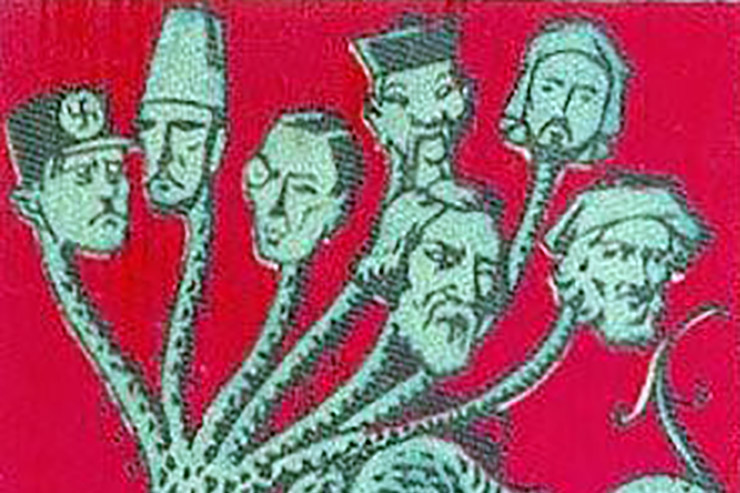
    Seven Heads of the Green Dragon

    There is another, more involved, though no less mysterious, description of the Green Dragon Society that predates Ravenscroft by forty years and Pauwels and Bergier by almost thirty. It is almost certainly the source for much of what he and others have had to say about the GDS since. The work in question is the 1933 Les Sept Tetes du Dragon Vert [“The Seven Heads of the Green Dragon”] by Teddy Legrand. The title evokes the dragon with “seven heads, ten horns, and seven crowns upon his heads” mentioned in Revelations 12:3, although that beast is red, not green. At first glance the book seems to be just an obscure piece of French pulp fiction, albeit one replete with real people and real events along with many invented ones.

    Basically, the book presents the Green Dragon or, more simply, “The Greens,” a sinister international cabal bent on world domination. An interesting detail is that these secretive conspirators number precisely 72 and were, presumably, the “72 unknown superiors” of conspiratorial legend.19 To achieve its nefarious aim, the Green Dragon generates war, revolution and chaos, and its hand is the unseen common denominator in such seemingly disparate events as the assassination of Franz Ferdinand, the instigation of the Bolshevik Revolution, the murder of the Romanovs, the 1922 killing of German foreign minister Walther Rathenau, the abduction of White Russian general A. P. Kutepov and the apparent suicide of millionaire Swedish “Match King” Ivar Kreuger. All in all, the Green Dragon sounds like another version of the infamous Illuminati who haunt so many conspiracy theories.

    At the time of the book’s action, 1929-30, the mysterious Greens are busy facilitating the rise of the “The Man of the Two Z’s” under whose “sharp spurs” Europe would soon tremble.20 The latter is a thinly-veiled and rather prophetic reference to Hitler who had barely come to power when the book was published. The “Two Z’s” were the interlocking arms of the Swastika.

    The central figure of Les Sept Tetes… is a British secret agent, the ace of L’Intelligence Service, James Nobody, who may be the original literary inspiration for James Bond. He had already starred in a series of pot-boiler spy novels by French writer Charles Lucieto, and the latest was an effort to continue the franchise after Lucieto’s recent death. Interestingly, Lucieto was a retired spy, having served the French secret service in World War I. He liked to claim that his Nobody and similar yarns were roman-a-clefs which revealed true, if hidden aspects of recent history and current events. His publishers later implied that this had something to do with his untimely demise.

    To no great surprise, Lucieto’s successor, “Teddy Legrand,” was a pseudonym. In fact, the author was Pierre Mariel who turns out to be a rather interesting fellow. Nominally he was a journalist, but like Lucieto he had ties to French intelligence. That has led to the claim that the latter “inspired” or even directed his literary efforts as it had his predecessor’s.21 More importantly, perhaps, he was a self-proclaimed expert on the occult. Some years later, under the name Werner Gerson, he would author one of the first books on Nazi occultism.22 Mariel himself was a member of both the Freemasonic Martinist Order and a one-time French grand master of the Ancient and Mystical Order Rosae Crucis (AMORC).23 Interestingly, in Les Sept Tetes… Mariel paints the Martinist Order as a conspiratorial sect which played a behind-the-scenes role in the French Revolution and later political upheavals, and which just might have links to the mysterious Green Dragon.24

    In the book, brother spies Nobody and Legrand are inspired by their common curiosity about the fate of the Russian Imperial family. The chief object of fascination is an icon on St. Seraphim, supposedly found on the Tsarina Alexandra’s body, which bears a puzzling inscription, in English: “S.I.M.P. The Green Dragon. You were absolutely right. Too late.”25 They quickly determine that the first element, which is accompanied by a six point “kabbalistic” symbol, stands for “Superieur Inconnu, Maitre Philippe” [Unknown Superior, Master Philippe], a French Martinist mystic who was an early guru to the Tsarina Alexandra.26 They also note the Tsarina’s predilection for the “Tibetan” Swastika as a good luck symbol. The rest of the story follows the duo’s efforts to discover who or what constitutes the Green Dragon.

    Some interest inevitably falls on Maitre Philippe’s successor as royal spiritual guide, Rasputin, who comes across as a tool of the Green Dragon, if not an outright member. Legrand/Mariel correctly observes that during World War I, the dissolute holy man maintained communication with mysterious “Greens,” or simply “The Green,” based in Stockholm in which Mariel portrays as another piece of a larger conspiracy.27 Interestingly, Colonel Stanislaus de Lazovert, one of the men later involved in the plot to kill the dissolute holy man, claimed that Rasputin was a member of the “Green Hand,” a secret order presumably backed by Russia’s Austrian enemies.28 Most recently and reliably, Russian investigator Oleg Shishkin linked Rasputin’s mysterious friends to a Berlin-inspired conspiracy which included German occult lodges and members of the ethnic-German Baltic nobility. Their secret brotherhood, Baltikum, used a green swastika as its symbol.

    Coincidentally or not, one of the antagonists encountered by Nobody and Legrand is a Baltic Baron, Otto von Bautenas, whom they identify as no less than one of the “72 Verts.” Bautenas turns out to have been a very real person: an ex-adherent of Baltikum, a close ally of Lithuanian politico Augustine Valdemaras and leader of the fascistic Iron Wolf movement.

    Mariel also implies that Anthroposophy kingpin Rudolf Steiner was mixed-up in all this skullduggery and “secret politics” through his connections to pan-German secret societies.29 He also drops Gurdjieff’s and Besant’s names in the same murky mess.

    While the book’s action stays within the geographic confines of Europe, shifting from Constantinople, to Scandinavia, to Paris to Berlin, there are numerous references to the Orient, especially Tibet. Legrand and Nobody enlist the aid of one of their old antagonists, Jewish-born “international spy” I.T. Trebitsch-Lincoln, whom has transformed himself into the Tibetan lama Dordji Den. Here again, there is at least a kernel of truth; in 1931 the chameleon-like Trebitsch was ordained a Buddhist monk and became “the Venerable Chao Kung.”30

    The pair eventually find themselves in Berlin, in the presence of The Man with the Green Gloves, an apparently Asian soothsayer who has set himself up much as the real Hanussen. They observed an eerie figure that seemed to have “complete mastery of his reflexes.”31 Was this the “control of the life forces” mentioned by Ravenscroft? Like a living statue, “not a muscle in his face moved” as the weird seer conversed in “excellent Oxford English.” Nobody and friend finally realise that they are standing face-to-face with “one of those famous Greens.” The description has led one recent author, Christian von Nidda, to conclude that the Greens were nothing less than “reptilian” beings!32

    In the end, Mariel never clearly defines just what the Green Dragon Society is and is not. Doubtless, that was never his intention. Interestingly, there is no suggestion of any Japanese connection. However, as the episode with the Man with Green Gloves suggests, there is the spectre of a powerful, mysterious Asiatic hand at work. The true purpose of the Russian Revolution, he believed, was to destroy Europe’s eastern barrier against Asiatic intrusion. Mariel sensed a kind of “permanent conspiracy against the white race – against Western Greco-Latin civilisation – which seeks to sap, fracture and shake the edifice of already unstable Europe.”33 When the time came, the conspirators would “substitute him” [the Man of the Two Z’s] as a means of bringing about a New Order.

    It also remains uncertain to what degree Mariel intended Les Sept Tetes… to be taken seriously. Clearly, that has not prevented some from doing so. Truth, fiction, or some strange amalgam of the two, Mariel’s little book is undoubtedly the inspiration for most of the claims about the Green Dragon Society which have sprung up since. We are still left to wonder whether, if all the exaggeration, obfuscation, superstitious dread and outright lies were cleared aside, there would be anything there at all. Maybe.

    [alert type=”general” dismiss=”no”]This article was published in New Dawn 112.[/alert]

    [alert type=”success” dismiss=”no”]If you appreciate this article, please consider subscribing to help maintain this website.[/alert]

    Footnotes:

    1. “Japan’s Dark Background, 1881-1945.” www.fortunecity.com/tatooine/lieber/50/bds1.htm [15 Oct. 2008].
    2. Chieh-ju Ch’en, Chiang Kai-shek’s Secret Past: The Memoir of His Second Wife, Westview Press: Boulder, 2000.
    3. Ibid.
    4. Trevor Ravenscroft, The Spear of Destiny: The Occult Power behind the Spear which Pierced the Side of Christ, Weiser Books: Boston, 1982, 246-247.
    5. Louis Pauwels and Jacques Bergier, The Morning of the Magicians, Avon Books: New York, 1960, 279.
    6. Ravenscroft, 256.
    7. Ibid.
    8. Gil Trevizo, “The Order of the Green Dragons” (2003), http://odh.trevizo.org/green_dragons.html [15 Oct. 2008]. This and like articles are connected to the Delta Green role-playing games.
    9. On Hanussen’s bizarre career, see Mel Gordon, Erik Jan Hanussen: Hitler’s Jewish Clairvoyant, Feral House: Los Angeles, 2001.
    10. “Tibet’s Dragon Culture,” courtesy of Charles Rice, August 2006.
    11. Alexander Berzin, “Russian and Japanese Involvement with Pre-Communist Tibet: The Role of the Shambhala Legend,” www.berzinarchives.com/web/en/archives/kalachakra/shambhala/russian_japanese_shambhala.html. [10 Sept. 2008]
    12. Richard Spence, Secret Agent 666: Aleister Crowley, British Intelligence and the Occult, Feral House: Los Angeles, 2008, 184, 189.
    13. Wulf Schwarz waller, The Unknown Hitler: Behind the Image of History’s Darkest Name, Berkley Books: New York, 1990, 100.
    14. For a highly critical view of “Green Dragon Zen,” See: groups.google.com/group/alt.philosophy.zen/browse_thread/thread/da7a81921050f728.
    15. Trevor Corson, “The Magic of Buddhism,” Kyoto Journal (1 July 2000), www.scrawlingclaw.com/blogs/ArticleArchive/Entries/2000/7/1_The_Magic_of_Buddhism.html [10 Nov. 2008].
    16. “The Green Dragon Society & Brotherhood, Chi Tao Ch’uan Gung Fu: A Recent History,” www.orientalherb.com/index.php?cPath=35 [1 Nov. 2008].
    17. Charles Rice to author, 3 July 2003.
    18. Clifford Lo, “Sex Cult Might Have Lured 30 Women,” South China Morning Post (16 Jan. 2004).
    19. Nolan Romy, Les Grandes Conspirations de Notre Temps, Bruxelles, 2002, 35-50.
    20. Teddy Legrand, Les Sept Tetes du Dragon Vert, Berger-Levrault: Paris, 1933, 78.
    21. Oleg Shishkin, Ubit’ Rasputina, Olma Press: Moscow, 2000, 36-37.
    22. Werner Gerson, Le Nazisme: Societe Secrete, Productions de Paris: Paris, 1969.
    23. Shishkin, 36.
    24. Legrand, 32.
    25. Legrand, 30-33.
    26. True name: Nizier Anthelme Philippe.
    27. Legrand, 39-40.
    28. “Stanislaus Lazovert and the Assassination of Rasputin, 29 December 1916,” www.firstworldwar.com/source/rasputin_stanislaus.htm.
    29. Legrand, 228-230.
    30. Bernard Wasserstein, The Secret Lives of Trebitsch Lincoln, Penguin Books: New York, 1989, 274.
    31. Legrand, 243-244.
    32. Christian Von Nidda, Our Secret Planet, Lulu Publications, 124-125.
    33. Legrand, 132

    © New Dawn Magazine and the respective author.
    For our reproduction notice, click here.

  • Vladimir Vladimirovich Putin & the Eurasian Empire of the End Times

    Vladimir Vladimirovich Putin & the Eurasian Empire of the End Times

    From New Dawn 111 (Nov-Dec 2008)

    Russia has always perceived of itself as a Eurasian country.
    – President V.V. Putin, November 2000

    …an epochal, grandiose revolutionary admission, which, in general, changes everything. The prophecy of [French conspiratologist] Jean Parvulesco has come to pass… There will be a Eurasian millennium.
    – Alexandre Dugin, Russian thinker and author

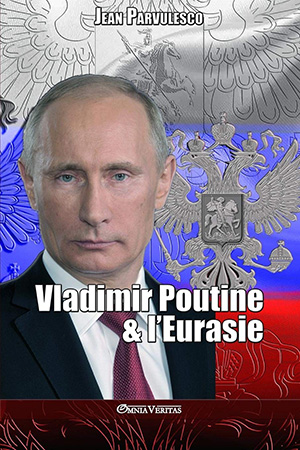
    The French visionary writer Jean Parvulesco’s main agent – if not hope – for world change rests with Vladimir Putin. Parvulesco argues that – whether we are aware of it or not – we find ourselves at the crossroads of “great history,” where a totally new era is about to be born.

    For such a new period to begin, the old needs to die first. For Parvulesco, this is the old “democratic system” of political correctness, which he feels has now reached its limits and is no longer supportable. It has become “a permanent and total nightmare.” Many will wonder how the “new world” is to come about. The best example of what appeared to be a sudden, almost instantaneous collapse is seen in the fall of the Soviet Union, two decades ago. It illustrates that powerful empires can, from one day to the next, completely disappear, requiring a new society and structure to be built from the ground upwards.

    When news of the collapse of the Soviet Union appeared on television screens, the system had already imploded. It was just the public revelation of its death; the disintegration of the communist system had already occurred. According to Parvulesco, the collapse of “democratic Europe” has already taken place too, and we are now in the years between its collapse and the public acceptance of its demise – and the start of a new Europe.

    For Parvulesco, the evidence of the collapse of this system is apparent in the recent political history of Italy and Germany, and to some extent that of France and Great Britain. But in each case he feels the same dire situation has transpired: an “immense empty desert,” the wasteland of “social democracy.” A local version of what he sees as a “worldwide conspiracy,” but one that has failed and will soon be sent back to the “black hole” from where it came.

    Parvulesco knows what to write on the death certificate; but he also feels he knows what the New Europe will be: the “Eurasian Empire of the End Times.” He labels our timeframe an interregnum where what happened to Russia is actually evidence that dramatic political change is possible. The Soviet Union was the first domino to fall, with the others in Europe soon to follow.

    Could he be right? In 1976, Parvulesco published “La ligne géopolitique de l’URSS et le ‘projet océanique fondamental’ de l’Amiral G.S. Gorchkov” (The geopolitical line of the USSR and the ‘fundamental oceanographic project’ of Admiral G.S. Gorchkov), which he labelled “political-revolutionary research.” In it he wrote that the Soviet Union would end up changing the course of history. And changing the course of history is, for Parvulesco, the only true goal politics should have.

    Parvulesco therefore provides an interesting type of prophecy. Whereas most prophets predict the end of the world at a given time, his type of prophecy brings more detail about the type of change and how. As to its timeframe, it is very much like “when the time is right.”

    So, what is meant to happen? Parvulesco argues that across Europe there are geopolitical groups at work – often clandestinely – laying the groundwork for the Eurasian agenda. Like the Project for a New American Century, there are other think tanks hard at work – and judging from the amount of newspaper headlines they don’t get, much more secretly – to bring about a new Eurasia. Despite their secrecy, Parvulesco was able to lay his hands on one article titled “The Imperial Eurasian Pact.” Similar to the idea put into action by the Neocons after 9/11 (an agenda that claimed to want to bring peace to the world by using the power of America’s military might), this group states that, “It is the confrontation of our imperial and catholic [universal] doctrines with the current political-historical reality […] which will see the final emergence of the catholic Great Empire which constitutes our ultimate objective, the Imperium Ultimum, the Regnum Sanctum, which should comport, in principle, three operational stages […].”

    The first stage is the creation of a Paris-Berlin-Moscow axis, that is considered to be the axis along which this major change will occur. This axis will tie together the destiny of three nations (France, Germany and Russia).

    The second stage is the integration of what was traditionally known as West and East Europe, together with Russia, Siberia, India and Japan.

    The final stage involves what is termed the destruction of the “global democratic conspiracy,” led by the United States, including a revolutionary liberation of its people, after which America as a whole (North and South) will become one entity. We can only wonder whether the present drive by the US to expand NAFTA and create a North American Union are steps in this direction.

    The end of the planetary superpower that is the United States is forecast to be an act of self-destruction, a continental civil war very much on par with the first Civil War. The extreme dissatisfaction within the United States, the extreme disparity between the archconservative religious community and the more liberal, means that being elected as president on a genuine agenda (rather than one of total style but no substance) is almost impossible. For Parvulesco, it will be primarily America’s Catholic, ex-European community that will lead America towards its new destiny – and cause the demise of the current “global conspiracy.” There will be a new Europe, but also a new America.

    In the end change is a social process, but it often needs a symbol. Hitler became the face of World War II, Lenin – more than Marx – that of communism, etc. So who is the new face of Europe, and who is the creator of this new Eurasian Empire? For Parvulesco, that “messiah” is already here: Vladimir Putin. Even though Putin is no longer president, his influence as Russian prime minister remains virtually omnipresent.

    Vladimir Putin remains the face of the New Russia, a country with a vast territory and natural resources that is able to hold Europe to ransom, energy-wise, should it ever want to.

    Who is Vladimir Vladimirovich Putin? This is a question that many in a non-Parvulesco universe have also asked. Seen as a pawn of the KGB’s successor, in Parvulesco’s world, Putin is the direct emanation of the secret revolutionary groups of the Armed Forces of the Soviet Union. These, he believes, are trying to make their decades-long secret battle open and public, moving from a type of synarchic, behind the scenes government, into a more open type of rule.

    Whereas some conspiracy theorists claim the CIA and various secret societies like Skull & Bones are the real puppet masters of American politics, Parvulesco says the situation in the Soviet Union was not much different. Ruled for a long time by secret powerbrokers whose agents are now stepping out into the open taking the course of Russian politics into the direction they have been trying to steer it from behind the veil for a number of decades.

    Unlike in the US where the “conspiracy” is often faceless, Parvulesco lists two people as Russia’s master conspirators. One was the chief of the Soviet security service (GRU) and one time Commander in Chief of the former Warsaw Pact, General S.M. Stemenko (died 1976), the other was Marshall N.V. Ogarkov, a former head of the Soviet military. Marshall Ogarkov, who died in 1994, is rumoured to have been behind a failed coup attempt which in turn led to a kind of counter-conspiracy that brought Mikhail Gorbachev to power.

    Parvulesco is convinced that if this counter-conspiracy had not succeeded, the end of the Soviet Union would have occurred several years earlier, with a transition from the Soviet Union to the New Russia that would have been much harsher. Indeed, it underlines that years before the actual demise of the Soviet Union, the regime was comatose, ready for the taking, just like – in Parvulesco’s eyes – Western Europe (and the United States of America) is now.

    Parvulesco is not alone in his assessment of these two men. French intelligence expert Pierre de Villemarest who wrote the history of the GRU, labelled “the Soviet’s most secret service,” says Gen. Sergei Matveevich Stemenko was “one of the first geopoliticians of the Soviet Union, perhaps even the first.” Though de Villemarest calls Stemenko a Soviet, he considered himself to be truly a “Great Russian.” “For this caste,“ writes de Villemarest, “the Soviet Union was an Empire that was called to dominate the Eurasian continent, not only from the Ural to Brest, but also from the Ural to Mongolia, from Central Asia to the Mediterranean.”

    The “dream” of Russia à la Stemenko may be seen as merely returning back to the days when Russia was a true empire, before the days of the Bolshevic Revolution. But for Parvulesco, that in itself is part of a larger, and most intriguing puzzle – a mission.

    The above is connected to this article in the same issue of New Dawn: Men of Mystery: Raymond Abellio & Jean Parvulesco – Their Vision of a New Europe

    [alert type=”general” dismiss=”no”]This article was published in New Dawn 111.[/alert]

    [alert type=”success” dismiss=”no”]If you appreciate this article, please consider subscribing to help maintain this website.[/alert]

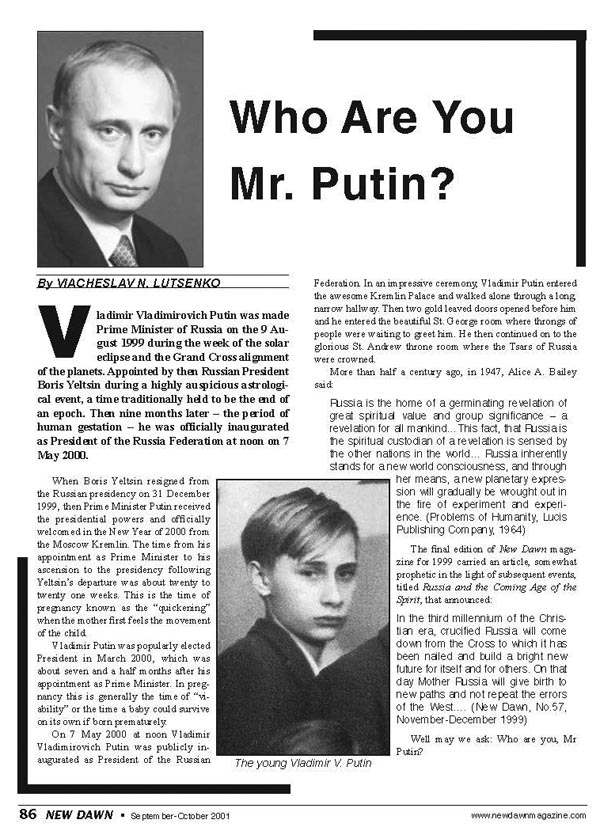
    Vladimir Putin was the subject of an article in the Sept-Oct 2001 issue of New Dawn that prophetically discussed the symbolic significance of his ascension to power and the important role he was destined to play in the future of not only Russia, but the world.

    © New Dawn Magazine and the respective author.
    For our reproduction notice, click here.

  • Men of Mystery: Raymond Abellio & Jean Parvulesco – Their Vision of a New Europe

    Men of Mystery: Raymond Abellio & Jean Parvulesco – Their Vision of a New Europe

    From New Dawn 111 (Nov-Dec 2008)

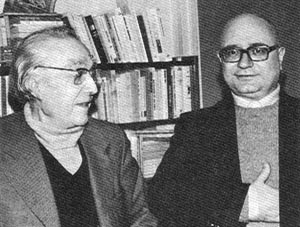
    Raymond Abellio and Jean Parvulesco are two prominent French esotericists who have visualised and tried to implement a roadmap for what Europe – and the Western world as a whole – should become. It is a future where the real role of the Priory of Sion comes into its own.

    Raymond Abellio claimed that the Flemish occultist S.U. Zanne, pseudonym of Auguste Van de Kerckhove (1838-1923), was amongst the greatest initiates of the modern era. But hardly anyone knows who he is. Some have placed Abellio in the same category – he too is a great unknown for most. And those that have looked at Abellio largely conclude that he was a French fascist politician with an interest in esotericism.

    Was he? Part of the problem is that Abellio’s writings – like that of so many alchemists – need a key. So much of their material is coded text, and Abellio himself used to laugh that most people’s keys “only opened their own doors” – not his. Who was he really, and what were his true political aims?

    Raymond Abellio is the pseudonym of Georges Soulès (1907-1986), who rose to fame in France during World War II when he became the secretary general of the MSR (Mouvement Social Révolutionnaire) in 1942. The invitation to join the organisation had come from none other than Eugène Schueller, owner of the cosmetics giant L’Oréal. As the British researcher Guy Patton, author of Masters of Deception, points out: “This group had evolved out of the sinister Comité Secret d’Action Revolutionaire (CSAR), also known as the Cagoule. Soules was now to become acquainted with Eugène Deloncle, head of the political wing, dedicated to secret, direct, and violent action.”

    Later, Patton adds: “So here we have a Socialist turned Fascist, deeply involved in political movements, who actively collaborated with the Vichy government. In the course of his political activities, he was to work closely with Eugène Deloncle, who […] was closely acquainted with a fellow engineer, François Plantard, and whose niece married [French President François] Mitterrand’s brother, Robert.”

    Though never confirmed, it is claimed that Abellio was involved with Bélisane publishing, founded in 1973. Bélisane published several books on Rennes-le-Château, the village so intimately connected with the Priory of Sion. In his book Arktos, Joscelyn Godwin refers to Raymond Abellio as another ‘Bélisane’ pseudonym. For Guy Patton, Abellio is part of a network that tried to create a New Europe, ruled by a priest-king, whereby various modern myths, like the Priory of Sion, are meant to provide the modern Westerner with a longing of sacred traditions and rule, very much like the myths of King Arthur that gave a surreal dimension to European politics in medieval times.

    Abellio’s political views have therefore been described as very utopian, and he has been suspected of synarchist leanings – the belief that the real leaders of the world are hidden from view, politicians being merely their puppets. But in truth, Abellio had a well-defined vision for social change. When the battle lines of the Cold War were drawn after World War II, he tried to find the best of both camps and hoped he could unite them. Why? To create a type of Eurasian Empire, stretching from the Atlantic to Japan, an idea later taken up by the novelist and theoreticist, his friend Jean Parvulesco.

    French Esotericist Jean Parvulesco

    “Parvu” is largely responsible for acquainting at least some with the visions of Abellio – though whether it was the real Abellio or a character created by Parvulesco remains open to debate. Guy Patton sums up Abellio’s view as being “typical of an extreme right-wing esotericism, the aim of which is to ‘renew the tradition of the West’. He wanted to replace the famous Republican slogan, ‘Liberty, Equality, Fraternity’, with ‘Prayer, War, Work’, to represent a new society built on an absolute hierarchy led by a king-priest.”

    The implication, however, is that several of the people involved were not truly devoted to esoteric spirituality and merely used it as a mask for making money, acquiring more power, and pushing an extreme right wing agenda. Though that is the case for some of those involved, within the mix of powerful and/or money-hungry people most agreed that Abellio was truly a ‘spiritual’ man. And it was Professor Pierre de Combas who is credited with Abellio’s transformation from politician Georges Soulès into the visionary Abellio (the Pyrenean Apollo), making him not merely a “man of power,” but also a “man of knowledge” – an initiate?

    To understand his vision, we need to acknowledge that Abellio’s system, as mentioned, needs a key, and without a key there is no understanding – hence, no doubt, why he is often misunderstood. Secondly, his system is complex and difficult to summarise in a few words and is best described by listing some examples.

    He wanted to “de-occultise” the occult (e.g. his book “The End of Esotericism,” 1973), whereby he hoped this would help science. His knowledge of science – acquired as a polytechnic student – meant that he could build bridges between the two subjects, for example between the 64 hexagrams of the Yi-Ching and 64 codons of DNA, or the correspondences between the numbers of the Hebrew alphabet and the polygons that could be inscribed in a circle.

    The most famous of his works is “The Absolute Structure” (1965) which led to him being regarded as an heir to phenomenological philosopher Husserl. Such topics, of course, hardly make for bestsellers, but are the type of study one expects from a genuine alchemist.

    His drive for an “absolute structure” is a vital ingredient in his idea of the “Assumption of Europe,” i.e. what he sees as the destiny of Europe: “the Occident appears to us not to be only as an interval separating the opposing masses of the East and the West, but is the most advanced carrier of the dialectic of the present time.” Abellio did not believe in the subject-object duality that continues to drive most politicians into fear-mongering and the other usual tactics employed by their ilk, but instead preferred a more complex model, centred on Conscience (the zero point), which evolved along the base towards Quantity (science) and upwards to Quality (knowledge), which gave him a six-armed cross. This is the “hypercubic” cross, to use Salvador Dali’s words, a man who also spoke of the “Assumption of Europe” in some of his paintings. The “hypercubic cross” allowed Abellio to express all ontological and spiritual problems in dynamic terms – and it is clear that he used complex wording, making his thinking difficult to understand, which is no doubt why he is easily misunderstood, was thought to be writing mumbo-jumbo, or simply neglected.

    First of all, to get our heads around his terminology, we need to know that the Bible was one of Abellio’s most often consulted books and he described the stages of the evolution of a civilisation in Christian terms: birth, baptism, communion, etc. This is why he said that the next stage in Europe’s development mimicked Assumption, which is specifically linked with the Virgin Mary – the Saint deemed to play a pivotal part in Europe’s future. She is, of course, a supernatural being who is said to have appeared on numerous occasions to counsel Christian Europe on which direction to take, such as in the politically charged “secrets” of Fatima in 1917.

    In 1947, in his book “Towards a New Form of Prophecy, an essay on the political notion of the sacred and the situation of Lucifer in the modern world,” he notes, “not more than any other being, man is but an addition, a juxtaposition of Spirit and Matter, but an accumulator and an energy transformer, of variable power according to the individual, and capable of passing his energetic quantity from one qualitative level to another, higher, or lower.” Thus, we see a mixture of Christian eschatology, prophecy, as well as Gnostic doctrines on what it is to be truly human.

    The visionary Abellio was also an astrologer. He predicted the fall of the Soviet Union in 1989, as well as the ascent of China. He qualified its Marxism as “Luciferian,” which he did not suggest should be interpreted in a moral sense, but that Chinese materialism had to be integrated in terms of the Absolute Structure, in opposition to the individual and “Satanic” materialism of the United States.

    In the West, it was the task of freedom fighters – terrorists? – to bring about this change. These “heroic” battles were brought to life in his novels. In retrospect, he said that his first three novels were indeed “apprenticeships,” where his heroes evolved, while his final novel – published 24 years after “The Pit of Babel” (1962) – “Motionless Faces” (1986) was for him “that of the companion who is trying to become master.”

    However, many consider “The Pit of Babel” to be his best work and it is here that he plots intellectuals that are disengaged from all forms of ideology and scruples engaging in widespread terrorism. It is a theme he revisited in “Motionless Faces,” where the primary character attempts to poison the population of New York, not by any straightforward means but by using the creation of an illuminated architect who had built a type of “counter-structure” underneath Manhattan, which was reserved for an elite – a type of urban Agarttha.

    The heroine of his last novel is named Helen, also – not coincidentally – the name of the companion of Simon Magus. In the end, she perishes, taken to the centre of the earth by a subterranean stream underneath Manhattan. In the case of the historical Simon Magus, Helen was the personification of Light held prisoner by matter. Abellio specifically chose his name because he identified himself with Apollo, another deity connected with light, and Raymond Abellio’s initials – RA – were of course those of the Egyptian sun god.

    Abellio himself never met his “ultimate woman,” even though he searched for her. She may have been Sunsiaré de Larcone, herself a writer of fantasies as well as a model, who died at the age of 27 in a car crash in 1962. She called herself his disciple. Other equally beautiful women had gone before, and would go after, but no-one was apparently worthy of being “his” woman. Hence, his tomb contains an empty space for his “Lady.”

    It is “Motionless Faces” that Jean Parvulesco studied in detail in his essay, “The Red Sun of Raymond Abellio,” published in 1987. Parvu is a novelist who was both close and far removed from Abellio. Close, because they shared a similar vision of the “Great Eurasian Empire of the End.” He, too, had his initiators, and he saw himself heir to the “Traditional School,” represented by authors such as René Guénon and Julius Evola, whom he met in the 1960s. Parvu was preoccupied with “non-being,” the forces of chaos, which make him into something of a dualist, i.e. a Gnostic. With Evola he shared the idea that there is a need for a final battle against the counter-initiatory and subversive forces (the non-being). Like Evola, he had an interest in Tantrism.

    Parvulesco often uses the term “Polar” in reference to the “polar fraternities” with which Guénon had once associated. He sees these as important instruments in the creation of modern Europe. He also used the term to refer to the Hyperborean origins of the present cycle of humanity, which he argued would soon end with a polar reversal. Here he is close to Guénon, but far from Abellio’s thinking, who had an altogether more optimistic vision of the future. So despite their kinship and a common goal, they were not agreed on how exactly the New Europe would be accomplished.

    Parvulesco has often been cited by extreme right-wing European authors. Some of them have claimed him as one of their own, but it is clear that no single writer is in charge of who and where his name is used.

    In the early 1960s, Parvu was close to the OAS, the “Organisation Armée Secrète,” a terrorist group opposed to Algerian independence from France. This put him in opposition to De Gaulle, yet he is known to have claimed to be a strong supporter of De Gaulle. Incidents such as this make it difficult to place him on the political spectrum, and it’s best simply not to try and put him into one category. Indeed, what sets him and Abellio apart is largely that they had an independent vision of the future – and the role of politics. They realised that the world was radically changing, and though their models might in the end prove not to work or be unrealisable, it does not negate the fact that they were innovative thinkers.

    It is Parvulesco who provides further details as to what this New Europe would be and why, specifically, a priest-king is needed as its ruler. In ancient times, these rulers were primarily seen as a denizen of both worlds, a mediator between this reality and the divine realm. Parvulesco makes it clear that “the beyond” is guiding us towards Europe’s destiny, whereby the role of European leaders is first and foremost to correctly interpret the signs, rather than invent new goals and targets.

    Interdimensional Gateways

    A few constant themes run through Parvu’s writings, one of them being that of gateways to other dimensions. Whenever historical people (most often politicians) make appearances in his novels, they are not the politicians we know but their doubles who evolve in our and another dimension. The novels of Parvulesco are hence often seen as those of the “eternal present,” or the “ninth day.”

    In “Rendez-vous au manoir du Lac,” the setting is a strange site where there is a gateway to heaven – Venus in particular – from where, according to Parvulesco, some chosen ones have to transit. In “En attendant la junction de Vénus,” he repeats this claim, but links it with French president François Mitterrand and specifically the Axe Majeur of Cergy-Pontoise, near Paris. This axis is the creation of artist Dani Karavan and is the “soul” of this new town. It stretches for three kilometres and if ever archaeologists stumbled upon its remains in future centuries, it would be classified as a leyline. Though the project commenced before Mitterrand’s presidency, it was during his term in office that the line became properly defined and executed. Today, it is seen – in France – as an enigmatic work, far superior to the Louvre Pyramid or Arche de la Défense, which has set the likes of Dan Brown and Robert Bauval questioning the reasons behind these projects. The Axe, however, is a far more ambitious, greater and more enigmatic project. When we note that Abellio was closely associated with the Mitterrand family, we can merely ponder whether he had a hand in the project.

    With the Axe Majeure, it is clear that we are in a strange world where politics and esoterica mingle, partly in this dimension and partly in a divine realm. Well, Abellio hoped that from this mixture a new form of politics and a New Europe would arise. And it is here where we need to see the role of the Priory of Sion, not so much – as Dan Brown and others would like it – as the preservers of a sacred, old bloodline, but a new priesthood – a mixture of politician and esotericist, i.e. like Abellio himself – that can rule a New Europe.

    So even though Abellio and Parvulesco are often described as synarchists, they repeatedly referred to themselves as freedom fighters laying the foundation for this New World. The new powerbrokers would not always remain hidden puppet masters, but would clearly one day step to the forefront to take up the role of priest-king. And for such thinkers, it was a given that France had come closest to attaining this ideal under De Gaulle, whereby the “Great Work” of Mitterrand was seen along the same lines, though clearly not to the same extent.

    Abellio and Parvulesco were therefore New Agers building “An Age of Aquarius.” However, they did not focus on personal transformation, but on social transformation. As an author one might argue that Parvulesco operates within the domain of the “esoteric thriller,” which in Hollywood is seen in Roman Polanski’s ‘The Ninth Gate’ or Umberto Eco’s Foucault’s Pendulum. But both works have great difficulty in convincingly integrating the “passage to another world” within their storyline, often leaving the reader/viewer unsatisfied, or – alternatively – unconvinced of the end goal. Lovecraft has a better reputation and others argue that Parvulesco, thanks to the influence of both Abellio and Dominique de Roux, has gone further, and done better. But the main point is that his esoteric thrillers were to make this step through this “interdimensional passage” not as an individual, but as a society – as Europe.

    De Roux (1935-1977) greatly inspired those authors who evoked what is known as “novels of the End” – however they saw the transformation of Europe. Parvulesco actually began his literary career in the magazine Exil published by de Roux. De Roux travelled widely, and in 1974 wrote “The Fifth Empire,” about the struggle for independence in Portugal’s colonies, which brings up the same struggle for a country’s new future. The title “The Fifth Empire” is an allusion to a popular Portuguese myth, namely that of the lost king. Like King Arthur, the Portuguese king Dom Sebastian was said to one day return to lead his people to a fabulous destiny – which, as can be expected in light of Abellio and Parvulesco’s ideology, was not necessarily of this plane. To quote the Portuguese poet and occultist Fernando Pessoa (a friend of Aleister Crowley): “We have already conquered the sea, there only remains for us to conquer the sky and leave the earth for others.”

    Russia, Putin and the New Europe

    What Algeria and De Gaulle had been for Abellio, what Portugal was for De Roux, Putin’s Russia is for Parvulesco. But it is in Abellio’s preface to “The Fifth Empire” that we find an interesting note explaining the true context and “key” that unlocks their works: “Those who attach a profound meaning to coincidences cannot be but stricken by the fact that the last message of Fatima was delivered in October 1917, at the moment when the Bolshevik Revolution began. What subtle link of the invisible history was thus established between the two extremities of Europe?”

    For esotericists who saw our dimension as being infiltrated by the other plane of existence, the coincidences of the apparitions of the Virgin Mary at Fatima and her clearly political messages to do with the future of Russia and how it should embrace the Virgin Mary, are part and parcel of this Great Empire. Not merely a political ambition, but part of their vision as to how “real politicians” work together in league with the “denizens of the otherworld” so as to accomplish the Assumption. Hence why Parvulesco believes Putin’s Russia to be so important. This is why, no doubt, Abellio tried to make contact with the Soviets to enable this New Europe, which indeed has come about largely under Putin’s presidency.

    As mentioned, for British author Guy Patton, Abellio and Parvulesco are French fascists who abused newly created myths like that of the Priory of Sion to increase their influence, power and wealth. But this, of course, is merely one interpretation. Take the literature of the Priory and its creator Pierre Plantard and we discover he was close to De Gaulle’s regime. Plantard in fact ran part of De Gaulle’s “terrorist cells” in Paris when De Gaulle was struggling for power. Then, Plantard used the Priory to create an ideology that saw a unified Europe, from the East to the West, and it is obvious those involved in the promotion of the Priory later spoke of the importance of François Mitterrand.

    The Priory is indeed a fabricated myth, a non-existent secret society. But it is equally clear the individuals involved (Plantard) and those linked to it (Abellio, and to some extent Parvulesco), had genuine convictions of what a future Europe should be. Their interest in Marian apparitions was genuine, and they saw them as divine guides along the path that Europe had to walk to its future and its next stage, its Assumption. As Parvulesco pointed out, it depends whether you believe in coincidences or not. If not, then you will argue the major political events of the past century are but tangentially related to the messages received from these apparitions. If you do believe coincidences have meaning, then it is clear this New Europe is slowly emerging.

    In the 1980s, Parvulesco reviewed a strange novel, “La boucane contre l’Ordre Noir, ou le renversement,” by one “Father Martin,” who had already published “livre des Compagnons secrets. L’enseignement secret du Général de Gaulle.” For an avowed Gaullist, Parvu was obviously in his element. The novel itself has certain common points with one volume of the tetralogy of Robert Chotard, “Le grand test secret de Jules Verne.” Both books speak of a “reserved region” in Canada from where there is a conspiracy directed to change the world’s climate. The base is controlled by the sinister “Black Order” and aims to create a pole reversal – a theme also explored by Jules Verne. We can only wonder whether the stories of HAARP – set in nearby Alaska – might be inspired, or reflective, of this. But it is here that we see the final framework of their political ambition: they saw their quest not so much as a desire, a longing, but as a genuine struggle of good versus evil – if a New Europe did not come, the “Black Order” would have won. And in the end, perhaps Abellio and Parvulesco should thus be seen as modern knights, fighting for Europe – a new Europe.

    The above is connected to this article in the same issue of New Dawn: Vladimir Vladimirovich Putin & the Eurasian Empire of the End Times

    [alert type=”general” dismiss=”no”]This article was published in New Dawn 111.[/alert]

    [alert type=”success” dismiss=”no”]If you appreciate this article, please consider subscribing to help maintain this website.[/alert]

    © New Dawn Magazine and the respective author.
    For our reproduction notice, click here.
  • Red Star Over Shambhala: Soviet, British and American Intelligence & the Search for Lost Civilisation in Central Asia

    Red Star Over Shambhala: Soviet, British and American Intelligence & the Search for Lost Civilisation in Central Asia

    From New Dawn 109 (Jul-Aug 2008)

    On his way across the wastes of Mongolia in 1921, Polish writer and refugee Ferdinand Ossendowski witnessed some strange behaviour on the part of his Mongol guides. Stopping their camels in the middle of nowhere, they began to pray in great earnestness while a strange hush fell over the animals and everything around. The Mongols later explained that this ritual happened whenever “the King of the World in his subterranean palace prays and searches out the destiny of all people on Earth.”1

    From assorted lamas, Ossendowski learned that this King of the World was ruler of a mysterious, but supposedly very real, kingdom, “Agharti.” In Agharti, he was told, “the learned Panditas [masters of Buddhist arts and sciences] write on tablets of stone all the science of our planet and of the other worlds.”2 Whoever gained access to the underground realm would have access to incredible knowledge – and power.

    Ossendowski was not exactly a casual listener. As noted in a previous article [The “Bloody” Baron von Ungern-Sternberg: Madman or Mystic?, New Dawn No. 108 (May-June 2008)], during 1921 he would become a key adviser to “Mad Baron” Roman von Ungern-Sternberg who established a short-lived regime in the Outer Mongolian capital of Urga.3 A self-proclaimed warrior Buddhist who dreamed of leading a holy war in Asia, the Baron allegedly tried to contact the “King of the World” in hopes of furthering his scheme.

    Ossendowski’s credibility later was assailed by the likes of Swedish explorer Sven Hedin.4 Among other things, Hedin accused the Pole of plagiarising the story of Agarthi from an earlier work by French esotericist Joseph Alexandre St.-Yves d’Alveydre.5 To one extent or another, that probably was true, but Hedin, a veteran seeker after lost cities, did not dismiss the possibility of a hidden Kingdom; indeed, he likely harboured the aim of finding it himself.

    In any event, Ossendowski did not invent the story of a fabulous land secreted somewhere in – or under – the vastness of Central Asia, be it called Agharti, Agarttha, Shangri-la, or, most commonly, Shambhala.6 Some believed it to be a physical, subterranean realm inhabited by an ancient, advanced race, while to others it was a spiritual dimension accessible only to the enlightened. The Shambhala legend is firmly grounded in Buddhist tradition which vaguely puts the Kingdom somewhere to the north of India. The legend also proclaimed that a time would come when the King of Shambhala and his mighty hosts would come forth to vanquish evil and usher in a golden age guided by pure Dharma. As noted, Baron von Ungern-Sternberg envisioned himself as the initiator of this “Shambhala War.” So would others.

    The tantalising possibility of a hidden trove of advanced knowledge and technical know-how did not just pique the curiosity of explorers and occultists. The practical advantages to be gained by accessing and exploiting such knowledge was not lost on certain politicians and intelligence officers, above all in Soviet Russia. But whatever attracted the attention of the Bolsheviks was bound to draw British curiosity as well, and where both those powers were concerned, the Americans, Germans and Japanese were unlikely to be far behind.

    This article focuses on the activities of three men, two Russians and one American: Aleksandr Vasil’evich Barchenko, the so-called “Bolshevik professor of the occult,” the artist-mystic-explorer Nicholas Roerich, and the man often cited as the real-life model for Indiana Jones, Roy Chapman Andrews. While, so far as can be told, none of the trio ever met, all were involved with expeditions roaming the deserts of Mongolia and the high valleys of the Himalayas in search of lost civilisation and ancient man. In the case of Barchenko and Roerich, the specific object was Shambhala. As we will see, these explorations were only the tip of a clandestine iceberg of intrigue and hidden agendas which included secret societies and a host of spies. Just who was doing what for whom – and why – remains uncertain.

    “Bolshevik professor of the occult” Aleksandr Barchenko

    A.V. Barchenko was born in Elets in 1881 and manifested an early interest in the “paranormal.” Part occultist, part scientist, part explorer, and maybe just a bit of a charlatan, Barchenko was, above all, a seeker. His interests came to focus on recovering the lost knowledge of a prehistoric civilisation, remnants of which he thought might still survive. It was in medical school, c. 1901-1905, that Barchenko gravitated to Masonic and Theosophist circles and their esoteric doctrines. One of his professors was acquainted with the above Saint-Yves d’Alveydre, and so introduced his pupil to the legend of Agarttha/Shambhala.

    D’Alveydre’s works also promoted the mystical-political doctrine of Synarchy, a system supposedly perfected by the denizens of the hidden Kingdom. Loosely defined, Synarchy signifies “rule by secret society” or enlightened elite. In the late 19th century, the idea was picked up by yet another French occultist, Gerard Encausse, better known as Papus, who combined it with another mystical current, Martinism, to form the quasi-Masonic Ordre Martiniste et Synarchie.7 During 1900-1905, Papus visited Russia where he established cells of his new order and even recruited members among the Romanovs.8 More intriguing are suggestions that Papus simultaneously functioned as a French “agent of influence” to counter German intrigue among the Russian elite and, more secretly, to foster social revolution. One associate of Papus later claimed that Martinism was the “germ of Sovietism.”9

    Prior to World War I, Barchenko embarked on a career as journalist and writer. At the same time, he joined the Martinist Order and the “Kabbalistic Order of the Rose & Cross.”10 His ever-widening interest in the occult came to include palmistry, the Tarot, alchemy, hypnosis, “radiant energy,” astrology and mind-reading. In 1911 he wrote an article for Priroda i liudi (“Nature and People”) on “thought transference.”11 His literary outpourings included two “fantastic” novels, Doktor Chernyi (“Dr. Black”) and Iz mrak (“From the Darkness”). His literary alter ego, Dr. Aleksandr Nikolaevich Chernyi, had spent years in India and Tibet studying arcane knowledge at the feet of mysterious mahatmas. Barchenko dreamed of doing the same.

    After brief service in World War I, Barchenko returned to Petrograd (the renamed St. Petersburg) where he moved deeper into occult circles. One self-proclaimed master of Eastern mysticism who frequented Petrograd in this period was George Gurdjieff. Whether Barchenko had direct contact with him is uncertain, but he was well-versed in Gurdjieff’s teachings and the two would be linked in curious ways in the years ahead.

    While Barchenko welcomed the overthrow of Tsar Nicholas in 1917, he was not enamoured of Lenin’s Bolsheviks. Still, to earn a living in the post-October environment, he began giving lectures on esoteric subjects to the revolutionary sailors of the Baltic Fleet. He used Shambhala as an example of a “primeval communist society,” which had been part of a prehistoric “great universal federation of peoples.”12 Such Bolshevik-sounding sentiments contrasted with his more private affiliations. In the “Sphinx” society, Barchenko associated with Martinists, Theosophists and “Christian pacifists” who were out-and-out enemies of Soviet power. He later confessed that the group harboured “conspiratorial quarters of the White Guards” and connived with militant anti-Bolsheviks such as Boris Savinkov.13 Savinkov, in turn, actively conspired with British and French agents, among them Ace-of-Spies Sidney Reilly who helped concoct an abortive effort to overthrow Lenin in the summer of 1918.14

    One result of that failed plot was the “Red Terror,” a wave of bloody reprisals spearheaded by the Bolshevik secret police, the Cheka. So, when Barchenko received a summons to the office of the Petrograd Cheka (P-Cheka) in the fall of 1918, it was an ominous sign. However, he found there a cadre of fellow Martinists and students of the occult who had no interest in shooting him as a counter-revolutionary.15

    The most important of these chekisty was Konstantin Konstantinovich Vladimirov, a self-described “psychographologist” who would do much to promote Barchenko and his ideas within the Soviet establishment. On the surface, it would appear that Vladimirov recruited Barchenko as an informer in occult circles, but things may not have been so simple.

    Vladimirov’s own loyalties are questionable. He soon was involved in the case of two Britons, Harold Rayner and G.H. Turner, arrested for supposed involvement in the August 1918 assassination of the chief of P-Cheka, Moisei Uritsky. The actual gunman was a follower of the above Boris Savinkov. Even more interesting, Vladimirov and comrades apparently nabbed the wrong men. Then, instead of being executed, one somehow managed to evade proletarian justice and make it back to England.
    Finally, Vladimirov became romantically involved with the widow of the second Englishman, a woman also identified as a British spy. As a result, he found himself booted from the Cheka, but somehow managed to get himself reinstated. However, in 1927 Vladimirov was again arrested and ultimately shot as an English spy, exactly as his protégé Barchenko would be a decade later.16 So, did Vladimirov recruit his fellow occultist to spy for the Cheka in 1918, or was he even then a British agent who enlisted the like-minded Barchenko into another, more secret conspiracy?

    One more twist is that some insist Vladimirov was identical with another clandestine operative, Yakov Blumkin.17 That they were one and the same is demonstrably untrue, but Blumkin and Vladimirov did move in the same murky circles in 1918. Through those same circles, Blumkin also came to know Barchenko. Thus, there is reason to suspect, if no more, that Blumkin was another British double-agent. As a supposedly renegade chekist, he assassinated the German ambassador in Moscow in July 1918. Nevertheless, like Vladimirov, he soon found his way back into the good graces of Soviet intelligence. A year after Vladimirov’s demise, however, Blumkin would stand before a firing squad as a Trotskyite conspirator.

    Barchenko also found friends in Soviet academia. With such backing, during 1921-22, he led an expedition to the remote Kola Peninsula, north of the Arctic Circle, where he found ancient petroglyphs and megalithic structures.18 This reinforced his belief in an advanced prehistoric civilisation linked to mysterious Shambhala.
    As early as 1920, Barchenko sought permission to mount a “scientific-propagandistic” expedition into Mongolia and Tibet to search for “Red Shambhala.”19 Recovery of its ancient science and wisdom, he argued, would expand Moscow’s influence throughout Asia. This early lobbying came to naught, though it may have influenced Moscow to dispatch two Baltic sailors, Barchenko’s former “pupils,” on a secret mission to Tibet in the early 20s.20

    At the same time, Barchenko founded a “Masonic” lodge dubbed the Edinoe Trudovoe Bratstvo, ETB, or the “United Labor Brotherhood.” The new Brotherhood included Vladimirov and numerous other current or former chekists. Closely associated with the ETB, if not a formal member, was Yakov Blumkin, back in the saddle as a special agent of Soviet intelligence.

    The Lodge’s name bears a curious resemblance to an earlier group formed by Gurdjieff’s followers, the Edinoe Trudovoe Sodruzhstvo (“United Labor Fellowship”), and at least one prominent member of ETB, P.S. Shandarovskii, was a devotee of Gurdjieff.21 Another link may have existed through Soviet sculptor Sergei Merkurov, who was Gurdjieff’s cousin.22 Interestingly, Gurdjieff had alleged ties to British intelligence, including the charge that he had for years served as a British asset in Central Asia and the Near East.23 What is undeniable is that among Gurdjieff’s pupils in pre-Revolutionary Russia was English composer Sir Paul Dukes, a man whose interests included not only Gurdjieff, but also esoteric Buddhism and Tibet. Dukes joined MI1c (MI6) during World War I and for much of 1919 headed the British spy network in Petrograd.24 Could Barchenko and Vladimirov have been linked to this?

    By far the most important brother of the ETB was chekist bigwig Gleb Ivanovich Bokii. Bokii, a veteran Bolshevik, had an equally venerable involvement in the occult. Among other things, he was a pre-Revolutionary member of the “Kabbalistic Order of the Rose & Cross.” Curiously, his advancement in that Order was approved by none other than Aleksandr Barchenko.25 More curious still, Bokii took over the P-Cheka after Uritsky’s death and was running the show when Barchenko was “recruited” in late 1918. Nevertheless, both men later swore that they never met until the early 1920s. Bokii would confess that for him the Revolution died with Lenin in early 1924. Growing disillusionment led him to oppose Stalin and to support Barchenko’s schemes, schemes that, he admitted, included espionage.26

    By 1924, Bokii sat in control of the OGPU’s (the renamed Cheka) Spetsotdel, or “Special Department.” This outfit handled codes and included an elite outfit, the 7th Section, which delved into paranormal issues ranging from hypnotism and ESP to the Abominable Snowman.27 The Spetsotdel also guarded the so-called “black dossiers,” the personal files of the Soviet leaders which included sexual kinks and, undoubtedly, any association with things occult.28

    Besides personal curiosity, Bokii had practical incentive to pursue paranormal research. Telepathic communication offered a perfect means to send and receive messages from agents abroad. Likewise, what we today call Remote Viewing offered the ability to spy on the imperialist enemy without leaving Moscow. Unlocking the secrets of hypnotism and mind control had potential application in propaganda. To explore such matters, Bokii put Barchenko in charge of a special “neuroenergetics” lab within the All-Union Institute for Experimental Medicine.29

    Still, the primary aim of Barchenko and the ETB was establishing direct contact with Shambhala. To this end, he exploited Bokii’s help and made common cause with other esoteric groups, most notably the “Great Brotherhood of Asia.” He connived with at least two members of the Brotherhood, a Tibetan lama, Naga Naven, who claimed to be a direct representative of Shambhala, and a Mongolian official, Khayan Khirva, future chief of the Mongolian secret police.30 In that role, Khirva would work side-by-side with Yakov Blumkin.

    In the spring of 1925, thanks to Bokii’s access to secret funds, the Shambhala expedition seemed set to go. Bokii picked Blumkin to head the expedition’s secret intelligence angle.31 But the plan ran into opposition. Dark rumours painted Bokii as a dangerous degenerate who drank human blood.32 A leading opponent was Mikhail Trilesser, head of the OGPU’s foreign intelligence branch (INO). He naturally felt that any activity outside the USSR fell into his bailiwick. By summer, Barchenko’s Shambhala expedition was dead. Or was it?

    In September 1925, a humble Muslim pilgrim crossed the Pamir passes into British-controlled Kashmir. In fact, the pilgrim was Yakov Blumkin who was on his way to even more remote Ladakh to rendezvous with an expedition led by Nicholas Roerich. Roerich’s aim was to enter Tibet and contact Shambhala. However, soon after crossing the frontier, tribal police seized Blumkin. Apparently, someone had tipped-off the British. The crafty chekist soon gave his captors the slip, and assuming a new guise as a Mongol lama, pressed on towards Roerich. Anyway, that is how Blumkin later told the story. There could be another explanation. The brief arrest and fortuitous escape also gave Blumkin convenient cover to check-in with British intelligence prior to joining Roerich.

    Russian Painter, Theosophist and Philosopher, Nicholas Roerich

    Born in St. Petersburg in 1874, Nicholas (Nikolai) Konstantinovich Roerich is best known today as a painter and tireless advocate of Yoga and Buddhism in the West. He definitely was a Theosophist and probably a Martinist.33 He also became a secret Soviet agent-of-influence. Some of his admirers vociferously dispute this, and it may be true that Roerich used the Bolsheviks as much as they used him. Nevertheless, his ties to Soviet intelligence are too extensive to be denied.34
    By the time the Revolution hit Russia, Roerich had left the country, and he initially showed no interest in the Great Socialist Experiment. By 1920, he was in London where he joined the local Theosophist scene dominated by Annie Besant. Besant and her followers were outspoken supporters of Indian independence which brought them under the scrutiny of British security. By the early 20s, Moscow had become the main benefactor of anti-British agitation in Asia and in the view of MI6’s Desmond Morton (later one of Churchill’s most trusted spies) “nearly all these theosophist and theosophical societies are connected in some way with Bolshevism, Indian revolutionaries and other unpleasant activities.”35

    Roerich came to see British influence over Tibet as an evil he must combat, and during 1920 other things pushed him further towards Moscow. Roerich’s wife Elena (Helene), a medium, began receiving messages from an entity calling himself Master Morya, or Allal Ming, who claimed to be a member of the Great White Brotherhood and “spiritual teacher of Tibet.”36 Allal Ming convinced Roerich that he was the key to the fulfilment of a “Great Plan” which would end with creation of a vast, pan-Buddhist state that would encompass Tibet, Mongolia, parts of China, and much of Siberia. The first stage would be the “Shambhala War,” the end result of which would be the “earthly expression of the Invisible Kingdom of Shambhala.”37 The Plan is virtually identical to the one envisioned by Baron Ungern at almost the same time. However, whereas Ungern aimed to build his New Order by making war on the godless Bolsheviks, Roerich’s guide encouraged him to see the Soviets as allies and Lenin as a harbinger of a new, enlightened age. Perhaps the King of the World was hedging his bets.

    At the same time, Roerich acquired a new follower in the person of a young Russian Theosophist, Vladimir Anatol’evich Shibaev. Shibaev also happened to be an agent for the Communist International (Comintern) working with Indian nationalists. He introduced the Roerich’s to other Soviet officials and encouraged their plans to move to India as a first step in realising the Great Plan. London’s MI5 kept a close eye on Shibaev and his dealings with Roerich.38

    The Roerich’s moved to New York in October 1920. They thus evaded the hostile scrutiny of British authorities and secured support among wealthy Americans. One such benefactor was Wall Street broker Louis Levy Horch who helped found the Roerich Museum and became the Mystic’s financial manager and mainstay. Naturally, Horch, too, had a secret life. A successful businessman with important connections in American politics, he also was an underground operative for the Cheka/OGPU.39

    The Roerich’s next relocated to Darjeeling, India in late 1923. This put them under the watchful eyes of Frederick Marsham Bailey, the British “political resident” in nearby Sikkim, and a man intimately familiar with Russian activities in Central Asia.

    In spring 1925, Roerich was ready to launch his expedition into the Himalayas and beyond. The synchronicity with Barchenko’s plan seems more than coincidental and doubtless had something to do with the scuttling of that effort. Travelling under the American flag and backed by Yankee money, Roerich had the advantage of not being a blatant Soviet cat’s paw. Still, it is interesting that Bokii’s and Barchenko’s pal Blumkin should materialise at Roerich’s side. Whatever his connection to the British, did Blumkin maintain communication with his friends back in Moscow? Regardless, he and Roerich would roam the fringes of Tibet (never reaching Lhasa), and press on into Sinkiang and Mongolia. There was even time for a side-trip to Moscow where Roerich hob-nobbed with more Soviet officials. In fact, his expedition was Moscow-managed from beginning to end, whether Roerich fully realised it or not.

    That fact was not lost on the British. During this period, MI6 monitored Red activities in Asia through one of its men in the Moscow embassy, Arthur V. Burbury. In 1928, persons in London concluded that Roerich had been “illuminated” as to the “excellence of the Union of Soviet Socialist Republics.”40

    Real-Life Model for Indiana Jones, Roy Chapman Andrews

    In contrast to Barchenko and Roerich, American Roy Chapman Andrews had no obvious interest in the occult and paranormal.41 Of course, given his curiosity about natural mysteries, he must have harboured a little about supernatural ones. Born in Wisconsin in 1884, Andrews evidenced an early lust for knowledge and adventure. By World War I, he had acquired a degree from Columbia University, membership in the exclusive Explorer’s Club and employment at the American Museum of Natural History (MNH).

    His early explorations took him to China, which doubtless accounted for a new assignment that came his way in 1918. He travelled as a “naturalist” but he was really an officer of the US Office of Naval Intelligence (ONI) assigned to the American Legation in Beijing.42 Befitting a good spy, Andrews was subsequently very mum about what he did there, but he made at least two “reconnaissance” trips into turbulent Mongolia, visiting its capital of Urga (where Baron Ungern would soon take charge) and venturing into Siberia where the Russian Civil War raged.43 Andrews subsequently compiled a map of the “Southern Boundary Region of Asiatic Russia” which found its way to the US Army’s Military Intelligence Division (MID).44 In his travels, did Andrews hear the same whispers of Agharti/Shambhala that reached the ears of Ossendowski, Roerich, and Barchenko?

    Andrews left the Navy in the spring of 1919, but no sooner did he return to the States that he offered his services to the Army’s MID. His former boss in Beijing, US Naval Attaché Commander I.V. Gillis, vouched for Andrews as someone “who in case of emergency could be depended upon to do work with required skill and nerve,” and a colleague at the Museum of Natural History assured MID that Andrews was the “only American who is at all familiar with Mongolian.”45

    Between 1922 and 1930, Andrews led five expeditions into the Gobi Desert and adjoining regions of Mongolia. All were sponsored by the MNH and made notable fossil discoveries, including the first dinosaur eggs. However, the original goal of the explorations was not animal fossils, but evidence of early man. Andrew’s boss at the Museum, Henry Fairfield Osborn, was convinced that the origins of the human race lay somewhere in Eastern or Central Asia. Some of his theories echoed those of the Theosophists, or so thought the Theosophists.46

    From our perspective, the most interesting of Andrews’ forays was the one that commenced in early 1925 and took him and his companions deep into western Mongolia. The “mapmaking” team consisted of a US Army officer, Lt. Fred Butler, and a British officer, Lt. H.O. Robinson, detached from His Majesty’s Legation in Beijing.47 Butler’s later report also went to MID.48

    Andrews might have gleaned information about Roerich’s activities from another explorer then roaming the wastes of Central Asia, Ossendowski’s nemesis, Sven Hedin. The Swede told Andrews that his expedition was a “reconnaissance” of a projected Lufthansa air route across Central Asia to Beijing, but it may have been something more.49In any case, Andrews dutifully reported his conversation with Hedin to MID.

    In the end, Shambhala remained hidden, or so it seems. Roerich and Andrews went on to live out full lives and pass on, respectively, in 1947 and 1960. Barchenko, Bokii and the brethren of ETB were not so fortunate. All perished in the purges of the late 1930, condemned for crimes they did not – or did – commit.

    [alert type=”general” dismiss=”no”]This article was published in New Dawn 109.[/alert]

    [alert type=”success” dismiss=”no”]If you appreciate this article, please consider subscribing to help maintain this website.[/alert]

    Footnotes

    1. Ferdinand Ossendowski, Beasts, Men and Gods (New York: E. P. Dutton, 1922), 300.
    2. Ibid., 311.
    3. Richard Spence, “The ‘Bloody’ Baron von Ungern-Sternberg: Madman or Mystic?” New Dawn, No. 108 (May-June 2008), 31-36.
    4. Sven Hedin, Ossendowski und die Wahrheit (Leipzig: Brockhaus, 1925).
    5. Joseph Alexandre St.-Yves d’Alveydre, Mission de l’Inde (1910). D’Alveydre, arguably, was in turn influenced by two other works: Edward Bulwer-Lytton’s The Coming Race (1870) and fellow Frenchman Louis Jacolliot’s Les Fils de Dieu (1873).
    6. See, e.g., Jason Jeffrey, “Mystery of Shambhala,” New Dawn, No. 73 (May-June 2002), and Joscelyn Goodwin, Arktos: The Polar Myth in Science, Symbolism and Nazi Survival (Kempton, IL: Adventures Unlimited Press, 1996), 95-104.
    7. Ostensibly a school of mystical Christianity, Martinism takes its name from the 18th century French esoteric philosopher, Louis-Claude de Saint-Martin.
    8. Markus Osterrieder, “From Synarchy to Shambala: The Role of Political Occultism and Social Messianism in the Activities of Nicholas Roerich,” Paper presented at the conference on The Occult in 20th Century Russia, Berlin, March 2007, 11, n. 68.
    9. Ibid., 11, n. 67.
    10. Oleg Shishkin, Bitva za Gimalai ( Moscow: Eksmo, 2003), 31.
    11. Anton Pervushin, Okkul’tnyi Stalin (Moscow: Yauza, 2006), 133.
    12. Aleksandr Andreev, Okkul’tist Strany Sovetov (Moscow: Yauza/Eksmo, 2004), 101.
    13. Ibid., 74.
    14. On the intrigues of Reilly and Savinkov, see Richard Spence, Trust No One: The Secret World of Sidney Reilly (Los Angeles: Feral House, 2002), especially, Chapter Nine.
    15. Pervushin, 143-144.
    16. Andreev, 91.
    17. Aleksei Velidov, Pokhozhdeniia terrorista: Odisseia Yakova Bliumkina (Moscow: Sovremnik, 1998), 243.
    18. Pervushin, 144-152. The expedition centred on the region of Lovozero-Seidozero.
    19. Aleksandr Andreev, Soviet Russia and Tibet: The Debacle of Secret Diplomacy, 1918-1930s (Leiden: Brill, 2003), 108-109.
    20. Andreev, 101.
    21. Shishkin, 105-106.
    22. Ibid., 259.
    23. E.g., Peter Roberts, “Gurdjieff’s Origins,” www.promart.com/g.origins.html, (12 May 2008).
    24. See: Sir Paul Dukes, The Story of “ST 25”: Adventure and Romance in the Secret Intelligence Service in Red Russia (London: Cassell, 1938).
    25. Shishkin, 31.
    26. Protokol dopros [Interrogation] of Bokii, 18-18 May 1937, in Andreev (2004), 360-361.
    27. Shishkin, 177.
    28. Ibid., 367.
    29. Shishkin, 179, Pervushin, 171-173, and “Barchenko, Aleksandr Vasil’evich,” Liudi i sud’by, http://memory.pvost.org/pages/barchenko.html.
    30. Protokol dopros [Interrogation] of Bokii, 17-18 May 1937, in Andreev (2004), 354-355.
    31. Shishkin, 197.
    32. Ibid., 203.
    33. Osterrieder, 12 and n. 78.
    34. Ibid., 1 and n. 3, and Shishkin, passim.
    35. Gill Bennett, Churchill’s Man of Mystery: Desmond Morton and the World of Intelligence (Routledge: London, 2007), 72.
    36. Osterrieder, 2, 4 and n. 8.
    37. Ibid, 1.
    38. Shishkin, 48.
    39. Shishkin, 68.
    40. UK, Foreign and Commonwealth Office, notes on July 1928 exchange between India Office and Foreign Office.
    41. On Andrews, see: Charles Gallenkamp, Dragon Hunter: Roy Chapman Andrews and the Central Asiatic Expeditions (New York: Penguin Books, 2001).
    42. Andrews US Passport application, 18 June 1918.
    43. Gallenkamp, 72-73.
    44. US National Archives, Records of the Military Intelligence Division, MID, 10989-H-12/8, MID to George H. Sherwood, 20 Jan. 1922.
    45. MID, 2338-H-12/39, Report from N.A. China, 5 July 1921, and MID 2657-H-158/2, Clarence A. Manning to MID, 8 Nov. 1921.
    46. G. de Purucker, Theosophy and Modern Science, Pt. I [Reprint] (Whitefish, MT: Kessinger, 2003), 101.
    47. Gallenkamp, 188.
    48. MID, 2055-632-5, C of E to G2, 5 April 1926.
    49. MID, 2657-D-935/2, HA, 29 April 1927.

    © New Dawn Magazine and the respective author.
    For our reproduction notice, click here.