New Dawn – World's Most Unusual Magazine

Category: Secret History

  • Giordano Bruno: Forgotten Genius & Hermetic Martyr

    Giordano Bruno: Forgotten Genius & Hermetic Martyr

    From New Dawn 130 (Jan-Feb 2012)

    In our last New Dawn article we listed the great pioneering discoveries of science that – unacknowledged by science historians – were directly inspired by the ancient Egyptian ideas as set out in the Hermetic texts which were ascribed to the demi-god Hermes Trismesgistus. These landmark breakthroughs were either drawn directly from the cosmology of the Hermetica – the most important being Copernicus’ heliocentric theory – or indirectly by applying their principles to different areas (as did Isaac Newton, to crack the code of gravity).

    But most of the discoveries on our list involved a figure who, although not an experimental scientist himself, should be remembered as being equally important as Copernicus and Newton, but who until recently was virtually erased from history. This towering genius and truly extraordinary man was Giordano Bruno (1548-1600), the foremost Hermetic philosopher of his age whose influence over the scientific revolution has been scandalously downplayed. There’s even more to him than his intellectual and philosophical genius: he also applied the Hermetic principles to social, political and religious questions. And he presented such a serious challenge to the supremacy of the Church that for a time he even threatened to undermine it. But it also, with a sickening inevitability, lead to a date with a flaming pyre in Rome…

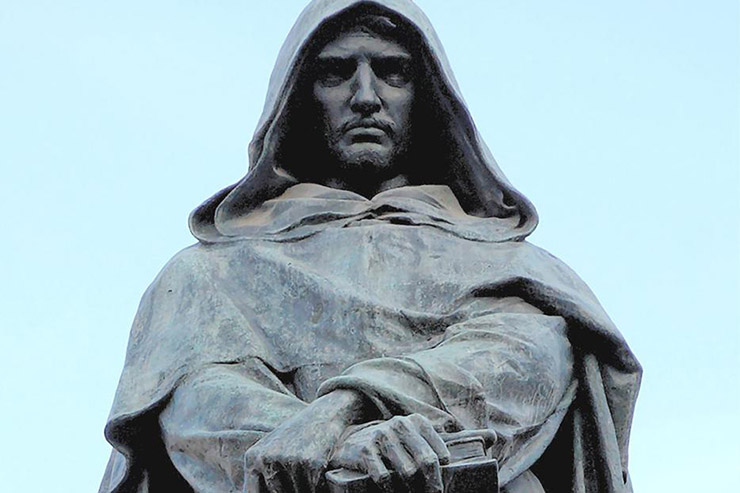
    In recent years Bruno has begun to be rediscovered and appreciated, although still the truth is often distorted in order to crowbar him into the accepted history of science. Because of his remarkably advanced ideas he tends to be regarded as a martyr for scientific rationalism, victim of even greater Church persecution than Galileo (on whom he was hugely influential). Bruno has become a hero for freethinkers and, particularly ironically, atheists, who gather annually at the site of his execution in Rome’s Campo de’ Fiori – marked by a statue erected in the late nineteenth century – to honour his memory and sacrifice. But this is missing the point in a big way. Far from being an arch materialist-rationalist, in fact everything Bruno did was inspired by his passionate belief in magic and the esoteric. 

    He is also being introduced to a wider audience through the historical thrillers of S.J. Parris (the pseudonym of British writer Stephanie Merritt), Heresy (2010) and Prophecy (2011). Although mainly concerned with Bruno as a kind of late Renaissance Hercule Poirot, she paints an authentic picture of Bruno as a dedicated and campaigning Hermeticist.

    Privy Secrets

    Ironically, Bruno began as a Dominican monk, a member of the same Order that gave rise to his nemesis, the Inquisition. He was born in 1548 in the small town of Nola – hence his nickname of ‘the Nolan’ – in the then huge Kingdom of Naples in Italy, which was under Spanish rule. Although he was christened Filippo, he took the name Giordano – from the River Jordan – on entering the Dominican monastery in Naples at the age of sixteen. In those days becoming a monk was the only way for a bright lad – and Bruno had already exhibited a prodigious intellect – from a humble background to get a good education.
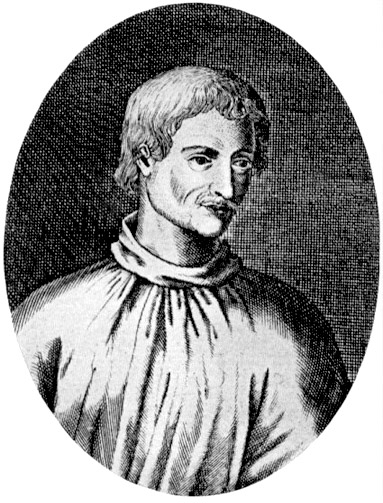
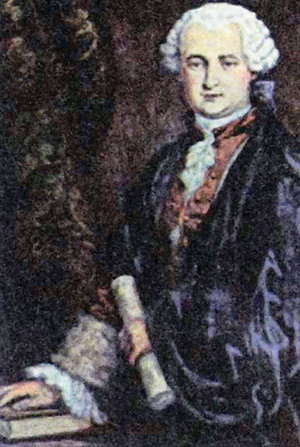
     The only known portrait of Bruno, published in 1715 in Germany, more than a century after his death.

    The young monk soon distinguished himself with his extraordinary mastery of memory-training – even being summoned to Rome to demonstrate the ability to the Pope. The classical art of memory, based on the manipulation of mental images, had a magical counterpart which employed talismanic principles to induce, rather than simply recall, information. Clearly this possessed a heady allure to someone so hungry for knowledge as Bruno. 

    As he grew in ability, exploring the powers of the mind through magic and psychology, Bruno became a powerfully confident man. Although never lacking in self-belief, he always respected those who deserved respect. On the other hand, he was disinclined to suffer fools gladly – indeed, at all. And he always, without fail, believed in his own mission… 

    A side of this self-belief that was hardly welcome in a monk was his refusal to allow others to dictate what he could read or even think. Not only were monks’ studies tightly circumscribed by their very nature, but at that time the Catholic Church was desperately trying to combat the rise of Protestantism, so departing even marginally from the conventional line attracted great suspicion. Even listening to the arguments of those deemed heretics, or reading their works, was a crime for a monk – even if you disagreed with them. 

    On the other hand, as the Dominicans were tasked with fighting heresy, they had easy access to banned books – much to the ever-curious Bruno’s delight. When his superiors discovered he had been secretly reading them in the monastery toilet he fled from Naples.

    For five years he wandered round the intellectual centres of northern Italy, southern France and Switzerland – Padua, Milan, Geneva and Toulouse among other places, with frequent gaps in his biography. By the time he reappears fully, in Paris in 1581, he had become a hardcore believer in the Renaissance occult philosophy with Hermeticism at its heart. Quite how he developed this interest is unknown, but it fundamentally underpinned everything he did for the rest of his life.

    Like everyone inspired by the Hermetic books since their rediscovery in Europe just over a century before (see our last article in New Dawn 129), Bruno was fired up with their vision of humans as glorious, miraculous beings of limitless potential – the polar opposite of what all Catholics were taught. To them, humans were little better than worms, only achieving a tiny bit of God’s grace through the intercession of the Church, and even that often depended on how much you were prepared to pay the priesthood to be let off a few years in purgatory. 

    The more he studied, the more Bruno considered everything – every level of life and understanding of our place within the cosmos – could be illuminated by the principles of Hermeticism.

    In Paris he gained the patronage of the French king, Henri III – a Catholic, but who still had a deep interest in the esoteric and was tolerant towards the French Protestants, the Huguenots. After two years Bruno moved to London, accompanying Henri’s new ambassador to Queen Elizabeth I’s court. Clearly he had Henri’s backing for whatever his mission might have been – probably establishing contact with English magi centred around John Dee. During his two-year stay in London he made friends with such luminaries as Sir Philip Sidney, and wrote some of his most important books. As we will see, Bruno left a rich intellectual legacy that influenced some of the great minds of the late-flowering English Renaissance. Many consider that the character of Berowne in Shakespeare’s Love’s Labours Lost was based on Bruno.

    It was while in London that Bruno produced his major works on cosmology that were to inspire enormous scientific advances.

    The Hermetic Key

    To Bruno the Hermetic philosophy and cosmology was the great key to unlocking the secrets of nature and the cosmos. Having already seen the Hermetica inspire Copernicus to develop his heliocentric theory, he applied himself to scientific questions using the Hermetic principles. And very fruitful it proved, too…

    A passage in Treatise X of the Corpus Hermeticum states that “the spirit, passing through the veins and arteries, moves the living thing.”1 Bruno realised the image suggests that the blood also moves, a concept that also reflected Hermetic ideas of man as a microcosm of the greater cosmos.2 Bruno’s interpretation was picked up by fellow Hermeticist Robert Fludd, who – writing in the late 1610s – inspired Charles I’s physician William Harvey with the idea of testing it. Harvey became the first person to demonstrate the circulation of the blood experimentally, “one of the greatest achievements of the Scientific Revolution.”3
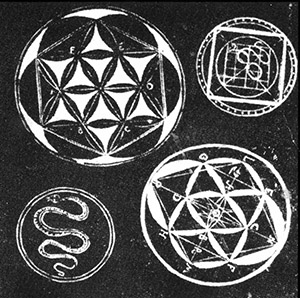
    Woodcut illustrations from Giordano Bruno, Prague 1588. Upper left cut contains a version of the “Flower of Life” pattern.

    Bruno’s Hermetic influence also extended to Elizabeth I’s physician William Gilbert’s 1600 masterwork, On the Magnet, Magnetic Bodies and the Great Magnet of the Earth, in which he proposed that magnets work because the Earth itself generates magnetic force – another landmark discovery. Without Bruno’s work, Gilbert would never have got there.4

    In our bullet-point list of Hermetic-inspired discoveries in our last article we included “the basic principles of computer science and information theory.” At first glance this may seem rather unlikely but this, too, can be traced back to Bruno’s application of Hermetic principles. This time the seed he planted flowered in Gottfried Wilhelm Leibniz (1646-1716), the German genius whose life and career paralleled those of Isaac Newton. A great polymath, Leibniz is chiefly known today for inventing infinitesimal calculus, at about the same time as Newton – although Leibniz’s system was the one that caught on – and for the basic principles of information theory, including the binary system.

    Yet even Leibniz was no hard-line materialist-rationalist. Like Newton, he was deeply versed in esotericism – almost certainly a Rosicrucian and certainly a scholar of the Cabala and, predictably, the Hermetica. Equally predictably, he owed an enormous debt to the works of Giordano Bruno.
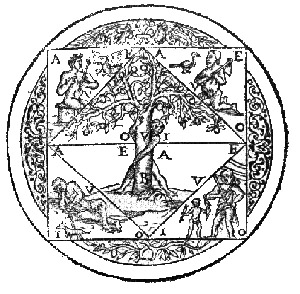
    Woodcut illustration of one of Giordano Bruno’s less complex mnemonic (memory) devices. He planted this drawing – which acts as a portal – in his mind to recall massive amounts of information from memory.

    Information theory was really just a by-product of a much more ambitious scheme. Leibniz believed it should be possible to devise a set of symbols – which he called characteristica universalis – to represent all the fundamentals of knowledge, and by manipulating them to make new discoveries (a process he described as ‘innocent magia’). He developed this idea from Bruno’s works, especially those on the magical art of memory and the manipulation of the imagination to produce desired results.

    Although Leibniz was never to achieve the full dream of the characteristica universalis, his work developed into the idea of mathematical modelling, at first using pen-and-paper equations (which is where calculus came in) and later computer modelling. His pioneering computer work also saw him designing some of the first calculating machines.

    But although Bruno can never be described as a scientist in his own right (he seems never to have undertaken a single experiment) basing his reasoning on the Hermetic principles led him to make some truly remarkable insights. (And given that he practised magical techniques to acquire information directly, we can be forgiven for wondering just how successful they were.)

    In London in 1584 Bruno wrote and published On the Infinite Universe and Worlds in which he put forward some extraordinarily advanced – and for the time deeply shocking – propositions.

    Shock and Awe

    Bruno was a leading champion of Copernicus’ heliocentric theory which, although published five years before he was born, was still regarded as new and unproven, scholarly opinion being split over whether he was right, wrong or somewhere in between. Copernicus had merely proposed that the sun was at the centre of creation; he still stuck with the traditional model that the entire cosmos consists solely of the sun, moon and planets which move within an outer ‘shell’, the sphere of the fixed stars. In other words, the stars are simply fixed points of light of varying intensity, all stuck on the same crystalline sphere and therefore equidistant from Earth. 

    But, as the title of his book implies, Bruno went further, arguing that the stars are really suns like our own, but immensely far away, and at varying distances. He rejected the concept of the sphere of the fixed stars entirely, proposing that the universe was in fact infinite. 

    Bruno also took the next logical step: if stars are really suns, then at least some must have their own system of planets. And some of those planets must be like our own.

    He wrote in On the Infinite Universe and Worlds:

    There is a single general space, a single vast immensity which we may freely call Void; in it are innumerable and infinite globes like this on which we live and grow. This space we declare to be infinite, since neither reason, convenience, possibility, sense-perception or nature assign to it a limit. In it are an infinity of worlds of the same kind as our own… Beyond the imaginary convex circumference of the universe is Time.5

    And making the final logical leap, Bruno concluded it was impossible to imagine that “these innumerable worlds, manifest as like to our own or even more magnificent, should be destitute of similar or even superior inhabitants.”6

    Of course, time and telescopes have proven Bruno right about the scale of the universe and the existence of other solar systems – and, even if it has yet to be proven, few scientists also doubt that extraterrestrial life is a reality.

    These were deeply shocking conclusions to the Church – and indeed they were high on the list of indictable offences for which Bruno was condemned to death 16 years later. Whereas Copernicus had shifted the physical centre to the sun, the focus of creation was still the Earth and human beings, which fitted the basic biblical model where God made the world as a unique place, and humans ‘in his own image’. Bruno was proposing that there was no centre, and that humans were no more or less important than other beings on other planets – and indeed, that some of the extraterrestrial races are superior to human beings. 

    This was to mark the beginning of the Vatican’s antipathy towards heliocentricity that was to climax in its persecution of Galileo.

    Where did Bruno get this radical notion? His immediate inspiration seems to have been the English mathematician Thomas Digges, a protégé and ward of John Dee, and England’s major champion of Copernican theory. Digges had argued that space is infinite in his defence of heliocentricity published in 1576, seven years before Bruno arrived in London. As they shared both interests and friends it is unlikely that Bruno and Digges never met during the former’s London years. But in any case Digges derived his idea from a section of the Hermetic treatise known as Asclepius.7

    Bruno may have reached the same conclusion independently from his own study of Asclepius, but he added the concept of other inhabited worlds, which came from his contemplation of another key Hermetic principle: that the cosmos is imbued with life.

    Bruno also showed remarkable insights into other areas of science. He understood that the body is perpetually being renewed, bit by bit, so it effectively becomes totally new over time. The current understanding is that our bodies are completely ‘replaced’, cell by cell, every seven to ten years.

    In other writings he put forward basic ideas about relativity, and some academic writers regard some of his notions about the structure of matter as effectively laying the foundations for later atomic theory.8

    So in the face of this astonishing catalogue of achievements and insights, it seems nothing short of an outright scandal that Giordano Bruno is so little known today. 
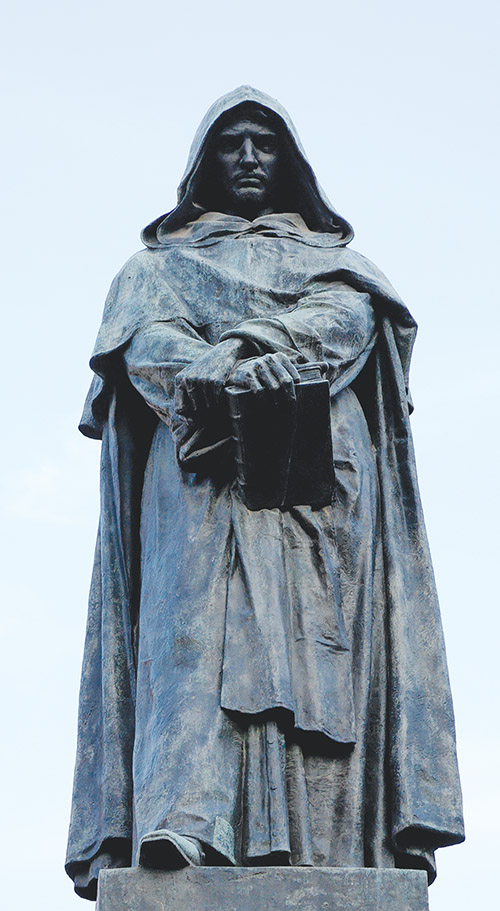
    Bronze statue of Giordano Bruno by Ettore Ferrari, Campo de’ Fiori, Rome.

    No Insignificant Ambition

    Bruno’s hugely influential ideas about the workings of the universe were only part of the picture. It was his view of the religious significance of the Hermetic tradition that inspired his most radical message – and led to his downfall.

    Another of the major works Bruno produced in London was Expulsion of the Triumphant Beast (1584). Modelled on a key Hermetic text, Kore Kosmou (Virgin of the World), and dedicated to Sir Philip Sidney, the book describes a gathering of the Egyptian and Greek deities – the goddesses Isis and Sophia taking the lead – in order to organise a great reform in the heavens. On the principle invoked in the celebrated Hermetic adage ‘as above, so below/as below, so above’, this would cause equally great changes on Earth.

    Clearly it is the earthly transformation that interested Bruno most pressingly – and for which he called so passionately. How would that manifest? In Expulsion of the Triumphant Beast, Bruno reproduces in its entirety a key section from Asclepius – a celebrated passage known as the Lament – in which Hermes Trismegistus mourns the decline of the Egyptian religion, which has been eclipsed by foreign gods, Egypt’s own having abandoned the land. But it also predicts that they will return and the religion will be restored. 

    Bruno believed this prophecy referred to his own time, and saw the religious turmoil then engulfing Europe as a sign that at least in its present form Christianity had run its course. The return of the magical religion of Egypt was imminent. 

    Since the rediscovery of the Corpus Hermeticum in the 1460s it had been universally accepted – by Hermeticism’s enthusiasts and opponents alike – that the texts contained the wisdom of the high point of ancient Egyptian, then considered the oldest civilisation. (As we showed previously, in fact there is good evidence to support the Hermetica’s ancient Egyptian origins.) Many – Bruno among them – believed therefore that they preserved the original religious revelation to mankind.

    But characteristically Bruno went further. He believed that the magical religion of ancient Egypt had been corrupted, first by the Jews and then by the Christians. (Bruno thought that Jesus had been sent to restore the Jewish religion to its true, Egyptian roots. From our own research into the origins of Christianity, detailed in our 2008 book The Masks of Christ, we would broadly agree. Without the benefit of recent historical discoveries, how did Bruno know this?)

    Bruno wanted nothing less than a root-and-branch reform of the whole of society based on the Hermetic principles, or rather, as he saw it, the religion of ancient Egypt. His ultimate aim was the creation of a spiritually unified Europe in which the religious tension between and within nations – which if unchecked would inevitably lead to a Europe-wide cataclysmic war – would be swept away.

    Bruno manifestly saw the authoritarian and dogmatically inflexible Catholic Church, rather than the Protestants, as the big stumbling block to his great reform. Indeed, although he explained the ‘triumphant beast’ of his title as a metaphor for human vices, many (including the Inquisition) took it as a not-very-thinly-veiled allusion to the Pope. This was not a good turn of events.
    The Predictable Unhappy Ending

    The worry for the Inquisition was that Giordano Bruno was not just an easily-dismissed eccentric, but an energetic and charismatic campaigner with a sharp mind who, as we have seen, enjoyed considerable influence over the likes of Henri III of France, Elizabeth I and the Holy Roman Emperor Rudolph II. Put simply, he was an Inquisition magnet and his death by fire was only a matter of time.

    Towards the end of 1585 Bruno returned to France, but found it descending into civil war as staunchly Catholic nobles challenged Henri III (who was soon to be assassinated). He then left France and for the next five years travelled the university towns of Protestant Germany preaching an increasingly hard-line message of the danger posed by the Catholic Church.

    In 1591 he made a somewhat unwise return to Italian soil, accepting an invitation from a wealthy admirer to visit the Republic of Venice. There, in May 1592, he was denounced to the Inquisition, arrested and sent to Rome. After languishing in prison for eight years he was sent to the stake on 17 February 1600 – with his tongue tied so he couldn’t address the crowds.

    Regarded as a diabolically-inspired magician who sought the destruction of God’s own Holy Church, it isn’t surprising that Bruno’s memory faded in the Catholic lands. What is less forgivable is that his great intellectual legacy was also allowed to fall by the wayside by the science historians. They seek to downplay – if not completely erase – the influence of the Hermetic tradition on science’s origins, and, whereas with the likes of Newton it was possible to pretend that their ‘occult’ interests were of no great consequence, it was utterly impossible to ignore the role of Hermeticism in Bruno’s work. Far easier just to forget him.

    Bruno’s story was by no means over. During his last travels, fearing a Catholic onslaught that would bring Europe back under its domination, he had made plans for the underground continuation of his Hermetic reform movement. He formed a secret society, or more accurately a network of secret societies, based in the universities of Germany and in the Republic of Venice, which would outlive him. Known as the Giordanisti, after his death this clandestine group would have its own key part to play in the development of the Western esotericism…

    [alert type=”general” dismiss=”no”]This article was published in New Dawn 130.[/alert]

    [alert type=”success” dismiss=”no”]If you appreciate this article, please consider subscribing to help maintain this website.[/alert]

    Footnotes

    1. Brian P. Copenhaver, Hermetica: The Greek Corpus Hermeticum and the Latin Asclepius in a New English Translation (Cambridge University Press, 1992), 33.

    2. Walter Pagel, ‘Giordano Bruno: The Philosophy of Circles and the Circular Movement of the Blood’, Journal of the History of Medicine, vol. VI, 1951.

    3. Allen G. Debus, ‘Robert Fludd and the Circulation of the Blood’, Journal of the History of Medicine, vol. XVI, no. 4, 374.

    4. Hilary Gatti, Giordano Bruno and Renaissance Science (Cornell University Press, 1999), 80-5.

    5. Translated by Dorothea Waley Singer in Giordano Bruno: His Life and Thought (Henry Shuman, 1950), 363.

    6. Singer, 323.

    7. Robert S. Westman and J.E. McGuire, Hermeticism and the Scientific Revolution (William Andrews Clark Library, 1977),24.

    8. See Ksenija Atanasijevic’s introduction to her The Metaphysical and Geometrical Doctrine of Bruno (Warren H. Green, 1972).

    © New Dawn Magazine and the respective author.
    For our reproduction notice, click here.
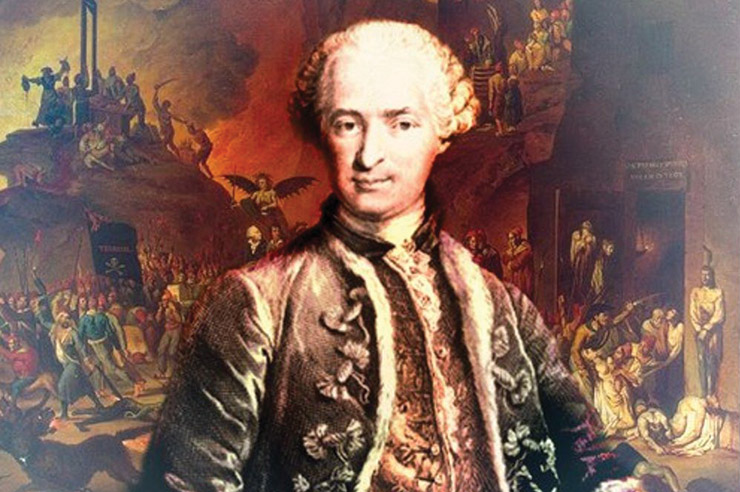
  • The Timeless Mystery of the Count de Saint-Germain

    The Timeless Mystery of the Count de Saint-Germain

    From New Dawn Special Issue Vol 11 No 3 (June 2017)

    While historical records prove that the man known as the Count de Saint-Germain actually existed, his life seems to defy common sense and appears almost magical. Was he a genius or charlatan?

    While the exact date of Saint-Germain’s birth remains unknown, he himself stated (and the known facts support his contention) that he was the son of Franz-Leopold, Prince Ragoczy of Transylvania, and Princess Charlotte Amalia of Hesse-Wahnfried, who were married in 1694. After his brothers had been taken prisoner by the Austrians and his parents had died, he was brought up by the executors of his father’s will – the Duc de Bourbon, the Duc de Maine, and the Count of Charlerie and Toulouse – and through them was introduced to the courts of Europe as someone of princely blood and almost royal descent.

    According to the historical work Illustri Italiani by Caesare Cantu, librarian of the great library in Milan, when this particular embodiment of Saint-Germain came of age, he was educated at the university of Sienna, travelled a lot in Italy and Spain, was greatly protected by the last Grand Duke of Tuscany, and eventually inherited his father’s considerable legacy, which may be why he never seemed to need money. 

    Little else was known about him until 1740, when he began turning up in various historical records as a man who appeared to be in his early thirties, moved in fashionable Viennese circles, and was renowned for his unusually sombre clothing, paradoxical fondness for spectacular diamonds, and penchant for telling extraordinary tales about his past life, including his claim that he had known the Holy Family (Jesus, Mary & Joseph) intimately; been present at the marriage feast at Cana; been a good friend of Anne, mother of the Virgin Mary; personally proposed her canonisation at the Council of Nicaea in CE 325; and prophesied that Christ would come to a bad end.

    The Saint-Germain of those days was widely spoken of as an enigmatic and remarkable figure who practised alchemy, was an expert jeweller, had travelled widely in Europe, Africa, India, China and Persia, was known to speak many languages fluently, including Chinese, Hindu and Persian, composed music and played the violin. (Pieces of music, dated 1745 and 1760, supposedly composed by, and certainly signed by, Saint-Germain, are to be found in the British Museum in London.) He also had a reputation as a ‘magical’ healer, was reported to be deeply involved in numerous esoteric orders, including the Rosicrucians and Templars, and was rumoured to be able to turn base metal into gold. He frequently described machines that bore remarkable similarities to locomotives and steamships (which had not been invented at the time) and there were suggestions he possessed the Alchemist’s Stone, had drunk from the Fountain of Eternal Youth, and was approximately 4,000 years old.

    With regard to Saint-Germain’s frequent talk of futuristic machines, the library in Troyes, France, is in possession of a document signed by him, in which he describes an experience that seems remarkably similar to modern space travel: 

    We moved through space at a speed that can be compared with nothing but itself… Within a fraction of a second the plains below us were out of sight, and the earth had become a faint nebula. I was carried up, and I travelled through the empyrean for an incalculable time at an immeasurable height. Heavenly bodies revolved, and worlds vanished beneath me… (La Très Sainte Trinosophie)

    There were many who believed Saint-Germain was a confidence trickster, but just as many who took him seriously – not least the governments of the major European countries, since the Count, apart from being talked about as a remarkable man, also had the reputation as someone involved, rather shadily, in politics. On the one hand accused by the French police of being a Prussian spy, he was, on the other, suspected by the Prussians of being a Russian agent. To complicate matters further, in November 1745, in a London obsessed with Jacobite plotters and their French sympathisers, he was arrested by the English authorities, accused of having pro-Stuart letters in his possession. He claimed indignantly that the letters had been planted on him, and was eventually released.

    Commenting on the case in a letter to Sir Horace Mann, dated 9 December 1745, Horace Walpole, the famous British art historian and esteemed man of letters, wrote the following odd description: “He [Saint-Germain] has been here these two years, and will not tell who he is or whence, but professes that he does not go by his right name.” He also wrote that Saint-Germain “sings and plays the violin wonderfully” but added that he was “mad and not very sensible.”

    A Surprisingly Youthful Saint-Germain

    The even more bewildering and legendary aspects of the original Saint-Germain began shortly after the Count had, according to the French Marshal de Belle Isle, cured him of a serious illness and was rewarded by being taken to Paris, where the grateful Marshal set him up with apartments and a laboratory for his alchemical experiments. According to Touchard la Fosse, in his Chroniques de l’Oeil de Bœuf, shortly after Saint-Germain’s arrival in Paris he attended a soirée given by the aged Countess von Georgy, wife of the deceased ambassador to Venice, who remembered meeting someone with the same name as, and similar appearance to, Saint-Germain in Venice in the 1670s. When the surprisingly youthful Saint-Germain confirmed to the ageing Countess that the man she had met all those years ago had been himself, she could scarcely believe it, since this would have made him nearly a hundred years old. However, Saint-Germain insisted he was that same man and that he was in fact very old. But then, when the stunned Countess said he must be “a devil,” Saint-Germain “trembled violently,” told her not to use such terms, and fled from the room.

    A possible substantiation for Saint-Germain’s claim that he was the man known to the much younger Countess von Georgy in the 1670s was recorded by Baron Charles Henry de Gleichen, a Danish diplomat. In his published memoirs, Baron Gleichen stated that the composer Philippe Rameau and a relative of the French ambassador to Venice had both assured him they had known Monsieur de Saint-Germain in the early 1700s when, according to them, he appeared to be a man of about fifty. The Baron also confirmed that Saint-Germain had a fondness for unusual diamonds when, in the same memoirs, he wrote: “He showed me some remarkable things – a great number of coloured brilliants and other stones of unusual size and perfection. I thought I was seeing the treasures of the fabled Cave of Jewels…”

    Could these unusual diamonds have been the products of alchemical experiments? Certainly it was believed at the time Saint-Germain was an alchemist who could turn base metal into gold, or glass into diamonds, and whose obsession with alchemy might also have led to his discovery of the elixir of life. This was thought to explain why many people remembered him from years previously and why he seemed relatively ageless. This latter aspect of his personality was heightened by his oft repeated claims that he never ate – and certainly he was never seen eating or drinking in public.

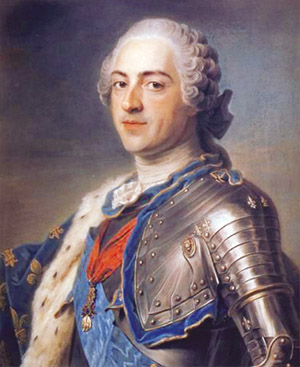
    Portrait of Louis XV, King of France. In 1758,
    Saint-Germain was presented to Louis XV.

    In 1758, while still in Paris, Saint-Germain was presented to Louis XV by Marshal de Belle Isle in the saloon of Louis’ mistress, Madame de Pompadour. He seems to have charmed both of them, since two years later, in 1760, he was sent by Louis XV to the Hague as his personal representative, to help settle the peace treaty between Prussia and Austria. While in Holland, he fell out with his former friend, the notorious philanderer Casanova, who then tried to discredit him. This may have encouraged the enmity of Louis’ Foreign Minister, the Duc de Choiseul, who convinced Louis that Saint-Germain had betrayed him and should be thrown into the Bastille. To save his neck, Saint-Germain fled to England. 

    Subsequently, a London Chronicle article of 3 January 1760, which was mainly concerned with Saint-Germain’s then widely reported ‘eternal youth’, stated: “No one now doubts it, although at first it was thought to be pure fantasy. In fact, everyone believes that, among other things, he knows of a panacea for all diseases and is able to overcome old age.”

    What this proves so far is that Saint-Germain definitely existed, that he was very odd indeed – a musician and composer, an astonishing linguist, an authority on world history, a magician and alchemist rumoured to be 4,000 years old – and who, at least according to historical records, did live a remarkably long time.

    However, from this point on, the recorded facts make his life much more concrete.

    Saint-Germain: A Legend Built from a Real Life

    In 1762 he took part in the deposition of Peter III of Russia and in bringing Catherine the Great to the throne. A year later, he was known to be carrying out further alchemical experiments in his laboratory in the Renaissance château at Chambord, south-west of Orléans, which Louis XV had put at his disposal in 1758. (Other guests in the château at the time included the Princess of Anhalt-Zerbst, mother of Catherine II of Russia; the Marquise d’Urfe; Baron de Gleichen, and Madame de Genlis, all of whom mentioned Saint-Germain’s experiments in their letters and memoirs.) The following year he was living in Holland under the name of Count Surmount, where he established another laboratory in which he made paint and dyes, as well as continuing his alchemical experiments. After disappearing from Holland with about 100,000 guilders, he materialised in Belgium, this time calling himself the Marquis de Monferret – and there, in Tournai, he set up another alchemical laboratory.

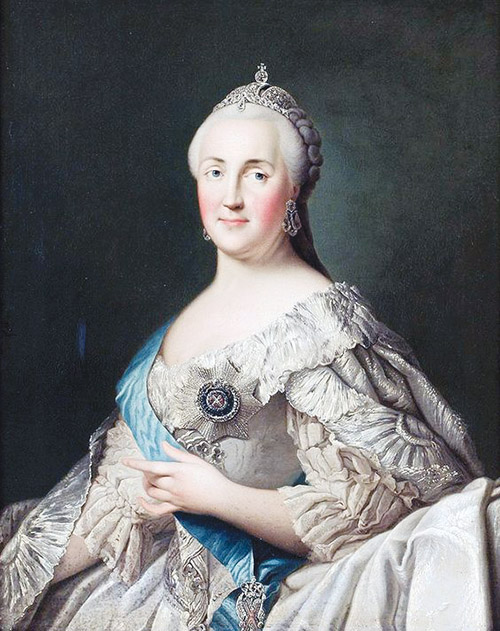
    In 1768, Saint-Germain turned up in Russia in the court of Catherine the Great (above), whom he had previously helped bring to the throne. 

    In 1768 he turned up in Russia in the court of Catherine the Great, whom he had previously helped bring to the throne. According to Count Alexei Orlov, then head of the Russian Imperial Forces, he was an invaluable diplomat and palace advisor during the Russian-Turkish war of 1768-70. As a reward, he was made a high-ranking officer in the Russian Army – a position he took under the ironic English alias of General Welldone – but instead of reaping the benefits of his prestigious position at the end of the war, he chose instead to leave Russia and go to Germany where, with his friend and pupil, Prince Charles of Hesse-Cassel, he carried out more alchemical experiments, as well as studying Freemasonry and Rosicrucianism.

    Voltaire (above) described Saint-Germain as “a man who knows everything and never dies.” 

    A decade before this, on 15 April 1758, Voltaire, the famous French historian and philosopher, in one of his many letters to Frederick the Great, had described Saint-Germain as “a man who knows everything and never dies.” He then added: “I think it quite probable that this man will visit you within the next fifty years.” While this visit never came to pass, in 1779, Princess Amalie of Prussia, the sister of Frederick the Great, met Saint-Germain and became interested in him. However, when a letter from Saint-Germain to Frederick the Great, begging for patronage, was ignored (possibly because of Frederick’s embarrassment over widely circulated reports that Saint-Germain had worked for him as a double-agent during his period in the French court) Saint-Germain returned that same year to Eckernforde, in Schleswig, Germany, where he lived, and reportedly died, in the castle of his old friend, Prince Charles of Hesse-Cassel.

    The parish records in the Catholic church of Eckernforde say that Saint-Germain died on 27 February 1784, and was buried locally. If this was true – and assuming that Saint-Germain was about fifty years old in 1701 – it makes him (at a time when thirty-five was old age) over 130 years old when he died.

    Assuming that he did die in Eckernforde. 

    Post-‘Death’ Appearances of Saint-Germain

    Although Saint-Germain’s burial is recorded in the records of the parish church in Eckernforde, a great deal of mystery surrounds his death. For a start, he was reported to have died when his good friend and disciple, Prince Charles, the Landgrave of Hesse-Cassel, was absent from home, and with only two nameless women in attendance. To deepen the mystery, Prince Charles then burned all of Saint-Germain’s supposedly invaluable papers – in his own words, “Lest they be misinterpreted.” Almost immediately, rumours that Saint-Germain was still alive spread like wildfire.

    In 1785, an important congress of Freemasons was held in Paris and attended by Rosicrucians, Kabbalists, Illuminati and members of other secret societies. According to the Masonic archives, the guests included the famous magician, mystic and alchemist, Count Cagliostro, the philosopher Louis Claude de St. Martin, the renowned physician and hypnotist, Franz Mesmer, and… the Count de Saint-Germain, who is also recorded as having addressed the meeting. 

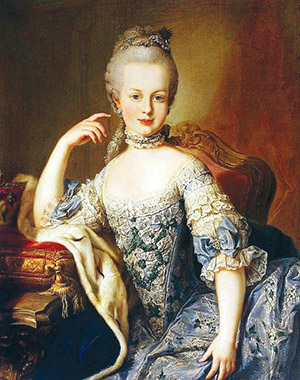
    Reportedly, Saint-Germain appeared to Marie Antoinette (above) in prison, warning her of the date and time of her execution. 

    This was not his only post-death appearance. It was recorded by the diarist Mademoiselle d’Adhemar that he visited her five times over a period of many years, beginning in 1789, when he also visited Sweden’s King Gustavus III to warn him of danger, and ending in 1820, the night before the infamous murder of the Duc de Berri. Even stranger is that in her own diaries, Marie Antoinette expressed regret that she didn’t take note of Saint-Germain’s earlier warning about the forthcoming outbreak of the French Revolution. Reportedly, Saint-Germain also appeared to Marie Antoinette in prison, to warn her of the date and time of her execution. 

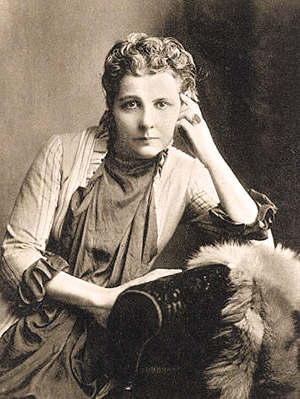
    Nor does it end there… Twenty-eight years later, in 1821, the noted educationalist, Madame de Genlis, mentioned in her memoirs a conversation she had with Saint-Germain during the Vienna peace talks; and in the same year the French ambassador, the Count de Chalon, claimed to have spoken to him in St. Mark’s Square in Venice. By 1842, Saint-Germain’s name was being mentioned in connection with Lord Lytton, whom he was said to have helped develop supernatural powers. In 1867 a meeting of the Grand Lodge of Freemasons in Milan, Italy, was reportedly attended by Saint-Germain; and in 1896, when, according to the evidence, he would have been approximately 245 years old, the famed Theosophist Annie Besant wrote that she had recently met him.

    The noted Theosophist Annie Besant (far left) wrote that she met Saint-Germain in 1896 – this was the last confirmed sighting of the mystery man who would have been 245 years old at that time. 

    Sceptics argue the known history and longevity of Saint-Germain is some kind of elaborate hoax, but it would be impossible for any individual, or organisation for that matter, to extend such a hoax over such a long period of time, as well as keeping it alive in so many different countries and cultures. Sceptics also ask why, given that Saint-Germain was supposed to have led such an extraordinary and active life, the historical records on him are so thin – but this may have been deliberate on Saint-Germain’s part. For instance, Napoleon III was so intrigued by the stories about Saint-Germain that he set up a special council to investigate him. However, the commission’s findings were destroyed in a fire that consumed the Hotel de Ville in Paris in 1871 – and few were willing to ascribe that disaster to coincidence. Similar obstructions to the sources of information, and the mysterious destruction of discovered rare material evidence, have occurred throughout the years since Saint-Germain’s final recorded materialisation in 1896, when Annie Besant noted her meeting with him. 

    Did HE Discover the Elixir of Life?

    Saint-Germain was obsessed with alchemy and the possibilities of alchemical transformation. One of the purposes of alchemy is to find a means of purifying humanity as well as Nature and applying that purification to material objects, the cosmos, or man. The changing of metal into gold is only a small part of alchemy – the unimportant part. Its major purpose is to find the ultimate purification – the panacea, the cure for all ailments, the elixir of life, the Hermetic secret that gives one immortality. Because of this, many believe Saint-Germain did not die in Eckernforde in 1784, but that he simply moved on – either in the flesh or in the spirit – and possibly commanded Prince Charles, his faithful friend and disciple, to fake his death… as it had been faked many times before.

    In the register of the Nicolai church in Eckernforde, Germany, the following words are inscribed:

    Deceased on February 27th, buried on March 2nd, 1784.
    The so-called Comte de St Germain and Weldon.
    Further information not known. 

    That use of the phrase ‘so-called’ only deepens the mystery.

    [alert type=”general” dismiss=”no”]This article was published in New Dawn Special Issue Vol 11 No 3.[/alert]

    [alert type=”success” dismiss=”no”]If you appreciate this article, please consider subscribing to help maintain this website.[/alert]

    © New Dawn Magazine and the respective author.
    For our reproduction notice, click here.
  • Alice A. Bailey: Mother of the New Age or the New World Order?

    Alice A. Bailey: Mother of the New Age or the New World Order?

    From New Dawn Special Issue Vol 13 No 2 (June 2019)

    One of the most controversial figures to emerge from the Theosophical Society (TS) in the early twentieth century grew up a devout Christian far removed from occult circles. For many decades her faith was unshakeable, yet the seeds of her conversion lay in her introspective nature and sensitivity to mysticism. 

    In the scholarly milieu, she is considered to be the mother of the New Age movement, harnessing the term circulating among occultists and the spiritually minded in her milieu, and composing a series of foundational texts which provide much of the theoretical basis of New Age thinking. 

    The obscure Theosophist has left a hidden legacy that continues to this day to influence world affairs behind the scenes through various key roles, bodies and organisations operating within the United Nations. The degree of influence is difficult to gauge, but conspiracy theorists would argue it is significant.

    Alice Ann Bailey (1880–1949) was born into the aristocratic La Trobe-Bateman family. Among her ancestors are Victoria’s first governor, Charles La Trobe, and the renowned book illuminator, Edward La Trobe. Other notables include neoclassical architect Benjamin Henry Boneval La Trobe and Alice’s grandfather, civil engineer John Frederick La Trobe Bateman. 

    Unlike her younger sister, Alice deviated from the path her family expected her to tread. She did not marry, and she had no interest in pursuing a university education. Instead, adhering to her unwavering belief in the need for the salvation of souls, she worked as a missionary in soldier’s homes for the British army in Ireland and India, expounding the Gospels, entertaining the men playing checkers, serving cocoa and eggs, and sitting beside the ill and dying. 

    Her time in India came to an abrupt end when she suffered a physical and psychological breakdown. Her faith, which she had held dear for so long, began to waver. It was then she fell in love with a soldier in the Hussar regiment, Walter Evans. It was an unfortunate match. The couple moved to Cincinnati where Walter attended Lane Theological Seminary. 

    Three daughters and numerous bruises later, Alice managed to free herself from Walter’s violence. She then spent several years packing sardines in one of Monterey’s canneries, made famous by John Steinbeck in Cannery Row.

    It was during this period that Alice converted to Theosophy after attending a lecture at the home of some acquaintances. She devoured the teachings and received guidance from founder Madame Helena Blavatsky’s personal students. Before long, Alice was giving her own classes in Theosophy.

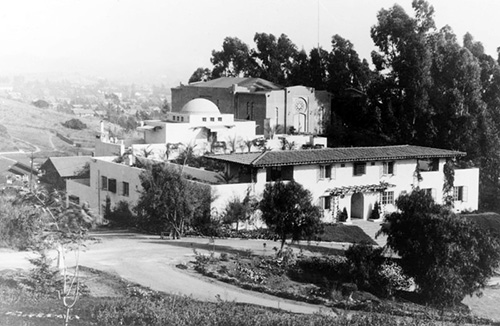
    Consumed by this new body of knowledge, she moved to the Theosophical headquarters at Krotona, Hollywood, where she worked in the café. As soon as she could, she joined the elite Esoteric Section of the society. 

    Krotona Institute of Theosophy, Hollywood, USA, early 1900s. Credit: Los Angeles Public Library

    In January 1919, Alice Evans met her second husband, Foster Bailey, a lawyer and Freemason from Massachusetts born into a distinguished family of politicians and lawyers, hailing on the maternal line from founding father of Fitchburg, Amos Kimball. The couple soon took on key administrative roles in the TS, Foster as secretary and Alice as editor of the sectional magazine. 

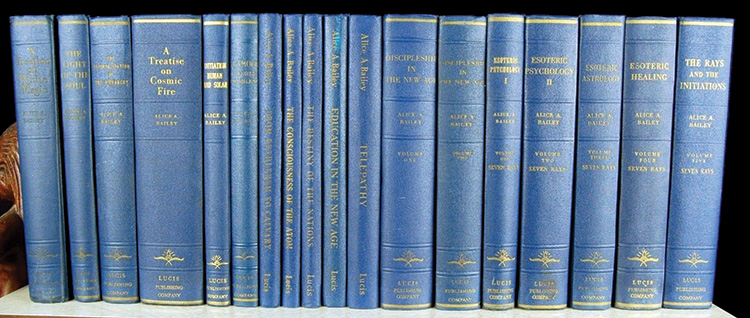
    Around October of that year, Alice began writing as amanuensis for The Tibetan or Djwhal Khul, one of the Theosophical Masters of Wisdom. The Tibetan had also been Blavatsky’s master, from which her seminal text The Secret Doctrine arose. Reluctant at first, Alice took on the role of writing for The Tibetan, a role that would culminate in twenty-four volumes of esoteric teachings and commentary, a number written in her own right and many published posthumously. The collection became known as the Blue Books due to their indigo covers. 

    A year later, an organisational row resulted in both Alice and Foster being ousted from their roles in the TS. They moved to New York where Foster was offered work as secretary of a Theosophical association. The couple quickly married and settled in Ridgefield Park, NJ. While Foster continued to campaign to change key organisational practices of the TS, Alice continued writing as she visioned their future. 

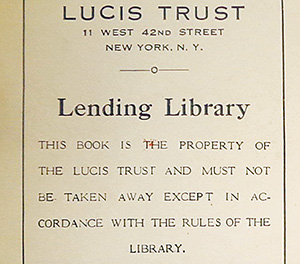
    She established a Secret Doctrine class held in a room on Madison Avenue, which became an outstanding success. Interest grew and grew from all over the United States and beyond, and correspondence mounted. In 1922, the Baileys established the Lucis Trust and published the first three volumes of her opus. In 1923, they founded the Arcane School – an esoteric training school delivered by correspondence to disciples around the world. 

    Alice Bailey would dedicate the rest of her life to laying the foundations of a new age of spiritual enlightenment, in the hope of countering the continued rise of materialism, hatred and greed.

    The Blue Books

    Alice Bailey’s body of work is in part a reformulation of the Theosophical current of Western Esotericism, composed in language accessible to the contemporary mind. Central to Theosophy are: a belief in the existence of the soul, reincarnation and the interconnectedness of all existence; an epochal view of evolution that includes consciousness; the transmission of an Ageless Wisdom from master to disciple; and a commitment to humanitarianism. 

    There is nothing fluffy between the pages of the Blue Books. The atmosphere the teachings evokes is business-like, with an emphasis on responsibility, leadership and executive management. The volumes are instructional texts for aspirants and disciples of the spiritual path. Some are harder to read than others. The volumes include A Treatise on Cosmic Fire, an intricate cosmology drawing on Neoplatonist metaphysics and Eastern philosophy. Other works provide instructions for disciples on how to live, think and behave. A Treatise on the Seven Rays provides a detailed formulation of human psychology and advice on meditation and healing. 

    Cemented in Alice Bailey’s particular version of Theosophy are Christian ideas of goodwill and good works, and she sought to make these basic principles the cornerstones of her teachings. She made it her mission to elevate occultism from the lower reaches of charlatans and counter the left-hand path some occultists follow. For Alice Bailey, esoteric thought and practice needed to be oriented towards selfless, altruistic goals and always for the good of the whole. 

    Controversies

    Despite these noble aims, during her lifetime Alice Bailey aroused the wrath of purist Theosophists, Christians and Jews who all took issue with her body of work.

    Purist Theosophists accused Alice Bailey of false claim-making over her assertion that the source of most of her writings was none other than Blavatsky’s master Djwhal Khul. That she was merely a conduit in telepathic rapport receiving the next outpouring of the Ageless Wisdom provided her with a handy disclaimer should any issues of copyright or plagiarism arise. Some even alleged Alice Bailey made use of secret Theosophical teachings only available to members of the society’s Esoteric Section, a matter that cannot be proven as the teachings have not been made available in the public domain. 

    She upset members of the Jewish community through her criticisms of their exclusive practices and an attachment to the notion of a Chosen People, which separated Jews from the rest of humanity in her eyes. Controversy also surrounds interpretations of the Theosophical root races, which appear to position Jews as less advanced. She trod sensitive ground even then, although to her credit some of her closest allies and co-workers were Jewish, including renowned psychiatrist Roberto Assagioli, who was highly influential in the foundation of humanistic and transpersonal psychology. Today, the Lucis Trust has issued an explanation of Alice Bailey’s position on the Jewish faith which can be found on their website. 

    The Lucis publishing company started life as the Lucifer Publishing Company; an unfortunate choice and Alice Bailey quickly changed the name when she realised the upset it was causing among fundamentalist Christians. Her original choice stuck in the minds of later Christians, including author Constance Cumbey, who uses the original name to take Alice Bailey to task over her alliance with pure evil. Conspiracy thinkers cite the same. 

    Throughout her writing life, Alice Bailey strove to gain credibility in academic circles. She wanted her texts to be taken seriously and set apart from the gamut of occult literature being published at the time. She solicited forewords and prefaces from sympathetic scholars including popular psychologist Harry Allen Overstreet and eminent professor of philosophy Oliver L Reiser. Not having received a tertiary education, she was at pains to include references to leading scholars in the fields of psychology, philosophy and religion, including the eminent psychiatrist Carl Jung. She met with some success but failed to achieve acceptance among the intellectual milieu. 

    She rose above all of these threats to her reputation and credibility, yet a close reading of her unfinished autobiography reveals a defensive tone in relation to her husband, her daughters, her views on Jews, her own Christian fundamentalism and the Theosophical Society. It is transparent that she was painfully aware of her critics and sought to counter their claims.

    Influencing the New Age Movement

    Alice Bailey can be called the mother of the New Age movement if for no other reason than she set out to give birth through her texts, organisations and followers to a new and spiritually informed world order. Many who know of and respect Alice Bailey can be found in the New Age movement, yet few may realise just how influential her work has been in the movement’s foundation.

    The New Age began as a utopian counter culture which rejected mainstream beliefs and values and searched for alternatives. The roots of the New Age are deep and can be traced back at least to the 1800s when interest in spirituality as an alternative to mainstream religion and dull intellectualism burgeoned, culminating, in esoteric circles, in the founding of the Theosophical Society in 1885. Alice Bailey, along with Rudolf Steiner and Krishnamurti, brought Theosophical teachings to their own audiences, helping to perpetuate continuing interest in the Ageless Wisdom. 

    Hopes for a new utopian age were prevalent in Europe, Britain and America in the 1920s and 30s, at a time when the occult and spirituality to some degree fused. While dedicated seekers were committing to particular currents, dabblers and ‘armchair enthusiasts’ tried out or considered various strands, everything from the ideas of Mary Swainson, through Gurdjieff, Ouspensky, Meher Baba, Sufism, Rosicrucianism, Wicca and Jung, along with the aforementioned Theosophists. 

    Alice Bailey was a prominent figure in the scene. She lectured far and wide. The Beacon was acknowledged to be a high-quality occult periodical.Book reviews and her letters appeared in the prestigious Occult Review

    What others may have lacked and Bailey had in abundance was a highly focused missionary zeal. Everything she did in every hour of every day for thirty years was devoted to her cause. Her single-mindedness fuelled a similar dedication in her students, especially among her Arcane School graduates, those who have carried forward her vision. She continues to draw towards her, out of the general pool of seekers, those who are as serious, focused and committed as she. 

    Her entire body of work can be described a New Age thought-form. She sought to found a paradigm, not a movement of spiritual seekers. All the personal-growth training contained in the New Age movement is, in Alice Bailey’s worldview, meant to be preparation for world service, not self-aggrandisement. For her, healing of various emotional and mental wounds is a side issue, something that may occur solely to divest the personality of its own obstacles. 

    A Treatise on White Magic: or The Way of the Disciple is a work prized as a training manual for spiritual discipleship, containing fifteen ‘rules’ of the path, in essence a guide on how to avoid the dark path of black magic and render the student equipped for world service. Disciples are “instruments of service,” charged with developing their intuition and their sense of values, and turning their inner ear to those voices on the inner planes in order to inaugurate the New Age. 

    Should her disciples fail in their responsibilities, then the Masters will withdraw, change their plans, and find some other way to proceed. Alice Bailey’s entire canon pivots on this one single charge. An opportunity exists for a new orientation, for humanity to pass through the portal of initiation into the kingdom of the soul. This is the New Age, should we want it.

    Alice Bailey’s New Age is the dawning of global consciousness and the manifestation of the World Disciple, one with an expanded awareness of affairs affecting humanity and the planet. The hallmark of such global consciousness is world service, relinquishing selfish desires of the personality and acting in goodwill to foster right relations for the good of the whole. 

    Through her texts and organisations, she not only helped conceptualise the New Age, she energised the concept with her evangelical drive, infusing the very notion with the atmosphere of ‘born again’ religious fervour. Her mission was to convert, to foster the birth of the soul, to guide her readers towards spiritual enlightenment. 

    She was not unsuccessful. Her followers went on to interpret and step down her teachings to render them intelligible to seekers among the general population. Authors such as Vera Stanley Alder, Nancy Magor and Michael J. Eastcott, and Roberto Assagioli, provided interpretive bridges for later seekers, practitioners and writers. New Age luminaries inspired by Alice Bailey include David Spangler, William Bloom, Benjamin Creme and Jean Houston.

    Alice Bailey has influenced Western understanding of the chakras, colour therapy, light work, astrology and transpersonal psychology, as well as providing core inspiration for the well-known alternative community of Findhorn in Scotland’s northeast. 

    Alice Bailey & the United Nations

    The New Age Alice Bailey sought to inspire took a new turn during World War II. In response to the evils of dictatorship, Bailey, like many others of her time, yearned for better governance. She was distressed by the war, deeply affected by the suffering she saw and appalled by the aggressor nations. She argued the need for a new world order, one founded on ideas of equality, goodwill and leadership. She advocated equality of opportunity for all, individual freedom and autonomy, the eradication of poverty, the sovereign rights of all nations, a universal education, shared resources distributed fairly, and disarmament. 

    She had no outward anchor for her reflections until 1st January 1942, when government representatives of twenty-six nations pledged to fight against the Axis powers and signed the Declaration of the United Nations, a declaration that led to the founding of the United Nations on 24th October 1945 in San Francisco, when its charter was ratified. Until then, all her efforts were poured into training disciples who were to go off in their various directions in the capacity of world service. The United Nations gave Bailey a focus and from then on she directed her disciples towards the organisation. 

    Her support of the United Nations is unsurprising, the organisation representing a dovetailing of her spiritual ethos with the pressing concerns of the era to address the situation that had led to another world war, not least a widespread desire to create some form of international law designed to protect individuals and groups from abuses meted out by nation states, challenging the idea that a nation has an inviolable right to treat its citizens or anyone within its borders however it wishes. Through Alice Bailey’s eyes, there was at last hope of a better world, one founded on unity, goodwill and right relations. 

    Alice Bailey’s call for a New World Order and support of the United Nations have resulted in an uproar among conspiracy theorists. Conspiracists are not wrong when they point to the infiltration of the UN by Alice Bailey’s co-workers. Membership of the UN’s Spiritual Caucus is filled with her people. Her organisation, World Goodwill, is a UN NGO. In 1952, Eleanor Roosevelt read Alice Bailey’s prayer, The Great Invocation, on a radio broadcast from the UN building in New York. 

    One key UN figure closely associated with Alice Bailey is Robert Muller, who served in the UN for forty years and was assistant to three Secretary Generals. Muller devised the World Core Curriculum for which he was awarded the UNESCO Peace Education Prize in 1989, a curriculum loosely based on Alice Bailey’s Education in the New Age. He contributed to Alice Bailey’s magazine, The Beacon, and addressed Arcane School conferences. 

    A coterie of influential figures operating out of plain sight would arouse suspicion in most of us. When those individuals believe in and are practising a form of occultism, suspicions inflame. And when the focus of activity is the United Nations – a locus for the New World Order – the result is a perfect storm of fear, speculation and evidence gathering. Whether Alice Bailey deserves it or not, she has become a pet hate among conspiracists.

    The Passing of a Remarkable Occultist

    Alice Bailey can be called the mother of the New Age movement if for no other reason than she set out to give birth through her texts, organisations and followers to a new and spiritually informed world order.

    Alice Bailey passed away in December 1949 with her husband Foster at her bedside. She had been ill for many years. Among her health conditions, she suffered from pernicious anaemia. Symptoms are wide-ranging and incapacitating. Even with treatment, the condition can be debilitating and painful. Alice received regular blood transfusions. Despite this, she worked tirelessly to the very end, holding executive meetings from her hospital bed. 

    After her death, Foster and their closest co-workers set about continuing the work. The Lucis Trust continues to publish the Blue Books in twenty languages and maintains and promotes the organisations she founded. Her co-workers to this day occupy key roles within the United Nations, and her texts continue to influence alternative spirituality and Western esoteric understanding and practice. 

    Alice Bailey’s version of esoteric truth is meant to foster goodwill and right relations. It is up to the individual to decide if it does.

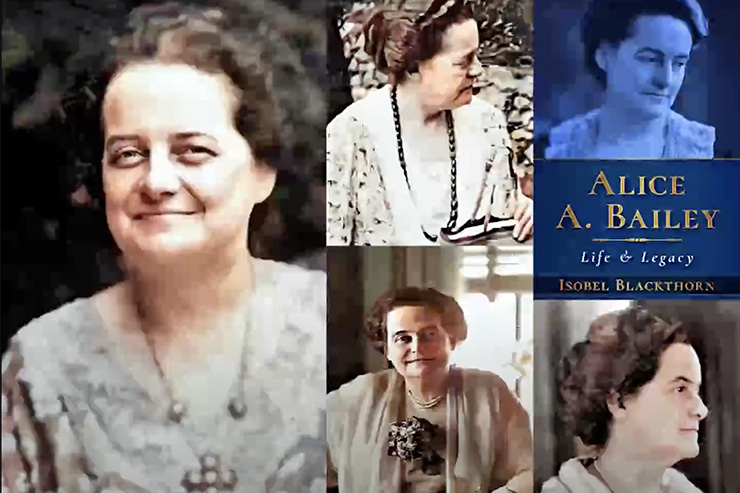
    Isobel Blackthorn has written a biography of Alice Bailey. To learn more, visit this web page: https://isobelblackthorn.com/alice-a-bailey-life-and-legacy/

    [alert type=”general” dismiss=”no”]This article was published in New Dawn Special Issue Vol 13 No 2.[/alert]

    [alert type=”success” dismiss=”no”]If you appreciate this article, please consider subscribing to help maintain this website.[/alert]

    Bibliography

    Alice Bailey was prolific. Here is a selection of her works mentioned above. All her teachings are available for purchase at the Lucis Trust (www.lucistrust.org) or via online retailers.
    A Treatise on Cosmic Fire, 1925
    A Treatise on White Magic or The Way of the Disciple, 1934
    A Treatise on the Seven Rays: Esoteric Psychology Vol I, 1936
    A Treatise on the Seven Rays: Esoteric Psychology Vol II, 1942
    Education in the New Age, 1954
    The Externalization of the Hierarchy, 1957

    © New Dawn Magazine and the respective author.
    For our reproduction notice, click here.
  • Evolution Upside-Down: History is Cyclical, Not Linear

    Evolution Upside-Down: History is Cyclical, Not Linear

    From New Dawn Special Issue Vol 12 No 3 (June 2018)

    Charles Darwin possessed some characteristics which greatly endear him to me. He was an ‘amateur’, not a professional, making it clear that an all-consuming thirst for knowledge is a mania, not a profession, with its clerical and bureaucratic overtones. And there is something immensely dashing about his voyage on the Beagle. True, he was looking for confirming instances of his pre-established theory; also true, he did seem to neglect whatever evidence he chanced upon that went against it. But the confirmation bias syndrome seems to be embedded in human nature. Objectivity is impossible. 

    Anyway, when he published his seminal works Origin of Species (1859) and The Descent of Man (1871), he happened to have the right ideas at the right time. It was the age of Positivism, that proud and most legitimate descendant of the Enlightenment. And it was the dawn of the most materialistic and deterministic age in recorded history. Darwin’s theory of biological evolution through natural selection was enthusiastically co-opted by Herbert Spencer and the intelligentsia, and applied to society as a whole. The evolutionary dogma is now taught in every school in the Western world, and found in every textbook, and not just of science, but also of history, civics, etc. The whole ethos of Western societies is imbued with, and hinges on, the materialistic myth of evolution and progress.

    The broad concept of ‘evolution’, therefore, has been an invaluable ally to modern societies. Implicitly, but often also explicitly, these maintain that, by finding themselves at the apex of the process of societal evolution, the cosmology they incarnate could not be but the best one. It is a Machiavellianly powerful argument. Why, we were apes; then, humans who could barely, say, light a fire; eventually, we mastered nature (and how!); and now, as exponents of modern democracies in the free, secular and enlightened world, we spread the good news to our fellow humans in less privileged countries, or rather ‘developing’ countries and, surely, by the laws of evolution. (Among many, many ‘anomalies’, Göbekli Tepe, the archaeological site in Anatolia, debunks such a simplistic explanation, but that does not seem to matter to the establishment.) Indeed, such ideas spread like the plague. 

    As a consequence, a Single Thought is imposed upon the world, along with a Single Behaviour. The same way of reasoning, the same ‘values’, the same way of speaking, dressing, even eating. A completely arbitrary subjective point of view has been disguised as objective and is being imposed on a global scale through cultural lobbies and the mass media. Glory to the intrinsic supremacy of the evolutionary dogma, and its ramifications: liberalism and the free market, the latter being, in effect, the result of merciless natural selection.

    Leibnitz, and far more recently Popper, postulated that we live in “the best of possible worlds.” It is the principle of sufficient reason. While Leibnitz argued that God could not have created but the best of possible worlds, one that is constantly undergoing changes for the better, Popper affirmed that contemporary Western societies, and their socioeconomic system, represent the very best system that could possibly be conceived as opposed to previous social and cultural organisations.

    Now, dear reader, if you agree with Leibnitz and Popper, read no further. You are a well-adapted human specimen, the result of a pervasive cultural indoctrination, or outright brainwash. A true son/daughter of your times. If you don’t agree, read on – at your own risk.

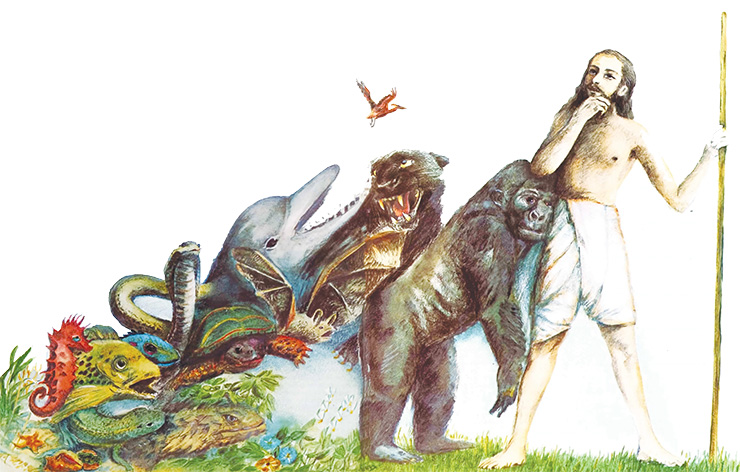
    When I was a teenager, an Italian progressive rock group released an album entitled Darwin. One of its songs encouraged the listener to “think a little differently.” It continued by explaining that nothing had been created by God, but rather all creation had created itself, and then had constantly improved thanks to the laws of evolution. Even spaghetti rock was co-opting its own warped version of Darwinism! Well, I now ask you to “think a little differently.” For you see – I do not believe that man is derived from the ape by evolution, but that the ape is derived by man by involution.

    Joseph de Maistre explained that savage peoples are not primitive peoples in the sense of original peoples, but rather the degenerated and/or degenerating remains of ancient peoples that have disappeared. I rebel against the evolutionary dogma and assert that animal species clearly show the degeneration of primordial man’s potential. In a nutshell, the ‘forbidden philosopher’ Julius Evola wrote: “These unfulfilled or deviant potentials manifest themselves as byproducts of the true evolutionary process that man has led since the beginning. For this reason, ontogenesis, the biological history of the individual, does not repeat in any way the process of phylogenesis, the presumed evolutionary history of the species, but passes again through some eliminated possibilities. It stops to roughly outline them and then moves beyond, subordinating these possibilities to the superior and specifically human principle, which is defined and fulfilled little by little in the development of the individual.”

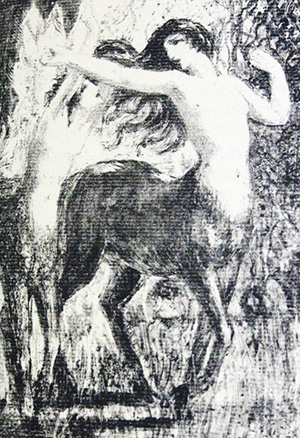
    Contrarian enough? It makes wonderful, if non-linear, sense. But the scientist would need proof. (Institutional science, incidentally, does tend to play a fixed game, as it sets up its own rules, and implicitly dismisses anything that does not quite conform with them.) Imagine, for example, a centaur, a four-legged horse body topped by a two-armed human torso with head. This lovely creature, if unearthed somewhere, would bring evolutionary theory to its knees, because there are simply no ancestors from which centaurs might have descended. On the other hand, the esoteric world may well consider us, two-legged humans, the degenerated and maimed mongrels of a centaur. 

    Artist’s rendition of a Centaur that appears in French poet Maurice de Guérin’s literary work Centaur.

    Poets seek truth, not scientists. The French poet Maurice de Guérin in his Centaur has the creature meet Pan, coming down from the mountains to the valley, there to drink from a river. It is night time. The river shimmers, a silver streak under the moon. This is the archaic Pan, a being immediately belonging to the Earth, not at all a god, though later he will be promoted to that rank. And it is Pan that De Guérin’s Centaur sees that night on the opposite side of the river, or… the first man. The Centaur is overwhelmed by disgust. And by sadness. In him, the Centaur sees a maimed individual. That being on the other side of the river announces, furthermore, his own demise, and the end of the Golden Age. Not by chance does the river seem, in the night, a silver streak. The Silver Age has begun.

    The world must have been in mourning when man detached himself from this part of his own being. The Golden Age gives way to the Silver Age. The lot will fall to Herodotus, in the fifth century BCE, to transition from the Silver Age to the Bronze Age. He stands at the cusp of the two epochs, and ushers in history. The Renaissance, and later the Enlightenment, will usher in the Iron Age, in which we live at present. 

    The scientist cannot but reject this. He must. Of course, if palaeontologists or archaeologists did unearth the remnants of a Centaur, it would not only be a fatal blow to evolutionary theory, but to science as a whole. Also, finding true anachronisms would be useful. Such as human beings fossilised inside the stomach of, say, an allosaur; or a trilobite in Cenezoic (‘recent’, up to 65 million years old) strata. But again, science, and Western societies, by and large, tend to dismiss or indeed conceal evidence that may damage the status quo. This censorship is a survival tactic, not in any way shocking or original. But apparently traces of nicotine were recently found inside an ancient Egyptian sarcophagus. Tobacco being a plant of the New World, such a discovery should have changed if nothing else our perception of history. Indeed, it would mean so much more. Not surprisingly, very little has been said or made of this. Why, Atlantean studies, i.e., the entertaining of the possibility that there was an advanced civilisation in prehistoric times, are deeply subversive. They make nonsense of Darwin, Marx, and Freud, and greatly annoy the professorial ‘experts’. They question the Big Bang cosmology. They inspire no belief in progress or social engineering. And ultimately open the door to the “black tide of mud,” as Freud called the occult (really the esoteric) in his famous feud with Jung. 

    A few years ago, I spent quite a number of afternoons and evenings interviewing the shaman, or rather ‘bundle-carrier’, of the Miccosukee tribe, in the Everglades of South Florida. After a few sessions I realised that the man was able to read my next question as I formulated it in my mind and would answer to it without my asking it orally. As would be expected, I was utterly unable to read his mind, or anybody’s. Eventually, a very odd take on history surfaced from his words.

    When the Spaniards kicked out the last Moor, thus achieving their epochal Reconquista after eight centuries of Muslim occupation, that very year, 1492, Columbus officially and ostensibly discovered America (in error?). It is hardly a coincidence. Certainly, metahistory is not taught in any school, so people are at best perplexed by it. That there should be powers involved in epochal changes which go well beyond the pettiness of human greed and social upheavals would seem a self-evident truth, yet contrariwise denied out and out as utterly unthinkable by the heralds of the evolutionary historical dogma. And what did the white men do when they came to America, asked the bundle-carrier? 

    They found the Golden Age, I realise now, in retrospect. It was not the New World; it was the Old World, older than history, older than myth.

    Yes, America was still in a state of grace. Macroscopic cereal only grew here: corn, Zea mays, bearing grains on very large ears which did not require any milling. It was the food of giants, of the Titans. Cacao, Theobroma cacao, the Fruit of Gods, which ‘theo-broma’ means in Greek. The origin of this tropical understory tree were the Amazon Headwaters from where it moved to Central America. Cocoa cultivation began by Mayan tribes in Central America, around 1500 BCE. Mayans and Aztecs attributed divine origin to the cocoa tree, brought to them by god Quetzacoatl. The sacred beverage called ‘chocolatl’ was consumed from golden cups. And the list goes on. Tobacco, i.e., Nicotiana tabacum. An herbaceous plant, tobacco was first used by the peoples of the pre-Columbian Americas. Native Americans cultivated the plant and smoked it in pipes for medicinal and ceremonial purposes. The rustica variety was used by shamans to enter trance states and induce hallucinations. Tomato, Lycopersicon esculentum, was another gift of the Golden Age. A fruit which grew readily not from a tree, and could be cultivated anywhere, provided there be enough warmth. Its edible, fleshy, usually red fruit has become a staple for cuisines the world over. What would Italian cooking be without it? No pizza? No pasta? And what of the following other godly gifts: vanilla; potatoes (which, ironically, made the Industrial Revolution possible); immense herds of bison grazing and roaming freely in the Northern Plains? What of the turkey, which has become such a symbolic animal in the US, and is raised and eaten all over the world? No fowl of this size grew in Europe and, again, with good reason, as Europe had left the Golden Age, then the Silver Age, and indeed was leaving even the Bronze Age.

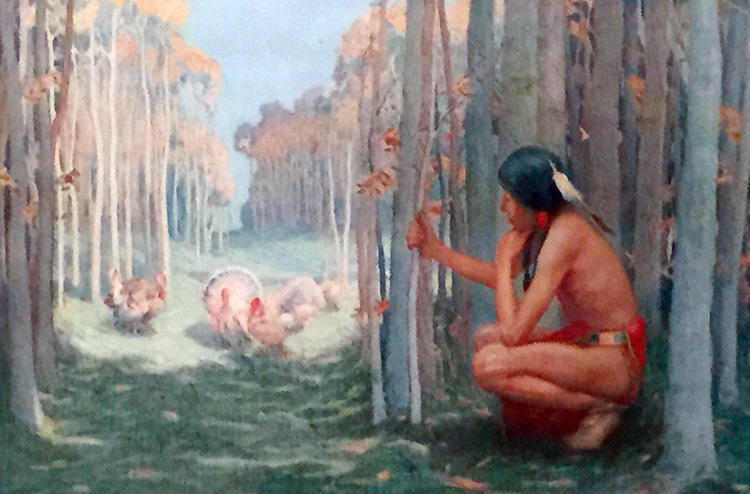
    I have a print by Eanger Irving Couse which I bought in Taos, New Mexico. Painted about a hundred years ago, it depicts a sylvan scene. A native American, wearing only a loin-cloth, and crouching on his knees, is hiding behind a clump of trees, keenly observing, unseen, some turkeys in a clearing, a few paces from him. With his right hand he is clutching what at first sight appears to be a spear. On closer inspection, one realises he is merely holding on to a branchless sapling, which can be mistaken for a spear, but is in fact a slender young tree rooted in the ground. This image, incidentally very well executed, speaks volumes. The native American, slim but evidently not hungry, does not intend to kill the turkeys, but does enjoy observing them.

    Photo of the author’s Eanger Irving Couse print.

    Such people, primitive, original people, deserved the Golden Age in which they still lived. They had no need for eschatology. Indeed, drawings have been found in caves depicting primitive hunters hunting also in their after-life. There really was no after-life, no demarcation between life here and life elsewhere. The Golden Age was the Garden of Earthly Delights, and gold itself, paradoxically, was not needed.

    White man brought along not only a host of exotic diseases, but banking, the greatest disease of them all.

    Indeed, the Catholic Church had been banning for centuries the charging of interest, as it perceived it as usury, with banking, and lending, becoming an accepted practice only during the early Renaissance. 

    “What,” asked my friend, the Miccosukee bundle-carrier, “what did the white men need banking for in America?” As a matter of fact, they owned everything: land, trees, rivers, fish, fowl, game. Everything they saw. Yet, they introduced that supreme artifice – banking. 

    We know what has happened since to the millions of bison that used to roam the prairies, at the hand of the white man, hunting for sport with lever action rifles. We know what has happened to the native Americans. Yet, we continue to disguise our societies as the logic result of evolution and progress.

    Frederic Edwin Church, the painter from the Hudson River School, made it a point to record the last vestiges of the Golden Age in this continent. He spared no effort in reaching the remotest places so as to portray their Golden Grandeur. Far more than Turner or Caspar David Friedrich, respectively from England and Germany; precisely because he roamed the Americas, he had the last chance to sing her Golden glory.

    But the evolutionary dogma has branched out and infected also the world of art. It is hard to believe, as art should have been the only field immune to such poison. Yet, we have been told that art, too, evolves. Who could like Giotto now, he who did not know perspective? Clearly, Pier della Francesca and Paolo Uccello, who introduce it, were far superior. But they pale in comparison to the grandeur of Michelangelo and, later, Tiziano. However, Caravaggio, with his shadows and chiaroscuro, is far more evolved. Not to mention Goya. Away at last from those stale religious subjects, into the far better common-life themes. But impressionism fuzzed this up too – a change for the better, of course – and all the other -isms led to the best artistic expression of them all: abstract art, a.k.a. ‘anything-goes-ism’. Indeed, as a further development along the evolutionary scale leading to perfection, ugliness became beautiful, and the beautiful, ugly. Major cities across the Western world number many a museum dedicated to this pinnacle of artistic evolution: ugly art. All along, Theodor W. Adorno and other Marxist philosophers were busy singing the praises of ugliness. 

    How can we defend ourselves from the aberrations caused by the globalised co-option and imposition of an all-encompassing evolutionary dogma? I think I have given you some hints. History is cyclical and not, as we are eloquently and assiduously told, linear. We are caught up in the very low ebb, at present. The Iron Age, or the Kali Yuga, as described in traditional Hindu texts. But the tide may come in the future. In the meantime, we are already doing what is best: differentiating ourselves from mainstream thinking.

    P.S.: My wife and I have quite a collection of abstract painting of which we are very fond; inconsistency is a good sign.

    Guido Mina di Sospiro’s Forbidden Fruits: An Occult Novel, co-authored by Joscelyn Godwin, is available from all good bookstores.

    [alert type=”general” dismiss=”no”]This article was published in New Dawn Special Issue Vol 12 No 3.[/alert]

    [alert type=”success” dismiss=”no”]If you appreciate this article, please consider subscribing to help maintain this website.[/alert]

    © New Dawn Magazine and the respective author.
    For our reproduction notice, click here.

  • The Fantastic Reality of Pauwels and Bergier

    The Fantastic Reality of Pauwels and Bergier

    From New Dawn 165 (Nov-Dec 2017)

    In 1960 a book appeared in France that triggered a kind of revolution. Not a political one, although one of the book’s authors had political ideas that slanted distinctly toward the right. It was more a revolution of the mind, of the imagination we might say, or even of reality itself. In the Paris of Jean-Paul Sartre and Albert Camus, of existentialism, black polo necks, engagement and dreary “authenticity,” the book had the effect of a flying saucer landing at the Café Deux Magots, or of a cosmic wormhole opening in Saint-Germain-des-Prés. In the black and white world of “nausea” and the “absurd,” Marxism and social commitment, it seemed to explode with technicolour visions of a strange new world. Or perhaps a strange old one, a forgotten past that at the start of that most modern of decades, seemed poised to return to lead a new generation into a fantastic future.

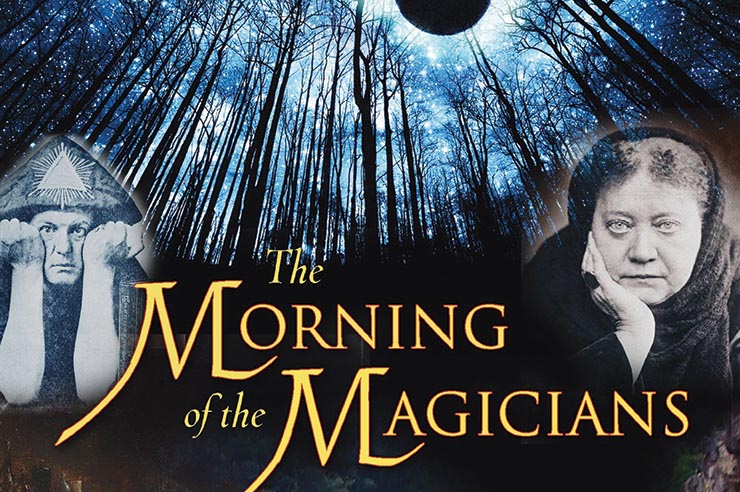
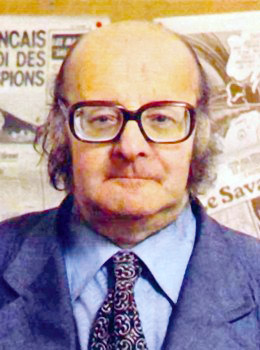
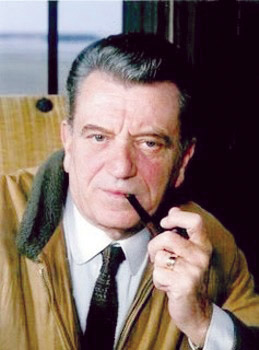
    The book was Le Matin des magiciens, or as it was soon called in its American edition, The Morning of the Magicians (The Dawn of Magic in the UK). Its authors were an unlikely pair. Louis Pauwels was a journalist who had edited a hostile, misleading book about the enigmatic esoteric teacher G. I. Gurdjieff. Pauwels had spent his last years in Paris and edited the newspaper Combat after the end of World War II; a previous editor had been Camus himself. The Russian born Jacques Bergier was a physicist and chemical engineer with an interest in alchemy and a colourful past as a spy and resistance fighter. The two met while working on a series of articles on contemporary science for a popular Parisian journal. Accounts have it that they were introduced by André Breton, the Black Pope of Surrealism, who had a distinct interest in magic himself, as his exploration of the Tarot, Arcane 17, shows. If true, then the revolution sparked by his introduction proved more influential and widespread than the one Breton had hoped Surrealism itself would bring about.

    Jacques Bergier (1912–1978) was a nuclear physicist and chemical engineer who was active in the French Resistance in World War II and helped destroy the German atomic plant at Peenemünde.
     Louis Pauwels (1920–1997) was a French journalist who founded the magazine Planète, an outgrowth of Le Matin des magiciens. 

    Pauwels and Bergier soon discovered they had much in common. They shared a central insight, dissatisfaction with what they saw as the unnecessary limits of modern science, a constraint many find still in place today. Pauwels had already spent several years investigating various schools of ‘alternative thought’. Along with spending time in Gurdjieff’s groups in the late 1940s, he had also explored the teachings of Swami Vivekananda and the Traditionalism of René Guénon. Bergier too came from a somewhat mystical background; he often spoke of a great-uncle in Russia who had been known as a ‘miraculous rabbi’. Bergier had trained with the physicist André Helbronner, whose area of inquiry was the transmutation of elements, the essence of alchemy. Helbronner was murdered by the Nazis at Buchenwald and Bergier himself spent time in Mauthausen. After his release, he became a spy for the Allies. On one mission he discovered that the Germans had a secret supply of uranium, evidence, it seemed, the Nazis were close to making their own atomic bomb.

    Bergier also claimed that in 1937 he met the elusive Fulcanelli, one of the most mysterious figures in the history of alchemy. Fulcanelli was believed to have discovered the secret of the philosopher’s stone and in his work Le Mystère des Cathédrales he revealed the hidden meanings of the alchemical “green language,” the esoteric symbols carved in stone in the great Gothic masterpieces of Chartres and Notre Dame de Paris. (Another said to have known Fulcanelli was the maverick Egyptologist René Schwaller de Lubicz, who claimed Fulcanelli stole the manuscript of Le Mystère des Cathédrales from him.) In the 1950s, Bergier’s name was linked to the American weird fiction writer H. P. Lovecraft, who had acquired a critical cachet in France denied him in his homeland. His fascination with Lovecraft’s work was long-lived. A letter Bergier wrote praising Lovecraft’s work was published in Weird Tales in 1936; another letter was published a year and a half later, lamenting Lovecraft’s death in 1937.

    Select english language editions of The Morning of the Magicians

    Pauwels and Bergier decided to write a book, exploring their ideas. For five years they gathered material, haunting libraries and periodical rooms, rummaging through newspapers, magazines, and scientific journals, seeking out curious and little-known bookshops. They studied ancient texts, investigated abandoned practices, and pored over reports of strange phenomena that were overlooked or actively ignored by the mainstream, creating their own kind of ‘X-Files’. They aimed to show how practices like alchemy, long dismissed by the modern mind, had many parallels with modern physics, and that in some strange way the modern age fast coming upon us might have more to do with ancient insights found in magic and the occult than we would suspect. In a way, they wanted to do for the post-war world what Madame Blavatsky had done a century earlier with her unwieldy masterpiece Isis Unveiled (1877): bring science up to date with the latest secrets from the remote past. This was in line with their belief that, “As a preliminary to understanding the present one must be capable of projecting one’s intelligence far into the past and far into the future.”1

    Their publisher, Éditions Gallimard, assumed the book would have modest success. They were unprepared for the reception it received. France had a long history of interest in the occult – Gurdjieff himself had died only a decade earlier – but in 1960, angst was still the rage, and the bleak milieu of Waiting for Godot, with its grim comic nihilism, was still au courant. That a book on magic and alternate realities would set the Seine on fire was hardly to be expected. Yet, within weeks of publication, Le Matin des magiciens had both banks of the river talking about things that left existentialists scratching their heads. While Allen Ginsberg howled in the Beat Hotel and American tourists slipped editions of the scandalous Olympia Press into their suitcases, amazed readers of Pauwels and Bergier were talking about alchemy, spacemen, lost civilisations, magic, occultism, quantum physics, secret societies, altered states of consciousness, the weird discoveries of Charles Fort, forgotten groups like the Hermetic Order of the Golden Dawn, and its once notorious members, like the dark magician Aleister Crowley and much, much more.

    Kick-Starting the “Occult Revival of the 1960s”

    The book was a hit. It seemed to appear at just the right time and took everyone by storm. In the process, it kick-started what became known as the “occult revival of the 1960s,” ushering in an occult boom that lasted into the 1970s and remains with us today as the New Age. Les Matin des magiciens went on to sell millions of copies in France, and by 1963 there were UK and US editions, which did just as well. The long post-war drabness and futility had lifted and a bright, exciting, and marvellous future, filled with mystery and miracle, seemed to beckon. The book’s basic message, that there are more things in heaven and earth than are dreamed of by rive gauche philosophers, caught on. Paris-Presse called it, “One of the most exciting books of our time.” Le Monde devoted two long articles to its success, and that of Planète, the magazine that Pauwels and Bergier quickly started in magiciens wake. No longer were we stuck in our ‘historical moment’, as existentialists had said. The readers of Planète found that for 5.50 francs – not cheap at the time – they could investigate the ancient past, stretch their minds into the far-flung future, dive deep into their own inner worlds, or journey out into the stars. 

    Many Frenchmen did. At its height, Planète had a bi-monthly circulation of more than 100,000, an impressive showing for a journal of its kind. Although it did not translate into the English-speaking world as had Les Matin des magiciens, Planète was a success in Italy, Belgium, Switzerland, and conferences devoted to its themes were held in places as far-flung as Canada and Argentina. Buenos Aires was home to the writer Jorge Luis Borges, who shared Pauwels and Bergier’s taste for what they called “fantastic realism”; his work appeared in several issues and he participated in the conference held there. 

    Along with Borges, Planète’s pages were home to other writers well-known to European readers, such as the ufologist Aimé Michel, the science fiction writer George Langelann – whose story ‘The Fly’ was the basis for several films – and the cryptozoologist Bernard Heuvelmans, among many others. Articles ranged from “A New Science of Dreams” and “Korzybski and General Semantics,” to “The True Woman of the Thousand and One Nights” and “A Mutant of the Eighteenth Century,” with reprints of works by C. S. Lewis, the Austrian occult novelist Gustav Meyrink, Salvador Dali, and others. 

    With its wide range of subjects and eclectic editorial brief – “Nothing that’s strange is foreign to us” was its motto – Planète catered to the burgeoning taste for the new, the marvellous, the unusual and magical that characterised the decade of the “mystic Sixties,” with articles on science, literature, archaeology, film, history, occultism, and much else. Workshops and clubs based on Planète’s themes were opened in Egypt, India, and Mexico. Its reach was global, we could even say planetary, and its impact was, like that of the book that spawned it, eventually felt around the world.

    Reality is Much More Fantastic Than We Imagine

    The 1950s had seen some other odd best-sellers. Immanuel Velikovsky’s Worlds in Collision, for example, published in 1950,hadrevived the catastrophe theory of cosmology by arguing that a comet sprung from Jupiter just missed Earth but destroyed Atlantis and caused several biblical miracles as it passed by. It sold millions of copies. In 1956 the Englishman Cyril Henry Hoskins started a long and successful career with his book The Third Eye: The Autobiography of a Tibetan Lama, written under the pseudonym T. Lobsang Rampa. That Hoskins, a plumber, had never journeyed far from his home in Devon, England, seemed no obstacle to this account of his past life in the Himalayas, and his millions of readers agreed. 

    But The Morning of the Magicians – the edition I knew – was different than these and other popular books about flying saucers, like George Adamski’s Flying Saucers Have Landed (1953) or suburban witchcraft, like Gerald Gardner’s Witchcraft Today (1954). It tried to link together, however loosely, a variety of unusual phenomena and ideas, in most cases with little more than their sheer strangeness. It argued a point of view, the idea that reality is already much more fantastic than we imagine, and that if we peek beneath its surface, we will discover the strange connections linking everything together. This may be the roots of a ‘conspiracy consciousness’, but it is also the beginning of a sense of a deeper meaning, hidden somewhere within the everyday world, that we can discover if we look for it. 

    Where Lovecraft, a familiar figure to Planète readers, warns us not to connect the dots, for fear of discovering a maddening reality – “the most merciful thing in the world,” he tells us, “is the inability of the human mind to correlate all its contents.” Pauwels and Bergier positively insist that we do so. For them, reality is not devastating, but fantastic, and their pursuit of it is not an escape from life – as it is for many romantics – but a deeper participation in it. The fantastic was reached by making contact with reality directly, by throwing off old habits of mind and prejudices of thought and opening consciousness to new possibilities. It was reached through what Pauwels and Bergier, borrowing from Gurdjieff, called “the awakened state,” a new way of understanding reality, beyond the usual limits of “yes” or “no” that keep us hypnotised.2 

    It was this aspect of the book that attracted the praise of important figures like the philosopher Edgar Morin and the writer Umberto Eco. For the historian of religion Mircea Eliade, what was “new and exhilarating” about The Morning of the Magicians, “was the optimistic and holistic outlook… in which human life again became meaningful and promised an endless perfectibility.” We were called to “conquer the physical universe and to unravel the other, enigmatic universes revealed by occultists and gnostics.”3 Not all shared Eliade’s appreciation. Some, like the scholar of esotericism Antoine Faivre, who knew Pauwels and Bergier, saw the book as little more than a “masterpiece of confusionism” and “an adroit commercial undertaking.”4 That it was a commercial success is undoubted, yet an honest appraisal must admit to some “confusionism” as well. 

    An attentive reader soon encounters it. The book is full of inaccuracies, its breathless prose often trips over itself with sensational claims, its research is questionable, and references are at a premium. It is, as Colin Wilson wrote, a “curious hodgepodge of a book,” “too wild and undisciplined,” and lacking a connecting thread linking together its ideas about a hollow earth, ancient astronauts, lost civilisations and dozens of other strange items.5 In this, it suffers the same defect as the books of Charles Fort, a central influence on Pauwels and Bergier, and which also hampers their later collaborations Eternal Man (1972) and Impossible Possibilities (1974), neither of which have the same magic as their first effort. Blavatsky’s Isis Unveiled, mentioned earlier, has the same problem: it presents an enormous amount of material which, while undoubtedly startling and exciting, soon begins to numb through sheer excess. 

    Probably the most serious inaccuracies in the book involve the alleged occult interests of Hitler and the Nazis, dubious claims about dark forces at work behind the Fuehrer that have gone on to spawn a whole genre of suspect literature, and which seeped into music, film and other areas of culture. Serious investigations into the “occult roots of National Socialism” done by Nicholas Goodrick-Clarke, Hans Thomas Hakl and others throw doubt on most of the claims made about “occult Nazism” in The Morning of the Magicians

    There are other mistakes – those about the Hermetic Order of the Golden Dawn deserve special mention – but the general shakiness of many of Pauwels and Bergier’s claims has led the book to be categorised by later readers as a “grab-bag of inspiring misinformation.” In this it is much like the work of an earlier Frenchman with a taste for the occult, Éliphas Lévi, whose gripping and highly readable books on Kabbalah and magic, while inspiring many young occultists – myself included – are nevertheless peppered with mistakes and outright howlers. 

    Yet in one sense the sensationalism and inaccuracies of The Morning of the Magicians hardly matter; in the occult genre, sadly, they are often the norm. Whatever the book’s flaws, its place in the counter-history of western consciousness is secure. As I say in Turn Off Your Mind, my history of the influence of occult ideas on the 1960s, one of the remarkable things about The Morning of the Magicians is that it seemed to presage many of the themes that would come to dominate that decade.6 For one thing, it heralded the ancient astronaut craze that hit the screen with Stanley Kubrick’s psychedelic ‘2001: A Space Odyssey’ (1968) and made Erich von Däniken, author of Chariots of the Gods (1969),a rich man. But perhaps even more significant was its anticipation of the youth rebellion that would characterise the times. 

    One of the central themes of The Morning of the Magicians is that of the mutant, young individuals with strange abilities, who are evolving into a higher type of human, and who stand out from the average. Pauwels and Bergier give many examples of this phenomenon, but they were not alone. Around the same time ‘The Village of the Damned’ (1960), the film version of John Wyndham’s novel The Midwich Cuckoos, was released. It tells the story of a strange meteor shower that leaves the young women of a small English village pregnant, although many are virgins. The children turn out to be part of a collective mind, possessing enormous intellects and strange mental powers. And in 1963 Marvel Comics started what was to become one of its most successful series, The X-Men. This featured teenagers who, like the mutants of ‘The Village of the Damned’, possess weird powers and band together for support in a world that won’t accept them. 

    Not long after this, other, real-life teenagers felt something similar. In Haight-Ashbury in 1967 the San Francisco Oracle, the psychedelic spreadsheet for the Aquarian Age, published a “Manifesto for Mutants.” It proclaimed:

    Mutants! Know now that you exist!
    They have hid you in cities
    And clothed you in fools clothes
    Know now that you are free.

    By then the occult revival, spawned by The Morning of the Magicians, was in full swing. The fantastic realism that its authors sought to awaken in their readers seemed, at least for a time, to have taken to the streets. If the ‘reality revolution’ of that mystic decade eventually petered out – Planète itself stopped publishing in 1972, Bergier died in 1978 and Pauwels in 1997 – the light of that magical morning nevertheless still shines today.

    [alert type=”general” dismiss=”no”]This article was published in New Dawn 164.[/alert]

    [alert type=”success” dismiss=”no”]If you appreciate this article, please consider subscribing to help maintain this website.[/alert]

    Footnotes

    1. Louis Pauwels and Jacques Bergier, The Morning of the Magicians, Dorset Press, 1988, vii
    2. Ibid., 96
    3. Mircea Eliade, Occultism, Witchcraft, and Cultural Fashion, University of Chicago Press, 1976, 10
    4. Antoine Faivre, Access to Western Esotericism, SUNY Press, 1996, 104
    5. Colin Wilson, The Supernatural, Carrol & Graf, 1991, 1-2
    6. Gary Lachman, Turn Off Your Mind: The Mystic Sixties and the Dark Side of the Age of Aquarius, Disinformation Books, 2003, 19; expanded UK edition The Dedalus Book of the 1960s; Turn Off Your Mind, Dedalus Books, 2009

    © New Dawn Magazine and the respective author.
    For our reproduction notice, click here.