New Dawn – World's Most Unusual Magazine

Category: Secret History

  • The Tell-Tale Sign of the All-Seeing Eye

    The Tell-Tale Sign of the All-Seeing Eye

    From New Dawn Special Issue 18 (Dec 2011)

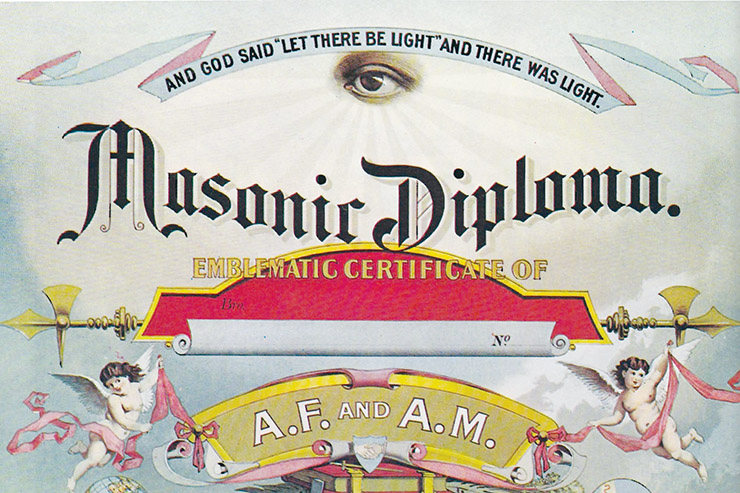
    The symbol of the All Seeing Eye appears regularly among writings by conspiracy theorists. It is alleged the reverse of the Great Seal of the USA is a Masonic symbol and proves that Masonry helped found the United States of America.1 It is also widely believed the All Seeing Eye is the symbol of the Illuminati,2 and where the symbol appears that is evidence of a continuing Illuminatist influence. 

    While there is much exaggeration and outright falsification based on individual bias, often religiously based, there is also the antithetical position of certain Masons, especially from the Anglophone ‘United Grand Lodge’, who hold there is little significance to the symbol, and that where the symbol appears in association with subversive movements, these are not “genuine Masons.”3 Although this writer has not been able to find any reliable evidence that the All Seeing Eye is in fact the symbol of the Illuminati, the debunkers of all critiques of Masonry are also often in error or are disingenuous. This article examines some examples of the All Seeing Eye as a graphic indicator of conspiracies.4
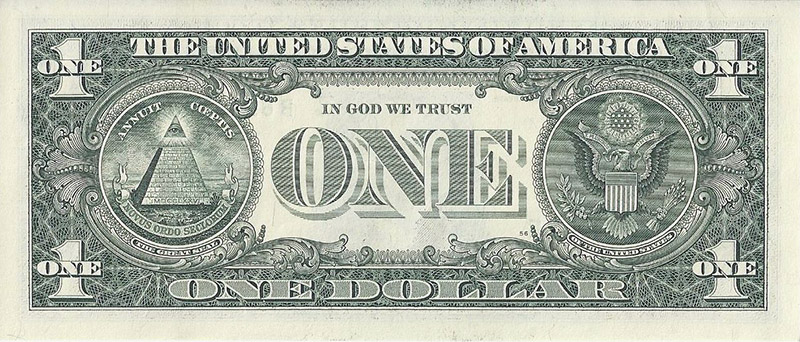
    The Great Seal of the United States: A Masonic Symbol?

    Some branches of Masonry, particularly the Grand Orient of France with its tradition of radicalism, atheism and rationalism, acknowledge that many brethren were involved in the American, French and other revolutions.5 The enigmatic symbols on the reverse side of the Great Seal of the USA, more familiarly seen on the US One Dollar Bill, have long caused speculation as to whether this is a sign of Masonic influence. There have recently been attempts at refutation, contending that the combination of the All Seeing Eye and triangle or pyramid motif is not a symbol of Masonry, or at least was not until after the American Revolution and the designing of the Great Seal; and that any subsequent use of the symbol by Masonry was not widespread.

    The British Columbia and Yukon Grand Lodge, for example, operates a website with a section devoted to refuting anti-Masonic theories. On the US Great Seal, the Canadian Masons write:

    Of the four men involved in designing the USA seal in 1776, only Benjamin Franklin was a freemason, and he contributed nothing of a Masonic nature to the committee’s proposed design for a seal…

    Congress declined the first committee’s suggestions as well as those of its 1780 committee. Francis Hopkinson, consultant to the second (1782) committee, used an unfinished pyramid in his design. Charles Thomson, Secretary of Congress, and William Barton, artist and consultant, borrowed from earlier designs and sketched what at length became the United States Seal. None of the final designers of the seal – William Baron, Charles Thomson, Sir John Prestwick – were freemasons.

    The single eye was a well-established artistic convention for an ‘omniscient Ubiquitous Deity’ in the medallic art of the Renaissance…

    The first ‘official’ use and definition of the all-seeing eye as a Masonic symbol seems to have come in 1797 with The Freemason’s Monitor of Thomas Smith Webb – 14 years after Congress adopted the design for the Seal…

    Neither the eye nor the pyramid have ever been uniquely Masonic symbols, although a few Grand Lodge jurisdictions incorporate them into their seals. The combining of the eye of providence overlooking an unfinished pyramid is a uniquely American, not masonic, icon. There are no available records showing the all-seeing eye, with or without a pyramid, associated with freemasonry prior to 1797…6 

    This Masonic refutation has widely appeared elsewhere in both Masonic and non-Masonic sources including an entry in Wikipedia. There are a number of important points that need questioning.
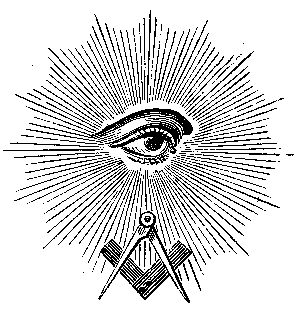
    Early Masonic Use of All Seeing Eye 

    The website ‘Pietre Stones Review of Freemasonry’ only accepts articles from Master Masons of the United Grand Lodge (UGL) and those recognised by the UGL. It is therefore an authoritative source from that perspective. In a section illustrating ‘Masonic Tracing Boards’7 there are a number which depict the All Seeing Eye as a major symbol. The earliest shown is not from the USA or from the American Colonies, but from Germany going back to 1770, well before the designing of the US Great Seal. Illustrations of early tracing boards incorporating the All Seeing Eye motif include:

    • ‘Ancient Tracing Board, Germany, 1770’.8
    • ‘Lodge Union No. 129 Kendal 1772’.9
    • ‘1796 Union Lodge, Boston’.10

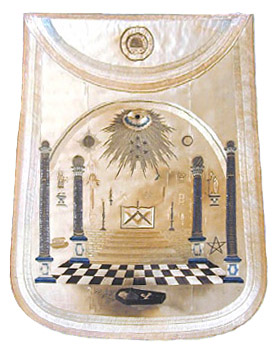
    George Washington’s Masonic Apron (left), given to him as a gift from the revolutionist General LaFayette, includes the All Seeing Eye, and dates to 1784.11 

    Ironically, the Canadian Masonic website includes a section headed ‘Masonic Art’. One of the examples is a painting by the Florentine artist Jacopo Carucci, entitled ‘Supper at Emmaus’ (1525). The Masons involved with this website have isolated the All Seeing Eye and triangle detail from the painting, and present three enlarged images of it.12 Of twelve examples of ‘Masonic art’ given by the Canadian Masons, three feature the All Seeing Eye. One is labelled ‘eye in a triangle’.13 Another is Washington’s Apron featuring the All Seeing Eye.14

    In an article entitled ‘The Masonic Landmarks’ by Dr. Athena Stafyla, written for ‘Pietre Stones Review of Freemasonry’, she (or the graphic artist) includes illustrations of both the Great Seal of the USA and a painting (presumably Masonic) of Egyptian ‘masons’ working on an incomplete pyramid.15 The pictures are carried without explanation. The pyramid without its capstone symbolises the work of Masonry, which is to complete the perfection of humanity, as per the Enlightenment and the humanistic and often communistic doctrines which were used as a means of subverting the Traditional social order of Europe and elsewhere from the 18th century. The Masonic doctrine is that the initiated Freemason is working to craft humanity towards Perfection. 

    All Seeing Eye on Dollar Bill

    Reporting on an exhibition of Rosicrucian MSS at the Rosicrucian Museum (San Jose, USA), Gary Singh writing in Metro reports a conversation he had with the curator on the Great Seal and the All Seeing Eye:

    We then come back to Roerich’s volume and discuss the Great Seal of the United States and the all-seeing eye. I mention it’s amazing that it took so long for the seal to make it onto the back of the dollar, and that I wonder why George Washington and crew didn’t put it there from the beginning. “Yeah,” said Armstrong. “Considering they were all Masons.”16

    Discussing a book by the Rosicrucian author, mystic and painter Nicholas Roerich:

    Roerich, a Rosicrucian, played an influential role in the administration of Franklin Delano Roosevelt, as he was the mover and shaker behind FDR putting the Great Seal of the United States and the all-seeing eye on the back of the $1 bill. The eye is a Masonic and Rosicrucian symbol dating back centuries.17 

    The influence on the Roosevelt Administration to get the All Seeing Eye on the Dollar Bill came via Vice President Henry Wallace, a devotee of Roerich and a 32º Mason. If the All Seeing Eye was not a Masonic symbol, one must wonder why it was considered so important by Roerich, Wallace and President Roosevelt? 

    Masonic authority Manly P. Hall18 believed the Great Seal represents a specific occult influence on the founding of the USA:

    On the reverse of our nation’s Great Seal is an unfinished pyramid to represent human society itself, imperfect and incomplete. Above floats the symbol of the esoteric orders, the radiant triangle with its all-seeing eye… There is only one possible origin for these symbols, and that is the secret societies which came to this country 150 years before the Revolutionary War… There can be no question that the Great Seal was directly inspired by these orders of the human Quest, and that it set forth the purpose for this nation.19 

    Henry Wallace was imbued with occult doctrine, particularly that inspired by Masonry. He regarded the USA as having a manifest destiny to lead the world into a new world order, and he saw that mission symbolised in the Great Seal. Alluding to the Masonic significance of the unfinished pyramid, the Masonic conception of God as the Great Architect of the Universe, and the motto on the Great Seal referring to a ‘new order of the ages’, Wallace wrote:

    It will take a more definite recognition of the Grand Architect of the Universe before the apex stone [capstone of the pyramid] is finally fitted into place and this nation in the full strength of its power is in position to assume leadership among the nations in inaugurating ‘the New Order of the Ages’.20 
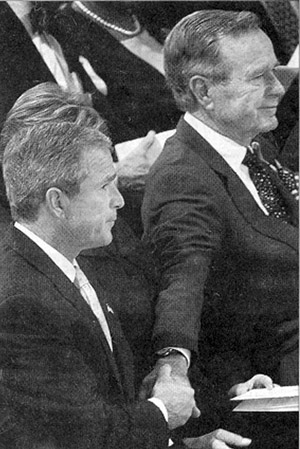
    Masonic handshake between George H.W. Bush Snr and George W. Bush, at the inauguration of a ‘new world order’ after the first Gulf War

    Wallace’s interpretation of the ‘new order of the ages’ was that of a ‘new world order’, not simply a new era for the USA (hence the reference to the USA leading the ‘nations’ into this international regime). This ‘new world order’ has now become quite familiar after US President George H.W. Bush Snr announced its official inauguration, being ushered in after the first Gulf War war against Iraq.21 His son, President George W. Bush, reiterated the aim fourteen years later when stating, in specific reference to the motto of the Great Seal: “When our Fathers declared a ‘new order of the ages’, they were acting on an ancient hope which is meant to be fulfilled.”22 The reference to an “ancient hope” implies something arcane that would be recognised by the initiated.

    All Seeing Eye of Grand Orient Masonry

    The All Seeing Eye is an important symbol in Grand Orient and associated forms of Masonry on Continental Europe. United Grand Lodge Masonry can eschew the subversive nature of the Grand Orient and others by the simple expedient of stating they are not “true Masons.” Be that as it may, this oft-cited difference did not prevent important figures such as Benjamin Franklin being initiated into the revolutionist Lodge of the Nine Sisters in Paris, nor Thomas Jefferson lauding the noble virtues of Illuminatist Adam Weishaupt.23 

    Grand Orient Masonry and its derivatives are of an Illuminatist nature, aiming to overthrow all traditional social orders, to inaugurate a world order ushered in by a faithless, materialistic rationalism, as a prelude to establishing a universal cult as was seen in the aftermath of the French Revolution when rival cults contended on the ruins of the Church and unleashed new forms of un-reason. 

    The Grand Orient of France (GODF), the mother of Grand Orient throughout the world, does not disguise its rationalist, humanistic and revolutionary pedigree:

    But in this period when the new ideas of Liberty, and Equality were to be born, which would lead to the French Revolution and the Republic, France entered the age of enlightenment. From being a sort of ‘Club’ as in England, the Masonic Lodges which very quickly spread in our country became a sounding board for these great new ideas and turned into places where debates about the emancipation of Man and Society took place. The Grand Orient de France which was set up in 1733 and was, until the end of the 19th century, the only Masonic Order in France, is still fighting for these ideals.24
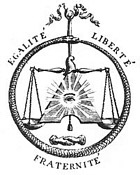
    The motto of the GODF is that of the French Revolution, Liberty, Equality, Fraternity. That is to say, the Revolutionaries adopted the motto from the Freemasons. The GODF adds:

    Thus Lafayette received a sword from George Washington in honour of the part played by French Freemasons in the American War of Independence. In this way, the preparation of the ideas of Liberty and Equality in the Masonic Lodges contributed to the great reforms of the French Revolution…25

    The GODF claims to be continuing the legacy of various revolutionary thinkers and activists including the most extreme anarchists Blanqui and Bakunin whom they identify as Grand Orient Masons:

    For the freemasons of the Grand Orient de France, the search for progress has always been the force behind their reflection and their activities, to such an extent that this principle is an integral part of the tradition of this form of Masonry. We are the heirs of men and women who all, in their own way, worked to improve Humankind: Voltaire,26 La Fayette,27 Garibaldi,28 Auguste Blanqui,29 Victor Schoelcher, Emir Abd-El-Kader, Louise Michel, Bakounine,30 Jean Zay, Félix Eboué, Pierre Brossolette and so many others whom we are proud to know have enriched our Lodges with their presence. Therefore, the Grand Orient de France is a vigilant defender of the principles contained in its motto which is also that of the Republic: ‘Liberty, Equality, Fraternity’.31

    Therefore, when academics have a clichéd tendency to ridicule ‘conspiracy theories’ on Masonry as simplistic and ignorant, they would do well to consult the Masonic literature, including that of the present day.

    As one would expect, the All Seeing Eye makes its looming appearance in the symbology of both the Grand Orient and the French Revolution. 
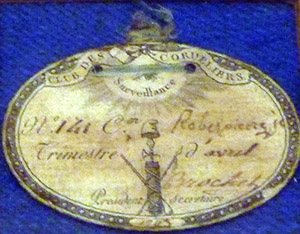
    The card of the Cordeliers Club that depicts the All Seeing Eye above the word ‘Surveillance’.32 It is pertinent to ask whether this supposed ‘Eye of Providence’ or ‘Eye of God’ is in reality the eye that sees all under a totalitarian state?

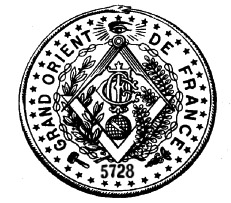
    The Symbol of the Grand Orient de France includes an All Seeing Eye above the Masonic Compass & Square, surrounded by the Ouroboros serpent.33
    The Temple of the GODF features the All Seeing Eye at centre place.34

    1848 GODF medal commemorating the French Republic. This shows an All Seeing Eye within a triangle, around which is the GODF motto: ‘Liberty, Equality, Fraternity’.35

    The symbols illustrating the French Revolutionary ‘Declaration on the Rights of Man and the Citizen’ feature the All Seeing Eye radiating above Moses-type tablets etched with the Declaration. Below that symbol is the self-devouring serpent, Ouroboros.36
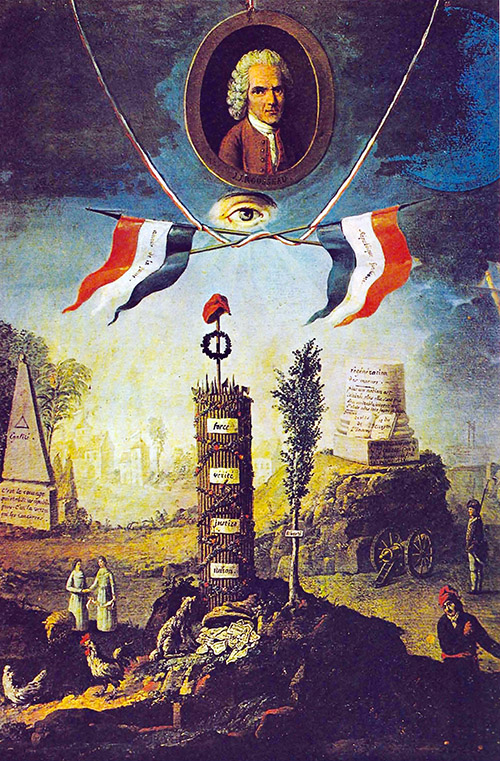
    As the French Revolution progressed, Christian symbols were removed from churches and replaced by busts of such heroes of the Revolution as the anti-Catholic Voltaire, or Rousseau who accepted that man and Nature had been created by the Supreme Being but believed that Church institutions corrupted human nature:Homage to Rousseau by Jeaurat de Bertry, showing the philosopher presiding over the ‘Eye of Truth’.

    It is also of interest that the title page of the seminal Encyclopedie,37 compiled by the rationalist philosophers38 under the direction of Denis Diderot, intended as a compendium of scientific knowledge to repudiate the ‘superstition’ of Christianity, is decorated with esoteric symbolism. Leading American atheist Conrad Goeringer, in writing on the contribution of Freemasonry to revolutionary ferment, states that the central figure of the title page is Lucifer, surrounded by the compass and square symbols of Masonry:39 

    If the bible was the holy book of the Christian enlightenment, then the Encyclopedia was the inspiration of the Enlightenment. Here was a compendium of human knowledge dealing with arts, sciences, mechanics and philosophy which swelled to some 36 volumes by 1780. Begun by the atheist Diderot in 1751, the Encyclopedia bore the imprints of Voltaire, Montesque, Rousseau, Buffon, Turgot and others. Gracing the title page of Diderot’s compendium in the first edition was a drawing of Lucifer, symbol of light and rebellion,40 standing beside the masonic symbols of square and compass.41 

    Why did the rationalists and humanists of the French Revolution, supposedly eschewing ‘superstition’, decorate their new holy writ with arcane symbolism? The answer is that such creeds are intended not as the end of religious worship, but as a stepping-stone by which traditional faiths are destroyed, to be replaced by a universal humanistic religion where man replaces God, and where the ultimate step is to enthrone a leader as Man-become-God.
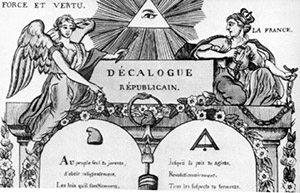
    The symbols illustrating the French Revolutionary Declaration on the Rights of Man and the Citizen feature the All Seeing Eye radiating above Moses-type tablets etched with the Declaration. Below that symbol is the self-devouring
    serpent, Ouroboros.

    The French Revolution was the forerunner of communist revolutions that attempted to abolish Christianity. Amongst the anti-Christian fervour, babies were baptised not to the ‘Father, Son and Holy Ghost’, but to ‘Liberty, Equality, Fraternity’. In 1793 the word Sunday (dimanche) was dropped, the Gregorian calendar was replaced by a French Revolutionary Calendar, and it was prohibited to ring Church bells, display the crucifix, or hold religious processions. Robespierre’s Cult of the Supreme Being was officially inaugurated in 1794,42 opened by hymns to the Supreme Being sang by the Paris Opera choir.43 Yet these subterranean forces did not intend Paris as the capitol of the world, nor even Washington, but Jerusalem, a dream kept alive for centuries in the secret societies. 
    Get the issue this article appears in

    Jerusalem, World Capitol, Under the Gaze of the All Seeing Eye

    In Jerusalem, the United Nations (a truly United Nations) will build a Shrine of the Prophets to serve the federated union of all continents: this will be the seat of the Supreme Court of Mankind, to settle all controversies among the federated continents, as prophesied by Isaiah. 
    – David Ben Gurion, First Prime Minister of the State of Israel44

    Jerusalem holds a central place not only for the three Abrahamic faiths of Christianity, Judaism and Islam, but for Freemasonry, possibly the result of the influence of the Knights Templar whom some researchers regard as the fathers of Masonry,45 and whom the Masons themselves acknowledge as such in their tradition. A major aim of the Freemasons, like the messianic Jews, is the rebuilding of the Temple of Solomon, around which Masonic rituals and allegories are based. Therefore, Masonry can be expected to have a special interest in the creation of the State of Israel. 

    The importance of Jerusalem to Masonry was stated by Albert Pike, when describing the 30° of Knight Kadoth, when the initiate learns of Masonry’s Templar origins, where it is explained that the Templars seeking to destroy the Papacy aligned themselves with the Patriarch at Constantinople, the Templars’“secret object [being] the re-building of the Temple of Solomon on the model prophesied by Ezekiel.”46 Leon Zeldis, 33° Adjunct Grand Master, Supreme Council of the Scottish Rite for the State of Israel, describes the importance of Jerusalem to Masonry, which happens to corresponds to messianic Judaism:

    …King Solomon’s Temple already appears in the Old Charges of Operative Masons used by medieval Lodges and many legendary and ritual features of various Masonic degrees are related to its construction and architecture. For both Christians and Jews, Jerusalem is the focal point of the world, the place where heaven and earth touch each other (Heavenly and Earthly Jerusalem).47

    Masonry staked its mark on the borders of Israel. On the Egyptian-Israeli border a marker has been erected by Masonry consisting of a pyramid, the dividers and compass symbol of Masonry and the two columns or pillars, Binah and Chokmah, of the Cabalistic Tree of Life, a feature of Masonic Temples.48
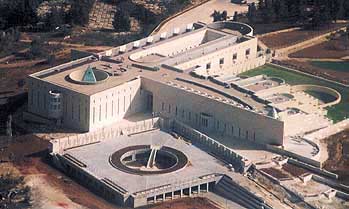
    The Supreme Court building of Jerusalem, Israel, is replete with Masonic symbolism.

    One of the most overt displays of Masonic symbolism is to be found in the Supreme Court building of Jerusalem. The building is replete with Masonic symbolism, and the crowning glory is the All Seeing Eye. Jerry Golden, a researcher resident in Israel, has numerous photographs of the Supreme Court building. In accord with many conspiracy theorists, Golden ultimately attributes this to the Illuminati. While there is no direct evidence of this, the Masonic symbolism is nonetheless apparent. Of additional interest is the involvement of the Rothschild banking dynasty in the construction of the building. Golden writes:

    Showing the architectural design of the New Israeli Supreme Court Building designed and paid for by the Rothschilds reflects the presence of Free Masonry… The Supreme Court building sits on a plot of land opposite the Knesset [Parliament] and next to the Foreign Ministry and the Central Bank of Israel.49

    The Rothschild involvement in this overtly Masonic construction is perhaps the first reliable evidence of a Rothschild connection with Masonry. Golden writes:

    The Engineers who were chosen for this job by the Rothschild’s were the grandson and granddaughter of Ben-Zion Guine from Turkey who worked for Baron Rothschild, Ram Kurmi, born in Jerusalem in 1931, and Ada Karmi-Melanede born in Tel-Aviv in 1936.50

    A plaque dedicated to the Rothschilds has been placed on the Supreme Court building. The emblem at the top left of the plaque is a radiating All Seeing Eye. Most evident, however, is the All Seeing Eye on a large pyramid that stands on the top of the Supreme Court building looking over Jerusalem. Golden states of this:

    The first thing you will notice is the pyramid with the All Seeing Eye just like the one you will see on the American dollar bill. It sits in a circle to the left.51

    These occult and Masonic correspondences suggest the Supreme Court building, in which the Rothschilds took an intimate interest, was constructed for purposes other than merely handing out sentences in the Israeli justice system. Such a building crowned with the pyramid and All Seeing Eye accord with the requirements of a World Court for a New World Order, the aim of the ages’ old traditions of occult societies to establish Jerusalem as the capitol of the universal republic.

    [alert type=”general” dismiss=”no”]This article was published in New Dawn Special Issue 18.[/alert]

    [alert type=”success” dismiss=”no”]If you appreciate this article, please consider subscribing to help maintain this website.[/alert]

    Footnotes

    1. For a scholarly work on the founding of the USA by Freemasons and the dichotomy that occurred between Masons and Puritans see: Nicholas Hagger, The Secret Founding of America: The Real Story of Freemasons, Puritans & the Battle for the New World (London: Watkins Publishing, 2007). 
    2. The Order of the Illuminati was a crypto-Masonic secret society founded by Professor Adam Weishaupt in Bavaria, Germany, in 1776, to overthrow the Church and all monarchies, and to establish a communistic universal republic. See: Prof. J Robison (1798) Proofs of a Conspiracy (Massachusetts: Western Islands, 1967).
    3. There are branches of Grand Lodge Masonry, or ‘Regular Masonry’, that do however proudly cite the involvement of other forms of Masonry in revolutions as part of a wider Masonic heritage. 
    4. While allegations of ‘conspiracy’ often appear exaggerated, even less scholarly is the stance of those ‘sceptics’ who insist that any form of conspiratology is delusional or ignorant. Scholarship accepts that the Thuggee was a criminal conspiracy based on religion, or that the Mafia is a criminal conspiracy based around Sicilian families reaching back centuries and spreading out from Sicily to encompass the world. Yet when someone suggests that Freemasonry, Illuminati, Bilderberger, Zionism or the Council on Foreign Relations might be involved in political and economic conspiracies, this is laughed out of academe with arrogant derision. 
    5. For example, the Portuguese revolution of 1910: A M Goncalves, Breve historical da Maconaria em Portugal, Pel Irmao Mestre Macom, R L Anderson No. 16 Grande Loja Regular de Portugal/GLLP, 14° Grau do Rito Escoces Antigo e Aceite. A Shortened History of Freemasonry in Portugal. English translation by W. Bro. Don Falconer, Pietre-Stones Review of Freemasonry, www.freemasons-freemasonry.com/arnaldoGeng.html. On the March 1917 Russian Revolution see: Richard L Rhoda, ‘Freemasonry in Russia’, www.mastermason.com/hempstead749/RussiaMas.htm
    6. Grand Lodge of British Columbia & Yukon, ‘Anti-Masonry Frequently Asked Questions’, Section 2, version 2.9, II SYMBOLS, 3. ‘Is the eye and pyramid a Masonic symbol? No’. http://freemasonry.bcy.ca/anti-masonry/anti-masonry02.html
    7. Masonic Tracing Boards comprise symbols for the instruction of Masons as they are initiated into each degree. They are laid out on the chamber floor and form the basis for lectures on Masonic allegory, history, ritual and doctrine relevant to that degree. Any symbol on a Tracing Board is therefore of importance to Masonry.
    8. R. Robinson, ‘Collection of Masonic Tracing Boards’, www.freemasons-freemasonry.com/TBs.html
    9. Ibid.
    10. Ibid.
    11. ‘Brother Washington’s Masonic Apron’, Grand Lodge of Free & Accepted Masons of Pennsylvania, www.pagrandlodge.org/mlam/apron/
    12. ‘Eye of God’, Masonic Art, Grand Lodge of Yukon & British Columbia, http://freemasonry.bcy.ca/art/pontormo.html
    13. ‘Eye in a triangle,’ Ibid., http://freemasonry.bcy.ca/art/eye_triangle.html
    14. ‘George Washington’s Masonic apron’, Ibid., http://freemasonry.bcy.ca/art/washington_apron.html
    15. Dr. A Stafyla, ‘The Masonic Landmarks’, Pietre-Stones Review of Freemasonry, www.freemasons-freemasonry.com/athena1.html
    16. G. Singh, ‘Mystic Pages’, Metro, 24-31 March 2004, www.metroactive.com/papers/metro/03.24.04/rosicrucian-0413.html
    17. Ibid.
    18. Hall was a 33º Scottish Rite Mason who founded the Philosophical Research Society in Los Angeles, USA. He was honoured by Scottish Rite Journal which called him ‘The Illustrious Manly P. Hall’ in September 1990, and honoured him as ‘Masonry’s Greatest Philosopher’.
    19. Manly P. Hall, The Secret Destiny of America (Los Angeles: The Philosophical Research Society, Inc., 1944), 174. 
    20. H.A. Wallace, Statesmanship and Religion (New York: Round Table Press, 1934), 78-79. 
    21. George H.W. Bush, US Congress, 6 March 1991.
    22 George W. Bush, Second Inaugural Address, United States Capitol, 20 January 2005.
    23. V Stauffer, New England and the Bavarian Illuminati (Columbia University Press, 1918), 312; cited by N Hagger, op. cit., 142. 
    24. Grand Orient de France, ‘History’, www.godf.org/foreign/uk/histoire_uk.html
    25. Ibid. (These entries seem to have been deleted since accessed in 2006). 
    26. Voltaire and Rousseau were the primary ideological inspirers of the French Revolution. They are depicted on the posters of the Declaration of the Rights of Man & the Citizen, along with Masonic symbolism. G. Hancock and R. Bauval, Talisman: Sacred Cities, Sacred Faith (London: Penguin Books, 2005), 21. Voltaire was escorted during his initiation into the Nine Sisters Lodge in 1778 by de Gebelin and Benjamin Franklin. G. Hancock and R. Bauval, Ibid., 460. 
    27. Lafayette served with the American revolutionary army, and later drafted France’s Declaration on the Rights of Man & the Citizen
    28. Garibaldi along with Mazzini, were the primary Italian revolutionaries, the latter founding a worldwide movement of which Young Italy was a constituent. Garibaldi became the first Grand Master of Memphis-Misraim Masonry, G. Hancock and R. Bauval, op. cit., 422. 
    29. Blanqui was a precursor of Karl Marx, and the Communist League derived from Blanqui’s League of Just. D. Conway, A Farewell to Marx (Harmondsworth: Penguin Books, 1987), 146. 
    30. Mikhail Bakounine was the organiser of the Anarchist movement and the primary rival to Karl Marx for leadership of the First Internationale
    31. ‘Our Values’, Grand Orient de France, www.godf.org/index.php/pages/details/slug/nos-valeurs
    32. www.histoire-fr.com/revolution_francaise_monarchie_constitutionnelle_2.htm. The ‘Club of the Cordeliers’ or ‘Society of the Friends of the Rights of Man and of the Citizen’, were ultra-revolutionaries founded in 1790 to guard the ideological purity of the French Revolution. Significantly, the Club was named after the place of its foundation, a former monastery that had been seized from the Church and taken over as state property; a forerunner of communism. The Cordeliers seem to have acted as the Trotskyites of their day.
    33. A depiction of the GODF symbol appears at ‘The secession of the Grand Orient de France’, Loja Luz Do Oriente No. 80, http://luzoriente.blogspot.com/2008_05_01_archive.html
    34. A depiction of the GODF Temple appears at: C Hoddap, ‘Women not flocking to the Grand Orient of France’, http://freemasonsfordummies.blogspot.com/2011/04/women-not-flocking-to-grand-orient-of.html. Hoddap is a 33º Scottish Rite Mason.
    35. H. Nguyen, ‘Symbols of Revolution’, http://halleynguyen294.wordpress.com/category/symbols-of-revolution/
    36. Declaration of the Rights of Man & the Citizen, http://libertyeverywhere.blogspot.com/2010/12/declaration-of-rights-of-man-and.html
    37. Encyclopédie, ou dictionnaire raisonné des sciences, des arts et des métiers was published in France between 1751 and 1772.
    38. The so-called Encyclopedists.
    39. Rt. Hon. Dr. J. Morley, M.P., ‘Denis Diderot (1713-1784)’, Encyclopaedia Britannica, Ninth Edition, 1902, www.1902encyclopedia.com/D/DID/denis-diderot.html
    40. 18 and 19th century radicals, including Freemasons such as the anarchist leaders Proudhon and Mikhail Bakunin, regarded Lucifer or Satan in romantic terms as the archetypal rebel. Bakunin, for example, wrote: “Satan is the eternal rebel, the first freethinker and the emancipator of worlds.”M. Bakunin (1883), God & State (New York: Dover Publications, 1970), 112. Karl Marx wrote plays and poems extolling Satanic themes, including The Player and Oulanem. According to Australian Labour history scholar Dr. Bob James, Marx was an initiate of the Loge des Philadelphes, as were the French radical Blanc, and Italian revolutionaries Garibaldi and Mazzini. R. James, Secret Societies and the Labour Movement, Biennial Conference of the Australian Society for the Study of Labour History, Wollongong, 1999; Radical Tradition, www.takver.com/history/secsoc01.htm. Carducci, a leader of Italian Republicanism and of Scottish Rite Masonry, wrote a lengthy poem, Inno a Satana (1863) lauding a revolutionary Satan.
    41. C. Goeringer, Conrad. The Enlightenment, Freemasonry, and The Illuminati, Part I – The Enlightenment, www.atheists.org/Atheism/roots/enlightenment/
    42. G. Hancock and R. Bauval, op. cit., 15-16. 
    43. Ibid., 20. 
    44. David Ben Gurion, Look Magazine, 16 January 1962. 
    45. M. Baigent and Richard Leigh, The Temple and the Lodge (London: Jonathan Cape, 1989). 
    46. Albert Pike, Morals and Dogma, 1871, 815-16.
    47. http://web.mit.edu/dryfoo/Masons/Reports/israel.html
    48. J. Golden, ‘Mason’s making a move in Israel, and a closer look at the Road Map’, Golden Report, 23 February 2005, ‘Masonic Monument in Eilat’, Cassiopaea Forum, 9 August 2010, http://cassiopaea.org/forum/index.php?topic=19165.0
    49. J. Golden, ‘The Roots of Evil in Jerusalem’, 21 February 2011, www.thegoldenreport.com/special-reports/5-the-roots-of-evil-in-jerusalem
    50. Ibid.
    51. Ibid.

    © New Dawn Magazine and the respective author.
    For our reproduction notice, click here.
  • Australia’s Cosmic Capital: Canberra’s Geomantic Powers

    Australia’s Cosmic Capital: Canberra’s Geomantic Powers

    From New Dawn 194 (Sept-Oct 2022)

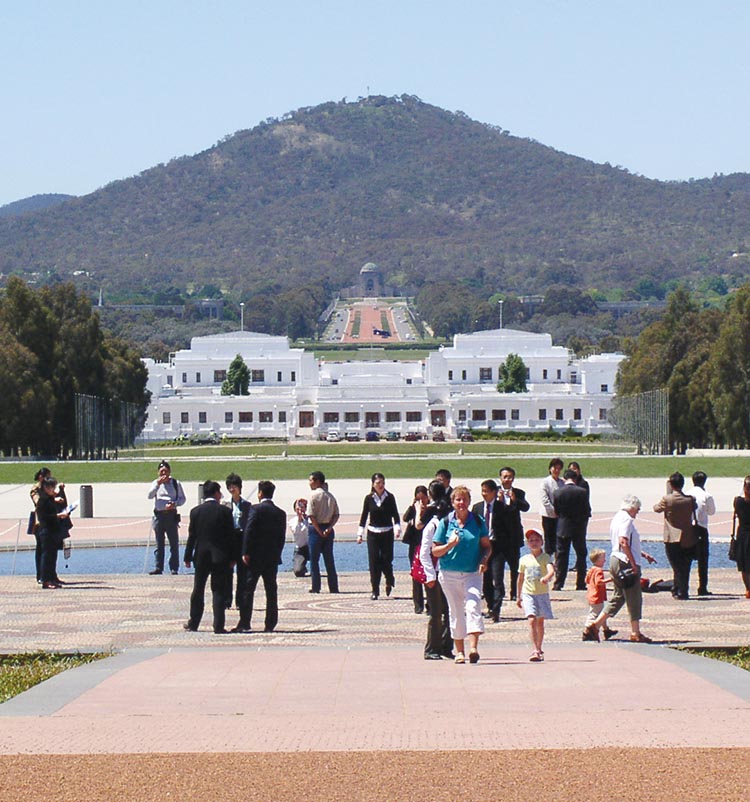
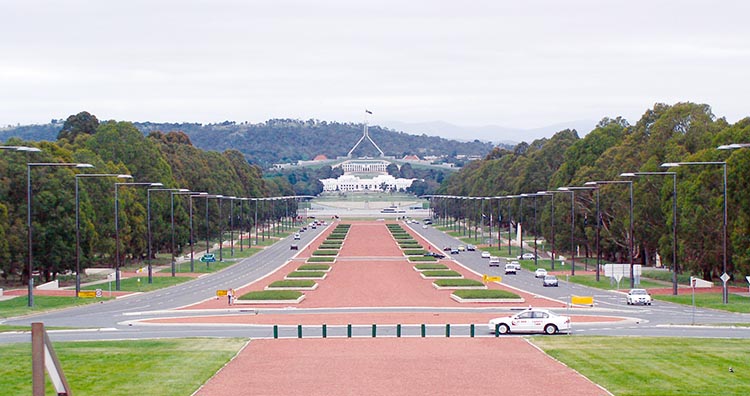
    If you stand on top of Canberra’s Mt. Ainslie and look west, your eye will pass over the top of the War Memorial and run along the brown strip down the middle of Anzac Parade towards Lake Burley Griffin. In the middle distance you will see the ‘Wedding Cake’ (old Parliament House) and the ‘Crouching Spider’ (new Parliament House) behind it. The Brindabella Ranges rise in the background.

    The roads and buildings below Mt. Ainslie are arranged in circles and lines – flag poles topped with the Australian flag line up reinforcing each other. Straight lines bring strength and harmony into the landscape. Geomancers say that leys (lines linking points) are power paths for ideas and feelings to run along. Such linked points are interactive and become similar over time.

    Look down again, and you will see, between the buildings and trees, cars and people. There is a maze of interactions, people going to meetings, shopping, and racing home. Within all this, far more is taking place than the eye can see; the whole makes up the geomancy1 of Australia’s national capital.

    Now, look at the War Memorial. There are name plaques for every soldier who died as a personal contribution to the development of the Australian nation. The rising ‘Dome of Remembrance’ contains the body of an ‘unknown soldier’ who acts as a link between the location and the hellish battlefields of Europe in 1917. And it all points down Anzac Parade, along the main Canberra axis line, which ends in Bimberi Peak. Built on either side of the axis line are memorials to the dead. It is here that Australia celebrates Anzac Day, its most prominent ritual of nationhood.

    With your back to Canberra’s Mt. Ainslie and standing on the steps of the War Memorial looking down towards Lake Burley Griffin, one can just make out Commonwealth Place. Behind this is Old Parliament House, the “wedding cake,” and then we see the new Parliament House, the “crouching spider.” (photo courtesy of the author)

    In geomantic terms, our rituals of nationhood are a plea to the essences of the dead to help fulfil the aims of the Australian nation. A request to the souls of the dead who died for “God, King and Country” to help their descendants live peacefully under the symbol of the Australian flag with its Union Jack and Southern Cross.

    Why The Canberra Site?

    I asked myself this question when I wrote my first Canberra piece, a school text published by Jacaranda Wiley in 1977. The history of the site bears repeating because the thoughts that went into its inception, which carry through in its design, have made Canberra the place it has become.

    In the last decades of the 1800s, Australia was occupied by separate British colonies (today’s states) that all referred back to England and not each other. The Germans were in New Guinea and there was the possibility of a German invasion. A combined and effective military force was considered a smart move. There were other reasons – a better postal service, a more effective taxation system, the problem of the vast number of male Chinese immigrants left over from the gold rush, and even the virtual slavery of Islanders in Queensland. It took years for the separate colonies to compromise and sort out these issues, but they finally did, and in 1901 the Australian nation was born.

    An unresolved national issue was the location of the seat of Government. Where would the Federal Parliament House be built? Where would the public service work? Neither Sydney nor Melbourne wanted the other city to become the Australian capital, so a compromise was reached. The capital would stay in Melbourne until the new Federal Parliament House was built. And the new capital had to be at least 100 miles from Sydney.

    A dozen country towns were considered, from Armidale to Eden, Junee to Bombala, but no decision was made. Then, finally, the ‘Limestone Plains’ location was chosen. Why? It was so inaccessible that Melbourne politicians felt it would take many years for the move to be made from Melbourne – and they were right. The site also had some good things going for it – a bracing climate (memories of Simla, the virtual summer capital of the British Raj in India) but no winter snowfalls. A good clean water supply. An accessible route for a railway link to Goulburn and a further possible route to the Jervis Bay naval base, intended to be developed as Canberra’s harbour. And due to its inland location, the site was safe from the most fearsome and dangerous weapon known to the world in 1910 – bombardment from warships!

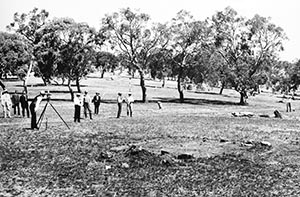
    First survey in 1910 of the Canberra site.

    The site was called Limestone Plains because it is enclosed by hills to the south, east, and west, with limestone caves under the surface. There are many caves, caverns and sinkholes under central Canberra. Some have strange stories attached to them… aboriginal art, witchcraft covens and unfathomable sinkholes that swallow up foundation piers.

    Canberra’s geology is broken and varied with intense underground activity. There are vast amounts of water underneath – probably more than enough for a city of half a million people.

    The site’s openness, lack of undergrowth, and treelessness puzzled the first settlers and remained a mystery until the 2003 Canberra bushfires. The blaze, started by lightning strikes in the Brindabella Ranges, swept into Canberra and destroyed 600 houses in an afternoon. Willy willies carried it from updrafts generated by the westerly winds skimming over the ranges. It seems these waves of fire can be expected when enough regrowth provides new fuel.

    Hills on three sides contribute to making Canberra seem a place apart, an island in the middle of nowhere. A nowhere from which something new could start. Walter Burley Griffin and his wife Marion Mahoney certainly saw it that way.

    The Griffin Design For Canberra

    An international competition was held for the best design. But the competition rules displeased many British and Australian architects who refused to compete. Even so, 137 entries were received by the January 1912 closing date.

    On 23 May 1912, entry number 29, by Walter Burley Griffin, landscape architect of Chicago, Illinois, USA, was declared the winner of the competition to design Australia’s new federal capital.

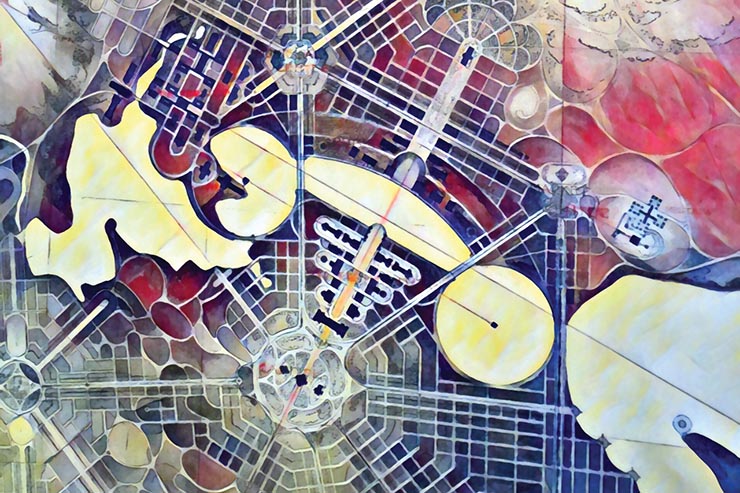
    Walter Burley Griffin’s original plan for Canberra. Notice all the circles. In the days before computer-aided drawing, the tools of an architect were ruler and compass. Many of the Griffin’s circles found their way into the layout of Canberra’s streets, so the tourist can follow the same street to its never-ending beginning!

    The judge was the Minister for Home Affairs, King O’Malley. By one of those quirks of fate, King, to use his Christian name, was an American real estate developer who gave his birthplace as Canada so that, as a British subject, he could sit for a seat in the Australian Parliament. As an aside, Griffin and O’Malley became friends of sorts but their wives continued to dislike each other throughout their many years of association.

    How did they get started on the design? Well, Walter thought about the possible city and did nothing. On weekends, Walter and Marion often took ‘Allana’, their Indian canoe, into the maze of streams near Chicago. One day they paddled 45 miles in stinking hot weather…

    The sand was as hot as the top of a stove; we ate our meals in the water. Perhaps it was the torture of those sunburnt legs, perhaps it was just that well-known mean disposition of mine, or it may have been those spiritual advisers, of whom I was unconscious at the time, who said to me, “We can’t do anything with him without some human help. Won’t you do something to make him start on the important matter he has in mind?” – or perhaps it was the suggestion of the Devil himself as Walt was later inclined to think.

    Anyway the storm of wrath broke over his head on some such lines as follows: “For the love of Mike when are you going to get started on those Capital plans? How much time do you think there is left anyway? Do you realise that it takes a solid month to get them there after they have started on their way? That leaves exactly nine weeks now to turn them in. Perhaps you can design a city in two days but the drawings take time and that falls on me. Nine weeks! It isn’t possible to do them in nine weeks. I may be the swiftest draftswoman in town but I can’t do the impossible. What’s the use of thinking about a thing like this for ten years if when the time comes you don’t get it done in time? Mark my words and I’m not joking, either you get busy on this very day, this very minute (with rising tones) or I’ll not touch a pencil to the darn things. Serve you jolly well right if I refuse to take it on now. (No, not jolly. Such language only came later).”

    And Walt said nothing (he was such an amiable man) but started sawing wood. And so a new adventure was started.2

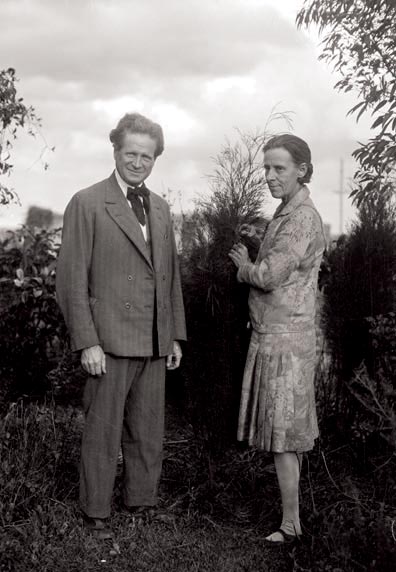
    Walter Burley Griffin and Marion Mahoney, Castlecrag, Sydney, 27 July 1930.

    Marion’s artistic skills were outstanding. She created perspectives in purple and gold that reached from the top of Mt. Ainslie across the Limestone Plain to show a dreamscape of a city to be realised in the morning… it took much longer than that.

    I must point out that in those days, the Griffins had no known interest in any esoteric philosophy. Their involvement with Theosophy was to come later in Australia, and it was not until their Castlecrag ‘new age’ community developed that Rudolf Steiner’s Anthroposophy reached their lives. Furthermore, the Griffins didn’t knowingly insert esoteric ideas into their design; Walter just followed ideas he had seen that worked.

    A crucial conceptual starting point was the 1893 Chicago World Fair, which aired designs linking avenues, locations, and water. One of those attending the fair, the 17-year-old Walter Burley Griffin, must have been duly impressed.

    For Canberra, Griffin used a compass and ruler to draft his design, using the hills marked on the maps as the starting points for his ideas. That’s why Canberra continues to trap the casual tourist – who can expect roads to curve back on themselves?

    When the Griffins arrived in Australia in 1913 to oversee the development of the capital, they got into trouble before they started. Walter tended to express himself in complex, even grandiose terms. This added to his dislike by local architects, on top of his disparaging statements about local designs and Australia’s dependency on the British Empire. Government also changed and with it intentions about the building of the new capital, a capital which few – if any politicians – wanted to move to in the first place. And then the First World War swallowed all available funds, and in the midst of conflict the new nation struggled to find itself in the wake of the Anzac debacle.

    There was a long and complex Royal Commission into Griffin’s handling of Canberra’s development. Records of the proceedings show that the results were inconclusive. Yes, bureaucracy certainly set out to make his life as difficult as possible. But Griffin was not a good communicator, and one thing led to another. As a result, Canberra’s development and the Griffins parted company in 1920. The couple went on to have a reasonably successful private practice in Sydney and Melbourne.

    For anyone curious about the personality and relationships of the Griffins, there is considerable material in the National Library including oral history tapes of interviews with all the people who knew them in the 1930s in their Castlecrag years (also visit the website of the Walter Burley Griffin Society: www.griffinsociety.org)

    The Canberra Landscape Temple

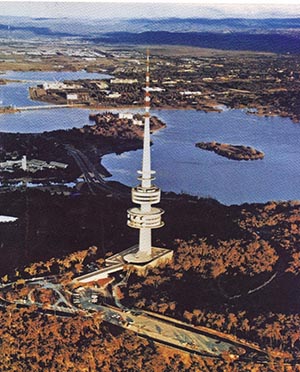
    Canberra’s ‘space needle’ is Telstra Tower which rises 195.2 meters above the summit of Black Mountain, as seen in this 1970s photo. 

    Let’s return to Mt. Ainslie and across to the hill on the right, looking over the downtown area. It’s topped with one of those revolving restaurant ‘space needle’ telecommunications towers that all respectable cities seemed to need in the last century. The hill is known as Black Mountain. Ahead, just to the left of the axis line and near to the ‘crawling spider’ is Red Hill. Below is Canberra’s diplomatic cluster.

    That’s three hills, each with different geology and each with its own mood. I’ve travelled from one to another, taking visitors on tour. Our discussions reflect mood changes. On Mt. Ainslie, we look down at the city, think about the future and discuss possibilities. We seem to discuss cars, machines and economics on Black Mountain with its hard, dark rocks and telecommunications hum. Red Hill often results in a clash of personalities between myself and visitors, “You’ve taken me around, and now you want me to believe your perceptions, I don’t see why I should!” It makes me feel I’ve just stepped into a diplomatic meeting or question time in Parliament.

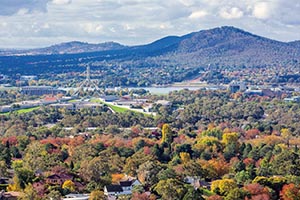
    View from Red Hill lookout.

    Yes, each of the three hills has its own “personality,” its resident consciousness that affects the people standing inside its energy field. These natural “Dreaming” locations are as real as the spaces we make inside our buildings. The strength and size of these radiating fields vary – nothing in geomancy is truly stable. Times of day, astrological conditions, rituals performed – all have an effect. Sometimes Mt. Ainslie is strong, extending across the Limestone Plain to affect the mood of people below; at other times and on other days, Black or Red is larger and more powerful.

    The energy of these three mountains is reflected in the three apexes of the Parliamentary Triangle that Griffin put in place. City Hill, in downtown Canberra, watches over money and construction. Parliament House Hill is about personal power and arrogance – reflecting the proximity of Red Hill. The apex near the War Memorial is about the love for the dead Australian soldiers who gave their lives for the nation. There is a little hill at the apex of this corner of the triangle, between houses and defence department offices, called Peace Harmony Hill. Griffin’s original plans placed Australia’s National Cathedral (non-denominational) at this location.

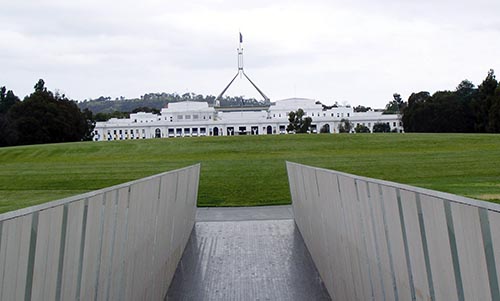
    View from the front entrance to Parliament House. In the middle distance is the rear of the old Parliament House. In the background, at the end of Anzac Parade, at the base of Mt. Ainslie, is the Australian War Memorial. (photo courtesy of the author)

    There are two triangles in Canberra that interlock and interrelate. Inside these the business of the nation is carried out. When politicians sat inside the Wedding Cake – the original Parliament house – the interflows between love, money, and pride worked reasonably well. The Australian nation’s Dreaming, more or less, worked. New Parliament House is located on the apex where Griffin conceived a garden with a central gazebo-style monument to celebrate the Australian nation. It is the strongest site in Canberra, connected to the central axis and the parliamentary triangle. Griffin saw it as a people’s park belonging to everyone in the nation.

    But alas, the new Parliament House swallowed the Capital Hill site. This creates an unfortunate situation that makes pride and personal power far too important in the minds of those who control the nation. It is not just the proximity of Red Hill that is an issue, there is also the architectural oddity of a building that replaces a hill. Capital Hill was removed, a billion-dollar building put in its place, and grass planted on top. To make matters even more geomantically undesirable, the whole structure is cut into the large and unstable Lake George fault line. In the symbolic language of geomancy, one could say the building is a gateway to the underworld, and lacks a Buddha and chanting nuns to keep the necessary balances between the spiritual worlds, Earth and the underworlds.

    As for Old Parliament House, a visit is a good lesson in how the energies of place interact with our moods and thoughts. Wander down the corridors and go into the Prime Minister’s office. Sit down on a visitor’s chair, lightly meditate, and you may get the same feeling of complexity I got when I did this exercise. Being PM in this office was a difficult job. How does one control situations rather than be controlled by the whirl of events? The old reading rooms give one the feeling of a gentleman’s club. For decades, Canberra wasn’t on the artistic, social, or cultural map.

    One evening I was at a wedding reception in the lightly remodelled member’s bar and restaurant in the back of the building when suddenly, at 10 o’clock, the mood changed. The atmosphere filled with what is known in Buddhist metaphysics as “hungry ghost” energy forms (desire elementals) that searched out the heavy wine and spirit drinkers in the room, compelling a recharge of glasses. Many of Australia’s early parliamentary processes must have taken place in a haze of hangovers and alcohol.

    Down The Main Axis Linking The Past To The Future

    Let’s journey down the main Anzac Parade axis, lined with monuments to people who fought and died in wars, making links between the nation’s past, present and future. There are vacant spaces for more monuments – reserved for the future when there will be more heroes and certainly more deaths to keep the Australian nation alive.

    A marble-lined cutting links Commonwealth Place to Reconciliation Place, which is located behind Old Parliament House. It rises above the grassed-over mound and reminds the author of a burial site, suggesting this is the way the Commonwealth of Australia ‘reconciled’ their Aboriginal obligations. (photo courtesy of the author)

    Crossing the lake, one comes to Commonwealth Place, a lakefront forecourt where bands occasionally play. An almost subterranean passageway links it to a grassy hill named Reconciliation Place. The location is a weird bit of geomancy, an attempt to show how British Commonwealth Australians and Aboriginal people have reconciled their differences. By what one would hope is an error of judgement – rather than a result of conscious intent – Reconciliation Place resembles a burial mound or perhaps a mass grave. I’ve been told that, like so many places in Canberra, it links the city to the underworld; in this case, to Aboriginal ancestors who emerge to participate in events when they feel the need and disappear when their mission is complete.

    There are many other sites to tell of Canberra. But to keep the story in line with revealing how the geomantic past creates frameworks for future decisions, I need to tell the National Museum story that involved me because of my geomantic interests.

    Alas, for Australia, the Museum is a geomantic opportunity lost. The site is touched on three sides by Canberra’s central lake and was the site of Canberra’s original hospital. The hospital reached its use-by date and was demolished, leaving the site open for redevelopment. Many groups claimed the site, and much community discussion followed.

    Finally, the National Museum of Australia won the site. Guidelines for a competition to create the prize-winning design were drawn up. The guidelines were exciting – they called for a multicultural museum and a complex of separate buildings spread over the peninsula. Each cultural group was to have its own building, the Aboriginal building was to be large, so were the Greek and Italian buildings. Smaller groups were to have use of buildings for periods. The whole was conceived as a place of continual festival, a celebration of the unfolding strengths that multiculturalism gives Australia.

    But it was not to be. Instead of structures that used the energetic potential inherent in the site – with its water and vistas – a building was chosen that looked more at home in an industrial area in Berlin, inward-looking with the vistas hidden behind dense shade cloth. The building opened in 2001 and cost $152 million to complete. The museum’s initial displays radiated out from the time of “Coronation Australia,” the period in the 1950s when the British colonial perspective still made sense.

    Why did this happen? Why wasn’t the site made a location for the ongoing celebration of a multicultural Australia, an Australia built on constant immigration?

    The Whitlam years, with their Al Grassby openness, gave Australian power brokers an awareness that a new Australia was possible, but also one in which power might shift away from the ruling concepts and frameworks locked into the idea of “God, King and Country” enshrined in the War Memorial and Anzac Parade.

    Get the issue this article appears in

    I think it is a shame Australia’s self-perception as a multicultural nation, brimming with new life and activity, has been stultified. Instead, we struggle in an underworld linked to the past, to souls that “gave of themselves so that we could live.”

    Foundations are very important because the original intentions of founders – like energy – stream forth into structures like cities to shape the future for their inhabitants. Well before the word Canberra had entered his mind, Walter Griffin – like so many other thinkers of the time – was inspired by the influential book Progress and Poverty by Henry George, written in the late 1870s.

    George dedicated the book with the following words, which I believe inspired the Griffins on their Australian adventure:

    To those who, seeing the vice and misery that spring from the unequal distribution of wealth and privilege, feel the possibility of a higher social state and would strive for its attainment.

    I see the spiritual basis of Australia’s capital city as originating from this short quote. The rationale behind Canberra was that it would serve to unite the rivalries that separated State capitals and make the development of a united Australia possible.

    Perhaps things would change for the better if we allowed Canberra’s spiritual forces to work into our doings. What can we do to overcome the forces of hindrance that hold us back from developing our future potential?

    This article originally appeared in New Dawn 94 (Jan-Feb 2006).

    [alert type=”general” dismiss=”no”]This article was published in New Dawn 194.[/alert]

    [alert type=”success” dismiss=”no”]If you appreciate this article, please consider subscribing to help maintain this website.[/alert]

    Footnotes

    1. Chinese geomancy, generally called Feng Shu, is a collection of systems that evolved to help people understand and adjust the spirits of place – whether these are resident above or below or linked to the past or the future.
    2. From The Magic of America, Marion Griffin’s writings compiled in the later years of her life (she was 91 when she died in Chicago). Extracted from Ron Evans’ collated and edited version titled Marion’s Magic (1991), page 26.

    © New Dawn Magazine and the respective author.
    For our reproduction notice, click here.
  • The Twisted History of the Swastika

    The Twisted History of the Swastika

    From New Dawn Special Issue Vol 10 No 2 (May 2016)

    If you were asked to come up with a symbol for evil, very likely you would think of the swastika. The quintessential emblem of the Third Reich, it still evokes hatred and fear seventy years after the collapse of the Nazi regime.

    And yet not so long ago it was a symbol of blessings and good fortune. Even its name is derived from Sanskrit roots meaning “it is good.” (Other names given to it include the cross patteé, the gammadion, the hakenkreuz or hooked cross, and the fylfot.) Today, in a somewhat truncated form, it still occupies a place in the official symbol of the Theosophical Society.

    The peculiar fate of the swastika has a great deal to teach about the nature and meaning of symbols – and about the uses to which they can be put.


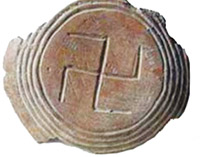
    Pottery fragment with swastika, dating to 7,000 years ago, from Bulgaria. 

    The swastika occurs almost universally. The most ancient version known is on a carved tusk from the Ukraine, dated to around 10,000 BCE. Other early instances were found at Hissarlik in western Asia Minor, where Heinrich Schliemann, often called the father of archaeology, unearthed the ruins of Troy in 1873. The swastika begins to appear in the city’s third stratum, dated to 2250–2100 BCE. It is on spindle-whorls, a sphere, and a statue made of lead thought to be an image of the goddess Artemis. The vulva (or perhaps the mons veneris) of this figure has a swastika in the middle. One scholar interpreted it as representing “the generative power of man.”1


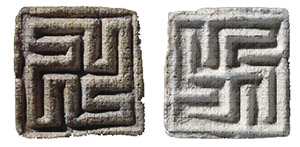
    Seals, showing swastikas, from the Indus Valley Civilisation (3300–1300 BCE)

    Schliemann himself, following orientalist scholars of his time, said that the swastika was “of the very greatest importance among the early progenitors of the Aryan races in Bactria and in the villages of the Oxus, at a time when Germans, Indians, Pelasgians, Celts, Persians, Slavonians and Iranians still formed one nation and spoke one language.”2

    But the swastika is found far beyond the traditional provenance of the “Aryan races.” Thomas Wilson, who wrote a study on it for the Smithsonian Institution in the late nineteenth century, lists examples from ancient sites ranging from Japan to Europe to North and South America. It’s quite apparent that the swastika belongs to everybody and to nobody.

    Before we go into the swastika’s history, it might be best to clear up one source of confusion: its orientation. You will often hear it said that the “clockwise” direction of the swastika is the “good” direction, while the “counterclockwise” direction is the “bad” one.

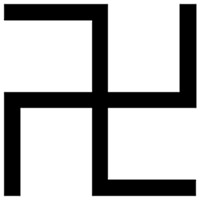
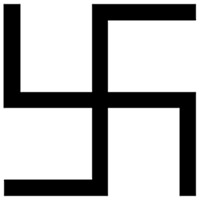
    To begin with, consider these two images:

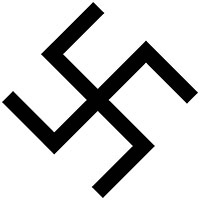
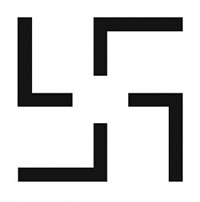
    Figure 1 (left): Left-facing or “clockwise” swastika.
    Figure 2 (right): Right-facing or “counterclockwise” swastika.

    Which of these looks clockwise to you? To me, either one could be seen as clockwise, or counterclockwise, so I will avoid these terms. Instead I will speak of “left-facing” (for diagram 1) and “right-facing” (for diagram 2) swastikas. (If you’re curious, the left-facing one is most often described as clockwise.)

    You can also forget about which direction is the good one or the bad one. Traditionally there seems to be no difference, and often both types appear in the same location – for example, on the curtain of a Tibetan temple devoted to the Bönpa, the nation’s pre-Buddhist shamanistic religion.3 Similarly Thomas Wilson, introduced to a member of a Chinese delegation visiting Washington, found him wearing robes of state emblazoned with both versions of the swastika. “The name given to the sign was… wan, and the signification was ‘longevity’, ‘long life’, ‘many years’,” Wilson writes. “Thus was shown that in far as well as near countries, in modern as well as ancient times, this sign stood for blessing, good wishes, and, by a slight extension, for good luck.”4


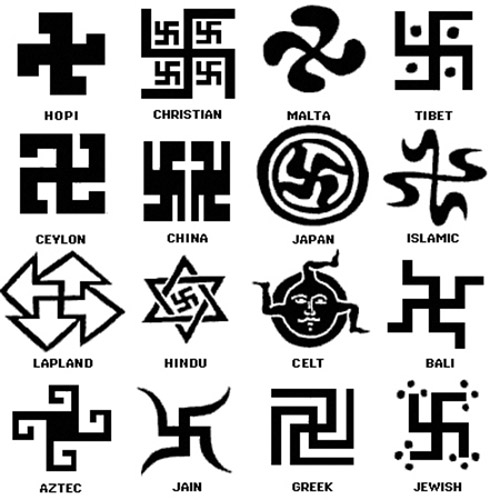
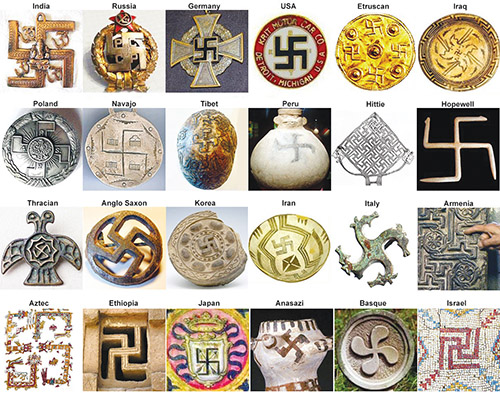
    The swastika occurs almost universally across the world in diverse cultures, religions and regions. Above are just some of the swastika’s renditions in art and religious symbolism.

    Swastika: From Good to Evil Symbol

    So how did it come to stand for the complete opposite: hatred, violence, and cruelty?

    Some historical background is needed. In 1871 Germany, which for centuries had been fragmented into dozens of tiny and often overrun states, was unified into a single empire, or Reich, by the Prussian chancellor Otto von Bismarck. Naturally Germans began to feel a thirst for a shared national identity. This began to form under a range of influences, from the treatise on Germany by the Roman historian Tacitus to the operas of Richard Wagner.

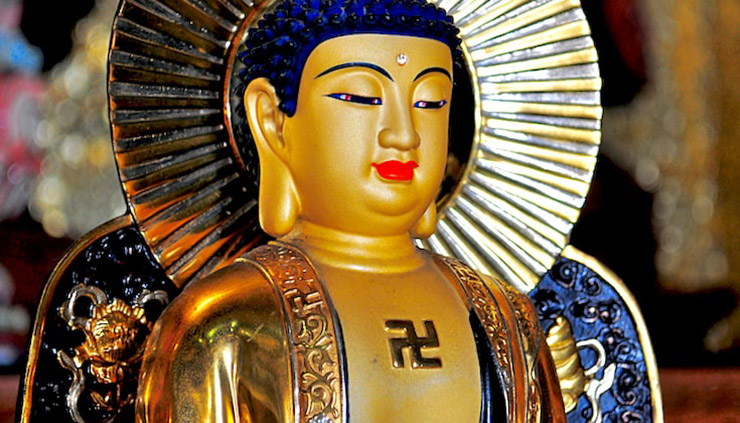
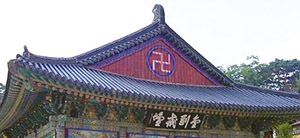
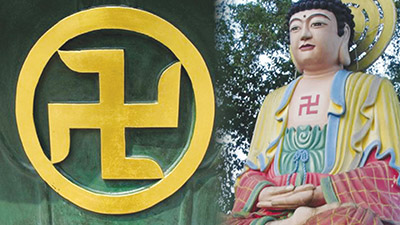
    In Asia, the swastika is a centuries-old positive symbol of peace, auspiciousness and good fortune. It can be found on Buddha statues as well as temples.

    An identity is created out of many things, including the things you are against. Thus anti-Semitism soon became part of this German identity. Anti-Semitism had deep roots in Germany, going back at least as far back as Martin Luther, who in 1543 published a vituperative book entitled On the Jews and Their Lies. 

    Opposed to the Jews were, so the theory went, the Aryans. The word comes from the Sanskrit arya, meaning “noble,” and originally referred to the Indo-European peoples who conquered the Indian subcontinent in the second millennium BCE. But soon it came to mean, above all else, the pure, white European race, which had reached the summit of perfection in the Germans.

    What could serve as a symbol for this race? The cross was tainted by Christianity, which after all was founded by Jews. The fact that Schliemann had found the swastika in the ruins of Troy and Mycenae, the homes of an ancient, noble, and presumably Aryan race, spoke in its favour. It was (and is) found universally in India too, which had given the Aryans their name. And there was the verdict of the French symbologist the Count Goblet d’Alviella, who asserted that the swastika “is not met with in Egypt, Chaldea, or Assyria” – the last two being Semitic nations.5

    By the twentieth century, occult and pseudo-occult groups invoking the Aryan legacy were displaying the swastika. Hitler’s connection with these groups is suppositional at best, but it is fairly certain that he read and collected issues of the journal Ostara, founded in 1905 by the occultist Jörg Lanz von Liebenfels. The magazine’s subtitle – “Newsletter of the Blonds and Male Supremacists” – gives a good idea of its orientation. Its emblem was a knight in a hooded robe covered with swastikas.

    Other extreme groups made use of the symbol as well, such as the Germanenorden, an occult lodge focused on ancient Germanic lore and of course anti-Semitism. Its founder was a self-styled aristocrat named Rudolf von Sebottendorff. As the German Reich collapsed in the fall of 1918, the order recast itself as the Thule Society (after Thule, a mythical polar land). Its symbol was a long dagger superimposed on a swastika sun wheel. 

    On 9 November 1918 – two days before Germany’s surrender in World War I – Sebottendorff delivered an impassioned speech to the Thule Society. Because of the imminent defeat, he declaimed, “in the place of our princes of Germanic blood rules our deadly enemy: Judah.” He urged his audience to fight “until the swastika rises victoriously out of the icy darkness.”6

    Direct connections between the Thule Society and the nascent Nazi movement are somewhat hard to trace, but there was at the very least an overlap of membership. In May 1919 a Thule member named Friedrich Krohn proposed the left-facing swastika as a symbol for the Deutsche Arbeiterpartei (“German Workers’ Party,” or DAP), the precursor of the Nazi party.

    Krohn evidently preferred this direction because he considered it auspicious, whereas he said the right-facing version portended disaster and death. But as Nicholas Goodrick-Clarke writes in his Occult Roots of Nazism, “there was no standard usage regarding the swastika” in this movement (or, as far as I can tell, anywhere else). The Germanenorden itself had used the right-facing version. Finally Hitler, who joined the party in November 1919 and soon rose to its leadership, chose the right-facing version, for reasons that are not clear.7

    But the meaning was clear. In his autobiography, Mein Kampf, Hitler writes: “The swastika signified the mission allotted to us – the struggle for the victory of Aryan mankind and at the same time the triumph of the ideal of creative work which is in itself and always will be anti-Semitic.” He credits himself with the design:

    After innumerable trials I decided upon a final form – a flag of red material with a white disc bearing in its centre a black swastika. After many trials I obtained the correct proportions between the dimensions of the flag and of the white central disc, as well as that of the swastika… The new flag appeared in public in the midsummer of 1920. It suited our movement admirably, both being new and young. Not a soul had seen this flag before; its effect at that time was something akin to that of a blazing torch.8

    This, by the way, is the standard Nazi swastika:

    Figure 3: Nazi swastika.

    Notice one thing about this version. As figures 1 and 2 indicate, the traditional forms of the swastika appear in full vertical and horizontal orientation. But the Nazi swastika is decussated: it is cocked to a tilt of 45 degrees. This gives a greater impression of movement, possibly of a destructive kind. In this position it looks like a whirling blade. Hitler may have adopted it for this reason.

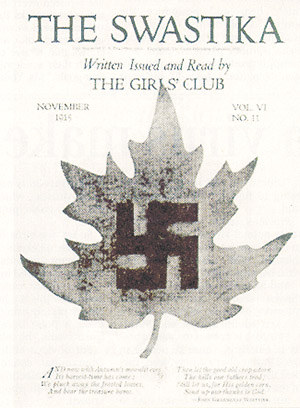
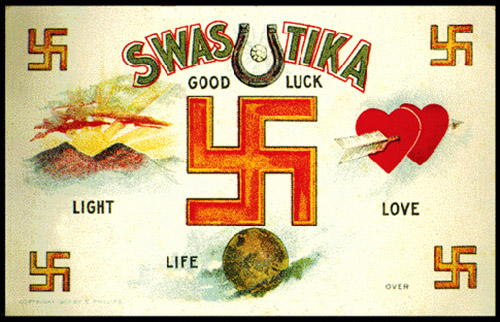
    Nevertheless, the swastika did not have these meanings elsewhere in the world. In the US it remained a good-luck sign, as evidenced by its use in the house organ of the Girls’ Club, called The Swastika (left). Up to the 1930s, the symbol appeared – with perfectly innocent intentions – on American goods ranging from poker chips and playing cards to the labels of fruit boxes. It was even the emblem of a lovable cartoon monkey named Bing-o. To this day in Asia it is still used, with auspicious connotations, on commercial signs and in religious ritual.9 

    But after Hitler came to power in 1933, the Western world came to link the swastika with hatred and violence. A synagogue in Hartford, Connecticut, had swastika patterns in its flooring, which the horrified congregation had to have paved over. When swastika flags were hoisted over three ocean liners docked in New York in 1935, a mob of 2,000 people tore them down, provoking diplomatic protests from the Nazis. The swastika became so firmly equated with evil that it remains an emblem of fear for many – and for many others, it is still used for that purpose. The incarcerated cult leader Charles Manson carved it into his forehead in 1970.10 It continues to surface among anti-Semites and fascists of various stripes. The present-day German republic forbids its public display.


    The swastika appeared – with perfectly innocent intentions – on American goods ranging from poker chips and playing cards to the labels of fruit boxes. Above: Early 20th century postcard.

    What Does the Swastika Actually Symbolise?

    All this gives a brief history of the use and abuse of the swastika in modern times. But what does the symbol really mean? This question is, I believe, not only difficult but unanswerable. But before I say why, let’s explore some of the meanings that have been ascribed to it.

    One interpretation is given by Schliemann, citing a scholar named Émile Bournouf:

    The 卐 represents the two pieces of wood which were laid cross-wise upon one another before the sacrificial altars in order to produce the holy fire (Agni), and whose ends were bent round at right angles and fastened by means of four nails, so that this wooden scaffolding might not be moved. At the point where the two pieces of wood were joined, there was a small hole, in which a third piece of wood, in the form of a lance (called Pramantha) was rotated by means of a cord made of cow’s hair and hemp, till the fire was generated by friction.11

    The swastika is thus associated with fire – particularly the sacred fire known as agni, which is not to be confused with the physical manifestation per se. Because this fire is caused by friction, the swastika is also associated with motion. And from its shape, it is connected with the cross. Thus the swastika can represent a cross in motion. George S. Arundale, late president of the Theosophical Society, writes:

    All that you feel in the sea you can feel infinitely more in the whirling of the Svastika [sic], for you yourselves are part and parcel of the whirling. The Svastika whirls because a God has set in motion the Wheel of the Law, and it is as if to its myriad spokes clung innumerable drops – the Men who are to become Gods.12

    This passage is taken from Arundale’s Lotus Fire, a profound work that explores a sequence of symbols (the point, the web, the line, the circle, the cross, the swastika, and the lotus) that was, he claimed, “disclosed to me by a Lord of Yoga.”13 Arundale also observes:

    I see… a very special appearance of relentlessness to the movement of the Svastika and to its effect upon the Men of the Sea [i.e., unindividuated beings] whom it frictions into ever-increasing Self-consciousness. The well-known phrase “broken on the wheel” – that horrible physical torture of earlier periods of history, perpetuated in modern days in terms of the mind, so that the inquisition of today is breaking its victims on the wheel of the mind, a terrible desecration of the Wheel of the Law… – occurs to me, for indeed [it is] ignorance which is broken upon the Wheel of the Love of God, the Wheel of His Salvation, the Svastika (emphasis added).14

    Although Arundale is writing in the 1930s, he does not seem to have Nazism per se in mind. Nevertheless, his association of the swastika with relentlessness and with “breaking on the wheel” suggests a possible bridge between its ancient, esoteric meaning and its present sinister connotations.


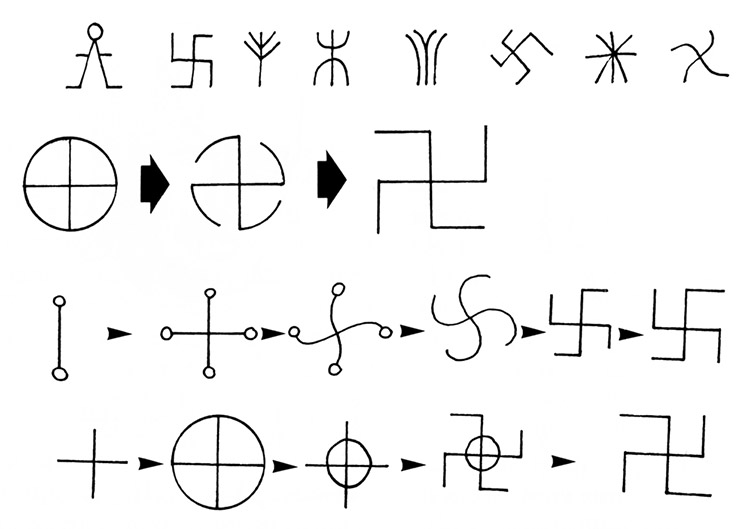
    The evolution of the swastika. Top line (1): Hallristningar, ancient Scandinavian rock-scribings. (2): In The Book of Signs, Rudolf Koch suggested the swastika evolved by the breaking of a sunwheel’s circumference. (3): In 1933, Herman Wirth said the swastika evolved from a runic character. (4): In his book The Sacred Symbols of Mu, James Churchward claimed the swastika had begun with the simple cross.

    H.P. Blavatsky, identifying the swastika with “Thor’s hammer” or “the hammer of creation,” says:

    In the Macrocosmic work, the “Hammer of Creation,” with its four arms bent at right angles, refers to the continual motion and revolution of the invisible Kosmos of Forces. In that of the manifested Kosmos and our Earth, it points to the rotation in the circles of Time of the world’s axes and their equatorial belts; the two lines forming the Svastika 卐 meaning Spirit and Matter, the four hooks suggesting the motion in the revolving cycles (emphasis Blavatsky’s).15

    Other authorities have also linked the swastika to cosmic cycles. The French esotericist René Guénon writes:

    The bent part of the arms of the swastika is considered… as representing the Great Bear seen in four different positions in the course of its revolution around the Pole Star, to which the centre of the four gammas are united naturally corresponds, and that these four positions are related to the cardinal symbol points and the four seasons.16

    Figure 4: The swastika seen as an arrangement of four Greek gammas (Γ).

    Guénon is talking about the fact that the four arms of the swastika resemble four gammas (the Greek capital gamma looks like this: Γ) positioned around a centre point. He connects this fact with the symbolism of the letter G – the Roman equivalent of the gamma – in Masonry. Hence also the name gammadion.

    Furthermore, this centre point would be the pole. (The point of view would be of someone looking down at the earth from above the North Pole.) For this reason, Guénon associates the swastika with Hyperborea, a prehistoric circumpolar civilisation that was said to precede Atlantis.17 (Note: this is not to be confused with Blavatsky’s concept of the Hyperborean Root Race.)

    So, then, the swastika is, or may be, connected with the four principal directions, portrayed symbolically as a cross. If so, then the decussated Nazi swastika would symbolise directions that are askew, and hence a world out of joint, possibly evil.

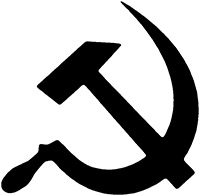
    Figure 5: The Soviet hammer and sickle. Conventionally it refers to the combined power of the workers (represented by the hammer) and the peasants (represented by the sickle).

    Incidentally one could say the same thing about the Soviet hammer and sickle. In essence it is nothing other than the cross (in this case, a T-cross) combined with the crescent – two of the most ancient and universal sacred symbols. But again its orientation is not rectilinear. Like the Nazi swastika, it is decussated – again suggesting something that is aberrant, out of joint, or evil.

    At any rate, these are some of the esoteric meanings associated with the swastika: sacred fire (or primordial energy), a cross in motion, movement, the North Pole and the four directions. Of course they do not contradict each other, because a symbol is a nexus of meanings and associations, not a series of propositions that can be consistent or inconsistent.

    Earlier I said that none of these associations, singly or as a whole, exhausts the meaning of the swastika. That’s because the swastika, like all other primordial symbols, has no ultimate meaning. It means itself. It speaks to a level of the mind that lies beyond the realm of meaning as we normally understand it. The same is true of other basic geometric shapes such as the six-pointed star and the crescent, the defining symbols of Judaism and Islam. These symbols will keep their living force for as long as the human mind is as it is. Meanings and movements will attach themselves to them and will try to draw power from them, often with success. Yet meanings come and go, while the symbol remains.

    As theologian Paul Tillich writes, religious symbols open “the depth dimension of reality itself, the dimension of reality which is the ground of every other dimension and every depth… the fundamental level, the level below all other levels, the level of being itself… If a religious symbol has ceased to have this function, then it dies. And if new symbols are born, they are born out of a changed relationship to the ultimate ground of Being, i.e., to the Holy.”18

    I believe that Tillich is right up to a point, but it is not so obvious to me that symbols – the primordial symbols, at any rate, of which the swastika is one – die. Or if they die, they are born again. Maybe it would be more accurate to say that they are recycled.

    Get the issue this article appears in

    In recent years some have tried to cleanse the swastika of its evil connotations. In 1988–92 a Jewish artist named Edith Altman created an installation entitled Reclaiming the Symbol: The Art of Memory. In one scene, she has a gold swastika painted on a wall above a black Nazi swastika painted on the floor – a visual attempt to expunge evil from the symbol. In 2008, in a ham-handed effort to make the swastika humorous, cartoonist Sam Gross published We Have Ways of Making You Laugh: 120 Funny Swastika Cartoons. (Sample: a Nazi dropping garbage into a swastika-shaped bin labelled “White Trash Only.”)

    But as graphic artist Steven Heller comments: “For every naïve rock-and-roller who thinks the swastika can be used with irony, there is a fervent neo-Nazi who uses it with malice. For every well-meaning artist who thinks the swastika can be tamed, there is a devout racist who embraces it.”19

    In the long run, it’s likely that the swastika will be rehabilitated. Theosophist Arthur M. Coon observes:

    The memory of the use of the swastika, as an emblem of Nazism will in future ages have faded to oblivion; while its true meaning as a symbol of the hidden “fire” or “spirit” within all manifestation, from the atom to a solar universe, will become increasingly revealed to humanity.20

    But I suspect that these future ages will not, at least in the West, come in the lifetime of anyone who is breathing on this planet now.

    This article first appeared in Quest: Journal of the Theosophical Society in America (Winter 2016), and is reprinted with permission.

    [alert type=”general” dismiss=”no”]This article was published in New Dawn Special Issue Vol 10 No 2.[/alert]

    [alert type=”success” dismiss=”no”]If you appreciate this article, please consider subscribing to help maintain this website.[/alert]

    Footnotes

    1. Thomas Wilson, The Swastika: The Earliest Known Symbol and Its Migrations, with Observations on the Migrations of Certain Industries in Prehistoric Times, Government Printing Office, 1896, 811–13, 829
    2. Henry [Heinrich] Schliemann, Troy and Its Remains: A Narrative of Researches and Discoveries Made on the Site of Ilium, and in the Trojan Plain, Edited by Philip Smith, John Murray, 1875, 102
    3. Christoph Baumer, Tibet’s Ancient Religion: Bön, Translated by Michael Kohn, Weatherhill, 2002, 21
    4. Wilson, 800
    5. Count Goblet d’Alviella, The Migration of Symbols, Archibald Constable, 1894, 40
    6. Nicholas Goodrick-Clarke, The Occult Roots of Nazism: Secret Aryan Cults and Their Influence on Nazi Ideology, New York University Press, 1985, 144–45
    7. Ibid., 151
    8. Adolf Hitler, Mein Kampf, Translated by James Murphy, chapter 7, www.greatwar.nl/books/meinkampf/meinkampf.pdf; accessed Aug. 27, 2015
    9. Steven Heller, The Swastika: Symbol beyond Redemption?, Allworth, 2000, 37, 90–101, 149
    10. Ibid., 13
    11. Schliemann, 103–04; cf. H.P. Blavatsky, Collected Writings, 15 vols., Edited by Boris de Zirkoff, Theosophical Publishing House, 1966–91, 2:143–44
    12. George S. Arundale, The Lotus Fire: A Study in Symbolic Yoga, Theosophical Publishing House, 1939, 225
    13. Ibid., 22
    14. Ibid., 267–68
    15. H.P. Blavatsky, The Secret Doctrine, 2 vols., Quest, 1993, 2:99
    16. René Guénon, Fundamental Symbols: The Universal Language of Sacred Science, Translated by Alvin Moore, Jr., Quinta Essentia, 1995, 85
    17. Jason Jeffrey, “Hyperborea and the Quest for Mystical Enlightenment,” New Dawn 58 (Jan.-Feb. 2000), www.newdawnmagazine.com/articles/hyperborea-the-quest-for-mystical-enlightenment; accessed Sept. 1, 2015.
    18. Paul Tillich, The Essential Tillich, Edited by F. Forrester Church, Macmillan, 1987, 47, 49
    19. Heller, 157
    20. Arthur M. Coon, The Theosophical Seal: A Study for the Student and the Non-Student, Theosophical Publishing House, 1958, 120

    © New Dawn Magazine and the respective author.
    For our reproduction notice, click here.
  • The Beatles, Aleister Crowley, & the Mystery of ‘Paul Is Dead’

    The Beatles, Aleister Crowley, & the Mystery of ‘Paul Is Dead’

    From New Dawn Special Issue Vol 16 No 5 (Oct 2022)

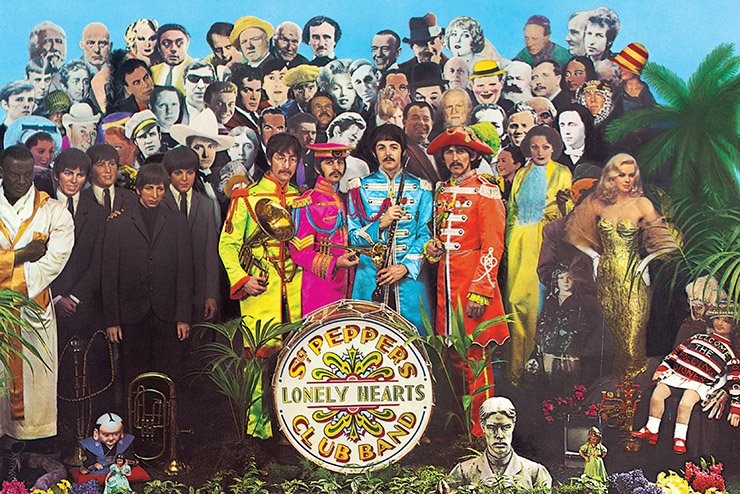
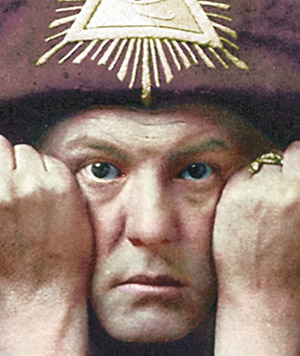
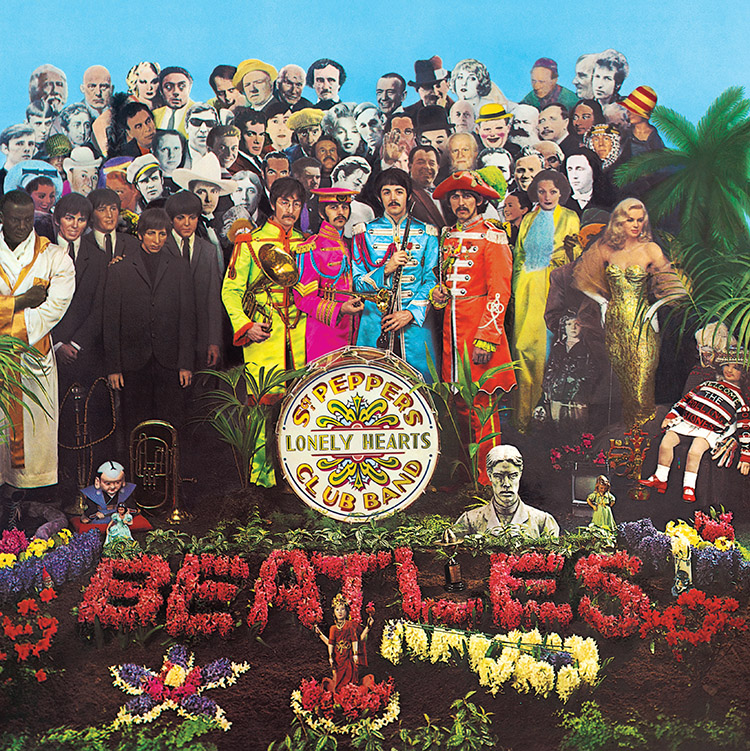
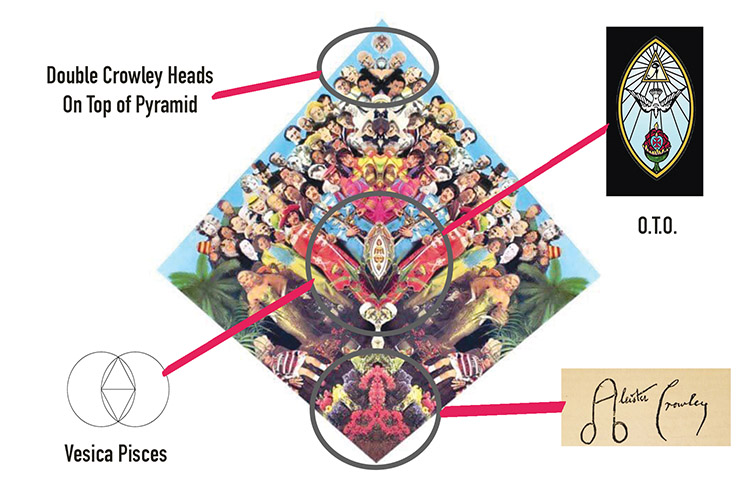
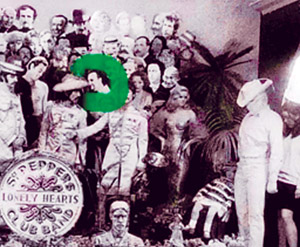
    Aleister Crowley’s penchant for photobombing some of the world’s most infamous conspiracies is often a topic for debate, but in the present case the analogy can be taken quite literally – Crowley’s mug is planted squarely on the Beatles’ Sgt. Pepper’s Lonely Hearts Club Band. 

    Of course, this album cover is one of pop culture’s most iconic images. Our present focus relates to Crowley’s involvement in the ‘Paul is Dead’ (P.I.D.) conspiracy and, more generally, his influence on the Beatles as a whole.

    The Fab Four are the cornerstone of modern-day pop culture, which for some makes them inextricably linked with the nefarious workings of the Establishment. As we shall find, Mr Crowley managed to worm his way into the centre of this alleged rotten apple. But as with all things “conspiracy,” a vast gulf lies between what is real and what is indulgent fantasy.

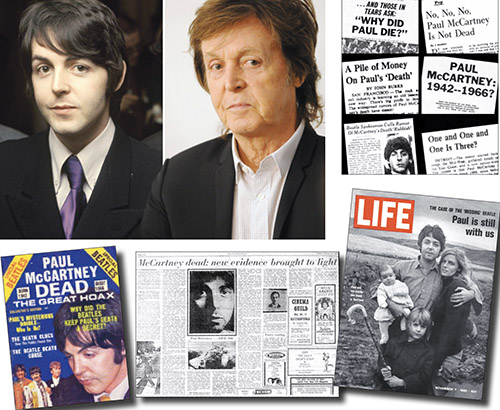
    Back in the summer of 1969, rumours of Paul McCartney’s death began circulating like wildfire on college campuses across the United States. To wit, Paul was killed in a car crash on the M1 motorway on 11 September 1966 and was secretly replaced by a look-alike double to keep the money rolling in for band and country. The band, however, felt obliged to leave hints attesting to the fact to appease their guilty conscience. 

    On 17 September 1969, Des Moines’ Drake Times-Delphic published the first known article on the subject, “Is Beatles’ Paul McCartney Dead?” It listed some of the hidden clues and messages on Beatles records hinting at Paul’s demise, like a voice uttering “Turn me on, dead man” whilst “Revolution 9” was played backwards.

    Radio station disc jockeys spread the message, and soon mainstream media got hold of the story, pushing the Beatles for comment. Ringo Starr told the press, “If people are gonna believe it, they’re gonna believe it. I can only say it’s not true.” John Lennon, for his part, simply said the rumours were “insane.” A CBS News crew secretly filmed McCartney working on his farm in Scotland, followed by a pair from Life magazine. Paul busted the reporters skulking on his property but relented to an interview, telling them:

    “Perhaps the rumour started because I haven’t been much in the press lately. I have done enough press for a lifetime, and I don’t have anything to say these days. I am happy to be with my family and I will work when I work. I was switched on for ten years and I never switched off. Now I am switching off whenever I can. I would rather be a little less famous these days.”

    After the Life cover story, the “Paul is Dead” rumours began to die down, but they never really went away. Today, over 50 years after the death “hoax” started, McCartney is back on top and quite ubiquitous. You’ll find him on the Billboard charts with the album McCartney III (2020). In bookstores with The Lyrics: 1956 to the Present (2021). In theatres and streaming on Disney+ with the Peter Jackson-directed The Beatles: Get Back (2021). Headlining Glastonbury 2022.

    (Top left) Paul McCartney before his supposed death in 1966, and McCartney today, still living and breathing – if that’s really the same Paul!  At the time of the hoax, the media had a field day feasting on the rumour until Life magazine declared that Paul was “still with us.”

    Rumours of his premature demise are also back in full swing. Numerous books, YouTube videos and blogs pay slavish devotion to analysing every detail of the conspiracy, sensing something sinister lurking behind the “cute” Beatle. 

    Maybe that sinister something has a name – Aleister Crowley. Crowley, however, died shortly after any of the Beatles were born, so how could the “Wickedest Man in the World” pull the strings of the world’s greatest band? Let’s begin the investigation with the name itself.

    Beatles with an ‘A’

    The Beatles, it seems, have always been shrouded in mystery. This goes for the origins of the band name. “Beatle” is a clever pun imbued with various permutations of meaning. How did it come to be? John Lennon claimed that he and Stu Sutcliffe came up with the name in a nod to Buddy Holly and The Crickets. John said in a 1964 interview: “It was beat and beetles and when you said it, people thought of crawly things, and when you read it, it was beat music.” On another occasion, John stated, “It came in a vision – a man appeared on a flaming pie and said unto them ‘from this day on you are Beatles with an ‘A’.”

    Some researchers claim there is more to the name than meets the eye. They reference a poetry collection by Aleister Crowley, published in 1910, entitled The Winged Beetle, which includes occult-themed poems like “The Wizard Way,” “The Octopus,” “The Two Secrets and The Wings.” They note how Paul, after the break-up of the Beatles, went on to form the band Wings. Is Paul the “Winged Beetle,” and were the Beatles acolytes of Crowley’s system of Magick, with a “K”?

    Aleister Crowley in characteristic pose.

    It is not unusual to find rock stars openly professing their admiration for Crowley (i.e. Jimmy Page, David Bowie, Ozzy Osbourne, etc.). As we know, Crowley is on the cover of Sgt. Pepper. One rumour has it that “Sgt. Pepper” was a reference to Crowley himself. The opening lyrics to the album are… “It was 20 years ago today when Sgt. Pepper taught the band to play.” That album came out on the 20th anniversary of Crowley’s death. Is the band hinting they are disciples of the Great Beast 666? Crowley’s axiom is, “Do what thou wilt is the whole of the Law,” and “Love is the Law, love under will.”

    In an interview with Playboy, John Lennon stated: “The whole Beatle idea was to do what you want, right? To take your own responsibility, do what you want and try not to harm other people, right? Do what thou whilst, as long as it doesn’t hurt somebody.” In 1967, they added “All You Need Is Love” to the repertoire.

    What kind of influence did Crowley have over the Beatles? Consider the band’s innovation in the field of backmasking, a recording technique in which a sound or message is recorded backwards to be played forward. The first time such a thing was accomplished was in 1966 during the Beatles recording of the Revolver album. In Magick in Theory and Practice, Crowley instructed the Adept to do the following:

    (“a”) Let him learn to write backwards, with either hand. 

    (“b”) Let him learn to walk backwards.

    (“c”) Let him constantly watch, if convenient, cinematograph films, and listen to phonograph records, reversed, and let him so accustom himself to these that they appear natural and appreciable as a whole.

    (“d”) Let him practice speaking backwards; thus for “I am He” let him say, “Eh ma I.”

    (“e”) Let him learn to read backwards. In this it is difficult to avoid cheating one’s self, as an expert reader sees a sentence at a glance. Let his disciple read aloud to him backwards, slowly at first, then more quickly.

    (“f”) Of his own ingenium, let him devise other methods.

    In addition to their innovation in the studio, Crowley may have influenced the band’s lifestyle, most evident during their post-1965 “experimental” phase. Crowley was notorious for his drug use, indulging in alcohol, heroin, cocaine and psychedelics. Coupled with his libertine views on sexuality, Crowley could be viewed as the quintessential rock star, decades before such creatures roamed the earth. The Beatles, of course, encompassed all the cliches of rock stardom, for good and ill.

    Here Comes the Sun King

    The Egyptian deity Khepera is often depicted as a beetle-headed man.

    Crowley’s philosophy holds the key to our discussion, a philosophy heavily rooted in ancient Egyptian mythology. Crowley understood the significance and sacred symbolism of the beetle. In Egyptian mythology, the scarab or dung beetle was believed to be the incarnation of the beetle-headed god Khepera, who ruled over resurrection and fertility, symbolic of the rising sun, rebirth and creation. Synchronistically, if not consciously, the Beatles would carry the mandate of Khepera and become the sun centre of our musical universe.

    The scarab beetle may also hold the key to the ‘Paul is Dead’ mystery. This small insect is associated with an ancient Egyptian god by its curious habit of rolling dung, from east to west, into a ball, into which it lays its eggs. When hatched, the dung provides its young with food. This process of transforming the dead matter of dung into renewed life represents initiation in the Egyptian mysteries. Paul’s “death,” rather than being literal, should be interpreted as symbolic of initiation. 

    The candidate for initiation represents Osiris who was murdered by his brother Set. Osiris’ consort Isis reassembles his body and then gives birth to the resurrected god Horus, thus completing the cycle of death and rebirth.

    It is possible the Beatles were preparing us for Paul’s symbolic death before he was “officially pronounced dead” in September 1966. Let’s go back to 1965 and look at the cover of the Beatles fifth studio album Help! Robert Freeman, who photographed its cover, explains: “I had the idea of semaphore spelling out the letters ‘HELP’. But when we came to do the shot, the arrangement of the arms with those letters didn’t look good. So we decided to improvise and ended up with the best graphic positioning of the arms.”


    Did the cover of the Beatles Help! album encode references to Crowley’s system of magick? Hooded figures in a Tau robe in Crowley’s Liber O vel Manus et Sagittae sub figurâ VI seem to match the figures on the album’s cover. 

    In semaphore, the Beatles are spelling out the letters N-U-J-V. Basically, gibberish. But what if the band were not using semaphore but rather a totally different system? Crowley’s Liber O vel Manus et Sagittae sub figurâ VI contains images of a hooded figure in a Tau robe posing in various positions. Each position conveys a different meaning.

    In a video appearing on the YouTube channel “Iamaphoney,” these pictures are superimposed over the cover of Help! It’s pretty much a perfect match. Let’s take a closer look at what these body positions mean when interpreted through Crowley’s system. 

    John Lennon, with both arms raised, signifies “Osiris Risen – the Pentagram.” Ringo, holding one hand up and one hand down, signifies “Earth – The God Set fighting.” George, with both arms spread out, conveys “Isis mourning – the Svastika.” And Paul, with one arm raised and the other lowered, represents a close approximation of the position, “Typhon – The Trident.” 

    Could it also be possible that the loose-fitting jackets the Beatles are wearing on the cover of Help! are a hipster’s interpretation of the Tau robe?

    If you think these concepts are a little far-fetched, understand that the occult was a big deal in 1966, as it was with the Beatles themselves. This is evident on their 1966 masterpiece, Revolver, whose working titles included Abracadabra, Magic Circle and Four Sides of the Circle.

    The word Abracadabra plays a central role in Crowley’s philosophy. “Abrahadabra” in The Book of the Law is “the Word of the Aeon,” meaning the Great Work accomplished and the all-important “attainment of the Knowledge and Conversation of one’s Holy Guardian Angel.” In addition, the word represents the uniting of the Microcosm with the Macrocosm.

    It Was 20 Years Ago Today

    Many people are familiar with the ‘Paul is Dead’ clues. Let’s touch upon some of the better-known ones on Sgt. Peppers to bring us up to speed. The album cover undoubtedly presents a funeral ceremony. On the grave, pictured in the lower portion of the cover, red flowers spell out the word “Beatles.” This is traditionally interpreted to mean that the Beatles, with the death of Paul McCartney, are now “dead.”


    Album cover for Sgt. Pepper’s Lonely Hearts Club Band

    Take note as well that on the cover we are presented with a set of Beatle doubles. Two sets of Beatles stand over the grave. The older phase Beatles, to the left, look over the grave mournfully. Dressed in drab coloured suits, they are in fact wax figures made by Madame Tussauds.

    The second group of Beatles, standing in the centre, are the new phase Beatles. They are dressed in bright clothing, looking very much alive because they are in fact the Beatles standing there in the flesh. Here we are presented with the ‘new’ Paul McCartney, the replacement double as it were, who will carry the band into new psychedelic frontiers, etc.

    Below the red flowers is a group of yellow flowers in the shape of a left-handed bass, Paul’s bass of course. There are three strings on that bass. One is missing. Paul is missing.

    While the other three Beatles carry brass instruments, McCartney carries a cor anglais, a double-reed woodwind instrument. This has been interpreted as a symbol of death. As well, Paul here is “out of step” with the other Beatles, just as he is on the cover of Abby Road. The interpretation is that Paul walks amongst the dead. In the corner, next to a doll wearing a “Welcome the Rolling Stones” jumper, is a reddish driving glove symbolising McCartney’s bloody car crash death.

    These are popular clues and lots of fun to play with, but the proof of the pudding linking P.I.D. to black magician Aleister Crowley is a revelation never before written about. 

    We all know, of course, that Crowley is on the cover of Sgt. Peppers, one of many famous people pictured, and seemingly was placed randomly in the back row. However, if you split the cover diagonally and mirror it, a remarkable thing happens. At the very top of this diamond-shaped image sits Crowley. His head predominates over everyone else.

    Right at the bottom of the cover you see the flowers form an insignia that is identical to the ‘A’ which Crowley used in his signature and is famously portrayed in the shape of a penis. Sex magick, it should be noted, was a central component of Crowley’s teachings. And in the middle of the cover is the emblem for Crowley’s mystical organisation – the O.T.O.

    The palm tree on the right side of the album now appears on both sides forming a border. This symbol, especially significant in Freemasonry, refers to the two pillars Boaz and Jachin that are said to have stood on the porch of Solomon’s Temple. This is a remarkable image. To put that all together indicates, in my opinion, a level of genius.

    Get the issue this article appears in

    The Smoking Gun

    Recently, a veritable treasure trove of material has been released from the Beatles’ camp showing behind-the-scenes photos of the production of the Sgt. Pepper’s album cover. These photos reveal something very interesting. In my estimate, the smoking gun – both literally and figuratively – and final clue regarding the ‘Paul is Dead’ mystery.

    The Beatles hired Michael Cooper as the principal photographer for the album cover. The photoshoot occurred at Cooper’s London studio at 4 Chelsea Manor Studios, 1-11 Flood Street off King’s Road in Chelsea.

    Paul McCartney came up with the album title Sgt. Pepper’s Lonely Hearts Club Band. He based the concept for the album cover on an old photograph showing Paul’s father’s old orchestral band standing around a bass drum that read Jim Mac’s Band.

    Peter Blake and his wife Jann Haworth designed and assembled the set. Finally, after eight days of preparation, on 30 March 1967, the Beatles arrived at the studio where Cooper shot them as they posed in front of various life-sized cardboard cut-out photographs of famous people.

    What we discover in these behind-the-scenes photos is that some of these life-sized cut-outs did not appear on the official album cover because they were behind another cut-out or behind a band member. Behind George Harrison is one of these obscured characters. Indeed, on the album cover, we catch only a glimpse of this figure peering out from behind the right side of Harrison’s head.

    Now, with the aid of these photos, we can identify this person to be film actor Timothy Carey. The image is, in fact, taken of Carey specifically from one scene in the Stanley Kubrick film The Killing (1956).

    The cut-out shows Timothy Carey holding a rifle, and in the movie Carey plays a hired hitman working with a group of criminals. They have a plan to rob the racetrack of its earnings and Carey’s job is to shoot one of the horses to cause a distraction.

    On the cover of the album, the image of Carey is obscured by George Harrison. The barrel of the gun actually extends all the way behind Paul McCartney who is standing next to Harrison. If you gauge it, you can see that the barrel of this gun is pointed directly behind the heart of Paul McCartney.

    Timothy Carey in The Killing (1956).

    No one knew about this for over 50 years. Yet, curiously, the choice was made to use an image from this Kubrick film to symbolise, I would suggest, the ‘killing’ of the lead racehorse – as Paul McCartney could indeed be equated to a very profitable lead racehorse. A smoking gun indeed.

    What does it all mean? What does it add up to? We are left with room for conjecture. Perhaps, as some researchers suggest, the Beatles were part of an elaborate plan by the elite to condition the youth of the Western world to accept the coming ‘New Aeon’. Others would assert it is a method of social engineering akin to the use of MK-ULTRA but applied on a mass level. Certainly, the symbolism draws a direct link to the inner workings of the Mystery Schools and the teachings of Aleister Crowley.

    [alert type=”general” dismiss=”no”]This article was published in New Dawn Special Issue Vol 16 No 5.[/alert]

    [alert type=”success” dismiss=”no”]If you appreciate this article, please consider subscribing to help maintain this website.[/alert]

    References

    https://www.ancient.eu/article/1011/ancient-egyptian-symbols/
    https://www.amazon.com/Winged-Beetle-Aleister-Crowley-ebook-dp-B07PBV5LBB/dp/B07PBV5LBB/ref=mt_kindle?_encoding=UTF8&me=&qid=
    https://www.youtube.com/watch?v=XM8KebDc8ac
    https://thenumbernineblog.wordpress.com/2017/02/23/well-sing-it-man-well-be-reversed-learning-to-think-backwards/
    https://hermetic.com/metadata/crowley/libers/lib6#liber-o-vel-manus-et-sagittae-sub-figura-vi
    https://theoccultbeatles.wordpress.com
    http://mccartneyart.com/product/egypt-station/
    https://louderthanwar.com/aleister-crowley-influence-on-popular-music/
    www.amazon.com/Lennon-America-1971-1980-Based-Diaries/dp/081541157X

    © New Dawn Magazine and the respective author.
    For our reproduction notice, click here.
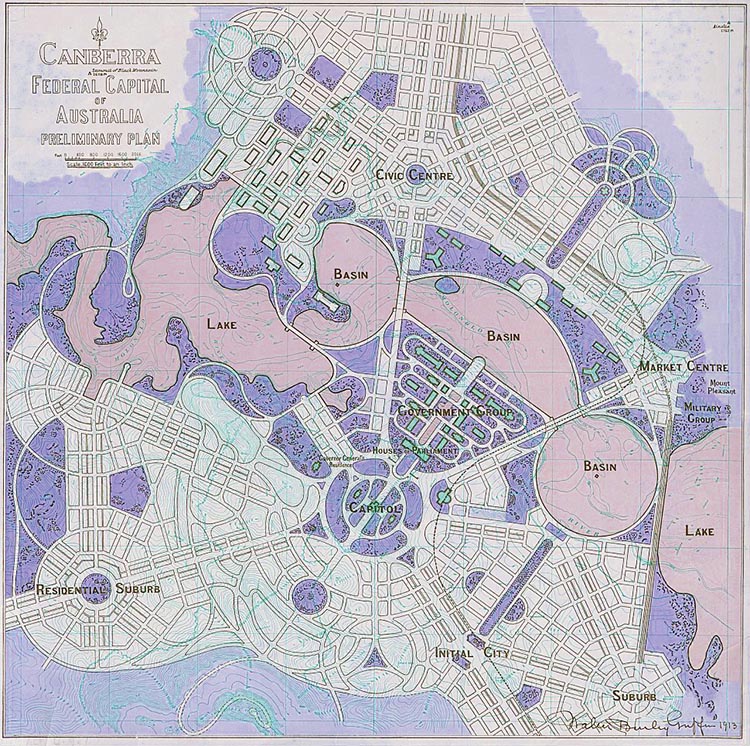
  • ‘Lenin was a Mushroom’! The Strange Life & Times of Sergey Kuryokhin

    ‘Lenin was a Mushroom’! The Strange Life & Times of Sergey Kuryokhin

    From New Dawn Special Issue Vol 15 No 3 (June 2021)

    Lenin was a mushroom! At least according to Sergey Anatolyevich Kuryokhin, the pioneering Russian musician, activist, and prankster from St. Petersburg who convinced viewers of Leningrad Television in January 1991 that the leader of the Bolshevik Revolution and father of the Soviet Union had eaten so many psychedelic mushrooms, he ended up becoming one. 
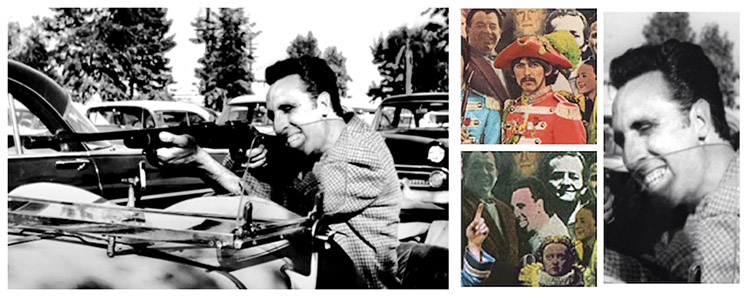
    In 1990s Soviet Russia, citizens read Pravda, the official newspaper of the Communist Party of the Soviet Union. They were conditioned to believe state propaganda, and an easy target in Kuryokhin’s Lenin mushroom prank.
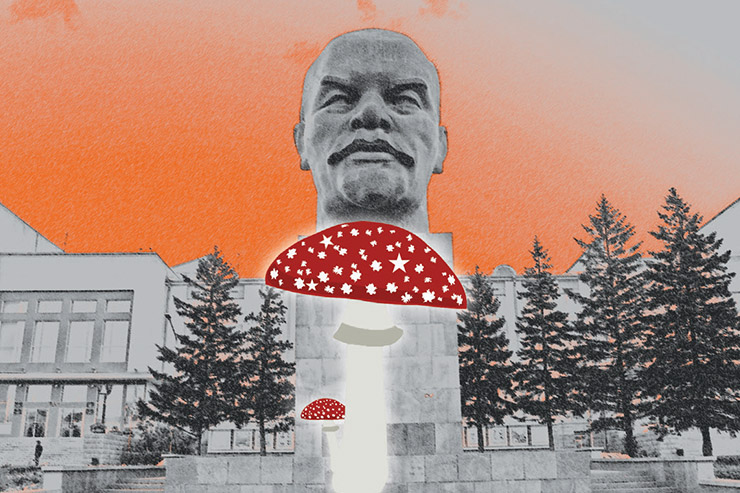
    It’s hard to believe such a claim could be taken at face value by anyone, but Russians under communism had long been conditioned to believe whatever appeared on State-run television. 

    Delivering his argument with a straight face and a serious tone, and citing the work of genuine sources, Kuryokhin was able to convince his audience of Lenin’s secret fungi metamorphosis – though a large part of the prank’s success also came from the fact that he was speaking about a man who Soviet citizens had been brought up to revere, someone never publicly mocked or satirised. 

    Sergey Anatolyevich Kuryokhin (1954–1996) is recognised as a pioneering Russian musician, artist, activist, and founder of the now legendary music group Pop Mechanics.

    In a paper on the incident, University of California, Berkeley Professor Alexei Yurchak claimed that if Kurykohin had “been speaking of anyone else, his words would easily have been dismissed as a joke.”1

    “But Lenin! How could one joke about Lenin? Especially on Soviet television,” Yurchak explained. “Audiences could not help but attribute some credibility to the revelation.” 

    Not only did Kuryokhin claim to have “absolutely irrefutable proof that the October Revolution was carried out by people who had been consuming certain mushrooms for many years” but that the mushroom consumption had in turn “displaced their personalities.” 

    The day after the broadcast, a delegation of old Bolsheviks approached Galina Barinova, who oversaw a regional committee of the Communist Party, and demanded to know, “Could it be true that Lenin was a mushroom.” “NO!” answered Galina Barinova. “But…” the Bolsheviks insisted, “they said so on TV yesterday.” “It’s not true,” she responded. “Because a mammal cannot possibly be a plant.” 

    In this Pop Mechanics performance, Kuryokhin is lead singer with Sergey Letov on saxophone.

    Ironically, in 2003, then US Secretary of State Colin Powell claimed at the United Nations to have “irrefutable” evidence that Iraq possessed weapons of mass destruction – a false claim that, like Kuryokhin’s, was believed by many, but tragically unlike Kuryokhin’s led to the death of hundreds of thousands of people.

    Kuryokhin’s mushroom prank aired on TV less than a year before the collapse of the Soviet Union, but the artist was just getting started. His rebellion against the rigidity of communist Russia would soon take on the nation’s new capitalist form too. 

    In 1991, months before the collapse of the USSR, Soviet audiences witnessed a shocking scene on television program Pyatoe Koleso (The Fifth Wheel). Two serious-looking men – Sergey Sholokhov, the host, and his guest, the underground musician and writer introduced as “politician and actor” Sergey Kurekhin – sat in a studio discussing the 1917 October revolution. Suddenly, Kurekhin offered an astounding hypothesis – that Vladimir Lenin, the Bolshevik leader, was not a human being but a mushroom. Kurekhin used graphics to back up his hypothesis including this picture of Lenin (above right) with a round “strange object” on the bottom right of the photo. Kurekhin mesmerised viewers with a complex scientific-sounding explanation, and some misdirection, that linked the object to hallucinogenic mushrooms, as well as citing much “evidence” of Lenin’s affinity for mushrooms!

    With the end of the Soviet Union, Kuryokhin like many artists was optimistic at the prospect of a new Russia. However, as reality began to set in, Kuryokhin and other dissidents soon came to see this new Russia as a state even worse than the previous. 

    “He was very disappointed with liberals at that time, plus by senseless post-modernity, by the chillness of the people surrounding him in the liberal artist circles, and he was in search of something different,” said Aleksandr Dugin, the Russian philosopher, author, and political strategist who was close friends with Kuryokhin in his final two years. 

    Kuryokhin was among the first of the liberal artists who, upon seeing the reality of a post-Soviet Russia, became disillusioned with the vacuousness of liberal capitalism and sought to replace it with something new and spiritually substantial. Thus came the creation of the National Bolshevik movement. A radically syncretic and paradoxical movement co-founded by Dugin, Kuryokhin, writer Eduard Limonov, and punk musician Yegor Letov, the National Bolsheviks combined anti-liberalism, the Situationist Avant Garde, the metaphysical, and the absurd with loud imagery and anti-government protest. 

    A man who enjoyed pushing the envelope and making waves wherever he went – including through his experimental music group Pop Mechanics – Kuryokhin’s involvement with National Bolshevism was no different, and he used politics as another vehicle for his art, even inserting Dugin and Limonov into the final Pop Mechanics performance, which was dedicated to the British occultist Aleister Crowley. 

    According to Professor Fabrizio Fenghi in his book It Will Be Fun and Terrifying: Nationalism and Protest in Post-Soviet Russia, Limonov “read a text about ‘fallen angels’ and sang” during the concert, while Dugin read excerpts from Aleister Crowley’s work as Kuryokhin “performed some pseudo-ritualistic and seemingly mocking gestures” from behind. 

    “He was much larger than a party. He used National Bolshevism as a line of his conceptual music, one of the melodies in the sequence,” Dugin explained, adding that one core element of Kuryokhin’s personality was irony. 

    “When it looked like he was joking, he was saying serious things. When it looked like he said serious things, he was joking,” Dugin continued, calling Kuryokhin one of the master ‘trolls’ before ‘trolling’ was even a thing. 

    But Kuryokhin was also “really serious about religion, about metaphysics, about death, about philosophy” and “about the basic structure of human being,” Dugin said – using his art and his stunts to push a greater message, concept, or ideal. 

    Aleksandr Dugin & Sergey Kuryokhin in the mid-90s.

    In their ‘Manifesto of the New Magi’ (on page 70 of this issue of New Dawn), Kuryokhin and Dugin called for a return to ‘magic’ to bring on the revitalisation of politics and art, which they argued had degenerated to the lowest point. 

    “Only the direct, total replacement of art and politics with MAGIC can save this situation,” the manifesto declared, claiming that the source of magic in both institutions “has gradually been lost sight of.” 

    “Instead of a separate art, separate politics, and separate magic, a new synthetic discipline should be introduced, that of MAGIC, which directly establishes its own politics and its own art,” they said, concluding that art and politics should become the ritual itself. 

    Get the issue this article appears in

    The National Bolshevik movement is often considered to have been Kuryokhin’s last major stunt, or work of art, before he tragically died of a heart condition in 1996 at the age of just 42. 

    Yegor Letov passed away in 2008 and Eduard Limonov died in 2020, making Dugin the last of the co-founders of the National Bolsheviks still standing. 

    Kuryokhin was never a well-known figure in the West, and his international obscurity continues today, though with the advent of the internet his work has reached small new audiences online in the United States, United Kingdom, Australia, and beyond. 

    Perhaps more importantly, the conditions that led to Kuryokhin’s art are still present around the world, though largely in the West, where another generation of youth find themselves at the precipice of societal change, in a late state of decline.

    [alert type=”general” dismiss=”no”]This article was published in New Dawn Special Issue Vol 15 No 3.[/alert]

    [alert type=”success” dismiss=”no”]If you appreciate this article, please consider subscribing to help maintain this website.[/alert]

    Footnote

    1. www.academia.edu/633795/A_Parasite_From_Outer_Space_How_Sergei_Kurekhin_proved_that_Lenin_was_a_mushroom

    © New Dawn Magazine and the respective author.
    For our reproduction notice, click here.