New Dawn – World's Most Unusual Magazine

Category: Secret Wisdom

  • Mystery of the Seven Seals: Seven Spheres, Planetary Archons & Corruption on High

    Mystery of the Seven Seals: Seven Spheres, Planetary Archons & Corruption on High

    From New Dawn 158 (Sept-Oct 2016)

    Until baptism …fate is true. But afterward the astrologers are no longer correct. 
    – Excerpta ex Theodoto, 78

    The New Testament is probably the most widely read book in the world. And yet it is also a book that is mysterious, and, at best, not fully understood. In some cases, this is because what the churches teach today no longer corresponds with what the New Testament says. This is the case with the nature and person of Jesus. (See my article, “The Strange Identity of Jesus Christ,” in New Dawn 156.)

    In other instances, it is not so much that the teaching has been changed, but that it has been lost completely.

    This is true of the early Christian view of cosmology. It is peppered throughout the New Testament but has been completely overlooked or forgotten. The result is that many parts of the text are baffling or incomprehensible today.

    Here’s one example – the angels. Today angels are golden-haired beauties who save you from car wrecks. In the US there is even a magazine, Angels on Earth, that is devoted to printing readers’ firsthand experiences of encounters with angels. It has a circulation in the hundreds of thousands.

    But in the first century CE it was not so. Here is a curious fact: in the New Testament, the apostle Paul never speaks of angels in a favourable way. Examples: “For I am persuaded, that neither death, nor life, nor angels, nor principalities, nor powers, nor things present, nor things to come… shall be able to separate us from the love of God” (Romans 8:38–39; biblical quotations are from the Authorised King James Version). “For I think that God hath set forth us the apostles last, as it were appointed to death: for we are made a spectacle unto the world, and to angels, and to men” (1 Corinthians 4:9; emphasis added in both passages).

    In both examples, the angels are not friends of humanity but barriers to God.

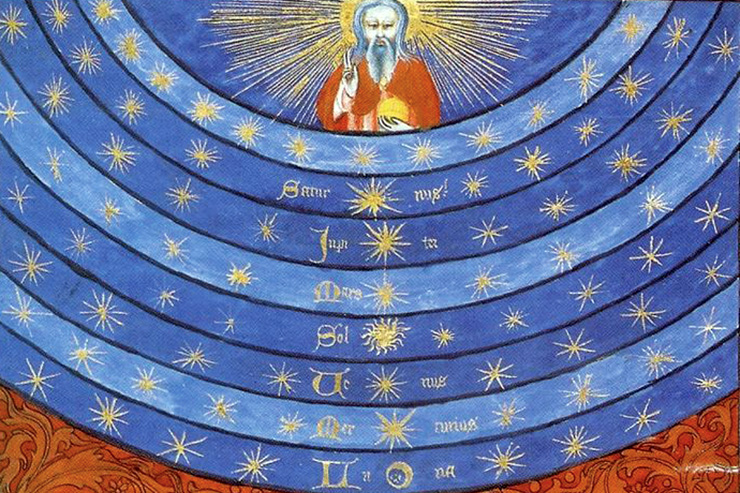
    To understand the implications of this fact, it might be best to begin with the cosmological worldview that was current in the first century CE. It is based on the seven planets as known at that time: the Moon, Mercury, Venus, the Sun, Mars, Jupiter, and Saturn. They were believed to revolve around the earth (in the order just given), each in its own crystalline sphere. Beyond these was the realm of the fixed stars, and beyond that, God himself.

    Another curious fact: you will notice that in English the word heaven has two meanings, one having to do with the physical sky (usually in the plural form heavens), the other having to do with the spiritual realm. The ancient Greek word ouranós had a similar dual sense. The heavens above, including the spheres of the planets, were regarded both as physical space and as a spiritual dimension. 
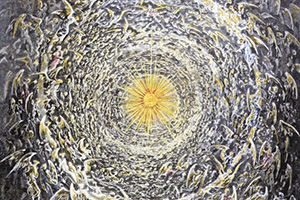
    Section of Gustave Doré depiction of the Empyrean, or highest heaven, for Dante’s Divine Comedy.

    It’s difficult for us today to understand this worldview. Although we do think of heaven in the spiritual sense as being “up there,” we understand it as a metaphor only. The realms of the physical planets and stars in outer space, to our minds, have no spiritual component as such.

    In antiquity it was not so. The physical heavens were identified with the levels through which the soul had to ascend after death. These levels, and the planets associated with them, were, as often as not, viewed as a series of gates that blocked the soul from its ascent to its true home.

    Each of these planets had a vice associated with it, which is where we get the concept of the seven deadly sins. The soul could only ascend if it shed these vices. The process is described in the Poimandres, a treatise that makes up part of the Corpus Hermeticum or “Hermetic body” of writings, generally dated to the early centuries of the Common Era:

    The human being rushes up through the cosmic framework, at the first zone [the moon] surrendering the energy of increase and decrease; at the second [Mercury] evil machination, a device now inactive; at the third [Venus] the illusion of longing, now inactive; at the fourth [the sun] the ruler’s arrogance, now inactive; at the fifth [Mars] unholy presumption and daring recklessness; at the sixth [Jupiter] the evil impulses that come from wealth, now inactive; and at the seventh [Saturn] the deceit that lies in ambush. (Poimandres, 1.25)

    Each of these seven spheres was also ruled by a planetary archon, who could be viewed as an angel or as a god.

    Heavenly Realms & Corrupt Evil Forces

    Another part of the Christian teaching – and, again, I am speaking of the New Testament – was that these planetary spheres were ruled by corrupt forces. The epistle to the Ephesians, according to most scholars, was not written by Paul, but it is close to his thought. Here is what it says: “For we wrestle not against flesh and blood, but against principalities, against powers, against the rulers of the darkness of this world, against spiritual wickedness in [heavenly] places” (Ephesians 6:12). The word “heavenly,” in this version, appears in a note. But it is closer to the Greek epouraníois than is the reading in the main text, “high places.” This verse makes it clear that the “principalities” and “powers” were not the Roman emperors, but spiritual forces of evil. Paul himself in Romans 8:38–39 (quoted above), uses more or less identical terms in the same way.

    Let’s go ahead five hundred years, to the single most important work on angelology in the Christian tradition: the Celestial Hierarchy of Dionysius the Areopagite. (Dionysius the Areopagite is a figure mentioned in Acts 17:34 as a contemporary of Paul. This work is attributed to him, but was very likely written 500 years later, in the sixth century CE. Hence the author, otherwise unknown, is often called “Pseudo-Dionysius.”) He lists orders, or “choirs,” of angels, each class having a different name. Two of these are the “Principalities” and “Powers.” Pseudo-Dionysius’s system was taken up by Dante in his Divine Comedy, among others. 

    Notice the change here. For Paul and the author of Ephesians, writing in the first century, the “principalities” and “powers” are among the forces of “wickedness in heavenly places.” For Pseudo-Dionysius, writing five hundred years later, they are honourable members of the heavenly hierarchy.

    It would be an intricate task to show when and how this change came about. For our purposes, it’s enough to know that it did come about. Thus the mainstream Christian view of the angels as unilaterally benevolent simply does not go back to the earliest times of the faith.

    The result of all this is that, among the early Christians, at any rate among the ones who wrote the New Testament, there was a widespread belief that the celestial realms were occupied by evil forces. The struggle of the Christian was to rise above them, to contend with them, and possibly to defeat them.

    This too is a theme that appears throughout the New Testament. In Luke 10:18 we find a mystifying verse. It appears in this context: Jesus has sent out seventy disciples to preach his message. They return “with joy, saying, Lord, even the devils are subject to us through thy name.” Jesus replies: “I beheld Satan as lightning fall from heaven.”

    A similar idea appears in John 12:31: “Now is the judgment of this world: now shall the prince of this world be cast out.”

    The upshot of all these details is clear: the early Christians – at any rate, those who wrote the New Testament – believed that somehow Satan and the forces of spiritual wickedness had managed to ensconce themselves in the celestial spheres, and that it was the task of Christ (and his followers) to cast them down. The verse from Luke quoted above makes it sound as if this has already happened: the verses from Paul suggest that the struggle is still going on.
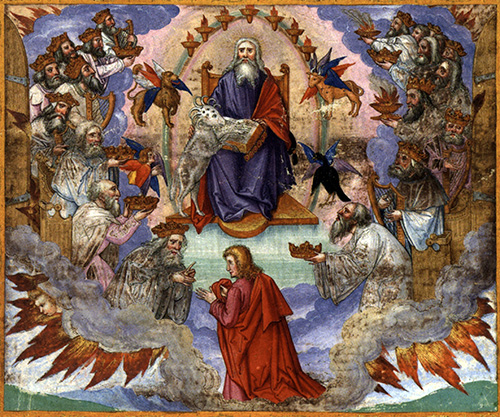
    “The Lamb opening the book with seven seals” by Matthias Gerung, ca. 1530-1532

    The Book of Revelation

    To understand this picture more fully, we will have to turn to the most enigmatic book of the Bible: Revelation. 

    Revelation has a grip on the Western imagination like no other work. In Doctor Zhivago, Boris Pasternak wrote, “All great, genuine art resembles and continues the Revelation of St. John.” Its images and themes have long since soaked into the popular imagination: the Beast, the Whore of Babylon, the number 666, the Four Horsemen. Nonetheless, very few have managed to pull its narrative together and explain it in terms that might have made sense to its original audience in the first century CE.

    But it is possible to do this in light of the ideas I have sketched out above.

    To begin with, a very brief sketch of this enigmatic book: John – traditionally associated with Jesus’s “beloved disciple,” although he probably did not write it – has a vision of the “Son of man” among seven golden candlesticks, which represent seven churches, all of them in Asia Minor. The messages are unenthusiastic at best: to the one in Ephesus, for example, he says, “I have somewhat against thee, because thou hast left thy first love” (Revelation 2:4).

    Then John has a vision of heaven, where he sees “seven lamps of fire burning before the throne, which are the seven Spirits of God.” A book with seven seals is presented, and these seals is opened, each revealing some new and terrible manifestation: the renowned Four Horsemen, “a great earthquake,” and cosmic cataclysm: “The stars of heaven fell unto the earth… And the heaven departed as a scroll when it is rolled together” (Revelation 6:12–14).

    When these are completed, seven angels sound seven trumpets, with similar tribulations: a star named Wormwood falls upon the waters of the earth, “and the third part of the waters became wormwood: and many men died of the waters, because they were made bitter” (Revelation 8:11).

    Finally, the climactic moment arrives: “And there was war in heaven: Michael and his angels fought against the dragon: and the dragon fought and his angels, And prevailed not; neither was their place found any more in heaven. And the great dragon was cast out, that old serpent, called the Devil, and Satan, which deceiveth the whole world: he was cast out into the earth, and his angels were cast out with him” (Revelation 12:7-9).

    The images in Revelation have been used so often, and in so many ways, that certain facts have become obscured. In the first place, the vision does not have to do with some imagined end of the world in the immeasurably remote future. It is something that the prophet sees as happening in his own time.

    In the second place, we may wonder why the number seven is repeated and emphasised to an almost maniacal degree. In the light of the things we’ve already seen, the reason becomes clearer: it has to do with the realms of the seven planets. They have been inhabited by corrupt forces, including evil angels. The opening of the seven seals and the blast of the seven trumpets culminate in a war in which all of them, led by Satan, are cast down from the heavens onto the earth.

    Revelation appears to be describing a great purge of the cosmic realms that, the prophet believes, has been initiated by Christ, “the Son of man,” “the Lamb.” Satan is cast down to earth. (Remember the line from Luke in which Jesus says that he sees Satan falling “as lightning” from heaven.)
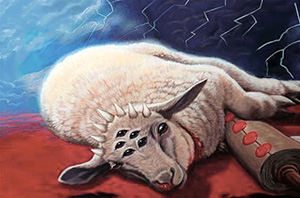
    Literal interpretations of Revelation result in images such as the above. Perhaps the symbolism of the text is more correctly understood in the context of how the ancients conceived of the heavens.

    At this point the action switches to earth. Then ensues “the judgment of the great whore that sitteth upon many waters.” She sits on “a scarlet-coloured beast… having seven heads.” The text explains, “The seven heads are seven mountains, on which the woman sitteth” (Revelation 17:3, 9). The identification of this woman and beast are obvious: it is Rome, which was famously built on seven hills. It has “seven kings. Five are fallen, and one is, and the other is not yet come; and when he cometh, he must continue a short space.” If we identify them with the Roman emperors, the first five are Augustus, Tiberius, Caligula, Claudius, and Nero, who was overthrown in 68. By this reckoning Galba would be the sixth, although he reigned for only seven months. This takes us up to 69 CE, known as “the year of the four emperors,” because in fact four emperors followed one another in quick succession. The prophet believes that there will be another, but that his reign will be brief, and that he will be the last. John was partly right: The reign of Otho, who succeeded Galba, was only three months long. But he was far from the last emperor.

    If this is actually what John has in mind, we find ourselves in the midst of the Jewish War (66–73 CE), in which the Jews revolted against Rome. It would seem likely that the prophet is writing around this time, and he expects it to usher in the Last Judgment, which will involve a final battle with the result that “Babylon the great is fallen” (Revelation 18:2). After that, the prophet sees “a new heaven, and a new earth, and the holy city, new Jerusalem, coming down from God out of heaven” (Revelation 21:1–2).

    This did not happen. Instead the Jews were crushed. The Temple in Jerusalem was sacked and Judea partly depopulated. Rome, the “great whore,” was not overthrown, and celestial forces did not descend to destroy it. The Roman empire continued to last for centuries. The Last Judgment did not occur. Nor did the world end.

    In any event, we can sum up the action of Revelation as follows: Christ, the Lamb, is slain and resurrected. He ascends into heaven and purges the seven heavens of evil influences, led by Satan. They are cast down to earth, and are embodied in the Roman empire, which itself will be crushed by heavenly forces led by the Lamb, culminating in a new world.

    The Host of Heaven

    I can’t claim to understand the entire symbolism of Revelation, which is profound and multilayered, but I am willing to say that this, at least in part, is what is going on here. The evidence we have seen from other New Testament texts indicate that this belief was current, if not universal, among the early Christians – at least the ones who wrote the New Testament.

    I also must admit that this account leaves one major question unanswered. Why and how did the heavenly realms come to be infested with evil influences?

    One answer appears in the passage from the Poimandres that I quoted above. Here the planetary zones seem to be identified with evil propensities. Could the Hermetic texts – of which the Poimandres is a part – be the sources of this doctrine of “spiritual wickedness in heavenly places”? Or could both the texts and this doctrine have come out of the same stream?

    It is possible. Although the Hermetic texts have been studied, often intensively, over the centuries, there is much that remains baffling about them. But it is probably accurate to say, along with scholar Brian Copenhaver, that they “can be understood as responses to the same milieu, the very complex Greco-Egyptian culture of Ptolemaic, Roman, and early Christian times” – meaning the long period between the fourth century BCE and the second century CE. This was also the milieu in which Christianity arose. So there may be some trace of these Greco-Egyptian influences on the Christianity of the New Testament.

    The Poimandres does not portray these cosmic forces as evil. When the cosmic man is created, it is said that the seven “governors” – of the planets, that is – “loved the man, and each gave a share of his own order.” But man, like Narcissus, fell in love with his image in the natural world, and fell. Thus his nature is twofold: immortal, given by God, and mortal, born of his infatuation with matter. He is in bondage to things over which he should be master. The qualities that the “governors” gave him become vices that he has to overcome.

    There are hints of similar ideas in the Hebrew Bible. Over and over we encounter entities called “the host of heaven” or “the sons of God.” Here is one example. The prophet Micaiah says, “I saw the Lord sitting on his throne, and all the host of heaven standing by him on his right hand and on his left” (1 Kings 22:19). In this passage, the host of heaven is part of Yahweh’s heavenly court, and thus part of the cosmic order.

    But here is another verse. It is a warning given to the children of Israel by Moses, “lest thou lift up thine eyes unto heaven, and when thou seest the sun, and the moon, and the stars, even all the host of heaven, shouldest be driven to worship them, and serve them, which the Lord thy God hath divided unto all nations under the whole heaven” (Deuteronomy 4:9).

    In fact many references in the Hebrew Bible to the “host of heaven” amount to warnings against worshipping them, or condemnations for having done so.

    The host of heaven plays an ambiguous role in the Hebrew Bible. Again these beings – personifications of the stars and the planets and the signs of the zodiac – are not necessarily evil; they are part of the celestial court. At the same time there is a strong temptation to worship them that is repeatedly and vehemently denounced. As in the Poimandres, man is not meant to worship the seven heavenly “governors” or to be subject to them.

    The ascent portrayed in the Poimandres has to do with the fate of the soul after death. The ascent through the spheres happens to the virtuous, those who obey this divine dictum: “Let him [who] is mindful recognise that he is immortal, that desire is the cause of death, and let him recognise all that exists.” (The bracketed insertion is the translator’s.) Salvation here comes from gnosis: insight into one’s own true nature and estate. One who lacks such insight, “the one who loved the body that came from the error of desire goes on in darkness, errant, suffering sensibly the effects of death.”
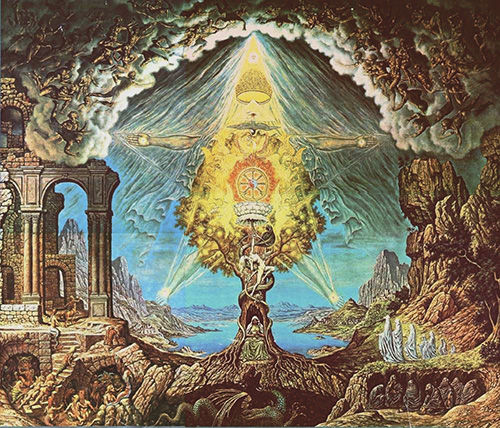
    Unio Mystica – Interior (1973) by the Dutch modern artist Johfra Bosschart. The interpretation of this image can be read here: www.visionaryrevue.com/webtext2/herjof12.html

    Initiation & Gnosis: Free from Fate

    There is another thread that we need to take up at this point. The Bulgarian sage Omraam Mikhaël Aïvanhov observes that the message of Revelation is “a description of the elements and processes that are common to our own inner life and the life of the cosmos.” These processes of our “inner life” have to do with initiation. As is often said, initiation is a kind of death and rebirth. On the simplest level, this has to do with a death to one’s former life and a birth to a new, higher life. But there is more to it than that. In a famous passage, Cicero, the great Roman statesman and philosopher, writes about initiations into the mysteries: “So in very truth we have learned from them the beginnings of life, and have gained the power not only to live happily, but also to die with a better hope” (Cicero, Laws 2.14.36; my emphasis).

    This theme keeps appearing around the ancient mysteries. They have to do with death, not merely in a symbolic sense, but in a highly practical one. In some way they prepare the candidate for death. They are intended to make the process that he undergoes in the afterlife easier and more assured of success. It seems likely to me that the pagan mysteries had more than a little to do with this process. The mysteries of Mithras in fact took place in seven stages of initiation, which were very likely connected to the seven planets.

    We then turn back to the epigraph of this article, a quotation from the Excerpta e Theodoto (“Excerpts from Theodotus,” a Gnostic figure from the second century CE): “Until baptism… fate is valid. But afterward the astrologers are no longer correct.” Christian baptism, viewed esoterically, raises the candidate up beyond the levels of the seven planets, which rule fate. The initiate is free from the influence of the planets and thus from fate.

    This passage also emphasises that liberation is not merely due to a rite but is the result of gnosis: “It is not only the cleansing that is liberating, but the knowledge [gnosis] of who we were, and what we have become, where we were or where we have been thrown, where we hasten, what we are cleansed of, what birth is and what rebirth is” (Excerpta e Theodoto, 78; my translation).

    Thus, at least for some early Christians, baptism was correlated with a liberating ascent through the realms of the planets, whose associated vices were made inoperative by the sacrament. The initiate reaches a level of consciousness and being that is above the domain of the planets.

    Certainly much of this teaching has been lost or obscured over the centuries, to the point where a typical Christian today would be unlikely to recognise it as part of his own religion. The view of the planetary spheres as benign – indeed, as levels of heaven, as they are in Dante’s Paradiso – completely supplanted this older view.

    And yet echoes continue to resound. In the early twentieth century, the Theosophist James M. Pryse wrote The Apocalypse Unsealed:

    Many actors, apparently, play their parts in the drama of the Apocalypse; yet in reality there is but one performer – the neophyte himself, the sacrificial “Lamb,” who awakens all the slumbering forces of his inner nature, passes through the terrible ordeals of the purificatory discipline and the telestic [i.e., initiatic] labors, and finally emerges as the Conqueror, the self-perfected Man who has regained his standing among the deathless Gods.
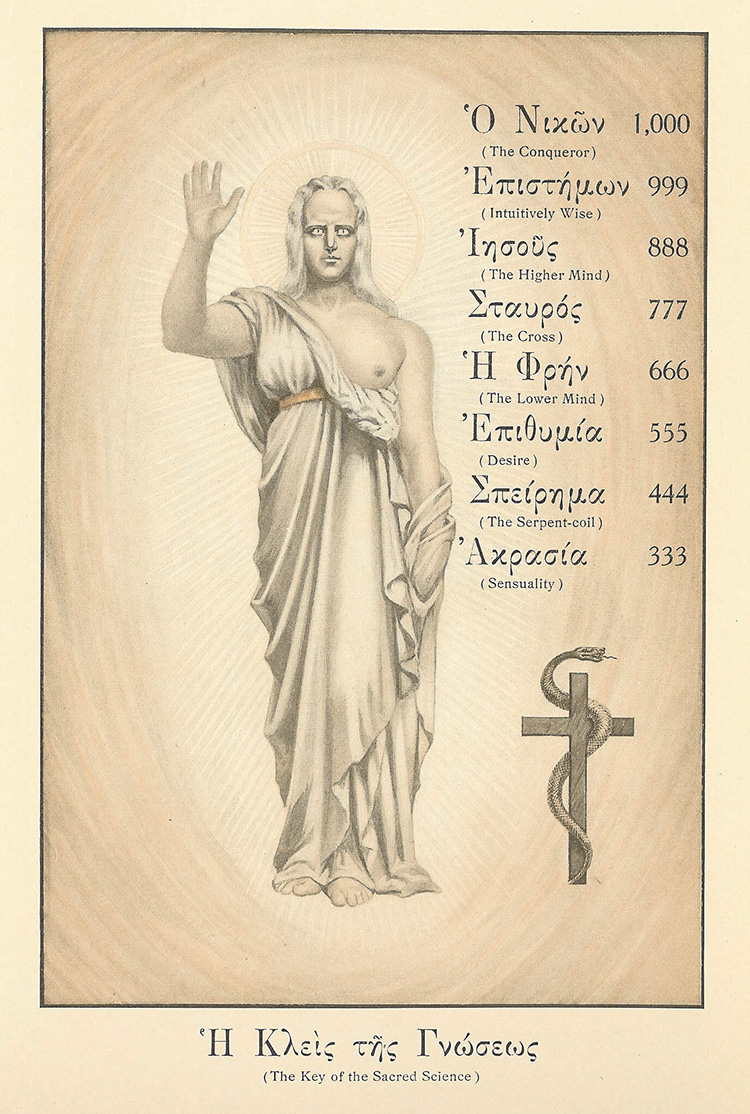
    Theosophist James M. Pryse, author The Apocalypse Unsealed, connects the seven seals with the chakras, the seven subtle centres in the human body. According to certain theories, these need to be opened in order for the seeker to attain enlightenment. Hence he translates the Greek apokálupsis (usually rendered as “revelation”) as initiation.

    Pryse connects the seven seals with the chakras, the seven subtle centres in the human body. According to certain theories, these need to be opened in order for the seeker to attain enlightenment. Hence he translates the Greek apokálupsis (usually rendered as “revelation”) as initiation.

    Aerial Tollhouses

    One question remains: did any fragment of this early teaching survive in later Christianity? Yes, it did – in a curious form. Eastern Orthodox teaching refers to “aerial tollhouses” that the soul must pass through while ascending after death.

    Seraphim Rose, a twentieth-century American Orthodox monk, writes, “The particular place which the demons inhabit in this fallen world, and the place where the newly-departing souls of men encounter them – is the air” (emphasis Rose’s). He quotes a liturgy written by John Damascene in the eighth century: “When my soul shall be about to be released from the bond with the flesh, intercede for me, O Sovereign Lady [i.e., the Virgin]… that I might pass unhindered through the princes of darkness standing in the air.”

    And the quaint metaphor of aerial tollhouses is actually used. Another passage from John Damascene: “O Virgin, in the hour of my death rescue me from the hands of the demons, and the judgment, and the accusation, and the frightful testing, and the bitter toll-houses.” At each tollhouse, the soul is presented with all the sins it has committed of that kind: lying, envy, fornication, and so on. If it is found guilty of any of these sins, it is cast down to hell. If it is innocent, it is permitted to ascend.

    These ideas clearly go back a long way. A nineteenth-century Orthodox historian of theology, Metropolitan Macarius of Moscow, writes: “Such an uninterrupted, constant, and universal usage in the Church of the teaching of the toll-houses, especially among the teachers of the 4th century, indisputably testifies that it was handed down to them from the teachers of the preceding centuries and is founded on apostolic tradition.”

    The resemblance between these ideas and those in the Poimandres is striking. One could cite other parallels, such as the seven hekhalot (palaces) of heaven mentioned in the early Kabbalah.

    It would be foolish, I think, to try to argue that all these teachings are exactly the same, or were so in antiquity. Then as now, there was a panoply of religions and beliefs and cults, and it would useless to try to show that their teachings were identical. Nevertheless, the resemblances are unmistakable.

    Looking at this from a broader perspective, we can see the theme of man trying to situate himself in the cosmos. He looks up at the sky and sees the stars and planets and feels some connection with them. What sort of connection? Are these entities hostile, beneficent, indifferent? Do they lead to God, or do they block the way? And what of the unseen realms that, however dimly, each of us knows to exist?

    The questions multiply. The picture of the seven planetary realms no longer fits in well with what we know from astronomy, and yet one cannot help sensing that it remains profoundly valid. We may have to wait till death – or initiation – to find out the truth.

    [alert type=”general” dismiss=”no”]This article was published in New Dawn 158.[/alert]

    [alert type=”success” dismiss=”no”]If you appreciate this article, please consider subscribing to help maintain this website.[/alert]

    Sources

    Omraam Mikhaël Aïvanhov, The Book of Revelations [sic]: A Commentary, Editions Prosveta, 1991
    Brian P. Copenhaver, Hermetica: The Greek Corpus Hermeticum and the Latin Asclepius in a New English Translation, with Notes and an Introduction, Cambridge University Press, 1992
    James M. Pryse, The Apocalypse Unsealed, Being an Esoteric Interpretation of the Initiation of Ioannes, James M. Pryse, 1931 [1910]
    Pseudo-Dionysius the Areopagite, The Celestial Hierarchy, www.esoteric.msu.edu/VolumeII/CelestialHierarchy.html; accessed Feb. 26, 2016
    Seraphim Rose, The Soul after Death, St. Herman of Alaska Brotherhood, 1980
    Richard Smoley, “The Esoteric Revelation,” Quest 102:4 (fall 2014), 138

    © New Dawn Magazine and the respective author.
    For our reproduction notice, click here.
  • Prophecy: Does it Work?

    Prophecy: Does it Work?

    From New Dawn 100 (Jan-Feb 2007)

    Elie Wiesel, in his sombre memoir Night, describes a poignant incident from his time in a Nazi concentration camp. Amidst unimaginable suffering and despair, an inmate named Akiba Drumer “had discovered a verse from the Bible, which, translated into numbers, made it possible for him to predict Redemption in the weeks to come.”

    There have been countless Akiba Drumers over the last 2,000 years. Confronting dismal memories of the past and the bleak actualities of the present, they have turned to the future for hope and solace.

    The trend is not necessarily as old as humanity itself. While traditional mythologies ranging from those of the Hindus to those of the ancient Germans spoke of the rising and passing of ages in cycles, the Abrahamic religions – Judaism, Christianity, and Islam – have tended to see history as aimed toward a final destination point, an end of time in which the ledger books of justice will be balanced and all of humanity will be marched off to either salvation or perdition. This is sometimes called the Apocalypse, and literature devoted to it is called apocalyptic.

    What exactly is prophecy? Can we trust it?

    The esoteric tradition – the body of knowledge that underlies all the great spiritual traditions of humanity – teaches that the future is, at least in principle, knowable. There are several theories to account for such events (and they are not mutually exclusive). One of these holds that there exists a realm of images and forms, which has many names in many traditions. The Kabbalists call it the world of Yetzirah, or “formation”; quite possibly it is what Australian aborigines call the Dreaming and what some Western occultists refer to as the astral realm. This realm of images does not exist in any physical sense, but all the same it has a reality of its own. If you think of a light bulb, say, that image in your mind has some reality, even some substance, although not physically.

    Esotericism also teaches that this world of images is prior to the physical world: events and things manifest in this realm before they appear in palpable reality. Consequently, someone with reasonably clear access to this dimension – deliberately, through divination or prophetic contemplation, or spontaneously, through dreams or hunches or intuitions – should be able to see the future.

    Some readers may wonder what this theory may have to do with synchronicity, a concept that is often invoked when people attempt to understand such forms of divination as the Tarot or the I Ching. Synchronicity in this sense is a coinage of the Swiss psychologist C.G. Jung, who defines it as an “acausal connecting principle.” Jung gives a case in point: “The wife of one of my patients, a man in his fifties, once told me in conversation that, at the deaths of her mother and her grandmother, a number of birds gathered outside the windows of the death-chamber.” Such incidents are common: I can tell similar stories from my own family. For Jung, the connection between these events – the deaths and the appearance of the birds – is not causal; that is, the impending death didn’t cause the birds to come or vice versa. But they are related by what he calls a “meaningful cross-connection.”

    Swiss psychologist C.G. Jung defined synchronicity as an “acausal connecting principle.”

    Jung’s attempt to characterise synchronicity as “acausal” appears misguided. He seems to be veering toward a connection that is not acausal in the strict sense; rather it implies a hidden factor lying outside the physical dimension that, so to speak, “caused” both the death and the appearances of the birds. Jung locates this hidden cause in the realm of the archetypes, the psychic forces that underlie the human mind and possibly reality itself. For Jung, “meaningful coincidences… seem to have an archetypal foundation.”

    Granting this much, we are left with a theory very close to the esoteric doctrine sketched out above. Jung’s archetypal world is more or less identical to the realm of Yetzirah, of forms and images. As such it can give rise to two phenomena that have no obvious causal relation (such as a death and the sudden appearance of a flock of birds) and yet seem to be meaningfully connected. Jung made much of being scientific, and to a great degree he was – but his conclusions in many respects resemble those of the old occultists.

    Another esoteric theory about seeing the future is based on the highly relative nature of time. Time, as Immanuel Kant argued, is one of the basic structural components of our experience, but it is a construct that our minds have imposed on reality. As hard as it may be to imagine, time has no absolute reality in itself (a conclusion to which contemporary physics may also point). If so, it may be possible to step past the portals of our own experiential framework and take some measure of events in the future.

    Many spiritual traditions speak of a higher Self, a part of our being that stands over and above our selves as we customarily experience them. The names for this Self are countless. The ancient Greeks called it the daimon; the ancient Romans, the genius; to esoteric Christians, it is the kingdom of heaven or the Christ within. This Self stands outside the personality, the conscious self, and outside the categories of conscious experience, including time. It perceives our lives, not as a sequence of events and experiences that span several decades, but as a whole. It can see a lifetime as we can see a snapshot.

    A famous instance of the workings of this Self appears in the Crito of Plato. Socrates, under sentence of execution, is urged to escape by his rich friend Crito, who assures him that he has bribed the guards and can furnish the necessary getaway. Socrates refuses, saying he has had a dream in which a beautiful woman dressed in white appeared to him and recited a line from the Iliad: “On the third day to the fertile land of Phthia thou shalt come.” Socrates takes this as a message from his daimon, the guiding spirit that has directed him all throughout his life, that he will be executed in three days, and that he should not try to escape. One way of understanding such episodes is that the daimon, the Self, can see the whole of one’s life from start to finish, apart from the linearity of time, and can give appropriate guidance. 

    Note, however, that, as in Socrates’ case, these glimpses usually have to do with one’s deeper destiny. It’s not a question of picking next week’s lottery number or finding hot stocks. While these are in principle no more unknowable than anything else, one soon discovers that the higher Self is not terribly interested in them – and anyway, how helpful would the knowledge really be? I know directly of only one case where someone got this kind of information. A friend of my father’s once told me he had been awakened in the middle of the night by the image of some numbers that flashed in his mind. It struck him that they might be lottery numbers and that he should buy a ticket using them, but he never got around to it. Of course they were the winning numbers that week.

    If these visions of the future are ultimately personal in nature – that is, they are meant to give guidance or inspiration to an individual at crucial junctures in his or her life – what then of prophecy in a grander sense, the prophecy that purports to open a window onto the fates of nations and peoples, and of humanity itself?

    As a whole, the record of prophecy in predicting the future on a large scale is not good. We can see this as far back as the start of the apocalyptic genre in Palestine in the second century B.C.E. At the time the Jewish nation was living under the rule of the Hellenistic Seleucid monarchs, who were heirs to a portion of the empire of Alexander the Great. In 167 B.C.E., one of these rulers, Antiochus IV Ephiphanes, embarked on a program of forced Hellenisation of the Jews. He set up an altar, and perhaps an image, of Olympian Zeus in the Temple in Jerusalem.

    The Jews’ outrage is reflected in the Book of Daniel, one of the earliest apocalyptic writings and the only one to make its way into the Hebrew Bible. Written during the ensuing revolt against the Seleucids, this book sets up Daniel, a legendary sage of the sixth century B.C.E., as the mouthpiece of a prophecy that would “foretell” events 400 years after his time. (The technical term for this practice is vaticinium ex eventu, “prediction after the event.”) Daniel refers to “a vile person” – Antiochus – who will “pollute the sanctuary of strength, and shall take away the daily sacrifice, and… shall place the abomination that maketh desolate” (Dan. 11:21, 31) – that is, the idol in the Temple (cf. 1 Macc. 1:54). The archangel Michael will come to Israel’s rescue; the dead will be raised, “some to everlasting life, and some to shame and everlasting contempt.” Antiochus “shall come to his end, and none shall help him” (Dan. 11:45, 12:1-2).

    What happened in fact was that the Jews rose up under the priestly clan of the Maccabees and won back their religious liberties as well as a measure of political autonomy, but this obviously did not begin the end of time. Antiochus did not perish as a result of any obvious divine wrath: he died of natural causes.

    Despite its failure as a prophecy, the Book of Daniel established the basic structure of the apocalyptic genre. Arising during some crisis, such texts predict that this event is the harbinger of the imminent Day of Judgment, when justice will be done and evildoers will receive their due. The Book of Revelation at the end of the New Testament follows this pattern. Most scholars agree that it is a response to the Roman persecution of Christians in the first century C.E. Here, too, the prophecy, taken as literal truth, is not accurate. The book seems to foretell the end of the Roman Empire and the coming of a millennial kingdom, but this did not happen. The Roman Empire did come to an end (close to 400 years after Revelation was written), but it did not usher in the reign of God on Earth. Rather it initiated a period of collapse and chaos that came to be known as the Dark Ages.

    Even the prophecies of Jesus as related in the Gospels do not seem trustworthy. If we are to read what scholars call his Apocalyptic Discourse literally (three versions of it appear in Matthew 24, Mark 13, and Luke 21), we would conclude that he was predicting the destruction of the Temple by the Romans, to be followed by the return of the Son of God. This did not happen either. The Romans did sack the Temple, in 70 C.E., about a generation after Jesus’s lifetime, but Jesus did not return and did not establish a millennial kingdom. Things went on much as they had (except for the Jews, who were expelled from Palestine).

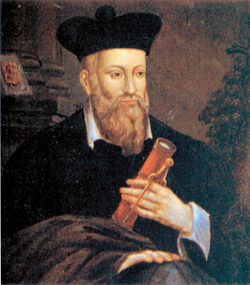
    Michel de Nostra-dame (1503-1556), better known as Nostradamus.

    I’m using instances from the Bible as it is by far the best-known work of prophecy, but if we were to look at prophecies from other sources, they would not look much better. The American trance medium Edgar Cayce foretold that much of California would be under water by 1972. Nostradamus predicted some kind of great manifestation in the sky for the seventh month of 1999, but the year 1999 had very little that was remarkable, much less cataclysmic, either in the seventh or in any other month. (For more on Nostradamus’s prophecies, see my new book The Essential Nostradamus.)

    How, then, can we reconcile the abysmal performance of prophecy as a whole with the esoteric theory that I’ve sketched out above? If we can know the future, why don’t we?

    The astral realm is a sea of images. We can think of it as containing every image and idea that every human being has ever thought and possibly will ever think. No sooner do we say this than we realise that this dimension must contain an enormous amount of psychic rubbish – the fears, dreads, and anxieties of humanity, most of which have nothing to do with reality past or present. This dimension is described most clearly in the spiritual text known as A Course in Miracles:

    The circle of fear lies just below the level the body sees, and seems to be the whole foundation on which the world is based. Here are all the illusions, all the twisted thoughts, all the insane attacks, the fury, the vengeance and betrayal that were made to keep the guilt in place, so that the world could rise from it and keep it hidden. Its shadow rises to the surface, enough to hold its most external manifestations in darkness, and to bring despair and loneliness to it and keep it joyless.

    Without going into the elaborate psychological system of the Course, I will simply point to the notion of the “circle of fear” – a zone of fears, hatreds, and anxieties that lie just below the surface of consciousness. This circle of fear is universal: each of us participates in its creation. Probably only the most enlightened human beings are entirely free from its effects. For the rest of us, it sits underneath our experience of reality like a water table. We all tap into it in our own ways.

    This fear is not “about” anything particular; it is not necessarily connected to anything real or substantial; it is simply a nameless, objectless anxiety that can attach itself to anything. It holds tremendous power over each of us precisely because we are usually unconscious of it. We imagine that our fears and anxieties are about something real and justified, but there is something suspect about this belief: no sooner does one anxiety disappear than another pops up to take its place. For many people, this anxiety can manifest in fears about their personal future or about society or humanity or the Earth; for others, it is displaced onto a fear of an imminent end of the world.

    Some say fear is a healthy and normal emotion, that without it we could not function in the world. So it may be under certain circumstances. If a man finds himself facing a wild animal, his fear will make him run away. But the kind of fear I am talking about is not healthy. It does not increase our chances for survival; instead it is weakening and debilitating. Much of mental dysfunction no doubt stems from too close a contact with this kind of fear.

    Saying this much explains the horrific imagery of so many prophecies, but what about the nice part? What about the beautiful dreams of a utopian future that is always just around the horizon? The explanation is the same. The Yetziratic or astral realm is known to esotericists as the zone of illusion. We can think of it as literally a bandwidth of fantasies and illusions that surround us on a psychic level. While many of these fantasies are negative, there are also many that are positive; they are the flip side of the circle of fear. The power of wishful thinking – which is very strong – can easily lead someone to put all these images together into a picture of the future that involves both terrible calamities (usually visited on one’s enemies) and ultimate salvation (for oneself and one’s own sect). Akiba Drumer’s prophecy in the concentration camp most likely falls into this category.

    Our age imagines itself to be more sophisticated than its predecessors, and yet the contemporary mind falls prey to many of the temptations of the past. Cataclysmic and millennialistic thinking is as much with us as ever. The religious-minded cast it in biblical images. The secular mindset translates it into visions of nuclear or environmental disaster. The problems posed by both nuclear power and environmental contamination are very great and should not be dismissed out of hand, but it is also well to separate them from unconscious apocalyptic expectations, which can erupt from the minds of supposedly rational scientists just as easily as they can from men wearing sandwich boards on streetcorners.

    Having said this much, we might want to compare prophecy with prediction of a more conventional kind, which has evolved into an academic discipline (or pseudodiscipline) known as futurology. Futurology makes no supernatural assumptions. It is based entirely on what is currently known. It takes current statistics – about population, economic growth, political trends, resource capacity – and extrapolates them into the future. That is its strength but also its weakness. Futurology can only make predictions on the basis of current trends, but one thing we know is that current trends never continue. There are shocks, dislocations, cataclysms. Conventional forecasters cannot predict these; their unpredictability is at the root of their nature.

    The apocalyptic prophet faces no such restrictions. He has no incentive to predict more of the same; who would pay attention to him then? So he is entirely happy to foretell all kinds of upheavals, natural and supernatural: the submerging of continents; the manifestation of extraterrestrials; the shifting of the Earth’s pole; the return of Jesus Christ. In a sense, he is right. Cataclysms do occur. But somehow they never occur in the way they were predicted.

    In the end, I personally would not base my plans for the future on any prophetic claims from any source. I can’t say that none of these prophecies will be fulfilled – that would be making a prophecy of my own – but to my mind they haven’t been proved reliable enough in the past to merit any serious attention now. Conventional futurology may offer some insights, but frequently it, too, better represents the analyst’s preconceptions than any reality that is likely to come.

    All this still leaves us with the possibility of a knowable future, whose seeds are present in the astral realm amidst all the fears and fantasies. How can we have contact with it? Trying to glimpse the future on a collective level is extremely tricky, often because it is something into which we as individuals are not supposed to stick our noses. Recently a friend of mine used the divinatory technique of horary astrology to ask a question about a national issue. Horary astrology, though not practiced or understood even by most astrologers, can produce quite striking insights for one who knows how to use it. In my friend’s case, the answer was quite sharp: “None of your business.”

    When we come to the personal future, the situation is different. I myself have often found that when I needed to be told of something that was going to happen to me, I was informed of it, usually through some form of inner perception, bidden or unbidden. I have not found divination methods like the Tarot or the I Ching to be particularly useful. Astrology, on the other hand, can have remarkable predictive value – provided one knows the system well enough to understand what the stars are saying.

    These are my conclusions from my own experience. Others may have different results; these matters are more individual than popular books like to let on. In the end, for me nothing has proved to be of as much value as a clear-sighted determination to see what was going on both inside and outside myself, to look upon my own hopes and fears and wishes, and to bring them face to face to what Freud called “the reality principle.” A.R. Orage, a pupil of the great spiritual teacher G.I. Gurdjieff, defined conscience in a rather unusual way as “the simultaneous experience of all one’s emotions.” If one can do this with a naked and even remorseless honesty (and it is considerably harder than it may first seem), one is far more likely to have an accurate basis for future action than if one follows the advice of any number of psychics or prophets. 

    [alert type=”general” dismiss=”no”]This article was published in New Dawn 100.[/alert]

    [alert type=”success” dismiss=”no”]If you appreciate this article, please consider subscribing to help maintain this website.[/alert]

    © New Dawn Magazine and the respective author.
    For our reproduction notice, click here.
  • Harmony of  Nonconformity

    Harmony of Nonconformity

    From New Dawn 167 (Mar-Apr 2018)

    In a linear world, the external order dictates an artificial way of life to the individual, creating a conformist society and forcing us to relinquish our power to a machine that is unnatural and devoid of life. This passive conformity can be traced back to the origins of the Vedic Hindu caste system and the feudal system under medieval Western Christianity. When a settled agrarian culture such as these is born, it tends to build towns, not only to protect people from outside influences but also to develop a mental framework based on rules and regulations. 

    The complexity of agrarian culture leads to a division of labour and a division of function. From this division, the ancient Hindus (the Vedic civilisation of Dravidians and Aryans) developed a caste system. The Hindu caste system is made up of the Brahmins (priesthood), Kshatriyas (nobility), Vaishyas (merchants and farmers), and the Shudras (labourers). A direct parallel to the Hindu caste system can be found in medieval Christian society, where we see the priesthood and the church, feudal lords and nobility, farmers and merchants of the commons, and the serfs. 

    Although we no longer have a caste system, this underlying pattern is still with us today. When we are born into this world, we come out of our mother’s womb (nature) and are taught to submit to the rules of society and culture according to our socioeconomic status. This is the crucifixion of the individual; it is the sacrifice we all make. According to the tyranny of the machine, this crucifixion is for the “common good” or “greater good.” But there is a stark difference between the Hindu and Christian societies of ancient times. 

    First of all, the function of the Vedic caste system was an act of surrender to Brahman (ultimate reality/godhead). Individuals would crucify their egos and their desires in favour of the lives they had been given by nature. This means they would not seek another path or to try and control their lives according to their interests. Instead, they would abide by the order of society, which helped them diminish their egos so that they could feel the presence of Brahman within themselves. This is dharma as social duty. 

    The second difference is that, once Hindus have fulfilled their social duties in this life, they are allowed to break away from caste and become renunciate sages in the forest, a practice and title known as vanaprastha in Sanskrit. (This possibility is loathed by Christian society because one is thought of as useless if one does not contribute to the social order.) This breakaway from caste is viewed as a return back to nature and could be thought of as a resurrection. A sage is not part of society and does not conform to its rules. Jesus was a sage in this mould. This is why he was not thought of as a particularly good member of society, and he was actually put to death (if we take the story of Jesus to be real). 

    Those who submit invariably lose their natural innocence. Conformity is the result of force. When individuals are forced by society and culture into life situations that are against their will, they give away their natural sovereignty in exchange for comfort and servitude and are psychologically reduced to sheep. We developed this sheeplike behaviour as a result of the belief that the morals and ethics forced upon us by society are avenues to success and freedom. This notion is absurd inasmuch as the success and freedom of our world are unnatural. These goals are gauged only by finances. But obviously this is not true success or freedom, as money is empty and void of meaning, and it provides no happiness other than that of acquisition. Happiness cannot be contained in anything that we need to force to happen. 

    As human life is forced into a sheeplike way of being, happiness is reduced to momentary stimulants of excitement. In such a life we can never express our natural divinity, li, because we are following the model of someone else’s idea of life. Yet conforming to anything other than one’s own innate world destroys us physically, mentally, and spiritually, as te, the virtue of Tao, cannot come through the organic pattern of the individual, li. Anxiety, depression and stress are so prevalent in this day and age partly because we are forced to live such lives. Wars and social unrest then reflect the individual’s anxiety. 

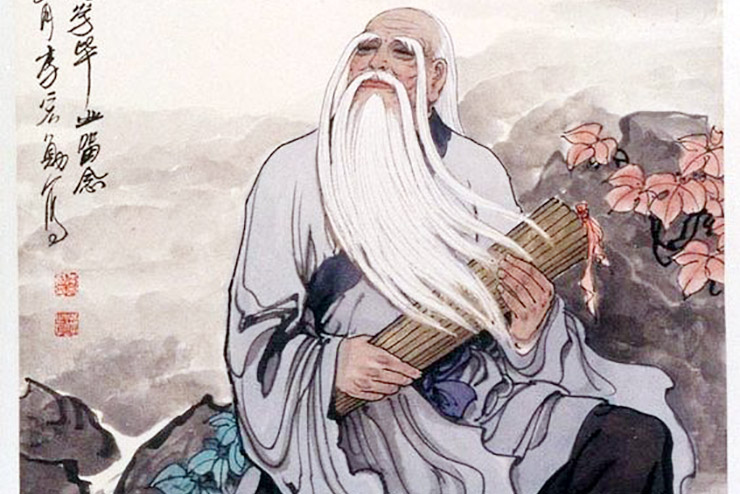
    Liberated individuals are in alignment with their own nature and with the Tao. They do not benefit the accepted social order and are regarded as useless in the eyes of institutional and organisational power. [Taoist sages] Lao-tzu and Chuang-tzu were treated this way because they could see the unnaturalness of an artificial society. The Buddha and Jesus of Nazareth were two other such sages who could see through the hypnotic veil. A liberated sage understands that anyone who continues to act out the unnatural patterns of conditioning is contributing to chaos and destruction, either consciously or unconsciously. One who is liberated, on the other hand, begins the yoking process until a crystal-clear perception of the Tao in reality can be experienced. In Richard Wilhelm’s translation of the I Ching, he states:

    Not every man has an obligation to mingle in the affairs of the world. There are some who are developed to such a degree that they are justified in letting the world go its own way and in refusing to enter public life with a view of reforming it. But this does not imply a right to remain idle or to sit back and merely criticise. Such withdrawal is justified only when we strive to realise in ourselves the higher aims of mankind. For although the sage remains distant from the turmoil of daily life, he creates incomparable human values for the future. (The I Ching or Book of Changes)

    Evidence for these “incomparable human values” can be found in the legacy that a sage leaves behind. Lao-tzu is a good example. It has been over 2,500 years since he lived, and yet his wisdom still reverberates within our consciousness today. This is the power of te

    The virtue of te is only available to those who do not seek power, control, or force. Governments, politics, banking, religions, and commerce, on the other hand, are constantly striving for control by forcing the population to their will. This poses a significant hurdle for humanity to overcome. What would it take to bring the individual and the collective back into harmony with the Tao?

    The above is an exclusive extract from Jason Gregory’s book Effortless Living: Wu-Wei and the Spontaneous State of Natural Harmony. Gregory outlines the Taoist practice of wu-wei, revealing that when we release our ego and allow life to unfold as it will, we align ourselves more closely with our goals and cultivate skill and mastery along the way. The book is available from all good bookstores.

    [alert type=”general” dismiss=”no”]This article was published in New Dawn 167.[/alert]

    [alert type=”success” dismiss=”no”]If you appreciate this article, please consider subscribing to help maintain this website.[/alert]

    © New Dawn Magazine and the respective author.
    For our reproduction notice, click here.
  • Waking Up is Hard To Do: Remembering Gurdjieff & Ouspensky

    Waking Up is Hard To Do: Remembering Gurdjieff & Ouspensky

    From New Dawn 167 (Mar-Apr 2018)

    In the spring of 1915 the writer and journalist Peter Demianovich Ouspensky, a familiar name in Russian Theosophical circles, gave a series of lectures in Moscow about his recent “search for the miraculous” in Egypt, Ceylon, and India. Ouspensky, a popular author on occult themes, had gone East in search of “schools,” teachers from whom he could learn a knowledge “unlike anything known or used by us” – the modern, scientific West that is.1 Such knowledge, he believed, was the only thing that could offer a way out of the “labyrinth of contradictions” that make up modern life. Ouspensky was convinced that through this knowledge the “thin film of false reality” – of money, prestige, and the pursuit of power – that we take to be real, could be dissolved and another reality, that of the “miraculous,” could be revealed.2 

    Ouspensky did not find what he was looking for in the East. He met many interesting people and travelled to many sacred places, but in the end he had to admit that the miraculous had eluded him. But the miraculous was not to be balked. It was waiting for Ouspensky, and if he could not find it, it would come to him. 

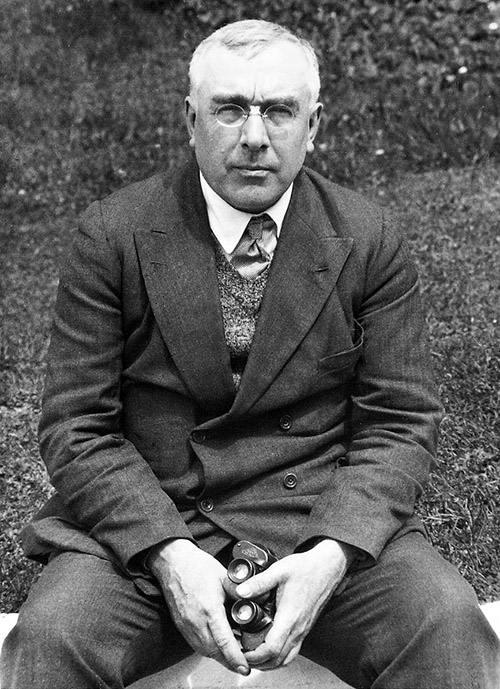
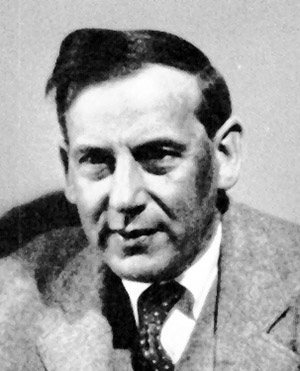
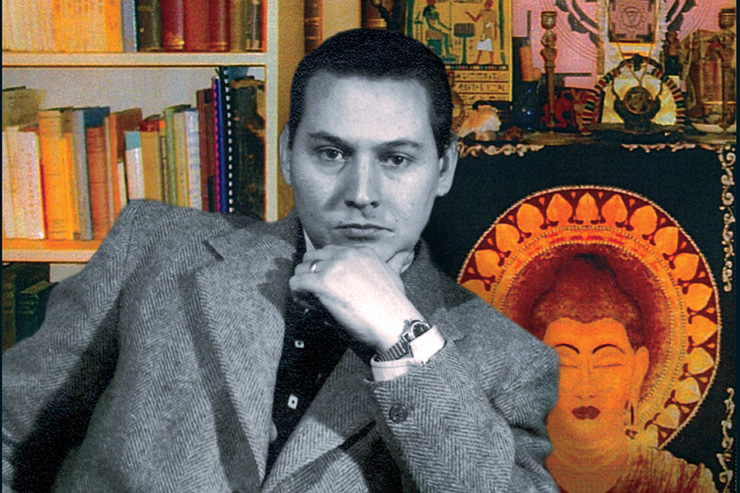
    Peter Demianovich Ouspensky (1878–1947) went in search of the miraculous and found the enigmatic Armenian esoteric teacher George Ivanovitch Gurdjieff. 

    Apparently, it was much closer than he thought. In fact, it appeared one afternoon in small café in a busy Moscow side street in the form of a “certain G., a Caucasian Greek,” whom Ouspensky remembered was the author of a strange ballet, “The Struggle of the Magicians,” a notice for which he had recently seen in a newspaper. He had agreed to this meeting only after one of G’s students, who had attended his lectures, had persisted in inviting him. Ouspensky had finally said yes to his requests just to stop his pestering. Ouspensky had had his fill of gurus and had returned from the East not a little disillusioned. His interest in Theosophy and other occult ideas was more than a little bruised, and he was sure all that would come from this encounter was more confirmation of his scepticism. But what he learned from this “certain G.” changed all that.

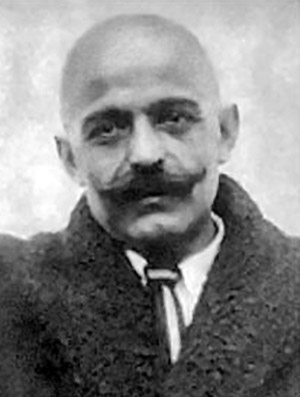
    Ouspensky’s “certain G.” was the enigmatic Armenian esoteric teacher George Ivanovitch Gurdjieff. Together the two were responsible for introducing to the West a startlingly new and often brutally demanding system of self-development, what Ouspensky later dubbed “the psychology of man’s possible evolution.” Today it’s widely known as the Fourth Way – to differentiate it from those of the fakir, yogi, or monk – or, more familiarly, “the work.” Gurdjieff had already been working with groups of students in Moscow for a few years before stage managing this meeting and had purposefully set out to attract Ouspensky, whom he wanted to secure as a Plato to his Socrates, that is, as a good interpreter and expositor of his ideas. He had his students read Ouspensky’s books – the most impressive of which, Tertium Organum, about higher dimensions and mystical states of consciousness, had made his name – and then sent them out to ensnare the philosopher. If Gurdjieff’s students had not been successful in getting a wary Ouspensky to this café, there is every chance that “the work” might not have survived the historical eruptions – World War I, the Bolshevik Revolution and Russian civil war – that were the backdrop to Ouspensky’s true encounters with the miraculous.

    George Ivanovitch Gurdjieff (1866–1949)

    Ouspensky was immediately impressed by Gurdjieff as a man who knows, a man, that is, who possessed the kind of knowledge that he had sought in the East. But although it soon became clear through their conversation that Gurdjieff was as well versed in religious, spiritual, and mystical traditions as he was, and was equally if not better travelled – indeed, he had been to places that Ouspensky had only wished to visit – there was something more. Gurdjieff himself had a strange undeniable presence. This man “of an oriental type” with a “black moustache and piercing eyes” astonished Ouspensky because he seemed to be purposefully poorly disguised. His face, which reminded Ouspensky of “an Indian raja or Arab sheik,” did not suit the black overcoat and bowler hat he wore, as did the many small businessmen that frequented the place. But his disguise was obvious, and Ouspensky was not a little disconcerted to feel that while he knew this certain G. was in disguise, he also knew that he had to pretend that he wasn’t, and that he had to carry on their conversation as if all was perfectly normal. This was Ouspensky’s first experience of the kind of psychodrama and “role-playing” that Gurdjieff performed with his students and which, in the end, would drive him away.

    Nevsky Prospect, St Petersburg, circa 1900. After first meeting Gurdjieff in Moscow in 1915, P.D. Ouspensky returned to St Petersburg and joined Gurdjieff’s core six-member St Petersburg group.

    But that was in the future. From that meeting until the summer of 1918, while Russia exploded into chaos, Ouspensky submitted himself to Gurdjieff’s tutelage and began to learn the “system,” a story he tells in his posthumous masterpiece, In Search of the Miraculous. And if Gurdjieff himself impressed with an aura of strength and knowledge, the system he began to unfold to an increasingly ensnared Ouspensky made an even greater impact. It was logical, consistent, based on experience and observation and free of the kind of wishful thinking that Ouspensky had found in many other mystic teachings. In fact, it was almost specifically designed to attract a rigorous, critical intellect that had recently shorn itself of much of its romanticism. Whether this was so or not, in Ouspensky’s case it’s exactly what happened.

    The Teachings

    What was Gurdjieff’s teaching? When Ouspensky remarked on how life in big cities like London, where he had just been, was becoming more mechanical and increasingly turning people into machines, Gurdjieff corrected him. They already are machines, he said, and would be whether they lived in the city or not. “This must be understood,” Gurdjieff impressed on Ouspensky. “All the people you see, all the people you know, all the people you may get to know, are machines, actual machines working solely under the power of external influences.” Ouspensky was already concerned about the increasing mechanisation of modern life, but he believed that some things, the most important ones – thought, art, poetry – could stand against it. Gurdjieff told him he was wrong. These, too, can be and regularly are performed mechanically. He put up a fight, but it was not long before Ouspensky, himself a novelist and short story writer – witness Strange Life of Ivan Osokin and Talks With the Devil, respectively – agreed.

    The most important question Ouspensky asked Gurdjieff was whether it was possible to stop being a machine? It was, Gurdjieff told him, but it was difficult and demanded much knowledge and effort. The problem is that man is asleep. What we take to be our waking consciousness is really just another kind of sleep; true wakefulness is something different. There are many reasons for this sleep. One is that human beings possess different minds or “centres,” each responsible for certain actions and behaviours. We have an intellectual, an emotional, a moving, and an instinctive centre, and also two “higher centres” from which we are cut off by our mechanicalness. When these work properly, all is good, but in modern man the centres are all confused, with one doing the work of another or stealing energy from other centres in order to do its own work. What is important for wakefulness is that each centre do its own work with its own energy and that all are in balance. It is then that the insights of “higher centres” can reach us. Such balancing is what Gurdjieff taught and his aim was to produce the “harmonious development of man.” 

    Another hurdle to wakefulness is that while we believe we possess a single “I,” a stable, reliable ego, the truth is that “we are legion,” as the man possessed by devils tells Jesus in Mark 5:9. We are not one but many. Our “I’s” shift with every mood. We decide to get up early tomorrow; when the alarm bell rings we turn it off and stay in bed. We decide to start a diet; when dinner time arrives we conveniently forget this. Our “I’s” shift because we are subject to a kind of hypnosis Gurdjieff called “identifying.” We lose our identity, our “I-ness” by giving it over to practically everything around us. Some of these disparate “I’s” can congeal into what is known as “false personality,” a picture of ourselves that allows us to ignore the contradictions that run rife through our lives but which are obvious to others. 

    Personality – let alone a false one – is itself an obstacle. Gurdjieff taught that we are made of two parts, what he called “essence” and “personality.” Essence is our own, it is what we are born with and is through essence that we can grow. But around essence accumulates our “personality.” This is what we learn or imitate from others and is the face we turn towards “life.” The problem is that personality becomes too rich, obscuring essence, rather like a bad orange whose thick rind covers a small bit of fruit. The aim of Gurdjieff’s system was to break down personality, to dismantle it and through the suffering that this entails, enable essence to grow.

    Self-Remembering

    What impressed Ouspensky most was what Gurdjieff had to say about a strange third state of consciousness he called “self-remembering.” There are four states or levels of consciousness. First there is sleep, which we pass through each night. Then there is what we normally call “waking consciousness,” but which is really another layer of sleep. This is our usual mechanical state of consciousness, which we falsely believe to be true consciousness. True consciousness, “self-consciousness,” only comes in the third level, what Gurdjieff called “self-remembering.” Normally our attention is directed outwards, toward the external world. Because we usually “identify” with things outside us, we “forget” about our own inner world. We forget that it is “I” – “you” – who is conscious and is actually in this moment engaged in the act of perceiving the world. Gurdjieff knew, as did Edmund Husserl, the founder of phenomenology, the philosophical method that gave birth to existentialism, that perception is intentional. He also knew that the less intentional and more passive we remain, the deeper our forgetfulness becomes. 

    Self-remembering is having the awareness of your own self, the observer and what you are observing, simultaneously. It is essentially a vivid sense of your own being, the fact that “you” exist, here and now. It can come to us out of the blue, and many examples of self-remembering can be found in literature; the episode of the madeleine in Proust’s Remembrance of Things Past is a classic example, although, of course, Proust doesn’t use the term “self-remembering.” In this sense, Gurdjieff shares much with the existential philosopher Martin Heidegger, who also believed that man’s greatest problem is what he called “forgetfulness of being,” loss of the sense of our own existence. Gurdjieff and Heidegger also arrive at the same remedy for this. Our forgetfulness or sleep in the face of being can be broken by a vivid grasp of the reality of our own finitude – our death – a medicine Heidegger prescribes in Being and Time and with which Gurdjieff agreed in his own perplexing jawbreaker of an esoteric masterpiece, Beelzebub’s Tales to His Grandson.

    There is a fourth state of consciousness, “objective” or “cosmic consciousness,” in which we perceive reality as it truly is, and not obscured by our subjective perspectives. It is then that certain laws, the Law of Three and the Law of Seven, and an understanding of Gurdjieff’s version of the Great Chain of Being, the Ray of Creation, among other otherwise incomprehensible things, seem obvious. But this is far beyond us at present and actually useless to us unless we can maintain “self-remembering” for more than brief flashes. 

    Ouspensky’s Breakthrough

    A. R. Orage (1873–1934)

    These and other ideas first became widely known when Lady Rothermere, wife of a powerful British newspaper baron, rescued Ouspensky from White Russian refugee status in Constantinople by inviting him to London all expenses paid. An English translation of Tertium Organum – which Ouspensky knew nothing about – had become a surprise best-seller in America and England; one of its most devoted readers was Lady Rothermere, and a handsome royalty check accompanied her invitation. In September 1921 Ouspensky found himself in Lady Rothermere’s luxurious St. John’s Wood salon, addressing an audience that included T. S. Eliot, Aldous Huxley, Algernon Blackwood, Gerald Heard among other London literary luminaries. Also among his listeners were A. R. Orage, editor of the leading journal of ideas The New Age, and Maurice Nicoll, a successful Harley Street physician and C. G. Jung’s main disciple in Great Britain. By the end of Ouspensky’s lecture on the system he had learned from G. – which surprised all and disappointed some who had come to hear something more along the lines of Tertium Organum – both Orage and Nicoll would become his students.

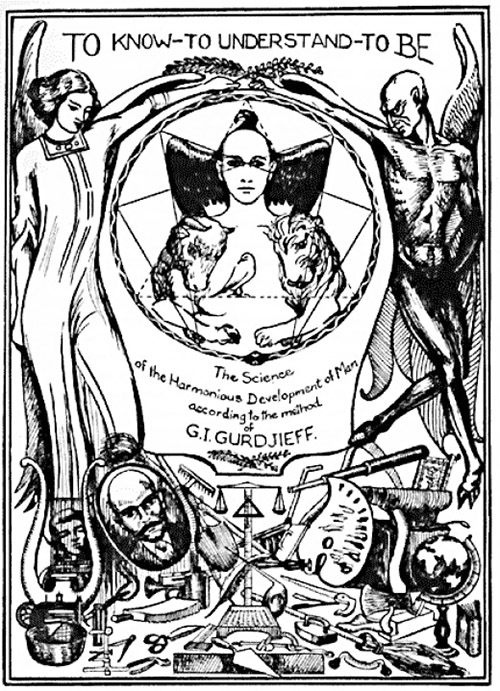
    Ouspensky’s tutelage of Orage was short-lived. In February 1922, Gurdjieff himself arrived in London. As always, the appearance of this remarkable man caused disruption. Ouspensky had already impressed with his intellect and seriousness. But Gurdjieff was something else. The same solidity and sheer being that had convinced Ouspensky that Gurdjieff knew now bowled over Ouspensky’s students. And when Gurdjieff announced that he was establishing his Institute for the Harmonious Development of Man in Fontainebleau, just outside Paris, many who had metaphorically sat at Ouspensky’s feet – he really was an unlikely guru – now were eager to make their way across the English Channel. The New Age lost an editor and Jung an apostle. But while Orage remained with Gurdjieff until his own break with him not long before his death in 1934, Nicoll studied with Gurdjieff for a year, and then returned to London to work with Ouspensky.

    Representation of a design for Gurdjieff’s Institute for the Harmonious Development of Man, 1923 (from Teachings of Gurdjieff by C.S. Nott).

    By this time Ouspensky had already ended his schooling with Gurdjieff and had set out to teach the system on his own, always giving Gurdjieff credit for it. Or at least for bringing it to the West. Gurdjieff said he had learned it during his time with the Sarmoung Brotherhood, a Central Asian version of Madame Blavatsky’s Tibetan masters, a story he tells in Meetings with Remarkable Men, the most immediately readable of his writings. But at other times Gurdjieff spoke of the system as “his,” so it is unclear how much belonged to him and how much he was “transmitting” from what he called the “inner circle of humanity.” Either way, Ouspensky had come to the conclusion that while he believed the system offered the sole method of “waking up,” he felt that he could no longer work with Gurdjieff himself. 

    Two Very Different Teachers

    During their time together, Gurdjieff taught in a more or less traditional way, through lectures, relating ideas and various exercises or methods of fighting “sleep.” This, along with Ouspensky’s clarity and rigour as a writer and thinker, makes In Search of the Miraculous still the best introduction to “the work.” Ouspensky believed that somewhere along the line, Gurdjieff changed and that his methods and aims were no longer the same as when he first began to learn from him. They had become, as mentioned, more geared toward a kind of psychodrama or role-playing and had also become more focused on the kind of “shock tactics” familiar to one branch of “the work.” The “movements,” incredibly difficult postures and “sacred dances,” designed to outwit our mechanicalness and awaken slumbering parts of ourselves, were part of this. It also entailed making more and more of what Gurdjieff called “super-efforts,” pushing oneself beyond one’s usual limits. When Orage, a portly man and heavy smoker, arrived at Fontainebleau, he was given a shovel and told to dig. He did until his body ached and he sobbed with pain. When he felt he could no longer go on, a sudden influx of energy hit him; he had broken through his mechanical limits. Gurdjieff also made outlandish claims about the success of his Institutes in other cities, most, if not all untrue. Gurdjieff was much more of a “crazy guru” than Ouspensky, a more traditional serious philosopher. And to make things worse, in 1924, a year after it opened, except for a small group, Gurdjieff turned away practically all of his students, said the Institute was closing down, and furthermore, that hewas breaking off all relations with Ouspensky.

    Exactly why teacher and student fell out remains unclear, although in my book In Search of P.D. Ouspensky, I take a stab at answering this question, the essential one in the psychohistory of “the work.” Probably the most likely reason is that they were two very different men and that whatever his faults – I don’t spare them in my book – Ouspensky had a genius of his own, as many of his readers know. However remarkable a teacher Gurdjieff was, Ouspensky could not have remained a student for very long. The strange thing is that he continued to teach the system – to which he added his own ideas about time, as spelled out in his magnum opus A New Model of the Universe – while having many troubling doubts about his teacher. One concern was reports of Gurdjieff enjoying the intimate favours of some of his students. At first Ouspensky dismissed these as gossip; later he wondered about their veracity. Gurdjieff, he knew, was no angel. Indeed, some who encountered him painted him as quite the devil. In any case, he kept everyone on their toes and Ouspensky had had enough of it.

    Ouspensky taught the system in London and, during World War II, in New York and New Jersey, for some twenty-five years. Then, in a series of lectures held in London in 1947, a few months before his death, Ouspensky rejected it, telling his audience they had to think for themselves and start again from the beginning. Exactly what this meant remains one of the mysteries in the psychohistory of “the work.” Some think it was an expression of searing honesty by a man who realised he had made a mistake. Others see it as a grand “work” strategy, a “shock” sent to force people to wake up. Perhaps we will never know. Gurdjieff spent some time in New York in the 1930s, but his main base of operation, following the closing of his Institute, was Paris. There, in his small flat in the rue des Colonels-Renard, which he maintained during the Nazi occupation, he gathered his many students for enormous dinners that would last for hours, and during which he would get them drunk on vodka and pierce their personality to get to their essence. He died in 1949.

    A simple way to see the difference between the two is this. Ouspensky’s approach was to create a method that could be applied by anyone with the will and determination to master it, independently of the personal power or baraka of the teacher, rather as Husserl’s phenomenological method can be learned by anyone with the necessary patience and persistence. But no one could learn how to be like Gurdjieff, although somehow his presence, which so impressed Ouspensky, was in some way able to help others to be like themselves, perhaps for the first time. We might say that Ouspensky’s was the way of knowledge, whereas Gurdjieff taught through being. And, of course, he knew some things too.

    If that is the case, then we are lucky that Ouspensky laboured to capture what he learned from Gurdjieff and to present it in such a brilliant, vivid, and gripping way, as this is what remains for us today. We may not be able to benefit from Gurdjieff’s presence, but we may be able, through his and Ouspensky’s efforts, to make something of our own.

    [alert type=”general” dismiss=”no”]This article was published in New Dawn 167.[/alert]

    [alert type=”success” dismiss=”no”]If you appreciate this article, please consider subscribing to help maintain this website.[/alert]

    Footnotes

    1. P. D. Ouspensky, In Search of the Miraculous, Harcourt Brace and Co. 1949, 3
    2. Ibid.

    © New Dawn Magazine and the respective author.
    For our reproduction notice, click here.
  • Typhon Rising: The Magical Legacy of Kenneth Grant

    Typhon Rising: The Magical Legacy of Kenneth Grant

    From New Dawn 156 (May-June 2016)

    Five years on from the death of British author, occultist and poet Kenneth Grant (1924–2011), we are only just now beginning to see the first attempts at assessing the impact and legacy of the man who was the last-ever student and secretary of the notorious Aleister Crowley, and thought by many to be his natural successor. 

    Grant was also a close friend to the magical artist Austin Osman Spare, supporting him in his final years, counted the godfather of Wicca, Gerald Gardner, as a colleague and sometimes rival, and during his time with Crowley met New Age Priestess, Dion Fortune. As such, Grant had direct contact with four of the most influential figures of the Magical and Mystical Revival of the mid-twentieth century. 

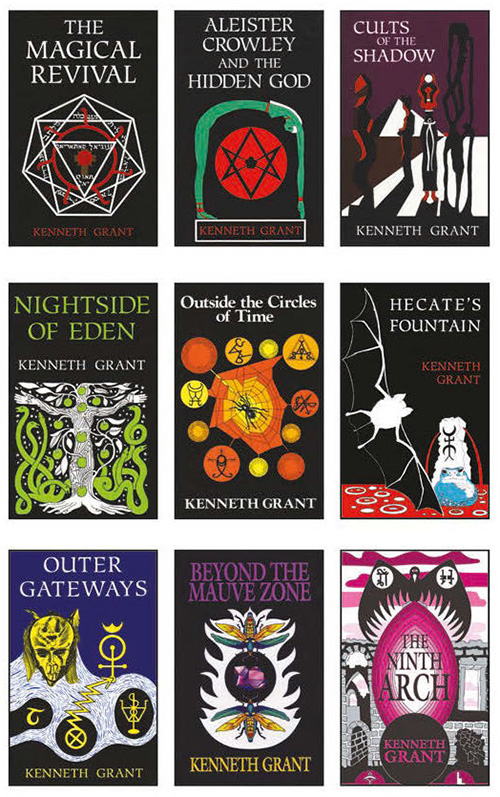
    Regarding his own work, the nine volumes of Grant’s three ‘Typhonian Trilogies’ written across the three decades from 1972 to 2003 – as well as several volumes of occult-themed fiction, and memoirs of the magical personalities he encountered – range across Alchemy, Cabala, Dream Control, Egyptology, H. P. Lovecraft’s Cthulhu Mythos, Left Hand Path, Sex-Magick, Surrealism, Tantra, Thelema, Tibetan Buddhism, UFOlogy, Witchcraft, Voodoo, and back again, and are a unique portrait of the Modern Occult Revival, as well as arguably one of its most creative currents.

    So, just who exactly was Kenneth Grant?

    Born 23rd May 1924, very little is known of Grant’s background or actual biography. He was an intensely private man, who despite – or perhaps even because of? – the nature of his work and the notoriety of his mentor, Aleister Crowley, nonetheless pursued a rigid policy of non-disclosure, akin to the erasing of personal history advocated in the books of Carlos Castaneda. 

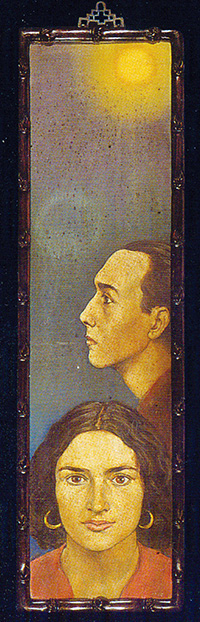
    Portrait of Steffi and Kenneth Grant by Austin Osman Spare

    By his own admission something of a bookish, dreamy youth, fascinated by magic and mysticism, the young Grant had experienced astral projection and, at the age of 15, what he felt were spontaneous contacts from a being calling itself Aushik or Aossic, which he would later identify as his Holy Guardian Angel. Grant had come across Magick In Theory and Practice by ‘The Master Therion’ (a pen-name of Crowley’s) in the Charing Cross Road bookshop, Zwemmer’s, and, feeling here might be a key to understanding – or even controlling – his experiences, had prevailed upon Michael Houghton, proprietor of The Atlantis Bookshop, to put him in touch with the author. Houghton declined, however – the reasons for which are unclear – but what is a matter of record is that Grant, after first writing, finally met with Crowley. It was December 1945, and as they shook hands for the first time the song Shine On Harvest Moon was playing on the radio in the background.

    So it was that the young Kenneth Grant became, for a while, an informal assistant-cum-secretary to the aged Magus upon forsaking Blitz-battered London for the peace and quiet and relative safety of a lodging-house on the South Coast. It was at ‘Netherwood’ in Hastings, where The Great Beast ended his days just three short years later, that Grant would become apprenticed to Crowley’s Magick in earnest, be initiated into his Ordo Templi Orientis, meet the likes of Dion Fortune, Gerald Gardner, and Lady Frieda Harris, the gifted artist who illustrated Crowley’s superlative Book of Thoth Tarot-deck. He also became aware of Crowley’s still-extensive network of correspondence with occultists overseas – such as Karl Germer and Eugen Grosche in Germany, and Jane Wolfe, W. T. Smith, and Jack Parsons in America. For a while it even seems that the ageing Beast was grooming young Grant to be a possible successor, referring to him as a “Gift from the Gods,” and noting in his diary:

    …value of Grant. If I die or go to the USA, there must be a trained man to take care of the English OTO.

    But even at this early stage, Grant’s propensity for daydreaming and otherworldliness bewildered and frustrated the older man, who – after all – was looking for practical, day-to-day assistance first, and to train as heir, second. Eventually it all became too much – particularly for Grant, who was missing his fiancée Steffi – and Crowley let him go, but not before initiating Grant into the IXO O.T.O. and furnishing him with a Charter to set up an encampment of the Order.

    Shortly before Crowley’s death, Grant also met a man who would later prove to be almost as much of an influence on him as The Great Beast: albeit more in the form of an éminence grise, who influenced Grant from behind the scenes. He provided an initiation and inspiration that had a definitive impact on Grant’s reformulation of Thelema, the purpose and rituals of the branch of the O.T.O. he founded, and much of the focus of his Typhonian Trilogies. His name was David Curwen.

    A practicing Alchemist and student of Tantra, who had taken the step of devotion to an Indian Guru – unusual for a Westerner at the time – David Curwen was first mentioned in Grant’s 1991 memoir, Remembering Aleister Crowley:

    David Curwen was first mentioned in Crowley’s diaries on 2.9.1944. When I met him, shortly before Crowley’s death, he was a member of the IX° O.T.O. His passion for Alchemy was all-consuming; so much so that he had nearly died after imbibing liquid gold. His knowledge of Tantra was considerable. It was through Curwen that I received, eventually, full initiation into a highly recondite formula of the Tantric vama marg.

    In discussing Crowley’s attempted formulation of an ‘elixir’ as part of his sex-magickal workings, Grant mentions a detail of key relevance to his later weaving of Tantra and Thelema, which would be essential to his own journey of initiation:

    There exists a document relative to this formula compiled by Curwen’s erstwhile guru, a South Indian tantric. It is in the form of an extensive commentary on an ancient text of the Kaula School. Curwen lent Crowley a copy of it.

    The document in question was a copy of the Anandalahari, or ‘Wave of Bliss’, annotated by Curwen’s South Indian Guru and with a Commentary explaining the physiological – and explicitly sexual – symbolism. This provided Grant with a key to unlocking the hidden mysteries of the Sanskrit Sacred Texts, from which he was able to develop – with Curwen’s help – a deeper insight into Tantra than his former mentor had ever achieved:

    In the instructions which accompany the higher degrees of the O.T.O., there is no comprehensive account of the critical role of the kalas, or psycho-sexual emanations of the woman chosen for the magical rites. The commentary was an eye-opener for Crowley, and it explained some of his preoccupations during my stay at ‘Netherwood’. These involved a formula of rejuvenation. The O.T.O. lacked some vital keys to the real secret of magick which Crowley claimed to have incorporated into the higher degrees. Curwen undoubtedly knew more about these matters than did Crowley, and Crowley was piqued.

    Despite his outsider credentials as an occultist and sometimes transgressive attitudes as a drug-taker and promiscuous bisexual, Aleister Crowley was still in many respects a product of his time: he may not have been an out-and-out misogynist, but he suffered from a male chauvinism all-too-typical of his Victorian, privileged, white male background. He also had little-or-no knowledge of authentic Tantra from original sources, whereas when I exchanged letters and briefly met with Kenneth Grant in 1981, he made it clear that despite his lifelong dedication to Crowley and the Law of Thelema, really his “first love,” spiritually speaking, was Advaita Vedanta. This ancient Hindu philosophy of non-duality asserts that Atman, or the True Self, is essentially no different from the Highest Universal Principle, or Brahman. Grant would become for a while in the 1950s a follower of the Sage of Arunachala, Bhagavan Sri Ramana Maharshi, and saw his essential meditation “Who am I?” as equated to Thelema’s pursuit of realising one’s True Will, writing:

    The natural spirit of the East, in its deeper rootage, is in complete accord with the doctrine of Thelema. That this is so may be proved by comparing the basic tenets of Thelema with the Chinese Way of the Tao, the Vedantic doctrine of Advaita, and the pivotal philosophy of Hindu and Buddhist Tantricism.

    A number of articles that Grant wrote for Anglo-Indian journals were later gathered together and published as At the Feet of the Guru.

    After a period of association with Gerald Gardner – who was also a member of the O.T.O., likewise with a charter to set up an encampment (although there is no evidence that he ever put it to use) – Grant would set up a Working Group of his own, “evolved… for purposes of traffic with the Outer Ones,” of which he wrote:

    Between the years 1955-1962, I was involved with an occult Order known as New Isis Lodge. It functioned as a branch of the Ordo Templi Orientis (O.T.O.), with headquarters in London. I founded the Lodge to channel transmissions from transplutonic sources… The body of these transmissions forms the basis of the Typhonian Trilogies.

    This caused a falling out with Karl Germer, nominal Head of the O.T.O. upon Crowley’s death, who felt that Grant had exceeded his authority. There were also personality clashes because New Isis Lodge had issued a manifesto in conjunction with the former Grandmaster of the German Fraternitas Saturni, Eugen Grosche, with whom Germer had fallen out previously – the net result being Grant’s expulsion from the Order. This Grant disregarded, however, considering his authorisation to have come from Crowley himself, and also his own ‘Inner Planes’ contacts. Thus began the parting of the ways between Grant’s Typhonian Order and the so-called ‘Caliphate’ O.T.O. reformulated in America by Grady McMurtry.

    A key to understanding the notion of ‘Typhonian Gnosis’ is Kenneth Grant’s emphatic identification of Typhon – a monstrous entity from Greek mythology, leader of the Titans, who make war against the gods of Olympus, and decidedly male – as the Mother of Set. Grant does not hesitate to appropriate this gigantic, multi-winged and snake-limbed chthonian monster, Primal Typhon, as an avatar of The Great Mother, i.e. ‘Mother Nature’ Herself, and boldly asserts:

    She typified the first parent at a time when the role of the male in procreation was unsuspected. Because she had no consort she was considered to be a goddess without a god, and her son – Set – being fatherless was also godless and was therefore the first ‘devil’, the prototype of the Satan of later legends. 

    With regard to Set – a dark, primal figure of raw potency from aboriginal, pre-Dynastic Egypt, later cast as the killer of the god-king Osiris and thereafter prototype of the “God against the Gods” – Grant wrote in the Foreword to the 1990 edition of what had originally been his first book, The Magical Revival:

    “For us, who have the inner knowledge, inherited or won, it remains to restore the true rites of Attis, Adonis, Osiris, of Set, Serapis, Mithras, and Abel.”

    These words of Aleister Crowley inspired me as a youth, and, imagining myself as one of those to whom they were addressed, I soon discovered that for some reason I have not been able to fathom it was the god Set I was being called upon to honour. I accordingly took it upon myself to penetrate the Mysteries of this, the most ancient of deities, and to trace the history of his rites from an indefinite antiquity to the present day. 

    Kenneth Grant (1983)

    The Egyptian Mysteries very much form the core of the Western Magical Tradition, and were certainly the basis for the mythos and rituals of the Hermetic Order of the Golden Dawn, where Crowley had learned most of what he needed for his later development. Ancient Egypt as a source of supernatural power sanctioned his role as Prophet, and as much as Grant built on Crowley’s Aeon of Horus and The Book of the Law, the primary source for his Typhonian Gnosis was the controversial work of self-taught Esoteric Egyptologist, Gerald Massey. 

    In monumental works such as Natural Genesis and Ancient Egypt: The Light of the World, Massey set out in no uncertain terms what he claimed was the Afrocentric and physiological basis of Gnosis: “The oldest symbols and religions originate in Africa.” He conceived of Typhon as equivalent to the Egyptian Tauret, or Ta-Urt, the hippopotamus “Mistress of the Birth-House.” She was the Goddess of the Seven Stars of the North, and Her son was the Dog Star, Sothis or Sirius (equated with Set), whose heliacal rising appeared above the horizon just before the inundation of the Nile. ‘Typhonian’ referred to those who worshipped this Primal Goddess, and members of Her Stellar Cult had fled East, taking their wisdom with them, when the Solar worshippers gained the ascendancy. In many ways, Kenneth Grant’s major innovation was in linking this Typhonian Tradition to Modern Occultism.

    While Grant built extensively on the works of other occultists that had gone before him – Blavatsky, Crowley, Fortune, Grosche, Spare – and cited academics and scholars, from pioneering sexologist Havelock Ellis to ‘Egyptosophist’ Gerald Massey, he also had the curious habit of referencing works of fiction with the same apparent seriousness. Thus, discussions of the Stellar Wisdom and survival of pre-Dynastic worship from earliest Egypt may include, as well as references to archaeological sources, also speculative material drawn from the Akashic Record. Comparisons with writings on Tantra and Voodoo are all mixed together with the horror stories of Bram Stoker, the pulp novels of Sax Rohmer, supernatural fiction of Arthur Machen, and the ‘Weird Tales’ of H. P. Lovecraft. 

    Grant had a special affection for Lovecraft (pictured left), apparently believing that he was “onto something” – that his dread grimoire, The Necronomicon, in fact existed on the astral plane, and that HPL had apprehended this through his dreams, but was unable to accept the ‘truth’ of what he had discerned – that he was, in effect, an unconscious magician. To add to the apparent confusion, in a number of works Grant has given accounts – allegedly from the Annals of his New Isis Lodge – that read like something from the purple prose of supernatural horror writers, and talked about fictional characters as if they were “real” – and then in his supposedly fictional works he has drawn on presumably biographical elements from his own life, also ‘real’ characters and locations.

    To my mind, this over-literal examination of certain writings, such as Grant – or even Carlos Castaneda, with whom he has sometimes been compared – can miss the point. Whether or not Don Juan ‘really’ turned Castaneda into a crow, or that they jumped off the mountain together – or whether Crowley ‘really’ asked Kenneth Grant if they were distantly related via a shared cousin in an extended clan, who just happen to have been in possession of a family heirloom in the form of a grimoire documenting their generations-long traffic with otherworldly intelligences – is neither here nor there. What Grant is trying to stress – what he was an undoubted Master of – is the use of fiction or literature as a form of magical Glamour. 

    Words can weave worlds, words can conjure ghosts – words can transport and transform, and alter consciousness – the only limit being imagination. It is to be remembered that imagination is concerned with creating images, in which respect it is directly related to the Ancient Egyptian Heka: a word that meant both ‘Magic’ and “the making of images.” The roll-call of writers who were also magicians – or alternatively, occultists who employ fiction as a means of expressing magical concepts – is a long and distinguished one. 

    Grant himself follows in the footsteps of Aleister Crowley and Dion Fortune, both of whom had a background in the Golden Dawn and its offshoots, as did Algernon Blackwood, J. W. Brodie-Innes, Arthur Machen, Sax Rohmer, Bram Stoker, and A. E. Waite. Grant saw the occult implications in the work of such writers as being not that dissimilar to his own:

    Machen, Blackwood, Crowley, Lovecraft, Fortune, and others, frequently used as a theme for their writings the influx of extra-terrestrial powers which have been moulding the history of our planet since time began…

    As well as other Decadent and Symbolist poets and writers such as Baudelaire, Huysmans, Lautréamont and Rimbaud, Surrealist painters like Salvador Dali, Paul Delvaux, Max Ernst and Yves Tanguy come in for special appreciation. Dali in particular was praised as “One of the foremost magicians of our time” – with Grant going on to make the comparison with Spare explicit:

    Spare had already succeeded in isolating and concentrating desire in a symbol which became sentient and therefore potentially creative through the lightnings of the magnetised will. Dali, it seems, has taken the process a step further. His formula of ‘paranoiac-critical activity’ is a development of the primal (African) concept of the fetish, and it is instructive to compare Spare’s theory of ‘visualised sensation’ with Dali’s definition of painting as ‘hand done colour photography of concrete irrationality’. Sensation is essentially irrational, and its delineation in graphic form (‘hand done colour photography’) is identical with Spare’s method of ‘visualised sensation’.

    The emphasis on the use of such creativity, charged with magical Intent and directed by the trained Will, is a key concept of the Typhonian Gnosis:

    Dion Fortune emphasised the importance of the consciously controlled day-dream. Basing her practices on aspects of the Spiritual Exercises of St Ignatius of Loyola, she demonstrated the magical value of “dreaming true,” an expression derived from George du Maurier’s novel, Peter Ibbetson. The theory is that if one weaves a day-dream with sufficient intensity it induces so total an abstraction of the senses that the dreamer merges into a waking dream, wherein he is the creator and master of his own fantasies. If powerfully formulated, these concretise, reify, and assume a reality equal in degree – and often more so – to that which is experienced in ordinary wakeful consciousness. The advantages of being able to induce such a state are evident…

    Perhaps more than any other modern occult writer, Grant stressed the importance, potential and power of such creativity, writing in Aleister Crowley & The Hidden God that, “Great art is always simple… true art expresses Eternity.” From the beginning, Art by the likes of Austin Osman Spare and Grant’s wife, Steffi, is essential to the function of the Typhonian Trilogies – the text illustrates the pictures as much as the pictures illustrate the text. Later, in Outside the Circles of Time, Grant writes regarding artists such as Dali, Sidney Sime, Spare, and Tanguy: 

    These artists accomplished a leap into other dimensions and – this is the important point – returned to record their extra-dimensional experiences… Art, in the true and vital sense, is an instrument, a magical machine, a means of occult exploration which can project the seer into the realm of the Unseen, and launch the waking mind into the seas of the subconsciousness.

    As much as Kenneth Grant’s works can stand as invaluable documents of the evolution of contemporary occultism – as well as records of the contribution of many of the pioneering figures that he had personal contact with – it is to be hoped that the greater contribution of his books will be as magical catalysts for the reader who is prepared to approach them in the same light. As Grant’s former protégé, Priestess of Maat Magick, Nema, wrote: “These aren’t just books about Magick; they’re books that are Magick.” 

    Used as portals to the Nightside, the nine volumes of the Typhonian Trilogies – as well as Grant’s various other books – can ultimately serve as guides to that place of exploration and inspiration beyond such distinctions as ‘fact’ and ‘fiction’ that he liked to call “the Mauve Zone.” 

    The Typhonian Trilogies – available from www.starfirepublishing.co.uk

    As such they can serve as launch-pads or even vehicles to that place which each of us needs to find for ourselves: the place where the Magick happens.

    Finally, in closing, I know that a picture of Grant is often painted as autocratic, even ‘Old School’ authoritarian, which may well have been so – several people have lead me to believe that he was actually easier to get on with if you weren’t a member of his Typhonian Order! – but there is no doubting his obvious dedication to the Daemonic Feminine. The Fellowship of Isis, whom Grant supported, have asserted he was “totally for the Goddess.” His championing of the work of Dion Fortune, of Marjorie Cameron – at a time when most people, if they were aware of her at all, just thought of her as “Jack Parsons’ widow” – his active encouragement of successive generations of strong women occultists such as Janice Ayers, Jan Bailey, Linda Falorio, Margaret Ingalls (the aforementioned Nema), Mishlen Linden, and Caroline Wise – as well as his life-long devotion to his wife, the artist Steffi Grant, whose works vividly complement and illustrate his books – all attest to this.

    The last living link to Aleister Crowley, Gerald Gardner, Eugen Grosche, and Austin Osman Spare, Kenneth Grant’s legacy is yet to be fully assessed and we shall not see his like again.

    [alert type=”general” dismiss=”no”]This article was published in New Dawn 156.[/alert]

    [alert type=”success” dismiss=”no”]If you appreciate this article, please consider subscribing to help maintain this website.[/alert]

    Further Reading

    The Works of Kenneth Grant have appeared via a number of publishers down the years. Long out-of-print First Editions are quite rare, and prices on the Collector’s Market tend to reflect this. All of the following titles – unless otherwise indicated – are still available in relatively recently reprinted editions from Starfire Publishing, who are committed to ensuring the continuing availability of Grant’s Work.
    The Typhonian Trilogies: The Magical Revival [1972]; Aleister Crowley & the Hidden God [1973]; Cults of the Shadow [1975]; Nightside of Eden [1977]; Outside the Circles of Time [1981]; Hecate’s Fountain [1992]; Outer Gateways [1994]; Beyond the Mauve Zone [1999; reprint forthcoming]; The Ninth Arch [2002; reprint forthcoming]
    Starfire can be contacted via their website www.starfirepublishing.co.uk, or at: Starfire Publishing Ltd, BCM Starfire, London WC1N 3XX, United Kingdom.
    Also: Images & Oracles of Austin Osman Spare [1975; re-issued Fulgur, 2003]; Remembering Aleister Crowley [Skoob, 1991]; Zos Speaks! Encounters with Austin Osman Spare [with Steffi Grant; Fulgur, 1998]
    In addition, there are several volumes of Grant’s fiction, including Grist To Whose Mill?, a semi-fictionalised “Nightside Narrative” from the mid-1950s, featuring intriguing portraits of a number of occultists Grant was associated with, such as Aleister Crowley, Gerald Gardner, and Austin Osman Spare.
    As yet, the study of Grant and his work is in its early stages, but two interesting and quite diverse starting points are Dave Evans’ The History of British Magick After Crowley [Hidden, 2007] – which contains several chapters relating to Grant and the influence of his Work – and Peter Levenda’s The Dark Lord: H. P. Lovecraft, Kenneth Grant and the Typhonian Tradition in Magic [Ibis, 2013].

    © New Dawn Magazine and the respective author.
    For our reproduction notice, click here.