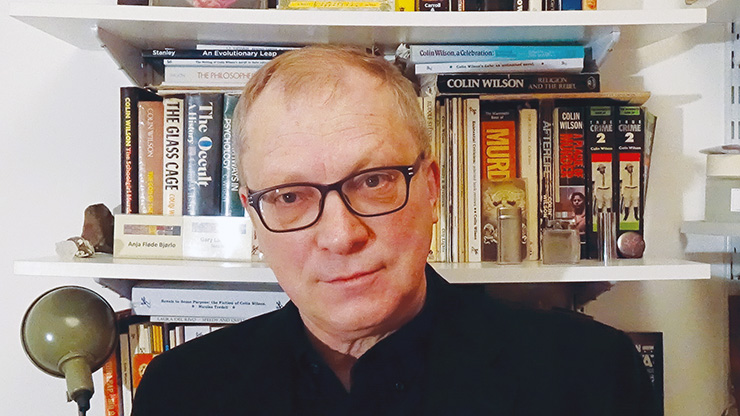
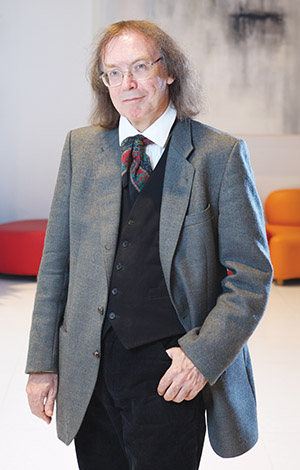
American author Gary Lachman has long called London his home, but I caught up with him during a recent visit to Australia. Compact, quiet and stylishly dressed, Lachman’s gentle scholarly manner belies the fact that he is a child of rock and roll, having come of age during the Punk/New Wave movement in New York and being once a member of the now legendary pop band Blondie.
These days he is a writer and has produced some of the best and most readable and accessible books about occultism and the major figures in the field of Western Esotericism. He has published superb biographies of Madame Blavatsky and Colin Wilson and an extraordinary history of the major figures of the occult tradition (The Secret Teachers of the Western World, 2016), along with extended reflections on magic, politics and the history of thought.
In a noisy, packed Indonesian restaurant, I asked Gary how he developed his interest in the occult.
“In 1975 I was a musician playing in New York,” he said in his companionable manner. “I was playing in Blondie – this was before Blondie became anybody. I was living on the Bowery with Debbie Harry and Chris Stein and they had a kind of kitschy interest in occult stuff. The guy who rented us our loft was a very flamboyant artist who had studied Aleister Crowley and he had a Thoth tarot deck which, at the time, was rather rare. He would do readings with it and I just got interested in it.”
Gary’s biography of the prolific British writer and historian of the occult, Colin Wilson, is a fascinating read and is the book that really made me determined to meet Gary and study with him. His 2014 biography of Crowley is a wickedly good read and the book I recommend to anyone who wants to learn more about the self-styled ‘Great Beast’. I asked Gary how these two men in particular influenced his life.
“During this period [the early 70s] I was in someone’s room and on a bookshelf saw this big book called The Occult [by Wilson, published 1971]. I’d already been reading Crowley, so I pulled it off the shelf and started reading it and it totally grabbed me. He has a wonderful writing style and he was looking at all of this from the philosophy of consciousness. I had read some of the existentialists and Nietzsche, but I really didn’t know all that much and I found this totally gripping work and it was basically the start of it.”
“Not only did it get me interested in the occult, esotericism, mysticism and all that, I became completely devoted to the work of Colin Wilson. I remember that wherever we went on tour I would head to the local used bookstore and look for books by Wilson. I wound up getting a big collection of them and in 1983 I made a pilgrimage to Cornwall, where he lived, and met him.”
“You seem to be someone who uses everything you read,” I said. “Nothing ever goes to waste. How did you get into that habit?”
“Well it was something I picked up from Wilson. He read an enormous amount and he made the effort to connect it all together. I wanted to write the kind of books I liked reading, and I wanted to write those sorts of books where you learn a lot. If you follow up on the books Colin Wilson mentions in his writing, it’s like getting a liberal arts education. From reading him I followed up people like Ouspensky, Gurdjieff, Husserl, Yeats… You follow up on the strands he leaves for you. So, I do that now myself. If I get a commission for a book, I read everything I can about the subject for the first six months or so. Then I spend the next six months trying to write about it.”
Since so much of Gary’s work is about the importance of thinking for ourselves and allowing ourselves the time and space to think deeply, I asked him if he thought we had lost the habit of thinking.
“We’re thinking less and less,” he responded, without hesitation. “I mean, it has never been particularly popular, but people are now letting machines do our thinking for us. I guess that’s one of the problems with the internet, when everything is based on algorithms based on what you have searched – you can’t get out of that loop. I often wonder that if you put Siri and Alexa next to each other, would they be able to have a conversation? Siri says one thing and Alexa something else and we can just let them fight it out.”
Though his work has been almost exclusively centred on the Western tradition, I was curious to know if he’d ever explored any of the Eastern traditions.
“Early on, when I was first reading this stuff, I was quite taken with Zen. I tried to practice for a while, inspired by people like Alan Watts and D. T. Suzuki. More recently I have been interested in Taoism, in the context of Jung’s ideas about alchemy and ‘The Secret of the Golden Flower’ [the Chinese alchemical text that had come into Jung’s life in an act of remarkable synchronicity – see Gary Lachman’s book Jung the Mystic]. I think there’s a great deal to learn from the Eastern traditions.”
I asked him if there were any gaps in 21st century presentations of the history of occultism – was there anyone who wasn’t being written about that deserved a closer study.
“Well, Owen Barfield,” he said. “Not necessarily an occultist, but certainly in the consciousness tradition. And Kathleen Raine, who is one of my heroes. I interviewed her just before she died. She devoted her life to resurrecting what she called ‘the lost knowledge of the imagination’ – that’s where I got the title of my book. It’s a tradition of the imagination that has been rejected in the West. We tend to see the imagination either as make believe or something with practical, utilitarian applications – in the context of innovation or cutting-edge technologies.”
“Raine saw it as a way in which we could actually know the world. There can be a cognitive content to the imagination, and she devoted her life to reviving that. She found it in the Romantic poets that she loved – poets that Barfield loved as well, people like Shelley or Blake. She was a great Blake scholar. If you read Blake the imagination is everything.”
Is “the imagination” another term for God, I asked.
“Well…” he demurred politely. “I don’t know if it’s another term for anything. In the Hermetic tradition they say that in order to know God you have to be like God. And one can be like God through the imagination. Through the imagination you acquire God-like powers. Maybe not the specific Christian God but in the sense of a level of consciousness that is not constrained by our limitations. Blake talks about ‘Jesus the imagination’ so Jesus was for him someone who lived the imagination. What did he mean by that? I think that depends on our own understanding. I think that Blake meant that he lived through the spontaneity of his inner world.”
Part of the great thrill of spending time in the company of someone like Gary Lachman is the incredible breadth and depth of his knowledge. A conversation with him veers all over history, religion and literature. He has been a determined scholar since he was a very young man, and now he wears his learning lightly on his sleeve and has a charming way of assuming his conversation companion is as learned as he. Almost inevitably, given the circumstance of two bookish people sharing lunch, our chat turned to literature more generally.
“Well I’ve just finished writing a book about Russia, and Dostoevsky has always been an interest of mine,” he volunteered. “Sadly, the fiction I read now is mostly for entertainment and I have been reading a lot of the Maigret novels by Georges Simenon. I guess you could call it thinking-person’s crime fiction. I used to love fantasy and science fiction and I grew up on Lovecraft. There’s an English novelist called John Cowper Powys who wrote A Glastonbury Romance. That book is a real commitment – it is a huge thick thing. But reading it is a mystical experience; he sees everything from a cosmic perspective. There is a life running through every aspect of the novel, from the protagonist’s loftiest speeches to the most mundane description of landscape. He has a wonderfully mythic consciousness.”
As lunch wound up, I thought I would take a chance at asking him if there was single spiritual path to which he had found himself committed. He allowed that in his youth he had been for a while involved in a Crowley group and then the Gurdjieff work. But now this great polymath is content to exist between worlds.
“I’m interested in too many things,” he said with his trademark impish grin. “I see connections between things and so rather than stick to one school of thought I need to be true to myself. Being constant has its virtues but I want to explore the contradictions and similarities I notice. I don’t belong to anything, but I study whatever I can.”
Gary is currently completing two books, one on precognitive dreams, and another titled The Return Of Holy Russia: Apocalyptic History, Mystical Awakening, and the Struggle for the Soul of the World, to be published by Inner Traditions in May 2020.
Gary Lachman is the author of 21 books on topics ranging from the evolution of consciousness to literary suicides, popular culture and the history of the occult. His work has appeared in many journals, magazines and newspapers. Gary lectures regularly and has appeared in several film and television documentaries. Before becoming a full-time writer, he studied philosophy, managed a new age bookshop, taught English Literature, and was a Science Writer for UCLA. He was a founding member of the pop group Blondie and in 2006 was inducted into the Rock and Roll Hall of Fame. Lachman was born in New Jersey, USA, but since 1996 has lived in London, UK. Website: garylachman.co.uk, Twitter @GaryLachman
[alert type=”general” dismiss=”no”]This article was published in New Dawn 178.[/alert]
[alert type=”success” dismiss=”no”]If you appreciate this article, please consider subscribing to help maintain this website.[/alert]
When the veil descended, men revered what it covered. And as time went on it seemed to hide more and more and was revered still more. Then, when it was heavy with age, young men fresh and arrogant demanded the removal of the veil and demanded to see what was hidden. For they said that whatever is hidden from the people cannot be for the common good. In the thunder and lightning of indignation, the veil was torn down. Nothing lay beyond. At first the young men were startled, but then they laughed jubilantly at the absurd fraud they thought they had uncovered. And the old men grieved, cursing the young men because they had destroyed the veil. – The Tree of Life Oracle
Why do so many creation sagas sound alike? Why can myths of a universal flood be found worldwide? And why do we find prophecies of an end of the world in equally far-flung places?
There are two basic theories that try to account for these similarities. One is the archetypal, which argues that these universal myths point to a common structure within the human mind. The Swiss psychologist C.G. Jung is the best-known advocate of this approach. The other is the diffusionist view, which claims that these resemblances point to a common source of myth in the past.
In a recent book, entitled Origins of the World’s Mythologies, E.J. Michael Witzel, a professor of Sanskrit at Harvard University, argues on behalf of the diffusionist view. He compares the myths of nations around the world and paints a picture of the history of myth that reaches back as far as 100,000 years.
Witzel claims that certain universal mythic elements may actually go back to the earliest stages of humanity, when the whole species still lived in Africa. He calls this strain the “Pan-Gaean” mythos (he uses the geological names of prehistoric continents to label these different strata). The next oldest is that of “Gondwana,” a mythos that can be found today chiefly among the indigenous peoples of sub-Saharan Africa and Australia. By this account, the gods, heaven, earth, and so on, preexist; there is no story that tells of their origins. The gods create humans from substances such as trees or clay, but the humans commit acts of hubris and are punished by a worldwide flood (an element that apparently goes back to the Pan-Gaean mythos). Afterward, local tribes emerge.
The myths of the rest of the world – not only Europe and Asia but the Americas and even Polynesia – are “Laurasian.” They first arose, probably in southwestern Asia, between 40,000 and 20,000 BCE, and share one crucial feature: unlike the earlier strains, they all present a continuous and more or less similar narrative; Witzel even describes it as a “novel.” It has some of the features of the earlier Gondwanan story, but it goes much further and is much more coherent. It begins with the origins of the cosmos and the gods and extends to the birth of humanity, whose history is delineated into four or five “ages.” Humans show hubris in this narrative as well, and are also punished with a universal flood.
The mythos proceeds to the end of time, in which heaven and earth are destroyed and a new heaven and new earth emerge. This event is represented in legends as different as the Nordic Götterdämerung (“twilight of the gods”) and the Last Judgment of Christianity. Indeed, for Witzel, the creation narratives and eschatology of the Bible are only the latest manifestations of the Laurasian mythos.
Why have these myths lasted so long? According to Witzel, one reason is that, quite simply, they are good stories. Another is that the Laurasian mythos in particular recapitulates the human lifespan on a universal scale: like us, it is saying, the cosmos is born, grows to maturity, and eventually withers and dies; it even goes through several distinct stages of development. He also echoes the claim made by certain neuroscientists that in some yet undefined way the human brain is “hardwired” for myth and religion (although this leads toward the archetypal view that Witzel dismisses).
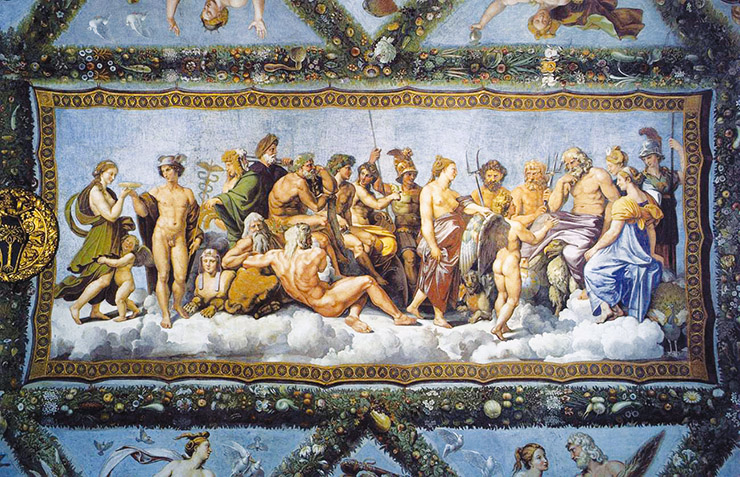
We can also see that these myths have been recast into new forms every few thousand years. Little by little, the old gods cease to be taken seriously; sometimes they are mocked. This happened in classical antiquity. The period that is most familiar to us – from 500 BCE to 300 CE – is a comparatively late one for that civilisation, and we can see the old gods losing their hold. Around 500 BCE, the pre-Socratic philosophers arose in Greece, some of whom disdained the gods, claiming that they were mere personifications of natural phenomena or outright fictions. The gods were also satirised in literature then and in later centuries, as we see in the comedies of Aristophanes and the dialogues of Lucian. While paganism remained alive in the popular mind until Christianity won out in the fourth century CE, the intelligentsia had long ceased taking it seriously – or interpreted the gods symbolically or allegorically. (Sometimes when the new mythos takes over, it keeps some of the gods of the previous one, but as demigods or demons: early Christianity saw the Greek and Roman gods this way.)
The Ages of Greece
Every people have gods to suit their circumstances. – Henry David Thoreau
This constant need for creation and recreation of myth leads us to wonder what may cause these upheavals. It is tempting to look at this issue in the light of the “ages” that are so universal a mythic motif. Among the most familiar are those of the Works and Days by Hesiod, a Greek poet of the eighth century BCE: the ages of Gold, Silver, Bronze, the Heroes, and Iron. Hesiod’s sequence of these periods, like those of many Laurasian myths, is one of decay and degeneration, from the Golden Age, whose people “lived like gods without sorrow of heart, remote and free from toil and grief” down to the present Age of Iron, when “men never rest from labour and sorrow by day, and from perishing by night.” Although Hesiod laments that he had rather “died before or been born afterward,” the present age will deteriorate still further, and will approach an end when people “come to have grey hair on their temples at their birth.”
Hesiod may be preserving some historical memory here, at least in his choice of names. The Bronze Age in Greece lasted till around 1100 BCE, and the Age of Heroes centres around the sack of Troy, which is generally dated to the early twelfth century. The Greek Dark Ages (1100-750 BCE), when iron was introduced, then began, at the end of which Hesiod himself lived. The ages of Gold and Silver would then be part of a more or less imaginary mythic prehistory.
While the idea of the Golden Age still floats about in the popular mind today, Hesiod’s other ages do not. But we have something similar in the mythos of Christianity. One common version of Christian sacred history speaks of several “dispensations” or different periods of worship. Based on the biblical narrative, they are usually divided thus: the period between Adam and Noah; the period between Noah and Abraham; the period between Abraham and Moses; the one between Moses and Christ; and from Christ to the present, which will last until Judgment Day, and restore a new heaven and a new earth. The last days, again, will be characterised by decay and degeneracy, as we see in Christ’s apocalyptic discourse in Matthew 24, Mark 13, and Luke 21.
Thus we see ancient Laurasian myth transposed into both classical Greek and Christian modes. And this in itself illustrates how a universal mythos can shift from one era to another.
Astrological Ages
For some today, the concept of the ages can take an astrological form, and this idea has been extraordinarily popular since the 1960s, when the coming of the Age of Aquarius was proclaimed. The idea of the Aquarian Age itself now seems somewhat dated, but that, I would argue, is because we are now actually in the Age of Aquarius, and we take some of its most characteristic features for granted.
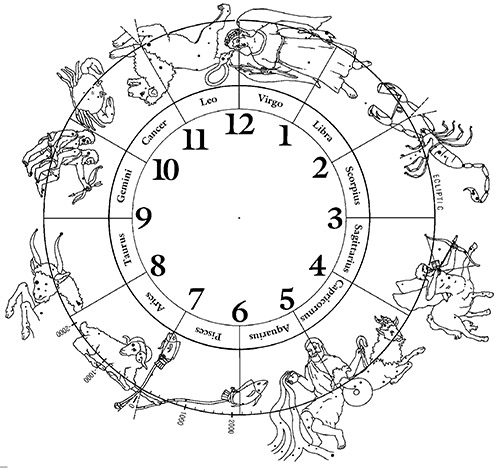
The idea of the astrological ages is based on the precession of the equinoxes, in which, by an extremely long and slow cycle, the point of the sun’s rising at the spring equinox (that is, in the northern hemisphere) moves from one sign of the zodiac to another over a period of nearly 26,000 years. Dividing this by twelve, we can see that each age lasts somewhat less than 2,170 years. Since there is no dotted line in the sky separating one constellation of the zodiac from another, the time of this transition as given by different authorities can vary by centuries. Moreover, there is a tremendous overlap of influences, so that no sharp delineation can be drawn.
Our understanding of the earliest of these ages, which were preliterate, is imperfect, relying on surviving artefacts that may or may not reflect the totality of the culture. It is really only with the Age of Aries, which began in the second or third millennium BCE, that we can begin to fill in details and learn how religious observance in particular has changed throughout these ages.
It’s common to date the recent astrological ages as follows: the Age of Aries, 2100-7 BCE; the Age of Pisces, 7 BCE-2100 CE; the Age of Aquarius, 2100-4200 CE. These dates are highly approximate, although 6 or 7 BCE is sometimes given as the beginning of the Age of Pisces, when a “great conjunction” (between Jupiter and Saturn, opposing the sun) supposedly marked the birth of Christ.
But, on the basis of history, I would suggest that the ages took place much earlier: Aries, between roughly 3000 and 800 BCE; Pisces, between 800 BCE and 1400 CE; and Aquarius, from 1400 CE to, perhaps, 3600. There is also an overlap of several centuries.
My reasoning is as follows: Pisces is associated with religion, and the great world religions all arose around what the German philosopher Karl Jaspers called the Axial Age, the period between 800 and 200 BCE, when figures including the Hebrew prophets, the Greek philosophers, Lao Tzu, Confucius, the Buddha, and Mahavira, the founder of Jainism, all lived.
Thus, by my account, the Age of Pisces marked the birth of all the great world religions, with the possible exception of Zoroastrianism. (Zoroaster’s date is controversial: although his life was traditionally dated to c.800 BCE, scholarly opinion has now pushed it back to the late second millennium BCE.) Judaism and Hinduism certainly existed before the Axial Age, but they changed profoundly during that era. One of the most remarkable changes is that they, like most of the world, gave up animal sacrifice.
Animal Sacrifice In Religion Phased Out
In the Hinduism of the Age of Aries, one of the most important rites was the asvamedha or horse sacrifice. It could only be performed by a king and was meant to ensure the prosperity of the kingdom. The horse was released and allowed to roam for a year; if it wandered into hostile foreign territory, that territory had to be conquered. After its return, it was sacrificed. The Brihadaranyaka Upanishad compares the horse to the universe, so that symbolically the universe is sacrificed in this rite.
After the Axial Age, however, the old Vedic animal sacrifices were phased out. The more philosophical and ethical Hinduism that we know today arose, and the sacrifices that were retained (such as the extremely ancient fire sacrifice) did not involve animals. The difference in eras is illustrated by a line from the Hindu Laws of Manu (5:53), which date from the early centuries of the Common Era: “He who sacrifices every year with a horse-sacrifice, and he who eats not flesh, the fruit of the virtue of both is equal.”
Judaism practiced animal sacrifice up until the sack of the Second Temple in Jerusalem by the Romans in 70 CE. And the sacrifice was on a grand scale. Many people have a sugary, children’s-Bible image of the Jerusalem Temple, but the reality was quite different. A text dating probably from around 100 BCE called The Letter of Aristeas gives one of the few surviving eyewitness descriptions of it. One detail that especially impressed the author was the temple’s elaborate plumbing system, which was needed to drain off the blood of all the animals killed.
Animal sacrifice and blood were major themes in the religions of the Age of Aries. Blood keeps surfacing in the biblical narrative; in Genesis 9:6, for example, where God forbids Noah to eat meat with the blood, “which is the life thereof”; a commandment repeated in the Mosaic law, for example in Leviticus 17:11 and Deuteronomy 15:23. Blood, reserved for God alone, is to be poured out on the ground.
The spilling of blood in sacrifice is an ancient and widespread theme. It is treated vividly in the eleventh book of the Odyssey, where Odysseus summons up the shade of the prophet Teiresias to learn how he can return home. Odysseus begins with a huge sacrifice:
I took the sheep and cut their throats over the pit, and the dark-clouding blood ran in, and the souls of the perished dead gathered to the place… These came swarming around my pit from every direction with inhuman clamour, and green fear took hold of me.
When Odysseus wants to speak to the spirits of the dead, he allows them to draw near and drink the blood – or, as we might put it today, the energies given off by the blood.
One might begin to wonder about the nature of animal sacrifice and of the gods that demanded it. Were the gods of the Age of Aries lower-grade spirits that, like the ghosts from Homer’s Hades, literally fed on the life force released from the blood? And did the Age of Pisces, with its more abstract and ethical religions, mark an actual transition to a worship of a higher form of god? (For one view of this transition, see the accompanying article, “Is Your God a Devil?”)
One case of this transition appears in Pythagoreanism, a mystery school founded by the Greek philosopher Pythagoras (c.570-c.495 BCE). Pythagoras enjoined his followers not to eat meat or fish (indeed, until the term “vegetarianism” was coined in the nineteenth century, this was called “the Pythagorean diet”). Nonetheless, in the first century of their existence, the Pythagoreans did not seem to have any problem with the animal sacrifices that were so central to Greek religion; only later, in the fourth century BCE, did this become an issue. This in itself gives a hint of the shift that was taking place in Western consciousness.
Animal sacrifice is still practiced to some degree. Muslims sacrifice domestic animals at the festival of Eid el-Adha. The practice survives as well in Santería and Voudun, the religions of the African diaspora that flourish in the Americas. Years ago in San Francisco, I remember seeing a dead bird on a street corner. It was not the typical grey city pigeon that had dropped dead; it was pure white. I suspect it was the offering of some devotee of Santería who had sacrificed a dove at a crossroads.
Pisces, as we have seen, was the age of the great world religions, and all the major world religions arose during that period, the latest being Islam, which came in the seventh century CE. The most famous symbol of the Age of Pisces is the ιχθυΣ (ichthys) symbol, which is the acronym of the Greek phrase “Jesus Christ, son of God, saviour.” It is the Greek word for “fish.”
The largest and most successful of the Piscean religions (at least in terms of size) are Christianity and Islam, which together account for approximately half of the human race. Both of these posit a monotheistic, personal God who demands obedience, prayer, and ethical behaviour.
Age of Aquarius and the Changing God Image
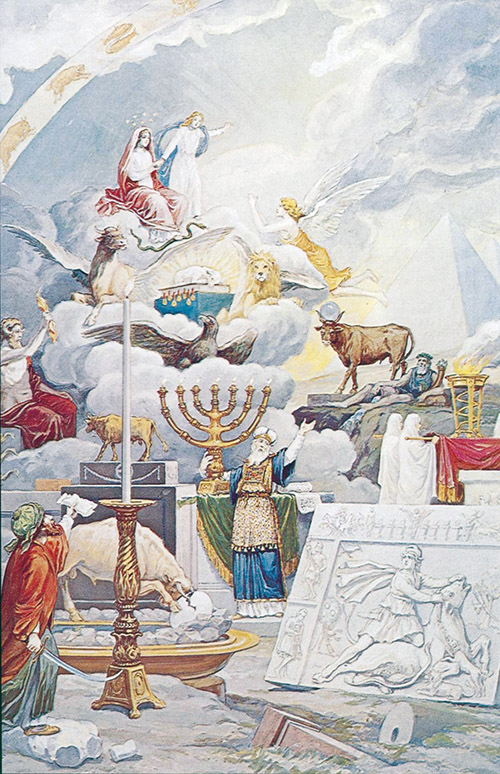
The changing and diverse figures and forms of world religion over the ages. The arch of the zodiac appears in the top left hand corner. This drawing appears in Manly P Hall’s Secret Teachings of All the Ages (and was redrawn from Lanoir’s La Franche-Maconnerie).
While the monotheistic God continues to command the belief of much of humanity, another radical change of thought seems to have taken place with the approach of the Age of Aquarius around the beginning of the Renaissance. At that point, humanism began to supplant religion. Humanism has a dual meaning: it can refer to the learning of classical pagan civilisation as well as to a kind of nonreligious philosophy that promotes ethical behaviour without recourse to the supernatural. Both of these began to come to the fore at this time. In the Age of Aquarius – whose symbol is a man – humanity began to focus on a human-centred rather than a divine-centred world.
As I argued in my New Dawn article “The Other Side of Aquarius,” (New Dawn 141) the final transition from the Piscean to the Aquarian age came centuries later, with the great upheavals of the world wars. From a military point of view, these began with naval power dominant (as evidenced by the British Empire) and ended with the triumph of air power (as seen at Hiroshima and Nagasaki). Pisces is a water sign, Aquarius an air sign.
We are thus now in the Aquarian Age. Those who predicted that it would be an age of harmony and understanding were only half-right. It is an age like any other, with its progress and tumult. It is not a dawning millennium that will save us from all our problems; rather it has brought a number of problems of its own – environmental damage, an obsession with computers and technology, and so on.
So we have seen that the previous two ages saw the demise of one set of gods and the rise of another. Who are the new gods of Aquarius?
Aquarius is a rather impersonal sign, as zodiac signs go; it is more comfortable with ideals than with particulars. (It reminds me of a line from Charles Schultz’s comic strip “Peanuts”: “I love mankind. It’s people I can’t stand!”) So it stands to reason that the Aquarian gods would be impersonal as well. And we see that science has pushed aside the creator God of Christianity in favour of abstract entities such as natural selection and the forces of physics. Unlike the gods of Aries, they do not require animal sacrifice. Unlike the gods of Pisces, they do not require worship and moral behaviour. They are completely and utterly indifferent to, and unaware of, the human race.
Science is the dominant mode of thought in the present age. It is taken as the final arbiter of reality and the ultimate determinant of meaning: if science sees no meaning in the universe, then, many would say, there is none. Consequently, the struggle between science and religion is a struggle between the old worldview of Pisces and the new worldview of Aquarius.
From all this, someone might look back and see a steady elevation in conception from the blood-drinking gods of Aries to the moral but vindictive God of Pisces to the bright, shiny new world of science, technology, and progress. There is some truth to this picture – but only some.
We tend to assume that whatever is newer is better, but that itself is a fairly recent development in human thought – and probably Aquarian in inspiration. We’ve already seen how Hesiod portrays the cycle of the ages as one of decay. The classical scholar E.R. Dodds argued that the ancient Greeks had no concept of progress as we know it today. In classical Latin, the word for “new” – novus – had the same pejorative connotation that “old” has for us. In Christian apocalyptic terms too, the present age deteriorates until it can only be saved by the return of Christ. Progress does appear in some Laurasian myths – such as in the Mayan Popol Vuh, which says that the gods created several unsuccessful races until they got it right with humans – but not in very many.
In any event, we can now see Witzel’s Laurasian mythos in its latest incarnation: that of science. There is no creation by God; rather there is a Big Bang. The picturesque ages named after metals have been replaced by immeasurably long and grandiose-sounding ones such as the Precambrian and the Jurassic. And instead of a Götterdämerung or Last Judgment, physicists posit a Big Crunch or heat death as the final fate of the universe.
What remains most striking is that, even in this supposedly objective view of the universe, we have a cosmos that is born, grows up, and dies – just like us. No matter how much intellectual and technical sophistication human beings acquire, they still tend to view the universe as themselves writ large. Is this objectively true – that man is the measure of all things, and our lifespan recapitulates that of the cosmos? Or are we simply foredoomed by our own makeup, with its all-too-finite duration, to see things this way?
I myself go back and forth between these two points of view. In any event, contemporary science faces a fundamental contradiction in its outlook. It holds (1) that our minds are necessarily limited and conditioned by the structure of our nervous system and yet (2) this nervous system, expressing itself in scientific formulae, gives a complete and accurate version of the universe. The Christian theologians papered over their logical contradictions by appeals to divine mystery and the inscrutable will of God. I wonder what escape route the scientists will find.
Finally, the question of meaning remains. Paganism and the world religions did give meaning to the universe. Science, or its quasi-religious form known as scientism, has not. In fact it has gone in the opposite direction. Scientism says not only that it can find no meaning in the universe, but that there is none. Any attempt to find such a thing is derided as a reversion to the supposedly obsolete idea of a personal God.
Are the cultists of scientism right? Science may have squashed simplistic notions of meaning and purpose, but this need persists, and it is not going away. The failure of the new gods of Aquarius to provide it have left our civilisation with a deep sense of anomie and isolation. We can ask how accurate or complete a picture this impersonal Aquarian religion really offers. After all, our very appetite for meaning attests to its existence. You would never feel thirst if there were no such thing as water.
[alert type=”general” dismiss=”no”]This article was published in New Dawn 142.[/alert]
[alert type=”success” dismiss=”no”]If you appreciate this article, please consider subscribing to help maintain this website.[/alert]
Sources
Arthur Coke Burnell and Edward R. Hopkins, ed. and trans., The Ordinances of Manu, Munshiram Manoharlal, 1995 [1884]
R.H. Charles, ed., The Apocrypha and the Pseudepigrapha of the Old Testament, volume 2: Pseudepigrapha, Oxford at the Clarendon Press, 1913
Cherry Gilchrist and Gila Zur, The Tree of Life Oracle, Friedman Fairfax, 2002
Homer, The Odyssey, Translated by Richmond Lattimore, Harper & Row, 1965
R.E. Hume, ed. and trans., The Thirteen Principal Upanishads, 2d ed., Oxford University Press, 1931
G.S. Kirk, J.E. Raven, and M. Schofield, The Presocratic Philosophers, 2d ed., Cambridge University Press, 1983
Rudolf Steiner, “The Occult Significance of Blood: An Esoteric Study”, http://wn.rsarchive.org/Lectures/19061025p01.html; accessed Sept. 16, 2013
E.J. Michael Witzel, The Origins of the World’s Mythologies, Oxford University Press, 2012
Recently I returned to London after a week in Spain promoting a new translation of one of my books, and taking part in an International Occulture Conference held in León, an ancient city in northern Spain that is an important site on the Santiago de Compostela pilgrim trail. An ‘International Occulture Conference’ you might say? What is that and why in Spain? The second part of this question is easier to answer than the first.
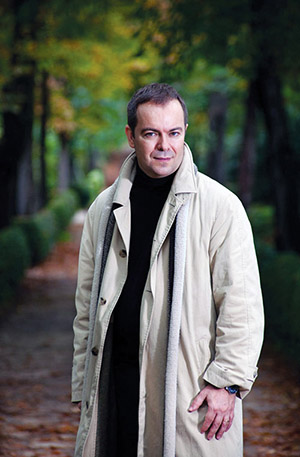
The conference was held in Spain because it was organised by one of that country’s most popular writers, Javier Sierra. While he is not necessarily a household name in the English speaking world, Sierra has had considerable success with some translations of his work, most notably La Cena Secreta (2004) which, as The Secret Supper (2006), found a place on the New York Times bestseller list and stayed there for some time. Other works of what Sierra calls “investigative fiction,” like El Maestro del Prado (2013) – The Master of the Prado (2015) – have also done well in the UK and US. But in Spain Sierra is something of a phenomenon. I got a sense of this at the conference, watching the many fans of his books queue up for him to autograph their copies and to take a selfie with their favourite author.
Javier Sierra (photo courtesy of Javier Sierra)
Sierra’s fictions deal with occult and esoteric themes, but not in a way aimed at shocking or titillating his readers. His books are thrillers, detective stories in the mould of Dan Brown or Umberto Eco’s The Name of the Rose, but what Sierra aims at giving his readers aren’t thrills and shivers but knowledge. He uses the structure of a mystery to uncover the traces of what for convenience sake we can call the Hermetic or Gnostic influence on Western culture. We can say that he uses one mystery to reveal another. At least this is the theme of the two books of his I’ve read. The Secret Supper – translated by Alberto Manguel – deals with the heretical ideas and teachings that Leonardo Da Vinci secretly embedded in his painting The Last Supper, and the efforts of a kind of papal secret police to wipe out those few who can read the code. In The Master of the Prado a young man meets a mysterious older gentleman in Madrid’s famous museum, and is instructed in the subtle art of reading the strange symbolism inserted into some of the world’s most famous paintings, works by Hieronymus Bosch, El Greco, Botticelli, and others.
The knowledge the heroes of Sierra’s fictions acquire is doubly ‘occult’, in that not only is it about ‘hidden’ things – the soul, the spirit world, and visionary states of consciousness, all deemed verboten by the religious authorities – but is itself hidden, coded in a language that only devotees of the lost wisdom can decipher. Sierra’s aim seems to be to teach this language to his readers so they can look at some of the most well-known works of Western art with new eyes, and grasp the deeper meanings that, for the uninitiated, are hidden in plain sight.
What is Occulture?
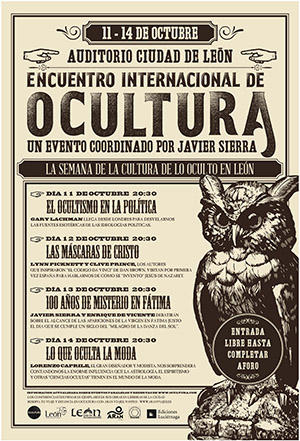
Brochure for the International Occulture Conference.
Here I would say we can begin to answer the second part of our question: what is occulture? It is what happens when what we call the occult and what we know as culture come together, in ways that illuminate both in an unusual light and allow us to understand each from new and different angles. In Sierra’s books Neoplatonism, Hermeticism, Kabbalah, art history, hermeneutics and mysticism come together in narratives that not only entertain but instruct.
Sierra’s success led to the launch of a new publishing line, Ocultura, which specialises in titles hand-picked by him and whose covers receive his imprimatur. Hence the conference and my appearance at it. My book Politics and the Occult had been chosen for translation as was The Masks of Christ by Lynn Picknett and Clive Prince, who were the other English-speaking presenters at the conference. Picknett and Prince’s The Templar Revelation had been an inspiration for Sierra’s The Secret Supper as it had been for Dan Brown’s The Da Vinci Code – they even make a cameo appearance in the film. My book looks at the many examples of occult or esoteric ideas that have influenced politics in the modern west, and argues, contra Umberto Eco, that there is plenty of evidence for a ‘progressive’ occult politics, and not only for the more well-known far-right version. In The Masks of Christ Picknett and Prince analyse the actual evidence we have for who exactly Christ was – or wasn’t, as the case may be. As readers of their other books – like The Stargate Conspiracy and The Turin Shroud – have come to expect, their conclusions are, if nothing else, challenging and thought-provoking. The other speakers were Sierra himself, who engaged in a dialogue with the Spanish author and occult mover and shaker Enrique De Vincente on the true meaning of the visions of Fatima, celebrating their hundredth anniversary in 2017, and the top-flight designer Lorenzo Caprile, who spoke about the growing influence of occult ideas in the fashion world.
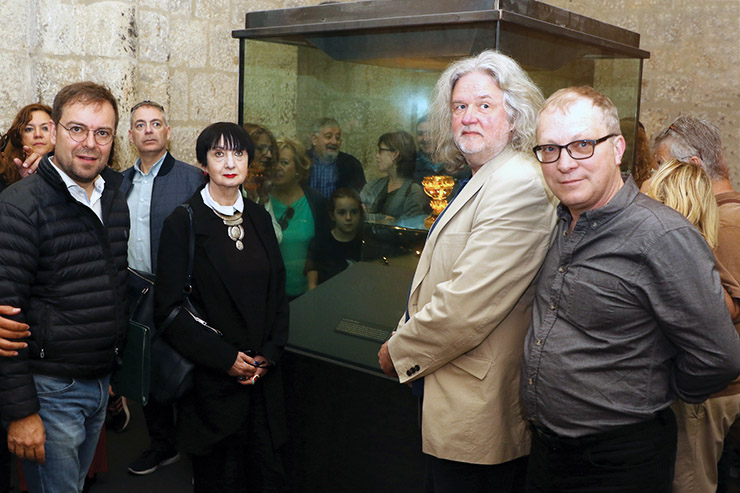
Politics, religion, haute couture and esotericism do not usually mix, but for the week of the conference they seemed to get on well. The huge León civic auditorium, where the conference was held, was packed and the audience engaged. Local, regional and national newspapers, radio and television covered the event, with shots of the speakers and Sierra standing before the remarkable cathedral at León – a masterpiece of French gothic transported to northern Spain – and at the Basílica de San Isidoro. It claims, among its many other worthy features, to house a good candidate for the Holy Grail, at least according to the historian Margarita Torres Sevilla who argues for its authenticity.1 At the start of our Spanish adventure, in Madrid, I was surprised at the media attention Sierra’s new Ocultura editions drew. Lynn, Clive and I ran a marathon of radio, newspaper, and web interviews, enabled by our excellent translator. But in León there was even more, and when the head of the town council greeted us, I was surprised that he didn’t hand us the key to the city.
Most of this had to do of course with our host’s popularity and the attention and business he was bringing the town, which is already a well-trod pilgrimage site. But it also could not hurt the ‘occulture’ cause, if there is such a thing. I had already taken part in several similar events all held under the occulture banner, in London, New York, and Trondheim, Norway. I had spoken at symposia and conferences in Germany, France, Denmark and Sweden in which the theme was the close links between art and the occult, in the past and present, and had written essays about this for art magazines and catalogues for ‘occulture’ exhibitions held in Europe and South America. So, whatever occulture is, it is certainly getting around.
But what exactly is it? The term occulture is said to have been coined by the performance artist Genesis P–Orridge sometime in the 1980s. What exactly he meant by it remains unclear – at least to me – but it received its academic bona fides some years later. In 2004 Professor Christopher Partridge of Lancaster University defined it as a concern with “hidden, rejected and oppositional beliefs and practices associated with esotericism, theosophy, mysticism, New Age, Paganism,” and other ideas belonging to the “occult subculture.”2
That is indeed a mouthful, but the gist of it was expressed more succinctly by the Swedish writer and publisher Carl Abrahamsson, who summed up occulture as “anything cultural but decidedly occult/spiritual.” Abrahamsson, to whose forthcoming book Occulture I contributed a Foreword, sees this union taking place more in the odd mashups between pop culture and the avant-garde, in the films of the Aleister Crowley devotee Kenneth Anger, the ‘cut-ups’ of William S. Burroughs and Brion Gysin, and other forms of ‘trangressive’ art. But “anything cultural but decidedly occult/spiritual” is a wide brief. It includes, for example, the work of the comic writer Alan Moore, the Russian painter and guru Nicholas Roerich, and the ‘traditionalist’ composer John Tavener. And if Sierra’s ideas are correct, it includes many of the great works of Western art.
To be sure, most self-conscious works of contemporary occulture tend toward the transgressive, the antinomian, for the simple reason they aim to challenge not only the social but the ontological status quo, to upset ‘consensus reality’. As Sierra shows, much of the old traditional art that later rebels transgress against is itself already transgressing – against the religious dogmas and repressions of the time. It is not out to disturb, as by definition transgressive art is, but to instruct. What it wants to trigger is not so much a reaction as a response. It does not want to convey a shock, but knowledge. And to acquire this knowledge it is necessary to know where to look for it and, even more, how to read it. And for this, one must understand the language in which it is written, a symbolic code or lost alphabet that is at the heart of esotericism.
Of course, there is much art that does not qualify as occulture, just as there is much occultism that does not qualify as culture. Occulture inhabits that intermediary realm between the artwork and the ritual, the inner journey and the poetic experience, where the transformative power lies not only in the secret knowledge revealed but in the symbols that convey it. Here knowledge and experience, symbol and symbolised, are one. The magic of a work of art lies first in its power to compel our attention. It is only when it grabs us that we can begin to see it clearly.
The idea of a hidden alphabet or secret code of some kind can be taken too literally, as can the notion of some lost or forgotten knowledge. Then what is sought is some explicit information, some concrete secret – like the password to your bank account – just as military codebreakers seek to decipher the enemy’s messages, which remain meaningless until the key is found. The process, the codebreaking itself is irrelevant; if the information could be obtained otherwise it would be just as useful. The destination, not the journey, is what counts.
Transforming the Imagination
Learning the hidden alphabet of occulture is another matter because here the language and the knowledge revealed through it are one. It cannot be given in another way. The knowledge and the process of acquiring it are one and the same. Because of this, they are transformative.
What brings about this transformation and is itself transformed is the imagination. The artworks at the centre of Sierra’s tales are products of the imagination. But the ability to read them too requires an imaginative effort. Their meaning does not simply pass into our consciousness passively, although to be sure many of us assume that if we stand before an El Greco, a Botticelli, or a Da Vinci, we have ‘seen’ it. But we haven’t. To see in the way that the artist wants you to, and to know what to look for, requires work. It necessitates acquiring what we might call the ‘learning of the imagination’.
That, in fact, is the theme of my recent book, Lost Knowledge of the Imagination, which looks at imagination not as a way of escaping reality or of creating some substitute for it, but as a way of knowing it, as a cognitive faculty. Imagination, I argue, is what enables us to grasp the reality of the world around us in its fullness, which means being aware of dimensions and meanings beyond the physical and sensory, the ‘here’ and ‘now’. This means ‘unseen’ or ‘occult’ dimensions which are nevertheless as real as those revealed through the senses – perhaps more so – but which are grasped not by the senses but by the mind, by what the German writer Ernst Jünger called our “inner claws.” Learning how to grasp in this way is part of the ‘learning of the imagination.’ More times than not the first lesson in this is simply becoming aware that such claws exist and that you possess them. And this means becoming aware of the mind as an active power reaching out into the world and not merely a passive mirror simply reflecting it. This awareness of ourselves as active agents and not merely passive subjects is, I would say, one of the central teachings of esotericism.
Hermetic Wisdom
The Hermetic wisdom that Sierra’s heroes discover in the great artworks of the past says as much. Since the ground-breaking research of the historian Frances Yates, we’ve known that much of the Renaissance and the masterpieces it produced – and which fill museums like the Prado, which I had the opportunity to visit – were informed with the Hermetic belief that man is a microcosm, a little universe, and something more than a wretched sinner. “Within God,” the Hermetic writings tell us, “everything lies in imagination.” Man was made in the image of God and, “If you do not make yourself equal to God you cannot understand him,” so says the universal Mind to its student, the great sage Hermes Trismegistus. The message is clear: the way to God is through the imagination.
Through the translations of the Corpus Hermeticum – the supposed writings of Hermes – by the Renaissance Platonist Marsilio Ficino, ideas and beliefs like these informed the work of masters like Michelangelo. For a brief time it seemed the church would embrace the Hermetic wisdom, seeing in it another expression of the perennial philosophy it itself had emerged from, although it was loathe to admit it. In the end the Hermetic knowledge proved too threatening and, as history shows, was forced underground. Hence the need for the artists aware of these ideas to convey their knowledge secretly, in symbols that only their fellow initiates understand and which pass before the watchful eye of the authorities, seen but not understood. Hence the storyline for Sierra’s ‘investigative fictions’ in which modern-day visitors to the world’s great museums become privy to this lost knowledge, and by learning where and how to look, can read the wisdom hidden for all to see.
Sierra’s message, and perhaps that of occulture, seems to be getting across. When I returned to London I heard the news that he had just been awarded one of Spain’s top literary prizes, the Premio Planeta, for his novel El Fuego Invisible (2017) – The Invisible Fire – which centres around the Holy Grail – which, as mentioned, is believed to reside in León. Most likely this will help the pilgrim business there, and bring in some literary esotourism. Copies of El Maestro del Prado already guide readers to some of that museum’s many treasures, if the stacks of them in the Prado bookshop is anything to go by. Sierra’s belief is that “literature should not only entertain its readers but awaken them.” I would only extend that mission to culture at large, and make it the purpose of art en total.
[alert type=”general” dismiss=”no”]This article was published in New Dawn 166.[/alert]
[alert type=”success” dismiss=”no”]If you appreciate this article, please consider subscribing to help maintain this website.[/alert]
Footnotes
1. Margarita Torress Sevilla and José Miguel Ortega del Rio, Kings of the Grail: Tracing the Historic Journey of the Holy Grail From Jerusalem to Spain, Michael O’Mara Books, 2015
2. Quoted in Here to Go: Art, Counter Culture, and the Esoteric, ed. Carl Abrahamsson, Edda Publishing, 2012, 7
This article was published in New Dawn 165 (Nov-Dec 2017)
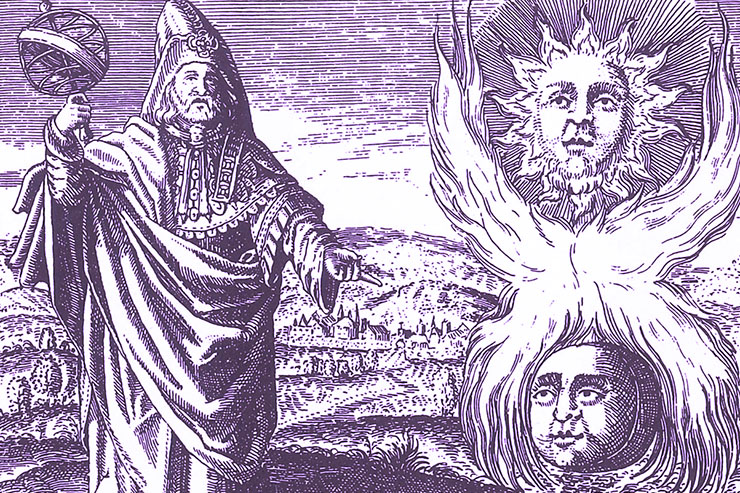
I sometimes suspect that we deploy the word ‘Hermetic’ – a term for late ancient Greek-Egyptian mystical texts attributed to the mythical man-god Hermes Trismegistus, or thrice-greatest Hermes – as a kind of marker, intended to connote a venerable ancestor to modern mysticism, and thus giving our current spiritual pursuits the weight of historical gravitas.
The truth is, Hermeticism is a living philosophy, which ought to be read, debated, and engaged. The Hermetic texts, mostly those found in the Corpus Hermeticum and the dialogue called Asclepius, can serve the needs of a twenty-first century person in search of metaphysical ideas and clarity.
Hermeticism is of immediate value much like the more arcane books of the Old Testament. Although certain Hebrew rites, rituals, and genealogical record keeping may seem period-bound, or of little more than liturgical significance to any but the religiously orthodox, such passages provide a framework for luminous ethical and spiritual insights. Similarly, elements of the late-Egyptian Hermetic books also reflect traditions of formalism, ritual, and recital – and these elements likewise frame passages of penetrating relevance to current seekers. This fact has not always been apparent due to the longstanding paucity of quality translations, a deficit that is thankfully being redressed in our time.1
The central and most enduring theme of the Hermetic literature – and one that left its mark on the ancient and Renaissance worlds, and, indirectly, on our contemporary culture of New Thought and mind metaphysics – is that the human mind is an extension and imitation of Nous, the Higher Mind, which serves as the divine creative force behind all that is.
This perspective finds particular resonance in books I and XI of the seventeen tracts that make up the Corpus Hermeticum. In book I, sometimes called the Divine Pymander of Hermes Trismegistus, we learn of the mind’s causative abilities: “…your mind is god the father; they are not divided from one another for their union is life.”2 As we come to realise our creative capacities, we grow closer in nature and perspective to the Eternal: “…he who has understood himself advances toward god.”
Book XI goes further in urging man’s awareness of how his mind, through its abilities to visualise all things, originate new concepts, and surpass physical boundaries, reflects innate divinity:
See what power you have, what quickness! If you can do these things, can god not do them? So you must think of god in this way, as having everything – the cosmos, himself, (the) universe – like thoughts within himself. Thus, unless you make yourself equal to god, you cannot understand god; like is understood by like. Make yourself grow to immeasurable immensity, outleap all body, outstrip all time, become eternity and you will understand god. Having conceived that nothing is impossible to you, consider yourself immortal and able to understand everything, all art, all learning, the temper of every living thing.
In the student-teacher dialogue called Asclepius, which is often grouped as an adjunct to the Corpus Hermeticum, man’s estimate is even further elevated. We first learn that, “one who has joined himself to the gods in divine reverence, using the mind that joins him to the gods, almost attains divinity.” Using a variant of the famous Hermetic formula, “as above, so below” (enunciated in another text called the Emerald Tablet), this dialogue counsels: “Forms of all things follow kinds… Thus, the kind made up of gods will produce from itself the forms of gods.” This adds a deeper resonance to man being made in God’s image, as found in Hebrew scripture.
Hermes goes on to teach his disciple Asclepius that man, at his highest, is actually on par with the gods: “Because of this, Asclepius, a human being is a great wonder, a living thing to be worshipped and honored: for he changes his nature into a god’s…” Hermes ultimately evaluates man as even greater than the gods because, while a god’s nature is fixed in immortality, the striving and aware man is ever in the process of becoming and fulfilling his highest nature: “In short, god made mankind good and capable of immortality through his two natures, divine and mortal, and so god willed the arrangement whereby mankind was ordained to be better than the gods, who were formed only from the immortal nature…”
Moreover, man in his reverence and worship performs necessary acts of caretaking of the gods: “He not only advances toward god; he also makes the gods strong.”
In considering man’s potential, the modern reader of Hermetic literature may find himself facing a question that also faces contemporary students of New Thought: Given the causative powers ascribed to our minds, and the manner in which thought relates to the highest source of creation, why do we suffer physical decline, illness, and bodily death? Indeed, the most Hermetic of all New Thought teachers, Neville Goddard (1905–1972), instructed that your mind is God, and all that you experience is the product of your imagination – so, again, why must we “die as princes?” as the psalmist puts it?
The Corpus Hermeticum offers a reconciling response. Man, for all his potential greatness, is nonetheless conscripted to dwell within a “cosmic framework,” where physical laws must be suffered and limitations experienced. “The master of eternity,” Hermes tells Asclepius, “is the first god, the world” – or great nature – “is second, mankind is the third.” Man may be the greatest of beings in God’s schema of creation, but he nonetheless remains bound to other aspects of the creative order.
In book I we learn, “mankind is affected by mortality because he is subject to fate” – fate being a term for nature’s governance – “thus, although man is above the cosmic framework, he became a slave within it.”
These views of man’s greatness and weakness, the forces in which he functions, and his higher possibilities are considered with surprising adroitness in the 1908 occult classic, The Kybalion (see article “Nothing Is Impossible” on page 51). Published under the tantalizingly Hermetic pseudonym “Three Initiates,” the slender but powerful book is a reasonable iteration of certain Hermetic concepts, as well its author’s personal insights into New Thought psychology.
In essence, The Kybalion adds specific techniques to the overarching Hermetic principle that the mind of the individual is an adjunct to the Mind of God, through which man may not only create but also aspire to his eventual return to the source from which he was created.
For those seeking a guiding, cosmic philosophy, as well as the reconciliation of certain vexing ideas within New Thought and other modern mystical schools, I recommend reading the Hermetic literature hand in hand with Neville, The Kybalion, and other mature New Thought works.
You will also discover within the Hermetic texts, particularly Asclepius, a poignant and, incidentally, accurate prophecy of Ancient Egypt’s decline, and the demise of its lexicon of gods. With today’s renewed interested in Hermeticism, and the arrival of a new generation of supple translations, we may be entering a phase of Hermetic rebirth. This renewal, however, comes with a caveat, one deeply grounded in Hermetic tradition: If Hermes is to be resurrected, such an operation must occur within you.
[alert type=”general” dismiss=”no”]This article was published in New Dawn 164.[/alert]
[alert type=”success” dismiss=”no”]If you appreciate this article, please consider subscribing to help maintain this website.[/alert]
Footnotes
1. Of particular note are Hermetica translated by Brian P. Copenhaver (Cambridge University Press, 1992), and The Way of Hermes translated by Clement Salaman, Dorine van Oyen, and Jean Pierre-Mahé (Inner Traditions, 1999, 2000).
This article was published in New Dawn Special Issue Vol 11 No 4 (August 2017)
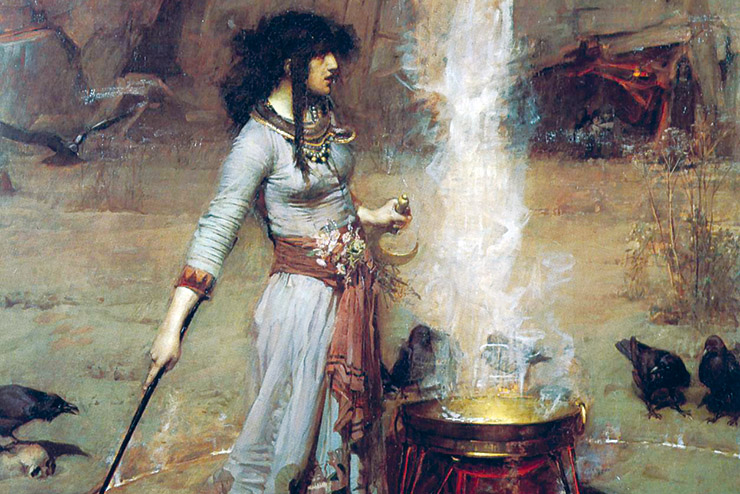
A leading academic in the field of Neopaganism, Witchcraft, and Druidry, Ronald Hutton is Professor of History at the University of Bristol. During the 1990s, he produced a string of books dealing with historical paganism, folklore and contemporary paganism in Britain: The Pagan Religions of the Ancient British Isles (1991), The Rise and Fall of Merry England (1994), The Stations of the Sun (1996) and The Triumph of the Moon (1999), the last of which has come to be praised as a seminal text in Pagan studies.
Since the millennium, he has published Shamans (2001), a collection of essays on folklore and paganism, Witches, Druids and King Arthur (2003) and then two books on the role of the Druids in the British imagination, The Druids (2007) and Blood and Mistletoe (2009). Professor Hutton has also appeared on British television and radio, and his documentaries include A Very British Witchcraft (2013) and Professor Hutton’s Curiosities (2013).
His new book, The Witch: A History of Fear from Ancient Times to the Present, employs underused anthropological and ethnographical findings to revise entirely our understanding of the witch around the world. He illuminates a fascinating ancient and global context to argue that prehistoric beliefs and experience of broader magical practices such as pre-Christian religions and shamanism provided the milieu within which European witchcraft developed and the perspective from which they were viewed.
He also looks at specific local and popular traditions across Europe and the Near East, such as ceremonial magic, beliefs about ghosts and night-spirits, Satanism, fairies, animal familiars, and the reasons behind witchcraft’s prevalence in Celtic-speaking areas.
The following interview was conducted via email in June 2017.
Prof. Ronald Hutton
Professor Hutton, would you mind telling us how you came to write your new book, The Witch: A History of Fear from Ancient Times to the Present?
I have long been interested in the reasons behind the notorious early modern European witch hunts, and from an early stage it seemed to me that they could only be properly understood and explained in a much broader context than had usually been employed hitherto. That context would include ancient and global perspectives. This idea also connected neatly with a lot of my other interests – in ancient paganism, in ritual magic, in shamanism, and so on – and from 1990 onward I slowly began accumulating the different expertise needed for it.
On the way, I realised how great a problem witch hunting still was, in the developing world, and became involved in the public debate over whether to revive laws against witchcraft in South Africa. I came to hope that a book which explained the roots of the fear of witchcraft might play a part in eradicating that fear.
In 2014 I was ready to write it, and got the Leverhulme Trust to fund a team of researchers to work upon aspects of the subject with me, for three years. It was eight strong, including an artist, entirely female apart from me and a quarter self-identified as Pagan, and aimed to produce three books, four doctoral theses, five symposia and the art works. My own book was the largest of those outputs and completed punctually before the project concluded in February 2017.
You have achieved a considerable level of acceptance and appreciation among the broader contemporary neo-pagan and Wiccan communities – how do you imagine they will receive The Witch?
It is not really written for them, but for the wider reading world, although I would hope that they benefit from it. It is designed as a contribution to ending the fear of witchcraft, and so the persecution of people as witches, across the world, in the manner in which humanity has combined to eliminate diseases such as smallpox, polio and leprosy. This need is still especially acute in the developing world, but has resonances even in the West, where the early modern stereotype of Satan-worshipping witches that produced the great witch hunts underlay the Satanic Ritual Abuse scares of the 1980s and 1990s and fuels much of the Deliverance Ministry in contemporary North America.
More generally, the name ‘witch’ still inspires a vague but intense fear and hostility among many ordinary people in the West which makes life uncomfortable for Pagans who use it for themselves. I want to show where this comes from, and why it is not necessary. In addition, however, Pagans of all kinds will probably find much of direct interest in my book, such as attitudes to witchcraft in the ancient world, the origins of the Western tradition of ritual magic, the history of the idea of the Wild Hunt, and the relationships between witches and fairies, and witches and animals.
You are well-known and greatly appreciated for the series of books in which you explore all manner of different aspects of the Pagan world, from Druidry to King Arthur, shamanism, and now witches. Your 1999 volume, The Triumph of the Moon, is practically required reading in Wiccan circles! What is it that you think drew you to explore these areas in the first place, and how do you find it sits alongside your, shall we say, more mainstream work as a historian?
I was brought up as a Pagan, in a non-denominational, Victorian and Edwardian sense, of regarding the Greek and Roman pagan classics as the best introduction to the nature of divinity and sensing an immanent sanctity in the land, and especially natural places. This meant that when I first encountered Wicca, in my teens, I liked it at once and found it made perfect sense as a mystery religion within the wider and vaguer paganism to which I adhered. I did not start my career as a historian by working on such subjects, as I knew that I would never get a job if I did, but on more mainstream political history, in areas which I also genuinely enjoyed. Once firmly established, however, I felt able to turn to paganism, witchcraft and magic at last. In doing so I underestimated both the security of my position and the blind hostility to anything associated with witchcraft that even members of my own highly educated profession could manifest.
Although I never publicly identified myself as a Wiccan, or any other kind of Pagan, my identification with both, when I published Triumph did me enormous damage. An American historian visiting Cambridge at that time asked my colleagues what I was doing and was told that he could forget about me, as I had gone mad, become a witch and left the profession. The student newspaper at my own university denounced me as a satanic witch and warned people against me. Research grants and invitations to speak – the lifeblood of my profession – dried up, and my career stalled. However, I stood firm and carried on writing, and after some years it all died down. My progress in my profession – which had initially been unusually rapid – resumed, and I received its highest honours, such as election to the British Academy, to both history and archaeology sections, in the end.
What would you say to anyone who was troubled by the somewhat pejorative definitions of the term ‘witch’ that you open the discussion in your book with? (For example, leading anthropologist Rodney Needham’s 1978 summing up of the witch as “someone who causes harm to others by mystical means.”)
I start the book by apologising to anybody offended by my employment of that pejorative term as my standard one for the rest of the contents. The problem is that four different definitions of the word ‘witch’ are circulating in the current world, and they all have some legitimacy. The first is somebody who uses magic to harm others. The second is somebody who uses magic for any means, positive or negative, with the positive often distinguished by calling those practitioners ‘good’ or ‘white’ witches. The third is a practitioner of a surviving or recreated Pagan nature religion. The fourth is a strong and independent woman victimised by the forces of patriarchy. The first two are old, the last two modern, but still established for well over a hundred years. Pagans generally use one or all of the last three, but most of British society, at all levels, still uses the first, and equivalent terms and attitudes are found all over the world. I am trying to stop belief in such a figure for good, or rather am striving to make a contribution to a long, long struggle of re-education which will achieve that work.
Down the ages – and from culture-to-culture – there have been innumerable men who pursued the study and practice of everything from alchemy to Kabbalah and ceremonial magic: all those wizards and warlocks, sorcerers and shamans – and yet the stereotype of the ‘witch’ has almost always remained defiantly female. Why is that, do you think?
This is because most Europeans – in sharp contrast to many other peoples across the world, and some in Europe itself (most of these in the far north and east of the continent) – have traditionally seen women as the more magical sex. They believed that men can learn magic, from books or teachers, but women just have it in them. That is why women were traditionally brought in by ancient Europeans, whether Greeks, Romans, Germans or Celtic-speakers, when established religious and magical processes could not cope – as prophetesses, seeresses, sibyls and pythonesses. It also means they were more readily suspected of witchcraft, because magic was regarded as inherent in them and could be used spontaneously.
Are you aware of recent movies like Robert Eggers’ The Witch (2015) – which, even though it does not reference the Salem Witch Trials directly, makes use of a comparable setting? Or even Anna Biller’s comedy-horror-thriller, The Love Witch (2016)? What are your thoughts on films like these (if any), and why the figure of the witch continues to interest and intrigue, or even inspire fear, still?
The enduring power of the figure of the witch lies in the very versatility it now possesses, to which I referred above. She (or sometimes he) can represent the ultimate force of evil, or of good, or the ultimate victim, and the apotheosis of either power or vulnerability. So she is very, very exciting for modern creative minds. Of the specific works mentioned, I have not seen The Love Witch. I did see The Witch, in a special screening arranged for me by the British Broadcasting Corporation, which wanted me to review it for Jonathan Ross’s national radio show. I thought that the costumes, acting, and period setting were all excellent, but the moral message completely haphazard, being sacrificed to a series of dramatic effects. At the end, the story-line seemed completely to reaffirm the early modern stereotype of the satanic witch – of a conspiracy of witches who have sworn allegiance to (an objectively real) Devil and are given superhuman powers, in turn, with which to torment and murder humans – and so effectively to justify the witch hunts. You may gather that this is not a message which resonates well with me.
What is next for Professor Hutton, professionally and personally?
In literary terms, I am busy writing the extras which I did not put into The Witch: essays on the meaning of the word, on images of witches and cunning folk in British fiction between 1800 and 1940, and on the place of the Wild Hunt in the modern British imagination. The first two are already finished, but I am not sure yet whether to put them separately into academic journals or to publish them together as part of a collection of essays from Yale University Press. A proper revised second edition of Triumph of the Moon is due, twenty years after the original. My main next project, which will take years, will however be to return to my original power base of mainstream political history and produce a study of Oliver Cromwell. In contrast to subjects concerning paganism and magic, it is really easy to get leave and other support systems for a topic like that, and I have already been granted them. As for my professional and personal future, I shall as usual work with whatever opportunities fate sends me.
Professor Hutton, thank you so much for your time!
Thank you very much for yours.
The Witch: A History of Fear from Ancient Times to the Present(Yale University Press) is available from all good bookstores.