New Dawn – World's Most Unusual Magazine

Category: Secret Wisdom

  • Dreams, Spirits & the Occult: The Secret World of Carl G Jung

    Dreams, Spirits & the Occult: The Secret World of Carl G Jung

    From New Dawn 174 (May-June 2019)

    On 11 February 1944, the 68-year-old Carl Gustav Jung – then the world’s most renowned living psychologist – slipped on some ice and broke his fibula. Ten days later, in hospital, he suffered a myocardial infarction caused by embolisms from his immobilised leg. Treated with oxygen and camphor, he lost consciousness and had what seems to have been a near-death and out-of-the-body experience – or, depending on your perspective, delirium. 

    He found himself floating 1,000 miles above the Earth. Seas and continents shimmered in blue light and Jung could make out the Arabian desert and snow-tipped Himalayas. He felt he was about to leave orbit, but then, turning to the south, a huge black monolith came into view. It was a kind of temple, and at the entrance Jung saw a Hindu sitting in a lotus position. Within, innumerable candles flickered, and he felt that the “whole phantasmagoria of earthly existence” was being stripped away. It wasn’t pleasant, and what remained was an “essential Jung,” the core of his experiences. 

    He knew that inside the temple the mystery of his existence, of his purpose in life, would be answered. He was about to cross the threshold when he saw, rising up from Europe far below, the image of his doctor in the archetypal form of the King of Kos, the island site of the temple of Asclepius, Greek god of medicine. He told Jung that his departure was premature; many were demanding his return and he, the King, was there to ferry him back. When Jung heard this, he was immensely disappointed, and almost immediately the vision ended. 

    He experienced the reluctance to live that many who have been ‘brought back’ encounter, but what troubled him most was seeing his doctor in his archetypal form. He knew this meant that the physician had sacrificed his own life to save Jung’s. On 4 April 1944 – a date numerologists can delight in – Jung sat up in bed for the first time since his heart attack. On the same day, his doctor came down with septicæmia and took to his bed. He never left it, and died a few days later. 

    Jung was convinced that he hadn’t simply hallucinated, but that he had been granted a vision of reality. He had passed outside time, and the experience had had a palpable effect on him. For one thing, the depression and pessimism that overcame him during WWII vanished. But there was something more. For most of his long career, he had impressed upon his colleagues, friends, and reading public that he was, above all else, a scientist. He was not, he repeated almost like a mantra, a mystic, occultist, or visionary, terms of abuse his critics, who rejected his claims to science, had used against him. Now, having returned from the brink of death, he seemed content to let the scientist in him take a back seat for the remaining 17 years of his life. 

    Although Jung had always believed in the reality of the ‘other’ world, he had taken care not to speak too openly about this belief. Now, after his visions, he seemed less reticent. He’d had, it seems, a kind of conversion experience, and the interests the world-famous psychologist had hitherto kept to himself now became common knowledge. Flying saucers, astrology, parapsychology, alchemy, even predictions of a coming “new Age of Aquarius”: pronouncements on all of these dubious subjects – dubious at least from the viewpoint of modern science – flowed from his pen. If he had spent his career fending off charges of mysticism and occultism – initially triggered by his break with Freud in 1912 – by the late 1940s he seems to have decided to stop fighting. The “sage of Küsnacht” and “Hexenmeister of Zürich,” as Jung was known in the last decade of his life, had arrived.

    All in the Family 
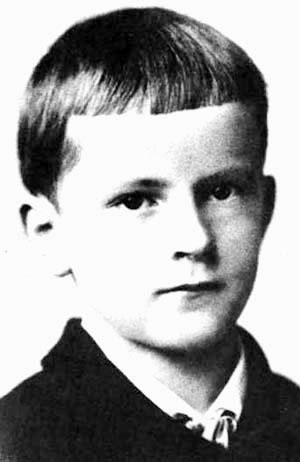
    A young Carl Jung    

    Yet Jung’s involvement with the occult was with him from the start – literally, it was in his DNA. His maternal grandfather, Rev. Samuel Preiswerk, who learned Hebrew because he believed it was spoken in heaven, accepted the reality of spirits, and kept a chair in his study for the ghost of his deceased first wife, who often came to visit him. Jung’s mother Emilie was employed by Samuel to shoo away the dead who distracted him while he was working on his sermons. 

    She herself developed mediumistic powers in her late teens. At the age of 20, she fell into a coma for 36 hours; when her forehead was touched with a red-hot poker she awoke, speaking in tongues and prophesying. Emilie continued to enter trance states throughout her life, in which she would communicate with the dead. She also seems to have been a ‘split personality’. Jung occasionally heard her speaking to herself in a voice he soon recognised was not her own, making profound remarks expressed with an uncharacteristic authority. This ‘other’ voice had inklings of a world far stranger than the one the young Carl knew. 
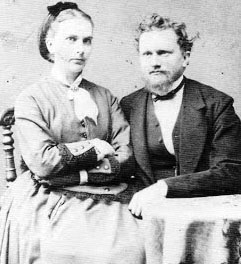
    His parents Emilie Preiswerk & Paul Jung 

    This ‘split’ that Jung had seen in his mother would later appear in himself. At around the age of 12, he literally became two people. There was his ordinary boyhood self, and someone else. The ‘Other’, as Carl called him, was a figure from the 18th century, a masterful character who wore a white wig and buckled shoes, drove an impressive carriage, and held the young boy in contempt. It’s difficult to escape the impression that in some ways Jung felt he had been this character in a past life. Seeing an ancient green carriage, Jung felt that it came from his time. 

    His later notion of the collective unconscious, that psychic reservoir of symbols and images that he believed we inherit at birth, is in a sense a form of reincarnation, and Jung himself believed in some form of an afterlife. Soon after the death of his father, in 1896 when Jung was 21, he had two dreams in which his father appeared so vividly that he considered the possibility of life after death. In another, later dream, Jung’s father asked him for marital advice, as he wanted to prepare for his wife’s arrival. Jung took this as a premonition, and his mother died soon after. And years later, when his sister Gertrude died – a decade before his own near-death experience – Jung wrote that, “What happens after death is so unspeakably glorious that our imagination and feelings do not suffice to form even an approximate conception of it.”1

    Tables & Knives

    Jung’s mother was involved in at least two well-known paranormal experiences that are recounted in practically every book about him. Sitting in his room studying, Carl suddenly heard a loud bang coming from the dining room. He rushed in and found his mother startled. The round walnut table had cracked from the edge past the centre. The split didn’t follow any joint but had passed through solid wood. Drying wood couldn’t account for it; the table was 70 years old and it was a humid day. Jung thought: “There certainly are curious accidents.” As if she was reading his mind Emilie replied in her ‘other’ voice: “Yes, yes, that means something.” 

    Two weeks later came a second incident. Returning home in the evening, Jung found an excited household. An hour earlier there had been another loud crack, this time coming from a large sideboard. No one had any idea what had produced it. Jung inspected the sideboard. Inside, where they kept the bread, he found a loaf and the bread knife. The knife had shattered into several pieces, all neatly arranged in the breadbasket. The knife had been used earlier for tea, but no one had touched it nor opened the cupboard since. When he took the knife to a cutler, he was told that there was no fault in the steel and that someone must have broken it on purpose. He kept the shattered knife for the rest of his life, and years later sent a photograph of it to psychical researcher JB Rhine. 

    Spirits Afoot

    By this time Jung, like many others, was interested in spiritualism, and was reading through the literature – books by Zöllner, Crooks, Carl du Prel, Swedenborg, and Justinus Kerner’s classic The Seeress of Prevorst. At the Zofingia debating society at the University of Basel, he gave lectures on “The Value of Speculative Research” and “On the Limits of Exact Science,” in which he questioned the dominant materialist paradigm that reigned then, as today. Jung led fellow students in various occult experiments, yet when he spoke to them about his ideas, or lectured about the need to take them seriously, he met with resistance. Apparently, he had greater luck with his dachshund, whom he felt understood him better and could feel supernatural presences himself.2 
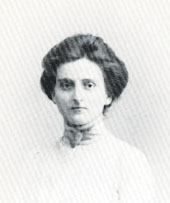
    Cousin Helene Preiswerk

    Another who seemed to feel supernatural presences was his cousin, from his mother’s side of the family, Helene Preiswerk. In a letter to JB Rhine about the shattered bread knife, Jung refers to Helly – as she was known – as a “young woman with marked mediumistic faculties” whom he had met around the time of the incident, and in his “so-called’ autobiography Memories, Dreams, Reflections he remarks that he became involved in a series of séances with his relatives after the incidents of the bread knife and table. Yet the séances had been going on for some time before the two events, and at their centre was Helly, whom Jung already knew well and who, by all accounts, was in love with him. This is an early sign of his somewhat ambiguous relationship with the occult. 

    Helly would enter a trance and fall to the floor, breathing deeply, and speaking in old Samuel Preiswerk’s voice – although she had never heard him. She told the others that they should pray for her elder sister Bertha, who, she said, had just given birth to a black child. Bertha, who was living in Brazil, had already had one child with her mixed-race husband, and gave birth to another on the same day as the séance.3 Further séances proved equally startling. At one point, Samuel Preiswerk and Carl Jung Sr – Jung’s paternal grandfather – who had disliked each other while alive, reached a new accord. A warning came for another sister who was also expecting a child that she would lose it; in August the baby was born premature and dead.4 

    Helly produced further voices, but the most interesting was a spirit named Ivenes, who called herself the real Helene Preiswerk. This character was much more mature, confident, and intelligent than Helly, who Jung described as absent-minded, and not particularly bright, talented, or educated. It was as if buried beneath the unremarkable teenager was a fuller, more commanding personality, like Jung’s ‘Other’. This was an insight into the psyche that would inform his later theory of “individuation,” the process of “becoming who you are.” Helly did blossom later, becoming a successful dressmaker in France, although she died young, at only 30. 

    In Jung’s dissertation on the séances, On the Psychology and Pathology of So-called Occult Phenomena, he describes Helly unflatteringly as “exhibiting slightly rachitic skull formation,” and “somewhat pale facial colour,” and fails to mention that she is his cousin. He also omits his own participation in the séances, and dates them from 1899 to 1900, whereas they had started years before. Gerhard Wehr politely suggests that, “[T]he doctoral candidate was obviously at pains to conceal his own role, and especially his close kinship relationship, thus forestalling from the start any further critical inquiry that might have thrown the scientific validity of the entire work into question.”5 

    In other words, Jung the scientist thought it a good career move to obscure Jung the occultist’s personal involvement in the business. 

    The Poltergeist in Freud’s Bookcase

    In 1900, the 25-year-old Jung joined the prestigious Burghölzli Mental Clinic in Zürich. Here, he did solid work in word-association tests, developed his theory of ‘complexes’, and initiated a successful ‘patient-friendly’ approach to working with psychotics and schizophrenics. It was during his tenure that he also became involved with Freud. From 1906, when they started corresponding, to 1912, when the friendship ruptured, Jung was a staunch supporter of Freud’s work and promoted it unstintingly. 

    Carl Jung standing in front of Burghölzli clinic, Zurich circa 1909

    There were, however, some rocky patches. One centred on the famous poltergeist in Freud’s bookcase. Visiting Freud in Vienna in 1909, Jung asked him about his attitude toward parapsychology. Freud was sceptical and dismissed the subject as nonsense. Jung disagreed, and sitting across from the master, he began to feel his diaphragm glow, as if it was becoming red-hot. Suddenly a loud bang came from a bookcase. Both jumped up, and Jung said to Freud: “There, that is an example of a so-called catalytic exteriorisation phenomenon!”, Jung’s long-winded circumlocution for a poltergeist, or “noisy spirit.” When Freud said “Bosh!”, Jung predicted that another bang would immediately happen. It did. Jung said that, from that moment on, Freud grew mistrustful of him. From Freud’s letter to Jung about the incident, one gets the feeling that he felt Jung himself was responsible for it. 

    This isn’t surprising; Jung did manifest numerous paranormal abilities. While in bed in a hotel room after giving a lecture, he experienced the suicide of a patient who had a strong “transference” on him. The patient had relapsed into depression and shot himself in the head. Jung awoke in his hotel, feeling an odd pain in his forehead. He later discovered that his patient had shot himself precisely where Jung felt the pain, at the same time Jung woke up. More to the point, a visitor to his home once remarked about Jung’s “exteriorised libido,” how “when there was an important idea that was not yet quite conscious, the furniture and woodwork all over the house creaked and snapped.” 

    The Red Book
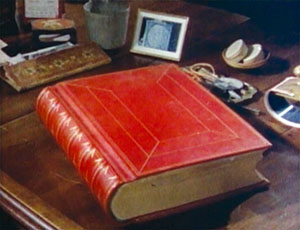
    The personal Red Book of Jung resting on his office desk (credit Lance S. Owens).

    It was Jung’s break with Freud that led to his own ‘descent into the unconscious,’ a disturbing trip down the psyche’s rabbit hole from which he gathered the insights about the collective unconscious that would inform his own school of ‘analytical psychology’. He had entered a ‘creative illness’, unsure if he was going mad. In October 1913, not long after the split, Jung had, depending on your perspective, a vision or hallucination. While on a train, he suddenly saw a flood covering Europe, between the North Sea and the Alps. When it reached Switzerland, the mountains rose to protect his homeland, but in the waves he saw floating debris and bodies. Then the water turned to blood. The vision lasted an hour and seems to have been a dream that had invaded his waking consciousness. Having spent more than a decade treating mental patients who suffered from precisely such symptoms, Jung had reason to be concerned. He was ironically rather relieved the next summer when WWI broke out and he deduced that his vision had been a premonition of it. 

    Yet the psychic tension continued. Eventually there came a point where Jung felt he could no longer fight off the sense of madness. He decided to let go. When he did, he landed in an eerie, subterranean world where he met strange intelligences that ‘lived’ in his mind. The experience was so upsetting that for a time Jung slept with a loaded pistol by his bed, ready to blow his brains out if the stress became too great. 
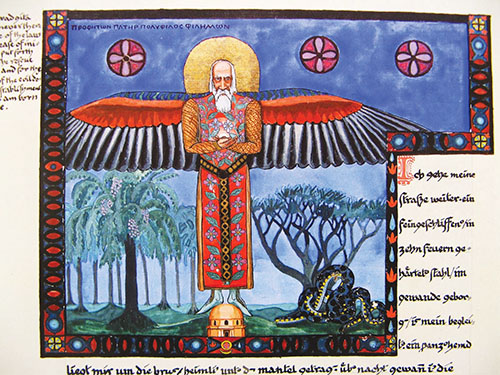
    A page from Carl Jung’s Red Book (Liber Novus) depicting “Philemon,” Jung’s image of the Wise Old Man archetype.  

    In his Red Book he kept an account, in words and images, of the objective, independent entities he encountered during his “creative illness” – entities that had nothing to do with him personally, but who shared his interior world. There were Elijah and Salome, two figures from the Bible who were accompanied by a snake. There was also a figure whom Jung called Philemon, who became a kind of ‘inner guru’ and who he painted as a bald, white-bearded old man with bull’s horns and the wings of a kingfisher. One morning, after painting the figure, Jung was out taking a walk when he came upon a dead kingfisher. The birds were rare in Zürich and he had never before come upon a dead one. This was one of the many synchronicities – “meaningful coincidences” – that happened at this time. 

    There were others. In 1916, still in the grip of his crisis, Jung again felt that something within wanted to get out. An eerie restlessness filled his home. He felt the presence of the dead – and so did his children. One daughter saw a strange white figure; another had her blankets snatched from her at night. His son drew a picture of a fisherman he had seen in a dream: a flaming chimney rose from the fisherman’s head, and a devil flew through the air, cursing the fisherman for stealing his fish. Jung had yet to mention Philemon to anyone. Then, one afternoon, the doorbell rang loudly, but no one was there. He asked: “What in the world is this?” The voices of the dead answered: “We have come back from Jerusalem where we found not what we sought,” words that form the beginning of Jung’s strange Seven Sermons to the Dead, a work of “spiritual dictation,” or “channelling,” he attributed to “Basilides in Alexandria, the City where the East toucheth the West.” 
    Ghosts in the House 

    By 1919, WWI was over and Jung’s crisis had passed, although he continued to practise what he called “active imagination,” a kind of waking dreaming, the results of which he recorded in the Red Book. But spirits of a more traditional kind were not lacking. He was invited to London to lecture on “The Psychological Foundations of the Belief in Spirits” to the Society for Psychical Research. He told the Society that ghosts and materialisations were “unconscious projections.” “I have repeatedly observed,” he said, “the telepathic effects of unconscious complexes, and also a number of parapsychic phenomena, but in all this I see no proof whatever of the existence of real spirits, and until such proof is forthcoming I must regard this whole territory as an appendix of psychology.” 

    Scientific enough, no doubt, but a year later, again in England, he encountered a somewhat more real ghost. He spent some weekends in a cottage in Aylesbury rented by Maurice Nicoll (later a student of Gurdjieff and Ouspensky) and while there was serenaded by eerie sounds, while an unpleasant smell filled the bedroom. Locals said the place was haunted and, on one particularly bad night, Jung discovered an old woman’s head on the pillow next to his; half of her face was missing. He leapt out of bed and waited until morning in an armchair. The house was later torn down. One would think that, having already encountered the dead on their return from Jerusalem, Jung wouldn’t be so shaken by a traditional English ghost, but the experience rattled him; his account of it only appeared 30 years later, in 1949, in an obscure anthology of ghost stories. 

    When his lecture for the SPR was reprinted in the Collected Works in 1947, Jung added a footnote explaining that he no longer felt as certain as he did in 1919 that apparitions were explicable through psychology, and that he doubted “whether an exclusively psychological approach can do justice to the phenomenon.” In a later postscript, he again admitted that his earlier explanation was insufficient, but that he couldn’t agree on the reality of spirits because he had no experience of them – conveniently forgetting the haunting in Aylesbury. But in a letter of 1946 to Fritz Kunkel, a psychotherapist, Jung admitted: “Metapsychic phenomena could be explained better by the hypothesis of spirits than by the qualities and peculiarities of the unconscious.” 

    A similar uncertainty surrounds his experience with the I Ching, the ancient Chinese oracle, with which he began to experiment in the early 1920s and which, like horoscopes, became part of his therapeutic practice. Although he mentioned the I Ching here and there in his writing, it wasn’t until 1949, again nearly 30 years later, in his introduction to the classic Wilhelm/Baynes translation, that he admitted outright to using it himself. And although he tried to explain the I Ching’s efficacy through what would become his paranormal deus ex machina, synchronicity, Jung admits that the source of the oracle’s insights are the “spiritual agencies” that form the “living soul of the book,” a remark at odds with his quasi-scientific explanation. Ironically, his major work on “meaningful coincidence,” Synchronicity: An Acausal Connecting Principle (1952), written with the physicist Wolfgang Pauli, provides only one unambiguous example of the phenomenon, and readers who, like me, accept the reality of synchronicity, come away slightly baffled by Jung’s attempt to account for it via archetypes, quantum physics, statistical analysis, mathematics, JB Rhine’s experiments with ESP, astrology, telepathy, precognition, and other paranormal abilities, all of which read like a recrudescence of Jung’s “I am a scientist” reflex. 

    Age of Aquarius

    In the 1920s, he plunged into a study of the Gnostics – whom he had encountered as early as 1912 – and alchemy. It was Jung, more than anyone else, who salvaged the ancient Hermetic pursuit from intellectual oblivion. Another Hermetic practice he followed was astrology, which he began to study seriously around the time of his break with Freud. Jung informed his inner circle that casting horoscopes was part of his therapeutic practice, but it was during the dark days of WWII that he recognised a wider application. In 1940, in a letter to HG Baynes, Jung speaks of a vision he had in 1918 in which he saw “fire falling like rain from heaven and consuming the cities of Germany.” He felt that 1940 was the crucial year, and he remarks that it’s “when we approach the meridian of the first star in Aquarius.” It was, he said, “the premonitory earthquake of the New Age.” 

    He was familiar with the precession of the equinoxes, the apparent backward movement of the Sun through the signs of the zodiac. By acting as a backdrop to sunrise at the vernal equinox, each sign gives its name to an ‘age’ – called a ‘Platonic month’ – which lasts roughly 2,150 years. In his strange book Aion (1951), he argues that the ‘individuation’ of Western civilisation as a whole follows the path of the ‘Platonic months’ and presents a kind of “precession of the archetypes.” Fish symbolism surrounds Jesus because He was the central symbol of the Age of Pisces, the astrological sign of the fish. Previous ages – of Taurus and Aries – produced bull and ram symbolism. The coming age is that of Aquarius, the Water Bearer. In conversation with Margaret Ostrowski-Sachs, a friend of Hermann Hesse, Jung admitted that he had kept this “secret knowledge” to himself for years, and only finally made it public in Aion. He wasn’t sure he was “allowed” to, but during his illness he received “confirmation” that he should. 

    Although the arcane scholar Gerald Massey and the French esotericist Paul Le Cour had earlier spoken of a coming Age of Aquarius, Jung was certainly the most prestigious mainstream figure to do so, and it is through him that the idea became a mainstay of the counterculture of the 1960s and ’70s. This was mostly through his comments about it in his book Flying Saucers: A Modern Myth of Things Seen in the Sky (1958), in which he argued that UFOs were basically mandalas from outer space. During his crisis, he had come upon the image of the mandala, the Sanskrit ‘magic circle’, as a symbol of psychic wholeness, and he suggested that ‘flying saucers’ were mass archetypal projections, formed by the psychic tension produced by the Cold War that was heating up between Russia and America. The Western world, he argued, was having a nervous breakdown, and UFOs were a way of relieving the stress. 

    Jung wrote prophetically: “My conscience as a psychiatrist bids me fulfil my duty and prepare those few who will hear me for coming events which are in accord with the end of an era… As we know from ancient Egyptian history, they are symptoms of psychic changes that always appear at the end of one Platonic month and at the beginning of another. They are, it seems, changes in the constellation of the psychic dominants, of the archetypes or ‘Gods’ as they used to be called, which bring about… long-lasting transformations of the collective psyche. This transformation started… in the transition of the Age of Taurus to that of Aries, and then from Aries to Pisces, whose beginning coincides with the rise of Christianity. We are now nearing that great change… when the spring-point enters Aquarius…” Ten years later, The Fifth Dimension (whose very name, appropriated from the title song of The Byrds’ third LP, suggests the cosmic character of the Mystic Sixties) had a hit song from the hippie musical Hair echoing Jung’s ideas, and millions of people all over the world believed they were witnessing “the dawning of the Age of Aquarius.” 

    Jung the Mystic
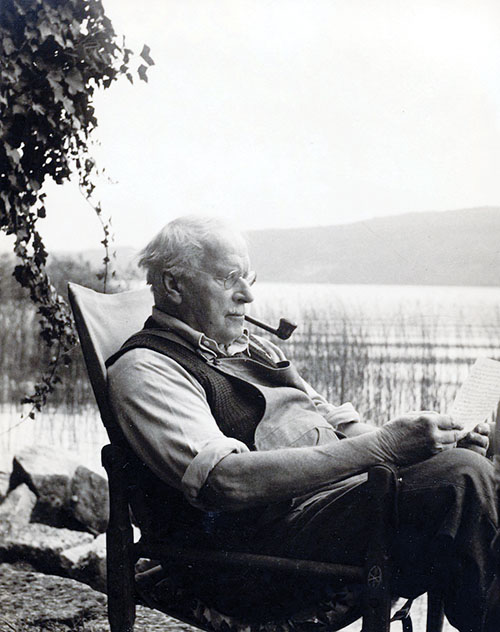
    Jung reading (1956)

    Jung died in 1961, just on the cusp of the ‘occult revival’ of the 1960s, a renaissance of magical thinking that he did much to bring about. He was also directly responsible for the “journey to the East” that many took then, and continue to take today. Along with the I Ching, Jung gave his imprimatur to such hitherto arcane items as The Tibetan Book of the Dead, Taoism and Zen, and without his intervention it’s debatable if these Eastern imports would have enjoyed their modern popularity. That he was in many ways a founding father of the Love Generation is seen by his inclusion on the cover of the Beatles’ Sgt Pepper’s Lonely Hearts Club Band album, although Jung himself would have thought “flower power” sadly naïve. 

    Although for all his efforts he has never been accepted by mainstream intellectuals, his effect on popular culture has been immense, and our contemporary grass roots, inner-directed spirituality, unfortunately associated with the New Age, has his name written all over it. Jung himself may have been equivocal about his relationship with mysticism, magic, and the occult, but the millions of people today who pay attention to their dreams, notice strange coincidences and consult the I Ching have the Sage of Küsnacht to thank for it. 

    The above article first appeared in Fortean Times 265 and is reprinted with the kind permission of the author.

    [alert type=”general” dismiss=”no”]This article was published in New Dawn 174.[/alert]

    [alert type=”success” dismiss=”no”]If you appreciate this article, please consider subscribing to help maintain this website.[/alert]

    FOOTNOTES 
    1. Quoted in Vincent Brome, Jung: Man and Myth, Scientific Book Club, 1979, 277 
    2. Brome, op. cit., 68 
    3. Deidre Bair, Jung: A Biography, Little Brown, 2004, 48 
    4. Ibid., 49 
    5. Gerhard Wehr, Jung: A Biography, Shambhala, Boston, 1987, 72 

    © New Dawn Magazine and the respective author.
    For our reproduction notice, click here.
  • Magic for Grown-ups: The Work of the UR Group

    Magic for Grown-ups: The Work of the UR Group

    From New Dawn 172 (Jan-Feb 2019)

    In the consensus view, magic belongs (if at all) in Disney films and Harry Potter books, and adults who actually believe in it are stuck in infantile or medieval superstition. It does not help that the most famous magus of modern times, Aleister Crowley, was a sex maniac and a drug fiend.1 Nor does the later development of Chaos Magick inspire much hope, with its dark, postmodern metaphysic. To most sane people, whether or not they have a spiritual outlook, magic is best left alone.

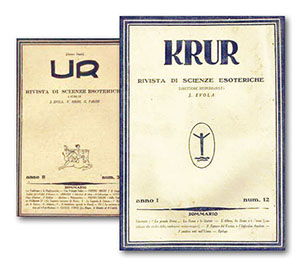
    This would also have been the attitude of the “Gruppo di UR,” a group of Italians led in the late 1920s by Julius Evola and Arturo Reghini.2 Their magic was not for the casual, the credulous, or those excited by the cool or the weird. It was for those dedicated to “magic as science of the I,”3 a concept that I will try to explain below. Although the group’s activities were private, involving only a handful of participants, they shared them with the world in a monthly journal, called first UR and then KRUR. The print-run, estimated at a thousand copies, suggests a surprising level of interest in Fascist-era Italy. In its three-year existence, UR/KRUR published 142 articles under 23 different pseudonyms, making it one of the twentieth century’s richest compilations of esoteric material and instruction.

    English language readers had access to the UR Group’s work in 2001, with a translation of the first of the three volumes.4 I helped with its preparation and promised that if no one else could be found to translate the other two, I would do so after I retired. Eventually I had to keep my promise. The second volume will appear in February 2019, and the third, hopefully, before another eighteen years have gone by.

    Baron Julius Cesare Evola (19 May 1898 – 11 June 1974)

    In his Introduction, Julius Evola states that the goal of this magic is knowledge of “metaphysical reality.” 

    Metaphysical reality exists and works in transcendent mode, in utter independence from the world of men. Nonetheless, he who is established in that mode and casts his glance downward can draw from it reference-points for a system of values and principles, which may confer earthly and temporal life with an order and a meaning that would otherwise be wholly lacking. (p.1)5

    Those familiar with Evola will recognise in these few lines the core of his doctrine. It is a hard and chilly one for those preferring the comforts of religion and a warm embrace of humanity. This magic has nothing to do with them, or with the order and meaning that help them to get by in earthly life. It is anti-humanistic, antisocial, and utterly at odds with the modern world. But although Evola was at the centre of the UR enterprise, he was not so harsh in his choice of collaborators. Being “established in metaphysical reality” is a tall order, and none of them claimed more than temporary glimpses of it. What they did claim, though, is that it has existed, and left its traces in Tradition.

    “Tradition,” as the word was used by Evola, René Guénon, and Ananda Coomaraswamy, meant the body of wisdom acquired or revealed in the distant past and handed down in the form of myths, symbols, rites, and to an extent religions.6 There was a time, they say, when humanity lived in concord with it, open to spiritual realities and in harmony with nature. But that was a Golden Age, and we are in the Age of Iron, the Kali Yuga.7 The magic of the UR Group is a lifeline for a few in this dark age who sense what has been lost and are determined to regain it.

    The UR Group’s journals contained five different kinds of documents:

    • Expositions of methods, disciplines, and techniques; 
    • Reports of initiatic experiences, historical and contemporary;
    • Translations of traditional texts. The first volume included a Mithraic Ritual and excerpts from Neoplatonic, alchemical, and Buddhist writings; the second, songs of Milarepa and a complete translation of the Turba philosophorum, with commentaries.
    • Traditional doctrines placed in context, to challenge modern views and attitudes;
    • The study of various forms of Tradition over history, to show their continual validity in the human world.

    The three volumes are not necessarily sequential because new contributors appear and the articles address different levels of commitment. One need not tread the magical path to appreciate the UR Group’s global approach to esotericism, which owed much to the Theosophical Society’s example of opening to the wisdom of the East. Esotericism apart, there is a refreshing contrast between their attitudes and the forced consensus of today. 

    Magic Guided by Science

    When Evola edited the group’s papers for publication in book form, the title “Introduction to Magic as Science of the I” implied that this was not a belief system but a science. Nothing was to be taken on trust unless proved by personal experience – and even then, subjected to the test of Tradition. The latter acted as a control for evaluating modern movements such as spiritualism, psychical research, occultism, Theosophy, psychoanalysis, and Jung’s depth psychology. All of these failed the test of traditional authenticity and were dismissed as deviances only to be expected of a dark age. But unlike the Traditionalism of René Guénon and his followers, that of the UR Group paid no respect to exoteric religions. To the aspirant for their sort of magic, religions were simply irrelevant. To Reghini, especially, they were worse than that, for he was a staunch defender of pagan traditions against monotheism and the Christian hegemony. 

    A partial exception was made for Rudolf Steiner’s Anthroposophy. Several members of the UR Group were active in Steiner’s movement, and their contributions reflect this. But Evola, as editor, drew a firm line between Steiner’s techniques for obtaining “knowledge of higher worlds” and his Christocentric and reincarnational doctrines.

    The scientific method is essentially amoral: that is why it is widely mistrusted today. The science of the UR Group followed the same principle, but with a crucial difference:

    As an example, from the moral point of view one may say: “You mustn’t lie, because lying is bad, and telling the truth is good.” From the initiatic point of view one is simply aware that lying causes a sort of lesion and contradiction in the unity of the being, which is a condition contrary to that of an initiatic qualification. (p. 243)

    The most dedicated members of the group formed “chains” for group work, numbering perhaps no more than five participants. They worked with guided imagery to build up psychic energy, and might “eventually be able to contact other chains, created on the same principles by other groups and in other places.” One wonders whether this has actually happened. Hans Thomas Hakl’s Foreword mentions that UR-type groups continue up to the present day, mostly in Italy and all in deliberate obscurity. Here are some of the principles: 

    In some kinds of chain the individuals are simply thrown together, and the polarity of masculine 0 and feminine Y necessary for operations is not reflected harmoniously in every member. Instead, they separate into the opposition of the fluid, passive mass formed by the majority = Y, and the active role of a leader = 0. But in the type of chain proposed here, every member must distinctly and firmly possess self-awareness, control, and mastery: thus both aspects of the Hermetic complementarity. Each must participate in the chain as an individual, as a distinct force. The chain formed by such individuals will become compact and positive in every way when, through repeated meetings, the various distinct elements become attuned and form a unity. (p. 42)

    Beyond the Grave & the Great Liberation

    These practices served an intention that went beyond one’s earthly life. In a commentary on the Tibetan Book of the Dead, Evola (writing as “Ea”) remarks:

    One notes the special emphasis on qualities that need to be obtained in one’s lifetime, through suitable disciplines and control of one’s own mind; they are not only of use in this existence and for progress along the Way, but also beyond the grave, in the battle for one’s own destiny. (p. 137)

    Experiences “beyond the grave” are beyond the reach of the empirical science that the UR Group preferred. Consequently, they had to rely on Tradition and be very selective in their choice of authorities. That of Tibetan esotericism stood high in Evola’s estimation, and he sets out the options as found there. The first is said to be offered to everyone upon death, but very few are able to seize the opportunity:

    Then suddenly the supreme test occurs, the experience of the pure state of Being, dazzling, annihilating, with terrifying radiance and the “sound of a thousand thunders.” If the soul has the ability to identify with it, as though hurling itself out of itself, incinerating everything in itself that is “other” or “ignorance,” in an instant it will have attained the Great Liberation. (p. 134)

    If the soul fails in this – as almost all do – the Supreme Reality may take the form of a divine figure worshipped in life, to which the fortunate soul can abandon itself. But if that too fails, the being is fated for another incarnation. This is demonstrably the case with all of us, unless we are Bodhisattvas, so it is important to know the options that remain:

    Under such circumstances, which represent a fall and the loss of the higher possibilities offered after death, there are still actions to be taken, as it were in extremis, to avoid the worst outcome. It is possible to collect oneself and […] to “steer” it to some degree. Even in these crises, within these ultimate possibilities, the decisive factor is to restrain the mind, and not to give in to the irresistible emotions of attraction or repulsion that make play with the soul. (p. 136)

    These quotations show how the UR Group treated a traditional text, restating it in plain language without foreign words or alien images. Once those are eliminated, it is obviously the same doctrine as Plato taught at the end of his Republic, where souls choose their next lives, wisely or foolishly as the case may be. This example also served the purpose listed as no. 4 above, challenging modern notions of chance and genetic determinism.

    Initiation & Sex Magic

    The reports of initiatic experiences make fascinating reading. Reghini (writing as “Pietro Negri”) evokes their environment and atmosphere:

    Years ago we were doing the ritual in an inner room of an isolated old tower by the sea, with enormously thick walls. The conditions were ideal: the only biped around was the falcon that now and again took flight with its strident cry. The only opening was a tiny window in the thick wall; but between its weather-worn frame and the wall there was a little gap, through which a hornet once entered, probably attracted by the smell of incense. We noticed it at the beginning of the ritual because of the noise it made with its claws, walking on the paving. (pp. 309-10)

    Nothing could be done, except to hope that it wouldn’t sting anyone. A more analytic essay reports on what happens when one tries to maintain awareness during sleep. The writer glimpses his other self “slipping catlike out of my body, while I straightway plunged into the leaden unconsciousness of sleep.” (p. 185) Another describes how one’s faculties of thinking, willing, and feeling, usually blended, begin to separate during initiatic work:

    It is difficult to describe the nature of these experiences to those who have not been through them. There are apparitions of thoughts that present themselves rather as absolute entities, icy and sharp as crystals, absolutely detached from any kind of life. There are unconditioned determinations of the will, which asserts itself simply for the sake of its own assertion, passing above any imagination, motive or sentiment. There are also emotional states, both exalted and debased, which occur without cause and penetrate to the depths of the soul, with a sort of immensity that overwhelms any mental content.

    We must realise that the very thing that originates these phenomena simultaneously offers a basis for defending oneself against them. Through detachment one progressively realises an I that is not what thinks, wills or feels, because it possesses a simplicity that rests solely on itself. The chief principle is not to hold on to these reactions. Becoming scared and trying to repel them only opens a door to them. (p. 315)

    This volume also contains advanced instructions for sexual magic, much too complicated and demanding to arouse any prurient interest. Briefly, physical sex may not occur at all, or not before years of practice. The approach is exclusively from the male point of view, for reasons that Evola explains in alchemical terms: 

    Hermetically, one can say in general that woman can attain the “White Work,” while the “Red Work” is an eminently virile affair. These two degrees of the Hermetic Work correspond, moreover, to the Lesser and the Greater Mysteries. (p. 397)

    Pain, Illness & Drugs

    An essay on “The Metaphysics of Pain and Illness” states defiantly that “all that modern medical science can say is often based on the reversal of cause and effect, given that the plane on which the true causes are found is inaccessible to either physical eye or microscope.” (p. 190) These causes often lie in “certain forces to which consciousness has been unwilling or unable to open itself,” because of its fixed habits and self-identity: 

    This fixity works such that whenever there is a contact with a transcendent force, it causes something comparable to a lesion – an interior lesion. In that moment consciousness, taken by surprise, is thrown into a state of agitation and fear for its own individuality, feeling its foundations shaking. (p. 189)

    The chance offered is then lost, but the consequence may not be a total waste. Indeed, 

    …certain forms of illness can bring forth moments of illumination. Likewise, we know of schools and also traditions in savage peoples, in which suffering has been considered as a means of attaining ecstasy, as in the cases of shamans, flagellants, etc. We might make many other suggestions: for example, explaining why sometimes prayer in states of intense pain can cause extraordinary effects, facilitating a state of transcendence and thus the conversion of the forces we have mentioned. (p. 192)

    No serious book on magic can neglect drugs, called here by the alchemical term of “corrosive waters” and grouped together with poisons and alcohol. The ancients had knowledge of the most effective substances for initiatic use, which were always kept in deepest secrecy. They are not even for grown-ups, though in exceptional cases they may serve to give the ultimate push to a soul which is perfectly in control of itself. 

    And if in extreme cases consciousness may thus pass from the individual to the non-individual state, thereby becoming free, one of the consequences may be the manifestation, albeit sporadic, of various incidental magical powers, even influencing natural phenomena. (p. 151, note 3)

    Notice in this aside that the UR Group’s science had no problem with the paranormal, though it considered psychical research for its own sake a waste of time. Evola, writing here as “Agla,” had no illusions about the lure and consequences of drugs, which he describes with forcible eloquence:

    When the imagination is seized and transported on the wings of the “dragon,” there breaks forth the fantastic world of visionaries, the orgy of forms and colours of false clairvoyants, the dreams filled with subtle and seductive sensations of opium and hashish users.

    When it is the faculty of sensation that is seized – alone, or together with the former – the force gives rise to a world of strange pleasures, indefinable, intoxicating, which gradually become a necessity for the soul. It creates vice. All those in ordinary life who abandon themselves to drug use are precisely on this plane, almost without exception. (pp. 151-52)

    These quotations touch on the states of being to which occultists give various names, such as the subtle, etheric, and astral planes, or the imaginal world. Western occultism is full of efforts to classify the various levels, aethyrs, mansions, sub-planes, etc. The UR Group did not doubt their existence or the powers that might be derived from them, but their ambitions reached further than that. 

    Realising the Absolute Individual

    The “science of the I” rests on the assumption, fortified by Tradition, that the human being is potentially divine. Ercole Quadrelli (writing as “Abraxa”) puts it plainly:

    The Supreme Mystery of the Initiations – that is what you now hear: in man is the liberation and the immortality of the gods. The god realises the man – the man liberates the god. (p. 114)

    This turns the usual esoteric analysis inside-out. Instead of seeing us as compound beings culminating in a divine spark or atma, it sees us as gods, whose business it is to manifest through that compound. The “I” in question is what Evola had been calling the “Absolute Individual,” and the “science” is the method of realising it. 

    After ninety years, nothing about the UR Group seems old-fashioned, except their complete innocence of today’s pseudo-morality. Each member had a significant social, academic, political, or creative career outside the group, but there is very little pretentiousness or posing about them. Those who are interested in them as individuals can find out more in Renato del Ponte’s Preface to the first volume, which first broke their anonymity, and in Thomas Hakl’s Foreword to the second. Given their strong personalities, it is remarkable that they could come together, even for a few years, and produce something of such lasting value.

     All quotations are from Introduction to Magic, Volume II: The Path of Initiatic Wisdom by Julius Evola and The UR Group, translated by Joscelyn Godwin, foreword by Hans Thomas Hakl © 2018 Inner Traditions Press. Printed with permission from the publisher Inner Traditions International. www.InnerTraditions.com.

    [alert type=”general” dismiss=”no”]This article was published in New Dawn 172.[/alert]

    [alert type=”success” dismiss=”no”]If you appreciate this article, please consider subscribing to help maintain this website.[/alert]

    FOOTNOTES
    1. Of course Crowley was much more than that. I refer to his public persona.
    2. See my article “Who Was Julius Evola, Really?”, New Dawn 162 (May-June 2017), 60-68.
    3. The Italian phrase “magia quale scienza dell’Io” could be translated as “magic as science of the Self,” but that now carries a Jungian flavour alien to the group’s intentions.
    4. UR 1927, published as Julius Evola and the UR Group, Introduction to Magic: Rituals and Practical Techniques for the Magus, translated by Guido Stucco, edited by Michael Moynihan, preface by Renato del Ponte (Rochester, Vt.: Inner Traditions, 2001). 
    5. All quotations are from Introduction to Magic, Volume II: The Path of Initiatic Wisdom by Julius Evola and The UR Group, translated by Joscelyn Godwin, foreword by Hans Thomas Hakl © 2018 Inner Traditions Press. Printed with permission from the publisher Inner Traditions International. www.InnerTraditions.com
    6. See my article “Understanding the Traditionalists,” New Dawn 147 (Nov-Dec. 2014), 63-69.
    7. See my article “When Does the Kali Yuga End?”, New Dawn 138 (May-June 2013), 63-68.

    © New Dawn Magazine and the respective author.
    For our reproduction notice, click here.
  • Rudolf Steiner: Dweller on the Threshold

    Rudolf Steiner: Dweller on the Threshold

    From New Dawn 171 (Nov-Dec 2018)

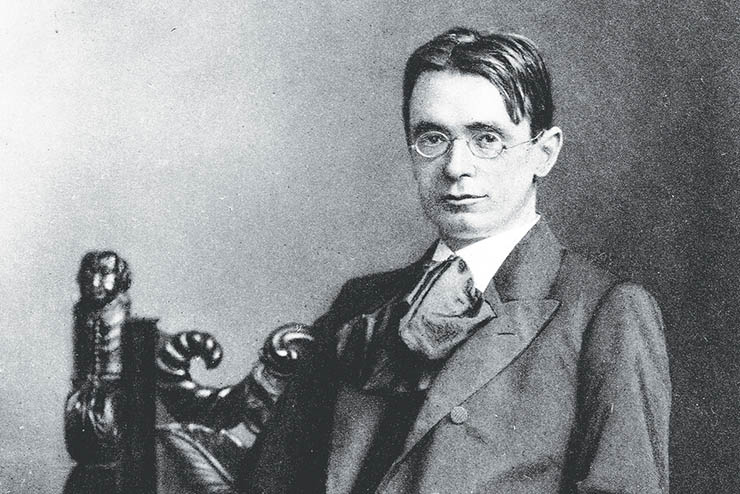
    The most enigmatic figure to emerge from the “occult revival” of the early twentieth century was also the most successful, the Austrian “spiritual scientist” Rudolf Steiner (1861-1925). Although many of his contemporaries were outwardly more eccentric – think of Madame Blavatsky, Gurdjieff or Aleister Crowley – it’s precisely Steiner’s sobriety that is so striking, making him seem somewhat out of place in the often flamboyant world of the esoteric.

    We generally associate ideas of the occult, higher consciousness and spiritual worlds with exotic, extraordinary characters with something of the trickster about them; Blavatsky, Gurdjieff and Crowley would certainly fall into this category. Steiner was precisely the opposite. Standing at the lectern with his pince-nez in hand, he projected an image of irreproachable rectitude. Steiner was earnestness incarnate, his one gesture of bohemian extravagance the flowing bow ties he was fond of wearing, a remnant of his early student days. Where Blavatsky, Gurdjieff and Crowley each took pains to present a formidable self-image, there was something simple and peasant-like about Steiner. Combined with this wholesomeness was an encyclopedic erudition. If we were to use an archetype to describe Steiner, it would have to be that of “the Professor” – or more precisely, “the Doctor,” as he was known by those around him. Commenting on her magnum opus, The Secret Doctrine, Madame Blavatsky once remarked that she “wrote, wrote, wrote” like the Wandering Jew “walks, walks, walks.” Steiner too wrote a great deal, but his main mode of disseminating his ideas was lecturing, and in the years between 1900 and 1925, he lectured, lectured, lectured, delivering more than 6,000 talks across Europe.

    In a dry and often pedantic style, Steiner informed his audience of the results of his spiritual research, his “supersensible” readings of the occult history of the world made available to him through what is called “the Akashic Record.” In matter-of-facts terms, he introduced them to his teaching, Anthroposophy, telling them along the way about ancient Atlantis, life after death, astral and etheric bodies, the true meaning of Christianity and much, much more. Yet this humble, self-effacing character became one of the most influential, and simultaneously vilified, forces in the spiritual and cultural life of early twentieth century Europe, and his ideas are still relevant today. 

    Steiner’s efforts to lead “the Spiritual in the human being to the Spiritual in the Universe” have produced remarkably concrete results. Since his death, more than 1,000 schools around the world work with Steiner’s pedagogical principles, not to mention the many special-needs schools, working along lines developed by Steiner a century ago. There are also the hundreds of “bio-dynamic” farms, employing Steiner’s agricultural insights, developed decades in advance of our interest in ecology and organic foods. The practical application of Steiner’s ideas had also informed very successful avenues in holistic healing, the arts, architecture, economics, religion and other areas. 

    Given these achievements in the “real world,” which certainly exceed those of other esoteric teachers, why isn’t Steiner better known? You would reasonably expect the average educated person to have some idea of who, say, Jung is, or Krishnamurti, or the Dalai Lama; possibly even Blavatsky, Gurdjieff or Crowley. But Steiner? He remains something of a mystery, a name associated with a handful of different disciplines and endeavours, but not solidly linked to any one thing. He remains, as one of his most eloquent apologists, the Inkling Owen Barfield, called him “the best kept secret of the twentieth century.” It’s certainly time that he was better known.

    Early Life

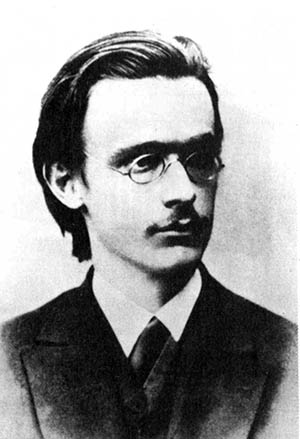
    Rudolf Steiner as 21-year-old student (1882)

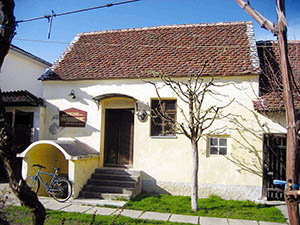
    Rudolf Steiner was born on 27 February 1861, in the small rural town of Kraljevec in what was then Hungary but is today part of Croatia. His father was a telegraph operator for the Southern Austrian Railway, and Steiner spent his first years amidst magnificent scenery: mountain ranges and green plains were his playgrounds. Steiner felt that it was significant that he grew up in a part of Europe where East meets West, as it was also significant that childhood had an equal measure of natural beauty and modern technology – at the time, both the railways and the telegraph were relatively new innovations. 

    In Knowledge of the Higher Worlds and its Attainment (1905), Steiner relates that a crucial experience on the path of higher consciousness is an encounter with the Guardian of the Threshold, a spiritual being embodying one’s unredeemed karma. Well before his career as an esoteric teacher, Steiner was himself a dweller on several thresholds, having one foot in the mysteries of nature, the other in the methodology of science. It was this combination of mystic visionary and disciplined thinker that gave Steiner’s later career its peculiar character.

    The house where Rudolf Steiner was born, in present-day Croatia.

    When Steiner was eight, his father was transferred to Neudörfl, near the border with Lower Austria. An argument with the local teacher led his father to educate the boy himself, and this meant that he spent a great deal of time on his own at the railway station where his father worked. Young Steiner was deeply introverted; as he admits in his Autobiography (1925), he had great difficulty relating to the outer world. He also had an inquisitive mind and was obsessed with many questions the adults he knew seemed unable to answer. This subjectivity might have taken a morbid turn were it not for his discovery of mathematics. When Steiner came upon a book of geometry, it was a revelation. “That one can work out forms which are seen purely inwardly, independent of the outer senses, gave me a feeling of deep contentment. I found consolation for the loneliness caused by the many unanswered questions. To be able to grasp something purely spiritual brought me an inner joy. I know that through geometry I first experienced happiness.”1

    Steiner’s joy upon discovering geometry may strike us as odd, yet the experience was essential in getting him through an early crisis. What impressed Steiner so greatly about geometry was that it seemed to offer proof that within the mind there existed a kind of “soul space,” an inner equivalent of the external space of the natural world. The soul space was “the setting for spiritual beings and events.” Thoughts for the young Steiner were not “mere pictures we form of things”; they were rather the “revelations of a spiritual world seen on the stage of the soul.” Geometry, Steiner believed, although produced by the human mind, had an objective reality independent of it, and for him this meant that the soul space in which it was revealed was also real.2

    Rather precocious stuff, perhaps, but Steiner’s early years included an event that made him question the outer world’s monopoly on reality. 

    A Paranormal Encounter

    One day at the railway station, he had a paranormal experience, an early manifestation of his psychic abilities. Sitting in the waiting room, he saw a strange woman enter; although he didn’t know her, he felt she resembled other members of his family. Standing in the middle of the room, the woman spoke to the boy. “Try to help me as much as you can – now as well as in later life,” she said. Then she walked into the stove and disappeared. Steiner decided not to tell his parents, afraid that they would scold him for lying. But he noticed that his father was sad, and he later discovered that a female relative who lived in the neighbouring town had committed suicide at the same time that he had had his vision. 

    This early experience marks for Steiner the beginning of a life-long involvement with the dead. Much of his later esoteric teaching involves accounts of the soul’s experiences in the afterlife and of the machinery of karma and reincarnation, the balancing of the spiritual books that casts the departed back into the stream of life in order to complete their tasks. While other boys of his age were fantasising about the Austrian equivalent of cowboys and Indians, Steiner was preoccupied with the reality of the spirit worlds and the soul’s encounter with the beings that inhabit them.

    Later, as a young man, Steiner would on two occasions have unusual opportunities to verify some of his ideas about the meaning of death. Twice he would come into intimate contact with families in which the father was a recluse who would die soon after Steiner made their acquaintance. Yet on both occasions, although never actually meeting the man, Steiner formed a profound intuitive relation with the deceased, so deep and insightful in fact that he was asked by both families to give the funeral orations. Later still, during his years as an esoteric teacher, Steiner informed his followers that one means of helping the dead in their spiritual journeys was to read to them from his writings.

    When Steiner was eighteen, his father was transferred once again, this time to Inzersdorf. His new location had the advantage of being close to Vienna, and it was decided that Steiner would study at the Technical School there. Although he had leanings toward literature and philosophy, he chose instead to work towards becoming a science teacher. 

    One day on the train to Vienna, he met a man who would have a profound influence on his life. Felix Koguzki was a herb-gatherer who travelled to Vienna regularly to sell his wares. It’s not known how they fell into conversation, but the teenaged Steiner soon discovered that this simple, uneducated man had strange experiences like his own, and a deep, personal knowledge of the other worlds. He was the first person with whom he could speak about his spiritual visions, and their talks boosted Steiner’s confidence; more than likely, they also convinced him that he wasn’t crazy. 

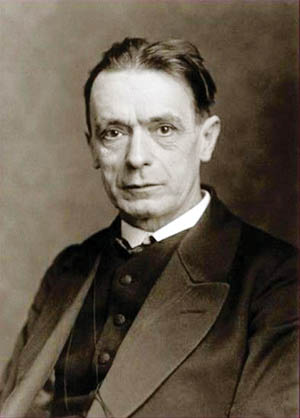
    Rudolf Steiner

    Meeting a Master

    Around the same time, Steiner had an encounter with another individual whose name has not come down to us. Steiner refers to him only as “the Master.” The French writer Edouard Schuré, author of the bestselling The Great Initiates (1889), and later a friend and follower of Steiner, remarked that the Master was “one of those potent personalities who are on Earth to fulfil a mission under the mask of some homely occupation.” Steiner had by this time read widely in philosophy, specifically the German Idealists, and had worked his way through Hegel, Schelling and several others, absorbing Kant’s Critique of Pure Reason during his history class, which bored him. Steiner was obsessed, then and later, with refuting scientific materialism, and this became the impulse that drove his philosophical studies. 

    Although he doesn’t mention this episode in his Autobiography, in a lecture given in Berlin in 1913, Steiner spoke of the experience. Speaking in the third person, he told his audience: “from that time onward a soul-life began to develop in the boy which made him entirely conscious of worlds from which not only external trees or mountain speak to the human soul, but also the Beings who live behind them…”3 

    What little we know of the Master is that he pointed out some passages in the work of Johann Gottlieb Fichte, one of Kant’s most important followers, which helped Steiner in his quest. Fichte’s work focused on the centrality of the human ego, the “I,” the locus of consciousness and the self that scientific materialism argued was mere illusion. Steiner’s spiritual experiences convinced him that this was palpably false and the “I,” rather than being an illusion, was a concrete, irreducible reality. For the next twenty years, until Steiner’s re-invention as a spiritual leader, his work would focus on developing a methodical epistemology proving this fact.

    Introduction to Goethe

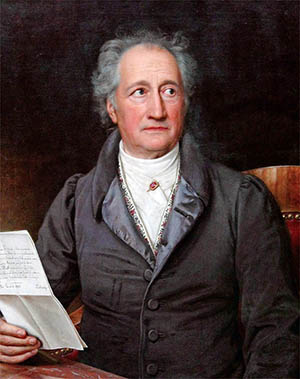
    The single most important influence on his ideas, however, was the work of Johann Wolfgang von Goethe. Goethe is best known for his drama Faust (1808-1832), which takes a cautionary tale about a pact with the Devil and transforms it into an archetype of Western consciousness. Although he’s never enjoyed the same reputation among English speakers, Goethe is one of the Olympians of Western literature, sharing the top shelf with Plato, Dante and Shakespeare (Jung too thought Goethe a key figure, even to the extent of sometimes believing he was an illegitimate descendent of the great man.) Often regarded as the last true Renaissance man, Goethe was not just a giant of literature but also a statesman, traveller, and most important for Steiner, a scientist, making important contributions to botany, anatomy, mineralogy, and optics. Through his literature tutor Karl Schröer, who opened his mind to Goethe’s importance, Steiner was offered what must have seemed the chance of a lifetime. At twenty-two, he was head-hunted as the editor of Goethe’s scientific writings for a major edition of the polymath’s work.

    Johann Wolfgang von Goethe (1749–1832)

    For an unknown rural scholar to be offered such a position might seem unusual, but the general consensus on Goethe’s scientific musings at this point was that they were useless as science and dreary as literature; in truth, no one else wanted the job of editing them. Aside from his early success in proving that the human upper jaw contained the intermaxillary bone found in other mammals – Goethe was, in a different way, an evolutionist long before Darwin – most scientists found Goethe’s attempts to disprove Newton’s theory of colour, or to demonstrate the existence of what he called the Urpflanze, the archetypal plant from which others emerged, muddleheaded if not insane. 

    Yet for Steiner, Goethe’s science was the prototype for what would become his own phenomenology of the spirit worlds. Instead of the conventional scientist’s cold, dispassionate eye regarding the world as mere matter, passive to his intrusions, Goethe called instead for “objective imagination,” an active participation in the reality under scrutiny. The subjectivity of the scientist – his state of consciousness – was vastly more important than the increasingly hair-splitting exactitude provided by his instruments. This “objective imagination” became for Steiner the basis for his own “supersensible cognition.”

    Encountering Nietzsche

    Steiner’s work on Goethe opened many doors. One led to Weimar, Goethe’s city, where he was asked to work on the Goethe Archive, another prestigious task. Although Steiner found few congenial colleagues, the work had other compensations. He was introduced to the city’s literary and cultural life and made many acquaintances. One in particular led to a momentous meeting. Elizabeth Forster Nietzsche, sister of the ill-fated philosopher, approached Steiner to work with her in establishing a Nietzsche Archive. This led to Elizabeth introducing Steiner to her brother, who had been insane from syphilis for several years. Elizabeth had taken to dressing the defenceless Friedrich in a toga, and positioning him by the window, where his blank stare and unkempt appearance provided the impression of a great prophet. Steiner, aware of Nietzsche’s madness, was nevertheless impressed – not with the figure before him, but with its spiritual aura. He saw Nietzsche’s soul “hovering over his head, infinitely beautiful in its spiritual sight…” It was a soul that “brought from former lives on Earth golden riches of great spirituality…”4

    If mention of Nietzsche’s “soul” brimming with “golden riches of great spirituality” suggests to readers familiar with the author of Beyond Good and Evil and The Antichrist that Steiner was as ignorant of Nietzsche’s philosophy as his sister Elizabeth notoriously was, they should have a look at Steiner’s book Friedrich Nietzsche: Fighter for Freedom (1895), a remarkable perceptive study which at times even reads like Nietzsche. Throughout his career, Steiner had an uncanny knack for entering into and defending the ideas of thinkers with whom he had profound disagreements – like the staunch materialist Ernst Haeckel – a critical sympathy that often led to much misunderstanding.

    When his work at Weimar was ending, rather than embark on academic career (Steiner had received his doctorate in philosophy during his stay and could easily have found a comfortable niche somewhere), he decided instead to move to Berlin, home of Germany’s nascent avant-garde. He had by this time published what many believe to be his most important book, The Philosophy of Freedom (1894), an exhilarating, if often difficult work of epistemology which Steiner believed established beyond doubt the reality of the human “I.” Others, like the influential philosopher Eduard von Hartmann, author of the once immensely popular The Philosophy of the Unconscious, were less convinced and suggested he had muddled the question. Steiner, however, was undaunted and believed he had a mission to disseminate his ideas. He also needed to find work. Although his followers tend to see Steiner’s life as the undeviating unfolding of a pre-ordained destiny – and Steiner himself, we must admit, contributes to this belief – like the rest of us, he was looking for his place in the world and the means to get on in it. He was also filled – rightly so – with the conviction of his own genius. The literary and cultural world of Berlin might offer opportunities not available elsewhere.

    Steiner, however, made the thoroughly impractical decision of buying a moribund periodical, The Magazine for Literature. His previous brief catastrophic experience in Vienna as an editor of a political magazine seemingly forgotten, Steiner proceeded to run the already failing Magazine for Literature into the ground, alienating its readers with his persistent exhortations regarding the spiritual life. In the age of Strindberg, Wilde, Ibsen, Wedekind, and Shaw, Steiner’s idealism seemed a stale leftover from a forgotten time.

    Yet, although he bemoaned the burden destiny had placed on him, Steiner seems to have enjoyed hobnobbing with bohemians: his acquaintances include poets, playwrights, novelists and political activists. In fact, his reputation among the demi-monde caused academics to cancel their subscriptions, and Steiner earned the unique distinction of being the one esoteric teacher – as far as I know – to have a periodical banned in Czarist Russia, because its editor was known to socialise with anarchists. 

    It was also in Berlin that Steiner married his first wife, although one gets the impression that the relationship with Anna Eunicke was little more than platonic. Anna had been Steiner’s landlady in Weimar, and when he moved to Berlin she followed him. There he moved in with her again, and, almost as an afterthought, married her in 1899 in a civil ceremony. (It was in the Eunicke household in Weimar that Steiner had had one of his experiences with the death of a reclusive father.) Anna, not particularly well-educated or cultured, was apparently very happy to have Herr Doctor Steiner under her roof; Steiner, for his part, thus avoided the “misery of living alone,” as well as that of the cheap lodgings and bad food he had endured up till then. Anna was ten years older than Rudolf, and their relationship raises the question of Steiner’s sexuality, of which there is no mention in the entire 406 pages of his Autobiography. I do have it on the authority of one Steiner scholar, Christopher Bamford, that the Doctor was indeed celibate.

    Berlin & Theosophy

    But it was in Berlin that Steiner’s real career began. For a time he seemed willing to speak to any group who would listen to him. He lectured on history and other subjects at the Workingman’s College, surreptitiously slipping large doses of Idealism to budding Marxist materialists. He also lectured to the Giordano Bruno Society and The Coming Day, a quasi-Nietzschean cultural group. He managed, however, to alienate all of this (as well as Anna Eunicke, whom he soon left) when he accepted a request to lecture to the Berlin Theosophical Society. For years, Steiner had tried to express his insights into the spiritual worlds under the cover of philosopher. Now, at the turn of the century and the age of forty, he decided to forgo the camouflage and speak directly of his experiences.

    Steiner quickly rose to prominence among the Theosophists and was soon made head of the society’s branch. One member of his audience was particularly struck. Marie von Sivers, who became Steiner’s second wife in 1914, was a Baltic Russian actress. She asked if it weren’t time for a new spiritual movement to arise in Europe. More to the point, didn’t Steiner think he should lead it? Steiner did, but he insisted that any such movement would be firmly based on Western esoteric sources. Steiner had recently passed through a spiritual crisis which convinced him that the “Christ event” was the single most important incident in human history. He had no time for “Eastern wisdom” or mystic Mahatmas. He more or less adopted the cosmic evolutionary framework of Madame Blavatsky’s Secret Doctrine and informed it with large helpings of German Idealist philosophy and Christian mysticism, developing a peculiarly idiosyncratic neo-Rosicrucian system of esoteric thought, aided by his own readings of the Akashic Record. In light of this it’s difficult to ignore the occult historian James Webb’s remark that Steiner joined the Theosophical Society in order to take it over.

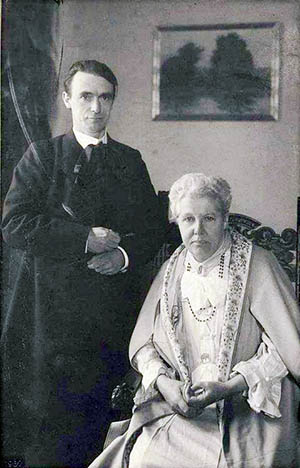
    Rudolf Steiner & Annie Besant (1907)

    His relationship to the society was rocky, and in 1913 he and its head, the ex-Fabian Annie Besant, came to rhetorical blows over C.W. Leadbeater’s advocacy of the Indian boy Krishnamurti as the second coming of Christ. Steiner was disgusted at the idea, and even more so at Leadbeater’s known paedophilic predilections. He demanded Besant’s resignation; she retaliated by ex-communicating him. Steiner left with much of his flock – by this time several thousand – and started his own group, the Anthroposophical Society. As opposed to Theosophy, which spoke of the wisdom of the gods, anthroposophy was concerned with the wisdom of the human being.

    Building a New Movement & the Goetheanum

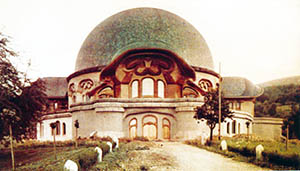
    Practically the first thing Steiner did was to build a temple for his new movement. Land was secured in Dornach, Switzerland, and during WWI Steiner gathered a community of followers from several different countries to construct the Goetheanum, a weirdly beautiful fusion of art nouveau and Expressionist architecture that Steiner himself designed. His lecturing was curtailed by the fighting, but his greatest popularity came with the war’s end. Steiner’s plan to reconstruct Europe, The Threefold Commonwealth (1922), sold some 80,000 copies in its first edition, and audiences for his public appearances were now in the thousands; on one occasion the crowds outside a Berlin auditorium were so great they stopped traffic. 

    The original Goetheanum, which burned to the ground on New Year’s Eve 1922.

    This period, however, also saw the start of the anti-Steiner campaign that would plague him henceforth. Practically everybody hated him: Catholics, Protestants, Marxists, proto-Nazis, not to mention other esotericists. There were at least two attempts on his life, and the number of occult attacks fomented by the “black brotherhoods” is unknown. One clear victory from this time was the establishment of the first Steiner school in Stuttgart in 1919. Based on pedagogical principles developed over decades of tutoring – in Vienna he had cured a retarded hydrocephalic boy to the extent that child grew up to earn a medical degree – Steiner’s educational ideas earned him deserved renown, and an international reputation among experts that continues today.

    Steiner endured vilification in the press and disruption at his lectures with equanimity, but one victim of the attacks was, many believe, the Goetheanum, which burned to the ground on New Year’s Eve 1922. Arson by right-wing proto-Nazis is the common assumption, although an electrical fault remains a possibility. In any case, a decade’s effort, not to mention an architectural wonder, was lost overnight: the building was made of the same wood as that used in making violins and burned fiercely. Steiner took the tragedy as a sign that some changes in the society were necessary. His original occult teachings, based on the idea of an evolution of consciousness and the ability to achieve “supersensible thinking,” were, he felt, obscured by the success of subsequent initiatives. 

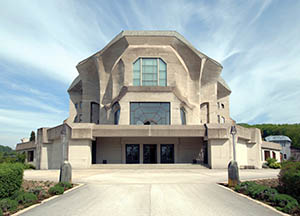
    Front view of the Goetheanum in the Swiss town of Dornach, the seat of the General Anthroposophical Society.

    Steiner education, the Christian Community (a religious group using Steiner’s ideas), the Threefold Movement for social change, eurythmy – a form of what he called “visible speech” – and newer developments like bio-dynamic farming and anthroposophical medicine were taking centre stage. Steiner had attracted many younger followers after the war, eager to rebuild society, and these clashed with his older, more esoterically inclined devotees. Bickering within the Anthroposophical Society, whose numbers had swollen in the post-war years, threatened to undo much that had been achieved. On the first anniversary of the Goetheanum’s destruction, Steiner announced plans for a second temple; it stands today in Dornach, defiantly made of concrete. He also told his followers that he was reconstructing the society as well. Although he had not previously even been a member of the society, remaining only its spiritual guide and adviser, he now declared himself president of the newly formed General Anthroposophical Society which, although most successful in Germany, today has branches around the world.

    Ahriman & Coming World Inferno 

    Steiner’s last years were spent in sowing as many seeds as possible for future work; they were also darkened by his belief in a coming world conflagration, when the archangel Michael, overseer of the current stage of human consciousness, would face off against the power of Ahriman, a spiritual being who seeks to prevent humanity’s development. Steiner spoke ominously of the incarnation of Ahriman, an Antichrist-like figure, whose display of miraculous powers would precede a catastrophic “war of all against all.” Steiner believed this unavoidable destiny would take some time to unfold – Ahriman is scheduled to arrive in the 3000s – yet many of his followers suspect that in recent years the process has been speeded up. Steiner himself had grave doubts about the growing pace of technological development, warning his followers that materialist science gains its great power through unwittingly releasing Ahrimanic entities. In his last communications, Steiner called on his followers to develop their consciousness in order to rise above nature to the same extent that technology sank below it. He also gave series of lectures about karma and its work in human history.

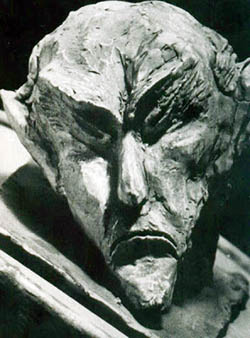
    The head of Ahriman, carved in wood by Rudolf Steiner.

    Steiner died on 30 March 1925. He had been ill for at least a year with an undisclosed stomach ailment, although there is some speculation he had been poisoned. He continued lecturing until it was physically impossible for him to do so, and his followers were astounded when, on the evening of his last scheduled lecture, they found a note saying that it had to be cancelled because of the Doctor’s health. Nothing like this had ever happened before. The Doctor, they believed, was invulnerable. 

    The exact nature of Steiner’s illness remains unknown, but it is clear that his inability to refuse help to those who came to him was a key factor. Along with his public and private lectures, and his practical work as a teacher, architect, and agriculturalist, Steiner made himself available to any who needed his counsel. For many years, he had practically no free time, and wherever he went his hotel room saw a constant stream of visitors including, on one occasion, Franz Kafka. Some asked about their astral bodies; others their diet or their marriages; Kafka asked about his writing. Steiner advised them all, giving little bits of himself to thousands. He was, as the Russian novelist Andrei Biely, a follower, once remarked, “a giant of the power of kindness.”5 It’s not hard to see how such solicitude would eventually wear anyone down.

    In the end, it’s difficult to give an exact assessment of a man whose work combines cogent criticisms of Kant with accounts of life in Atlantis. But this “mild, gentle, good, kindly man,” whose achievement in “humanitarian terms is remarkable and enduring,” as the psychiatrist Anthony Storr wrote of Steiner in his study of gurus, Feet of Clay, remains, for devotees and non-initiate alike, something of an enigma.

     This article first appeared in Fortean Times 205, January 2006.

    [alert type=”general” dismiss=”no”]This article was published in New Dawn 171.[/alert]

    [alert type=”success” dismiss=”no”]If you appreciate this article, please consider subscribing to help maintain this website.[/alert]

    FOOTNOTES
    1. Rudolf Steiner, Autobiography, Rudolf Steiner Publications, 1977, 28
    2. Ibid, 28-29.
    3. Quoted in Colin Wilson, Rudolf Steiner: The Man and his Vision, Aquarian Press, 1985. 38
    4. Steiner, Autobiography, 223
    5. Andrei Biely, Reminiscences of Rudolf Steiner, Adonis Press, 1987, 8

    © New Dawn Magazine and the respective author.
    For our reproduction notice, click here.
  • ‘As Above, So Below’: Are Cosmic Forces at Work on Earth?

    ‘As Above, So Below’: Are Cosmic Forces at Work on Earth?

    From New Dawn Special Issue Vol 12 No 3 (June 2018)

    When we think of wars, revolutions, populist uprisings, outbreaks of mass hysteria and other sudden social and political eruptions – even a popstar’s popularity or the latest fashion trend – we usually believe that at bottom there is some logical, rational explanation for them, even if we do not yet possess it. We are confident that we can understand these things through economics, psychology, race relations, religion, or as a reaction to ‘modernity’ or to some other factor that we can reason about, analyse, come to decisions on and take steps to alter and improve. 

    Although the evidence sadly seems to suggest otherwise, we believe that ultimately we can learn how to control the factors that lead to these explosions. We can, if not eliminate the more catastrophic events like wars, at least minimise the disruptions they cause. In short, we believe we control our fate – or will be able to sometime soon. That is the whole modern project: man applying his intellect and will in order to make a better world, working to control events rather than be controlled by them, and steering history toward progress. We are not there yet, but it is just a matter of time.

    But what if there are factors at work in these massive human events that are beyond our control? What if they are not a product of solely rational, calculable forces but are triggered by natural causes, even cosmic ones? What if the power behind these upheavals doesn’t come from the earth below but from up above, in outer space, from the moon, the stars, the planets and the sun?

    We know that for a great part of human history that is exactly what many people believed. Until the advent of what we know as science in the early seventeenth century, the belief that the stars ordered our destiny was commonly accepted. Astrology, the art of foreseeing the turn of events on earth by charting the movements of the stars in the heavens, had for millennia guided emperors and kings the world over. In ancient China, India, and the Middle East, in classical Greece and Rome and throughout Europe in the Middle Ages and the Renaissance, the belief that “everything in the… cosmos was inextricably connected to everything else, no matter how great or how small” was as much common knowledge as the supposed Big Bang is today.1 And that this arrangement was hierarchical, with changes in the heavens portending those on earth, was also accepted. It was generally agreed that the earth and everything on it was open to forces coming from beyond and that the wise men of antiquity understood these forces and benefited by them.

    All this changed some four centuries ago when what we know as science began to disabuse Western man of such ‘nonsense’ – notwithstanding that millions of people around the globe still accept it.2 The irony here is that some of the most significant figures in the rise of the modern scientific view of the world were well-steeped in the very ‘nonsense’ they were ostensibly freeing us from. 

    Hermeticism & Astrology

    Copernican Planisphere, engraving by Andreas Cellarius, 1660

    The inauguration of the modern worldview is generally credited to the Polish astronomer Nicolai Copernicus. In On The Revolutions of the Heavenly Spheres (1543) Copernicus argued – reluctantly it seems – that, as we all accept today, the sun did not orbit the earth, but the earth the sun.3 It, not ourselves, was at the centre of things, or at least that of our solar system. 

    Although Copernicus was a timid agent provocateur – and a mean-spirited one – his work nevertheless sparked a revolution among the heavenly spheres and our earthly one.4 Yet the idea that the sun was at the heart of things did not arrive in Copernicus’ mind fully formed. As the historian Frances Yates argued some years ago – and as has been echoed more recently by others – Copernicus was an attentive reader of the Hermetic texts in which the sun plays a dominant, we might even say, central role.5 

    Western astrology is one of the Hermetic sciences. It has its roots in the teachings of the great sage Hermes Trismegistus, father of magic and science and initiate of the perennial philosophy, collected in the Corpus Hermeticum and other texts, circa 200 CE. In Book XVI of the Corpus Hermeticum, Hermes calls the sun the “craftsman,” Plato’s name for the demi-urge, creator of the universe. In the Asclepius – a Hermetic text not in the Corpus Hermeticum – Hermes speaks of the sun’s “divinity and holiness” and calls it a “second god.” 

    In the Corpus Hermeticum, the earth was seen as the manifest physical realm at the centre of a series of concentric spheres which represented the planets, stars and higher levels in the Divine hierarchy of Being. The Ptolemaic model – which was official theory in Europe until after the Copernican revolution – had the earth in a stationary position at the centre of the universe.

    In the introduction to his work, Copernicus enlists two previous sages in support of his theory, both of whom find places in the Aurea Catena, or Golden Chain of Adepts, by whom the Hermetic wisdom, or prisca theologia, has been handed down through the ages, at least according to the Renaissance Hermeticist Marsilio Ficino. These are Pythagoras (who, we know, heard the ‘music of the spheres’) and his follower, the teacher of Plato, Philolaus. Copernicus even refers directly to the sun as a “visible god,” just as the Asclepius does. The fact that in the Hermetic cosmology the sun’s position differs from its place in the Ptolemaic system that Copernicus was ‘improving’, suggests that it was an important influence on those improvements.

    Copernicus wasn’t the only one to help shape our modern universe while retaining a good amount of the ancient one. The seventeenth-century German astronomer Johannes Kepler, who discovered the laws of planetary motion, devoted much time to astrology and forecast more than one dignitary’s fortune, although he was not always happy about it. He was also for a time a guest of Rudolf II, the Hermetic Holy Roman Emperor, a patron and student of astrologers.6 “That the sky does something to man is obvious,” Kepler said, “but what it does specifically remains hidden.”7 Kepler recognised that much astrology was moonshine – at least that was true of his competition. But he also knew that the genuine baby should not be thrown out with the phony bathwater. 

    Perhaps the biggest surprise is that Sir Isaac Newton, whose view of the cosmos was dominant until the advent of Einstein, wrote more about alchemy – a Hermetic science directly linked to astrology – than he did about gravity. And as astrology is also known as an ‘occult science’ – ‘occult’ meaning ‘unseen’ – then Newton was a Hermeticist even when he did write about gravity which is also unseen. As with Copernicus, there is much debate today over how much Newton’s Hermetic ideas informed the Principia (1687), the blueprint for the modern, Newtonian view of the cosmos, which, ironically, ousted the earlier, more ‘magical’ one.8

    Nevertheless, even with this esteemed company, astrology suffered the same fate as the other Hermetic sciences and was relegated with other forms of ‘rejected knowledge’ to the great dustbin of ideas – and also, since the 1930s, to daily appearances in most major newspapers. But it didn’t go down without a fight. As late as 1768, the German physician Franz Anton Mesmer, soon to add a word to our vocabulary, earned his doctorate with his dissertation on ‘The Influence of the Planets on the Human Body’. Mesmer did not consider himself an astrologer or occultist. He was a scientist who had discovered the medium through which the planets and the entire cosmos influence life on earth. Yet he could not escape astrology altogether. The very word ‘influence’ itself comes from astrology. It is the name Marsilio Ficino gave to the stellar fluid that flows from the stars down to earth and informs what happens here.

    The medium Mesmer had discovered – to his satisfaction and that of many of his patients, if not the authorities – was what he called ‘animal magnetism’ – ‘animal’ meaning ‘animated’, not ‘beastly’. This was, like the astral influence, a fluid permeating the universe, like the nineteenth-century ‘ether’, linking everything to everything else, its cosmic flow keeping all in balance. In living things it was the source of health and vitality, and Mesmer believed he had mastered a method of guiding and encouraging its movement in his patients, many of whom agreed. 

    A side-effect of the ‘magnetic passes’ that Mesmer and the mesmerists that received his training made over patients was what became known as the ‘magnetic trance’. It was a student of Mesmer, the Marquis de Puységur, who in 1785 stumbled on to what was really at work.9 The ‘trance’ was not magnetic, animal or otherwise, but hypnotic – the term was coined by the Scot James Braid in 1842. When today we say someone is ‘mesmerised’ we mean they are ‘hypnotised’, not that animal magnetism is at work. 

    While Mesmer might not have grasped the phenomenon of hypnosis, he may not have been as wrong about magnetism as the members of the French Academy of Sciences, who in 1784 declared his work a fraud, believed. 

    Gauquelin’s Breakthrough Survey

    The French psychologist and statistician Michel Gauquelin and his wife Françoise. His scientific analysis of astrological correspondences, which were later confirmed by fellow scientist and staunch sceptic Hans Eysenck, revealed they did play a role in human life.

    Astrology held on in the popular mind, along with other Hermetic ideas, but as the modern age progressed science continued to dismiss it. Then in the mid-twentieth century science, of all things, seemed to come to its aid. In 1955 Michel Gauquelin, a French psychologist and statistician with degrees from the Sorbonne, published a book L’influence des astres (‘The Influence of the Stars’) based on years of research that seemed to support some of astrology’s fundamental ideas. This work, as well as the English editions of his other books – The Cosmic Clocks (1967), Astrology and Science (1970), Cosmic Influences on Human Behaviour (1974) – made Gauquelin astrology’s most persuasive scientific defender, although, like Mesmer, he did not see himself as an astrologer. Gauquelin and his collaborator, his wife Françoise, said they simply wanted to answer a basic question: does one’s birthday have any effect on one’s future? 

    After submitting the 27,000 + birthdates they had gathered to statistical analysis, the initial results were disappointing. There seemed to be no substantial correspondence between one’s ‘sun sign’ (Capricorn, Aries, Pisces, etc.) – the constellation the sun is ‘in’ at the time of one’s birth – and one’s destiny. But the Gauquelins seemed to have discovered something else. There was a strong correlation between one’s future profession and the time of birth, not because of the sun, but because of the planets. The Gauquelins discovered that more famous doctors were born just after the rise or culmination of Mars or Saturn – planets related to that vocation – than chance should have allowed. Top-ranking military leaders were born just after the rise or culmination of Mars or Jupiter; again the astrological correspondence held. Professions which in traditional astrological lore were associated with the other inner planets – Mercury and Venus – showed similar correlations. As Guy Lyon Playfair and Scott Hill say in The Cycles of Heaven, “In some cases, there was only one chance in five million that such clusterings were due to chance alone.”10 

    And there was another odd fact: these significant results were true only of people who were highly successful at their work. The Gauquelins saw that large numbers of scientists, doctors, athletes, artists, writers and others, who were competent but not above average, fell outside their select group. It was as if the smaller number received the planetary influence – whatever it was – direct and absorbed it all, leaving very little for the stragglers. Gauquelin’s findings have come to be known as ‘the Mars Effect’.

    ‘The Mars Effect’ (red) illustrated on this chart.

    Gauquelin’s results were examined by the psychologist and statistician Hans Eysenck. Eysenck, a tough-minded sceptic, had to admit that he was convinced. And when Eysenck and his colleagues examined some other astrological givens – that people born under ‘water’ signs tend to be emotional, that those born under ‘odd’ numbered signs tend to be extroverted while those born under ‘even’ ones are introverted – he and his team were surprised to find the evidence strongly in favour of them.11

    The question remained of exactly how the planets and other cosmic bodies can affect earthly ones? Some people working in the earlier part of the last century, and in another part of the world, thought they might have a clue.

    The Role of the Moon

    Whether astrology can account for it or not – I don’t have the statistics on hand – it nevertheless seems that investigating the role of cosmic forces on human life is a peculiarly Russian pursuit. At least in researching this article I came across more Russians than chance may have allowed. For example, the Greek-Armenian esoteric teacher G. I. Gurdjieff may not have been Russian – his exact nationality has always been uncertain – but he certainly started his career in Russia.12 In 1914, with the First World War erupting, the Russian philosopher P.D. Ouspensky, Gurdjieff’s most famous pupil, asked him if such catastrophes could be avoided. They could, Gurdjieff told Ouspensky, but what was necessary was to understand why they start. 

    The moon is the chief… motive force of all that takes place in organic life on earth. All movements, actions, and manifestations of people… depend on the moon and are controlled by the moon. – Georges Ivanovich Gurdjieff

    “What is war?,” Gurdjieff asked Ouspensky. “It is the result of planetary influences. Somewhere up there two or three planets have approached too near to each other; tension results… For them it lasts, perhaps, a second or two. But here, on the earth, people begin to slaughter one another, and they go on slaughtering maybe for several years.” The people involved feel they have perfectly good reasons for fighting – for king, country, national honour, lebensraum or to pre-empt an attack by a hostile neighbour. But “they fail to realise to what extent they are mere pawns in the game.”13 

    Gurdjieff also spoke to Ouspensky about the moon. Bookshelves are full of accounts of how the full moon affects some people; our terms ‘lunacy’, ‘lunatic’, ‘looney’, ‘moonshine’ are evidence of the popular acceptance of something that is still ‘officially’ dismissed. Gurdjieff took it a bit further. “The moon,” he said, “is the chief… motive force of all that takes place in organic life on earth. All movements, actions, and manifestations of people… depend on the moon and are controlled by the moon.”14 Perhaps the strangest thing was Gurdjieff’s insistence that the moon is a living being and that it is growing, and that its nourishment comes from the souls of ‘sleeping’ people who are not working to attain the true ‘waking’ state of consciousness.15 

    When one recognises that in the weeks surrounding the November 2016 US presidential election the moon entered a ‘perigee full moon’ or ‘supermoon’ – when it was both full and closer to the earth than it had been for nearly seventy years – one wonders if Gurdjieff knew things denied more conventional political analysts.16

    Gurdjieff said that he gained his cosmic knowledge during his time with the mysterious Sarmoung Brotherhood in Central Asia.17 One wonders if he had more local sources. Helena Petrovna Blavatsky, one of the founders of the Theosophical Society, was, like Ouspensky, a full-blooded Russian. In Isis Unveiled (1877) she writes that “certain planetary aspects may imply disturbances in the ether of our planet, and certain others rest and harmony.” At times this influence promotes periods of withdrawal, of “monasticism and anchoritism”; at others frenzied action and “utopian schemes.” And where Gurdjieff speaks of the “harmony of reciprocal maintenance” operating throughout the cosmos, Blavatsky speaks of the “reciprocal relations between the planetary bodies.”18

    Blavatsky got her knowledge from her Masters in Tibet. Did anyone in Russia have it too? Oddly, around the same time that Gurdjieff was enlightening Ouspensky about our place in the cosmos, it seemed someone did. But in his case, the sun, not the moon, pulled the strings.

    The Role of the Sun

    In June 1915, the eighteen-year-old prodigy Aleksandr Chizhevsky – scientist, musician, painter, poet – noticed something. He had become fascinated with the study of sun-spots – huge dark bodies that pass across the surface of the sun – and it struck him that at the same time as a large group of spots crossed the sun’s central meridian, certain events transpired on earth. The aurora borealis that month was unusually strong, and the magnetic storms making up the spots had disrupted more radio and telephone communication than usual. But there was something else. The fiercest battles of the war coincided with the spots. Was that a coincidence? 

    In 1916, when he was fighting with the Russian army on the Galician front, Chizhevsky saw that the battles intensified when solar flares and geomagnetic storms were most active. In 1917, when the Bolsheviks took power, there was, he saw, another unusual burst of solar activity. Checking the records, Chizhevsky saw that there had also been one in 1905, at the time of an aborted uprising. 

    The young Soviet scientist Aleksandr Chizhevsky correlated the sun-spot cycle with major upheavals in human history. He is photographed here pointing to one of his charts. 

    By 1922 Chizhevsky had made a chart showing, he claimed, 2,400 years of “mass movements”: wars, major battles, revolutions, uprisings, migrations, from across the globe. These, he argued, came in regular cycles which coincided almost exactly with the eleven-year sun-spot cycle. (In 1843, the German astronomer Heinrich Schwabe observed that sun-spots went through a ten-year cycle; the idea was later refined by Rudolf Wolf and Alexander Humboldt and established at eleven years.)

    Chizhevsky believed he had discovered a “universal cycle of historical events,” with the sun, or whatever was behind its spots, at the wheel.19 Every major outbreak in recent history, from the French Revolution to the start of World War I, was precipitated by solar excitement. Chizhevsky was even able to predict when such things would occur. In 1926, guided by the sun-spot cycle, Chizhevky predicted important flare-ups from 1927 to ’29. What happened then? Salazar’s dictatorship began in Portugal. Chiang Kai-shek captured Peking. Mussolini was on the rise as was Hitler, and Stalin consolidated his power by exiling Trotsky. And Wall Street suffered a collapse triggering the Great Depression.

    Chizhevsky’s work impressed many people, like the economist Edward Dewey, who used his ideas in his own work on economic cycles. Others, like Stalin, were not so impressed. In 1942, when he realised that for Chizhevsky sun-spots and not the irresistible march of the Marxist class war were responsible for the Soviet Union, he ordered him to retract his work. By this time Chizhevsky was a prestigious scientist, with many degrees and honours. Alongside Nicolai Fedorov, Konstantin Tsilokovsky, and V. I. Vernadsky, he was one of what is known as the ‘Cosmist’ school. Chizhevsky refused and Stalin sent him to a gulag for eight years, with eight years ‘rehabilitation’ after that. He was released during the Khrushchev ‘thaw’ following Stalin’s death and today is revered as the ‘father of heliobiology’, the study of the sun’s influence on life on earth. Other Russians who were influenced by his work or shared his belief in cosmic forces affecting the earth, were Vladimir Vernadsky, mentioned above, who popularised the ideas of the ‘biosphere’ and ‘noosphere’, and the historian Lev Gumilev, whose ideas about ‘ethnoi’ and ‘passionarity’ as agents of civilisation, also depend on cosmic forces affecting human beings.20

    Chizhevsky believed that what was behind the intensified agitation during high sun-spot activity was an increase in negative ions in the atmosphere. The solar flares erupting from the sun during the intense magnetic storms making up the spots affected the earth’s own magnetic field, which in turn ‘ionised’ the air. Positive ions, he believed, had a ‘negative’ effect, making people dull, lethargic, and irritable. Negative ions did the opposite. They worked as stimulants; hence the effect of a ‘breathe of fresh air’ after a rainstorm. The ionisation too went through cycles and at the highest concentration of negative ions, things start jumping.21 Mesmer was not as wrong as his critics believed. Magnetism did have something to do with it. 

    Chizhevsky died in 1964. One odd fact that he missed but others, like Edward Dewey, noticed was that often things on earth occurred slightly ahead of the sun-spot cycle, as if effect preceded cause – or as if events on earth triggered the spots. If this was the case, then something else must be responsible or at least precede both. In 1949 John Nelson, an RCA engineer who had been studying the sun to ‘predict’ when its spots would interfere with communications, hit upon an answer. Somehow, the planets had a hand in it. Although most astronomers would laugh at the idea of a planet’s weak magnetic field having any effect on the sun, this is exactly the conclusion Nelson came to, and which enabled him to predict and avoid blackouts.22 The odd thing was that the planets’ effect on the sun coincided with traditional astrological notions of ‘opposition’ and ‘conjunction’. When planets were in such an arrangement with the sun and the earth, things tended to go haywire. Otherwise, things were fine.

    Some contemporary thinkers see in Chizhevky’s work an argument against free will. In The Bond, Lynne McTaggart states that “if we are essentially at the mercy of the slightest move of the sun and its activity,” then Chizhevsky’s work stands “as a gigantic refutation of our misguided belief in ourselves as masters of the universe – or even of ourselves.”23 This is a not uncommon reflection on human hubris.But it goes against what Chizhevsky himself believed: that the sun does not compel us to do anything in particular, only to do something. It acts as a stimulant; what we do when stimulated is up to us. There may be increased belligerence during intense sun-spot activity, but there are always pacifists, conscientious objectors, and quiet people at home, sitting out the riots.

    As astrological lore has it, ‘the stars incline, they do not compel’. This was something Gurdjieff knew when he told Ouspensky that one could choose which influences one fell under.24 Man could escape being ‘food for the moon’ by working on himself and, in his interior planetary system – spelled out in fascinating detail by Rodney Collin, a student of Ouspensky, in The Theory of Celestial Influence – could become an ‘inner sun’, under a minimum of cosmic laws.25 As its students know, this too was an aim of Hermeticism.26 The stars in their courses may spark events here on earth, but we still have the responsibility of steering our way through them.

    [alert type=”general” dismiss=”no”]This article was published in From New Dawn Special Issue Vol 12 No 3.[/alert]

    [alert type=”success” dismiss=”no”]If you appreciate this article, please consider subscribing to help maintain this website.[/alert]

    Footnotes

    1. Nicholas Campion, The Great Year: Astrology, Millenarianism and History in the Western Tradition, Arkana, 1994, 76
    2. Peter Marshall, World Astrology, Macmillan, 2004
    3. Arthur Koestler, The Sleepwalkers, Penguin Books, 1979, 121
    4. Colin Wilson, Starseekers, Hodder & Stoughton, 1980, 86
    5. Frances Yates, Giordano Bruno and the Hermetic Tradition, Routledge and Kegan Paul, 1971; Lynn Picknett and Clive Prince, The Forbidden Universe, Constable, 2011; Gary Lachman, The Quest for Hermes Trismegistus, Floris Books, 2011
    6. Peter Marshall, The Theatre of the World, Harvill Secker, 2006
    7. Quoted in Guy Lyon Playfair and Scott Hill, The Cycles of Heaven, Souvenir Press, 1978, 256
    8. Sean Martin, Alchemy and Alchemists, Pocket Essentials, 2006, 76
    9. Henri F. Ellenberger, The Discovery of the Unconscious, Fontana Press, 1994, 7-74
    10. Playfair and Hill, 257
    11. Colin Wilson, Mysteries, Watkins, 2006, 582-83. ‘Water’ signs are Cancer, Scorpio, Pisces. ‘Odd’ signs are Aries, Gemini, Leo, Libra, Sagittarius, Aquarius, ‘even’ ones Taurus, Cancer, Virgo, Scorpio, Capricorn, Pisces.
    12. As his biographer James Webb wrote, “Georgei Ivanovitch Gurdjieff was born… and here all pretentions to accuracy stop.” (The Harmonious Circle, G.P. Putnam’s Sons, 1980, 25)
    13. P.D. Ouspensky, In Search of the Miraculous, Harcourt, Brace, and Company, 1949, 24
    14. Ibid., 85
    15. It may have been with this in mind that Colin Wilson made the moon the base of operations of the psychic vampires in his novel The Mind Parasites (Monkfish Book Publishing Company, 2005). This edition has a preface by me.
    16. https://edition.cnn.com/2016/11/02/world/supermoon-november-14-2016/index.html 
    17. G.I. Gurdjieff, Meeting with Remarkable Men, Penguin Classics, 2015. This edition has an Introduction by me.
    18. G.I. Gurdjieff, Beelzebub’ s Tales to His Grandson, First Book, E.P. Dutton, 1978, 81; Helena Petrovna Blavatsky, Isis Unveiled Vol. 1, Theosophical Publishing House, 1972, 274
    19. Playfair and Hill, 277
    20. Charles Clover, Black Wind, White Snow: The Rise of Russia’s New Nationalism, Yale University Press, 2016, 125
    21. The ‘passionarity’ that Lev Gumilev believed was the driving force behind human activity may be Chizhevsky’s sensitivity to negative ions.
    22. Playfair and Scott, 46
    23. Lynne McTaggart, The Bond, Hay House, 2011, 60
    24. Ouspensky, 25
    25. Rodney Collin, The Theory of Celestial Influence, Watkins Publishing, 1980. Collin, too, hits on planetary magnetism as the agent at work. For him, it directly affects the body’s glandular system which he sees as arranged in parallel order to planets’ positions vis-a-vis the sun. 
    26. Gary Lachman, The Quest for Hermes Trismegistus, Floris Books, 2011, 135-37

    © New Dawn Magazine and the respective author.
    For our reproduction notice, click here.
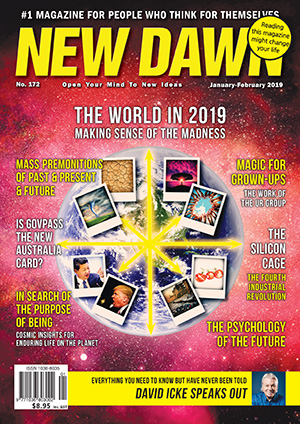
  • René Guénon &  Counterinitiation: Are Things Getting Better or Worse?

    René Guénon & Counterinitiation: Are Things Getting Better or Worse?

    From New Dawn Special Issue Vol 10 No 3 (June 2016)

    A question nags at everyone today: are things getting better or worse? The answer depends on the criteria you’re using. In terms of material comfort, it seems clear that life is better and easier for most people – certainly most people in the West – than they were a century ago.

    Yet somehow this is not reassuring. The very forces that have created these comforts threaten to destroy us. And in any case the complexities of advanced civilisation have by no means enabled us to feel that we, individually or collectively, have any meaningful place in the universe. Indeed there would seem to be powers that are trying to thwart this sense of meaning and to stamp it out whenever it raises its head. The works of René Guénon (1886–1951) attempt to deal with this problem.

    Guénon is still little-known even among the mainstream intelligentsia. But his critique of the modern world – set out particularly in his books East and West, The Crisis of the Modern World, and The Reign of Quantity and the Signs of the Times – has become increasingly influential both in the West and in the Islamic world (Guénon, a convert to Islam, moved to Cairo in 1930 and lived there for the rest of his life).

    Guénon starts with the concept of the yugas, the world ages as conceived in traditional Hindu metaphysics. The first and best is the Satya Yuga; next is the Treta Yuga; third is the Dvapara Yuga; the last, shortest, and worst is the Kali Yuga, the age of darkness. This is the age we are in. It began in 3102 BCE, with the end of the great war described in the epic known as The Mahabharata. Most Hindu sources say that the Kali Yuga will last 432,000 years – in short, we are nowhere near the end of it. Guénon sees the matter otherwise. In The Crisis of the Modern World he writes: “We have in fact entered upon the last phase of the Kali-Yuga, the darkest period of the ‘dark age’, the state of dissolution from which it is impossible to emerge otherwise than by a cataclysm.”

    The reasons for Guénon’s belief are complex, but they have to do with his view of the ages as a gradual movement (and decline) from a pure and direct contact with the primordial source of Tradition, which he associates with prehistoric polar civilisation known as Hyperborea. Over the millennia, contact with this Tradition has become more and more occluded so that in our time we are almost entirely cut off from it. (For more about this, see my article “Waiting for the End of the World: René Guénon and the Kali Yuga” in New Dawn 122.)

    The modern West is thus, for Guénon, not the summit of progress. It is at the tail end of a long decline. Although Guénon does not specify when this age will end, he seems to think it will be comparatively soon – a few decades from the time he is writing in the early to mid-twentieth century.

    René Guénon (1886–1951), Cairo, Egypt.

    For Guénon, this decline is cyclical and thus inevitable. At the same time, despite his claims of holding himself above the fray, he displays a strong animus against the era. One senses a dissociation here. If materialism and the “reign of quantity” are omnipresent, surely it is a result of the cycle; things could hardly be different in the late stages of the Kali Yuga. In that case, why be upset about it?

    Years ago I had a discussion with the philosopher Jacob Needleman in which I made this complaint about the Traditionalists. “It’s as if they’re mad because it’s November,” I said. (I am speaking from a northern-hemisphere perspective.) “No,” Needleman replied. “They’re mad because people are going around saying, ‘It’s May’.”

    Needleman was right. Guénon’s time, the early twentieth century, was the high-water mark of Western triumphalism. Guénon felt a powerful need to fight this attitude as well as what he considered a deluded belief in “progress” and “evolution.” Indeed the very things that the West has trumpeted as signs of progress were, for Guénon, the sign of the very opposite: “Have we not arrived at that terrible age, announced in the Sacred Books of India, ‘when the castes shall be mingled, when even the family shall no longer exist’?” Most modern people would say that the decline of the caste system is a good thing.

    Besides, Guénon did not think the woes of modernity could be blamed completely on a cyclical entropy. There were conscious factors at work as well. In The Reign of Quantity, he writes, “Since all effective action necessarily presupposes agents, anti-traditional action is like all other kinds of action, so that it cannot be a sort of spontaneous or ‘fortuitous’ production, and, since it is exercised particularly in the human domain, it must of necessity involve the intervention of human agents.”

    This action comes in two stages. The first is one of “quantification and mechanisation.” Quantification is the warping of the modern mind so that it only perceives things in terms of number. Statistics are one example of this trend, and Guénon has an insightful chapter in The Reign of Quantity entitled “The Illusion of Statistics.” Also, the use of quantification in industry – as opposed to the “crafts” that flourished in traditional civilisations – “had the effect of attaching men more and more completely to purely material realisations. Man ‘mechanised’ everything and ended at last by mechanising himself, falling little by little into the condition of numerical units, parodying unity, yet lost in the uniformity and indistinction of the ‘mass’.” The result? Man loses practically all contact with higher realms. He is so focused on materiality that he believes nothing else exists.

    A second phase ensues: “dissolution.” Guénon explains: “After having enclosed the corporeal world as completely as possible, it was necessary, while guarding against the re-establishment of any communication with superior domains, to open it up again from below, so as to allow the dissolving and destructive forces of the inferior subtle domain to penetrate into it. It is the ‘unleashing’ of these forces, so to speak, and the setting of them to work to complete the deviation of our world and effectively to bring it towards final dissolution, which constitutes the second part or second phase referred to.” 

    Guénon calls the sum total of these forces – who are, as he has emphasised, human – the “counter-initiation.” Now it is not merely a matter of being passively unaware of Tradition, but of forces that actively seek to block and divert this awareness.

    Mark Sedgwick, author of Against the Modern World, an important study of Guénon and Traditionalism, observes: “Traditionalists are those who… recognise that one of the most important aspects of modernity is inversion – that the world sees the valuable as worthless and the worthless as valuable, the good as bad and bad as good. Guénon never saw a punk, but it would have made a lot of sense to him. And with that comes ‘counter-initiation’ – religious movements that are actually irreligious, that actually lead away from what religion is meant to lead to.”

    Two of the most prominent “counter-initiatic” movements, in Guénon’s view, were Theosophy and Spiritualism. This is why he devoted two books to denouncing them. Theosophy was pernicious because it presented a loathsome parody of the genuine Traditional teachings of Hinduism. Moreover, in teaching the idea of the soul’s evolution – a word that was anathema to Guénon – it was presenting dangerous modern ideas in esoteric form.

    Actually it is difficult to tease out the differences between Guénon’s views of the ascent of the Self through multiple states of being from the Theosophical model, which describes a very similar process. (One difference is that Theosophy posits multiple incarnations on earth, whereas Guénon denies it.) But he saw the very similarity of these views as yet another sign of the diabolical cleverness of the counter-initiation. Spiritualism too, with its séances, was stirring up “inferior forces.”

    For a Traditionalist, practically every modern movement or school of thought can be – and is – seen as an example of “counter-initiation” at work. Psychoanalysis, for example, involves an excursion into the lower depths of the psyche from which the subject may well never return. “In the ‘fall into the mire’,” as Guénon characterises it, “the inferior possibilities take possession of him, dominate him, and end by submerging him completely.” Guénon makes a similar argument about the revivals of shamanism and “sorcery.” Eventually, he predicts, “counter-initiation” will lead to a “counter-tradition” – a grotesque and evil imitation of true Tradition.

    Another symptom of the present crisis is syncretism: the random mixture of teachings and images from any number of traditions. For Guénon, this is radically different from synthesis, by which common themes and symbols are seen to be reflections of one universal Tradition. Someone might object that from the exterior, synthesis and syncretism are hard to tell apart. Guénon would say that is the point: from the exterior, one does not have knowledge to integrate these themes properly. It is only intellectual intuition – the possession of true knowledge – that makes this a possibility for initiates.

    It does not take much imagination to see how many present-day trends fit into Guénon’s model. Mark Sedgwick mentions punk, but Guénon would have found every other form of popular music just as abominable. Similarly with the visual arts: he would have seen transgressive works such as the photography of Robert Mapplethorpe or Andres Serrano’s notorious Piss Christ as extreme examples of such degeneration – in the unlikely event that he deigned to take notice of them at all. 

    He may even have a point about the penetration of “the dissolving and destructive forces of the inferior subtle domain” into world. In his 1936 essay “Wotan,” psychiatrist C.G. Jung writes about the Germany of that time: “What is more than curious… is that an ancient god of storm and frenzy, the long quiescent Wotan, should awake, like an extinct volcano, to new activity, in a civilised country that had long been supposed to have outgrown the Middle Ages.” For Jung, much like Guénon, the terrible forces of the twentieth century were eruptions from the unconscious.

    Guénon may even have been right about the deliberate evocation of such forces. Occultist Donald Tyson writes that the magus Aleister Crowley, a contemporary of Guénon’s, “firmly believed that he was the herald of a new age of strife and destruction that would sweep across the world. He called this the Aeon of Horus, after the Egyptian god of war.” [See article in this issue, ‘Enochian Apocalypse’ by Donald Tyson, page 43.] In 1909 Crowley conducted some magical workings to accomplish this end by opening “the four great Watchtowers that stand guard against chaos at the extremities of our universe.” Tyson writes:

    Let us suppose for the sake of argument that… Crowley’s Enochian evocations of 1909… pried the doors of the Watchtowers open a crack – enough to allow a foul wind to blow through the common mind of the human race. This would explain the senseless slaughter of the First World War and the unspeakable horror of the Nazi Holocaust during the Second World War. It would explain the decline of organised religions and why the soulless cult of science has gained supremacy. It would explain the moral and ethical bankruptcy of modern times and the increase in senseless violence.

    Whether or not Crowley really did open up the cosmic Watchtowers, he no doubt would have liked to think he did. In any case, this description sounds very much like what Guénon is talking about.

    To go back to Guénon, no one can lay out such a comprehensive denunciation of a civilisation without offering some positive alternative. He evidently hoped that his works would inspire a nucleus of Western illuminates to gain access to, and perpetuate, the Traditional knowledge, either to reverse the decline of the modern world, or, more likely, to serve as an ark for the preservation of the sacred knowledge for a better future time.

    To a small extent, his hopes have been realised. London’s Temenos Academy, for example, founded in 1990 by the poet Kathleen Raine and associates including the Traditionalist Philip Sherrard, is committed to perpetuating the “perennial philosophy” – another name for Guénon’s Tradition. The Prince of Wales is among its patrons. Indeed, as Angel Millar points out in his recent book The Compass and the Crescent: Islam, Freemasonry, Esotericism, and Revolution in the Modern Age, Prince Charles is very likely a Traditionalist himself, and his ideas and programs cannot be understood without reference to Traditionalism.

    The number of people sympathetic to Traditionalism, of course, remains infinitesimal. But Guénon did not believe that mere numbers were necessary to influence the course of civilisation. Numbers, after all, are merely another manifestation of the reign of quantity. He believed that certain awakened individuals, even if only a few, could extend a powerful and beneficent influence on civilisation.

    Was he right? We are certainly far from anything like a “reign of quality.” But history has a way of reversing course, and the prospects for a civilisation that incorporates a sense of the sacred may not be so dismal after all.

    [alert type=”general” dismiss=”no”]This article was published in New Dawn Special Issue Vol 10 No 3.[/alert]

    [alert type=”success” dismiss=”no”]If you appreciate this article, please consider subscribing to help maintain this website.[/alert]

    Sources

    René Guénon, The Crisis of the Modern World, Translated by Arthur Osborne et al. Sophia Perennis et Universalis, 2004 [1942]
    René Guénon, East and West, Translated by Martin Lings, Sophia Perennis et Universalis, 1994 [1941]
    René Guénon, The Reign of Quantity and the Signs of the Times, Translated by Lord Northbourne, Penguin, 1972 [1953]
    C.G. Jung, “Wotan.” www.philosopher.eu/others-writings/essay-on-wotan-w-
    nietzsche-c-g-jung/; accessed April 3, 2016
    Jean-François Mayer, “Traditionalism: René Guénon’s Legacy Today: An Interview with Mark Sedgwick,” ReligioScope, 2004; http://religion.info/english/interviews/article_53.shtml; accessed April 3, 2016.
    Angel Millar, The Compass and the Crescent: Islam, Freemasonry, Esotericism, and Revolution in the Modern Age, Numen Books, 2015
    Mark Sedgwick, Against the Modern World: Traditionalism and the Secret Intellectual History of the Twentieth Century, Oxford University Press, 2004
    Donald Tyson, “The Enochian Apocalypse,” Gnosis 40 (summer 1996), 56–62

    © New Dawn Magazine and the respective author.
    For our reproduction notice, click here.