New Dawn – World's Most Unusual Magazine

Category: Secret Wisdom

  • A Search for Paul Brunton

    A Search for Paul Brunton

    From New Dawn 191 (Mar-Apr 2022)
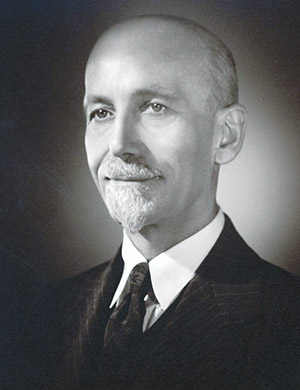
    Paul Brunton (1898-1981)

    There was a time when Paul Brunton (1898-1981) needed no introduction. From the 1930s through the 1950s, his eleven books were best-sellers in the field of alternative spirituality. A Search in Secret India and A Search in Secret Egypt played to a popular fascination with the Orient. 

    In Egypt, Brunton capped his meetings with magicians, snake-handlers, holy men and impostors by spending a night in the Great Pyramid, which he attributed to the Atlanteans. His Indian quest culminated in the encounter with Sri Ramana Maharshi, a living exemplar of Hinduism’s highest philosophy, that of Advaita or non-duality. (See “The Life and Teachings of Ramana Maharshi” by Jason Gregory in New Dawn 190.) These events defined the breadth of Brunton’s appeal, leading his readers, as he himself had been led, from psychism and mystical adventures to the supreme identity. 
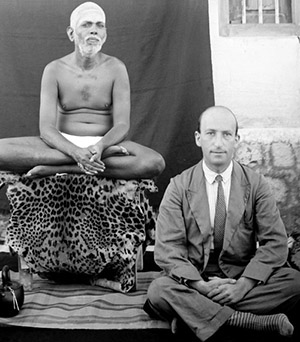
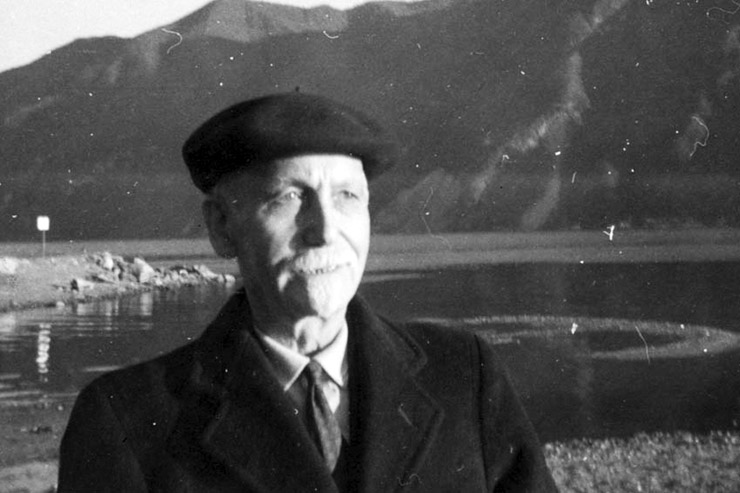
    Paul Brunton with Ramana Maharshi, early 1930s.

    His subsequent books were a graded manual of training in what he simply called “philosophy,” from The Secret Path through The Quest of the Overself to the two-volume treatise The Hidden Teaching Beyond Yoga and The Wisdom of the Overself. He never sought disciples or led a movement in the outer world. His writings were a gift to the solitary seeker, who through circumstance or inclination lacks the support of a group or sect. But he accepted the burden of responding in person to sincere correspondents and giving his time and patience to countless private interviews.

    After his last book, The Spiritual Crisis of Man (1952), Brunton fell silent and apparently incommunicado. However, writing remained his daily habit. In his last decades, he wrote over 30,000 notes, ranging from one-liners to essays, in which he developed a universal philosophy for sane and spiritual living beyond anything in his books. During his last years, he allowed a few helpers to transcribe and classify them. They were published in 1984-89 as The Notebooks of Paul Brunton, in sixteen volumes bound in the bright orange cloth of the Buddhist monk, then in paperback. In one of the later notes, Brunton muses on how in a future incarnation he will discover them and be delighted by something so congenial to his tastes.

    He saw his mission, at least in one dimension, as making the wisdom and methods of the ancient East accessible to Westerners. The Theosophical Society, which he had joined in 1920, demonstrated the value of Eastern philosophies and the reality of occult phenomena, but had given little advice on how to apply them in one’s own life. This accounted for the success of magical and occult orders like the Golden Dawn, the A.M.O.R.C., or the Gruppo di Ur, which gave practical training or rituals, while also returning the West to its own esoteric heritage.

    In preference to such groups, Brunton had the advantage of two outstanding personal guides. One was Allan Bennett (1872-1923), a former member of the Golden Dawn who had travelled to the East in the company of Aleister Crowley and remained there to become a Buddhist bhikku. As “Ananda Mettaya,” he returned to London on a mission to proclaim the Noble Eightfold Path, and Brunton acted for a time as his secretary. Brunton’s own work retained a certain Buddhist character, with its freedom from formalism and mere belief, and its confidence in the possibility of liberation from the ego. But Gautama’s view of all existence as suffering did not seem to him a useful principle for modern Westerners. 
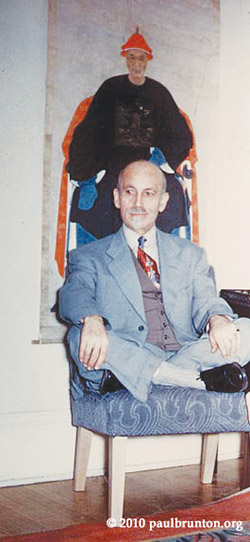
    Paul Brunton with painting of Chinese sage.

    Brunton’s other mentor was an obscure character known only as “Brother M” or by his surname of Thurston. He was of partly Native American ancestry, settled in London and worked as a painter in the arts and crafts field. Before the First World War, he had led a group called “The Brothers,” and his few publications bear their imprint. In the 1920s, “M” served a small circle of spiritual seekers as a fatherly adviser and guide on the occult ventures in which they were involved. One of them recalled this period in an “occult autobiography” of 1927 (The White Brother by Michael Juste), in which the young Brunton appears semi-fictionalised as “David.”

    There are mysteries about Brunton’s own biography, which he had no interest in revealing. To prevent misuse of his horoscope by inquisitive or hostile astrologers, he habitually gave out a false birthdate. When in 2019 his archive entered the library of Cornell University in Ithaca, New York, some of these mysteries were resolved – evidently with his consent, for before his death he had carefully sifted his papers and destroyed many of them. We now know that he was born on October 21, 1898, and named Hyman Abraham Isaacs, the only child of a master bootmaker in East London. He attended the Central Foundation School, originally called the “Middle Class School,” founded for the sons of skilled workmen and tradesmen who, while not poor, could not afford schools like Westminster, Eton, St. Paul’s, etc. In April 1914, he was registered as a “Temporary Boy Clerk” in government employment and subsequently worked in the Patent Office.

    At some point, the Isaacs adopted the surname Hurst, and Hyman the forename of Raphael. From 1917-18 he served in a tank regiment, perhaps chosen for his small stature to fit the cramped space in the vehicles. After the war, he ran a mail-order book service with his friend Michael Hurwitz (uncle of the eminent violinist Emanuel Hurwitz, writing as “Michael Juste” and bookselling as “Michael Houghton”), who established it as the Atlantis Bookshop, still flourishing near the British Museum. During the 1920s, Brunton worked for Foyle’s bookshop, in journalism, as personal assistant to a building contractor, and as author and editor, first of motivational and business publications, then as a prolific contributor to the Occult Review. By the end of the decade, Raphael Hurst was a familiar name in London’s esoteric subculture.

    Membership of that world, then as now, spanned the social scale from the impoverished Bohemians depicted in The White Brother to the titled and celebrated. Brunton joined the Astrological Lodge of the Theosophical Society on the same day as Mrs Eugene Goossens, wife of the conductor Sir Eugene Goossens, and Lady Smith Dodsworth, a baronet’s wife. Thanks to such connections, he was enabled to study in the library of the Royal Asiatic Society and had propitious meetings with Sir Francis Younghusband, who had commanded the invasion of Tibet in 1904 and was now President of the Royal Geographical Society.

    On the personal side, in 1922 Brunton married a young Danish woman, Karen Tottrup, and fathered one son, Kenneth Thurston Hurst. Within a few years, Karen and Kenneth moved into the household of Leonard Gill, proprietor of the Rudolf Steiner Bookshop, also near the British Museum. An amicable divorce followed in 1928, and as Kenneth matured, his father became his intimate friend and counsellor, steering him toward a successful publishing career in the USA. Kenneth’s memoir Paul Brunton: A Personal View remains the sole attempt at a book-length biography.

    The first intention of Brunton’s Indian quest of 1930-31 was to meet Meher Baba. The silent Iranian was enjoying his first period of international celebrity, and the trip may have been financed by his English disciples. When A Search in Secret India appeared, with its foreword by Younghusband and its instant rise to the best-seller lists, they were sorely disappointed by the author’s verdict on their master. The contrast was all too obvious with the climactic episode of the book, the meeting with Sri Ramana Maharshi, whose reputation as an authentic jivan mukti (liberated in life) would draw many pilgrims to the holy mountain of Arunachala.

    The tropical diseases which Brunton had caught in India affected him periodically for years. In order to recover and write his travelogue, he left London for Jordans, a Quaker village in Buckinghamshire where he had a cottage built and attended the venerable meeting house. Since 1932 he had been using “Paul Brunton” among his various noms-de-plume, and in 1935, with two books published under that name, he registered it formerly by deed poll. Later he always preferred to be addressed as “PB.”

    Although he had grown away from the Theosophists, his second book again secured a stellar endorsement: the foreword was by Alice A. Bailey, the scribe of neo-Theosophical works ascribed to “The Tibetan.” The Secret Path was a practical manual on how and why to meditate, inspired by Indian practices but free from Sanskrit or other foreign terms. This would remain Brunton’s principle: to put everything into plain English, including some terminology of his own when necessary. Its crucial concepts are the Overself, World Mind, and Mind in Itself, whose equivalents can be found in esoteric religions and in higher philosophies such as Neoplatonism. Also essential to Brunton’s teaching of the path are the ascending hierarchy of Religion, Mysticism, and Philosophy; the Sage as the ultimate goal of human endeavour; and the central doctrine of Mentalism.
    Get the issue this article appears in

    Brunton acknowledged that the mere observance of a religion, its morals, rituals, and beliefs, has its value for the majority of humankind. In a few, it kindles the aspiration for a personal experience of the Divine, a real encounter with one’s God. This leads to the higher degree of mysticism, with its special practices and great exemplars. But to realise the highest human potential, the mystic should not remain content with his or her experience, however sublime. The question of who or what is experiencing this must be asked, and there philosophy begins. Ramana Maharshi offered the exemplary practice of asking “Who (or What) Am I?”, whose answers become increasingly subtle, up to the sage’s state of absolute certainty where Overself and World Mind are one.

    The philosophic ascent confirms the truth of Mentalism, using the term in opposition to materialism. While the latter takes matter as its first principle, mentalism holds that matter has no independent existence, but is an apparent form taken by mental processes, both individual and cosmic. Modern philosophers classify this as “subjective idealism,” but the fact of classifying it implies distance. To actively embrace the mentalist philosophy affects psychology, cosmology, theology, and even the physical sciences. These lose nothing of their practical value, but they deal with forms in the mind, not with a separate material reality. The true philosopher aspires to exclaim, with a legendary Hindu sage, “The world is just one’s thoughts!” Brunton predicted that the best Western thinkers would come round to the mentalist position by the end of the twentieth century. Perhaps they have, but where are they? 
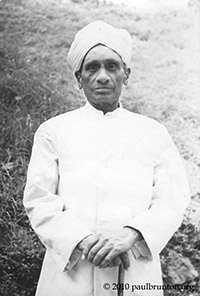
    V. Subrahmanya Iyer (1869-1949).
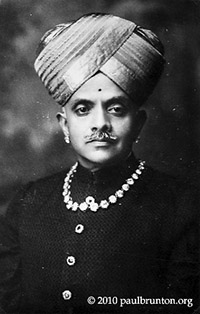
    The Maharaja of Mysore, Krishna Raja Wadiyar IV (1884–1940).

    A second stay in India (1935-37) brought Brunton into contact and friendship with the Maharaja of Mysore via his court philosopher V. Subrahmanya Iyer, and Mussorie Shamsher, Prince of Nepal, who facilitated the retreat chronicled in A Hermit in the Himalayas. On the way back to England, Brunton gave interviews in Austria, Hungary, and Czechoslovakia, where a devoted group of students persisted throughout the Nazi and Communist periods. In August 1937, he accompanied Iyer to the International Conference on Philosophy in Paris, then to Switzerland for a meeting with Carl Gustav Jung, which resulted in Jung’s own Indian journey at the turn of the year.

    With such high connections, one wonders why in 1938 Brunton obtained a PhD diploma from McKinley Roosevelt Graduate College in Chicago. This was not an accredited institution but a diploma mill that supplied impressive-looking documents for a fee. Brunton submitted a thesis that was the basis for his short book Indian Philosophy and Modern Culture. More worthy of the title was the magnum opus written during the early years of the war, published as The Hidden Teaching Beyond Yoga and The Wisdom of the Overself. The first volume reviews Brunton’s works to date and establishes the mentalist philosophy in a rather laborious way. The second takes flight, explaining how the universe comes into being, how individuals arise, what happens after death, the meaning of the current war, and ends with a series of practical exercises for turning this knowledge into realisation.

    The Second World War found Brunton in India again, intending to stay for a few months first with Ramana Maharshi, then in Mysore. In fact, he was trapped there for seven years before he could obtain a passage back to Europe. The Maharaja gave him a home. The British authorities declined his call-up application and encouraged him to continue his work for the Allied cause. One can only imagine what sort of discreet diplomacy that entailed, travelling the length and breadth of the subcontinent.
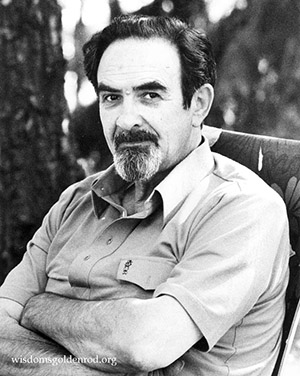
    Anthony Damiani (1922–1984)

    Brunton’s future biographers will continue the story of the next 35 years, drawing on his archive to track him through America, England, Australia, New Zealand, and the European continent, to his last homes on the Swiss lakes. They will soon come across the name of Anthony Damiani, who met Brunton in New York in 1946 and founded Wisdom’s Goldenrod Philosophic Center, not far from Cornell University. From the late 1960s, Damiani led a small group in the study of Brunton’s philosophy, together with Neoplatonism, Buddhism, Vedanta, astrology, and, on the psychological level, Jung.

    For those of Damiani’s students who visited Brunton in Switzerland, it was an unforgettable experience, as it had been for Brunton when he met Ramana, to be in the presence of a man who had fought the battle with the ego and won. That was the final invitation of his works: to overcome the obstacles to realisation of one’s true identity as the impersonal Overself and consequently as an unobstructed ray of the World Mind. In July 1977, Brunton spent a month at Wisdom’s Goldenrod, giving personal interviews, many of which are summarised in the Cornell archive. Two years later the Dalai Lama took time off his American tour to consecrate its new library building.

    In his last years, Brunton found his routine of housework, shopping, cooking his vegan diet, attending to Swiss bureaucracy and a constant flood of correspondence increasingly burdensome. Various members of the philosophic centre went for weeks or months to help with his mundane affairs. After his death, following a second stroke, Kenneth Hurst gave his father’s literary estate to the Paul Brunton Philosophic Foundation. Work began immediately on producing the Notebooks, supported by Brunton’s Swedish publisher, and thereafter on sorting, scanning, and digitising his formidable archive. It took almost forty years before a suitable home could be found for it, when Cornell University’s library recognised, at the very least, a unique contribution to the modern history of India.
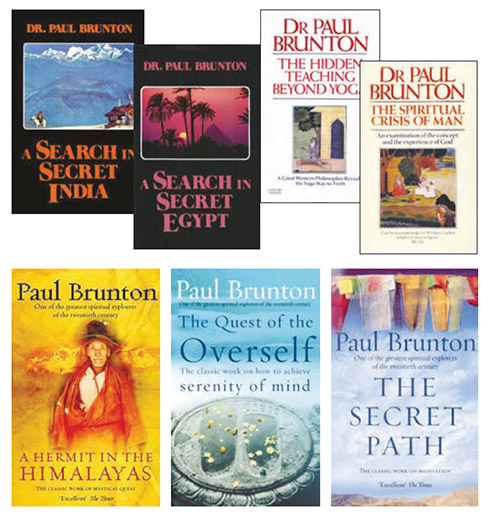
    From the 1930s through the 1950s, Paul Brunton’s eleven books were best-sellers in the field of alternative spirituality. The above is a selection of his titles from the 1930s with new editions in recent decades.

    There are not many accessible archives of twentieth-century spiritual masters and none that can be studied in their entirety from anywhere in the world. Among the 87 file boxes are drafts of his books, unpublished essays, records of interviews, and the original “notes,” including those omitted from the published Notebooks, together with personal details that a more ego-identified person might have suppressed. Cuttings from newspapers and magazines range from metaphysics through the occult sciences to diet, health, and the conduct of life. Brunton paid close attention to world events, which he saw through the lens not of politics but of destiny and karma. A curious relic from the pre-xerox era is his well-worn travelling library, made by Indian assistants who typed out articles, extracts, and entire books. A collection of photographs records scenes in Egypt and India that no longer exist. There is a vast horde of letters in which readers and friends from every walk of life, from royalty downwards, bared their souls to him. Even more inspiring are his replies, for their ability to say exactly what the recipient needs to hear. Yet the older and wiser he became, the more he disowned the role of master or guru, describing himself as “a student of these matters.” To which one can only exclaim: “Some student! Some matters!”

    Thanks and credit to the Paul Brunton Philosophic Foundation (www.paulbrunton.org) for the photos in this article and its digitisation of the archive at www.pbarchives.org, and to the Cornell University Library’s Division of Rare and Manuscript Collections, https://rmc.library.cornell.edu/EAD/htmldocs/RMM08692.html.

    The Notebooks of Paul Brunton (sixteen independent but related volumes) are available from https://www.larsonpublications.com/shop/product-detail.php?id=19.

    [alert type=”general” dismiss=”no”]This article was published in New Dawn 191.[/alert]

    [alert type=”success” dismiss=”no”]If you appreciate this article, please consider subscribing to help maintain this website.[/alert]

    © New Dawn Magazine and the respective author.
    For our reproduction notice, click here.
  • An Aquarian Age Revolution In the Balance

    An Aquarian Age Revolution In the Balance

    From New Dawn 181 (Jul-Aug 2020)

    The challenge of the Aquarian Age is to “inner-stand” between the two personal and trans-personal forces represented by its rulers Saturn and Uranus. 

    Many astrologers fall into the personality trap of labelling poor Saturn as a “grim reaper” or the lord tyrant of time, or the grumpy ruler of Capricorn who is also the co-ruler of the personal choices we make under Aquarius. Call him Planet of Contraction, the hard taskmaster of Discipline, the conserver of resources. In the bigger picture of an age of 20 centuries now dawning, Saturn in its Aquarian transits will expose all the ways our personality gets hung up in restriction.

    Even this idea of restriction restricts understanding Saturn’s true nature. 

    Looking through the mask of personality darkly, the ego filters out the unified essence behind every changeable appearance. Take it as a holy hypothesis not to believe but to explore individually, uniquely. A mask of society’s conditioning can only hide behind it your original face. The one you had before you were born. The one you have after you die. The witness hidden behind the mask that society has made you forget by gathering up its pretences of borrowed personality.

    That happening that remembers this witnessing face of consciousness is a seer. The grim reaper is seen by the unfiltered seer as something other than restrictive. If a luminous and innocent enlightenment came into this world falsely labelled “you,” it is rediscovered waiting behind the mask of “you” that obscured. 

    To that blessed one, Saturn is not a limiter or binder but your best friend. If truth is your centre, Saturn is there to show you the truth behind every action and inaction, hope, fear, dream or nightmare your “personalised” life presents before a constant witnessing consciousness, for that is your “original face.” That is the face the Zen masters metaphorically suggest is the one you cannot experience. All experiences are witnessed outside of “it.” Call it the constant and eternal Witness of changeable appearances that are by their nature limited by their incontinence, like a wave that rises into form and retreats back from whence it came: a cosmic, eternal ocean. The wave as form is not eternal, but the water oceanically is.

    When the original face awakens behind the mask. When the appearance of you as wave remembers each moment in its apparent shape passing that it is not separate from the cosmic ocean, that the ocean ever resides inside the smallest dewdrop, that is “inner-standing.”


    The Aquarian Age is a grassroots-to-mountain peak rebellion against the Piscean Age and its centralised controls, its paternal, death-cult religions that sell the “end times” afterlife and don’t let you live your life in paradise now. 

    The right understanding of Saturn’s personality mask lesson can either bring humanity into an age of a Global Peace or Police state. 

    If you live more in a mask, the transpersonal big-picture ruler of Aquarius, Uranus, will bring you the Dark Side of Aquarius as your reality. 

    Individual sovereignty is the Uranian Aquarian potential. With the 2020s we begin the evolution towards the decentralising down of everything left behind by 20 Piscean centuries. The breakthrough into this new age will have transpired the moment any human being this moment becomes fully aware that Being is a nation unto itself. 

    If enough individuals awaken to this, a unique and unexpected paradox of a Uranus society happens only when people are individually sovereign, fully freed by fully awakening consciousness. Only the sovereign individual can turn Anarchy away from its current perversion of self-destruction and Uranian chaos to what Anarchy was ever intended to be.

    True anarchy does not mean “no government” but something more subtle: people who are enlightened to the fact that true freedom – the motto of the Aquarian Age “to Know” – is to know from direct experience and authority that the greater expanse of your freedom equally expands your ability to self-govern. And only a fully free and responsible individual can harmoniously commune with others. 

    Community is a dead Piscean Age word. In this Aquarian Age it will lose the paternal, authoritarian cocoon of a noun and metamorphose into a living butterfly of a verb. From community we set forth into a new age of Communing with each other.

    The “Police State” future is a personality’s misunderstanding from the roots of Saturn in Aquarius’ dominion over the individual facing the transpersonal dreams of Uranus, the higher ruler of the Aquarian Age of “Knowing.” 

    The police state of unconsciousness is the end result of a constant brain-griming the soul behind the personality mask with the dark Aquarian arts of propaganda, corporately controlled media, public commons online privatised to shadow block or de-platform free (Uranian) speech. In a Dark Aquarian Age, Uranian humanity is suppressed by the inhuman, privately controlled, non-alive, no-human of A.I. (Artificial Idiocy). The magnification of such idiocy into our machines is not an intelligent future but technological Viagra for the lusts of intellect presuming wisdom. 

    I ask you intellectually-identified creators of A.I. this question: How can you qualify “intelligence” with “artificial”?! Only the unwise can overlook this oxymoronic move. 

    Man created ego-bots and Adolf Algorithms, and all the artificial “almost-intelligent” ways to render humans slaves of a virtual enlightenment. 

    The Aquarian golden-aged alternative requires enough individuals in this era of individuality communing right here and now to become aware of what wisdom is lacking in A.I. because until your mask comes off, ego identity makes everyone AH! (Artificial Humanity).


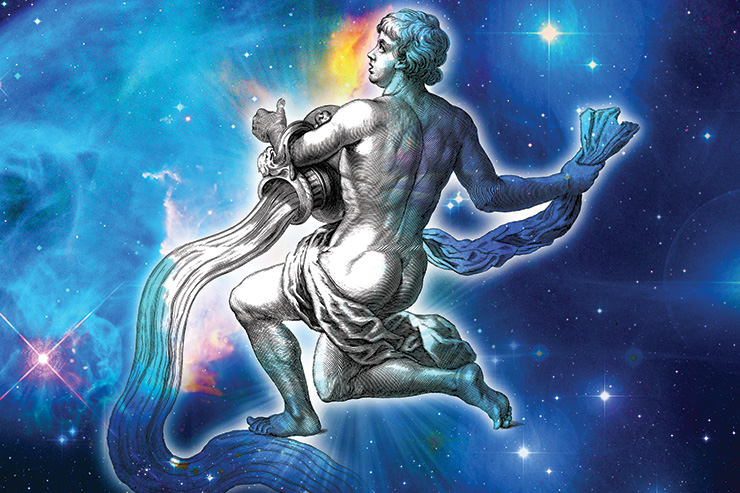
    The atmospheres of Aquarius the Water Bearer – that electric blue mist of a water that vibrates in its angular symbolic lines like a stock market’s ups and downs, booms or busts – changes the climate of the mind and the world’s atmosphere into an auto-suicidal future if the individual remains masked. However, Saturn in reality illuminates only the limits of your illusions against the limitless possibilities of Truth. 

    Take his hand to remove your mask. Let the Original Face, the Source consciousness, be rediscovered under its fake-mask of ego and then all the things Uranus and his Water Bearer rule in Aquarius, those things you cannot see but underpin all and everything – such as your consciousness – guides a 20-century age. 

    Aquarius rules the invisible, the Science of the Awakened Ones: A Truth that does not “exist” – therefore it is free of the burden of existing and “non-existing” too. The Atmosphere of Enlightenment that is your very being can never be seen, because all experiences, including that of your personality, its thoughts, emotions, body, are appearances reflected in the being’s mirrorlike consciousness. 

    You cannot seek what you have always been, but you can forget it and run around every corner of reality and illusion for millions of misery-go-rounds of incarnate life, chasing after the thing you never stopped being, this “Itness.” 

    This Is-not-nessing Isness. 

    That is what can be unleashed out of the genie Aquarius’ tipped urn – a brain- and being-washing from Itness in a bath clearing all the dust of identity off your consciousness mirror so being can reflect clearly what is before it, enjoying life fully, living it, but not being of it. 

    Uranus is all for brain-and-being washing, each moment.

    Why hold onto the dirt of eras?

    The personality is a master of collecting dirt of mind, the dust-emote and identities. Let rush the genie Aquarius water out of the urn for an electric power washing of ecstasy for those who move from the motto to know to all-knowing to the ultimate of no-knowing that is the no-mind of being. 


    Saturn in Aquarius touched the roots of dark or golden ages starting on 23 March through to 2 July 2020. Saturn temporarily transiting our skies in Aquarius gave us a little, one-degree dip into the Water Bearer’s urn for potentially better and worse to come when Saturn ends its over three-year transit of Capricorn, the sign of Corporate hegemony. 

    Pluto, the Lord of the Underworld, will miss the “grinning” Reaper in rebellious Aquarius.

    Pluto’s grand Capricorn cycle soon to end by January 2024 began roughly 250 years ago, the last time it serviced a generation’s time in Capricorn when it gave birth to modern democracies, the apogee of aristocratic rule over the birthing of the first middle classes. Pluto’s entry into Aquarius by 1777 began a century of popular revolutions against class asses of the one-percent. 

    The middle classes in North America and Europe 250 years later suffer a midlife crisis while new middle classes spread across much of the developing world. As Pluto’s current transit of Capricorn soon ends, they will seek freedom from the constraints of new corporate-aristocracies and their king trillion and billionaires. The American Revolution of past becomes a global revolution, near future, after 2024. 

    Consider carefully the “prelude” to the next century of revolution we passed through by 2 July 2020. It is Saturn, the ruler of Capricorn and the ruler of the personal actions of each of us, under an Aquarian Age beginning its first travail. The birth pain will scream and cry economic and politically.

    You might find it strange to hear me say this, but a perpetual wave of states of emergencies that keeps fascism overlording people’s freedoms can also strain under the stress of many things these times of constant crisis will throw at the powerful as well as the rest of us, and soon.

    Astrologically speaking, there is about to begin a shift in key, corporate-friendly planets out of their long transit through earth (establishment, finance, banks and world order rulers) into air signs of quick thought, out of the box intellectual curiosity and humanitarian waves of revolution. Saturn began testing the waters poured by Aquarius the Water Bearer on 23 March 2020. Saturn toe dipped one-degree in, then pulled his toe out in retrograde motion to come back to establishment Capricorn on 2 July 2020. 

    Saturn dived into Aquarius on 18 December 2020, stirring the waters of global revolutionary times until 23 March 2023. 

    If you think 2020 was overturning apple carts of comfortable, unconscious life on Earth set in automatic ego-drive mode, brace yourself. On 20 January 2021, the inauguration of a new US president started a political crisis that will rock the world. On that day the conjunction of the Sun, Jupiter and Saturn’s scythe, all in Aquarius, struck the birth of the next term of a man in cognitive decline. Uranus Ruler of Aquarius in its fall in Taurus inharmoniously squares that Sun-Jupiter-Saturn conjunction!

    This president could see a complete political system failure and revolution in his (or her) four years in office. 

    Cry “Revolution!”

    “Pitchforks!”

    Or a complete suppression of the people in a surveillance and dictatorial state, the dark antithesis of the humanitarian, individual’s independence-loving Aquarian zeitgeist. 

    Uranus, the ruler of Aquarius transiting Taurus, squares off against its own sign and higher potentials because it is wallowing unhappily in Taurus the ruler of an ego’s personal business, career, property and consuming. 

    The next four years of this US presidential term has a birth chart that eggs on the vast majority of those who aren’t elites: the working people that had a snoot-full of their freedoms being stomped on by the establishment represented by Pluto and Saturn in Capricorn. 

    The dark side of saturnine Aquarian behaviour will be in full play. Suppression into abject fascism might have initial success but as the mid-decade approaches the cracks cleave. The civilisation’s established centralised power structures of bank, bundestrepublik and bureaucratic control topples. 

    The Piscean-age iconic edifices of political, economic, dogmatic religious and ecologically abusive systemic flaws – exposed completely – at last begin collapsing into a heap. These require a rebuild, a transmutation of what it is to be human, and how we treat ourselves, each other and the world – or extinction is our destiny by 2044 when Pluto ends its 20-year transit of Aquarius (Revolution!) starting in January 2024.

    Its generational transit at the beginning will pick up momentum stirring a collective feeling in humanity to move forward, to change, when Jupiter enters Gemini by May 2024. Its harmonious trines with Aquarian Pluto will be reinforced by an establishment-busting additional series of trines of Uranus starting upon its entry into Gemini in July 2025. 

    Uranus enters Gemini free to think freely and originally. That is when the tide of human destiny may have a fighting chance to survive the long emergency of the 2020s and 2030s up to and through 2044 when Pluto enters spiritually transcendent Pisces in 2044. 

    These are the ultimately good, initially cathartic things, people of the world, especially working people, need. Especially free loving, free thinking and feeling people. Let fire their adrenalin a righteous shock to awareness.

    Hear then in future’s augury these cries of “Havoc!” Letting slip the calls of Aquarian revolution once again as Pluto re-enters the sign of Aquarius that brought the world the French Revolution and many more popular revolutions to follow that changed the world: 


    Government regimes! You told us to stop working, so it is on YOU to bail US out! Grind us not, paying off YOUR debts!

    If I have lost my job, my small business, I am already in a Greater Depression!

    Why should I pay my taxes when banks hold me under rent and mortgage debt but print money for themselves to keep rich without my taxes? 

    Have I no value to you? Is my contribution to the state worthless? 

    Printing worthless fiat money to keep Wall Street speculators fat-and-ass-ly rich is a gesture of those above who view the working people below – all people – as serfs!

    In the times of Life B.C. (Before Coronavirus) compromise was considered a weakness. 

    In times of Life, switching on the A.C. (After Coronavirus), compromise is a strength. 

    Withhold a vote for the lesser of two evil, two-faced Democrat-Republican Corporate Parties will be considered a strength! 

    Following faux progressives and conservatives who preach but don’t ACT revolutionary – Enough! Finished!

    Shout them off the podiums, be they Donald Trumpeting or Bernie Sanders sand-bagging paper tigers manipulating the people’s misery and hope. Just shining the schystery on. Just talking about revolution and change with no balls to do it. 

    Real flesh and blood suffering people of America! Take back your Right to Life from those Corporations-turned-into-People. Let the un-human dead bury the undead! 

    It is we the living who make the world run. We the creatively working human beings that are the motive force. We Real people of the Real economy make the wealth, make the things that make a civilisation. 

    WE! US!! 

    Not you corporations masquerading as human things. 

    We will cast out the speculators with all the compassion of Jesus Christ overturning the tables of moneychangers in the Temple of the Living.

    Do not distract us with your infernal work to wage war on Iran or start a cold war with China added to one against Russia. Watch our anti-war movement gather. Watch us fight and cast out the largest Socialist boondoggles ever imposed: corporate welfare for the Rich, the Military-Industrial Complex and its pimp warmongers addicted to a business of fear, blood and death sustained by over HALF of the living citizens’ annual taxes. 

    Cut that American war machine business down to size and 90 percent of ALL WARS and threats of civilisation-ending cold-wars-turned-nuclear-hot would disappear. 

    Have at you! Witch-hunters of surveillance.

    We will not assuage. We will Julian Assange

    We have truth hunters and whistleblowers to catch you before comes a human holocaust in reply. 

    The time is rapidly approaching when we will arrest and put on trial all those politicians and businesspeople who broke up our American industries and sold them to China in the last 30 years. 

    Don’t blame this on China, or Russia, otherwise you are no different than Nazis who blamed everything wrong with their state of Third Reicheous-ness on the Jews. 

    Get this, finally! 

    China never stole a single job from Americans. 

    Corporate America did. 

    China is not our enemy as much as Corporate Americans are America’s enemies! 

    And you will face the people’s punishment like it was a new Nuremberg trial and like Hitler’s henchmen, you wretches of industry will be crowding the people’s court. You will be convicted to a life in prison of hard labour for hollowing out the American middle class, stripping us of our jobs, our industries, our self-reliance. 

    You left us exposed to plagues, banana-republic medical care, and governance bought by your rot over us! 

    Recessions and Depressions caused by YOU! 

    Get the issue this article appears in

    To be fair, we the living had our part in this. 

    Our blind faith and sheepish compliance.

    We are now paying the price! 

    We the unemployed Americans by the tens of millions by YOUR ORDER! 

    We believed in you blindly, you corporately lobbied and bribed leaders governing over us like an armoured bank truck full of money running over us! 

    Yes, that is our fault. We are already being punished for that. 

    Now it’s YOUR TURN!

    Cry “HAVOC!” and let slip the ire of real people AWAKENING!

    [alert type=”general” dismiss=”no”]This article was published in New Dawn 181.[/alert]

    [alert type=”success” dismiss=”no”]If you appreciate this article, please consider subscribing to help maintain this website.[/alert]

    © New Dawn Magazine and the respective author.
    For our reproduction notice, click here.
  • Toward the Practice of the Original Magic of Zarathustra

    Toward the Practice of the Original Magic of Zarathustra

    From New Dawn Special Issue Vol 11 No 4 (Aug 2017)

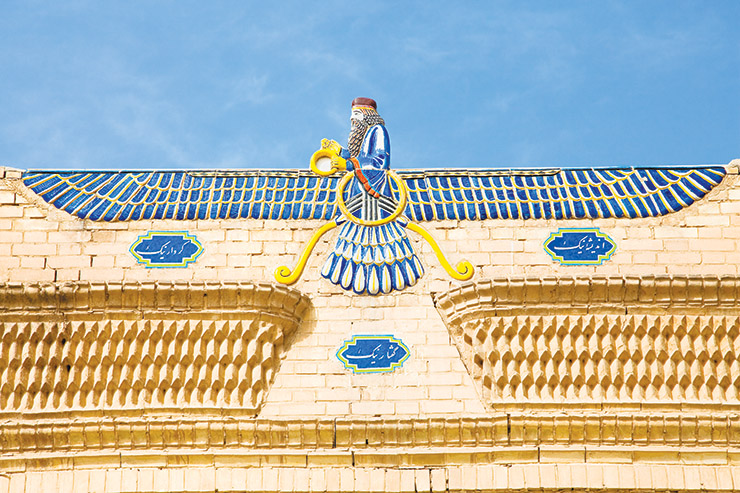
    One of the enduring signs of the origin of consciousness beyond the limits of our present planet is that of the Persian Faravahar – a winged disk mounted by the figure of a human being. In tradition this is a symbol of the fravashi, individual consciousness, but many also see it as an indication of the instillation of consciousness in humanity by higher beings. This it is as well. 

    The speculation surrounding this sign and its heritage recently received a boost when it was rumoured that in the summer of 2011 the American armed forces discovered a cave in Afghanistan containing the remnants of an ancient spacecraft (vimana). Reputedly the cave also contained inscriptions indicating the cave and its contents belonged to the ancient Iranian Prophet Zarathustra. Such narratives may or may not be true. The point of the present article is to delve into the little-known doctrines of the magical religion of Zarathustra and its unfolding in the West today. 

    Zarathustra, who probably lived around 1700 BCE, is the father of true religion, that is, a set of ideas and practices that can be adopted by anyone from any tribe or nation. This is because he had the flash of insight that the gods and goddesses of the traditional cult of which he himself was a trained priest were but extensions or emanations of One God: Consciousness. This one god he called Ahura Mazda, or Lord-Wisdom. This entity is one, yet it is dual-aspected, male and female, Ahura (Lord) is masculine, Mazda (Wisdom) is feminine. 

    In Zarathustra’s mind this insight (daena) also indicated that all humans were originally exponents of this god and that if people could come to see the Truth the Prophet was explaining, each individual could return or revert to the true religion which was his or her birth-right as a human being. 

    The word daena means both ‘insight’ and ‘religion’. (In Modern Persian it is din [deen].) Instead of seeing ‘religion’ as a strict set of rules and regulations, it is a higher mode of action to strive for insight, or true inner transformation – good thoughts, words and deeds follow from one’s being rather than as a result of trying to follow rules or laws. 

    The magical religion founded by Zarathustra came to be called the Beh Din, ‘the Good Religion’. At first it was a universal religion open to all peoples, but as other religions developed and as the conditions of the surviving Zoroastrians worsened, it evolved into an ethnic faith and conversions were discouraged. 

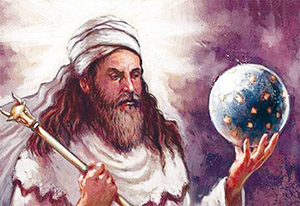
    Zarathustra was widely reputed to be the inventor of ‘magic’ by the ancient Greeks and Romans. The word ‘magic’ is indeed derived from an Iranian word for ‘priest’, and thus refers to their craft and science. The magi, such as the ones that supposedly visited and honoured the young Jesus, were Zoroastrian priests. The religion which Zarathustra founded can be called a magical religion in that one very important part of it is the technology of ritual whereby changes can be made in the environment and in the essence of the individual. 

    The tribe to which Zarathustra belonged was an Eastern Iranian one and he lived in the region of the present-day Aral Sea. The Iranian peoples spread from the borders of China into the heart of Europe in ancient times. The Persians formed the world’s first multinational empire under Cyrus the Great. The Scythians and Sarmatians were horse-riding nomads who spread out over the steppes of Central Asia to eastern Europe where they productively interacted with the early Celts and Germanic peoples. It is said that the stories of King Arthur and the Grail derive from them. Because the Iranians, Celts and Germanic peoples belong to a common family of Indo-European language and culture, the cross-fertilisation was especially profound.

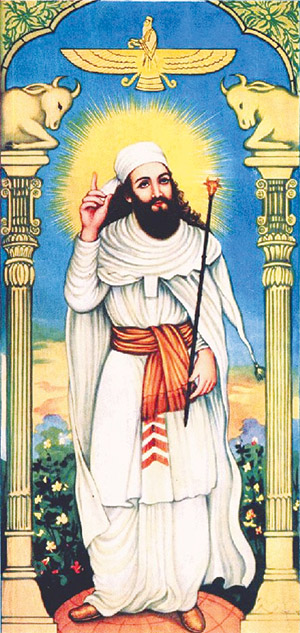
    Common portrait of Zarathustra with Faravahar at very top

    Ahura Mazda originally created a perfect cosmos, which at once came under attack from negative shadow forces lead by Angra Mainyu (‘Destructive Spirit’) and his legions of daevas. In order to combat this onslaught, Ahura Mazda created humankind to enter the world to fight the good fight against the forces of negativity. The fravashis, good spirits who originally guarded the ramparts of Ahura Mazda’s celestial fortress, were inspired to choose to incarnate in physical bodies to fight the daevas in the world. 

    Zoroastrian daevas have little in common with Western demons, as daevas are devoid of any positive qualities or heroic dimensions of rebellion against an oppressive order. Ahura Mazda is the friend of mankind and the promoter of mankind’s (re)development toward a god-like level of being. Additionally, Ahura Mazda created a whole range of yazatas, ‘ones worthy of worship’, chief among them are the Amesha Spentas: ‘Immortal Bounteous Ones’. Ahura Mazda is all-seeing and all-good, but is temporarily not all-powerful. But the deity has created the elements necessary to overcome this temporary situation. The Will of individual human beings is, however, necessary for this to be a successful venture.

    Ahura Mazda created humankind by combining a living essence from the terrestrial world with the spirits of the fravashis from the supernal world. These spirits battle for consciousness against the evils of sickness, weakness, ignorance and stupidity. Humankind forms a necessary army of valiant warriors against the daevas, or patterns of negativity and destruction. It is the work of all individuals to awaken to their true natures, develop those natures, and work against all forces of negativity in the world. The first part of this process requires the use of magic. Because every human now incarnate is thought to have originally volunteered to enter this world, and because they are under unrelenting attack from the daevas, Ahura Mazda assures that in the end all individual humans will reach a state of salvation – perfected immortality, both spiritual and physical. There is no eternal damnation because there is no original sin. There is eventual eternal reward because there was original heroism in that every individual fravashi volunteered to enter the fray exposing itself to suffering and numerous challenges. 

    Individuals forget the Truth of their existences and their heritages, but through the Mazdan teachings of magic they can learn to remember. The Lie is that humankind is mortal, sinful and corrupt. Ahura Mazda cannot logically punish eternally his soldiers just because they have sustained grievous wounds in battle. The fravashis of humankind who have distinguished themselves in life and in the battle are actually worshipped as divinities in the pantheon of the Mazdan yazatas (gods or angels). 

    Much is made of the Zoroastrian ideas of this great battle between the angels and demons (yazatas and daevas). It is important to realise that these entities are not humanoid cherubs and imps, but rather are best understood as patterns or paradigms of action and being, rather like biological systems, operating theories, communicative signals, etc. Most are positive and move Creation toward perfection, but some are negative and thwart such progress and cause depression, chaos, inertia, sickness, fatigue, and so on. When the will of the individual is inspired by the Truth, that individual also attracts a number of daevas bent on interfering with the transmission of Truth to the consciousness of that individual. This is why so many a noble beginning ends in defeat. Awareness and the use of certain manthras and other practices shield the individual entering the battle for Truth. 

    During his own lifetime Zarathustra instituted a Great Fellowship (Maz Maga) which carried on the verbatim recitations of his compositions in the Avestan language and the ritual mechanics all of which together formed the original magico-religious technology. The oral recitations formed what are called manthras, akin to Sanskrit mantras, and the ritual mechanics were streamlined and intensified versions of those he had inherited from his tribe. The older versions of the pre-Zoroastrian rituals were virtually identical to the Vedic rites of India to which they were closely related. The new forms were paired down to their essential components and perfected by the Great Fellowship. This Great Fellowship continues to exist. Its esoteric symbol is that of the honey bee. Over the centuries this secret fellowship acted as an embassy to the other peoples of the world at various times and through this agency greatly affected the religions of the world which developed after the inception of Zoroastrianism. Judaism was reformed under its influence around 500 BCE, Christianity was influenced greatly by it, and Islam borrowed much from Zoroastrianism and was in some areas heavily Persianised on an esoteric level. 

    Zarathustra’s modification of ritual was done under the strictest scientific precision to reveal the laws of what the ancients termed ‘magic’. The English magician Aleister Crowley once said the essence of what he termed Magick was the gaining “of knowledge and conversation of one’s Holy Guardian Angel.” The whole idea of angels (and demons for that matter) was borrowed by other religions from the doctrines of the Zoroastrians. The Holy Guardian Angel is nothing other than the fravashi that expresses the divine part of yourself, but of which you remain largely ignorant most of the time. Therefore, the essence of magic can be seen as the raising of consciousness to the level of the innate divine spark, known as the fravashi, and furthermore learning to gain wisdom, insight and knowledge from this innate source. This is the innate wisdom the Zoroastrians speak of. It is balanced by acquired wisdom, or experience. In the final analysis, the Mazdan Way is a balance of the logical and rational with the mysterious and celestial. 

    One of the other extremely important aspects of the Mazdan method, which has already been alluded to, is its doctrine of ethics summed up in the formula: Good Thoughts – Good Words – Good Deeds. The concept ‘good’ indicates: effective, powerful and aimed toward the goals of wisdom, strength and well-being. A more complete practical discussion of this ethical code is contained in my recent book The Mazdan Way (Lodestar, 2017). It is generally held that all people who practice the doctrines of these three ethical components are de facto Mazdans, no matter what they call themselves – Zoroastrian, Jew, Christian, Muslim, pagan, atheist or whatever. The idea that a good people are condemned for all eternity because they didn’t say certain words, or did not undergo this or that ritual, is illogical. 

    One of the main aims of the Mazdan system is to ensure the happiness of the individual. This happiness is known by the Avestan word ushta. Zarathustra taught that life was intended to be enjoyed, and that by being happy, and by enjoying life, helps all seven parts of the Good Creation: one’s fellow humans, fire, plants, animals, the waters, the earth, the sky. These joyous activities above all other things help the good and at the same time do the greatest damage to the negative forces all around us. Every joyous thought, each kind word, and all positive acts cut deeply into the corpses of the daevas.

    In its recent history, orthodox Zoroastrianism has not readily accepted converts, and besides this its culture is one that has been created by and for its followers over a period of almost four millennia. As such it is difficult for Westerners to absorb. A Western form of the Good Religion has been formed called the Occidental Temple of the Wise Lord (OTWL). A basic outline of this religion is given in my book The Good Religion (Lodestar, 2014). This is an independent branch of the tradition of Zarathustra. Adherents call themselves Mazdans, not ‘Zoroastrians’. The school of the OTWL takes into account the history, culture and experience of the West. We have a Facebook page called “The Occidental Temple of the Wise Lord.”

    The Mazdan way is a way of action, not contemplation and intellectual activity alone. This is reflected in its ethical structure, which is at its core. Additionally, the way requires ritual action. A full program of such initiatory work designed for individual practice is outlined in my book Original Magic (Inner Traditions, 2017). Mazdan rituals combine manthras (verbal formulas) with symbolic actions according to the Mazdan theory. Here I provide a simple ritual for readers to try for themselves. Many of the holy manthras are in the Avestan language and were composed by Zarathustra himself or other later seers and priests or magavans. It is thought that these manthras have innate power and that by reciting them from memory the forces locked up in them are released. The key to Mazdan magic is connected to the mysteries of the ancient astrological calendar which ascribed a yazata (god or angel) to each of the three hundred and sixty degrees of the circle surrounding the planet. 

    Get the issue this article appears in

    A Simple Mazdan Rite

    The letters in square brackets are phonetic representations of the verbal formulas. Translations appear in quotation marks. 

    Sit at a table in a comfortable position, facing south, if possible. Place before you a water bowl and a votive candle in another bowl. The water bowl should be just in front of the candle. Light the candle with the manthra:

    Yazdan ni yad!

    [yaz-dahn nee yah-d]

    “In honor and glory to the Creator.”

    Gaze at the flame and say:

    Nemase te atarsh Mazdao

    [neh-maseh-tay Atarsh mazdow]

    “Homage to thee, Fire of Wisdom.”

    Contemplate the flame for a few moments and realise it as the earthly manifestation of the divine flame of intelligence and wisdom. Gaze into the water bowl and see in it the primeval waters and the source of all life. 

    Repeat the following manthra:

    Ashem vohu vahishtem asti, ushta asti, ushta ahmai hyat ashai vahishtai ashem.

    [ash-em voh-hu va-heesht-em as-ti oosh-tah as-ti oosh-tah ah-h-mai h-yat ash-ay va-heesh-tay ash-em]

    “True order is the best good, and it is happiness. Happiness for the one who is truly ordered for the sake of the best true order.”

    Such manthras were composed using magical (operative) criteria, not linguistic clarity. Numerological and other factors play a part in their formulation. The basic meaning of the manthra is that happiness is attained by doing things in accordance with right order (Truth).

    The manthra can be repeated as a sort of chant, or you may simply silently meditate on its meaning until you feel that your consciousness has become attuned to that of Ahura Mazda. At that point and in that state of mind you can, if you wish, open yourself to the higher form of consciousness signified by Ahura Mazda and the Amesha Spentas. Once you feel that the vision is clear and you want to charge it, or solidify this insight, touch the rim of the water bowl with your left hand and the vessel containing the candle with your right hand simultaneously. By completing this electromagnetic circuit the higher work is completed. 

    To close the rite repeat the manthra:

    Ashem vohu vahishtem asti, ushta asti, ushta ahmai hyat ashai vahishtai ashem.

    And utter the words:

    Atha jamyat yatha afrinami

    [ah-thah jam-yaht yah-tha afree-nah-MEE]

    “Thus may it come as I wish.”

    Such ritual practice, in conjunction with intellectual study of the teachings, mythology, cosmology, psychology and ethics of the Mazdan Way, constitute the beginning of the inner journey toward the practice of the original magic. 

    To learn about The Occidental Temple of the Wise Lord, an entirely independent Western rite of the Good Religion with Zarathustra as its Prophet, visit www.facebook.com/totwl. Email: totwloutreach@gmail.com

    To learn more, read Dr. Stephen E. Flowers’ book on the history, theory, practice, rituals, and initiations of the Mazdan magical system practiced by the Magi of ancient Persia – Original Magic: The Rituals and Initiations of the Persian Magi (published by Inner Traditions) – and available from all good bookstores.

    [alert type=”general” dismiss=”no”]This article was published in New Dawn Special Issue Vol 11 No 4.[/alert]

    [alert type=”success” dismiss=”no”]If you appreciate this article, please consider subscribing to help maintain this website.[/alert]

    © New Dawn Magazine and the respective author.
    For our reproduction notice, click here.
  • Of Cannibals, Inquisitors, Mainstream Militants & Escape Artists

    Of Cannibals, Inquisitors, Mainstream Militants & Escape Artists

    From New Dawn Special Issue Vol 12 No 1 (Feb 2018)

    Recently re-reading St. Augustine’s Confessions, written over sixteen hundred years ago, I was struck by one aspect that had previously eluded me: the authors he refers to are, for the most part, still known to us today. Whether consciously or not, he was already contributing to building the Western canon. The Aristotelian-Euclidean-Cartesian-Newtonian-Darwinian/Spencerian canon by which the Western world operates to this day has been in the making for millennia. Along the way, there were death blows to the possibility of at least one other canon, for example the Platonic Academy, which was first destroyed by the Roman dictator Sulla in 86 BCE. Then, having been revived centuries later, was closed once and for all by Justinian I in 529 CE. The Church had/has its Canon Law and was, for centuries, a strict enforcer of it, with anything beyond it being perceived as heresy and vigorously stamped out.

    While the Western world in the 21st century is free from alacritous canon-enforcing enterprises such as the Holy Inquisition, it nevertheless operates by a canon which remains very much the mentioned Aristotelian-Euclidean-Cartesian-Newtonian-Darwinian/Spencerian one, inculcated into us all from kindergarten to the grave, echoed not only by schools of all levels, but by governments, the media, official institutions and nonofficial entities and, last but not least, by the entertainment industry. 

    Judging from the history of mankind, the simple reality is that people both need and like dogmas. Concepts that to an uninvolved and level-headed mind seem grotesque, evil and everything in between, at a certain time and in a certain place looked just right. Customs that appear barbaric today were the norm once, and vice versa. The Holy Inquisition is the obvious target, as is the Nazis’ Final Solution. But what of Stalin’s Great Purge? The Khmer Rouge Killing Fields? Ethnic cleansing in the Balkans? 

    And then there are many less obvious examples. 

    In his book Los Invencibles de América, Spanish author Jesús Á. Rojo Pinilla maintains that, far from committing genocide against the Aztecs in what is today Mexico, Cortés and his conquistadors saved them from a self-inflicted holocaust. Animal husbandry being unknown to the Aztecs, they and their neighbours were essentially eating each other to the brink of extinction. Not only did they commit tens of thousands of human sacrifices every year for religious motivations, and thereafter ate the thighs of the sacrificial victims, but their cannibalism was widespread because of the scarcity of food. The contemporary Western canon, still a staunch supporter and propagator of the Leyenda Negra (the British/American propaganda that demonises Spain and all things Spanish), in the face of historical and archaeological evidence teaches us the opposite: that pre-Columbian Mexico was the Garden of Earthly Delights and that the conquistadors proceeded to exterminate everyone. DNA testing on the contemporary Mexican population reveals that 30% of them are of pure Aztec or Maya descent; 60%, mestizo; and only 10%, white. If the alleged holocaust had in fact taken place, wouldn’t the DNA of contemporary Mexicans indicate an overwhelmingly white descent? 

    One should think of dogmas or, in their combined puissance, of the canon as an inescapable force not dissimilar from gravity. Can it, in fact, be escaped at all?

    Some readers of my books have sent me e-mails asking for suggestions about what they might read in order to break out of the Western canon. I’ve been thinking about that request for some time and, while a complete list of books would be impossible and at any rate well beyond the scope of this piece, I suspect that a small list, to begin with, could be of help to those curious minds that are contrarian by nature, or disillusioned with the current Western canon and the all-pervasive propaganda that reinforces it. Here follows my (drum roll) eye-opening, assumption-challenging, horizon-broadening list.

    The I CHING, not only mankind’s first (known) book, but a very thorough dissertation on accidentality in juxtaposition to Western man’s obsession, i.e., causality, that self-evident and asinine nexus between cause and effect on which Western philosophy nevertheless built entire systems. Moreover, consulting the I CHING as a divinatory tool can be as infuriating as it can be enlightening. 

    Skipping thousands of years, Lin Yutang’s The Importance of Living. Lin Yutang was a philosopher of life, translator of Chinese classics into English, novelist and an inventor. He is the one who finally solved the riddle and, in 1946, succeeded in producing the unthinkable: a workable Chinese typewriter! Amid his writings he left many epigrams, lustrous exercises in witty prose as well as in non-linear thinking. You would think that the Dude, from the film ‘The Big Lebowski’, has metabolised his teachings, for example: “It is amazing how few people are conscious of the importance of the art of lying in bed.” “It is characteristic of play that one plays without reason and there must be no reason for it.” “A good traveller is one who does not know where he is going to, and a perfect traveller does not know where he came from.”

    Jesus Lived in India: His Unknown Life Before and After Crucifixion by Holger Kersten. To reconfigure Jesus as a Buddhist does the world the great favour of releasing him from the Abrahamic tradition. Also, his not dying on the cross is explained with such abundance of telling details (often in plain sight in the various gospels), I tend to be convinced of their veracity. And Paulinism being smuggled and imposed as Christianity – that has caused not a little trouble down the centuries.

    A New Science of Life: The Hypothesis of Formative Causation by Rupert Sheldrake. It opened my eyes, many years ago, and since then Rupert and I have become friends. Darwin (and, by extension, Herbert Spencer, that great co-opter): Goodbye. The first chapter magisterially sums up biology as it’s taught to this day in all schools; from the second chapter on, welcome to a new world. When first published, the prestigious journal of science Nature attacked it with the editorial A Book for Burning? (as it dared to go against the strongly-held convictions of the scientific priesthood). Echoes of the Holy Inquisition from the mainstream scientific world. 

    Of the trinity of essential, prescient works that describe the decadence of the West – Oswald Spengler’s The Decline of the West, René Guenon’s The Crisis of the Modern World, and Julius Evola’s Revolt Against the Modern World – I would pick the latter, with Hermann Hesse’s warning that it is a “really dangerous” book. And so it is. It’s difficult not to be swept away by this radical rethinking of history. Its Wagnerian scope and intrinsic power make it one of the most disruptive books ever written, particularly because it’s so well constructed and so profoundly erudite. I would recommend it, but with the caveat: to be read cum grano salis by a mature, Apollonian reader, not by an impressionable, Dionysian youth.

    The less heady but equally central The Revolt of the Masses by José Ortega y Gasset may well provoke the ire of contemporary progressive “thinkers” and the joy of those who don’t digest their propaganda. Compare and contrast the very well-established concept: “Everybody is entitled to their opinion” (grammatically incorrect in deference to feminist sensitivities) to “The sovereignty of the unqualified individual, of the human being as such, generically, has now passed from being a juridical idea or ideal to be a psychological state inherent in the average man.” The masses, maintained Ortega y Gasset, are the rabble; only the individual counts, if (s)he goes through a process of initiation, which is life-long. 

    Very valuable is Aldous Huxley’s anthology The Perennial Philosophy: An Interpretation of the Great Mystics, East and West, an excursus across space and time in search of the same matrix.

    Weren’t St. Francis of Assisi and St. Anthony of Padua a bit peculiar – and extreme? Where did Cervantes draw inspiration for many of the adventures in his Don Quixote? Idries Shah’s The Sufis explains how much the West owes to Sufism and its teachings, and introduces the fundamental practice of non-linear thinking.

    For a touch of India from a Western perspective, and limiting it to a single book, I would pick Paul Brunton’s A Search in Secret India. His sensible approach, unwillingness to be credulous, and nevertheless slow transition from being a non-believer to becoming open to wonder, is a wonder in itself.

    Julius Evola wrote various books that deserve mention. But having to choose, in addition to Revolt, I would signal The Hermetic Tradition, praised even by C.G. Jung, whom Evola disliked for obvious reasons, chiefly the former’s insistence on the “lowly” unconscious.

    Which brings us to Carl Gustav Jung who is not an author but a voyage. He touched upon just about everything, and his most gifted disciple, Marie-Louise von Franz, was as insightful, as well as possessed, unlike her teacher, of the art of concision. The reader who wants to depart from what
    (s)he has been taught since the crib could start with Jung’s exceptional Answer to Job. And for a touch of early ufology, Flying Saucers: A Modern Myth of Things Seen in the Skies.

    While on the subject, George Adamski’s Inside the Spaceships is a great read; should the story not be true, it would still be highly engaging, eye-opening science fiction. For a more level-headed treatment of the subject, Patrick Harpur’s Daimonic Reality: A Field Guide to the Otherworld remains one of the best works on this elusive theme (while I would stay away from anything written by Whitley Strieber under the pretence of being true). 

    Graham Hancock’s Fingerprints of the Gods was written, as a successful breakthrough, with the technique of fiction, rather than nonfiction. As a result, it’s an engaging read. Some of its claims are… odd (Atlantis in Antarctica!), others, for example the actual occurrence of the Great Flood, have been confirmed by various other open-minded scholars. 

    I like anything either written or published by David Hatcher Childress, the real-life Indiana Jones. The back-covers of his books are full of bombastic tidbits, but in fact his writing is well-researched and careful, and he tends to present unusual facts and findings while consistently trying to strike a balance between enthusiasm and plausibility. 

    David Conway’s Complete Magic Primer begins with an excellent, if condensed, history of magic and mysticism, and slowly morphs into an instruction manual. In other words, it teaches hands-on magic. Only for the stout of heart; I would not be toying with any of this, especially if I were not a believer. 

    Forbidden Archaeology by Michael Cremo and Richard Thompson is useful in revealing in a very methodical and indeed scientific way to what extent mainstream science has gone in suppressing the evidence pointing to the reality that humans have inhabited this planet for much longer than we are told. In Chapter 1.11, for example, there is a very lucid explanation of the “Phenomenon of Suppression”: the different stages by which an anomalous finding is either ignored, explained away, ridiculed, dismissed, or suppressed. Quite an enterprise from an activity – science – that originally set out to explain the unexplained or seemingly unexplainable. While the ponderous tome of 914 pages doesn’t make for the liveliest reading, it is nevertheless an impressive contribution. 

    More on the wacky side, and far more entertaining, is Terence McKenna’s True Hallucinations: Being an Account of the Author’s Extraordinary Adventures in the Devil’s Paradise. For those who will never try “heroic doses” of psilocybin mushrooms deep in the Colombian jungle, this is a wild, vicarious ride, an amalgam of science, literature, myth and exotica from an adventurer whose genuine inquisitiveness in things psychedelic goes hand in hand with mythomania – what an exuberant explosion of literary and philosophical high kitsch! If not persuaded, there follows the endorsement from The New York Times: “The polysyllabic sentences he lards with intellectual references are an attempt to lend credibility to the otherwise debunked subject of drugs.” Yes, a hatchet job from The New York Times could not make for a more valuable endorsement. 

    Equally wacky and even more wide-ranging is The Morning of the Magicians: Secret Societies, Conspiracies, and Vanished Civilizations by Louis Pauwels and Jacques Bergier, quite an international bestseller down the decades. Inter multa alia, the reader will find a description of how hands-on alchemy actually works; a parallel between the Mayans and the Nazis; and then some. As ever, the nagging question is: What if even a fraction of this were true? What have we been told instead, and why?

    With scholarly discipline but also with a decidedly English sense of humour, The Rough Guide to Unexplained Phenomena 2 by John Michell and Bob Rickard, takes a path along that shadowy territory between the known and the unknown, between the dogmas of mainstream scientists and the reality of phenomena that happen regardless of such dogmas. Much as, in a dramatic reversal, Galileo said centuries ago, after being forced to recant his claim that the Earth moved around the immovable sun: “And yet it moves.” (Back then, science, in its nascent state, was based on unbiased inquiry and rejected dogmas de facto. Today, mainstream science has morphed into a scientific priesthood.) The late John Michell was the author of, among others, View over Atlantis, one of the cult reads of the 1970s; Bob Rickard is the founder and editor of the Fortean Times.

    Get the issue this article appears in

    My friend and co-author of two novels, Joscelyn Godwin, has written, translated, and edited many books that could be on this list. One of them, Artkos: The Polar Myth, explores a different origin of mankind in conjunction with various other occult myths. I should remind the reader that while I do not necessarily adhere to any of the beliefs expounded in these books, I am interested in learning about alternate versions of the same reality, which some (at times lunatic) fringes were, or are, convinced of. The level of scholarship is very high, as in all of Joscelyn’s works.

    Finally, and possibly shockingly, I would include a few instalments from George MacDonald Fraser’s outrageously entertaining Flashman saga – take your pick. That’s because his masterful portrayal of Flashman is too close to what man’s nature really is once stripped of all its phony, superimposed veneer of civility. In fact, should man be “re-wilded” (and all it takes is a catastrophe, natural, nuclear or otherwise), Flashman’s outrageous trespasses would, in comparison, seem benign. 

    This is far from an exhaustive list, which did not set out to be complete in the first place; lastly, please remember that the following caveat applies to its every book: to be read cum grano salis [‘with a grain of salt’]. 

  • The Eurasian Vision: From the End of History to a New Beginning

    The Eurasian Vision: From the End of History to a New Beginning

    From New Dawn Special Issue Vol 15 No 3 (June 2021)

    The Eurasian idea is an open idea. It is open toward both the past and the future – what will happen in the future depends on how we understand and interpret the past. This is a very urgent problem, for we are by all means witnessing the collapse of the current international order, an order which was not really international but rather defined by the order of “one sovereign and one master.” In practice, this was a liberal order, defined by very specific visions and ideas into whose circles we inadvertently moved. Now we are finally free from this. We can take a breath of fresh air with full lungs and start “from scratch.” 

    Of course, this does not really mean starting from nothing. In the 1920s, the foundations for the Eurasian vision were laid by the persistent, quiet, patient work of enthusiasts (such as Petr Savitsky) and, even before, in the works of Danilevsky, Leontiev, and Dostoyevsky. These thinkers outlined a “Copernican revolution of history”: the future is not predetermined, and time does not run linearly. There are no privileged points on the globe, nor is there one privileged time, unless we adopt the axioms of liberal ideology. There is no singular and binding direction of historical development; rather, there are many divergent directions that cannot be compared to one another in terms of stages in the development of a single process. 

    Taken together, Danilevsky believed that these directions make up the richness of history and express the different possibilities of mankind’s development. In fact, every civilisation has its own time, and it draws its own schemata over the course of its development. Only the totality of civilisational paths gives the unique tracing that is the “development of humanity.” The new beginning for world order based on this recognition would correspond to the “other beginning” of which the philosopher Martin Heidegger spoke. 

    Liberal ideology has hitherto prescribed what “progress” is: it is always in the same direction, the only direction allowed. Behind this ideology has stood one world power: the United States of America. There is fundamentally only one world – that is the teaching they preached, a teaching which emerged out of the Enlightenment and quickly spread across the planet. 

    But, if the world is not a universe, then it is, in fact, a pluriverse: there are many worlds. Many of them have been hidden under the illusion of one world: opposite the First World during the Cold War stood the Second (Communist) World, and behind this, somewhere in the shadows, was the Third World (the non-aligned world which is today called the “Global South”). 

    This reality was not all-encompassing: the illusion of “convergence” revealed the reality of many worlds which were, in fact, many different civilisations – the American, the European, the Russian, Islamic, Indian, Chinese, etc. This is the truth that the West failed to grasp. Nor does it understand this today. The West was intoxicated by its victory in the Cold War in 1991, which was supposed to be followed by the “end of history” of which Francis Fukuyama spoke. That was what the West wanted to hear at the moment… And it seemed that all of humanity was obeying its will. 

    Yet, this obedience was only seemingly voluntary. It was backed by the world’s strongest power with its aircraft carriers capable of projecting its military might at “any point on the planet.” Then came the regime changes (of “undesirables” making up the “axis of evil”): colour revolutions, more or less violent coups, open military interventions, the occupation of entire countries… This is what the proclaimed “freedom” boiled down to. This was, however, only the “unipolar moment” in the history of the world. It is finished now. 

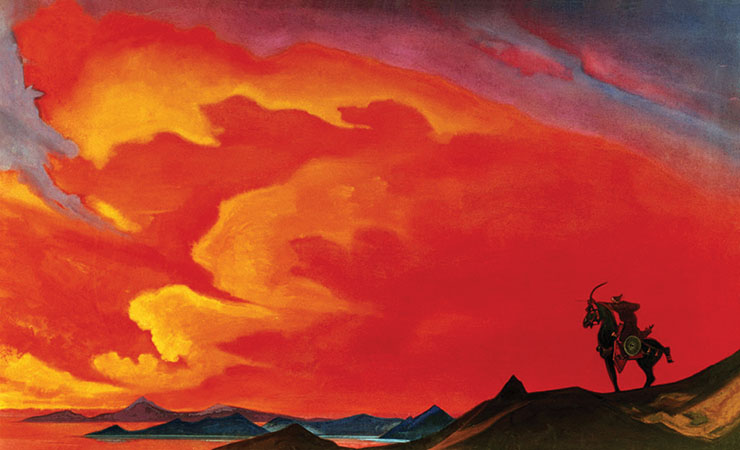
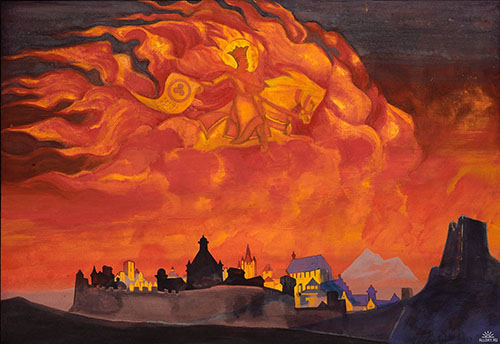
    ‘Armageddon’ by Nicholas Roerich, c.1935

    The End of Western Hegemony

    What’s happened with the hitherto hegemon? The hegemon is “tired” and is no longer capable of dictating to the whole of humanity. At first glance, it seems that all of this has been done by one tiny virus: the coronavirus. This, of course, is not the case. The virus was preceded by a prolonged fatigue, a crisis that has progressed within the West itself since at least the 1970s. 

    First, there was the “retreat of the West” (which is not a civilisation, but rather an ideological construct based on several basic Enlightenment ideas currently holding a certain number of countries together), and today its collapse is underway. The virus only made this crisis visible, and it will not be solved by any monetary measures, nor by ever-new military interventions as the globalists are now demanding. 

    Many are not yet aware of this major change. What about them? That is not our problem. What is important is grasping that the fundamental paradigms for the world of the future are being shaped today – or rather, it would be more appropriate to say, for the worlds of the future, because in such a world there will obviously be no single binding model that would be true for everyone. 

    “Western universalism” was only an illusion. Perhaps it was sweet and appealing to a few countries in which these ideas originated, but it was still only that: an illusion. Living in illusions is ill-advised. The awakening had to come sooner or later. But if it comes too much later, this awakening will be bitter. Today, people are waking up from the “American dream” to discover that it was a well-promoted nightmare and that they can live quite well without it.

    At the same time, this poses a challenge to Eurasia which, after a brief absence, is finally returning to the historical scene. How can this transition be made as painless and with as few victims as possible? In other words, how can it be made known to the hitherto hegemon that it is no longer the hegemon (the one determining the future of all of humanity)? This is no easy task. 

    Today, of course, the hegemon is threatening and rattling its weapons. It is gathering forces for what appears to be a “final showdown” for the “final battle of history.” Will this decisive battle take place at all? It has nothing new to offer. It is only a more militant, slightly upgraded version of the same, with tolerance or its illusion abolished. In its upgraded edition, liberalism is becoming openly totalitarian (having hitherto been so covertly: “If you don’t want to be a liberal, you will be excluded from history” is now “Everyone must be a liberal”).

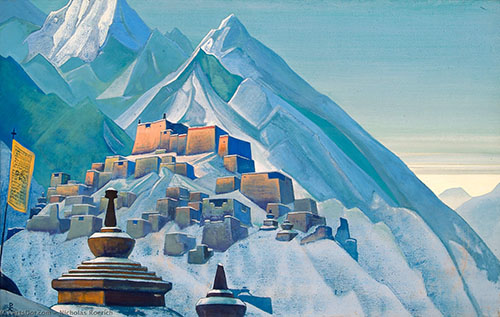
    ‘Tibet, Himalayas’ by Nicholas Roerich, 1933

    Rise of Eurasia

    Meanwhile, new concepts and ideas have taken shape in Eurasia and are quickly being transformed into reality. One of these important projects is the “New Silk Road.” It is, in fact, a very old project that is now being revived, dressed in the new spirit of our times, a project to which the hegemon offers nothing other than interference (the same with the Nord Stream 2 gas pipeline). The hegemon wants quarrels, conflicts, and wars between peoples to thereby impose its dominance. This is how it ruled before. The Russian thinker Aleksandr Dugin has recently spoken of the need to “internationalise peoples” to oppose this hegemony, i.e., nations must not lose sight of the larger whole. They have to look at the much broader picture. This is a fundamental geopolitical reality which we cannot afford to forget. 

    The other reality is that of Eurasia itself. First and foremost, an alliance between China and Russia has taken shape. Integration in different forms is taking effect across the Eurasian continent – integration from which America is to be expelled. The Eurasian Economic Union is the initial form of such, its first incarnation, so to speak. The term “first in history,” however, should be used only with caution because it was preceded by the Soviet Union, before that by the Russian Empire, and still earlier by the empire of Genghis Khan. After all, every real historical project has its reflection in the distant past. The hope remains that for now, this “empire” still in outline develops in the direction of a fully-fledged Eurasian Empire. 

    This process could encourage others on other continents. We could imagine, for example, a Brazilian Empire, sovereign and independent, around which a circle of South American countries would gradually take shape. We could think of African empires or an Islamic caliphate (a true, not a fake one). And we could, in the distant future, imagine a North American Empire, one which would not claim universality for itself and which would express the North American people’s characteristic way of self-understanding, their internal Logos. Every empire, in fact, offers its own answer to the question of what the human being is. The North American people have not yet found a way to understand themselves (there is simply no “American dream”) and have thrown themselves into slavery to false elites in the service of “globalism.”

    Future of Humanity an Open Project

    Either way, the future of humanity is now an open project. Its future actors are defining their places. This is why it is imperative to move away from what the Russian philosopher Aleksandr Dugin calls the “Western codification of consciousness,” which is the custom of looking at the world through Western eyes. The Western cultural, political, social, and economic models are exhausted or have become a burden – an unnecessary, harmful, even dangerous burden. It is important to reassess these models or (if necessary) to abandon them altogether, once and for all, as soon as possible. The Western models for a “mandatory future” should be opposed by our own models of a possible and desirable future. 

    First and foremost, the concept of the nation-state and nationalist state has been overcome. As Rodrigo Sobota remarked, “we cannot forget the fact that the crystallisation of the nation-state as an artificial notion of the specifically Western character has deeply divided us.” The modern nation, reared within the homogenous nation-state and inspired by narrow and exclusive ethnonationalism, is not the same as the people, the community reared by long-standing history and culture, nor is the nation-state the only possible state. Along with the concept of the nation-state, “we must necessarily admit that the ancient Hegelian myth of the state, crystallised as he saw it in the venerable Imperial Germany, is in terminal decline.”

    In today’s globalised world, nation-states, the undoubted product of the 19th century, as well as their firmly fixed borders, are disappearing, and new, supranational, continental or even global entities are being created. These are not merely processes of inevitable “dissolution,” but also processes of creating something new – opportunities for building new relations and ties between peoples. These processes are usually ambiguous in history: it is difficult to determine what is actually collapsing and what is being built. Not everything goes as planned. Processes can be reversed in one direction or another. In the new conditions, both colonialism and anti-colonialism are taking on new forms. Those ideas and concepts, which over the past three or more centuries gave impetus to the “modern West” and enabled its planetary supremacy in a brief historical period, are now exhausted. 

    This is most clearly visible today in the West itself: individualism, liberalism, and utilitarianism no longer ensure superiority – not even material – but are instead turning into obstacles and hindrances. Moreover, they are the reason for the internal collapse and rapid disintegration of Western society and its entire civilisation. All of them belong to the age of the Enlightenment as the fruits of the reason of “enlightened man,” “his majesty the Western European thinker.” It is vain to continue fruitless debates about “values” which are already dead and belong to the irreversible past. Is there a more obvious sign of “internal decay” than this?

    ‘Sophia: The Wisdom of the Almighty’ by Nicholas Roerich, 1932

    Death of the Old, Birth of the New

    We need to build new political, civilisational, and economic structures of continental proportions. We think that empires would be the most suitable for this. When we say “empire,” we have in mind the broadest possible meaning, entities sufficiently elastic and robust (at the same time) to protect their civilisational space from “outside intrusion.” This does not mean that existing nations will disintegrate or disappear within them. On the contrary, by being within them, they will acquire the conditions for normal development. 

    As for where this development will lead them, let the question remain open. “Human” in the plural is “the people,” and every people has its own unique face and character. Every people ought to continue their own particular development, with their own language, tradition, history, culture, and the special heritage which makes them precious and different from others. Empires arise out of the pursuit of this freedom. But this is not “freedom from,” but “freedom for”: freedom for everyone to be who they are. 

    Today, let us repeat, we live in an age of the agony and death of one civilisation – the Western one. This is a time of crisis, an interregnum, of which the great Italian philosopher Antonio Gramsci said: “Crisis consists precisely in the fact that the old is dying and the new cannot be born; in this interregnum a great variety of morbid symptoms appear.” The agonal cramps of one civilisation allow us to sense the contours of the future world. The “new” often comes into the world with birth pangs. There is no way for the sounds and voices of this to be silenced, no matter how hard they try to do so in the West. 

    The death of a civilisation, as a rule, means the birth of a new civilisation, or civilisations, which are in part created over its corpse (in this case, the dead body of the “West”). The new states and new arrangements are not completely “new,” just as “old” civilisations never die completely and entirely. Something will be taken over or inherited and given a whole new meaning and significance in a completely different context, while other things will be condemned to oblivion. The paradigms of new civilisations are built on old foundations. Both the Soviet Union and America, for instance, mysteriously resurrected the concept of empire and thus shaped the bipolar world of the past century. 

    Cultivating All Unique Cultures

    In the first place, this applies to the sphere of culture. Culture is no longer and can no longer be dictated from one centre. We must free culture, or rather cultures, from everything that is outlived, boring, and stereotypical and return cultures to their original meaning. Culture and art are not planetary entertainment for bedtime; culture and art are revelations, awakenings, something that disquiets and moves us to search further for the “new.” Instead of one planetary and commercialised culture, pleasure for the masses, an intoxicating narcotic that always bears the same stamp (“made in the USA”), we will have cultures in the plural. “Yes” to Chinese, Russian, Korean, Greek, French, Finnish, Serbian, and many other cultures – as well as true American culture, a culture that has its own deep roots. “No” to the culture of stereotypes that boils down to faceless imitations, tediously and always repeating the same dilapidated, banal, and now wholly outdated clichés. We must return culture to its original meaning by creating it (anew). And this is, perhaps, our foremost task at the moment. 

    Today we are concentrating our thoughts on the future, on the “new beginning,” while looking back on the past. This is natural and logical. It cannot be otherwise, for everything new “is only a new expression of an ancient, eternal desire,” just as any true “other beginning” is not a mere return to or imitation of the past, but a “new beginning, more primordial than the previous.”

    Boris Nad’s book The Reawakening of Myth is available to purchase from PRAV Publishing (www.pravpublishing.com) and online booksellers. With thanks to Jafe Arnold for the translation.

    [alert type=”general” dismiss=”no”]This article was published in New Dawn Special Issue Vol 15 No 3.[/alert]

    [alert type=”success” dismiss=”no”]If you appreciate this article, please consider subscribing to help maintain this website.[/alert]

    © New Dawn Magazine and the respective author.
    For our reproduction notice, click here.