New Dawn – World's Most Unusual Magazine

Category: Secret Wisdom

  • Twisting the Threads: The Ageless Wisdom of the Western Mystery Tradition

    Twisting the Threads: The Ageless Wisdom of the Western Mystery Tradition

    This article was published in New Dawn Special Issue 5 (Winter 2008)

    Once upon a time, every religion was Janus-faced. It had its exoteric or outward side, serving or exploiting the majority of believers, and its esoteric or inward side, reserved for a few. Christianity had its esoteric side in theosophy, the science of the knowledge of God; Judaism in Kabbalah; Islam in Sufism; Hinduism in the various yogas; Paganism in its Mysteries. These esoterisms were for those with sufficient interest, motivation, and capacity to benefit from them. Entry was through initiation, whereupon, under expert guidance, the elect might embark on the lifelong and demanding quest for reality. That, at least, was the principle, however imperfect it may have been in practice. 

    It is different today. There is a widespread thirst for a deeper dimension to life than the consumer society can provide, and for a better explanation of its enigmas than exoteric religion or materialistic science has to offer. This thirst accounts for the popular success of books and films that feature Gnostic and occult themes, and of conspiracy theories that claim that things are ordered quite differently – for good or ill – than the public is led to believe. If anyone wants to learn more, the secrets once imparted only to initiates are there on the bookshelves, or the Internet. The doors of the sanctuary are agape, but where are the hierophants, adepts, and sages whom one hoped to find there? Most of us seem to be thrown back on our own resources, lonely travellers among the ruined monuments of ancient mysteries.

    The Golden Thread is one such traveller’s offering, and this article is a sampling of it. The book stems from a series of fourteen articles in the New York-based magazine, Lapis: The Inner Meaning of Contemporary Life. Its editor, Ralph White, suggested treating the Western mystery traditions in such a way as to make them not merely historical curiosities, but relevant to his readers. These were typically people with a secure footing in contemporary life, but feeling the call of that “inner meaning” that money and status cannot buy. So I had a dual task: to give them a quick and easy course in the main episodes of Western esoterism, and to show what these have to teach us today. 

    From the start, I wanted to shake the readers up a bit. In the first article, on The Chaldaean Oracles of Zoroaster, I seized on a hint that the Oracles contained an idea of bodily transmutation as a means towards immortality. Yea, yea, says the modern reader, a typically superstitious belief. But wait: what if there were something to it? 

    As testified in the Bible, Enoch, Elijah, and Jesus left no physical body behind after their deaths. The same was believed of the Virgin Mary from the fifth century onward, and in 1950 the Catholic Church proclaimed it dogma. Although always skeptical when told what I must believe, I have no difficulty in principle with this concept. It seems quite feasible that a person’s physical body might be so transformed during life that it becomes indistinguishable from the subtle “radiant body.” The soul then takes the body with it, wherever it goes after leaving earth.

    There is reliable evidence that this has happened in modern times in the case of Tibetan adepts. Eyewitness accounts support the tradition that adepts may achieve the “diamond body” during life. Then, within days after death, their physical body just disappears, leaving behind only the “vegetable” elements of hair and nails. A lesser phenomenon, well attested in Christendom, is that of saints’ bodies that remain uncorrupted, sometimes for centuries. Evidently there is a whole science here, studied in ancient Egypt and Tibet but temporarily in abeyance because of the limits of the Western imagination. Theoretical physics, with its concepts of matter, energy, and mind, might someday provide a framework within which such phenomena can be intelligently discussed.

    The Nature of Metaphysics

    In thirty years of writing, I have consistently tried to bridge the gulf between the academic and what, for want of a better word, I’ll call the metaphysical. It was only in the past century that the academic world virtually banned psychical research, and decreed that a materialistic philosophy was the only permissible base assumption. You can’t entirely blame them. Nowadays there’s such a fear of religion – the exoteric kind – infecting research and throwing its weight around in society as a whole, that the metaphysical baby has been thrown out with the religious bathwater. Yet the higher reaches of physics are already metaphysical. There, the rigid separation of mind from matter is a thing of the past, and things no less strange than the “diamond body” of Tibetan tradition are everyday currency. 

    Here’s another instance in which science is invited to loosen up the boundaries of the possible. It comes in a discussion of alchemy, one of the corner-stones of Western esoterism, which is sometimes interpreted as proto-chemistry, sometimes as proto-psychoanalysis, and sometimes as theosophical allegory. Each interpreter tends to take only one point of view, but I think this a mistake. 

    The proponents of the different kinds of alchemy are different psychological types, and as such are unlikely to favour each other’s methods. Those who work with physical substances do so because it suits them, but it is just as well that the process of human transmutation can go forward without the expense of a well-equipped laboratory. Otherwise poor Jacob Boehme would not have got far. However, if we can believe what we read, is it not extraordinary that, when interpreted one way, chemical recipes deriving from Alexandrian Egypt work in the laboratory, and in another way, provide reliable guidance on the theosophic path? How could these two such different fields be connected?

    Yes, it is extraordinary to the modern mind, so brilliant in physics and chemistry, so ignorant of the inner and the imaginal world. It is almost touching, this childlike faith that the world of matter is the only real one, and all the rest epiphenomena of it. But what if we were to turn the tables and suggest that the inner world is prior to the outer? That the imagination precedes rather than follows the event? That the only reason we see the stars is that we share, for that moment, in their perpetual creation? Then it would be mental and imaginal states that are primary, and the chemical procedures that are secondary to them. As normal, undeveloped people, we are only able to live in a normal, undeveloped world, which is the world known to science. But once supernormal conscious states had been mastered, then one might live in a supernormal world with laws different from those of classical physics. This, incidentally, would explain the miracles of healing attributed to Christ and others, and even the turning of lead into gold.

    Obviously I am not speaking from experience of such “supernormal conscious states,” but only from a position that does not deny their possibility. Likewise, I have no personal knowledge of the Tibetan practices that make the physical body vanish three days after death, but confidence in the veracity of reports. I won’t say that I “believe” in these things, but I won’t disbelieve in them either. That is as far as I claim to have gone beyond the common mind, which snaps shut as soon as it encounters notions of this kind. 

    It is similar with the mentalist doctrine to which the above quotation alludes. I don’t experience the world around me as created by my mind, any more than I perceive the earth beneath my feet as spinning round on its axis, but I am as certain of the former as I am of the latter. In their respective fields, they seem to be the working hypotheses that best “save the phenomena.” However, all human explanations are no more than that. As that immortal American philosopher, Charles Fort, wrote: “I conceive of nothing, in religion, science, or philosophy, that is more than the proper thing to wear, for a while.” This can lead to pessimistic conclusions, but not necessarily depressing ones:

    Efforts to fit the universe into rational systems and schemata are doomed to provinciality, none agreeing with any other. At the present stage of human intelligence, we have no more chance of success than an ant with a theory about human society. 

    The great benefit of a sense of history is that it puts things into perspective, especially science and philosophy. Ideas and theories change with the centuries, and yesterday’s certainties are today’s quaint, archaic notions. One thing is a sure bet: that some of today’s scientific and moral certainties are going to be tomorrow’s quaint, archaic notions. The “touching, childlike faith” in the materialist explanation, mentioned above, is likely to be one of them.

    The certainties encountered in those “supernormal conscious states” are different in kind, and do not change with time and progress. At the peak of gnosis or philosophical mysticism, there seems to be agreement between the sages of all times and races. This is the “Ageless Wisdom” of my subtitle: the gnosis that is always and everywhere the same because it is the birthright of humanity, whether realised or not. However, it is of limited effectiveness in daily life, and communicating it is well-nigh impossible. The preceding quotation continues:

    When the rational mind is bypassed by gnosis, the result is “ineffable” (inexpressible in words), and paradoxically most certain; but that has nothing to do with categories of thought, molded as those are by genetics, language, and the senses.

    The mystery traditions were designed to bring people closer to the gnostic state, but even there, its formulations are contradictory. For example, the mysteries of Orpheus, Mithras, and the Egyptian teachings preserved in Hermetism emphasise preparations for the life after death, picturing the initiate as then deified or at least enjoying the company of the god(s). On the other hand alchemy, Kabbalistic meditation, Rosicrucianism, and occult Freemasonry all focus on transmutation in the here and now. The Greek tradition of philosophical mysticism – Pythagoras, Plato, and the Neoplatonists – combines both, teaching contemplative methods of detachment from earthly concerns that are a preparation for the inevitable detachment of death. 

    As for the religions, they cannot agree about such basic issues as whether there is one god, or many, because they are incapable of the shifting standpoints familiar to the philosophic mind. Given those, the matter is not difficult to resolve.

    The subtle intelligence of Indian, Egyptian, and Greek philosophers easily grasped the truth of monotheism: that there can be only one ultimate source of all things. But the ordinary worshipper, in every religion, takes comfort not from metaphysics but from faith, and draws spiritual sustenance from a personal relationship with a god or goddess. A polytheistic culture like ancient Rome or modern India recognises that there are many worthy objects for such devotion, and allows everyone his or her divinity of choice. Its philosophers keep their understanding to themselves, and do not interfere in people’s religious customs by saying: “You should throw down the idols of Jupiter (Shiva, Isis, etc.) and worship the ineffable One!” Not so the monotheists. The scriptures of Judaism, Christianity, and Islam insist that there is only one God, and in a sense they are right. But what they call God is no longer the One of the philosophers. He is a masculine entity with attributes of a far lower order, such as tribal chauvinism, the desire for love, response to prayers and bribery, and intervention in human affairs. He is no better than the gods of Olympus, yet he is supposed to be the source of all. And as he acts, with bitter enmity to the worshippers of other gods, so do his followers – as if the One could care!

    Some current books on the Western esoteric tradition are factual, scholarly accounts that add to one’s bank of learning. Others are inspirational, written out of enthusiasm for one or another stream, such as Christian theosophy or the divine feminine. The Golden Thread has something of both intentions, but even more, it encourages the reader to face some difficult questions. There is no lack of people eager to supply answers to them, but I see a greater virtue in leaving the questions open and admitting that one simply doesn’t know. This is the Socratic principle of facing one’s own ignorance, which Socrates and Plato taught as a superior philosophical stage to that of most of humanity, who live in a miasma of opinions and beliefs that they mistake for knowledge.

    [alert type=”success” dismiss=”no”]If you appreciate this article, please consider subscribing to help maintain this website.[/alert]

    The Philosopher’s Dilemma

    The following questions arise in the context of what I call “The Philosopher’s Dilemma” (meaning by “philosopher” the person drawn to esoteric studies). 

    The philosopher’s dilemma is the choice between these two fields of action, the political and the personal. It may be phrased thus: Can the state of humanity as a whole be remedied, or is it in such a parlous case that remedy is only possible on the individual level?

    One does not have to be excessively wise to be troubled by this question, but to answer it requires a sounding of one’s deepest convictions about human nature and the place of man on earth. For example, does one believe that life on earth is merely a prelude to a much more important life that begins after death? If so, the social conditions of this vale of tears are a secondary matter, even a distraction. Does one believe, with most Christians, that everyone has an individual and immortal soul, or, with some pagans, that personal immortality is won only by titanic efforts? Is there a clear distinction between material and spiritual existence, or are body and soul both part of a continuum that is split by our misperception? Should I concern myself with humanity as a whole, or with my own salvation, leaving the rest to Divine Providence or the goddess Fortuna? Am I a separate unit with my own spiritual history, a stranger or even exile on this earth (the Gnostic point of view), or do I belong to a tribe, race, or species with a macrohistory of past and future evolution? 

    In studying esoteric and mystery traditions, one cannot avoid coming up against the occult. The term “occultism” is a coinage of the nineteenth century, when it served as a counter-balance to growing materialism, but there have always been “occult sciences” that deal with that which is hidden from the senses. These include astrology, alchemy, the many forms of divination including palmistry, geomancy, cartomancy, and the interpretation of omens, natural magic or the manipulation of the hidden forces of nature, sexual magic, ceremonial magic including demonic and angelic invocations, the science of correspondences, and the study of the beings intermediate in the hierarchy between the gods (or God) and man.

    I see no reason to exclude these from esoteric studies, because the two have so often gone hand in hand. They are part of the practical side, without which book-learning is incomplete; yet the person who dabbles in the occult sciences without a philosophical grounding is worse off still. In The Golden Thread, I acknowledge the reality of the occult domain, and try to bring some sense to it. One concept in particular seems to me worth consideration: that of the “egregore,” explained in the chapter on the mysteries of the Roman empire.

    There is an occult concept of the “egregore,” a term derived from the Greek word for “watcher.” It is used for an immaterial entity that “watches” or presides over some earthly affair or collectivity. The important point is that an egregore is augmented by human belief, ritual, and especially by sacrifice. If it is sufficiently nourished by such energies, the egregore can take on a life of its own and appear to be an independent, personal divinity, with a limited power on behalf of its devotees and an unlimited appetite for their further devotion. It is then believed to be an immortal god or goddess, an angel, or a daimon. 

    One may deoccultise the theory of the egregore by imagining these entities to be mere energy-patterns reinforced by use, analogous to the way in which patterns of neurons in the brain are reinforced and strengthened by use and mental effort. The formation of language is one example of how such a pattern may come to form the dominant matrix for our entire human experience. On the collective level, then, I suggest that the old Roman gods and goddesses did have a certain limited reality, and that they were kept alive by the beliefs of the people, the rituals of the priests and priestesses, and psychic energy released and directed in a myriad of animal sacrifices. So long as this compact continued, the egregores watched over the city, which flourished under their protection. 

    The alert reader cannot avoid wondering what manner of egregores are being formed and might be active today. 

    Just as my philosophical attitude has been influenced by Charles Fort as well as by Plato, so I cannot fail to notice some modern equivalents to ancient occult ideas. One of these, which may have a connection to the egregore concept, is the “science fiction scenario” of Gnosticism, in which a malevolent god, the Demiurge, manipulates humanity. There is a good reason not to dismiss it lightly.

    There are scientists today who believe and even hope that the human race will eventually take over other planets and exploit their environments, with any life forms that may be found there, for human advantage. Give us a million more years and we might become an evil Demiurge ourselves, enslaving the inhabitants of some hapless planetary system, perhaps even without their knowledge. In an era of genetic manipulations, it is no longer frivolous to wonder whether our own earth, and our bodies, might have suffered some such intervention by beings cleverer than ourselves. In view of the continuing inability of materialistic science to explain the origins of humanity, it seems worth collecting material bearing on this hypothesis. There are several separate hypotheses to be considered: 1. That the mutation which brought homo sapiens into being was deliberately introduced by an entity or entities unknown. 2. That early man was educated by superior beings from elsewhere, later commemorated as “gods.” 3. That the motivation of such beings may not have been in mankind’s best interests. 4. That they are still engaged with us, perhaps as the “unknown superiors” of occult groups, perhaps as the aliens who perform abductions.

    The popular literature abounds in claims for all four hypotheses, boldly presented as fact and exemplifying the anti-Socratic method of pretending to knowledge that one doesn’t possess. I tabulate and offer them here in a Fortean spirit, hoping that the reader will agree with me that the cosmos is a strange and complex place, and that there is much we do not know about it.

    In this article I have emphasised the questioning and unsettling nature of The Golden Thread at the expense of its other functions. One of these is to give readers a short but solid outline of the main currents within Western esotericism. Another is to provide, in the notes, a guide to further readings ranging from scholarly studies in several languages to popular works. A third purpose is a personal one. Ever since I chanced, nearly half a century ago, upon Carl Jung’s Flying Saucers: A Modern Myth of Things Seen in the Skies and William Q. Judge’s The Ocean of Theosophy, these matters have fascinated me, and it seems time to draw up a temporary balance-sheet and see where I stand in relation to them. If I am none the wiser, I am certainly the richer for the experience, and readers may sense something of the joy and excitement of it.

    The Golden Thread: The Ageless Wisdom of the Western Mystery Traditions by Joscelyn Godwin, Foreword by Richard Smoley, published by Quest Books, is available from Dominion Press including a collector’s edition clothbound in red and gold with the author’s calligraphic cover design. To order, go to http://dominionpress.net/titles/the-golden-thread/

    [alert type=”general” dismiss=”no”]This article was published in New Dawn Special Issue 5.[/alert]

    [alert type=”success” dismiss=”no”]If you appreciate this article, please consider subscribing to help maintain this website.[/alert]

    © New Dawn Magazine and the respective author.
    For our reproduction notice, click here.
  • The Way of the Sly Man: The Teachings of G.I. Gurdjieff

    The Way of the Sly Man: The Teachings of G.I. Gurdjieff

    This article was published in New Dawn 131 (Mar-Apr 2012)

    It has happened to everyone. You go into a room only to find you have no recollection of why you went; someone reminds you of a promise you made but have completely forgotten; or you realise you’ve set down your keys but can’t remember where. Nor are such cases always matters of failure: sometimes you discover that you have done a perfectly good job of making coffee or writing a cheque even though you have no memory of it.

    We usually take these harmless instances of forgetting for granted; it’s hard to believe that they can tell us anything important. But according to George Ivanovich Gurdjieff (1866?-1949), they point to the heart of the human predicament.

    Long before the twentieth century’s discovery of the unconscious, people knew that there were unseen parts to themselves. “I cannot totally grasp all that I am,” wrote St. Augustine in the fifth century CE. “For that darkness is lamentable in which the possibilities in me are hidden from myself: so that my mind, questioning itself upon its own powers, feels that it cannot rightly trust its own report.”

    Gurdjieff would have agreed. Indeed he insisted that we are not awake even in the so-called waking state, but go about our lives in a hypnotic stupor. “It may surprise you,” he said, “if I say that the chief feature of a modern man’s being which explains everything else that is lacking in him is sleep. A modern man lives in sleep, in sleep he is born and in sleep he dies” (emphasis here and in other quotes is in the original). 

    This sleep, Gurdjieff contended, is universal, or nearly so. Today some contend that the mass of humanity is being manipulated by a small and sinister elite who are keeping people in the dark in order to maintain their own power and position. This is not Gurdjieff’s view. According to him, the world’s leaders are in the same position as the rest of us. During World War I, Gurdjieff said, “Neither Emperor Wilhelm [of Germany], nor generals, nor ministers, nor parliaments, signify anything or can do anything.” Nor is it a matter of a secret cabal pulling the strings behind the scenes. Instead “everything that happens on a big scale is governed from outside, and governed either by accidental combinations of influences or by general cosmic laws.”

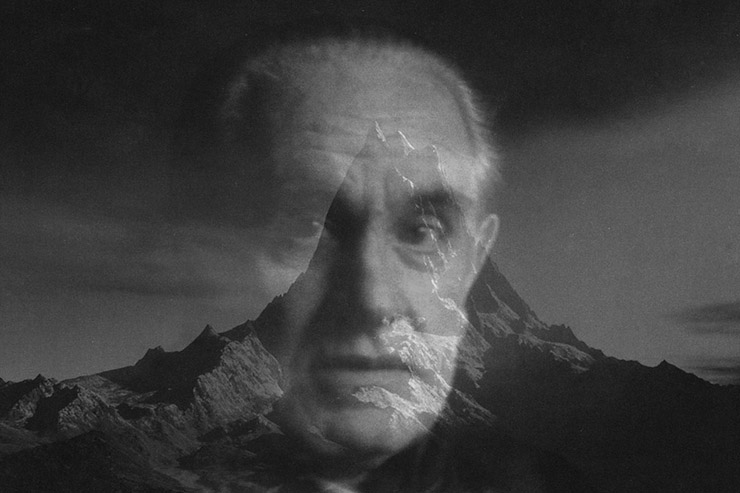
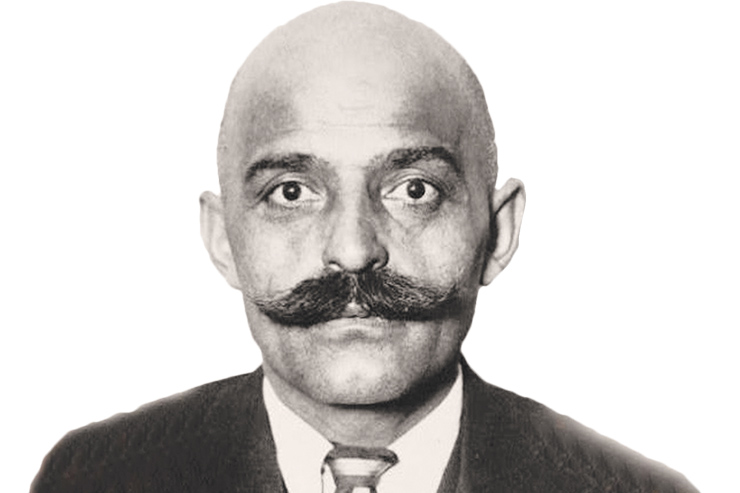
    George Ivanovich Gurdjieff (1866?-1949)

    In 1915 in St. Petersburg, Gurdjieff met his most famous student, the man who, more than Gurdjieff himself, would become the most widely read exponent of his teaching: Piotr Demianovich Ouspensky (1878–1947). Ouspensky’s account of his experiences appears in what is perhaps the best and most famous book about Gurdjieff’s teaching: In Search of the Miraculous: Fragments of a Forgotten Teaching, which Gurdjieff himself endorsed as an accurate picture of his views. It presents an intricate and fantastic esoteric system. One theme is the “sleep” of ordinary life. Another is the disunity of the human being. Gurdjieff says:

    Man such as we know him… cannot have a permanent and single I. His I changes as quickly as his thoughts, feelings, and moods, and he makes a profound mistake in considering himself always one and the same person; in reality he is always a different person, not the one he was a moment ago….

    Each minute, each moment, man is saying or thinking “I.” And each time his I is different. Just now it was a thought, now it is a desire, now a sensation, now another thought, and so on, endlessly. Man is a plurality. Man’s name is legion.

    Gurdjieff is here alluding to an ancient view of the human mind, which regards human beings as essentially tripartite, consisting of the intellect, the emotions, and the instinctive and motor functions of the body.

    These three “centres,” as Gurdjieff called them, “instead of fusing inwardly in the normal way to produce common outer manifestations, have become, especially of late, quite independent outward functions…. [Man] cannot be master of himself, for not only does he not control these centres, which ought to function in complete subordination to his consciousness, but he does not even know which of his centres governs them all.”

    This disjunction would be bad enough on its own, but it is compounded by “sleep,” the hypnotic trance in which we habitually live. Gurdjieff links this “sleep” to the concept of kundalini.

    The spread of Eastern teachings over the past generation has made kundalini a comparatively familiar term. Most esotericists use this Sanskrit word to refer to the “serpent fire” at the base of the spine. This subtle energy is said to lie dormant in most people but can be awakened through meditation or yogic practices. Travelling up the spine, it brings about illumination when it reaches the head.

    Gurdjieff thought this view of kundalini was completely wrong. “In reality Kundalini is the power of imagination, the power of fantasy, which takes the place of a real function. When a man dreams instead of acting, when his dreams take the place of reality,… it is the force of Kundalini acting in him. Kundalini can act in all centres and with its help all the centres can be satisfied with the imaginary instead of the real.”

    In his immense and difficult magnum opus, Beelzebub’s Tales to His Grandson, Gurdjieff speaks of “the crystallised consequences of the properties of the organ kundabuffer.” Kundabuffer, a coinage of Gurdjieff’s, is a portmanteau word formed from “kundalini” and “buffer”; “buffers” were what he called those psychic mechanisms that keep the different “I” ’s from confronting each other. (The idea resembles the modern psychological concept of dissociation.)

    But what Gurdjieff calls “the terror of the situation” is still worse. It might not matter if we lived our lives in sleep; perhaps we would not achieve all we could, but that almost inevitably happens anyway. According to conventional religion, if we are good, we will still go to heaven (or obtain a favourable rebirth) when we die.

    Gurdjieff does not subscribe to conventional views of immortality. For Gurdjieff, we possess the possibility of having immortal souls, or what he calls “higher being-bodies,” but we almost never attain them because we live in sleep. And for undeveloped human beings, there is no immortality. “The ‘man-machine’… who is now one, the next moment another, the next moment a third, has no future of any kind; he is buried and that is all.”

    This bleak view of human fate is reminiscent of the gloomier Gnostic cosmologies, and to many who have read In Search of the Miraculous, Gurdjieff sounds like a Gnostic. “Kundalini is a force put into men in order to keep them in their present state,” he asserts. “One would think that there are forces for whom it is useful and profitable to keep man in a hypnotic state.”

    Figure 1. Gurdjieff’s Ray of Creation. From P.D. Ouspensky, In Search of the Miraculous.

    There is some truth to the idea that Gurdjieff is a kind of Gnostic, but only some. To understand it fully, we need to grasp something of his intricate cosmology. It can be best seen in a diagram known as the Ray of Creation (Figure 1). Gurdjieff did not claim to have originated it but said it “belongs to ancient knowledge.” Many other esoteric systems are, he adds, distorted or incomplete versions of this system.

    As one can see from the diagram, the Ray of Creation rather resembles the way children sometimes address envelopes: after listing the street, city, and state, they will add “USA, North America, Planet Earth, the Solar System, the Milky Way, the Universe.” It also resembles the levels of manifestation seen in other systems, like the Kabbalistic Tree of Life. But Gurdjieff depicts the cosmic levels in terms of scale. The Absolute, or God, is all-encompassing. The next level is that of “all worlds,” that is, all galaxies (and perhaps all universes) taken as one. The next stage is that of “all suns” in our own galaxy, and so on. Each level, as it descends, is subject to a new set of cosmic laws of its own in addition to those of all the levels above it.

    In contrast to the higher realms, where there is comparative freedom, we on Earth are subject to many cosmic laws. In fact we are very nearly at the bottom rung of the ladder – but not at the absolute bottom, for that rung is occupied by the Moon. Contrary to the prevailing scientific views both of his time and of our own, Gurdjieff held that the Moon is not cold and dead but is rather “an unborn planet, one that is, so to speak, being born. It is becoming warm gradually and in time (given a favourable development of the Ray of Creation) it will become like the Earth and have a satellite of its own.”

    “Food for the Moon”

    The growing Moon needs to be fed by certain cosmic energies. What Gurdjieff calls “a huge accumulator” exists on Earth to accomplish this end. This “accumulator” is organic life in all its forms: “Everything living sets free at its death a certain amount of the energy that has ‘animated’ it: this energy, or the ‘souls’ of everything living – plants, animals, people – is attracted to the Moon as though by a huge electromagnet.” Human beings, like the rest of life on Earth, are thus merely “food for the Moon.”

    Such is the view set out in In Search of the Miraculous. Because this book is much more readable than Gurdjieff’s own magnum opus Beelzebub’s Tales to His Grandson, many take it as the final word. But Beelzebub amends this picture in an important way. For while Gurdjieff here reiterates that humanity was indeed designed as “food for the Moon,” he adds that we have a choice of how to serve this end.

    Buried toward the end of Beelzebub, in a convoluted passage on war, Gurdjieff makes an important and often overlooked disclosure: that the energy needed to “feed the Moon” is precisely the same as that given off by people “forming and perfecting… their higher bodies by means of conscious labours and intentional sufferings.” If people do not serve the purposes of “Great Nature” by inner work, this energy will be extracted from them on a massive scale by means of wars and epidemics.

    Gurdjieff’s picture of the universe, stated so baldly, seems improbable. What are we to make of “higher being-bodies,” “kundabuffer,” and the idea that we are “food for the Moon”? Does he mean these things literally? There was always a touch of the rogue about Gurdjieff, and the reader is sometimes struck by his writing in the same way that some people were struck by him in life: he seems to be staring at you with a penetrating gaze and asking you to decide whether or not he is kidding.

    Yet there is nothing in Gurdjieff’s life and work to indicate that he did not mean what he said. He despised conventional wisdom, and indeed one of the main themes interwoven throughout Beelzebub’s 1,200 pages is that modern people are so stuffed with absurdities that they have lost sight of cosmic truths. So Gurdjieff would hardly be concerned that today’s scientists and psychologists might differ with many points of his teaching.

    At the same time there is an elegance and sublimity to Gurdjieff’s vision. He is telling us not only that we are here for a purpose, but that the universe is benign and intricately constructed: if we fulfil its designs, we will be rewarded with immortality.

    [alert type=”success” dismiss=”no”]If you appreciate this article, please consider subscribing to help maintain this website.[/alert]

    “The Fourth Way”

    To rescue us from our plight, Gurdjieff brought what he called “the Fourth Way.” He contrasts his approach with three more familiar ways: (1) the way of the fakir, who masters his body to the point where he can stand “motionless in the same position for hours, days, months, or years”; (2) the way of the monk, who, by prayer and devotion to God, masters the emotions; (3) the way of the yogi, the one who gains control over the mind.

    Unlike these paths, the Fourth Way, “the way of the sly man,” does not require withdrawal from the world, but can and should be pursued in the course of everyday life; and instead of working with the mind, the body, or the emotions alone, it works with all three. It is, Gurdjieff claimed, faster and more efficient than the other three ways. “The ‘sly man’ knows the secret,” said Gurdjieff, “and with its help outstrips the fakir, the monk, and the yogi.”

    What is the sly man’s “secret”? It is a higher force, an energy that is able to penetrate the being of man and create unity in his centres where there was none before. This energy must come from above, but it will not come by itself; Gurdjieff does not preach quietism but advocates “conscious labours and intentional suffering.” (Indeed Gurdjieff’s disciples refer to his teaching as “the Work”; those attempting to follow it are said to be “in the Work.”) For a long time these “labours” and “sufferings” will consist, not in some sophisticated form of masochism, but in striving to overcome the slumber of daily life and see oneself as one really is.

    A central practice of the Fourth Way is self-remembering. “You do not remember yourselves,” Gurdjieff chides Ouspensky’s Petersburg group. “You do not feel yourselves; you are not conscious of yourselves. With you, ‘it observes’ just as ‘it speaks,’ ‘it thinks,’ ‘it laughs.’ You do not feel: I observe, I notice, I see.”

    Anyone who has read even a little in the literature of contemporary spirituality will find familiar resonances here, for many books emphasise the need for mindfulness. Gurdjieff’s teaching goes still further, for it puts this effort at the centre of the spiritual search. It also gives many more specific practices for “self-remembering”: people in the Work often receive instructions about being consciously present at certain moments of the day or during particular tasks.

    Many who have read about – or even practiced – Gurdjieff’s teaching seem to fall into the trap of seeing “self-remembering” as a completely cerebral practice; trying to carry it out, they end up simply being self-conscious in the ordinary sense. They miss an essential part of the practice: that self-remembering entails a conscious effort of sensing the body.

    Self-remembering begins with the body because, as the French Gurdjieffian Jean Vaysse puts it, the body “is solid and concrete, with an apparently stable form which can… be relied on to some degree. It is the instrument through which we perceive and our means of action. It can stay still voluntarily and thus is easier than the other parts for us to observe. It is relatively obedient, and we have a certain amount of control over it (in any case more than over our other parts). In addition, it is the one solid material base in us.”

    Hence a Gurdjieffian reading this article might attempt to read while giving some attention to the sensation of some part of the body, the foot or hand, say, or even the body as a whole. This may sound simple, but if you try it, you’ll find it isn’t. If you’re lucky, you may be able to keep this “divided attention” for a few seconds before you lose it again. For a long time the Work involves returning to this sensation of the body over and over again no matter what you’re doing. Such attempts are known as “efforts.” They are meant to counteract the sleep of everyday life. Those who persist in this practice find that some of the “maleficent consequences of the properties of the organ kundabuffer” are, if not destroyed, at least interrupted, for these efforts help to dissipate daydreaming, absentmindedness, and the hazy stupor in which we stumble through our lives.

    These efforts of attention tie into other aspects of the teaching as well. Gurdjieff defined attention as “the direction of the thinking centre’s activity.” Self-remembering, at least in the early stages, directs the “thinking centre” toward the body, which is governed by the “moving-instinctive centre.” Self-remembering brings these two centres closer together. When the mind is paying attention to the body, they are working a bit more in harmony, and the practitioner is slightly closer to becoming a unified being. (See the accompanying article on page 27 for further discussion – purchase a copy of the magazine to read it.)

    Gurdjieff further explains that “making a conscious effort at the moment an impression is received” enables the organism to absorb more of certain subtle energies than it ordinarily does. These energies are used to create “higher being-bodies” that can withstand the shock of death. Thus self-remembering, a practice as rich and multileveled as meditation itself, is meant not only to counteract the sleep and disunity of man, but to help one attain the immortality that, Gurdjieff says, usually exists for us as nothing more than a possibility.

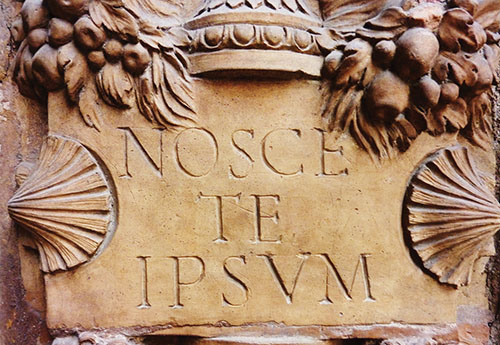
    The Ancient Greek aphorism “Know thyself”, Latin: nosce te ipsum, was inscribed in the forecourt of the Temple of Apollo at Delphi.

    A second, closely related practice is self-observation, whereby one tries to see as much as possible of one’s own immediate state – thoughts, moods, emotions, reactions, and physical postures. Self-observation attempts to fulfil the injunction of the ancient oracle at Delphi: “Know thyself.” All true teachings must work toward this goal in some way. The Gurdjieffian technique is to observe ourselves in the course of daily life, to see ourselves as others see us, in all our moments of awkwardness, irrationality, and sleep.

    This process not only helps students accumulate material for understanding themselves better, including the subtle organism of the “centres,” but it enacts certain changes in its own right. “Many psychic processes can take place only in the dark,” says Gurdjieff. “Even a feeble light of consciousness is enough to change completely the character of a process, while it makes many of them altogether impossible.”

    Today most Gurdjieffian groups focus on the practices of self-remembering and self-observation; people also take part in various forms of physical labour and craftwork as a means of seeing different aspects of themselves. There are even some who continue an interesting facet of his teaching known as the Gurdjieff Movements.

    The origins of the Movements form part of Gurdjieff’s legend, for most people in the Work connect them with the “sacred dances” he learned in his explorations in Central Asia during his youth. These dances, which Gurdjieff claims are over 4,500 years old, “correspond precisely to our books. Just as is now done on paper, so, once, certain information about long past events was recorded in dances and transmitted from century to century to people of subsequent generations.” Each posture forms a letter in an alphabet of gestures; understanding this code, you can read the information therein.

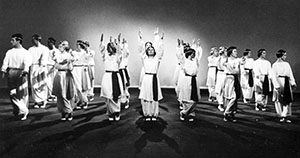
    The “sacred dances” known as the Gurdjieff Movements.

    Although the Movements, accompanied by music written by Gurdjieff and his pupil, the composer Thomas de Hartmann, are still taught in some Gurdjieffian schools, it is not clear that the means of “reading” them has been passed down as well. If Gurdjieff did impart the secret to some of his pupils, it has been well hidden. It is rarely possible even to see a performance of the Movements; the best way of glimpsing them is in the 1977 film Meetings with Remarkable Men, directed by Peter Brook under the supervision of Gurdjieff’s pupil Jeanne de Salzmann, which shows the performance of some of these dances toward the end.

    Anyone who does see the Movements can understand how they fit in with Gurdjieff’s teaching. They require the performer to maintain two or three different rhythms with different parts of the body, say, the head, arms, and feet, often while executing complicated dance steps. The difficulty of these “sacred dances” is obvious, but they accord with Gurdjieff’s goal of integrating the “three centres” so that a new, higher “I” can be created. As for the difficulty, Gurdjieff insisted that “only super-efforts count.”

    What possibilities does the Work offer for the seeker today? Its hardships rarely take the peculiar forms they did under Gurdjieff himself, but much of the master’s rigor remains. It is not a path for those who crave conviviality or emotional warmth; many who encounter the Work complain of its coldness. On the other hand, this very characteristic tends to weed out dilettantes, so the calibre of people one encounters is probably higher than in many traditions. There are of course dubious entities that lay claim to Gurdjieff’s heritage, but most of them can be avoided if one keeps clear of groups that aggressively proselytise or demand exorbitant sums of money.

    For a sense of the possibilities offered by the Gurdjieff Work, one might take a clue from Beelzebub, whose hero at one point remarks that of all the creatures in our solar system, “personally I liked best of all the three-brained beings breeding on the planet bearing the name Saturn.” Traditional astrology portrays Saturn as the cold, remote planet that creeps slowly through the sky. As such, it has always been associated with slow, unstinting labour (which is why in the old rhyme “Saturday’s child works hard for a living”) as well as with authority and depth. Hence the “super-efforts” required by the Work may seem to lack glamour and fun, but they may also confer knowledge that cannot be won by easier means.

    [alert type=”general” dismiss=”no”]This article was published in New Dawn 131.[/alert]

    [alert type=”success” dismiss=”no”]If you appreciate this article, please consider subscribing to help maintain this website.[/alert]

    © New Dawn Magazine and the respective author.
    For our reproduction notice, click here.
  • Who Was Julius Evola,  Really?

    Who Was Julius Evola, Really?

    New Dawn 162

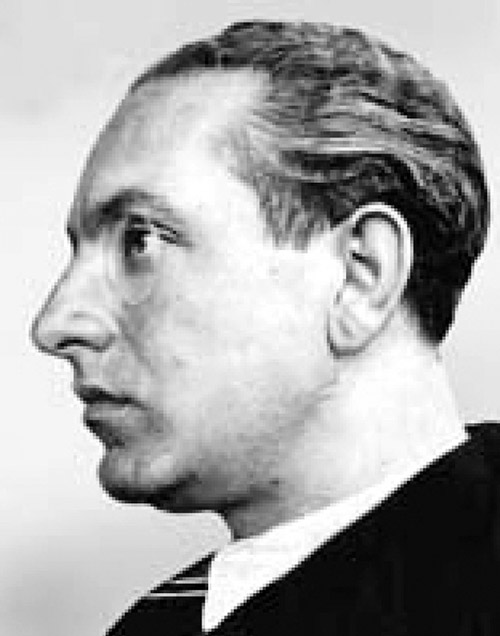
    It is a pity that no researcher, while there was still time, ever spoke to the friends and relations who had known Julius Evola (1898–1974) in his youth. Like some other occult philosophers (Blavatsky and Gurdjieff come to mind), Evola covered his tracks, putting his apprentice years out of reach of the curious, then constructing an idealized biography.1 After his crippling injury in World War II he became an obscure and private figure, of little interest to the world in general, so that no one was prompted to go to Sicily, for instance, to try to find some cousins or to establish the status of the title “Baron” to which he sometimes answered. His few disciples, for their part, would never have had the bad manners to poke into the Master’s past, or to search out his aging school-fellows for insights into a level of his personality which he affected to despise.

    Like his early hero Nietzsche, Giulio seems never to have been a child, but to have come into the world fully-formed and ready for his life’s mission. We know that he completed university studies in engineering, but disdained to receive a diploma, as being too bourgeois an ambition.2 He served in World War I as an artillery officer, without seeing any serious action. His first public appearance was at the age of twenty-one, exhibiting 54 abstract paintings (now avidly collected, and some of them in public collections) and participating in the Dadaist movement. After abruptly quitting that phase, he reappeared as commentator and translator of the Tao Te Ching. By his mid-twenties, at a time when most young men are still finding themselves, he had completed a series of essays on Magical Idealism, a scholarly study of Tantra, and an 800-page treatise which he sent to the most eminent Italian philosopher of the time, Benedetto Croce. With typical hauteur, Evola explained that:

    For some years I have tried to organize my philosophical views into a system, mainly contained in an unpublished work entitled Theory of the Absolute Individual… I will release this volume, which has cost me several years of work, without any remuneration… For a number of reasons that I cannot go into here, the publication of the principal work represents something quite important to me, since, in the discipline I have followed, it is the opportunity to address freely and without reserve those for whom the general effect of my doctrine, expounded theoretically, is not merely an abstract scheme.3

    Croce recommended publication. The publisher divided it into two volumes, Teoria dell’Individuo Assoluto (“Theory of the Absolute Individual”) and Fenomenologia dell’Individuo Assoluto (“Phenomenology of the Absolute Individual”). Evola’s premises had been anticipated by some German Romantics, but are generally quite foreign to Western philosophy. They are more familiar to readers of the Taoist, Tantric, alchemical, and magical texts that Evola was simultaneously studying. The Absolute Individual is the Self, seen as identical to the source of all being. Like the philosophy of Plotinus and other Neoplatonists, and even more like the philosophic writings of India and China, Evola’s doctrine includes, but also transcends, the dimensions of religious experience and mysticism. His twin volumes contain a history of subjective idealism, and a practical philosophy of life, based on the assumption that the Absolute Individual is the ultimate object of human aspiration and attainment. Evola, at least, must have been familiar with the experiences about which he was writing; apart from the authoritative tone of his “phenomenology,” there is the evidence of an entire life lived most rigorously in the spirit of this philosophy. It is a question for specialists whether his youthful experiences of the Absolute, some of which he admits were drug-induced, were temporary samadhis (to use the language of Yoga) that confirmed him in the truth of his intellectual convictions, or whether they effected a permanent change in his being, leaving him, no matter what his outer activities and circumstances, in the simultaneous awareness of absolute consciousness.

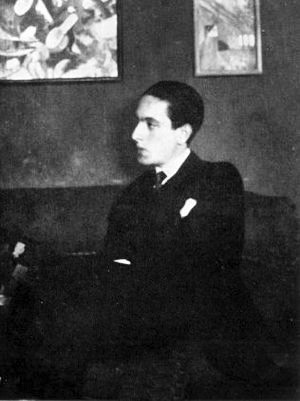
    A young Julius Evola

    Evola’s concept of the Absolute Individual is inseparable from the other theme which he treated in this early period: that of Magical Idealism. “Magic” would remain his blanket-term for the methods taught in East and West that aim at the realization of the Absolute Individual. Questions such as whether magic is an irrational belief-system, or a reaction against modern science, would have been totally irrelevant to him. In his world, magic and the order of things classified as occult were the object of direct, intuitional knowledge. By stripping them of their superstitious associations and their Christian-Kabbalistic accretions, he reduced them to a form in which they could be sensibly and even scientifically discussed.

    There are two reasons why Evola’s Magical Idealism is a landmark in the history of modern occultism (another inevitable blanket-term). First, he raises questions that have scarcely ever been addressed to practitioners or answered by theoreticians of the occult sciences, concerning the ultimate motivation and validity of the latter. The answers that one could expect from most occultists are either of a very lowly order, aiming at personal power, knowledge, wealth, etc., or else, in more serious figures such as Eliphas Lévi and A. E. Waite, they give way to dogma, making magic a handmaid to Judeo-Christian mysticism. The second reason is that Evola was not content to stay within the Western streams of magic, philosophy, or mysticism, but needed for the completion of his experiential system the input of the East. In both respects, his philosophical journey resembles that of Aleister Crowley, who, for all the differences in their “personal equations,”4 would probably not have disagreed with many of Evola’s principles. These did for magic what the Theosophists had done for the theoretical study of esotericism: opened it to the whole world. 

    By this time, Evola had been introduced by the Futurist painter Giacomo Balla to Arturo Reghini (1878–1946), a mathematics teacher active in many esoteric and fringe-masonic groups. Reghini performed two important services for the younger man. By his own example as a kind of Pythagorean nationalist, he convinced Evola – hitherto a student more of German Idealism and of the East – of the value of his native Italian heritage; and he introduced him to the writings of René Guénon (1886–1951), proponent of the “integral tradition.”

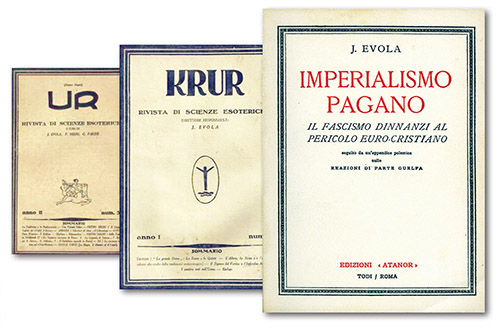
    At the beginning of 1927 Evola and Reghini founded an esoteric group called the “Gruppo di Ur.” Its members included a number of Reghini’s previous collaborators, and had connections in Roman high society. The group produced a monthly journal which treated the whole spectrum of theoretical and practical magic, including classic texts from East and West, translations, and commentaries on their applicability to modern times. Some of the members worked alone; others formed “chains” for group work. Some of them wrote candidly of their own experiences, good or bad. Their magic was not of a superstitious kind but more in the practical mode of Rudolf Steiner’s “spiritual science,” for the group included some of Italy’s leading Anthroposophists. While the group itself was small, the fact that Ur was published in an edition of about 2,000 copies testifies to an astonishing level of interest in the Italy of those days.

    One consequence of the friendship with Reghini was the theme of Evola’s next book, Imperialismo pagano (“Pagan Imperialism”), which was so violently anti-Catholic that it later became an embarrassment to him, and was never reissued during his lifetime. It is subtitled “Fascism facing the Euro-Christian peril,” and argues, as Reghini had been doing since the end of World War I, for the restoration of the Roman pagan tradition as the proper spiritual foundation for the new Italy. Mussolini, more alive to political necessities than swayed by “traditional” spirituality, dealt the death-blow to these pagan dreams in 1929 with his Concordat with the Roman Church. The Duce remained a reader of Evola and his protector, up to a point, despite the philosopher’s fearless criticisms of Fascism. 

    The insistence, henceforth in Evola’s work, on “Tradition” is the legacy of Guénon, whose early writings had propounded the idea of a single primordial tradition from which the various religions were offshoots, and which contained in symbolic form the basic metaphysical truths about the universe and man’s self-realization. The Absolute Individual that Evola had found in Taoism and Tantra, Guénon had expounded as the Supreme Identity of the Vedanta. It seemed clear to both of them that the same ultimate truths and teachings were to be found at the deepest layer of every authentic tradition.

    Unlike Guénon, Evola was unsympathetic to exoteric religion and dubious about the Judeo-Christian tradition, which was so displeasing to him on a political and aesthetic level. He preferred other strands that had kept the authentic tradition alive in the West, foremost among which was alchemy. His contributions to Ur and Krur included many essays on this subject that he later gathered and expanded into a book on the Hermetic Tradition. In the history of alchemy in the twentieth century, Evola’s work represents a third stream, distinct from the practical, laboratory alchemy of Fulcanelli, Eugène Canseliet, Frater Albertus, Jean Dubuis, and their disciples, and equally distinct from the psychologized alchemy of Herbert Silberer or Carl Jung. Evola’s Hermetic Tradition is instead a cosmology, combined with a method for self-realization, in which sulphur and mercury, conjunction, transmutation, etc., are the names of otherwise undefinable states of mind and soul. Although it is not made explicit in the text, Evola’s alchemical method, like much else in occult practice, centres on the deliberate separation of consciousness from the body and on operations performed in the “astral world” or the world of the Imagination (taking this term in the sense used by William Blake or Henry Corbin), which require more than the usual degree of concentration and courage.

    [alert type=”success” dismiss=”no”]If you appreciate this article, please consider subscribing to help maintain this website.[/alert]

    The more one mentions things of this kind, the greater is the tendency to associate Evola with other modern occultists, in the broad sense of the term. But his next book drew the line firmly between himself and them, being a denunciation of the “Mask and True Face of Contemporary Spiritualism.” It was based on articles he had already published critical of Spiritualism, Psychoanalysis, Theosophy, Anthroposophy, the French occultists, etc., and it served the same purpose as Guénon’s earlier works against Theosophy and Spiritualism: it defined the field, the sources, and the individuals that were unacceptable to “traditionalists.” With Pagan Imperialism, this book established a dualist, even Manichean trend, always latent in Evola’s character, but which in his earlier works had not yet become the source of his creative energy. Now it was not enough to speak of the various royal paths by which the “superior man” (to use the I Ching’s expression) becomes the Absolute Individual: the machinations of inferior men (and women) had to be laid bare, and war had to be declared against them.

    Just as Evola’s early explorations in art, philosophy, psychedelics and magic had found their expression in the Theory of the Absolute Individual, so now he gathered his paganism, his sense of tradition, his political consciousness, and his contempt for most of the human race into definitive form and his most important and representative work: Rivolta contro il mondo moderno (“Revolt Against the Modern World”). This revolt was urged in the name of a primordial tradition whose metaphysical and cosmological principles occupy the first half of the book, while the other half is concerned with the process that led to the modern aberration. The fundamental assumption, without which Revolt makes no sense whatever, is the cyclical principle of history that is most fully developed in the Hindu system of four Yugas or world-ages (Satya, Treta, Dvapara and Kali Yuga), and also known to the Greeks as the Ages of Gold, Silver, Bronze and Iron. Evola accepts this, just as Guénon did, with the corollary that modernity is a phenomenon of the last part of the Kali Yuga or Age of Iron – after whose cataclysmic ending a new Golden Age will dawn, as certainly as the sun rises every morning.5

    Guénon and Evola both believed in a previous Golden Age with a perfectly ordered primordial tradition, situated in the Arctic if not positively at the North Pole. For Evola, at least, there seemed to be tangible proof in Herman Wirth’s collection of prehistoric symbols from the circumpolar regions. But the greatest value of Revolt may be as an epic work of the imagination, which like all epics offers an escape into a world more comprehensible than our own, if no less tragic. Evola’s exposition of the orderly cosmos of Tradition and its fall, if not historically verifiable, is a creative enterprise on a Wagnerian scale that, like a great opera, does not have to be “true” in order to be an inspiration and an enrichment to its audience. 

    If the Traditionalist concept of cyclical history is correct, the modern world is the inevitable consequence of the tail-end of the cycle. What else could one expect from the Dark Age, the Age of Iron, or the Kali Yuga? It is as inevitable as night, winter, or natural death. Yet Evola and the other Traditionalists rage against its secularism, its social organizations, its confusion of gender-roles, its materialism and vulgarity, its racial and spiritual degradation. Above all, there is Evola’s pervasive theme, apparently derived from his early reading of the Swiss anthropologist Bachofen, of the spiritual superiority of the masculine over the feminine, contrasting the virile, primordial, Arctic, “Uranian” and “Olympian” way with the Southern, orgiastic, sentimental, Dionysian way of the Mother-goddess. The former, one gathers, is the path to the Absolute Individual, while the latter leads only to extinction on the wheel of the Eternal Return.

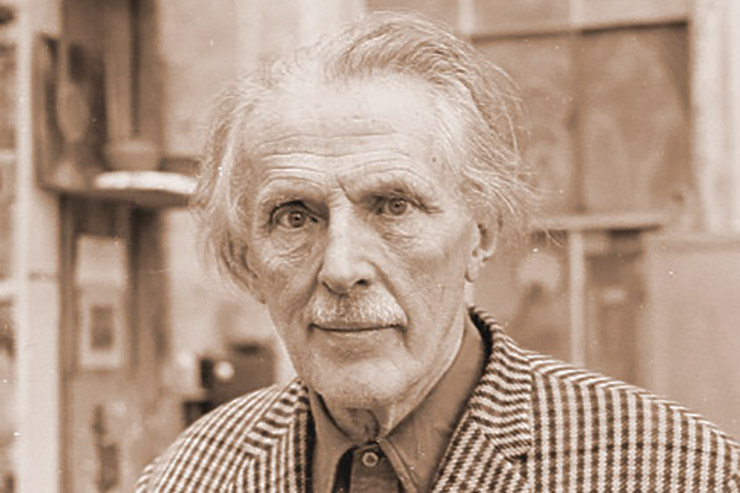
    Baron Julius Cesare Evola (19 May 1898 – 11 June 1974)

    Only in modern times could someone have thought and written as Evola did, rejecting his native environment (whether one thinks of this as Italian Catholicism or as the rootless materialism of the Western world) and deliberately choosing an invented, or at least a foreign (because fundamentally Eastern) mode of thought. The critic of modernity is an essentially modern phenomenon, and his cultural pessimism, as it is generally known today, a natural reaction to events in Europe which none could ignore, least of all one of Evola’s warrior disposition. For all the lapidary certainties of his writing, Evola was looking for something to hold on to during the 1930s. He had been disappointed as Fascism cosied up to the Church and compromised itself with the bourgeois and proletarian world, even though he never found it so degraded as the rival systems of American capitalism or Soviet communism. During this decade his glance wandered continually to Germany, hoping to find there a political realization closer to his ideals. Fluent in German, he made several semi-official visits to Germany and Austria between 1934 and 1941 to give lectures and to meet dignitaries of the Schützstaffel (the “SS”). But these encounters also left a residue of mutual disillusionment: his hosts found him too unworldly and idealistic; he found National Socialism too narrowly Pangermanist; and the Italian regime became so uneasy about his activities that in 1942 it temporarily withdrew his passport.

    Two themes dominated Evola’s thought after the completion of Revolt Against the Modern World. One of them had been present incidentally in that book: the theme of race, and in particular the connection of the primordial tradition with a pure Hyperborean race that had interbred, after the destruction of its Arctic homeland, with the inferior races of the South. After Hitler’s rise to power, Mussolini’s German allies began to exert pressure on a Fascist system that had been quite innocent of anti-Semitism and racism, at least until the Abyssinian Campaign. Evola now became a self-appointed authority on this topic. With obsessive diligence he addressed both theory and practice in numerous articles and two full-length books, Il mito del sangue (“The Myth of Blood”), and Sintesi della dottrina della razza (“Synthesis of Racial Doctrine”). Both books were illustrated with photographs, some taken from anthropological sources, others being of contemporary figures including Rudolf Steiner. Evola also addressed “Three Aspects of the Jewish problem: in the Spiritual World, in the Cultural World, in the Socio-Economic World.” With this project, he attempted to give Fascism its own racial philosophy, distinct from that of the National Socialists, and in 1943 it was accepted, in principle, by Mussolini. The core of Evola’s theory was that race is of three kinds. One of these is the sense in which the term is generally used, to indicate physical and genetic types: this he calls the “race of the body.” The second is the “race of the soul,” which is expressed in art and culture; the third, the “race of the spirit,” expressed in religion, philosophy and initiation. Evola’s fundamental disagreement with the National Socialists was that, like cattle-breeders, they considered only people’s biological or bodily race: in his view, the least significant of the three. It is no wonder that the SS found him unworldly.

    The American-Italian scholar Dana Lloyd Thomas has found that this theory, as found in Evola’s books, is quite far removed from the polemical and often crude racism of his journalism. Thomas concludes that Evola’s studies, though presented as objective and historical, served two purposes: they made racism a respectable area of study, and all the examples he gave came to the same conclusion, affirming the superiority (spiritual as well as physical) of the “Nordic race” that was effectively equated with the Germans.6 Thomas’s project, stemming from honest moral conviction, needs to be balanced by the recent account of Evola’s war years, traced almost day-by-day through unprecedented archival research (see note 2). The author, Gianfranco De Turris, who has been writing about Evola for over forty years, is equally motivated by a desire for justice towards a philosopher who has been vilified like none other, and gifted with insight into circumstances that were very different from those of today. 

    The other theme that occupied Evola in the pre-war years also reflected his Germanophilia: he developed an admiration for the high Middle Ages that resulted in a book on the “Mystery of the Grail.” For whatever reason,7 his historical allegiances had now changed, and it was no longer ancient Rome, from Romulus to Augustus, that seemed to him to incarnate the last worthy manifestation of the tradition, but the “Holy Roman Empire of the German People” inaugurated by Charlemagne’s consecration in the year 800. In his book, Evola connects the Grail myths on the one hand with the prehistoric Hyperborean tradition, and on the other with the resurgence of the imperial and knightly spirit in the Middle Ages: no matter that Charlemagne was the pitiless suppressor of Nordic paganism, or that the Holy Roman Empire derived its authority from the church that Evola had so reviled in Pagan Imperialism. This medievalism, exacerbated by Evola’s later indulgence towards extreme reactionary Catholics, continues to puzzle those who would have thought that the Renaissance Neoplatonists were closer to his ideals. Instead, he lumped the Renaissance together with the Reformation, the Enlightenment, Socialism, Communism, and modernity as part of the degenerative process. 

    [alert type=”success” dismiss=”no”]If you appreciate this article, please consider subscribing to help maintain this website.[/alert]

    During the first years of World War II, Evola turned to yet another tradition, that of Buddhism, and wrote one of his best books: The Doctrine of Awakening: A Study on the Buddhist Ascesis. Just as with his early work on Tantra, Evola had to base his study on translations by English, German, and Italian scholars. Yet his insights into the human condition that Buddhism addresses, and the calm spiritual height from which it speaks, transcend mere erudition. The temporary habitation of Oriental modes of thought seems to have enabled him to forget the politics and the polemics which the modern West so easily provoked from him. At the same time, the work is revisionistic in its preference for Theravada (or Hinayana) Buddhism. The Western impression of Buddhism, abetted by nineteenth-century incomprehension and by Theosophical influence, has always been condescending to the primitive Hinayana (the word means “lesser vehicle”) in comparison with the “greater vehicle” of Mahayana Buddhism, to which belong the schools of Japan and Tibet that have been more successful exports. To Evola, the contrary was true: the Mahayana was a late and decadent development, sullying the original purity of Buddha’s philosophy with its sentimental and religious accretions (just the sort of thing Westerners would prefer!), while the uncompromising Hinayana was the original teaching, fit only for Aryas, i.e. the elite, in terms of their spiritual race. For a long time The Doctrine of Awakening was the only work of Evola’s available in English. It appeared from Luzac, a London Oriental publisher, uniformly with a number of René Guénon’s works, thus giving many (including myself) their first taste of the Traditionalist school.8 De Turris’s book, cited above, tells of Evola’s correspondence with the young translator Herbert Musson: a patrician Englishman who ended his life as a Theravada Buddhist monk.9

    The trauma of Evola’s war-injury on 21 January 1945 and the years-long search for a cure left him permanently disabled. This is how he described his condition in a letter to a fellow philosopher: “The last war made me the gift of a lesion in the spinal cord, which has deprived me almost entirely of the use of my legs: a contingency, however, to which I do not attach much importance.” After almost six years of treatment in Austrian, Hungarian, and Italian hospitals, he returned to the apartment at 197 Corso Vittorio Emanuele II which he shared with his mother until her death in 1956, and whose owner, an aristocratic admirer, allowed him a free lease for life. 

    The postwar climate was not favorable to Evola, who bore the stigma of having backed the losing side. Now that “fascism” had become a term of abuse, it was applied to him, who had never joined the Fascist or any other party, indeed who had risked much with his criticisms of the government.10 It was difficult for him to resume the career as a journalist which had supported him before the War. He first returned to print with a thorough recasting of his early book on Tantra. Then he was rediscovered by some who were still faithful to the principles of the Right, and for them he wrote the booklet Orientamenti (“Orientations”). 

    Evola paid dearly for this act of idealism. A week after his return to his Roman residence on May 18, 1951, he was arrested and accused of being the “master,” the “inspirer,” with his “nebulous theories,” of a group of young men, who were accused in their turn of having hatched organizations for clandestine struggle and attempted to reconstitute the dissolved Fascist party.11 Evola, confined to his wheelchair, was held in the Regina Coeli prison until the trial, which lasted from early October until 20 November 1951, when he was acquitted.12 

    In the early 1950s Evola was still hoping for some counter-revolutionary movement, somewhat in the spirit of the “Conservative Revolution” of post-World War I Germany, that would restore the Right to power. Gli uomini e le rovine (literally, “The Men and the Ruins”), a book largely about public, social and political matters, addresses the potential leaders of such a movement. It is an analysis of the postwar world, somewhat like an updating of Revolt Against the Modern World, that ends with an outline of what would be needed for the healing of Europe: a Europe that would no longer be the playground and victim of the rivalry between the USA and the USSR Evola hoped – but knowing that it was probably beyond hope – for a resurgence of the Imperial ideal, which would endow the separate nations with a spiritual unity, but not with a forced, political one. His description of how Europe should not become united is an uncanny anticipation of what would, in fact, transpire. For example, he writes: “Democracy, on the one hand, and a European parliament that reproduces on a larger scale the depressing and pathetic sight of the European parliamentary systems on the other hand: all this would bring ridicule on the idea of a united Europe.”13 In the end, he puts his faith in the foundation of an Order, if among the ruins there are sufficient men left to stand up and constitute one.

    Evola published no more books for five years after Men Among the Ruins. That his thought did develop is clear. The next time he addressed the elite, he no longer envisaged any possibility or desirability of changing the world itself: it was too far gone on the road to perdition and the conclusion of its cycle. The only place for revolution was now inside oneself. The title of the work in question, Ride the Tiger, refers to a Taoist emblem of how the superior man behaves towards a chaotic world: following the principles of “actionless action” and of “doing that which is to be done,” he uses it to fortify his own higher individuality. In contrast to the public themes of Men Among the Ruins, Ride the Tiger treats more private domains such as existential philosophy, belief and non-belief, sex, music, drugs, and death, always in the spirit of Tradition and from the point of view of their use for the man in quest of his Absolute Individual. 

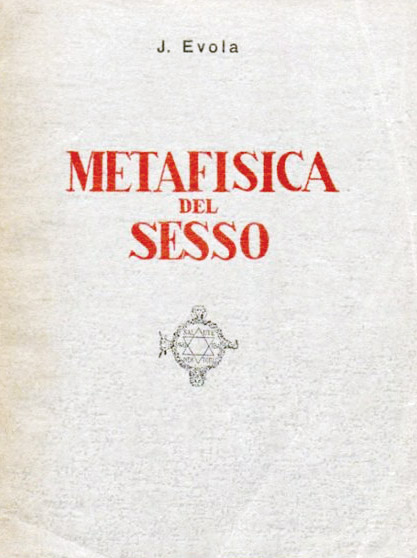
    Metafisica Del Sesso (The Metaphysics
    of Sex) by Julius Evola 

    The sexist language used here is deliberate, for Evola does not seem to have considered woman as a likely candidate for the quest. He had ample heterosexual experience, especially in his earlier years, but his anti-bourgeois principles caused him never to marry or have children. His book of 1958, The Metaphysics of Sex, anticipated the sexual revolution of the 1960s with its assumption that sex was not primarily given us for reproduction. It has always been one of the secret weapons in the magician’s cabinet; but Evola was the first, and to date the only writer to treat sex from the point of view of “traditional” metaphysics, so as to explain why it has this function.

    Most of Evola’s remaining titles are anthologies of his earlier articles and journalistic essays on various subjects – genres to which he contributed prolifically up to his death.14 Only two more original books appeared: an autobiography, The Path of Cinnabar, and the provocatively titled Fascism, Seen from the Right:15 his verdict on the Fascism and National Socialism that had been, and will always be, the first thing with which his critics associate him. More importantly, he returned to the Ur and Krur materials which he had been working on since the war years, and gave them definitive form in 1971 as the three-volume Introduzione alla Magia (“Introduction to Magic”). This monumental collection, with its contributions from a dozen authors beside Evola, shows that the Italian strain in modern esotericism was in no way inferior to the French Martinist and occultist strain, or to the much-studied Order of the Golden Dawn. It remains for the other leading lights, notably Giuliano Kremmerz and Arturo Reghini, to gain equal recognition for their stature as thinkers and movers. 

    The fact that so much of Evola’s enormous output of books and articles has been reprinted bears witness to a stratum of readership to which there is no parallel in the Anglophone world, and whose influence as a ferment within political, cultural and academic circles, especially in Italy, cannot be ignored. In the first version of this essay I concluded that, “Evola is currently the only esoteric and magical philosopher to have any impact whatever on the ‘real world’.” That was after centennial conferences in Milan and Rome (1998) and a wave of other commemorations and publications had brought Evola into the public eye, synchronously with the rise of right-wing political parties such as the National Alliance and the Northern League. Whether anything came of it is for historians to judge.

    Now there are rumors of Evolian influences at the highest level of government in both Russia and the United States. One agent named is Alexander Dugin, a known admirer of the Traditionalists, whose Eurasian theories and possible influence on President Vladimir Putin’s policies have often been mentioned in this magazine. The other is Stephen K. Bannon, strategist and assistant to US President Donald Trump. In 2014, addressing a Vatican conference via Skype, Bannon mentioned that Putin has an adviser “who harkens back to Julius Evola and different writers of the early 20th century who are really the supporters of what’s called the traditionalist movement, which really kind of eventually metastasized into Italian fascism.”16 Some of his Roman listeners may have gasped at this off-the-cuff revision of history, but three years later it sent the journalists googling the unfamiliar name, and to Evola’s posthumous “fifteen minutes of fame” through exposures in the New York Times and other unlikely venues.17 

    A lot of dots would need to be connected before any causal link could emerge between Evola’s political and spiritual philosophy and the presidency of Donald J. Trump. First, Bannon was speaking about Putin’s advisor, not Trump’s, and hardly with approval, since in the same speech he stated that Putin ran a kleptocracy and was intent on expanding the Russian empire. Second, that the Traditionalists “inspired Fascism” is doubly inaccurate: the Fascist movement was underway while Guénon was unknown in Italy and Evola still dabbling in Dadaism. When Evola did turn to political journalism after the Gruppo di Ur had dissolved, it was to criticize the Mussolini regime’s deviance from the principles of the true Right. For him this meant a monarchic, organic state, rather than one based on competing parties (as in democracy) or on class warfare (as in communism). Third, any serious student of Evola knows that in his riper and wiser years he adopted the position of apoliteia (detachment from politics). In Ride the Tiger he reflected on the futility of the “rectifying, political action” that had still seemed a possibility in Men Among the Ruins. The context was now, in 1961, the Cold War, and while admitting that life was more comfortable on the capitalist side of the wall, the conflict mattered little to the differentiated man, whose “inner imperative” could only be to retire from the public arena. As for the latter, Evola now said with devastating scorn that “even if leaders worthy of the name were to appear today – men who appealed to forces and interests of a different type, who did not promise material advantages, who demanded and imposed a severe discipline on everyone, and who did not prostitute and degrade themselves just to ensure a personal, ephemeral, revocable, and formless power – they would have almost no hold on present society” (pp. 173-74). Perhaps this introduction will help to clear the air and indicate where the true value of Evola’s work lies, encouraging some readers to explore it first hand.

    An earlier version of this article appeared in TYR: Myth—Culture—Tradition, vol. 1 (2002), pp. 127-142, titled “Julius Evola: A Philosopher for the Age of the Titans.” It is adapted by kind permission of the Editors of TYR, on which more information can be found at Dominion Press
    English translations of Evola’s principal works, published by Inner Traditions in Rochester, Vermont, USA unless otherwise indicated: The Doctrine of Awakening, Eros and the Mysteries of Love (formerly The Metaphysics of Sex), The Hermetic Tradition, Introduction to Magic (by Evola and members of the Gruppo di UR), Meditations on the Peaks, Men Among the Ruins, The Mystery of the Grail, The Path of Cinnabar (Integral Tradition Publishing), Revolt Against the Modern World, Ride the Tiger, The Yoga of Power.

    [alert type=”general” dismiss=”no”]This article was published in New Dawn 162.[/alert]

    [alert type=”success” dismiss=”no”]If you appreciate this article, please consider subscribing to help maintain this website.[/alert]

    Footnotes

    1. See end for a list of Evola’s major works available in English. The original version of this article contained a full documentation of sources, both original and translated, and other notes, omitted here. Much information, complementary to the present article, can be found in Gwendolyn Toynton, “Mercury Rising: The Life and Writings of Julius Evola,” New Dawn 111 (2008): 63-68.
    2. Yet after World War II he was commonly addressed as “Dr.” or even “Prof.” The false identity he assumed in Austria was that of a Graf [Count] von Bracorens. See Gianfranco de Turris, Julius Evola: Un filosofo in guerra 1933-1945 (“Julius Evola: A Philosopher in Wartime 1933-1945,” Milan: Ugo Mursia editore, 2016), 96, 202, 214. 
    3. Evola, letter to Croce, 13 April 1925, quoted in Piero di Vona’s introduction to Teoria dell’Individuo Assoluto (Rome: Edizioni Mediterranee, 1998), 7-8.
    4. A favorite metaphor of Evola’s: each of us enters the world with a more or less difficult “equation” which it is our life’s project to “solve.” 
    5. For more on this subject, see J. Godwin, “When Does the Kali Yuga End?” New Dawn 138 (2013): 63-68.
    6. Thomas’s book, Julius Evola e la tentazione razzista: L’inganno del pangermanesimo in Italia (“Julius Evola and the Racist Temptation: The Deception of Pangermanism in Italy,” Mesagne: Giordano editore, 2006) has not appeared in English. The foregoing passage quotes from my combined review of that book and of Evola’s autobiography in TYR, vol. 4 (2014): 329-42.
    7. The reasons were analyzed by Piero Fenili in a series of articles in the periodical Politica Romana. These, too, are only accessible in Italian. I have summarized their arguments in an article “Politica Romana pro and contra Julius Evola,” in Arthur Versluis, Lee Irwin, and Melinda Phillips, eds., Esotericism, Religion, and Politics (Minneapolis: Association for the Study of Esotericism, 2012): 41-58.
    8. For a balanced evaluation, see J. Godwin, “Understanding the Traditionalists,” New Dawn 147 (2014): 63-69.
    9. See Musson’s biography at http://obo.genaud.net/backmatter/gallery/nanavira.htm
    10. In this as in many other regards, Evola resembles the anti-Nazi novelist Ernst Jünger.
    11. How reminiscent of the accusations against Socrates: misleading the young, and not believing in the gods of the city but in other, strange gods!
    12. See J. Evola, Self-Defence, published as an Appendix to Men Among the Ruins (see list of works).
    13. Men Among the Ruins, 278.
    14. Meditations on the Peaks (see list of works) is one such collection.
    15. Il fascismo, saggio di una analisi critica dal punto da vista della Destra (“Fascism, Essay of Critical Analysis from the Point of View of the Right.” Rome: Volpe, 1964). The second edition (1970) is enlarged with Note sul Terzo Reich (“Notes on the Third Reich”).
    16. Quoted from the website www.buzzfeed.com/lesterfeder/this-is-how-steve-bannon-sees-the-entire-world and the audio recording linked thereto.
    17. See Jason Horowitz, “Steve Bannon Cited Italian Thinker Who Inspired Fascists,” New York Times, Feb. 10, 2017.

    © New Dawn Magazine and the respective author.
    For our reproduction notice, click here.

  • J.G. Bennett: A Quest for the Masters of Wisdom

    J.G. Bennett: A Quest for the Masters of Wisdom

    From New Dawn 149 (Mar-Apr 2015)

    On 13 December 1974, just over forty years ago, a 77-year-old Englishman died unexpectedly, after digging a flower garden, on the grounds of Sherborne House, an impressive mansion in the Cotswalds of England. Formerly a private school, it was now the headquarters of the International Academy for Continuous Education. For years he had made demands on himself that would have exhausted most people half his age within weeks.

    A scientist by profession, he brought aspects of the experimental method to bear on spiritual technique and attempted a philosophical union of science and esotericism. He spoke many languages (eighteen, according to one count, including Italian, French, German, Russian, Turkish, modern and ancient Greek, Sanskrit, Pali, Persian and Indonesian) and had travelled widely, particularly in the Near East. His facility with languages allowed him access to Sufi teachers in a way that was difficult for Westerners of the period.

    Several inches above six foot tall, with a distinctively English, slightly equine face, the stray wisps of white hair only marginally wilder than his eyes, dressed in tweed and checks and corduroys, in clashing shirts and woollen ties, John Godolphin Bennett was one of the great spiritual explorers of the twentieth century. Probably best known as a pupil of the spiritual teacher G.I. Gurdjieff, he was an extraordinary, if largely forgotten, teacher in his own right. In terms of energy and creativity, he was second to none. By his final years he had developed compassion and wisdom too.

    Born in 1897 in Wimbledon to a middle class family, Bennett spent four years of his childhood in Italy, helping to lay the foundations of his linguistic ability. His father was a widely-travelled and rakish Englishman, his mother a puritanical, yet hardworking, American. Little is known publicly about his very early life. Bennett states in his autobiography Witness that his childhood seemed irrelevant in terms of the book as his boyhood was no different to any others.

    Out-of-Body Experience

    Bennett felt that in many ways his life truly began on 21 March 1918 when he was wounded by machine gun fire in the First World War on the western front. He woke up outside his body looking down on the beds of the army hospital. When he was taken to the operating theatre he heard medical staff commenting they would have to use coarse thread for his stitches as there was no fine thread left. After he had woken a nurse examining his stitches remarked they should have used fine thread, to which Bennett was able to explain there had been none left. The nurse was very surprised as there should have been no way that he would have known this as he had been in a coma for six days. This out-of-body near-death experience became a touchstone for Bennett’s understanding and he would later have similar experiences.

    After the war Bennett undertook an intensive course in the Turkish language and was posted to Constantinople, where he held a sensitive position in Anglo-Turkish relations. Rapidly acquiring fluency in a very difficult language, he found himself being consulted as an expert in international diplomacy at a young age. He was able to visit dervish communities before the new Turkish government suppressed them. It was in 1920 and 1921 that he first made contact with G.I Gurdjieff and P.D. Ouspensky, each of whom had fled the Russian Revolution with both temporarily living in Constantinople. He had been impressed with some of the dervishes but found in the teachings of the Armenian Gurdjieff’s, also explicated by the Russian Ouspensky, a weight and clarity he had not experienced elsewhere. The Gurdjieff Work cannot be summarised in a couple of sentences but includes practices of self-observation, self-remembering, work with sensation, sacred movements and other exercises, supported by an extensive psychological system and a cosmology.

    In 1923 he spent several weeks at Gurdjieff’s Institute for the Harmonious Development of Man at the Château Le Prieuré in Fontainebleau-Avon near Paris. Bennett is unusual in describing some of his many extraordinary inner and visionary experiences. Although there were expositions of Gurdjieff’s system and impromptu teaching by Gurdjieff, much of the time those at the Prieuré were involved in physical work, on various building projects or cleaning and cooking and other community needs.

    Bennett suffered from dysentery but forced himself to work in the summer heat digging ditches for an irrigation system. Day after day Bennett willed himself out of bed when he should have been resting and threw himself into demanding physical labour. One day Gurdjieff put his pupils through a particularly arduous session of his movements or sacred dances after the day’s work. Bennett was one of the few who kept going through increasingly complicated exercises. He promised himself he would stop at the next break but became aware of Gurdjieff paying particular attention to him. He persevered and found himself filled with an energy so limitless that he went on to do another hour of intense digging which would have been far beyond his capacity had he been healthy. Gurdjieff later found Bennett working in the forest and told him that he had tapped into a great reservoir or accumulator of energy that few people were able to reach. Despite an offer by Gurdjieff to take him further into the teachings, Bennett left the Prieuré, feeling he had to attend to his own affairs first (and he was obviously physically exhausted). He would not see Gurdjieff again until 1948, 25 years later.

    Bennett enthusiastically explored many spiritual teachings and followed a number of guides throughout his life, but it was the Gurdjieff Work he always returned to, and which most informed his own teachings.

    After his political consultancy and intelligence work, Bennett was involved in a series of somewhat dodgy business enterprises, including an unsuccessful attempt to claim the inheritance of dispossessed Turkish nobles. This culminated in a period of imprisonment in a Greek jail until he was acquitted. Bennett found a more respectable career as a scientist in coal research, at the time the most important fuel source in the world. Although he attended a good school, Bennett never went to university and it is remarkable he could advance so much in mathematics, science and linguistics with little formal training.

    He became part of Ouspensky’s groups in England, but had a chequered history with the brilliant, though somewhat authoritarian, Russian writer. Bennett hosted his own work groups which were acknowledged, if reluctantly, as being within Ouspensky’s orbit. In retrospect, Bennett seems not to have felt that he developed greatly during this period until he met Gurdjieff again in 1948. Ouspensky eventually banned Bennett from any contact with his groups on the basis of what seems to have been inaccurate gossip.

    Bennett was never a stranger to spiritual effort and discipline, to a degree unimaginable to most of us. For instance, on 1 January 1931 he started a 1,000 day regime with the purpose of obtaining inner freedom. For most people, the regime would have lasted as long as a New Year’s resolution. Bennett kept it up but found himself strangely frustrated by the lack of genuine transformation. For a period of two or three years he practised the prayer of the heart, a technique central to Eastern Orthodox hesychasm, continually repeating the Lord’s Prayer internally between 300 to 1,000 times a day.

    The return to Gurdjieff in Paris after the Second World War opened up an entirely new vista of spiritual techniques and teaching. Bennett’s diaries at the time have been published, along with his future wife’s, as Idiots in Paris (Samuel Weiser, 1991). They capture some of the contradictory aspects of his character, revealing the extraordinary efforts he made that were matched by similarly extraordinary states of consciousness. Yet they also paint a rather unpleasant picture of a man obsessed by his own salvation. He undoubtedly must have been very irritating at times. Later in his life he became considerably more understanding and compassionate.

    Coombe Springs & Subud

    In 1946 Bennett purchased a seven-acre estate at Coombe Springs in Surrey, England that developed into a community where people did practical work, movements and held meetings, with Bennett frequently demonstrating his brilliant lecturing ability. The first half of the 1950s saw Bennett travelling widely in Turkey, Syria, Jordan, Persia, and Iraq, meeting with various Sufis, many of whom struck him as very developed. In turn, he was often told by them that he had a major spiritual role to fulfil.

    John G. Bennett with Muhammad (Pak) Subuh, the Subud movement’s

    In 1956 Bennett was initiated into the latihan, the central technique of the Subud movement. This opened a flow of purifying energy described as a kind of instant mysticism but which was often accompanied in recipients by all sorts of spontaneous reactions, from bliss to horrifying emotional states and violent thrashing about. Bennett experienced what he described as a purgatorial state of conscience, vividly perceiving the affect he had on others, his many affairs with women, his fear of women, his unreliability and untruthfulness, his insensitivity, self-will, and on and on for a whole fortnight.

    Bennett had a naturally remarkable intellect that he developed through hard work, and he had trained his body to be strong and resilient. Yet he felt it had taken Subud to finally open his heart. He put aside the disciplines of the Gurdjieff Work, which seemed unnecessary in comparison to the efficacy of the latihan, and turned Coombe Springs over to the promotion of Subud, becoming a somewhat messianic spokesperson for the movement, which attracted much media attention.

    His enthusiasm for Subud eventually waned and by the early 1960s Bennett had once again performed an about turn, resumed Gurdjieff-style exercises and experimentation, and started work with a young group of brilliant scientific men on the final two volumes of The Dramatic Universe.

    The Dramatic Universe

    His magnum opus, The Dramatic Universe, was published in four volumes between 1956 and 1966, but Bennett had been working on the material for it since the 1940s. Bennett intended it as a synthesis of what he termed fact and value: fact being the province of science and value that of religion, philosophy, and esotericism. The Dramatic Universe is a work of serious philosophy by a genuine scientist who is the master of his materials, based on the principles of esoteric spirituality that he practised in his daily life. It is full of insights and extraordinary viewpoints. It is also very difficult reading. A selection of chapter titles from the first volume illustrate the difficulty: “The Existential Tract and the Cosmodesic,” “Pencils of Skew-Parallels,” “The Higher Gradations of Thinghood,” “Quinquepotence–Viruses” not to forget “Septempotence–Organism,” and so on.

    The combination of esoteric teaching, formal philosophical language and scientific rigour constituted a recipe for being ignored, and the proof is in the pudding. Few Gurdjieffans, and even many of those involved in the Gurdjieff-Bennett Work, let alone the general public, have read the entire Dramatic Universe (and I have to include myself in this category.) It is, however, a mine of possibilities where gems await determined diggers.

    The discipline of systematics is foundational to The Dramatic Universe. This is a method developed by Bennett of using number to describe “systems” and their progression. Gurdjieff’s Law of Three and Law of Seven offer important ways of understanding the Universe on all scales. The Law of Three describes how a triad of forces is necessary for every phenomenon to occur, while the Law of Seven, or law of octaves, using the musical scale, describes how any process changes through time and requires help from outside at certain places, known as intervals, to keep progressing in the original direction.

    Bennett saw that it was arbitrary to limit discussion to only these numbers and incorporated Gurdjieff’s laws of three and seven into the general scheme. A system with a single term has a unity in which there can be no development. Two-term systems are usually polar, containing opposition. When there are three terms, a system largely matches Gurdjieff’s triads with their active, passive and neutralising forces. Four term systems form a tetrad that has stability. These number systems use the natural properties of whole numbers. Different number-systems have different properties that seem contradictory but may be integrated into a grand scheme.

    As a tool of analysis, systematics allows the user to examine the elements of a situation and understand the relationships between them. As an esoteric technique, it also has the potential of explicating elements of sacred geometry and Pythagorean numerology. The application of systematics has gone beyond esotericism to management and industry.

    Spiritual Smorgasbord

    Just as his adoption of Subud had alienated a large number of people who practised the Gurdjieff Work, Bennett’s return to the latter alienated those who had become Subud enthusiasts. Never one to allow his spiritual smorgasbord to get too stodgy or lack variety, in the 1960s Bennett visited a Nepalese teacher named Shivapuri Baba and converted to the Roman Catholic faith. Bennett had had visions of Christ at various times in his life. He also held a correspondence with leading physicist David Bohm, who would later work with Krishnamurti.

    To cap it all, Bennett was approached by Idries Shah, the Western populariser of Sufism. Shah presented himself as a living representative of the same esoteric source as Gurdjieff. He persuaded Bennett to hand over Coombe Springs entirely to his own work, including the deeds of the property, with no conditions. Bennett and his close followers were eventually forbidden to enter the property and it was sold off for a considerable price. This event is a litmus test for one’s attitude to Bennett. Many see Shah as perpetrating a dishonest scam which the naive Bennett fell for. Yet Bennett seems to have been genuinely liberated by the experience and felt that Shah had given him the opportunity of moving forward.

    In 1969 Bennett had another near-death experience due to uric acid poisoning, during which for around 20 hours he was close to death or permanent brain damage. He experienced a continual joyful awareness which convinced him that he could survive both the loss of his body and mind yet retain a self. He mentions other out-of-body states, including one when he was reading for Gurdjieff in Paris, for which Gurdjieff scolded him and told him if he hadn’t been there Bennett might not have got back into his body.

    Academy for Continuous Education

    In 1971 he began the final phase of his life, setting up the Academy for Continuous Education at Sherborne House in the Cotswolds. Five experimental courses each of ten months duration were hosted at Sherborne House. These were mostly attended by people in their twenties, a large proportion of them American. (Bennett had attended the Isle of Wight Festival and was impressed by the energy of the counterculture.) The courses attempted to give a taste of the spiritual life and work on oneself to help orient people for the rest of their lives. True to form, other teachers visited the academy including Hasan Shushud, a Sufi, and Bhante, a Cambodian monk, who taught a form of meditation based on colour using coloured crepe paper and a lightbulb. Around 500 people experienced the courses over a period of five years, Bennett dying near the beginning of the fourth course. The teaching was founded on Bennett’s development of the Gurdjieff Work, including movements and work on sensation, as well as all sorts of techniques from the Sufi zikr repetition and latifa work (somewhat similar to chakras), to meditation and that old standby of digging the garden.

    Critics see Bennett as a butterfly, abandoning the Gurdjieff Work for Subud, Subud for Catholicism and Shivapuri Baba, then submitting Idries Shah, and so on, with dashes of contact with traditional Sufis drizzled regularly over the stew. At times it seemed a crazy pebbledash of mixed teachings. Those broadly sympathetic to Bennett – and I am one – may see these rather as correctives to the limitations of each tradition or influence. The instant mysticism of the latihan compensated for the exceedingly hard-won fruits of the Gurdjieff Work. The Sufis offered a connection to an ancient but living tradition that was most likely one of Gurdjieff’s sources. When Bennett became a Catholic it was likely he filled a gap in his overall spiritual and emotional make up, one that his native Anglicanism did not fill.

    Although The Dramatic Universe is a notably indigestible read, the dozens of other works published in Bennett’s name are quite approachable, even easy reading. Many of these are based on transcriptions of talks to his pupils. Audio recordings show his delivery to have been slow and measured, delivered in a melodious piping tenor in a particularly refined English accent. Deeper Man (Bennett Books, 1995) is perhaps a good place to begin, informally yet systematically laying out much of Bennett’s own teaching, drawing on Gurdjieff, Sufism and other sources, yet very much Bennett’s own.

    John G. Bennett with Sufi master Hasan Lutfi Shushud

    Bennett’s legacy perseveres in a variety of groups and individuals. Claymont Court in West Virginia, USA, purchased shortly before Bennett died, remains open as a centre for spiritual activity. George and Ben Bennett, J.G.’s sons, continue the Gurdjieff-Bennett work, now under the umbrella of the J.G. Bennett Foundation (www.jgbennett.org), holding occasional extended practical courses. They and other pupils of Bennett and those interested in his work meet for various international gatherings, which manage to bring together the various strands of Bennett’s heritage.

    Anthony Blake has held the flame of Bennett’s experimental approach and his principle of integration without rejection and gone on to develop several techniques in partnership with a variety of other seekers. Robert Fripp, guitarist and leader of the progressive rock band King Crimson, attended the final Sherborne course, the first after Bennett died, and went on to develop Guitar Craft, which uses guitar playing as a vehicle for development. Yet outside these small circles Bennett’s legacy waits to be rediscovered.

    Meals in Bennett’s groups at Coombe Springs and Sherborne were typically consumed in silence, but they began with a grace composed by Bennett that could serve comfortably as an epitaph:

    All Life is One, and everything that lives is holy.

    Plants, animals, and men, all must eat to live and nourish one another.

    We bless the lives which have died to give us our food.

    Let us eat consciously,

    Resolving by our work to pay the debt of our existence.

    [alert type=”general” dismiss=”no”]Read all the sidebars to this article, which appeared in New Dawn 149, by purchasing a copy.[/alert]

    [alert type=”success” dismiss=”no”]If you appreciate this article, please consider subscribing to help maintain this website.[/alert]

    © New Dawn Magazine and the respective author.
    For our reproduction notice, click here.

  • Gematria: The Link Between Numbers & Letters

    Gematria: The Link Between Numbers & Letters

    From New Dawn 148 (Jan-Feb 2015)

    Count the numerical values

    Of the letters in Nero’s name,

    And in “murdered his own mother”:

    You’ll find the sum is the same.

    This piece of doggerel, written on a wall in Rome around 60 CE, points to a widespread (and very likely true) rumour that was circulating about the wicked emperor Nero: that he had his mother, Agrippina, killed.

    It is one of the earliest recorded uses of gematria, or isopsephy. By this technique, you add up the number equivalents of letters in the alphabet. If the numbers are the same for two different words or phrases, they are pointing to a connection between the two things – and may even suggest they are identical. This particular calculation was done in Greek. If you add up the numerical values for the Greek letters in Neron (Nero) and in the phrase idian metera apekteine (“killed his own mother”), they both equal 1005.

    The verse above was quoted by the Roman historian Suetonius. If Suetonius was right about this story, the use of gematria was so well-known in first-century Rome that it could be used by a juvenile delinquent (although a highly educated one) scrawling a nasty comment on a wall.

    Gematria is based on the fact that the alphabets of some languages do double duty as letters and as numbers. This is certainly the case for both ancient Greek and Hebrew, and it makes gematria a particularly fascinating technique when those languages are involved.

    Curiously, the most famous use of gematria also concerns Nero. In all likelihood, he is the famous Beast of Revelation 13:18, which reads, “Here is wisdom. Let him that hath understanding count the number of the beast: for it is the number of a man; and his number is Six hundred threescore and six.” Scholars generally agree this refers to Nero, because the Hebrew letters for the words “Nero Caesar” do in fact add up to 666.

    This identification also fits the time, since Revelation, at least in part, probably dates from the era of the Jewish War of 66-73 CE, in which the province of Judea rebelled from Rome and was crushed by the Roman army. Nero, whose cruelty was excessive even by Roman standards, was overthrown in 68.

    The number 666, being of the Beast, is sometimes contrasted with 888, which by Greek gematria is the number of Jesus.

    So where does gematria come from? It is a Hebrew word, derived from the Greek geometria (“geometry”) or possibly grammateia (“grammar”). As we’ve just seen, one of the earliest instances of gematria is based on Greek letters. But the Greeks did not invent it. Perhaps the Babylonians did. The oldest known use of gematria appears in an inscription from the reign of the Babylonian king Sargon II (727-707 BCE). It says that Sargon built the wall of the city of Khorsabad “equivalent to the value of his name,” which, according to Babylonian calculation, was 16,283 cubits.

    Nevertheless, it was the Jewish tradition, particularly its mystical strain known as the Kabbalah, that took gematria the furthest. The single best-known use of gematria has to do with the word chai (“life”), whose numerical value equals eighteen, making eighteen a traditionally lucky number for Jews.

    Thirty-six, twice eighteen, thus pointing to two lives (presumably a heavenly as well as an earthly one), is a still more important number. According to Jewish tradition, at any given time there are thirty-six righteous people on Earth for whose sake the world is preserved, no matter how wicked it may become. Their identity is known to no one, for the most part not even to themselves. If anyone claims to be one of them, it is a sure sign that he is not.

    Thirty-six may have another meaning as well: it is written with the Hebrew letters lamed and waw, or vav, which equal thirty and six respectively. These letters spell the word lo, “to him,” possibly indicating these thirty-six belong specially to God. The thirty-six righteous are sometimes known as “lamed-vavniks.”

    Far more famous than gematria, of course, is numerology, which is based on the same principle. Although this method seems more artificial in English and other modern languages, whose alphabets do not serve as numerals, it has been undyingly popular. It generally focuses on determining an individual’s fate by adding up the numbers associated with the letters of her name, or sometimes the numbers of her birthdate. There are innumerable guides to numerology available. One concise account I found helpful can be found in chapter 2 of Richard Cavendish’s book The Black Arts (published in the UK under the title The Magical Arts).

    Gematria in its most standard form (there are many variants) uses the actual numerical value of the Hebrew letters. Vav, the sixth letter, stands for the number six. Yod, the tenth letter, stands for ten, and so on. But there is another, more esoteric value for numbers based on a complex but fascinating system.

    There are twenty-two Hebrew letters as there were in the Phoenician alphabet from which it derives. And the number twenty-two has a little-known mystical significance. It comes from the fact there are exactly twenty-two regular polygons that can be inscribed in a circle.

    Why should this idea have any importance? Probably because the circle, whose dimensions are based on pi, an irrational number, represents the unseen – thus heaven. The polygons, all of which have dimensions that can be expressed in rational numbers, represent the visible – thus the earth. These twenty-two figures would thus symbolise the interaction of heaven and earth.

    This schema is, as far as I can tell, almost unknown in the English-speaking world. I have come across it in two sources, both originally published in French: La Bible, document chiffré (“The Bible: A Coded Document”) by Raymond Abellio, and Gnosis: Study and Commentaries on the Esoteric Tradition of Eastern Orthodoxy by Boris Mouravieff. The latter has been translated into English; the former has not.

    Abellio points out that the esoteric numerical value of each Hebrew letter corresponds to the number of sides of the polygon to which it relates. For example, the first Hebrew letter, aleph, corresponds to the triangle, the first of the regular polygons. Hence the esoteric value of the aleph is three. (Its value in more familiar versions of gematria is one, because it is the first letter of the alphabet.) The second letter, beth, has the value of four, because it corresponds to the next polygon, the square, which has four sides, and so on.

    Mouravieff adds another dimension to this picture. In the first place, he says this system was expounded esoterically in the 118th Psalm. This psalm, the longest by far, consists of twenty-two stanzas, each of which corresponds to one of the Hebrew letters. The eight lines of each stanza all begin with that letter. I have never found it easy to find these deeper meanings in this psalm, but that doesn’t mean they don’t exist.

    In the second place, Mouravieff gives a table of the esoteric meanings of these numbers. Although he insists they are not equated with images in the esoteric Christian tradition and he does not mention the Tarot, his list bears a striking resemblance – at least at some points – to the Major Arcana of the Tarot deck.

    For example, according to Mouravieff the key of three has the meaning “Love (coming from the feminine principle), Queen of the Heavens.” It’s easy to see the resemblance between this description and the Empress card, the third of the Tarot trumps. The key of thirteen has the meaning “fall, decomposition, death.” Anyone familiar with the Tarot will immediately see that this corresponds directly to the thirteenth trump, which is Death. The key of fifteen has the meaning “thought, calculation, lie, illusion,” which again corresponds neatly to the Devil card.

    The last number is of particular interest. The twenty-second trump has the meaning “the Whole, in Space and Time as well as out of Space and Time, comprising the perceptible and the imperceptible, the imaginable as well as the unimaginable.” The twenty-second figure is the 360-gon, which has 360 sides. Although I have never seen a drawing of this figure, I would imagine that its sides would be so small that you could be fooled into thinking it was a circle. It is striking, then, to recall that the twenty-second Tarot trump is the Fool. Moreover, its number is given as zero in most decks, which again resembles a circle.

    This system of polygons in the circle may provide a link between the Tarot and the Hebrew letters, which was posited by the French magus Éliphas Lévi in the nineteenth century, but most scholars today no longer take seriously. It’s possible, then, that the Tarot trumps were not modelled on the Hebrew letters or vice versa, but they were both inspired by the same geometrical schema.

    What is the value of this numerological knowledge? I doubt it has the kind of practical application that will enable one to cure cancer or blow up cities. Its power lies at another level. Mouravieff hints at how one might use it: “Each of these Numbers in its turn contains a whole bundle of ideas, bound together by a general idea that often escapes the mind that is still untrained in this contemplative research.” Contemplation of these ideas and figures is as much the point as any factual knowledge it may convey.

    Thus, as with other esoteric codes, mere information is only a small part of the picture. The knowledge involved is not merely a collection of facts, but the perception of interconnections between things that had previously seemed separate and isolated. This kind of practice, we can surmise, is a way of training and integrating the mind. In this way it helps the individual consciousness to correspond more closely to the primordial, integrated Unity that underlies all things.

    [alert type=”general” dismiss=”no”]This article was published in New Dawn 148.[/alert]

    [alert type=”success” dismiss=”no”]If you appreciate this article, please consider subscribing to help maintain this website.[/alert]

    Sources

    Raymond Abellio, La Bible, document chiffré, 5th ed., Gallimard, 1950

    Kieren Barry, The Greek Qabalah: Alphabetic Mysticism and Numerology in the Ancient World, Samuel Weiser, 1999

    Richard Cavendish, The Black Arts, G.P. Putnam, 1967

    Boris Mouravieff, Gnosis: Study and Commentaries on the Esoteric Tradition of Eastern Orthodoxy, vol. 3, edited by Robin Amis, Praxis Institute Press, 1993

    Gershom Scholem, Kabbalah, Dorset, 1987

    © New Dawn Magazine and the respective author.
    For our reproduction notice, click here.