France, the ancient land of Gaul, holds an unparalleled place in the history of the development and spread of mystical, esoteric, and occult teachings in the West.
Southern France is the region where the ‘Good Christians’ or Cathars (the name derived from the Greek word katharos, meaning ‘The Pure’) emerged in the twelfth and thirteenth centuries.
The Cathars received their central teachings from the Bogomils (meaning ‘beloved of God’), a Gnostic community active in the Balkans since at least the tenth century.
At the heart of Cathar doctrine is the notion that true Christianity (which the Cathars claimed to possess via a secret line of apostolic succession from St John) is a life lived, not simply a doctrine believed. For them, the life of Jesus was a model the ‘Good Christian’ must strive to emulate, not a vicarious sacrifice to be blindly accepted on trust.
The existence of the Cathars challenged the legitimacy of the Roman Church, as historian Zoe Oldenbourg explains in Massacre at Montségur:
The Cathars declared themselves the heirs of a tradition that was older than that held by the Church of Rome – and, by implication, both less contaminated and near in spirit to the Apostolic tradition. They claimed to be the only persons who had kept and cherished the Holy Spirit which Christ had bestowed upon His Church; and it looks as though this claim was at least partially justified….
After the manner of the Bogomils and the followers of the Eastern Gnostic Prophet Mani, the Cathars believed in a cosmic battle between the principles of Light and Darkness on whose meetings and encounters everything in the universe is based. Darkness was for them the unperfected, the transient. They identified all clerical and secular rulers as the personification of the Darkness.
“Today we are better informed than they were concerning the practices of the Early Church,” says Zoe Oldenbourg, “and have to admit that the Cathars merely followed a tradition somewhat more ancient than that of the [Roman] Church herself. It was with some appearance of reason that they claimed Rome as the party guilty of ‘heresy’ through her falling-out from the original purity which had characterised the Church of the Apostles.”
As it did with the Gnostic Christians, Rome saw the Cathars as a threat.
“Catharism was spreading with extraordinary speed in Southern France,” points out the French writer Maurice Magre. “It was the radiant cult of the pure spirit which took possession of men’s souls, and it seriously endangered the materialistic Church of the pope.”
The central tenets of the Cathars, particularly the prominence they ascribed to Mary Magdalene and St. John, confirm they were a manifestation of a hidden stream of secret teachings called by the Prophet Mani, the universal ‘Religion of Light’.
Forced underground by persecution and massacres, the Gnostics would later re-emerge at the appointed time.
The Gnostic Revival
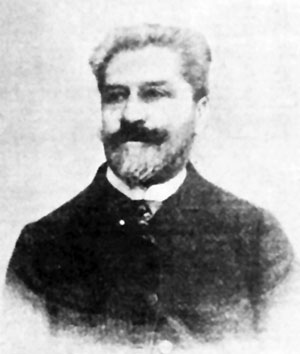
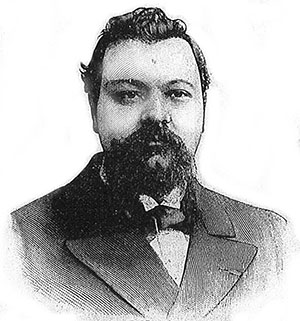
Jules-Benoit Doinel
Six hundred years after Rome launched the murderous Crusade against the ‘Good Christians’, a group of French mystics were inspired to play a unique role in the revival of the Gnostic tradition in the modern world.
Jules-Benoit Doinel (1842–1902) had frequented esoteric and mystical circles for some years. One of these, formed around the Countess of Caithness, took a particular interest in ancient Gnosticism. Dr Stephan A. Hoeller, author of Gnosticism: New Light on the Tradition of Inner Knowing, informs us:
It was into this milieu that the ancient Gnostic tradition was reborn in France in the late nineteenth century. Jules-Benoit Doinel du Val Michel, a scholarly esotericist who had been a devoted researcher of the documents of the Cathar faith, had a mystical experience in 1890, in which he received spiritual empowerment to reconstitute the Gnostic church of old. His experience occurred in the splendid chapel at the residence of the Duchess de Pomar, Countess of Caithness, in Paris. This remarkable noblewoman was a friend of Madame Blavatsky and an early Theosophist and patroness of esoteric movements….
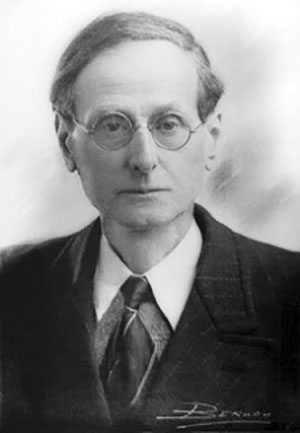
Déodat Roché
Doinel recorded an account of his ‘mystical experience’ and ‘spiritual empowerment’, which was later preserved by Déodat Roché (1877–1978), the foremost historian of Catharism.
One evening, in the autumn of 1890, at the Paris circle of Lady Caithness, Doinel received the communication, “Prepare yourselves. Soon the Bishops of the Albigensian Synod of Montségur are going to appear.” Doinel could not remember the exact words but the sense he recalled from the magical communication of Guilhabert de Castres, the famed Cathar bishop:
We came to you from the most distant of the two Empyrean circles. We bless you. That the principle of good, God, be eternally praised and blessed, glorified, and adored. Amen.
We came to you dear ones… you will establish the Assembly of the Paraclete and you will call it the Gnostic Church.
Doinel and the circle of mystic seekers were seized by “an understandable emotion,” tears streamed from their eyes. Doinel felt fire in his veins, akin to the fire the apostles felt on their heads at Pentecost. A voice was heard: “That the Holy Pleroma bless you. That the Aeons bless you. We bless you as we bless the martyrs of the Pyrenaean Tabor. Amen. Amen. Amen.”
Jules Doinel, as instructed, established the Église Gnostique (Gnostic Church), which was organised along sacramental lines. The teachings of the new church were strictly Gnostic, women were ordained to priestly and episcopal offices, and Doinel also established once again the sacrament of the Consolamentum reminiscent of the Cathars.
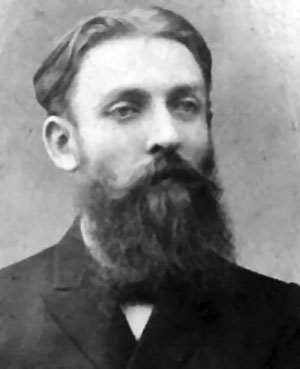
Joanny Bricaud
Soon other gifted esotericists joined the French Gnostic Church, among them Fabré des Essarts, Albert de Pouvourville, Paul Sédir, Lucien Mauchel, Victor Blanchard, and René Guénon.
Given Jules Doinel’s connections to France’s leading mystics and occultists, the Gnostic Church soon became known as “the church of the initiates.” Doinel consecrated the remarkable esoteric writer Papus (Dr Gerard Encausse) as a Gnostic bishop and joined Papus’ Martinist Order. Among Doinel’s acquaintances was Abbe Berenger Sauniere, the parish priest of Rennes-le-Château.
In 1908, at Lyon, Joanny Bricaud (1881–1934) held the Holy Synod of Gnostic Bishops which elevated him as patriarch of the Gnostic Church under the name Tau Jean II. On becoming patriarch, he declared:
The religious evolution of which we are a part shows us that a new religion is necessary. Gnosticism offers itself as the desired religion. Gnosis is the complete and definitive synthesis of all beliefs and all ideas of which humanity has need to realise its origin, its past, its end, its nature, the contradictions of existence and the problems of life….
Gnosis is the very essence of Christianity. Here, my beloved, is the just definition of Gnosticism. But, by Christianity, we do not only mean the doctrine taught since the arrival of the divine Savior, but also the one taught before Jesus’ arrival, in the old temples, the doctrine of Eternal Truth. Our Church is the antinomy of that of Rome. The name of that one is Force; the name of ours is Love.
Our Sovereign Patriarch is not Peter, the impulsive, who denied three times his master and took up the sword, but John, the Savior’s friend, the apostle who relied on his heart and in it knew best the immortal sentiment, the oracle of light, the author of the Eternal Gospel, who took up only Speech and Love.
In The Esoteric Christian Doctrine, published in 1907, a year before he became patriarch of the Gnostic Church, Bricaud wrote:
The main aim of the Universal Gnostic Church is to restore the original religious unity, that is to establish and spread a Christian Religion true to the universal religious tradition. It is not hostile towards any Church. It respects the customs and laws of all peoples. It is essentially large and tolerant, which permits it to admit all men without distinction of nationality, language, or race.
Sadly, the ecumenical brotherhood and openness of spirit cultivated by Bricaud could not prevent persecution and strife befalling the Gnostic Church in France.
Bricaud’s successor, the saintly Monsignor Constant Chevillon, Tau Harmonious (1880–1944), was cruelly executed by Nazi collaborators after the Vichy government suppressed the Gnostic Church.
Nevertheless, it was from France that the Gnostic Church spread to Portugal, Italy, Belgium, and South America.
“The Gnostic tradition, which originally had its home in France,” Dr Stephan Hoeller tells us, “came to be established in England and later in the United States, initially as a result of the efforts of a bishop of French descent who was raised in Australia.”
The Gnosis Restored
With fascism and communism on the rise across Europe, far away in Australia a young spiritual seeker began questioning the historical foundations of Christianity.
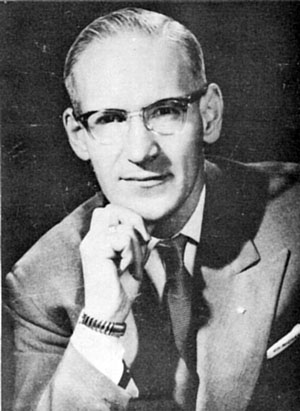
Richard, Duc de Palatine
In his quest for truth, Richard, Duc de Palatine (born Ronald Powell in 1916) joined “the biggest occult library in the Southern Hemisphere at the Theosophical Lodge in Melbourne,” where he studied “the extant writings concerning the Gnostics, Essenes and Secret Mysteries.” By 1944 he became convinced “that one day he would cause to be formed a Brotherhood which would partially restore the Sacred Lore and encourage people to prepare themselves for the Illumination and Interior Communion with the God within.”
In 1940s Melbourne, Richard, Duc de Palatine, a learned and charismatic figure, attracted much attention. His insight was uncanny, but for all this, he was perceived as being a very humble person who seemed to exude love and peace wherever he went. In 1948 he told his friends his mission was not in Australia, and he travelled to London, where in 1953 he was consecrated as Bishop Richard John Chretien Duc de Palatine by the Patriarch Hugh George de Willmott Newman. The name of Duc de Palatine being a personal and spiritual title.
In October 1953, Richard, Duc de Palatine established in London the Pre-Nicene Gnosto-Catholic Church, with the stated object of “restoring the Gnosis – Divine Wisdom to the Christian Church, and to teach the Path of Holiness which leads to God and the Inner Illumination and Interior Communion with the Soul through the mortal body of man.”
From his base in London’s Kensington, Richard, Duc de Palatine travelled on several occasions to France where he contacted the surviving bishops of the French Gnostic Church. They encouraged him to fulfil his mission of transmitting the Gnostic tradition to the English-speaking world. He was also received by representatives of France’s leading mystical orders, including the surviving Grand Master of the Johannite Templar Order.
In a profile of Richard, Duc de Palatine’s life, we read that he held high office in many esoteric bodies:
Through these Orders and his many contacts, particularly in France which he frequently visited, Richard was able to bring forth in a semi-public forum the hidden teachings, the Gnosis of the Soul, which exposed the false vestiges of truth that had been foisted onto the people.
Through his London-based Pre-Nicene Publishing House, Richard, Duc de Palatine issued a series of booklets on Christian Gnosticism, with titles like “The Inner Meaning of the Mystery Schools,” “The Christian Mysteries,” and “Christ or Jesus?” He also published The Lucis Magazine as the official organ of ‘The Sovereign Imperium of the Mysteries’.
Reviewing Richard, Duc de Palatine’s early writings, it is obvious how far-sighted and spiritually gifted he was. Articles in his magazine ranged from discussions of “The Fallen Angels” and the “Dead Sea Scrolls” to the “Christian Fathers on Reincarnation” and “Spiritual Illumination.” In the book The Key to Cosmic Consciousness, he is described as an “outstanding mystic and illumined teacher and writer” whose “knowledge and experience stems from his own illumination in 1956, after applying the teachings of the early Gnostic Fathers…”
Fifty years ago, Richard, Duc de Palatine contrasted the Gnostic spirit of tolerance with the dogmatism of the mainstream Churches:
The true Gnostic or Christian makes no claim that he alone is right or that his teaching is the only one required or necessary for salvation. He demands that no one accept the statements of himself or anyone else on faith but insists that everyone should prove these things for himself.
Richard, Duc de Palatine’s magazines and booklets were disseminated around the world, and his Brotherhood and Order of the Pleroma had branches in South Africa, Nigeria, the USA, and Australia. In 1971 he moved to the United States where he continued his work up to the time of his death in 1977.
“He left behind a rich heritage, and because of his pioneering work a breach was made in the consciousness of the people…. but the keys to find the Door are still guarded and can only be found within the Wisdom Schools which through its Rite of Succession pass on the Keys to the Door.”
Within the Australian branch of the Brotherhood and Order of the Pleroma, established in the early 1950s by students of Richard Duc de Palatine, the ‘Good Christians’ or Cathars held a special place of honour and reverence.
The Good Men and Women of the Languedoc are remembered annually on 16 March, the anniversary of the fall and martyrdom of Montségur in 1244, the last Cathar stronghold.
We do not believe in progress or in salvation. For the Latin race, which goes to its death, we prepare a final splendour, to dazzle and gentle the barbarians who are to come.” These words, published in Le Figaro on 2 September 1891 as part of an essay titled “Manifesto of the Rose+Cross,” heralded the major work of one of the most astonishing figures in the history of Western occultism – a teacher and visionary with a message that still resonates today.
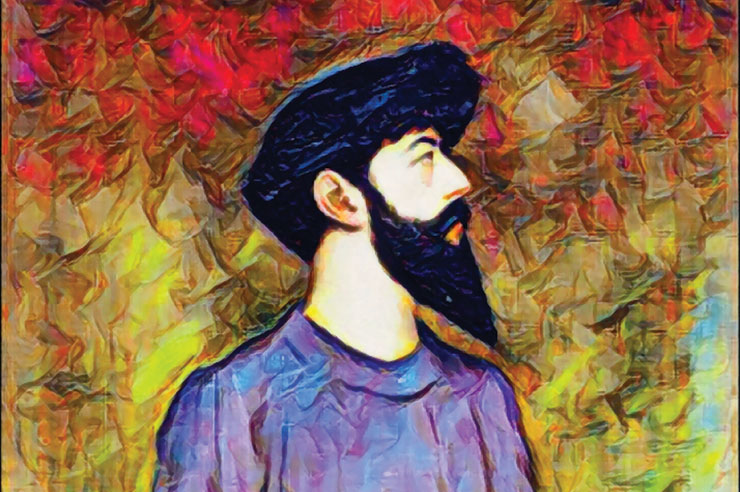
Joséphin Péladan was born in 1858 in Lyon, that perennial hotbed of French occultism, in a devout but eccentric Catholic family with occult connections: his father was a member of a Templar order and his older brother Adrien, a homeopathic doctor, studied alchemy and occultism.
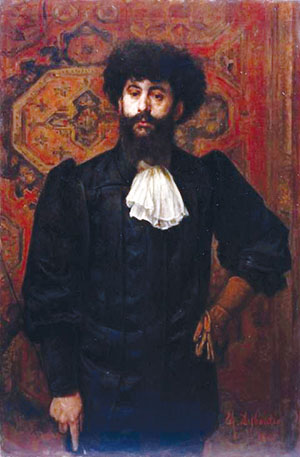
Portrait of Péladan by Marcellin Desboutin (1891).
In 1882 Joséphin came to Paris. After a brief period of couch-surfing with friends, he found a job working for the magazine L’Artiste. Jules Bois, a friend of his, reminisced: “He shook his opulent hair above twenty-centime plates of beans at the corner wine merchant. When the cuisine of Paris tired him, he went to decimate the hearts of sentimental provincials. One saw him in a medieval doublet going through the cafés of Marseilles, and he would hide a walking stick beneath his opera cloak so that it looked, under the folds, like a sword.”
His art criticism, which lambasted the stereotyped Academic style of the period, won him an immediate following, and he added to it by playing the part of a Parisian eccentric. “Do you know what is meant by the expression ‘That man is a character’? Well, a mage is that above all,” Peladan wrote, and he certainly was.
He’s the man Oscar Wilde was imitating when Wilde went strolling through London in velvet clothes with a drooping lily in his hand. He claimed descent from the kings of ancient Babylon, grew a long square beard in the Babylonian style, and took the Babylonian title Sâr, “prince.” These extravagances aside, his real fame began in 1884 with the publication of his first novel, Le vice suprême (The Supreme Vice).
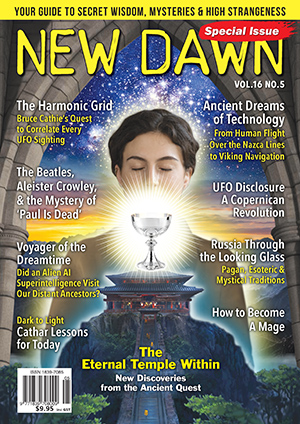
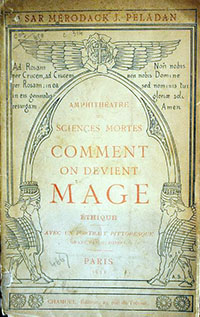
Lush, erotic, vivid, and bold, The Supreme Vice became an overnight sensation and helped feed the passion for occultism that made fin-de-siècle Paris one of the wellsprings of modern magic. Its main characters, Princess Leonora d’Este and the magus Merodack, act out a process of initiation that Péladan explored in more detail in many other novels and in a valuable instructional text, Comment devient un mage (How To Become A Mage), published in 1891.
Become an Individual
Gérard Encausse (Papus).
To Péladan, the point of magic was the creation of the free individual. We are not born individuals, Péladan taught, and our education and upbringing are designed to keep us from achieving individuality. “Society,” he wrote, “is an anonymous enterprise for living a life of secondhand emotions.”
To become an individual, it is necessary to break free from the mental grip of your culture, and that requires sustained effort guided by a clear awareness that a great deal of what you consider “your thoughts” and “your feelings” belong to society, not to you. That was Péladan’s magic, and it is just as possible and just as important now as it was in his day.
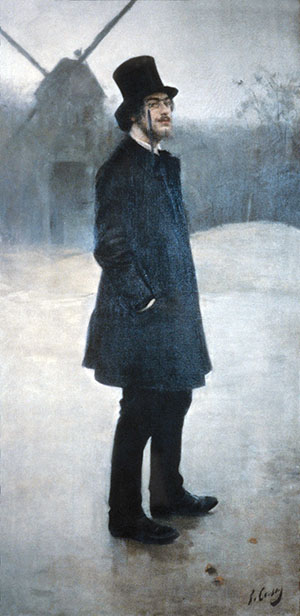
Erik Satie by Ramon Casas (1891).
Paris in the late nineteenth century was awash with magical orders and secret societies, and it was inevitable that Péladan would try to bring this vision of magic into one of them sooner or later. In 1888 he joined together with Stanislaus de Guaita, Gérard Encausse (who wrote important occult works under the name Papus), and a circle of other leading occultists to found L’Ordre Kabbalistique de la Rose+Croix (the Cabalistic Order of the Rose+Cross). Differences in opinion, particularly over Péladan’s Catholic loyalties, eventually drove Péladan to break with the others. In 1890 he founded an order of his own, L’Ordre Catholique du Rose+Croix, du Temple, et du Graal (the Catholic Order of the Rose+Cross, the Temple, and the Grail).
Salons de la Rose+Croix
With the help of a wealthy patron, Count Antoine de la Rochefoucauld, and a circle of enthusiastic followers, Péladan set out to make as big a splash for his new organisation as he could. Erik Satie, then a rising star in the Paris music scene, became the order’s official composer and wrote three Sonneries de la Rose+Croix (Fanfares of the Rose+Cross) for its meetings. 1891 saw the publication of How to Become a Mage and the “Manifesto of the Rose+Cross.” 1892 brought Péladan’s greatest triumph – the first of the Salons de la Rose+Croix.
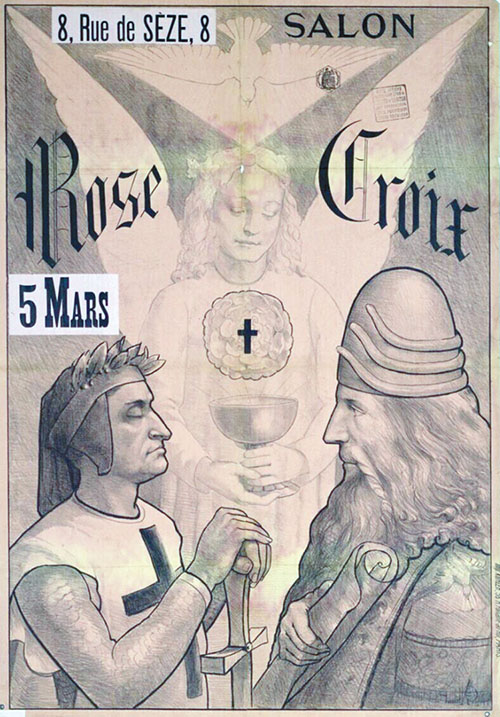
Lithographed poster by Gabriel Albinet for the 3rd Salon Rose-Croix (1894).
At that time, the official Salon, held annually in Paris, was the bastion of Academic art in France. Péladan conceived the plan of sponsoring an alternative Salon under the aegis of his order, providing a venue for the more innovative and esoterically inclined art of the Symbolist movement, which he favoured but which was strictly excluded from the official Salon. His alternative show opened on 9 March 1892 in the Galeries Durand-Ruel, 11 rue le Peletier, Paris. It was a roaring success, proving once and for all that the art being created outside the official salon was far superior to the art produced inside it.
Anticlimax followed. Péladan’s order sponsored five more Salons de la Rose+Croix, but none of them succeeded as brilliantly as the first. The occult movement in France crested and began to ebb as the political pressures that eventually resulted in the First World War seized the public imagination. Through it all, Péladan kept writing and teaching, turning out novels, plays, essays, instructional works, and pamphlets for an audience that gradually dwindled over time. When he died in 1918, he was nearly forgotten.
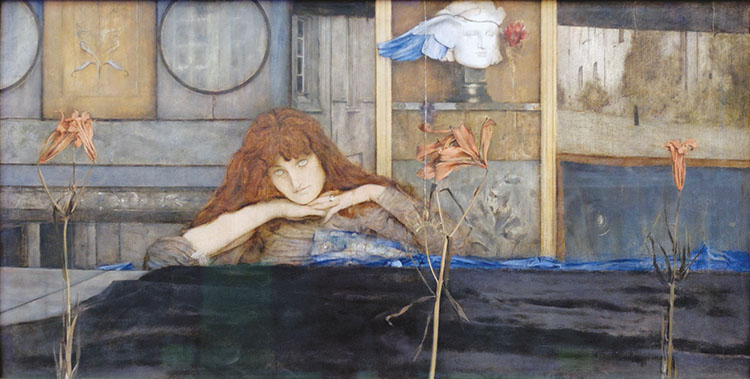
I lock my door upon myself by Fernand Khnopff (1891). Exhibited at the 2nd Salon Rose-Croix (1893).
Magic in a Dying Civilisation’s Twilight Years
All this labour was in the service of an utterly serious purpose. Péladan belonged to that large minority of nineteenth-century thinkers who recognised that the European societies of their day were headed for disaster. What set him apart from the sentimental conservatives of his time and ours is that he recognised that the heritage of old Europe was already past saving and that he worked his magic in the twilight years of a dying civilisation.
Of course, he was quite correct. The great cultures of Europe, in every sense Péladan would have recognised, died in the trenches of the First World War. The forty years from Sarajevo in 1914 to Dien Bien Phu in 1954 saw Europe’s nations flattened to the ground by two catastrophic wars, overwhelmed by cultural change, and reduced from the status of masters of the planet to pawns in a game of bare-knuckle politics played with gusto by the United States and the Soviet Union. All this made Péladan’s lessons more than usually relevant because the catastrophe he foresaw had a clear magical dimension.
Read contemporary accounts of the way that Europe stumbled into war in 1914 and it’s hard to miss the weirdly trancelike state of mind in the warring nations, as vast crowds cheered the coming of hostilities that would cost millions of them their lives, and left-wing parties that had pledged themselves to nonviolent resistance in the event of war forgot all about their pledges and swung into step behind the patriotic drumbeats.
The collective consciousness of the age was primed for an explosion, partly by the sorcery of competing political and economic interests, and partly by the rising pressures of intolerable inner conflicts that were prevented by the limits of the mass mind from finding a less catastrophic form of expression.
It took an extraordinary degree of mental independence to stay clear of the trance state and its appalling consequences, but that was one of the things the magical training available in those days was intended to do.
How To Become A Mage
How To Become A Mage, originally published in 1891
Péladan was inevitably the most outspoken of the period’s occult writers on this subject, as on so many others, and filled a good many of the twenty-two chapters of How To Become A Mage and long passages in his novels with advice on how to open up an insulating space between the individual mind and the pressures that surround it. Many of the same points, though, are made in quieter ways by other writers of the time, and in the instructional papers of magical lodges of the same period. All this advice is aimed at the social habits of another time and has not necessarily aged well, but the basic principles still stand.
The first of those principles is to limit and control the channels by which the mass media and their wholly owned subsidiary, public opinion, get into your nervous system. Now, of course, that raises the hackles of quite a few people nowadays, but it’s essential. Mass-produced popular culture exists solely for the purpose of emptying your wallet and your brain, not necessarily in that order. Popular culture is a vehicle for the mass mind; it works, as negative magic always works, by inducing you to think less and react more. Thus, in the strictest sense of the word, it makes you more stupid. That’s not a useful habit to cultivate.
One point Péladan made that remains valid today is that spending time among a crowd of people whose minds and conversation are utterly conditioned by popular culture is not noticeably different from getting your popular culture firsthand from the media. If anything, this is even more of an issue these days than it was in his; I suspect most of us have had the experience of hearing a conversation between two people in which every single word spoken was a sound bite from some media source or other. There’s no need to become a hermit, but it’s a good idea to choose your crowds with some care.
Steps such as these will cut down on the influence that the pop culture of our time has over your thoughts, feelings, and decisions. Still, the empty space has to be filled with something better, or there won’t be much of an improvement; this is the second of Péladan’s principles. It avoids the perennial mistake of Romanticism, the notion that all you have to do is fling aside the fetters of social expectations and do what comes naturally. The problem here, of course, is that “what comes naturally” to every one of us is the product of a lifetime spent absorbing social cues from people around us and from the media, all of which triggers unthinking and unconscious reactions we share with our nonhuman relatives: social primate see, social primate do.
Being who he was and living when he did, Péladan phrased that dimension of the work in terms of art, music and literature, and those are certainly among the available options. If you happen to be a dandy and an aesthete and live in a city with good art galleries, concert venues, and the like, you could do worse than to follow his recommendations – he was particularly partial to Renaissance paintings, German classical and romantic music from Bach through to Wagner, and Shakespeare’s plays – but I don’t recommend copying him and Oscar Wilde and strolling down the streets with a lily in your hand. Their wives clearly had to put up with a lot. (You didn’t know that Wilde was married, did you? Her name was Constance; she was an initiate of the Hermetic Order of the Golden Dawn, the most influential magical order in late nineteenth century Britain; and yes, she did have to put up with a lot.)
Still, that’s only one option, and the last thing you should do in this sort of practice is rely on someone else’s notions of what ought to feed your mind. “‘Fear the example of another, think for yourself’,” wrote Péladan; “this precept of Pythagoras contains all of magic, which is nothing other than the power of selfhood.” The important thing is simply to choose things to read, watch, hear, and do that you consider worthwhile instead of passively taking in whatever the sorcerers-for-hire of the media and marketing industries push at you. What falls in the former category will vary from person to person, as it should.
All this seems relatively straightforward, and indeed it’s quite possible to get to the same decision by plain reasoning starting, say, from the shoddy vulgarity of mass-produced entertainment and going from there to the realisation that there’s much more interesting mind food to feast upon. That making such choices also makes it easier to think clearly would, in that case, be merely a pleasant side effect of good taste. The operative mage in training does the same thing deliberately, not just to think clearly but to feel and will clearly as well. As the training proceeds, however, those effects begin to reveal another side, which is their effect on other people.
Péladan hinted at this effect in How To Become A Mage, though custom in the occult scene back in his time didn’t favour spelling out the details. “Do not look for another measure of magical power than that power within you, nor for another way to judge a being than by the light that he sheds to perfect yourself by becoming luminous, and like the sun, to excite the ideal life latent around you – there you behold all the mysteries of the highest initiation.” What he did not quite say is that “the ideal life latent around you” is in other human beings. Especially in times of cultural crisis, stepping outside the lowest common denominator of the mass mind has an effect rather like induction in electrical circuits. Put another way, it can be as catchy as a lively new tune.
You can catch that tune, so to speak, from a person; you can catch it from a book, which is why Péladan wrote his twenty-two novels, each of them exploring some aspect of the relation between the initiate and a corrupt society; you can catch it from other sources, the way Rainier Maria Rilke did from a statue of Apollo; you can also catch it all by yourself, by climbing out of collective consciousness for some other reason and discovering that you like the view.
Far more often than not, those who step out of the collective consciousness of their society promptly jump back into the collective consciousness of a congenial subculture, which from a magical perspective is no better – thinking the same thoughts as all your radical friends is just as much secondhand living as is thinking the same thoughts as the vacuous faces on the evening news – but there’s always the chance of getting beyond that.
To get beyond that is the central theme of Péladan’s work. His books are readily available on the internet at present, though only a few of them have been translated into any language but French; his ideas remain vital and important. To take up the challenge he offered is to begin working the most powerful magic of all – the creation of yourself as a free individual.
John Michael Greer wrote the foreword to the first English translation of Péladan’s How to Become a Mage (subtitled A Fin-De-Siecle French Occult Manifesto), published in 2019 by Llewellyn.
We should be cautious of prophecies that claim we are on a path of infinite political progress or infinite economic growth – or, conversely, headed toward civilisational collapse.
Things are more complicated, and opportunities remain for creating interesting new cultural movements and for personal transcendence and integration (though perhaps not for those who are determined to conform to some outdated societal mould).
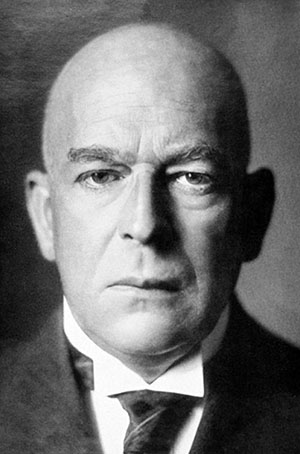
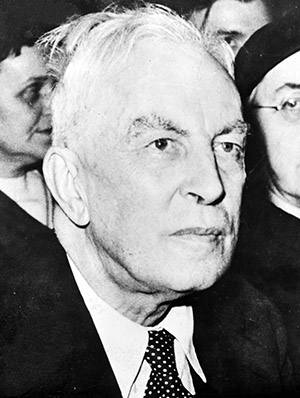
Oswald Spengler (1880-1936)
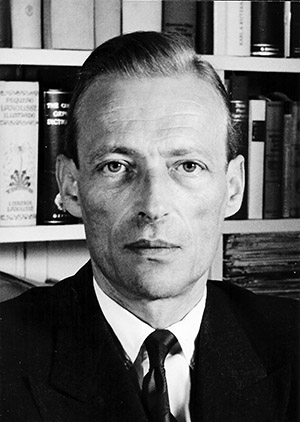
A century ago, the German intellectual Oswald Spengler (1880-1936) argued that civilisations are organic and, like plants, they take root, blossom, whither, and die. According to Spengler, the West is now in its dying phase. His thesis was countered by another German thinker, Jean Gebser (1905-1973), who argued that human consciousness evolved through the emergence of new stages. The previous stages remained part of the psyche but were superseded. These stages (the archaic, magic, mythical, and mental) were characterised by new developments in language, art, and even perception (e.g., the development of perspective in art).
Jean Gebser (1905-1973)
Perhaps more important was the thesis of British historian Arnold Toynbee (who was influenced by Spengler). While Spengler preferred “culture” to its more developed and complicated phase – civilisation – Toynbee believed that the former type of society preserved itself by worshipping the dead and sticking, unquestioningly, to the rules that the ancestors had laid down. But a civilisation, Toynbee argued, constantly renews itself through the actions of a “creative minority” – a small group of individuals who think differently and create new culture. (One such creative minority was the Beatniks of the 1950s, who attempted to live authentically, creatively, and spiritually in the context of a West in decline, introducing many Americans to Eastern religion, alternative spirituality, and psychedelics.)
Arnold Toynbee (1889–1975)
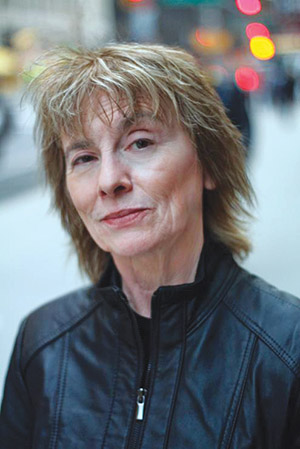
Spengler’s thesis can be detected in the warnings of feminist social critic and author Camille Paglia. She suggested a few years ago that America may well be in a stage of decline and cited the transgender movement as proof, suggesting that transgenderism gains popularity in the “late phases of culture, as a civilisation is starting to unravel,” e.g., the late Roman Empire, the Weimar Republic, and so on.1 The people of such societies, says Paglia, think of themselves as very sophisticated, but yet, out on the margins of society, or just beyond the borders of the state, those – from the Hun to ISIS – “convinced of the power of heroic masculinity” are gathering, waiting to strike.
Camille Paglia
Paglia is not the first to contrast the militant jihadist with young, effeminate Western men and modern Western culture that “no longer believes in itself.” Nor is she the only one worrying about the emergence of hyper-masculine men, though she is unusual, as a feminist and progressive of sorts, for her criticism of the latest political fads. The target of the more “sophisticated” members of our societies tend to be those representing traditional culture, pro-masculinity groups, or groups advocating physical and mental strength. But Paglia is an actual thinker, of course, and not merely another establishment apologist posing as one.
Disintegration
Who are the barbarians? When we look at television and movies today, we see that men are not infrequently portrayed as clueless, weak, ignorant, stupid, cowardly, or thuggish. Heroes are dead. And we do not need strength and courage. Of course, this angers a lot of men – especially in the “men’s rights” movement – and some are convinced that it’s a Hollywood conspiracy to deracinate masculinity. But, let’s be honest, if these images of men caught on, it is because that was the experience that so many people had of men.
I have spoken to men across the United States, and the vast majority told me their father gave them no real attention or guidance growing up or that he was a workaholic, an alcoholic, a “yes man,” a womaniser, a bully, or worse. If they received guidance on how to behave, it usually came from their mother or their first real girlfriend. Unsurprisingly, many young men feel resentment toward older men in power and are suspicious of “masculinity” (a term they equate with working too much, bullying, watching sport, hitting on women, and talking nonsense).
Beyond which team to support and which political party to cheer for, the stock advice from fathers to their male children is often little more than “get good grades and get a good job” – or at least some kind of job – or “don’t do what I do; do what I say.” This doesn’t really grab most young men as a satisfactory plan for life. A lot of pain in men goes unnoticed.
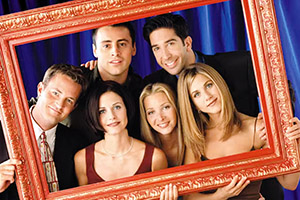
I mentioned the portrayal of men and women on television. In one op-ed a few years ago, the ‘90s sitcom Friends was blamed for the downfall of Western civilisation.2 For the op-ed writer, Ross was the show’s hero – or, at least, he should have been. He was an intellectual (or at least intelligent). But he was boring in comparison to the rest of the Friends gang. As such, society was given the message that intelligence is bad. He got the girl he deserved, the writer tells us: “Rachel, the one who shops.”
Apparently, not all Rosses are boring. While the writer assures us that there is now a “resistance” forming, made up of “new Rosses” – people of “grit” who are “hiding” in art museums, chess clubs, and so on – Rosses aren’t going to save civilisation from the nightmare Paglia imagines – its collapse and takeover by new barbarians. In real life, Rachel (by which I mean the actress Jennifer Aniston) married (and then divorced) Brad Pitt.
We don’t need to pick through Aniston’s off-screen love life and its ups and downs to know that the dithering and undynamic Ross wouldn’t have got a look-in with Rachel. And, frankly, why should he? He wanted a woman that was, physically, well out of his league. He could have gone across the hall and asked Joey for some pointers on working out and then set to work improving himself physically – but he didn’t. And, unlike most people, he didn’t want to, or couldn’t, adapt his conversation to his friends, either.
Ross (and the Friends gang as a whole) reflects the West’s compartmentalisation of people into types: the intellectual (the intellect), the jock (the body), the artistic dropout (the soul), the Democrat, the Republican, the independent, the non-binary, the genderqueer, the two-spirit, and so on, and so on. (Effectively, Friends is a comedic Planet of the Apes without the ape costumes or post-apocalyptic NYC backdrop.) And while compartmentalisation may have helped us create civilisation, it is now contributing to its disintegration.
Revolt Against The Shrinking Brain
Rosses may represent a clumsy resistance to the dumbing down of society. Some of those becoming transgender may, as Paglia suggests, be the sort of people who would have become Beatniks or Hippies in decades past and might be rebelling against the very limited, clichéd 1950s-type notions of gender (pushed in some online “masculinity” and politically conservative circles). Men’s rights groups may be an angry resistance to men not being taken very seriously on a range of issues (e.g., divorce and child custody). And as Paglia suggests, culture may be “starting to unravel” into different types, none of them whole in themselves. But opportunities remain.
As Paglia notes, that opportunity is open to those who would destroy us and take our liberty away. But that is not the final word. Opportunities are open, too, to the creative, adaptable, and integrated. (The integrated are entirely opposite to the mass of compartmentalised individuals: Rosses, Joeys, and Rachels, etc.)
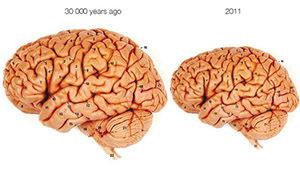
The human brain 30,000 years ago and today.
The human (genus Homo) brain quadrupled in size over six million years but, strangely, appears to have decreased in size since the last Ice Age. Diet and environmental factors are blamed. A more recent hypothesis suggests that human brain shrinkage occurred in response to the expansion of our societies and the need for greater compartmentalisation of tasks to sustain and develop those societies (i.e., civilisations).
Jeremy M. DeSilva et al. note that “brain differentiation can occur in association with division of labor in the absence of striking changes in body size, illustrating how selection may have operated in humans as social groups increased in size.”3
Formed into large and increasingly complex organisations, human beings needed specialists, not generalists. It needed some people to focus on medicine and others to focus on engineering, some to focus on creating art and others to focus on fighting wars, and so on, effectively distributing functions throughout the community. DeSilva says, “multiple brains contribute to the emergence of collective intelligence.”
The collective brain is most visible in the realm of politics. The ideas of a particular movement are thought up by a handful of individuals at most (these original thinkers are usually dead before their ideas catch on). The average voter and political fanatic (the compartmentalised individual) merely receives these ideas and passes them along, acting as a node in a network. He believes them to be “true” because, unaware of their history, the ideas appear to have emerged out of nowhere, suddenly to be accepted by everyone (every other node) around him. Nevertheless, the more the compartmentalised individual is convinced he arrived at his own conclusions, the more likely he will parrot the latest political mantra, spreading the message to other nodes. And tied into his self-image and survival as a node in a network – if the information is challenged or shown to be false, his response is usually anger, outrage, and ad hominem accusations. In authoritarian societies, detractors are prosecuted and either imprisoned or executed. Typically, though, such societies fail.
Let’s consider Western civilisation as a brain (or an organism). The current obsession with “diversity and inclusion” can be regarded not as an expression of a moral conviction (as it is presented) but as a survival mechanism: i.e., as an attempt to expand the network so that new nodes can pass along new information about possible threats from outside as well as new opportunities. Racial, sexual, gender and religious diversity within the workforce is often presented as a way for companies to gain an advantage over competition (which seems amoral at best). And notably, although the registration of patents (probably the most concrete marker of innovation in any society) has gone up in the United States over the last few decades, half of these were registered by foreign-born inventors.4 Everyone’s favourite entrepreneur, Elon Musk – founder of Tesla, SpaceX, and Paypal – immigrated from South Africa, first to Canada and then to the US.
Renewal & Reintegration
The integrated individual – capable of thinking, creating, and problem-solving – might be a throw-back to a time before civilisation, but that individual is essential to its survival and renewal. He, or she, is one of Toynbee’s creative minority. Even in more ordinary lines of work, in a fast-changing society, developing different skills and interests will be an advantage and might be essential to remaining relevant to the economy. “Holding a solid grasp of many concepts or decent proficiency in multiple skills,” says Forbes, “can allow for flexibility, in a life and career.”5
But there are things more essential to life and the human spirit than commerce, of course, though it may be crucial both to the individual and their society. The Renaissance saw a renewed interest in ancient Greek and Roman thought and classical learning, as well as new developments in the arts (such as perspective in painting) and sciences. And epitomised by Leonardo DaVinci (artist and inventor) and, perhaps, more so, by Leon Battista Alberti (architect, mathematician, scientist, painter, poet, expert horseman, and a man keen to demonstrate his physical prowess). The notion of the Uomo Universale (“Universal Man,” usually called the “Renaissance Man” today) was born during this time.
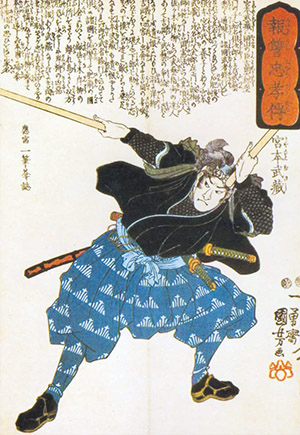
We can, of course, find such integrated human beings in different times and places. The ancient Greek philosopher Plato was also a wrestler and believed that youths should be educated through philosophy, music, and wrestling. In Shi‘i Islam, ‘Ali is regarded as both the ideal warrior and ideal mystic and as the exemplar of futuwwa (the Muslim code of “chivalry” or, more literally, “young manhood”). The samurai warrior Miyamoto Musashi was also a renowned painter and calligrapher, and Viking warrior Egill Skallagrímsson was also a renowned poet.
Closer to our own time, we find the Renaissance Man turning up primarily in, or on the margins of the occult, with the ability to break the taboos of a spiritually disintegrating culture being, perhaps, necessary to begin the journey towards personal reintegration. Rudolf Steiner was a mystic, educator, painter, author, and architect. G. I. Gurdjieff was a mystic, hypnotist, and (sacred) dance teacher. Carl Jung was both a pioneer of psychoanalysis as well as an artist and visionary author.
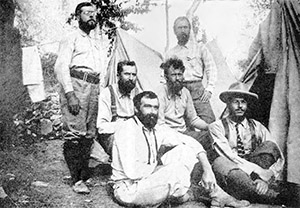
Aleister Crowley played many roles including that of mountaineer, and notable for being one of the first Westerners to attempt K2, the second-highest mountain on Earth after Mount Everest, in 1902. He is seen on K2 in the above photo, sitting, fourth from left.
Known primarily as a ceremonial magician, author (fiction and non-fiction), and founder of his own religion (Thelema), Aleister Crowley was also a boxer, mountaineer, adventurer, painter, and poet. If we take half his accomplishments, he is a clichéd “man’s man.” If we take the other half, he is an effeminate, dandyish “girly man.” But, as he advised his adepts, in himself he managed to embrace and develop the “Angel” and the “Demon” – what society might call the “male” and the “female,” the “left brain” and the “right brain,” the body and the spirit, etc.
Depiction of samurai warrior Miyamoto Musashi
Modern culture has hemmed us in. Today, painting, poetry, calligraphy, etc., are all seen as “feminine” or “girly.” In contrast to Musashi or Skallagrímsson, modern-day “real men” do not write poetry. In fact, “real men” don’t seem to do much at all. Whether we like it or not, in part, it is against the backdrop of fatherless families and men more interested in gaming and chasing women than in mental, physical, spiritual, and cultural self-development, that the pro-transgender, pro-pan-gender, pro-gender-fluid movement is reacting. And we must agree with them that the 20th-century clichés of gender – the compartmentalised man or woman, individuals who act merely as nodes, passively absorbing and regurgitating whatever they hear – are inseparable from the disintegration of the West and the lack of energy it displays in the arts, philosophy, and other areas of culture.
We mentioned Toynbee’s belief that civilisations differ from cultures by constantly renewing themselves through the “creative minority.” Perhaps the best example of a renewal is the Renaissance (literally “Rebirth”) which we already mentioned. But there have been other, smaller revivals, such as artistic movements (Cubism, Surrealism, etc.) and musical movements (Punk, Hip-Hop, etc.). It might even be argued that the emergence of transgenderism, pangenderism, and gender-fluidism into the mainstream is part of a revival (perhaps emanating from the unconscious of the collective intelligence) of the shamanic (since shamans often wore the clothes of the opposite gender and were regarded as neither or both male and female) and, as such, as part of a centuries-long occult revival that includes, at its softer edges, the now virtually omnipresent New Thought movement and New Age spirituality.
We mentioned the union of the mystic and the warrior in the figure of ‘Ali, as well as Plato, the philosopher and wrestler. The average person might remain a node in a network of the collective brain, merely absorbing and transmitting ideas to others without ever questioning those ideas, even as the disintegration of their society continues. A new Renaissance will only be brought about by the work of creative minorities. And, today, in a time of increasing hostility towards the body (particularly as an embodiment of strength or beauty), when life is increasing online and virtual, and thinking is increasingly done for us (or against us) by algorithms and artificial intelligence, such a minority must work to elevate the physical body and reintegrate it (as Plato suggested, with his schema of music, philosophy, and wrestling) with the mind and spirit. We must be part-barbarian and part-sophisticated cultural thinker and creator.
The future is uncertain but it remains open to the integrated – to those who push forward in different ways, creating new art, new ways of thinking, new movements, new rituals, and new routines, all awakening us to a recognition we are more than nodes in a disintegrating network: that inside of each of us burns a barbarian fire – a spirit – for adventure, for struggle against our limits, for strength and beauty, and wholeness.
[alert type=”success” dismiss=”no”]If you appreciate this article, please consider subscribing to help maintain this website.[/alert]
Footnotes
1. www.youtube.com/watch?v=I8BRdwgPChQ
2. David Hopkins, “How a TV Sitcom Triggered the Downfall of Western Civilization,” March 21, 2016, https://gen.medium.com/how-a-tv-sitcom-triggered-the-downfall-of-western-civilization-336e8ccf7dd0
3. Jeremy M. DeSilva, James F. A. Traniello, Alexander G. Claxton, and Luke D. Fannin, “When and Why Did Human Brains Decrease in Size? A New Change-Point Analysis and Insights From Brain Evolution in Ants.” Frontiers in Ecology and Evolution, 22 October 2021, https://doi.org/10.3389/fevo.2021.742639
4. Richard Florida, February 1, 2013, “Innovation and the Wealth of Cities,” www.bloomberg.com/news/articles/2013-02-01/innovation-and-the-wealth-of-cities
5. Jodie Cook, May 13, 2021, “Why Being A Jack Of All Trades Is Essential For Success,” www.forbes.com/sites/jodiecook/2021/05/13/why-being-a-jack-of-all-trades-is-essential-for-success
We are all in the gutter, but some of us are looking at the stars. – Oscar Wilde
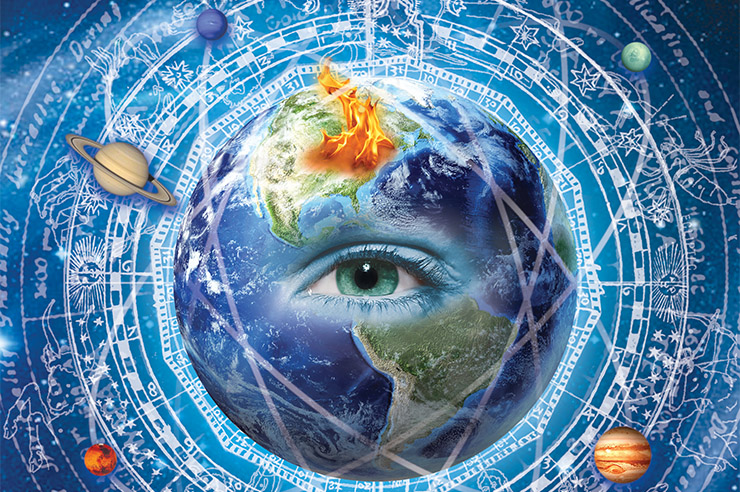
We’re living through one of the most tumultuous and significant periods in history’s astrological playbook. A massive cosmic timepiece turned the hands of destiny into a new position, and all hell broke loose for the players in the game of life on Earth who’ve no idea what is really going on.
Over very large spans of time in our long and often brutal history, there is nothing much to report on the astrological front. Boring planetary configurations that only have meaning for specific events in the life and times of an individual or society. Then suddenly, at certain cosmic power points, things come to a head when the signs in the sky indicate huge changes, and we see it all play out on the ground here in the affairs of humanity.
There is no doubt that all our forebears – who helped guide societies over thousands of years before this current age – would be paying close attention, wholly preoccupied with the sky and studying these major astrological transits and conjunctions.
The seers of all ancient civilisations, the medieval astrologers in Western Europe and all the East, as well as theologians and advisors to royalty down through the ages – not to forget those men who helped birth the modern scientific framework like Tycho Brahe, Johannes Kepler and Galileo – all would be fascinated by what we are seeing right now in the heavens, and what it means for the immediate future.
What is Happening?
Without getting into the technical aspects (you’ll have to study up on this yourself), the following is an overview of the significant astrological dynamics.
The rare series of Uranus/Pluto squares from June 2012 to March 2015 signalled what was to come. A square is a 90-degree aspect between two planets that indicates conflict. These seven exact squares happened between Uranus – the planet of radical change – and Pluto – the planet of transformation, power and subconscious forces.
On 12 January 2020, Saturn conjoined Pluto at 22° Capricorn for a single and dramatic pass. The two planets met in the same position in the same zodiac sign, signifying a very powerful merging of planetary energies. Although Saturn and Pluto conjoin every 31 to 37 years in different zodiac signs, it was over 500 years since they conjoined in Capricorn!
In astrology, Saturn is associated with restriction and limitation. Most astrologers concur that this Saturn/Pluto conjunction signified major impacts on power structures, more so because Capricorn ‘rules’ the domain of government (previous Saturn/Pluto conjunctions took place at recent turning points in world history, for example, in 1913-1916 and 1946-1948).
As it turned out, Covid-19 was officially identified by scientists right on the conjoin of Saturn/Pluto in January 2020. Uprisings and protests across the globe correlated with this dynamic. The push and pull of this conjunction reflected in the collapse of outdated structures but also helped solidify newly emerging bodies.
Historian and professor of philosophy and psychology Richard Tarnas describes these Saturn/Pluto periods as bringing an “irrevocable termination of an established order of existence” and “a widespread sense of victimisation and suffering under the impact of cataclysmic and oppressive forces of history.”
Pandemic Patterns
Next up in 2020 was Jupiter and Pluto conjoining in Capricorn on 5 April, 30 June and 12 November. There hadn’t been a Jupiter/Pluto conjunction in Capricorn since the year 1771.
Throughout history, many plagues and pandemics coincided with the conjunction of Jupiter – the planet of expansion and knowledge – and shadowy Pluto, which rules all things hidden and buried.
Three examples: In September 1771, the Russian plague (Jupiter/Pluto in Capricorn) hit its peak, killing an estimated 1,000 Moscow residents a day (20,000 confirmed dead that month alone).
In 1981, the HIV epidemic officially arrived, spawning the AIDS crisis. Jupiter and Pluto were meeting up in Libra, the sign of relationships, from October and November 1981.
In January and February 1918, Jupiter and Pluto were travelling together in Cancer. A terrible flu pandemic – known as the ‘Spanish flu’ – broke out during this time, infecting an estimated 500 million people – one-quarter of the world’s population – and resulting in 50 million deaths worldwide.
There is an interesting dynamic between the events of 1918 and 2020 in regard to scientific and technological developments in medicine.
Journalist and historian John M. Barry, in his book The Great Influenza: The Epic Story of the Deadliest Plague in History, notes that the history of the ‘Spanish flu’ is not just “chaos, death and desolation of society in a war against nature,” but also “a history of science, of discovery, of how one thinks and how to change the way one thinks, how, in the midst of almost absolute chaos, some men sought the coldness of contemplation, the absolute calm that precedes not philosophy but, rather, severe and determined action.” Barry says the ‘Spanish flu’ was “the first major clash between nature and modern science.”
Modern science’s way out of the Covid-19 crisis, building upon this foundation, has been to rely on experimental vaccines based on new technologies (largely ignoring natural immunity strategies). This invokes dystopian visions of life inside techno-bubble worlds cut off from nature.
Great Conjunction
On 21 December 2020, in an extra-special rare celestial event, Jupiter and Saturn appeared as one bright star when both planets conjoined or ‘kissed’. The Great Conjunction of 2020 was visible from across the world. To view it was a once-in-a-lifetime opportunity.
The Great Conjunction significantly occurred at the beginning degree of Aquarius (on the Solstice point). The last time these two planets conjoined in Aquarius was back on 7 January 1405.
This powerful dynamic is considered a celestial omen and the preeminent method of demarcating historical eras in traditional astrology. Great Conjunctions were always closely observed by astrologers and linked to the rise and fall of royalty, leaders, and societies.
The fact this Great Conjunction inaugurates a new Air element Grand Mutation cycle, with all the related Aquarian symbolism, suggests we have stepped through one of the entry doors into this long-heralded new age.
2021 Onwards to the New Age
The incredibly volatile period stirred up in 2020 continued into 2021. The year started with a massive sequence of transits in January, including the major Saturn/Uranus Square running from 2020 to 2023.
On the horizon looms Pluto’s tour through Aquarius from 2024 to 2044. This dynamic is seen as formally marking our official entry into the Age of Aquarius.
Prophecy scholar and astrologer John Hogue sees Pluto’s 2024 entry into Aquarius marking the birth of “Generation One or Generation Zero.” It is they who will decide whether to look “backward into the past and give birth to human extinction,” or “open to the new and celebrate the unknown… in this oncoming time of the Great Purification [as foreseen by the Hopi].”
Different Perspectives on NOW
What does it all mean for now? It depends on your perspective and where you’re coming from (culture) and as an individual (mental programming, beliefs etc.).
At the end of 2020, Russian astrologer Tatiana Borsch predicted that 2021 would be a year of challenges for the US and most countries of the world.
“As this global financial crisis unfolds, expect a stronger China and a weakened US and Europe. America’s economic and political system might waste away, which could take place faster than we think,” said Tatiana.
This is contrasted by predictions made by various astrologers in Western countries like the United States and Australia. For many of them, the world is moving into an Aquarian Age that embraces Western liberal values and lifestyles. The tragedy is they build their outlook on Piscean era foundations of exceptionalism and superiority, conflating their belief in the modern myth of progress with an “evolution of consciousness.”
Truth is, says the talented UK-based writer and astrologer Jessica Davidson, in the coming years “we can be sure there’ll be no sudden shift into a liberal and progressive paradise of freedom and equality.”
When the signs in the sky match the events on the ground, all we do know is something big is at hand. Your best bet is to stand objectively above the prejudices and biases of your age and culture and drop the pretentious claptrap. All transitions involve pain and adjustments – and one would hope much reflection.
Brazilian Insights
At the time of the Great Conjunction in December 2020, the well-informed Brazilian journalist Pepe Escobar spoke to the respected Brazilian astrologer Vanessa Guazzelli. For over a decade, Escobar has been reporting on the emerging multipolar world and the rise of Russia and China, amidst the structural collapse of the old order.
Vanessa Guazzelli
Guazzelli told Escobar that the rising new age Aquarian-Leo dynamic indicates “it is not the time for a hegemonic single star to rule the world, but a time of many stars illuminating the entire sky. It is not a time for a single empire. There can be empires, if in plural…. It is time for a multipolar world – now that is the Mandate of Heaven.”
She also observes “the strong Aquarian edge activated in China’s astrological progressions when the Belt and Road Initiative was first proposed by Xi Jinping in Astana, in 2013, and how it connected to the degree of the Great Mutation (progressed Venus and Jupiter conjunct AC at 1º Aquarius).”
The Saturn/Neptune dynamic strongly connects with collective ideals in politics, religion and society. Saturn, material reality and structure, combines with Neptune, transcendence and idealism associated with collective dreams and inspiration. This astro-combo in conjunction, square or opposition is particularly pertinent to societies with strong sociocultural linguistic structure like China and Russia, as well as Asia in general.
Guazzelli notes a Saturn/Neptune opposition when “Vladimir Putin gave his historical speech in Munich, proposing the Eurasian Integration in February 2007.” A Saturn/Neptune square coincided with strong, synchronised speeches by Putin and Xi at the 70th UN Assembly in 2015, “affirming the multipolarity of the world.”
“The next Saturn/Neptune aspect will be the conjunction in February 2026,” declares Guazzelli, “inaugurating a brand new cycle… towards multipolarity.”
Jessica Davidson, in her article ‘The Saturn Pluto Conjunction: Start of the New World Order’, states: “We’re at the end of the era of Anglo-American dominance as the power centre shifts towards a multipolar world. It’s not clear exactly how this will play out but there are many who want to maintain the current system, unable to give up their position at the top of the global totem pole. This conjunction marks the start of a period of transition between systems so it could feel chaotic for some time.”
All this was outlined by farsighted long-time New Dawn contributor Mehmet Sabeheddin back in 2003 (in the wake of the Anglo-American war on Iraq):
The current turmoil and conflict unleashed on the planet by the United States and Britain is only the beginning of the climax of a struggle between cosmic influences of which most people are completely unaware. Today, America and Britain embody atrophied and degraded Piscean energies. The Anglo-Americans, as the standard-bearers of bankrupt Western materialism, are trying to reorganise the world, imposing their imbalanced, egoistic approach to life on all societies. Yet their latest brutal and insane actions, witnessed in the tragic invasion of Iraq, are part of a frantic effort to prolong their collapsing system. Despite all their apparent power and wealth, Anglo-American universalism is in a state of rapid decline leading to death.
A new era, a new consciousness, and a new people are on the horizon as the planet goes through a turbulent transitional period paving the way to the Aquarian Age.
In 2022, the United States will experience its Pluto return. This astrological phenomenon occurs when transiting Pluto returns to the same zodiac sign and degree as it holds within the natal chart – in this case, not an individual but a country – the USA, born on 4 July 1776. It’s a cycle of approximately 247 years. Pluto always has a sense of fate to it, especially in this critical time of major world changes.
“The return of the lord of the underworld also speaks of the return of that which was repressed, hidden or rejected. It will have three exact hits throughout 2022, and the final and definitive of the next Pluto cycle has the planet of death and regeneration facing Black Moon Lilith in Cancer, in opposition. Karma is a bitch and hits home,” warns Guazzelli.
However, “this doesn’t mean the American Empire will fall by 2022, but it is collapsing and will undergo dramatic transformations in the coming decade.”
From Pisces to Aquarius
We may not have overcome the cliches and New Age connotations associated with the line out of the 1967 musical ‘Hair’ – This is the dawning of the Age of Aquarius – but the astrological truth of the situation is clear-cut for anyone with eyes to see.
On the level of cosmic time, we are tentatively stepping into the Age of Aquarius from the Age of Pisces. Astrology posits a cosmic imprint over the course of the Ages on human society – its religion, philosophy, myths, science, music, arts, etc. Over immense periods, subtle but distinct patterns manifest in the consciousness of humanity – a sort of unfolding of the collective spiritual state of humankind in a grand cycle known as the ‘Great Year’ that measures 25,920 years.
The Great Year divides into 12 months, each lasting approximately 2,160 years, corresponding to the 12 divisions of the zodiac.
The imprint of Aquarius is all around to see – electricity, computers, the internet, flight, space exploration, individual freedom, humanitarianism, idealism, rebellion, nonconformity, and even the renewed interest in astrology.
As an ‘Air’ zodiac sign, Aquarius pertains to the mental realms. As the element of the incoming age, Air makes communication and inventiveness two of its most outstanding characteristics. This factor also stimulates the mental sphere of humanity towards brotherhood and the integration of knowledge.
However, as I noted in my article ‘The Dark Side of Aquarius: Upheaval, Revolution & Mind Control in the Transition Between Ages’ in New Dawn 161: “Aquarius’s energies are feeding the dark side of human beings at the same time they are stimulating a higher calling…” And: “The dying energies (and systems of thought) of the previous age intensify and poison the winds of change blowing in from the new age.”
We’re living in a period when the old energies mix with the first rays of the new – but the old (outwardly and inwardly) very much runs the show.
The energies of Aquarius – seeping into the minds of a humanity born in the twilight of the Piscean Age – are liable to have negative impacts to that predicted by the believers in positive change: a manifestation of the worse tendencies of Aquarian nature – its dark side.
“[Y]ou will feel as if you are happy, as if you are a citizen living in the harmonious New Age,” writes John Hogue. “You will be seduced into believing it. In fact, in the darker realm of the future, the more people will be programmed not to think for themselves at all.”
These negative aspects of Aquarius resonate in today’s world.
Covid-Control
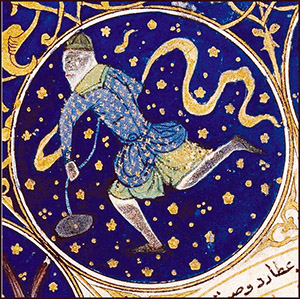
Aquarius the Water Bearer in a horoscope from the Book of the Birth of Iskandar, 1411. The complexion of the saturnine sign is purposively dark.
Aquarius may be the humanitarian, but he is easily corrupted by the simple fact that he is fixed Air. This can manifest as something of the benevolent, somewhat chilly tyrant. – P. James Clark, classical astrologer
The traditional planetary ruler of Aquarius, Saturn, was seen as the ‘great malefic’ because it represents restrictions, difficulties, scarcity and was connected to the Lord of Time – Chronos – of Greek mythology.
The global response to Covid has a saturnine Aquarian feel about it. Worshipping at the altar of science, health surveillance & control systems, lockdowns, quarantines, social distancing, the constant appeals and declarations of humanitarianism.
The ‘new normal’ quickly became an embrace of ‘Big Brother’ as governments of all political orientations around the world assumed unprecedented control over their citizens’ daily lives in response to Covid. Governments in so-called democracies like Australia assumed emergency powers.
Cynical observers are increasingly thinking the response to Covid hides another agenda.
If politicians consulted learned astrologers, they would have been forewarned to prepare for a difficult period. J.P. Morgan, America’s first billionaire banker, apparently held that millionaires don’t need astrologers, but billionaires do.
Great Resets
It is no measure of health to be well adjusted to a profoundly sick society. – Jiddu Krishnamurti
Most readers of New Dawn have heard about the ‘Great Reset’ of World Economic Forum founder Klaus Schwab – a tectonic society-wide shift that imposes changes on how we live, work and interact with each other.
The Great Reset entails a transformation of society resulting in permanent restrictions on fundamental liberties and mass surveillance as entire sectors are sacrificed to boost the monopoly and hegemony of pharmaceuticals corporations, high-tech/big data giants, Amazon, Google, major global chains, the digital payments sector, etc.
Under cover of Covid-19 lockdowns and restrictions, a ‘Fourth Industrial Revolution’ is being rolled out in which older enterprises are to be driven to bankruptcy or absorbed into monopolies, effectively shutting down vast sections of the pre-Covid economy.
Astrologer Guazzelli was astonished to learn that the Great Reset launched in January 2021, “so close to the Great Mutation at the end of December 2020. I doubt this is a mere coincidence or ‘synchronicity’.”
“Possibly aware of this great transition,” she told Escobar, “the [WEF] Davos crew seem to be actually trying to reset the system they already rule with their own settings and revive the dying system as a cyborg from hell.”
Only the arrogantly foolish believe Schwab and the old global elite wouldn’t take a look at what humanity’s oldest science has to say about NOW – especially with so much hanging on a Great Reset to keep a hold on power.
Perhaps they know, writes Jessica Davidson, that “Pluto in Aquarius means the power shifts to the people and society at large, rather than a small group that dominates from the top down. But they won’t give up their power easily.”
“That means things won’t change unless we change.”
Eastern Winds
Now winds blow from the East and from Eurasia, inspiring new forms of co-existence. But the controllers of capital, wealth and worldly power won’t give it up without a fight – or a few wars and a heavy load of social control via technology, capturing bodies and minds. What will it be – Great Reset or Great Mutation? – Vanessa Guazzelli
Two hundred years ago, Emperor Napoleon Bonaparte famously remarked that “China is a sleeping giant. Let her sleep for when she wakes up, she will move the world.”
China is well and truly on the move, along with a resurgent and confident Russia.
“With the end of the Piscean era, history and civilisation are reorienting,” Mehmet Sabeheddin observed back in 2003. “We are seeing a return to origins with the emergence of a new power centre at the cross-roads of the East and West, in Eurasia.”
Pepe Escobar has written extensively on the multipolar world and belated failing Anglo-American plans to forge a full spectrum anti-China front.
Trying to ‘teach’ others how to live is also a failed strategy. To avoid bitter conflict, now is a better time to accept coexistence with the diverse cultures on Earth which express different spiritual, ethical, political and economic frameworks. Who knows what gems of wisdom and human possibility may bloom in Aquarius’ seedbed?
Faulty Thinking
Although we’re in the eye of an astrological storm – on a tipping point of chaos and uncertainty – the time is also pregnant for positive change and sudden breakthroughs. But we need to avoid misconceptions and false judgments – especially regarding how Westerners have projected fears and their values onto other societies.
Harnessing Aquarian impulses from the perspective of Piscean thinking will get you nowhere. Despite being high-minded and for universal brotherhood – hallmarks of the coming age when it flowers – Aquarius isn’t as objective as it thinks it is, and can get caught up in groupthink and fanaticism. The shadow side of Aquarius is its propensity to want to reform everybody and a skewed view of equality, limited to the realm of ideas and debate but lacking in terms of the heart and emotion.
This is all playing today in the era of Covid control and the emerging biopower. As noted by Guazzelli, “the nefarious potential of the Aquarian emphasis is the control of society through technology, be it techno-feudalism or, gods forbid, techno-slavery. On the brighter side of the Force, Aquarius is about a social project to sustain life and meet the needs of the people. Both dimensions or systems might co-exist on Earth for a while.”
Astrologer John Hogue suggests the authorities of the coming age might “fashion psycho-weapons out of the Aquarian element of atmosphere and mood… and you may not even feel the repression.”
“The police state of tomorrow will be clean and corporate, and you will be happy. You can’t help it because your genes were altered at birth. And whatever bad moods or antisocial behaviour that cannot be altered by gene splicing can be dulled by drugs or distracted by an entertainment fix. Tomorrow’s negative Utopia will be more like Aldous Huxley’s Brave New World,” predicted Hogue in his 1994 book The Millennium Book of Prophecy.
Ultimately, faulty thinking will likely land us in a dead-end passage of no return.
This is best encapsulated by the technocentric and anthropocentric Transhumanist movement which views the Earth merely as the backdrop for human ‘enhancement’. Unmoved one inch from its foundation stones of materialism and the progress myth, the human being is regarded as a biological computer to be enhanced and its life extended in perpetuity in the cloud – a techno-version of Heaven. Cleverness and artificial intelligence replace wisdom, spiritual insight and genuine self-actualisation. “The goal of humanity is conceived as being to become more and more clever, as if this were the equivalent of becoming spiritually fulfilled,” says philosopher Jeremy Naydler.
Just as Transhumanist ideology envisages the human future as inseparable from the machine, so too it envisages nature’s destiny as to serve as a kind of substratum of a vast artificial Global Brain. What the Internet of Things, and the creation of a so-called ‘intelligent planet’, means is the total saturation of the Earth with non-biological ‘intelligence’. Through emerging nanotechnologies and enhanced microelectronics, ‘intelligent’ control of the natural environment and many of the organisms within it will be greatly strengthened. And so the Global Brain awakens…. Thus the destiny of the universe is conceived as being ultimately to become an enormous supercomputer. It is a dream of insane proportions…
The Struggle for a Human Future by Jeremy Naydler
Near-Death Experience
Aquarius will be the new age, the new life. First, there will be disastrous events, gigantic upheavals, turmoil and change of all kinds…. – Omraam Mikhael Aivanhov (1900–1986)
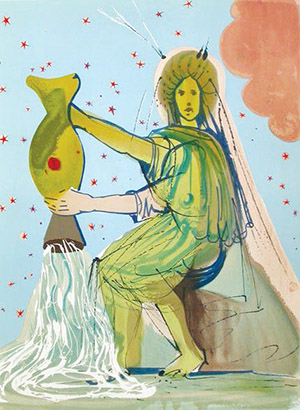
Aquarius by Salvador Dali (born with Saturn in Aquarius)
When individuals have close brushes with death, they often have profound experiences and undergo significant changes in outlook and personality. Similarly, a near-death experience (NDE) for a whole society could instigate a process of reflection and healing.
Devastating changes can be understood as necessary purgations affecting the transformation of humanity into a new mode of being, says NDE expert and psychologist Kenneth Ring:
By analogy, just as the individual near-death experiencer may have to endure the pain and suffering associated with the trauma of almost dying before positive personal transformation can take place, so the world may need to undergo a “planetary near-death experience” before it can awaken to higher, more spiritual, collective consciousness with universal love at its core.
The Aquarian Mode
Whether the Age of Aquarius turns out to be a utopia or an Orwellian nightmare, we ultimately have responsibility for our own awareness and attitudes – and in some ways that may be the most Aquarian lesson of all. – Ray Grasse
The hallmarks of the Age of Aquarius, we are told, are universal brotherhood, peace, unity, higher consciousness, and harmony. In the far distant future – beyond the lifetimes of current humanity – a magnificent flowering of Aquarian civilisation will bloom. It won’t be anything like we can imagine from our place in the grand scheme of the unfoldment of the Ages.
What can we do to facilitate the highest expression of the coming era? Pluto’s entry into Aquarius in 2024 will coincide with society re-organisation and the application of new technologies – tinged by dystopian Piscean energies.
Self-knowledge is the key to surviving this transition period.
“It’s time for us to figure out what it means to be human and how to live together on this planet without fighting over everything,” urges Jessica Davidson. “Aquarius is future-oriented and wants to make society, and the future, a better place. But before you can do that, you have to understand who you are and why you’re here.”
Writer and astrologer Ray Grasse, in his book Signs of the Times, says that “enhancing the higher potentials of the Aquarian Age will involve, among other things, developing one’s own higher mind and critical faculties, allowing one to remain free from the hypnotising qualities of society’s mental ‘grid’ – the sociocultural matrix of our collective beliefs.”
“Can you stand apart from the crowd and think for yourself?” asks Grasse.
The Soul is the means that vivifies human life. It descends from the invisible Spiritual Reality to push the individual to act according to the plans of Life. The individual who knows how to awaken his Soul, walking the Path of the Heart (Love), becomes a helper of humanity. – Bernardino del Boca, artist & Aquarian Age pioneer
Beyond the cliches, superficial renditions and preaching on how to embark on the spiritual journey, there is a simple truth. It can only be approached and reached from a position of equanimity, fortitude, and an internal orientation for Self-Knowledge.
Artwork by Bernardino del Boca
Humans in this current era are immersed and glamoured by the intellect, thinking there is no other way to be. Aquarius is about mental energy and stimulation which manifests today in an overbearing obsession with the thinking function to the exclusion of all else.
In the game of life, we like to think our mind directs the play – and in most cases it does – but in the maze of Maya (unreality), we easily deceive ourselves and often deepen the illusion. Thinking and naming divides the One Being. The function of logic used by a thinker is a subtle trap. That which is named becomes a spell enslaving the namer.
Eventually, people in the Age of Aquarius will have mastered the higher range of intellectual functions to integrate and use the full range of ‘information’ from different levels of Being.
We approach the Way of the Heart, as it is called in various spiritual traditions, by posing a question with ‘heart’. Contemplating the question is not an intellectual activity but a process of engaging and submitting one’s whole being freely in relationship to the object of inquiry.
The ‘spiritual heart’ rests beyond mere emotion and sentimentality – it is an ‘organ’ for spiritual perception. It has been said that the human, fully alive, is one who is able to rest in the heart, integrating the finite with the Infinite.
Awakening individuals, acting from this place of centredness, can ‘make a difference’ and play a positive role in this world of transition and suffering. They can point to the light and the new world to come, inspiring younger generations to act from pure intention.
“If we create the body of civilisation,” the late philosopher Manly Palmer Hall once remarked, “then the soul body of civilisation – which is the ‘New Atlantis’ – will move in and vitalise it. And instead of being a mechanistic culture defended only by mortal laws, it will be the manifestation of a loving being receiving light from the Eternal source of light.”
The Great Ages come and go, but you never need to be dragged under by external circumstances or restricted by worldly affairs. As the famed yogi Paramahansa Yogananda once remarked:
“You do not have to wait for the end of the world in order to be free. There is another way: rise above the age in which you are born.”
Further reading & sources: ‘The Dark Side of Aquarius: Upheaval, Revolution & Mind Control in the Transition Between Ages’ by Jason Jeffrey, New Dawn 161; ‘2020: The Great Transformation?’ by Jason Jeffrey, New Dawn 178; ‘The Great Conjunction Approacheth’ & ‘A Reset on The Age of Aquarius’ by Jason Jeffrey, New Dawn 183; ‘The Dawn Of Aquarius: A New People, A New Consciousness, A New Era’ by Mehmet Sabeheddin, New Dawn 78 (May-June 2003); https://asiatimes.com/2020/12/behold-the-dawning-of-the-age-of-aquarius; https://jessicadavidson.co.uk; The Struggle for a Human Future by Jeremy Naydler; ‘The Dawn of Aquarius: The Turning of the Great Ages’ by Ray Grasse, Quest, Winter 2010.
The greatest discovery of my generation is that man can alter his life simply by altering his attitude of mind. – William James, The Varieties of Religious Experience
If there is a central religious doctrine for the New Age, surely it is this – the belief that positive thoughts can bend reality to their own shape. It is an alluring concept. If it’s true, we don’t need to act or work or perform in the world. All we need to do is change our thinking. But is there anything to this idea?
To understand something about the doctrine of thought power, it’s helpful to look at its history. The father of the religion of positive thinking was an obscure New Englander named Phineas Parkhurst Quimby (1802–66).
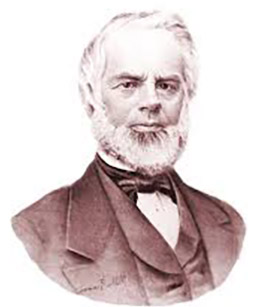
Phineas Parkhurst Quimby (1802–66)
Quimby, like many men of his time, was a jack of all trades. He started as a clockmaker, but eventually became fascinated with alternative methods of healing and learned the art of mesmerism or animal magnetism, a forerunner of hypnosis. Quimby found that if he put an assistant into a trance, the assistant could diagnose and prescribe a remedy for a patient’s disease (much like Edgar Cayce, the celebrated “sleeping prophet” who lived a couple of generations later).
Quimby built up a successful practice this way, but soon he came to a startling conclusion: it didn’t matter what remedy was prescribed; it was the faith of the patient that made the difference. So Quimby dismissed his assistant and began to practice his own radical method of healing, in which he would simply convince the patient that he or she was already well. Quimby’s warm and gentle nature aroused a sense of confidence. His office filled with patients, and many came away from his treatments feeling great relief or even fully cured. He often treated people for free when they could not pay.
A self-taught man, Quimby was not a systematic thinker. But around 1859, he began to formulate his teachings in writing. He believed he had discovered the secret of the miracles performed by Jesus Christ, and he wished to make this knowledge available to all.
“My philosophy,” he said, “will make man free and independent of all creeds and laws of man, and subject him to his own agreement, he being free from the laws of sin, sickness, and death.”
The teaching was simple. In each human being resides Truth, Wisdom, and Goodness. This is our natural birthright. But there is also another aspect: the mortal, material mind that is subject to error. And the chief error to which this material mind is subject is disease.
“Disease,” Quimby wrote, “is false reasoning. True scientific wisdom is health and happiness. False reasoning is sickness and death.” Quimby never really gave a name to his teaching, though he usually called it the “Science of Health.” Once or twice in his writings he referred to it as “Christian Science.”
Quimby attracted a number of disciples. One of them, Warren Felt Evans, was also a follower of the Swedish visionary Emanuel Swedenborg (1688-1772). It was in fact Evans who introduced the term “New Age” in his influential 1864 book, The New Age and Its Messenger. The “messenger” of the title was Swedenborg, who in his voluminous writings proclaimed 1757 as the year of the Last Judgment. But this event, he said, did not and was not supposed to take place on earth. It was enacted in the realm of the spirits, an intermediate zone between heaven and hell. The Lord purged this realm of evil, making it possible for heaven to transmit its influences to earth in a less impeded fashion.
Swedenborg did not espouse the doctrine of thought power as it would later emerge: he held that the human mind was continually subject to influences from both heaven and hell and that the function of the human being on earth was to choose the good and renounce the evil impulses. Even so, Swedenborg’s thought, which reached the zenith of its influence in the early nineteenth century, prepared the ground for the New Age movement.
After Quimby’s death in 1866, his ideas lived on in the teachings of his most famous pupil, Mary Baker Eddy, who popularised the name “Christian Science” and created a religion around it, as well as in subsequent movements such as New Thought, Unity, and Religious Science.
New Thought is something of a blanket term used to cover these other movements in contradistinction to Eddy’s Christian Science. The American scholar of religions Charles Braden characterised the chief differences between these two strains as follows:
Mary Baker Eddy
1) Christian Scientists tend to be more authoritarian in their thinking, regarding Mrs. Eddy’s writings as definitive revelations, whereas adherents of New Thought stress that spiritual truths are being revealed every day;
2) Christian Scientists have tended toward denial – disease, matter, and “mortal mind” do not exist – whereas the New Thought movement has inclined more toward affirmations (“I am well”; “I am perfect”);
3) Christian Scientists are generally opposed to working with traditional physicians or allowing their patients to do so, whereas proponents of New Thought have been more flexible and pragmatic on this count.1
Ernest Holmes’ Religious Science
One of the more vibrant strains of New Thought in the twentieth century was Religious Science, founded by Ernest Holmes (1887-1960). Born in Maine, Holmes moved to Boston as a teenager where he took a two-year course in public speaking. At this time he was drawn to the works of Ralph Waldo Emerson (another major influence on the New Thought movement), as well as to Eddy’s textbook of Christian Science, Science and Health with Key to the Scriptures. Later he would study other major figures in the New Thought movement, such as William Walker Atkinson and Thomas Troward.
Ernest Holmes (1887-1960)
In 1914, Holmes moved to Venice, California. In 1919, he published his first book, Creative Mind. His magnum opus, Science of Mind, was first published in 1926. Though most of Holmes’s ideas can be found in his nineteenth-century precursors, he offered a slicker version of New Thought in his thoroughly twentieth-century salesmanship. He liked to tell stories of persuading homely girls to smile; when their lips parted, he claimed, they were surrounded by rich men eager to pay the bills for orthodontia. Gail Thain Parker, a scholar of New Thought, writes, “Holmes’s smugness is very different from the more exploratory (and sometimes evasive) tone of the first- and second-generation mind curists…. He knew that nothing he would say would shock or surprise; his prose was full of lifetime warranties and unbeatable bargains.”2
Holmes, a powerful speaker but an ambivalent guru, nevertheless suffered his disciples to set up an organisation to promote his ideas. The Institute of Religious Science and the School of Philosophy was incorporated in 1927. In the same year Holmes also founded Science of Mind magazine, which is still published today. His influence was enormous, not only through his own writings but through those who were inspired by him. Norman Vincent Peale, author of The Power of Positive Thinking, a best-seller of the mid-twentieth century, drew much of his message from Religious Science.
Norman Vincent Peale
Holmes lived long enough to see his organisation subject to schisms and infighting. Shortly before Holmes’s death, his protégé Obadiah Harris (who went on to become head of the Philosophical Research Society in Los Angeles) confided to him that he was leaving the movement to find his own path. “I wish I could go with you,” Holmes replied.3
Even so, Holmes’s organisation survives to this day, and his teachings continue to inspire many. One of his central – and perhaps his most influential – ideas is the Law of Attraction. The term was originally coined in the nineteenth century to refer to the soul’s affinity for different spheres of the afterlife, but Holmes gave it its current meaning: “What we shall attract will depend on that on which our thoughts dwell.”4
If you think of prosperity, prosperity will come your way; if your thoughts dwell on disease, suffering, and misfortune, you are laying the ground for your own future unhappiness. These thoughts are not necessarily conscious ones, Holmes contended:
“While most disease must first have a subjective cause, this subjective cause (nine times out of ten) is not conscious in the thought of the person who suffers from it, but is perhaps largely the result of certain combinations of thinking. So while it is true that disease has its prototype in subjective mind, it is also true that the individual who suffers from the disease, frequently has never thought he was going to have that particular kind of trouble. But this does not alter the fact that every disease which comes up through subjectivity, and appears in the body, must come through mind.”5
Healing, by contrast, comes from right thinking, as Quimby had taught decades before. Holmes taught his followers to heal in this way: “First recognise your own perfection, then build up the same recognition for your patient. You are then read to directly attack the thought that binds him, recognising that your word destroys it, and stating that it does. You may then take into account and specifically mention everything that needs to be changed, every so-called broken law or false thought. Then finish your treatment with a realisation of peace, remaining for a few moments in silent recognition that your work is done, complete and perfect.”6
Holmes said that the human mind was composed of two aspects: the “subjective” or “subconscious” mind on the one hand and the “objective” or “conscious” mind on the other. The subjective mind is not conscious but is creative; it is “that part of the mind which is set in motion as a creative thing in the conscious state.” The subjective “sets power in motion in accordance with the thought.”7 The conscious mind must, however, direct the subconscious toward positive goals.
A similar view can be found in the writings of Max Freedom Long, who, in such books as The Secret Science behind Miracles, taught an almost identical system that he traced back to the kahunas, the shamans of Hawaii. According to Long, the Hawaiians used the word unihipili to describe what Holmes called the “subjective mind” and the word uhane as more or less equivalent to Holmes’s “conscious” or “objective mind.” Although both authors use the word “science” in a metaphysical context, it is unlikely that Holmes or Long influenced each other; rather these similarities show how thoroughly these ideas pervaded the alternative spirituality of early twentieth-century America.
The Universe is “Mental”
By contrast, a work called The Kybalion, first published in 1908, was a likely influence on Holmes (see accompanying article). The title page of this anonymous work lists its authors merely as “Three Initiates.” The Chicago occultist William Walker Atkinson is generally acknowledged to have been one of these; Paul Foster Case, founder of the occult order known as Builders of the Adytum, is also sometimes suggested as one of the others.8
In any event, The Kybalion – its name allegedly going back to the Egyptian mysteries, although its meaning was supposedly lost – set forth seven principles of metaphysical truth, the first being “the principle of mentalism” – “The Universe is mental – held in the Mind of the all….the Universe and all It contains, is a mental creation of The all.”9 Compare this to Holmes’s statement “There is one mental law in the universe, and where we use it, it becomes our law because we have individualised it.”10 (The similarities extend to the printing of both sentences in all capital letters.)
Since the universe was “mental” in its essence, Holmes prescribed what today is called “creative visualisation” as a means of attaining well-being. Here is his advice to someone who is seeking success in business: “Every day he should see his place filled with people. See them looking at and finding pleasure in his merchandise; see them comparing prices and realising that he is offering good values; see them delighted with the service he is giving…. Make a mental picture of it all. We are dealing with Intelligence, and we should recognise the Power we are working with – realising our Oneness with it – and then we should ask for what we wish and take it.”11
A related approach is affirmation. Like the ancient Semites, who believed in a mystical unity between a word and the thing it represented, Holmes believed that the spoken word held the power to transform reality, and he included affirmations as part of his prescribed practice.
He recommended making this statement, for example, as part of a “treatment” for “supply”: “I always have an abundance of money and an abundance of whatever it takes to make life happy and opulent. There is a continuous movement toward me of supply, of money, of all that I need to express the fullest life, happiness and action.”12
Image from a promotional booklet produced by the Rosicrucian Order AMORC in the 1940s.
Science of Mind and Magic
Anthropologists have classically distinguished between magic and religion. Magic uses certain techniques such as incantation, sacrifice, and ritual as a way of manipulating unseen powers. Religion often uses the same methods but it does so as a way of supplicating God or the gods through prayer and meditation. Magic is a kind of sacred technology, while religion usually involves a relationship to a personal deity. Science of Mind – and the religion of positive thinking as a whole – is much closer to magic than to religion. While it does not prescribe arcane rituals or weird spells, it does attempt to manipulate the primordial force of the universe – mind – on the practitioner’s behalf.
There is no theological problem in this from a New Thought perspective, because God is all-good and all-loving and wants us to live in health and abundance; our failure to do so is simply the result of faulty thinking and a failure to claim our due. The constant use of the word “Science” by figures from Quimby to Holmes underlines the quasi-technological mindset that operates in these teachings, and suggests how much they owe to the industrial age that gave them birth: mind is an impersonal force that can be harnessed in much the same way as steam or electricity.
While New Thought and Religious Science insist that they are part of a tradition that has always been known to adepts – the healing miracles of Jesus are frequently cited as cases in point – there is comparatively little in traditional esotericism that resembles these teachings. Certainly it has long been taught, particularly by Plato and his philosophical descendants, that there is an ideal world of forms that can be perceived by the higher intellect and that serve as prototypes for the things of materiality. But the teaching that someone can not only perceive these archetypes but manipulate them to change physical reality is extremely rare. The traditional view was that a true philosopher did not care about the material world and occupied himself as little as possible with it.
Even the occultism of the Renaissance, with its cumbrous magical technology, did not lay any particular emphasis upon thought power. According to Renaissance savants such as Paracelsus and Cornelius Agrippa, the magus can affect the higher dimensions, but does so by operating upon their corresponding objects in the physical world. To bring down beneficent solar or jovial influences, one wears stones or eats herbs that are associated with these benign influences. Magical formulae were also employed, but not as affirmations – many of these incantations consist of words in no known language – and the goal was often to subject spirits and demons to the magician’s will.
The world of traditional magic is thus very far removed from the streamlined positive thoughts and affirmations of Religious Science and its kin. To speculate wildly for a moment, perhaps this is one sign of the New Age proclaimed by Swedenborg and Evans – that what formerly required intricate spells and bizarre operations can now be accomplished by using the power of the mind and the spoken word.
This, of course, assumes that the methods of Religious Science actually work, and such claims are hard to assess. Certainly there are any number of people who have been willing to testify on behalf of these procedures, and their claims must be taken seriously enough. But we have no way of knowing how many of them there are as opposed to the numbers of those who have tried and failed. Most of the people I have known through New Thought circles appear no richer, happier, healthier, or more successful than much of the rest of humanity. And while I have known people who have gotten rich over the years – some of them staggeringly rich – their secret was probably not affirmations or thought power but the usual combination of talent, hard work, and sheer luck – and, indeed, enormous quantities of all three.
Nonetheless, the claims of the thought power gurus from Quimby to Holmes (not to mention latter-day figures such as the entity known as Abraham, channelled by Esther Hicks, and Rhonda Byrne, author of The Secret) cannot be dismissed wholesale. Thought power, like so many aspects of the metaphysical realm, occupies a liminal space between truth and falsity. As soon as you have decided it is all nonsense, something pokes you on the shoulder and tells you it may not be nonsense after all. But if you become an enthusiastic believer, you may end up disappointed.
To speak personally, I would be willing to say this much. The basic idea behind positive thinking is true: there is a mental world that underlays the physical, and thoughts can influence events in ways that can seem bizarre or even paranormal. But the interplay of thought and actuality is not entirely explained by a few simplistic axioms and the usual lifetime warranties. Other factors operate as well – the obscure but overwhelming forces that are sometimes called fate and destiny; the actions of a mind that cannot always be understood, much less manipulated, by the conscious ego; and of course the “time and chance” that, the Bible reminds us, “happeneth to all” (Eccl. 9:11).
To the extent that positive thinking and mental science help us focus upon our goals and eliminate negative mental patterns, they can be useful. But they are usually not very effective substitutes for action. And if they foster a self-centred attitude that focuses on “my” prosperity and “my” health, or, still worse, dismisses the suffering of others on the grounds that somehow they brought it all upon themselves by wrong thinking, these ideas can cause serious trouble. We must never lose sight of the fact that the power of thought includes the power to enslave the mind. And the ultimate goal of liberation may not be to make our thoughts manifest in the world of desire, but to free ourselves from them as much as is possible in this world of entanglements.
[alert type=”general” dismiss=”no”]This article was published in New Dawn 124.[/alert]
[alert type=”success” dismiss=”no”]If you appreciate this article, please consider subscribing to help maintain this website.[/alert]
Footnotes
1. Quoted in Gail Thain Parker, Mind Cure in New England from the Civil War to World War I (Hanover, N.H.: University Press of New England, 1973), 4–5.
2. Parker, 16-17.
3. Horowitz, 97.
4. Ernest Holmes, The Science of Mind, rev. ed. (New York: Tarcher/Penguin, 1998), 294.
5. Holmes, 201-02; emphasis and capitalisation here and in other quotes are from the original.
6. Ibid., 202.
7. Holmes, 30.
8. Mitch Horowitz, Occult America: The Secret History of How Mysticism Shaped Our Nation (New York: Bantam, 2009), 210. Horowitz, however, believes that Atkinson was the sole author.