New Dawn – World's Most Unusual Magazine

Author: Rev. Gary Duncan

  • Getting Serious with Spiritual Practices in an Age of Crisis

    Getting Serious with Spiritual Practices in an Age of Crisis

    From New Dawn 181 (Jul-Aug 2020)

    Over the years, I have used a variety of contemplative practices in combination to achieve specific spiritual outcomes. These practices eventually became ritualised into cyclical patterns in which the stage was set for some surprising results. 

    For almost two decades, I became fascinated with the idea that we are living in a computer simulation but I couldn’t wrap my head around that concept because it didn’t fit with the near-death-experience studies of how the soul transitions into the afterlife. To gain a better understanding of what I was dealing with, I put together a set of contemplative practices to give me insight into this phenomenon. I used mindfulness meditation, the mantra sound āh as well as visualising and dialoguing with inner images of spiritual masters from both Western and Buddhist traditions to create a ritual. To help anchor and entrain this experience in my mind, I used Theta music sounds. Entrainment enabled my mind to reproduce the Theta frequencies within the ritual practice.

    Intermittently, I had been working with these specific ritual practices throughout the years eager to find some resolution, but none emerged. About a year ago, I set aside a few months devoted to this practice hoping for insight; still nothing. I then changed the routine – one day mindfulness meditation and the next the ritual practice – but still nothing, so I thought. Then a few weeks later while practising only mindfulness meditation, I found myself in an unusual reality, not knowing if it was related to my computer simulation quest.

    What emerged was a stunning inner vision. I found myself looking at a small open gate made of shiny sparkling gold. I saw beyond the gate a pathway meandering through a landscape of beautiful colours made up of various shades of blues, reds and yellow flowers, beautiful grasses and trees made up of various shades of green. I was looking out of my eyes at this beautiful scene and decided that since the gate was open I would walk through. Once across the threshold, I found myself in a world hard to describe! Those beautiful colours of blues, reds, yellows, and greens were now vibrant shimmering brilliant colours. I have never seen anything so beautiful. 

    It suddenly dawned on me, if I walked further into this beautiful landscape, I would not return to ordinary reality. I gently backed out and crossed the threshold. Once on this side of the gate, the colours muted and the brilliance was gone. Then, suddenly, my timer went off and I moved out of mindfulness meditation and back into ordinary reality. The experience deeply puzzled me, and I wondered why it happened in mindfulness meditation rather than ritual state, and what it meant in regard to what I was pursuing.  

    Two weeks later, I decided to use insight meditation and go back to the gate. In the meditation, it was hard focusing my awareness back to the gate, but once there I found a new problem – the gate was closed. Not only was the gate closed but it had a dull gold finish and the brilliant colours of the flowers, grass and trees on the other side were also dull. “Why is it now different,” I asked myself. Since that experience, I have made three more inner journeys back to the gate and in all three, the gate remains closed. This raised questions such as, “Why am I now locked out”? and “Why was I trapped on this side of the gate”? 

    Throughout the oncoming months, I puzzled over this inner vision trying to understand its meaning. It all came together with my second vision which was prophetic. It began on 13 August 2019 when I read an article in the British newspaper The Telegraph on DNA bioweapons. These weapons could potentially target specific individuals and groups. I had read similar reports before, but this time something different happened. While reading the article online, I lost it! Something radically shifted inside me. In my inner vision, I saw thousands of people dying from these bioweapons. I panicked, feeling trapped in a new world I didn’t want to be part of. I tried to run but to where? I thought of Canada, the mountains, some island, where I could be safe. My spouse and a friend tried to calm me, but to no avail, I was trapped. For three weeks, I had constant visions flooding my mind of mass deaths and every part of my mind was filled with profound darkness and gloom, watching people dying from these biological agents. I have never had an experience like this before. 

    Trying to gain some composure, I reached out to one of the editors at New Dawn magazine, asking if they had published any articles on bioweapons. The tenor of the email I sent New Dawn was one of panic because I was still seeing the death visions in my mind. I discovered they had published an article on the topic. Once I got the email response, I closed my computer for over a week trying to deal with these constant dark visions of mass death. During that week, my contact at New Dawn sent three very consoling emails.

    After three weeks, the visions slowly lessened, giving me the chance to attempt to process what happened. For the first time, I connected the vision of the golden gate with the mass death vision. In the golden gate vision, I felt trapped on this side of the gate because the gate remained closed. In the mass death vision, I felt trapped in a dark world I could not escape. At the time, I could not understand what all this meant. Then, in April 2020, after meditating, it all came together – these were visions of what was to come, the COVID-19 pandemic. I saw it all on 13 August 2019! 

    Currently, we do not know if COVID-19 was scientifically created in a lab as a bioweapon. If that’s not the case, then it was probably made in the environmental lab of the earth from pollution, or could have come from outer space hitching a ride on a spacecraft returning to earth from the international space station, or transmitted from animals that have these novel viruses. It appears these visions were triggered by contemplative practices which enabling me to see a dark gloomy future, the one we all globally experienced.      

    Components of Contemplative Practices and Lifestyle

    When I first began putting together a contemplative lifestyle, I used the Trappist (Cistercian), Tibetan Buddhist and Hindu monastic (ashrams) daily practices as a loose model. This model included working in the everyday world, contemplation, meditations, mindfulness, silence, solitude, spiritual retreats, study to enhance spiritual growth, simplicity, and service to others. I added these activities one at a time until I had a complete regimen. Some activities I used daily, some weekly, some monthly, some quarterly, and some yearly such as retreats. 

    As we enter this new age of mass deaths from biological agents, these contemplative practices are essential to our emotional, mental, and spiritual health, and provide insights into our lives. 

    If you are a monk living in a community, your daily regimen is set. However, most of us, including myself, live in the secular world and need to create our own personal contemplative routine. I felt that the most important activities for a spiritual lifestyle was to begin with contemplation and meditation practices because I was already using some of them. Contemplation, which includes contemplative prayer and various forms of meditations, are used to alter one’s consciousness to bring oneself into the present moment, as well as focusing and visualising on specific spiritual icons and images. By being in the present moment, a person can explore their inner landscapes; in my case, opening a portal to prophetic visions. 

    Mindfulness eventually emerges from various forms of contemplation and meditation. I learned early on that contemplating sacred images and using various forms of meditation put me in contact with the present moment. I attuned to minute details in the present moment, allowing me to focus exclusively on the task at hand, bringing me into the here and now.  

    Contemplation, meditation and being mindful is wrapped in a cocoon of silence. Silence allows one to disconnect from the outer world of distractions. It facilitates an inner exploration by gaining insights into one’s inner world – we learn to know ourselves. As with insight meditation, silence allows us to observe thoughts coming into our awareness without the disruption of external sounds. 

    With silence comes solitude and with solitude comes spiritual retreat. Silence enhances contemplation, meditation and mindfulness, setting the stage for solitude. Solitude can be practised without going on a spiritual retreat. The best option is to create a personal retreat by isolating yourself for a weekend in your home. In a pandemic lockdown, isolating oneself should be easy if you are alone, but with a family this could be difficult. Solitude enables you to listen and experience the inner presence, that deep connection with your soul, what I experienced with the visions. 

    A contemplative lifestyle also includes a study regimen to enhance spiritual growth. I studied the world’s contemplative traditions and religions, and the individuals within those traditions who created new spiritual practices. This information helped me compare where I was in my spiritual growth and where I was on my spiritual journey. I also used spiritual readings called Lectio Divina. Lectio Divina is a Benedictine contemplative practice incorporating spiritual reading, meditation and prayer which promotes spiritual communion and connection. 

    All these practices gave me perspective on what is important in life. I became aware that I own nothing. I’m only using things in this reality for a short period of time. I knew that shedding a lot of useless physical baggage and clutter, and living a life of simplicity, was the answer to many of my woes and distractions. Besides, in our present situation, human lives are more important than the useless baggage we throw away.

    It goes without saying, that if one cultivates a contemplative lifestyle, one finds themselves in service to others, which happened with people helping those during the COVID-19 pandemic. I have been in service to others throughout my life beginning as a child, helping family and neighbours as well as others in my community who were in need. When I was a psychotherapist, I set aside a certain amount of time to see clients in need at no cost or at a very reduced fee. As a priest, I help others specifically in spiritual development and tutor students on the college level at no cost. Being in service to others not only feeds our spirituality but our humanness as well. 

    The Tree of Contemplative Practices 

    In this time of global crisis, where does one begin? The Tree of Contemplative Practices (issued by US-based Center for Contemplative Mind in Society), offers a sampling of some of the practices used the world over. In reference to the above illustration, there are two roots feeding the tree – communion/connection and awareness – which symbolise the various contemplative practices from the world’s wisdom traditions as well as those created in the secular world. 

    Throughout my life, I have engaged in at least one of the practices in each category, beginning in childhood with storytelling. I can attest that each practice focuses the practitioner’s attention on the here and now as we must be aware of what we are doing in the present moment for the practices to work. 

    The branches on the Tree signify seven categories of contemplative practices: 

    Stillness Practices are used to quiet the mind and body to create calmness and focus, and they include contemplation, meditation, quieting the mind, silence, and centring. 

    Generative Practices produces thoughts and feelings of devotion and compassion and includeLectio Divina, visualisation, beholding, and loving-kindness meditations. 

    Creative Practices are activities that begin with inner fermentation and move into outer manifestation in the exploration, development, expression and interactions with our creative potential as well as our humanness resulting in a deep sense of fulfilment, and include contemplative arts, improvisation, journaling, music and singing. 

    Activist Practices are in service to others and include pilgrimages to areas where social justice issues are highlighted, work and volunteering, vigils, marches, and bearing witness. 

    Relational Practicesfocus on the interaction with others and include council circles as in Native American and other indigenous cultures, dialogue with deep listening and storytelling. 

    Movement Practices are actively focused practices that brings one into the moment through physical actions, and they include labyrinth walking as in many monasteries, walking meditation, yoga, dance, Qigong, Aikido, and Tai Chi Chu’an. 

    Ritual/Cyclical Practices focus on specific intentional routines that brings one’s attention and awareness into the here and now by altering consciousness through various rituals connecting us to the deepest parts of our spirituality. They include symbolic ceremonies and rituals based on replaying mythical stories from spiritual and cultural traditions, establishing a sacred/personal space and spiritual retreats.

    This is only a sampling of contemplative practices as there are many more, for example, eating meditation, contemplative walks, gardening, and chanting. All these practices are intended to cultivate awareness, wisdom and being in the present moment. These practices can help relieve the anger, tension, and desperation that one may feel when coping with crises such as the COVID-19 pandemic. 
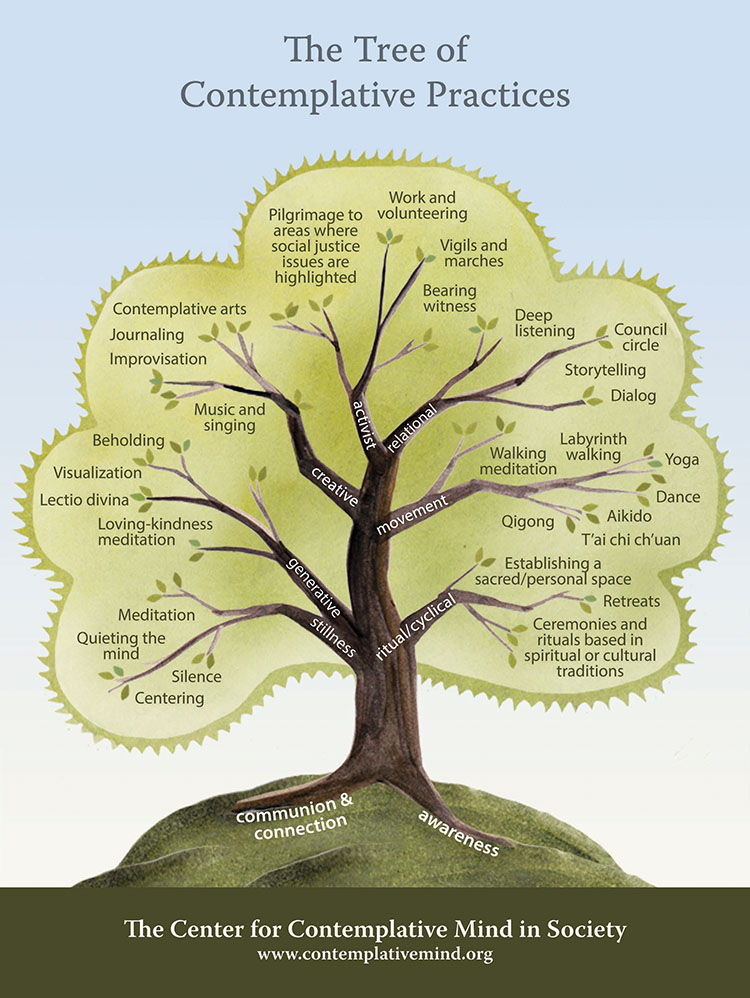
    © The Center for Contemplative Mind in Society. Concept & design by Maia Duerr; illustration by Carrie Bergman. Permission to use given by The Center for Contemplative Mind in Society.

    Developing a Contemplative Lifestyle in the Age of COVID-19

    One of the key objectives when developing a contemplative lifestyle is commitment. Commitment to making major modifications in one’s spiritual journey by changing the habitual patterns that keep us locked in a destructive mindset. These habitual patterns often divorce us from our humanness, and we became mediocre and lifeless. By helping others, we move away from the mundane and reconnect with ourselves and those we love. Once we set ourselves apart for a short period of time to unplug from the distractions of everyday life, we commune on a vastly different level. The practices that we incorporate into our contemplative routines are those we commit to observing daily, and this commitment allows us to help others. Commitment is extremely important!

    If one does not currently use contemplative practices, select at least one from the Tree of Contemplative Practices and learn to use it by yourself through readings or with the help of a teacher. I suggest starting with a stillness practice such as contemplation or meditation because these practices centre a person and bring them into the moment – and being in the moment is that state of mindfulness which allows us to think more clearly. 

    You may then go on to add another practice such as silence. With silence, one becomes aware of the small gradation in thoughts and a deep awareness of one’s spiritual core – the soul. 

    In all contemplative traditions, simplicity is the key to happiness. Without simplicity, we are caught in the cluttered web of meaningless materialistic consumption that never makes us happy. True happiness comes from simplicity because it unclutters our mind so we can think of more important things such as our connections with each other. Being in service to others allows our humility and compassion to grow and can give meaning and purpose to our lives. 
    All the years I engaged in contemplative practices, beginning in high school with the study of Thomas Merton and later joining the Rosicrucian Order, all those practices helped open a prophetic portal in myself. The one thing I now know that I did not know before is I have visionary insight. I had two prophetic visions which I did not understand at the time. With hindsight, I know our world was caught in the grip of a new biological threat coupled with the other threats we currently face. My extra burden is that I had these prophetic visions and did not understand them at the time – in a sense I knew what was coming – a situation I now have to grapple with. 

    In this age of crises and sudden threats such as COVID-19, contemplative practices are truly an effective panacea to help us cope with anger, frustration, and fear of an uncertain future. Mindfulness meditation, in particular, can calm us and create a solid foundation for connecting with each other. I cannot guarantee you will have a prophetic visionary experience as I did, but as I look to the future, one question haunts me, “Is this the shape of things to come?” 

    [alert type=”general” dismiss=”no”]This article was published in New Dawn 181.[/alert]

    [alert type=”success” dismiss=”no”]If you appreciate this article, please consider subscribing to help maintain this website.[/alert]

    © New Dawn Magazine and the respective author.
    For our reproduction notice, click here.

  • UNPLUG: Staying Spiritually Sane in the World of Advanced Technologies

    UNPLUG: Staying Spiritually Sane in the World of Advanced Technologies

    From New Dawn 170 (Sept-Oct 2018)

    When I was sixteen our family moved to western Kentucky, about sixty miles from the Abby of Gethsemani where the famous Trappist (Cistercian) monk Thomas Merton lived. I became acquainted with Merton the year before when I read No Man Is An Island – the book had a significant impact on my spiritual journey. Within months, my mother, father and I decided to spend a day at the Abby. I remember we turned off the main highway onto a winding tree-lined road, suddenly after crossing over a small hill, a steeple-cross appeared in the distance, and we were in the most serene setting I had ever been in. That day marked a major transition in my spiritual life.

    After that day at the Abby I entertained becoming a monk, but circumstances would lead me away from the monastic life. Although I never pursued becoming a monk within a community, I would spend the rest of my life periodically going on retreats in monasteries and retreat centres. It was at the Abby of Gethsemani some twenty-five years later I had a religious calling while on retreat that eventually led me into the Priesthood. 

    In the oncoming years, I studied a variety of meditational practices, beginning with Christian contemplation in which I focused on a religious icon or sacred symbol incorporating the image and the attributes into my spiritual self. This meditation led to Kabbalistic pathworking meditation, Buddhist Diamond meditation, Transcendental Meditation, chakra meditation, and finally settled on mindfulness meditation and Qi Gong. Decades later I incorporated Passage Meditation into my practice. I used several of these meditational practices to reduce stress and anxiety with myself as well as my psychotherapy clients, and currently use them with clients in spiritual direction. With these meditational practices I eventually developed a secular contemplative lifestyle that keeps me connected to the sacred as well as keeping me balanced and sane when it comes to new technologies. 

    Staying Spiritually Sane in the World of Advanced Technologies 

    It took many years of intense work for me to develop a contemplative lifestyle amid my work as a psychotherapist, priest, writer and adjunct professor. The challenge in developing a spiritual lifestyle in our changing world of advanced technologies is to commit to a daily routine and practice. One needs to create an internal personal and outer physical environment that allows one to disconnect from the world of technology. Contemplative practices facilitate and promote this type of setting, and they all come from the world’s religious and spiritual traditions. 

    These traditions promote a calmer, quieter and relaxing environment in which one can experience an inner focus, a calmer mind, a balanced life and a profound change in conscious awareness. The contemplative practices that achieve this type of lifestyle include inner reflection, centring prayer, imaginary journeying, sacred reading, journal writing, Qi Gong, contemplation and all types of meditation. 

    To understand the foundations of contemplative lifestyles, one needs to know where they derive. All contemplative practices come from religions and spiritualities. There are major differences between these two concepts. According to Timothy Freke,1 religion focuses on “rituals, observances, creeds and codes of social morality.” Religion also centres on major “life transitions such as birth, marriage and death with appropriate rites that bind together a community. Religion is the outer form of spirituality,” which is a personal journey of transformation. Within this context, spiritual practices are used to transform a person’s inner life from baser needs into higher needs. To attain this inner transformation, spiritual practices such as prayer, contemplation and meditation are used. However, it is “possible to be religious without being spiritual,” such as “many people piously participate in religious customs without ever understanding a personal journey of spiritual transformation. Fundamentalism of all religious persuasions,” including scientific materialism and scientism with its “insistence on blind faith in dogmas, is religion without spirituality. This is why it divides people rather than uniting them.”

    On the other hand “spirituality is the inner content of all religions, but it does not necessarily have to have a religious context. Spirituality is about setting out on a personal journey of transformation, searching for answers to the most profound questions of life.” In this context, “spirituality is a journey of awakening to who we really are; a journey of opening the heart to the love that permeates the universe; a journey from confusion to meaning; a journey from fear to faith” (faith meaning trust); “a journey from” malaise or dissatisfaction “to a life filled with magic and wonder; a journey from feeling alone in a hostile world to being one with everyone” and everything, a journey into the awakening that all existence is an interconnected whole, in essence, a journey from fragmentation into wholeness or oneness.2

    As stated, contemplative practices are significant components of both religion and spirituality in the development of a personal spiritual lifestyle. A contemplative lifestyle is a life of spiritual unfoldment coupled with the experience of spiritual oneness. Spiritual unfoldment is the process of becoming aware of one’s spiritual nature and aware of the spirit within. Spiritual oneness is the recognition that everything that exists is part of one grand experience, and within that grand experience everything is interconnected or interdependent. Within the experience of spiritual unfoldment and oneness, there is a personal awareness of a divine presence within one’s self and outside of one’s self; this awareness is totally absent in Artificial Intelligent (AI) machines. 

    To live and develop a contemplative lifestyle one cultivates a daily spiritual practice with methods and techniques that open one to become consciously aware of their connection with all existence. The various contemplative practices cited above facilitates conscious awareness and being mindful of the present moment. However, Passage Meditation or PM is a special type of meditation because it is a multi-sectarian practice appealing to both the religious and the non-religious. 

    PM uses mindfulness, wisdom passages and a mantram to centre and keep a person balanced and calm. In this practice, one chooses a wisdom passage from the world’s wisdom traditions and memorises it. During meditation, the meditator says each word in the passage, one word at time, which brings the meditator into the present moment. The passage is repeated over and over for 30 minutes. Then, throughout the day, the meditator says a mantram over and over to keep calm and balanced. The mantram one chooses can be as simple as saying Buddha, St. Frances, Om, or just the word calm over and over. One interesting result of PM is over time the meaning of the wisdom passage becomes incorporated into the meditator’s spiritual life – they become one with the passage. 

    Religion and spirituality have always been major parts of my life as well as science. With science, Einstein had a deep impact on me, especially when it comes to how I understand the connections between religion and science. The moving statement from Einstein that became a beacon for me was “Religion without science is blind. Science without religion is lame.” These words have guided me through my years in scientific research as well as my perceptions of religion and spirituality. 

    In our contemporary world with advanced technologies we have forgotten what Einstein’s words really mean. It takes both of these areas working together and in harmony to keep us balanced as we move into the world of advanced technologies. We already see negative results of these technologies. People are unconsciously becoming addicted, dependent, obsessed, angry, frustrated and anxious with the Internet and technologies in general. If we can’t keep ourselves balanced as we use the technologies we already have, then how are we going to react to new advanced technologies that are now creeping into our lives. Because of these technologies, our spiritual selves or the core that makes us human is fragmenting. 

    This fragmentation is the result of awareness lag. Awareness lag is a phenomenon in which our awareness lags behind the rapidly changing technologies prohibiting us from adequately adjusting to these innovations and inventions. In this phenomenon, we don’t know what to do with our lives or whom to trust because we are blind-sighted by the rapid changes affecting our lives – we simply can’t adjust. We have not prepared for the present or the future, and we don’t understand what is happening and we don’t know where advanced technologies are leading us. 

    Because our awareness lags behind our rapidly changing world, we are overloaded with useless information. By the time we understand what is happening and able to sort through the data, it’s too late because new AI technologies such as smartphones, robotics and the Internet have taken over our lives. Awareness lag can be addressed by slowing down one’s daily pace by using contemplative practices that allow us to be in the moment so we can centre ourselves, freeing our minds, allowing us to understand the direction our lives are heading and what is happening in our existential world. 

    Advanced Technologies Shaping our Spiritual LiFe

    The current technologies that are responsible for fragmenting and overwhelming us are smart TVs, advanced computers, smartphones, robotics, and self-driving vehicles with their accompanying AI algorithms. These technologies are taking us away from intimate face-to-face interactions as we lose sight of our humanness. Many people are becoming lost in these virtual AI realities, and many can’t distinguish the virtual world from the real world. The image of your wife on your smartphone is not your wife, but photons and electrons arranged by AI algorithms creating specific human-like patterns. People mistake the virtual world for the real world, which furthers spiritual fragmentation. Although these technologies add conveniences to our hectic lives, our spiritual selves are suffering. 

    Current technologies are just the tip of the iceberg when it comes to spiritual fragmentation because these new technological innovations seeping into our lives will create more alienation and fragmentation. The following five technologies are destined to change and reshape humans forever. However, to maintain our sense of humanness, there are ways to sustain our spiritual connections through contemplative practices. These practices will keep us centred and in the present moment as we adjust to the radical changes that are here and those that are coming as a result of quantum computers, artificial intelligence (AI), robotics, nanotechnology and gene editing tools.

    The major invention that will be here soon is the quantum computer that uses quantum mechanical phenomena such as superposition and entanglement to perform operations on data. Quantum computers are very different from our conventional computers because the storage capacity is enormous and speed is exponentially faster. This computer with its quantum effects will further fragment our core selves because it will change our reality into something unforeseen.

    Artificial intelligence, also called synthetic intelligence or Machine Learning (ML), is the ‘intelligence’ exhibited by machines or software. Quantum computers will use and control AI programming with unanticipated consequences. There are four types of AI and the first two are already here on your smartphones and self-driving vehicles.  

    Type I AI is purely reactive and is in the category of narrow or weak AI, and is the most basic form. According to an infographic by the website Futurism.com, “It perceives its environment” or “situation directly and acts on what it sees. It doesn’t have a concept of the wider world” and “can’t form memories or draw on past experiences to affect current decisions.” This type of AI is very specialised and was the basic programming for “IBM’s Deep Blue” that “beat [Garry] Kasparov at chess.”3

    Type II AI is called limited memory and is a category of general AI, but currently has very limited decision-making capabilities. This type of AI takes portions “of past information and adds them to its preprogrammed representations of the world,” and “has just enough memory” or experience “to make proper decisions and execute appropriate actions.” Type II examples are self-driving vehicles, chatbots and personal digital assistants. Personal digital assistant is a term for small, mobile, handheld devices that provide computing and information storage and retrieval capabilities for personal or business use, often for keeping schedules, calendars, and address book information. The latest innovation is scheduling using AI voice interactions in which one cannot distinguish between the AI voice and a real person.4

    Type III AI is called theory of mind, an advanced type of general AI that will have the capabilities “to understand thoughts and emotions affecting human behaviour.” This type of AI hypothetically will “comprehend feelings, motives, intentions and expectations” as well as the ability to “interact socially.” However, Type III is “yet to be built,” but will “likely be the next class of intelligent machines.” Examples are C-3PO and R2D2 from the movie Star Wars.5

    Type IV AI is self-aware and “can form representations about themselves,” which is “an extension of the theory of mind.” It is Type IV AI that troubles many in the AI field, a fear that intelligent machines could render humans obsolete or even eliminate humans altogether. Type IV would be aware of “internal states” and “predict the feelings of others.” It will be able to “make abstraction and inferences.” This type of AI is “the future generation of machines” with “super intelligent, sentient and conscious” capabilities but not on the human scale. No machine will fully exhibit humanness. How can you program true emotions, intuitions, hunches, leaps of insight, spiritual transcendence and numinous states into a logical structure – you can’t – because we don’t really understand these experiences and humans are both logical and non-logical – machines are only logical. An example of Type IV would be Eva in the 2015 movie Ex Machina.6

    Robotic systems are mechanical or virtual artificial agents; usually an electro-mechanical machine guided by a computer program such as AI, including machines resembling a human being, and able to replicate specific human movements and functions automatically. These AI machines will eventually take over most of the work presently performed by humans.7 As robots continue to take over many jobs in the workforce, stressing the human psyche, the result is spiritual fragmentation and a loss of internal cohesion.

    The next technology is nanotechnology, also called atomically precise or manufactory machines. These machines are created by the manipulation of matter on the atomic, molecular, or supramolecular scale. The earliest description of nanotechnology refers to the particular technological goal of precisely manipulating atoms and molecules for fabrication of macroscale products, now referred to as molecular nanotechnology.8 These small micro-machines are similar to robots and they will take more jobs from humans, further fragmenting our core selves.

    CRISPR-Cas9, or CRISPR, is a gene-editing tool. The word CRISPR stands for “clusters of regularly interspaced short palindromic repeats.” It is a specialised region of DNA with two distinct characteristics: the presence of nucleotide repeats and spacers. Repeated sequences of nucleotides, the building blocks of DNA, are distributed throughout the CRISPR region. CRISPR is the first genome-editing tool that is faster, cheaper and more accurate than previous techniques for editing DNA, and has a wide range of potential applications. CRISPR is the protein with their RNA guide that finds the area in the DNA to be edited. The Cas9, also a protein, is the editing component that snips and removes the DNA allowing the DNA to be restructured. 

    CRISPR-Cas9 enables geneticists and medical researchers to edit parts of the genome by removing, adding or altering sections of the DNA sequence. It is currently the simplest, most versatile and precise method of genetic manipulation.9 This technology will reshape us physically as well as mentally, further fragmenting our humanness. However, on the upshot, this technology may offset human extinctions due to superintelligent machines creating new forms of humans, but that would also contribute to spiritual fragmentation. 

    Unplugging

    Contemplative practices facilitate a calmer mindful environment. Mindful in this context is the ability to focus attention in the here and now by controlling distractions. Being mindful also means taking time for what really matters in your life by being conscious or aware of where your attention is focused, and what you are doing and feeling. In a mindfulness mode of awareness, you are being sensible, accepting and non-judgmental of what is going on in the present moment and being attentive to your emotions, thoughts and sensations. 

    An example of how mindfulness is used in one’s daily life is to take the time and move into the present moment. Take a few minutes and settle down becoming mindful in the moment, either in front of the technology you are using, or in the room you are in, or what’s going on around you, and focus on your present experience. Close your eyes, take a few deep breaths, and relax. What are you feeling? Are you frustrated, angry, anxious or happy, content and at ease? What are the smells in the room you are in? Are they pleasant or noxious? What are you thinking, is it something specific or non-specific? Where you are sitting, are you comfortable? Do you have aches, pains, itches, tingling sensation or a subtle calmness throughout your body? What do you hear? Do you hear natural sounds such as birds singing, traffic sounds or undefined sounds? Are you comfortable or tense being where you are now? Be mindful of these sensations and experiences for a few minutes. Now slowly move your awareness back into the everyday world. 

    Being mindful in our world of advanced technologies is essential in reducing awareness lag, technology addiction, obsession and dependence by keeping yourself calm, balanced and centred. In this regard, approach all technologies with a mindfulness perspective. Before turning on your computer or any other communication device, sit for a few minutes in front of the technology and close your eyes and focus on your breath going into your lungs and your breath going out of your lungs. On the in-breath, say to yourself “I am calm,” and on the out-breath say to yourself “and I’m at peace.” By sitting in front of your computer or any technology performing a meditation, you centre yourself before being exposed to the Internet, email or Facebook. When you are on a computer or any technology, pay attention to your thoughts, feelings and emotions – if you become anxious, frustrated or angry, stop, take time out and meditate to centre yourself. I say the Buddhist Metta Prayer before turning on my computer to centre and calm myself.

    When on the Internet, selectively pay attention to what you are viewing, and how much time you spend on each such as e-mails or Blogs. While on the Internet, or using your smartphone or on Facebook, always pay attention to your emotions – are you angry, frustrated, happy or in an upbeat mood. In being mindful, do not surf the Internet without a specific goal, always be aware of where you are emotionally. After viewing, take a short 10-minute rest period, re-centre yourself by doing something non-technical or just sit and meditate. At the end of the day, turn off your computer and smartphone, prepare to rest, and relax before going to bed. Take control of technologies and don’t let technologies take control of you because this helps to prevent technology addiction, obsession and dependence. By being mindful, you avoid spiritual fragmentation by moving into a state where your life has purpose and meaning. I control my time at the computer by turning it off each day around 6 PM, and on most Friday afternoons I turn the computer off – in most cases, I don’t turn it back on until Monday.

    Once you have created a mindfulness set of practices in working with technologies, it is time to broaden your contemplative lifestyle to assure you have purpose and meaning in your life. To achieve a contemplative lifestyle and keep yourself mindful and centred, take a no-technology day by limiting your use of technology. As the five advanced technologies discussed earlier take centre stage in our global world, we need time to connect to our humanness – finding meaning and purpose in our life. We ask ourselves, what really matters in my life? It’s not these advanced technologies; it’s our connections with ourselves and with other people, the beauty of a sunset, the songs of birds, the simple evening meal with our loved ones – meals where cell phones are forbidden. When loved ones eat together, there needs to be a rule – no cell phones and no texting, only face-to-face communication – we are humans not AI-driven robots. Find a day you can set aside to reconnect with yourself or life partner or family.

    On the no technology day, UNPLUG and choose the technologies you want to UNPLUG from. I set aside all technologies except for the CD player in which I only play slow relaxing music and Gregorian Chants. Before bed, I may watch a non-violent commercial free movie for a short time and then turn on the Music Choice channel and fall to sleep listening to Soundscapes. As you UNPLUG from your hectic consumer driven materialistic outer life, you will begin to engage in quiet time, listening to slow relaxing music in the background, reading poetic stories or spiritual reading also called lectio divina. Throughout the day, sit and relax by centring yourself in the calmness of meditation. DO NOT THINK ABOUT THE PAST OR THE FUTURE; ONLY BASK IN THE PRESENT MOMENT. 

    Conclusion

    I have found the contemplative lifestyle centring and rejuvenating. Setting aside one day in which I can reflect on what has meaning and purpose in my life is very fulfilling. What’s fulfilling are not new technologies, buying things I don’t want or need, but the interconnections with friends, family and everything around me. It’s our face-to-face human communications with each other that is important, not the phony one-sided view of a person on Facebook. You will never honestly get to know that person electronically; it’s only in our flesh and blood interaction one gets to know a person. 

      If we are not mindful and acutely aware, new advanced technologies will take total control of our life, rendering us pawns in a world of fragmentation. We end up shallow, with no real meaning and purpose in our life. The antidote is to cultivate a contemplative lifestyle using various mindfulness practices such as Passage Meditation and simply UNPLUGGING. 

    [alert type=”general” dismiss=”no”]This article was published in New Dawn 170.[/alert]

    [alert type=”success” dismiss=”no”]If you appreciate this article, please consider subscribing to help maintain this website.[/alert]

    Footnotes

    1. Encyclopedia of Spirituality: Information and Inspiration to Transform your Life by Timothy Freke, Godsfield 2000, 152
    2. Ibid.
    3-6. https://futurism.com/images/types-of-ai-from-reactive-to-self-aware-infographic/
    7. Rise of the Robots: Technology and the Threat of a Jobless Future by Martin Ford, Basic 2015 
    8. Radical Abundance: How a Revolution in Nanotechnology will Change Civilization by K. Eric Drexler, Public Affairs 2013
    9. A Crack in Creation: Gene Editing and the Unthinkable Power to Control Evolution by Jennifer A. Doudna & Samuel H. Sternberg, Houghton Mifflin Harcourt 2017; also see Brett Lothian’s article ‘The Rise of Homo Technicus’ in New Dawn 169.

    © New Dawn Magazine and the respective author.
    For our reproduction notice, click here.
  • Entangled Minds: Telepathically Entering Another Person’s Lucid Dreams

    Entangled Minds: Telepathically Entering Another Person’s Lucid Dreams

    From New Dawn 149 (Mar-Apr 2015)

    In the late 1970s I read the research on dream telepathy conducted at Maimonides Medical Center’s Dream Laboratory in New York.1 I was fascinated with how a person could send pictures into the minds of sleeping subjects during dream sleep, also called Rapid Eye Movement or REM sleep. The sleeping subjects would incorporate aspects of a sent picture into their dream motifs or dream stories.

    In one target picture there were two men in a boxing match, the sender or agent also had on display in his office “a genuine dark-brown leather boxing glove.”2 The picture and the physical object on display enhanced the telepathic transfer more significantly than the picture alone.

    This research got me interested in dreamwork and a year later I began studying methods on how to control my dreams.3 At the time I was having an unusual recurring dream and thought dream control would help me explore it. However, this endeavour fell short of what I expected. I continued working on dream control, and added to my dream retinue Freudian and Jungian dream interpretation. I also discovered dream control was the antecedent to experiencing lucid dreams.

    By the mid-1980s more research into the nature of lucid dreaming had accumulated accompanied with new methods on how to experience a lucid dream.4 Now somewhat successful with controlling my dreams, I decided to try one of the new techniques, and it worked; I was becoming more consciously aware in my dream states. But remembering and staying conscious in my dreams was a constant struggle. I began noticing that on nights I did not smoke marijuana, I could recall my dreams, they were more vivid, and I was more consciously aware of them and as a result. I curtailed my marijuana use.

    During this period Joe, a long time friend, and I were studying rituals from the Hermetic Order of the Golden Dawn. He and I had a close friendship, and according to the studies on dream telepathy to be successful, there needed to be an “agent-subject rapport,”5 which is what we had. We decided to experiment with the directional symbols from the Golden Dawn: the dagger, wand, chalice and pentacle. The pictures of these symbols were all in black and white, and copied from Israel Regardie’s book The Golden Dawn.6 Joe was a night owl, so while I slept he attempted to send these symbols into my dreams randomly, one symbol per night. After several months without success we stopped the experiment.

    Shortly thereafter I began teaching a course at the University of Cincinnati, ‘Dreams: The Night Theatre’. By the seventh week of class I noticed some of the students began sharing aspects of each other’s dreams. Each time I taught the course this phenomenon would occur. I finally concluded these students unconsciously were telepathically transferring dream information into each other’s dreams, changing the dream motifs. Eventually I discovered research into this phenomenon called shared dreaming or mutual dreaming.7

    If these students could telepathically send information into each other’s dreams, then why was my earlier experiment with Joe not successful? I decide to restructure the experiment with another friend, Mike, who was deeply interested in the mystical, and like Joe, we had a deep rapport. In the new experiment, we used black and white standard ESP card symbols as the targets. We decided to send these symbols into each other’s dreams telepathically. If that worked then we would attempt to enter each other’s dream motifs, a shared dream experience. Each night we randomly selected one of the ESP symbols and then telepathically focused on sending that symbol into each other’s dreams. We alternated nights, one night I would be the sender and the next night would be Mike’s turn. After a year with no successes we stopped the experiment.

    A few years later I became friends with Aaron who was in the counselling profession like myself and had a deep interest in parapsychology. I presented the research on dream telepathy, lucid dreaming and shared dreaming, and he was fascinated with the idea of sharing a dream story. Rather than trying to send symbols into each other’s dreams, we instead used a different approach. Aaron would try to send his image telepathically into my dreams, and over the next year we experimented with this shared dreaming technique without success. With these experimental failures, I sat the entire project aside.

    Entangling Minds

    Hector (pronounced Ector) and I had known each other for four years and we had discussions on various topics. The topic of choice was always the afterlife and the supernatural. Being from Mexico, Hector had a very different perspective on reality because in his culture the supernatural is a part of everyday life. One topic that kept cropping up was how everything that exists is interconnected or entangled with everything else. The concept of entanglement comes from quantum physics in which particles created at the same time become entangled with each other. What is done to one particle instantly happens to the other particle, no matter how far apart they are. Studying entanglement, I stumbled upon Dean Radin’s (2006) concept of entangled minds.8 Radin used entangled minds to explain ESP phenomena, and his theoretical explanations gave me a scientific basis for how everything is interconnected, especially our minds.

    Figure 1: Zener cards are commonly used to conduct experiments for extrasensory perception (ESP). The cards were used in author Gary Duncan’s dream experiment with Mexican colleague Hector.

    Hector could not wrap his head around the entanglement concept. I would tell him, he and I are a part of each other, we are a part of everything that exists and everything is entangled with everything else including our minds; we are all one. In talking to him about how we are all interconnected and entangled with each other, I began thinking about my previous failed experiments with dream telepathy and shared dreaming and why those experiments didn’t work. A successful telepathic experiment would convince Hector we are all interconnected and our minds are indeed entangled.

    Now that I had piqued Hector’s interest, I decided to approach him about conducting an experiment that would test the entanglement idea, and he was interested. How would I go about the experiment? What would I do different this time that I didn’t do before? I finally came to a simple experimental protocol. I would again use standard ESP symbols but this time they would be in colour. Hector would be the sender/agent and I would be the receiver/subject. My reasoning for this decision was Hector spoke English with a deep accent, many words he had problems pronouncing, but he understood more than he could speak. I thought his language issues and his cultural background might be an asset because he was unsullied by the rational materialistic culture of the United States.

    If Hector was able to send me an ESP symbol telepathically and if I received the image, that would indicate we are entangled in some way. But if the experiment failed then my argument would fall apart. I presented the experimental protocol and he was ready and excited to begin. I, on the other hand, was a bit anxious because of the previous failures, but decided the experiment might work because we had a deep rapport with each other and our cultural backgrounds were so different.

    I gave Hector the coloured ESP symbols (see Figure 1) and instructed him to choose one each week at random. Once chosen, throughout the day he pictured me in his mind and visualised the ESP symbol going from his mind into my mind. At week’s end I would call him and tell him what symbol came into my mind. He would confirm if I hit or missed the symbol. The first three days of the first week I missed the target completely and then started to get hits off and on throughout the day. Over the next two weeks, I got hits every day and a few misses, but more hits than misses. He was impressed with our experimental results and so was I.

    I decided to change the targets from ESP colour symbols to pictures of black and white physical objects (see Figure 2, above). Hector continued with the same experimental protocol and I did not get a single hit. What was it about the ESP colour symbols that were easier for Hector to transmit telepathically? And why was I able to receive the ESP coloured symbols and not the black and white pictures of physical objects? Did it have to do with how he culturally perceived these symbols and objects as he telepathically transmitted them to me? Did it have to do with the fact that the black and white pictures were more detailed than the ESP coloured symbols? I was at a loss to explain these results. After a week and a half of nothing but misses, we decided to take four months off and then resume with the ESP colour symbols to see if there were any changes.

    We resumed the experiment for a four-week period and every day, throughout the day, I got hits. I soon discovered that when Hector sent the ESP symbols telepathically he focused mostly on the colour that made up the symbol. In the experiments it appeared the colour of the symbol was the salient factor for successful telepathic transmission. I realised Hector is a visual learner, so cognitively the colour of an object might carry more visual weight than black and white objects.

    Hector was amazed with our results but could not understand how it all worked. I tried to explain it the best I could by simplifying Dean Radin’s theoretical perspective, but fell short because of our language barrier. It became obvious we were now more than ever interested in continuing our research into entangled minds, but where would we go from here? Out of three previous attempts with three different people, Hector is the first experimental colleague to be able to telepathically send ESP symbols into my mind.

    Entering Dreamscapes

    With the success of our telepathic experiments we decided to take the next step into the world of dreams. I knew dream telepathy was true, lucid dreaming was true, shared dreaming was also true, but could Hector telepathically transmit his animated image into my dream stories? If so, how could it be done? Over the next few months I put together all I knew about dream research, especially lucid and shared dreaming, telepathy, remote viewing, clairvoyance, and various behavioural and Neuro-Linguistic Programming techniques to develop a sound experimental protocol. I also added a lucid dream supplement, galantamine, to enhance the lucidity and vividness of my dreams.

    I shared all the information accumulated with Hector and a protocol for how we would conduct the experiment. Since Hector was an excellent sender/agent and I was an excellent receiver/subject, we would keep that structure intact because of the positive results of our previous experiment. Not only that, but our minds were now significantly entangled.

    Since Hector is the manager of a restaurant, he is up late at night giving him the opportunity to telepathically send his image into my mind while I sleep. He sent his image into my mind between the hours of 12:30 a.m. and 6:00 a.m., and somewhere during this period I was dreaming. Without an EEG hook-up monitoring my sleep stages, his telepathic projections were hit or miss. In addition, before going to sleep, I took galantamine on alternate nights excluding weekends.

    Over the next several months Hector and I experimented to see if he could project his image into my dreams. Nothing happened for several weeks, but when I woke up to use the bathroom during one night the first image to pop into my mind was Hector. Slowly, over the next several weeks, this experience went through subtle changes. One significant change was when Hector’s image popped into my mind accompanied with intense feelings of his presence. Then, one night, I suddenly awoke almost in a startle and Hector’s presence was all around. I couldn’t see him, but it was as though he was in the room with me. Throughout the next day his presence remained, and I could feel him intensely. The following day I called him and he told me he and his lady-friend had a deep intense discussion about an article I had written on helping stuck souls go into the light.9 Their intense discussion about the article’s details telepathically transferred Hector’s spiritual energetic presence to me.

    Now that I could feel Hector’s presence, we decided to create a specific place in my dream world where he could project his image. This special place is called an egregore. According to Gaetan Delaforge10 egregores are “created when people consciously come together for a common purpose. Whenever people gather together to do something an egregore is formed….” Hector’s native tongue is Spanish, so he would be the one creating the egregore because it would be easier for him to describe to me where the dream would take place rather than for me to describe it to him in English. It took a week for Hector to come up with an egregore, which was a soccer field.

    Since I don’t play sports and have no idea what a soccer field looks like, I immediately went to the Internet, found several pictures and committed them to memory. Hector taught me how soccer is played and he telepathically met me in my dreams on the soccer field. Throughout the day I would focus on him and me meeting on the soccer field and playing the game. This focusing ritual that I performed throughout the day is called dream incubation. I also added two other components to the dream incubation ritual – a command statement and dream enhancing technique. The command statement, “Tonight, Hector will enter my dreams,” is an invitation for him to enter my dream stories.

    The dream enhancing technique was one I used years earlier in a psychotherapeutic setting to gain insights into my client’s issues, and it worked. In this technique I placed the signature of the client I desired to dream about under my pillow at night, which resulted in me dreaming about the client.11 However, for our experiment I augmented this technique. I placed under my pillow a signed photograph of Hector, placed in an envelope with the command statement written on the back of the envelope. Throughout the day I repeated the command statement while visualising me and Hector playing soccer. At night I placed the envelope under my pillow and recited the command statement repeatedly while going to sleep. Another valuable tool I used was a dream journal. With this experiment the journal became a valuable asset. After several weeks of preparation we were ready to execute the experiment.

    The first several weeks were all failures in the sense Hector did not appear in any of my dreams, nor was there a soccer field, but with galantamine my dreams were vivid and lucid. Although I dreamed, Hector was not in any of them, however when I awoke I felt his presence all around me. This continued for several weeks and then I had a dream of several Mexicans, none of them I knew. A few nights later I dreamed I was talking to a friend about Hector. Then it finally happened; I was dreaming and suddenly Hector was in the background watching the dream story – he said nothing, just stood and observed. This was the first breakthrough with him in my dreams.

    A few nights later, still taking galantamine, Hector was in my dream story. Rather than a soccer field, the egregore setting was a restaurant and Hector was gambling, an activity he doesn’t do. In the second part of the dream he went to another restaurant where a party was going on; I followed him and enjoyed the party. A few nights later he was in another dream with a different motif in which we were driving to another city talking about him opening a Mexican restaurant, but still no soccer field.

    Over the years I have experimented with a variety of lucid dream supplements, and found galantamine works. I also discovered another dream supplement, African Dream Root (Silene Capensis), which received many positive reviews regarding vividness in lucid dreaming. Based on these reviews, I decided African Dream Root might be a better supplement to allow Hector and me to create the soccer field egregore. I took three weeks off galantamine and substituted African Dream Root.

    After taking the supplement for a few days there were radical changes in my dreaming. African Dream Root did not do what I expected; my dreams were chaotic and violent, with poor dream recall. But Hector was in one dream in the background, observing the chaotic and violent dream story, and there was no soccer field egregore. I stopped taking African Dream Root and resumed taking galantamine.

    Over the next several dreams Hector was in the motifs and they were all in places where one eats, a restaurant and a kitchen. There was a dream in which I was talking about Hector’s restaurant to someone else. In another dream Hector served food and taught me how to drink Margaritas with salt. In a later dream we were at my house at the kitchen table talking and his mother was present in a pale blue dress. Hector and I were so close; I could smell his body fragrance which was a sweet subtle smell, not offensive at all. In studying my dreams throughout the years, this was the first time my olfactory (smell) sense was activated to this level of sensitivity.

    Conclusion

    In reviewing the details of the first part of our telepathy-dream experiment, there is a combination of factors contributing to Hector being a very good sender/agent. It is evident, since Hector has a visual learning style, that the colour ESP targets were more effective than the black and white targets. Also, his cultural background lends itself to the supernatural and his language issues allowed him to successfully telepathically transmit the colour targets to me. I, on the other hand, am a good subject/receiver because I have had many altered state of consciousness experiences throughout my life. These experiences have opened me up to receive information from a variety of spiritual or imaginal domains as well as the earlier experiments with telepathy and shared dreaming.

    The reason Hector could not transmit the soccer field egregore was because he manages a restaurant and that scene is ever-present in his mind. He works in this environment six days a week, absorbing all the details of the restaurant into his mind. In the restaurant money is the primary re-enforcer, creating a strong mental image of that environment. On the other hand, he plays soccer occasionally and the re-enforcer is having fun, which is not as strong as a monetary re-enforcer. Moreover, when he tried projecting the soccer field, the stronger re-enforcer associated with the eating environment is what was unconsciously transmitted. As a result, we decided an eating environment would be our dream egregore.

    The use of the lucid dream enhancer galantamine allowed my dreams to become more vivid and lucid. By being more vivid and lucid, I was more consciously aware in each dream motif. Within the lucid dream structure my intent was not to change the dream story but to become more aware of dream details.

    The use of the programmed command statement and the signed photo in the envelope as part of the incubation process allowed my protective barriers to become more relaxed and invited Hector’s visual presence to enter my dreams. Eventually Hector became an active part of the dream stories. Although one aspect of the incubation process did not materialise as planned – creating the soccer field egregore – but a more viable result occurred, the eating environments.

    This experiment has broad implications for how we understand and perceive our reality. The fact that Hector and I were able to connect telepathically indicates we broke down major psychic and protective barriers between us. The ESP component of this experiment allowed our minds to become entangled. This entanglement allowed Hector to project his image, essence or presence into my dream motifs.

    The Next Step

    With the success of this telepathy-dream experiment, which took a year and a half to unfold, Hector and I are moving on to the next phase. Over the next several months Hector will telepathically enter my dreams and he and I will attempt to change the dream story at will – he transmitting from the outside world and me within the dream world. As this experiment has unfolded there are broader implications for Hector and I. Hector can use his telepathic abilities to continue helping me explore the dream world, or he can explore other dimensions of the imaginal realm, or he can be taught how to refine and focus these sacred abilities to heal others. Whichever route he chooses, Hector will find great satisfaction in experiencing other realities or knowing he is helping others to heal.

    I, on the other hand, will continue exploring the phenomenon of entangled minds, the dream world, and other terrains of the vast imaginal realm. The results of this experiment are shifting my professional focus toward what is possible with human potential. Lastly, what we have accomplished in this experiment is far greater than I ever expected.

    [alert type=”general” dismiss=”no”]This article was published in New Dawn 149.[/alert]

    [alert type=”success” dismiss=”no”]If you appreciate this article, please consider subscribing to help maintain this website.[/alert]

    Footnotes

    1. Montague Ullman & Stanley Krippner, Dream Telepathy: Experiments in Nocturnal ESP, Penguin, 1974
    2. Ibid., 121
    3. Patricia L. Garfield, Creative Dreaming, Simon & Schuster, 1975 & 1995 (updated edition)
    4. Stephen LaBerge, Lucid Dreaming, Ballantine, 1985
    5. Ullman and Krippner, 1974, 212
    6. Israel Regardie, The Golden Dawn, Aries Press, 1937-40, 398
    7. Linda Lane Magallon, Mutual Dreaming, Pocket Books, 1997; Barbara Shor, ‘The Promise of Shared Dreaming’, Gnosis Magazine, Winter, 1992, 36-42
    8. Dean Radin, Entangled Minds: Extrasensory Experiences in a Quantum Reality, Paraview, 2006
    9. Gary W. Duncan, ‘Helping Stuck Souls Crossover’, New Dawn 143 (March-April 2014), 65-70.
    10. Gaetan Delaforge, ‘The Templar Tradition Yesterday and Today’, Gnosis Magazine, No. 6, Winter, 1988, 8-13
    11. Magallon, 1997; Robert Moss, Conscious Dreaming, Crown, 1996.

    © New Dawn Magazine and the respective author.
    For our reproduction notice, click here.

  • Thoughtforms, Tulpas & Egregores

    Thoughtforms, Tulpas & Egregores

    From New Dawn 146 (Sept-Oct 2014)

    What are thoughts – are they real, and once created are they things that exist independent of our minds? Are they constructs created by our soul’s mental and emotional faculties? If so, how do these faculties mould consciousness into the creation of thoughts? In many of the world’s religions, mystical and esoteric traditions there is a belief that once a thought comes into being it becomes a real entity that exists separately from the thinker.

    The first time I became aware that our thoughts had a profound effect on our personal reality was as an adolescent in reference to Mark 7:15 in the Bible. In this passage Jesus says, “There is nothing that enters a man from outside which can defile him; but the things which come out of him, those are the things that defile a man.” In explaining that we are not what we eat but what we think, Jesus was alluding to Proverbs 23:7: “For as he thinketh in his heart, so is he.” It was during this time I began seriously contemplating what these two passages meant, but could not fathom their true implications.

    In the late 1960s I began studying a Kabbalistic meditation known as pathworking and had some profound experiences in which I could visualise mythological figures on the lower paths of the Tree of Life. The questions I asked then was, am I creating these figures out of my own thoughts and are those figures real on some level? I had no answers.

    Several years later I began studying a new method of meditation form – the Diamond Way tradition of Tibetan Buddhism – a form of Vajrayana or Tantric Buddhism. In studying Buddhism, it became evident from their teachings the physical world we experience is created from our thoughts and our reality is an illusion. Trying to sort through the implications of what I was learning, I stumbled upon the writings of Prentice Mulford, one of the founders in the late 1800s of the New Thought movement. In his book Thoughts Are Things he explained how our thoughts influence our spiritual, mental and physical health. Our thoughts create sickness as well as wellness.

    I was becoming convinced that our thoughts in some way were creating our reality. It was at this point I re-connected with the Kabbalah, this time magical Kabbalah. This led me into the many streams of magic, especially Renaissance magic and later Tibetan Buddhist magic. I soon discovered in the Western magical traditions the practitioner, through ceremonial rituals, moulds reality into their bidding through their thoughts and emotions. I also discovered this was true with Tibetan Buddhist magic as well.

    I became very curious; do these rituals actually work? So I began an intense study of rituals from various Renaissance grimoires (magical books) and performed a specific ritual with a specific intention. To my surprise, within a few months I got the results I asked for. I asked myself, did I actually use my thoughts in the ritual to produce the results? And if so, was there a scientific basis for my experience? At the time I was a polymer researcher in the chemical industry and ordered a book on quantum mechanics from a scientific book club that added some clarity. It, too, presented a picture of reality similar to Buddhism in that reality does not exist until it is observed in some way, which means that through our thoughts we create the world around us.

    On the heels of being exposed to quantum physics, I discovered two related concepts on reality creation, one from Jungian psychology on the imaginal realm and the other from the theosophical literature on thoughtforms. I discovered there is a reality that exists separate from physical reality called the imaginal realm. In the imaginal realm there exist animated beings that are created by our thoughts and emotions called thoughtforms and tulpas. Thoughtforms in general are created by our intentions both consciously and unconsciously. However, tulpas are thoughtforms that are created with conscious intention.

    What are Thoughtforms and Tulpas?

    The word thoughtform has various spellings. In some cases, it is spelled thought form or thoughtform, but I have put the two words together as one word, thoughtform, reflecting a single construct. Thoughtforms and tulpas are created by focusing on a single thought and infusing that thought with intense emotions, becoming a separate mental/energetic thing. Once created, thoughtforms and tulpas exist in all spiritual realities and make up what is known as the imaginal realm. The imaginal realm interpenetrates all existence and is the repository of collective thought formations and energies. Thoughtforms and tulpas can be experienced physically, but in most cases they are experienced as apparitions. Nonetheless, they exist as separate entities manifesting both as physical and apparitional formations.

    Tulpas are thoughtforms that have their origin in Tibetan Buddhism and the Bön religion. In these traditions tulpas are consciously created beings or objects. The word tulpa literally means to build or to construct. In Tibetan Buddhism those who create tulpas are naljorpas and tulkus. Naljorpas are ascetics possessing magical powers and tulkus are special lamas that consciously incarnate into their next lifetime as bodhisattvas (highly evolved spiritual beings). In the Bön religion, magicians known as ngagspas create tulpas.

    According to Theosophists Annie Besant and C.W. Leadbeater,1 there are three classes of thoughtforms. The first class is “that which takes the image of the thinker.” The second class is “that which takes the image of some material object.” The third class is “that which takes a form entirely its own, expressing its inherent qualities in the matter which it draws around it.” To this list I will add a fourth class – that which takes the collective form of a group mind known as an egregore. Although there are four distinct classes of thoughtforms presented here, they nonetheless have overlapping qualities that will be evident in the following cases.

    The thoughtform of the first class, taking the image of the thinker, is when a person intensely imagines and focuses that they are somewhere else, such as in another city, an area of the city or another country. With intense focusing they see themselves in another locale performing various activities. They have created a thoughtform of themselves that exists separately from them, has autonomy and mental awareness. In some cases other people can see and sense the thoughtform of that person as an apparition.

    The Franciscan friar Padre Pio is one such case. He was able to be at the friary and then project the thoughtform of himself to various locales. People in those locales would see him or smell the fragrance of roses indicating his presence. In one documented case during World War II, Padre Pio projected his thoughtform appearance in the air over San Giovanni Rotondo in southern Italy. American bombers were getting ready to bomb the city when a brown-robed friar appeared before their aircraft and all attempts to bomb the city failed.

    The possible explanation for this case is that Padre Pio, through intense prayer to keep the city safe, focused intensely on protecting his city. The intense prayer coupled with detailed images of how he would keep the city safe created a thought structure. Added to that thought structure were strong emotions solidifying the thought structure into a specific form. Once solidified, an image of Padre Pio split off creating a thoughtform of himself, which manifested before the airplane as the brown-robed friar.

    In another case, the philosopher Michael Grosso2 reported an experience he had with a lover named Windy. He met Windy in London and they had an intense love affair. Michael had to return to New York and Windy was to join him there soon, but there were visa problems that prevented her from joining him. They could not get each other out of their minds. At times, in their intense imagination they could see, feel, smell and touch each other. One night, Michael in an intense imaginative love experience projected the thoughtform of himself to Windy.

    [alert type=”info” dismiss=”no”]If you appreciate this article, please consider a subscription to New Dawn magazine.[/alert]

    Several days later Michael received a letter from Windy that read, “I’m writing this in haste before I go to work. A strange thing happened to me this morning. It was Sunday morning, about eight o’clock. I was lying in bed, half-awake, wishing I didn’t have to get up. In the back of my mind, I kept thinking I had to go to the loo, but I didn’t move. I was somewhere between sleeping and waking, when it happened. Believe me, I’m not crazy, and my life’s not so miserable that I have to make stories up. But the truth is, suddenly you were in bed with me. You were there! Making love to me! I knew it was you, I couldn’t see, but I knew it was you. I felt your body, recognised your voice. I knew I wasn’t asleep, it wasn’t a dream. I would appreciate it, philosopher, if you would explain this to me. Nothing like this has ever happened to me before. It was very peculiar. I do hope this isn’t a prelude to my going completely mad.”

    The possible explanation for this case is similar to Padre Pio. Michael in an intense love making fantasy created a detailed image with strong emotions of making love with Windy. The inner image coupled with intense emotions created a thoughtform of him making love in a real situation. The thoughtform of himself split off and was projected to Windy. That thoughtform took on some physical characteristics allowing Windy to know it was Michael.

    The second class, taking the image of some material object, can be applied to the phenomenon called doppelgänger as well as tulpas. In these instances, the doppelgänger and the tulpa exist as separate material objects. In 1991 Debra Mann reported on an unusual case of the doppelgänger manifestation of George Hensley.3 George was heading back to college in Laramie, Wyoming and discovered the route he was taking through Telephone Canyon was blocked by snow and police were redirecting traffic onto another route. George decided he would take the route anyway because it was the shortest. He waited until the police left and started driving his jeep down the canyon. He noticed a hitchhiker along the road, picked him up and asked the hitchhiker if he wouldn’t mind driving because he (George) was very tired and needed to sleep.

    The hitchhiker accepted the invitation, got in the driver seat and started driving. George noticed the hitchhiker looked like a younger version of himself even wearing his good-luck Eisenhower jacket that he wore during World War II. Unbeknownst to George, while he slept the middle of the canyon was completely blocked with snow, but somehow when he awoke the hitchhiker had made it through the canyon. Near Laramie at Bosler Junction, the hitchhiker got out of the jeep and later George discovered that Telephone Canyon had been totally blocked with snow. How did George get through the canyon and who was the hitchhiker?

    I can only give a partial explanation for this case. George intensely focused on getting back to college going the shortest route. On some level, he knew the trip was fraught with danger. Knowing that danger, he created in his mind detailed images coupled with intense emotions for a safe route through the canyon. This created a thoughtform of himself as a doppelgänger. The doppelgänger was a split-off part of himself manifesting as a protective guardian angel thoughtform, smoothing out a safe route. In this case, the thoughtform was a solid physical manifestation that took on a life of its own. The part of the story that baffles me is how the material thoughtform manoeuvred the jeep through the blocked snow filled canyon.

    The next case is that of Alexandra David-Neel4 the Tibetan explorer and the first female lama from the Western world. Alexandra studied the dubthabs rite5 that is used in Tibet to create Yidams, which are particular types of tulpas. In most cases, in Tibetan Buddhism, Yidams are deities that are created through intense focusing and imagination. Alexandra had heard that certain lamas could create tulpas, so she decided to see if she could create one as well. Rather than creating a Yidam deity, which she saw all around her in painting and statues, she chose instead to create a short fat jolly monk.

    Alexandra shut herself in tsams, which means living in seclusion. In Tibetan tsams literally means a barrier or border, usually a tent, hut or cave. In some cases, tsams are non-material in which the lama isolates himself or herself in a state of meditation. While she was in tsams, most likely a tent, Alexandra performed the required thought concentration of the dubthabs rite as well as other rites. Within several months, the monk tulpa manifested and grew into a life-like figure becoming her companion. The monk became animated and visible even to others. At times, she could feel his robe and his hand touching her shoulder.

    Over time, the monk began to change into a slender creature with a “sly malignant look.” He became so animated that she could no longer control him. At this point, she decided to dissolve him. It took her six months of constant struggle, but she finally succeeded. In reference to what she created, Alexandra wrote: “There is nothing strange in the fact that I may have created my own hallucination. The interesting point is that in these cases of materialisation, others see the thought-forms that have been created.”

    The explanation for this case is similar to the creation of the doppelgänger. However, Alexandra consciously created the tulpa by using the dubthads rite, which means a method of success. In similar fashion as to the doppelgänger, Alexandra’s tulpa became a solid material object at times, took on a life of its own and manifested physically in which others could see it. Once animated and having a life of its own, the tulpa became a separate entity in which Alexandra was losing control. Eventually, she was able to reverse the process dissolving her creation.

    The third class, taking a form entirely its own, expressing its inherent qualities in the matter which it draws around it. In this class, a positive or negative thoughtform is projected into an individual’s aura, the protective energy field surrounding the body. The mental and astral bodies of the soul create this energy field. The auric field is either strongly intact preventing outside influences from entering, or weak and diffused allowing unwanted influences to invade. There are cases where mothers intensely pray for a guardian angel to protect her child. She creates an angelic thoughtform using her energetic thoughts coupled with the energetic material of her child’s aura. Once created, the thoughtform penetrates her child’s aura and remains there to keep out negative influences.

    In Western magical traditions there are protection rituals the magician uses to strengthen and protect their auric field. In the late 1800s the magical fraternity The Hermetic Order of the Golden Dawn used a specific ritual known as the Lesser Banishing Ritual of the Pentagram to create a strong auric field to protect the magician from intruding influences.

    In creating guardian angels and using the Banishing Ritual, the mental and astral bodies of the soul uses the energetic properties of the aura and surrounding energies to create the protective field as a positive thoughtform. However, there are cases in which the auric field’s thoughtform is not positive but negative. The following two cases pertain to the third class of thoughtforms and they come from my personal archives when I was a psychotherapist and paranormal investigator.

    The first case is a male client I worked with around issues regarding his possessive mother. After the father died when my client was a child, his mother became over protective, fearing something would happen to him. She focused on protecting him with intense emotions to keep him safe. Her intense focusing intruded into his aura, setting up a strong symbiotic relationship in which her protective thoughtforms mingled with his auric energetic field. Their two mental and emotional energies merged creating an unconscious possessive thoughtform that prevented him from separating from her and maturing.

    My client moved from the state of Washington to Cincinnati, Ohio to get away from his mother, but she still possessed him. He could constantly feel the thoughtform of her all around him and could see her image in his mind’s eye continuously. We used various imagery techniques and protective rituals to strengthen his aura. Finally, after a year we were able to cut the energetic stream that animated her possessing thoughtform. Once free of her possessing thoughtform, he continued daily protective rituals to keep his auric field strong.

    The explanation for this case is my client’s mother had good intentions in trying to protect her child, but her own fears and insecurities got in the way. She intentionally created a protective thoughtform that went awry because unconsciously she infused her fears and insecurities into the thoughtform. Being a child when this happened, his auric field was weak and diffused allowing his mother’s thoughts and emotions to invade and use his auric energies along with hers to create the thoughtform. Her constant focusing on his safety allowed the thoughtform to become possessive as well as using the energies from his auric field to exist.

    The second case is of a woman who contacted me regarding her haunted house. After working with her for a while, I managed to convince her to move. After she moved, the haunting activity ceased. Within a few months she contacted me again, the haunting activity had reoccurred and it was now more like a poltergeist. She moved again, only for the haunting activity to follow her. It became evident at this point that she was haunted and not the houses. As I dug deeper into the case, I discovered soon after her divorce was when the haunting activity began. It became evident that either she or her husband had created a negative thoughtform that had affected her auric field and was haunting her. Now being part of her auric field, the thoughtform followed her from place to place. With all the methods I used, including spirit releasement techniques, we were unable to free her from the thoughtform. It was this fact that persuaded me to believe she was the one creating the thoughtform and not her former husband.

    The explanation for this case is my client created the poltergeist thoughtform out of anger and frustration over her failed marriage. She resented and hated her husband over the way he had treated her, but would not stand up for herself. Rather than releasing her anger onto her husband, she turned it inward affecting her auric field, which was already weak and diffused. Her negative thoughts and emotions created the thoughtform that remained attached to her and her anger and resentment kept it alive.

    Egregores: Collective Thoughtforms

    The fourth class is the collective form of a group mind known as an egregore. An egregore is a special class of thoughtforms experienced mentally as images, feelings, complete structures with or without animated beings. According to Gaetan Delaforge6 egregores are “created when people consciously come together for a common purpose. Whenever people gather together to do something an egregore is formed, but unless an attempt is made to maintain it… it will dissipate. However… (if) people wish to maintain it and know the techniques of how to do so, the egregore will continue to grow in strength and can last for centuries. An egregore has the characteristic of having an effectiveness greater than the mere sum of its individual members. It continuously interacts with its members, influencing them and being influenced by them…. If this process is continued a long time the egregore will take on a kind of life of its own, and can become so strong that even if all its members should die, it would continue to exist on the inner dimensions (the imaginal realm)…”

    In this description, Delaforge is discussing egregores in general. However, when egregores are created through “spiritual or esoteric activities its influence will be even greater. People who discover the keys to tap in on a powerful egregore representing… a spiritual or esoteric tradition,” as described above, they can activate the egregore, gaining “access to the abilities, knowledge, and drive of all that has been accumulated in that egregore since its beginnings.”

    Delaforge’s focus is creating egregores through conscious intention by group minds. However, as with all thoughtforms, egregores can also be created unconsciously by group minds such as political parties, organisations of various kinds, religious denomination as cited above, ethnic groups as well as a variety of inner world structures within the imaginal realm. These egregores exist separately and can be accessed consciously or unconsciously. If accessed, the energies and thought formations can have a profound influence on individuals and groups motivating them into specific directions and actions.

    I have had several spontaneous experiences with egregores as well as creating four with conscious intention. There are two spontaneous experiences, I wish to discuss, one visual and the other emotional. Living in North Carolina I have made many trips to the coast driving on a road in the southern part of the state. On one occasion I was passing a cotton field I had driven by many times. I glanced over at the field and saw the cotton in bloom as I had seen many times before, except this time I saw many African Americans in period clothes picking cotton. I turned back to the road and then back to the cotton field, and this time I saw no one in the field just cotton in bloom. On that occasion, I tapped into the visual egregore of the slaves who had worked that field before the Civil War.

    The second experience occurred when I took a retreat in a Trappist Monastery. I hiked up a small mountain to a large cross overlooking the monastery grounds. It was July and the day was very hot. By the time I reached the top of the mountain where the cross stood, I was exhausted. I sat down to rest leaning against the cross when suddenly my exhaustion was lifted; finding myself in a deep state of calmness and not at all tired, but energised. I was bathed in the sacred egregore energies left there by people who had meditated and prayed at that very spot.

    After being introduced to the imaginal realm and egregores, I decided to create my first egregore in the mid-1980s. This egregore was a cave where a wise woman lived and was created specifically to help one of my psychotherapy clients. My second egregore was an inner temple based on the Hermetic Order of the Golden Dawn. My third egregore was a special room in a large house which I used to contact those who have passed on. The fourth egregore I created recently and it is a combination of the special room and the inner temple. All of these egregores I created consciously and they worked for the purpose they were created.

    Keep in mind the imaginal realm is the plasticised reality we mould through our thoughts, emotions, imagination and focused intention. The imaginal realm is that reality that exists between the physical reality and the realm of the light, which we experience at death. This landscape of the imaginal realm also includes our material reality as well.

    Summary

    Thoughtforms are created from the soul’s mental and astral bodies through imagination, desire, willpower and intention. In many cases, once thoughtforms are created they exist as real things separate from their creator. Thoughtforms are created from energised thoughts, and from this perspective thoughts are real things. Once created, thoughts exist as separate entities all on their own. The take-a-way lesson – beware of what you desire because you may actually create it.

    [alert type=”general” dismiss=”no”]This article was published in New Dawn 146.[/alert]

    [alert type=”success” dismiss=”no”]If you appreciate this article, please consider subscribing to help maintain this website.[/alert]

    Footnotes

    1. Annie Besant & C.W. Leadbeater, Thought-Forms, 1901, 26-30
    2. Michael Grosso, ‘Trans-Atlantic Sacred Sex: A Psi-Related Story’ Ecstasy: The Journal of Divine Eroticism, 1993, Vol. II, Num. 3, 5-9
    3. Debra D. Mann, ‘George Hensley and the Doppelgänger’, Fate Magazine, Feb 1991, 70-75
    4. Alexandra David-Neel, Magic and Mystery in Tibet, Dover, 1971, 306-320
    5. Alexandra David-Neel, Initiation and Initiates in Tibet, Dover, 1993, 91-99
    6. Gaetan Delaforge, ‘The Templar Tradition Yesterday and Today’, Gnosis, 1988, No. 6, Winter, 8-13

    © New Dawn Magazine and the respective author.
    For our reproduction notice, click here.

  • Helping Stuck Souls Crossover

    Helping Stuck Souls Crossover

    When I was twelve years old, my brother – a Funeral Director – began introducing me into the business. Over the next several years, he taught me anatomy and physiology, principles of mortuary science as well as other aspects of the profession. By the time I was twenty-one, I had completed my mortuary apprenticeship, but decided to leave the profession and pursue a degree in psychology.

    Working in the funeral business gave me a rich understanding of the dying process, people’s experiences at death and personal experiences preparing the body for burial. It was here that I became acquainted with a phenomenon I call “the watchers.” Both my brother and I, at times while preparing the body, would feel the soul of the departed watching us. It was as though there were three people in the preparation room rather than two.

    The other interesting phenomenon I became acquainted with during this time was the many stories of deathbed visions. Families would often talk about the last hours or days before their loved ones died. It was during these times that family or friends who had died would visit the dying person and within hours or days, and sometimes a week or so, the person would die. Some dying people would see a closed golden or brilliant white door, and later report the door had opened, and soon they would be dead.

    Working with the Dying

    These experiences and stories stayed with me as I completed my undergraduate and graduate degrees in both psychology and counselling. I eventually set up a counselling and psychotherapy practice in the state of Ohio and within six years I was in an internship at the Cincinnati Health Department’s STD Clinic. During the first year at the STD clinic, I began working with the first AIDS case in the Cincinnati area, and eventually worked with others who were diagnosed with the disease.

    At the time, there was no treatment for AIDS, so I began helping people with this disease go through the dying process. Working with those dying of AIDS, I encountered much fear and anxiety regarding dying, death and the afterlife. I immersed myself in Eastern and Western literature on death, and began attending a local near-death experience group to find a solution to my client’s fears and anxieties. After accumulating a large body of information, I created guided imagery to take my clients into the light. This imagery was targeted to reduce their fears and anxieties. However, what occurred on their inward journeys were profound mystical experiences, in which they encountered deceased relatives and loved ones. I was simply awe-struck by this outcome.

    Discovering Some Souls Do Not Cross Over

    The stories I heard in the local near-death experience group helped me craft the guided imagery, but I also learned all souls do not go into the light at death. One of the men in the group was Howard Storm, an atheist, who had a hellish negative near-death experience in which he was lost in an agonising darkness taunted by shadowy creatures. He came to realise he was dead and after saying prayers his mother taught him in childhood, he was immediately escorted into the light by a light being. According to P.M.H Atwater1 about 15% of adults have had near-death experiences similar to Howard Storm. It soon became obvious the guided imagery I created not only helped my clients reduce their fears and anxieties, but I was taking them on an inward journey directly into the light, avoiding the hellish experience Howard Storm encountered. Decades later, Howard published his near-death experience in the book My Descent into Death: A Second Chance at Life.2

    A few years later, while working with The Monroe Institute, an organisation using sound frequencies to produce out-of-body experiences, I learned that they had helped a confused soul move into the light. An Institute facilitator using this technology connected with a man whose ship had sank in the early 1800s. This man was still in the water holding onto a wooden part of the ship, but unlike Howard Storm this soul did not know he was dead. The facilitator eventually convinced the man he was dead. He was told to look up and he would see a light. He reported he did see the light. The facilitator then convinced the man to let go of the wood and go toward the light, which he finally did.

    During this period, I began teaching a course in parapsychology at the University of Cincinnati, and soon the Psychology Department was sending me referrals of people who were having unusual experiences, primarily hauntings. I set up a small research team and began investigating these phenomena. I discovered these hauntings were caused by souls who had not gone on into the light at death because of various reasons. Some of these souls died a violent death, some saw the light but decided not to go into it because of unfinished earthly business, while others appeared to be lost or addicted to earthly pleasures, and some were just astral shells.

    There were some souls that appeared to have gone into the light, but their astral image was left behind imbedded in what Eliphas Levi called astral light.3 Astral light is the spiritual substance emanating from the upper and lower astral planes that interpenetrates physical reality. Astral planes are areas in spiritual reality manifesting intense feelings and emotions. The upper astral plane expresses positive feeling and emotions and the lower expresses negative feeling and emotions. When souls die a violent death, or sudden death, their soul image is fused into the astral light with intense emotions coming from the lower astral plane. These ghostly images are astral shells and have no soul essence or spiritual identity. These astral shells, as in most ghostly encounters, re-enact over and over the drama the soul experienced at death, which is usually traumatic.

    A few years later I encountered a totally different soul experience called twin souls. In this case, a soul named George decided not to go into the light, but remain in the hinterlands between the earth plane and the light waiting for his twin soul named Jean to die.4,5 According to George, as twin souls they needed to merge back into one soul and that can only be possible after Jean dies. Once Jean dies, she will be like George in spirit form, and they can both go into the light together, and eventually merge back into one soul.

    Up until this point, working with these unusual cases, I found myself becoming more open and receptive to souls who had died. With George, I could feel his presence and energy at times all around me – he would come into my meditations, and I could see him clearly. These experiences were laying the foundation for what was to come, which would change my life forever.

    Messages from the Other Side

    The major shift happened when an old friend died, an Episcopal Priest, I had known for years. I was distraught for weeks after his death. My melancholy mood suddenly lifted when in the middle of his memorial service he spoke to me. He said in his voice as though he was speaking to me in life, “This is Wayland, thanks for coming, I’m okay, I’ll see you later.” I was stunned! This was the first time anything like that had happened to me. I was now spiritually open and could not go back to the way I was.

    A few years later my father was diagnosed with lung cancer and it had metastasized to the brain. I made a decision to set aside specific career goals and instead listened to his concerns about the dying process and his inevitable death. I eventually asked him if any of his loved ones, who had died, visited him. He said his mother visited him several times. I knew at that point he would be joining her soon, and he did two weeks later.

    That following Memorial Day, my life partner and I visited my mother, and we all went to the cemetery to decorate my father’s grave. I was alone looking at his gravesite, reflecting on the many things we had done together in life, then like the experience I had with Wayland, my father spoke to me. In life, when he wanted to get my attention, he would address me by my middle name, which is “Wayne.” In his voice, he said, “Wayne I’m not there. Wayne I’m not there.” After that day, I only visited the gravesite once, when my mother died. I will never visit it again because he told me he was not there.

    These afterlife encounters opened up a portal between the earth plane and the light, and the landscape in-between. This portal has allowed me to connect with the deceased in the afterlife, in ways I had never thought possible before. Realising the fullness of the afterlife has added richness to my life, and given me a direction for my own spiritual journey. The experiences with Wayland and my father have opened a vast horizon, working with other departed souls.
    [alert type=”info” dismiss=”no”]If you appreciate this article, please consider a subscription to New Dawn magazine.[/alert]

    Helping Souls Go Into the Light

    After the Memorial Day encounter with my father, my personal armour was shattered, leaving me open to other afterlife experiences. About a year later, my life partner and I were visiting my mother when another life expanding experience flooded into a nightly dream. I had read several biographies of the actor James Dean, and had visited his hometown in Indiana. While at my mother’s, I had a dream of the late actor. Suddenly, the dream motif shifted, and I found myself in a grayish sepia-tone room. The room looked like a concentration camp cell with dingy bunk beds, two beds high. On one of the beds was Paul, a childhood and adolescent friend who died of an overdose a few years earlier. Besides me, he was the only one in the room. He looked gaunt and dishevelled lying on the bed. He looked up at me and said, “Gary, where am I?” I told him he was dead and that surprised him.

    During meditations, I worked with Paul helping him move out of the place he was in. Together we created a new home for him that was bright and sunny, overlooking a beautiful green valley. Paul continued to be with me for the next several years. At times, I could feel his presence and he would come into my meditations, to work on earthly issues, primarily his drug and alcohol addictions. Then one day he told me he was moving on, and thanked me for helping him. I saw Paul in my inner world or inner vision walking toward the light and disappeared. I haven’t felt his presence, nor has he visited me in my meditations, since that day. I feel he is now in a better place in the afterlife.

    Shortly after Paul left, another experience came into my meditations; it was my mother. She died a few months previously, and I thought my father was there to welcome her into the light. However, this was not the case. My mother was a very religious woman who tried to help many people in need, but she thought she was doomed to hell because of certain thoughts she had. She never revealed what those thoughts were. In the meditation she said, “Gary Wayne, I’m lost.” She repeated that over and over. Like my father using my middle name, my mother always referred to me as Gary Wayne. I immediately came out of the meditation. I could not see her, but I felt her presence and heard her voice.

    Knowing she was lost in some darkness she had created out of guilt regarding her thoughts, I began helping her move on. Over the next several weeks during meditation, she would come to me. I told her my father and her mother was waiting for her in the light. I told her to look for a white door with light shining all around the edges. It took her a while to find the door and slowly over the next few weeks I helped her move closer and closer to the door as her fears slowly abated. I continued to reinforce that my father and her mother were just beyond the door, and all she had to do was to open it and go through. I finally convinced her to put her hand on the levered door handle, and that was the last time I heard her or felt her presence.

    Being open to the afterlife has allowed other souls who have died to contact me. During the 2009 Christmas holiday season, another old friend entered my awareness. While sitting watching the fire in the fireplace a shadowy figure crossed the living room, and then in my inner awareness an image of Greg popped in, with a strong feeling of his presence. Somewhere in the centre of my mind he spoke to me about our last encounter, which wasn’t pleasant. I had known Greg for thirteen years from the time he was fifteen. His brother and I were life-partners for nine years, and finally broke-up. After the break up, Greg and I remained friends. However, Greg’s wife was in contact with my ex, which created insurmountable problems. So, I decided the only way to deal with the issues was to cut off all communication with Greg and his wife.

    In spirit, Greg told me he was devastated by my decision to cut off all communication because he felt we were like brothers, and this caused him to go through a severe depression. In the afterlife, he could not move on until we dealt with this unfinished business. During meditation, Greg would come to me and we went through a process of forgiveness. After forgiveness, he told me it was time for him to move on. Like the experience with Paul, I saw Greg walking toward the light and disappeared. I have not felt his presence since that day.

    Growing up in the racist South, I was influence by racism all around me. One night in a house on our property adjacent to the main house, I was playing an old piano. The door unexpectedly opened and there stood a black man whom at first I didn’t recognise. After a few moments, I recognised him; it was James, a former high school basketball player that came to our school during integration. At the time, I had no black friends and felt very uncomfortable with him being in my presence.

    However, over the next few weeks, James would drop by at night, and we would play the piano together. I was still uncomfortable with him, but I tolerated the situation. One night, full of bourbon and a strong dose of racism from a white neighbour, I was drunk, and ready for a confrontation. When I came home, I heard the piano playing, opened the door and there sat James at the piano with a big smile. A horrible confrontation ensued, and I ran James off our property with a cacophony of racial slurs. Weeks later, I felt horrible guilt and shame over the encounter, but never saw James again.

    Then in November 2011, he returned. I was reflecting on various students I have taught over the years. I was thinking about an African American student, I had helped work through a bad divorce. Suddenly, another African American replaced his image, a man I had long forgotten: James. It was as though his energy was all around me. I simply couldn’t shake it. It felt like one of those experiences where you feel a person’s presence, or they pop into your mind, and shortly afterwards they call you on the phone.

    The feeling was so intense. I looked on the Internet to try to find him because I wanted to apologise for what I did over forty years ago. I had no luck, but the feeling persisted. For two days, I felt possessed to find him. Finally, on the third day, I located his sister. She told me he married a woman in Scotland, had two daughters and died there in 1986 of Lou Gehrig’s disease. I was stunned!

    Knowing he was dead, I decided to use imagery I had learned from my Theosophical training. In the imagery, I created a room in my inner world in what Henry Corbin6 would call the imaginal realm, between the physical and the spiritual world. I decorated the room to my personal taste and specifications. I focused on the last image I had of James, and asked him to knock on the door to the room. Suddenly, there was a knock, I opened the door and there stood James as I last remembered him. James and I sat facing each other in deep conversation in front of a burning fire in the fireplace. Over the next two years, we worked things out and ended with forgiveness. The last time I saw James, he was walking toward the light and disappeared.

    Reflections on These Soul Encounters

    Why did these souls come to me? It is apparent all these souls wanted me to know something specific about their situation. Wayland and my father wanted me to know they were okay. Paul and my mother wanted me to help them out of the dire situation they had created for themselves. Greg and James wanted to bring closure to unfinished business between us.

    My interaction with these souls has totally changed my life, and has confirmed all souls do not go into the light at death. There are many ways to contact the deceased. My experiences are just a sampling of the experiences people have. One thing I know without question is there is no death, just a passage from one world into another. Keep in mind that whatever we physically acquire during this lifetime remains in this lifetime. At death our souls disconnect from our physical bodies and move on, taking none of the things acquired in this lifetime. Remember, we are just passing through here, so think about the kind of impression of yourself you want to leave behind.

    [alert type=”general” dismiss=”no”]This article was published in New Dawn 143.[/alert]

    [alert type=”success” dismiss=”no”]If you appreciate this article, please consider subscribing to help maintain this website.[/alert]

    Footnotes

    1. P.M.H. Atwater, The Big Book of Near-Death Experiences, Hampton Roads, 2007, 26.
    2. Howard Storm, My Descent into Death: A Second Chance at Life, Harmony, 2005.
    3. Eliphas Levi, Transcendental Magic, Samuel Weiser, 1972, 63, 66-67.
    4. Gary W. Duncan, “Twin Souls Merging, Another Look”, New Dawn 142 (Jan-Feb 2014).
    5. Jean A. Cline, Gary W. Duncan & Daryl I. Coston, Twin Souls Merging, Jillett Publications, 2007.
    6. Henry Corbin, Mundus Imaginalis or the Imaginary and the Imaginal. An Annuel of Archetypal Psychology and Jungian Thought; http://hermetic.com/moorish/mundus-imaginalis.html

    © New Dawn Magazine and the respective author.
    For our reproduction notice, click here.