New Dawn – World's Most Unusual Magazine

Author: Mitch Horowitz

  • What if the New Agers Were Right All Along?

    What if the New Agers Were Right All Along?

    From New Dawn Special Issue Vol 18 No 6 (Dec 2024)

    I believe that some of us dedicated to experimental spirituality and mind metaphysics must attempt to theorise the mechanics and delivery systems behind what we experience and observe. There exist, of course, manifold risks of personal bias toward a favoured thesis. But to limit the wish to “know thyself” to clinical study is to eviscerate the principle itself. This is my effort to describe “what happens” in the process of thought causation or what is popularly, though inadequately, called positive thinking or manifestation.

    Everyone hates The Secret. Mainline cultural commentators and “serious” spiritual seekers routinely resurrect the nearly 20-year-old work for excoriation, presumably allowing H.L. Mencken (1880–1956) to sleep undisturbed after writing the first “take down” piece on mind metaphysics more than a century ago. In 1910, the Bard of Baltimore wrote in “Mental Vibrations”:

    The New Thought, that fantastic magic, goes marching on… There is, in brief, little if any truth in the belief that good wishes may be transformed into objective phenomena, that mind influences matter – and little, even, in the belief that mind influences mind.

    To today’s cutting-edge rationalists who would lift our spiritual blinkers: we’ve been there.

    Mapping a Theory of Thought Causation

    My task in this article is neither to defend alternative spirituality nor enumerate its flaws – of which I write often – but rather to consider why, from a spiritual or extra-physical perspective, positive thinking, “manifestation,” or the “Law of Attraction” just might work. Before you cry confirmation bias! (materialism’s equivalent of lock her up!), take a beat.
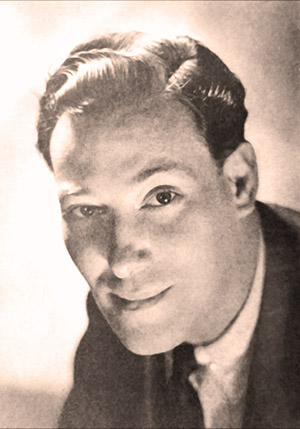
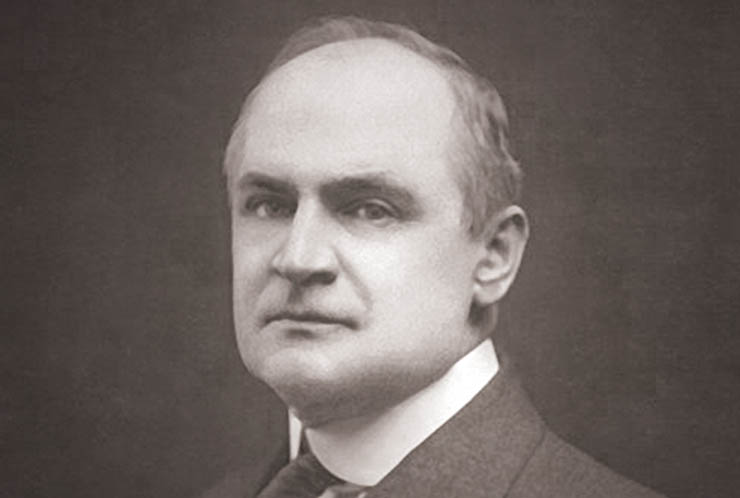
    Neville Goddard (1905–1972)

    I venture to map a seeker’s theory of mind causation – but one that also stands defensible within parameters of accepted (if not always understood) knowledge. My theory may be wrong. It may be grossly incomplete. But I believe that those of us engaged in the search for practical spirituality must at least attempt to theorise from the intersection of testimony, science, and experience. Each generation owes the labour of verification to the search of the next, which will have its own ideas and critiques.

    Indeed, today’s seekers must move beyond inherited decisions and templates. We need our own experiments and results, including failures. Those of us who care about New Thought, or mind causation, owe the spiritual culture – and ourselves – a supportable hypothesis of how it works. We must be equally willing to discard cherished hypotheses. In that vein, I conclude this essay with articles of personal experimentation.

    I start by quoting mystic Neville Goddard (1905–1972) from a 1948 series of lectures in Los Angeles:

    Scientists will one day explain why there is a serial universe. But in practice, how you use this serial universe to change the future is more important.

    It was a striking observation. The mononymous Neville is, I believe, the most penetrating voice to emerge from New Thought tradition – because it was not until years later that quantum physicists began discussing the many-worlds theory, devised by physicist Hugh Everett III (1930–1982) in 1957.

    A Short Overview of Quantum Physics

    Everett was attempting to make sense of some of the extraordinary findings that had been occurring for about three decades in quantum mechanics. For example, scientists are able to demonstrate, through various interference patterns, that a subatomic particle occupies a wave state or state of superposition – that is, an infinite number of places – until a sentient observer or automatised device takes a measurement: it is only when measurement is taken that the particle collapses, so to speak, from a wave state into a localised state. At that point, it occupies a definite, identifiable, measurable place. Before measurement is taken, however, the localised particle exists only in potential.

    Now, I have just about squeezed all of quantum physics into a couple of sentences. I think it is an accurate description, but obviously I am reducing huge complexities into the dimensions of a marble. I believe I am faithfully stating what has been observed in the last ninety-plus years of particle experiments (as well as emerging experiments on larger objects, such as hydrogen molecules). We are seeing that on the subatomic scale matter does not behave as we are conditioned to expect.

    Measurement & Observation: The Role of Mind

    Starting about twenty years ago, it became fashionable for New Agers and laypeople, like me, to put quantum theory at the back of cherished spiritual principles. It became equally fashionable for professional sceptics and mainstream journalists to pushback, crying B.S. and sophistry. That position, while still heard, has quieted. Not because sceptics have grown more pensive or attenuated to media-speak, but because the proposition of mind-over-matter, strange as it may seem, now resounds in debates on theoretical physics in mainline journals and magazines.

    In 2009, I attended a presentation on the “quantum measurement problem” delivered by parapsychologist Dean Radin before an audience of scientists, social thinkers, and scholars of religion. I asked Radin to address the 800-pound gorilla in the room: If observation and perspective alter material on a micro level, in the world of waves and particles, might that say something about the legitimacy of the New Thought or mind-power thesis? “It’s not complete bullshit,” Radin replied. “There may be an inkling of something to it.” Another physicist and longtime military researcher was also present. “As the resident sceptic,” he said, “I concur.”

    Our understanding of matter in our macro world generally comes from measuring things through our five senses and experiencing them as singularities. There is one table. It is solid and definable. It is not occupying an infinite number of spaces. But contemporary quantum physicists have theorised that we may not normally see or experience superposition phenomena because of what is sometimes called information leakage.

    This means that we gain or lose data based on fineness of measurement. When you measure things with exquisitely well-tuned instruments, like a microscope, you see more and more of what is going on, i.e., actual reality. But when you pan the camera back, so to speak, your measurements coarsen and you see less and less of what is actually happening. To cite the most basic example, to all ordinary appearances, a table is solid. The floor beneath your feet is solid. Where you are sitting is solid. But measuring through atomic-scale microscopes, we realise that if you go deeper and deeper, space appears within these objects. Particles make up the atom and still greater space appears. We do not experience that; we experience solidity. But no one questions that space prevails among particles composing an atom.

    Furthermore, we possess decades of data demonstrating that when subatomic particles are directed at a target system, such as a double slit, they appear in infinite places at once until a measurement is made; only then does locality exist. But we fail to see this unless we are measuring things with comparative exactitude. Hence, what I am describing seems unreal based on lived experience – but it is actual.

    In any event, my supposition is this: if particles appear in an infinite number of places at once until a measurement is taken; and if, as we know from studying the behaviour and mechanics of subatomic particles, there exists an infinitude of possibilities; and if we know, as we have since the inception of Einstein’s theories, that time is relative, then it is possible to reason – and it is almost necessary to reason – that linearity itself, by which we organise our lives, is illusory.
    Linearity is a useful and necessary device for five-sensory beings to get through life; but it does not stand up objectively. Linearity is conceptual – a subjective interpretation of what is really going on. It is not reflected in Einstein’s theory of relativity, which demonstrates that time slows for an object approaching the speed of light. (The individual travelling in a metaphorical spaceship at or near light speed experiences time slowing, not from their perspective but in comparison to those not at near light speed. And this is no mere thought exercise: space travellers in our era, although they are obviously approaching nowhere near that velocity, experience minute effects of time reduction.) Nor is linearity reflected in quantum mechanics, where particles appear in an infinitude of places and obey no orderly modality. Linearity is not replicated when measurement of a particle serves to localise the appearance or existence of the object.

    This begins to clarify why Einstein famously wrote in a letter of March 1955:

    People like us, who believe in physics, know that the distinction between past, present, and future is only a stubbornly persistent illusion.

    If we pursue this line of thought further – and this is where Everett’s many-worlds theory comes into play – the very decision to take a measurement (or not take one) not only localises a particle but creates a past, present, and future for that particle. Hence, an observer’s decision to log a measurement creates a multidimensional reality for the particle.

    There exists debate over whether a device represents a method of measurement distinct from an observer, as well as whether the “collapse” from wave to particle results from an observer’s individual psyche or “transpersonal mind behaving according to natural laws,” as observed by Bernardo Kastrup, Henry P. Stapp, and Menas C. Kafatos in a May 29, 2018, Scientific American article “Coming to Grips with the Implications of Quantum Mechanics.” This transpersonal mind, the writers continue, “comprises but far transcends any individual psyche,” a description similar to the Hermetic concept of Nous or an over-mind. The authors compellingly argue that even if a device is used for measurement – and thus localisation – perception and intent, either of the individual, the meta-mind, or both, remains the determining force.
    Schrödinger’s Cat

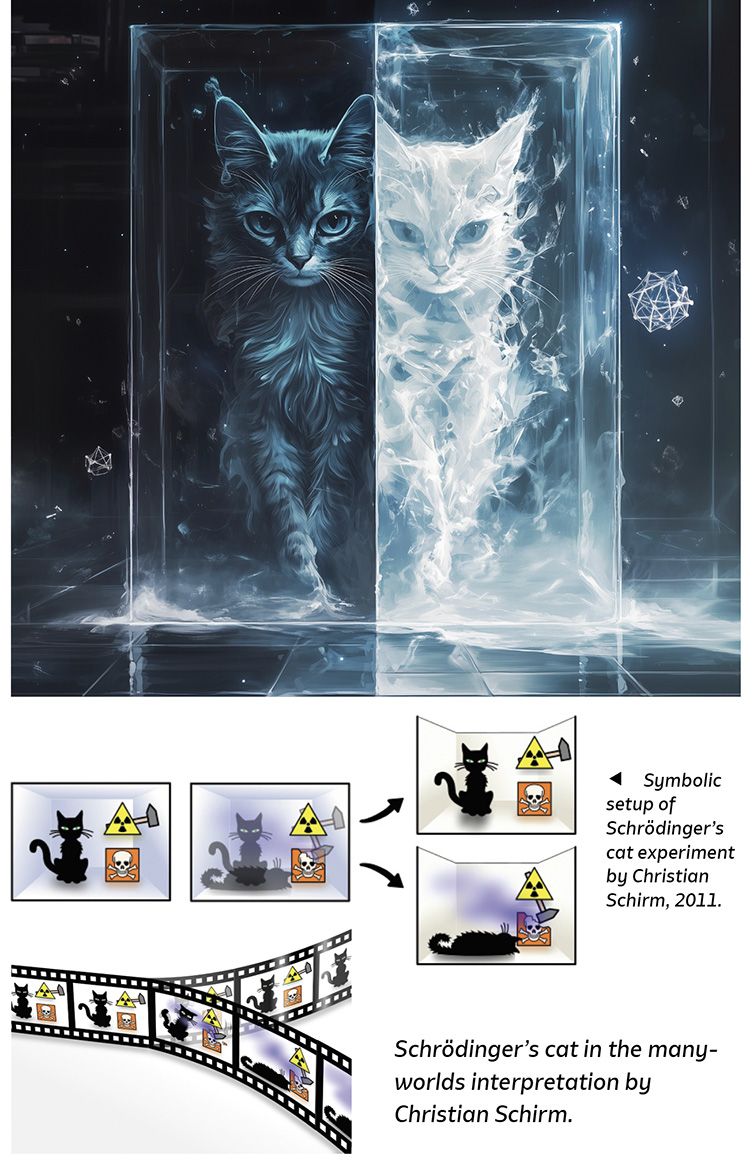
    Multidimensional reality is implied in the famous thought experiment called Schrödinger’s Cat. 20th-century physicist Erwin Schrödinger (1887–1961) was frustrated with the evident absurdity of quantum theory, which showed objects simultaneously appearing in more than one place at a time. Such an outlook, he felt, violated all commonly observed physical laws. In 1935, Schrödinger sought to highlight this predicament through a purposely absurdist thought experiment, which he intended to force quantum physicists to follow their data to its ultimate degree.

    Schrödinger reasoned that quantum data dictates that a sentient being, such as a cat, can be simultaneously alive and dead. Here is a variant of the Schrödinger’s Cat experiment: a cat is placed into one of a pair of boxes. Along with the cat is a collar fitted with a device which, if exposed to an atom, releases a deadly poison. An observer then fires an atom at the boxes. The observer subsequently uses some form of measurement to check which box the atom is in: the empty one or the one with the cat and the poisoning device. When the observer goes to check, the wave function of the atom (the state in which it exists in both boxes) collapses into a particle function (the state in which it is localised to one box). Once the observer takes his measurement, convention says that the cat will be discovered to be dead or alive. But Schrödinger reasoned that quantum physics describes an outcome in which the cat is both dead and alive. This is because the atom, in its wave function, was, at one time, in either box, and either outcome is real.

    Of course, all lived experience tells us that if the atom went into the empty box, the cat is alive; and if it went into the box with the cat and the poisoning device, the cat is dead. But Schrödinger, aiming to highlight the frustrations of quantum theory, argued that if the observations of quantum-mechanics experiments are right, you would have to allow for each outcome.

    To take it even further, many-worlds theorists in the 1950s posited that if an observer waited some significant length of time – say, eight hours – before checking on the dead-alive cat, he would discover one cat that was dead for eight hours and another that was alive for eight hours (and now hungry). In this line of reasoning, conscious observation effectively manifested the localised atom, the dead cat, and the living cat – and also manifested the past, or in other words, created a history for both a dead cat and a living one. Both outcomes are true.

    So, whatever a particle is doing, the very fact that a sentient observer has chosen to take a measurement at that time, place, moment, and juncture creates a whole past, present, and future – an infinitude of outcomes. A divergent set of outcomes would exist if that measurement were never taken. A divergent set of outcomes would also exist if that measurement were taken one second later, or five minutes later, or tomorrow. And what is tomorrow? When particles exist in superposition until somebody takes a measurement, there is no such thing as tomorrow, other than subjectively.

    Consider too: the cat, from its perspective, is local; the observer, from its perspective, is local – but both, in fact, are in a wave state or superposition. We can speak of them as concrete, singular beings only from their personal perspective. From the quantum perspective, they are infinite. Expanding on this idea, research physician Robert Lanza, adjunct professor at Wake Forest University School of Medicine, argues that death itself is ultimately a mental phenomenon: we “die” only insofar as an observer perceives demise; the consciousness of the “deceased” branches off into one of Everett’s many worlds. (This begs the question of who experiences these effects if there’s no such thing as “one” person/life. I consider this in my book Daydream Believer.)

    And what, finally, are our five senses but a technology by which we measure things? Are our five senses anything other than a biological technology, not necessarily different in intake from a camera, photometer, digital recorder, or microscope? So, it is possible that within reality – within this extra-linear, super-positioned infinitude of possibilities in which we are taking measurements – we experience things based upon our perspective. This is why in considering mind causation I use the term select rather than manifest.

    Neville Goddard: Thoughts Have Wings
    Here, we return to mystic Neville Goddard. His instinct was, I believe, correct in the schema just considered. Neville taught that you can take a measurement by employing the visualising forces of your imagination. You are taking a measurement within the infinitude of possible outcomes. The measurement localises or actualises the thing itself.

    In the 1948 lectures quoted earlier, Neville further noted:

    Man can prove the existence of a dimensionally larger world by simply focusing his attention on an invisible state and imagining that he sees and feels it. If he remains concentrated in this state, his present environment will pass away, and he will awaken in a dimensionally larger world where the object of his contemplation will be seen as a concrete objective reality.

    I feel intuitively that, were he to abstract his thoughts from this dimensionally larger world and retreat still farther within his mind, he would again bring about an externalisation of time. He would discover that, every time he retreats into his inner mind and brings about an externalisation of time, space becomes dimensionally larger. And he would therefore conclude that both time and space are serial, and that the drama of life is but the climbing of a multitudinous dimensional time block.

    Again, note how foresightful Neville’s ideas and language proved of the many-worlds theory.

    Aleister Crowley, the confounding and brilliant British occultist and artist, made a statement related to Neville’s. Writing in the introduction to his 1904 channelled text The Book of the Law – later published in a general edition in 1938 – Crowley observed:

    Each of us has thus an universe of his own, but it is the same universe for each one as soon as it includes all possible experience. This implies the extension of consciousness to include all other consciousnesses. In our present stage, the object that you see is never the same as the one that I see; we infer that it is the same because your experience tallies with mine on so many points that the actual differences of our observation are negligible… Yet all the time neither of us can know anything… at all beyond the total impression made on our respective minds.

    Neville’s formula is simplicity itself: an assumption, if persisted in, hardens into fact. But the assumption must be persuasive; it must be convincing. That is why emotions and feeling states must come into play. And Neville observed that you can use hypnagogia – the state of cognizant pre-sleep or drowsy relaxation – to help facilitate that process.

    Hypnagogia naturally occurs twice daily: just prior to and following sleep. It is a period of hallucinatory sentience during which we are nonetheless capable of controlling attention; what’s more, your rational defences are lowered. This can be considered “prime time” to visualise a desired end. (Hypnagogia is also a period of heightened ESP-related activity, as recorded in academic psychical research.)

    Another way of using Neville’s approach to mental creativity is to enter an inner state of theatrical or childlike make-believe. Not childish but childlike: a state of internal wonder and pretending. Children excel at this. We grow embarrassed about this quality as we age, but Neville spoke ingenuously about walking the streets of Manhattan imagining that he was in the treelined lanes of his native Barbados, boarding a ship to some desired destination, or in a location where he wanted to be.

    He would say: “Unfoldment will come. You will see.” Again, he argued that an assumption, although false, if persisted in, eventually hardens into fact. He further advised, “Assume the state of the wish fulfilled. Live from the end.” Remember, the teacher reminded listeners, you are not in a state of wanting; you are in a state of having received. Your aim is simply to occupy the emotional and mental condition that you would experience following fulfilment.

    Of course, you must also continue to go about your adult life in this world of Caesar, currency, and commerce – fulfilling your obligations and remaining accountable. You must cooperate with the world. You must do the normative things that life requires. The crisis of the New Age is the inability of an outsized number of its adherents to abide this. In my observation, until a person demonstrates accountability, competency, and agency in outer life, the spiritual path is a diversion, possibly a disastrous one.

    Should you accept this challenge, how long will it take to witness your desired changes in outer life? How long is required for outer life to conform to your internal focus, your act of living “from the end” of your ideal? The question of time intervals is deeply fraught because with all the stresses that life throws at us, it is very difficult to adopt a feeling state and stick with it for weeks. At times, psychological barriers and stresses make it impossible.

    Neville noted that there could fall a substantial time interval between your visioning and experience of the wished-for state or thing. He would point out that the gestation period of a human life is nine months. The gestation period of a horse is eleven months. The gestation period of a lamb is five months. The gestation period of a chick is twenty-one days. There is almost always going to be some time interval. You will find that naturalness of persistence comports with depth of passion for your aim. It can appear more a matter of the aim holding you than you it. This is one reason why clarity of aim and self-honesty are essential: we follow emotions, acknowledged or not.

    Careful What You Wish For

    Johann Wolfgang von Goethe (1749–1832) made an interesting observation in this vein. We have all heard the expression, “Be careful what you wish for; you just might get it.” It is rooted in Goethe. Taking a leaf from the philosopher and dramatist’s play Faust (c.1772–1775),Ralph Waldo Emerson noted this dynamic in his 1860 essay “Fate,” which led to the popular adage. Emerson wrote:

    And the moral is that what we seek we shall find; what we flee from flees from us; as Goethe said, “what we wish for in youth, comes in heaps on us in old age,” too often cursed with the granting of our prayer: and hence the high caution, that, since we are sure of having what we wish, we must beware to ask only for high things.

    We are being warned to act with perspective: what we wish for when we are young will visit us in waves when we are old.

    Goethe’s observation relates to Neville’s remarks about the perceived passage of time and the gestation between thought and actualisation. Many people would reasonably object that they have all kinds of unfulfilled wishes. But unlocking the truth of this observation requires peeling back the layers of your mind and probing formative images and fantasies from when you were very young.

    What is the earliest dream you recall from when you first gained conscious memories, maybe at age three or four? What fantasies occupied your earliest recollective years? Children lead very intense fantasy lives, even at ages four or five. If you take Goethe’s counsel, you might be surprised – barring extreme countervailing events (to which I return) – to discover remarkable symmetry between things you are living out today and concepts you harboured when very young. These can be positive, negative, or numerous stations between.

    Neville recommended against thinking in terms of, “It will happen this way” or, “I’ll do something to make it happen.” His attitude was that the event will unfold in its own natural manner. In his system, your job is not to draw the map – it is to live from the destination.

    I must, finally, add a word about suffering on both an intimate and global scale. New Thought has proven woefully inadequate in addressing matters of implacable tragedy and catastrophe, a topic on which I’ve written widely.

    My contention is that even if awareness or consciousness is the ultimate arbiter of existence, we still experience many different laws and forces within the physical framework we know. I used to say that we live under many different laws and forces; I’m not sure if that’s entirely right. But we certainly experience diffuse laws and forces, and these experiences are hard-baked into us.

    So, it stands to reason that even if emotive thought, perspective, and awareness are determinative of what reality gets concretised into our individual experiences, there exist different laws and possibilities that are also playing out at the same time. There are physical facts which also form part of the nature of our experience within the framework that we find ourselves. And it could be that there are other frameworks in which our psyches are much freer. There may be frameworks in which we experience fewer laws and forces that seem to interrupt a sense of continuity between you, the individual – you, the seeker – and that which you experience.

    That said, suffering and catastrophe must, for every ethical being, be understood as fundamental, urgent, and, where possible and according to personal conviction, requiring of amelioration and solidarity.

    I believe that Neville is going to be remembered – and is already seen today – as having created the most elegant mystical analogue to quantum physics.

    When I started writing about Neville in 2005 – the first journalistic coverage of his life since the 1940s – he was a figure of obscurity even among most New Thoughters. But today Neville’s voice and work net millions of results in search engines. At a 2022 tech conference, I was floored by the number of programmers and engineers (not the usual suspects) who approached me to talk about him.

    As seen, Neville espoused a variant of the many-worlds theory long before the popularisation of quantum physics. Indeed, he had a series of remarkable instincts in the 1940s that have since been tantalisingly, if indirectly, reiterated by quantum theorists – most of whom have not (yet) heard his name.

    Indeed, it would not surprise me if, within a generation, some physics students begin to read Neville as a philosophical adjunct to their work. That may seem a stretch, but remember that many of today’s senior cohort of physicists, people in positions of academic and grant-making authority, were inspired by Star Trek, Arthur C. Clarke,and Zen and the Art of Motorcycle Maintenance. There is visibly greater openness in the field today to matters of perspective and thought causation.
    Get the issue this article appears in

    Living by the Inner Light of Conviction

    As I’ve suggested, you can use several different techniques in connection with Neville’s ideas, including those of your own devising: I challenge you to try them and see what happens. You are entitled to results. I believe that every therapeutic, ethical, or spiritual philosophy should produce some concrete and desired change in your life and conduct; if it does not, then such an idea warrants no hold on you.

    I feel similarly that the ability to observe and note an outcome in your life is vitally important. Testimony forms a critical source of ideas, a meaningful record, and a warranted inducement to others.

    We all live by philosophies, spoken or not. Even if we say we do not have an ideology, we obviously harbour assumptions by which we navigate life. When I look back on figures like Neville or pioneering parapsychologist J.B. Rhine (1895–1980), I realise that their greatness is that they lived by the inner light of their ideas. That is rare. We are a world of talkers. People are sarcastic or cruel over Twitter and think they are taking a principled stand. Is it courageous or honourable for a keyboard warrior (often under a pseudonym) to call out people online? That is no victory. It is make-believe morality.

    When we look back on iconic figures in the social, cultural, artistic, or spiritual milieu, we remember those few who lived by the inner light of conviction; who struggled to comport their ideals with conduct. Such private philosophies are the only ones that last. Indeed, if you cannot keep your word, apologise, demonstrate solidarity or loyalty, then write nothing of an ethical or spiritual bent. You’ll be writing on sand.

    I must state the following and I mean it in my heart: if you sincerely attempt what I am theorising in this article, I believe that you will find greatness; because, if nothing else, you will be attempting to live by the inner light of an idea. Try.

    [alert type=”general” dismiss=”no”]This article was published in New Dawn Special Issue Vol 18 No 6.[/alert]

    [alert type=”success” dismiss=”no”]If you appreciate this article, please consider subscribing to help maintain this website.[/alert]

    © New Dawn Magazine and the respective author.
    For our reproduction notice, click here.
  • Is There a Connection Between Quantum Physics & Positive Thinking?

    Is There a Connection Between Quantum Physics & Positive Thinking?

    From New Dawn Special Issue Vol 13 No 6 (Dec 2019)

    For the last several years a thickening stream of New Age books and documentaries have, to the chagrin of critics, attempted to use quantum theory to “prove” that the mind possesses causative powers. Enthusiasts say that quantum experiments demonstrate that an observer’s presence or perspective determines the nature of objects on a subatomic scale.

    Recently Robert Lanza, adjunct professor at the Institute for Regenerative Medicine at Wake Forest University, argued that death itself is ultimately a mental phenomenon – we “die” because the mind perceives demise.1

    Researchers are rightly vexed when concepts in quantum theory are picked over in slipshod or sensationalistic ways. Most scientists want to slam shut the door on this (admittedly dim) connection between quantum physics and the vaunted reality-shaping properties of the mind. But ongoing findings in quantum physics – when considered without half-baked understanding – keep pushing the door back open.

    There is place for a conversation between physicists and serious people in the metaphysical culture – including those who are interested in the widely maligned practice of “positive thinking,” which holds that thoughts influence reality. Scientific authorities quickly shoot down the starting proposition that quantum theory raises a viable question about the causative influence of the mind, at least in a world of subatomic particles and waves. Many scientists object that such notions arise from a misunderstanding of quantum data.

    Yet, if approached with care, this discussion – of whether observation evinces causal properties in a world of waves and particles – deserves the ear of reasonable people.

    First the basics: Physics journals today routinely discuss what is called the “quantum measurement problem.” Many people have heard of some version of it. In essence, more than eighty years of laboratory experiments show that atomic-scale particles appear in a given place only when a measurement is made. Astonishing as it sounds – and physicists themselves have debated the data for generations – quantum theory holds that no measurement means no precise and localised object on the atomic level.

    Put differently, a subatomic particle literally occupies an infinite number of places (a state called “superposition”) until observation manifests it in one place. In quantum mechanics, a decision to look or not look actually determines what will be there. In this sense, an observer’s consciousness determines objective reality in the subatomic field.

    Some physicists would dispute that characterisation. Critics sometimes argue that certain particles are too small to measure; hence any attempt at measurement inevitably affects what is seen. But there exists a whole class of “interaction-free measurement” quantum experiments that don’t involve detectors at all. Such experiments have repeatedly shown that a subatomic object literally exists in more than one place at once until a measurement determines its final resting place.

    How is this actually provable? In the parlance of quantum physics, an atomic-scale particle is said to exist in a wave-state, which means that the location of the particle in space-time is known only probabilistically; it has no properties in this state, just potentialities. When particles or waves – typically in the form of a beam of photons or electrons – are directed or aimed at a target system, such as a double-slit, scientists have found that their pattern or path will actually change, or “collapse,” depending upon the presence or measurement choices of an observer. Hence, a wave pattern will shift, or collapse, into a particle pattern. Contrary to all reason, quantum theory holds that opposing outcomes simultaneously exist.

    The situation gets even stranger when dealing with the thought experiment known as “Schrodinger’s Cat.” The twentieth-century physicist Erwin Schrodinger was frustrated with the evident absurdity of quantum theory which showed objects simultaneously appearing in more than one place at a time. Such an outlook, he felt, violated all commonly observed physical laws. In 1935, Schrodinger sought to highlight this predicament through a purposely absurdist thought experiment, which he intended to force quantum physicists to follow their data to its ultimate degree.

    Schrodinger reasoned that quantum data dictates that a sentient being, such as a cat, can be simultaneously alive and dead. A variant of the Schrodinger’s Cat experiment could be put this way: Let’s say a cat is placed into one of a pair of boxes. Along with the cat is what Schrodinger called a “diabolical device.” The device, if exposed to an atom, releases a deadly poison. An observer then fires an atom at the boxes. The observer subsequently uses some form of measurement to check on which box the atom is in: the empty one, or the one with the cat and the poisoning device. When the observer goes to check, the wave function of the atom – i.e., the state in which it exists in both boxes – collapses into a particle function – i.e., the state in which it is localised to one box. Once the observer takes his measurement, convention says that the cat will be discovered to be dead or alive. But Schrodinger reasoned that quantum physics describes an outcome in which the cat is both dead andalive. This is because the atom, in its wave function, was, at one time, in either box, and either outcome is real.


    Schrödinger’s cat thought experiment: a cat, a flask of poison, and a radioactive source are placed in a sealed box. If an internal monitor (e.g. Geiger counter) detects radioactivity (i.e. a single atom decaying), the flask is shattered, releasing the poison, which kills the cat. The Copenhagen interpretation of quantum mechanics implies that after a while, the cat is simultaneously alive and dead. Yet, when one looks in the box, one sees the cat either alive or dead, not both alive and dead. This poses the question of when exactly quantum superposition ends and reality collapses into one possibility or the other.

    Of course, all lived experience tells us that if the atom went into the empty box, the cat is alive; and if it went into the box with the cat and the poisoning device, the cat is dead. But Schrodinger, aiming to highlight the frustrations of quantum theory, argued that if the observations of quantum-mechanics experiments are right you would have to allow for each outcome.

    To take it even further, a cohort of quantum physicists in the 1950s theorised that if an observer waited some significant length of time, say, eight hours, before checking on the dead-alive cat, he would discover one cat that was dead for eight hours and another that was alive for eight hours (and now hungry). In this line of reasoning, conscious observation effectively manifested the localised atom, the dead cat, the living cat – and also manifested the past, i.e., created a history for both a dead cat and a living one. Both outcomes are true.

    Absurd? Impossible? Yes to that, say quantum physicists – but decades of quantum experiments make this model – in which a creature can be dead/alive – into an impossible reality: an unbelievable yet entirely tenable, even necessary, state of nature. Schrodinger’s thought experiment forced a consideration of the meaning of quantum mechanics (though not many physicists pay attention to the radical implications).

    Why is there an apparent divide in our view of reality, in which one set of rules governs the events of the micro world and another set governs the macro world? It may be due to the limits of our observation in the macro world. Some twenty-first-century quantum physicists call this phenomenon “information leakage.”

    The theory of “information leakage” holds that the apparent impossibilities of quantum activity exist all around us. They govern reality. However, when we step away from whatever instrument we are using to measure micro particles and begin looking at things in larger frames and forms, we see less and less of what is really going on. We experience a “leakage” of data. William James alluded to a similar dynamic in his 1902 Gifford Lectures: “We learn most about a thing when we view it under a microscope, as it were, or in its most exaggerated form. This is as true of religious phenomena as of any other kind of fact.”

    Only future experiments will determine the broader implications of sub-natural phenomena in the mechanical one in which we live. For now, however, decades of quantum data make it defensible to conclude that observation done on the subatomic scale: (1) shapes the nature of outcomes, (2) determines the presence or absence of a localised object, and (3) possibly devises multiple pasts and presents. This last point is sometimes called the “many-worlds interpretation,” in the words of physicist Hugh Everett. This theory of “many worlds” raises the prospect of an infinite number of realities and states of being, each depending upon our choices. And here we encounter the frustrating but persistent thesis of positive thinking, which holds, in some greater or lesser measure, that our thoughts influence – concretely – our experience.

    Neville Goddard (1905–1972)

    Everett’s concept of multiple worlds and outcomes based on the vantage point of the observer finds its closest metaphysical analogue in the ideas of Neville Goddard,2 a mid-twentieth century mystical writer and lecturer who reasoned that our thoughts create an infinitude of realities and outcomes. Neville (who went by his first name) argued that everything we see and experience, including one another, is the product of what happens in our own individual dream of reality. Through a combination of emotional conviction and mental images, Neville believed, each person imagines his own world into being – all people and events are rooted in us, as we are ultimately rooted in God. When a person awakens to his true self, Neville argued, he will, in fact, discover himself to be a slumbering branch of the Creator clothed in human form, and at the helm of infinite possibilities.

    Most quantum physicists wouldn’t be caught dead/alive as Schrodinger’s cat reading an occult philosopher such as Neville. Indeed, many physicists reject the notion of interpreting the larger implications of quantum data at all. “Shut up and calculate!” is the battle cry popularised by physicist N. David Mermin. The role of physics, critics insist, is to measure things – not, in Einstein’s phrase, to lift “the veil that shrouds the Old One.” Leave that to gurus and philosophers, but, for heaven’s sake, critics argue, keep it out of the physics lab. Others adopt the opposite position: If physics isn’t for explaining reality, then what is it for?

    Get the issue this article appears in

    The latter principle may carry the day. A rising generation of physicists, educated in the sixties and seventies and open to questions of consciousness, is currently reaching positions of leadership in physics departments (and gaining authority in areas of grant-making and funding). This cohort was educated in a world populated by Zen and motorcycle maintenance, psychedelic experimentation, and Star Trek; they tend to be open to philosophical questions and meta-analysis. As scientists they are every bit as rigorous as the past generation of classical empiricists. Hence, we could be on the brink of a renaissance of inquiry into the most remarkable scientific issue since Newton codified classical mechanics. As more data is known, purveyors of quantum physics and metaphysics may be headed for a new and serious conversation.

    But the pitfalls are too important not to consider before waltzing off into the world of “both/and” realities. To the frustration of scientists, spiritual seekers often prove overeager to seize upon the implications of quantum data, declaring that we now have proof that the universe is the result of our minds. The correlation between the events of the micro world and those of the daily life that we see and feel is far from clear. Spiritual seekers should resist the temptation to cherry-pick from data that seems to confirm their most deeply cherished ideas. Likewise, physicists should be patient with lay seekers who want to ponder the possibilities of quantum physics. If the right balance can be struck, serious and thoughtful people from both worlds, science and spirituality, have something to talk over. Such a discussion may, ultimately, revolutionise how we see ourselves in the twenty-first century as much as Darwinism did in the Victorian age.

    [alert type=”general” dismiss=”no”]This article was published in New Dawn Special Issue Vol 13 No 6.[/alert]

    [alert type=”success” dismiss=”no”]If you appreciate this article, please consider subscribing to help maintain this website.[/alert]

    Footnotes

    1. Does Death Exist? New Theory Says ‘No’ by Robert Lanza, M.D., www.huffpost.com/entry/does-death-exist-new-theo_b_384515
    2. The Greatest Philosopher You’ve Never Heard Of by Mitch Horowitz, https://
    medium.com/universal-quest/the-greatest-philosopher-youve-never-heard-of-336231e26885

    © New Dawn Magazine and the respective author.
    For our reproduction notice, click here.

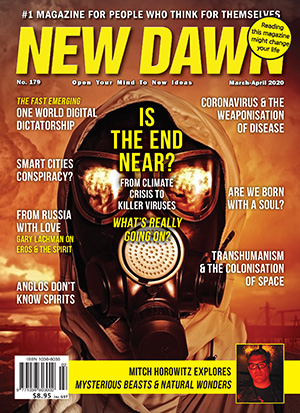
  • Mysterious Beasts & Natural Wonders: Toward a New Understanding of Bigfoot, Flying  Saucers, Fairies & other Inconvenient Realities

    Mysterious Beasts & Natural Wonders: Toward a New Understanding of Bigfoot, Flying Saucers, Fairies & other Inconvenient Realities

    From New Dawn 179 (Mar-Apr 2020)

    Several years ago a critic wrote about me, “Horowitz is an okay historian, but the guy believes in leprechauns for chrissakes.”That is true – I plead guilty. In this paper, I will try to explain why my critic is right. 

    Although I am not a crypto-zoologist, I am a great admirer of the paranormal investigator Charles Fort (1874–1932). People wouldn’t necessarily call me a Fortean, though. I don’t study anomalies. But my critic was referencing a series of events that I once related, which happened to me about 20 years ago in the nation of Belize in Central America. 

    For those of you who don’t know Belize, it’s a very beautiful, English-speaking country that borders Guatemala and Mexico on the Caribbean. Belize is filled with lush forestry, rainforests, snaking rivers and hills – including vast hills in the highlands, which are the subject of folklore and mysteries. 

    I was staying in the hill country at an eco-jungle lodge founded by a very enterprising couple and their kids from Maryland. They carved the whole place themselves out of the jungle interior. The area attracted a fair amount of ecotourism. Staying at a lodge next door was the actress and model Brooke Shields (who was very nice). 

    Now, a cabdriver was taking us to this jungle lodge from the airport in Belize City. It was a long drive of about two-and-a-half hours. The final leg ascended a very rocky, unpaved road up a mountain. It was difficult to navigate in a standard car because the rocks and roots and undulating landscape caused the car to hit bottom from time to time, and the terrain can damage the chassis.

    As we drove up the hill, the driver started saying, “I really don’t like going up into these hills. As soon as I drop you off, I am going to turn around and speed off and get out of here.” It seemed odd to speed away on such treacherous landscape. “What’s the rush?” I asked. 

    “Well,” he said, “there are little men who live in these hills. They’re called aluxes. They’ve lived here for centuries. If you see one of them while you’re walking around in the forest you’ll get so frightened that you won’t be able to speak. Your voice will get caught in your throat. I really don’t like coming up here.”

    Sure enough, he dropped us off, turned around, and sped away. I thought, “Well, that’s kind of strange.”

    We checked into the lodge and the next day went canoeing down a river that ran below the ridge on which it was perched. I started telling one of my travelling companions that I was really kind of pissed off at this cab driver because I thought he was just playing “scare the tourist.” I thought he was trying to have a little fun at our expense.

    As I was talking about this, drifting along this deadly quiet river, a big boulder came crashing down in front of us, having been rolled down a hill or falling down a hill from somewhere along the ravine we were canoeing through.

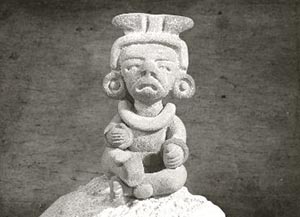
    Figurine of an Alux – Belize’s legendary “little folk.”

    I got nervous and I thought, “All right, I need to watch what I say.” Because there’s a folk tradition that if you talk about these creatures they come around. This is why some people in Ireland today won’t make reference to “little folk” or leprechauns – they use euphemisms like “the other crowd.” This opens an interesting point: you find traditions of these little creatures all throughout the world. This folklore exists in Central America, in Ireland, in Polynesia, in West Africa. Virtually every continent has these legends, going back centuries, which include the detail that if you start talking about these little beings, sometimes called wood sprites or fairies or brownies, you invite them into your life, and they can cause mischief.

    Many traditional-minded people in Ireland today believe so strongly in the existence of “the other crowd” that in 1999 a major highway under construction in County Clare got rerouted to avoid running past what was known as a fairy bush – the domain, so it is said, of these little beings. The fear was that if you run a highway through a fairy bush you will incur their wrath, and they will cause accidents. A folklorist and historian named Eddie Lenihan, with whom I’ve worked and greatly respect, helped prompt the change. 

    Who Goes There?

    Perhaps I’m sympathetic to these events because I do not want to live in a world where no mysteries remain. I do not want to live in a world where you hear a twig snapping in the woods and don’t wonder, “Who goes there?” I don’t want to live in a digital, fluorescent-lit environment in which we feel that we know everything that’s out there.

    Call it sentiment, but I think that most of us feel intuitively, and sometimes through personal experience or study, that the belief nothing at all is lurking in the dark corners doesn’t cover all the bases of life. 

    There exists so much testimony and so many stories of people having unusual experiences with things that are not supposed to be there, whether they’re little men or Bigfoot or something that’s lurking in the water. We’re all attached to these stories to some degree. Obviously, the concept of Bigfoot or some kind of mysterious simian runs not only through a great deal of our folklore but wields a great hold on people’s attention today. 

    The question is, why? We face so many crises and problems in the world: war, climate change, famine, and all of the wonderful things coming out of the White House. Why would we be interested today in the persistence of mysterious winged beasts or Bigfoot or yeti or fairies? For what reason?

    I think part of the reason is not only that some of these things may be empirically real – when considering the paranormal I do not remove empiricism from the table prima facie, a point to which I’ll return – but I think our fascination with mysterious beasts and natural wonders speaks to how we feel, and have reason to feel, that there exists an unseen dimension of life. Something beyond our workaday, five-sensory existence.

    What I am describing goes beyond a wish to believe in the mythical. Rather, it touches upon our understanding of a world that doesn’t fully disclose itself, but that we experience intuitively, insightfully, and even cognitively in terms of phenomena that may be causatively related to our minds, as well as to unseen dimensions, the reality of which we’re unable to fully decipher but which we catch glimpses of from time to time. 

    The UFO Thesis

    This is true also of so-called UFO or extraterrestrial sightings. I think that we are actually living through a moment, in the here and now, where we are experiencing a cultural breakthrough in understanding about the existence of unknown forces and expressions of life.

    This can be seen in particular with regard to the UFO thesis. In September 2019, the Guggenheim Museum in New York City hosted a remarkable, and I would say unprecedented, panel on UFOs and extraterrestrials. This was notable in itself because the Guggenheim is not considered a fount of occult passions. This is the first time I can recall any major cultural institution in the city hosting a panel like this and earnestly exploring this question.

    The panel was the work of a very innovative curator, Troy Therrien, who oversees the Guggenheim’s architectural collection. It featured writer and scholar Gordon White, a wonderful occult intellect, and philosopher and historian Diana Pasulka. It was a fascinating program before a packed house. Afterwards, the curator asked me: “At what point do you think it is going to become intellectually embarrassing within our culture not to take seriously the question of UFOs?” I told him that I do not refer casually to paradigm shifts. I often deflect questions from mainstream journalists about supposed occult revivals because I think such framings are usually a way of trying to find a news hook. I don’t speak casually about those kinds of cultural shifts. With that in mind, I replied, “I actually think, in all honesty, that we have just now, at this very time, entered the point culturally where it is no longer sustainable or even intellectually serious to wave off the notion of UFOs.”

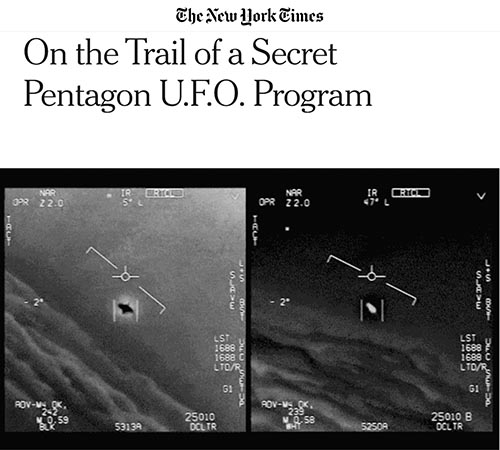
    This shift arose in part from an event in 2017. The Pentagon and the Navy released cockpit footage and recordings of pilots witnessing UFOs, including vehicles moving at unbelievable speeds, behaving in ways that airborne vehicles are not supposed to behave, and the pilots asking: “What is that?” This material was so plain, clear, and persuasive that it moved even holdouts in the gatekeeping culture to acknowledge its significance. 

    The footage appeared in a prominent and widely read piece in The New York Times, co-written by the excellent researcher Leslie Kean. I consider it one of the most significant news stories because it finally moved the dial on the debate. The question of what UFOs are remains unsettled, of course; but that the testimony and records of such phenomena raise profoundly valid questions is now denied by no serious person.

    I date the before-and-after of this shift to a pair of columns that appeared in the same newspaper by the opinion writer Ross Douthat. This writer considers himself a no-nonsense, old-school conservative, of which we have few remaining in the US. In December 2017, Douthat wrote a column headlined “Flying Saucers and Other Fairy Tales.” As you can gather, the column denigrated interest in UFOs as a persistent and silly trope. Oddly enough, as a device for dismissing the delusions of UFO acolytes, Douthat used the work of my friend Jacques Vallée. Jacques is known not only for co-designing the prototype of the Internet, but he is also one of the most trenchantly intelligent UFO researchers of our time, as well as a brilliant social observer and writer. His diaries Forbidden Science revive a style of serial-memoir writing that hasn’t been seen since the early-to-mid twentieth century. 

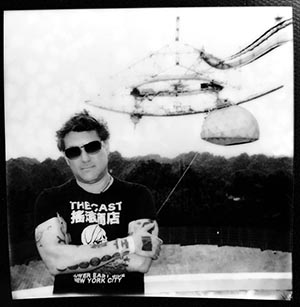
    The author Mitch Horowitz at Arecibo Observatory radio telescope in Puerto Rico, USA, which maps the cosmos using radio waves and also seeks ET contact. The Observatory is famous for the “Arecibo message,” a 1974 interstellar radio message carrying basic information about humanity and Earth sent to globular star cluster M13. Photo credit Jacqueline Castel

    The columnist cited Jacques as saying that there was mechanical unlikelihood of vehicles from outer space being able to reach our terrestrial confines. But what Douthat omitted in Jacques’ work, and what is most distinguishing in his theorising about UFOs, is that he long ago posited there are so many apparent mechanical impossibilities involving UFOs that, following the principle of Occam’s Razor, it’s plainer and broader to theorise that some of these sightings may be extra-dimensional. I’ll say more about that and define what is meant by extra-dimensional. Oddly, the columnist entirely omitted that key facet of Jacques’s outlook.

    Flash forward to August 2019, a month before the Guggenheim panel. The same columnist reversed course and wrote a piece, while not related specifically to UFOs, in which he noted the persuasive (if unsettled) nature of some of the UFO data that had recently been released, without noting that less than two years earlier he dismissed the validity of considering such data. I tweeted my thanks that he had seen fit to change his position. To my surprise, the New York Times opinion section retweeted me – another institution not known for its occult passions. I began to realise, typified by this little turn of events, that we have reached a turning point where it was intellectually unserious to dismiss the UFO question. I would challenge any materialist scientist or philosopher to push back against that statement. 

    Random Numbers & Patterns

    Until 2007, there was a parapsychology lab at Princeton University. It was known by the acronym PEAR for Princeton Engineering Anomalies Research Lab. This was a serious parapsychology lab in existence for about 30 years. When PEAR was operating it conducted a number of experiments with machines known as random number generators. We use random number generators every day – they produce an infinitely variable pattern of numbers and we commonly use these things to set passwords. 

    Parapsychologists sometimes use random number generators to test for ESP or telekinesis. They might place a subject in proximity to a random number generator to see if he or she proves capable of disrupting the randomness, of creating a signal in the noise, so to speak. Perhaps I jump to a conclusion by using the term create – but, rather, there is congruity between the individual’s efforts to interrupt randomness and the appearance of a pattern that shouldn’t be there.

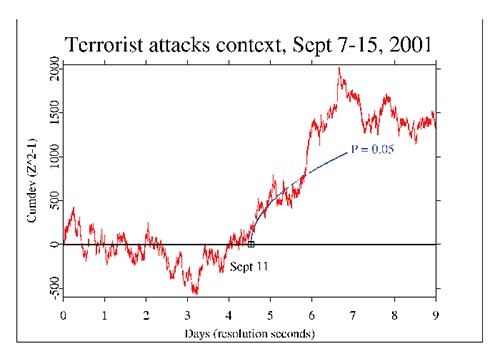
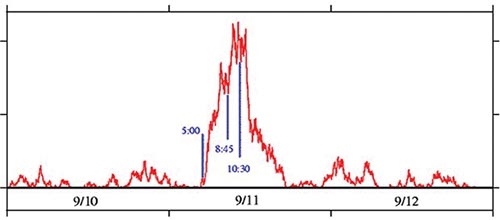
    One of the things the Princeton lab did, going back many years, was to place random number generators at various locations around the world. It was found – and there have been journal articles about this and I’m simplifying it somewhat – that during the events of 9/11, immediately preceding the events, during them, and immediately following, the random number generators started displaying patterns.

    There was an interruption in these completely randomised and chaotic displays of numbers. Suddenly numbers would repeat. There was a traceable pattern at certain moments. Researchers were left with an enormous question, which begs further research and further understanding: Why, at a moment of what could be loosely described as a global trauma, did this network of random number generators demonstrate a pattern, an interruption in the noise?

    This raises the tantalising prospect of mental causation. Of whether we, through the agency of thought, are able to impact and produce outcomes. This isn’t a paper on mental causation, but there are many different scientific fields, including neuroplasticity, quantum mechanics, placebo studies, and psychical research, that have demonstrated causation relating to thought. One way of empirically discussing the manifestation of energies is to note that during that period of global trauma we saw some apparently unified impact of thought, which was exercising probable telekinetic influence on this network of random number generators.

    The Princeton Engineering Anomalies Research Lab, a research program at Princeton University that studied parapsychology (and was closed in 2007), established the Global Consciousness Project in 1998 to detect possible interactions of “global consciousness” with physical systems. Employing electronic random number generators in locations around the globe (see map), the project detected anomalous fluctuations in the nine-day period around the September 11, 2001 terrorist attack as per the graphics. When great events synchronised the feelings of millions of people, their network of RNGs became “subtly structured.” (see http://noosphere.princeton.edu)

    Check Your Foundation

    I think we may be approaching a new way of understanding Bigfoot sightings, UFOs, persistent reports of anomalous beasts and things that go bump in the night and twigs snapping, so to speak. 

    People in many reaches of US society are obsessed with the existence of Bigfoot. It is the subject of these mostly awful cable TV pseudo-documentaries; it fuels an enormous stream of books, articles, debates, and controversies. Scientists complain that no one has been able to produce viable DNA evidence of Bigfoot. One might argue that point, but that’s the broadly held critique. 

    If one concedes the point, however, it could open to a more radical and supple thesis. Several scientists, including Richard Feynman, have observed that you can’t get out of a problem by employing the same thinking that got you into it. I’ve found that is a universal principle. I have found it a good principle in writing, for example. If you write a sentence or paragraph and you’re wrestling with it and clarity keeps eluding you, there’s probably something wrong with the foundation. It’s best to toss out the line or paragraph and start fresh. If something proves chronically difficult – this is true in relationships, too – there’s probably a flaw in the foundation itself. 

    The same may hold true for the question of mysterious beasts and natural wonders. Maybe the reason we don’t find more physical or DNA evidence is that, while these persistently reported phenomena are real and are actually occurring, they do not necessarily conform to our five-sensory material lives.

    This returns us to the observation that Jacques Vallée made about UFOs probably being some kind of inter-dimensional manifestation, which enter our awareness intermittently and then vanish. There may exist an infinitude, or superposition, of events occurring all the time and everywhere, which we are capable of measuring or experiencing only intermittently (such as in the cases of documentary imagery), fractionally, or at periods of extreme sensitivity, in the same way that ESP or telekinesis may manifest at highly receptive moments. This ties into the question of psychical energies being unleashed during instances of trauma or crisis or intensity.

    Super Events

    Consider it this way: Within the particle lab, more than eighty years of quantum experiments demonstrate that subatomic particles occupy a state of superposition or a wave state. As such, they appear everywhere at once. They exist in a state of infinite possibility. We know this because subatomic particles display interference patterns, which demonstrate that they are non-localized. They exist in a state of potential until an observer takes a measurement. When an observer decides to take a measurement the particle collapses from a wave state to localized state. Without that measurement, the particle will not occupy a definite, locatable place.

    This is not controversial. No quantum physicist would challenge eighty years of this data. What is controversial are the implications of the data, and the willingness of our culture to follow those implications. In the 1930s, physicist Erwin Schrödinger devised a thought experiment known as Schrödinger’s Cat. He intended to force his colleagues to acknowledge the impossible possibilities that occurred in the particle lab. Schrodinger challenged them to acknowledge the evident absurdity of what was being documented – of this surreal reality in which everything exists everywhere at once, in a state of infinitude.

    One variant of Schrödinger’s Cat experiment could be put this way: You take a house cat and place around its neck a collar with what Schrödinger called a “diabolical device.” Upon contact with a single atom this device releases a fatal poison. You take the collared cat and place it in one of a pair of boxes. You then direct a single atom at the two boxes. After you check the boxes to see the outcome. What would you find?

    Schrödinger’s cat thought experiment: a cat, a flask of poison, and a radioactive source are placed in a sealed box. If an internal monitor (e.g. Geiger counter) detects radioactivity (i.e. a single atom decaying), the flask is shattered, releasing the poison, which kills the cat. The Copenhagen interpretation of quantum mechanics implies that after a while, the cat is simultaneously alive and dead. Yet, when one looks in the box, one sees the cat either alive or dead, not both alive and dead. This poses the question of when exactly quantum superposition ends and reality collapses into one possibility or the other.

    All commonly observed reality dictates if the atom went into the empty box, the cat would be alive. If the atom went into the box that held the cat and tripped the poison device, the cat would be dead. Simple, right? But Schrödinger said, no, that’s not reality at all. You would have to allow for the existence of a dead/alive cat. Because at one time, when that atom was in a wave state, it appeared in both boxes at once. It became localized in a single box only when you went to check. 

    Hence, reality demands that you would have a dead/alive cat. It’s impossible, it makes no sense, and yet it’s absolutely required if we’re to accept the data from quantum physics. 

    In the 1950s, physicist Hugh Everett extrapolated further from the Schrödinger’s Cat experiment. Everett contended that the timing of your decision to look or not look in the boxes would create a past, present and future for that cat. If you were to wait eight hours, say, until you checked the boxes, you would not only have a dead/alive cat, but the alive cat, having been stuck in the box for eight hours, would be hungry. You actually created a past narrative and present for that animal. Your decision to look, not look, to wait, to not check it all, creates an arc of life for this animal. 

    That could be the actual nature of reality: all outcomes exist in infinite potential and become localized or actualised only when they reach our perspective. This may be a matter of measurement, focus, or awareness, accident or choice.

    Leaving aside the question of freewill (another issue entirely), what I’ve described raises the possibility that these persistent, extraordinary events – sightings of everything from serpents in the water, to mysterious winged beasts, to otherworldly beings, to gnomes, to Bigfoot – may be the result of perspective and of these things intermittently localizing in our reality.

    A related possibility comes from what is called string theory. String theorists try to explain the strange behaviour of subatomic objects, as well as why such objects affect one another at distances, and why, as Isaac Newton observed, even macro objects at vast removes mirror each other’s motions. String theory holds that all particles and all matter are not separate entities but rather are part of vast, undulating networks of strings. When an object at one point in space affects another object, we’re not seeing two distinct entities but a unified string of objects. What’s more, different dimensions and universes exist along these strings, so we may not always see the thing causing an effect. In string theory, all material and events are one whole. We catch only hints of this through exquisitely fine measurement. 

    When speaking of measurement, we naturally think of laboratory instruments. But what are our senses if not instruments of measurement through which we navigate reality? On the psychological scale, it may be that at moments of profound sensitivity, or at moments in which we are emotionally primed in a certain way – maybe through trauma, through euphoria, through a sense of crisis – we catch glimpses of things that are real but do not usually register with the senses or mechanics through which we experience daily life. Anomalous entities exist, but they exist at other points on a vibrating, cosmic string, or what we might call another dimension. That’s one theory. Another, not necessarily at odds with string theory, is that these anomalies occupy a state of superposition which you select into your locality – not manifest but select, which is my preferred term – through perspective.

    Hence, these strange events or entities may be real, but they are perceived only occasionally, and we give them names like Bigfoot or fairies or UFOs. These potentialities exist all around us, but we don’t possess the instrumentation to measure such things. Our way of viewing the world is coarse and limited – even illusory. For example, we organise our lives by linear time. Linear time feels very real. It’s overwhelmingly persuasive. But linearity itself is an illusion. It is a necessary illusion which we use to organise life, but it’s not real.

    We know that time slows down at or near light speed. The aging process slows when a being is moving near light speed. We likewise know that time slows or bends in environments of extreme gravity, like black holes. These things are no longer theoretical, they’ve been measured, they’re real, they’re actual. Yet they make no sense to us. As we go through daily life and our commutes and so on, it makes no impact on us that time can actually slow.

    Even knowing this, being able to understand this, being able to talk about this, doesn’t necessarily impact our everyday experience of linearity. Because linearity is probably a very necessary illusion for five sensory beings. But it’s a device, not ultimate reality. Ultimate reality is stranger than we’re given to believe. 

    Why Don’t We See Reality?

    Why don’t we pick up more on this material? Why does life seem so orderly to us? There’s just one of me here, there’s just one of you there, there’s one chair that you’re sitting on. There’s not an infinitude of chairs. It feels so practical, so actual. It’s difficult to imagine that any of this quantum or string phenomena can be real in more than an abstract way or on the subatomic scale. Philosopher William James, in his Gifford lectures in 1902, made an observation that speaks to this. When a mystic sees something, James said, it’s as if he or she is viewing it through a microscope. The mystic sees more and more of what’s really going on because of his or her extreme sensitivity.

    If I look at a drop of water, all I see is a common drop. It’s translucent, it feels like what I call wet. But if I look at that same drop through a microscope, all kinds of things are revealed. There are single-cell organisms, there are bacteria, there are molecules moving around. The molecules are made up of atoms and other particles that are similarly moving around. All kinds of things are occurring that I don’t normally see. 

    James made the contention that the mystic is always viewing things as if through a microscope. When you pan the camera back, so to speak, you experience less and less of what’s really happening. Without crediting James, quantum physicists today call this the phenomenon of “information leakage.” They respond to the apparent disparity between the particle world and our macro world by saying what James said, which is that when you’re measuring things with extremely fine and well-tuned instruments, you’re seeing more and more of what’s really going on. But when your capacity for measurement coarsens, you lose data and see less and less of what’s occurring.

    Just as linear time is a device, just as particles exist in a wave state or state of superposition, it is possible that we live amidst an infinitude of extraordinary events, which we perceive in only fragments or at fleeting moments, maybe moments of great awareness, maybe moments in which our ordinary thought patterns, for whatever reason, get interrupted, maybe moments that are available to some of you because you have a gift for what we call ESP or sensitivity or intuition. It could be that at such times, the individual is capable of seeing what’s really happening, and yet such individuals get smeared with terms like psychosis, fraud, imagination, fantasy, or confirmation bias. Materialists over-rely on the term confirmation bias to ignore testimony. Consistent testimony from varying sources forms a record and should be considered. Materialists fail to realise that confirmation bias, or prejudicial thought, is their own problem, too. 

    If my contention is correct, which is to say you get what you’re looking for, we’re all in the same boat. So let’s sit down together in an interdisciplinary way and have a conversation and try to determine the topography. We must try to understand more of what’s going on. We won’t get there if we dismiss or underfund or ban the so-called borderline sciences. Think of the possibilities that open to us if scholarly research into psi or extra-cognition really becomes available. If places like the Princeton Engineering Anomalies Research lab didn’t have to close because it was time for the founders to retire and nobody else had the energy to maintain the kind of fundraising or fight the battles that they fought to keep that lab alive.

    We have money for everything in this society. There’s no shortage of resources. And yet we always seem to cry poverty when it comes to dispensing resources in a more democratic way or allotting really modest sums to keep alive research into the nature of reality itself. The reason I appreciate today’s best paranormal investigators, and why I appreciate historical figures like Charles Fort, is because they poke holes in the straight story. They drive us to ask questions that might otherwise never get considered.

    A Damnable Bore

    Fort himself was a fascinating character. He was born in Albany, New York, in 1874 and lived and worked for much of his life in The Bronx. Like the occult scholar Manly P. Hall, Fort did a great deal of his research in the New York Public Library (where I now sit in a research room writing these words). Newspapers used to call Fort “the mad genius of the Bronx.” He produced his first of four books in the year 1919. It was called The Book of the Damned. By “damned” Fort meant the facts that didn’t fit in: outsider facts, theories, and ideas; facts that were considered unfit for consumption, so they were pushed to the margins.

    Fort would gather news reports of things happening around the world that weren’t supposed to be happening, like mysterious airships in an age before we had the term flying saucers; frogs falling from the sky; mysterious beasts; spontaneous combustion; telekinesis – all sorts of things that didn’t fit the straight story. 

    Some people thought Fort was a genius, that he was modernity’s greatest critic of science, because he understood that science in the early 20th century had formed its own orthodoxy, its own canon, to the point of excluding things that didn’t fit in. 

    The novelist Theodore Dreiser was a great admirer of Fort. He said, “To me no one in the world has suggested the underlying depths and mysteries and possibilities as has Fort. To me he is simply stupendous.” Whereas H.G. Wells called Fort “one of the most damnable bores who ever cut scraps from out-of-the-way newspapers.” So, there was a binary attitude about Charles Fort. But I’ve always loved the man, and I think his work has retained a legion of fans and readers precisely because he was capable of poking holes in the straight story. 

    Beastly Traits

    There’s another dimension to the presence of mysterious or allegorical beasts. Some of the beasts that appear in parable and mythology, like the sphinx or griffin or centaur, summon us to traits that are actual or potential parts of our personas, of our abilities as human beings, which we are divorced from, which get pushed off to the margins of our understanding, which we can speak of only in terms of metaphor because they’re not accepted, they’re not understood, they’re not integrated into the human story. As Charles Fort would say, they’re “damned.” 

    Obadiah Harris, the past president of Manly P. Hall’s Philosophical Research Society (PRS) in Los Angeles, shared a wonderful story with me a few years before his death in 2019. We held a very moving memorial service for Obadiah at PRS, which you can find online. Obadiah said that when Manly Hall used to ready himself in his office each Sunday morning prior to delivering his weekly talk, he would pause before his altar and rub a wonderful little Egyptian statuette of a cat. It was a black onyx model of Bastet, one of the Egyptian cat gods. He would rub this little cat for wisdom because a cat has the ability to see in the dark. Many people felt Manly displayed a preternatural ability of speaking extremely fluidly and at great length without notes. I’m not suggesting a connection but I did like the story. And this little cat really existed – I held it in my hands – but it has unfortunately disappeared from Manly’s office. We’d like to re-select this little cat into existence. 

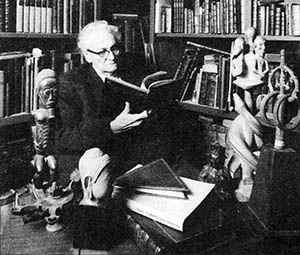
    Manly P. Hall (1901–1990), founder of the Philosophical Research Society, reading in his study.

    We often ascribe powers to animals that exist within ourselves, but that we don’t feel capable of summoning. We mythologise them. In that vein, I want to share the story of two episodes I experienced recently in Egypt in connection with mythical or allegorical animals.

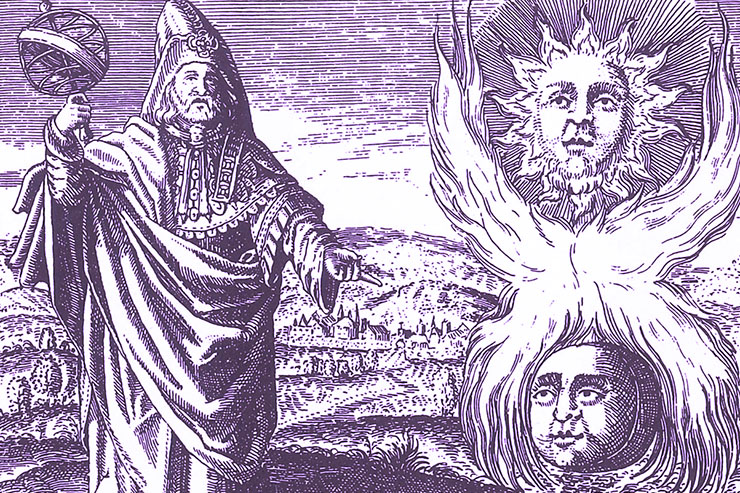
    In February 2019, I was travelling in Egypt with my friend Ronni Thomas. Ronni is a brilliant film director and we are making a documentary about the 1908 occult book The Kybalion. I once regarded The Kybalion as a kind of early-twentieth century novelty of occult literature. Several years ago, however, I came to realise that I was wrong. I was underestimating the nature and the greatness of that short book. It’s a beautiful and very relevant distillation of the spiritual psychology found in the Hermetic writings that appeared during the final stages of Egyptian antiquity.

    For the film, we decided to go back to the source, as much as we were capable. Ronni made the courageous decision that we should do some filming in Egypt. Off we went to Egypt in the month of February. I can disclose this now that I’m safely back home, but we had no license to actually film because it’s enormously expensive. We had a decent budget, but it was out of reach. So we had to surreptitiously film in Egypt, which is no small risk because if you’re caught without the proper licenses, you will be arrested and thrown in jail, which is probably not a great experience. We were very aware of this, but felt that even though we lacked the proper licensure, and we simply couldn’t afford it within the confines of our budget, we just had to do this.

    We were able to get some extraordinary footage. There are sneak peaks of the documentary on YouTube and Vimeo. We expect the final film to be released in 2020. You’ll be surprised at how much footage we were able to gather illegally, but very lovingly, in Mother Egypt. We were also granted some remarkable access and opportunities. I had two opportunities that I want to share, both involving exposure to allegorical beasts.

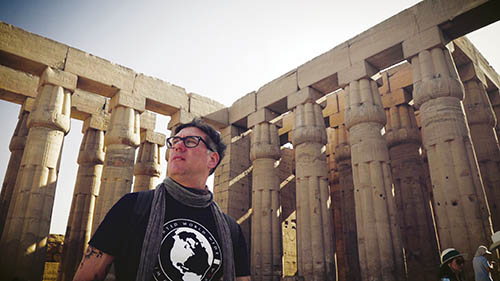
    Mitch Horowitz at the Temple of Karnak, Egypt, February 2019.

    Subterranean chambers exist in the Valley of Kings that are off the path of most people who visit Egypt. These chambers are accessible if you’re basically willing to pay the right people. My wish is that it wouldn’t be commerce alone that allowed people to gain entry to these places, but sometimes you have to deal with the world as it is. We were willing, as much as we were able, to pay off the right people to enter some places that are normally off limits. 

    After paying, we were able to enter a chamber very, very deep in the Valley of Kings. Within this chamber is a large bas-relief of a bull. A bull in Ancient Egyptian symbolism represents strength, virility, and personal power. It’s an enormously potent image within the pantheon of Egyptian deities and allegories. The guide who took me into this chamber gestured to me that it was permissible to touch and lay hands on this enormous bas-relief. The carvings in the chamber were incredibly well preserved. One of the astounding things that we don’t always realise when we look at Egyptian monuments is that they were originally colourised. They were not only three dimensional, they were not only covered in beautiful precious stones and finishing material, but they were majestically and very vividly colourised. Over time, the most widely seen or weathered monuments have lost this colour.

    This was within a very dry, temperate, cool underground chamber, and these images and bas-reliefs had been preserved going back thousands of years. I was a little uncomfortable when the guide invited me to lay hands on the bull because I have tremendous respect for antiquities, and I would never want to do anything to detract from the power and the beauty of these monuments. I’m very aware that if tourists and travellers are traipsing through the place all day and laying hands on the object, it gets damaged or degraded. And yet I felt that I was being given an invitation.

    The philosopher Jacob Needleman once said to me, “What do you do when someone offers you a gift?” Brilliant student that I was, I just stared at him blankly. He said, “You accept it!” So I made the decision to accept this gift. I can only report in all candour what happened. As I laid hands on this bull, I experienced, call it what you will, a tremendous rush of lightning and electricity shooting through my body, and I felt this sense of inner light within me. The only phrasing I can use to describe it is just feeling this flash of lightning pass through me. It was an extraordinary and tactile experience.

    Of course, one could say, “Look, you’re a suggestible guy, you’re an excitable person.” I don’t know, nor would the person saying that know, just what occurred. But I can only report that it was, for me, a palpable experience. Here I stood before this magnificent allegorical beast carved in a bas-relief going back more than 3,000 years, still fully colourised and vivid, and the symbol of virility and strength and power, and I was invited to lay my hands on it. I felt lightning absolutely pass through me. It was one of the most remarkable experiences of my life.

    We had another experience when we were at the Temple of Karnak in Luxor. Our guide was aware that Ronni and I had occult interests. There’s a colloquialism in Egypt for people like us – they call us “meditators.” Terms like occult and New Age don’t translate very well. Once they say, “Oh, you’re meditators,” then they know what you want to see. Our guide for this leg of the trip was an extraordinary woman who was multilingual even though she had never travelled outside the country. She learned English, French, and Korean on her own through BBC language courses. She brought us to a small temple to the cat goddess Sekhmet, which is tucked away on a side path in this vast complex. This small temple is closed and padlocked. A soldier toting an automatic rifle and a robed guide guard it. The only way to gain entry is by paying a bribe. Again, you sometimes have to deal with the world as you find it. And, of course, people are entitled to earn a living. 

    The soldier and guide looked at us like, “Who are these two mangy characters?” We very nicely said hello and greeted them with as much money as possible, and then everybody was all smiles. We were invited to enter this chamber to Sekhmet, a goddess with the head of a cat and the body of a woman. I can’t begin to tell you how completely dark it was inside this chamber. The chamber is thousands of years old and there wasn’t so much as a streak of light, with no cracks or fissures in the wall. 

    We were guided to kneel at the feet of Sekhmet and invited to kiss her feet and lay our hands upon her body and recite a prayer. We performed this short ceremony in pitch blackness. This, too, was an experience of absolute transcendence. There seemed to be a complete dissolution between us as separate beings and the goddess before whom we kneeled. I think we both experienced a sense of dissolving, almost like a lightness of body that felt something like what an out-of-body experience might be like. We felt a complete disassociation crouched in the darkness before this goddess. We felt, you could say, almost a sense of transcendent oneness with that before us, and everything briefly entered a state of non-physicality. It was remarkable.

    Statue of Sekhmet in small chapel of the Temple of Ptah in the precinct of Amun-Re at Karnak Temple. The statue, which is about two meters high, receives light only from a small hole in the ceiling.

    I’m not someone who goes around collecting experiences, but this left us two travellers, two seekers going places off the permissible path, with perhaps some feeling for what our primeval ancestors might have felt in the presence of these extraordinary beings. The episode reaffirmed my belief, which I’ve explored elsewhere, that we have neglected some of the wisdom of our primeval ancestors who identified with and personified certain energies in deific form, and who gave these energies names, whether Set or Sekhmet or Bastet or Minerva or Zeus or Jupiter or Athena.

    They identified these energies, maybe as projections of their own intellect or maybe non-localized intellect, and deified them. They also petitioned them. When people come to me in need, when they’re feeling at a dead end in life or things aren’t going the way they wish, my suggestion, as an ethical and spiritual experiment, is to identify a god or goddess from the ancient pantheon, whether from Egypt, Persia, the Hellenic world or elsewhere, one with whom you resonate, one that is meaningful to you, one whose characteristics or traits seem to capture something that you need in life, and having done so I see no reason why you cannot enter a prayerful state and make a petition to this deity and see what occurs. You may find exactly the help that you need. My contention is that the old gods may be lonely. They hunger for human attention and veneration. 

    People from all over the world used to travel great distances to honour and petition these gods. That is no longer so. It could be that these personified energies or intelligences hunger for human contact; and if you make the personal decision to attempt a relationship with one of these deities and to make a petition, you could be surprised. 

    I speak to you from deepest personal experience. I would never offer something as a suggestion that I haven’t tried and experimented with myself. I’ve had some of the deepest, most meaningful spiritual experiences of my life by following the path that I just described. You certainly don’t need to tell anybody what you’re doing; you don’t need to tell your shrink or your boyfriend or your spouse. It’s yours. It’s your private experiment. It’s something I’ve found bountifully fruitful and significant. We displace onto certain ideals of allegorical beasts and deities and beings, traits that perhaps exist within us and that we are capable of selecting or having a relationship with.

    Reclaiming the Damned

    I have written elsewhere of how the snake or the serpent represented wisdom in cultures all over the world. This was true in Egyptian culture, this was true in Hebraic culture, this was true in Mayan culture, this was true in Celtic culture. Every culture around the world, spanning enormous stretches of time, distance, language, and custom, identified the snake as a symbol of illumination, possibility, provocation, and awareness. 

    I think that we, in the Western world, have made a tremendous misreading of Genesis 3, where we have associated the snake who conversed with Eve as a figure of evil or maleficence. Rather it was the snake who gave Eve permission to eat from the so-called Tree of Knowledge of Good and Evil, which the creator had placed in the midst of the garden, so the parable goes, even though the garden dwellers, who were supposedly beloved and cared for, were prohibited from eating from it and gaining awareness, and were told they would die if they did so. The snake told Eve, “You’ve been deceived. You will surely not die if you eat the fruit from this tree.” She took the challenge and did not die from eating the fruit, which she shared with Adam. Their eyes were opened, and they gained the capacity for measurement and creativity; they gained the capacity to argue with the creator, and they were expunged from the garden of paradise. Their offspring, Cain and Abel, so the story goes, got caught up in this tragic act of fratricide. But it’s very possible that the price of creativity, the price of awareness, the price of perspective, is friction. 

    Haven’t we seen this play out across our culture? In Europe, for centuries, they committed witch burnings, which are still occurring in parts of the world today. People who are clearly capable of functioning in the world are called lunatics or flying-saucer nuts when they have extraordinary experiences. Plato famously theorised that if we were all captured in a cave, chained and capable of witnessing reality only as shadows cast on a wall and someone was somehow able to leave the cave and came back and tell the other captives about the splendour that existed in the outside world, what would they do? They would kill the individual. 

    Isn’t that the story of the snake in the garden, essentially playing out over and over again? Every time a capable, mature, intelligent person speaks of an extraordinary experience, he or she is told, “Don’t talk about seeing a UFO. You’re going to lose your rank and your reputation within the Air Force. Don’t try to experiment with ESP, everybody’s going to think you’re a nut and you’re going to lose your departmental funding. Don’t question the standard dating of the Great Sphinx or of the pyramids because if you start questioning the standard timeline people in your department are going to get hostile toward you, and you’ll be branded a nut.”

    What do we do? We disassociate from these abilities and experiences and code them into parable, story, myth, and archetype, because it’s a way of distancing ourselves from abilities and possibilities that exist within the human experience, but that are easier for us to understand and talk about, that are less risky for us, if we classify them as mythology, as anomalies, as wonders, as little green men, as strange encounters. People who testify to these things in an actual way are treated, in effect, like Adam and Eve, expelled from the garden of paradise, or seen differently, expelled from the garden of conformity. Yet this state of affairs is getting shaken up at this very moment.

    As I mentioned earlier, I do not speak casually about paradigm shifts. Every generation seems to think it exists on some kind of a precipice. Some generations did indeed exist on a precipice. The World War I generation existed on a precipice. I don’t think one should speak about this casually. But I do believe we are facing possibilities and questions in our generation, at this very moment, that may upend our idea of what it means to be human as much as the theories of Darwin upended people’s views and understanding of human nature in the Victorian age.

    I think we’re poised on this precipice, where we look out at the world, we look out at testimony of wondrous beasts, strange beings, and anomalous events, and we’re coming to realise that we’re not necessarily looking at things that are fantasies or chimeras. We are actually looking into a mirror. And what we’re looking at is gazing back at us. These are the traits of our own personas that we’re becoming reacquainted with. Our personas are inter-dimensional, unmoored by linearity, and symbiotic with a larger cosmic reality than we have previously understood. 

    Mitch is lecturer-in-residence at the Philosophical Research Society in Los Angeles, where he originally delivered the lecture on which this article is based. 

    [alert type=”general” dismiss=”no”]This article was published in New Dawn 179.[/alert]

    [alert type=”success” dismiss=”no”]If you appreciate this article, please consider subscribing to help maintain this website.[/alert]

    © New Dawn Magazine and the respective author.
    For our reproduction notice, click here.
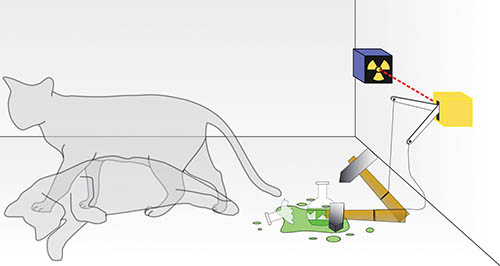
  • Hermes Resurrected: Does Hermetic Literature Hold Any Meaning for Today’s Seekers?

    Hermes Resurrected: Does Hermetic Literature Hold Any Meaning for Today’s Seekers?

    This article was published in New Dawn 165 (Nov-Dec 2017)

    I sometimes suspect that we deploy the word ‘Hermetic’ – a term for late ancient Greek-Egyptian mystical texts attributed to the mythical man-god Hermes Trismegistus, or thrice-greatest Hermes – as a kind of marker, intended to connote a venerable ancestor to modern mysticism, and thus giving our current spiritual pursuits the weight of historical gravitas.

    The truth is, Hermeticism is a living philosophy, which ought to be read, debated, and engaged. The Hermetic texts, mostly those found in the Corpus Hermeticum and the dialogue called Asclepius, can serve the needs of a twenty-first century person in search of metaphysical ideas and clarity. 

    Hermeticism is of immediate value much like the more arcane books of the Old Testament. Although certain Hebrew rites, rituals, and genealogical record keeping may seem period-bound, or of little more than liturgical significance to any but the religiously orthodox, such passages provide a framework for luminous ethical and spiritual insights. Similarly, elements of the late-Egyptian Hermetic books also reflect traditions of formalism, ritual, and recital – and these elements likewise frame passages of penetrating relevance to current seekers. This fact has not always been apparent due to the longstanding paucity of quality translations, a deficit that is thankfully being redressed in our time.1

    The central and most enduring theme of the Hermetic literature – and one that left its mark on the ancient and Renaissance worlds, and, indirectly, on our contemporary culture of New Thought and mind metaphysics – is that the human mind is an extension and imitation of Nous, the Higher Mind, which serves as the divine creative force behind all that is. 

    This perspective finds particular resonance in books I and XI of the seventeen tracts that make up the Corpus Hermeticum. In book I, sometimes called the Divine Pymander of Hermes Trismegistus, we learn of the mind’s causative abilities: “…your mind is god the father; they are not divided from one another for their union is life.”2 As we come to realise our creative capacities, we grow closer in nature and perspective to the Eternal: “…he who has understood himself advances toward god.”

    Book XI goes further in urging man’s awareness of how his mind, through its abilities to visualise all things, originate new concepts, and surpass physical boundaries, reflects innate divinity: 

    See what power you have, what quickness! If you can do these things, can god not do them? So you must think of god in this way, as having everything – the cosmos, himself, (the) universe – like thoughts within himself. Thus, unless you make yourself equal to god, you cannot understand god; like is understood by like. Make yourself grow to immeasurable immensity, outleap all body, outstrip all time, become eternity and you will understand god. Having conceived that nothing is impossible to you, consider yourself immortal and able to understand everything, all art, all learning, the temper of every living thing. 

    In the student-teacher dialogue called Asclepius, which is often grouped as an adjunct to the Corpus Hermeticum, man’s estimate is even further elevated. We first learn that, “one who has joined himself to the gods in divine reverence, using the mind that joins him to the gods, almost attains divinity.” Using a variant of the famous Hermetic formula, “as above, so below” (enunciated in another text called the Emerald Tablet), this dialogue counsels: “Forms of all things follow kinds… Thus, the kind made up of gods will produce from itself the forms of gods.” This adds a deeper resonance to man being made in God’s image, as found in Hebrew scripture. 

    Hermes goes on to teach his disciple Asclepius that man, at his highest, is actually on par with the gods: “Because of this, Asclepius, a human being is a great wonder, a living thing to be worshipped and honored: for he changes his nature into a god’s…” Hermes ultimately evaluates man as even greater than the gods because, while a god’s nature is fixed in immortality, the striving and aware man is ever in the process of becoming and fulfilling his highest nature: “In short, god made mankind good and capable of immortality through his two natures, divine and mortal, and so god willed the arrangement whereby mankind was ordained to be better than the gods, who were formed only from the immortal nature…” 

    Moreover, man in his reverence and worship performs necessary acts of caretaking of the gods: “He not only advances toward god; he also makes the gods strong.”

    In considering man’s potential, the modern reader of Hermetic literature may find himself facing a question that also faces contemporary students of New Thought: Given the causative powers ascribed to our minds, and the manner in which thought relates to the highest source of creation, why do we suffer physical decline, illness, and bodily death? Indeed, the most Hermetic of all New Thought teachers, Neville Goddard (1905–1972), instructed that your mind is God, and all that you experience is the product of your imagination – so, again, why must we “die as princes?” as the psalmist puts it?

    The Corpus Hermeticum offers a reconciling response. Man, for all his potential greatness, is nonetheless conscripted to dwell within a “cosmic framework,” where physical laws must be suffered and limitations experienced. “The master of eternity,” Hermes tells Asclepius, “is the first god, the world” – or great nature – “is second, mankind is the third.” Man may be the greatest of beings in God’s schema of creation, but he nonetheless remains bound to other aspects of the creative order. 

    In book I we learn, “mankind is affected by mortality because he is subject to fate” – fate being a term for nature’s governance – “thus, although man is above the cosmic framework, he became a slave within it.”

    These views of man’s greatness and weakness, the forces in which he functions, and his higher possibilities are considered with surprising adroitness in the 1908 occult classic, The Kybalion (see article “Nothing Is Impossible” on page 51). Published under the tantalizingly Hermetic pseudonym “Three Initiates,” the slender but powerful book is a reasonable iteration of certain Hermetic concepts, as well its author’s personal insights into New Thought psychology. 

    In essence, The Kybalion adds specific techniques to the overarching Hermetic principle that the mind of the individual is an adjunct to the Mind of God, through which man may not only create but also aspire to his eventual return to the source from which he was created. 

    For those seeking a guiding, cosmic philosophy, as well as the reconciliation of certain vexing ideas within New Thought and other modern mystical schools, I recommend reading the Hermetic literature hand in hand with Neville, The Kybalion, and other mature New Thought works. 

    You will also discover within the Hermetic texts, particularly Asclepius, a poignant and, incidentally, accurate prophecy of Ancient Egypt’s decline, and the demise of its lexicon of gods. With today’s renewed interested in Hermeticism, and the arrival of a new generation of supple translations, we may be entering a phase of Hermetic rebirth. This renewal, however, comes with a caveat, one deeply grounded in Hermetic tradition: If Hermes is to be resurrected, such an operation must occur within you.

    [alert type=”general” dismiss=”no”]This article was published in New Dawn 164.[/alert]

    [alert type=”success” dismiss=”no”]If you appreciate this article, please consider subscribing to help maintain this website.[/alert]

    Footnotes

    1. Of particular note are Hermetica translated by Brian P. Copenhaver (Cambridge University Press, 1992), and The Way of Hermes translated by Clement Salaman, Dorine van Oyen, and Jean Pierre-Mahé (Inner Traditions, 1999, 2000).
    2. In this essay, I use Copenhaver’s translation.

    © New Dawn Magazine and the respective author.
    For our reproduction notice, click here.
  • “Nothing is Impossible”: Rediscovering The Kybalion

    “Nothing is Impossible”: Rediscovering The Kybalion

    From New Dawn 165 (Nov-Dec 2017)

    And with the wish the energy was born…
    – Corpus Hermeticum, book I

    I once regarded The Kybalion as little more than a novelty of early twentieth-century occultism. I considered the book a faux-antique work of mind-power philosophy, dressed up in pseudo-Hermetic language and offering a handful of serviceable but not greatly significant ideas of practical spirituality.

    I was wrong.

    This enduring work, which appeared on the American occult scene in 1908 under the mysterious byline “Three Initiates,” has earned its posterity. The book serves as something close to what it claims to be: a “Great Reconciler” of metaphysical, transcendental, and New Thought philosophies.

    Although some of The Kybalion’s reference points and formulations are plainly modern, the book can justly be defended as an authentic retention of certain ancient Hermetic ideas. Its author – about whom I’ll say more in a moment – drew upon elements of the Hermetica, a late-ancient collection of Greek and occasional Latin writings attributed to the mythical man-god Hermes Trismegistus, or “thrice-greatest Hermes.” This was a Greek appellation for Ancient Egypt’s god of writing and intellect, Thoth, whom the Greeks venerated above their own Hermes or Mercury. Using Greek literary form, the various and unnamed authors of the Hermetic tracts, not always agreeing among themselves, codified fragments of immeasurably old oral precepts from Ancient Egypt.1

    I should have listened more closely when, almost twenty years ago, a respected religious philosopher, who himself had translated some of the core Hermetic writings, told me of The Kybalion, with his voice low and a gleam in his eye: “There are some good ideas in that little book.”

    Indeed there are – and it took me a long time to rediscover them. It is not always easy to say exactly what brings us back to a book or an idea. I had always orbited around The Kybalion, albeit tentatively; I admired or grew friendly with some of its acolytes and with cultural figures influenced by it; and, finally, in 2017, I returned to the book in full. It was as though a light went on. Maybe my journey is an example of the book’s dictum: “When the ears of the student are ready to hear, then cometh the lips to fill them with wisdom.”

    Before saying more about the value of The Kybalion, let me address the question of its authorship. The identity of the “Three Initiates” has long been a source of speculation and drama; this can serve as a distraction from the book’s greater significance. The Kybalion was written by New Thought philosopher William Walker Atkinson (1862–1932), a remarkably energetic Chicago publisher, writer, lawyer, and spiritual seeker, who deserves to be remembered for this, his greatest work. Atkinson was one of the most incisive New Thought voices of the twentieth century.

    Among the many pieces of evidence, both literary and documentary, that demonstrate Atkinson’s authorship, he acknowledged himself as the sole writer in a 1912 entry in Who’s Who In America. Historical scholars, including Philip Deslippe and Richard Smoley (I also take up the matter in my Occult America), have amply demonstrated that there is no reason to argue with him. This prolific and thoughtful man was the Three Initiates. It should also be noted that in the traditional literature, Hermes Trismegistus addresses himself to three disciples: Tat, Ammon, and Asclepius, which may have been a source of inspiration for Atkinson’s byline.

    Atkinson was also the book’s original publisher at his Chicago-based Yogi Publication Society. The press published its owner’s many influential and not infrequently pseudonymous works, including books under the names of Yogi Ramacharaka and Theron Q. Dumont, as well as Atkinson’s self-bylined works. For generations, the writer-publisher’s diminutive blue hardcovers were a well-loved mainstay of New Age bookstores and served to influence a wide range of occult and metaphysical seekers.

    More important than The Kybalion’s byline is how the book highlights ideas about mind, matter, and thought-creativity, some of which demonstrate authentic resonance with Hermetic antiquity. This is no small matter. The Kybalion is not merely, or at least not only, modern New Thought clothed in ancient garb; rather, the book connects us, however tenuously, to ideas that once motivated seekers from a vastly removed era.

    Deslippe and Smoley have admirably tracked some of Atkinson’s sources; to their work I would add only that Atkinson was a capable surveyor of Victorian-era and Theosophically based translations of Hermetic literature, which is how the corpus was available to early twentieth-century readers. In particular, he would have encountered the translations of G.R.S. Mead (1863–1933), a scholar of ancient mysticism and one-time secretary to Madame H.P. Blavatsky (1831–1891), a figure whom Atkinson revered. The influence of Blavatsky’s 1888 occult opus The Secret Doctrine is evident at several points in Atkinson’s writings. Mead’s 1906 translation of the Hermetica, published two years before Atkinson’s effort, while turgidly worded in late-Victorian prose, and sometimes almost purposely written as if to assume an antique affect, was then one of the few sources of Hermetic ideas in English. With a skilled and discerning eye, Atkinson identified and distilled insights that corresponded to the sturdiest aspects of New Thought, or what William James had contemporaneously called “the religion of healthy-mindedness,” a field in which Atkinson was deeply steeped. The seeker-writer used his considerable curatorial abilities to produce a marriage of ancient and modern psychological insights.

    Atkinson focused primarily on the veritable Hermetic principle that Mind is the Great Creator. According to Hermetic literature, a supreme Mind, or Nous, uses as its vehicle a threefold process consisting of, 1) subordinate mind (demiurgosnous); 2) word (logos); and 3) spirit (anthropos), concepts that echo, albeit distantly, in Atkinson’s work. The Kybalion is structured around “Seven Hermetic Principles,” which follow from the Hermetic concept of “seven rulers” of nature. Man, we are told in book I of the Corpus Hermeticum, the body of work translated during the Renaissance, “had in himself all the energy of the rulers, who marvelled at him, and each gave him a share of his own nature.”2

    Atkinson is particularly supple in adapting the Hermetic conception of gender, in which the masculine (conscious mind, in Atkinson’s terms, and original man in the Hermetica) impregnates the feminine (subconscious mind to Atkinson, and nature in the Hermetica), to create the physical world.

    Further still – and this is vital to the book’s power and usefulness – The Kybalion ably ventures a theory of mind causality. The book explains why, from a metaphysical perspective, our minds seem to possess formative, creative abilities, and yet, even as we evince powers of causation, we are also subject to limits of physicality, mortality, and daily mechanics.

    As beautifully articulated in Atkinson’s chapter “‘The All’ in All,” the individual may wield traits of a higher manifesting Force – but that does not make the individual synonymous with that Force. Man, the book counsels, may accomplish a great deal within given parameters, including transcendence of commonly presumed limitations, influence over the minds of others, and co-creation of certain circumstances; but the book reminds the idealistic reader that we bump against physical parameters even as we are granted the capacity, within a given framework, to imitate the Power that set those parameters. In this, The Kybalion honours the views of the ancients.

    Atkinson offers compelling philosophical definitions of concepts of rhythm, polarity, paradox, compensation, and “Mental Gender.” In a sense, the philosophy found in The Kybalion is an application of Hermeticism, Neo-Platonism, Transcendentalism, and New Thought. The book also attempts, however fitfully, to correspond its ideas to the early-twentieth century’s nascent insights into quantum mechanics and the “new physics,” which gained currency in the decades immediately following its publication. In this sense, the author exaggerates only slightly when he writes: “We do not come expounding a new philosophy, but rather furnishing the outlines of a great world-old teaching which will make clear the teachings of others – which will serve as a Great Reconciler of differing theories, and opposing doctrines.”

    Get the issue this article appears in

    The overall spirit of The Kybalion can be traced to book XI of the Corpus Hermeticum, in which Hermes is told by Supreme Mind that through the uses of imagination he can discover the workings of Higher Creation: “If you do not make yourself equal to God you cannot understand Him. Like is understood by like.”3 Hermes is told to use his mind to travel all places, to unite opposites, to know all things, to transcend time and distance: “Become eternity and thus you will understand God. Suppose nothing to be impossible for yourself.” Hermeticism teaches that we are granted a Divine birthright of boundless creativity and expansion within the imagination. This teaching is central to the Hermetic philosophy, and its modern re-sounding in The Kybalion.

    Brief in length yet epic in ideas, The Kybalion should be read repeatedly by anyone with an interest in New Thought or practical metaphysics. For the modern seeker, the book can, as its author promises, serve as a source of coherence among various, and sometimes conflicting, modern mystical philosophies.

    Does life grant us second chances? I believe that it does. One of mine arrived in rediscovering this meaningful book. As you enter its pages, I wish you the highest of discoveries and discernment.

    The above is slightly adapted from the Introduction to the Italian edition of The Kybalion.

    [alert type=”general” dismiss=”no”]This article was published in New Dawn 165.[/alert]

    [alert type=”success” dismiss=”no”]If you appreciate this article, please consider subscribing to help maintain this website.[/alert]

    Footnotes

    1. Some historical scholars dispute this notion and posit the Hermetica strictly as an expression of late-Greek philosophy with an Egyptian overlay; today’s consensus view, however, tends toward the Hermetica as a syncretic work, intermingling Hellenic and Egyptian thought. See The Egyptian Hermes by Garth Fowden (Princeton University Press, 1986, 1993).
    2. Hermetica (Far West Undertakings, 1977).
    3. The Way of Hermes translated by Clement Salaman, Dorine van Oyen, and Jean Pierre-Mahé (Inner Traditions, 1999, 2000).

    © New Dawn Magazine and the respective author.
    For our reproduction notice, click here.