New Dawn – World's Most Unusual Magazine

Author: Lynn Picknett & Clive Prince

  • Giordano Bruno: Forgotten Genius & Hermetic Martyr

    Giordano Bruno: Forgotten Genius & Hermetic Martyr

    From New Dawn 130 (Jan-Feb 2012)

    In our last New Dawn article we listed the great pioneering discoveries of science that – unacknowledged by science historians – were directly inspired by the ancient Egyptian ideas as set out in the Hermetic texts which were ascribed to the demi-god Hermes Trismesgistus. These landmark breakthroughs were either drawn directly from the cosmology of the Hermetica – the most important being Copernicus’ heliocentric theory – or indirectly by applying their principles to different areas (as did Isaac Newton, to crack the code of gravity).

    But most of the discoveries on our list involved a figure who, although not an experimental scientist himself, should be remembered as being equally important as Copernicus and Newton, but who until recently was virtually erased from history. This towering genius and truly extraordinary man was Giordano Bruno (1548-1600), the foremost Hermetic philosopher of his age whose influence over the scientific revolution has been scandalously downplayed. There’s even more to him than his intellectual and philosophical genius: he also applied the Hermetic principles to social, political and religious questions. And he presented such a serious challenge to the supremacy of the Church that for a time he even threatened to undermine it. But it also, with a sickening inevitability, lead to a date with a flaming pyre in Rome…

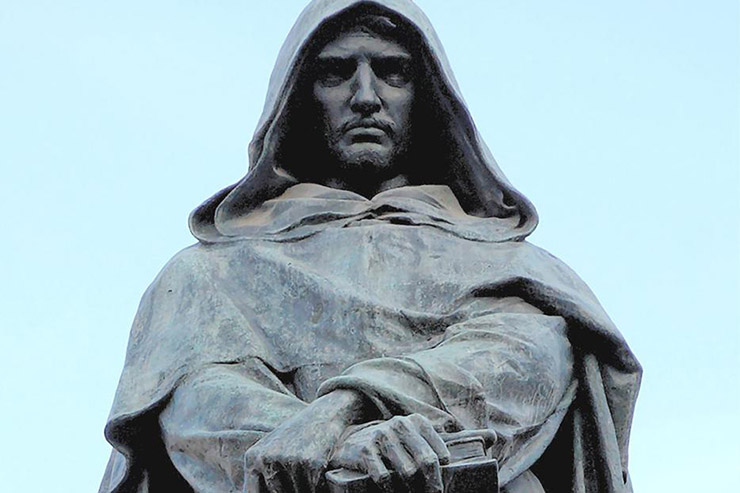
    In recent years Bruno has begun to be rediscovered and appreciated, although still the truth is often distorted in order to crowbar him into the accepted history of science. Because of his remarkably advanced ideas he tends to be regarded as a martyr for scientific rationalism, victim of even greater Church persecution than Galileo (on whom he was hugely influential). Bruno has become a hero for freethinkers and, particularly ironically, atheists, who gather annually at the site of his execution in Rome’s Campo de’ Fiori – marked by a statue erected in the late nineteenth century – to honour his memory and sacrifice. But this is missing the point in a big way. Far from being an arch materialist-rationalist, in fact everything Bruno did was inspired by his passionate belief in magic and the esoteric. 

    He is also being introduced to a wider audience through the historical thrillers of S.J. Parris (the pseudonym of British writer Stephanie Merritt), Heresy (2010) and Prophecy (2011). Although mainly concerned with Bruno as a kind of late Renaissance Hercule Poirot, she paints an authentic picture of Bruno as a dedicated and campaigning Hermeticist.

    Privy Secrets

    Ironically, Bruno began as a Dominican monk, a member of the same Order that gave rise to his nemesis, the Inquisition. He was born in 1548 in the small town of Nola – hence his nickname of ‘the Nolan’ – in the then huge Kingdom of Naples in Italy, which was under Spanish rule. Although he was christened Filippo, he took the name Giordano – from the River Jordan – on entering the Dominican monastery in Naples at the age of sixteen. In those days becoming a monk was the only way for a bright lad – and Bruno had already exhibited a prodigious intellect – from a humble background to get a good education.
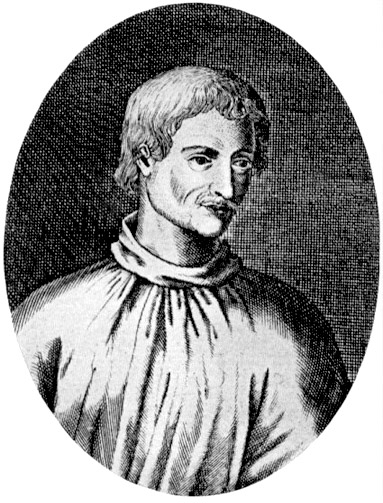
     The only known portrait of Bruno, published in 1715 in Germany, more than a century after his death.

    The young monk soon distinguished himself with his extraordinary mastery of memory-training – even being summoned to Rome to demonstrate the ability to the Pope. The classical art of memory, based on the manipulation of mental images, had a magical counterpart which employed talismanic principles to induce, rather than simply recall, information. Clearly this possessed a heady allure to someone so hungry for knowledge as Bruno. 

    As he grew in ability, exploring the powers of the mind through magic and psychology, Bruno became a powerfully confident man. Although never lacking in self-belief, he always respected those who deserved respect. On the other hand, he was disinclined to suffer fools gladly – indeed, at all. And he always, without fail, believed in his own mission… 

    A side of this self-belief that was hardly welcome in a monk was his refusal to allow others to dictate what he could read or even think. Not only were monks’ studies tightly circumscribed by their very nature, but at that time the Catholic Church was desperately trying to combat the rise of Protestantism, so departing even marginally from the conventional line attracted great suspicion. Even listening to the arguments of those deemed heretics, or reading their works, was a crime for a monk – even if you disagreed with them. 

    On the other hand, as the Dominicans were tasked with fighting heresy, they had easy access to banned books – much to the ever-curious Bruno’s delight. When his superiors discovered he had been secretly reading them in the monastery toilet he fled from Naples.

    For five years he wandered round the intellectual centres of northern Italy, southern France and Switzerland – Padua, Milan, Geneva and Toulouse among other places, with frequent gaps in his biography. By the time he reappears fully, in Paris in 1581, he had become a hardcore believer in the Renaissance occult philosophy with Hermeticism at its heart. Quite how he developed this interest is unknown, but it fundamentally underpinned everything he did for the rest of his life.

    Like everyone inspired by the Hermetic books since their rediscovery in Europe just over a century before (see our last article in New Dawn 129), Bruno was fired up with their vision of humans as glorious, miraculous beings of limitless potential – the polar opposite of what all Catholics were taught. To them, humans were little better than worms, only achieving a tiny bit of God’s grace through the intercession of the Church, and even that often depended on how much you were prepared to pay the priesthood to be let off a few years in purgatory. 

    The more he studied, the more Bruno considered everything – every level of life and understanding of our place within the cosmos – could be illuminated by the principles of Hermeticism.

    In Paris he gained the patronage of the French king, Henri III – a Catholic, but who still had a deep interest in the esoteric and was tolerant towards the French Protestants, the Huguenots. After two years Bruno moved to London, accompanying Henri’s new ambassador to Queen Elizabeth I’s court. Clearly he had Henri’s backing for whatever his mission might have been – probably establishing contact with English magi centred around John Dee. During his two-year stay in London he made friends with such luminaries as Sir Philip Sidney, and wrote some of his most important books. As we will see, Bruno left a rich intellectual legacy that influenced some of the great minds of the late-flowering English Renaissance. Many consider that the character of Berowne in Shakespeare’s Love’s Labours Lost was based on Bruno.

    It was while in London that Bruno produced his major works on cosmology that were to inspire enormous scientific advances.

    The Hermetic Key

    To Bruno the Hermetic philosophy and cosmology was the great key to unlocking the secrets of nature and the cosmos. Having already seen the Hermetica inspire Copernicus to develop his heliocentric theory, he applied himself to scientific questions using the Hermetic principles. And very fruitful it proved, too…

    A passage in Treatise X of the Corpus Hermeticum states that “the spirit, passing through the veins and arteries, moves the living thing.”1 Bruno realised the image suggests that the blood also moves, a concept that also reflected Hermetic ideas of man as a microcosm of the greater cosmos.2 Bruno’s interpretation was picked up by fellow Hermeticist Robert Fludd, who – writing in the late 1610s – inspired Charles I’s physician William Harvey with the idea of testing it. Harvey became the first person to demonstrate the circulation of the blood experimentally, “one of the greatest achievements of the Scientific Revolution.”3
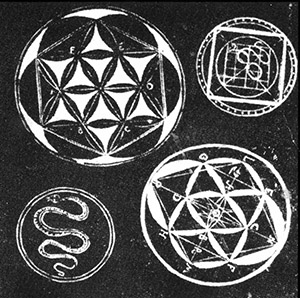
    Woodcut illustrations from Giordano Bruno, Prague 1588. Upper left cut contains a version of the “Flower of Life” pattern.

    Bruno’s Hermetic influence also extended to Elizabeth I’s physician William Gilbert’s 1600 masterwork, On the Magnet, Magnetic Bodies and the Great Magnet of the Earth, in which he proposed that magnets work because the Earth itself generates magnetic force – another landmark discovery. Without Bruno’s work, Gilbert would never have got there.4

    In our bullet-point list of Hermetic-inspired discoveries in our last article we included “the basic principles of computer science and information theory.” At first glance this may seem rather unlikely but this, too, can be traced back to Bruno’s application of Hermetic principles. This time the seed he planted flowered in Gottfried Wilhelm Leibniz (1646-1716), the German genius whose life and career paralleled those of Isaac Newton. A great polymath, Leibniz is chiefly known today for inventing infinitesimal calculus, at about the same time as Newton – although Leibniz’s system was the one that caught on – and for the basic principles of information theory, including the binary system.

    Yet even Leibniz was no hard-line materialist-rationalist. Like Newton, he was deeply versed in esotericism – almost certainly a Rosicrucian and certainly a scholar of the Cabala and, predictably, the Hermetica. Equally predictably, he owed an enormous debt to the works of Giordano Bruno.
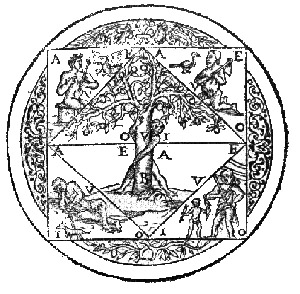
    Woodcut illustration of one of Giordano Bruno’s less complex mnemonic (memory) devices. He planted this drawing – which acts as a portal – in his mind to recall massive amounts of information from memory.

    Information theory was really just a by-product of a much more ambitious scheme. Leibniz believed it should be possible to devise a set of symbols – which he called characteristica universalis – to represent all the fundamentals of knowledge, and by manipulating them to make new discoveries (a process he described as ‘innocent magia’). He developed this idea from Bruno’s works, especially those on the magical art of memory and the manipulation of the imagination to produce desired results.

    Although Leibniz was never to achieve the full dream of the characteristica universalis, his work developed into the idea of mathematical modelling, at first using pen-and-paper equations (which is where calculus came in) and later computer modelling. His pioneering computer work also saw him designing some of the first calculating machines.

    But although Bruno can never be described as a scientist in his own right (he seems never to have undertaken a single experiment) basing his reasoning on the Hermetic principles led him to make some truly remarkable insights. (And given that he practised magical techniques to acquire information directly, we can be forgiven for wondering just how successful they were.)

    In London in 1584 Bruno wrote and published On the Infinite Universe and Worlds in which he put forward some extraordinarily advanced – and for the time deeply shocking – propositions.

    Shock and Awe

    Bruno was a leading champion of Copernicus’ heliocentric theory which, although published five years before he was born, was still regarded as new and unproven, scholarly opinion being split over whether he was right, wrong or somewhere in between. Copernicus had merely proposed that the sun was at the centre of creation; he still stuck with the traditional model that the entire cosmos consists solely of the sun, moon and planets which move within an outer ‘shell’, the sphere of the fixed stars. In other words, the stars are simply fixed points of light of varying intensity, all stuck on the same crystalline sphere and therefore equidistant from Earth. 

    But, as the title of his book implies, Bruno went further, arguing that the stars are really suns like our own, but immensely far away, and at varying distances. He rejected the concept of the sphere of the fixed stars entirely, proposing that the universe was in fact infinite. 

    Bruno also took the next logical step: if stars are really suns, then at least some must have their own system of planets. And some of those planets must be like our own.

    He wrote in On the Infinite Universe and Worlds:

    There is a single general space, a single vast immensity which we may freely call Void; in it are innumerable and infinite globes like this on which we live and grow. This space we declare to be infinite, since neither reason, convenience, possibility, sense-perception or nature assign to it a limit. In it are an infinity of worlds of the same kind as our own… Beyond the imaginary convex circumference of the universe is Time.5

    And making the final logical leap, Bruno concluded it was impossible to imagine that “these innumerable worlds, manifest as like to our own or even more magnificent, should be destitute of similar or even superior inhabitants.”6

    Of course, time and telescopes have proven Bruno right about the scale of the universe and the existence of other solar systems – and, even if it has yet to be proven, few scientists also doubt that extraterrestrial life is a reality.

    These were deeply shocking conclusions to the Church – and indeed they were high on the list of indictable offences for which Bruno was condemned to death 16 years later. Whereas Copernicus had shifted the physical centre to the sun, the focus of creation was still the Earth and human beings, which fitted the basic biblical model where God made the world as a unique place, and humans ‘in his own image’. Bruno was proposing that there was no centre, and that humans were no more or less important than other beings on other planets – and indeed, that some of the extraterrestrial races are superior to human beings. 

    This was to mark the beginning of the Vatican’s antipathy towards heliocentricity that was to climax in its persecution of Galileo.

    Where did Bruno get this radical notion? His immediate inspiration seems to have been the English mathematician Thomas Digges, a protégé and ward of John Dee, and England’s major champion of Copernican theory. Digges had argued that space is infinite in his defence of heliocentricity published in 1576, seven years before Bruno arrived in London. As they shared both interests and friends it is unlikely that Bruno and Digges never met during the former’s London years. But in any case Digges derived his idea from a section of the Hermetic treatise known as Asclepius.7

    Bruno may have reached the same conclusion independently from his own study of Asclepius, but he added the concept of other inhabited worlds, which came from his contemplation of another key Hermetic principle: that the cosmos is imbued with life.

    Bruno also showed remarkable insights into other areas of science. He understood that the body is perpetually being renewed, bit by bit, so it effectively becomes totally new over time. The current understanding is that our bodies are completely ‘replaced’, cell by cell, every seven to ten years.

    In other writings he put forward basic ideas about relativity, and some academic writers regard some of his notions about the structure of matter as effectively laying the foundations for later atomic theory.8

    So in the face of this astonishing catalogue of achievements and insights, it seems nothing short of an outright scandal that Giordano Bruno is so little known today. 
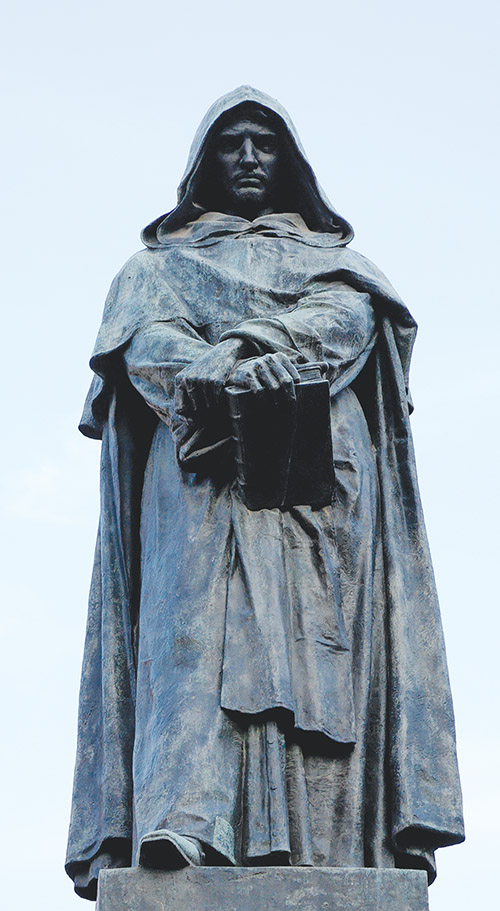
    Bronze statue of Giordano Bruno by Ettore Ferrari, Campo de’ Fiori, Rome.

    No Insignificant Ambition

    Bruno’s hugely influential ideas about the workings of the universe were only part of the picture. It was his view of the religious significance of the Hermetic tradition that inspired his most radical message – and led to his downfall.

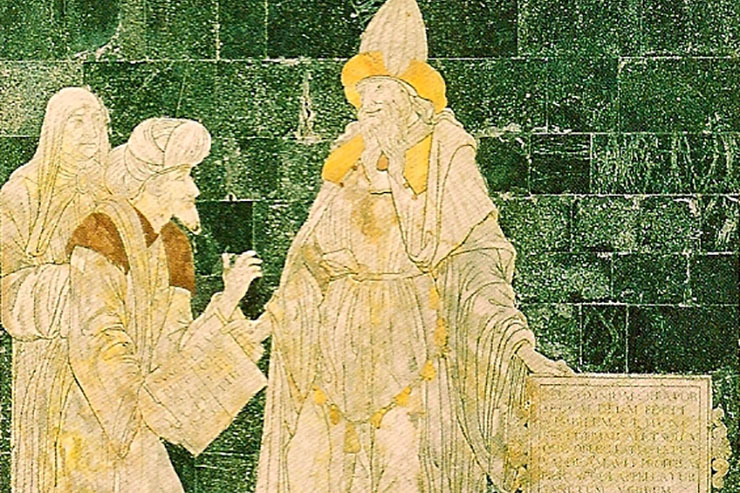
    Another of the major works Bruno produced in London was Expulsion of the Triumphant Beast (1584). Modelled on a key Hermetic text, Kore Kosmou (Virgin of the World), and dedicated to Sir Philip Sidney, the book describes a gathering of the Egyptian and Greek deities – the goddesses Isis and Sophia taking the lead – in order to organise a great reform in the heavens. On the principle invoked in the celebrated Hermetic adage ‘as above, so below/as below, so above’, this would cause equally great changes on Earth.

    Clearly it is the earthly transformation that interested Bruno most pressingly – and for which he called so passionately. How would that manifest? In Expulsion of the Triumphant Beast, Bruno reproduces in its entirety a key section from Asclepius – a celebrated passage known as the Lament – in which Hermes Trismegistus mourns the decline of the Egyptian religion, which has been eclipsed by foreign gods, Egypt’s own having abandoned the land. But it also predicts that they will return and the religion will be restored. 

    Bruno believed this prophecy referred to his own time, and saw the religious turmoil then engulfing Europe as a sign that at least in its present form Christianity had run its course. The return of the magical religion of Egypt was imminent. 

    Since the rediscovery of the Corpus Hermeticum in the 1460s it had been universally accepted – by Hermeticism’s enthusiasts and opponents alike – that the texts contained the wisdom of the high point of ancient Egyptian, then considered the oldest civilisation. (As we showed previously, in fact there is good evidence to support the Hermetica’s ancient Egyptian origins.) Many – Bruno among them – believed therefore that they preserved the original religious revelation to mankind.

    But characteristically Bruno went further. He believed that the magical religion of ancient Egypt had been corrupted, first by the Jews and then by the Christians. (Bruno thought that Jesus had been sent to restore the Jewish religion to its true, Egyptian roots. From our own research into the origins of Christianity, detailed in our 2008 book The Masks of Christ, we would broadly agree. Without the benefit of recent historical discoveries, how did Bruno know this?)

    Bruno wanted nothing less than a root-and-branch reform of the whole of society based on the Hermetic principles, or rather, as he saw it, the religion of ancient Egypt. His ultimate aim was the creation of a spiritually unified Europe in which the religious tension between and within nations – which if unchecked would inevitably lead to a Europe-wide cataclysmic war – would be swept away.

    Bruno manifestly saw the authoritarian and dogmatically inflexible Catholic Church, rather than the Protestants, as the big stumbling block to his great reform. Indeed, although he explained the ‘triumphant beast’ of his title as a metaphor for human vices, many (including the Inquisition) took it as a not-very-thinly-veiled allusion to the Pope. This was not a good turn of events.
    The Predictable Unhappy Ending

    The worry for the Inquisition was that Giordano Bruno was not just an easily-dismissed eccentric, but an energetic and charismatic campaigner with a sharp mind who, as we have seen, enjoyed considerable influence over the likes of Henri III of France, Elizabeth I and the Holy Roman Emperor Rudolph II. Put simply, he was an Inquisition magnet and his death by fire was only a matter of time.

    Towards the end of 1585 Bruno returned to France, but found it descending into civil war as staunchly Catholic nobles challenged Henri III (who was soon to be assassinated). He then left France and for the next five years travelled the university towns of Protestant Germany preaching an increasingly hard-line message of the danger posed by the Catholic Church.

    In 1591 he made a somewhat unwise return to Italian soil, accepting an invitation from a wealthy admirer to visit the Republic of Venice. There, in May 1592, he was denounced to the Inquisition, arrested and sent to Rome. After languishing in prison for eight years he was sent to the stake on 17 February 1600 – with his tongue tied so he couldn’t address the crowds.

    Regarded as a diabolically-inspired magician who sought the destruction of God’s own Holy Church, it isn’t surprising that Bruno’s memory faded in the Catholic lands. What is less forgivable is that his great intellectual legacy was also allowed to fall by the wayside by the science historians. They seek to downplay – if not completely erase – the influence of the Hermetic tradition on science’s origins, and, whereas with the likes of Newton it was possible to pretend that their ‘occult’ interests were of no great consequence, it was utterly impossible to ignore the role of Hermeticism in Bruno’s work. Far easier just to forget him.

    Bruno’s story was by no means over. During his last travels, fearing a Catholic onslaught that would bring Europe back under its domination, he had made plans for the underground continuation of his Hermetic reform movement. He formed a secret society, or more accurately a network of secret societies, based in the universities of Germany and in the Republic of Venice, which would outlive him. Known as the Giordanisti, after his death this clandestine group would have its own key part to play in the development of the Western esotericism…

    [alert type=”general” dismiss=”no”]This article was published in New Dawn 130.[/alert]

    [alert type=”success” dismiss=”no”]If you appreciate this article, please consider subscribing to help maintain this website.[/alert]

    Footnotes

    1. Brian P. Copenhaver, Hermetica: The Greek Corpus Hermeticum and the Latin Asclepius in a New English Translation (Cambridge University Press, 1992), 33.

    2. Walter Pagel, ‘Giordano Bruno: The Philosophy of Circles and the Circular Movement of the Blood’, Journal of the History of Medicine, vol. VI, 1951.

    3. Allen G. Debus, ‘Robert Fludd and the Circulation of the Blood’, Journal of the History of Medicine, vol. XVI, no. 4, 374.

    4. Hilary Gatti, Giordano Bruno and Renaissance Science (Cornell University Press, 1999), 80-5.

    5. Translated by Dorothea Waley Singer in Giordano Bruno: His Life and Thought (Henry Shuman, 1950), 363.

    6. Singer, 323.

    7. Robert S. Westman and J.E. McGuire, Hermeticism and the Scientific Revolution (William Andrews Clark Library, 1977),24.

    8. See Ksenija Atanasijevic’s introduction to her The Metaphysical and Geometrical Doctrine of Bruno (Warren H. Green, 1972).

    © New Dawn Magazine and the respective author.
    For our reproduction notice, click here.
  • From Ancient Egypt to Modern Science: The Forgotten Link

    From Ancient Egypt to Modern Science: The Forgotten Link

    From New Dawn 129 (Nov-Dec 2011)

    The ‘Scientific Revolution’ describes the sixteenth- and seventeenth-century watershed in the basic attitude to the scientific method, laying the foundations for the modern technological age. Starting when Copernicus went public with his heliocentric theory in 1543, and ending when Isaac Newton published Principia Mathematica in 1687, textbooks say there was a window of just 150 years when European thinking was transformed from superstition to science.

    But that’s not the way it was. In reality, science owes its origins to beliefs that the high priests of modern science such as Richard Dawkins would regard as even more irrational than Christianity. Far, far worse to them would be the fact that the particular ‘superstitions’ in question were unprecedentedly influential.

    In fact, the Scientific Revolution was driven by a very specific magical philosophy and cosmology, set out in a set of texts that inspired all the pioneers of science, directly or indirectly.

    The Books that Really Changed the World

    Bluntly, these texts have had a greater influence on Western civilisation than any other set of texts apart from the Bible – and the greatest effect on modern Western civilisation than any texts including the Bible. The scandal is that so few people today have even heard of them.

    They are a collection known as the Hermetica, setting out an uncompromisingly magical and mystical philosophy and cosmology. Their name comes from their attribution to the legendary Egyptian teacher, Hermes Trismegistus (‘Thrice-Great Hermes’). According to the Hermetica, he was a descendant of the god of that name – Hermes in Greek, identified with the Egyptian god of learning, Thoth, scribe to the gods.

    In medieval Europe, with the exception of the one treatise Asclepius, they had been lost, thanks to the fourth-century crackdown on pagan learning by Christian zealots. However, the books survived in the Middle East, becoming the foundation for the famously advanced medieval Arab science. All knowledge-hungry Europeans could do was hope – and pray? – that they might be rediscovered.

    Eventually they were. In 1463 an agent of the great patron of the early Renaissance, Cosimo de Medici, returned to Florence with a set of 14 Hermetic treatises, written in Greek, which he had acquired in Macedonia. Famously, Cosimo’s top scholar, Marsilio Ficino, was working on the first translation of the complete works of Plato into Latin – but Cosimo, beside himself with excitement at the new discovery, ordered him to drop it in favour of the Hermetic books.

    Through his translation – the Corpus Hermeticum – and allied esoteric writings, Ficino is a major figure in the restoration of Hermeticism, setting it at the heart of the Italian Renaissance. And thanks to the sensational new technology of the printing press, the Hermetic books fomented the greatest furore among European intelligentsia. It is impossible to overstate their impact, both then and much, much later. Hermeticism influenced everyone from Leonardo da Vinci to Shakespeare, and can be said without exaggeration to have kick-started the Renaissance. But the Hermetic books’ significance has always been downplayed by academics, particularly historians of science and philosophy.

    The Hermetic works were so enthralling largely because they were believed to preserve the wisdom of the most ancient period of the Egyptian civilisation, that of the pyramid builders, predating even the Old Testament. But the most important reason for their huge impact was the image of humankind they presented – diametrically opposite to Man-the-doomed-worm so beloved of the Vatican.

    According to the Corpus Hermeticum human beings are brilliant, amazing creatures of unlimited potential. Treatise X even declares that “the human is a godlike living thing,”1 reinforced by the Hermetic adage ‘Magnum miraculum est homo’ (‘Man is a great miracle’). This also applies to women: the Hermetic tradition had great respect for the feminine – a reason by itself for the Catholic Church’s horrified reaction to this audacious philosophy.

    Although to the Church it was bad enough to promote ideas of a divine-spirited Man, to include women as inherently god-like was considerably worse. Some clerics were still debating whether they had souls, and here come these vile pagans with outrageous beliefs that women were dazzling beings of ultimate light…

    Many authors have written at length about the Hermetica’s influence in generating the surge of self-confidence that inspired the great flowering of art and literature that is the Renaissance. We, however, take it further and link this Hermetic epiphany with the history of science.

    Copernicus’ ‘Visible God’

    The Scientific Revolution famously began with Nicolas Copernicus’ On the Revolution of the Celestial Spheres (1543), which set out the sensational theory that the Earth circles the Sun and not the other way round. But where did he get the idea?

    A rather large clue is there on the very page showing his celebrated diagram of the Earth and other planets orbiting the Sun. Just four lines below, he explicitly references the Hermetica in relation to the metaphysical implications of the diagram, quoting a passage where Hermes Trismegistus describes the Sun as the ‘visible god’.

    This is no coincidence. All Copernicus’ radical notions can be found in the Hermetica.

    Copernicus’ famous proposition is found several times in the Corpus Hermeticum, for example, in Treatise XVI: “For the Sun is situated at the centre of the cosmos, wearing it like a crown.”2 And “Around the Sun are the six spheres that depend from it: the sphere of the fixed stars, the six of the planets, and the one that surrounds the Earth.”3 ‘Spheres’ correspond to our ‘orbits’…

    Essentially, Copernicus was claiming to have found mathematical and physical proof for principles that are set out – without proof – in the Hermetic books. Contemporary Hermeticists certainly regarded him as a hero for vindicating their sacred texts.

    The Hermetic influence spread and spread. There isn’t a major character in the Scientific Revolution who wasn’t steeped in the tradition: Kepler, Tycho Brahe, William Gilbert, William Harvey, Leibniz. The list even includes the likes of Galileo and Francis Bacon, generally considered proto-reductionists.

    The list of the discoveries either taken directly from the Hermetica or discovered indirectly by applying its basic principles to particular problems is truly impressive. Apart from the world-changing theory of heliocentricity, they include:

    The circulation of the blood

    The Earth as a magnet

    The concepts of an infinite universe and that the stars are in fact distant suns

    The idea of other inhabited worlds, some with more advanced inhabitants

    The basic principles of computer science and information theory

    Most of these were actually developed by the great Hermetic genius Giordano Bruno, as we will explain in our next article.

    Perhaps the Hermetica’s greatest – but most deliberately downplayed – impact was on the work of Isaac Newton who first put forward the theory of gravity and the other laws of motion in his Principia Mathematica in 1687: the apotheosis of the Scientific Revolution and the real start of the modern world. However, although his admirers today tend to humour his obsession with alchemy – usually very condescendingly – the extent to which he was influenced by Hermeticism is still rarely mentioned.

    Briefly, by Newton’s day the new reductionist, mechanistic thinking developed by René Descartes in the mid-seventeenth century was all the rage in scientific circles. Undoubtedly Newton began his own academic career as a mechanist but in the mid-1670s he became heavily influenced by a group of philosophers at Cambridge University known as the Cambridge Platonists.

    In fact these ‘Platonists’ were the spiritual heirs of Ficino’s Academy in Florence, founded on Hermetic principles at the very beginning of the Renaissance, the initiators of a magical brotherhood that transmitted the Hermetic tradition from Florence to Cambridge, and to Newton… And they changed his thinking – but in the opposite way to what is usually claimed. American historian of science and Newton biographer Richard S. Westfall, wrote that, as a result of his contact with the Cambridge group “the Hermetic influence bade fair to dominate his picture of nature at the expense of the mechanical.”4 Instead of moving from magic to mechanics, he moved from mechanics to magic.

    A few, such as Westfall, now acknowledge that Newton’s breakthroughs came from applying the Hermetic principles – to understand the mystery of gravity, for example.

    Newton didn’t make his great discoveries despite his occult beliefs, but because of them.

    The same is true of all the great figures of the Scientific Revolution – really the Hermetic Revolution – a very different picture from steady march of rationalism painted by the likes of Dawkins. Science’s real origins were occult and therefore, according to the modern misunderstanding, irredeemably irrational. And deeply embarrassing.

    It was only after Newton that science as we know it emerged, through the gradual separation of Hermeticism from the scientific method. History was then rewritten to pretend the magic had never been there in the first place, or that it was only ever a derisory novelty.

    However, it was the magic that did the trick. It’s often stated that if Newton had never written the Principia the modern technological world would not exist – but the fact is if he had never read the Hermetica he would never have written the Principia. For that alone we owe the ancient texts a huge debt. But did these momentously influential books really come from ancient Egypt?

    Out of Egypt

    As we saw above, when they were rediscovered everybody believed the Hermetic books originated at the most venerable period of the Egyptian civilisation, the pyramid age. Depending on one’s viewpoint, they were either humanity’s purest wisdom or devil-inspired pagan occultism, but either way their immense antiquity was accepted.

    Then in 1614 the French scholar Isaac Casaubon compared the Hermetica’s language and style to other Greek texts, arguing that they were of relatively late composition. He also believed that the Hermetic writers had borrowed from Greek philosophy and sections of the New Testament, concluding they were a second- or third-century hoax, although – to him, laudably – one that was intended to bring Egyptian pagans to Christianity.

    Hermeticism’s enemies, particularly among French Catholics (then fiercely combating its academic influence) seized on Casaubon’s work as ammunition. Meanwhile, Hermeticists, naturally, were slower to acknowledge his reasoning. Although accepting his linguistic arguments, many – particularly the Cambridge Platonists – argued that, while the books may have been written during the Greek period, their ideas were much older.

    While most historians still agree that the Hermetica came from Egypt during the period of Graeco-Roman domination, they now only accept the part of Casaubon’s case based on the style, considering his conclusion that the Hermetic writers borrowed from the New Testament a particular howler. In fact, it is now known that the gnostic theology in question pre-dated Christianity (although Casaubon couldn’t have known that). The consensus now is that the texts were written a few centuries earlier than Causabon thought. But when were their ideas first developed?

    The Hermetic books are clearly an Egyptian and Greek mix. As western academia has always been biased in favour of classical Greece, regarding it as the fount of all things worthwhile in philosophy and science, the Greek parts have been traditionally considered more important than the Egyptian. However, during the twentieth century it became increasingly obvious that native Egyptian ideas played a larger part than previously thought. Today it’s not a question of if there’s an Egyptian influence, but of how much. One faction even argues that the books are mostly Egyptian, with ideas from Plato and other Greek thinkers being crowbarred in only to help explain the underlying concepts to that particular audience.5

    The evidence is considerable: the books fit the Egyptian model of wisdom literature more obviously than the Greek tradition; the authors remain anonymous and attribute their works to Hermes – typically Egyptian – whereas Greek writers sought personal celebrity; the texts use the Egyptian, rather than Greek, system of astrology.

    Perhaps most compelling, though, is the fact that the Hermetica are not only populated with Egyptian gods and goddesses – either ‘straight’ Egyptian deities such as Isis, Thoth and Horus or Greek gods that were specially venerated in Egypt such as Asclepius and Hermes himself – but also rely on Egyptian concepts of divinity. Although Greek Hermes is customarily identified with the Egyptian wisdom-god Thoth, scribe of the gods, the two did not share identical characteristics – and Hermes Trismegistus’ are those of Thoth, not Hermes.

    The honorific ‘Trismegistus’ also makes sense as a Greek rendering of a characteristically Egyptian custom. In Egypt a person or deity was venerated simply by repeating the glyph for ‘great’, either twice or, for exceptional greatness, three times. It would be natural for a Greek translator to render a text literally reading ‘great great great’ as ‘three times great’ – or ‘Trismegistus’.

    Indeed, the practice seems to have been reserved for Thoth himself (left). An inscription from Saqqara in 160 BCE calls him “the three times great” – repeating the Demotic character for ‘great’ three times.6 Not only is this the earliest known inscription using the ‘three times great’ form, but it comes from the period of Greek domination when the Hermetic books were being composed, making the link to Thrice-great Hermes even more compelling.

    The case for a native Egyptian influence on the Hermetica is now so persuasive that many specialists believe the books originated with a specific Egyptian wisdom-cult – which obviously honoured Thoth. Borrowing ideas from Greeks such as Plato would have helped make alien Egyptian concepts seem more familiar, and ensuring Egyptian traditions were inveigled into the Greek conquerors’ own literature would have effectively preserved them for posterity. But who created the Hermetica?

    From the City of the Sun

    A clue comes from another movement that emerged in Greek-dominated Egypt and which is closely entwined with Hermeticism – and may be regarded as Hermeticism’s esoteric twin.

    Academics may have called this school, off-puttingly, ‘Neoplatonism’ – because it borrowed some concepts from Plato’s more mystical writings – but the movement is entrancingly profound and very Egyptian: a magical system intended to reconnect directly with God during life – rather than after death – and empower the practitioner.

    It is known that the school was founded on the works of the Egyptian philosopher Plotinus (c.205-270 CE), pupil of the mysterious Egyptian sage Ammonius Saccas. And although originally it was thought to be entirely Greek-based, the presence of other influences, including native Egyptian, was acknowledged. And now some argue that the core ideas are wholly Egyptian and the Greek parts just a veneer.

    One of the main proponents of the latter is the German-born American professor of religious history Karl W. Luckert, who argues in Egyptian Light and Hebrew Fire (1991) that rather than Neoplatonic the philosophy should be called ‘neo-Egyptian’. He declares: “Plotinus has given us Egyptian religion [and] theology in the linguistic garb of Hellenic philosophy.”7 The most obvious example is Plotinus’ account of a two-part soul, corresponding exactly with the well-known Egyptian ka and ba, but failing to match any Greek beliefs.

    And now there’s a huge amount of evidence that Neoplatonism preserves spiritual traditions that go right back to the very foundations of the Egyptian civilisation. Luckert has found compelling parallels between the Neoplatonic writings and the beliefs expressed in the famous Pyramid Texts. The oldest known religious writings in the world, these are inscribed on the walls of pyramids constructed between 2500 and 2200 BCE, but are unquestionably just examples of writings that originated many centuries earlier. In fact, they encapsulate the beliefs of the religion whose cult centre was at Heliopolis, the City of the Sun, close to Giza – which inspired the building of the great pyramids.

    The similarities between Neoplatonism and Hermeticism have been obvious since Ficino’s day, and clearly they are simply alternative expressions of the same worldview. For example, Iamblichus of Syria (c.245-c.325 CE), labelled a Neoplatonist philosopher by contemporary historians, opens his masterwork On the Egyptian Mysteries with an appeal to Hermes “who presides over true knowledge of the gods,”8 showing the close connection with Hermeticism. Significantly, too, Iamblichus emphasises the custom of Egyptian writers of attributing their books to Hermes while remaining anonymous.

    Given the close association of Hermeticism and Neoplatonism they obviously share a common source. And if Neoplatonism derives from ancient Heliopolis – then so must the Hermetica. Indeed, a comparison of the latter’s core spiritual and cosmological ideas does reveal them to be very similar, if not identical, to the Pyramid Texts.

    To the Heliopolitans, the universe was not merely an emanation from the creator-god Atum but also as an emanation of Atum. This fits both the Hermetic concept of the cosmos as God’s thought and the part-divinity of humanity. It also parallels the Hermetic belief in an evolving, expanding and growing universe, becoming ever more complex and multidimensional as it develops from the spiritual to the material.

    And in the Heliopolitan system, as the cosmos evolves Atum generates eight other deities, representing new forces and levels of complexity, which make up the Great Ennead – nine gods – the most famous of which are Isis and Osiris, and of which Atum is the chief. But a second ‘octave’, repeating the pattern on the level of physical matter, is generated through Isis and Osiris’ child Horus, who has the same relationship with the material universe as Atum does to all creation, and is therefore god of the material world. Not only does this seem to be the origin of Gnostic (and Platonic) ideas of the Demiurge or lesser god of this world, but also, through Horus’ association with the Sun, of two important ideas that Copernicus picked up on. The first is the Sun as the ‘visible god’ (as opposed to the invisible one, Atum). The second is that, since Atum is the centre of the entire universe, the Sun must be at the centre of our solar system.

    Although Egypt’s most ancient religion, the Heliopolitan tradition survived throughout the civilisation’s three-millennia history. In early Egypt mystical and religious wisdom were not separate from practical, technical and scientific knowledge. Both were the preserves of priests, a practice that continued through to classical times, as witnessed by the association of the great libraries, such as that of Alexandria, with temples. Even by the time the Greek traveller Herodotus visited Heliopolis in the fifth century BCE it was still considered to be “where the most learned of the Egyptians are to be found.”9 The famed third-century BCE priest and sage Manetho (‘Beloved of Thoth’) was a priest of Heliopolis – who worked to preserve his land’s religious beliefs by making them more accessible to the new Greek rulers, the very same motive ascribed to the writers of the Hermetica. But there is another important clue to the origins of the Hermetica at the very beginning of the civilisation’s history, in the person of the earliest recorded priest of Heliopolis.

    This was Imhotep, priest of Heliopolis and the genius who conceived and oversaw the building of the first great pyramid, the Step Pyramid of Saqqara, in 2650 BCE. He was so endowed with genius and divine gifts that he was worshipped by later generations – making him the perfect role model for the Hermetic belief that humans can achieve godhood through their endeavours.

    Imhotep’s cult survived through the ages. The second-century-BCE inscription to ‘three times great Thoth’ discussed above was written by a priest named Hor (Horus) who belonged to the ‘chapel of Imhotep’ in the city of Heliopolis.

    Imhotep also lives on, thinly disguised, in the pages of the Hermetica. The major character of the treatises is Hermes’ pupil, Asclepius – a descendant of Asclepius, Greek god of healing. The Greeks identified Asclepius with Imhotep – and in the Hermetic work that bears his name, the identification with Imhotep is heavily reinforced.

    So the latest scholarship vindicates the belief of the Renaissance Hermeticists such as Ficino and Bruno that their revered texts contained the wisdom of Egypt’s pyramid age. But this also means that the Scientific Revolution – and therefore the whole basis of modern science – was also inspired by the authentic wisdom of the ancient Egyptians. Where they might have got it from is quite another question, sadly beyond the scope of this article…

    [alert type=”general” dismiss=”no”]This article was published in New Dawn 129.[/alert]

    [alert type=”success” dismiss=”no”]If you appreciate this article, please consider subscribing to help maintain this website.[/alert]

    Footnotes

    1. Brian P. Copenhaver, Hermetica: The Greek Corpus Hermeticum and the Latin Asclepius in a New English Translation, Cambridge University Press, 2003, 36.

    2. Ibid., 59.

    3. Ibid., 61.

    4. Richard S. Westfall, ‘Newton and the Hermetic Tradition’, in Allen G. Debus, Science, Medicine and Society in the Renaissance, Science History Publications, 1972, vol. II, 194-5.

    5. A major figure in this development was the French orientalist Jean-Pierre Mahé, in his Hermès en Haute-Egypt, published in two volumes in 1978 and 1982. Another important study is British professor of antiquity Garth Fowden’s The Egyptian Hermes (1986).

    6. See J.D. Ray, The Archive of Hor, Egypt Exploration Society, 1976.

    7. Karl W. Luckert, Egyptian Light and Hebrew Fire: Theological and Philosophical Roots of Christendom in Evolutionary Perspective, State University of New York Press, 1991, 257.

    8. Iamblichus (trans. Clarke, Dillon and Hershbell), De mysteriis, Brill, 2004, 5.

    9. Herodotus (trans. de Sélincourt and Burn), The Histories, Penguin, 1972, 130.

    © New Dawn Magazine and the respective author.
    For our reproduction notice, click here.
  • Search for the Mind of God

    Search for the Mind of God

    From New Dawn 127 (Jul-Aug 2011)

    Stephen Hawking famously ended his 1988 bestseller A Brief History of Time with the statement that, if and when physics finds its long-sought grand unified field theory “we would know the mind of God.”1 Although since then he has reportedly regretted the phrase, and famously announced in 2010 that “God did not create the universe,” his original statement was – knowingly or not – in fact simply a repetition of the underlying quest of the historical scientific revolution.

    All its great pioneers, from Copernicus to Newton, were motivated by the passionate belief that by discovering the way the universe works they were not only uncovering God’s design, but also taking humankind closer to the divine. Science was for them primarily a spiritual quest. And, given the evidence, that’s precisely what it should be now.

    Despite rather desperately cowering behind the wall of strident rationalism most of them are famous for, the startling truth is that cosmologists and quantum physicists themselves have revealed that the mind of God may be much nearer than we think. Science itself has effectively proven that ours is not a random universe. Science itself has demonstrated it was literally designed for life, which implies a designer… But as science itself – in general – is rather backward in coming forward about this, permit us to explain.

    The sensational conclusion that the universe appears to be meant began to be formulated with the famous ‘anthropic principle’ brought to the attention of the scientific community at the end of the 1970s by the seminal Nature paper by British cosmologists Bernard Carr and Martin Rees. The latter, now Lord Rees – Astronomer Royal and President of the Royal Society until 2010 – recently attracted the disdain of many colleagues by accepting the annual million-pound Templeton Foundation prize awarded for an “outstanding contribution to affirming life’s spiritual dimension.” Quite something for a mainstream scientist – and of course hugely controversial.

    The Designer Universe

    At its most basic, the anthropic principle states that all the cosmological data shows the laws of physics are, to an uncanny degree, exactly the ones needed for a bio-friendly universe. According to Paul Davies’ book The Goldilocks Enigma (2006) conditions are, like her porridge, “just right” for organic life. It needs precisely our kind of universe: relatively stable, with galaxies and stars – and this was by no means inevitable: if things were even slightly different matter could never have coalesced, or the universe would be riddled with black holes, preventing the formation of heavenly bodies. Life requires certain chemical elements, primarily carbon, which need stars to manufacture them and disperse them in their supernovae explosions. It also needs planets where the building blocks can be assembled for living beings to develop.

    All this requires not only fundamental particles and energies to possess particular values, but the relationships between them must be very precise. Carr and Rees noted that for almost every variation of the physical laws, a bio-friendly universe would be impossible. Yet as Hawking writes, “a series of startling coincidences” make the laws of physics “a system that is extremely fine-tuned” to produce conditions propitious for life.2 Freeman Dyson, the British-born American physicist, writes that there are “numerical accidents that seem to conspire to make the universe habitable,”3 while Paul Davies notes the “ingenious and seemingly contrived ways”4 the laws of physics allow the creation and dispersal of the elements necessary for life – and that we appear to live in a “designer universe.”

    More astoundingly, as all the values were ‘set’ by the big bang – if the conditions at the start of the universe had been say, bigger and bangier or smaller and less bangy (sorry for the technical terms), the physical laws would also be different – then life seems to have been an integral part of the design from the very beginning.

    One of the first examples of the fine-tuning to be recognised, back in the 1950s, is the formation of carbon – quintessential to organic life – which like all except the simplest three elements is forged in the centre of stars. However, scientists had long realised that according to conventional wisdom, carbon shouldn’t exist at all (or if it did it should be extremely rare). Even the vast temperatures and pressure in stars shouldn’t produce enough energy for stable atoms to form. But we now know there is a lucky fluke – a quantum effect known as resonance – which produces a ‘spike’ that enormously amplifies the energy to exactly the right value. This only happens for carbon.

    The scientist who worked out the process, the maverick British astronomer and mathematician Fred Hoyle, was so astonished by the coincidence that he famously described it as a “put-up job.” In a 1957 lecture he observed:

    If this was a purely scientific problem and not one that touched on the religious problem, I do not believe that any scientist who examined the evidence would fail to draw the inference that the laws of nuclear physics have been deliberately designed with regard to the consequences they produce inside the stars. If this is so, then my apparently random quirks have become part of a deep-laid scheme. If not then we are back again at a monstrous sequence of accidents.5

    The most recently-discovered example of fine tuning is perhaps the most compelling. This relates to ‘vacuum energy,’ a force arising from ‘virtual particles’ that fill even empty interstellar space, and which has a profound effect on the universe, since it determines its rate of expansion and this in turn determines how life-friendly it is. If the universe was expanding too quickly, then gravity would be unable to build galaxies, planets and stars; if too slowly, then all matter would be pulled back to the ‘big crunch’ before life had time to evolve. Obviously, our universe is expanding within that critically narrow range that allows it to be bio-friendly. But only recently has it been discovered how narrow – indeed, wafer-thin – that range is.

    It all hangs on the rate of expansion, determined by the balance between the negative and positive energy of the virtual particles. In the mid-1990s, based on new improved data from the Hubble Space Telescope and other sources, cosmologists were finally able to calculate the balance. It turns out that the negative energy cancels out all but an infinitesimal amount of the positive – all but 10120 (that’s 119 zeroes after the decimal point and before the 1).

    But the scary thing is that if this number was just one decimal place shorter – 10119 – then the universe would be expanding too quickly: there would be no stars and no planets. That tiny decimal place is the difference between life and no-life. The leading American theoretical physicist Leonard Susskind wrote: “This seems like an absurd accident and we have no idea why it should happen. There is no fine-tuning quite like this in the rest of physics.”6 Nobel prize-winning theoretical physicist Steven Weinberg commented in 1993 that if the extraordinary balancing act of the vacuum energy was confirmed then, “it will be reasonable to infer that our own existence plays an important part in explaining why the universe is the way it is,” but went on, “For what it is worth, I hope that this is not the case.”7 Unfortunately for Weinberg, it has since been confirmed. It is the case.

    It’s rather like winning the lottery (we assume). If our numbers come up we might think we’re clever or destined to win but of course it would be just chance. Not so long ago astrophysicists assumed that’s how it was with life: the right conditions just happened by accident. But the anthropic principle has shown that the game appears to have been fixed – as if only our numbers went into the machine. We couldn’t lose. In fact, the ‘coincidences’ involved in the universal fine tuning are so vast it’s more like winning the lottery week after week for several years.

    Of course this was unthinkable for most scientists – after all, design implies a designer – so they desperately searched for a get-out clause. Susskind duly came up with the now-ubiquitous multiverse as a way out of the anthropic conundrum: the theory that there are really billions – perhaps an infinity – of universes, each with its own physical laws (since conditions at the big bang were different for each one). The vast majority don’t possess life, but because we live in one of the few that does, we are mistakenly over-impressed by the coincidence that it is spot on for us.

    The multiverse hypothesis turns the virtually improbable into the inevitable. This time it’s like entering our lottery numbers into several billion games simultaneously. We’re bound to scoop the jackpot at least once. The multiverse allowed scientists uncomfortable with the implications of the anthropic principle to breathe a sigh of relief.

    There is, however, a major problem with the multiverse – and its exotic brother theories, string and M. There’s not a shred of evidence for any of it. Ironically it’s a fundamental aspect of the multiverse that there can never be any, since interaction between universes is by definition impossible. Which also conveniently makes the theory impossible to disprove. As Carr wrote in 2007, the multiverse “is highly speculative and… currently untestable. Indeed, it may always remain so…”8

    It gets worse. Being untestable means it violates one of science’s cardinal rules – that any hypotheses should be capable of being tested by experiment or observation. At best the multiverse is an interesting speculation, a possible but unprovable answer to the conundrum of the anthropic principle. But the majority of physicists take it as the answer to their prayers. If indeed they ever admit to praying.

    It’s easy to understand why. Hawking, for example, has acknowledged it’s a straight choice between intelligent design (begging the awkward question of the designer) and the multiverse.9 Naturally he champions the latter, as do most of his colleagues, keen to look cool and cutting-edge, and beguiled by the seduction of endless equations – even if by definition they can never lead anywhere or prove anything.

    The Anti-Science of the Multiverse

    One of the key principles of every other area of science is that it is contingent, the consensus at any time being based on the best data, but with the underlying acknowledgement that future discoveries may lead to major revisions. But here we have hard data pointing directly to a designer universe – and yet the overwhelming majority of scientists prefer to accept the entirely speculative and untestable multiverse, just because one day they might find a way of proving it. In other words, they accept it on faith, their belief in a non-designed universe blinding them to the overwhelming evidence for one that is obviously designed, and that science itself now points to.

    The anthropic principle has been conceptually divided between the ‘weak’ version (the universe appears to be designed for intelligent life, but this is an illusion) and the ‘strong’ version (the universe appears to be designed for us because it is). Enter the American John Archibald Wheeler (1926-2008), one of the most eminent modern theoretical physicists, discoverer of black holes and originator of the concept of space-time wormholes, who came up with a new spin: the “participatory anthropic principle.”

    Wheeler developed the concept as the logical extrapolation of another weird aspect of quantum physics, the implications of which few other physicists have dared explore. It is accepted that by observing events at the quantum level they will inevitably be changed by the act of observation. The outcome of a particular experiment often depends on how the experimenter chooses to make the observation – in effect they assign particular values to a subatomic particle.

    This is seen most famously in the ‘double slit experiment’, where the experimenter can ‘choose’ whether a beam of light behaves as a particle or a wave even when only a single photon is involved. Bizarre though it might seem, a fundamental principle of quantum theory is that the photon does not take a single path, but takes every possible path simultaneously. They exist as a series of probabilities (‘wave functions’), and only when an observation is made does the wave function ‘collapse’ and the photon take a specific position. As Wheeler declared (his emphasis): “Each photon is governed by laws of probability and behaves like a cloud until it is detected… The act of measurement is the transforming act that collapses uncertainty into certainty.”10 On a much wider scale, every particle in the universe exists as a wave function, ‘waiting’ to be given specific values by being observed.

    Wheeler showed that it wasn’t just a question of the experimenter determining through observation how a particle behaves now. In the double-slit experiment choosing how the photon is observed after it has passed through the slit produces the same effect. The observer effectively chooses how the particle behaved in the past – maybe only microseconds ago, but in the past nevertheless (‘backward causation’).

    Initially Wheeler’s proposal could only be a thought experiment as the technology allowing a choice to be made in the infinitesimally small period while a photon is in ‘flight’ wasn’t available. But in 2006 a French team devised a method of experimenting for real. Wheeler was proved right.

    He then realised the same effect could be obtained if light from a distant star was involved, but the observer on Earth would be ‘choosing’ how a photon behaved when it set out on its journey thousands, maybe millions, of light years ago. The observer effect must be truly cosmic in scale. He then developed the notion of the “participatory universe” – by observing the universe, we are actually creating it, not just now but in the past. In short, we are determining the initial conditions set by the big bang. Physicists aren’t discovering the laws of physics – they are creating them. As he noted: “The past history of the universe has no more validity then is assigned by the measurements we make – now!”11 And in a somewhat Star Trekky soundbite he declared: “We are participators in bringing into being not only the near and here but the far away and long ago.”12

    In Wheeler’s vision, human consciousness (and that of any other sentient beings out there) is an integral part of cosmic evolution. The big bang creates the subatomic particles from which galaxies, stars and planets are built. Life forms on planets and evolves to produce intelligent, conscious beings, who through their active observation actually manifest the big bang itself, “the mechanism of genesis.”13 (Wheeler pointed out that this disposes of the multiverse: if consciousness is needed to make the universe, then only a universe such as ours, with its conscious living beings, can exist.)

    In other words, there is a circular relationship between mind and the universe – human consciousness is in some way necessary for its completion: the universe is evolving from a starting point towards some end, and mind plays a key part in that process. As Bernard Carr commented: “Wheeler has suggested a more radical interpretation [of the anthropic principle] in which the universe does not even come into being in a well-defined way until an observer is produced who can perceive it. In this case, the very existence of the universe depends on life.”14

    Although to the casual reader this might seem somewhat off the wall, Wheeler’s logic holds up – and, unlike the multiverse, its predictions have been tested experimentally – winning acceptance from other prominent physicists. Among them is Stephen Hawking, who writes in The Grand Design: “We create history by our observation, rather than history creating us.”15 If Wheeler is right, then we play a part in the grand design implied by the anthropic principle. And if for ‘designer’ we read ‘God’, then we are, at least in part, God, or have a share in God’s mind.

    Back to the Future

    Perhaps the oddest – and most satisfying – aspect of this is how Wheeler’s participatory universe dovetails with the beliefs of the ancients, as Austrian astrophysicist Erich Jantsch (1929-80) noted. Based on the mass of evidence for cosmic purpose, he developed the concept of the ‘self-organising universe’, very similar to Wheeler’s. To him, the universe, through its components – including conscious beings – determines its own evolution. He wrote, “God is not the creator, but the mind of the universe.”16 But although acknowledging that the self-organising universe was prefigured in many mystical religious systems, Jantsch singled out one in particular: “the oldest recorded world view, Hermetic philosophy.”17

    Bingo! In fact we had pinpointed the very same tradition while researching our latest book, The Forbidden Universe, as the inspiration for all the great heroes of the scientific revolution: Copernicus, Kepler, Galileo, William Harvey, William Gilbert, Isaac Newton – even the allegedly arch-rationalist Francis Bacon.

    The Hermetic system is a metaphysical and magical philosophy and cosmology contained in a collection of texts known as the Hermetica, ascribed to a legendary Egyptian teacher, Hermes Trismegistus (‘Thrice-Great Hermes’). These writings, of which around twenty survive out of a much larger body, were set down in Egypt during the period of Greek domination, some time after the third century BCE.

    They were largely lost to Europe after the crackdown on pagan scholarship when Christianity became the state religion of the Roman Empire in the fourth century CE. But they survived in the Middle East (where they actually laid the foundations of medieval Arab science), and were rediscovered by Europe in the mid-fifteenth century by an agent working for the great patron of learning, Cosimo de’ Medici – the event that actually triggered the Renaissance.

    As we show in The Forbidden Universe, not only did the Hermetica go on to be the driving force behind the scientific revolution of the sixteenth and seventeenth centuries, but it also – somewhat spookily – outlines a cosmology that fits very neatly with Wheeler’s and Jantsch’s. (This may not be entirely coincidental, as Wheeler’s great philosophical hero was Gottfried Wilhelm Leibniz [1646-1716], the extraordinary intellect and contemporary of Newton, who, like him, was steeped in the Hermetic tradition – although it was expedient to downplay his interest in matters esoteric.)

    The Hermetica, too, celebrated the universe as an emanation of the mind of God, declaring: “… you must think of god in this way, as having everything – the cosmos, himself, the universe – like thoughts within himself.”18 American historian of science Ernest Lee Tuveson sums up the fundamental Hermetic principle: “the world emanates from the divine intelligence, and, as a whole in which each part is an essential component member, expresses the great Mind.”19 And modern Hermetic specialist, American philosopher Glenn Alexander Magee, writes: “Hermeticists not only hold that God requires creation, they make a specific creature, man, play a crucial role in God’s self-actualisation. Hermeticism holds that man can know God, and that man’s knowledge of God is necessary for God’s own completion.”20 Back to Wheeler’s participatory universe…

    In the Hermetic cosmology, the universe is God, everything in it is an emanation of God’s mind, and human beings play a necessary part in God’s self-actualisation. In Wheeler’s, consciousness plays a fundamental role in actualising the universe.

    But where did the writers of the Hermetic treatises get their ideas? Renaissance devotees of their philosophy believed it encapsulated the highest wisdom of the ancient Egyptian civilisation, that of the pyramid builders themselves. In later centuries there was a more critical view: the texts might have been written in Egypt, but owed more to Greek ideas. However, recent research shows that – while written for a Greek audience – the Hermetic books do indeed contain traditional Egyptian religious and cosmological ideas. In fact, there a compelling case that they came from the most ancient known Egyptian cult: the religion of Heliopolis, as set out in the Pyramid Texts, the oldest magical writings in the world. And as it was indeed the religion of the builders of the great pyramids of Giza, this would vindicate the beliefs of the Renaissance Hermeticists.

    In their complex and highly symbolic system, the Pyramid Texts too reveal many parallels with Wheeler’s participatory universe. According to the Heliopolitan theology the cosmos is an emanation flowing out from the creator-god, Atum, expanding from a single point of origin outward to the material world. But it, too, involves a flow from ourselves back to the moment of creation. As specialist in the Heliopolitan religion, American anthropologist Karl Luckert puts it, the universe not only “exhales” from Atum but “inhales.” We might need Atum/God, but he needs us.

    So perhaps instead of tying themselves in the knots of string theory and abandoning themselves to the siren seduction of the non-existent multiverse, scientists would be better advised to read the Hermetica. After all, they would only be following in the footsteps of intellectual giants. But they should be warned: there is a creative consciousness involved, as science itself shows. It is a fact: face it. But we must stress that while this ‘god’ bears no resemblance whatsoever to the petty tyrant of the Old Testament, he/she/it is not too hard to find. Simply start the quest with a mirror.

    Lynn Picknett & Clive Prince are the authors of the book The Forbidden Universe: The Occult Origins Of Science And The Search For The Mind Of God (Constable, 2011), available from all good bookstores.

    [alert type=”general” dismiss=”no”]This article was published in New Dawn 127.[/alert]

    [alert type=”success” dismiss=”no”]If you appreciate this article, please consider subscribing to help maintain this website.[/alert]

    Footnotes

    1. Stephen Hawking, A Brief History of Time, Bantam Press, London, 1988, 175.

    2. Stephen Hawking and Leonard Mlodinow, The Grand Design, Bantam Press, London, 161.

    3. Freeman J. Dyson, A Many Colored Glass: Reflections on the Place of Life in the Universe, University of Virginia Press, Charlottesville, 2007, 44.

    4. Paul Davies, The Mind of God: Science and the Search for Ultimate Meaning, Penguin, London, 1993, 197.

    5. In Mervyn Stockwood (ed.), Religion and the Scientists, SCM Press, London, 1959, 64.

    6. Leonard Susskind, ‘A Universe Like No Other’, New Scientist, no. 2419, 2003, 37.

    7. Steven Weinberg, Dreams of a Final Theory, Hutchinson, London, 1993, 182.

    8. Bernard Carr, Universe of Multiverse?, Cambridge University Press, Cambridge, 2007, 14.

    9. In the Sunday Times’ Eureka magazine, September 2010.

    10. John Archibald Wheeler and Kenneth Ford, Geons, Black Holes, and Quantum Foam: A Life in Physics, W.W. Norton & Co., New York, 1998, 334.

    11. Ibid., 337.

    12. On ‘The Anthropic Universe’, The Science Show, ABC National Radio, 18 February 2006.

    13. John Archibald Wheeler, ‘Genesis and Observership’, in Robert E. Butts and Jaakko Hintikka (eds.), Foundational Problems in the Special Sciences, D. Reidel, Dordrecht, 1977.

    14. B.J. Carr, ‘On the Origin, Evolution and Purpose of the Physical Universe’, in John Leslie (ed.), Physical Cosmology and Philosophy, Macmillan, New York, 1990, 152.

    15. Hawking and Mlodinow, op. cit., 140.

    16. Erich Jantsch, The Self-Organizing Universe: Scientific and Human Implications of the Emerging Paradigm of Evolution, Pergamon Press, Oxford, 1980, 308.

    17. Ibid., 308.

    18. Brian P. Copenhaver, Hermetica: The Greek Corpus Hermeticum and the Latin Asclepius in a New English Translation, Cambridge University Press, Cambridge, 1992, 41.

    19. Ernest Lee Tuveson, The Avatars of Thrice Great Hermes, Bucknell University Press, London, 1982, xi.

    20. Glenn Alexander Magee, Hegel and the Hermetic Tradition, Cornell University Press, Ithaca, 2001, 9.

    © New Dawn Magazine and the respective author.
    For our reproduction notice, click here.
  • Onside with The Outsider: Colin Wilson at 80

    Onside with The Outsider: Colin Wilson at 80

    Colin Wilson passed away on 5 December 2013. A tribute to his life and examination of his work written by Colin Stanley appears in New Dawn 143 (March-April 2014). New Dawn Special Issue Vol 8 No 2, published in April 2014, contains an interview with Colin conducted by Australian writer Louis Proud. The following article was published in New Dawn on the occasion of Colin Wilson’s 80th birthday in 2011. 

    You know individuals have become icons when they are referred to simply by their first names: Marilyn and Diana being perhaps the two most obvious. But in New Age, occult and esoteric circles there is only one Colin (while Wilsons may be thick on the ground). And as the last of the Angry Young Men has reached the age of 80, if ever there was a time to celebrate Colin (Wilson’s) contribution to the world of the mind and spirit, this is it.

    This is something of a personal paean, as he has touched both of our own lives in his typically exhilarating way. Back in the 1980s, when Lynn was Deputy Editor of the landmark weekly publication The Unexplained, he was one of its consultants. Thank the gods for Colin! Always polite and affable, he was also the consummate professional, being particularly noted for delivering an article on any subject at a moment’s notice that was word-perfect and guaranteed to be a hot topic for discussion, not only among the readership but even among the cynical editorial team. He was never grand, although with his fame, he could well have been. And of course he has added to the list of his remarkable achievements in the quarter century after the last edition of The Unexplained saw the light of day.

    His main achievement has always been to shake his readers up. Through his books on philosophy, psychology, criminology, parapsychology and the weirder aspects of the paranormal – even his novels – he has challenged consensus reality head on. Few authors have done this so consistently, bravely and anarchically, although many have tried. And in our view, no author has done so quite so successfully, if success is measured in kick-starting a mass awakening from spiritual and mental zombie-hood.

    This intellectual dynamism – more akin to actual dynamite – has been there right from Colin’s first work on existential philosophy, The Outsider (1956), through to more recent books dealing with weird phenomena such as his study of alleged ET encounters and alien abductions, Alien Dawn (1998).

    It all stemmed from a profound dissatisfaction with the way most people experience the world – the feeling that we’re all missing something important. Or “the vague, brainless, cow-like drifting of the people around me” Colin was aware of from adolescence.1

    The occasional individual – usually an artist, poet or mystic – may experience “certain moments when he feels curiously immortal, god-like, as if hovering above the world, untouched by its dullness.”2 But is this just an illusion? Which is the ‘real’ world: the mundane everyday reality or the mystics’ and artists’ glimpse of something bigger, brighter and considerably more joyful?

    Pursuing such questions led the young Colin to existential philosophy, resulting in his first book, The Outsider, published in 1956 when he was 24. It was an immediate sensation. The term ‘angry young men’ was originally coined by The Times to describe both himself and John Osborne (whose Look Back in Anger premiered the same week as The Outsider was published).

    Over the next decade Colin pursued his search for meaning through a mainly philosophical and literary approach. His ‘Outsider cycle’ of six books, plus a final summary volume in 1966 – covering religious experience, human sexuality and discoveries in psychology – developed his ‘new existentialism’, basically existentialism minus the customary pessimism. While Colin regards the flashes of meaning experienced by poets/mystics – or by many ordinary folk as a ‘peak experience’ – as evidence of a state of consciousness towards which humans are evolving, existentialists see them as the mind’s trick to convince us that life’s worth living. Colin has no truck with turgid pessimism – one of his most endearing and encouraging traits, which also, incidentally, makes his talks so life-enhancing.

    All his work has continued to develop the original themes of The Outsider, right through to his 2009 Super Consciousness: essentially an update of The Outsider but incorporating all the other major fields of interest he has accrued throughout his long career.

    But back in the early 1970s it was The Occult, his great landmark book that set the world alight. Ironically, as a sceptic, he only accepted the commission for the money, intending to write a noncommittal survey of the subject, but it was to turn his worldview upside down. His research not only persuaded him that psychic abilities are real, but it also transformed and enhanced his vision of human beings. (And the vision of many of its readers too, such as Clive, whose own life changed dramatically because of The Occult and its sequel, laying the foundations for his career as a writer of books on the esoteric and alternative history.)

    It is hard not to gush about The Occult. In retrospect, it is probably not much of an exaggeration to say that this mammoth work, published in October 1971, worked the same blinding epiphany on many of its readers as did say, Darwin’s Origin of Species in its day. And it had a happy spin-off: not only was The Occult a seminal book for a popular audience but it also revived Colin’s career, which had languished since the heady days of angry young manhood.

    Discovering that “the mind possesses hidden powers that can influence the external world”3 finally answered his question about whether the mystics’ and poets’ insights of a purposeful universe were real or illusory – and about whether or not the pessimist-philosophers are right. To Colin not only are they wrong, but their state of mind is actively dangerous, since it inhibits the human ability to tune in to and even order the world: “…there is something in our minds that can alter our lives – the ‘something’ that causes synchronicities, for example.”4

    Perhaps with all the gloom and doom centred on 2012 hysteria, the New Age community in particular needs to receive an injection of Colin’s inspired optimism. Like the Hermeticists of old, he actively celebrates what it means to be human. O what a miracle is Man!

    Mysteries (August 1978), his sequel to The Occult, explored in greater depth the relationship between the hidden powers of the mind and the outside world, covering subjects such as dowsing and Earth mysteries.

    Another major development in Colin’s thinking came in 1980. Until then he had understood paranormal phenomena purely in terms of the interaction between the hidden depths of human consciousness and the physical world. But through his research into poltergeists (which he originally thought were projections of the subconscious) he came to accept the reality of spirits, the afterlife and also the existence of non-human entities. As he wrote in 1992:

    More than twenty years of psychical research have led me to the conclusion that there is a ‘psychic reality’ which runs parallel to our physical reality. Ghosts, demons, poltergeists, fairies, even ‘vampires’, are incursions from this ‘other reality’ into our own.5

    These, too, found a place in his all-encompassing philosophy:

    …their effect is to remind human beings that their material world is not the only reality. We are surrounded by mystery that cannot be understood in terms of scientific materialism. If psychic phenomena have a purpose, it is to wake us up from our ‘dogmatic slumber’, and galvanise us to evolve a higher form of consciousness.6

    In Alien Dawn (1998) Colin came to agree with researchers such as Jacques Vallée and John A. Keel that encounters with apparent extraterrestrial entities, including alien abductions, belonged to that parallel, psychic reality – essentially as an updating of the ancient fairies and demons tradition. Discussing the work of abduction researcher John Mack he noted:

    Since The Outsider was about people who feel that there is something deeply wrong with ‘consensus reality’, and that we need to broaden our views about what is real or possible, I experienced an instant rapport with his conclusions. I ended by coming to believe that although UFO phenomena seem to contradict consensus reality, they do not contradict the reality described by quantum physicists. Or, for that matter, mystics.7

    Colin has, over an astonishing six decades, built a grand, all-encompassing and consistent vision of the universe and humanity’s place in it. He started out with the basic question: why are we here? This is his bold and heartening answer (from his 2004 autobiography Dreaming to Some Purpose): “The purpose is to colonise this difficult and inhospitable realm of matter and to imbue it with the force of life.”8

    This gels astonishingly with the latest (if weirdest) scientific thinking, such as physicist John Archibald Wheeler’s idea that we live in a ‘participatory universe’ that is being created by human observation.

    That’s perhaps the most enviable of Colin’s talents as an author – he is always relevant. From the days of the angry youth to the spiritually bereft and scared 21st century he has always understood the underlying mood. But instead of feeding off our angst like other authors he always has taken us by the scruff of the neck, shaken us and made us glad to be alive. With Colin’s words in our heads we face the future with confidence and courage.

    It also helps that he writes and speaks like a dream – always with utter sincerity and deep knowledge – and that he’s a really, really nice guy.

    Happy birthday, Colin!
    [alert type=”general” dismiss=”no”]This article was published in New Dawn 126.[/alert]

    [alert type=”success” dismiss=”no”]If you appreciate this article, please consider subscribing to help maintain this website.[/alert]

    Footnotes

    1. The Outsider (Picador, London, 1978 edition), 296.

    2. Ibid., 300.

    3. Super Consciousness: The Quest for the Peak Experience (Watkins, London, 2009), 141.

    4. Dreaming To Some Purpose (Century, London, 2004), 386.

    5. Alien Dawn: An Investigation Into the Contact Experience (Virgin, London, 1998), 295, quoting from a 1992 article.

    6. Ibid.

    7. Dreaming To Some Purpose, 372.

    8. Ibid., 386.

    © New Dawn Magazine and the respective author.
    For our reproduction notice, click here.
  • Synarchy: The Hidden Hand Behind the European Union

    Synarchy: The Hidden Hand Behind the European Union

    From New Dawn Special Issue 18 (Dec 2011)

    While questions remain about the existence of a single global elite with an agenda that goes beyond simply keeping itself very, very rich, there are certainly groups that want to run the world for quite other reasons. And with the increasing globalisation of political and economic institutions, it has become easier for a relatively small group to inveigle itself into quite staggeringly influential positions. One cabal in particular reveals – alarmingly – what a small group, driven by a fanatical belief system, can achieve from the shadows. And writing as we are in the United Kingdom, this group is on our doorstep, and has been for over a century. And although perhaps small in number, its reach is big.

    Our research into this subject – detailed in The Stargate Conspiracy (1999) and The Sion Revelation (2006) – demonstrated that every major step in the development of the European Union from a simple trading body to a borderline superstate can be traced back to a very specific ideology, which upholds rule by an elite from behind the scenes. But this isn’t just about politics. Astonishingly, this ideology is also about mysticism and magic.

    This shadowy politico-occult movement is synarchy, which was developed by the Frenchman Joseph Alexandre Saint-Yves, the Marquis d’Alveydre, in opposition to the rise of anarchy in the second half of the nineteenth century. To him the ideal synarchist state would be a rigid social hierarchy topped by an elite that is predestined to rule – absolutely at odds with the then emerging concepts of democracy, individual liberty and social mobility.

    Central to Saint-Yves was the creation of a united Europe, a call for which appears on the first page of his first book on synarchy, Keys to the East (1877). He believed that his perfectly balanced society reflected deep cosmic laws, with which his elite perfectly resonated. They are also directly guided by the powers that rule the universe – as he believed himself to be.

    Saint-Yves claimed that in the ancient past an advanced civilisation – based, of course, on synarchic principles – had governed the whole world. This golden age lasted from 7500 to 4000 BCE, before imploding due to a global catastrophe, remembered in legends such as Atlantis. Since then the occult powers-that-be have periodically reintroduced the revelation of synarchy, sending or inspiring figures such as Moses and Jesus – and, naturally, Saint-Yves himself.

    He adopted the idea, popular in nineteenth-century esoteric and theosophical circles, that spiritually advanced masters – to him preservers of the synarchic revelation – existed in Agartha, a hidden realm in the Himalayas. He confided in his closest associates that he had been visited by its emissaries.

    Another significant aspect of his version of history was that clandestine societies had transmitted the secret of synarchy throughout the ages. It comes as no surprise to discover that his ‘spiritual fathers of synarchy’ were the usual suspects – the Knights Templar.

    For a time in the 1880s and 90s Saint-Yves’ ideas were seriously discussed in political circles in France and elsewhere in Europe. In 1886 he formed the Syndicate of the Professional and Economic Press to promote synarchy to political and business leaders. Several members of the French Parliament joined, including government minister François Césaire Demahy – later a founder of the influential nationalist movement Action Française – and Paul Deschanel, who became President of France in 1920. Saint-Yves was made a chévalier of the Légion d’honneur in 1893.

    In the end, however, Saint-Yves’ followers realised things would have to change radically. After his death in 1909, and particularly in the uncertain aftermath of the First World War, they knew they could never achieve their ambitions through conventional means – and turned to stealth. They decided on inveigling their members into key positions in political and economic institutions intending on creating, in the words of Richard F. Kuisel, a specialist in twentieth-century French political history, “a world government by an initiated elite.”1 Synarchy came to stand for ‘rule by secret society’, which in practice makes it difficult to distinguish between card-carrying synarchists and those merely under their influence.

    Towards Europe’s ‘United States’

    The most high-profile late nineteenth-century devotee of Saint-Yves was the physician Gérard Encausse (‘Papus’), a leading light among French esoteric societies. He blended the teachings of his ‘spiritual master’, the eighteenth century occult philosopher Louis-Claude de Saint-Martin, and his ‘intellectual master’ Saint-Yves. Encausse founded the Martinist Order, into which he absorbed synarchist principles – so that, unusually, it had political ambitions, including the formation of ‘a United States of Europe’. Delusions of grandeur, one might have thought…

    Encausse’s death in 1916 resulted in a schism in the Martinist Order over its involvement in politics. The activists, under Victor Blanchard – head of the secretariat of the Chamber of Deputies of the French Parliament – formed the breakaway Martinist and Synarchic Order, which established the Synarchic Central Committee in 1922, designed to pull in promising young civil servants and “younger members of great business families.”2 The Committee soon became the Synarchic Empire Movement, or MSE (Mouvement Synarchique d’Empire) in 1930, under dedicated firebrands Jeanne Canudo and Vivien Postel du Mas.

    Canudo is best remembered today as an energetic campaigner for European unity and founder of several youth organisations in the 1930s, select members of which were inducted into the esoteric synarchist orders that she led together with Postel du Mas.

    An important witness to these events was the celebrated Parisian litterateur Maurice Girodias (publisher of scandalous sensations such as The Story of O, Lolita, Henry Miller’s Sexus and William S. Burrough’s The Naked Lunch). As a teenager in the 1930s he was involved both with Canudo’s European groups and an esoteric society that met at Postel du Mas’ luxurious apartment to hear the ‘secret masters’ speaking through teenage trance medium Laurette. Girodias said of Postel du Mas’ magical salons: “I saw at his feet men of science, company directors, and bankers.”3

    Beyond Top Secret

    The MSE produced an important but beyond Top Secret document – its very existence unknown to outsiders until 1941 – entitled The Synarchist Revolutionary Pact for the French Empire, usually known simply as the Synarchist Pact. The exact authorship is uncertain but the main candidates are Postel du Mas and the businessman Jean Coutrot. It was only as a result of Coutrot’s apparent suicide under the Nazi Occupation, when copies were found among his possessions, that anyone knew the Pact existed.4

    This highly scary document set out a programme for “invisible revolution” or “revolution from above”: that is, taking over a state from within by infiltrating into high office. The first step was to take control of France, before creating the “European Union” – then, tomorrow…

    Saint-Yves did not invent the concept of a federal Europe. For example, Victor Hugo is credited with first using the term ‘United States of Europe’, although – probably not coincidentally – he was a close friend of Saint-Yves in the French ex-pat community in the Channel Islands in the 1860s.

    But it became a serious political force when the Pan-European movement was established in 1923 by the Austrian Count Richard Coudenhove-Kalergi, described by Otto von Habsburg – in rather telling terms – as the “guide and prophet” of a united Europe. He famously won over Winston Churchill, who began espousing European unity from 1930 and wrote a foreword to the Count’s 1953 book An Idea Conquers the World. The Count was a committed believer that cosmic forces shape events, giving him at least the profile of a synarchist. (Sadly we have no information about Churchill’s views on the more occult aspects.) But there is evidence of a closer connection with the French synarchists.

    In their 1968 Synarchy and Power, André Ulmann and Henri Azeau interviewed one of the inter-war members of the MSE, who claimed it had “inspired the action of Coudenhove-Kalergi and his pan-Europeanism.”5 Coudenhove-Kalergi also lent his support to pro-Europe groups formed by the MSE’s Jeanne Canudo.

    Maurice Girodias’ involvement with the synarchists began as a 16-year-old when, at a Theosophical Society lecture in 1935, he was intrigued by a group in flamboyant Templar garb led by Postel du Mas and Canudo. He was told they were “schismatic theosophists with political designs, and they are linked to Count Coudenhove-Kalergi… who is a champion of the United States of Europe… Their aim is to launch a pan-European political party and to institute in the entire world, commencing with Europe, a society obedient to a spiritualist idea.”6 In conversation with Girodias Postel du Mas named Coudenhove-Kalergi as one of the two major promoters of his and Canudo’s plans.

    The Hood and the Illuminati

    In the tumultuous aftermath of the First World War, like the rest of Europe France became polarised between communism and fascism. The mid-1930s saw the creation of several clandestine far-right groups, both civilian and military, which were integrated into a single network under the control of a three-man Superior Council. Although it gave itself no particular name, the press dubbed it the Cagoule – or the sinister-sounding ‘Hood’.

    Indeed, the Chicago Tribune’s correspondent in Paris, William Shirer, summed up the Cagoule as “deliberately terrorist, resorting to murder and dynamiting, and its aim was to overthrow the Republic and set up an authoritarian régime on the model of the Fascist state of Mussolini.”7 Italy supplied the Cagoule with funds and arms and, in return, the Cagoule assassinated anti-fascist Italian refugees in Paris.

    The Cagoule was led by chévalier of the Légion d’honneur Eugène Deloncle, with the other Council members being Dr Henri Martin and Colonel Georges Groussard, who oversaw cabals within the military. It was funded by wealthy industrialists, including Eugène Schueller, founder of L’Oréal – who obviously thought synarchy was “worth it” – in whose company’s headquarters the group met.

    Although most of the Cagoule were simply anti-communist extremists, who had probably never heard of synarchy, there’s no doubt that there was a strong connection between the MSE and Superior Council, particularly Deloncle. The connection was acknowledged by Shirer8 and by Richard Kuisel, who writes: “Strangely enough, although the Cagoule was an archenemy of Freemasonry, it imitated Masonic ritual, symbolism, and method of recruitment. The head of the Cagoule, Eugène Deloncle, even likened its recruiting procedures to the ‘chain method’ of the Illuminati.”9 

    Basically, through the Cagoule, the synarchists had taken over terrorist groups for their own ends, planning to precipitate a state of emergency that would enable its chosen man to step in as a strong leader to restore order “in the interests of public safety.” And their chosen man was Marshal Philippe Pétain.

    In September 1937 a series of bomb explosions rocked Paris, intended to kick-start a wave of armed attacks to spread chaos and confusion. But a lucky break led the police to caches of arms and ammunition around the city and Deloncle was arrested.

    An official report pointed to the MSE, noting “affiliates of the Synarchic Movement were very numerous and already in place within, and at the head of, the major organs of the state, ready to take charge.”10

    It is hard to overestimate the influence of the synarchists. They were – and no doubt still are – hardly a bunch of nobodies. A major player in this story was none other than François Mitterrand, later France’s longest-serving President. Although he was to reinvent himself as a socialist, before and during the Second World War he was very much of the extreme right.

    Even at the time it was rumoured that Mitterrand was a member of the Cagoule. But more sensationally, Henri Martin’s family claimed he had actually planted the 1937 bombs.11 But while no firm evidence exists to support Mitterrand being a cagoulard, and he strenuously denied it when confronted with his shady past in the 1990s, he certainly had the connections, besides the relevant political – and indeed, esoteric – views.

    Mitterrand believed in rule by an elite – preferably an elite of one: himself. Although from a relatively modest background, he always had an unshakeable belief in his personal superiority, even seeing significance in his family’s origins in the town of Bourges, where a field called the Champs de Mitterrand marks the exact centre of France. ‘Mitterrand’ means ‘middle of the land’.

    When the ultra-ambitious Mitterrand finally achieved power he notoriously governed through his ‘clan’ of friends and relatives, famously remarking that he needed only “fifty well-placed friends to run the country.”12 And he began building the clan during those pre-war days, around leading cagoulards, particularly those close to Deloncle.

    Mitterrand was a close friend of conspirator in the assassination of the Italian anti-fascist Rosselli brothers, Jean Bouyver, and of François Méténier, Deloncle’s assistant who was sentenced to 20 years for his part in the 1937 bombings. But the closest family connection was with Deloncle: Mitterrand’s brother Robert married Deloncle’s sister-in-law just before the outbreak of war. It is inconceivable that Mitterrand never met the Cagoule’s mastermind and top synarchist. Also, as we will see, like Deloncle Mitterrand was deeply fascinated by esoteric and mystical matters.

    Secrets of the Hitler-friendly State

    Although the Cagoule’s plans to create a state of emergency to bring Pétain to power failed, of course this was achieved three years later by an even greater crisis. In June 1940 France fell to Nazi Germany, Pétain emerging as the leader of the new Hitler-friendly French State, based in Vichy.

    Almost immediately after France’s ignominious surrender some claimed elements in the military had connived in the defeat, believing that jumping into bed with the Nazis would enable Pétain to achieve his cherished national reorganisation.

    So it is all the more disturbing that one of Ulmann and Azeau’s ex-MSE informants told them that a senior figure behind the group and “one of the mentors” of the young men being groomed for future greatness in the 1920s and 30s was none other than General Maxime Weygand.13 No doubt not coincidentally married to Saint-Yves’ great-niece, he was Supreme Commander of French and British forces at the outbreak of the Second World War, and in June 1940 it was he who advised the French government to ask Hitler for terms.

    French researcher Roger Mennevée argued that Vichy represented the climax of the first phase of the plan outlined in the Synarchist Pact – taking power in France in preparation to extend it to Europe – using the Germans to do what the Cagoule had failed to three years earlier.14 Ulmann and Azeau note that, coincidence or not, Vichy was organised precisely on synarchist lines.

    Both the Occupation and Vichy were seen as an opportunity by the synarchists. In Paris, Postel du Mas and Canudo positively welcomed the German overlords. One investigator into synarchy notes of one of her pro-Europe organisations, “the majority were found, after 1940, either in the corridors of power in Vichy, or in the collaborationist circles in Paris.”15

    In Vichy, unsurprisingly, former cagoulards rose to the top, particularly in the dreaded Milice, Vichy’s equivalent of the Gestapo. Deloncle was freed from prison – and formed a political party to build a ‘new Europe’, while Henri Martin and Colonel Groussard enjoyed high-level roles in the intelligence and surveillance network. Historian John Hellman states bluntly that former cagoulards were behind the “manipulation, control, and orientation of Pétainist France.”16

    Although a one-to-one connection between the Cagoule and the synarchs may sometimes be something of a leap, the latter were undoubtedly active in Vichy. Shirer declares there is “no doubt” that synarchists “infiltrated the highest posts in business and finance and in the government bureaucracy.”17 Certainly many of the young hopefuls groomed by the MSE rose to Vichy’s upper echelons – including Yves Bouthillier, Minister of Finance from 1940 to 1942.

    What about Mitterrand? Imprisoned in June 1940, he escaped from the Occupied territory in December 1941 to the Vichy zone. He was welcomed by ex-cagoulards who got him various government jobs (his main sponsor was the father-in-law of both his brother and Deloncle) and was even awarded Vichy’s highest honour for services to the state, the Francisque Gallique, in 1943.

    Soon afterwards Mitterrand hastily changed sides, joining the Resistance and making his way to London to ally himself with the Free French – the only episode allowed to be remembered after the war. He wasn’t the only Vichyite to jump ship. Many French synarchists began cosying up to the Allies, as it was increasingly obvious that the tide had turned against Hitler. Henri Martin joined the American covert organisation, the OSS, and Deloncle established contact with the British SOE, although he was killed in a gun battle with the Gestapo in January 1944.

    In November 1943 a group of Free French analysts drew up a report explicitly examining synarchists in Vichy and, lately, in the Resistance, acknowledging the reality of synarchy and its considerable influence.18

    Unbelievably, Mitterrand emerged from the conflict a Resistance hero and a left-wing politician, his connections with Vichy and his far-right background assigned to the collective amnesia that conveniently gripped France after the war.

    But as he clearly had cagoulard sympathies and connections, he must have shared their aims – despite his later bluster to the contrary. And with his interests, associations and chameleon-like changing of political colours in order to achieve his goals he certainly looks like the perfect synarchist. But most suspicious by far are his extraordinary efforts to create the European Union…

    The EU: An Alternative History

    The ‘European project’ began on 9 May 1950 with French Foreign Minister Robert Schuman’s announcement that France and West Germany had agreed to co-ordinate their coal and steel industries. Italy, Belgium, the Netherlands and Luxembourg took up his offer to join in, leading seven years later to the Treaty of Rome that established the European Economic Community (EEC).

    Schuman was only the front man. The prime mover was actually Jean Monnet, the most influential businessman and economist in post-war Europe. Period. The massive international power base he had built up before and during the war gave him immense political influence while keeping out of the public eye. It was Monnet who had secured the Allies’ backing for General de Gaulle against Roosevelt’s opposition, and in return, de Gaulle gave him responsibility for rebuilding the French economy and industry – a position he used to achieve his great dream, laying the foundations for the EEC.

    The ‘Schuman Declaration’ was the result of intrigue, trickery and subterfuge by Monnet,19 his most audacious trick being to get French and West German governments to set up a supranational organisation to co-ordinate their industries without realising exactly what they had signed up to. This radical new concept, of an organisation with control over individual nations’ industries but with its own, outside autonomy, laid the foundation for all that came after. Unsurprisingly, Monnet became president of the new body, called – with a chillingly Orwellian tone – the High Authority. Shuman became the first president of the European Parliament in 1958.

    What was really going on? A rather large clue lies in the fact that Monnet was another pre-war protégé of the Synarchist Empire Movement. In 1936, Vivien Postel du Mas told Maurice Girodias that, alongside Coudenhove-Kalergi, Monnet was an influential promoter of the synarchist agenda. He certainly publicly supported Canudo’s pro-Europe groups. And one of Ulmann and Azeau’s ex-MSE informants went so far as to describe Monnet as a “true synarch… whose membership of the movement was never in doubt for the true initiates.”20 (Note the occult-sounding “initiates.”)

    Schuman, too, had pre-war synarchist connections, although not as direct: he had worked closely on political reform in France and European integration with the professor of law Louis Le Fur, a synarchy activist.

    Power for Power’s Sake

    The Single European Act of 1986, which established free trade and movement between EEC states, was the culmination of the process set in motion by the Schuman Declaration. Over the years the EEC had come to include the UK and Ireland, among others, but the original idea had gone as far as it could.

    It was Mitterrand who went beyond the original concept by proposing not just closer economic, but also political, union. The 1992 European Union (‘Maastricht’) Treaty not only turned the EEC into the EU, but for the first time gave the European Parliament powers over member nations (until then it had only an advisory role). Was this the beginning of a European superstate? It also agreed on a single currency, establishing the ‘eurozone’ and the European Central Bank – now terrifyingly beleaguered. All this was Mitterrand’s initiative (aided by German Chancellor Helmut Kohl), including changing the name to the ‘European Union’. Straight out of the Synarchist Pact.

    Mitterrand made his second bid for the presidency in 1981 – but unlike the first sixteen years before, backed by Jean Monnet, this one was successful. He held the office for two seven-year terms, only being prevented from a third term by the onset of the cancer of which he was to die in 1996. His presidency is remembered for its corruption and the blatant nepotism of his ‘clan’ being rewarded with positions of power.

    Political historians accept that Mitterrand was purely interested in power for power’s sake, and for the enrichment of himself and his clan, with no real political agenda or vision – except when it came to the ‘European project’. There, he was driven by the desire to see a fully integrated Europe, which he declared “takes precedence over everything.”

    But was Mitterrand a card-carrying synarchist? He moved in the right circles, through his pre-war associations with the Cagoule’s leadership. His pursuit of closer European integration certainly fits the synarchists’ core objective. And his interest in esoteric matters also fits the profile – which tends to be downplayed by Mitterrand’s biographers, although it is explored in Nicolas Bonnal’s Mitterrand, the Great Initiate (2001). He employed astrologers – even for major foreign policy decisions – believed in reincarnation, and was interested in UFOs.

    Even more intriguing to Dan Brown fans – and indeed, our own – is the fact that he had a special veneration for Mary Magdalene, focused on her cult centre at Vézelay. And much has been made of him visiting the celebrated ‘village of mystery’ of Rennes-le-Château (actually only the most high-profile of several visits) during his 1981 election campaign.

    Nicknamed ‘the Sphinx’, Mitterrand was also fascinated by ancient civilisations: as President he oversaw a great accumulation of Egyptian antiquities by French museums and universities, believing there was some connection between that civilisation and ancient France. Saint-Yves would have agreed.

    As President, Mitterrand also spent some 30 billion francs on a major programme of public building, mostly in Paris. Like all egomaniacs he was driven to leave his solid, tangible mark on history. But apparently, there was more to it than that. His monuments’ esoteric symbolism is acknowledged even by mainstream writers, such as Marie Delarue in her 1999 study, tellingly entitled A Republican Pharaoh. She refers to the Parisian buildings as “a journey for initiates,” noting they “seem to relate more to personal destiny and François Mitterrand’s pronounced taste for hermeticism and the Sacred Science, than to the politics of socialist governments.”21

    The most famous of his monuments is the great glass pyramid outside the Louvre, unveiled in 1993 to mark the bicentenary of the French Revolution, and clearly reflecting a link between ancient Egypt and France. But the most imposing public work is the Grande Arche de la Fraternité in the La Défence area of Paris, completed in 1989 and designed by the Danish architect Otto von Spreckelsen. Bizarrely – and rather ambitiously – it represents a three-dimensional ‘shadow’ of a hyperdimensional cube that he called a “porte cosmique”: ‘cosmic gateway’ or perhaps even ‘stargate’…

    But “the most beautiful, most esoteric and least known of the Mitterrandian Great Works”22 – and his personal favourite – is the 1989 Monument to the Rights of Man and the Citizen in the Parc du Champs-de-Mars, in the shadow of the Eiffel Tower. Modelled on an Egyptian funerary temple and aligned to the Sun on the summer solstice, it is literally covered in esoteric symbolism, much of it obviously Masonic. After Mitterrand’s death his staff revealed that he often visited it at night, silently meditating.

    In both action and belief Mitterrand certainly fits the profile of the synarchist. But remember that synarchy’s elite believed itself to be in direct contact with powerful non-human intelligences who effectively pulled the strings of those in power. Or perhaps Mitterrand was simply under the synarchist elite.

    So…

    Nobody can pretend the journey from the Schuman Declaration to today’s EU has been untroubled. It has been repeatedly obstructed by those opposed to a federal Europe, and diverted by vested interests – political, economic and even criminal – seeking to turn it to their advantage. The whole thing simply can’t have been planned and directed exclusively by the synarchist elite. But on the other hand, it is undeniable that things have turned out how Saint-Yves and his followers would have wanted. And given that all the major steps along the way were the initiative of individuals with direct synarchist connections, it would equally be wrong to dismiss their influence on the EU’s creation.

    Of course, Saint-Yves’ vision did not end with the creation of the EU and the eurozone. They merely marked the beginning of the ultimate synarchist dream of a true United States of Europe. Building on those foundations, and bringing about even closer integration, depends on overcoming the individual nations’ interests, which has always presented a problem – unless the situation changes drastically.

    [alert type=”general” dismiss=”no”]This article was published in New Dawn Special Issue 18.[/alert]

    [alert type=”success” dismiss=”no”]If you appreciate this article, please consider subscribing to help maintain this website.[/alert]

    Footnotes

    1. Richard F. Kuisel, ‘The Legend of the Vichy Synarchy’, in French Historical Studies, spring 1970, 378.

    2. André Ulmann and Henri Azeau, Synarchie et pouvoir (Julliard, 1968), 63.

    3. Maurice Girodias, Une journée sur le terre (Éditions de la Différence, 1990), vol. I, 411.

    4. The Pact was finally published in 1946 by Raoul Hussan, writing under the pseudonym Geoffrey de Charnay, in Synarchie: Panorama de 25 années d’activité occulte (Médicis).

    5. Ulmann and Azeau, 64.

    6. Girodias, vol. I, 149.

    7. William L. Shirer, The Collapse of the Third Republic: An Enquiry into the Fall of France in 1940 (William Heinemann, 1970), 209.

    8. See Shirer, 217-20.

    9. Kuisel, 385.

    10. Quoted in Jean-Raymond Tournoux, L’Histoire secrète (Plon, 1962), 173.

    11. The allegation was made to journalist Pierre Péan, during his research for Une jeunesse française: François Mitterrand 1934-1947 (Fayard, 1994), see page 109.

    12. Quoted in John Laughland, The Death of Politics: France under Mitterrand (Michael Joseph, 1994), 60.

    13. Ulmann and Azeau, 116.

    14. Writing in Action, 2 November 1945.

    15. De Charnay, 69.

    16. John Hellman, The Knight-Monks of Vichy France: Uriage, 1940-1945 (Liverpool University Press, 1997), 331.

    17. Shirer, 218.

    18. The report is reproduced in Ulmann and Azeau, pages 293-310. Ulmann was one of the Free French analysts, who worked alongside Mitterrand after his ‘defection’.

    19. See, for example, Merry and Serge Bromberger, Jean Monnet and the United States of Europe (Coward-McCann, 1969).

    20. Ulmann and Azeau, 63.

    21. Marie Delarue, Un pharaon républicain (Jacques Grancher, 1999), 8.

    22. Delarue, 50.

    © New Dawn Magazine and the respective author.
    For our reproduction notice, click here.