New Dawn – World's Most Unusual Magazine

Author: Richard Smoley

  • The Secret History of Astrology

    The Secret History of Astrology

    From New Dawn 141 (Nov-Dec 2013)

    The history of astrology is in many ways the history of a polemic. The question of whether astrology works, as crucial as it is, is soon buried under other issues, such as what this might have to say about human free will and whether the stars and planets that govern our fates are benign, malevolent, or neither. These issues have been debated for thousands of years.

    Before we get into them, however, we should probably begin with why astrology is the way it is. To do this, we have to imagine what ancient people saw and how they explained it. In the first place, they would have found that there are seven bodies in the sky that move (or, as we would say today, appear to move) around the earth. These are the sun and the moon as well as five planets: Mercury, Venus, Mars, Jupiter, and Saturn. The rest of the planets are invisible (except for Uranus, under some circumstances) to the naked eye.

    The number seven is significant: probably there is no other number that has so much lore and mystery about it. But the explanations for its importance are never very clear. Of all the reasons given for the prominence of seven, there is only one that makes a great deal of sense. In his magisterial History of Magic and Experimental Science, Lynn Thorndike writes, “The number seven was undoubtedly of frequent occurrence, of a sacred and mystic character, and virtue and perfection were ascribed to it. And no one has succeeded in giving any satisfactory explanation for this other than the rule of the seven planets over our world.”

    So we have a system of seven planets, imagined as moving in concentric spheres around the earth. Of these, the most important is the sun; the second is the moon. Ancient humans observed that the sun appeared to move in a tight band of the sky, known as the ecliptic. By the time it made a full circuit, returning to the same point in the sky, somewhat more than twelve cycles of the moon had passed. (The solar year is 365.242 days long; the lunar year is 354.37 days.) Thus there were slightly more than twelve moons in a solar year, making the solar and lunar years extremely hard to reconcile. But twelve was the closest whole number to the truth, so it seemed reasonable to make a year with twelve months. It also made sense to divide the ecliptic into twelve parts. These were marked out by constellations, which were given specific names, mostly of animals. They are now the twelve signs of the zodiac.

    The Evolution of Astrology in History

    When did people start to make these calculations? When was this system set up? It appears that we owe to the Egyptians the schema of a twelve-month solar year (they added some intercalary days to the twelve lunar months to make up the full 365). But the most common and consistent traditions say that astrology itself came from Mesopotamia. The time is somewhat harder to fix, but one consideration might tell us something. Over the years the sun moves slightly in relation to the constellations of the zodiac, and every 2,150 years the sign in which the vernal (Spring) equinox appears will change. The full cycle, the time the sun takes to return to the same point in the zodiac (known as a Platonic year, because Plato was the first to mention it, in his dialogue the Timaeus) is approximately 25,800 years.

    The starting point of the zodiac is placed at the vernal equinox – 0 degrees of Aries. But at the vernal equinox (from the perspective of the northern hemisphere, where astrology developed), the sun does not rise with 0 degrees of Aries behind it, and it has not done so for a long time – not, in fact, since around 2000 BCE. (Today it rises with either Pisces or Aquarius in the background, depending upon whom you ask). Since this is the natural starting-point of the zodiac, we can assume that whoever set up this system must have begun here. We can speculate that astrology as we know it arose in Mesopotamia around 2000 BCE.

    And, in fact, the earliest evidence we have for astrology does indeed come from that part of the world. Although the Roman author Pliny the Elder cites a claim that the Babylonians were following and recording the stars for 490,000 years, the earliest astrological evidence we have is from the second millennium BCE. It consists of omen lists, which correlate various natural events, particularly the positions of the planets, with events on earth. Here is one example: “When the Moon occults Jupiter…, that year a king will die (or) an eclipse of the sun and moon will take place. A great king will die. When Jupiter enters the midst of the Moon there will be want in Abarrú” – and so on.

    Notice two things about this prediction. In the first place, it focuses on great events, like a famine or the death of a king. There was not yet any personal astrology as we know it. In the second place, the reasoning was inductive: when one thing happened, another thing was going to happen. While this was not, strictly speaking, scientific reasoning, it was like scientific reasoning in that it attempted to correlate one thing – the relations of planets – with another thing – events on earth. There was probably very little theorising about causes, that is, about why one thing should affect the other. But then, as Western philosophy has found again and again, the concept of causation is an extremely problematic one to this day. (For more on this, see my book The Dice Game of Shiva, chapter 4.)

    It was the Greeks who made astrology into what we know today. In his History of Western Astrology, Jim Tester contends that the twelve equal signs as we know them from Aries to Pisces was standardised in the fifth century BCE, at the time of Greece’s Golden Age. And it was definitely the Greeks who (at least in the West) first came up with the concept of natal (birth) astrology (or, to use the scholarly name, genethlialogy).

    While looking at all this, it’s important to remember that the sciences were not distinguished as they are today. Astrology and astronomy were the same discipline, and two of the greatest Greek astronomers, Hipparchus of Nicaea and Claudius Ptolemy, were also astrologers. (Astronomers also tended to be astrologers up to the seventeenth century.) Meteorology was part of the same package, and the planets were used to predict the weather. Aristotle in his Politics tells of the Greek philosopher Thales, who “knew by his skill in the stars while it was yet winter that there would be a great harvest of olives in the coming year; so, having a little money, he gave deposits for the use of all the olive-presses in Chios and Miletus, which he hired at a low price because no one bid against him. When the harvest-time came, and many were wanted all at once and of a sudden, he let them out at any rate which he pleased, and made a quantity of money. Thus he showed the world that philosophers can easily be rich if they like, but that their ambition is of another sort.”

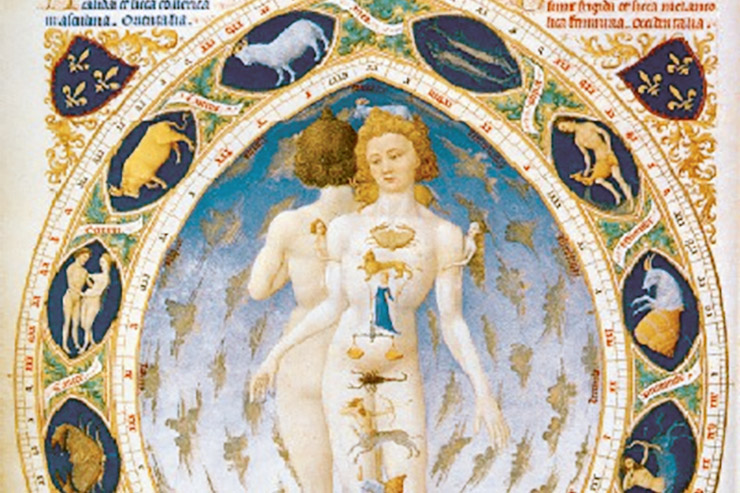
    Medicine, too, had a link to astrology. The ancient and widespread idea that the human being, the microcosm, corresponds to the universe, the macrocosm, led the Greeks to assign the signs of the zodiac to different parts of the body. Aries, the first sign, was assigned the head; to Pisces, the last, were ascribed the feet. This enabled physicians to diagnose illnesses and prescribe treatments based on the patient’s horoscope and the positions of the planets. The connection between astrology and medicine lasted a long time, up until the eighteenth century. Before then, even sceptics admitted that it was useful to consult the stars for medical purposes. And astrologers who were attacked for the inaccuracy of their predictions retorted that the doctors did no better.

    It was natal horoscopes that gained the most ground, and they became popular in the last centuries BCE and in the early centuries of the Common Era. This period, which saw the rise of Hellenistic civilisation in the Mediterranean world, was, like ours, a time of tremendous technical and intellectual progress. It was also a time of political consolidation: small, previously independent states were united, first under Alexander the Great and his heirs, and later under the Roman Empire. As in our age, the world became more integrated – and the individual occupied a smaller piece of it.

    These facts may explain the tremendous rise in those centuries in devotion to the goddess Tyche or Fortuna – Fortune – whose caprices seemed to reflect a world where the individual was under the dominion of powers far away. It was also the time when personal astrology – particularly the natal horoscope – established its place in Western culture. People began to see their fates in more deterministic ways than they had done in previous centuries.

    ‘Gods’ & Planetary Spheres

    In those days, as we’ve seen, the planets were believed to surround the earth in concentric spheres. The soul taking incarnation in a birth was thought to descend through each of these planetary spheres in turn, assuming characteristics of that sphere as it passed. The relations of the planets to one another, and their place in the zodiac, thus dictated individual fate and character.

    Few modern astrologers would say this is why their art works, but on the other hand, there are also few other explanations that are much clearer or more sensible. We can take this idea of the soul’s descent as a metaphor for how one’s character may be fixed by the planets in the zodiac. Like most metaphors, it casts some light on what it portrays – and at the same time, it is only a metaphor.

    The history of astrology, as I’ve suggested, is the history of polemic, and just from looking at what I’ve just said above, we can see one of the bases for this polemic. The soul descends through the realms of the planets, and in those days the planets were gods. Plato in his Timaeus said that it was the gods of the planets that formed human beings, not the true, high God above (who, according to Plato, is himself perfect and could not have formed imperfect things like humans). Plato’s pupil Aristotle also held that the planets were subordinate gods.

    If this is true, then exactly who are these gods and how are they disposed toward us? Already in Plato the planetary gods are ambiguous figures, responsible for both the good and the evil in our natures. Later thinkers were to paint them in even more negative terms. The Hermetic texts – writings of late antiquity said to preserve the wisdom of the Egyptians – portrayed the keepers of these heavenly gates as the sources of vice in the human character. One Hermetic text describes the liberation of the soul at death as an ascent through the planetary spheres (as opposed to birth, when the soul descends): “Then the human being rushes up through the cosmic framework, at the first zone surrendering the energy of increase and decrease; at the second, evil machination, a device now inactive,” and so on through the seven spheres. Each sphere has a vice that is connected with its respective planet – “energy of increase and decrease” being connected with the moon, which waxes and wanes throughout the month, and “evil machination” with Mercury, the god of cleverness. The Gnostics, too, saw these intermediary planetary powers as inimical “archons” that imprisoned humankind spiritually.

    This ambiguous, or inimical, nature of the planetary gods led some to criticise astrology. Plotinus, the Neoplatonic philosopher of the third century CE, argued that if the planets are gods, it is absurd to conclude they can do evil (as some planets, particularly Mars and Saturn, are said to do). As a matter of fact Plotinus did not reject astrology entirely, allowing that it was useful for divination, because the planets are part of the cosmos and serve to reflect its harmony as a whole. But then his critique was not directed at astrology as such; the section of his Enneads discussing this matter is entitled “Are the Stars Causes?”, indicating it was the causative aspect of the planets that he had problems with. (Again we see how problematic the idea of causation can be.)

    Free Will Vs Fate

    By contrast, Plotinus’s disciple Porphyry embraced astrology (he even wrote a three-volume work on the subject, now lost). Dealing with the issue of free will versus fate, Porphyry used some of Plato’s texts to argue for a kind of mix between the two: the soul chooses its fate before incarnation, but this fate, immutable once one is born on earth, is reflected in the horoscope.

    Origen, a third-century church father, also focuses on free will. Like most Christian theologians, he is at pains to uphold the doctrine of free will and opposes anything that might challenge it. Yet he too stops short of rejecting astrology altogether, because if he did, he would have to reject natural philosophy as a whole (into which astrology was intricately interwoven at the time).

    Origen also contends that astrologers, in order to make perfectly accurate predictions, would have to be able to calculate horoscopes very precisely – within four minutes or so. The technology of the time did not allow them to do this; time was kept by sundials and water-clocks, which were not precise enough. Nor were astronomical observations. Hence, Origen said, astrology could not work.

    If we back away and look at this issue from a distance, we can actually see that, given what we know now, astrology should not have worked much of the time, given the limitations of the observations of the stars (there were no telescopes), and given the fact that the outer planets were unknown. To this we can add likely mathematical errors made by astrologers themselves, which must have been extremely common in all periods. In the sixteenth century, the celebrated prophet Nostradamus was derided by his astrological peers for his sloppiness in calculating charts.

    In any event, Christianity has always had an ambivalent, and frequently critical, posture towards astrology. Astrology and its practitioners were condemned when they came too close to sorcery and when they seemed to be criticising the doctrines of free will and divine sovereignty. But the science of the stars remained an important part of the medieval curriculum, partly because it was an integral part of the system of the seven “liberal arts” that the Catholic Church inherited from classical antiquity. (There is a persistent rumour that the pope’s bathtub in the Vatican is adorned with the signs of the zodiac, but I have not been able to verify this.)

    Although I could go into more detail about the history of astrology from late antiquity to the present, in fundamental ways the debate has not changed much. Some issues certainly have faded away. No one regards the planets as gods anymore, so we do not wonder about whether they are personally good or evil. And computers make it possible to calculate charts with extreme accuracy, either with one of the many dedicated software packages on the market or through many free sites on the Internet (astrodienst.com being one of the best-known). Finally, while the issue of free will versus determinism continues to haunt us, it does not have quite the theological weight that it once did. We no longer feel quite so obliged to justify the ways of God to man as people did a couple of centuries ago.

    Scientific Efforts to Validate Astrology

    Nonetheless, we are still forced to ask, does astrology work? Has there been any genuine scientific effort to test the validity of astrology? There haven’t been terribly many. Some studies have attempted to correlate astrological charts with the results of personality tests, without positive results (but of course that presupposes the personality tests themselves have anything more than a vague degree of accuracy). One famous study, designed by Shawn Carlson at the University of California at Berkeley and whose results were published in 1985 in the journal Nature, concluded from such indications that there was no validity to astrology. But a statistical reevaluation of Carlson’s findings by Suitbert Ertel, professor of psychology at the University of Gőttingen, that was published in the Journal of Scientific Exploration in 2009, reversed Carlson’s conclusions and argued the study validated astrology instead.

    Another famous case involved the French researcher Michel Gauquelin, who attempted to correlate planetary positions in birth charts with success in certain professions. He calculated the charts of nearly 1,100 members of the French Academy of Medicine to see if any planetary aspects showed up beyond the range of statistical probability. And indeed Gauquelin found that physicians had Saturn in prominent positions in their charts far more than could be explained by chance. A study he conducted on athletes showed a similar “Mars effect” for them.

    Gauquelin’s findings were vigorously – and viciously – attacked by the clique of “sceptical inquirers.” Some of these actually attempted to replicate Gauquelin’s findings – and corroborated them. But then these supposedly objective scientists changed the parameters of their own study to alter the results and make Gauquelin look wrong, causing great scandal even in the community of sceptics.

    The heat and vitriol generated by these studies prove one thing and one thing only: that we are a long way from any true scientific evaluation of astrology. Astrologers – and a large section of the public – believe in it, while sceptics mock it at every chance. In order to have genuinely trustworthy results, those who actually want to find out the truth would have to outnumber those who are angling for their own pet conclusions – and I suspect that they do not.

    Speaking for myself, I am not a scientist and have not done any scientific studies on this or any other subject, but I have often been struck by the validity of astrology, both for my personal life and for a perspective on larger events. To take one example, in 2001 I decided to cast a chart for the presidency of George W. Bush, based on the time of his inauguration in Washington. I noticed that Mars was badly aspected. “My God!” I thought. “It looks like we’re going to have a war.” (Mars is the planet of war.) Then I told myself, “That’s ridiculous. Who are we going to go to war with?” Events to come provided the details.
    Get the issue this article appears in

    How Astrology is Supposed to Work

    Another question remains. If astrology does work, how does it work? Tradition held that the planets send out certain vibratory influences that affect events on earth. Scoffers retort that the gravitational pull of the planets (apart from the sun and moon) is too small to have any influence whatsoever on us on earth. That may or may not be the case: the old occult theory did not talk about gravitational effects per se, and actually predated Newton’s theory of gravity. In any event, today it’s probably more common to explain astrology through C.G. Jung’s concept of synchronicity – which he defined as an “acausal connecting principle” between apparently unrelated events. In his essay “Synchronicity,” Jung discussed astrology. He conducted a study of several hundred married couples, and found that cases in which the husband’s sun or ascendant was conjunct the wife’s moon (classical markers for marriage) occurred three times more often than would be predicted by chance.

    Nevertheless, Jung’s theory leaves a great deal to be desired. Synchronicity, as he describes it, is not strictly acausal; rather it posits a hidden cause – the psychic forces Jung called the archetypes that underlies apparently unrelated but significant events. And so we return to that bane of sceptics – occult causes. But then Newton’s gravity, when it first appeared, was also derided by the sceptics of the day as an occult cause.

    We are pushed toward one final, and highly disturbing, conclusion – one that I have already hinted at in this article. The notion of cause and effect is in itself extremely problematic. The classic critique came from the Scottish philosopher David Hume. He said that when looking at things that were said to be causes, he saw no property they had in common (as, say, red or round objects do). From this he concluded that causation was a relation, and this relation consisted of “constant conjunction.” One event follows another (sometimes after an interruption) on a regular basis, so we infer that the one caused the other. The German philosopher Immanuel Kant, who said he had been roused by Hume from his “dogmatic slumber,” went on to argue that causation does not exist in the world as it really is, but rather is an innate “category,” or feature, of the human mind that leads us to perceive reality this way.

    No one has ever really refuted Hume’s and Kant’s conclusions. Science, it is true, is somewhat humbler and more furtive about asserting causal relations than it used to be: it tends to speak in terms of association rather than causation – “smoking was associated with lung cancer in X cases” rather than “smoking caused cancer in X cases” – but this only points up the strength of the philosophers’ criticisms. Whether it’s a matter of determining the causes of cancer or of asking whether the planets can presage a war, we are left with “constant conjunction.” In that respect, we haven’t gone far beyond the Babylonians.

    [alert type=”general” dismiss=”no”]This article was published in New Dawn 141.[/alert]

    [alert type=”success” dismiss=”no”]If you appreciate this article, please consider subscribing to help maintain this website.[/alert]

    Sources

    Aristotle, The Basic Works of Aristotle, Edited by Richard McKeon, Random House, 1941

    Brian P. Copenhaver, ed. and trans., Hermetica: The Greek Corpus Hermeticum and the Latin Asclepius in a New English Translation with Notes and an Introduction, Cambridge University Press, 1992

    Ken McRitchie, “Reappraisal of 1985 Carlson Study Shows Support for Astrology,” Center of the Universe at the Edge of the World website; theworldedge.blogspot.com/2009/07/reappraisal-of-1985-carlson-study-finds.html

    Claudius Ptolemy, Tetrabiblos, Translated by F.E. Robbins, Loeb Classical Library, 1940

    Jim Tester, A History of Western Astrology, Boydell, 1987

    Lynn Thorndike, A History of Magic and Experimental Science, vol. 1, Columbia University Press, 1923

    © New Dawn Magazine and the respective author.
    For our reproduction notice, click here.
  • The Dual Search for the Philosophers’ Stone

    The Dual Search for the Philosophers’ Stone

    To say what the Philosophers’ Stone – the great goal of alchemy – is, one has to know. And to know, one must have attained it. I cannot claim to have done this, so what follows must be speculation.

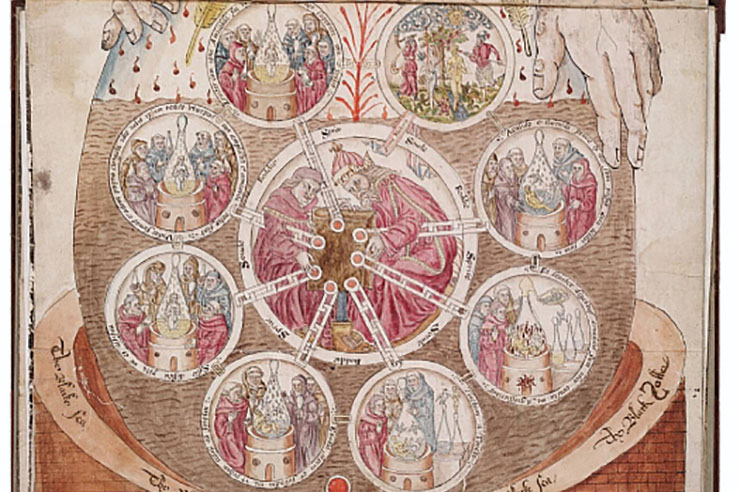
    The mystery grows deeper the closer one attempts to look. Even to say what alchemy itself is proves difficult. Of course, everyone knows what alchemy is – or thinks he knows: it is an outmoded form of science in which men in conical hats cooked and mixed various strange substances trying to make gold out of base elements. Or they sought to make the Philosophers’ Stone, a substance that was supposed also to produce gold – and to confer physical immortality besides. This project was totally deluded, but somehow gave rise to modern chemistry with all its wonders and curses.

    However cartoonish it may be, this picture has some truth to it. Or so the stories suggest. According to one, the seventeenth-century Flemish scientist Jean-Baptiste van Helmont once received a curious visitor to his laboratory. The stranger did not identify himself, but offered to give his host a piece of the Philosophers’ Stone. Van Helmont accepted on the condition that he be allowed to conduct his own experiments on it in the stranger’s absence. His guest readily agreed, asking nothing in return for the substance; the scientist’s conversion, he said, would be reward enough. The stranger left, never to be seen again.

    “I saw and handled the Philosophers’ Stone,” van Helmont wrote. “It was a saffron-coloured powder, very heavy, and it glittered like splinters of glass.”

    Van Helmont had his assistants melt eight ounces of mercury in a crucible. He then added the powder and sealed the vessel. Fifteen minutes later he opened it and was astounded to find a lump of gold.

    In 1666, the Dutch scientist Helvetius had a similar experience. Given the Philosophers’ Stone by a stranger, he was able to transmute a piece of lead pipe into gold that an assayer called the finest he had ever seen. Later, when the gold was melted down, mixed with silver, and separated out again, there was more gold than there had been at the beginning. Evidently some of the silver had been transformed by contact with this alchemical gold.

    Such stories abound in the literature of the early modern era. We read not only of mysterious strangers visiting early scientists, but of such figures as the fifteenth-century French alchemist Nicolas Flamel, who, having learned the secret of the Great Art (as alchemists call their practice), amassed a tremendous personal fortune and endowed many churches and hospitals. Another Frenchman, Jacques Coeur, allegedly used his alchemically created wealth to bail out his bankrupt nation after the Hundred Years’ War. Alchemists were particularly welcome at the Hapsburg court of Austria in the seventeenth century, where they would commemorate their feats by striking their transmuted gold into elaborate medallions, at least one of which still exists.

    Alchemy, then, appears to resemble chemistry to some degree. In fact one of the few practicing alchemists that I know in the US is a former chemistry professor who abandoned the conventional form of the science because he found it boring. But both the Stone and alchemy itself may offer greater mysteries still.

    A completely different perspective on the subject appears in a book called The Hermetic Tradition by the Italian esotericist Julius Evola (1898-1974). For Evola, alchemy is not about gold and metals and stones. These expressions are just blinds to cover the alchemist’s real goal – immortality in the true sense of the word.

    Evola distinguishes between immortality and mere survival after death. The latter is the lot of ordinary men. They go on to a shadowy netherworld like the Greek Hades or the Sheol of the Old Testament and lose all sense of personal consciousness. “In the eternal sleep, in the larval existence of Hades, in the dissolution – which is thought to be the destiny of all those for whom this life and the forms it takes constitute the beginning and end of everything human – in all this only those will escape who, while still in life, have learned how to focus their consciousness upon the higher world.” Evola goes on to criticise the conventional belief that “immortality is a certainty, not a problematical possibility.”

    It was, Evola contends, the goal of initiation in the mystery schools of antiquity to confer this immortality. He quotes Plotinus, the philosopher of the third century CE, who wrote, “As the gods must one be, not as good men. It is not that one must free oneself from sin, but that one must transform oneself into a god.” After the decline of paganism and the triumph of Christianity, which did not support this effort in the slightest, the alchemical path was created as a means of concealing it. From this point of view, Evola claims, it was “much better then to speak of Mercury and Sulfur, of metals and puzzling things and impossible operations” than to allow the pure teaching to be desecrated by religion.

    What, then, is the real alchemy? For Evola, it is the transformation of the body, especially in relationship to the spirit, to the life force. By this process the body goes from imprisoning the spirit to expressing it in a perfect way. “The corporeal principles are elevated to a higher plane, and ‘the two are made one’ in a spiritual corporeality; and the word that serves… to express that corporeality will be… the Philosopher’s Stone.” The symbol of the Stone is chosen because at this point “the body, as a completed, organised, and stable Nature is a ‘fixed’ thing as opposed to the instability of psychic principles and the volatility attributed to ‘spirits’.” This image evokes Christ’s parable that speaks of a man building his house upon rock rather than sand.

    This state, Evola emphasises, is the true goal of alchemy. Its attainment is difficult and uncertain, and particularly in its later stages is hard to grasp. But that is not surprising: one cannot be expected to grasp something that one has not experienced for oneself, particularly something that is so deeply at odds with ordinary understanding.

    In any event, much of Evola’s discussion, although it is far more lucid than we find in traditional alchemical texts, remains mysterious and puzzling. But there is one part of the process that is reasonably clear – the journey to the gates of death. By some process (which Evola does not describe) the candidate is brought into a kind of catatonic state that resembles death – except that he remains conscious during this process and then returns to life. This confrontation confers immortality – a stage that Evola equates with the alchemical term albedo or “whitening.”

    Evola does not talk much, or at all, about the actual experience that the candidate undergoes during this initiation. Indeed the only first-hand account of such a process that I know of can be found in a book called Opening the Dragon Gate, in which a Chinese wizard named Wang Liping tells of his initiation into Taoist alchemy under the guidance of two masters in the almost unimaginable setting of Mao’s Cultural Revolution of the 1960s. Wang undergoes a death and rebirth process that matches Evola’s description.

    There are other steps to the alchemical process as well. After the whitening stage, there is the rubedo, or “reddening,” in which the now-immortal spirit is reunited and reintegrated with the physical body. Does this confer physical immortality? The alchemical legends suggest that it does. Nicolas Flamel was reported to be seen hundreds of years after his lifetime in the fourteenth century; the eighteenth-century savant the Comte de St.-Germain, another heir to the alchemical legacy, was similarly said to be centuries old; and the Taoists have their legends of the Eight Immortals, whom author Victor H. Mair describes thus: “They are immune to heat and cold, untouched by the elements, and can fly, mounting upward with a fluttering motion. They dwell apart from the chaotic world of man, subsist on air and dew, are not anxious like ordinary people, and have the smooth skin and innocent faces of children.”

    Like practically all legends, these tales are unverifiable, although by the same tack, they are impossible to refute: we cannot go through all seven billion people on earth one by one and prove that none of them has lived for hundreds of years. The physical immortality to which alchemy points remains, as Evola says, a “problematical possibility,” waiting for us around a corner that may or may not exist.

    All this said, it is hard to entirely dismiss the more familiar version of alchemy. There are practicing alchemists who do work with metals, and, as we saw at the beginning of this article, there were even some who claimed to have attained the summit of this work. Again, these achievements remain elusive and legendary, but again negative proof is impossible.

    Thus we are left with a dual alchemy. One path attempts to transform the essence of a metal so that it reaches its most perfect form (which was always held to be gold). The other path is aimed at transforming human nature. In the end, do these goals converge? They can only do so if the principle of consciousness that dwells within us is fundamentally the same as that which dwells in all of nature, animate and supposedly inanimate. In that case the two would in the end be one.

    [alert type=”general” dismiss=”no”]This article was published in New Dawn Special Issue Vol 7 No 3.[/alert]

    [alert type=”success” dismiss=”no”]If you appreciate this article, please consider subscribing to help maintain this website.[/alert]

    Sources

    Titus Burckhardt, Alchemy: Science of the Cosmos, Science of the Soul, Translated by William Stoddart, Penguin, 1971

    Chen Kaiguo & Zheng Shunchan, Opening the Dragon Gate: The Making of a Modern Taoist Wizard, Translated by Thomas Cleary, Tuttle, 1998

    Julius Evola, The Hermetic Tradition: Symbols and Teachings of the Royal Art, Translated by E.E. Rehmes, Inner Traditions, 1985

    Fulcanelli, The Dwellings of the Philosophers, Translated by Brigitte Donvez and Lionel Perrin, Archive Press, 1999

    Cherry Gilchrist, Everyday Alchemy: How to Use the Power of Alchemy for Daily Change and Transformation, Rider, 2002

    Stanislas Klossowski de Rola, Alchemy: The Secret Art, Thames & Hudson, 1973

    Victor H. Mair, Wandering on the Way: Early Taoist Tales and Parables of Chuang Tzu, Bantam, 1994

    Mark Stavish, The Path of Alchemy: Energetic Healing and the World of Natural Magic, Llewellyn, 2006

    David Goddard, The Tower of Alchemy: An Advanced Guide to the Great Work, Samuel Weiser, 1999

    © New Dawn Magazine and the respective author.
    For our reproduction notice, click here.
  • Ritual Magic in Theory & Practice

    Ritual Magic in Theory & Practice

    Several years ago I decided to do an evening-long introduction to ritual magic at the New York Open Center, one of the city’s best-known gathering places for mind, body, and spirit activities. Soon before it was about to start I told myself, with some surprise, “My God! I’m about to do ritual magic with a bunch of people who have walked in off the streets of New York!”

    Despite my apprehensions, the evening went off well. Power was raised, channelled in a certain direction, and then the ritual was closed. The only negative result was a comment I got back on a feedback sheet from a participant, who said she was shocked that I did not begin the ritual by invoking the holy archangels of the four directions (usually given as Michael, Gabriel, Raphael, and Uriel).

    The person who complained was both right and wrong. In ritual magic, it is essential to create a sacred space to work in. But it is not essential to do this by invoking the four archangels specifically. In fact there are many ways to do it. Invoking the archangels is part of the Western tradition of high magic, particularly as handed down by the extremely influential Victorian occult society known as the Hermetic Order of the Golden Dawn. Here is another, quite different way to create a sacred space, from the Native American medicine man Rolling Thunder (known as “RT” to his friends), as described by one of his students:

    We started a fire in the fire pit and formed a circle around it, warming ourselves in the chilly weather. RT pulled out a pouch of Five Brothers Tobacco, pure tobacco with no artificial ingredients. He passed the pouch around, each of us taking a little bit of tobacco in our hands. RT then led us in a prayer, starting out with Father Sun, Mother Earth, Grandmother Moon, and All Our Relations. He would include “the East where the Sun rises, to the South where the heat comes from, to the North where the cold comes from, and to the West where the sun sets.” RT would vary the order and the wording from time to time, just to maintain our attention.1

    This is somewhat simpler than a lengthy invocation and visualisation of archangels. The version I used in the ritual in New York was simpler still; at the outset I simply asked the participants to visualise a pillar of light in each corner of the room.

    This anecdote illustrates two basic concepts of ritual magic: (1) it is important to create a sacred space in which to work; and (2) there are many methods for accomplishing the same purpose. While many people associate the word “ritual” with something rigid and formalised, ritual magic, practiced at its best, is neither. Rather it’s a flexible system, with enough structure to give form to one’s intention, and with enough pliability to give the practitioner a great deal of leeway in actual practice.

    In my brief description of the New York ritual, I mentioned another important part about ritual magic – raising power. No one knows what power is (used in this sense), and at the same time everyone knows what it is. We cannot say whether it is a form of electromagnetic energy, the life force known as chi, or something quite different from either of these. But all of us have experienced its effects, and, moreover, all of us have raised it ourselves, usually without knowing what we are doing.

    Remember the last time you entered a room in which an argument was about to break out. Although probably nothing was different about the air or the lighting or any of the physical aspects of the room, you undoubtedly noticed a feeling of tension and perhaps danger in the atmosphere. This tension becomes even more palpable if the room is silent, and the pressure that you feel to dispel it becomes extremely intense. One way of dispelling it is to express it somehow, and if the tension is not too strong, it can be broken when someone simply speaks. At other times, it erupts in an argument or even a physical fight.

    Another example is the classic situation of the teenage dance. At the outset the boys are ranged at one end of the hall, the girls at the other. Everybody is too shy to begin dancing, and again an extreme amount of tension accumulates in the room. Finally one courageous couple breaks the tension and begins to dance. The energy starts to flow. It is expressed through dancing (and perhaps later on, sexually).

    Most of the time this raising of power is completely unintentional and undesired. Its presence causes a great deal of discomfort, and depending upon an individual’s personality type, he may try to get rid of it by giving in, arguing, or simply leaving. The magician, by contrast, wants to raise this power. But he (or she) chooses to do it only in certain circumstances and for specific results.

    The raising of power partially explains another feature we have seen in ritual magic – the creation of a sacred space of some kind. It can be done, as we have seen, by marking out the four directions; traditional magicians have also done it by drawing a geometric figure, such as a circle or a pentagram, with the point of a wand or a sword in the space around them. The actual shape does not matter as much as building an invisible sanctuary where certain forces are kept in and stray influences are kept out.

    I’ve said that the magician raises power for specific intention, and in this context it’s important to note that power in this sense, like the Force in the Star Wars films, is morally neutral. It can be used for good or evil or for that matter mixed ends. Using it for good purposes – such as healing or blessing or cleansing – is known as white magic. Using it for harmful purposes, such as cursing or coercion, is black magic. These terms are well-known; a less familiar one is grey magic, which is done for mixed motives. In all likelihood few magicians probably practice grey magic intentionally, although most have probably done so without entirely realising it. I personally would characterise doing a magical ritual to find a lover as grey magic; doing a ritual to make a specific person fall in love with you would be closer to black magic, since it intentionally interferes with the free will of another person.

    All these reflections lead to some questions: Does ritual magic work? If so, how? And since practicing magic for selfish ends is at best morally ambiguous, why do it at all?

    The Astral Light

    To look at how magic works, it’s helpful to understand a concept that has fallen into disuse in recent years but still occupies a central place in Western magic: the astral light. Esoteric texts from the Renaissance and early modern era often refer to it as the anima mundi, or “the soul of the world.”

    “God is light,” the Bible tells us (1 John 1:5). Esotericism regards this image as a specific and accurate picture of reality. This light pervades the universe; there is nowhere and nothing it is not, but it is modified, its purity and intensity are filtered and diluted, as it proceeds through various levels of manifestation. Esoteric theory holds that this light reaches us on earth only after passing through the zones of the stars and planets, whose influences it absorbs; hence its name.

    Astral light must not be confused with physical starlight. It is a subtle matter, imperceptible to the five senses and to the implements of science. “It is the common mirror of all thoughts and forms,” writes the nineteenth-century French magus Éliphas Lévi, “the images of all that has been are preserved therein and sketches of things to come, for which reason it is the instrument of thaumaturgy and divination.”2

    To form a more or less accurate picture of this light, one need only ask, what is the substance of a thought? Neurochemical responses, a scientist may say. While that may be true up to a point, we don’t experience these images as neurochemical events; we experience them subjectively as images and forms. In this latter form, they can be said to be made up of astral light.

    A more topical analogy comes from the world of computers. Hardware, software, and networks together form cyberspace, a dimension that, while in no way separate from the workings of computers, seems to obey its own laws and possess its own reality. This resemblance between the apparently outmoded world of the occult and the sophisticated ideas of cutting-edge science has not gone unnoticed: Silicon Valley is a hotbed of interest in the esoteric, and computer aficionados sometimes speak of cyberspace as a kind of bardo – a term used in The Tibetan Book of the Dead to designate the astral plane.

    The fine matter of the astral light is also believed to form the subtle or “astral body” of humans, giving literal force to the words of Shakespeare’s Prospero: we are indeed “such stuff as dreams are made on.” Shakespeare probably meant these words metaphorically; he was saying that we are frail, transitory, ephemeral. But then so are dreams and mental images.

    This is not to say that the astral light is itself a frail substance; occultists consider it indestructible. But this subtle matter does not hold shapes well. Dream figures constantly shift form, and even before our waking eyes mental images rise and fall like waves. For this reason some esoteric teachings figuratively refer to this substance as “water.” Under most circumstances, practically none of the thoughts or images formed in this “water” ever come into physical manifestation; there is not enough force behind them to make that happen. Hence, the central aspects of occult magic has to do with forming, holding, and energising a shape composed of astral light. If enough power and skill are used in its creation, the image will sooner or later manifest in the physical world.
    [alert type=”info” dismiss=”no”]If you appreciate this article, please consider a subscription to New Dawn magazine.[/alert]

    Manifestation

    In theory the process sounds simple enough, and in a way it is, but it is not so easy to accomplish. To begin with, in order to manifest in the physical world, an image must have a steady, consistent form in the mind’s eye. In practice, however, few things are more difficult to achieve, since it is notoriously hard to hold an image in one’s mind for all but the briefest time. This may be partly due to a lack of mental discipline, but it also reflects the nature of the astral light itself. It is fluid and slippery; trying to hold it is like trying to grab water with one’s bare hands. Much of magical practice consists of moulding this elusive substance. Hence magical training emphasises, above all else, mental concentration and will.

    Look at some object near you. Now close your eyes and try to visualise it. Then open your eyes again, and compare your mental picture of the object with the object itself.

    If you’re like most people, you’ll find some discrepancy between the object and your picture of it. You may find that you were able to imagine some parts of it better than others, or that you could imagine it as seen from one angle but not from another. You’ll probably find not only that it’s hard to keep your mind on the same picture, but that it’s difficult to create an entirely accurate image even of an everyday object right in front of you.

    One part of magical training is intended to hone the skill of visualisation. The magician may begin by taking extremely simple objects or forms – geometric shapes, for example, like triangles and circles – and attempting to visualise them. Later on, the aspirant may be able to proceed to more complicated things like three-dimensional objects. A piece of fruit, an orange, for example, is a good thing to use, since one can imagine not only its appearance, but also its taste, smell, and texture.

    Visualisation and imagination form only one aspect of the discipline. The second and equally important part is the conditioning of the will. The mind is not likely to enjoy concentrated imagination at first; it will probably rebel and drift on to its ordinary worries and fantasies. The only way to train it is to constantly bring it back to the object.

    Such work is often tedious, and the beginner may be able to practice for only a few minutes a day before concentration gives out. Gradually, however, these practices will achieve their end. The act of constantly bringing the mind back to the object, despite boredom or frustration, begins to form a small core around which the will can constellate. And the will is the magician’s principal tool.

    So far this procedure resembles the “creative visualisation” described in many books. Creative visualisation, however, generally doesn’t go past this point. Nothing more may be needed: sometimes the greatest hurdle lies in simply formulating a clear goal. But often the enterprise requires some sacrifice: an additional investment of vital energy to literally give life to the desired image.

    This brings us back to the need to raise power. For a process of ritual magic to be complete, it must have a clear and specific form in the mind of the practitioner – and enough power must be directed toward it to ensure it manifests.

    This does not always happen. To cite another personal experience, about fifteen years ago I was on a retreat with a group holed up in a country house in Derbyshire, England, learning to practice magical techniques. One of the chief things taught was raising power, which was done by having the group (of about a dozen people) channel mental energy in a certain direction. Throughout most of the retreat this power was directed to an actual sink – a drain in the floor of one of the utility rooms. The reason for doing this was quite clear. We were learning to raise power, but this power could not be allowed to float around in the atmosphere. It would create enormous tension (and there was tension enough anyway); given enough momentum, it would start to cause mayhem. So for training purposes the power was directed to the ground – it was literally “earthed.”

    Such was the practice for most of the retreat, but toward the end each of us was allowed to raise power and direct it toward whatever we wished. We all took turns: we sat in a room on our own while the other members of the group directed power toward us. When it came to be my turn, I decided to channel this power toward realising a particular project I had in mind at the time.

    But it was no good. I could not focus the power in the direction I wanted; it felt as if it kept slipping and sliding away from me. I tried to recoup my efforts more than once, but soon the time was up. The whole experience had the depressing quality of a premature ejaculation.

    Where did the failure lie? I certainly felt power being sent in my direction; that was not the problem. And the project I was developing was clear enough in purpose and intent. Rather the failure came from my own will. Although I did my best to work with the power through the exercise, there was some level at which I was not interested enough in this project to make it manifest.

    It was, as a matter of fact, a book project, and it came as no surprise to me a few weeks later when I learned that all the publishers to whom my agent had submitted the project rejected it. None of this was especially tragic; all writers have projects that they come up with and never manage to materialise; in fact, these generally far outnumber the successful ones. But the whole experience taught me something about the nature of will.

    Will, as I’ve said, is a chief characteristic of the ritual magician, and from my experience, I would say that the will is in many ways as subtle and elusive as the astral light itself. Where exactly is my will? In my superficial wishes and desires? In my gut? In the deep and inaccessible reaches of my heart? I would say that for the will to be truly effective, it must lie in, and encompass, all these parts of one’s being; if one is conflicted or ambivalent, the results will be nil.

    All this helps to answer a question that was posed earlier: Does ritual magic work? It does work, but it is a subtle and difficult process that requires a great deal of training and mastery – and especially self-knowledge – in order to succeed.

    The Importance of Ritual

    Ritual magic, as practiced in the West, is an elaborate and somewhat cumbersome discipline. Fully devoted practitioners devote an enormous amount of effort to making and obtaining robes, wands, swords, cups, talismans, incense, and other appurtenances of the magician’s craft. Are these necessary? They are – nearly every ritual of any kind requires some kind of paraphernalia – but the complexity and elaborateness of these things can vary greatly. Purists among magicians tend to say that tools that the practitioner makes himself, from scratch, are the ones that have most power. And from what we’ve already seen in this article, we can understand why. Power follows attention. And something that has had a great deal of effort and attention directed toward it, even if it is crudely executed, is likely to have more power than a more polished object that has been manufactured.

    Is ritual necessary in order to make one’s will manifest? After all, if it’s simply a matter of raising power and focusing it on an image, what need is there for a ritual at all? Can’t it be done by thought power alone?

    In fact, it can; and that is the theory behind creative visualisation and what some portions of the New Age world call “manifesting.” In these techniques it’s enough to work exclusively through thought power – if the will is strong enough. These practices differ from prayer in that they don’t necessarily invoke the favour of God or a god in order to operate; rather it is a matter of simply using certain universal (though little-known) occult laws. They differ from ritual magic in that no physical operation is necessary.

    Given all this, the reason for practicing ritual magic is twofold: in the first place, ritual magicians are drawn to this kind of activity. For them the more inward and sedentary acts of prayer and meditation may seem a little bloodless. There is a certain satisfaction to be gained from making and wielding magical implements in a way that’s perhaps not very different from the reasons people sometimes prefer to build their own bookcases or brew their own beer. This may seem fairly obvious, but it is not trivial. There is a part of the mind that will not take anything seriously that it cannot see or touch, and ritual magic is meant to address – and involve – this part of the mind.

    The second reason is both grander and more abstract. Man, it is said, is a bridge between worlds. He is the only creature that we know of who is capable both of extending his mind to sublime and mystical levels of experience and of doing and acting in physical reality. Some esoteric teachings would go so far as to say that this is our function as human beings, and that many of our sufferings and discontents occur because we have forgotten it. In light of this idea, we can see how ritual magic can be valuable and effective in its own right, quite apart from whatever apparent results it might achieve. It enables the magician to serve as a conduit between the higher and lower worlds, and to assist in the work of unifying them.

    There is a great deal about ritual magic that I haven’t been able to discuss in an article of this length – divination, for example, which in its many forms attempts to take a kind of reading of the patterns in the astral light in order to find out what is likely to happen in the physical world. (The Tarot and the I Ching are two common methods used by magicians today to do this.) Nor have I been able to explore the issue of raising and interacting with spirits – invisible entities that, under the right circumstances, can communicate with us and can also have an effect in the physical world. These are large and important subjects in their own right, and serve to indicate that ritual magic, practiced in the West for centuries, retains its fascination and its power.
    [alert type=”general” dismiss=”no”]This article was published in New Dawn Special Issue Vol 7 No 2.[/alert]

    [alert type=”success” dismiss=”no”]If you appreciate this article, please consider subscribing to help maintain this website.[/alert]

    Footnotes

    1. Sidian Morning Star Jones and Stanley Krippner, Ph.D., The Voice of Rolling Thunder: A Medicine Man’s Wisdom for Walking the Red Road, Bear & Co., 2012, 6.
    2. Éliphas Lévi, Transcendental Magic: Its Doctrine and Ritual, trans. A.E. Waite, 1896; repr., Bracken Books, 1995, 15.

    © New Dawn Magazine and the respective author.
    For our reproduction notice, click here.
  • Spaceship Earth: The Visionary Ideas of the Russian Cosmists

    Spaceship Earth: The Visionary Ideas of the Russian Cosmists

    From New Dawn 140 (Sept-Oct 2014)

    Winston Churchill famously characterised Russia as “a riddle, wrapped in a mystery, inside an enigma.” It’s apt, then, that the father of the Russian space program – perhaps of all space programs – was an ascetic librarian who taught that humanity should work for the physical resurrection of all the dead. Nikolai Fyodorov (whose name is also transliterated as Fedorov; 1829–1903) was the first man to seriously theorise about interplanetary travel. He also coined the term “spaceship Earth” to convey a sense of humanity’s interconnection with the cosmos.

    Fyodorov, little-known in his lifetime, served as mentor and inspiration for an entire philosophical school known as the Russian Cosmists. These visionaries, often neglected, sometimes persecuted by the Soviet state, conceived of such advanced ideas as rocket travel, a prolonged human lifespan, and the use of electromagnetic energy to enhance vitality. And in many cases they produced the models and formulas that would make these far-fetched ideas a concrete reality.

    The ideas of the Cosmists, always visionary, sometimes fantastic, seem closer to reality now than they did a hundred years ago, and the school of the Cosmists continues to this day in Russia, with conferences and papers dedicated to the propagation of these ideas and activities. It is time that their work became better-known.

    The foremost authority on the Cosmists in the English-speaking world is George M. Young, author of The Russian Cosmists: The Esoteric Futurism of Nikolai Fedorov and His Followers (published by Oxford University Press in 2012). Young grew up in Madison, Indiana, in the US and received a B.A. in English from Duke University and a Ph.D. in Slavic languages and literatures from Yale University. He has taught Russian and general humanities at Grinnell College, Dartmouth College, and the University of New England, and for many years between academic positions directed a fine arts and auction business specialising in nineteenth- and early twentieth-century American and European paintings. He is currently a research fellow at the University of New England’s Center for Global Humanities.

    Young is the author of Nikolai F. Fedorov: An Introduction, published in 1979, and has published many essays and reviews on Russian literature and thought in academic and general magazines, journals, and edited collections. Other books include Hermotimus’ Voyages, a collection of poems, and Force through Delicacy: The Life and Art of Charles H. Woodbury, N.A. George and his wife, Patricia, live in rural southern Maine and are the parents of two grown children.

    Richard Smoley (RS): The Russian Cosmists aren’t familiar to most English-speaking readers. Maybe you could begin by telling us a bit about who they were and why they’re important.

    George M. Young (GY): In a recent issue of Quest magazine, Richard, you observed that over the centuries at crucial moments in history, small groups of people have emerged who were working from a higher plane of consciousness. Among these groups you mention the Pythagoreans, the Chartres school of cathedral builders, the late medieval Brethren of the Common Life, the Rosicrucians, and H.P. Blavatsky’s circle of Theosophists.

    I think the Russian Cosmists, working in the late nineteenth and early twentieth centuries, may be another such group. They did not consider themselves a group, or even a school of thought, but individually addressed similar profound, cosmic problems, treating subjects usually considered esoteric or occult as matters suitable for serious scientific and philosophical investigation. The major Cosmists include the religious thinkers Nikolai Fyodorov, Vladimir Solovyov, Nikolai Berdyaev, Sergei Bulgakov, and Pavel Florensky; the philosophical scientists Konstantin Tsiolkovsky, Vladimir Vernadsky, Alexander Chizhevsky, Valerian Muravyov, and Vladimir Kuprevich, each of whom was a broad, polymath genius, in no way able to be pigeonholed as simply “religious” or “scientific.”

    Florensky, for example, wrote seminal papers in mathematics, developed crucial processes for the electrification of Russian industry, taught in revolutionary schools for workers while wearing his priest’s cassock, and wrote The Pillar and Ground of Truth, one of the great classics of Russian Orthodox contemplative spirituality.

    Others were similarly multitalented. They addressed topics such as the infinite extension of the human life span, the overcoming of death, the physical resurrection of the dead, the reconstitution of the human organism, the recreation of whole human individuals from particles of identity, the exploration and colonisation of cosmic space, the reversal of time, and the practical realisation of universal human brother-sisterhood.

    The Cosmists show us today how it is possible to overcome dichotomies and bridge gaps. Theory and practice, science and religion, esoteric and exoteric, ideal and real – the Cosmists found ways to unify apparent opposites. Another quality of theirs that we might take note of is the confidence with which they addressed the most enormous, apparently insoluble questions. Can we, should we attempt to overcome death? Can we, should we attempt to remake humanity? Explore and colonise space? Yes, the Cosmists said, with a conviction not much in evidence elsewhere today, we can and should, and here is how to start!

    RS: Could you talk a little bit about Nikolai Fyodorov and his work? If I understand it correctly, he coined the term “spaceship Earth” back in the nineteenth century.

    GY: Nikolai Fyodorov was the prime exemplar and source of Russian Cosmism. Born in southern Russia, the illegitimate son of a Russian prince and an unknown local woman, Fyodorov led an ascetic, eccentric life, first as a rural elementary school teacher, and then as a Moscow librarian of legendary erudition. That he was also a highly original thinker was known to only a few contemporaries, but this handful included Fyodor Dostoevsky, Leo Tolstoy, and Russia’s leading philosopher, Vladimir Solovyov.

    Fyodorov’s central idea was that everything we now do leads toward division, destruction, and death. Our “common task” as humans is join together in a grand “project” to use all our god-given intelligence to counter nature’s force of division and death, leading eventually to universal immortality and the resurrection of all the dead. Individual parts of the “common task” included travel beyond earth to collect the dispersed particles of our ancestors (“dust of the fathers”) in order to restore them to wholeness and life, the reconstitution of the human organism to allow us to survive in space under conditions now unable to support human life, and human control over gravity, allowing us to liberate our planet from its natural orbit and guide it through space on courses of our own choosing. More than a century before Buckminster Fuller, Fyodorov argued that we should no longer ride as idle passengers but must become “captain and crew of spaceship Earth.”

    Fyodorov did not know exactly how the spiritual-scientific workers of the future would solve the technical problems of biological engineering and interplanetary voyage, but he knew what the goals should be and he believed that if humanity undertook the “common task,” future expertise would be able to find solutions.

    For Fyodorov, as early as the 1860s, space colonisation was not an optional fantasy, but a necessary human step toward fulfilment of a divine plan. Dust of our ancestors is dispersed throughout the universe. The human task is to gather and revive this dust, to find homes beyond Earth for the resurrected multitudes that otherwise would overcrowd our planet, to populate the uninhabited and currently uninhabitable places in the universe, to spiritualise all the currently dead matter in the cosmos. In a sense, Fyodorov was the ultimate alchemist, attempting to turn all human knowledge and labour, all science, religion, and art, into a single task of transmuting currently dead or dying matter into eternal, universal life. His posthumously published writings seemed ridiculous to most of his early readers – perhaps less so today.

    RS: I gather that Konstantin Edouardovich Tsiolkovsky, a pupil of Fyodorov’s, laid some of the groundwork for what became the Russian space program. Could you tell us a little bit about him and what he accomplished?

    GY: Even before Fyodorov’s writings were published, a handful of listeners and readers recognised in him a mind far ahead of his time. Tolstoy wrote that he was proud to have lived in the same century as Fyodorov. And Solovyov wrote that since the appearance of Christianity Fyodorov’s “project” was the first forward movement of the human spirit along the path of Christ.

    But the follower who did most to realise a portion of Fyodorov’s “project” was Konstantin Tsiolkovsky (1857–1935), a mostly deaf but precocious seventeen-year-old boy from a small village who moved to Moscow to educate himself and came under Fyodorov’s tutelage at the library. As Tsiolkovsky would later write, Fyodorov guided his readings, taught him to take notes, and served as his one-man university. After a few years studying with Fyodorov, Tsiolkovsky returned to his village to teach. After school hours he built wooden model rockets and spaceships, and developed and published the mathematical formulas that eventually led to the launching of the world’s first artificial satellites. In addition to his seminal scientific papers, for which he received recognition as the grandfather of the Russian space program, Tsiolkovsky published science fiction tales about space exploration that inspired generations of young Russian readers to dream of becoming cosmonauts. And though he could not publish them through official Soviet outlets, he wrote and sometimes printed and circulated numerous esoteric and theosophical speculations concerning higher sentient beings and energies alive throughout the cosmos.

    RS: What does it mean to be a “Cosmist” in this context?

    GY: I think one of the main features of Cosmist thought is what Fyodorov called the shift from a Ptolemaic to a Copernican comprehension of the universe. Intellectually, we have long realised that our planet is not the centre of the universe, but emotionally, culturally, aesthetically, and in almost every other way, we cling to a Ptolemaic cosmology. The Cosmists urge us not only to think but to feel and in every way realise that we are citizens of the entire universe. Not only the planet, but the cosmos is our home, and our lives are meant to span not merely seventy-odd years, but forever. The Cosmists propose that we are not the end product, but are still in the early stages of evolution. We are still children, or at best, adolescents, with all the characteristics and problems of that age, and have a long way to go to attain maturity. The insecurities, appetites, and needs – sexual, gustatory, etc. – that now drive and dominate our lives will eventually subside. We will be greatly changed from what we now are. As Fyodorov wrote, we need to realise – to make real in every way – that we are already “heaven dwellers.”

    RS: How did the Cosmists conceive of interplanetary travel?

    GY: Tsiolkovsky developed formulas and designed rockets for human beings as we are today. But he, Fyodorov, and others also imagined possible interplanetary, even intergalactic travel for more advanced levels of humanity. A step in that direction would be the cessation of what Fyodorov called “cannibalism” (i.e., that we stop eating organic matter, all of which he believed is made up of particles of our ancestors), and the attainment of an autotrophic way of life, in which, like certain plants and other organisms, we would feed on air, sunlight, and other elements. In Cosmist thought, we must direct our own evolution. Instead of taller, heavier bodies, we should choose to develop smaller, lighter bodies, and eventually perhaps eliminate all our mass and become bodiless minds, free from gravity, god-men able to be anywhere and everywhere in the cosmos. At that stage, interplanetary travel would be automatic and instantaneous: decide to go to Jupiter and you’re there.

    RS: It seems that the Cosmists were among the first thinkers to conceive of human possibilities beyond the limits of the physical earth. What do you think were some of their most important contributions in this regard?

    GY: Fyodorov and the other Cosmists tried to make literal sense of ideas such as “resurrection of the dead,” “heaven on earth,” “eternal life,” “oneness with God,” “manna from heaven,” etc. They believed that we should not merely dream and pray for “heavenly peace,” but could and should take the actualisation of such concepts as our human duty and task. So the first step for them was a shift in consciousness, changing speculations about things “not of this world,” into tasks to be realised in this world, turning metaphysics into engineering projects. Writers like Jules Verne, Prince Vladimir Odoyevsky, and others had written entertaining speculative fiction about a future with space travel, but the Cosmists said: “Let’s not just talk about these things, let’s do them.”

    As far as results are concerned, Tsiolkovsky published the formulas enabling man-made objects to escape Earth’s gravity. Solovyov developed a philosophy of active love pointing humanity toward a higher, spiritually mature, androgynous level of existence. Bulgakov countered Marx’s earthly, materialist philosophy of economics with a Cosmist, spiritual “Philosophy of Economy” that casts man as responsible owner and regulator of the universe. Vernadsky developed the idea of the noösphere, a sheath of mental energy as real and influential as the stratosphere, ionosphere, and other spheres of energy surrounding our planet. Muravyov proposed new socioeconomic structures that would facilitate mass human control over time. Chizhevsky invented devices that focused electromagnetic energy to invigorate workers and increase animal productivity, and further discovered correlations between periodic solar storms and cycles of mass human activity. And Kuprevich laid the foundation for remarkable Russian advances in gerontology and human longevity research that is now being conducted. I think, then, that one of the major contributions the Russian Cosmists have made is to take seriously the idea that humans are made for infinite space and infinite time.

    RS: Tsiolkovsky held not only that life is distributed throughout the universe, but that the most advanced forms of life are not to be found on Earth. How did he conceive of, and portray, these forms of life?

    GY: Tsiolkovsky was a panpsychist, recognising life and sensitivity throughout the universe. He believed that a spiritual atom (atom dukh) inhered in every particle of the material universe. Tsiolkovsky’s cosmos, moreover, is teleological, rationally organised, and hierarchical. Lower life forms, consisting mainly of matter in which spirit is dormant, evolve into higher ones, in which spirit is awakened and more dominant, and eventually as we approach perfection we will outgrow our material envelopes and join the rays of cosmic energy that constitute something like the pleroma of the Gnostics.

    For Tsiolkovsky, integral life is distributed throughout the universe, and the most advanced, most highly developed life forms are not to be found on earth. In cosmic evolution, higher life forms move on, leaving lower forms behind, and the higher life forms guide and shape the evolutionary paths of the lower forms. So in Tsiolkovsky’s view, we are being guided and shaped by higher life forms from somewhere beyond our planet. The past is endless, and many universes have come and gone before the present one, and the processes and forces that guide and shape our paths are real and intuited, but beyond our present rational understanding.

    RS: There has been an enormous amount of interest in extraterrestrials and UFOs over the past two generations. Do the Cosmists have anything to contribute to this conversation?

    GY: Most Cosmist speculation focuses on our human role in and toward the cosmos, but some attention has also been given to how cosmic beings or forces interact with us. Tsiolkovsky, as noted above, thought that higher life forms beyond Earth guide and shape our evolution. And his younger colleague Alexander Chizhevsky (1897–1964), who lived and worked in the same town as Tsiolkovsky, devoted most of his scientific research (he was also an artist and a poet) to the influence of solar and other cosmic waves and particles of energy on earthly life. He won recognition and honours for his “Chizhevsky Chandelier” – an electromagnetic device that produced negatively charged aero-ions for curative and therapeutic uses and to stimulate more productive animal and human output in henhouses. But his best-known work today is his discovery of correlations between solar and human cycles of activity. In a series of charts and graphs covering two millennia of human history, he demonstrated – though not entirely convincingly – that wars, revolutions, and other examples of mass upheaval coincided almost perfectly with the eleven-year cycle of solar eruptions, and that during the middle, less active years of the solar cycle, peace, prosperity, and creative mass movements flourished.

    Chizhevsky’s argument might make sense in a general way: human life and history may well be influenced more than we now recognise by unseen, unmeasured forces from the sun and from other sources beyond our planet. But Chizhevsky’s charted and graphed correlations seem too neat for the little we actually know about “universal” mass activity in remote places and eras. A more nuanced presentation of the same overall data might be more convincing.

    As for UFOs, Cosmist thinkers have little to contribute, perhaps assuming that entities wishing to interact with us and our planet would probably have passed beyond physical planes of existence, and if they did appear to us as visible entities, it would only be as illusions – adaptations dumbed down for our convenience.

    RS: Could you say something about Vladimir Vernadsky (1863–1945) and his ideas of the noösphere?

    GY: Of all the Cosmists, Vernadsky had the most conventionally productive life. Others were exiled, imprisoned, even executed for their Cosmist ideas, considered heretical at the time. Vernadsky, thanks in part to his international reputation and to his apolitical devotion to pure science, but perhaps mainly because of the economic and military value of his work in atomic energy, was permitted to conduct and publish his research through even the worst periods of Stalinist repression.

    He is best known today for his formulation of the “biosphere” as the planet’s sheath of “living matter,” and the emergence of the “noösphere” (from nous, the Greek word for “mind”) as the biosphere’s sheath of “thinking matter.” Though better known in the West through the writings of his French colleagues Pierre Teilhard de Chardin and Edouard Le Roy, who probably developed their ideas while attending seminars taught by Vernadsky at the Sorbonne, the idea of the noösphere is most extensively developed by Vernadsky in Russian. Like Chizhevsky, Vernadsky emphasised the importance of cosmic forces on the shaping and development of our planet. The biosphere serves as a transformer converting cosmic radiation into active energy in electrical, chemical, mechanical, thermal, and other forms. Radiation from all stars affects the biosphere, but we measure and are aware of only a small portion, mainly from the sun. The noösphere, emerging through the biosphere, is a new geological phenomenon, as important as the earlier emergence of the biosphere on our inert planetary rock.

    Humanity, for the first time, becomes a major geological force, and thinking matter will change the planet as thoroughly as did the emergence of living matter. Vernadsky insists that we can and must alter our habitat by labour and thought. Like other Cosmists, he is confident that our efforts are more likely to improve than destroy our environment. The noösphere is not the final, but merely the latest stage of biological evolution in geological history. He writes that many stages have preceded and many will follow but this is our present stage, and its course is only beginning to be apparent to us.

    Get the issue this article appears in

    RS: Where do you think the ideas of the Cosmists can take us in the twenty-first century?

    GY: The ideas of the early Cosmists have been further developed in the late twentieth and early twenty-first century. In Moscow, the Nikolai Fyodorov Museum and Library sponsors seminars, publications, research presentations, and other activities for today’s Cosmists. In Kaluga, the town where Tsiolkovsky and Chizhevsky lived and worked, the Tsiolkovsky Museum of Cosmonautics also sponsors wide ranging research and publishing projects. Other centres in St. Petersburg, Novosibirsk, and elsewhere engage in studies and activities related to but not directly linked to the Fyodorovian tradition of Cosmism.

    Some of the most intense activity related to Cosmism is in the field of human longevity and immortology – the science of immortality. One scientist, Igor Vishev, has predicted that technology is advancing so rapidly that there are already people alive today who will never die. Others, of a transhumanist orientation, emphasise the coming union of man and computer, human and artificial intelligence. Other researchers have investigated alternative realities, developing mechanical devices to induce states of altered, perhaps higher, consciousness.

    In remote areas of Russia and Siberia, utopian groups have emerged, attempting, as Fyodorov and Florensky did, to create an alternative human communal future by looking deeply into the Russian past. For Fyodorov and Florensky, the spiritual past with a future lay in pre-Petrine Russian Orthodox Christianity. For the communal Cosmists of today, the spiritual past with a future lies for the most part in pre-Christian Slavic paganism. At academic conferences on Cosmism, a feature of many presentations and discussions is the interdisciplinary character of the research. Since Fyodorov’s day, the division of knowledge into narrow specialties, along with the separation of thought from action, has been viewed as an example of modern intellectual decline and death. Today’s Cosmists follow their classic predecessors in fearlessly addressing the big questions and proposing bold, active, comprehensive solutions. The Cosmists are aware that the problems and solutions they discuss today may not be the ones they will be discussing tomorrow. But they are also aware that Cosmists past and present have made an important start, and the discussion will continue.

    The Russian Cosmists: The Esoteric Futurism of Nikolai Fedorov and His Followers by George M. Young (Oxford University Press, 2012) is available from all good bookstores and online retailers.

    [alert type=”general” dismiss=”no”]This article was published in New Dawn 140.[/alert]

    [alert type=”success” dismiss=”no”]If you appreciate this article, please consider subscribing to help maintain this website.[/alert]

    © New Dawn Magazine and the respective author.
    For our reproduction notice, click here.
  • Cultivating Consciousness in an Unconscious World

    Cultivating Consciousness in an Unconscious World

    Politicians constantly evade the truth. Why can they get away with it? According to a recent study conducted at Harvard University, it’s because people have such terrible attention spans.

    Behavioural scientist Todd Rogers of the Harvard Kennedy School and Michael I. Norton of the Harvard Business School conducted a simple experiment to see when and whether people can detect a dodge. They recorded a speaker answering a question about universal health care (a controversial issue in the US). Then they attached the same answer to three separate questions: the original question about health care, one on illegal drug use, and a third about terrorism. Amazingly, subjects found the speaker just as trustworthy when he gave the response about health care to a question about illegal drug use – a related but different subject – as when he responded to the original question about health care. Moreover, when quizzed immediately afterward, almost none of the subjects could remember exactly what question had been asked.

    Part of the reason for these findings, Rogers believes, is simply that humans have poor attention spans. Poor attention is “universal to all animals that we managed to study,” says Rogers. “Though we don’t realise it, we go through our lives detecting just the gist of what’s going on. Even if we wanted to pay attention to each answer, we would have a limited capacity” to do so. Another, related reason is that when people are listening to a speaker, they are taking in nonverbal signals such as body language, facial expressions, and likability. In short, even when doing something as simple as listening to a speaker, the audience is overwhelmed by information, enabling politicians to dodge answers without appearing to.

    These findings have more than a theoretical importance. Faced with economic and social crisis, and haunted by the spectre of global conflict, famine, and environmental collapse, people are demanding change. At the same time, however, there is a widespread suspicion of all political and economic ideologies. World civilisation at this point is like a sick man who shifts restlessly in bed, unable to find a comfortable position. It may be that what is needed is not a change in ideologies, but a change in consciousness.

    The problem goes deeper than merely detecting whether a politician has answered a question or not. Many of the world’s great spiritual traditions frequently tell us that we live in illusion. The twentieth-century spiritual teacher G.I. Gurdjieff said, “A modern man lives in sleep, in sleep he is born and in sleep he dies.” The contemporary Tibetan lama Tarthang Tulku writes, “Because our powers of self-observation are usually not well developed, we are often blind to our suffering.” Could they be saying that it’s our poor capacity for attention that is keeping us in cognitive bondage?

    Proposed remedies for this chronic and widespread attention-deficit disorder vary to some degree. For Gurdjieff, the answer lay (at least in part) in what he called self-remembering: an attention that is divided between the world outside and the world within. How does this work in practice? One Gurdjieffian teacher pointed out to me how, under ordinary circumstances, when you look out the window, your attention goes with it. In a certain sense you go out the window as well. Your sense of yourself is lost. To counter this, he suggested that when you look out a window, you keep some attention for yourself, even if it’s something as simple as a conscious awareness of a hand or a foot. “When you look out the window, you don’t go out the window,” as he put it.

    For Tarthang Tulku, the answer lies along a slightly different route. He believes that our failure of attention has to do with a deep-seated fear of discomfort. Our suffering goes on under the surface, and we refuse to touch it out of avoidance of the emotional pain that it would bring. One alternative that he recommends is not only to touch the pain, but to explore it – to feel it as fully as possible. “Whenever we are caught in a physical or mental conflict, we can focus on it, heat it up, go into the centre of it,” he says. Going directly into psychological pain in this way will often transform it into a new, dynamic, and more creative energy.

    There are many other approaches, but the point is the same: to sharpen and focus a capacity for attention does not forget what question was asked, that does not go out the window. In this the seed of will is sown. The British occultist Charles R. Tetworth writes about the training of a magician:

    As an apprentice, he or she will have learned how to hold an image in his mind for an hour at a time. He will have learned how to maintain direction in the midst of life’s distractions. He will have learned to keep contact with what is real within him, even in the throes of passion. He will have learned something of the uneven tides that move the hearts of men. He will be independent of the movements of fashionable views and capable of taking a long-term view of humankind’s apparent tragedies. This will make him a more conscious member of the human race.

    While some of this passage may have little bearing on us – not many people will be able to hold an image in their minds for a solid hour – it provides some genuine, and important, guidelines for living in the midst of today’s turmoils. The key practice is – however you manage to do it – to cultivate a centre of attention in yourself. You can do this right now, by closing your eyes and sitting attentively for a few minutes. At first you let your attention go to your bodily sensations, however they present themselves: sensations of the feet on the floor, your back against the chair, and so on. Then you let your attention go to the flow of thoughts, images, and emotions that pass before the mind’s eye. You will soon realise that you can watch these thoughts come into awareness like images on a screen, and pass away again just as readily.

    The question then becomes, who exactly is doing the watching? It is not the body; the body is part of what is being observed. Nor is it the stream of thoughts that flow across the screen of the mind. You will rapidly find that you can observe them as from a distance. And if there is some distance, however slight, between you and thoughts, this immediately proves that the thoughts are not you.

    This realisation is one of the principal goals of meditation. It will enable you, to use Tetworth’s words, “to keep contact with what is real” within you, even in the sorrows and disturbances of life. It will also free you from enslavements to such things as opinions, the current fashions of belief, and, what is perhaps most important, the subtle but debilitating attachment to your self-concept as a “good person.” If you pursue the inquiry of self-observation far enough, you will find that these opinions and self-concepts are merely what you have absorbed from the media, from advertising, from your family, from your friends. You will also discover that you have encompassed yourself in a circle. You read opinions that already mirror your own. You listen to “experts” who merely confirm what you believe already. You support politicians who appeal to your own fears and delusions.

    I do not pretend that the exercises I have sketched out in this article are a panacea. Nor are they easy, and it will generally take a great deal of patience and effort to apply them in any but the most basic way. And you will notice that in and of themselves they do not present any brilliant solutions to the world’s multifold problems. But if you apply them, you will be a more conscious being, and you will be more free of the delusions and anxieties that press so heavily on the human race.

    What comes next? A long work, in which you begin to become aware of your own special function – that is, the role that you can play to help the world most effectively. It may or may not mean embracing a cause or political program. Instead it may, for example, involve working quietly as a light shining in the dark corridors of an apparently soulless corporation. It does not matter: that is your work. As you move deeper into your reaches that some teachings call the Self or the “true I,” the more this function will come into focus for you, and you will be able to become a powerful force for change rather than a weak, worried, and anxious consumer.

    [alert type=”general” dismiss=”no”]This article was published in New Dawn 132.[/alert]

    [alert type=”success” dismiss=”no”]If you appreciate this article, please consider subscribing to help maintain this website.[/alert]

    Sources:

    P.D. Ouspensky, In Search of the Miraculous: Fragments of a Forgotten Teaching, New York: Harcourt, Brace, & Co., 1949.

    Peter Saalfield, “The Art of the Dodge,” Harvard Magazine, March-April 2012; http://harvardmagazine.com/2012/03/the-art-of-the-dodge; accessed March 13, 2012.

    Charles R. Tetworth, Wielding Power: The Essence of Ritual Practice, Great Barrington, Massachusetts: Lindisfarne, 2002.

    Tarthang Tulku, Gesture of Balance: A Guide to Awareness, Self-Healing, and Meditation, Berkeley, California: Dharma Publishing, 1977.

    © New Dawn Magazine and the respective author.
    For our reproduction notice, click here.