New Dawn – World's Most Unusual Magazine

Author: Richard Smoley

  • Freemasons, Secret Societies, Conspiracies, Consciousness & the Hidden Masters: An Interview with Gary Lachman

    Freemasons, Secret Societies, Conspiracies, Consciousness & the Hidden Masters: An Interview with Gary Lachman

    From New Dawn 153 (Nov-Dec 2015)

    An overlooked but powerful current is flowing in our time. It’s found in a small group of writers and thinkers who are trying to overcome the materialism and rationalism of the present age and rediscover the perennial truths that lie behind all religion. These writers are grappling with the occult and esoteric paths of the past and present. They’re trying to explore these movements without falling into either credulity or blinkered scepticism. They include Jay Kinney, founder of Gnosis magazine and author of The Masonic Myth; Mitch Horowitz, a New York book editor whose own works include Occult America and One Simple Idea: How Positive Thinking Reshaped Modern Life; and Erik Davis, author of TechGnosis and Nomad Codes: Adventures in Modern Esoterica.

    In this small but distinguished company is Gary Lachman. He started out in the 1970s in the New York rock scene as one of the original members of the groundbreaking New Wave band Blondie. In 1996 he moved to London, where he established himself as a full-time writer, contributing to publications such as Fortean Times, The Guardian, and The Times Literary Supplement.

    Since 2001 Gary has produced a steady stream of books, including Turn Off Your Mind: The Mystic Sixties and the Dark Side of the Age of Aquarius; The Secret History of Consciousness; A Dark Muse: A History of the Occult; and Politics and the Occult: The Right, the Left, and the Radically Unseen. In recent years he has published biographies of major esoteric figures including P.D. Ouspensky, Emanuel Swedenborg, Rudolf Steiner, Carl Jung, and H.P. Blavatsky (see his interview in New Dawn 137).

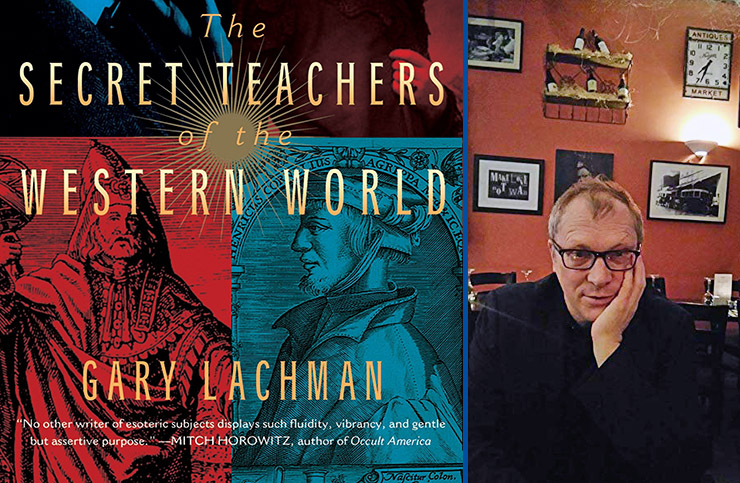
    Gary’s latest work, published in December 2015 by Tarcher/Penguin, is The Secret Teachers of the Western World, a monumental work that unveils the esoteric masters who have shaped the intellectual development of the West, from Pythagoras and Zoroaster to little-known twentieth-century figures such as Jean Gebser and René Schwaller de Lubicz.

    In June 2015 I conducted an e-mail interview with Gary about secret currents in the Western tradition.

    RICHARD SMOLEY (RS): Many people have a sense, however dim, that what is going on in the news is only the thinnest skin upon a sea of struggles and forces that we can barely conceive of. Would you agree with this assessment?

    GARY LACHMAN (GL): I suspect that at most times what we are aware of is only a selection of what is actually taking place. I mean this in the broadest sense possible. In terms of the media, it’s reasonable to assume there are a variety of filters in place that result in an edited version of things getting to us. But then there are people who devote their energies to ‘uncovering’ the truth and ‘revealing’ the facts about this or that event. It does strike me that one could get lost in attempting to track down the ‘truth’ about things, in terms of the political, economic, social situation. I mean conspiracy theorists who pursue an elusive solution to the mystery of who ‘really’ is in power and what ‘really’ happened in this or that situation.

    I think it is important to be discriminating about what we accept from our sources and to be aware that every source has its bias. Personally, I am more interested in the kind of things that are outside this kind of ‘hermeneutics of suspicion’, in the philosopher Paul Ricoeur’s phrase. I mean philosophy, thought, etc. I think it’s always a good time to pursue the good, the true, and the beautiful, whoever is running the show. I also think there is less covert control than some people believe, but it seems de rigueur nowadays to feel that everything we see on the news is false. The show itself is ultimately unimportant. It is an unavoidable nuisance that we nevertheless need to be aware of in order to pursue our aims.

    RS: Novelist Ishmael Reed wrote, “Beneath or behind all political and cultural warfare lies a struggle between secret societies.” How much truth do you think there is in this statement?

    GL: Well, I don’t know. I first came across it, as many people did, in Robert Anton Wilson and Bob Shea’s conspiracy fantasy Illuminatus. Are there really secret societies at work, manipulating events and controlling the world? If there are, they don’t seem to be doing a particular good job of it.

    I think that at different times there have been societies or groups of people who have worked together to effect some change or introduce some idea into the societies of their time. I talk about some of them in my new book, The Secret Teachers of the Western World. But these were relatively small groups who were active at a certain time, and when you look at what they were doing, the aura of mystery and sensation around them being ‘secret’ dissolves. That isn’t what is important about them. Take the Fedeli d’Amore of Dante’s time and of whom Dante was a member. They weren’t secret in the way that we think of Skull and Bones or that kind of thing (and I should say here that my book isn’t about that kind of secret group). But they were a relatively private group of poets who wanted to introduce ideas about the divine feminine or Sophia into the consciousness of their time. They were more like what G.I. Gurdjieff and P.D. Ouspensky mean when they talk about the ‘inner circle of humanity’ or ‘esoteric school’. I’m not saying the Fedeli d’Amore were agents of esoteric schools, but that their objectives and practice were like theirs, rather than some cabal of powerful individuals directing events from behind the scenes, which is how secret societies are popularly imagined to be.

    In one sense I think conspiracy consciousness is a good sign, in the way that Jung said neuroses were, as an attempt by the psyche to deal with a problem. It shows that we have a hunger for meaning. We prefer feeling that someone is in charge, even if we don’t know who that is, to feeling that no one is and that everything is chance and arbitrary. The hunger for meaning is good; it’s the means of satisfying it that I find questionable. We are purposive beings who seek out patterns and meanings. The mainstream narratives – religion, progress – no longer satisfy our appetite for meaning, and so we seek it elsewhere. One of the ideas of the book is that the meaning is there, but we won’t find it by looking for it outside ourselves.

    RS: One period in which occult orders were especially influential was the eighteenth century, in which lodges like the Freemasons played a crucial role in transforming the old feudal and ecclesiastical order into the modern world. Do you have any thoughts or insights about this development?

    GL: Freemasonry was a very important means for some fundamental ideas about modernity to be disseminated. I mean ideas about tolerance, social justice, democracy, individual worth regardless of social or economic rank. It was the spread of these ideas through different lodges that helped prepare the eighteenth-century zeitgeist for the radical changes that happened with the American and French revolutions. It is a mistake, though, to think, with Abbé Barruel and more recent writers on the Masonic influence on these events, that Freemasonry arranged or stage-managed them. There were Masons on both sides of the American Revolution, and the Illuminati – the real society, not the popular romanticised idea of it that’s present on the Internet – wasn’t ‘responsible’ for the French Revolution. The ideas that informed Adam Weishaupt’s short-lived and ineffective Masonic offshoot certainly were active forces in the revolution, and they were spread through Masonic lodges. But I think we have to credit the zeitgeist more than Weishaupt and Co. for the storming of the Bastille. In fact in one sense we could say Freemasonry itself was a product of the shift in consciousness that began around that time.
    RS: Your new book is entitled The Secret Teachers of the Western World. If they were secret, how have they been able to have such influence?

    GL: Well, again, my secret teachers aren’t necessarily secret in the sense that no one knows about them. I mean, if they were that secret, how could I know about them? One can be a secret teacher by teaching secrets, or one can be a secret teacher in the sense that the influence and importance of your ideas haven’t been recognised or have been misunderstood. Or you can be secret in another sense, as with several important thinkers who have been marginalised or don’t fit into the standard model of Western consciousness. It’s a broad term referring to a variable status rather than specific group of people. Jesus Christ, for example, is one of my secret teachers, and most people know about him. But there is a whole school of thought that argues that what we have accepted as Christianity really has little to do with the original teachings associated with Jesus. The Gnostics, for example, are thought to be more in line with what Jesus actually taught then the Petrine church of Rome.

    Or take Madame Blavatsky. If people know about her at all, she is chalked up to be an entertaining but fraudulent nineteenth-century spiritualist with a lot of chutzpah. But she was enormously influential on the modern world, in everything from art, religion, and science to what became known as the ‘counterculture’. I am not saying that everything she said about science or religion is ‘true’. That’s not the point. True or not – and she is more often on the ball than you might think – her ideas were tremendously influential, and I am amazed that feminists haven’t appropriated her. I suspect the occult connotations put them off. She isn’t secret, but her influence is not generally recognised.

    I should say the central idea of my book is that the whole Hermetic, esoteric tradition is the victim of a war going on inside our heads. I mean the rivalry between our two cerebral hemispheres. One of the inspirations for the book came from reading Iain McGilchrist’s very important work The Master and His Emissary, which is about the left and right brain and the differences between them. Briefly put, McGilchrist revamps the left/right brain discussion by showing that the difference between them is not in what they do – as was originally believed – but in how they do it. They respond to the world in very different ways, and the way they present the world is also very different. In the simplest sense, the right brain presents a total picture of the world. Its mode of consciousness is relational, connective, holistic. It presents what McGilchrist calls the ‘big picture’, the overall pattern, but its picture is fuzzy, vague. It works with metaphor, symbols, and is focused on the living character of being. It is aware of implicit meanings, meanings that we know and feel but cannot express explicitly. (Think of our appreciation of music: we know a Beethoven string quartet means something, but we’d be hard pressed to say exactly what.)

    The left brain is aimed at breaking up the big picture into smaller bits and pieces that it can manipulate. Its main function, as Henri Bergson said long ago, is to help us survive. It reduces the living, flowing whole presented by the right brain to a kind of map that allows us to manoeuvre through the world effectively. It’s interested in the trees; the right brain is interested in the forest. One looks through a microscope, the other at a panorama.

    Both are necessary, and for the most part each gets along with the other in a system of checks and balances, each inhibiting the other’s excesses. But McGilchrist argues – convincingly, I believe – that in the last few centuries the left has increasingly gained an upper hand against the right and has, in a sense, gone on a smear campaign against it. One expression of right brain thinking that the left brain targeted was the Hermetic, esoteric tradition, which was cast into disrepute with the rise of mechanical science – itself an exemplar of left brain thinking. With the dismissal of the esoteric tradition it was transformed into what the historian James Webb called ‘rejected knowledge.’ What my secret teachers teach is this rejected knowledge.

    [alert type=”info” dismiss=”no”]If you appreciate this article, please consider a subscription to New Dawn magazine.[/alert]

    RS: Of the figures that you would include among these secret teachers, which do you consider the most influential?

    GL: That’s difficult to say, and I should point out that the book isn’t a ‘top ten’ or ‘ten best’ list or something like that. Plato is certainly one of the most influential; in many ways the esoteric, Hermetic roads all lead to him. He is believed to have ‘gone to school’ in Egypt, and whatever he learned there is supposed to inform his philosophy. But whether Plato studied in Egypt or not, his ideas about the Forms, the ideal essences of which the physical realities of time and space are merely shadows, is certainly at the heart of the esoteric tradition. And Platonism informed Christianity, Hermeticism, Gnosticism, and other esoteric teachings. We can argue with and reject or accept different aspects or elements of his philosophy, but I would say that for the West, Plato is certainly one of, if not the most, significant source of esoteric thought, or thought in general. Alfred North Whitehead said long ago that all Western philosophy is but a series of footnotes to Plato.

    In saying this I’m not saying I think Plato is the ‘best’. My own philosophical background is more in Nietzsche, Bergson, Whitehead, William James, and existentialism. But Plato is still there too.

    RS: Which of these figures do you admire the most?

    GL: I’m not quite sure how to answer that. There are plenty of admirable figures in the book, as well as more questionable ones, and also some martyrs, like Hypatia the Neoplatonist, and the Persian theosopher Suhrawardi, both of whom fell victim to religious persecution, as well as truly secret teachers like the so-called Dionysius the Areopagite who welded Neoplatonism to Christianity. We do not know who he really was, just as we have no names for the Hermeticists of ancient Alexandria.

    I can say who has been an influence on me. One of first writers on esotericism that I read was P.D. Ouspensky. His books Tertium Organum and A New Model of the Universe made a big impact on me, even before I read In Search of the Miraculous and became interested in Gurdjieff. I first read these books forty years ago, and Ouspensky seemed a model of the kind of thinker I wanted to be: he combined a romantic openness to ideas, and poetry and art with a rigorous critical mind and he remains the best writer from what I call the ‘golden age of modern esotericism’, which took place during the 1920s, when people like Ouspensky, Gurdjieff, Rudolf Steiner, Jung, Crowley, and others were all active. Again, I’m not saying Ouspensky is the ‘best’ – that’s as pointless as arguing about who’s the best guitarist. But reading his books excited me and made me want to learn more. I tend to like figures that combine imagination with critical thinking, which we can see as the right and left brain working together, which is another theme running through the book.

    RS: One theme that you advance in your new book is that the cosmos is a living, conscious being, and that we need to rediscover that fact. To what extent do you think this rediscovery is actually happening in the world today?

    GL: It seems some form of that idea has been revived and presented in a variety of different ways throughout the last century and into our own. Bergson argued a form of it as did Whitehead. In the nineteenth century we have Gustav Fechner, who wrote about the Earth as a living being well in advance of James Lovelock. The philosopher David Chalmers has argued for a kind of panpsychism, meaning that in some sense, the entire universe is conscious. What headway this idea has made in altering our ‘standard model’ of the cosmos is unclear. We’d have to interview lots of scientists, I guess, and go through the numbers. I think more people today have some sense of it than, say, in the nineteenth century – at least the kind of mechanistic picture of the world popular then is less so now. Of course, any scientist who takes the idea literally and talks about it is subject to the scorn of his peers. But that too is an expression of the rivalry between the two modes of thinking. The ‘hard’ left brain makes fun of the ‘soft’ right brain’s ‘need’ to see a nice, cozy universe that cares about him, while he shows how ‘tough’ he is by saying that he doesn’t need that and prefers the ‘truth’ about the cold, indifferent cosmos. I write about this in an earlier book, The Caretakers of the Cosmos, where the idea of a living cosmos is a central theme.

    RS: Thirty or forty years ago, it seemed possible to believe that we were on the verge of a new age of rising consciousness and compassion. It’s a little harder to believe this now. How do you personally respond to hopes and dreams of a coming new age (however imagined)?

    GL: I’m not that keen on predicting a new age. Western history is littered with them. I think the current pessimism, or, more accurately, nihilism is a kind of ‘sound barrier’ that our culture, our civilisation, has to break through. Nietzsche predicted it at the end of the nineteenth century. I think we have somewhat naïve ideas about a new age. I believe there are shifts in consciousness. One of the thinkers I refer to in the book and in others is the little-known German philosopher Jean Gebser, who talks about different ‘mutations’ of consciousness happening throughout history. But these come about through our own participation in them; I mean we are active players, not passive recipients of something happening in the stars or according to some ancient teachings.

    The real new age will come round when we learn how to master our own consciousness. This means coming to understand it. This takes hard, determined work. I don’t think the new age will come about because of nice thoughts or fun raves or because of a conference or a festival. It will start to appear in individuals who have an obscure hunger for some purpose higher or more demanding than what our ordinary life can provide. These types embody in embryonic form a new consciousness that demands a new kind of inner freedom.

    We tend to think of freedom as liberation, as being free from something. The new types want a more significant freedom, the freedom for some purpose greater than just fulfilling their individual needs. In The Caretakers of the Cosmos I borrow a term from the Russian existential philosopher Nikolai Berdyaev and talk of a ‘creative minority’. These are the individuals who quietly and solitarily confront the demands of the new consciousness emerging within them. We tend to think that a new form of consciousness will be lots of fun and full of ecstasy. But more often people experiencing a different kind of consciousness, with different needs and appetites, tend to feel like misfits and have to go through a long struggle to actualise their possibilities. I have a very evolutionary way of thinking. I feel that any important development at first makes life more difficult for those in whom it occurs. Those who can get through the initial difficulties develop a strength that will help them impose the new vision on the world around them.

    RS: Which living people do you consider to be most important and impressive in fostering this higher awareness?

    GL: The most important one for me has been Colin Wilson, who sadly died at the end of 2013 at the age of eighty-two. I have been a dedicated Wilson reader since 1975, when I first read The Occult. After that I tracked down and read as many of his books as I could find. I am in fact preparing to write a book about his work and ideas, which more or less form the basis for much of my own writing. Wilson spent a lifetime in a determined analysis of consciousness and developed what I find to be a very convincing argument for why our consciousness is how it is and what we can do to intensify it. It isn’t for everyone, but I personally have got the most out of following his leads.

    Gary Lachman’s The Secret Teachers of the Western World (Tarcher/Penguin) is available from all good bookstores and online retailers.

    [alert type=”general” dismiss=”no”]This article was published in New Dawn 153.[/alert]

    [alert type=”success” dismiss=”no”]If you appreciate this article, please consider subscribing to help maintain this website.[/alert]

    © New Dawn Magazine and the respective author.
    For our reproduction notice, click here.
  • Where Does Consciousness Reside? Eben Alexander & the Brain-Mind Problem

    Where Does Consciousness Reside? Eben Alexander & the Brain-Mind Problem

    This article was published in New Dawn Special Issue Vol 9 No 3 (June 2015)

    Why has Eben Alexander’s story caught the public imagination so intensely? Admittedly, not everyone has looked favourably upon his revelations. Much of the materialistic press has groped around to find holes in his arguments (usually by casting aspersions upon his good faith), but their attempts to rebut him have been someplace between weak and nonexistent. As we shall see.

    To begin with, here is one of the most important challenges that Alexander makes to current scientific dogma: his experience strongly suggests that consciousness is not produced (or produced exclusively) by the brain.

    In the simplest possible terms, his argument goes like this. The standard scientific view says that all higher cognition – conscious, human experience – is the result of brain states. Furthermore, different parts of the brain govern different states. Higher cognition is performed mostly by the front part of the brain: the cerebral cortex. If this part of the brain doesn’t function, there is no cognitive experience.

    Alexander’s case shows something different. During his experience, his cortical areas showed no activity, according to the medical apparatus. The parts of the brain associated with higher cognition weren’t working. Thus he should have been in what he appeared to be in – a coma. So far, so good. But in this state he should have had no experience at all.

    That was not what happened. In fact Alexander went through a Dantesque journey starting with an abyssal kind of existence – what in his book he calls the “worm’s-eye view” – and ending in a sublime vision of cosmic illumination and love.

    Maybe you want to say that Alexander was only dreaming. But he shouldn’t even have been dreaming.

    Whatever metaphysical conclusions you might want to draw from his experience, the fact that he had it at all poses a strong challenge to conventional belief about the relation between mind and brain.

    Furthermore, Alexander is a neurosurgeon himself. That means he understands the neurology behind his own case – what the readouts on the machines were saying and what they meant, or should have meant.

    All of this is very difficult to explain away through any simplistic materialism. You might want to say that the brain functions in some way that is wildly different from what is now believed, but then you would have to tell us how it does work.

    Sam Harris, a spokesman for the new atheism, has challenged Alexander’s work in a 2012 blog posting. He quotes Mark Cohen, an expert in neuroimaging at UCLA, who responded thus to Alexander’s case: “Of course, science cannot explain consciousness anyway. In this case, however, it would be parsimonious to reject the whole idea of consciousness in the absence of brain activity. Either his brain was active when he had these dreams, or they are a confabulation of whatever took place in his state of minimally conscious coma.”

    Cohen’s statement is fascinating. Let’s look at it in more depth. Statement one: “Of course, science cannot explain consciousness anyway.” Very true. In fact, science hasn’t even told us what consciousness is. (Scientific attempts at defining it range from the vague to the circular to the hilarious.) Therefore you shouldn’t be too hasty to say when and how it can arise.

    Statement two: “It would be parsimonious to reject the whole idea of consciousness in the absence of brain activity.” Cohen is using the word “parsimonious” in a good sense. “Parsimonious” here doesn’t mean being stingy. It means being economical in a scientifically responsible way. Being translated, the sentence means, “It would be more scientifically rigorous to reject the whole idea of consciousness in the absence of brain activity.”

    The principle behind this reasoning is Ockham’s razor. Just for fun, I’ll give it to you in Latin: Entia non sunt multiplicanda praeter necessitatem: “Entities are not to be multiplied beyond necessity.” In this context, Cohen can only mean this: we know that consciousness is connected to brain states in many or most instances. Thus it’s more economical to assume that consciousness is always brain-based than to assume that there might also be some cases (like Alexander’s) when it isn’t.

    Why is this more economical? From a logical point of view, it isn’t really. It’s only simpler because it corresponds to current preconceptions. The British philosopher Mary Midgley comments on this type of thinking: “False economy is very common among people who rely too readily on it. As we are seeing, extravagance is not eliminated merely by becoming anti-religious, and thoughts which are designed to be sternly reductive often compensate by strange, illicit expansions elsewhere. In fact when we encounter a specially harsh reduction, officially launched in the name of parsimony, our first question should be ‘and what are these savings being used to pay for?’”

    In this case they’re being used to pay for a refusal to take the question seriously.

    Cohen shows this in his third statement: “Either [Alexander’s] brain was active when he had these dreams, or they are a confabulation of whatever took place in his state of minimally conscious coma.” This comes very close to the most elementary of logical errors – begging the question, since these are precisely the things that we are trying to figure out. They also show some reluctance to look at the data in any depth.

    Granted, Cohen’s responses were probably just off-the-cuff remarks given to Harris for his blog. I dwell on them because they show how cognitive science tends to behave toward the brain-mind issue. Here’s what it’s saying: (1) Actually we don’t know how or if the brain creates consciousness (as Cohen admits). (2) We believe that consciousness is the epiphenomenon of certain brain activities. We also believe that it cannot come from any other source. (3) We do not wish to look at evidence to the contrary.

    Note the contradiction here. It is more a matter of tone and implication rather than of logic per se. It’s true that “science cannot explain consciousness anyway.” The devotees of scientific materialism admit as much. Harris writes: “I remain agnostic on the question of how consciousness is related to the physical world.”

    But something about this agnosticism doesn’t smell good. Harris goes on: “There are, of course, very good reasons to believe that [consciousness] is an emergent property of brain activity, just as the rest of the human mind obviously is.” Suddenly we have gone from agnosticism to the “obvious” – even though it is anything but obvious that the mind is merely an emergent property of brain activity. That question is just as fraught as any of the others we are dealing with here.

    We see the same attitude in religious agnosticism. The agnostic sticks his tongue in his cheek and says, “I don’t know if there’s a God” – but he thinks, talks, and acts as if he knows there isn’t.

    Harris has his own sophisticated answer for Eben Alexander’s experience: it was a DMT trip. The psychedelic drug DMT creates a very short but intense high that makes the subject feel as if he has been zapped into other dimensions. Harris quotes psychedelic guru Terence McKenna: “Under the influence of DMT, the world becomes an Arabian labyrinth, a palace, a more than possible Martian jewel, vast with motifs that flood the gaping mind with complex and wordless awe. Colour and the sense of a reality-unlocking secret nearby pervade the experience.”

    Harris notes that DMT, unlike many drugs, occurs naturally in the human brain. He writes, “Does Alexander know that DMT already exists in the brain as a neurotransmitter? Did his brain experience a surge of DMT release during his coma? This is pure speculation, of course, but it is a far more credible hypothesis than that his cortex ‘shut down’, freeing his soul to travel to another dimension.”

    It’s not clear how DMT is going to send you on a wild trip when you are in a coma to begin with. To put it another way, you can’t get drunk when you’ve already passed out.

    In short, if you are absolutely dead set against believing something, you are going to do what Harris has done here: grab at any wild possibility (that makes no reference whatsoever to the actual facts of the case) to avoid believing it – at whatever cost to logic or accuracy.

    Much of today’s discussion about the relation between mind and brain shows these symptoms. Even if the materialistic view is right, there is no reason to believe it on the basis of arguments like these.

    Here is the truth, as far as I can see it: the relationship between consciousness and brain states is still very much a matter under investigation. Most of what is said about it has to be followed with a question mark. On the basis of what is now known, it’s premature and irresponsible to say that consciousness must be accompanied by brain activity. Even assuming that it is, is irresponsible.

    Alexander’s case may not serve as definitive proof that human consciousness exists apart from the brain, but it’s an important piece of evidence that can’t be dismissed just because it sounds too mystical.

    I have heard about a certain type of crab. When the fisherman catches it, he puts it in a bucket. He doesn’t put a lid on the bucket. He doesn’t have to – even though the crab is perfectly capable of climbing out. Why? Because whenever one of the crabs tries to get out, the other crabs pull it back down.

    I can’t think of the materialistic worldview without coming back to this image over and over. Whenever someone tries to free himself from this view of reality, the others – who are happy there or at any rate believe they have to be there – try to pull him back down.

    This is a pretty bad situation if you are a crab. It is utterly ridiculous and humiliating if you are a cognitive scientist.

    [alert type=”general” dismiss=”no”]This article was published in New Dawn Special Issue Vol 9 No 3.[/alert]

    [alert type=”success” dismiss=”no”]If you appreciate this article, please consider subscribing to help maintain this website.[/alert]

    Sources

    Sam Harris, “This Must Be Heaven”; http://www.samharris.org/blog/item/this-must-be-heaven, 12 Oct. 2012; accessed 25 March 2015

    Mary Midgley, Evolution as a Religion, Rev. ed., Routledge, 2002

    © New Dawn Magazine and the respective author.
    For our reproduction notice, click here.

  • A Neurosurgeon’s Journey to Worlds Beyond: An Interview with Dr. Eben Alexander

    A Neurosurgeon’s Journey to Worlds Beyond: An Interview with Dr. Eben Alexander

    From New Dawn Special Issue Vol 9 No 3 (June 2015)

    Today the intellectual world is facing an insurrection. It has nothing to do with politics or economics. It is about worldviews. Contemporary intellectual thought is hidebound by a materialistic view of the universe that automatically shuts out anything of the “spiritual,” or, God forbid, “mystical.” More and more evidence is coming to light that refutes this narrow view of reality. And more and more intellectuals are standing up against it.

    Eben Alexander is one of the most famous examples. An American neurosurgeon, in 2008, he fell into a coma during a case of severe meningitis and – at a time when, from the conventional point of view, he should have had no consciousness whatsoever – he had a profound and inspiring vision of worlds beyond this one.

    Alexander describes this journey in the best-selling Proof of Heaven: A Neurosurgeon’s Journey into the Afterlife. The book sent a shock through the United States, and gained Alexander a place on the cover of Newsweek as well as the usual attempts at debunking. Since then he has travelled and given lectures to many audiences. His latest book, The Map of Heaven: How Science, Religion, and Ordinary People Are Proving the Afterlife, co-authored with my good friend and Quest contributor Ptolemy Tompkins, was published last November.

    In July 2014, at the invitation of the Theosophical Society in America, Alexander spoke to an audience of some 450 people in Glen Ellyn, Illinois, and later addressed the TS’s Summer National Convention. He also did the following interview. Karen Newell was also present. She is his associate in Sacred Acoustics, a company that creates audio meditations combining various kinds of sound to stimulate higher states of consciousness.

    This interview originally appeared in Quest: Journal of the Theosophical Society in America, in the Winter 2015 issue.

    Richard Smoley (RS): Perhaps you could start by telling us a little bit about your journey. 

    Eben Alexander (EA): I’ve spent more than twenty years in academic neurosurgery and thought I had some idea of how brain-mind consciousness worked. I fully logged into the reductive materialistic mindset of neuroscience of the twentieth century, which says there is something about the neurons of the brain and their firing that gives you consciousness. Even though nobody had a clue of how that worked, I thought we just needed to study it more and figure it out.

    That’s why my illness, which came on in November 2008, was so revolutionary to my thinking. I had to go back and question everything I ever thought I knew about reality. I had a very severe case of bacterial meningitis. Only in looking back, months and months later, did I start to realise what a perfect model for human death meningitis is, especially the severe form that I had: it basically dissolves the neocortex.

    Modern neuroscience says the neocortex – the whole outer surface of the brain – is the part that gives rise to all the details of conscious experience. As this disease wipes out your neocortex, what is the next step? It would have been very clear to me as a neuroscientist that the next step is nothingness. Any doctor who knows anything about gram-negative bacterial meningitis and the details of my illness would realise that people don’t go in that state and come back with hallucinations, dreams, or exotic stories – they come back with nothing. In fact the reality is they usually don’t come back at all. Just the opposite happened, and that part was a mind-bender.

    The extraordinary odyssey that I went through, and that I describe in my book Proof of Heaven, should not have happened at all, according to all the modern notions saying that the brain creates consciousness. And yet I was left with this absolutely astonishing ultra-real experience and an odyssey that seemed to go on for months or years, although it fit within seven earth days.

    To me that was the central mystery. How is it that when you destroy the neocortex, you actually take the blinders off and allow consciousness of a far richer and more real and comprehensive knowing to come into existence? That was what drove me to come to some explanation.

    RS: How do you now view that relation between brain and mind?

    EA: Before the coma, as a neuroscientist who felt that the brain creates consciousness, I paid no attention to near-death experiences, because I would have said that they’re a flickering of a dying brain.

    But they’re far more than that. In fact, they are not created by a dying brain at all, they’re linked to a much more substantial, conscious, eternal spiritual being. Near-death experiencers have been telling us for decades about a reality that is much more real than this one. So has the afterlife literature going back thousands of years.

    I give talks around the world about all this. And I’ll have people who come up to me who know nothing about any of this literature but who share with me their own stunning personal stories of near-death experiences, after-death communications, past-life memories in children, and reincarnation stories. There’s just no way to pretend that it’s some mass hysteria, that it’s all some trick of the brain. This is something far more profound.

    So I’ve come to realise that consciousness, soul, or spirit is the thing that truly exists at the core of all that is. Before my coma I would have been tempted to try and tell you that, as conventional scientific teaching says, the brain, the chemistry, the biology creates an illusion of reality, an illusion of free will. In fact that is absolutely backwards. What truly exists is consciousness, soul, or spirit.

    Even modern physics is in a headlong rush to tell us that there is no material to the material world. It’s vibrating strings of energy and higher-dimensional space-time. And it is consciousness that is essential to emerging reality. The only thing we know exists is our own consciousness. But we’re so immersed in this consciousness that it’s very difficult to separate ourselves from it.

    Any possible model, or any kind of scientific explanation of the nature of reality, must begin with a far more robust explanation of what consciousness is, because it is not created by the brain. The brain is a reducing valve or filter. That idea was gaining in popularity in the late nineteenth century with very brilliant thinkers – William James, Carl Jung, Frederic Myers – and yet it lost its attraction during the heyday of the twentieth century, when science got sucked into purely materialistic explanations.

    [alert type=”info” dismiss=”no”]If you appreciate this article, please consider a subscription to New Dawn magazine.[/alert]

    RS: So what is consciousness?

    EA: Consciousness, I would say, at its core level, is the observer, the awareness. We’re so consumed with this worship of the ego, the self, the linguistic brain, and rational thought that we lose sight of the fact that our own consciousness is actually something far deeper and more mysterious. It is that awareness part of us, the part that knows of its own existence and of the existence of a universe.

    The little voice in my head, that linguistic human brain, which is so tightly tied to rational thought and also to ego and self, can make a request, state an intention, offer up some gratitude, but there is far greater wisdom as one gets deeper and deeper into consciousness. This is something that meditators, Tibetan monks, those who have been deeply into consciousness study over millennia, have been trying to tell us. And yet only now is science beginning to recognise that deep within consciousness itself we can find the evidence that we can be linked to something far, far greater than we are told by that minuscule view that the brain creates consciousness. In fact, when you realise it works the other way around, we can come in touch through deep meditation with consciousness. We come to realise consciousness is not local.

    Before my coma I was a conventional neuroscientist who believed that we can only know things through our physical senses. Since then I’ve come to realise that things like telepathy, precognition, near-death experiences, after-death communications, past-life memories in children, the tremendous scientific literature on reincarnation, are proving to us that consciousness is not local.

    It’s important to understand nonlocal consciousness. In the scientific community I steer people to that wonderful book from the University of Virginia, Irreducible Mind: Toward a Psychology for the Twenty-First Century by Edward Kelly. It’s 800 pages of hard-core scientific data and analysis showing very clearly that the brain does not create consciousness. As I said earlier, it’s more of a reducing valve or a filter. This helps us to understand that mystery of quantum mechanics, which was proving, a hundred years ago, that consciousness is fundamental in the existence of any part of reality emergent in this universe. Consciousness is filtered in through the brain; it is not created by the brain.

    RS: You say that the materialistic model of the brain and mind is being increasingly challenged within science itself. Do you see much evidence of this, particularly in psychology and neurology?

    EA: A number of respected scientists around the world, some of whom have their training in psychiatry, some in psychology, are realising that the “hard problem” of consciousness is the most vexing conundrum known to all of human thought. This is saying that, in spite of the increasing devotion of study to the brain, no neuroscientist on earth can offer the first sentence about how the physical brain might create consciousness.

    A lot of the neuroscientists who study this problem realise that the more we know about the physical brain, the more we realise it’s not the creator of consciousness. It’s very clearly related to consciousness, but again it’s more of a reducing valve or filter.

    Often colleagues will challenge me and say, “Wait a minute! You’re saying this whole mystery of being deep in your coma as your brain was being destroyed by bacterial meningitis actually was the blinders coming off – when your awareness was getting more crisp and real.” They say that makes no sense.

    I would reply by pointing out two commonly observed clinical phenomena. Neurologists and neuroscientists are aware of some of these examples. One is “terminal lucidity,” which I point out in my book Proof of Heaven. Often when they get closer to death, elderly and demented patients can have these oases of very clear thinking, memory, interaction, great clarity of thought that completely defies any kind of explanation.

    The other commonly observed phenomena have to do with what is called the idiot savant or acquired savant syndrome, where some kind of brain damage, like a stroke or head trauma, uncovers some oasis of superhuman mental functioning. These savant syndromes are very, very common. I had many of them when I was active in neurosurgery. I would see where people would have some kind of brain damage, and it actually uncovered this incredible superhuman ability – of memory, calculation, ability to graphically represent things, musical creativity – that emerged out of nowhere.

    Wilder Penfield, one of the most renowned neuroscientists of the twentieth century, probably still holds the record for electrical stimulation of the brain in awake patients – tens of thousands of episodes in his work on epilepsy. He worked in Montreal and wrote a book in 1975 called Mystery of the Mind: A Critical Study of Consciousness and the Human Brain. In the book, he gets clearly into his conclusions that never once, in all those tens of thousands of stimulations, did he uncover an event that seemed to be a free-will event of conscious experience. The patients always felt like they were puppets on a string, no matter what the memory, experience, whatever they went through – they always knew it was something “triggered.” Never once was there anything that resembled a free-will type event.

    To Penfield it was very clear. To me, the evidence for this is completely consistent with my journey as described in Proof of Heaven and my conclusions and understandings about consciousness. If you’re trying to find free-will and consciousness, or soul, or spirit, they’re just not created in the brain at all. In fact, the brain is basically shackles. That’s essentially what near-death experiencers have been trying to tell us for millennia. Mystics who have had similar spiritually transformative experiences have been trying to put it out there that in fact, when we’re freed from shackles of the physical brain and released from that illusion of here and now, we actually come into a much higher knowing.

    RS: My understanding of most near-death experiences is that they are overwhelmingly positive. But there are some negative experiences, where people encounter hells or devils or demons. How does this fit with your picture?

    EA: When you look at a large number of NDEs, say somewhere around 95-98 percent of them seem to be very positive, very loving. This can be quite independent of the circumstances around the demise of a given patient. They often are shown beautiful scenes of unconditional love, love of an infinitely powerful spiritual being, often messages conveyed by the souls and spirits of departed loved ones that are very positive and loving.

    As for the experiences that are negative: those who have read the book Proof of Heaven realise that I started out in a very dark, foreboding, underground realm, which I call the earthworm’s eye view. If I had come back from my near-death experience having only been to the earthworm’s eye view, I probably would have had what people describe as a hellish near-death experience.

    Talking with other near-death experiencers and reviewing thousands of near-death cases, I believe that in many ways the hellish ones are incomplete. They are not going in with the power and the oomph to blast through to those higher realms. To me it was very clear that unconditional love has tremendous power – to heal at all levels, to heal the individual soul, to heal soul groups, to heal all of humanity, to heal all of life on earth, to heal all of consciousness existent in this material universe.

    There can be dark forces, but by knowing that connection to the divine, the infinite power and love of that divine, we are able to bring that light and love into any realm we exist in. That includes this material realm; that includes the lower spiritual realms, including that earthworm’s eye view.

    In my journey, as I describe in Proof of Heaven, I would cycle through and ascend through higher and higher levels through a gateway realm with a beautiful idyllic valley, butterfly wings, and angelic choirs, with lots of spiritual beauty, but with earth-like features. I would then ascend to higher and higher realms all the way to the core: infinite inky blackness, but filled to overflowing with the divine, that power of unconditional love in its healing capacity and also the brilliant light of that orb, brighter than a million stars. I knew that completely outside of our duality.

    But then I would tumble back into that earthworm’s eye view. And very quickly in that journey I came to realise the importance of sound, music, vibration, which is part of the work I do now with Sacred Acoustics, with Karen Newell: using sound to enhance these abilities of our souls to transcend. That’s why the work of Sacred Acoustics has so much to do with meditation and getting into deep meditative states.

    All of that is coming to realise that love has infinite power to heal. And I came to see in my journey that this is not a battle between good and evil, where they are equal and counterbalanced and maybe good and love will win out or maybe evil and darkness. Evil and darkness are the absence of that love and that light. By remembering our divine connection to that oneness and to the infinite healing power of that creative source, we can bring that light and that love into any aspect of the material realm and the lower spiritual realms.

    RS: Could you say more about your work with Sacred Acoustics? What do you recommend for people who want to have a sense of that unconditional love while being connected with this earthly realm?

    EA: You don’t have to die, or almost die, to get this. As a conscious being, you have all the tools you need to go within consciousness to come to see much deeper truth. I recommend meditation, Centering Prayer – sometimes it comes to us as a gift of desperation through the hardships of life, because in fact those hardships and difficulties, even illness or injury, are often a beautiful gift. That is often how we get a revelation about our deep connectedness with each other and with the divine.

    About two years after my coma, I was introduced to the Monroe Institute and the work of Robert Monroe, who wrote three wonderful books on his journeys. He was a pretty straight-laced guy who ended up having spontaneous out-of-body experiences. Over four decades he came to realise that you can use sound – specifically slight differences in the frequency of sound presented to the two ears – to do some very interesting things with consciousness. I was attracted to it two years or so after my coma, when people approached me who knew a bit about hemispheric synchronisation, brain entrainment, what Monroe called hemi-sync. And they suggested to me that maybe I could revisit some of the realms that I had experienced in coma, when my neocortex was being ravaged by the meningitis. But I could do it in a reversible fashion by using two differential frequencies to the two ears.

    There’s a particular circuit in the brain that is a very accurate timing circuit. That circuit is right next door to a circuit in the brain stem that modern neuroscience would tell you (with our very primitive notions about consciousness) seems be an ignition system for all of consciousness. My idea was that with this synchronisation of electrical activity to the hemispheres using differential sound inputs to the two ears, I might synchronise the electrical activity. This would take away the information processing aspect of the neocortex and allow my consciousness to be set free, just as it was when meningitis was destroying my neocortex.

    This is the work that I now do in conjunction with Sacred Acoustics; those that are interested should visit sacredacoustics.com. It has to do with a sophisticated use of patterning of these sound inputs to the two ears to enable consciousness to be set free. 

    RS: Which spiritual figures have you found most inspiring?

    EA: I grew up in a Methodist church in Winston-Salem, North Carolina. My father was very influential in my life, and he had a very strong religious belief in his own right. He had grown up in eastern Tennessee during the Depression. He had been a combat surgeon in the Pacific during the Second World War, and then he went on to head up a neurosurgery training program. So he was very scientific, but also deeply religious and truly spiritual. And I had grown up trying to follow, as best I could, in his footsteps.

    Of course, being a child of the ’60s and ’70s, I realised that science is the pathway to truth. And as much as I wanted to believe what I was taught in my Methodist church, through those years of working in academic neurosurgery I found it more and more difficult to explain the survival of consciousness after the death of the brain and the body. As I said earlier, I bought into the modern twentieth-century neuroscientific view that the brain creates consciousness. And that, of course, means that it’s birth, death, and nothing more, and none of us has free will, and consciousness is an illusion.

    My coma journey showed me that every bit of that is false. As I started to study more and more about NDEs and was led into the afterlife literature and into the writings of mystics and prophets going back thousands of years, what struck me was their similarity: they all converge on a much deeper truth. It turns out that the linguistic brain is in many ways our enemy in trying to come to a much deeper understanding. We can actually communicate in deeper ways, too, that have to do with a much purer form of consciousness. This is why I’m such a tremendous fan of meditation and encourage people to develop a daily practice of meditation.

    The more I started giving talks about my experience, the more I started hearing back from Kabbalists, from Christian mystics, Sufis, Buddhists, Hindus, and atheists who had a very deep spiritual awareness through some experience. They were all talking about the same thing.

    RS: Is there anything you’d like to add?

    EA: A central message in Proof of Heaven is that consciousness is at the core of all existence. I think the most important aspect of that lesson, which is brought back by so many near-death experiencers and other spiritual journeyers, is that we are all eternal spiritual beings, and in fact our very consciousness is a direct link to the infinitely loving creative source at the core of all being. As so many who have had these experiences will tell you that unconditional love is infinitely healing.

    It’s important for all of us to realise that we’re eternal, spiritual beings, that we come back in multiple reincarnations in our ascendance toward that oneness, and that we’re all in this together. Consciousness binds us all, not just as humans, not just as all life on earth – all of conscious life throughout the universe.

    My journey showed me that the human brain and mind will never have a theory of everything. We can never possibly understand the grand workings of this universe in its greatest sense, the workings of that great creator. Never! But the journey is absolutely wonderful beyond description, and that is what we are all a part of, and we are all doing it as eternal spiritual beings bound together as one.

    Any frictions between schools of religious thought, frictions between science, philosophy, and religion and spirituality, are false boundaries that have to do with the linguistic brain trying to define and to limit. Whereas we really have to take a top-down approach. We can all do that by exploring our consciousness through prayer and meditation.

    [alert type=”general” dismiss=”no”]This article was published in New Dawn Special Issue Vol 9 No 3.[/alert]

    [alert type=”success” dismiss=”no”]If you appreciate this article, please consider subscribing to help maintain this website.[/alert]

    © New Dawn Magazine and the respective author.
    For our reproduction notice, click here.
  • What Happened to the New Age? Sorting Truth from Nonsense

    What Happened to the New Age? Sorting Truth from Nonsense

    This article was published in New Dawn 147 (Nov-Dec 2014).

    Not long ago I was walking through the aisles of a New Age fair in the suburbs of Chicago. All the usual suspects were there: booths for Baha’i and Eckankar; ladies selling essences and fragrances; bodyworkers offering ten minutes of chair massage; psychics inspecting the etheric fields of their subjects. Like most New Age events I have gone to over the past decade, the fair had a tired quality to it.

    I could simply be jaded. I’ve been going to such gatherings for over thirty years now, and at this point they hardly impress me with their novelty. But I may not be alone. One has the sense that for many, the energy that gave rise to the New Age has ebbed.

    Even the term “New Age” has come to sound stale, harking back to the ’80s and the Harmonic Convergence, and, still further, to the spirituality of the 1960s counterculture. Commercial interests have backed away from the name, preferring the term “mind-body-spirit” or “MBS.” In January 2012, New Age Retailer, the primary trade magazine for this field in the US, changed its name to Retailing Insight.

    Was the New Age a fad? Was it a noble but misguided hope that the world was ready for an enlightenment to which it now seems indifferent or hostile? Probably neither. More likely this is the case: much of what the New Age pioneered, including yoga, meditation, and organic foods, has become mainstream. Thus you could say the New Age won out in many ways – but at the cost of seeming fresh.

    What about its ideas? Many of them too entered the mainstream and have even become clichés. At this point it may be useful to step back and look at some of the clichés of the New Age and see how well they stand up.

    The New Age

    Let’s start with the phrase “New Age” itself. It goes back far beyond the ’60s, even beyond the turn of the twentieth century. It first started being used in 1864, when an American clergyman, Warren Felt Evans, published a book entitled The New Age and Its Messenger.

    Evans was propounding the ideas of the great Swedish visionary Emanuel Swedenborg (1688-1772). In the 1740s Swedenborg underwent a series of spiritual awakenings that, he said, gave him access to the invisible realms and to the hidden meanings of Scripture. One of his most remarkable claims was that the Last Judgment of the Bible had no resemblance to the way it was seen by conventional Christianity. It was never meant to mean Christ’s second coming on earth. In fact it took place entirely in the world of spirits, a realm which, in Swedenborg’s theology, occupies a middle place between heaven and hell and serves as a clearinghouse for the newly deceased. This spirit realm had accumulated a great deal of debris, such as base and mean entities, and it needed a housecleaning. The Lord accomplished this in the year 1757.

    This Last Judgment, according to Swedenborg, had no immediate consequences for life on earth. Its only effect would be to weaken the power of spiritual tyranny and oppression (notably on the part of the Catholic Church, but also among the Protestants). New horizons on the spiritual world would therefore open. This was the New Age that Evans proclaimed, and Swedenborg was its messenger.

    In his way Swedenborg was right. Many of the religious shackles that seemed solid in the eighteenth century have been broken. There is still a great deal of nonsense, deception, and crime in religion, but there is also much more freedom of inquiry – even the freedom not to believe if you don’t want to.

    Since the nineteenth century, Swedenborg has faded into comparative obscurity, and Evans, once a best-selling author, has been almost completely forgotten. But the term “New Age” was given new life in the twentieth century by figures such as the British esotericist Alice Bailey, and, as we have seen, the New Age as an ideal reached its own peak in the late twentieth century.

    To go back to the initial question: how much truth is there in this idea of a New Age?

    In a trivial sense, every age is a new age. Today we face unprecedented dangers and opportunities. So did our fathers; so did our grandfathers. So will our children and grandchildren. Thus it has been since the beginning of history.

    But I don’t believe the human condition is going to change in any radical way in the future. Whatever wonders and disasters we may engender, we will still be born, love, experience pleasure and pain, and die as humans have since the beginning of time. As Anton Chekhov said in his play Three Sisters, written in 1900: “When we’re dead people will fly around in balloons, there will be a new style in men’s jackets and a sixth sense may be discovered and developed, but life itself won’t change, it will still be as difficult and full of mystery and happiness as it is now.”

    Paradigm Shift

    This phrase is often connected to the idea of the New Age. “Paradigm” means a scientific model. The Ptolemaic view of the solar system, which put the earth at the centre, was one such paradigm. It was replaced by another: the Copernican paradigm, which puts the sun at the centre.

    How did the new view replace the old one? The historian of science Thomas Kuhn asked this question in his influential book The Structure of Scientific Revolutions. His answer goes something like this: A scientific model inevitably has some flaws. It explains the data, but not quite perfectly. There are anomalies. For a long time these are set aside and either explained away or simply ignored. But after a certain point too many anomalies accumulate and can no longer be set aside. Science must then find another model – another paradigm.

    In the case of astronomy, the Ptolemaic view explained the movements of the planets quite well in light of the observations that could be made at the time (up to the sixteenth century). This even included the retrograde motion of the planets. If the planets moved around the earth, why did they sometimes move backwards in the sky? The Ptolemaic theory replied by positing epicycles – meaning that the planets not only revolved around the earth, but moved in small cyclical orbits as they did.

    Eventually the epicycle theory, which still did not match the data entirely, began to break down. Astronomers responded by positing epicycles within epicycles, but there was a point when this model seemed implausible. Another one had to be found. The theory of Copernicus, modified by Kepler, accounted for the planets’ motion much better. This was a scientific revolution, also known as a paradigm shift.

    The paradigm shift that the New Age speaks of is more vague. To some degree it has to do with another scientific revolution – from Newtonian to quantum physics. Newtonian physics is mechanistic and materialistic: it is a universe of ricocheting billiard balls. The quantum universe is much stranger, and some of its most brilliant theorists have stressed how bizarre and counterintuitive it is. But one idea from quantum theory has captured the public imagination: the observer affects the results of an experiment simply by the process of observation. This theory seems to place consciousness, rather than matter, at the centre of the universe.

    This idea fascinates people who dislike the meaningless, materialistic Newtonian universe. Some physicists, such as Amit Goswami, author of The Visionary Window and other works, say quantum theory proves that consciousness is the ground of all being. This is a step many other scientists are not willing to take, largely because quantum theory talks about the behaviour of submolecular particles; they are very reluctant to say quantum effects occur on greater scales. Quantum physics is sometimes defined, in fact, as “the science of the very small.”

    What does this all amount to? There is certainly a new scientific paradigm (although it is well to remember that much of quantum theory was in place by 1930, making it nearly a hundred years old). But this new paradigm, as understood and applied by physicists themselves, does not prove consciousness is the ground of all existence. Nor is it leading toward a more holistic and satisfying view of the universe. In fact the trend is going in the opposite direction.

    A generation ago there was much excitement, at least in the popular mind, about the connections between quantum physics and mysticism. But the majority of scientists, rightly or wrongly, have never bought it. They remain firmly materialistic in their outlook.

    Other disciplines have also moved backward. The psychology of the ’60s and ’70s embraced humanistic and transpersonal perspectives, but to all appearances this process has been turned around. Neuroscience has had so much luck modifying behaviour through pharmaceuticals that now scientists seem to assume more or less universally that consciousness is a mere side-effect of brain states. (Never mind that this claim has never been proved or even explained in any kind of coherent way.) Computer science, for its part, has made such progress in simulating brain processes that some people now believe it will soon be possible to download your consciousness into a computer, allowing cognition to go on through the operation of a machine rather than a brain. You will no longer need your body to be you. Minds are machines, whether they are made of carbon-based protein or silicon.

    In short, the paradigm that was so fondly expected to bring about a new, satisfying, and holistic view of man’s place in the universe failed to arrive. Conventional science, for all its accomplishments, is as drearily materialistic as it was in the days of Queen Victoria.

    That is not to say change will never come. Trends reverse themselves without warning, and fashions in science come and go almost as arbitrarily as the ones in couture. But that is how it looks now.
    [alert type=”info” dismiss=”no”]If you appreciate this article, please consider a subscription to New Dawn magazine.[/alert]

    You Create Your Own Reality

    In a trivial sense, this is certainly true. Your senses and nerves and brain filter the data from the outside world (whatever this “outside world” ultimately is) and create a picture of reality that enables you to function.

    But some New Agers go further. They say that all you have to do is change your thinking and the world will change automatically.

    To some degree this is true as well. Say you are having money trouble. Try this mental experiment. Believe, as fully as you can, that a cheque for a million dollars is coming to you next week. Suddenly your problems will seem to vanish. You will have no worries.

    Your thinking certainly changes the way you feel. But the claim that you create your own reality is a little stronger than this. It is saying that if you believe hard enough that this cheque will be coming, it will come: the universe will manifest it for you. And this idea is harder to swallow. At best, it can motivate you to strive to bring more money into your life; at worst, it is nothing more than daydreaming.

    Some people practice creative visualisation. By this method you formulate a vivid mental picture, and you concentrate on it so that the energy you are directing will make it appear in the physical world. This can and sometimes does work. But it very often brings unwanted consequences in its wake. You can visualise a cheque for a million dollars, and the cheque may appear. But you didn’t count on the fact that you would get into a crippling accident, and the cheque is to compensate you for the fact that you will never walk again. Granted, this is an extreme example. Another more likely outcome is that you will find that you really didn’t want what you were asking for and were disappointed when you got it.

    A few weeks ago, for no reason that I can discern, a file suddenly opened up on my computer. It said, “Please, God, protect me from everything I have been praying for.” I wrote it several years earlier and had completely forgotten about it. Evidently I needed to hear it again.

    Another thing is often overlooked: You are not the only one creating your own reality. There are others like you. All of them have the same power over reality that you do. And you are part of their reality as well.

    This fact raises a large but unexamined question: if we create our own reality, it must be a collective creation. And what is the effect of all these minds creating and cocreating together? How do the thoughts of your neighbours, your countrymen, your fellow humans as a whole, affect you? How do the minds of many engender a collective reality?

    This is, I believe, one of the most important questions facing humanity today. There is a collective imagination – psychologist Charles Tart called it “consensus trance” – that shapes our reality as much as, and probably more than, our own private thoughts do.

    As far as I can tell, psychology has not dealt with this question or even acknowledged it. It is true that the psychiatrist C.G. Jung spoke of the collective unconscious. He touched upon collective mentalities in some of his articles, such as “Wotan,” which discussed the resurgence of an old Germanic archetype in the Nazi ideology, and “The Complications of American Psychology,” which related the American psyche to the nature of the land in which it found itself. From another angle, the Russian psychologist V.M. Bekhterev explored mass and mob behaviour in his book Collective Reflexology. Bekhterev, who saw the Russian Revolution firsthand, had plenty of observations to work from. Even so, the science of collective psychology is embryonic.

    Thus up to a point it is true you create your own reality. But so does everyone else, and you are part of that reality too. The question for the twenty-first century is how we create our reality.

    Be Here Now

    Let’s turn to one of the most famous artefacts of the New Age. A squarish, large-format paperback book, with a purple cover, its contents printed on rough brown paper that looks like wrapping material. Its title: Be Here Now. Its creator: the beloved American guru Richard Alpert, best known as Ram Dass. The words, pasted down clumsily with letterpress as if to simulate the visual distortions caused by LSD, urge you to awaken:

    What are you doing?

    Planning for the future?

    Well

    IT’s ALL RIGHT NOW

    But later?… Forget it baby

    That’s later

    Now is

    NOW

    Are you going to

    BE HERE or not?

    IT’S AS SIMPLE AS THAT!…

    If you get so efficient…

    If you’ve got to turn off all the vibrations of the scene…
    because you’re so busy

    about the future

    or the past

    or time has caught you…

    IT COSTS TOO MUCH!

    No message from the New Age has burned itself into the collective mind as deeply as this command: Be here now. The past is an artificial construct. The future is an equally artificial construct. There is only the present moment. There is always only the present moment. This is the way to liberation.

    The idea still reverberates. Just as its effect was starting to fade, Eckhart Tolle came out with a booster shot: the best-selling Power of Now, published in 2004.

    No one could possibly refute this idea. It is always now, and, it would seem, the atomic moments felt through meditative awareness – an endless chain of nows, each one inexorably strung upon its predecessor – bring us as close to ultimate reality as we are likely to come in this world.

    As a mental discipline, what has sometimes been called “the doctrine of the present” has no peer. Every moment – or, rather, every moment you are aware of it – you bring your attention to the present; you sense your feet on the floor and feel the breath go in and out. The welterings of your mind subside. You are centred and at peace.

    How could anyone question this?

    In essence, I could not hope to. But in practice, another view arises.

    There is the sensation of my foot on the floor. This is direct, immediate, real. There are, on the other hand, the thoughts and fantasies and daydreams in my head, flowing before my mesmerised eyes like the scenes of a thriller. By contrast, they seem unreal.

    But maybe this is not the whole picture. Am I not, after all, experiencing all these supposedly delusory thoughts in the present as well? Why should one experience be held up as real and genuine, while the other is despised as false?

    Someone who goes to a few of the innumerable talks given by Tibetan lamas in the West will sometimes hear them denigrate the conceptual mind – the ‘monkey mind’ that must be suppressed, or even killed, if enlightenment is to occur. But I once heard the Dalai Lama speak, and he criticised this point of view. Although I don’t remember his exact words, I do remember that he said this contempt for the conceptual mind was unjustified, that this part of the mind too has its place, and one must not try to uproot or kill it.

    And sometimes this conceptual mind will take you out of the present.

    The present, then, that magic moment that discloses God, is only one of innumerable types of experience. It is well, of course, to be able to recognise and rest in it. But it may not be wise, and it certainly seems impossible, to stay there all the time.

    R.H. Blyth, in his celebrated collection of essays Zen and Zen Classics, writes: “Where Buddhism makes its great mistake is in asking for eternity without time. As Blake said, ‘Eternity is in love with the productions of time’.”

    Peace

    Peace. If there is one word that encapsulates the New Age, it is this one. In its day, it was more than a word. It was a gesture (the fingers forming a V, the palm facing out in an exact reversal of Churchill’s ‘V for victory’ gesture). It was an ideograph, the circle bisected vertically, with two other lines extended down from the centre – a combination of two letters in semaphore code standing for ND or “nuclear disarmament.”

    But peace – a cliché? That is a harsh verdict. And if it is, you will say, we need more of such clichés. And badly.

    In the ’60s the peace movement was the result of a genuine collective impulse. It was not only the recent memory of the horrors of the Second World War. It was also an aftershock from the Cuban missile crisis of 1962, when the world came the closest it has ever come to nuclear war. In the US, the peace movement was also a response to the Vietnam conflict and to the real likelihood that, like the states in Orwell’s 1984, the superpowers would maintain a permanent state of war.

    Events turned out differently from the expectations, as events always do. The threats to world peace that seemed so menacing during the Cold War are gone, but they have been replaced by others, and when these are gone, there will be others still.

    Do we need a peace movement to turn ourselves around? I think we do, but I also think we have never had a genuine peace movement. What we have had are antiwar movements. And to be against war is not the same thing as to be for peace.

    Earlier in this article I talked about the possibility that thoughts play a part – a major part – in shaping reality. And I think this is the case. In this light what are we to make of today’s mentality, which projects so much hatred toward its leaders? Do they deserve it? Maybe – but you are not making them any better or their work any easier by directing hatred and vituperation at them. Not if there is the dimmest bit of truth to the idea that your thoughts create reality. And of course this goes double for any collective feelings of hatred.

    In this light I find myself thinking about the possibility of a peace march – a genuine peace march. Such an event would be aimed not at stopping the latest war but at offering peace and blessings to the leadership of the nation, of any and all ideologies, without any agenda whatsoever. This would be a real peace march, because it would be offering peace rather than opposition, blessings rather than grievances. I wonder what effect it would have.

    A cliché, of course, could never become a cliché unless it is widely disseminated. And it would never become widely disseminated if it did not have much truth, and even wisdom, in it. So it is with the clichés of the New Age. Many of them are rooted in ancient and indeed perennial truths. That these truths need to be recast and restated in the language of a particular time and place is hardly a flaw; it is a way of adapting them to the needs of a generation. They will be restated and recast in many ways in the generations to come.

    [alert type=”general” dismiss=”no”]This article was published in New Dawn 147.[/alert]

    [alert type=”success” dismiss=”no”]If you appreciate this article, please consider subscribing to help maintain this website.[/alert]

    Sources

    V.M. Bekhterev, Collective Reflexology: The Complete Edition, translated by Eugenia & Alissa Lockwood, Transaction, 2001

    R.H. Blyth, Zen and Zen Classics, vol. 5, Hokuseido, 1962

    Amit Goswami, The Visionary Window: A Quantum Physicist’s Guide to Enlightenment, Quest, 2006

    Ram Dass, Be Here Now, Lama Foundation, 1971

    C.G. Jung, Civilizations in Transition: Collected Works, vol. 10, 2d ed., translated by Gerhard Adler & R.F.C. Hull, Princeton/Bollingen, 1970

    Emanuel Swedenborg, True Christianity, translated by Jonathan S. Rose, 2 vols, Swedenborg Foundation 2006-2012

    © New Dawn Magazine and the respective author.
    For our reproduction notice, click here.
  • What is Alchemy?

    What is Alchemy?

    From New Dawn Special Issue Vol 9 No 2 (June 2015)

    It is a remote location in China in the early 1960s. A young man, Wang Liping, is studying with three Taoist masters. After preliminary training, they give him a grain of “gold elixir.”

    Wang sits in a cross-legged position. The masters tie up his legs so that he will stay seated. He then goes into a deep state of trance. On the first day, he feels as if his insides are burning, and he passes out. But thanks to the ropes, he remains immovable in the cross-legged position.

    On the second day, Wang’s skin changes colour from sallow to ruddy to dark. The masters judge that the toxins in his body have been pushed to the surface.

    At this point he has been pushed to the limits of his endurance, but he keeps on meditating. His skin experiences all kinds of sensations from burning to itching and aching.

    Finally on the third day, Wang’s body becomes comfortable again. His skin colour has changed to a healthy rosy white and glistens. The gold elixir has been completely expelled from his body. The operation is a success.

    This account, taken from a book called Opening the Dragon Gate, describes Wang Liping’s training as a Taoist master. Its mention of a gold elixir – which the text does not otherwise describe – evokes images of alchemy. It leads one to wonder exactly what alchemy is.

    Superficially, everyone knows what alchemy is. It is an outmoded practice for changing base metal to gold. Although it was in its way an important precursor to present-day chemistry, today it is little more than a discarded superstition.

    Accounts like Wang’s tell another story. They suggest there are other dimensions to alchemy than simply heating and cooling metals in the hope they turn into gold. And of course the old alchemists themselves said, “Our gold is not the gold of the vulgar.”

    Moreover, to say alchemy is outmoded may be jumping to conclusions. One of the few practicing alchemists I know in the US is a former chemistry professor. At one point he found conventional chemistry too boring, gave it up, and turned to alchemy. Even so, I see from his website that he does metallurgic consulting for the Smithsonian Institution in Washington.

    To understand alchemy in more than a simplistic way, one needs to take into account several strands of the alchemical tradition. They interconnect and interpenetrate, and to the outsider, the noninitiate (such as me), their relations are impossible to sort out in any kind of complete way.

    The first is the best-known kind: practical transformation of natural substances. Metals are not necessarily the best place to start. One of the best-known alchemical schools of the twentieth century, the Paracelsus Research Society, was operated by the German magus Albert Riedel, known as Frater Albertus, in Salt Lake City, Utah, in the US, until his death in 1984. (Some of his students continued his work in Australia as Paracelsus College: http://homepages.ihug.com.au/%7Epanopus/).

    Frater Albertus’s students started out by making a “plant stone” – taking a plant and subjecting it to certain operations to crystallise its essential nature. Plant stones apparently have any number of uses, including healing. Hans Nintzel, a pupil of Frater Albertus, writes:

    So, we have killed the plant to enable it to give up its soul and spirit. Then we have reunited them and thus resurrected them in a new and glorified body. This product is the highest form of the plant attainable. Philosophically speaking, note that the plant could not do it for itself. It needed a “higher power” (in this case, man) to accomplish this highest transmutation. The plant stone can not only perform interesting physical phenomena, but is an extremely powerful medicine. Depending on what plant or herb it was made from, it can provide a variety of cures.

    Working with metals is a later, more advanced process. But Nintzel adds, “metals, having long absorbed planetary influences, are far more powerful than herbs in healing.”

    Nintzel’s description casts some light on the meaning and purpose of making gold. Alchemy considers gold to be the highest form of metal, just as the plant stone is considered to be the highest form of the plant. Gold is, alchemically, the part of the mineral kingdom that has evolved to the highest stage possible for it. By making gold, the alchemist is helping the mineral kingdom to evolve.

    Nintzel also says that according to alchemy, all things are composed of three essential substances: sulphur, mercury, and salt. “These are consciousness (sulphur), a vivifying life force (mercury), and the vehicle in which the latter two are housed (salt).” Clearly these substances are defined differently than they are in ordinary language.

    And of course if sulphur, in this sense, is present in everything, it naturally follows that consciousness too is present in everything. It is this consciousness even in apparently inanimate matter that the alchemist is trying to develop.

    Unlike conventional chemistry, this is not a practice that takes place entirely outside the operator. The French alchemist François Trojani says:

    The physical world is shown to be far more malleable than science imagines. But this malleability is not some power attained by the alchemist as a separate being, a human subject, to be then replicated on equivalent material objects by other human subjects. The separation of subject and object is revealed as illusion. The Work accomplishes the worker: experiment and experimenter are an inseparable whole.

    Here we can see how this first type of alchemy may intersect with the second kind. This is the kind we glimpsed in the story of Wang Liping. It is not a matter of transforming metals, but of transforming certain substances and energies in the human body. One occasionally hears mention of “Taoist inner alchemy,” which often involves certain visualisation practices as well as the circulation of chi energy within the body (something that can be done with a small amount of training and practice).

    Curiously, sometimes this process seems to involve ingesting certain types of metal preparations. It’s hard to say what the Chinese gold elixir was made of, but very likely it did include gold. Cinnabar (mercury sulfide) is also sometimes ingested, and supposedly has therapeutic properties – when taken the right way. Mercury itself, as is well known, is poisonous.

    The third type of alchemy is a twentieth-century innovation, created by the Swiss psychologist Carl Jung. It involves an engagement with certain energies called archetypes as manifested in symbols. Jung himself called it active imagination. It is a type of visualisation in which the practitioner engages with images and characters taken from dreams. Because these can resemble the bizarre and mysterious figures in alchemical art, Jung saw this as a form of inner alchemy. He himself collected alchemical books, and much of his impenetrable late work Mysterium Conjunctionis deals with alchemical symbols.

    But Jung’s alchemy is not held in the highest regard by at least some practicing alchemists. François Trojani says:

    Jung was not a real alchemist because he attempted to reduce alchemy to its psychological aspect. His understanding of that aspect was excellent as far as it went, but there is much more to alchemy than psychology. It was reductionistic of him to treat laboratory work as a collection of symbols of psychological work. Of course it is rich in symbols, but true symbols are much more powerful and alive than they are considered to be in modern thought, even Jung’s.

    In any case, there are these three versions of alchemy – one involving materials such as minerals, the second having to do with the subtle energies of the body, the third having to do with energies and symbols in the psyche. And although these practices overlap to a certain degree – after all, you would need to do alchemy with metals to make a gold elixir for the body – it would seem to be a mistake to confuse one with another. Or to assume that an alchemical practitioner of one kind necessarily has knowledge of the others.

    If there is any single thread connecting all of these practices, it has to do with consciousness. Alchemy is an attempt to make practical use of the fact that consciousness, in some form and to some degree, is present in all things. One form seeks to refine the consciousness of plants and minerals to the highest degree possible. Another seeks to do the same with the processes of the human body. The third, Jung’s, tries to bring unconscious parts of the mind to awareness, where they can be integrated.

    Maybe we could go still further and say that consciousness is the true gold of the alchemists. As they said, it is not the gold of the vulgar.

    [alert type=”general” dismiss=”no”]This article was published in New Dawn Special Issue Vol 9 No 2.[/alert]

    [alert type=”success” dismiss=”no”]If you appreciate this article, please consider subscribing to help maintain this website.[/alert]

    Sources

    Opening the Dragon Gate: The Making of a Modern Taoist Master by Chen Kaiguo and Zheng Shunchao, Translated by Thomas Cleary, Tuttle, 1996

    The Hermetic Tradition: Symbols and Teachings of the Royal Art by Julius Evola, Translated by E.E. Rehmus, Inner Traditions, 1995

    “Alchemy Is Alive and Well” by Hans Nintzel, Gnosis 8 (summer 1988), 11–15

    “The Quintessence of Alchemy: The Gnosis Interview with François Trojani” by Joseph Rowe, Gnosis 40 (summer 1996), 34–40

    © New Dawn Magazine and the respective author.
    For our reproduction notice, click here.