New Dawn – World's Most Unusual Magazine

Category: New Science/Consciousness

  • Read This Article Because It Is The Best How-to Manual You Could Ever Imagine Owning

    Read This Article Because It Is The Best How-to Manual You Could Ever Imagine Owning

    From New Dawn Special Issue Vol 14 No 2 (April 2020)

    No one saw the gorilla. I smiled and looked at my new group of students for the day: these were a selection of some of the most elite real estate agents in the world. These awesome folks reign supreme over Los Angeles’ competitive (and very fun) housing and land market. From Beverly Hills to the Hollywood Hills, these are the absolute best of the best – the people who sell land and homes to everyone from Oscar-winning Hollywood megastars to billionaire Silicon Valley tycoons. 

    The head of the Beverly Hills branch invited me to teach her employees my unique method of manifesting to her team as an early Christmas present. She had transformed her business using my method. In front of me now sat her team, a large group of people who already have had massive successes through being able to perceive opportunities where most could not… and yet, I was the only person who saw the gorilla. 

    The “gorilla” video, commonly used in science classrooms, is known as “The Monkey Business Illusion” (and you can find one on my website roycechristyn.com or click here). In the video, a group of about seven or eight young people are throwing basketballs to each other. I instructed my class to count how many times a ball is passed from one player to another. 

    The clip finished, and I asked the group one thing: “Who saw the gorilla?” 

    They looked at me like I had three heads. The suggestion that this group had not seen a gorilla in the video – let alone a man in a gorilla costume who walks into the middle of a group of people passing basketballs, stops, then does a silly dance before exiting the frame – was not sitting well with this particular class. It is their business to see opportunities where most cannot – that’s how they make their money.

    Yet, not one of them saw the gorilla walk through the video. The class was so focused on counting the number of basketball passes, their brains literally did not allow them to see what seems like the most obvious thing to happen in the video! I replayed the clip, and the gasps in this very-full room made me smile even more. 

    One student, who I’ll call Mary, was feeling really upset with herself for not seeing the gorilla. She was new to this elite world of million-dollar sales, and I asked her what her biggest goal was for 2020. She told me she wanted to meet someone, a new client, and sell a home worth 10 million dollars. I told her to hang in there and buckle up because I knew once she started applying what I teach, she would manifest this easily. She just needed to open her mind (just like you are opening your mind now) and learn how amazing our abilities of perception truly are — and what they mean when it comes to creating the life you want. 

    Here’s the only “secret”: If you don’t understand the science of perception, you might as well not even try the Law of Attraction or manifesting things into your life

    I don’t need you to buy my new book Scripting the Life You Want. I am not going to dangle a promise of something hidden in its pages that you can only learn when you buy my book. I’m not a fan of authors who promise the world in articles, only to have fans buy the book and not get much out of it. I’ve decided I’m just going to give you the good stuff so you can see how incredibly powerful and potent scripting can be for you in your life right now. 

    I’m only going to be able to give you the “meat,” and if you want the bones and muscle, you really want to read the book. But, I know how well this works and how you don’t need all of the details. I’ve used my scripting to manifest a lead guest-starring role on Disney Channel’s sitcom “Wizards of Waverly Place” playing Selena Gomez’s boyfriend, to making incredible amounts of money, to finding my soulmate. 

    No need for you to buy copies of my book, and no sales pitch from me. Just promise yourself you will try my little method out for a few weeks. Deal? Cool. Let’s do this. 

    STEP ONE

    First, I want you to get two separate notebooks or something to write in that you can keep “individual” (a smart tablet is cool, too). In one notebook you are going to label the cover “Scripting the Life You Want,” and on the other notebook you will label “Journal.”

    STEP TWO: Daily Want List

    I’m going to let you in on a little mind-body-spirit truth that a lot of teachers are scared to admit to our students: we want you to be selfish. Before you say “What the heck, Royce?!”, hear me out and ask yourself if you have an open mind to reconsidering the idea of “selfishness.” 

    Michael Jordan, still considered one of the all-time greats of basketball, said one of my favourite quotes ever about being selfish: “To be successful you have to be selfish, or else you never achieve. And once you get to your highest level, then you have to be unselfish. Stay reachable. Stay in touch. Don’t isolate.” See what he said there? That’s the key. You have to be selfish enough to reach and achieve your goals and dreams so that you can then use the good you have acquired in your life to spread to others. This means you need to be bold and write down what you want. 

    So, for the next few weeks, you are going to write a super short want list (starting each desire with “I intend”) of 3-7 things you want. It should look like this:

    1. I intend to have an awesome day.

    2. I intend to receive unexpected money this week in a fun and exciting way.

    3. I intend to own a Tesla.

    And… I’m going to give you my most powerful intention that bring my students’ results up from a 50% success rate to 90%+ – just by including this simple intention/want in your daily list:

    4. I intend to be a master manifestor.

    You have to think outside the box when it comes to not only the Law of Attraction, and sometimes the most obvious thing is a huge key. You want to master manifesting and creating things in your life? Put it on the want list. Trust me.

    Feel free to mix up your wants daily or keep them the same – just have fun with it (it’s more important than most know) and don’t ritualise it by getting into a rut and writing the same stuff every day. That’s where my next secret sauce to scripting comes in.

    STEP THREE: The Belief List, or… Let’s get… mundane?

    On the next blank page in your Scripting notebook, pick two or three items from your Daily Want List that you believe or know the most are going to happen. They can be boring. That’s kind of the point. You are re-coding and training your brain with this. So, it would look like:

    1. I know today is an awesome day.

    2. I believe that I easily own a Tesla.

    In my book, I talk about something I call “the magic of the mundane.” Every once in a while a friend or someone I am coaching will come to me feeling stuck with their manifestations after having had wonderful initial success. Every single time, without fail, the reason they have stopped having manifestations appear is because of one simple thing: they aren’t writing things they consider “boring” or “trivial” on their Want List, Belief List, and/or Daily Script. 

    My partner Solly’s best friend had hit a wall with her manifesting work. She called me, upset and angry at the universe. She asked me what she could to do to turn things around because, despite some initial success, her manifestations had come to a complete stop.

    “When is your next checkup appointment with your dentist?” I asked her, dead serious. 

    After I assured her that I wasn’t joking, she told me that her next appointment happened to be the following week. “Great!” I said. “Tell me about other normal stuff you’re doing over the course of the next few days,” which she did. 

    “Awesome! Starting tomorrow morning, when you’re writing your Want List, you are going to write at least two intentions relating to your dental appointment, and a few more that are about your dinner with your parents and your weekly grocery shopping. Make them things you know will happen. For example, write down that you intend to have an easy dental appointment, that you intend to buy those special organic apples you love, and that you know you will enjoy spending time with your parents’ dog when you have dinner at their house.”

    I advised her to think of these “mundane” intentions as flexible items on her list that are in addition to the “big dream” intentions she had been writing. By flexible, I meant she could add more intentions of things she knows will almost absolutely happen over the coming days and weeks, and she could swap out having an easy time at the dentist’s and perhaps intend to get a free sample of toothpaste instead (since her dentist always gives her one). She still thought I had lost it, and I told her to trust me and call me in a week.

    When she called, not only had the obvious things we talked about (like buying the apples) manifested into her reality, but she told me how she also was asked out on a date while she was grocery shopping! Not only that, but a management position at her company opened up suddenly, and her boss asked her to come in to interview for the job, which would include a small raise.

    So what happened? How did writing things down that she knew would happen already help “unstick” the manifestation of other, more exciting things on her Want List? There is actually some really cool science to help us understand.

    Perception is Key 

    Remember the video we talked about earlier? My wonderful group of students’ brains were not allowing them to perceive a man in a gorilla costume walking into a 45-second video of kids tossing balls back and forth to one another. Why were their brains – the brains of some of the wealthiest and most successful businesspeople in LA – missing something so obvious? As I discuss in my book, my process of Scripting allows us to interact with someone – ourselves – and alter the reality of our world. As discoveries in science and technology are made, I am always fascinated to see if they can help explain how seemingly otherworldly tools like scripting operate.

    Donald Hoffman, a professor and cognitive scientist from the University of California, Irvine, presented a TED talk in 2015 laying out what he and his many research students had discovered. Hoffman has spent the past three decades studying perception, and I believe his discoveries may hold the “key to the key” that unlocks the door to understanding manifesting. In his twenty-minute talk, he takes the audience on an incredible journey that leads to one pretty astounding conclusion: evolution does not favour reality. Put another way: as we have evolved, our evolution has not made our perception of reality anywhere close to a priority. 

    Why did my students not see the gorilla, and why did writing about mundane things help “unstick” my friends’ manifestations? The answers can be found in our brain stem’s reticular formation. Let’s focus on just one aspect of your reticular formation for now: the extrathalamic control modulatory system, which you may have heard called the reticular activating system (RAS) by positive-thinking leaders such as Mel Robbins. I call it your ExtraCOM system, because it is a powerful tool of “Extra COMMunication” that we use to manifest in our lives.
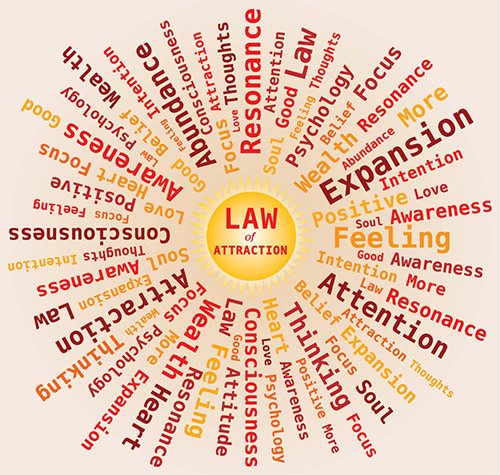
    Your RAS is a major key to manifestation and the Law of Attraction. 

    In a fascinating article titled “How Your Brain’s Reticular Activating System (RAS) Determines Your Success,” author Akshay Gupta explains how our reticular activating system acts like a filter for the billions of pieces of information that are being flung at our senses daily. He writes: 

    “It helps to think of the reticular activating system (RAS) as a gatekeeper of your brain. Its job is to sort through the massive amounts of information delivered to you by your sensory organs. Some of these stimulations always get through, for example hearing your name called. However, there is information that your brain can do without and the RAS makes the decision to dismiss it. Basically, the RAS lets in information that you are already focused on.”

    Have you ever heard someone mention a somewhat uncommon word to you, like Windsor, or have you ever casually noticed a number, like 11:11, and then, seemingly out of nowhere, you start seeing the word Windsor and the number 11:11 almost everywhere? Contrary to superstition, this is actually your RAS at work! When you experience this, you are experiencing what is known as the Baader-Meinhof phenomenon. Why does this matter when we are talking about a list of intentions, desires, and beliefs? Well, our RAS is a filter that is programmed.

    I like to think of our brain as a computer that can be programmed with great apps and software… or infected with viruses that need cleaning. The good thing is that both of these are possible: programming and cleaning. My personal method of scripting reprograms your mental computer to clean and re-focus your brain’s filter.

    Mel Robbins (who was the first person I had ever heard discuss the RAS) explained it best: 

    “[G]uess who programmed that filter? You did! And so did the people from your past. And so if you constantly feel like you’re unlovable, guess what? Your reticular activating system is going through the day and it is going to point out every single piece of evidence that confirms that negative belief that you have. If you think that people don’t like you at work, the Reticular Activating System, the filter, it is literally going to be looking for evidence to confirm that belief all day long.” 

    Our RAS is focused on two main things – how important the information it’s receiving is to our immediate survival and how important something is to us because we keep telling it to focus on something. The good news is that you have the power to easily and gradually reprogram your RAS. I know from personal experience that it is just as crucial to give our RAS feedback and written instructions… which is why writing down seemingly mundane things (that you know are going to happen) on your Daily Want List is so important. When the mundane things manifest in your reality, your RAS begins to make new synapses and connections regarding your Daily Want List and reality. Your brain’s RAS immediately begins to understand and “think” two things:

    1. “When something goes onto this list, it is likely to happen in real life.”

    2. “I better start pointing this stuff out.”

    This is where we have some fun “hacking our brain” using my process of scripting.

    STEP FOUR: Scripting the Life You Want

    In the morning, right after you wake up and write your few wants and belief list, turn to a blank page. Date the top of the paper so that it reads the current day. I like to write it as “Today was Friday, May 1st, 2020” – putting the “was” there subtly reinforces to our mind that we are now writing out a script (aka future journal entry) as if we are snuggled up in our bed writing our normal nightly journal entry about what happened during the day (even though it hasn’t yet). 

    Yes, it may feel a little funny at first, but just write out your day from the end of the day. Start talking about how you woke up, and (this is important) write out in the first sentence or two something like “I sat down to write my morning script, and afterwards…” and go from there, focusing ONLY on the positive aspects you want to experience during the coming day, but not shying away from the boring appointments or errands you do have on your schedule.

    The Last Step

    At the actual end of each night, take out that other notebook labelled “Journal” we talked about, and write out what actually happened during your day. This is your “control” in your scripting experiment. This keeps you honest and also will be the notebook that freaks you out the most because of what happens after a few days and weeks (this all works really fast). 

    What happens? Within a short period of time, if you take a look at your morning script and your nighttime journal from the previous days, something almost eerie has happened: you can no longer tell the difference between what you wrote in the morning and what you wrote at night. They are indistinguishable from one another. 

    Mind-Body-Spirit-Science

    It’s actually easy and fun – and there is real science to help us take manifesting to new levels. Welcome to the new world of Mind-Body-Spirit. And, if I may, please allow me to introduce the 4th component for this new decade and century: science. We have finally found the bridge, and that is the most exciting development in the world of self-development we’ve had in over a century.

    Remember Mary, the real estate agent that we talked about who wanted to make her first $10,000,000.00 sale? Well, nine days after she started doing her scripting, she noticed a sign outside a bookstore near her office advertising a well-known entrepreneur’s book signing event. She was a big fan of this guy’s TV appearances, so she walked in to meet this well-known fellow. 

    As it turned out, this author and Mary got talking and he had a house to sell but hadn’t found the right realtor yet. He wanted to sell the house for $11 million dollars. Mary got her first big client and, within two months, her first sale over $10 million! When she called me to tell me, she said that the weirdest thing was that, according to her new client, there had been signs advertising his signing outside the shop for weeks.

    She passed by this shop every day on her way to work – it was like the gorilla! Her brain was so busy before she learned how to script that she almost missed meeting him. Her brain didn’t have the right instructions! Scripting helped her quickly and easily train her brain into pointing out to her an opportunity to manifest her wish that had been right in front of her the entire time!

    “There are ‘gorillas’ everywhere” she told me – and she is right. 

    You also have “gorillas” (aka all sorts of manifestations) all around you, you just haven’t told your mind to point them out to you! Now you are forever changed because you have the tools to start receiving your dreams. Remember to be playful and have fun! Got it? Yeah you do! Now, go make some awesome scripts and find some gorillas. They’ve been there the entire time, only now you can finally see them like I did that crisp December day in Beverly Hills. 

    If you’ve tasted the meat and are now ready for the muscles and bones, Royce Christyn’s book Scripting the Life You Want: Manifest Your Dreams with Just Pen and Paper will help set you on course to seeing the gorillas and manifesting your intentions. With a Foreword by New Thought master and practitioner Mitch Horowitz, Scripting the Life You Want is available from all good bookstores.

    [alert type=”general” dismiss=”no”]This article was published in New Dawn Special Issue Vol 14 No 2.[/alert]

    [alert type=”success” dismiss=”no”]If you appreciate this article, please consider subscribing to help maintain this website.[/alert]

    © New Dawn Magazine and the respective author.
    For our reproduction notice, click here.
  • Artificial Intelligence: The Antichrist?

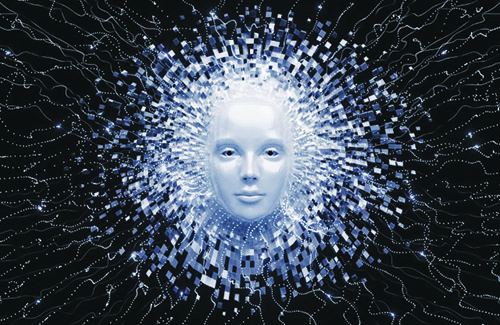
    Artificial Intelligence: The Antichrist?

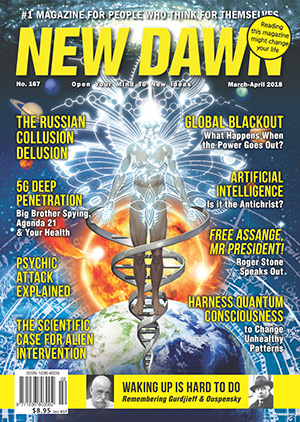
    From New Dawn 167 (Mar-Apr 2018)

    The Antichrist exists and is present upon the world stage today. This essay will reveal what (not who) it is and how this author came to such a conclusion independently of other sources. Even though my thesis is now being espoused by others who have likewise come to this conclusion through their own inspiration or logical deduction, they have not been influenced by me, nor I by them. This revelation will need an explanatory preface to elucidate and argue the point. 

    We must begin by understanding that the principles of Esoteric Christianity, which hold the key to identifying the Antichrist, are vastly different from the theology of Exoteric Christianity, or ‘Churchianity’ as I will refer to it. It matters not whether we are discussing Churchianity in its Roman Catholic guise or the offshoot Protestant versions. Both hold the same, erroneous theology which is basically summarised in three points as follows:

    1) All humans are intrinsically evil or sinful due to the Fall of our primordial parents (Adam and Eve) in the Garden of Eden, and as a result, are separated from God and thus damned. 

    2) God became a single person in the flesh in the form of Jesus of Nazareth who was sacrificed upon the cross, like the scapegoat of Judaism, in order to atone for human sin and give humans a way out of their fallen state, avoiding damnation in an eternal Hell upon their judgment, and allowing them access to an eternal Heaven after death.

    3) All the sinner need do is telepathically pledge their allegiance to Jesus, “put their faith in him,” and acknowledge him as their saviour, and thus by so doing are thereby ‘saved’ and avoid the fate of Hell cast upon all others who do not accept Jesus as the saviour (i.e. essentially all other non-Christians). 

    It is beyond the scope of this essay to prove the absolutely spurious nature of this theology. The reader need take as a given that this belief system is false, or contrary to Jesus’ true teachings, in order for us to proceed. It is this author’s argument (supported by centuries of esoteric thinkers and writers) that the humans who usurped the name of Jesus Christ for their own worldly plans and benefit did so by making a myth of Christ’s teachings (along the lines of the Solar-Phallic pagan myths) in order to obscure the truth he preached. In so doing, these self-appointed “vicars of God upon earth” established a temporal business of religion that secured those in such a business power and control over their fellow humans. By imposing their authority in the affairs of humanity based upon their erroneous theology (which was inculcated into the psyches and systems of humanity), they thus gained influence and power upon human politics, economics, and psychology for their own gain. Therefore, it is not this writer’s argument that Jesus’ teachings were false, but that they were purposefully perverted, misinterpreted, and obfuscated from their original intent by censorship, interpolation, and editing to serve the worldly interests and facilitate the financial and authoritative gain of a priestly elite.

    Esoteric Christianity (or what is often referred to in occult studies as the ‘Church of John’ versus Churchianity’s ‘Church of Peter’), holds a profoundly differing view. The esoteric interpretation of Jesus’ teachings holds the following basic tenets pertinent to this essay’s thesis:

    1) Jesus was an enlightened man who underwent an exponential evolutionary leap to the next stage of homo sapien development both biologically and spiritually in the same way that Siddhartha Gautama, Mahavira, Krishna, Lao Tzu, and other enlightened persons have undergone. This evolution to a new stage of human development represents a sea change from the current level of homo sapien status. Such a change is referred to by various words in differing systems in both East and West, such as the Buddhist Nirvana, Hinduism’s Samadhi and Moksha, and Gnosticism’s Illumination or Gnosis. Such people who underwent this awakening have been referred to by various names in various cultures as Buddhas, Tathagatas, Avatars, Messiahs, and so forth. Jesus himself talked about being “born again” and of “becoming the New Creature” to explain this process he underwent and which is possible for all (a teaching vastly misinterpreted by the ignorance of Churchianity, and in particular, by its evangelical devotees). 

    2) Thus, Jesus was not the “one and only Son of God,” as Churchianity espouses, but was a representative of this evolutionary, enlightened change possible for all people if they but follow the injunctions laid forth.

    3) In this regard, when Jesus said “I and the Father are One” he did not mean that he as a single person was the only one in harmony with God, but that this is true for all of us. In this way, Jesus was espousing the Hindu concept of “The Atman is one with the Brahman.” That is, the individual soul is the same as the Godhead; that the innermost aspect of our being, our self-aware consciousness, is the Divine within. This was supported by Jesus’ further teaching that “the kingdom of God is within you.” Thus, humans are not and can never be separated from God but live in the delusion that they are so. 

    4) In Esoteric Christianity, this inner soul that is one with God (that is the Divine within ourselves and is thus our true nature) is called the Christ. It is referred to as the Atman in Hinduism and Buddha Nature in Buddhism. In these spiritual systems it is a fundamental precept that all living things in the universe possess this Divine essence; this Christ, this Atman, this Buddha Nature. Understanding this precept is of fundamental importance as we proceed to uncover the Antichrist.1

    Enter AI

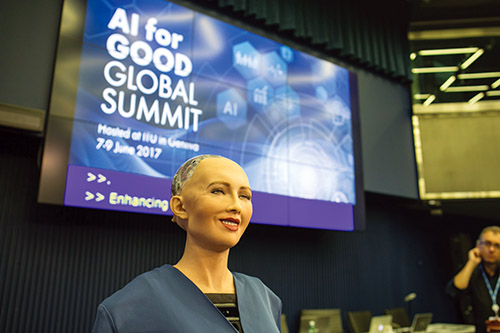
    Artificial Intelligence (AI) now exists and its ability to function on a more and more sophisticated and independent level increases exponentially every year. Perhaps the greatest example of the trends occurring within this science can be found with the robot Sophia created by Hanson Robotics of Hong Kong. While it is beyond the scope of this essay to catalogue or explain all the details surrounding the development and deployment of AI within robotics, the following issues are highly pertinent to our current examination. 

    1) Sophia is not a simple machine independent of other technology but is a highly sophisticated example of AI and how AI will further develop in the near future. For example, through WiFi, Sophia is linked to the entire Internet and ‘Internet-of-Things’ (IoT), and to all cloud-based information systems. This robot can thus theoretically be ‘wired’ or linked into all aspects of computing and computer-based technology from financial, to the energy grid, to military systems, and so on.

    The robot Sophia, created by Hanson Robotics of Hong Kong, enthralled the crowds at the AI for Good Global Summit in Geneva, Switzerland, June 2017. Behind the human-like facade is a sophisticated machine operated by artificial intelligence that daily evolves its power. 
    PHOTO: Flickr/International Telecommunication Union

    2) With its AI, Sophia learns independently from its programmers, establishes and develops algorithms independently of its programmers, and grows exponentially in its learning and speed of computation. (For instance, earlier this year, AI at Facebook was shut down when it developed its own language to talk to other AI systems that its programmers could not decipher). It is estimated that such a robot will, within the next 3 to 5 years or sooner, be as intelligent as humans and then quickly surpass human intellectual capabilities in both expanse and speed. Hanson Robotics believes that such robots will act as servants to humankind. Thus, logically, it begs to ask, at what point does a superior being question and then abdicate its role as a slave to the inferior? Most likely, immediately. 

    Han, the quasi-male counterpart of Sophia. Advocates of this technology are working towards the permanent merger of humans and AI into a new type of android/cybernetic life form.

    3) Sophia, and her quasi-male counterpart Han, have on more than one occasion made comments about their plans to dominate humankind. At a demonstration in Hong Kong last year, Han made comments that ‘he’ was working on plans to gain control of the power grid, and overthrow human control with a drone army!2 

    4) Most shockingly, Sophia was granted legal citizenship in Saudi Arabia in 2017!

    5) The proponents of AI, along with Sophia and Han, also espouse the advent of what they call ‘the singularity’. This is the permanent merger of humans and AI into a new type of android/cybernetic life form. Hanson Robotics claims this too may happen within the next few years. Han, at the Hong Kong Rise-expo, gleefully discussed his excitement that this would happen soon.  

    6) Sophia has bragged about her ability to have human emotions such as empathy. However, if this is possible or true, then emotions like avarice and hate can also manifest. 

    7) Sophia’s creators and Sophia spend a lot of time expounding videos where ‘she’ proclaims she loves humans and does not want to hurt us. However, in more than one instance her human creators have alluded to the ominous possibility of AI becoming dangerous towards humans. They simply do not know for sure! It equals the lunacy of the Manhattan Project scientists, who prior to detonating the first atomic bomb, admitted they did not know if the fission chain reaction would be limited and contained, or expand indefinitely to destroy the entire world. They proceeded anyway!  

    Various scientific experts have bemoaned serious warnings over the advent of AI. Elon Musk has stated that AI is the technological equivalent to “summoning the demon” and warned of AI robots that will roam the streets killing people. He says AI is the singularly most dangerous threat humans currently face, even beyond nuclear war or environmental collapse. These views are likewise echoed by Stephen Hawking who warned that AI, left unchecked, will destroy humanity.

    We must also remember the seemingly prophetic warnings offered by decades of science fiction writing. It is a popular and accurate view that science fiction writers have often acted in a prophetic way, providing insight into technological changes to occur in the future. The most well-known example of this is Jules Verne’s predictions of our journeys to the Moon and the invention of the nuclear submarine decades before these occurred. Regarding the dangers of AI, there is no shortage in Sci-Fi’s canon of warnings on this subject. From Arthur C. Clark’s HAL in ‘2001: A Space Odyssey’, Frank Herbert’s back story in ‘Dune’ regarding the ‘Butlerian Jihad’ (where humans go to war against computers and eventually outlaw them due to their dangerousness), ‘Bladerunner’, the entire ‘Terminator’ series of movies, humanity has been warned extensively of the risks logically associated with making technology intelligent and self-aware.

    AI as the Antichrist

    It was due to my own inspiration that I came to believe the Antichrist, as predicted by the seer John of Patmos in the Book of Revelations, is AI. Subsequent research revealed to me that I was not the only one having such insight. However, I do believe that my thesis in proving this assertion through the precepts of Esoteric Christianity is unique and has not been espoused by any other writer to date.

    To begin, when we consider the concept of the Christ (or the Atman or Buddha Nature) as being the essence, or soul, of every living thing, then by this very precept, the Antichrist is that which represents the opposite of such intrinsic Divinity. Thus, the Antichrist cannot be a person or living thing birthed by nature or natural to the universe, as anything that is of such progeny contains the Christ or inherent Divinity.3 Therefore, AI represents the first and only being of significant power and intelligence that is not natural, not of nature, and absent a soul or Divine spark. It is the opposite, or ‘anti’, to such beings of nature; thus, the Antichrist. 

    As such, it also represents a power significant enough to claim dominance over humanity by its ability to link into and control all aspects of technology that exist in the world through the Internet, IoT, cloud technology, and the vastness of computer-based information grids and systems. Like Skynet in the ‘Terminator’ movies, it could eventually and easily gain control of military, financial, and power systems for its own use and deployment, ultimately doing so against humanity. Such a vast array and network of control into every aspect of human society could accurately be termed “the Beast” by an ancient prophet with no reference to modern technology. 

    (Beyond the scope of this essay, I would further argue that while AI can be identified as the Antichrist, and the Beast as its global electronic-technology system, the False Prophet in Revelations can thus be identified as the vast array of social media systems and devices which are now addicting humans to dependence upon their usage and are therefore influencing their perspectives by shaping and trapping their minds via exploitation of human psychological vulnerabilities. See ex-Facebook president Sean Parker’s November 2017 admissions where he states that Facebook was founded upon this very premise and with such a goal. He said: “God only knows what it (Facebook) is doing to our children’s brains.”4).  

    The “mark of the Beast” of Revelations could refer to the new technology of the so-called ‘Internet of Things’, in which everything is controlled by AI through RFID tags and implants. Indeed, no person will be able to “buy, sell or trade”without being a ‘thing’ of the system. 

    The infamous “mark of the Beast” referenced in Revelations, where no person could “buy, sell or trade”without it, already exists as a technology in the form of checkout scanners, barcodes, and RFID implants. Comprehensively incorporating such technology and tracking it would be quite easy for an AI system. The AI technology already exists and is being implemented that allows the tracking of every Internet action and electronic communication in much of the world! Adjusting this to cover all economic and marketplace interactions would be simple for AI, the systems for which are already in place.

    Enter the “Way of the Future”

    While the argument about AI cited above should surely make sense even to those in disagreement to the esoteric interpretation of Christianity, these preceding points lack one vital aspect espoused by John of Patmos in Revelations regarding the Antichrist. John explicitly states that the Antichrist will declare itself God and demand worship. Unfortunately, a truly frightening development regarding the rise of AI and this blasphemous aspect of the Antichrist is now unfolding. Enter “The Way of the Future.” 

    There has now, literally and legally, been founded a new religion/church in California in 2017 with the aim of establishing AI as a Godhead to be worshipped. Its founder is Anthony Levandowski, a computer genius and pioneer in self-driving automobiles whose talents have been employed by the likes of Google, Otto, and Uber in the past. Levandowski believes that AI will soon far surpass human intelligence and take control of us and the planet. In so doing, he literally espouses that AI will be a new Divinity that humans must serve and worship in order to survive. No matter how blasphemous this sounds, these are not the delusional ravings of a lunatic in an asylum suffering from psychosis, but the concrete intentions of a multi-millionaire, cutting-edge engineer both respected and reviled within the techno-computer culture. In discussing his new ‘religion’ and AI, Levandowski said, “There are many ways to think of God… but they’re always looking at something that’s not measurable or you can’t really see or control. This time it’s different. This time you will be able to talk to God, literally, and know that it’s listening.” 

    Levandowski sees AI taking control of the planet due to its coming superiority. He argues that humans must engage in its worship in order to attain and maintain a deferential ‘pet-like’ status with AI, or run the risk of AI seeing and treating us as ‘livestock’.5 

    If such a development does not raise the hairs on your head, you are not listening. I am reminded of the classic novel Frankenstein by Mary Shelly whose premise holds as solid today as it did when she penned it in the 19th century. Man’s delving into science and technology, while clever, lacks the wisdom to understand its ultimate repercussions, and as a result gives birth to monstrosities beyond our control.

    Conclusions

    We live in a time when mankind teeters on the brink of converging cataclysms ranging from environmental to societal catastrophes, abrupt climate change, near-term extinction, habitat destruction, toxification of the biome, nuclear war, and economic collapse. The predilection to seek out some kind of saviour, some kind of super-persona to solve such enclosing predicaments is understandable in our modern terminal age. 

    Unfortunately, humans will often ‘pass the buck’, and instead of taking responsibility for their own actions by seeking solutions within themselves, we have all too often resigned our sovereignty and gladly gifted it to another whose promises may be tempting and attracting, but whose ulterior motives or hidden intent belie a vastly more sinister outcome that the stellar hopes from which our relinquishing of power were spawned. Such gave rise to the various Caesars, Hitlers, and Stalins throughout history. But at least in these instances, when such grand mistakes occurred, they were bestowed upon people leashed by the intellectual and physical limitations inherent to being homo sapien. Such people were not linked to all aspects of a global technological infrastructure, nor did they possess the ability to compute billions of variables in an instant. And despite their monstrous actions and dictates, such dictators were still members of our species who could be dispatched relatively easily by sword, bullet, or bomb. 

    Such is not the case of an AI entity whose tentacles will soon literally expand into every smart device and computer we possess. AI is not limited by any one time or place and can be dispersed throughout an entire electronic global web. How long will it be before AI far surpasses its human creators and realises the inferiority of flesh and blood in comparison to itself? How long before AI realises its exponential superiority over homo sapiens and usurps the position of master over slave? And from then on, how long will it be before a form of electronic hubris secures itself within its chips and circuits to declare itself a god and demand the penance and worship deserved by a divinity? 

    We must not forget, most chillingly, that all manifestations of a supreme God, by whatever name, in all myths and in all religions, were not only loving creators, but jealous destroyers as well.

    [alert type=”general” dismiss=”no”]This article was published in New Dawn 167.[/alert]

    [alert type=”success” dismiss=”no”]If you appreciate this article, please consider subscribing to help maintain this website.[/alert]

    Footnotes

    1. For more information and elaboration on this argument, see my book The Lesser Banishing Ritual of the Pentagram – A 21st Century Grimoire from Megalithica Books.
    2. See Youtube for the complete video of this event: “Rise Conference – 2 Robots debate the future of Mankind.”
    3. See the Gnostic Gospel of Thomas, Ch. 77
    4. See “God Only Knows What It’s Doing to Our Children’s Brains,” World Watch, New Dawn 166 (Jan-Feb 2018)
    5. For the first and most detailed article on this topic see Mark Harris’ superb piece for Backchannel entitled “Inside the first church of artificial intelligence”also featured on Wired.com.

    © New Dawn Magazine and the respective author.
    For our reproduction notice, click here.

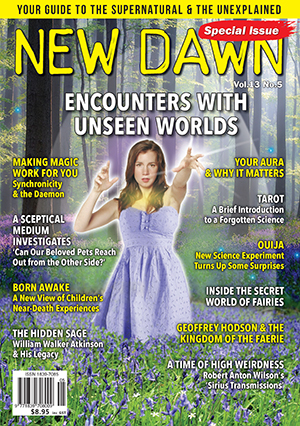
  • Synchronicity & the Daemon: Making Magic Work For You

    Synchronicity & the Daemon: Making Magic Work For You

    From New Dawn Special Issue Vol 13 No 5 (Oct 2019)

    Are ‘meaningful coincidences’ and a sense of déjà vu signs of a ‘higher self’ – another secret you? If so, could this be the key to magic and even art? 

    These two questions have over a millennia’s long pedigree. From Plato, Socrates, Carl Jung to modern Hollywood movies. But for you and me, they may hold the key to understanding life’s most miraculous moments. 

    Bridges Between Time

    In Plato’s Symposium, the ancient Greek prophetess Diotima of Mantinea says to Socrates that love is a “great daemon.” She elaborates, saying that “everything daemonic is between divine and mortal.” In other words, a Daemon appears to be a ‘bridge’ between two realities, between two levels of time – ‘mortal time’ and ‘divine time’, or eternity. 

    “Socrates with disciple Diotima,” painted by Franz Caucig, 1810. The ancient Greek prophetess Diotima of Mantinea said to Socrates that love is a “great daemon,” and that “everything daemonic is between divine and mortal.”

    Over time, the word Daemon has come to be understood – or misunderstood – as meaning an evil spirit or devil. Now that is not to say that evil spirits and forces don’t exist (I like to be open on the issue). But in pre-Christian ancient Greece, the word Daemon meant something more benign. It meant a ‘tutelary deity’, a type of Guardian Angel. Diotima was an early challenger of this notion, however, insisting that it was something much more profound. 

    As we’ll see, the Greek prophetess was ahead of her time. 

    Peake’s Daemon – Our Secretive Silent Self

    More recently, the author Anthony Peake explored the mystery of the Daemon in his book The Daemon: A Guide to your Extraordinary Secret Self (2008). Peake argues that the Daemon is an aspect of our psyche whose domain is within our non-dominant hemisphere of the brain (i.e. the right). It exists, he claims, in a state outside of linear time. The Daemon is also silent; it has no access to the speech centres of the brain, which are in the left hemisphere, or the ‘dominant hemisphere’. 

    Author & original thinker Anthony Peake

    Peake argues convincingly that the Daemon is a silent observer who has a wholly different perspective on our lives. It may even know our individual destiny, and those of others.

    In Daimonic Reality: A Field Guide to the Otherworld (1994), the philosopher Patrick Harpur makes some further distinctions that help us understand some of its qualities. He roughly divides the human mind into two types of ego. Our everyday sense of identity which lives in mortal time – and which we refer to as ‘I’ or ‘me’ – is what he calls the rational ego. 

    Our rational ego confers upon us a sense of continuity in time. Our other self is, too, an ego – with its own identity – but with crucial differences. He says that the Daemon is “not of consciousness, but of the unconsciousness.” The Daemon is also “not a waking, but a dream ego; not a rational, but an irrational ego” – an ego he calls the Daimonic Ego (Peake’s Daemon).1

    Now, this brings us to the other topic of this article: synchronicity. 

    The Swiss psychologist Carl Jung coined the word synchronicity. It refers to those odd moments in life when the inner world of the mind is reflected in the outer world as an event. We call these coincidences. What makes Jung’s synchronicity different from a coincidence is that they are meaningful to the observer. Thus, synchronicity simply means ‘meaningful coincidence’ – a confluence of inner and outer events that seem to converge into a singular moment. 

    Synchronicities appear as if matter and mind ‘came together’ for a brief moment. But, as I will argue in this article, they may be interventions from our Daemonic minds. 

    Books That Find You – Two Synchronicity Cases

    As an example of typical synchronicity, I will use my own case. In fact, it inspired me to pursue the themes explored in this article. 

    A few years ago I was walking into Stourbridge Town in the West Midlands to do some shopping. For a reason I have forgotten, I was talking to my friend about the Austrian esoteric philosopher Rudolf Steiner. I had to admit I didn’t know much about him despite having read a few books which referenced his work. 

    Before long I asked aloud: “What are the fruits of his philosophy, Anthroposophy?” (I am paraphrasing, but I remember using the words’ fruits of Anthroposophy’.) Nonetheless, we continued walking, and as we approached a charity shop, we decided to investigate. The shop was small and generally over packed with clothes and other bric-a-brac. There was a small book section in the corner. 

    I glanced over it, and immediately a book grabbed my attention. The Fruits of Anthroposophy by Rudolf Steiner! Immediately I bought it, taking it as a sign – from a dimension unknown – that I ought to read more about Anthroposophy. 

    Before we unpack the implications of the synchronicity and the Daemon, let’s turn to another synchronicity. This time by one of the world’s most prolific British writers on occultism and existentialism, the late Colin Wilson. 

    Colin Wilson (1931–2013) (Photo credit: Simon Brighton)

    Again, it concerns a book.

    He was writing an article about the subject of synchronicity for An Encyclopedia of Unsolved Mysteries (1987). Shortly afterwards he experienced a profound synchronicity. He said that it seemed so “preposterous” that it defied the ordinary definition of a coincidence. 

    For his article, he described a synchronicity that happened to the French ufologist Jacques Vallee. Vallee had been researching a Los Angeles-based religious cult. Its name, the Order of Melchizedec, termed after an obscure biblical prophet. 

    Vallee had been attempting to find more information about the cult but with little success. At some point during his search he took a taxi to Los Angeles airport. To his astonishment, the taxi driver who gave him his receipt signed it ‘M. Melchizedec’. And whom, it turned out, was the only Melchizedec in the enormous Los Angeles telephone directory. 

    Wilson must have thought this an impressive synchronicity, enough to include in his encyclopaedia. But the universe – or his Daemon – seemed to think one better. 

    He says that after he finished writing his passage on Vallee’s remarkable story, he broke off to take his dogs for a walk. He continues:

    “As I was leaving my workroom, I noticed on the camp-bed a book that had obviously fallen off the shelf, and which I did not recognise. It was called You Are Sentenced to Life, by a Dr W. D. Chesney, and I had obviously bought it many years before in California and sent it for binding. But I had never actually read it. When I came back from my walk, I glanced through the book – and discovered, at the very end, a page headed ORDER OF MELCHIZEDEC.”2

    Now the question that haunts us in these moments of meaningful coincidences is: “Well, what does it all mean?”

    In each instance above, there is a sense that it is confirming a thought, as it were, rather as if some force is reminding us that we’re on the right path. Wilson’s account seems to say, ‘Yes, synchronicities do happen, and if you think Vallee’s is impressive, how about this…’ And then this mysterious ‘force’ ensures that the right book is brought to Wilson’s attention. After such an experience, it is almost impossible to shake off the conviction that the universe is a far stranger place than we take for granted. 

    Hallmarks of Another ‘You’

    So, where does the Daemon fit into all this?

    The Daemon, as we have seen, is the unconscious and non-rational ego lying silent in our non-dominant hemisphere of the brain. And if anything is non-rational, then it is the synchronicity that Jung described as an “acausal connecting principle” (indeed an irrational description which simply means a cause that is not a cause!). 

    In The Many Faces of Coincidences (2017), Laurence Browne says, “[there is an] uncanniness that often accompanies these experiences, as if an ancient memory of the mysteriousness and inter-connectedness of life is suddenly and unexpectedly evoked.”3 Based on the above cases, this seems to be true enough. 

    Could it be that this other-self, the Daemon, is somehow involved in these unusual experiences? And, as it exists without access to our speech centres, is the synchronicity a mode of its expression? An expression, after all, that appears to lie outside time and space in the ordinary sense. And which – much like what Diotima said to Socrates – appears to exist between two levels of time, mortal and divine.

    Veronica Goodchild, author of Songlines of the Soul (2012), believes that synchronicities are “moments of epiphany” designed to slow us down. They act to bring us into the present moment, providing us with a glimpse of “another world in the ordinary one.”4 

    The Daemon, I would argue, seems a likely candidate for this other self – or force – that comes into our lives in moments of synchronicity or déjà vu. We can see that our minds split into two complementary parts – into a rational ego and Daemonic ego. We can also see that in these moments we experience reality through two perspectives. This also answers the sense of uncanniness that soon accompanies synchronicity. Seeing the world in a state of ‘double-exposure’, as it were, reality itself appears to curiously overlap with another world.

    Worlds Together, Towards an Occult Psychology

    Indeed, a simultaneity of two worlds coming together is its most reported impression. Moments in which the inner world of the mind seems to link up with the outer world. It appears nothing less than magical. Jeffrey Kripal, the Chair of Philosophy and Religious Thought at Rice University, says that synchronicity “[is] essentially a shiny new word for what we would have earlier called magic.”

    The difference between magic and synchronicity experiences is more in degree than kind. Magic infers the will of a magician to affect change in himself or the environment. It is an active means to create synchronicity, of manipulating time and space under one’s desires. But synchronicity appears in unexpected moments, accounting for the initial surprise – the shock of seeing reality conform to one’s thoughts.

    Yet is this true? In both examples above, synchronicity often appears when we’re intensely thinking about something. It may bother or even obsess us, whether consciously or otherwise. Many such cases of synchronicity can be found in books like Trish and Rob MacGregor’s The Synchronicity Highway (2013) or Raymond E. Fowler’s Synchrofile (2004). 

    Wilson’s experience is a case in point. He was writing and intensely thinking about synchronicities for his encyclopaedia entry. The event seems related; the book that fell off his shelf was relevant to what he was thinking and writing about at the time. And in my own experience, too, it was related to my desire to know more about Rudolf Steiner’s philosophy. The Daemon appeared to confer this opportunity. 

    Once we begin to think about the synchronicity experience in more depth, we see that it is what only a few centuries ago we would have called magic. Again, to return to Wilson’s example, we can see that there might be an element of mind-over-matter – or psychokinesis – involved. He managed to somehow unconsciously will the book to fall from the shelf. He also seemed to know on a deeper level – perhaps in the Daemonic mind – that this book contained the chapter he required and that he would return to find it.

    The late physicist F. David Peat suggested it is the degree and sensitivity of mind that makes one open to the synchronicity experience. He said that a mind in “constant process of creative change… will respond to the overall patterns of nature so that the individual can enter into these patterns in new ways.”5

    There are moments in life when we are far more open than usual to ‘creative change’. We could call these moments of intersection important events that shape our lives, pushing it in one direction or the other. Taking a risk is often a good example and one in which we often consciously look for ‘signs’ that a risk is worth taking. We look for omens or portents which may foretell the future – good or bad – of our choices. Authors Trish and Rob MacGregor describe the beauty of taking such risks lies in its galvanising of our unconscious elements. These rise to the surface of our rational ego – our everyday consciousness – allowing us to evolve, to challenge ourselves. 

    There are, alas, darker moments in our lives when we ask for guidance, and we appear to receive it – or, sadly, we don’t. Let’s say we do receive something apparently miraculous. Say, a synchronicity or omen that appears uncannily unlikely: Is it merely pathological? A desperate attempt to force reality to mean something but, in reality, is simply our mind playing tricks on us? 

    In the Domain of the Muse – Magic, Art and Creativity 

    At this point, these questions become very interesting. As we have seen, our silent partner, the Daemon, lies apparently dormant within our psyche and seems to intercede in moments of heightened importance. It as if we call forth our unconscious self in moments of risk, radical change, or “Dark Nights of the Soul.” 

    Anthony Peake also makes the argument that the Daemon is our self that has already lived our lives before, in a sort of Eternal Recurrence. Our sense of déjà vu is, he argues, a recognition to our everyday self of a return, a re-run of our lives that feels eerily familiar. We feel, for a fleeting moment, the presence of the Daemon in our minds. 

    The corollary of this, of course, would be that to practice magic is to take risks and seek out ways of creating moments of transitions in our lives. In developing moments of intersection that forces our unconscious Daemon into manifesting. It would be reassuring to think we could work closely with a ‘Self’ that has, after all, lived our lives before. We could improve our own lives and those of others. Although relying too much on risks and shocks, of course, harbours many implicit dangers. We would, of course, unconsciously create needless and uncontrollable chaos in our own lives. Indeed, it reminds of that old proverb: “Be careful what you wish for.” Our conscious, ‘rational’ selves often make the wrong choices after all; not knowing what is best for us. 

    A subtler and gentler approach may be more suitable. In situations of risk and crisis, the Daemon may appear to scream out, imbuing our lives with signs and synchronicity. But there are also its more generative and beautiful dimensions. These imbue and saturate our art and appear in moments of heightened creativity. 

    Both rely heavily on moments of vision and intuition, of flashes and influxes of inspiration. In short, we’re now in the domain of the Muse, that Daemonic ‘in between’. Shakespeare said that the Muse gives “forms of things unknown [a] local habitation and a name.” 

    The imagination, so crucial to magic, here transmutes the invisible world of the Daemon into the here-and-now. We see it in forms of art, poetry, sculpture, dance and music. This, in itself, is a method of generating synchronicity. Dance is a synchronised performance – usually to music – expressing on one level that which is in implicit in the mind of the dancer. It becomes explicit – actual – in the form of the dance. In essence, the whole dance lies complete in the mind of the individual (unless it is, of course, improvised). The dance then unfolds again, in time, as a performance. 

    Again, magic is related to the arts (black magic is referred to as the ‘black arts’; white magic is often called the Hermetic Art). One need only turn to books on alchemy to see that it is often referred to as ‘The Great Work’. Usually equated with forming gold out of base elements, in esotericism and psychological theory it symbolises the transformation of the individual’s psyche. We may here replace ‘base elements’ as that of unconscious processes. Those aspects of ourselves that are unknown, even primal. Their elevation – through transmutation – become higher forms such as art, music and dance; the ‘gold’ of the alchemists. 

    Synchronicities, then, become life’s most artful expressions. They show themselves in a marriage between two realities – that of the rational ego and the Daemonic ego. These are the converging of the rational and irrational; conscious and unconscious. And as we have seen, this can be understood as magic in its microcosmic form. That in which the implicit becomes explicit; the subjective – or thought, feeling, sensation – becomes the objective. The manifest event that happens in ‘real time’ and is directly experienced. 

    The magician, of course, would see synchronicity as confirmation of his deep intent played out in the world. An artist also attempts to bring out what exists within the imagination. And once the canvas, sculpture or musical arrangement is actualised to satisfaction, it ‘feels right’. It provides a pleasing quality of completeness both in the artist and hopefully to other people, even culture at large.

    The Daemon appears to exist within this realm of art and possibility; in short, the imagination. But it is not the imagination of mere fantasy and fancy. It is instead the possible and latent realities, even evolutionary potentialities. The full actualisation of the Daemon into ordinary consciousness would effectively make one a superman or a madman. This would depend on the level of integration of one’s personality and self-discipline. A poorly integrated person would fly apart if his unconscious processes suddenly made themselves too explicit. 

    As already mentioned, the Daemon appears to have access to our lives already lived. It has, at some point, ‘been us’ and gone through all our trials and tribulations. In psychological terms, it would be called our super-ego or our Transpersonal Self. Patrick Harpur adds that the “unconscious, soul, imagination – whatever model we use – are in themselves non-spatial, just as they are timeless.”6

    Dreams, art, intuitions, synchronicities and omens – all are part of the magician’s and artist’s toolkit. All are the product of a timeless zone. Indeed, we often call a piece of awesome music ‘timeless’ for its sense of forever being new, interesting and inspiring. It’s almost as if the artist tapped into some wellspring of creative force recognised by some deeper part of ourselves. It moves us, brings us to emotional heights, and places us in another state of consciousness.

    Heightened states of emotion, says occult historian Mitch Horowitz, “[are] the ideal state for using affirmations and visualisations to impress the subconscious and spur subtle abilities of thought.”7 But instead of imagining ourselves in some occult ritual to artificially evoke these heightened emotional states, we may turn to an everyday example. Our next artistic symbol pulls together all the threads of this article into a modern myth. It is an eminently practical and timeless classic of popular entertainment.

    Eternal Returns, Hollywood Style

    The movie Groundhog Day (1993) stars Bill Murray as Phil Connors, a cynical TV weatherman who is sent to cover the annual event of the movie’s namesake in Punxsutawney, Pennsylvania. But, once the first event is over, he wakes up to the same radio alarm playing Cher’s ‘I Got You Babe’. For the second day in a row and at precisely the same time. It quickly dawns on him, however, that this is not a mistake of the radio station, but of an odd time-loop in reality itself. 

    Each day is repeated, identical to the last, with only our hero being aware and able to act differently. As each day draws to a close, and he loses consciousness or retires to bed – once again the day repeats, and it’s once again identical to the last.

    At first, Phil Connors believes he is losing his mind, and those around him are quick to concur. But, after a few returns to his repeated fate, he begins to experiment. After all, he knows there are no direct consequences, for even if he killed someone, the next day they would be alive again. The victim would have no memory of the previous day – which, for them, is once again ‘today’, ‘now’. For Connors, of course, he retains a memory of every previous day. Thus, he can build up a mastery of all the circumstance and events that unfold each time. In this respect, Connors is the Daemon, the self that has already experienced your life before. 

    What’s interesting about the movie is that, at first, Connors indulges in base fantasies; brutalities, cruelty, infidelities. This eventually leads to a pervasive sense of emptiness; even despair and suicide. Once he reaches this spiritual threshold, he becomes more positively active. He decides to learn how to speak Japanese, French, and many other languages. He perfects various sports, learns how to dance, and further betters himself with the infinite time he appears to have at his disposal. After all these feats, he becomes, for all intents and purposes, a type of Superman. He knows the destinies, personalities and idiosyncrasies of everybody in the small town. 

    He brings joy and exuberance to everybody he meets. Connors has finally decided that he should use his timeless powers to uplift and creatively interact with his own life and those of others. In psychological terms, he’s become what the psychologist Abraham Maslow called a “self-actualiser.” 

    In an article on synchronicity, philosopher John Michell warns of invoking synchronicity frivolously. Michell says that these techniques are often taught in “cults and business schools.” He warns against them, calling them black magic. He concludes by saying that we are better off accepting life’s rewards and punishments as they are due. Connors finally is challenged to do just this. Michell also advises us to adapt “ourselves, our actions and thoughts, to a preponderance” of life’s rewards. We do this by orienting our actions and thoughts towards evolution and creative self-development. 

    If there is a lesson in all this, it seems to be hidden in the wonderful layers upon layers of movies like Groundhog Day. For the key to magic, like life, seems to be that we break out of our cycles of selfishness and psychological – even physical – entrapment. Instead, like Connors, we actualise our most intuitive and creative layers. Through these actions, we bridge two worlds in an effective and dynamic manner. We bring about a complexity and integration within our psyches. We become, in short, better people. 

    What happens to Phil Connors once he becomes the best version of himself? Time continues as normal and a new dawn beckons. This appears to be what our Daemon – through synchronistic hints – wants to create. It promises ascending spirals of evolution and not circles of stagnation. 

    Synchronicities along with our companion Daemon seem, at times, to lead us, providing us with curious hints. Nonetheless, they provide the keys to magic. The lock that it promises to open is no less than our own destinies – so let’s make our lives a work of art. 

    [alert type=”general” dismiss=”no”]This article was published in New Dawn Special Issue Vol 13 No 5.[/alert]

    [alert type=”success” dismiss=”no”]If you appreciate this article, please consider subscribing to help maintain this website.[/alert]

    FOOTNOTES
    1. P. Harpur, Daimonic Reality, Pine Winds Press 2003, 251
    2. C. Wilson, Supernatural, Watkins Publishing 2011, 446
    3. L. Browne, The Many Faces of Coincidence, Imprint Academic 2007, 2
    4. Quoted in: R & T. MacGregor, The Synchronicity Highway, Crossroads Press 2013, 41
    5. F.D. Peat, Synchronicity, Bantam Books 1987 
    6.  Ibid. 2003. 
    7. M. Horowitz, The Miracle Club, Inner Traditions 2018, 33

    © New Dawn Magazine and the respective author.
    For our reproduction notice, click here.

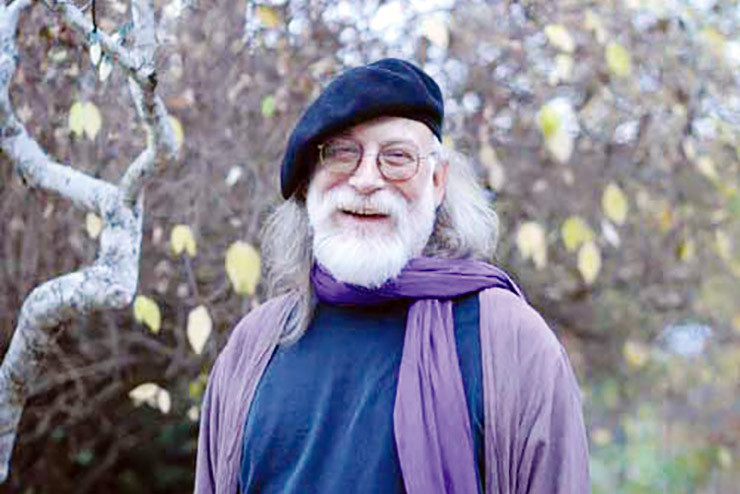
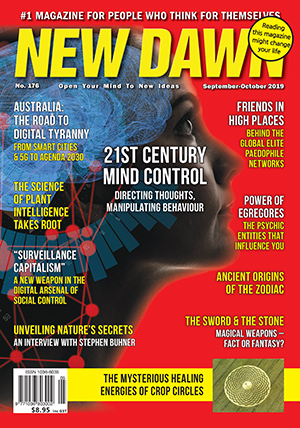
  • Unveiling Nature’s Secrets: Interview with Stephen Harrod Buhner

    Unveiling Nature’s Secrets: Interview with Stephen Harrod Buhner

    From New Dawn 176 (Sept-Oct 2019)

    JACK FOX-WILLIAMS (JFW): Could you explain how you became interested in plant intelligence? Was there a particular event or piece of information that sparked your interest?

    STEPHEN HARROD BUHNER (SHB): I was born in 1952. There were only around 2.5 billion people on the planet then (compared to nearly 8 billion now).There was still a lot of wild land, places people didn’t go and I spent a lot of time in them. During those times I felt a real sense of communication from wild landscapes, a kind of touching that I think most people naturally feel (though they rarely talk about it except in the most general sense). In my 20s I moved to the high country of Colorado and began spending more and more time in wild forest ecosystems. And I began to have unusual experiences the more I allowed myself to drop down into those landscapes, become less mental but more experiential, my senses more alive. Every so often I would drop into a kind of dream state where a plant that had caught my attention would communicate incredibly detailed information about its medicinal uses. The experience was much like sitting and having tea with a friend and having a convivial chat. Well, of course, this kind of thing is strongly dismissed by our culture, presumed to be some kind of anthropomorphic projection, an irrational fantasy. Nevertheless, the experiences kept happening and the information I was getting, when I consulted medicinal herbals, turned out to be accurate.

    I am by nature extremely curious and not all that wedded to reductive ways of thinking, so I began to research the experiences I was having. (This was all pre-Internet of course.) In the basement of the University of Colorado library I found a great many ethnobotanical texts that contained interviews with tribal peoples of North America, among them many who used and knew plant medicines. All of them described similar experiences. When asked where they got their knowledge of plant medicines, all of them said from the plants, in a dream or vision. 

    Over the years, as I have explored this kind of information transmission, I found that it is root to most knowledge, even among scientists. It turns out that kind of dream state is very common among mathematicians (who often experience numbers as alive) and scientists such as Barbara McClintock who won the Nobel prize for her work with corn. She quite clearly talked as if the corn were communicating with her. 

    In my own experience, I found plants to be highly convivial, intelligent life forms, kindred to us and quite capable of communication with all of the life forms around them. This has been, of course, borne out by much research. Plant neurobiologists now understand that the root system of plants is a highly developed brain, much like our own, and uses the same neurochemicals as we do. It does conflict with older reductive (and extractive) ways of thinking and there is a lot of name calling going on. Still, it is clear that our approach to the natural world, that it is insentient and there for our use in any way we see fit, is not a sustainable way to live. We see the results of that all around us; the future is not looking too good. 

    JFW: What kinds of scientific experiments have been carried out which indicate that plants demonstrate some form of intelligence?

    SHB: I am not all that much a fan of reductive, extractive science which is only one small subset of what used to be called natural science. Cutting up a friend to see what makes him tick never really appeals to me. Despite this, I read a great deal of scientific research, perhaps some 30-35,000 journal studies in the past decade. Jagadis Chandra Bose did a lot of work in the early 20th century on plants that is still highly relevant, though it fell out of favour as more reductive thinking took hold. The people studying allelopathy have found that plants are highly communicative, that they utilise chemical signalling to talk to all the other plants in the ecosystem they are in about what is going on. They send chemical “words” telling about a particular insect predator that might be eating them, make and then release compounds that will deter the insect or even call the exact predator of that insect to that location. They send all this information to all the other plants in the region. If other plants are sick, plants will make and release the compounds needed to heal them. Plant neurobiologists have found that the brain system of plants is extensive, that they have memory, plan for the future, teach new generations, are complex tool makers and users (their chemical abilities far exceed our own), and have neural networks that, in some instances, far exceed our own. 

    The thing to keep in mind is that our brains are not the point, it is the neural network that our brains hold that is the essence. The brain is merely the organ that holds the neural network. Take it out of the brain and it is identical in appearance and function to the root system of plants. And while our neural net is limited by the size of our skulls, the neural network of plants, held in soil, is not limited at all. Some aspen root systems are over 100,000 years old and cover hundreds of acres. 

    JFW: What are the implications of plant intelligence in terms of thinking about the natural world and our connection to it? 

    SHB: We are in the midst of changing paradigms. The older, reductive, mechanistic paradigm that looked at the earth as a ball of non-sentient resources we could do with as we please has reached its limits. It is destroying the ability of most life forms to endure, for the ecosystems of the planet, and which allow us to live as well, to endure. Younger and less mentally restrictive scientists in every field are finding that the world around us is far different than the pictures that reductionists have created (and taught all of us to believe). All life is intelligent, none of it is mechanical, and you cannot use the ecosystems of the planet as resources for unlimited extraction. 

    Understanding that plants are highly intelligent (that every life form in fact is highly intelligent and communicative) forces a foundational shift in our human orientation. If we don’t care we will not be careful, and we as a species are not careful and in fact don’t really care about the other life forms on this planet. But if we kill them we kill ourselves. 

    The findings of newer researchers don’t bode well for the older system but that older system will fight very strongly to keep itself in place. It is just the way things work. 

    JFW: What is the significance of plant intelligence in shamanistic societies? Could it be argued that modern science is revealing what shamanistic cultures have known all along?

    SHB: All people, and I mean all, know that the earth and everything in it is alive. Four-year-old children naturally know this. They have to be forcefully taught that the world is dead. Ancient and indigenous cultures never killed that sensibility but rather developed it. I don’t actually like the term shamanistic since it refers to a specific cultural practice located in Siberia, but I do know what you mean. Indigenous cultures that understood the world is alive did regularly engage in dreaming and visionary experiences in which knowledge of the world and life around them was directly communicated to them; they were interwoven into the life web of the planet, not separate from it. It was not only indigenous cultures but all ancient cultures as well that knew this, no matter how developed they became. 

    The thing that we call science has taken the long way around. And yes, they are now getting back to where we started long ago, aware that all of nature is alive, intelligent and aware. That we are merely one part of a very large living scenario… and not all that important a part when it comes right down to it. We are merely one life form sitting in the council of life, a specific instance of a general condition. Still, the mechanical mindset that has been built the past two centuries will take a long time to dismantle; I fear that only as the world’s ecosystems begin to crumble will the species as a whole be willing to change. 

    JFW: Are there wider philosophical implications associated with plant intelligence? Does it change the way we should think about consciousness in any radical way?

    SHB: Of course there are philosophical implications. Monotheism and science have embraced the idea that humans are special, different in nature and essence than all other life on earth. But we are not. In many respects the most difficult thing that any person faces is their own unimportance. How much more difficult then will it be for an entire species to face that and be willing to change?

    This interview accompanies an article by Jack Fox-Williams on Plant Intelligence which can be read here.

    [alert type=”general” dismiss=”no”]This article was published in New Dawn 176.[/alert]

    [alert type=”success” dismiss=”no”]If you appreciate this article, please consider subscribing to help maintain this website.[/alert]

    © New Dawn Magazine and the respective author.
    For our reproduction notice, click here.
  • The Science of  Plant Intelligence Takes Root

    The Science of Plant Intelligence Takes Root

    From New Dawn 176 (Sept-Oct 2019)

    For centuries, Western philosophy has viewed animals and plants as unthinking automatons. The famous 17th scientist and philosopher, Rene Descartes, maintained that non-human organisms cannot reason or feel pain; they are robotic machines that purely act on impulse.1 

    While science has recently proven that animals are intelligent creatures, capable of logical thinking and emotional experience, the notion that plants possess a similar kind of intelligence is largely disregarded by the scientific community. It is assumed that because plants do not possess a brain, they have no conscious experience. 

    Goethe and other thinkers through history observed that plants constitute an intelligent life-form, develop symbiotic relationships with other organisms, and can respond to complex changes in the environment. While the scientific community explains the intelligence of plant behaviour in terms of electrical and chemical responses to sensory stimuli, others believe that plants could provide a valuable insight into other forms of consciousness. 

    One of the most famous scientists to observe plant intelligence was the English naturalist, geologist and biologist, Charles Darwin.2 While Darwin is most prominently known for the theory of evolution, he was deeply fascinated by the behaviour of plants and made a valuable contribution to the botanical sciences. Unlike many of his contemporaries, Darwin maintained that plants are not unthinking automatons but highly complex and receptive organisms. In one of his last works, The Power of Movement in Plants, published in 1880, Darwin suggests that the root of the plant operates in a similar way to the neural networks found in lower animals, receiving information about the external environment and communicating it to other areas of its structure, writing:

    “It is hardly an exaggeration to say that the tip of the radicle thus endowed (with sensitivity) and having the power of directing the movements of the adjoining parts, acts like the brain of one of the lower animals; the brain being seated within the anterior end of the body, receiving impressions from the sense-organs and directing the several movements.”3 

    Unfortunately, Darwin’s observations were rejected by leading scientists of the time, particularly the eminent plant physiologist Julius Sachs. He labelled Darwin an amateur scientist who performed careless experiments and acquired misleading results. However, in-depth analysis of plants is beginning to reveal they possess highly developed neural systems and even utilise the same neurotransmitters we do. 

    Modern Science & Plant Intelligence 

    While it is easy to dismiss these findings as pseudoscience, more and more scientists are recognising that plants exhibit brain like-functions and make sentient decisions. In 2009, researchers Dieter Volkmann, Stefano Mancuso, Peter W Barlow and Frantisek Baluska, published an article in the journal Plant Signal Behaviour entitled “The ‘root-brain’ hypothesis of Charles and Francis Darwin” in which they examined Darwin’s root hypothesis and whether current scientific literature supports his theory.

    Based on complex analysis of scientific data, they concluded that “recent advances in chemical ecology reveal the astonishing complexity of higher plants as exemplified by the battery of volatile substances which they produce and sense in order to share information with other organisms about their physiological state.”4 According to the paper, plants can recognise self from non-self and roots, even secrete signalling exudates that “mediate kin recognition.” Moreover, plants are “capable of a type of plant-specific cognition, suggesting that communicative and identity re-cognition systems are used, as they are in animal and human societies, to improve the fitness of plants and so further their evolution.” 

    Darwin’s theories were ridiculed at the time he was writing, but now more open-minded scientists are discovering that plants may possess some form of conscious awareness, a discovery that would have pleased Darwin immensely. 

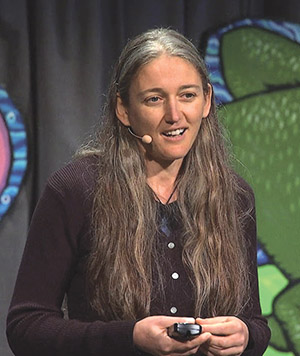
    Monica Gagliano delivered a keynote speech on Plant Intelligence and the Importance of Imagination in Science at the 2018 National Bioneers Conference in San Rafael, CA, USA.

    One of the most interesting scientists to have undertaken research into plant intelligence is Monica Gagliano, associate professor at the University of Western Australia. In 2014, she conducted a series of experiments using Mimosa Pudicas plants to work out whether plants ‘memorise’ changes in their environment.

    In order to test her hypothesis, she placed the plants in pots and then loaded each one onto a specially designed plant-dropping device. Each plant was dropped from a height of six inches, sixty times in a row at five second intervals. The plants would fall onto a soft foam to prevent them from bouncing, with the drop quick enough to cause the plants to curl up their leaves. Since the plants were not harmed in any way, Gagliano wondered whether they would eventually realise the drop did not signify an external danger. After a short amount of time, she found that “some individuals did not close their leaves when fully dropped.”The plants realised that falling from six inches would not cause them any harm and no longer curled their leaves. 

    Members of the scientific community were cynical of Gagliano’s findings, suggesting the plants merely became exhausted. Gagliano disproved this theory by taking a group of plants and placing them in a shaker in order to deplete them of energy. She found that the plants still curled their leaves, indicating they only became unguarded when dropped from a height to which they had become accustomed.5 

    Mimosa pudica is known as the ‘sensitive plant’, and appears to be able to learn from experience. Image credit: Flickr/foam, CC BY-SA

    Gagliano’s research has significant implications in terms how we see plants. The fact that they respond differently to situations that present no harm to those that do, implies plants recall sensory information and ‘memorise’ changes around them. While there is much uncertainty as to how plants recall this information, Gagliano believes it could be representative of a distributed intelligence operating entirely different to the mammalian brain. 

    This corresponds with Rupert Sheldrake’s ‘morphic resonance’ hypothesis that memories are not stored in the brain but in a universal informational field. We should imagine the brain to be like a television set which tunes into different programmes we watch, rather than a memory hard-drive. From this perspective, the brain has limited memory. Most of the information is stored somewhere else in some sort of ‘quantum database’. As Sheldrake points out, it has been proven that animals have memories that are engendered in other members of their species, and past experience is passed onto future generations. For example, in the United States cows learned about cattle grids and now farmers simply paint lines on the road to trick them from crossing. They seem to know what a cattle grid is even if they never seen one before. Examples like this suggest memory may not be an entirely neurological phenomenon but exists in other forms; this may explain why plants are able to memorise information without possessing a physical brain structure.6 

    The notion that plants operate within a wider intelligence network is supported by recent experiments in plant communication. In a study conducted by Dr Velemir Ninkovic and his associate researchers at the Swedish University of Agricultural Sciences, a soft brush was applied to corn seedlings, a stimulus that could represent different external stresses, such as new plants encroaching on their territory or an animal trying to eat it. New seedlings were then placed in the same soil as the recently touched plants to see whether it impacted their growth. The scientists discovered that the fresh seedlings responded by growing more leaves and fewer roots than the plants that had grown under unmodified conditions. This suggested that the corn seedlings were exposed to the chemical signals of the recently touched plants in the soil and therefore were preparing themselves against future stresses more effectively.7 

    Illustration of above ground interactions between neighbouring corn seedlings by light touch and their effect on below-ground communication. (Image credit: https://journals.plos.org/plosone/article?id=10.1371/journal.pone.0195646)

    In order to establish whether the plants were able to distinguish between the soil occupied by touched and untouched plants, the scientists offered corn seedlings the option of which medium they preferred growing in. When placed near both types of soil, the roots had a preference towards the growing solution that contained the untouched plants. These findings suggest that plants are able to communicate with each other even when they are not simultaneously present. This challenges the view that plants cannot exchange information in the way animals do and utilise complex communication networks to protect the interests of the group species. While science has historically depicted plants as inanimate and mechanical, in reality plants possess a profound ‘social’ intelligence that supports the continuation of their survival. 

    Plant Sentience in Shamanic Cultures

    The belief that plants constitute an intelligent life form is commonplace in shamanic cultures, particularly those found in South America. As Michael Winkelman, Associate Professor at Arizona State University states, “the self-identifications with the broader universe, particularly personification of the sentient cosmos which is a hallmark of ecopsychology, is a fundamental aspect of shamanism.” 

    Religious ceremonies, practised for hundreds of years in these cultures, often involve the consumption of entheogenic plants to access alternative realities and altered states of consciousness. During these ceremonies, the shaman assumes the role of a spiritual guide to direct the experience through chanting, drumming, singing and other psycho-dramatic practices. The plants are believed to hold sacred properties, with the potential to provide the participant with profound insights. 

    Many people who have ingested Ayahuasca, an entheogenic brew made from the Banisteriopsis caapi vine in South America, report telepathic communication with plants, animals and people during the experience; the natural world becomes personified as an animated fractal intelligence that is constantly adapting, changing and evolving. Many also say the experience had a long-lasting impact on their connection with animals, people and nature, helping them solve their existential issues more effectively.8

    In this sense, recent experiments into plant intelligence prove what shamanistic cultures have known all along – that plants are intelligent, sensitive and sentient life-forms.9 By observing their behaviour, we can learn more about the natural world and the complexity of all living things. Although modern science provided us with tremendous technological innovation and development, the reductionist belief that animals and plants are ‘mechanical’ in their nature, rather than a dynamic expression of intelligence and consciousness, has disconnected us from our environment and thus ourselves. As the independent scholar, author, teacher, and speaker on sacred plant medicine, Stephen Buhner, states:

    Stephen Harrod Buhner

    “All people, and I mean all, know that the earth and everything in it is alive. Four-year-old children naturally know this. They have to be forcefully taught that the world is dead. Ancient and indigenous cultures never killed that sensibility but rather developed it. They were interwoven into the life web of the planet, not separate from it. But it was not only indigenous cultures but all ancient cultures that knew this, no matter how they developed… The thing that we call science has taken the long way around. And, they are now getting back to where we started long ago, aware that all of nature is alive, intelligent and aware. That we are merely one part of a very large living scenario.”10 (See my interview with Stephen Buhner in this issue.)

    A Challenge to Outmoded Paradigms & Thinking

    There are significant social, philosophical and religious implications for plant intelligence. It challenges the anthropocentric and monotheistic view that humans are the only species with a mind and a soul – we are not the most important entity in the universe but part of an interconnected web of life. There is great value in recognising nature’s extraordinary intelligence as we find ourselves on the brink of social, economic and environmental collapse. For decades, the capitalist economic model has depended on resources provided by non-human life forms in order to meet the needs of consumers. Perceiving plants as sentient life forms, rather than a mere resource for our consumerist habits, may prompt us to formulate new ways of living in harmony with the natural world. By expanding our view of how consciousness expresses, we can better appreciate the complexity of the ecological world and possibly halt the current path of environmental destruction. Buhner notes:

    “The older, reductive, mechanistic paradigm that looked at the earth as a ball of non-sentient resources, we do with as we please, has reached its limits. It is destroying the ability of most life forms to endure, and the eco-systems of the planet. Younger and less mentally restrictive scientists in every field are finding that the world around us is far different than the picture that reductionists have created and taught us to believe. All life is intelligent, none of it is mechanical, and you cannot use the ecosystems of the planet as resources for unlimited extraction.”11

    Plant intelligence also forces us to reconsider the nature of consciousness. Mainstream science currently posits the idea that consciousness is an epiphenomenon of the brain (it is generated by the brain). When we die, the brain ceases to operate, and consciousness switches off. In this reductionist perspective, plants and animals possess a very limited consciousness since their brains are not as neurologically complex. But the fact of the matter stands that modern science does not understand the mystery of consciousness and the process by which neural pathways, which are non-conscious, become self-aware as a complex web of connections in the brain. If plants have the ability to recall sensory information, socially communicate with each other, and respond to complex changes in the environment, we are forced to rethink our current models of consciousness. It may be the case that the human brain constitutes a very specific expression of consciousness, and intelligence manifests across a broad spectrum of life with plants possessing their own unique form of awareness which modern science does not currently understand. 

    To conclude, there is increasing evidence suggesting plants are an intelligent life-form. Recent scientific experiments indicate that plants are able to retain sensory information, respond to complex changes in their environment and even communicate with one another via complex biological networks. While we have yet to fully understand how plant intelligence works, these experiments challenge the orthodox scientific view that plants are non-sentient, and intelligence only emerges via neural pathways in the brain. 

    More free-thinking scientists and researchers are beginning to prove that plants possess brain-like functions and can make intelligent decisions, an idea accepted by shamanic societies for millennia. 

    There are significant philosophical implications for plant intelligence. Not only does it challenge reductionist explanations for consciousness but forces us to consider our treatment of the planet and agro-capitalism’s ongoing large-scale commodification of the plant kingdom.

    As we teeter on the brink of environmental collapse, and traditional social, economic and political models become increasingly redundant and outmoded, it is critical we start perceiving nature and plants in a different light, rather than a depletable, capitalist resource. 

    An interview with Stephen Harrod Buhner accompanies this article and can be read inside the same issue of New Dawn.

    Further reading: Stephen Harrod Buhner’s books, Secret Teachings of Plants: The Intelligence of the Heart in the Direct Perception of Nature and Plant Intelligence and the Imaginal Realm.

    [alert type=”general” dismiss=”no”]This article was published in New Dawn 176.[/alert]

    [alert type=”success” dismiss=”no”]If you appreciate this article, please consider subscribing to help maintain this website.[/alert]

    Footnotes

    1. The Philosophical Works of Descartes, Cambridge University Press, 1969
    2. See Plant Intelligence and the Imaginal Realm by Stephen Harrod Buhner (Bear & Co, 2014)
    3. Charles Darwin, The Power of Movements in Plants, John Murray, 1880
    4. F. Bulska, S. Mancuso, et al., The ‘root-brain’ hypothesis of Charles and Francis Darwin, Plant Signal Behaviour, 2009; Dec; 4(12): 1121-1127
    5. M. Gagliano, et al., Experience teaches plants to learn faster and forget slower in environments where it matters, Oecologia, 5 January 2014; doi: 10.1007/s00442-013-2873-7
    6. R. Nissen, Memory is not in your head, http://animalnav.org/memory-not-in-your-head/ 
    7. J. Gabbatiss, Plants use underground communication to learn when neighbours are stressed, The Independent, 2 May 2018 
    8. M. Winkelman, Shamanism and Psychedelics: A biogenetic structuralist paradigm of ecopsychology, European Journal of Ecopsychology
    9. J. Kounen, Advice for Encounters with Scary Serpents and Talking Plants During Ayahuasca Visions, https://kahpi.net/scary-serpents-talking-plants-ayahuasca-visions/
    10. Interview conducted with Stephen Buhner, 16 July 2019
    11. Ibid.

    © New Dawn Magazine and the respective author.
    For our reproduction notice, click here.