New Dawn – World's Most Unusual Magazine

Category: Articles

  • The Return of the Elder Race & Opening the Gateway of the Fifth Kingdom

    The Return of the Elder Race & Opening the Gateway of the Fifth Kingdom

    René Guénon’s assertion, culled from ancient esoteric sources, that in the remote past humanity’s first civilisation arose in the ice-free Arctic zone is not without geological support. According to the well-known researcher J.S. Gordon, “there is no scientific doubt that the polar ice caps have melted and reformed many, many times over and that this has always affected human society (plus animal and plant species), often catastrophically.”1 

    He points out that the great Ice Age that lasted about two million years, ending about twelve thousand years ago, was made up of thirty or so minor Ice Ages, with warm intervals of polar deglaciation in between them, each creating periods of thousands of years of temperate conditions at the poles. Any one of these warm intervals would have been hospitable to a circumpolar civilisation.

    Charles Hapgood, who in the mid-sixties was the Professor of the History of Science at Keene University in New Hampshire, USA, became convinced that humanity did indeed enjoy a sophisticated civilisation a hundred thousand years or more ago, and that it must have been at least partly in a polar location. He derived his theory from cartographic research conducted on ancient portolans or seafaring maps, one of which had been in the possession of a l6th-century Turkish admiral, Piri Re’is.2

    “This map (and others also researched),” Gordon comments, summarising Hapgood’s conclusions, “clearly showed… that the polar regions had been cartographically surveyed when no ice cap existed,”3 and that in the case of the Antarctic Circle, rivers and mountains had been mapped in such detail that the land must have been inhabited – and by a people who understood spherical trigonometry.

    Other researchers, sifting and re-examining existing archaeological data from the past 150 years, have concluded from the evidence of human artefacts and fossil bones found under deep geological layers that anatomically modern humans with a modern intellectual capacity have existed from the beginning of the Quaternary period, some 1.65 million years ago – and that they were taller than modern man and with a brain capacity 15 – 20 per cent larger. Such findings reinforce the growing opinion of many people today that Hapgood’s theory, initially rejected by scientists of the day, has serious merit.

    In The Secret Doctrine, Helena Blavatsky said that in primeval times the earth had still not densified fully and was therefore larger than at present. All body forms would have been considerably lighter in weight and of a more plastic nature, the skeleton still not having hardened by then; and accordingly human beings could have been less affected by gravity and as much as sixty feet or more taller than they are today. She believed that over vast ages there have been several violent changes in earth’s climatic conditions, with corresponding diminutions of human stature, accompanied by many variations in human civilisation and culture.4

    Mainstream science has no real conception of how long modern homo sapiens has been in existence, or under what physical conditions, but certainly archaeologists are aware that homo sapiens skulls of an entirely modern type have been found that are over a hundred thousand years old. Swanscombe man from England is a quarter of a million years old, while Vertesszollos man from Hungary, equally modern in type, dates to an amazing four hundred thousand to seven hundred thousand years old.5 Such dates leave ample room in our human record for many modifications of climate and variations in the physical stature, cultural development and living conditions of human beings.

    The Hebrew Bible tells us:

    There were giants in the earth in those days; and also after that, when the Sons of God came in unto the daughters of men, and they bare children to them, the same became mighty men which were of old, men of renown. (Genesis 6:4)

    The information given in the Book of Genesis regarding the Sons of God, the giant-sized Elders who once lived on earth – “mighty men of old, men of renown” – was derived by Hebrew scribes from the scriptures of older surrounding races, such as the Indian Vedic texts, the Vedas and Puranas, and the Sumerian Epic of Gilgamesh.

    In the Sumerian illustrations of the doings of the gods it can readily be seen that the relative height of the Elders and ordinary humans was that of adult and child: in one such instance, a god is holding a human on his lap as though nursing an infant. The Egyptians also created statues of god-kings of enormous height juxtaposed to little figures of normal human stature; and while these statements in stone may have been intended symbolically, the alternative possibility exists that an entirely realistic rendition was intended, as more than one researcher has suggested.

    Helena Blavatsky, for example, contended that not only were the polar regions the cradle of humanity millions of years ago, but that due to a decrease of velocity in the Earth’s rotation conditions at the poles changed, and the size and weight of all the organisms living there was accordingly modified.

    The axle of the Wheel tilted… People [for the first time] knew snow, ice and frost, and men, plants and animals were dwarfed in their growth. Those that did not perish remained as half-grown babes in size and intellect. 6

    The other outstanding characteristic imputed to the Elders, whom Blavatsky called the Kumaras, was their huge skulls. Although there is less evidence in the ancient texts to support this legend, it is an astonishing fact that several such enormous skulls, relative to the size of the face, have been unearthed in Peru: one is on display in the museum in Lima.7 According to reports, others of similar immensity have been found in and around Egypt and Tibet, suggesting a correspondingly massive intelligence.8

    Furthermore, carved busts of the family members belonging to the Egyptian pharaoh Akhenaton of the eighteenth dynasty demonstrate the same anomalous feature, including equally huge ears. Found in the underground desert ruins of Tel el Amarna in Egypt, little known statues of this strange family, which included Nefertiti, Akhenaton’s wife, and their daughters, exhibit other unusual features, including great body height. The body of a statue of Nefertiti is described below:

    She’s not wearing clothes because they didn’t believe in that at the time. She has a huge head, large ears, a long, skinny neck and a high waist. She also has a kind of bulging tummy. And… she has skinny legs and wide thighs.9

    This in fact is an equally good description of her husband’s famously strange appearance. The carved or painted likenesses of Nefertiti’s daughters, down to the youngest, a mere toddler, show exactly the same peculiar characteristics of enormous hairless skulls, high waists, skinny calves and huge ears.

    Could this Egyptian royal family, then, have been a throwback to the ancestral offspring of the Elders? And more pertinently, could its anomalous physical features support the idea of an intellectually advanced race alien to ours, either from another stellar system or a previous racial cycle?

    These Elders, also known as the beni ha-elohim, the Sons of God or Sons of the Fire Mist whom the Sumerians claimed had brought civilisation to humanity, are a perennial mystery. G.I. Gurdjieff regarded them as palaeolithic shaman adepts, men and women who in the remote past practised their mysteries in the underground caves along the Syr Darya, in Central Asia, and whose evolution due to their superior spiritual practices put them far in advance of their fellows.10

    But occult tradition goes a great deal further, contending the Elders were a wise and powerful race that came from the stars – possibly, say some, from the giant star Sirius. In the ancient Egyptian tradition they are called the “Watchers of Pe,” divine Intelligences who watch over and guide humanity, their progeny, from celestial heights. Alternatively, could they have been, as the noted Theosophist G. de Purucker suggests, the left-over remnant of an earlier human race that had incarnated on Earth but had originally come from the Pleiades system, and which had ended its racial cycle perhaps millions of years ago?

    Until recently such questions about the Elders could not profitably be asked except in the context of a closed initiatory society. Even stranger, until recently the rest of the world was not even aware that such questions entailed proscribed temple material that had been forbidden to the outside world for thousands of years. As already mentioned in the first part of this article (see New Dawn No. 112, January-February 2009), René Guénon, one of the foremost esotericists of the late nineteenth and early twentieth centuries, struggled as far as he dared against this occult embargo, believing that the time was fast approaching when humanity would be in need of a higher level of anthropological, cosmological and metaphysical understanding than was possible in his day.

    “This study,” he wrote, concerning the advanced Elder race that, according to Theosophical lore, had migrated from the Arctic zone to Central Asia many hundreds of thousands or perhaps millions of years ago, “has gone deeper than any preceding it, inviting reproach, perhaps, from some. We do, however, believe we have not said too much, nor anything that should not be disclosed…”11 Yet much knowledge regarded as too arcane or too dangerous for the profane populace would, Guénon was convinced, soon have to be released into the public domain. And it would seem he was right.

    A new order is dawning in this post-millennial era in which a great deal of the once proscribed sacred knowledge is being made available to all. Among many of yesterday’s underground secrets now freely emerging into the light of day are the secrets of human evolution and its tandem relationship to the evolution of earth and cosmos. These secrets have a direct relevance to the mysterious Elders, gods whom they suggest are actually human beings and members of a fifth kingdom in Nature.

    Thus the removal of the occult embargo, allied to an explosion of new scientific discoveries and hypotheses, is making it possible to approach the subject in an entirely new way.
    [alert type=”info” dismiss=”no”]If you appreciate this article, please consider a subscription to New Dawn magazine.[/alert]

    The Fifth Kingdom

    The medieval classification of Nature into four universal kingdoms, mineral, vegetable, animal and human, has been rendered obsolete by modern science, which has inductively evolved its own hierarchical system of subatomic particles, atoms and molecules before the mineral, and combined the animal and human in one category. Nevertheless, the old system of four kingdoms, based on an intuitive deductive vision of the truth and seen as an example of the Perennial Philosophy, is still entrenched in most of the Western esoteric schools that have emerged since medieval times: Theosophy, Anthroposophy, Rosicrucianism, modern Sufism, various New Age channellings, the Sri Aurobindo school and others.

    Four-kingdom proponents from these schools see the progression in Nature as a succession from inert mineral to the plant, that is alive but not apparently conscious, to the animal that has a limited reasoning power but is not self-aware, and to the human being who alone has self-awareness and conscious free will. To these four definitive classifications a fifth is occasionally added by medieval philosophers under variously named, rather obscure and even misleading headings; but whatever the designation, in esoteric circles any natural classification beyond the fourth is either nonexistent or only vaguely delineated, lacking the emphasis or clarity it requires.

    The ancient Egyptians made the matter a great deal clearer. They understood the goal of human evolution to be a transition or resurrection into a higher state, a higher natural kingdom, and illustrated the transition with admirable precision on the ceilings of certain very old tombs.12 In their depiction of the neters or gods undergoing spiritual resurrection, they show a row of animal-headed human figures marching along a horizontal base line, a red oval – the “egg of metamorphosis” – above each head, until suddenly the base line turns by 90 degrees to the vertical and one figure swings into ascension along it. Achieving what may be a rapid biological change into a new life form, he transforms into the royal fifth kingdom. Armed with what appears to be the staff of spiritual authority and lacking the oval over his head, which has presumably been absorbed into his being, he has metamorphosed into a king.13 In other words, from being a collective being of a lower order, he has become a royal singularity, a ruler of all kingdoms lower than the fifth.

    Ancient petroglyphs of sun-headed men found in various parts of the world, but especially in Central Asia, tell the same story.

    Because of the occult secrecy that has enshrouded the subject of the fifth kingdom over the past 2,000 years at least, we have failed to understand its crucial significance as our true evolutionary goal and our key to all those questions we have never been able to answer. The inclusion of a fifth kingdom in the natural order turns the fourth kingdom that we humans presently inhabit into a mere corridor of becoming, a transitional episode in which we are driven forward in a process of transformation from the animal state behind us to that of the true human ahead, as indeed Gautama Buddha recognised. Life, human life, he said, is never-ending change and the suffering of change – and indeed it is viewed as a journey of relentless development of intelligence and consciousness into the truly human kingdom, the fifth, wherein alone lies repose well earned.

    The idea of a potential fifth kingdom, a state of spiritual felicity and repose we may hope to enjoy some time in the future, is not new to us. But what the ancient mystery temples through to modern esoteric teachers like Guénon have been reluctant to disclose is that the fifth kingdom is not a future potential but a presently existing reality, a supremely enlightened human state coexisting with our own. Like the other four kingdoms of nature, it has extended and always will extend back into the illimitable past and forward into an equally illimitable future, with its own archetypal place in the cosmos.

    Indeed, it is esoterically acknowledged that beyond the fifth kingdom others also exist. Gordon speaks of the fourth, fifth, sixth and even the seventh kingdom of our planetary Nature. “All of these kingdoms exist together (even if we are unaware of the fact),” he says, “and all of them together comprise the evolving nature of Man. Hence humankind is but one partial expression of Man in general.”14 Given such a perspective, many possibilities open up that were not previously viable in our worldview.

    According to this perspective, the Elders of Akkadian-Sumerian legend and the gods of the Babylonians and the Assyrians were the higher-level final flowering of a previous human cycle many millions of years old, their privilege being to guide the evolution of the next cycle – our own. Freed by their advanced development from the limiting conditions of transitional fourth-level humanity, the universe was open to them, for fifth-kingdom space-time is said to possess multiple dimensions incomprehensible and inaccessible to the lower kingdoms. These so-called gods could travel between the stars on supramundane energy currents unknown to us, incarnating on other stellar bodies or on planet Earth as the need arose, and withdrawing as they chose into dimensions invisible to their charges on Earth.

    In the above scenario, not only is our past implicated in this new perspective; our future is equally involved. As we ascend with increasing rapidity into higher states of consciousness and hence into proximity with the fifth kingdom, we are finding the Elders in their various otherworld guises descending to meet us. As a part of the great human order, they are our future as well as our past. We shall find in fact that humanity is at home everywhere in the universe and its life has no beginning and no ending; it is co-eternal with the cosmos.

    Therefore, perhaps, it is time we gathered together all our ideas of aliens, extraterrestrials, Sirian cosmonauts and angelic visitors and categorise them all as members of our own human species who, along with their advanced technologies, have arrived in the fifth kingdom before us – our own kin already established in majesty and power; already, like the Egyptian priest-kings of old, free to traverse the cosmic pathways at will as the Sons of God – the lords of the universe.

    According to the Solar teachings of the ancient Pillar religion, the royal road to the fifth kingdom lies in an ascension up the World Tree, through its successive gateways, to the starry heavens. Kingly authority and the power to rule wisely rests on the royal initiate’s ability to ascend the axis mundi or World Tree to the divine centre of creation at the zenith of the heavens. There, and only there, he will find deification; there he will be able to access the heavenly powers from which all impulses of rulership, creativity and wisdom emanate; there he will find the freedom of the spiritual world.

    This idea of returning home to the stars is implicit in all the tribal totem systems found in early shamanic societies around the world, but was more fully realised in its religious form when the idea of kingship – of hierarchical rule from above – seized neolithic societies at the end of the last Ice Age. John Major Jenkins, a leading researcher of ancient cosmology, says:

    Sacred knowledge is won or achieved by undertaking visionary journeys up the World Axis to the cosmic centre. A ruler, having thus become fused with the divine source and emanating power of life and wisdom, constellates the beings and objects of lesser degrees.15

    Such a monarch stands as far more than an exemplary figurehead or an administrative symbol at the heart of his kingdom; he has become, by virtue of his conquest of the World Tree, a way-shower into a new order of being for the whole of his society. In the same way, so Jenkins believes, at certain critical junctures of the Earth’s history, this odyssey of transformation up the cosmic Pillar to the divine Centre at the zenith is possible for the race as a whole, which thereby advances further towards its next evolutionary goal – the supernal kingdom, the fifth.

    Revisiting the Pillar Religion

    The secret teachings of the very earliest sages of which we have cognisance claimed that all life, all wisdom and creative power is transmitted to the earth plane via a spiritual energy flowing down from the highest Source, and that it is by reascending the sacred current, symbolised as a Pillar or a World Tree connecting earth to heaven, that humanity comes to its most sublime perfection.

    A traditional symbol of this occult energy stream has been retained in the Qabalistic Tree of Life defined astrologically.The well-known British author Trevor Ravenscroft likens the Tree of Life to “the Yggdrasil tree of Norse mythology, the world-Ash which binds together heaven, earth and hell.” The crown of the tree, he says, “comprises the twelve constellations of the Zodiac, the spiralling branches symbolise the planets and the roots of the trunk dig deeply into the elements of the earth.”16 The Tree is thus a metaphor for the archetypal processes of the cosmos that are believed to underlie all evolutionary activity.

    From the earliest times, the World Tree was central to the shamanism of the nomadic tribes of the Central Asian steppes, as it was to the later Solar religion of the settled Aryan communities of that region. Indeed, if we are to believe Plato, in the days before the Great Flood and the sinking of Atlantis, the World Tree featured also in the primeval Atlantean religion with its monarchic system, its warlike bull cult and its concentric city planning; and according to Blavatsky, it was this Solar system that was eventually transplanted by great migrations into Central Asia.

    From west to east and from north to south, then, the Pillar religion in its various guises appears to have reigned universally as the earth’s primordial belief-system, the destiny of man being seen as the ultimate return of his soul via the World Tree to the power-realms of the stars.

    Where then on the planet is this World Tree that the Hebrews called Jacob’s Ladder? Although it would be natural to assume it is synonymous with the earth’s north-south axis of rotation, such is not the case. According to Guénon, there have been several successive locations of the World Axis on the surface of the globe that distinguish it from either the north-south axis of rotation or the magnetic axis. Opening up the secret metaphysical tradition, he asserts that basically nothing less than a new model of the world is needed if we are to understand the true nature of the World Axis.

    The esoteric reality, expressed long ago in the Pillar teachings, is that the earth incorporates a principle that connects it at all times to a greater spiritual world in the same way that a mirrored reflection is intrinsically connected to the reality. By virtue of this fact, the earth is multi-dimensional in structure – as indeed the physicist David Bohm has proposed in his theory of an implicate universal order lying behind the explicate physical order as its energetic template – and this radically modifies everything we can say about the planet, in the way we measure and describe it.

    The Pillar religion projected a worldview very different from our own. The planet was regarded as a living organism with its own hierarchy of elemental intelligences, plus a hierarchy of solar intelligences or devas, at work in the manifold organisation and running of the whole, and which we call today the work of Nature. The World Tree, in India known as Mt. Meru, was believed to be at the very heart of this great dynamic complex, a channel of evolutionary energy running through the centre of the planet, a path of psychospiritual transformation of the same order as the seven-fold spinal path of consciousness running through the human body.

    In fact, the name Meru is connected to the Sanskrit word merudanda, meaning a backbone, and hence the World Tree can be further qualified as the backbone of the planet, a chakric system analogous to that of the human spinal system, with seven or nine nodes of increasing psychospiritual awareness culminating in the Cosmic Centre at the summit. These nodes were clairvoyantly perceived as a succession of gateways up the trunk of the Tree leading into higher planes of existence, and the final entrance to the Cosmic Centre was therefore called the North Gate.

    Guénon’s Neoplatonic thesis contains the concept of a universal ether, renamed “the quantum fluid” by modern science, and states that behind the physical body of the earth lies its spiritual template, a permanent prephysical or etheric web of forces delineating the planetary structure in its essential form. In this inner light body – or, as Vedic cosmology calls it, the vajra body – is located the World Axis, the etheric source and intelligent regulator of all the energies of the planet. At the beginning of each great temporal cycle – and by that Guénon means at the very least one round of the Zodiac, one Sidereal Year of 25,920 years – the two bodies are in virtually perfect alignment, but as the cycle proceeds a separation occurs and the physical body falls increasingly out of alignment with its spiritual template.

    This non-alignment or tilting away of the planetary body from its inner template is the result of their differentiation from each other, which has the effect of creating all the earthly stresses and vicissitudes of time and change that we know so well, yet is the necessary precondition for evolutionary growth. From this circumstance comes all the suffering of becoming, all the so-called evils of our earthly existence.

    In such a spiritual cosmology the universe is the expression of a great Intelligence within which are the unchanging ideas or templates of form, the whole being in a state of ideal harmony and order. But although the spiritual world of pure Being is changeless, the natural state of its reflection, holographically projected onto a lower plane and thus an object of differentiation, is to become off-centre in relation to it and therefore in perpetual compensatory motion. This is the biblical “fall” of mankind without which there would be no evolutionary process. With the separating out of the physical plane, motion is created and the suffering of change begins; for the process of increasing differentiation of the physical body from its spiritual background inflicts on the planet and all its life-forms a local disturbance, the angst of movement, of disequilibrium, of continual adjustment to new conditions and new evolutionary demands – but also to the possibility of attaining a greater state of being.

    We can sum up this occult cosmology thus: At the beginning of the great precessional cycles, the north-south axis and the magnetic axis are in virtually perfect alignment with the World Axis and with each other. All three stand at that time apparently united at true North, so that the supreme spiritual centre is in a literally polar location; but as the cycles proceed, the poles fall progressively out of alignment with the World Axis and terrestrial changes develop. Today this mysterious noumenon known variously as the Sampo, the axis mundi and the Tree of Life has apparently shifted southward. Clairvoyantly visible, it has its locale in the Inner Asian region delineated by the Tarim Basin and its surrounding ring of great mountain ranges.

    Within the boundaries of this vast mountain encirclement, the World Axis is believed to have varied its location from time to time. But wherever it is found, it always remains functionally polar; it is always the central origin point – or as ancient peoples called it, the omphalos of the planet, the place of the first creation – from whence grand waves of acculturation have periodically issued.

    In Galactic Alignment Jenkins presents a similar cosmological picture. He calls the World Axis the evolutionary axis, by implication a third terrestrial axis presently unknown to science. Psychically accessible, this great current of psychospiritual conscious energy that runs through the centre of the earth is thought today to emerge somewhere north of Kashmir, soaring high into interstellar space above the Pamirs.17 It is in that vicinity, at the foot of the World Tree, that the peoples of Central Asia have traditionally located the hidden kingdom of the Elders known as Shambhala, an initiatory centre accessible on both a physical, an etheric and an astral plane.

    The North Gate, Jenkins contends, can be viewed as analogous at a cosmic level to the pineal gland in the human system, which is the most interior and creative centre in man and “the point from which spiritual gifts are given.”18 He sees the Cosmic Centre at the head of the World Axis as fulfilling the same function in a planetary context. However, while René Guénon has postulated a major polar-to-solar shift of the Cosmic Centre in man’s worship at some remote time in antiquity, Jenkins has argued that this shift would be better understood as a polar-to-galactic one.

    Thousands of years ago, he says, priest-astronomers realised that approximately every 6,450 years the North Gate was aligned with the galactic centre, and that such times offered a priceless evolutionary opportunity for the whole race. It is an astronomical fact, says Jenkins,

    that alignments of the solstices and equinoxes with the plane of our Milky Way galaxy occur periodically over the 26,000-year precession cycle. Such alignments, in fact, occur every 6,450 years. Joseph Campbell pointed out that knowledge of the precessional cycle is implied by the importance given the number 25,920 in Hindu, Nordic and Babylonian doctrines.19

    Jenkins equates the spiritual evolution of humanity with this periodic alignment of the Earth with the galactic plane and the Galactic Centre. The idea that the latter stimulates consciousness on this planet is, he says, “an intriguing and profound concept” that finds echoes in Mayan, Vedic and Egyptian cosmology. Gordon too observes that the earth is subject to celestial seasons of about 6,480 years, “which have a dramatic effect upon both the climate… and also upon the many and varied cultures and civilisations which exist at the time.”20

    The Tree is thus regarded as a planetary chakric system analogous to that of the individual tantrica in the practice of kundalini yoga. Even as the yogic consciousness ascends the spinal system, so activating a sequence of seven hierarchically ordered chakras or psychospiritual energy vortices which alter in subtle ways the entire spectrum of consciousness, so the ascension of the racial soul up the World Tree at certain precessional intervals of c.6,450 (or c.6,480) years corresponds with the opening up of a succession of celestial gateways for humanity as a whole.

    At each open gateway the flooding down of divine creative energies precipitates certain psychological and cultural modifications in society; the human body typology changes; new deities, new mores appear; the material technology advances or changes its base, a new world-civilisation is launched founded on newly imperative truths. It is a moment of supreme evolutionary importance, a collective initiation perhaps best conveyed by the teachings of the Mithraic mystery religion.

    This important Greco-Roman cult flourished until the fourth century CE, when it was extinguished by Christianity. Seven planetary spheres were opened up to the seeker through the seven grades of Mithraic initiation, allowing him ultimately to ascend to the highest, the Father (Saturn). However, beyond the seventh level was a secret teaching revealing an eighth and ninth level or “house” where the Hypercosmic Sun was located. This hypercosmic luminary, this “Star of Stars” as the first century philosopher Philo Judaeus of Alexandria called it, was identified with the Galactic Centre, to which access was gained only through the eighth and ninth celestial “doorway” above that of Saturn.21 This secret means of escape from Earth’s gravity into the freedom of the Universe has been closely guarded by occult tradition and is still not fully unveiled.

    The doctrine of the Hypercosmic Sun, according to Jenkins, is “fundamentally about the soul’s passage through the galactic gateways that open during eras of galactic alignment,” when the divine light of the Milky Way Centre pours down through the opened valves of the World Axis and irradiates the earth and all its inhabitants for a certain interval of time. It is in that critical interval that the great evolutionary mutations take place, civilisations are overthrown and reinstated in radically new forms and the potential exists for the fifth kingdom to be realised by at least some members of fourth-kingdom humanity.

    Jenkins is only one of countless observers who believe such a historic time has once again come around. Indeed, by now millions of people are watching and waiting for the end-of-the-world Mayan date of 2012 CE, believing it to be the beginning of a new World Age… a further stage in the journey towards the fifth kingdom.

    Eurasia Awakes

    In February of 1962 astrological pundits announced a major planetary conjunction that occurs only once in every c.6,500 (or 6,480) years – the previous one therefore having taken place in c.4500 BCE, and the one before that in c.11000 BCE, both of which occasions were prophetic of great earth changes.22 I remember well the report in the media, because immediately a cry of distress and foreboding went up right across India; for it was known by most Hindu astrologers that this rare stellar event, occurring only four times in the precessional cycle of 26,000 years, does indeed foreshadow great floods and catastrophic climatic changes.

    In response, the dawning New Age movement of the time predicted the return of the Elder race, the possibility of a pole shift, the birth of a new race of clairvoyants. To esotericists generally the conjunction signified a new World Age and an impending psychospiritual initiation of collective humanity, with all the social and ideological turmoil such an event implied. And confirming John Major Jenkins’ later theory to the hilt, the conjunction was seen by some star-gazers as the first sign of a coming revolution in geopolitical world affairs, with the rise of Asia and the decline of the western Anglo-American hegemony.

    At the time all these predictions were regarded as amazing and pretty farfetched. But nearly fifty years on, the events presaged in 1962 are now crystallising as post-millennial realities. Ominously, the ice caps and glaciers are melting, the seas rising, earth’s resources shrinking; the Anglo-American world order, built on predatory economic corporations, is unravelling, Asiatic power inexorably rising. A transformation in human consciousness is well underway; and there is increasing evidence that the vast natural, socio-political and consciousness changes we are seeing are now irreversible, for good or ill.

    Perhaps the most significant sign of the times is to be found in the growing vision of a unified Eurasia among the major Asian nations such as China, Mongolia, India, Iran (and also Brazil), as well as Kazakhstan and many other of the Central Asian Muslim states. Included in this growing Eastern bloc is Russia which, since the collapse of the Soviet regime, is increasingly turning away from Western Europe and towards Asia in its quest for identity. Geographically the largest nation on the earth, it extends right across northern Asia from Eastern Europe to the Bering Sea.

    Russia is rediscovering its Slavic roots; and especially since the discovery of Arkaim and the Land of Cities in the southern Urals, it is also exploring its Aryan past and its more recent connections to the Mongol Empire of Genghis Khan, who subjugated the whole of the Eurasian corridor as far as eastern Europe in the thirteenth century. Indeed, for many of Russia’s intellectuals the universal tolerance and freedom from dogma of the ancient Pillar religion of the Mongol/Turkic peoples has great valence and is displacing Christianity and Islam in the popular esteem. “Out of Russia,” says Alice Bailey, channelling the prophecies of her Tibetan guru, DK, “will emerge the new and magical religion about which I have so often told you.”23

    There have been a number of famous prophecies regarding Russia’s future pivotal role in world affairs generally, notably those of Rudolf Steiner and Edgar Cayce, as well as those of Gerard Encausse, the highly respected French occult master who went under the pseudonym of Papus (1865 – 1916). The author Mehmet Sabeheddin notes that “Papus knew of the key role to be played by Russia in unifying Eurasia and her occult destiny as the Empire of the End, the outward manifestation of the enigmatic power of ‘Northern Shambhala’.”24 Many others have seen Russia as destined to continue the work of Genghis Khan, who transformed the nomad tribal conglomerates of the Eurasian steppes into a unified and superbly organised political system that revolutionised international life for centuries to come.

    Across the steppes, where for countless centuries a melting pot of peoples, religions and empires from every quarter have traded and warred and sunk with their cities beneath the desert sands, a spirit of renaissance, of ecumenical reform, is undoubtedly taking hold. From the Far East to Moscow and from the Altai to Iran, a countervailing force, identifiable with the invisible spiritual powerhouse of Shambhala, is stirring throughout the region. Muslim, Buddhist, Zoroastrian, Christian, Jew, Taoist and shaman are finding common ground in a unitive vision of the future. Responding to the militaristic Anglo-American colonisation that has long dominated the Asian hemisphere, this new regional climate bodes well for the rebalancing of the globe’s spiritual, cultural and economic forces.

    The move to turn the tenuous Eurasian concept into a geopolitical reality composed of numerous independent but strongly affiliated nations committed to East-West amity must be regarded as a force for renewal, for the healing of the Atlantean/Hyperborean rupture that long ago shattered the primal unity of the life of the planet. The present thrust seeks instead to recapture the unity of the ancient Arctic accord and to set forth new terms for a viable future for humankind.

    What is truly remarkable is that we are witnessing all this happening in Central Asia at the very time of great astrological significance, when the stars again portend extreme danger and extreme opportunity for the life of Earth. Are we then seeing once again a mysterious intervention from the East, a salvific influence arising in the heart of Asia that seeks to sow the seeds of a new global order and a new type of civilisation in the face of apocalyptic geophysical change? Can the Elder race be coming to our aid yet again?
    [alert type=”general” dismiss=”no”]This article was published in New Dawn 113.[/alert]

    [alert type=”success” dismiss=”no”]If you appreciate this article, please consider subscribing to help maintain this website.[/alert]

    Footnotes:

    1. J.S. Gordon, The Rise and Fall of Atlantis, and the Mysterious Origins of Human Civilization, Watkins Publishing, London, 2008, 131.

    2. Charles Hapgood, Maps of the Ancient Sea Kings, Turnstone Press, London, 1979.

    3. Gordon, op. cit., 131.

    4. Ibid., 159.

    5. William Fix, Lake of Memory Rising, Council Oaks Books, LLC, San Francisco, 2000, 203.

    6. H.P. Blavatsky, The Secret Doctrine, Vol. 2., Theosophical Publishing House, Los Angeles, 1947, 324.

    7. Drunvalo Melchizedek, The Ancient Secret of the Flower of Life, Light Technology Publishing House, Flagstaff, AZ, 1990 – 8, 143.

    8. Ibid., 143.

    9. Ibid., 139.

    10. J.G. Bennett, Gurdjieff: Making a New World, Turnstone Books, London, 1976.

    11. René Guénon, The Lord of the World, Coombe Springs Press, U.K., 1983, 66.

    12. Melchizedek, op. cit., 43.

    13. Ibid., 43.

    14. J.S. Gordon, op. cit., 85.

    15. John Major Jenkins, Galactic Alignment, Bear & Co., Rochester, Vermont, 2002, 150.

    16. Trevor Ravenscroft & T. Wallace-Murphy, The Mark of the Beast, Vol. 3, Sphere Books, U.K., 1990, 67.

    17. Victoria LePage, Shambhala, Quest Books, Illinois, 1996, 180.

    18. Jenkins, op. cit., 140, citing Valentinia Straiton, The Celestial Ship of the North, 1927.

    19. Ibid., 42.

    20. J.S. Gordon, op. cit., 130.

    21. Jenkins, op. cit., 107.

    22. Sky and Telescope Magazine, December 1961, 320. On February 5, 1962, Mercury, Venus, Mars, Jupiter and Saturn were all within 13 degrees of the eclipsed Sun.

    23. Cited by Mehmet Sabeheddin, The Secret of Eurasia: The Key to Hidden History and World Events, New Dawn No. 68 (September-October 2001).

    24. Ibid. 

    © New Dawn Magazine and the respective author.
    For our reproduction notice, click here.
  • Secret Mysteries of the Sun Revealed

    Secret Mysteries of the Sun Revealed

    From New Dawn 113 (Mar-Apr 2009)

    From 1209-1249 one of the worst genocides in history was conducted against the Cathars, a heretical sect in southern France. Pope Innocent III, promising gold and indulgences (the remission of punishment due for sins) in exchange for the blood of the Cathars, sent 30,000 crusaders into France to massacre the Cathars and their supporters. 

    The Cathars were hunted, tortured, burned at the stake and savagely murdered by the Church’s hired killers. Estimates place the total number of Cathars and sympathisers murdered between 300,000 and 1,000,000 men, women and children. Throughout this bloodbath, an amazing phenomenon was witnessed. The Cathars did not express fear, anger or pain, but only bliss, despite the most horrendous atrocities committed against them. What were they on?

    According to William Henry in Mary Magdalene: The Illuminator, it was a psychoactive substance produced by the brain – the Cathars had learned the techniques necessary to produce it from the secret teachings of Jesus. It was called Christos (anointing oil) by the Essenes, who passed on their secrets to Jesus from Moses, who had obtained them in Egypt from descendants of the banished Atonite priests of Akhenaton.

    These teachings involve the power of the sun and the power of the spoken word and constitute what I call “the mysteries of the sun.” They were part of the Egyptian, Babylonian and Greek mysteries, and the Gnostic teachings of the early Christians and secret societies. They have been given to every culture by great adepts as means of enlightening the minds of the people and freeing them from the darkness of ignorance and superstition.

    In this article, I will briefly examine the life and teachings of the founders of various mystery schools in the Middle East and Mediterranean area from the Pharaoh Thutmose III to Omraam Mikhail Aivanhov. There were other mystery schools in India, China, Peru and elsewhere, but the ones I have chosen represent a continuity that spanned millennia and formed the spiritual roots of the Judeo-Christian heritage.

    The story of the mysteries of the sun is as old as mankind and as new as the latest scientific breakthrough. In 1882, Ignatius Donnelly published Atlantis: The Antediluvian World. In this book, he argued convincingly that Atlantis had established colonies in Peru, Egypt and elsewhere and that the mythologies and mysteries of these peoples represented the original religion of the Atlanteans, which was a form of sun worship.

    He wrote, “The religion of the Atlanteans, as Plato tells us, was pure and simple; they made no regular sacrifices but fruits and flowers; they worshipped the sun. In Peru a single deity was worshipped, and the sun, his most glorious work, was honoured as his representative. Quetzalcoatl, the founder of the Aztecs, condemned all sacrifice but that of fruits and flowers. [We can see how far the Aztec religion degenerated over the centuries to the low point of human sacrifice by the time of the Conquest.] The first religion of Egypt also was pure and simple; its sacrifices were fruits and flowers; temples were erected to the sun, Ra, throughout Egypt. In Peru the great festival of the sun was called Ra-mi.”

    Between pre-dynastic Egypt and the eighteenth dynasty, the “pure and simple” solar religion of Egypt became very corrupt and complicated. There were several sun gods and a whole host of minor gods. The priesthood was rich and powerful and the people depended on them for magic amulets, praying to the gods on their behalf and giving them a proper elaborate send-off into the afterlife. Fruits and flowers were no longer fitting sacrifices; animals took their place.

    Enter Pharaoh Thutmose III. A younger son of Amenhotep I, he owed his rule to the intervention of the priesthood of Amen-Ra who, in a religious ritual invoking the will of Amen-Ra, appointed him pharaoh, even though he was not in line for the succession. Thutmose realised that the priesthood was becoming too powerful and sought to curb their power by outwardly paying obeisance to Amen-­Ra, but secretly worshipping Aton and supporting a separate priesthood of Aton at Heliopolis who were loyal to the throne.

    Under his rule, Thutmose III permitted the common people to indulge in all their fanciful beliefs and superstition such as magic amulets. He believed that a gradual change in the existing religious beliefs could be more easily and permanently accomplished by establishing a secret mystery school, the students of which would put into practice higher standards. He wanted to gradually infuse into Egyptian religion from the top down those mysteries, myths and rites that would raise the people to a higher understanding and morality.

    Thus, in 1489 BCE he founded a secret mystery school, the Order of the Rose Cross, which the Rosicrucians claim descent from and which still exists today. Members of this mystery school were called the Therapeutea, meaning “physicians of the soul.” The sungazing Essene sect of Alexandria later adopted this name and the rosy-cross symbol.

    William Henry, in The Healing Sun Code, linked the rosy-cross and the Rosicrucian secrets with the “rising of the Healing Sun, the source of life and wisdom.” I recently talked to a woman who studied Egyptology for 25 years and knew about Thutmose III and the Rosicrucians. She told me that she once knew a Rosicrucian lady, who every time she felt ill would face the sun and do a special breathing exercise in which she would breath in the fire of the sun to burn impurities in her body. She lived to be very old. This technique was part of the secret teachings of the Rosicrucians, which they were very careful not to reveal to the uninitiated.

    Another technique used by Thutmose III and members of his order was the use of healing rods while sungazing (see Figure 1). These were copper and zinc tubes that contained hardened coal and magnetite respectively. They were reintroduced to the world by the Russian mystic Count Stefan Colonn Walewski, who was a member of a sungazing mystery school in the Caucasian Mountains. They amplify the current that passes through the body between the sun and earth while sungazing, enhancing meditation and quickening healing and the development of psychic powers.

    Thutmose III’s son and grandson continued with the mystery school and the cult of Aton, but it wasn’t until his great grandson, Akhenaton, took the throne that things came to a head.

    The Revolution of Akhenaton

    In 1369 BCE, Amenhotep IV took over the reigns of Egypt from his ailing father Amenhotep III. During his upbringing, he was educated at the Temple of the Sun at On (Heliopolis) where the priests instilled in him a devotion to Aton. When he became pharaoh, he was given the secret mysteries of the sun handed down from his great grandfather. He learned that Aton was the one true, self-created, unmanifest God and that most of the other gods, including Amen-Ra, were man-made. Early in his reign, he changed his name to Akhenaton, meaning “the servant of Aton.” Unlike his great grandfather, he had no tolerance for spiritual ignorance.

    Akhenaton initiated a change in the religious climate from a fear-based polytheism with its death cult, magic amulets, numerous idols, animal sacrifice, and secretive rituals of a powerful priesthood to a more devotional religion, which was free of graven images, obsession with the afterlife, and magic; which emphasised reverence for sunlight and cleanliness, and simple burial; and which allowed ordinary citizens to freely worship in open-air temples with offerings of fruits, flowers and incense, as was done in the original solar religion of Egypt. Aton’s temples had no idols or graven images other than the one Akhenaton devised – a sun disk from which proceeded rays, the ends of which terminated in graceful hands. Some of these hands held the ankh, the symbol of life, to the nostrils of his sungazing worshippers.

    This symbolism shows that Akhenaton understood the relationship between sunlight, prana and breath. He knew that sunlight is the source of all life upon earth. This was not worship of the physical sun but worship of one God, a supreme deity, whose spirit was in heaven and whose physical manifestation was the sun – the symbol of life. It changed the worship of the sun as a god to the worship of God symbolised by the sun. Paintings and carvings of Aton were always accompanied with a sort of hieroglyphic footnote (seen at the top of Figure 4, page 56), stating that it was just a representation of the All-encompassing Creator.

    Thus, Akhenaton established the first monotheistic religion by elevating Aton over Amen-Ra and other gods. His mother, Tiya, did much to mediate and stem the tide of controversy caused by his bold opposition to the powerful priesthood of Amen-Ra. However, after she died, he took the offensive and ordered his army to disband the priesthood and deface their false gods.

    Akhenaton loved to officiate at ceremonies as the high priest of Aton. The following quote from a decree made by Akhenaton upon the founding of his capital city, Akhetaton, shows that morning sungazing was a daily ritual of Atonism:

    “Every eye beholds him without hindrance while he fills the land with his rays and makes everyone to live. With seeing whom my eyes are satisfied daily when he rises in this temple and fills it with his own self by means of his rays, beauteous with love, and embraces me with them in life and power forever and ever.”

    During these ceremonies, Akhenaton and his congregation would sing his Hymn to Aton. Although the vast majority of Egyptians did not give much credence to Atonism, and Akhenaton’s court followed the rituals of the outer religion out of a sense of duty, there existed an inner circle of about 300 initiates who learned from Akhenaton the mysteries of the sun. Among these were Joseph the son of Jacob, who Robert Feather, in The Mystery of the Copper Scroll of Qumran, claims was Akhenaton’s vizier Nakhte.

    The Bible records that Joseph married Asenath the daughter of Potiphera, a priest of Aton in Heliopolis, and archaeologists discovered a private chapel to Aton in the ruins of Nakhte’s home in Akhetaton. Robert Feather thinks that after Akhenaton’s death, some of these initiates went to the sun temple of Heliopolis and others, including Joseph and his family, went to Elephantine Island in the land of Cush (Ethiopia), where they built another sun temple and established a branch of Judaism that exists to this day.

    The Mysteries Formed the Basis of the Judeo-Christian Tradition

    After the death of Akhenaton, the teachings of Atonism, its rituals and precepts, were almost completely destroyed by fanatics of the established religion. This has been the fate of every mystery teaching involving the sun in the past. Most historians and religious writers think that Akhenaton’s monotheism was a brief aberration in a long tradition of Egyptian polytheism and that it died with him.

    But, buried in the pages of historical and scriptural texts are hints that his ideas survived in the Jewish faith. For example, Psalm 104 is almost identical to the Hymn to Aton. They also survived in the secret teachings of the Essene and Therapeut Brotherhoods, which were associated with early Christianity.

    In the History of Egypt, the Egyptian priest Manetho wrote, “Moses, a son of the tribe of Levi, educated in Egypt and initiated at Heliopolis, became a High Priest of the Brotherhood… He was elected by the Hebrews as their chief and he adapted to the ideas of his people the science and philosophy which he had obtained in the Egyptian mysteries when he established a branch of the Egyptian Brotherhood in his country, from which descended the Essenes. The dogma of an ‘only God’, which he taught, was the Egyptian Brotherhood interpretation and teaching of the Pharaoh who established the first monotheistic religion known to man [Akhenaton]. The traditions he established in this manner were known completely to only a few of them, and were preserved in the mysteries of the secret societies, the Therapeutea of Egypt and the Essenes.”

    After returning from Heliopolis, Moses became an annoyance to the priests of Amen-Ra and the court of Ramses II because of his Atonistic ideas. The historian Josephus records that Moses was sent on a military expedition to Cush in an effort by Pharaoh’s courtiers to get rid of the “dissident.” There he not only found a wife but another outpost of Atonism on Elephantine Island. Robert Feather thinks that it was in the wilderness of Cush that Moses saw the burning bush and received his mission.

    Flavia Anderson, in The Ancient Secret: Fire from the Sun claimed that the burning bush was actually a small golden tree with a crystal that reflected sunlight so brightly that it appeared to be on fire. A similar talisman, called a punchao, was used by the Incas to put worshippers in a trance so that they could see and communicate with beings of light.

    Anderson also relates this golden tree to the Urim and Thummin (perfect light) of the Jews, which was a crystal set in a golden stand, and by which the high priest communicated with God. Anderson thinks that Moses encountered this golden tree during an initiation in the sun temple of Heliopolis. But it’s more likely that he saw it in the sun temple of Elephantine Island right before he returned to Egypt. It’s also likely that some of the Atonite priests who were descendants of Joseph and his family joined Moses in his mission. The Bible records that there were two rival factions of priests during the Exodus. One faction had Egyptian names such as Korah, Dathan, Abiram and On.

    In The Secret Initiation of Jesus at Qumran, Robert Feather shows how the descendants of these Egyptian priests, originally appointed at the time of Akhenaton, could have maintained their cohesion down to the beginning of the Qumran Essenes (610 BCE). When they entered Canaan, they settled around Shiloh and so became known as Shilonite priests. They became prominent around the time of Ezekial (589 BCE), Onias IV (160 BCE) and Jesus (4 BCE). These were also times when the Essenes were active. The Qumran Essenes, based on the Shilonite priests, came to have a much purer Judaism that rejected animal sacrifice, idols, amulets and burial with worldly goods which crept into the Judaism of the rest of the Israelites. During the Exodus, these priests were pro-Moses and against the priests of Aaron. It is likely that the priests of Aaron, who backslid into idolatry of the golden calf (the Egyptian goddess Hathor) while Moses was on the mountain, may have been responsible for reintroducing another Egyptian practice of holocaust sacrifice, prohibited by Atonism. On Mount Sinai, God gave Moses the first set of tablets to present to the Hebrews. Figure 2 (page 55) is a detail from a painting by Beccafumi. It shows Moses receiving the tablets from the sun, which is depicted as an opening in the sky.

    However, when he came down the mountain and saw how the people had lapsed into idolatry, he realised they weren’t ready for what was on the tablets. So he smashed the tablets and went back up the mountain where God engraved ten simple commandments on a second set of tablets.

    What could have been on the first set? Perhaps the solar mysteries! In any case, the mysteries were handed down by word of mouth from Moses to the Shilonite priests to the Essenes.

    Archeologists found in the catacombs of Rome a drawing of Jesus holding a rod of power when raising Lazarus from the dead (Figure 3, page 55), showing that early Christians understood that the source of Jesus’ power came from the sun. The Bible records that just before Jesus raised Lazarus, he “lifted up his eyes” to the sun and prayed. The rod is a symbol of the life force, which every Egyptian sun god and sun gods from Babylonia, India and Peru are shown wielding in paintings and wall carvings, such as in Figure 5.

    Many scholars are now coming around to the realisation that Jesus was a member of the Qumran Essene movement and that many of his teachings are similar to the Essene teachings. The Essenes and Therapeuts considered themselves to be the children of light and so did the early Christians.

    According to Gene Savoy in his book The Essaei Document: Secret Teachings of an Eternal Race, Jesus received the Essenes’ secret teachings, which he calls the paradosis, meaning a divinisation process by which one became immortal. Savoy hints at sungazing being a key factor in this secret teaching.

    He writes: “That the Essaei [Essenes] faced the sun at these times [sunrise and sunset] suggests that the sun was used as an intermediary by which men of the earth were linked by ‘cords of light’ with heaven… and were nurtured on a divine food upon which the angels fed…”

    The Therapeuts believed that pure souls returned to the sun and that sunlight indeed is the heavenly, incorruptible food of the soul.

    Savoy’s “cords of light” linking everyone can be thought of as an energy grid. The sun is one part of this energy grid; the earth is the other. Savoy wrote elsewhere: “The followers of Mithra gathered on the summits or stood in the waters, lifting their hands in prayer before the rising sun…” Savoy also mentioned in Project X that sun worshippers in Peru would stand on the summits of mountains or sun temples. This made me think of the vortices and ley lines of the earth grid, which are focal points and lines of electromagnetic energy usually found on high points on the earth’s surface and in stream beds.

    Richard Leviton and Robert Coons, in “Ley Lines and the Meaning of Adam,” a chapter from Anti-Gravity and the World Grid, claimed that the electromagnetic system of our bodies, the entire biosphere and the earth grid are part of a much larger solar system grid and it’s all connected. And the energy that powers this grid is the Light of God. They wrote, “The landscape temple made of stones and crystal… linked Heaven and Earth through Man. The terrestrial temple also functioned as a Grid Door by which human consciousness… could actually exit this plane and enter ‘the realm of the Gods’ [what William Henry called ‘the dimension of the blessed’]. Through this Grid Door, the Gods could also channel their spiritual vibrations and messages.”

    Perhaps that’s how God channelled the mysteries of the sun and then the Ten Commandments to Moses on the terrestrial temple of Mt. Sinai, as depicted in Figure 2. It’s significant that key events in Jesus’ ministry occurred on the peaks of mountains and in streams (his baptism, his last temptation, the sermon on the mount, his transfiguration, his death, and his ascension).

    Jesus passed on the Essene secret teachings on the mysteries of the sun to his disciples, including Mary Magdalene. The early Christians, who were not privy to these teachings, at first worshipped the spirit of Christ in the sun, but around the third century they lapsed into a personality cult of Jesus worship, which has continued to this day.

    Fragments of these secret teachings can be found in the Dead Sea scrolls, in the apocryphal text known as the Pistis Sophia, and in the Essene Gospel of Peace, which was hidden in the Vatican library for centuries before Edmond Bordeux Szekely discovered it in 1928. In the Pistis Sophia, an ancient gospel suppressed for over a thousand years and ignored by the orthodox churches even after its publication in the last century, Jesus, after his resurrection, elaborates on the solar mysteries and how necessary they are for entering the kingdom of heaven:

    “Ye are to seek after the mysteries of the Light, which purify the body of matter and make it into refined light exceedingly purified. Amen I say unto you… I have torn myself asunder and brought unto them all the mysteries of the Light, that I may purify them… else would no soul of the total race of men have been saved, and they would not be able to inherit the Kingdom of the Light…”

    How this purification occurs is hinted at in this further passage: “Now, therefore, he who shall receive the mysteries of the baptisms, then they becometh a great, exceedingly violent, wise fire and it burneth up the sins and entereth into the soul secretly and consumeth all the sins which the counterfeiting spirit hath made fast on to it.”

    In the Essene Gospel of Peace, Jesus gives a teaching on the purifying role of sunlight in this baptism of fire. He tells the sick after instructing them on fasting, “And if afterward there remain within you aught of your past sins and uncleanness, seek the angel of sunlight… For I tell you truly, holy is the angel of sunlight who cleans out all impurities and makes all evil-smelling things of a sweet odour. None may come before the face of God, whom the angel of sunlight lets not pass. Truly, all must be born again of the sun and of truth, for your body basks in the sunlight of the Earthly Mother, and your spirit basks in the sunlight of the truth of the Heavenly Father.”

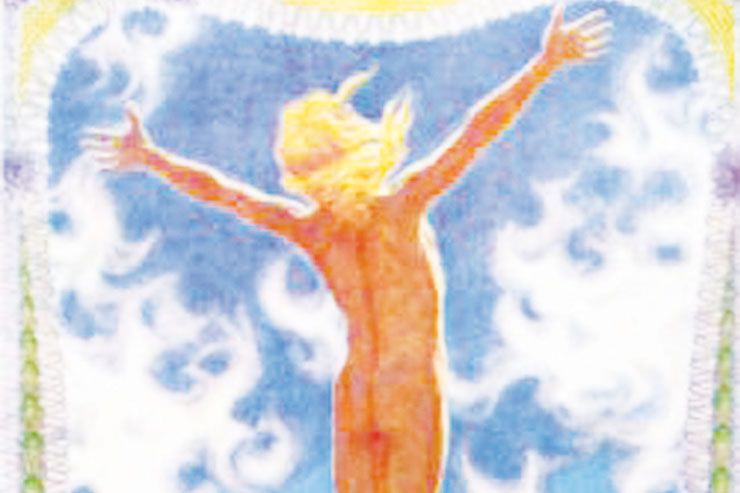
    The receiving of this fire through sungazing with arms upraised in a Y formation or bent at the elbow and hands spread out and facing the sun was called by the Greeks “fire blooming” because the radiance or essence of the sun thus channelled burned away impurities in the solar plexus, which, by the way, is associated with the sun and with fire. One can find wall carvings, paintings, statues, woodcuts and photographs of sun worshippers from all over the world – Hindus, Muslims, American Indians, ancient Egyptians, Medieval monks, Russians, Incas, and even aborigines in prehistoric petroglyphs – all with upraised arms. William Henry wrote in Mary Magdalene: The Illuminator that when Jesus taught his disciples the Lord’s Prayer, he also taught them this prayer position, which he learned from the Egyptians, who called it the Ka position (Figure 6, page 57). Moses also learned it from the Egyptians and used it to invoke the Light of God during the Israelites’ battle with the Amalekites. Significantly, the battle was won at sunset.

    This leads us to consider another part of the mysteries revealed by the Pistis Sophia, which is a certain power of the spoken word. The soul, in order to be cut free from the counterfeit spirit, must utter “the mystery of the undoing of the seals and of all the bonds.” This is the science of the spoken word, the uttering of sacred mantras, prayers and songs that remove or restrain the evil self, the “karmic records” of the individual.

    These spiritual sciences and techniques were not revealed to all the faithful. According to the Pistis Sophia, the mysteries were to be given only to those initiates who proved themselves worthy through years of testing. They were also kept secret because of the threat of persecution.

    The Mysteries Survive Persecution During the Dark Ages

    In Lost Light, Alvin Boyd Kuhn wrote that sun worship “was the heart’s core of all religion and philosophy everywhere before the Dark Ages obscured the vision of truth… The dreadful shadows of the Dark Age will not end until the bright glow of the solar wisdom is released once more to enlighten benighted modernity.”

    During the Dark Ages, the mysteries of the sun survived and were passed down through the Knights Templar, Cathars, Paulicians, Bogomils and other Gnostics. Many of these saints were brutally murdered by the Roman Catholic and Eastern Orthodox Churches in an attempt to suppress their teachings, which threatened the Churches’ established authority.

    One of the most inspired Gnostics was Saul of Tarsus. Saul experienced a sudden conversion and gnosis on the way to Damascus. Paintings of this experience usually show Saul being blinded by the noonday sun shining through a break in the clouds directly upon him.

    Gene Savoy, in The Essaei Document, claimed that Saul had learned that the Essenes sungazed in order to communicate with God. When Saul tried it, he received a powerful, life-transforming message, which left him blind and temporarily insane so that he could not eat or drink for three days. In 1840, Dr. Gustav Fechner, the father of psychophysics, experimented with gazing at the sun through coloured filters and liquids. He did it at noon and, as a result, became blind and insane. However, after much prayer and meditation in a dark room, he recovered his sight and sanity and more. He began seeing auras and angels, whom he called “beings from the sun.”

    Socrates taught in his academy that personal transformation was only possible through understanding the word of God, the Light, and that it was attained only through inner illumination absorbed from the sun. Apparently, Saul the persecutor was transformed by the sun into Paul the proselytiser.

    Clement of Alexandria recorded that Paul, before going to Rome, said that he would bring to the brethren the Gnosis, or tradition of the hidden mysteries, as the fulfilment of the blessings of Christ, who, Clement says, reveals the secret knowledge and trains the Gnostic by mysteries, that is, revelations made in the state of higher consciousness. Such a state can be attained through deep meditation, chanting and sungazing. Unfortunately, Paul was arrested in Rome and a few years later executed. His true teachings on the mysteries of the sun were lost for several centuries until they were resurrected in Armenia and Syria during the late seventh century by the Paulicians. This group was so named because their teachings were the Gnostic mysteries handed down from St. Paul when he brought them to the Balkans and Syria during his ministry.

    The Paulicians were persecuted and diminished in the ninth century, although until relatively recently there existed an Armenian sun cult whose adherents were known as Arevorti, “children of the sun.” In the tenth century, a new Gnostic movement, the Bogomils, arose in Bulgaria, which carried many of the same beliefs and practices of the Paulicians, including sun worship. However, their teachings were based on the Gospel of John.

    At the beginning of the 12th century, Byzantium started to persecute the Bogomils. Many were killed, but some fled to Italy, southern France and elsewhere. By the middle of the 12th century, Gnostic schools like the Knights Templars and Cathars had sprung up and spread throughout Western Europe. These were the Western European counterparts of the Eastern European Bogomils.

    The Cathars “pure ones” and the Knights Templars were concentrated in the Languedoc and Midi regions of Southern France. The Cathars claimed to possess the Book of Love (AMOK) the original initiatory version of the Book of John (the only gospel the Cathars, Knights Templars and Bogomils read) which likely contained the solar mysteries. It taught that a spark or tiny sun of the Christ Light dwelt in man’s heart and it revealed how to nurture it like a seed of divinity so that it blossomed into the rose of the original rosy-cross mystery school. This teaching, which reputedly could transform a human into a divine being, once belonged to Thutmose III, Akhenaton, Moses, Solomon, Jesus, and John the Beloved. It was reputed to be able to dissolve all hatred, anger and jealousy from the hearts of men.

    The Cathars believed that the key to this divine transformation was the correct understanding of the symbolism of the Eucharist, that is, the bread and wine and the Holy Grail. The light of the sun is the bread; its warmth is the wine. The Holy Grail is the brain’s third ventricle or cavity containing the pineal and pituitary glands (Figure 7, page 58).

    This secret, known to the Cathars as the consolamentum (“with the sun in the mind”), was kept hidden from the uninitiated. The Cathars believed man entered the kingdom of God through his soul, the seat of which was considered by Descartes to be the pineal gland. The Cathars believed that the solar elements of the Eucharist transubstantiated into the body and blood of Christ within themselves. The world transubstantiation comes from the Latin trans, across, and substantia, substance. This substance or glandular secretion, caught by the Holy Grail (the third ventricle), is what the Hindus call Amrita, “the elixir of immortality” and the Greeks called Ambrosia, “the nectar of the gods.”

    William Henry, in Mary Magdalene: The Illuminator, wrote, “All the occult mysteries speak of a key that is required to unlock mystical secrets of enlightenment. Specifically, the lost secret of the Templars… is about building a better human through the release of secretions from the astounding manufacturing plant of spiritual oils, the human brain. This oil or essence was the key secret of Mary Magdalene and the Essenes, recovered by the Templars from between the temples. The skull [specifically the third ventricle] is… the Cup of Life, the Grail, that catches these secretions from the brain… The Templars’ ultimate objective was to restore true Gnostic monotheism to the world, uniting Christianity, Judaism and Islam in a New Kingdom of Heaven on Earth. The ‘new’ humans that inhabited this New Jerusalem (or New Atlantis) would know and embody the secret of the Kingdom of Heaven within the brain and its capability of producing… the elixir of life, the Sacred Soma, the tonic of immortality, for these terms all refer to the cosmic essence or brain substance.” It was also called Christos (anointing oil) by the Essenes.

    Like their forerunners, the Bogomils, the Cathars engaged in chanting. This along with sungazing was the key to activating the pineal gland and producing the oil of Christos. The use of mantras and chanting can awaken the pineal because it sits above the mouth suspended in the third ventricle, a chamber filled with cerebrospinal fluid. Its location above the mouth in a fluid chamber makes the pineal gland quite uniquely positioned to respond to sonic vibrations. Manly P. Hall, in The Opening of the Third Eye, stated that the pineal gland “vibrating at a very high rate of speed, is the actual cause of true spiritual illumination.”

    The bliss that is experienced during sungazing and chanting is not just a natural high. According to William Henry, bliss is created by Christos and is a state of extreme happiness and freedom from attachment, conditioned responses and fear. It is the key required to enter the Kingdom of Heaven. Omraam Mikhael Aivanhov said that only those who are happy and carefree like children can enter the Kingdom of Heaven.

    The teachings of the Cathars posed quite a threat to the fledgling Catholic Church. Unlike the Cathars, the Church of Rome clearly did not produce a substance that gave people an experience of divine bliss. And if it did, it would keep it from the people. That’s why the Church had to exterminate them.

    Fortunately, today we live in an age of spiritual freedom and anyone can teach and learn the science of the spoken word and techniques of sungazing presented by sun yogi Hira Ratan Manek and others. Although the light of the Cathars was snuffed out in the 13th century, at the beginning of the 20th century, the teachings of the Bogomils were revived by the master Peter Deunov and his chief disciple, Omraam Mikhail Aivanhov.

    The Mysteries of the Sun Revealed

    On January 31, 1900, Mikhael Aivanhov was born into a poor family in Serbtzi, a small village of Macedonia. Throughout his childhood and adolescence, he was inspired by reading the Gospel of John, lives of the saints and books on yoga, which led him, at the age of fifteen, to an experience of illumination or samadhi.

    He went to the seashore to gaze at the sunrise. After meditating and sungazing for a little while, he sensed the presence of a heavenly being. Suddenly bathed in a cloud of brilliant light, he was plunged into a state of ecstasy. Later, he commented: “It was so beautiful that I was beside myself. To see such a being, with all those colours, all that light! He was almost invisible in the extraordinary luminosity that surrounded him. I found myself flooded with light. I was in a state of bliss, of ecstasy so immense, so powerful, that I no longer knew where I was. It was a delirious joy; it was heaven; it was the universe! Ever since then I have felt that if God were not all beauty I could not believe in him. It is beauty that remains in my mind as the one essential: neither power, nor knowledge, nor wealth, nor glory. Only beauty!”

    On the basis of his own spiritual experiences and of his reading of what he called the “Book of Nature,” he discovered the mysteries of the sun before being taught them by Peter Deunov. Mikhael and his master would go together to meditate in the pre-dawn stillness and watch the sun rise. Deunov also gave him the basic methods and exercises in mantra, prayer and sacred song: the mysteries of the spoken word.

    In 1959, he travelled to India, where he visited numerous ashrams and met several spiritual leaders. He was welcomed by several renowned Hindu sages as an accomplished master in his own right. One adept hailed him as a “solar rishi.” Another gave him his spiritual name, Omraam. One of the masters he met was the immortal bodhisattva, Babaji, who in 1992 and 1998 gave his blessings to another teacher of sungazing, sun yogi Hira Ratan Manek.

    Central to Omraam’s teaching is the concept of light. He saw in light the first emanation of the Divine, retaining the Divine’s qualities more than any other manifestation. As he insisted: “Light is a living spirit which comes from the sun and which establishes a direct relationship with our own spirit.” He explains how we can use light to transform ourselves and become radiant as the sun. In The Splendour of Tiphareth, he wrote, “Only the sun’s rays are capable of replacing all that is impure, worn out or obscure within you, and they can only do so if you learn to receive them. If you welcome them with your whole heart, they will begin their work of replacing the ‘old man’ in you, so that you will be wholly regenerated, renewed and resuscitated; your thoughts, feelings and acts will all be different. Only the sun’s rays are capable of working this transformation within you.”

    Omraam loved to talk about the Spirit of the sun. In this respect his philosophy coincided with the age-old mysteries of the sun, which taught that the true sun is not the star that is visible in the sky, but the invisible spiritual sun, the source of all life, light and love.

    He pointed out that, “On the physical, material level, the sun is the door, the link and the medium thanks to which we can make contact with the Lord… Through the sun, we work with God Himself. I can say that certain things that no human can teach me have been revealed to me by the sun. No book can give you what the sun gives you if you learn to have the proper relationship with him… If you want to create a bond between you [and the sun], you have to look at him in all consciousness. If you do that there will be a communication of vibrations between the sun and you in which forms and colours, a whole new world, will be born… The sun is an intelligence, a life, a living light. And when you understand that, all of a sudden he begins to speak to you… Try asking him a question and you will see that he will answer you.”

    Omraam died in 1986, but his teachings on the mysteries of the sun live on in numerous books. Over 90 books have been published in English, and there are enough notes from his hundreds of lectures to fill another 400 books. Of these books, the ones that are primarily concerned with the mysteries of the sun are The Splendour of Tiphareth: The Yoga of the Sun, Toward a Solar Civilization and Light is a Living Spirit. Louise-Marie Frenette’s newly-released biography of Omraam Mikhael Aivanhov, The Life of a Master in the West, has just been published in New Zealand by First Edition Press (to order call +64 (04) 586-1973). Today, his teachings and sungazing rituals are practiced by the I.D.E.A.L. Society, The Hearts Center and other spiritual communities around the world.

    The above article first appeared in World Explorer 37 Vol. 5 No. 1. 

    [alert type=”general” dismiss=”no”]This article was published in New Dawn 113.[/alert]

    [alert type=”success” dismiss=”no”]If you appreciate this article, please consider subscribing to help maintain this website.[/alert]

    © New Dawn Magazine and the respective author.
    For our reproduction notice, click here.
  • Enoch & the Watchers: The Real Story of Angels & Demons

    Enoch & the Watchers: The Real Story of Angels & Demons

    From New Dawn Special Issue 8 (Winter 2009)

    Every visible thing in the world is put under the charge of an angel. 
    – St Augustine

    In 2002 the British newspaper The Sunday Telegraph reported that the Vatican had banned the veneration of those angels who do not appear in the authorised texts of the Bible. This was an attempt to counter the influence of unnamed New Age groups who were allegedly recruiting new members within the Roman Catholic Church. In future, prayers were only to be directed to the three archangels Michael, Gabriel and Raphael who are mentioned in the Bible. According to the apocryphal and banned Book of Enoch these were the angelic beings responsible for binding the wicked fallen angels or Watchers who had transgressed God’s law. The news report said that the early Church had excluded the book, attributed to the Old Testament prophet and patriarch Enoch, from the authorised version of the Bible because it described these fallen angels and their activities.

    Who are the Watchers or fallen angels and why was the early Church and the modern Vatican so concerned about them?

    Genesis 6:1-4 says: “When men began to multiply on the face of the Earth, and daughters were born to them, that the sons of God saw the daughters of men that they were fair; and took them wives of all which they chose.” Traditionally the Ben Eloha or ‘sons of God’ numbered several hundred and they descended to Earth on Mount Harmon. Significantly this was a sacred place to both the Canaanites and the Hebrews who invaded their land. In later times shrines to the gods Baal, Zeus, Helios and Pan and the goddess Astarte were built on its slopes.

    These Ben Elohim or ‘fallen angels’ were also known as the Watchers, the Grigori and the Irin. In Jewish mythology the Grigori were originally a superior order of angels who dwelt in the highest heaven with God and resembled human beings in their appearance.1 The title ‘Watcher’ simply means ‘one who watches’, ‘those who watch’, ‘those who are awake’ or ‘those who do not sleep’. These titles reflect the unique relationship between the Watchers and the human race since ancient times.

    In the esoteric Luciferian tradition they were a special elite order of angelic beings created by God to be earthly shepherds of the first primitive humans. It was their task to observe and watch over the emerging human species and report back on their progress. However they were confined by the divine prime directive not to interfere in human evolution. Unfortunately they decided to ignore God’s command and defy his orders and become teachers to the human race, with unfortunate repercussions for both themselves and humanity.

    Most of the information we have about the Watchers and their activities comes from the apocryphal Book of Enoch. In the orthodox Bible the prophet Enoch, from the Hebrew ‘hanokh’ or instructor, is a mysterious figure. In Genesis 4:16-23 he is described as the son of Cain, the “first murderer,” and the first city built by his father is named after him. Further on in Genesis 5:18-19, and several generations later, Enoch is named as the son of Jared, and it is during his lifetime that the Watchers either arrive or incarnate in human bodies.

    In the apocryphal Book of Jubilee, allegedly dictated by “an angel of the Lord” to Moses on Mount Sinai when he also received the Ten Commandments, it says that Enoch was “the first among men that are born on Earth [sic] who learn writing, knowledge and wisdom.” It says that Enoch wrote down “the signs of Heaven” (the zodiac signs) according to their months in a book. This was so human beings would know the seasons of the years in relation to the order of the months and their respective stellar and planetary influences. The indication is that Enoch received this information from extraterrestrial angelic sources, i.e. the Watchers, and therefore he was a cultural exemplar.

    The Fallen Angels Instruct Humanity

    Two hundred of the ‘fallen angels’ descended from the heavenly realm on to the summit of Mount Hermon and they were so smitten by the beauty of human women that, using their new material bodies, they had sex with them. This further incurred Yahweh’s wrath and, according to the Bible, the consequence of this miscegenation between the Fallen Ones and mortals led to the creation of half-angelic, half-human offspring (Genesis 6:4).

    These children were called the Nefelim or Nephilim and they were the giant race that once inhabited Old Earth. The fallen angels taught their wives and children a variety of new technological skills, magical knowledge and occult wisdom. This suggests that psychic abilities and magical powers were originally an ancient inheritance from the angelic realm given to early humans. In the Luciferian tradition this is known in spiritual and metaphorical terms as the ‘witch blood’, ‘elven blood’ or ‘faery blood’ that is possessed by witches and wizards.

    In the Book of Enoch it says that the leader of the fallen angels was called Azazel, and he is often identified with Lucifer (the Lightbringer) or Lumiel (‘the light of God’). He taught men to forge swords and make shields and breastplates (body armour). Azazel also taught them metallurgy and how to mine from the earth and use different metals. To the women he taught the art of making bracelets, ornaments, rings and necklaces from precious metals and stones. He also showed them how to ‘beautify their eyelids’ with kohl and the use of cosmetic tricks to attract and seduce the opposite sex. From these practices Enoch says there came much ‘godlessness’ and men and women committed fornication, were led astray and became corrupt in their ways.

    This was the basis for the early Church condemning the fallen angels for teaching women to make necklaces from pieces of gold and bracelets for their arms. St Paul said that women should cover their head in the synagogue (Corinthians: 11:5-6). This was because the fallen angels were supposed to be attracted to human females with long flowing hair. The custom of women covering their hair in churches is still found in Roman Catholicism and also in the customs of Islam.

    The fallen angel Shemyaza, another form of Azazel, is said by Enoch to have taught humans the use of root cuttings and the magical art of enchantment; the fallen angel Armaros taught the resolving (banishing) of enchantments; Baraqijal taught astrology; Kokabiel, the knowledge of the constellations (astronomy); Chazaqiel, the knowledge of the clouds and the sky (weather lore and divination); Shamsiel, the signs of the sun (the solar mysteries); Sariel the courses of the moon (the lunar cycles used in horticulture and agriculture and the esoteric lunar mysteries); Penemuel instructed humans in the art of writing and reading; and Kashdejan taught the diagnosis and healing of diseases and the science of medicine.

    It is obvious from these descriptions of the teaching abilities of the Watchers that they were cultural exemplars and the bringers of civilisation to the early human race. It is therefore strange that in orthodox Judeo-Christian religious texts they are misrepresented as evil corrupters of humanity.

    Some idea of the original exalted status and real nature of the ‘sons of God’ and ‘the angels of the Lord’ can be found hidden in the ancient annals of angelic lore. For instance, Kokabiel is described as “a great angelic prince who rules over the stars.”2 In the Sibylline Oracles, Araqiel is one of the fallen angels who guides the souls of the dead to judgement in the underworld.

    Shamsiel, possible originally a Babylonian sun god, was called “the prince of Paradise” because he was one of the guardian angels who watched over the gates to Eden. In this role he took Moses to see the heavenly garden and he also watched over the treasures of King David and his son Solomon the Wise. This reference may be to spiritual treasures rather than physical gold and jewels. In the Jewish Zohar he is named as the chief aide-de-camp to the mighty Archangel Uriel and bore his standard into battle.

    Sariel was an angel associated with fertility of the earth and the spring equinox (northern hemisphere) in March. He governed the martial zodiac sign of Aries the Ram and was invoked for protection against the malefic power of the Evil Eye.

    [alert type=”info” dismiss=”no”]If you appreciate this article, please consider a subscription to New Dawn magazine.[/alert]

    Azazel – Lucifer – Lumiel

    Azazel, the leader of the Watchers, as mentioned before, was identified with Lucifer or Lumiel. In the Quran it is said that Lucifer-Lumiel (Iblis) rebelled against Allah because he was told to bow down and worship the clay-born “man of earth” Adam and refused. He was forced to fight a battle in Heaven with the Archangel Mikael or Michael and his Army of the Lord. As a result Lumiel and his rebel angels were cast out of Heaven and fell down to Earth. Here Lumiel became the “Lord of the World” and in Christian mythology he was falsely identified with the bogeyman Satan. However, esoterically in the Luciferian tradition, Lumiel or Lumial is not an evil satanic figure luring humankind into temptation and acts of evil as the Church represents him. He is “the angel of God [who] rebelled against the static, established cosmic order and set in motion the forces of change and evolution…”3

    It is possible that Lumiel may have originated in Canaan as Shahar, the god of the morning star (Venus). He had a twin called Shalem, who was also symbolised by the planet Venus, but as the evening star. These divine bright and dark twins represented the solar light emerging from the darkness of night at dawn and descending into it at dusk. They were the children of the goddess Asherah, and there is archaeological evidence from the Middle East that the Hebrews adopted her worship when they settled in Canaan and practised it alongside reverence of the tribal storm god Yahweh. The Old Testament has several references to the continued worship of Asherah as “Queen of Heaven” by the allegedly monotheistic Hebrews. This took place at shrines in sacred groves on hills where they made offerings of cakes and incense to the goddess. In Canaanite mythology, Shahar, as the Lord of the Morning Star, was cast down from heaven for defying the high god El in the form of a lightning bolt. In that form he fertilised Mother Earth with his divine phallic force.

    Azazel is represented as a metal-smith and a fire-working sorcerer or magician. He has also been compared to the biblical first smith Tubal-Cain, a descendant of the half-human, half-angelic “first murderer” Cain. The actual name Azazel has variously been translated as ‘god of victory’, ‘the strength of God’, ‘the strong god’ and even ‘the goat god’. In the apocryphal Apocalypse of Abraham, he is called “the lord of heathens” suggesting he was originally a pagan god. He has also been identified with the serpent in the Edenic myth that seduced the first woman and “Mother of All Living,” Eve. In a Persian text known as the Urm al-Khibab or The Primordial Book, dating from the 8th century CE, the angel Azazil or Azazel is said to have refused to acknowledge the superiority of Adam over the angels. As a result Allah expelled him and his rebel angels from the heavenly realm to live on Earth. More generally in Islamic lore Azazel or Azrael is the angel of death and he acts as a guide for the souls of the dead.

    In Leviticus 16:8-10 and in the Dead Sea Scrolls a curious Hebrew ritual is recorded that features Azazel as the name for the ‘scapegoat’ that takes on the communal sins of Israel. It says that the high priest Aaron took two goats from the flock and cast lots (practised divination) to choose which one would be the scapegoat and sacrificed as a “sin offering.” The Scrolls say that the high priest confessed all the “impurities of the children of Israel” over the head of the Azazel goat. By this ritually symbolic act he transferred to the unfortunate animal all their guilt and sins so they could be absolved of them. The goat was then either cast out into the wilderness to die or thrown over a cliff to be dashed to pieces on the rocks below.

    This ancient and archetypal concept of the scapegoat sacrificed for the sins of the human race and abandoned in the wilderness is a powerful and potent motif that appears several times in biblical myths. It can be seen in the story of Cain who becomes an exiled wanderer on the Earth after being marked by God and banished “east of Eden” after killing his brother Abel. In one Jewish legend the wise King Solomon, a powerful magician who could summon and control demons, fell from grace because he “whored after foreign gods.” He was forced by God to leave Jerusalem and wander in the desert disguised as a beggar.

    Also after their exodus from slavery in Egypt, Moses and the Israelites were forced to spend forty years wandering in the desert before they were allowed to enter the Promised Land (Canaan). In Ancient Egyptian mythology, the dark god Set is represented as a divine outcast who dwells in the desert and, after she left Adam, his first wife Lilith or Liliya fled to the wilderness away from human habitation. In the New Testament Jesus wandered in the wilderness for forty days and nights. He was not accepted as a teacher in his own town of Nazareth and was rejected as the promised messiah by his people. When Jesus was crucified he symbolically took on the role of the sacrificial scapegoat who dies to cleanse the sins of the human race.

    It is possible that the account of the ritual of the goat-god Azazel may have been an autumn equinox or harvest rite of Syrian, Hittite or Canaanite origin adopted by the Hebrews. Originally a goat would have been selected by means of a divination ritual and then offered to a desert god or demon that had to be placated by the shedding of blood. Eventually the sacrifice was made to Yahweh as a petition to forgive the sins of his followers. Azazel was popularly believed to have a retinue of hairy he-goat demons known as the se’irim who, like the Watchers, lusted after human women. It cannot be a total coincidence that the Church imagined the Devil or Satan in the form of a hairy half-human he-goat with a massive erect phallus who had sexual intercourse with his female worshippers at the Witches Sabbath.

    Shemyaza is seen by some modern Luciferians as either the emissary of Lumiel or one of his avatars (an incarnated divine being in human form). He not only fell in love with human women, but also with the Babylonian deity Ishtar, the goddess of love and war. She promised to have sex with him if he would in return reveal to her the secret name of God. When Shemyaza told her, Ishtar used this forbidden knowledge to ascend to the stars and she reigned over the constellation of Pleiades or the Seven Sisters. While the other Watchers were rounded up by the archangels and punished by God, Shemyaza voluntarily repented his error and sentenced himself to hang upside down in the constellation of Orion the Hunter, with whom he is sometimes identified in the Luciferian tradition. In the Qabalistic tradition, Naamah, the sister of the biblical first smith Tubal-Cain, seduced Azazel and she has been associated with Ishtar.4

    “A race between Gods and men”

    As we have seen, the end result of the illicit relationships between the Watchers and “the daughters of men” was, according to Judeo-Christian propaganda, the spawning of a monstrous race of warlike, blood-drinking cannibalistic giants called the Nephilim. Genesis 6:4 less dramatically describes them as “the mighty men of old, men of renown.” At first they were fed manna (ambrosia or the food of the Gods?) by Yahweh to stop them consuming human flesh, but they rejected it. They slaughtered animals for food instead and then began to hunt down and eat human prey.

    It has been speculated that this legend is based on the culinary habits of the nomadic desert herdsmen in the Middle East, who were voracious meat-eaters. In the biblical myth of Cain and Abel the dispute between the two brothers that led to the first murder is over the nature of the offerings made to Yahweh. Abel, a “keeper of sheep” or nomadic herdsman offered the “firstlings of the flock…” and Cain, who was “a tiller of the ground” or farmer-gardener offered “the fruit of the ground” (Genesis 4:2-4). Abel’s burnt offerings of animal flesh and blood were pleasing to Yahweh, but he rejected the vegetables, cereal and fruit offered by his brother. On a purely material level, as opposed to a mythic and spiritual metaphor, this story may reflect the struggle for dominance between nomadic herdsmen and the early farmers of the Neolithic Age in the Middle East.

    The idea of semi-divine heroes was born from the ancient myths of unions between the Gods and mortals. The poet and writer Pindor (518-438 BCE) described the heroes of the past as “a race between Gods and men.” In the Dead Sea Scrolls the terrible human-eating Nephilim are in fact described as the guardians of arcane knowledge who “knew all the mysteries of nature and science.” There are also oblique references to the breeding techniques they taught that suggest they instructed early humans in the domestication and rearing of animals.

    Additional references also hint at experiments that led to the creation of ‘monsters’ by the interbreeding of animals with different and unrelated species. In modern theosophical occultism there are legends about the lost continent of Atlantis that claim its scientists bred half-human, half-animal hybrids as a slave race. In our own time scientists are experimenting with genetic research and animal cloning experiments. It is widely rumoured that in China there have recently been abortive attempts to create a new half-human, half-animal hybrid species. These unnatural experiments led to the cataclysmic disaster that destroyed Atlantis. This also relates to the destruction of the Nephilim and the early human race in the biblical Flood. Records of such an event can also be found in the mythology of ancient peoples worldwide and especially among the Babylonians in the Middle East. In fact, it is claimed that the story of Noah and the Flood in the Old Testament originated in Babylonian and Sumerian myths.

    10,000 BCE and the End of the Ice Age

    It is known that around 10,000 BCE there seems to have been a cultural explosion that transformed early humankind. At the end of the last Ice Age the first signs of agriculture appeared in the Middle East with a shift from a nomadic hunter-gatherer lifestyle to that of settled farming. This marked the beginning of civilisation in this area. As early as 9500 BCE barley, wheat and rye were being cultivated and oats, peas and lentils were being grown by our Neolithic ancestors in what is now modern Kurdistan, between Turkey and Iraq. At the same time dogs, goats and sheep were also domesticated. Within a thousand years copper and lead smelting was being practised in Anatolia (modern Turkey) and archaeologists believe this process was first discovered in Kurdistan, along with weaving and pottery making. The ancient Kurdish culture was also the first to develop a script and was one of the earliest literate societies in the Middle East.

    The Kurds claim to be the descendants of the ‘Children of the Djinn’ (spirits), the offspring of a mating between the djinns and mortal women. In some parts of Kurdistan, especially among the sect of Yezedis, who worship the Peacock Angel (Azazel, the leader of the fallen angels), can be found tall, fair-haired people with blue eyes. Although anthropologists believe they may be of ancient European ancestry, popular folk belief among the Kurds says they are descendants of the ‘Children of the Djinn’, who in ancient times brought civilisation to early humankind.

    In general the ancient Middle East was known as ‘the cradle of civilisation’ with the earliest city-states being founded in the Mesopotamian area (modern Iraq and Iran). The early indigenous people of the region, the Sumerians and Akkadians, developed the first written language, studied astronomy and created libraries. The Babylonians and Assyrians followed them and in the mythology of all these races are stories of how the Gods descended to Earth and taught them the arts of civilisation.

    In the Book of Enoch it says that when Yahweh saw the lawlessness, chaos, corruption and sexual immorality that had been caused by the interaction of the Watchers and humans he decided to intervene through the agency of the archangels Michael, Raphael, Gabriel and Uriel. He commanded Raphael to bind Azazel hand and foot like a sacrificial goat and cast him into a deep ravine in the desert. Gabriel was sent on a divine mission to destroy “the bastards and reprobates” and “the children of the Watchers amongst men.”5 The Archangel Michael, the commander of the Army of God, was sent to arrest Shemyaza and bind him “under the earth” until Judgement Day. As we have seen, the fallen angel repented his sins and sentenced himself to cosmic exile among the stars.

    The Book of Jubilee says that the archangels bound the Watchers “in the depths of the earth” and in Judaic lore they are imprisoned in a mysterious “second Heaven.” However, it is also said that some of these “mighty warriors” have a special place reserved for them in Sheol, the Jewish underworld. There they are said to lie in state “with shield and spear intact.”

    Christian O’Brien has suggested6 there is a connection between the biblical Watchers and the semi-divine, semi-mythical Tuatha De Danann (Children of the goddess Dana). This race of ancient magicians descended to Earth on the sacred hill of Tara in prehistoric Ireland. With the coming of Christianity, the Tuatha De Danann was banished into the ‘hollow hills’ and became the Sidhe (Shee) or ‘Shining Ones’, the elves and faeries of Irish folklore. There has always been a strong belief among the peasantry in Ireland that the Good People or faeries were originally the fallen angels who sided with Lucifer in the Battle of Heaven.

    In this article we have constantly referred to the Watchers as angelic beings with a spiritual form who incarnated in physical bodies to have sexual relations with mortal women. In recent years a considerable amount of speculative literature has been published suggesting that instead they were of earthly origin. Popular best-selling authors such as Andrew Collins,7 Graham Hancock and Ian Lawson have claimed that the biblical myth of the Watchers represents memories of a primeval ‘elder race’ of super-humans belonging to a lost civilisation who taught their technology to more primitive people. Lawson has claimed that this (unknown) ancient race may have been spiritually advanced souls who incarnated to help early humankind and were corrupted by them in the process. Collins has also recently launched a new project to investigate the magical aspects of the legend.

    Symbolism of the Myth of the Fallen Angels

    What is the esoteric significance behind the myth of the fallen angels, the expulsion of Lucifer from Heaven and the Fall of Man as represented by the Garden of Eden saga? In the Bible Lucifer is often depicted in the reptilian form of a dragon or serpent and in the West this creature is symbolic of evil and the powers of chaos. Babylonian, Hittite, Canaanite, Iranian, Egyptian, Greek and Norse myths all describe in various forms a struggle between a supreme father-god, representing cosmic order and harmony, and a younger rebellious god who challenges and tries to overthrow divine authority. Although these conflicts usually take place in a pre-human epoch, they are also sometimes depicted as occurring in world history and are often connected with the creation and early development of the human species and the rise of ancient civilisations.

    Symbolically, Lucifer or Lumiel is known as the Lord of Light as he is the first-born of creation. He represents the active cosmic energy of the universe and has been identified with fire, light, phallic power, independent thought, consciousness, progress, liberty and independence. The founder of the modern Theosophical Society, Madame Helena Blavatsky, described the Lightbringer as “the spirit of intellectual enlightenment and the freedom of thought” without whose influence humanity would be “no better than animals.”8

    In the Bible Lucifer (or Satan as he is mistakenly called) is often depicted in reptilian form as either a dragon or a serpent. In Western mythologies this creature is commonly misrepresented as a symbol of the powers of darkness, chaos and evil. In contrast, in Eastern mythology the dragon is a good omen representing fertility and good fortune. Lumiel-Lucifer is often identified with the serpent in the Edenic myth described in Genesis. In the Luciferian tradition, the biblical serpent is regarded as the personification of knowledge, wisdom and enlightenment who liberated the first humans from the spiritual ignorance imposed on them by Yahweh. The serpent is seen as the symbol of an outside liberating force that quite literally opened the eyes of Adam and Eve to the reality of the created universe and the wonders of the material world.

    The snake, serpent or dragon is an ancient mythical and archetypal image of the solar phallic power or life force that is associated with Lucifer and the explosion of light following the divine celestial event that created the universe (known by modern scientists as the Big Bang). When the first man and woman ate the forbidden fruit from the Tree of the Knowledge of Good and Evil in the astral or heavenly garden, they became consciously aware. Their first realisation was that their physical ‘cloaks of flesh’ were naked. They rushed to cover their genitals as they had become aware of the so-called ‘serpent power’ or kundalini that can be raised by sexual intercourse and non-reproductive sex acts. They also ate from the Tree of Life which initiated the cycle of birth, life, death and rebirth and of human souls incarnating in physical form.

    Interestingly, the anthropologist and shamanic teacher Dr. Michael Harner has described an experience he had in the jungle of the Peruvian Amazon after partaking of the hallucinogenic vine ayahuasca. He had a vision of a dragon-prowed ship with a crew of bird-headed humans. He then encountered an ancient race of reptilian entities that he believes exist within each human being in the brain stem at the base of the skull and the top of the spinal column. These reptilian life forms told Dr. Harner they had arrived on Earth aeons ago from the stars. Allegedly, they created life here so they had somewhere to hide and were the true masters of the planet. The anthropologist mentioned this to an old Indian shaman and he said he knew about these entities and called them the “Masters of the Outer Darkness.”9

    The myth of the Watchers, the Fall of Lucifer and the Fall of Man all represent the primeval Dreamtime or ‘Golden Age’ of cosmic and earthy harmony and primal innocence that may have existed on the material plane or on some kind of astral or pre-material plane. It is the symbolic or actual physical destruction of this heavenly or earthly paradise, where humans and animals lived together and communicated by a universal language, which is reflected in such myths and legends. In shamanic terms it is known as the Great Separation when humans no longer knew or understood the language of the animals. It was also a time when humans began to communicate together in different languages and this is represented by the biblical story of the Tower of Babel.

    The myth of the Golden Age or Paradise on Earth is closely linked with the fall of Lucifer from Heaven and the diminishing of his former status as the first-born of creation to become the Lord of the World. On a symbolic and metaphorical level, as well as a physical one, it is also connected to the separation of humans from nature and their natural environment that is manifesting in our modern times. It was the deliberate intervention of Lucifer and the fallen angels in human evolution, rather than any defiance of cosmic authority, which ultimately lead to their fall from heavenly grace. The Watchers’ only ‘crime’ was that they wanted to help the progress of their human flock. However, the refusal of Lucifer-Iblis to recognise the creation of human beings means that the Fall from heavenly grace was inevitable.

    In the Luciferian tradition Lumiel is promised redemption and the restoration of his former status in the cosmic plan. This can only come to pass when the human race spiritually evolves. So it is to the benefit of Lumiel and his teaching angels to help us achieve that end. The relationship between humanity and the leader of the Fallen Ones is therefore very much a symbiotic one, as they need each other.

    [alert type=”general” dismiss=”no”]This article was published in New Dawn Special Issue 8.[/alert]

    [alert type=”success” dismiss=”no”]If you appreciate this article, please consider subscribing to help maintain this website.[/alert]

    Footnotes

    1. G.A. Davidson, Dictionary of Angels, The Free Press, USA, 1971, p. 127.

    2. Ibid, p.164.

    3. Dr. Stephen Flowers, Fire and Ice, Llewellyn, USA, 1990, pp.43-44.

    4. Michael Howard and Nigel Jackson, The Pillars of Tubal Cain, Capall Bann, UK, 2000 and 2003, p.65; Michael Howard, The Book of Fallen Angels, Capall Bann, UK, 2004.

    5. R.H. Charles, The Book of Enoch, Society for the Promotion of Christian Knowledge, UK, 1912, p.37.

    6. Christian O’Brien, The Genius of the Few, Daintus, UK, 1985.

    7. Andrew Collins, From the Ashes of Angels, Michael Joseph, UK, 1996; Andrew Collins, The Gods of Eden, Headline, UK, 1998.

    8. Helena Blavatsky, The Secret Doctrine Vol: II, Theosophical Society, India, 1921, p. 171, 255, 539.

    9. Dr. Michael Harner, The Way of the Shaman, Harper & Row, USA, 1980

    © New Dawn Magazine and the respective author.
    For our reproduction notice, click here.
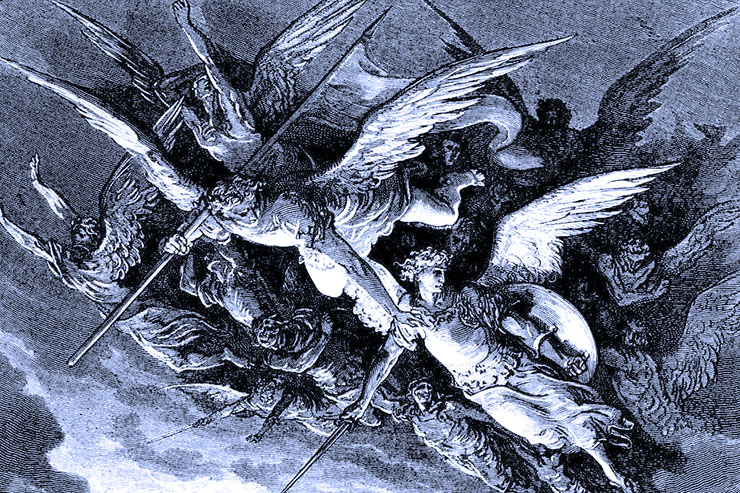
  • Searching for the  Dawn & Demise of Ancient Civilisation

    Searching for the Dawn & Demise of Ancient Civilisation

    From New Dawn Special Issue 8 (June 2009)

    When and where did civilisation begin? How far back in time does high culture go? Indeed, what do we mean by such terms as civilisation, or sophisticated and high culture?

    When I was in college, more years ago than I perhaps care to remember, I learned the standard story which still holds sway in many circles: Civilisation and high culture date back to, at most, perhaps five or six thousand years ago. A handy marker for recognising a true civilisation was written language, and it was generally agreed that the earliest true writing could be dated to the late fourth millennium BCE (that is, circa 3500 to 3000 BCE).

    The Sumerians are generally credited with developing writing about 3300 to 3200 BCE, although the earliest Egyptian hieroglyphics may date back to the same period, or even a century or so earlier, and there is also evidence of writing possibly from as far back as 3500 BCE found at Harappa, the Indus Civilisation, in what is now modern Pakistan.1

    But then there are reports of much earlier possible writing from Henan Province, China, dated to 6600 to 6200 BCE, inscribed on tortoise shells.2 I recollect a book I read while still an undergraduate, The Roots of Civilization by Alexander Marshack, which argued that various lines, notches, and “scratchings” on ancient bone artefacts dating to 10,000 BCE and earlier, before the end of the last Ice Age, were in fact symbolic systems, including lunar calendar notations. Maybe our ancestors were not so primitive and stupid after all.

    Maybe defining civilisation and high culture in terms of a written language (or more accurately our knowledge of a recorded language; we can easily miss things in the archaeological record) simply is not a fruitful approach. This is the conclusion I have come to while pursuing my own research.

    Re-Dating the Great Sphinx of Egypt

    I first came to the problem of the origin of civilisation through my studies of the Great Sphinx of Giza, Egypt. Combining a Ph.D. in geology and geophysics from Yale University (1983) with a lifelong enthusiasm for ancient cultures, on my first trip to Egypt in 1990 I was primed to take a careful look at the Sphinx.

    As I have recounted elsewhere,3 my colleague and friend John Anthony West had suggested to me various silly notions that the Great Sphinx might be older than the standard Egyptological attribution of circa 2500 BCE. I figured that through a careful analysis of the geology, I could show the error in such thinking. Surely all those professional Egyptologists could not be wrong. It turns out they were.

    Based on my geological and seismic analyses, utilising the weathering and erosion patterns correlated with the palaeoclimatology and subsurface features,4 I concluded that the oldest portions of the Great Sphinx date back to at least the period of 7000 BCE to 5000 BCE, and perhaps back to 9000 BCE or earlier. To oversimplify a bit, the core body of the Great Sphinx shows features that place it well back before the onset of the current arid regime (the Giza Plateau is on the edge of the Sahara Desert) some 5,000 years ago.

    Such a conclusion has deep implications, suggesting that high culture and civilisation dates back much earlier than previously believed. I have been told on more than one occasion that my conclusions cannot be true because if they are, then “history must be rewritten.” Certainly, we cannot have that, can we? Vested interests run high, and I have been attacked from many sides, both by orthodox Egyptologists and historians, and by various people not as closely associated with mainstream academia.

    Through it all over the last two decades, I have looked at the alternative theories suggested to explain the data, and I continue to maintain that the evidence clearly points to the origins of the Great Sphinx being much older than 2500 BCE. Indeed, the attacks and criticisms, forcing me to carefully scrutinise and enlarge my dataset, have served only to reaffirm my conclusions.

    The Sphinx Under Water, or Under Fire?

    Recently my work on the Great Sphinx has come under fire from a self-described anti-Establishmentarian. Given the number of people who have been asking me about this latest “Sphinx theory,” I feel it is imperative that I briefly address it here.

    Robert Temple5 has proposed a moat theory (that is, the Sphinx Enclosure was purposefully filled with water such that the body of the Sphinx was submerged and sat as a statue in a small artificial lake) to explain the clear signs of water weathering and erosion on the body of the Great Sphinx and on the walls of the Sphinx Enclosure.

    Temple contends that the moat theory explains the data adequately without hypothesising that the Great Sphinx dates back to a much earlier period during which there was more rainfall than at present. (Here I will not address his hypotheses, which I do not find persuasive, that the Sphinx was the jackal [wild dog] Anubis and the face seen on the Sphinx is that of the Middle Kingdom pharaoh Amenemhet II, though I would point out that the original Sphinx has been reworked and the head has been re-carved, perhaps more than once.)

    The body of the Sphinx, carved from the bedrock, sits largely below ground level, and various moat, pool, or artificial fountain hypotheses have been suggested for the Sphinx from time to time. I considered such notions carefully as far back as my early analyses of the geology of the Sphinx, starting in 1990. In summary, such moat and related theories do not hold water (to use a bad pun) and are not compatible with the features of the actual Great Sphinx, the Sphinx Enclosure, and the general geology and palaeohydrology of the Giza Plateau.

    Scrutinising the Sphinx

    While in Egypt recently (March 2009) I made it a point to look at the Great Sphinx and Sphinx Enclosure with fresh eyes to see if there could be anything to the moat class of theories. I will summarise briefly a half dozen points.6

    1) Based on my observations and analyses, the Sphinx Temple (built out of blocks removed from the Sphinx Enclosure when the body of the Sphinx was initially carved) and the so-called Valley Temple to the south of the Sphinx Temple show clear signs of heavy precipitation-induced weathering on the limestone core blocks. These limestone temples were subsequently refurbished with Aswan granite ashlars during the Old Kingdom (as evidenced by an Old Kingdom inscription still found on a block located at the Valley Temple). The moat theory cannot explain the nature of the very ancient weathering seen under the Old Kingdom granite veneer.

    2) There is much heavier surface erosion on the western end of the Sphinx Enclosure, and the surface erosion tapers off dramatically toward the eastern end of the enclosure. This is exactly what is to be expected based on the palaeohydrology of the Giza Plateau and is incompatible with a moat theory where it is hypothesised that water was brought in from the Nile to the east. Furthermore, the nature of the surface erosion throughout the enclosure and on the body of the Sphinx is as expected if there were water running over or raining down on the rock layers. The erosion actually observed is not compatible with pooled water in the enclosure.

    3) The highest levels of the middle member strata, as seen in the Sphinx Enclosure on the western end, are most severely eroded, which is compatible with the agency of precipitation. If the moat theory were true, then the lower strata on the eastern end of the Sphinx Enclosure would be most heavily eroded (caused by water being brought in via canals from the Nile), but the opposite is seen in reality.

    4) The subsurface seismic data demonstrating the depth of weathering below the floor of the Sphinx Enclosure, based on my analyses (using areas excavated during the Old Kingdom for comparison), even when calibrated very conservatively, gives an age of initial carving for the core body of the Great Sphinx of at least 5000 BCE. More than one geological colleague has suggested to me that a more realistic calibration gives a date thousands of years earlier. And no, standing water in the Sphinx Enclosure would not accelerate the depth of weathering below the floor of the enclosure.

    5) The vertical fissures observed in the walls of the Sphinx Enclosure show diagnostic signs of having been formed by precipitation and water runoff. In my opinion, they do not show any characteristics that are diagnostic or even suggestive of having been formed by artificial dredging of the Sphinx Enclosure, as some have suggested.

    6) If the Great Sphinx actually had sat in an artificial pool or lake, either the water level around the Sphinx would have had to have been the same as that of the surrounding water table, or the walls and floor of the pool in which the Sphinx sat would have had to have been sealed up and watertight (and any artificial walls, such as on the eastern end, would have had to have been strong enough to withstand the pressure of the water). Clearly, the ancient water table was well below the level of the floor of the Sphinx Enclosure (or else the Sphinx Temple, for instance, would have been flooded). The Sphinx Enclosure, if simply carved from the bedrock (as all the evidence suggests) would not have held a deep pool of standing water. The bedrock in the enclosure is highly faulted, and characterised by a karst morphology that would leak like a sieve (another bad pun, perhaps). The enclosure would have had to have been fully sealed up (with some kind of mortar or cement, perhaps), and there is no evidence of such sealing. Furthermore, if the enclosure had been sealed in such a manner, this would not be compatible with the dredging theory for the vertical fissures mentioned in the previous point. I would also note that the chambers and tunnels under the Great Sphinx would have been flooded from above if the Great Sphinx had been sitting in a pool of water, unless the Sphinx Enclosure had been watertight; yet the evidence suggests the enclosure was not watertight.

    Could the Sphinx be Hundreds of Thousands of Years Old?

    Even as my re-dating of the Great Sphinx has been attacked as impossible by some authorities, other serious researchers have suggested that I have underestimated the true age of the oldest portions of the Great Sphinx by a factor of ten or more!

    For instance, two members of the National Academy of Sciences of Ukraine, Vjacheslav I. Manichev and Alexander G. Parkhomenko,7 citing my work, have reinterpreted the geology and erosional features on the Great Sphinx to mean that the core body of the statue could date back as far as 800,000 years ago. And they are not referring to simply a natural outcropping that may have existed 800,000 years ago that was later shaped into a statue. (Remember, too, that to carve the core body of the Sphinx huge multi-ton blocks were removed from the Sphinx Enclosure and assembled as the Sphinx Temple, so the original Sphinx Temple is as old as the core body of the Great Sphinx).

    The dating of Manichev and Parkhomenko could push the age of the Great Sphinx into a very remote time period, one that has been suggested for possible, but ambiguous, ancient structures, sculptures, or simulacra that are found in many parts of the world, such as Markawasi in Peru,8 the Romanian Sphinx,9 or a possible stone circle dubbed Adam’s Calendar by researchers Johan Heine and Michael Tellinger with a claimed date of 75,000 years ago.10 Personally, I am not convinced that the Great Sphinx is anywhere close to the age postulated by Manichev and Parkhomenko, or that various claimed very ancient, very eroded statues are anything more than natural formations, but the prospects are intriguing. Without going off on such limbs, there is clear evidence for early high culture at a remote period beyond just that of the Great Sphinx.

    Nabta Playa

    In the Sahara Desert of southern Egypt, west of Aswan, is an area known as Nabta Playa. Here an ancient stone calendar circle, as well as many other megalithic erections and structures, was identified by archaeologist Fred Wendorf (Southern Methodist University) and his team and dated to circa 4000 BCE and earlier.11 

    Thomas Brophy12 has carried out extensive analyses of Nabta. According to Brophy, three stones inside the Nabta calendar circle represent the belt of Orion (just as the three pyramids of Giza represent the belt of Orion according the research of Robert Bauval13). The stones on the Playa and the corresponding stars in the sky aligned on summer solstice nights between about 6400 BCE and 4900 BCE. Brophy found even more correlations, however. Three other stones in the Nabta calendar circle correspond to the configuration of Orion’s head and shoulders as they appeared in circa 16,500 BCE, about half a precessional cycle earlier than the previously mentioned alignment. Based on these and other analyses of monoliths in the area, Brophy concludes that the early inhabitants of Nabta Playa possessed incredibly sophisticated knowledge, the type of knowledge we associate with high culture and civilisation. Furthermore, the dates of the Nabta structures are in line with my dating of the oldest portions of the Great Sphinx, and at both Giza and Nabta the constellation of Orion (which represented the god Osiris during dynastic times) was of prime importance.

    Göbekli Tepe

    If the dating of the Great Sphinx remains controversial (after all, old ideas die hard), and the analyses of Nabta Playa are questionable in the eyes of some researchers, there is one site that even the most ensconced conventional archaeologists cannot ignore.

    In modern Turkey, just north of the border with Syria, is a site known as Göbekli Tepe that has yielded dozens of carved limestone megaliths, many of which date back to the extraordinarily early period of 9000 BCE to 10,000 BCE.14 Klaus Schmidt, of the German Archaeological Institute, has been heading an excavation team there since 1994, and there is no doubt as to the importance, authenticity, and dating (based in part on radiocarbon) of Göbekli Tepe. This is a discovery made by mainstream academics.

    Göbekli Tepe boggles the imagination on many accounts. The date is incredibly early, even earlier than my “conservative” estimate for the date of the Great Sphinx. Göbekli Tepe dates back to the end of the last Ice Age. The monolithic megaliths are in the range of two to seven metres high (the latter is the height of an unfinished megalith left where it was being quarried). Sculpted onto the surfaces of the monoliths are a variety of animals, including snakes, boars, foxes, vultures, spiders, scorpions, a centipede, and a three-dimensional figure that has been interpreted as a lion. The megaliths excavated thus far had been erected into four distinct stone circles, ranging from ten to thirty metres in diameter. Based on geophysical surveys, the entire site may cover three dozen hectares (about 90 acres) and contains another twenty or so stone circles.

    Although very different from the Great Sphinx and the Sphinx Temple, in my estimation, taking the entire Göbekli Tepe site as a whole into account, just as much effort, social organisation, and sophisticated or high culture must have been required to construct the Göbekli Tepe complex as the Sphinx complex. When I first presented my findings on the age of the Great Sphinx, I was told over and over again by mainstream archaeologists and historians that my dating was simply impossible because it was well known that nothing so elaborate and sophisticated, requiring an advanced level of social organisation, could occur so early. Göbekli Tepe proves these assertions false and helps place the Great Sphinx in a larger context.

    The work at Göbekli Tepe has literally just begun. Most of the site has yet to be excavated and who can predict what surprises might be in store for us? Who were the people that built the site, and why did they build it? So far there is no evidence that the site was inhabited; no living areas have been excavated, though the thousands of animal bones found (the most common animal represented is the aurochs, a type of extinct ox) are evidence of feasting at the site. Was it a holy, sacred site? An area for religious pilgrimages? Or perhaps an ancient centre of knowledge? My instinct is that the positions of the monoliths, and the specific carvings on their surfaces, probably encode information… but what? And what happened to the people who built and used Göbekli Tepe? Curiously, the site did not simply fall into disuse and gradually decay. It was intentionally buried somewhere around 8000 BCE. Why? The mystery only deepens.

    The Origin and Demise of Early High Culture

    There has been space here to mention only a few examples of archaeological sites that challenge the conventional view of when high culture, advanced knowledge, and civilisation arose. Admittedly, I have dwelt on those that most interest me, including the Great Sphinx with which I have become entwined. Put all the evidence together and there is no doubt in my mind that what we can term high culture existed at least 11,000 years ago (and possibly much earlier).

    Where did early civilisation originate? And what happened to it? Is there a lost primordial ancient civilisation, one that was destroyed in some cataclysmic natural catastrophe? Could the legend of Atlantis have some truth to it? These are questions I have pondered long and hard for many years.

    Being a geologist, I view Earth and our environment as unstable, full of unexpected surprises, at least over the long term. Climates change, sea levels rise and fall, volcanoes erupt, earthquakes rock the land and sea, and objects fall from the sky. I have discussed how such natural cataclysms may have influenced the history of ancient civilisations,15 and in particular I have pointed out that Earth has experienced a series of encounters with comets during historical and prehistoric times.16

    Depending on the severity of the encounter (size of the comet, whether it actually touched the surface of Earth or perhaps resulted in a mid-atmosphere explosion, and so forth), dramatic climatic changes could be affected on Earth, which in turn could affect sea levels, and weather extremes can wreck havoc on animal and human populations, causing famines.17

    In 2003 I suggested that the end of the last Ice Age may have been brought about in part by comets bombarding Earth,18 and this hypothesis has received dramatic support with physical evidence for an impact around 10,900 BCE.19 There is also evidence for impacts around 7600 BCE, 4400 BCE, 3150 BCE, 2345 BCE, 1628 BCE, 1159 BCE, 207 BCE, 536 CE, and 1178 CE.20 

    Bottom line, based on all the evidence, there is no doubt in my mind that these incidents, these cosmic catastrophes, had a profound influence on ancient civilisations. In some cases migrations were sparked, in other cases entire cultures may have been wiped out.

    At the end of the last Ice Age, from before around 18,000 BCE to perhaps 11,000 BCE or later (dates at such a far remove are approximate), when sea levels were significantly lower (by seventy-five to a hundred and twenty metres), a sub-continental expanse of land was exposed in Southeast Asia where there is now only water in the area bounded by Indochina, the Malay Archipelago, the islands of Indonesia, and Borneo. To geologists this drowned region is known as Sundaland, and there is a variety of evidence that here an early civilisation was located; they fled as the waters rose and the comets came down.21 Could this be the primordial lost civilisation that so many of us suspect once existed?

    And what about that intentional burial of the structures at Göbekli Tepe? Did they see their fate in the skies? As the comets rained down did those ancient builders do their best to cover and preserve that which they had so carefully created, perhaps hoping to return one day to uncover their monuments? Or did they leave them for us to recover?

    [alert type=”general” dismiss=”no”]This article was published in New Dawn Special Issue 8.[/alert]

    [alert type=”success” dismiss=”no”]If you appreciate this article, please consider subscribing to help maintain this website.[/alert]

    FOOTNOTES

    1. David Whitehouse, “‘Earliest Writing’ Found”, BBC News Online, 4 May 1999; John Nobel Wilford, “Who Began Writing? Many Theories, Few Answers”, The New York Times on the Web, Science, 6 April 1999.

    2. Paul Rincon, “‘Earliest Writing’ found in China”, BBC Science.

    3. Robert M. Schoch with Robert Aquinas McNally, Voices of the Rocks: A Scientist Looks at Catastrophes and Ancient Civilizations, New York: Harmony Books, 1999.

    4. Robert M. Schoch, “Redating the Great Sphinx of Giza”, KMT, A Modern Journal of Ancient Egypt, vol. 3, no. 2, pp. 52-59, 66-70 (Summer 1992); Robert M. Schoch with Robert Aquinas McNally, Voyages of the Pyramid Builders: The True Origins of the Pyramids from Lost Egypt to Ancient America, New York: Jeremy P. Tarcher/Penguin, 2003; Robert M. Schoch & Robert Aquinas McNally, Pyramid Quest: Secrets of the Great Pyramid and the Dawn of Civilization, New York: Jeremy P. Tarcher/Penguin, 2005; T.L. Dobecki & R.M. Schoch, “Seismic Investigations in the Vicinity of the Great Sphinx of Giza, Egypt”, Geoarchaeology, vol. 7, no. 6, pp. 527-544 (1992); Robert M. Schoch, “Life with the Great Sphinx: Some Personal Reflections”, Darklore, vol. 1, pp. 38-55, 291 (2007).

    5. Robert Temple, “What was the Sphinx?”, New Dawn, no. 112, pp. 47-52 (January-February 2009); Robert Temple with Olivia Temple, The Sphinx Mystery: The Forgotten Origins of the Sanctuary of Anubis, Rochester, Vermont: Inner Traditions, 2009.

    6. For more details pertaining to some of these points, as well as various comments on the criticisms of K. Lal Gauri and his colleagues as cited by Temple with Temple [2009], see Robert M. Schoch, “Geological Evidence Pertaining to the Age of the Great Sphinx”, in New Scenarios on the Evolution of the Solar System and Consequences on History of Earth and Man (Eds. Emilio Spedicato and Adalberto Notarpietro), 2002. Proceedings of the Conference, Milano and Bergamo, June 7-9th, 1999, Università degli Studi di Bergamo, Quaderni del Dipartmento di Matematica, Statistica, Informatica ed Applicazion, Serie Miscellanea, Anno 2002, N. 3, pp. 171-203.

    7. Vjacheslav I. Manichev & Alexander G. Parkhomenko, “Geological Aspect of the Problem of Dating the Great Egyptian Sphinx Construction”, in Geoarchaeology and Archaeomineralogy (Eds. R. I. Kostov, B. Gaydarska, and M. Gurova) 2008. Proceedings of the International Conference, 29-30 October 2008, Sofia, Publishing House, “St. Ivan Rilski”, Sofia, pp.308-311.

    8. Robert M. Schoch, “Introduction”, in Markawasi: Peru’s Inexplicable Stone Forest (Ed. and Author, Kathy Doore, with a foreword by Peter E. Schneider), Surprise, Arizona: Kathy Doore, 2006, pp. 14-20.

    9. Anonymous, “THE BUCEGI – Sphinx,” article dated 10 October 2002 and posted at: www.ici.ro/romania/en/turism/c_sfinx.html. Accessed 4 April 2009.

    10. Angelique Serrao, “‘Oldest Man-Made Structure’ Unearthed”, Article dated 14 July 2008 and posted at: www.iol.co.za/index.php?from=rss_South%20Africa&set_id=1&click_id=13&art_id=vn20080714062546858C113827. Accessed 4 April 2009.

    11. J. McKim Malville, “Oldest Astronomical Megalith Alignment Discovered in Southern Egypt by Science Team”, Press release dated 31 March 1998 and posted at: www.colorado.edu/news/releases/1998/101.html. Accessed 5 April 2009.

    12. Thomas G. Brophy, The Origin Map: Discovery of a Prehistoric, Megalithic, Astrophysical Map and Sculpture of the Universe (Foreword by Robert M. Schoch and Afterword by John Anthony West), New York: Writers Club Press (iUniverse), 2002; Mark H. Gaffney, “The Astronomers of Nabta Playa: New Discoveries Reveal Astonishing Pre-Historic Knowledge”, Atlantis Rising, no. 56, pp. 42-43, 68-70 (March/April 2006).

    13. Robert Bauval & Adrian Gilbert, The Orion Mystery: Unlocking the Secrets of the Pyramids, New York: Crown Trade Paperbacks, 1994.

    14. Graham Chandler (photographs by Ergun Çağatay), “The Beginning of the End for Hunter-Gatherers”, Saudi ARAMCO World, vol. 60, no. 2, pp. 2-9 (March/April 2009); Andrew Curry (photographs by Berthold Steinhilber), “The World’s First Temple? Predating Stonehenge by 6,000 years, Turkey’s Stunning Gobekli Tepe Upends the Conventional View of the Rise of Civilization”, Smithsonian, vol. 39, no. 8, pp. 54-58, 60 (November 2008).

    15. Schoch with McNally, 1999.

    16. Schoch with McNally, 2003.

    17. For a discussion of the effects of a sixth century CE cometary event, see Ker Than, “Comet smashes triggered ancient famine”, New Scientist, issue 2689, p.9 (7 January 2009).

    18. Schoch with McNally, 2003.

    19. R.B. Firestone, A. West, J.P. Kennett, L. Becker, T.E. Bunch, Z.S. Revay, P.H. Schultz, T. Belgya, D.J. Kennett, J.M. Erlandson, O.J. Dickenson, A.C. Goodyear, R.S. Harris, G.A. Howard, J.B. Kloosterman, P. Lechler, P.A. Mayewski, J. Montgomery, R. Poreda, T. Darrah, S.S. Que Hee, A.R. Smith, A. Stich, W. Topping, J.H. Wittke, and W.S. Wolbach, “Evidence for an extraterrestrial impact 12,900 years ago that contributed to the megafaunal extinctions and the Younger Dryas cooling”, Proceedings of the National Academy of Sciences, vol. 104, no. 41, pp. 16016-16021 (9 October 2007).

    20. Schoch with McNally, 2003; Undoubtedly this list is incomplete, especially for the period between 10,900 BCE and 3150 BCE.

    21. Schoch with McNally, 2003.

    © New Dawn Magazine and the respective author.
    For our reproduction notice, click here.
  • The Spiritual Dimensions of the Martial Arts

    The Spiritual Dimensions of the Martial Arts

    From New Dawn 85 (Jul-Aug 2004)

    He who wishes to live in an oriental martial art, rather than to just practice it on a physical level, must so train his consciousness to attain a self-discipline that at last his conscious mind will merge into an identity with the very principle of life itself.
    – Maurice Zalle

    Amongst the usual loud and predictable offerings at the Australian cinema box office last summer, the Hollywood movie The Last Samurai emerged as an interesting alternative for many curious movie-goers. We were presented with a unique perspective on the cultural interaction between East and West. The film deals almost exclusively with the philosophical, spiritual and martial differences between Japan and America, and presents in grand form the figure of the Samurai, and the way his martial practice has a powerful spiritual dimension to which the West cannot relate.

    The traditional practice of Martial Arts is now experiencing a renaissance of sorts, and this is largely due to the fact many people are realising the existence of the esoteric spiritual components behind widely known styles. The Arts are no longer considered remnants of old cultures, but valid and effective methods of achieving spiritual growth. The Martial Arts were actually formulated for this purpose all along.

    A Spiritual Heritage

    In 475, the Indian monk Bodhidharma arrived in Southern China. On his arrival he moved to the Huan province where he spent nine years in meditation, facing the rock wall of a cave. When the monk emerged from his retreat, he stumbled across a small mountain temple approximately one mile away called Shaolin. Bodhidharma was shocked to see the terrible physical condition of the monks of the Shaolin Temple who practiced long-term meditation exercises which, while making them spiritually strong, totally destroyed their physical health.

    Bodhidharma created an exercise regime for the monks involving physical techniques that were efficient in strengthening the body, and eventually, could be used to defend oneself from the inevitable travelling thieves and gangs prominent in the area at the time. The latter benefit was a simple side benefit of the practice. The former was the main objective. The primary concern was always maintaining the physical strength of the monks for the purpose of meditation. These physical exercises developed into what we now know as Martial Arts.

    Amongst the myriad of contemporary options for developing the spirit, the Martial Arts remains one of the oldest and most universally effective systems for teaching internal ideas which awaken the spiritual dimension in all parts of life.

    The Physical Path To Enlightenment

    The true value in studying the Martial Arts lies not in the learning of the technique or system itself, but in the acquisition of particular internal qualities that are developed through the learning process. The physical exercises are the concrete examples of abstract philosophical principles. Footwork systems teach the student about the qualities of energy, ebb and flow, and both creative and destructive potential. Handwork patterns teach the student about balance, dynamics and the intuition of natural spirit.

    The actions of blocking, deflecting, striking, breaking and throwing all contain concepts that can be applied to the human spirit. Then in combat, we unite these concepts and in the process discover our own nature which is forced to emerge under extreme stress and pressure.

    One is never rattled as much as when under attack. In this act, one’s metal is tested and they emerge with a new view of themselves and in many cases, a view of their true self. This is a first step to self realisation.

    The legendary Japanese swordsman, Myamoto Musashi, found that the more he looked for proficiency and efficiency in his training, the more he looked for proficiency and efficiency in all things. He began to look for the deeper purpose in everything that he did.

    When farming, he took land made useless by yearly floods and turned it into productive land by building his dikes and fields in the shape of the natural water flow. The farmers built a shrine in his honour for his concepts and prayed at that shrine daily. He found that every part of his life effected every other part of his life and he began to look for the spirituality in every part of his life.

    Combat places great demands on the capacities of the warrior. Such demands act as powerful learning situations for self-discovery and self-confrontation.

    Confronting Death

    To defeat a thousand enemies is good, but the Samurai who defeats himself is the greatest of warriors.

    Perhaps the first and most important of these is the confrontation with death. Throughout life we are sporadically confronted with death, be it through family, television or literature. In the modern world we are very familiar with death, but rarely if ever are we confronted with the prospect of our personal demise. But when it does arrive it most likely will be a sudden, irrevocable and inconvenient event from which we learn nothing. The martial artist does not ignore or wait for death, but walks right up to it.

    In the Martial Arts, death is a constant presence. The whole activity revolves around it. Attack, defense and counter-attack are all performed as if a true life-or-death situation were involved. With proficiency, the vigour of the actions increases and, if one is using weapons, one may employ, for instance, a ‘live’ (naked) sword instead of a bamboo or wooden sword – all of which make the situation genuinely dangerous. The practitioner confronts death and makes peace with it in the knowledge it is inevitable. With this understanding, there exists no more fear, and the martial artist is now truly free.

    All spiritual systems set up a confrontation with death, for confronting death is perhaps the most important element of spirituality. The basic preparatory practices of Buddhism involve the recognition one’s life is short and one may die tomorrow. In the Chod rite of Tibet, practitioners visit a graveyard at night (where the corpses are left exposed to the elements and scavengers) and invite the demons to come and take them. Christians and Muslims invite the Almighty to take their souls at any time.

    The fear of death is the greatest obstacle for the martial artist. This fear has a quality of rigidity, or paralysis, or of loss of control; one may freeze with terror, or one may panic and react blindly and irrationally. Such reactions, intruding at the crucial moment in combat, will spell death, even for the technically accomplished fighter.

    But freedom from this incapacitating fear releases great powers. There is a story of a Master of the Japanese Tea Ceremony from the province of Tasa – a man of no martial skill yet of great meditative and spiritual accomplishment. He accidentally gave offence to a high-ranking Samurai and was challenged to a duel.

    He went to the local Zen Master to seek advice. The Zen Master told him frankly that he had little chance of surviving the encounter, but that he could ensure an honourable death by treating the combat as he would the formal ritual of the Tea Ceremony. He should compose his mind, paying no attention to the petty chatterings of thoughts of life and death. He should grasp the sword straightforwardly, as he would the ladle in the Tea Ceremony; and with the same precision and concentration of mind with which he would pour the boiling water onto the tea, he should step forward, with no thought of the consequence, and strike his opponent down in one blow.

    The Tea Master prepared himself accordingly, abandoning all fear of death. When the morning of the duel arrived, the Samurai, encountering the total poise and fearlessness of his opponent, was so shaken that he promptly begged forgiveness and called off the fight.

    The recognition and mental triumph over death is the martial artist’s greatest power, in that he will focus on the fact he has little time and hence lets his acts flow accordingly. Each act is your last battle on Earth, and only with this philosophy will your acts have their rightful power. Otherwise they will be, for as long as you live, the acts of a timid man.

    In the words of a Samurai legend, “being timid is fine if you are to be immortal, but if you are going to die, there is no time for timidity, simply because timidity makes you cling to something that exists only in your thoughts.” It soothes you while everything is at a lull, but then the awesome, mysterious world will open its mouth for you, as it will open for every one of us, and then you will realise your sure ways were not sure at all. Being timid prevents us from examining and exploiting our lot as men.

    Mastery of Energy

    To the martial artist, Energy manifests within each individual as spirit, spirit manifests in each individual as mind. This Energy or “Chi” as it is known in China, or “Ki” in Japan, permeates everything, and hence is both the martial artist’s strongest connection to his enemy as well as his strongest weapon against his enemy.

    The mastery of this energy is a central element of all traditional forms of Martial Arts practice. Two widely recognised expressions of this ideal are the Chinese art of Tai Chi Chuan, and the Japanese art of Aikido.

    Tai Chi Chuan integrates many elements of Chinese culture such as philosophy and religion, medicine, and military practice. It draws its inspiration for movement heavily from the philosophy of yin and yang. It incorporates the theory of the Five Elements of cosmology and the principles of the Bagua (“Eight Trigrams”) together with motion, creating a continuous flow of movement that reflect the ideas behind these ideologies.

    The Yin-Yang symbol, which is often linked with Tai Chi Chuan, represents the interaction of Yin and Yang. Yin and Yang are shown in equal amounts, yet the Yin portion of the Yin-Yang contains a small amount of Yang and the Yang portion an equally small amount of Yin.

    The ancient Chinese saw the universe as a vast unity with every part of it being related to and dependent on every other part. Within this unity, there is continual change in an endless cycle between two partners, the Yin (feminine, dark, soft, yielding) and the Yang (masculine, hard, aggressive).

    The universe is entirely made from these two forms of energy and in order for all things to progress harmoniously, the forces of Yin and yang must constantly interact with each other. While doing so, each must evolve, over a period of time, into its opposite, just as day gradually turns to night. For this reason, everything that seems to be Yin contains some Yang and all that is Yang also contains some Yin, without which change would not be possible. (Chen Lei)

    From this view of existence and energy, the style of Tai Chi Chuan was constructed. It is a perfect physical expression of the Yin-Yang philosophy and operates within the same parameters and limitations.

    While other martial styles are violently fast and rigid, Tai Chi is slow and controlled, with techniques that flow endlessly into one another. Just as Yin-Yang energy maintains a continual flow, so does the Tai Chi form. There is no rigid stop-start, only a controlled natural mimic of energy. This is why Tai Chi is often seen as one of the most graceful and peaceful Martial Arts. Just as energy is circular in flow, all Tai Chi footwork is circular in direction, and just as energy is a natural phenomenon, the Tai Chi defence postures are always in a natural form, not rigid, boxing-like military stances.

    The effective practice of Tai Chi relies on a pure and deep understanding of the Yin-Yang/ Tai Chi view of Chi and the universe. Without this spiritual dimension to the art, the student is not practicing Tai Chi, they are simply performing empty movements of little significance to themselves or the world around them.

    Another art dealing with the dynamics of energy was founded by Ueshiba Morihei in 1942. The Japanese art of Aikido was considered a continuation of the Samurai Arts, and borrows much of its spiritual dimension and expression from Bushido (The Way of the Samurai), particularly its use of traditional sword practices. It is a relatively contemporary system and much a continuation of Japanese values and culture as it is a cultivation of philosophy and spirit.

    The meaning of Aikido is literally the “artful path of discovery of gathering Ki”. Ki is the Japanese translation of Chi, and shares an identical definition. It is suggested that Ki was “born” at the same instant as the rest of the universe, and that we are all born from the Ki of the universe. All living organisms have equal access to Ki, and it will course through our system if we allow it. Daily Aikido practice is primarily directed at maintaining a balanced state physically and emotionally, and practicing ways to cultivate this energy.

    Like Tai Chi, Aikido is a physical expression of this way of seeing the world. As a result, it has no attack form, because attacking an opponent would be like attacking a family member or damaging the flow of Universal Ki energy sustaining the world. Once again, because Ki moves constantly, so does the martial artist, with all of Aikido’s footwork occurring in circular patterns. Aikido also places great attention on the balance aspect of energy, and hence has created an awareness of balance essential to its maneuvers. The main techniques of the style involve particular throwing and wrestling patterns that are precisely dependent on the perfect balance of its practitioner.

    In Aikido like all Martial Arts, physical and emotional balance is codependent.  Physical balance helps to engender emotional balance. An understanding of the nature of our spirit will help the practitioner create an effective alignment of thought and action. When every aspect of the individual is aligned the individual is better able to adapt and change.

    Spirituality and the Samurai

    The Way of Zen perpetuates the earliest Buddhist traditions. It signifies the perfect natural state of enlightenment. Zen cannot be rationalised, only experienced, lived and realised. Unattainable through concrete thought and analysis, the Way of Zen is found through meditational practice engaging both mind and body. Zen may be considered a unique expression of the Mahayana Buddhism. It originated in the northern regions of India and later moved to China and then Japan where it became a strong influence from around 1190 CE onwards. It exerted such an influence that up until a few years ago, it would have been difficult to find a person of noble Japanese origins who had not been exposed to Zen philosophy.

    Zen offers an interesting perspective in the world of Martial Arts and spirituality, because it becomes hard to see where the spiritual philosophy ends and the martial practice begins. While most Martial Art philosophies are a building process supplying us with tools and understanding, the experience of Zen is a destructive process, in the strict sense that it removes things from our lives that keep us from enlightenment. Zen’s liberation comes in absolute autonomy. There are no gods, no denominations, and no higher authority. It is necessary to abandon all crutches and proceed forward with no assistance.

    The role of Zen in the Samurai society is amazingly complex. It sustained the warrior spirit in two ways: Morally, because Zen is a system which teaches the individual not to look back once the course is decided; and philosophically, because Zen treats life and death indifferently.

    The classic text, Hagakure or “Hidden by Leaves” attributed to the Samurai Yamamoto Tsunetomo, states that, “The Way of the Samurai is found in death” and goes on to say that the Samurai is powerful because his mind is no longer attached to life and death. The Samurai will “conquer immortality by dying without hesitations.” Great deeds are accomplished when one attains the Zen state of “no-mind-ness.”

    It is through this Zen state of “no-mind” that swordplay becomes not an act of killing but an instrument of spiritual self-discipline. The individual, the sword and the target become one. The blade moves by itself under the influence of the target without any individual decision, always finding a perfect blow. The acknowledgement of mastery in the sword is also the acknowledgement of a higher degree of Zen spirituality. The “no-mind” is one of the most influential Zen concepts to mix with the Samurai psyche.

    A mind unconscious of itself is a mind that is not at all disturbed by affects of any kind. It is the original mind and not the delusive one that is chock-full of affects. It is always flowing; it never halts; nor does it turn solid. It fills the whole body, pervading every part of the body. It is never like a stone or a piece of wood. If it should find a resting place anywhere, it is not a mind-of-no-mind. A no-mind will keep nothing in it. It is thus called mushin. (G.R. Parulski)

    This “empty-minded-ness” applies to all creative activities, such as dancing and swordplay.  The mind flows freely from one object to another stopping at no single concern. In this process the mind is free and fulfills every function required of it. When the mind stops at a single thought, it loses its freedom. It cannot hear, it cannot see, even when sound enters the ears or light flashes before the eyes. Every mind has the nature of Buddha and every person is already liberated beyond birth and death. They must only realise this fact. Zen seeks to promote this realisation, the gradual process of which is referred to as Satori. The consequence of Satori is a completely new way of seeing the world and one’s place within it. According to Zen, liberation should not be looked for in the next world, for this is the next world and is already liberated. We are already at our goal, yet we cannot realise it.

    Zen does not require involvement in speculation, sacred texts or writings, and every theory is valid only as an indication toward the Way. Originally a secret doctrine, passed on by the Buddha to his disciple Mahakassapa, Zen itself arose as a reaction against the fantastic and shallow rituals of traditional Hinduism, and while seeming quite loose in form, it actually operates on a base of severe self-discipline which appealed to the Samurai. Far removed from the harsh ascetic practices of its contemporary systems, the discipline of Zen involves a more subtle and inward form operating on four levels.

    The first is the mastery of external objects, in particular the reactions which emanate from them. The student must understand that every time a yearning leads him toward something, he is not in control of the external object, but rather the object is in control of him. “He who loves a liquor, deceived himself in thinking that he is drinking the liquor; the truth is, the liquor is drinking him.” (Hagakure)

    The second stage sees the student master the physical body. Often at this level, martial training accompanies spiritual growth as an initiatory counterpart. It is here that legends grew of superhuman Samurai and masters who could withstand the extremes of heat and cold, and break trees and stone with their bare hands. The Samurai exerts dominion over his body and mastery of his own mental functioning.

    Imagine your own body as something other than yourselves. If it cries, quiet it right away, as a strict mother does with her own child. If it is capricious, control it as a rider does his own horse, through the bridle. If it is sick, administer medicines to it, just as a doctor does with a patient. If it disobeys you, punish it, as a teacher does with a pupil. (Hagakure)

    The third stage involves controlling personal emotion, and establishing an inner equilibrium. Through meditational practices the student confronts every fear and excitement in an effort to “bring the heart under control.”

    The fourth stage is the rejection of the Ego, and the most difficult. The heart of the philosophy promotes a higher form of spontaneity, freedom and calmness in action. Traditional arts have originated in the East as a response and execution of this mental state. Many of these arts were developed as a means of achieving Zen awareness. While the majority are martial in nature, the Zen element extends to the art of drama, the tea ceremony, flower arranging, and painting. Mastery in any of these arts cannot be achieved without the inner enlightenment and transformative power of Zen.

    Generally Zen does not promote the hermit like existence found in legend, but rather asks that the practitioner lives in the world with a Zen state of consciousness which should be permanent and permeate every experience and activity. The student will labour with his mind and body until they have reached the extreme limit of all natural faculties, and eventually achieve Satori. The student is only supposed to spend the training period in Zen monasteries, and once they have achieved Satori, the student returns to the world, choosing a way of life that fits their needs.

    Martial Arts systems are all united in the fact they demand the practitioner to readjust their lifestyle. Aside from being an intellectual and physical pursuit, true practice arises in the expression of the Art throughout one’s daily life and thought. Attending a Martial Arts class once a week will not release the enormous transformative potential of this avenue, but it will start you on an ancient path that has affected lives for centuries. Like all spiritual endeavours it requires commitment and patience.

    [alert type=”general” dismiss=”no”]This article was published in New Dawn 85.[/alert]

    [alert type=”success” dismiss=”no”]If you appreciate this article, please consider subscribing to help maintain this website.[/alert]

    Bibliography

    Evola, J., The Zen Tradition, Holmes Publishing Group

    Tsunetomo, Y., trans. W. Wilson (1979), Hagakure, Kodansha Int. Company: Tokyo

    Parulski, G., (1976), An Introduction to Oriental Philosophy, Ohara Publications, Inc: California

    Suzuki, D.T., (1959), Zen and Japanese Culture, Pantheon Books, Inc: New York

    Chen Lei, Exploding the Myths of Martial Arts

    Geis, K.E., (1987), Christmas Clinic Newsletter, The Fugakukai International Association

    Geis, K.E., (1990) The Spiritual Aspect of the Martial Arts, The Fugakukai International Association

    Parulski, G., Zen and the Samurai: Why Zen Became Associated with a Warrior Class

    © New Dawn Magazine and the respective author.

    For our reproduction notice, click here.