New Dawn – World's Most Unusual Magazine

Category: Articles

  • Secret Teachings Reborn: The Mysterious Life of Manly P. Hall

    Secret Teachings Reborn: The Mysterious Life of Manly P. Hall

    This article was published in New Dawn 96 (May-June 2006)

    The late nineteenth and early twentieth centuries saw an explosion of spiritual teachers and impresarios dealing in “secret wisdom.” Their ranks included hacks and frauds – as well as more than a few genuine scholars of esoteric traditions. Most have vanished from memory, their writings a historical footnote.

    There exists one distinct figure, though, whose movement and teachings not only survived his passing but are even experiencing a revival in our day. His name is Manly P. Hall. While few academicians will ever know of him, Hall was among the twentieth century’s – and perhaps any century’s – most commanding and unusual scholars of esoteric and mythological lore. Yet the source of his knowledge and the extent of his virtuosity can justly be called a mystery.

    While working as a clerk at a Wall Street banking firm – the “outstanding event” of which involved “witnessing a man depressed over investment losses take his life” – the 28-year-old Hall self-published one of the most complex and thoroughgoing works ever to catalogue the esoteric wisdom of antiquity, The Secret Teachings of All Ages. Hall’s Secret Teachings is almost impossible to classify. Written and compiled on an Alexandrian scale, its hundreds of entries shine a rare light on some of the most fascinating and little-understood aspects of myth, religion, and philosophy.

    Today, more than seventy-five years after its initial publication, the book’s range of material astonishes: Pythagorean mathematics; alchemical formulae; Hermetic doctrine; the workings of Kabala; the geometry of Ancient Egypt; the Native American myths; the uses of cryptograms; an analysis of the Tarot; the symbols of Rosicrucianism; the esotericism of the Shakespearean dramas – these are just a few of Hall’s topics. Yet his background betrays little clue to his virtuosity.

    A Man Unknown

    Hall was born in Peterborough, Ontario, in 1901 to parents who would shortly divorce, leaving the young Manly in the care of a grandmother who raised him in Sioux Falls, South Dakota. He had little formal schooling. But there was a spark of some indefinable brilliance in the young man, which his grandmother tried to nurture in trips to museums in Chicago and New York.

    Tragedy struck early, when his grandmother died when he was 16. Afterward, a self-styled Rosicrucian community in California took him in. At age 19, suspicious of the community’s claims to ancient wisdom, Manly moved on his own to Los Angeles where he began a precocious career in public speaking – first giving an address on reincarnation in a small room above a bank in Santa Monica, and soon rising to the rank of minister at a liberal evangelical congregation called The Church of the People.

    Word spread of the boy wonder’s mastery of arcane and metaphysical subject matter. He attracted benefactors and eventually began travelling the world in search of hidden wisdom. Yet Hall’s early letters from Japan, Egypt, China, and India are, in many respects, fairly ordinary: They contain little of the eye-opening detail or wonder of discovery that one finds in the writings of other early twentieth-century seekers encountering the East for the first time. More often they read like prosaic, if somewhat sensitive, linear travelogues of their day.

    Like a bolt from the blue, however, one is astounded to discover a short work of immense power from the young Hall – a book that seems to prefigure that which would come. In 1922, at the age of 21, Hall wrote a luminescent gem on the mystery schools of antiquity, Initiates of the Flame. Though brief, one sees in it the outline of what would become The Secret Teachings of All Ages. On its frontispiece, Initiates of the Flame boldly announces: “He who lives the Life shall know the Doctrine.”

    The short book goes on to expound passionately and in detail on Egyptian rites, Arthurian myths, and the secrets of alchemy, among other subjects. Feeling the power and ease in its pages, the reader can almost sense the seeds of greatness that were beginning to take hold in Hall’s grasp of esoteric subjects.

    The Secret Teachings Born

    Hall soon returned to America, where he tried his hand at banking – though he found his true path in the beaux arts Reading Room of the New York Public Library. Entering this cavernous space today, it is not difficult to picture the large-framed, young Manly P. Hall surrounded by books of myth and symbol at one of the room’s huge oaken tables. Like a monk of the Middle Ages, Hall copiously, almost superhumanly, pored over hundreds of the great works of antiquity, distilling their esoteric lore into his volume.

    By the age of 28, having pre-sold subscriptions for nearly 1,000 copies (and printing 1,200 more), Hall published what would become known as “The Great Book” – and it has never gone out of print since.

    Indeed, Hall is an exception to most of his contemporaries as someone whose work is actually building in influence today. In its day, the Secret Teachings was expensive, hefty, and cumbersome. As a result, the book spent much of its existence as an underground classic. In late 2003, however, the Secret Teachings found new life in a reset and redesigned “reader’s edition,” which has sold a remarkable 40,000 copies in less than three years.(For further details, see “Bringing the Secret Teachings Into the 21st Century” by Mitch Horowitz at www.lapismagazine.org). A little-known 1929 companion volume by Hall, called Lectures on Ancient Philosophy, has also been recently reissued.

    After publishing his magnum opus, Hall opened a campus in 1934 in the Griffith Park neighbourhood of Los Angeles called The Philosophical Research Society (PRS), where he spent the rest of his life teaching, writing, and amassing a remarkable library of esoterica. A self-contained property designed in a pastiche of Mayan, Egyptian, and art deco styles, PRS remains a popular destination for LA’s spiritually curious.

    Following Hall’s death in 1990, PRS barely survived simultaneous legal battles – one with Hall’s widow, who claimed the group owed her money, and another with a bizarre father-son team of con artists who, in the estimation of a civil court judge, had befriended an ailing, octogenarian Hall to pilfer his assets. The Los Angeles Police Department considered Hall’s death sufficiently suspicious to keep it under investigation for several years.

    Secret Wisdom, Practical Wisdom

    For all his literary output, Hall revealed little about his private life. His most lasting record is a frequently trite, unrevealing childhood memoir called Growing Up with Grandmother (in which he refers to his guardian as “Mrs. Arthur Whitney Palmer”). As an adult, Hall’s close relations were few. He did not marry until well into middle age, in a union some surmise was never consummated.

    Hence, when Hall disclosed something about his background, it was purposeful. He wrote this in a PRS newsletter in 1959: “As a result of a confused and insecure childhood, it was necessary for me to formulate a personal philosophy with which to handle immediate situations.”

    Here was someone with a tremendous interest in the arcane philosophies of the world, in the occult and metaphysical philosophies, but he wasn’t fixated on immortality, or a will to power, or on discovering keys that unlock the universe. Rather, he was focused on harnessing inner truths in a very practical way. How, he wondered, could such ideas lend clarity to daily life?

    We’ll take a byroad that steers us in another direction before returning to this point. Our byroad involves one of the most famous novels in history, Mary Shelley’s Frankenstein. The work has many facets, among them a portrait – not sympathetic, but not as unsympathetic as one might suppose – of the European occult in the Enlightenment era. The portrait comes in the character of a young Victor von Frankenstein, a budding scientist torn between the occult teachings that drew him to science as a child and the prevailing rationalism of his teachers. Victor confides his interest in the great alchemists and occult philosophers, such as the Renaissance-era magus Cornelius Agrippa, but his professors dismiss him with complete condescension.

    One day in his room, Victor ponders the unbridgeable gap between his magical visions and the scholasticism of his peers:

    I had a contempt for the uses of modern natural philosophy. It was very different when the masters of science sought immortality and power; such views, although futile, were grand; but now the scene was changed. The ambition of the inquirer seemed to limit itself to the annihilation of those visions on which my interest in science was chiefly founded. I was required to exchange chimeras of boundless grandeur for realities of little worth.

    In a sense, Victor spoke for generations of occultists when describing his ideal of boundless grandeur, immortality, power, and visions. (And who wouldn’t sympathise with the rebellious young Victor – whose dreams and ambitions, while hopeless, exist on a grand scale – versus the certainties of his crusty professors?)

    An occult scholar born at the cusp of the twentieth century, Manly P. Hall signalled a different kind of ideal. Hall told of “a personal philosophy with which to handle immediate situations.” After Hall’s death, a reporter in the Los Angeles Times noted, “Followers say he believed in reincarnation and in a mixture of the Golden Rule and living in moderation.”

    For Hall, the very act of writing The Secret Teachings of All Ages was an attempt at formulating an ethical response to the age he lived in. While the book is at times speculative and some of its sources are limited by the constraints of their era, it is the only codex to esoteric ideas that treats its subject with total seriousness. Contemporaneous works, such as The Golden Bough, regarded indigenous religious traditions as superstition – interesting museum pieces worthy of anthropological study but of no direct relevance to our current lives. Hall, on the other hand, felt himself on a mission to re-establish a connection to the mystery traditions at a time when America, as he saw it, had given itself over to the Jazz-Age materialism he witnessed at his banking job.

    “After I thought the matter over,” he wrote a few years before his death, “it seemed necessary to establish some kind of firm ground upon which personal idealism could mingle its hopes and aspirations with the wisdom of the ages.”

    In this sense, the prodigious scholar achieved more than a cataloguing of esoteric truths. He turned the study of occult ideas into an ethical cause.

    [alert type=”general” dismiss=”no”]This article was published in New Dawn 96.[/alert]

    [alert type=”success” dismiss=”no”]If you appreciate this article, please consider subscribing to help maintain this website.[/alert]

    © New Dawn Magazine and the respective author.
    For our reproduction notice, click here.

  • The Lost City of Angkor Wat & the Mysteries of a Great Asian Civilisation

    The Lost City of Angkor Wat & the Mysteries of a Great Asian Civilisation

    From New Dawn Special Issue Vol 6 No 1 (Feb 2012)

    Angkor Wat is a vast stone temple at the heart of an ancient stone city. But at the ends of its corridors and the centres of its hidden rooms lie surprising Buddhist shrines still active in a place abandoned for hundreds of years. These Buddhist statues are imposters, hasty late additions to a religious building constructed to accommodate the myths and rituals of Hinduism.

    They are splendid still, some draped incongruously in new and garish orange robes, the polyester glowing harsh against the cool, old stone. They are alive, thriving on the centuries of mystical memory that make Angkor Wat one of the most fascinating and mysterious places on Earth. Among these ancient religious ruins there still exists a living, beating heart of spirituality that has survived almost 1,000 years. Imagine the incredible spiritual power that exists in such a place.

    These days the revered King of Cambodia, for whose ancestors the ancient temples at Angkor were built, lives in his official residence right in the centre of Phnom Penh, the capital city of Cambodia. I often wonder if he thinks about what it would be like to live at that other place. Angkor Wat would be uninhabitable, of course, for any modern head of state. But its presence must play in the king’s heart and mind, reminding him that his was one of the greatest of the lost civilisations, and now still the largest standing stone religious structure in the world.

    Angkor Wat was built over a 30 year period beginning in 1113. It was a royal palace, temple and eventually tomb for a god-king and the hundreds of women who attended him. The five famous lotus-bud towers still rise above the flattened landscape so characteristic of Cambodia, the central one containing the holiest of shrines once attended only by the King himself.

    Though it was lost to the world for centuries, rumours of this great complex would pop up occasionally in Europe, principally in the accounts of Spanish and particularly Portuguese Catholic missionaries who would periodically stumble upon the place. Of course, when you go to Angkor Wat now you are more likely to see hundreds of Chinese and Korean tourists on package holidays. It is more than compensating for its centuries of obscurity.

    It has tantalised the popular imagination, periodically slipping from the collective memory, only to be discovered and celebrated over again. Angkor Wat was once again “rediscovered” by the West in 1860 by French Protestant naturalist Henri Mouhot, who became its great publicist and created a vogue for Cambodia and for Angkor in particular. This rediscovery very nearly destroyed it by creating a market for the exquisite sculpture that was littered all through the jungle which covered the complex.

    Writers and aristocratic travellers like Somerset Maugham and the eccentric Sitwells travelled to Angkor in the 1930s, 40s and 50s. Maugham thought that everyone should see Angkor once before they die. They were charmed by Angkor Wat and its surrounding reservoirs and canals. It reminded them of an oriental version of the Palace at Versailles, though it far surpassed Versailles in scale.

    The temple has been plundered over the centuries, and much of its best statuary is now in collections all over the world, as well as in places like the National Museum of Cambodia – an astounding institution – probably one of the best in the world – in an exquisitely designed building. The grounds of the museum also house a University of Fine Arts and a College of Traditional Performing Arts. It is in this museum that you will see the best sculpture of the Angkor period. Cambodian religious art is simply the best in the world, the refined and beautiful Buddha heads becoming such iconic items that they are reproduced now in cement and resin and found in gardens and on coffee tables across the world. To come face to face with them in their original stone glory is really quite exceptional.

    Angkor Wat was not constructed as a Buddhist temple. It represents an extraordinary moment in religious history where an ancient civilisation shifted from Hinduism to Mahayana Buddhism and later to the more deliberately primitive form of Theravada Buddhism, which it continues to practise today.

    The King & His Wives

    The stone temples at Angkor are covered with intricate carvings of women. The dancing, flying and singing angels called apsaras and the more substantial and sensuous goddesses or devadattas. They look out at you from every wall and from every column. Kent Davis, writing in the recent book To Cambodia With Love (Andy Brouwer ed.), claims that there are 1,850 women carved into the stone at Angkor Wat alone, making them the real subject of the temple, crowding out the image and idea of Vishnu, to whom the place is meant to be dedicated. For Angkor was a city of women. The temples were allowed to house only women, apart from the god-king himself.

    He had hundreds of wives, plus attendants and staff and the sacred court musicians and dancers. He was also attended by an all-female bodyguard, a picturesque police force that made quite an impression when he paraded amongst his people outside the temple walls, standing on the back of an elephant. It is said that these carvings are in fact portraits of the very women who lived here, and certainly each is different and quite unique. They are imbued with clothing and jewellery and attitudes that are quite individual. And the faces are still quite recognisably those of the women you meet outside on the streets of 21st century Siem Reap. It’s the most extraordinary communication across the centuries.

    The King and his women walked through these galleries and cloisters, attending to a particular religious cult that was said to be the very purpose of the Khmer people. During the Angkorian empire – when this place was the centre of a vast city of over a million people – the Kingdom extended its rule over huge areas of south-east Asia, over the whole of the Mekong Delta, Laos, Burma, Thailand and Malaysia. What’s so eerie about Angkor Wat now is that it stands alone, with none of the immense wooden city which once surrounded it. All we have left are the stone cloisters, galleries and temples that served the empire’s religious purpose. There is no record anymore of the places where people actually lived and pursued their everyday lives. Just constant, monolithic stone structures dedicated to a purely religious purpose.

    And into these structures are carved religious iconography, and out of it are carved the most sensuous and alive statues – Garudas, Bodhisattvas, the Naga. This Naga, the snake king, was the special protector of the Angkorian empire, and his hooded, cobra-like image, bearing seven, nine or eleven heads, is still there in the antique stone, emerging at the end of stairways on balustrades, looming up at the visitor in an attitude both threatening and majestic. Each evening the King of Angkor had to ascend to the temple at the summit of the complex and spend the night with his only true wife, the Queen of Serpents. This is the central tower of Angkor Wat, with a well 120 feet deep, its bottom scattered with sacred golden objects. He was locked into the holiest of shrines each night of his life to consummate this supernatural relationship. If the Queen of Serpents were not to appear, the King was doomed to die the next day. And if the King didn’t appear then the Khmer kingdom would be destroyed and the world would end.

    This was the mythology of the Khmer people, and the reason behind their great stone city. They saw themselves as the creators of humanity, and the keepers of humanity’s secrets. The continued existence of the whole world, they believed, relied on the religious duties of the Khmer King. This mythology continues even into the present day, with a real conviction amongst the Khmer people that whoever could build Angkor Wat must still be possessed of extraordinary talents. This conviction has fed into some of the more unfortunate moments of recent Cambodian history, with the genocidal butcher Pol Pot employing this imagery to justify his savagery and his lunatic ambitions.

    The holy ground surrounding the ancient and mysterious (and fundamentally Hindu) Angkor Wat has been colonised by the more modern Buddhists, recognising the special significance of this amazing place. Indeed, almost from the day it was deserted as the centre of royal power, the city of Angkor became a place of pilgrimage for the Buddhists of Cambodia, though century by century it fell into further disrepair.

    These days in the surrounding areas you can have your palm read, make offerings to Buddhist monks and have the special blessed red thread tied around your wrists, and all of these activities have an especial significance on the hallowed ground of Angkor. Wizened old women performed the thread-tying ceremony on me and my partner, and these threads stayed around our wrists for almost a year, something we took as an auspicious and remarkable sign – they normally only last for a month or two. Attesting as well to Angkor Wat’s Hindu heritage is the presence of shrines to the sacred cow at various points around the city. These shrines are still recognised as holy by the local people, though they have no real understanding of why this is so, and Cambodian Buddhist culture has no taboos surrounding the eating of cows.

    The Amazing Construction of the Temple

    So who built the place? The king Suryavarman the 2nd built Angkor Wat as a Hindu temple dedicated to Vishnu, in a recreation of the mythical Holy Mountain of Meru. He was said to be the descendant of an intrepid Hindu family that had managed to conquer vast swathes of Asia. This included the island of Java, where a relative built the extraordinary temple of Borobudur, another evocation of Mount Meru, though on far less grand a scale than Angkor. The glory of the Angkor Wat period was short lived. Having been completed in 1150, it was sacked by the sister Hindu Kingdom of Cham – in modern-day Central Vietnam – in 1177. In the nineteenth century, when Henri Mouhot asked the locals how it was built they were as mystified about its origins as he was. They suggested that it was self-created, somehow emerging entirely perfect from the jungle floor. At this point in history the Cambodian people had forgotten the greatness of their empire. Some others thought that it had been created through magical intervention – that such a feat of construction was impossible given the technology of the time.

    Maverick historian Graham Hancock believes the temples mirror the constellation Draco as it would have been seen some 12,000 years ago, so that they in fact map out an even more ancient – and perhaps even extraterrestrial – set of astronomical records. Many have hinted that Angkor contains wisdom that is Atlantean in its origins. The lost civilisation archetype is at its most powerful in this place because it provides such solid and inexplicable evidence of technology, sophistication and architectural complexity seemingly out of its time. It is no accident that it calls to so many people from across the world. Angkor is a point of power, and to be amongst it is to feel a connection that cannot be described or defined.

    Others still wondered if it was constructed by a prehistoric race of giants who embodied the perfection of the Khmer nation. This last theory still has some currency today, with one of my smart young university-educated friends in Phnom Penh confessing to me that he was sure the Khmer had once been giants. Giants and demons make up the balustrades of the stone bridges in Angkor, representing the act of the churning of the ocean of milk, the fundamental creation myth of Hinduism, and a central idea behind the architecture of Angkor Wat.

    The temples are surrounded by still-functioning reservoirs, artificial lakes and ornamental pools. These served, not a practical purpose as the earliest French archaeologists supposed, but a religious and symbolic purpose. Australian Cambodia expert Milton Osborne explains it best in his book The Mekong: “Symbolically, the water that surrounded the temples represented the ‘seas’ of the Hindu universe, just as the towers of the temples were evocations of Mount Meru, the sacred mountain at the centre of the universe.” Such incredible complexity exists in this antique cityscape. The average tourist is almost entirely unaware of the sacred intent of the ground on which they wander.

    As might be expected in such an ancient, mysterious and palpably spiritual place, there is much talk of prophecies found etched in the stones of Angkor. Monks and magicians are all privy to these tales, all of which hinge on the destruction of Cambodia and the eventual return to power of the Khmer on the global stage. The prophecies are quite spooky in their prescience, though perhaps they speak more to the agony of a powerless and impoverished nation destroyed by war and internal conflict. Certainly they are shared at drunken gatherings of men all over Cambodia. It is written in Angkor, they say – one day we shall be great again.

    The man who restored the Angkorian empire to greatness was Jayavarman the 7th, descendent of the man who constructed Angkor Wat. He led Cambodia during its very brief period in the sun and remains a great hero to the Cambodian people, the epitome of the God-King. He is so much still revered that they are making a new movie about him featuring Khmer martial arts and a muscular movie star playing the king. The real truth is probably Jayavarman the 7th was a recluse who rarely left his Temple at Bayon and was said to have leprosy. Nonetheless he seems to have been a strong and capable leader and he got rid of the invading Chams in 1181.

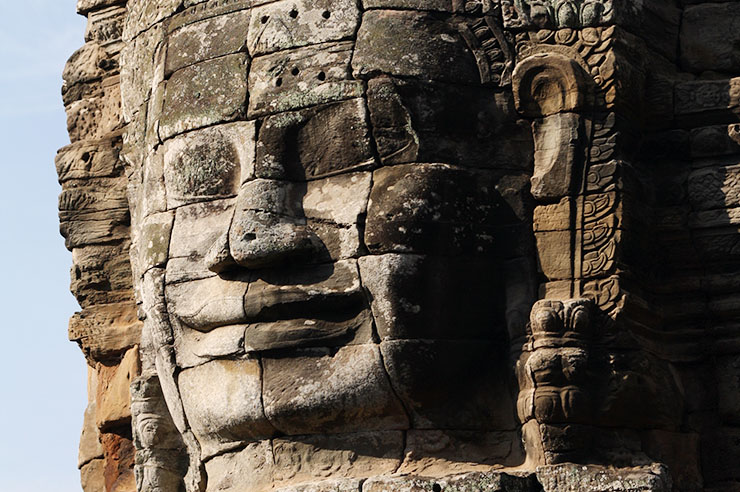
    That’s when he built the enigmatic Bayon Temple, which has his own face carved into dozens of towers scattered at random around the temple. The King rendered himself, not just as the supreme ruler and representative of the Godhead, but also as the Bodhisattva Lokesvara, thereby combining in his person the multiple religious currents of the Khmer. There is something, as well, supremely human in these heads, so perfectly recreated throughout the complex. The full lips and plump cheeks are beautiful, and speak of gentleness rather than fear, of contemplation rather than exertion. I am always delighted to be in the presence of this enormous cosmic friend, no matter how many hundred elderly Korean ladies might be pushing past me in the hot sun. That is the connection between the ruler and his people – perhaps all people. We respond to majesty, and recognise its presence and its guiding hand, even across the division of ages.

    After he died in 1218 the Khmer Empire began its slow and sad decline, from which it is only now beginning to rescue itself. From the 17th century the Khmer empire began to spiral downward, ceding vast amounts of territory to Thailand and Vietnam – including the whole of what we now know as Southern Vietnam, including the city of Saigon, which the Khmer called Prey Nakor (and still do, if you ask them). In 1865 Cambodia became a French protectorate.

    The Legacy of the Khmer Empire

    The Khmer empire is responsible for so much of what we recognise as south-east Asian culture – including many of the things we normally attribute to Thailand, such as Thai boxing, Thai dancing, even the Thai script is derived from Khmer, which was itself derived from Sanskrit. The traditional story of the Ramayana – though considerably changed in its Cambodian version – is carved on kilometres of stone panels in Angkor Wat, said to contain eighteen to twenty thousand carved figures. The women of the temple spent much of their time re-creating the stories in sacred dance. This dance has survived, quite miraculously, through its continuous royal patronage, and these days is performed once again on the terraces of the temples of Angkor.

    Cambodia is still a very poor place. It has suffered the effects of war and the disastrous Khmer Rouge years. Angkor Wat is its jewel, glorious and majestic still, and the Khmer people are justly proud of it. In our enthusiasm for this ancient site it’s important that we not glamorise the poverty that still blights the nation or, more subtle still, spiritualise it. The Cambodian people struggle to exist, and it’s a country of immense poverty and injustice. But there exists as well a great continued interest in the traditional arts, the arts that you can see being practiced on the 900 year-old carved stones of Angkor.

    And Angkor Wat is no longer the centre of political power in modern Cambodia. The capital city is Phnom Penh, 315 kilometres to the south-east. Interestingly enough, Phnom Penh has its own spiritual and mystical roots in Angkor. The city was said to have been founded by an elderly woman who, scavenging for firewood in the debris washed up by a recent flood, split a log and found in its hollow five religious statues – four stone Buddhas and one bronze Vishnu. They had come from Angkor, magically transported in the floodwaters. The woman, called Penh, decided to have them enshrined on a hill (Phnom in Khmer) on her property around 1372. Around this grew the city of Phnom Penh, eventually the new heart of the Khmer kingdom. But at its very centre remains the spiritual energy of Angkor.

    The temples of the Angkor area are still alive as points of worship and pilgrimage. They have seen such a strange shift over the centuries – as Hindu temples, then Mahayana Buddhist temples, then Theravada Buddhist temples, and finally as shrines to the tourist dollar. They will survive this, too, and their stones will continue to speak to people a thousand years after we have gone.

    [alert type=”general” dismiss=”no”]This article was published in New Dawn Special Issue Vol 6 No 1.[/alert]

    [alert type=”success” dismiss=”no”]If you appreciate this article, please consider subscribing to help maintain this website.[/alert]

    © New Dawn Magazine and the respective author.
    For our reproduction notice, click here.

  • A Life of Philip K. Dick: The Man Who Remembered the Future

    A Life of Philip K. Dick: The Man Who Remembered the Future

    From New Dawn 139 (Jul-Aug 2013)

    This year [2013] saw the 30th anniversary of the death of one of the most influential writers of all time, the iconic Philip K. Dick. Although virtually unknown outside of science fiction circles, during his lifetime Dick’s intriguing philosophy on the nature of reality has become a staple of the modern Hollywood movie. Huge blockbusters such as Total Recall, Minority Report, The Adjustment Bureau, Blade Runner, A Scanner Darkly and Paycheck were loosely based directly on his novels or short stories, and movies such as The Eternal Sunshine of the Spotless Mind, Memento, The Matrix, The Truman Show and Inception all owe a huge debt to his vision.

    One of the most intriguing themes of Dick’s writing was the concept of the “precog,” a person who could “see” the future before it happened. In 1954 Phil introduced the concept of precognition in his novel The World Jones Made. In this novel the eponymous anti-hero Floyd Jones can see exactly one year into the future. From then on “precogs” occur regularly in his novels and short stories, most notably in his 1956 short story The Minority Report, his 1964 novel Martian Time-Slip, The Three Stigmata of Palmer Eldritch and many others.

    What was it that made Philip K. Dick interested in precognition? It had not been a particular theme within classical science fiction nor had it been part of the books that the young Philip read during his childhood years and early teens. The answer may lie in one simple fact: Philip K. Dick himself was a “precog.” He was not writing fiction but heavily disguised autobiography. Let us review the evidence.

    Like many of his schoolmates, Phil was expected to attend the University of California in his hometown of Berkeley. But in order to do so he needed to reach the entrance grades required. This possibility started to fade rapidly when, during a crucial physics test, Phil couldn’t remember the key principle behind the displacement of water. As eight of the ten questions involved this principle, he was clearly in trouble. And then it happened: a voice clearly and precisely explained to the surprised young man the scientific principles he so desperately needed to understand. All Phil had to do was write down the words in his head. Phil received an ‘A’ grade.

    Although this “voice” effectively disappeared for many years, Phil continued to sense there was a part of him that was alien in some way. Throughout the 1950s the voice remained silent and then, under somewhat prosaic circumstances, it re-appeared. In an interview with his friend Greg Rickman, recorded in October 1981, Phil described how he had been watching a TV programme about the Galapagos turtles. The fight for survival of one particular female turtle had really upset him. After laying her eggs she had turned in the wrong direction and instead of going towards the sea she crawled inland. Soon the heat had brought about extreme dehydration. She was dying. As she began to fade her legs were still seen to be moving. The film had been edited to give the impression that the dying turtle was imagining she was back in the ocean. He went to bed with this tragic image in his mind. He woke up in the night to hear a voice. In careful and deliberate terms the entity explained to Phil that the turtle actually believed she was in the water:

    I was just terribly amazed and dumbfounded to hear that voice again. It wasn’t my own voice because one of the sentences the voice said was “And she shall see the sea” and I would not use the two words “see” and “sea” in the same sentence. It tends to do that, use word choices I don’t use. One time it used the expression “a very poisonous poison” which I would not use.1

    It is clear Phil recognised the voice as being the same entity that had helped him in his physics exam all those years before. It was back. He was to continue hearing this entity for many years, but only as a faint background whisper. In another 1981 interview he stated:

    I only hear the voice of the spirit when I am falling asleep or waking up. I have to be very receptive to hear it. It’s extremely faint. It sounds as though it is coming from a million miles away.2

    The “Voice” Returns

    In February and March 1974 the voice was to reappear and stay with him. It all started quite innocently. Phil had been in considerable pain after having a wisdom tooth pulled out. His wife, Tessa, called the dentist who prescribed painkillers. As Tessa did not want to leave her husband alone in such a state of agitation she asked if somebody could deliver the prescription to their house in Fullerton. Half an hour later the doorbell rang and Phil dashed to the door. On opening it he saw a young woman clutching the much-needed painkillers. Phil stood back stunned. Around the young woman’s neck was a necklace with a fish pendant. Phil recognised this as a symbol of something deep within himself. He asked her what it was and she explained it was a sign used by the early Christians as a code to show their secret beliefs to fellow Christians.

    Dick later reported this was the first time he experienced the pink light, the same light so central to the Beatles incident (described below). He said a beam of this light shot out of the pendant and entered his brain. This light opened up a part of his brain that had long been asleep. He described it in this way:

    I suddenly experienced what I later learned is called anamnesis – a Greek word meaning, literally, “loss of forgetfulness.” I remembered who I was and where I was. In an instant, in the twinkling of an eye, it all came back to me.3

    As we have already mentioned, up until March 1974 what Dick had called “the voice” manifested itself on rare occasions such as the incident during the school exam. But after Phil’s “anamnesis” his hidden partner was to become very active in his life. It decided that Phil had become far too slovenly in his personal appearance. He was made to go out and buy a pair of nasal hair-clippers and it suggested he trim his beard. The entity even had Phil go shopping for new trendy clothes.

    It was also concerned about the health of the shared body. It had Phil go through his drugs cabinet and forced him to throw out those medications that were proving problematical to his health. It discovered that wine was too acidic for his sensitive stomach and suggested he change to drinking beer. This being had many skills that Phil sadly lacked, such as business acumen. It realised he had made quite a mess of his tax matters and within weeks the entity sorted this out. It also had Phil sack his agent after it read over his royalty statements and discovered massive irregularities.

    All of these were minor interventions compared to its apogee, the saving of Phil’s son’s life. Phil describes how one morning he was lying in a semi-sleep state when he heard the voice announce that his recently born son, Christopher, had a potentially fatal birth defect and that urgent medical attention was needed. Indeed the voice was quite precise when it stated: “Your son has an undiagnosed right inguinal hernia. The hydrocele has burst, and it has descended into the scrotal sac. He requires immediate attention, or will soon die.” Phil told various versions of this story, including one involving him listening to the Beatles and the lyrics of “Strawberry Fields” were changed to give the instruction. Tessa, acting on her husband’s frantic instructions, took Christopher to the family doctor and it was, indeed, confirmed that Christopher had exactly the problem the “voice” had described and surgery was needed.

    Dick’s “Homoplasmate”

    What was the source of this “voice” and how did it have information unknown to Phil? Phil was to conclude that it was an immortal part of himself, something he called a “plasmate.” He argued this entity had bonded with him and in doing so had taken human form, something Phil termed a “homoplasmate.” He was later to describe how his mind had been invaded by a “transcendentally rational mind, as if I had been insane all my life and had suddenly become sane.” He explained that:

    …mental anguish was simply removed from me as if by divine fiat… some transcendental divine power which was not evil, but benign intervened to restore my mind and heal my body and give me a sense of the beauty, the joy, the sanity of the world.

    This being, set free from its shackles by Phil’s “anamneses,” was able to use its powers to help Phil precognise the future. Indeed, Phil realised this being had been the source of a series of peculiar precognitive incidents that had taken place throughout his life.

    For example, in his 1974 novel Flow My Tears the Policeman Said, Phil has a sequence in which one of his characters, Felix Buckman, is distraught at the death of his twin sister, Alys. He finds himself in an all-night gas station and there he meets up with a black stranger. Buckman and the black man start up a conversation. In the summer of 1978 Phil, uncharacteristically, decided to go out late at night to post a letter. In the darkness he noticed a man loitering by a parked car. Phil posted his letter and on the way back the man was still there. In a second uncharacteristic impulse Phil walked over to the man and asked if anything was the matter. The man replied that he was out of gas and he had no money with him. Much to his surprise Phil found himself digging into his pocket and giving the man some cash. The man asked for Phil’s address and said that he would return later and pay him back. As Phil entered his apartment he realised that the money would be of no use to his new friend. There were no gas stations within walking distance. Phil went back out, found the man, and offered to drive him to the nearest all-night gas station. As he stood watching the man fill up his metal gas can he had an alarming sensation of a déjà vu-like recognition:

    Suddenly I realised that this was the scene in my novel – the novel written eight years before. The all-night gas station was exactly as I had envisioned it in my inner eye when I wrote the scene – the glaring white light, the pump jockey – and now I saw something which I had not seen before. The stranger who I was helping was black.4

    Phil drove the black man back to his car, they shook hands and Phil never saw him again. He finishes off his description of this event with a slightly chilling comment:

    I was terribly shaken up by this experience. I had literally lived out a scene completely as it had appeared in my novel…. What could explain all this?5

    Uncanny Precognition

    In early 1974 Phil started a long-term correspondence with a graduate student called Gloria Bush. As time went on Phil described to Gloria some of his deepest thoughts, including his fascination regarding his own precognitive abilities. In a letter dated 9 May of that year he described to Gloria a particularly strange recurring dream he experienced in November 1971. In the dreams he always saw what looked like a Mexican city with “square arrangements of streets and yellow cabs.” The yellow cabs suggested to Phil a location in the USA rather than Mexico or Latin America. At the time of these dreams he was living in Marin County, north of San Francisco. In 1974 he was living in Fullerton, a southern suburb of Los Angeles. Right next to Fullerton is a place called Placentia which is a strongly Hispanic area. Phil explains to Claudia that he was convinced this was the place he saw in these dreams.6

    But Phil’s dreams in 1975 took a turn to the macabre. On 25 February he wrote a letter to Bush that was very different from those he had sent before. In a fascinating postscript to an otherwise standard letter, he mentions “the entity” again. It had clearly been manifesting itself within his life at that time. How regularly and to what intensity we cannot say as we have no other source other than this letter. However, it is clear Phil wanted to bring things to a head. He told Claudia:

    I was up to 5 a.m. on this last night. I did something I never did before; I commanded the entity to show itself to me – the entity which has been guiding me internally since March. A sort of dream-like period passed, then, of hypnogogic images of underwater cities, very nice, and then a stark single horrifying scene, inert but not still; a man lay dead, on his face, in a living room between the coffee table and the couch.7

    On 9 May 1974 he wrote another typewritten letter to Claudia stating that he felt “scared.” He didn’t elaborate on this comment but at the bottom of the letter is a handwritten note that states the following: “p.s. What scares me most, Claudia, is that I can often recall the future.”

    Almost exactly seven years later Phil had failed to answer a series of phone calls to his condominium. A group of neighbours then found his front door open. One witness, Mary Wilson, entered the condo and described how she initially thought nobody was home, but then she spotted Phil’s feet sticking out from behind a coffee table. She immediately asked her mother to phone Phil’s close friend, science-fiction writer Tim Powers. Powers jumped on his motorcycle to see what he could do to help. In his introduction to The Selected Letters of Philip K Dick Volume Four Powers describes what happened next:

    As I was putting the key in the ignition of my motorcycle I heard the sirens of the paramedics howl past me down Main Street. When I got to Phil’s place the paramedics and Mary Wilson were already there and the paramedic had lifted him from between the coffee table and the couch and carried him to his bed, and Mary and I answered a few hasty medical questions about him before they got him into a stretcher and carried him downstairs to the ambulance.8

    Phil’s February 1975 dream had come true in stunning detail. He had seen the circumstances of his own death.

    Who, or what, was the “entity” that seemed to share Phil’s life and know his future? Surprisingly enough Phil believed this being to be a version of himself that existed outside of time; a being that could observe the whole of Phil’s life from a position of timelessness. Phil believed that during his dreams, in his semi-waking states and during certain times of heightened awareness, this timeless part of himself could communicate and use its foreknowledge to assist him.

    In October 1977 Phil made a very curious statement during a radio interview at the Berkeley radio station KPFA FM. He described an incident that took place in 1951:

    Back at the time I was starting to write science fiction, I was asleep one night and I woke up and there was a figure standing at the edge of the bed, looking down at me. I grunted in amazement and all of a sudden my wife woke up and started screaming because she could see it too. She started screaming, but I recognised it and I started reassuring her, saying that it was me that was there and not to be afraid. Within the last two years – let’s say that was in 1951 – I’ve dreamed almost every night that I was back in that house, and I have a strong feeling that back then in 1951 or ’52 that I saw my future self, who had somehow, in some way we don’t understand – I wouldn’t call it occult – passed backward during one of my dreams now of that house, going back there and seeing myself again. So there really are some strange things…9

    If the figure at the end of the bed was a future version of Phil then that version would have foreknowledge of all Phil’s life-experiences between 1951 and 1977. Indeed, if Phil’s interpretation can be taken at face value, we have here evidence that in some way his mind from the mid-1970s was manifesting itself back within its own past.

    Vertical Vs. “Orthogonal Time”

    But Phil was not simply happy with accepting this may be the case, he wanted to create a model to explain such a belief. Immediately after the strange events of February and March 1974, or simply 2-3-74 as he termed them, Phil started to keep a journal. Initially in hand-written form and later as page after page of typewritten sheets with diagrams and side notes, this became known as his Exegesis. In effect this was Phil’s attempt to understand the source and meaning of the visions and revelations that he continued to receive until his death in March 1983.

    We are fortunate that in November 2011 a single volume containing all the main sections of this huge work was published by Houghton Mifflin Harcourt. Running to 976 pages this is a fascinating read and in it one can discover Phil’s own understanding of how a part of him could see the future. His solution was a radical re-interpretation of time itself – something Phil called “orthogonal time.”

    He proposes there are two variations of time, both of which exist at right angles to each other. We are usually only aware of “Vertical Time,” but there is another which runs at right angles to our space-time. He calls this “Orthogonal Time.” If we could perceive both times simultaneously it would look cubical, hence his term cubic time. He proposed that events are actually located within this cubic time. As such the idea of cause and effect cannot be applied within this model. Causality can run in reverse or act simultaneously with an event in the past or the future. In other words within orthogonal time all past and future states exist at this moment. In the whole of the Exegesis Phil makes one passing reference to a physicist by the name of Herman Minkowski, the teacher of the much more famous Albert Einstein. With reference to his own precognitions, Phil wrote:

    This is a disturbing new view but oddly enough it coincides with my dream experiences, my precognition of events moving this way from the future; I feel them inexorably approaching, not generated from the present, but somehow already there but not yet visible. If they are somehow “there” already, and we encounter them successively (the Minkowski block universe; events are all already there but we have to encounter them successively), then this view might be a correct view of time and causality.10

    Phil suggested that the basic premise of his short story Adjustment Team – that there exists a way in which the past can be “adjusted” to change the present – may be another of his fictionalised accounts of something that really takes place.11 

    Phil believed that part of us exists within orthogonal time and this alternate-consciousness can, under certain circumstances, communicate with the every-day self that perceives only linear time. This was the source of “the voice” and VALIS (Vast Active Living Intelligence System, Dick’s gnostic vision of one aspect of God). This is how, in dreams, Phil found himself back in his own past observing an earlier version of himself. In this way “the voice” was his own voice speaking from his own future. This entity created his plot-lines using material from his own future. Was this how the meeting with the black man at the gas station ended up in Flow My Tears The Policeman Said? All information from all parts of our life is readily available to a mind open to receive it. Phil suggested in a letter to his friend Patricia Warrick, written in September 1981, that:

    The universe is an information retrieval system; which is to say, everything that has ever happened, ever been, each arrangement and detail – all are stored in the present moment as information; what we lack is the access or entry mechanism to this stored information… where the past of each object – all its prior manifestations along the Form axis – this is all stored in the present object and can be retrieved.12

    This is again astounding evidence that Phil seemed to be accessing information from some form of infinite data-field. It is very much in keeping with the work of modern-day researchers such as Ervin Laszlo and Bernard Haisch, both of whom suggest this “library” is, in fact, something known as the Zero-Point Field.13

    Is this the answer to the mystery of Phil’s precognitions? It certainly makes sense. The future and the past are simply illusions. Phillip K. Dick and every being that reads this article consist of two independent consciousnesses. One lives in linear time and the other in orthogonal time. And in this way we may all be immortal. After all, the transition between life and death takes place in linear, not orthogonal, time.

    In his novel Ubik Phil created a concept known as “Half Life.” This is a timeless place, hovering between life and death. Tibetan Buddhists call this the “Bardo State.” Is this from where Phil’s eternal mind communicated with him? To paraphrase the title of one of his most intriguing books, could it be we all exist in a place where “Time is Out of Joint”?

    For more on the above, read Anthony Peake’s book The Man Who Remembered the Future: A Life of Philip K. Dick.

    [alert type=”success” dismiss=”no”]If you appreciate this article, please consider subscribing to help maintain this website.[/alert]

    Footnotes

    1. Gregg Rickman, Philip K. Dick: The Last Testament, Fragments West, 1985, 23

    2. John Boonstra, Horselover Fat and The New Messiah, Hartford Advocate, 22 April 1981, reproduced in PKD Otako #06, 22

    3. ‘How to Build a Universe that Doesn’t Fall Apart Two Days Later’, published as an introduction to I Hope I Shall Arrive Soon, Doubleday, New York, 1985

    4. Lawrence Sutin (editor), The Shifting Realities of Philip K. Dick, Vintage, 1995, 268

    5. Ibid., 269

    6. The Selected Letters of Philip K Dick, 1974, Underwood-Miller, 1991, 101

    7. Philip K. Dick, Letter to Claudia Krenz, 25 February 1975

    8. The Selected Letters of Philip K Dick, 1975-76, Underwood-Miller, 1992, ix

    9. Richard A Lupoff,  A Conversation With Philip K Dick, Vol. 1, no. 2, August 1987, 45-54

    10. Philip K. Dick, The Exegesis of Philip K Dick, Hachette Littlehampton, Kindle Edition.

    11. Ibid.

    12. The Selected Letters of Philip K Dick, 1980-1982, Vol. 6, Underwood Books, 2009, 262

    13. Ervin Laszlo, Science and the Akashic Field: An Integral Theory of Everything, Inner Traditions, 2007

    © New Dawn Magazine and the respective author.
    For our reproduction notice, click here.

  • When Does the Kali Yuga End?

    When Does the Kali Yuga End?

    From New Dawn 138 (May-June 2013)

    The widespread belief that an age is ending and a new one dawning is part of a cyclical concept of time common to most philosophical cultures. The best known versions are the Four Ages of Greek mythology and the Hindu myth of the Four Yugas. The purpose of this article is to clarify some of the confusion that exists around them, to set out the actual figures as given by Eastern and Western authorities, and to discourage unthinking acceptance of a currently popular theory.1

    The earliest European source of the myth is Hesiod, a Greek poet of the eighth century BCE. In his Works and Days (lines 109-21) he describes the ages as a cycle of decline, from Golden to Silver, Bronze, and Iron. He adds the interesting idea that these ages do not only change the quality of life, but the after-death state of humans. The people of the Golden and Silver Ages, when they died, became spirits who watch over and benefit the human race. The people of the Bronze Age were not immortal in that sense, but went down to a twilight existence in Hades. Perhaps influenced by the Trojan War, Hesiod here inserts an “Age of Heroes” of whom a few crossed the ocean to enjoy a private Golden Age under its ruler Cronos (Saturn). But this did not stem the degeneration for the rest of mankind, which hurtled down to the nadir of the Iron Age. For Hesiod it was too soon to tell their after-death fate, but things were not looking good for them.

    Post-classical culture learned of the Four Ages mainly through Virgil and Ovid. In the first book of his Metamorphoses (I, 89-261) Ovid describes them and their races as declining in happiness and virtue until the universal Deluge. After that a new order of humans, animals, and plants was raised up from the earth. Christians saw a similarity with the biblical story of Noah’s Flood, but even more so in Virgil’s prophecy of a new Golden Age in his own time. It may have been intended to flatter the Emperor Augustus, who had brought peace after Rome’s civil war, but the mention of the Virgin made it applicable to Christ:

    Now comes the last age, sung by the Cumaean Sibyl:
    The great order of ages starts anew.
    The Virgin returns and Saturn’s reign resumes:
    A new race of men is sent from heaven.
    (Eclogue IV, 5-8)

    The Abrahamic religions (Judaism, Christianity, Islam) do not share the pagan concept of multiple cycles of creation and destruction. Monotheisms have room only for one cycle, with the Garden of Eden before the Fall as equivalent to the Golden Age. To continue the parallel, the Silver Age might be that of the biblical patriarchs who were still intimate with God; the Bronze Age that of the prophets and sacred kings; the Iron Age, from the Babylonian exile up to the present day. The cycle will end with Judgment, after which the Christian elect enter the New Jerusalem and Muslims the Garden of Paradise. Jews have their corresponding Messianic expectation. All three religions promise that in the end God will set things right, or in pagan language, that the reign of Cronos will return.

    Incidentally, one of the recurrent themes of the Golden Age is that during it, the earth’s axis was perpendicular to the ecliptic (a topic treated in my book Arktos2). If this were so there would be no seasons, but equal day and night throughout the year. Plants and trees would fruit continuously, and the years would pass uncounted. Eternity could well describe the human experience of time under such conditions, which ceased when the axis was knocked off kilter. It will be restored at the next Golden Age, when the earth resumes its proper axial position. Whether or not there is any scientific basis to this myth makes no difference to its power and the “thought experiment” that goes along with it.

    The Four Ages (Yugas) of Hinduism

    Hindu tradition has its own version of the Four Ages, and it was probably from there that it reached the Greeks and other Indo-European peoples. The Puranas and Laws of Manu agree that the four Yugas are in the proportion 4:3:2:1. Their names are Krita Yuga (fortunate age; also called Satya Yuga), Treta Yuga (age of three parts), Dwapara Yuga (age of two parts), and Kali Yuga (age of conflict), the four together constituting a Maha Yuga or Great Age.

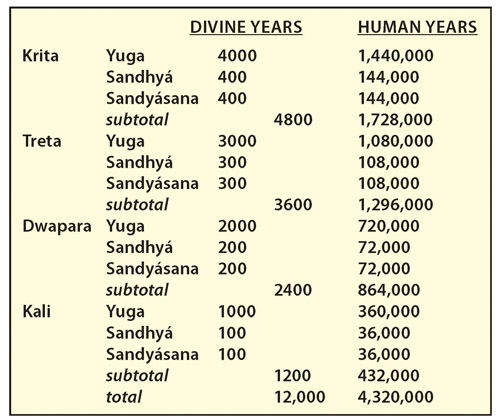
    Each Yuga has a dawn and a twilight period, each a tenth of its length, called respectively Sandhyá and Sandyásana. The Vishnu Purana gives their durations in divine years, each counting for 360 human years, as follows:3
    ndmain138 64

    To relate these durations to history we need an actual date, and this is supplied by the Hindu astronomers. They agree that the Kali Yuga began at midnight between February 17 and 18, 3102 BCE. From that we can calculate that the transition to the Golden Age will occur around 427,000 CE. It hardly seems worth bothering about something so far outside the time-scale of human experience. But before we dismiss these figures as pure fantasy, we should know that they are not peculiar to Hinduism. Some of them appear in very different contexts, with such precision that there is no question of chance coincidence.

    Berossus, who records the Babylonian chronology, was a priest of Bel and had a school of astronomy on the island of Kos in the third century BCE. He gives the figures for the reigns of the ten Assyrian kings who preceded the Flood: they total 420,000 years.4

    In China, according to the early missionary researcher Père Prémare, the early dynasties were respectively of 13 and 11 kings, each of whom ruled or lived 18,000 years. Prémare understandably doubted this, but if we do the arithmetic, (13 + 11) x 18,000 comes to 432,000 years.5

    The Icelandic saga called the Poetic Edda describes the preparations for the apocalyptic battle at the end of time, when Valhalla’s warriors issue forth against the Fenris Wolf:

    Five hundred doors | and forty there are,
    I ween, in Valhall’s walls;
    Eight hundred fighters | through one door fare
    When to war with the wolf they go.6

    800 fighters going through each of 540 doors totals 432,000. So the number of warriors gathered in Valhalla on the last day is again the number of years in the Kali Yuga, the last age of the Maha Yuga cycle.

    The authors of Hamlet’s Mill, Giorgio de Santillana and Hertha von Dechend, called this a “remarkable and disturbing coincidence.”7 This is because the theory of an archaic worldwide culture with cosmological knowledge is anathema to official prehistory. One breach in the conventional view is due to Ernest McClain, one of the most original and ingenious researchers of our time. He has uncovered evidence of a kind of multidisciplinary game played with these self-same numbers which hinges on musical tuning systems. Those in the know included the Babylonians, the Vedic poets, Plato, the compilers of the Hebrew scriptures, the earliest Christians and Gnostics, and whoever gave the Quran its present form. For example, McClain interprets the Arks of Babylonian and Hebrew legend as multi-story diagrams that enclose, or “save” from the flood all possible numbers, the ones needed for calculating the calendar and the musical scale. In the case of Noah’s Ark, the significant number is none other than 432,000.8

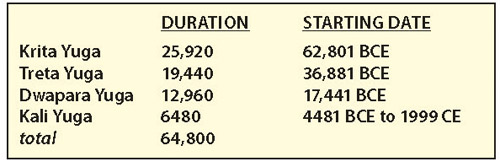
    McClain is a radical with regard to the history of ideas, but even more so are the Traditionalists, who take the numbers not as a philosophical game but as encoding precise knowledge of cosmic and historical time-cycles. René Guénon (1886-1951), one of the few great thinkers to have worked from this assumption, accepted that the four Yugas are in the proportion of 4:3:2:1, but questioned the Puranic figures. The zeros were put there simply to mislead, he says,9 and for good reason. If people knew the real dates, they would try to predict the future, which is unwise “because in practice, such knowledge brings many more problems than advantages.”10 The essential thing is the number 4320, which Guénon takes as representing the Maha Yuga: the set of four Yugas that embraces the entire history of present humanity. But 4320 years is obviously too short a period, just as the 4,320,000 years of the Puranas is too long. There were two basic problems: first, to find the correct multiplier of 4320 in order to arrive at the true length of the Maha Yuga, and second, to find the anchor in known chronology. Guénon seems to have worked backwards from knowledge of another cycle, that of the precession of the equinoxes which is traditionally given as 25,920 years (4320 x 6). Assuming that the Krita Yuga or the “timeless” Golden Age lasted for a whole precessional cycle, this gives the following durations for the four Yugas in human years, with a total of 64,800 years or 4320 x 15:

    Krita, 25,920
    Treta, 19,440
    Dwapara, 12,960
    Kali, 6480

    For all his warnings about attempts to predict the future, Guénon planted straightforward clues, mostly in footnotes, to show how he connected these durations to known chronology. Writing about Atlantis, he says:

    We think that the duration of the Atlantean civilisation must be equal to a “Great Year,” understood as half the period of the Precession of the Equinoxes. As for the cataclysm that brought it to an end, certain concordant data seem to indicate that it took place 7200 years before the year 720 of the Kali Yuga: a year which is itself the departure point of a familiar era, but one whose origin and significance are no longer known to those who currently use it.11

    Guénon typically does not reveal the “concordant data,” but his commentator Jean Robin explains:

    If one knows that the era in question is none other than the Jewish one, whose beginning is traditionally placed 3761 years before the Christian era, it is easy to deduce… the “theoretical” end-date of the cycle. The beginning of the Kali Yuga would thus be in the year 4481 BCE (3761 + 720), and its end would have to come 6480 years later, i.e. in the year 1999 (6480 – 4481).12

    We can now reconstruct Guénon’s chronology as follows:
    ndmain138 65

    Robin was writing in the early 1980s. He reminds us that 1999 is the one date specifically mentioned by Nostradamus as when “a great King of Terror will come from the sky.” But like every other world-ending date, it has come and gone.
    [alert type=”info” dismiss=”no”]If you appreciate this article, please consider a subscription to New Dawn magazine.[/alert]

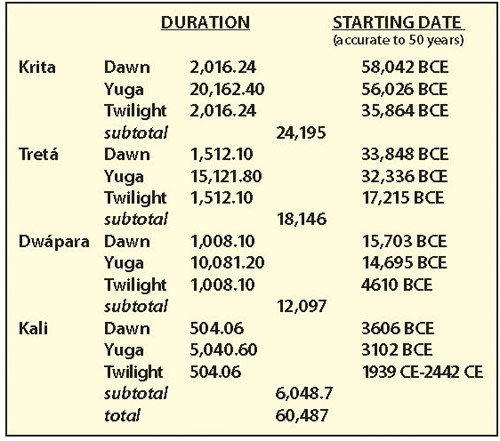
    The orientalist and musicologist Alain Daniélou (1907-1994) knew the Hindu tradition from the inside and was a correspondent of Guénon’s. He too could not accept the extremely large figures given in the Puranas, and reduced them in a different way. There are some problems with his method (explained in my book Atlantis and the Cycles of Time), but it is enough here to give his figures for comparison. Daniélou’s historical peg is the traditional date for the beginning of the Kali Yuga, 3102 BCE, which he says “represents a cosmological reality linked with an alternation in influx from the planetary spheres; it is not an arbitrary date.”13
    ndmain138 66

    By these calculations, the Kali Yuga’s final phase began with World War II. Daniélou, although a much more cheerful type than the saturnine Guénon, was a complete cultural pessimist. He writes that, “the final catastrophe will take place during this twilight. The last traces of this present humanity will have disappeared in 2442.”14 I can imagine him adding, with a smile, “et bon débarras!” [and good riddance!].

    Guénon also corresponded with Gaston Georgel (1899-?), an independent scholar of whom almost nothing is known. He had found that historical events tend to replicate each other at certain rhythmical intervals. Some of his parallels are impressive, such as that of the medieval kings of France with Louis XIV-XVI, at an interval of 539 years (77 × 7), or that of the English and French revolutions, 144 years apart. Georgel first published his cyclical theories in 1937 as Les rythmes dans l’histoire (Rhythms in history).15 He was as yet unaware of Hindu traditions, and his large-scale cycle was one of 2160 years. This is the traditional duration of an astrological age, twelve of which make up the precessional cycle of 25,920 years. Georgel renames the Age of Aries the “Cycle of Abraham,” and the Age of Pisces the “Cycle of Caesar,” which he dates from 130 BCE. He arrived at that date, he says, from “a deep study of the Christic cycle” and the fact that “according to Virgil’s Fourth Eclogue, the sun at autumn equinox then entered the sign of Virgo.”16 That sounds authoritative, but as anyone who has studied the astrological ages should know, the borders of the constellations are not fixed (unlike the regular, fictive constellations counting from the spring point as 0° Aries). Consequently the time when the equinoctial sun moves from one to the next is debatable. For instance, the dates given by various authorities for the beginning of the Aquarian Age range from 1760 (Godfrey Higgins) to 2160 (Paul Le Cour).17 

    Guénon agreed that many of Georgel’s coincidences were extraordinary. The next year he wrote his own contribution to the subject, “Some Remarks on the Doctrine of Cosmic Cycles” (1938), in which he interpreted the Puranic numbers as given above. After World War II their correspondence resumed. Georgel returned the compliment by adopting Guénon’s Yuga chronology but stuck to his own dating, saying that “to facilitate our research, we will here adopt the date of AD 2030 that was proposed as a working hypothesis in our first book, for the end of the Manvantara” (i.e. the Maha Yuga of 64,800 years).18

    Georgel found corroboration of the 2030 end-date in a book to which Guénon himself lent much credence: Beasts, Men and Gods by Ferdinand Ossendowski. This best-selling book published in 1922 plays a large role in the myth of Agarttha, which I have treated elsewhere.19 It culminated with a prophecy that the King of the World is supposed to have made in Mongolia in 1891:

    In the fiftieth year only three great kingdoms will appear, which will exist happily seventy-one years. Afterwards there will be eighteen years of war and destruction. Then the peoples of Agharti will come up from their subterranean caverns to the surface of the earth.20

    The fiftieth year from 1891 is 1941. The happy period of 71 years under three great kingdoms lasts from 1941 till 2012. Then 18 more years bring us exactly to 2030.21

    We now have four suggested dates for the end of the Kali Yuga, and with it the end of the present set of four ages. The Puranic figures, taken literally, place it about 427,000 years in the future. Jean Robin, following Guénon, reckoned that it would end in 1999. Daniélou calculated that the Kali Yuga entered twilight phase in 1939 and will end completely in 2442. Georgel’s multiple cycles converge on the year 2030. After that a new Krita/Satya Yuga initiates the next cycle.

    Sri Yukteswar’s Hindu Yuga system

    Many readers will be familiar with the system proposed by Sri Yukteswar Giri (1855-1936). It has had such favourable publicity in recent years that it is widely believed to be the authoritative Hindu Yuga system.22 Sri Yukteswar adopts as his Maha Yuga a 24,000 year period, supposedly that of the precession of the equinoxes. He assigns half these years to a set of descending Yugas in the traditional proportion 4:3:2:1. By taking the “divine years” of the Puranas (see the first table, page 64) as human ones, they total 12,000 years. Then comes his real innovation: the cycle does not repeat, but starts a new set of four Yugas in reverse order. The link to historical chronology seems to be the traditional Kali Yuga starting-date of 3102 BCE, but moved to 3101 and to a different place in the Yuga sequence. From this it is easy to construct a table of Yuketeswar’s system:
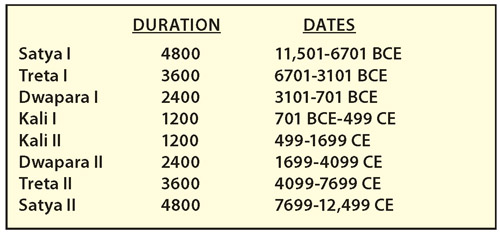
    ndmain138 67

    As in the Puranic system, each age is framed by sandhis or periods of mutation at its beginning and end, each worth 1/10 of the Yuga. Thus a Kali Yuga proper lasts 1000 years, with periods of 200 years preceding and following it. In 1894 Yukteswar wrote:

    In 1899, on completion of the period of 200 years of Dwapara Sandhi, the time of mutation, the True Dwapara Yuga of 2000 years will commence and will give to mankind in general a thorough understanding of the electricities and their attributes.23

    The essence of Yukteswar’s system is that it places present-day humanity in an ascending, rather than a descending curve. This is so contrary to all traditions that we must look for its source elsewhere. Upper-caste Indians like Yukteswar may have resented being colonised by the British, but they had bought into the European myth of progress through science. Yukteswar believed that around 1700 the world had entered an “electrical” age. The discovery of electricity and its uses signified to him that man was attaining a finer perception than in the purely materialistic age that had preceded it. Before that, in the dual Kali Yuga, “the intellectual part of man was so much diminished that it could no longer comprehend anything beyond the gross material of creation.”24

    Only historical ignorance can excuse such a statement. The period in question, from 701 BCE to 1699 CE, saw the birth of Buddhism, Zoroastrianism, Taoism, Jainism, and Vedanta; of the Orphic and Pythagorean movements, the mysteries of Isis, Serapis, and Mithras, the birth of post-exilic Judaism, Druidry, Christianity, Manicheanism, Gnosticism, Catharism, and Islam. On the esoteric side it witnessed Zen and Vajrayana Buddhism, Sankhya philosophy, Kabbalah, Sufism, theosophy both Neoplatonic and Christian, Rosicrucianism, and the arts of magic, alchemy, and astrology. Reports of miracles were commonplace, and belief in non-material realities such as oracles, curses, the Will of God, the Devil, transubstantiation, or witchcraft was so intense as to cause major wars and persecutions. Finally around 1700, with the scientific revolution and the Enlightenment, came a rising tide of disbelief in anything spiritual, leading to the atheism and scientific materialism of today’s elites.

    The Jains and some Buddhist sects also had an up-and down cyclical system, which may have been one of Sri Yukteswar’s inspirations, though their time-scale far exceeds his. His other ingredient was a rough approximation of the precessional cycle to 24,000 years instead of the astronomers’ 25,770 or the traditional 25,920. He anchored it in historical chronology with a clearly political motive, for, along with another future guru, Sri Aurobindo Ghose, he belonged to a secret anti-colonial movement called precisely Yugantar, meaning “New Age” or “Transition of an Epoch.”25 There was a strategic purpose behind the announcement in 1894 that the Kali Yuga was over and the Dwapara Yuga, a better age, already in progress; also behind the emphasis on 1899, only five years away, as the year that the new epoch would come into its own. In the early years of the twentieth century, the movement’s propaganda announced that the “sinful Iron Age was over” and urged insurrection. This is not an attack on Sri Yukteswar and those who respect him and his disciple Yogananda, but simply a reminder that even sages have their agendas. Guénon said as much about the authors of the Puranas!

    What is at stake here is more than allegiance to one authority or another. It is whether one’s world-view allows (1) that humanity as a whole passes through predetermined cycles, and (2) that these are fixed chronologically, hence predictable if one can find the key. For what it is worth, I lean towards the first but not the second, because I trust the microcosm as a guide to understanding the macrocosm, and vice versa. Every one of us is passing through a predetermined cycle whose dates are unpredictable. Barring accidents, we are making our way from the Golden Age of childhood, through the bitter-sweet Silver Age of adolescence and the combative Bronze Age of maturity, to the Iron Age of decline and death. Then we may start afresh, but we certainly don’t repeat the process in reverse! Just as one can estimate someone’s life expectancy by their age, state of health, habits, etc., so one can make a guess at that of civilisations and maybe the entire human race.

    The traditional descriptions of the Kali Yuga, and especially of what Guénon in 1944 called the “Reign of Quantity,” fit the modern world perfectly, and that may give us an idea of our position in the cycle. But like an old person recovering from one close call after another, we seem to be holding on and must be grateful for each new day.

    More information and extensive research on this subject matter can be found in Joselyn Godwin’s book Atlantis and the Cycles of Time (Inner Traditions, 2011).

    [alert type=”general” dismiss=”no”]This article was published in New Dawn 138.[/alert]

    [alert type=”success” dismiss=”no”]If you appreciate this article, please consider subscribing to help maintain this website.[/alert]

    Footnotes

    1. This article quotes and adapts material explained more fully in my book Atlantis and the Cycles of Time (Rochester, Vt.: Inner Traditions, 2011).

    2. J. Godwin, Arktos, The Polar Myth in Science, Symbolism, and Nazi Survival (Kempton: Adventures Unlimited, 1996), 13-18.

    3. Compiled from Vishnu Purana, 1:3; see also Linga Purana, 4:24-35; Laws of Manu, 1:68-82.

    4. Eusebius, Chaldaean Chronicle, 1:8.

    5. Joseph Henri Marie de Prémare, Discours préliminaire, in Joseph de Guignes, ed., Le Chou-King, un des livres sacrés des Chinois (Paris: Tilliard, 1770), li.

    6. The Poetic Edda, Grimnismol, 23, trans. Henry Adams Bellows.

    7. Giorgio de Santillana and Hertha von Dechend, Hamlet’s Mill: An Essay on Myth and the Frame of Time (Boston: Gambit, 1969), 162.

    8. Ernest G. McClain, The Myth of Invariance: The Origin of the Gods, Mathematics and Music from the Rig Veda to Plato (New York: Nicolas Hays, 1976), 149.

    9. What follows is summarised from René Guénon, “Quelques remarques sur la doctrine des cycles cosmiques,” in Formes traditionnelles et cycles cosmiques (Paris: Gallimard, 1970), 22-24.

    10. Ibid., 21.

    11. Ibid., 48n.

    12. Jean Robin, Les sociétés secrètes au rendez-vous de l’apocalypse (Paris: Guy Trédaniel, 1985), 67.

    13. Alain Daniélou, While the Gods Play: Shaiva Oracles and Predictions on the Cycles of History and the Destiny of Mankind, trans. Barbara Bailey et al. (Rochester, Vt.: Inner Traditions, 1987), 193.

    14. Daniélou, While the Gods Play, 197.

    15. Gaston Georgel, Les rythmes dans l’histoire, 3rd ed. (Milan: Archè, 1981; 1st ed. 1937).

    16. Ibid., 164.

    17. See Atlantis and the Cycles of Time, 346-48.

    18. Gaston Georgel, Les quatre âges de l’humanité (Exposé de la doctrine traditionnelle des cycles cosmiques) (Milan: Archè, 1976; 1st ed. 1949), 87.

    19. See J. Godwin, “Agarttha: Taking the Lid Off the Underground Kingdom,” New Dawn 109 (2008), 59-62; also the investigations by Marco Baistrocchi, “Agarttha: A Guénonian Manipulation?” trans. J. Godwin (Fullerton, Ca.: Theosophical History, 2011) and Louis de Maistre, Dans les coulisses de l’Agartha l’extraordinaire mission de Ferdinand Anton Ossendowski en Mongolie. (Paris: Arché, 2010).

    20. Ferdinand Ossendowski, Beasts, Men and Gods (New York: Dutton, 1922), 314.

    21. Gaston Georgel, Le cycle Judéo-Chrétien, sceau et couronnement de l’histoire humaine (Milan: Archè, 1983), 34.

    22. This system is explained in Jnanavatar Swami Sri Yukteswar Giri, The Holy Science (Los Angeles: Self-Realization Fellowship, 1990; 1st ed. 1949), 7-18.

    23. Ibid., 15.

    24. Ibid., 13.

    25. See Terrorism in Bengal: A Collection of Documents on Terrorist Activities from 1905 to 1939, ed. Amiya K. Samanta (Calcutta: Government of West Bengal, 1995), 1:155. Accessed through Wikipedia article “Mokshadacharan Samadhyayi.”

    © New Dawn Magazine and the respective author.
    For our reproduction notice, click here.
  • The Inscrutable Madame Blavatsky: An Interview with Gary Lachman

    The Inscrutable Madame Blavatsky: An Interview with Gary Lachman

    This article was published in New Dawn 137 (Mar-Apr 2013)

    I was in search of the unknown…
    – Madame H.P. Blavatsky (1831-1890)

    Gary Lachman is one of today’s most intelligent and prolific authors on the world of the occult. He started out in the 1970s in the New York rock scene as one of the original members of the groundbreaking New Wave band Blondie. In 1996 he moved to London, where he established himself as a full-time writer, contributing to publications such as Fortean Times, The Guardian, and The Times Literary Supplement.

    Since 2001 he has produced a steady stream of books, including Turn Off Your Mind: The Mystic Sixties and the Dark Side of the Age of Aquarius; The Secret History of Consciousness; A Dark Muse: A History of the Occult; and Politics and the Occult: The Right, the Left, and the Radically Unseen. In recent years he has published biographies of major esoteric figures including P.D. Ouspensky, Emanuel Swedenborg, Rudolf Steiner, and Carl Jung.

    I first came to know Gary in the ’90s, when he was a frequent contributor to the now-defunct Gnosis magazine, for which I was editor. Although we’ve been in constant touch over the years, the last time I saw him in person was in 2006, when he was in New York to be inducted into the Rock and Roll Hall of Fame as part of Blondie. We had a long conversation over lunch that led to his book Politics and the Occult. In 2012 Gary published Madame Blavatsky: The Mother of Modern Spirituality, a biography of the pioneering nineteenth-century spiritual figure H.P. Blavatsky (also known as HPB). In January 2013 I conducted an e-mail interview with him about the book and about Blavatsky.

    RICHARD SMOLEY (RS): To begin with, could you say a little bit about who H.P. Blavatsky was for those who aren’t familiar with her?

    GARY LACHMAN (GL): Helena Petrovna von Hahn was born in 1831 into a family of the lower Russian nobility. Around her eighteenth year, she fled a brief and unconsummated marriage to an older man, Nikifor Blavatsky, and embarked on what by all accounts was a twenty-odd-year-long global quest for secret knowledge, triggered by her reading of her great-grandfather’s occult library and her own mystical experiences. During this time, she said, she met her Master Morya in London, who charged her with a mission: to reach Tibet, where she would be tutored in the control of her psychic abilities. She surfaced in New York City in 1873, where she lived in a woman’s cooperative on the Lower East Side. A meeting with Colonel Henry Steel Olcott led to a lifelong Platonic relationship, and in 1875, she, Olcott, and William Quan Judge founded the Theosophical Society. The rest is history.

    RS: What made you choose her as the subject of a biography?

    GL: I had already written studies of Ouspensky, Jung, Swedenborg, and Rudolf Steiner. As I argue in the book, HPB was a seminal influence on practically the whole of modern spirituality and esotericism. All of my work is centred on the idea of an evolution of consciousness, both in the individual and in culture at large. It seemed to make sense to take a new, fresh look at someone who kick-started a whole movement dedicated to this idea. Also, it struck me that much of what we think we know about HPB was really a myth, made up of hearsay and misperception, repeated for more than a century. I can’t say I’ve told the truth about Blavatsky, but I’ve tried to point out what others haven’t.

    RS: What influence does Blavatsky continue to have on the current spiritual scene?

    GL: Well, the Theosophical Society, in its many different forms, continues today. Much of what we think of as New Age really has its roots in Blavatsky’s early work. Tibetan and Mahayana Buddhism, as we understand it in the West, for example, emerged from her and her early followers. W.Y. Evans-Wentz, who collected the funerary texts we know as The Tibetan Book of the Dead, was a Theosophist, and much of his work is informed by Theosophical ideas. Also, our contemporary interfaith and multifaith sensibilities, our striving toward a broad religious tolerance, has its roots in Blavatsky’s belief that all the major religions have their source in an ancient, ‘secret’ doctrine. She was very much ahead of her time.

    RS: There is a broad spectrum of opinion about Blavatsky. On one end there are those who regard her as a fraud pure and simple. On the other end are those who see her as a much-maligned saint. Where would you place yourself on this continuum?

    GL: Well, I don’t see her as a fraud or as a saint, so I guess I am in the middle, or rather, perhaps ‘above’ this either/or opposition. In the book I refer to a concept I borrow from the novelist Hermann Hesse. In an essay on Dostoyevsky, Hesse speaks of what he calls ‘Russian Man’, who is an antinomian character, “an hysteric, drunkard, criminal, poet and saint, all wrapped up in one.” Think of Rasputin, the ‘holy devil’. HPB was what we call a ‘trickster’, although that is something of a cliché. She wasn’t above mystical high jinks when she felt it was necessary – or when she got exasperated with the sanctimonious devotees who often wasted her time. But she was also a deeply spiritual, I would even say religious, moral character; I liken her to the Russian startzi – deeply spiritual individuals who gave off a kind of spiritual electricity. But she didn’t wear this on her sleeve.

    RS: After having done so much research on Blavatsky, do you personally believe that her alleged occult powers were genuine?

    GL: I keep an open mind about her powers. For one thing, I’ve had enough anomalous experiences to accept that the standard ‘scientific’ view of reality simply doesn’t cover all the bases, things like precognitive dreams, telepathy, and very convincing synchronicities. Of course, some of the things claimed about HPB – materialising teacups and other items – do seem impossible. But I point out in the book other examples of similar abilities. I look at a few of the most well known examples, and, given what we know about them – and we can only go by the accounts that have come down to us – I try to see how she could have faked them – if she did. Of course, because I can’t see how she could have faked the teacup or some other ‘materialisation’, doesn’t mean she couldn’t have. But I did rack my brain quite a bit about it, and I think I covered every possible angle. So my take is that, yes, they are incredible, but perhaps not impossible. I mean, look at what science tells us about dark matter, dark force, super strings, and n-dimensions. That seems pretty incredible too. Were her ‘phenomena’ important? That’s a different question.

    RS: Blavatsky made much of her connection with the hidden Masters Morya and Koot Hoomi, as well as other Masters. Some take these to be actual men endowed with superhuman capacities who guided her in her path and in the creation of the Theosophical Society. Others say they are figments of her imagination. What’s your own position on this issue?

    GL: Blavatsky’s Masters seem to me to be composed of several different things. There was the ‘mysterious Hindu of my dreams’ that came to her in her earlier life, and more than once saved her life – at least that was the story she told in her later years. Then there was the idea of ‘unknown superiors’, high-ranking individuals in the Rosicrucian Freemasonry her great-grandfather practised. Reading of these mysterious powerful but ‘hidden’ men, Blavatsky became committed to finding them and to realising the vision of a progressive, united Europe they championed. The Theosophical Society was her way of trying to make their goal of a universal fraternity come true. Then there were the actual men and women she encountered in her quest for knowledge; people like herself who were pursuing a similar quest. She considered many of these ‘Masters’ – a title of respect and gratitude. But of course the most significant Masters were Morya and Koot Hoomi, flesh-and-blood men who had mastered their own psychic powers and who taught her how to master her own. Whether they had the powers she claimed is still up for debate, but I believe they did exist. HPB lived out a myth and she saw these people as embodiments of the inner guides she believed were helping her on her path. So the Master she knew from her childhood dreams and the Master she met in London in 1851 may not have been the same actual person, but for her we can say that they fulfilled the same role.

    RS: In your book you allude to unseen hands that work behind the scenes of history. Do you think there are such forces, and if so, how did they use Blavatsky?

    GL: I’m not sure about the ‘hidden hand’ version of history – and the phrase ‘hidden hand’ comes from the esoteric scholar Joscelyn Godwin. That idea is a kind of staple of occult history, and also of our contemporary conspiracy consciousness. In one sense I’m not partial to it – I think we need to solve our problems ourselves, rather than expect a saviour, either some ‘inner circle’ of humanity or benevolent aliens or extradimensional beings or Mayan calendars, to do it for us. But on the other hand, given the dominance of the ‘rational’ view that history is meaningless, or, at best, the result of purely material forces, I think the idea of something at work ‘behind the scenes’ can be positive. At least it posits some meaning or intelligence at work. But the notion of some cabal of advanced individuals, holed up in the Himalayan fastness – or at the centre of the earth, or in the Arctic – does seem a bit de trop. I tend to see the idea as a metaphor for the evolutionary urge. But then perhaps there are angelic beings who drop us hints from time to time.

    RS: Could you tell us a bit about Blavatsky’s major works, Isis Unveiled and The Secret Doctrine?

    GL: In the book I say that I am more partial to Isis Unveiled than to The Secret Doctrine. One reason is that Isis Unveiled is often overlooked compared to her other major work. I think it is a remarkable achievement. It is one of the first occult compendiums, a fascinating, if often exhausting, collection of what esoteric and occult literature and philosophy was available at the time. It is the source of so much of what we see as ‘alternative’ literature today. In a way it is like Charles Fort’s books, only much better-written and containing more cogent argument. Basically, with Isis Unveiled Blavatsky tried to resurrect the Hermetic wisdom, which had been in eclipse since the 1600s. If nothing else she deserves credit for formulating the first philosophical – not religious – criticism of Darwinian evolution in it; credit for this is usually given to Samuel Butler (author of Erewhon), who wrote a remarkable series of books attacking Darwin in the 1870s and ’80s. Unfortunately these are forgotten today, but their arguments are still quite pertinent. (Someone should send copies to Richard Dawkins.) But Blavatsky got there ahead of Butler by a few months. She should be recognised in the history of ideas for this.

    The Secret Doctrine is a kind of bible of esoteric and occult thought. It presents a full scale esoteric history of humanity and the universe, and presents the occult wisdom that Blavatsky says she learned during her tutelage in Tibet. It has more of a ‘carved in stone’ character than Isis Unveiled and has given rise to numerous offshoots, some good, some not so good.

    RS: The Secret Doctrine presents an elaborate alternative history of human evolution, with references to things like Atlantis and Lemuria. What do you personally make of this history?

    GL: I found it most profitable to read HPB’s occult history as a gigantic sci-fi or fantasy epic, a modern mythology, something along the lines of, say, Olaf Stapledon’s ‘future histories’ Last and First Men and Starmaker. I felt the same about Rudolf Steiner’s similar readings of the akashic record. I also think, though, that while the details in both Steiner’s and Blavatsky’s readings of Atlantis and Lemuria and so on can seem frankly unbelievable, the general sense of an earlier form of consciousness they present has much of value. With most such spiritual visions – William Blake’s can fit in here, as can Jung’s as depicted in The Red Book – we have to sift through what is personal, what is simply the unconscious being creative, and what may be a symbolic presentation of our actual spiritual reality. At the same time, there is much cogent argument for the idea that civilisations existed well before what we considered the beginning of history. In fact, the ‘official’ accounts are regularly pushed further and further back. Will archaeology eventually prove HPB was absolutely right? I doubt it. But it may and probably will show that she was right in saying that we aren’t the first ones to spend time on our planet.

    RS: One criticism that is frequently levelled at Blavatsky was that she was a racist, and that her views on what she called the ‘Aryan root race’ inspired Nazism and similar ideologies. Where does the truth lie on this issue?

    GL: Basically, although some of HPB’s remarks about race break the cringe barrier and are unacceptable to us, she was no more racist than what the prevailing sensibilities of the time accepted. Sadly, her remarks about root and subraces in The Secret Doctrine inspired some proto-Nazi characters in Austria and Germany – if you can call what they did with her brief remarks ‘inspired’. We can’t hold her responsible for that, or for any other appropriation of her ideas by less tolerant characters. In a sense, HPB is in the same position Nietzsche was in when the Nazis appropriated some of his work – he was in no way racist, nor was he a war monger, but Nazi hacks presented him in this way. It wasn’t until serious scholars repaired his reputation that he was cleared of any Nazi taint. The same needs to be done for HPB, and if I’ve helped in this effort, I am glad. I saw no evidence of Blavatsky being personally racist, and indeed, she abandoned her white, European privilege to live with Hindus and Sinhalese during her time in India and Ceylon (Sri Lanka). She was more anti-European, even anti-white, we can say, given her remarks about the British Raj and the Christian missionary movement. Some have called her anti-Semitic, but what this really means is that she had little fondness for the Judeo-Christian religion. One forgets that her central mission was the founding of a universal fraternity, regardless of race, creed, sex, or colour. One also forgets that she had much more influence on Gandhi than she did on Hitler. Gandhi found his life’s work through his contact with Theosophy.

    RS: Could you say a little bit about the Theosophical Society and its place in twentieth- and twenty-first-century spiritual currents? What influence does it continue to have?

    GL: Well, I’m not a Theosophist and am not associated with any Theosophical group, so I can only speak of what I’m aware of peripherally, as it were. But the Theosophical Society in its different forms – there are quite a few different incarnations of it – is still alive and kicking. I know here in London the Theosophical Society is a centre for a wide-ranging series of talks, lectures, and other activities, all linked to the themes of spirituality, consciousness, and ‘lost knowledge’. There is quite a lively Theosophical presence on the Internet, with several different sites devoted to different aspects of Theosophy in general and Blavatsky in particular. My book itself seems to have stimulated some discussions. So I think it will continue to maintain an important place in the ‘alternative’ world. What I have found with practically all of the movements or groups associated with the people I’ve written about – Steiner, Swedenborg, Ouspensky, etc. – is that they are all looking for ways to reboot themselves, to attract a wider, younger audience, to make themselves more inclusive. I think this is also paralleled in the broader, outer world. I’ve been involved with some art events in Europe and England at major museums and galleries that have had spirituality at their centre, and Theosophy is a frequent element in these. In fact, I am supposed to be involved in a major retrospective of the work of the Swedish Theosophical painter Hilma af Klint in Stockholm later this year. I think in general the official world is starting to see what many of us have been aware of for years: that esotericism has had a much bigger influence on the modern world that we realise.

    RS: What are your own views of human evolution, particularly as it relates to the current era? What do you think is happening with the human race as a whole at this stage of the game?

    GL: As I say, pretty much all my work is focused on the idea of an evolution of consciousness. My view is informed by the work of people like Colin Wilson, Owen Barfield, Jean Gebser, and others; I write about it at length in my book A Secret History of Consciousness. In a general sense, I think we are seeing the beginning of the breakdown of the kind of scientific reductionism that has been the dominant mode of consciousness for the last four centuries. This doesn’t mean that a neon sign will rise up over the horizon announcing the start of a new age. It doesn’t work like that, and we shouldn’t look for signs of this change in the news. Changes in consciousness don’t necessarily mean immediate changes in society or the world. All work begins with the individual. But I do think that in the last century or so, more and more people have realised that science, or rather, scientism, is simply no help when it comes to the big questions, such as ‘What is this all about?’ Science is very good on know-how but useless on ‘know why’. The Higgs boson can’t tell me why I exist and what I am supposed to do now that I’m here. For a long time we went along with the notion that if science can’t answer these questions, then they are nonsense. But that doesn’t work any more. The main challenge is for us to understand how our own consciousness works, not try to explain it away, as much contemporary neuroscience and philosophy of mind have tried to do. Science can’t tell me the meaning of my life, and the established religions – which once were able to satisfy this need for meaning – seem no longer capable of it. I think the answer lies in ourselves, in our own minds. I think HPB would have agreed.

    Gary Lachman’s biography of the pioneering nineteenth-century spiritual figure H.P. Blavatsky is titled Madame Blavatsky: The Mother of Modern Spirituality (352 pages, Tarcher 2012). It’s available from all good bookstores. Gary Lachman’s website is www.garylachman.co.uk.
    [alert type=”general” dismiss=”no”]This article was published in New Dawn 137.[/alert]

    [alert type=”success” dismiss=”no”]If you appreciate this article, please consider subscribing to help maintain this website.[/alert]

    © New Dawn Magazine and the respective author.
    For our reproduction notice, click here.