New Dawn – World's Most Unusual Magazine

Category: Articles

  • Hidden London: Secrets of the City Revealed

    Hidden London: Secrets of the City Revealed

    This article was published in New Dawn 133 (Jul-Aug 2012)

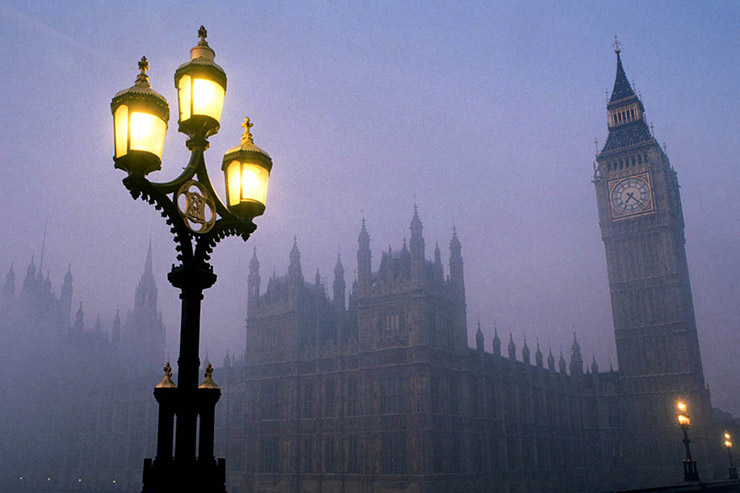
    American by birth, I have lived in London for fifteen years and consider it my home. During that time I have explored many of the city’s esoteric sites and have concluded that this remarkable metropolis is only just beginning to reveal its true occult significance.

    London has been inhabited for thousands of years and the diversity of its settlements has resulted in a rich, if not peculiar, collection of occult traditions. The earliest humans hunted here over four hundred thousand years ago. While a rich abundance of wildlife and a strategic riverside base would have attracted many different colonies of people, one wonders how the ancients truly saw their landscape, and how many were drawn here due to the distinctive snake-like curvature of the River Thames.

    The serpent is one of the oldest occult symbols, representing many esoteric concepts, including duality, good and evil, and harmony with the earth. Thanks to the wonders of technology, an image of the serpent in the form of the winding Thames has been broadcast daily to millions of viewers across the globe for nearly three decades, courtesy of the television programme Eastenders, whose opening credits feature the unique landscape from the air.

    Like other ancient settlements in Europe, London was inhabited by megalithic societies who constructed stone circles and burial mounds. The Iron Age introduced more sophisticated settlements and hill forts which, sadly, can only really be appreciated today by aerial photography. These include settlements at Wimbledon Common, Heathrow and the present-day Houses of Parliament, to name a few. Urbanisation has all but erased the megalithic footprint of London, but some remnants, such as Primrose Hill, with its curious burial mound and breathtaking views of London, remain. In fact, Primrose Hill would become a haunt of occultists William Blake and Dion Fortune, amongst others, and plans, albeit later aborted, would be made to construct a colossal pyramid burial complex on top of the hill, complete with over five million honeycomb-shaped tombs.

    There is considerable evidence for occult practices having occurred in London in ancient times: beeswax effigies, thought to be five thousand years old, have been found in the Thames, representing man’s attempt at harnessing occult powers via shamanism and many stylised Bronze Age swords have also been discovered in the Thames, suggestive of votive offerings to Celtic deities. Similarly, albeit over a thousand years later, a golden-horned, apparently ceremonial Viking helmet was discovered in the Thames, near Waterloo. The amazing artefact is unique in Europe and appears to reinforce the occult tradition of London’s ancestors and their reverence for the serpentine river.

    The Trojan leader Brutus established a city here in 1100 BCE and named it Troia Nova, or Trinovantum. Later, the 1st-century BCE King Lud renamed it Caer Lud, which evolved into Caerlundein, Londinium and finally London. It is said that giants lived in London in Brutus’s day and that he captured two, Gog and Magog, and employed them as porters at the gate of his palace. Brutus is also associated with another legend, the London Stone, a curious rock of which little is known for certain. Some say it came from Troy, others believe it was a druid stone or even the stone from which Arthur extracted Excalibur.

    A medieval proverb states, “So long as the stone of Brutus is safe, so long shall London flourish.” William Shakespeare wrote about the stone and, intriguingly, many believe that his plays were actually written by Francis Bacon or Christopher Marlowe, both of whom were esoterically connected. Another London occultist, William Blake, wrote of the London Stone in his poem, Jerusalem (1820): “At length he sat on London Stone and heard Jerusalem’s voice.” Clearly, the relic once cast a magical spell on the city. Sadly, it is now embedded in an abandoned building across from Cannon Street Tube Station, its former glory but a distant memory.

    For the best reading experience, obtain the full digital version of this magazine with all this article’s illustrations.

    Hail the Romans: As Above So Below

    The arrival of the Romans marked a significant milestone in the evolution of London’s occult tradition and in 54 BCE Julius Caesar and his men crossed the Thames in West London, signalling the new era.

    The Romans were especially threatened by the Druids, who, according to Caesar, were involved in divine worship and human sacrifice, including the burning of prisoners, or even innocents, in ‘wicker men’. Sure enough, London’s native tribes appear to have paid homage to their gods for protection from the Romans, as indicated by a decorative bronze shield with inlaid coloured glass found in the Thames near Battersea that dates to this time. The original inhabitants of London were incredibly resilient and fought bravely to maintain their cultural identity. One hundred years later Queen Boudica sacked the city and soundly, if not brutally, defeated the Romans in retaliation for the rape of her daughters and the killing of the Druids; but the Romans would soon avenge this attack and all but extinguish the Druids and their largely oral occult traditions.

    The Roman invasion changed the landscape, language, culture and thought process of native Britons forever. There are many museum exhibits in London that document these changes via artefacts and re-creations. From an occult perspective there was a less tangible, but no less fundamental, change in consciousness starting to take place: the introduction of Mithraism, and the theology of ‘as above, so below’.

    Not much is known of this ancient mystery school, other than it involved Mithras, the Roman God of Light, but we do know that it also involved the ritualistic slaughter of bulls and included a seven-grade system of initiation. Like the Masonic rituals that would be conducted some fifteen hundred years later in London’s Grand Lodge, Mithraism included ritual meals and a secret handshake.

    The Romans conducted their rituals in underground temples called mithraea, and several of these evocative temples have been discovered in London, including one remarkable 60-feet long, 26-feet wide temple beneath the now underground River Wallbrook.

    The origins of Mithraism are uncertain, although it is known to have been popular amongst Roman soldiers, most likely because it provided a comforting framework for the afterlife, and understandably so. In their profession a premature death was almost inevitable. The cult is thought to be Roman or Persian in origin and the name ‘mi-it-ra’ has been found inscribed in a 1400 BCE peace treaty between the Hittites and the kingdom of Mitanni in Northern Syria. This is interesting, for both regions have a rich tradition of bull veneration and each was contemporary with Dynastic Egypt, where I believe the tradition of Mithraism originated. In Egypt, the slaughter of Apis (‘bee’ in Latin) bulls resulted in 1,000 souls, represented as bees, being born out of the body of the dead bull. The occult tradition of bull slaughter, which is referenced in the Mesopotamian Epic of Gilgamesh and the Egyptian Opening of the Mouth ceremony, commemorates what the ancients observed in the constellation of Taurus: a hunter killing a bull with distinctive marks (3 stars) on its forehead, just as the Apis bull has distinctive marks on its forehead.

    I believe London’s adoption of the occult tradition of ‘as above so below’ can also be found in the legend of King Arthur, whom every Celtic nation claims as their own, most notably England. In a recent documentary on King Arthur that I presented for the National Geographic Channel, I expressed my belief, much to the producer’s chagrin, that the ambiguity around Arthur’s origins is due to the fact that he never existed. Rather, he was an archetypical hero, who lived in the constellation of Ursa Major, known as the ‘Great Bear’, meaning Arthur. Man would have observed the Big Dipper, which resembles a platter (the object that was considered to be the Grail in the first complete account) rotating around the Pole Star, promising to return, like Arthur. The night sky also includes an outline of a man with a wounded thigh, which sounds very much like the Fisher King. And, of course, Arthur fought twelve battles and there were twelve knights of the ‘round’ table; one for each of the twelve constellations perhaps? Was the legend of King Arthur just another archetype, much like Mithraism?

    The Arrival of the Knights Templar

    The Order of the Hospital of St John of Jerusalem was founded in 1099, shortly after the First Crusade. Less than fifty years later they established their headquarters at the Priory in Clerkenwell, the remains of which are now a museum. Across town, the Knights Templar established a base in High Holborn, in a Roman temple once revered by Hugues de Payens. The Knights Templar outgrew their headquarters and built Temple Church between Fleet Street and the River Thames, a round church based on the Church of the Holy Sepulchre in Jerusalem. In keeping with their power elsewhere in Europe, the Order installed the Master of Temple Church in Parliament, thus ensuring that their powerful occult views would become part of the nation’s legislature.

    The land between Fleet Street and the Thames was owned by the Knights Templar and divided into Outer Temple and Middle Temple, with Temple Church serving as Inner Temple. Each existed above the covered-up River Fleet and, in occult tradition, an underground stream provides divine augmentation to rituals and spiritual attainment.

    Come the middle of the 19th century the tale of Sweeney Todd, the demon barber of Fleet Street, began to emerge. The gory urban myth appears to be without historical merit, causing some to speculate that the legend of a serial killer in the vicinity of the Templar precinct may be a memory of former ritual sacrifices. Today a dragon guards the entrance to Temple Bar and reminds one of the esoteric traditions once practiced there.

    Despite the recent Hollywood movie starring Johnny Depp and Helena Bonham Carter, the legend of Sweeny Todd has largely been superseded by one that took place half a century later, in 1888, when a serial killer by the name of Jack the Ripper murdered five women, forming a 5-sided pentagram in the process and removing their organs along the way, including, in some instances, their hearts.

    Ritual killings continue in London, and the river Thames continues to be the depository for the ritual remains of victims. In recent years the analysis of limbless torsos discovered in the Thames has prompted authorities to suspect ritual murder and superstition as the reason for the crimes. This is not a new tradition in London. The nursery rhyme, ‘London Bridge is falling down’, is said by English Myths and Legends author Henry Bett to be the folk memory of the ancient practice of human sacrifice at the building of a bridge.

    Summoning the Spirit World

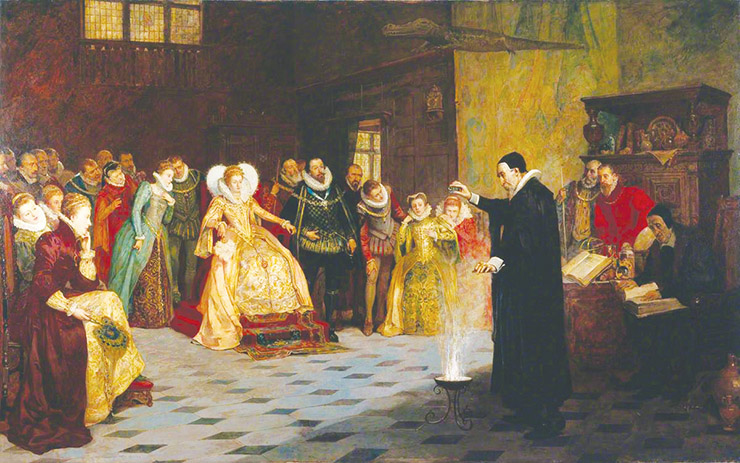
    A belief in the occult appears to have helped London achieve prosperity during periods of pending adversity. Dr. John Dee (1527-1608), who used a crystal ball and scrying mirror to guide Queen Elizabeth through one of the most challenging eras in British history, is perhaps the most renowned example (see “John Dee and the Enochian Apocalypse”).

    But there are many other examples of occult traditions in the court of the king and queen. Take, for example, the peculiar tale of King Charles II (1630-1685), who presented his mistress, a resident of West London, with a griffin. The dog-like figure with wings fell into a local river, survived and ended up in the Thames, near the point at which Caesar had crossed. It was later paired with a second griffin that Joseph Banks, a scientist who accompanied Captain Cook on his voyages, had brought back from an exotic island in the Pacific Ocean. The account leads us to believe that the griffin may have been a real animal, which multiplied before fading from history, only to be seen once more in the 1980s, and on multiple occasions by various upstanding citizens of West London.

    Charles II also domesticated the ravens at the Tower of London, a tradition summed up as follows: “If the Tower of London ravens are lost or fly away, the Crown will fall and Britain with it.” The belief appears to stem from the legend of the Celtic god, Brân the Blessed, whose name means ‘Blessed Raven’ in Welsh and who was killed in an otherwise successful battle against an adversary, the Irish King, Matholwch. Brân’s head was buried beneath the spot where the Tower now stands, facing France as a talisman against further foreign invaders. Could the legend of the griffin and the raven somehow be related?

    Henry VIII (1491-1547) created a religious revolt with great consequence when he severed ties from Rome in an act known as the Dissolution of the Monasteries. Given the many cathedrals and orders that were subsequently transformed into ruins, any number of different sects could have been culpable of the act of desecration that awaited the king after his death. On his way from London to Windsor, where he would be buried, the King’s funeral procession rested overnight at Syon Abbey in West London. In the morning it was discovered that wild dogs had ripped open his casket and ravaged his body, leading some to speculate that the attack was a deliberate act of revenge enacted by a member or group of individuals from one of the aggrieved monastic orders he had defied.

    Phoenix Rising

    The Great Fire of 1666 devastated London, destroying over 13,000 buildings. What is less widely known, however, is that occult beliefs prevented an otherwise manageable outbreak from being extinguished. This is confirmed by first-hand accounts of Londoners whose belief in the prophecies of Mother Shipton and Nostradamus, each of whom was thought to have predicted the catastrophic fire, led them to feel disempowered and unworthy of extinguishing the fire and thus saving the city from its destiny.

    Out of the ashes came a vision of a New Jerusalem, masterminded by the Freemason and architect, Christopher Wren, who drew on the occult traditions of the Kabbalah, and the tree of life in particular, in addition to the sacred geometry of the Old Testament. Wren reintroduced the hallowed number of 2,000 cubits, or roughly 2/3 of a mile, which represented the distance from the Mount of Olives to Jerusalem (the furthest a Jew was allowed to walk during the Sabbath), and proposed that many of London’s newly-constructed buildings be set 2,000 cubits apart.

    Foremost amongst Wren’s impressive, occult inspired designs is Saint Paul’s Cathedral, which not surprisingly is aligned 2,000 cubits from Temple Bar to the West and 2,000 cubits from St Dunstan’s in the East. Miraculously, the stunning edifice survived the bombings of a world war, and it is no wonder that Prime Minister Winston Churchill addressed his staff each morning with the pensive question; “Is Saint Paul’s still standing?” Poignantly, Saint Paul’s is where Wren is buried. Fortunately for all, the fabulous monument still stands like the esoteric beacon it was always intended to be.

    Other buildings erected after the fire, such as the Monument and Nelson’s Column, were either designed with occult-inspired dimensions or aligned to the solstices. Further, Wren’s student Nicholas Hawksmoor followed in the occult tradition by placing Egyptian obelisks on top of churches, forming, in the estimations of some, a pentagram on the ground across London. The tradition of creating buildings with occult dimensions had been re-born and continued in later periods of development, such as the nude, winged statue of Anteros, the Greek avenger God of requited love, erected in Piccadilly Circus in 1892, and which was originally orientated in the direction of Parliament, presumably to send ‘love’ and to produce greater synergies within government.

    King George III (1738-1820) was a remarkable man and one of England’s many occult-minded kings. In 1769 George III anxiously awaited the completion of an alchemist observatory in the London Borough of Richmond upon Thames. In commissioning the work, George III was creating his personal observatory and meridian, despite the fact that the official and Royal Observatory – and meridian, the naval of the country – had been established in Greenwich a hundred years earlier. The King was passionate about astronomy and instructed his architect, the renowned occultist Sir William Chambers, to complete the work in time to view the transit of Venus, which occurred that year on 3rd June.

    Meridians have existed since ancient times. While the placement of a meridian is arbitrary, its function is quite specific: to project an imaginary line across earth’s surface, stretching from the North Pole to the South Pole, esoterically connecting all locations within a given longitude. In the case of George III, he projected his own meridian straight down the serpentine Thames, a stunning riverside landscape, rich in history and renowned for its visionary inhabitants, innovators such as J M W Turner, Alexander Pope, James Thompson, Horace Walpole, David Garrick and William Hogarth, to name a few. The Meridian was special, for it intersected sacred sites along the way, which were part of what George envisaged as a new Arcadia; a diamond in the rough – a paradise amidst the urban chaos of London.

    Dawn of the Occultists

    Arguably the greatest spiritual explorer of the 18th century, Emanuel Swedenborg (1688-1722), hailed from Stockholm, but spent much of his time in London. He eventually moved to Wellclose Square, a former hotbed of esoteric notables, including Rabbi Falk, ‘The Ba’al Shem of London’. Also in the 18th century the London-born poet, painter and esotericist William Blake (1757-1827) became one of a long tradition of writers whose work may need to be reconsidered in the context of a recent discovery; not a temple, book or artefact, but a portal, supposedly concentrated in the garden of Saint Marylebone Church.

    The portal is said by modern occultists to be a stargate to an alternative dimension and consciousness, accessible only by initiates. The so-called energy field/cosmic doorway is said to stretch all the way to Primrose Hill, which is precisely the expanse of land that Blake was writing about in his epic poem, Jerusalem. Lord Byron was born in the church; Francis Bacon was married there, as were Robert Browning and Elizabeth Barrett. Lord Nelson had his daughter christened at the church and Charles Dickens lived but a short distance away. May each have drawn on the occult energy of the portal to enhance their art?

    As the 20th century neared, London became esoterically linked to ancient Egypt and other sacred cities, when an obelisk from the ancient capital of Heliopolis was installed on the south bank of the Thames. Like Rome and Paris before it, and New York shortly thereafter, London now possessed one of the most highly charged artefacts in the ancient tradition, an Egyptian obelisk; a powerful talisman to the sun god. Cleopatra’s Needle, as the London obelisk is known, is flanked by two replica sphinxes that appear to guard the ancient structure. In fact, sphinxes adorn the whole of London’s Embankment, including armrests on the benches along the Thames. In 1917, during World War I, a bomb from a German air raid landed near the obelisk, but, inexplicably, produced no real damage. Had the sphinx protected London from a disastrous fate?

    Come World War II an urban myth arose in which British witches were said to have gathered to assist Winston Churchill in deterring Hitler from advancing on Britain. Given the occult traditions of London at this time, who is to say that the witches did not play their part in the war effort?

    The Victorians were obsessive about all matters of the supernatural and the legend of Spring-Heeled Jack, the Bogeyman of London, persisted throughout the reign of Queen Victoria. It is said that the creature could walk through walls, had a pointed nose and ears and fiery eyes. Half a century or so later the creature would return, or so it would appear, this time as a 20th century apparition of a vampire in Highgate Cemetery.

    The legend of the Highgate vampire has its roots in tales of creatures that roamed the north London district of Dracula author Bram Stoker. The practice of Satanism was not uncommon in London and some believe that the creature with the fiery eyes was manifested by satanic rituals and remained in this realm, only later becoming known as Spring-Heeled Jack and the Highgate Vampire. Speculation aside, one wonders if the legend of Dracula was inspired by London’s secret traditions.

    Cults Wars

    The Theosophical Society, co-founded by Madame Blavatsky (1831-1891), introduced the notion that the evolution of mankind was governed by a chosen elect known as the ‘brotherhood’. The Ukraine-born spiritualist believed the occult and science worked in tandem, and the occult was simply accessing realms that science had yet to conquer. 

    Despite its success at displacing Victorian spiritualism, the Theosophical Society had its own competition, the Hermetic Order of the Golden Dawn, whose first temple, Isis-Urania, was created by Samuel Liddell Mathers in 1888, and which conducted its first tomb-based rituals at Thavies Inn, off Holborn Circus. The ritual was said to have included the enactment of the death and rebirth of Christian Rosencreuz, the founder of the Rosicrucian Order. The Golden Dawn was alleged to have been based on rituals contained in a coded ‘cipher manuscript’. Others believed it was a ruse to compete with the Theosophical Society. Regardless, the Golden Dawn grew rapidly, converting 50 members in its first year and another 250 in its second, before starting to implode into more offshoots than Clapham Station has train tracks.

    Aleister Crowley was initiated as the group began to fragment into various offshoots, such as the Alpha et Omega which formed in around 1900. Crowley had a fierce reputation as an occultist and his own mother believed him to be the Anti-Christ of the Apocalypse and the ‘Great Beast’. Crowley studied at Cambridge before moving to a flat at 67 & 69 Chancery Lane in London, where his occult studies flourished with the help of a mentor by the name of Allan Bennett, who introduced him to Buddhism. Here the two men sought to perform the ‘Abramelin Operation’, an intense six-month ritual designed to conjure the Holy Guardian Angel. One account suggests that Crowley succeeded, for he is said to have returned home one night only to find his door open and ‘semi-materialised beings’ marching around his flat. Crowley had his hands in all sorts of secret traditions, and despite his Masonic involvement elsewhere in Europe, the United Grand Lodge of England denied him admission.

    Another famous occultist of the 20th century was Dion Fortune, who left Alpha et Omega and joined another Golden Dawn derivative, the Stella Matutina (Morning Star), a group originally known as the Mystic Rose or Order of the M R in the Outer. Fortune left because she feared she was under psychic attack, and proceeded to write the definitive book on psychic and occult protection. In 1924 she formed her own cult, the Fraternity of the Inner Light, which met in Primrose Hill.

    In 1960 the French poet and occultist Jean Cocteau, an alleged Grand Master of the Priory of Sion, visited the Church of Notre Dame de France in Leicester Square. Here, he created a mural dedicated to the Virgin Mary, which features a Black Sun and references layer upon layer of veiled knowledge.

    The year 2000 came and went, with the only homage to the millennium being the creation of a ‘dome’ (now called the ‘O2’), which was nestled in one of the curvatures of the serpent Thames. However, the previous year, 1999, had seen the creation of an even more esoterically potent edifice, the London Eye. This huge, slow-moving Ferris wheel amusement ride stands majestically on the banks of the Thames. The structure dominates the landscape, recalling many occult circular symbols, from the zen-like concepts of completeness and wholeness, to the brutal death of heretics upon the Catherine Wheel. It also includes a brazen Masonic compass in its centre, as well as being named after another ancient occult symbol, the all-seeing eye. The ‘Eye’ became a powerful part of the landscape in a very short period of time and one that is colourfully lit during special occasions, such as New Year’s Eve.

    Fast forward to 2012 and the London Olympics, whose logo inexplicably resembles the word ‘Zion’ and whose stadium sits amidst symbolically named streets (see “The London Olympics Conspiracy”). One wonders how much invisible influence occult powers may have in Parliament.

    The foundations of London’s occult traditions run wide and deep and represent a microcosm of the esoteric tradition the world over. If history is any indication, it is unlikely these traditions will fade any time soon, although they may move underground, much the same as London’s forgotten rivers, in order to survive.

    [alert type=”general” dismiss=”no”]This article was published in New Dawn 133.[/alert]

    [alert type=”success” dismiss=”no”]If you appreciate this article, please consider subscribing to help maintain this website.[/alert]

    © New Dawn Magazine and the respective author.
    For our reproduction notice, click here.
  • Transcending Our Brain Created Reality: A New Call to Lift Nature’s Veil

    Transcending Our Brain Created Reality: A New Call to Lift Nature’s Veil

    From New Dawn Special Issue Vol 6 No 4 (Aug 2012)

    The study of non-ordinary states of consciousness is quickly becoming an established area of scientific and philosophical inquiry. Yet, all the enthusiasm about finding out what these non-ordinary states are somehow obfuscates much bigger, important, and urgent questions: What as-of-yet unknown aspects of reality do they give us access to? And what significance do those hold for the human adventure in space-time?

    In this article, I’d like to make a call-to-arms of sorts: A call for a structured, systematic, and rational inquiry into nature through non-ordinary states of consciousness, next to the now established investigation of non-ordinary states of consciousness.

    What Can We Really Know?

    Our Western civilisation is justifiably proud of its cultural, social, scientific, and technological achievements. Western values now pervade nearly all cultures on Earth, and Western-created technology has become an integral part of human activity. We look back at our historical past with the patronising attitude of an adult looking at a child: We have absolutely no doubt that we now know a lot more than we knew then and smile, full of hubris, at the naiveté of our ancestors. Unlike them, we now understand what nature is all about; we know who we are and what is going on; we even acquired a large measure of control, through our Faustian technology, of the forces and mechanisms underlying nature. The present is seen as the highest point ever reached in the historical mountain humanity has been climbing for about two hundred thousand years. Kings of the hill, we see ourselves.

    But are we, really? Do we really know what is going on? Or have we been caught in an invisible web of self-referential epistemic trappings?

    Allow me to explain what I mean here. The currently accepted view in neuroscience is that the ordinary, waking reality we experience every day is in fact a brain-constructed ‘hallucination’ analogous in nearly every way to a dream. Indeed, the same neuronal mechanisms underlie our experience of dreams and of waking reality.

    The difference between the waking hallucination you live your daily life in, on the one hand, and your dreamed-up hallucination during sleep, on the other hand, is merely this: The former is believed to be modulated by electromagnetic signals emanating from a supposed external reality that we can never have direct access to, for we’re irremediably locked into our brain-generated hallucination.1 It is this abstract, assumed external reality that, supposedly, explains why our waking experiences seem to be shared with other individuals, while our nightly dreams are highly individual and idiosyncratic.

    There is, in my view, a better hypothesis to explain this synchronisation of our experiences during waking states, without the need to postulate an entire, forever inaccessible, external universe.2 But this is beyond the scope of this article, whose conclusions should hold anyway, whichever hypothesis is true. What I want to stress here is that, whichever the case, what we experience in our lives every day is not reality as such, but a kind of brain-constructed ‘copy’ of reality. The original is supposedly an amorphous, colourless, soundless, tasteless realm of abstract energy fields.

    The question, of course, is whether we have any reason to believe that the copy is perfect. Assuming that Darwin’s theory of evolution is correct in its more essential aspects, we have to ask ourselves whether evolution would have favoured a brain that created a complete internal copy of reality, capturing in it all aspects of relevance for our understanding of the fundamental mechanisms of nature. Furthermore, we have to ask ourselves whether evolution would have favoured a brain that, whatever part of reality it did capture in its internal copy, copied them without significant distortions that could throw us completely off track as far as putting together an accurate worldview. The answer to both questions is no.

    Evolution favours physical survival, not per se the accuracy or completeness of internal representations. It is reasonable to think that some matching between our brain-generated copy of reality and reality itself is favourable for survival of the physical body: If a tiger is approaching you, it is useful to see the actual tiger, and not some other non-modulated, dream-like hallucination. But most people, scientists included, far overestimate the survival usefulness of accurate, complete internal representations.

    My own research on artificial neuronal networks shows that, very often, it is useful precisely to distort certain parts, and cut out other parts, of the external stimuli when creating an internal representation of reality in an artificial nervous system.3 Complete information is often confusing, drowning out the small parts that really matter. Undistorted information is often hard to act upon in a timely manner, due to the subtlety of its nuances. Therefore, these artificial nervous systems perform much more efficiently – and would stand a much better chance of survival if they had to compete in an ecosystem – when their own internal copy of reality is largely incomplete and distorted.

    As such, this is what evolution would have favoured and there is absolutely no reason to believe that the copy of reality you and I live in comes even close to what is really going on. We’re intrinsically limited to watching an edited and biased version of the film we’re trying to make sense of.

    Even the scientific instruments that broaden the scope of our sensory perception – like microscopes that allow us to see beyond the smallest features our eyes can discern, or infrared and ultraviolet light sensors that detect frequency ranges beyond the colours we can see – are fundamentally limited to our narrow and distorted window into reality: They are constructed with materials and methods that are themselves constrained to the edited copy of reality in our brains.

    As such, all Western science and philosophy, ancient and modern, from Greek atomism to quantum mechanics, from Democritus and Aristotle to Bohr and Popper, have been and are fundamentally limited to the partial and distorted copy of reality in our brains. Western science is thus, from a certain point-of-view, a house of cards built on shaky foundations: The scientific worldview is the result of an internal model of reality whose unreliability is an inescapable implication of that very model; a self-referential epistemic contradiction.

    For all we know, we may be locked in a small room trying to explain the entire universe outside by looking through a peephole on the door; availing ourselves only of its limited and distorted images. This, ironically enough, may be the situation we find ourselves in while naively celebrating our understanding of the cosmos and our place in it.

    Is there another alternative, or should we resign ourselves to the hopelessness of our ambition to understand reality? There is evidence to suggest that another alternative indeed exists. And, in that case, a new way to structure our inquiry into nature may offer unfathomable new possibilities.

    Looking Beyond the Veil

    Solid evidence has been accumulating that our minds cannot be explained solely by brain activity; the mind seems to transcend the brain.4 Yet, it is undeniable that the brain plays a significant role in our perceptions and behaviour, as, for instance, the effects of alcoholic drinks make plain and clear.

    In an earlier article in this magazine,5 I elaborated upon an alternative hypothesis for explaining the relationship between the mind and the brain; a hypothesis that, since the publication of that article, has gained increased scientific momentum: Consciousness is a fundamental aspect of nature, not depending on any material structure for its existence. The function of the body-brain system is to localise and restrict conscious perception to the space-time locus of the physical body. As such, the brain modulates and limits conscious perception, this being why, in ordinary states of consciousness, mental states correlate so well with brain states.

    As we’ve seen in the discussion above, such restriction and modulation of conscious perception – that is, the filtering and distortion of the copy of reality in our brains – can have a significant survival advantage, which explains why the brain evolved to perform such counterintuitive tasks.

    Now, because the brain works as a kind of filter of mind, restricting and distorting our view of reality for survival purposes, bypassing certain brain mechanisms could conceivably give one access to a broader, cleaner, crisper, and more reliable view of nature. Historically, most, if not all, methods for achieving non-ordinary states of consciousness seem to do precisely that: To enable expanded perception and understanding by reducing brain activity.

    The pattern here is so clear that it is surprising our culture seems to remain largely oblivious to it. For instance, many traditional Yogic breathing practices, as well as the more modern method of Holotropic Breathwork, reduce brain activity through the constriction of blood vessels that results from hyperventilation (which is precisely why you to get dizzy and ultimately faint when breathing too fast). Military pilots undergoing G-force induced loss of consciousness (G-LOC) – which forces blood out of the brain, thereby reducing its activity – are known to report transcendent narratives similar to near-death experiences. Teenagers worldwide play a dangerous, potentially fatal game involving partial strangulation in order to ‘trip’ without drugs.

    Even psychedelic substances, which have always been assumed to produce ‘hallucinations’ by stimulating brain activity, have recently been shown to actually reduce brain activity.6 At least two Nobel Prize laureates – Francis Crick and Kary Mullis – have attributed their prize-winning insights to such non-ordinary states of consciousness; a powerful corroboration for the notion that such states broaden understanding and increase insight, despite reduced brain activity. Even more subtle methods, like meditation, ritual prayer, and sensory deprivation (think of isolation tanks) are likely associated to decreased brain activity.

    The pattern here is as clear as it is ancient: Specific reductions in brain activity seem to consistently lead to a broadened and crisper perception and understanding of reality. The hypothesis that the brain is a mechanism to constrain and localise mind is entirely consistent with this: Reduction of brain activity impairs the filter/localisation mechanism, allowing one to temporarily and partially escape its entrapment and come closer to perceiving reality as it truly is.

    A tantalising possibility suggests itself, one that has been lost to Western culture perhaps since the extinction of the Eleusinian mysteries: An unfathomably broader and more authentic inquiry into the true nature of reality can be achieved through an expansion of the investigator’s own state of consciousness. That true inquiry involves not only the transcendence of physical limitations through the use of instrumentation, but – and more fundamentally – a transcendence of one’s own brain-based mental filters. To see and understand reality for what it truly is – to see the original, not the flawed copy – we need to temporarily escape the limitations imposed on us by biology and culture.

    A New Kind of Inquiry

    In my more hopeful moments, I envision the emergence of a ‘New Kind of Inquiry’ (NKI); one based fundamentally on the use of non-ordinary states of consciousness to access transcendent, yet natural ‘landscapes’ otherwise unavailable to our ordinarily filtered perceptions and cognition.

    Even though the use of such non-ordinary states is ancient, it has historically been restricted mostly to religious purposes and otherwise (semi-)dogmatic agendas. More recently – namely, in the 20th century – it has partly freed itself from such agendas, but become then a vehicle for purely personal, idiosyncratic insight. While valuable to the individual, the broader cultural impact of these personal insights has been extremely limited: Our culture is still dominated by the subjective belief-systems underlying the current scientific paradigm, which irrationally rejects the value of non-ordinary states.

    In the meantime, Western civilisation edges ever closer to a point of irreversible unsustainability, both environmentally and psychologically. To change the culture and safeguard a healthy and sane future, we need more than isolated, personal transcendence. Many of us, for fear of being foolish, need permission to allow our belief systems to change; permission that can only be gained through the institutionalised, collective validation of new hypotheses and worldviews.

    An effective NKI with contemporary appeal, capable of leading to a major paradigm shift in our modern relationship to reality, requires complete freedom from dogma and traditional symbolisms due to the baggage they carry. But such effective NKI must also entail more than personal, idiosyncratic excursions into transcendent landscapes if it is to have true cultural impact.

    As a first step in that direction, I envision an institutionalised NKI think-tank whose initial charter would be the study, creation, and refinement of methods for the achievement of non-ordinary states of consciousness. Even though countless such methods have traditionally been available, no systematic, structured, modern scientific study has been done for the very practical purpose of increasing their effectiveness (and safety). With modern scientific knowledge, we should be able to achieve a degree of success in enabling non-ordinary states of consciousness that traditional cultures could only dream of.

    For instance, while psychedelics have the advantage of nearly always delivering an unambiguous effect at sufficient doses, they are notoriously hard to control and the insights resulting from their use very difficult to interpret. In contrast, while meditation has historically proven to be the most fruitful method for the achievement of unfathomable but clear insights about the nature of reality, it is notoriously difficult to master to a point where truly transcendent, unambiguous experiences can be achieved. Could we synthesise the strengths of all these methods? Could new and more effective ones be invented, based on more modern technologies like, for instance, Transcranial Magnetic Stimulation (TMS)? The ultimate goal here would be the iterative refinement of a safe, reliable, effective, robust, best-in-class method for enabling any educated and healthy individual to pursue the exploration of landscapes otherwise unavailable to ordinary cognition.

    And here is where the second step of this vision comes in. Another, and more important, goal of the NKI think-tank would be to put the best-in-class method discussed above to practical and systematic use. Instead of adventurous individuals pursuing idiosyncratic exploration in isolation, without structure or suitable preparation, and unable to contribute their insights to a growing and coherent body of knowledge, the idea here is to organise structured and coordinated expeditions into transcendence involving various individuals; to have them collect data and compare notes upon returning; to build up and progressively refine compound maps based on reports from various explorers and their different perspectives; to find commonalities and consistencies, document them, and thereby reduce the unreliability of personal interpretations.

    The NKI think-tank would attempt to derive rational, coherent models for describing the underlying nature of reality; models that would take into account a broader set of data than that available to ordinary perception; models based on more than just the distorted and limited view through the peephole. Its explorers wouldn’t be random: They would be selected based on a broad skill-set. Like medieval explorers – who were selected based on their seamanship, as well as cartography, astronomy, and natural history skills – explorers in the staff of the NKI think-tank would be required to have a balanced skill-set encompassing knowledge of history, philosophy of science, epistemology, modern physics, neuroscience, psychology, mathematics, and, perhaps most fundamentally, the arts. Contemporary ‘renaissance men and women’, is what we’re talking about here.

    The think-tank would provide the entire infrastructure necessary for their voyages into transcendence: meditation spaces, isolation tanks, brain entrainment and TMS equipment, appropriate medical staff and facilities in case psychoactive substances would be used, etc. It would also host facilities required for journey preparation, as well as consolidation of results: Well-stocked libraries and network infrastructure for scholarly research; discussion rooms where explorers could debate and compare notes and ideas; conference facilities; data-processing facilities to enable the building of computer models inspired by transcendent insights; laboratory facilities for testing some of these models empirically; gardens for pondering, integration, and recuperation; etc.

    The NKI think-tank would also have its own publishing infrastructure: periodicals, book imprints, podcasts, video production facilities, websites, and all that is necessary for the dissemination of its results and ideas. Its independence from the currently established academic and commercial channels would initially be paramount, since the subjective values and belief systems underlying the current scientific paradigm, as discussed by Thomas Kuhn,7 would render these channels non-conducive to new, paradigm-breaking hypotheses.

    Through the respectability it would build up over time, the qualification of its staff, the quality of its results, as well as its communication and out-reach efforts, the NKI think-tank would insert itself powerfully into the collective mindset of the culture. It would give legitimacy to the New Kind of Inquiry it would embody and represent. It would broaden the horizons of civilisation through the generation of coherent, appealing hypotheses regarding the nature of reality and of our condition within it, free from tradition and dogma. It would give many intelligent, educated, and perhaps influential individuals permission – as well as a little more latitude – to seriously entertain worldviews that would otherwise be considered taboo. The NKI think-tank would become a significant catalyst for a shift of paradigm in the way our civilisation relates to reality and, as a bonus, re-introduce hope and meaning into the mainstream cultural dialogue.

    Get the issue this article appears in

    Concluding Remarks

    This is my dream for a New Kind of Inquiry. As a vision that aims at stimulating the imagination, it would be silly to restrict such a dream based on practical limitations or notions about what is ‘realistic’ to accomplish at this time. Therefore, I may have allowed myself to get a little carried away above. Still, I do believe that something along those lines is urgent and essential to the progress of our worldview as a civilisation. It may be essential even to our very physical or psychological survival.

    Our current materialistic worldview is self-contradictory, self-limiting, reduces humanity to a mere accident of probabilities, empties life of all meaning and telos, and manages to make no distinction between intellectual garbage and transcendent insight. Such is an unsustainable state of affairs; it translates itself into intellectual polarisation, alienation, and hysteria, all of which are plain to see in today’s society.

    A breakthrough is required, something I believe the collective unconscious is ‘cognizant’ of and which, therefore, becomes inevitable. With this article, I hope to have helped shape a mental image of how the breakthrough could begin to take place; a first of many steps required for the attainment of our true freedom.

    For more on this subject and related, see Bernardo Kastrup’s books Rationalist Spirituality (O-Books, 2011), Dreamed Up Reality (O-Books, 2011), and Meaning in Absurdity (Iff Books, 2011). 

    [alert type=”general” dismiss=”no”]This article was published in New Dawn Special Issue Vol 6 No 4.[/alert]

    [alert type=”success” dismiss=”no”]If you appreciate this article, please consider subscribing to help maintain this website.[/alert]

    Footnotes

    1. See, for instance: David Eagleman, Incognito: The Secret Lives of the Brain, Canongate, 2011, 44-51
    2. As elaborated upon in my books Dreamed Up Reality (O-Books, 2011) and Meaning in Absurdity (Iff Books, 2011), as well as in my YouTube video ‘Bernardo Kastrup – Real or Imagined? HD (Interview series, episode 3)’
    3. B. Kastrup and J. M. Seixas, ‘A Single-Neuron Weighting Technique for Classifiers,’ Proceedings of the ‘5th European Congress on Intelligent Techniques and Soft Computing,’ (EUFIT ‘97) Sept. 8-11, 1997, Vol. 1, 480-484. As well as: J. M. Seixas, L. P. Caloba, R. W. Santos, B. Kastrup, and F. S. Pereira, ‘Reducing Input Space Dimension for Real-Time Data Analysis in High-Event Rate Environment,’ Proceedings of the ‘International Conference on Artificial Neural Networks,’ (ICANN ‘95) Oct. 9-3, 1995, Paris, France, Vol. 2, 203-208
    4. Edward F. Kelly et al., Irreducible Mind: Toward a Psychology for the 21st Century, Rowman & Littlefield Publishers, 2007.
    5. Bernardo Kastrup, ‘Spirituality Is Not Flaky; Really,’ New Dawn, Nov-Dec 2011, 47-51.
    6. Robin L. Carhart-Harris et al., ‘Neural correlates of the psychedelic state as determined by fMRI studies with psilocybin’, Proceedings of the National Academy of Sciences of the United States of America, 17 January 2012, www.pnas.org/content/early/2012/01/17/1119598109
    7. Thomas Kuhn, The Structure of Scientific Revolutions, 3rd edition, The University of Chicago Press, 1996.

    © New Dawn Magazine and the respective author.
    For our reproduction notice, click here.

  • Childhood’s End: The Agony of Our Collective Puberty

    Childhood’s End: The Agony of Our Collective Puberty

    The passage from childhood to adulthood happens when the child begins to realise that life is hard, death is certain and the chances are pretty good that he or she is going to be struggling for the rest of their life. These harsh realities wash away the idealism, naiveté and illusions of youth. Also this maturation process causes the youth to have a new understanding of what responsibility and stewardship means as well as the desire to make an impact on reality and leave the world a better place. This process occurs as a result of both experience and information. As a youth gathers more information through the experience of life he or she reaches certain inevitable conclusions.

    The initial inquiry into life involves the consumption of vast amounts of information. Some of it is fascinating and life-altering but sad to say, much of it useless within the confines of daily life. As one matures, one begins to learn the art of discernment and to weave their way through information, discarding that which is not useful and keeping that which is. This is how information becomes knowledge. Once information has gone beyond facts and has woven itself into a coherent stream of knowledge, a certain kind of confidence is engendered in the individual.

    As we grasp and understand the world around us through the process of turning information into knowledge, we begin to gain experience in a multiplicity of different facets of reality. As a thinking person matures, he or she gains greater knowledge and experience of the multitude of seemingly disparate aspects of reality until they reach a clear cohesion of thought and heightened level of awareness. This new level of awareness occurs when the individual begins to not only look outward to perceive the facts and forces that shape our reality, but focuses inward to digest and distil all that they have learned and experienced. This maturation process, which happens in later adulthood, is called Gnosis or wisdom.

    A key to this process is the discovery and understanding of the deceptive power inherent in the massive amounts of manipulation and psychological imprinting that has taken place over the course of life. As this occurs, one gains the ability to perceive reality from a higher perspective and detach from the storm of emotional cravings and psychological addictions, which have veiled his or her innate awareness and cohesion as a human being. Through this process, one learns to discern and clearly decide which of these varieties of knowledge is important and meaningful to his or her life and which is not.

    The gathering of information and experience is the first level of this process. The activity of turning information into knowledge is the second part. Turning knowledge into wisdom is its final aspect. Our youth is a relatively short, confusing and often chaotic processing of information. Schools, religious institutions, and the media fill our heads with gigabytes of information. By the time most of us reach puberty the glut of information that has been poured into our heads makes most of us dizzy. It is at this stage in life where the separation of those who will have an effect on the future of the world and those who won’t occurs. The sudden realisation that old age is imminent, death is certain, and working for a living is a necessity causes a large number of people to recede from the act of information gathering. They stop reading. They stop questioning. They are no longer interested in the ebb and flow of the mechanisms of the larger reality. They become numb, jaded, cynical, defeated and desensitised to the power and beauty of the extraordinary gift of human life. The second group embraces the dizzying array of information being offered to them and by puberty they are turning information into knowledge. At this time in their lives, through devotion, focus and discipline, people begin to excel in their chosen areas of exploration be it math, science, sports, the arts and many other fields of endeavour.

    Long after college, the birthing of children, and anxiety about employment, if they are lucky, a wonderful new mental process begins. It starts in the late 30s and 40s. Synaptic pathways in the brain that were disconnected from each other previously have now woven themselves into a situation where the countless pods of knowledge begin to interconnect. Revelations, visions and comprehension of their own gifts and unique place in the nature of human experience begin to occur. This interlinking of thought distils experience into wisdom. This next level of discernment, not only engenders the creation of books, movies, philosophical treatises, inventions, and innovation, but also it brings with it a certain inner peace and sense of fulfilment that the immature self lacked.

    Fully immersed in life and creative expression, the fear of death begins to recede. From this heightened spiritual perspective, the ones who attain wisdom begin to look at the world around them and bear witness to the evidence arrayed before them. Yes, the vision of connectivity, beauty and wonder that inspired their pursuit still lives within their hearts. However, at the same time, the undeniable evidence of a pathetic and immature reality filled with destruction, divisiveness, nihilism, egotism, greed and sexual depravity is ever present. There is a reason why students are not allowed to study the Kabbalah until they are 35 years old. The human intellect cannot possibly be mature enough until that age to fully comprehend the inner dynamics of the Kabbalah or any of the other deep spiritual and esoteric traditions that have been left for us.

    Until around 1992, the human race lived and operated in an extremely isolated fashion. Until the invention of the telephone, telegraph, automobile and train in the early 1900’s people were even more isolated. It is really only in the last 50 years that the human race has become fully aware of the vast and varied cultures, languages and peoples that exist on the Earth.

    But in 1992, something happened. Whereas much of the human race before were like isolated babes in the woods surrounded by wolves, confused and simplistic, in 1992, the first coherent stream of information was released all across the planet at the same time. It was appropriately called the World Wide Web. For the first time in human history, any human being who had a laptop or computer could increasingly access all of the information concerning the vast wealth of human history, experience and expression.

    This shift was disorienting and confusing just like school was when we first started. A startling and mind expanding compilation of the best and worst aspects of human endeavour, the Internet overwhelmed us with facts, distractions, disinformation, lies, distortions, hopes and fears, everything. It became a mirror of who we are as a species and reflection of our collective psyche. Critics arose decrying that the Internet was a jumble of false ideas, a free for all, a place where a housewife in San Antonio has the same power and voice as a columnist for the New York Times. It can be safely said that the Internet was and is a land of incredible opportunity, massive confusion and one of the most important tools that has ever been invented by the human race.

    2012 represents the 20-year anniversary of this great event. Through the course of this time, through the consumption, digestion and integration of massive amounts of information, many people have begun to notice that there is a spiritual awakening occurring. It’s just a rumbling underneath the surface but we all can feel it. More and more we sense there has to be something more to human life than slavery to the manipulations and whims of what many call The Controllers. Rising like a powerful tide, the collective yearning for clarity, intimacy, community and harmony is the result of 20 years of endless information being spewed out by the Internet.

    From our metaphorical perspective, the human race in the past 20 years has gone from an infant babe lost in the woods to a post puberty young adult. The same processes that turn a child into an adult are the same processes that are happening across the world at this very moment in time. At first, like school, the Internet was a jumble of information that we were taking in while not even questioning or understanding why we were doing it. In school we were force fed the prevalent conditioned perspective on mathematics, reading, science, history, philosophy and much more, without even knowing why our teachers thought these things were so important. Later when we matured, we realised that many of these skills, which we had learned earlier and frequently thought weren’t needed, suddenly were very useful tools in the game of life. The last 20 years has been a voyage of collecting millions of bits of information, much of it useless to our physical and spiritual growth and maturity as human beings.

    Now the second level of this process is starting. All of the secrets, the corruption, the war, the reasons for wars, the understanding of the monetary system, the realisation that conspiracies aren’t theories, the destruction of the environment and the dawning knowledge that all of the members of the human race have a lot more in common than we have ever known before, have become apparent to a large swath of humanity. This coming to grips with the darkest and the lightest aspects of human beingness by people all over the planet marks the beginning of the maturation of the human species. No we are not wise yet. But we are waking up and becoming aware of what has to be done.

    The next level in this process, what we call the wisdomification and spiritual rebirth of the human race, will begin occurring after 2012. Because the Internet is so malleable, we can speed up this crazy wisdom process. Clearly, there are among us people who are wise. Some of them have created websites espousing their unique forms of wisdom. These sites are taking the various pods of knowledge and interconnecting them so that the result generates a new clarified vision of reality. Intelligent and discerning people are attracted to these types of sites for one fundamental reason. The information that they are offering, and remember information is the foundation of wisdom, is reliable. The members of the human race who have not backed away from seeing beyond the veil of the vast mental and emotional manipulation of the times, those that know how to relax, take a deep breath, sit in stillness and reflect upon the information being offered with open and discerning minds and hearts, are all reaching the state of wisdom at the same moment. They are the wisdom keepers of the future. These are the enlightened ones who have and will come to grips with and offer solutions to the myriad of problems we collectively face.

    This mental dynamic happening on a collective level across geographies, languages, and cultures is the single most earth-shaking event that has happened in human history. It will be these wisdom keepers who will come to understand that the many mistakes of the past from wars to nuclear meltdowns and environmental catastrophe are largely the result of the childlike destructive nature of our predecessors who indulged in and exhibited the most vile and juvenile aspects of themselves.

    While we can forgive the excesses of youth, it would be unpardonable for us to allow these excesses to continue. That process is starting now.

    What can we expect from a puerile society immersed in a spiritual paradigm that has taught us to believe that humans are essentially sinful, vile creatures, dominated by a celibate, angry, jealous god? That we do not have to be truthful or good or loving but can fully immerse ourselves in falsehood, deceit and corruption with the assurance of dispensation, that if we just ‘believe’ in some alien force, or god outside of ourselves we can be ‘saved’.

    The single most important information that we humans need to understand and come to grips with is that our childhood ignorance, our addiction to distraction, has allowed a corporate criminal network to take over the entire planet. The coming wise human race needs to recognise that the only way towards a future where absolute truth, freedom and expression are allowed, is to find a way to divest ourselves of this corporate criminal network. For the last ten years we have been besieged by the darkest conspiracy stories, the most frightening descriptions of disaster, and the whisperings of rumours of an elite who rule us with an iron hand.

    Facing up to these dark truths is the first level of the human maturation process. If maturity is caused by our understanding of the darker aspects of life, if maturity is the shedding of preconceived ideals, the realisation that we are responsible for our own actions, that life can be tough, then the maturation of the human race will occur when we come to understand the dark nature of this criminal network and how to rid ourselves of it.

    In order for us to get to the collective wisdom aspect of this process, we as a collective are going to have to start behaving like adults. Yes, our childhood was fun and filled with many fond memories, the last 6,000 years of running roughhouse, brawling, backstabbing, living in phantasms and allowing ourselves to indulge in our most perverse fantasies may have been fun, but in retrospect, highly destructive. However, like a young person in their early 20’s, we are beginning to understand that our society, our way of life, and even the human species too can die, that we are not immortal.

    With that understanding, like the young adult, the human race needs to set aside the destructive habits of youth. We need to realise that the senseless addiction to video games, pharmaceuticals, violence, rape of the environment and much more are the manifest expression of the last vestiges of childhood. A wise human race would discourage these activities. The argument these indulgences should even be allowed seems ludicrous to a wise person and a wise human race.

    The leading edge of the wave of this wisdom sweeping across our planet is now reaching some seriously damning conclusions about our current situation. Like the fat, depressed food addicted boy who wakes up one day and realises he is overweight and out of touch with reality, which forces him into pursuing a healthy lifestyle, that is where we are as a collective today. We as a race are waking up to discover that we are unhealthy, corrupt, bereft of any meaningful spiritual understanding, cynical and arrogant. And now we have to clean up our act.

    A wise person knows you cannot continuously dump refuse into the air and water. A wise person knows that dropping depleted uranium is a crime against nature and humanity. A wise person knows that in a world turned upside down, the spiritual dramas we call religion have become corrupted. A wise person knows that no single person should be in total power, that centralisation of power is always a bad idea. A wise person knows it is impossible to regulate the human condition. So why bother?

    The world after 2012 is going to be raucous and unnerving. The maturation process, like puberty will be extremely painful to observe. But around 2020, long after the hormones have started shutting down and the pimples have disappeared, a wonderful thing is going to happen. The human race is going to emerge as a beautiful, intelligent and perceptive young adult. And this young adult will be smart enough to know that the true knowledge and wisdom of their elders is the most important thing they can cultivate.

    If the Powers That Be do not destroy the freedom on the Internet and poison our environment beyond repair, by 2030 our collective human neuro-system will have matured and developed into a great font of collective wisdom. In that situation, decisions will be made not according to how much money can be made, but how much benefit can be created. The scrapes and bruises of our childhood folly will be repaired as we see the puerile remnants of these false lives and shed them. Nuclear power plants built in areas where tidal waves hit will seem ludicrous to the coming human race. Stockpiling nuclear weapons, chemical weapons, assuming a mutually assured destruction posture and much more of our current experience will seem silly to the people of the future.

    It should be noted this process will meet much resistance. No one resists with more adamancy than a child. We can expect countless temper tantrums over the next 20 years. With the awakening power of Internet, the shedding of the phantasm, and the rising experience of our true spiritual nature, no one can hide from the truth.

    When the contrivances and distortions of our current spiritual systems have been fully realised and rooted out, then we as a human race will collectively journey to an authentic, heart-centred spiritual path based on truth, beauty, direct knowledge, ubiquity of sources and tolerance.

    Wise people know the value of spiritual truth, but they also know when someone is lying to them.
    [alert type=”general” dismiss=”no”]This article was published in 2012 New Dawn Collector’s Edition.[/alert]

    [alert type=”success” dismiss=”no”]If you appreciate this article, please consider a contribution to help maintain this website.[/alert]

    © New Dawn Magazine and the respective author.
    For our reproduction notice, click here.
  • ‘In the Interests of Money’: America, Big Business & Revolution

    ‘In the Interests of Money’: America, Big Business & Revolution

    From New Dawn Special Issue Vol 6 No 3 (Aug 2012)

    There is no proletarian, not even communist movement, that has not operated in the interests of money, in the directions indicated by money, and for the time permitted by money – and that without the idealist amongst its leaders having the slightest suspicion of the fact. 
    – Oswald Spengler1

    One of the great myths of history is the concept of the mass people’s revolt against tyranny, epitomised in our era by the 1917 Bolshevik Revolution. Much political analyses have focused on the supposed clash between socialism and capitalism. The philosopher-historian Oswald Spengler was one of the first in our era to point out that revolts in the name of ‘the people’ operate in the service of the moneyed class:

    Herein lies the secret of why all radical (i.e. poor) parties necessarily become the tools of the money-powers, the Equites, the Bourse. Theoretically their enemy is capital, but practically they attack, not the Bourse, but Tradition on behalf of the Bourse. This is as true today as it was for the Gracchan age, and in all countries…2

    The concepts of Liberalism and Socialism are set in effective motion only by money. It was the Equites, the big-money party, which made Tiberius Gracchu’s popular movement possible at all; and as soon as that part of the reforms that was advantageous to themselves had been successfully legalised, they withdrew and the movement collapsed.3

    The socialist triumphs, whether by revolt or by the ballot box, have generally been no more directed by ‘the people’ than the present so-called ‘Arab Spring’, or the sundry ‘velvet revolutions’ funded and prompted by George Soros’ Open Society Institute, the US State Department, National Endowment for Democracy, Freedom House, and sundry other plutocratic think tanks.4

    Russia Targeted

    New York financial interests marked Russia for revolt at least a dozen years before the Revolution. It was first necessary to sour the hitherto friendly relations existing between Americans and Russians, by portraying the Czar as the pinnacle of antiquated tyranny. A journalist, George Kennan, was chosen for the purpose. Historian Thomas A. Bailey stated of Kennan that “no person did more” to turn Americans against the Czar.5

    The opportunity for undermining Czarism came with the 1905 Russo-Japanese War. During this time Kennan was in Japan organising Russian POWs into “revolutionary cells,” and claimed to have converted “52,000 Russian soldiers into ‘revolutionists’.” Cowley comments that such activities were “well-financed by groups in the United States.”6 The financial patron was primarily Jacob Schiff, senior partner of Kuhn, Loeb & Co, New York.

    World War I provided the opportunity to deal a deathblow to the Czar, serving as a catalyst for the March 1917 Revolution. Kennan reported of a celebratory event in New York by the “Friends of Russian Freedom,” that the dissemination of revolutionary propaganda among Russian soldiers in 1905, who formed the cadres of the 1917 Revolution, had been “financed by a New York banker you all know and love,” Jacob Schiff. The New York Times reported that a telegram was read from Schiff to the gathering referring to “what we had hoped and striven for these long years.”7

    Writing to The Evening Post in response to a question about revolutionary Russia’s new status on the world financial markets, Schiff stated:

    Replying to your request for my opinion of the effects of the revolution upon Russia’s finances, I am quite convinced that with the certainty of the development of the country’s enormous resources, which, with the shackles removed from a great people, will follow present events, Russia will before long rank financially amongst the most favoured nations in the money markets of the world.8

    This reflected the generally jubilant attitude of the international financiers. John B. Young of the National City Bank, who had been in Russia in 1916 in regard to a US loan, stated of the revolution that it was discussed widely when he had been there. He regarded those involved as “solid, responsible and conservative.”9 In the same issue of The New York Times it was reported there had been a rise in Russian exchange transactions in London 24 hours preceding the revolution, and that London had known of the revolution prior to New York. The article reported that most prominent financial and business leaders in London and New York had a positive view of the revolution.10 Another report states that while there had been some disquiet about the revolution, “this news was by no means unwelcome in more important banking circles.”11

    ‘The Bolshevik of Wall Street’

    The March Revolution was the prelude to the November Bolshevik Revolution. Again, international financial interests were involved from the start. This was primarily undertaken under the guise of the American Red Cross Mission to Russia, which comprised mostly Wall Street rather than medical personnel.12 The Mission was under the direction of William Boyce Thompson, a director of the NY Federal Reserve Bank, who funded the Mission along with International Harvester. According to Thompson’s assistant, Cornelius Kelleher, the mission was “nothing but a mask” for business interests.13

    Such was Thompson’s enthusiasm for Bolshevism that he was nicknamed “the Bolshevik of Wall Street” by his business comrades. Thompson gave an interview with The New York Times shortly after his four-month tour with the American Red Cross Mission, expressing his favourable views on the still precarious Bolshevik regime. The article states that Thompson’s “opinion is that Russia needs America, that America must stand by Russia.” He stated: “The Bolsheviki peace aims are the same as those of the Untied States.” The Times commented:

    Colonel Thompson is a banker and a capitalist, and he has large manufacturing interests. He is not a sentimentalist nor a ‘radical’. But he has come back from his official visit to Russia in absolute sympathy with the Russian democracy as represented by the Bolsheviki at present.14

    Thompson stated that in reply to surprise at his pro-Bolshevik sentiments he did not mind being called “red” if that meant sympathy for 170,000,000 people “struggling for liberty and fair living.” He said that “the present government in Russia is a government of workingmen. It is a Government by the majority, and, because our Government is a government of the majority, I don’t see how we can fail to support the Government of Russia.”15 

    Trotsky’s Business Connections

    While the manner by which Russian revolutionary Vladimir Lenin and his entourage made their way by train to Russia courtesy of the German General Staff, facilitated by the wealthy and well-connected Marxist ‘Parvus’ (Israel Helphand), is well documented,16 the manner by which Leon Trotsky reached Russia from New York has been obscure.

    Dr. Richard Spence of Idaho State University has provided the best research. While Lenin and Co. were backed by German interests, Spence provides convincing evidence that the British were backing Trotsky. However, behind both stood international financiers, centred on Kuhn, Loeb & Co. in Wall Street, and the Warburg banking dynasty, which encompassed simultaneously Allied and German business. In the centre of these interests around Trotsky was Sir William Wiseman,17 de facto head of the British Secret Service in the USA who, interestingly, stayed in America after the war to work with Kuhn, Loeb & Co. becoming a partner in 1929.

    When Trotsky arrived in New York with his family, despite later claims that he was “penniless,” he carried at least $500 (the equivalent of $10,000 today) and had been booked into the elite Hotel Astor. After a brief stay, the Trotsky’s were provided with a spacious apartment in the Bronx, and were taken under wing by Dr. Julius Hammer, who lived nearby.18 Like Parvus, Dr. Hammer was another example of a millionaire Marxist, whose son Armand, as head of Occidental Petroleum, became a mainstay of commercial relations with the USSR for decades,19 interrupted only by the Stalinist interregnum.20 

    Spence further traces associations between the enigmatic British master spy Sidney Reilly, whose dealings seem to have been duplicitous, having traded with the Germans as a director of Allied Machinery Co. He was associated in business with Abram Zhivotovskii, an international banker who was Trotsky’s maternal uncle.21 Zhivotovskii in turn was associated with Olof Aschberg,22 head of the Nye Banken, Stockholm, who channelled funds to the Bolsheviks, earning Aschberg the title of “Bolshevik banker.” Uncle Abram, suspected of being a German agent while supposedly working for the Russian Government, was described by the US State Department as laundering large sums to the Bolsheviks, while professing to be anti-Bolshevik.23

    As for Aschberg, Dr. Antony Sutton of the Hoover Institution cites a US State Department File Green Cipher message from the US Embassy in Christiania (Oslo), dated 21 February 1918, stating that Bolshevik funds were deposited in the Nye Banken.24 When the Bolsheviks established their international bank Ruskombank in 1922, it was headed by Aschberg, with Max May, vice president of the JP Morgan bank Guaranty Trust Co., as director of the Foreign Division.25

    However, to return to Trotsky, when the call came to get back to Russia, en route he was detained at Nova Scotia, Canada by British authorities, on suspicion of being a German agent.26 Spence points out that Trotsky was just the type of revolutionary that Wiseman would seek out to direct the movement. Spence believes that Trotsky’s brief detention at Nova Scotia on suspicion of pro-German sympathies would make sense as a pretext for allaying suspicions as to a pro-British agenda. He was soon allowed to proceed.

    Pro-Bolshevik Agendas

    The Bolsheviks took several years of a very bloody civil war to consolidate their hold over Russia. Their initial position did not extend much beyond Moscow and Petrograd (now St Petersburg). Both socialist and mainstream Western history maintain the Bolsheviks were engaged in a life and death struggle with reactionaries who received largesse from the capitalist powers. As will be seen below, this is not correct. However, diplomatically, plutocratic interests lost no time in advocating for the Bolshevik cause in the aftermath of World War I. We have already considered the actions of William Boyce Thompson and the merchant interests that comprised the bulk of the Red Cross Mission to Russia. There was also high-powered lobbying behind the scenes at the peace conferences.

    Two prominent sources, one conservative, and one socialist, observed the same machinations of High Finance on behalf of Bolshevism. Henry Wickham Steed, editor of The London Times, with the backing of the newspaper’s proprietor, Lord Northcliffe, was a one-man lobby against the powerful international forces trying to secure support for Bolshevik Russia. The extent of his success was due to his position in being able to publicly expose these machinations while also publicising the atrocities of the Bolsheviks.

    In a first-hand account of the Paris Peace Conference of 1919, Wickham Steed stated that proceedings were interrupted by the return from Moscow of William C. Bullitt and Lincoln Steffens, who had been sent to Russia by Colonel Edward M. House27 and US Secretary of State Robert Lansing, to study political and economic conditions and report back to the US Commissioners plenipotentiary at the peace conference. Steed observed that Jacob Schiff was particularly “eager to secure recognition” of the Bolsheviks, also writing that, “Potent international financial interests were at work in favour of the immediate recognition of the Bolshevists.”28 House met Steed and expressed concern at the publicity Steed was giving to the machinations. Steed replied that it was Schiff, Warburg and other bankers who were behind the diplomatic moves in favour of the Bolsheviks in order to secure the exploitation of Russia. I have written on this subject that:

    House disingenuously asked Wickham Steed to compromise; to support a move that would supposedly secure benefits for both the pro-Bolshevik and non-Bolshevik Russian masses in terms of humanitarian aid. Wickham Steed agreed to consider this, but soon after talking to House found out that British Prime Minister Lloyd George and Wilson were to proceed with recognition the following day. Steed therefore wrote the leading article for the Paris Daily Mail of March 28th, exposing the manoeuvres and asking where a pro-Bolshevik stance stood with Wilson’s high moral principles for the post-war world?29

    Steed was visited again by House, who stated that Steed’s article in the Paris Daily Mail, “had got under the President’s hide”; while the publicity also bothered Prime Minister Lloyd George as it was preventing him from recognising the Bolsheviks.

    Several years later, on the other side geographically and politically, Samuel Gompers, president of the American Federation of Labor, also observed that it was capitalistic interests that were lobbying for the Bolsheviks. On 1 May 1922 The New York Times reported that Gompers, reacting to negotiations at the international economic conference at Genoa, declared that a group of “predatory international financiers” were working for the recognition of the Bolshevik regime for the opening up of resources for exploitation. He also noted that prominent Americans who had a history of anti-labour attitudes were advocating recognition of the Bolshevik regime.30

    The American ‘Intervention’

    If capitalistic interests were really supporting the Bolsheviks, the sceptical reader might ask, what is one to make of the Allied ‘intervention’ on the side of the White Armies against the Red Army during the Russian Civil War? Again we are faced with the simplifications and obfuscations of socialist propaganda and Western mainstream academia. The Allies sent troops into Russia when there was an impending collapse of the Russian Home Front, for the purpose of ensuring that Allied war supplies sent to Russia would not fall into German hands. While there were those in military, diplomatic and political circles that did want to assist the White Army and fight the Bolsheviks, these never prevailed. Many others of much greater influence sought a policy that was a literal ‘stab in the back’ to the forces fighting the Red Army.

    US State Department Russia expert George F. Kennan31 stated that when the Americans sent their first representative to Archangel in 1917, at the time the Bolsheviks had seized power, Archangel was an important strategic port where war supplies that had been shipped by the Allies had accumulated in large quantities.32 This materiel included 2,000 tons of aluminium, 2,100 tons of antimony, 14,000 tons of copper, and 5,230 tons of lead, etc.33 With the possibility of Russia concluding an armistice with Germany, the Allies were anxious to recover the stocks. The Bolsheviks dispatched a commission to Archangel to deliver the war materials to the interior.34 Despite the arrival of two British ships, the British sat by for several months while the Bolsheviks removed the war materiels.35 The second factor was to ensure the safety of Czech soldiers who had been prisoners-of-war in Russia and wished to fight Germany with the aim of gaining support for Czech nationhood after the war. Their release was agreed by the Bolshevik regime and the Americans and Japanese were responsible for their transport by rail to Vladivostok.36

    The attitude of the Bolsheviks in regard to armistice with Germany was far from clear. Trotsky in particular did not support Lenin’s priority to withdraw from war, and after aggravating the German representatives at Brest-Livotsk, resigned as Commissar for Foreign Affairs, assuming the position of Commissar for Military Affairs and head of the Red Army. This resulted in the Germans launching another offensive on the Eastern Front against the embryonic Red Army. This caused a sense of “solidarity” between the Allies and the Bolsheviks.37 Trotsky remained a focus of efforts to secure Bolshevik support for the Allied war effort. There is no sense, therefore, in the perception that the Allies invaded Russia to destroy Bolshevism.

    The resistance to Bolshevism formed around Admiral A.V. Kolchak, who created the White Army and established control over Siberia, while other White forces were pressing against the only two Bolshevik strongholds, Petrograd and Moscow. Kolchak was pro-British by inclination, but if not given any choice would be obliged to turn to the Germans for assistance. The USA therefore established a military presence in Siberia under the command of Major-General Robert Graves, whose hatred of the opponents of Bolshevism, and of Kolchak in particular, ensured Kolchak’s defeat and death. While Gajda, head of the Czech soldiers, and British General Knox tried to pursue an anti-Bolshevik position, Graves told Gajda that “as long as he was in command no American soldiers would be used against the Bolsheviks.”38 Graves’ real policy, however, was far from neutral: he pursued a pro-Bolshevik agenda wherever he was able. To what level this antagonism descended can be seen by the situation with the American Red Cross, which Graves slandered as having “no sympathy for the aspirations of the Russian people.” When the Red Cross was found to be providing Kolchak’s forces with warm underwear and running hospitals for the troops, Graves responded that no further guards would be available for Red Cross trains unless this humanitarian aid ceased.39

    In March 1919 Captain Montgomery Schuyler, Chief of Staff of the American Expeditionary Force in Siberia, reporting from Omsk to Lt. Colonel Barrows in Vladivostok, wrote of his misgivings, stating that, “It is very largely our fault that Bolshevism has spread as it has and I do not believe we will be found guiltless…”40

    By late 1919 the Kolchak forces were in retreat, and the White offensive was beginning to be crushed throughout Russia. The White Army had never received training and weaponry from the Allies, and were scuttled by Allied withdrawal. Lack of diplomatic recognition had also been a major factor in undermining the Kolchak Government at Omsk.

    The New York Times, reporting on the routing of Kolchak by the Red Army, placed the blame on the Allies, particularly the US Administration. The Admiral’s White Army had been beaten back over 800 miles, “because he had not sufficient gun power, no airplanes, no tanks, and little food.”

    The Allies withheld the necessary supplies, especially the supplies of arms and ammunition from the Omsk Government… [T]he Allies have given no officers to Kolchak, not even a non-commissioned officer to train the undisciplined privates he has in some fashion dragged together. So Kolchak, without ammunition, food or other supplies, and with a patriotic mob he cannot discipline by himself without aid, has done wonders and has finally been routed…41

    In the midst of this Allied scuttle of the White Army, the USA kindly allowed Kolchak to receive the weapons he had paid for several years previously. However, Graves still ensured that even now there were delays and ill-will attached to the late delivery. The New York Times reported on the situation:

    Major General Graves recently refused delivery of the arms to the Russian authorities at Vladivostok, his action resulting in criticism of the American command by the Russian authorities in the Far East, as well as by General Knox, chief of the British Military Mission at Omsk, who said that General Graves had held up the delivery of arms which the Russians had bought and paid for.42

    In December 1919 a revolt by an army regiment against Kolchak in Irkutsk resulted in the proclamation of a revolutionist Government, whose forces captured the railway station. Kolchak threatened to bomb the station but was prevented from doing so by the Allies, and the station was declared “neutral.” Kolchak drove the revolutionists across the Irkutsk River. However, several days later he was detained at Nijnie Udinsk after the establishment of a revolutionary authority. Several hundred of Cossack Ataman Semenoff’s soldiers arrived and clashed with the revolutionists. On 12 January 1920 American troops clashed with Semenoff’s troops.43 Thus, one of the final acts of the American forces had been to fight against the desperate remnants of the White movement under Semenoff, Kolchak’s successor, as he attempted to assist the Admiral.44

    The American forces guarding the Trans-Siberian railway left Vladivostok amidst wild acclaim from the revolutionist regime. The New York Times reported:

    Parades, street meetings and speechmaking marked the second day today of the city’s complete liberation from Kolchak’s authority. Red flags fly on every Government building, many business houses and homes. There is a pronounced pro-American feeling evident. In front of the American headquarters the revolutionary leaders mounted steps of buildings across the street, making speeches calling the Americans real friends, who at a critical time saved the present movement.45

    In 1920, in the midst of defeat, Kolchak stated that “the meaning and essence of this intervention remains quite obscure to me.”46 Kolchak was captured after being betrayed by his Czech guard and was shot by the Revolutionist regime on 7 February.47 

    The New York Times editorialised with pertinent analysis of the Allied “intervention” and the impending collapse of the White remnants:

    There can be no doubt that the allied Governments must bear a large part of the blame for the collapse of this movement. As The New Europe recently observed, ‘the publicly proclaimed vacillations of our statesmen are worth a whole army corps to the Bolsheviki’.48

    Big Business and the Soviets

    Big business is by no means antipathetic to Communism. The larger big business grows the more it approximates to Collectivism. It is the upper road of the few instead of the lower road of the masses to Collectivism.
    – H.G. Wells

    In 1920, when the Allies were in Vladivostok to supposedly assist the Whites, an American businessman, Washington Vanderlip, representing a consortium of US business interests and the US Government, was negotiating a concession with Lenin for what would have virtually made the whole region a protectorate of the USA. This involved a sixty-year lease of the Far Eastern Kamchatka Peninsula to secure important oil and mining concessions.49 Vanderlip embarked on his mission at a time when the Soviets did not control the region, and undertook the trip with the authority of the US State Department.

    At the time the ‘ownership’ of Kamchatka was not even known to Lenin, but the Japanese were in possession, and did not withdraw until signing a Treaty with Soviet Russia in 1925. Lenin pointed out that an American presence, including a naval base, would act as a “buffer” to Japanese aggression, stating: “Actually the Japanese are in possession, and they do not relish the idea of our giving it away to the Americans.”50 Hence the statement often made that the Vanderlip concession never became operative because of opposition from the US Government and “big business” is incorrect.51 However, American “big business” had initiated commercial relations with the Bolsheviks as early as 1920, the press reporting that “on the initiative of American businessmen a new international organisation had been formed in Denmark to exchange raw materials for manufactured goods after ‘lengthy discussions with Maxim Litvinoff’, Commissar for Foreign Affairs.”52

    It was a chance meeting between Fabian-socialist, pro-Bolshevik historian and novelist H.G. Wells with Washington Vanderlip in Russia that prompted Wells to comment:

    The only Power capable of playing this role of eleventh-hour helper to Russia single-handed is the United States of America. That is why I find the adventure of the enterprising and imaginative Mr. Vanderlip very significant. I doubt the conclusiveness of his negotiations; they are probably only the opening phase of a discussion of the Russian problem upon a new basis that may lead it at last to a comprehensive world treatment of this situation. Other Powers than the United States will, in the present phase of world-exhaustion, need to combine before they can be of any effective use to Russia. Big business is by no means antipathetic to Communism. The larger big business grows the more it approximates to Collectivism. It is the upper road of the few instead of the lower road of the masses to Collectivism.53

    In 1923 the omnipresent think tank, the Council on Foreign Relations (CFR),54 whose luminaries such as Warburg, Schiff and Edward M. House, had been involved in attempting to secure support for the Bolshevik regime when it hardly held Russia, issued its report on the Soviets. As has been seen, however, Big Business had been busy enough in its dealing with the Bolsheviks since 1917. CFR historian Peter Grose, in his semi-official history of the Council, states:

    The impetus for this first study was Lenin’s New Economic Policy, which appeared to open the struggling Bolshevik economy to foreign investment. Half the Council’s study group were members drawn from firms that had done business in pre-revolutionary Russia, and the discussions about the Soviet future were intense. The concluding report dismissed “hysterical” fears that the revolution would spill outside Russia’s borders into central Europe or, worse, that the heady new revolutionaries would ally with nationalistic Muslims in the Middle East to evict European imperialism. The Bolsheviks were on their way to “sanity and sound business practices,” the Council study group concluded, but the welcome to foreign concessionaires would likely be short-lived.55

    The CFR was correct in warning that the opening up of the USSR to exploitation under Lenin and Trotsky might be short-lived. Four years later Joseph Stalin had consolidated absolute power, and the plutocrat’s favourite, Trotsky, was gone. Armand Hammer, head of Occidental Petroleum, reminisced that he had intimately known every Soviet leader from Lenin to Gorbachev – except for Stalin. In 1921 Armand Hammer was in the USSR concluding business deals when he met Trotsky (whom it should be recalled was a guest of Armand’s father Julius in New York) who wanted to know whether financial circles in the USA “regard Russia as a desirable field of investment?” Trotsky remarked to Hammer that “capital was really safer in Russia than anywhere else” because capitalists who invested there would have their investments protected even after the “world revolution.”56 Hammer states that Trotsky remarked to him that, “no true Marxist would allow sentiment to interfere with business.” The comments “startled” Hammer at the time, “but they wouldn’t surprise me today.”57 In contrast, Hammer said he never had any dealings with Stalin and that by 1930 “Stalin was not a man with whom you could do business. Stalin believed that the state was capable of running everything without the support of foreign concessionaires and private enterprise.”58

    Despite the temporary alliance against the Axis during World War II, the hoped for ‘new world order’ that would see the friendly relations with Stalin continue did not transpire, and Stalin disdainfully rejected US plans for the establishment of a United Nations world government and the “internationalisation” of nuclear energy via the Baruch Plan. The result was the Cold War.59 This, however, only prompted the revolutionary zeal of Big Business, which proceeded to create and fund an anti-Russian Left, which metamorphosed into both the ‘New Left’, and into a post-Trotskyite movement misnamed ‘neo-conservatism’.60 Proceeding from these have been the ‘velvet revolutions’ that continue to convulse the world, and the persistent attitude of suspicion towards Russia, which seems as reluctant now to enter the ‘new world order’ as it did under Stalin.61

    Also see Dr. Bolton’s article “Empire of Mammon: Secret History of the World’s Financial Capital” published in New Dawn 133.

    [alert type=”general” dismiss=”no”]This article was published in New Dawn Special Issue Vol 6 No 3.[/alert]

    [alert type=”success” dismiss=”no”]If you appreciate this article, please consider subscribing to help maintain this website.[/alert]

    Footnotes

    1. Oswald Spengler, The Decline of The West, London: George Allen & Unwin, 1971, Vol. 2, 402.

    2. Ibid., 464.

    3. Ibid. 402.

    4. ‘Who’s Plotting World Government?’, various authors, New Dawn Special Issue 16.

    5. Robert Cowley, ‘A Year in Hell’, America and Russia: A Century and a Half of Dramatic Encounters, ed. Oliver Jensen, New York: Simon and Schuster, 1962, 92-121, quoting Thomas A. Bailey, 118.

    6. Ibid., 120.

    7. New York Times, 24 March 1917.

    8. ‘Loans easier for Russia’, The New York Times, 20 March 1917.

    9. ‘Is A People’s Revolution’, The New York Times, 16 March 1917.

    10. ‘Bankers here pleased with news of revolution’, ibid.

    11. ‘Stocks strong – Wall Street interpretation of Russian News’, ibid.

    12. Of the 24 members of the American Red Cross Mission, seven had medical backgrounds.

    13. Antony Sutton, Wall Street and the Bolshevik Revolution, New York: Arlington House Publishers, 1974, ‘The American Red Cross Mission in Russia – 1917’, Chapter 5, 71.

    14. ‘Bolsheviki Will Not Make Separate Peace: Only Those Who Made Up Privileged Classes Under Czar Would Do So, Says Col. W B Thompson, Just Back From Red Cross Mission’, The New York Times, 27 January 1918.

    15. Ibid.

    16. Parvus had made a fortune as an arms and grain dealer in Constantinople. Pearson writes: “Though he still had socialist ambitions, he had become a caricature tycoon with an enormous car, a string of blondes, thick cigars and a passion for champagne – often a whole bottle for breakfast.” M. Perason, The Sealed Train: Journey to Revolution, Lenin – 1917, London: Macmillan, 1975, 58.

    17. R.B. Spence, ‘Spies, Lies & Intrigue Surrounding Trotsky’s American Visit January-April 1917’, Revolutionary Russia, London: Francis & Taylor Group, Vol. 21, Issue 1, 2008, 33-55.

    18. Ibid. Spence concludes that Julius Hammer is probably the mysterious “Dr M” that Trotsky refers to in his memoirs as befriending the family and taking them for excursions in his chauffeured car. Spence also believes Julius to have been the provider of the Bronx apartment and its furnishings, and the provider of financial largesse that exceeded Trotsky’s meagre income as a socialist journalist.

    19. A. Hammer (with N. Lyndon), Hammer: Witness to History, London: Hodder & Stoughton, 1988, 188-221.

    20. Ibid., 221. Hammer states that he got out of Russia in 1930, discerning that Stalin would not be as favourable to foreign business dealings as Lenin and Trotsky.

    21. R.B. Spence, op. cit.

    22. Ibid.

    23. Ibid.

    24. Antony Sutton, op. cit., 60.

    25. Ibid., 60-63.

    26. However, when Trotsky became Commissar of Foreign Affairs he maintained friendly relations with Bruce Lockhart, who represented the British War Cabinet in Russia, Trotsky hoping for US and British assistance. Trotsky was angrily at odds with Lenin’s policy of armistice with Germany.

    27. House was President Woodrow Wilson’s principal adviser and acted for the international banking and business interests. Discerning students of history will recall he was the founder of the omni-present globalist think tank The Council on Foreign Relations, and its predecessor, The Inquiry.

    28. Henry Wickham Steed, Through Thirty Years 1892-1922 A Personal Narrative, ‘The Peace Conference, The Bullitt Mission’, Vol II., New York: Doubleday Page and Co., 1924, 301.

    29. K.R. Bolton, Revolution from Above: Manufacturing ‘Dissent’ in the New World Order, London: Arktos Media Ltd., 2011, 64-65; Henry Wickham Steed, ‘Peace with Honour’, Paris Daily Mail, 28 March 1922; quoted in Steed, op. cit.

    30. S. Gompers, ‘Soviet Bribe Fund Here Says Gompers, Has Proof That Offers Have Been Made, He Declares, Opposing Recognition. Propaganda Drive. Charges Strong Group of Bankers With Readiness to Accept Lenin’s Betrayal of Russia’, The New York Times, 1 May 1922.

    31. Not to be confused with the anti-Russian writer and revolutionary propagandist George Kennan, a relative, previously cited.

    32. George F. Kennan, The Decision to Intervene, New Jersey: Princeton University Press, 1958, 17.

    33. ‘Memorandum regarding allied war stores lying at Archangel’, US National Archives, Foreign Affairs Branch, Petrograd Embassy, 800 File; March 20, 1918.

    34. George F. Kennan, op. cit., 20.

    35. Ibid., 21.

    36. William S. Graves, America’s Siberian Adventure 1918-1920, New York: Peter Smith, 1941, ‘Aid to the Czechs’.

    37. George F. Kennan, op. cit., 35.

    38. Michael Sayers & Albert E. Kahn, The Great Conspiracy Against Russia, London: Collet’s Holdings, 1946, 64.

    39. William S. Graves, op. cit., ‘The Railroad Agreement’.

    40. Capt. Montgomery Schuyler, Report of March 1, 1919, Record Group 120, Records of the American Expeditionary Forces, 383.9 Military Intelligence Report, 2.

    41. ‘Kolchak Beaten’, The New York Times, Editorial, August 13, 1919.

    42. ‘Semenoff demanded arms of Americans’, The New York Times, November 2, 1919.

    43. ‘Says Kolchak’s Staff Joined Revolution. Happenings in Irkutsk Region Before and After Admiral’s Overthrow’, The New York Times, 25 January 1920.

    44. ‘Revolt in Irkutsk. Admiral Kolchak Resigns Command. Russian Leader said to be Ill, Names Semenoff as Military Successor’, The New York Times, 28 December 1919.

    45. ‘Vladivostok Pro-American. Revolutionist Staff Thanks Graves for Preserving Neutrality’, The New York Times, 15 February 15 1920.

    46. J. Smele, Civil War in Siberia: The Anti-Bolshevik Government of Admiral Kolchak 1918-1920, New York: University of Cambridge, 1996, 201

    47. ‘Kolchak Sought to Save Companions. 48 Officers and Civilians Refused to Leave Him when Miners Halted Train. Czech Guard Gave Him Up’, The New York Times, 22 February 1920.

    48. ‘Kolchak’s Fall’, The New York Times, 30 December 1919.

    49. ‘The Vanderlip Concession, an alternate history’, 26 December 2009, www.articlesbase.com/politics-articles/the-vanderlip-concession-an-alternate-history-1626435.html

    50. Lenin, 22 December 1920; ‘Speech To The R.C.P.(B.) Group At The Eighth Congress Of Soviets During The Debate On The Report Of The All-Russia Central Executive Committee And The Council Of People’s Commissars Concerning Home And Foreign Policies’, Lenin Internet Archive (2003), www.marxists.org/archive/lenin/works/1920/dec/x01.htm

    51. The Vanderlip project was still proceeding in 1922 when Standard Oil purchased one-quarter of the stock and exclusive rights for oil exploration in the area. However the concession could not become operative until diplomatic recognition. ‘Standard Oil Joins Vanderlip Project’, The New York Times, 11 January 1922.

    52. ‘Americans to Trade with Reds’, The New York Times, 15 February 1920.

    53. H.G. Wells, Russia in the Shadows, Chapter VII, ‘The Envoy’. Wells went to Russia in September 1920 at the invitation of Kamenev, of the Russian Trade Delegation in London, one of the leaders of the Bolshevik regime. Russia in the Shadows appeared as a series of articles in The Sunday Express. The whole book can be read online at: gutenberg.net.au/ebooks06/0602371h.html

    54. K.R. Bolton, Revolution from Above, op. cit., 32-49. 

    55. Peter Grose, Continuing The Inquiry: The Council on Foreign Relations from 1921 to 1996, New York: Council on Foreign Relations, 2006, ‘Basic Assumptions’. The entire book can be read online at: Council on Foreign Relations: www.cfr.org/about/history/cfr/index.html

    56. Armand Hammer with Neil Lyndon, Hammer: Witness to History, Kent: Hodder and Stoughton, 1988, 160.

    57. Ibid., 201.

    58. Ibid., 221.

    59. K.R. Bolton, ‘Origins of the Cold War and How Stalin Foiled a New World Order’, Foreign Policy Journal, 31 May 2010, www.foreignpolicyjournal.com/2010/05/31/origins-of-the-cold-war-how-stalin-foild-a-new-world-order/all/1

    60. K.R. Bolton, ‘Trotsky, Stalin and the Cold War: The Historic Implications and Continuing Ramifications of the Trotsky-Stalin Conflict’, The Occidental Quarterly, Vol. 10, No. 3 Fall 2010, 75-105.

    61. K.R. Bolton, ‘Mikhail Gorbachev: Globalist Super-Star’, Foreign Policy Journal, 3 April 2011, www.foreignpolicyjournal.com/2011/04/03/mikhail-gorbachev-globalist-super-star/

    © New Dawn Magazine and the respective author.
    For our reproduction notice, click here.

  • John Dee & the Enochian Apocalypse

    John Dee & the Enochian Apocalypse

    Doctor John Dee (1527-1609) remains one of London’s most intriguing historical figures. Dee was a renaissance man; an occultist, mathematician, astronomer, astrologer and navigator. In addition to his prodigious skills, Dee was a confidant of Queen Elizabeth I, who guided the nation through one of its most challenging eras, partly based upon Dee’s unique blend of alchemy, divination and Hermetic philosophy. In fact, the Queen had so much faith in Dee’s calculations she had him choose her coronation date.

    By all accounts Dee was a distinctive looking gentleman, respected and admired by many, as John Aubrey describes: “Dee had a very cleare rosie complexion… a long beard as white as milke. A very handsome man… he was tall and slender. He wore a gowne like an artist’s gowne, with hanging sleeves, and a slitt. A mighty good man he was.”

    Dee lived in Mortlake, a West London village mentioned in the 1086 ’Domesday Book’. Here, his modest residence along the River Thames provided easy access for Elizabeth and other dignitaries, especially other occultists, for Dee had amassed what was arguably the grandest esoteric library of his day. Sadly, fashionable apartments now stand where Dee once lived, and a block of council flats across the street boasts his name.

    What is less known is that Dee was obsessed with the apocalypse, and believed he had opened a supernatural gateway leading to a powerful and disgruntled spirit world. But this came later. During the early part of his career Dee had little interest in the supernatural. He was a devoutly religious man and deeply ambitious. From the 1550s until the 1570s he honed his skills as a writer as well as a navigator with unique technical expertise. Few recall that he coined the phrase ‘British Empire’ and helped shape the emerging ideology of the nation.

    Dee became frustrated with his perceived inability to uncover more occult secrets than he already had obtained, and so began his fascination with the supernatural. During the 1580s he focused his attention on contacting angels in the spirit realm in order to obtain greater wisdom. Initially Dee tried his hand at using a ‘scrying’ mirror or crystal ball, each of which can be found in the British Museum.

    Dee struggled to achieve the results he was hoping for and thus reached out to someone who professed to have expertise in these matters. Enter the occultist and spirit medium Edward Kelley, who stumbled upon a ration of magical red powder, which he had received from an innkeeper in Glastonbury, who had acquired the powder from tomb robbers. In a different version of the story, Elias Ashmole, who wrote the first account of Kelley’s discovery, recounts how Kelley found a book containing the curious powder in the ruins of Glastonbury Abbey. Regardless, Kelley’s desire to learn as much as possible about the magical substance, which he believed could turn base metals into gold, led him to Dee, whose library attracted many such seekers.

    Like Dee, Kelley was a fascinating man; a seer whose ritual expertise in the black art of necromancy, combined with his passion for alchemy, and his quest for the Philosopher’s Stone in particular, so impressed Dee that the two soon became inseparable. Together they embarked on a journey that would transform their lives and quite possibly ours too.

    Dee and Kelley held various ‘spiritual conferences’; a quest that Dee believed would render immeasurable benefit to mankind. Kelley’s integrity, on the other hand, is the subject of continued debate and in fact before coming to London he was convicted of forging title deeds in Lancaster. Nevertheless, Kelley became Dee’s regular scryer and the two men appear to have achieved, if not exceeded, their goals, for Dee began to write truly remarkable, albeit sublime, works that he maintained were the product of angels who spoke in language known as Enochian.

    In 1583, Dee and Kelley embarked for Europe, seeking the patronage of Emperor Rudolf II in Prague and King Stefan of Poland in Kraków, amongst others. The two occultists continued their alchemical pursuits on the continent for a number of years. One incident in particular stands out, which stems from their involvement in necromancy. An inquisition by the Catholic Church proved messy, yet both men were acquitted in 1587. That same year the angels instructed Dee, through Kelley, that the two were to share everything, including their wives, which they did. Dee’s wife gave birth nine months later to what is now thought to be Kelley’s child.

    At the best of times the two men had what could be called a terse relationship, and the ‘sharing’ mandate of the angels angered Dee and led to his break up with Kelley, who later died in prison. Dee returned to his residence in Mortlake, only to find that his world had changed. Much of his library had been pillaged and his political stature fallen. What little that remained of his relationship with the Queen enabled him to assume the office of Warden at Christ’s College, Manchester in 1595. He returned to Mortlake in 1605, where he died in 1609 and was buried under the high altar of his parish church.

    In retrospect, we can glean that the essence of the Enochian dialogues centred upon a coming apocalypse, which Dee’s angels referred to as ‘the Harvest’. Dee and Kelley succeeded in manifesting the spiritual beings they had summoned, and what followed appears to have been the process of opening the gates to another dimension and obtaining the keys required to activate the angels’ agenda, an apocalypse of the mind – a poisoning of man’s spiritual essence and the rapid degeneration of society. In one instance the angel, Mapsama, instructs Dee as to his role in the whole affair:

    Mapsama: These Calls are the keyes into the Gates and Cities of wisdom. Which [Gates] are not able to be opened, but with visible apparition.

    Dee: And how shall that be come unto?

    Mapsama: Which is according to the former instructions: and to be had, by calling of every Table. You called for wisdom, God hath opened unto you, his Judgement: He hath delivered unto you the keyes, that you may enter; But be humble. Enter not of presumption, but of permission. Go not in rashly; But be brought in willingly: For, many have ascended, but few have entered. By Sunday you shall have all things that are necessary to be taught; then (as occasion serveth) you may practice at all times. But you being called by God, and to a good purpose.

    Dee: How shall we understand this Calling by God?

    Mapsama:  God stoppeth my mouth, I will answer thee no more.

    The exchange is intriguing and hints at the angels’ selection of Dee as the wick by which the fuse to ignite the end of days would be lit. Had Dee and Kelley unknowingly ushered in the Enochian Apocalypse?

    Three centuries later the Golden Dawn incorporated many of its teachings and one of their initiates, Aleister Crowley, picked up where Dee and Kelley had left off. He wrote: “Much of their work still defies explanation.” Crowley is known to have concentrated on Dee’s ‘Apocalypse Working’, although it is not known whether he accessed the elusive occult key necessary to usher in the apocalypse. Nevertheless, Crowley died in 1947, believing he had opened the gate of the apocalypse almost 45 years earlier, in 1904, when he spiritually ‘received’ The Book of the Law.

    Today, we are uncertain if Dee, Kelley or Crowley did in fact unlock the door of the apocalypse, for it is said the apocalypse is a slow-working mental transformation within the collective unconscious of the human race.

    The year is 2012. Now, as then, we contemplate the possibility we are living in an Enochian end of days. Doctor Dee influenced history at the highest levels of government. His legacy influenced perhaps the most notorious of occult groups, which in turn influenced the ‘New Age’ and modern occult movement. But was he also instrumental in the opening of a door in human consciousness that would allow the apocalypse to manifest?

    (For more on Dr. Dee, see Glyn Parry’s article John Dee & the Magical Origins of the British Empire in this same issue of New Dawn. Use link below to purchase.)
    [alert type=”general” dismiss=”no”]This article was published in New Dawn 133.[/alert]

    [alert type=”success” dismiss=”no”]If you appreciate this article, please consider subscribing to help maintain this website.[/alert]

    © New Dawn Magazine and the respective author.
    For our reproduction notice, click here.