New Dawn – World's Most Unusual Magazine

Category: Articles

  • The Mysterious Kybalion

    The Mysterious Kybalion

    From New Dawn 124 (Jan-Feb 2011)

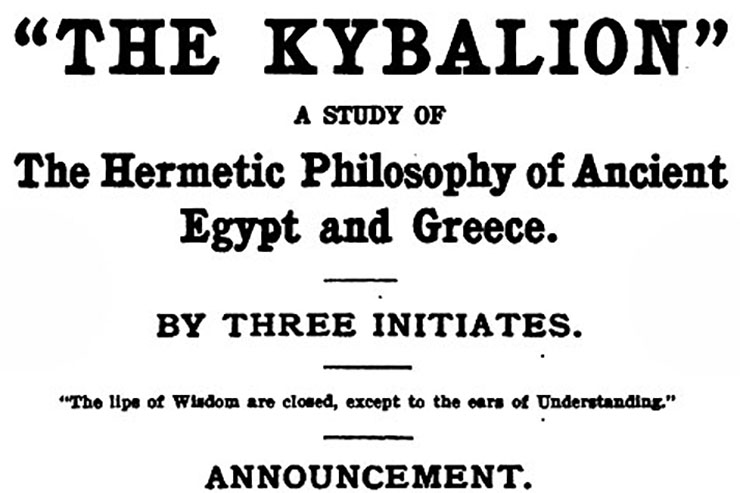
    People who have spent time grazing in metaphysical bookshops may have come across a mysterious volume called The Kybalion, written by “Three Initiates” and first issued by the Yogi Publication Society of Chicago in 1908.

    The most familiar edition is a plain volume bound in blue cloth and stamped with gold, in a format like those of other books from the same publisher, including various works on yoga by one Swami Ramacharaka.

    The Kybalion claims to be a brief introduction to a mystical tradition that has survived from antiquity. The core of the work is a series of aphorisms that, the authors contend, go back to the “early days” and were “passed on from teacher to student,…the exact signification and meaning of the terms having been lost for several centuries.”

    The word, taken at face value, looks vaguely Greek, but it has no meaning in this language (the closest Greek word to it, curiously, is kybeia, meaning “dice game” or “trickery”). It is also tempting to connect this work with the Jewish mystical tradition known as the Kabbalah, but as a matter of fact the Kabbalah is never mentioned in The Kybalion.

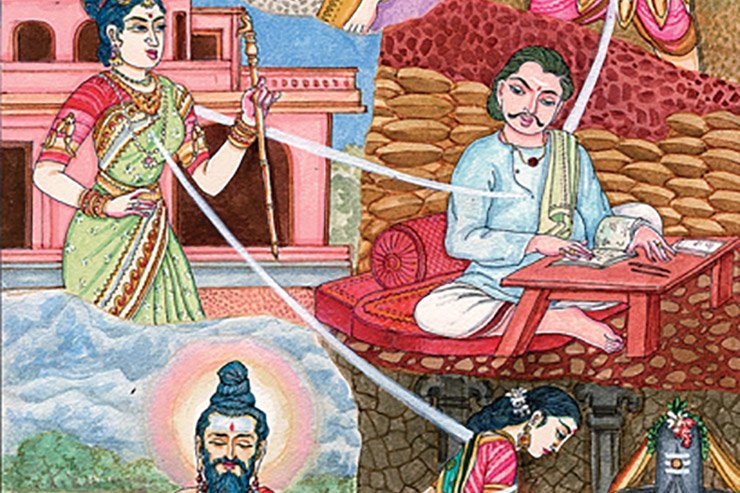
    Rather it presents itself as the essence of the teaching of Hermes Trismegistus (“Thrice-Greatest Hermes”), a legendary, semidivine figure who is said to have brought learning to Egypt in the remotest past. Hermes Trismegistus (pictured at top, right side) is often identified both with the Greek god Hermes and the Egyptian god Thoth (pictured at top, left side).

    The Kybalion is organised according to seven basic principles, which, it says, form the basis of occult philosophy:

    1. Mentalism. “The All is Mind; the Universe is mental.”

    2. Correspondence. “As above, so below; as below, so above.”

    3. Vibration. “Nothing rests; everything moves; everything vibrates.”

    4. Polarity. “Everything is Dual; everything has poles; everything has its pair of opposites.”

    5. Rhythm. “Everything flows, out and in; everything has its tides; all things rise and fall.”

    6. Cause and Effect. “Every Cause has its Effect; every Effect has its Cause; everything happens according to Law.”

    7. Gender. “Gender is in everything; everything has its Masculine and Feminine Principles; Gender manifests on all planes.”

    The origins of this book are difficult to trace. As I noted in the accompanying article, “The Secret Science of Mind,” it is believed to have been written by William Walker Atkinson, who operated the Yogi Publication Society in Chicago (he is generally acknowledged to be “Swami Ramacharaka”).

    As the first principle – “Mentalism” – suggests, the ideas of The Kybalion bear some resemblance to New Thought, a movement to which Atkinson was closely connected.

    The universe, The Kybalion tells us, is contained in “the Mind of the All”: “The All creates the Universe mentally, in a manner akin to the process whereby Man creates Mental Images.” This idea is central to practically all New Thought teachings.

    Nevertheless, the book does echo a more remote past. The term “The All,” for example, resembles the Greek to pan – which also means “the all” and which appears in some Hermetic maxims, most famously Hen to pan: “All is one.”

    Given the claims made for it, the most obvious source to examine for the roots of The Kybalion is the Corpus Hermeticum or “Hermetic body” of texts. These were composed in the early centuries CE and purport to expound the wisdom of Egypt as narrated in a series of discourses and dialogues including Hermes and his son Tat (a version of “Thoth”). And indeed there are intriguing resemblances between these works and The Kybalion.

    The first text of the Corpus Hermeticum, the Poimandres (whose name is probably a Greek adaptation of the Egyptian p-eime-n-re or “mind of authority”), tells us that the source of the universe was nous – consciousness or mind – much as The Kybalion asserts the principle of “Mentalism.” Moreover, this divine mind is described as “being androgyne and existing as light and life” – which parallels the concept of “Gender” as set out in The Kybalion.

    The Kybalion also speaks of the principle of correspondence. This idea appears in another ancient Hermetic text: the extremely brief and elliptical Emerald Tablet, which says, “Quod est superius est sicut quod est inferius, et quod est inferius est sicut quod est superius, ad perpetranda miracula rei unius”: “What is above is like what is below, and what is below is like what is above, to enact the wonders of the one thing.” (The Emerald Tablet is said to have originally been written in Syriac, a Semitic language spoken in antiquity in the eastern Mediterranean world, but it survives only in somewhat dissimilar translations in Latin and Arabic.)

    Whether there really was a collection of aphorisms known as The Kybalion that was passed down from master to pupil from ancient times is hard to say. There are, to my knowledge, no copies of it in any form that predate the 1908 edition, but that does not mean there were none.

    And there are claims of similarly hidden texts in other traditions. The Russian esotericist Boris Mouravieff claimed that esoteric Christianity has an unpublished set of aphorisms called The Golden Book, some of which he quotes in his three-volume work Gnosis: Study and Commentaries on the Esoteric Tradition of Eastern Orthodoxy (although these do not resemble the maxims of The Kybalion to any great degree).

    In a blog posting, Tarot scholar Mary K. Greer suggests a plausible direct source for The Kybalion. In 1884, Anna Kingsford, an Englishwoman who founded an organisation called the Hermetic Society, published a book entitled The Virgin of the World of Hermes Trismegistus, which presents an adaptation of the Hermetic texts. As Greer points out, the introduction to this book bears a strong similarity to many of the ideas in The Kybalion. And in fact the introduction to The Virgin of the World, written by Kingsford’s associate Edward Maitland, does contain a number of things that are echoed in The Kybalion.

    For example, Maitland asserts that consciousness is “the indispensable condition of existence,” and that matter “is a mode of consciousness,” which certainly resonates with The Kybalion’s doctrine of mentalism. Maitland also mentions “the law of correspondence between all planes, or spheres, of existence.” He also speaks of “the doctrine of Karma,” which dictates “the impossibility either of getting good by doing evil, or of escaping the penalty of the latter” – an obvious parallel to The Kybalion’s “law of cause and effect.” In light of these resemblances and The Kybalion’s insistence that it contains the essence of Hermetic teaching, it is very likely that Kingsford and Maitland’s work was at least one of The Kybalion’s sources.

    Thus it is possible to trace out a lineage for The Kybalion: the original Hermetic texts, which have been known in the Western world since the fifteenth century and which have existed in English versions since at least the seventeenth; and the digest of these texts as presented by Kingsford and Maitland in Victorian London.

    But there is a major difference between the original Hermetic teachings and the New Thought–flavoured doctrines of The Kybalion. The Corpus Hermeticum did not exist in a philosophical vacuum; its elevated and abstruse dialogues form only a part of the ancient Hermetic literature. Much of the rest consists of magical texts, and scholars have become increasingly aware that these cannot be so easily divorced in content or inspiration from the Hermetic writings.

    What does this mean in short? It means that the ancient Hermetists probably did not use a type of New Thought-like mind power in their practice. Rather they probably made use of such things as magical rituals, divination, and invocations of the gods, just as we see in most ancient religions. The use of mind power as we find it in New Thought seems to be very much an innovation of the nineteenth century.

    Hence the aphorisms in The Kybalion are very likely a pious fraud. Certainly their style and mode of thought are more evocative of twentieth-century America than of ancient Egypt or Greece. Even so, it would be mistaken to conclude that this work is unfaithful to the tradition it invokes. A spiritual tradition is based, certainly, on timeless and unchanging truths; but the application to which these truths are put will vary from age to age, in accordance with that age’s need. In this sense, The Kybalion can lay genuine claim to the Hermetic heritage.

    [alert type=”general” dismiss=”no”]This article was published in New Dawn 124.[/alert]

    [alert type=”success” dismiss=”no”]If you appreciate this article, please consider subscribing to help maintain this website.[/alert]

    Sources

    Brian P. Copenhaver, Hermetica: The Greek Corpus Hermeticum and the Latin Asclepius in a New English Translation with Notes and an Introduction, Cambridge: Cambridge University Press, 1992.

    Mary K. Greer,  “Sources of The Kybalion in Anna Kingsford’s Hermetic System,” http://marygreer.wordpress.com/2009/10/08/source-of-the-kybalion-in-anna-kingsford%E2%80%99s-hermetic-system (Accessed Nov. 11, 2010).

    Anna Kingsford and Edward Maitland, The Virgin of the World of Hermes Mercurius Trismegistus, www.sacred-texts.com/eso/vow/index.htm (Accessed Nov. 11, 2010).

    Walter Scott, Hermetica: The Ancient Greek and Latin Writings Which Contain Religious or Philosophic Teachings Ascribed to Hermes Trismegistus, Boston: Shambhala, 1985 [1924].

    “Three Initiates,” The Kybalion, Clayton, Ga.: Tri-State Press, 1988 [1908].

    Roelof Van den Broek, “Hermetic Literature I: Antiquity,” in Wouter J. Hanegraaff et al, eds., Dictionary of Gnosis and Western Esotericism (Leiden: Brill, 2005), 1:487-99.

    © New Dawn Magazine and the respective author.
    For our reproduction notice, click here.

  • Thoughts Have Wings

    Thoughts Have Wings

    From New Dawn 124 (Jan-Feb 2011)

    Telepathy is real. Thoughts have wings. Of this I am certain. It is a shame that telepathy, direct mind-to-mind interaction independent of the known senses (vision, hearing, smell, taste, touch, balance, and so on), is still shunned and mocked by many people. This despite the extensive studies of telepathy, precognition, and similar mental phenomena, carried out for more than a century by some of the best minds, including Ph.D. scientists and Nobel laureates.1

    The basic phenomena of telepathy have been demonstrated over and over again, and even put to practical use. A vast scientific literature on parapsychology (which encompasses the study of telepathy) exists, with specialised journals and societies.2

    There is strong laboratory evidence for telepathy, from classic card-calling studies to controlled experiments where an agent inserts material telepathically into a subject’s dreams, through more sophisticated tests for telepathic information transfer in the fully conscious state or at the threshold of consciousness between sleep and waking (hypnagogia).

    A large and compelling body of evidence from spontaneous cases supports the reality of telepathy, such as crisis events when a person has telepathic awareness, or even “sees” an apparition, of a loved one experiencing emotional turmoil, pain, suffering, or death. Telepathy and related parapsychological phenomena have been successfully applied to intelligence gathering. Jimmy Carter, 39th President of the United States (1977-1981), testified to their efficacy.

    The proven results of these exchanges between our intelligence services and parapsychologists raise some of the most intriguing and unanswerable questions of my presidency… They defy logic, but the facts are undeniable.3

    Recently Dr. Daryl J. Bem of Cornell University released the results of nine experiments, involving over a thousand participants, documenting consistently significant positive results for precognition and retroactive influences, important components of parapsychology.4 Despite the overwhelming evidence for telepathy and related phenomena, many scientists do not consider parapsychology a science and, knowing nothing about the subject, feel free to make disparaging statements concerning the field and its practitioners.

    At this point I believe it is time to move beyond assuaging the debunkers and scoffers, for no amount of evidence will ever convince some that telepathy is genuine. Let us concentrate on studying the phenomena and unravelling the secrets of telepathy. Thoughts may have wings, but how far can they fly?

    Telepathy is often considered independent of distance; that is, thoughts are free to fly as far as they desire. But, is this really the case? There are well-attested instances of telepathy occurring over thousands of kilometres, but to conclude that all telepathy is literally independent of distance is premature. It is extremely difficult to measure the strength of a telepathic signal apart from the delivery of the message (in analogy, an audible message may be received across a room whether yelled or whispered).

    A few controlled studies indicate that at least sometimes telepathy may attenuate with distance.5 Attenuation might be expected unless perhaps telepathy is a nonlocal quantum mechanical phenomenon. Possibly there are multiple forms of telepathy: information carried on extremely low frequency electromagnetic waves, information transferred by quantum mechanical means, and information propagated via some other mechanism.

    We must also consider the psychological aspects of telepathy. A person may preferentially focus telepathically on the thoughts and emotions of someone who is psychologically “near,” even if far removed in physical space.

    There is another, most curious, aspect of telepathy. Telepathic-type phenomena are not limited to the present, but transcend the boundaries of time. Telepathic information can be received from the future and the past, with the proviso that telepathic experiences drop off dramatically as one moves temporally further away from the present.6 Various forms of precognition, such as those confirmed by Dr. Bem, can be explained in terms of telepathic information received from the future, the future agent in some cases being the same person as the receiver (the percipient) in the present. You can receive telepathic information from your future self! Perhaps this sounds strange, but it may just be the way the world is. Indeed, if you think about it, who is closer emotionally and psychologically to you than yourself?

    [alert type=”general” dismiss=”no”]This article was published in New Dawn 124.[/alert]

    [alert type=”success” dismiss=”no”]If you appreciate this article, please consider subscribing to help maintain this website.[/alert]

    Footnotes

    1. For example, Charles Richet, Nobel Prize in Physiology/Medicine, 1913, and Brian Josephson, Nobel Prize in Physics, 1973.
    2. See articles reprinted in, and references cited in, Robert M. Schoch and Logan Yonavjak, compilers and commentators, The Parapsychology Revolution: A Concise Anthology of Paranormal and Psychical Research, New York: Jeremy P. Tarcher/Penguin, 2008.
    3. Jimmy Carter quoted in a Politico article, “Carter’s weird science” by Patrick Gavin, posted on the Internet 20 October 2010 at:  www.politico.com/click/stories/1010/carters_weird_science.html  (Accessed 20 October 2010).
    4. Daryl J Bem, “Feeling the Future: Experimental Evidence for Anomalous Retroactive Influences on Cognition and Affect”, Journal of Personality and Social Psychology, in press. Manuscript posted at: http://dbem.ws/FeelingFuture.pdf (Accessed 11 November 2010).
    5. See discussion in Schoch and Yonavjak (note 2), 346-347; William Braud, “Psi and Distance: Is a Conclusion of Distance Independence Premature?”, 2010, article posted at: http://inclusivepsychology.com/uploads/Psi_and_Distance_-_A_Premature_Conclusion.pdf (Accessed 20 November 2010).
    6.  See discussion in Schoch and Yonavjak (note 2), 345-346 & 347-349..

    © New Dawn Magazine and the respective author.
    For our reproduction notice, click here.

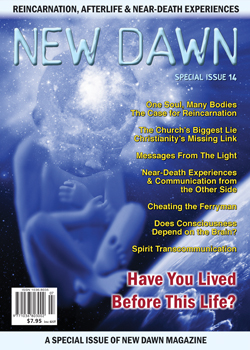
  • One Soul, Many Bodies: The Case for Reincarnation

    One Soul, Many Bodies: The Case for Reincarnation

    What happens to us when we die? It’s a question everyone eventually asks themselves at some point in their life. It transcends racial, social, political, economic and gender lines, making it the one question common to all human beings whether we like it or not.

    Yet ever since the first men and woman began pondering their mortality a hundred thousand years ago, the answer has eluded us. What does happen when we die? What becomes of our soul, our mind, our personality – our very essence? For that matter, do we even have such a thing as a soul, or is it all an illusion we have created to give ourselves a sense of permanence and the hope of immortality?

    The rationalist answers this query by proclaiming that since we are nothing more than a collection of cells and our brains simply tissue encased within a mantle of bone, nothing can happen to us when we die. The essence, personality, mind – soul – or whatever we wish to call our consciousness, ceases to exist, endowing our time on this planet with no more meaning than that which we choose to give it during our brief sojourn here. This is, of course, the position of the atheist, which is what makes atheism, in my opinion, so easy. It requires nothing because it offers nothing, which strikes me as a fair trade.

    To most people, however, this answer is unsatisfactory. It suggests that we are little more than some great cosmic accident and that, consequently, our life has no ultimate purpose, forcing us to contemplate an existence without meaning in a universe that, despite all its beauty and splendour, has no more significance – or ultimate permanence – than a flower that briefly blooms in the spring only to wither and die after a few short days of vibrant life.

    I suppose there are people for whom such a prospect is acceptable. It does, after all, tidy things up and make life simply a little game we sentient beings like to play for no particularly good reason other than because we have no choice. Yet something deep within the human heart knows better. We instinctively understand that we are more than the sum of our parts, which is why most people believe their personalities will survive their physical demise in some form and will continue on long after their bones have turned to dust. This, of course, brings us to our second option, which is that the personality/ego/true self/whatever you want to call it does survive the demise of the body to exist – at least for a time – as a separate disembodied consciousness. If this is the case, however, the next question that logically follows is what happens next?

    Some believe, for example, that we become ghosts – little more than disembodied spirits aimlessly wandering the Earth, capable of perceiving the physical realm but unable to interact with it in any meaningful way. They can even point to various evidences to support this contention, from reported hauntings to automatic writing, séances, and apparent disembodied spirits caught on film.

    While I personally have no problem with the idea of ghosts, I don’t think existing as a disembodied consciousness is truly a viable long-term option for what happens to us. Ghosts always struck me as being transitory; beings stuck on the Earth plane for a time only to ultimately move on and so essentially vanish from our physical realm. As such, even if we are to become ghosts, it will be, at least for the vast majority of us, a brief experience and not our eternity. I suspect we all eventually move on to ‘greener pastures’, so to speak.

    Now, however, is where things get more interesting. Most people, regardless of whether they believe in ghosts or not, believe that the essence of who we are – our “soul” if you will – goes some place. Heaven is the favoured destination for most; a place where our conscious personality, no longer shackled to the limitations and burdens of physical existence, survives within a perpetual state of bliss and joy throughout eternity. Some add to this by also embracing a belief in hell; a perpetual state of torment for those who turn to evil and so are doomed to exist forever within a conscious state of agony, regret, and fear.

    Both positions, however, suffer from the same problem, and that is that they see our time here on this planet as but a blink of the eye of eternity, with the decisions we make – or fail to make – while in the body having profound and eternal ramifications. Unfortunately, this reduces the physical world to little more than a cosmic hatchery that exists only to birth new souls, each of which will spend a short time in it before winging – or, potentially, plunging – to their ultimate destiny.

    While admittedly this idea does manage to make this single life of paramount importance, it also forces one to wonder why a physical realm is necessary at all. If the physical universe exists merely as a vehicle for our creation, why couldn’t the process be circumvented entirely and we be created directly into the spiritual realm – as was supposedly the case with God’s angels?

    Why all the unnecessary pain and hardship of a physical existence – especially if there exists the very real danger that we might earn hell through our misdeeds – if the spirit realm is the only destination that awaits us? In such a context, physical existence seems not only pointless but, in many ways, even hazardous.

    So where does that leave us? If no Heaven and if no Hell, then what’s left?

    There is a third position to consider. It is one that until recently has been largely ignored in the West but has been embraced by literally billions of people around the world for thousands of years. It is the belief that this physical existence is neither insignificant nor transient, but instead is perpetually ongoing. It is the concept that our soul lives on not in some ethereal Eden – or Hades – somewhere, but realises perpetual existence through a process of continual rebirths into the physical realm, making our time on this planet not one single, brief experience, but a repetitive process realised through literally hundreds of lifetimes. It is a timeless belief – one that predates both Christianity and Islam by many centuries – and one that is known by many names in many cultures. It’s been called rebirth, regeneration, transmigration of the soul, even metempsychosis, but is perhaps best known to us today as reincarnation.

    Upon first consideration, especially to those who haven’t given the idea great thought, reincarnation may seem to be a foreign or exotic concept, especially to the Western mind steeped in the scientific method and drenched in two thousand years of monotheistic religion. It is something for Hindu holy men to ponder, or New Agers to embrace, but nothing that seems particularly relevant to most Westerners today.

    I can easily understand this perspective for it is one I held myself for the first forty years of my life. And the truth be told, it is an Eastern concept – one in vogue more than four millennia before Christ was born and a belief held to by nearly two billion of the world’s population today – making it one of the oldest and most enduring belief systems known to man. In fact, it may be the original post-mortem belief among early humans who probably considered the idea when they began noticing strong similarities between recently born offspring and their deceased ancestors. Perhaps the mannerisms or interests a child displayed reminded one of a deceased loved one or a birthmark mimicked that found on a long-dead grandparent, leading village elders to imagine that the dead ancestor had returned a second time – a not unreasonable assumption in cultures that naturally assumed the soul to be inherently immortal.

    Unfortunately, Westerners have traditionally had a tendency to consider foreign or primordial religious concepts as primitive and so reject them out of hand. However, this perception appears to be slowly changing as reincarnationist beliefs have become more prevalent in the West, especially in the last fifty years, and is becoming increasingly popular to ever growing numbers of people.

    A Lost Western Tradition of How the Soul Returns

    Of course, unbeknownst to most people, reincarnation has always been a part of Western thought. The prospect that the soul repeatedly returns to the flesh flourished in ancient Greece almost three thousand years ago and may have played a far more important role in our development as a civilisation than traditional histories have led us to believe. Aristotle, Socrates, Plato, and Pythagoras all taught and believed in some form of rebirth, the foundations of which were later adopted by the great Roman philosophers Ovid, Virgil, and Cicero, along with a host of other great thinkers of antiquity.

    In fact, reincarnationist concepts were so prevalent in the centuries immediately preceding the birth of Christ, that they played a major role in many of the “mystery” religions of the Mediterranean; religions which were themselves to become the template for other later mystical faith systems of the region. Reincarnation, then, far from being a purely foreign concept was, in fact, widespread and may have strongly influenced the shape and thrust of Greek and Roman philosophy.

    Even more of a surprise to many people, however, is the fact that reincarnationist concepts were also part of some of the more mystical branches of traditional Western religion, from the Sufis of Islam to the Gnostics of the early centuries of Christianity, and even within the Hasidic and Kabbalist traditions in Judaism. In fact, at times it virtually flourished and, especially in the case of Christianity, almost became the predominant belief system during the first few centuries of the Church’s existence until it was forced underground by the more traditional, non-reincarnationist branches of Christianity. Its proponent’s writings declared heretical and burned, the concept was so successfully suppressed by the Church of Rome that few Christians today even realise it was ever a part of their own faith.

    Why was it suppressed? The obvious answer is because it threatened authority. Western religion is largely dependent upon the belief that man is destined to “die once and then be judged” to maintain control. In promising multiple rebirths, however, reincarnation renders the proclamations of the Pope or the Grand Mufti or whomever was the ruling head at the time transitory and, the truth be told, irrelevant. As such, reincarnation threatened the Church’s very livelihood, making it a very dangerous idea that had to be either suppressed or labelled as heretical in order for the Church to maintain its power base. As a result, the concept remained largely unknown outside of Asia for probably seventeen of the last twenty-one centuries.

    Its revival in the West was imminent, however, with the arrival of the Age of Enlightenment in the eighteenth century. Once the long forgotten writings of the ancient Greeks again became available and one could hold to previously forbidden ideas without forfeiting their lives, such once forbidden concepts as reincarnation became increasingly popular, especially among the intellectual elite of the era. Amongst those who held to some form of multiple rebirths are such notables as Charles Dickens, Ralph Waldo Emerson, Benjamin Franklin, Shakespeare, Leonardo Da Vinci, and Voltaire, among others.

    Interpreting What it Means to Reincarnate

    However, since its reintroduction into the Western consciousness, reincarnation has undergone a transformation. It is no longer the unending “cycle of life” wheel taught by the Hindus and Buddhists, but has become a “school of higher education” designed to bring us to ever greater levels of spiritual enlightenment. This is why when a Hindu or a Buddhist and their fellow Western reincarnationist talk about the subject, it often appears as though they are speaking two different languages. This is because in some ways they are, which is where the confusion comes in.

    To the Hindu, the soul is essentially stuck in a never ending cycle of rebirth which can never be broken due to the continual need to balance one’s karma. In effect, with each incarnation into the flesh, the human personality – a by-product of the underlying soul that birthed it – accumulates a degree of bad karma that must be worked off in order to restore balance to itself. Some of this karma can be worked off in life in the form of good works, but this is seldom sufficient to work off the entire debt, which must be accounted for in the next life by having the soul take on an incarnation that may be more difficult so the ongoing karmic debt can be worked off.

    On rare occasions, a life may be so exemplary that the person might be born into a higher station (or caste in Hindu parlance) but as a rule, bad karma tends to outweigh good karma and, in being continually accumulated through each lifetime, adds to the growing debt that remains to be balanced and so perpetuating the rebirth cycle. (Of course, if one accumulates too much bad karma, they may not be reborn as a person at all, but could come back as an animal or even, in some teachings, an inanimate object such as a stone. This belief is called “transmigration of the soul” and is also a major element of Hindu teachings.)

    Buddhism, on the other hand, while understanding the process of reincarnation in much the same way as does the Hindu, differs in that it teaches that the cycle of rebirth can be broken through achieving nirvana (literally, enlightenment), at which point the cycle is broken.

    Enlightenment means essentially to be become aware of one’s true nature and to the realities contained within the Four Noble Truths as articulated by Gautama Buddha over two thousand years ago. These are: first, to be alive is to suffer due to the imperfection of human nature and the world around us; second, that the cause of suffering is attachment to transient things (in effect, craving or desiring things); third, that one can learn to let go of these attachments; and, finally, that the process of achieving enlightenment is progressive and may itself extend over many lifetimes.

    In sharp contrast, to many Western reincarnationists, the purpose of rebirth is to learn the lessons we need to learn in each incarnation in order to advance to the next spiritual level which, while having some similarities to the Buddhist concept of slowly achieving enlightenment over a number of incarnations by practicing the Buddha’s Eightfold Path (right view, right intentions, right speech, right action, right livelihood, right effort, right mindfulness, and right concentration), is actually quite different.

    The Buddhist does not believe that one is “learning” new lessons with each lifetime, but simply applying the principles contained within the Eightfold Path until craving, ignorance, delusions and its effects gradually disappear as progress is made towards enlightenment. To the Western mindset, attachment is not seen as the source of the problem (though it does generally acknowledge that an obsessive attachment to things can be detrimental to spiritual growth).

    Another significant difference between Eastern and Western concepts of reincarnation have to do with the perception of what it is, exactly, that is reincarnating. The Hindu sees the soul – the divine essence of God – as being the generator of each incarnation, with the individual personality or ego a transient expression of that soul.

    In marked contrast, the Buddhist doesn’t believe in individualised souls at all, but believes the sense of self is merely an illusion created by our own perceptions – a conscious “memory” if you will, conceived by our assumption that we exist separately. To the Buddhist, we are all a part of a larger, divine consciousness that has simply taken on the very brief “illusion” that it is separate. The Buddhists compare our sense of existence to the waves upon the ocean; just as a wave is a temporary phenomena caused by wind and currents, our personality is equally as transient and is, upon death, absorbed back into the divine consciousness in the same way that a wave upon the ocean is eventually swallowed up by the ocean itself.

    In the West, however, the personality – or ego – is more robust and generally considered immortal. To many, the soul and the personality are considered essentially synonymous, so as a result, when we die, our basic personality – complete with all its memories, life experiences, knowledge, and traits – returns in another body to continue its existence. It may not have a direct memory of its past life – though some people claim to be possess the ability to consciously remember their previous incarnations – but it is essentially the same personality starting life over again in another context.

    The personality may experience dramatically new surroundings – for example, it may experience one incarnation as an Indian girl who lived and died in the nineteenth century and then return as a Spanish man in the twentieth century – but it is still the same “person” underlying each “role.” Of course, the experiences and environment it finds itself in through each subsequent incarnation will affect the base personality in both subtle and sometimes substantial ways, but this too is a part of the process. This is why the Westerner sees reincarnation in the context of “lessons.” After all, the Indian girl was able to experience and learn only so much in her short time on Earth, mandating that she return again – this time as a Spanish male – to learn those things she either neglected to learn or hadn’t the opportunity to learn in her previous incarnation.

    This makes spiritual enlightenment a type of “to do” list that needs to be checked off in its entirety before we can cease the process of rebirth. (What happens after that is equally open to speculation among Westerners: some imagine we come back as avatars or spiritual teachers; others speculate that we start the process over again on another planet, while still others maintain that we move onto other dimensions. Apparently, the options available to the enlightened soul are extensive.)

    I wonder, however, if the truth is not a conglomeration of each of these perceptions? Clearly the Eastern concepts of a parent soul that births each and every individual personality has merit, as does the Buddhist belief in the transient, temporary nature of the ego that is birthed. And the Western concept that we reincarnate until we learn what we need to know also has some validity and seems to parallel in some ways the Buddhist idea that the cycle of rebirth ends upon achieving enlightenment – however one chooses to define the term.

    I often wonder if we aren’t all looking upon the same phenomena and not simply seeing only those parts of it that speak to us personally. I suspect our understanding of the purpose for reincarnation is lacking in many ways and may never be entirely complete, though I also believe we are making progress in coming to a fuller appreciation for its complexity and sophistication. Perhaps one day East and West will come together and merge their different perceptions and in so doing, form a complete whole that answers everyone’s questions.

    Of course, I recognise that such may sound like a contradictory process. After all, how can there be a soul and yet not a soul, and how can the ego be immortal and yet transient? To combine both Western and Eastern concepts of reincarnation would seem to embrace paradox, but I have found it is often within the complexities of paradox that the truth exists. In fact, it is only our limited ability to understand that makes these apparent contradictions paradoxes in the first place.

    I wonder if they would still appear as such were we to find the capacity within ourselves to truly understand on a level our current mental capacity does not permit. On the other hand, perhaps understanding these concepts is not done at a mind level, but on a spiritual level, which is a difficult place for many people to go.

    Maybe in the end we were never meant to fully understand how reincarnation works, and that may be where the adventure really begins. Perhaps the question of what happens to us when we die was never meant to be answered but merely explored, for it is in seeking – not necessarily finding – the answer that growth can take place.

    It may be, in fact, that it is only in abandoning our need to find the answers that we give them the ability to find us. In effect, we may be like the man who is so busy looking for treasure that he fails to realise he is searching for it within the bowels of a gold mine. Were he to but look up and see the treasure that shimmers all around him, he would realise how silly his fervent quest had been all along. Perhaps we need only do the same.

    Jeff Allen Danelek’s book The Case for Reincarnation: Unraveling the Mysteries of the Soul (Llewellyn, 2010) is available from all good bookstores.

    [alert type=”general” dismiss=”no”]This article was published in New Dawn Special Issue 14.[/alert]

    [alert type=”success” dismiss=”no”]If you appreciate this article, please consider subscribing to help maintain this website.[/alert]

    © New Dawn Magazine and the respective author.
    For our reproduction notice, click here.
  • Cheating the Ferryman: A New Paradigm of Existence?

    Cheating the Ferryman: A New Paradigm of Existence?

    From New Dawn Special Issue 14 (Dec 2010)

    What happens when we die? This is the ultimate question and one that we still have no real answer. From the first few moments that man became a self-aware being he has pondered upon this mystery.

    Every culture has attempted an explanation, and it is reasonable to conclude that all religions exist to give an account of what happens at that moment and, more importantly, where does the person go after their body dies.

    One of the most enduring myths is that of the Ancient Greeks. They believed that the recently dead would find themselves at the banks of a vast river, the River Styx. Out of the mists would appear Charon, the Ferryman. It was his job to ferry the soul, termed a “Shade,” across to the other side…. To the Land of the Dead.

    But he did not do this for free. He needed a payment. The relatives of the recently dead person made sure the Shade could pay the ferryman. This payment was usually a small coin called an obolus. Depending upon the tradition, either this would be placed under the tongue of the corpse or two oboli would be placed over each eye.

    This well known myth still resonates over three thousand years later. “To Pay The Ferryman” can still be heard today. However, there is a lesser known myth that suggests a deeper truth: The myth of the River Lethe.

    The Greeks believed that before getting to the banks of the Styx the Shade would encounter a much smaller tributary of the great river. This could be crossed with ease by wading from bank to bank. This small river was called the Lethe, and its waters contained a profoundly important quality.

    If the Shade or newly deceased soul drank of this water all their memories would evaporate. They would forget who they are and the events of their life. Their memories would become like those of a new born baby. Of course by doing so the Shade also forgot all of the lessons learned during that life.

    But before doing this the Shade had the option of drinking from a small pool next to the Lethe. This was the Spring of Mnemosyne. By drinking here the Shade’s past-life memories became sharp and distinct. Each action and its subsequent effects became crystal clear. Life’s lessons became precise and understood.

    If the Shade drank of the Spring of Mnemosyne they were allowed to pay the ferryman, board the boat, and sail across the Styx to the Elysian Fields.

    But if a drop of the waters of the Lethe was drunk by the Shade, then they were sent back to be reborn again with no memories of their previous life. Now this was not a form of reincarnation as it is understood by most people. It was a re-birth process in which the same life was lived again. The Shade found itself back in its mother’s womb waiting to start all over again.

    This concept is called “The Eternal Recurrence” and has been a long held alternative belief to that of the linear life found in most religions, even those who have reincarnation as their central belief.

    However, those who have long held this belief never shared it with the masses. Such a belief has always been found in the secret – esoteric – groups within most of the major religions. This is the great secret carried through the ages by the groups loosely termed as “Gnostics.”

    The Gnostic tradition can be found behind the great mystery traditions of the Middle East and Europe. From the Manicheans of Persia to the Cathari of Southern France, and from the Cabbalists of Southern Spanish Judaism to the Sufi’s of Arabia, this hidden knowledge is the real Holy Grail in whose defence the Knights Templar and the Albigenesians died in their thousands to protect.

    In my books I present evidence for this belief system, that at the moment of death we are catapulted back to our moment of birth. The theory is supported by a good deal of evidence from modern science, particularly quantum physics, neurology, psychiatry and consciousness studies.

    I call this theory “Cheating the Ferryman” because I suggest many of us never make it across the River Styx. We never step into Charon’s boat and we never pay him his obolus. We cheat the ferryman out of his fare and return to live our lives again.

    On what evidence do I base such a totally weird idea?

    Dreams & Precognitive Déjà Vus

    Well, for me, the whole theory started with one very peculiar dream. In this dream I experienced a déjà vu… yes a dream that contained the sensation that I was experiencing an event that I had dreamed before, if that makes sense.

    In the dream I had an inner dialogue with another me and this being stated that a déjà vu is a memory of an event that you have lived before in a different life. I then woke up with this idea echoing round my mind.

    I had for some time wanted to write a book and now it seemed that my dream self, or more accurately a part of my dream self, had given me both the theme and the incentive.

    I was surprised to discover that déjà vu is not only the most common anomalous psychological perception (70% of people will experience the sensation at least once in their lives) but also that experts have no real idea what causes it. Various suggestions have been made but none have been shown to be correct.

    As an example, for many years a proposal made by the psychiatrist Paul Efron was considered to have nailed the mystery. Efron suggested that one part of the brain processes information before the other. In this way we have the feeling of experiencing an event twice. This occurs because each hemisphere of the brain receives signals from the right and left visual fields of each eye. As such the non-dominant hemisphere processes the incoming images a split second before the dominant hemisphere. So, in effect, the consciousness receives the signal twice with a short time delay. As one signal is immediately, but not fully, over-written by another we feel as if we have experienced the images twice. But this curious message transferal only works for the eyes. It has recently been shown that congenitally blind individuals experience aural déjà vu sensations. As the brain processes sound in a totally different way to sight, the Efron thesis simply cannot explain this form of déjà vu.

    I wondered if déjà vu may not be simply what it feels it is: a curious sensation that suggests the observer has lived this moment before. The Seattle based psychiatrist Dr. Vernon Neppe has defined déjà vu as, “any subjectively inappropriate impression of familiarity of the present experience with an undefined past.”

    So the “undefined past” could be part of this life or a past life. However this ‘past life’ for me did not imply reincarnation for one simple reason: for a déjà vu sensation to be effective it has to be a memory of the exact circumstances, not a circumstance that is similar. For example, if my “subjectively inappropriate impression” consisted of me remembering being in this place in Victorian times, the two images would be quite different. The location may be the same but my clothing, my companions and the décor would be totally different. It would feel more like a time-slip than a doubling of consciousness. For a déjà vu to be a déjà vu the two impressions have to be identical, in all ways. My memory of the event is identical to my experiencing of the event. I am literally re-living an event from my own past, but a past that is, for the moment, the future.

    Indeed, I have now interviewed many people who experience precognitive déjà vu’s. The ‘memory’ includes a remembrance of what happens/happened next. The subject suddenly has very short-term clairvoyance.

    I found that these precognitive déjà vu sensations are usually reported by individuals who experience three brain-states: migraine, temporal lobe epilepsy (TLE) and schizophrenia. I was intrigued as to why this was the case and began researching what may link these three ‘illnesses’.

    Much to my delight I found there is one common factor, a neurotransmitter called glutamate.

    Perception and Time Distortion

    In a curious coincidence that was to have great significance to me later, I learned that neurotransmitters were first discovered by an Austrian scientist called Otto Loewi. Just like me, Loewi had a dream guider. On Easter Sunday 1920 he awoke in the middle of the night having experienced a really vivid dream. He wrote down what he had experienced and went back to sleep. The next morning he excitedly looked at his notes to find them to be illegible scrawl. He knew that he had dreamed something of profound importance so he went to bed early the next night. The dream came again and when he awoke he reproduced his dream experiment exactly as he experienced it that night. In doing so he isolated a substance that was to eventually be called acetylcholine. Such was the importance of this discovery that in 1936 Dr. Loewi and his English associate Sir Henry Dale were awarded the Nobel Prize.

    What Loewi’s dream had helped find was the first example of the chemicals that were later to be called neurotransmitters. These are internally-generated substances that facilitate the transmission of messages from cell to cell within the body. The most important group is found in the brain and glutamate is the most important of the brain neurotransmitters.

    Glutamate is directly responsible for the peculiar feelings described by migrainers, temporal lobe epileptics and schizophrenics, specifically a sensation that is technically known as “the aura.”

    The aura is a form of early warning system. It is triggered by over-production of glutamate and usually takes place a short time before an attack of migraine or a temporal-lobe seizure. (Glutamate’s role in schizophrenia is different but the overall outcome is similar). Experiencers report sensations of time slowing down, of hyper-sensitivity, of visual or aural hallucinations and profound déjà vu sensations. Déjà vu had been linked with both migraine and TLE for years before Loewi’s serendipitous discovery.

    Here was the link I had been looking for. Déjà vu has, as one of its causes, a flood of glutamate in the brain. It was then that I made my first big step to “Cheating the Ferryman.”

    Quite by chance I was reading an old book I had on Near-Death Experience (NDE). One of the more technical articles discussed the neurochemical causes of the NDE. Much to my surprise I found that glutamate was also connected to this well-reported experience. Another, and quite unrelated, article in the same book discussed one of the most commonly reported elements of the NDE, what is technically known as the “panoramic life review.”

    “My life flashed before my eyes” is a quotation recorded time and time again by people who have close encounters with death. Some report the experience as being a series of snapshots, others that they literally re-live every experience of their life but in super-speed. One person reported that it was as if somebody had recorded a movie of his life and was running it in fast-forward.

    I was fascinated by this link. Both déjà vu and the Panoramic Life-Review were linked by a specific brain-chemical, glutamate. After doing some subsequent research, I found that Dr. Karl Jansen of the Maudsley Hospital in London had been able to reproduce a full near-death experience in volunteers when he had them take small doses of the drug ketamine. Now ketamine is chemically almost identical to glutamate so here again we had an amazing link.

    I was later to find that ketamine, and by implication glutamate, also brings about another curious subjective sensation in the brain: time slows down or almost stops for the experiencer.

    In another fortuitous event I was to be given a first-hand description of a glutamate effect by a person who experienced TLE seizures.

    Temporal Lobe Epilepsy Breakthrough

    I received a phone call one afternoon. It was a lady from a recruitment agency who was wishing to discuss with me a vacancy she was handling. “Margaret” asked me whether I was working and I explained that I was driven to write a book. “What about?” she asked, “I don’t really know at the moment,” I truthfully responded. I then explained that I was reading a good deal about temporal lobe epilepsy and was making some fascinating links.

    She went very quiet and suggested that we should meet up to discuss the vacancy. Three days later I met her at a coffee shop nearby. As soon as she had sat down she explained to me that she had to meet me because she wished to discuss with me something she could not mention in her office where she would have been overheard.

    “Margaret” informed me that she had recently been diagnosed as a having temporal lobe epilepsy. She described to me how she had first discovered that something unusual was happening in her brain.

    She had been having lunch with a work associate in a crowded café. As her associate started to pour a cup of tea from a teapot she suddenly felt a snap over her right ear. Surprised by this she looked at her associate assuming that she too would have heard the noise. One look told her that her lunch companion had heard nothing. This was because she had stopped moving. The stunned recruitment consultant looked round the café and every person was frozen in time and space. It was as if she had suddenly found herself in a three-dimensional photograph. She could hear a low humming sound that seemed all around her. She then looked back at her companion to notice that she was not frozen at all, she was moving incredibly slowly.

    Margaret then realised that the low hum she could hear was, in fact, people’s voices! Her metabolic rate had increased to such an extent that time had slowed down to a crawl. She watched in amazement as the tea slowly appeared from the spout of the teapot and slowly fell into the cup. Margaret assured me that this took hours to take place in her mind.

    At that point she made a fascinating comment. She said that she could have been in this state for days, months, years, “even a lifetime.” Then, after what seemed like many hours, Margaret felt another snap over her right ear and her associate finished pouring the tea and sat back. “Are you okay,” she asked. “I am not sure,” replied Margaret. Her friend then explained that Margaret had suddenly stopped moving and had stared into space… for about twenty seconds! As Margaret explained to me, those twenty seconds had been hours for her. She went on to tell me that she feared she had a brain tumour but after a series of scans she was told that she had TLE.

    I was amazed at this story. Here was evidence that glutamate, when it floods the brain, does, indeed, slow subjective time to an absolute crawl. For some reason I then asked Margaret if she experienced déjà vu. “I get déjà vu’s to kill for” was her reply. “Not only that but when I am in this pre-seizure aura state I know what is going to happen next. I really do see the future!”

    My meeting with Margaret presented me with the final piece of a jigsaw puzzle that I had not known, until that moment, I was trying to complete. I knew then what the book would be about – not an explanation for déjà vu but something much bigger, an explanation as to what happens to human consciousness at the point of death!

    My theory was both simple but stunning. Déjà vu sensations are exactly what they seem to be: they are recollections of past events, otherwise known as lost memories.

    So how can we “remember” the future? Simple, because the future is also the past. Confused? Well the best way to explain this is to give a fictitious example based upon an amalgamation of many NDE reports.

    Get the issue this article appears in

    The Physics of the NDE – Cheating the Ferryman

    Our hero is a skydiver. He is a very unlucky skydiver because his parachute has refused to open and he forgot to pack his back-up ‘shute’. As he plummets to the ground there will be a point where the stress levels will be so high that glutamate floods the brain. In doing so it brings about the subjective slowing down of time. Indeed, for the skydiver the duration of time slows down to a virtual standstill. But his brain remains completely active.

    Just as he is about to hit the ground his motion through space is slowed by the fact that his motion through time has similarly been changed. As we know from the theories of Albert Einstein, time and space are the same thing and they are “relative” to the observer. This is where the word “Relativity” comes from.

    So “relative” to the skydiver, time duration has slowed down to a crawl. For him a split second can last days, weeks, years, even a lifetime. This is exactly what Margaret experienced in the canteen.

    What happens then? Well something very strange. Recall that many people who report Near-Death Experiences explain they see their lives “flash before my eyes.” This is a Near Death Experience. Our skydiver is in a Real Death Experience. There is no way he will survive the impact with the ground. In this case his life does not “flash” before his eyes but he experiences it in a literal, minute by minute, recreation of his life from the moment of his birth. In effect he lives his whole life again. And at the end of the second life it happens again, and again and again. It is like the movie “Groundhog Day,” but it is not a “day” but a “life” – and all this takes place in the split second before he hits the ground.

    This is how he “Cheats The Ferryman.” In his subjective time-frame he never reaches the point of death because it is always in his future.

    But there is more – and this where things get very interesting. I suggest each life-rerun is not like a pre-recorded movie that cannot be changed but more like a video game in which all consequences of all decisions are already programmed in. By applying the latest findings of quantum physics I present a model whereby the implications of something called the “Many-Worlds Interpretation” can be shown to allow such a scenario.

    Put simply, according to the MWI hypothesis there are literally billions of versions of each person and each one of these versions have the capacity to live out – and lay down re-playable memories – the outcomes of every decision made in a lifetime. There is available to each person a recording of every possible life they could live. I call this recording the “Bohmian IMAX.” Others may recognise it as the “Akashic Record” or the “Akashic Field” of Professor Ervin Laszlo.

    I further suggest that at the point of death consciousness splits into two elements. I term these the Eidolon and the Daemon. The Eidolon is the everyday being that calls itself “I” or “me” and it has no knowledge of its previous lives. The Daemon is different. It carries all the memories of the past life (or lives) and as such it acts as a form of “Higher Self” or “Guardian Angel.” In my books I present evidence from modern neurological research to suggest this may be the case.

    The “changes” that bring about a new “life-path” are instigated by the Daemon when it warns the Eidolon of potential dangers lying waiting in the future. These can be conveyed through dreams, precognitions, inklings, voices and many other subtle methods – possibly even a deja sensation.

    We don’t just “Cheat The Ferryman,” we are also given opportunities to change things and possibly put right the wrongs we do.

    I agree that on first encountering this hypothesis it is both bizarre and incredible. But the science does seem to work. Could this be the paradigm changer that we have all been waiting for?

    [alert type=”general” dismiss=”no”]This article was published in New Dawn Special Issue 14.[/alert]

    [alert type=”success” dismiss=”no”]If you appreciate this article, please consider subscribing to help maintain this website.[/alert]

    © New Dawn Magazine and the respective author.
    For our reproduction notice, click here.
  • The Great  Cholesterol Deception

    The Great Cholesterol Deception

    From New Dawn 123 (Nov-Dec 2010)

    Millions of Australians are prescribed cholesterol-lowering drugs – statins like Pravachol®, Zocor® and Lipitor® – each year at a cost of more than $1 billion dollars with very little, if any, benefit. In the US, some 40 million people currently take statins at a cost of more than $3.00 per pill, more than $1,000 per year, totalling more than $40 billion a year.

    While there are many exaggerated claims and a lot of hype about the benefits of statins, there are also many studies showing no benefits at all. The pro-statin hype is based on the misuse and abuse of statistics.

    Various independent studies in prestigious, peer-reviewed journals have shown that statin use in primary prevention – that is, to save lives – has minimal or no value in reducing mortality and certainly nothing that is considered anywhere near clinically significant to warrant their widespread use. It does not matter how one manipulates the statistics, the results just aren’t there.

    In data gathered in 2009 from six trials, a review of the efficacy in lowering the risk of death with statins found virtually no difference between the treatment group and the control group.1 There are many more of these studies.

    In an independent meta-analysis (when a number of studies are put together to achieve more statistical power) of randomised controlled trials in patients without CVD, statin therapy decreased the incidence of major coronary and cerebrovascular events and revascularisations but not coronary heart disease or overall mortality.2

    Taking statins for a number of years will not reduce mortality: “Primary prevention with statins provides only small and clinically hardly relevant improvement of cardiovascular morbidity/mortality.”3 “Hardly relevant” means there is virtually no clinical benefit; as the authors of these particular studies are independent, they gain nothing by stating this.

    Another review found that “current clinical evidence does not demonstrate that titrating lipid therapy (trying to lower cholesterol with statins) to achieve proposed low LDL cholesterol levels is beneficial or safe.”4 In other words, lowering lipids has no real benefit and has the potential for adverse effects.

    Following up on this, in a major independent review of studies funded by the Ministry of Health of British Columbia (Canada) on statins and primary prevention, researchers reported that “statins have not been shown to provide an overall health benefit in primary prevention trials.”5 This is a government report carried out by an independent university yet its findings are still ignored.

    The problem really comes down to vested interests and the abuse of statistics. To overcome the limitations of small studies, vested parties combine many studies into a meta-analysis. The researchers themselves select the studies used in the meta-analysis. A fundamental problem is that researchers with direct links to drug companies have the authority to select the most positive studies and ignore the rest – including independent studies not funded by pharmaceutical companies. Despite this, they have still not been able to show any clinically significant findings.

    As readers of the scientific journals, we should not be confused between statistical significance and clinical significance. For an outcome to be “statistically significant” means that the outcome was likely a result of the treatment – whether the result was 100% effective or less than 0.1% effective. That is, if you treat 1,000 people to save one life (0.1%) it may be statistically significant but it is not clinically significant. “Clinical significance” means 20% to 30% or more. The drug companies’ most positive studies on statins for prevention of CVD report statistical significance, mostly 1% or less, and none have found any clinical significance.

    Busy medical professionals don’t have time to review the statistics; few of them may be aware of the different ways the statistics are manipulated. So if the experienced professionals don’t understand the results of these studies, how do we expect the media or public to understand?

    More Deception

    The studies on statins also report “relative risk,” not “absolute risk” or “real risk.” The relative risk reduction is highly misleading6,7,8,9,10if not deceptive. An example of relative risk is: if you have four people in a study who die in the placebo group (no drug) compared to three people who die in the drug treatment group – that is, four were expected to die but with the drug only three did – then there is a 25% relative risk reduction. However, to get this effect of saving one life you would have to treat 1,000 people and the real risk reduction is 0.1%. Relative risk is like adding 1+1 to get 11 or 2+5 to get 25 or more. How can the pharmaceutical companies and the researchers working for them get away with this? This is probably because (at least in my experience) most people are afraid of statistics.

    In studies by the Medical Research Council dating back to the late 1980s, researchers found that of 1,000 men ranging in age from 35 to 64 who received treatment for mild hypertension over five years, there were six fewer strokes and two fewer cardiovascular events than would be expected.11,12 The real risk reduction over five years was 0.9%.

    Ten years later, a study of Pravachol® was released in the media, with much fanfare, as having a 22% drop (relative risk, not real risk) in mortality. However, when one looks at the numbers and statistics behind the calculations, treating 1,000 middle-aged men who had hypercholesterolemia (high cholesterol) and no evidence of a previous myocardial infarction with pravastatin for five years resulted in seven fewer deaths from cardiovascular causes, and two fewer deaths from other causes than would be expected in the absence of treatment.13 The real risk reduction, however, was a mere 0.9%, less than 1% or nine lives out of 1,000 when treated for five years. The research was sponsored by Bristol-Myers Squibb Pharmaceutical (West of Scotland Coronary Prevention Study).

    Conservatively, put another way, researchers treated 1,000 people for five years at a total cost of over $5 million to save seven people from CVD. One might wish to compare this to the cost and efficacy of adopting healthy lifestyle choices.

    In the Heart Protection Study in the United Kingdom, more than 20,000 participants aged 40 to 80 years with high risk of cardiovascular disease but average-to-low levels of total cholesterol and LDL cholesterol were treated with 40mg daily of simvastatin (marketed under several trade names including Zocor). Of 20,500+ study participants, 577 on statins died from a heart attack, 701 not treated died from a heart attack. That is a 25% relative risk reduction over five years.14 Sounds good, doesn’t it? The real percentage improvement is actually 1.7%. Over the five-year study, they saved 25 people per year in a high-risk population with previous cerebrovascular disease, peripheral artery disease, renal impairment or diabetes. These are seriously ill people and the researchers still achieved a benefit of only 1.7%. Researchers neglected to mention that around 30,000 people were not allowed in or dropped from the study and not counted in the percentage of people with side effects. There were 10,269 people on statins and 10,267 people on a placebo.15

    A study of 90,056 participants combining 14 randomised trials looked at the best outcome for people who had pre-existing conditions: 47% had pre-existing chronic heart disease, 21% had a history of diabetes and 55% a history of hypertension. The death rate was 8.5% among the statin group compared to 9.7% in the control group. This difference represents 1.2%.16

    The well-known JUPITER study compared a placebo group to a statin-taking group. The study found that there were 68 heart attacks in the placebo group and 31 heart attacks in the drug treatment group – a 58% relative risk reduction. There were 64 strokes in the placebo group, compared to 33 strokes in the treatment group, a relative risk reduction of 48%.17Sounds good, doesn’t it? However, the drug treatment group had 8,901 participants in it. In real terms, the heart attack risk went from a very low 0.76% to 0.35% and the risk of stroke went from 0.72% to 0.37%.

    Effectively, if you treat 300 people with expensive and dangerous drugs you might save one life. Under the best possible scenario, the real risk reduction was well under one half of one percent. The real risk reduction of consuming a handful of raw mixed nuts is much higher. It is interesting to note that one of the risk factors used to select the participants in the study was C-Reactive Protein (CRP) an indicator of inflammation, the real cause of CVD.

    In an independent assessment of the same statistics in 2010 titled “Cholesterol Lowering, Cardiovascular Diseases, and the Rosuvastatin-JUPITER Controversy. A Critical Reappraisal” by Michel de Lorgeril and her 8 colleagues found that “the JUPITER Study” was severely flawed.18 This recent analysis did a careful and independent review of both results and methods used in the JUPITER Study and reported that the “trial was flawed.”

    In an unprecedented attack on the study they (scientists other than myself usually don’t say boo even when it is serious) stated that, “The possibility that bias entered the trial is particularly concerning because of the strong commercial interest in the study.” In other words, the big pharmaceutical money influenced the study. And concluded, “The results of the trial do not support the use of statin treatment for primary prevention of cardiovascular diseases and raise troubling questions concerning the role of commercial sponsors.”

    This is a scathing attack in scientific terms of the earlier drug company sponsored study. Scientist do not go out of their way to create waves but these ones have not just found different results but also criticised the earlier studies link with pharmaceutical industry. It highlights not only that the studies don’t show any significant results but these studies and the education of our doctors is strongly influenced by the drug companies.19

    More recently, a study reported in the BMJ was a meta-analysis of 10 randomised clinical trials of about 70,000 people followed for an average of four years.20 In these trials, people with risk factors for cardiovascular disease but no history of existing disease were randomised to receive statins or no treatment. The relative risk reduction was 12% for total mortality, 30% for coronary event and 19% for a cerebrovascular event (stroke). However, the real risk reduction was 0.6%, 1.3% and 0.4% respectively. The actual number needed to treat to save one life was 167. Despite this outcome the authors of the study concluded, “In patients without established cardiovascular disease but with cardiovascular risk factors, statin use was associated with significantly (statistical not clinical) improved survival and large (statistical) reductions in the risk of major cardiovascular events.” (emphasis added.).

    In fact, the authors had significant associations with the drug companies and failed to mention it was statistically significant but not clinically significant. Again, busy medical professionals tend to read only the abstracts; claims like this are pretty convincing, though very misleading.

    More telling however, is the latest findings in June 2010 where two major independent studies, one the re-analysis of the Jupiter Study reported above and the other “A Meta-analysis of 11 Randomised Controlled Trials Involving 65,229 Participants” (don’t worry about the title) by Ray Kausik and 6 other independent researchers. The study, wait for it, found the use of statins in high-risk individuals was not associated with a statistically significant reduction in mortality. That is, they don’t save lives. Their data combined from 11 studies with 65,229 participants followed for approximately 244,000 person-years, a very big study, reported that this “meta-analysis did not find evidence for the benefit of statin therapy on all-cause mortality in a high-risk primary prevention set-up.” In other words they don’t save lives even in a high risk group. Even if you have all the elevated risk factors these drugs don’t work.

    How many more studies to we need to do to show these drugs don’t work?

    Professor Peter Dingle’s book on the truth about cholesterol and cholesterol lowering medication, The Great Cholesterol Deception, is available. To order, visit www.drdingle.com.

    [alert type=”general” dismiss=”no”]This article was published in New Dawn 123.[/alert]

    [alert type=”success” dismiss=”no”]If you appreciate this article, please consider subscribing to help maintain this website.[/alert]

    Footnotes

    1 Bartolucci, A.A., S. Bae, et al. (2009). A Bayesian meta-analysis approach to address the effectiveness of statins in preventing death after an initial myocardial infarction. 18th World IMACS/MODSIM Congress. Cairns, Australia. 2009. Cairns, Australia. http://mssanz.org.au/modsim09
    2 Thavendiranathan, P., A. Bagai, et al. (2006). “Primary prevention of cardiovascular diseases with statin therapy: A meta-analysis of randomized controlled trials.” Archives of Internal Medicine 166: 2307-2313.
    3 Vrecer, M., S. Turk, et al. (2003). “Use of statins in primary and secondary prevention of coronary heart disease and ischemic stroke. Meta-analysis of randomized trials.” International Journal of Clinical Pharmacology and Therapeutics 41(12): 567-577. M.Turk, S.Drinovec, J.Mrhar, A.International Journal of Clinical Pharmacology and Therapeutics. International Journal of Clinical Pharmacology and Therapeutics 567-57741122003
    4 Hayward, R.A., T.P. Hofer, et al. (2006). “Narrative review: Lack of evidence for recommended low-density lipoprotein treatment targets: A solvable problem.” Annals of Internal Medicine 145(7): 520-530.
    5 University of British Columbia (2003). “Do statins have a role in primary prevention? A review by the Therapeutics Initiative of the Department of Pharmacology & Therapeutics of the University of British Columbia.” Therapeutics Letter (48).
    6 Fidan, D., B. Unal, et al. (2007). “Economic analysis of treatments reducing coronary heart disease mortality in England and Wales, 2000–2010.” QJM 100: 277-289.
    7 Franco, O.H., A. Peeters, et al. (2005). “Cost effectiveness of statins in coronary heart disease.” Journal of Epidemiology and Community Health 59: 927-933. O.H.
    8 Franco, O.H., E.W. Steyerberg, et al. (2006). “Effectiveness calculation in economic analysis: the case of statins for cardiovascular disease prevention.” Journal of Epidemiology & Community Health 60: 839-845.
    9 Capewell, S. (2008). “Will screening individuals at high risk of cardiovascular events deliver large benefits? No.” British Medical Journal 337: a1395. S. British Medical Journal Capewell200816161617
    10 Nuovo, J., J. Melnikow, et al. (2002). “Reporting number needed to treat and absolute risk reduction in randomized controlled trials.” Journal of American Medical Association 287: 2813-2814.
    11 Medical Research Council Working Party (1985). “MRC trial of treatment of mild hypertension: principal results.” British Medical Journal 291: 97-104.
    12 Miall, W.E. and G. Greenberg (1987). Mild Hypertension: Is There Pressure to Treat? An account of the MRC trial. New York, Cambridge University Press.
    13 Shepherd, J., S.M. Cobbe, et al. (1996). “Prevention of coronary heart disease with Pravastatin in men with hypercholesterolemia.” New England Journal of Medicine 333: 1301-1307. P.W.McKillop, J.H.Packard, C.J.New England Journal of Medicine. New England Journal of Medicine 1301-13073331996
    14 Heart Protection Study Collaborative Group (2002). “MRC/BHF Heart Protection Study of cholesterol lowering with simvastatin in 20,536 high-risk individuals: A randomised placebo-controlled trial.” Lancet 360: 7-22.
    15 Ibid.
    16 Cholesterol Treatment Trialists’ Collaborators, C. Baigent, et al. (2005). “Efficacy and safety of cholesterol lowering treatment: Prospective meta-analysis of data from 90,056 participants in 14 randomised trials of statins.” Lancet 366: 1267-1278. L.Buck, G.Pollicino, C.Kirby, A.Sourjina, T.Peto, R.Collins, R.Simes, R.Lancet, Lancet 1267-12783662005
    17 Ridker, P.M., E. Danielson, et al. (2008). “Rosuvastatin to prevent vascular events in men and women with elevated C-reactive protein.” New England Journal of Medicine 359(21): 2195-2207. J.G.Nordestgaard, B.G.Shepherd, J.Willerson, J.T.Glynn, R.J.JUPITER Study Group, New England Journal of Medicine 2195-2207359212008
    18 Ray, K.K., S.R.K. Seshasai, et al. (2010). “Statins and all-cause mortality in high-risk primary prevention: A meta-analysis of 11 randomized controlled trials involving 65 229 participants.” Archives of Internal Medicine 170(12): 1024-1031.
    19 de Lorgeril, M., P. Salen, et al. (2010). “Cholesterol lowering, cardiovascular diseases, and the Rosuvastatin-JUPITER controversy: A critical reappraisal.” Archives of Internal Medicine 170(12): 1032-1036.
    20 Brugts, J.J., T. Yetgin, et al. (2009). “The benefits of statins in people without established cardiovascular disease but with cardiovascular risk factors: meta-analysis of randomised controlled trials.” British Medical Journal 338: b2376.

    .

    © New Dawn Magazine and the respective author.
    For our reproduction notice, click here.