New Dawn – World's Most Unusual Magazine

Category: Articles

  • The Bible: Myth or History?

    The Bible: Myth or History?

    From New Dawn 123 (Nov-Dec 2010)

    Every civilisation needs a myth; but woe to the civilisation whose myth has been found wanting. That is the position of Christianity today. It came to ascendance at a time when the myths of Greece and Rome had lost their credibility. The pagans themselves laughed at the stories of their gods; Plato sought to censor them. Christianity triumphed because it offered its sacred scriptures not as myth but as fact. Mystical adepts had always known that the stories in the Bible were not meant to be taken entirely at face, but as the religion degenerated into priestcraft, these insights were forgotten or suppressed.

    Today we have come full circle. Over the last two centuries a staggering number of scholars – the vast majority Christians themselves, many of them clergymen – have laboured on the great project of seeing how much of the Bible is historically valid. The verdict has not, in general, gone in the Bible’s favour. Little by little its validity as a plausible source for the facts it claims to recount has been eroded. In the nineteenth century, scientists such as Charles Lyell and Charles Darwin showed that the epochal changes in geology and biology could not have happened in the six thousand years allotted to them by Genesis, while the German scholar David Friedrich Strauss (who was a Lutheran pastor) showed that much that the Gospels said about Jesus was probably not accurate in any factual sense, but consisted of stories and legends that had accumulated around him after his life.

    But the inquiry did not end there. Much of the Hebrew Bible consists of history – the history of Israel from primeval times to around 500 BCE. It tells of patriarchs such as Abraham, Isaac, and Jacob; of the bondage of the Israelites and their miraculous liberation by the hand of God; and of David and Solomon and their successors to the thrones of Israel and Judah.

    Until fairly recently scholars took much of this account at face value. But as our knowledge of the first millennium BCE in the Near East has improved, it has become more and more obvious that the Bible cannot be entirely trusted even in these areas.

    I must digress here to make an important point. Many of the articles in New Dawn present what is called “alternative history” – views of the past that run counter to what conventional scholars believe. This approach is valuable and refreshing, if only because academics tend to operate like a team of horses with blinders on. Nevertheless, what I am going to be saying in this article (and in the following article, “God’s Forgotten Wife”) is not alternative history. It is conventional scholarship, and it consists of things that anyone would learn at a mainstream seminary or divinity school, although these findings have not always trickled down to the public at large.

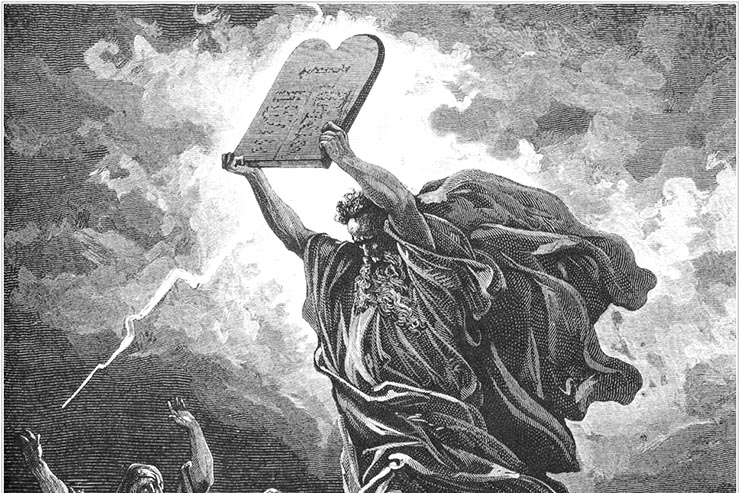
    To take one fairly simple example, two hundred years ago nearly everyone in the Judeo-Christian world believed that the first five books of the Bible (known to the Jews as the Torah, to the Christians as the Pentateuch) were written by Moses. Today practically no scholar who is not a fundamentalist believes this. Many scholars do not even believe that a person such as Moses ever lived, or that an exodus from Egypt ever occurred in anything like the way it is described. Moreover, a generation ago it was generally accepted that the accounts of David and Solomon in the books of Samuel and Kings were reasonably accurate – even contemporary – accounts. But today it is agreed that these histories were written centuries later, and the glories ascribed to these two monarchs were vastly overstated.

    To summarise all these findings, an article of this length cannot hope to be complete. All the same, it is possible to sketch out some of the major findings along with their implications.

    Israel in History: The Archaeological Evidence

    The history of Israel begins with the patriarchs Abraham, Isaac, and Jacob. The general setting for their lives is best placed in the early second millennium BCE. The original texts (there were several) that make up what today we call Genesis were not written until around the seventh century BCE. Consequently, what we have about these patriarchs is a collection of legends with an interval of a millennium between the events and the written accounts. It would be hard to find anything here that could be called real history.

    As we come closer to the present, the picture becomes clearer, although it does not necessarily validate the Bible as a source. The descent of Jacob and his twelve sons into Egypt to escape a famine in Canaan does resonate with a well-documented period (in the seventeenth and sixteenth centuries BCE) in which Egypt was ruled by the Hyksos, Semitic “foreign kings” that came from the northeast. But here too it is very hard to reconcile the biblical account (again written almost a thousand years later) with the Egyptian documents. They portray the Hyksos not as slaves but as rulers; indeed an Egyptian king list includes one “Yaqub” – identical to “Jacob.”1 They did not flee a tyrannical Pharaoh but were thrown out by the Egyptians themselves – an almost complete reversal of the biblical account.

    As for the flight of the Israel to the land of Canaan to escape their Egyptian taskmasters, this too is hard to accept, because in the period in which this is supposed to have happened – the thirteenth century BCE – Canaan was an Egyptian province, complete with governors and forts and garrisons. Egypt would retain control over Canaan until around 1160 BCE.

    In fact the first mention of Israel in any contemporary text comes from a stele from the reign of Pharaoh Merneptah, the son of Rameses II (often portrayed as the pharaoh of the Exodus), and it dates to 1207 BCE. It tells of an Egyptian campaign into Canaan, and in it Merneptah boasts, “Israel is laid waste; his seed is not.”2 Obviously this is an exaggeration, but it suggests that at this time the people of Israel were an already well-established population at a time when Pharaoh still ruled the land.

    Scholars generally agree that there was no conquest of Canaan by the Israelites as described in the book of Joshua. How, then, did Israel come to be? To understand this, we have to grasp something about the geography of Palestine. The country can be roughly divided into three north-south strips. The first is a fertile coastal plain parallel to the Mediterranean shore. The second is a band of hill country east of the plain. The third and easternmost is the Jordan River valley. It was the second of these regions, the hill country, that was the Israelite homeland. In the Late Bronze Age (1500-1200 BCE), it was sparsely populated. But at the beginning of the Iron Age in the thirteenth century, its population rose dramatically. And it is these Iron Age settlements that scholars believe were the homes of the proto-Israelites. There was very little in their material culture (alphabet, pottery, and so on) that differentiated them from the Canaanites of the coastal plain, except that the proto-Israelites’ culture was more primitive – the pottery was crude and poorly ornamented, for example – and, strangely, the bones of pigs are almost completely absent from the animal remains that are found at these sites, indicating that these people, whoever they were, had a taboo against eating pork even in the earliest times.

    Where did these hill people come from? Scholars do not agree entirely, but they are more or less unanimous in stating that most of them were not freed slaves coming up from Egypt. In all likelihood, they were people fleeing the social breakdown in the Bronze Age culture of the Palestinian coastal plain – itself only a localised version of the end of Bronze Age civilisation that was taking place all around the eastern Mediterranean. They were probably augmented by a small number of nomads who adopted sedentary ways of life. These hill people were not city dwellers; their social units were extended families that were themselves organised into tribes, which in turn formed a loose confederation that resembles the one described in the book of Judges.

    Myth Made History: Moses, David & Solomon

    Did Moses live? There is no reference to him in any contemporary source. The name Moses is a curious one; it is Egyptian, and it literally means “son,” as we see in some Egyptian names: Thutmosis (or Thutmose), the name of several pharaohs, means “son of Thoth,” the god of learning. It would be odd if Moses had been the prophet’s original name, just as in the English-speaking world there are many Johnsons and Williamsons, but practically nobody with the surname “Son.” Possibly his name originally included the name of an Egyptian god that Moses himself – or later chroniclers – chose to remove.

    Scholars thus have stopped believing in any great migration that resembles the biblical account. To the extent that they lend any credence to the story of Exodus at all, they grant the possibility that a charismatic leader led a small band of former Semitic slaves to the hill country of Palestine and that as Egyptian power began to wane in that area, this people, along with the hill people that had already settled there, was able to shake off its chains.

    To move on to the late eleventh and tenth centuries BCE, the period that biblical historians call “the united monarchy,” when Israel was supposedly ruled by a single king – Saul, followed by David and David’s son Solomon. According to the Bible, this was the zenith of Israel’s power and influence. David supposedly ruled over a territory that stretched from the Euphrates to Gaza (1 Kings 4:24), while Solomon accumulated vast riches and a thousand wives. But the archaeological remains and extrabiblical texts say virtually nothing about these rulers; some scholars go so far as to doubt whether there ever was a united monarchy at all. Richard A. Freund, professor of Jewish history at the University of Hartford, Connecticut, in the US, sums up the situation:

    If… David was so prominently involved in the lives of so many different peoples in the region, it stands to reason that he would be mentioned in one of these different non-Israelite literatures. If… Solomon conducted international relations with Egypt, marrying into the royal family and importing horses, why wouldn’t there be a record somewhere in Egypt that would corroborate this relationship?…. But no independent corroboration of these events exists from archaeological evidence or source not influenced by biblical tradition, save perhaps an early medieval collection called the Kebra Nagast, the national epic of Ethiopia.3

    The earliest extrabiblical reference to David comes from an inscription found at Tel Dan in northern Galilee in 1993. Dated to the ninth century BCE, it contains a claim by Hazael, king of Aram, that he has killed Ahaziah, king of Israel, and Jehoram, “king of the house of David.”4 Hazael, Ahaziah, and Jehoram are all mentioned in the Bible, so this inscription confirms these men lived and ruled and that there was a house of David in the ninth century BCE. Nevertheless, this inscription dates more than a hundred years later than David is supposed to have lived, so it confirms nothing more about him.

    Nor is there much archaeological evidence for the existence of Solomon’s Temple, which would have been built around 940 BCE.5 Indeed the archaeologist Israel Finkelstein contends that Jerusalem, supposedly Solomon’s magnificent capital, was actually a rather humble place. “Digging in Jerusalem has failed to produce evidence that it was a great city in David or Solomon’s time,” he argues. “Tenth century Jerusalem was rather limited in extent, perhaps not more than a typical hill village.”6

    There is archaeological evidence for a highly prosperous and centralised monarchy in Israel, but, Finkelstein contends, it was in the ninth century BCE and not the tenth. Remains include palaces, storage centres, and even stables. They are centred around Samaria, the capital of the northern kingdom of Israel (the ten tribes that seceded from the house of David after Solomon’s death, ending the united monarchy). They were the work of the Israelite king Omri and his heirs – every last one of whom, according to the Bible, “wrought evil in the eyes of the Lord” (1 Kings 16:25).7 The most notorious of the Omrid dynasty was Ahab, whose queen was the proverbially wicked Jezebel.8

    It is thus really only in the ninth century BCE that biblical history and the extrabiblical evidence begin to converge, and in the eighth century the picture becomes still clearer. The Bible tells of the destruction of the northern kingdom of Israel at the hands of the king of Assyria in 722 BCE (2 Kings 17:3-23); this is confirmed by an Assyrian stele. The Bible also says that Hezekiah, king of the southern kingdom of Judah, was able to save his tiny nation from destruction by the Assyrians. This too has a parallel in the surviving Assyrian records – although these happen to mention the huge tribute of gold and silver that Hezekiah had to pay in return. The Bible, by contrast, credits the survival of Judah to the miraculous intervention of Yahweh, whose angel “smote in the camp of the Assyrians an hundred fourscore and five thousand” (2 Kings 19:35-36).

    Yahweh’s Companions?

    But it is when we turn to the religious history of ancient Israel that the picture becomes truly astonishing. After all, the intense interest in the Bible has a great deal to do with the part that is said to be played by God in history: specifically the revelation of the one true God, Yahweh, to the nation of Israel, and his granting of the land of Canaan to them in perpetuity on condition that they obey his law and worship him alone. But here, too, the extrabiblical sources create a much more checkered picture. Egyptian texts of the Late Bronze Age do show some familiarity with a god called “Yhw” (Egyptian, like Hebrew, did not employ vowels in its script) in connection with some nomads located in the southern part of Jordan.9 This resonates with the biblical account, which has Moses learning about Yahweh in Midian (see Exodus 3), which is in the same area. And it is possible, as we have seen, that a charismatic leader like Moses could have led a small band to Canaan and used this god as a rallying-cry to unify the hill folk and create a national identity for them. But even so, the reality would be very different from the story narrated in the Pentateuch.

    Scholars today generally agree that the revelation of a monotheistic Yahweh to Moses and his spiritual heirs is not an accurate picture of what happened. Instead, they contend, Yahweh only gradually – over the course of several centuries – came to be seen as the sole god of Israel and as the supreme god of the universe. Frank Moore Cross, one of the most distinguished Old Testament scholars of his generation, has argued that originally Yahweh was an epithet of El, the high god of the Canaanite pantheon, in his function as patron deity of a confederation of tribes known as the Midianite League. Cross says that Yahweh later became differentiated from El among the proto-Israelites, and eventually came to displace him.10

    Margaret Barker, another biblical scholar, has an even more radical suggestion. She contends that throughout most of the era of the First Temple (c.940-586 BCE), both El and Yahweh were worshipped in the Temple in Jerusalem as separate deities, forming a trinity with Asherah, Yahweh’s divine consort (see the next article). El retained his position as the high god – the lord of the universe – whereas Yahweh was the national god of Israel alone. It was only with the “reforms” of the religion of Judah that took place under King Josiah in 621 BCE (2 Kings 23) that Asherah was discarded and Yahweh was conflated with El. In fact, Barker claims, the Josianic “reform” was actually a radical restructuring of the faith. The Bible portrays it differently, as a purge of alien elements, but that is because the Bible was written by the party that instigated the purge. It was this party that created the Deuteronomic history in the Bible (comprising Deuteronomy, Joshua, Judges, 1 and 2 Samuel, and 1 and 2 Kings), which has shaped our historical understanding of this period to this day. Nearly all the biblical texts I have mentioned above are taken from the Deuteronomic account.

    Obviously there is a great deal more to say about these matters, and endless numbers of books have been written about them. I have limited my discussion here to the Hebrew Bible simply because of space. The New Testament is problematic as well, but for different reasons. Here it is not archaeology or the larger historical context that is the question: there is ample extrabiblical evidence for the existence of the Second Temple, which was still being completed at the time of Christ and was sacked by the Romans in 70 CE. Indeed the Temple’s western wall, today called the Wailing Wall, still survives. There is also ample extrabiblical documentation of figures such as Herod the Great and Pontius Pilate. There is no such documentation for Jesus, but this is not in itself problematic. We might reasonably expect some archaeological evidence for the existence of David and Solomon, who were supposedly great monarchs, but Jesus was comparatively obscure in his own day. It is only when we ask who Jesus was and what his earliest followers thought him to be that the controversies arise.

    In any event, we have seen a strange reversal over the last two hundred years. At the beginning of the nineteenth century, the educated world in the West took the Bible as history while the Homeric epics, the Iliad and the Odyssey, were written off as legend. Then in the early 1870s, the pioneering archaeologist Heinrich Schliemann unearthed the ruins of Troy in Asia Minor, and scholars realised that the Homeric poems – whether or not their specific characters ever lived – were firmly grounded in the world of Late Bronze Age Greece. Ironically, when scholars examined the Bible in the same fashion, they came up with little more than a few isolated inscriptions and the stables of the wicked King Ahab.
    Get the issue this article appears in

    Literal Truth of the Bible Under Attack

    Does this all matter? Does the Bible have to be true in a historical sense? Not necessarily. As I noted at the outset, esotericists have long acknowledged that these stories are in many ways symbolic of higher truths. The book of Exodus, with its ten plagues and miraculously gushing stones, is in all likelihood not true historically. But the British Kabbalist Warren Kenton, writing under the pen name Z’ev ben Shimon Halevi, gives an intricate and profound analysis of the mystical dimensions of this saga in his book Kabbalah and Exodus.

    What the original authors of the biblical texts may have intended is a difficult question to answer, since we do not even really know who they were. Nevertheless, Christianity has often proselytised on the premise that the stories in the Bible are literally true. It is reasonable to assess the Bible in terms of the claims that its proponents have made for it, and those claims have been found wanting.

    All this said, the scholars who have delved so deeply into the historicity of the Bible over the last two hundred years have shown tremendous moral and intellectual courage. They have not, for the most part, been debunkers but have been serious scholars of Judaism and Christianity who are often profoundly committed to their faith. Some have turned to archaeology to validate this faith and have had to admit they were wrong. Joseph Callaway, an American professor of biblical archaeology, tried to find the city of Ai, supposedly destroyed by Joshua (Joshua 7-8), but he concluded that the city did not exist in Joshua’s time. He wrote: “For many years, the primary source for the understanding of the settlement of the first Israelites was the Hebrew Bible, but every reconstruction based on the biblical traditions has floundered on the evidence from the archaeological remains.”11 Callaway took early retirement from his very conservative seminary rather than cause any embarrassment on this count.

    Many journalists have lacked Callaway’s integrity, so you can pick up an American newsmagazine such as Time and read an account of Moses that treats him as if he were Churchill or John F. Kennedy.12 To bring the far more elusive truth to light would no doubt cause many readers to cancel their subscriptions. Sometimes the weaker a myth is, the more stridently it is defended.

    [alert type=”general” dismiss=”no”]This article was published in New Dawn 123.[/alert]

    [alert type=”success” dismiss=”no”]If you appreciate this article, please consider subscribing to help maintain this website.[/alert]

    Sources:

    Margaret Barker, The Great Angel: A Study of Israel’s Second God, Louisville, Kentucky: Westminster John Knox Press, 1992.
    Frank Moore Cross, Canaanite Myth and Hebrew Epic: Essays in the History of Religion of Israel, Cambridge, Massachusetts: Harvard University Press, 1973.
    William G. Dever, What Did the Biblical Writers Know and When Did They Know It? What Archaeology Can Tell Us about the History of Ancient Israel, Grand Rapids, Michigan: Eerdmans, 2001.
    –  – . Who Were the Ancient Israelites and Where Did They Come From?, Grand Rapids, Michigan: Eerdmans, 2003.
    Israel Finkelstein and Neil Asher Silberman, The Bible Unearthed: Archaeology’s New Vision of Israel and the Origin of Its Sacred Texts, New York: Simon & Schuster, 2001.
    Richard A. Freund, Digging through the Bible: Modern Archaeology and the Ancient Bible, Plymouth, U.K.: Rowman & Littlefield, 2010.
    Simon Goldhill, The Temple of Jerusalem, Cambridge, Massachusetts: Harvard University Press, 2004.
    Z’ev ben Shimon Halevi, Kabbalah and Exodus, London: Rider, 1980.
    Hershel Shanks, et al., The Rise of Ancient Israel, Washington: Biblical Archaeology Society, 1992.
    D. Winton Thomas, ed., Archaeology and Old Testament Study, Oxford: Oxford at the Clarendon Press, 1967.

    Footnotes:

    1. Dever, Who Were the Early Israelites?, 10.
    2. Finkelstein and Silberman, 57; see also Dever, Who Were the Early Israelites?, 202.
    3. Freund, 117.
    4. Freund, 117–18.
    5. Goldhill, 31.
    6. Finkelstein and Silberman, 124, 133.
    7. Biblical quotations are taken from the Authorised (King James) Version.
    8. For an account of the archaeological findings and their relation to the house of Omri, see Finkelstein and Silberman, ch. 7.
    9. Dever, Who Were the Early Israelites?, 128.
    10. Cross, 44, 71.
    11. Quoted in Dever, 47–48.
    12. A good example is Emily Mitchell and David Van Biema, “In Search of Moses,” Time, Dec. 14, 1998; www.time.com/time/magazine/article/0,9171,989815-7,00.html; accessed Sept. 21, 2010. The article is worth careful deconstruction. It does, for example, ask “Did Moses even exist?” and mentions such evidence as the Merneptah inscription. But the vast bulk of it is devoted to a retelling, in Time-style prose, of the biblical account as literally true. The reader is subtly led to believe that somehow, in the end, all these things did happen. The article is a cover story, timed to the release of the film The Prince of Egypt. A more recent article, “How Moses Shaped America,” by Bruce Feiler (Time, Oct. 12, 2009; www.time.com/time/magazine/article/0,9171,1927303-3,00.html; accessed Sept. 21, 2010) discusses the political uses made of the Moses story by American politicians without attempting to touch the historical issue of whether this figure actually lived.

    © New Dawn Magazine and the respective author.
    For our reproduction notice, click here.
  • A New Theory for the Great Pyramid: How Science is Changing Our View of the Past

    A New Theory for the Great Pyramid: How Science is Changing Our View of the Past

    This article was published in New Dawn Special Issue 13 (Sept 2010)

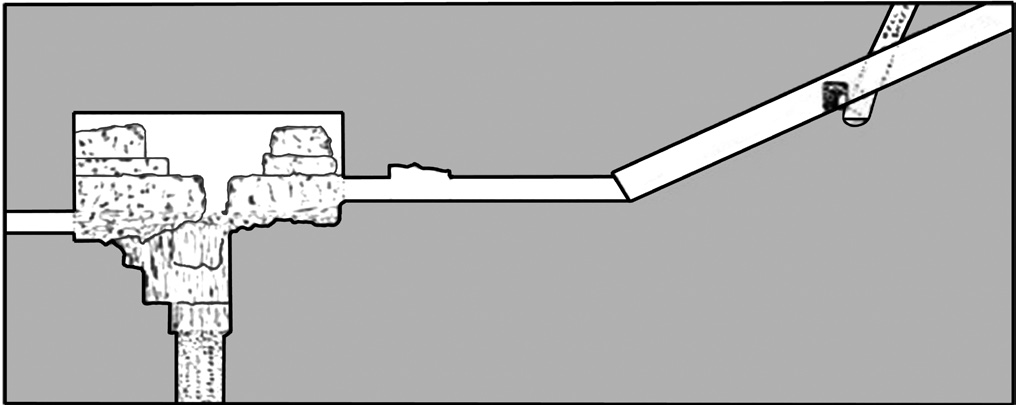
    Of all the chambers in the Great Pyramid, the subterranean chamber is the largest, as well as the most mysterious. It is 46 feet long, 27 feet wide, hewn into the limestone bedrock, and difficult to describe. The descending passageway’s entrance to the subterranean chamber is near the floor at the northeast corner. A six-foot-wide square pit shaped like a funnel has been tunnelled in the middle of the floor, near the east wall. This square-shaped pit is actually the mouth of a shaft that is eleven feet deep, although in 1816 the Italian explorer Count Caviglia drilled into the pit another thirty feet.

    The western half of the chamber has been carved nearly six feet higher than the eastern half and sculpted into several large finlike protrusions. All these finlike protrusions are situated east to west and are nearly as tall as the ceiling. Between the large protrusions, a stepped channel starts at the floor and flows toward the back of the chamber. In its centre there is a channel leading to the western wall. In the southeastern corner, a tunnel known as the “dead end shaft,” thirty inches in height and width, runs south fifty-seven feet, then ends at a wall. There are two other features in the design of the Great Pyramid that appear to be part of the work performed in the bedrock, the well shaft and the “grotto” (see figures 1 & 2)

    Figure 1. © Edward Malkowski
    Figure 2. © Edward Malkowski

    If the subterranean chamber was nothing more than a mistake, and was originally designed to be a burial vault, an enormous amount of resources was wasted. On the other hand, if the chamber was an integral part of the overall design of the Great Pyramid and performed a function, then what could that function possibly be?

    Everything from a tomb to temple of initiation to a device of some kind, there’s never been a lack of theories over the years describing what the Great Pyramid of Giza and the other pyramids was originally designed for. What has been lacking, though, is a theory describing why all the ancient Egypt pyramids were built. More importantly, what’s been lacking in any theory is scientific experimentation.

    To the best of my knowledge no one has built a scale model of the Great Pyramid. However, without any idea of what the Great Pyramid was, assuming it was a device, there would be no theory to test. Marine engineer, John Cadman, saw something that had been passed over for decades. In 1962, in a book entitled The Pharaoh’s Pump, a man named Edward Kunkel put forth the theory that the Great Pyramid was in its entirety a water pump. Cadman ran across the book one day browsing titles in a used bookstore. Intrigued, he purchased Kunkel’s book and after reading it realised that Kunkel was not far off the mark with his water pump theory. Being familiar with hydraulics and machines that rely on hydraulics, Cadman noticed that the design of the Great Pyramid’s subterranean chamber and its associated tunnels looked familiar.

    Cadman’s Experiment

    Figure 3. © Edward Malkowski

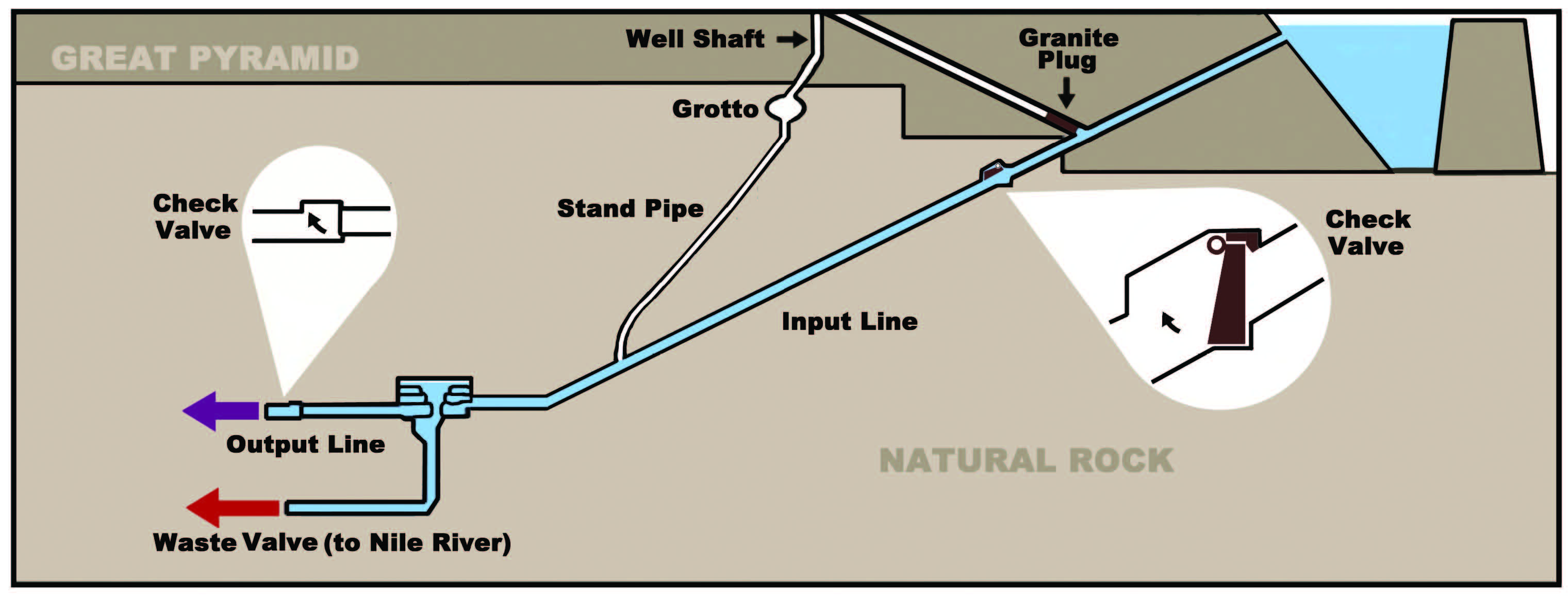
    Before the invention of the electric water pump the ram pump was used to move water from a reservoir to another location through a simple system that had only two moving parts, a weight loaded waste valve and check valve. Under the force of gravity, water in a reservoir flows down the input pipe and forces the waste value closed (see figure 3). With the waste valve closed, water continues to flow down the input pipe increasing the pressure inside the pump. The increased pressure opens the delivery valve forcing water into the output pipe. Since the water is being forced to a higher elevation faster than the water flowing down the input pipe the flow of water reverses which closes the check valve and the process begins again.

    Inspired by Kunkel’s work, Cadman learned as much as he could about the Great Pyramid’s subterranean chamber and associated tunnels, and in June of 1999 he made his first model. It leaked then cracked, neither would it function. Several months later he began work on a second model and connected a new line to the bottom of the pit shaft, believing this new line had to be the pressurised output. But the pump still didn’t operate the way he thought it should so he began building a third model which he completed on April 3, 2000, and it worked flawlessly.

    What Cadman discovered was that the subterranean chamber absorbed much of the reverse pulse. He also observed that without the subterranean chamber, the reverse pulse was large and the output flow was more erratic, confirming for him that the output in the Great Pyramid’s subterranean chamber travelled through what is called the dead end shaft. It also confirmed his suspicion that the ancient oral tradition that a tunnel exists connecting the subterranean chamber’s pit to the Nile River.

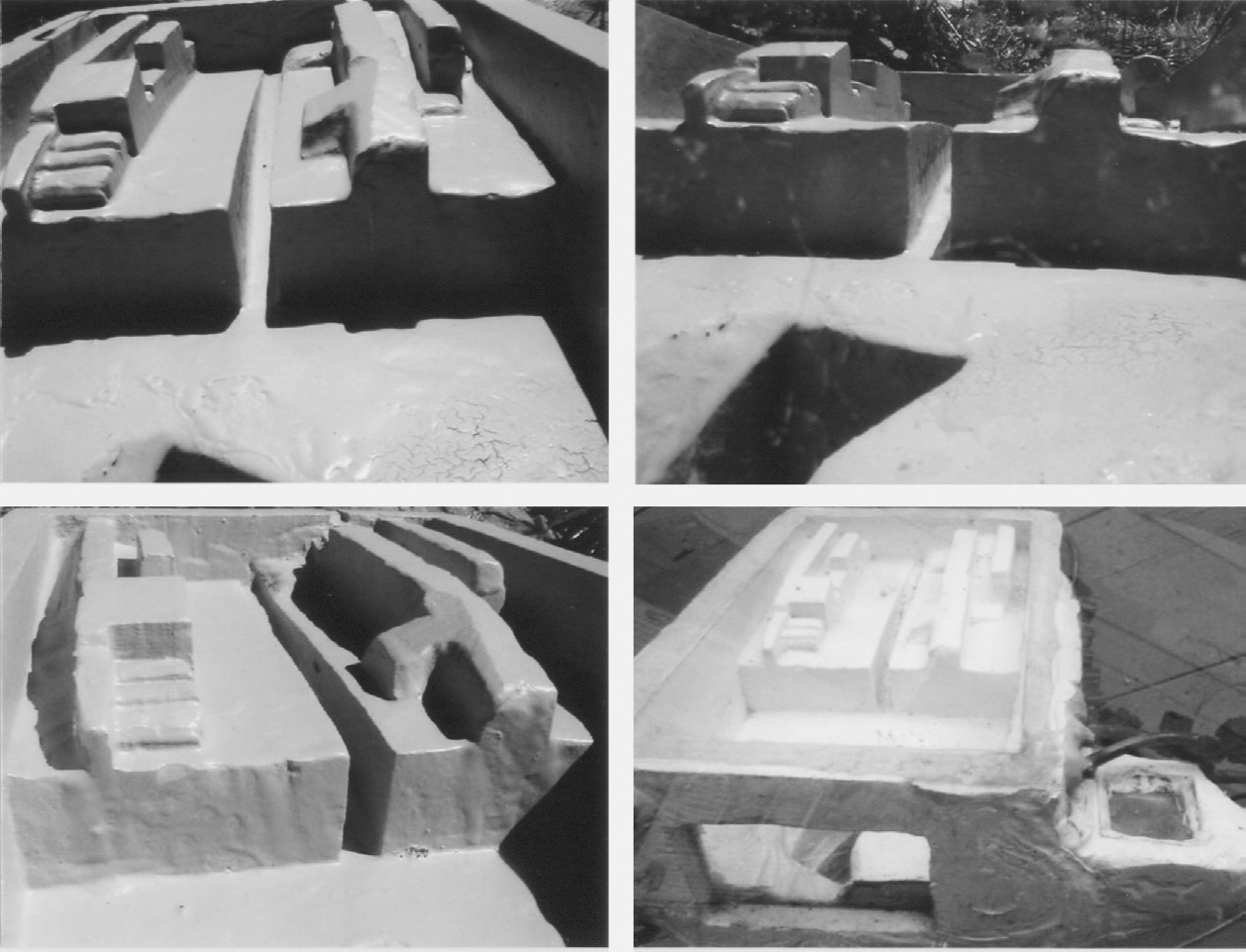
    A few weeks later Cadman moved the model to a seasonal creek with a pond serving as a reservoir, and experimented further. To simulate the effect of being underground he encased the pump assembly in concrete (see figures 4 and 5). Interestingly, the action of the pump, which was now embedded in concrete, created a vertical compression wave. This, according to Cadman, meant that the Great Pyramid’s subterranean ram pump also had an acoustical element. So, he built two more models to study the acoustics and fluid dynamics.

    The acoustic model, which was made of fibreglass and epoxy and encased in concrete, weighed five hundred pounds. When operating, the characteristic heartbeat-like thump of the pump could be felt through the ground twenty feet away and heard nearly a hundred feet away. Because of the powerful pulses it generated, Cadman named it the “pulse generator.”

    Figure 4. © Edward Malkowski
    Figure 5. © Edward Malkowski

    Cadman constructed a fourth model to study how water moved through the subterranean chamber and could operate in two different modes. This model was fitted with twenty-five individual ink injection locations and a glass top (see figure 6). It had a glass wall on its east side to view water flow, although Cadman discovered that the glass top quickly shattered when the model was operating in pump/pulse mode. Nevertheless, when not in pump/pulse mode, it was clear by studying the movement of water within the modelled subterranean chamber that the flow was complex and precise.

    What he discovered was that the sound wave striking the perpendicular surface reflects the majority of the pulse back toward the source. He also discovered that when the fluid jet strikes a perpendicular surface, it spreads in a 360° pattern perpendicular to the jet. Thus, he concluded that the design of the subterranean chamber incorporated fluid dynamics as well as acoustical dynamics. In his own words, “The dynamics are on par with that of computerised storm analysis: somewhere between hurricane dynamics and tornado dynamics.”

    Cadman’s model also revealed some performance issues that were built into the Great Pyramid’s subterranean pump. An additional “assist” line, from the compression chamber to a secondary location, speeds the movement of water through the output pipe. It also focuses the shock wave in the line leading to the compression chamber. The result is that a pulse is transmitted through the ceiling of the compression chamber. Thus, the line that connects the waste valve to the compression chamber acts as a waveguide, forcing the shock wave into a pulse. Therefore, the pulse is transmitted vertically (through the ceiling) as well as down the waste-valve line.

    Figure 6. © Edward Malkowski

    Cadman’s modelling of the subterranean chamber and its tunnels provides a better understanding of the Great Pyramid, as well as the Giza Plateau. In its completed state the Great Pyramid required a moat, which was fed by a system of aqueducts from the Western Nile (the Ur Nile); an ideal source for a gravity-fed water system, since the Western Nile was at a higher elevation than the plateau. It also explains the remains of a retaining wall that once surrounded the pyramid. The wall served as an embankment for an onsite reservoir, which in appearance was a moat. Tunnels, such as the “well” at the pyramid’s entrance, connected the Great Pyramid complex to an ancient lake, Lake Moeris, and the Western Nile.

    Lake Moeris (Egyptian Mer-Wer, meaning “Great Lake”) was an ancient lake fifty miles southwest of Cairo. At one time it was very large and occupied the entire Faiyum depression. It was also called the Pure Lake and the Lake of Osiris by the ancient Egyptians. During prehistoric times the waters of Lake Moeris stood nearly 120 feet above sea level, but by 10,000 BCE they had dropped to nearly twenty-five feet below sea level, possibly as a result of the Nile channel being naturally diverted. With increases from rain, between 9000 BCE and 4000 BCE the lake rose again, but gradually subsided. And as the climate became increasingly more arid, a canal connected Lake Moeris to the Nile; over the years it slowly silted. During the Middle Kingdom, 2000 BCE to 1600 BCE, dynastic Egyptians widened and deepened the channel, thereby restoring its flow. At that time the lake was believed to be fifty-five feet above sea level.

    There is little doubt that the lake served as a means of flood control as well as a reservoir for irrigation. Egypt’s Ptolemaic kings of the third century BCE partially drained Lake Moeris to make available 450 square miles of rich alluvial soil, which was irrigated by canals and extensive cultivation. Since then the water level of Lake Moeris has continually declined, and it is now the small, shallow saltwater Lake Qārūn.

    When the Great Pyramid pulse pump was functioning, the descending passage, subterranean chamber, dead end shaft, pit, well shaft, and grotto made up the components (see figure 7). According to Cadman, it could be operational today if all the tunnels associated with the pyramid could be cleared. Besides the well shaft that connects the descending passage to the middle chamber of the pyramid, there are two other tunnels that would need to be cleared. Clearing the pit associated with the dead end shaft (where the check-valve exists) would expose the horizontal shaft. If these shafts were cleared, the moat reservoir was in place, and the well in front of the pyramid connected to a Lake Moeris substitute, the pump could be operational.

    Figure 7. © Edward Malkowski

    One of the most important results from Cadman’s experiments was discovering the significance of the well shaft and its effect on the pump’s pulse rate. This specific design issue leads to the intent of the Great Pyramid’s designer. The well shaft begins near the bottom of the descending passageway and extends upward 170 feet. In the water-pump assembly, the well shaft functions as a standpipe, providing a shortcut for the reverse shock wave to reach air. In essence, it maximises the pulse rate of the pump.

    Although standpipes are typically twice the diameter of the input (drive) pipe, in the Giza assembly the standpipe (well shaft) is actually 25 percent smaller than the input pipe (descending passageway), which has a peculiar effect on the system. It lowers the elevation of the pulsing water below the water level of the moat reservoir. Interestingly, this specific elevation correlates to the height of the grotto, which serves as a reservoir, allowing for stabilisation and regulation of the reverse pulse. A block of granite, existing within the grotto that fits within the pipe, is believed to function as some type of choke or regulator.

    According to Cadman, the well shaft was part of the original design of the pyramid, and as a standpipe in the pump assembly, it served to maximise the pulse rate of the pump. The standpipe also reduced the reverse surge out of the descending passage, as well as reduced pumping efficiency and pulse intensity.

    The Importance of Pump Efficiency

    Cadman tested four different pump configurations, two circulating and two elevating, to gauge the well shaft’s affect efficiency. When in a circulating-pump mode, the well shaft reduced the efficiency by 29 percent. And, in an elevating-pump mode, the well shaft reduced the efficiency by 68 percent. The increase in efficiency of the well shaft provided an extra twenty pulses per minute, from sixty to eighty. Since the Giza configuration of the subterranean chamber included a well shaft, for the builders of the pyramid, pumping efficiency did not appear to be of primary importance. So if pumping efficiency was not of primary importance then what was?

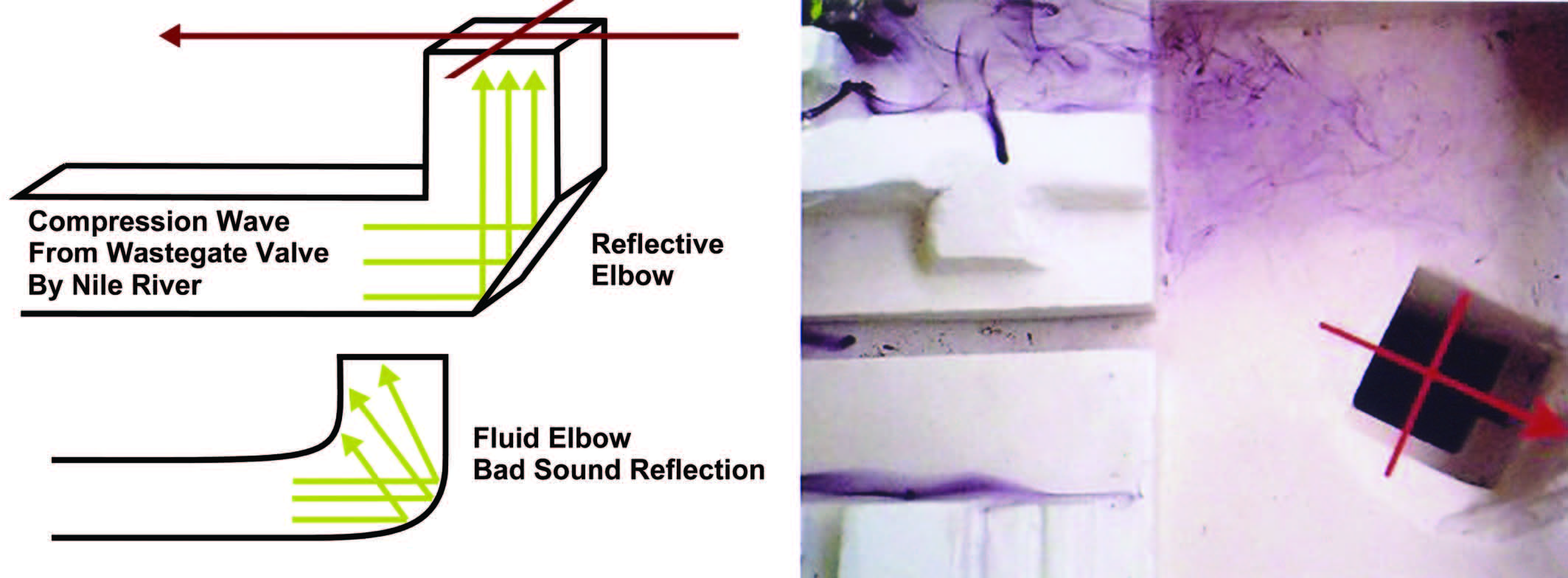
    One way to approach this question is to review the general layout of the subterranean chamber. The subterranean chamber pit is offset by 45° in relation to the general configuration of the chamber and is aligned northwest to southeast. According to Cadman, this is so because a plane placed at a 45° angle will maintain the unidirectionality and consistency of the compression wave. In other words, this reflective elbow ensures the consistency of the compression wave. Any other type of elbow at the pit’s bottom would diffract (scatter) the compression wave. So the pit’s alignment is strictly for acoustical dynamics and for creating a standing wave in the waste line and subterranean chamber.

    Figure 8. © Edward Malkowski

    To create the standing wave in the waste gate line and subterranean chamber, it would be imperative to have the reflective elbow. The pit’s offset is exactly aligned with the tunnel (see figure 8, right; the red arrow is aligned with the exit tunnel). Not only does the reflective elbow completely explain the pit’s diagonal offset, but it also confirms that the compression wave is a major design consideration. The designers thoroughly understood complex fluid dynamics as well as complex acoustics (see figure 8, right; the red arrow shows the direction of the tunnel at the bottom of the pit; the ink injection photo shows some of the flows in the step area).

    Another way to approach the question is to review the engineering significance of the dead end shaft. It allows for a pressure change, which in turn changes the frequency of the compression wave. A gate valve at the end of the dead end shaft provides a means for accomplishing this. Adjusting the back pressure by adjusting the gate valve allows for changes in timing. In essence, this is a simple method to compensate for different water temperatures and atmospheric pressure, which are factors that affect the velocity of the compression wave.

    Cadman’s testing demonstrated that the pulse rate can be altered by at least 30 percent, between sixty and eighty pulses per minute. He also discovered that adjusting the back pressure changed the water’s density and, as a consequence, altered the compression wave’s velocity and frequency. In essence, such an assembly allows for easy fine tuning of the lower portion of the Great Pyramid to create the standing wave in the subterranean chamber and waste gate shaft.

    These experimental results confirm that the compression wave was a major design consideration. Also, according to Cadman, the square pit carved into the subterranean chamber created a whirlpool as water moved through the system of tunnels – apparently another design feature to efficiently move water to the chamber and out the waste line.

    If pump efficiency – in other words, pumping water – was not of prime importance to the ancient Egyptians, then what was? According to the experimental evidence, the answer is a compression wave, which, of course, creates another question. Why was a compression wave of primary interest to the Great Pyramid’s builders?

    A New Theory

    The question I have always had in the back of my mind concerning the pyramids is one of economics. Resources are resources whether a construction project occurs today or thousands of years ago. Man-hours and tools are required, so is pay for the management team, supervisors, and workers. If it cost 35 billion dollars to build a large structure today it would also cost that much in resources to build the same structure many thousands of years ago, the only difference being the nominal value of money used. In the case of the Great Pyramid that’s 380 billion dollars, according to engineer Markus Schulte of the global design and business consulting firm Arup.1 The limestone blocks for the Great Pyramid, alone, would cost today 18 billion dollars. With such a high dollar amount for a single pyramid, and more than ten were built comparable in size, then there had to be a very good reason why the Great Pyramid and the other pyramids were built, a reason that would benefit the whole of society.

    If the Great Pyramid was exclusively a water pump as John Cadman demonstrated in his experiments, then there wouldn’t be a need for another chamber located in the middle of the pyramid and a third chamber located in its upper regions. These chambers as well as the shafts in these two chambers need to be explained.

    Assuming Cadman is correct that the compression wave was what the pump was designed for, then the middle and upper chamber would likely have been designed to somehow react with the vibrations emanating from the pump. The upper chamber, known as the King’s Chamber, in its entirety was built from slabs of granite – the floor, walls, and ceiling – and located just above the chamber the builders of the Great Pyramid placed five rows of granite beams. So, it is obvious that granite was of primary importance in the uppermost chamber. The question is why.

    The high-fidelity stereo industry uses granite not only to provide a stable base for equipment but also because of its resonance qualities. All materials have a natural resonance frequency meaning that all materials will vibrate at certain frequencies. In the world of high-fidelity, the resonance of other materials in a room distorts the stereo’s sound, including the rack where the components of the sound system are housed. However, with granite as a base for stereo components not only are extraneous sounds dampened, but full sound is produced through the granite’s resonance. And by further isolating the granite base from the stereo rack with rubber washers or other polymer fixtures, the granite’s resonance properties can be further controlled. With this in mind, it might be the case that the purpose of building a granite chamber in the Great Pyramid was to create resonance.

    According to Tom Danley, the sound engineer featured in the documentary film The Mystery of the Sphinx, the Great Pyramid makes strange sounds because the granite chamber resonates from the rigidity of the stone. What he also discovered was that a number of low-frequency components existed even without a test signal present in the pyramid implying that the chamber was constructed for its resonance, and that it naturally creates a frequency. Most likely, he added, the low frequencies were a result of “Helmholtz resonances caused by the wind blowing across the entry tunnel.”2

    However, a compression wave emanating from the subterranean chamber would likely have a marginal effect on the granite in the upper chamber. What would be needed to localise the granite is a way to transform the compression wave into sound. This would create enough vibration to activate the granite beams and create a standing wave of resonance. With devices such as Helmholtz resonators built into the Grand Gallery those vibrations would become sound and cause the granite to resonate or ‘sing’. The question is ‘why’, to what effect? With shafts leading to the Great Pyramid’s exterior, the ‘singing’ granite would project its sound into the atmosphere. This, in turn, would create an electrical field in the atmosphere according to physics research.

    Again, we are left with the question ‘why’? The subtle electrical field created by the Great Pyramid would be of little use for means of powering equipment. However, such a field would deflect very low frequencies (VLF) and extremely low frequencies (ELF), frequencies that exist at all times in the atmosphere as a result of thunderstorms around the world. In agricultural experiments, VLF and ELF have been shown to promote plant growth. With the Great Pyramid operating as the engine, all of the pyramids could be connected by a subtle electrical field to create a canopy of sorts thereby deflecting VLF and ELF into the surrounding fields.

    In might sound mundane that the pyramids were agricultural devices, but it provides the best of reasoning for a civilisation to spend an immense amount of resources on any given project. Without food society would gradually fall into anarchy and civilisation would cease to exist.

    Illustrations courtesy of © Edward Malkowski. Further information on the above theory and a whole lot more can be found in Edward Malkowski’s new book Ancient Egypt 39,000 BCE: The History, Technology, and Philosophy of Civilization X (Bear & Company, 2010), available from all good bookstores.

    [alert type=”general” dismiss=”no”]This article was published in New Dawn Special Issue 13.[/alert]

    [alert type=”success” dismiss=”no”]If you appreciate this article, please consider subscribing to help maintain this website.[/alert]

    Footnotes

    1. ‘Where Did It Come From? Ancient Egypt: Iconic Structures’, Popular Arts Entertainment, The History Channel, September 21, 2006.

    2. “ProSoundWeb Live Chat with Tom Danley,” March 12, 2002, transcript, at www.prosoundweb.com/chat_psw/transcripts/danley3.shtml (Accessed September 29, 2009).

    © New Dawn Magazine and the respective author.
    For our reproduction notice, click here.
  • Waiting for the End of the World: René Guénon and the Kali Yuga

    Waiting for the End of the World: René Guénon and the Kali Yuga

    From New Dawn 122 (Sept-Oct 2010)

    Currently the fear – or hope – of the closing of the age pervades the air like a thick vapour. Sometimes this end is envisaged as an environmental calamity, sometimes as the second coming of Christ, sometimes as the return of the space brothers to claim their own.

    Figures including Jose Argüelles, the prophet of the 1987 Harmonic Convergence; Terence McKenna, the late pope of psychedelia; and the channelled entity known as Kryon have fastened onto 2012 as the turning point.

    A less well known, though in a way equally influential, figure was the French esoteric philosopher René Guénon, whose writings often speak of the end of a cycle that he equated with the Kali Yuga, the “dark age” of Hindu cosmology. While he did not point to 2012 or any other specific date, his ideas do resonate with some of these expectations for the dawning age to come.

    Born in Blois, France, in 1886, Guénon had a conventional education in mathematics. In his youth he began to explore occult currents in Paris and was initiated into esoteric groups connected with Freemasonry, Martinism, Taoism, and Advaita Vedanta. In 1911, he was initiated into a Sufi tariqah (order) under the leadership of an Egyptian sheikh, Abder Rahman Elish El-Kebir. In 1930, he moved to Egypt, where he converted to Islam and lived until his death in 1951. In the meantime, he published a wide range of books, articles, and reviews espousing what he said was the universal and primordial tradition underlying all religions.

    For Guénon, tradition is the ne plus ultra of human life. He conceives of tradition as a hierarchy: higher knowledge emanates from a now-hidden spiritual centre to all of humankind through the “orthodox” traditions, among whom he includes (with many caveats and qualifications) the great world religions as well as certain other lines such as Freemasonry. Or to put it more accurately, this tradition is preserved in certain initiatic lineages that lie embedded in these faiths, such as the Kabbalah in Judaism, Taoism in Chinese religion, and Sufism in Islam. The esoteric dimension of Christianity had, he believed, practically disappeared by the late Middle Ages and was now preserved (if at all) by small initiatic groups that he apparently regarded as inaccessible. Indeed Guénon’s conversion to Islam was motivated in part by his belief that these Western lineages had almost completely died out by the twentieth century.

    In fact, according to Guénon, this transmission of traditional knowledge – the “doctrine,” as he often styles it – has become almost completely blocked in our era. This, he argued, is the result of a long cosmic cycle, which is called a Manvantara in Hindu cosmology, and which is divided into four yugas or ages: the Satya Yuga, the Treta Yuga, the Dvapara Yuga, and the present Kali Yuga. The problems and anxieties of the current era are the result of this age. It’s worth exploring why he believed this and what he thought it meant.

    The Reign of Quantity & the End of an Age

    Guénon was first and foremost a metaphysician – indeed, he was one of the greatest and most lucid thinkers who have delved into this arcane subject. And for him, metaphysics concerns universal principles; the details of circumstance are of value only insofar as they illustrate these. At the beginning of his best-known work, The Reign of Quantity and the Signs of the Times (first published in 1945), he writes that “considerations of that order” – namely, factual details – “are worth nothing except in so far as they represent an application of principles to certain particular circumstances.”1

    Thus Guénon said that he not a prophet in any conventional sense of the term. He was not a visionary and believed that the visionary prophecy of the current age was nothing more than a cloud of lies emitted by sinister “counterinitiatic” forces. If he spoke of an outlook that made it possible “to foresee, at least in its broad outlines, what will be the shape of a future world,” he insisted that “previsions of this kind have not really any ‘divinatory’ character whatever, but are founded entirely on… the qualitative determinations of time.”2

    The use of the word “qualitative” may seem peculiar here, but for Guénon, the polarity between “quality” and “quantity” was central to understanding the dynamics at play. In his 1931 book The Symbolism of the Cross, he depicted reality in the form of a three-dimensional cross – one that has the dimension of height and depth in addition to the familiar two of length and breadth. At the top of this cross is what he called “absolute quality” – an abstract state that is impossible for us to conceive, because it has no element of quantity whatsoever. (An interesting mind game: try to conceive of a universe in which there is no number or quantity of any sort. It’s almost impossible to do.) At the bottom of this cross is “absolute quantity” – another abstract state that is impossible to conceive. (Again, try to imagine a universe where there is only number, in which there is nothing that has any particular qualities such as colour, shape, or anything else of the kind.)

    Hence it’s not possible in this relative level of existence to reach the absolute end of each pole, but in a given age one of the two will be more pronounced and the other less pronounced to an exactly inverse degree. According to Guénon, the Manvantara proceeds in an ages-long cycle from an era where quality is emphasised – the legendary time known to the Hindus as the Satya Yuga and to the ancient Greeks as the Golden Age – to one in which quantity comes more and more to dominate. This is our present era, the Kali Yuga or what the Greeks called the Iron Age. That’s why Guénon speaks of the present era as one of “the reign of quantity.” He goes on to argue that all the primary characteristics of our time are the result of this reign of quantity.

    Guénon produces modern philosophy and science as evidence for his argument. Modern Western philosophy to all intents and purposes begins with René Descartes (1596-1650), who divided the world into what he called res cogitans (literally, “the thing that thinks”) and res extensa (literally, “the extended thing”). That is to say, the world is divided into that which experiencesres cogitans – and that which is experienced: res extensa. According to Descartes (at least as interpreted by Guénon), everything material is characterised by – and only by – extension, by what can be measured and quantified.

    While this all may sound extremely abstract, Guénon argued – rightly, I believe – that this attitude has profoundly shaped Western thought over the last few centuries. Essentially, he is saying, materialistic science focuses exclusively on quantity: “The more specifically ‘scientific’ point of view as the modern world understands it… seeks to bring everything down to quantity, anything that cannot be so treated is not taken into account, and is regarded as more or less non-existent.”3 Unfortunately, as Guénon goes on to say, this creates any number of logical contradictions. Science conceived purely in terms of quantity argues that the same causes produce the same effects, but as Guénon points out, this is absurd, as no two events are ever completely identical. He also criticises “the delusion which consists in thinking a large number of facts can be of use in itself as ‘proof’ of a theory; …even a little thought will make it evident that facts of the same kind are always indefinite in multitude, so that they can never all be taken into account.”4

    This is precisely the problem that contemporary philosophers call “the justification of induction.” You base a theory on any number of similar events that have happened in the past; but how can you account for the ones that you have not seen, and how can you be sure that future facts will yield the same results? Bertrand Russell put the point wittily when he wrote, “The man who has fed the chicken every day throughout its life at last wrings its neck instead, showing that more refined views as to the uniformity of nature would have been useful to the chicken.”5 The notion of causation is at least as problematic.6 These facts place a ceiling on the degree to which science can understand and explain the universe.

    The Real Meaning of “Value”

    As even this short discussion suggests, Guénon raises profound philosophical issues, and contemporary thought has not done a terribly impressive job of coping with them. But, he contends, the problems go further still. In a chapter of The Reign of Quantity entitled “The Degeneration of Coinage,” he explores the economic aspects of the issue. At first glance, one might think that nothing was more purely quantitative than money. But that, Guénon argues, is an illusion fostered by the degenerate age we live in: “The ‘economic’ point of view…, and the exclusively quantitative conception of money which is inherent in it, are but the products of a degeneration which is on the whole fairly recent,… money possessed at its origin, and retained for a long time, quite a different character and a truly qualitative value, remarkable as this may appear to the majority of our contemporaries.”7

    In traditional societies, Guénon says, money had a sacred character. Not only were the coins stamped with the images of gods and other sacred symbols, but the currency was controlled by the spiritual authorities rather than by the secular powers. Money was meant to be a reminder of “value” in the qualitative as well as the quantitative sense. Today, however, “nobody is able any longer to conceive that money can represent anything other than a simple quantity.”8 Even such words as “value” and “estimate” have been deprived of their qualitative character, and today, when we ask how much a man is worth, we are almost always thinking in terms of cash and equities rather than moral or spiritual calibre.

    This quantitative approach extends to every object we use. “In a traditional civilisation,” Guénon writes, “each object was at the same time as perfectly fitted as possible for the use for which it was immediately destined and also made so that it could at any moment, and owing to the very fact that real use was being made of it (instead of its being treated more or less as a dead thing as the moderns do with everything that they consider to be a ‘work of art’), serve as a ‘support’ for meditation,… thus helping everyone to elevate himself to a superior state according to the measure of his capacities.”9 One obvious example are the tools of Masonry, such as the square, compass, and plumb line, each of which was intended to convey a spiritual and ethical meaning in the days when Masonry was limited to practicing stonemasons. Manufactured goods have no such meaning or value.

    It is not possible here to go further into Guénon’s critique, but even this short discussion reveals that his insights into the woes of the current era were remarkably perceptive and prescient. In The Crisis of the Modern World, published in 1927, he said, “It is… to be expected that discoveries, or rather mechanical and industrial inventions, will go on developing and multiplying more and more rapidly until the end of the present age; and who knows if, given the dangers of destruction they bear in themselves, they will not be one of the chief agents in the ultimate catastrophe, if things reach a point at which this cannot be averted?”10

    Guénon’s charge that the modern world has no use for anything apart from quantity could be substantiated by cases from every conceivable source. Writing about the BP oil spill in the Gulf of Mexico, in early July 2010 a front-page article in The Wall Street Journal reported, “BP PLC is pushing to fix its runaway Gulf oil well by July 27, possibly weeks before the deadline the company is discussing publicly, in a bid to show investors it has capped its ballooning financial liabilities.” Why did BP choose this date? “The July 27 target date is the day the company is expected to report second-quarter earnings and speak to investors.”11 In other words, the fact that the BP spill, one of the greatest environmental disasters in history, fouled a large portion of the Gulf of Mexico, killed innumerable creatures, and devastated the lives of people all along the Gulf Coast was not reason enough for the company to hurry: it needed a second-quarter earnings report to goad itself into action. Nothing could illustrate the reign of quantity more clearly.

    The Kali Yuga

    All this said, when it comes to Guénon’s discussion of the Kali Yuga as a traditional Hindu doctrine, he stands on much shakier ground. He says that the Kali Yuga began some six thousand years ago.12 He also says this era is close to its end. In The Crisis of the Modern World he writes: “We have in fact entered upon the last phase of the Kali-Yuga, the darkest period of the ‘dark age’, the state of dissolution from which it is impossible to emerge otherwise than by a cataclysm.”13

    Not all traditional sources agree about this point. The Hindu sage Sri Yukteswar, best-known as the master of the celebrated yogi Paramahansa Yogananda, discusses the matter in his book The Holy Science. Sri Yukteswar says that the Kali Yuga is actually over, although this has not been recognised even by many Hindu authorities. Ironically in light of Guénon’s claims, it was the very occlusion of the sacred centre that made it impossible to calculate the yugas correctly.

    Traditional dating for the beginning of the Kali Yuga starts from the death of Krishna, the avatar of Vishnu, at the end of the war between the Pandava and Kaurava clans chronicled in the Hindu epic the Mahabharata. Some sources date this to 3012 BCE, others to 1400 BCE.14 As the Kali Yuga began to dawn, Yudhisthira – the victorious Pandava king – gave his throne over to his grandson, Raja Parikshit. “Together with all the wise men of his court,” according to Sri Yukteswar, Yudhisthira “retired to the Himalayan Mountains, the paradise of the world. Thus there was none in the court of Raja Parikshit who could understand the principle of correctly calculating the ages of the several Yugas.”15

    Sri Yukteswar maintains that the Kali Yuga actually ended in 1699 CE. While his views may have been imbued with a belief in progress by his own British education and do not necessarily correspond with those of the majority of Hindus,16 at any rate his claim to being a source of “traditional” knowledge is much higher than Guénon’s. David Frawley, an American Vedic astrologer, agrees with Sri Yukteswar in saying that the Kali Yuga ended in 1699.17 In any event, the dating is far from clear-cut. In fact, many traditional sources reckon on a much larger scale for the duration of the Kali Yuga, placing its length at 432,000 years. If this were the case, it would render any imminent end to this epoch highly improbable.18

    One of the sources that come closest to Guénon’s view of the Kali Yuga is H.P. Blavatsky (1831-91), founder of the Theosophical Society. In her magnum opus, The Secret Doctrine, Blavatsky writes, “The Kali-yuga reigns now supreme in India, and it seems to coincide with the Western age.”19 Blavatsky, writing around 1888, dates the beginning of this epoch to “4,989 years ago” – close to the traditional date of 3012 BCE – and places its end roughly at the close of the nineteenth century: “We have not long to wait, and many of us will witness the Dawn of the New Cycle.”20

    This resemblance is peculiar, because Guénon loathed Blavatsky and Theosophy and criticised them in his first published book, Theosophy: History of a Pseudo-Religion. For Guénon, Theosophy was the ultimate counterinitiatic force, distorting and perverting the truth of traditional knowledge. He especially detested the Theosophical doctrine of evolution, which teaches that each living thing – indeed each atom – is progressing on a cycle of devolution into matter followed by evolution into higher consciousness. The Theosophical view is similar to Guénon’s in saying that the present era is the one in which materiality is most dominant and that it is coming to an end, but it generally portrays the progress of the human race in far more positive terms than Guénon.

    The connections between Guénon and Theosophy are intricate. One of his first spiritual teachers was the occultist Papus (Gérard Encausse), who was head of the French branch of the Theosophical Society, and the scholar Mark Sedgwick, whose book Against the Modern World is the best introduction to the impact of Guénon’s thought, sees Theosophy as one of Guénon’s chief influences.21 While it is impossible to go into this controversy here, it is at least clear that both Blavatsky and Guénon believed the end of the Kali Yuga was at hand. Another central figure in the esotericism of the twentieth century, C.G. Jung, did not deal at length with the Kali Yuga, but in Aeon, his compendious analysis of the symbolism of the astrological ages, he suggests 1997 as the starting point of the New Age, for intricate astronomical reasons.22

    Waiting for the End of the World

    Are we, then, at the end of a cycle? In one sense, yes, of course we are. There are many cycles in nature: every year, every day, is the end of a cycle. But whether we are at the end of the Kali Yuga is, at the very least, moot. My own impression is that the more genuinely traditional Hindus tend to see the Kali Yuga in terms of the much longer time frame of 432,000 years. While Guénon reviled the West and its attempt to erode the traditional values of Asian civilisation, ironically his view that the end is at hand comes far closer to the spirit of Christianity, the ultimate Western religion – which for 2,000 years has been predicting the imminent return of Jesus – than it does to Hindu thought.

    What does this mean in practical terms for us today? Waiting for the end of the world (or of the age) is a kind of narcotic. It enables the human mind to accommodate its own notion of cosmic justice to the realities at hand (because the wicked – who are always, of course, the others – will be brought low, while the good – oneself and whatever group one identifies with – will be exalted). It also serves as what psychology calls a displacement of the fear of death. For each of us individually, the end of the world is certainly coming, in a few decades at the very longest. But human beings dislike contemplating the certainty of death. They find it easier to deal with it by casting it in the remote and highly improbable form of whatever cataclysm happens to suit the fashions of the moment. (For a fuller treatment of this dynamic, see the chapter “Nostradamus and the Uses of Prophecy” in my book The Essential Nostradamus.)

    Unfortunately, we cannot stand around waiting for the end of the world to solve our problems for us. If we genuinely are at a threshold of a new era, we will be able to cross it only if we discard the contrived apocalypticism that suffuses mass culture and to which Guénon, as powerful a thinker as he was, was not immune.

    Nevertheless, Guénon’s claim that we are living under the reign of quantity is hard to refute. One has only to read prominent journals such as The Wall Street Journal and The Economist to see that the real protagonist in all their stories is money – money in the abstract, as a kind of hypostatised entity that stipulates all value and dictates all morality. What is good, we are being told, is what is good for money. Whether or not the Kali Yuga is about to end, we can bring the end of the reign of quantity a few steps closer by looking into ourselves and making sure that the values by which we guide our lives are more than merely economic ones.

    [alert type=”general” dismiss=”no”]This article was published in New Dawn 122.[/alert]

    [alert type=”success” dismiss=”no”]If you appreciate this article, please consider subscribing to help maintain this website.[/alert]

    Footnotes

    1. René Guénon, The Reign of Quantity and the Signs of the Times, trans. Lord Northbourne (Harmondsworth, Middlesex, UK: Penguin, 1972), 7.

    2. Guénon, The Reign of Quantity, 57.

    3. Guénon, The Reign of Quantity, 85.

    4. Guénon, The Reign of Quantity, 87.

    5. Bertrand Russell, The Problems of Philosophy (New York: Barnes & Noble, 2002 [1912], 42.

    6. For a more complete discussion of these issues, see my book The Dice Game of Shiva: How Consciousness Creates the Universe (Novato, Calif.: New World Library, 2009), chs. 4 and 5.

    7. Guénon, The Reign of Quantity, 133.

    8. Guénon, The Reign of Quantity, 136.

    9. Guénon, The Reign of Quantity, 137.

    10. René Guénon, The Crisis of the Modern World, trans. Arthur Osborne et al. (Ghent, N.Y.: Sophia Perennis et Universalis, 1996), 39.

    11. Monica Langley, “BP Sets New Spill Target,” The Wall Street Journal, July 8, 2010, A1.

    12. René Guénon, The King of the World, trans. Henry D. Fohr (Hillsdale, N.Y.: Sophia Perennis et Universalis, 2001), 49.

    13. Guénon, The Crisis of the Modern World, 17.

    14. See Klaus R. Kostermaier, A Survey of Hinduism, 3d ed. (Albany: State University of New York Press, 2007), 97.

    15. Jnananavatar Swami Sri Yukteswar, The Holy Science (Los Angeles: Self-Realization Fellowship, 1990), 16-17.

    16. See the forthcoming work by Joscelyn Godwin, Atlantis of the Occultists and the Cycles of Time.

    17. David Frawley, Astrology of the Seers: A Guide to Vedic/Hindu Astrology (Twin Lakes, Wis.: Lotus, 2000), 36-39.

    18. For a helpful summary of the various views, see Joseph Morales, “The Hindu Theory of World Cycles in the Light of Modern Science”; http://baharna.com/karma/yuga.htm (accessed January 14, 2010).

    19. H.P. Blavatsky, The Secret Doctrine (Wheaton, Ill.: Quest, 1993 [1888]), 1:377.

    20. Blavatsky, Secret Doctrine, 1:xliii-xliv.

    21. Mark Sedgwick, Against the Modern World: Traditionalism and the Secret Intellectual History of the Twentieth Century (Oxford: Oxford University Press, 2004), 40-44.

    22. C.G. Jung, Aion: Researches into the Phenomenology of the Self, trans. R.F.C. Hull (Princeton: Princeton/Bollingen, 1959), 94.

    © New Dawn Magazine and the respective author.
    For our reproduction notice, click here.
  • Magic & Mysticism in Java

    Magic & Mysticism in Java

    From New Dawn Special Issue 5 (May 2008)

    The death of ex-President Soeharto of Indonesia at the age of 86 [in 2008]  reminded me that I was present in Jakarta in 1967 during the bloodbath in which the Communist Party was decimated and General Soeharto rose to political power, along with the minority modernist Muslim party that supported him.

    At that time Indonesia was only nominally Muslim: under the charismatic President Soekarno it was animistic, feudal, steeped in an other-worldly mysticism, and was infested with starving beggars, superstition and black magic practices. General Soeharto, of humble village origin, had risen high in the military apparatus and married into a family of the minor nobility in Solo. His marriage gave his political aspirations legitimacy in the eyes of Indonesians, who believed in the ancient tradition that links royal status to the right to rule.

    The General was well known to have a close affiliation with a Javanese magico-mystical school believed to give him great occult powers, yet from the time of his ascension to the presidency he appeared, unlike ex-President Soekarno, to deny the affiliation, at least publicly. The new pro-Western president donned the Islamist black pitje and publicly espoused and supported the political arm of orthodox Islam, which in the main was vehemently opposed to any and all occult practices. It proved to be the best thing that could have happened to the country.

    Whatever President Soeharto’s questionable legacy in other areas, in this respect he dragged Indonesia from the dreaming Middle Ages into the modern world. Today, Indonesia is officially a member of the great Muslim international fraternity, and Islam’s austere religious mores have increasingly infiltrated the national culture, modifying its more primitive animistic traits and greatly strengthening its influence in Asia-Pacific politics.

    Nevertheless, Pak Soeharto retained to the end of his life his private allegiance to Javanese mysticism. Doctors who attended him in the last weeks of his illness, during which he rallied more than once from heart, lungs and kidney failure, said they were amazed and baffled by his recuperative powers. It was commonly believed, however, that the power of spirits and the implantation of many lucky charms inside his body was the factor keeping him alive. Indeed, those who were close to Soeharto in his home town of Solo, the heartland of the Javanese culture, have attributed his resistance to death to his devotion to the powerful occult forces that resided in him throughout his life.

    According to a recent article in the New York Times, all six presidents of Indonesia “paid respects to the spirit world, visiting sites said to hold mystical powers, consulting with seers and collecting tokens of magic like the Indonesian dagger called a kris.”1 Among these leaders, Soeharto was outstanding as a devotee of the occult. He studied as a boy with a spiritual teacher and performed ritual acts throughout his presidency, continuing to do so even after a popular uprising deposed him in May 1998.

    According to his aides, over the years he made frequent visits to sacred places, including mountains, caves, tombs and ruins, and took ritual baths in oceans and rivers sacred to Nyai Loro Kidul, the mighty Queen of the South Seas. He also collected hundreds of sacred objects in order to absorb their magical power.

    The Javanese Science

    Despite the ascendancy of modernist Islam throughout the nation, Soeharto’s private loyalty to Java’s spiritual past is mirrored in Javanese society in general, though its allegiance now tends to run underground in the face of Islamic disapproval, especially that of the strict Wahhabi sect, which over the years has become extremely influential. To the outsider today all Indonesians are strict Muslims, but under the pitje or the headscarf there is likely to be concealed a mystic of quite a different stripe. The people of the island of Java in particular are very proud of their indigenous pre-Islamic spiritual tradition, which they refer to as the Javanese Science, and while few may actually practice it now in its pure occult form, most have a proprietorial understanding of at least some of its sacred principles. They are evasive about discussing this hidden dimension of their society, especially with Western foreigners, but one would be mistaken in not taking the Science very seriously indeed as the essence of the Javanese culture even to the present day.

    The Javanese Science is a syncretic blend of Hindu-Buddhist, Sufi, Taoist and ancient animist strands, and evolved in the royal courts of Solo and nearby Jogjakarta in Central Java as a system of self-transformation confined solely to the aristocracy. But since the Revolution that ejected the Dutch rulers from the country after the Second World War, the Science emerged into the popular culture in the form of hundreds of kebatinan (or inner-being) sects, each one of which celebrates some aspect of the royal mother tradition. These esoteric sects have drawn a very large minority of the Indonesian population into their sphere, forming an immensely creative and diverse subculture at the leading edge of national life, very much as happened in Japan after the Second World War.

    The Kebatinan movement has in many respects evolved into an inherently new form of mysticism. Syncretism raised to a religious principle is its dominant keynote, a drive towards pluralistic unity that echoes a prominent feature of the New Age spirituality appearing elsewhere in the world. But the Javanese approach to the universe and the human situation generally, though at its best of a high metaphysical order, is in many respects quite different from that of the West. It doesn’t involve religious theories and dogmas so much as a science of inner energies perceived directly with a highly sensitised intuition – one might say, clairvoyantly – and manipulated directly by the will.

    This shamanistic approach can lend a disconcerting ambiguity to those moral categories that the Western mind likes to regard as eternally fixed: Justice, Compassion, Truth, Altruism, Duty and so on. To the Javanese, mystic things in the moral sphere are not good or bad according to what we in the West would regard as an ethical judgment, but according to whether the personal energies concerned balance out in a manner beneficial to the whole. Do they bring harmony to the individual, do they stabilise him or her? For the Science all is dynamic, all is in ever-transformative and purposive flux: good is what works in the present moment to the spiritual benefit of the whole; bad is what fails to do so. This stance contributes a relativistic and unpredictable note to the Javanese outlook that Western diplomats and others have famously found difficult to deal with, yet its creative power is undeniable.

    Javanese adepts with access to this underlying realm of subtle forces are reputed to have diagnostic powers and techniques of psychic healing of extraordinary efficacy, and are believed to understand the dynamics of spiritual physiology better than any other race on earth. The Javanese Science has much in common with other shamanistic Eastern paths such as have been found in Tibet and Japan, where syncretism has similarly been raised almost to a spiritual principle. These too have dealt in patterns of shifting subtle energies rather than fixed doctrinal systems. But there is something different and mysterious about the Javanese Science, a depth, a quality of purity that most researchers are agreed sets it apart from any other form of mysticism. What makes it unique?

    The Invisible People

    In a visit to Indonesia some years later, I was able to put this question to Pak Joyo, at one time the Director of a Christian Theological College in Central Java and the pastor of one of the largest charismatic Lutheran churches in the Reformed Dutch Church of Indonesia. Pak Joyo was a fourth-generation Christian whose great-grandfather was converted to Christianity at the point of his Sultan’s kris (the Sultan himself having been similarly converted by Dutch missionaries), and Pak Joyo followed in his family’s footsteps in deciding to train for the ministry. But halfway through his theological training, he decided to quit the church and give all his allegiance to a contemporary mystical sect called Hardopusoro which interested him a great deal more.

    However, he told me that in a vision Christ asked him to remain in the church, where he could be more useful than anywhere else; and after an internal struggle he obeyed. Pak Joyo went on to become a multilingual international emissary for Christian ecumenicalism – but, with the blessing of his bishop, privately continued in Hardopusoro, in which he became a high initiate. Such dual religious allegiances are entirely natural to the Indonesian temperament.

    Pak Joyo’s answer to my question surprised me. The source of his country’s spirituality, he said, was not familiar to other races. It was unique because it stemmed from the Invisible People, the Badui, who grew no bigger than a ten-year-old child and who lived in an inaccessible part of the mountainous jungle in South Bantam, about a hundred miles west of Jakarta. The Badui were “closer to the soul” than other people, said Pak Joyo, and were the X factor in the background of the Javanese Science. Invisibly they had instructed the Javanese people for nearly three thousand years, helping to guide them from their original primitive state to their present civilisation.

    The Badui were not Indonesian and had no part in the country’s laws or economy, but lived apart in forest territory forbidden to outsiders and had great spiritual knowledge and strange magical powers. Although rarely seen by outsiders, they were held in awe in the marketplaces throughout Indonesia. When Indonesian spiritual and political leaders needed advice, said Pak Joyo, even the most illustrious of them went into the jungle alone to consult the Badui seers, for the understanding of the Invisible People on spiritual matters was a universal one that embodied a primordial tradition beyond factions or institutions.

    President Soeharto would undoubtedly have been one of those top leaders who was not too proud to seek enlightenment, possibly of a political as well as a spiritual kind, from these strange priestly people of the jungle. Leaving behind his aides, bodyguard and driver, he would have had to ascend alone the jungle forest track that led to the Badui colony, there to consult with its leading prophets.

    Inexplicably, although remote from the teeming civilisation surrounding them, the Badui knew everything that happened in it long before the news was heard on television. They had prophesied the Second World War and that the Dutch would leave the country soon after peace was declared. They knew the destiny of peoples worldwide. The Badui, it was said, planted sacred trees – living trees, as they called them – representing their tribal leaders in a hallowed grove called the Artjas Domas, which was visited once a year by the highest-ranking Badui priests. By studying the growth on the trees clairvoyantly, they were able to read the fortunes and destiny not only of people, but of nations and the world. From this yearly examination everything of value to their leading families was recorded in a script known only to them. The Badui were said to have telepathic powers and a magical way of keeping others away from their settlements, especially from the Artjas Domas.

    I have recently learned that the Badui people have now inexplicably disbanded and their old territory has been settled by Indonesian farmers. But when I revisited Java in 1980, their colony was still a great focus of mystery and unanswered questions. Why were these strange forest-dwellers so influential? What kind of special wisdom did they possess? Where had they come from? And why did they live apart, alien, feared, invisible – and yet, according to Pak Joyo, all-seeing? Sir Stamford Raffles referred to them in his eighteenth-century History of Java, yet since then no traveller from the West had succeeded any better than the Indonesians themselves in setting foot on the Badui’s inner territory or penetrating their secrets.

    Eventually I learned more about this remarkable people from Dr. Paul Stange, an American lecturer in Asian Studies who grew up in Indonesia and who obtained a doctorate from the Michigan University in the US for his study of Sumarah, an akebatinan sect that has become influential in Indonesia since the Revolution.2 In his thesis, Dr. Stange was able to relate the Badui indirectly to the growth of kebatinan sects such as Subud and Sumarah as constituting a cutting edge phenomenon in the evolution of mystical consciousness.

    Custodians of the Soul World

    It seems that the Badui are of the dark-skinned Tamil race that is believed to have spread from Africa long ago into southern India, and from thence into Southeast Asia and the Pacific Islands, where they lived unmolested for thousands of years. But about eight thousand years ago the Malays, at that time a mainly Caucasian race from the north, crossed the Sunda Strait and displaced the Badui culture in the Sunda Islands, with the consequence that most of the indigenous race withdrew into the mountainous interior of Java, far from the spreading communities of the newcomers, while a remainder migrated further east.

    Some time in the first millennium BCE the remnant of the aboriginal Tamil people in Java was joined by a large group of Indian initiates – probably, some authorities think, refugees from the defunct Indus valley culture in which holy trees also played an important part – and the two groups, each with its heritage of ancient racial wisdom, together formed the Badui priesthood.

    Forty Indian Hindu-Buddhist families, constituting a sacred nucleus, inhabited a central group of three villages served by an outer ring of vassal Badui communities: together the two clans built a spiritual power-centre in Java which, isolated though it was for nearly three thousand years and finally greatly diminished in numbers, preserved unchanged its sacerdotal structure and identity and its pivotal place in Javanese religious life. Those in the inner esoteric circle wore white sarongs and turbans, were called the White Ones, had strict rules of conduct and were forbidden by their laws to have any communication whatever with the outside world, while those in the outer villages wore blue sarongs and turbans and were called the Blue Ones. There was no intermarriage between the two clans.

    Although the use of money or of weapons was forbidden to all in the colony, the ascetic laws of the Blue Ones were less severe than those of the others, and enabled them occasionally to visit an Indonesian village to obtain by barter the very few items the farming colony needed (mainly smoked fish and salt), and to serve where necessary as liaison officers and spokespersons for the White Ones.

    Despite their harshly primitive way of life, it would be a mistake to suppose these jungle people were not, in their own way, highly civilised. Nina Epton, a British journalist who is the only known Westerner to have met the Blue Ones and a few of their holy White Ones (although many Dutch researchers tried before her), speaks in her book The Palace and the Jungle of their aloof dignity, their air of having “a destiny apart from other mortals,” and above all, of what she calls “the Tibetan look.” This was a wide-eyed all-seeing look common to many of the Badui, which she describes as staring beyond this world into the spiritual realm. It was a look she associates especially with pictures of seers like Guru Padma Sambhava, the great Indian initiate who brought Buddhism to Tibet.3

    Ms. Epton has described the Badui physiognomy as varied and clearly of an older ethnicity than that of the Indonesians. But the elderly leader of the White Ones, reputed to have been a saint and a sage and obviously of a superior caste to the others, was plainly more ethnically advanced. She noted in particular that he had a worn, patient and ascetic face which reminded her of that of a well-mannered European intellectual. In other clothes he would have passed unnoticed in an English crowd, for he had a very light complexion, a narrow face and the gentle bearing of a civilised person. Altogether, Epton says, the Badui were not what one expects from the jungle.

    This assertion is borne out by the personal history of a young runaway, the son of a pu’un or chief of the White Ones, who in the seventeenth century escaped the colony to become a stable boy in the then Sultan’s palace. Soon he became the Sultan’s counsellor and then his son-in-law, and today his descendants are the Jajadiningrat family, one of the most aristocratic and politically influential families surrounding the Indonesian presidency. Throughout the intervening three hundred years, the Badui continued to “read” the sacred tree of the stable boy’s line, to visit his Jajadiningrat descendants once a year with predictions and advice for the coming year, and where necessary protect the members of the family from danger.

    In fact, the sole reason for Nina Epton’s unprecedented interview with the leader of the White Ones was that, through the Sultan, she obtained an introduction to the Jajadiningrat family, who asked the White Ones as a special favour to grant her an interview. In no other way would the meeting have been possible.

    The Badui priests continued to follow the destiny of the Jajadiningrats, says Epton, because for the Invisible People once a holy lineage is laid down it is laid down forever, it belongs to the timeless realm of the soul world. The Badui in fact denied the reality of time. Their sages believed that the rules of life were laid down once and for all at the Beginning of things by an ancestral divinity called Batarratunggal, who will one day return to govern the Badui and the world. In the meantime, it was their sacred obligation to maintain everything exactly as it was at the beginning, without change, without innovation. Nothing concerning their customs or belief system must be disturbed from their state of primordial perfection: hence the necessity of isolation.

    To the modern Javanese mystic this Badui belief is merely the folk expression of a deeper spiritual reality. He sees the concept of a Beginning-time or Dreamtime to which so many early races look back with longing, believing it to be a cosmic paradise that must be ritually preserved for the future, as simply a metaphor for the inner soul plane, which is both cosmic and interior at one and the same time. That inner place, eternally omnipresent within each human being, is really the cornucopia from which all spiritual paths and religions flow forth in their season. As a race we have long ago lost contact with such a high level of soul-consciousness, and so it is called by other names: the Garden of Eden, the Dreamtime, Paradise, the Kingdom of Heaven. But according to the Javanese view, it is in truth a soul-world present in each one of us, a celestial headwaters from which the river of the spirit flows continually into our bodily spacetime. This higher/inner world must be kept purified, as it once was and will be again in the future, and it was the task of the Badui to help do this, since we as a race cannot.

    No one knows for certain why the Badui people have now dispersed. But it is evident that deep changes reflected in its politics have overtaken Indonesia within the last few decades. The erratic occult climate that pervaded the early years of independence has yielded not only to a stricter Islamist discipline but also to the growing apparatus of democratic government, a maturing judicial system and economic reform, all of which has brought stability and prosperity to the people. The nation has come of age. According to Dr. Stange, who received a wealth of Javanese lore from the Sumarah cognoscenti, there is a school of thought that believes the Badui have now fulfilled their mission in the South Pacific, and that is why they have at last dispersed into the Indonesian population.

    The reign of animism in this region under the sovereignty of Nyai Loro Kidul had long been prophesied to end during the twentieth century, giving way to a new and higher religious and cultural dispensation for the Pacific races – one perhaps best represented by the modern Kebatinan movement in Java. It is thought that the Badui understood well that this prophesy has now been fulfilled. They understood that their reign is no longer needed – or indeed tolerable under the new conditions. Having played a custodial role by preserving in secret the pure and unsullied soul-conditions necessary for such a surge of higher consciousness, they have now been able to die out as a separate society.

    Whether or not there is any truth in this theory, it is undoubtedly the case that around the Pacific Rim a new religious spirit is rising. Akin to kebatinan and to the Javanese Science in general, it is based on principles of high shamanism known to the Badui many thousands of years ago, but forgotten by modern humanity. Recognising that enormous healing powers are locked in the ancient soul-ways, seekers visiting Indonesia today find common ground with the synthesising mysticism of the new kebatinan sects and are forming part of a spiritual network that stretches from Findhorn in Scotland to the esoteric centres of California. This development in the Pacific zone has in it the potential for creating a new religious paradigm of global significance. But how much of it is indebted to the heroic patience of the Invisible People of the Javanese jungle, as mystics like Pak Joyo believe, we shall probably never know.

    [alert type=”general” dismiss=”no”]This article was published in New Dawn Special Issue 5.[/alert]

    [alert type=”success” dismiss=”no”]If you appreciate this article, please consider subscribing to help maintain this website.[/alert]

    Footnotes:

    1. ‘As Suharto Clings to Life, Mystics See Spirits’ Power’, Seth Mydans, The New York Times, Jan. 27, 2008.
    2. Paul D. Stange, The Sumarah Movement in Javanese Mysticism, UMI Dissertation Information Service, Ann Arbor, Michigan, 1980.
    3. Nina Epton, The Palace and the Jungle, Oldbourne Press, London, n.d., 55.

    © New Dawn Magazine and the respective author.
    For our reproduction notice, click here.

  • Monks & Magic: Buddhism and the Supernatural in Thailand

    Monks & Magic: Buddhism and the Supernatural in Thailand

    From New Dawn Special Issue 7 (Mar 2009)

    In August 2008 Bun Rany, the wife of the Cambodian Prime Minister Hun Sen, led Buddhist monks and soldiers to the site of the historic Hindu temple Preah Vihear to call upon their ancestors to protect the temple. The site of this temple is located on disputed land, perched atop a cliff on Cambodian soil but with the most accessible entrance to the site located on the Thai side of the border.

    This 11th century temple is located on the border between the two countries, but the borderline itself has never been clearly demarcated because the area is littered with landmines left over from decades of war. Ownership of the temple was originally awarded to Cambodia, but dispute between the two countries flared up when Preah Vihear was granted United Nations World Heritage status.

    Desperate to resolve the issue, both sides deployed military forces – but when they were unable to reach a solution to the conflict, Cambodia and Thailand resorted to supernatural means. Fearing that the magical abilities of Cambodia‘s Buddhist monks would weaken Thailand, residents throughout the province of Si Sa Ket wore yellow to help protect Thailand from Cambodian magic.

    Though Buddhism is not often thought of as a religion that practices magic, in such communities as those found in Thailand and Cambodia, there can be no doubt that Buddhism shares common ground with belief systems that are primarily associated with the use of magic.

    Both countries have a long history of engagement in spiritualist and animistic magical practices. When Buddhism first arrived in these areas it came into contact with pre-existent traditions that believed in spirits, both benevolent and malevolent, and a developed system of magic which was to be feared or revered, depending on whether or not it was used for good or ill.

    For Buddhism to flourish under such conditions in Thailand, it was necessary to develop a complex system of interaction between Buddhism and what has been called the Spirit religions. Debate still exists as to whether or not the two systems have become completely integrated or not, although the interaction of the two systems is sometimes referred to as an example of syncretism. On the subject of interaction between Buddhism and the Spirit religions in Thailand, the academician B.J. Terwiel says the following:

    When I interviewed villagers in Central Thailand on the relationship between Buddhist and non-Buddhist aspects of their religion, a variety of reactions were observed. The more sophisticated informants generally stated that the Lord Buddha had never forbidden rituals of ancient origin. Other persons hesitatingly made up their minds with regard to the orthodoxy of the ritual, but on subsequent occasions contradicted their own judgment. Many were at a loss to classify rituals or beliefs under rubrics such as ‘Buddhist’ and ‘non-Buddhist’.1

    It would appear from this statement that the boundary between the use of magic by the indigenous tradition of Thailand and the practice of Buddhism is not apparent to many of the inhabitants of Thailand themselves. This is most likely due to the fact that the people of rural Thailand are raised in a society where the two systems are found closely entwined together.

    The religious traditions of Thailand have always included the belief in spirits and the ability to manipulate them by means of magic. For example in Thailand preservation of the spirit of life (khwan) is considered to be of the utmost importance, as is ensuring that malevolent spirits (phii) do not enter the body. Control of these spirits is greatly emphasised in rural Thai culture, as the service of these spirits can be employed to improve the qualities of day to day existence.

    Magic and the Sangha

    In the lives of ordinary Thai people, more value is placed upon the improvement of their current existence than on transcending the cycle of rebirth, as is advocated by Buddhism. The relationship between the members of the Sangha (community of Buddhist monks) and the practitioners of magic in Thailand combine in a variety of ways, as one system (the Spirit religions) deals with the aspects of gain in this world (laukika), whilst the other (Buddhism) advocates the importance of salvation and ideas of transcendence (lokottara).

    This relationship is complicated even further by the fact that in Thailand almost every adult male will become a member of the Sangha at some stage in his life, for in rural areas the taking of vows is considered to be an essential element in preparation for adult life. Given the wide range of magic and animistic beliefs which operate within rural Thailand, these men will carry a variety of beliefs and practices with them into the Sangha, not all compatible with the ethics of Buddhism.

    In accordance with this, religious opinions are not questioned during ordination. As a direct result, villagers can be found entering the Sangha for a variety of reasons, as is reflected in the following Thai rhyme:

    Ordination to fulfil a promise to the Gods,

    Ordination to escape poverty,

    Ordination to flee from a wife,

    Ordination to save money,

    Ordination to eat better food than at home,

    Ordination to join one’s friends in the monastery.2

    Thai belief does not only consist of beneficial Gods and spirits. It also abounds with belief in ferocious spirits of pure malevolence, from who the villagers seek magical protection. Amongst these classes of malevolent spirits are such beings as the preed (a giant, looming shape with a small head that emits a sharp, piercing sound, as a reflection of its past sins), the phii krasy (a type of parasite which inhabits human bodies, feeds on excrement, and is shaped like a human head with entrails protruding from beneath), and the phii baan (the ghosts of ancestors that hover around their previous home and watch their descendants with malignant jealousy).

    Whilst it is possible for these spirits to be exorcised, Buddhism chooses to deal with their interfering presence in another way; the correct approach for a Buddhist to cause these spirits to cease meddling in the affairs of their human victims is to preach to them, thus converting the spirits involved to a more benign nature. There are certain canonical texts which serve this purpose of protection, which can also be recited at specific times in order to avert misfortune. These texts are known as the phraa parit. The source of the magical power of these texts has not yet been clearly identified, but Y. Ishii, author of Sangha, State & Society: Thai Buddhism in History, claims that whilst some possessed a magical content from the beginning, as modifications of Hindu rites, others such as the Mangalasutta originally had no magical connotations.3

    Indeed, for most people, including some who chant them, the parit are incomprehensible, being in Pāli. Rather, I believe, the magic of the parit stems from three factors: the social recognition that parit should be chanted for certain purposes (e.g. blessing); the existence of an established formula for their chanting; and the sanctity attributed to the chanter.4

    The use of parit is a means by which to ensure protection; it provides good luck and disperses misfortune whether caused by the presence of spirits or not. As is seen in the above passage the presence of magic being used by the Sangha is not overtly explicit in the parit texts, rather it is interpreted to be so by the lay audience. They do not understand the words the monks recite, but because of the respected state of the Sangha in Thailand, the lay community assumes that it must be not only beneficial, but also powerful.

    Amulets

    Another type of magic practiced by the Thai Sangha is the manufacture of amulets. These amulets are employed for a variety of reasons, including protection from diseases, black magic and accidents. Of these amulets the ones portraying the Buddha are the most popular, although some also are made in the likeness of famous monks and King Chulalongkorn (also known as Rama V, one of Thailand‘s most revered kings).

    The sanctity of the subjects portrayed upon the amulets is a reflection of the beneficial powers they are thought to contain. The Buddha images vary in size, from anywhere between two and eight centimetres, and can be manufactured from wood, metal, ivory or resin, although frequently they are made from a selected combination of these elements, pressed into a mould and baked.5 To create a pressed or printed image (phraaphim), a monk needs not only a mould, recipe and the proper ingredients; he also requires an advanced knowledge of spells and sacred script.6

    The inherent sanctity of the amulet is not always thought to be sufficient; hence its power needs to be enhanced by means of the correct recitation of spells and sacred scripts. The most simple of these sacralisation rites is known as plugseeg.7At the culmination of plugseeg the monk will either blow upon the Buddha image or draw over the amulet with the index finger of his right hand.8

    During the manufacture of amulets the Sangha is also invited to perform a consecration rite known as phutthaphisek.9The use of magic within the phuttaphisek is illustrated by the fact that it is desirable for at least one of the monks participating in the phutthaphiseek to be either advanced in meditative technique or in the Brahmanic rites known as saiyasat.10

    These rites are intimately entwined with another type of Thai ritual, namely the ceremony held to consecrate Buddha images which infuse the representation with the auspicious wisdom and power associated with Prince Siddhārtha’s victory over the demon Māra and the obtainment of enlightenment by Siddhārtha. During this ritual monks chant in Pāli or preach in Northern Thai several texts including the Buddha Abhiseka (Consecrating the Buddha [Image]).11 This text focuses on the powers of the mind attained by the Buddha that are associated with his enlightenment. Both the consecration of images and amulets draws their impetus from this core idea.

    One specific example of a text dealing with the extraordinary supernatural powers of the Buddha that occupies a position of prominence in Thailand is Bimbās Lament. (Bimbā is the Buddha’s wife, who he left to pursue the life of an ascetic.) 

    By his magical power he created a crystal path in the sky from the eastern boundary of the city of Kapilavastu to its western perimeter. Then, ascending into the air, the Tathāgata, surrounded by many previous Buddha’s, walked on the sky-bridge he had miraculously created… he also preformed other miracles, such as appearing to walk above the heads of the Śākyans.12

    Tattooing is another magical practice that is widespread throughout Thailand. At some stage in their adult life many Thai males will receive a tattoo of some description or another. This is of significance because in the culture of rural Thailand tattoos are representative of magical power. The magical power of these tattoos stems in part from the tattooist, for whilst both layman and monk may be a tattooist, there is vast difference in the scope of their work and the designs used.

    The types which may be employed by the monk are restricted. As a monk, he is limited to tattooing the upper parts of the body, for not only would it be seen as sexual misconduct on the part of the monk to tattoo the lower areas, the upper parts of the body represent the higher, more spiritual aspects of humanity, whereas the lower regions represent mankind’s more base, animalistic attributes. The tattoos done by the monk are also limited in application. The monk may bestow tattoos that are of a beneficial or protective nature. Other tattoos, such as those which bestow things such as sexual virility, can only be performed by members of the lay community.

    Another Thai rite involving magical skills of the members of the Sangha is the Wong Dai Sai (Encircling with Holy Thread).13 This is a type of consecration rite designed to protect a place from evil. It is believed that the consecrated place will be protected by the power of the Three Gems and the phraa parit.14 During this rite cotton is affixed to an image of the Buddha, stretched clockwise (as is the way of beneficial magic; anticlockwise is considered to be used for evil purposes) around the place to be consecrated, and finally wound back to its point of origin, at the Buddha image.15 If the thread should snap at any stage, it is considered to be an ill omen.

    The main doctrinal link between Buddhism and the Spirit religions is found in the incidences where magic is employed by the Sangha as a transfer of merit. The theory of the transference of merit is based upon the concept that when a member of the lay community performs a virtuous deed, such as making a donation or feeding a monk, the Gods witness the act and empathise with the process. The Sangha themselves are referred to as being a ‘field for merit’ (na bun), as is found in the Sanghnussati-bhavana.

    Well practiced is the Exalted One’s Order of Disciples, practiced in integrity, practiced in intellectual methods, in right lines of action – to wit the four pairs, the eight groups of persons – this is the Exalted One’s Order of Disciples, worthy of offerings, oblations, gifts, salutations, the world’s peerless field for merit.16

    Monk’s Superior Magical Status

    The greater the purity of the monk, the more magical power/merit he is said to generate. The sanctity of the monk himself is the source of belief in the efficacy of his magical power. The magical power that is generated by the monk is also classed as being superior to that of the layman, but by its very nature it is also more limited in its application. A monk is also deemed to be superior to a spirit, and thus a monk should never be seen to supplicate himself before a spirit. When a member of the Sangha addresses a spirit, he never raises his hands in supplication, in contrast to the layman who will raise his hands when requesting a favour from a spirit.

    The superior magical status of the monk stems from his purity; the monk must not do anything to compromise his superior position. Part of the magical power which results from the monks’ purity is derived from celibacy. A monk should never touch a female (human or animal), and is forbidden to even receive an object that is directly given to him by a woman.17 In order to receive an object given by a woman, the monk must first take a piece of cloth and place it upon the floor, upon which the woman will then place the gift in whilst the monk holds the edges of the cloth.18 The cloth is used as a medium by which to transfer merit since there can be no direct contact between a monk and a woman. The merit flows from the fingers of the monk holding the cloth, to the woman who has donated the cloth. The medium of cloth must be used so as not to deprive the female donor of the merit she would otherwise not receive. One of the reasons for which a monk may not have contact with women is not only due to the temptation of sexual misconduct, but also because women are believed to be associated with a type of magical power said to be diametrically opposed to that of the monk.19 This is due to the fact that menstruation is associated with dangerous magical power, and is classed as being capable of destroying some of the beneficial power of the Sangha.20

    Another aspect of magic in Thailand which needs to be considered is the import of magical systems via India. The branch of Buddhism found in Thailand is an older form known as Theravāda, and its links to Hinduism are much stronger than those of the later Buddhist schools. For example, in the book A Summary of the Seven Books of the Abhidhamma (Abhidhamma Chet Khamphi Ruam) there are elements of cosmology, cosmogony, buddhology, ethics, epistemology and language that are integrated into a yantric/mantric system.21 This system is very much similar to that found in Indian magic, and it is reasonable to assume that many of the formulas found within are directly based on the use of Hindu mantras. These are broken down into component syllables for recitation by the Buddhist practitioner. The mantra Namo Buddhāya (Homage to the Buddha), is correlated with the five vowels, symbolising the five elements (dhatū) – water, earth, fire, air and atmosphere.

    Furthermore, in the following passage from the Seven Books of Abhidahamma, we also find a formula which contains correlations with the Hindu Tantric Yoga techniques, dividing the body into a solar right and lunar left, and creating what appears to be Buddhist chakra centres. This integration of the occult, Tantra and Buddhism is by no means unique for it is prolific in Tibetan Buddhist texts and practices.

    Na = the Buddha Kakusandha at the right eye

    Mo = the Buddha Konagāmana at the left eye

    Bhud = the Buddha Kassapa at the back

    Dhā = the Buddha Gotama at the naval

    Ya = the Buddha Ariya Metteyya at the forehead22

    Get the issue this article appears in

    Transmission of Occult Techniques

    One possible explanation of how this similarity between Thai Buddhist and Hindu occult techniques occurred can be found by examining the magical history of a third South East Asian country – namely Myanmar (Burma).

    In the late eighteenth and early nineteenth centuries, Burmese kings imported large numbers of Sanskrit texts from India on topics such as medicine, alchemy, incantation and astrology.23 In Burma, these Buddhist wizards are practitioners of what is called the weikza-lam (path of occult knowledge). This tradition still exists today in Burma, and the largest of the groups practicing this occult path is based in the city of Pegy, and is called the Manosetopad Gaing. Like their Thai counterparts, this organisation bases an interest in the occult on the powers attained by the Buddha on the path to enlightenment. They also believe that the relics of the Buddha (Burmese dat-daw) (Pāli dhātu) are possessed of a kind of majestic power that he infused in them through the force of his samādhi.24 The similarity between this branch of Burmese magic with that of the Thai people is amply illustrated in the following extract from a magical treatise by the Manosetopad Gaing:

    A person wishing to practice the path must first suffuse his mind with thoughts of the Three Jewels, and cultivate loving kindness toward the various grades of nats… the nats referred to here include powerful nature spirits dwelling in trees, the earth, and mountains, minor deities who preside over the use of magical incantations and diagrams, and medicine spirits whose domain includes the well-known herbs and minerals of alchemical lore.25

    From this passage it is clear that the Manosetopad Gaing not only use Buddhist motifs, they are also drawing upon a much older tradition of Spirit religions and animistic world views. These Buddhist wizards, however, are also drawing upon Hindu texts on supernatural lore; and if such texts entered the Burmese magico-religious system then it is entirely possible that influences from India may help to explain what appears to be a yantric/mantric tradition within the Thai Seven Books of Abhidahamma.

    With their magical prowess and the protection of the Sangha, why do the Thai people fear the magic of the Cambodians? Cambodia is also a country with a long history of occult practices. For instance, in the Khmer book The Tale of Ancient History there is a legend of Prince Chey Ahca who led a ghost army against the Siamese – Siam being an earlier name for Thailand. More recently, we also find record of Po Kambo, who in 1866 protested against French colonial rule and was alleged to know a magical formula that deflected bullets. Even as recently as the 1970s and 1990s, Khmer soldiers utilised magical tattoos, in a similar manner to that of their Thai enemies, and used mantras written in Pāli and Sanskrit, the holy languages of Buddhism and Hinduism, to protect them in battle.

    All of the magic employed by the Sangha in Thailand is based on one important concept: the sanctity and purity of the Sangha themselves. The forms of magic the Sangha use is limited in scope by this fact, for they can use only what is generally referred to as ‘white’ magic: that which benefits another and causes no harm. Use of magic to harm another or for personal gain would result in expulsion from the Sangha. Similarly, a monk may not use magic that serves to improve the virility of a layman or create love charms, as this could severely impair the powers of the monk which stem from his sexual abstention. A monk may not request the spirit world for aid, for this would compromise the superior status of the monk who is deemed to be beyond the mundane affairs of this world.

    Whilst the power of the Sangha is more limited in application than that of laymen, it is also deemed as stronger for it stems from other worldly sources, as opposed to the spirits who remain bound to this world. As such, villagers come to the monk knowing that when they treat the monk with a proper attitude of respect, the cosmic forces shall share their merit and transfer it to demonstrate approval. The transfer of merit thus benefits not only the Sangha, but the laity as well – even providing protection in times of conflict.

    [alert type=”general” dismiss=”no”]This article was published in New Dawn Special Issue 7.[/alert]

    [alert type=”success” dismiss=”no”]If you appreciate this article, please consider subscribing to help maintain this website.[/alert]

    Footnotes:

    1. B.J. Terwiel, Monks and Magic: An Analysis of Religious Ceremonies in Central Thailand (Curzon Press, 1975), 3.
    2. Ibid., 20.
    3. Y. Ishii, Sangha, State & Society: Thai Buddhism in History (University of Hawaii Press, 1986), 21.
    4. Ibid., 21.
    5. B.J. Terwiel, Monks and Magic: An Analysis of Religious Ceremonies in Central Thailand, 74.
    6. Ibid., 75.
    7. Ibid., 77.
    8. Ibid., 78
    9. Y. Ishii, Sangha, State & Society: Thai Buddhism in History, 23.
    10. Ibid., 25.
    11. D. K. Swearer, Consecrating the Buddha, in ed. D. S. Lopez, Jr., Buddhism in Practice (Princeton University Press, 1995), 50.
    12. D. K. Swearer, Bimba’s Lament, in ed. D. S. Lopez, Jr., Buddhism in Practice (Princeton University Press, 1995), 543.
    13. Y. Ishii, Sangha, State and Society: Thai Buddhism in History, 22.
    14. Ibid., 22.
    15. Ibid., 22.
    16. Ibid., 14.
    17. B.J. Terwiel, Monks and Magic: An Analysis of Religious Ceremonies in Central Thailand, 114.
    18. Ibid., 114.
    19. Ibid., 115.
    20. Ibid., 115.
    21. D. K. Swearer, A Summary of the Seven Books of Abhidamma, in ed. D. S. Lopez, Jr., Buddhism in Practice (Princeton University Press, 1995), 336-7.
    22. Ibid., 340.
    23. P. Pranke, On Becoming a Buddhist Wizard, in ed. D. S. Lopez, Jr., Buddhism in Practice (Princeton University Press, 1995), 343.
    24. Ibid., 345.
    25. Ibid., 351.

    © New Dawn Magazine and the respective author.
    For our reproduction notice, click here.