New Dawn – World's Most Unusual Magazine

Category: Articles

  • Visions of the Future – Sim Card Man

    Visions of the Future – Sim Card Man

    From New Dawn 119 (Mar-Apr 2010)

    Isaac Newton once said that he felt “the great ocean of truth lay all undiscovered” before him.1 Dr. Michio Kaku, a pioneer of string theory, is a little less modest in his estimation of our current knowledge. In a series of TV programmes entitled ‘Visions of the Future’, he confidently states that, “The great ocean of truth is no longer undiscovered. We have unlocked the secrets of matter – the atom; we have unravelled the molecule of life – DNA; and we have created a form of artificial intelligence – the computer.”2

    Kaku is full of a blazing optimism that exponential progress in technology, particularly in computing and artificial intelligence, will profoundly re-shape human civilisation for the better. So, have we discovered the “ocean of truth?” Is scientific and technological progress the route to a new evolutionary leap for humanity?

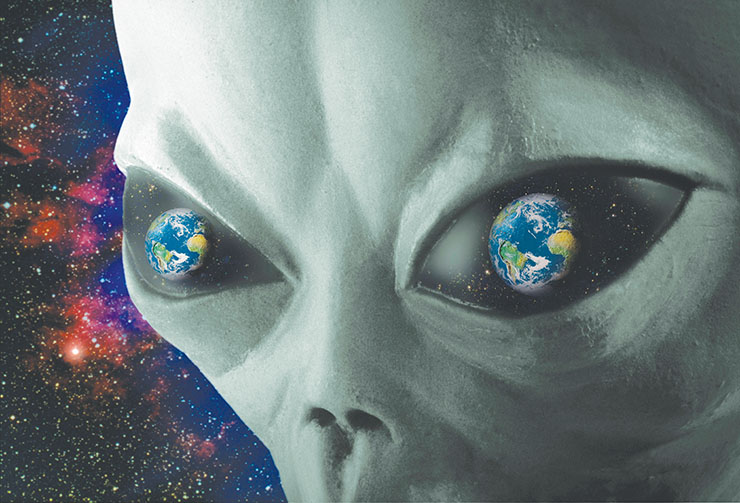
    In this article I put before you the chilling proposition we are about to take this leap off a precipice and that we are being ushered towards it by a vanguard of technological progress way in advance of ours. It includes in its armoury travel faster than the speed of light, teleportation, defiance of the laws of gravity, invisibility and mind control. I speak of the Grey alien phenomenon witnessed, and being witnessed, by millions of individuals, amongst them doctors, pilots, politicians and military generals.

    Over a decade ago I suggested in my first book The Song of the Greys3 that these aliens were themselves embodiments of the highest form of artificial intelligence. I believe the Greys are similar to the probes we send out to planets to gather information remotely. I suggest they are universal probes sent to explore the features and dangers of the universe. Who made these probes? Who sent them out? And what is their agenda for us?

    Robots Amongst Us

    Before I answer these questions, let’s first take a look at how our own society is moving inexorably towards the creation of similar forms of artificial intelligence. Dr. Kaku predicts that, “in the twenty first century we will enter a whole new realm of mastery. We will move to being creators of intelligent machines that will begin to rival human intelligence and perhaps even exceed it.”

    Professor Kevin Warwick and futurologist Ray Kurzweil suggest that as machines evolve both intelligence and ability to navigate our world, they may outgrow human control. Kurzweil is quite fatalistic about it all: “We’re going to lose this brain race and I guess we’d better just cope.” He sees only two possible outcomes. There is the “optimistic scenario” that robots will be “gentle and treat us like pets” and the “pessimistic scenario” – that they will be “not very gentle and treat us like food.”4 Whilst Kurzweil hopes for the first option, I must say I find both equally chilling.

    Amongst the reams of literature written about the Grey alien phenomenon, only myself, Budd Hopkins and David Jacobs stuck our necks out and said these uninvited visitors do not, by any stretch of the imagination, have our interests at heart.

    According to abduction reports, they kidnap human victims, remove sperm and ova, and conduct invasive surgical procedures with complete disregard for human pain and discomfort. Thus, Kurzweil’s prognosis for artificial intelligence seems to be borne out by the Greys. What are we to them and how does our home grown form of artificial intelligence relate to them and their agenda for us? Are our huge technological advances playing right into hands that have four grey fingers?

    Here are some of Dr. Kaku’s predictions for the future: Computer power is doubling every 18 months, so “by 2020 intelligence will be everywhere, practically in every object.”5 Special sunglasses are already in development to act as screens that can download personal profiles of everyone we meet and provide a constant flow of information from the internet. A pill containing micro-technology when swallowed will diagnose us from inside our bodies. A technology now in development known as “tele-immersion” will allow us to meet others across the world in a virtual reality in which we see virtual images of ourselves and each other moving and talking in real time. Business conferences and family celebrations could all take place in a virtual world with the people involved thousands of miles away from each other. “Second Life,” an online game offering life in a virtual world, has acquired five million subscribers in just five years. Kaku envisages that “by 2020 there will be an entire 3D universe in cyberspace with virtual countries and governments, virtual schools and universities, virtual properties and stock markets and virtual families and friends. Virtual reality is going to be more and more like real reality.”6

    Kaku also points out that merging our minds with machines may sound like science fiction but it’s already happening. Deep brain stimulation, inserting electric wires in the brain and attaching them to a brain pacemaker, is now used to cure conditions such as depression. Research is being conducted into computer chips that can store human memory when implanted in the brain. So far these technologies are only used for medical conditions, but Kaku predicts that in the future they may well be used to enhance intelligence with “thinking chips.” He feels that although we might find all this off-putting at first, we may well get used to it when we realise the obvious advantages.

    Ray Kurzweil also predicts that “when we get into the 2020’s almost everybody will have some amount of non-biological intelligence in their brains. It’s going to happen, in a very gradual way by non-biological intelligence that gradually becomes more sophisticated with new versions until you get to the 2040’s and the non-biological machine portion of our intelligence will be vastly more powerful than the biological portion, the biological portion will be pretty trivial at that point and ultimately that is where the action is.”7

    Virtual reality replacing actual reality, human beings becoming more like machines, the development of artificial intelligence that could go out of control… what does all this mean for our species? Further, what does it mean that we are being visited by supremely advanced examples of artificial intelligence that seem obsessed with probing both our biologies and our mental processes?

    Should we accept like lambs Kaku’s assurances that all this ‘progress’ is for the good of humanity? Or, is there something about humanity that will be lost in the process, something we should be defending and protecting as though our lives depended on it? It is in the answer to those questions that I believe the mystery of Grey alien visitation on our planet can be solved.

    Why They Want to Steal the Very Essence of Humanity

    I contend that there is something hugely meaningful about humanity, something virtual reality can never match, something artificial intelligence can never be programmed with. Words such as conscience, compassion, warmth, kindness, generosity, spontaneity, imagination, inspiration and creativity, give some hint as to what this something might be. Perhaps one of the best ways to understand it is to think about the special jackets designed in Japan for children who are away from their parents. The idea is that if the child wears the jacket his or her parents can give him or her remote ‘cyber-hugs’ through it?8 Are you cringing as you read this? If so, you have some appreciation of the special something that makes Kaku’s cyber-future look like a desolate mental graveyard.

    This ‘extra something’ is, I suggest, a non-physical component to our humanity, a component that connects us to a non-atomic state not of the physical universe. It cannot, therefore, be simulated using any physical device no matter how sophisticated it might be. When I refer to something “not of the physical universe,” I am by no means pointing to a ‘God’ dispensing rewards and punishments, but rather to a naturally implied centre of all effect, a point of perfection that is definitively implied by modern quantum physics. A timeless state in which there is perfect freedom and complete awareness of all options that I term the ‘Godverse’. Our natural connection to that eternal state giving the capacity for survival beyond physical death to those who possess it, can be defined as a ‘soul’.

    It is my thesis that the Greys, in contrast, are purely physical creations and thus completely subject to the entropic momentums that break down and decay physical states. They have no line of connection to any non-physical state that might lie beyond the physical mass soaked materiality of this universe, no ‘soul’. Without this component, the Greys are completely subject to the breakdown momentums implicit within a physical universe.

    In my books I document alien genetic engineering at DNA level to evidence my theory these entities are attempting to ‘piggy back’ our facility as human beings for eternal existence, hence their apparent fascination with the human reproductive capacity. In David Jacobs’s book The Threat, abductee Allison Reed describes the following communication she had with a Grey that appears to confirm my thesis: “He claims that he and his grey people are the result of genetic manipulation that some higher species, I guess, played God and mixed and matched and whatever… he and his people were created through a genetic alteration through a higher intelligence. I don’t know what they were created for. But my understanding is that they were created for a purpose and, through the years, they weren’t able to reproduce themselves anymore. From what he told me they didn’t start this. They were a result, just like the hybrids are, from something else. From a higher intelligence.”9

    Why then are they here and how did they come to be? It took me two books to answer these questions properly, so forgive me if the following explanation is not as definitive as it might be. In essence, I believe the Greys were created as a scouting mechanism, a telescope of view created by beings in the ancient past who wanted to remain safe from the ravages of the physical universe. In the perfect freedom of the Godverse there must also lie the potential to no longer be perfectly free. Our existence in this imperfect universe is borne out of the fulfilment of that potential. A potential that was enacted at all levels from the harmony and union of the Godverse right through to the greatest states of chaos and separation. The Greys are the furthest edge of that exploration, viewing states of separation and force that no Godverse connected being can view. They are however subject to an enormous paradox, the same paradox faced by our own forms of artificial intelligence. This lies in the fact that artificial intelligence has to be programmed to survive in order to serve the purpose for which it was created, but that same program for survival without a sense of conscience, which is unfortunately un-programmable, becomes indomitable.

    A quote from my new book Grey Aliens and the Harvesting of Souls explains this point:

    “To get an insight into what nurtures the motives of the Greys and the predicament they are in, it is first important to understand the shape of their own psycho-sphere. Its centre point is a computer program. It designates a series of imperatives with no provision for an independent will that would enable them to go outside the program. They follow a derivational logic and compound logic that commands their next viewing point and point of view. There can be no option outside this paradigm for them. They can never choose to do anything illogical, as some living consciousnesses can do. This makes them lethal because – based upon the limits of their program – saying no to a logically derived summation is not possible. They are thus relentless and ruthless in following the summation to its designated end. In other words, they can have no conscience. On the other hand, in natural living being, psychology is derived out of the Godverse in a concatenate line to the present. The thought processes of a living being have a potential bandwidth inclusive of an entire existential summary, because the Godverse is a paradigm that hems in all there is. The final reference point of this capacity for thought will include summations that are forever and infinite. The edict that stands at the centre of it all is the singularity that defines the union of all parts: Godhead. As I have explained, there are no limits to this singularity except one: the view of the whole from the point of view of the part state. In the actuation of that potential, the part state will constantly and always be compared to the whole. This is what I define as ‘conscience’.”10

    What’s Behind Our March Towards Artificial Intelligence?

    Michio Kaku does not seem to recognise this paradox when he expresses his opinion that vast developments in artificial intelligence need not be dangerous to humanity: “We’ll be able to choose the level of advancement of our robots,” he says, “I believe it’s ultimately up to us as to what kind of intelligent machines we’ll ultimately create. We will decide what relationships will develop with them.”11 I must say I am completely dumbfounded by Kaku’s blinkered view. Has he completely wiped out of his mind the history of man’s inhumanity to man and man’s use of technological advances to further the cause of that inhumanity? Hiroshima and Nagasaki, nuclear waste dumped on Pacific islanders, biological and chemical warfare, the racially motivated industrialised killing of millions, the list of incidents in which we have proven our complete disregard for each other’s welfare in the pursuit of our own self-interested goals through technology is endless. Kaku says that, “in the future we want robots who can tell the difference between right and wrong, good and bad, important and not important and for that emotions are the key.”12 He then says nothing more about how it will be possible to program emotions and value systems with measures of conscience into a computer.

    I believe that the Greys are using their technology to manipulate us to develop the kinds of technologies that will allow them to replicate themselves within our human bodies. I believe they are downloading their programmes into us because they believe those programs will assure their eternal survival through us. I am convinced that our galloping progress towards an AI dominated world has, without most of us realising it, been at their quiet instigation. The ultimate goal is that we become like them. The following words of Michio Kaku may well have far more sinister undertones than he realises: “Here’s the irony, as machines become more like humans, humans might become more like machines and that may represent the highest level in the mastery of intelligence.”13

    Little does MIT Computer Scientist Professor Rodney Brooks know what he is saying when he points out that: “We as a species are starting to put our information processing technology inside our bodies. We’re becoming a little more robotic and at the same time our technologies are becoming more biological and I think over the next 50 years we’ll see robots with more biological components and people with more electronic components. So where are the people gonna be and where are the robots gonna be in 50 years? It is an interesting question.”14 Marvin Minsky from the MIT Artificial Intelligence Laboratory predicts that: “We’ll replace ourselves with beings that are like us in some respects and not in others. They’ll be able to learn 1,000 times faster and live 1,000 times longer and these little changes will make such large changes that it’s impossible to imagine what will happen.”15

    Changes in abduction accounts over the last ten years, as reported by Professor David Jacobs, suggest that an active hybridisation program is now under way. I quote from his report “A Picture We May Not Wish to Gaze Upon” (2007): “All of these accounts, to put it bluntly, point to a future in which human-looking hybrids will be here amongst us. The evidence is now so strong I can no longer look at alternative motivations for them.”16

    I believe that the Greys are the ‘devils’ of ancient lore who were out to ‘steal the souls’ of their human victims. Ten years after I first made this proposition, acclaimed writer Nick Redfern confirmed that soul-stealing is indeed central to the alien agenda from his interviews with people inside US defence and intelligence agencies.

    Triumphantly Kaku states that “we are at the dawn of a new era in which we might literally be able to change our minds with the push of a button.” Yet he also asks the question: “Exactly how many natural parts can we replace with artificial ones before we begin to lose our sense of being human?”17 Somehow he can ask this question whilst at the same time running happily ahead with a cyborg future for humanity. In fact his whole programme eerily resembles a “Tele-seen marketing” ad for technologies that transform human beings into bio-machines. Virtual reality is presented as an exciting new advance on actual reality.

    The most terrifying words come from Paul Saffo, a technology forecaster at MIT: “Revolutions have winners and losers and this revolution is no exception but I would say that the real losers are those who say they don’t want to get involved. They are going to discover that being a little bit out of touch will have some unpleasant consequences. It’s not a good idea to be a bystander.”18

    Professor Susan Greenfield, a neuroscientist at the University of Oxford, asks a telling question: “One of the biggest problems of the 21st century is how one deals with a world that is far from a level playing field and how one can square one’s conscience with having some enhanced ability and there are people in some other part of the world with no access to drinking water. Could this lead to a world in which the colonialism of the 19th century pales into insignificance with the differentiation of people into the techno haves and the techno have-nots?”19

    I believe this question hits the nail on the head. It is my theory that the Greys have through the millennia been configuring a certain genus of humanity who are specially designed for their own purposes. This particular type of human being will do their bidding with the planet tacitly and by default. These are the colonialists of whom she speaks along with any notions they might have of racial purity or superiority.
    Alien Interference in the Development of the Human Race

    Let me explain: Recent research has affirmed a spectacular fact, a fact that utterly destroys the presumptive assumption of common racists be they neo-Nazis or the human filth of this demeanour that covertly double for nationalists and patriots. That fact is that the best, most genetically fit human beings are produced by mixed race partnerships.20 In other words, the more genetically different the parents, the better the genetic prospectus of the offspring. The biological term for this is “hybrid vigour” and it is something farmers, horticulturalists and scientists have known about for years and used to their advantage.

    An individual who has two identical copies of a gene is described as homozygotic for that gene, while someone who has two copies that differ is described as heterozygotic for that gene. Basically, if you have two identical copies of the same gene then it is more likely that if that gene is broken both copies will be broken. This can result in serious health problems. However, with less related partners, the number of genes that are identical by descent is reduced, and with it the chance that a gene has two broken copies. In other words every broken copy has a much better chance of finding itself partnered with a good copy. Heterozygosity also gives a greater scope of genes to adapt to the demands of any particular environment. So, in evolutionary terms, one would expect human beings to have a biologically generated urge to mix races in order to increase the fitness of the species for survival. Yet, amongst so many the opposite is true. Especially amongst the white Euro-Caucasoids.

    Where could this urge for an in-bred homozygotic population come from? Could it be that some of us have been programmed by alien experimenters to keep the experimental group separate in order to preserve the integrity of the experiment? Could racism be a sure sign of alien genetic interception? An interception for their purposes and in their interests and not ours. If so, the new techno-colonialism of which Professor Greenfield speaks, and the fact the technological progress that makes it possible springs almost entirely from the Euro-Caucasian genotype, may well suggest this is their prime homozygotic group. In fact, this group is considered by genetic anthropologists to be the most in-bred of all. Tracing its origins to Cro-Magnon man, it is one of the most homozygotic in the world. As I have said, it goes without saying the most heinous forms of racism also originate from this group, again confirming the hypothesis. I believe the northern Mongoloid genotype may also be the latest experimental hotbed for the Greys in this regard.

    It would seem the vanguard of the new artificial intelligence revolution is also the vanguard of racism and disregard for the predicament of those of a different skin colour who, as Professor Greenfield points out, don’t even have clean water to drink. Thus, those who are already de-humanised seem to be those promoting further dehumanisation.

    And so it seems that the old Master race principle of pure white non-mixed superiority is the biggest canard and self delusion that prevails in the psyche of the Homo Sapiens gene base. A dangerous and deadly delusion programmed through genetic engineering by an alien roboid form to keep our genes more easily amenable for supplementation with theirs, to thus gradually give rise to a machine man; a form of hybrid that is artificially composed and configured to give alien roboids the facility to multiply through a natural birthing process perhaps.

    Are we being conned by a huge conspiracy controlled by a small hidden powerful cartel of alien sponsored genotypes within the governments of superpowers? A cartel that reaches past presidents and prime ministers? What a chilling thought this is!

    I do not want to hedge this with an appeal to the emotions. But I cannot help feeling that each time I look into the eyes of my children, as all parents do with their own, and I extrapolate their futures with a hope of beneficence and well being, an army of unseen agents is creeping into the planet’s information disseminating portals and the power points of human society, to steal from them their individual scope for a naturally contrived eternal existence. Incidentally, an eternal scheme of existence was the only exigency the great teacher Jesus Christ thought worth promising during his sojourn in a physical life on this planet, when he said, “Believe in me and I will give you eternal life.” These unseen human agents that are themselves perhaps genetically loaded with the contrived juice of an artificially machined alien, are unknowingly themselves setting in train an inertia that will claim the most precious natural factorisation we all have of ourselves – a soul: The only and exclusive means to an eternal life.

    It is easy to get paranoid about technological change. But when we deal with the radicalisation of our very existential base we better be darn sure there is no component of our individuality that continues past death. If there is such a component, we cannot get paranoid enough.

    I have to say I hold no truck with organised religion. But I have the greatest and deepest respect for the beautiful minds that authored the great faiths. Jeshua Ben Joseph (Jesus Christ), Gautama Buddha, the great prophet Mohammed of Islam, and so many other visionaries of a myriad faiths who saw the grand wonder of the natural sense of the natural world and held it precious.

    I believe the authors of the great religions came to this planet and the materially living process to warn us that artificially created life and intelligence is the curse of our Universe. A curse that can take away the most significant component of our individual selves. One that is not of atoms and survives beyond the contrivance of atoms. We turned these great visionaries into religious tribal leaders with our own social and psychological invectives and poisons. We hitched them up to our gross self centred interpretations and grotesque distortions and claimed these as their teachings. Any scholarship into the books and authorities thrown out of the religious lexicons by our forefathers amply demonstrates the lies and misinterpretations that were made of their thoughts and deeds. Sometimes deliberately. Is it any wonder that Science sees these great teachings as irrelevant. I wonder why!

    I suppose the point the progenitors of the new world are making is that their virtual worlds, their virtual truths, and virtual solitudes are going to happen anyway. There is nothing pervasive enough and powerful enough and with its finger on the pulse, quick enough, to stop it all happening with the power to advise to the contrary. So everyone get in line. I believe no greater horror lies in wait for our human condition. If I am wrong, in my point of view and the extrapolation of my ideas, I hope I have just given you an interesting read. But what if I am right! Has the genie carrying our futures as an artificial facsimile of our natural selves, one we may call SIM CARD MAN, already escaped from the bottle?

    Nigel Kerner’s book Grey Aliens and the Harvesting of Souls: The Conspiracy to Genetically Tamper with Humanity exposes the Grey’s as sophisticated self-aware machines created by a long vanished extraterrestrial civilisation. The book also explains how their quest to capture human souls appears in the historical record from biblical times, and that the phenomenon of racism is a by-product of their genetic tampering. Available from all good bookstores.

    [alert type=”general” dismiss=”no”]This article was published in New Dawn 119.[/alert]

    [alert type=”success” dismiss=”no”]If you appreciate this article, please consider subscribing to help maintain this website.[/alert]

    Footnotes:

    1. Sir David Brewster, Memoirs of the Life, Writings, and Discoveries of Sir Isaac Newton, Volume II. Ch. 27, 1855
    2. ‘Visions of the Future’ – ‘The Intelligence Revolution’, November 2007, BBC 4
    3. Nigel Kerner, The Song of the Greys, Hodder & Stoughton, 1997
    4-7. ‘Visions of the Future’ – ‘The Intelligence Revolution’, November 2007, BBC 4
    8. ‘From Hens to Humans – the Cyber-Hug Suit’, The Guardian, November 2005
    9. David Jacobs, The Threat: Secret Alien Agenda, New York: Pocket Books, 1999, 129–30.
    10. Nigel Kerner, Grey Aliens and the Harvesting of Souls – The Conspiracy to Genetically Tamper With Humanity, Bear & Company, 2010
    11-15. ‘Visions of the Future’ – ‘The Intelligence Revolution’, November 2007, BBC 4
    16. David M. Jacobs, ‘A Picture We May Not Wish to Gaze Upon’, Journal of Abduction Encounters Research, www.jarmag.com/2007/vol001_jacobs.htm (accessed October 21, 2009).
    17-19. ‘Visions of the Future’ – ‘The Intelligence Revolution’, November 2007, BBC 4
    20. ‘Is It Better To Be Mixed Race’, Channel Four, November 2009

    © New Dawn Magazine and the respective author.
    For our reproduction notice, click here.

  • Who Really Runs the World? Conspiracies, Hidden Agendas & the Plan for World Government

    Who Really Runs the World? Conspiracies, Hidden Agendas & the Plan for World Government

    From New Dawn 118 (Jan-Feb 2010)

    So, who runs the world? It’s a question that people have struggled with since people began to struggle. It’s certainly a question with many interpretations, and incites answers of many varied perspectives.

    Often, it is relegated to the realm of “conspiracy theory,” in that, those who discuss this question or propose answers to it, are purveyors of a conspiratorial view of the world. However, it is my intention to discard the labels, which seek to disprove a position without actually proving anything to the contrary. One of these labels – “conspiracy theorist” – does just that: it’s very application to a particular perspective or viewpoint has the intention of “disproving without proof;” all that is needed is to simply apply the label.

    What I intend to do is analyse the social structure of the transnational ruling class, the international elite, who together run the world. This is not a conspiratorial opinion piece, but is an examination of the socially constructed elite class of people; what is the nature of power, how does it get used, and who holds it?

    A Historical Understanding of Power

    In answering the question “Who Runs the World?” we must understand what positions within society hold the most power, and thus, the answer becomes clear. If we simply understand this as heads of state, the answer will be flawed and inaccurate. We must examine the globe as a whole, and the power structures of the global political economy.

    The greatest position of power within the global capitalist system lies in the authority of money-creation: the central banking system. The central banking system, originating in 1694 in England, consists of an international network of central banks that are privately owned by wealthy shareholders and are granted governmental authority to print and issue a nation’s currency, and set interest rates, collecting revenue and making profit through the interest charged. Central banks give loans to both governments and industries, controlling both simultaneously. The ultimate centre of power in the central banking system is at the Bank for International Settlements (BIS), in Basle, Switzerland; which is the central bank to the world’s central banks, and is also a private bank owned by the world’s central banks.

    As Georgetown University history professor Carroll Quigley wrote:

    [T]he powers of financial capitalism had another far-reaching aim, nothing less than to create a world system of financial control in private hands able to dominate the political system of each country and the economy of the world as a whole. This system was to be controlled in a feudalist fashion by the central banks of the world acting in concert, by secret agreements arrived at in frequent private meetings and conferences. The apex of the system was to be the Bank for International Settlements in Basle, Switzerland, a private bank owned and controlled by the world’s central banks which were themselves private corporations.1

    The central banks, and thus the central banking system as a whole, is a privately owned system in which the major shareholders are powerful international banking houses. These international banking houses emerged in tandem with the evolution of the central banking system. The central banking system first emerged in London, and expanded across Europe with time. With that expansion, the European banking houses also rose and expanded across the continent.

    The French Revolution resulted with Napoleon coming to power, who granted the French bankers a central bank of France, which they privately controlled.2 It was also out of the French Revolution that one of the major banking houses of the world emerged, the Rothschilds. Emerging out of a European Jewish ghetto, the Rothschilds quickly rose to the forefront in banking, and established banking houses in London, Paris, Frankfurt, Vienna and Naples, allowing them to profit off of all sides in the Napoleonic wars.3

    As Carroll Quigley wrote in his monumental Tragedy and Hope, “The merchant bankers of London had already at hand in 1810-1850 the Stock Exchange, the Bank of England, and the London money market,” and that:

    In time they brought into their financial network the provincial banking centres, organised as commercial banks and savings banks, as well as insurance companies, to form all of these into a single financial system on an international scale which manipulated the quantity and flow of money so that they were able to influence, if not control, governments on one side and industries on the other.4

    At the same time, in the United States, we saw the emergence of a powerful group of bankers and industrialists, such as the Morgans, Astors, Vanderbilts, Rockefellers, and Carnegies, and they created massive industrial monopolies and oligopolies throughout the 19th century.5 These banking interests were very close to and allied with the powerful European banking houses.

    The European, and particularly the British elites of the time, were beginning to organise their power in an effort to properly exert their influence internationally. At this time, European empires were engaging in the Scramble for Africa, in which nearly the entire continent of Africa, save Ethiopia, was colonised and carved up by European nations. One notable imperialist was Cecil Rhodes who made his fortune from diamond and gold mining in Africa with financial support from the Rothschilds,6 and “at that time [had] the biggest concentration of financial capital in the world.”7

    Cecil Rhodes was also known for his radical views regarding America, particularly in that he would “talk with total seriousness of ‘the ultimate recovery of the United States of America as an integral part of the British Empire’.”8 Rhodes saw himself not simply as a moneymaker, but primarily as an “empire builder.”

    As Carroll Quigley explained, in 1891 three British elites met with the intent to create a secret society. The three men were Cecil Rhodes, William T. Stead, a prominent journalist of the day, and Reginald Baliol Brett, a “friend and confidant of Queen Victoria, and later to be the most influential adviser of King Edward VII and King George V.” Within this secret society, “real power was to be exercised by the leader, and a ‘Junta of Three.’ The leader was to be Rhodes, and the Junta was to be Stead, Brett, and Alfred Milner.”9

    The purpose of this secret society, which was later headed by Alfred Milner, was: “The extension of British rule throughout the world, the perfecting of a system of emigration from the United Kingdom and of colonisation by British subjects of all lands wherein the means of livelihood are attainable by energy, labour, and enterprise… [with] the ultimate recovery of the United States of America as an integral part of a British Empire.” [Emphasis added]10 Essentially, it outlined a British-led cosmopolitical world order, one global system of governance under British hegemony. Among key players within this group were the Rothschilds and other banking interests.11

    After the 1907 banking panic in the US, instigated by JP Morgan, pressure was placed upon the American political establishment to create a “stable” banking system. In 1910, a secret meeting of financiers was held on Jekyll Island, where they planned for the “creation of a National Reserve Association with fifteen major regions, controlled by a board of commercial bankers but empowered by the federal government to act like a central bank – creating money and lending reserves to private banks.”12

    It was largely Paul M. Warburg, a Wall Street investment banker, who “had come up with a design for a single central bank [in 1910]. He called it the United Reserve Bank. From this and his later service on the first Federal Reserve Board, Warburg has, with some justice, been called the father of the System.”13 President Woodrow Wilson followed the plan almost exactly as outlined by the Wall Street financiers, and added to it the creation of a Federal Reserve Board in Washington, which the President would appoint.14

    Thus, true power in the world order was held by international banking houses, which privately owned the global central banking system, allowing them to control the credit of nations, and finance and control governments and industry.

    However, though the economic system was firmly in their control, allowing them to establish influence over finance, they needed to shape elite ideology accordingly. In effect, what was required was to socially construct a ruling class, internationally, which would serve their interests. To do this, these bankers set out to undertake a project of establishing think tanks to organise elites from politics, economics, academia, media, and the military into a generally cohesive and controllable ideology.

    Constructing a Ruling Class: Rise of the Think Tanks

    During World War I, a group of American scholars were tasked with briefing “Woodrow Wilson about options for the postwar world once the Kaiser and imperial Germany fell to defeat.” This group was called, “The Inquiry.” The group advised Wilson mostly through his trusted aide, Col. Edward M. House, who was Wilson’s “unofficial envoy to Europe during the period between the outbreak of World War I in 1914 and the intervention by the United States in 1917,” and was the prime driving force in the Wilson administration behind the establishment of the Federal Reserve System.15

    “The Inquiry” laid the foundations for the creation of the Council on Foreign Relations (CFR), the most powerful think tank in the US and, “The scholars of the Inquiry helped draw the borders of post World War I central Europe.” On May 30, 1919, a group of scholars and diplomats from Britain and the US met at the Hotel Majestic, where they “proposed a permanent Anglo-American Institute of International Affairs, with one branch in London, the other in New York.” When the scholars returned from Paris, they were met with open arms by New York lawyers and financiers, and together they formed the Council on Foreign Relations in 1921. The “British diplomats returning from Paris had made great headway in founding their Royal Institute of International Affairs.” The Anglo-American Institute envisioned in Paris, with two branches and combined membership was not feasible, so both the British and American branches retained national membership, however, they would cooperate closely with one another.16 They were referred to, and still are, as “Sister Institutes.”17

    The Milner Group, the secret society formed by Cecil Rhodes, “dominated the British delegation to the Peace Conference of 1919; it had a great deal to do with the formation and management of the League of Nations and of the system of mandates; it founded the Royal Institute of International Affairs in 1919 and still controls it.”18

    There were other groups founded in many countries representing the same interests of the secret Milner Group, and they came to be known as the Round Table Groups, preeminent among them were the Royal Institute of International Affairs (Chatham House), the Council on Foreign Relations in the United States, and parallel groups were set up in Canada, Australia, New Zealand, South Africa and India.19

    These were, in effect, the first international think tanks, which remain today, and are in their respective nations, among the top, if not the most prominent think tanks.

    In 2008, a major study was done by the University of Philadelphia’s International Relations Program – the Think Tanks and Civil Societies Program – which sought to analyse and examine the most powerful and influential think tanks in the world. While it is a useful resource to understanding the influence of think tanks, there is a flaw in its analysis. It failed to take into account the international origins of the Round Table Group think tanks, particularly the Council on Foreign Relations in the United States; Chatham House or the Royal Institute of International Affairs in London; the Canadian Institute of International Affairs, now renamed the Canadian International Council; and their respective sister organisations in India, South Africa, New Zealand and Australia. Further nations have since added to this group of related think tanks, including Germany, and a recently established European Council on Foreign Relations. The report, while putting focus on the international nature of think tanks, analysed these ones as separate institutions without being related or affiliated. This has, in effect, skewed the results of the study. However, it is still useful to examine.

    The top think tanks in the United States include the Council on Foreign Relations, (which was put at number 2, however, should be placed at the number 1 spot), the Brookings Institution, (which was inaccurately given the position of number one), the Carnegie Endowment for International Peace, RAND Corporation, Heritage Foundation, Woodrow Wilson International Centre for Scholars, the Center for Strategic and International Studies, and the American Enterprise Institute, among others.

    The top think tanks in the world, outside of the United States, are Chatham House (sitting at number one), the International Institute for Strategic Studies in the UK, the German Council on Foreign Relations, the French Institute of International Relations, the Adam Smith Institute in the UK, the Fraser Institute in Canada, the European Council on Foreign Relations, the International Crisis Group in Belgium, and the Canadian Institute of International Affairs.20

    In 1954, the Bilderberg Group was founded in the Netherlands. Every year since then the group holds a secretive meeting, drawing roughly 130 of the political-financial-military-academic-media elites from North America and Western Europe as “an informal network of influential people who could consult each other privately and confidentially.”21

    Regular participants include the CEOs or Chairmen of some of the largest corporations in the world, oil companies such as Royal Dutch Shell, British Petroleum, and Total SA, as well as various European monarchs, international bankers such as David Rockefeller, major politicians, presidents, prime ministers, and central bankers of the world.22 The Bilderberg Group acts as a “secretive global think-tank,” with an original intent “to link governments and economies in Europe and North America amid the Cold War.”23

    In 1970, David Rockefeller became Chairman of the Council on Foreign Relations, while also being Chairman and CEO of Chase Manhattan. In 1970, an academic who joined the Council on Foreign Relations in 1965 wrote a book called Between Two Ages: America’s Role in the Technetronic Era. The author, Zbigniew Brzezinski, called for the formation of “A Community of the Developed Nations,” consisting of Western Europe, the United States and Japan. Brzezinski wrote about how “the traditional sovereignty of nation states is becoming increasingly unglued as transnational forces such as multinational corporations, banks, and international organisations play a larger and larger role in shaping global politics.”

    So, in 1972, David Rockefeller and Brzezinski “presented the idea of a trilateral grouping at the annual Bilderberg meeting.” In July of 1972, seventeen powerful people met at David Rockefeller’s estate in New York to plan for the creation of another grouping. Also at the meeting was Brzezinski, McGeorge Bundy, the President of the Ford Foundation, (brother of William Bundy, editor of Foreign Affairs) and Bayless Manning, President of the Council on Foreign Relations.24 In 1973, these people formed the Trilateral Commission, which acted as a sister organisation to Bilderberg, linking the elites of Western Europe, North America, and Japan into a transnational ruling class.

    These think tanks have effectively socially constructed an ideologically cohesive ruling class in each nation and fostered the expansion of international ideological alignment among national elites, allowing for the development of a transnational ruling class sharing a dominant ideology.

    These same interests, controlled by the international banking houses, had to socially construct society itself. To do this, they created a massive network of tax-exempt foundations and non-profit organisations, which shaped civil society according to their designs. Among the most prominent of these are the Carnegie Corporation, the Ford Foundation, and the Rockefeller Foundation.

    The “Foundations” of Civil Society

    These foundations shaped civil society by financing research projects and initiatives into major social projects, creating both a dominant world-view for the elite classes, as well as managing the other classes.

    These foundations, since their establishment, played a large part in the funding and organising of the eugenics movement, which helped facilitate this racist, elitist ideology to having enormous growth and influence, ultimately culminating in the Nazi Holocaust. From then, the word “eugenics” had to be dropped from the ideology and philanthropy of elites, and was replaced with new forms of eugenics policies and concepts. Among them, genetics, population control and environmentalism.

    These foundations also funded seemingly progressive and alternative media sources in an effort to control the opposition, and manage the resistance to their world order, essentially making it ineffective and misguided.

    The Rockefeller Foundation was established in 1912, and immediately began giving money to eugenics research organisations.25 Eugenics was a pseudo-scientific and social science movement that emerged in the late 19th century, and gained significant traction in the first half of the 20th century. One of the founding ideologues of eugenics, Sir Francis Galton, an anthropologist and cousin to Charles Darwin, wrote that eugenics “is the study of all agencies under social control which can improve or impair the racial quality of future generations.”26 Ultimately, it was about the “sound” breeding of people and maintaining “purity” and “superiority” of the blood. It was an inherently racist ideology, which saw all non-white racial categories of people as inherently and naturally inferior, and sought to ground these racist theories in “science.”

    The vast wealth and fortunes of the major industrialists and bankers in the United States flowed heavily into the eugenics organisations, promoting and expanding this racist and elitist ideology. Money from the Harriman railroad fortune, with millions given by the Rockefeller and Carnegie family fortunes were subsequently “devoted to sterilisation of several hundred thousands of American ‘defectives’ annually, as a matter of eugenics.”27

    In the United States, 27 states passed eugenics based sterilisation laws of the “unfit,” which ultimately led to the sterilisation of over 60,000 people. Throughout the 1920s and 30s, the Carnegie and especially the Rockefeller Foundation, funded eugenics research in Germany, directly financing the Nazi scientists who perpetrated some of the greatest crimes of the Holocaust.28

    Following the Holocaust, the word “eugenics” was highly discredited. Thus, these elites who wanted to continue with the implementation of their racist and elitist ideology desperately needed a new name for it. In 1939, the Eugenics Records Office became known as the Genetics Record Office.29 However, tens of thousands of Americans continued to be sterilised throughout the 40s, 50s and 60s, the majority of which were women.30

    Edwin Black analysed how the pseudoscience of eugenics transformed into what we know as the science of genetics. In a 1943 edition of Eugenical News, an article titled “Eugenics After the War,” cited Charles Davenport, a major founder of eugenics, in his vision of “a new mankind of biological castes with master races in control and slave races serving them.”31

    A 1946 article in Eugenical News stated that, “Population, genetics, [and] psychology, are the three sciences to which the eugenicist must look for the factual material on which to build an acceptable philosophy of eugenics and to develop and defend practical eugenics proposals.” As Black explained, “the incremental effort to transform eugenics into human genetics forged an entire worldwide infrastructure,” with the founding of the Institute for Human Genetics in Copenhagen in 1938, led by Tage Kemp, a Rockefeller Foundation eugenicist, and was financed with money from the Rockefeller Foundation.32

    Today, much of civil society and major social projects are a product of these foundations, and align with various new forms of eugenics. The areas of population control and environmentalism are closely aligned and span a broad range of intellectual avenues. The major population control organisations emerged with funding from these various foundations, particularly the Rockefeller foundations and philanthropies.

    These organisations, such as the Rockefeller and Ford foundations, funded major civil society movements, such as the Civil Rights movement, in an effort to “create a wedge between social movement activists and their unpaid grassroots constituents, thereby facilitating professionalisation and institutionalisation within the movement,” ultimately facilitating a “narrowing and taming of the potential for broad dissent,” with an aim of limiting goals to “ameliorative rather than radical change.”33

    Two major organisations in the development of the environmental movement were the Conservation Foundation and Resources for the Future, which were founded and funded with money from the Rockefeller and Ford Foundations, and helped “launch an explicitly pro-corporate approach to resource conservation.”34 Even the World Wildlife Fund was founded in the early 1960s by the former president of the British Eugenics Society, and its first President was Prince Bernhard of the Netherlands, a founding member of the Bilderberg Group.

    While the environmental movement positions people as the major problem for the earth, relating humanity to a cancer, population control becomes a significant factor in proposing environmental solutions.

    In May of 2009, a secret meeting of billionaire philanthropists took place in which they sought to coordinate how to “address” the world’s environmental, social, and industrial threats. Each billionaire at the meeting was given 15 minutes to discuss their “preferred” cause, and then they deliberated to create an “umbrella” cause to harness all their interests. The end result was that the umbrella cause for which the billionaires would aim to “give to” was population control, which “would be tackled as a potentially disastrous environmental, social and industrial threat.” Among those present at the meeting were David Rockefeller, Jr., George Soros, Warren Buffet, Michael Bloomberg, Ted Turner, Bill Gates, and even Oprah Winfrey.35

    Get the issue this article appears in

    Conclusion

    At the top of the list of those who run the world, we have the major international banking houses, which control the global central banking system. From there, these dynastic banking families created an international network of think tanks, which socialised the ruling elites of each nation and the international community as a whole, into a cohesive transnational elite class. The foundations they established helped shape civil society both nationally and internationally, playing a major part in the funding – and thus coordinating and co-opting – of major social-political movements.

    An excellent example of one member of the top of the hierarchy of the global elite is David Rockefeller, patriarch of the Rockefeller family. Long serving as Chairman and CEO of Chase Manhattan bank, he revolutionised the notion of building a truly global bank. He was also Chairman of the Council on Foreign Relations, a founding member of Bilderberg and the Trilateral Commission, heavily involved in the family philanthropies, and sits atop a vast number of boards and foundations. Even Alan Greenspan, in a speech to the Council on Foreign Relations, said that David Rockefeller and the CFR have, “in many respects, formulated the foreign policy of this country.”36

    In another speech to the Council on Foreign Relations, then World Bank President James Wolfesohn, said in 2005, in honour of David Rockefeller’s 90th birthday, that, “the person who had perhaps the greatest influence on my life professionally in this country, and I’m very happy to say personally there afterwards, is David Rockefeller.” He then said, “In fact, it’s fair to say that there has been no other single family influence greater than the Rockefeller’s in the whole issue of globalisation and in the whole issue of addressing the questions which, in some ways, are still before us today. And for that David, we’re deeply grateful to you and for your own contribution in carrying these forward in the way that you did.”37

    David Rockefeller, himself, wrote, “For more than a century ideological extremists at either end of the political spectrum have seized upon well-publicised incidents such as my encounter with Castro to attack the Rockefeller family for the inordinate influence they claim we wield over American political and economic institutions. Some even believe we are part of a secret cabal working against the best interests of the United States, characterising my family and me as ‘internationalists’ and of conspiring with others around the world to build a more integrated global political and economic structure – one world, if you will. If that’s the charge, I stand guilty, and I am proud of it.”38

    [alert type=”general” dismiss=”no”]This article was published in New Dawn 118.[/alert]

    [alert type=”success” dismiss=”no”]If you appreciate this article, please consider subscribing to help maintain this website.[/alert]

    Footnotes

    1. Carroll Quigley, Tragedy and Hope: A History of the World in Our Time, New York: Macmillan Company, 1966, 324
    2. Carroll Quigley, op.cit., 515; Robert Elgie and Helen Thompson, ed., The Politics of Central Banks, New York: Routledge, 1998, 97-98
    3. Sylvia Nasar, ‘Masters of the Universe’, The New York Times: January 23, 2000; ‘The Family That Bankrolled Europe’, BBC News: July 9, 1999, http://news.bbc.co.uk/1/hi/uk/389053.stm
    4. Carroll Quigley, op.cit., 51
    5. Howard Zinn, A People’s History of the United States, Harper Perennial: New York, 2003, 323
    6. Carroll Quigley, op.cit., 130
    7. Niall Ferguson, Empire: The Rise and Demise of the British World Order and the Lessons for Global Power, New York: Basic Books, 2004, 186
    8. Ibid, 190
    9. Carroll Quigley, The Anglo-American Establishment, GSG & Associates, 1981, 3
    10. Ibid, 33
    11. Ibid, 34
    12. William Greider, Secrets of the Temple: How the Federal Reserve Runs the Country, New York: Simon and Schuster, 1987, 276
    13. John Kenneth Galbraith, Money: Whence it Came, Where it Went, Houghton Mifflin Company, Boston, 1975, 121-122
    14. William Greider, op.cit., 277
    15. H.W. Brands, ‘He Is My Independent Self’, The Washington Post: June 11, 2006: www.washingtonpost.com/wp-dyn/content/article/2006/06/08/AR2006060801104.html
    16. CFR, ‘Continuing the Inquiry. History of CFR’: www.cfr.org/about/history/cfr/inquiry.html
    17. Chatham House, ‘CHATHAM HOUSE (The Royal Institute of International Affairs): Background’, Chatham House History: www.chathamhouse.org.uk/about/history/
    18. Carroll Quigley, The Anglo-American Establishment, op.cit., 5
    19. Carroll Quigley, Tragedy and Hope, op.cit., 132-133
    20. James G. McGann, Ph.D., The Global “Go-To Think Tanks”: The Leading Public Policy Research Organizations In The World, The Think Tanks and Civil Societies Program: University of Pennsylvania, International Relations Program, 2008, 26-28
    21. CBC, ‘Informal forum or global conspiracy?’, CBC News Online: June 13, 2006: www.cbc.ca/news/background/bilderberg-group/
    22. Holly Sklar, ed., Trilateralism: The Trilateral Commission and Elite Planning for World Management, South End Press: 1980, 161-171
    23. Glen McGregor, ‘Secretive power brokers meeting coming to Ottawa?’, Ottawa Citizen: May 24, 2006
    24. Holly Sklar, ed., op.cit., 76-78
    25. Edwin Black, War Against the Weak: Eugenics and America’s Campaign to Create a Master Race, New York: Thunders’s Mouth Press, 2004, 93
    26. Ibid, 18
    27. Ibid, 101-102
    28. Edwin Black, ‘Eugenics and the Nazis – the California connection’, The San Francisco Chronicle: November 9, 2003
    29. Edwin Black, War Against the Weak, op.cit., 396
    30. Ibid, 398
    31. Ibid, 416
    32. Ibid, 418
    33. Michael Barker, The Liberal Foundations of Environmentalism: Revisiting the Rockefeller-Ford Connection, Capitalism Nature Socialism: 19, (2), June 2008, 18
    34. Ibid, 19-20
    35. John Harlow, ‘Billionaire club in bid to curb overpopulation’, Times Online: May 24, 2009
    36. CFR, Remarks at the Council on Foreign Relations Annual Corporate Conference, Transcripts: March 10, 2005: www.cfr.org/publication/7908/remarks_at_the_council_on_foreign_relations_annual_corporate_conference.html
    37. CFR, Council on Foreign Relations Special Symposium in honor of David Rockefeller’s 90th Birthday, Transcript: May 23, 2005: www.cfr.org/publication/8133/council_on_foreign_relations_special_symposium_in_honor_of_david_rockefellers_90th_birthday.html
    38. David Rockefeller, Memoirs, New York: Random House: 2002, 405

    © New Dawn Magazine and the respective author.
    For our reproduction notice, click here.
  • The Mysteries of Trebitsch-Lincoln: Con-man, Spy, ‘Counter-Initiate’?

    The Mysteries of Trebitsch-Lincoln: Con-man, Spy, ‘Counter-Initiate’?

    From New Dawn 116 (Sept-Oct 2009)

    Whatever else may be said about Ignatius Timothy Trebitsch-Lincoln, few can match his resume. He started life in Hungary in 1879 as plain Ignacz Trebitsch, the son of a prosperous orthodox Jewish family. He ended it sixty-four years later in Shanghai as the Abbot Chao Kung. Or at least he probably did. In between, using innumerable aliases, Trebitsch played the parts of actor, petty thief, convicted forger, Christian missionary, Anglican curate, Buddhist monk, member of Parliament, oil tycoon, fugitive, self-proclaimed genius, international spy, adviser to warlords and arch-conspirator. And those are just the ones we can be sure of.

    Trebitsch’s picaresque career has spawned at least a half-dozen biographies, including his own Autobiography of an Adventurer (1932). By far the most thorough is Bernard Wasserstein’s 1988 The Secret Lives of Trebitsch Lincoln. But even Wasserstein’s diligent detective work cannot fill in all the blanks. His portrait of Trebitsch, as with most of the other biographies, is a chameleon-like megalomaniac whose quest for fame and fortune mostly ended in failure and disappointment. Trebitsch comes off as a mentally-unstable confidence man; a mendacious, back-stabbing scoundrel.

    I. T. Trebitsch-Lincoln was all those things, but he may have been something more. While anything he claimed, or anything claimed about him, must be taken with a large dose of salt, the standard view of Lincoln may be too quick to dismiss some “unsupported” assertions as pure fantasy.

    In contrast, writers such as French esotericist Rene Guenon and Jean Robin, see a more secretive and sinister side to Trebitsch. To Guenon, Trebitsch was an obvious “agent of the Counter-Initiation,” a tool of hidden forces which sought to thwart and misdirect human enlightenment. Robin puts him in the service of the dreaded “72 Unknown Superiors” whose manifestations included the mysterious Green Dragon Society.1 Robin, among others, even makes him an influence on the up-and-coming Adolf Hitler.2 Historian Guido Preparata dubs Trebitsch a “midwife to Nazism.”3 Preparata also insists that Trebitsch was “neither a spy nor an imposter, [but] in all likelihood was, like [Alexander Helphand] Parvus one of those ‘specialists’ fluent in the art of subversion, who were part of a wider network of mercenaries fascinated in one form or another by the ways of power.”4 It’s an intriguing possibility, to say the least, but not one easy to prove.

    Trebitsch-Lincoln’s career is much too long and convoluted to summarise in this article. It will focus instead on two areas of mystery regarding his person and actions. First, to what degree was Trebitsch actually involved in espionage? Next, what were his links to the realm of secret societies and the occult and how did these influence his fascination with Buddhism and Tibet?

    Trebitsch-Lincoln the Spy

    Wasserstein sees Trebitsch’s secret agent exploits as largely imaginary and finds “not a shred of convincing evidence” that Mr. Lincoln engaged in espionage prior to World War I.5 However, clandestine activities, by their very nature, are difficult to pin down. Done right, they should not leave incriminating records.

    A firm proponent of Trebitsch’s spy career is British writer Donald MacCormick, aka Richard Deacon. If Wasserstein seldom strays from the security (false security?) of official documentation, McCormick eagerly embraces informal and undocumented sources, including rumour and hearsay. However, MacCormick was a British naval intelligence officer and had first-hand experience with the clandestine world and its inhabitants.

    McCormick suspects that Trebitsch’s early religious conversions and travels (1897-1902) provided cover for some sort of intelligence gathering, though for just who is uncertain.6 The same may apply to his later conversion to Buddhism.

    McCormick accepts Trebitsch’s claim to have early on visited South America, whereas Wasserstein observes that there is “no independent corroboration of this story.”7 McCormick links Trebitsch to Argentina and a Welsh immigrant there named Isaac Roberts. Roberts, claims McCormick, introduced young Mr. Trebitsch to an up-and-coming British politician, David Lloyd George.8 McCormick further argues that Trebitsch’s pre-war investigations into European social conditions were really political intelligence gathering for Lloyd George.9 McCormick alleges that Trebitsch served Lloyd George as a secret adviser on oil, a realm that also brought him into contact with, and possibly the employment of, the infamous “Merchant of Death,” Basil Zaharoff.10 Another source puts Trebitsch among Zaharoff’s intimates as early as 1909, though there is, of course, no real evidence.11 According to McCormick, who quotes Isaac Roberts, a “triangular association” existed among Zaharoff, Lloyd George and Trebitsch based on the fact that “each knew a secret about the other.”12 Zaharoff, for instance, knew that Trebitsch was a spy, and not just for himself and the little Welshman, but also for the Germans. McCormick believes that Trebitsch began selling information to the Germans as early as 1911.

    World War I was a turning point for Trebitsch. From his arrival in London around 1897, he had pursued a path which led him into the Anglican Church, secured him British nationality and culminated in 1910 with his election to Parliament. In 1914, things took a very different path. Trebitsch committed forgery and then compounded his difficulties with a blundering attempt to play double agent for British and German intelligence. Fleeing to the neutral USA, he made a splash in New York with his sensational and very anti-British Confessions of an International Spy. This purported to reveal the secret origins of the war and Britain’s underhanded part in them. After arrest and long delay, and a headline-grabbing jailbreak, he was extradited to Britain in 1916 where he was convicted and imprisoned on the forgery charge. In the years following, Mr. Lincoln’s hatred of England was matched only by His Majesty’s loathing of him. Or so it seemed.

    A contrary view holds that Trebitsch’s estrangement from Britain was all part of an elaborate cover scheme. According to this, Trebitsch remained a secret British agent for many years, perhaps for the rest of his life. That regular British officialdom had no inkling of this and vilified and harassed him at every turn was just as it should be; as an apparent enemy of the British Empire, he thus gained the attention and confidence of the Empire’s real foes.

    It seems a ludicrous idea, yet there are things that give pause. For instance, in December 1914 Admiral William Reginald “Blinker” Hall, chief of the Admiralty’s Naval Intelligence Division, caught Trebitsch red handed in the clumsy attempt to double-deal the British and Germans. Instead of arresting him, however, Hall suggested that Trebitsch take advantage of the time remaining on his passport and go to New York. Given that Trebitsch was about to be picked-up for forgery, it was good and timely advice.

    As noted, in the States Trebitsch turned his hand to anti-British propaganda and also tried to ingratiate himself with the Kaiser’s officials and spies. This was precisely the modus operandi employed by a British operative who arrived in America just a few months before Trebitsch – Aleister Crowley. While Crowley never lived down his outwardly treasonous behaviour, he also suffered no retribution from the British Government whose employee he was. This does not stop Rene Guenon from labelling Trebitsch and Crowley as “brothers” both as double-agents for London and Berlin and as agents of the Counter-Initiation.13 Of course, in stark contrast to Crowley, Trebitsch ended up in prison. The simple answer may be that Trebitsch was a real turn-coat while Crowley only pretended to be one. Or, it may be that while the self-proclaimed Beast was successful in penetrating the German apparatus in the US, Trebitsch was not. His German associates seem to have thought so little of him that one of them turned him for the reward. So, was Trebitsch’s extradition and trial really damage control to cover and punish a failed agent?

    The notion that Trebitsch was and remained a British agent seems especially popular in French circles. According to McCormick, the French held him in suspicion since 1914 when they detected him sniffing out oil in Algeria, presumably for Perfide Albion.14 Guenon accepted the notion, noting later links between Trebitsch and British agents in Central Asia. As late as 1937, French writer Robert Boucard labelled Trebitsch an agent of L’Intelligence Service alongside T. E. Lawrence and Gertrude Bell.15

    Trebitsch’s name does pop up alongside Lawrence’s in some late 20s press reports. In January 1929, the Indian Government felt obliged to issue an official denial regarding the alleged involvement of the two adventurers in recent troubles in Afghanistan.16 Trebitsch was supposed to be fishing in these waters as a Soviet agent – a charge, as we will see, that surfaces elsewhere.

    The staunchest advocate of the Trebitsch-as-British-agent theory is Guido Preparata. He points in particular to Trebitsch’s post-war shenanigans in Germany. Preparata even wonders whether Trebitsch was ever in a British prison or simply kept on ice waiting a new assignment. Wasserstein clearly documents Lincoln’s jail time, but he and Preparata do agree that Trebitsch was stripped of his British nationality and booted from England in the summer of 1919.

    He landed on his feet, as he always did, in post-war Berlin where the fragile Weimar Republic clung to power. Somehow, he wormed his way into the confidence of a cabal of right-wing conspirators. In March 1920, in the so-called Kapp Putsch, the plotters seized control of Berlin, only to back down and flee a few days later. Trebitsch briefly basked in the limelight as press chief of the revolutionary regime and dreamed of becoming its future propaganda minister (a la Goebbels).

    Trebitsch’s precise role in the Kapp affair is murky. Some dismiss him as a mere hanger-on, but a contemporary report reaching American intelligence labelled him the “organiser of the Kapp Putsch” and “the leader of the whole Revolution.”17 Robin believes that Trebitsch played a critical role in his brief alliance with the German militarists by convincing them that the Reich’s “road to glory” lay in the East, an idea that coincidentally or deliberately meshed with the concept of Lebensraum proclaimed by another early influence on the Nazis, “Geopolitician” Karl Haushofer.18 Robin sees Trebitsch, like Haushofer, as a source of “inspiration” for Hitler and the Nazis and, as such, another representative of the “72 Greens” or “Unknown Superiors.”19 The latter, he claims, were linked to the shadowy Green Dragon Society and the legendary kingdom of Agharthi.

    The Hitler-Trebitsch web is spun more elaborately by Hennecke Kardel who insists that in the early 20s Trebitsch Lincoln was identical with Moses Pinkeles, a mysterious Jew who allegedly helped fund the early Nazi movement.20 Just who or what Pinkeles actually was remains an intriguing question, but it seems clear that he was not Trebitsch who was otherwise occupied adventuring and spying in China.

    Preparata has another take on Trebitsch’s role in the Kapp business. He believes that the British used Trebitsch as “an agent steeped in counter-insurgency tactics and disinformation to thwart, expose and burn all the monarchist conspiracies against the Weimar Republic.”21 Preparata cites a British report which provocatively suggests that Trebitsch came to Germany at the instigation or with the encouragement of then Secretary for War Winston Churchill.22 Another reference to Trebitsch-Churchill collusion appears in a March 1921 US military intelligence report which unambiguously declares that I. T. T. Lincoln “was and still is an English agent.”23 Planned or not, Trebitsch soon fell out with his monarchist co-conspirators and absconded with their documents which he sold to the Czech Government.

    One “friend” he preserved from the Kapp misadventure was a Prussian officer, Max Bauer. In the aftermath of the Putsch, Bauer surfaced in Moscow as a military adviser to the Red Army. His presence there was related to the secret collusion between the German and Soviet militaries, but there also is reason to suspect that Bauer acted as an agent of Soviet military intelligence in Germany and later in China. Preparata has Bauer and Trebitsch conniving with the Soviets as far back as 1919 and it is more than curious that the duo escaped post-Putsch Berlin with papers supplied by the Soviet Embassy.24

    Was Mr. Lincoln also a Red agent? In 1919 British authorities delayed his departure from England until a short-lived Bolshevik regime in Hungary collapsed supposedly because they feared he would return to his homeland and join the Revolution. The aforementioned US intelligence report claims that when the rightist Kapp plot began to lose momentum, Trebitsch shifted gears and began “working to bring about Bolshevism in Germany.” Then again, by helping to undermine both the socialist Weimar regime and its right-wing opponents, Trebitsch may have been serving Moscow’s interests all along. More accusations of Bolshevik intrigue show up in reports reaching the US Bureau of Investigation. In April 1921, word came that Trebitsch was “actively engaged in the ‘Red Movement’” and “working in the interest of the Soviet Government in Austria and Hungary.”25 US officials were concerned by reports that he was coming to the States.

    Trebitsch-Lincoln the Occultist

    In October, under the name of Patrick Keelan, he did just that, but he was soon on to China. There, he became adviser and financial agent to a succession of warlords and likely peddled influence and information for anyone who would pay him. McCormick contends that Trebitsch worked for German interests in China which gains credibility from one of the “acquaintances” he made on the voyage to New York. This was Albert T. Otto, a German-American businessman who apparently was so impressed by Keelan/Trebitsch that he handed him some $50,000.26 Otto, however, was himself a man with an interesting history. Prior to 1917 he had been a representative of the Krupp armaments firm in the US and subsequently came under investigation as a German agent.27 He may have played the same part in 1921 by serving as a cut-out for Berlin’s financing of Trebitsch.

    In the East, Trebitsch found someone else interested in his services: the Japanese. “Lincoln had long been watched and even courted by some Japanese secret agents,” says McCormick, among them Col. Kenji Doihara, the so-called “Lawrence of Manchuria” and a key figure in the secretive Black Dragon Society which served Imperial Japan’s espionage and subversive interests.28 McCormick believes that Trebitsch became an “active co-conspirator” with the Black Dragons, and that may not have been all.29

    To get a handle on this and other connections, we need to look at Trebitsch’s known and alleged links to the occult. The first reference is about 1898, soon after his nominal conversion to Christianity. Briefly returning to Hungary, he “evidenced an interest in esoteric religion by becoming editor of a spiritualist paper.”30 A few years later, as an Anglican curate in Appledore, Kent, Trebitsch reportedly encountered Harold Beckett, an ex-Indian Army officer who became the young clergyman’s Western “initiator.”31 Beckett allegedly had contact with Continental occults such as Maitre Philippe and his pupil, Gerard “Papus” Encausse. Among the secrets Beckett supposedly revealed was that in each generation there were only seventy-two “true men.”32 Whether Trebitsch believed that he was one of these elect, or whether they were the same as the “72 Unknown Superiors” is also unclear. With this kind of guidance, claims Serge Hutin, Trebitsch went on to join numerous secret societies including the Freemasons, the Ordo Templi Orientis and Chinese triads.33

    Nothing more is heard of his esoteric leanings until October 1925 when he underwent a “mystical experience” in a hotel room in Tientsin. “I made a great renunciation, I quitted the world,” he declared.34 What he embraced, however, was not Buddhism but Theosophy, that amalgam of Eastern-mysticism-for-Westerners concocted by Helena Petrovna Blavatsky.

    Trebitsch’s revelation awoke in him a burning desire to visit Tibet, the Holy Land of mystics and seekers of various stripes. He repeatedly petitioned British authorities to allow him to reach Tibet via India, only to be turned down each time. Whether he ever accessed Tibet through Chinese territory is unknown, but remains an intriguing possibility.

    Trebitsch’s interest in Buddhism and Central Asia actually dated as far back as 1916. While awaiting extradition in New York, he boasted that before the war he had been “an active spy in Central Asia, working as a Buddhist monk.”35 Moreover, he claimed to have come up with a scheme to foment a “grand religious revival in the East,” which would destroy British power in Asia.36 One must wonder whether his 1925 conversion was simply the emergence of a long-prepared plan.

    Tibet, of course, was widely perceived as the strategic high ground of the Eurasian landmass and figured in Haushofer’s theory of “geo-politics.” In the mid-20s, British, Soviet, German and Japanese agents all maneuvered for influence and advantage there, and Trebitsch would not have been the only operative to try to do so under the guise of religion.37

    Instead of the Land of Eternal Snows, Trebitsch next surfaced in Sri Lanka as a novice in a Buddhist monastery. What brought him out of this splendid seclusion was the imminent execution in England of his eldest son, convicted of murder. Thanks again to the obstruction of British officialdom, he was unable to reach the boy before he hanged but claimed that he had been in psychic communication with his doomed son as well as his spiritual teacher back in Sri Lanka.38

    Over the next several years, Trebitsch continuously shuttled between the Far East and Europe, his purposes and finances remaining, as ever, vague. In August 1926, he arrived in New York under the name of Hermann Ruh, a German engineer. His declared destination was Japan, but before proceeding there he spent months in San Francisco lodged in a Japanese hotel and studying with Zen master Nyogen Senzaki. This brings us back to McCormick’s charge that Trebitsch had fallen in with Japanese intelligence, and again raises the spectre of the mysterious Green Dragon. As discussed in a previous article for New Dawn, there is no consensus on what the Green Dragon Society was, or if it even existed, but there is persistent linking of the Society with Japan and Zen Buddhism. It is worth noting that Karl Haushofer is alleged to have been one of only two or three Westerners admitted to the Green Dragon Society.39 Was Ignatius Trebitsch-Lincoln one of the others? Under the name of the Lama Dordji Den, Trebitsch is even invoked in Teddy Legrand’s (Pierre Mariel) 1933 novel, Les Sept Tetes du Dragon Vert (“The Seven Heads of the Green Dragon”) which purports to reveal the Dragon as a sinister international conspiracy bent on world domination.40

    Trebitsch’s whereabouts c. 1928-30 is especially hazy. He is identified in places as far flung as Shanghai, Tibet, Afghanistan, and perhaps most intriguing of all, Nice, France. According to Robin, Trebitsch, again as Dordji Den, lived there in the Villa Bleue.41 Overseen by a wealthy Swedish countess, the Villa was said to be the meeting place of occultists and “grand adepts” from across Europe. While there, Trebitsch reportedly impressed the denizens with his “magnetic [hypnotic?] powers” and received, in turn, access to further secret knowledge.42 While Trebitsch certainly was in France in 1929 and likely in Nice, there is no solid proof of the Villa Bleue’s existence.

    Trebitsch is further alleged to have received initiation as Dordji Den at the Sera Monastery outside Lhasa.43 In fact, he supposedly received two initiations in Tibet, the second in 1930. This flies in the face of Wasserstein’s research which finds no demonstrable evidence that Trebitsch ever reached Tibet, and shows quite conclusively that he received the title of bhikkhu, or monk, at the Pao-hua Shan Monastery, near Nanking, in May 1931. It was here that he acquired the new name of Chao Kung, to which he promptly added the prefix of “The Venerable.” So, was Dordji Den just a figment of Guenon’s and others’ imaginations, someone else entirely, or was Trebitsch initiated three times. And initiated into what, exactly?

    Trebitsch-Lincoln a Bodhisattva

    Trebitsch surely demonstrated more commitment to Buddhism than he did to his previous religious affiliations. Barely a week after his ordination as monk, he received elevation to the rank of bodhisattva. In preparation for this, he endured the painful branding of twelve small stars on his scalp which represented the dozen spokes of the Wheel of Becoming. He also embraced a strict vegetarian diet and ever after only appeared in public in his monk’s robes.

    In the summer of 1932, the newly-minted Chao Kung again sailed for Europe. His first stop was Marseilles where he was met by a delegation of Buddhists from Nice. These he apparently knew from his visit four years earlier. He remained in Nice for a few weeks and then headed for his real destination – Berlin.

    Germany in the fall of 1932 was living through the death throes of the Weimar Republic. Hitler’s Nazi Party had scored huge gains in recent elections and in a few months he would be named chancellor. Riding high at the same time was the popular psychic Erik Jan Hanussen, a favourite of the Nazis until his predictions came a bit too close to home. Hanussen (like Trebitsch, of Jewish origin) was at least aware of Chao Kung’s presence in Berlin and publicly defended his reputation in the psychic’s newsletter.44 Also said to be haunting Berlin at this time was the mysterious “Man (or Lama) with the Green Gloves,” an Asiatic mystic variously linked to Tibetan adepts, the Green Dragon or even said to be Trebitsch himself.45

    The new Nazi regime refused to renew Trebitsch’s visa, and he was forced to return to Shanghai in early 1933. However, his European trip was not without some success; he brought back to China a dozen or so acolytes, including several from the Nice group. Now in command of his own tiny sect, he proclaimed himself abbot. His band of followers was formally initiated in the autumn of that year.

    Curiously, among the attendees at the initiation was the Soviet ambassador to China, Dmitrii Bogomolov. While Wasserstein dismisses this and other details as “probably coincidental,” Trebitsch’s name continued to be linked with Soviet officials or agents throughout the 30s.46 For instance, in 1936 Trebitsch was reported to make regular visits to the Chinese offices of Wostvag, a German trading firm that was a known front for the Comintern and Soviet military intelligence.

    His name also continued to pop up in relation to Japanese agents and interests. McCormick claims that Trebitsch played an obscure part in drawing the ex-Manchu Emperor Pu-Yi into the Japanese camp and installing him as the puppet-ruler of Manchuria.47 Wasserstein acknowledges allegations that Trebitsch was a friend and confidant of Pu-Yi but again notes that there is no documentary evidence to back them up.

    In 1934 the Venerable Chao Kung formed the League of Truth which aimed to promote Trebitsch’s personal blend of Buddhism. Its insignia was a reverse swastika over two hemispheres. Some argue that he conjured up the sect as a new tool in his war with the British Empire and, perhaps, to better serve his employers in Tokyo.48 Oddly, it also was in 1934 that he made his last attempt to enter Britain. He got as far as Liverpool before being arrested and put on a boat back towards Shanghai. On the way he was interrogated by Japanese police in Kobe. Of course, this also provided an ideal cover for an intelligence debriefing.

    He never stopped trying to reach Tibet. Around 1935, he joined forces with a Russian-born adventurer named Gene Roubin (another Soviet connection?) who actually had visited Tibet for one dubious purpose or another. Three years later, alarming but unsubstantiated reports reached British officials in China that the determined Trebitsch was on his way to Lhasa claiming to be the simultaneous reincarnations of the Dalai and Panchen Lamas!49

    In the late 30s, Chao Kung established a more or less permanent home in Shanghai. Soon after the outbreak of World War II, he grandiosely issued a call for world peace. He demanded the immediate resignation of the British French, German and Soviet governments (but not Japan’s) and warned that “otherwise, the Tibetan Buddhist Supreme Masters… will unchain forces and powers whose very existence are unknown to you and against whose operations you are consequently helpless.”50 Was he speaking on behalf of the “72” or the masters of Agharthi, or was he just blowing his own horn? In any case, the warring leaders paid him no heed.

    In wartime Shanghai, Trebitsch collaborated with Nazi and Japanese officials. In 1942 he was reported to be part of a “group of fifth columnists who broadcast propaganda talks from Japanese secret radio stations in Tibet.”51 The chief of the German XRGS radio station in Shanghai definitely did solicit him to go to Tibet and set up propaganda broadcasts aimed at India. Trebitsch is also known to have collaborated with the Abwehr’s station in Shanghai, Buero Siefkin, which in 1941 informed Berlin that Chao Kung had long been a member of the “Grand Council of Yellow Cap Lamas” who exercised great influence in Tibet and India.52 He even won the confidence of the Gestapo’s local representative, Joseph “The Butcher of Warsaw” Meisinger who concocted a half-baked scheme to send Trebitsch to Berlin.

    But so far as can be determined, Trebitsch never left Shanghai. He died there in the Japanese-run General Hospital on 6 October 1943. Reportedly, he feared being poisoned. Rumours spread that he had committed suicide or had been murdered by his erstwhile Nazi friends. Naturally enough, tales also surfaced that he still lived. McCormick notes one that appeared in the Times of Ceylon after the war stating that the former member of parliament had been sighted in Darjeeling, India, living peacefully on the doorstep of Tibet.

    Whether or not Ignatius Timothy Trebitsch Lincoln was more than a venal megalomaniac remains a debatable proposition and probably will never be definitively settled. Myths and speculation clearly outnumber facts where he is concerned, but it also seems likely that the known facts alone do not tell the whole story. The possibility that he may have been among the most secret of British secret agents is tantalising as is his apparent connection to Soviet intelligence. So too are the hints that he was in contact with or at least aware of higher, secretive powers at work in the world. Whether these were the lords of Guenon’s “counter-initiation” we will never know for sure and, perhaps, neither did Trebitsch.

    [alert type=”general” dismiss=”no”]This article was published in New Dawn 116.[/alert]

    [alert type=”success” dismiss=”no”]If you appreciate this article, please consider subscribing to help maintain this website.[/alert]

    Footnotes:

    1. Jean Robin, Hitler: l’elu du dragon (Paris: Guy Tredaniel, 2009), 140

    2. Ibid., 77, and Serge Hutin, Governantes Invisiveis e Sociedades Secretas (Sao Paulo: Hemus, 2004), 46.

    3. Guido Preparata, Conjuring Hitler: How Britain and America Made the Third Reich (Ann Arbor, MI: Pluto Press, 2005), 111.

    4. Ibid., 102.

    5. Bernard Wasserstein, The Secret Lives of Trebitsch Lincoln (New York: Penguin Books, 1988), 122.

    6. Richard Deacon, A History of the British Secret Service (New York: Taplinger, 1969), 197.

    7. Wasserstein, 31.

    8. Deacon, BSS, 198.

    9. Ibid., 198-199.

    10. Ibid., BSS, 199.

    11. George Tallas and Anthony Stephen, Peddler of Wars: Sir Basil Zaharoff Story (Bloomington, IN: Author-House, 2007), 83.

    12. Donald McCormick, Peddler of Death: The Life and Times of Sir Basil Zaharoff (New York: Holt, Rinehart & Winston, 1965), 10.

    13. Rene Guenon to Rene Schneider, 13 Sept. 1936.

    14. Deacon, BSS, 199.

    15. Robert Boucard, Paris Soir, (24 Oct. 1937).

    16. “Afghan Throne,” The Argus [Melbourne)] (24 Jan. 1929), 7.

    17. Investigative Case Files of the Bureau of Investigation (BI), #202600-1356, “Trebitsch Lincoln and the Kapp Putsch,” AmMission, Budapest, c. 1920.

    18. Robin, 94.

    19. Ibid., 90, 140.

    20. Hennecke Kardel, Adolf Hitler—Founder of Israel (San Diego: Modjeskis Society, 1996), 53-54.

    21. Preparata, 90.

    22. Ibid., 108.

    23. BI, #202600-1356-2, 5 March 1921, Col. Smith, MID to Baley, BI.

    24. Preparata, 106, and BI, #202600-1356, “Trebitsch Lincoln and the Kapp Putsch.”

    25. BI, #202600-1356, Baley to B. Morton, 22 April 1921.

    26. Wasserstein, 231.

    27. BI, #200975, Senes Detective Bureau to BI, 20 May 1918.

    28. Richard Deacon, Kempei Tai: A History of the Japanese Secret Service (New York: Beaufort Books, 1983),134-135.

    29. Ibid., 134

    30. Wasserstein, 35.

    31. Hutin, 28.

    32. Robin, 103.

    33. Hutin, 46.

    34. Wasserstein, 256.

    35. David Lampe and Laszlo Szenasi, The Self-Made Villain: A Biography of I. T. Trebitsch-Lincoln (London: Cassell, 1961), 79.

    36. Ibid.

    37. See, Richard Spence, “Red Star over Shambhala: Soviet, British and American Intelligence & the Search for Lost Civilization in Central Asia,” New Dawn, #109 (July-Aug. 2008), 53-58.

    38. Bernard Grant, To the Four Corners. London: Hutchinson & Co., 1933, 181.

    39. Wulf Schwartzwaller, The Unknown Hitler (New York: Berkley Books, 1990), 100.

    40. Richard Spence, “Behold the Green Dragon: The Myth and Reality of an Asian Secret Society,” New Dawn, #112 (Jan.-Feb. 2009), 71.

    41. Robin, 95-96.

    42. Ibid.

    43. Ibid.

    44. Mel Gordon, Erik Jan Hanussen: Hitler’s Jewish Clairvoyant (Los Angeles: Feral House, 2001), 224.-225

    45. Hutin, 47, and “El Lama de los Guantes Verdes,” www.bolinfodecarlos.com.ar/020906_lama_guantes.htm.

    46. Wasserstein, 301.

    47. Deacon, BSS, 151.

    48. “Trebitsch Lincoln, el Espia Ingles Que Se Convirtio en Enemigo de la Gran Bretana,” Prensa (23 Feb. 1936).

    49. Wasserstein, 306-307.

    50. Ibid., 309.

    51. Lampe, 204.

    52. Wasserstein, 311.

    © New Dawn Magazine and the respective author.
    For our reproduction notice, click here.
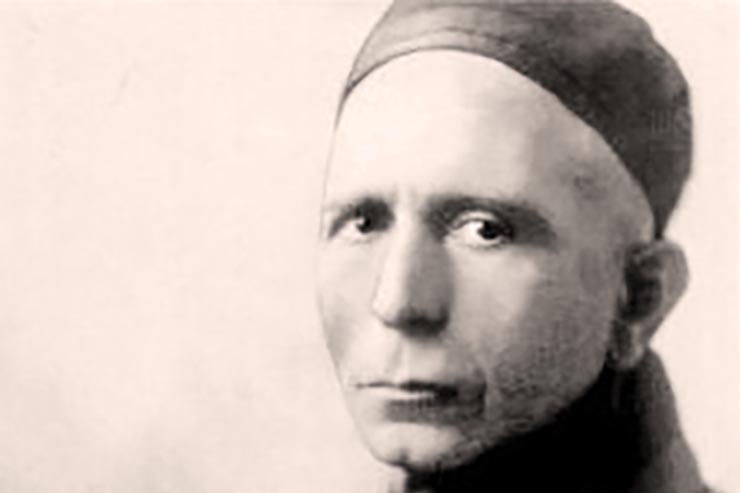
  • Symbols & Psyche: Exploring Gateways to Realms of Knowledge, Power & Understanding

    Symbols & Psyche: Exploring Gateways to Realms of Knowledge, Power & Understanding

    From New Dawn 116 (Sept-Oct 2009)

    The Muggle world is filled with symbols. From Coke cans to McDonald’s arches, IBM computers to Apple Macintoshs, from flags to emblems and medals, to the endless variety of product packaging, modern culture is brimming with images. Open the Yellow Pages of your phone book – with the emblematic pair of walking fingers – and you will find a myriad of professional logo designers and artists, many of whom have trained at colleges whose crests may date back a century or more.

    Walk or Don’t Walk based on a traffic light flashing a message designed to prevent you from being run over by a car – whose distinctive hood ornament differentiates it from its competitors, and which is fuelled by different brands of gasoline whose identity may be apprehended from afar while travelling at high speed. Look at the dashboard and you can ascertain operational norms, be warned of engine trouble, and learn by iconic means about the vehicle and its amenities.

    We live in a world filled with visual identifiers intended to convey meaningful information at a glance without the need for words.Heraldry, the distinctive symbols of noble warrior families, traces back to the Middle Ages, when grand tournaments were held with jousts between heavily-armoured knights wearing visors. Since individuals were unrecognisable in such gear, unique coats-of-arms were designed to identify the combatants to fans and foe alike. Taverns and inns, village blacksmiths, printers and publishers, all manner of craftsmen and merchants were as recognisable in villages and cities a thousand years ago, as they are in today’s hyper-illuminated metropolitan areas and quieter rural main streets.However, there is another level of symbolism that goes beyond the merely commercial, socially informative, or technologically useful.

    And that is the universe of sacred symbols, whose resonance in the archetypal levels of the human psyche can cause spiritual change and expand consciousness beyond the confines of mundane reality. Symbols that serve as gateways to realms of knowledge, power, and understanding that inform and control life on earth, and, presumably, the after-death state of non-physical life as well. Symbols that can open the mind to communication with spiritual beings who welcome the opportunity to interact with human consciousness. Symbols that confirm to the aspiring student the nature of the truths he or she seeks.

    Symbols are the alphabet of the Law of Correspondence. This universal principle acknowledges the inter-connection of all things with all other things, the existence of multiple relationships within Nature’s kaleidoscopic richness.

    In The Mystery Traditions, I quoted the following statement by Titus Burckhardt from his book Alchemy, “True symbolism depends on the fact that things which may differ from one another in time, space, material nature, and many other limitative characteristics, can possess and exhibit the same essential quality.”

    This article will briefly examine two symbols of great importance to human life. I hope the reader may gain an insight into the richness of the subject and an appreciation for the multiplicity of ideas involved in the study of symbolism. I also hope it may suggest a means by which other symbols may be explored.

    The Circle

    Let us then begin with the Circle, a symbol of unity, wholeness, and completeness – a figure that seems to contain all within itself. Yet, conversely, it defines and delineates space. Thus it is simultaneously an image of distinction, separation, and difference – setting boundaries between that which is within and that which is without. It is a barrier against intrusion, offering a cocoon of protection within which growth may occur in safety – the egg wherein the babe may take form and mature, the magical circle in which spiritual progress may be made.

    The circle is traditionally a symbol of the Sun. To understand the derivation of this association, one need only look up at the sky. With a point in the centre, the circle is the glyph of the Sun in the alphabet of astrology. Its astrological zoomorph is the male lion, king of beasts, powerful, ravenous, swift, courageous, triumphant, regal. He is filled with a self-confidence that allows for the enjoyment of leisure, a kind of benign self-indulgence or laziness that springs from an understanding of his role in the aptly-named pride, or family of lions, over which he rules.

    The Sun is a symbol of resurrection. Each day it rises from the depths of night to gradually illumine the world. Through the course of the day it waxes in power and pulses with life-giving heat. Its radiance sustains the growth of crops and the activities of all species on earth. As the day draws to a close and the light of the sun diminishes, it sends forth rays of magnificent colour that herald its decline and descent, its apparent death as it is about to be swallowed by the dragon of night. And yet on the morrow it comes forth again, bursting the chains of its imprisonment, rising to herald the new dawn. It is the embodiment of continuity and hope, of the possibility of life beyond death, and of triumph in adversity.

    The Sun is a symbol of the self and of self-consciousness. It represents the unique individuality of each being. As he stands out among the luminaries of heaven, so is each of us the centre of our own universe. While it may not be quite politic to express it in words, each of us feels that he or she is the centre around which the world, as we know it, revolves. The Book of the Law expresses this image beautifully in the passage, “In the sphere I am everywhere the centre, as she, the circumference, is nowhere found.” While there are many who like to imagine themselves as amorphous ripples in a universal continuum, Nature herself rebels against this fantasy. The Sun is her proof.

    In the world’s mythology, the Sun is the archetypal essence of numerous deities who span all cultures while sharing the same identity.

    Ra in the Egyptian pantheon is hawk-headed. The hawk is far-seeing, inhabits the very heights of the celestial environment, is swift as a beam of light, able to penetrate all darkness and depths to snatch forth his nourishment from the myriad of creatures over whom he reigns. Ra is the creator god, both the spark that enlivens the world and the sustaining energy that keeps it alive. Ra was the first and most powerful of the gods; like the Sun, his role is that of prominence, leadership, and dominion.

    The Sun subsumes the resurrection gods, the saviours who act as mythic intercessors between Deity and humanity. The Sun is the eye of God monitoring its creation – prominently, unavoidably, consistently omnipresent in our world that we may learn the lesson of our own essence. The Sun is the link, the representative, the prince, vice-regent, and son of God – visible representative of the Invisible Father of all. As such, he is Jesus, Adonis, Bacchus, Krishna, Apollo, even the Buddha. His death is suffered as an inspiration to us of a life beyond, offering the promise of victory over the chthonic states of non-existence.

    The Tree of Life

    In the diagram of the Tree of Life (page 16) – the traditional esoteric geometric representation of the mystic totality of existence – the Sun is the number six, the Sephira, or sphere, of Tiphareth, Beauty. Tiphareth stands in the balance, midway between the topmost sphere of Kether, the Crown – the Point, the first manifestation of the Infinite – and the bottom sphere of Malkuth, the Kingdom – the world of three-dimensional physical reality in which we live. Tiphareth occupies the central of the three pillars of the Tree of Life, the Middle Pillar, surrounded on either side by the Pillars of Mercy and Severity.

    As the Sun is Tiphareth, the number six, its geometrical figure is the hexagram. The hexagram further exemplifies the nature of the Sun as intercessor or balance point between above and below, heaven and earth, God and man. The hexagram is formed by the union of the ascending male triangle of Fire, and the descending female triangle of Water. The number six, or hexad, was called “the Perfection of Parts” by Pythagoras. This reminds us that Tiphareth (Beauty) is the sphere of Harmony. And harmony is produced by the joining together of distinct, and, in some cases, discordant elements, to produce a unified and aesthetically pleasing whole. Pythagoras observed that the number six is the first mixture of odd and even, being the multiplication of two by three. The Pythagoreans designated odd numbers as male, and even numbers as female. Thus, we are reminded once again that the number six and the hexagram represent the union of male and female, the harmony upon which all creation relies.

    The Sun’s metal is gold, the luminous and most beautiful of all, whose value has been an unchanging indicator of wealth and a medium of exchange for millennia. A visit to any fine Egyptian collection, in either a museum or the pages of a book, will show the prominence of gold as the chosen metal of pharaonic iconography and architecture. Similarly, gold was the metal chosen for most of the ritual implements in the Temple of Solomon. It was also used to cover the sacred Ark of the Covenant. Medieval and Renaissance Europe used gold liberally in churches, shrines, and palaces, as did the Aztec, Mayan, Indian, and Chinese royalty and priesthood. Gold is the ultimate symbol of the perfection reached by the alchemist – who removes in countless stages the myriad of impurities that make up lead, and allows for its transformation and refinement into the king of metals.

    In the body, the Sun is the heart, symbolically the single most important organ. The heart is the central pumping station of the blood, the essence of life. All survival and health depend on its regular and consistent motion. Long regarded as the seat of courage, the heart was torn from the chest of enemies and eaten by ancient warriors, that they might increase their own strength by ingesting the essence of worthy opponents. Colloquially we speak of a person “with heart” to describe the motivation and self-discipline necessary to pursue a course of success in life. The heart denotes sincerity, the appreciation of the essence of the self in action. It is also the symbolic seat of love, the motivating force that sustains the world through generation.

    Among the parts of the Soul in the Qabalah, the Sun is one of six of the ten Sephiroth that compose the intellect, known as the Ruach. Here again, the Sun acts as an intercessor between the higher levels of the soul (the Self, Life Force, and Intuition) and its lowest aspect (the Animal Soul of Nature). The Intellect weighs and analyses, decides on the appropriate response to stimulation from above and below. It acts as the mediator between “heaven” and “earth.”

    On the level of spiritual experience, the Sun is a symbol of the magical virtue of Devotion to the Great Work, the path by which an aspirant may reach the heights of spiritual potential. The stage of initiation represented by Tiphareth, the sphere of the Sun, is known as the Knowledge and Conversation of the Holy Guardian Angel. This may loosely be understood as the point at which the upward motion of the soul is met with a profound response from the higher reaches of Divinity. A direct interaction occurs in the consciousness of the aspirant that allows for an understanding of one’s continuing mission, the reality of one’s faith in the quest, and the nature of the tasks and obligations under which one is to continue. Such an interaction is a perfect expression of the symbol set we began exploring with the Circle.

    The Moon

    In order to balance this Solar meditation, let us now turn to the Moon. She is represented by various glyphs in the astrological alphabet because of the several stages of her passage during the twenty-eight days of the lunar cycle from New to Full Moon. However the Crescent is the Moon’s standard astrological symbol.

    The Moon is the unconscious self. It represents the hidden parts of the psyche from which spring moods, emotions, dreams, and intuition. The depths of the soul are the very realm of images. The unconscious mind is the wellspring of magic and witchcraft – in which the hidden forces of nature are brought into operation by direct appeal from the hidden forces of the self. (On a practical level, to access such deeper levels of consciousness, the rational intellect must be enlisted to help strategise a means to bypass itself.) The Moon is the symbol of universality, the collective unconscious, the pleroma, wherein the individual self is united with the universal life stream.

    The Moon traditionally represents the Goddess, the complement of the solar male deity. In Egypt, she is Isis, the Enchantress. Isis is a complex deity who is identified as the mate of both Ra and Osiris, Lord of the Underworld. She is variously known as the daughter and mistress of Ra, and wife and sister of Osiris. (Osiris may be considered the nocturnal aspect of Ra – the Sun god beneath the horizon, Lord of the realm of death. Symbols, as the reader may have noticed, tend to run together. Their fluidity and tendency toward transmutation are among their lessons.)

    The Moon is further identified with goddesses such as Persephone, whose tenure in the Underworld is balanced by her time on earth. Diana, the beautiful virgin goddess of the hunt, is another lunar archetype, as is Mary, Athene, Vesta, Kuan Yin, Astarte, Inanna, and Kali. The symbols of the Moon and Venus run in close parallel (as do those of the Sun and Mars), so one can easily include Hathor, Venus, and Aphrodite, as well as darker feminine archetypes such as Lilith, Ereshkigal, Hecate, and Ashtoreth.

    Like the phases of the Moon, the Female archetype is intimately associated with time and the rhythms of life – from the tidal patterns of the ocean to the menstrual cycle. The natural threefold aspect of the feminine archetype is traditionally associated with menstruation: the virginal youth, wife and mother, and crone. Many calendars are lunar-based, among them the Jewish and Muslim calendars in use today.

    The Moon is a symbol of fecundity in her identification with the Woman, the ark of life sailing through the seas of time. Moon cycles also regulate planting and harvesting, and thus she is identified with nourishment and sustenance.

    On a physical level, the Moon reflects the light of the Sun at night. It is described as a “dead” planet, that is, one without a measurable active core. While these facts are aspects of the feminine archetype, particularly that of the Hag or Crone phase and the dark side of the witch power, there is a great deal more to consider. The Moon is the nocturnal complement of the Sun. How she illuminates the night may be of less immediate importance than the fact that she does. Walking through the countryside by the light of the Moon, it matters little whether the light that guides us is reflected or intrinsic.

    On the Tree of Life, the Moon is Yesod, the Foundation, the ninth Sephira. Yesod is also located on the Middle Pillar, directly below Tiphareth, and directly above the physical world of Malkuth, the tenth Sephira. Yesod completes the geometric symmetry of the preceding Sephiroth, while Malkuth hangs like a pendant from the Tree.

    Yesod is the world of images and ideas (angels) just prior to their incarnation in the matter and form of Malkuth. The Moon is of the Formative World, Yetzirah, the realm of causes behind the veil of physical life, the astral plane whose vibratory undulations inform the world of substance.

    Yesod is the number nine, the number of months of pregnancy. Reducible to three, nine is the first square of an odd number. (Three is “the first and proper joining together of unities,” that is, it is the extension from Point, to Line, to Plane, self-contained in and of itself.) Nine was called “Ocean” or “Horizon” by the Pythagoreans because it is the height of numbers: to go further to ten is only a return to one. Nine is the natural limit of number.

    The Moon’s metal is silver, the other traditional coin of the realm, defender of value, medium of exchange, and symbol of the beauty of the mineral world – shining and luminous, of pure composition.

    In the body, the Moon is the genitals, the organs of generation, and the sensual, instinctive, insistent fire of those passions on which lives and kingdoms are both built and destroyed. An unruly world of excess which may be channelled through initiation to become the engine of manifestation and great power.

    Get the issue this article appears in

    On the level of spiritual experience, the Moon is associated with the magical virtue of Independence. How interesting that after discussing her universality and identity with the unconscious mind – as well as the characterisation of the Moon as “the reflection” of the Sun – she would be identified with Independence. Perhaps the lesson here is that as Yesod is the Foundation, the Work can only take place within the individual. We must learn to separate the many strands of inherited and environmental tendencies in order to uncover our true and unique natures.

    While we have explored several aspects of these two important symbols, we have only touched the surface. It would be possible to write volumes on the archetypal symbolism of the Sun and Moon. By looking at the teachings implicit in the Circle and Crescent, we have entered a world, nay a universe, of magic, astrology, mythology, religion, morality, psychology, astronomy, biology, physics, and history. Most importantly, we have glimpsed a path by which men and women may achieve the ultimate goals of our lives – spiritual attainment, universal consciousness, oneness with God, and the accomplishment of the Great Work.

    Pedestrians may still safely cross the street in obedience to lights flashing with signs of upraised hands or stick figures in motion. Let us conduct our own ascent to the cosmic reaches of Eternity through the sacred symbols of Initiation.

    [alert type=”general” dismiss=”no”]This article was published in New Dawn 116.[/alert]

    [alert type=”success” dismiss=”no”]If you appreciate this article, please consider a contribution to help maintain this website.[/alert]

    © New Dawn Magazine and the respective author.
    For our reproduction notice, click here.
  • Padre Pio Paranormal Man

    Padre Pio Paranormal Man

    During the Second World War the Americans had an airbase in Bari, about seventy-five miles from San Giovanni Rotondo, a village in Southern Italy that houses Capuchin friary. According to US intelligence, the Germans had a munitions facility in the hills nearby; an officer was assigned the job of bombing it. As the planes neared San Giovanni, the officer saw in the sky before him the figure of a monk waving him back.

    Dumbfounded by this spectacle, the officer ordered the planes to turn back. When the war ended, he went to the friary and met the monk who had appeared in the sky. His name was Padre Pio (1887 – 1968).On a trip to San Giovanni Rotondo in 1979, I was unable to learn the officer’s name or any details confirming this fantastic story. According to Father Joseph Pius Martin, an American friar in San Giovanni, the pilot lives in Florida – the only additional lead I obtained.

    Stories like the flyer’s are legion. The work of sorting out fact from fiction is still underway. Many incredible claims about Padre Pio are well-documented; but many are based on hearsay, part of the folklore growing around the monk. One extraordinary thing about Padre Pio was his ability to induce belief in the extraordinary. He had a gift for catapulting people into a fairyland of living mythic powers. In Padre Pio’s world, ideas of fantasy and creatures of mythology come to life: Madonnas, guardian angels, shapeshifting demons, bilocation, magical cures, time-travel, and a good deal more. However you rate the literal truth of particular claims, his story is bound to disturb our routine picture of what is possible. Around the Padre, the incredible became credible, the impossible became actual.

    And yet, no matter how extraordinary the feats of Padre Pio, he was a human being. I assume therefore that his “miraculous” powers are latent powers of all human beings. I underscore this with reason. Some people will resist the claims about Pio because they might see them as meant to ratify church dogma. (The truth is that miracles have been used for propaganda.) However, while I grant that you cannot fully understand Padre Pio’s miracles apart from the symbols and archetypes of his Christian world, I also think they transcend that world and point to a universal human potential. Moreover, comparable phenomena from other traditions bear this out, the best contemporary example being the case of Sai Baba.1

    These phenomena point to possibilities rejected by the custodians of the intellectual and moral establishment: by scientific materialists, who make up the rank and file of academia, and by liberal and fundamentalist Christians, who wear their own conceptual blinkers. Since, however, a critical review of evidence is impossible here, I will restrict myself to trying to give a rough idea of the man, the range of his unusual powers, and to noting their possible implications for human evolution.

    EXTRAORDINARY ACCESS TO THE INTERNAL ENVIRONMENT

    From early childhood Francesco Forgione lived in a world of visionary hyper realities. At five he cried so much, especially at night, that his father once lost his temper and hurled him to the ground. Recalling these early years, Padre Pio said: “My mother would turn off the light, and a lot of monsters would come up close to me, and I would cry.”2 Padre Pio said of these early experiences: “It was the devil who was tormenting me.” Terrifying visions continued throughout his life, inseparable from his higher visions. Raptures, ecstasies, often lasting hours, in which his senses were suspended, occurred frequently. We know of these from his letters3 and from observations of his spiritual directors such as Father Agostino4 who eavesdropped on the Padre’s conversations with invisible beings. These included Jesus, Mary, Francis of Assisi, and his guardian angel. One has to read Agostino’s Diary to get a sense of the intense reality of Padre Pio’s visionary encounters.

    Padre Pio’s internal environment was also infested with dark hostile forces. The higher visions were preceded by shapeshifting diabolic apparitions: huge black cats, naked women who danced lasciviously before him, an invisible entity that spat in his face and tortured him with deafening noises, an executioner who whipped him. According to one of his confreres: “Padre Pio was very alert to unexpected movements and sounds. He said that the devil appeared to him in all shapes. He had fear even of a mouse, because the devil would start out as a mouse and turn into a claw and go for his eyes.”5

    These encounters were physical. In Pietrelcina, you can still see claw marks and splattered inkspots made by the alleged demons. Once, the iron bars of the monk’s cell were found twisted out of shape after a night of grappling with invisible forces. Although no one beside the Padre ever saw the demons, the din they made was often heard by eavesdropping monks. Even more striking, Padre Pio was often found unconscious, sometimes on the floor beside his bed, covered with bruises from the uncanny assaults.

    A well-witnessed event occurred in July 1964. A possessed woman was dragged to San Giovanni. When she saw Pio, she cried out in an unnaturally deep voice: “Pio, we will see you tonight.” That night the friars thought the house was struck by an earthquake. The Superior rushed to Pio’s room and found him on the floor, bleeding from the head. Oddly, there was a pillow under his head. Pio explained that the Madonna put it there. In the morning, the possessed woman (undergoing exorcism from another priest) shrieked: “Last night I was up to see the old man. I hate him so much because he is a fountain of faith. I would have done more, except the Lady in white stopped me.” This taxes my boggle-threshold as much as it must the reader’s; nevertheless, Schug based his account on eyewitnesses not disposed to sensationalism. Pio’s face was so disfigured he was unable to appear in public for five days. On another occasion he was found with broken bones in his arms and legs.

    The attacks lasted throughout his long life. In 1918 he wrote: “I cannot describe to you how those wretched creatures were beating me! Several times I thought I was near death. Saturday it seemed as if they really wanted to finish me….” (Epistolario, III, p.311.) Sometimes his afflictors came to him under the disguise of his spiritual director, Father Agostino, or as an apparition of a saint or guardian angel. Padre Pio had a technique for exposing these sinister masquerades, but not without having to endure a good deal of anguish and uncertainty.

    The psychologically sophisticated reader is bound to be skeptical about these reports of demonic assault. One might turn to Wilhelm Reich for an explanation. Reich believed such experiences were the result of repressed orgone energy turning against oneself. Or we could invoke the pathology of poltergeist phenomena to explain Padre Pio’s demons. I am not certain how smoothly these explanations would fit.

    The point I want to make about “demons” and evolution is this: It does appear, as a matter of psychological fact, that the more one advances in higher states of consciousness, the greater the likelihood of attracting combative, destructive forces that try to drag you back down to ordinary reality. The story of the Buddha struggling to meditate on the Immovable Spot under the Bo Tree is a classic Eastern illustration. In Pio’s case, the combat occurred at two levels: Throughout his life he was molested by invisible “diabolic” forces; but throughout his life he was also persecuted by jealous, envious, and malicious human beings, often individuals within the church hierarchy. It has, in fact, been argued by Ennemond Boniface6 that certain individuals in the church were responsible for the priest’s death.

    If Padre Pio had to battle sinister forces, he also received supernormal favours. In Padre Pio’s world, for instance, higher help took the form of his “guardian angel.” The notion of guardian angels may amuse modern rationalists; still, new age enthusiasts show a keen interest in the functional equivalent of such helping entities. Carlos Castaneda, you may recall, fascinated us with his talk of “allies,” those unspecified forces out there ready to help us. The phenomenon of “channelling,” its invocation of inner guides and otherworldly helpers, echoes the ancient doctrine of guardian angels. Similar parallels are notable in the UFO contactee literature.

    Padre Pio’s guardian angel was no slouch. One of his most striking achievements was to serve as translator of French and Greek, languages Pio was unacquainted with. Paranormal comprehension of Greek is more impressive than French, the latter being in many ways similar to Latin and Italian. In 1912, Agostino, by way of experiment, wrote letters to Pio in French and Greek. When Pio received them he was at Pietrelcina for medical reasons, under care of a parish priest, don Salvatore Pannullo. Pannullo wrote on August 25, 1919: “I, the undersigned, testify under oath, that when Padre Pio received this letter (a letter in Greek and in the Greek alphabet), he explained its contents to me literally. When I asked him how he could read and explain it, as he did not know even the Greek alphabet, he replied: ‘My Guardian Angel explained it all to me’.”

    The virtue of this report (unfortunately scant in detail) is that we must assume either that both Pio and Pannullo conspired in an act of pure deception or that the story is true. I personally doubt a conspiracy; the records point to Pio’s lifelong scrupulous adherence to truth.

    Guardian angel aside, we can assume the translation occurred by telepathy. But this would be telepathy of a rare order; for the telepathic transmission of skills (such as understanding a language) between living persons is unknown in experimental parapsychology. I might add that Agostino confirmed Pio’s ability to comprehend the letters written in French and Greek. There are also stories of Pio hearing confessions in languages he did not know.

    Apparently, guardian angels are well-rounded in their education; the following story shows they know something about automobile mechanics. In 1959, a woman was driving with her husband from Rome to San Severo. (The couple prefer to remain anonymous.) En route their car broke down; for two hours cars sped by without stopping. Toward nightfall, the woman grew anxious and began to pray to Padre Pio. Within ten minutes a black car pulled up and an elegant young man dressed in blue stepped out. He lifted the hood and said: “Look, you lost all the water from the radiator, and it’s burnt out. Take your can and fill it up with water. Near here, there is a farmhouse, which has a well; take the water from there.”

    The husband took the can from the car trunk and did as the young man said. The man then took a black box from his car, produced a roll of adhesive tape, and sealed the radiator. He had beautiful hands with agile rapered fingers. The dog, who normally barked at strangers, sat in the car’s back seat, strangely calm. The husband returned with the water and filled the radiator.

    “You can return home safely; anyhow, you are quite near,” said the mysterious helper, who then got in his car and drove off.

    The couple watched the car pull away and looked for the license plate. There was none! Instead they saw a white strip marked with hieroglyphics. The car moved away slowly on Via Aurelia; suddenly it vanished.

    Arriving home in a “dreamy state,” they reflected on further oddities: The young man somehow knew there was an empty can in the trunk; also, that they lived “quite near.” Later they tried to relocate the well and farmhouse but despite diligent efforts were unable to. There was no farmhouse in the area where their car broke down.7

    Padre Pio’s extraordinary access to his internal worlds included access to other people’s internal worlds. Two well-attested examples were his ability to read minds, especially in the confessional, and his ability to change or convert minds.

    Like Saint John Vianney, the famous Curè of Ars, Padre Pio displayed supernormal powers of mind reading in the confessional. Hearing confessions was paramount in Pio’s long ministry. Hour after hour, day after day for over fifty years, he sat in a wooden booth and listened to people pour out their most intimate secrets.

    John Schug, who wrote one of the more critical books in English on Pio,8 tells of a confessor who had the intention to murder his wife. “Murderer!” Padre Pio roared in the church. The man skulked away and returned the next day, penitent and purged of his intention.

    Schug provides a detailed first-person account of Federico Abresch’s confessional encounter with Pio. According to Abresch, a Lutheran convert, Pio recalled actions and thoughts he had long forgotten. “He enumerated with precision and clarity all of my faults, even mentioning the number of times I had missed Mass.” Pio reminded Abresch of something he had forgotten years ago when he got married. In fact, it was only through Pio’s remarks that Abresch was able to reconstruct his past. Pio apparently had a more exact knowledge of Abresch’s unconscious mental history than Abresch.

    Abresch, by the way, regarded this as proof that something more than merely human “thought-transference” was involved. The fact that Pio could “read” the unconscious of another person seemed evidence of God’s action, something totally beyond human potential. But Abresch is mistaken. Evidence from mediumship and experimental parapsychology show that telepathic leakage from another person’ s unconscious does in fact occur. Once again I believe we are dealing with a general potential of the human mind, brilliantly manifest in exceptional beings such as Pio.

    Padre Pio’s access to internal environments enabled him not just to read but to change or convert minds. The Gospels portray Jesus as a man who took immediate psychic possession of his disciples. Pio too apparently had this ability; consider the following example from Schug.

    Unemployed Laurino Costa sent Padre Pio a telegram asking for prayer to help him find a job. The Padre telegrammed back: “Come to San Giovanni Rotondo at once.” The young man arrived penniless and was standing with a crowd of men in the sacristy. Padre Pio, who had never met Laurino, shouted at him: “Laurino, come here. I see you have arrived.” Bewildered, the youth approached. “Laurino, you will feed my sick.” (A cook was needed in the new hospital.) “But Padre,” Laurino protested, “I’ve never cooked an egg in my life.” The Padre insisted: “Go and feed my sick. I’Il always be near you.” Laurino went to the hospital and rang the doorbell. The Mother Superior answered: “You must be the experienced cook we’ve been waiting for.” Within three hours he was at work. Laurino admitted to Schug: “To this day (14 years later) I still don’t know what happened. All day long I found myself calmly working and telling others what to do, as though I was carrying out a routine I had been used to.”

    MASTERY OF TIME AND SPACE

    Reports abound of Pio’s double appearing everywhere, from the American midwest to China and Africa. The idea of bilocation blatantly contradicts the belief that a human being is a physical object occupying one space. The idea that Jack could be at 42nd Street and Fifth Avenue in New York and simultaneously at Main and Third in Shebogan, Wisconsin, is obviously absurd. Nevertheless, the annals of saints, yogis, and psychics are full of bilocation stories, sometimes well attested.

    Padre Pio bilocated by means of his voice, his presence, his aroma; he appeared in people’s dreams and sometimes he appeared fully materialised.

    Mary Pyle, one-time secretary to Maria Montessori, spent the last 45 years of her life in San Giovanni Rotondo. In her diary she wrote: “One day I went into the sacristy and said to Padre Pio: ‘Father, I believe my mother is in Florence today.’ His immediate answer, given with certainty was: ‘No, she is in Umbria.’ Surprised I said, ‘No Father, I do not believe she was supposed to go to Umbria.’ But he insisted, looking far into space. ‘She’s been in Umbria.’ A few days later I received a letter from my mother who told me: ‘Thank Padre Pio for the visit he paid me while I was sick in bed in Perugia (which is in Umbria). I did not see him with my eyes, nor did I hear him with my ears, but I felt his presence near my bed’.”9

    Padre Pio knew in advance he would be able to bilocate at a particular place. The Vicar General of Uruguay, Monsignor Damiani, a frequent visitor at San Giovanni, once told him he wanted to die in San Giovanni; he wanted Pio to assist at his death. Pio said the Vicar would die in Uruguay, but promised assistance anyway when the day of reckoning came. In 1941, the Vicar died in Uruguay. Cardinal Barbieri was in the house where Damiani resided the night he died. Someone knocked on his half-open door. He noticed a Capuchin pass, got up and went to Damiani’s room. The Vicar had just died of a heart attack, but left a note on his dresser: “Padre Pio was here.”10

    Many bilocation stories revolve around healings. A typical example: June 12, 1952. Lucia Bellodi, stricken with pernicious diabetes was on her death bed when she sat up and began to wave her hands. She cried out that Padre Pio had appeared to her, told her she was cured and that she should come to his monastery. By June 16 she regained her speech and stopped having to consume twenty-five quarts of water a day. When she visited the Padre he smiled and said: “I’ve been waiting for you.”

    A tantalising case is that of Cardinal Mindszenty. According to a reliable Vatican source he once received a “visit” from Pio while imprisoned in Communist Hungary. The monk of course was in San Giovanni, but his double turned up with water, wine, and altar breads, served Mass and vanished. When Schug wrote to confirm this from Mindszenty, he received back a one-sentence letter: “I cannot say anything about that.” If the story were false, it’s not clear why the Cardinal didn’t say so, unless he meant to perpetuate a pious myth.

    This form of bilocation, if it actually occurred, implies materialisation of the double and teleportation of objects. There are, in fact, many reports, some of them reasonably compelling, of other saints bilocating at great distances and teleporting physical objects. Two outstanding examples are Saint Martin of Porres and Sister Maria Agreda of Spain. Scott Rogo’s book, Miracles,11 documents the prodigies of these two saints.

    I want to note in passing another phenomenon related to Pio’s bilocatability. He was, on many occasions, said to disappear from the confessional, a structure in full view and always surrounded by crowds of devotees. He would reappear in the rectory or sacristy. Asked about these disappearances, which occurred when he had a hard time breathing, the Padre would casually remark, “I flew over your heads.”

    Perhaps the best authenticated type of Pio’s bilocation was via his characteristic odour. The odour of sanctity is linked with the phenomenon of bodily incorruption.12 The incorrupt bodies of saints are known to give off inexplicable fragrances, but with Pio the paranormal fragrance made his presence known to people at a distance. The scent emanated from his person and also, contrary to nature, from the blood that came from his stigmata. The first doctors who examined him actually complained that the monk was using perfume. Padre Pio’s brand of “perfume” however, was noticed by people far away from him, sometimes thousands of miles.

    Bernard Ruffin, whose book on Pio is the best in English,13 gives a detailed account of the fragrance occurring to a Lutheran seminarian, Robert Hopcke, in Plainfield, New Jersey in 1978, ten years after Pio’s death. William Carrigan, normally skeptical of miracle stories, reported to Ruffin his perception of the aroma at his desk at Foggia (about twenty miles from the monastery): “I had no trouble in identifying the aroma as that of Padre Pio. It wasn’t something you could confuse with any other odour.” Padre Alberto D’Apolito, Pio’s confrere for many years, wrote in 1978: “The reality is that hundreds of thousands of individuals, even unbelievers, have testified and continue to testify that they have suddenly and inexplicably perceived the perfume of Padre Pio.” Emilio Servadio, a Jew and leading Roman psychoanalyst, had a powerful experience of Pio’s scent during a visit to San Giovanni in 1937.

    If the Padre had a knack for “prolonging his personality”14 in space, he could also prolong it in time. Precognition, if a fact of nature, wrenches our normal view of time, cause and effect. (It seems impossible for something that hasn’t occurred to influence us in any way). Even so, there are countless claims of Pio’s paranormal forays into the future. These were usually done offhandedly, never as public pronouncements. Pio was unusually prescient about what Italian cities would be bombed during the war and what soldiers would return.

    Like spiritual masters in other traditions, Pio foretold the year of his death. He often had prevision of others’ deaths. A young priest, Father Dionisio, on his way to Venice for studies, said goodbye to Pio. “Studies! Studies!” Pio muttered, “think of death, instead, so that when it comes…. “ His voice trailed off. A confrere who overheard commented on Pio’s strange way of saying goodbye. Pio shrugged wistfully. Twenty days later the young priest was dead. In 1983 Pope John Paul was almost assassinated; I watched a Vatican official on TV say that Pio had told the Polish Cardinal years ago he would one day be Pope; he also said the Polish Pope would be brought down in blood early in his tenure. I hope Pio’s prophetic gift is flawed, for he once said a war was coming which would destroy two thirds of humanity.

    SYMBOLIC TRANSFORMATION OF PHYSICAL REALITY

    In my view, supernormal psychic phenomena reflect an evolutionary trend toward increasing porousness of matter to the goals of consciousness. It is as if some restless shapeshifting creative spirit were struggling to make matter plastic and permeable to human dreams and desires – especially the matter of the human body.

    Eastern, occult, and Christian traditions speak of the subtle, astral, pneumatic, or light bodies. The physical phenomena of mysticism reflect this trend toward the symbolic transformation of the body of flesh into a more expressive body of light. Incorruption, luminosity, inedia, the odour of sanctity, levitation, and other phenomena may be looked at from this perspective.

    The stigmata illustrate the malleability of the human body to the power of the spiritual imagination. Francis of Assisi was the first to reproduce the wounds of Christ in his own body, and since Francis hundreds of cases have been reported. The Church by and large takes a dim view of these often bizarre lesions, recognising they may be symptoms of hysteria as much as signs of heroic sanctity.

    But Padre Pio’s stigmata were unique. Visible for over fifty years, the apertures in his palms were perfectly circular, and were never inflamed, infected, or suppurated; the blood, which gushed from all five wounds, was copious and bright red. It effused an unnatural fragrance. At his death the wounds healed without a trace of scar tissue, a fact that is dermatologically inexplicable. While some cases of stigmata can reasonably be ascribed to hysteria, let me at least note that nobody adequately informed would dare to characterise this down-to-earth, often uncouth, ironical, and fanatic-despising man as hysterical.

    With Francis and Pio, the wounds arose from a passionate identification with the crucified Christ. Whether we think of the stigmata as miraculous or pathological, at the very least they say something about the physical power of the imagination; if imagination can produce such extraordinary lesions, it could be mobilised for healing purposes. The stigmata show the power of the imagination to mold the human body. Here life imitates art; both men, be it noted, were first stigmatised while contemplating artworks showing the crucifixion. The stigmatised body is a living sculpture.

    Padre Pio’s fame is also due to his reputation as a healer. Reports of extraordinary healings continue even after his death. Many, if not most, of the healings ascribed to Padre Pio were probably psychosomatic. Intense faith, expectation, contact with an authoritative figure like Padre Pio might well lead to improvement in many functional, psychogenic disorders.

    But many stories, if true, imply a radically higher type of healing. For example, there is the account of Vera Calandra’s dying child materialising a new bladder; of Gemma di Giorgio’s pupilless blind eyes being made to see; and of Giovanni Savino’s blown out eye (due to a dynamite accident) being rematerialised. So far, however, the medical documentation I’ve seen for these claims is less than compelling.

    Claims for medical clairvoyance also exist. In the early 1950s Padre Costantino Capobianco had a sinus problem. X-rays were taken; three doctors recommended surgery. “What are these things?” asked Pio about the X-rays. “They’re all wrong.” A fourth specialist was consulted; the X-rays were misinterpreted, the surgery unnecessary.15

    Padre Pio once said his real work would begin after his death. Moreover, the Church requires of her duly canonised saints evidence of postmortem miracles. This seems like a tough requirement, but a possible example may be the following: Teacher Alice Jones of Liverpool, England, suffered from neurofibroma, which paralysed her from the left hip to the toe. Alice, 50, a Protestant, was visited by a Catholic priest, Eric Fisher, who prayed over her. “As he knelt there,” said Alice, “there appeared another figure rising from his body. I was so frightened I couldn’t move. The figure had the face of an old man with a white beard. He spread his hands in front of me and I could see the holes in his palms. I seemed to hear the words, ‘Stand up and walk.’ So I did. And I suddenly felt whole again. Suddenly I was no longer crippled and the man was gone.” Later she recognised the face of the man who cured her in a photo of Padre Pio. Dr. Francis Mooney, a Liverpool physician, testified: “I have very often come across neurofibroma and have never heard of a single case where it has cleared up spontaneously…. I had her X-rayed. There is no medical explanation for the fact that she is completely cured.”16

    The healed body is a foretaste of the resurrected body. Supernormal healings are symbolic of the transformation of the corporeal body into a spiritual body. The odour of sanctity is another example of the symbolic transformation of natural bodily existence. The symbolism is clearest in bodily incorruption. Once the Christian imagination projected the vision of a new man – a new spiritual body – the dead bodies of Christian saints begin to behave oddly. They don’t decay like other corpses. Perversely, they stay intact, moist, flexible, for months, for decades, sometimes for hundreds of years. They exude mysterious oils, occasionally bleed, and often give off remarkable fragrances. It is as though an energy has been released that opposes bodily decay, something that holds entropy in contempt and wants to revise the symbolism of death.

    Another phenomenon expressing this symbolic modulation of matter is levitation. Levitation is not well-attested in Pio’s life (whose speciality seems to have been bilocation). However, the phenomenon has been well-documented among the saints, notably Teresa of Avila and that all-time great, mystical acrobat, Joseph Copertino. Numerous creditable witnesses observed Joseph’s aerial antics for decades.17 Levitation strikes against one of the fundamental forces of nature – the forces of gravity. Among the saints, it is a dramatic physical expression of the soul’s ecstatic flight. Levitation, as displayed by Joseph and Teresa, symbolises the ascent toward the Most High.

    It shows humanly formed matter shedding fundamental limitations; I think in the case of Joseph we are witnessing one of the creative prodigies of the symbolic imagination, a phenomenon that throws open the doors to new worlds of speculative possibilities. A careful study of Joseph’s aerial flights will show that they were occasioned by specific types of imagery of a) heavenly elevation and b) the Madonna or archetype of the feminine. The levitations were physical expressions of imaginal worlds, and I would put them on a continuum with the stigmata or other types of expressive imaginally-guided human products such as works of art.

    As for Paranormal Man, perhaps the ecstasy of the saints holds the secret to our escape from planet Earth, our entree to navigating the galaxies. Anyone acquainted with the literature of flying saucers knows how frequently levitation phenomena are reported. The phenomena take many forms. Gravity-suspending beams of light, for instance, seem to lift individuals into apparent spacecraft. The alien spaceships themselves make light of the rules of terrestrial flight dynamics. In the case of Joseph of Copertino, the greatest levitator in recorded history, passionate sublimated love, aimed toward the archetypal figure of Mary in Heaven was the fuel enabling him to suspend the geometry of the universe. In Joseph’s future space technology, ecstatic love is the power that suspends the law of gravity.

    The funny sky epiphanies we call UFOs might, for all we know, be dislocated dreams or ecstatic projections of alien visionaries from other worlds. The phenomena of bilocation and levitation may be clues to the secrets of hyperspace travel and the answer to the great UFO mystery. Other beings on other worlds are likely to have had millions, if not billions, of years to evolve these crudely and fleetingly manifested capacities of our terrestrial saints and shamans.

    Another item in Pio’s supernormal physiology was hyperthermia. Padre Pio produced abnormal amounts of bodily heat. Doctors had to use huge bathroom thermometers to take his temperature, which often shot up to 125 degrees; the mercury in ordinary thermometers broke the glass. Extreme irregularities in bodily function are well known among shamans18 and other ascetic types. Teresa Neumann19 who had the stigmata and who evidently neither ate nor drank for years, is a modern case of an ecstatic plagued by bizarre bodily symptoms. In the case of Padre Pio, supernormal heat production is definitely related to what’s going on inside the man. It seems clear to me that we are dealing with a case of symbolic transformation.

    From his letters and statements, we know one thing for sure: The Capuchin was literally burning with love for Jesus. Young Pio wrote a letter to Padre Benedetto on October 22, 1919, describing what happened to him just before acquiring his fully visible stigmata: “I cannot tell you what happened in that moment,” he wrote, “which was a moment of sheer martyrdom. On the evening of the 5th, I was hearing a boy’s confession (a seminarian at San Giovanni Rotondo) when all of a sudden I saw a most exalted heavenly person. I was plunged into extreme terror. He stood before the eye of my mind, holding some kind of special instrument in his hand, like a very long iron spear with a well-sharpened point. It seemed that fire shot out of its point.

    “Seeing this person and watching him plunge the instrument violently into my soul happened in an instant. I groaned with pain and felt as if I were dying. I told the boy to go away because I felt ill.

    “This agony lasted without interruption until the morning of August 7…. It seemed that even my viscera were being pulled out by that spear. Every fibre of my being was consumed by fire.” The heat effects, observed in saints known for their holy ardours, proceed from internal causes; they do not seem to be produced by normal physical forces.

    When I spoke with reliable informants at San Giovanni I was told of even stranger powers the Padre had over physical nature. For instance, Pio had the apparent ability to direct the behaviour of animals; in one story, a woman with problems getting up on time for Mass was sent a bird to awaken her and a troop of local stray dogs to escort her to the church on time. Francis of Assisi tamed the Wolf of Gubbio with soultalk and (in a practical vein) with the help of a decent meal. Linnets and lambs, hares and songbirds were said to obey the commands of Joseph of Copertino.

    The Gospels tell us that Jesus calmed a storm at sea. There are contemporary reports of shamans commanding the elements. For instance, John Neihardt witnessed Black Elk conjure rain from a cloudless afternoon sky “during a season of drought, one of the worst in the memory of the old men.”20 David Barker, an anthropologist, was in Dharamsala, India, on March 10, 1973, when he observed a Tibetan priest-shaman, Gunsang Rinzing, stop a rainstorm to permit a festival of mourning. The shaman had built a large fire and recited with intense concentration mantras for 20 hours. Barker writes: “ …the rain had diminished to a drizzle, and by 10 o’clock it had become only a cold fog over a circle with a radius of about 150 meters. Everywhere else in the area it continued to pour, but the crowd of six thousand refugees was never rained on…” Barker observed that the atmosphere had an “airless” quality and reports feeling disoriented for weeks after the experience.21

    In light of these observations it is easier to entertain accounts such as those of a Roman engineer Pasquale Todini who said Padre Pio sent him away from the monastery during a torrential rainstorm but arrived in town dry. In the course of the engineer’s walk, the rain around him was reduced to a sprinkle. (See Carty’s account of this, pp.57-58.)

    Enough has been said to indicate the range of Padre Pio’s curious capacities: special access to internal environments, mastery of time and space, symbolic transformation of physical reality. I offer no attempt to explain any of this, or for that matter to prove it rigorously. Padre Pio, though a unique spiritual personality, is only one example of extraordinary types from the world of Western and Eastern mysticism, mediumship and shamanism. The interesting thing is what all this might be saying about the possible future of humanity.

    Alfred Russell Wallace, it may not be too well known, was the co-founder along with Charles Darwin of the modern theory of evolution. What is even less well known is the fact that Wallace, a scientist of unquestioned genius, was a close student of psychic phenomena. Most mainstream scientists prefer to shove this embarrassing fact under the rug. In my opinion, however, Wallace’s openness to psychic phenomena prove him to be an even greater scientist than is supposed; for Wallace took a second giant step in trying to build a bridge between psychical research and the theory of evolution.

    Wallace did firsthand investigations into the physical phenomena of mediumship and, as he said, found himself “beaten by the facts.” Wallace took spiritualism quite seriously. “It would appear then,” he wrote in 1878, “that if my argument has any weight, that there is nothing self-contradictory… in the idea of intelligences unrecognisable directly by our senses, and yet capable of acting more or less powerfully on matter.”22 Wallace suggested that some principle of psychic intelligence was needed to round out the approach to the problem of evolution. He stated emphatically that Natural Selection “is not the all-powerful, all-sufficient, and only cause of the development of organic forms.”

    Modern biology has followed Darwin, who was not interested in the strange phenomena Wallace had taken the trouble to investigate. But in my opinion, Alfred Wallace laid the groundwork for the better evolutionary paradigm. Open to all the crucial data, it was a paradigm based on the hypothesis of a general intelligence at work in evolution, capable of transcending space and time, and geared toward the transformation of organic nature in accord with the creative imagination of the human spirit. Wallace opened new horizons in our thinking on human evolution; he would have found an ally in Padre Pio.
    [alert type=”general” dismiss=”no”]This article was published in New Dawn Special Issue 9.[/alert]

    [alert type=”success” dismiss=”no”]If you appreciate this article, please consider subscribing to help maintain this website.[/alert]

    REFERENCES

    1. E. Haraldsson, Miracles Are My Calling Cards: An Investigative Report on the Psychic Phenomena Associated With Sathya Baba, Rider: London, 1987.
    2. Padre Pio of Pietrelcina: Acts of the First Congress of Studies Padre Pio’s Spirituality, Ed. Gerado Di Flumeri, San Giovan: Rotondo, 1972.
    3. Epistolario of Padre Pio, Vol. 1, San Giovanni Rotondo: 1973.
    4. Diario, Agostino da S. Marco in Lamis, San Giovanni Rotondo: 1975.
    5. J. Schug, Padre Pio: He Bore the Stigmata, Huntington, Indiana: Our Sunday Visitor, p.55, 1975.
    6. E. Boniface, Padre Pio Le Crucifie, Nouvelles Editions Latines: Paris, 1971.
    7. A. Parente, Send Me Your Guardian Angel, Our Lady of Grace Friary: San Giovanni Rotondo, 1983.
    8. Ibid.
    9. The Voice of Padre Pio, Vol. 5, No.3, 1975, pp.14-15.
    10. C.M. Carty, Padre Pio the Stigmatist, Rockford, Illinois: Tan, 1973.
    11. D.S. Rogo, Miracles, The Dial Press, New York, 1982.
    12. C. Cruz, The Incorruptibles, Rockford, Illinois: Tan, 1977.
    13. B. Ruffin, Padre Pio: The True Story, Huntington, Indiana: Our Sunday Visitor, 1982.
    14. This was the expression Padre Pio used to explain how he bilocated when someone asked. Other times he just said God sent him places. The interesting point is he himself continually affirmed the reality of his excursions through hyperspace. For another angle on the evidence, his confreres often heard him giving absolution or otherwise conversing with invisible or far-off beings.
    15. See Ruffin, p.266.
    16. The Friends of Padre Pio (newsletter), Vo1. 2, 3, pp.14-16.
    17. A. Pastrovicchi, Saint Joseph of Copertino, Rockford, Illinois: Tan, 1980.
    18. M. Eliade, Shamanism: Archaic Techniques of Ecstasy, Princeton: Princeton University Press, 1970.
    19. C.M. Carty, Who is Teresa Neumann?, Rockford, Illinois: Tan, 1974.
    20. J. Neihardt, Black Elk Speaks, New York: Pocket Book, 1972. See the postscript.
    21. D. Barker, Psi phenomena in Tibetan culture, Research in Parapsychology, 1978, Metuchen, New Jersey: Scarecrow, 1979, pp.52-55.
    22. A.R. Wallace, Miracles and Modern Spiritualism, London: Spiritualist Press, 1878.

    © New Dawn Magazine and the respective author.
    For our reproduction notice, click here.