New Dawn – World's Most Unusual Magazine

Category: Articles

  • Was There a Civilisation X?: Evidence Indicates There Was

    Was There a Civilisation X?: Evidence Indicates There Was

    From New Dawn Special Issue 8

    Atlantis: everyone knows the name and almost everyone knows that the name refers to a mythical, sunken island continent in the Atlantic Ocean, according to a story told by the Greek philosopher Plato sometime during the 4th century BCE. Whether or not Atlantis existed has been a matter of conjecture for nearly four hundred years, ever since Francis Bacon published his novel The New Atlantis in 1626. Atlantis is a controversy that continues to this day.

    For some folks, Atlantis existed just as Plato explained, but for others the idea alone runs across the grain of prevailing scholarship and archaeological investigation. For those who are sure Atlantis did exist, it is a belief. But for the skeptic, a prehistoric civilisation with technical sophistication is pure fiction. Unfortunately, for those who believe there is no proof, Atlantis has been ‘discovered’ by researchers in almost every part of the world, from South America to the Eastern Mediterranean to the British Isles.

    Although scholarly consensus is convinced that Plato’s fictitious tale of Atlantis was based on the Island of Thera’s destruction in 1628 BCE, Atlantis remains as the Holy Grail of archaeology, even if archaeologists won’t admit it. Discovering evidence – even the smallest artefact – that the lost continent of Atlantis really existed would be the greatest find in the annals of all historical disciplines. History would not only be made, but have to be rewritten. However, until that evidence is discovered and confirmed, the controversy will rage on between believers and skeptics, with the skeptics having a distinct advantage. It’s all about evidence.

    Solid evidence is important and there is no direct evidence that Atlantis existed. No ancient stone or sign has ever been found stating ‘Atlantis this Way’ or ‘Welcome to Atlantis.’ No artefact has been discovered proving that sophisticated Atlantean equipment was used by any culture or civilisation during prehistoric times. This being the case, why do some people insist that the story of Atlantis is fact?

    The answer to this question lies in the Valley of the Nile, ancient Egypt, and the enigmatic Old Kingdom period. It’s where my hunt for Atlantis began.

    STANDARD EXPLANATION MISINTERPRETS THE EVIDENCE

    The ruins of ancient Egypt are unique. Nowhere else in the world are there such magnificent megalithic structures as well as fields of granite. It’s obvious that the builders of ancient Egypt’s temples and pyramids used granite, as well as limestone and basalt, as primary materials in their architectural designs. The importance of this fact cannot be overlooked.

    Working with stone is not easy and working with granite – the hardest rock known to man – and achieving any scale of economy in order to build big and build everywhere, like the ancient Egyptians did, is impossible without diamond studded tools. Today, such large and numerous projects on a big scale require specialised tools and equipment. Case in point: Giza’s Great Pyramid was the tallest structure in the world until France erected the Eiffel Tower in 1889.

    So, how could the ancient Egyptians build an entire civilisation out of limestone, basalt and granite using little more than copper chisels, stone hammers, dolerite pounding rocks, and brute strength? How could a large number of granite statues, some in excess of forty feet tall, be carved with such detail and perfection and then erected?

    The traditional explanation is that they did it with copper chisels, stone hammers, dolerite pounding rocks, and brute strength. However, for me, since no culture or civilisation was able to duplicate in complexity, scale, and quantity, the Old Kingdom construction efforts during the next 4,000 years, then the traditional understanding must be an incorrect interpretation of the evidence – the most erroneous being the Great Pyramid. Skepticism is a two-way street.

    The idea that the Great Pyramid was a tomb defies logical and cogent reasoning. First, funeral items were never found within any of the pyramid’s chambers. Nor are there any inscriptions describing it as a tomb. Second, its internal design is strange and does not accommodate human beings. Passageways that lead to its three chambers are a little more than three feet in height and width. Nor are there any steps; so, to move about you have to crawl on your hands and knees. This makes moving about inside the pyramid next to impossible for anyone, let alone a ritual funerary party. Third, the walls and ceiling of the uppermost chamber, the alleged burial chamber, was built from seventy-ton slabs of granite with another five layers of granite in the area directly above its ceiling. Finally, as any good detective would consider important, a colossal structure such as the Great Pyramid requires enormous resources to build which, consequently, requires a valid and reasoned motive. A tomb is not one of them.

    At a cost of thirty-five billion in adjusted (US) dollars, according to engineer Markus Schulte, there had to be a very good reason to build the Great Pyramid; a reason or a cause that united a nation in mind and in spirit. To be sure, the currently accepted idea that the Great Pyramid’s construction was a national project is an accurate interpretation of what likely happened. However, any large scale operation that consumes billions of dollars in resources must return some type of social benefit. In the case of the Great Pyramid, the benefit somehow involved water.
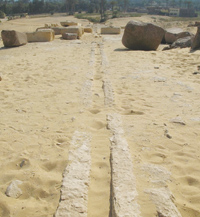
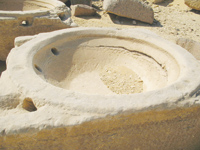
    image_15
    A trough links the pyramid/temple site to the valley below at Abu Sir. Image courtesy of the author.
    image_17
    Basin at Abu Gorab (1 mile north of Abu Sir). Image courtesy of the author.

    On the Giza Plateau just south of the middle pyramid, a granite trough emerges from the sand (see illustration). At Abu Sir, south of Sakkara, a limestone trough runs the course of the hill on which a pyramid was built, and at both Abu Sir and its neighbour pyramid, Abu Gorab, there are numerous stone basins. Although denied by most Egyptologists, there is also evidence that a system of tunnels exists under the Giza Plateau. The so-called ‘Tomb of Osiris’ runs deep into the ground as does ‘the pit’ in the Great Pyramid’s subterranean chamber. Near the granite trough there is also two square tunnels drilled into the bedrock, although now filled with sand. Furthermore, the Great Pyramid’s original design included a perimeter wall, which might have functioned as a retaining wall for a reservoir for fresh water that flowed through a canal from the ancient Lake Moeris.

    A DEVICE, NOT A TOMB

    In his 1967 book The Pharaoh’s Pump, Edward Kunkel put forth the idea that the Great Pyramid was a hydraulic device. According to Kunkel, the Great Pyramid served as a ‘ram’ style water pump in order to facilitate moving large quantities of stone. Through a series of locks, stone blocks arriving from Upper Egypt were moved onto the Giza Plateau by barge, through a system of canals that linked the Nile River to the Great Pyramid. In Kunkel’s theory, the Great Pyramid housed two pumps. One was built underground and a second pump was built above ground. The underground pump consisted of the subterranean chamber and its associated passageways, and the above ground pump, the middle and upper chambers.

    The underground ‘ram’ style water pump used energy created by compressing water to maintain water flow, as did the middle chamber for the upper pump. In the lower pump, the subterranean chamber functioned as a compression chamber, and in the upper pump, the middle chamber functioned as a compression chamber. The odd niche in the middle chamber, according to Kunkel, was a safety value, and the upper (King’s) chamber, a secondary compression chamber.

    Kunkel’s theory is not as wild as it first seems. In his book he discusses the archaeological evidence that supports his idea. However, the notion that the middle and upper chambers functioned as compression chambers is a stretch of engineering imagination. For the upper pump to function, water would have to enter the Grand Gallery from the lower pump and then flow into the middle and upper chambers. Once in the upper chamber, the continuous flow of water from below would create two streams exiting the pyramid through the shafts built into the north and south sides.

    Unfortunately, Kunkel’s upper pump theory requires the creation of a vacuum, a number of valves, and some type of combustible fuel and combustion chamber to drive the pump, which according to Kunkel was located above the uppermost chamber. None of which appear plausible, although the theory that the subterranean chamber functioned as a ‘ram’ style water pump makes sense.

    According to marine engineer John Cadman, Kunkel made the mistake of theorising that the entire pyramid was a water pump. Cadman realised that only the subterranean chamber and associated passageways would have functioned as a pump. So, Cadman set out to solve it the engineering way.

    With as many photos of the subterranean chamber as he could find, Cadman built a model to test his theory, the first of which didn’t work. Accordingly, he went over the model’s design looking for weak points, and built a second model. This one worked the first time. He then built two more models, one which was made with a glass top and ink injectors in order to study the flow of the water inside the chamber. After studying this model he concluded that the chamber was designed to efficiently circulate and move water through the output and waste line.

    Cadman experimented further by adding a vertical pipe connected to the input pipe, called a ‘stand pipe’. In a ram pump, water enters the compression chamber from an elevated source. Inside the compression chamber an opened valve allows water to flow out until the velocity forces the valve shut; when the valve closes high pressure forces water past the check valve and through the output line. When the valve reopens, water once again flows down the input pipe into the compression chamber. A vertical pipe connected to the input line facilitates the pressure wave exiting the system and thereby allows greater cycling, i.e. water is moved through the pump at a faster rate. He also discovered that the stand pipe increases the intensity of the compression wave inside the chamber.

    Cadman’s conclusion: whoever carved the subterranean chamber out of bedrock knew exactly what they were doing. The chamber’s design was deliberate and engineered to quickly move water through the system. Furthermore, the compression wave resulting from the pump’s action was apparently more important to the builders of the pyramid than the water being pumped. This leads to another question: why would the pyramid builders design a device that intentionally sent a compression wave up through the body of the pyramid?

    Although the answer to that question still lies in the future, the significance of Cadman’s modelling of the Great Pyramid’s subterranean area is obvious. The builders of the Great Pyramid understood engineering physics, at least in the area of hydraulics which requires scientific inquiry and the application of science; in other words, technology.

    Herein is the answer to how the pyramid builders built an entire civilisation out of limestone, basalt and granite. If they had achieved an understanding of hydraulics sufficient to build a large ram pump, certainly they also achieved an understanding of physics sufficient to develop some type of machine technology.

    Of course, skeptics would argue if they used machines to build, then where are the machines now?

    I, too, would like to know what happened to the machines, but the reality is the machines they used, or what is left of them, probably disintegrated and returned to the elements from which they were made long ago. Exposed to weathering, only rock can withstand the corrosiveness of the environment for extremely long periods of time, although the possibility exists that beneath the Saharan sands lies the machining treasure of Civilisation X. Even so, there is another way to demonstrate that powered machines were used in the process of building the Old Kingdom’s magnificent structures.

    Whether a hand tool or power tool, every tool leaves its mark, and marks from hand tools are very different than those made by machines. Anyone who has taken metals or wood shop in high school knows this to be true. A cut made from a table saw is flat and straight where as a cut made by a person using a hand saw is less precise, not quite as flat or straight.

    The telltale signs of a power tool or machine are the minute marks the blade’s teeth make as they remove material. Although difficult to see, close up the marks from the blade are visible and make a regular pattern across the surface of the cut material. These marks are called ‘feed lines’ and are left by the machine as the operator feeds the material into the cutting blade. Finding evidence of feed marks on stone at one of Egypt’s ancient sites would be the equivalent of finding the machine that made those marks.
    THE STONE AT ABU RAWASH

    With the Great Sphinx and three pyramids, the Giza Plateau is the jewel of Egypt’s modern day tourist economy, and rightfully so. Without question there is no other place with such magnificence. However, there’s little-known ancient ruins five miles to the north, just off the road to Alexandria, called Abu Rawash. It’s not on the tourist map, but is as spectacular as Giza, although in a very different way.

    According to Egyptology, Abu Rawash’s pyramid was built 4,570 years ago during the fourth dynasty by Djedefre, that dynasty’s third ruler. What’s fascinating about this pyramid is that it was never finished. Only fifteen or so courses of the pyramid were laid and the descending passage is exposed to the sky. It’s a fantastic site to visit and provides insight into pyramid construction and design.
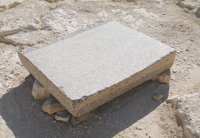
    image_19
    Machined granite slab at Abu Rawash. Image courtesy of the author.

    The most intriguing aspect of Abu Rawash, though, lies on its south side, a hundred feet or so from the base of the pyramid. There is a pink granite slab approximately four feet in length, three feet wide, and a foot in thickness. It’s propped up on a dozen or so stones the size of a softball. The granite stone is pristine, as if it was hidden away for thousands of years and only recently uncovered. The surface of the stone is smooth to the touch and at its top is an arc, precise in its edge, which separates the stone’s smooth surface from its rough. On the smooth surface there are two slice marks, one near the top and another toward the bottom. And as you look close at the stone’s surface, minute horizontal striations are clearly visible in the same pattern of the separating arc.

    Unmistakably, this pink granite slab was cut using a machine; irrefutable evidence that whatever construction crew was responsible for the pyramid at Abu Rawash, they were using some type of power saw. Abu Rawash isn’t the only place, either.

    There is evidence elsewhere that powered equipment was used by the pyramid builders – on the Giza Plateau, on the east side of the Great Pyramid at the north end of the basalt patio. Originally, the machine marks on these stones were not visible, hidden by adjoining blocks of a finished patio. But sometime over the course of the last four thousand years or more scavengers removed a number of blocks from the patio’s periphery, particularly the north end, exposing what the pyramid builders did not want anyone to see. Mistakes made by the men who operated the saws. At Giza, the evidence is just as compelling as what exists as Abu Rawash.

    WAS THERE A CIVILISATION X?

    Since the ancient Egyptians that lived from the third through the first millennium BCE were not known to have developed machine technology, and no other civilisation since has until modern times, the builders responsible for the stone at Abu Rawash and the Great Pyramid’s basalt patio must have existed at a remote time in prehistory. The evidence speaks for itself.

    There was Civilisation before Civilisation. I like to refer to it as Civilisation X.

    Who were they? Was Egypt a colony of Atlantis as some theorists have put forth? Or were they an unknown culture never described by ancient peoples?

    Although everyone knows that the story of Atlantis is attributed to the Greek philosopher Plato, most people don’t realise the story of Atlantis is Egyptian in origin. According to Plato’s dialogues Timaeus and Critias, he heard the story second hand from his uncle Solon who originally heard it from the temple priests at Sais where the Atlantis tale was said to be inscribed upon the temple’s pillars. Unfortunately, such an inscription has never been found. So no one knows whether or not Plato’s story of Atlantis is fact or fiction.

    There’s no question that Plato’s tale of Atlantis was a social moral. The pertinent question is, in my opinion, was there a kernel of truth to the story? In other words, was Plato inspired to write Timaeus and Critias from known history of the time?

    I think that is likely the case. There are a number of ancient cataclysm myths such as the Greek’s Deucalion’s Flood, the Hopi’s ‘Blue Star’, Sumer’s ‘The Epic of Gilgamesh’, and Egypt’s story of ‘Hathor as the Eye of Ra’, just to name a few. There are also two tales of catastrophe in the biblical Genesis, Noah’s Flood and the Tower of Babel.

    In modern times these ancient stories of death and destruction have been attributed to fantasy or a way of explaining life’s mysteries. I think such an interpretation is not only superficial but an insult to our ancestors. Who are we to say they were primitive and ignorant in their understanding of the world around them?

    Indeed, we should understand these ‘myths’ for what they are, ancient history told as a story in oral tradition that was designed to be understood as metaphor to be interpreted, and not a literal account. With that in mind, a fresh look at the biblical Tower of Babel story allows unique insight into our remote past. On its surface, the Tower of Babel story is just another fable where God’s wrath befalls an unsuspecting world:

    The whole world had one language and a common speech. Mankind was capable of planning and completing just about anything. Now the whole world had one language and a common speech. As men moved eastward, they found a plain in Shinar [Babylon] and settled there.

    They said to each other, “Come, let’s make bricks and bake them thoroughly.” They used brick instead of stone, and tar for mortar. Then they said, “Come, let us build ourselves a city, with a tower that reaches to the heavens, so that we may make a name for ourselves and not be scattered over the face of the whole earth.”

    But the LORD came down to see the city and the tower that the men were building. The LORD said, “If as one people speaking the same language they have begun to do this, then nothing they plan to do will be impossible for them. Come, let us go down and confuse their language so they will not understand each other.”

    So the LORD scattered them from there over all the earth, and they stopped building the city. That is why it was called Babel – because there the LORD confused the language of the whole world. From there the LORD scattered them over the face of the whole earth.

    – Genesis 11:1-9

    Taken literally the story makes little sense. However, as metaphor the imagery is easy to understand. First, the word Babel in Hebrew sounds like the Hebrew word for confused. In my opinion what they were building was not a literal tower. In fact, the tower they were building was not a tower at all. The tower represents the technical state humanity had achieved at that time and that they were building a great civilisation. The text is clear on this point: “mankind was united through a single language and could accomplish just about anything.”

    It’s ludicrous to think that some magic event occurred that picked people up and moved them across the world while at the same time mysteriously altering their language. This, too, is metaphor.

    In the insurance industry customers are protected from floods, fires, tornados, and other unfortunate events. They are referred to as ‘Acts of God’ and are nothing more than natural disasters. Today, although we know that the disaster is a result of nature, we still perceive these events as acts of God. And a number of people, particularly those who hold spiritual views, assign their responsibility to God. Why would it be any different five thousand years ago?

    I don’t think it would. We still blame God today for all sorts of personal disasters.

    What the Tower of Babel story is expressing in metaphor is that a natural disaster of immense proportions occurred that decimated civilisation. Over many generations, isolated pockets of survivors struggled back onto the road of civilisation, and because of their isolation unique languages developed in diverse regions.

    HISTORY UNLEASHED

    According to history pundits, civilisation emerged around the world at about the same time, around 3000 BCE; in the Nile Valley, the Indus Valley, Mesopotamia, as well as South America at Caral, Peru and Japan from within the Jomon culture. Scholars interpret the sudden rise in societal organisation as an evolutionary phenomenon, a natural progression of humankind. But how do we know that as a fact?

    We don’t. It’s an assumption based solely on archaeological evidence, and given the evidence for the use of powered equipment at Abu Rawash and Giza, and the scientific modelling of the subterranean section of the Great Pyramid, it appears to be a false assumption.

    Maybe we should pay more attention to ancient myth such as the story of Hathor as the Eye of Ra and ancient records such as the Palermo Stone or the Turin Papyrus.

    According to the Turin Papyrus, before Egypt’s first dynasty – preceding 3000 BCE – the ‘Followers of Horus’ ruled for 13,000 years and before them ‘the gods’ ruled for 20,000 years. Thus, according to the ancient Egyptians their civilisation’s history dates back 36,000 years.

    What happened to obscure this history?

    Between 14,000 BCE and 9,000 BCE catastrophe occurred on our planet, a cataclysm we simply refer to as ‘the end of the Ice Age’; science refers to it as the Terminal Pleistocene Extinction. We know for a fact that during that time many large mammalian species became extinct. If civilisation existed at that time, and the evidence is convincing that it did, the women and men living at that time would also have suffered the consequences of global calamity. For the survivors it would have been a long and difficult journey on the road to re-establishing civilisation.

    Edward Malkowski‘s book – Ancient Egypt 39,000 BCE: The History, Technology & Philosophy of Civilization X – takes a fresh look at the physical and textual evidence for a technical, prehistoric civilisation.

    [alert type=”general” dismiss=”no”]This article was published in New Dawn Special Issue 8.[/alert]

    [alert type=”success” dismiss=”no”]If you appreciate this article, please consider subscribing to help maintain this website.[/alert]

    © New Dawn Magazine and the respective author.
    For our reproduction notice, click here.

  • Restoring Your I-sight: How the Soul Unites the Senses in Healthy Seeing

    Restoring Your I-sight: How the Soul Unites the Senses in Healthy Seeing

    Much of medical science deals strictly with the body, while denying – or at least largely relegating to the background – our inner soul essence. This view is particularly prevalent in conventional vision treatment where eyesight is considered to be a camera-like process which creates an image that’s either in or out of focus. Such a one-tiered approach results in a lopsided notion of what is normal. Eyeglasses are so commonplace in our culture, they’re considered virtually natural extensions of the human anatomy. People seeing clearly with their own eyes are becoming a rare breed.

    In more recent years, the quest for a novel approach to vision treatment took a technological leap with the advent of refractive eye surgery, also known as laser eye surgery, or by the acronym of LASIK, a popular procedure. In a way, this technology is turning full circle back to Mother Nature’s design, touting 20/20 vision (or very close to it) with a natural appearance and no fuss. According to the industry, these purported outcomes involve minimal risk and have high patient satisfaction rates.

    However, more cases of patients with negative outcomes – ranging in scale from continual annoying symptoms to disabling complications and worsening eyesight – are coming to the forefront in the media and on the Internet. Tragically, a few cases have ended in suicides.The furore prompted the US Federal Drug Administration (FDA) last year to publicly hear statements from affected patients. The FDA panel reiterated that refractive eye surgery, like any surgery, has its risks but has an excellent overall track record. Nevertheless, to bolster the safeguards, they recommended enhanced patient screening methods and further post-operative studies by the industry. (Interestingly, the eye doctor who chaired the FDA panel wears glasses. Although she regularly performs refractive eye surgery, she chooses not to undergo the procedure herself, citing one of the reasons as an aversion to any level of risk.)

    Lost amid the allure and debates over technological treatments is an obscure alternative called natural vision improvement (NVI). As the name implies, it’s a more nature-centred approach, a holistic mind-body method that seeks to reverse an imbalance induced by a response to stress. It introduces a psychological component, counter to most prevailing notions that the physical eyes somehow just “go bad” with no hope of improving. For those attuned to esoteric traditions – or the “Perennial Philosophy” as writer Aldous Huxley put it – the psyche is simply a secular name for the soul.

    To understand how NVI succeeds on the personal soul level, the work of spiritual scientist Rudolf Steiner offers some insights. While embodied within a physical form, our soul is said to be a link between the “lower” physical world and the “higher” world of the spirit in which we simultaneously participate. Steiner further suggested that a portion called the sentient soul is responsible for our experience of sensation. He also distinguished between the terms perception and sensation; perception comes first and is fleeting, but the sensation which follows lasts.

    When external light reaches us, the eyes initially register myriad perceptions from our environment. Then something lights up in the sentient soul when certain perceptions are filtered and sensations come alive with personal vividness and quality. For example, when you behold a red object with your eyes, you initially perceive the colour. However, this colour perception ceases once you look away, but the sensation that it makes upon you continues to linger in your soul. It’s a lasting impression that may be later recalled, whether to ponder its meaning and significance or to rekindle nostalgic sentiments and feelings.

    Because our sensations illuminate internally in a unique and private way, Steiner contended that this soul activity is not a mere brain process. Science can describe the various light, chemical and nerve stimuli along the chain from the eye retina to the brain, but he noted that nowhere can our actual sensations be found in this chain. The sentient soul is said to also partake in the intrinsically private activities of feelings, emotions, drives and instincts, as well as willing, where our soul flows outward through actions.

    Such a perspective of soul activity aligns with other researchers’ distinctions of mind and brain. Neurophysiologist Wilder Penfield once determined that no amount of electronic probing in the various areas of the brain would elicit a person to believe or decide. He concluded that the mind seems to work independently of the brain, analogous to a computer programmer acting independently of the firings within the computer. Penfield suggested that the mind has its own energy that is different from the neurons that travel the pathways within the brain.

    Michael Polanyi, philosopher of science and social science, arrived at the same conclusion when he stated that thoughts and neural processes are two completely different things.

    Religious author Huston Smith concurs, suggesting “the brain breathes mind like the lungs breathe air.”

    We typically think of having five senses – sight, hearing, smell, taste and touch – with sight generally considered to be the most important in its ability to perceive shades of lightness and different colours. However, Steiner recognised that we have at least seven more than these basic senses. By the term sense, he meant a perception which provides us with immediate information without the involvement of a thought process. One of the additional senses he noted was what he called movement, what is nowadays termed proprioception. Movement is that special sense which indicates whether we’re still or moving, providing direct feedback where our joints, tendons and muscles are in space.

    Steiner also recognised how the various senses work together, not in isolation. Although each sense may be categorised for the sake of definitions, our soul reunites the separate perceptions into a unified whole that provides coherent inner meaning. Of particular note, he was well aware that vision encompasses more than the sense of sight. In 1919, he knew the important role that the sense of movement plays in visual sensation:

    We nearly always see things so that when they give the colours to us, they also show us the boundaries of colours, namely, lines and forms. We are not normally aware of how we perceive when we perceive colour and form at the same time…. At first you see only the colour through the specific activity of the eye [sense of sight]. You see the circular form when you subconsciously use the sense of movement and unconsciously make a circular movement… When the circle you have apprehended through your sense of movement rises to cognition, it is then joined with the perceived colour. You take the form out of your entire body when you appeal to the sense of movement spread out over your entire body…. Today, official science is not at all interested in such a refined way of observation, so it does not distinguish between seeing colour and perceiving form with the help of the sense of movement… In the future, however, we will not be able to educate with such confusion. How will it be possible to educate human seeing if we do not know that the whole human being participates in seeing through the sense of movement?

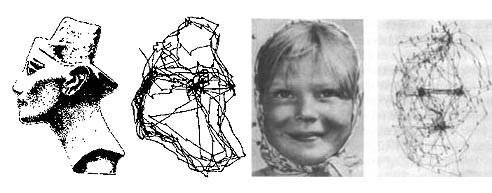
    Decades later, Steiner’s comments appear to have been validated by Alfred Yarbus, a psychologist who studied the eye movements of people looking at natural objects and scenes. In the 1950s and 1960s, he recorded the rapid saccadic eye movements that occur within milliseconds and demonstrated with remarkable images how the eyes subconsciously scan forms and outlines with incredible speed. Figure 2 has examples from Yarbus’ work.

    image006 copy
    Figure 2 – The sense of movement in vision. Rapid eye tracing movements corresponding to images viewed (Yarbus, 1967).

    Steiner’s observations are also quite extraordinary when related to NVI fundamentals of proper vision. William Bates was an eye doctor who broke from the mold of orthodox teachings and single-handedly established the field of NVI back in the early 1900s. Two of Bates’ guiding fundamentals are what he called shifting and apparent movement (also called the swing), both which involve our sense of movement.

    The eyes, which move by different sets of surrounding muscles, must continually shift from point to point to prevent the strain of fixation. Otherwise, the subconscious saccadic movements become sluggish and vision begins to blur within seconds. It’s analogous to grasping a heavy object in your hand and holding it tightly in an extended arm position. The muscle strain cannot be held long before you lose your hold and drop the object. If we fixate for too long in an attempt to “hold” a point in our sight with intense concentration, the effort backfires and we lose the clarity of sight.

    As for oppositional movement, stationary objects in our peripheral field of vision must have the appearance of moving in an opposing direction. This swing is a natural consequence of the first fundamental, the shift.

    Bates explains the illusion of the swing: “Your head and eyes are moving all day long. Imagine that stationary objects are moving in the direction opposite to the movement of your head and eyes. When you walk about the room or on the street, notice that the floor or pavement seems to come toward you, while objects on either side appear to move in the direction opposite to the movement of your body.”

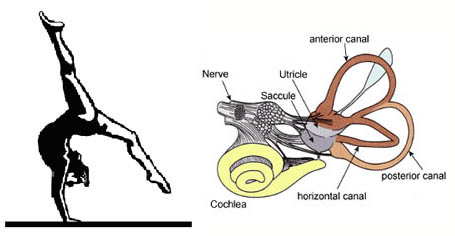
    If one attempts to stop this illusion of oppositional movement, Bates claimed it caused vertigo or dizziness. That’s because our sense of balance also comes into play for effective vision. Coordinated body movements and eye movements depend on good balance, controlled by the organs in the inner ears.

    In more recent years, the role of movement and balance in visual perception has been recognised in a speciality field called developmental or behavioural optometry. They have made the connection between visual difficulties, mental development, and emotional behaviour, with such problems as dyslexia, slow reading and poor comprehension, ADHD and juvenile delinquency. Some children have difficulty reuniting the individual senses as a unified whole, causing a jumbled imbalance of sensations, thoughts and emotions.

    The importance of training which integrates the senses with whole-body movements is a hallmark of this specialised field of optometry. The training typically incorporates bouncing on the trampoline with rhythmic arm and hand movements and visual interaction with special wall charts. Or the child could be instructed to call out answers to rapid-fire mental tasks – like mathematics or spelling – while jumping on the trampoline. Balance beams are also used in combination with sensory, physical and mental tasks.

    In a separate field of study, psychiatrist Harold Levinson treated thousands of cases of learning disabilities and phobias and discovered a common physical correlation. Over 90 percent of his patients who were dyslexic or phobic had a malfunction of the inner-ear system. These more recent findings validate what Steiner suggested back in his day: mental disorders are linked to physiological disorders.

    “But one will find over and again,” he wrote, “that especially in so-called mental illness – which actually has been, as such, incorrectly named – physical processes of illness are present in a hidden way somewhere. Before one wants to meddle. . . with mental illness, one ought actually, with the proper diagnosis, to determine which physical organ is involved in the illness.” Thinking, feeling, and willing – soul activities which follow from our senses – are all interrelated and interdependent.

    image009 copy
    Figure 3 – The sense of balance in vision. The inner ear regulates balanced eye movements.

    In our highly technological era, we are intently centred on the physical realm, bombarded with sense data from the external environment. Such sensory overload may induce responses in an individual’s soul, such as fear and anxiety, while causing overconcentration and staring. The net result can lead to a habitual strain pattern that restricts movement and negatively impacts the healthy functioning of the eye-focusing muscles. School age children are especially prone to such problems and begin to develop vision problems early as a result.

    One of the most fascinating aspects of improving eyesight naturally is a “flash” of near perfect vision that spontaneously occurs from time to time. I experienced flashes several times prior to having any knowledge of the phenomenon. They appear very early in the vision improvement process for many people, even for those with a high degree of initial blur. I liken the experience to a flash of inspiration or intuition from the spiritual realm, a Divine Perfection pouring into the soul, reminding the eyes how to see clearly again without strain. It’s also a reminder to step back from the stressful demands of a society fixated on material ends and become more in touch with our higher spiritual nature.

    Quantum physicist Arthur Zajonc chronicled the scientific study of light and visual optics from the time of the early Greek philosophers to our current age and laments at the gradual demise of artistic and spiritual insights in the endeavour. Throughout the centuries, Plato’s light of the soul in visual perception was eventually excised by science to the point we are today – a pure neurophysical model – even though the nature of light is as enigmatic as ever.

    We’ve become so steeped in material pursuits that we’ve “lost sight” of the spiritual side. If physical light is the counterpart of spiritual light, perhaps the visual blur that’s endemic to modern culture is a manifestation of spiritual myopia?

    Observe the symmetry in the word “eye” itself. I view it as a symbol of our threefold nature. One “e” represents the exoteric, or physical realm, while the other “e” represents the esoteric, or spiritual realm. The “y” in between is the soul with three branches, two linking body and spirit, while the third points to the “I” (pronounced the same as “eye”) that is the centre of our soul. Window of the soul, indeed!
    [alert type=”general” dismiss=”no”]This article was published in New Dawn 114.[/alert]

    [alert type=”success” dismiss=”no”]If you appreciate this article, please consider a contribution to help maintain this website.[/alert]

    Bibliography

    William H. Bates, The Cure of Imperfect Sight by Treatment Without Glasses, New York: Central Fixation Publishing, 1920. Reprint, Pomeroy, Wash.: Health Research Books, n.d.
    William H. Bates, “Perfect Sight,” Better Eyesight, September 1927
    Aldous Huxley, The Perennial Philosophy, New York: Harper and Brothers, 1945
    LASIK Complications website, www.lasikcomplications.com
    Harold N. Levinson, Phobia Free, with Stephen Carter, New York: M. Evans and Company, 1986
    Wilder Penfield, The Mystery of the Mind: A Critical Study of Consciousness and the Human Brain, Princeton: Princeton University Press, 1975. Quoted in Huston Smith, Forgotten Truth: The Common Vision of the World’s Religions (New York: Harper Collins, 1992), 64-65
    Michael Polanyi, Personal Knowledge, Chicago: The University of Chicago Press, 1958. Quoted in Huston Smith, Forgotten Truth: The Common Vision of the World’s Religions (New York: Harper Collins, 1992), 63
    Huston Smith, Forgotten Truth: The Common Vision of the World’s Religions, New York: Harper Collins, 1992
    Rudolf Steiner, A Psychology of Body, Soul, and Spirit: Anthroposophy, Psychosophy, & Pneumatosophy, Translated by Marjorie Spock, Herndon, Va.: Anthroposophic Press, 1999
    Rudolf Steiner, Polarities in Health, Illness and Therapy, Lecture, Pennmenmawr, N. Wales, August 28, 1923. Spring Valley, NY: Mercury Press, 1987. Rudolf Steiner Archive. wn.rsarchive.org/Lectures/Polart_index.html
    Rudolf Steiner, The Foundations of Human Experience, Translated by Robert F. Lathe and Nancy Parsons Whittaker, Herndon, Va.: Anthroposophic Press, 1996
    Rudolf Steiner, Theosophy: An Introduction to the Spiritual Processes in Human Life and in the Cosmos, Translated by Catherine E. Creeger. Herndon, Va.: Anthroposophic Press, 1994
    Alfred Yarbus, Eye Movements and Vision, New York: Plenum Press, 1967
    Arthur Zajonc, Catching the Light: The Entwined History of Light and Mind, New York: Bantam Books, 1993

    © New Dawn Magazine and the respective author.
    For our reproduction notice, click here.


  • Intuition: Delusion or Perception? Toward a Scientific Explanation of the Akashic Experience

    Intuition: Delusion or Perception? Toward a Scientific Explanation of the Akashic Experience

    The intuitions reported by mystics, poets, artists, ordinary people, even scientists, often go beyond the range of sensory perception. In the reductionist culture inspired by classical science, they are dismissed as mere delusion – classical empiricism claims that there is nothing in the mind that was not first in the eye. However, the classical tenet is not universally upheld. It is exceptional in the annals of history, and even in the context of contemporary cultures.In history intuitions were embedded in the conceptual framework through which a given culture interpreted the nature of reality. In indigenous societies shamans and medicine-men (and women) tuned themselves to spontaneous apprehension through rigorous initiation and training; they derived their mystical vision from them. In mythically oriented societies the world was seen as a cosmic realm of spirits, and in classical cultures it was believed to be governed by a panoply of unseen gods. The Abrahamic monotheistic religions recognised the intuitions of their prophets as conveying fundamental truths about God and the nature of His creation. Eastern cultures have always held that reality extends far beyond the domain of the senses.

    On the other hand Western culture takes as real only that which is manifest – literally “to hand.” Because what people see is constrained by what they believe they can see, everything that is not conveyed to consciousness by eye and ear is dismissed from the modern view of the world. But are the intuitions that occasionally surface in consciousness mere delusion? Or can there be intuitions that are as real and fundamental as sensory perception? This question calls for a deeper look at the possibility that spontaneous insights and apprehensions may have a physical basis. There are findings at the cutting-edge of scientific research that affirm this possibility.

    The Brain as a “macroscopic quantum system”

    The crucial finding is the discovery that the brain is not merely a classical biochemical system; in some respects it is a “macroscopic quantum system.” Certain cerebral functions involve processes previously thought to be limited to the domain of the quantum. The pertinent functions concern the reception and transmission of information at the cellular and subcellular level: intercellular communication involves quantum-effects and processes. Neurons and neuronal and subneuronal networks form synchronised oscillators that receive and send information through quantum resonance. This information propagates quasi-instantly throughout the organism and does not require classical channels of signal transmission. The various forms and characteristics of information transmitted through quantum resonance are not fully understood, but their physical basis is clear. It is nonlocality, the process Einstein first said is “spooky” and then Erwin Schrödinger termed “entanglement.” Entanglement means that the states and functions of the entangled entities are correlated beyond the ordinary bounds of space and time. As a result the entities are intrinsically and fundamentally coherent. Such coherence obtains in the domain of the quantum: in pristine states quanta are coherent and mutually entangled. Only interaction in some form (measurement, and possibly certain acts of observation) renders them decoherent. Macroscale objects were said to be in a permanently decoherent state, yet certain objects also exhibit forms of quantum coherence. There is experimental evidence that the state of entire atoms can be entangled, and in recent years quantum-coherence has been discovered at the scale of living organisms. The divide between the microworld of the quantum and the world of macroscale objects has been breached. The heat of living organisms – even of warm-bodied species – does not necessarily destroy the coherence that is the precondition of entanglement. While classical quantum theory maintained that at ordinary temperatures Brownian movement made quanta, so-called “qubits,” decoherent and thus incapable of entanglement, recent research (inter alia by Kitaev, Pitkanen, and Frecska and Luna) indicates that the problem of “heat-decoherence” is not insuperable.1

    There appear to be networks of quanta where the particles are “woven” or “braided” in a way that is sufficiently robust to maintain coherence at body temperatures. Whereas at such temperatures classically organised qubits become decoherent, networks of woven or braided qubits conserve coherence. As Parsons put it, “braiding is robust: just as a passing gust of wind may ruffle your shoelaces but won’t untie them, data stored on a quantum braid can survive all kinds of disturbance.”2 Quantum coherence in the brain and throughout the organism is not just theoretical speculation; it is entirely fundamental for coordinating the processes that make life possible. The staggering number of physical and chemical reactions taking place in the living organism is not likely to be coordinated by limited and relatively slow biochemical signal-transmission alone. Only the “entanglement” of the organism’s cellular and subcellular components can ensure a sufficiently rapid flow of multidimensional information to maintain the organism in its physically improbable state far from thermal and chemical equilibrium.

    Cytoskeletal Structures

    Roger Penrose and Stuart Hameroff suggest that cytoskeletal structures in the brain are responsible for the reception, computation, and transmission of multidimensional quantum-resonance-based information. Throughout the organism cytoskeletal proteins are organised into a network of microtubules, and the elements of these networks are connected to each other structurally by protein-links and functionally by gap junctions. However, the network of microtubules may be too coarse-grained to produce quantum-effects in the brain. The “infoplasm,” the basic substrate of living matter, may be the microtrabecular lattice, a web of microfilaments 7 to 9 nanometer in diameter. The periodic lattice of microtubules forms a network within the network of neurons, and the microtrabecular lattice is a network embedded in the network of microtubules. According to Ede Frecska, it is this lattice that is likely to be the structure responsible for quantum-effects in the brain. It appears physically possible that the quantum-scale components of the cytoskeletal lattice convey information from the world to the brain. The question is, what information? How does information originate in the world at large?

    The Akashic Field

    Until recently, asserting that information is objectively present in nature and not only in the human realm was considered metaphysical. This is no longer the case. It is now recognised that information is present in all things; as John Wheeler remarked, in some respects it the most fundamental feature of the universe. Experiments designed to test the Einstein-Podolski-Rosen hypothesis indicate that already quanta behave in an informed manner: they appear to make choices of their own, and respond to choices by other quanta. Either they have a form of consciousness (a thesis entertained by some physicists), or they are embedded in a complex informational environment. The latter is the minimally speculative assumption. It suggests that even in the absence of matter space is neither empty nor passive. As this writer among others has suggested, cosmic space is not a vacuum, but a plenum. In recognition of the prophetic insight of ancient Sanskrit and Hindu cosmology – where Akasha is the most fundamental of the five elements, the one from which the others arise – this writer calls the field that fills cosmic space the “Akashic Field.”3

    The idea that space is active and filled with physically significant events is not unique to Sanskrit and Hindu cosmology; it has noteworthy antecedents also in the history of science. In the nineteenth century, mathematician William Clifford suggested that small portions of space are analogous to little hills on a surface that is flat on average; the geometry of the landscape does not hold for them. The property of space to be curved or distorted, he said, is continually being passed on from one portion of space to another after the manner of a wave. In the physical world there is nothing else but this wavelike variation.4

    In a 1930 paper, “The concept of space,” Albert Einstein noted, “We have now come to the conclusion that space is the primary thing and matter only secondary; we may say that space, in revenge for its former inferior position, is now eating up matter.”5 A few years later Erwin Schrödinger restated the same thought: “What we observe as material bodies and forces are nothing but shapes and variations in the structure of space.”6 In physical cosmology cosmic space is seen as a ceaselessly fluctuating sea of emerging and vanishing virtual particles. In grand-unified and super-grand unified theories all the universal fields and forces of nature are traced to origins in the quantum vacuum, a fundamental hyperspace often viewed as a unified field. This fundamental field carries also zero-point energies – energies that remain present when at the absolute zero of temperature conventional forms of energy vanish. The concept of a complex unified field, effectively the Akashic Field, offers a basis for identifying the origins of the information that quantum processes transfer to the brain. It is known that as a consequence of their motion atoms, molecules and all material entities (i.e. structures composed of massive particles) produce electromagnetic waves that radiate into surrounding space. Space, however, is not empty and passive, and it is more than Maxwell’s extended electromagnetic field. It is the locus of the Akashic Field. The waves emitted by moving objects excite and modulate this field, creating wavefronts that propagate in the field and, upon meeting, interfere with each other. The interference patterns that result carry information at their nodes on the objects that created the waves. Because the Akashic Field is a seamless medium that extends throughout space, the information carried by the interference patterns produced by moving objects extends throughout space. This information corresponds to the physical properties of the objects.7

    The process is similar to that which occurs in holography. The holograms created by interfering beams of light conserve information on the surface of the things and events that modulated the light beams. But the interference patterns responsible for quantum coherence are created by waves in the Akashic Field, and not by photons in the electromagnetic field. Thus they are not ordinary, but quantum holograms. Walter Schempp has shown that quantum holograms are coherent, mutually entangled, and carry nonlocal information on the things and events that produced the constituent waves. He has also shown that the brain’s object imagery is phase conjugate. Lending support to Karl Pribram’s “holonomic brain theory,” Schempp affirmed that “the conditions which make quantum holography possible are ideally suited to the hypothesis that the brain works… by quantum holography.”8

    The answer to the question regarding the origin and nature of the information transferred by quantum-resonance to the brain can now be essayed. When the phase and frequency of a cerebral lattice corresponds to the phase and frequency of a quantum hologram, brain and hologram enter into phase-conjugate resonance. This allows the information conserved at the nodes of Akashic Field quantum holograms to be transferred to the cerebral receptors. Thus some of the intuitions that reach consciousness are not merely delusion: they are transmitted by phase-conjugate resonance from the Akashic Field to the cytoskeletal structures of the brain. Just which intuitions have this physical origin cannot be ascertained at this time merely by examining the pertinent cerebral processes. We need to resort to circumstantial evidence, examining the correspondence of the content of the intuitions with things and events known to exist in the real world through ordinary sensory perception. But we can affirm in good conscience that it is entirely plausible some intuitions have a bona fide physical basis. And that, in itself, goes a long way toward legitimating belief in the veridical nature of at least some of our intuitions.

    A Concluding Note

    Although widely reported and often meaningful, intuition is seldom the subject of sustained scientific research. The classical empirical tenet of mainstream science discourages attempts to investigate the phenomenon: it is physically implausible if not categorically impossible. Yet sustained research on intuition would be potentially fruitful and extremely important. In the positive case it would show that the human brain and nervous systems can access information in a spontaneous mode. While some varieties of experience viewed as intuition could well be delusion, there could also be spontaneous apprehension for which we can find an acceptable scientific explanation. This would lend support to the frequently voiced belief that human beings – and by implication all living things – are connected with each other and with nature in ways that are more subtle than those that stimulate the senses. This in turn would reinforce and legitimate empathy and solidarity among people and a closer sense of rapport with nature – vitally important attributes in our critical times when we face problems we can only resolve in cooperation with each other and harmony with our environment. This article is based on the author’s latest book The Akashic Experience: Science and the Cosmic Memory Field (Inner Traditions, Rochester, USA).
    [alert type=”general” dismiss=”no”]This article was published in New Dawn 114.[/alert]

    [alert type=”success” dismiss=”no”]If you appreciate this article, please consider subscribing to help maintain this website.[/alert]

    Footnotes:

    1. Alexei Kitaev, 1997, Quantum error correction with imperfect gates, in Proceedings of the Third International Conference on Quantum Communication and Measurement, edited by O. Hirota, A.S. Holevo, and C.M. Caves, New York: Plenum Press; Pitkanen, Matti, 2006, Topological Geometrodynamics, Frome, UK: Lunilever Press; Frecska, Ede and Luis Eduardo Luna, 2006, Neuro-Ontological Interpretation of Spiritual Experiences, Neuropsychopharmacologia Hungarica, 8(3), 2006.
    2. Paul Parsons, Dancing the Quantum Dream, New Scientist 2431: 31-34, 2004.
    3. Ervin Laszlo, The Connectivity Hypothesis, Albany: State University of New York Press 2003; Science and the Akashic Field, Rochester, Vt.: Inner Traditions International 2004; Quantum Shift in the Global Brain, Rochester, Vt.: Inner Traditions International, 2008.
    4. William Clifford, in Wolf Milo and Geoff Haselhurst, Einstein’s Last Question, VIA: Journal of Integral Thinking for Visionary Action, Vol. Three, No. 1, 2005.
    5. Cited in Wolf and Haselhurst, op. cit.
    6. Erwin Schrödinger, in Schrödinger: Life and Though, Cambridge University Press, London, 1989.
    7. Peter H. Fraser and Harry Massey, Decoding the Human Body-Field, Rochester, Vt.: Inner Traditions International, 2008.
    8. Walter Schempp, Quantum Holography and Magnetic Resonance Tomography: An Ensemble Quantum Computing Approach, Informatica (Slovenia) 21(3), 1997; Karl Pribram, 1991, Brain and Perception: Holonomy and Structure in Figural Processing (John M Maceachran Memorial Lecture Series), Mahwah, NJ: Lawrence Erlbaum, 1991.

    © New Dawn Magazine and the respective author.
    For our reproduction notice, click here.

  • The Captain Cook Conspiracy

    The Captain Cook Conspiracy

    From New Dawn 113 (Mar-Apr 2009)

    Historians and archaeologists consistently ignore solid evidence that Captain James Cook was not the first European to discover Australia while government agencies regularly prohibit access to shipwreck sites which would uncover proof for this assertion.

    Why is the true history of Australia being covered up? Why does history treat Captain Cook so kindly, despite the fact that in his later years he was an extraordinarily irritable man who, over the most trivial matters, did not hesitate to flog crew members or burn down entire native villages?

    And even though all of the expeditions he led ended in partial or complete failure, Cook is generally, almost universally, lauded as the greatest of navigators and his expeditions seen as milestones in navigation history – and on top of all that it is claimed Cook discovered Australia.

    Lately the claim has been modified a bit as most people now know that the Dutch were sailing along the coastline of west Australia a couple of hundred years before James Cook was born, and of course Abel Tasman sailed along the south of Australia (then called New Holland) and landed on Tasmania. We also know that the Indonesians traded with the Northern Australian Aborigines for at least 400 years before Cook. And most people now know that the Portuguese were trading out of Timor since the 15th century.

    So now we say Captain Cook discovered the east coast of Australia, or did he? And why does it matter if he did or did not?

    It matters because history shapes our world view, our culture and our social structures. If we believe a description of the past to be true when in fact it is false, our view of how we arrived at the present is flawed, which in turn allows powerful social structures and groups to exist which might not otherwise be able to justify their existence. This is why Japan avoids including true histories of World War II in its schools’ curriculum.

    The idea that an Englishman discovered Australia is fundamental to the maintenance of the notion of Australia as a pre-dominantly white Anglo-Saxon society. There are several subtle messages laying behind the notion of Captain Cook, the great English navigator, sailing around the world and discovering the vast continent of Australia. One of these was important in the 19th and early 20th centuries, affirming the inherent superiority of English society and technology as a justification of the British Empire’s dominion over much of the planet. Another was fundamental to the English claims of ownership of Australia, all of Australia, even though Cook only discovered the east coast.

    The British discovery of Australia also underpins Australia’s belief that the British system of government is the best, better than, say, the French or Spanish systems. Likewise, Australia’s legal system, both civil and criminal, is British as is the way we structure our police and miliary forces etc., not because they are the best ways of doing things but because they are the British way. Thus it has been important that the myth of the great Captain Cook was propagated and perpetuated over the last 200 years. Yet there were other nations who also had valid claims on Australia: the Dutch, the French and, importantly, the Spanish, England’s old nautical enemy.

    The story of Captain Cook was propagated where ever the English could plant the seed, certainly throughout the British Empire and by default most of North America, but is it the truth? Was Captain Cook the first European to discover Australia, even just the east coast?

    The answer in a nutshell is no. It’s as simple as that. Ask any Spaniard and he or she will tell you that Captain Cook used stolen Spanish maps to navigate his way around the Pacific. He also used copies of Abel Tasman’s maps, which he acknowledged because at the time Tasman’s maps were readily available. He does not acknowledge the Spanish maps, however when Cook arrived in Hawaii (which he claims to have been the first European to discover) he was recognised and greeted as a returning god, a god who had visited those islands many years before bringing the Hawaiians knowledge of agriculture. They recognised Cook as this god because he sailed a ship just like the one their previous visitor had sailed, and of which they still made venerated models. A tall, multi-masted ship with huge sails and no paddles: these were models of a Spanish ship.

    Cook was quick to see the advantages of being mistaken for a god and pretended to be that god in order to restock his ships with food and water. Sadly for Cook he overplayed his hand and over-taxed the generosity and tolerance of the Hawaiians who realised they had been both duped and exploited, and as a result killed Cook, then cooked and ate him. (Yes Cook got cooked.)

    The Spanish, who left the Hawaiians on better terms than Cook, had been regularly sailing the Pacific for about 300 years before Cook entered that vast ocean. Their presence there was the result of the combined efforts of Christopher Columbus and Ferdinand Magellan and Spain’s interest in maritime exploration, in the search of new lands. The Spanish ships sailed mostly from Mexico or Peru to Manila following a course utilising favourable winds and currents that flowed from east to west between 5 and 10 degrees south of the Equator until they reached Guam where they restocked with water and other supplies before the final leg of their journey to the Philippines. This was a treasure trade route vital to the Spanish and Mexican economies. Silver, gold and jewels were taken from the slave mines of South America to Manila in huge galleons where they were traded for silks, porcelains and other goods out of China and Asia. This was called the Manila galleon trade and each ship, and there were a number every year, carried enough wealth to equal a king’s ransom.

    The Spanish considered the Pacific and everything in it, including Australia, their property and felt completely secure in their Pacific domain until Sir Francis Drake sailed around Cape Horn and began pillaging the Spanish treasure fleets there.

    The Spanish Empire had been built around maritime exploration and expansion. It is inconceivable that Spanish ships sailed the Pacific Ocean for 300 years and not discovered a continent the size of Australia. But where is the proof?

    The Dieppe Maps

    Dieppe map

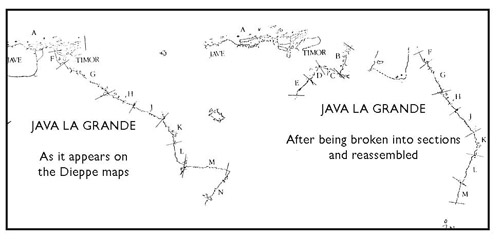
    The first and most obvious piece of proof which is continually ignored by mainstream Australian historians is a well known collection called the Dieppe maps, a set of maps made in the town of Dieppe in France in the 16th century. These provide clear proof of either Spanish or Portuguese exploration of Australia’s east coast at least two hundred years before Captain Cook. The maps clearly show the east coast of Australia as well as almost all the rest of Australia’s coastline. In the Dieppe maps the name given to the Australian continent is “Java la Grande.”

    The Dieppe maps have proved to be actual copies of Portuguese maps; another similar set of maps are the Dauphin maps after a series of copies of the Dieppe maps made for the French Dauphin. Also there is the Vallard map which is essentially the same map as the Dieppe and Dauphin maps.

    The Dauphin maps are elaborately decorated, not for any scientific or geographical reason but simply to make the maps more interesting to his Royal Highness the Prince Dauphin – an important thing to remember as many historians attempting to discredit these maps cite the images used in the decorations to dismiss the cartographic accuracy of the Dauphin maps.

    When considering the Dieppe maps one should remember just how important navigation maps were in the European world of 400 years ago. It was the “Age of Exploration,” a historic time of maritime expansion, of empire building, of ruthless exploitation and greed. It was an age of conquest, trade, navies and more greed.

    The rulers and populations of the European nations wanted wealth, whatever it took. The pathways to wealth were on the sea and those who possessed the navigation maps showing how to travel those pathways held the keys to unimagined riches.

    In those days (up until the 19th century) the information contained in items such as the Dieppe and Dauphin maps was often priceless, top secret, government property, and jealously guarded as the plans to nuclear weapons or interplanetary space travel might be guarded today. For this reason various nations and their captains contrived ways of concealing the information contained within their maps – maps in code so to speak. Cracking the secret code of those ancient Dieppe maps was the work of Australian Army map maker and surveyor Brigadier Lawrence Fitzgerald O.B.E., a man of genius largely ignored by mainstream academia.

    Brigadier Lawrence Fitzgerald

    Fitzgerald with his extensive practical and theoretical experience with maps and map making could clearly see there were sections of the Dieppe maps that resembled Australia’s coastline but there were also sections that did not. After considerable research the Brigadier discovered that the maps which ancient navigators used on ships were not in the form we generally think of – that is a huge rolled up sheet of parchment or paper that covered the Captain’s entire table. No, they were in sections on separate sheets generally kept loose in a folio or even in separate folios. To protect the information in the maps, should they fall into rival hands, the maps did not join up neatly or even had small components to make reassembling and interpreting the maps difficult or impossible if the keys to the codified maps were not available.

    Brigadier Fitzgerald realised that he only had to divide the Dieppe maps into the appropriate sections and then discover how to reassemble them in the correct order. This he did and in his book Java la Grande he clearly shows that the Portuguese had accurately and extensively mapped the Australian coastline more than 200 years before Cook. His work is largely ignored, even ridiculed, by most Australian and British historians. Why?

    The next question most people ask is: “If the Spanish and/or the Portuguese visited Australia before Cook, why are there no archaeological traces of them?” The answer is simple: “There are many.” But they are ignored, covered up, or hidden.

    Possible Pre-Cook Shipwrecks

    Sand miners uncovered the remains of an oak ship under the sand on a beach near Byron Bay. The ship was reburied in the sandmining process but a private citizen paid for a piece of timber retrieved from the ship to be carbon-dated by an independent laboratory. The results came back that the wood (oak) dated to the 16th century. Archaeologists from the University of New England, Armidale, New South Wales got excited and they organised for a magnetometer survey of the area. The ship was relocated under the sand and a dig planned to excavate it and solve the mystery. A week before the dig was scheduled to begin word came high in the New South Wales government that the dig could not proceed, and it was stopped. There were no reasons given. That was in 1995, and the shipwreck is still sitting there under the sand.

    Another example is a shipwreck buried under the sand dunes at Facing Island near Gladstone, Queensland. This shipwreck was seen after a storm in the early 19th century but its location was lost when the sand covered it again. A 5 feet (1700 mm) long bronze cannon with the date of 1596 stamped on it and other artefacts were found around Gladstone in the mid 19th century and the subject of articles in the early Australian press, several essays, investigations and books.

    In the late 1990’s the wreck on Facing Island was again exposed for a few days by a cyclone. Fortunately a fisherman saw it and took photographs as well as noting the shipwreck’s location, all of which he gave to the local Maritime Museum. The Maritime Museum, with suitably qualified personnel, applied to the government for a permit to investigate the shipwreck. The application was refused and a warning given that anyone attempting to excavate or otherwise investigate the wreck would face prosecution under the draconian penalties of Australia’s “Historic Shipwrecks Act.” The wreck is still buried under the sand on Facing Island.

    The list of possible pre-Cook shipwrecks is long and includes the “Mahogany ship” at Warrnambool. In the case of the Mahogany ship, the fact that it is described as being built of mahogany indicates it was built in either South America or the Caribbean as this is the only area that mahogany trees grow. As it was an old wreck in 1836 when it was first seen, it could only have been of Portuguese (Brazil) or Spanish (the rest of South America) origins.

    The Stradbroke Island Galleon in Queensland is a ship built of European oak about 30 metres long. It lays in a peat swamp where it was first seen in the 1860s and which the local Aborigines said had been in the swamp a long time. In the case of the Stradbroke galleon, we actually have historic records of Aboriginal oral traditions that report the arrival of the shipwreck victims in an Aboriginal camp and even the fact that one of them was named Juan!

    Both of these shipwrecks have an extensive presence on the Internet so I will not go into detail about them here; a simple Google search will bring up a wealth of information.

    Another ancient shipwreck was noted by Governor Oxley in 1821 off the beach at Fingal Head in Northern NSW. There is also a shipwreck at Caravel Creek in the Hinchenbrook Channel in Queensland and the list goes on.

    Pre-Cook Artefacts

    Apart from the pre-Cook shipwrecks there are numerous artefacts that have been found scattered around the sites of these wrecks or actually taken off the wrecks in the early days before the government actively intervened to suppress information about possible pre-Cook shipwrecks.

    For example, coins were found on the beach where the Mahogany ship is buried. These have generally been described as Spanish coins but I would guess they could be Portuguese as they have never been identified by experts.

    In the case of the Stradbroke Island Galleon there have been coins, a sailor’s dirk, a brass walking stick head dated by experts to Spain or Portugal in the 16th century, a rapier sword blade, a ship’s bell and various other items.

    A lead weight has been found by a university geologist while digging for pumice in undisturbed sand strata on Fraser Island, Queensland. This lead weight was accurately dated as having been laid down on Fraser Island over 400 years ago and, using radioactive isotope fingerprinting, the lead can be proved to have come from mines in the south of France.

    A bronze 16th century Portuguese cannon is on display at the Queensland Maritime Museum in Brisbane, which was found on the Great Barrier Reef. And the list goes on and on.

    Australian History

    Why is all this evidence ignored by Australian historians and archaeologists? Why does the government continue to block the excavation of possible pre-Cook sites?

    Until the Mabo court case and the granting of Aboriginal Land Rights, the obvious reason would have been the legal implications allowing a challenge to Cook’s pronouncement that Australia was Terra Nullus – unoccupied land. It was this proclamation that allowed Britain to occupy Australia without entering into negotiations with its existing occupants, the Aborigines.

    After Mabo this reason no longer applies and an even sillier, pettier motive may exist: the defence of reputations. Many Australian historians and archaeologists have for so long scoffed at the idea any nation reached and explored the east coast of Australia before Cook that they have entrenched themselves in their position. There is no way for them to change their “official” position without admitting they ignored solid scientific evidence in defence of a historic status quo. In universities and museums there are professors and doctors of history and archaeology who have painted themselves into a corner by systematically deriding all those who present theories or evidence that Cook was not the first European to discover and explore Australia. They use their influence and position to block any attempts to get the final proof they are wrong, proof that would require history books to be re-written and leave reputations in tatters.

    History shows us that these attempts to falsify history, to block discovery, ultimately fail. It’s only a question of time.

    Greg Jefferys is the author of the book The Stradbroke Island Galleon, The Mystery of the Ship in the Swamp, which is available as an e-book.

    [alert type=”general” dismiss=”no”]This article was published in New Dawn 113.[/alert]

    [alert type=”success” dismiss=”no”]If you appreciate this article, please consider subscribing to help maintain this website.[/alert]

    © New Dawn Magazine and the respective author.
    For our reproduction notice, click here.
  • Behold the Green Dragon: The Myth & Reality of an Asian Secret Society

    Behold the Green Dragon: The Myth & Reality of an Asian Secret Society

    From New Dawn 112 (Jan-Feb 2009)

    History certainly has no shortage of enigmatic or controversial brotherhoods, orders, lodges and societies. The Knights Templar, for instance, are a perennial object of fascination and speculation. Whether the Templars were the inspiration for the no less controversial Freemasons, a band of depraved heretics or the innocent victims of a conspiracy born of greed and envy remains a topic of lively debate.

    What no one can contest, however, is that the Knights existed. The beginning and formal end of the Order can be dated with precision, and the names of its leaders are a matter of historical record. Even a dubious organisation like the Priory of Sion can be shown to have had a genuine, if recent, existence, though its claims to centuries of tradition and hidden influence remain unsubstantiated. But there are other groups which seem to exist only in that gray zone between reality and imagination, ones whose origins, number, scope and purpose remain maddeningly vague.

    One such entity is the quasi-mythical Green Dragon Society (GDS), also known as the Order of the Green Dragon or simply the Green Dragon. It most often is mentioned as a Japanese secret society, but that is not necessarily the whole story. Other evidence, or at least allegation, argues that its true origins lay in China or Tibet and that its influence extended to the power centres of Tsarist Russia and Nazi Germany. Historical figures from the Emperor Hirohito, to Adolf Hitler to Rasputin have been tied to the Green Dragon, legitimately or not. The waters have been further muddied by role-playing games which have combined the Society with H. P. Lovecraft’s Cthulhu Mythos and other fictional elements. Determining what is “real” and what is the playful figment of someone’s imagination can be tricky.

    What follows will not solve the mystery of the Green Dragon, but it will try to separate fact from fiction and explain where claims and information came from. In doing so, it will offer a tantalising glimpse into a mysterious organisation that may have played a significant role in shaping modern history.

    Enter the Black Dragon

    The simplest explanation for the Green Dragon Society is that it is a muddled reference to the better known, and definitely real, Black Dragon Society (BDS) or Kokuryukai. The BDS first appeared about 1901 and was an offshoot of another, older Japanese secret society, the Black Ocean or Genyosha. Like its parent, the Black Dragon was a militant, “ultra-nationalist” body which worked to expand Imperial Japan’s influence on the Asian mainland. The BDS initially concentrated on combating Russian interests in the vast Chinese province of Manchuria. Indeed, the Society took its name from the “Black Dragon” or Amur River which separated Manchuria and Siberia. The Black Dragon’s network of spies and saboteurs took an active part in the subsequent Russo-Japanese War (1904-05) and the Black Dragons later expanded their operations and influence throughout Asia and Europe and even the Americas.

    The nominal founder and leader of the Black Dragon was Ryohei Uchida, but the true master, or “darkside emperor,” was Uchida’s shadowy and sinister mentor, Mitsuru Toyama, also a founding member of Genyosha. He reputedly was steeped in “extreme Eastern religious beliefs.”1 That suggests the mysticism and occultism attributed the Green Dragon Society. Might the scheming and secretive Toyama have played a guiding role in both societies?

    Were the Black and Green Dragons, if not one and the same, two sides of the same conspiratorial coin? For instance, just as the Black Dragon (Amur) River delineated the northern limit of Manchuria, further south the much smaller Qinglong or Green Dragon River roughly followed the dividing line between Manchuria and China proper. If the Black Dragon Society was primarily anti-Russian in its focus, might the Green Dragon have been anti-Chinese or anti-Western? While the Black Dragon focused on the political side, did the Green deal with the more secretive occult realm?

    One obscure but important reference which clearly distinguishes between the Black and Green societies appears in the memoir of Chinese strongman Chiang Kai-shek’s “second wife,” Ch’en Chieh-ju.2 She recalls that her husband contemplated a “completely secret system of private investigators” and considered as models the “Green and Black Dragon Societies of Japan and the Triad societies of Shanghai.”3 Thus, in Chiang’s mind at least, the two Dragons were entirely separate (though not necessarily unrelated), Japanese, and appropriate models for secret intelligence gathering.

    As noted, the Black Dragon Society was heavily involved in spying and the kindred spheres of propaganda and subversion. As such, it basically functioned as an extension of the Imperial Army’s “special organ,” the Tokumu Kikan. Not to be outdone in anything, the Japanese Imperial Navy maintained its own secret service, the Joho Kyoko. Just as the Army utilised the Black Dragon to augment or handle its “special needs,” might the Navy have used the Green Dragon in the same way?

    Trevor Ravenscroft & Karl Haushofer

    The identification of the Green Dragon as a fundamentally mystical order most evidently appears in Trevor Ravenscroft’s 1973 The Spear of Destiny. It is not insignificant that Ravenscroft was a follower of Anthroposophy and its founder Rudolf Steiner, and his book is a distinctly Anthroposophist take on the nefarious occult forces behind Hitler and his Nazi Regime. Ravenscroft firmly connects the Green Dragon to German geo-politician and mystic Karl Haushofer, one of Hitler’s presumed spiritual mentors. According to Ravenscroft, Professor Haushofer “gained… extraordinary gifts through membership of the Green Dragon Society of Japan in which the mastery of the Time Organism and the control of the life forces in the human body is the central aim of ascending degrees of initiation.” Ravenscroft adds that “one of the highest tests of this type of initiation in the Green Dragon Society demands the capacity to control and direct the life force in plants in a somewhat similar manner to the former powers of the Atlantean people.” “Only two other Europeans have been permitted to join this Japanese Order,” [and who, one wonders, were they?] continues Ravenscroft, “which demands oaths of secrecy and obedience of far more strict and uncompromising nature than similar secret societies in the Western world.”4

    The major problem with all this is that Ravenscroft’s sources are hazy or non-existent. He likely took a cue from the 1960 work of Louis Pauwels and Jacques Bergier, The Morning of the Magicians. Those authors claim that Haushofer “is said [by whom?] to have been initiated into one of the most important secret Buddhist societies and to have been sworn, if he failed in his ‘mission,’ to commit suicide in accordance with the time-honoured ceremonial.”5 Assuming this to be an allusion to the above GDS, we are still faced with the lack of any identifiable source for the authors’ information.

    Ravenscroft goes on the claim that members of the Green Dragon Society set-up shop in 1920s Germany and there joined forces with a group of Tibetan monks called the “Society of Green Men.” The latter were, in fact, the “Adepts of Agharti and Schamballah” and their leader was a mysterious “Man with the Green Gloves.”6 It also turns out that the Green Dragons and the Green Men had “been in astral communication for hundreds of years.”7 The united brethren soon established communication with the rising Herr Hitler.

    Others have since elaborated on the above by turning the Green Dragons into an “inner cabal” of both Genyosha and the Black Dragon, and making them “but an outpost of a much larger conspiracy based on the even more secretive group known and the Green Men.”8 While fascinating, such assertions appear not to have any basis in hard fact.

    But that is not to say they may not have a germ of truth. For instance, there was an occult figure in late Weimar Berlin sometimes referred to as the “Magician with the Green Gloves” who did become a short-lived soothsayer for Hitler and the Nazi Party. He was no Tibetan but, of all things, a Jew who went under the name of Erik Jan Hanussen. When he became inconvenient by accurately predicting the Reichstag Fire (or arranging it), his erstwhile Nazi pals killed him.9

    Likewise, there could very well be something to a Green Dragon-Tibet connection. A green dragon, or Zhug, plays an important role in Tibetan mythology where it symbolises the “God of Thunder… bravery and all-conquering force.”10 More to the point, perhaps, a Japanese Buddhist monk named Ekai Kawaguchi made two visits to Tibet in the years before World War I, around the same time Haushofer was in Tokyo. On the surface, Kawaguchi seemed a simple religious devotee, but he is known to have had contact with at least one Japanese secret agent while in the Land of Eternal Snows, Narita Yasuteru, as well as an operative of British Indian intelligence.11 Kawaguchi also had links to Annie Besant and her Theosophist sect, another group accused of subversion and general skullduggery.12 More significantly, Kawaguchi was a devotee of Zen Buddhism.

    In his 1989 The Unknown Hitler, Wulf Schwarzwaller claims that Haushofer was a master of various Eastern mystical traditions and “had familiarised himself with the Zen teachings of the Japanese Society of the Green Dragon.”13 More recent sources emphasise the Green Dragon’s intimate association with Zen, specifically its Soto branch, and claim that the “Green Dragon has had a tradition of secret propagation,” whatever that means.14

    The Buddhist connection may offer some important clues. Buddhism originated in India and spread to Tibet and China, and from there to Japan. Zen (Cha’an) doctrine also had its roots in China. One of the most revered Buddhist “saints” in Japan is Kukai, an 8th-9th century mystic who spent years studying in China. Interestingly, his main place of enlightenment was the Green Dragon Temple in Xian where he was trained in occult, tantric traditions originating in Tibet. Returning to Japan, Kukai incorporated these into his version of True Land (Shingon) Buddhism.15 The problem is that Shingon was and is quite distinct from Zen, so which, if either, is connected to the Green Dragon?

    To further complicate the picture, there are numerous references to a Chinese Green Dragon Society. Most are linked to the martial arts. Green Dragon kung fu societies are active throughout the world, but most appear to be of fairly recent origin. Oddly enough, during the 1960s, the Chicago-based Green Dragon Society was locked in a bitter feud with the rival Black Dragon Society! One version of the Chinese Green Dragon’s history pegs it as a Taoist secret society formed in response to the 17th century persecutions launched by the Jesuit-influenced Emperor Kiang Hsi. According to this, the secret society emerged from the Pure Thought Mystical School of Tao, and along with an implacable hatred for the Manchu Dynasty, it remained dedicated to the “practice of Taoist Alchemy and Immortalist Techniques.”16 That sounds a bit like what Ravenscroft described. The Green Dragon also reputedly operated under numerous aliases and disguises. A secretive and even sinister Green Dragon Society also shows up in at least two martial arts films: ‘The Deadly Sword’ (1978) and ‘Seven Promises’ (1980). Finally, a Green Society or Green Gang was (and arguably still is) a major force in the Chinese underworld.

    So, could there be two Green Dragon Society’s, one Japanese and Buddhist and the other Chinese and Taoist? This much seems clear: the inter-pollination of Chinese and Japanese Buddhism, and the sects and secret societies they spawned, is centuries old. Within that context, just about anything is possible.

    Other oddments, which may or may not mean anything, include the fact that during his marriage to another wife, Chiang Kai-shek paid a visit to a Green Dragon monastery. The late scholar Charles Rice, after sifting through everything he could find on the Green Dragon Society, wondered whether it might be nothing more than the karate club of the Japanese Emperor’s Imperial Guard!17 Strangest of all, perhaps, is a 2004 article from the South China Morning Post which describes the recent arrest of three members of the “Green Dragon Temple Cult” on charges of running a prostitution ring.18 The female victims were assured a place in heaven if they earned enough money for the cult.

    Seven Heads of the Green Dragon

    There is another, more involved, though no less mysterious, description of the Green Dragon Society that predates Ravenscroft by forty years and Pauwels and Bergier by almost thirty. It is almost certainly the source for much of what he and others have had to say about the GDS since. The work in question is the 1933 Les Sept Tetes du Dragon Vert [“The Seven Heads of the Green Dragon”] by Teddy Legrand. The title evokes the dragon with “seven heads, ten horns, and seven crowns upon his heads” mentioned in Revelations 12:3, although that beast is red, not green. At first glance the book seems to be just an obscure piece of French pulp fiction, albeit one replete with real people and real events along with many invented ones.

    Basically, the book presents the Green Dragon or, more simply, “The Greens,” a sinister international cabal bent on world domination. An interesting detail is that these secretive conspirators number precisely 72 and were, presumably, the “72 unknown superiors” of conspiratorial legend.19 To achieve its nefarious aim, the Green Dragon generates war, revolution and chaos, and its hand is the unseen common denominator in such seemingly disparate events as the assassination of Franz Ferdinand, the instigation of the Bolshevik Revolution, the murder of the Romanovs, the 1922 killing of German foreign minister Walther Rathenau, the abduction of White Russian general A. P. Kutepov and the apparent suicide of millionaire Swedish “Match King” Ivar Kreuger. All in all, the Green Dragon sounds like another version of the infamous Illuminati who haunt so many conspiracy theories.

    At the time of the book’s action, 1929-30, the mysterious Greens are busy facilitating the rise of the “The Man of the Two Z’s” under whose “sharp spurs” Europe would soon tremble.20 The latter is a thinly-veiled and rather prophetic reference to Hitler who had barely come to power when the book was published. The “Two Z’s” were the interlocking arms of the Swastika.

    The central figure of Les Sept Tetes… is a British secret agent, the ace of L’Intelligence Service, James Nobody, who may be the original literary inspiration for James Bond. He had already starred in a series of pot-boiler spy novels by French writer Charles Lucieto, and the latest was an effort to continue the franchise after Lucieto’s recent death. Interestingly, Lucieto was a retired spy, having served the French secret service in World War I. He liked to claim that his Nobody and similar yarns were roman-a-clefs which revealed true, if hidden aspects of recent history and current events. His publishers later implied that this had something to do with his untimely demise.

    To no great surprise, Lucieto’s successor, “Teddy Legrand,” was a pseudonym. In fact, the author was Pierre Mariel who turns out to be a rather interesting fellow. Nominally he was a journalist, but like Lucieto he had ties to French intelligence. That has led to the claim that the latter “inspired” or even directed his literary efforts as it had his predecessor’s.21 More importantly, perhaps, he was a self-proclaimed expert on the occult. Some years later, under the name Werner Gerson, he would author one of the first books on Nazi occultism.22 Mariel himself was a member of both the Freemasonic Martinist Order and a one-time French grand master of the Ancient and Mystical Order Rosae Crucis (AMORC).23 Interestingly, in Les Sept Tetes… Mariel paints the Martinist Order as a conspiratorial sect which played a behind-the-scenes role in the French Revolution and later political upheavals, and which just might have links to the mysterious Green Dragon.24

    In the book, brother spies Nobody and Legrand are inspired by their common curiosity about the fate of the Russian Imperial family. The chief object of fascination is an icon on St. Seraphim, supposedly found on the Tsarina Alexandra’s body, which bears a puzzling inscription, in English: “S.I.M.P. The Green Dragon. You were absolutely right. Too late.”25 They quickly determine that the first element, which is accompanied by a six point “kabbalistic” symbol, stands for “Superieur Inconnu, Maitre Philippe” [Unknown Superior, Master Philippe], a French Martinist mystic who was an early guru to the Tsarina Alexandra.26 They also note the Tsarina’s predilection for the “Tibetan” Swastika as a good luck symbol. The rest of the story follows the duo’s efforts to discover who or what constitutes the Green Dragon.

    Some interest inevitably falls on Maitre Philippe’s successor as royal spiritual guide, Rasputin, who comes across as a tool of the Green Dragon, if not an outright member. Legrand/Mariel correctly observes that during World War I, the dissolute holy man maintained communication with mysterious “Greens,” or simply “The Green,” based in Stockholm in which Mariel portrays as another piece of a larger conspiracy.27 Interestingly, Colonel Stanislaus de Lazovert, one of the men later involved in the plot to kill the dissolute holy man, claimed that Rasputin was a member of the “Green Hand,” a secret order presumably backed by Russia’s Austrian enemies.28 Most recently and reliably, Russian investigator Oleg Shishkin linked Rasputin’s mysterious friends to a Berlin-inspired conspiracy which included German occult lodges and members of the ethnic-German Baltic nobility. Their secret brotherhood, Baltikum, used a green swastika as its symbol.

    Coincidentally or not, one of the antagonists encountered by Nobody and Legrand is a Baltic Baron, Otto von Bautenas, whom they identify as no less than one of the “72 Verts.” Bautenas turns out to have been a very real person: an ex-adherent of Baltikum, a close ally of Lithuanian politico Augustine Valdemaras and leader of the fascistic Iron Wolf movement.

    Mariel also implies that Anthroposophy kingpin Rudolf Steiner was mixed-up in all this skullduggery and “secret politics” through his connections to pan-German secret societies.29 He also drops Gurdjieff’s and Besant’s names in the same murky mess.

    While the book’s action stays within the geographic confines of Europe, shifting from Constantinople, to Scandinavia, to Paris to Berlin, there are numerous references to the Orient, especially Tibet. Legrand and Nobody enlist the aid of one of their old antagonists, Jewish-born “international spy” I.T. Trebitsch-Lincoln, whom has transformed himself into the Tibetan lama Dordji Den. Here again, there is at least a kernel of truth; in 1931 the chameleon-like Trebitsch was ordained a Buddhist monk and became “the Venerable Chao Kung.”30

    The pair eventually find themselves in Berlin, in the presence of The Man with the Green Gloves, an apparently Asian soothsayer who has set himself up much as the real Hanussen. They observed an eerie figure that seemed to have “complete mastery of his reflexes.”31 Was this the “control of the life forces” mentioned by Ravenscroft? Like a living statue, “not a muscle in his face moved” as the weird seer conversed in “excellent Oxford English.” Nobody and friend finally realise that they are standing face-to-face with “one of those famous Greens.” The description has led one recent author, Christian von Nidda, to conclude that the Greens were nothing less than “reptilian” beings!32

    In the end, Mariel never clearly defines just what the Green Dragon Society is and is not. Doubtless, that was never his intention. Interestingly, there is no suggestion of any Japanese connection. However, as the episode with the Man with Green Gloves suggests, there is the spectre of a powerful, mysterious Asiatic hand at work. The true purpose of the Russian Revolution, he believed, was to destroy Europe’s eastern barrier against Asiatic intrusion. Mariel sensed a kind of “permanent conspiracy against the white race – against Western Greco-Latin civilisation – which seeks to sap, fracture and shake the edifice of already unstable Europe.”33 When the time came, the conspirators would “substitute him” [the Man of the Two Z’s] as a means of bringing about a New Order.

    It also remains uncertain to what degree Mariel intended Les Sept Tetes… to be taken seriously. Clearly, that has not prevented some from doing so. Truth, fiction, or some strange amalgam of the two, Mariel’s little book is undoubtedly the inspiration for most of the claims about the Green Dragon Society which have sprung up since. We are still left to wonder whether, if all the exaggeration, obfuscation, superstitious dread and outright lies were cleared aside, there would be anything there at all. Maybe.

    [alert type=”general” dismiss=”no”]This article was published in New Dawn 112.[/alert]

    [alert type=”success” dismiss=”no”]If you appreciate this article, please consider subscribing to help maintain this website.[/alert]

    Footnotes:

    1. “Japan’s Dark Background, 1881-1945.” www.fortunecity.com/tatooine/lieber/50/bds1.htm [15 Oct. 2008].
    2. Chieh-ju Ch’en, Chiang Kai-shek’s Secret Past: The Memoir of His Second Wife, Westview Press: Boulder, 2000.
    3. Ibid.
    4. Trevor Ravenscroft, The Spear of Destiny: The Occult Power behind the Spear which Pierced the Side of Christ, Weiser Books: Boston, 1982, 246-247.
    5. Louis Pauwels and Jacques Bergier, The Morning of the Magicians, Avon Books: New York, 1960, 279.
    6. Ravenscroft, 256.
    7. Ibid.
    8. Gil Trevizo, “The Order of the Green Dragons” (2003), http://odh.trevizo.org/green_dragons.html [15 Oct. 2008]. This and like articles are connected to the Delta Green role-playing games.
    9. On Hanussen’s bizarre career, see Mel Gordon, Erik Jan Hanussen: Hitler’s Jewish Clairvoyant, Feral House: Los Angeles, 2001.
    10. “Tibet’s Dragon Culture,” courtesy of Charles Rice, August 2006.
    11. Alexander Berzin, “Russian and Japanese Involvement with Pre-Communist Tibet: The Role of the Shambhala Legend,” www.berzinarchives.com/web/en/archives/kalachakra/shambhala/russian_japanese_shambhala.html. [10 Sept. 2008]
    12. Richard Spence, Secret Agent 666: Aleister Crowley, British Intelligence and the Occult, Feral House: Los Angeles, 2008, 184, 189.
    13. Wulf Schwarz waller, The Unknown Hitler: Behind the Image of History’s Darkest Name, Berkley Books: New York, 1990, 100.
    14. For a highly critical view of “Green Dragon Zen,” See: groups.google.com/group/alt.philosophy.zen/browse_thread/thread/da7a81921050f728.
    15. Trevor Corson, “The Magic of Buddhism,” Kyoto Journal (1 July 2000), www.scrawlingclaw.com/blogs/ArticleArchive/Entries/2000/7/1_The_Magic_of_Buddhism.html [10 Nov. 2008].
    16. “The Green Dragon Society & Brotherhood, Chi Tao Ch’uan Gung Fu: A Recent History,” www.orientalherb.com/index.php?cPath=35 [1 Nov. 2008].
    17. Charles Rice to author, 3 July 2003.
    18. Clifford Lo, “Sex Cult Might Have Lured 30 Women,” South China Morning Post (16 Jan. 2004).
    19. Nolan Romy, Les Grandes Conspirations de Notre Temps, Bruxelles, 2002, 35-50.
    20. Teddy Legrand, Les Sept Tetes du Dragon Vert, Berger-Levrault: Paris, 1933, 78.
    21. Oleg Shishkin, Ubit’ Rasputina, Olma Press: Moscow, 2000, 36-37.
    22. Werner Gerson, Le Nazisme: Societe Secrete, Productions de Paris: Paris, 1969.
    23. Shishkin, 36.
    24. Legrand, 32.
    25. Legrand, 30-33.
    26. True name: Nizier Anthelme Philippe.
    27. Legrand, 39-40.
    28. “Stanislaus Lazovert and the Assassination of Rasputin, 29 December 1916,” www.firstworldwar.com/source/rasputin_stanislaus.htm.
    29. Legrand, 228-230.
    30. Bernard Wasserstein, The Secret Lives of Trebitsch Lincoln, Penguin Books: New York, 1989, 274.
    31. Legrand, 243-244.
    32. Christian Von Nidda, Our Secret Planet, Lulu Publications, 124-125.
    33. Legrand, 132

    © New Dawn Magazine and the respective author.
    For our reproduction notice, click here.