New Dawn – World's Most Unusual Magazine

Category: Articles

  • The Eden Experiment: Aliens, Archons & the Associative Universe

    The Eden Experiment: Aliens, Archons & the Associative Universe

    From New Dawn 110 (Sept-Oct 2008)

    In the timeless library of human myths and legends, perhaps none are more primal and disturbing than the biblical story of the Fall. Responsible for everything from the demonisation of women to the Church’s pious horror for nature, sex and the body, there is scarcely a life-hating ideology or barbaric practice it hasn’t been used to justify.

    For all that, this strange and unsettling story has lost none of its melancholy power over the centuries, remaining as enigmatic and haunting as a dimly remembered nightmare – and almost no closer to being understood today than the day it was first told.

    If “God” is all-powerful, then why did He need to test Adam and Eve at all? Wouldn’t a real supreme being already know what was going to happen? Why did the serpent seem like the only one who really understood what was going on? And who was God talking to when he fretted that Adam had become “like one of us1?

    Observes libertarian “anti-psychiatrist” Thomas Szasz:

    Adam’s apple is so named because a piece of the biblical forbidden fruit is supposed to have stuck in his throat… Perhaps this is why the Forbidden Truth so often appears ‘chewed up’, transformed into metaphor, humour, satire, slang (or dream and myth, of course).2

    In this essay I’d like to take the unusual step of examining the Eden myth, not through the lens of traditional theology or atheist reductionism, but instead from the perspective of a few fringe phenomena it isn’t usually associated with: alien abductions and the occult “serpent power” of Eastern mysticism.

    As we shall discover, these apparent discrepancies aren’t mistakes at all, but instead represent the sole surviving keys to uncovering its true meaning – for the legend of Adam and Eve originally had nothing to do with human sin or divine punishment.

    Instead, the story of the “Garden Eden” comes to us as a distorted version of primitive man’s first recorded encounter with uncanny beings from the stars – a botched abduction attempt culminating in the spontaneous illumination of two very confused cavemen.

    What this means for religion in general, and monotheism in particular, I shall leave for the reader to divine on their own.

    We shall see that at which dogs howl in the dark, and that at which cats prick up their ears after midnight. We shall see these things, and other things which no breathing creature has yet seen. We shall overleap time, space, and dimensions, and without bodily motion peer to the bottom of creation.
    – H.P. Lovecraft, From Beyond

    UFOs – A Modern Problem?

    Since the dawn of the space age, man’s dreams have been haunted by strange visions of cigar or saucer shaped aircraft bearing vaguely foetal (or insectoid) passengers who kidnap, brainwash and even impregnate their human captives before erasing their memories and vanishing into the ether.

    Like “out of body” experiences or spirit possession, the UFO phenomenon stands as one of those baffling “psychic” anomalies which seems to exist for the sole purpose of mocking human reason. Claims one “victim”:

    I woke up in the middle of the night and everything looked odd and strangely lit. At the end of my bed was a 4 feet high grey alien. Its spindly, thin body supported a huge head with two enormous, slanted, liquid black eyes. It compelled me, telepathically, to follow and led me into a spaceship… examination room [where]… I was forced to lie down while they… implanted something in my nose. I could see jars containing half-human, half-alien fetuses and a nursery full of silent, sickly children. When I eventually found myself back in bed, several hours had gone by.3

    French astrophysicist Jacques Vallee studied the alien abduction phenomenon for decades, wondering continually at the arbitrary and illogical nature of most such reports. Why do these supposed “wise explorers from the stars” behave so bizarrely? If they have the advanced technology necessary for interstellar travel, why would they use it to visit this planet, let alone kidnap housewives, farmers and convenience store clerks for the purpose of anal probing? Observed Vallee’s mentor, J. Allen Hynek:

    To me, it seems ridiculous that super intelligences would travel great distances to do relatively stupid things like stop cars, collect soil samples, and frighten people. I think we must begin to re-examine the evidence. We must begin to look closer to home.4

    Vallee’s Rejection of the Extraterrestrial Hypothesis of Alien Contact

    Researching hundreds of “contactee” testimonials, folkloric narratives and world mythologies, Vallee eventually concluded that UFOs aren’t what they seem to be. They don’t hail from the Zeta Reticula galaxy, they aren’t here to explore or conduct genetic experiments and their presence on this planet isn’t a recent development at all. Instead, notes Vallee:

    Reports of uncanny visitors from the sky have plagued mankind for thousands of years – enough to rule out short-term exploration as a motive.

    Witnesses typically describe the “aliens” as humanoid bipeds able to breathe our atmosphere and see in our light spectrum – but wouldn’t genuine extraterrestrials be adapted to a completely different type of environment?

    The aliens’ supposedly “scientific” experiments are “crude to the point of being grotesque…. often accompanied by sadistic sexual manipulation [and] reminiscent of medieval encounters with demons” – not the sort of behaviour we might expect from an advanced civilisation!5

    Finally, since UFOs seem able to appear and disappear at will, they are probably “not just a bunch of spacecraft” but instead represent “a much more interesting technology that manipulates dimensions. It manipulates space-time. And if it can do that, then [the aliens could] be from anywhere and anytime.”6

    Frustrated with the unquestioned assumptions and cultish insularity of contemporary ufology, Vallee instead suggests three alternatives to the “Extraterrestrial Hypothesis” (EH) based on “second level” readings of the UFO phenomenon – speculative scenarios notable less for what they say about UFOs than about the structure of physical reality itself:

    The Inter-Dimensional Hypothesis

    One possibility is that aliens are not from another planet, but instead represent “evidence for other dimensions beyond spacetime”7extradimensional entities hailing from an uncanny world which overlaps but only occasionally intrudes upon our own, beings from the future (or a perhaps a ghostly copy of our own earth) using “four-dimensional wormholes for space and even time travel”8 through the “multiverse which is all around us.”9

    This “multiverse” could consist of parallel worlds existing alongside each other in different dimensions of space, alternate past and future worlds following one another in time, or even computer-generated “virtual worlds” stored in some vast cosmic database (as in the film ‘The Matrix’); if this latter instance is true, hints Vallee, then the seemingly stable and predictable world in which we find ourselves could be a much more magical (or even whimsical) place than we normally realise:

    If there is no time dimension as we usually assume there is, [then] the human brain may be traversing events by association… If we live in the associative universe of the software scientists rather than the sequential universe of the spacetime physicist, then miracles are no longer irrational events… [and the] illusion of time and space would be merely a side effect of consciousness as it traverses associations. In such a theory, apparently paranormal phenomena like remote viewing and precognition would be expected, even common, and UFOs would lose much of their bizarre quality…10

    The Electromagnetic Connection

    Another promising vein of inquiry originates with the work of Dr. Michael Persinger, a cognitive neuroscientist at Laurentian University in Canada whose 1975 “Tectonic Stress Theory” holds that UFOs, out-of-body experiences and mystical visions of saints and angels are the byproducts of electrical microseizures (i.e., epileptic episodes) resulting from exposure to electromagnetic fields generated by shifting plates in the Earth’s crust.

    Persinger’s experiments include the construction of the “God helmet,” a specially modified motorcycle helmet which uses weak EM fields to stimulate the parietal and temporal lobes of the brain. Shockingly, almost 80% of the 900 subjects thus tested report altered states of consciousness, visions of God and dead loved ones, and even full-blown alien abductions.11

    More radical still is Paul Devereux’s 1989 “Earth Lights” hypothesis, in which UFOs appear as some sort of “previously unrecognised terrestrial phenomenon” (think Will O’ the Wisps) which either rely upon or are attracted to the EM fields generated by seismic stress.

    Devereux notes that the strange balls of light which appear and hover near or around earthquake fault lines behave at times almost like “inquisitive animals” and speculates that they may be intelligent “macro-quantal” blobs of plasma energy capable of telepathy, mimicry and hypnosis.12

    Both theories in turn anticipate the research of Johnjoe McFadden, an English neuroscientist at the University of Surrey whose Conscious Electromagnetic Field Theory (CEMI) locates human thought outside the wet, grey labyrinth of the brain, identifying it instead with a weak electromagnetic field which surrounds and penetrates the skull.13

    If McFadden is correct, then the entire sensory environment we perceive all around us could be nothing more than an extremely sophisticated communications broadcast of some sort – perhaps just one of many “channels” available to the human nervous system.

    The Control System Hypothesis

    Vallee’s final alternative to the EH is his “Control System” Hypothesis, a fringe view in which aliens (or UFOs) appear as a non-human intelligence closely linked to the Earth, but not bound by it – not little green men from far-flung planets but hallucinatory imps from a dreamlike hyperspace who always seem to appear in just about the form we expect to see them.

    Once upon a time these interacted and appeared to us as gods, spirits and angels, accepting sacrifices, sending dreams and inspiring mankind’s great religions; then as fairies, goblins, elves and spirits, spreading fear and wonder in the lives of medieval peasants; and finally as space-faring “greys,” reptilian humanoids and noble “Plaeaidian” scientists, bearing cryptic warnings about the environment and seeding new mythologies for the Information age.

    So why have these protean tricksters chosen to visit us? Perhaps Vallee’s most controversial claim is that these mysterious visitors are themselves mere epiphenomena, shadows and reflections of a vast (and very ancient) “control system” which has been operating in the background to manipulate human belief systems since time immemorial, guiding our species towards some unknown purpose. Notes Vallee:

    If UFOs are having an action at [the level of myth] it will be almost impossible to detect it by conventional methods… because they are the means by which man’s concepts are being rearranged. All we can do is trace their effect…14

    This “control system,” Vallee hypothesises, could represent a projection of the collective unconscious, the activity of an unknown species or even some sort of ecosystemic feedback loop.15
    Vallee’s Control System and the Origins of Western Religion

    If mankind’s long flirtation with gods, ghosts, goblins and grays is anything to go by, Vallee’s alien “control system” has been with us since the very beginning – and for evidence of its influence, we need look no further than the origins of Abrahamic monotheism.

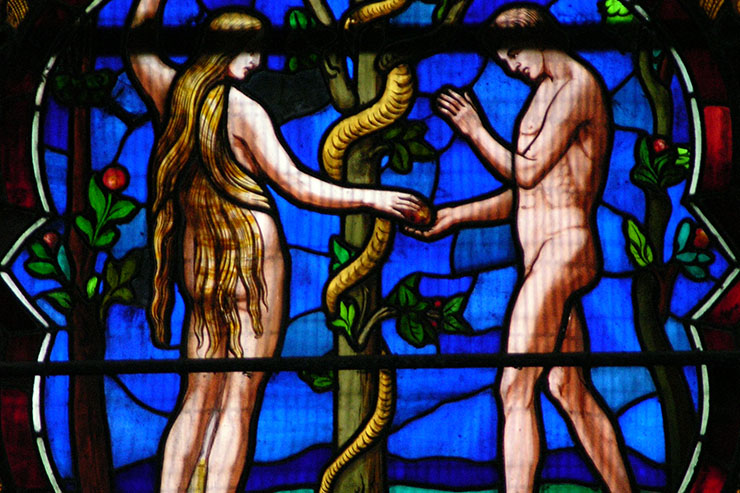
    Take, for example, the story of the Garden of Eden, an eerie tale which – with only a little imagination – can easily be read as a coded account of an alien abduction, an extraterrestrial interlude in which speaking primates are tested for obedience and adaptability:

    Omniscient keeper(s) create a man (or remove him?) from the “earth”;

    Test subject is anesthetised;

    Keepers produce a female specimen supposedly cloned from his “rib”;

    Test subjects are placed in a controlled environment and forbidden from eating a certain type of food;

    A writhing hologram appears (the “shining serpent”) and encourages them to violate the Keepers’ directives;

    Subjects are punished and returned to the wild to digest their encounter.

    Now, is this all there is to the story – ancient astronauts tampering with primitive man? Admittedly, that would be incredible if true – but wouldn’t alien scientists have been able to conceal even the most elaborate breeding and colonisation program from a pair of cavemen?

    What if the real agenda behind the Eden incident was not creation (or obedience testing) but something else entirely?

    Remarks Vallee:

    If the phenomenon is forcing us through a learning curve, then it has no choice but to mislead us. When Skinner designs a machine that feeds a rat only when the right lever is depressed, this is extremely misleading for the rat. But if the rat doesn’t depress the correct lever, he becomes extremely hungry. Man is hungry for knowledge and power, and if there is an intelligence behind the UFOs it must have taken this fact into account…16

    Perhaps instead of looking at the biblical “Fall” as a failed experiment, we should instead think of it as what Vallee calls an “open control system” – a metalogical labyrinth whose participants “graduate” to the next level when the correct sequence of stimuli are triggered – in this case, eating the “forbidden fruit.”

    In other words, “Adam” and “Eve” didn’t fail the test when they ate from the “Tree of Knowledge” – they passed it.

    Open Control Systems and Mythological Mashups

    This alternate reading of the Eden creation myth is reinforced in the scriptures of the ancient Gnostics, an unorthodox (some say “heretical”) movement in early Christianity that competed with the infant Catholic church for several centuries after the birth of Christ.

    Often dismissed as a primitive heresy that fell under the weight of its own obscurantist tendencies, Gnosticism was instead a sophisticated system of occult hermeneutics whose acolytes employed special neurolinguistic trance-inducing techniques to engage in a sort of memetic sabotage, splicing, remixing and mutating of biblical stories in a manner seemingly calculated to cause maximum offense and psychological discomfort. But why? Notes one literary critic:

    Drugs, sex, and power control the body, but “word and image locks” control the mind, that is, “lock” us into conventional patterns of perceiving, thinking, and speaking that determine our interactions with environment and society. The cutup is a way of exposing word and image controls and thus freeing oneself from them, an alteration of consciousness that occurs in both the writer and the reader of the text.17

    For the Gnostics, the biblical creation stories weren’t divine revelations, but the shattered fragments of a monstrous and malevolent spell – the control system. By rearranging and retelling Judeo-Christian myths, the Gnostics sought clues that might allow them to reprogram creation itself, changing the past, seizing control of the heavens, and overthrowing the phony god of the Bible.

    The Gnostic Version(s) of the Eden Myth

    In the Gnostic view, Eden was not a paradise, but a jungle laboratory where an opportunistic race of alien parasites conducted a series of bizarre experiments in an attempt to produce a compliant strain of biped slaves.

    Banished from the stars at the dawn of time, these “archons” (Greek for “rulers”) fled to the Earth where they abducted a caveman named “Adam” and sexually assaulted his mate “Eve,” implanting both with false (or screen) memories:

    When they [the archons] saw Eve speaking with [Adam], they said to one another… “Come, let us seize her and let us cast our seed on her, so that… those whom she will beget will serve us. But let us not tell Adam that she is not derived from us, but let us bring a stupor upon him, and… teach him in his sleep as though she came into being from his rib…18

    Feared and worshipped as “gods” and “angels,” the Archons depend for their very existence on the energy captured and siphoned from the human nervous system via various control systems – biological and memetic thermostats which allow them to regulate the flow of information and energy through words and images, pleasure and pain:

    They say that the soul is the food of the Archons and Powers without which they cannot live, because she is of the dew from above and gives them strength…19

    Adam and Eve “fell” when the archons programmed them with prohibitions and commandments, changing them from primates living in the eternal “now” to “soft machines” – biological automata at war with their own instincts, parasitised by selfish replicators and paralysed by double-binds:

    ….when the Rulers saw [Adam] and the woman who was with him, erring in ignorance… they rejoiced greatly… They came to Adam… [and] said to him, “Every tree which is in Paradise, whose fruit may be eaten, was created for you. But beware! Don’t eat from the Tree of Knowledge…” [T]hey gave them a great fright….20

    Unfortunately for the archons, this strange prohibition seems to have provoked its own violation – for, as the Gnostic scriptures inform us:

    [the archons] do not understand what they have said to [Adam]; rather… they said this in such a way that he might in fact eat…21

    Pushed to the brink by a mysterious talking serpent, Adam and Eve partook of the fruit and convulsed with ecstasy as the walls of the Garden fell away to reveal the larger world outside the Garden. Like lab rats suddenly lifted out of a maze, Adam and Eve could now perceive their own situation clearly for the very first time:

    Then their mind opened. For when they ate… they saw that they were naked, and they became enamoured of one another. When they saw their makers, they loathed them since they were beastly forms. They understood very much…22

    Serpent Power Rising

    A few more details complete this curious picture: Adam, we learn, was created with “seven souls”23; the “serpent” was actually a “hidden Mother” goddess named “Sophia” who fought against the archons from her secret location inside Adam’s “intestines”(!)24; and finally, when Eve fled from the archons, she took refuge inside the “Tree of Knowledge”25 (in biblical Hebrew, the word for “tree” can also mean “spine.”).

    If any of this sounds familiar, it should – for as countless researchers have noted, the entire story seems to be nothing more than an allegorical description of the Kundalini serpent of Buddhist and Hindu yoga:

    A Tantric yogi sees the great Mother present within his human body as the Kundalini. She lies hidden by her self-created ignorance, like a snake, coiled and fast asleep… at the bottom of the spinal cord. Through [meditation], the Tantric awakens the Mother and rouses her to go upward… [until he] becomes illumined…26

    Theories about the Kundalini Serpent

    Frequently misunderstood as an exotic oddity unique to Eastern mysticism, the kundalini instead represents a cross-cultural phenomenon of great antiquity (and plasticity) which (like the UFO phenomenon) has many features in common with OBEs, NDEs, spirit possession and shamanic initiation.

    In short, the belief is that the human body possess seven (sometimes more) energy centres called “chakras,” roughly located near or in the anus, genitals, stomach, heart, throat, brow and crest of the skull. Normally clogged with the traumata of everyday life, these “chakras” open when stimulated by a serpentine energy which normally lies sleeping and coiled at the base of the spine.

    In dreams, this serpent takes the form of a sleeping goddess who projects the illusion of the world; awakened, she climbs the spine to open the “third eye” at the crown of the head, bringing explosive emotional, psychological and spiritual growth, even ecstasy, enlightenment and the acquisition of occult powers.

    Although the scientific study of the kundalini is still in its infancy, there do exist many plausible theories which might some day explain how it works. Here are a few of them:

    Reichian/Bioenergetic

    Wilhelm Reich was a renegade disciple of Freud’s who discovered a type of libidinal energy called orgone which flows throughout the “seven segments”27 of the body, resembling nothing so much in its “slow undulation[s]” as “the movement of an intestine or snake.”28

    In most of us, social and cultural programming cause this elusive life force to become blocked in early childhood so that it pools up in the muscles and hardens into a rigid “body armour.” Thus diverted from life, the stagnant energy becomes a machine-like parody of itself which stunts and distorts human emotions, turning healthy expressions of love and sexuality into addiction, resentment and fear.

    In the long term, the suffocating obstacles imposed by this invisible exoskeleton cause untold misery by exacerbating the mind/body split and creating the conditions necessary for the emergence of cancer (in individuals) and fascism (in societies).

    Unimpressed with the slow pace and ineffectiveness of traditional talk therapy, Reich favoured a direct, hands-on approach designed to weaken the body armour itself. Over time, Reich and his followers found that unplanned events of great emotional intensity could trigger the orgone to ascend through the seven body segments spontaneously, purging vast reserves of repressed emotional energy and causing the body to vibrate uncontrollably as the noxious “body armour” crumbled once and for all.

    Mechanical

    Czech inventor Itzhak Bentov dedicated years to the study of human consciousness, eventually developing what is today known as the “holographic model” of the human brain.

    In Bentov’s view, the “kundalini experience” is primarily a mechanical phenomenon which arises when the brain begins to vibrate in sympathetic resonance with the heartbeat (7.5 hz), releasing terrific amounts of stored musculoskeletal stress as the nervous system is temporarily transformed into a polarised loop.

    This in turn causes the spinal column to oscillate like a tuning fork, allowing it to receive and transmit information directly from the ionosphere – the same part of the atmosphere responsible for bouncing electromagnetic waves back to Earth.29

    The Pineal Gland and the Third Eye

    Finally, former New Mexico University psychiatrist Rick Strassman hypothesises that kundalini yoga somehow stimulates the pineal gland to secrete larger than normal amounts of naturally-occurring DMT into the brain – making it the true “third eye.”30

    DMT is a powerful hallucinogen, also found in ayahuasca, the “vine of souls” used by Amazonian shamans to induce mystical visions; the pineal gland, meanwhile, has its own surprising analog in the photosensitive “third eye” found in many species of reptiles, a vestigial organ with full lens and retina buried under the skin in the centre of the forehead.31

    The connections to biblical myth here are many and obvious, so what does it all mean?

    Seeking to understand the roots of human religious experience, Strassman injected over 60 volunteers with high doses of DMT, conducting over 400 such sessions from 1990-1995; perhaps unsurprisingly, just over half his test subjects reported blissful visions of timeless, cosmic unity, communion with benevolent deities and “classic near-death experiences” which included flying through tunnels of “radiant light.”32

    The other 47% were not so lucky, reporting nightmarish beings drawn straight from the twilight horror-world of the Gnostic counter-Eden: menacing “clowns, elves [and] robots” who threatened and even attacked their human victims. Strassman finally ended his experiments ahead of schedule when one of his subjects reported being “eaten alive” by giant insects.

    Dragons in the Darkness

    Strassman’s findings here echo the eerie experiences of Michael Harner, an American anthropologist who penetrated the Amazon rainforest forty years earlier to experiment with the “vine of souls” potion himself.

    Harner reported seeing “giant reptilian creatures” dwelling in and around his own brain stem, “dragon-like” beings from deep space who colonised the Earth millennia ago; chillingly, these dark beings claimed to have seeded the Earth with life for the sole purpose of creating various host species they could hide themselves in.

    “I learned that the dragon-like creatures were thus inside of all forms of life, including man,” claims Harner. “They were the true masters of humanity and the entire planet, they told me. We humans were but [their] receptacles and servants…”33

    True to form, when Harner demanded an explanation from the medicine man who gave him the potion responsible for this ominous vision, the old man just laughed and explained that, “…they’re always saying that. But they are only the Masters of Outer Darkness…”34

    Conclusion

    Clearly Harner is speaking here of beings very much like the archons of Gnostic myth or the manipulative “greys” of modern Ufology – but are these entities nothing more than symbolic projections of the reptilian brain, as Harner’s narrative seems to imply?

    Do aliens and archons hail from outer space or inner space? Why is “contact” with aliens (or archons) so often accompanied by vibrations or tremors, either muscular or tectonic? How should we think about the “serpent” now that we know it is probably a dormant evolutionary mechanism of some sort? And are the “big three” Abrahamic religions of Islam, Judaism and Christianity really nothing more than hallucinatory control mechanisms employed by alien parasites to enslave and manipulate us?

    German Historian Klaus Theweleit has written what would seem to be the last possible word on the subject, noting that:

    …[T]he ‘fall of man’ depicts a failed revolution from the victor’s standpoint. For attempting to put into practice their slogan ‘Our bodies belong to us,’ the rebels were sentenced to a life of forced labor… ‘Your bodies belong to your Ruler!’ – that was the response. (The ‘paradise’ they were driven out of was the blissful state of being ruled without realising it. Even today, being driven out of ‘paradise’ is the penalty for trying to create a paradise.)35

    Whether the Eden story is really about UFOs or the kundalini, and whether such phenomena are electromagnetic or chemical in origin, I can’t say for sure (I’ve never even seen a UFO!), but I do know this:

    I have taken mushrooms and seen great, flying black mantas which pursued me across the desert floor, telepathically overwhelming me with thoughts of paranoia and despair. I’ve taken DMT and left my body to enter a crystalline world of euphoric decahedrons and four-dimensional pyramids, spread out beneath a great vaulted membrane which breathed, and knew at that instant that this membrane was the threshold between time and eternity.

    I’ve practiced tantric yoga with a dakini and been bruised and battered as I hyperventilated under the tutelage of a Reichian therapist; and I’ve been in dark rooms lit only by flickering candles, watching friends and family members pant as their eyes rolled back in their heads and their limbs shook uncontrollably, “mounted” by the spirits of the dead and personified forces of nature known to witch doctors the world over.

    Whatever the origins of these and related “psychic” phenomena ultimately prove to be – genetic memories, autonomous archetypal complexes, glitches in the Matrix or even the intrusive activities of extraterrestrial civilisations – nothing will change for our species until we finally rise to our feet, shake off the chains of superstition and ignorance and claim our inheritance – not as childlike “test subjects” to be ordered about and punished, but as adults striding forth into the cosmos with eyes wide open, ready to take responsibility for our own evolution.

    The Eden myth, like all myths, is meant to be lived; not studied but experienced – so let us treat the Bible with its endless commandments and airless authoritarianism not as the final authority on human life, but as a leaping off point for the rediscovery of the human body as a sacred text in its own right, a flesh and blood book with its own sounds, smells and textures and even wisdom too – for in the end, it may be the only thing we can ever really know anyway.

    Or, as the Gnostic scriptures put it:

    You are the Tree of Knowledge, which is in Paradise, from which the first man ate and which opened his mind, so that he became enamoured of his co-likeness, and condemned other alien likenesses, and loathed them.36

    [alert type=”general” dismiss=”no”]This article was published in New Dawn 110.[/alert]

    [alert type=”success” dismiss=”no”]If you appreciate this article, please consider subscribing to help maintain this website.[/alert]

    Footnotes:

    1. Genesis 3:22
    2. Thomas Szasz, The Untamed Tongue, p.58, pub. 1990
    3. Dr. Susan Blackmore, “Alien Abduction: The Inside Story,” New Scientist, November 19, 1994, pp.29-31
    4. Dr. Jacques Vallee, Forbidden Science: Journals, 1957-1969, p.426
    5. Ibid, p.17
    6. “Strange Encounters: An Interview with Jacques Vallee” by Daniel Blair Stewart, excerpted from Green Egg Magazine, Vol. XXTV, No. 95, Yule 1991, republished www.bibliotecapleyades.net/ciencia/ciencia_vallee03.htm
    7. Vallee, Dimensions: A Casebook of Alien Contact, p.253, pub. 1988
    8. Vallee, Revelations: Alien Contact and Human Deception, p.255, pub. 2008
    9. Vallee, Dimensions, p.253
    10. Ibid, p.257
    11. BBC – Science & Nature – Horizon – God on the Brain, www.bbc.co.uk/science/horizon/2003/godonbrain.shtml
    12. Paul Devereux, “Earth Lights: Abstracted from a presentation given at the Dana Center of the London Science Museum,” December 9, 2003, www.pauldevereux.co.uk/new/html/body_earthlights.html
    13. JohnJoe McFadden, The Conscious Electromagnetic Field Theory, www.surrey.ac.uk/qe/cemi.htm
    14. Vallee, Dimensions, p.246
    15. Vallee, Revelations, p.254
    16. Vallee, Dimensions, p.246
    17. Jenny Skerl, William S. Burroughs, quoted in “William S. Burroughs Cut-ups,” http://languageisavirus.com
    18. Willis Barnstone (editor), The Other Bible, “On the Origin of the World,” p.70, pub. 1984
    19. Hans Jonas, The Gnostic Religion, p.169, pub. 1958
    20. Barnstone, Ibid, p.71
    21. Barnstone, Ibid, “The Hypostasis of the Archons,” p.77
    22. Barnstone, Ibid, “On the Origin of the World,” p.71
    23. Marvin W. Meyer, The Secret Teachings of Jesus: Four Gnostic Gospels, “The Secret Book of John,” pp.69-70, pub. 1986
    24. Barnstone, Ibid, “The Sethian-Ophites,” p.664
    25. Willis Barnstone (editor), The Other Bible, “On the Origin of the World,” p.70, pub. 1984
    26. Elizabeth U. Harding, Kali: The Black Goddess of Dakshineswar, pp.70-71, pub. 1993
    27. Roger M. Wilcox, “A Skeptical Scrutiny of the Works and Theories of Wilhelm Reich as related to Psychiatric Orgone Therapy (character-analytic vegetotherapy)”, pub. July 25, 2005, http://members.dslextreme.com/users/rogermw/Reich/orgone_therapy.html
    28. Wilhelm Reich, The Cancer Biopathy: Volume II of the Discovery of the Orgone, pub. 1973
    29. Wikipedia Article on Kundalini, www.crystalinks.com/kundalini.html
    30. Ibid.
    31. Schwab & O’Connor, “The Lonely Eye,” March 2005, www.pubmedcentral.nih.gov/articlerender.fcgi?artid=1772576
    32. John Horgan, “The God Experiments: Five researchers take science where it’s never gone before,” Discover Magazine, November 20, 2006.
    33. Michael Harner, The Way of the Shaman, pp.4-5, 1980
    34. Ibid.
    35. Klaus Theweleit, Male Fantasies: Women, Floods, Bodies, History, pp.414-15, pub. 1987
    36. Barnstone, Ibid, “On the Origin of the World,” pp.67-68

    © New Dawn Magazine and the respective author.
    For our reproduction notice, click here.
  • The British Occult Secret Service, The Untold Story

    The British Occult Secret Service, The Untold Story

    From New Dawn 107 (Mar-Apr 2008)

    Since the time of Elizabeth I, British secret services have worked according to the principle of ‘the end justifies the means’. Money, bribery, blackmail – these are their recruitment methods…
    – Nikolai Patrushev, head of the Russian Federal Security Service (FSB), October 2007

    It is not really surprising that historically occultism and espionage have often been strange bedfellows. The black art of espionage is about obtaining secret information and witches, psychics and astrologers have always claimed to be able to predict the future and know about things hidden from ordinary people.

    Gathering intelligence is carried out under a cloak of secrecy and occultists are adept at keeping their activities concealed from sight. Like secret agents they also use codes, symbols and cryptograms to hide information from outsiders. Occultists and intelligence officers are similar in many ways, as both inhabit a shadowy underworld of secrets, deception and disinformation. It is therefore not unusual that often these two professions have shared the same members.

    The ‘father of the British Secret Service’ was the Elizabethan lawyer, politician, diplomat and spymaster Sir Francis Walsingham. He was a Protestant and as a young man during the bloody reign of the Catholic Queen Mary was forced to flee abroad to escape persecution. While in exile, Walsingham learnt Italian and French and became acquainted with the work of the famous Venetian Secret Service that used its spying skills for trade and commerce under the cloak of diplomacy.

    When Queen Elizabeth I was crowned Francis Walsingham returned to England. He was appointed as a secretary to the English ambassador to the French court in Paris and also worked as a secret agent reporting back the intelligence he gleaned to Queen Elizabeth’s Secretary of State, Sir William Cecil, later Lord Burghley. Between 1568 and 1570 Walsingham, who had become a Member of Parliament, worked in England in domestic counter-espionage exposing Catholic plots against the monarchy.

    In 1570 Walsingham was appointed as the new ambassador to France. He proceeded to set up his own network of undercover agents in France, Italy, Spain and the Low Countries. The late Cecil Williamson, who worked for British Intelligence during World War II and later ran a witchcraft museum, told this writer that Walsingham often used witches as spies.

    The Mysterious Dr Dee

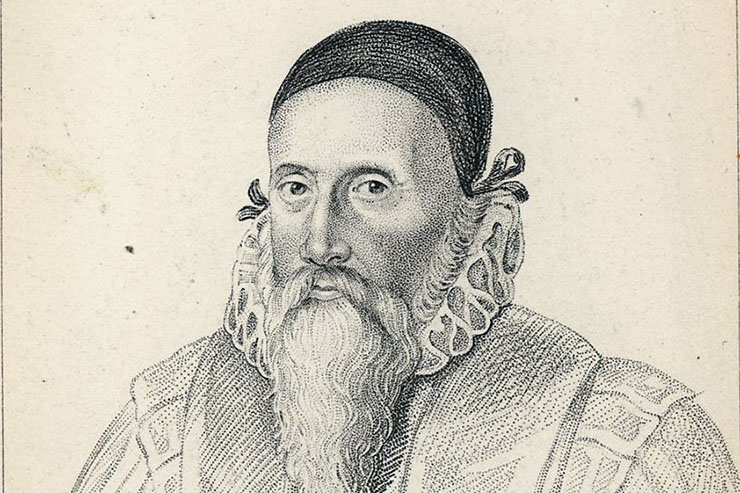
    One of the famous occultists he is known to have recruited was Queen Elizabeth’s court astrologer and the magical architect of the British Empire, the Welsh magician Dr John Dee. Walsingham was involved in the machinations for the proposed marriage of the Duc d’Anjou and Elizabeth. At the spy master’s personal recommendation, the queen dispatched Dee to France with orders to report back on the progress of the marriage negotiations. The magus travelled to the Duchy of Lorraine and drew up the birth charts of both the Duc and his brother, who was also regarded as a possible husband for the English monarch. Dr Dee, probably influenced by Walsingham, diplomatically reported back to London that the stars suggested a political alliance would be far wiser than matrimony and the queen took his advice.

    In 1573 Sir Francis returned to London and became a privy councillor. This placed him at the heart of government and he proceeded to set up what amounted to the first organised foreign espionage service to operate from England. In 1566 he had put in place a pan-European network of spies extending as far to the east as Turkey and Russia, where Dr Dee reported on the goings-on at the Tsar’s court. This network mostly gathered intelligence on the military activities of the Spanish, who were England’s primary enemies at this time. Walsingham was also responsible for foiling the Catholic plot whose exposure led to the execution of Mary, Queen of Scots. Using Dr Dee’s psychic powers, he was apparently able to discover that the plotters were passing secret messages to the imprisoned Scottish queen hidden in bottles of wine.

    While travelling in Europe in 1562, Dr Dee had come across a book written by Abbot Trimethus of Spanhiem (1462-1516). This was a guide to writing ciphers and secret codes for magical purposes and Dee informed Sir William Cecil about his discovery. On his return to England Dr Dee adapted the abbot’s cryptography and gave it to Sir Francis Walsingham for use by his secret agents. He also passed on the political and military intelligence he had acquired during his travels across Europe. It has been alleged that Dee used the famous Enochian magical alphabet as a code to disguise this information. If he had been arrested his captors would not have understood it and dismissed it as nonsense.

    In 1587 Dee even claimed he had received a spirit message from one of his angelic contacts concerning a threat to the English Fleet. The message said that a group of disguised Frenchmen working for the Spaniards was secretly visiting the Forest of Dean. The forest was the centre for English ship-building and the French agents planned to bribe disloyal foresters to burn it down. Dr Dee sent his supernatural intelligence to Walsingham and the saboteurs, who were masquerading as squatters, were arrested.

    Information supplied to Sir Francis Walsingham from his European spy network convinced him that a Spanish armada would be launched against England in 1588. He asked Dee to use his knowledge of astrology to calculate the weather prospects for an invasion. The magus told him there would an impending disaster in Europe caused by a devastating storm. When news of this prophecy was leaked and reached Spain, naval recruitment fell and there were desertions of sailors from the Spanish Fleet. In Lisbon an astrologer who repeated the prediction was charged with spreading false information. In an act of psychological warfare, Dr Dee also informed Emperor Rudolf of Bohemia (the modern Czech Republic) and King Stephen of Poland that the predicted storm would “cause the fall of a mighty empire.” Rudolf, who was an occultist and Dee’s patron when he stayed in Bohemia, passed on the warning to the Spanish ambassador.

    It is a fact that in 1588 a great storm did scatter the ships of the Spanish Armada in the English Channel and aided the English victory. This metrological event was popularly credited to a magical ritual performed by the buccaneer Sir Francis Drake on the cliffs at Plymouth. Superstitious people believed Drake was a wizard and sold his soul to the Devil in exchange for success over the Spanish. It is claimed that he also organised several covens of witches to work magically to raise the storm and prevent the invasion. Meanwhile, as a result of scrying in his shewstone or crystal, Dr Dee saw a symbolic vision of a castle with its drawbridge drawn up (England) and the image of the elemental king of fire. As a result he urged the Navy to employ fire-ships against the Armada and they did so with good results.

    After Sir Francis Walsingham’s death in 1590, and the ascension to the English throne of the Scottish king James, Dr John Dee fell into royal disfavour. The new king had an unhealthy obsession with witchcraft and his early reign was dominated by this preoccupation. It led him to employ the Secret Service in his own personal vendetta against suspected witches. James I ordered its agents to hunt down alleged practitioners of witchcraft and expose their alleged plots against the monarchy. One of those involved was the Earl of Bothwell, accused of high treason for organising a coven of Scottish witches to work magic against the king in an attempt to seize the throne. To assist his secret agents in their new witch-hunting activities, King James persuaded Parliament in 1604 to pass a new and stronger Witchcraft Act to deal with the problem. The Bill was rushed through and it was made law within three months.

    Dashwood & the Hellfire Club

    In the 18th century the Secret Service became concerned at the activities of the so-called ‘Hellfire Club’ founded by Sir Francis Dashwood, later the Chancellor of the Exchequer and a close friend and political adviser of King George III. As a young man Dashwood went on the Grand Tour of Europe that was compulsory for aristocrats and he was initiated into a Masonic lodge in France. While visiting Italy he developed anti-Catholic views, violently broke up a celebration of the Mass and insulted the Pope. Even though he was an aristocrat, Dashwood was disgusted at the vast wealth of the Roman Church compared with the poverty of its devoted worshippers. He also became fascinated by classical mythology and decorated his country house at West Wycombe in Buckinghamshire with murals, paintings and statues of Greek and Roman gods and goddesses.

    Sir Francis Dashwood founded a secret society called the Order of the Friars of St Francis of Medmenham (more popularly known as the Hellfire Club) named after the abbey he had purchased on the banks of the River Thames where its meetings were held. Rumours circulated in the coffee houses of London that the Friars practised sexual orgies featuring aristocratic ladies and prostitutes dressed up as nuns. There were also satanic rites such as Black Masses where the naked body of a noblewoman acted as an altar. However, according to one senior member of the Hellfire Club, this occult mummery was just an amusing diversion for the dandies. The inner circle of the Order was actually dedicated to the serious revival of the pagan Eleusian Mysteries and the worship of the Bona Dea or Great Mother Goddess. Dashwood’s present-day descendant, also called Sir Francis, confirmed this fact in a BBC radio interview some years ago,

    It has been claimed secret agents infiltrated the Hellfire Club because of its many famous members. They included the Earl of Sandwich, John Montagu, who was the First Lord of the Admiralty, the Paymaster General Thomas Potter, several members of Parliament, the Lord Mayor of London, a son of the Archbishop of Canterbury, the Earl of Bute, who was the prime minister, and it has been claimed even the Prince of Wales. At least four members of the group were known to be actively involved in espionage. They was a radical MP called John Wilkes, a transvestite French diplomat, Chevalier D’Eon de Beaumont, the American statesman and philosopher Benjamin Franklin, and Sir Francis Dashwood himself. Wilkes had allegedly recruited the chevalier into the British Secret Service.

    During his stay in Russia on the Grand Tour Dashwood had spied on the court of the Tsar through his close friendship with the Grand Duchess Catherine. In Italy he gathered intelligence on the exiled Stuart dynasty and their supporters, although the head of the British Secret Service in Rome believed Dashwood was a Jacobite agent. In fact he was only pretending to support the Stuart cause and was passing on information about their activities directly back to London. In later years Sir Francis and Benjamin Franklin were involved in a clandestine plan to reconcile the American colonists and the British government to prevent the War of Independence.

    Rudolf Hess & the British Occult Connection

    During World War II British Intelligence invited many occultists into its ranks because it needed their specialist knowledge and skills. The assistant director of Naval Intelligence during the war was Lt. Commander Ian Fleming RN, best known later as a thriller writer and the creator of the famous fictional spy James Bond 007. Fleming was also interested in astrology and numerology and he was a friend of the notorious magician Aleister Crowley, who had worked for MI6 (the Secret Intelligence Service) during World War I and in the 1920s and 1930s spying on Germans with occult interests (see ‘The Magus Was A Spy’ by Dr Richard Spence in New Dawn No. 105, November-December 2007).

    Ian Fleming conceived an audacious plan to lure a high-ranking member of the German government into defecting to Britain so as to provide a morale-boosting propaganda coup. This idea had been inspired by a novel written by Fleming’s brother, Peter, called Flying Visit (Jonathan Cape 1940). Peter Fleming was a journalist and also worked for both MI5 (the Security Service) and the propaganda section of the clandestine Special Operations Executive (SOE). The novel imagined that Hitler’s plane crash-landed in England and he was captured. The Reichminister and deputy fuehrer himself, Rudolf Hess, was chosen as a suitable candidate for the actual plot. This was because he was a supporter of peace with Britain and was also under the influence of astrologers and occultists. It was believed this could be used against him.

    Commander Fleming recreated The Link, a defunct Anglo-German friendship society of the 1930s that had a wealthy membership of Nazi sympathisers drawn from the British Establishment. Ironically, or perhaps coincidentally, The Link had been founded by Admiral Sir Barry Domville, an ex-director of the Naval Intelligence Department (NID), after he retired in 1930. Domville was arrested and interned in May 1940 because MI5 believed he was plotting a fascist coup d’etat supported by aristocratic peacemongers. The admiral was a friend of Major-General J.F.C. ‘Boney’ Fuller CBE, a famous military analyst who designed the tactics for the first tank battle in World War I. Fuller also invented the concept of blitzkrieg used so successfully in World War II by the German Panzers. Fuller was an open admirer of Hitler (he attended the fuehrer’s 50th birthday party in 1939), a leading member of Sir Oswald Moseley’s British Union of Fascists (BUF), a friend of Ian Fleming and a leading disciple of Aleister Crowley. In the 1930s Fuller formed the extreme-right wing Nordic League (aka the White Knights of Britain), allegedly established by Nazi agents. However in the 1950s he was a member of a MI6 supported group of Russian émigrés engaged in anti-communist propaganda. It has been suggested that Fuller was not interned during the war with other leading fascists such as Mosley and Domville because he was a MI6 double-agent.

    Ian Fleming’s idea was to persuade the German High Command in Berlin, and especially Rudolf Hess, that when war broke out The Link had not disbanded but had gone underground. It had allegedly regrouped and recruited even more prominent pro-Nazi members in the British Establishment including aristocrats and royalty. These were represented by the NID as influential people with the political muscle to overthrow prime minister Winston Churchill’s national wartime government, call a ceasefire and agree to a peace treaty with Germany. Under its terms Britain would keep control of its Empire and Germany would have free reign in occupied Europe. The Nazis also hoped that British troops would be sent to fight alongside the German Wehrmacht and the SS against the Soviet Union in a joint anti-communist crusade.

    Hitler did not want to invade and occupy Britain. Instead he would have preferred to negotiate a treaty with a sympathetic new government in London. It has been suggested that the only reason the fuehrer abandoned Operation Sea Lion – the proposed invasion of Southern England – and instead invaded the Soviet Union was to force Churchill to accept peace terms. If the Red Army had been defeated Britain would truly have been standing alone, as Hitler did not believe the Americans had the political will to enter the war. Unfortunately he underestimated the ability and resolve of the Soviets to defend their motherland and also the clandestine support that the US was already offering Great Britain.

    The NID plot to ensnare Rudolf Hess used bogus astrological predictions combined with political intelligence. Hess was persuaded that a Scottish aristocrat, the Duke of Hamilton, was willing to negotiate peace terms on behalf of the influential people at the top of British society who wanted to end the war. The duke had met Hess at the Berlin Olympics in 1936 and the deputy fuehrer for some reason thought he was a member of the surviving Hermetic Order of the Golden Dawn. Ian Fleming commissioned an astrologer to produce a faked astrological forecast indicating that 10 May 1941 would be a propitious date for Rudolf Hess to fly to Scotland and meet secretly with the Duke of Hamilton and other members of the so-called British ‘peace party’. Hess’ occult advisors had also told him there would be an unusual planetary conjunction on 10 May. On that day six planets would be aligned in the zodiac sign of Taurus and conjoined to the full moon. At the same time Hitler’s chart showed ‘malefic’ astrological aspects. Hess saw himself in the role of a messianic hero saving Germany from possible future defeat by making peace with the British. All the (false) reports reaching the deputy fuehrer about the political situation in England and the astrological aspects convinced him that his mission would be a success.

    Rudolf Hess flew to Scotland on 10 May 1941 in the firm belief that on landing he would be met by the Duke of Hamilton and the Duke of Kent and whisked off to London for a private audience with King George VI. He had been convinced by the misinformation fed to him by British Intelligence that these three men represented a genuine peace movement capable of removing the warmonger Churchill and agreeing to German terms. Hess had also previously met the Duke of Windsor when he had visited Berlin before the war. As a result Hess was persuaded that some members of the German-descended royal family were sympathetic to Nazism. Certainly the Duke of Saxo-Coburg, formerly Prince Charles Edward, a grandson of Queen Victoria and a close friend of the Duke of Windsor, had willingly embraced Nazism. In fact Hitler had appointed him as the head of the German branch of the Red Cross that was responsible for exterminating the mentally sick and physically disabled.

    Unfortunately instead of meeting pro-Nazi aristocrats and royals when he landed, Hess was captured by a local farmer and a Home Guard unit. They handed him over to the police and he was transferred to London to be interrogated by MI5. Unfortunately the British government completely mishandled the capture of Hess. It has been suggested that Churchill believed the subterfuge by the NID and SIS suggesting leading members of the British Establishment might be pro-German may have been based on fact. For that reason the government did not capitalise on Hess’ ‘peace mission’. The German High Command had also disowned him and said that his flight had been unauthorised. They also suggested that Hess might be insane so his value for propaganda purposes was undermined and diminished.

    Rudolf Hess’ apparent defection caused widespread panic in Berlin concerning the influence of occultism on the Nazi Party. The Gestapo immediately launched Operation Aktion Hess. On the direct orders of Hitler, they rounded up hundreds of occultists, psychics and astrologers, including Hess’s leading occult advisor Ernst Schulte-Strathaus. In June 1941 a decree was issued banning all public performances of clairvoyance, astrology, fortune-telling or telepathy. Anybody associated with Hess and his esoteric interests was thrown into concentration camps and occult secret societies were closed down. Because of staff shortages in the Gestapo, officers from the Naval Intelligence Service were drafted in to interrogate some of the arrested psychics. It has been claimed that they recruited some of them for secret operations using dowsing on maps with pendulums to hunt down British submarines.

    It has also been claimed that Ian Fleming and the NID was involved in a plot to silence the Spiritualist medium Helen Duncan, the penultimate person to be charged under the old Witchcraft Act of 1736. She was arrested in 1944 after holding a séance during which allegedly the spirit of a dead sailor from the sinking of the HMS Bolham physically manifested. As the news of the loss had not been publicly released, and the Admiralty was keeping it secret for morale purposes, Duncan became a target for the security services. She and other psychics were regarded as a serious threat to national security and they became the object of a MI5/NID dirty tricks operation to silence leaks. This suggests that the Intelligence Services actually believed these mediums had genuine powers. Duncan’s arrest and subsequent trial, which in fact was condemned by Winston Churchill as a waste of public funds, was allegedly meant to deter other mediums. The War Office was paranoid that military secrets about the forthcoming D-Day landings in Normandy would be revealed at séances and become public knowledge or passed to the Germans.

    [alert type=”general” dismiss=”no”]This article was published in New Dawn 107.[/alert]

    [alert type=”success” dismiss=”no”]If you appreciate this article, please consider subscribing to help maintain this website.[/alert]

    Bibliography:

    Derek Wilson, Sir Francis Walsingham (Constable 2007)
    Richard Deacon, John Dee (Muller 1968)
    Donald McCormack, The Hellfire Club (Jarrolds 1958)
    P. Mannix, The Hellfire Club (Four Square 1961)
    M.R.D. Foot, SOE: The Special Operations Executive 1940-46 (BBC publications 1984)
    J.M. McKenzie The Secret History of the SOE 1940-1945 (St Ermins Press 2000)
    Nigel West, The Secret War: The Story of SOE (Hodder & Stoughton 1992)
    Richard Deacon, The History of British Secret Service (Frederick Muller 1979)
    Donald McCormick, The Life of Ian Fleming (Peter Owen 1993)

    © New Dawn Magazine and the respective author.
    For our reproduction notice, click here.
  • The “Bloody” Baron von Ungern-Sternberg: Madman or Mystic?

    The “Bloody” Baron von Ungern-Sternberg: Madman or Mystic?

    From New Dawn 108 (May-June 2008)

    My name is surrounded with such hate and fear that no one can judge what is true and what is false, what is history, and what is myth.1
    – Baron Roman Fedorovich von Ungern-Sternberg, 1921

    In Mongolia, there was a legend of the warrior prince, Beltis-Van. Noted for his ferocity and cruelty, he spilled “floods of human blood before he found his death in the mountains of Uliasutay.”2 His slayers interred the corpses of the Prince and his followers deep in earth, covered the graves with heavy stones, and added “incantations and exorcism lest their spirits again break out, carrying death and destruction.” These measures, it was prophesied, would bind the terrible spirits until human blood once more fell upon the site.

    In early 1921, so the story goes, “Russians came and committed murders nearby the dreadful tombs, staining them with blood.”3 To some, this explained what followed.

    At almost the same instant, a new warlord appeared on the scene, and for the next six months he spread death and terror across the steppes and mountains of Mongolia and even into adjoining regions of Siberia. Among the Mongols he became known as the Tsagan Burkhan, the incarnate “God of War.”4

    Later, the Dalai Lama XIII proclaimed him a manifestation of the “wrathful deity” Mahakala, defender of the Buddhist faith.5 Historically, the same individual is best known as the “Mad Baron” or the “Bloody Baron.” His detractors are not shy about calling him a murderous bandit or an outright psychopath.

    The man in question is the Baron Roman Fedorovich von Ungern-Sternberg. His exploits can be only briefly sketched here. In the wake of the Russian Revolution, Baron Ungern found himself in eastern Siberia where he aligned himself with the anti-Bolshevik “White” movement. However, his extreme monarchist sentiments and independent ways made him a loose cannon in that camp.

    In 1920, he led his “Asiatic Mounted Division,” a rag-tag collection of Russian, Mongol, Tatar and other troops, into the wilds of Mongolia, a land seething with unrest against Chinese occupation. Rallying Mongols to his banner, in early February 1921 Ungern scored a seemingly miraculous victory by wresting control of the Mongol capital, Urga (today Ulan Bator), from a large Chinese garrison. He then restored the Mongols’ spiritual and temporal leader, the “Living Buddha” Jebtsundamba Khutukhtu Bogdo Gegen, or, more simply, Bodgo Khan and established himself as warlord over Outer Mongolia and the scattered White Russian detachments that had taken refuge there.

    Surrounding himself with an inner circle of murderous sycophants and fortune-tellers, he instituted a reign of terror that claimed as victims Jews, real or suspected Reds, and hundreds of others who somehow aroused the Baron’s wrath or suspicion.6 In June of the same year, he launched an ill-fated invasion of Soviet Siberia which ended with his capture by the Red Army and his subsequent trial and execution on 17 September.

    This article focuses on Baron Ungern’s real and alleged mysticism and its influence on his actions. A key question is whether his perceived “madness,” in whole or in part, was a misreading of his devotion to esoteric Buddhist, and other, beliefs.

    Background and Early Years

    While the Baron spent most of his life in the service of the Romanovs, he was almost entirely German by blood. He entered the world as Robert Nicholaus Maximilian von Ungern-Sternberg on 10 January 1886 (new style) in Graz, Austria. In Russian-ruled Estonia, his father, Teodor Leonard Rudolf von Ungern-Sternberg, enrolled his son in the Tsar’s nobility as Roman Fedorovich. The Ungern-Sternbergs were an old and illustrious family. The Baron dated his line back at least a thousand years and boasted to his Bolshevik captors that seventy-two of his ancestors had given their lives in Russia’s many wars.7

    There is a suggestion of mental instability, even madness, in his immediate line. For instance, one late 18th century ancestor, Freiherr Otto Reinhold Ludwig von Ungern-Sternberg, earned infamy as a ship-wrecker and murderer who died in Siberian exile.8 Roman’s own father had a reputation as a “bad man” whose violence and cruelty led to divorce and a ban on him having any “influence” on his children.9

    As regards Roman von Ungern-Sternberg’s mental state, obviously a diagnosis of insanity can be made only after examination by a psychiatrist, something impossible in this case.10 However, Dmitry Pershin, an eye-witness who took a somewhat positive view of the Baron, still felt that Ungern suffered from a “psychotic abnormality” which made him lose his temper at the “least provocation,” often with terrifying result.11

    Later stories claimed that Roman’s aberrant behaviour was the result of a sabre cut to his head, but he manifested rebellious, violent tendencies much earlier. His school days were marked by constant problems; at the elite Naval Cadet Corps, he racked-up no less than twenty-five disciplinary charges before withdrawing in the face of certain expulsion.12 His education left him with a life-long aversion to “thinking” which he equated with “cowardice.”13

    As a junior officer before and during World War I, he established a reputation as a violent troublemaker with a penchant for hard-drinking. However, he also earned medals for wounds and reckless bravery. In the words of one superior, the young Baron was a “warrior by temperament,” who “lived for war” and adhered to his own set of “elemental laws.”14 The latter were influenced by an interest in mysticism and the occult, especially of the Eastern variety.

    The Baron as Mystic Warrior

    Just when and where this interest began is uncertain. Ungern’s personal brand of faith, if it was Buddhism at all, adhered to the mystical Tibetan Vajrayana or Tantric sect. Young Roman got his first taste of the East as an infantryman during the Russo-Japanese War, and he spent 1908 to 1914 as a Cossack officer in Siberia and Mongolia. It was then, he later claimed, that he formed an “Order of Military Buddhists” to serve the Tsar and fight against the evils of revolution. The rules of his Order included celibacy and the “limitless use of alcohol, hashish and opium.”15 The latter was to help initiates overcome their “physical nature” through excess, but as the Baron confessed, it did not work quite as he had planned. Later, in Mongolia, he enforced a strict ban on drink. Still, he asserted, he gathered “three hundred men, bold and ferocious,” and some who did not perish in the fighting against Germany and the Bolsheviks were still with him in 1921.

    Ungern resigned his regular commission at the end of 1913. Alone, he headed into the vastness of Outer Mongolia which had proclaimed independence from China. By one account, he rose to command the cavalry forces of the fledgling Mongolian Army, while another holds that he joined the marauding band of the bloodthirsty anti-Chinese rebel, Ja Lama. At some point, Ungern ended up in the western Mongolian town of Kobdo (Khovd) as a member of the guard of the local Russian consulate.

    One of his comrades recollected that “when one observed Ungern, one felt himself carried back to the Middle Ages…; [he was] a throwback to his crusader ancestors, with the same thirst for war and the same belief in the supernatural.”16 Another recalled that he displayed “a great interest in Buddhism,” learned Mongolian and took to frequenting lama fortune-tellers.17 According to Dmitri Aloishin, a later, unwilling member of the Baron’s army, Ungern’s “Buddhist teachers taught him about reincarnation, and he firmly believed that in killing feeble people he only did them good, as they would be stronger beings in the next life.”18

    The parallels between aforementioned Ja Lama and the Baron seem too close to be mere coincidence. Also known as the “Lama with a Mauser,” Ja Lama briefly made himself master of western Mongolia. Another “militant Buddhist,” he earned a fearsome reputation for ripping out the hearts of unfortunate captives and offering them up in skull-shaped bowls as bali (sacrifice) to the “Tibetan terror gods.”19 One such “Tantric” ritual slaughter occurred in Kobdo in the summer of 1912, just before Ungern arrived on the scene. In February 1914, the Russian consul in Kobdo arrested Ja Lama and Cossack troops, possibly including Ungern, and escorted the captive to exile in Russia. Did Ja Lama become a role model for the Baron, or even a religious inspiration?

    A Tibetan angle figures prominently in Ungern’s subsequent Mongolian escapade. The Living Buddha was himself a son of the Land of Eternal Snows, and a small Tibetan community dwelled in Urga. A hundred or so of these men formed a special sotnia (squadron) in the Baron’s forces and played a critical part in the assault on Urga by snatching the Bogdo from under the noses of his Chinese guards. The Chinese and Mongols were convinced that the feat had been accomplished through sorcery. These Tibetans maintained a distance from the rest of the Baron’s army; apparently others were put off by their habit of dining out of bowls made from gilded human skulls, perhaps the same sort of vessels used in Ja Lama’s sacrificial rites.

    The Tibetan nexus also provided the Baron with a link to Lhasa and the Dalai Lama, to whom he addressed personal letters. After his power in Mongolia collapsed, Ungern dreamed of leading the remnants of his division to far-off Tibet and putting himself at the service of the Buddhist holy man.20 The prospect of this gruelling, and potentially suicidal, trek was the final straw in provoking mutiny against the Baron.

    Also serving under Ungern in his Mongolian adventure were fifty or so Japanese soldiers. This has fuelled accusations that he was a cat’s paw of Japanese imperialism. While it is clear that the Japanese military monitored the Baron’s activities and thought he might be useful, it is equally evident that they had no real control over him. Still, his tiny Japanese contingent received better rations and the unique privilege of consuming alcohol.21 Japanese military records suggest that the men were “mostly petty adventurers” acting on their own accord, but that is far from clear.22 Their commander, a Major or Captain Suzuki, had met the Baron in 1919 at a “Pan-Mongol Congress” and the pair maintained a special and secretive friendship.

    An intriguing possibility is that Suzuki was not an emissary of the Mikado’s Army but of one of the secret societies that permeated it, such as the Black Dragon Society or the even more secretive Green Dragon Society. The latter was based in a sect of esoteric Buddhism, and its Pan-Asiatic, Pan-Buddhist agenda meshed with Ungern’s own beliefs.23 The Baron felt that the West had lost its spiritual moorings and had entered a stage of moral and cultural disintegration. The Russian Revolution was but a manifestation of this advanced corruption. Only in the East, specifically in Buddhism, did he see a force capable of resisting this decay and restoring spiritual order in the West.

    The Baron’s Lamas and Fortune-Tellers

    Ungern was fascinated by all forms of divination. He allegedly carried a deck of Tarot cards with him, even in the heat of battle. As noted, in Kobdo he consorted with lama soothsayers and in Urga he surrounded himself with a small army of fortune-tellers (tsurukhaichi), sorcerers and shamans.24 Aloishin recalls that the Baron’s diviners were forever consulting the roasted shoulder blades of sheep, pouring over the cracks “to determine where the troops must be stationed, and how to advance against the enemy.”25 On other occasions, Ungern ordered his troops to stop “at various places in accordance with old Mongolian prophecies.”26

    The Baron’s staff physician, Dr. N. M. Riabukhin, damned the fortune-tellers as “brazen, filthy, ignorant and bow-legged” and decried the fact that Ungern “never took any important step” without consulting them. The soothsayers convinced him that he was the incarnation of Tsagan Burkhan, the God of War. To White officer Boris Volkov, the Baron’s dependency on these types seemed proof of the “moronic mentality of the degenerate who imagined himself the saviour of Russia.”27

    Prior to his advance in Red Siberia, Ungern spent 20,000 precious Mexican dollars to hire thousands of lamas to “perform for him elaborate services in the temples and to call to his assistance all their mystic powers.”28 One drugged shamaness’s prediction of the Baron’s approaching doom proved eerily accurate, and helped convince him to undertake the disastrous invasion.29 The fortune-telling lamas failed him when they counselled a two day delay in the attack on Troitskosavsk, a key border town.30 This gave the Reds opportunity to bring up reinforcements and repel the assault. Later, officers bribed a Buriat fortune-teller to change his predictions, which led Ungern to call-off further advance and order retreat to Mongolia.31

    But if Ungern was influenced – and mislead – by the supernatural, he also knew how to use it to his advantage. Prior to his final attack on Urga, he dispatched fortune-tellers into the city where they “filled the Chinese soldiery with superstitious fear” by predicting his imminent arrival and spreading rumours that the White Baron was immune to bullets and could appear and disappear at will.32 He also ordered nightly bonfires set on the surrounding hills. His Mongol agents told the credulous Chinese that the fires were Ungern offering sacrifices to the spirits who would take their vengeance on the sons of China.33

    One person struck early by the Baron’s peculiar nature was mystical philosopher Count Hermann Keyserling who knew Roman and his brother Constantin from childhood. Keyserling later regarded the Baron as “the most remarkable person I have ever had the good fortune to meet,” but also a mass of contradictions.34 He saw Ungern as one whose “nature was suspended… in the void between heaven and hell,” someone “capable of highest intuition and loving kindness” alongside “the most profound aptitude for the metaphysics of cruelty.”35 The Baron’s metaphysical ideas, Keyserling believed, were “closely related to those of the Tibetans and Hindus.”36 Keyserling was convinced that Roman possessed the occult power of “second sight” and “the faculty of prophecy.”

    Keyserling was not the only one to come to such conclusions. Years later, fascist and occult philosopher Julius Evola opined that Baron Ungern possessed “supernormal faculties” including clairvoyance and the ability to “look into the souls” of others.37 Ferdynand Ossendowski claimed that he did exactly that at their initial meeting. “I have been in your soul and know all,” the Baron proclaimed, and Ossendowski’s life was secure.38

    Much the same is repeated in the testimony of others who knew Ungern. Aloishin thought the Baron patently insane but also felt that he “possessed a dangerous power of reading people’s thoughts.”39 He recounts how Ungern would inspect recruits by staring into each man’s face, “hold that gaze for a few moments, and then bark: ‘To the army’; ‘Back to the cattle’; ‘Liquidate’.”40 Riabukhin mentions that on their first meeting “it was as though the Baron wanted to leap into my soul.”41 Another anonymous officer recounts that “Ungern looked at everyone with the eyes of a beast of prey,” and this instilled fear in all who met him.42 A Polish soldier in Mongol service, Alexander Alexandrowicz, accepted the Baron’s “second sight,” but believed that it was his “superior” intellect that helped him “size up any man in a few minutes.”43

    The Mysterious Ferdynand Ossendowski

    Arguably, no one did more to create the prevailing image of Baron Ungern than the above noted Polish writer Ferdynand Ossendowski. However, he is a far from an impeccable source. Prior to his encounter with the Baron, Ossendowski had a long history as spy, intriguer and purveyor of fraudulent documents. He almost certainly was an agent of the Tsarist secret police, the Okhrana. In 1917-18 he was mixed-up with the infamous Sisson Documents, a fake (if fundamentally accurate) dossier on German-Bolshevik intrigues.44 Later, in Siberia, Ossendowski served White “Supreme Ruler” Admiral Kolchak as an economic adviser and, probably, a spy. Ossendowski arrived in Mongolia as a refugee from the Red tide. In his widely-read 1922 book Beasts, Men and Gods, the Pole describes his meeting with the “Bloody Baron” in vivid detail, and not without some sympathy for the subject. Nevertheless, Ossendowski knew that “standing before me was a dangerous man,” and that “I felt some tragedy, some horror in every movement of Baron Ungern.”45 Nor did Ossendowski mince words about the climate of fear that gripped Urga under the Baron. He describes Ungern’s brace of murderous underlings such as the psychotic “strangler” Leonid Sipailov, the equally repellent Evgeny Burdukovsky and the sadistic Dr. Klingenberg. What Ossendowski conveniently side-steps is the mystery of his own survival in that precarious environment.

    In the views of others who witnessed the Baron’s rule, Ossendowski was not just lucky and no innocent observer. Konstantin Noskov notes that from the moment of his arrival in Mongolia, “Professor” Ossendowski played “a strange role understood by no one.”46 “He interfered in everything,” adds Noskov, “quarrelled very skilfully [and] wove complicated political intrigue….” Pershin charges that Ossendowski was another who exploited Ungern’s obsession with the supernatural, a view echoed by one of the Baron’s officers, K.I. Lavrent’ev.47 By encouraging “the Baron’s faith in occultism and other things of the beyond,” Ossendowski became an “adviser” to the Baron, which may explain a later claim that the Pole became Ungern’s “chief of intelligence.”48

    Ossendowski, according to Pershin, “wormed his way into a position close to the Baron” and so “extracted all the advantages he wanted.”49 Those included money and safe passage to Manchuria “in comfort and, perhaps, with something more than that.” Dr. Riabukhin and Noskov both recall that Ossendowski was inexplicably the sole survivor among a group of refugees whose other members were murdered on Ungern’s orders.50 Boris Volkov adds that Ossendowski played a key role in formulating the Baron’s infamous and “mystical” Order #15, and so secured his life and a large sum of money.51 Noskov flatly declares that Ossendowski was the author of the Order.52

    “Order #15,” the closest Ungern ever came to outlining a philosophy or mission, deserves closer examination. Since the Baron was not in the habit of issuing numbered orders, the #15 is meaningless in that context. According to Aloishin, that number and the date of its issue were more work of the “learned lamas” who picked them as lucky numerals.53 Basically, the Order outlines a grandiose scheme to initiate an ever-expanding wave of counter-revolution that would cleanse Russia of its radical contagion and restore the Romanov throne under the late Tsar Nicholas’s brother, Mikhail Alexandrovich. The Baron, as many others, was not aware that Mikhail had been dead since June 1918. The Order proclaimed that “the evil which has come to Earth in order to destroy the divine principle of the human soul must be destroyed at the root,” and that “the punishment may be only one: the death penalty, in various degrees.”54

    The most notorious article, though, was #9 which declared that “Commissars, Communists and Jews, together with their families, shall be destroyed.” The Baron had a pathological hatred of Jews, and wherever his power held sway there was a ruthless extermination of that community. Even Pershin, who felt that “stories concerning [Ungern’s] mercilessness have been much exaggerated,” admitted that the mass killing of Jews was regrettably true and that the Baron was implacable on the matter.55 Volkov felt that Ungern used pogroms as a tool to exploit anti-Semitism among the émigrés and troops, but there was an almost religious zeal to his hatred. In a letter to a White Russian associate in Peking, the Baron warned against “international Judaism” and even the insidious influence of “Jewish capitalists” who were an “omnipresent, though very often undetected, enemy.”56 At his trial, the Baron assured his Jewish, Bolshevik prosecutor, Emelian Yaroslavsky, that “the Communist International was organised 3,000 years ago at Babylon.”57 In his feelings towards Jews, Ungern certainly prefigures the Nazi mentality, and much the same could be said for his whole weird mixture of mystical anti-modernism.

    In August 1921, the Baron’s despotic reign came to an end when desperate officers of the Asiatic Mounted Division staged a coup against him and his dwindling cadre of loyalists. Almost miraculously, Ungern escaped the general slaughter and found a brief, final refuge among his Mongol soldiers. They too soon abandoned him to the approaching Reds, but without harming a hair on his head; they were still convinced that he was the Tsagan Burkhan and could not be killed.58

    The Soviets suffered from no such delusions. At his trial in Novo-Nikolaevsk, he was a calm, even dignified, prisoner. He had foreseen his fate and accepted it. The prosecution was most interested in portraying him as an agent of the Japanese, which he denied. However, the Baron readily admitted to mass killings and other atrocities. So far as his brutal discipline was concerned, he proclaimed himself a believer in a system that had existed “since Frederick the Great.”59 He went before the firing squad quite convinced that someday he would be back.

    A final point brings us back to Ossendowski, who claimed that the Baron sought contact with the mythical subterranean kingdom of Agarthi and its mysterious ruler, the “King of the World.”60 Agarthi, of course, is identical with Agarttha or Shambhala, a mystical land enshrined in Hindu and Buddhist mythology. In the early twentieth century, the story was picked-up and elaborated by Western esoteric writers such as Alexandre Saint-Yves d’Alveydre and Nikolai Roerich who believed that it described an actual realm hidden somewhere in northern Tibet or a nearby Central Asia. By an interesting coincidence, another officer in Ungern’s Division was Vladimir Konstantinovich Roerich, Nikolai’s younger brother. Then again, perhaps it was no coincidence at all. But that brings us to a story that is best saved for a following article: “Red Star over Shambhala: Soviet, British and American Intelligence and the Search for Lost Civilisation in Asia.”

    [alert type=”general” dismiss=”no”]This article was published in New Dawn 108.[/alert]

    [alert type=”success” dismiss=”no”]If you appreciate this article, please consider subscribing to help maintain this website.[/alert]

    Footnotes:

    1. Ferdinand Ossendowski, Beasts, Men and Gods [BMG] (New York: Dutton, 1922), 238.
    2. Konstantin Noskov, The Black Year: The White Russians in Mongolia in the Year 1921 (Harbin, 1930), 75.
    3. Ibid.
    4. Tsagan Burkhan roughly translates as “White God” but can also be used to mean “White Buddha.” The use of the term for Ungern seems to have started among his Buriat troops and spread to other Mongols.
    5. Markus Osterrieder, “From Synarchy to Shambhala: The Role of Political Occultism and Social Messianism in the Activities of Nicholas Roerich,” presented at “The Occult in 20th Century Russia: Metaphysical Roots of Soviet Civilization,” Munich, March 2007, 10, n. 51.
    6. Boris Volkov, About Ungern (trans. Elena Varneck), 6 , Hoover Institution Archives [HIA], Stanford, CA,.
    7. Izvestiya (23 Sept. 1921). Standard genealogy puts the beginning of the line in the mid-13th century with one Hanss von Ungern or Johannes de Ungaria who took service under the Bishop of Riga: Genealogisches Handbuch des Adels (Glueksburg: C.A. Starke, 1952), 467.
    8. Marquis de Custine, Empire of the Czar: A Journey through Eternal Russia (New York: Anchor, 1989), 61-65.
    9. Vladimir Pozner, The Bloody Baron: the Story of Ungern-Sternberg (New York: Random House, 1938), 50-51.
    10. I. V. Ladygin, “Chetyre mifa o barone Ungerne,” http//army.armor.kiev.ua/hist/ungern.shtml.
    11. D. Pershin, “Baron Ungern, Urga, i Altan Bulak,” 113, HIA, Stanford.
    12. Paul du Quenoy, “Warlordism a la russe: Baron von Ungern-Sternberg’s Anti-Bolshevik Crusade, 1917-21,” Revolutionary Russia, Vol. 16, #2 (December 2003), 4. This article provides an excellent overview of Ungern’s career.
    13. Pozner, 81-82.
    14. Baron Petr N. Vrangel’ (Wrangel), “Yuzhnyi front,” Beloe delo, Vol. V (1927), 12-13.
    15. Ossendowski, “With Baron Ungern in Mongolia,” Asia, Vol. 22, #8 (1922), 618.
    16. Pershin, 53c.
    17. Boris Volkov, “On Ungern,” 45, trans. by Elena Varneck, HIA, Stanford.
    18. Dmitri Aloishin, Asian Odyssey (New York: Henry Holt, 1940), 230.
    19. Charles R Bawden, The Modern History of Mongolia (New York; Praeger, 1969), 198.
    20. N. M. Riabukhin, “The Story of Baron Ungern Sternberg As Told by His Staff Physician,” 30, trans. by Elena Varneck, HIA, Stanford.
    21. Volkov, 47.
    22. Fujiko Isono, “The Mongolian Revolution of 1921,” Modern Asia Studies, Vol. 10, #3 (1976), 388.
    23. My thanks to the late Charles Rice for this information.
    24. Pershin, 53c.
    25. Aloishin, 228. See also Ossendowski, BMG, 218.
    26. Aloishin, 231.
    27. Volkov, 5.
    28. Aloishin, 258.
    29. Osssendowski, “Baron,” 661-662.
    30. Riabukhin, 23, and Volkov, 42.
    31. Riabukhin., 28.
    32. Pershin, 45.
    33. Ibid., 49.
    34. Pozner, 81.
    35. Hermann Keyseling, Creative Understanding (New York: Harper, 1929), 276 and Pozner, 81-82.
    36. Ibid.
    37. Julius Evola, “Ungern-Sternberg, el Baron Sanguinario,” trans. from Roma (9 Feb. 1973).
    38. Ossendowski, “Baron,” 615.
    39. Aloishin, 229.
    40. Ibid.
    41. Riabukhin, 2.
    42. Ungernovets, “Memories of Ungern-Sternberg: Memories of a Participant” (c. 1933), 11, trans. by Elena Varneck, Varneck Collection, HIA.
    43. Rene Guenon. Theosophy: History of a Pseudo-Religion (Hillsdale, NY: Sophia Perennis, 2001), 311.
    44. George Kennan, “The Sisson Documents,” The Journal of Modern History, Vol. 28, #2 (June 1956), 130-154.
    45. Ossendowsky, BMG, 226.
    46. Noskov, 14.
    47. Pershin, 53c.
    48. Osterrieder, 11, n. 70.
    49. Pershin, 53c.
    50. Noskov, 16.
    51. Volkov, 6.
    52. Noskov, 26
    53. Aloishin, 258.
    54. “Order No. 15 issued by Baron Ungern Sternberg,” trans. by Elena Varneck, Varneck Papers, Hoover Institution Archives, 5.
    55. Pershin, 59, 59c, 66, 75. See also Volkov, 15, 20, 26, 50.
    56. Ungern to “Grigorii,” (20 May 1921), 7-8, “Letters Captured from Baron Ungern in Mongolia,” HIA, Stanford.
    57. “Trial of Ungern,” from Izvestiya (23 Sept. 1921), trans. by Elena Varneck, Varneck Collection, HIA, Stanford.
    58. Aloishin, 267-268.
    59. “Trial,” Ibid.
    60. Ossendowski, BMG, 301-312.

    © New Dawn Magazine and the respective author.
    For our reproduction notice, click here.
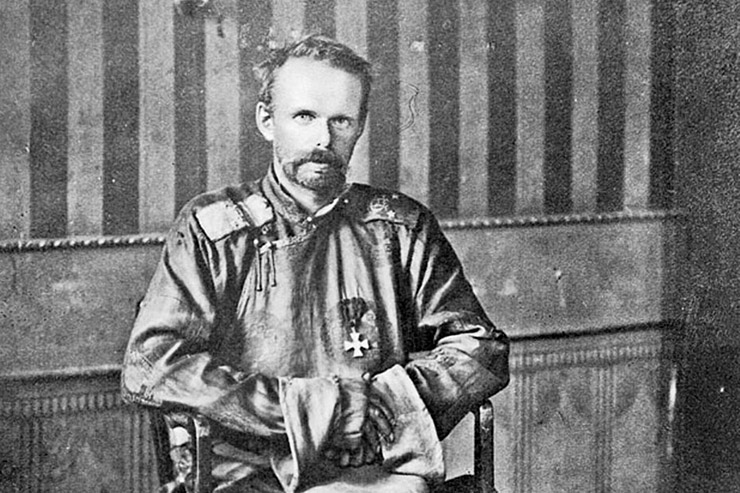
  • Water Fluoridation: Facts & Fallacies

    Water Fluoridation: Facts & Fallacies

    From New Dawn 107 (Mar-Apr 2008)

    Water fluoridation has been around for just over 60 years and whilst the practice has become widespread, particularly in Western nations, it’s always been a controversial and often passionately argued one.

    My formative moment in the fluoride ‘debate’, one that cathartically shunted me into the anti-fluoride lobby’s arms, came many years ago when I was sitting in a dentist’s chair in Cambridge, UK.

    I knew very little about fluoride at the time, so it was with an open mind and calm disposition that I opened my mouth in order for my dentist to pour in some fluoride solution which he said would give my teeth a strong protective coating. The problems started immediately after having dispensed the liquid into my mouth when he stammered, “…but don’t whatever you do swallow it!” “Why?” I gurgled, “Because it’s poisonous and could kill you,” came his reply.

    The swill, which was supposed to have lasted about one minute actually lasted about 10 seconds and ended up all over my lap and the surgery floor. The incident was funny. We laughed about it at the time, but I had learned something new and very disturbing about fluoride that has remained with me. It matured into an understanding and appreciation of matters concerning fluoride that, whether you have any concerns about ingesting this chemical or not, I feel compelled to share with you.

    The pro-fluoridation lobby, notably the dental and medical associations in several countries, together with armies of practitioners tethered to them, will tell you that fluoride is a naturally occurring substance,1 that it is safe and effective at preventing tooth decay when used in designated dosages, and that its use is strongly supported by credible scientific evidence. It has, they say, improved the quality of life and well being of millions of people around the world for decades.

    They will also say that because it is generally added to water supplies at less than 1 part per million, that it is extremely safe, but that ‘if’ young children get too much fluoride they may develop a condition called dental fluorosis which is mostly detectable by dentists and involves a mild discolouration of teeth enamel. All sounds pretty harmless and reassuring don’t you think?

    However, if you were to take a quick peek at even a small amount of the arguments that are levied against the use of fluoride by the anti-fluoride lobbyists, you might be in for a nasty, albeit rather compelling, surprise.

    Let me just pick off a few of them and in no particular order.

    On the history of fluoridation, despite what is written on the Australian Dental Association’s website2 – which states that interest began in the US more than 100 years ago when a Colorado dentist noticed that some of his patients were displaying mottled yet decay free teeth which he deducted was due to their drinking of local spring water that was naturally high in fluoride – the real and well documented origins of water fluoridation actually sprang from a pre-emptive public relations campaign commissioned by US military interests.3 They were attempting to stave off litigation arising out of the Manhattan Project, the one that was set up to produce the world’s first atomic bomb.

    Apparently atomic bomb production required enormous amounts of fluoride, which inevitably resulted in large amounts of fluoridated (not radioactive) effluent spewing out over the US countryside. People, animals and crops that were downwind began to get diseased causing the US government to become concerned (for its precious bomb project, not the people who were sick).

    For the US, with plans to use the A-Bomb as a defensive deterrent after WWII, it was a strategic imperative that bomb production be allowed to continue without the threat of massive class actions hanging over it, and that therefore the exposure of humans to ‘low’ levels of atmospheric fluoride be demonstrated to be biologically safe.

    Human studies developed and administered by institutions associated with the A-Bomb project were mainly focused on the town of Newburgh,4 New York from 1946-56 where the effects on health were observed following the addition of fluoride to the town’s drinking water supplies.

    Whilst the results of the research were heavily censored, the intended purpose of the findings had been to serve as evidence in favour of the safety of continued low, long term exposure of humans to fluoride.5

    The litigants, mainly farmers, were bought off and the results of the research will therefore probably never be dragged into the public spotlight. However, following incidental observations made during the water fluoridation research program, it was floated by one of the team leaders that it “might help to counteract a local fear of fluoride… through lectures on… fluoride toxicology and perhaps the usefulness of fluoride in tooth health.”6

    The rest is history! That the development of water fluoridation was motivated by a benevolent move to prevent dental caries was almost a total myth and it gets a lot worse than that.

    Fluoride production increased significantly since the immediate post-war years and is now a toxic by-product of the chemical industry that is produced in massive quantities. Most of the early research presented to support the notion that fluoride is both safe and effective for use in the prevention of tooth decay was conducted or funded by the very same interests7 that stood to benefit most from its use in the public domain. It was also done when there was a lot less environmental fluoride around too.

    That fluoride is toxic and dangerously so is not in doubt or contention, but the fact that it is poured into the water supply of any local council that so wishes to do so is nothing short of criminal, given the facts that are now available.

    Most European countries including Denmark, France, Germany, Italy, Holland and the whole of Scandinavia, have (in many cases after having embraced it) now rejected water fluoridation outright.8 As of today Europe is reportedly 90%+ free9 of fluoridated water. Indeed there have never been any transparently conducted scientific studies anywhere in the world,10 including Australia, that unequivocally demonstrated the safety of water fluoridation on human health, most of the research having been focused on the chemical’s dubious impact on oral health.

    Fluoride is a cumulative toxin, it gets stored mostly in bone tissue and has now found its way into dental products, food, soft drinks, polluted air and in fact it’s just about in anything manufactured using treated mains water.

    Although it varies from place to place, it is added to water in concentrations of around 1 part per million, a level deemed safe,11 yet is added to toothpaste products in concentrations as high as 1,500 p.p.m., easily enough to kill a small child if it swallowed a whole tube.

    Fluoride does indeed occur in nature in trace amounts, but the fluoride that we have in our water supplies is not the same thing at all. What we put into our mains water is, without exception, an industrial toxic waste product. Neither is fluoride in any of its forms essential for good nutrition.12 Tooth decay (contrary to what is implied by the likes of the Australian Dental Association and the Australian Medical Association) is not a symptom of fluoride deficiency. There is no such thing.

    The forms of fluoride placed into our water systems and then into our bodies are usually calcium fluoride, sodium fluoride or hydrofluorosilicic acid. They are all either industrial or pharmaceutical grades of fluoride compounds which, in the instance of the latter, is scraped from the inside of smokestack scrubbers during the production of phosphate fertilisers. If it were not dumped into our drinking water it would be considered a highly dangerous and toxic chemical to be disposed of at considerable expense and with significant health and safety precautions. Yet we happily consume it when we’re told to.

    Another way of looking at water fluoridation is as a form of forced mass medication not by doctors, but, effectively by dentists. We should remember that these are the same body of professionals who are still lodging tons of mercury in our mouths each year in the form of amalgam fillings. If I lived in an area where 25% of people suffered from headaches I’d be unhappy, to put it mildly, if my local council put paracetamol in my water supply as a preventive measure and on the advice of some doctor. I fail to see the difference with what they are doing with fluoride (except that fluoride is a toxic waste and not an approved medicine).

    If you absolutely do not want to take fluoride when it’s forced on you the only way to resist is to purchase a water filter that is good enough to filter the stuff out. Even if you did this, what about the water you bath and shower in, or those who live in places too small to accommodate an extra tank, or in institutions where you just don’t get the choice. It’s sometimes simply impossible to take evasive action.

    With mass medication there is no such thing as a safe nominated dose. Even if we did need extra fluoride, just like everything else in this world everyone’s needs are totally individual, as are indeed our levels of exposure to fluoride natural and otherwise. We’d do well to remember that early research into fluoride was done before it was widely dispersed into the atmosphere, our food, drinks and personal care products.

    Further, there are those amongst us who tend to drink more than others, sportspeople, the sick or the very young. What level of choice do they get if they don’t want to overdose on fluoride? Water fluoridation will give you the same dose per litre whether you drink a lot of water or not.

    I don’t trust any authority when, as the Australian Dental Association (ADA) does, it continues to claim that the side effects of fluoridation are limited to fluorosis13 and little else. Fluorosis is, in itself, evidence of excessive ingestion of fluoride and shouldn’t be tolerated at all – period. In order for the ADA to say this with any integrity and honesty it has to be ignoring, at the public’s expense, a large body of accumulating evidence that strongly indicates fluoride is neither as effective, nor as safe as it was once cracked up to be.

    New research indicates that the benefits of fluoride are equivalent to an average difference of less than one filling in baby teeth of younger children and “no significant difference” in the permanent teeth of older children,14 yet the pro-lobbyists are still claiming the outdated figure of between a 15-25% reduction in tooth caries in fluoridated areas! They’re having us on!

    Perhaps more to the point, the reduction in dental caries that we have seen (credit for which has been claimed by the pro-lobby) were in line with similar reductions in areas that were not fluoridated. In fact in fluoridated areas that were monitored after they had ceased fluoridation caries reduction was seen to peak immediately after cessation.15

    Other research tells us that for fluoride to be effective as a preventive measure against tooth decay it has to be used topically.16 This means that forced ingestion via the water supply is ineffective. The same research also indicates that fluoride works least well down among the crevasses and fissures of the teeth, where most decay occurs anyway.

    Coming closer to home and Australian research has recently debunked the myth that Australians living in fluoridated areas have healthier teeth and significantly lower levels of tooth decay than the rest of the nation. They don’t.

    Recent claims17 by the Queensland government that Townsville (fluoridated for 50 years or more) has 65% less decay is based on data from 1991 (!) and relates to a tiny 0.2% of a single tooth surface (there are 128 tooth surfaces in the average fully grown adult mouth). Therefore the claims and many others that it is using to support fluoridation, and the same goes for every other state, are misleading and unjustified.

    More recent surveys done between 2000-2002 clearly show that Townsville children have more decay in their permanent teeth than children in North Brisbane, the Gold Coast and several other Queensland Health Districts that do not have water fluoridation. Townsville, for all its decades of fluoridation, is smack in the middle, no better and no worse than any other area of Queensland. Do these sorts of results justify the continued dumping of a toxic waste into our drinking water?

    As the award-winning investigative reporter Christopher Bryson says in his book The Fluoride Conspiracy, “Fluoride science is corporate science, fluoride science is DDT science, it’s asbestos science, its tobacco science.”

    It’s happened in Europe, but when are our politicians going to stop this fluoride nonsense here in Australia?

    2006 was a good year for anti-fluoride lobbies. The National Research Council in the US, a highly reputable scientific organisation, issued a report called ‘Fluoride in Drinking Water: A Scientific Review of EPA’s Standards’.18 It is a lengthy report that was not commissioned to judge the safety or benefits of water fluoridation per se, but rather to assess the safety of the “maximum contaminant level goal,” which incidentally the report recommended should be lowered.

    But the report, despite keeping rigidly to the initial brief, gave strong support to the notion that US citizens are being constantly over-dosed with harmful levels of fluoride and that whilst bones and teeth were most affected, these were not the sole targets of the report’s concern.

    The report threw up a growing body of research linking fluoride exposure to crippling skeletal fluorosis (similar in effect to arthritis), bone fracture, joint pain and damaged teeth. It also pointed to fluoride’s disruption of the nervous and endocrine (hormone) systems with specific focus on the brain, the thyroid and the pineal glands. There is also evidence linking fluoride to behavioural disorders, clinical depression, dementia, lowered levels of I.Q. and migraines, and finally to osteosarcoma (a type of bone cancer that particularly affects young males).

    So, bad news is good news, but does it make you feel like taking a glass of tap water with added fluoride, or what? Small wonder then that there is this world wide phenomenon whereby whenever there is a publicised public debate on the merits or otherwise of the fluoridation of water, no one from the pro-lobby ever shows up.
    By way of reinforcing the reasons why this is so, it’s worth remembering that back in 1965 when fluoridation was well underway in the US, it was Joseph Flanagan of the American Medical Association which openly endorsed the use of fluoride for dental caries prevention. He wrote:

    “The AMA is not prepared to state that ‘no harm will be done to any person by water fluoridation’. The AMA has not carried out any research work, either long-term or short-term, regarding the possibility of any side-effects.”19

    Which brings me to the extraordinary turn of events that appears to be taking place in Queensland at the time of writing.

    Given all the evidence currently available which throws such extreme doubt and serious concerns on the practice of water fluoridation, the State government in Queensland has chosen 2008 to go open slather on water fluoridation.20

    Up until now Queenslanders had been given a choice on whether or not to fluoridate its local water supplies. Only 5% of Queensland has elected to do so, although some previously had done so and subsequently discontinued the practice. Yet according to the latest National Children’s Dental Survey (published in Dec. 2007),21 75.1% of Queensland children aged 5-12 years have no decayed teeth. This compares with figures of 76.9% for the national average and 72.9% and 79.7% in the ACT and South Australia respectively (both fluoridated and the ACT 100%). So why the sudden and urgent need to fluoridate Queensland’s water supply?

    This provides clear and irrefutable proof that fluoridation neither creates good dental health, nor performs any better at doing so than areas that do not have water fluoridation.

    No one is saying there is no problem with standards of dental health and that something really ought to be done about it. The key issue is that overwhelmingly water fluoridation is not the answer, and when it is mistakenly introduced as the answer it presents a plethora of serious new risks to the health of the people who drink it. The ADA doesn’t believe these risks exist and if you don’t believe me go and have a look at the FAQ section of its website.22

    Take any region of Australia whether it is fluoridated or not and compare the figures. The statistics,23 when carefully and thoroughly studied, strongly suggest that fluoridation makes only insignificant improvements to dental health in the early years (in all likelihood only because one of the effects of fluoride is to delay the eruption of first teeth) and none at all once kids reach 12 years or so. After drinking fluoridated water for 12 years, Townsville children have the same or more decay as children who never consumed fluoridated water!

    It isn’t all about the likes of Townsville either. Some of the other problems that water fluoridation hasn’t solved are: a) nursing bottle tooth decay, a problem affecting all areas in Australia, b) lower income groups which tend to have higher levels of tooth decay, yet still drink the same water as higher income groups, c) rural and remote areas where tooth decay is reportedly consistently worse, and finally d) Aboriginal and Islander communities where oral health has declined to levels well below the national average and have been headed in that direction ever since they stopped eating traditional, healthy diets.

    So where is all this going? Well, if Queensland is anything to go by, back to the dark ages. Will someone please tell the Queensland government this is not a good time to take the highly questionable step of forcing water fluoridation onto the rest of the State. It flies directly in the face of common sense, current wisdom, people’s rights and is not in the best interests of everyone’s long term health.

    As a spokesperson for Queenslanders Against Water Fluoridation recently articulated in an open letter to State Premier Anna Bligh,24 “If fluoride ingested water made a real difference to decay, the longer it was consumed, the more difference there would be.”

    So here, for what it is worth, are a few humble suggestions for the way forward from here. My first and number one priority would be to stop water fluoridation now. The evidence is very much against it and has already convinced most of Western Europe.

    My second would be that if you don’t accept the first point, then before anyone with sufficient power and totally lacking an enquiring mind makes a decision that could make us all ill, would someone please fund some good, objective and independent research so that the matter can once and for all be decided.

    Thirdly, whilst I’m not sure where everybody else stands on this issue, if you are quietly and rock solidly convinced that you as an individual need fluoride, especially if you have any affiliation with the ADA, then be my guest and go buy yourself a tube of fluoride toothpaste, but remember to spit it out when you’ve done brushing your teeth as it’s not too good for you if you swallow it.

    Finally, and just in case the whole nasty issue of poor dental health could even remotely have anything to do with poor diet, nutrition and generally poor standards of personal oral hygiene, perhaps we might be better off investing some money on trying to improve these things.

    The ADA can rubbish the anti-fluoridation lobby as unscientific all it likes, but for me I think that the US National Research Council in its 2006 report; theLancet,25 one of the medical world’s most pre-eminent journals, which published an article on fluoride as an emerging neurotoxin; Chinese studies linking fluoride to lowered I.Q.26Cancer, Causes & Control journal which linked osteosarcoma to water fluoridation27; the American Dental Association & Centre for Disease Control 2006 advising that infants under 12 months old not consume fluoridated water28; should all be given bravery awards for finally providing us with good evidence that links adverse health impacts to the practice of water fluoridation.

    Don’t expect the chemical industry to stop producing fluoride any time soon either. It’s a big industry and would probably come to a grinding halt if they found they couldn’t produce it any more. But please, can we make them take it away and store it somewhere safe at their own expense and not at ours?

    Ah well, these are just some thoughts and only mine at that!

    [alert type=”general” dismiss=”no”]This article was published in New Dawn 107.[/alert]

    [alert type=”success” dismiss=”no”]If you appreciate this article, please consider a contribution to help maintain this website.[/alert]

    Footnotes

    1. www.health.qld.gov.au/fluoride/default.asp
    2. Ibid.
    3. Australian Fluoridation News, ‘The Authentic Original History of Fluoridation’ by Glen S.R. Walker, Sept/Oct 2007, p.2.
    4. Ibid., p.6.
    5. Ibid., p.7.
    6. ‘Declassified documents, studies showing lower IQ bolster voter rejection of fluoridation’,Business Wire, 29 November 1996, www.mind-trek.com/arti-int/961202d.txt
    7. Australian Fluoridation News, ‘The Authentic Original History of Fluoridation’ by Glen S.R. Walker, Sept/Oct 2007, p.7.
    8. www.whocollab.od.mah.se/euro.html
    9. Ibid.
    10. ‘Scientists and Professionals Lash Out Against Water Fluoridation’ by Adam Miller, www.naturalnews.com/022008.html
    11. www.health.qld.gov.au/fluoride/q_and_a.asp
    12. ‘50 Reasons to Oppose Fluoridation’ by Paul Connett, Ph.D Prof. of Chemistry, St. Lawrence University, NY, USA, www.fluoridealert.org/50-reasons.htm
    13. www.health.qld.gov.au/fluoride/q_and_a.asp
    14. ‘Caries Experience Among Children in Fluoridated Townsville and Unfluoridated Brisbane’, by Gary D. Slale; John Spencer; Michael J Davies; Judy F. Stewart, Australian and New Zealand Journal of Public Health 1996 Dec; 20(6): 623-9.
    15. Olsson ’79; Retief ’79; Mann ’87 & ’90; Steelink ’92; Diesendorf ’86 and Colquhoun ’97, www.fluorideawareballarat.com/what_the_experts_say.htm
    16. Centers for Disease Control and Prevention (CDC ’99, 2001); http://bmj.bmjjournals.com/cgi/content/full/321/7265/904/a
    17. Water Fluoridation & Children’s Dental Health. The Child Dental Health Survey. Aust. 2002.
    18. National Research Council ‘Fluoride in Drinking Water: A Scientific Review of EPA’s Standards’, 2006, www.fluoridealert.org/health/epa/nrc/
    19. Letter dated 13.5.1965, J.E. Flanagan Jnr. (Assist.Dir. Dept. of Environmental Health, USA).
    20. www.health.qld.gov.au/fluoride/whats_new.asp
    21. National Children’s Dental Survey, Australia, published 17 December 2007.
    22. www.fluoridationqld.com
    23. National Children’s Dental Survey, Australia, published 17 December 2007 & Public Water Fluoridation & Dental Health in NSW (Australian and New Zealand Journal of Public Health 2005. Vol. 9 No.5).
    24. www.gawf.org
    25. ‘Developmental Neurotoxicity in Industrial Chemicals’, Lancet 368.
    26. Wang ’97; Guan ’98; Varner ’98; Zhang’99; Lu 2000; Shao 2000; Sun 2000; Bhatnagar 2002; Chen 2002
    27. Bassin B; Wypi D; David RB; ‘Age Specific Fluoride Exposure in Drinking Water and Osteosarcoma (US), 2006.
    28. www.ada.org/prof/resources/pubs/adanews/adanewsarticle.asp?articleid=2212

    © New Dawn Magazine and the respective author.
    For our reproduction notice, click here.
  • G.I. Gurdjieff & the Hidden History of the Sufis

    G.I. Gurdjieff & the Hidden History of the Sufis

    From New Dawn 107 (Mar-Apr 2008)

    Sufism belongs in spirit to the modern age. It has an affinity with it; it is in tune with secularism, with the modern thirst for objective knowledge. Yet the Sufi tradition is immensely old. In some quarters a belief still persists that it is a mystical offshoot of Islam, but most reliable sources claim it is far older than the Muslim religion.

    Evidence is emerging that suggests the tentacles of the brotherhood reach out to many religions and cultures and extend thousands of years into the past, and that its members were once better known as the Friends of Truth, the Builders, the Masters, the People of the Way and numerous other appellations that had been circulating for far longer than the lifetime of Islam. The Friends, it is said, were already present in Medina during Muhammad’s lifetime and adopted the name Sufi after taking an oath of fidelity to the Muslim cause.1

    A number of derivations of the word Sufi have been put forward, including Ain Soph, the Kabbalistic term for the unknowable, and Sophos, meaning Wisdom. This is in line with the view held by many students of Sufism who claim that it corresponds with the hidden esoteric wisdom-dimension that underlies all religions. Thus the British Sufi fellow-traveller and author Ernest Scott believes the Sufi tradition has impregnated Western culture to a degree we rarely realise, leading him indeed to call it the Invisible Tradition. Its covert influence, he says, has been strong in Manichaeism and the Cathar faith, in the Troubadour and Jester traditions of medieval Europe, in the evolution of Jewish Kabbalah, in alchemy and in Christianity itself. Scott quotes the Afghan Sufi teacher Idris Shah as saying that “there is evidence that at the deepest levels of Sufi secrecy, there is a mutual communication with the mystics of the Christian West.”2

    Scott further quotes Hakim Jami, a twelfth-century Sufi master, as implicitly denying Sufism’s Islamic origin by declaring that Plato, Hippocrates, Pythagoras and Hermes lay on an unbroken line of Sufi transmission, thus making a causal connection between Sufism and the Greek Mystery schools of antiquity.3 The British esotericist J.G. Bennett goes further, claiming that the Sufis are the descendants and spiritual heirs of the old master magicians of Altai, and that Central Asia has been their heartland for forty thousand years or more. He says that it was from the Altaic shamans that the Sufis inherited the religious tolerance, supremely practical expertise and democratic ideals that are their hallmark today. And it was from the Siberian schools of wisdom that they learned their unique way of surrender, the way of total obedience to a higher principle than man which has earned them the soubriquet “the slaves of God.”4

    Bennett gained much of this knowledge of Sufism’s hidden history from his mentor George Ivanovitch Gurdjieff (1877 – 1949), the Armenian-Greek mystic and spiritual teacher who travelled extensively in the Caucasus and Central Asia and who received Sufi training in the dervish schools he encountered there. In The Masters of Wisdom, Bennett recounts:

    Gurdjieff told me that he had learned about these ancient schools of wisdom from researches he himself had made in caves in the Caucasian mountains and in the great limestone caverns of the Syr Darya in Turkestan. I have since learned that there is a Sufi tradition in Central Asia that claims to go back forty thousand years.5

    Gurdjieff also told Bennett that the paintings in the Lascaux caves in the Dordogne, France, which the great authority on parietal art, the Abbé Breuil, has dated to about thirty thousand years BCE, were the work of later Sufi descendants of the shamans.6 Gurdjieff took the story of Atlantis literally. He associated it with pre-sand Egypt and believed the Lascaux artists were members of a brotherhood that survived after Atlantis sank seven or eight thousand years ago.7 They were highly evolved Masters of Wisdom, “‘psychoteleios’ who had learned the secret of immortality,” and whose centres of initiation on the now submerged Atlantic continental shelf have left us, in their paintings of deer, bison and auroch, a magical message of prehistoric spirituality that lay undeciphered for many thousands of years.

    In that palaeolithic age art and religion were still one; secular and religious consciousness had not yet separated out, and spirit and matter were not yet in opposition; nor was evil an absolute force seeking the overthrow of good. All things and all attitudes to things were filled with the magnetic, synthesising radiance of hypercosmic energy, which Gurdjieff called conscious energy. In such a unified world the great Initiates developed the unique type of spirituality that still distinguishes Sufism today, wherein the polarising activity of mind is submissive to the over-riding Spirit that ever seeks a return to the One. Only in the later more alienated religious systems, Gurdjieff believed, do we find the divisive seeds of philosophical dualism.

    The Sarmoun Society

    At the apogee of the Sumerian civilisation, Bennett continues, the Sufis are believed to have founded a brotherhood called the Sarman or Sarmoun Society, which, according to Gurdjieff, met in Babylon as far back as c. 2500 BCE and was responsible for preserving the inner teachings and initiations of the Aryan tradition in a period of religious decline. Sarmoun is a word meaning bee in Old Persian, and refers symbolically to the practice of the brotherhood of storing the “honey” of both the traditional wisdom and the supernatural energy or baraka enabling it to be understood, and sending this double “nectar” out into the world in times of great need.8 The word Sarmoun can also mean “those who are enlightened.” The Sarmouni are believed to have secret training centres hidden to this day in the most remote regions of Central Asia.

    In Gurdjieff: Making a New World, Bennett conjectures that around 500 BCE the Sarmoun Society migrated from ancient Chaldaea to Mosul in Mesopotamia, moving north into the upper valley of the Tigris, into the mountains of Kurdistan and the Caucasus. There it became active in the rise of Zoroastrianism under the Persian monarch Cambyses I. According to Gurdjieff, the Society later moved eastward to Central Asia, twenty days’ journey from Kabul and twelve days’ journey from Bokhara. “He [Gurdjieff] refers,” says Bennett, “to the valleys of the Pyandje and the Syr Darya, which suggest an area in the mountains south-east of Tashkent.”9 Although Gurdjieff was never explicit about his relationship to the Sarmouni or the precise locality of the monasteries in which he trained towards the end of his travels, he provides many hints in such autobiographical writings as Meetings With Remarkable Men that this Sarmoun brotherhood, whose monasteries were situated on the northern slopes of the Himalayas, was the custodian of the most ancient wisdom known and the primary source of his extraordinary esoteric knowledge and powers.

    Gurdjieff came to the West as a man with a mission. He had journeyed extensively in the Caucasus, where it is thought he first entered the tekkes of the Yesevi dervishes of Sheikh Adi in the Kurdish foothills and later those of the Sarmouni in Afghanistan, receiving a number of initiations by the remarkable age of twenty two. Those closest to him maintain that he remained in touch with hidden Sufi sources throughout his life and received help and support from them. He clearly believed that he acted on their authority in setting up schools in the West that transmitted the cosmological and psychological teachings he himself had learned during his travels. Yet while freely recounting his many Central Asian adventures in his search for wisdom, Gurdjieff managed to draw a permanent veil of secrecy and ambiguity over all details of these intimate encounters with the dervish tradition. This of course is in line with the extreme reticence of the Sufi orders themselves.

    Gurdjieff and the Masters of Wisdom

    A charismatic hypnotist, carpet trader, Russian spy and mystic extraordinaire, George Gurdjieff was the son of a Greek-Armenian bard and was deeply impressed by his father’s songs concerning the great spiritual luminaries of a vanished past. The boy apparently began his search for the lost wisdom of the ancients at the early age of fifteen, and maintained it at huge cost to his health and material resources until he emerged, nearly thirty years later, a magus of mysterious yet undeniably charismatic authority. Possessed of enormous personal courage, during World War I Gurdjieff led a large posse of Russian followers across Eastern Europe to safety, through the raging battle lines of Bolsheviks and Cossacks in turn, eventually establishing a school in Fontainbleu, outside Paris, for the study and practice of methods of spiritual self-transformation. These methods, revolutionary in their day, are believed to have included the sacred dance and music exercises of the shamanistic Yesevi dervishes of Kurdistan, a community in which Gurdjieff seems to have received his initial training in Sufi techniques of “soul-making.”

    The Yezidis, a secretive Kurdish religious sect from which the Sufi Bektashi order has sprung, live to this day in the foothills north of Mosul in Iraqi Kurdistan pursuing a cult of angels. According to the British baroness E.S. Drower, who in 1940 published a detailed paper on the sect, the chief Yezidi angel is Malek Taus, the Peacock Angel who has some likeness to Lucifer, the fallen angel of Christian fame. A black serpent is also held in special reverence in the Yezidi religion as a symbol of magical potency – no doubt ultimately a symbol of kundalini and the spinal system of energies elaborated in spiritual physiology. While paying lip service to the Muslim faith, the Yezidi have their own unique cosmogony, mythology and ritual practices, which have more commonality with the Magian or Gnostic belief-systems than with either Islam or Christianity. Ceaselessly persecuted and destroyed by Kurdish Muslims and Ottoman Turks as well as Islamic armies of both Iraq and Iran, the once powerful Yezidi tribes have been almost wiped out as heretics of the first order. Only isolated groups are now left. These include small pockets in Central Kurdistan, the Russian Caucasus and in satellite communities in Syria, Lebanon, Anatolia and Iran.

    Sheikh Adi, a noted mystic of the thirteenth or fourteenth century, was a Median Magi, and although he is regarded as the founder of the Yezidi faith and an incarnation of the Peacock Angel, both the religion and the tribe are ascribed a far earlier date of origin. They are believed to be heirs to an ancient ancestral tradition going back to Noah. Adrian G. Gilbert comments:

    It is my belief that they [the Yezidis] are descended from the ancient Chaldaeans. Their own tradition is that they migrated from the South, and they may well be the lost remnants of the Babylonian Magi who disappeared after the time of Alexander of Macedon.10

    This is certainly in line with Gurdjieff’s belief that the roots of Sufism lie in a spiritual tradition of extreme antiquity such as is found in the Yezidi faith, and that it was probably centred in the Caucasus and Central Asia. Nevertheless, there is much evidence that Sufism continually developed beyond its initial form and amplified its teachings over the ages.

    The late Hugh Schonfield, a noted Jewish scholar and author, says that by the third century CE Sufi schools were well established in the Middle East, particularly in Mosul, the heart of the old Assyrian kingdom, under the auspices of the Zoroastrian Magi. There the Sufis were joined by many Jewish refugees from Egypt fleeing Roman persecution. Among these were the Therapeutae, members of an Essene Order of contemplatives strongly imbued with a revolutionary New Covenant with God. The covenant involved a Judaic reformation that forbad militarism and animal sacrifice and embraced the principles of gender equality and an equitable distribution of wealth. The Therapeutae brought to the Sufi tradition not only these enlightened social ideals which were actually already enshrined in its own constitution, but much of the new Hermetic and Kabbalistic mysticism fermenting in Alexandria. Thus, says Schonfield, throughout Egypt and the Middle East

    there were religious fusions and amalgamations, and the emergence of spiritual hybrids… Zoroastrianism and Mithraism lent their characteristics to Jewish Essene teaching, and found a Greek expression in the Hermetic and Christian Gnostic. The coverage of the Roman empire right round the Mediterranean carried the cults with it, and opened the way to new blendings.11

    In this way Sufism was continually invigorated by new trends and in turn invigorated others. Then, when in the seventh century CE civilisation was in danger of total collapse through the ravages of global pestilence, war, earthquakes and the suppression of all Greek learning by Byzantine Christianity, the Sufi masters transferred their allegiance from Zoroastrianism to Islam, the latter offering the greater hope of rehabilitation for humanity. Thus the wisdom and science of Persia, with its great heritage of Greek learning, passed into the Muslim culture and was carried by Muslim sages into every quarter of the globe. The Dark Ages were halted and Islam, supported by the Sufis, brought about a brilliant revival of the Graeco-Roman arts and sciences.12

    The conquest of Spain by the Muslim Moors meant Jews, Muslims and Christians were able to live there harmoniously until the fifteenth century, creating a culture of superb beauty and intelligence which lasted until the Jews and Muslims were banished to Byzantium, and which gave Sufism entrance into the rest of backward Europe. During the same centuries Crusaders such as the Templars encountered the rich Saracen culture in the Holy Land and secretly brought back the cream of Sufi thought to Europe to enrich Christian theological scholarship, art and sciences.

    Himalayan Withdrawal

    With the Mongol invasions, however, came difficult days for European civilisation as many sources of Sufi wisdom withdrew. The Sufi Masters of Wisdom known in Central Asia as the Khwajagan lineage withdrew at this time to the Trans-Himalayas, where their schools still persist. The Khwajagan were neither savants nor mystical ecstatics. They were practical men who assiduously practiced the breathing and mantric exercise of the zikr, fought their own weaknesses by means of trials based on humiliation and abasement, and during the Mongol depredations of the conquered western cities built new schools, hospitals and mosques. Some say these Masters, who may be synonymous with the Sarmouni, have continued to this day to head the Sufi hierarchy – which Bennett has called the Hidden Directorate – from its hidden Trans-Himalayan headquarters. Meanwhile, the Sufi orders left behind continued to strengthen their ties with other esoteric systems, such as the Magian secret societies in Persia and the Copts in Egypt, and to extend their formidable influence across the world into South-East Asia.

    In the Sunda Islands they amalgamated successfully with the indigenous shamans, Hindu-Buddhists and Taoists and were instrumental in establishing in Java one of the most influential schools of Tibetan Kalachakra Tantra in the world. The result was a chain of hybrid secret societies around the globe whose roots were buried deep in a freedom-loving soil compounded of Sufism, Magian wisdom and the Solomonic and Hermetic wisdom of the Egyptian Essenes. It was these pan-religious amalgamations that produced over the centuries initiatic schools like the Templars, the Chartres masters, the Rosicrucians, the Illuminati, the Freemasons and the Theosophists, all dedicated to working for the religious and scientific dawning of a new age free from religious intolerance.

    Throughout the long Sufi saga, the West had been unaware of intervention in its affairs, or indeed of the very existence of a powerful organisation in its midst that was monitoring the course of history and at the same time maintaining its own hierarchy, objectives and worldview independently of the visible political and religious structures of society. But the Sufi masters knew that this unconscious condition, mainly imposed on the people by repressive forces outside their control, must end, and that the time of awakening was drawing near.

    Sufi Masters and Rosicrucianism

    The two Rosicrucian manifestos pseudonymously published in Germany in the early years of the seventeenth century marked the first Sufi venture into the public domain and caused a sensation. The manifestos purported to advertise a mysterious order called the Fraternity of the Rosey Cross which had been founded, it was claimed, by one Christian Rosencreutz; and a third publication called The Alchemical Wedding of Christian Rosencreutz, written in high Dutch, came out soon after. The manifestos declared that Fr. Rosencreutz had obtained the inspiration for his brotherhood from Arabia, Fez (the home of Sufic alchemy since the eighth century) and Egypt, all centres of Sufi activity. And Rosicrucian tradition has it that Fr. Rosencreutz was initiated in Palestine by an Arabic sect. Observes Ernest Scott:

    When it is realised that the Sufi teacher Suhrawardi of Aleppo had a teaching method called the Path of the Rose and that the Sufic word for a dervish exercise has the same consonantal root as the word for a rose, the Sufic origin of the Rosicrucians may be inferred with some confidence.13

    As we now know, the series of Rosicrucian publications with their visionary and reforming talk of an invisible college, a “winged academy” dedicated to a commonwealth of man, created a furore in Europe. Some saw the publications as a hoax, others as a God-given sign of the millennium. As ever, the Sufis were not directly mentioned: but, sweeping like a rejuvenating wind through Protestant and Catholic lands alike, the movement stirred up by the mysterious manifestos became a potent though short-lived catalyst for change. It instigated a religious and intellectual uprising that sought reform in education, religion and science, promising a coming utopia in which the dignity and worth of every man and woman would be recognised.

    Frances A. Yates, a foremost Renaissance scholar, believes this period in the seventeenth century can rightly be called the Rosicrucian Enlightenment and that out of its “great reservoir of spiritual and intellectual power, of moral and reforming vision”14 came the Royal Society and the age of scientific revolution.

    Full of Christian mysticism yet also permeated with Hermetic-Kabbalistic angelology and alchemical religious philosophy, the Rosicrucian teachings proclaimed that this age of enlightenment, in which religion and science would no longer be antithetical, was at hand. Great advances were to be made and a reformation of the whole wide world would presage “a great influx of truth and light” into fallen society such as shone on Adam in paradise. For a time large factions of the Church espoused these ideas, and the Jesuits, themselves of occult and hermetic origin, took over much of the Rosicrucian symbolism and emblematics.

    Yet in the event the whole programme was aborted by the fiercely reactionary response of the Spanish Inquisition and its political ally, the Hapsburg dynasty, which instigated the Thirty Years’ War, forcing thousands of religious dissidents to flee with the seeds of the new vision to the New World. The Sufi programme had to incubate in secret for several more centuries.

    Sufis Re-emerge in Twentieth Century

    Not until the twentieth century, in a more tolerant and receptive age, were the Sufis finally able to reveal themselves openly. In 1921 Gurdjieff, the emigré and entrepreneur from Armenia, was the first to make this possible. He came with a crucial message for the twentieth century and, as we shall see, for our own era in the third millennium. Of great personal magnetism, drive and unusual psychic powers, Gurdjieff burst upon the Western scene with his programme for spiritual development, bringing to the European cognoscenti for the first time an awareness of the sacred ritual dances and dervish exercises of the East. These, he said, had strong links with Altaic shamanism and Tibetan and Chinese Tantra.

    But Sufis have never regarded spiritual exercises alone as adequate. Generally speaking, little is said in Sufi literature about baraka, the effective grace that makes spiritual development on this path possible, yet its importance is primary. Baraka, as transmitted from teacher to pupil, is said to be a high emotional energy associated with the heart centre, and according to Bennett, enables the pupil to do what would be quite beyond his unaided strength.15 It is this inner infusion of conscious energy – energy of a high spiritual nature – that enables the zikhr, the Sufi invocatory exercise, to be fruitful. Discipline, austerity and voluntary suffering, which Gurdjieff translated as conscious labour and intentional suffering, were also needed. By intentional suffering he meant exposing oneself to painful situations in order to help others.

    While the southern Sufi orders embraced the mystical doctrine of love and union with God, these northern Sufis were strongly influenced by Buddhism and, like the Khwajagan, were concerned with a total liberation from self and the world of appearances. They were regarded by the more conservative southern Sufis as unorthodox, even being accused of magical practices learned from the Siberian shamans to the north. Nevertheless, Gurdjieff saw great benefit for the West in the dervish practices, disapproved though they were by the more purist brotherhoods such as the Nach’shbandi and the Qadiri, and made his unique programme available to all those wishing to develop their human potential.

    At his Institute for the Harmonious Development of Man in Fontainbleu, Gurdjieff trained his students in group dance movements set to dervish rhythms that demanded of them intense physical effort and coordination and which raised the body to a “high state of consciousness” conducive to a transformation of energies. He also encouraged his pupils to observe intensively their own psychic centres of thinking, feeling and instinct as a means of achieving a degree of self-government that man at present entirely lacks – but without which, Gurdjieff insisted, it is impossible for him to govern and maintain the planet. Public performances of Gurdjieff’s dervish dances were put on at various theatres, even in the prestigious Carnegie Hall in New York, and Europe and America marvelled: nothing like it had ever been known. Sacred dances, Gurdjieff said,

    have always been one of the vital subjects taught in esoteric schools of the East… Such gymnastics have a double aim: they contain and express a certain form of knowledge and at the same time serve as a means to acquire a harmonious state of being.

    At one time it was his intention to use the movements in the traditional way for which they were principally intended in the ancient temples of initiation – that is, as a means of transmitting knowledge directly to the higher centres without passing through the mind, which is the way of Tantra. But a car accident in which Gurdjieff’s physical health was severely damaged put an end to his wider plans for the movements and turned his attention to writing and training selected people to carry on his work at a more intellectual level.

    Sufi prescience, Sufi aptitude for the right teaching in the right time and place, is well attested. In many respects, Gurdjieff’s writings contributed enormously to the familiarisation of the West to the radical idea of the psyche or soul – the dynamic centre that mediates between the spiritual and the sensory functions – which at that time Sigmund Freud was also bringing to Western notice. Recognition of this unifying centre of relativity, which modifies the traditional absolutes of philosophy and religion on one hand and the physical sciences on the other, was just then opening up, and Gurdjieff’s psychological brand of theosophy, which became the vogue at the same time as Freudian and socialist theory, made a very great impact.

    The Gurdjieff schools of self-development spread to numerous countries and his ideas became common coinage in the new enlightenment of the sixties. Through the interest aroused in his methods and teachings, in which the centrality of individuation was paramount, Gurdjieff was able to give out for the first time a certain amount of information about the Sufi tarekats hidden in Eurasia. And in his train came a school of eminent Sufi writers like Guénon, Bennett, Ouspensky, Schuon, Hazrat Inayat Khan and Idris Shah, all of whom further opened up the world of Sufism to a vast reading public.

    One of the central strands in Gurdjieff’s belief-system was the principle of world-creation and world-maintenance, which he said was derived from “an old Sumerian manuscript” discovered by a great Kurdish philosopher. The doctrine can be summed up very simply: “Everything that exists maintains and is maintained by other existences.” Peculiar to Sufism and appearing in no other religion, it states that the whole of the universe is a web of mutually supporting systems, “apparatuses for transforming energy,” each one of which produces the means of sustenance for others.

    This law of reciprocal maintenance governs all of life and applies to man as well as in his relation to Mother Nature. The world is not made for man, as we have been taught; both are made for each other. Man’s destiny and the destiny of the earth are interdependent. The evolution of the one depends on the evolution of the other, the survival of one on the survival of the other. Man is not separate from the cosmic process; he is himself part of the ecosystem he observes out there, and he must serve the evolution of the world as well as his own. That is the law of the cosmos, even as the palaeolithic shaman defined it many millennia ago.

    From the Sarmounis, Gurdjieff learned that man is at present an automaton, a mere mechanism driven by the blind forces of action and reaction, his sense of identity fragmented, his will almost non-existent. Yet even work on himself will not redeem him without an acceptance that he is here to serve the world. Through Gurdjieff, therefore, the Sufis gave out to the twentieth century a new teaching, a new outlook on life that was revolutionary seventy years ago: man cannot advance spiritually unless he fulfils his obligation to planet earth, and through planet earth to the solar system. He must “pay the debt of his existence” by nurturing that which nurtured him.

    For man’s cross is a twofold spiritual destiny; to evolve as an individual, but also to serve the evolution of kingdoms other than his own, lives other than his own. Out of the friction these opposed drives generate, said Gurdjieff, there comes a transcendental third, the birth of conscience. This suffering of the tension between the opposites is the law of true religion and is alleviated only by the awakening of the mediating force inherent in the soul; that is, conscience or love. The Sufi theory of world-creation and world-maintenance – “a new master idea for the coming age,” as Bennett called it – has become increasingly relevant as the planet’s ecological crisis has worsened over the decades; and now, looking back from our vantage point in the new millennium, we see how it has indeed become the hallmark of our time, perhaps the key to its essential meaning. Wherever the next civilisation is centred it must be where the third and reconciling power can operate; where conscience can find a home. That is the prime Sufi message for our generation, as it was Gurdjieff’s.

    [alert type=”general” dismiss=”no”]This article was published in New Dawn 107.[/alert]

    [alert type=”success” dismiss=”no”]If you appreciate this article, please consider subscribing to help maintain this website.[/alert]

    Footnotes:

    1. Ernest Scott, The People of the Secret, Octagon Press, London, 1985, p.45.
    2. Ibid., p.118.
    3. Ibid., p.45.
    4. J.G. Bennett, Gurdjieff: Making a New World, Turnstone Books, London, 1973, p.94.
    5. J.G. Bennett, The Masters of Wisdom, Turnstone Books, London, 1977, p.40.
    6. J.G. Bennett, Gurdjieff: Making a New World, p.86.
    7. Ibid., p.86.
    8. Ibid., p.57.
    9. Ibid., p.64.
    10. Adrian G. Gilbert, The Magi, Bloomsbury, London, 1996, p.49.
    11. Hugh Schonfield, The Essene Odyssey, Element Book, UK, 1984, p.166.
    12. J.G. Bennett, The Masters of Wisdom, Ch. 6.
    13. Scott, op. cit., p.176.
    14. Frances A. Yates, The Rosicrucian Enlightenment, Routledge & Kegan Paul, London, 1986.
    15. J.G. Bennett, Gurdjieff: Making a New World, p.278.

    © New Dawn Magazine and the respective author.
    For our reproduction notice, click here.