New Dawn – World's Most Unusual Magazine

Category: Articles

  • The Lost Lands of Mu and Lemuria: Was Australia Once Part of a Sunken Continent?

    The Lost Lands of Mu and Lemuria: Was Australia Once Part of a Sunken Continent?

    From New Dawn 103 (Jul-Aug 2007)

    Lemuria and Mu are interchangeable names given to a lost land believed to have been located somewhere in either the southern Pacific or Indian Oceans. This ancient continent was apparently the home of an advanced and highly spiritual culture, perhaps the mother race of all mankind, but it sank beneath the waves many thousands of years ago as the result of a geological cataclysm of some kind.

    The thousands of rocky islands scattered throughout the Pacific, including Easter Island, Tahiti, Hawaii and Samoa, have been claimed by some to be the only surviving remains of this once great continent. The theory of a lost continent in this area has been put forward by many different people, most notably in the mid 19th century by scientists in order to explain the unusual distribution of various animals and plants around the Indian and Pacific Oceans.In the late 19th century occultist Madame Blavatsky reincarnated the idea of Lemuria as a lost continent / spiritual homeland and influenced a host of subsequent occultists and mystics including well known American psychic healer and Prophet Edgar Cayce. The popularisation of Lemuria / Mu as a purely physical place began in the 20th century with ex-British army officer Colonel James Churchward, and the idea still has many adherents today.

    But is there any physical evidence to back up these claims of an ancient continent beneath the Pacific or Indian Ocean? Or should these ‘lost homeland’ stories be interpreted in another way entirely, perhaps as the symbol of a mythical vanished ‘Golden Age’ of man?

    The Land of Mu

    The idea of a lost continent known as ‘Mu’ in the Pacific Ocean does not actually have a particularly long history, neither is it mentioned specifically in any ancient mythologies as some writers have suggested. The title ‘Mu’ originated with eccentric amateur archaeologist Augustus le Plongeon (1826-1908), who was the first to make photographical records of the ruins of the archaeological site of Chichen Itza in Yucatán, Mexico. Plongeon’s credibility was badly damaged by his attempted translation of a Mayan book known as the ‘Troana Codex’ (also known as the ‘Madrid Codex’).

    In his books Sacred Mysteries Among the Mayans and Quiches (1886) and Queen Moo and the Egyptian Sphinx (1896) Plongeon interpreted part of the text of the Troana Codex as revealing that the Maya of Yucatán were the ancestors of the Egyptians and many other civilisations. He also believed that an ancient continent, which he called Mu, had been destroyed by a volcanic eruption, the survivors of this cataclysm founding the Mayan civilisation. Plongeon equates Mu with Atlantis and states that a ‘Queen Moo’ originally from Atlantis, travelled to Egypt where she became known as Isis, and founded the Egyptian civilisation. However, Plongeon’s interpretation of the Mayan book is considered by experts in Mayan archaeology and history as completely erroneous, indeed much of what he interpreted as hieroglyphics turned out to be ornamental design.

    Lemuria

    ‘Lemuria’, the alternative name for the lost continent, also originated in the nineteenth century. Ernst Heinrich Haeckel (1834-1919), a German naturalist and supporter of Darwin, proposed that a land bridge spanning the Indian Ocean separating Madagascar from India could explain the widespread distribution of lemurs, small, primitive tree-dwelling mammals found in Africa, Madagascar, India and the East Indian archipelago. More bizarrely, Haeckel also suggested that lemurs were the ancestors of the human race and that this land bridge was the “probable cradle of the human race.”

    Other well-known scientists, such as the evolutionist T.H. Huxley and the naturalist Alfred Russell Wallace, had no doubt about the existence of a huge continent in the Pacific millions of years previously, which had been destroyed in a disastrous earthquake that submerged it beneath the waves, much as Atlantis was thought to have been drowned.

    Before the discovery of continental drift it was not unusual in the mid to late 19th century for scientists to propose submerged land masses and land bridges to explain the distribution of the world’s flora and fauna. In 1864, the English zoologist Philip Lutley Sclater (1829-1913) gave the hypothetical continent the name ‘Lemuria’ in an article ‘The Mammals of Madagascar’ in The Quarterly Journal of Science, and since then it has stuck.

    The Geologists’ View

    Zoologists and geologists now explain the distribution of lemurs and other plants and animals in the area of the Pacific and Indian Oceans to be the result of plate tectonics and continental drift. The theory of plate tectonics, and it is still a theory, affirms that moving plates of the Earth’s crust supported on less rigid mantle rocks causes continental drift, volcanic and seismic activity, and the formation of mountain chains. The concept of continental drift was first proposed by German scientist Alfred Wegener in 1912, but the theory did not gain general acceptance in the scientific community for another 50 years.

    With this understanding of plate tectonics geologists now regard the theory of a sunken continent beneath the Pacific as an impossibility. They also point out that theories of lost lands in the Pacific mostly originate in the 19th century, when knowledge of the area was limited and well before the Pacific sea floor had been mapped.

    Blavatsky’s Lemuria

    The idea of Lemuria as something more than a physical place, or at least somewhere which had been inhabited by non-human entities before the appearance of man, derives from the writings of colourful Russian occultist Helena Petrovna Blavatsky (1831-1891). Blavatsky was the co-founder, together with lawyer Henry Steel Olcott, of the Theosophical Society, in New York in 1875. The Society was an esoteric order designed to study the mystical teachings of both Christianity and Eastern religions.

    In her massive tome The Secret Doctrine (1888) Blavatsky describes a history originating millions of years ago with the ‘Lords of Flame’ and goes on to discusses five ‘Root Races’ which have existed on earth, each one dying out in an earth-shattering cataclysm. The third of these Root Races she called the ‘Lemurian’, which lived a million years ago, and who were bizarre telepathic giants who kept dinosaurs as pets.

    The Lemurians eventually drowned when their continent was submerged beneath the Pacific Ocean. The progeny of the Lemurians was the fourth Root Race, the human Atlanteans, who were brought down by their use of black magic, their continent of Atlantis sinking beneath the waves 850,000 years ago. Present humanity represents the Fifth Root Race.

    Blavatsky envisioned her Lemuria as covering a vast area. In her own words it stretched from

    …the foot of the Himalayas, which separated it from the inland sea rolling its waves over what is now Tibet, Mongolia, and the great desert of Schamo (Gobi); from Chittagong, westward to Hardwar, and eastward to Assam. From thence, it stretched South across what is known to us as Southern India, Ceylon, and Sumatra; then embracing on its way, as we go South, Madagascar on its right hand and Australia and Tasmania on its left, it ran down to within a few degrees of the Antarctic Circle; when, from Australia, an inland region on the Mother Continent in those ages, it extended far into the Pacific Ocean…

    Blavatsky also describes survivors of the catastrophic destruction of Lemuria escaping to become the ancestors of some of the Aboriginal tribes of Australia. She maintained that she took all of her information regarding Lemuria from ‘The Book of Dzyan’, supposed to have been written in Atlantis and shown to her by the Indian adepts known as ‘Mahatmas’.

    Madame Blavatsky never claimed to have discovered Lemuria; in fact she refers to Philip Schlater coining the name Lemuria, in her writings. It has to be said that The Secret Doctrine is an extremely difficult book, a complex mixture of Eastern and Western cosmologies, mystical ramblings and esoteric wisdom, much of it not meant to be taken literally.

    Blavatsky’s is the first ‘occult’ interpretation of Lemuria, but on one level it should not be equated with the physical continent later proposed by Churchward. What Blavatsky and other occultists since have suggested concerning Lemuria could be partly interpreted as an ideal spiritual condition of the soul, a kind of spiritual-historical vision.

    Nevertheless, there are some psychics and prophets who even today regard the existence of ancient Lemuria / Mu as a physical reality. Indeed, there are a few who when ‘hypnotically regressed’ have recalled former lives as citizens on the doomed continent.
    Lemuria and Australia

    The writings of Blavatsky and other Theosophists about Lemuria, and the idea of Australia as part of this ancient lost continent and the scene of a lost golden age, had a significant influence on mystics and occultists in the country at the end of the 19th century.

    Queensland-born novelist Rosa Campbell Praed represented Australia as the last remnant of ancient Lemuria and believed the myth of the lost continent to be based on fact. In Praed’s case, she used the theosophical idea of Lemuria to present an idealised primeval history of Australia, a land very different to the Queensland frontier country wracked by racial violence she had witnessed first-hand as a child.

    Other evidence for this fascination with ancient Lemuria comes in the series of Australian adventure of the 1890s known as “the Lemurian novels.” In The Last Lemurian, written in 1898 by historian of Australian exploration and adventure-romance novelist George Firth Scott, the narrator Dick Halwood discovers the remains of legendary Lemuria out in the Australian desert, in a plot involving reincarnation, pygmies, a bunyip-monster, and an occult Yellow Queen.

    John David Hennessey’s An Australian Bush Track (1896) calls Lemuria ‘Zoo-Zoo land’, and locates it somewhere in northern Queensland. Its inhabitants, the Zoo-Zooans, are a “remnant of a great nation which came there from some part of the mainland of Asia,” but had lost all the arts of high civilisation they once possessed. The Lost Explorer (1890) by James Francis Hogan has Lemuria as ‘Malua’, located in the centre of Australia, and ruled by the cannibalistic Queen Mocata, the last survivor of a superior race that once lived in “the interior of the great southern continent.”

    The idea that Australia was once part of this lost Eden has also influenced those of a more practical bent, and attempts have been made to locate traces of Lemurian civilisation on both the west and east coasts of Australia.

    Aboriginal art, artefacts and mythology have also been used to identify the Aborigines as prehistoric remnants of the Lemurians (following Blavatsky again), who somehow escaped the devastation of 20,000 or so years ago. Indeed, in some Theosophical publications of the first quarter of the 20th century Aborigines were described as the last of the Lemurians. However, the Aborigines of Australia had already been established on the continent for at least 30,000 years at the time of the supposed destruction of Lemuria, in fact they have perhaps the longest continuous cultural history of any people on Earth, so the theory of them having a Lemurian origin does not hold water.

    Colonel James Churchward

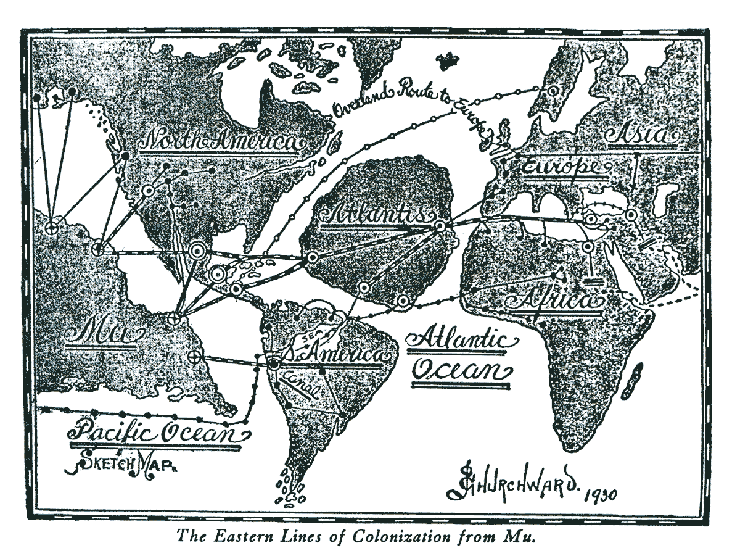
    The lost civilisation of Lemuria / Mu was brought dramatically back to public attention in 1931 with the publication of Colonel James Churchward’s bizarre The Lost Continent of Mu, the first in a series of five books by Churchward about the lost continent.

    In the book he claimed that the lost continent of Mu had once extended from an area north of Hawaii southwards as far as Fiji and Easter Island. According to Churchward, Mu was the original Garden of Eden and a technologically advanced civilisation which boasted 64,000,000 inhabitants. Around 12,000 years ago Mu was wiped out by an earthquake and submerged beneath the Pacific. Apparently Atlantis, a colony of Mu, was destroyed in the same way a thousand years later. All the world’s major ancient civilisations, from the Babylonians and the Persians, to the Maya and the Egyptians, were the remains of the colonies of Mu.

    Churchward claimed he received this sensational information when, as a young officer in India during a famine in the 1880s, he became friendly with an Indian priest. This priest told Churchward that he and two cousins were the only survivors of a 70,000 year old esoteric order which originated on Mu itself. This order was known as the ‘Naacal Brotherhood’.

    The priest showed Churchward a number of ancient tablets written by the Naacal Order in a forgotten ancient language, supposed to be the original language of mankind, which he taught the officer to read. Churchward later asserted that certain stone artefacts recovered in Mexico contained parts of the ‘Sacred Inspired Writings of Mu’, perhaps taking ideas from Augustus le Plongeon and his use of the Troana Codex to provide evidence for the existence of Mu.

    Unfortunately, Churchward never produced any evidence to back up his exotic claims, he never published translations of the enigmatic Naacal tablets, and his books, though they still have many followers today, are perhaps better read as entertainment than factual studies of Lemuria / Mu.

    Nan Madol

    It was James Churchward who first posited the theory that the site of Nan Modal, on Pohnpei Island in the North Pacific Ocean, was one of the seven cities of ancient Mu / Lemuria.

    The cyclopean ruins of Nan Modal, at one time a ceremonial centre covering 11 square miles, consist of around 90 small artificial islands built up out of a lagoon, and interlinked by a network of tidal canals. These islands, situated on the tidal flats southeast of Temwen Island, Micronesia, contain house foundations, sea walls – thirty feet tall in places, tunnels and burial vaults, all constructed entirely from prismatic basalt columns stacked crisscross like log cabins. These rocks weigh several tons on average, with the largest weighing 25 tons.

    What makes the construction all the more remarkable is that the stone had to be transported some distance to the site, as no quarries have been found nearby, though they do exist elsewhere on the island. A clue to how this feat was achieved are crystal basalt columns discovered at the bottom of the lagoon near Temwen Island and on the shores of other islets in the area, which would suggest that the stones were transported by raft.

    Modern Pohnpeians, on the other hand, believe the stones were flown over the island using black magic. Radio carbon dates and analysis of pottery from Nan Madol reveal that construction of the site began around 1200 CE, though the area may have been occupied from as early as 200 BCE. Such dates would certainly preclude any connection with Churchward’s Lemurians or their descendents.

    At the beginning of the 13th century CE the island of Pohnpei is thought to have been conquered and unified by the mysterious ‘saudeleur’ dynasty, and it was then that the spectacular complex was constructed as a ceremonial and political seat for the new royal line. The saudeleur line was brought to an end in the 1500s by exiled Pohnpeian warrior, Isokelekel. The new chiefs, known as Nahnmwarki, occupied Nan Madol for a couple of hundred years, but by the 1800’s when the first Europeans arrived, the site was deserted. Why this happened remains one of the many mysteries of this incredible site.

    The Kerguelen Continent

    In the last twenty or so years submerged civilisations have once again been in the news due in particular to a number of intriguing underwater discoveries. In 1999 the Joint Oceanographic Institutions for Deep Earth Sampling (JOIDES) Resolution research vessel made an amazing discovery drilling in an area of the southern Indian Ocean about 3,000 km to the southwest of Australia.

    The researchers discovered that an underwater plateau about a third the size of Australia, known as the Kerguelen Plateau, was actually the remains of a lost continent, which sank beneath the waves around 20 million years ago. The team found fragments of wood, a seed, spores and pollen, in 90 million year old sediment, as well as types of rocks associated with explosive volcanism.

    One of the many fascinating points about the Kerguelen Plateau is that it contains sedimentary rocks similar to those found in India and Australia, which indicates that they were at one time connected. Scientists believe that around 50 million years ago, the continent may have had tropical flora and fauna, including small dinosaurs. With further research planned, the fascinating puzzle of the Kerguelen Plateau may yet resurrect the Lemuria debate.

    Yonaguni Island and the Gulf of Cambay

    In 1985 off the southern coast of Yonaguni Island, the westernmost island of Japan, a Japanese dive tour operator discovered a previously unknown stepped pyramidal edifice. Shortly afterwards, Professor Masaki Kimura, a marine geologist at Ryukyu University in Okinawa, confirmed the existence of the 183m wide, 27m high structure.

    This rectangular stone ziggurat, part of a complex of underwater stone structures in the area which resemble ramps, steps and terraces, is thought to date from somewhere between 3,000 to 8,000 years ago. Some researchers have suggested these ruins are the remains of a submerged civilisation – and that the structures represent perhaps the oldest architecture in the world. Connections with Lemuria and Atlantis have also been mentioned.

    However, some geologists, such as Robert Schoch of Boston University, and others with knowledge of the area, insist that the underwater ‘buildings’ are natural, mainly the result of ocean erosion and coral reef settlements and similar to other known geological formations in the region. Furthermore, archaeologists also point out that no man-made tools or weapons have been recovered from the site, which would indicate human settlement.

    In December 2000 a team from the National Institute of Ocean Technology (NIOT) claimed to have discovered the remains of a huge lost city 36 metres underwater in the Gulf of Cambay, off the western coast of India. A year later further acoustic imaging surveys were undertaken and evidence recorded for apparent human settlement at the site, which included the foundations of huge structures, pottery, sections of walls, beads, pieces of sculpture and human bone. One of the wooden finds supposedly from the city has given a radiocarbon date of 7500 BCE, which would make the site 4,000 years earlier than the oldest known civilisation in India.

    Research is ongoing at this fascinating site, now known as the Gulf of Khambat Cultural Complex (GKCC), which if the dates are proved correct, may one day radically alter our understanding of the world’s first civilisations. However, it must be added that a number of marine geologists believe that the NIOT scientists have made serious errors in their interpretations of the sonar images obtained from the area. The opinion of these researchers is that the supposedly ancient ‘ruins’, shown as geometric patterns on the images, are natural rock formations and there is no evidence that the artefacts discovered in the area of the site, including the radio-carbon dated block of wood, are associated with it. The debate is still continuing among geologists, archaeologists and historians on this controversial discovery.

    Whether any of these underwater finds in the Pacific and Indian Oceans prove to be the remains of forgotten civilisations or not, one thing is certain man will always be searching for a lost homeland or a more spiritually satisfying ancient past. In this sense Lemuria or Mu will always be more than just a physical place.

    [alert type=”general” dismiss=”no”]This article was published in New Dawn 103.[/alert]

    [alert type=”success” dismiss=”no”]If you appreciate this article, please consider subscribing to help maintain this website.[/alert]

    Sources and Further Reading

    The Lost Continent of Mu by J. Churchward, C.W. Daniel Co. Ltd, 1994 (1931).
    The Lost Land of Lemuria: Fabulous Geographies, Catastrophic Histories by Sumathi Ramaswamy, University of California Press, 2005.
    The Secret Doctrine II – Anthropogenesis by H.P. Blavatsky,  Theosophical University Press, Pasadena, California, 1970 (1888).
    Other Temples, Other Gods: The Occult in Australia by N. Drury & G. Tillett, Sydney, Hodder & Stoughton, 1982.
    http://news.bbc.co.uk/2/hi/science/nature/353277.stm ‘Lost Continent Discovered’. The Kerguelen discovery.
    www.hinduonnet.com/fline/fl1905/19050670.htm ‘Questionable Claims’. The finds in the Gulf of Khambat.
    www.morien-institute.org/yonaguni.html Morien Institue page about Yonaguni.
    www.pohnpeiheaven.com/nanmadol.htm ‘Pohnpei Between Time and Tide’.
    www.uoregon.edu/~wsayres/NanMadol.html Dr. William S. Ayres’s site about his work in Nan Madol.

    © New Dawn Magazine and the respective author.
    For our reproduction notice, click here.
  • The Real Secret of The Secret

    The Real Secret of The Secret

    From New Dawn 103 (Jul-Aug 2007)

    The latest in the blockbusters of alternative spirituality is The Secret, now both a film and a book. Both have been huge successes. The film version has sold 1.5 million copies in DVD format, while at this writing in early June 2007, the book version of The Secret has been on The New York Times’s best-seller list in the US for “advice nonfiction” for twenty weeks, and currently sits on the top.

    No wonder. In breathless, gee-whiz language, The Secret’s Web site promises the key to human existence: “The Secret has existed throughout the history of humankind. It has been discovered, coveted, suppressed, hidden, lost and recovered. It has been hunted down, stolen, and bought for vast sums of money. Now for the first time in history, The Secret is being revealed to the world over two breathtaking hours.”

    Well, then, what is the Secret? Was it the source of the success of great men throughout history, including Plato, Aristotle, Galileo, Napoleon, and Einstein, as its promoters claim?

    The Secret as a film is the brainchild of Australian documentary producer Rhonda Byrne, who began reading self-help literature while going through a rough patch in her life in 2004. Through such books as The Secret of Getting Rich, The Master Key System, and The Secret of the Ages, Byrne was exposed to an idea that has long fascinated seekers and self-promoters alike: your health, wealth, and success in love, work, and life depend not on what you do but what you think. “That principle can be summed up in three simple words: thoughts become things,” proclaims Mike Dooley, one of the ‘teachers’ featured in The Secret.

    That, in essence, is the Secret. Whether it was “hunted down, stolen,” or “bought for vast sums of money” and whether Plato, Aristotle, and other great men had any knowledge of it remains highly open to question, but there’s nothing particularly astonishing about the Secret itself. As the film’s promoters concede, the idea has been a part of occult philosophy for centuries, although it entered the mainstream only about 150 years ago.

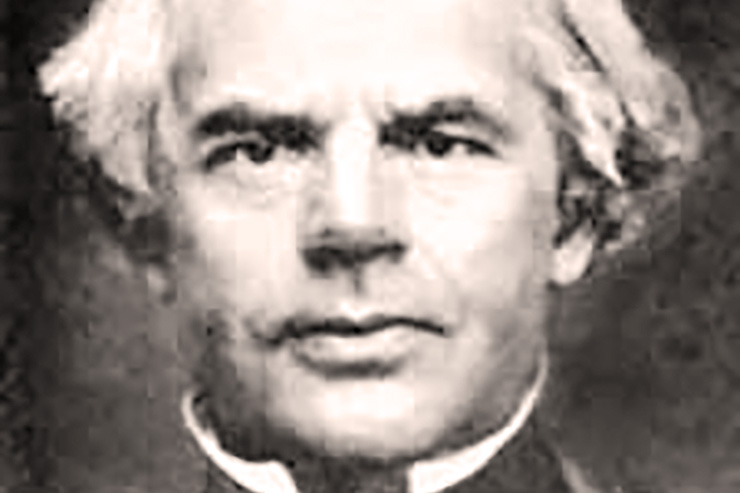
    The seminal figure in promoting the Secret was a now little-known American healer named Phineas Parkhurst Quimby (1802–66). Quimby, like many men of his time, was a jack of all trades. He started as a clockmaker but eventually became a healer. Eventually he realised that it didn’t matter what remedy he prescribed; it was the faith of the patient that made the difference. By simply convincing the individual that he or she was already well, Quimby became a tremendous success. His office filled with patients, many of whom went away feeling completely healed. He often treated people for free when they could not pay.

    Around 1859, Quimby began to write down his ideas. Believing he had discovered the secret by which Christ had performed his miracles, he wanted to make his discoveries known to all. “My philosophy,” he said, “will make man free and independent of all creeds and laws of man, and subject him to his own agreement, he being free from the laws of sin, sickness, and death.” The cardinal tenet of this philosophy was this: “Every phenomenon in the natural world has its birth in the spiritual world…. Instead of your happiness being in the world, the world’s happiness is in you. Here is your true position, and this is the struggle you will have to go through. Shall the world lead you, or shall you lead the world? This is the point that is to be settled in your mind.”

    Quimby, like his most famous pupil, Mary Baker Eddy, founder of Christian Science (a term coined by Quimby), focused mostly on health and healing. “Disease,” wrote Quimby, “is false reasoning. True scientific wisdom is health and happiness. False reasoning is sickness and death.” But as these ideas – which came to pervade nineteenth century American religion under the rubric of New Thought – grew more widespread, practitioners began to use ‘the Secret’ for prosperity and success. One of the most famous promoters of this idea was Napoleon Hill, who, in his 1937 book Think and Grow Rich, contended, “TRULY, THOUGHTS ARE THINGS – and powerful things that when they are mixed with definiteness and purpose, persistence, and a BURNING DESIRE for their translation into riches and other material objects.”

    The idea proved irresistible to the success-crazed American public, and Hill’s book became a perennial best-seller. In the 1960s it attracted a reader named Jerry Hicks, who would claim that the ideas in Hill’s book helped him succeed in business. Hicks would become responsible for the latest flowering of this perennial of American spirituality.

    In 1980, Hicks married. His wife, Esther, was at first indifferent to his interests in spirituality, but soon both of them became fascinated with the Seth books by Jane Roberts, which described Roberts’ activity as a channel for an entity named Seth. (‘Channelling’ is a term used to describe a situation in which the speaker believes he or she is serving as a mouthpiece for a invisible, spiritual being.) Later the Hickses began to meditate on their own, and in 1986 Esther began to channel a collective entity (that is, a number of related spiritual beings) called Abraham.

    “I have no real way of understanding how it is that Esther is able to allow Abraham to speak through her,” Jerry writes in the Hickses’ latest book The Law of Attraction. “From my point of view, Esther closes her eyes and breathes a few very deep, soft breaths. Her head gently nods for a few moments, and then her eyes open and Abraham addresses me directly.” The voice that speaks is slightly different from Esther’s own; a New York Times reporter characterises it as “rounder, quicker and more computerlike than Ms. Hicks’s natural voice,” and from the one Abraham session I attended, I would say it has a quality that I can only describe, somewhat imperfectly, as metallic.

    The Hickses first began publicising the Abraham material in 1988 with a series of recorded cassettes, and in the years since, the output has blossomed to include books, radio and television interviews, calendars, and even decks of cards. The Hickses regularly offer week-long ‘Well-Being Adventure Cruises’ and ‘Art of Allowing’ workshops, in which participants can ask their own questions of Abraham. At US$195 for a single day, the workshops aren’t cheap, particularly since they can include hundreds of people, making it fairly unlikely that you’ll be able to chat with Abraham yourself.

    At any rate, the Abraham material forms the core of The Secret’s teachings. Early versions of the film featured Esther and Abraham, although after disputes with Rhonda Byrne over revenues and distribution, the Hickses asked to be removed from the film entirely. “I’ve got to give Rhonda credit,” Esther has said. “I’ve never seen anybody do that like she’s doing it. And never mind honesty, and never mind doing what you said you were going to do, and never mind anything. Just stay in alignment.”

    Do what? Stay in alignment with what? Here lies the Secret. In The Law of Attraction, Jerry Hicks spells out the three “Eternal Universal Laws” that lie at the centre of the teaching.

    The first is the Law of Attraction. It says that “That which is like unto itself, is drawn [sic]” – or, less clumsily, like attracts like.

    The second is the Science of Deliberate Creation:That which I give thought to and that which I believe or expect – is.” In short, you get what you are thinking about, whether you want it or not.

    The third is the Art of Allowing: “I am that which I am, and I am willing to allow all others to be that which they are.”

    From this it’s easy to see how Abraham’s teachings resemble those of New Thought. What you create in your mind manifests in physical reality. If you have positive thoughts, you’ll have positive results in your life. The same is true if you hold negative thoughts.

    But, you may reply, how many people go around wanting bad things to happen to them? What about all the people who are constantly saying, “I don’t want this to happen,” but have it happen anyway?

    According to Abraham, the Law of Attraction is working in any case. To focus on something that you don’t want is still to think about it – and thus to bring it into your life. The book version of The Secret explains:

    The law of attraction doesn’t compute ‘don’t’ or ‘not’ or ‘no,’ or any other words of negation. As you speak words of negation this is what the law of attraction is receiving:

    “I don’t want to spill something on this outfit.”

    I want to spill something on this outfit and I want to spill more things.

    “I don’t want a bad haircut.”

    I want bad haircuts.

    This, in essence, is the Secret. As we’ve seen, it’s surfaced in many books and articles over the years, and it has become a central component of what one might call the American Religion. Does it really work?

    Yes and no. The ideas in The Secret do work, but the information it presents is incomplete in some serious ways, and incomplete information is wrong information.

    In the first place, it’s true that, as esoteric doctrine has always held, thought is creative. The world of thoughts and images – what the Kabbalists call Yetzirah and which Theosophy calls the astral realm – exists prior to the physical world and underlies it. What comes into being in physical form manifests first in the realm of images. This explains not only the ideas behind The Secret but the possibility of such things as precognition: under certain (highly limited) circumstances, you may be able to tap into the astral realm and see the future. (For more on this, see my article “Prophecy: Does It Work?” in New Dawn, Jan-Feb 2007.) Much of occult magic also involves forming a particular thought-form, infusing it with vital energy so that it makes its way into actuality, sometimes in odd and even quasi-miraculous ways.

    But there are some major caveats. Both The Secret and Abraham tell us to focus very specifically and precisely on what we want. Joe Vitale, one of the ‘teachers’ featured in The Secret, says, “Your job is to declare what you would like to have from the catalogue of the Universe. If cash is one of them, say how much you would like to have. ‘I would like to have twenty-five thousand dollars, unexpected income, within the next thirty days’.” Abraham also recommends having a ‘Magical Creation Box’ in which you put pictures of anything you want to manifest in your life – “furniture, clothing, landscaping, buildings, travel destinations, vehicles…. if it feels appealing to you in any way, clip it, and drop it into your Creation Box. And say, as you drop it in, ‘whatever is contained in this box – IS!’”

    The problem with these procedures is not that they don’t work, but that they do. The subconscious – the part of the mind that is involved in shaping the image and giving it energy – is slavishly literal-minded. As we’ve seen, it doesn’t understand negative commands terribly well, so if you ask it not to do something, it may end up doing that very thing. But the problem doesn’t stop there. You could have your wish fulfilled in a way that you don’t want. A friend of mine once used Secret-like techniques to get $10,000 to help her boyfriend start a business. Her car was robbed on the day she was moving, with all her belongings in it. The insurance settlement amounted to $10,000. As the proverb says, “Be careful what you wish for. You might just get it.”

    Sophisticated practitioners avoid this problem by making sure to leave the request more open-ended, and also to specify that no harm come to anyone through the wish. Florence Scovel Shinn, an American New Thought teacher of the early twentieth century, taught her students to say, for example, “Perfect work with perfect pay comes to me now under grace in a perfect way.” Adding the rider “under grace in a perfect way” should – at least theoretically – prevent any harm from resulting from one’s wish.

    Another equally serious omission in The Secret lies in its exclusive emphasis on thought. To read The Secret, and much of New Thought literature, you might conclude that it is thought alone that makes the difference. This is not really true. A small detail here has been overlooked because it (quite accurately) makes the process look like far more work than the best-sellers would have us believe. To sit around and visualise enormous cheques arriving in the mail is not much trouble; in fact, it’s a great deal like daydreaming. Sometimes the cheques do come. But sometimes they don’t. In what are, I would say, by far the most common cases, what really works is thought combined with action – a process that requires will, concentration, and effort. If you’re looking for the perfect job, the visualisation and affirmation techniques of various New Thought teachings may be helpful, but in all likelihood they will be far more so if you combine them with your own best efforts in finding the job – even if, in the end, the job seems to manifest in a completely unexpected way. This is not as breezily simple as The Secret and its kin like to make out, but it is so.

    A crucial issue is lying under the surface here. What you wish for comes true: that is the Secret. But it’s what you wish for with all your being – and much of your being is concerned with action, with doing. If you are thinking with your mind that you want the perfect job while your body is sitting on the couch all day watching cartoons, you may not get anywhere. What’s still worse is that you will tend to induce an inner dissociation that lies behind much of today’s mental illness: one part of your mind is doing one thing while another part is doing quite the opposite. This, in fact, is one of the dangers of simplistic applications of The Secret.

    Another difficulty with The Secret has to do with its ethical component. From The Secret’s point of view, you create your own reality. Which means that other people create theirs as well. Which means that you are not responsible for them. Which means that you are not your brother’s keeper. The Secret does, of course, talk about love (“There is no greater power in the Universe than the power of love. The feeling of love is the highest frequency you can emit”) and the Law of Allowing does teach a tolerance that can be helpful in enabling certain types of people to be less compulsive and controlling. But the emphasis in The Secret and in the Abraham teachings is on feeling love: “The greater the love you feel and emit, the greater the power you are harnessing.” And yet ‘feeling’ and ‘emitting’ love are not necessarily the same as doing loving things. The Secret does not leave much room for compassion. If everyone is creating their own reality, ultimately, it would seem, that is their business, and all one can do is cultivate one’s own garden.

    We can see this problem echoed in Esther Hicks’ comment about Rhonda Byrne’s behaviour: “Never mind honesty, and never mind doing what you said you were going to do, and never mind anything. Just stay in alignment.” Fortunately or unfortunately, “staying in alignment” is more than feeling good or thinking nice thoughts. The universe has a profoundly moral dimension, and you can’t “stay in alignment” with it by acting dishonestly or deceitfully. While I personally have no idea of the rights and wrongs in the Hickses’ differences with Byrne, I can see how they might directly result from Abraham’s ideas. The Hickses may have gotten a taste of their own medicine.

    This leads to another inaccuracy in The Secret. It is not only our thoughts that create reality, it’s also what Hindus and Buddhists call samskaras – a word that can be roughly translated as ‘karmic dispositions’ or ‘seeds of karma’. Put extremely simply, these are imprints left by one’s past actions on the mind at its deepest and most inaccessible level. These samskaras are a key component in creating our current reality. They can be eradicated by a persistent process of cleansing and release (one aspect of which is The Secret’s own “letting go of the past”), but they also require what the Twelve-Step programs call “a searching and fearless moral inventory” of oneself and “making direct amends” to those we have harmed. If you ignore these facts, your mightiest efforts at visualisation might go for nothing. No one is perfect, but if you’re to “be in alignment” with the universe, you are going to have to hold yourself to moral standards that are at least as high as those of ordinary decency and kindness.

    The ultimate problem with The Secret and the Abraham teachings may, however, be what they focus on. It’s almost entirely a matter of attracting abundance, of finding love, success, money, nice things. In fact, if you believe Abraham, that is what we’re here to do. The universe is an enormous vending machine that operates using the coinage of our thoughts.

    What’s striking about this advice is how directly it contradicts practically all of the great spiritual teachings. These teachings, as I’ve suggested, have no quarrel with the fundamental concepts of The Secret: mind does create its own reality. But they differ very much with The Secret about what we’re supposed to create. Most of the great spiritual traditions insist that the ‘abundance’ The Secret urges us to generate is nothing more than a distraction from discovering the truth of our own nature. You can call this enlightenment, liberation, gnosis, or whatever you like, but the goal is the same. Material wealth is nothing more than an impediment to this goal.

    While it would be possible to find examples of this truth in practically all the world’s spiritual traditions, I can cite only a very small number in this space. The Hindu master Ram Chandra has said, “Sit in loneliness for some time, and think of God with at least as much power as you have bestowed to your own difficulties. What then? It is as easy to realise your own God as it is to realise the worldly things in crude form.” There’s also the advice of A Course in Miracles, another extraordinarily popular channeled text, supposedly dictated by Jesus Christ to a New York psychologist named Helen Schucman in the 1960s. The Course has this to say about material wealth:

    The world you see holds nothing that you need to offer you; nothing that you can use in any way, nor anything at all that serves to give you joy. Believe this thought, and you are saved from years of misery, from countless disappointments, and from hopes that turn to bitter ashes of despair. No one but must accept this thought as true, if he would leave the world behind and soar beyond its petty scope and little ways.

    Each thing you value here is but a chain that binds you to the world, and it will serve no other end but this. For everything must serve the purpose you have given it, until you see a different purpose there. The only purpose worthy of your mind this world contains is that you pass it by, without delaying to perceive some hope where there is none. Be you deceived no more. The world you see holds nothing that you want.

    Passages like this one explain why, in my view, a single page of the Course is worth The Secret and all the utterances of Abraham put together.

    What, then, are we to want? The Course explains this in a lesson entitled “I want the peace of God,” adding:

    To say these words is nothing. But to mean these words is everything. If you could but mean them for just an instant, there would be no further sorrow possible for you in any form; in any place or time. Heaven would be completely given back to full awareness, memory of God entirely restored, the resurrection of all creation fully recognised.

    The Course, like much channeled material (including Abraham’s pronouncements), makes the process sound easier than it often is in practice; perhaps channeled entities don’t understand how difficult life can feel to those of us on earth. Nonetheless, a goal of manifesting inner peace strikes me as far superior to manifesting lovers and cheques and SUVs.

    On the other hand, it requires a certain amount of illumination even to see through the deception of appearances. Up to a point, we are going to desire the solid satisfactions of life because they are all we can trust in. A time will come, however, when disillusion sets in, when the desirable things of the world start to seem not so desirable after all, and one realises that there is something more to life. This recognition will come to each of us according to his or her own readiness. Until then, I suspect, many will use the ideas of The Secret and similar teachings as elementary lessons in the truth that the world is more than we can see with our physical eyes, and also as a mild but helpful form of cognitive therapy. After all, it’s better to focus the mind on good things than on bad.

    [alert type=”general” dismiss=”no”]This article was published in New Dawn 103.[/alert]

    [alert type=”success” dismiss=”no”]If you appreciate this article, please consider subscribing to help maintain this website.[/alert]

    © New Dawn Magazine and the respective author.
    For our reproduction notice, click here.
  • The Tao of Detox

    The Tao of Detox

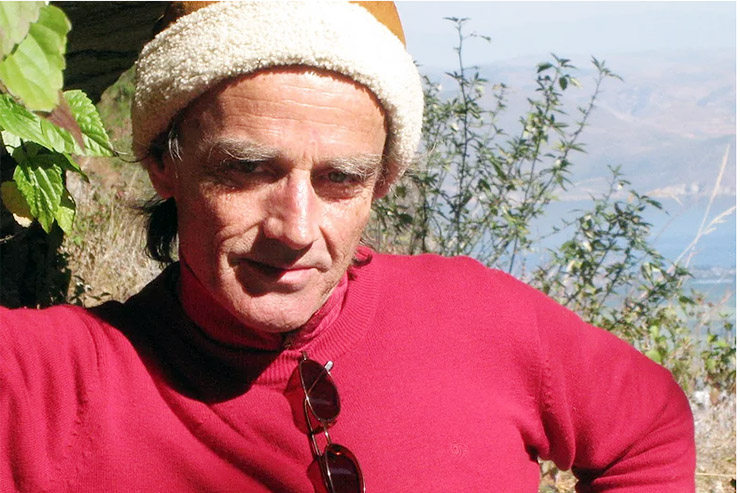
    Daniel Reid is a leading expert on Eastern philosophy and medicine and is the author of several best selling books on various aspects of Chinese health, healing and traditional practices. His unparalleled ability to explain traditional oriental healing methods to the modern reader in ways that are both practical and easily applicable has earned him an international reputation that puts him in a class of his own.

    In this interview with naturopath Huw Griffiths, Daniel Reid discusses his book The Tao of Detox.

    Huw Griffiths: In The Tao of Detox you combine two extremely potent areas of interest that are current in contemporary society – the gradual, but seemingly inexorable integration of oriental philosophy and practices into Western lifestyle and culture together with the growing Western fixation with ‘Detox’. Until reading your book I wasn’t aware these two concepts were all that closely associated, yet your book presents them almost as two sides of the same coin. Is this just a clever and convenient way of presenting your ideas, or have the two concepts always gone hand in hand?

    Daniel Reid: They’ve always gone hand in hand, but in my book, as in all my books, I do try to present any aspect of Asian culture in ways that are not only acceptable, but understandable to the Western reader.

    Detox today is considered a very modern, a very new thing, and has developed almost to the point of becoming a fixation here in the West. You see the word literally everywhere and presented almost as if it’s a new discovery. Toxicity is the basic cause of disease, but this is ancient knowledge. Even in the West they knew this two hundred years ago.

    A good example of current medical practice can be seen in Russia. If you go to a hospital in Russia for anything, whether it’s an in-growing toenail or a heart attack, the first thing they will give you is a colonic. The first priority is to start to get rid of all the built up, blocked rubbish in your colon, so that the body can start to function normally again.

    I think I quote a sixteenth century TCM (Traditional Chinese Medicine) practitioner in my book: “If you want to be healthy, first clean the bowels.”

    There are various ways of doing it, some systems use purging herbs, some like Ayurveda have elaborate detox methods using salt water that you drink, but the whole point is that tissue toxicity is the base root cause of discomfort and disease in the world today and has been known about for thousands of years.

    Conventional Western medicine denies this direct link for the simple reason that when you detoxify yourself you essentially cure yourself and this would mean that there would no longer be any business for the pharmaceutical or medical industries.

    What is happening to us today is ironic because we are doing it to ourselves. We’re being poisoned! The West’s food is full of additives, preservatives, pesticides, MSG, aspartame, you name it. There a hundreds of things that are allowed into people’s food and water. It’s disgraceful!

    Everything that modern people put inside their mouths these days makes us ever more toxic. We consequently develop symptoms, discomforts and then eventually disease, for which they give us drugs then more drugs until it finally all gets too much and they pack us off to the surgeon for some sort of final solution.

    Another example is what they do to our babies! Whether a baby is born in Australia or the US, within a week of birth they begin to receive a series of vaccines, some of which contain mercury or aluminium adjuvants. Now anyone who injects a new born baby with anything that has got mercury, or anything with heavy metal in it, is either a mad scientist or being unethical. At least when I was a child we got the shots when we were five years old. Now they get it within a week of being born.

    Not surprising then that we have now got a pandemic of autism and brain damage in the US. I’ve known people who have had their babies die in their arms only eight hours after having had a vaccine shot, and the doctors just shrug and say ‘It’s just crib disease’, and turn away. They’ve just killed them!

    It’s incredible that even the doctors are doing it to us. What I’m saying is that it’s really important Westerners pick up on these things and become aware. These foods and medicines are toxic and we should be switching to a more naturopathic, more Asian way of doing things.

    HG: When the word ‘detox’ gets mentioned these days most people think in more physical terms, that is we tend to think more of purifying the body and not much else. Yet the ideas put forward in The Tao of Detox go much further than that. You talk of detoxifying the body, mind and spirit as if they are one inseparable whole. For many Western readers, accepting this concept must surely be a major challenge and for that matter a potential barrier to the adoption of some of the practices that you teach. Do you see these more esoteric aspects to detoxification as absolute needs or could they be treated as optional by the average Westerner?

    DR: They can be treated as optional so long as the person who does it is prepared for the inevitability of the body needing to be detoxified again and again. But a major issue is an individual’s attitude to themselves, to their consciousness and the impact that this can have on their lifestyle habits. A person who eats so much that they weigh say, 750 pounds, is clearly destroying themselves. They have a mental problem, otherwise why would you do that to yourself?

    The issue of addiction is an obvious example: alcoholics, drug addicts, smoking, people who get hooked on diet coke full of aspartame until they end up in a wheelchair. People in this predicament are clearly not enlightened, they have a problem of some kind, whether it’s an unresolved issue from their childhood or whatever.

    Now people in this type of situation, and we’ve had plenty of people like this on our own programs, they tend to come back again and again. We clean them up, and then they come back toxic later on. We tell them, “Hey, you’ve got to get out of this habit, this relationship, this job, you’ve got to stop eating this food,” but very often they just don’t want to. So they go over the same steps again and again.

    Now, with regard to this mind/body thing there is a very definite connection, but it’s very difficult to see the borderline between a person’s energy system and their physical body. But there is a tangible link between the two and it’s ‘Breathing’!

    Take, for example, what happens when you sense fear. Your breathing takes on a certain pattern, then if you are really frightened it will make you pee your pants. Now, for fear, which is most definitely a mental figment, to suddenly make you evacuate your bladder clearly shows a connection between the mind and the body.

    Similarly, when you get angry you get hot (usually under the collar) because blood is rushing up to your face from your liver and makes your face go bright red. These two examples are basic demonstrations of the effects of stress. Stress (which is mental) has become the bane of modern life and everybody who is under stress, without going into heavy detail, is essentially going to experience the fight or flight response. The reality is that the first thing that happens when anyone experiences a stress response is their immune system shuts down.

    Therefore, people who put themselves under stress 24 hours a day, which is easily done, are basically running on no immune system and the ease with which people can escalate from say fear, to a stress response and then on to a heart attack is a major problem.

    Mind and spirit ultimately hold the root causes of all our physical problems. Sure, you can keep fixing the physical problems if you can catch them in time by detoxing or whatever, but if you don’t do something about the root source, you are going to go right back to it all the time. It’s not going to go away.

    HG: Is the need for detoxification reaching some sort of crisis point in the world today? In your book you mention many sources from which toxins emanate and eventually enter our bodies and you present rapid re-toxification as some kind of inevitability. Is the situation really that much worse than it was say ten years ago or are we just becoming more aware of the issues these days?

    DR: OK! As to the answer to the first question about the crisis point… Yes! It really is that serious!

    The main reason is that when you get toxic you effectively destroy your immune response, yet this is exactly what you need most when you get toxic. With your immune response down you are open to all these other diseases, the super germs and all the other things that are happening around the world.

    Detoxification is absolutely essential to restore normal immune response and once you have done that your body has a chance to recover. But when people remain toxic, and today people really are toxic, there is no magic that can help them. They’re shut down.

    As far as today versus ten years ago is concerned, ‘Yes, it’s much worse’. We’re at saturation level and it’s a matter of the amount of chemicals that are being used in the production of food and especially in pharmaceutical drugs, which is much more than was being used ten years ago.

    We also have to now face another major threatening factor: electro-magnetic fields. These artificial fields, and even worse the microwave thing, cell phones themselves, the relay towers that are everywhere (in Australia by the way they are hidden in plastic palm trees so that you can’t see them). All these are far more serious and significant than anyone actually imagines. Just because people don’t see it, they don’t worry about it. The point is, and I have studied this carefully, microwave pollution and artificial electro-magnetic fields, which are all around us in computers, appliances, high tension wires, etc, are doing far worse damage to us than the damage being done by chemicals.

    The radiation from these sources is there all the time, 24 hours a day, and all during that time your body is going through a stress response. You can’t see it, but it is there and causing a stress response in your body. What happens then is that your immune system shuts down, you have cortisone coming out of your adrenal glands and your whole system is in fight or flight response. This isn’t just once in a while, it’s all the time.

    So people who don’t do things like Chi-Gung, or meditation or who don’t know how to calm down and switch themselves back into healing mode, are really falling apart fast.

    So ‘Yes’, the situation really is much worse than before.


    HG: Daniel, I’ve really enjoyed our chat and I didn’t mean to distract our discussion away from your book, which I found to be not only an excellent read, but a highly practical manual for survival in today’s toxic world.

    Daniel Reid’s website is www.danreid.org.
    [alert type=”general” dismiss=”no”]This article was published in New Dawn 102.[/alert]

    [alert type=”success” dismiss=”no”]If you appreciate this article, please consider subscribing to help maintain this website.[/alert]

    © New Dawn Magazine and the respective author.
    For our reproduction notice, click here.
  • Satsang: The Power of Spiritual Presence

    Satsang: The Power of Spiritual Presence

    From New Dawn 101 (Mar-April 2007)

    Enlightened people are like spiritual dynamos: they have a very strong presence which touches the people they come into contact with, transmitting something of their enlightenment to them. Even people who aren’t at all “spiritual” usually feel a sense of well-being in their presence, and so feel attracted to them without knowing why. And for people who have made some spiritual progress already, the effect can be extremely powerful.

    Contact with an enlightened person may enable them to make the final “jump” to permanent enlightenment themselves. This is one of the reasons why many spiritual traditions place so much emphasis on the role of a guru. The guru is so important not just because of the advice and guidance he can give you, but because he can transmit his spiritual power to you, giving you a taste of enlightenment and speeding up your spiritual development. (In Sanskrit, this is called satsang, literally “good company.”)

    Paul Brunton and Ramana Maharishi

    The early 20th century author and spiritual teacher Paul Brunton became aware of this when he visited the ashram of the great sage Ramana Maharishi, while travelling around India in search of spiritual wisdom (as described in his book A Search in Secret India). Brunton knew that Ramana was a truly enlightened man the first time he met him, someone who had completely transcended his ego and become one with ultimate reality. He felt the spiritual effect of his satsang straight away. He sensed that “a steady river of quietness seems to be flowing near me, that a great peace is penetrating the inner reaches of my being.” While sitting near him, he realised that his mind was becoming more still, and suddenly all of the intellectual questions he’d had about spiritual matters no longer seemed important. The only question in his head now was, “Does this man, the Maharishee, emanate the perfume of spiritual peace as the flower emanates fragrance from its petals?”1

    At the end of his first visit to the Ashram, Brunton was sitting quietly while the sage was meditating. He felt a sense of awe building up inside him, as a powerful force started to fill the room, emanating from Ramana. Ramana opened his eyes and gazed at him and he felt that he was aware of his every thought and feeling. He felt that a telepathic current was passing between them, that Ramana was transmitting his deep serenity to him, and began to feel a sense of euphoria and lightness. He felt that his own being became one with Ramana’s, and that he had transcended all problems and all desires.

    After this, Brunton resumed his travels around India, meeting magicians and miracle workers and self-proclaimed gurus who are less enlightened than they claimed to be, and eventually returned to the Maharashi’s ashram. Again he experienced an “ineffable tranquillity” when sitting close to him, and again he experienced revelations which he was sure were “nothing else than a spreading ripple of telepathic radiation from this mysterious and imperturbable man.”2 And finally, after a period of wrestling with his own thoughts and his intellect, he had an experience of genuine enlightenment which changed him forever:

    I find myself outside the rim of world consciousness. The planet which has so far harboured me disappears. I am in the midst of an ocean of blazing light. The latter, I feel rather than think, is the primeval stuff out of which worlds are created, the first state of matter. It stretches away into untellable infinite space, incredibly alive.3

    Andrew Cohen and H.W.L. Poonja

    The American spiritual teacher Andrew Cohen had a similar experience when he first met the Indian teacher who became his guru, H.W.L. Poonja – who was, coincidentally (or perhaps not!), a direct disciple of Ramana. Cohen had had profound spiritual experiences before, but had spent many years feeling frustrated and disillusioned, yearning for spiritual liberation but being disappointed by a series of other teachers. Cohen asked Poonja whether it was important to make an effort in spiritual practice, and he replied, “You don’t have to make any effort to be free.” And at that moment Cohen experienced enlightenment:

    His words penetrated very deeply, I turned and looked out into the courtyard outside his room and inside myself all I saw was a river – in that instant I realised that I had always been Free. I saw clearly that I never could have been other than Free and that any idea or concept of bondage had always been and could only ever be completely illusory.4

    After this, Cohen spent three weeks with Poonja and found the liberation he’d been yearning for. After a week or so, he “surrendered” to his guru, let go of his own identity and everything which made up his life. He felt himself become one with Poonja, and began to experience “waves of bliss and love that at times were so strong that I felt my body wouldn’t be able to contain it.” And from that point on, although his initial euphoria faded a little, he had a constant sense of “being always in the present with much contentment and calm. I feel no desire for other than what IS.”5

    And now that he had attained moksha (freedom) himself, Cohen realised that other people were affected by his presence in the same way that he had been by Poonja’s. Friends who spent time with him found that they experienced a powerful sense of bliss and freedom too. He became a spiritual teacher, giving talks and holding retreats, and found that people were naturally drawn to him, and that around him they would “easily and often instantly… have profound realisations, insights into their true nature and powerful feelings of love, joy and bliss.”6

    My wife and I went to one of Andrew’s talks several years ago in Manchester, England, and for days afterwards Pam – my wife – felt like a different person. There was a feeling of freedom inside her, a sense that – in her words – “nothing mattered, that I didn’t have any problems. I didn’t want anything because I was happy as I was. My life was quite stressful at that point but suddenly none of the stress could affect me.” And she’s sure that this wasn’t so much because of what Andrew actually said but the effect of simply being there, in his presence.

    Russell Williams

    I was a little jealous because I didn’t have any of those feelings – at that time I was taking a more intellectual approach to spiritual matters, and was so busy trying to understand what Andrew was saying conceptually that I must have been shut off from the feeling dimension.

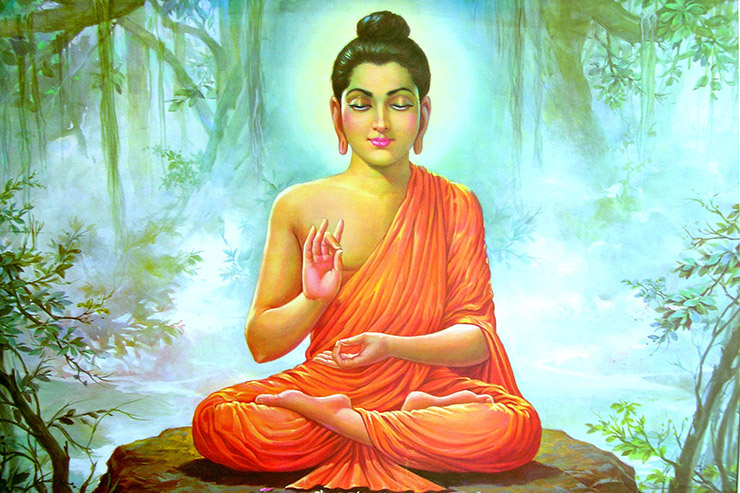
    A couple of years before then, I’d started to visit a spiritual teacher called Russell Williams, and also took a largely conceptual approach to his teachings. Russell – who I still go to see now – is 85 years old, and has been the president of the Manchester Buddhist Society for over 50 years, even though he’s not specifically a Buddhist. He doesn’t chant or meditate or read Buddhist scriptures, and doesn’t adhere to or promote any particular set of teachings. He’s a humble self-realised man, who talks about the most profound spiritual truths and the most intense spiritual states as if they’re the most simple and natural things.

    In my first years of going along to Russell’s twice weekly meetings, I used to wonder why most people didn’t seem to be paying attention to him. He was saying some of the most profound things I’d ever heard and people didn’t seem to be listening – they were just staring into space, or sitting with their eyes closed. They rarely asked questions, seeming content to let Russell be silent, when as far as I was concerned he was full of wisdom which I wanted to absorb.

    But about three years ago I began to realise why this was. Perhaps I’d changed, become less interested in the conceptual side of spirituality, or perhaps I’d finally completed a long process of getting attuned to the atmosphere at the meetings, but when I went there I started to experience very strange, pleasurable states of consciousness. Even when I’d been taking a conceptual approach, I’d often experienced feelings of peacefulness and well-being, which sometimes lasted for a couple of days afterwards. But this was something stronger.

    The first time it happened, I was staring at Russell while he was speaking to me, and began to feel very relaxed and calm, as if the flow of my life-energies was becoming smoother and lighter. And then, all of a sudden, everything became unfamiliar – the light became brighter, the colours began to merge and the distinctions between people and objects began to fade away. My main feeling, however, was of a powerful sense of strangeness – the scene was completely alien, as if I was suddenly on a different planet. Even though it was accompanied with a sense of exhilaration, I was a little scared and pulled away from it.

    Over the following months I had the same experience several times again, and I learned to relax and trust it. I let the sense of strangeness overcome me, as the light in the room became brighter and all objects began to shimmer and merge into one another. The light seemed to be flowing out and immersing everything in its brightness. The room was filled with this beautiful shimmering haze of golden light, and I was filled with a deep serenity, a glow of intense well-being filling my whole body. I could feel it flowing through my legs and my feet, as if I’d taken a sedative of some kind. And even when I didn’t have this particular experience at the meetings, I usually had a very powerful feeling of calmness and serenity inside. I was often aware that my breathing had slowed down dramatically, and when I left I found myself doing everything very slowly, with a natural mindfulness. My mind was still and quiet, and outside everything looked beautiful and alive.

    After a few months I was talking to one of the members of the group, and said to him, “I’ve been having really very strange experiences here over the past few months.” I tried to describe them, and he laughed and said, “So now you know why we’ve all been coming here for so long! Now you’re really a member of the society.”

    I still have these experiences now, and I’m certain that they’re the result of satsang, of being in the presence of an enlightened person. The experience of the scene becoming unfamiliar and the light becoming brighter usually only happens when Russell is talking directly to me. In these moments I can almost feel spiritual power radiating from him and flowing into me, feel my own life-energy being affected by his.

    The Sources of Satsang

    The big question is: why do enlightened people have this strange ability to generate spiritual experiences in others, this power to “transmit” their enlightenment to the people around them?

    Spiritual experiences induced by satsang strongly suggest that the esoteric concept of an “aura” has a basis in fact. They suggest that our being or life-energy isn’t just confined to our own mind or body – it radiates out from us, creating an atmosphere (or aura) which can affect the people we come into contact with. The auras of most people don’t appear to be particularly strong, or at least don’t have particularly strong negative or positive qualities, so that we don’t usually feel anything palpable from them. But we’ve all met certain people who we instinctively recoil from. We might not even exchange any words with them but they still fill us with a sense of unease or even fear or dread. These are people who have a strong “bad aura” around them, perhaps because their life-energy is heavily poisoned with negative emotions and egotism. But with enlightened people, of course, the exact opposite happens. Their life-energy is so intensified and stilled, and has such powerful positive qualities, that they “transmit” waves of calm and bliss to everyone around them.

    But spiritual experiences are more than just feelings – they are also experiences of vision, insight and revelation. And one of the most important aspects of satsang experiences, I believe, is that they show that spiritual illumination is also communicable. Feelings of bliss can certainly spread from person to person – and so can the vision of the oneness of the universe, the awareness that the essential reality of the universe is a limitless ocean of Spirit, and the experience of transcending the ego and being reborn as a deeper and higher Self. These experiences are completely transferable – under the right circumstances, they can be passed from an enlightened person to others without any loss of intensity.

    There are two basic types of spiritual experiences (in the sense I’m using the term). The first are ecstatic experiences caused by a disruption of the homeostasis of the human organism. These can occur as a result of fasting, sleep deprivation, drugs, breathing exercises, pain, dancing, and so on. All of these activities can put us “out of homeostasis” – by changing our body temperature, blood pressure or metabolic rate, causing dehydration and exhaustion or chemical changes – and when this happens there’s a chance that we’ll experience a higher state of consciousness. (Although this certainly doesn’t always happen, of course. Most of the time the only effect that depriving yourself of sleep and food often has is to make you feel miserably tired and hungry.)

    The second type of spiritual experiences are more serene and calm states which occur when there is an intensification and stillness of life-energy (or vitality) inside us. This can happen in any situation when we’re very relaxed, when there’s peacefulness around us, and when the mental chatter inside our heads fades away. In meditation, we make a conscious effort to intensify and still our life-energy by being inactive, by withdrawing our attention from the world around us, and by focusing on a mantra (or a candle flame or on our breathing or any other object) to slow down and quieten our mental chatter. As a result, meditation is probably the most effective way of generating spiritual experiences.

    However, they can also happen more spontaneously – in natural surroundings, for example, when there’s peacefulness around you and the beauty of nature has a similar effect to a mantra in meditation, focusing your attention and quietening your mental chatter. They often occur when people are listening to music or contemplating works of art. Certain sports are also very conducive to spiritual experiences, such as long-distance running or swimming. This is also probably part of the reason why spiritual experiences can occur during or after sex. The sheer pleasure of sex can have the effect of shifting our attention away from our ego-minds, which may fall silent as a result.

    Spiritual experiences caused by satsang clearly belong to this second type. Contact with an enlightened person has the effect of intensifying and stilling our life-energy. He or she gives us an extra input of energy – the “current” or “telepathic radiation” which Paul Brunton was aware of. At the same time, the sheer power of an enlightened person’s presence stuns the ego-mind into silence and brings our chattering thoughts to a halt. As a result, we attain the same state of inner stillness and intensified life-energy which we reach after periods of intense and very focused meditation.

    However, satsang isn’t just a phenomenon which can affect us as individuals; it also has an important bearing upon the concept of collective spiritual awakening. It’s now almost a cliché to state the human race as a whole may be on the threshold of an evolutionary jump, a collective shift to a higher level of consciousness which will give rise to a new era of true spirituality and harmony. Some people find this idea far-fetched – perhaps understandably so when you look at the state of the world today – but satsang experiences show us a process by which this transformation could occur. They show us that enlightenment is highly contagious.

    After all, it’s surely not just wholly enlightened individuals who affect the people around them. Anybody who has become spiritually developed to a degree will have some power to affect the people around them. And so it’s possible that a kind of positive cycle might take place – as more people become spiritually developed, they will “transmit” their insight and well-being to the people around them, who will in turn transmit their spirituality to the people around them, and so on. It may be that once a certain critical threshold has been reached – once a certain number of people have become enlightened, or once the collective spiritual power of the human race has built up to a certain degree – a great wave of spiritual illumination will spread through the world like a forest fire; a process of “spiritual transmission” building up power and intensity, and eventually leading to an Omega point of permanent change.

    This may still sound like wishful thinking – but then again, the experience of satsang itself is miraculous, showing that our apparent individuality is an illusion, and that we are parts of an indivisible ocean of consciousness.

    [alert type=”general” dismiss=”no”]This article was published in New Dawn 101.[/alert]

    [alert type=”success” dismiss=”no”]If you appreciate this article, please consider subscribing to help maintain this website.[/alert]

    Footnotes:

    1. Paul Brunton, A Search in Secret India, London: Rider, 1934/1972, p. 141.
    2. Ibid., p.280.
    3. Ibid., p. 305.
    4. Andrew Cohen, Autobiography of an Awakening, Corte Madera, CA: Moksha Press, p. 30.
    5. Ibid., pp.34-5.
    6. Ibid., p.35.

    © New Dawn Magazine and the respective author.
    For our reproduction notice, click here.
  • The I Ching, The Most Modern Ancient Wisdom Classic

    The I Ching, The Most Modern Ancient Wisdom Classic

    From New Dawn 100 (Jan-Feb 2007)

    In a changing and unpredictable world, no classical text is more rewarding, or more challenging, than the ancient Chinese I Ching or Book of Changes. This classic presents itself as a book of divination and invites dismissal on such grounds amongst educated Western circles, including even the great British sinologist and advocate of Chinese science and technology Joseph Needham. It is, however, the most modern of practical handbooks, being a remarkably wise and profound guide to that nagging imperative of contemporary personal and political life – self-organisation.

    This truth only grows as political authority shifts from West to East, as economic productivity travels from America to China, as industrial technology grows robustly throughout Asia and shrivels in the developed economies and as health and well-being wisdom is found more surely in Asian therapeutic traditions than in contemporary share market driven medical innovations.

    Indeed, the I Ching is not only the source of a profound personal, social and political wisdom but also of a scientific genius that is holistic and organic and that led the world for several millennia until the rise of Anglo-American power over the past two hundred years. Moreover, this scientific culture promises much for the future of a troubled global community. It contrasts with the culture that has turned contemporary life into one large uncontrolled and poorly understood scientific experiment, where the casino of the marketplace has ceased to respect the ecologies of life.

    Central elements of the text of the I Ching are attributed to men (King Wen and his sons King Wu and the Duke of Zhou) who were responsible for overthrowing the powerful tyrant who ruled a declining and corrupt Shang Dynasty, as the prelude to founding the Zhou Dynasty around 1045 BCE. As such, much of its wisdom can be read as a political text, informed by profound and holistic wisdom. This wisdom is shaped by a keen sense of the social morality needed to win widespread popular support, the human understanding needed to avoid the perils of carelessness and hubris and the acute insight into the dynamics of life and nature essential to prosper in this world.

    There is no more seminal influence in Chinese culture than the I Ching, with its history of over three thousand years and its roots in the wisdom that guided the founding of China’s longest and most culturally productive dynasty. Contrary to modern fashion, the authority of the I Ching tends to increase with the age and experience of the reader or interpreter. Japanese who lived during the Tokugawa Shogunate counseled against serious study before the age of fifty. At the same time, one of the most renown Chinese commentaries on the I Ching was completed by a scholar who died at the age of twenty three in 249.

    Despite the fact that the 17th and 18th century German philosopher Gottfried Leibnitz had been shocked to discover that his binary arithmetic was matched by an arrangement of the I Ching’s hexagrams, the West’s greatest authority on Chinese science and technology – the 20th century Joseph Needham – dismissed it as of little worth. Now, it has been shown by later scholars to have a mathematical structure similar to that of DNA, discovered in the West more than three thousand years later. In this, it is the world’s first, and possibly still only, serious guide to self-organisation at personal, social and political levels.

    Moreover, another scholar suggests that it may reveal an understanding of still poorly understood fundamentals that inform a wide variety of physical change, in both living and non-living structures. This all reflects the almost unbelievable Chinese genius for observing the minutiae of nature, a quality that long informed the world’s most innovative and productive scientific and technological civilisation.

    In many ways, the I Ching is an enigma. Apart from qualities noted above, it offers a unified understanding of what are often seen as China’s two main contending spiritual traditions – Confucianism and Daoism – and some even see in it the source of both these traditions of thought. Moreover, while the I Ching has always served as a book of divination, this article will treat it essentially as a book of moral, political and scientific wisdom.

    (It should be noted that I Ching is more accurately written as Yi Jing, as laid down in the transliteration system prescribed by the Chinese Government, but is presented here as I Ching in order to avoid confusion in referring to several book titles, which use a dated system of transliteration that is often preferred in the United States.)

    Contrasting Wisdom – East and West

    The use of the I Ching as a book of divination has worked since ancient times to give the I Ching an authority that has shaped all levels of Chinese society. Anything with related aspirations in the West has been marginalised either by the Christian Church or by the tradition of Greek rational thought. Consequently, despite its growing popularity in alternative Western circles, it is difficult for mainstream Western thought to accommodate or relate to the disciplines of the I Ching. Yet, the I Ching has made the mature management of inevitable and irresistible change one of the great art forms of the East Asian ruler, administrator and head of family. At the same time, it contains a gentle acumen that finds a fulfilling role for all who make up society and does not exclude the exceptional and idiosyncratic.

    Perhaps, the clearest and simplest explanation of the differences that derive from these two contrasting traditions has been given by Geoffrey Lloyd and Nathan Sivin in The Way and The Word: Science and Medicine in Early China and Greece. They conclude, with politically tactful deference to Western sensitivities, that neither China nor Greece uniquely monopolised the development of science. Each possessed the conceptual frameworks and institutional structures necessary to inquire systematically into organic physiologies, material nature and cosmic processes. Yet each displayed unique qualities.

    The Greek way sought predominantly foundations, demonstration, and incontrovertibility. Its central authority was found in the principles of clarity and deductive rigour. The Chinese approach was most strongly characterised by the search for correspondences, resonances and interconnections, which encouraged the exploration of holistic and organic relationships that integrate highly divergent areas of activity and order.

    The I Ching not only does not respond to a need for ‘clarity and deductive rigour’ but it will frustrate and irritate those with minds that insist on such convenience. Rather the I Ching inspires a seemingly infinite range of possible ‘correspondences, resonances and interconnections’ and warns against the impatient or thoughtless need for action.

    A little reflection may prompt recollection of the opening two lines of the Dao De Jing, the seminal Daoist classic. These assert effectively that words, concepts, rational structures and scientific theories may all be useful conveniences of the human mind but should not be mistaken for an accurate statement of the natural world.

    Once one has come to terms with what seems to the Western mind to be its counter-intuitive character, one can start to explore and discover in the I Ching a profound wisdom that has guided, shaped, preserved and advanced Chinese civilisation for more than three millennia.

    The Living I Ching

    Although deeply rooted in ancient Chinese history, the I Ching lives like perhaps no other classic form of wisdom. This is indicated by the commentary written by Wang Bi who lived almost thirteen hundred years after the founding of the Zhou Dynasty and who died at twenty-three. It can also be found in works translated respectively by the American Thomas Cleary as The Tao of Organisation, The Buddhist I Ching and The Taoist I Ching, which derive from texts attributed to the 11th century Neo-Confucian Cheng Yi, the 17th century Buddhist Chih-hsu Ou-I and the late 18th century Daoist Liu I-ming.

    The movement by some Westernising Chinese to marginalise and banish the I Ching from respectable intellectual company has, paradoxically, been parallelled by a contrasting movement in Western publishing, where it appears in diverse, numerous and multiplying forms of publication. At the same time, it assumes an identity that now ranks it for many at least on the same level of cultural authority as the Bible, even as some choose it in preference as a work that has nourished a more stable, prosperous and continuous sense of civilisation.

    The relevance of this may be most readily found in the manner in which one version, The Complete I Ching: The Definitive Translation by the Taoist Master Alfred Huang, introduces the work in a way that details the circumstances in which the founders of the Zhou Dynasty worked to replace the corrupt Shang Dynasty. This is given an acute sense of relevance because Alfred Huang makes it clear that the I Ching was a major form of spiritual and practical sustenance during difficult times for him and others personally after 1949.

    More pertinent, however, is the fact that contemporary leaders in Japan, Korea and China have emulated the qualities of patience and humility displayed by the Zhou founders as they have built their strength in a world that had earlier humiliated them. It might be going too far to liken the contemporary West with the self-indulgent and indiscriminately assertive Shang Dynasty. Even so, it is difficult to dismiss the thought that this parallel may present itself to many in East Asian communities.

    Any sensitive Westerner who has had the good fortune to live, work and reflect in contemporary East Asia is likely to have concluded that the certainties derived from a Western education are a poor guide for action in that part of the world. Many pleasant things will come one’s way but in a manner that defies explanation by familiar principles and in a manner that can invite an uneasy sense of losing control. In seeking to comprehend the reasons for such sentiments no better guide can be found than the classic texts that have shaped, informed and inspired its people. None of these is more seminal than the I Ching, even when today’s East Asian youth may feign disdain or ignorance of its wisdom.

    Yin and Yang

    The essence of the I Ching is to be found in the dynamic of yin and yang, complementary opposites that:

    •           lie at the heart of the I Ching and all Chinese thought

    •           require one always to adopt a holistic view of issues

    •           highlight the need for internal and external balance

    •           emphasise a constant state of flux

    •           are at the heart of all development

    •           are forever interdependent

    •           are essentially dynamic and creative in their interaction

    Five basic principles can be identified as inherent in yin and yang.

    •           all things have two facets: a yin aspect and a yang aspect

    •           yin and yang aspects can be divided into further yin and yang polarities

    •           yin and yang mutually create each other

    •           yin and yang control each other

    •           yin and yang transform into each other.

    It is customary to identify yin with qualities such as femininity, softness, darkness and receptivity and yang with the qualities of masculinity, hardness, brightness and assertiveness. At the same time, there is scope for endless discussion about yin and yang qualities in various specific situations.

    The important point rests, however, in the infinite range of dynamic reactions set up by the interplay of yin and yang. Most important, and infinitely complex, is the interplay of yin and yang within the sixty-four six line hexagrams that make up the I Ching. According to established procedures either yin or yang can transform into the other and the significance of yin and yang depends on which of the six positions is occupied by a yin or yang line and a variety of other complex relationships.

    In other words the use of the I Ching for divination creates an almost infinite range of possibilities for interpretation. This reinforces perceptions of the fundamental dynamism of the I Ching, of nature, of political fortune, of human relationships and, if one so chooses, of the sexes. The subtle interplay of eight basic three line sets of yin and yang that can be labeled heaven, earth, fire, water, valley, wind, mountain and thunder (two of which make up a six line hexagram) further strengthens the sense of forces of nature exercising an authority before which humanity must be humble and attentive.

    A most important consequence of the fluid sensitivity that flows from the use of the I Ching is the manner in which this reveals the rigid abstractions that have come to command Western thought as both limited and marginal. The cerebral universe that derives from the I Ching is incomparably more complex and dynamic. In just one example, it is difficult, not to say impossible, to apply Western notions of equality to a world where all nature and life is the product of the rich and intense interaction of yin and yang.

    Contingency

    The I Ching provides an endless flow of moving commentaries that remind continually of the need to recognise:

    •           the contingencies of chance

    •           the full environment of any action

    •           the possibilities of side-effects in any action

    •           the multiple layers of contingencies in organic beings

    •           the limitations of causality and rationality in managing life

    •           the need for mature reflection on all important actions

    The I Ching profoundly challenges Western intellectual and scientific certainties because:

    •           it is a unique mix of probabilistic science and timeless literary comment

    •           it portends to guide future behaviour, attracting Western derision as fortune telling

    •           it is integral to an organic and holistic sense of science

    •           it was part of a superior scientific culture until the beginning of the 19th century

    •           its formula for self-organisation has an unrivalled record of success in maintaining the continuity of Chinese civilisation.

    While Western commentators continue in a state of denial it is difficult to dispute that I Ching science:

    •           outperformed the West and rest of the world until the 19th century

    •           again today outperforms Western science and technology

    •           disdains the West’s mechanistic and reductionist scientific assumptions

    •           highlights an aggressive and shallow character in the European Enlightenment

    •           is genuinely holistic, organic and humanistic in ways denied Western science.

    The I Ching cultivates disciplines of the mind by encouraging continual questioning of and reflection on the dynamic and volatile forces that command natural and human processes. This commences with the acceptance of human humility before forces that will never be fully mastered but that must always be fully respected. Its seemingly infinite variety of possible readings nurtures an acute sensitivity to the contingencies that accompany action.

    Competing Medical and Scientific Cultures

    The contemporary West has gone in a very different direction: It has built a type of structured religious faith around a rational mythology that promises belief in endless progress. The associated human conquest and subjugation of nature is conducted through the use of experimentation to identify a variety of notionally universal truths. These are marketed as the fruits of medicine, science and technology even as they produce an exponentially mounting volume of environmental, ecological and health troubles.

    Problems inherent in this faith and mythology were compounded as the 20th century progressed by the annual allocation of many of the best brains and most vigorous spirits in each generation to intense training and lifetime service before the Gods of medicine, science and technology.

    Subsequently put in various ways at the service of large corporations, this talented and dedicated priesthood is then paid to sacrifice all for the corporation. It should surprise no one that this has produced scientific and medical cultures that are prone to systemic corruption. Highly educated, newly graduated and ambitious young souls quickly learn that this is the only way to gain a reasonable return on the investment of money, time, effort and hope spent in an exhausting and extended education. Some of the more obvious dubious aspects of the priesthood’s work is conducted:

    •           in relentless experimentation in artificial laboratories

    •           in high brow but often duplicitous marketing

    •           in peer reviewed, but misleading professional articles

    •           in misrepresentation or non-disclosure of research

    •           in the exercise of official responsibilities to serve corporate interests after being placed in government administration positions

    •           in some other use of prestigious, high sounding and daunting academic qualifications to fatten corporate bottom lines.

    Many of the certainties cultivated by Western beliefs and rational structures, ostensively verified by scientific processes of proof, are revealing themselves to be cruel hoaxes. These are often designed to persuade large communities to subject themselves to experiments that are neither understood nor controlled by their initiators. Increasingly, the profitable areas of a struggling American economy seem to fall into such categories, whether they be chemical agriculture, processed food, fast food, synthetic pharmaceuticals, bio-technology or nano-technology.

    The corporation, which is designed by its commercial nature and legal structure to maximise profit, has grown in reach and influence more or less in parallel with the advance of post-Enlightenment science and with the consolidation of Anglo-American political authority. With the exhaustion of new lands and new resources to discover and colonise, profit maximisation has increasingly focused on seizing a competitive advantage through innovation and the monopolisation of intellectual property. This frequently necessitates the authoritative denial and dismissal of the possibility of any harmful side-effects or consequences.

    In contrast, the I Ching scientific spirit advanced largely in harmony with environment, ecology and human health and achieved a record of diverse innovation predating many of the most critical European inventions. These included:

    •           developing a cybernetic machine 1,600 (possibly 3,000) years before Europe

    •           developing the compass 1,000 years before Europe

    •           inventing paper 1,500 years before Europe

    •           inventing printing 600 years before Europe

    •           developing a calendar 1,000 years before the ancient Greeks

    In fact, China preceded the West, in most cases by at least a millennium, in almost one hundred inventions and discoveries from a wide variety of fields of activity, including:

    •           agriculture

    •           astronomy and cartography

    •           engineering

    •           domestic and industrial technology

    •           medicine and health

    •           mathematics

    •           magnetism

    •           the physical sciences

    •           transport and exploration

    •           sound and music

    •           warfare

    Western communities have had neither the strength nor integrity to address the fact that this achievement did not involve the perils to the environment, living ecologies and human health generated by contemporary corporate science. This is not surprising because an adventurous, conquering corporate spirit has been fundamental to Western advance over the past two centuries. The cost has been high. Perversely, as it becomes more and more difficult to ignore the consequences so it also becomes more and more difficult to recognise their source.

    The West’s insistence on clarity and deductive rigour has conveniently enabled it to distract attention from many of the side effects of its scientific advances. It has made it easy to marginalise holistic concerns about identifying possible resonances, correspondences or inter-relationships that might compromise the desirability of some new energy source, innovative weapon or pharmaceutical breakthrough.

    The anomaly in all this is that in the early 21st century it is the economies of East Asia, long under the influence of the I Ching’s concern to cultivate sensitive attention to nature, its processes and its contingencies, which are proving most successful in the marketplace of catering to human needs. Unfortunately, communities programmed to compete blindly for economic growth, a legacy of the Anglo-American genius that has constructed the contemporary global order, are unlikely to find their way out of this Faustian dilemma.

    Caution, Humility and Patience

    No reading of the I Ching can leave an attentive auditor unimpressed by its concern to stress the importance of caution, humility and patience. In an important sense, this was probably the world’s first handbook on how to conduct a revolution in the face of overwhelming but intolerable power. It was imperative to emphasise the dangers inherent in the undertaking. In the process, however, it laid down standards that have informed Chinese politics and culture ever since, producing the world’s most resilient and robust civilisation. It also nurtured perhaps the world’s most deceptively cautious, humble and patient people.

    It is possible to see the Six Secret Teachings, a strategic classic that is attributed to a strategist and general credited with a major role in the founding of the Zhou Dynasty, Jiang Taigong, as being inspired by a similar ethos. These Teachings include the Twelve Civil Offensives, which lay out a strategy of essentially peaceful conquest, through the exploitation of an adversary’s moral weaknesses. These vulnerabilities are simply serviced and indulged by a more disciplined, purposeful and patient rival. Ultimately, dependence and excess ensures a favourable outcome for the more virtuous party. Such basic wisdom, which equates caution and humility with virtue, and ultimately strength, permeates the I Ching and the civilisations of East Asia.

    The two central lines (second and fifth) in the most auspicious hexagram with six yang lines (identified as Heaven) in the I Ching capture the judicious quality of the I Ching in all situations. In the popular Richard Wilhelm translation, the commentary on each of these lines is auspicious but concludes with the same caution ‘It furthers one to see the great man’. This reminds of the need to always seek guidance from those better qualified and hints that nothing can be taken for granted even in the most favourable circumstances.

    Equally, the hexagram composed of six yin lines (Earth) is characterised by ’receptive devotion’ and identifies the superior man as marked by breadth, purity and sustaining power, like the Earth capable of carrying and preserving all things that live upon it. In this way it quickly becomes apparent that the yin and yang distinction is one that enriches human perceptions and is far from the prejudicial attitudes that have come to characterise the contemporary West’s struggle with distinctions between male and female behaviour.

    The I Ching also reminds repeatedly that great success is often the prelude to difficulty and that great hardship is often the necessary preparation for subsequent achievement. In this manner this seminal Chinese classic works to inspire both caution and aspiration, with the emphasis being placed on life’s recurring rhythms and humanity’s endless challenges.

    Conclusion

    Like the Dao De Jing, the I Ching is a book that grows in significance and influence with familiarity and time. It continually surprises by revealing new dimensions and insights. These may be in the mathematical structure of its sixty-four hexagrams and their complex variations or in the philosophical and historical commentaries that it has accumulated over three millennia.

    Its role as a book of divination cannot be separated from its role as a book of wisdom, as one function complements and deepens the other. Ultimately, however, it is best evaluated as the product of the highly developed Chinese capacity to observe and order the minutiae of nature, whether personal, political or cosmic. In this it makes the clearest statement possible about the limitations inherent in the West’s preference for rational structures, which override the diversity and contingency of our world, simply to provide the often misleading convenience of clarity and deductive rigour.

    [alert type=”general” dismiss=”no”]This article was published in New Dawn 100.[/alert]

    [alert type=”success” dismiss=”no”]If you appreciate this article, please consider subscribing to help maintain this website.[/alert]

    © New Dawn Magazine and the respective author.
    For our reproduction notice, click here.