New Dawn – World's Most Unusual Magazine

Category: Articles

  • The Power of the Mind

    The Power of the Mind

    From New Dawn 106 (Jan-Feb 2008)

    Living in the world under your skin is a bustling metropolis of 50 trillion cells, each of which is biologically and functionally equivalent to a miniature human. Current popular opinion holds that the fate and behaviour of our internal cellular citizens are preprogrammed in their genes. Since Watson and Crick’s discovery of the genetic code, the public has been programmed with perception that DNA acquired from our parents at the moment of conception determines our traits and characters. This conventional view of genetics further has us believe that our inherited gene programs are apparently fixed, the equivalent of a computer’s “read-only” program.

    The notion that our fate is indelibly inscribed in our genes was directly derived from the now dated scientific concept known as genetic determinism. It is still a conventional belief that genes “control” the many wonderful attributes passed down through a family’s lineage, as well as dysfunctional familial traits such as cancer, Alzheimer’s, diabetes and depression, among scores of others. As “victims” of heredity, genetic forces outside of our control, we naturally perceive of ourselves as being powerless in regard to the unfolding of our lives. Unfortunately, the assumption of being powerless is the road to personal irresponsibility. “Since I can’t do anything about it anyway… why should I care?”

    Shattering Illusions

    Just as the Human Genome Project got off the ground in the late 1980’s, scientists began to acquire a paradigm-shattering new view of how life works. Their revolutionary research has become the foundation for a new branch of science known as epigenetic control. The world of epigenetics has shaken the foundations of biology and medicine for it reveals that we are not “victims” of our genes, but are in fact “masters” of our genes.

    The conventional version of heredity still being taught in schools emphasises genetic control, which literally reads as “control by genes.” However, newly revealed epigenetic control mechanisms provide a profoundly different view of how life is managed. The Greek-derived prefix epi- means “over or above.” Consequently, the literal translation of epigenetic control reads as “control above the genes.” Genes do NOT control life – life is controlled by something above the genes. Knowledge is power and this knowledge of how life works provides the most important element in our quest for self-empowerment. Epigenetics leads us from our perception of victim to our proper role as a participatory creator.

    The new science of epigenetics recognises that environmental signals are the primary regulators of gene activity. As described in the Biology of Belief: Unleashing the Power of Consciousness, Matter and Miracles, cells read and respond to the conditions of their environment using membrane protein perception switches. Activated switches send signals into the cytoplasm to control behaviour and regulate the activity of the genes, the hereditary blueprints used to make the body. Proteins are the cell’s molecular building blocks and their characters provide for our physical and behavioural traits.

    Amazingly, epigenetic information can modify or edit the readout of a gene blueprint to create over 30,000 different variations of proteins from the same gene. This editing process can provide for normal functional protein products as well as dysfunctional proteins from the same gene. One can be born with healthy genes and through epigenetic processes express mutant behaviours such as cancer. Similarly, one can be born with defective mutant genes and through epigenetic mechanisms create normal healthy proteins and functions.

    The conventional belief that the genome represents “read-only” programs is now proven to be false. Epigenetic mechanisms modify the readout of genetic code, therefore genes actually represent “read-write” programs wherein life experiences actively redefine an individual’s genetic expression. As organisms experience the environment, their perception mechanisms fine-tune genetic expression so as to enhance their opportunities for survival. The environment’s influence over the genome is dramatically revealed in studies on identical twins. When first born, these siblings express almost the same gene activity from their identical genomes. However, as they begin to experience life, their personal individualised experiences and perceptions lead to the activation of profoundly different sets of genes.

    The “new” biology is based upon the fact that perception controls behaviour AND gene activity! This revised version of science emphasises the reality that we actively control our genetic expression moment by moment throughout our lives. Rather than seeing ourselves as victims of our genes, we must come to own the responsibility that our perceptions are dynamically shaping our biology and behaviour. The expression of a healthy or dis-eased biology is directly influenced by the accuracy of an individual’s interpretation or perception of their environment. Misperceptions rewrite genetic expression just as effectively as accurate perceptions, yet with far graver, perhaps even life threatening consequences.

    From the Microcosm of the Cell to the Macrocosm of the Mind

    For the first three and a half billion years of life on this planet, the biosphere consisted of a massive population of individual single-celled organisms, such as bacteria, yeast, algae, and protozoa like the familiar amoeba and paramecium. About 700 million years ago, individual cells started to assemble into multicellular colonies. The collective awareness afforded in a community of cells was far greater than an individual cell’s awareness. Since awareness is a primary factor in organismal survival, the communal experience offered its citizens a far greater opportunity to stay alive and reproduce.

    The first cellular communities, like the earliest human communities, were basic hunter-gatherer clans wherein each member of the society offered the same services to support the survival of the community. However, as the population densities of both cellular and human communities reached greater numbers, it was no longer efficient or effective for all individuals to do the same job. In both types of communities, evolution led to individuals taking on specialised functions. For example, in human communities some members focused upon hunting, others upon domestic chores and some upon child rearing. In cellular communities specialisation meant that some cells began to differentiate as digestive cells, others as heart cells, and still others as muscle cells.

    Most of the trillions of cells forming bodies such as ours have no direct perception of the external environment. Liver cells “see” what’s going on in the liver, but don’t directly know what’s going on in the world outside of the skin. The function of the brain and nervous system is to interpret environmental stimuli and send out signals to the cells that integrate and regulate the life-sustaining functions of the body’s organ systems.

    The successful nature of multicellular communities allowed evolving brains to dedicate vast numbers of cells for use in the cataloguing, memorising and integrating complex perceptions. The ability to remember and select among the millions of experienced perceptions in life provides the brain with a powerful creative database from which it can create complex behavioural repertoires. When put into play, these behavioural programs endow the organism with the characteristic trait of consciousness. In this presentation, the term consciousness is used in its most fundamental context… the state of being awake and aware of what is going on around you.

    Many scientists prefer to think of consciousness in terms of a digital quality, an organism either has it or not. However, an assessment of the evolution of biological properties suggests consciousness, like any other quality, evolved over time. Consequently, the character of consciousness would likely express itself as a gradient of awareness from its simpler roots in primitive organisms to the unique character of self-consciousness manifest in humans and other higher vertebrates.

    The expression of self-consciousness is specifically associated with a small evolutionary adaptation in the brain known as the prefrontal cortex. The prefrontal cortex is the neurological platform that enables us to realise our personal identity and experience the quality of “thinking.” Monkeys and lower organisms do not express self-consciousness. When looking into a mirror, monkeys will never recognise that they are looking at them selves; they will always perceive the image to be that of another monkey. In contrast, neurologically more advanced chimps looking in the mirror perceive the mirror’s reflection as an image of themselves.

    An important difference between the brain’s consciousness and the prefrontal cortex’s self-consciousness is that consciousness enables an organism to assess and respond to the immediate conditions of its environment that are relevant at that moment. In contrast, self-consciousness enables the individual to factor in the consequences of their actions in regard to not only how they impact the present moment but also as to how they will influence the individual’s future.

    Self-consciousness is an evolutionary adjunct to consciousness in that it provided another behaviour-creating platform that included the role of a “self” in the decision-making process. While conventional consciousness enables organisms to be participatory members in the dynamics of life’s “play,” the quality of self-consciousness offers an opportunity to simultaneously be an observer in the “audience.” From the perspective of our being able to observe the role of “self” in the unfolding of the “play,” self-consciousness provides the individual with the option for self-reflection, reviewing and editing their character’s performance. The conscious and self-conscious functions of the brain may be collectively referred to as the mind.

    In conventional parlance, the brain’s conscious mechanism associated with automated stimulus-response behaviours is referred to as the subconscious or unconscious mind, for the reason that its functions require neither observation nor attention from the self-conscious mind. Subconscious mind functions evolved long before the prefrontal cortex, consequently it historically was able to successfully operate a body and its behaviour without any contribution from, or involvement with, the more evolved self-conscious mind.

    The subconscious mind is an astonishingly powerful information processor that can record perceptual experiences (programs) and forever play them back at the push of a button. Interestingly, many people only become aware of their subconscious mind’s automated programmed behaviours when they realise they’re engaged in an undesirable behaviour as a result of someone “pushing their buttons.”

    The power of the subconscious mind lies in its ability to process massive amounts of data acquired from direct and indirect learning experiences at extraordinarily high rates of speed. It has been estimated that the disproportionately larger brain mass providing the subconscious mind’s function has the ability to interpret and respond to over 40 million nerve impulses per second. In contrast, it is estimated that the diminutive self-conscious mind’s prefrontal cortex can only process about 40 nerve impulses per second. As an information processor, the subconscious mind is one million times more powerful than the self-conscious mind.

    As a tradeoff in acquiring its computational bravado, the subconscious mind expresses a marginal creative ability, one that may be best compared to that of a precocious five year old. In contrast to the freewill offered by the conscious mind, the subconscious mind primarily expresses prerecorded stimulus-response “habits.” Once a behaviour pattern is learned, such as walking, getting dressed or driving a car, those programs are processed as habits in the subconscious mind… meaning you can carry out these complex functions without paying any attention to them.

    In contrast to the massive information processing by the subconscious mind, the smaller prefrontal cortex responsible for self-consciousness is limited to juggling only a small number of tasks at the same time. Though its ability for multitasking is physically constrained, the self-conscious mind can focus upon and control any function in the human body. It was once thought that some body’s functions were beyond the control of the self-conscious mind, such involuntary functions included the regulation of heartbeat, blood pressure and body temperature, behaviours controlled by the unconscious autonomic nervous system. However, it is now recognised that yogis and other practitioners that train their conscious minds can absolutely control functions formerly defined as involuntary behaviours.

    The subconscious and self-conscious components of the mind work in tandem. The subconscious mind controls every behaviour that is not attended to by the self-conscious mind. For most people, their self-conscious minds are rarely focused upon the current moment since their mental processing continuously flits from one thought to another. The self-conscious mind is so preoccupied with thoughts about the future, the past or resolving some imaginary problem, that most of our lives are actually controlled by programs in the subconscious mind.

    Cognitive neuroscientists conclude that the self-conscious mind contributes only about 5% of our cognitive activity. Consequently, 95% of our decisions, actions, emotions and behaviours are derived from the unobserved processing of the subconscious mind.

    Simple Insights… Profound Consequences!

    Through the management of “programmed” perceptions, the mind controls our biology, behaviour and gene activity. The seat of thinking, freewill, personal identity, and our wants, desires and intentions is a small 40 “bit” self-conscious processor that controls our lives only 5% of the day or less. The million times more powerful subconscious mind controls 95% or more of our lives using “habits” derived from instincts and the perceptions acquired in our life experiences.

    This data reveals that our lives are not controlled by our personal intentions and desires as we may inherently believe. Do the math! Our fate is actually under the control of the preprogrammed experiences managed by the subconscious mind. The most powerful and influential programs in the subconscious mind were downloaded into consciousness in the profoundly important formative period between gestation and six years of age. Now here’s the catch – these life-shaping subconscious programs are direct downloads derived from observing our primary teachers… our parents, siblings and local community. Unfortunately, as psychiatrists, psychologists and counsellors are keenly aware, many of the perceptions acquired about ourselves in the formative period are expressed as limiting and self-sabotaging beliefs.

    Unbeknownst to most parents is the fact that their words and actions are being continuously recorded by their children’s minds. Consequently, when they inform their child that he or she does not deserve things, or that they are not good enough, or smart enough, or that they are sickly, these pronouncements are directly downloaded into their child’s subconscious. Since the role of the mind is to make coherence between its programs and real life, the brain generates appropriate behavioural responses to life’s stimuli to assure the “truth” of the programmed perceptions.

    Let’s apply this understanding to the behaviour in one’s life. Consider that you were a 5-year-old child throwing a tantrum in Walmart over your desire to have a particular toy. In silencing your outburst, your father yelled, “YOU don’t deserve things!” You are now an adult and in your self-conscious mind you are considering the idea that you have the qualities and power to assume a position of leadership at your job. While in the process of entertaining this positive thought in the self-conscious mind, all of your behaviours are now being automatically managed by the programs in your more powerful subconscious mind. Since your fundamental behavioural programs are those derived in your formative years, your father’s admonition that “you do not deserve things” may become the subconscious mind’s automated directive. So while you are entertaining wonderful thoughts of a positive future and not paying attention, your subconscious mind is automatically engaging self-sabotaging behaviour to assure that your reality matches your program of not-deserving.

    Now here’s the catch – Behaviour is automatically controlled by subconscious mind’s programs when the self-conscious mind is not focused on the present moment. When the reflective self-conscious mind is preoccupied in thought and not paying attention, it does not observe the automatic behaviours derived from subconscious mind. Since 95% or more of our behaviour is derived from the subconscious mind… then most of our own behaviour is invisible to us!

    For example, consider you intimately know someone and you also know his or her parent. From your perspective you see that your friend’s behaviour closely resembles their parent. Then one day you casually remark to your friend something like, “You know Mary, you’re just like your mom.” Back away! In disbelief and perhaps shock, Mary will likely respond with, “How can you say that!” The cosmic joke is that everyone else can see that Mary’s behaviour resembles her mom’s except Mary. Why? Simply because when Mary is engaging the subconscious behavioural programs she downloaded in her youth from observing her mom, it’s because her self-conscious mind is not paying attention. At those moments, her automatic subconscious programs operate without observation.

    Another familiar example of how “invisible” behaviour operates: You are driving your car while having an intense conversation with a friend in the passenger’s seat. You become so involved in the discussion that only later, when your gaze returns to the road, do you realise that you haven’t paid attention to the driving for the last ten minutes. Since the self-conscious mind was preoccupied with the conversation, the car was being driven by the subconscious mind’s “autopilot” mode. However, if you were asked to describe your driving behaviour during that ten-minute hiatus, you would be forced to say, “I don’t know… I wasn’t paying attention.” Aha! That’s the point – when the conscious mind is busy, we do not observe our own programmed subconscious behaviours.

    Consequently, when life does not work out as planned, we rarely recognise that we were very likely contributing to our own disappointments. Since we are generally unaware of the influence of our own subconscious behaviours, we naturally perceive of our selves as victims of forces outside of us when things don’t work out as desired. Unfortunately, assuming the role of victim means that we assume we are powerless in manifesting our intentions. Nothing is further from the truth! The primary determinant in shaping the fate of our lives is the database of perceptions and beliefs programmed in our minds.

    Where Did That Behaviour Come From?

    There are three sources of perceptions that control our biology and behaviour. The most primitive perceptions are those we acquire with our genome. Built into our genes are programs that provide fundamental reflex behaviours referred to as instincts. Pulling your hand out of an open flame is a genetically derived behaviour that does not have to be learned. More complex instincts include the ability of newborn babies to swim like a dolphin or the activation of innate healing mechanisms to repair a damaged system or eliminate a cancerous growth. Genetically inherited instincts are perceptions acquired from nature.

    The second source of life-controlling perceptions represents memories derived from life experiences downloaded into the subconscious mind. These profoundly powerful learned perceptions represent the contribution from nurture. Among the earliest perceptions of life to be downloaded are the emotions and sensations experienced by the mother as she responds to her world. Along with nutrition, the emotional chemistry, hormones, and stress factors controlling the mother’s responses to life experiences cross the placental barrier and influence fetal physiology and development. When the mother is happy, so is the fetus. When the mother is in fear, so is the fetus. When the mother “rejects” her fetus as a potential threat to family survival, the fetal nervous system is preprogrammed with the emotion of being rejected. Sue Gearhardt’s very valuable book Why Love Matters reveals that the fetal nervous system records memories of womb experiences. By the time the baby is born, emotional information downloaded from the life experiences in womb have already shaped half of that individual’s personality.

    However, the most influential perceptual programming of the subconscious mind occurs in the time period spanning from the birth process through the first six years of life. During this time the child’s brain is recording all sensory experiences as well as learning complex motor programs for speech, and for learning first how to crawl and then how to stand and ultimately run and jump. Simultaneously, the subconscious mind acquires perceptions in regard to parents, who are they and what they do. Then by observing behavioural patterns of people in their immediate environment (usually parents, siblings and relatives), a child learns perceptions of acceptable and unacceptable social behaviours that become the subconscious programs that establish the “rules” of life.

    Nature facilitates the enculturation process by developmentally enhancing the subconscious mind’s ability to download massive amounts of information. EEG readings from adult brains reveal that neural electrical activity is correlated with different states of awareness. Adult EEG readings show that the human brain operates on at least five different frequency levels, each associated with a different brain state:
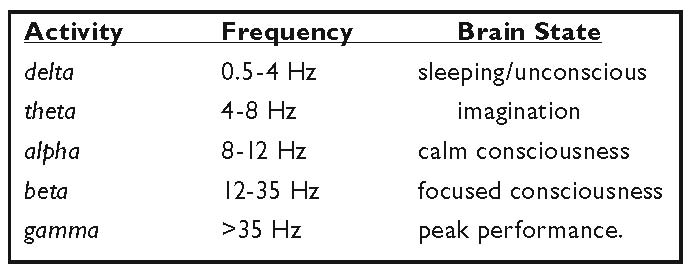
    EEG vibrations continuously shift from state to state over the whole range of frequencies during normal brain processing in adults. However, brain frequencies in developing children display a radically different behaviour. EEG vibration rates and their corresponding states evolve in incremental stages over time. The predominant brain activity during the child’s first two years of life is delta, the lowest EEG frequency range. In the adult brain, delta is associated with sleeping or unconsciousness.

    Between two and six years of age, the child’s brain activity state ramps up and it operates primarily in the range of theta. In the adult, theta activity is associated with states of reverie or imagination. While in the theta state, children spend much of their time mixing the imaginary world with the real world. Calm consciousness associated with emerging alpha activity only becomes a predominant brain state after six years of age. By twelve years, the brain expresses all frequency ranges although its primary activity is in beta’s state of focused consciousness. Children leave elementary education behind at this age and enter into the more intense academic programs of junior high.

    A profoundly important fact in the above timeline that may have missed your attention is that children do not express the alpha EEG frequencies of conscious processing as a predominant brain state until after they are six years old. The predominant delta and theta activity of children under six signifies that their brains are operating at levels below consciousness. Delta and theta brain frequencies define a brain state known as a hypnogogic trance, the same neural state that hypnotherapists use to download new behaviours directly into the subconscious mind of their clients.

    The first six years of a child’s life is spent in a hypnotic trance. Its perceptions of the world are directly downloaded into the subconscious during this time, without the discrimination of the, as yet, dormant self-conscious mind. Consequently, our fundamental perceptions about life and our role in it are learned before we express the capacity to choose or reject those beliefs. We were simply “programmed.” The Jesuits were aware of this programmable state and proudly boasted, “Give us a child until it is six or seven years old and it will belong to the Church for the rest of its life.” They knew that once the dogma of the Church was implanted into the child’s subconscious mind, that information would inevitably influence 95% of that individual’s behaviour for the rest of their life.

    The inhibition of conscious processing (alpha EEG activity) and the simultaneous engagement of a hypnogogic trance during the formative stages of a child’s life are a logical necessity. The thinking processes associated with the self-conscious mind’s processing cannot operate from a blank slate. Self-conscious behaviour requires a working database of learned perceptions. Consequently, before self-consciousness is expressed, the brain’s primary task is to acquire a working awareness of the world by directly downloading experiences and observations into the subconscious mind.

    HOWEVER, there is a very, very serious downside to acquiring awareness by this method. The consequence is so profound that it not only impacts the life of the individual, it can also alter an entire civilisation. The issue concerns the fact that we download our perceptions and beliefs about life long before we acquire the ability for critical thinking. Our primary perceptions are literally written in stone as unequivocal truths in the subconscious mind, where they habitually operate for life, unless there is an active effort to reprogram them. When as young children we download limiting or sabotaging beliefs about ourselves, these perceptions become our truths and our subconscious processing will invisibly generate behaviours that are coherent with those truths.

    As an important point for personal reference, it should be noted that acquired perceptions in the subconscious mind could even override genetically endowed instincts. For example, every human can instinctually swim like a dolphin the moment they emerge from the birth canal. This might prompt you to ask, “Why is it that we have to work so hard at teaching our children how to swim?” The answer lies in the fact that every time the infant encounters open water, such as a pool, a river, a bathtub, the parents freak out in concern for the safety of their child. However, in the baby’s mind, the parent’s behaviour causes the child to equate water as something to be feared. The acquired perception of water as dangerous and life threatening, overrides the instinctual ability to swim and makes the formerly proficient child susceptible to drowning.

    The following is further reference to the fact that our unconsciously acquired cultural beliefs control biology and behaviour. Through our developmental experiences we acquire the perception that we are frail, vulnerable organisms subject to the ravages of contagious germs and disease. The belief of being frail actually leads to frailty since the mind’s limiting perceptions inhibit the body’s innate ability to heal itself. This influence of the mind on healing processes is the focus of psychoneuroimmunology, the field that describes the mechanism by which our thoughts change brain chemistry, which in turn regulates the function of the immune system. While negative beliefs can precipitate illness (nocebo effect), the resulting dis-ease state can be alleviated through the healing effects of positive thoughts (placebo effect).

    Finally, the third source of perceptions that shape our lives is derived from the self-conscious mind. Unlike the reflexive programming of subconscious mind, the self-conscious mind is a creative platform that provides for the mixing and morphing a variety of perceptions with the infusion of imagination, a process that generates an unlimited number of beliefs and behavioural variations. The quality of the self-conscious mind endows organisms with one of the most powerful forces in the Universe, the opportunity to express freewill.

    Taking Personal Responsibility

    The conclusions of the “new” biology provide a radical departure from our conventional beliefs of how life works. In contrast to the notion that we are biochemical automatons driven by genes, the new insights reveal that it is the mind that controls genes, which in turn shape our biology and behaviour. The self-conscious mind, associated with our individual identity and the manifestation of thoughts, is guided by our own personal desires and intentions.

    While we generally perceive that our self-conscious mind is “controlling” the show, neuroscience has established the fact that 95% of our behaviour is under the control of the more powerful subconscious mind. As most of our personal and cultural problems arise from the fact that behaviours derived from the subconscious mind are essentially invisible to us, we rarely observe our automated behaviour.

    Compounding the problem is the fact that fundamental programs in the subconscious mind are derived from others, people who generally do not share your personal goals and aspirations. While our conscious minds are trying to move us toward our dreams, unbeknownst to us our subconscious programs are simultaneously shooting ourselves in the foot and impeding our progress.

    The subconscious mind is simply a “record-playback” mechanism that downloads experiences into “behavioural tapes.” While the self-conscious mind is associated with creativity, the subconscious mind’s function is to engage previously recorded programs. Unlike self-consciousness that is overseen by an entity (you), the subconscious mind is more closely related to a machine, meaning there is no thinking, conscious entity controlling the subconscious programs.

    We have all been shackled with emotional chains wrought by dysfunctional behaviours programmed by the stories of the past. However, the next time you are talking to “yourself” with the hope of changing sabotaging subconscious programs, it is important to realise the following information. Using reason to communicate with your subconscious in an effort to change its behaviour would essentially have the same influence as trying to change a program on a cassette tape by talking to the tape player. In neither case is there an entity in the mechanism that will respond to your dialogue.

    Subconscious programs are not fixed, unchangeable behaviours. We have the ability to rewrite our limiting beliefs and in the process take control of our lives. However, to change subconscious programs requires the activation of a process other than just engaging in a running dialogue with the subconscious mind. There are a large variety of effective processes to reprogram limiting beliefs, which include clinical hypnotherapy, Buddhist mindfulness and a number of newly developed and very powerful modalities collectively referred to as energy psychology.

    For a list of resources, visit: www.brucelipton.com.

    [alert type=”general” dismiss=”no”]This article was published in New Dawn 106.[/alert]

    [alert type=”success” dismiss=”no”]If you appreciate this article, please consider subscribing to help maintain this website.[/alert]

    © New Dawn Magazine and the respective author.
    For our reproduction notice, click here.

  • A Pagan Christ? Reflections on the Real Christmas Story

    A Pagan Christ? Reflections on the Real Christmas Story

    From New Dawn 105 (Nov-Dec 2007)

    Strictly speaking, a pagan Christ is a contradiction in terms. The very concept of paganism was constructed by Christians who wanted to distinguish their faith from the old religion of Greece and Rome, which by the end of classical antiquity was observed only by peasants in remote rural areas – the pagani, or “country people,” or – to use words that are similar in tone – rustics, rubes, hayseeds. So there can be no pagan Christ. Paganism is all that Christianity is not.

    Once we go past this elementary point, however, we see that the situation is not so simple. The resemblance between Christianity and its rivals could never be entirely overlooked. The Church Father Augustine (354–430) wrote, “That which is now called the Christian religion existed among the ancients, and never did not exist from the planting of the human race until Christ came in the flesh, at which time the true religion which already existed began to be called Christianity.” Whatever Augustine meant by this – and it’s not entirely clear from the context – one thing it could mean is that the “true religion” is universal and has always existed; only comparatively late did it come to be codified in the teachings of Christ.

    Before I go further into what this “true religion” might be, it’s necessary to stop and take a look at early Christianity in its context. Christianity, as is well known, grew up in the Roman Empire, a time of remarkable fecundity in religious belief, with a huge and dizzying marketplace of gods and cults and philosophies for the seeker to choose from, many of which bore more than a passing resemblance to one another. It’s impossible to believe that Christianity was not affected by this background. Although the Christians insisted that their religion was true and all the others were false, they still had to account for the fact that theirs was not so different from many of those they were denouncing.

    Over the past century, one of the most influential views of the relationship between Christianity and paganism has been that of Sir J.G. Frazer (1854–1941), author of the classic work The Golden Bough, first published in 1890 and updated in many editions thereafter. A pioneer of comparative mythology, Frazer delved into the compendious collections of lore and legend that scholars were amassing in his time and noticed that Christianity had taken many of its elements from the religions it would eventually displace.

    The most famous instance is Christmas. The birthday of Christ was not recorded and is not known; in the early centuries of the religion that bears his name it was not celebrated. But by the fourth century, Christ’s birthday came to be observed as a holiday. In the East (starting in Egypt), the date selected was January 6. But the Western church, which had never observed this date, set Christ’s birthday as December 25. Why? One Christian writer quoted (but not named) by Frazer explains: “It was a custom of the heathen to celebrate on the same twenty-fifth of December the birthday of the Sun, at which they kindled lights in token of festivity. In these solemnities and festivities the Christians also took part. Accordingly when the doctors of the Church perceived that Christians had a leaning to this festival, they took counsel and resolved that the true Nativity should be solemnised on that day and the festival of the Epiphany on the sixth of January.”

    Another, possibly more revealing, case involves the festival commemorating the death and resurrection of Christ. Today Easter is celebrated on the first Sunday after the full moon after the March equinox. (This is to some extent a simplification of the complex process of fixing the date of Easter, but it will serve our purposes here.) Frazer noted that there was an ancient tradition by which the death of Christ was observed on March 25, regardless of the phase of the moon. Remarkably, this coincided with the date on which the death and resurrection of a pagan god, Attis, was celebrated. Still more significantly, the parts of the world where Christians observed Easter on this date – western Asia Minor and Rome – were precisely the areas where the cult of Attis was most popular.

    Attis, according to the myth, was a handsome young shepherd who was born of a virgin. Beloved of the Great Goddess of life, he was said in some legends to have been killed by a boar, in others to have died after castrating himself. (The priests of the Attis cult were all self-made eunuchs, in imitation of him.) After his death, he was changed into a pine tree.

    It’s curious that the death and resurrection of Christ should have been celebrated in such close conjunction with that of one of the deities that the Christians so detested. What’s even more interesting is the underlying similarity of the myths: both are celebrations of a god, born of a virgin, who has died and risen again. More surprisingly still, Attis was not the only god in antiquity who was believed to have died and risen again. There was also Adonis, worshipped in Babylonia and Syria. Adonis, another beautiful young man, was said to die every year. His death caused passion to cease and beasts and men to forget to reproduce; all life would be extinguished if Ishtar, the goddess of life, did not rescue him annually from the halls of death. And of course there is Osiris, the slain and dismembered king of Egypt who was reassembled by his wife Isis (another goddess of life) to serve as the lord of the dead.

    Even this cursory sketch suggests how many parallels we can find between Christianity and pagan religions. Moreover, it was obvious that the pagan faiths were much older than the Christian one. Christianity looked like a mere copycat of these religions, and that’s exactly what many of its pagan critics contended. The Christian fathers countered with a remarkably clumsy response: that Satan, foreseeing that Christ would come to earth, came down first and created religions that were merely diabolical imitations of the truth.

    Those of us who find this argument implausible are left wondering exactly what the relationship between Christianity and these pagan cults was. Frazer saw the mystery religions of Attis and Adonis and Osiris as essentially fertility cults: Their rites were designed to mimic and foster the rebirth of life each spring. According to Frazer, Christ had come as a teacher of “ethical reforms”; the mythologies of the fertility cults were gradually assimilated to the faith of Christ’s followers “so as to accord in some measure with the prejudices, the passions, the superstitions of the vulgar.” Frazer writes:

    To live and to cause to live, to eat food and to beget children, these were the primary wants of men in the past, and they will be the primary wants of men in the future so long as the world lasts…. These two things, therefore, food and children, were what men chiefly sought to procure by the performance of magical rites for the regulation of the seasons.

    This all may sound plausible – as it certainly did to Frazer’s rationalistic late-Victorian contemporaries – but there’s one small problem with it. The idea that the mysteries of Attis and Adonis and Osiris, and by extension of Christ, were mere attempts to reproduce and sustain the cycles of life was known to the ancients and explicitly refuted by them. Plutarch, writing in the late first century CE, contends:

    And we shall also get our hands on the dull crowd who take pleasure in associating the [mystic recitals] about these Gods either with changes of the atmosphere according to the seasons, or with the generation of the corn and sowing and ploughings, and in saying that Osiris is buried when the corn is hidden by the earth, and comes to life and shows himself again when it begins to sprout.

    Cicero, the Roman statesman and philosopher (106–43 BCE), also says there is something more to the mysteries:

    These Mysteries have brought us from rustic savagery to a cultivated and refined civilisation. The rites of the Mysteries are called “initiations” and in truth we have learned from them the first principles of life. We have gained the understanding not only to live happily but to die with better hope.

    We can safely say this much: The ancient mysteries were more than rites intended merely to ensure that the crops grew and the animals bred. But what, then, were they? What is the dying “with better hope” that Cicero mentions? And why does the story of Christ, springing from the monotheistic world of Judaism, so much resemble those of the gods that went before?

    At this point it would be helpful to address an extremely important issue: the reliability of the historical accounts of Jesus. Apart from a few extremely brief references in non-Christian writers such as Tacitus and Pliny the Younger (which talk about the Christians as a sect but say practically nothing about Christ himself), we have to rely on the canonical gospels: Matthew, Mark, Luke, and John. Scholars unanimously accept these as the oldest gospels, with the possible exception of the Gospel of Thomas, an early sayings collection with a strongly Gnostic tinge; the many other gospels that were written are almost certainly later – one reason they didn’t find their way into the New Testament.

    Unfortunately, even these texts present Jesus at a remove. None of them, it is now generally acknowledged, was written by any of the Twelve Apostles or even by anyone who knew or saw Jesus personally. The earliest Gospel, Mark, is dated to around 70 CE; the latest, John, to around 100 (these dates are highly approximate). Nowhere in these Gospels is the claim that the writer himself has seen what he is describing. Indeed most scholars today agree that none of the texts in the entire New Testament was written by any of the Twelve Apostles.

    The only surviving eyewitness account of Christ is found in Paul’s first letter to the Corinthians. Paul did not know Jesus when he was alive, but he writes that after Jesus had appeared to Cephas (Peter), the twelve, and various other witnesses, “last of all he was seen of me also, as of one born out of due time” (1 Cor. 15:5). (Biblical quotations are from the Authorised King James Version.) This experience, usually equated with Paul’s vision on the road to Damascus (Acts 9:1–7), is an eyewitness account: Paul is claiming that he has had a vision of the risen Christ like that of the other apostles. Inasmuch as Paul died during Nero’s persecution in Rome in 64 CE, this text is almost certainly earlier than any of the Gospels. But Paul does not say anything more about his experience, and he says almost nothing at all about Jesus before his death.

    In their 1999 book The Jesus Mysteries, Timothy Freke and Peter Gandy argue that the extreme scarcity of direct evidence about Jesus, together with the strong resemblance of his story to other pagan myths, means that Jesus did not exist as a historical figure. He was created by Gnostic sages as a kind of Jewish equivalent of the dead and reborn gods of the pagan Mediterranean world.

    Freke’s and Gandy’s view, although interesting, seems to be an overstatement given the evidence. They say that Paul’s vision (as described by himself) may have been a later addition to 1 Corinthians, a claim that, to my knowledge, no reputable scholar would agree with; or perhaps that it was a mystical vision of some sort. But the context of 1 Corinthians 15 indicates that, as Christians have always claimed, Paul, like the others who claimed they had witnessed the resurrection of Christ, regarded it as an actual encounter with the risen Jesus. Whatever it was they saw or did not see, this much seems indisputable. Indeed, if we go to 1 Thessalonians, another letter of Paul’s, which was the first New Testament book to be written (it’s generally dated to around 50 CE), we see Paul saying, “The Jews… both killed the Lord Jesus, and their own prophets” (1 Thess. 2:14–15). “We believe that Jesus died and rose again,” he writes in the same letter (1 Thess. 4:14). In both these instances, he is stressing the historical actuality of these events: they are not a myth. Furthermore, Paul is not introducing this idea as a novelty but as a premise that he expects his readers to share.

    About the historical Jesus, then, we can say this much: that as early as 50 CE, no more than twenty years after his death and still well in the lifetime of his disciples, his followers preached that he had suffered and died and was resurrected. These facts are not later mythic accretions but among the first things the historical record says about Jesus.

    What, then, does this all mean? Paul’s own ideas seem to have grown and changed over time. In 1 Thessalonians, his first surviving epistle, he sounds like a modern-day fundamentalist, obsessed with the Rapture. In fact the idea of the Rapture comes from 1 Thess. 4:17: “Then we which are alive and remain shall be caught up together with [the dead] in the clouds, to meet the Lord in the air.” Later, Paul becomes more mystical. In 1 Corinthians he explicitly denies the physical resurrection of the dead: “It is sown a natural body; it is raised a spiritual body…. Flesh and blood cannot inherit the kingdom of God; neither doth corruption inherit incorruption” (1 Cor. 15:44, 50). This, incidentally, puts mainstream Christianity in the bizarre position of teaching a doctrine – the resurrection of the physical body – that is explicitly denied by its own scriptures. I do not know of any other such case in all of world religion.

    Nonetheless, resurrection is at the core of Christianity from its earliest days, just as it was of the mystery religions of Attis and Adonis and Osiris that preceded it. And, like the pagan mysteries, which enabled its initiates to die “with better hope,” Christianity viewed the resurrection not an isolated case that happened to one (possibly divine) man, but something that is the common human inheritance, potentially available to everyone: “Now is Christ risen from the dead, and become the firstfruits of them that slept” (1 Cor. 15:20). This was not the concept of resurrection as commonly taught, but part of what the Church Father Origen (185–253) called “the deeper and more mystical doctrines which are rightly concealed from the multitude.”

    The nature of this resurrection lies at the heart of the old pagan mysteries and the Christian faith alike. To best understand it in a short space, it would be helpful to use the common metaphor of a seed, used both by Jesus in the Gospels and by Paul (as well as in some of the pagan mysteries). A seed is something extremely small and contains only in germ the full plant; this is the metaphor Paul uses to compare what he calls “the resurrection body” with the “natural body.” Christ in the Gospels likens the kingdom of heaven to a seed on several occasions as well: for example, “the kingdom of heaven is like to a grain of mustard seed” (Matt. 13:31).

    What, then, is this “seed”? What is the kingdom of heaven, for that matter? If you were to read the works of many theologians, you might conclude that they don’t know. But this is a central concept in esoteric Christianity. It is not difficult to grasp, but it is subtle. I’ve discussed it in detail in my book Inner Christianity, but in essence it comes to this: There is that in you which says “I.” It is consciousness in its pure form; it is never seen, but always that which sees. You may think you are your body or your emotions or your thoughts, but the fact that you can step back and look at all these things at a distance proves that these things are not you – not in the truest and fullest sense. In fact it is your very confusion of your “I” with your thoughts, emotions, and sensations that constitutes the fundamental problem of human existence. Liberation or enlightenment or, as the early Christians called it, gnosis is the freeing of the “I” from its identification with its own experience. Paul writes, “That which thou sowest is not quickened until it die” (1 Cor. 15:36). Esoterically, this means that the “I” must “die” – must detach itself from its former identifications – before it can be “resurrected” or “born again,” that is, realise its fullest potential in a life that is not limited by the body or the psyche. In the course of this liberation the “I” realises its own immortality.

    This, in the simplest and most concise language that I can muster, is the secret that I believe lies at the heart of esoteric Christianity and of the Christian mystery itself. To speak of the resurrection of the physical body, explicitly denied by Paul, is to misunderstand; it is the symbolic death and rebirth of the true “I” – called “I am” in the Gospel of John – that is really the point. But it is an arcane point, and not everyone can grasp it. Early Christianity eventually allowed ordinary believers to believe in a physical resurrection because it was easier to understand; only those who wanted to go deeper were told the truth. As Origen writes, “The resurrection of the body,… while preached in the churches, is understood more clearly by the intelligent.” Origen is saying that the doctrine “preached in the churches” is not the whole story. Regrettably, however, as Christianity developed in later centuries, those who had only an inaccurate, secondary understanding of this truth came to lead the church. Because they did not understand the deeper message, they suppressed it, with consequences that have been disastrous for the spiritual life of the West.

    In any event, the revelation of the true nature of the “I” makes the correspondence between the Christian mystery and those of the pagans much easier to understand. If these things are true, they are universally true, and if they are universally true, they must have been known in many times and places and cannot be the bailiwick of a single religion. That, I would suggest, is why Augustine can say that the “true religion” always existed. It’s also why the mystery religions so resembled Christianity. They were expressing a universal truth to which Christianity was also pointing.

    Get the issue this article appears in

    All the same, this does not entirely explain the innumerable parallels between the Christ of the Gospels and the figures of ancient myth. Often it does seem that characteristics of the ancient pagan gods were later associated with Christ – and at a fairly early stage. The virgin birth, for example, is not mentioned in Mark, the earliest canonical Gospel, or for that matter by Paul. But it does appear in Matthew and Luke, which are generally dated to between 80 and 100. This suggests that by this point certain myths and legends had attached themselves to the basic story of Christ’s death and resurrection.

    Exactly how this happened is unclear. There is no contemporary documentation of this process, or, for that matter, of Christ himself apart from the Gospels to serve as a check. The best guess seems to be something like this: The earliest Christians believed they had some experience of the risen Christ, and this was the central part of their message from the very beginning. By the end of the first century, as the Gospels were being written, the historical kernel of the story of Christ was expanded and recast, partly to imitate familiar aspects of pagan myths but also to symbolically express certain truths. That’s why Origen could write:

    Very many mistakes have been made because the right method of examining the holy texts has not been discovered by the greater number of readers… because it is their habit to follow the bare letter….

    Scripture interweaves the imaginary with the historical, sometimes introducing what is utterly impossible, sometimes what is possible but never occurred…. [The Word] has done the same with the Gospels and the writings of the Apostles; for not even they are purely historical, incidents which never occurred being interwoven in the “corporeal” sense…. These passages, by means of seeming history, though the incidents never occurred, figuratively reveal certain mysteries.

    This process began with the Gospels but did not end with them. It continued for several centuries later, as we’ve seen with the Christian appropriation of Christmas and Easter in the fourth century. Later still, in the fifth century, when the cult of the pagan goddesses was suppressed, there was a need for a feminine face of divinity, and the mother of Christ was elevated to this role; many of the attributes of Ishtar and particularly Isis were then attached to her. Christianity’s success was at least partly due to its remarkable genius and flexibility in adapting pagan myths to its own ends. Ultimately, however, the true greatness of the faith lies in its profound and haunting expression of what may be the central mystery of human existence.

    [alert type=”general” dismiss=”no”]This article was published in New Dawn 105.[/alert]

    [alert type=”success” dismiss=”no”]If you appreciate this article, please consider subscribing to help maintain this website.[/alert]

    Bibliography

    Raymond E. Brown,  Introduction to the New Testament, New York: Doubleday, 1997.
    J.G. Frazer, The Golden Bough, New York: Macmillan, 1922.
    Timothy Freke and Peter Gandy, The Jesus Mysteries: Was the “Original Jesus” a Pagan God?, New York: Three Rivers, 1999.
    The Greek New Testament, edited by Kurt Aland et al. Third edition. N.p.: United Bible Societies, 1966.
    G.R.S. Mead, Thrice-Greatest Hermes: Studies in Hellenistic Theosophy and Gnosis, York Beach, Maine: Samuel Weiser, 1972. Originally published 1906.
    Origen, Contra Celsum, translated by Henry Chadwick, Cambridge: Cambridge University Press, 1953.
    Origen, On First Principles, Edited and translated by G.W. Butterworth, New York: Harper & Row, 1966.

    © New Dawn Magazine and the respective author.
    For our reproduction notice, click here.

  • Forces of the Unconscious Mind: Exploring the Work of Stan Gooch

    Forces of the Unconscious Mind: Exploring the Work of Stan Gooch

    From New Dawn 105 (Nov-Dec 2007)

    In the first chapter of his fascinating book The Origins of Psychic Phenomena (1984), the British psychologist Stan Gooch explains that he used to smile when he heard, “for instance, stories of invisible ‘thought forms’ allegedly produced by Tibetan mystics and others.” He then adds: “I no longer smile at such stories. My own feeling, now, is that there may literally be no limit to what can be achieved by the human subjective mind manipulating and actualising itself in the external, objective universe around it.”

    According to Gooch, the workings of the unconscious mind – or subjective mind – can shed light on a whole host of paranormal phenomena, including poltergeist disturbances, mediumship, automatic writing, multiple-personality-disorder, succubi and incubi attacks, and even UFO sightings. The list goes on.

    Stan Gooch the Medium

    Gooch’s involvement with the paranormal began at age 26, when he was working as a school teacher in Coventry, England. Because he was new to the area and had few acquaintances, Gooch decided to enrol in three sets of evening classes, one of which was gymnastics. One evening at gymnastics class, while he was in the changing room, a member of the advanced class, named Peter, struck up a conversation with him. “He eventually told me that his ‘spirit guide’ had instructed him to do so,” explains Gooch. Peter, a spiritualist and medium, invited Gooch to a séance at his parent’s house.

    The séance comprised eight to ten people, seated on hardback chairs, facing the medium. Soon after it commenced, Gooch had an experience that was to change the direction of his life. At first he felt light-headed. “And then,” he explains in his book The Paranormal, “it seemed to me that a great wind was rushing through the room. In my ears was the deafening sound of roaring waters. Together these elements seized me and carried me irresistibly forward. As I felt myself swept away I became unconscious.”

    When he regained consciousness, Gooch was told that several entities had spoken through him while he was in a trance state. One of the entities identified himself as a cousin of Gooch’s who had been killed in the Second World War. Told by the presiding medium that he was a “strong natural medium” and that he ought to develop his “gift,” Gooch began attending her weekly circle, which consisted entirely of mediumistic individuals.

    Sometimes Gooch and the other mediums would channel “higher guides.” Other times they would hold what’s called a “rescue circle,” whereby they would channel the spirits of those who did not realise they were dead, their aim being to help them “move on.” In The Paranormal, Gooch explains what it’s like to be “possessed by one of these lost souls.” It feels, he says, “as if another being ‘materialises’ or arises within one’s body and pervades it… There is a very clear and definite sense of another person within you.”

    During one particularly memorable séance, a cave-man materialised in the corner of the room. “It stood half in shadow, watching us, breathing heavily as if nervous,” says Gooch. He later came to suspect that this figure “which so very much impressed and haunted me both then and afterwards” was a Neanderthal. Years later, in 1971, Gooch formulated the hybrid-origin theory, which basically posits that we – Homo sapiens – are a hybrid cross between the two early species of man, Neanderthal and Cro-Magnon. His Total Man trilogy is an exploration of this hypothesis.

    On another occasion, soon after the presiding medium said they would experience “a wondrous radiance,” Gooch and the others were illuminated by what appeared to be a bright light shining down from above. Gooch eventually reached the conclusion that this occurrence was a type of collective hallucination, in addition to all the other paranormal manifestation that took place in the séance room. They were, in other words, psychological in nature, not physical. “That is, I do not think that any of the happenings would have registered on a photograph of the scene,” he explains.

    In due course, Peter allowed Gooch to have a session with his spirit guide, an alleged American Indian named Grey Hawk. While Peter was channelling Grey Hawk, says Gooch, his face and profile took on the features of a “story-book Indian.” Grey Hawk gave Gooch a long lecture on “the nature of spirit,” which Gooch found moving and poetic, though also empty and unsatisfying. Gooch says he finds many talks by spirit guides, as well as books that have been dictated by them, “a kind of intellectual candy-floss… When you try to chew on these utterances, there is nothing there. The mouth is empty.”

    It is because of this reason, as well as numerous others, says Gooch, that “personalities” like Grey Hawk are nothing more than a product of the unconscious minds of the mediums who claim to channel them. “One is that the alleged spirits never tell us anything that is not already known to living persons on this planet – and, almost invariably, known to the bereaved person ‘sitting’ with the medium,” he explains.

    More on Mediumship

    In The Origins of Psychic Phenomena, Gooch mentions how the author and former Air Force officer Sir Victor Goddard once asked the British medium Ena Twigg to contact one of his friends who had died. Remarkably, Twigg managed to give an accurate description of this individual – his appearance and personality, etc – even though she hadn’t been told anything about him. In a later session, she went into a trance, apparently channelling Goddard’s friend. In a description of this event, Goddard mentions that Twigg adopted his friend’s mannerisms and personal figures of speech, and that he was thoroughly taken aback by what he had witnessed. “It wasn’t so much the information which was conveyed as the manner of its conveying in speech, in action, and in gesture that carried conviction…,” writes Goddard.

    Gooch uses this case to support his theory that mediumship has nothing to do with spirits. What is occurring instead, he says, is that the medium is unconsciously “tapping into” the mind of the sitter. “…There is nothing in what the ‘spirits’ narrate that persuades us that anything but a memory of that person is operating…,” he explains.

    In his book Afterlife (1985), the British author and paranormal expert Colin Wilson explores, among other things, the subject of mediumship, eventually reaching the conclusion that there are indeed such things as spirits. The “unconscious mind theory,” he says, falls short of explaining a great many number of mediumistic communications, as well as a large number of poltergeist disturbances. Most paranormal investigators, he says, “are finally driven to the conclusion that spirits almost certainly exist. They do this with the utmost reluctance. It would be far more convenient, and far more logically satisfying, if we could explain all the phenomena in terms of the unrecognised powers of the human mind.”

    Not surprisingly, Gooch gives the “spirit hypothesis” very little consideration. He does state, however, that it would be arrogant to rule out the possibility that some “spirits” have an independent existence, and are therefore not a product of one’s own mind.

    The unconscious mind, says Gooch, for which a better name would be “alternative consciousness,” is far more dynamic and powerful than we assume. It is, in a sense, an entity of its own, possessing its own logic and autonomy, and, when repressed, is capable of expressing itself in very odd and alien ways – mediumship being a perfect example.

    In Gooch’s opinion, as mentioned previously, ‘channelled’ information, as a general rule, leaves much to be desired. As an example – and a good one at that – Gooch mentions the numerous ‘Seth’ books that have been written through Jane Roberts. All of these books, says Gooch, “mean absolutely nothing.” Jane Roberts, by the way, who died in 1984, was a successful and prolific author before she became a ‘mouthpiece’ for Seth.

    In late-1963, as part of her research for a book on ESP, Roberts, who was then thirty-five, started experimenting with an Ouija board. Her husband, Robert Butts, took part in these activities. Before long, they began to receive coherent messages from a male personality who later identified himself as Seth. Before long, Roberts began to hear Seth’s voice inside her head. She then developed into a medium, regularly going into a trance state in which Seth would allegedly speak through her. Over the years, with Butts acting as stenographer, Seth’s deranged philosophical and spiritual ramblings were written down and compiled in book, after book, after book…

    However, some of this material was written automatically, whereby Roberts would enter a trance state and let her hand “take over.” Seth described himself as an “energy personality essence no longer in physical form.” He claimed, moreover, that he existed independently of Robert’s subconscious (or ‘unconscious’, as the two words basically have the same definition).

    Hypnosis and the Theories of Thomas Jay Hudson

    In the early-1880s, the subject of hypnosis attained a certain degree of scientific acceptance, and was being employed by leading psychologists to investigate the realm of the unconscious. After witnessing a remarkable display of hypnosis, conducted by the famous Professor Carpenter, a Detroit newspaper editor named Thomas Jay Hudson decided to formulate his own theories about such matters, later writing an influential book on the subject called The Law of Psychic Phenomena (1893). (By ‘psychic’ he means psychological.)

    The hypnosis presentation conducted by Carpenter, which so impressed Hudson, took place in Washington DC. One of the participants, a college graduate identified only as ‘C’, was placed under hypnosis and made to believe that he was in the presence of Socrate’s spirit, which he, but nobody else, was able to see. He was also told that Socrates would answer any question he desired. C and the imaginary Socrates then began to have a conversation, with C repeating everything ‘Socrates’ said, so that Carpenter and the audience could hear it. Apparently their conversation went on for two hours, and the answers ‘Socrates’ gave were so plausible and impressive that some members of the audience were firmly convinced of his being there in spirit form.

    C was then introduced to the ‘spirits’ of far more modern philosophers, and again, the conversations that took place left the audience spellbound. Each ‘philosopher’ he talked to had their own distinct style of speaking. The language they used, moreover, was also distinct, as were the comments they made. It should also be mentioned that the ideas and opinions they expressed were far different to those which C possessed. Had the entire discourse been printed word for word, says Hudson, it would have “former one of the grandest and most coherent systems of spiritual philosophy ever conceived by the brain of man.”

    There were, it turns out, a small number of spiritualists in the audience, some of whom believed that the presence of spirits could explain what they had witnessed. It’s fair to assume, however, that some of them began to question this notion when Carpenter managed to invoke the ‘spirit’ of a talking philosophical pig, which proved to be something of an expert on the Hindu doctrine of reincarnation.

    In an attempt to explain hypnosis and other phenomena of this nature – including genius, insanity and even the miracles of Jesus – Hudson formulated the theory that man has two minds, the subjective and the objective. The objective mind, which is practical in nature, allows us to function effectively in the real world. It operates, moreover, through the medium of the five senses.

    The subjective mind, on the other hand, is non-practical in nature, and allows us to deal with our inner problems. It prefers to use intuition, and is highly suggestible. “It is the seat of the emotions, and the storehouse of memory,” explains Hudson. “It preforms its highest functions when the objective senses are in abeyance. In a word, it is that intelligence which makes itself manifest in a hypnotic subject when he is in a state of somnambulism.”

    During hypnosis, says Hudson, the objective mind – the ‘you’ – is put to rest, allowing the subjective mind, which is a “separate and distinct entity,” to take charge of the brain and body. According to Hudson, when in control, the highly intuitive – in fact, psychic – subjective mind is able to perform all sorts of remarkable, almost supernatural, feats. Hudson knew of cases where hypnotised subjects, who had their eyes closed, were able to read a newspaper held by someone on the opposite side of the room. He had also heard stories of people, who, under hypnosis, were able to speak foreign languages they had never consciously learnt, later discovering that they had been exposed to the languages in early childhood, and had therefore managed to ‘absorb’ them unconsciously.

    If one were to compare Gooch’s theories with Hudson’s, they would obviously say that the objective mind is the same as the conscious, and the subjective mind is the same as the unconscious.

    Automatic Writing

    As explained in his book The Paranormal, Gooch not only developed mediumistic powers, he also developed the ability to write automatically. “After only one or two attempts my hand began to write vigorously and fluently,” he explains. To be successful in this endeavour, he says, one must be totally relaxed and in an environment free of distractions, paying as little attention to one’s “writing hand” as possible. “After a few sessions, perhaps even in the first, the hand will begin to twitch occasionally of itself. Marks and scribbles may be made. In time many people can progress to a hand that writes coherently by itself.”

    After much experimentation with automatic writing, Gooch reached the conclusion that his unconscious mind was producing the results. The types of ‘personalities’ that expressed themselves on paper, he says, were many and varied. He describes some of their comments as solemn and soulful. Others, he says, were “naughty remarks of the ‘impish spirit’. And occasionally the cursing and filth of the true demon or devil.”

    Gooch soon discovered that, simply by using mental commands, he was able to alter the tone and style of the material he wrote automatically. This process, he insists, was purely mental, in that no amount of deliberate, physical force was used. “I could also lead the conversation in any direction I chose,” he explains. “I could easily catch out the communicant by causing him or her to contradict something said earlier.”

    In The Origins of Psychic Phenomena, Gooch provides further evidence to suggest that one’s own unconscious mind is able to produce automatic writing. He mentions the work of a physician named Dr. Anita Mühl of the St. Elizabeth’s Hospital in Washington, who used automatic writing as a tool to treat hospitalised neurotics and psychotics. Mühl discovered that the material her patients wrote automatically – which consisted mainly of short poems, short stories, drawings and musical compositions – often contained elements that illuminated the problems they suffered from. She found, moreover, that discussing and exploring this material with her patients was of considerable therapeutic value.

    Mühl’s patients wrote in a variety of different ways, some of which were very odd indeed; as she explains in her own words: “The subject may display a sudden facility for using the opposite hand or for using both together and may even produce two personalities at once, each making use of a different hand and each representing a different sex. He may write mirrorwise with either or both hands and he may write backwards correctly and speedily…”

    One of Mühl’s patients, a woman “of such refinement and charming manner,” who suffered from various sexual difficulties, produced automatic writing that contained “the most obscene and filthy language.” Analysis of this material revealed that the patient had been repeatedly sexually assaulted as a child, and that this was the cause of her problems. Although she had only the vaguest recollections of these humiliating and distressing incidents, her unconscious mind had recorded it all in great detail.

    A Brief Note on the Poltergeist

    No article on the paranormal abilities of the unconscious mind would be complete without mentioning the poltergeist. Most experts on the poltergeist agree that these dramatic, frightening and often violent manifestations are created by the unconscious mind of a particular person around whom the disturbances take place. This individual – sometimes called the agent or focus – is often psychologically disturbed in some way. Many well-documented cases exist where the focus was a pubescent child.

    According to the parapsychologist Scott Rogo in his book The Poltergeist Experience, poltergeist disturbances occur when an individual creates a “PK-being from his inner guilt, hate and repression, which takes on a life of its own…” This “PK-being,” he says, “grows in force until it completely severs itself from the will or personality that gave it birth.” The disturbances cease, he says, once the PK-being has expended all its energy.

    The Cerebellum as the Unconscious

    So where in our brains is the unconscious located? After all, the cerebral cortex, the outer layers of the two hemispheres of the cerebrum, is widely considered to be the general, physical location of the conscious mind, as many of the functions it performs are those which take place in a fully awake state of consciousness.

    Gooch proposes that the cerebellum – or “little brain” – is the physical seat of the unconscious mind. He points out, for instance, that strong evidence exists to suggest that the cerebellum is directly responsible for the function of dreaming. He also points out that it is the headquarters of the autonomic nervous system, while the cerebrum – the conscious mind – is the headquarters of the central nervous system (CNS). Women, he says, who are generally more psychic than men, have larger cerebella than men, as confirmed by brain imaging techniques.

    Exploring the Realm of the Unconscious

    The fact that we dream, says Gooch, proves that we inhabit not one universe, but two – the world of the conscious, and the world of the unconscious. The latter of which – the “inner alternative world of the mind” – is open to extensive exploration, he says. Some people, including Gooch, reach it by sustaining a hypnopompic state, remaining in a semi-conscious condition – the one that precedes complete wakefulness (as opposed to the one that precedes sleep, knows as a hypnagogic state).

    Gooch says the “inner universe” can take on a variety of different forms, such as that of a town – with streets shops, cafes and people – or that of a beautiful countryside. In this universe, he says, one is able to talk to people, and even have sex. “The sex is not just as good as, but better than that obtained in the real world, because one’s own personal archetypal wishes and fantasies may be, and often are, lived out,” he explains.

    Gooch believes that the unconscious mind manifests paranormal phenomena in response to being repressed. In a “balanced” individual, he says, the two minds exist in harmony. But when an imbalance occurs, when the unconscious mind is not given its due, there is an externalisation of latent energies. It is then that we are haunted by creatures and forces from the mysterious universe of our other mind.

    [alert type=”general” dismiss=”no”]This article was published in New Dawn 105.[/alert]

    [alert type=”success” dismiss=”no”]If you appreciate this article, please consider subscribing to help maintain this website.[/alert]

    Bibliography

    Richard S. Broughton, Parapsychology – The Controversial Science (Ballantine Books, US, 1991)
    Stan Gooch, The Paranormal (Wildwood House Ltd., UK, London, 1978)
    Stan Gooch, The Origins of Psychic Phenomena (Rider & Co, UK, 1984)
    Brian Inglis, Trance – A Natural History of Altered States of Mind (Grafton Books, UK, 1989)
    D. Scott Rogo, The Poltergeist Experience – Investigations Into Ghostly Phenomena (Penguin Books Ltd., Middlesex, England, 1979)
    Colin Wilson, Afterlife (The Leisure Circle Ltd., UK, 1985)
    Colin Wilson, Beyond the Occult (Caxton Editions, London, UK, 1988)

    © New Dawn Magazine and the respective author.
    For our reproduction notice, click here.

  • John Perkins: From Economic Hitman to Shaman

    John Perkins: From Economic Hitman to Shaman

    I remember John Perkins. He was a real jerk. A gold-plated, super-slick lying little butthole shill for corporate gangsters; a snake-oil salesman with a movie-star grin, shiny loafers, a crooked calculator and a tooled leather briefcase full of high-blown bullshit.
    – Greg Palast (www.gregpalast.com)

    Despite Greg Palast’s spleenish dismissal from an earlier time, John Perkins has emerged as a spiritual, intellectual and political authority. He is an important leader of contemporary neo-shamanism, one of today’s most effective critics of American corporate culture, and a story teller capable of overshadowing the legendary Ian Fleming, who created James Bond, when it comes a tales of imperial adventure and conquest.

    He is working to offer a vision, or a ‘dream change’ as he calls it, designed to rescue America, and the world it dominates, from the destruction of rampant corporate energy. He works to achieve these ends by recounting in a disarmingly honest and sensitive way the personal adventures and dilemmas he has experienced in diverse and exotic parts of the world.

    Perkins first gained a reputation in the 1990s for a series of books on shamanic cultures amongst remote tribes and peoples. Around a decade later and prompted by the events of 9/11, he published Confessions of an Economic Hit Man in 2005. This describes life as part of an elite group trained to “utilise international financial organisations to foment conditions that make other nations subservient to the corporatocracy running our biggest corporations, our government, and our banks.”

    After twenty-seven publishers turned it down, the book came out of nowhere to be an international best seller, and is about to be made into a Hollywood movie. It went to number four on Amazon during its first week and was quickly on all best-seller lists. This was achieved without receiving any mainstream media attention.

    Most importantly, Confessions of an Economic Hit Man has provided credibility, authority and celebrity in opening up new areas of thought. These range across corporate power, American empire, shaman spirituality and environmental consciousness.

    Perkins has become a rallying figure for critics of the American ‘corporatocracy’. The harm it inflicts with casual neglect on the environment and local tradition is identified wherever there is the potential to seize cheap resources or some other commercial windfall. A second book has now been published in this genre. The Secret History of the American Empire again recounts wild, troubling conspiracies to grab resources from vulnerable third world leaders through the peddling of unserviceable loans. This is what makes it tempting, even if it is an injustice, to say that its author is becoming America’s Ian Fleming, with conscience.

    Intriguingly, the American hit man is a much more sophisticated and reflective operator than the British secret agent. He never dirties his own hands with an actual act of execution or termination. That is left to the jackal, a scavenger that cleans up after others and a figure much closer to the persona of James Bond. Yet both Fleming and Perkins leave the feeling that they have witnessed a time of transition, as the challenges of empire begin to outweigh its rewards. Each captures his readers through the exposure of perversely heroic excesses.

    John Perkins both writes and plays the story of the economic hit man, as he reveals an institutionalised imperial strategy of which few had previously been aware. This exposure may well make a contribution to constraining the role of laissez faire corporate plundering in maintaining empire. It may also help construct a vision for an American future more in tune with the values of its founding fathers and its constitution.

    It is a comment on the paradoxical character of the contemporary world that the legacy from time as an economic hit man is now committed to opposing and constraining such activity. Rarely have the costs and destruction that go with exercising power over vast areas of the world and the enormous demands of imperial authority on energy, talent and resources been rendered more transparent.

    Perkins sketches a highly complex world, both at the personal and imperial level. His own heroic personality reflects a messy, if robust, form of schizophrenia. Simultaneously, he confesses to ghastly deeds as an economic hit man, articulates a rare sensitivity to diverse indigenous forms of spirituality, uses his experience of malevolent deeds to awaken readers to the destructive power of corporations and comments on the complex feelings and questionings that accompany his actions and reflections.

    A simple, powerful and authoritative style makes it easy to follow these stories of endless exotic adventure. It is also easy to follow the author’s feelings as he learns and grows through personal involvement in a world of calculated intrigue and exploitation that no one had ever explained to him.

    The experience of many bright, inexperienced young men is captured with rare honesty. These innocents are recruited to maintain and extend the reach of empire by means that it would be politically unacceptable to explain in an academic text or a university course. Such stories are a powerful means of mocking much of the economic doctrine taught at Western universities and wielded like a weapon by the minions of the IMF and World Bank as self-serving theoretical nonsense.

    Greg Palast, in a piece titled John Perkins: Jerk, Conman, Shill posted on his website www.gregpalast.com, captures the profound ambiguity in the author’s character in the following colourful language:

    To steal millions, you need a top team of armed robbers. But to steal billions, you need PhD’s with colour charts and economic projections made of fairy dust and eye of newt. Perkins had it all – including a magical thing called a computer-generated spreadsheet (this was well before Excel)…..

    But, as in every moral tale, Perkins, the modern Dr. Faust, found redemption in confession…..

    And in his writings today, Perkins’ heart goes out to the Third World targets of this new empire ruled by shock troops and spread sheets. His empathy extends to those in the occupied territory known as the USA. Because, says Perkins, when the wretchedly ripped-off of the Earth rise in rebellion, the lash of the backlash is felt by the children of the lobstermen of New Hampshire, shivering under Humvees in Falluja, and never the EHM’s clients’ fortunate sons, frolicking in their Ferraris.

    While Perkins is best known today for his Confessions of an Economic Hit Man, he is best understood in the context of his earlier writing. This explores the wisdom and understanding of shamans in contrasting parts of the world. These revelations can be even more startling than his hit man stories. They raise serious questions about most readers’ perceptions of reality and can leave an elated sense of new possibilities and enhanced insight into the nature of life. It is even possible to read in an exchange with an Amazonian shaman an early contribution to the idea of carbon trading.

    Stories of the profound practical wisdom mobilised by forms of shamanic spirituality make this unfamiliar world surprisingly accessible. The struggle for survival in a world threatened with destruction by economic hit men adds further credibility.

    Stories of spiritual discovery amongst native shamans are built around a deep but shifting sensitivity. Initial days as a wide-eyed Peace Corps volunteer are followed by subsequent hit man travels surrounded by privilege, sycophantic attendants and murky conspiracies, and then by a role as guide and leader of small groups of spiritual explorers venturing into the Amazon and other threatened environments. A capacity to recognise the mundane daily imperatives of human life in many contrasting environments is a basic strength of these stories. Readers are introduced in a most convincing manner to the surprisingly practical uses to which native spiritual powers are put. These range from the power to track down and destroy a rogue tiger in the jungle to the capacity to navigate vast distances at sea without charts or other recorded knowledge.

    Pychonavigation: Techniques for Travel Beyond Time in 1990 displayed a writer and activist deeply concerned with the preservation of native traditions, the understanding of shamanic spirituality and the protection of the environment. It also highlighted the manner in which the contemporary world offers unprecedented opportunities to those with wealth, interest, understanding and accidental opportunity. Such individuals are able to explore and identify with diverse forms of spirituality amongst peoples from many different traditions of belief and behaviour.

    The world of shamans may be under threat, but there is also a sense in which the advanced and scientific West needs to turn increasingly to these influences. Christian and scientific dogmas have destroyed essential human qualities in the rush of spread sheets and bottom line calculations.

    These discoveries have been followed up and explored further in other books, such as Shapeshifting: Techniques for Global and Personal Transformation. This 1997 book gives readers an almost tactile sense of experience in uncovering new wonders. This powerfully encourages an opening of the mind and spirit to new possibilities. Not only is the reader’s preparedness to explore the seemingly unbelievable tested, but penetrating reflections on the contemporary world challenge many familiar certainties.

    The assertion of a sympathetic mentor, a Norwegian engineer and corporate power-broker, that capitalism is here to stay provides the basis for reflections on the future. It is essential to understand as deeply as possible the nature of the corporation, which need not necessarily be predatory and destructive. This gives context and balance to devastating comments about corporate fostering of consumerism and emasculation of education. These products of the European Enlightenment, and the way they have diminished the spiritual qualities and understanding of people in the developed world, are rarely exposed so aptly.

    Concern with corporate realities leads to discussion with a Mayan shaman about the need to distinguish dreams from fantasy. While dreams can nourish fulfilment in life and a deep sense of spiritual reality, fantasies only encourage illusion and can be very harmful. This distinction has great practical usefulness because we all vacillate between dreams and fantasies. Yet we rarely pause to recognise the need to distinguish between them, nourish our dreams and discipline our fantasies.

    Explorations with the Mayan shaman suggest that critical to realising the potential of dreams is an understanding at the most fundamental level that energy is everything, that spirit is energy and that the sighting of spirits is synonymous with the sighting of energy. From this it follows that the aura that surrounds organic life and that some healers can use to restore well-being is an emanation of spirit and energy. In bold reflections such as these, Perkins offers himself with a genuine sense of humility – attributing his insights to ‘primitive’ shamans – as a serious and profound commentator on the ills of Western progress and development.

    Books such as Pychonavigation and Shapeshifting in the 1990s reveal the depth of Perkins experience, reflection and spirituality. While they won him a substantial readership and group of followers, it was the political and corporate expose of Confessions of an Economic Hit Man that catapulted him into the ranks of bestsellers and made him a celebrity leader with a potential to transform many of the spiritual ailments that trouble the contemporary American imperial character.

    John Perkins was born in New Hampshire in 1945. He attended Tilton Boys High School, and later Middlebury College and Boston University, before joining the Peace Corps and working in Ecuador in the Amazon. He claims he was vetted by the National Security Agency before being recruited by the Boston strategic consulting firm, Chas T Main, where he rose to the position of chief economist. Not surprisingly, his claims have been disputed by the US State Department.

    Then followed some years of internal struggle over the role of persuading third world governments to accept large, unserviceable loans for infrastructure projects contracted to major US corporations. This anguish deepened as understanding grew about subsequent joint US government and international aid agency action, designed to control these governments and dispose of their oil and other resources to serve US interests. Being a witness to such activities all over the world – in Africa, Asia, Europe, Latin America and the Middle East – led to a decision to quit. Little doubt is left, however, that those who desired silence about earlier work assisted in the success of a subsequent independent energy company.

    After the sale of the energy company in the late 1980s Perkins became involved with non-profit work around the world. In addition to his writing, he became active in shifting consciousness and promoting sustainable lifestyles for the individual and global community.

    It is possible to question the veracity of accounts of American skulduggery. But there is much evidence to support them and they are rarely subjected to serious critical cross-examination. To the contrary, Confessions of an Economic Hit Man has been followed by books like A Game as Old as Empire: The Secret World of Economic Hit Men and the Web of Global Corruption, a collection of chapters by a variety of writers, edited by Steven Hiatt, which explores the range of such activity.

    Even more important, perhaps, unrelated writers such as the German-American William Engdahl have shown in books like A Century of War: Anglo-American Oil Politics and the New World Order that Anglo-American power-brokers have long made devastating use of discreet partnerships between corporate and governmental interests. When the record of the English East India Company is put together with the work of contemporary writers, it is difficult to avoid the conclusion that Anglo-American empire has largely been the product of the corporation.

    These organisations have been effective fronts for imperial expansion. They have been characterised by a remarkable capacity to mobilise adventurous, risk-taking individuals, by skilful, discreet control and manipulation of financial and commodity resources and by the ability to shroud their activities in high-sounding rhetoric about progress and universal values.

    The impact of Perkins in exposing this reality has been enhanced by several factors. First, he tells a great story from the perspective of personal involvement and personal anguish. Second, his earlier writings on indigenous spirituality in scattered parts of the world provided him with an established reputation amongst informed and reflective readers in the decade before the appearance of Confessions of an Economic Hit Man. Third, there is apparent coherence linking his stories of spiritual adventure and discovery and his stories of political adventure and discovery. Finally, 9/11 has created a world, with its enhanced electronic communications and troubled questioning of what has gone wrong, that is disposed to explore the issues raised by corporate excess and economic hit men.

    In one sense, the linkage of spiritual and financial adventure and discovery has created a 21st century everyman or icon. Educated and reflective members of economically advanced communities will find it increasingly difficult to avoid the type of issues and questions that are central to these themes.

    The fact that Perkins does not claim great erudition but simply recounts a story and a succession of dilemmas enhances the accessibility of the work. The sense of surprised discovery of hidden realities is one that is shared by increasing numbers in a world where even advanced levels of education tend to be narrow and excessively functional. It is easy for even the best intentioned and most responsible of workers to become jerk, con-man, and shill as they toil to fit in, accommodate peer group pressure, win the favour of superiors and build the reputation and wealth needed to support a family.

    The modern corporation (or government) demands a certain ignorance and naïvetè of its employees if they are to serve its purpose of maximising profit (or voter support). Only a few are privileged to have the opportunity to see through illusions, opt out and warn others. It is a role where success is improbable.

    The title chosen for Perkins’ second book on American financial strategies, The Secret History of the American Empire, invites the reader to revisit and reconsider events like the 1997 Asian Financial Crisis and ponder on it as the product of a team of economic hit men. It also raises daunting questions about the longer-term viability of major global institutions like the World Bank and IMF.

    There is one story of carrying a book by Joseph Stiglitz during travels to Tibet and of reflections about closely related concerns. Globalization and Its Discontents explains spreading discontent and criticism about the international financial institutions. It does this from the perspective of one who served on President Clinton’s Council of Economic Advisors, was Chief Economist and Senior Vice President of the World Bank and was the winner of the 2001 Nobel Prize for Economics. Yet, it is important to understand why it is John Perkins and not Joseph Stiglitz who will have the greater impact on the popular American consciousness.

    However much the authority of the American State Department may dispute them, Perkins’ stories take the reader directly into the action and personalities of events that have shaped the latter half of the 20th century. They involve the reader in the excitement, the fulfilments and the angst of such action and make the most implausible of conspiracies seem commonplace and mundane, even as they unfold in exotic and alien environments. Ultimately, they intensify many dilemmas by focusing on discoveries of the shamanic spirituality and wisdom of peoples whose cultural survival in the contemporary world seems condemned – limited to decades.

    Unfortunately, there is little about Japan and China, two large nations that have preserved ancient forms of spirituality while building robust and vibrant modern economies. A chapter on geishas in Secret History hints at great subtlety in Japanese traditions. It recounts a platonic, hungering and fleeting relationship with two geishas who are revealed to be mixed blood daughters of Taiwanese mothers abandoned by American fathers and rescued and raised by a shrewd but kindly Japanese businessman. These, in a single forthright conversation, educate a still naïve American in the way their charms are used to advance Japanese corporate interests. One suspects these are rarely matched by American finesse. Sadly, apart from this early chapter in the latest book nothing more is said about Japan.

    Another chapter, The Quiet Giant, reflects in passing, and not unsympathetically, on China in the context of a visit to Tibet. There are no insights of particular interest, however, and China is not addressed again.

    Both Japan and China have sheltered and preserved shamanic traditions, generally in the form of Shintoism and Daoism, but also in Zen and Chan Buddhism and other forms. Despite the fact that both Japan and China have been remarkably successful in exporting products of this shamanism in the form of martial arts, physical therapy and spiritual disciplines, it is not popular to recognise such successes in the West.

    While this issue is not explored directly by Perkins, exploration of less imposing shamanic traditions invites the thoughtful reader to reflect further on the costs inherent in the West’s ‘intellectual apartheid’. Deployed as a means of advancing the West’s civilising mission and imperial ambitions, ‘intellectual apartheid’ blinded most observers to the power of Japanese and Chinese shamanic spirituality. East Asian nations have shown that educated, disciplined and organised communities can defend themselves against Anglo-American economic hit men, whether it is through the use of geishas or other aspects of traditional practice.

    Ultimately, one may question whether Perkins offers serious readers any realistic way forward. He cannot be faulted for his criticism of economic hit men and their plundering corporations and one cannot but applaud his revelations about endangered shamanic cultures. But does he address these issues strategically?

    The 21st century world of rapid global communications is ruthless in exposing the vulnerability of communities that are not organised to advance their own interests. Perkins’ Anglo-American world is one that has used the corporation to great effect as an empire-building tool but is one that has neither the disciplined subtlety of the Japanese geisha nor the strategic wisdom inherent in Chinese tradition. These are the areas where Asian shamans have displayed their power but they are not areas where Perkins is well equipped to comment.

    It would be misguided to criticise Perkins on these grounds. He is modest in his claims to expertise. Yet his writing covers such a broad spectrum and is so authoritative in speaking of hope derived from tribal shaman traditions that it becomes necessary to probe broader issues. It is a reflection of his value that he gives grounds to address weighty matters and encourages recognition of the growing frailties in aggressive contemporary corporate culture.

    Unquestionably, John Perkins is a figure with convincing and disarming talent, with spiritual and moral depth and with political and economic discernment. Men with these qualities who are prepared to speak clearly are rare in America.

    Should the continuation of economic hit man stories lead to a series of adventure films that recall James Bond, this is only likely to increase Perkins’ influence and importance. It will be hard for such films not to be educational in terms of the way the world works and sobering in terms of exposing the strategies that have constructed Anglo-American Empire. They may also begin to open the popular imagination to long neglected spiritual realities that challenge false certainties. Perhaps no greater service could be rendered in these days of imperial strain and insecurity.
    [alert type=”general” dismiss=”no”]This article was published in New Dawn 104.[/alert]

    [alert type=”success” dismiss=”no”]If you appreciate this article, please consider subscribing to help maintain this website.[/alert]

    © New Dawn Magazine and the respective author.
    For our reproduction notice, click here.

  • The Speed of Life: Why Time Seems to Speed Up and How to Slow it Down

    The Speed of Life: Why Time Seems to Speed Up and How to Slow it Down

    From New Dawn 104 (Sept-Oct 2007)

    I’m six years old, in the car with my parents and brother, travelling back from our annual two week holiday in Conwy, North Wales. It’s dark and the journey seems to take forever. I lie in the back seat, watching the orange streetlights and the houses pass by, and wonder if we’re ever going to get home.

    “Are we nearly there yet?” I ask my father.

    “Don’t be silly,” he says. “We only set off half an hour ago.”

    My mum plays the ‘Yes/No’ game and ‘Twenty questions’ with us to make the time pass faster. We listen to the radio for a while. Then I fall asleep. When I wake up it seems like I’ve been in the car for an eternity and I can’t believe we’re still not home.

    “Are we nearly there yet?” I ask again.

    “Not far now,” says my father.

    We play some more games and finally I recognise the streets of our suburb of Manchester. I feel bored and miserable and tell myself that I’m never going to spend as long in a car ever again.

    The journey from Conwy to Manchester took two hours when I was a child and still takes roughly two hours now (although slightly less due to improvements in roads). I made the journey again a few years ago and couldn’t believe how short it seemed now, from my adult perspective. Those two hours – which seemed like an eternity when I was 6 – were nothing. My girlfriend was driving, and we chatted, listened to tapes, watched the Welsh countryside give way to the urban sprawl of north-west England, and we were back in Manchester almost before we knew it. It was a little frightening – what had happened to all the time that two hours contained when I was six years old?

    A year or so ago I made another journey which gave me an indication of how much more quickly time is passing to me now. This was a 15 hour plane journey, from Singapore to Manchester, which also seemed to last forever. I’m not a very good flyer and it wasn’t a very good flight: we flew into two typhoons over India and it was rocky almost all the way. I hoped I’d be able to ‘kill’ some of the time by sleeping but it was impossible. Every time I drifted off my anxiety woke me up again. Failing that, I hoped I’d at least be able to make the time pass quickly by distracting myself with the in-flight entertainment or with books and magazines, but my mind stubbornly refused to move from the moment to moment reality of the situation. I was aware of every minute passing, and as a result time seemed to drag horribly. Every time I checked the clock – which was every few minutes or so – less time had gone by than I expected.

    My subjective sense of how long that journey took is, I realised recently, very similar to my sense of how long my childhood journey to Conwy took. To me they seemed to involve roughly the same amount of boredom and impatience and to last for roughly the same amount of time. This suggests that what was two hours to me as a child is equivalent to 15 hours to me as an adult – which means, rather frighteningly, that time is now passing around seven times faster than when I was a child.

    This story appears to fit with most people’s experience. Most of us feel that time moved very slowly when we were children and is gradually speeding up as we grow older. We’ve all remarked on it: how Christmas seems to come round quicker every year; how you’re just getting used to writing the date of the new year on your cheques and you realise that it’s almost over; how your children are about to finish school when it doesn’t seem long since you were changing their nappies…

    Questionnaires by psychologists have shown that almost everyone – including college students – feels that time is passing faster now compared to when they were half or a quarter as old as now. And perhaps most strikingly, a number of experiments have shown that, when older people are asked to guess how long intervals of time are, or to ‘reproduce’ the length of periods of time, they guess a shorter amount than younger people.

    We usually become conscious of this speeding up around our late twenties, when most of us have ‘settled down.’ We have steady jobs and marriages and homes and our lives become ordered into routines – the daily routine of working, coming home, having dinner and watching TV; the weekly routine of (for example) going to the gym on Monday night, going to the cinema on Wednesday night, going for a drink with friends on Friday night etc.; and the yearly routine of birthdays, bank holidays and two weeks’ holiday in the summer. After a few years we start to realise that the time it takes us to run through these routines seems to be decreasing, as if we’re on a turntable which is picking up speed with every rotation. As the French philosopher Paul Janet noted more than a hundred years ago:

    Whoever counts many lustra in his memory need only question himself to find that the last of these, the past five years, have sped much more quickly than the preceding periods of equal amount. Let any one remember his last eight or ten school years: it is the space of a century. Compare with them the last eight or ten years of life: it is the space of an hour.1

    This speeding up is probably responsible for the phenomenon which psychologists call ‘forward telescoping’: our tendency to think that past events have happened more recently than they actually have. Marriages, deaths, the birth of children – when we look back at these and other significant events, we’re often surprised that they happened so long ago, shocked to find that it’s already four years since a friend died when we thought it was only a couple of years, or that a niece or nephew is already ten years old when it only seems like three or four years since they were born.

    As one 83 year old man told me, “I can never guess how long ago things happened. People ask me things like ‘When did so and so get married?’ or ‘When did so and so die?’ and I’m always way out. If I say it was two years it turns out to be 5 years. If I say six months, it’s two years.” The same holds true for national and international events, like the deaths of famous people, natural disasters and wars: studies have shown that people usually date these too recently as well. And perhaps this is because time is speeding up as we get older. Time is moving more quickly than we think. It doesn’t seem like four years since a friend died or a baby was born, or since a famous person died, because during those four years time has been speeding up without you realising, making every month and year shorter than the one before.

    The Proportional and Biological Theories

    So why do we experience this speeding up of time?

    One popular answer is the ‘proportional’ theory, which suggests that the important factor is that, as you get older, each time period constitutes a smaller fraction of your life as a whole. This theory seems to have been first put forward in 1877 by Paul Janet, who suggested the law that, as William James describes it, “the apparent length of an interval at a given epoch of a man’s life is proportional to the total length of the life itself. A child of 10 feels a year as 1/10 of his whole life – a man of 50 as 1/50, the whole life meanwhile apparently preserving a constant length.”2 At the age of one month, a week is a quarter of your whole life, so it’s inevitable that it seems to last forever. At the age of 14, one year constitutes around 7% of your life, so that seems to be a large amount of time too. But at the age of 30 a week is only a tiny percentage of your life, and at 50 a year is only 2% of your life, and so your subjective sense is that these are insignificant periods of time which pass very quickly.

    There is some sense to this theory – it does offer an explanation for why the speed of time seems to increase so gradually and evenly, with almost mathematical consistency. One problem with it, however, is that it tries to explain present time purely in terms of past time. The assumption behind it is that we continually experience our lives as a whole, and perceive each day, week, month or year becoming more insignificant in relation to the whole. But we don’t live our lives like this. We live in terms of much smaller periods of time, from hour to hour and day to day, dealing with each time period on its own merits, independently of all that has gone before.

    There are also biological theories. One of these is that the speeding up of time is linked to how our metabolism gradually slows down as we grow older. Because children’s hearts beat faster than ours, because they breathe more quickly and their blood flows more quickly etc., their body clocks ‘cover’ more time within the space of 24 hours than ours do as adults. Children live through more time simply because they’re moving through time faster. Think of a clock which is set to run 25% faster than normal time – after 12 hours of normal time it has covered 15 hours, after 24 hours of normal time it has covered 30, which means that, from that clock’s point of view, a day has contained more time than usual. On the other hand old people are like clocks which run slower than normal, so that they lag behind, and cover less than 24 hours’ time against a normal clock.

    Also from a biological perspective, there is the ‘body temperature’ theory. In the 1930s the psychologist Hudson Hoagland conducted a series of experiments which showed that body temperature causes different perceptions of time. Once, when his wife was ill with the flu and he was looking after her, he noticed that she complained that he’d been away for a long time even if he was only away for a few moments. With admirable scientific detachment, Hoagland tested her perception of time at different temperatures, and found that the higher her temperature, the more time seemed to slow down for her, and the longer she experienced each time period. Hoagland followed this up with several semi-sadistic experiments with students, which involved them enduring temperatures of up to 65C, and wearing heated helmets. These showed that raising a person’s body temperature can slow down their sense of time passing by up to 20%. And the important point here may be that children have a higher body temperature than adults, which may mean that time is ‘expanded’ to them. And in a similar way, our body temperature becomes gradually lower as we grow older, which could explain a gradual ‘constriction’ of time.

    The Perceptual Theory

    However, in my view, the speeding up of time we experience is mainly related to our perception of the world around us and of our experiences, and how this perception changes as we grow older.

    The speed of time seems to be largely determined by how much information our minds absorb and process – the more information there is, the slower time goes. This connection was verified by the psychologist Robert Ornstein in the 1960s. In a series of experiments, Ornstein played tapes to volunteers with various kinds of sound information on them, such as simple clicking sounds and household noises. At the end he asked them to estimate how long they had listened to the tape for, and found that when there was more information on the tape (e.g. when there were double the number of clicking noises), the volunteers estimated the time period to be longer. He found that this applied to the complexity of the information too. When they were asked to examine different drawings and paintings, the participants with the most complex images estimated the time period to be longest.

    I have tested this myself with a simple experiment with music. During a course, I asked the participants to listen to two pieces of music. One was a mad, frenetic piano concerto by Rachmaninov, with notes cascading at a rate of about 10 per second. The other was a piece of ambient music by Brian Eno, which floated gently and sedately across the room. We listened to the pieces for different periods of time and I asked the participants to estimate how much time had passed. If time perception is related to information, they should have experienced more time for the Rachmaninov piece. It contains a lot more information than the Brian Eno piece – many times more notes, tones and different instruments. All of this extra information should have stretched time.

    And this is what the results showed. We listened to the Rachmaninov piece for 2 mins 20 secs, and the average estimate was 3 mins 25 secs. We listened to the Brian Eno piece for 2 minutes, while the average estimate was 2 mins 32 secs – still an over-estimate, but a lower one.

    And if more information slows down time, perhaps part of the reason why time goes so slowly for children is because of the massive amount of ‘perceptual information’ that they take in from the world around them. Young children appear to live in a completely different world to adults – a much more intense, more real and more fascinating and beautiful one. As the psychologist Ernest Becker writes, in childhood we experience a “vision of the primary miraculousness of creation,” and our perceptions of the world are “suffused… in emotion and wonder.” This is one of the reasons why we often recall childhood as a time of bliss – because the world was a much more exciting and beautiful place to us then, and all our experiences were so intense. Children’s heightened perception means that they’re constantly taking in all kinds of details which pass us adults by – tiny cracks in windows, tiny insects crawling across the floor, patterns of sunlight on the carpet etc. And even the larger scale things which we can see as well seem to be more real to them, to be brighter, with more presence and is-ness. All of this information stretches out time for children.

    However, as we get older, we lose this intensity of perception, and the world becomes a dreary and familiar place – so dreary and familiar that we stop paying attention to it. After all, why should you pay attention to the buildings or streets you pass on the way to work? You’ve seen these things thousands of times before, and they’re not beautiful or fascinating, they’re just… ordinary. As Becker describes it, we “repress” this intensity of vision. “By the time we leave childhood,” he writes, “we have closed it off, changed it, and no longer perceive the world as it is to raw experience.”3 Or as Wordsworth puts it in his famous poem ‘Intimations of Immortality’, the childhood vision which enabled to all things “apparelled in celestial light,” begins to “fade into the light of common day.”4 And this is why time speeds up for us. As we become adults, we begin to ‘switch off’ to the wonder and is-ness of the world, gradually stop paying conscious attention to our surroundings and experience. As a result we take in less information, which means that time passes more quickly. Time is less ‘stretched’ with information.

    Old and New Experience

    And once we become adults, there is a process of progressive ‘familiarisation’ which continues throughout our lives. The longer we’re alive, the more familiar the world becomes, so that the amount of perceptual information we absorb decreases with every year, and time seems to pass faster every year.

    There are two basic reasons why this happens. On the one hand, as we grow older there is progressively less newness in our lives. The life of a 20 year old woman is still full of new experiences. She’s still discovering new kinds of music, food, literature and other new hobbies and interests. She might be experiencing her first serious romantic relationship, learning to drive, flying and going abroad for the first time, discovering new towns or the countryside close to where she lives and so on. When she has these new experiences she is free of the de-sensitising mechanism; she perceives the ‘raw experience’ of the world and processes a large amount of perceptual information.

    The same person at the age of 30 might still be having a few new experiences. She might be having a baby, going abroad to another country she’s never been to before, learning a new language, or starting a new job. But by the time she reaches 40 the world contains much less unfamiliarity. Her life probably consists mainly of the repetition of experiences which she’s had hundreds or thousands of times before. She works at the job she’s had for the last 20 years, goes home to the same house she’s had for the last ten, devotes her free time to the same hobbies and interests she discovered when she was 20, goes away at weekends to the same countryside, to the same foreign country every year, and so on. Because of this the de-sensitising mechanism has a greater hold over her. She’s hardly ever free of it, which means that she absorbs much less perceptual information.

    But if this was the only reason why our perceptions become less fresh – and why time speeds up – as we get older, there wouldn’t be much difference between the time perceptions of a 40 and a 60 year old person. Most of us use up almost all of our ‘stock’ of new experience by the time we reach middle-age, and so there would be no real reason why time should appear to move faster for a person at these different ages. However, the second reason why our perceptions become less fresh is probably that as we get older all the experiences we’ve already had become more familiar to us. Not only do we have fewer new experiences, but the experiences which are already familiar to us become progressively less real. In William James’ words, “each passing year converts some of this experience into automatic routine.”5 As well as experiencing lots of new things, a woman at the age of 20 is still quite ‘fresh’ to the phenomenal world around her – but over the next 20 years, she’ll look at the same street scenes and the same sky and the same trees thousands of times, so that more and more of their realness will fade away.

    Incidentally, this link between time and information can explain other aspects of time too. One of the ‘laws’ of psychological time which I set out in my book Making Time is that “time seems to slow down when we’re exposed to new environments and experiences.” This is because the unfamiliarity of new experiences allows us to take in much more information. Another of the laws is that “time goes quickly in states of absorption.” This is because in states of absorption our attention narrows to one small focus and we block out information from our surroundings. At the same time there is very little ‘cognitive information’ in our minds, since the concentration has quietened the normal ‘thought chatter’ of the mind. On the other hand, time goes slowly in states of boredom and discomfort because in these situations our attention isn’t occupied and a massive amount of thought-chatter flows through our minds, bringing a massive amount of cognitive information.

    Get the issue this article appears in

    Slowing Down Time

    On the positive side though, if we know why time speeds up as we get older we aren’t powerless against it. If we know that this is caused by familiarity, then we make an effort to expose ourselves to as much newness in our lives as possible – not just new environments through travel (although this is very important), but new challenges, new situations, new information, ideas, hobbies and skills. As the expansion of time which we often experience when we go to foreign countries shows, newness and unfamiliarity stretch time. If we regularly expose ourselves to unfamiliarity, we can experience more time in our lives, and so effectively live for ‘longer.’

    If you spend all the years of your adult life doing the same job, living in the same house in the same area, doing the same things with the same people in your free time, then it’s inevitable that you experience a swift passage of time. But if you change jobs regularly, regularly travel to new places, keep investigating new ideas and giving yourself new challenges, time will pass more slowly to you. In this way, it’s possible for a person who dies before the age of 40 (like the French poet and explorer Arthur Rimbaud, who I wrote about recently in New Dawn) to live for ‘longer’ than a person who dies at the age of 80.

    A second way in which we can slow down time is by making a conscious effort to be ‘mindful’ of our experience. There are some people who seem to be as affected by familiarity than others, and see the world with something of the fresh, first-time vision of children all through their lives. These are the kind of people – sometimes seen as eccentrics by those around them – who often begin sentences with phrases like ‘Isn’t it strange that…?’ or ‘Have you ever wondered…?’ They’re the kind of people who might stop in the street to gaze up at a beautiful scene of the sun breaking through clouds or a silver moon above the rooftops; or they might stare intently at the sea, at flowers or at animals, as if they’ve never seen them before. Poets and artists often have this kind of ‘child-like’ vision – in fact it’s this that usually provides the inspiration for their work. They often have a sense of strangeness and wonder about things which most of us take for granted, and feel a need to capture and frame their more intense perceptions. These people will be less affected by the first time law of psychological time than others; time may well speed up for them, but perhaps not to the same degree.

    And in a sense, we can cultivate this attitude simply by making a conscious effort to be ‘mindful.’ Instead of focusing our attention on the ‘thought-chatter’ in our heads or on tasks or distractions like TV or computer games, we should try to live in the present, to give our attention to the experiences we’re having and to our surroundings. When you’re having a shower in the morning, for example – instead of letting your mind chatter away about the things you’ve got to do today or the things you did last night, try to bring your attention to the here and now, to really be aware of the sensation of the water splashing against and running down your body and the sense of warmth and cleanness you feel. Or on the way home from work on the bus or the train – instead of mulling over all the problems you’ve had to deal with at work or daydreaming about the attractive girl you met last night, focus your attention outside you; look at the sky, at the houses and buildings you pass, and be aware of yourself here, walking amongst them.

    Mindfulness means stopping thinking and starting to be aware, to live in the here and now of your experience instead of the ‘there and then’ of your thoughts. It stretches time in exactly the same way that new experience does: because we give more attention to our experience, we take in more information from it.

    In other words, to some extent we can control time. It doesn’t have to speed up as get older. Some of us try to extend our lives by keeping fit and eating healthy food, which is completely sensible. But it’s also possible for us to expand time from the inside, by changing the way we experience the moment to moment reality of our lives. We can live for longer not just in terms of years, but also in terms of perception.

    [alert type=”general” dismiss=”no”]This article was published in New Dawn 104.[/alert]

    [alert type=”success” dismiss=”no”]If you appreciate this article, please consider subscribing to help maintain this website.[/alert]

    Footnotes:

    1. Quoted in W. James, The Principles of Psychology, (New York: Dover Press, 1950) Chapter XV.
    2. Ibid.
    3. E. Becker, The Denial of Death, (New York: Free Press, 1973), p.50.
    4. W. Wordsworth, Poems, (London: Penguin, 1950), p.71.
    5. James, op.cit.

    © New Dawn Magazine and the respective author.
    For our reproduction notice, click here.