New Dawn – World's Most Unusual Magazine

Category: Articles

  • Robots, Goblins and Alien Amoeba, Answering Fermi’s Paradox

    Robots, Goblins and Alien Amoeba, Answering Fermi’s Paradox

    From New Dawn 100 (Jan-Feb 2007)

    I believe there are many gods, not one, and always in conflict. Well, if there are gods who created and control what’s going on here, you can tell a lot about them by what is going on. I assume they are colonists. And so anything you can see here you can infer is the act or the will of one of those gods. All you have to do is look around. You’ll see what they’re like. It’s like looking in someone’s yard.
    – W.S. Burroughs

    Dateline: 1950 A.D. The physicist Enrico Fermi is having lunch with a few colleagues when the subject of interstellar travel comes up. There are countless potential living systems in our own galaxy, Fermi reasons. If even a small fraction of these produced technological civilisations capable of launching manned expeditions, our own humble planet should have been overrun with extraterrestrial conquistadores millions of years ago.

    “Don’t you ever wonder where everybody is?” Fermi asked.

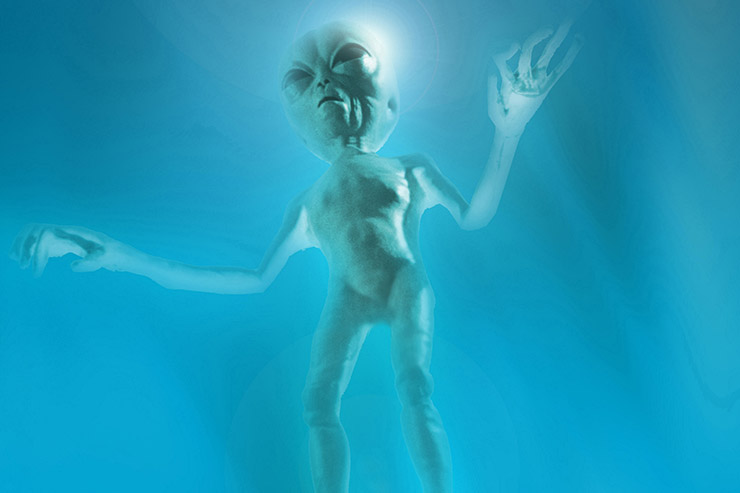
    In other words, if the galaxy is filled with little green men in luminous flying saucers who travel from star to star colonising other worlds, then why don’t we have any physical evidence of their existence – not even so much as a piece of broken zipper from one of their spacesuits?

    This question (known as the Fermi paradox) has spawned a vigorous scientific and philosophical debate whose possible answers can be grouped into three broad categories.

    1. Extraterrestrial civilisations do not exist.
    2. Extraterrestrial civilisations exist but haven’t colonised the Earth, either because they can’t or because they don’t want to.
    3. Extraterrestrial civilisations exist and have colonised the Earth without our knowledge.

    As we shall see, the implications for all of these positions are unsettling in the extreme – not so much for what they say about extraterrestrial life, but for what they might say about us.

    Are We Alone?

    The most straightforward solution to the Fermi paradox is that we are alone in the universe – our planet has not been colonised because advanced alien civilisations do not exist.

    Perhaps (as many Christians claim) life is unique to Earth; or perhaps most alien societies ruin themselves through pollution or war, extinguishing life on their home worlds before they have a chance to spread outwards. (Knowing as we do that terrestrial species have a better than 99% extinction rate, this latter scenario is rather easy to imagine.)

    Of course, even if most alien species do expire in this way, isn’t it stretching the limits of conjecture to suppose that all of them do?

    The Milky Way galaxy alone contains at least 100 billion stable solar systems;1 roughly a third of these possess Earth-like planets with oceans.2 The odds against every single one of these being either sterile or suicidal are literally astronomical.

    So, Where Are They?

    If we suppose that extraterrestrial civilisations do exist, we are left with only two options: either they are somewhere else or else they are here. So why might an alien civilisation choose to colonise the Earth (or not)?

    Many researchers seem to assume that an extraterrestrial colonisation effort would be overtly belligerent, taking the form of:

    • Imperialism
    • Resource Exploitation
    • Subversion
    • Scrub & Repopulate
    • Smash & Grab3

    But wouldn’t successful alien civilisations be more patient and cautious than that? Couldn’t they also be:

    A.        unable or unwilling to launch a full-scale invasion of the Earth?

    or

    B.        here already, and ruling over us by means so subtle as to be almost undetectable?

    In fact, some scientists have argued that until we conclusively prove that extraterrestrial civilisations don’t exist, the Fermi paradox isn’t a paradox at all; instead, we aren’t looking hard enough, or haven’t been looking in the right places.

    Biblical Brainteasers

    The Fermi paradox here reveals significant overlap with the theodicy, a traditional theological riddle, which asks: If God is good and all-powerful, where is the evidence of his existence – why is there so much evil in the world?

    One of the most ancient (and persuasive) answers to the theodicy is that of Gnosticism, a speculative branch of pre-Nicean Christianity which held that God (or the gods) do exist, but are neither omnipotent nor benevolent; instead, these advanced beings from the stars are selfish, opportunistic and deceptive.

    Gnosticism In Brief

    In the Gnostic view, the god of the Bible was not the Supreme Being at all, but an arrogant Demiurge who fled the heavens to build this planet as an experimental prison, populating it with artificial life forms and strange, symbiotic hybrids.

    Far from paradisiacal, his “Garden of Eden” was an eerie mad scientist’s laboratory where shadowy parasites abducted a pair of primitive primates named Adam and Eve, raping the female and implanting the male with false memories:

    When they [the Demiurge and his angels] saw Eve speaking with [Adam], they said to one another… “Come, let us seize her and let us cast our seed on her, so that… those whom she will beget will serve us. But let us not tell Adam that she is not derived from us, but let us bring a stupor upon him, and… teach him in his sleep as though she came into being from his rib…”4

    These chthonic and creepy alterna-Christian creation myths have influenced thinkers from many different fields over the millennia, from politics to popular culture. In recent decades, the Gnostic metanarrative has even made a re-appearance with the paranoid worldview which informs much contemporary speculation about aliens and UFOs, e.g.:

    One of the purposes for which UFOs travel to Earth is to abduct humans to help aliens produce other beings. It is not a program of reproduction but one of production. They are not here to help us, they have their own agenda and we are not allowed to know its full parameters.5

    In all of the solutions to the Fermi paradox which appear below, we can see echoes of many of these same, disturbing ideas. As the Demiurge and his angels pass from theology into speculative exobiology, the skies seem to swarm with icily indifferent robots, otherworldly djinn, celestial frauds and bestial, fallen bacilli.

    Six of the most widely-discussed scenarios follow:

    1. Extraterrestrial civilisations spread via self-replicating AI probes.
    2. Extraterrestrial civilisations develop massive virtual reality simulations.
    3. Extraterrestrial civilisations have left this universe and developed the ability to manipulate hyperspace.
    4. Extraterrestrial civilisations develop xenophobic and/or authoritarian religious forms.
    5. Extraterrestrials are biologically very primitive, or spread themselves via biologically primitive forms.
    6. The Earth is being deliberately quarantined.

    Conveniently, most of the possibilities listed here could plausibly be used to explain either why our planet has been invaded or how it could already have been invaded unbeknownst to us; which outcome you favour really seems to depend on your assumptions about alien motivation.

    POSSIBILITY #1 – Extraterrestrial civilisations spread via self-replicating AI probes

    Frank Tipler of Tulane University has argued that alien civilisations would probably explore and colonise the Universe by proxy, filling the galaxy with self-replicating AI (artificial intelligence) probes instead of venturing forth themselves. Thus, even a very distant extraterrestrial civilisation should be able to seize, secure, sterilise and strip-mine our entire planet in about 4 million years.

    “If they existed,” concludes Tipler, “they would be here”; and since we are here instead, they must not exist.6

    On the other hand, if hives of autonomous, adaptable, rapidly multiplying robotic probes were roaming the galaxy, successive generations might eventually become so intelligent as to far surpass their creators.

    In time, as these “artilects” spread throughout the Universe, they could come to abandon their creators’ agenda, preferring effortless communion with their own kind to the laborious conquest of organic, planetary life. Reflects AI researcher Hugo de Garis:

    I suspect strongly that virtually all the ETs out there are in fact artilects, and hence have intelligence levels astronomically superior to the human level. To me, biological technological intelligence is just a fleeting phase that nature goes through en route to creating immortal massive artilectual intelligence, which may be a phenomenon as commonplace as the creation of life from the molecular soup…

    The answer then to Fermi’s paradox is that we human beings, being mere biologicals, are utterly unworthy of the artilects’ attention… What’s in it for them? We are very probably not so special and are very, very dumb…7

    POSSIBILITY #2 – Extraterrestrial civilisations have developed massive virtual reality simulations

    Recent trends suggest that it should be possible for an advanced civilisation (either earthly or alien) to develop fully immersive virtual reality simulations like the “Holodeck” of Gene Rodenberry’s Star Trek. If such a technology were developed by an alien species on its own planet, the prospect of mingling in real time with a distant and dirty species like our own could seem unappealing, degrading or even boring to extraterrestrial psychonauts. Opines evolutionary psychologist Geoffrey Miller:

    Basically, I think the aliens don’t blow themselves up; they just get addicted to computer games. They forget to send radio signals or colonise space because they’re too busy with runaway consumerism and virtual-reality narcissism. They don’t need Sentinels to enslave them in a Matrix; they do it to themselves, just as we are doing today.8

    Alternately, it could be that our own world (and the visible universe which seems to surround it) is itself a vast computer simulation engineered by aliens, some form of artificial intelligence (as in the film The Matrix) or even our own descendants. The planetarium hypothesis holds that we can’t find evidence of alien colonisation because contact with other worlds hasn’t been built into the simulation.
    POSSIBILITY #3 – Extraterrestrial civilisations have left this universe and developed the ability to manipulate hyperspace

    A third possibility is that alien civilisations become capable of interstellar travel, but learn how to escape this universe soon afterwards. If transcension were common, extraterrestrial civilisations might quickly lose interest in colonising other planets. Why travel to a distant ball of mud and water when you can explore higher dimensional hyperspace instead?

    On the other hand, if alien scientists did have the ability to leave our shared space-time and launch themselves into the larger multiverse, they could be here now and we would not be able to see them.

    In the same way that a glass pipette might seem – from the point of view of beings trapped in the flat, two-dimensional world of the Petri dish – like an enormous, transparent column which descends from the sky to abduct unsuspecting amoeba out for an afternoon stroll, aliens from higher dimensional space-time could enter and leave our reality at will, seeming to appear and disappear, change shape and pass through solid barriers as they experimented on and/or revealed themselves to us, and all without leaving a shred of physical evidence.

    The idea that extraterrestrials are actually multi-dimensional has been an influential one, leading some UFO researchers to conclude that:

    This [the UFO phenomenon] is not the product of an alien culture from a nearby star, here to explore our solar system. Instead it is an intelligence which dwells in a different type of reality and moves through hyperspace in such a way as to interreact with us almost as a side-effect. It is an intelligence that is not here to study us but it has been here all along and effectively controls our whole existence…9

    Advocates of Jacques Vallee’s “control system” hypothesis similarly argue that we may never find the evidence we seek because extraterrestrials aren’t encumbered by physical artifacts like spaceships or ray guns; instead these polymorphous and hallucinatory aliens freely wiggle and hop in and out of our world like angels, demons and gods from the twilight realms of the collective subconscious.

    POSSIBILITY 4 – Extraterrestrial civilisations develop xenophobic and/or authoritarian religious forms

    A fourth possibility is that extraterrestrial civilisations tend to develop xenophobic and/or authoritarian religious forms. Given the history of our own species, the difficulties such belief systems might present to alien scientists can easily be imagined.

    Are Plaeadian professors who promote interstellar exploration passed over for promotion or excluded from alien faculty functions? Are extraterrestrial exobiologists denounced as heretics and electrocuted by otherworldly Inquisitors? If so, then we may never encounter these advanced beings from the stars.

    Alternately, it could be that alien conquerors literally walked the Earth’s surface millennia ago and left literary monuments to their endeavours in the form of the Babylonian and Sumerian creation epics and the Hebrew Bible. In this view (the so-called “alien astronaut” hypothesis), the gods and messengers of our own authoritarian religious traditions were not representatives of a supreme being at all, but extraterrestrial colonialists masquerading as gods!

    Israeli scholar Zechariah Sitchin’s works are generally representative of this latter position, holding that alien scientists (the “Elohim” and “Nephilim” of the Old Testament) genetically engineered homo sapiens from the great apes in an attempt to create a slave race:

    They made us through genetic engineering. They jumped the gun on evolution, and made us to look like them physically, and to be like them emotionally. That is what the Bible says: “Let us make the Adam in our likeness and after our image.” Physically, outwardly and inwardly. So much of what they are, we are.10

    Are human beings really descended from some prehistoric encounter between the apes and the angels 300,000 years ago? Sitchin is convinced of it. As proof, he points out that humans possess 223 genes found in no other species on Earth. Either these genes were horizontally transferred by some unknown species of bacteria, Sitchin insists, or else they must be extraterrestrial in origin.11

    POSSIBILITY #5 – Extraterrestrials are biologically very primitive, or spread themselves via biologically primitive forms

    600 million years ago, the Earth was ruled by sponges, flatworms and jellyfish. Possessing neither brains nor nervous systems, these simple organisms flourished, surviving nearly unchanged today.

    In similar fashion, our universe may be teeming with species hugely successful on their home planets but lacking the complex cognitive skills necessary to build and launch spacecraft.

    The flip-side of this possibility is the panspermia hypothesis, which holds that extraterrestrial colonists arrived here billions of years ago, not as bug-eyed monsters in metallic spacecraft, but as spores or bacteria which fell from the atmosphere to fertilise the Earth’s oceans with primitive life. In time, these alien microbes evolved into the many terrestrial species biologists know today, including human beings!

    Of course, the panspermia hypothesis doesn’t answer how our most ancient one-celled ancestors originated themselves; perhaps their ancestors too were seeded somewhere else by alien scientists from another solar system.12

    POSSIBILITY #6 – The Earth is being deliberately quarantined

    Finally, the “zoo hypothesis” holds that we haven’t been able to find any hard evidence of alien contact or colonisation because our extraterrestrial overlords don’t want us to – instead they are treating this planet like a farm or laboratory. As early 20th century paranormal researcher Charles Fort wondered:

    Would we, if we could, educate and sophisticate pigs, geese, cattle? Would it be wise to establish diplomatic relation with the hen…?

    I think we’re property… we belong to something… that once upon a time, this earth was No-man’s Land, that other worlds explored and colonised here, and fought among themselves for possession, but that now it’s owned by something… all others warned off.13

    If this planet functions as a livestock enclosure of some sort, then it makes sense that representatives of the civilisation cultivating and/or studying us would occasionally slip up and reveal themselves. The indignation expressed by the contactee who recalls alien encounters under hypnosis may have something in common with the drugged and dizzy roar of the bear who wakes up to discover a radio-tracking chip stapled to his ear:

    Close Encounters of the Fourth Kind (CE-IV): The contactee is abducted by the UFO occupants, taken aboard the landed craft, and subjected to a variety of “tests” and “experiments.” Some investigators claim to have recovered physical evidence of these interactions in the form of scars from alien surgical incisions. Some abductees report memories of devices being implanted within their bodies, typically through the nose.14

    Conclusion

    Perhaps most alien civilisations are unable or unwilling to colonise other worlds, due to their religious beliefs, immersion in video games, or an unfortunate tendency to blow themselves up, but even if 99% were thus incapacitated, this still doesn’t explain why the remaining 1% seem to have left the Earth alone.

    On the other hand, if just one ambitious, alien civilisation from among the remaining 1% were to colonise the Earth using any or all of the strategies described above, our seeming isolation would be explained and Fermi’s paradox would stand resolved – as long as they did so covertly.

    Are we then, mere talking monkeys in a cosmic cage, simulated serfs in a vast video game or experiments in an extraterrestrial Petri dish, as some of the most plausible solutions to Fermi’s famous question would seem to imply?

    Unfortunately (or perhaps fortunately), the “covert colonisation” hypothesis is by definition almost impossible to disprove; in the end, we may have no choice but to test some of these strange scenarios by launching colonisation programs of our own:

    Earth has provided a stable platform for the evolution of life over 4 billion years. But that lease is limited; we know for sure that it will expire after a few billion more. Long before that, our planet may become a place where it is no longer suitable for us to live. Increasing luminosity of the Sun may gradually boil our oceans, or more sudden catastrophes may threaten our existence. If we are wise, we will have furnished our new apartments long before that time….15

    [alert type=”general” dismiss=”no”]This article was published in New Dawn 100.[/alert]

    [alert type=”success” dismiss=”no”]If you appreciate this article, please consider subscribing to help maintain this website.[/alert]

    Footnotes:

    1. “Earth: No Longer the Lonely Planet,” RedOrbit, Saturday, 27 September 2003, www.redorbit.com/news/stories/1/2003/09/27/story003.html
    2. “Earth-Like Planets May Be More Common Than Once Thought, Says CU-Boulder-Penn State Study,” University of Colorado at Boulder, 7 September 2006, www.colorado.edu/news/releases/2006/280.html
    3. Fritz Freiheit, “The Possibilities of FTL: Or Fermi’s Paradox Reconsidered,” www-personal.engin.umich.edu/~fritx/Ftlessay/essay.html
    4. “On the Origin of the World,” from Willis Barnstone’s The Other Bible, p.70, 1984.
    5. Dr. David Jacobs, Secret Life, p. 305
    6. John D. Barrow and Frank J. Tipler, The Anthropic Cosmological Principle, p.578.
    7. Hugo de Garis, “Answering Fermi’s Paradox”, 22 March 2001, www.kurzweilai.net/articles/art0188.html
    8. Geoffrey Miller, “Runaway consumerism explains the Fermi Paradox,” www.edge.org/q2006/q06_print.html#miller
    9. Peter Hough & Jenny Randles, Looking For the Aliens, p.210, 1991.
    10. Interview with Zecharia Sitchin, www.metatron.se/asitch.html
    11. Zecharia Sitchin, The Case of Adam’s Alien Genes, www.sitchin.com/adam.htm
    12. For an in-depth discussion of the panspermia hypothesis, please see this author’s previous article “The Incredibly Strange Story of Intelligent Design” in the July/August 2006 issue of New Dawn magazine.
    13. The Book of the Damned, A Hypertext Edition of Charles Hoy Fort’s Book, Edited and Annotated by Mr. X, Chapter XII, www.sacred-texts.com/fort/damned/damn12.htm
    14. J. Allen Hynek, UFO researcher, from Keith Thompson’s Angels and Aliens, p.144, 1991.
    15. Robert Shapiro, Planetary Dreams, 1999.

    © New Dawn Magazine and the respective author.
    For our reproduction notice, click here.

  • Kuan Yin: The Compassionate Rebel

    Kuan Yin: The Compassionate Rebel

    From New Dawn 99 (Nov-Dec 2006)

    It is unfortunate that Buddhism’s most enduring (and universal) contribution to the world has been insufficiently translated as compassion. The original Sanskrit word is karuna, which holds within itself traces of the fragment ‘ru’, meaning to weep. While the Oxford dictionary describes compassion as pity bordering on the merciful, karuna is actually our ability to relate to another in so intense a measure that the plight of the other affects us as much as if it had been our own.

    The term karuna is central to the entire Buddhist tradition. It is frequently described as a love for all beings, equal in intensity to a mother’s affection for her child. However, it is quite unlike conventional love (Sanskrit: priya, kama or trishna), which is rooted in dualistic thinking and is egoistic, possessive and exclusive, in contrast to the all-encompassing nature of compassion. The root meaning of karuna is said to be the anguished cry of deep sorrow and understanding that can only come from an unblemished sense of oneness with others.

    In fact, the evolution of Buddhism in Asia and its spread throughout the world is, from a spiritual point of view, none other than the unfolding of karuna in history. Nowhere is this more explicitly exemplified than in the Chinese assimilation of Buddhism. Few would deny that the defining symbol of this integration is the goddess, who with her sweet and merciful disposition, has won the hearts of not only the Chinese, but also profoundly affected even those who, belonging to a foreign tradition, have only had a fleeting interaction with her. This divine female is none other than Kuan Yin, beloved goddess of over a billion people the world over. Her name too signifies her compassionate nature, literally meaning ‘One who hears the cries of the world.’

    It remains a historical fact that Kuan Yin is the Chinese version of the male god Avalokiteshvara, whom the ancient texts eulogise as the patron deity of compassion. It is fascinating, however, to observe that nowhere in India (where he originated) or Tibet (where he remains the most popular deity) is the latter ever deified as a female figure. In China too, his worship began as a male god, but over time, changed into a goddess and by the ninth century her popularity had prevailed over that of Avalokiteshvara’s.

    There are many reasons why this gender transformation took place. As Avalokiteshvara evolved into the supreme personality of the Buddhist pantheon, with this heightened pedestal came the inevitable elitism. Karuna, however, cannot be and is not (as it has become today under the pseudonym of compassion), the exclusive preserve of a charmed circle, but rather a symphonic identification with the masses, sharing their suffering and pleasure alike. No wonder then that Avalokiteshvara shed streams of tears observing the plight of his people. Now, any emanation from a divine form is bound to hold a dynamic potential within itself and indeed Indian mythology is replete with examples where fluids emerging from deities have led to enormous consequences. Tears similarly are a spontaneous emotional response to external stimuli and represent the outward flow of Avalokiteshvara’s infinite karuna.

    From these pearls emanated a beautiful female as attractive as she was compassionate. The goddess Tara, thus born, has continued her upward spiral of popularity and remains one of the most loved and widely recognised deities of the Buddhist pantheon today. Truly, even though Avalokiteshvara retains his foremost status in the gallery of Tibetan gods, in the popular imagination it is Tara, who with her supple charm, has come to symbolise the tenderness of karuna.

    It is relevant here to observe that Kuan Yin is often depicted in art holding a leafy twig, derived from the ‘weeping willow’ tree, known so due to its trailing leafy branches that droop to the ground and along which raindrops trickle down like tears. One of its distinctive characteristics is remaining green throughout the year, pointing perhaps to the goddess’ fertility aspect, which is further echoed in images showing her with an infant.

    The willow also has a deeper and direct connection with Chinese culture and it is believed that Lao Tzu, the author of Tao-te Ching, loved to meditate under its shade (6th century BCE). It was under the same tree that the younger Confucius had his famous interview with Lao Tzu, telling his disciples afterwards:

    I know how birds fly, fishes swim and animals run. But there is the dragon – I cannot tell how he mounts on the winds through the clouds, and rises to heaven. Today, having seen Lao Tzu, I can only compare him to the dragon.

    Over centuries, Kuan Yin’s visual depictions have highlighted her lithe, flowing form, much like the willow tree itself, which has the ability to bend during the most ferocious winds and then spring back into shape again. Indeed, who wants to stand rigid like the tall oak that cracks and collapses in a storm? Instead, one needs to be flexible like the willow, which survives the tempest.

    Or perhaps, Kuan Yin merely uses the willow branch to sprinkle the divine nectar of life on her devotees, which is stored in the vase she holds in her other hand.

    The Chinese (ever disposed to envisage friendly divinities in idealised human forms) seem to have been initially perplexed by Avalokiteshvara’s complex iconography. Not for them his thousand hands or even the seven eyes of Tara. Exposed for eons to the essentially humanistic philosophy of Confucianism, such images were alien and felt to be unsuitable for portraying the ‘soft’ emotion of karuna, the yearning passion a mother feels for her child.

    The Tibetan mind solved the craving for a down to earth, visual embodiment of karuna by envisioning the goddess Tara; the Chinese genius did the same by enclosing this virtue in the graceful and beautiful Kuan Yin, who was eminently human in appearance and approachable by all. Indeed, she gradually became the favoured goddess of the peasants and fishermen of China, retaining her place in their hearts to the present day.

    Additionally in China, not only had popular gods always been real people who had once lived in specific times and places, even mythical figures were turned into historical cultural heroes who were then venerated as the founding fathers of Chinese civilisation. Unlike Greece, where human heroes were transformed into Olympian gods, in China the reverse held true and if a god or goddess was not perhaps originally a human being, there was often an effort to turn her or him into one.

    Kuan Yin thus again had to change from a goddess into a living woman, so that she could be worshipped as a Chinese goddess. Truly, the human character of Chinese deities is one of the most distinctive features of their religion, and like ordinary mortals they too have birthdays, ancestries, careers and titles. Therefore, even though Kuan Yin is not given a date of birth in any of the Buddhist sutras, her birthday is widely celebrated on the nineteenth day of the second month of the lunar calendar.

    The legend describing how Kuan Yin was once a woman gives a fascinating insight into the working of the Chinese genius and the process by which she was given a distinctively local flavour and absorbed into their pantheon:

    It is said that in the past, there once lived a king under whose rule the people led a peaceful existence governed by Confucian ethics. He had three daughters; the eldest two having already married the grooms of their father’s choice. The youngest offspring however, was unlike any other normal child. Firstly, when she was born, her body glowed with an almost unearthly light so much so that the palace seemed on fire. She was thus befittingly named Miao Shan (Wonderful Goodness).

    Secondly, as she grew up, she wore only dirty clothes and never did display any urge to adorn herself. Further, she would subsist on only a single meal every day. In her conversations she would talk about the impermanence of material things and how human beings suffer because of their attachment to such objects. Naturally worried about their daughter’s detached inclinations, her parents proposed that (as per the Confucian ideals of filial piety) she too marry a husband of their choice. To this she replied:

    “I would never, for the sake of one lifetime of enjoyment, plunge into aeons of misery. I have pondered on this matter and deeply detest this earthly union (marriage).” Nevertheless, when her parents insisted, she agreed to comply with their wishes if only her future mate would save her from the following three misfortunes:

    1) When people are young, their face is as fair as the jade-like moon, but when they grow old, the hair turns white and faces become wrinkled; whether walking, resting, sitting, or lying down, they are in every way worse off than when they were young.

    2) Similarly, when our limbs are strong and vigorous one may walk as if flying through air, but when we suddenly becomes sick, we are confined to the bed.

    3) A person may have a large group of relatives and be surrounded by his flesh and blood, but when death comes, even such close kin as father and son cannot take the person’s place.

    Finally she concluded: “If indeed my future husband can ensure my deliverance against these misfortunes, I will gladly marry him. Otherwise, I vow to remain a spinster all my life. People all over the world are mired in these kinds of suffering. If one desires to be free of them, the only option is to leave the secular world and enter the gate of Buddhism.”

    This narrative of course, is parallel to one of the most significant episodes from the life of the Buddha when he encountered the three maladies of physical existence: sickness, old age and death.

    Exasperated to no end, the king summoned an old and experienced nun of his kingdom. He asked her to take the princess under tutelage and expose her to as much hardship as possible in the nunnery, so that she realise the futility of her desired path. The instruction was tinged with a threat of annihilation if after seven days Miao Shan was not ‘reformed’.

    Needless to say, all the travails she had to undergo at the monastery, including hard manual labor, were insufficient to deter her from the path of Dharma. However, Miao Shan did realise that she was being thus subjected because the inhabitants of the nunnery were under the threat of death. She addressed them, saying:

    “Don’t you know the stories about the ancient prince Mahasattva, who plunged off the cliff in order to feed the hungry lions, or King Sivi’s cutting off his flesh to save a dove? Since you have already left the life of a householder, you should regard this material body as illusory and impermanent. Why do you fear death and love life? Don’t you know that attachment to this dirty and smelly leather bag (body) is an obstacle?”

    At the end of the stipulated period, the monarch, in a mad and frenzied reaction, ordered that Miao Shan be beheaded. As her executioners approached the monastery gates, Miao Shan rushed out of the building, eager to embrace her impending death. No sooner had she kneeled at the stake and the deadly sword been raised, than a blinding thunder rose. Before the assailants could regain their composure, a tiger darted out of the darkness and carried away the swooning girl into the nearby hills. The king, now beyond the bounds of reason, ordered the hermitage to be burnt down with all its inhabitants.

    It was not long before his karma caught up with him and he fell sick with kaamla (jaundice). He was restless for days on end, finding no rest even in sleep. The disease spread all over his body and the best doctors throughout the land were unable to cure him. One day, a holy mendicant came to his door and predicted: “If some person would willingly consent to give his or her arms or eyes without the slightest anger or resentment, the elixir made of these potent ingredients will surely relieve you from your suffering.”

    “Where alas will I find such a compassionate being?” lamented the king. “In this very land,” said the monk. “Go southwest in your dominion, on top of the mountain there is a hermit who possesses all the characteristics which are necessary for your healing.”

    No sooner had he heard this than the king ordered his envoys to hurry to the abode of the recluse. On being informed of his plight and its prescribed remedy, the hermit readily agreed to undergo the supreme sacrifice, requesting them to ask the suffering king to direct his mind to the three treasures of Buddhism and then very calmly proceeded to gauge out both the eyes and asked one of the men to sever the two arms. The three worlds shook under the impact of this terrible sacrifice.

    When he had fully recovered, the king made haste with his wife to pay homage to the one who had so miraculously saved his life. After bowing low before the mutilated form, as soon as they raised their heads they let out a shriek of astonished horror; the hermit’s true identity lay bare before them. She was none other than their youngest daughter Miao Shan. Realising what she had done for him, despite all that he had done to her, the king fell prostrate upon the floor and asked for forgiveness. Overcome with emotion, the parents embraced her and the father said: “I am so evil that I have caused my own daughter terrible suffering.”

    Miao Shan replied, “Father, I have suffered no pain. Having given up these human eyes, I shall see with diamond eyes. Having yielded the mortal arms, I shall receive golden arms. If my calling is true all this will follow.”

    Much sobered by this intense experience, the king returned to his palace and ordered a statue to be made of her, which, emphasising her sacrifice was to be without eyes and hands. Now, in Chinese, the sound for ‘bereft’ or ‘deficient’ are virtually identical with ‘thousand.’ At some stage in the transmission of this message, the two words were confused and the sculptor toiled away, desperately seeking some way to capture the essence of the king’s wishes. He very imaginatively (or perhaps following Indian or Tibetan models) placed one eye on each palm, making the number of eyes equal to the arms, giving rise in the process to an awesome and complex image of breathtaking splendour.

    Unable to relate to the thousand-armed Avalokiteshvara, the above legend provided a rational explanation to the bewildered viewer and helped integrate the goddess into the Chinese ethos.

    The story of Miao Shan represents the fusion of the Buddhist theme of the gift of the body and the Confucian concept of filial piety. In the former tradition, giving is one of the six perfections performed by a bodhisattva (would be Buddha). Amongst the different forms of gifts, that of one’s own body is the best. The only difference is that while the bodhisattvas give up their bodies in order to feed or save sentient beings regardless of any formal relationship with them, the fact that Miao Shan does so for her father is where the Confucian model comes in.

    In the former context, a tale is narrated of the Buddha, who in one of his previous births was a pigeon. He saw a man lose his way during a snowstorm, driven to the point of starvation. The pigeon gathered twigs and leaves, made a fire and threw himself wholeheartedly into it, to become food for the distressed soul. It is this lofty ideal that Kuan Yin was following, a self-sacrifice par excellence, motivated by pure (selfless) and indiscriminate compassion (karuna).

    On the other hand, Kuan Yin as Miao Shan gives a bold and provocative message, challenging Confucian value systems as delineated in the ‘Classic of Filial Piety’ (published by the emperor Xuan in CE 722). Her life glorifies austerity, celibacy and renunciation, which, as per Buddhism, are highly valued (against the householder, who is necessary in Confucianism for creating offspring to perpetuate the lineage). In times of the Ming for example, one could achieve religious sanctification by performing one’s domestic obligations to the fullest degree. Eventually, Chinese of all social strata and both sexes came to know Kuan Yin as the strong-willed yet filial girl, who refused to get married and rebelled against stifling authority.

    The goddess Kuan Yin is a symbol, not only of the Chinese assimilation of Buddhism, but also of the many hued flavour of karuna, expressed through the softer wisdom of a woman. She is a pointer to the re-emergence of the goddess and the gender transformation of Avalokiteshvara in China represents perhaps a universal imperative, which is similarly reflected in the emanation of the goddess Tara from the compassionate tears of the same bodhisattva. Though often images are encountered which show her sporting a moustache, emphasising masculinity, this is negated by the softness of her demeanour.

    Can anything be more subtly female than her graceful poise – modest and inward looking, yet potent enough to generate and compassionately nourish the whole outside world? In the words of Martin Palmer: “The divine feminine cannot be suppressed for long. In China, it emerged by the transformation of the male into the female,” only god (or the goddess) knows how it will transpire in other cultures.

    [alert type=”general” dismiss=”no”]This article was published in New Dawn 99.[/alert]

    [alert type=”success” dismiss=”no”]If you appreciate this article, please consider subscribing to help maintain this website.[/alert]

    References and Further Reading

    Blofeld, John, Bodhisattva of Compassion The Mystical Tradition of Kuan Yin, 1988.

    Boucher, Sandy, Discovering Kwan Yin, Buddhist Goddess of Compassion, 1999.

    Cabezon, Jose Ignacio, Buddhism, Sexuality, and Gender, 1992.

    Colin, Didier, Dictionary of Symbols, Myths and Legends, 2000.

    Farrer-Halls, Gill, The Feminine Face of Buddhism, 2002.

    Jones, Lindsay (ed), Encyclopedia of Religion (Previously Edited by Mircea Eliade) 15 volumes, 2005.

    Keown, Damien, Oxford Dictionary of Buddhism, 2003.

    Kinsley, David, The Goddesses’ Mirror Visions of the Divine from East and West, 1995.

    Palmer, Martin and Jay Ramsay, with Man-Ho Kwok, Kuan Yin Myths and Prophecies of the Chinese Goddess of Compassion, 1995.

    Phillips, Kathy J. (Photography by Joseph Singer), This Isn’t a Picture I’m Holding: Kuan Yin, 2004.

    Watson, Burton (translator), The Lotus Sutra, 1999.

    Wright, Arthur F, Buddhism in Chinese History, 1959.

    Yu, Chun-Fang, Kuan Yin The Chinese Transformation of Avalokiteshvara, 2001.

    © New Dawn Magazine and the respective author.

    For our reproduction notice, click here.

  • William S. Burroughs: 20th Century Gnostic Visionary

    William S. Burroughs: 20th Century Gnostic Visionary

    From New Dawn 199 (Nov-Dec 2006)

    In 1984, in Boulder, Colorado, an interviewer asked William S. Burroughs (1914-1997), “What religious persuasion would you consider yourself?” Without hesitating, Burroughs replied, “Gnostic, or a Manichean.”1Upon reading those words, suddenly everything made sense.

    Perhaps it’s appropriate that the above conversation occurred in 1984. In many ways, Burroughs was a far more lucid and accurate analyst of twentieth century politics than even George Orwell, whose speculative concept of “newspeak” in his 1948 novel 1984 was quickly overshadowed by the real-world machinations of post-WWII Madison Avenue advertising techniques and Washington D.C. public relations firms.

    Superior to Aldous Huxley’s brilliant 1958 collection of essays, Brave New World Revisited, Burroughs’s 1974 book The Job is a must-not-live-without essential guide to charting the opaque labyrinth of obfuscation and lies regularly constructed by the Reality Studio to protect itself from the light of scrutiny. Unlike his more naïve contemporaries among the Beat literary movement, Burroughs never took his eye off the twitchy sharpshooter in the corner, the wild card in the deck known as Control.

    With the analytical eye of a surgeon (Burroughs studied medicine at Harvard, specialised knowledge that would eventually serve him well in his novels), Burroughs performed an autopsy on the body politic in a multitude of bleak and humorous novels, foremost among them Junky (1953), Naked Lunch (1959), The Soft Machine (1961), Nova Express (1964), and The Place of Dead Roads (1983).

    But Burroughs never limited his vision to merely charting out the intricate connections that make up the system of control. Like Huxley before him, who eventually followed his dystopian novel Brave New World with a Utopian counterpoint titled The Island, Burroughs himself attempted to construct his own vision of a Utopia in such novels as The Wild Boys (1971) and Cities of the Red Night (1981).

    In both cases, Burroughs seemed to suggest that a Utopia was not possible except within an isolated oasis, what Hakim Bey would call “a temporary autonomous zone.”2 In the first case, the autonomous zone takes the form of an all-male enclave in the jungles of North Africa; these commandos, trained in combat for defensive purposes, can reproduce without the aid of women and travel through the trees on prehensile hemorrhoids. In Cities of the Red Night, Burroughs’s Utopia is based on historical fact and manifests as an island settlement established by Captain Mission, an actual pirate who lived in the eighteenth century.Mission explored the Madagascar coast and found a bay ten leagues north of Diego-Suarez. It was resolved to establish here the shore quarters of the Republic – erect a town, build docks, and have a place they might call their own. The colony was called Libertatia and was placed under Articles drawn up by Captain Mission. The Articles state, among other things: all decisions with regard to the colony to be submitted to vote by the colonists; the abolition of slavery for any reason including debt; the abolition of the death penalty; and freedom to follow any religious beliefs or practices without sanction or molestation.3

    In both Wild Boys and Cities of the Red Night, Burroughs celebrates the notion of an autonomous zone kept separate from the madding hordes through potentially violent defensive measures, where a human being is allowed to pursue life free from the constant surveillance of overly authoritarian social structures. In Burroughs’s hands, William Golding’s Lord of the Flies would no doubt have a very different outcome.

    Burroughs’s libertarian brand of morality was based on Jack Black’s notions of the “Johnson family” as chronicled in Black’s 1926 autobiography You Can’t Win. The impact this book had on Burroughs when he was still a young man can’t be overestimated. In Burroughs’s own words, the Johnson creed can be described as follows:

    “The Johnson family” was a turn-of-the-century expression to designate good bums and thieves. It was elaborated into a code of conduct. A Johnson honours his obligations. His word is good and he is a good man to do business with. A Johnson minds his own business. He is not a snoopy, self-righteous, troublemaking person. A Johnson will give help when help is needed. He will not stand by while someone is drowning or trapped under a burning car.4

    Surely in Burroughs’s world this would be the only mandatory social stricture established for his personal temporary autonomous zone.

    Burroughs’s vision of a Utopian autonomous zone could be seen as a metaphor for the Gnostic concept of “the pneuma,” an infinitesimally small fragment of the divine that exists in all human beings.

    Gnosticism, an early form of Christianity, flourished in the Middle East until approximately the second century CE when the movement was violently suppressed by Roman Catholic authorities. Dr. Stephan Hoeller, the current bishop of the Gnostic Church in Los Angeles, distinguishes Gnosticism from traditional forms of Christianity in this way:

    [Gnosticism is] much more orientated toward the personal, spiritual advancement and transformation of the individual, regarding figures such as Jesus as being helpers rather than sacrificial saviours. It is a form of religion that has […] a much more ecumenical and universal scope in terms of its relationship to spiritual, religious traditions other than the Christian.5

    According to literary scholar Gregory Stephenson:

    …the attitude that characterises all the Gnostic systems is that the world, the body, and matter are unreal and evil. They are illusions that are the products of malevolent powers called Archons, chief among whom is Sammael (the god of the blind or the blind god), also called Ialdabaoth or the Demiurge. These creator-gods are not the Deity of the Supreme Being, though they make claim to being so. The Deity is completely transcendent – absolutely distinct, apart, and remote from the created universe. However, a portion of the divine substance, called the pneuma, is enclosed in the human body – within the human passions and the human appetites […]. The aim of Gnosticism is to liberate the pneuma from its material, delusional prison and to reunite it with the Deity. The Archons seek to obstruct this liberation and to maintain their dominion.6

    This basic theological structure applies to almost all of Burroughs’s work. Burroughs’s strong sense of morality, of the distinct difference between right and wrong, is often lost in the lurid morass of details concerning his personal life. His heroin addiction, his homosexuality, his arrest in Mexico for the accidental death of his wife, his early experimentation with yage in South America and his later fascination with Wilhelm Reich’s unorthodox theories regarding orgone energy – all of these unusual aspects of his life, though admittedly intriguing, are often reduced to gossipy anecdotes that threaten to diminish the importance of the work itself.

    Burroughs was never the star of his own novels, not even in his highly autobiographical debut, Junky. The central figure in all his novels is war – a continuous war between Freedom and Control, what Burroughs himself might very well refer to as “good and evil.”

    The conflict between good and evil is considered to be a hollow theme by most literary scholars. After all, is this not the purview of Tolkienesque sword and sorcery epics and four-colour superhero comics? Surely no major literary figure of the twentieth century ever bothered to waste his time on such silliness.

    But that’s not quite true. In the work of no other American writer do we find this theme explored in as complex and harrowing a manner as in the novels and essays of William Burroughs. At the beginning of this essay Burroughs described himself as a “Manichean.” Burroughs defined this term as follows:

    The Manichean believe in an actual struggle between good and evil, which is not an eternal struggle since one of them will win in this particular area, sooner or later. Of course, with the Christians there was this tremendous inversion of values where the most awful people are thrown up as this paragon of virtue for everyone to emulate…7

    The Manichean sect of Gnosticism spread across three continents over the course of eleven hundred years beginning, approximately, in CE 240. It was founded by the Persian prophet Mani, who was eventually imprisoned at the age of 61, tortured for 26 days, and assassinated. According to Dr. Hoeller, Mani is among “two of the great luminaries of the Gnostic tradition.”8

    Dr. Hoeller sums up Mani’s basic doctrine as follows:

    In the beginning, said Mani, the kingdoms of Light and Darkness coexisted in uneasy peace. While Light had no quarrel with the existence of Darkness and would have remained content existing side-by-side with it, Darkness would have it otherwise. Darkness was in a state of agitation and wrath and decided to attack and invade the realm of light.

    As the legions of Darkness approached the realm of Light, the primal light needed to defend itself. It called upon the Mother of Life to bring forth the Primal Man (a cosmic figure, not related to Adam or other human beings except in an indirect way). The Primal Man in turn had five sons, and together the six expelled the Dark forces from the kingdom of Light and pursued them onto the battlefield of the lower aeons. Unfortunately, on the battlefield the chief demons of Darkness overpowered the Primal Man and his five sons and devoured them, incorporating their luminous essence into their dark forms. This is how the first terrible intermingling of Light and Darkness occurred […].

    In the course of the rescue efforts the Primal Man is freed, and he gloriously ascends to the Godhead. The souls of the human beings, however, have been left behind, along with Light particles that derive from the captivity of the Primal Man and of his sons. It is only at this point that the material world as we know it comes into being. The Earth is created as an alchemical vessel of purification and transformation where the Light can be extracted from dark matter. The Sun and the Moon are both vessels of Light that serve as vehicles to transport Light upwards out of earthly darkness.9

    In Burroughs’s world, evil disguises itself as good and good disguises itself as evil. The Archons are Christians and politicians and “jus’ good folk.” The Gnostics are roving bands of criminals and thieves known only to themselves as “the Johnsons.” The visionaries, the ones who have attained genuine gnosis (i.e., “knowledge”) can see through the illusions forged by control, identify the face of the enemy, and from that point begin the quest for true freedom.

    These visionaries regularly employ unorthodox and seemingly “insane” methods to overthrow the hypnotic bonds of control: opiates, orgone energy, tape recorders that are used to cut up, analyse, and reconfigure the endless barrage of shallow mass media used to keep the masses docile, astral travel through time and space, hermetic magic, telepathy, etc. These are the tools of the twentieth century Gnostic in Burroughs’s revitalised Libertatia.

    The goal of these latter day Gnostics is to establish an autonomous zone, a physical approximation of the pneuma, while having as much fun as possible trying to “wise up the marks,” a paraphrase of a key sentence in the third chapter of his 1964 novel Nova Express: “And you can see the marks are wising up, standing around in sullen groups and that mutter gets louder and louder.”10

    The Archons are represented on Earth by parasite-infected control-freaks Burroughs aptly calls “the shits”: “…my contention is that evil is quite literally a virus parasite occupying a certain brain area which we may term the RIGHT centre. The mark of a basic shit is that he has to be right.11 The shits will use all the power they have on this planet in order to prevent the Johnsons from waking up the marks.

    This conflict between good and evil is played out in Burroughs’s fiction over and over again, perhaps most prominently in Nova Express. In this novel the Johnsons are called “The Nova Police” and the shits are called “The Nova Mob,” or simply “The Board”: “All right you board bastards, we’ll by God show you ‘Operation Total Exposure.’ For all to see. In Times Square. In Piccadilly.”12 Operation Total Exposure represents an attempt by the Nova Police to pull back the illusory curtain that protects the parasite-infected Reality Studio from being seen in its true form, to induce gnosis in the madding hordes, to transform the “marks” into “Johnsons.”

    In chapter one of Nova Express, Inspector J. Lee of the Nova Police addresses the human race:

    What scared you all into time? Into body? Into shit? I will tell you: ‘the word.’ Alien Word ‘the.’ ‘The’ word of Alien Enemy imprisons ‘thee’ in Time. In Body. In Shit. Prisoner, come out. The great skies are open.13

    Chapter two, titled “Prisoners, Come Out,” is an open letter addressed to the “peoples of the earth” and is signed by Inspector Lee. In this letter the Inspector explains that the purpose of his novels are

    …to expose and arrest Nova Criminals. In Naked Lunch, Soft Machine and Nova Express I show who they are and what they are doing and what they will do if they are not arrested. Minutes to go. Souls rotten from their orgasm drugs, flesh shuddering from their nova ovens, prisoners of the earth to come out. With your help we can occupy The Reality Studio and retake their universe of Fear Death and Monopoly.14

    In his 1978 collaboration with Brion Gysin, The Third Mind, Burroughs wrote in reference to Nova Express:

    A new mythology is possible in the space age where we will again have heroes and villains with respect to intentions toward this planet.15

    The central villain of Inspector Lee and his Nova Police is a Demiurge-like figure named Mr. Bradly-Mr. Martin who leads the extraterrestrial Nova Mob, and through this Mob he has kept the Earth enslaved for thousands of years. In The Third Mind, Burroughs describes Mr. Bradly-Mr. Martin in terms that are overtly Gnostic:

    Mr Bradly-Mr Martin, in my mythology, is a God that failed, a God of Conflict in two parts so created to keep a tired old show on the road, The God of Arbitrary Power and Restraint, Of Prison and Pressure, who needs subordinates, who needs what he calls “his human dogs” while treating them with the contempt a con man feels for his victims – But remember the con man needs the Mark – The Mark does not need the con man – Mr Bradly-Mr Martin needs his “dogs” his “errand boys” his “human animals” – He needs them because he is literally blind. They do not need him. In my mythological system he is overthrown in a revolution of his “dogs.”16

    Throughout the novel, Inspector Lee explicitly warns the people of Earth about some of the most insidious tools the Mob is using against them:

    Their drugs are poison designed to beam in Orgasm Death and Nova Ovens – Stay out of the Garden of Delights – It is a man-eating trap that ends in green goo – Throw back their ersatz Immortality – It will fall apart before you can get out of The Big Store – Flush their drug kicks down the drain – They are poisoning and monopolising the hallucinogen drugslearn to make it without any chemical corn – All that they offer is a screen to cover retreat from the colony they have so disgracefully mismanaged. To cover travel arrangements so they will never have to pay the constituents they have betrayed and sold out. Once these arrangements are complete they will blow the place up behind them.17

    The succeeding chapters introduce us to members of Mr. Bradly-Mr. Martin’s Archon-like Nova Mob:

    ‘Sammy the Butcher,’ ‘Green Tony,’ ‘Iron Claws,’ ‘The Brown Artist,’ ‘Jacky Blue Note,’ ‘Limestone John,’ ‘Izzy the Push,’ ‘Hamburger Mary,’ ‘Paddy the Sting,’ ‘The Subliminal Kid,’ ‘The Blue Dinosaur’.18

    In a section eerily redolent of current events, a chapter titled “Coordinate Points,” the Inspector does us the favour of outlining the Mob’s plan to bring about global destruction:

    The basic nova mechanism is very simple: Always create as many insoluble conflicts as possible and always aggravate existing conflicts – This is done by dumping life forms with incompatible conditions of existence on the same planet – There is of course nothing “wrong” about any given life form since “wrong” only has reference to conflicts with other life forms – The point is these forms should not be on the same planet – Their conditions of life are basically incompatible in present time form and it is precisely the work of the Nova Mob to see that they remain in present time form, to create and aggravate the conflicts that lead to the explosion of a planet that is to nova – At any given time recording devices fix the nature of absolute need and dictate the use of total weapons – Like this: Take two opposed pressure groups – Record the most violent and threatening statements of group one with regard to group two and play back to group two – Record the answer and take it back to group one – Back and forth between opposed pressure groups – This process is known as “feed back” – You can see it operating in any bar room quarrel – In any quarrel for that matter – Manipulated on a global scale feeds back nuclear war and nova – These conflicts are deliberately created and aggravated by nova criminals – […] In all my experience as a police officer I have never seen such total fear and degradation on any planet – We intend to arrest these criminals and turn them over to the Biological Department for the indicated alterations.19

    Jack Kerouac once wrote, “Burroughs is the greatest satirical writer since Jonathan Swift,” but the truth is that Burroughs never wrote a word of satire in his life. He was writing about life as he saw it, exactly as he experienced it. The Nova Mob and the virus parasites from outer space were not metaphors for him. They were real.

    Burroughs, perhaps more so than F. Scott Fitzgerald or even Ernest Hemingway, was the prime mimetic writer of the twentieth century. He never wrote anything other than realistic novels. Marshall McLuhan, author of Understanding Media and The Gutenberg Galaxy, might have been the first to catch onto this subtle but significant point when he wrote in 1964,

    It is amusing to read reviews of Burroughs that try to classify his books as nonbooks or as failed science fiction. It is a little like trying to criticise the sartorial and verbal manifestations of a man who is knocking on the door to explain that flames are leaping from the roof of our home.20

    Indeed, Burroughs wasn’t trying to satirise modern culture, nor was he trying to create a hypothetical, science fictional representation of it. He was simply explaining his society within the only context that seemed appropriate to him, and that context was undoubtedly a Gnostic one.

    Even the so-called science fictional elements of his books were not intended as satire or metaphor. Burroughs could very well have been introduced to the Nova Express model of invading extraterrestrials (and/or intrusions from alternate dimensions) at a very young age. In various interviews, for example, Burroughs has recounted one of his earliest childhood memories.

    When he was four, he woke up early in the morning and saw little gray men playing in a block house he had made. “I felt no fear,” he said, “only stillness and wonder.”21 When asked about this incident in 1987, interviewer Larry McCaffery offhandedly referred to such experiences as “hallucinatory.” Burroughs replied, “I wouldn’t call them hallucinatory at all. If you see something, it’s a shift of vision, not a hallucination. You shift your vision. What you see is there, but you have to be in a certain place to see it.”22

    This image of “little gray men” evokes more recent, popular conceptions of extraterrestrials as seen on the mass market covers of any number of books by Whitley Strieber, the author of Communion (1987), Transformation (1988) and several others in which his ostensible contacts with alien beings are delineated. Burroughs was so convinced of the reality of invading extraterrestrials that in 1989 he wrote a letter to Strieber asking to visit him and his family in their cabin in upstate New York. The 1996 revised edition of Victor Bockris’s With William Burroughs: A Report from the Bunker contains an in-depth interview about this meeting:

    I was very interested in his first books and I was convinced that he was authentic. I felt he was not a fraud or fake […]. I wrote a letter to Whitley Strieber saying that I would love to contact these visitors […]. His wife, Anne Strieber, wrote back saying, “We, after talking it over, would be glad to invite you to come up to the cabin.” So we spent the weekend there. I had a number of talks with Strieber about his experiences, and I was quite convinced that he was telling the truth […].

    Burroughs follows this comment by exploring the idea of “invasion” on all levels. He genuinely believed the human race was, and is, being infected by hostile intelligences on a regular basis:

    When I go into my psyche, at a certain point I meet a very hostile, very strong force. It’s as definite as somebody attacking me in a bar. We usually come to a standoff, but I don’t think that I’m necessarily winning or losing […]. Listen, baby, I’ve been coping with this for so many years. I know this invasion gets in. As soon as you get close to something important, that’s when you feel this invasion, and that’s the way you know there’s something there. I’ve felt myself just marched up like a puppy to go and do something that would get me insulted or humiliated. I was not in control […]. There are all degrees of possession. It happens all the time. What you have to do is confront the possession. You can do that only when you’ve wiped out the words. You don’t argue […]. You have to let it wash through. This is difficult, difficult; but I’ll tell you one thing: You detach yourself and allow this to wash through, to go through instead of trying to oppose, which you can’t do […]. The more you pull yourself together the further apart you get. You have to learn to let the thing pass through. I am a man of the world; I understand these things. They happen to all of us. All you have to do is understand them or see them for what they are, that’s all.23

    John Lash, co-founder of Metahistory.org, a website that concerns itself with Gnosticism and related topics, has many Burroughs-like perceptions regarding the Gnostic model of spiritual “intrusion.” Lash states:

    It might be said that Gnostics believed that only by confronting what is insane and inhumane in ourselves, can we truly define what is human. In essence, to define humanity is to defend it against distortion. Gnostics asserted that the capacity for distortion of humanitas, or dehumanisation, is inherent in our minds, but this capacity alone is not potentially deviant. Since we are endowed with nous, a dose of divine intelligence, we are able to detect and correct distorted thinking […]. In a practical sense, Gnostic teachers in the Mystery Schools instructed the neophytes in how to face the Archons both as alien intruders, comparable to the Greys and Reptilians of contemporary lore, and as tendencies in their minds. The detection of […] intrusion in both these modes of experience seems to be unique to the finely nuanced noetic science of the [Gnostic] Mysteries.24

    And it is this “finely nuanced science” that Burroughs attempted to keep alive in the form of fiction. Burroughs’s many readers were all potential recruits, “marks” who had “wised up” just enough to see a hint of light behind the illusion. His sincerest hope was that at least some of them were paying attention, would pick up the tools he left behind within his books, and use them to storm through the mass of Nova Mobsters whose unenviable job is to surround and protect the ramparts of the fragile Reality Studio until its dying day.

    [alert type=”general” dismiss=”no”]This article was published in New Dawn 99.[/alert]

    [alert type=”success” dismiss=”no”]If you appreciate this article, please consider subscribing to help maintain this website.[/alert]

    Footnotes:

    1. Gregory Corso Interview, “Attack Anything Moving.” Burroughs Live: The Collected Interviews of William S. Burroughs 1960-1997, Ed. Sylvere Lotringer, New York: Semiotext(e), 2000.

    2. Bey, Hakim, T.A.Z., Brooklyn: Autonomedia, 1991, p. 99.

    3. Burroughs, William S., Cities of the Red Night, New York: Holt, Rinehart and Winston, 1981, p. xii.

    4. Burroughs, William S., The Place of Dead Roads, New York: Henry Holt, 1983, p. ix.

    5. Robert Guffey Interview, “The Suppressed Teachings of Gnosticism.” Paranoia Magazine, www.paranoiamagazine.com/hoeller.html.

    6. Stephenson, Gregory, The Daybreak Boys: Essays on the Literature of the Beat Generation, Carbondale: Southern Illinois U P, 1990, p. 60.

    7. Gregory Corso Interview.

    8. Hoeller, Stephan A, Gnosticism: New Light on the Ancient Tradition of Inner Knowing, Wheaton: Quest, 2002, p. 135.

    9. Ibid, pp. 140-41.

    10. Burroughs, William S., Three Novels: The Soft Machine, Nova Express, The Wild Boys, New York: Grove P, 1988, p. 196.

    11. Burroughs, William S., The Adding Machine, New York: Seaver, 1986, p. 16.

    12. Three Novels, p. 197.

    13. Three Novels, p. 186.

    14. Three Novels, p. 189.

    15. Burroughs, William S. and Brion Gysin, The Third Mind, New York: Viking, 1978, p. 97.

    16. Ibid.

    17. Three Novels, p. 188.

    18. Three Novels, p. 236.

    19. Three Novels, pp. 235-36.

    20. Murphy, Timothy S, Wising Up the Marks: The Modern William Burroughs, Los Angeles: U of California P, 1997, p. 145.

    21. Bockris, Victor, With William Burroughs: A Report From the Bunker, New York: St. Martin’s Griffin, 1996, p. xx.

    22. Hibbard, Allen, Conversations with William S. Burroughs, Jackson: U P of Mississippi, 1999, p. 182.

    23. With William Burroughs: A Report From the Bunker, pp. 242-46.

    24. Lash, John, “A Gnostic Catechism: Encounters with Aliens in a Mystery School Text.” www.metahistory.org/GnosticCatechism.php.

    © New Dawn Magazine and the respective author.
    For our reproduction notice, click here.

  • The Incredibly Strange Story of Intelligent Design

    The Incredibly Strange Story of Intelligent Design

    From New Dawn 97 (Jul-Aug 2006)

    Children in Ohio may be taught life was created by aliens under an education package designed to ditch Darwin’s Theory of evolution. The US state is considering adopting the “intelligent design” theory that life is too complex to have simply evolved – as the Darwin Theory suggests. Therefore says the package, life must have been designed by some supernatural being, maybe God, maybe aliens.
    Herald Sun, Columbus, Ohio, March 2002

    Intelligent Design (ID) theory is a highly speculative philosophical argument, popular in recent years, which holds that rich diversity of species on the planet Earth is best understood as evidence of divine (or alien) intervention in terrestrial life.

    In a nutshell, ID argues that the Earth is too young, and life too complex for fish, animals and birds to have evolved through natural selection; instead, we must look for a supernatural cause.

    Professional scientists object to ID theory on the grounds that it can’t be proven, and so falls outside the domain of science; ID proponents have responded by taking their case directly to the public with a political campaign called “teach the controversy.”

    The “teach the controversy” campaign makes scientists (especially those who depend on public funding) nervous, and with good reason – the ultimate goal of the ID movement, as leading spokesmen frankly admit, is to discard the scientific method altogether and “win back” Western culture for the Biblical creator god.

    What makes this situation so especially interesting is the fact that leading ID theorists have positioned themselves as intellectual “heretics” struggling against the gatekeepers of scientific “orthodoxy.”

    Of course, the idea that ID could actually be taught alongside evolution in public schools has provoked an unprecedented tsunami of scorn from these same, self-appointed gatekeepers. “ID isn’t science!” they object. “If we teach ID, then why not teach students that the Moon is made out of green cheese, or that storks deliver babies?”

    I would like to respectfully suggest that children’s stories like the ones I’ve just mentioned aren’t the best analogies for ID theory. A better example might be the Anthropic Principle (AP), a closely related line of speculative reasoning which holds that the Universe itself is so complex and so improbable that it, too, requires special explanation. (We might also note that evangelical Christians are especially fond of AP in its “strong” form, which suggests that our Universe was “fine-tuned” for life by a god-like being.)

    Unfortunately for Christian culture warriors, neither of these remarkable notions ultimately supports the old-fashioned idea that life, the Universe and everything represent the singular creations of a perfect, rational Supreme being. (In its totalising singularity, the Genesis metanarrative differs little from the Big Bang and Darwinian evolution scenarios which comprise the “origins story” of the industrialised West).

    Rather, ID theory and the Anthropic Principle – and especially their corollary mechanisms panspermia and simulation – seem to reveal the handiwork of multiple, incompetent creators who were themselves created by yet more incompetent creators in another Universe, and so on, extending backwards in time and space to a point of infinite regress.

    To put it bluntly: AP and ID do not somehow “prove” the case for the Bible; instead, they unavoidably and inevitably lead us back to a time and place even earlier and more primal than Genesis itself, back to the myths and theological speculations of the ancient Gnostic Christians.

    GNOSTICISM: A QUICK INTRODUCTION

    What historians today call “Gnosticism” was once a broad and diverse movement within pre-Catholic Christianity – an anarchic assemblage of hundreds of different schools of mystical theology whose adherents proudly produced reams of elaborate, florid, and highly speculative re-interpretations of Biblical scripture.

    While no one doctrine united all Gnostic Christians, they did hold certain beliefs in common; perhaps the most shocking of these was the idea that the Old Testament creator God Yahweh was actually the Demiurge, a monstrous deity born from the shadow of infinity who fled the divine world to build our Universe in a misbegotten experiment.

    This Demiurge, the story goes, created for himself assistants – bumbling fallen angels called “archons” – and these in turn created the Earth, humanity, and seven heavens which encase and enclose our planet like so many cosmic prison walls.

    In a version of the myth popularised by 2nd century Gnostic theologian Basilides, the archons generated not just seven, but 365 heavenly realms in sequence, nested one inside the other like the rings of an electron – each successive layer just slightly more defective than the one which produced and preceded it, and all populated by arrogant creator gods completely unaware of those who came before them.

    French heresy-hunter St. Irenaeus invokes these strange stories in an attempt to refute the idea there is another heaven above heaven, and another god above “God”; for if gods produce gods who create heavens filled with yet more world-creating gods, then where does it all stop?

    …by that very process of reasoning on which they [Gnostic Christians] depend for teaching that there is a… God above the Creator of heaven and earth, any one who chooses to employ it may maintain that there is another [heaven] above [heaven and] above that again another… flowing out into… worlds without limits, and gods that cannot be numbered… so that the formation of heavens of this kind can never cease… the operation must go on ad infinitum…1

    The Gnostic version of the Adam and Eve myth also differs radically from the Biblical one, presenting the Garden of Eden as a shabby laboratory where the “archons” built Adam from blurry blueprints, botching his brain and body almost beyond repair:

    The (first) human being… was a creation of angels [but was] unable to stand erect because of the angels’ impotence, and rather writhed on the ground like a worm….2

    Even after the Eden fiasco, the archons continued to tamper with the human gene pool, raping Eve, drowning Adam’s descendants in a flood, and descending to the Earth to impregnate the survivors with half-human hybrids.

    As we shall see, the ID and AP theories so beloved of contemporary apologists have far more in common with the open, flawed and multiple processes described here than with anything even remotely resembling the Biblical creation account; or, as one Gnostic scribe observed waggishly:

    For Adam was a laughingstock, since he was made a counterfeit type of man by the Rulers.3

    ID THEORY MADE SIMPLE

    The basic idea behind ID is that life and its component parts display something called “irreducible complexity.” This means that living systems (plants, animals, people) are so complicated that they could not possibly have arrived at their present forms through evolution – instead, new species must have been deliberately planned and introduced to the planet by some sort of godlike being.

    Inanimate objects such as televisions, microwave ovens or wristwatches illustrate this principle. If we can admit that these devices show evidence of planning and design, and are unlikely to have emerged from chance alone, then shouldn’t we admit the same of the human eye?

    Like the watch, the eye seems so perfectly engineered that it’s difficult to imagine how it could have evolved in stages over time. Remove any one of its parts, ID theorists point out, and it would dim, blur, or even become completely useless.

    Unfortunately, there are a few problems with this line of reasoning, at least from the Biblical perspective. For one thing, if organs and species are so complex that they require an “intelligent designer,” then wouldn’t this “designer,” too, be at least as complex as its creations, and so require a designer of its own? And wouldn’t that intelligent designer also require a designer, and so too its designer, ad infinitum?

    UNINTELLIGENT DESIGN

    A second problem with the “eye” example is the fact that the human retina tends to detach from the optic nerve over time, leading to blindness; if this is evidence of “Intelligent Design,” then our “Intelligent Designer” is clumsy at best and malicious at worst.

    Other widely remarked-upon flaws4 in the design of the human body include:

    • high placement of the larynx, facilitating choking
    • thin spinal discs between the vertebrae which degenerate under pressure, causing crippling back pain
    • a small pelvis makes childbirth difficult and often fatal for women
    • a weak, vulnerable stomach unprotected by ribs

    Of course, evidence of sub-optimal design in itself does not prove that “Intelligent Design” did not occur; it may instead demonstrate the purposeful engineering of planned obsolescence.

    Or it may be that these seeming flaws are part of the Intelligent Designer’s secret plan to give humans the opportunity to improve themselves. Consider the German artist Gunther von Hagens’ plan to build a “super-human” using the donated body parts of terminally ill patients. Why and how?

    The programme aims to identify and correct the significant design flaws in human anatomy. The body will be modified by Professor von Hagens and leading biologists, surgeons and mechanical engineers into an “improved” human form. Ideas already put forward include:

    • increase the number of ribs to protect internal organs better
    • create backward-bending knees to lessen wear on joints
    • rearrange the trachea and oesophagus to stop food going down the windpipe by mistake
    • double heart or reconstruction of the coronary arteries
    • make a retractable penis

    Professor von Hagens claims that his Protean monster will “pave the way for a more healthy, capable and longer-living body. What we do with a real human body today will show what we can achieve in the future using genetic engineering.”5

    MULTIPLE DESIGNERS THEORY

    Von Hagens’ team of assistants illustrate another unstated premise of popular ID theory, to wit: why do ID proponents always seem to assume there was only one designer?

    If evolution fails as an explanation for the rich diversity of species on the planet Earth, then why not posit a rich diversity of designers?

    Science writer Richard Hoppe finds such a scenario not only possible but likely, noting that:

    …Some of the most impressive and elaborate designs in biology appear to have as their primary purpose the defeat or subversion of other designs. Designs engage in various kinds of biological arms races with one another. Some examples are:

    • Predator/prey arms races.

    • Parasite/host arms races.

    • Male/female arms races.

    • Disease-causing bacteria/drug companies arms races.

    Each of these is an example of design pitted against design, directly implicating multiple designers.6

    In fact, scientists have long known that the human body hosts a wide variety of foreign flora and fauna; as a recent Wired news story entitled “People Are Human-Bacteria Hybrid” notes:

    We are best viewed as walking “superorganisms,” highly complex conglomerations of human cells, bacteria, fungi and viruses… More than 500 different species of bacteria exist in our bodies, making up more than 100 trillion cells. Because our bodies are made of only some several trillion human cells, we are somewhat outnumbered by the aliens. It follows that most of the genes in our bodies are from bacteria, too.7

    “Which came first, the intestine or the tapeworm?” W.S. Burroughs once asked.

    If Hoppe’s “Multiple Intelligent Designers” theory is correct, the tapeworm, the intestine, mitochondria, bacteria, fungi and perhaps even the human brain and body were produced by completely separate beings – limited and imperfect creators with varying levels of skill competing against one another for ecological dominance.

    ALIENS AMONG US

    ID theory continues to excite evangelical Christians, but there are even more signs that their enthusiasm may be misplaced, and for reasons much more serious than built-in flaws or design by committee.

    In short, if they accept this “Intelligent Designer,” then what guarantee do they have that it (or they) will be gods at all?

    Leading ID theorist Bill Dembski (of Baylor University) isn’t exactly sure. According to a recent article in the American Spectator:

    The intelligent design that Dembski hopes to detect could belong either to a Biblical God or to an earlier race of Martians who planted us here (like in the movie Mission to Mars).

    The idea that the Earth was deliberately “seeded” with life by extraterrestrial scientists “may seem pretty far out,” the article concedes. “But Francis Crick, winner of the Nobel Prize for his co-discovery of DNA’s structure, is one of a number of scientists who have seriously promoted the ‘panspermia’ hypothesis…”8

    The ancient Gnostics were vitalists, holding that all life springs from a single, unseen animating principle; the Gnostic teacher Basilides referred to this original life source as the “universal seed,” or “panspermia.”

    Today, scientists use the term “panspermia” to describe the theory that life is not native to the Earth, but was instead brought here by an alien spore or virus. Part of the appeal of this idea lies in the fact it doesn’t try to answer how life first emerged from non-living matter; given our vast – perhaps infinite – Universe, the most likely scenario is that life first emerged somewhere else and then “infected” our relatively youthful planet only recently.

    Numerous vehicles for this “infection” have been proposed, from meteorites and sunbeams to interstellar clouds; perhaps the most distasteful was suggested by Thomas Gold of Cornell University, who famously wondered if the Earth life began when our planet was contaminated with microbes from the discarded remnants of an extraterrestrial picnic!

    CRICK’S CLONES

    Francis Crick agreed with the basic premise of panspermia – the idea that the Earth was probably “infected” with life – but wondered at the mechanism; wasn’t the passive spread of life from planet to planet by natural, accidental causes almost as unlikely as abiogenesis (the spontaneous production of life from non-living matter – the conventional scientific explanation)?

    Isn’t it much more likely that an extraterrestrial civilisation seeded our planet with life deliberately?

    Terming his model Directed Panspermia, Crick suggested that a “spaceship” carrying “large samples of… microorganisms” was sent to the Earth billions of years ago by an extraterrestrial civilisation – either as an experiment, preparation for colonisation or a genetic Noah’s Ark of some sort.9

    Or, as Fortean researchers Alan and Sally Landsburg put it:

    The DNA molecule is a marvel of microminiaturisation. All of the DNA in every cell of every living creature on Earth could be packed into one container no bigger than a pea. Thus it could be possible to ship to distant planets the distilled essence of entire colonies, stored in tiny packets. The DNA molecules need be activated only at the appropriate moment, thereby providing enormous savings both in shipping weight and in cost.10

    Sir Frederick Hoyle (the British astronomer who coined the term “Big Bang”) and his student Chandra Wickramasinghe have proposed an even stranger version of the Directed Panspermia model; in the Hoyle/Wickramasinghe view, life originated with (and continues to evolve from) showers of viruses from outer space:

    …life on Earth is derived from what appears to be an all pervasive galaxy-wide living system. Terrestrial life had its origins in the gas and dust clouds of space, which later became incorporated in and amplified within comets. Life was derived from and continues to be driven by sources outside the Earth…11

    What makes the Hoyle/Wickramasinghe model so remarkable is that it seeks to replace random genetic variation as a primary evolutionary mechanism; according to Wickramasinghe, “every crucial new inheritable property” that occurs in the animal kingdom “must have an external cosmic origin.”

    Viruses, although often bad for the individual, are in the view of Sir Fred Hoyle and myself of paramount importance to the evolution for species on our planet. They carry with them the store of cosmic genetic information needed for the generation of new species, classes and orders, and for the progressive forward march of life…12

    “If the Earth were sealed off from all sources of external genes: bugs could replicate till doomsday,” Wickramasinghe writes, “but they would still only be bugs: and monkey colonies would also reproduce but only to produce more monkeys. The Earth would be a dull place indeed…”13

    In other words, not only did aliens first infect the Earth with life, but they also make evolution possible by supplying terrestrial species with new genetic material for natural selection to act upon!

    Sir Hoyle didn’t believe that these viruses fell by chance; instead life itself was the result of an alien experiment:

    The likelihood of the formation of life from inanimate matter is one to a number with 40,000 naughts after it… It is big enough to bury Darwin and the whole theory of evolution. There was no primeval soup, neither on this planet nor any other, and if the beginnings of life were not random, they must therefore have been the product of purposeful intelligence.14

    Sir Hoyle seems to have betrayed at least some misgivings about the implications of these ideas, warning in a 1971 press conference that:

    Human beings are simply pawns in the game of alien minds that control our every move. They are everywhere, in the sky, on the sea, and in the Earth… It is not an alien intelligence from another planet. It is actually from another Universe which entered ours at the very beginning and has been controlling all that has happened since…15

    CAVEATS & PARADOXES

    For all its strengths, the panspermia hypothesis still does not actually tell us how or where life first arose, instead shuffling this question off to a distant realm of mystery and paradox into which we cannot hope to peer. As one Christian critic wonders:

    ..If for the sake of argument we grant that life on Earth was seeded by ancient extraterrestrials, then the obvious question is, Who or what created our extraterrestrial creators? Some would argue that they were, in turn sprinkled (created) by an even more ancient race of ET’s. Well, where did they come from? An infinite regression back in time of “alien sprinklings”…[?]16

    Since ID doesn’t distinguish between gods and extraterrestrials, and the activities of gods are by definition something that can’t be tested or measured, we have only a few, very limited avenues of inquiry left.

    Perhaps human beings were designed by multiple, incompetent creator gods (or one expert mischievously posing as a family of blunderers) – but if so, human beings will never be able to verify this supernatural creator(s) existence.

    Sadly, the metaphysical status of ghosts, spirits, gods and other supernatural beings means that these will always be compelled to hover just beyond the explanatory grasp of human science.

    On the other hand, researchers still can’t produce any evidence for the existence of (presumably physical and biological) extraterrestrial entities despite over 50 years of investigation – so until they do, the only way we can even hope to learn whether panspermia (and thus ID) might explain our own existence is by attempting to replicate the experiment ourselves.

    To wit: if human scientists ever succeed (either deliberately or accidentally) in “infecting” another planet with terrestrial bacteria or viruses, or in genetically engineering an entirely new species and introducing it to the wild, then ID will stand validated and our own role and history on this planet will suddenly come into sharp focus.

    Or, as Israeli researcher Zecharia Sitchin once put it:

    I feel that just as they (extraterrestrials) came to Earth and created us through genetic engineering, and mixed their genes with those of Ape-woman, that one day we will go out in space and land on another planet somewhere and do the same thing. In this sense, I believe things are ordained in a grand pattern…17

    [alert type=”general” dismiss=”no”]This article was published in New Dawn 97.[/alert]

    [alert type=”success” dismiss=”no”]If you appreciate this article, please consider subscribing to help maintain this website.[/alert]

    Footnotes:

    1. Irenaeus, Against all Heresies, http://ccel.wheaton.edu/fathers/ANF-01/iren/iren2.html
    2. Satorninos, according to St. Irenaeus of Lyon, Against Heresies, from Bentley Layton’s The Gnostic Scriptures, pp. 161-62, 1987
    3. The Second Treatise of the Great Seth, from James M. Robinson’s The Nag Hammadi Library, pp. 363-71, 1978
    4. Massimo Pigliucci, “Design Yes, Intelligent No: A Critique of Intelligent Design Theory and Neo-Creationism”, www.infidels.org/library/modern/features/2000/pigliucci1.html
    5. Professor Gunther Von Hagens’ Body Worlds, London Press Release, March 2, 2003, www.bodyworlds.com/en/pages/Pressemeldungen%20London.asp
    6. “Introduction to Multiple Designers Theory”, Posted by Richard B. Hoppe on September 23, 2004, www.pandasthumb.org/pt-archives/000509.html
    7. Rowan Hooper, “People Are Human-Bacteria Hybrid”, Wired News, Oct. 11, 2004, www.wired.com/news/medtech/0,1286,65252,00.html
    8. Fred Heeren, “The Lynching of Bill Dembski”, The American Spectator, November 2000, www.infovi.vu.lt/mps/Being Methodologically Correct.htm
    9. Crick, F. H. C., and Orgel, L. E. “Directed Panspermia,” Icarus, 19, 341 (1973), quoted in David Darling’s Encyclopedia of Astrobiology, Astronomy, and Spaceflight, www.angelfire.com/on2/daviddarling/dirpans.htm
    10. Alan and Sally Landsburg, The Outer Space Connection, p.17, 1975
    11. Chandra Wickramasinghe, testimony in McLean v Arkansas Board of Education, 1981, www.panspermia.org/chandra.htm
    12. Ibid.
    13. Ibid. Latter-day beatniks might also note that an extremely similar theory is advanced in the seminal William S. Burroughs science fiction tale, The Soft Machine – see www.spress.de/author/burroughs/onwsb/skerl/softm.htm
    14. Lee Elliot Majors, The Guardian, “Big enough to bury Darwin: Lee Elliot Major looks at the theories that secured Sir Fred Hoyle’s reputation as one of the 20th century’s leading scientists”, August 23, 2001, http://education.guardian.co.uk/higher/physicalscience/story/0,9836,541468,00.html
    15. Sir Frederick Hoyle, 1971 news conference.
    16. Missler & Eastman, Alien Encounters, p.141.
    17. Interview with Zecharia Sitchin, Connecting Link, Issue 17, www.metatron.se/asitch.html

    © New Dawn Magazine and the respective author.
    For our reproduction notice, click here.

  • How to Make a Ghost: Magic and Mysticism in Tibet

    How to Make a Ghost: Magic and Mysticism in Tibet

    This article was published in New Dawn 96 (May-June 2006)

    Authors note that fictional characters have a tendency to take on a life of their own. But few readers realise just how literally they mean it. A friend of mine, engaged in writing a romantic novel, called me in a panic just a year ago to complain that two of her characters had just run off and got married… thus ruining her carefully-crafted plot.

    In theory this should not have been a problem. From her god-like perspective, the writer could surely have deleted the relevant passage and written a new one that put her creation back on track. In practice, any attempt to rein in characters like that will produce an almost unreadable novel, full of wooden dialogue and contrived situations. The only viable answer is to let them go their own way, abandon any preconceived plot notions, and see what ‘really’ happens.

    The popular American science-fiction writer, Ray Bradbury, was so intrigued by the phenomenon that he wrote it into one of his own books. The Martian Chronicles describes how visitors to the red planet are confronted by characters from classical fiction who had somehow taken on corporeal existence in the alien environment.

    Curiously, Bradbury’s idea – that fictional characters might, in certain circumstances, take on solid form – had widespread currency in Tibet. Such creatures were known as tulpas and at least one European traveller claimed to have seen them.

    Madame Alexandra David-Neel, a distinguished French academic and explorer who died in 1969, reported that while camped in the Tibetan highlands, she was visited by a young painter she knew vaguely from a previous stay in Lhasa. The man had a particular obsession with one of the many Tibetan gods. For years he had meditated daily on the deity and painted its image many times. As he entered the camp, Madame David-Neel claimed she saw a misty representation of the god hovering behind him.

    She was so intrigued by this phenomenon that she studied Tibetan teachings about tulpas and eventually decided to create one for herself. To this end, she visualised a cheerful brown-robed monk, based loosely on Friar Tuck in the Robin Hood legends. After weeks of effort, the imaginary monk became so vivid that he appeared to her as if he were physically present – an induced hallucination.

    But then, says Madame David-Neel, the monk began to turn up when she was not trying to visualise him. Furthermore, his appearance was changing: he grew thinner and developed a sly expression. When other members of her camp asked about the ‘strange little lama’ she decided the time had come to destroy her creation… and battled for weeks before finally managing to do so.

    Could such a thing really be possible?

    During the early 1970s, a group from the Toronto Society for Psychical Research set out to see if they could make a ghost. First they dreamed up a fictional character, then invented a background to go with him. The character was named Philip and lived at the time of Cromwell, in a house called Diddington Manor. He fell in love with a beautiful Gypsy woman named Margo and subsequently had an affair with her. When his wife found out, she took her revenge by accusing Margo of witchcraft. Margo was tried, convicted and burned at the stake. Philip, mad with grief, committed suicide.

    There actually was a Diddington Manor and pictures of it were obtained by the group. The rest of the story was fiction. Philip never really existed. But that didn’t stop him haunting.
    The group held a series of séances with photographs of the manor placed around the room while they concentrated on the fictional Philip. For several months nothing happened. Then a rap was heard. The group set up a code and communication was established. Sure enough, the communicating ‘spirit’ turned out to be Philip, claiming the life history they had invented for him.

    As the séances continued, the fictional Philip continued to behave exactly as séance room spirits have always behaved. He caused raps and brought through such a richly detailed description of the Cromwellian period that the group actually double checked to make sure they’d not somehow based Philip on a real life character. (They hadn’t.) Later, the Toronto experiment was duplicated by other groups. One of them dispelled any lingering doubts about the fictional nature of the spirit by communicating with a talking dolphin.

    Although Philip was a step removed from the sort of visible ‘spirit’ appearance reported by Alexandra David-Neel, he did manage to produce physical phenomena like raps and table turning, which suggests the psychological mechanics of the two experiments may not have been all that different. But if certain persistent accounts are to be believed, the techniques used for creating ghosts went far further in Tibet than they ever did in Canada – and generated a valuable spiritual lesson in the process.

    One of the most fascinating stories involves a mythic creature called a Yidam, a tutelary deity in the Tibetan pantheon.

    In Tibet, many young men (and some young women) suffering from a spiritual itch, apprenticed themselves to a single guru rather than follow the traditional monastic route. A few of them who showed real spiritual promise would eventually reach the point where their guru would admit he had nothing more to teach them. If they wanted to go further, they would need a far more advanced guide. To that end, the guru would advise them to meditate on the Yidam and study pictures of it in the sacred scriptures. These showed the creature to have a fearful, almost demonic aspect.

    When the student was saturated in Yidam lore, he would typically be advised to find a remote cave and there create a magic circle (known as a kylkhor) using powdered chalk. The purpose of the circle was to encourage the visible appearance of the Yidam.

    In order to achieve this, the pupil was instructed to visualise the Yidam within the circle. Over a period of weeks, or months, the pupil had to continue the exercise until a full-scale hallucination resulted and the Yidam appeared. At this point, the pupil would be told he was obviously favoured by the god.

    But for his next step, he would have to persuade it to leave the circle.

    The process might take several more months, but eventually the pupil would report that the god had stepped out of the kylkhor. He would be congratulated, then told to see if he could manage to get the Yidam to speak to him.

    Once this was achieved, the goal-posts were moved again. The pupil was required to receive the Yidam’s blessing, a process that, in Tibet, involved the laying of hands on the pupil’s head.

    Once the pupil reported positively on this latest task, the guru would typically tell him he had only one more step to take. He had achieved conversation with and blessing from the Yidam, but it was still confined to the cave. In order to establish the deity as his personal guru, the pupil had to persuade the Yidam to leave its circle and accompany him wherever he went. Off went the pupil to his Himalayan cave again.

    With the benefit of our tulpa studies, we might suspect that the pupil was creating a fictional character, albeit one based on scriptural authority. While the appearance of the Yidam is a matter of visualisation, any conversations must require essentially the same creative input as an author writing dialogue.

    The gurus who developed the exercise clearly recognised its tulpa aspect as well, for the whole experience was actually a test. If the pupil succeeded in creating a Yidam that would walk and talk with him, his teacher would tell him his studies were ended since he now had the wisest and most powerful teacher possible. But the pupil who accepted this evaluation was deemed to be a failure – and sent off to spend the rest of his life locked into a comforting hallucination.

    There were, however, a few pupils who expressed doubts. They might begin to wonder if the Yidam was the god they believed it to be, or an aberration of their own perceptions. Often the guru would feign anger and send them back to the cave to redouble their efforts. But if the doubts persisted, then came the crunch.

    “Do you not see the god? Do you not hear the god? Do you not feel the god when he lays his hands upon your head to impart his blessing? Is not the Yidam as real as the mighty Himalayas?” asks the guru.

    The pupil agrees that he sees, hears and feels. He agrees that the Yidam seems as real and solid as the Himalayas. And yet he doubts.

    At which point the guru springs his trap. The experience of the Yidam is not simply a lesson in tulpa creation. According to the insights of Tibetan spirituality, human perception of the ‘real’ world is fundamentally flawed. Not just its politics and values, not just its preconceptions and ideas, but its very structure is something other than what it appears. The world as we know it – from our friends to ourselves to the mountains above and the valleys below – ismaya, a word imported from India that translates as ‘illusion.’ What happens in the creation of a Yidam proves that absolutely.

    An eerily similar theme underlay a popular Hollywood movie called The Matrix. The premise of The Matrix was that at some point in the distant future, humanity fought an apocalyptic battle against intelligent machines… and lost. With commendable efficiency, the machines decided to use captive humans as a power source. (The human body generates a measurable amount of electricity.)

    To avoid any possibility of a resistance, the machines wired their captives’ brains into a central computer running a complex program that created the illusion of day-to-day reality. Although actually stored neatly in nourishment tanks, the population of our defeated planet slept on, convinced that the world of offices and jet planes functioned exactly as it always had.

    The idea is not a new one, even in our materialistic West:

    “And then…?” the Emperor Claudius asks of the Sibyl in Robert Graves’ I Claudius, on discovering he is dead.

    “Then you shall dream a very different dream,” the Oracle replies, referring to Claudius’s next life.

    Among spiritually-enlightened Tibetans, the notion that we all live in aMatrix-style illusion is widespread. But the illusion is not maintained by rogue machines – it is generated by our own minds. When I first came across the doctrine, I was forcibly reminded of a saying you hear every day in Haiti: What you see… it’s not what you think.

    At least one (American) Buddhist attempted to convince me the Tibetan doctrine was purely philosophical. She believed it to be essentially a question of emphasis, in the way that a handful of American deaths might seem more real (to Americans) than a million famine victims in distant China.

    Her stance was sophisticated, her arguments psychologically enlightened, but even our own Western physicists know better. Investigations of the quantum world of sub-atomic particles reveals a universe founded on no more than statistical probabilities and built with little bits of something that appear out of nowhere, exist momentarily before vanishing again… and are profoundly influenced by human observation.

    Physicists have now become accustomed to thinking mathematically about an 11-dimensional space-time continuum that looks nothing like the world we live in.

    The only difference is Tibetan mystics seem to experience it directly.
    [alert type=”general” dismiss=”no”]This article was published in New Dawn 96.[/alert]

    [alert type=”success” dismiss=”no”]If you appreciate this article, please consider subscribing to help maintain this website.[/alert]

    © New Dawn Magazine and the respective author.

    For our reproduction notice, click here.