New Dawn – World's Most Unusual Magazine

Category: Articles

  • The Cathars: A Modern Day Rebirth?

    The Cathars: A Modern Day Rebirth?

    From New Dawn Special Issue Vol 16 No 5 (Oct 2022)

    France, the ancient land of Gaul, holds an unparalleled place in the history of the development and spread of mystical, esoteric, and occult teachings in the West.

    Southern France is the region where the ‘Good Christians’ or Cathars (the name derived from the Greek word katharos, meaning ‘The Pure’) emerged in the twelfth and thirteenth centuries.

    The Cathars received their central teachings from the Bogomils (meaning ‘beloved of God’), a Gnostic community active in the Balkans since at least the tenth century.

    At the heart of Cathar doctrine is the notion that true Christianity (which the Cathars claimed to possess via a secret line of apostolic succession from St John) is a life lived, not simply a doctrine believed. For them, the life of Jesus was a model the ‘Good Christian’ must strive to emulate, not a vicarious sacrifice to be blindly accepted on trust.

    The existence of the Cathars challenged the legitimacy of the Roman Church, as historian Zoe Oldenbourg explains in Massacre at Montségur:

    The Cathars declared themselves the heirs of a tradition that was older than that held by the Church of Rome – and, by implication, both less contaminated and near in spirit to the Apostolic tradition. They claimed to be the only persons who had kept and cherished the Holy Spirit which Christ had bestowed upon His Church; and it looks as though this claim was at least partially justified….

    After the manner of the Bogomils and the followers of the Eastern Gnostic Prophet Mani, the Cathars believed in a cosmic battle between the principles of Light and Darkness on whose meetings and encounters everything in the universe is based. Darkness was for them the unperfected, the transient. They identified all clerical and secular rulers as the personification of the Darkness.

    “Today we are better informed than they were concerning the practices of the Early Church,” says Zoe Oldenbourg, “and have to admit that the Cathars merely followed a tradition somewhat more ancient than that of the [Roman] Church herself. It was with some appearance of reason that they claimed Rome as the party guilty of ‘heresy’ through her falling-out from the original purity which had characterised the Church of the Apostles.”

    As it did with the Gnostic Christians, Rome saw the Cathars as a threat.

    “Catharism was spreading with extraordinary speed in Southern France,” points out the French writer Maurice Magre. “It was the radiant cult of the pure spirit which took possession of men’s souls, and it seriously endangered the materialistic Church of the pope.”

    The central tenets of the Cathars, particularly the prominence they ascribed to Mary Magdalene and St. John, confirm they were a manifestation of a hidden stream of secret teachings called by the Prophet Mani, the universal ‘Religion of Light’.

    Forced underground by persecution and massacres, the Gnostics would later re-emerge at the appointed time.

    The Gnostic Revival
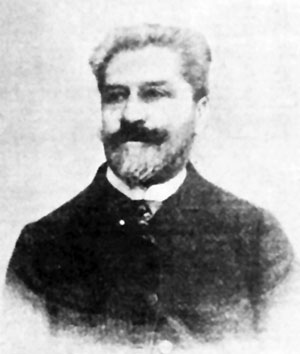
    Jules-Benoit Doinel

    Six hundred years after Rome launched the murderous Crusade against the ‘Good Christians’, a group of French mystics were inspired to play a unique role in the revival of the Gnostic tradition in the modern world.

    Jules-Benoit Doinel (1842–1902) had frequented esoteric and mystical circles for some years. One of these, formed around the Countess of Caithness, took a particular interest in ancient Gnosticism. Dr Stephan A. Hoeller, author of Gnosticism: New Light on the Tradition of Inner Knowing, informs us:

    It was into this milieu that the ancient Gnostic tradition was reborn in France in the late nineteenth century. Jules-Benoit Doinel du Val Michel, a scholarly esotericist who had been a devoted researcher of the documents of the Cathar faith, had a mystical experience in 1890, in which he received spiritual empowerment to reconstitute the Gnostic church of old. His experience occurred in the splendid chapel at the residence of the Duchess de Pomar, Countess of Caithness, in Paris. This remarkable noblewoman was a friend of Madame Blavatsky and an early Theosophist and patroness of esoteric movements….
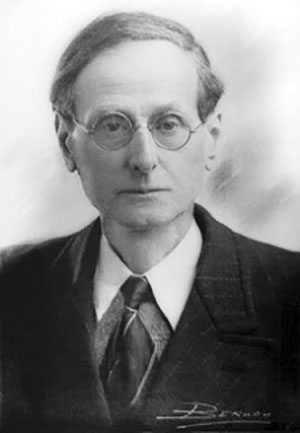
    Déodat Roché

    Doinel recorded an account of his ‘mystical experience’ and ‘spiritual empowerment’, which was later preserved by Déodat Roché (1877–1978), the foremost historian of Catharism.

    One evening, in the autumn of 1890, at the Paris circle of Lady Caithness, Doinel received the communication, “Prepare yourselves. Soon the Bishops of the Albigensian Synod of Montségur are going to appear.” Doinel could not remember the exact words but the sense he recalled from the magical communication of Guilhabert de Castres, the famed Cathar bishop:

    We came to you from the most distant of the two Empyrean circles. We bless you. That the principle of good, God, be eternally praised and blessed, glorified, and adored. Amen.

    We came to you dear ones… you will establish the Assembly of the Paraclete and you will call it the Gnostic Church.

    Doinel and the circle of mystic seekers were seized by “an understandable emotion,” tears streamed from their eyes. Doinel felt fire in his veins, akin to the fire the apostles felt on their heads at Pentecost. A voice was heard: “That the Holy Pleroma bless you. That the Aeons bless you. We bless you as we bless the martyrs of the Pyrenaean Tabor. Amen. Amen. Amen.”

    Jules Doinel, as instructed, established the Église Gnostique (Gnostic Church), which was organised along sacramental lines. The teachings of the new church were strictly Gnostic, women were ordained to priestly and episcopal offices, and Doinel also established once again the sacrament of the Consolamentum reminiscent of the Cathars.
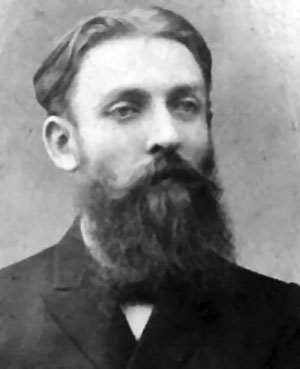
    Joanny Bricaud

    Soon other gifted esotericists joined the French Gnostic Church, among them Fabré des Essarts, Albert de Pouvourville, Paul Sédir, Lucien Mauchel, Victor Blanchard, and René Guénon.

    Given Jules Doinel’s connections to France’s leading mystics and occultists, the Gnostic Church soon became known as “the church of the initiates.” Doinel consecrated the remarkable esoteric writer Papus (Dr Gerard Encausse) as a Gnostic bishop and joined Papus’ Martinist Order. Among Doinel’s acquaintances was Abbe Berenger Sauniere, the parish priest of Rennes-le-Château.

    In 1908, at Lyon, Joanny Bricaud (1881–1934) held the Holy Synod of Gnostic Bishops which elevated him as patriarch of the Gnostic Church under the name Tau Jean II. On becoming patriarch, he declared:

    The religious evolution of which we are a part shows us that a new religion is necessary. Gnosticism offers itself as the desired religion. Gnosis is the complete and definitive synthesis of all beliefs and all ideas of which humanity has need to realise its origin, its past, its end, its nature, the contradictions of existence and the problems of life….

    Gnosis is the very essence of Christianity. Here, my beloved, is the just definition of Gnosticism. But, by Christianity, we do not only mean the doctrine taught since the arrival of the divine Savior, but also the one taught before Jesus’ arrival, in the old temples, the doctrine of Eternal Truth. Our Church is the antinomy of that of Rome. The name of that one is Force; the name of ours is Love.

    Our Sovereign Patriarch is not Peter, the impulsive, who denied three times his master and took up the sword, but John, the Savior’s friend, the apostle who relied on his heart and in it knew best the immortal sentiment, the oracle of light, the author of the Eternal Gospel, who took up only Speech and Love.

    In The Esoteric Christian Doctrine, published in 1907, a year before he became patriarch of the Gnostic Church, Bricaud wrote:

    The main aim of the Universal Gnostic Church is to restore the original religious unity, that is to establish and spread a Christian Religion true to the universal religious tradition. It is not hostile towards any Church. It respects the customs and laws of all peoples. It is essentially large and tolerant, which permits it to admit all men without distinction of nationality, language, or race.

    Sadly, the ecumenical brotherhood and openness of spirit cultivated by Bricaud could not prevent persecution and strife befalling the Gnostic Church in France.

    Bricaud’s successor, the saintly Monsignor Constant Chevillon, Tau Harmonious (1880–1944), was cruelly executed by Nazi collaborators after the Vichy government suppressed the Gnostic Church.

    Nevertheless, it was from France that the Gnostic Church spread to Portugal, Italy, Belgium, and South America.

    “The Gnostic tradition, which originally had its home in France,” Dr Stephan Hoeller tells us, “came to be established in England and later in the United States, initially as a result of the efforts of a bishop of French descent who was raised in Australia.”

    The Gnosis Restored

    With fascism and communism on the rise across Europe, far away in Australia a young spiritual seeker began questioning the historical foundations of Christianity.
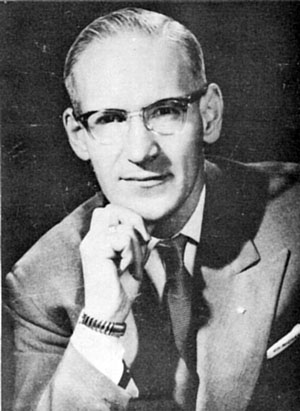
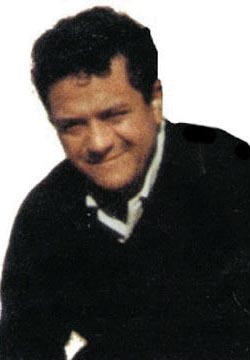
    Richard, Duc de Palatine

    In his quest for truth, Richard, Duc de Palatine (born Ronald Powell in 1916) joined “the biggest occult library in the Southern Hemisphere at the Theosophical Lodge in Melbourne,” where he studied “the extant writings concerning the Gnostics, Essenes and Secret Mysteries.” By 1944 he became convinced “that one day he would cause to be formed a Brotherhood which would partially restore the Sacred Lore and encourage people to prepare themselves for the Illumination and Interior Communion with the God within.”

    In 1940s Melbourne, Richard, Duc de Palatine, a learned and charismatic figure, attracted much attention. His insight was uncanny, but for all this, he was perceived as being a very humble person who seemed to exude love and peace wherever he went. In 1948 he told his friends his mission was not in Australia, and he travelled to London, where in 1953 he was consecrated as Bishop Richard John Chretien Duc de Palatine by the Patriarch Hugh George de Willmott Newman. The name of Duc de Palatine being a personal and spiritual title.

    In October 1953, Richard, Duc de Palatine established in London the Pre-Nicene Gnosto-Catholic Church, with the stated object of “restoring the Gnosis – Divine Wisdom to the Christian Church, and to teach the Path of Holiness which leads to God and the Inner Illumination and Interior Communion with the Soul through the mortal body of man.”

    From his base in London’s Kensington, Richard, Duc de Palatine travelled on several occasions to France where he contacted the surviving bishops of the French Gnostic Church. They encouraged him to fulfil his mission of transmitting the Gnostic tradition to the English-speaking world. He was also received by representatives of France’s leading mystical orders, including the surviving Grand Master of the Johannite Templar Order.

    In a profile of Richard, Duc de Palatine’s life, we read that he held high office in many esoteric bodies:

    Through these Orders and his many contacts, particularly in France which he frequently visited, Richard was able to bring forth in a semi-public forum the hidden teachings, the Gnosis of the Soul, which exposed the false vestiges of truth that had been foisted onto the people.

    Through his London-based Pre-Nicene Publishing House, Richard, Duc de Palatine issued a series of booklets on Christian Gnosticism, with titles like “The Inner Meaning of the Mystery Schools,” “The Christian Mysteries,” and “Christ or Jesus?” He also published The Lucis Magazine as the official organ of ‘The Sovereign Imperium of the Mysteries’.

    Reviewing Richard, Duc de Palatine’s early writings, it is obvious how far-sighted and spiritually gifted he was. Articles in his magazine ranged from discussions of “The Fallen Angels” and the “Dead Sea Scrolls” to the “Christian Fathers on Reincarnation” and “Spiritual Illumination.” In the book The Key to Cosmic Consciousness, he is described as an “outstanding mystic and illumined teacher and writer” whose “knowledge and experience stems from his own illumination in 1956, after applying the teachings of the early Gnostic Fathers…”
    Get the issue this article appears in

    Fifty years ago, Richard, Duc de Palatine contrasted the Gnostic spirit of tolerance with the dogmatism of the mainstream Churches:

    The true Gnostic or Christian makes no claim that he alone is right or that his teaching is the only one required or necessary for salvation. He demands that no one accept the statements of himself or anyone else on faith but insists that everyone should prove these things for himself.

    Richard, Duc de Palatine’s magazines and booklets were disseminated around the world, and his Brotherhood and Order of the Pleroma had branches in South Africa, Nigeria, the USA, and Australia. In 1971 he moved to the United States where he continued his work up to the time of his death in 1977.

    “He left behind a rich heritage, and because of his pioneering work a breach was made in the consciousness of the people…. but the keys to find the Door are still guarded and can only be found within the Wisdom Schools which through its Rite of Succession pass on the Keys to the Door.”

    Within the Australian branch of the Brotherhood and Order of the Pleroma, established in the early 1950s by students of Richard Duc de Palatine, the ‘Good Christians’ or Cathars held a special place of honour and reverence.

    The Good Men and Women of the Languedoc are remembered annually on 16 March, the anniversary of the fall and martyrdom of Montségur in 1244, the last Cathar stronghold.

    [alert type=”general” dismiss=”no”]This article was published in New Dawn Special Issue Vol 16 No 5.[/alert]

    [alert type=”success” dismiss=”no”]If you appreciate this article, please consider subscribing to help maintain this website.[/alert]

    © New Dawn Magazine and the respective author.
    For our reproduction notice, click here.

        

  • What has Gotten into Our Minds? The Psychosis of the Modern World & the Search for the Self

    What has Gotten into Our Minds? The Psychosis of the Modern World & the Search for the Self

    From New Dawn 177 (Nov-Dec 2019)

    …in the darkness charlatans are easily mistaken for sages.
    – Chantal Delsol

    There’s something fundamentally wrong with how the world is right now. Don’t you see it – feel it? We are a species with noble character, with a great spirit, and with a sacred soul. In our hearts we wish only for the betterment of all people; for love and justice and communion. And yet what we see going on in the world is nothing less than complete madness. We have to say it exactly as it is – there is a sickness going on, and this pathogen is spreading on a vast scale.

    We live in a world where economic greed overrides all other factors. Nations, corporations, and individuals commit horrendous acts that include impoverishment, deprivation, psychological and physical torture, and even murder, just for financial gain. We behave horrendously toward each other; there is constant bullying and harassment upon all social and cultural levels. Violence is endemic across the globe, and pharmaceutical corporations would rather turn a profit than support health and well-being. Governmental bodies and agents participate in drug trafficking on a huge scale in order to both make money as well as promote addiction amongst the masses. Rich individuals and corporations hide their money through illegal offshore schemes rather than contribute to the welfare of their communities. People in high office consistently abuse, harass, and violate people within their power as a sign of their high status. The health of the planet and its natural environment is constantly mistreated and polluted; again, mostly for the sake of economic gain. And the list goes on.

    We have entered the third millennium, and we pride ourselves on being an inventive and intelligent species. We have probed off-planet and have allegedly placed people on the moon. We are now planning trips further afield into the solar system and of having people live on the planet Mars. We are an incredibly creative and compassionate species. So, what is wrong? Why do so many people so much of the time adhere to thinking and ways of behaviour that is nothing short of insanity? Why is everything so seemingly upside-down?

    The reason, I propose, is that we are not living within our right minds. That is, we have ‘lost’ our minds to a collective psychosis that seeks to imbue us with a traumatic mind. This is no flight of fantasy. There are indeed indigenous and wisdom teachings that tell of a mental force that exists in the collective consciousness field that came to usurp our minds. Various traditions refer to these nefarious mindsets as wetiko, predators, archons, Ahriman, the flyers, and more. They speak of how an ‘alien mind’ has entrapped and traumatised the human collective mind.

    Another side of this story is that as a global species, we are also projecting the wounds of our collective unconscious out into the world. This is both a traumatic as well as cathartic process. Perhaps it is necessary – a collective cleansing of our unconscious traumas and of the shadows that lurk in the dark recesses of our minds – to prepare our species for the next phase of our evolution? What we can be sure about, without a doubt, is that we are amidst a great, historical transition. At this time, two major issues confront us: the seeming madness of the modern world, and the need to find meaning within it.

    What’s Going On?

    The question we are confronted with is a collective one, and it concerns us all. Why are so many of us, our fellow humans, behaving so badly? And not only badly, but in a way that is detrimental to our own well-being. It would seem more than strange, verging on the insane, that any creature would wish to deliberately harm its own environment and support systems. Yet for us humans, we have the significant added factor of being conscious of our actions, and self-conscious in our reflective understanding. So, again, we ask – what has gotten into our minds?

    Modernity (and post-modernity) has given us the perspective that anything that is important lays external to us. The attitude of this ‘modern mindset’ to the external world has largely been one of hostility – we have been conquering the external world for the greater part of recent history, instead of mastering our own inner nature. Whatever we project externally eventually becomes our sense of reality; therefore, if we have inherited a corrupted collective mind, then we are projecting a tarnished collective reality. Modern life has attempted to reinterpret the human condition, and this has resulted in a separation from our need to seek essential inner meaning in our lives. Progress may alleviate some of our suffering and pains, yet it shall never compensate for the lack of fulfilment we feel inside, for this requires metaphysical or transcendental nourishment.

    Any notion of the spiritual, or the metaphysical, is often considered not essential to our daily life, and we are taught to dismiss it. Modernity’s task was thus seen as freeing us from the illusions of transcendence. And in its place, we have been conditioned (a.k.a. programmed) with a form of thinking opposing a genuine path of human psychic development. In this regard, I now consider the hypothesis that a mental infection (a psychosis) has entered the collective human mindset.

    I examine this proposition from four different cultural contexts: indigenous Native American, western psychology, Central American shamanism, and European theosophy. And I have given it my own name – the Wounded Mind. First, I turn to the indigenous Native American tradition.

    The Wetiko Virus

    Jack Forbes, Native American scholar and activist, studied this disease of the mind, concluding it “is the greatest epidemic sickness known to man.”

    Jack Forbes (1934–2011), a Native American scholar and activist, long considered this question of what has gotten into the human mind – and came up with an answer for it. After long study, he came to the conclusion that humanity is suffering from a specific disease, a psychosis:

    For several thousands of years human beings have suffered from a plague, a disease worse than leprosy, a sickness worse than malaria, a malady much more terrible than smallpox… whatever we call it, this disease, this wetiko (cannibal) psychosis, is the greatest epidemic sickness known to man.1

    Wetiko is a Cree term (windigo in Ojibway, wintiko in Powhatan) that refers to an evil person or spirit which terrorises other creatures by means of terrible acts. And in Forbes’ view, the great tragedy of humankind is that our history for the past two thousand years has largely been a tale of the psychosis of the “wetiko disease” as he calls it. He goes as far back as to include the Egyptians, Babylonians, and Assyrians as cultures that helped to spread the wetiko disease throughout the Middle East. Afterwards, it was the Macedonians and Greeks under Alexander who spread it still further until it finally landed in the lap of the Roman Empire who, according to Forbes, really expanded the wetiko infection.

    What he is saying here is that this psychosis is a particular mindset that took form as certain hierarchical cultures and civilisations began to grow. And in order to maintain control, power, and to further bloody expansion, this mindset was deliberately cultivated, encouraged, and then developed as the dominant perspective and narrative. In fact, it was a crucial perspective that had to be propagated in order to maintain all status quo power structures within a developing culture. To not adhere to this specific mindset almost certainly meant annihilation and eradication in the face of other competing cultures (as was the case with Forbes’ inherited Native American ancestral cultures).

    Forbes’ view is that the wetiko disease has so corrupted European thinking that wetiko behaviour is now regarded as the very fabric of European culture and the pursuit of progress. And in order for the ruling few to maintain stable power and order, they must convince, persuade, or condition the masses within their society/civilisation to either believe and support the same, or at the very least not to rebel against it. The functioning of our modern societies has been derived from this operation of providing a dominant mindset – or social narrative – and manipulating its collective consent through coercion or, as is now more the case, persuasive propaganda.

    Forbes comes to the conclusion that a developed society takes the wetiko desire for power and channels it into creating highly disciplined and rigid structures that over the years have managed to conceal their controlling mechanisms through institutionalised conditioning. These institutions then go on to create an established ‘pecking order,’ or hierarchical status, between people. This ranking social status system continues to exploit the general population through more socially ‘normalised’ means. Innocent or non-conscious wetikos can also be co-opted into this system of behaviour through allurements such as grants, support, employment, etc., which entices them into the illusion of individual freedom and personal power. Like any other pathogen, the wetiko virus tries to infect and feed upon others by reinforcing its own corruption of the human mind.

    The predatory nature of wetiko can lurk under almost any guise and is most prevalent in such slogans as ‘patriotism’, ‘profit-seeking’, and ‘protecting our way of life’. We could say that we have seen recent examples in ‘you’re either with us or against us’. The wetiko mindset assimilates itself through intensive propaganda programs designed to perpetuate its own self-serving values. In the end, many of our national cultures have become pervaded by myths, narratives, and entrained thinking patterns that perpetuate a wetiko society. Yet what if such a mindset is not only preserved within particular cultures but is available to be assimilated through a species collective mindset? This is the question posed by the psychoanalyst and psychologist Carl Gustav Jung.

    Jung’s Collective Unconscious

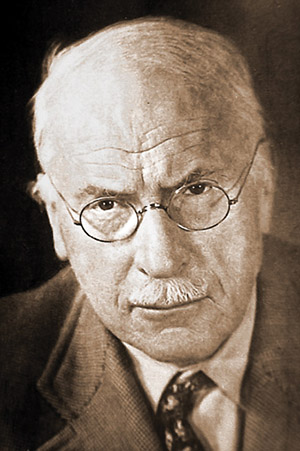
    According to Carl Gustav Jung, Hell represents, among every culture, the disturbing aspect of the collective unconscious. The wetiko pathogen may have infected the field of humanity’s collective unconscious.

    Jung was perhaps the first psychologist to fully realise that what we see playing out upon the global stage is largely a projection, or symptom, of the unconscious psyche of humanity. Jung considered that this collective unconscious does not develop individually but is inherited. That is, we inherit a ‘psychic life’ that is filled with ‘occurrences’ that stretch back to earliest beginnings. What if a psychosis, such as the wetiko pathogen, has already invaded this psychic stratum and now manifests as a disturbance in the field of humanity’s collective unconscious? We could very well be dealing with a psycho-pathogen – that is, a mind virus – that infects our individual minds from the underlying collective realm.

    This collective psychosis functions as a field phenomenon, and as such it underlies the entire collective field of nonlocal consciousness. The danger here is that each person can potentially be infected by the psychosis simply by not being mindful of their thoughts. Before we know it, we are having malicious or angry wetiko-like thoughts, which then could easily manifest into actual behaviour. Who at one time or another hasn’t had a mean or nasty thought? The question is – did this thought originate within us, or did it enter from without? Since the mind virus pathogen – which I refer to as the Wounded Mind – is a nonlocal phenomenon, then it is possible we all are infected with it to varying degrees. Or, it may be more accurate to say that this mind has us. And the worst of it is that most people will be unconscious and unwitting carriers of this pathogen. As Jung said, “Wars, dynasties, social upheavals, conquests, and religions are but the superficial symptoms of a secret psychic attitude unknown even to the individual himself.”2

    If we take the modern analogy of computing, then it is similar to how a virus would enter our computers and install malware or change the coding. Such a mental pathogen would act in the same way by installing its own malware program in our minds. For most of the time we are unaware of it, as it acts alongside our own ‘normal’ mind until a time when it takes over almost completely. Over time our own mental make-up – our psychological state – would adapt the foreign ‘invader’ and assimilate it into its own functioning as a way of normalisation. In other words, we would eventually come to consider it as our mind.

    Don Juan’s Alien Mind

    Carlos Castaneda (1925–1998)

    There are wide-ranging accounts throughout shamanic and anthropological literature about how people are vulnerable to psychic invasion and predatory ‘energy forces’. In recent times, perhaps no-one has been as openly explicit as the teachings given by don Juan through the books of Carlos Castaneda. Later in the series of books, when Castaneda is more experienced and matured into the shamanic path, don Juan reveals some ‘truths’ to him regarding the nature of the predators. Don Juan explains that there are “outside forces” that impose control upon us. These ‘predators’ imprison human beings and make us docile. When Castaneda protests against this, don Juan explains that:

    In order to keep us obedient, meek and weak, the predators engaged themselves in a stupendous maneuver – stupendous, of course, from the point of view of a fighting strategist. A horrendous maneuver from the point of view of those who suffer it. They gave us their mind! Do you hear me? The predators give us their mind which becomes our mind. The predators’ mind is baroque, contradictory, morose, and filled with the fear of being discovered any minute now… Through the mind, which after all, is their mind, the predators inject into the lives of human beings whatever is convenient for them.3

    According to don Juan, an ‘alien’ presence, or energy, has infiltrated the human mind. That is, when ‘we’ are thinking, or ‘having’ thoughts, we are in effect manifesting – or being influenced by – a corrupted mind that is “baroque, contradictory, morose” and filled with fear. When we connect and engage with the collective unconscious, or the collective mindset, are we, in fact, tapping into a psyche that, in the words of Jung, stretches “right back to the earliest beginnings”? Yet those beginnings may also include the ‘alien mind’ of the predator.

    As a species, humanity accesses a collective unconscious mind that forms the basis of our thinking patterns and our behavioural traits. If an element of psychosis, trauma, a dominating narrative – i.e., wetiko, predator – has infiltrated this collective mental field then it is a very real possibility that we too have inherited what I call the Wounded Mind. It also raises the question of what type of civilisation or society would such a parasite-predator psychotic ‘mind’ wish to create?

    The answer to this may lie with a form of twentieth-century theosophy that was put forward by the Austrian philosopher and mystic Rudolf Steiner.

    The Coming of Ahriman

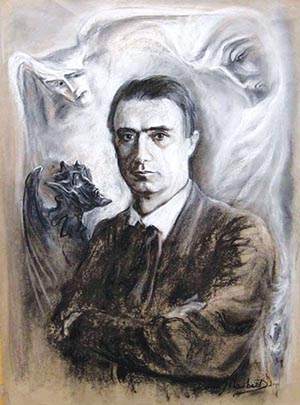
    Painting of Rudolf Steiner (1861–1925) displays the spiritual forces at work on humanity including that of the Ahrimanic presence which seeks to bind us to matter.

    In the writings of Rudolf Steiner in the early part of the twentieth century, he makes mention of an entity he calls Ahriman. For Steiner, this Ahriman is a supersensible being that wishes to distract humanity from aligning with its evolutionary potential. In order to accomplish this, it seeks to influence the minds of humanity in order to develop along a specific path; one that aligns with its own needs rather than that of humanity’s.

    The conditions that the Ahrimanic presence wishes to create includes the following: a materialistic, mechanical conception of the universe; a rational-materialistic based scientific dogma; an economic view of social dynamics and systems; a strong feature of nationalism and national identities; the popularity of separatist party politics; the prevalence of fundamentalism in religious dogma; and the dominance of an arid, dry intellectual culture.4 It would appear that this Ahrimanic presence has been quite successful so far!

    Steiner was also explicit in stating that the most dangerous aspect of Ahriman is for this presence to go unrecognised for it seeks to be hidden (similar to the predators). Steiner, in one of his lectures, stated: “…think of everything that presses us down upon the earth, that makes us dull and philistine, leading us to develop materialistic attitudes, penetrating us with a dry intellect, and so on: there you have a picture of Ahrimanic powers.”5

    The Ahrimanic powers, we are told, have a firm intention to get the human domain, as well as the earth, into their sphere of power, and to make human beings dependent upon their control. Again, it sounds eerily familiar. Steiner tells us that Ahriman intends to conceal from us that modern intellectual, rationalistic science, is a great illusion, a deception. The idea, apparently, is to keep us all so dulled with our materialistic paradigms that we have no inclination or urge to go seeking for knowledge concerning “soul and spirit in the cosmos.”

    The Ahrimanic powers use everything at their disposal to seed discontent, disarray, and conflict. They manipulate notions of heredity – family, race, tribe, peoples – to create confusion and division. Through these class structures, they enforce the dominant cultural paradigm of economic and material needs. Steiner warns his listeners that the “Ahrimanic incarnation” will be greatly advanced if people fail to develop an independent life of the spirit.

    Get the issue this article appears in

    A Few Words of Recognition

    In all the examples described here – indigenous Native American, western psychology, Central American shamanism, and European theosophy – we have had a glimpse of the proposition of what I term the Wounded Mind. The source of this trauma, however, is still unclear and open for debate. It may be either a collective psychosis of civilisation, a predatory invasion, a devolutionary impulse/presence, or a combination of these. Or else it may be something other but with similar aspects. Yet whatever may be the root cause, it is still quite clear that a traumatic presence lingers within the collective psyche of humanity, and it needs to be recognised for what it is – and expelled.

    Perhaps the traumas we are seeing inflicted upon the world today are part of this expulsion – a sort of public exorcism. In the end, we will need to curtail these ‘foreign impulses’ in order to evolve toward a better future for us as a human species upon this planet.

    Kingsley’s book Healing the Wounded Mind: The Psychosis of the Modern World and the Search for the Self (Clairview Books), is available from here and all good bookstores.

    [alert type=”general” dismiss=”no”]This article was published in New Dawn 177.[/alert]

    [alert type=”success” dismiss=”no”]If you appreciate this article, please consider subscribing to help maintain this website.[/alert]

    Footnotes

    1. Jack D. Forbes, 2008 (rev). Columbus and other Cannibals, Seven Stories Press, xvi
    2. Cited in Meredith Sabini (ed), ed. 2008. C.G. JUNG on Nature, Technology & Modern Life, North Atlantic Books, 188
    3. Carlos Castaneda, 1999, The Active Side of Infinity. Thorsons, 220
    4. R. Steiner, 2009, The Incarnation of Ahriman: The Embodiment of Evil on Earth, Rudolf Steiner Press
    5. Ibid, 1

    © New Dawn Magazine and the respective author.
    For our reproduction notice, click here.

  • Secret Agent ‘Putzi’: How Money Power & the Anglo-American Establishment Conjured Hitler

    Secret Agent ‘Putzi’: How Money Power & the Anglo-American Establishment Conjured Hitler

    From New Dawn 190 (Jan-Feb 2022)

    Shortly after 9:00 pm on 27 February 1933, alarm bells clattered in fire stations across Berlin. The Reichstag, the massive glass-domed home of the German parliament, was ablaze. The first fire crews arrived within minutes, and it was immediately apparent that separate fires had deliberately been set throughout the parliament using flammable liquid. Despite their brave efforts, the Reichstag was destroyed. What the firefighters could not know was that they were witnessing thekey event in establishing Nazi Germany and a defining moment of the twentieth century. All of Europe and much of the world, like the Reichstag, would soon be engulfed in flames.

    With the Nazi party facing losses to communists at the forthcoming general election six days’ later, Hitler blamed them for destroying the home of German democracy. A young Dutch leftist, Marinus van der Lubbe, would be executed for the crime. A communist revolution, Hitler informed the nation, was imminent, and the Reichstag fire was part of a Bolshevik plan to seize power. The communist vote consequently slumped at the election while the Nazi party’s share increased dramatically to make them the largest party. Hitler seized power, suspended the constitution, and sent communist members of parliament to Dachau concentration camp. Within weeks all political parties in Germany apart from the Nazi party were banned. Historian Professor Antony Sutton relates: “From that point on there was no turning back for Germany; the world was set upon the course to World War II.”1

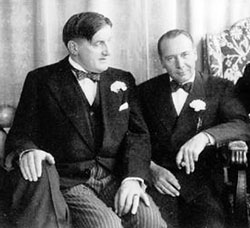
    Ernst Hanfstaengl (Putzi) (1887–1975)

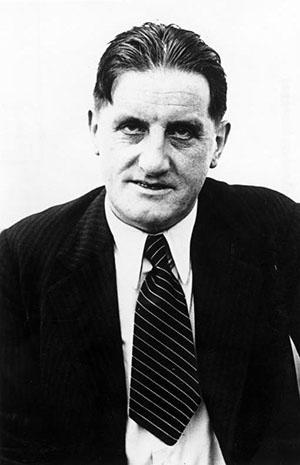
    Van der Lubbe was a patsy, and it is clear nearly ninety years on that the fire was deliberately started not by communists but by the Nazis themselves. Astonishingly, the man who deployed the arsonists that night, Ernst Hanfstaengl (known to all as Putzi), was a Harvard University graduate and secret agent of the closely collaborating Anglo-American secret intelligence services. As such, he spent almost 17 years at Adolf Hitler’s side, grooming him for power. Some readers may find that hard to believe but read on and examine the evidence before dismissing it. In his book, Conjuring Hitler: How Britain and America Made the Third Reich, historian Professor Guido Preparata details how the Anglo-American elites funded Hitler and the Nazis throughout the 1930s and armed them to the teeth.

    It was an astounding political manoeuvre willingly performed by the Allies to resurrect in Germany a reactionary regime from the ranks of her vanquished militarists… with a view to conjuring a belligerent political entity which she encouraged to go to war against Russia: the premeditate purpose was to ensnare the new, reactionary German regime in a two-front war (World War II), and profit from the occasion to annihilate Germany once and for all.2

    We contend it would be a misconception for anyone to think British and American banking and political elites brought Hitler to power because they respected him or his politics or hoped Germany would thrive under him. In reality, the destruction of Germany once and for all as an economic, commercial, and industrial competitor was the goal of this hideous Anglo-American bankers game.

    Who was Putzi Hanfstaengl?

    Putzi Hanfstaengl was born into an extremely wealthy family in Munich in 1887. Two years later, when Diphtheria brought him close to death, he was saved thanks to three days of round the clock attention from an old family servant. Throughout, she repeatedly crooned, ‘drink, Putzi, please drink Putzi’, encouraging him to take sips of water. The name, a Bavarian term of endearment for ‘little fellow’, stuck throughout his life despite growing to a six-foot-four towering hulk of a man with an enormous head, prognathous jaw, and huge hands.

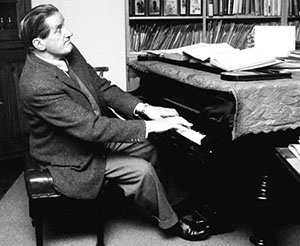
    Putzi and sibs had three governesses and were educated privately at top German schools. He was an accomplished classical pianist, taught by the cream of European musicians. Richard Wagner, Franz Liszt, and Richard Straus had been friends of his parents and grandparents before he was born. Mark Twain was another. Putzi was named after his father’s godfather, Duke Ernst of Saxe-Coburg and Gotha, the brother of Prince Albert, who married Queen Victoria.

    Putzi’s mother was American, and he always considered himself half American. Like his father, she came from an extremely wealthy and well-connected family. Several of Putzi’s forebears were famous Union Army Generals and close friends of Abraham Lincoln. His mother’s cousin, General John Sedgwick, fell in the Civil War and is honoured by a statue at West Point. His grandfather, General William Heine, helped carry the coffin at Lincoln’s funeral.

    Between 1905 and 1909, the young Putzi attended Harvard, the oldest and most prestigious university in America. He was immediately taken under the wing of his American relative, the famous and well-connected president of the university, Charles William Eliot. Highly popular at Harvard, Putzi regaled his fellow students with fight songs at pep rallies for the football team, songs that would later inspire him to compose Nazi marching songs.

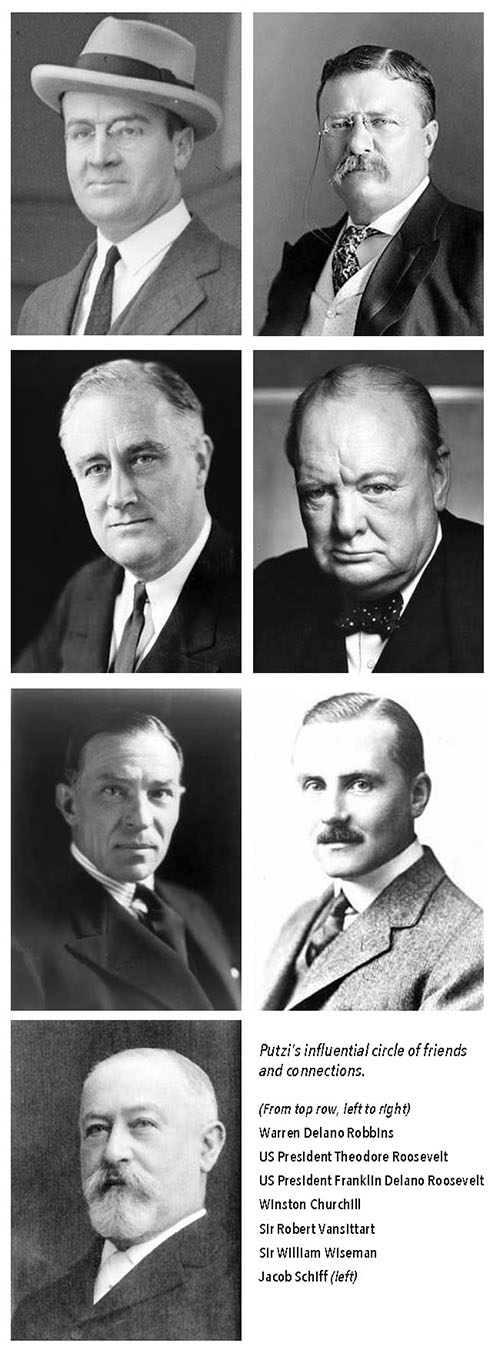
    Putzi befriended many important individuals such as President Theodore Roosevelt and future President Franklin Delano Roosevelt, and mixed at Eliot’s home with men at the very top of Wall Street banking such as J.P. Morgan and Jacob Schiff. A close friend of Charles Eliot’s, Jacob Schiff, is known to have funded Trotsky in preparation for the Bolshevik revolution. Putzi regularly played the grand Steinway at White House parties and frequented the President’s summer retreat at Sagamore Hill. This, together with many more famous names, was the undergraduate milieu of Putzi Hanfstaengl.

    After graduation, Putzi served for a year in the elite Royal Bavarian Foot Guards. Like the regiment, he was unstintingly loyal to the monarchy. He returned to the US to run the family art gallery on exclusive Fifth Avenue, mixing with famous personalities such as Henry Ford, Charlie Chaplin, Toscanini, and the great Caruso. Unlike many young German Americans, Putzi made little effort to return to Germany when the country went to war in 1914. And, unlike others of German origin, he was never harassed or interned when America entered the war in 1917. Putzi dined every day at the exclusive Harvard Club in New York, socialising there and elsewhere with many international celebrities, leading politicians, and Wall Street bankers. Across the Atlantic, he was a friend of Winston Churchill and other members of the British ruling class. What does it tell us that he associated with Sir Robert Vansittart, a leading figure in the British Foreign Office and Secret Intelligence services?

    During his ten years in New York (1911-1921), Putzi also associated with agents of the British secret service operating in the city, including the infamous Aleister Crowley, who was deeply implicated in the false-flag sinking of the Lusitania in 1915. British agents were active there with the consent of the US government and in the closest collaboration with the nascent US secret services. The head of British Secret Intelligence in the US, Sir William Wiseman, was a close friend of banker Jacob Schiff whom Putzi knew well. It was to this closely allied Anglo-American Secret Intelligence network that Putzi Hanfstaengl enlisted during WWI. Despite utterances otherwise, his allegiance now lay very firmly with America and Britain, not Germany.

    In late 1921 after spending the greater part of the past 17 years in America, Hanfstaengl, now age 34, gave up his wonderful life there and took his American wife and baby son, Egon, to Germany. Why? What on earth possessed a wealthy, well-connected now-American businessman with a beautiful young wife, Helene, and baby son Egon, to move to a country riven by faction and utterly desolate thanks to the war, raging inflation and widespread poverty? On arrival in Munich, they even found it impossible to get milk for their child. Putzi’s stated reason for going because he felt “nostalgic for his native land” is surely not credible.

    The Rise of Adolf Hitler

    Adolf Hitler’s background was the polar opposite of the well-bred, highly educated, sophisticated and cultured Putzi’s. Born in Austria, Hitler’s mother was a peasant girl, his father a minor civil servant who was allegedly often drunk and beat him. Sent to local village schools, he showed little interest in education. The teenage Adolf demonstrated an aptitude for art but twice failed to gain a place at the Art Academy. For years he was an unemployed, friendless vagabond living in men’s hostels or sleeping on park benches. The unhappy, angry, and frustrated artist survived by earning a few pfennig’s painting and selling postcards on the streets. Hitler was turned down by the Austrian army as too weak to handle weapons but found a place in the German army during WWI as a dispatch runner. He suffered a shrapnel wound to the leg at the Somme in 1916 and was gassed and temporarily blinded at Ypres in October 1918. When the war ended, he decided to stay in the army for another two years. Awarded the Iron Cross first class for bravery, he proudly wore the medal for the rest of his life. In 1920, Hitler ended six years of military service as a lowly lance corporal. Biographer William Shirer writes:

    As soldiers go, he was a peculiar fellow, as more than one of his comrades remarked. No letters or presents from home came to him as they did to the others. He never asked for leave; he had not even a combat soldier’s interest in women. He never grumbled… and was the impassioned warrior, deadly serious at all times about the war’s aims and Germany’s manifest destiny. “We all cursed him and found him intolerable,” one of the men in his company later recalled.3

    Hitler re-joined the ranks of the unemployed, rented a tiny, cheap room in Munich where he lived a shadowy existence and took to the beer halls as a political agitator. He was but one of the hundreds of similar rabble-rousers in the political turmoil of post-war Munich. Rare mentions in local newspapers failed even to spell his name correctly. Putzi describes Hitler as being like an awkward “down at heels clerk” or a “suburban hairdresser on his day off.” However, his ability as an orator to incite crowds brought him to the attention of the Allies. Planning to fund and build a reactionary movement in Germany, the Money Power was on the lookout for a suitable reactionary to run it.

    Putzi with Truman-Smith

    In Munich in 1922, Putzi got the call to action from an old Harvard friend, Warren Delano Robbins. Now second in command at the American Embassy in Berlin, Robbins just happened to be a first cousin of Putzi’s close friend, future President F Delano Roosevelt. The ruling elite’s tentacles were ubiquitous. He would send the embassy’s military attaché, Truman-Smith, to Munich to discuss political events in the city with Putzi. Individuals in such embassy positions are not simply regular bona fide diplomats. To put it bluntly, military attachés act as secret agents and spies, and Truman-Smith was no exception. He arranged for Putzi to attend a beer hall meeting in Munich where an as yet little known 32-year-old called Adolf Hitler would be speaking.

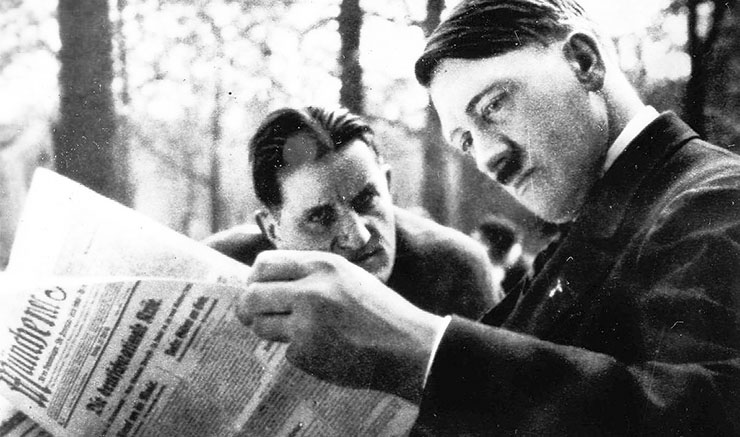
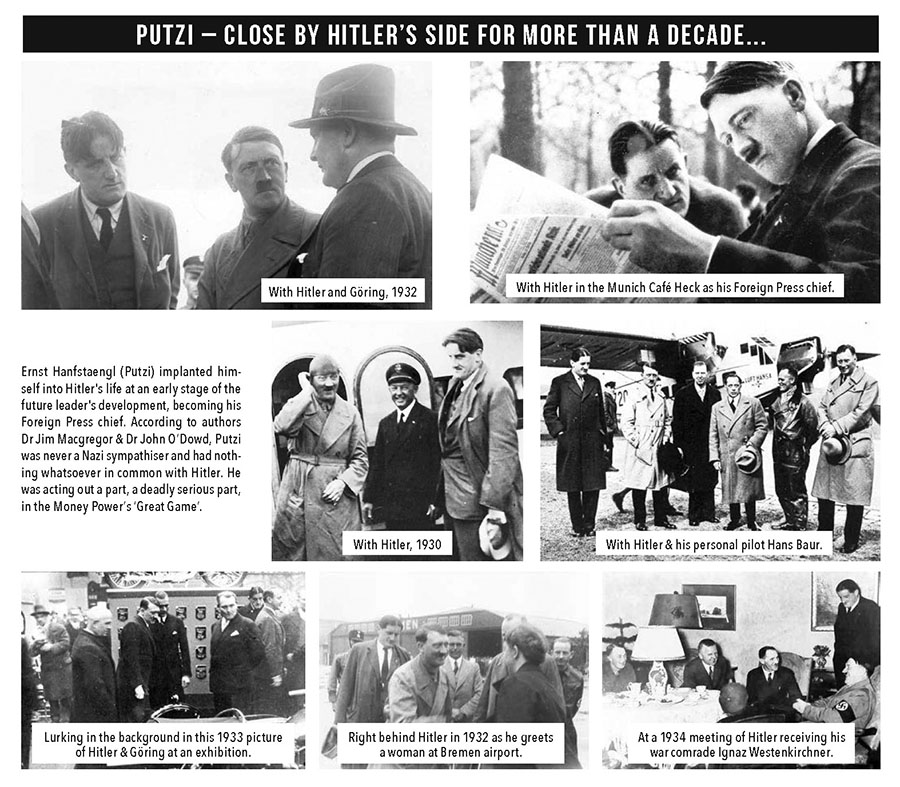
    Having clearly been forewarned by Truman-Smith, Hitler shook Putzi’s hand and greeted him warmly when he approached and introduced himself, “Ah, yes, the big American.”4 Putzi feigned Nazi sympathies, inveigled his way into Hitler’s company, and quickly became the otherwise friendless loner’s bosom buddy. It should be understood from the outset that it was a charade. Putzi was never a Nazi sympathiser – probably detested them if truth be told – and had nothing whatsoever in common with Hitler. He was acting out a part, a deadly serious part, in the Money Power’s ‘Great Game’.

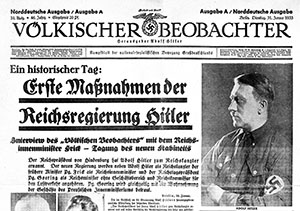
    Putzi financially backed the Nazi newspaper, the Volkischer Beobachter.

    The ghostwriter of Putzi’s ‘autobiography’, Brian Connell, states that Putzi’s task was “to mould into some statesmanlike form the spell-binding oratorical gifts and immanent potential of Adolf Hitler and make him socially acceptable.”5 Putzi himself relates that Hitler was open to influence and he “felt encouraged to continue exerting all he could.” Putzi ploughed money into the small Nazi newspaper, the Volkischer Beobachter, enabling it to purchase more printing presses, triple its size and increase circulation.

    Hitler dined regularly at Putzi and Helene’s home and played on the floor with his godson, Egon. Much to Hitler’s joy, Putzi would hammer out Wagner pieces on the piano. He also played football marching tunes picked up at Harvard.

    I explained to Hitler all the business about cheerleaders and marches, countermarches and deliberate whipping up of hysterical enthusiasm. I told him about the thousands of spectators being made to roar “Harvard, Harvard, Harvard, rah, rah, rah!” in unison and of the hypnotic effect… I even wrote a dozen marches or so myself over the course of the years. Rah, rah, rah! became Sieg Heil, Sieg Heil! but that is the origin of it and I suppose I must take my fair share of the blame.6

    Much to Hitler’s joy, Putzi would hammer out Wagner pieces on the piano. “You’re the purest orchestra, Hanfstaengl,” the Nazi leader reportedly would gush.

    Putzi was close by Hitler’s side for the next decade and more and became his Foreign Press chief, dealing daily with the international media. Hitler was infatuated with Helene, and after dinner would occasionally lie on the sofa with his head on her lap as she stroked his hair. She considered him a ‘neuter’. Court historians dismiss Hanfstaengl’s role as of no significant historical importance. He was little more than Hitler’s piano player, a “court jester and buffoon” ready and willing to entertain him. William Shirer describes Putzi as “an immense, high-strung, incoherent clown” and “an eccentric with a shallow mind.”7 All part and parcel of the Establishment whitewash to conceal Hanfstaengl’s real background as a secret agent.

    Putzi’s Role in the Reichstag Fire

    On Hitler’s behalf on the night of the Reichstag Fire, the “shallow-minded, incoherent clown” was coordinating and deploying a team of highly specialised Nazi storm trooper arsonists. According to official accounts, Putzi was due to join Hitler and Goering for dinner at Goering’s house in Berlin that evening. Putzi relates in his ‘autobiography’ that he felt “shivery,” wanted to lie down, and phoned Hermann Goering with his apologies. President of the Reichstag, Goering, offered him a bed in the Reichstag president’s palace. The given reason for Putzi being in the palace on the night of the fire rings false, for he owned his own house in Berlin just minutes from the palace.

    In all likelihood, Putzi went to the palace that night not because he felt “shivery” but to fulfil the massively important role of overseeing the burning of the Reichstag. How did a specialist team of arsonists with large quantities of flammable fuel gain access to the Reichstag without being seen? Only one door to the building was unlocked after 8 pm, and it was guarded throughout by security staff. Watchmen routinely toured the inside of the entire building just before it closed at 9 pm that evening and saw nothing untoward. No one could gain entry after 9 pm, and no one was seen to enter or leave.

    The very reason Putzi was in the palace that night lay in the fact that unknown to all but a select few, an underground passage linked it to the Reichstag directly opposite. In Wall Street and the Rise of Hitler, Professor Antony Sutton relates: “Hanfstaengl directed operations within the Palace, the propaganda apparatus stood ready, and the leaders of the Storm Troopers were in their places.… the scheme was almost perfect.”8 Under Putzi’s direction, the arsonists entered the Reichstag unseen via the tunnel, set multiple fires in the massive building, and returned via the tunnel to the palace. Putzi says he was asleep in the bedroom in the palace when the housekeeper rushed in shouting that the Reichstag was burning. He immediately phoned Goering and Hitler to inform them. In reality, he was calling to say, ‘Job done!’

    Putzi & the Beer Hall Putsch

    The Reichstag Fire was not the first time Putzi had been centre stage in Hitler’s violent attempts to seize power. Ten years earlier, a major event first brought the little corporal to national and international attention: the famous Beer Hall Putsch. On the bitterly cold evening of 8 November 1923, Hitler and Putzi stuffed pistols in their coat pockets and went to a meeting in the massive Burgerbrau beer keller in Munich. They stood drinking beer to the side of the crowd of 3,000 while the Bavarian State Commissioner, Gustav von Kahr, addressed his audience. 20 minutes into the speech, the audience was startled to hear the deep rumble of heavy trucks and clatter of hundreds of steel studded boots on the streets outside. Dozens of Nazi brownshirts burst in through the doors waving machine guns menacingly, while hundreds more sealed off the streets outside. Hitler handed Putzi his beer stein and, with his bodyguard at his back, strutted through the alarmed crowd towards the speaker. Jumping up on a chair, he silenced the crowd by firing his weapon into the ceiling and shouted: “The national revolution has broken out. This hall is occupied by six hundred heavily armed men. The Bavarian government and the Reich government are deposed. The police and army are now advancing under the banners of the swastika.”

    He was lying. When he and his armed gang advanced down the road towards central Munich the following day, the police and army remained loyal to the government. Gunfire was exchanged with several police officers and 16 putschists killed and many wounded. Hitler was pulled to the ground, dislocating his shoulder. Extricated from the bloody scene by bodyguards, he was driven to Putzi’s farm at Uffing, an hour’s drive south of Munich. As prearranged, Helene was waiting there. She tended to Hitler and hid him in an attic bedroom. Putzi says he became separated from Hitler during the melee and escaped over the border into Austria.

    The following day, local police were tipped off, and several truckloads of officers duly arrived to arrest Hitler. He allegedly drew his pistol to commit suicide, and allegedly Helene grabbed the weapon. He was taken to Landsberg Prison and charged with high treason. The previously unknown Hitler made the headlines in newspapers across the world.

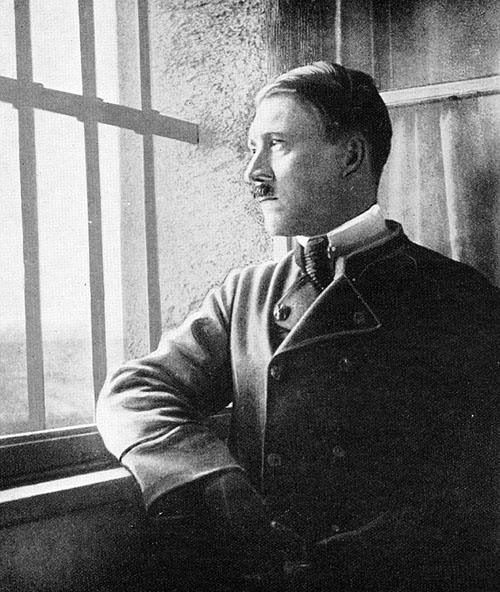
    Adolf Hitler in Landsberg Prison (1923).

    Putzi returned several weeks later but was never arrested or charged. He regularly visited Hitler in prison over the 11 months he served a five-year sentence. It was in Landsberg that Hitler wrote Mein Kampf (My Struggle) in which he set out his political philosophy and anti-Semitic views. Several authors have suggested that Putzi played a significant part in the proofreading of Mein Kampf, if not indeed the writing. Hitler trusted him implicitly and they remained firm friends throughout his imprisonment. On release, his first port of call was to Putzi, Helene and Egon at their house in Munich.

    In Reichstag elections held in December 1924, the radical right-wing parties picked up just three per cent of the votes, and the Nazis appeared to be a spent force. Inflation gradually came under control, bringing a much-needed period of stability to the ravaged country. Chastened by failure, Hitler decided to bide his time and attempt to gain power via the ‘democratic’ route. The Nazi party made little impact at elections over the 1920s, and Hitler entered his ‘quiet years’ at his comfortable home near the Alps. He and Putzi met regularly. During this quiet time, Putzi obtained a degree from Munich University with a thesis on eighteenth-century Bavaria. He was now Herr Doktor Hanfstaengl.

    Get the issue this article appears in

    Extremely Dangerous Game

    The Wall Street crash of October 1929 was music to the ears of Hitler, for he knew the German people would suffer badly as unemployment rocketed and look for radical solutions. “The Nazis could scarcely have hoped for a more propitious set of circumstances.”9 Hitler, with Putzi at his side, travelled by car or private plane campaigning in cities throughout Germany. As the economy disintegrated through 1930-32, the Nazis steadily gained votes and shared power in various coalition governments. Throughout that time, Putzi was making regular trips to London to meet Establishment figures who allegedly regarded Hitler with benevolence.

    Even Lloyd George [Father of the House of Commons and former British Prime Minister] on whom I called, was no exception. He gave me a signed photograph to take back, on which he had inscribed: “To Chancellor Hitler, in admiration of his courage, determination and leadership.”10

    This, as we shall see in part two, was part and parcel of the ‘appeasement’ game and duping of Hitler being played out by the British ruling class.

    One evening on the campaign trail in Berlin, Putzi made excuses and slipped away for a meeting with an American journalist and secret service agent called John Franklin Carter. Carter came as an emissary from Putzi’s old friend Franklin Delano Roosevelt who was soon to become US President. FDR sent his warm greetings. Aware that Putzi was playing an extremely dangerous game on behalf of the Anglo-American elites and would be tortured and shot if Hitler uncovered the truth, Roosevelt warned him: “If things start getting awkward, please get in touch with our ambassador at once.” Putzi relates: “The message heartened me enormously, and in due course I would do just that.”11

    Hanfstaengl and Diana Mitford at the 1934 Nuremberg Nazi party rally.

    In April 1932, Winston Churchill and his son Randolph – both friends of Putzi’s – visited Munich and invited him to dinner at their plush hotel. Churchill allegedly discussed the possibility of an Anglo-German alliance with him and was very keen to broach it with Hitler. Hitler, however, declined Churchill’s invitation to dinner. After a raucous evening with Putzi at the piano and the wartime British Minister singing, Churchill wished the Nazi’s success in the elections. Eleven months later, that success would come thanks to the Reichstag Fire.

    Part two of this article, published in New Dawn 191, examines the major role played by Putzi’s masters – bankers on Wall Street and the City of London – in financing Hitler throughout the 1930s and building up the German war machine in preparation for the planned conflict with Russia. Franklin Roosevelt’s concerns for Putzi’s welfare became a reality in 1937, and he fled Germany for his life. Roosevelt takes him to Washington as a White House adviser, with a good salary, nice house, servant, and Steinway grand for his entertainment.

    [alert type=”general” dismiss=”no”]This article was published in New Dawn 190.[/alert]

    [alert type=”success” dismiss=”no”]If you appreciate this article, please consider subscribing to help maintain this website.[/alert]

    Footnotes

    1. Antony Sutton, Wall Street and the Rise of Hitler, 118
    2. Guido Giacomo Preparata, Conjuring Hitler, How Britain and America Made the Third Reich, xvii
    3. William Shirer, The Rise and Fall of the Third Reich, 30
    4. Ernst Hanfstaengl, Hitler – The Missing Years, 36
    5. Ibid, 14-16
    6. Ibid, 51
    7. Shirer, Rise and Fall of the Third Reich, 47
    8. Sutton, Wall Street and the Rise of Hitler, 120
    9. Peter Conradi, Hitler’s Piano Player, 77
    10. Hanfstaengl, Hitler – The Missing Years, 212
    11. Ibid, 188

    © New Dawn Magazine and the respective author.
    For our reproduction notice, click here.

  • Russia Through the Looking Glass

    Russia Through the Looking Glass

    From New Dawn Special Issue Vol 16 No 5 (Oct 2022)

    Russia gets into your blood. It got into mine when I studied Russian at the United Nations Language School in New York in the 1980s and 90s while working as a UN information officer, having already learned the basics when I was 19.

    I can still hear our teacher Alla coming into the classroom and saying: “Today, my dear students, we going to study our beautiful Russian verbs – first the imperfective and then the perfective verbs.” Who could fail to fall in love with Russian verbs with such a charming teacher? If you happen to read this, Alla, I send you a big wave.

    But it was not only the verbs. Other intricacies of Russian grammar intrigued me – rules like “don’t forget that if the verb is negative the noun has to be in the genitive.” And the beautiful Cyrillic alphabet would dance before my inner eyes. Then there was my Russian girlfriend around the same time, who told me that “to sound like a Russian you must smile inwardly when you speak.” Indeed, they do this even when they are conveying something sad or, more likely, sad and funny at the same time – a combination at which the Russians excel.

    Russian literature, too, captivated me. I became familiar with Dostoyevsky’s Idiot, Andrei Bely’s extraordinary novel Petersburg and the equally extraordinary Master and Margarita by Mikhail Bulgakov. Reading these works, one becomes aware of the deeply spiritual nature of the Russian soul. Furthermore, these last two authors revealed another side to Russia that intrigued me, namely a strong current of fascination for things magical, esoteric and other-worldly. I decided to go deeper into this domain, and my latest book Occult Russia was the result.

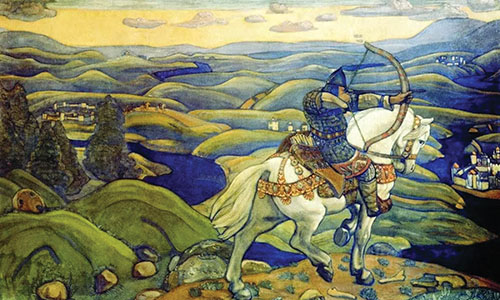
    ‘Ilya Muromets’ (1910) by Nicholas Roerich.

    Of course, I was devastated when the war in the Ukraine began, and I feel deeply for all my Russian and Ukrainian friends. As I write I can only pray that the conflict will not be prolonged. As a stop-press item, I must express my deep outrage and sadness at the death of Alexander Dugin’s daughter Darya who was killed on 20 August 2022 by a car bomb possibly intended for her father. Through this cowardly act, the life of a radiant human being has been tragically cut short. My deepest sympathy goes out to all her family.

    I offer the book Occult Russia in the hope that it will contribute to a deeper understanding of the Russian mind and soul. What follows is a foretaste of it, abridged and edited from the Introduction.

    • • •

    Upon hearing the word “Russia” you may think of military parades in Red Square, the war in the Ukraine, the annexation of the Crimea, gangsters, internet hackers, assassinations of journalists and imprisonment of opposition politicians. This book is not about those things but about a different Russia that is invisible to many people in the West – namely the inner Russia, the Russia of mysticism, myth, magic, the esoteric and the spiritual. Like a vast river, long ice-bound, the spiritual force deep in the Russian soul is moving again. In the wake of the collapse of communism, the Russian people are seeking new – or often old – ways of giving meaning to their lives. This search has given rise both to a revival of ancient spiritual traditions and to a plethora of new movements, cults, sects, -isms and -ologies, most of which would have been banned in the Soviet era. Out of this ferment exciting things are emerging.

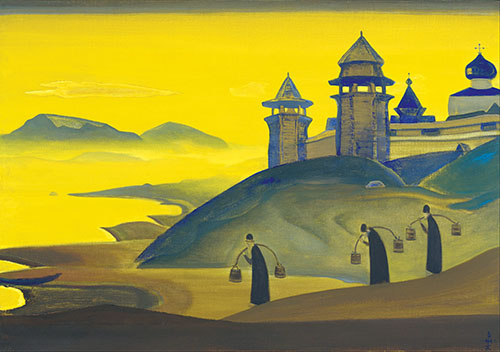
    ‘And We are Trying’ (1922) by Russian artist and Eurasian mystic Nicholas Roerich.

    Today’s spiritual quest in Russia covers an enormous spectrum. Millions are turning or returning to the Orthodox Church, and thousands of new churches are being built. As for alternative forms of spirituality, many people are turning to doctrines such as Theosophy, Anthroposophy and the teachings of Nikolai and Helena Roerich. Another group is turning back to the pre-Christian gods of Russia or to shamanism, often of the variety practiced by the urban intelligentsia. Meanwhile the indigenous pagan communities such as the Mari and the various shamanic peoples of Siberia are enjoying a new lease of life. In Russia the shamanic and pagan traditions have long existed side by side with the Orthodox religion – if not always in peaceful co-existence at least in a modus vivendi that the Russians call dvoeverie (dual faith).

    History can be driven by mythical motifs, and this perhaps applies particularly strongly to Russia. One useful term for such a motif is the word “meme,” coined by the British biologist Richard Dawkins in his 1976 book The Selfish Gene. Originally used in the biological context, it has come to mean an idea or notion that spreads like a message through a society, transmitted from person to person or through the media.

    A phenomenon with some similarities to the meme, but operating at a deeper level, is that of the egregore, a collective thought-form on the invisible plane, created by many people focusing on the same ideas and symbols. Deriving from a Greek word meaning “watcher,” an egregore can take an infinite variety of forms – an angel or demon, a god or goddess, a hero or heroine, an object of special veneration, a sacred place or a compelling narrative. The concept of the egregore overlaps to some extent with the notion, developed by the psychologist Carl Gustav Jung, of the archetype, an inherited motif in the collective unconscious of humanity. In exploring Russia’s mystical quest we find various powerful memes, egregores and archetypes at work. They include the following:

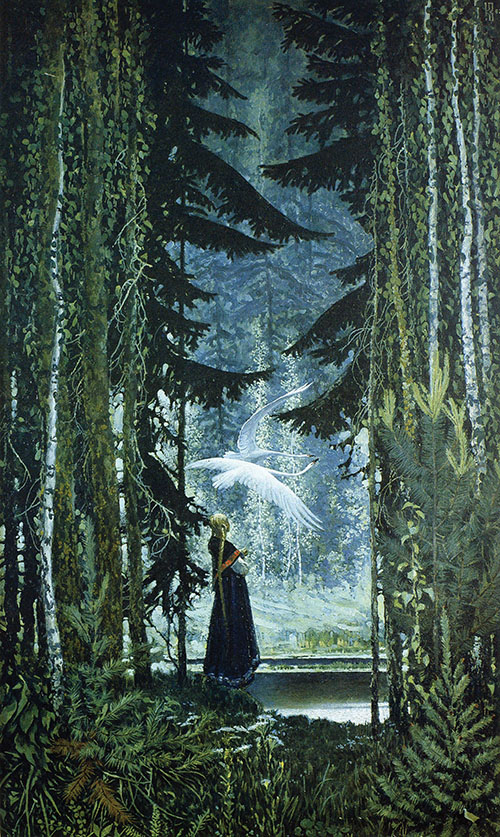
    Geese by Konstantin Vasilyev

    Holy Russia

    The notion of Holy Russia is searchingly explored by Gary Lachman in his book of that title. Deeply engrained in the Russian collective soul is the conviction that Russia has a special spiritual mission. This is reflected in the powerful mystique of the Orthodox Church and the concept of the “Third Rome” – the first Rome being the city on the Tiber, the second being Constantinople and the third and final one being Moscow. All of this has given rise to an egregore of enormous vitality, which has enabled the Orthodox religion to flourish anew after the communist era.

    The Warrior Hero

    An early example of this figure is the semi-legendary Ilya Muromets, who features in various Russian epics as well as in films, novels and art. Probably a composite of various different people, he appears as a defender of Kievan Rus in the 10th century and in later incarnations he fought the Mongols and saved the Byzantine Emperor from a monster. He eventually became a saint of the Orthodox Church. The role of the warrior hero has also been played by certain real historical figures such as Prince Alexander Nevsky who defeated the Teutonic Knights in the thirteenth century, Tsar Peter the Great, and even Joseph Stalin.

    The Never-Never Land

    This motif crops up repeatedly in Russian history in various forms and under various names: Byelovodye (Land of the White Waters); Opona, the utopia of peasant folklore; and Hyperborea, the vanished promised land in the north. The Never-Never Land is also thought of as the source of an ancient wisdom tradition that has the power to transform human life if one could only access it.

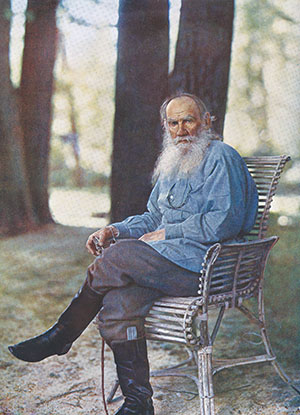
    The rustic sage, Lev Tolstoy, pictured  at Yasnaya Polyana, 1908, in the first colour photo portrait in Russia. 

    The Rustic Sage

    This figure is typified by Tolstoy’s character of Platon Karataev, the wise peasant who is a fellow prisoner of the hero Pierre Bezukhov in War and Peace. Tolstoy himself adopted this persona in his later years.

    The Holy Fool

    Alternatively “fool for Christ,” this term is applied to someone who adopts an apparently mad way of life, marked by great austerity and extreme piety. It can overlap with the concept of the starets, the independent, god-illuminated holy man or woman. It has been pointed out to me by my correspondent Dana Makaridina that there are two kinds of holy fool, namely the blazhennyi (“blessed”) and the yurodiviy (“foolish”). The distinction is subtle. The former are characterised by a state of saintly bliss, whereas the latter are conspicuous by their craziness and weird, antisocial behaviour. Both are associated with freedom, being unconstrained by any social norms and able to communicate directly with God. Dana Makaridina mentions a friend who has had the nickname blazhennyi since childhood because of his strange, otherworldly behaviour. She writes that “now he is an extravagant rock musician and performance artist dealing with topics of freedom and death.”

    The New Messiah

    Prophets and messiah figures have abounded in Russian history, overlapping somewhat with the starets and the fool for Christ, and they continue to appear in the present day. A typical example is the case of Sergei Anatoljewitsch Torop, an artist and jack-of-all-trades who, in 1991, proclaimed himself to be Jesus Christ returned. Adopting the name Vissarion, he founded a community called the Church of the Last Testament, gathered several thousand followers and established an ecospiritual settlement in Siberia. At the time of writing he is in prison facing a charge of extorting money from his followers and subjecting them to emotional abuse.

    The Woman Clothed with the Sun

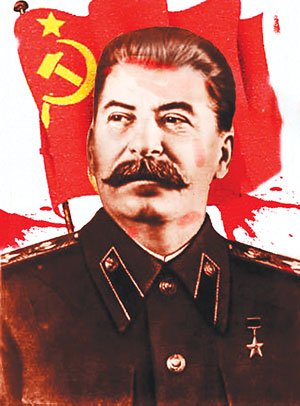
    Joseph Stalin led the Soviet Union from 1922 until his death in 1953

    This figure originates in a passage in chapter 12 of the book of Revelation in the New Testament. To quote the King James Bible:

    And there appeared a great wonder in heaven; a woman clothed with the sun, and the moon under her feet, and upon her head a crown of twelve stars.

    This image of the woman clothed with the sun crops up repeatedly in Russian prophetic writings.

    My own perception of Russia has been through different stages. As far as I can remember, the country meant little to me until 1953, when I was nine years old, and one morning at breakfast my father picked up the newspaper and remarked that Stalin had died. I may have asked who Stalin was and been told that he had been the leader of our powerful eastern ally during the Second World War.

    Later I absorbed the Cold War propaganda. Russia came to mean the suppression of the Hungarian uprising, defectors from the West like Burgess and Maclean, Khrushchev banging his shoe on the table at United Nations General Assembly, the Cuban missile crisis, the crushing of the Prague Spring, the persecution of dissidents.

    At the same time I was fascinated enough by Russia to start learning the language when I was nineteen years old, a process that I resumed in my fifties, by which time I had witnessed the advent of Gorbachev and perestroika, shortly to be followed by the break-up of the Soviet empire and the collapse of communism itself. While these tumultuous changes were going on I visited Russia for the first time in 1991 with an American contingent of very amiable born-again Christians, whose tour group I was able to join through the facilitation of an acquaintance.

    Get the issue this article appears in

    A particularly vivid memory of that trip was visiting a Russian Orthodox seminary near Saint Petersburg. On entering the building I found myself transported into another world, marked by candlelit icons, the fragrance of incense and an atmosphere of still reverence. There was a quiet dignity about the priests and seminarists moving about in the dim corridors. One of them, looking startling like the photographs I had seen of the wild-eyed prophet Rasputin, was a young man with long, black hair and a solemn expression, dressed all in black in a sort of peasant’s tunic, trousers, and boots. We were shown to the chapel of the seminary where a service was held, and I began to understand why Madame Blavatsky, non-Christian though she was, always vehemently defended the Orthodox Church.

    At the present time, in the wake of the collapse of communism, the Orthodox religion is once again playing a central role in the life of the nation. Churches are full, and thousands of new ones are being built, with the state playing a supporting role. But not everyone is happy with the current situation, and some of the initial post-perestroika religious enthusiasm is waning. Many believers oppose what they see as an increasing tendency towards a merger of state and Church, while people of other persuasions do not want Orthodox Christianity to be imposed on the population.

    Visiting Russia reinforced my view that it has a special destiny, as many prophets have predicted. One of them, the German writer Oswald Spengler, wrote in an essay entitled “The Two Faces of Russia” (1922):

    The bolshevism of the early years has thus had a double meaning. It has destroyed an artificial, foreign structure, leaving only itself as a remaining integral part. But beyond this, it has made the way clear for a new culture that will some day awaken between “Europe” and East Asia. It is more a beginning than an end.

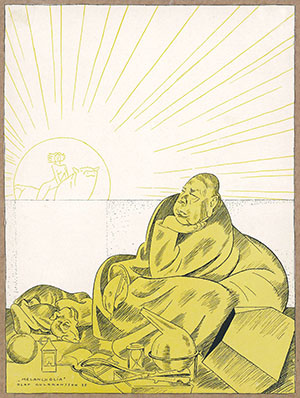
    A 1930s cartoon by Olaf Gulbransson, caricaturing the German historian Oswald Spengler. The woman in the background symbolises Spengler’s prediction that a new age will come out of Russia. Property of the Olaf Gulbransson Museum, Tegernsee. Photograph © VG
    Bild-Kunst, Bonn 2022.

    Thirteen years later Spengler’s vision for Russia was illustrated in a cartoon by the artist Olaf Gulbransson, which appeared in 1935 in a literary-satirical journal originally produced in Munich under the name Simplicissimus, but by then published in exile in Prague under the title Simpl. The cartoon, entitled Melancholia, is a parody of Albrecht Dürer’s famous engraving known under the same title.

    In the foreground sits a melancholy Spengler, quill pen in hand, beside an even more melancholy dog and various other objects including an obstetric forceps, perhaps indicating that the New Age in Russia will have a difficult birth. In the background is an image of the New Age itself in the form of a naked young woman riding a rather complacent-looking bear, both framed in a large rising sun. The woman in the background riding a bear symbolises Spengler’s prediction that a new culture will come out of Russia.

    Gulbransson’s cartoon appeared in 1935 during a troubled time. Germany had been through a military defeat, followed by the ravages of inflation and depression and then by the Nazi seizure of power in 1933. In Russia the Bolsheviks ruled. Another war was on the horizon. But Gulbransson pictured a bright future coming from the direction of Russia and symbolised by the maiden riding the bear. Between then and now there are certain parallels. The present era is overshadowed by war and by high tensions between Russia and the West. But I believe the maiden riding the bear still carries a hopeful message.  J

    Christopher McIntosh’s book, Occult Russia: Pagan, Esoteric, and Mystical Traditions, is available from Inner Traditions International (ISBN-13: 9781644114186).

    [alert type=”general” dismiss=”no”]This article was published in New Dawn Special Issue Vol 16 No 5.[/alert]

    [alert type=”success” dismiss=”no”]If you appreciate this article, please consider subscribing to help maintain this website.[/alert]

    © New Dawn Magazine and the respective author.
    For our reproduction notice, click here.
  • The Tell-Tale Sign of the All-Seeing Eye

    The Tell-Tale Sign of the All-Seeing Eye

    From New Dawn Special Issue 18 (Dec 2011)

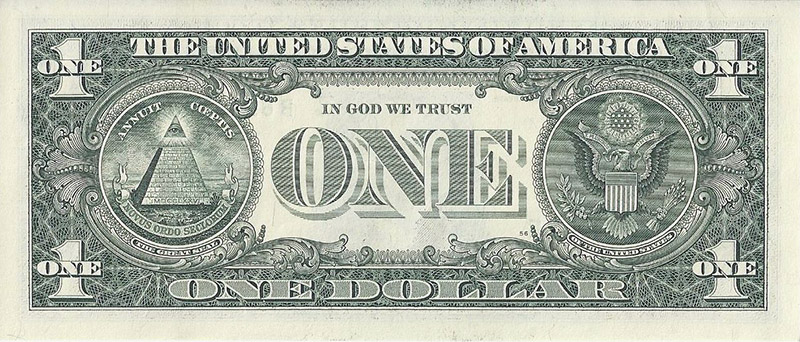
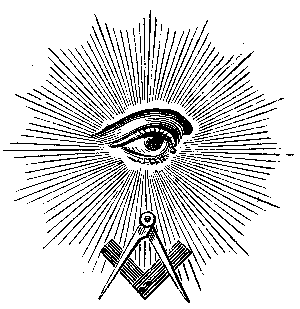
    The symbol of the All Seeing Eye appears regularly among writings by conspiracy theorists. It is alleged the reverse of the Great Seal of the USA is a Masonic symbol and proves that Masonry helped found the United States of America.1 It is also widely believed the All Seeing Eye is the symbol of the Illuminati,2 and where the symbol appears that is evidence of a continuing Illuminatist influence. 

    While there is much exaggeration and outright falsification based on individual bias, often religiously based, there is also the antithetical position of certain Masons, especially from the Anglophone ‘United Grand Lodge’, who hold there is little significance to the symbol, and that where the symbol appears in association with subversive movements, these are not “genuine Masons.”3 Although this writer has not been able to find any reliable evidence that the All Seeing Eye is in fact the symbol of the Illuminati, the debunkers of all critiques of Masonry are also often in error or are disingenuous. This article examines some examples of the All Seeing Eye as a graphic indicator of conspiracies.4

    The Great Seal of the United States: A Masonic Symbol?

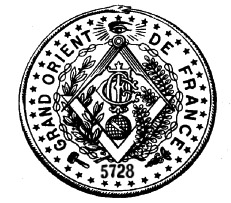
    Some branches of Masonry, particularly the Grand Orient of France with its tradition of radicalism, atheism and rationalism, acknowledge that many brethren were involved in the American, French and other revolutions.5 The enigmatic symbols on the reverse side of the Great Seal of the USA, more familiarly seen on the US One Dollar Bill, have long caused speculation as to whether this is a sign of Masonic influence. There have recently been attempts at refutation, contending that the combination of the All Seeing Eye and triangle or pyramid motif is not a symbol of Masonry, or at least was not until after the American Revolution and the designing of the Great Seal; and that any subsequent use of the symbol by Masonry was not widespread.

    The British Columbia and Yukon Grand Lodge, for example, operates a website with a section devoted to refuting anti-Masonic theories. On the US Great Seal, the Canadian Masons write:

    Of the four men involved in designing the USA seal in 1776, only Benjamin Franklin was a freemason, and he contributed nothing of a Masonic nature to the committee’s proposed design for a seal…

    Congress declined the first committee’s suggestions as well as those of its 1780 committee. Francis Hopkinson, consultant to the second (1782) committee, used an unfinished pyramid in his design. Charles Thomson, Secretary of Congress, and William Barton, artist and consultant, borrowed from earlier designs and sketched what at length became the United States Seal. None of the final designers of the seal – William Baron, Charles Thomson, Sir John Prestwick – were freemasons.

    The single eye was a well-established artistic convention for an ‘omniscient Ubiquitous Deity’ in the medallic art of the Renaissance…

    The first ‘official’ use and definition of the all-seeing eye as a Masonic symbol seems to have come in 1797 with The Freemason’s Monitor of Thomas Smith Webb – 14 years after Congress adopted the design for the Seal…

    Neither the eye nor the pyramid have ever been uniquely Masonic symbols, although a few Grand Lodge jurisdictions incorporate them into their seals. The combining of the eye of providence overlooking an unfinished pyramid is a uniquely American, not masonic, icon. There are no available records showing the all-seeing eye, with or without a pyramid, associated with freemasonry prior to 1797…6 

    This Masonic refutation has widely appeared elsewhere in both Masonic and non-Masonic sources including an entry in Wikipedia. There are a number of important points that need questioning.

    Early Masonic Use of All Seeing Eye 

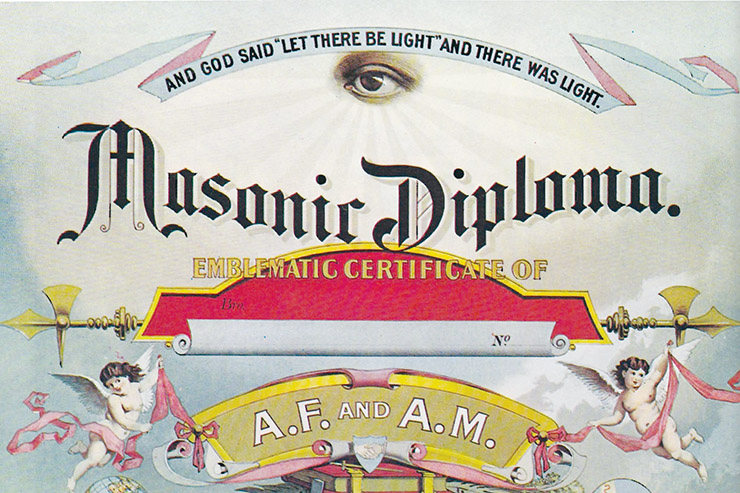
    The website ‘Pietre Stones Review of Freemasonry’ only accepts articles from Master Masons of the United Grand Lodge (UGL) and those recognised by the UGL. It is therefore an authoritative source from that perspective. In a section illustrating ‘Masonic Tracing Boards’7 there are a number which depict the All Seeing Eye as a major symbol. The earliest shown is not from the USA or from the American Colonies, but from Germany going back to 1770, well before the designing of the US Great Seal. Illustrations of early tracing boards incorporating the All Seeing Eye motif include:

    • ‘Ancient Tracing Board, Germany, 1770’.8
    • ‘Lodge Union No. 129 Kendal 1772’.9
    • ‘1796 Union Lodge, Boston’.10

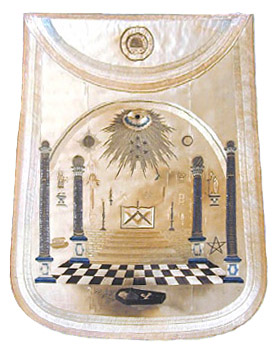
    George Washington’s Masonic Apron (left), given to him as a gift from the revolutionist General LaFayette, includes the All Seeing Eye, and dates to 1784.11 

    Ironically, the Canadian Masonic website includes a section headed ‘Masonic Art’. One of the examples is a painting by the Florentine artist Jacopo Carucci, entitled ‘Supper at Emmaus’ (1525). The Masons involved with this website have isolated the All Seeing Eye and triangle detail from the painting, and present three enlarged images of it.12 Of twelve examples of ‘Masonic art’ given by the Canadian Masons, three feature the All Seeing Eye. One is labelled ‘eye in a triangle’.13 Another is Washington’s Apron featuring the All Seeing Eye.14

    In an article entitled ‘The Masonic Landmarks’ by Dr. Athena Stafyla, written for ‘Pietre Stones Review of Freemasonry’, she (or the graphic artist) includes illustrations of both the Great Seal of the USA and a painting (presumably Masonic) of Egyptian ‘masons’ working on an incomplete pyramid.15 The pictures are carried without explanation. The pyramid without its capstone symbolises the work of Masonry, which is to complete the perfection of humanity, as per the Enlightenment and the humanistic and often communistic doctrines which were used as a means of subverting the Traditional social order of Europe and elsewhere from the 18th century. The Masonic doctrine is that the initiated Freemason is working to craft humanity towards Perfection. 

    All Seeing Eye on Dollar Bill

    Reporting on an exhibition of Rosicrucian MSS at the Rosicrucian Museum (San Jose, USA), Gary Singh writing in Metro reports a conversation he had with the curator on the Great Seal and the All Seeing Eye:

    We then come back to Roerich’s volume and discuss the Great Seal of the United States and the all-seeing eye. I mention it’s amazing that it took so long for the seal to make it onto the back of the dollar, and that I wonder why George Washington and crew didn’t put it there from the beginning. “Yeah,” said Armstrong. “Considering they were all Masons.”16

    Discussing a book by the Rosicrucian author, mystic and painter Nicholas Roerich:

    Roerich, a Rosicrucian, played an influential role in the administration of Franklin Delano Roosevelt, as he was the mover and shaker behind FDR putting the Great Seal of the United States and the all-seeing eye on the back of the $1 bill. The eye is a Masonic and Rosicrucian symbol dating back centuries.17 

    The influence on the Roosevelt Administration to get the All Seeing Eye on the Dollar Bill came via Vice President Henry Wallace, a devotee of Roerich and a 32º Mason. If the All Seeing Eye was not a Masonic symbol, one must wonder why it was considered so important by Roerich, Wallace and President Roosevelt? 

    Masonic authority Manly P. Hall18 believed the Great Seal represents a specific occult influence on the founding of the USA:

    On the reverse of our nation’s Great Seal is an unfinished pyramid to represent human society itself, imperfect and incomplete. Above floats the symbol of the esoteric orders, the radiant triangle with its all-seeing eye… There is only one possible origin for these symbols, and that is the secret societies which came to this country 150 years before the Revolutionary War… There can be no question that the Great Seal was directly inspired by these orders of the human Quest, and that it set forth the purpose for this nation.19 

    Henry Wallace was imbued with occult doctrine, particularly that inspired by Masonry. He regarded the USA as having a manifest destiny to lead the world into a new world order, and he saw that mission symbolised in the Great Seal. Alluding to the Masonic significance of the unfinished pyramid, the Masonic conception of God as the Great Architect of the Universe, and the motto on the Great Seal referring to a ‘new order of the ages’, Wallace wrote:

    It will take a more definite recognition of the Grand Architect of the Universe before the apex stone [capstone of the pyramid] is finally fitted into place and this nation in the full strength of its power is in position to assume leadership among the nations in inaugurating ‘the New Order of the Ages’.20 

    Masonic handshake between George H.W. Bush Snr and George W. Bush, at the inauguration of a ‘new world order’ after the first Gulf War

    Wallace’s interpretation of the ‘new order of the ages’ was that of a ‘new world order’, not simply a new era for the USA (hence the reference to the USA leading the ‘nations’ into this international regime). This ‘new world order’ has now become quite familiar after US President George H.W. Bush Snr announced its official inauguration, being ushered in after the first Gulf War war against Iraq.21 His son, President George W. Bush, reiterated the aim fourteen years later when stating, in specific reference to the motto of the Great Seal: “When our Fathers declared a ‘new order of the ages’, they were acting on an ancient hope which is meant to be fulfilled.”22 The reference to an “ancient hope” implies something arcane that would be recognised by the initiated.

    All Seeing Eye of Grand Orient Masonry

    The All Seeing Eye is an important symbol in Grand Orient and associated forms of Masonry on Continental Europe. United Grand Lodge Masonry can eschew the subversive nature of the Grand Orient and others by the simple expedient of stating they are not “true Masons.” Be that as it may, this oft-cited difference did not prevent important figures such as Benjamin Franklin being initiated into the revolutionist Lodge of the Nine Sisters in Paris, nor Thomas Jefferson lauding the noble virtues of Illuminatist Adam Weishaupt.23 

    Grand Orient Masonry and its derivatives are of an Illuminatist nature, aiming to overthrow all traditional social orders, to inaugurate a world order ushered in by a faithless, materialistic rationalism, as a prelude to establishing a universal cult as was seen in the aftermath of the French Revolution when rival cults contended on the ruins of the Church and unleashed new forms of un-reason. 

    The Grand Orient of France (GODF), the mother of Grand Orient throughout the world, does not disguise its rationalist, humanistic and revolutionary pedigree:

    But in this period when the new ideas of Liberty, and Equality were to be born, which would lead to the French Revolution and the Republic, France entered the age of enlightenment. From being a sort of ‘Club’ as in England, the Masonic Lodges which very quickly spread in our country became a sounding board for these great new ideas and turned into places where debates about the emancipation of Man and Society took place. The Grand Orient de France which was set up in 1733 and was, until the end of the 19th century, the only Masonic Order in France, is still fighting for these ideals.24

    The motto of the GODF is that of the French Revolution, Liberty, Equality, Fraternity. That is to say, the Revolutionaries adopted the motto from the Freemasons. The GODF adds:

    Thus Lafayette received a sword from George Washington in honour of the part played by French Freemasons in the American War of Independence. In this way, the preparation of the ideas of Liberty and Equality in the Masonic Lodges contributed to the great reforms of the French Revolution…25

    The GODF claims to be continuing the legacy of various revolutionary thinkers and activists including the most extreme anarchists Blanqui and Bakunin whom they identify as Grand Orient Masons:

    For the freemasons of the Grand Orient de France, the search for progress has always been the force behind their reflection and their activities, to such an extent that this principle is an integral part of the tradition of this form of Masonry. We are the heirs of men and women who all, in their own way, worked to improve Humankind: Voltaire,26 La Fayette,27 Garibaldi,28 Auguste Blanqui,29 Victor Schoelcher, Emir Abd-El-Kader, Louise Michel, Bakounine,30 Jean Zay, Félix Eboué, Pierre Brossolette and so many others whom we are proud to know have enriched our Lodges with their presence. Therefore, the Grand Orient de France is a vigilant defender of the principles contained in its motto which is also that of the Republic: ‘Liberty, Equality, Fraternity’.31

    Therefore, when academics have a clichéd tendency to ridicule ‘conspiracy theories’ on Masonry as simplistic and ignorant, they would do well to consult the Masonic literature, including that of the present day.

    As one would expect, the All Seeing Eye makes its looming appearance in the symbology of both the Grand Orient and the French Revolution. 

    The card of the Cordeliers Club that depicts the All Seeing Eye above the word ‘Surveillance’.32 It is pertinent to ask whether this supposed ‘Eye of Providence’ or ‘Eye of God’ is in reality the eye that sees all under a totalitarian state?

    The Symbol of the Grand Orient de France includes an All Seeing Eye above the Masonic Compass & Square, surrounded by the Ouroboros serpent.33

    The Temple of the GODF features the All Seeing Eye at centre place.34

    1848 GODF medal commemorating the French Republic. This shows an All Seeing Eye within a triangle, around which is the GODF motto: ‘Liberty, Equality, Fraternity’.35

    The symbols illustrating the French Revolutionary ‘Declaration on the Rights of Man and the Citizen’ feature the All Seeing Eye radiating above Moses-type tablets etched with the Declaration. Below that symbol is the self-devouring serpent, Ouroboros.36

    As the French Revolution progressed, Christian symbols were removed from churches and replaced by busts of such heroes of the Revolution as the anti-Catholic Voltaire, or Rousseau who accepted that man and Nature had been created by the Supreme Being but believed that Church institutions corrupted human nature:Homage to Rousseau by Jeaurat de Bertry, showing the philosopher presiding over the ‘Eye of Truth’.

    It is also of interest that the title page of the seminal Encyclopedie,37 compiled by the rationalist philosophers38 under the direction of Denis Diderot, intended as a compendium of scientific knowledge to repudiate the ‘superstition’ of Christianity, is decorated with esoteric symbolism. Leading American atheist Conrad Goeringer, in writing on the contribution of Freemasonry to revolutionary ferment, states that the central figure of the title page is Lucifer, surrounded by the compass and square symbols of Masonry:39 

    If the bible was the holy book of the Christian enlightenment, then the Encyclopedia was the inspiration of the Enlightenment. Here was a compendium of human knowledge dealing with arts, sciences, mechanics and philosophy which swelled to some 36 volumes by 1780. Begun by the atheist Diderot in 1751, the Encyclopedia bore the imprints of Voltaire, Montesque, Rousseau, Buffon, Turgot and others. Gracing the title page of Diderot’s compendium in the first edition was a drawing of Lucifer, symbol of light and rebellion,40 standing beside the masonic symbols of square and compass.41 

    Why did the rationalists and humanists of the French Revolution, supposedly eschewing ‘superstition’, decorate their new holy writ with arcane symbolism? The answer is that such creeds are intended not as the end of religious worship, but as a stepping-stone by which traditional faiths are destroyed, to be replaced by a universal humanistic religion where man replaces God, and where the ultimate step is to enthrone a leader as Man-become-God.

    The symbols illustrating the French Revolutionary Declaration on the Rights of Man and the Citizen feature the All Seeing Eye radiating above Moses-type tablets etched with the Declaration. Below that symbol is the self-devouring
    serpent, Ouroboros.

    The French Revolution was the forerunner of communist revolutions that attempted to abolish Christianity. Amongst the anti-Christian fervour, babies were baptised not to the ‘Father, Son and Holy Ghost’, but to ‘Liberty, Equality, Fraternity’. In 1793 the word Sunday (dimanche) was dropped, the Gregorian calendar was replaced by a French Revolutionary Calendar, and it was prohibited to ring Church bells, display the crucifix, or hold religious processions. Robespierre’s Cult of the Supreme Being was officially inaugurated in 1794,42 opened by hymns to the Supreme Being sang by the Paris Opera choir.43 Yet these subterranean forces did not intend Paris as the capitol of the world, nor even Washington, but Jerusalem, a dream kept alive for centuries in the secret societies. 

    Get the issue this article appears in

    Jerusalem, World Capitol, Under the Gaze of the All Seeing Eye

    In Jerusalem, the United Nations (a truly United Nations) will build a Shrine of the Prophets to serve the federated union of all continents: this will be the seat of the Supreme Court of Mankind, to settle all controversies among the federated continents, as prophesied by Isaiah. 
    – David Ben Gurion, First Prime Minister of the State of Israel44

    Jerusalem holds a central place not only for the three Abrahamic faiths of Christianity, Judaism and Islam, but for Freemasonry, possibly the result of the influence of the Knights Templar whom some researchers regard as the fathers of Masonry,45 and whom the Masons themselves acknowledge as such in their tradition. A major aim of the Freemasons, like the messianic Jews, is the rebuilding of the Temple of Solomon, around which Masonic rituals and allegories are based. Therefore, Masonry can be expected to have a special interest in the creation of the State of Israel. 

    The importance of Jerusalem to Masonry was stated by Albert Pike, when describing the 30° of Knight Kadoth, when the initiate learns of Masonry’s Templar origins, where it is explained that the Templars seeking to destroy the Papacy aligned themselves with the Patriarch at Constantinople, the Templars’“secret object [being] the re-building of the Temple of Solomon on the model prophesied by Ezekiel.”46 Leon Zeldis, 33° Adjunct Grand Master, Supreme Council of the Scottish Rite for the State of Israel, describes the importance of Jerusalem to Masonry, which happens to corresponds to messianic Judaism:

    …King Solomon’s Temple already appears in the Old Charges of Operative Masons used by medieval Lodges and many legendary and ritual features of various Masonic degrees are related to its construction and architecture. For both Christians and Jews, Jerusalem is the focal point of the world, the place where heaven and earth touch each other (Heavenly and Earthly Jerusalem).47

    Masonry staked its mark on the borders of Israel. On the Egyptian-Israeli border a marker has been erected by Masonry consisting of a pyramid, the dividers and compass symbol of Masonry and the two columns or pillars, Binah and Chokmah, of the Cabalistic Tree of Life, a feature of Masonic Temples.48

    The Supreme Court building of Jerusalem, Israel, is replete with Masonic symbolism.

    One of the most overt displays of Masonic symbolism is to be found in the Supreme Court building of Jerusalem. The building is replete with Masonic symbolism, and the crowning glory is the All Seeing Eye. Jerry Golden, a researcher resident in Israel, has numerous photographs of the Supreme Court building. In accord with many conspiracy theorists, Golden ultimately attributes this to the Illuminati. While there is no direct evidence of this, the Masonic symbolism is nonetheless apparent. Of additional interest is the involvement of the Rothschild banking dynasty in the construction of the building. Golden writes:

    Showing the architectural design of the New Israeli Supreme Court Building designed and paid for by the Rothschilds reflects the presence of Free Masonry… The Supreme Court building sits on a plot of land opposite the Knesset [Parliament] and next to the Foreign Ministry and the Central Bank of Israel.49

    The Rothschild involvement in this overtly Masonic construction is perhaps the first reliable evidence of a Rothschild connection with Masonry. Golden writes:

    The Engineers who were chosen for this job by the Rothschild’s were the grandson and granddaughter of Ben-Zion Guine from Turkey who worked for Baron Rothschild, Ram Kurmi, born in Jerusalem in 1931, and Ada Karmi-Melanede born in Tel-Aviv in 1936.50

    A plaque dedicated to the Rothschilds has been placed on the Supreme Court building. The emblem at the top left of the plaque is a radiating All Seeing Eye. Most evident, however, is the All Seeing Eye on a large pyramid that stands on the top of the Supreme Court building looking over Jerusalem. Golden states of this:

    The first thing you will notice is the pyramid with the All Seeing Eye just like the one you will see on the American dollar bill. It sits in a circle to the left.51

    These occult and Masonic correspondences suggest the Supreme Court building, in which the Rothschilds took an intimate interest, was constructed for purposes other than merely handing out sentences in the Israeli justice system. Such a building crowned with the pyramid and All Seeing Eye accord with the requirements of a World Court for a New World Order, the aim of the ages’ old traditions of occult societies to establish Jerusalem as the capitol of the universal republic.

    [alert type=”general” dismiss=”no”]This article was published in New Dawn Special Issue 18.[/alert]

    [alert type=”success” dismiss=”no”]If you appreciate this article, please consider subscribing to help maintain this website.[/alert]

    Footnotes

    1. For a scholarly work on the founding of the USA by Freemasons and the dichotomy that occurred between Masons and Puritans see: Nicholas Hagger, The Secret Founding of America: The Real Story of Freemasons, Puritans & the Battle for the New World (London: Watkins Publishing, 2007). 
    2. The Order of the Illuminati was a crypto-Masonic secret society founded by Professor Adam Weishaupt in Bavaria, Germany, in 1776, to overthrow the Church and all monarchies, and to establish a communistic universal republic. See: Prof. J Robison (1798) Proofs of a Conspiracy (Massachusetts: Western Islands, 1967).
    3. There are branches of Grand Lodge Masonry, or ‘Regular Masonry’, that do however proudly cite the involvement of other forms of Masonry in revolutions as part of a wider Masonic heritage. 
    4. While allegations of ‘conspiracy’ often appear exaggerated, even less scholarly is the stance of those ‘sceptics’ who insist that any form of conspiratology is delusional or ignorant. Scholarship accepts that the Thuggee was a criminal conspiracy based on religion, or that the Mafia is a criminal conspiracy based around Sicilian families reaching back centuries and spreading out from Sicily to encompass the world. Yet when someone suggests that Freemasonry, Illuminati, Bilderberger, Zionism or the Council on Foreign Relations might be involved in political and economic conspiracies, this is laughed out of academe with arrogant derision. 
    5. For example, the Portuguese revolution of 1910: A M Goncalves, Breve historical da Maconaria em Portugal, Pel Irmao Mestre Macom, R L Anderson No. 16 Grande Loja Regular de Portugal/GLLP, 14° Grau do Rito Escoces Antigo e Aceite. A Shortened History of Freemasonry in Portugal. English translation by W. Bro. Don Falconer, Pietre-Stones Review of Freemasonry, www.freemasons-freemasonry.com/arnaldoGeng.html. On the March 1917 Russian Revolution see: Richard L Rhoda, ‘Freemasonry in Russia’, www.mastermason.com/hempstead749/RussiaMas.htm
    6. Grand Lodge of British Columbia & Yukon, ‘Anti-Masonry Frequently Asked Questions’, Section 2, version 2.9, II SYMBOLS, 3. ‘Is the eye and pyramid a Masonic symbol? No’. http://freemasonry.bcy.ca/anti-masonry/anti-masonry02.html
    7. Masonic Tracing Boards comprise symbols for the instruction of Masons as they are initiated into each degree. They are laid out on the chamber floor and form the basis for lectures on Masonic allegory, history, ritual and doctrine relevant to that degree. Any symbol on a Tracing Board is therefore of importance to Masonry.
    8. R. Robinson, ‘Collection of Masonic Tracing Boards’, www.freemasons-freemasonry.com/TBs.html
    9. Ibid.
    10. Ibid.
    11. ‘Brother Washington’s Masonic Apron’, Grand Lodge of Free & Accepted Masons of Pennsylvania, www.pagrandlodge.org/mlam/apron/
    12. ‘Eye of God’, Masonic Art, Grand Lodge of Yukon & British Columbia, http://freemasonry.bcy.ca/art/pontormo.html
    13. ‘Eye in a triangle,’ Ibid., http://freemasonry.bcy.ca/art/eye_triangle.html
    14. ‘George Washington’s Masonic apron’, Ibid., http://freemasonry.bcy.ca/art/washington_apron.html
    15. Dr. A Stafyla, ‘The Masonic Landmarks’, Pietre-Stones Review of Freemasonry, www.freemasons-freemasonry.com/athena1.html
    16. G. Singh, ‘Mystic Pages’, Metro, 24-31 March 2004, www.metroactive.com/papers/metro/03.24.04/rosicrucian-0413.html
    17. Ibid.
    18. Hall was a 33º Scottish Rite Mason who founded the Philosophical Research Society in Los Angeles, USA. He was honoured by Scottish Rite Journal which called him ‘The Illustrious Manly P. Hall’ in September 1990, and honoured him as ‘Masonry’s Greatest Philosopher’.
    19. Manly P. Hall, The Secret Destiny of America (Los Angeles: The Philosophical Research Society, Inc., 1944), 174. 
    20. H.A. Wallace, Statesmanship and Religion (New York: Round Table Press, 1934), 78-79. 
    21. George H.W. Bush, US Congress, 6 March 1991.
    22 George W. Bush, Second Inaugural Address, United States Capitol, 20 January 2005.
    23. V Stauffer, New England and the Bavarian Illuminati (Columbia University Press, 1918), 312; cited by N Hagger, op. cit., 142. 
    24. Grand Orient de France, ‘History’, www.godf.org/foreign/uk/histoire_uk.html
    25. Ibid. (These entries seem to have been deleted since accessed in 2006). 
    26. Voltaire and Rousseau were the primary ideological inspirers of the French Revolution. They are depicted on the posters of the Declaration of the Rights of Man & the Citizen, along with Masonic symbolism. G. Hancock and R. Bauval, Talisman: Sacred Cities, Sacred Faith (London: Penguin Books, 2005), 21. Voltaire was escorted during his initiation into the Nine Sisters Lodge in 1778 by de Gebelin and Benjamin Franklin. G. Hancock and R. Bauval, Ibid., 460. 
    27. Lafayette served with the American revolutionary army, and later drafted France’s Declaration on the Rights of Man & the Citizen
    28. Garibaldi along with Mazzini, were the primary Italian revolutionaries, the latter founding a worldwide movement of which Young Italy was a constituent. Garibaldi became the first Grand Master of Memphis-Misraim Masonry, G. Hancock and R. Bauval, op. cit., 422. 
    29. Blanqui was a precursor of Karl Marx, and the Communist League derived from Blanqui’s League of Just. D. Conway, A Farewell to Marx (Harmondsworth: Penguin Books, 1987), 146. 
    30. Mikhail Bakounine was the organiser of the Anarchist movement and the primary rival to Karl Marx for leadership of the First Internationale
    31. ‘Our Values’, Grand Orient de France, www.godf.org/index.php/pages/details/slug/nos-valeurs
    32. www.histoire-fr.com/revolution_francaise_monarchie_constitutionnelle_2.htm. The ‘Club of the Cordeliers’ or ‘Society of the Friends of the Rights of Man and of the Citizen’, were ultra-revolutionaries founded in 1790 to guard the ideological purity of the French Revolution. Significantly, the Club was named after the place of its foundation, a former monastery that had been seized from the Church and taken over as state property; a forerunner of communism. The Cordeliers seem to have acted as the Trotskyites of their day.
    33. A depiction of the GODF symbol appears at ‘The secession of the Grand Orient de France’, Loja Luz Do Oriente No. 80, http://luzoriente.blogspot.com/2008_05_01_archive.html
    34. A depiction of the GODF Temple appears at: C Hoddap, ‘Women not flocking to the Grand Orient of France’, http://freemasonsfordummies.blogspot.com/2011/04/women-not-flocking-to-grand-orient-of.html. Hoddap is a 33º Scottish Rite Mason.
    35. H. Nguyen, ‘Symbols of Revolution’, http://halleynguyen294.wordpress.com/category/symbols-of-revolution/
    36. Declaration of the Rights of Man & the Citizen, http://libertyeverywhere.blogspot.com/2010/12/declaration-of-rights-of-man-and.html
    37. Encyclopédie, ou dictionnaire raisonné des sciences, des arts et des métiers was published in France between 1751 and 1772.
    38. The so-called Encyclopedists.
    39. Rt. Hon. Dr. J. Morley, M.P., ‘Denis Diderot (1713-1784)’, Encyclopaedia Britannica, Ninth Edition, 1902, www.1902encyclopedia.com/D/DID/denis-diderot.html
    40. 18 and 19th century radicals, including Freemasons such as the anarchist leaders Proudhon and Mikhail Bakunin, regarded Lucifer or Satan in romantic terms as the archetypal rebel. Bakunin, for example, wrote: “Satan is the eternal rebel, the first freethinker and the emancipator of worlds.”M. Bakunin (1883), God & State (New York: Dover Publications, 1970), 112. Karl Marx wrote plays and poems extolling Satanic themes, including The Player and Oulanem. According to Australian Labour history scholar Dr. Bob James, Marx was an initiate of the Loge des Philadelphes, as were the French radical Blanc, and Italian revolutionaries Garibaldi and Mazzini. R. James, Secret Societies and the Labour Movement, Biennial Conference of the Australian Society for the Study of Labour History, Wollongong, 1999; Radical Tradition, www.takver.com/history/secsoc01.htm. Carducci, a leader of Italian Republicanism and of Scottish Rite Masonry, wrote a lengthy poem, Inno a Satana (1863) lauding a revolutionary Satan.
    41. C. Goeringer, Conrad. The Enlightenment, Freemasonry, and The Illuminati, Part I – The Enlightenment, www.atheists.org/Atheism/roots/enlightenment/
    42. G. Hancock and R. Bauval, op. cit., 15-16. 
    43. Ibid., 20. 
    44. David Ben Gurion, Look Magazine, 16 January 1962. 
    45. M. Baigent and Richard Leigh, The Temple and the Lodge (London: Jonathan Cape, 1989). 
    46. Albert Pike, Morals and Dogma, 1871, 815-16.
    47. http://web.mit.edu/dryfoo/Masons/Reports/israel.html
    48. J. Golden, ‘Mason’s making a move in Israel, and a closer look at the Road Map’, Golden Report, 23 February 2005, ‘Masonic Monument in Eilat’, Cassiopaea Forum, 9 August 2010, http://cassiopaea.org/forum/index.php?topic=19165.0
    49. J. Golden, ‘The Roots of Evil in Jerusalem’, 21 February 2011, www.thegoldenreport.com/special-reports/5-the-roots-of-evil-in-jerusalem
    50. Ibid.
    51. Ibid.

    © New Dawn Magazine and the respective author.
    For our reproduction notice, click here.