New Dawn – World's Most Unusual Magazine

Category: Articles

  • Aliens: Extra-Terrestrial or Trans-Dimensional?

    Aliens: Extra-Terrestrial or Trans-Dimensional?

    From New Dawn Special Issue Vol 12 No 2 (April 2018)

    Are aliens extra-terrestrial? Ufologists, contactees and abductees presume that they are. This presumption is based on the theory that alien-astronauts visited the Earth in ancient times to establish off-world colonies and engineer the process of human evolution. Since the aliens supposedly come from worlds other than our own, or so the theory goes, it follows they must be extra-terrestrial. 

    However, there is little evidence for believing this. To date, not a single ufologist, contactee or abductee can present credible evidence to support the view that aliens are extra-terrestrial. Evidence of a kind, however, does exist for an alternate theory about the ontological nature of alien entities. This is the view that aliens are trans-dimensional entities inhabiting the myriad layers of alternate dimensions that interpenetrate the Multiverse, ‘in’ the world as we know it and yet not really ‘of’ the world. 

    Kenneth Grant (1924–2011)

    The great 20th century magickal practitioner Aleister Crowley, in his own experiments, first postulated this view; he saw aliens, in fact, as humanity’s best chance for solving the problems of life, death, and achieving perfection. Similarly, Crowley’s disciple and protégé, Kenneth Grant, head of the UK branch of the OTO for many years and author of the monumental 9-volume Typhonian Trilogies series, also made the argument that aliens are trans-dimensional. Grant went a bit further than Crowley due to the fact that the UFO craze was gathering steam when Grant was starting his own career (Grant’s Typhonian New Isis Lodge was in active operation between the years 1955–1962). Studying the documents of the early contactees such as George Adamski, Betty and Barney Hill, and Howard Menger, Grant attempted to reconcile ufology, which he referred to as “ufologicks,” with mainstream occult theory & practice. 

    Aleister Crowley & LAM

    Aleister Crowley (1875–1945), poet, mountaineer, adventurer & philanderer, worked his way through most of the grade structure of the Hermetic Order of the Golden Dawn in the early 1900s, learning the theory and practice of Western magick from the bottom up. When the order was wracked with schism, Crowley left and founded his own more congenial magickal order, the Argenteum Astrum. Later, in 1912, Crowley became the Grand Master of the Ordo Templi Orientis (OTO) in the UK, where he developed his special, stylised brand of sex magick based on Tantric and Yezidis sources. 
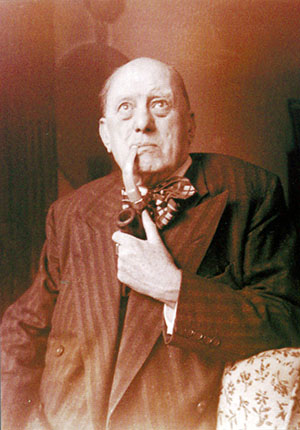
    Aleister Crowley (1875–1947)

    Crowley defined magick as “the science and art of causing Change to occur in conformity with Will.” The “change” Crowley refers to is psychological and spiritual transformation. This is accomplished by utilising the latent, psychic powers of the mind and activating the psycho-sexual power zones that reside in key areas of the body and the brain, the areas known as the chakras. As a necessary preliminary step towards making the “magick” happen, so to speak, the magickal practitioner must achieve contact with a genuine alien entity, something not connected to the practitioner’s own mind or body. Crowley referred to this entity by the rather fanciful name “Holy Guardian Angel” (HGA), and he described the experience of contacting the HGA somewhat less fancifully as obtaining “Knowledge & Conversation.” Crowley insisted that contact with the HGA was absolutely required before the magickal practitioner could hope to utilise the powers and energies of lesser entities such as spirits, elementals, demons and so forth (none of which, it must be remembered, can be wholly disassociated from the mind of the practitioner). And finally, Crowley insisted that each and every person on Earth must achieve contact with his or her own HGA if humankind is expected to advance. As Crowley writes:

    My observation of the Universe convinces me that there are beings of intelligence and power of a far higher quality than anything we can conceive of as human; that they are not necessarily based on the cerebral and nervous structures that we know; and that the one and only chance for mankind to advance as a whole is for individuals to make contact with such Beings.
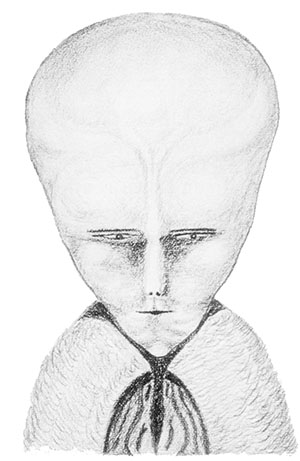
    Lam/Aiwaz

    This is one of the most important passages that Crowley ever wrote. Crowley offers a three-fold definition of an alien entity: (1) aliens are genuinely ‘alien’ since they exist apart from the physical and cerebral attributes of human beings; (2) aliens have a higher level of intellectual and cognitive ability than humans; and, most importantly, (3) aliens, being essentially magickal beings, are trans-dimensional, not extra-terrestrial. This last point is implicit in Crowley’s statement but it is there nonetheless. The magickal practitioner is expected to achieve the knowledge and conversation of the HGA via magickal or mystical methods; this entity can be summoned by magickal rites, whether evocations or invocations; it can be summoned by astral travelling or lucid dreaming; or the entity can be summoned in meditation and/or mystical trance. In contrast, extra-terrestrial entities cannot be reached by using any of these methods – they must be met face-to-face in real time, in a common, shared time-space continuum.

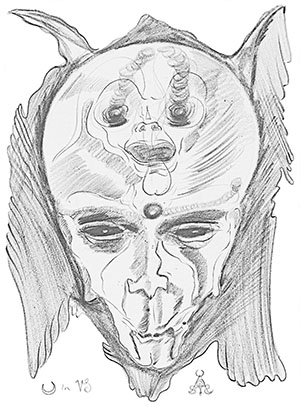
    In his lifetime Crowley achieved contact with only one alien entity of this nature, and that was the alien known as Lam or Aiwaz (the two are sometimes distinguished by occult scholars, but they were virtually synonymous in Crowley’s mind and I shall therefore speak of them as one entity in this essay). Lam was believed by Crowley to be an emissary of other aliens or “outer-ones”; Lam/Aiwaz was the entity that dictated the notorious Book of the Law, or Liber AL, to Crowley via the seer Rose Kelley in 1904. Crowley also had direct contact with Lam in America later in 1915 and 1919. Crowley drew a portrait of Lam and included it with some of his expressionist paintings in an exhibition held in Greenwich Village, New York City, 1919. This drawing was reproduced for the first time in The Equinox, Vol. III, No. 1 (1972); Kenneth Grant reproduced the same drawing in The Magical Revival (1972) and Outside the Circles of Time (1980). Lam has a small, diminutive body visible only from the chest on up, covered by a coarse, wool-textured robe. The area of the head above the eyebrows and the bridge of the nose is very high, bulbous and hairless; it is more than twice as long as the lower area. There is a faint, mushroom-cloud shape etched into the expansive forehead. The face itself is scrunched down low between the eyebrows and the chin; the eyes are narrow and slanted, the pupils tiny, the nose long, the mouth a mere slit. 

    When we compare the image of Lam with the descriptions of aliens given by contactees and abductees, there are striking similarities. Grey-skinned humanoids have been reported as being 3-4 feet tall with bald, elongated heads, black almond eyes and slits for mouths. There are descriptions of diminutive green humanoids, also bald with elongated heads, slanted eyes, slit-mouths. There are even accounts of small silvery creatures who resemble the other two types. Clearly, contactees and abductees are seeing the same sorts of entities that Crowley saw; the only difference is that Crowley’s entity was not coloured green, gray or silver. In this context, it is worth noting that all of these alien archetypes are virtually equivalent to the 1950s Hollywood Science Fiction versions of aliens – the big-brained, bug-eyed, little green or gray men that still crop up occasionally in SF films on TV and in the cinema today. 

    David J Skal, horror film scholar and author of The Monster Show: A Cultural History of Horror (1993), offers an interesting interpretation of the big-headed, bug-eyed alien stereotype. 
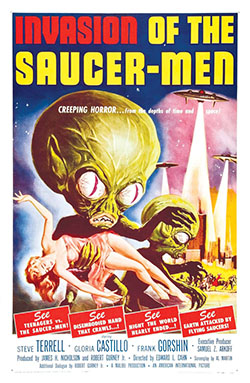
    Invasion of the Saucer Men (1957) boasted the most exaggerated eye-brain hypertrophy of all: aliens (played by dwarves) with heads shaped like gargantuan light bulbs, their bugging eyes the size of baseballs…. these new creatures anticipated not the violent rending of the body but its withering and atrophy. The future was about watching images and processing information; the eyes and brain were the only useful parts of the human form left…. ocular anxiety and depersonalization was reflected in films like The Beast with a Million Eyes (1955), The Crawling Eye (1958), and The Cyclops (1957).

    This is eerily applicable to our contemporary times where young millennials are addicted to their smartphones, cherishing them more, seemingly, than the hands that hold them, as they pump unceasing bits of social and entertainment data directly into their brains. Perhaps in the future, as our technologies advance and proliferate, we will see increasing levels of “ocular anxiety” and depersonalisation of the type mentioned by Skal. But this is more or less a human thing. Alien entities such as Lam do not have big heads because of information overload; they need the expanded cranial capacity to house their superior minds and apply their cognitive energy, enhanced as it is, to assist humankind in taking the next, necessary step towards enlightenment.

    Kenneth Grant & Ufologicks

    After Crowley’s death, his disciple Kenneth Grant (1924–2011) received a charter from Karl Germer, Crowley’s successor as Outer Head of the OTO, to set up a UK branch of the OTO. From its inception, Grant’s New Isis Lodge reflected Crowley’s hopes, which he articulated in his diaries during the last two years of his life, for a fundamentally different, re-structured OTO, focused less on initiation and more on promoting and fostering communication with alien entities.

    Elaborate ceremonial and the establishment of fixed Lodges in specific locales would be superseded by a fluid and far-flung web comprised of Thelemic power-zones. These power-zones would form a loosely-knit network of occult groups using the Ophidian Current to prepare human consciousness for intercourse with the denizens of other dimensions.

    Grant followed through on Crowley’s game-plan; he divided his “Typhonian” OTO as he called it into a series of disparate cells, each operated by either a single, dedicated magickal practitioner or by a small coven of practitioners. The main lodge facility was reserved for visiting magickal practitioners and performance artists who were allowed to stage their own creative rites on a first-come, first-serve basis, using lodge members occasionally for support and backup.
    Desmodus

    Grant, like Crowley, also contacted the HGA. Grant’s guardian angel was named Aossic-Aiwass, and not surprisingly it closely resembled LAM. Grant provides plates in the various volumes of his Typhonian Trilogies series that show the faces of the alien entities he communicated with over the course of his magickal experiments, both during his tenure as head of the New Isis Lodge and afterwards. These aliens also resemble Lam. An alien known only as Desmodus is shown in Plate 8 of Outer Gateways (1994); this was drawn by Grant. Desmodus’ face occupies only the lower half of the head; the rest is a high, bulbous forehead, with a small, weird face etched into the skin, smoke pouring out of its eyes. In Plate 29 of Beyond the Mauve Zone (1999) there is the drawing (also by Grant) of an alien priest. Like Aossic-Aiwass, the priest has a large, bulbous head, though the face is more normal looking. These examples are clear evidence the alien entities that haunted Grant’s magickal chambers and the chambers of his imagination are the same diminutive, big-brained creatures that appear to countless contactees and abductees. 

    Grant, likewise, accepted Crowley’s view that alien entities are trans-dimensional. In Outside the Circles of Time (1980), Grant calls into question the whole extra-terrestrial vs trans-dimensional dichotomy, seeing outer space as a form of inner space, especially when it comes to alien beings. This takes aliens out of their metal ships and plants them squarely in alternate dimensions. 

    Whether or not…. intrusion proceeds from actual entities in outer space is problematic; outer space may be another form of that inner space which comprises the mental or subjective universe.

    In a later, more penetrating analysis of the nature of aliens, in his Outer Gateways (1994), Grant rightly notes that the larger percentage of encounters involve aliens that are not flesh and blood but are actually magickal beings. Grant theorises that aliens are largely “etheric,” not quite astral-entities but closer in substance to the astral than they are to the physical. Grant extends this theory to include alien ships. These ships, according to Grant, are etheric – astral shells or capsules fabricated by the trans-dimensional aliens as a necessary by-product to assist in reification on the physical plane. 

    The substance of manifestation appears ….to be of an etheric as distinct from an astral nature. This supposition is suggested by the tangible quality of many of the objects observed. Sightings in this category appear to be far in excess of those in which the occupants of UFO’s are considered to be flesh-and-blood beings… that suggests that ufonauts are of a substance more subtle than their vehicles, as the astral body of man is more subtle, or less dense, than his physical body. Such might be the case, for example, if an astral entity fabricated for itself an etheric shell, or capsule, as in the practice known as the magickal assumption of god-forms.

    Grant coined the term “ufologicks,” which is phonetically similar to “magicks.” He defined ufologicks in obscure terms as “a suggested designation for the mantric vibrations associated with Gematria and with the power-wave impinging upon earth from Outside.” When we get past the over-inflated terminology, the meaning is rather simple: ufologicks is (or will be) a new magickal system focused primarily on rites that are specifically designed to enable magickal practitioners to contact alien entities like Lam, Aossic-Aiwass, or Desmodus. 

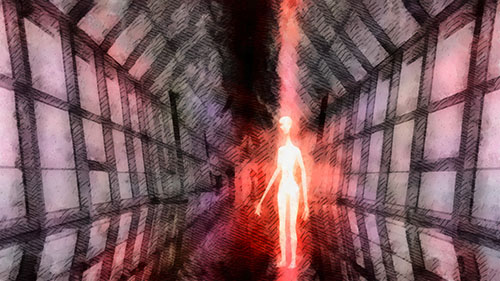
    Unfortunately, Grant died before he could take practical steps to implement this new system. But he did leave behind some notes on an improvised magickal rite which could be used to summon Lam. Grant instructs the magickal practitioner to gaze at the portrait of Lam, concentrating attention on the eyes. As concentration deepens, the eyes will start to enlarge, and they will suck you into the portrait so that you have the sensation of being inside the entity’s head. Then, Grant tells us, two paths are possible, either a “downward” or an “upward” path. Grant doesn’t elaborate on what might occur if the upward path is chosen, but he is very explicit about the downward option. The results are quite dramatic, and they deserve full quotation here. 

    If downward, the descent will be accompanied by a sensation of rushing air… A deep blackness will engulf the mind as one enters the dark tunnel beneath the mouth of Lam, and the wind will be replaced by the sound of rushing waters… [this] will awaken the image of an octopoid entity, the tentacles of which are the branchings of the tunnel below the mouth of Lam…. [A] fusion will occur between the eyes of Lam, in the region of the ajna chakra, and the flame will shoot aloft into the vast brilliance of a cranium that appears infinite in extent and dazzlingly lustrous. 

    This rite serves as an excellent example of what the formal rites for a ufologick lodge might have looked like if Grant had lived to establish his proposed magickal system. 
    Art by Raphael Terra © Esoterica Art Agency (esotericaartagency.com)

    As a parting concession to future ufologists, there is a curious and rather peculiar UFO-centric account of the creation of the world in one of Grant’s last books, Beyond the Mauve Zone (1999). Grant describes the appearance of an alien astronaut on Earth in ancient, pre-human times (the period is not specified). The alien presents itself in the guise of an eccentric, reclusive scientist. In his laboratory, the alien has set up a shrine to the goddess Nu-Isis, consisting of a statue of the goddess and an eternal flame burning in front of it. The statue is fashioned from a metal that cannot be found on Earth. She is a metallic, biomechanoid Earth-woman, reminiscent of the countless biomechanoid female aliens that proliferate in the canvasses of the Swiss artist H. R. Giger. The alien scientist feeds the statue with fluids drawn from elemental, astral entities. Eventually, the laboratory is destroyed by a massive explosion and the alien either perishes or escapes back to his own dimension. Much later a living human woman emerges from the ashes of the lab, born from the apocalypse of the explosion. She is Lura, daughter of the biomechanoid statue, who Grant describes as “the vitalised image worshipped and nourished by the scientist in the secrecy of his laboratory.” Along with the birth of Lura, humans begin to populate the Earth. Some of these humans are directly descended from Lura herself, the children of her sexual liaisons with Earth men, and these individuals are particularly suited to communicate with trans-dimensional alien entities. At the present day, the descendants of Lura are the magickal practitioners – magickians, mystics and psychonauts – who seek supra-human knowledge and power. 
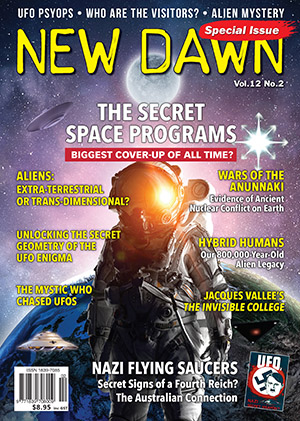
    Get the issue this article appears in

    Real or Not Real?

    Previously, I mentioned there is scant empirical evidence for the existence of aliens. This is especially true when it comes to the extra-terrestrial alien. In all fairness, it must be noted that the evidence for the existence of the trans-dimensional alien is equally weak. We have examined the testimony of Crowley and Grant, but is this any more reliable than the testimony of ufologists, contactees or abductees? The issue here boils down to the distinction between the imaginary world and the so-called ‘real’ world. Which is true? Or are both true? Or neither? In the last few decades, quantum physics has eroded our views about reality, and the theories of contemporary scientists are beginning to sound a lot like the theories of the magickal practitioners, both past and present. The line between what is real and what is not is no longer distinct, and in the absence of certainty we are free to believe what we will. 

    In this regard, I am reminded of Harry Potter’s final meeting with his mentor Albus Dumbledore near the end of the 7th book in J. K. Rowling’s Harry Potter series, Harry Potter and the Deathly Hallows (2007). Potter finds himself in an alternate dimension that looks like King’s Cross station, except that it is empty – no trains, no passengers and full of bright mist. Initially, Potter is surprised to see Dumbledore, because Dumbledore died in the previous book. After they converse, Potter asks Dumbledore: “Is this real? Or has this been happening inside my head?”, to which Dumbledore replies: “Of course it is happening inside your head… but why on earth should that mean that it is not real?”   

    [alert type=”general” dismiss=”no”]This article was published in New Dawn Special Issue Vol 12 No 2.[/alert]

    [alert type=”success” dismiss=”no”]If you appreciate this article, please consider subscribing to help maintain this website.[/alert]

    © New Dawn Magazine and the respective author.
    For our reproduction notice, click here.
  • The New Silk Roads: The Quiet Revolution

    The New Silk Roads: The Quiet Revolution

    From New Dawn 155 (Mar-Apr 2016)

    The late Australian geopolitical analyst James O’Neill wrote this article for New Dawn 155, published in 2016. As you will read, James accurately analysed and foretold the events that are unfolding today.

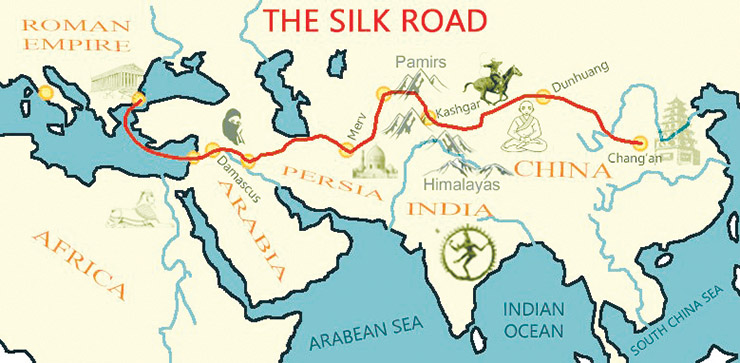
    In 1904 Sir Halford Mackinder gave a lecture to the Royal Geographical Society in London in which he set out a blueprint for change in the world’s geopolitical footprint. The centrepiece of Mackinder’s vision was the great land mass he called Euro-Asia, now better known as Eurasia.

    The heartland of this great landmass, a “world island,” was an area stretching in Mackinder’s vision from the Persian Gulf to the Yangtze River. We would now see it as from Vladivostok to the Baltic. Who rules the heartland, Mackinder argued, rules the World Island. Who rules the World Island “rules the world.”

    In Mackinder’s vision the less consequential hemispheres outside this controlling land mass included the United States and Australia. It might be argued that Mackinder underestimated the rise to dominance of the US in the hundred years following his address, but that dominance may be seen, in the broader sweep of history, as an aberration.

    American power, so dominant in the latter half of the twentieth century, is fading, being replaced by the re-emergence of Eurasia as the centre of economic, financial and geopolitical power. The self-styled “exceptional nation” (the US) has a fundamental problem with accepting the reality of that shift.

    One says re-emergence because the domination of the Western nations’ maritime, colonial and military power existed for a relatively brief period from the mid-16th to the latter 20th century.

    American foreign policy post-World War II has sought to maintain control of the world’s resources by building a comprehensive system of military bases that now number between 800 and 1,000, depending on definition, around the world. When viewed on a world map, the European, Asian and Pacific network of bases may be seen as effectively an encirclement of the Eurasian landmass, especially aimed at “containing” any expansion of Chinese and Russian influence.

    The military bases have been supplemented by a number of military alliances, of which the better-known ones are NATO, SEATO and ANZUS. Their common denominators are American control and the serving of American interests. Australians like to think of ANZUS as the bulwark of their defence network, but the treaty only requires the parties to “consult” in the event of an attack upon them. It is one of Australia’s more dangerous delusions.

    Asymmetrical Warfare

    More important than the military alliances, which are publicly portrayed as defensive in character, is the huge effort and resources devoted to asymmetrical warfare. This takes many forms. One form is the use of quasi-governmental organisations such as the US National Endowment for Democracy to finance and organise opposition groups with the aim of “regime change” to ensure a government in the target country that is amenable to American imperial interests. It is known that more than 70 countries since World War II have been subject to that kind of attention.

    Another form this asymmetrical warfare takes is the staging of false flag attacks that can be blamed on (generally) left wing groups, thereby ensuring the retention of power of conservative pro-American governments. Operation Gladio is the best documented of this type of subversion.

    A third favoured technique is the use of extremist proxy groups, of which the current incarnation is radical Islamists. That is not a new phenomenon, however, as its origins can be traced back at least to Operation Cyclone. That particular operation began in Pakistan in the 1980s where Muslim radicals (including the later infamous Osama bin Laden) were trained by the Americans to infiltrate and disrupt non-compliant governments.

    An obvious target was the leftist nationalist government of Afghanistan, but in fact the intended targets for infiltration, subversion, sabotage, assassinations and general mayhem included Iran, the then Soviet republics to the north of Afghanistan, and the Muslim Chinese region of Xinjiang.

    The CIA was the source of many of these policies. Finance for the operations, which had to be shielded from US congressional scrutiny, came largely from control of the production, distribution and sale of illegal narcotics.

    As Peter Dale Scott, Alfred McCoy and others have documented, CIA control of the world’s narcotics trade can be traced to the South East Asia Golden Triangle, for which the American War in Vietnam provided so many lucrative opportunities, to Afghanistan’s heroin. The latter provided 93% of the world’s supply. The Taliban government had virtually eliminated that industry during their period in power in the 1990s. It was no coincidence that following the invasion and occupation of Afghanistan by the US and its allies including Australia, one of the earliest major changes was a reinstatement of the heroin industry. Bagram air base north of Kabul became the major departure point for heroin distribution. Camp Bond Steel in Kosovo, the largest American base in Europe, but almost completely absent from the pages of the Western press, functions inter alia as a major transit point for heroin into Europe.

    Colombian cocaine performs a similar function for the American market. Daniel Hopsicker has brilliantly exposed the interconnections between Colombian cocaine, the CIA and American politicians at the highest levels of government.

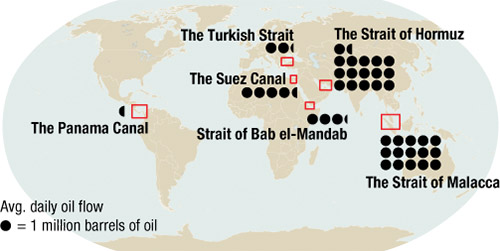
    The final component of this strategy was for the US Navy to control the world’s great maritime “choke points.” These are the narrow sea-lanes through which the great preponderance of the world’s maritime trade must pass.

    There are seven such great choke points. In each of these there is either direct US control (e.g. the Panama Canal); a significant American military presence that either controls the choke point (Persian Gulf, Straits of Malacca, Straits of Hormuz); or has a significant military presence (air, sea and land based) in close proximity. The US 6th Fleet in the Mediterranean (Suez Canal) and the 7th Fleet in Bahrain supplement land bases also in close proximity.

    Such unipolar dominance and actual or implied military threats is clearly intolerable to the other great powers of Eurasia – Russia and China. The pressure to respond has become increasingly acute in recent years as the US, through its NATO arm, has steadily moved further East in direct contradiction to assurances given to Russia at the end of the Cold War. The American organised coup d’état in Ukraine clearly crossed a red line as far as the Russians are concerned.

    One Belt, One Road

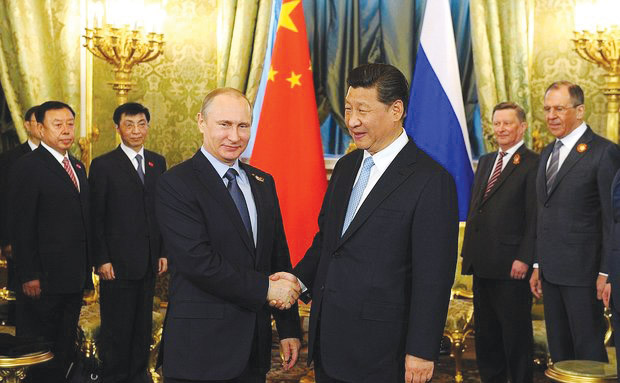
    The response of China and Russia to these endless provocations has taken many forms, which either individually or collectively, amount to a quiet revolution that is fundamentally reshaping the post World War II geopolitical structure. This revolution is being achieved without a single coup, invasion, acts of subversion or assassination of an unfriendly leader. Much less are there threats or sanctions. The revolution is predicated upon what Chinese President Xi Jinping likes to refer to as a “win-win” policy. 

    Xi first presented his vision of a One Belt, One Road policy in a speech to the Indonesian parliament in October 2013. Chinese attempts to reform existing financial and trade institutions were repeatedly stalled or rebuffed. US foreign policies, of the type noted above, showed no inclination to change. If China was not to be eventually trapped by the tightening US noose, a bold new initiative was required.

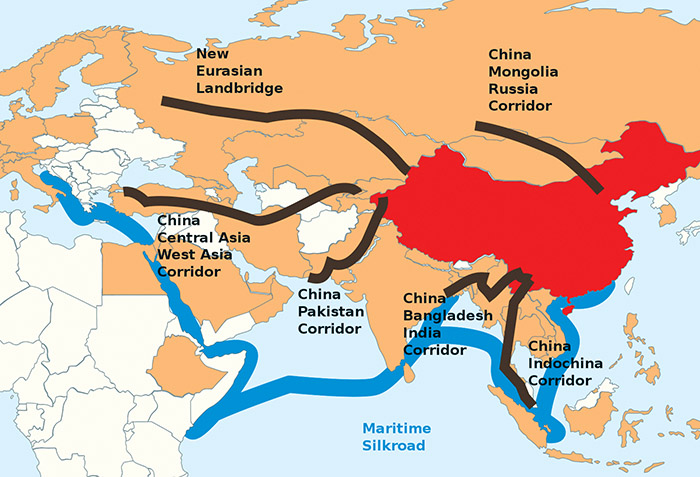
    Since then, events regarding the New Silk Roads, as the policy is known in the West, have moved with dizzying speed. Scarcely a week passes without major new announcements, and any listing would rapidly become obsolete. The framework for Xi’s initiative was already in place as discussed below. The interested reader can readily ascertain details of the land and maritime routes that are incorporated in the plan.


    Chinese President Xi Jinping

    The main focus here is to put the New Silk Roads into their geopolitical context, and then to examine the implications for the changing world order and the challenges it poses for countries such as Australia.

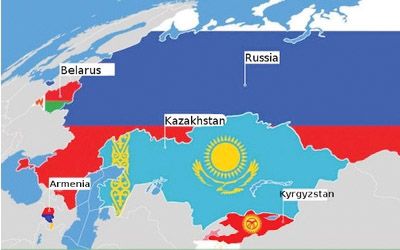
    Chronologically, the first development was the creation of the Shanghai Cooperation Organisation (SCO) in 1996. There are currently six member nations: China, Kazakhstan, Kyrgyzstan, Russia, Tajikistan and Uzbekistan.

    There are a further six states with “observer status”: Afghanistan, Belarus, India, Iran, Mongolia and Pakistan. India and Pakistan have been granted membership and will formally become full members in 2016.

    Iran’s accession to full status has been hampered by Western inspired sanctions. The ostensible reason for the sanctions was Iran’s “nuclear weapons program.” All 16 US intelligence agencies have on two occasions concluded there was no such program.

    That did not stop the customary belligerence from Israel, an actual nuclear-armed state, that the Western press carefully avoids acknowledging. Neither did it lessen the sanctions regime imposed by the West [Editor’s note: In January 2016, the West lifted sanctions against Iran following the implementation of a deal negotiated in 2015. In 2018, under President Trump, the US reneged on the deal and reimposed sanctions on Iran]. The real reason for the sanctions had more to do with placating Israel and Saudi Arabia and the lingering dislike for Iran by the Americans for having the temerity to overthrow the US backed dictator. The Shah had been imposed on Iran following the CIA-MI6 organised coup against the secular Mosaddegh government in 1953. The coup was on behalf of the Anglo-American Oil Company (now BP) whose assets had been nationalised by the Iranian government.

    As with so much of the politics of south-west Asia, an understanding of geopolitics is only ascertainable when one appreciates the central role of oil and gas resources, and the insatiable desire of the West to control those resources for their own benefit.

    The execrable Saudi regime is only tolerated by the West because it is the world’s largest source of oil. Its importance to the West was reinforced by the then secret agreement entered into in 1973 between the Saudis and the Americans that all oil sales were to be denominated in US dollars.

    This latter fact has been a principal reason why the US dollar has been able to defy economic logic and maintain its position, until very recently, as the world’s sole reserve currency.

    The decisions by Saddam Hussein in Iraq and Muammar Qadhafi in Libya to accept payment for oil and gas in other than US dollars was undoubtedly a major factor in the illegal regime change imposed on their countries in 2003 and 2011 respectively. That both countries have among the world’s largest known reserves of oil and gas was also a significant factor. The blowback from those two disastrous interventions reverberates today. 

    Brazil, Russia, India, China and South Africa (BRICS) were the next major geopolitical grouping. Preliminary discussions began in 2006, although the first formal summit was not until 2009. South Africa joined in 2010.

    China, India and Russia are the common basis of membership of both the SCO and BRICS. Between them they account for approximately 40% of the world’s population. China, India and Russia are all major components, geographically as well as in population terms, of Mackinder’s World Island. Brazil is by far the largest nation of South America, and South Africa was until 2015 the richest African nation. Both South America and Africa are key elements of China’s diversification in the supply of its raw materials.

    BRICS Bank & AIIB

    An important but little reported upon event, in the Western press at least, is the formation of the BRICS Bank, and the decision by its members to trade in their own currencies rather than through the medium of the US dollar. This is a significant move in a wider series of moves to fundamentally alter the dollar based financial system that has dominated world trade in the post World War II era.

    The third major Eurasian development was the creation of the Eurasian Economic Union (EEU), the formal establishment treaty for which was signed in May 2014 with the customs union coming into force from 1 January 2015. Its members are Armenia, Belarus, Kazakhstan, Kirghizstan and Russia. Again, the overlap with membership of the SCO is readily apparent.

    Some observers have derided this development as Russian President Vladimir Putin’s attempts to recreate the old Soviet bloc. This is typical of the ideologically driven comment that passes for analysis where Russia is concerned. The Russian leadership had for some years tried to interest the European Union in a grand free trade area from “Lisbon to Vladivostok.” It was only when these efforts were repeatedly rebuffed that the EEU was born.

    There have already been formal links established between the EEU and the SCO covering a wide range of areas of co-operation. Again, one of the most significant developments is that the trade relations between the member countries of the two groupings are denominated in other than US dollars.

    The fourth development in this context of enormous significance is the establishment of the China led Asian Infrastructure Investment Bank (AIIB). It was formed in 2014 and 57 countries have already signed up, including Australia, Germany, France, Italy, New Zealand and the United Kingdom.

    The conspicuous absentees from the founding nations are Japan and the United States. The European nations, Australia and New Zealand signed up in the face of significant American pressure not to do so. This was a rare example of those countries acting in their own national interests, as opposed to American interests.

    One of the functions of the AIIB will be to fund the huge infrastructure projects that are a central element of Chinese President Xi’s vision for an alternative world order to one that is run by and on behalf of the Americans.

    To nobody’s surprise the Americans have not quietly acquiesced in this fundamental realignment from a unipolar to a multipolar world. Their response has taken a number of forms, two of which may be briefly noted here. 

    The American Response

    The first is a series of military and political moves designed to exert pressure on Russia and China in particular. In Russia’s case that has included the almost unparalleled demonisation of Russia in general and President Putin in particular. 

    The coup in Ukraine noted above was followed in quick succession by Crimea rejoining Russia, and the shooting down over eastern Ukraine of Malaysian Flight MH17. Despite Crimea’s long history as an important part of Russia, and that the decision by Crimea to leave Ukraine and apply to join the Russian Federation followed an overwhelming popular vote for that course, it is consistently portrayed in the Western media as an example of “Russian aggression,” an “annexation” and a demonstration of Mr Putin’s alleged imperialistic ambitions.

    Despite very strong evidence that the shoot down of MH17 was carried out by Ukrainian forces, the Western media portrayed it as “Putin’s missile.” All evidence to the contrary, as with the recent Dutch Safety Board Report into the crash, is simply ignored or misrepresented. Appendix T of the Report, for example, said that the missile was fired from an area contested by both the separatists and Ukrainian forces. The Report also said there was no evidence separatists had possession of BUK missiles or the technical capacity to fire them.

    Notwithstanding this clear evidence, [then]-Australian Foreign Minister Julie Bishop claimed that separatists from a separatist controlled area had fired the missile. This blatant misrepresentation was simply reported by the media without correction or comment.

    The American led sanctions against Russia for its alleged transgressions in Ukraine have hurt the European nations more than it has hurt Russia. A direct consequence of these ill-conceived policies has been the acceleration of co-operation and mutual assistance by Russia and China. Throughout 2014 and 2015 these two countries have signed a plethora of agreements in trade, defence, and infrastructure development that are worth significantly more than two trillion dollars.

    In the Asia-Pacific region the American response has been to step up its so-called pivot to Asia. In reality, this is no more than a continuation of long standing American interference in the region. The devastation wrought on Cambodia, Laos and Vietnam from the 1950s to the 1970s is only one such example.

    The current policy is clearly to engage in a series of provocations against China in the South China Sea. When one looks at a map of American bases in near proximity to China, and the concentration of naval, air and land forces at those bases, just who is being belligerent is immediately obvious.

    Get the issue this article appears in

    New Silk Roads

    One of the most important features of the New Silk Roads policy being developed at a rapid pace by China and its allied countries in BRICS, the EEU and the SCO, is that the vast energy and mineral resources of Russia, Mongolia and others in these groupings, are capable of meeting all of China’s needs without recourse to Australian resources. China also has the option of sourcing its energy and mineral needs from its rapidly expanding links in Africa and Latin America.

    When China is contemplating further large scale purchases of iron ore, copper, bauxite etc., is it more likely to turn to its land based neighbours and other friendly nations in Africa and Latin America, or will it continue to buy from an Australia that persists in its slavish adherence to US foreign policy imperatives? The answer to that question is something that should be giving Australian policy makers serious concern.

    The New Silk Roads therefore is a great deal more than just the world’s largest infrastructure project. It is much more than the linking, through multiple high speed rail links over 12,000 kilometres of the Eurasian landmass from Vladivostok to Berlin.

    As important and frankly exciting as these huge infrastructure projects are, the longer-term significance lies in the development of a wholly different financial structure. The major instruments of Western economic hegemony, the IMF and the World Bank, the interbank credit system and many more, have proved incapable of reform. A range of financial institutions is progressively replacing them in arrangements created by the SCO, BRICS and EEU.

    Perhaps most significantly of all, countries trading in their own currencies, or through Special Drawing Rights that now include the Yuan, are steadily replacing the US dollar. The scramble by traditional financial centres such as London and Frankfurt to be part of this financial revolution is a very clear indicator they at least recognise the emerging geopolitical reality.

    The overriding geopolitical question is whether so-called Western nations such as Australia recognise these changing realities and adapt accordingly, or whether they remain mired in the old Anglo-American world and its increasingly irrelevant certainties. Making the right choices dictates whether the future is one of prosperity as an active and vital component of Mackinder’s World Island, or as one of the losers in a nuclear showdown that existing Western policies almost certainly foreshadow.

    [alert type=”general” dismiss=”no”]This article was published in New Dawn 155.[/alert]

    [alert type=”success” dismiss=”no”]If you appreciate this article, please consider subscribing to help maintain this website.[/alert]

    © New Dawn Magazine and the respective author.
    For our reproduction notice, click here.
  • The Twisted History of the Swastika

    The Twisted History of the Swastika

    From New Dawn Special Issue Vol 10 No 2 (May 2016)

    If you were asked to come up with a symbol for evil, very likely you would think of the swastika. The quintessential emblem of the Third Reich, it still evokes hatred and fear seventy years after the collapse of the Nazi regime.

    And yet not so long ago it was a symbol of blessings and good fortune. Even its name is derived from Sanskrit roots meaning “it is good.” (Other names given to it include the cross patteé, the gammadion, the hakenkreuz or hooked cross, and the fylfot.) Today, in a somewhat truncated form, it still occupies a place in the official symbol of the Theosophical Society.

    The peculiar fate of the swastika has a great deal to teach about the nature and meaning of symbols – and about the uses to which they can be put.


    Pottery fragment with swastika, dating to 7,000 years ago, from Bulgaria. 

    The swastika occurs almost universally. The most ancient version known is on a carved tusk from the Ukraine, dated to around 10,000 BCE. Other early instances were found at Hissarlik in western Asia Minor, where Heinrich Schliemann, often called the father of archaeology, unearthed the ruins of Troy in 1873. The swastika begins to appear in the city’s third stratum, dated to 2250–2100 BCE. It is on spindle-whorls, a sphere, and a statue made of lead thought to be an image of the goddess Artemis. The vulva (or perhaps the mons veneris) of this figure has a swastika in the middle. One scholar interpreted it as representing “the generative power of man.”1


    Seals, showing swastikas, from the Indus Valley Civilisation (3300–1300 BCE)

    Schliemann himself, following orientalist scholars of his time, said that the swastika was “of the very greatest importance among the early progenitors of the Aryan races in Bactria and in the villages of the Oxus, at a time when Germans, Indians, Pelasgians, Celts, Persians, Slavonians and Iranians still formed one nation and spoke one language.”2

    But the swastika is found far beyond the traditional provenance of the “Aryan races.” Thomas Wilson, who wrote a study on it for the Smithsonian Institution in the late nineteenth century, lists examples from ancient sites ranging from Japan to Europe to North and South America. It’s quite apparent that the swastika belongs to everybody and to nobody.

    Before we go into the swastika’s history, it might be best to clear up one source of confusion: its orientation. You will often hear it said that the “clockwise” direction of the swastika is the “good” direction, while the “counterclockwise” direction is the “bad” one.

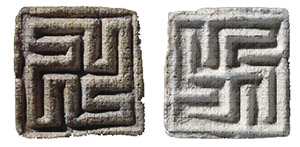
    To begin with, consider these two images:

    Figure 1 (left): Left-facing or “clockwise” swastika.
    Figure 2 (right): Right-facing or “counterclockwise” swastika.

    Which of these looks clockwise to you? To me, either one could be seen as clockwise, or counterclockwise, so I will avoid these terms. Instead I will speak of “left-facing” (for diagram 1) and “right-facing” (for diagram 2) swastikas. (If you’re curious, the left-facing one is most often described as clockwise.)

    You can also forget about which direction is the good one or the bad one. Traditionally there seems to be no difference, and often both types appear in the same location – for example, on the curtain of a Tibetan temple devoted to the Bönpa, the nation’s pre-Buddhist shamanistic religion.3 Similarly Thomas Wilson, introduced to a member of a Chinese delegation visiting Washington, found him wearing robes of state emblazoned with both versions of the swastika. “The name given to the sign was… wan, and the signification was ‘longevity’, ‘long life’, ‘many years’,” Wilson writes. “Thus was shown that in far as well as near countries, in modern as well as ancient times, this sign stood for blessing, good wishes, and, by a slight extension, for good luck.”4


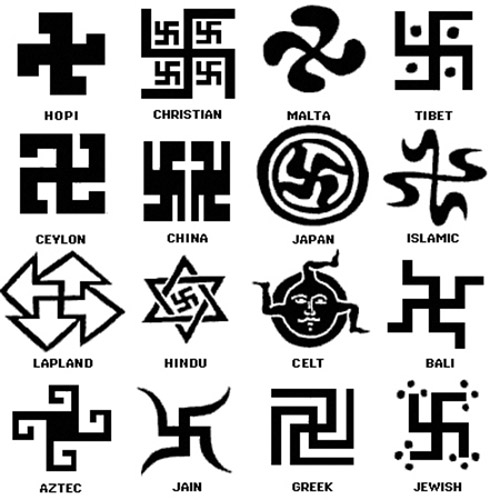
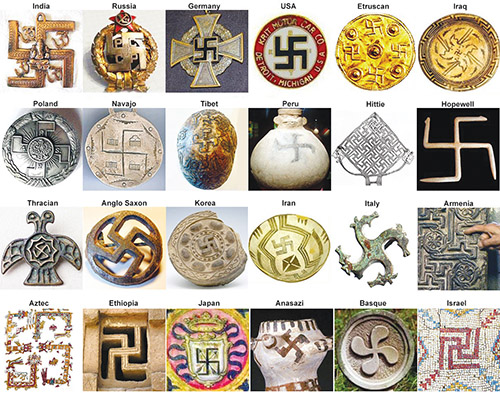
    The swastika occurs almost universally across the world in diverse cultures, religions and regions. Above are just some of the swastika’s renditions in art and religious symbolism.

    Swastika: From Good to Evil Symbol

    So how did it come to stand for the complete opposite: hatred, violence, and cruelty?

    Some historical background is needed. In 1871 Germany, which for centuries had been fragmented into dozens of tiny and often overrun states, was unified into a single empire, or Reich, by the Prussian chancellor Otto von Bismarck. Naturally Germans began to feel a thirst for a shared national identity. This began to form under a range of influences, from the treatise on Germany by the Roman historian Tacitus to the operas of Richard Wagner.

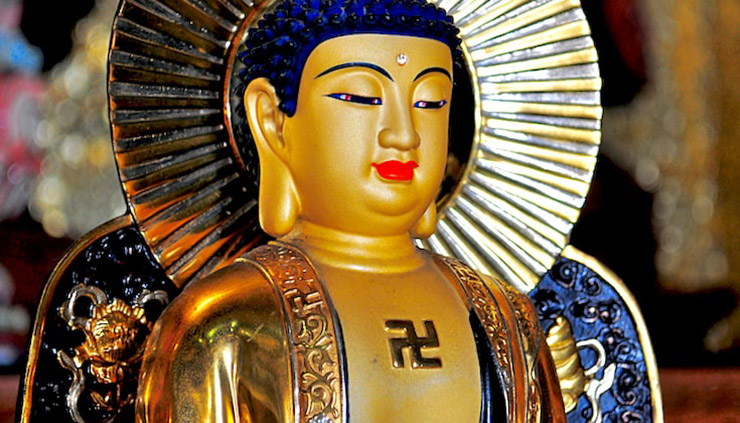
    In Asia, the swastika is a centuries-old positive symbol of peace, auspiciousness and good fortune. It can be found on Buddha statues as well as temples.

    An identity is created out of many things, including the things you are against. Thus anti-Semitism soon became part of this German identity. Anti-Semitism had deep roots in Germany, going back at least as far back as Martin Luther, who in 1543 published a vituperative book entitled On the Jews and Their Lies. 

    Opposed to the Jews were, so the theory went, the Aryans. The word comes from the Sanskrit arya, meaning “noble,” and originally referred to the Indo-European peoples who conquered the Indian subcontinent in the second millennium BCE. But soon it came to mean, above all else, the pure, white European race, which had reached the summit of perfection in the Germans.

    What could serve as a symbol for this race? The cross was tainted by Christianity, which after all was founded by Jews. The fact that Schliemann had found the swastika in the ruins of Troy and Mycenae, the homes of an ancient, noble, and presumably Aryan race, spoke in its favour. It was (and is) found universally in India too, which had given the Aryans their name. And there was the verdict of the French symbologist the Count Goblet d’Alviella, who asserted that the swastika “is not met with in Egypt, Chaldea, or Assyria” – the last two being Semitic nations.5

    By the twentieth century, occult and pseudo-occult groups invoking the Aryan legacy were displaying the swastika. Hitler’s connection with these groups is suppositional at best, but it is fairly certain that he read and collected issues of the journal Ostara, founded in 1905 by the occultist Jörg Lanz von Liebenfels. The magazine’s subtitle – “Newsletter of the Blonds and Male Supremacists” – gives a good idea of its orientation. Its emblem was a knight in a hooded robe covered with swastikas.

    Other extreme groups made use of the symbol as well, such as the Germanenorden, an occult lodge focused on ancient Germanic lore and of course anti-Semitism. Its founder was a self-styled aristocrat named Rudolf von Sebottendorff. As the German Reich collapsed in the fall of 1918, the order recast itself as the Thule Society (after Thule, a mythical polar land). Its symbol was a long dagger superimposed on a swastika sun wheel. 

    On 9 November 1918 – two days before Germany’s surrender in World War I – Sebottendorff delivered an impassioned speech to the Thule Society. Because of the imminent defeat, he declaimed, “in the place of our princes of Germanic blood rules our deadly enemy: Judah.” He urged his audience to fight “until the swastika rises victoriously out of the icy darkness.”6

    Direct connections between the Thule Society and the nascent Nazi movement are somewhat hard to trace, but there was at the very least an overlap of membership. In May 1919 a Thule member named Friedrich Krohn proposed the left-facing swastika as a symbol for the Deutsche Arbeiterpartei (“German Workers’ Party,” or DAP), the precursor of the Nazi party.

    Krohn evidently preferred this direction because he considered it auspicious, whereas he said the right-facing version portended disaster and death. But as Nicholas Goodrick-Clarke writes in his Occult Roots of Nazism, “there was no standard usage regarding the swastika” in this movement (or, as far as I can tell, anywhere else). The Germanenorden itself had used the right-facing version. Finally Hitler, who joined the party in November 1919 and soon rose to its leadership, chose the right-facing version, for reasons that are not clear.7

    But the meaning was clear. In his autobiography, Mein Kampf, Hitler writes: “The swastika signified the mission allotted to us – the struggle for the victory of Aryan mankind and at the same time the triumph of the ideal of creative work which is in itself and always will be anti-Semitic.” He credits himself with the design:

    After innumerable trials I decided upon a final form – a flag of red material with a white disc bearing in its centre a black swastika. After many trials I obtained the correct proportions between the dimensions of the flag and of the white central disc, as well as that of the swastika… The new flag appeared in public in the midsummer of 1920. It suited our movement admirably, both being new and young. Not a soul had seen this flag before; its effect at that time was something akin to that of a blazing torch.8

    This, by the way, is the standard Nazi swastika:

    Figure 3: Nazi swastika.

    Notice one thing about this version. As figures 1 and 2 indicate, the traditional forms of the swastika appear in full vertical and horizontal orientation. But the Nazi swastika is decussated: it is cocked to a tilt of 45 degrees. This gives a greater impression of movement, possibly of a destructive kind. In this position it looks like a whirling blade. Hitler may have adopted it for this reason.

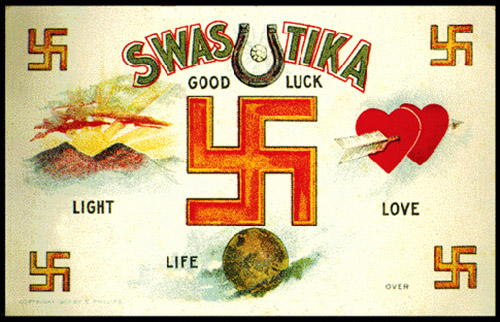
    Nevertheless, the swastika did not have these meanings elsewhere in the world. In the US it remained a good-luck sign, as evidenced by its use in the house organ of the Girls’ Club, called The Swastika (left). Up to the 1930s, the symbol appeared – with perfectly innocent intentions – on American goods ranging from poker chips and playing cards to the labels of fruit boxes. It was even the emblem of a lovable cartoon monkey named Bing-o. To this day in Asia it is still used, with auspicious connotations, on commercial signs and in religious ritual.9 

    But after Hitler came to power in 1933, the Western world came to link the swastika with hatred and violence. A synagogue in Hartford, Connecticut, had swastika patterns in its flooring, which the horrified congregation had to have paved over. When swastika flags were hoisted over three ocean liners docked in New York in 1935, a mob of 2,000 people tore them down, provoking diplomatic protests from the Nazis. The swastika became so firmly equated with evil that it remains an emblem of fear for many – and for many others, it is still used for that purpose. The incarcerated cult leader Charles Manson carved it into his forehead in 1970.10 It continues to surface among anti-Semites and fascists of various stripes. The present-day German republic forbids its public display.


    The swastika appeared – with perfectly innocent intentions – on American goods ranging from poker chips and playing cards to the labels of fruit boxes. Above: Early 20th century postcard.

    What Does the Swastika Actually Symbolise?

    All this gives a brief history of the use and abuse of the swastika in modern times. But what does the symbol really mean? This question is, I believe, not only difficult but unanswerable. But before I say why, let’s explore some of the meanings that have been ascribed to it.

    One interpretation is given by Schliemann, citing a scholar named Émile Bournouf:

    The 卐 represents the two pieces of wood which were laid cross-wise upon one another before the sacrificial altars in order to produce the holy fire (Agni), and whose ends were bent round at right angles and fastened by means of four nails, so that this wooden scaffolding might not be moved. At the point where the two pieces of wood were joined, there was a small hole, in which a third piece of wood, in the form of a lance (called Pramantha) was rotated by means of a cord made of cow’s hair and hemp, till the fire was generated by friction.11

    The swastika is thus associated with fire – particularly the sacred fire known as agni, which is not to be confused with the physical manifestation per se. Because this fire is caused by friction, the swastika is also associated with motion. And from its shape, it is connected with the cross. Thus the swastika can represent a cross in motion. George S. Arundale, late president of the Theosophical Society, writes:

    All that you feel in the sea you can feel infinitely more in the whirling of the Svastika [sic], for you yourselves are part and parcel of the whirling. The Svastika whirls because a God has set in motion the Wheel of the Law, and it is as if to its myriad spokes clung innumerable drops – the Men who are to become Gods.12

    This passage is taken from Arundale’s Lotus Fire, a profound work that explores a sequence of symbols (the point, the web, the line, the circle, the cross, the swastika, and the lotus) that was, he claimed, “disclosed to me by a Lord of Yoga.”13 Arundale also observes:

    I see… a very special appearance of relentlessness to the movement of the Svastika and to its effect upon the Men of the Sea [i.e., unindividuated beings] whom it frictions into ever-increasing Self-consciousness. The well-known phrase “broken on the wheel” – that horrible physical torture of earlier periods of history, perpetuated in modern days in terms of the mind, so that the inquisition of today is breaking its victims on the wheel of the mind, a terrible desecration of the Wheel of the Law… – occurs to me, for indeed [it is] ignorance which is broken upon the Wheel of the Love of God, the Wheel of His Salvation, the Svastika (emphasis added).14

    Although Arundale is writing in the 1930s, he does not seem to have Nazism per se in mind. Nevertheless, his association of the swastika with relentlessness and with “breaking on the wheel” suggests a possible bridge between its ancient, esoteric meaning and its present sinister connotations.


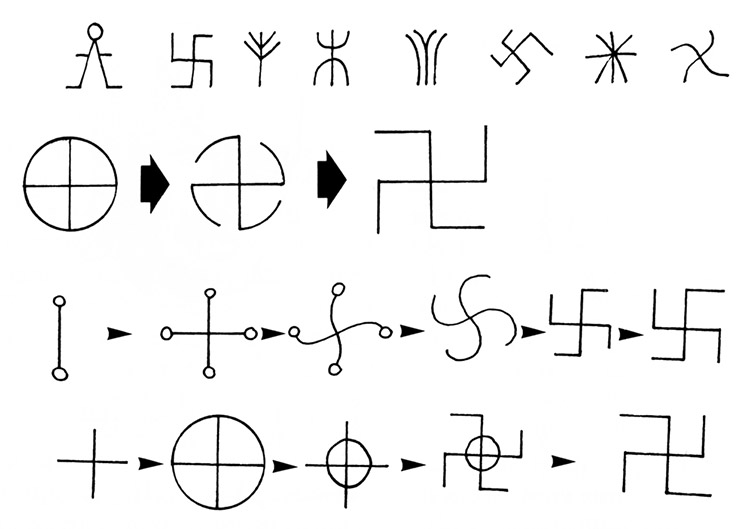
    The evolution of the swastika. Top line (1): Hallristningar, ancient Scandinavian rock-scribings. (2): In The Book of Signs, Rudolf Koch suggested the swastika evolved by the breaking of a sunwheel’s circumference. (3): In 1933, Herman Wirth said the swastika evolved from a runic character. (4): In his book The Sacred Symbols of Mu, James Churchward claimed the swastika had begun with the simple cross.

    H.P. Blavatsky, identifying the swastika with “Thor’s hammer” or “the hammer of creation,” says:

    In the Macrocosmic work, the “Hammer of Creation,” with its four arms bent at right angles, refers to the continual motion and revolution of the invisible Kosmos of Forces. In that of the manifested Kosmos and our Earth, it points to the rotation in the circles of Time of the world’s axes and their equatorial belts; the two lines forming the Svastika 卐 meaning Spirit and Matter, the four hooks suggesting the motion in the revolving cycles (emphasis Blavatsky’s).15

    Other authorities have also linked the swastika to cosmic cycles. The French esotericist René Guénon writes:

    The bent part of the arms of the swastika is considered… as representing the Great Bear seen in four different positions in the course of its revolution around the Pole Star, to which the centre of the four gammas are united naturally corresponds, and that these four positions are related to the cardinal symbol points and the four seasons.16

    Figure 4: The swastika seen as an arrangement of four Greek gammas (Γ).

    Guénon is talking about the fact that the four arms of the swastika resemble four gammas (the Greek capital gamma looks like this: Γ) positioned around a centre point. He connects this fact with the symbolism of the letter G – the Roman equivalent of the gamma – in Masonry. Hence also the name gammadion.

    Furthermore, this centre point would be the pole. (The point of view would be of someone looking down at the earth from above the North Pole.) For this reason, Guénon associates the swastika with Hyperborea, a prehistoric circumpolar civilisation that was said to precede Atlantis.17 (Note: this is not to be confused with Blavatsky’s concept of the Hyperborean Root Race.)

    So, then, the swastika is, or may be, connected with the four principal directions, portrayed symbolically as a cross. If so, then the decussated Nazi swastika would symbolise directions that are askew, and hence a world out of joint, possibly evil.

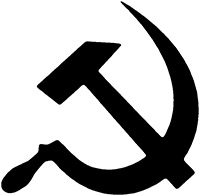
    Figure 5: The Soviet hammer and sickle. Conventionally it refers to the combined power of the workers (represented by the hammer) and the peasants (represented by the sickle).

    Incidentally one could say the same thing about the Soviet hammer and sickle. In essence it is nothing other than the cross (in this case, a T-cross) combined with the crescent – two of the most ancient and universal sacred symbols. But again its orientation is not rectilinear. Like the Nazi swastika, it is decussated – again suggesting something that is aberrant, out of joint, or evil.

    At any rate, these are some of the esoteric meanings associated with the swastika: sacred fire (or primordial energy), a cross in motion, movement, the North Pole and the four directions. Of course they do not contradict each other, because a symbol is a nexus of meanings and associations, not a series of propositions that can be consistent or inconsistent.

    Earlier I said that none of these associations, singly or as a whole, exhausts the meaning of the swastika. That’s because the swastika, like all other primordial symbols, has no ultimate meaning. It means itself. It speaks to a level of the mind that lies beyond the realm of meaning as we normally understand it. The same is true of other basic geometric shapes such as the six-pointed star and the crescent, the defining symbols of Judaism and Islam. These symbols will keep their living force for as long as the human mind is as it is. Meanings and movements will attach themselves to them and will try to draw power from them, often with success. Yet meanings come and go, while the symbol remains.

    As theologian Paul Tillich writes, religious symbols open “the depth dimension of reality itself, the dimension of reality which is the ground of every other dimension and every depth… the fundamental level, the level below all other levels, the level of being itself… If a religious symbol has ceased to have this function, then it dies. And if new symbols are born, they are born out of a changed relationship to the ultimate ground of Being, i.e., to the Holy.”18

    I believe that Tillich is right up to a point, but it is not so obvious to me that symbols – the primordial symbols, at any rate, of which the swastika is one – die. Or if they die, they are born again. Maybe it would be more accurate to say that they are recycled.

    Get the issue this article appears in

    In recent years some have tried to cleanse the swastika of its evil connotations. In 1988–92 a Jewish artist named Edith Altman created an installation entitled Reclaiming the Symbol: The Art of Memory. In one scene, she has a gold swastika painted on a wall above a black Nazi swastika painted on the floor – a visual attempt to expunge evil from the symbol. In 2008, in a ham-handed effort to make the swastika humorous, cartoonist Sam Gross published We Have Ways of Making You Laugh: 120 Funny Swastika Cartoons. (Sample: a Nazi dropping garbage into a swastika-shaped bin labelled “White Trash Only.”)

    But as graphic artist Steven Heller comments: “For every naïve rock-and-roller who thinks the swastika can be used with irony, there is a fervent neo-Nazi who uses it with malice. For every well-meaning artist who thinks the swastika can be tamed, there is a devout racist who embraces it.”19

    In the long run, it’s likely that the swastika will be rehabilitated. Theosophist Arthur M. Coon observes:

    The memory of the use of the swastika, as an emblem of Nazism will in future ages have faded to oblivion; while its true meaning as a symbol of the hidden “fire” or “spirit” within all manifestation, from the atom to a solar universe, will become increasingly revealed to humanity.20

    But I suspect that these future ages will not, at least in the West, come in the lifetime of anyone who is breathing on this planet now.

    This article first appeared in Quest: Journal of the Theosophical Society in America (Winter 2016), and is reprinted with permission.

    [alert type=”general” dismiss=”no”]This article was published in New Dawn Special Issue Vol 10 No 2.[/alert]

    [alert type=”success” dismiss=”no”]If you appreciate this article, please consider subscribing to help maintain this website.[/alert]

    Footnotes

    1. Thomas Wilson, The Swastika: The Earliest Known Symbol and Its Migrations, with Observations on the Migrations of Certain Industries in Prehistoric Times, Government Printing Office, 1896, 811–13, 829
    2. Henry [Heinrich] Schliemann, Troy and Its Remains: A Narrative of Researches and Discoveries Made on the Site of Ilium, and in the Trojan Plain, Edited by Philip Smith, John Murray, 1875, 102
    3. Christoph Baumer, Tibet’s Ancient Religion: Bön, Translated by Michael Kohn, Weatherhill, 2002, 21
    4. Wilson, 800
    5. Count Goblet d’Alviella, The Migration of Symbols, Archibald Constable, 1894, 40
    6. Nicholas Goodrick-Clarke, The Occult Roots of Nazism: Secret Aryan Cults and Their Influence on Nazi Ideology, New York University Press, 1985, 144–45
    7. Ibid., 151
    8. Adolf Hitler, Mein Kampf, Translated by James Murphy, chapter 7, www.greatwar.nl/books/meinkampf/meinkampf.pdf; accessed Aug. 27, 2015
    9. Steven Heller, The Swastika: Symbol beyond Redemption?, Allworth, 2000, 37, 90–101, 149
    10. Ibid., 13
    11. Schliemann, 103–04; cf. H.P. Blavatsky, Collected Writings, 15 vols., Edited by Boris de Zirkoff, Theosophical Publishing House, 1966–91, 2:143–44
    12. George S. Arundale, The Lotus Fire: A Study in Symbolic Yoga, Theosophical Publishing House, 1939, 225
    13. Ibid., 22
    14. Ibid., 267–68
    15. H.P. Blavatsky, The Secret Doctrine, 2 vols., Quest, 1993, 2:99
    16. René Guénon, Fundamental Symbols: The Universal Language of Sacred Science, Translated by Alvin Moore, Jr., Quinta Essentia, 1995, 85
    17. Jason Jeffrey, “Hyperborea and the Quest for Mystical Enlightenment,” New Dawn 58 (Jan.-Feb. 2000), www.newdawnmagazine.com/articles/hyperborea-the-quest-for-mystical-enlightenment; accessed Sept. 1, 2015.
    18. Paul Tillich, The Essential Tillich, Edited by F. Forrester Church, Macmillan, 1987, 47, 49
    19. Heller, 157
    20. Arthur M. Coon, The Theosophical Seal: A Study for the Student and the Non-Student, Theosophical Publishing House, 1958, 120

    © New Dawn Magazine and the respective author.
    For our reproduction notice, click here.
  • Is There a Connection Between Quantum Physics & Positive Thinking?

    Is There a Connection Between Quantum Physics & Positive Thinking?

    From New Dawn Special Issue Vol 13 No 6 (Dec 2019)

    For the last several years a thickening stream of New Age books and documentaries have, to the chagrin of critics, attempted to use quantum theory to “prove” that the mind possesses causative powers. Enthusiasts say that quantum experiments demonstrate that an observer’s presence or perspective determines the nature of objects on a subatomic scale.

    Recently Robert Lanza, adjunct professor at the Institute for Regenerative Medicine at Wake Forest University, argued that death itself is ultimately a mental phenomenon – we “die” because the mind perceives demise.1

    Researchers are rightly vexed when concepts in quantum theory are picked over in slipshod or sensationalistic ways. Most scientists want to slam shut the door on this (admittedly dim) connection between quantum physics and the vaunted reality-shaping properties of the mind. But ongoing findings in quantum physics – when considered without half-baked understanding – keep pushing the door back open.

    There is place for a conversation between physicists and serious people in the metaphysical culture – including those who are interested in the widely maligned practice of “positive thinking,” which holds that thoughts influence reality. Scientific authorities quickly shoot down the starting proposition that quantum theory raises a viable question about the causative influence of the mind, at least in a world of subatomic particles and waves. Many scientists object that such notions arise from a misunderstanding of quantum data.

    Yet, if approached with care, this discussion – of whether observation evinces causal properties in a world of waves and particles – deserves the ear of reasonable people.

    First the basics: Physics journals today routinely discuss what is called the “quantum measurement problem.” Many people have heard of some version of it. In essence, more than eighty years of laboratory experiments show that atomic-scale particles appear in a given place only when a measurement is made. Astonishing as it sounds – and physicists themselves have debated the data for generations – quantum theory holds that no measurement means no precise and localised object on the atomic level.

    Put differently, a subatomic particle literally occupies an infinite number of places (a state called “superposition”) until observation manifests it in one place. In quantum mechanics, a decision to look or not look actually determines what will be there. In this sense, an observer’s consciousness determines objective reality in the subatomic field.

    Some physicists would dispute that characterisation. Critics sometimes argue that certain particles are too small to measure; hence any attempt at measurement inevitably affects what is seen. But there exists a whole class of “interaction-free measurement” quantum experiments that don’t involve detectors at all. Such experiments have repeatedly shown that a subatomic object literally exists in more than one place at once until a measurement determines its final resting place.

    How is this actually provable? In the parlance of quantum physics, an atomic-scale particle is said to exist in a wave-state, which means that the location of the particle in space-time is known only probabilistically; it has no properties in this state, just potentialities. When particles or waves – typically in the form of a beam of photons or electrons – are directed or aimed at a target system, such as a double-slit, scientists have found that their pattern or path will actually change, or “collapse,” depending upon the presence or measurement choices of an observer. Hence, a wave pattern will shift, or collapse, into a particle pattern. Contrary to all reason, quantum theory holds that opposing outcomes simultaneously exist.

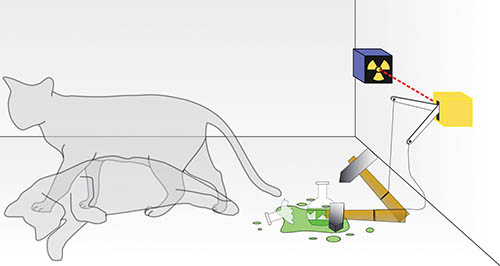
    The situation gets even stranger when dealing with the thought experiment known as “Schrodinger’s Cat.” The twentieth-century physicist Erwin Schrodinger was frustrated with the evident absurdity of quantum theory which showed objects simultaneously appearing in more than one place at a time. Such an outlook, he felt, violated all commonly observed physical laws. In 1935, Schrodinger sought to highlight this predicament through a purposely absurdist thought experiment, which he intended to force quantum physicists to follow their data to its ultimate degree.

    Schrodinger reasoned that quantum data dictates that a sentient being, such as a cat, can be simultaneously alive and dead. A variant of the Schrodinger’s Cat experiment could be put this way: Let’s say a cat is placed into one of a pair of boxes. Along with the cat is what Schrodinger called a “diabolical device.” The device, if exposed to an atom, releases a deadly poison. An observer then fires an atom at the boxes. The observer subsequently uses some form of measurement to check on which box the atom is in: the empty one, or the one with the cat and the poisoning device. When the observer goes to check, the wave function of the atom – i.e., the state in which it exists in both boxes – collapses into a particle function – i.e., the state in which it is localised to one box. Once the observer takes his measurement, convention says that the cat will be discovered to be dead or alive. But Schrodinger reasoned that quantum physics describes an outcome in which the cat is both dead andalive. This is because the atom, in its wave function, was, at one time, in either box, and either outcome is real.


    Schrödinger’s cat thought experiment: a cat, a flask of poison, and a radioactive source are placed in a sealed box. If an internal monitor (e.g. Geiger counter) detects radioactivity (i.e. a single atom decaying), the flask is shattered, releasing the poison, which kills the cat. The Copenhagen interpretation of quantum mechanics implies that after a while, the cat is simultaneously alive and dead. Yet, when one looks in the box, one sees the cat either alive or dead, not both alive and dead. This poses the question of when exactly quantum superposition ends and reality collapses into one possibility or the other.

    Of course, all lived experience tells us that if the atom went into the empty box, the cat is alive; and if it went into the box with the cat and the poisoning device, the cat is dead. But Schrodinger, aiming to highlight the frustrations of quantum theory, argued that if the observations of quantum-mechanics experiments are right you would have to allow for each outcome.

    To take it even further, a cohort of quantum physicists in the 1950s theorised that if an observer waited some significant length of time, say, eight hours, before checking on the dead-alive cat, he would discover one cat that was dead for eight hours and another that was alive for eight hours (and now hungry). In this line of reasoning, conscious observation effectively manifested the localised atom, the dead cat, the living cat – and also manifested the past, i.e., created a history for both a dead cat and a living one. Both outcomes are true.

    Absurd? Impossible? Yes to that, say quantum physicists – but decades of quantum experiments make this model – in which a creature can be dead/alive – into an impossible reality: an unbelievable yet entirely tenable, even necessary, state of nature. Schrodinger’s thought experiment forced a consideration of the meaning of quantum mechanics (though not many physicists pay attention to the radical implications).

    Why is there an apparent divide in our view of reality, in which one set of rules governs the events of the micro world and another set governs the macro world? It may be due to the limits of our observation in the macro world. Some twenty-first-century quantum physicists call this phenomenon “information leakage.”

    The theory of “information leakage” holds that the apparent impossibilities of quantum activity exist all around us. They govern reality. However, when we step away from whatever instrument we are using to measure micro particles and begin looking at things in larger frames and forms, we see less and less of what is really going on. We experience a “leakage” of data. William James alluded to a similar dynamic in his 1902 Gifford Lectures: “We learn most about a thing when we view it under a microscope, as it were, or in its most exaggerated form. This is as true of religious phenomena as of any other kind of fact.”

    Only future experiments will determine the broader implications of sub-natural phenomena in the mechanical one in which we live. For now, however, decades of quantum data make it defensible to conclude that observation done on the subatomic scale: (1) shapes the nature of outcomes, (2) determines the presence or absence of a localised object, and (3) possibly devises multiple pasts and presents. This last point is sometimes called the “many-worlds interpretation,” in the words of physicist Hugh Everett. This theory of “many worlds” raises the prospect of an infinite number of realities and states of being, each depending upon our choices. And here we encounter the frustrating but persistent thesis of positive thinking, which holds, in some greater or lesser measure, that our thoughts influence – concretely – our experience.

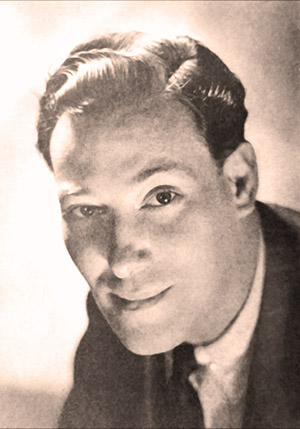
    Neville Goddard (1905–1972)

    Everett’s concept of multiple worlds and outcomes based on the vantage point of the observer finds its closest metaphysical analogue in the ideas of Neville Goddard,2 a mid-twentieth century mystical writer and lecturer who reasoned that our thoughts create an infinitude of realities and outcomes. Neville (who went by his first name) argued that everything we see and experience, including one another, is the product of what happens in our own individual dream of reality. Through a combination of emotional conviction and mental images, Neville believed, each person imagines his own world into being – all people and events are rooted in us, as we are ultimately rooted in God. When a person awakens to his true self, Neville argued, he will, in fact, discover himself to be a slumbering branch of the Creator clothed in human form, and at the helm of infinite possibilities.

    Most quantum physicists wouldn’t be caught dead/alive as Schrodinger’s cat reading an occult philosopher such as Neville. Indeed, many physicists reject the notion of interpreting the larger implications of quantum data at all. “Shut up and calculate!” is the battle cry popularised by physicist N. David Mermin. The role of physics, critics insist, is to measure things – not, in Einstein’s phrase, to lift “the veil that shrouds the Old One.” Leave that to gurus and philosophers, but, for heaven’s sake, critics argue, keep it out of the physics lab. Others adopt the opposite position: If physics isn’t for explaining reality, then what is it for?

    Get the issue this article appears in

    The latter principle may carry the day. A rising generation of physicists, educated in the sixties and seventies and open to questions of consciousness, is currently reaching positions of leadership in physics departments (and gaining authority in areas of grant-making and funding). This cohort was educated in a world populated by Zen and motorcycle maintenance, psychedelic experimentation, and Star Trek; they tend to be open to philosophical questions and meta-analysis. As scientists they are every bit as rigorous as the past generation of classical empiricists. Hence, we could be on the brink of a renaissance of inquiry into the most remarkable scientific issue since Newton codified classical mechanics. As more data is known, purveyors of quantum physics and metaphysics may be headed for a new and serious conversation.

    But the pitfalls are too important not to consider before waltzing off into the world of “both/and” realities. To the frustration of scientists, spiritual seekers often prove overeager to seize upon the implications of quantum data, declaring that we now have proof that the universe is the result of our minds. The correlation between the events of the micro world and those of the daily life that we see and feel is far from clear. Spiritual seekers should resist the temptation to cherry-pick from data that seems to confirm their most deeply cherished ideas. Likewise, physicists should be patient with lay seekers who want to ponder the possibilities of quantum physics. If the right balance can be struck, serious and thoughtful people from both worlds, science and spirituality, have something to talk over. Such a discussion may, ultimately, revolutionise how we see ourselves in the twenty-first century as much as Darwinism did in the Victorian age.

    [alert type=”general” dismiss=”no”]This article was published in New Dawn Special Issue Vol 13 No 6.[/alert]

    [alert type=”success” dismiss=”no”]If you appreciate this article, please consider subscribing to help maintain this website.[/alert]

    Footnotes

    1. Does Death Exist? New Theory Says ‘No’ by Robert Lanza, M.D., www.huffpost.com/entry/does-death-exist-new-theo_b_384515
    2. The Greatest Philosopher You’ve Never Heard Of by Mitch Horowitz, https://
    medium.com/universal-quest/the-greatest-philosopher-youve-never-heard-of-336231e26885

    © New Dawn Magazine and the respective author.
    For our reproduction notice, click here.

  • Renewal & Integration in a Time of Decline & Conformity

    Renewal & Integration in a Time of Decline & Conformity

    From New Dawn Special Issue Vol 16 No 4 (Aug 2022)

    We should be cautious of prophecies that claim we are on a path of infinite political progress or infinite economic growth – or, conversely, headed toward civilisational collapse. 

    Things are more complicated, and opportunities remain for creating interesting new cultural movements and for personal transcendence and integration (though perhaps not for those who are determined to conform to some outdated societal mould).

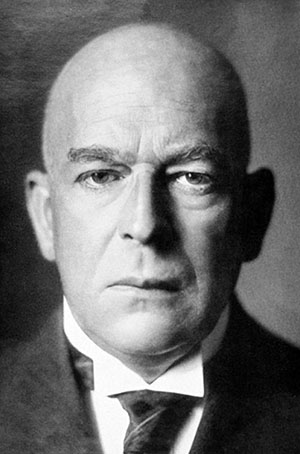
    Oswald Spengler (1880-1936) 

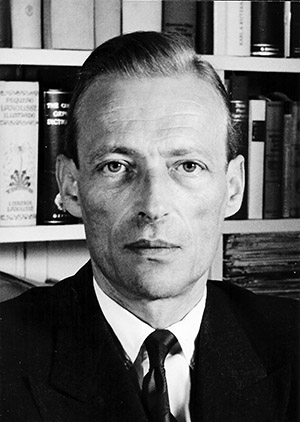
    A century ago, the German intellectual Oswald Spengler (1880-1936) argued that civilisations are organic and, like plants, they take root, blossom, whither, and die. According to Spengler, the West is now in its dying phase. His thesis was countered by another German thinker, Jean Gebser (1905-1973), who argued that human consciousness evolved through the emergence of new stages. The previous stages remained part of the psyche but were superseded. These stages (the archaic, magic, mythical, and mental) were characterised by new developments in language, art, and even perception (e.g., the development of perspective in art).

    Jean Gebser (1905-1973)

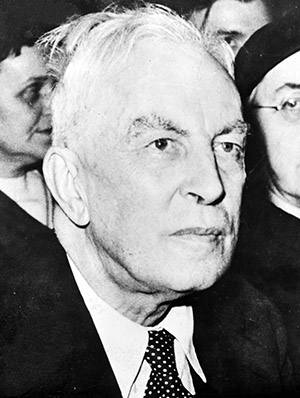
    Perhaps more important was the thesis of British historian Arnold Toynbee (who was influenced by Spengler). While Spengler preferred “culture” to its more developed and complicated phase – civilisation – Toynbee believed that the former type of society preserved itself by worshipping the dead and sticking, unquestioningly, to the rules that the ancestors had laid down. But a civilisation, Toynbee argued, constantly renews itself through the actions of a “creative minority” – a small group of individuals who think differently and create new culture. (One such creative minority was the Beatniks of the 1950s, who attempted to live authentically, creatively, and spiritually in the context of a West in decline, introducing many Americans to Eastern religion, alternative spirituality, and psychedelics.)
    Arnold Toynbee (1889–1975)

    Spengler’s thesis can be detected in the warnings of feminist social critic and author Camille Paglia. She suggested a few years ago that America may well be in a stage of decline and cited the transgender movement as proof, suggesting that transgenderism gains popularity in the “late phases of culture, as a civilisation is starting to unravel,” e.g., the late Roman Empire, the Weimar Republic, and so on.1 The people of such societies, says Paglia, think of themselves as very sophisticated, but yet, out on the margins of society, or just beyond the borders of the state, those – from the Hun to ISIS – “convinced of the power of heroic masculinity” are gathering, waiting to strike.
    Camille Paglia

    Paglia is not the first to contrast the militant jihadist with young, effeminate Western men and modern Western culture that “no longer believes in itself.” Nor is she the only one worrying about the emergence of hyper-masculine men, though she is unusual, as a feminist and progressive of sorts, for her criticism of the latest political fads. The target of the more “sophisticated” members of our societies tend to be those representing traditional culture, pro-masculinity groups, or groups advocating physical and mental strength. But Paglia is an actual thinker, of course, and not merely another establishment apologist posing as one.

    Disintegration

    Who are the barbarians? When we look at television and movies today, we see that men are not infrequently portrayed as clueless, weak, ignorant, stupid, cowardly, or thuggish. Heroes are dead. And we do not need strength and courage. Of course, this angers a lot of men – especially in the “men’s rights” movement – and some are convinced that it’s a Hollywood conspiracy to deracinate masculinity. But, let’s be honest, if these images of men caught on, it is because that was the experience that so many people had of men.

    I have spoken to men across the United States, and the vast majority told me their father gave them no real attention or guidance growing up or that he was a workaholic, an alcoholic, a “yes man,” a womaniser, a bully, or worse. If they received guidance on how to behave, it usually came from their mother or their first real girlfriend. Unsurprisingly, many young men feel resentment toward older men in power and are suspicious of “masculinity” (a term they equate with working too much, bullying, watching sport, hitting on women, and talking nonsense). 

    Beyond which team to support and which political party to cheer for, the stock advice from fathers to their male children is often little more than “get good grades and get a good job” – or at least some kind of job – or “don’t do what I do; do what I say.” This doesn’t really grab most young men as a satisfactory plan for life. A lot of pain in men goes unnoticed.

    I mentioned the portrayal of men and women on television. In one op-ed a few years ago, the ‘90s sitcom Friends was blamed for the downfall of Western civilisation.2 For the op-ed writer, Ross was the show’s hero – or, at least, he should have been. He was an intellectual (or at least intelligent). But he was boring in comparison to the rest of the Friends gang. As such, society was given the message that intelligence is bad. He got the girl he deserved, the writer tells us: “Rachel, the one who shops.”

    Apparently, not all Rosses are boring. While the writer assures us that there is now a “resistance” forming, made up of “new Rosses” – people of “grit” who are “hiding” in art museums, chess clubs, and so on – Rosses aren’t going to save civilisation from the nightmare Paglia imagines – its collapse and takeover by new barbarians. In real life, Rachel (by which I mean the actress Jennifer Aniston) married (and then divorced) Brad Pitt.

    We don’t need to pick through Aniston’s off-screen love life and its ups and downs to know that the dithering and undynamic Ross wouldn’t have got a look-in with Rachel. And, frankly, why should he? He wanted a woman that was, physically, well out of his league. He could have gone across the hall and asked Joey for some pointers on working out and then set to work improving himself physically – but he didn’t. And, unlike most people, he didn’t want to, or couldn’t, adapt his conversation to his friends, either.

    Ross (and the Friends gang as a whole) reflects the West’s compartmentalisation of people into types: the intellectual (the intellect), the jock (the body), the artistic dropout (the soul), the Democrat, the Republican, the independent, the non-binary, the genderqueer, the two-spirit, and so on, and so on. (Effectively, Friends is a comedic Planet of the Apes without the ape costumes or post-apocalyptic NYC backdrop.) And while compartmentalisation may have helped us create civilisation, it is now contributing to its disintegration. 

    Revolt Against The Shrinking Brain

    Rosses may represent a clumsy resistance to the dumbing down of society. Some of those becoming transgender may, as Paglia suggests, be the sort of people who would have become Beatniks or Hippies in decades past and might be rebelling against the very limited, clichéd 1950s-type notions of gender (pushed in some online “masculinity” and politically conservative circles). Men’s rights groups may be an angry resistance to men not being taken very seriously on a range of issues (e.g., divorce and child custody). And as Paglia suggests, culture may be “starting to unravel” into different types, none of them whole in themselves. But opportunities remain.

    As Paglia notes, that opportunity is open to those who would destroy us and take our liberty away. But that is not the final word. Opportunities are open, too, to the creative, adaptable, and integrated. (The integrated are entirely opposite to the mass of compartmentalised individuals: Rosses, Joeys, and Rachels, etc.)

    The human brain 30,000 years ago and today.

    The human (genus Homo) brain quadrupled in size over six million years but, strangely, appears to have decreased in size since the last Ice Age. Diet and environmental factors are blamed. A more recent hypothesis suggests that human brain shrinkage occurred in response to the expansion of our societies and the need for greater compartmentalisation of tasks to sustain and develop those societies (i.e., civilisations). 

    Jeremy M. DeSilva et al. note that “brain differentiation can occur in association with division of labor in the absence of striking changes in body size, illustrating how selection may have operated in humans as social groups increased in size.”3

    Formed into large and increasingly complex organisations, human beings needed specialists, not generalists. It needed some people to focus on medicine and others to focus on engineering, some to focus on creating art and others to focus on fighting wars, and so on, effectively distributing functions throughout the community. DeSilva says, “multiple brains contribute to the emergence of collective intelligence.” 

    The collective brain is most visible in the realm of politics. The ideas of a particular movement are thought up by a handful of individuals at most (these original thinkers are usually dead before their ideas catch on). The average voter and political fanatic (the compartmentalised individual) merely receives these ideas and passes them along, acting as a node in a network. He believes them to be “true” because, unaware of their history, the ideas appear to have emerged out of nowhere, suddenly to be accepted by everyone (every other node) around him. Nevertheless, the more the compartmentalised individual is convinced he arrived at his own conclusions, the more likely he will parrot the latest political mantra, spreading the message to other nodes. And tied into his self-image and survival as a node in a network – if the information is challenged or shown to be false, his response is usually anger, outrage, and ad hominem accusations. In authoritarian societies, detractors are prosecuted and either imprisoned or executed. Typically, though, such societies fail.

    Let’s consider Western civilisation as a brain (or an organism). The current obsession with “diversity and inclusion” can be regarded not as an expression of a moral conviction (as it is presented) but as a survival mechanism: i.e., as an attempt to expand the network so that new nodes can pass along new information about possible threats from outside as well as new opportunities. Racial, sexual, gender and religious diversity within the workforce is often presented as a way for companies to gain an advantage over competition (which seems amoral at best). And notably, although the registration of patents (probably the most concrete marker of innovation in any society) has gone up in the United States over the last few decades, half of these were registered by foreign-born inventors.4 Everyone’s favourite entrepreneur, Elon Musk – founder of Tesla, SpaceX, and Paypal – immigrated from South Africa, first to Canada and then to the US. 

    Renewal & Reintegration

    The integrated individual – capable of thinking, creating, and problem-solving – might be a throw-back to a time before civilisation, but that individual is essential to its survival and renewal. He, or she, is one of Toynbee’s creative minority. Even in more ordinary lines of work, in a fast-changing society, developing different skills and interests will be an advantage and might be essential to remaining relevant to the economy. “Holding a solid grasp of many concepts or decent proficiency in multiple skills,” says Forbes, “can allow for flexibility, in a life and career.”5

    But there are things more essential to life and the human spirit than commerce, of course, though it may be crucial both to the individual and their society. The Renaissance saw a renewed interest in ancient Greek and Roman thought and classical learning, as well as new developments in the arts (such as perspective in painting) and sciences. And epitomised by Leonardo DaVinci (artist and inventor) and, perhaps, more so, by Leon Battista Alberti (architect, mathematician, scientist, painter, poet, expert horseman, and a man keen to demonstrate his physical prowess). The notion of the Uomo Universale (“Universal Man,” usually called the “Renaissance Man” today) was born during this time. 

    We can, of course, find such integrated human beings in different times and places. The ancient Greek philosopher Plato was also a wrestler and believed that youths should be educated through philosophy, music, and wrestling. In Shi‘i Islam, ‘Ali is regarded as both the ideal warrior and ideal mystic and as the exemplar of futuwwa (the Muslim code of “chivalry” or, more literally, “young manhood”). The samurai warrior Miyamoto Musashi was also a renowned painter and calligrapher, and Viking warrior Egill Skallagrímsson was also a renowned poet. 

    Closer to our own time, we find the Renaissance Man turning up primarily in, or on the margins of the occult, with the ability to break the taboos of a spiritually disintegrating culture being, perhaps, necessary to begin the journey towards personal reintegration. Rudolf Steiner was a mystic, educator, painter, author, and architect. G. I. Gurdjieff was a mystic, hypnotist, and (sacred) dance teacher. Carl Jung was both a pioneer of psychoanalysis as well as an artist and visionary author. 

    Aleister Crowley played many roles including that of mountaineer, and notable for being one of the first Westerners to attempt K2, the second-highest mountain on Earth after Mount Everest, in 1902. He is seen on K2 in the above photo, sitting, fourth from left.

    Known primarily as a ceremonial magician, author (fiction and non-fiction), and founder of his own religion (Thelema), Aleister Crowley was also a boxer, mountaineer, adventurer, painter, and poet. If we take half his accomplishments, he is a clichéd “man’s man.” If we take the other half, he is an effeminate, dandyish “girly man.” But, as he advised his adepts, in himself he managed to embrace and develop the “Angel” and the “Demon” – what society might call the “male” and the “female,” the “left brain” and the “right brain,” the body and the spirit, etc.

    Depiction of samurai warrior Miyamoto Musashi

    Modern culture has hemmed us in. Today, painting, poetry, calligraphy, etc., are all seen as “feminine” or “girly.” In contrast to Musashi or Skallagrímsson, modern-day “real men” do not write poetry. In fact, “real men” don’t seem to do much at all. Whether we like it or not, in part, it is against the backdrop of fatherless families and men more interested in gaming and chasing women than in mental, physical, spiritual, and cultural self-development, that the pro-transgender, pro-pan-gender, pro-gender-fluid movement is reacting. And we must agree with them that the 20th-century clichés of gender – the compartmentalised man or woman, individuals who act merely as nodes, passively absorbing and regurgitating whatever they hear – are inseparable from the disintegration of the West and the lack of energy it displays in the arts, philosophy, and other areas of culture. 

    We mentioned Toynbee’s belief that civilisations differ from cultures by constantly renewing themselves through the “creative minority.” Perhaps the best example of a renewal is the Renaissance (literally “Rebirth”) which we already mentioned. But there have been other, smaller revivals, such as artistic movements (Cubism, Surrealism, etc.) and musical movements (Punk, Hip-Hop, etc.). It might even be argued that the emergence of transgenderism, pangenderism, and gender-fluidism into the mainstream is part of a revival (perhaps emanating from the unconscious of the collective intelligence) of the shamanic (since shamans often wore the clothes of the opposite gender and were regarded as neither or both male and female) and, as such, as part of a centuries-long occult revival that includes, at its softer edges, the now virtually omnipresent New Thought movement and New Age spirituality. 

    Get the issue this article appears in

    We mentioned the union of the mystic and the warrior in the figure of ‘Ali, as well as Plato, the philosopher and wrestler. The average person might remain a node in a network of the collective brain, merely absorbing and transmitting ideas to others without ever questioning those ideas, even as the disintegration of their society continues. A new Renaissance will only be brought about by the work of creative minorities. And, today, in a time of increasing hostility towards the body (particularly as an embodiment of strength or beauty), when life is increasing online and virtual, and thinking is increasingly done for us (or against us) by algorithms and artificial intelligence, such a minority must work to elevate the physical body and reintegrate it (as Plato suggested, with his schema of music, philosophy, and wrestling) with the mind and spirit. We must be part-barbarian and part-sophisticated cultural thinker and creator. 

    The future is uncertain but it remains open to the integrated – to those who push forward in different ways, creating new art, new ways of thinking, new movements, new rituals, and new routines, all awakening us to a recognition we are more than nodes in a disintegrating network: that inside of each of us burns a barbarian fire – a spirit – for adventure, for struggle against our limits, for strength and beauty, and wholeness.

    [alert type=”general” dismiss=”no”]This article was published in New Dawn Special Issue Vol 16 No 4.[/alert]

    [alert type=”success” dismiss=”no”]If you appreciate this article, please consider subscribing to help maintain this website.[/alert]

    Footnotes

    1. www.youtube.com/watch?v=I8BRdwgPChQ
    2. David Hopkins, “How a TV Sitcom Triggered the Downfall of Western Civilization,” March 21, 2016, https://gen.medium.com/how-a-tv-sitcom-triggered-the-downfall-of-western-civilization-336e8ccf7dd0
    3. Jeremy M. DeSilva, James F. A. Traniello, Alexander G. Claxton, and Luke D. Fannin, “When and Why Did Human Brains Decrease in Size? A New Change-Point Analysis and Insights From Brain Evolution in Ants.” Frontiers in Ecology and Evolution, 22 October 2021, https://doi.org/10.3389/fevo.2021.742639
    4. Richard Florida, February 1, 2013, “Innovation and the Wealth of Cities,” www.bloomberg.com/news/articles/2013-02-01/innovation-and-the-wealth-of-cities
    5. Jodie Cook, May 13, 2021, “Why Being A Jack Of All Trades Is Essential For Success,” www.forbes.com/sites/jodiecook/2021/05/13/why-being-a-jack-of-all-trades-is-essential-for-success

    © New Dawn Magazine and the respective author.
    For our reproduction notice, click here.