New Dawn – World's Most Unusual Magazine

Category: Articles

  • US Deep State Tangled in Their Own Russian Plot

    US Deep State Tangled in Their Own Russian Plot

    From New Dawn 167 (Mar-Apr 2018)

    Editor’s Note: As with many New Dawn featured articles, this 2018 piece by journalist Patrick Henningsen was extremely prescient, particularly following the recent revelations exposing the Russiagate hoax, and how Washington was preparing its geopolitical chess pieces for subsequent events in Ukraine. The 2023 Twitter Files also confirm that US Democrats and media organisations knowingly propagated the ‘Russiagate theory’ hoax and spread a false narrative about “Russian bots” and trolls amplifying pro-Trump messaging.

    Make no mistake about it: the US Deep State and its Atlanticist partners are waging a new Cold War against Russia, but will it go hot? It’s still difficult to say how far this sabre rattling will go, but one thing is certain: Washington’s stroganoff is definitely overcooked.

    When WikiLeaks published leaked Democratic National Committee emails in July 2016, it didn’t take long for Washington and its media oracles to trade-in their ultimate cash-cow ‘threat’ de jour, ISIL, in favour of a newly inflated Russian Bear.

    Right out of the gates, the media went big, clamouring for something to be done about Russia “hacking” the 2016 US presidential election. When no evidence materialised, the narrative mysteriously morphed into “Russian collusion,” before being lowered to “Russian meddling,” and then finally, 18 months after the story began, it’s been further downgraded to mere “Russian influence.” As weak as the case continues to be, the reality is that political operatives have staked everything on their official Russian conspiracy theory and are dutifully ploughing ahead regardless.

    One of the Deep State’s key partners in propping-up their narrative are the Silicon Valley tech firms. In January, Republican lawmakers began pressuring the House Intelligence Committee to release an explosive memo written by chairman Devin Nunes. The memo contains damning evidence about a fraudulent surveillance warrant ordered by Barack Obama’s FBI and Department of Justice, in order to spy on members of Donald Trump’s campaign and transition teams.

    Before the memo’s release, the hashtag #ReleaseTheMemo began trending on Twitter. It didn’t take long before the Deep State spin machine claimed it had evidence that the top-trending hashtag was being propelled through cyberspace by “Russian influence-linked accounts.” Unhinged Democrats, led by Congressman Adam Schiff and Senator Dianne Feinstein, went even further and drafted a letter to Facebook CEO Mark Zuckerberg and Twitter CEO Jack Dorsey demanding the Silicon Valley giants “conduct an in-depth forensic examination” of their latest anti-Russian conspiracy theory.1

    According to their overwrought line of thinking, anyone who retweeted or ‘liked’ any Twitter post which was either sympathetic to Russia or supported Trump had in fact taken part in the Kremlin’s secret “active measures” operation to influence the vulnerable minds of Americans. Twitter was so concerned that it sent an email out to hundreds of thousands of users who might have been ‘touched’ by the Kremlin, informing them of their original sin.

    California tech firms found no evidence of Russian meddling on social media over the last year, nor were there any attempts to sponsor ‘interference’ either.2 Still, desperate congressional conspiracy theorists like Adam Schiff want to pressure Silicon Valley firms to rummage through their data logs in the hopes of magically finding some evidence.

    As it turned out, the source of the hysterical reports was a Deep State cut-out organisation, a new online initiative promoted by the US-German Marshall Fund called “Hamilton 68,”3fronted by former military and FBI operative Clint Watts. He is an associate of the antediluvian cold warrior Deep State think tank Foreign Policy Research Institute.4

    Watts’ cut-out front is not dissimilar to another earlier online Deep State Russiaphobia project called “PropOrNot”5 which was promoted by the Washington Post and listed some 200 mostly North America alternative media websites including the Ron Paul Institute, Global Research, Truth Out, Paul Craig Roberts and many others. The shadowy site claimed these websites were all part of an intricate nefarious network of Kremlin agents.

    Both of these Deep State vilification initiatives claim to be part of ‘counter-propaganda’, but you can’t counter something which isn’t there in the first place.

    Click on the above to check out Patrick Henningsen’s predictions article in our Jan-Feb 2023 issue.

    In the Crosshairs of the Deep State

    During the primary phase of the US presidential election, Donald Trump was essentially up against 15 Republican war hawks (except for Rand Paul). He adopted a more pacifist-reformist approach in order to separate himself from the field – and it worked. Trump ran the table and cruised into the Republican Party nomination, ready to do battle with arch-globalist and Deep State favourite Hillary Clinton.

    His rhetoric on the campaign trail was promising. The soon-to-be 45th President of the United States spoke boldly about reaching out to Russian President Vladimir Putin and normalising relations with Russia, stressing the need for the two nations to cooperate on a number of pressing issues, not least of all the War on Terror and the fight to defeat ISIL in Syria and Iraq.

    Trump was popular with Americans feeling the fatigue of war, and also with disillusioned Obama supporters who believed in his ‘hope and change’ slogan, only to be saddled with seven wars from the Nobel Peace Prize president. Trump’s desire for détente with Russia angered both the Republican and Democratic establishments, federal agency operatives, and of course the mainstream media who have been ginning-up a new Cold War since the US-backed coup d’état in the Ukraine in 2014.

    Then, while the Trump transition team was waiting in the wings after defeating Clinton in a stunning upset, the outgoing Commander-in-Chief, Barack Obama, made a series of cutting moves that would undermine any chance of Trump starting his term on a positive footing with Moscow. First, Obama signed an extension on US sanctions against Russia as well as adding a number of new measures.6  But what came next can only be described as an act of diplomatic warfare when Obama ordered even more new sanctions along with the expulsion of 35 Russian diplomats and the closing of Russian diplomatic properties in Maryland and New York, which Obama claimed were being used for intelligence-related purposes.7

    “There has to be a cost and a consequence for what Russia has done,” said one of the mainstream media’s typically unnamed ‘senior administration officials’ at the time. “It is in an extraordinary step for them to interfere in the democratic process here in the United States of America. There needs to be a price for that.”

    Russian was understandably irate and warned this was Cold War déjà vu being initiated by the White House. Obama did not stop there. To keep things on ice between Washington and Moscow, he then deployed 300 US Marines to Norway, supposedly to reinforce Norway’s 122 mile-long border with Russia near the Arctic Circle.8 It was the first US deployment in Norway since World War II. Finally, right before Trump’s inauguration, Obama ordered the deployment of some 3,000 US soldiers into Poland to “reassure NATO allies who were concerned about ‘a more aggressive Russia’.”9

    The neophyte Trump tried playing it cool, even complimenting Vladimir Putin for not responding in a mindless tit-for-tat. Regardless, it was clear Trump had already been sandboxed before his term got started.

    To add insult to injury, while all this was unfolding, Obama appears to have also dispatched his top Deep State agent, former national security adviser Susan Rice, to oversee the spying of the Trump transition team, allegedly under the guise of surveilling “foreign officials,” in what became known as the great ‘Unmasking Scandal’.10

    From this point on, it became very clear what the Deep State wanted – it had no intention of allowing any US president to pursue good relations with Russia. Before the 2016 election, it was difficult to conceptualise this shadowy thing called the ‘Deep State’. It had previously been spoken of by a few great scholars such as Peter Dale Scott11 and Mike Lofgren.12 Some call it a ‘state within a state’, while others refer to it as a hidden hierarchical network of corruption that facilitates all number of criminal enterprises globally. From hostile corporate takeovers of countries and the unleashing of jackals like the ones described by John Perkins13 in Confessions of an Economic Hit Man, to proxy ‘regime change’ terrorist militias, to the CIA and its global drugs and weapons trafficking syndicates, and the banks and financial institutions who launder their illicit proceeds, some of which are used to fund other covert and ‘black ops.’

    At the very top of this pyramid of international organised crime is what US president Dwight D. Eisenhower14 famously dubbed the “Military Industrial Complex.” These are the criminal interests represented by Trump’s own party opponents like Jeb Bush, Marco Rubio, Lindsey Graham and of course John McCain. Certainly the same could be said about Hillary Clinton, a key operative in the Deep State machine since her husband’s days as Arkansas governor.15

    After Trump took office it wasn’t long before he was surrounded by Deep State loyalists, all tasked with making sure the new President stayed on course with the wider agenda. This is their strategy of geopolitical tension on multiple fronts, designed to keep Washington and its allies on a permanent war footing, leading to the most important outcome of this equation – the triggering of increased military and ‘defence’ spending, not only in the US but in Europe too. Positioning Russia as Washington’s number one existential threat is the keystone of this strategy.

    One year on, we can now see exactly how Russiagate greased the tracks for at least one controversial arms transaction: an initial US deal to send $50 million worth of lethal Javelin anti-tank missiles to the Ukraine.16 As arms shipments go, this is a small one amounting to a mere drop in the bucket compared to what the US trafficked to terrorists in Syria since 2012, but it does demonstrate how US politics can effectively trigger the mechanism on a deal that was simply not possible one year ago. You can expect more arms shipments, all fuelled by sustained fear-mongering and the spinning of evermore colourful fables about how Russia’s ‘little green men’ invaded and are occupying the Ukraine.17

    No doubt, this overall strategy of tension is what Trump’s vaunted ‘Generals’ were aiming at when pushing him to engage in more theatrical sabre rattling with Kim Jung-Un in North Korea. The strategy paid off as Congress enthusiastically inked his pen for a new $700 billion defence budget in December 2017 – a near 20 percent increase from the previous year’s already bloated Pentagon money pit. Interestingly, the $56 billion hike was almost as much as the entire Russian annual defence budget.

    The business doesn’t end there either. In Brussels, a concerted and relentless campaign of hysterical Russiaphobia in Europe has helped pave the way for a historic new European ‘collective defence’ agreement. 23 European Union countries signed the new Permanent Structured Cooperation (PESCO), a historic move that officially lays the framework for European military integration, or an EU Army. This includes a centralised defence budget for military hardware, facilities, and research & development. At the heart of this new EU defence force will be the usual suspects – transatlantic military juggernauts like Lockheed Martin, Boeing, Raytheon, General Dynamic, BAE Systems and many others. EU High Representative for Foreign Affairs, Federica Mogherini, described the signing of PESCO as a “historic moment in European defence.”18 By 2025, you could see a collective EU defence budget that rivals the US, as the world’s number two military spender ahead of China and Russia. Eventually, this will move NATO to an adjunct role in the job of policing the European hemisphere. You can almost hear Eisenhower rolling in his grave.
    Get the issue this article appears in

    In addition to this, there is already talk of increasing the US defence budget to $1 trillion over the next two years.19 Frugal-minded Americans would be shocked to realise that when you audit America’s entire National Security Budget, it already totals $1.1 trillion.20

    All of this, we’re told, is to counter the great Russian menace. How odd then, that in 2017 the Russian Federal Treasury announced its nation’s annual defence budget was being cut by 25.5 percent down to $65.4 billion21 – the most drastic cut in the country’s defence spending since the early 1990s. If the West is to be believed and Vladimir Putin really is “the next Hitler,” then his war chest is looking a bit scant. Good luck with the world domination Vlad.

    As for the West, the peoples’ challenge still remains: how to dislodge the Deep State and re-take control of their governments?

    [alert type=”general” dismiss=”no”]This article was published in New Dawn 167.[/alert]

    [alert type=”success” dismiss=”no”]If you appreciate this article, please consider subscribing to help maintain this website.[/alert]

    Footnotes

    1. “Top Dems call on Twitter, Facebook to investigate Russian bot campaign,” http://thehill.com/policy/technology/370265-top-dems-call-on-twitter-and-facebook-to-investigate-russian-bot-campaign
    2. “Tech companies say they didn’t see Russian social media infiltration in 2017 elections,” www.politico.com/story/2018/01/25/russian-social-media-elections-312491
    3. “Hamilton 68: A New Tool to Track Russian Disinformation on Twitter,” http://securingdemocracy.gmfus.org/blog/2017/08/02/hamilton-68-new-tool-track-russian-disinformation-twitter
    4. “Foreign Policy Research Institute’s Program on the Middle East,” www.fpri.org/contributor/clint-watts/
    5. “Washington Post’s ‘Fake News’ Guilt,” https://consortiumnews.com/2016/11/27/washington-posts-fake-news-guilt/
    6. “U.S. extends sanctions against Russia ahead of Trump inauguration,” www.rbth.com/international/2016/12/21/us-extends-sanctions-against-russia-ahead-of-trump-inauguration_665023
    7. “Obama expels 35 Russian diplomats in retaliation for US election hacking,” www.theguardian.com/us-news/2016/dec/29/barack-obama-sanctions-russia-election-hack
    8. “The Plan to Deploy U.S. Troops to Norway,” www.foreignaffairs.com/articles/norway/2016-11-09/plan-deploy-us-troops-norway
    9. “US tanks and troops in Poland a threat, Russia says,” www.bbc.co.uk/news/world-europe-38592448
    10. “Top Obama Adviser Sought Names of Trump Associates in Intel,” www.bloomberg.com/view/articles/2017-09-20/what-we-still-don-t-know-about-obama-era-unmasking
    11. “The ‘Deep State’ behind U.S. democracy,” www.voltairenet.org/article169316.html
    12. “What is The Deep State?,” http://21stcenturywire.com/2017/09/02/what-is-the-deep-state/
    13. Confessions of an Economic Hit Man by John Perkins
    14. “Dwight D. Eisenhower’s Farewell Address (1961),” https://eisenhower.archives.gov/research/online_documents/farewell_address.html
    15. “Clintons, Contras and Cocaine,” www.counterpunch.org/2016/03/11/clintons-contras-and-cocaine/
    16. “Why Trump’s Decision to Send Javelin Anti-Tank Missiles to Ukraine Could Escalate Tensions with Russia,” http://fortune.com/2017/12/23/trump-approves-javelin-missiles-ukraine/
    17. “How, Why, and When Russia Will Deploy Little Green Men,” www.fpri.org/article/2016/03/how-why-and-when-russia-will-deploy-little-green-men-and-why-the-us-cannot/
    18. “EU Paves the way for Defense Union,” www.dw.com/en/pesco-eu-paves-way-to-defense-union/a-41360236
    19. “President Trump Is Likely To Boost U.S. Military Spending By $500 Billion To $1 Trillion,” www.forbes.com/sites/charlestiefer/2016/11/09/president-trump-is-likely-to-boost-u-s-military-spending-by-500-billion-to-1-trillion/
    20. “US National Security Budget at $1.1 trillion,” www.pogo.org/straus/issues/defense-budget/2017/americas-1-1-trillion-national-security-budget.html
    21. “Russia Cuts Military Budget,” www.defenseworld.net/news/18745/Russia_Cuts_Military_Budget_By_25__To_US_65_Billion

    © New Dawn Magazine and the respective author.
    For our reproduction notice, click here.
  • Reality Tunnels: How to Control & Re-Program Your Mind

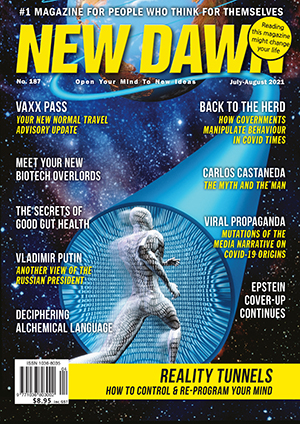
    Reality Tunnels: How to Control & Re-Program Your Mind

    From New Dawn 187 (Jul-Aug 2021)

    When I was in secondary school, a teacher showed me an animated optical illusion in which a dancer appears to be spinning in one direction. I was adamant that the dancer was spinning clockwise, while my teacher insisted it was spinning counterclockwise. She then told me that you could change the direction of the dancer by focusing on the feet. I gazed with meditative fixation, and suddenly, to my amazement, the dancer started spinning counterclockwise! My teacher explained that since there are no visual cues for three-dimensional depth, your mind can determine what direction the dancer spins. 

    At that moment, I realised that reality is a construct of the mind, and we all potentially see the same world differently. I may have put it in less eloquent terms than that (considering I was only a teenager), but there was a fundamental shift in my understanding. The illusion made me realise that the notion of ‘objective truth’ was essentially arbitrary since our subjective beliefs mediate sensory experience. 

    My teacher and I could have argued for hours, days or weeks as to which direction the dancer was spinning; science couldn’t have proven either of us correct since it was a matter of perception rather than ‘truth’. In ‘reality’, the dancer was spinning in both directions, but since the brain has a natural tendency to classify, categorise and catalogue information in binary terms (up/down, left/right, black/white, clockwise/counterclockwise), the animated optical illusion appears monodirectional. 

    There are numerous examples of this in our day-to-day lives, like when we fail to appreciate other people’s viewpoints because we perceive the world differently. We believe we are right despite the multiple (if not infinite) interpretations about the nature of reality. 

    What are Reality Tunnels?

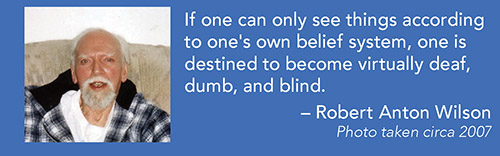
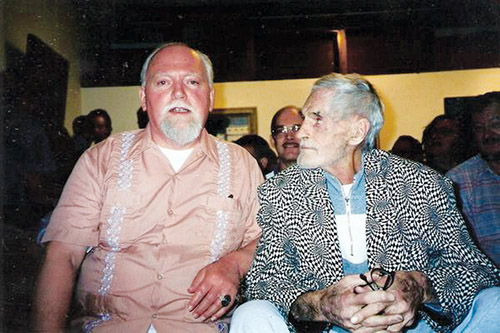
    Robert Anton Wilson (1932–2007) with Timothy Leary (1920–1996)

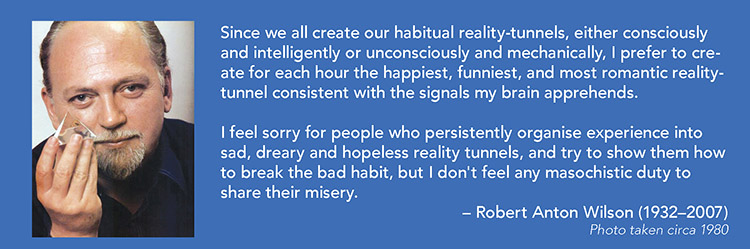
    The countercultural guru Timothy Leary coined the term ‘reality-tunnel’ to describe our filtered perceptions of the world. Robert Anton Wilson later developed the concept to describe “pre-composed patterns of thinking which limit and distort the perception of reality by reducing complexity and options.”1 According to Wilson, reality-tunnels shape our phenomenological sense of self, editing out experiences that do not support our beliefs while focusing on those which do.2 

    An advocate for capitalism, for example, will gather facts to support the view that capitalism is the most effective socioeconomic model, discarding any information that runs contrary to this viewpoint. Similarly, a Marxist will construct arguments based on select information to support the view that communism is the best system, often neglecting evidence that contradicts their position. 

    As the psychedelic scholar Ido Hartogsohn states, “all of us harbour established ideas about minorities, religions, nationalities, the sexes, the right ways to think, act, feel govern, eat, drink, and what not. Reality tunnels act to help us fortify these ideas against challenging information.”3 In this sense, there is a crossover between the concept of reality-tunnels and confirmation bias, the latter described as the “human tendency to notice and assign significance to observations that confirm existing beliefs while filtering out or rationalising away observations that do not fit with prior beliefs and expectations.”4 The phenomenon of confirmation bias helps explain why people who ascribe to a reality-tunnel are oblivious. Most people believe their worldview corresponds to the “one true objective reality,” however, Wilson emphasises that many reality tunnels are artistic creations, a culmination of biological, cultural and environmental inputs.5 

    The notion that reality is shaped by the conditions of the human mind is not new. The 18th-century German philosopher Immanuel Kant proposed in his Critique of Pure Reason that experience is based “on the perception of external objects and a priori knowledge.”6 We receive information about the external world through our five senses, which is then processed by the brain, allowing us to conceptualise its contents. When I look at an object, such as a chair or a table, I have no understanding of its external nature. The qualities that enable me to denote the meaning of the object, such as shape, colour, size etc., have no objective existence; they are merely by-products of the brain. 

    The French psychoanalyst and psychiatrist Jacques Lacan proposed his theory distinguishing between ‘The Real’ and the ‘Symbolic’. Lacan argued that ‘The Real’ is the “imminent unified reality which is mediated through symbols that allow it to be parsed into intelligible and differentiated segments.”7 However, the ‘Symbolic’, which is primarily subconscious, is “further abstracted into the imaginary (our actual beliefs and understandings of reality). These two orders ultimately shape how we come to understand reality.”8 

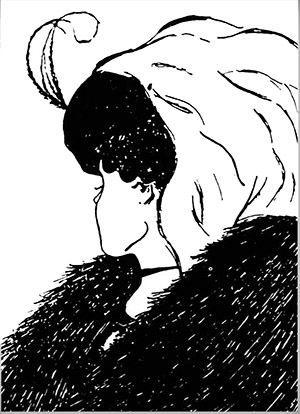
    For the left image, do you see a duck or a rabbit? For the image on the right, do you see a young woman or an old lady? These famous optical illusions help demonstrate how our sense of the world is mediated through ‘reality-tunnels’.

    The Harvard sociologist, Talcott Parsons, uses the word gloss to describe how our minds come to perceive reality. According to Parsons, we are taught how to “put the world” together by others who subscribe to a consensus reality based on shared beliefs, norms and associations.9 A gloss constitutes a total system of language and/or perception. For example, the word ‘house’ is a gloss since we lump together a series of isolated phenomena – floor, ceiling, window, lights, rugs, etc. – and turn it into a totality of meaning. 

    The author and anthropologist Carlos Castaneda commented on this notion, stating, “we have to be taught to put the world together in this way. A child reconnoitres the world with few preconceptions until he is taught to see things in a way that corresponds to the descriptions everybody agrees on. The world is an agreement. The system of glossing seems to be somewhat like walking… we learn we are subject to the syntax of language and the mode of perception it contains.”10 

    The French philosopher Jacques Derrida stated that our understanding of objects (and the words which denote them) are only understood in relation to how they are contextually related to other objects (and denotive words).11 

    We can break free from prescribed reality-tunnels by using objects and language in unusual or disjointed ways, thereby creating new discursive meanings, associations and connotations. This was the aim and outcome of certain art movements such as Dadaism and Surrealism, as well as Brion Gysin and William Burroughs’ cut-up method.12

    The famous ethnobotanist and psychonaut, Terence McKenna, argued that ideology and culture are tools “which give other people control over one’s experience and identity since they lead individuals to shape their identity according to pre-conceived forms. If a person identifies with commercial brands or with popular ideas of what is beautiful, true or important, they give away their power to other people.”13 McKenna once said that you should not see “culture and ideology as your friends,” implying that you should understand reality on your own terms rather than buying into “pre-packaged ideological and cultural ideals” such as communism, capitalism, democracy or some form of totalitarianism.14 Belief in itself, argued McKenna, was “limiting to the individual, because every time you believe in something you are automatically precluded from believing its opposite. By believing something, you are virtually shutting yourself from all contradictory information, thus once again performing the sin of imposing a rigid simplified structure upon an infinitely complex reality.”15

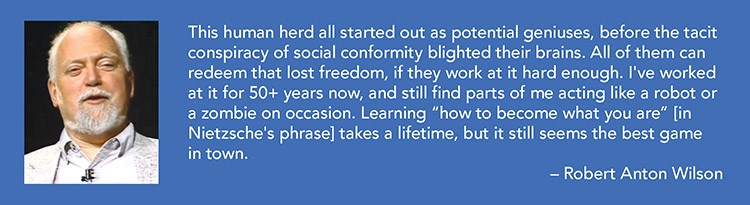
    Much like McKenna, Wilson recommends that a “fully functioning human ought to be aware of their reality tunnel and be able to keep it flexible enough to accommodate and, to some degree, empathise with different ‘game rules’, different cultures.”16 According to Wilson, constructivist thinking, which considers how social and cultural processes determine our perception of the world, constitutes an exercise in metacognition, enabling us to become aware of how reality tunnels are never truly objective, thereby decreasing the “chance that we will confuse our map of the world with the actual world.”17 

    How Your Reality Tunnel Is Formed

    The constraints of human biology partially limit our models of reality. As Wilson states, our DNA “evolved from standard primate DNA and still has a 98% similarity to chimpanzee (and 85% similarity to the DNA of the South American Spider Monkey). We have the same gross anatomy as other primates, the same nervous system and the same sense organs. While our highly developed pre-frontal cortex enables us to perform ‘higher’, more complex mental tasks than other primates, our perceptions remain largely within the primate norm.”18 

    The neural apparatus produced by our genetic coding helps create what ethologists call the umwelt, or “world-field.” Birds, reptiles and insects occupy a separate umwelt or reality-tunnel to primates (ourselves, included). For example, bees are able to perceive floral patterns in ultraviolet light, which we cannot (unless certain technologies are utilised). Canine, feline and primate reality-tunnels remain similar enough that friendship and communication can occur between these different species, however, a snake (for example) occupies such a different reality tunnel that their behaviour appears entirely alien. 

    As Wilson argues, the belief that human umwelt reveals “reality” or “deep-reality” is as “naïve as the notion that a yardstick shows more reality than a voltmeter or that ‘my religion is better than your religion’. Neurogenetic chauvinism has no more scientific justification than national or sexual chauvinisms.”19 He goes so far as to suggest that “no animal, including the domesticated primate, can smugly assume the world created by its senses and brain equal in all respects the ‘real world’ or the ‘only real world’.”20 

    Reality-tunnels are also influenced by “imprint vulnerability,” periods in our lives when early childhood/adolescent experiences “bond neurons into reflex networks which remain for life.”21 The psychological researchers, Lorenz and Tinbergen, won a Nobel Prize in 1973 for their research into imprinting, which demonstrated that “the statistically normal snow-goose imprints its mother, as distinct from any other goose, shortly after birth. This imprint creates a ‘bond’ and the gosling attaches itself to the mother in every possible way.”22 These imprints can be imposed onto literally anything. Lorenz observed a case in which a gosling, in the absence of its mother, imprinted a ping-pong ball. It followed the ping-pong ball around and, on reaching adulthood, “attempted to mount the ball sexually.”23 

    Wilson estimates that the age at which we are imprinted with language determines lifelong programs of “cleverness” (verbal intelligence) and “dumbness” (verbal unintelligence), since linguistic models enable us to articulate mental processing, evaluate complex ideas and communicate with those around us.24 Furthermore, how and when our first sexual experiences are imprinted can “determine lifelong programs of heterosexuality, brash promiscuity or monogamy etc.”25 In more obscure imprints, such as celibacy, foot-fetishism and sadomasochism, the “bounded brain circuitry seems quite as mechanical as the imprint which bounded the gosling to the ping-pong ball.”26 

    These examples suggest that experiences during childhood, when the brain exhibits optimal ‘neuroplasticity’ (a term used to refer to malleability of neural networks in the brain), can shape our reality tunnels far into adulthood. As Sigmund Freud proposed, many “rational” thoughts and behaviours are typically the result of “repressed” memories, impulses and desires, which dwell in the murky depths of the unconscious mind.27 

    Furthermore, reality-tunnels are shaped by social conditioning, the “sociological process of training in a society to respond in a manner generally approved by the society in general and peer groups within society.”28 Manifestations of social conditioning are multifarious but include nationalism, education, employment, entertainment, popular culture, spirituality and family life. Unlike imprinting, which usually requires only one powerful experience to set permanently into the neural networks of the brain, conditioning requires “many repetitions of the same experience and does not set permanently.”29 

    The processes of social conditioning vary greatly, depending on the cultural environment to which one is exposed. For example, an individual born in a Muslim country (such as Saudi Arabia) will likely believe in the teachings of the Quran and adhere to certain religious norms, customs and traditions. However, individuals born in a Western capitalist/consumerist country, or an Eastern country with Hindu or Buddhist traditions, will adhere to different cultural and behavioural codes. 

    Reality-tunnels are also formed through the process of learning. Much like conditioning, learning requires repetition, but it also requires motivation. Therefore, it plays “less of a role in human perception and belief than genetics and imprinting and even less than conditioning does.”30 Learning marks a major difference between how mammals, reptiles, insects and birds perceive the world. For example, snakes share the same reality tunnel since they merely act on biologically determined reflexes, with only minor imprinted differences. Mammals show “more conditioned and learned differences in their reality tunnels.”31 

    Humans demonstrate a higher aptitude for learning due to our highly developed cortex and frontal lobes as well as our prolonged infancy. This variability functions as “the greatest evolutionary strength of the human race” since it enables us to pass down knowledge from one generation to the next. But it also means that we can become brainwashed and label other people who do not share our beliefs as “mad,” “anti-social,” or “blasphemous.” In fact, it could be said that the majority of all wars are the result of two (or more) opposing reality tunnels fighting for supremacy. This is particularly evident in the case of religious conflict, where people kill each other in the name of “God.” 

    Tunnel Vision: The Politicisation of Reality

    The rise of “identity politics” in the 21st century perfectly demonstrates how reality-tunnels prevent us from considering alternative perspectives and viewpoints. During the last decade, the political domain has become increasingly polarised as the left and right engage in a battle for cultural supremacy. Such polarisation was apparent in the Brexit referendum of 2016, in which 51.9% of the British public voted to leave the European Union while 48.1% voted to remain.32 The marginal success of the ‘leave’ campaign highlighted the strong division between both sides of the political spectrum. The former stressed the importance of the Union in promoting social and economic stability, while the latter emphasised the importance of national identity, sovereignty and independence. 

    The rhetoric employed by both the ‘leave’ and ‘remain’ campaign was so binary in its articulation that neither side engaged in meaningful dialogue; instead, the referendum became a series of baseless slogans, mottos and catchphrases – an advertising campaign designed to appeal to target demographics. The referendum was more about two separate reality-tunnels competing for ideological supremacy than a balanced analysis of benefits and risks. 

    The US presidential election of 2016 was a similar drama of competing reality-tunnels, shaped by masterful spin doctors and hidden persuaders who exploited modern advertising techniques to capture specific demographics based on class, age, sex, religion, geographical location and other criteria. 

    Donald Trump was well-known for his campaign slogan ‘Make America Great Again’ and other catchphrases that employed a lexicon of patriotism, populism and protectionism to appeal to those on the right. On the other hand, Hillary Clinton used the slogan ‘Stronger Together’ to evoke feelings of unity, compassion, and solidarity. The election became a battle between two contrasting reality-tunnels, grounded in meaningless rhetoric and hyperbole. 

    Another example of politicisation is the Covid-19 crisis, with the public divided into two camps – those who supported measures such as lockdowns versus the other side that rejected many of these same measures. Political polarisation demolished a sane balanced approach to the crisis, exacerbated and intensified by the ongoing political divide across the media landscape. 

    ‘Echo Chambers’ & Identity Politics 

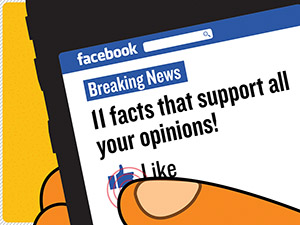
    Social media has fuelled identity politics by enabling groups and movements to generate an online presence and have real-world impacts. According to independent scholar and author Ilaria Bifarini, this results in the emergence of ‘echo chambers’ in which internet users “find information that validates their pre-existing opinions and activates confirmation bias.”33 This mechanism, says Bifarini, “strengthens one’s beliefs and radicalises them, without adding anything to information and knowledge. The result is the ideological extremism that we are observing today and in which we are taking part, where political debates have been replaced by supporters and verbal violence.”34 

    Another way this happens, for example, is how Google’s online video sharing and social media platform YouTube utilises algorithmic data to show users similar content to their prior engagements – content they are likely to engage with in the future, thus creating a feedback loop in which they are exposed to media reinforcing their political preferences.35 As media scholars Brooke E. Auxier and Jessica Vitak state, “many social media platforms structure their content-feeds based on what an algorithm determines to be the ‘top’ or most ‘relevant’ stories. While these tools may help users control their information and news environments – making consumption more manageable and mitigating information overload – it is possible that these tailoring tools will expose users to redundant information and singular viewpoints.”36

    Both sides of the political spectrum fail to engage in meaningful discussion when they are entrapped in a single reality-tunnel, the stability of which is threatened by competing narratives. Instead, political dialogue becomes characterised by inflammatory insults, name-calling and defamation. 

    Loaded language – such as ‘virtue signallers’, ‘snowflakes’, ‘racist’, ‘transphobic’, ‘Islamophobic’, ‘hetero-normative’, ‘privileged’ – enables identity groups to protect the integrity of their reality-tunnel by excluding those who hold a different opinion. In the same way that religious cult leaders isolate their members from the outside world, so too do identity groups orientate themselves around a closed belief system, which is immune to criticism, contention or challenge. 

    In order to facilitate a more meaningful discussion, it is important that both sides learn to break free from the constraints of their reality-tunnel. 

    Rising Above the Fray

    In his book Prometheus Rising, Robert Anton Wilson provides various techniques for challenging dominant reality tunnels. Writing in the early 1980s, Wilson suggested that “if you are a liberal, subscribe to the [conservative magazine] National Review… Each month try to enter their reality-tunnel for a few hours while reading their articles. If you are a conservative, subscribe to New York Review of Books for a year and try to get into their headspace for a few hours a month. If you are a rationalist, subscribe to Fate Magazine for a year. If you are an occultist, join the Committee for the Scientific Investigation of Claims of the Paranormal and read their journal, The Sceptical Inquirer, for a year.”37 

    To put a modern ‘spin’ on this exercise, if you follow conservative thinkers online such as Jordan Peterson or Ben Shapiro, expose yourself to leftist thinkers such as Slavoj Zizek or Noam Chomsky, and do the opposite if you are on the left. Subscribe to internet channels that do not align with your reality-tunnel. By performing this exercise, you will find that you can think about political issues in a more balanced, neutral and multidimensional way, free from the constraints of ideological dogma. 

    You can use the same technique with religion. In one exercise, Wilson says, “become a pious Roman Catholic. Explain in three pages why the Church is still infallible and holy despite Popes like Alexander VI (the Borgia Pope), Pious XII (ally of Hitler), etc.”38 Then explain why the Church is an immoral and outdated institution; also write three pages detailing why you believe this to be the case. If you have the time, you can perform the same exercise with other religions such as Hinduism, Buddhism, and even Satanism. Explain why these religions hold the key to the ‘true’ nature of ‘reality’ and then refute yourself by providing a counterargument.

    You can use the same technique to become more conspiratorial in your thinking. In one exercise, Wilson says, “start collecting evidence that your phone is bugged. Everyone gets a letter occasionally that is slightly damaged. Assume that somebody is opening your mail and clumsily revealing it. Look around for evidence that your co-workers or neighbours think you’re a bit queer and are planning to have you committed to a mental hospital.”39 Observe how these assumptions influence your perception of other people and their behaviour – it won’t be long before you find evidence to support your paranoid thinking! 

    Once you have sufficiently experimented with this reality-tunnel, “try living a whole week with the program, ‘Everybody likes me and tries to help me achieve all of my goals’.”40 Then try living a whole month with the program, “I have chosen to be aware of this particular reality.”41 Then try living a day with the program, “I am God playing at being a human being. I created every reality I notice.”42 Then try living forever with the metaprogram, “Everything works out more perfectly than I plan it.”43 By adopting these different reality-tunnels, you will notice how malleable your perceptual faculties really are – the world can become a place of conspiracy and collusion or a place of benevolence and positivity, depending on how you view it. 

    Get the issue this article appears in

    Wilson provides another interesting exercise to expand the boundaries of consciousness, in which you “list at least 15 similarities between New York (or any large city) and an insect colony, such as a bee-hive or termite hill. Contemplate the information in the DNA loop, which created both of these enclaves of high coherence and organisation, in primate and insect societies.”44 Then, “Read the Upanishads and every time you see the word ‘Atman’ or ‘World Soul’, translate it as DNA blueprint. See if it makes sense to you that way.”45 According to Wilson, “Contemplating these issues usually triggers Jungian synchronicities. See how long after reading this chapter you encounter an amazing coincidence – e.g., seeing DNA on a license plate, having a copy of the Upanishads given to you unexpectedly…”46

    Experimenting with different reality tunnels is a necessary practice if one wishes to challenge dominant narratives, perspectives and viewpoints and expand the boundaries of human consciousness. As we find ourselves in a post-modern ‘information age’, where an increasing number of political factions compete for informational authority, we are exposed to the hidden forces of propaganda more than ever before. 

    Every time we log into Facebook, Twitter, Instagram and YouTube, we allow ourselves to be manipulated by a complex system of algorithms that generates content based on our likes, dislikes, and even our differences. In order to escape the trappings of ideological dogma, we must become conscious of our biological, social and environmental conditioning and adopt a more multidimensional way of thinking. 

    Understanding about ‘reality-tunnels’ becomes instrumental in achieving true inner liberation since it enables us to think about the mind as a form of technological software that can be continually updated and reorganised. We achieve a state of metacognition, an awareness of one’s thought processes and an understanding of the patterns behind them. It is what the pioneering mind explorer John Lilly called our capacity for “metaprogramming,” the creation, revision, and reorganisation of mental programs.47

    Although we are constrained by the limitations of biological programming (to a certain extent), the creativity of human consciousness is infinite, a maze of endless possibilities and potentialities waiting to be explored. As the Buddha said, “All that we are is the result of all that we have thought. It is founded on thought. It is based on thought.”48 

    [alert type=”general” dismiss=”no”]This article was published in New Dawn 187.[/alert]

    [alert type=”success” dismiss=”no”]If you appreciate this article, please consider subscribing to help maintain this website.[/alert]

    Footnotes

    1. Hartogsohn, I. (2015). The Psychedelic Society Revisited: On Reducing Valves, Reality Tunnels and the Question of Psychedelic Culture, Psychedelic Press, 3 
    2. http://ultrafeel.tv/reality-tunnel-how-beliefs-and-expectations-create-what-you-experience-in-life
    3. Op cit., Hartogsohn, I. (2015), 4
    4. https://en.wikipedia.org/wiki/Confirmation_bias 
    5. Anton Wilson, R. (1983). Prometheus Rising, Tempe, Arizona: New Falcon
    6. https://en.wikipedia.org/wiki/Immanuel_Kant
    7. https://en.wikipedia.org/wiki/Reality_tunnel
    8. Ibid 
    9. Parsons, T. (1951). The Social System, Glencoe, Illinois: The Free Press, 1951
    10. Sam Keen, Castaneda interview, Psychology Today, December 1972
    11. Derrida, J. (1978). ‘Genesis’ and ‘Structure’ and Phenomenology, in Writing and Difference, Routledge. 
    12. https://en.wikipedia.org/wiki/Dada
    13. Op cit., Hartogsohn, I. (2015), 1
    14. Ibid, 2
    15. Anton Wilson, R. (1990). Quantum Psychology: How Brain Software Programs You & Your World, New Falcon Publications
    16. https://en.wikipedia.org/wiki/Reality_tunnel 
    17. Quantum Psychology, 74
    18. Ibid, 74
    19. Ibid, 75
    20-24. Ibid, 76
    25-26. Ibid, 76-77
    27. Wollheim, R. (1971). Freud, Fontana Press
    28. https://en.wikipedia.org/wiki/Social_conditioning 
    29. Quantum Psychology, 77
    30. Ibid
    32. Ibid
    33. Bifarini, I. Cognitive bias and echo chambers: The social media trap, www.academia.edu/40650380/Cognitive_bias_and_echo_chambers_The_social_media_trap
    34. Ibid
    35. Nguyen, C. Echo Chamber and Epistemic Bubbles, www.academia.edu/36634677/Echo_Chambers_and_Epistemic_Bubbles 
    36. Auxier, B. and Vitak (2019). Factors Motivating Customization and Echo Chamber Creation Within Digital News Environments. Social Media and Society, April-June 2019
    37. Prometheus Rising, 83
    38. Ibid, 159
    39. Ibid, 241
    40-43. Ibid, 242
    44-46. Ibid, 190
    47. Lilly, John C. Programming & Metaprogramming in the Human Biocomputer, New York: The Julian Press, Inc., 1967
    48. The Dhammapada

    © New Dawn Magazine and the respective author.
    For our reproduction notice, click here.
  • Mysteries of the Deep State: Examining the Hidden Hands that Guide World Events

    Mysteries of the Deep State: Examining the Hidden Hands that Guide World Events

    From New Dawn Special Issue Vol 15 No 1 (Feb 2021)

    Life-changing events are a frequent occurrence in politics and economics. Recent examples include the assassination of US President John F. Kennedy (JFK) in 1963, the events of 11 September 2001 (9/11), COVID-19 (which began in the eponymous year), and the Global Financial Crisis (2007-08). Some events are accidents. Others arise from systemic factors. But, on occasion, hidden manipulators known as the “Deep State” are to blame.

    After looking at cases of political interference, such as the soft coup against Australia’s Prime Minister Gough Whitlam in the 1970s, this article considers two examples of Deep State events: the clandestine “Gladio” networks set up across Europe after World War II (1939-45) and the collapse of the World Trade Center in New York, which triggered a “global war on terror” in which most of the nations of the world participated. These are known to researchers as “Deep State” events. They are contrived and covered up by agents of the security apparatus and dismissed by mainstream media as baseless conspiracy theory.

    Before exploring the differences between the “Deep State” and the “Open State,” consider some definitions. 

    WHAT IS “THE DEEP STATE”?

    The term Deep State is widely attributed to the academic Peter Dale Scott, who notes that at least four major political events in modern US history were designed by Deep State actors: the assassination of John F. Kennedy, Watergate (1972-74), the Iran-Contra Affair (1985-87), and 9/11. In each case, Deep State actors reportedly had access to a doctrine called Continuity of Government (COG): a contingency plan that allows for surface-level government shutdowns in the event of major crises. Scott argues that COG was unofficially invoked to hide the sale of weapons to Iran by the US to finance the latter’s dirty war against socialists in Nicaragua (Iran-Contra). But COG was officially implemented for the first time on 9/11.

    Within each state’s “deep” network lie competing factions; for example, there is often a rift between intelligence analysts and operations units. The latter tend to work against the former for political reasons, which further complicates the nexus of surface-level vs. deep politics. For instance, Michael Scheuer, former head of the US Central Intelligence Agency’s (CIA) unit responsible for finding the alleged leader of “al-Qaeda,” Osama bin Laden, told the BBC that the Bill Clinton administration (1993-2001) had ten “easy opportunities” to kill or capture bin Laden between 1998 and 1999. But, on each occasion, Clinton declined to act. The implication is that certain Deep State actors working against Scheuer’s brief wanted bin Laden alive. 

    But conspiracy researchers often fail to look at broader, structural reasons for unusual events. Many refuse, for instance, to critique the workings of capitalism as explanations for certain occurrences. For example, on 8 March 2020, Dr Anthony Fauci who served on US President Donald Trump’s Coronavirus Task Force, told Americans not to wear facemasks because they allegedly don’t work. Fauci later said that masks are indeed effective against COVID. Fauci acknowledged that he had lied because, at the time, masks were in short supply and he wanted to ensure that frontline workers were prioritised over members of the public who might otherwise panic-buy. Fauci’s immoral act was not part of a mandatory mask conspiracy: it was a reflection of capitalism. Masks were not profitable until the pandemic struck, so corporations didn’t stock them and the few that were available went to healthcare workers. 

    By contrast, “ad hoc” theorists – i.e., those who think that all political decisions are surface-level and made off-the-cuff in response to unexpected circumstances – refuse to explore the hidden workings of states and corporations. They fail to accept a striking facet of human nature: the tendencies of many individuals to form secret, mutual associations and to consciously plot against and deceive others. It is, therefore, important to distinguish between events caused by systemic design and events orchestrated by invisible forces. 

    Sometimes, major events occur because laws, lobbying, and licentiousness allow them space to happen. In the US, for instance, decades of financial deregulation enabled investors and traders to create bubbles of worthless, fancy-sounding products that were tied to bad mortgages: “collateralised debt obligations,” “credit default swaps,” and “derivatives,” against which the multibillionaire Warren Buffett had previously warned, describing them as “financial weapons of mass destruction.” Because the aforementioned toxic financial products were bloating the portfolios of asset managers, banks, hedge funds, liquidity firms, and more, the collapse of certain banks triggered an entire global financial crash. Unlike Deep State events, this was not a conspiracy. It was the inevitable consequence of deregulated, neoliberal capitalism. 

    WHITLAM AND WILSON: DEEP VS. OPEN STATES 

    On other occasions, however, things happen as a result of forces that are hidden from public and media scrutiny under the veils of national security and plausible deniability. These events are said by conspiracy researchers and the few scholars open-minded enough to look at them to be the calculated works of Deep State actors. 

    In November 1975, for example, Australia’s Governor-General, Sir John Kerr, dismissed the leader of the Labour government, Prime Minister Gough Whitlam. The official reason was that Whitlam’s minority government was a lame duck: it could not get a budget through the Senate and Whitlam refused to resign or call an election. But researchers like the journalist John Pilger note that there was more to the situation than meets the eye. 

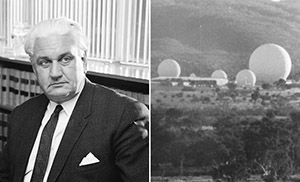
    Australia is home to Pine Gap, a ground-based listening station belonging to the US military and serving the US National Security Agency’s permanent global surveillance operation. The original members of the top-secret alliance were known as the Five Eyes. They included Australia, Britain, Canada, New Zealand, and the leader of the pack, the USA. Today via secret projects like PRISM, dozens of US allies, from Germany to Israel, provide the US Deep State with surveillance-based intelligence by sweeping the electronic signals of the world – from civilian telephone calls and private internet searches to conversations in living rooms via hacked smart TVs and sounds picked up through baby monitors. 

     British and US Deep States collaborated to depose Australian PM Gough Whitlam who was threatening Five Eyes spy base Pine Gap (right). In 1975, their plan came to fruition when Governor-General Sir John Kerr (left) dismissed Whitlam.

    Since the 1950s, Governor-General Kerr had allegedly been courted by the CIA. He was, for instance, a member of the Australian Association for Cultural Freedom, an entity later exposed in the US Congress as a CIA front. Christopher Boyce, an employee of the CIA contractor TRW, described him as “our man Kerr.” Victor Marchetti, a CIA officer previously involved with Pine Gap, told journalist Pilger that Whitlam’s hints against the US spy base “caused apoplexy in the White House.” The US and British Deep States collaborated to depose Whitlam.

    Each state, including democratic ones, has its own parallel government, which is kept secret from the public. 


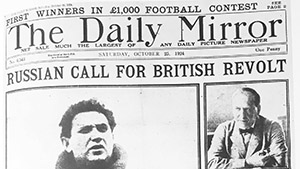
    Deep State black propaganda. The Zinoviev letter – one of the greatest British political scandals of the last century – was forged by a MI6 agent’s source and leaked to the press.

    As Whitlam was being sacked in Australia, the UK’s internal Security Service, Military Intelligence Section Five (MI5), was spying on the left-wing Labour PM, Harold Wilson, as well as dozens of left-leaning MPs and intellectuals. Fifty years earlier, the nascent Labour Party’s chances at the general election 1924 were torpedoed by the UK’s external Secret Intelligence Service (MI6), the equivalent of the CIA. To sabotage Labour, MI6 forged a letter purportedly written by the Soviet communist, Grigory Zinoviev. The preposterous letter claimed that the Bolsheviks, who had recently come to power in a coup in Russia, would back the Labour Party and foment civil war in the UK. 

    The letter is an example of what is known as black propaganda: putting false words in the mouths of enemies as part of strategic influence operations. The right-wing press at the time happily disseminated this Deep State propaganda at the general election which helped to crush Labour and thus the social and political progress of working people. 

    Today, two figures at opposite ends of the political spectrum, the 45th President of the United States, Donald Trump, and the recently-defeated leader of Britain’s Labour Party, Jeremy Corbyn, were victims of Deep State propaganda in the form of the Integrity Initiative (II) and related actors. Conducting information warfare by working with “clusters” of sympathetic journalists, the II was funded by the British Conservative Party through the Foreign and Commonwealth Office and is an offshoot of the anti-Russia think-tank, Institute for Statecraft. The II line was that Corbyn was a “useful idiot” for the Kremlin. Where Corbyn genuinely wanted peace with Russia, and indeed with all nations, Trump merely paid lip-service, continuing in reality to encircle Russia with US-backed forces. But for the fanatically anti-Russian elements of the Deep State, many of them Cold War holdovers, lip-service was enough to get Trump smeared as a blackmail risk. Companies working with the US Democratic National Committee paid Christopher Steele, MI6’s former Moscow station chief, to write a report on Trump’s alleged connections to Russian President Vladimir Putin. The objective was to stop Trump from becoming President. 

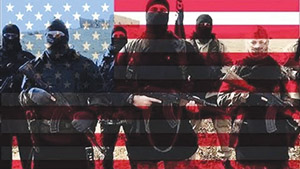
    The above are examples of soft coups and weaponised propaganda. But the Deep State also engages in violent acts, such as using far-right militias as proxies to attack left-wing governments and leverage features of the “Open State” (like MPs and ministers) against enemy states. Enter Gladio. 

    THE DEEP STATE’S SECRET ARMIES

    From the 1940s to the 1990s, Europe was terrorised by far-right and far-left groups that were apparently committed to bombings and assassinations. It turns out that many of the far-right groups were organised by MI6 and the CIA, with help from the given country’s own Deep State. The terror was often blamed by media and political opponents on far-left groups, some of which were linked to the Soviet Union. The Italian branch of the CIA-MI6 nexus was called Gladio, named after the Latin word gladius – a double-edged sword. Journalists and scholars used “Gladio” as a generic term for the pan-European operations, which also stretched as far as Algeria and Turkey. 

    Gladio began with Britain’s Special Operations Executive (SOE), which was formulated by the Chiefs of Staff in 1940 to repel a potential Nazi invasion of the British Isles. PM Winston Churchill supposedly expanded this doctrine to include the whole of the UK, as well as allied European countries. SOE’s SO1 operations included black propaganda and deception. SO2 included sabotage. Historian David Stafford writes that one directive “envisaged SOE building up and equipping paramilitary organisations to support conventional forces.” Operations included “interrupting enemy signals communications and transport, counter-sabotage, [and] attacks on enemy aircraft and air personal.” 

    The SOE dissolved in 1946. With the Nazis defeated, Gladio would target the Soviets – and leftism in general – via so-called stay-behind guerrilla networks. SOE units in Austria and Germany continued under MI6’s Special Operations Branch. In the US, the Central Intelligence Agency was formed to replace the Office of Strategic Services. The CIA worked with MI6 on setting up the Gladio network. The US National Security Council’s Directive 10/2 established the Office of Special Projects, later known as the Office of Policy Coordination. It decreed that “overt foreign activities of the US Government must be supplemented by covert operations.” The first was the German Stay Behind Organization, headed by the Nazi intelligence officer, General Reinhard Gehlen. MI6 set up the Anti-Bolshevik Bloc of Nations, which, says historian Dave Renton, “encouraged former Nazi sympathisers and other so-called freedom fighters from Eastern Europe to spy and commit acts of sabotage behind the Iron Curtain.”

    In 1947 under “Plan Bleu,” the CIA and British Special Air Service coordinated the other networks by establishing France’s stay-behind organisation. This was followed by the Western Union Clandestine Committee (WUCC). The WUCC was then integrated into France’s NATO units under the name, “Clandestine Planning Committee.” In 1958, NATO founded the Allied Clandestine Committee and the French Gladio was established with help from the Service de Documentation Extérieure et de Contre-Espionnage and France’s SAS-equivalent, the 11e régiment parachutiste de choc (11th Shock Parachute Regiment). 

      In 1959, the anti-US French President and former leader of the anti-Nazi Resistance, Charles de Gaulle, had come to power. Despite de Gaulle’s expulsion of NATO from France, the French Gladio networks continued to operate, apparently without his consent. CIA agent Philip Agee said at the time that the CIA “wanted to stop the left from coming to power, and want even more to stop Communist participation in the government. For the CIA this is evidently the priority and priorities.”

    Operations moved from France to Belgium. Britain’s involvement in the Belgian Gladio appears to have started in 1948, when PM Paul-Henri Spaak authorised his secret service (the Staatsveiligheid) to contact Britain’s MI6. Between 1982 and 1985 and known as the Brabant killings, apparently deranged masked gunmen murdered 28 people in sprees across Belgian supermarkets. Belgium’s Gladio networks used robberies as counter-terror training exercises. The far-right activist Paul Latinus claims to have been involved in a Belgian Gladio unit responsible for the killings. The job of Latinus and his second-in-command, Michel Libert, was reportedly to pass surveillance information to the Gladio units.

    The British were training Belgian Gladio units as late as at least 1989. Colonel S. Schwebach of the Belgian intelligence service told the Defence Minister that an exercise called Waterland had occurred that year, in which the Royal Marines Special Boat Squadron landed in Flanders and was guided by Belgian civilians. Speaking to the Associated Press, a former army intelligence officer said that as late as October 1990, weapon caches were spread across Belgium.

    A BBC documentary from the early-1990s puts it well: “For 40 years, secret terrorist organisations, many trained by Western intelligence agencies, have manipulated the political control of European sovereign states by a campaign of terror and murder.” In addition to empowering neo-Nazis, the consequences of Gladio included alienating left-wing parties by associating them with terrorism. Strict anti-terror laws designed to impinge on freedom of speech were adopted by the parliaments of many countries. “Nigel West” (real name Rupert Allason, a Tory and editor of Intelligence Quarterly Magazine), told the Associated Press in 1990: “We [the British] were heavily involved and still are,” in helping to “finance and run” the networks. 

    In the late-1970s, the CIA and MI6 used their Gladio skills to bring Islamic terrorists from Algeria, China, Jordan, Morocco, Pakistan, Palestine, Saudi Arabia and elsewhere into Afghanistan, which bordered Soviet countries. Known as Operation Cyclone, the aim was to “draw the Russians into the Afghan trap,” in the words of US President Jimmy Carter’s National Security Advisor, Zbigniew Brzezinski. Cyclone created a vast terrorist network later dubbed “al-Qaeda” by Western media and punditry.

    TURNING POINT: 9/11

    Gladio was designed to defeat both leftism and Sovietism. By 1991, the US had won the Cold War and the Soviet Union was no more. But the threat of leftism persisted. Enter the “global war on terror” (GWOT) and the creation of new layers of the “national security state.” The GWOT was launched after 9/11 by the George W. Bush administration (2001-09). Bush’s father, George H.W., had been Director of the CIA for a year, beginning 1976, during which time he oversaw Gladio operations. Bush the elder was also President of the USA from 1989 to 1993. Several times he spoke publicly of wanting to build a “New World Order” in the post-Soviet era. A businessman, Bush also invested in the acquisitions firm, the Carlyle Group, whose investors included the Bin Laden family: Osama bin Laden being the alleged “al-Qaeda” mastermind whose networks were trained by US and British forces between 1979 and 1989.

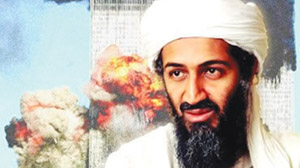
    The Deep State used their Gladio skills to bring Islamic terrorists to Afghanistan to fight the Soviets. This ultimately led to the creation of Osama bin Laden’s al Qaeda and the false flag attack of 11 September 2001. 

    The Presidencies of Bush senior and junior are rare examples of the Deep State operating as an open state. 

    The Project for the New American Century (PNAC) was a right-wing, imperialist think tank whose associates included former Presidents Bush senior and junior. Other members and associates who ended up in the Bush junior administration included future Vice President Dick Cheney, future Defense Secretary Donald Rumsfeld, future Deputy Defense Sec. Paul Wolfowitz, and Defense Sec. Advisor Richard Perle. 

    In September 2000, before the invasions of Afghanistan and Iraq under the pretext of fighting the GWOT, PNAC stated that its goal was “to shape a new century favourable to American principles and interests.” American business interests are assured by the US “fighting and winning multiple large-scale wars,” backing out of anti-missile treaties in order to weaponise space, and exploiting the “revolution in military affairs.” The document says that drones will “project military power around the globe” and that “advanced forms of biological warfare that can ‘target’ specific genotypes may transform biological warfare from the realm of terror to a politically useful tool.” 

    The plan to attack US targets and blame enemies was hinted at in the document: “Further, the process of transformation, even if it brings revolutionary change, is likely to be a long one, absent some catastrophic and catalysing event – like a new Pearl Harbor.” The demolition of the World Trade Center in New York a year later was blamed on Arab airline hijackers. To confuse the military and intelligence units that were not involved in the false-flag attack, the Deep State perpetrators created their own “fog of war” by timing the events to coincide with multiple training exercises. 

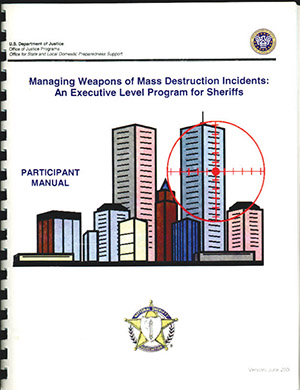
    To confuse, multiple training exercises coincided with the world-changing events on 11 Sept 2001. The cover of a US Dept of Justice manual for a training event in June 2000.

    For example, the National Reconnaissance Office was running an exercise simulating a small corporate jet crashing into a building. The North American Aerospace Defense Command (NORAD) was running its annual Operation Northern Vigilance, which began on 9 September and ran for several days. NORAD was also running Vigilant Guardian, which involved several scenarios. On the ground, the Federal Emergency Management Agency was positioned in New York on the night of 10 September in preparation for Operation Tripod, a huge counter-bioterrorism drill scheduled in New York for 12 September. 

    After 9/11, the strategically important nation of Afghanistan was occupied, as were the oilfields of Iraq. A new hi-tech economy was created, with drones and big data. Shortly after the attacks, lawyer, future Obama diplomat, and ex-Democratic Senator, Gary Hart, chaired the US government’s Commission on National Security in the 21st Century, during which he said: “There is a chance for the President of the United States [George W. Bush, a Republican] to use this disaster to carry out a phrase his father used… and that is a ‘new world order’.” Several years later, Israel’s Prime Minister Benjamin Netanyahu told an audience at Bar Ilan University: “We are benefiting from one thing, and that is the attack on the Twin Towers and Pentagon, and the American struggle in Iraq” (that’s actually three things). Within a decade, the US security and surveillance industry was worth $1 trillion. In Wired for War, P.W. Singer notes that five years after 9/11, border, construction, and airport security was a $30bn market, leading one private industry report to state: “Thank you, Osama bin Laden!” 

    9/11 was orchestrated by a Deep State cabal, whose surface-level members, like the Bush family, had come to power in the US. In the absence of new enemies, like the Soviets, their aim was to attack civilian targets and blame Islamic terrorists. This could justify the next phase of US military global domination and stimulate hi-tech investment. 

    In his farewell address, US President Dwight Eisenhower (1953-61) warned Americans about the potential of “misplaced power” by “a scientific-technological elite.” He admonished the people to “guard against the acquisition of unwarranted influence, whether sought or unsought, by the military-industrial complex.” The revelations of NSA contractor, Edward Snowden, decades later proved beyond doubt that Eisenhower’s warnings about an emerging Deep State were based in fact. 

    Get the issue this article appears in

    CONCLUSION

    To deny the existence of a Deep State operating within one’s country is to fail to understand, holistically, how the nation-state works: in whose interests it operates and the laws and regulations, or lack of, that allow for violent, clandestine activities. Structural factors underlie many major events, like the Financial Crisis. Accidents also occur, like nuclear power plant disasters. But, in addition, conspiratorial agents are responsible for certain events. Part of the process of deciphering propaganda, be it from the mainstream or from the alternative media, is to figure out what is structural, what is accidental, and what is conspiracy.

    This article has focused on the US and British Deep States and their effect upon both geo- and domestic politics. Each country has its own Deep State, sometimes working alone, sometimes working in collaboration with others. Sometimes the Deep State will work in total secrecy against democratic elements abroad, other times it will work with the Deep State of the host country. The presence of US spy installations on Australian soil is a classic case of sympathetic parallel structures colluding with foreign elements to interfere in democratic processes. 

    It is all-too-easy for academia, media, and political punditry to ignore, dismiss, and ridicule the Deep State as a conspiracy theory. But the Deep State thrives on conspiracy. Conspiracy is its business. To ensure its own survival and thus the privileges of the small number of elites it serves, maintaining conspiracy is essential. Once in a while, innocent people around the world pay the price for the actions of these dark agents.  

    [alert type=”general” dismiss=”no”]This article was published in New Dawn Special Issue Vol 15 No 1.[/alert]

    [alert type=”success” dismiss=”no”]If you appreciate this article, please consider subscribing to help maintain this website.[/alert]

    Footnotes

    1. For instance, Peter Dale Scott (2017) The American Deep State: Big Money, Big Oil, and the Struggle for U.S. Democracy.
    2. Interview BBC 2, The Conspiracy Files: Osama Bin Laden: Dead or Alive?
    3. “Fact check: Outdated video of Fauci saying ‘there’s no reason to be walking around with a mask’,” 8 October 2020, www.reuters.com/article/uk-factcheck-fauci-outdated-video-masks-idUSKBN26T2TR
    4. “Why Weren’t We Wearing Masks From the Beginning? Dr. Fauci Explains,” The Street, 12 June 2020, www.thestreet.com/video/dr-fauci-masks-changing-directive-coronavirus
    5. “Buffett warns on investment ‘time bomb’,” 4 March 2003, http://news.bbc.co.uk/1/hi/2817995.stm
    6. “Final Report of the National Commission on the Causes of the Financial and Economic Crisis in the United States,” Jan 2011, www.govinfo.gov/content/pkg/GPO-FCIC/pdf/GPO-FCIC.pdf
    7. Christopher Sweeney, “Australia in turmoil as Whitlam,” Guardian, 12 November 1975
    8. Glenn Greenwald & Ewen MacAskill, “NSA Prism program taps in to user data of Apple, Google and others,” Guardian, 7 June 2013
    9. Adam Parris-Long and Andy Hayes, “WikiLeaks releases files claiming MI5 and CIA hacked TVs and used them as bugs,” Sky News, 8 March 2017
    10. Canadian intelligence officer, Mike Frost, interviewed by 60 Minutes (US), https://cryptome.org/echelon-60min.htm
    11. John Pilger, “The British-American coup that ended Australian independence,” Guardian, 23 October 2014
    12. “MI5 kept secret file on Harold Wilson,” Independent, 23 Oct 2011
    13. Richard Norton-Taylor, “Zinoviev letter was dirty trick by MI6,” Guardian, 4 February 1999
    14. Parliament, “Foreign and Commonwealth Office: Integrity Initiative,” Written Questions, 27 November 2018
    15. Christopher Steele, Company Intelligence Report, No. 2016/080, https://assets.documentcloud.org/documents/3259984/Trump-Intelligence-Allegations.pdf
    16. ‘“Hitler’s Irish hideout”: a case study of SOE’s black propaganda battles’ (2006) in Mark Seaman (ed.) Special Operations Executive: A New Instrument of War, Routledge, p. 203. 
    17. Stafford in Mark Seaman (ed.) (2006) Special Operations Executive: A New Instrument of War, Routledge.
    18. Dave Renton (2000) Fascism, Anti-Fascism and Britain in the 1940s, Palgrave Macmillan.
    19. Daniele Ganser (2005) NATO’s Secret Armies, Frank Cass. 
    20. Ganser, op. cit.
    21. Ibid. 
    22. Clare Pedrick (1990), “CIA organized secret army in Western Europe,” Washington Post
    23. BBC 2, Timewatch: Gladio, 1992, www.youtube.com/watch?v=1YhRBxxyRqs
    24. Quoted in Ganser, op. cit. 
    25. Quoted in Jeffrey St. Clair and Alexander Cockburn, “How Jimmy Carter and I started the Mujahideen,” Counterpunch, 15 January 1998
    26. Oliver Burkeman and Julian Borger, “The ex-presidents’ club,” Guardian, 31 October 2001
    27. “Rebuilding America’s Defenses: Strategy, Forces and Resources for a New Century,” Project for the New American Century, September 2000, https://web.archive.org/web/20130501130739/http://www.newamericancentury.org/RebuildingAmericasDefenses.pdf
    28. Ibid. 
    29. ‘Agency planned exercise on Sept. 11 built around a plane crashing into a building’, Associated Press, www.boston.com/news/packages/sept11/anniversary/wire_stories/0903_plane_exercise.htm
    30. NORAD (2001), ‘NORAD maintains Northern Vigilance’, Public Affairs, www.norad.mil/Newsroom/Article/578022/norad-maintains-northern-vigilance
    31. Department of Defense (US) (2001), Battle Staff Exercise: Vigilant Guardian 01-02, Brief Morning, 11 September 2001, RDOD0301314[2?], www.archives.gov/files/declassification/iscap/pdf/2013-002-doc4.pdf
    32. ‘Attack on America’, CBS, www.youtube.com/watch?v=SmMRWL-jEVE
    33. New York City (2002), ‘Tripod’, Press Release, https://web.archive.org/web/20030626185936/http://nyc.gov/html/oem/html/other/sub_news_pages/tripod05_22_02.html
    34. Gary Hart (2001), US Commission on National Security in the 21st Century, www.youtube.com/watch?v=X-ezBk1ZFU0
    35. Quoted in Haaretz and Reuters, “Report: Netanyahu Says 9/11 Terror Attacks Good for Israel,” 15 April 2008

    © New Dawn Magazine and the respective author.
    For our reproduction notice, click here.
  • The Intriguing Life of Andrew Tomas: The Mystic Who Chased UFOs

    The Intriguing Life of Andrew Tomas: The Mystic Who Chased UFOs

    From New Dawn Special Issue Vol 12 No 2 (April 2018)

    ‘Ancient Aliens’ is the title of a popular show running on the History Channel, now in its 12th season, but the same title was used on a book published in 1973 by Andrew Tomas. It followed his 1971 bestseller – We Are Not the First – just a couple of years after the English version of Eric Von Däniken’s Chariots of the Gods attained worldwide success. In fact, Tomas had published a book titled The Planetary Doctrine as far back as 1935. While the modern TV namesake ‘Ancient Aliens’ takes pains to promote the idea that extra-terrestrials are made of flesh and blood, probably in deference to scientifically minded viewers, Tomas had no qualms about presenting his aliens as being otherworldly supra-humans, consisting of what was described as ‘mind-born’ bodies.

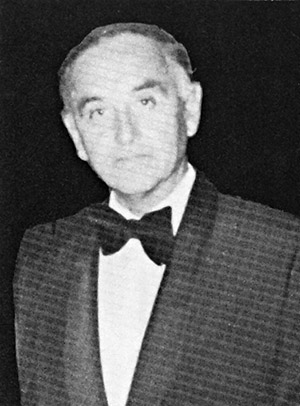
    Andrew Tomas (1906–2001)

    Some readers may hold the view that, just like science and religion, Ufology and spirituality are mutually exclusive. Not so if Andrew Tomas is any guide. He entwined both belief systems into a single coherent strand that yielded his impassioned advocacy for world peace.

    Born in Russia in 1906 and moving around as a result of his father’s work, Andrew left his homeland after the Bolshevik revolution and settled in China, where he completed his schooling and forged a career as an accountant. In 1948 he again fled social upheaval, this time when Mao Tse Tung forced the nationalists out of China. Tomas headed for Australia where he spent the best part of twenty years and dwelled successively in each of the mainland capitals. In the mid-1950s, at a time when he was involved in organising the NSW branch of the Australian Flying Saucer Research Society (AFSRS), he was viewed with suspicion by some other members and tarnished with the label ‘white Russian’.

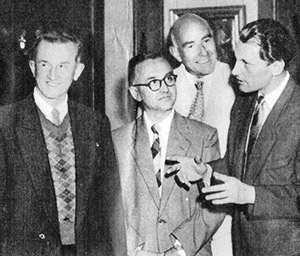
    Andrew Tomas (second from left) with fellow ufologists of the NSW UFO Investigation Centre, 1957.

    Well known ufologist and author Bill Chalker has recorded his recollections of that era: “I am well aware of the paranoia that existed during those years, but I do believe that any suspicion of the Victorian and Sydney groups by any individual, or body, could not have been further from the reality. While it is true that Andrew Tomas was indeed Russian, along with George Tararin (who I believe was from the region now known as Belarus), Dr Lindtner (Slovenia) and Joseph Gjerki (Croatia) and for all I know, maybe a few others also from Iron Curtain countries, the fact is that these people had all gone to Australia to get away from that sort of thing. George used to tell me he was ‘stateless’, having come more or less the same route as Andrew, which is to say, by way or Harbin or Shanghai. The latter two men had been educated by Americans – they had rather quaint accents with strong American overtones!”1

    The 1950s was the high point of McCarthyism in Australia, particularly with the Petrov affair. Unfortunately, even if you were not a communist sympathiser, the mentality of the era meant a ‘white Russian’ such as Andrew Tomas was probably under observation by intelligence agencies. This prompted him to request a name change from his Russian one, A. Boncza-Tomaszewski, under the ironically titled “Aliens Act 1947.” It was a further irony that Andrew Tomas should have drawn criticism because of his ethnic origins as he was a committed pacifist. Perhaps it was, in fact, his lobbying of politicians and other public figures with his peace agenda that drew attention. He had clung dearly to his Shambhala-inspired ‘peace doctrine’ ever since writing Planetary Doctrine two decades earlier.

    In 1954 Andrew Tomas met mystery writer Edgar Jarrold, the director of Australia’s first public flying saucer group. Tomas showed Jarrold his 1935 book The Planetary Doctrine, which had been published in Shanghai, China. He focused Jarrold’s attention on the passage: “Travellers and explorers often notice in the heights of the Himalayas strange shiny objects or creatures soaring high above the mountain crests, which are an eternal puzzle to Europeans. Whether these mysterious objects are vehicles belonging to supermen we dare not assert, though such an explanation is quite plausible. Cannot the reader believe that by such means, utilising unknown energies, communication is maintained from planet to planet?”2

    Books by Andrew Tomas

    The book Shambhala: Oasis of Light, written in 1977, was arguably Tomas’ most insightful and enduring legacy. In it, he describes how he ascended the snowy Himalayan slopes to a Tibetan monastery where he received spoken wisdom from a learned Lama, along with non-verbal illumination during a privileged initiation in a secret cave below the temple. Not only does Tomas assert the reality of the Bodhisattvas and Arhats, or Mahatmas, in this work he also draws together timeless mysteries from the East and West, Buddha and Jesus, Essenes and Templars, Hindu and ancient Greek; he connects Rosicrucianism, Masonry and Theosophy; the teachings of ancient philosophers flows through to unseen Guardians who continue to guide the planet today. 

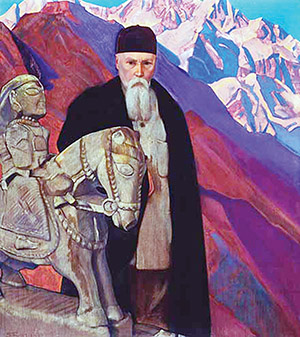
    He first met Nicholas Roerich in Shanghai during 1935 (the same year Tomas published The Planetary Doctrine). Roerich had just completed an expedition to Central Asia and talked about beings he called ‘Guardians’ who dwelt in the Gobi Desert. From that time onwards, Tomas would refer to Roerich reverently as his Master. For those unfamiliar with Roerich (1874–1947), he was a Russian painter, writer, archaeologist and theosophist, perceived as an ‘enlightener’, philosopher, and public figure, who in his youth was influenced by a spiritual movement in Russian society.

    Painting depicting the artist and mystic Nicholas Roerich. Tomas referred to Roerich as his ‘Master’.

    Trained as an artist and a lawyer, Nicholas Roerich was a dedicated activist for the cause of preserving art and architecture during times of war, earning several nominations for the Nobel Peace Prize. Among his most notable achievements was the Roerich Pact,3 which was signed into law by the United States and most nations of the Pan-American Union in April 1935. Andrew Tomas went on to devise a pact of his own. In March 1958, as secretary and organiser of the International Organising Committee of the Planetary Pact, he sent a draft of the pact to the world’s leading news agencies.

    Two years prior he published a 48-page booklet in Sydney titled Signs, Stars and Seers – An Experiment in Historical Prediction. In this book he stated he had already issued unheeded warnings to Hitler, Mussolini and Hirohito, through their embassies in China in 1935, regarding the folly of war. He also claimed to have approached a “responsible Soviet diplomat” four months after the defeat of Japan – well before the Cold War – with a project aimed at establishing friendly cultural relations between the USSR and the USA & UK. Although the project was not adopted, Tomas felt that his mission on behalf of world peace had been fulfilled. The booklet contained the ominous admonition: “If the national governments ignore this last warning, motivated by a desire to save this planet from destruction and mankind from self-annihilation, they will have to bear all responsibility for opposing the Cosmic Law of Unity.”4

    Not much was known in the West about the legendary Shambhala until revelations were made by Madame H.P. Blavatsky in the late nineteenth century. Andrew Tomas presented impressive evidence from Tibetan sources that this hidden kingdom really does exist and is the home base of higher beings who continue to guide us into the coming new age of Homo Noeticus. In that regard he issued warnings of coming calamities, while at the same time holding optimism for our long-term future. We will conclude with two of his predictions, one coming from his ‘Cosmic ET friends’, and the other from his Tibetan guides. 

    At the end of an article in the last issue of Jarrold’s Australian Flying Saucer Magazine, “Are you ready for a planetary crash?”, (page 7, February 1955), he wrote: “In the circles of the duly initiated Brethren of Space, fantastic stories are told of saucers, messages from space and cosmic decrees.… Anyway, my cosmic friends tell me not to worry about what other people say, but just place this information before the public. ‘It won’t be long now’, they say. Jokes aside, let us think more of the stars. Let us all become the children of Heaven. Let us dream of a Utopia where there is no hatred and no wars. But before we see that Utopia a red sign will flash in the skies, ‘Tighten your belts’. As Ripley says, ‘believe it or not’, but we are heading for a planetary crash.”5

    Get the issue this article appears in

    And finally, at the close of his book Shambhala: Oasis of Light, Andrew left us with predictions from the Tibetan Kalachakra tradition:

    “The twenty-first Ruler of the Land of Shambhala, Ma-gag-pa, is now enthroned on his lion-supported golden throne. He has ruled for forty-nine years before the present Fire Dragon year (1976). After another fifty-one years (2027), the twenty-second Holder of castes, Mi-yi Seng-ge, will ascend the throne and rule for one hundred years…

    “The twenty-fifth Holder of castes, Drag-po K’or-lo-chan, will ascend Shambhala’s golden lion-supported throne in the Fire Sheep year of the twenty-second cycle (twenty-fifth century) and propagate the Dharma teachings…

    “The La-lo king… will gather his legions west of India in a place called Tri-li… then the ministers will conduct an air surveillance. When they see numerous signs of wealth and happiness in the Land of Shambhala in the north, their jealousy will have no bounds and they will attack Shambhala. This will be in the Water Sheep year of the twenty-second cycle (2425)…

    “The Ruler of Shambhala will then assume command of the assembled forces of the twelve great gods – of the skyships flying faster than sound, fire- and steam-powered vehicles, armoured chariots, as well as the different types of atomic weapons…

    Tomas notes that these words were written down many centuries before the discovery of steam, aviation, nuclear physics or astronautics. He ends with these words:

    “Thus the evil forces will be destroyed by the might of the twelve gods. After that the precious Dharma will come under the direct protection of the Buddha. The King of Shambhala will change his residence and then the Perfect Age will dawn anew.”6   

    [alert type=”general” dismiss=”no”]This article was published in New Dawn Special Issue Vol 12 No 2.[/alert]

    [alert type=”success” dismiss=”no”]If you appreciate this article, please consider subscribing to help maintain this website.[/alert]

    Footnotes

    1. Bill Chalker, http://ufoicaustralia.blogspot.com.au/2007/09/ufologists-defiled-ufoic-asio-and-alien.html
    2. Ibid.
    3. For more on the Roerich Pact, see https://en.wikipedia.org/wiki/Roerich_Pact
    4. Ibid., Bill Chalker
    5. Ibid.
    6. Andrew Tomas, Shambhala: Oasis of Light, Sphere, 1977

    References & Further Reading

    Andrew Tomas, Beyond the Time Barrier, Sphere Books, 1974 
    Andrew Tomas, Chun’gang Wang, Xiangyang Xin, Xiaohong Zhang, Kua Yue shi kong di Qi ji, 1992
    Raymond De Becker, Las maquinaciones de la noche, 1973 
    Andrew Tomas, Mirage of the Ages: A Critique of Christianity, Exposition Pr of Florida, 1983
    Andrew Tomas, On the Shores of Endless Worlds – The Search for Cosmic Life, Bantam Books, 1974
    Andrew Tomas, Shambhala: Oasis of Light, Sphere, 1977 
    Andrew Tomas, The Home of the Gods: Atlantis from Legend to Discovery, Robert Hale & Co., 1972
    Andrew Tomas, We are Not the First: Riddles of Ancient Science, GP Putnam’s, 1971

    © New Dawn Magazine and the respective author.
    For our reproduction notice, click here.
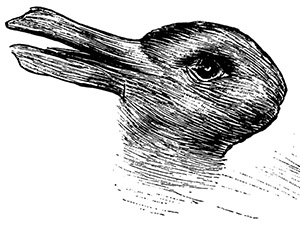
  • Making Social Media Work for You

    Making Social Media Work for You

    From New Dawn Special Issue Vol 16 No 1 (Feb 2022)

    You are the product. Your personal data are sold to brokers and advertisers against your informed consent to profit the uber-rich, like Facebook’s (now “Meta”) co-founder, Mark Zuckerberg.1 But it gets worse. Much worse. Your very reputation as a human is built or demolished on “social media” as it is sold to prospective employees, lenders, and landlords.2 

    So-called social media, which are really anti-social media,3 are merging into the tech-pharma industrial complex. They are creating a biofascist system in which your body and behaviour are potential money-makers for tech monopolies. The artificial intelligence (AI) economy is morphing into the “internet-of-bodies,” where genetic engineers and for-profit health companies will acquire all-pervasive, ubiquitous data about your most personal information.4 Not only this, but anticipatory artificial intelligence markets are under development. 

    GRIM FUTURE… AND PRESENT

    In these future markets, the omnipresent surveillance will be fed to algorithms programmed to guess your mood, reactions, and thoughts. We can imagine the nightmarish social applications.5 In public spaces, individuals with anxiety, for instance, might be analysed by AI, which could send adverts for stress pills to their phones, while security guards are dispatched to detain the individual, suspecting them of plotting crimes. Any public performance by, for instance, a populist politician will see their every facial and bodily movement scrutinised by behavioural AI in real-time for the public to assess and judge. Mainstream media delivering the given political debate will rank the “confidence” and “calmness” of the favoured candidate higher than those of the underdog, shattering voter confidence in the populist. 

    The present is already grim enough. Generation Z and the maturing Generation Alpha (perhaps named accordingly to anticipate and create generational divisions?)6 were born and are being born into a connected world, never knowing a moment of being off-line or having to wait for gratification. 

    Early so-called social media appealed to users’ egos; YouTube, MySpace. But they also played on our need, as humans, to be part of communities. “Social media” liberated the individual from the physical and restricting geography of their dwellings, but also from their cultures. The lonely and misunderstood teen could find the kinds of like-minded people online that they could not at school or in their hometown. The niche hobbyist could do likewise. The conformist could post about themselves to receive validation from fellow conformists.7 

    But users initially had no clue that their habits, connections, thoughts, interests, and posts were being harvested for profit. They had no idea that the military-intelligence complex was also hoovering up their data to build character profiles and engineer society. Pretty soon, users entered carefully crafted filter bubbles in which ever-increasing niche trends of favoured sites, products, “friends,” and personalities would play up to those traits to attract more users to the bubble. Behind the scenes, social media companies worked with cognitive psychologists to devise ways of keeping users addicted to their devices by simple reward-based conditioning (a dopamine hit from getting “likes,” a serotonin rise from checking inboxes, etc.). 

    This sign, held by a protester during the so-called Arab Spring uprising in Egypt in 2011, directed people to anti-regime Facebook groups.

    Anti-social media became weapons. When the Obama administration wanted to topple the regime of Hosni Mubarak in Egypt, it trained hordes of social media users8 to radicalise the peoples of Egypt to risk their lives to remove the dictator. But it was a trap. The US and Britain did not want “democracy” in Egypt. After Mubarak resigned, they fully backed the military under General al-Sisi against the democratically-elected government of Mohamed Morsi, who was soon deposed. The same occurred in Libya against Muammar Gaddafi. In Cuba, the CIA set up a fake Twitter-type social media app, ZunZuneo, against the Castro dynasty, their long-time target.9 Today, anybody or any organisation too far left or right is censored, “fact-checked,” and de-platformed, including the President of the USA. 

    As the tech-pharma complex imposes its biofascist framework on the world, anybody who opposes, questions, or investigates alleged health mandates is directed to the approved narrative or shut down entirely. But it doesn’t have to be this way. Nothing in this system is yours. Money is not your invention. You did not design or build the roads on which you walk, nor the computers on which you work. You may have voted for a politician, but you have no input in the political system beyond putting a cross periodically on a piece of paper. Nothing is yours, yet everything about you is theirs: where you live (census), your present space (geolocation), your physical health (medical records), your working, leisure, and buying habits (online data). 

    There is no balance in this equation. However, we still use the system that we did not invent and over which we have no control to benefit ourselves. The same can be said of “social media”: they use us, we don’t use them; but we could strategically use them to our advantage, like an army capturing a piece of enemy technology. How do we do it? It depends on who we are and what interests us.

    DETOX: RETRAIN YOUR BRAIN

    The social media companies with the most active users are as follows: Facebook (Meta, 2.8 billion users), YouTube (2.2bn), WhatsApp (owned by Meta, 2bn), Instagram (Meta, 1.3bn), Messenger (Meta, 1.3bn), WeChat (1.2bn), and TikTok (1bn). Other companies like Douyin, QQ, Sina Weibo, Telegram, and Snapchat have less than half of the market share of most of the above companies.10 With 400 million worldwide users, Twitter is nothing compared to FB. Seventy-seven million Americans use Twitter compared to over 200 million who use FB.11 Eight in 10 FB users access the site on a mobile device, not computer/laptop. Over 11 million Australians use FB compared to 4.6 million who use Twitter.12

    More males than females use Facebook. Worldwide (Australia included),13 it is most popular among the 18 to 24 age group (a fifth of people in this age range use it, 9 per cent females, 13 males) and the 25 to 34 age group (a third use it, 12 per cent female, 19 male).14 The numbers are surprisingly similar for US FB users, where given the larger number of connected people (compared to, say Africa,) we could expect FB user numbers to be larger.15 Seven in 10 American adults use Facebook. Nearly half of the company’s revenue comes from North America, with 40 per cent of US ad revenue coming from Instagram. The average user clicks on 12 adverts per month, and 75 per cent click on local business pages.16 Given their monopolies over the so-called market, when talking about western social media we really mean FB and YouTube. 

    Seven in 10 Americans of all ages between 15 and 56+ use YouTube.17 Like FB, slightly more users are male than female. Two billion people visit YouTube per month, spending an average of 18 minutes per day on the site. User time on YouTube varies. Millennials, for instance, have a higher tendency to binge on content than younger or older viewers.

    Social media companies sell user attention for advertisers. The more attention you give your phone, the more money FB et al. raise in ad revenue, hence their designers’ purposeful engineering of addiction into the architecture of their software. Before the pandemic, more than six in 10 Americans checked their phones 160 times a day, of whom 65 per cent checked the phone at night. One third spend more time with their phone than with their partner, and nearly half would rather give up sex for a year than their phone.18 By 2018, British users checked their phones every 12 minutes.19 The FB engineers have exploited three of the brain’s four dopamine pathways, the so-called neurotransmitters: the mesocortical, mesolimbic, and nigrostriatal. The more responses that stimulate rewards, the stronger the long-term potentiation (the strengthening of neural connections). Through a process called reward prediction error encoding, the brain can anticipate that it will receive a dopamine reward from an external stimulus.20 

    A recent study claimed that taking a break from social media, otherwise known as a digital detox, did nothing to improve mood. But the study was flawed. The length of the detox was short. It is well-known that addicts experience initial withdrawal symptoms that make them unhappy in the short term.21 Other studies that include these key considerations suggest that longer-term digital detox works. For example, the so-called “fear of missing out” factor was paired with the user’s sense of social connectedness and mental wellbeing. For most participants, a seven-day social media absence significantly increased mental wellbeing and, to an extent, social connectedness; which is interesting because social media are supposed to connect us, so we would expect the feeling of social connectedness to decline during detox. But what happens is that real social connectedness starts to occur.22

    BEAT THE ALGORITHMS

    Now that you have detoxed and reprogrammed your brain against those dopamine hits, you can use social media in a disciplined and constructive way: to organise protests, share real news, and create original content. How can these things be achieved when the tech giants are censoring everyone except the neoliberal-approved “centre”? So-called “fringe” terms flagged by Google, for instance, include “who shot JFK,” “proof earth is flat,” “do vaccines cause autism,” and “is global warming real” (sic). Google’s so-called “conspiracies & fake news” topics include “Vaccines: The truth behind vaccinations.”23 

    There are alternative search engines, though researchers note that they yield poor results because they cannot compete with Google’s computing power. The paradox, however, is that Google censors content. To avoid the strike-through, in which Google displays results not entirely relevant to your search, put each key phrase into inverted commas. Try changing your location, as results vary according to region. To avoid being successfully profiled, regularly search for things you are not really interested in. Wipe your cookies and browser history each day. None of the above presents a perfect solution to beating censors, remaining anonymous, or confusing the algorithms, but they can at least limit the power that these monopolies have over you and your browsing experience. 

    In addition to using alternative search engines like DuckDuckGo, avoiding the censors is possible when creating and sharing content. 

    One publication suggests five ways to beat the algorithms. Some might not be relevant now if buttons and programmes have changed, but the creative solutions can inspire ways to defeat the system. 1) Activate the “most recent posts” FB function by tapping the See More function so that you are not limited to posts the algorithm is programmed to promote. 2) Because FB is driven by the popularity of the page, person, and content, add friends and pages to Favourites so that the algorithm drives their content to your notifications. 3) Post screenshots instead of text of content dubbed “fake news” by the system. Programmes are less good at scanning images than text. 4) Engage with your political opposites to create an algorithmic crossover so that your content is less likely to be censored. 5) Send alerts out to smaller groups to limit the chance of the algorithm listing your content as spam.24 

    Strategies to fight censorship. This graphic, which went under the radar of Facebook censors, is of an old Arabic font saying: “Death to Israel: let the algorithms benefit you, Mr Mark.” 

    Following America’s Israel policy, FB has deleted and censored anti-occupation accounts and pages, but Arabic-speaking peoples have beaten the anti-Palestine robots by using old Arabic fonts that the software can’t recognise. We could take a cue from this and find ways to create content with fonts that algorithmic eyes cannot understand.25

    It is feasible to communicate with deepfake amateurs to create algorithm-beating political content modified enough to evade censors but not so much that the human user doesn’t understand. For instance, a deepfake-modified video of a prominent “vaccine”-sceptic might be tweaked to make it appear that they are talking about something else, though those sharing the content know what the video really refers to. The sceptic’s face could be altered so that the system doesn’t recognise and flag them. Trigger words like “vaccine” could be replaced with something unrelated like “orange juice.” Chinese dissidents beat the censors with similar techniques.26 

    Social media and indeed the very architecture of smartphones means that it’s not just users’ online activities that are being monitored. Phones are designed to create a digital trail of your physical movements. In so-called western democracies, police have identified protestors from their locations at particular times from data gleaned from those protestors’ phones. For instance, prior to the G8 summit in Heiligendamm (Germany) in June 2007, one thousand police raided the homes of 40 activists from data acquired from intercepted telecommunications.27 Similar tactics are being used in western “democracies” to surveil and arrest protestors opposing injection mandates and lockdowns. 

    Civil liberties organisations offer advice to demonstrators on how to evade detection. Tips include turning off the location (though signals can still be triangulated), particularly when posting from a particular location to social media,28 downloading encrypted messaging applications such as Signal and Threema,29 and, of course, keeping your phone in a separate room when having conversations because the microphone is recording.30 

    Get the issue this article appears in

    Harnessing Informational Tools

    As programmes and moderators become increasingly censorious – i.e., Google memory-holing content, Facebook sending users to digital prison, YouTube demonetising original work as punishment for non-conformity – it is important to go to other social media platforms: Bitchute, Gab, Telegram, Parler, Rumble. But this itself creates a dialectic in which everything bland, PR-friendly, and pro-corporate is permitted to appear on the monopoly platforms, and everything else jumps ship to alternative sites. Just as the monopolies create echo-chambers of dullness in which corporate media content is promoted over independent producers whose work gains grassroots momentum, filter-bubbles are generated on alternative platforms. It is, therefore, important to recognise and be suspicious of the motives of those posting on such sites. It is easy to get sucked into rabbit holes as a consequence of avoiding the ever-restrictive social media giants. 

    The political left has not helped itself in this regard. It has been quick to de-platform. Not only has the left found itself being de-platformed by corporate monopolies, but it has also helped push the political right into a new social media sphere in which ideas are reinforced instead of being challenged. 

    This is a perfect dialectic for our rulers, who paint everything as a battle between good and evil, ignoring the bad on all sides and good on all sides. In this age of biofascist control, we must find the good on each side and use informational tools to fight the new tech-pharma complex. 

    [alert type=”general” dismiss=”no”]This article was published in New Dawn Special Issue Vol 16 No 1.[/alert]

    [alert type=”success” dismiss=”no”]If you appreciate this article, please consider subscribing to help maintain this website.[/alert]

    Footnotes

    1. Stephen Beake (2014) Data Brokers and the Need for Transparency and Accountability, Nova Scientific
    2. Nora A. Draper (2019) The Identity Trade: Selling Privacy and Reputation Online, New York University Press
    3. Siva Vaidhyanathan (2018) Antisocial Media: How Facebook Disconnects Us and Undermines Democracy, Oxford University Press
    4. Eleonore Pauwels and Sarah W. Denton (2018) “Searching for privacy in the internet of bodies,” Wilson Quarterly, www.wilsonquarterly.com/quarterly/living-with-artificial-intelligence/searching-for-privacy-in-the-internet-of-bodies
    5. Kate Crawford, “Time to regulate AI that interprets human emotions,” Nature, 6 April 2021, www.nature.com/articles/d41586-021-00868-5
    6. Caroline Bologna, “What’s The Deal With Generation Alpha?,” Huffington Post, 11 August 2019, www.huffpost.com/entry/generation-alpha-after-gen-z_l_5d420ef4e4b0aca341181574
    7. Educational, Psychological and Behavioral Considerations in Niche Online Communities, Information Science Reference
    8. James K. Glassman, “Public Diplomacy 2.0: A New Approach to Global Engagement,” US Department of State, https://2001-2009.state.gov/r/us/2008/112605.htm
    9. Associated Press, “US secretly created ‘Cuban Twitter’ to stir unrest and undermine government,” Guardian, 3 April 2014, www.theguardian.com/world/2014/apr/03/us-cuban-twitter-zunzuneo-stir-unrest
    10. Statista, “Global social networks ranked by number of users 2021,” 16 November 2021, www.statista.com/statistics/272014/global-social-networks-ranked-by-number-of-users
    11. Statista, “Leading countries based on number of Twitter users as of October 2021,” 19 November 2021, www.statista.com/statistics/242606/number-of-active-twitter-users-in-selected-countries
    12. FIBER Marketing, www.fiber.com.au/post/social-media-statistics-worldwide-australia
    13. Thomas Hinton, “Distribution of Facebook users in Australia 2021, by age and gender,” Statista, 15 October 2021, www.statista.com/statistics/680607/australia-facebook-user-distribution-by-age-and-gender
    14. Statista, “Facebook: distribution of global audiences 2021, by age and gender,” 19 November 2021, www.statista.com/statistics/376128/facebook-global-user-age-distribution
    15. Statista, “Facebook user share in the United States 2021, by age group,” 15 October 2021, www.statista.com/statistics/187549/facebook-distribution-of-users-age-group-usa
    16. Salman Aslam, “63 Facebook Statistics You Need to Know in 2021,” Omnicore, 4 January 2021, www.omnicoreagency.com/facebook-statistics
    17. L. Ceci, “YouTube usage penetration in the United States 2020, by age group,” 19 October 2021, www.statista.com/statistics/296227/us-youtube-reach-age-gender
    18. Gabrielle Pickard-Whitehead, “66% of Americans Check Phone 160 Times a Day, Here’s How Your Business Can Benefit,” Small Business Trends, 3 March 2020, https://smallbiztrends.com/2020/03/2020-mobile-phone-usage-statistics.html
    19. Press Association, “Brits Now Check Their Mobile Phones Every 12 Minutes,” 2 August 2018, www.huffingtonpost.co.uk/entry/brits-now-check-their-mobile-phones-every-12-minutes_uk_5b62bf60e4b0b15aba9fe3cb
    20. Trevor Haynes, “Dopamine, Smartphones and You: A battle for your time,” Harvard University, May 2018, https://sitn.hms.harvard.edu/flash/2018/dopamine-smartphones-battle-time
    21. Andrew K. Przybylski, Thuy‑vy T. Nguyen, Wilbert Law, and Netta Weinstein (2021) “Does Taking a Short Break from Social Media Have a Positive Effect on Well‑being? Evidence from Three Preregistered Field Experiments,” Journal of Technology in Behavioral Science, 6: 507-14 
    22. Lorna Brown and Daria J. Kuss (2020) “Fear of Missing Out, Mental Wellbeing, and Social Connectedness: A Seven-Day Social Media Abstinence Trial,” Environmental Research and Public Health, 17(4566): doi:10.3390/ijerph17124566
    23. Google, “Fringe ranking/classifier: Defining channel quality,” Google Groups, “Breitbart and Google Ads,” February 2017, https://fdocc2.wordpress.com/2020/08/31/here-in-pdf-the-full-set-of-zach-vorhies-released-from-google-dont-be-evil-files-a-whistleblower-denouncing-the-current-criminal-removal-of-truths
    24. Andy Hogue, “Combat Facebook Censorship With These 5 Simple Steps,” The Hayride, 23 September 2020, https://thehayride.com/2020/09/combat-facebook-censorship-with-these-5-simple-steps
    25. Mustafa Abu Sneineh, “Facebook users deploy old Arabic font to bypass algorithm, support Palestinians,” Middle East Eye, 23 May 2021, www.middleeasteye.net/news/israel-palestine-facebook-algorithm-old-arabic-font
    26. Ritu R. Patil (2014) “A Method to Evade Keyword Based Censorship,” Master’s thesis, University of Texas at Arlington, https://rc.library.uta.edu/uta-ir/bitstream/handle/10106/24979/Patil_uta_2502M_12978.pdf
    27. Ben Hayes, “NeoConOpticon: The EU Security-Industrial Complex,” Transnational Institute and statewatch, June 2009, statewatch.org/media/documents/analyses/neoconopticon-report.pdf, p. 68
    28. Privacy International, “How social media monitoring can be used at a protest,” 6 May 2021, https://privacyinternational.org/explainer/4509/how-social-media-monitoring-can-be-used-protest
    29. Amelia Nierenberg, “Signal Downloads Are Way Up Since the Protests Began,” New York Times, 12 June 2020, www.nytimes.com/2020/06/11/style/signal-messaging-app-encryption-protests.html
    30. Kim Komando, “You’re not paranoid: Your phone really is listening in,” USA Today, 19 December 2019, https://eu.usatoday.com/story/tech/columnist/2019/12/19/your-smartphone-mobile-device-may-recording-everything-you-say/4403829002

    © New Dawn Magazine and the respective author.
    For our reproduction notice, click here.