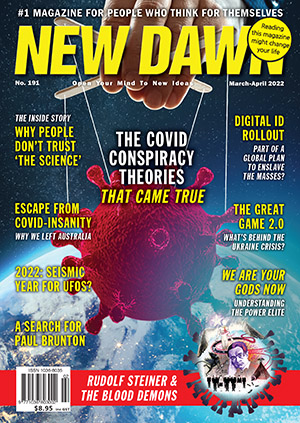
New Dawn – World's Most Unusual Magazine

Category: Articles

  • The Secret Science of Mind: How Positive Thinking Became a Force in the Modern World

    The Secret Science of Mind: How Positive Thinking Became a Force in the Modern World

    From New Dawn 124 (Jan-Feb 2011)

    The greatest discovery of my generation is that man can alter his life simply by altering his attitude of mind.
    – William James, The Varieties of Religious Experience

    If there is a central religious doctrine for the New Age, surely it is this – the belief that positive thoughts can bend reality to their own shape. It is an alluring concept. If it’s true, we don’t need to act or work or perform in the world. All we need to do is change our thinking. But is there anything to this idea?

    To understand something about the doctrine of thought power, it’s helpful to look at its history. The father of the religion of positive thinking was an obscure New Englander named Phineas Parkhurst Quimby (1802–66). 
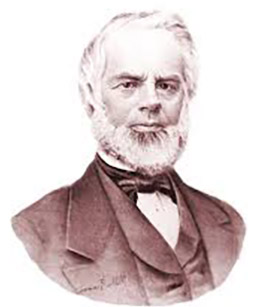
    Phineas Parkhurst Quimby (1802–66)

    Quimby, like many men of his time, was a jack of all trades. He started as a clockmaker, but eventually became fascinated with alternative methods of healing and learned the art of mesmerism or animal magnetism, a forerunner of hypnosis. Quimby found that if he put an assistant into a trance, the assistant could diagnose and prescribe a remedy for a patient’s disease (much like Edgar Cayce, the celebrated “sleeping prophet” who lived a couple of generations later).

    Quimby built up a successful practice this way, but soon he came to a startling conclusion: it didn’t matter what remedy was prescribed; it was the faith of the patient that made the difference. So Quimby dismissed his assistant and began to practice his own radical method of healing, in which he would simply convince the patient that he or she was already well. Quimby’s warm and gentle nature aroused a sense of confidence. His office filled with patients, and many came away from his treatments feeling great relief or even fully cured. He often treated people for free when they could not pay.

    A self-taught man, Quimby was not a systematic thinker. But around 1859, he began to formulate his teachings in writing. He believed he had discovered the secret of the miracles performed by Jesus Christ, and he wished to make this knowledge available to all. 

    “My philosophy,” he said, “will make man free and independent of all creeds and laws of man, and subject him to his own agreement, he being free from the laws of sin, sickness, and death.”

    The teaching was simple. In each human being resides Truth, Wisdom, and Goodness. This is our natural birthright. But there is also another aspect: the mortal, material mind that is subject to error. And the chief error to which this material mind is subject is disease. 

    “Disease,” Quimby wrote, “is false reasoning. True scientific wisdom is health and happiness. False reasoning is sickness and death.” Quimby never really gave a name to his teaching, though he usually called it the “Science of Health.” Once or twice in his writings he referred to it as “Christian Science.”

    Quimby attracted a number of disciples. One of them, Warren Felt Evans, was also a follower of the Swedish visionary Emanuel Swedenborg (1688-1772). It was in fact Evans who introduced the term “New Age” in his influential 1864 book, The New Age and Its Messenger. The “messenger” of the title was Swedenborg, who in his voluminous writings proclaimed 1757 as the year of the Last Judgment. But this event, he said, did not and was not supposed to take place on earth. It was enacted in the realm of the spirits, an intermediate zone between heaven and hell. The Lord purged this realm of evil, making it possible for heaven to transmit its influences to earth in a less impeded fashion. 

    Swedenborg did not espouse the doctrine of thought power as it would later emerge: he held that the human mind was continually subject to influences from both heaven and hell and that the function of the human being on earth was to choose the good and renounce the evil impulses. Even so, Swedenborg’s thought, which reached the zenith of its influence in the early nineteenth century, prepared the ground for the New Age movement.

    After Quimby’s death in 1866, his ideas lived on in the teachings of his most famous pupil, Mary Baker Eddy, who popularised the name “Christian Science” and created a religion around it, as well as in subsequent movements such as New Thought, Unity, and Religious Science.

    New Thought is something of a blanket term used to cover these other movements in contradistinction to Eddy’s Christian Science. The American scholar of religions Charles Braden characterised the chief differences between these two strains as follows: 
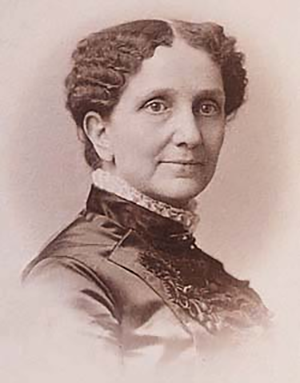
    Mary Baker Eddy

    1) Christian Scientists tend to be more authoritarian in their thinking, regarding Mrs. Eddy’s writings as definitive revelations, whereas adherents of New Thought stress that spiritual truths are being revealed every day;

    2) Christian Scientists have tended toward denial – disease, matter, and “mortal mind” do not exist – whereas the New Thought movement has inclined more toward affirmations (“I am well”; “I am perfect”); 

    3) Christian Scientists are generally opposed to working with traditional physicians or allowing their patients to do so, whereas proponents of New Thought have been more flexible and pragmatic on this count.1

    Ernest Holmes’ Religious Science

    One of the more vibrant strains of New Thought in the twentieth century was Religious Science, founded by Ernest Holmes (1887-1960). Born in Maine, Holmes moved to Boston as a teenager where he took a two-year course in public speaking. At this time he was drawn to the works of Ralph Waldo Emerson (another major influence on the New Thought movement), as well as to Eddy’s textbook of Christian Science, Science and Health with Key to the Scriptures. Later he would study other major figures in the New Thought movement, such as William Walker Atkinson and Thomas Troward.
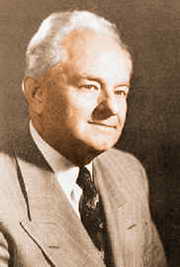
    Ernest Holmes (1887-1960)

    In 1914, Holmes moved to Venice, California. In 1919, he published his first book, Creative Mind. His magnum opus, Science of Mind, was first published in 1926. Though most of Holmes’s ideas can be found in his nineteenth-century precursors, he offered a slicker version of New Thought in his thoroughly twentieth-century salesmanship. He liked to tell stories of persuading homely girls to smile; when their lips parted, he claimed, they were surrounded by rich men eager to pay the bills for orthodontia. Gail Thain Parker, a scholar of New Thought, writes, “Holmes’s smugness is very different from the more exploratory (and sometimes evasive) tone of the first- and second-generation mind curists…. He knew that nothing he would say would shock or surprise; his prose was full of lifetime warranties and unbeatable bargains.”2

    Holmes, a powerful speaker but an ambivalent guru, nevertheless suffered his disciples to set up an organisation to promote his ideas. The Institute of Religious Science and the School of Philosophy was incorporated in 1927. In the same year Holmes also founded Science of Mind magazine, which is still published today. His influence was enormous, not only through his own writings but through those who were inspired by him. Norman Vincent Peale, author of The Power of Positive Thinking, a best-seller of the mid-twentieth century, drew much of his message from Religious Science.
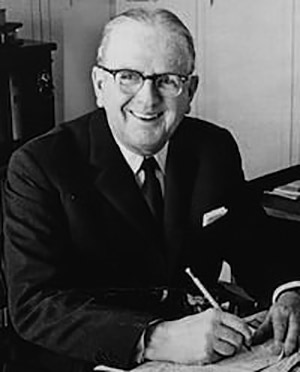
    Norman Vincent Peale

    Holmes lived long enough to see his organisation subject to schisms and infighting. Shortly before Holmes’s death, his protégé Obadiah Harris (who went on to become head of the Philosophical Research Society in Los Angeles) confided to him that he was leaving the movement to find his own path. “I wish I could go with you,” Holmes replied.3

    Even so, Holmes’s organisation survives to this day, and his teachings continue to inspire many. One of his central – and perhaps his most influential – ideas is the Law of Attraction. The term was originally coined in the nineteenth century to refer to the soul’s affinity for different spheres of the afterlife, but Holmes gave it its current meaning: “What we shall attract will depend on that on which our thoughts dwell.”4 

    If you think of prosperity, prosperity will come your way; if your thoughts dwell on disease, suffering, and misfortune, you are laying the ground for your own future unhappiness. These thoughts are not necessarily conscious ones, Holmes contended: 

    “While most disease must first have a subjective cause, this subjective cause (nine times out of ten) is not conscious in the thought of the person who suffers from it, but is perhaps largely the result of certain combinations of thinking. So while it is true that disease has its prototype in subjective mind, it is also true that the individual who suffers from the disease, frequently has never thought he was going to have that particular kind of trouble. But this does not alter the fact that every disease which comes up through subjectivity, and appears in the body, must come through mind.”5

    Healing, by contrast, comes from right thinking, as Quimby had taught decades before. Holmes taught his followers to heal in this way: “First recognise your own perfection, then build up the same recognition for your patient. You are then read to directly attack the thought that binds him, recognising that your word destroys it, and stating that it does. You may then take into account and specifically mention everything that needs to be changed, every so-called broken law or false thought. Then finish your treatment with a realisation of peace, remaining for a few moments in silent recognition that your work is done, complete and perfect.”6

    Holmes said that the human mind was composed of two aspects: the “subjective” or “subconscious” mind on the one hand and the “objective” or “conscious” mind on the other. The subjective mind is not conscious but is creative; it is “that part of the mind which is set in motion as a creative thing in the conscious state.” The subjective “sets power in motion in accordance with the thought.”7 The conscious mind must, however, direct the subconscious toward positive goals.

    A similar view can be found in the writings of Max Freedom Long, who, in such books as The Secret Science behind Miracles, taught an almost identical system that he traced back to the kahunas, the shamans of Hawaii. According to Long, the Hawaiians used the word unihipili to describe what Holmes called the “subjective mind” and the word uhane as more or less equivalent to Holmes’s “conscious” or “objective mind.” Although both authors use the word “science” in a metaphysical context, it is unlikely that Holmes or Long influenced each other; rather these similarities show how thoroughly these ideas pervaded the alternative spirituality of early twentieth-century America.

    The Universe is “Mental”

    By contrast, a work called The Kybalion, first published in 1908, was a likely influence on Holmes (see accompanying article). The title page of this anonymous work lists its authors merely as “Three Initiates.” The Chicago occultist William Walker Atkinson is generally acknowledged to have been one of these; Paul Foster Case, founder of the occult order known as Builders of the Adytum, is also sometimes suggested as one of the others.8 

    In any event, The Kybalion – its name allegedly going back to the Egyptian mysteries, although its meaning was supposedly lost – set forth seven principles of metaphysical truth, the first being “the principle of mentalism” – “The Universe is mental – held in the Mind of the all….the Universe and all It contains, is a mental creation of The all.”9 Compare this to Holmes’s statement “There is one mental law in the universe, and where we use it, it becomes our law because we have individualised it.”10 (The similarities extend to the printing of both sentences in all capital letters.)

    Since the universe was “mental” in its essence, Holmes prescribed what today is called “creative visualisation” as a means of attaining well-being. Here is his advice to someone who is seeking success in business: “Every day he should see his place filled with people. See them looking at and finding pleasure in his merchandise; see them comparing prices and realising that he is offering good values; see them delighted with the service he is giving…. Make a mental picture of it all. We are dealing with Intelligence, and we should recognise the Power we are working with – realising our Oneness with it – and then we should ask for what we wish and take it.”11

    A related approach is affirmation. Like the ancient Semites, who believed in a mystical unity between a word and the thing it represented, Holmes believed that the spoken word held the power to transform reality, and he included affirmations as part of his prescribed practice. 

    He recommended making this statement, for example, as part of a “treatment” for “supply”: “I always have an abundance of money and an abundance of whatever it takes to make life happy and opulent. There is a continuous movement toward me of supply, of money, of all that I need to express the fullest life, happiness and action.”12
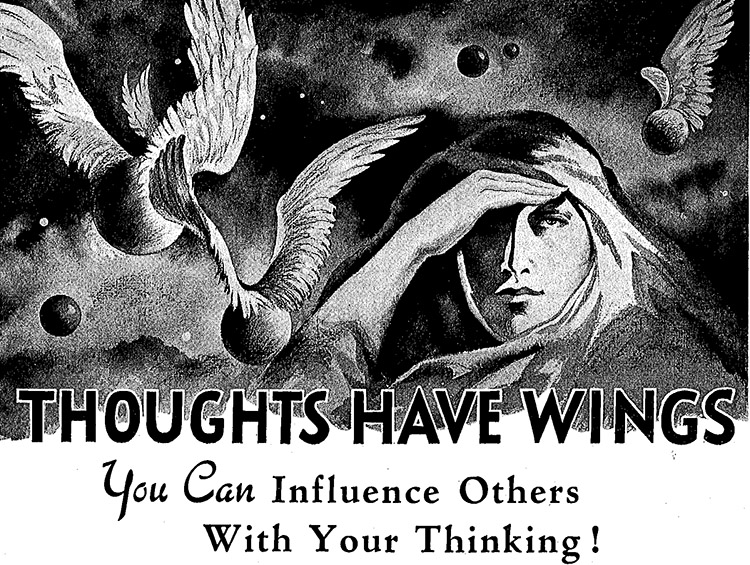
    Image from a promotional booklet produced by the Rosicrucian Order AMORC in the 1940s.

    Science of Mind and Magic

    Anthropologists have classically distinguished between magic and religion. Magic uses certain techniques such as incantation, sacrifice, and ritual as a way of manipulating unseen powers. Religion often uses the same methods but it does so as a way of supplicating God or the gods through prayer and meditation. Magic is a kind of sacred technology, while religion usually involves a relationship to a personal deity. Science of Mind – and the religion of positive thinking as a whole – is much closer to magic than to religion. While it does not prescribe arcane rituals or weird spells, it does attempt to manipulate the primordial force of the universe – mind – on the practitioner’s behalf. 

    There is no theological problem in this from a New Thought perspective, because God is all-good and all-loving and wants us to live in health and abundance; our failure to do so is simply the result of faulty thinking and a failure to claim our due. The constant use of the word “Science” by figures from Quimby to Holmes underlines the quasi-technological mindset that operates in these teachings, and suggests how much they owe to the industrial age that gave them birth: mind is an impersonal force that can be harnessed in much the same way as steam or electricity.

    While New Thought and Religious Science insist that they are part of a tradition that has always been known to adepts – the healing miracles of Jesus are frequently cited as cases in point – there is comparatively little in traditional esotericism that resembles these teachings. Certainly it has long been taught, particularly by Plato and his philosophical descendants, that there is an ideal world of forms that can be perceived by the higher intellect and that serve as prototypes for the things of materiality. But the teaching that someone can not only perceive these archetypes but manipulate them to change physical reality is extremely rare. The traditional view was that a true philosopher did not care about the material world and occupied himself as little as possible with it.

    Even the occultism of the Renaissance, with its cumbrous magical technology, did not lay any particular emphasis upon thought power. According to Renaissance savants such as Paracelsus and Cornelius Agrippa, the magus can affect the higher dimensions, but does so by operating upon their corresponding objects in the physical world. To bring down beneficent solar or jovial influences, one wears stones or eats herbs that are associated with these benign influences. Magical formulae were also employed, but not as affirmations – many of these incantations consist of words in no known language – and the goal was often to subject spirits and demons to the magician’s will.

    The world of traditional magic is thus very far removed from the streamlined positive thoughts and affirmations of Religious Science and its kin. To speculate wildly for a moment, perhaps this is one sign of the New Age proclaimed by Swedenborg and Evans – that what formerly required intricate spells and bizarre operations can now be accomplished by using the power of the mind and the spoken word.

    This, of course, assumes that the methods of Religious Science actually work, and such claims are hard to assess. Certainly there are any number of people who have been willing to testify on behalf of these procedures, and their claims must be taken seriously enough. But we have no way of knowing how many of them there are as opposed to the numbers of those who have tried and failed. Most of the people I have known through New Thought circles appear no richer, happier, healthier, or more successful than much of the rest of humanity. And while I have known people who have gotten rich over the years – some of them staggeringly rich – their secret was probably not affirmations or thought power but the usual combination of talent, hard work, and sheer luck – and, indeed, enormous quantities of all three.
    Get the issue this article appears in

    Nonetheless, the claims of the thought power gurus from Quimby to Holmes (not to mention latter-day figures such as the entity known as Abraham, channelled by Esther Hicks, and Rhonda Byrne, author of The Secret) cannot be dismissed wholesale. Thought power, like so many aspects of the metaphysical realm, occupies a liminal space between truth and falsity. As soon as you have decided it is all nonsense, something pokes you on the shoulder and tells you it may not be nonsense after all. But if you become an enthusiastic believer, you may end up disappointed.

    To speak personally, I would be willing to say this much. The basic idea behind positive thinking is true: there is a mental world that underlays the physical, and thoughts can influence events in ways that can seem bizarre or even paranormal. But the interplay of thought and actuality is not entirely explained by a few simplistic axioms and the usual lifetime warranties. Other factors operate as well – the obscure but overwhelming forces that are sometimes called fate and destiny; the actions of a mind that cannot always be understood, much less manipulated, by the conscious ego; and of course the “time and chance” that, the Bible reminds us, “happeneth to all” (Eccl. 9:11).

    To the extent that positive thinking and mental science help us focus upon our goals and eliminate negative mental patterns, they can be useful. But they are usually not very effective substitutes for action. And if they foster a self-centred attitude that focuses on “my” prosperity and “my” health, or, still worse, dismisses the suffering of others on the grounds that somehow they brought it all upon themselves by wrong thinking, these ideas can cause serious trouble. We must never lose sight of the fact that the power of thought includes the power to enslave the mind. And the ultimate goal of liberation may not be to make our thoughts manifest in the world of desire, but to free ourselves from them as much as is possible in this world of entanglements.

    [alert type=”general” dismiss=”no”]This article was published in New Dawn 124.[/alert]

    [alert type=”success” dismiss=”no”]If you appreciate this article, please consider subscribing to help maintain this website.[/alert]

    Footnotes

    1. Quoted in Gail Thain Parker, Mind Cure in New England from the Civil War to World War I (Hanover, N.H.: University Press of New England, 1973), 4–5.
    2. Parker, 16-17.
    3. Horowitz, 97.
    4. Ernest Holmes, The Science of Mind, rev. ed. (New York: Tarcher/Penguin, 1998), 294.
    5. Holmes, 201-02; emphasis and capitalisation here and in other quotes are from the original.
    6. Ibid., 202.
    7. Holmes, 30.
    8. Mitch Horowitz, Occult America: The Secret History of How Mysticism Shaped Our Nation (New York: Bantam, 2009), 210. Horowitz, however, believes that Atkinson was the sole author.
    9. “Three Initiates,” The Kybalion (Clayton, Ga.: Tri-State Press, 1988 [1908]), 53, 57.
    10. Holmes, 30. 
    11. Holmes, 300.
    12. Holmes, 263.

    © New Dawn Magazine and the respective author.
    For our reproduction notice, click here.
  • The Beatles, Aleister Crowley, & the Mystery of ‘Paul Is Dead’

    The Beatles, Aleister Crowley, & the Mystery of ‘Paul Is Dead’

    From New Dawn Special Issue Vol 16 No 5 (Oct 2022)

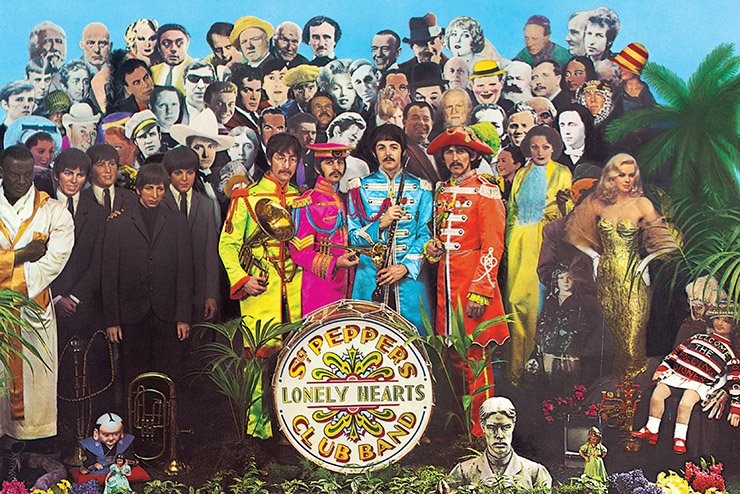
    Aleister Crowley’s penchant for photobombing some of the world’s most infamous conspiracies is often a topic for debate, but in the present case the analogy can be taken quite literally – Crowley’s mug is planted squarely on the Beatles’ Sgt. Pepper’s Lonely Hearts Club Band. 

    Of course, this album cover is one of pop culture’s most iconic images. Our present focus relates to Crowley’s involvement in the ‘Paul is Dead’ (P.I.D.) conspiracy and, more generally, his influence on the Beatles as a whole.

    The Fab Four are the cornerstone of modern-day pop culture, which for some makes them inextricably linked with the nefarious workings of the Establishment. As we shall find, Mr Crowley managed to worm his way into the centre of this alleged rotten apple. But as with all things “conspiracy,” a vast gulf lies between what is real and what is indulgent fantasy.

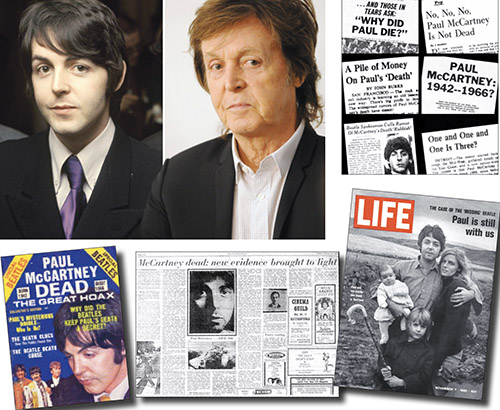
    Back in the summer of 1969, rumours of Paul McCartney’s death began circulating like wildfire on college campuses across the United States. To wit, Paul was killed in a car crash on the M1 motorway on 11 September 1966 and was secretly replaced by a look-alike double to keep the money rolling in for band and country. The band, however, felt obliged to leave hints attesting to the fact to appease their guilty conscience. 

    On 17 September 1969, Des Moines’ Drake Times-Delphic published the first known article on the subject, “Is Beatles’ Paul McCartney Dead?” It listed some of the hidden clues and messages on Beatles records hinting at Paul’s demise, like a voice uttering “Turn me on, dead man” whilst “Revolution 9” was played backwards.

    Radio station disc jockeys spread the message, and soon mainstream media got hold of the story, pushing the Beatles for comment. Ringo Starr told the press, “If people are gonna believe it, they’re gonna believe it. I can only say it’s not true.” John Lennon, for his part, simply said the rumours were “insane.” A CBS News crew secretly filmed McCartney working on his farm in Scotland, followed by a pair from Life magazine. Paul busted the reporters skulking on his property but relented to an interview, telling them:

    “Perhaps the rumour started because I haven’t been much in the press lately. I have done enough press for a lifetime, and I don’t have anything to say these days. I am happy to be with my family and I will work when I work. I was switched on for ten years and I never switched off. Now I am switching off whenever I can. I would rather be a little less famous these days.”

    After the Life cover story, the “Paul is Dead” rumours began to die down, but they never really went away. Today, over 50 years after the death “hoax” started, McCartney is back on top and quite ubiquitous. You’ll find him on the Billboard charts with the album McCartney III (2020). In bookstores with The Lyrics: 1956 to the Present (2021). In theatres and streaming on Disney+ with the Peter Jackson-directed The Beatles: Get Back (2021). Headlining Glastonbury 2022.

    (Top left) Paul McCartney before his supposed death in 1966, and McCartney today, still living and breathing – if that’s really the same Paul!  At the time of the hoax, the media had a field day feasting on the rumour until Life magazine declared that Paul was “still with us.”

    Rumours of his premature demise are also back in full swing. Numerous books, YouTube videos and blogs pay slavish devotion to analysing every detail of the conspiracy, sensing something sinister lurking behind the “cute” Beatle. 

    Maybe that sinister something has a name – Aleister Crowley. Crowley, however, died shortly after any of the Beatles were born, so how could the “Wickedest Man in the World” pull the strings of the world’s greatest band? Let’s begin the investigation with the name itself.

    Beatles with an ‘A’

    The Beatles, it seems, have always been shrouded in mystery. This goes for the origins of the band name. “Beatle” is a clever pun imbued with various permutations of meaning. How did it come to be? John Lennon claimed that he and Stu Sutcliffe came up with the name in a nod to Buddy Holly and The Crickets. John said in a 1964 interview: “It was beat and beetles and when you said it, people thought of crawly things, and when you read it, it was beat music.” On another occasion, John stated, “It came in a vision – a man appeared on a flaming pie and said unto them ‘from this day on you are Beatles with an ‘A’.”

    Some researchers claim there is more to the name than meets the eye. They reference a poetry collection by Aleister Crowley, published in 1910, entitled The Winged Beetle, which includes occult-themed poems like “The Wizard Way,” “The Octopus,” “The Two Secrets and The Wings.” They note how Paul, after the break-up of the Beatles, went on to form the band Wings. Is Paul the “Winged Beetle,” and were the Beatles acolytes of Crowley’s system of Magick, with a “K”?

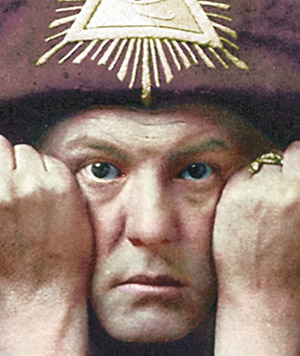
    Aleister Crowley in characteristic pose.

    It is not unusual to find rock stars openly professing their admiration for Crowley (i.e. Jimmy Page, David Bowie, Ozzy Osbourne, etc.). As we know, Crowley is on the cover of Sgt. Pepper. One rumour has it that “Sgt. Pepper” was a reference to Crowley himself. The opening lyrics to the album are… “It was 20 years ago today when Sgt. Pepper taught the band to play.” That album came out on the 20th anniversary of Crowley’s death. Is the band hinting they are disciples of the Great Beast 666? Crowley’s axiom is, “Do what thou wilt is the whole of the Law,” and “Love is the Law, love under will.”

    In an interview with Playboy, John Lennon stated: “The whole Beatle idea was to do what you want, right? To take your own responsibility, do what you want and try not to harm other people, right? Do what thou whilst, as long as it doesn’t hurt somebody.” In 1967, they added “All You Need Is Love” to the repertoire.

    What kind of influence did Crowley have over the Beatles? Consider the band’s innovation in the field of backmasking, a recording technique in which a sound or message is recorded backwards to be played forward. The first time such a thing was accomplished was in 1966 during the Beatles recording of the Revolver album. In Magick in Theory and Practice, Crowley instructed the Adept to do the following:

    (“a”) Let him learn to write backwards, with either hand. 

    (“b”) Let him learn to walk backwards.

    (“c”) Let him constantly watch, if convenient, cinematograph films, and listen to phonograph records, reversed, and let him so accustom himself to these that they appear natural and appreciable as a whole.

    (“d”) Let him practice speaking backwards; thus for “I am He” let him say, “Eh ma I.”

    (“e”) Let him learn to read backwards. In this it is difficult to avoid cheating one’s self, as an expert reader sees a sentence at a glance. Let his disciple read aloud to him backwards, slowly at first, then more quickly.

    (“f”) Of his own ingenium, let him devise other methods.

    In addition to their innovation in the studio, Crowley may have influenced the band’s lifestyle, most evident during their post-1965 “experimental” phase. Crowley was notorious for his drug use, indulging in alcohol, heroin, cocaine and psychedelics. Coupled with his libertine views on sexuality, Crowley could be viewed as the quintessential rock star, decades before such creatures roamed the earth. The Beatles, of course, encompassed all the cliches of rock stardom, for good and ill.

    Here Comes the Sun King

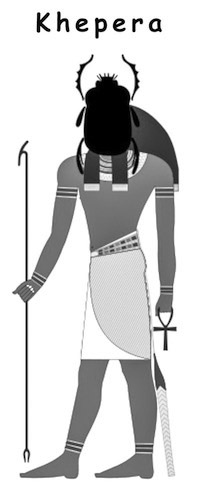
    The Egyptian deity Khepera is often depicted as a beetle-headed man.

    Crowley’s philosophy holds the key to our discussion, a philosophy heavily rooted in ancient Egyptian mythology. Crowley understood the significance and sacred symbolism of the beetle. In Egyptian mythology, the scarab or dung beetle was believed to be the incarnation of the beetle-headed god Khepera, who ruled over resurrection and fertility, symbolic of the rising sun, rebirth and creation. Synchronistically, if not consciously, the Beatles would carry the mandate of Khepera and become the sun centre of our musical universe.

    The scarab beetle may also hold the key to the ‘Paul is Dead’ mystery. This small insect is associated with an ancient Egyptian god by its curious habit of rolling dung, from east to west, into a ball, into which it lays its eggs. When hatched, the dung provides its young with food. This process of transforming the dead matter of dung into renewed life represents initiation in the Egyptian mysteries. Paul’s “death,” rather than being literal, should be interpreted as symbolic of initiation. 

    The candidate for initiation represents Osiris who was murdered by his brother Set. Osiris’ consort Isis reassembles his body and then gives birth to the resurrected god Horus, thus completing the cycle of death and rebirth.

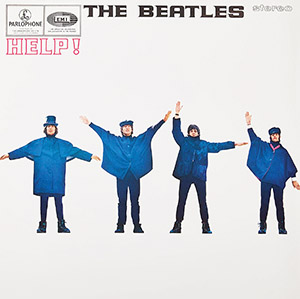
    It is possible the Beatles were preparing us for Paul’s symbolic death before he was “officially pronounced dead” in September 1966. Let’s go back to 1965 and look at the cover of the Beatles fifth studio album Help! Robert Freeman, who photographed its cover, explains: “I had the idea of semaphore spelling out the letters ‘HELP’. But when we came to do the shot, the arrangement of the arms with those letters didn’t look good. So we decided to improvise and ended up with the best graphic positioning of the arms.”


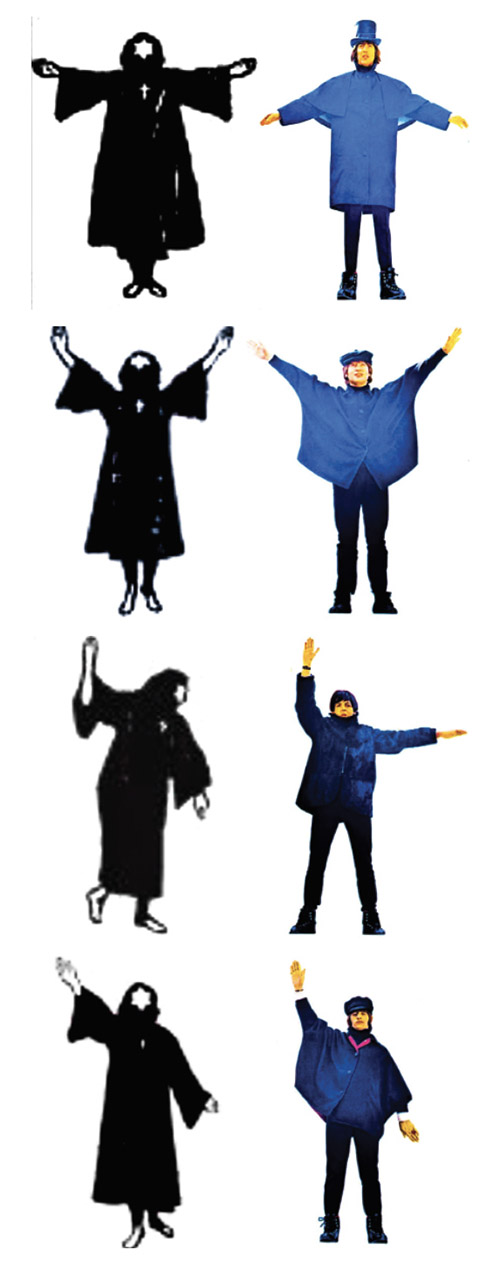
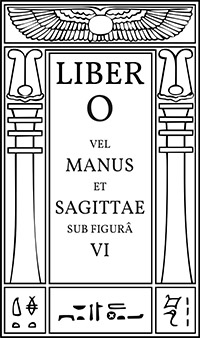
    Did the cover of the Beatles Help! album encode references to Crowley’s system of magick? Hooded figures in a Tau robe in Crowley’s Liber O vel Manus et Sagittae sub figurâ VI seem to match the figures on the album’s cover. 

    In semaphore, the Beatles are spelling out the letters N-U-J-V. Basically, gibberish. But what if the band were not using semaphore but rather a totally different system? Crowley’s Liber O vel Manus et Sagittae sub figurâ VI contains images of a hooded figure in a Tau robe posing in various positions. Each position conveys a different meaning.

    In a video appearing on the YouTube channel “Iamaphoney,” these pictures are superimposed over the cover of Help! It’s pretty much a perfect match. Let’s take a closer look at what these body positions mean when interpreted through Crowley’s system. 

    John Lennon, with both arms raised, signifies “Osiris Risen – the Pentagram.” Ringo, holding one hand up and one hand down, signifies “Earth – The God Set fighting.” George, with both arms spread out, conveys “Isis mourning – the Svastika.” And Paul, with one arm raised and the other lowered, represents a close approximation of the position, “Typhon – The Trident.” 

    Could it also be possible that the loose-fitting jackets the Beatles are wearing on the cover of Help! are a hipster’s interpretation of the Tau robe?

    If you think these concepts are a little far-fetched, understand that the occult was a big deal in 1966, as it was with the Beatles themselves. This is evident on their 1966 masterpiece, Revolver, whose working titles included Abracadabra, Magic Circle and Four Sides of the Circle.

    The word Abracadabra plays a central role in Crowley’s philosophy. “Abrahadabra” in The Book of the Law is “the Word of the Aeon,” meaning the Great Work accomplished and the all-important “attainment of the Knowledge and Conversation of one’s Holy Guardian Angel.” In addition, the word represents the uniting of the Microcosm with the Macrocosm.

    It Was 20 Years Ago Today

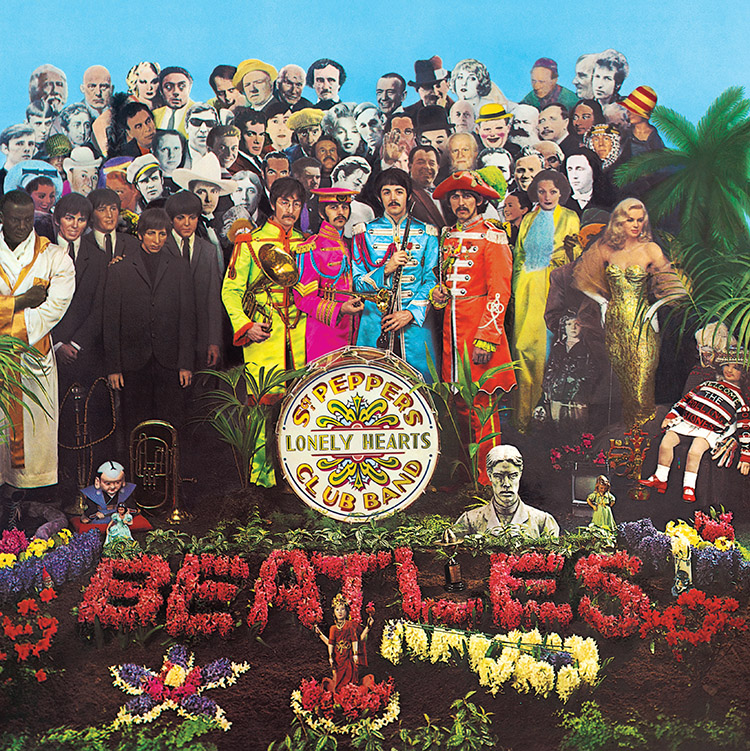
    Many people are familiar with the ‘Paul is Dead’ clues. Let’s touch upon some of the better-known ones on Sgt. Peppers to bring us up to speed. The album cover undoubtedly presents a funeral ceremony. On the grave, pictured in the lower portion of the cover, red flowers spell out the word “Beatles.” This is traditionally interpreted to mean that the Beatles, with the death of Paul McCartney, are now “dead.”


    Album cover for Sgt. Pepper’s Lonely Hearts Club Band

    Take note as well that on the cover we are presented with a set of Beatle doubles. Two sets of Beatles stand over the grave. The older phase Beatles, to the left, look over the grave mournfully. Dressed in drab coloured suits, they are in fact wax figures made by Madame Tussauds.

    The second group of Beatles, standing in the centre, are the new phase Beatles. They are dressed in bright clothing, looking very much alive because they are in fact the Beatles standing there in the flesh. Here we are presented with the ‘new’ Paul McCartney, the replacement double as it were, who will carry the band into new psychedelic frontiers, etc.

    Below the red flowers is a group of yellow flowers in the shape of a left-handed bass, Paul’s bass of course. There are three strings on that bass. One is missing. Paul is missing.

    While the other three Beatles carry brass instruments, McCartney carries a cor anglais, a double-reed woodwind instrument. This has been interpreted as a symbol of death. As well, Paul here is “out of step” with the other Beatles, just as he is on the cover of Abby Road. The interpretation is that Paul walks amongst the dead. In the corner, next to a doll wearing a “Welcome the Rolling Stones” jumper, is a reddish driving glove symbolising McCartney’s bloody car crash death.

    These are popular clues and lots of fun to play with, but the proof of the pudding linking P.I.D. to black magician Aleister Crowley is a revelation never before written about. 

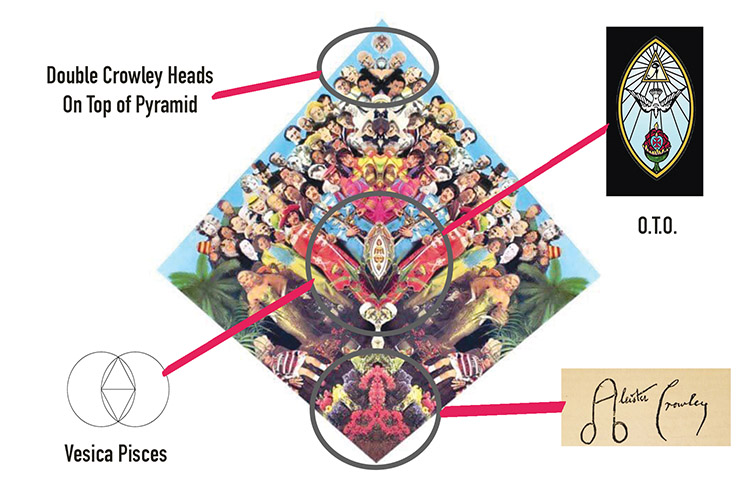
    We all know, of course, that Crowley is on the cover of Sgt. Peppers, one of many famous people pictured, and seemingly was placed randomly in the back row. However, if you split the cover diagonally and mirror it, a remarkable thing happens. At the very top of this diamond-shaped image sits Crowley. His head predominates over everyone else.

    Right at the bottom of the cover you see the flowers form an insignia that is identical to the ‘A’ which Crowley used in his signature and is famously portrayed in the shape of a penis. Sex magick, it should be noted, was a central component of Crowley’s teachings. And in the middle of the cover is the emblem for Crowley’s mystical organisation – the O.T.O.

    The palm tree on the right side of the album now appears on both sides forming a border. This symbol, especially significant in Freemasonry, refers to the two pillars Boaz and Jachin that are said to have stood on the porch of Solomon’s Temple. This is a remarkable image. To put that all together indicates, in my opinion, a level of genius.

    Get the issue this article appears in

    The Smoking Gun

    Recently, a veritable treasure trove of material has been released from the Beatles’ camp showing behind-the-scenes photos of the production of the Sgt. Pepper’s album cover. These photos reveal something very interesting. In my estimate, the smoking gun – both literally and figuratively – and final clue regarding the ‘Paul is Dead’ mystery.

    The Beatles hired Michael Cooper as the principal photographer for the album cover. The photoshoot occurred at Cooper’s London studio at 4 Chelsea Manor Studios, 1-11 Flood Street off King’s Road in Chelsea.

    Paul McCartney came up with the album title Sgt. Pepper’s Lonely Hearts Club Band. He based the concept for the album cover on an old photograph showing Paul’s father’s old orchestral band standing around a bass drum that read Jim Mac’s Band.

    Peter Blake and his wife Jann Haworth designed and assembled the set. Finally, after eight days of preparation, on 30 March 1967, the Beatles arrived at the studio where Cooper shot them as they posed in front of various life-sized cardboard cut-out photographs of famous people.

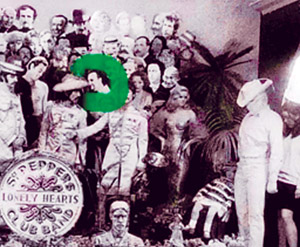
    What we discover in these behind-the-scenes photos is that some of these life-sized cut-outs did not appear on the official album cover because they were behind another cut-out or behind a band member. Behind George Harrison is one of these obscured characters. Indeed, on the album cover, we catch only a glimpse of this figure peering out from behind the right side of Harrison’s head.

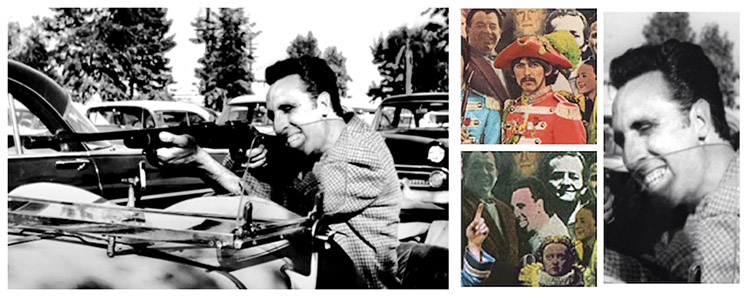
    Now, with the aid of these photos, we can identify this person to be film actor Timothy Carey. The image is, in fact, taken of Carey specifically from one scene in the Stanley Kubrick film The Killing (1956).

    The cut-out shows Timothy Carey holding a rifle, and in the movie Carey plays a hired hitman working with a group of criminals. They have a plan to rob the racetrack of its earnings and Carey’s job is to shoot one of the horses to cause a distraction.

    On the cover of the album, the image of Carey is obscured by George Harrison. The barrel of the gun actually extends all the way behind Paul McCartney who is standing next to Harrison. If you gauge it, you can see that the barrel of this gun is pointed directly behind the heart of Paul McCartney.

    Timothy Carey in The Killing (1956).

    No one knew about this for over 50 years. Yet, curiously, the choice was made to use an image from this Kubrick film to symbolise, I would suggest, the ‘killing’ of the lead racehorse – as Paul McCartney could indeed be equated to a very profitable lead racehorse. A smoking gun indeed.

    What does it all mean? What does it add up to? We are left with room for conjecture. Perhaps, as some researchers suggest, the Beatles were part of an elaborate plan by the elite to condition the youth of the Western world to accept the coming ‘New Aeon’. Others would assert it is a method of social engineering akin to the use of MK-ULTRA but applied on a mass level. Certainly, the symbolism draws a direct link to the inner workings of the Mystery Schools and the teachings of Aleister Crowley.

    [alert type=”general” dismiss=”no”]This article was published in New Dawn Special Issue Vol 16 No 5.[/alert]

    [alert type=”success” dismiss=”no”]If you appreciate this article, please consider subscribing to help maintain this website.[/alert]

    References

    https://www.ancient.eu/article/1011/ancient-egyptian-symbols/
    https://www.amazon.com/Winged-Beetle-Aleister-Crowley-ebook-dp-B07PBV5LBB/dp/B07PBV5LBB/ref=mt_kindle?_encoding=UTF8&me=&qid=
    https://www.youtube.com/watch?v=XM8KebDc8ac
    https://thenumbernineblog.wordpress.com/2017/02/23/well-sing-it-man-well-be-reversed-learning-to-think-backwards/
    https://hermetic.com/metadata/crowley/libers/lib6#liber-o-vel-manus-et-sagittae-sub-figura-vi
    https://theoccultbeatles.wordpress.com
    http://mccartneyart.com/product/egypt-station/
    https://louderthanwar.com/aleister-crowley-influence-on-popular-music/
    www.amazon.com/Lennon-America-1971-1980-Based-Diaries/dp/081541157X

    © New Dawn Magazine and the respective author.
    For our reproduction notice, click here.
  • When a Vaccine is Not a Vaccine and a Test is Not a Test

    When a Vaccine is Not a Vaccine and a Test is Not a Test

    From New Dawn Special Issue Vol 16 No 1 (Feb 2022)

    In his classic novel Nineteen Eighty-four, author Eric Blair (better known as George Orwell), famously laid out how a totalitarian technocracy would look. The phrase Orwellian has justifiably become an utter cliché, but despite the familiar territory it is worth looking at the aspect of the book that deals with the Ministry of Truth and its employees, who were tasked by the regime with “memory holing” history and rewriting dictionaries (“newspeak”) to reduced language and thus thought to simplistic, binary concepts, such as people and unpeople. 

    Consider how the definition of “vaccine” has been altered in recent years to appease the designers of mRNA technology. Birmingham and Lambert define vaccination as “the practice of artificially inducing immunity.”1 A book with a foreword written by Bill Gates defines vaccine-induced immunity as follows. “The quality of […] antibody responses, eg, their avidity or specificity, has been identified as a determining factor of efficacy.” 

    The authors continue: “long-term protection requires the persistence of vaccine antibodies and/or the generation of immune memory cells capable of rapid and effective reactivation with subsequent microbial exposure.”2 

    But the purported Covid-19 vaccines stimulate antibodies for months at a time, requiring multiple boosters. By a definition endorsed by Gates, the injectable products are not vaccines despite Gates’s use of the term.

    The pre-pandemic definition of vaccine has been memory-holed. Putting aside the changes in definition confluent with technological developments, the former definition of vaccine offered by Merriam-Webster was “a preparation… that is administered to produce or artificially increase immunity to a particular disease.”3 The Covid-era definition is: “a preparation that is administered… to stimulate the body’s immune response.” 

    Notice that the threshold has been lowered from increasing immunity to merely stimulating an immune response. The same big tech that suppresses web search results promotes articles that support the given narrative. In this case, we are being told outright lies: that mRNA is not new, untested technology; that vaccines can indeed be developed within months, not years; that humans are not experimental subjects; and that the injectable products are safe.4 

    Get the issue this article appears in

    WHEN A TEST IS NOT A TEST

    Polymerase chain reactions (PCR) work by amplifying nucleic acids to detect virus particles. 

    In the late-1980s, virologists were concerned that PCR tests were contaminated by two sources: the carry-over of material from one tube to another and the presence of dead human skin cells. When controlled and uncontrolled PCR tests were compared, the authors of one study found high rates of false-positives.5 

    A decade later, another study searching for respiratory adenoviruses (Ad) in humans had a 94 per cent efficacy rate when using primers for Ad7 proteins called hexons. But when the primers were not included, the results were much less effective. Detection efficacy for enzyme immunoassays and time-resolved fluroimmunoassys were between 53 and 46 percent.6 

    Ten years on, Applied Biosystems produced the TaqMan real-time PCR (RT-PCR) which detects viral and bacterial particles via processes called Plus/Minus and Allelic Discrimination. When testing the Plus/Minus to detect Escherichia coli, “an inordinately high proportion of false-positive signals was observed.” Correct thresholds require template controls.7 In one 2015 study using assays, PCR test estimation was over 40 per cent.8

    The most common SARS-CoV-2 detector is the Nucleic Acid Amplification Test RT-PCR. “[N]one of the tests have sufficient clinical sensitivity to detect virus during the first several days after infection, nor are they 100% sensitive at the time of peak infectiveness.”9 

    Recall the late-‘80s PCR test problems mentioned above. In 2020, the same issues plagued the Covid tests: “Technical problems including contamination during sampling (eg, a swab accidentally touches a contaminated glove or surface), contamination by PCR amplicons, contamination of reagents, sample cross-contamination, and cross-reactions with other viruses or genetic material could also be responsible for false-positive results.”10 

    In addition, the duration of viral infection affects PCR detection ability. The longer the infection, the lower the chances of detection. One kit had an average 77 per cent efficacy (depending on the assays) up to four days. The kit’s efficacy declined to as low as 38 per cent after 10 days of infection.

    [alert type=”general” dismiss=”no”]This article was published in New Dawn Special Issue Vol 16 No 1.[/alert]

    [alert type=”success” dismiss=”no”]If you appreciate this article, please consider subscribing to help maintain this website.[/alert]

    Footnotes

    1. Maureen Birmingham and Claudia Stein, “Global Burden of Disease” in Barry R. Bloom and Paul-Henri Lambert (2003) The Vaccine Book, Elsevier, 3
    2. Claire-Anne Siegrist, “Vaccine immunology” in Stanley A. Plotkin, Walter A. Orenstein and Paul A. Offit (eds.) (2013, 6th) Vaccines, Springer, 14 
    3. Merriam-Webster online, “vaccine,” https://web.archive.org/web/20201105154809/https://www.merriam-webster.com/dictionary/vaccine
    4. Merriam-Webster, “Vaccine,” https://web.archive.org/web/20211201095040/https://www.merriam-webster.com/dictionary/vaccine
    5. P.A. Kitchin, Z. Szotyori, C. Fromholc and N. Almond (1990) “Avoidance of PCR false positives,” Nature, 344: 201 
    6. R. Räty, M. Kleemola, K. Melén, M. Stenvik and I. Julkunen (1999) “Efficacy of PCR and other diagnostic methods for the detection of respiratory adenoviral infections,” Journal of Medical Virology, 59(1):66-72
    7. Forough L. Nowrouzian, Ingegerd Adlerberth, and Agnes E. Wold (2009) “High frequency of false-positive signals in a real-time PCR-based ‘Plus/Minus’ assay,” APMIS, 117(1):68-72
    8. David Svec, Ales Tichopad, Vendula Novosadova, Michael W. Pfaffl, and Mikael Kubistaa (2015) “How good is a PCR efficiency estimate: Recommendations for precise and robust qPCR efficiency assessments,” Biomolecular Detection and Quantification, 3: 9-16
    9. Glenn D. Braunstein, Lori Schwartz, Pamela Hymel, and Jonathan Fielding (2021) “False Positive Results With SARS-CoV-2 RT-PCR Tests and How to Evaluate a RT-PCR-Positive Test for the Possibility of a False Positive Result,” Journal of Occupational Environmental Medicine, 63(3): e159-62
    10. Elena Surkova, Vladyslav Nikolayevskyy, and Francis Drobniewski (2020) “False-positive COVID-19 results: hidden problems and costs,” Lancet, 8(12): 1167-68

    © New Dawn Magazine and the respective author.
    For our reproduction notice, click here.
  • Australian UFO Mysteries: The Disappearance of Frederick Valentich

    Australian UFO Mysteries: The Disappearance of Frederick Valentich

    From New Dawn 173 (Mar-Apr 2019)
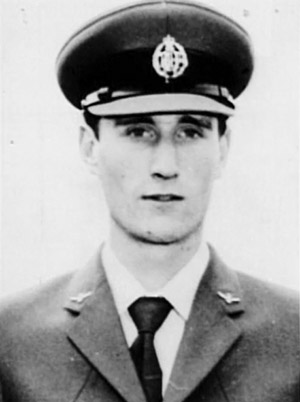
    Victorian pilot Frederick Valentich.

    Over 40 years ago, during the early evening of 21 October 1978, pilot Frederick Valentich reported in a radio communication with Steve Robey of Melbourne Flight Service that “a large aircraft” which had “a long shape” and “a green light,” appearing to have a bright metallic lustre and four bright lights, travelling variously at high speed, approached his Cessna 182L aircraft (registration VH-DSJ) and apparently hovered in a stationary manner and also orbited above him. 

    After six minutes Valentich reported his aircraft’s engine was rough idling, and the strange object was “hovering, and it’s not an aircraft.” Having indicated he intended to fly on to King Island, Valentich’s communication terminated after 17-seconds of “metallic” noises. 

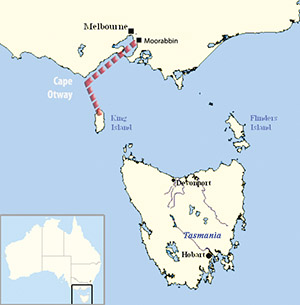
    Valentich’s intended route from Moorabbin to King Island over Bass Strait.

    Neither Valentich or the Cessna were ever found. The event became one of Australia’s greatest aviation mysteries, and the apparent UFO connection remains unresolved. 

    The areas that feature prominently in the Valentich incident – Cape Otway (his last land call), Bass Strait (the apparent location of his disappearance) and King Island (his apparent destination) – all have extensive precedents for UFO activity. 

    During a two-month period centred around January 1978, holidaymakers, fishermen, school teachers, local police and lighthouse keepers in the Cape Otway area reported seeing UFOs. During July 1977, local residents and the lighthouse keeper at Cape Otway saw an inexplicable brilliant light source that hovered out to sea for half an hour. 

    The lost Cessna VH-DSJ photographed at Essendon Airport in 1974.

    Bass Strait figures in UFO mysteries particularly in 1920 and 1944. The Melbourne Argus newspaper even described many people seeing “cigar-shaped” objects flying over Bass Strait as far back as 1896. 

    King Island’s 425 square miles played host to a wave of unidentified nocturnal aerial lights for at least three months prior to Frederick Valentich’s disappearance. Oval shaped lights followed cars and mystified local residents. Strange lights or flares appeared off the north of the island. 

    One of the most spectacular close encounters with a UFO in the area occurred at a wild and uninhabited part of the King Island coast, near Whistler Point, just before dawn, on 10 April 1976. “A beam of light” emanating from “a cross-shaped object” approached a duck-shooter’s car, in a direct line. The light display eventually receded directly along its line of approach, ending a silent inspection when it disappeared over the distant skyline.

    Much suggests a UFO connection in the Valentich case, but unfortunately a final answer alludes us. Despite the provocative nature of the taped conversation between Valentich and Melbourne Flight Control before his disappearance, which refers to a possible UFO presence, the affair remains a mystery.

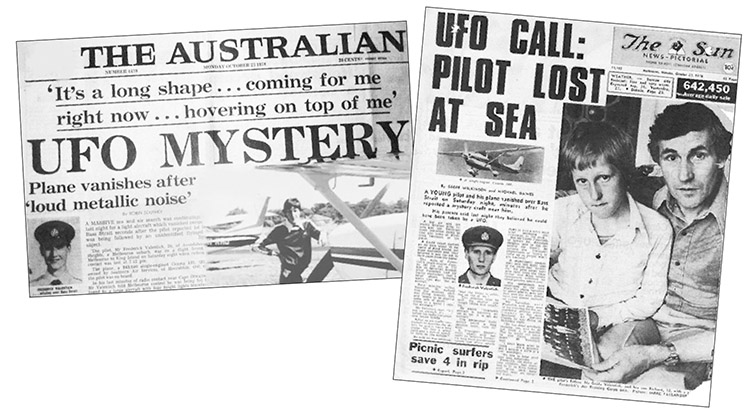
    Valentich’s mysterious disappearance made headlines in 1978. The Sun story on the right pictures Frederick’s father Guido and his brother Richard.

    The Valentich incident is punctuated with haunting, or rather more appropriately, taunting clues that set one off in all sorts of conflicting directions. Many have come up with solutions varying from the bizarre to the sublime. Did a UFO abduct Valentich? Did Valentich contrive the whole affair? Did he, as many think, crash into Bass Strait, leaving no trace? Or are other prosaic explanations involved? A multitude of various lines of enquiry radiate out in all sorts of directions. Most take us away from the facts of the matter, namely that no trace of pilot or plane have yet been found. 

    The mystery resonates in the Australian consciousness in a place reserved for more mythic episodes like the haunting fiction of ‘Picnic at Hanging Rock’. It has inspired dramatic works like the profound and confronting play ‘Sky’ and the bizarre and striking TV mini-series, ‘Locusts and Wild Honey’. We must remind ourselves that a family waits for an answer that so far has never come. I hope that someday they will find that answer.

    Department of Transport file V116/783/1047

    Due to the tenacious efforts of Adelaide-based researcher Keith Basterfield in 2012, we can now study the previously restricted Department of Transport file V116/783/1047, available in digital format at the National Archives of Australia website. I last saw this file back in late 1982 while sitting in front of Mr A. Woodward at the Melbourne office of the Bureau of Air Safety Investigation. He had the file open in front of him while answering my questions. I tried not to be too obvious in reading the file in its upside-down perspective. 

    The released Valentich files provide hints at some possible answers, and it may be that ultimately the answer does not involve UFOs. Reconciling a detailed analysis of the released data with the extensive research done on the case by researchers over the years might help us come up with a final answer. But for now Frederick Valentich and his Cessna plane are still missing, so final closure eludes those who want to know. 

    ‘The Unexplained Files’ series on the Discovery Science Channel in September 2013 featured an excellent recreation of the extraordinary 1978 Valentich mystery. My friend George Simpson (based in Melbourne, Victoria) was instrumental in the accounting of this story on the programme.

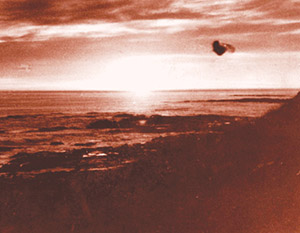
    Roy Manifold took some intriguing photos (including the above) at the time and locality of Valentich’s departure from the Australian mainland on route to King Island in Bass Strait.

    On the programme, Steve Robey of Melbourne Flight Service was clearly still distressed about the disappearance of Valentich. Frederick’s younger brother Richard gave the family’s dimension to the story. Both these elements remind us that a disturbing and tragic element still haunts this mystery. George Simpson interviewed Roy Manifold who took some intriguing photos at the time and locality of Valentich’s disappearance. 

    Dr Richard Haines investigated the case and authored a book on it, Melbourne Episode: Case Study of a Missing Pilot (1987). He facilitated the airing of the strange sound heard at the end of Valentich’s last radio conversation with Steve Robey. I listened to the tape back in 1984 when I stayed with Dr Haines in California. Haines’ comment in ‘The Unexplained Files’ programme that the sound might be from contact between the Cessna and the UFO Valentich had been describing in the six-minute conversation, caused me to suddenly reconsider a very strange story I came across back in early 1995.

    The Coonabarabran Times of Coonabarabran, north-west New South Wales, Australia, in its 17 November 1994 issue, carried brief details of an apparent close encounter with a diamond-shaped UFO near ground level on 15 November 1994, on the Mendooran road to the south of the town. 

    With the assistance of local police, I interviewed the four principal witnesses to this apparent close encounter.  One of the area witnesses told me that I should seek out Laurie, a local businessman, who had a lot of UFO stories to tell. 

    One story was utterly startling and unbelievable. It was apparently connected to the Valentich mystery and initially told to me by one of the Coonabarabran witnesses who heard it through Laurie. Others encouraged us to ask Laurie about other stories. We did both, but the story in question stood out.

    Laurie told us he had heard the story directly from a South Australian farmer who had bought a property in the north-west of New South Wales. The farmer had come into his business and the talk strayed onto UFOs. He shared with Laurie an experience he had on his South Australian property on the day following the disappearance of Frederick Valentich.

    The farmer said he was harvesting lucern when he heard a loud screeching sound coming from the harvester. He thought it might have been a bearing, so he uncoupled the harvester from the tractor’s power drive and jumped off and went back to have a look. The farmer was trying to work out the source of the continuing noise when he became aware that he was in a shadow. He looked up and saw he was directly underneath a large “saucer” shaped object, and going by the size of his harvester; he estimated it to be about 30 metres across. The loud screeching noise continued. 

    From directly underneath the object, the farmer reportedly could see two concentric outer rings or bands that were counter rotational and were operating at different speeds. One went very fast, so fast that you had to blink to see that it was moving. The other one was moving very slowly in the opposite direction. There were two small protuberances that the farmer took to be rudders, and two large holes, one had “shimmering heat” coming out, the other was shooting small flames.

    The farmer began to think there was something horribly wrong with this huge object and that it might crash down on him. He ran to get out from under it. He got the impression that one of the object’s engines had stopped working. 

    As he moved away the farmer looked back at the object which he could now see edge on. It had a large dome on top and what looked like a black weather seal along the base of the dome structure. He then noticed what looked like a “church door with a curved top, but no windows or handles were visible.”

    He told Laurie the most unusual thing was that the massive object had a Cessna stuck to the outside of it – “the whole aircraft.” It was flat up against the side of the object with its tail hanging down. Laurie said he was not sure whether the farmer said there was engine oil running down the outside of the Cessna, but he could clearly see the plane’s registration markings. He found a nail and scratched the plane’s registration number into the paint of his tractor. 

    According to Laurie, the farmer said the object – “the saucer” – still accompanied by the screeching sound, then flew away over a ridge in the direction of a nearby Army range.

    The farmer said to Laurie he told no one about what happened. He went into town later in the day. One of his neighbours saw him and apparently said, “I see you are doing some more crop spreading.” He said no, why do you say that. The neighbour said, “I saw the Cessna today up in your top paddock.” He replied to his neighbour, “There’s no Cessna in my top paddock.” The neighbour insisted, “Yes there is, I was up near there, I saw it there today.” The farmer said, “That’s interesting, I’ll have a look when I get home.”

    He went up to the top paddock and saw no plane, but he did see three tyre marks and some tracks from a plane. He followed the tracks to where they ended, and there was “a pool of ’flamin’ engine oil” on the ground. 

    I recorded the story from Laurie on two separate occasions, one over the phone in January 1995 and face to face in Coonabarabran one month later in the presence of my friend Robb Tilley. Laurie was impressed with the story. Robb and I simply did not know what to think. Getting further information proved elusive.

    As I had lived through the Valentich mystery unfolding at the time in 1978 and had written extensively about the research and investigation of the extraordinary events, I was acutely sensitive to the bizarre and strange aspects. I also had contact with Guido Valentich, Frederick’s father, and I knew that he had been exposed to various claims about what had happened to his son. He even helped me investigate one claim, which ultimately ended in no real resolution, just another unverifiable claim. Sadly, Guido passed away without a definitive answer to his son’s disappearance.

    With Laurie’s account from the farmer, I had yet another extraordinarily bizarre and unbelievable claim. Laurie told me the farmer returned on another occasion with the Cessna’s registration number. It was DSJ, the number of Valentich’s Cessna. This in itself was not convincing for me because that information was widely reported at the time of the plane’s disappearance.

    I did not want to burden the Valentich family or authorities with yet another unverified story. The biggest problem for me was that Laurie couldn’t recollect the farmer’s name. He told me he had written all this down in notes, but he had not been able to find them. I stayed in touch with Laurie for a while, but despite attempts to come up with a name, without his notes we couldn’t progress the investigation unless we had a vast amount time and resources available. 

    Get the issue this article appears in

    I circulated a brief account on Paranet (a favoured research Internet facility) at the time but nothing came of it. The story stayed a sleeper until Dr Haines’ comments on the Discovery Science programme. I immediately accessed my notes and tapes and began to evaluate whether the considerably improved resources of the Internet, social media and other resources would now allow another attempt at getting to the heart of the story. Sadly, I learnt that Laurie passed away about seven years ago.

    I contacted George Simpson and shared the story with him. We both agreed that despite the bizarre nature of the story, we should try to see if we could track down anyone who had knowledge of the story and see if we could get a name for the farmer. We have since tracked down all sorts of clues.

    I described the results of our investigation of this bizarre story in a report on my OZ Files blog entitled “Strange Days, Strange Tales – a Valentich connection” back in October 2013 (see http://the
    ozfiles.blogspot.com/2013/10/strange-days-strange-tales-valentich.html). 

    Victorian UFO Action (VUFOA) put on a 40th-anniversary event that featured a panel of people involved in the Valentich affair and its investigation including Steve Robey, Rhonda Rhuston and George Simpson. Videos of the event are available on VUFOA’s YouTube channel. The 3rd edition of Jerome Clark’s massive two-volume work The UFO Encyclopedia appeared in 2018 with my report on the Valentich disappearance.

    While there is now a wealth of data on the case, what happened to Frederick Valentich and the Cessna he was flying remains a mystery.

    For further information on this case, see my work: “The Missing Cessna and the UFO: a preliminary report on the Bass Strait-King Island Affair”, Flying Saucer Review, Volume 24, No. 5, March 1979, 3-5; “Vanished – A report on the Valentich – Bass Strait Affair”, Australian UFO Researcher (No. 56 & 57, No. 58 & 59, No. 60, January 1979 through to December 1979). This report included details on the widespread UFO activity on the same day as the incident, the precedent for UFO activity over Cape Otway, Bass Strait and King Island, precedents for UFO-related plane disappearances or crashes; “Valentich-Bass Strait (Australia) affair”, in Ronald Story’s The Encyclopedia of UFOs, 1980; “Vanished? The Valentich Affair re-examined”, Flying Saucer Review, Vol. 30, No. 2, 1984; “1978 and the RAAF” and “Frederick Valentich and Delta Sierra Juliet – Vanished?” in my lengthy online document “UFOs Sub Rosa Down Under” at www.theozfiles.com/ufos_subrosa4.html and www.theozfiles.com/ufos_subrosa6.html; I also describe the affair extensively in my 1996 book The OZ Files – the Australian UFO Story.

    [alert type=”general” dismiss=”no”]This article was published in New Dawn 173.[/alert]

    [alert type=”success” dismiss=”no”]If you appreciate this article, please consider subscribing to help maintain this website.[/alert]

    © New Dawn Magazine and the respective author.
    For our reproduction notice, click here.
  • A Search for Paul Brunton

    A Search for Paul Brunton

    From New Dawn 191 (Mar-Apr 2022)
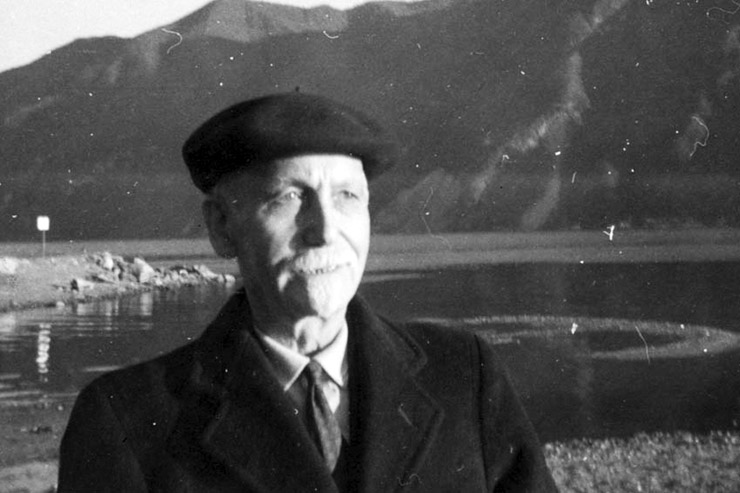
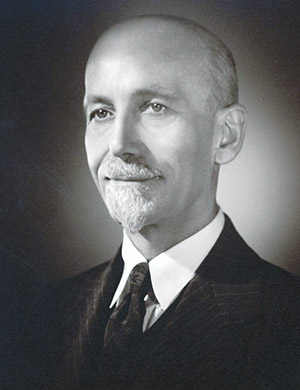
    Paul Brunton (1898-1981)

    There was a time when Paul Brunton (1898-1981) needed no introduction. From the 1930s through the 1950s, his eleven books were best-sellers in the field of alternative spirituality. A Search in Secret India and A Search in Secret Egypt played to a popular fascination with the Orient. 

    In Egypt, Brunton capped his meetings with magicians, snake-handlers, holy men and impostors by spending a night in the Great Pyramid, which he attributed to the Atlanteans. His Indian quest culminated in the encounter with Sri Ramana Maharshi, a living exemplar of Hinduism’s highest philosophy, that of Advaita or non-duality. (See “The Life and Teachings of Ramana Maharshi” by Jason Gregory in New Dawn 190.) These events defined the breadth of Brunton’s appeal, leading his readers, as he himself had been led, from psychism and mystical adventures to the supreme identity. 

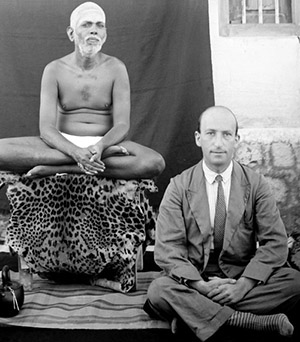
    Paul Brunton with Ramana Maharshi, early 1930s.

    His subsequent books were a graded manual of training in what he simply called “philosophy,” from The Secret Path through The Quest of the Overself to the two-volume treatise The Hidden Teaching Beyond Yoga and The Wisdom of the Overself. He never sought disciples or led a movement in the outer world. His writings were a gift to the solitary seeker, who through circumstance or inclination lacks the support of a group or sect. But he accepted the burden of responding in person to sincere correspondents and giving his time and patience to countless private interviews.

    After his last book, The Spiritual Crisis of Man (1952), Brunton fell silent and apparently incommunicado. However, writing remained his daily habit. In his last decades, he wrote over 30,000 notes, ranging from one-liners to essays, in which he developed a universal philosophy for sane and spiritual living beyond anything in his books. During his last years, he allowed a few helpers to transcribe and classify them. They were published in 1984-89 as The Notebooks of Paul Brunton, in sixteen volumes bound in the bright orange cloth of the Buddhist monk, then in paperback. In one of the later notes, Brunton muses on how in a future incarnation he will discover them and be delighted by something so congenial to his tastes.

    He saw his mission, at least in one dimension, as making the wisdom and methods of the ancient East accessible to Westerners. The Theosophical Society, which he had joined in 1920, demonstrated the value of Eastern philosophies and the reality of occult phenomena, but had given little advice on how to apply them in one’s own life. This accounted for the success of magical and occult orders like the Golden Dawn, the A.M.O.R.C., or the Gruppo di Ur, which gave practical training or rituals, while also returning the West to its own esoteric heritage.

    In preference to such groups, Brunton had the advantage of two outstanding personal guides. One was Allan Bennett (1872-1923), a former member of the Golden Dawn who had travelled to the East in the company of Aleister Crowley and remained there to become a Buddhist bhikku. As “Ananda Mettaya,” he returned to London on a mission to proclaim the Noble Eightfold Path, and Brunton acted for a time as his secretary. Brunton’s own work retained a certain Buddhist character, with its freedom from formalism and mere belief, and its confidence in the possibility of liberation from the ego. But Gautama’s view of all existence as suffering did not seem to him a useful principle for modern Westerners. 

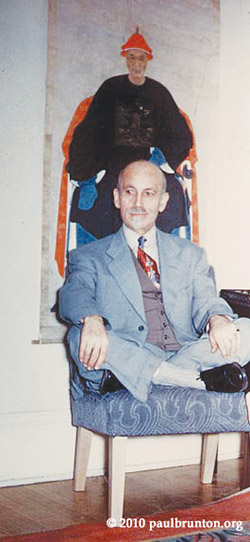
    Paul Brunton with painting of Chinese sage.

    Brunton’s other mentor was an obscure character known only as “Brother M” or by his surname of Thurston. He was of partly Native American ancestry, settled in London and worked as a painter in the arts and crafts field. Before the First World War, he had led a group called “The Brothers,” and his few publications bear their imprint. In the 1920s, “M” served a small circle of spiritual seekers as a fatherly adviser and guide on the occult ventures in which they were involved. One of them recalled this period in an “occult autobiography” of 1927 (The White Brother by Michael Juste), in which the young Brunton appears semi-fictionalised as “David.”

    There are mysteries about Brunton’s own biography, which he had no interest in revealing. To prevent misuse of his horoscope by inquisitive or hostile astrologers, he habitually gave out a false birthdate. When in 2019 his archive entered the library of Cornell University in Ithaca, New York, some of these mysteries were resolved – evidently with his consent, for before his death he had carefully sifted his papers and destroyed many of them. We now know that he was born on October 21, 1898, and named Hyman Abraham Isaacs, the only child of a master bootmaker in East London. He attended the Central Foundation School, originally called the “Middle Class School,” founded for the sons of skilled workmen and tradesmen who, while not poor, could not afford schools like Westminster, Eton, St. Paul’s, etc. In April 1914, he was registered as a “Temporary Boy Clerk” in government employment and subsequently worked in the Patent Office.

    At some point, the Isaacs adopted the surname Hurst, and Hyman the forename of Raphael. From 1917-18 he served in a tank regiment, perhaps chosen for his small stature to fit the cramped space in the vehicles. After the war, he ran a mail-order book service with his friend Michael Hurwitz (uncle of the eminent violinist Emanuel Hurwitz, writing as “Michael Juste” and bookselling as “Michael Houghton”), who established it as the Atlantis Bookshop, still flourishing near the British Museum. During the 1920s, Brunton worked for Foyle’s bookshop, in journalism, as personal assistant to a building contractor, and as author and editor, first of motivational and business publications, then as a prolific contributor to the Occult Review. By the end of the decade, Raphael Hurst was a familiar name in London’s esoteric subculture.

    Membership of that world, then as now, spanned the social scale from the impoverished Bohemians depicted in The White Brother to the titled and celebrated. Brunton joined the Astrological Lodge of the Theosophical Society on the same day as Mrs Eugene Goossens, wife of the conductor Sir Eugene Goossens, and Lady Smith Dodsworth, a baronet’s wife. Thanks to such connections, he was enabled to study in the library of the Royal Asiatic Society and had propitious meetings with Sir Francis Younghusband, who had commanded the invasion of Tibet in 1904 and was now President of the Royal Geographical Society.

    On the personal side, in 1922 Brunton married a young Danish woman, Karen Tottrup, and fathered one son, Kenneth Thurston Hurst. Within a few years, Karen and Kenneth moved into the household of Leonard Gill, proprietor of the Rudolf Steiner Bookshop, also near the British Museum. An amicable divorce followed in 1928, and as Kenneth matured, his father became his intimate friend and counsellor, steering him toward a successful publishing career in the USA. Kenneth’s memoir Paul Brunton: A Personal View remains the sole attempt at a book-length biography.

    The first intention of Brunton’s Indian quest of 1930-31 was to meet Meher Baba. The silent Iranian was enjoying his first period of international celebrity, and the trip may have been financed by his English disciples. When A Search in Secret India appeared, with its foreword by Younghusband and its instant rise to the best-seller lists, they were sorely disappointed by the author’s verdict on their master. The contrast was all too obvious with the climactic episode of the book, the meeting with Sri Ramana Maharshi, whose reputation as an authentic jivan mukti (liberated in life) would draw many pilgrims to the holy mountain of Arunachala.

    The tropical diseases which Brunton had caught in India affected him periodically for years. In order to recover and write his travelogue, he left London for Jordans, a Quaker village in Buckinghamshire where he had a cottage built and attended the venerable meeting house. Since 1932 he had been using “Paul Brunton” among his various noms-de-plume, and in 1935, with two books published under that name, he registered it formerly by deed poll. Later he always preferred to be addressed as “PB.”

    Although he had grown away from the Theosophists, his second book again secured a stellar endorsement: the foreword was by Alice A. Bailey, the scribe of neo-Theosophical works ascribed to “The Tibetan.” The Secret Path was a practical manual on how and why to meditate, inspired by Indian practices but free from Sanskrit or other foreign terms. This would remain Brunton’s principle: to put everything into plain English, including some terminology of his own when necessary. Its crucial concepts are the Overself, World Mind, and Mind in Itself, whose equivalents can be found in esoteric religions and in higher philosophies such as Neoplatonism. Also essential to Brunton’s teaching of the path are the ascending hierarchy of Religion, Mysticism, and Philosophy; the Sage as the ultimate goal of human endeavour; and the central doctrine of Mentalism.

    Get the issue this article appears in

    Brunton acknowledged that the mere observance of a religion, its morals, rituals, and beliefs, has its value for the majority of humankind. In a few, it kindles the aspiration for a personal experience of the Divine, a real encounter with one’s God. This leads to the higher degree of mysticism, with its special practices and great exemplars. But to realise the highest human potential, the mystic should not remain content with his or her experience, however sublime. The question of who or what is experiencing this must be asked, and there philosophy begins. Ramana Maharshi offered the exemplary practice of asking “Who (or What) Am I?”, whose answers become increasingly subtle, up to the sage’s state of absolute certainty where Overself and World Mind are one.

    The philosophic ascent confirms the truth of Mentalism, using the term in opposition to materialism. While the latter takes matter as its first principle, mentalism holds that matter has no independent existence, but is an apparent form taken by mental processes, both individual and cosmic. Modern philosophers classify this as “subjective idealism,” but the fact of classifying it implies distance. To actively embrace the mentalist philosophy affects psychology, cosmology, theology, and even the physical sciences. These lose nothing of their practical value, but they deal with forms in the mind, not with a separate material reality. The true philosopher aspires to exclaim, with a legendary Hindu sage, “The world is just one’s thoughts!” Brunton predicted that the best Western thinkers would come round to the mentalist position by the end of the twentieth century. Perhaps they have, but where are they? 

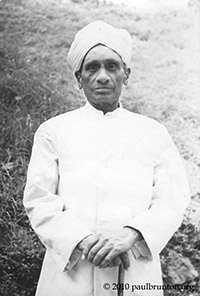
    V. Subrahmanya Iyer (1869-1949).
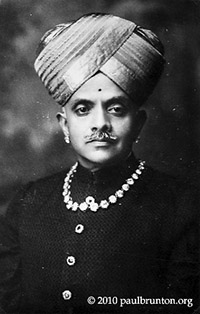
    The Maharaja of Mysore, Krishna Raja Wadiyar IV (1884–1940).

    A second stay in India (1935-37) brought Brunton into contact and friendship with the Maharaja of Mysore via his court philosopher V. Subrahmanya Iyer, and Mussorie Shamsher, Prince of Nepal, who facilitated the retreat chronicled in A Hermit in the Himalayas. On the way back to England, Brunton gave interviews in Austria, Hungary, and Czechoslovakia, where a devoted group of students persisted throughout the Nazi and Communist periods. In August 1937, he accompanied Iyer to the International Conference on Philosophy in Paris, then to Switzerland for a meeting with Carl Gustav Jung, which resulted in Jung’s own Indian journey at the turn of the year.

    With such high connections, one wonders why in 1938 Brunton obtained a PhD diploma from McKinley Roosevelt Graduate College in Chicago. This was not an accredited institution but a diploma mill that supplied impressive-looking documents for a fee. Brunton submitted a thesis that was the basis for his short book Indian Philosophy and Modern Culture. More worthy of the title was the magnum opus written during the early years of the war, published as The Hidden Teaching Beyond Yoga and The Wisdom of the Overself. The first volume reviews Brunton’s works to date and establishes the mentalist philosophy in a rather laborious way. The second takes flight, explaining how the universe comes into being, how individuals arise, what happens after death, the meaning of the current war, and ends with a series of practical exercises for turning this knowledge into realisation.

    The Second World War found Brunton in India again, intending to stay for a few months first with Ramana Maharshi, then in Mysore. In fact, he was trapped there for seven years before he could obtain a passage back to Europe. The Maharaja gave him a home. The British authorities declined his call-up application and encouraged him to continue his work for the Allied cause. One can only imagine what sort of discreet diplomacy that entailed, travelling the length and breadth of the subcontinent.

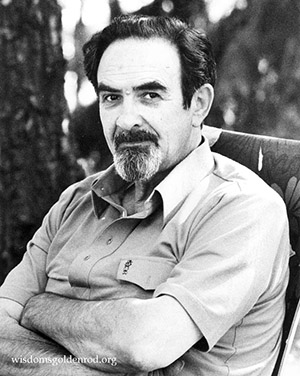
    Anthony Damiani (1922–1984)

    Brunton’s future biographers will continue the story of the next 35 years, drawing on his archive to track him through America, England, Australia, New Zealand, and the European continent, to his last homes on the Swiss lakes. They will soon come across the name of Anthony Damiani, who met Brunton in New York in 1946 and founded Wisdom’s Goldenrod Philosophic Center, not far from Cornell University. From the late 1960s, Damiani led a small group in the study of Brunton’s philosophy, together with Neoplatonism, Buddhism, Vedanta, astrology, and, on the psychological level, Jung.

    For those of Damiani’s students who visited Brunton in Switzerland, it was an unforgettable experience, as it had been for Brunton when he met Ramana, to be in the presence of a man who had fought the battle with the ego and won. That was the final invitation of his works: to overcome the obstacles to realisation of one’s true identity as the impersonal Overself and consequently as an unobstructed ray of the World Mind. In July 1977, Brunton spent a month at Wisdom’s Goldenrod, giving personal interviews, many of which are summarised in the Cornell archive. Two years later the Dalai Lama took time off his American tour to consecrate its new library building.

    In his last years, Brunton found his routine of housework, shopping, cooking his vegan diet, attending to Swiss bureaucracy and a constant flood of correspondence increasingly burdensome. Various members of the philosophic centre went for weeks or months to help with his mundane affairs. After his death, following a second stroke, Kenneth Hurst gave his father’s literary estate to the Paul Brunton Philosophic Foundation. Work began immediately on producing the Notebooks, supported by Brunton’s Swedish publisher, and thereafter on sorting, scanning, and digitising his formidable archive. It took almost forty years before a suitable home could be found for it, when Cornell University’s library recognised, at the very least, a unique contribution to the modern history of India.

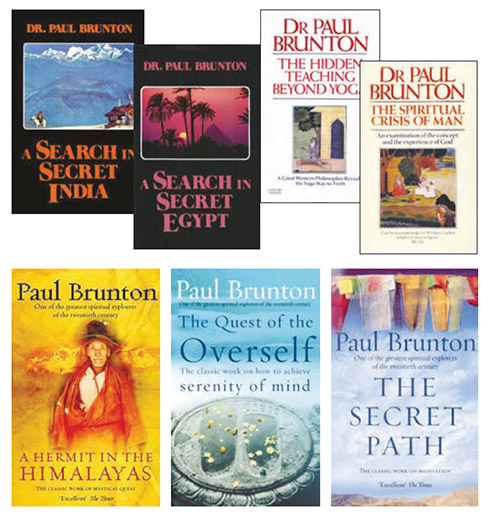
    From the 1930s through the 1950s, Paul Brunton’s eleven books were best-sellers in the field of alternative spirituality. The above is a selection of his titles from the 1930s with new editions in recent decades.

    There are not many accessible archives of twentieth-century spiritual masters and none that can be studied in their entirety from anywhere in the world. Among the 87 file boxes are drafts of his books, unpublished essays, records of interviews, and the original “notes,” including those omitted from the published Notebooks, together with personal details that a more ego-identified person might have suppressed. Cuttings from newspapers and magazines range from metaphysics through the occult sciences to diet, health, and the conduct of life. Brunton paid close attention to world events, which he saw through the lens not of politics but of destiny and karma. A curious relic from the pre-xerox era is his well-worn travelling library, made by Indian assistants who typed out articles, extracts, and entire books. A collection of photographs records scenes in Egypt and India that no longer exist. There is a vast horde of letters in which readers and friends from every walk of life, from royalty downwards, bared their souls to him. Even more inspiring are his replies, for their ability to say exactly what the recipient needs to hear. Yet the older and wiser he became, the more he disowned the role of master or guru, describing himself as “a student of these matters.” To which one can only exclaim: “Some student! Some matters!”

    Thanks and credit to the Paul Brunton Philosophic Foundation (www.paulbrunton.org) for the photos in this article and its digitisation of the archive at www.pbarchives.org, and to the Cornell University Library’s Division of Rare and Manuscript Collections, https://rmc.library.cornell.edu/EAD/htmldocs/RMM08692.html.

    The Notebooks of Paul Brunton (sixteen independent but related volumes) are available from https://www.larsonpublications.com/shop/product-detail.php?id=19.

    [alert type=”general” dismiss=”no”]This article was published in New Dawn 191.[/alert]

    [alert type=”success” dismiss=”no”]If you appreciate this article, please consider subscribing to help maintain this website.[/alert]

    © New Dawn Magazine and the respective author.
    For our reproduction notice, click here.