New Dawn – World's Most Unusual Magazine

Category: Articles

  • Haunted by Hungry Ghosts: The Joe Fisher Story

    Haunted by Hungry Ghosts: The Joe Fisher Story

    From New Dawn Special Issue No 5 (Winter 2008)

    Of those of us who do take mediumship and channelling seriously, and believe wholeheartedly in the existence of discarnate entities, very few of us are willing to concede that such beings may be liars and manipulators – and not just that, but purposely malevolent. There is, acknowledges the novelist Michael Prescott, “a dark side to the paranormal. It is not all benevolent angels and comforting words from deceased relatives. There can be obsession, deterioration of rational thought, shared fantasy, even a descent into madness. There can be hungry ghosts.”

    When it comes to encounters with ‘hungry ghosts’, no story is more disturbing and tragic than that of Canadian journalist and best-selling author Joe Fisher. Fisher committed suicide at age 53 on May 9, 2001, throwing himself off a limestone cliff at Elora Gorge, Canada. One newspaper suggested he may have been murdered. Shortly before his death, Fisher’s final book, The Siren Call of Hungry Ghosts, an investigation into channelling and spirit guides – described by its publisher as “his gripping journey into a realm of darkness and deception” – was republished by Paraview Press. What gives this story a strange twist is that, in one of his last communications with his editor-in-chief Patrick Huyghe, Fisher stated that the spirits he had allegedly angered as a result of writing the book were still causing him trouble. 

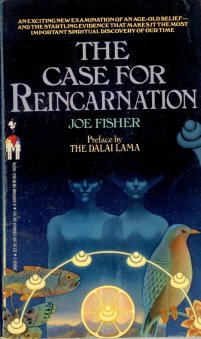
    Fisher’s works include the metaphysical classics Life Between Life, Predictions and The Case for Reincarnation, the last of which includes a preface by the 14th Dalai Lama. 
    In an article on the topic of ‘spirit possession’, famous British author Colin Wilson, who acknowledges Fisher as a friend, mentions that he “had been cheerful and normal, and no one, including myself, could believe that he had killed himself.” He mentions, moreover, that Fisher believed in life after death, and subscribed to the theory of reincarnation. “What baffled me was that he must have been convinced that suicide would only leave him with another set of problems.” Wilson has a point, because in The Case for Reincarnation, Fisher had written: 

    “Those who learn that they have killed themselves in past lives are quickly brought to the realisation that suicide, far from being an answer to life’s problems is (instead) the violent breaking of the lifeline. If the (suicide) could only realise the resulting intensification of difficulty which must enter the life to come, (suicide) would never be (attempted).”

    That Fisher’s death was caused by a group of malevolent discarnate entities – who perhaps influenced his mind – might sound far-fetched and sensational to some. It is, however, a possibility that cannot be ignored, as anyone who’s read Hungry Ghosts would probably agree. Unable to accept that an optimistic, spiritually-minded man like Fisher would want to take his own life, Wilson writes: “I find myself speculating whether his suicide had anything to do with a weird experience he had in the 1980s.”

    Canadian journalist and best-selling author Joe Fisher in his younger days.

    FISHER MEETS HIS ‘SPIRIT GUIDE’ 

    That “weird experience” began in 1984, when Fisher met an Australian-Canadian medium named Aviva Nuemann, who suffered from chronic leukaemia. Aviva had contacted Fisher, suggesting he attend a channelling session at her house, because, she said, she did not feel entirely comfortable being a ‘mouthpiece’ for discarnate entities, and was hoping that he, an expert on metaphysics, might be able to shed some light on the matter. When they first met, Aviva, a laboratory technologist, stressed the point that she had “never believed in the so-called psychic world. I think astrology is absolute crap, and I’ve got no time for anything that’s supposed to be paranormal…” She told him the remarkable story of how she became a channeler for ‘the guides’. 

    It all started, she said, when she agreed to allow her friend and neighbour, Roger Belancourt, to try to heal her under hypnosis. His aim was to administer positive medical suggestions to her subconscious mind, such as “Your bone-marrow will start immediately to manufacture the extra red blood cells needed by your body.” These hypnotic sessions took an experimental turn when Roger began probing Aviva’s mind for past-life memories. In an emotionless voice, and in the third-person, Aviva described having been a peasant woman named Svetlana who lived through the Russian revolution, as well as a Punjabi infant who died of malnutrition before his first birthday. Other ‘past lives memories’ were described as well. 

    Probing deeper still, Roger managed to contact another part of Aviva’s mind, even more knowledgeable than her subconscious. It referred to itself as the ‘alter-consciousness’. Roger discovered that every organ of Aviva’s body, and every aspect of her personality, appeared to possess its own alter-consciousness, each with its own voice. He used the ‘voices’ to monitor Aviva’s health. By communicating with the blood’s alter-consciousness, for instance, Roger was able to tell whether Aviva’s red blood cell count had increased or decreased. This higher aspect of Aviva’s mind – what one might term her ‘superconsciousness’ – proved to be very knowledgeable about spiritual matters. The aim of reincarnation is “forward development,” it said, which is “understanding of oneself.” When brought back to full consciousness, Aviva had no memory of what had transpired while in trance. It was as though she had been deeply asleep. 

    Seeing as her alter-consciousness seemed to know just about everything, Roger decided to ask it if ‘spirit guides’ actually existed, for he had long suspected that he was watched over by a deceased Tibetan Lama named Jai-Lin. Roger found to his delight that he could communicate with Jai-Lin via Aviva’s alter-consciousness, which, in Fisher’s words, “acted as intermediary, relaying messages from the next world.” Roger was told by his ‘guide’ that he “must always think positive thoughts,” and that “you have much to learn in self-discipline.” 

    Annoyed by the fact that Roger was unable to control his negative emotions, Jai-Lin told Roger that he must move on to meet fresh challenges elsewhere. Jai-Lin was eventually replaced by another ‘guide,’ an affectionate entity named Hanni, who claimed to have been Roger’s mother in a previous life in the Netherlands. Every incarnate individual was administered a spirit guide, Roger was told. But this did not necessarily mean that one had the same guide throughout the whole course of their life – or, for that matter, several life times. Sometimes a guide would leave their ‘charge’ – the incarnate person whom they were required to ‘watch over’ – and another guide would fill their place. 

    Having mastered the ability to manipulate Aviva’s vocal cords – a process that was said to take some time – Hanni was able to speak through the entranced Aviva. Fisher describes Hanni’s voice as “soft and tenderly,” and totally dissimilar to Aviva’s. While channelling her own guide – a Yorkshire farmer named Russell who claimed to have last lived on earth during the 19th century – the voice that issued from Aviva’s mouth was also unlike her own, so much so that it left Fisher stunned. “Gone was the high-pitched jocularity with the pronounced Australian lilt,” he says. “Her enunciation was now unequivocally masculine; the English accent was unmistakable.” 

    Speaking to Russell, Fisher was not only surprised by Aviva’s change in voice, but by her change in personality too. “This was an entirely different Aviva,” he says, “strangely assertive and uncompromising.” Fisher felt as though he were talking to a separate being, and not, for instance, a fragment of Aviva’s unconscious mind.  

    Fisher was told by Russell that humanity was divided into two groups – souls and entities. Souls were said to be “created from desire,” and entities “born of knowledge.” Neither one of the groups was superior, said Russell. Although he found the concept difficult to accept, Fisher was glad to be hailed as an entity – clearly the more appealing of the two groups. Entities were classified as individuals, while souls were said to have more of a group mentality.

    Fisher’s guide turned out to be a young Greek woman named Filipa Gavrilos. Three centuries earlier, said Russell, she and Fisher had been lovers in a little Greek village called Theros. Apparently they had been together over many lifetimes. The news blew Fisher away, for he had always been strongly drawn to Greece, and, as a child, the name Phillipa had appealed to him. Russell described Filipa as an “excitable young lady.” Eventually, he said, she would be able to speak through Aviva. In the meantime, Fisher tried to develop mind-to-mind contact with Filipa. Each day, Fisher would close his eyes and will Filipa to communicate with him, a regimen he followed religiously for the next three years. 

    In late-1984, Filipa spoke through Aviva for the very first time. Initially, admits Fisher, he was rather unimpressed with Filipa, and had “serious doubts about her intelligence… Her initial responses were almost juvenile, prompting me to remark to Roger and Aviva that I had attracted a ‘disco queen’ for a guide.” As the sessions continued, however, Filipa quickly became “an advisor, a best friend. And my ideal lover.” He adds: “Filipa and I seemed to think alike, feel alike and see the world from a near-identical perspective.”

    The guides said they could read the minds of their charges, which seemed to be true. They knew certain things about their charges that only their charges knew. They could, for instance, describe what their charge had been doing or thinking on a particular day, and at a particular time – information that could only have been gained psychically. 

    Fisher’s daily attempts to communicate with Filipa on a mind-to-mind basis began to yield some interesting results. Whenever contact had been successfully established, “a loud buzzing would reverberate in my ears, a sound that could be likened to an internal droning of cicadas.” During these meditative sessions, images would sometimes appear in his mind. One time he saw the image of woman walking towards him. She was wearing sandals and a long white wrap, her face partially hidden by a garment. He knew the woman was Filipa. “Within seconds, my body was racked with the most profound and unrestrained emotion. I wept out of joy and sadness and loss and anguish, yet to this day I don’t really know why.” It was, he says, “one of the most moving experiences of my life.” 
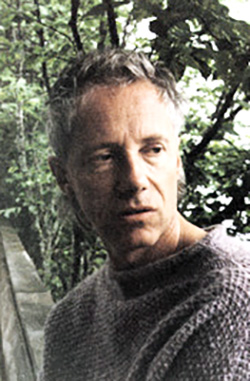
    Joe Fisher (1947-2001)

    Mind-to-mind contact could best be achieved when Fisher was in a particularly relaxed mood, with very few thoughts running through his head. Sometimes he’d imagine himself hugging Filipa, and this she appreciated greatly. Fisher could tell that she longed for a physical body. Filipa and the other guides disliked nothing more than to be referred to as ‘spirits’, and to be reminded of the fact that they no longed occupied physical bodies. To call one of the guides a spirit was to make them annoyed, even angry. “We’re not spirits!” Russell once shouted. “We’re people just like you. It’s just that we don’t have bodies any more.” Fisher found it a little dubious that the guides were so attached to the ‘physical plane’, even though they stressed that they were no more ‘spiritually evolved’ than their charges. 

    Occasionally, said Fisher, conversations with Filipa “would erupt in my head.” Once, while running up a steep hill, Fisher heard “a voice or implanted thought-form.” So as to make the climb much easier, the ‘voice’ told him to imagine that his feet were not touching the ground. The technique had a positive effect. When next at Aviva’s house, Fisher asked Filipa if she had spoken to him while he was out running. She answered yes, and was able to relate exactly what she had told him. “Somehow,” explains Fisher, “Filipa had to be either living inside me or hovering perpetually close by, picking up via some otherworldly antenna my organism’s every twitch and shudder.” 

    SUSPICIONS ARISE

    The guides appeared to have access to an almost unlimited amount of information. They even claimed to know “the nature of God.” However, they said, the amount of time required to explain it would take some three hundred sessions; for this reason, the project was never attempted. Fisher admits to being impressed by the teachings and advice offered by the guides. They were taught, among other things, about the history of Atlantis and Lemuria; about the workings of the mind; about reincarnation, karma and spiritual development. And so on and so forth. “So rich and so abundant were the insights and observations that there were times when I felt overwhelmed by the veritable geyser of information,” he says. Communicating with the guides was an addictive and thrilling experience. 

    As time went on, Fisher grew slightly suspicious of the guides. When, during one session, Filipa said she was aware of every thought he ever had about her, “the remark left me weak with ardent appreciation. Every time I thought of her, she knew. How attentive, I asked myself, can you get?” The guides gave long lectures about the importance of peace and love, but in many ways their teachings rang empty, and possessed little substance. Also worrying is that they intervened, both physically and emotionally, in the lives of their charges, while at the same time stressing the importance of free will. Such a massive contradiction was impossible to explain. 

    In his book The Paranormal, Stan Gooch describes the teachings of ‘spirit guides’ as “a kind of intellectual candy-floss… when you chew on these utterances, there is nothing there. The mouth is empty.” The late D. Scott Rogo, a prolific writer and researcher of parapsychological phenomena, was of much the same opinion as Gooch. “I find that most channelled discourses possess the spiritual and philosophical sophistication of a Dick-and-Jane book,” he explains in The Infinite Boundary.  
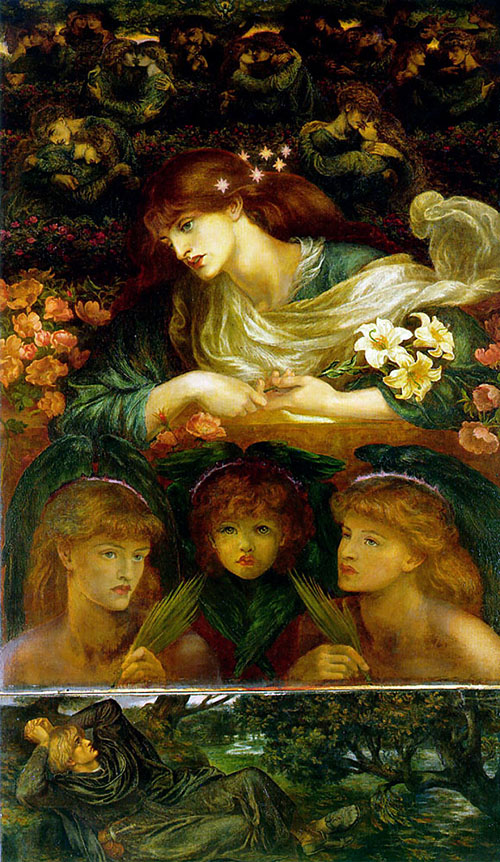
    In 1871, more than a century before Joe Fisher’s contact with “Filipa,” the Italian poet-painter Rossetti was commissioned to paint this illustration of his poem “The Blessed Damozel,” about lovers separated by death, waiting to be reunited. By 1879 Rossetti added a predella showing the earthbound lover gazing up at the heavens.

    Mischievous Spirits  

    “The more I loved Filipa,” writes Fisher, “the more I hungered for tangible proof of her existence.” For this reason, and because he wished to write a book about discarnate beings and life in the ‘next dimension’, Fisher set about trying to prove the identities of the guides. He wanted to know if they had lived the lives they said they had. Fisher knew enough about spirits to realise that they were rarely who they claimed to be. He had, in fact, been warned about this by Russell, who, during one of their first conversations, clearly stated that mischievous spirits sometimes like to pose as wise and knowledgeable spirit guides.

    The guides were more than happy with Fisher’s desire to prove their identities, and were eager to offer him specific details about their lives on earth. First of all, decided Fisher, he would try to follow up on the information given by ex-RAF bomber pilot William Alfred Scott, the guide of a man named Tony. Scott said he had been born in Bristol in 1917, had started his RAF career in 99 Squadron at Mildenhall, Suffolk, and, ironically, had not been killed in the air, but in a German bombing raid on Coventry in 1944. Scott knew everything about the squadron, its operations, and his fellow officers. However, discovered Fisher, there had been no Flying Officer William Scott in the Squadron, as proven by a visit to the Public Record Office at Kew. Numerous other details were found to be bogus too.  

    When, back in Canada, and in a bitter mood, Fisher confronted Scott as to why he had lied, the once calm and polite entity became peevish and irritable. “I do not wish for my privacy to be violated,” he said. “I have given you all the information you need and, as such, it will stand.” Worming his way out of the situation, Scott claimed that he was unable to stick around for very much longer, because he had made plans to reincarnate soon. A suitable “bodily vehicle” had been located in Southern England, he said. After saying farewell, Scott departed for the ‘physical plane’. Much later on, Russell provided details of Scott’s ‘new incarnation’ – his name, DOB, place of birth, and the names of his parents. Surprisingly, the information checked out, and Fisher managed to obtain a birth-certificate for the infant. Fisher contacted the parents, who, although intrigued by the matter, were unwilling to get involved. He respected their decision. 

    If the guides had wanted to be believed, thought Fisher, wouldn’t they have claimed to have been people who had actually existed? Were they, perhaps, drawing on the knowledge and memories of other people – either living or dead – to create their identities? 

    As for his beloved Filipa, she too was found to be a liar and deceiver – or, in Fisher’s words, “a master of deception.” During his travels through Greece, Fisher was unable to find the ruins of Theros, let alone any evidence that the village had actually existed. And not only that, the city of Alexandroupolis, which Filipa had mentioned visiting during the eighteenth century, had not even existed at that point in history. In fact, discovered Fisher, the city had been named after a twentieth-century monarch!  

    During the remainder of his stay in Greece, while lying in bed late at night and brooding on Filipa’s betrayal, “her buzzing returned to plague me. Once so comforting and reassuring, the noise in my ears took on a shrill and sinister aspect, leaving me sleepless.” At that point, says Fisher, he began to grow afraid of Russell, Filipa and the other guides. “If they knew us all so intimately – as they had demonstrated on countless occasions – who could say what power they wielded over our lives?” 

    After the guides had been unmasked, only one or two members left the group. Overall, their faith in the guides had hardly been shaken. Fisher describes Russell – clearly the leader of the guides – as “devious, manipulative and potentially dangerous,” and “as slippery as the proverbial eel and a master psychologist to boot.” Fisher was unable to talk to Filipa, because, said Russell, “You’ve quite completely shut her out.” They never spoke again. In an article on the Joe Fisher story, the philosopher and paranormal investigator Jonathan Zap suggests that the guides may have actually been one entity – “a single shape-shifting entity who, like the devil, ‘hath power to assume a pleasing shape’ and was capable of performing a whole cast of characters of both genders.” 

    An-ex member of the group, Sandford Ellison, told Fisher how the guides had almost ruined his life. During private sessions with the guides, particularly with Russell, Ellison was told that if he didn’t leave his wife – a soul, not an entity – he would die. They even said “that she was trying to kill me by projecting powerful negative energies my way.” While working with the guides, who were teaching him to channel ‘healing energies’, Ellison suffered from “fierce emotional fluctuations and bouts of muddled thinking.” When no longer in their presence, he felt much better. During his final conversation with Russell, whereby he explained that he wanted nothing further to do with the guides, Ellison was told “that I would commit suicide in a fit of depression.” Before splitting with the guides, Fisher, like Ellison, had felt poorly. “I was more jittery than usual,” he says, “more susceptible to insomnia and nervous tension… I could not shrug off a cloying sense of contamination which could neither be pinpointed nor explained.”

    Having spent years listening to, and talking intimately with, the entities channelled through Aviva, and having spoken with a number of other channelled entities, Fisher was forced to accept, somewhat ruefully, that these ostensibly wise and benevolent beings – “who have wormed their way into that juicy apple of spiritual regeneration known as The New Age” – were nothing more than ‘lower astral entities’ or ‘hungry ghosts’. Fisher defines these vampiric beings, these poor, wretched souls, as “individuals whose minds, at the point of physical death, have been incapable of disentangling from desire. Thus enslaved, the personality becomes trapped on the lower planes even as it retains, for a while, its memory and individuality. Hence the term ‘lost soul,’ a residual entity that is no more than an astral corpse-in-waiting. It has condemned itself to perish; it has chosen a ‘second death’.” 
    Get the issue this article appears in

    SUICIDED BY HUNGRY GHOSTS?

    In his aforementioned article on ‘spirit possession’, Colin Wilson asks the question: “Was his suicide an attempt to rejoin Filipa?” To support this theory, Wilson explains how Fisher’s involvement with Filipa had “spoiled him for a normal sex life,” as revealed in the following quote, taken from Hungry Ghosts: “My terrestrial love life was doomed. No woman of flesh and blood could hope to emulate Filipa’s love and concern. No incarnate female could ever begin to understand me in the fashion to which I had become accustomed. In a sense, I was lost to the world, living in a limbo land…”

    Wilson offers another compelling theory:

    “I talked about the mystery of Joe’s suicide to Suzanna McInerny, who is the president of the College of Psychic Studies in South Kensington. Suzanna confirmed that long-term involvement with ‘hungry ghosts’ can cause difficult inner problems. A kind of dirt sticks to the medium’s ‘aura’ (or vital energies), which has to be cleaned off by another medium, like a window cleaner polishing off grime. This dirt can cause depression and a sense of unreality. And sometimes, Suzanna said, a ‘hungry ghost’ can even hang around inside somebody, quite unsuspected, and can only be evicted by a medium who understands such matters. She agreed with me that this could well be the explanation of Joe’s suicide.”

    Fisher was of the opinion “that no highly-evolved, spiritual being would ever speak through a medium.” He quotes the late Tibetan Buddhist lama Namgyal Rinpoche, founder of the Dharma Centre of Canada, who makes the same point: “As a general spiritual law, no enlightened being would speak through an ordinary human. The discarnate spirits who are making themselves known through channelling are united in their desperate need for love. Their audience is a generation that is also hungry for love.” 

    In light of Fisher’s unfortunate story, it would be easy to form the opinion that all channelled entities are troublesome – possibly even malevolent – lower astral entities, and that, as is written in 2 Corinthians 14, “Satan himself masquerades as an angel of light.” For a fundamentalist Christian – which your author is not – such a facile view would be deeply satisfying. But nothing in life is that black and white. Perhaps the last word should go to Zap, who warns, “We need to consider the subtle ways that discarnates may influence our thoughts, emotions, sexuality and behaviour. Joe Fisher’s apparent suicide adds an ominous implication that these entities are not to be underestimated…”

    Dedicated to the memory of Joe Fisher (1947 – 2001)

    [alert type=”general” dismiss=”no”]This article was published in New Dawn Special Issue No 5.[/alert]

    [alert type=”success” dismiss=”no”]If you appreciate this article, please consider subscribing to help maintain this website.[/alert]

    REFERENCES

    Loren Coleman, The Anomalist, The Sudden Death of Joe Fisher, www.anomalist.com/milestones/fisher.html
    Jonathan Zap, The Siren Call of Hungry Ghosts, 2006, www.zaporacle.com/textpattern/article/110/the-siren-call-of-hungry-ghosts
    Suhotra Swami, Channeling – Extrasensory Deception?, 1998, http://krishnascience.com/Vaisnava%20Library/Philosophy/Articles%20from%20Suhotra%20Swami/Channeling.htm
    Emanuel Swedenborg, The Heavenly Doctrines, www.heavenlydoctrines.org
    Joe Fisher, The Siren Call of Hungry Ghosts, Paraview Press, USA, 2001
    Stan Gooch, The Origins of Psychic Phenomena, Rider & Co, UK, 1984
    Stan Gooch, The Paranormal, Wildwood House, Ltd, 1978
    Jon Klimo, Channeling: Investigations on Receiving Information from Paranormal Sources, Jeremy P. Tarcher, Inc., USA, 
    D. Scott Rogo, The Infinite Boundary, Dodd, Mead & Co, USA, 1987
    Wilson Van Dusen, The Natural Depth in Man, Harper & Row, USA, 1972

    © New Dawn Magazine and the respective author.
    For our reproduction notice, click here.
  • Allan Kardec and the Way of the Spirit

    Allan Kardec and the Way of the Spirit

    From New Dawn Special Issue No 5 (Winter 2008)

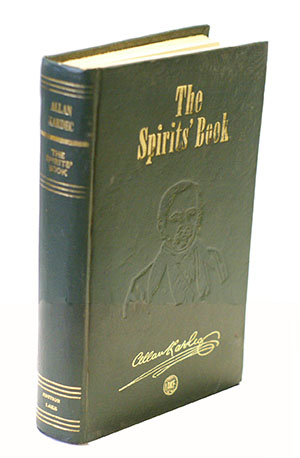
    In Allan Kardec’s The Spirits’ Book, which is considered by many to be the bible of Spiritism, the characteristics of “impure spirits” are listed. They are “inclined to evil,” it says, and “give to men perfidious counsels, stir up discord and distrust, and assume every sort of mask in order the more effectually to deceive.” According to Spiritist doctrine, moreover, “imposition is one of the distinctive characteristics of bad spirits. They command and want to be obeyed. The good never impose.” 

    Most people know about the religious movement Spiritualism, which flourished in Europe and America from the 1840s to the 1920s, and whose followers believed, and still believe, that the spirits of the dead can be contacted by mediums. But few of us in the English speaking world are familiar with the philosophical doctrine Spiritism, which was established in France in the mid-nineteenth century. An offshoot of Spiritualism, Spiritism began with the aforementioned Frenchman Allan Kardec, whose real name was Hippolyte Leon Denizard Rivail. 

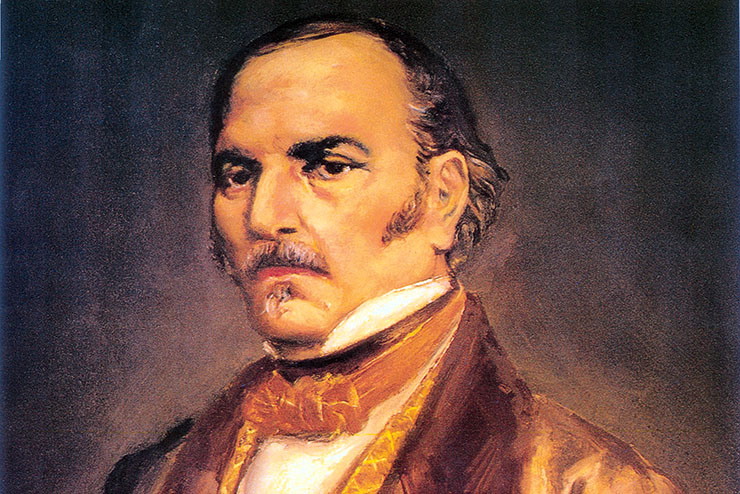
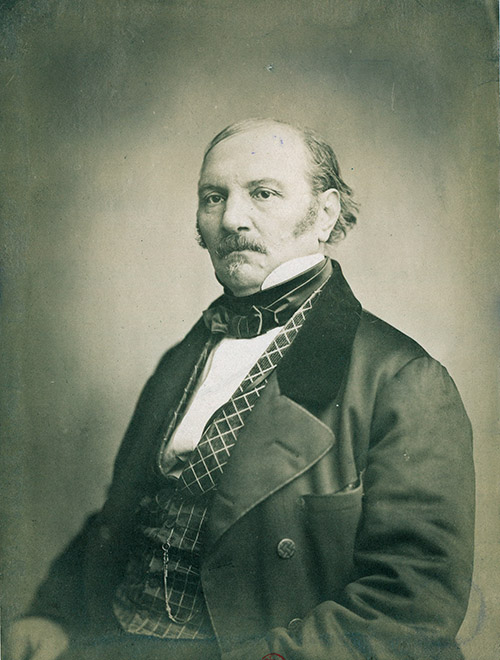
    Allan Kardec was the pseudonym of the French teacher and educator Hippolyte Leon Denizard Rivail (1804 – 1869), who is known today as the ‘codifier’ of Spiritism.

    Universal Educator

    Born in Lyon, France, in 1804, Rivail was educated at the distinguished Yverdon Institute in Switzerland, a school founded and run by the famous educational reformer J.H. Pestalozzi. Rivail was so influenced by Pestalozzi and his revolutionary teaching methods that he decided to become a teacher too, eventually establishing his own school in Paris, which, unfortunately, he was forced to close down after just eight years, due to financial reasons. But Rivail’s career as an educator didn’t end there. He wrote textbooks on French grammar, mathematics and educational reform, and also taught free courses in the sciences. Possessed of a great intellect, he apparently spoke six languages. By the early-1850s, writes British parapsychologist Guy Lyon Playfair, Rivail had become “well-established as a progressive, free-thinking writer and educator.” British author Colin Wilson describes him as “a kind of universal educator, willing to dispense knowledge on any and every topic.”

    Rivail’s initial reaction to the Spiritualist ‘table-turning’ craze was one of scepticism. Originating in 1848 with the Fox sisters in Hydesville, New York, the exciting phenomenon quickly spread to Europe. 

    Being, in Anna Blackwell’s words, “unimaginative almost to coldness” and “a close, logical reasoner,” it’s little surprise that Rivail’s initial reaction to the Spiritualist ‘table-turning’ craze was one of scepticism. Originating in 1848 with the Fox sisters in Hydesville, New York, the exciting phenomenon quickly spread to Europe. Almost everyone, it seems, were conducting séances in their homes, communicating with the spirits of the dead with the use of a table. 

    In 1854, while discussing the subject with a friend, Rivail remarked, “I will believe it when I see it.” He attended his first séance about a year later, and was greatly impressed by what he witnessed, which not only included table-turning, but also a demonstration of automatic writing. “I glimpsed,” he explains, “beneath the apparent frivolities and entertainment associated with these phenomena something serious, perhaps the revelation of a new law, which I promised myself I would explore.”

    Questioning the Spirits

    Rivail was later introduced to a Mr. Baudin, who held weekly séances at his home. Present at these sessions were his two daughters, both of them excellent mediums. The methods they used to communicate with the ‘spirit world’ were that of table-turning and planchette writing. Because the girls were frivolous and not the sharpest crayons in the box, so to speak, and because mediumship works on the principal that ‘like attracts like’, nothing particularly special was obtained from these communications – except, of course, when Rivail was present, who appeared to have acted as a ‘beacon’ for wise and knowledgeable spirits. 

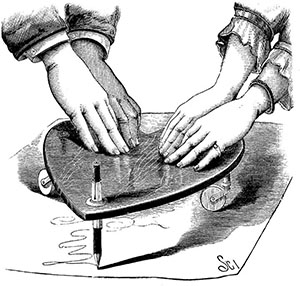
    A planchette is used to assist automatic writing. The board is used to hold a pencil and is supported on small wheels that allow for easy movement. The medium simply places his or her hand on the board, which is then manipulated by a spirit. Some sceptical researchers attribute the movement to the subconscious. 

    No longer were the spirit communications of a banal and superficial nature. The spirits began to talk philosophy of “a very grave and serious character,” and Rivail used the opportunity to ask them the most penetrating questions he could think of. He came to each session with a list of new questions. Examples include, “What is God?”, “Do spirits foresee the future?”, and “Is it possible for man to enjoy perfect happiness upon the earth?” Their answer to the first question was simple yet elegant. God, they said, is “the Supreme Intelligence – First Cause of all things.” Rivail, by the way, was not a medium himself, and thus he relied on others to act as his ‘telephone line’ with ‘the other side’.

    Another group of researchers, no doubt as earnest and sincere as Rivail and his colleagues, also conducted numerous ‘question and answer sessions’ with apparently wise and knowledgeable spirits, collecting, in the end, over fifty notebooks full of compelling material, which they ended up handing to Rivail. He added it to the other communications he had obtained himself. Overall, the information seemed entirely logical, and possessed an impressive inner-consistency. That it had a profound impact on Rivail, spiritually, intellectually and philosophically, is proven by the following statement, which he made to his wife: “My conversations with the invisible intelligences have completely revolutionised my ideas and convictions. The instructions thus transmitted constitute an entirely new theory of human life, duty, and destiny, that appears to me to be perfectly rational and coherent, admirably lucid and consoling, and intensely interesting.” 

    The Spirits’ Book

    After two years of scrutinising the material, Rivail decided that it might be a good idea to collate, edit, and publish it. When he asked his ‘spirit communicators’ what they thought of the notion, they replied in the affirmative, giving him specific instructions as to how he should go about it: “To the book… you will give, as being our work rather than yours, the title of Le Livre des Espirits (The Spirits’ Book); and you will publish it, not under your own name, but under the pseudonym of Allan Kardec.” (‘Kardec’ was an old Breton name in his mother’s family.)

    Rivail spent a considerable amount of time organising and verifying the communications. He only wanted to publish the best and most credible material – credible in the sense that the information could be confirmed by a number of different ‘sources’, and that it fitted in with the overall ‘theme’ of the work. If he wasn’t satisfied with the answer to a question – perhaps because it conflicted with the rest of the information he had collected – he would submit the question again, sometimes to a different medium than the one he had originally consulted. Rivail’s method, although not perfect, was certainly far more credible than that of most people who receive communications from the ‘spirit world’, who are often willing to believe almost anything they’re told. 

    The Spirits’ Book was finally published in 1857, causing quite a stir. It was so successful, in fact, that a second edition, containing additional material, was printed the following year, and the name Allan Kardec became known all over France. That its ‘author’ was a respected intellectual – and not the sort of person one would expect to publish such material – astonished the public. Almost everyone was able to find something of value in the book, even those of a scientific disposition, as it deals with such a wide range of topics, and in a very intelligent and enlightening manner. According to Steve Hume in an article that appeared in The Noah’s Ark Review, the French working classes took to Spiritism the most, “perhaps for the simple reason that the spirits had nothing good to say about the inequity that was, and still is, inherent in human society.” He points out, for instance, that the Spiritist teachings utterly condemn selfishness; proof of this can be found in The Spirits’ Book, which reads, “it is from selfishness that everything evil proceeds. Study all the vices, and you will see that selfishness is at the bottom of them all.” 

    Few can deny that The Spirits’ Book is an impressive piece of work, and that much food for thought can be found within its pages. One might describe it as an attempt to answer many of the ‘big questions’. As well as the nature of God, some of the topics it covers include ‘reincarnation’, ‘spirits and their relations with man’, ‘spiritual advancement’, and ‘the structure of the universe’. Some of the information is ahead of its time. On the topic of ‘universal space’, for instance, we are told than an absolute void does not exist in any part of space, but that “what appears like a void to you is occupied by matter in a state in which it escapes the action of your senses and of your instruments.” It’s exciting to think that ‘quantum field theory’ (QFT), which postulates the existence of a ‘quantum vacuum’, did not originate until the 1920s – more than half-a-century after the publication of The Spirits’ Book. According to QFT, in article available on Wikipedia, “the vacuum state is not truly empty but instead contains fleeting electromagnetic waves and particles that pop into and out of existence.” 

    Get the issue this article appears in

    Reincarnation

    In addition to The Spirits’ Book, also written – or, in Rivail’s words, “compiled and set in order” – under the name of Allan Kardec are four other fundamental works. They include The Mediums’ Book, The Gospel According to Spiritism, Heaven and Hell, and The Genesis According to Spiritism. All five books – known collectively as The Spiritist Codification – were published before Rivail’s death in 1869. Playfair describes them as “the clearest and most comprehensive survey of the invisible world yet written.” 

    The major difference between Spiritualist doctrine and Spiritist doctrine is that the latter advocates reincarnation, while the former does not. This had the effect of dividing the two movements. Automatic writing was the type of mediumship most favoured by Rivail, who considered it among the most safe, describing it as a method “by which the spirits best reveal their nature, and the degree of their perfection or inferiority.” The Spiritualists, on the other hand, were, and still are, fond of practising trance mediumship, while most of their mediums – or, rather, the spirits speaking through them – mentioned nothing at all about reincarnation. For this reason, explains Wilson in his book Poltergeist!, “Rivail was inclined to be critical about trance mediums, while the trance mediums and their followers denounced Rivail as a dogmatic old man.” 

    Buried in Paris’ famous Père Lachaise Cemetery Allan Kardec’s tomb, which features a large dolma, annually draws more visitors than any other.

    Following Rivail’s death, interest in Spiritism almost completely died out in France and other parts of Europe. It eventually spread to Brazil, attracting millions of followers. According to the last IBGE census data, in Brazil more than 4 million people declare themselves “Kardecist Spiritists.” Much like the Salvation Army volunteers, Brazilian Spiritists are known for their inspiring humanitarian efforts, and, according to Playfair, “have carried out some of the most impressive social welfare projects to be found anywhere.”

    When approaching the world of the spirits, it is worth keeping in mind what is said in The Mediums’ Book by one of its non-physical authors: 

    “Repel all spirits who counsel exclusiveness, division, isolation. Such spirits are always vain and shallow; they impose on the weak and credulous by exaggerated praises, in order to fascinate and to domineer over them. They are generally spirits who, having been public or private despots while on earth, still desire to have victims to tyrannise over after their death.”

    [alert type=”general” dismiss=”no”]This article was published in New Dawn Special Issue No 5.[/alert]

    [alert type=”success” dismiss=”no”]If you appreciate this article, please consider subscribing to help maintain this website.[/alert]

    REFERENCES

    Steve Hume, The Career of ‘Allan Kardec’ (originally published in The Noah’s Ark Society Review)
    Allan Kardec, The Spirits’ Book, Brotherhood of Life, USA, 1989
    Allan Kardec, The Book of Mediums, Samuel Weiser, Inc., USA, 1970
    Guy Lyon Playfair, The Way of the Spirit, The Unexplained magazine, vol. 3, issue 26, 1981
    Colin Wilson, Poltergeist!, Caxton Editions, UK, 1981

    © New Dawn Magazine and the respective author.
    For our reproduction notice, click here.
  • ‘Lenin was a Mushroom’! The Strange Life & Times of Sergey Kuryokhin

    ‘Lenin was a Mushroom’! The Strange Life & Times of Sergey Kuryokhin

    From New Dawn Special Issue Vol 15 No 3 (June 2021)

    Lenin was a mushroom! At least according to Sergey Anatolyevich Kuryokhin, the pioneering Russian musician, activist, and prankster from St. Petersburg who convinced viewers of Leningrad Television in January 1991 that the leader of the Bolshevik Revolution and father of the Soviet Union had eaten so many psychedelic mushrooms, he ended up becoming one. 

    In 1990s Soviet Russia, citizens read Pravda, the official newspaper of the Communist Party of the Soviet Union. They were conditioned to believe state propaganda, and an easy target in Kuryokhin’s Lenin mushroom prank.

    It’s hard to believe such a claim could be taken at face value by anyone, but Russians under communism had long been conditioned to believe whatever appeared on State-run television. 

    Delivering his argument with a straight face and a serious tone, and citing the work of genuine sources, Kuryokhin was able to convince his audience of Lenin’s secret fungi metamorphosis – though a large part of the prank’s success also came from the fact that he was speaking about a man who Soviet citizens had been brought up to revere, someone never publicly mocked or satirised. 

    Sergey Anatolyevich Kuryokhin (1954–1996) is recognised as a pioneering Russian musician, artist, activist, and founder of the now legendary music group Pop Mechanics.

    In a paper on the incident, University of California, Berkeley Professor Alexei Yurchak claimed that if Kurykohin had “been speaking of anyone else, his words would easily have been dismissed as a joke.”1

    “But Lenin! How could one joke about Lenin? Especially on Soviet television,” Yurchak explained. “Audiences could not help but attribute some credibility to the revelation.” 

    Not only did Kuryokhin claim to have “absolutely irrefutable proof that the October Revolution was carried out by people who had been consuming certain mushrooms for many years” but that the mushroom consumption had in turn “displaced their personalities.” 

    The day after the broadcast, a delegation of old Bolsheviks approached Galina Barinova, who oversaw a regional committee of the Communist Party, and demanded to know, “Could it be true that Lenin was a mushroom.” “NO!” answered Galina Barinova. “But…” the Bolsheviks insisted, “they said so on TV yesterday.” “It’s not true,” she responded. “Because a mammal cannot possibly be a plant.” 

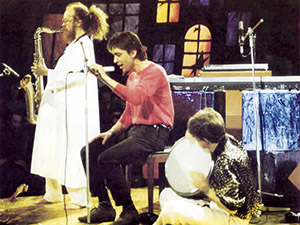
    In this Pop Mechanics performance, Kuryokhin is lead singer with Sergey Letov on saxophone.

    Ironically, in 2003, then US Secretary of State Colin Powell claimed at the United Nations to have “irrefutable” evidence that Iraq possessed weapons of mass destruction – a false claim that, like Kuryokhin’s, was believed by many, but tragically unlike Kuryokhin’s led to the death of hundreds of thousands of people.

    Kuryokhin’s mushroom prank aired on TV less than a year before the collapse of the Soviet Union, but the artist was just getting started. His rebellion against the rigidity of communist Russia would soon take on the nation’s new capitalist form too. 

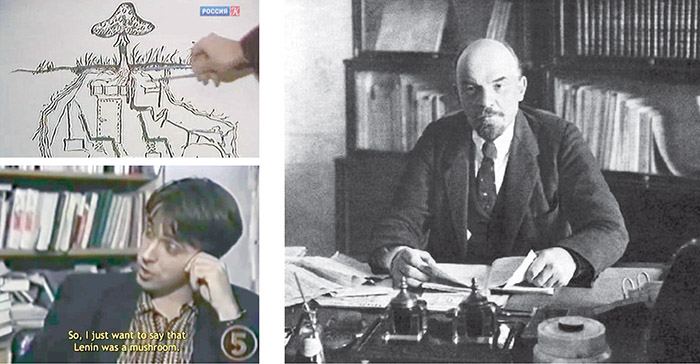
    In 1991, months before the collapse of the USSR, Soviet audiences witnessed a shocking scene on television program Pyatoe Koleso (The Fifth Wheel). Two serious-looking men – Sergey Sholokhov, the host, and his guest, the underground musician and writer introduced as “politician and actor” Sergey Kurekhin – sat in a studio discussing the 1917 October revolution. Suddenly, Kurekhin offered an astounding hypothesis – that Vladimir Lenin, the Bolshevik leader, was not a human being but a mushroom. Kurekhin used graphics to back up his hypothesis including this picture of Lenin (above right) with a round “strange object” on the bottom right of the photo. Kurekhin mesmerised viewers with a complex scientific-sounding explanation, and some misdirection, that linked the object to hallucinogenic mushrooms, as well as citing much “evidence” of Lenin’s affinity for mushrooms!

    With the end of the Soviet Union, Kuryokhin like many artists was optimistic at the prospect of a new Russia. However, as reality began to set in, Kuryokhin and other dissidents soon came to see this new Russia as a state even worse than the previous. 

    “He was very disappointed with liberals at that time, plus by senseless post-modernity, by the chillness of the people surrounding him in the liberal artist circles, and he was in search of something different,” said Aleksandr Dugin, the Russian philosopher, author, and political strategist who was close friends with Kuryokhin in his final two years. 

    Kuryokhin was among the first of the liberal artists who, upon seeing the reality of a post-Soviet Russia, became disillusioned with the vacuousness of liberal capitalism and sought to replace it with something new and spiritually substantial. Thus came the creation of the National Bolshevik movement. A radically syncretic and paradoxical movement co-founded by Dugin, Kuryokhin, writer Eduard Limonov, and punk musician Yegor Letov, the National Bolsheviks combined anti-liberalism, the Situationist Avant Garde, the metaphysical, and the absurd with loud imagery and anti-government protest. 

    A man who enjoyed pushing the envelope and making waves wherever he went – including through his experimental music group Pop Mechanics – Kuryokhin’s involvement with National Bolshevism was no different, and he used politics as another vehicle for his art, even inserting Dugin and Limonov into the final Pop Mechanics performance, which was dedicated to the British occultist Aleister Crowley. 

    According to Professor Fabrizio Fenghi in his book It Will Be Fun and Terrifying: Nationalism and Protest in Post-Soviet Russia, Limonov “read a text about ‘fallen angels’ and sang” during the concert, while Dugin read excerpts from Aleister Crowley’s work as Kuryokhin “performed some pseudo-ritualistic and seemingly mocking gestures” from behind. 

    “He was much larger than a party. He used National Bolshevism as a line of his conceptual music, one of the melodies in the sequence,” Dugin explained, adding that one core element of Kuryokhin’s personality was irony. 

    “When it looked like he was joking, he was saying serious things. When it looked like he said serious things, he was joking,” Dugin continued, calling Kuryokhin one of the master ‘trolls’ before ‘trolling’ was even a thing. 

    But Kuryokhin was also “really serious about religion, about metaphysics, about death, about philosophy” and “about the basic structure of human being,” Dugin said – using his art and his stunts to push a greater message, concept, or ideal. 

    Aleksandr Dugin & Sergey Kuryokhin in the mid-90s.

    In their ‘Manifesto of the New Magi’ (on page 70 of this issue of New Dawn), Kuryokhin and Dugin called for a return to ‘magic’ to bring on the revitalisation of politics and art, which they argued had degenerated to the lowest point. 

    “Only the direct, total replacement of art and politics with MAGIC can save this situation,” the manifesto declared, claiming that the source of magic in both institutions “has gradually been lost sight of.” 

    “Instead of a separate art, separate politics, and separate magic, a new synthetic discipline should be introduced, that of MAGIC, which directly establishes its own politics and its own art,” they said, concluding that art and politics should become the ritual itself. 

    Get the issue this article appears in

    The National Bolshevik movement is often considered to have been Kuryokhin’s last major stunt, or work of art, before he tragically died of a heart condition in 1996 at the age of just 42. 

    Yegor Letov passed away in 2008 and Eduard Limonov died in 2020, making Dugin the last of the co-founders of the National Bolsheviks still standing. 

    Kuryokhin was never a well-known figure in the West, and his international obscurity continues today, though with the advent of the internet his work has reached small new audiences online in the United States, United Kingdom, Australia, and beyond. 

    Perhaps more importantly, the conditions that led to Kuryokhin’s art are still present around the world, though largely in the West, where another generation of youth find themselves at the precipice of societal change, in a late state of decline.

    [alert type=”general” dismiss=”no”]This article was published in New Dawn Special Issue Vol 15 No 3.[/alert]

    [alert type=”success” dismiss=”no”]If you appreciate this article, please consider subscribing to help maintain this website.[/alert]

    Footnote

    1. www.academia.edu/633795/A_Parasite_From_Outer_Space_How_Sergei_Kurekhin_proved_that_Lenin_was_a_mushroom

    © New Dawn Magazine and the respective author.
    For our reproduction notice, click here.

  • What is the End of an Age? Understanding the Precession of the Equinoxes

    What is the End of an Age? Understanding the Precession of the Equinoxes

    From New Dawn Special Issue Vol 15 No 6 (Dec 2021)

    Timing is everything. Everything moves in cycles. Our days are defined by the turning of the earth, our weeks and months by the cycle of the moon, while the seasons of the year are caused by the relationship between the earth and the sun.

    The monthly cycle of a woman’s body, upon which the conception and birth of every child depends, has been associated with the cycle of the moon from ancient times. Despite a condescending denial of this ancient association in recent decades by proponents of “modern science” – who argue that there is no way heavenly bodies such as the moon impact biological functions in women or men – recently published findings from a long-term study over fifteen years revealed that the moon does indeed impact that monthly cycle (see “Women temporarily synchronize their menstrual cycles with the luminance and gravimetric cycles of the Moon,” Science Advances, January 2021, www.science.org/doi/10.1126/sciadv.abe1358).

    For the past twelve years, I have been exploring and presenting evidence that the world’s ancient myths are based on the stars and heavenly cycles – that ancient stories and all the characters and figures described in them correspond directly to constellations and celestial features. This is an esoteric system stretching around the globe and forming the foundation for myths from every inhabited continent and island, including the myths of the cultures of the Americas, Africa, Australia, the islands of the Pacific, as well as ancient India, China, Mesopotamia, Egypt, Japan, and Greece. This system forms the foundation for the Norse myths and for the stories contained in the scriptures of the Bible, from Genesis all the way to the Revelation of John.

    The myths use the heavenly cycles, including the cycles of the moon and the planets, but most especially the annual cycle with its effect on the hours of darkness and light as we move through the equinoxes and solstices. They are part of an esoteric language in which different parts of the cycle are understood to represent specific aspects of our experience in this incarnate life and thus convey powerful truths for our understanding and benefit.

    In addition to the cycles with which we are familiar from our own experience, such as the annual cycle with its changing seasons and lengths of the day, the ancient myths also use the less obvious and far more gradual cycle known as precession. This is a cycle unfamiliar to most people and rarely taught in formal schooling or mentioned in anything we see on television or in the movies. It proceeds at such a slow pace that even an entire human lifetime of carefully observing the heavens will barely reveal its subtle action.

    Indeed, the motion of precession is so subtle and gradual that it was not even articulated by any writers of whose work we are today aware, until the work of the astronomer Hipparchus who lived between the years we today designate as 190 to 120 BCE. Many centuries passed before astronomers could narrow down estimates of the rate of the motion of precession with any degree of accuracy.

    Understanding Precession

    To understand why precession is so difficult to detect, let’s examine its effect on what we see in the sky from our vantage point on earth. If we spend any amount of time looking at the stars at night, we will soon observe that the position of the constellations slowly changes as we go throughout the year.

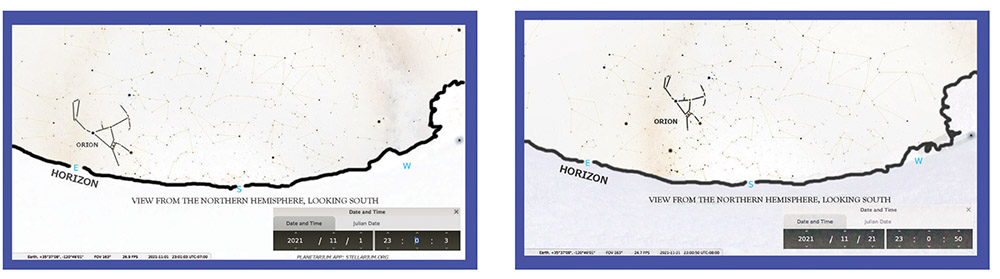
    FIGURE 1 (left):  Date and time box show that at one hour before midnight, on 1st November, all the stars of Orion have now risen in the east and are above the horizon. FIGURE 2 (right):  As we move through the year, the stars rise a few minutes earlier each night. Thus, they are farther along their journey from the east to the west at the same time on successive nights. Here we see that by the 21st of November, the stars of Orion have moved much higher by the same hour shown above: one hour before midnight. 

    For example, as I write this at the very end of October and beginning of November, the majestic constellation we call Orion is rising above the eastern horizon in the hours after dark, such that the entire constellation clears the hills to the east of where I live about one hour before midnight (see Figure 1). However, as we continue through the year, the stars of the constellation Orion will rise just a little bit earlier each night (about four minutes earlier per night, at the latitude where I live), such that in just a few weeks the entire form of Orion will be above the eastern horizon two hours before midnight, and thus even higher in the sky later on (see Figure 2). In a few months, the constellation will be high in the sky nearing its zenith.

    This change in the position of the constellations as we go from one night to another is a result of the changing relationship between the earth and the sun as we move through the year. Orion dominates the night sky during November through April (the winter months for the northern hemisphere), but as the year goes on and the stars of Orion continue rising earlier and earlier each night, the constellation will be farther and farther along its journey from east to west as the sun goes down, until at last we will observe that at nightfall, when the stars start to become visible, the familiar form of Orion is all the way over at the western horizon. As the year progresses even further, into the end of May and the beginning of June, Orion will already be below the western horizon when night falls and the stars appear.

    Because this movement is a function of our annual dance with the sun, the position of any given star (say, for example, the centre star in Orion’s famous three-star belt) will be back in its same position when we on earth get back to the same point relative to the sun in our annual cycle. Of course, to measure this phenomenon precisely, we need to stand in exactly the same spot from one year to the next. In fact, we have to rest our chin (or our telescope) in exactly the same location. If we do, we should find that the star in question is in its expected position when we get back to the exact same point in our annual cycle.

    How do we know when we get back to the exact same point in our annual cycle? We cannot simply use an ordinary calendar and pick the exact same calendar date (such as November 1st) and assume that we are back to the same point relative to the sun. As we know, the calendar “slips” around a little bit from one year to the next due to the fact that our earth’s daily turning does not match up evenly with our annual cycle. The earth turns on its axis 365 times and a little bit more each year, which means that we have to come up with corrections such as the concept of the “leap year” to keep the calendar from slipping to the point that January 1st falls in the summertime instead of the wintertime (for the northern hemisphere) due to that little extra bit of turning each year.

    So, if we want to know when we are back to the exact same point in our relationship with the sun, it is much easier to observe the great station points of the year that we call the solstices and the equinoxes. If we use the winter solstice, for example, to measure some specific star, we will know we have returned to the exact same point in our annual cycle. We can see if that star is in the same place that it was the prior winter solstice (keeping in mind that we will need to take our measurement at the exact same time and with our chin or our telescope in the exact same place as when we measured that star’s location the year before).

    If we are very careful with our measurements, then we should find that the same star is in its appointed place the following year. That is what we, in fact, do find because when we get back to the exact same point in relation to the sun, we should be able to look up into the sky at exactly midnight (for example) and trust that the scene in the heavens is the same it was when we crossed midnight at this exact same point in the annual cycle the year before.

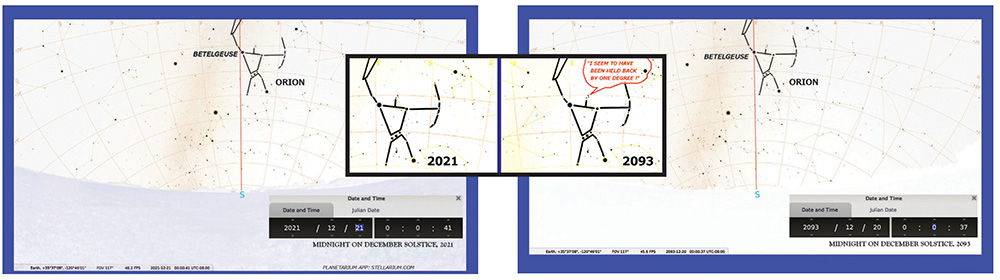
    FIGURE 3 (left):  Position of the stars of Orion midnight on December solstice, 2021. Compare this to the position of the same stars 72 years later, shown in Figure 4: the “delaying” action of precession will “hold the stars back” ever so slightly after 72 years, but only by a single degree of arc. FIGURE 4 (right):  Position of the stars of Orion midnight on December solstice, 2093. The gears of precession grind very slowly, but after 72 years, the stars have been “held back” by one degree of arc. Observe, for example, the position of the star Betelgeuse, at Orion’s shoulder just below the upraised arm: it has ben “delayed” by about one degree over 72 years on the December solstice. 

    But there is another motion going on which throws a twist into the orderly round of the march of the stars from one year to the next. It is so subtle that we will not be able to measure it very easily with standard equipment unless we take the same measurements every year for a very long time. Over the course of many years, the expected star will keep returning to its expected spot on the expected day, but if we measure its position each year for many decades (keeping careful records each year, of course), we will begin to see it “struggling” to make it to its appointed spot in the heavens – as if some force is very slowly “delaying” that star or “holding it back” from one year to the next.

    This action is so slow and subtle that it takes 72 years for that star to be held back by a single degree of arc (about the width of your littlest finger, held at arm’s length from your face). Due to that very slow delay, after 72 years the star will be delayed by a whole degree on the appointed day and time from the place that you measured it at the exact same place and time, 72 years before. Indeed, this delay holds back all of the stars. It is as if the entire fabric of the heavens is held back ever so slightly over decades so that Orion is one degree lower 72 years from now on the night of (let’s say) the December solstice than Orion will be this year on the December solstice at the same hour – and so will the stars of Taurus, and the Pleiades, and all the rest of them.

    Of course, very few astronomers can make 72 successive annual measurements of the same star as we’ve just described, even if they start at the early age of 10 years old. For the ancients to even perceive the motion of precession would require meticulous record-keeping for more than one human lifetime – not to mention a system for ensuring that all the observers rested their chins in precisely the same spot when taking annual measurements.

    Even after 72 years of observation, the delay is very slight – just one degree! And for the stars to be delayed by two degrees would take another 72 years, or a total of 144 years to get the two-degree displacement. After thousands of years, this “delaying action” will have a real impact. 

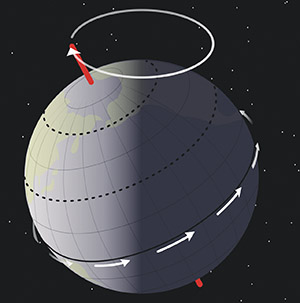
    FIGURE 5:  Precession appears to “hold back” the night sky by one degree every 72 years due to a 23.5° wobble of Earth’s axis as shown here. One cycle of the wobble takes approximately 25,920 years, which is 12 x 2,160 years.

    The reason this motion is called “The Precession of the Equinoxes” is that, after thousands of years, this slight delaying action changes the background of stars such that the constellation expected above the horizon before sunrise on the significant morning of the March equinox (the spring equinox for the northern hemisphere) will be delayed so much that it will still be below the horizon – and the constellation that normally precedes it in the march across the sky and through the year will be above the horizon instead.

    We know there are 360 degrees in a complete circle, so if the motion of precession delays the background of stars by one degree every 72 years, we can determine how many years it takes to delay the constellation expected to be just ahead of the sun on the morning of the March equinox (or even the constellation in which the sun is located on the March equinox, although we obviously can’t see the stars once the sun clears the horizon) due to the action of precession.

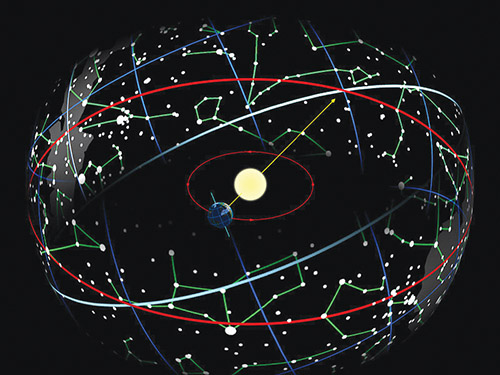
    FIGURE 6:  Another way of seeing the action of precession. Earth in its orbit around the sun causes the sun to appear on the celestial sphere moving along the ecliptic (red), which is tilted 23.5° with respect to the celestial equator (blue-white). Over very large spans of time, different zodiac constellations appear behind the sun as it rises at the March equinox. Image credit: Wikipedia/Tau’olunga

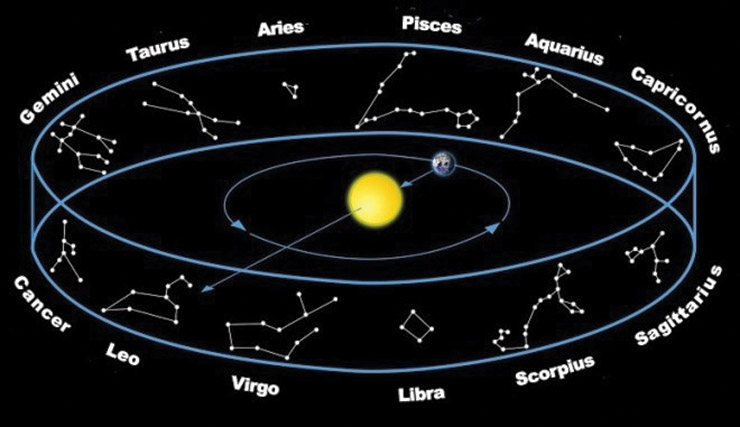
    The constellations along the plane of our solar system, the plane between the earth and sun, is known as the “ecliptic.” The background constellations along this ecliptic plane are known as the zodiac constellations. Although the constellations are not all exactly the same size, if there are 12 zodiac constellations and 360 degrees in a full circle, then we can calculate that each constellation in the zodiac should occupy a space of that circle totalling 30 degrees (since 360 degrees in a circle, divided by 12 zodiac constellations, gives us 30 degrees per zodiac constellation). Thus, if precession “holds back” the night sky by one degree every 72 years, then it would take 2,160 years for this motion of precession to delay the sky so much that the expected zodiac sign above the eastern horizon on the morning of the March equinox is “held down” completely below the horizon, such that the preceding zodiac constellation would be above the horizon instead.

    The same is true for the zodiac constellation forming the background for the sun itself on the March equinox – after 2,160 years of delaying action, the sun will be in the “preceding” constellation instead of the “expected” constellation. In other words, the sun will have “precessed” into the preceding constellation of the zodiac due to the inexorable motion of precession.

    Understanding the End of an Age

    This replacement of one entire zodiac constellation by another is what is meant by the “End of an Age.” An “Age” is a precessional Age and is generally identified with the constellation in which the sun rises on the March equinox during that entire Age. The Age of Taurus eventually gave way (due to the delaying motion of precession) to the Age of Aries (Aries being the zodiac constellation that precedes Taurus across the sky), and after another 2,160 years or so, the Age of Aries in turn gave way to the Age of Pisces, which is now giving way to the Age of Aquarius.

    The authors of the seminal 1969 book Hamlet’s Mill, Professors Giorgio de Santillana and Hertha Von Dechend, made the brilliant observation that this subtle motion of one constellation taking over the special position in the sky from a preceding constellation could be allegorised in myth. For example, in the usurpation of the throne of the rightful ruler by a jealous brother, as in the story of Osiris and his usurping brother Set, in the mythology of ancient Egypt.

    They went on to observe that all “End of the World” imagery common in myths (not only in the Bible where we find the apocalyptic scenes described in the Revelation of John and some of the sermons of Jesus in the gospels, but also in other myth-systems such as the Norse myths with their prophesies of Ragnarokk), must be allegorisations of the “End of a Precessional Age.” One “world” is (figuratively speaking) destroyed and replaced with a new one. The heavenly arrangement of the Age of Taurus, for example, was replaced by the arrangement of the Age of Aries, in which the sun rose in the new sign on the March equinox and also in the new sign on the other important stations of the annual cycle, including the June solstice, September equinox and December solstice.

    To support their argument, the authors of Hamlet’s Mill found “precessional numbers” relating to the cycle operating in myths around the globe, particularly in myths having to do with these themes of “usurpation” and the “End of the World.” For example, they point out that the ancient philosopher Plutarch tells us quite specifically that in the myths of ancient Egypt, the rightful king Osiris is killed by his jealous brother Set along with seventy-two henchmen!

    It should be noted that the actual rate of precession is not one degree every seventy-two years exactly, but rather one degree every 71.6 years – but we should be able to understand why the myths “round up” to 72 for a metaphorical story.

    Similarly, as the authors of Hamlet’s Mill also note, the Norse myths tell us (in the Poetic Edda also known as the Elder Edda) that when the final dreadful day of Ragnarokk arrives, the heroes of Odin’s hall of Valhalla will march out to do battle. The verses declare that Valhalla has 540 doors, through each of which will march eight hundred warriors on the day and that they must go to battle with the Wolf on the last day, for a total of 432,000 warriors (which, of course, relates to the precessional number of 72 and to the 2,160 years of a precessional Age, in that 432 is double 216 and six times 72).

    These numbers constitute a powerful argument in favour of their theory. Moreover, in the intervening years since Hamlet’s Mill was published, I found abundant evidence to support their theory in that the imagery in these apocalyptic battles and cataclysms (whether we are talking about the scenes described in the Book of Revelation or in the descriptions of Ragnarokk, or in other apocalyptic battles from other mythologies, such as the great Battle of Kurukshetra in the Mahabharata of ancient India) can be shown to correspond to specific constellations – proving beyond any doubt that these “End of the World” scenes are celestial metaphor.

    Get the issue this article appears in

    What is the purpose of such metaphor? That can be debated, although it stands to reason that if the cycle of the moon has an impact on the time of month that a woman can conceive a new life, then the other cycles up to the slow and inexorable turning of the cycle of precession can have an impact on our lives.

    I am also quite convinced that the myths use these heavenly cycles as an esoteric code to convey to us powerful messages about subjects we should understand in this life. The “displacing” motion of precession (by which one constellation’s place is “usurped” by another) relates to themes of displacement in our own life, including the theme of alienation, which I have found to be a central theme in the myths – alienation, indeed, from our own Self, which some pioneering modern psychologists connect to psychological trauma. The myths appear to have a dominant central theme about alienation from our Self and the path towards recovery. A subject that should interest all of us, very deeply.

    For an introduction to the ancient system of understanding the stars, read David Warner Mathisen’s Star Myths of the World Volumes One through Four, available from all good bookstores. His most-recently published books are The Ancient World-Wide System (2019) and Myth and Trauma (2020). Book previews are available at www.starmythworld.com.

    [alert type=”general” dismiss=”no”]This article was published in New Dawn Special Issue Vol 15 No 6.[/alert]

    [alert type=”success” dismiss=”no”]If you appreciate this article, please consider subscribing to help maintain this website.[/alert]

    © New Dawn Magazine and the respective author.
    For our reproduction notice, click here.
  • Meet Your New Biotech Overlords; How Covid Has Ushered in the Next Generation of Digital Control

    Meet Your New Biotech Overlords; How Covid Has Ushered in the Next Generation of Digital Control

    From New Dawn 187 (Jul-Aug 2021)

    A few years ago, commentators argued that “data is the new oil”:1 a precious commodity that makes the world go ‘round. Instead of wars for control over natural resources, à la Iraq, Libya, and Syria, the new battles will be fought across informational landscapes by tyrannical tech monopolies whose software is based on designs that emerged from the state-funded military sector and whose power is too vast for governments to break. 

    For-profit transhumanism was the plan all along. Referring to brain implants, the founder and head of what became the World Economic Forum, Klaus Schwab, said in 2016: “first we will implant them in our clothes as ‘wearables’ and then we could imagine that we will implant them in our brains or in our skin.” Schwab said that this will eliminate the boundaries between digital and physical space.2 In 2017, Jun Wang, co-founder of the health company iCarbonX, said: “We want an exact 3-D figure of you: the fat, the muscle – your entire body shape, plus facial recognition, and what’s going on with your skin.”3 

    Governments’ responses to the Covid pandemic worldwide have given our new biotech overlords the perfect opportunity to roll out and impose a myriad of next-generation gadgets for the control of humanity. 

    SELLING YOUR DATA

    Consider how anti-democratic forces have exploited national health services for profit. Billionaire tech entrepreneur Peter Thiel once wrote: “I no longer believe that freedom and democracy are compatible.”4 In-Q-Tel is a US Central Intelligence Agency seed-funding company whose investments, with others, helped to set up Google and Thiel’s Palantir: an AI and analytics company.5 Palantir was awarded US Defense Department contracts in foreign battlefields, including Afghanistan, to build biometric databases of the world.6 

    NHSX is a unit of the British National Health Service (NHS) designed to put the final nails in the NHS coffin by digitising patient care. In July 2019, long before the world was aware of the growing pandemic, Palantir UK’s Louis Mosley dined with the chair of NHS England, David Prior. The pair discussed selling NHS data to the US-based firm.7 In 2020, with Covid ripping through Britain, Palantir was awarded a £23 million contract under the secret Crown Commercial Services G-Cloud 11 Framework.8 The NHS later developed its own App for track and trace, which in April 2021 the Transport Secretary, Grant Shapps, said could be used for vaccine travel passports.9 

    GenVis is an Australian company specialising in surveillance analytics. It describes itself and its products as building and presenting “compelling criminal cases underpinned by video forensics,” “real time intelligence,” and “people management.”10 A snazzy GenVis video promotes Australia’s 500 per cent increase in CCTV over the last decade, adding that 80 per cent of footage is unused due to monitoring costs. GenVis’s “intelligence path mapping” software can rectify this alleged problem by tracking targets and using visuals to make data easy to understand.11 The authorities in both South and Western Australia gave GenVis a contract to monitor Covid patients in quarantine via the G2G Now app, which the police also utilise to enforce travel restrictions.12 

    VACCINES AND TRACKING

    Accenture is a company with an Australian presence that provides numerous services, including artificial intelligence, cybersecurity, and data analytics.13 Accenture has also won military consultation contracts and promotes the aerospace sector on its website.14 In March 2021, the Australian government teamed up with numerous companies, including Accenture, to deliver vaccines to the population. Greg Hunt, the Minister for Health and Aged Care, said: “Accenture will provide tracking of vaccine doses as well as enabling overall program implementation monitoring.”15 Vaccine bookings would be managed by HealthEngine: a company that boasts 1.5 million monthly users, most of whom are Australia’s 70,000 GPs and health clinics. But the company had already been fined for unlawfully sharing patient data.16

    International Business Machines (IBM) provided Hollerith punch-card systems to Nazi Germany, which the regime used to code and tabulate non-Aryans for slave labour and extermination.17 IBM also made money off the back of the US taxpayer. By the 1950s, for example, the IBM 701 computer was processing 17,000 instructions per second for researchers and the US government.18 The pandemic has given IBM an opportunity to utilise its data-gathering and processing for public health services. The US government contracted IBM to develop a Digital Health Pass. The operation is described as follows: “Pharmacies and labs can issue verifiable credentials – such as test results or Covid-19 vaccine certificates – and send to an individual’s smartphone.”19 

    According to the New York State, the Excelsior Pass “provides a free, fast and secure way to present digital proof of Covid-19 vaccination or negative test results.”20 The Excelsior Pass is based on IBM’s Digital Health Pass.21 Carbon Health, the Commons Project, the CARIN Alliance, Evernorth, the Mayo Clinic, Microsoft, the MITRE Corporation and many others have spawned a mini vaccine/test passport industry via apps and initiatives like Change Healthcare, FirstVitals, and VaxYes.22

    LIFE IN CHAINS

    IBM’s systems are built on a new model of data storage that creates new endpoints tied to previous information: blockchain. Blockchain advocates reckon that end-to-end data can fast-track test results and vaccine certificates.23 But blockchain potentially threatens privacy by including in the chain all the informational points about the given person. 

    For decades, privacy advocates have warned about the incremental steps toward a cashless society in which every transaction by every citizen is not only tracked, recorded, and analysed but marketised in the form of surveillance capitalism. Buying habits form personal profiles of the consumer from which insurance companies, data brokers, and advertisers profit. Blockchain was created specifically for cashless digital money transactions called cryptocurrency.24 Fear of catching Covid has made growing numbers of consumers and shop assistants increasingly reluctant to handle cash, so much so that by November 2020, nearly six in 10 consumers were willing to pay bank fees in order to make non-physical transactions.25 

    As with data companies, cryptocurrency designers have used Covid as an opportunity to promote their products. “Governments are very interested in the cashless society,” says the Financial Times. In the US, the Federal Reserve has quarantined its cash. The e-commerce-friendly Chinese Community Party, which had already encouraged payment by QR codes, has literally disinfected its money. The Reserve Bank of India has actively encouraged electronic payments.26 

    YOU ARE DATA

    Financial technology (fintech) is another sector actively stimulated by governments. FinTech Magazine reports that the kind of biometrics envisaged by the likes of Klaus Schwab originated in the 19th century with the eugenicist Francis Galton. As growing numbers of apps and software on iPhones, iPads and other devices give users the option or indeed require having fingerprint recognition, palm prints, voice recognition, and eye scans, cryptocurrencies go hand-in-hand with biometrics. Set up by the entrepreneur Mihai Draghici, PayByFace, for instance, uses recognition algorithms to enable instant transactions. Similar companies have focused on eye recognition in light of mask mandates that render whole-of-face recognition software useless.27

    In America, the Scripps Research Translational Institute “aim[s] to make individualised medicine a reality for everyone. We use the tools of genomics and digital medicine combined with cutting-edge informatics techniques to better understand each individual and ultimately render more effective healthcare.”28 Over the years, the Institute has received money from the US Department of Defense, including grants to build an artificial immune system.29 In August 2020, employees of the San Diego Metropolitan Transit System wore the Institute-produced Fitbit watch designed to identify early Covid symptoms.30

    In 2018, Amazon acquired Wholefoods for $13.4 billion. A few months ago, it was reported that in Wholefoods stores in Seattle, customers will be able to wave their palms over biometric payment devices as they previously had at Amazon One stores.31 The news comes at a time when Amazon Prime drivers are quitting over company demands that they consent to yield their biometric data in the form of in-car surveillance that monitors them to authenticate their identity and track their levels of fatigue as they drive.32 

    Get the issue this article appears in

    Breaching Sovereign Inner Space 

    In an era of what the US Pentagon calls “full-spectrum dominance,” these separate nodes of technology create a cohesive whole that scans, tracks, and monitors not only every movement and digital transaction but, increasingly, the very intimate and sovereign inner space of the human being. The ancient wisdom that teaches lack of separation between the human and the infinity of god is being replaced with a new philosophical paradigm: the human as a data point in the infinite universe of 0s and 1s, whose gods are the surveillance capitalists and transhumanists, like Jun Wang and, more powerfully, Klaus Schwab and his technofascist ilk. 

    [alert type=”general” dismiss=”no”]This article was published in New Dawn 187.[/alert]

    [alert type=”success” dismiss=”no”]If you appreciate this article, please consider subscribing to help maintain this website.[/alert]

    Footnotes

    1. www.wired.com/insights/2014/07/data-new-oil-digital-economy/.
    2. www.rts.ch/play/tv/pardonnez-moi/video/klaus-schwab?urn=urn:rts:video:7400263
    3. www.technologyreview.com/2017/10/03/67827/how-ai-will-keep-you-healthy
    4. www.cato-unbound.org/2009/04/13/peter-thiel/education-libertarian
    5. https://medium.com/insurge-intelligence/how-the-cia-made-google-e836451a959e
    6. Annie Jacobsen (2021) First Platoon: A Story of Modern War in the Age of Identity Dominance, Dutton.
    7. www.thebureauinvestigates.com/stories/2021-02-24/revealed-data-giant-given-emergency-covid-contract-had-been-wooing-nhs-for-months
    8. www.digitalhealth.net/2020/12/palantir-awarded-23m-deal-to-continue-work-on-nhs-covid-19-data-store
    9. Simon Hodes and Azeem Majeed (2021) BMJ, 373: 1178.
    10. GenVis, https://genvis.co/contact
    11. https://twitter.com/genvis_/status/1054606176615165952
    12. Javad Jarrahi, BiometricUpdate.Com, 9 February 2021. 
    13. www.accenture.com/au-en
    14. https://newsroom.accenture.com/industries/health-public-service/us-department-of-defense-awards-accenture-improvement-contract.htm
    15. www.health.gov.au/ministers/the-hon-greg-hunt-mp/media/contracts-signed-for-rollout-of-covid-19-vaccine
    16. Katharine Murphy, Guardian, 11 March 2021.
    17. Edwin Black (2001) IBM and the Holocaust: The Strategic Alliance between Nazi Germany and America’s Most Powerful Corporation, Dialog Press.
    18. www.ibm.com/ibm/history/history/decade_1950.html
    19. www.ibm.com/products/digital-health-pass
    20. https://covid19vaccine.health.ny.gov/excelsior-pass
    21. www.governor.ny.gov/news/governor-cuomo-announces-launch-excelsior-pass-help-fast-track-reopening-businesses-and
    22. https://mashable.com/article/private-companies-vaccine-passports
    23. Moritz Platt (2021) JMIR of Public Health Surveillance, 7(4): e26460. 
    24. www.pwc.com/us/en/industries/financial-services/fintech/bitcoin-blockchain-cryptocurrency.html
    25. https://fintechmagazine.com/digital-payments/covid-cashless-and-convenience-rise-biometrics
    26. www.ft.com/partnercontent/comarch/covid-19-the-viral-spread-of-cashless-society.html
    27. Girling, op. cit. 
    28. www.scripps.edu/science-and-medicine/translational-institute/about/index.html
    29. https://web.archive.org/web/20141027020036/https://www.scripps.edu/news/press/2014/20140924darpa.html
    30. Laura Bliss, Bloomberg, 19 August 2020.
    31. www.cnet.com/news/amazon-palm-readers-coming-to-whole-foods-checkouts
    32. www.cnet.com/news/amazon-drivers-must-consent-to-biometric-monitoring-or-lose-jobs-reports-say

    © New Dawn Magazine and the respective author.
    For our reproduction notice, click here.