New Dawn – World's Most Unusual Magazine

Category: Articles

  • The 1966 Westall Incident: Refuting the Official Explanation

    The 1966 Westall Incident: Refuting the Official Explanation

    From New Dawn 173 (Mar-Apr 2019)

    What happened at Westall in Clayton, Victoria on 6 April 1966 has become one of our most prominent UFO mysteries. It has become widely known through the work of Shane Ryan and the excellent 2010 documentary ‘Westall’66 – A Suburban UFO Mystery’ directed by Rosie Jones. Here I will focus on why I think the case is credible and why the HIBAL balloon theory, still trotted out by uncritical media, does not explain what happened.

    The news story that tried to explain what happened at Westall School in 1966, appearing in the Herald Sun, 7 August 2014.

    Melbourne Herald Sun journalist Mark Dunn wrote the story which was published online on 6 August 2014 with the headline “Westall ‘UFO’ incident was actually government radiation testing, reports reveal.” A shorter version of the story appears in the hard copy of the paper the following day with the headline “UFO all hot air – ‘Westall’ was a balloon.” There is no evidence of any original research by the journalist, and it is based entirely on research done by long-time researcher Keith Basterfield. To quote from the story (my comments are in brackets):

    “An almost 50-year-old mystery when more than 200 people believed they had a close encounter with a UFO landing in Clayton may have finally been solved after newly-unearthed government documents revealed a secret radiation-testing program. [The HIBAL programme was not conducted in secret at the time of the Westall incident. HIBAL was openly reported in newspapers from at least 1965 and beyond 1966.]

    “Although federal and state government agencies refused to comment about the 1966 ‘Westall’ incident at the time, it is now believed that, rather than a UFO, what landed was an errant high altitude balloon used to monitor radiation levels after the controversial Maralinga nuclear tests. The HIBAL program was a joint US-Australian initiative to monitor atmospheric radiation levels using large silver balloons equipped with sensors between 1960 and 1969. Documents held by the National Archives and former Department of Supply indicate one test balloon launched from Mildura may have been blown off course and came down in Clayton South in a paddock near Westall High School, alarming and baffling hundreds of eyewitnesses, including teachers and students. [No official documents have been found as of the beginning of August 2014 that refer to any HIBAL launch being the explanation for the events at Westall in April 1966. No documents have been found to confirm the scheduled 5 April 1966 launch took place.]

    “After hovering over the area, it landed at an area known as The Grange, behind a grove of pine trees, before taking off again and being pursued by several light aircraft in a sighting which lasted 20 minutes from 11am on April 6, 1966. The event has ever since been shrouded in mystery.”
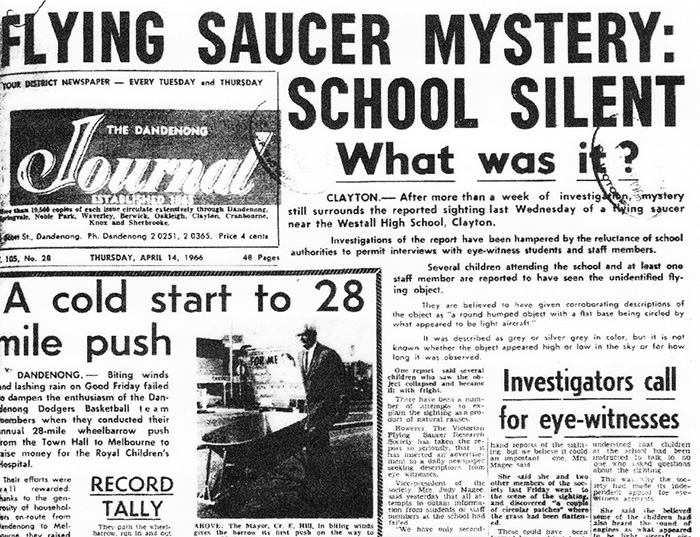
    Story in the Dandenong Journal, 14 April 1966, one of the few papers to cover the 1966 UFO mystery at Westall High School, Clayton, Victoria.

    “But researcher Keith Basterfield, who has spent years investigating unexplained phenomenon in Australia, said a ‘runaway’ balloon from the HIBAL (high altitude balloon) project was the likely answer. Each test balloon lifted a 180kg payload consisting of an air sampling and telemetry unit in a gondola and was followed by a light aircraft tasked with tracking it and triggering its 12mtr parachute via radio signal.”

    “Immediately after the Westall ‘UFO’ sighting, reports emerged of government men in suits converging on the area and asking school officials and other witnesses to not talk about the event. A contemporary witness reported these ‘suits’ stated what the students saw was part of a secret government exercise and that for national security reasons they were forbidden from discussing it…

    “What is strikingly missing is a memo reporting on the actual four launches for April 1966, one of which was scheduled for 5 April 1966, the day before Westall. So we have no (official) knowledge of where flight 292 went.”

    A document in the Australian HIBAL files may point towards the fact that no dramatic HIBAL related touchdown occurred at Westall on 6 April 1966. The Australian Prime Minister’s secretary in a memo to the Secretary of the Department of Supply dated 6 May 1966 (only one month after the Westall incident) indicated: “The indemnity clause was inserted in the HIBAL agreement because of the real risk of injury from descending instrument packages.” It tellingly does not refer to any HIBAL event of “descending instrument packages” coming down in populated areas, let alone suburban Melbourne. 

    The original SECRET classification of this file and the absence of any reference to HIBAL-initiated hazards or security concerns related to Westall during April 1966, strongly suggests that no such incident occurred. 

    A number of witnesses in the Westall incident report a heavy hand in what seemed like an official coverup. If it was a HIBAL related matter, the file would have contained references to it or at the very least an escalation in the security and liability fallout. Instead, what is seen is a dense bureaucratic dialogue being slowly resolved to permit the HIBAL programme to continue with continual references to minimal risks. No references to a crisis at Westall caused by a messy HIBAL containment and retrieval suggest a logical conclusion: There was no HIBAL event at Westall on 6 April 1966.

    A scenario like the HIBAL hypothesis might take flight if you ignore or reject a lot of impressive eyewitness testimony or only utilise suggestive fragments of the fuller story. Especially considering the coherence of much of the Westall testimony, some of it revealed in 1966 and 1967, and much more since then, particularly in the last decade, primarily through Canberra researcher Shane Ryan’s work.

    Ken McCracken was involved in HIBAL as a scientist from Adelaide University from at least 1965 to 1968. In his memoir Blast Off: Scientific Adventures at the Dawn of the Space Age (2008), Professor McCracken in a chapter entitled ‘Little Green Men and other Weird Tales’ writes of “the most famous occasion” when flying saucers or UFOs factored into his scientific adventures. It was a HIBAL launch, but it wasn’t Westall in 1966. In fact, it was 1968 in Sydney. This was about sightings of a high-level HIBAL balloon gone astray.
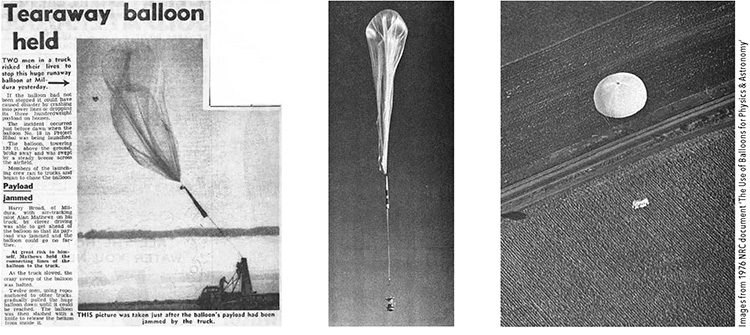
    Left:  What a HIBAL ground mishap looks like. The Melbourne Sun, 13 April 1961, reported on balloon No 18 in Project Hibal which broke away and was swept across an airfield. It’s hard to see how anyone could not identify such a sight as a parachute with its payload. Centre:  A HIBAL in its  ascent phase.  Right:  HIBAL in ‘close encounter’ landing phase. A poor inspiration for a striking UFO close encounter.

    My point: if the events described at Westall in April 1966, even if we limit it to evidence gathered in 1966 and 1967, were due to a HIBAL balloon, payload or parachute (or variations of those combinations), we would have had a spectacular example of misinterpretation and hysterical contagion, which far outstrips the 1968 Sydney event as contender for “the most famous occasion” of a HIBAL “flying saucer” fallout.

    I suggest that a low-level HIBAL event, while possibly creating some hysteria, would have been clearly identifiable, not as a UFO but as an obvious IFO – identified – and not a big deal other than containing it from causing injury, damage and retrieving the payload and its attachments. Photos of HIBAL parachute/payload configurations about to touch down make it pretty apparent that at a low-level people would easily confirm a parachute and payload. 

    For example, Westall school student Joy Tighe’s 1966 description of two separate circular UFOs (shaped like “upright domes”) “flying in varying directions,” “faster than some light aircraft in vicinity,” then turning on edge and disappearing fast, as recorded on a Victorian Flying Saucer Research Society report form in 1966. To suggest this description supports a sighting of a parachute connected to a heavy payload, weighing up to 200 kg, seems like an incredible force-fit. It is a big stretch to suggest that winds caused a HIBAL parachute and payload to come down low, then go in varying directions, at times faster than light aircraft in the area, then turn and quickly disappear. That’s a pretty impressive performance for a balloon and payload at low altitude. In this scenario it would be a wonder that the school children and teachers were able to stand upright in the wind conditions needed to keep the balloon/payload up in the air, defying the forces of gravity, and gyrating around the sky low over Westall school, at times flying faster than light aircraft despite being at a low altitude. 

    I was able to do a video interview with Joy (Tighe) Clarke at the 2006 Westall reunion event. I found her to be a compelling witness. I also videoed her 2006 drawing of the UFOs she saw. I was left with the same general impression with all the Westall witnesses I met at the reunion. They told stories of their recollections and didn’t seem to be embellishing narratives. Sure, there are problems with testimony gathered decades after an event, but I was impressed with the general coherency and consistency of the individual stories. Collectively, they appeared to support an event that goes way beyond what a HIBAL incursion might have generated.

    Given that for a long time I have focused on physical trace (UFO landing) accounts, I was pleased to eventually interview Victor Zakry who described witnessing, as a Westall school student, two identical objects, like Joy, but strikingly initially at ground level, that were connected directly with ground traces. The reports of ground traces did not get the careful attention they deserved at the time. There are accounts of clandestine attention, but nothing has surfaced other than witness descriptions and a Victorian Flying Saucer Research Society photo of a grassed area suggestive of a trace, but may have been due to prosaic factors. We just don’t have certainty in that area, but there are plenty of speculations.
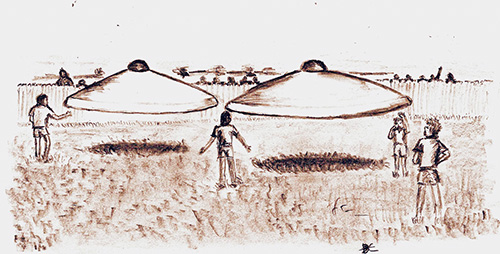
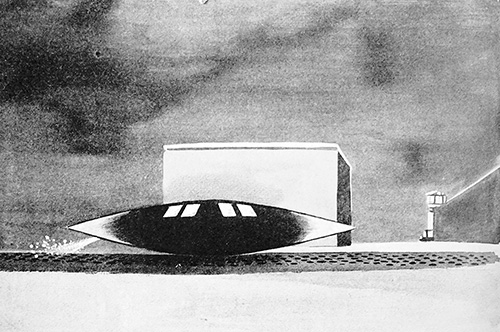
    Bill Chalker’s ‘forensic’ drawing of witness Victor Zakry’s recollection of events during the encounter, based on onsite reconstruction in 2008. 

    On 5 July 2008 I was able to undertake an onsite detailed investigation and interview Victor Zakry at Westall in Melbourne. I videoed the interview and got him to do a rough layout map of the events he witnessed. His account was consistent with a number of interviews he had given to others and me.

    Victor indicated he was able to walk up close to one of the objects, while three other students stood close to the other object. A teacher and at least a dozen other students crowded along the high fence to get a view. Victor contemplated touching the object but thought better of it. The two objects suddenly rose up from the grass and took off, one to the west, the other flew up and orbited a small plane before flying down to the south-west Grange reserve area, with students in pursuit. The UFOs were described as about 1.5 metres in height and approximately 5.4 metres in width. They left behind two circles of burnt grass.
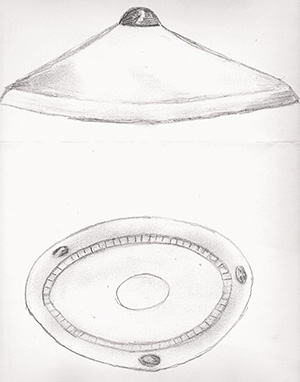
    Victor Zakry’s drawings of the UFO he saw a few years before the Westall incident.

    Victor went home for lunch straight after this extraordinary experience which swept up much of the rest of his school. This initially to me seemed a strange thing to do given the unfolding events, but Victor explained that at the time he felt he didn’t need to see any more that day (6 April 1966) because he had seen the exact same object a few years earlier. He was trying to take a wooden pallet from a factory site near the Westall Grange area during the early hours of the morning. His work was interrupted when a UFO flew over. It was the same looking object he would see during daylight at Westall in 1966 along with many in his school, but it was flying on edge – an appearance captured in a polaroid photo taken at the nearby suburb of Deepdene only four days before the Westall incident. There were other similar encounters during this period of the 1960s in the area around Westall and neighbouring isolated suburbs of Melbourne, which in those days was the outer edge of the city. Pockets of this area still have something of an isolated, almost country, feel to them.

    Victor also impressed me as a compelling witness giving consistent testimony. While, like Joy, he spoke of seeing two objects, Victor saw them at ground level and then watched them take off and go in different directions. Like Joy, he described one of them flying faster than a light plane. Indeed, he described it as orbiting the plane, then taking off and apparently heading down to the Grange area. 

    Victor later told me that he had a meeting with the school headmaster who encouraged him not to talk about the event because it might hurt his future chances of a career in art. The headmaster gave him that advice because he had witnessed something similar during the war and had experienced the pressure of being told not to talk about such things. Victor followed the headmaster’s advice, but with the growing tide of witnesses coming forward since 2006 he now felt more comfortable reporting his own experience. His artistic abilities also provided us with some striking drawings of the objects he saw.

    I don’t think the evidence that witnesses like Victor share with us should be diminished simply because they were described decades after the original event. Instead, when they are told with compelling conviction, we should accept them for what they seem to be – genuine attempts at recollections of past events – and try to see how they fit into the daunting jigsaw puzzle that the large body of testimony of Westall ’66 represents. There is a measure of coherency, but many aspects remain confusing. 

    This fits with Nassim Nicholas Taleb’s “black swan” concept, an interesting way of looking at things. He says: “I am interested in how to live in a world we don’t understand very well – in other words, while most human thought [particularly since the enlightenment] has focused us on how to turn knowledge into decisions, I am interested in how to turn lack of information, lack of understanding, and lack of ‘knowledge’ into decisions – how not to be a ‘turkey’. My last book The Black Swan drew a map of what we don’t understand; my current work focuses on how to domesticate the unknown.”

    This approach could be used to help understand and address the UFO mystery, which is like one of Taleb’s “black swans,” a thing that “lies outside the realm of regular expectations,” “it carries an extreme impact” and “human nature makes us concoct explanations for its occurrence after the fact, making it explainable and predictable.” These are key attributes of Taleb’s “black swans,” events of rarity, extreme impact, and retrospective predictability.

    It is with the third attribute that mainstream science and media have let us down. They tried to explain the whole phenomenon away, but it is exactly the phenomenon’s ability to remain highly improbable to mainstream perceptions, and to have high impact in incredibly mysterious and profound ways, which should guide us. We have to learn to “expect the unexpected” and learn to understand it and learn from it.
    The collective testimony gathered over decades powerfully argues that the Westall incident may well be a legitimate UFO mystery. Back in 1996, in my book The OZ Files: The Australian UFO Story, I concluded: “There is little doubt that something of an extraordinary nature was seen over the Westall school area and that at least one (UFO) appears to have landed and apparently left behind some physical traces. Numerous witnesses confirm these basic details. Other more exotic details vary in credibility …”
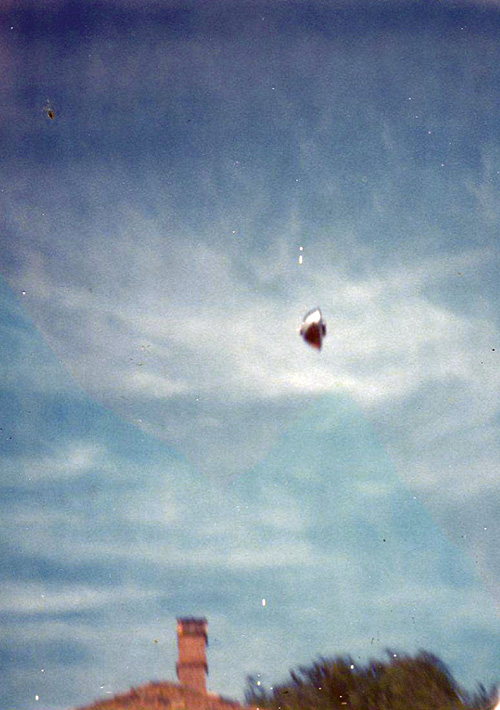
    Polaroid of UFO seen above a house in Deepdene on 2 April 1966, four days before the Westall incident, and only 20 kms away.

    Sceptics and debunkers may uncritically embrace a HIBAL explanation for the Westall mystery, but the impressive nature of much of the testimony deserves far better. I don’t think the answer for Westall ’66 is blowing in the wind. I suspect it may be providing us with an extraordinary insight into the impact and nature of the UFO phenomenon if we have the skills, determination and insights to go beyond the curtains of nature to reveal the real mystery being played out in our little place in the cosmos.

    Thank you to all the Westall witnesses who have had the courage and interest to share their experiences and recollections. Thanks also to all the researchers, investigators and people trying to understand the mystery. It all helps stir this fascinating melting pot that is the UFO mystery and might yield great insights. The ongoing Westall controversy can be monitored at Shane Ryan’s Facebook group: www.facebook.com/groups/1966westallflyingsaucerincident

    The above is largely drawn from a report Bill Chalker wrote on his OZ Files blog: http://theozfiles.blogspot.com/2014/08/westall-66-ufo-or-hibal-answer-is.html

    For more on Keith Basterfield’s research, see his website: ufos-scientificresearch.blogspot.com.au and search for his HIBAL entries.

    [alert type=”general” dismiss=”no”]This article was published in New Dawn 173.[/alert]

    [alert type=”success” dismiss=”no”]If you appreciate this article, please consider subscribing to help maintain this website.[/alert]

    © New Dawn Magazine and the respective author.
    For our reproduction notice, click here.
  • Aimé Michel: Tribute to the Great French Ufologist

    Aimé Michel: Tribute to the Great French Ufologist

    From New Dawn Special Issue Vol 12 No 2 (Apr 2018)

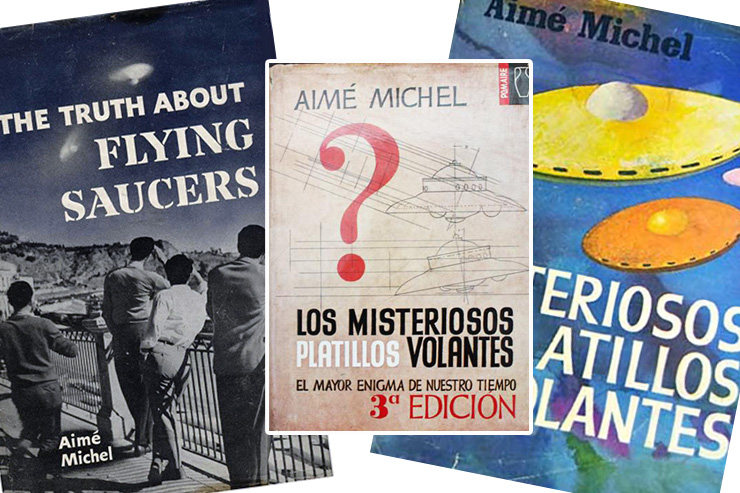
    Aimé Michel, who died in 1992, was certainly the most memorable French UFO researcher and a pioneer in this field. In the early 1950s he wrote the second French book on the subject, Lueurs sur les soucoupes volantes (published later in English as The Truth About Flying Saucers by Criterion Books, NY). He was the only one who was successful in putting some rationality into the irrationality that is the UFO phenomenon.

    Aimé Michel in the 1950s.

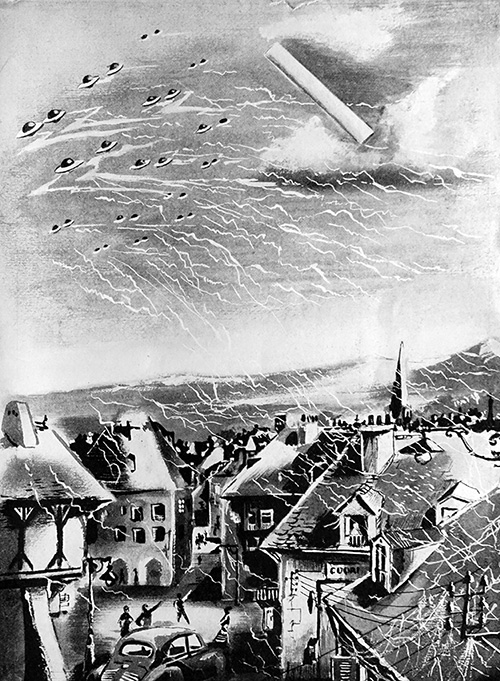
    In 1954, he was 35 years old and worked at the French Radio and Television Broadcasting. Since the end of August, France had been literally invaded by “flying saucers.” Every day they were making headlines in the daily press. For instance, the classic case at Vernon near Paris on 23 August where one of the witnesses, Bernard Miserey, observed a huge red-orange cigar-shaped object releasing several smaller luminous craft above the Seine river; or the well-known case of the landing of a bell-shaped UFO with two little cosmonaut-looking entities experienced by Marius Dewilde on 10 September at Quarouble in the north of France, to mention only two.

    One day in the fall of 1954 during a dinner, his friend Jean Cocteau (1889–1963), who had read his first book The Truth About Flying Saucers, gave him the following advice:

    “You should search if all those flying saucers did not obey some order which our eyes, at first glance, could not suspect. It would be necessary to see if these objects move along certain lines, if they describe some drawings, or anything? You could see, for example, if there are coincidences between their routes and the earth magnetic lines, or other lines with any meaning possible.”

    The word was out: “lines…” And it was to lead Aimé Michel towards his main contribution to Ufology, the “orthoteny.” Michel began plotting on large Michelin maps of France all the sightings of the wave of 1954. Wholly unexpected spider web-like figures appeared. In a program on UFOs, broadcast on French TV in 1965, he alluded to one of the most puzzling “alignments” he discovered.

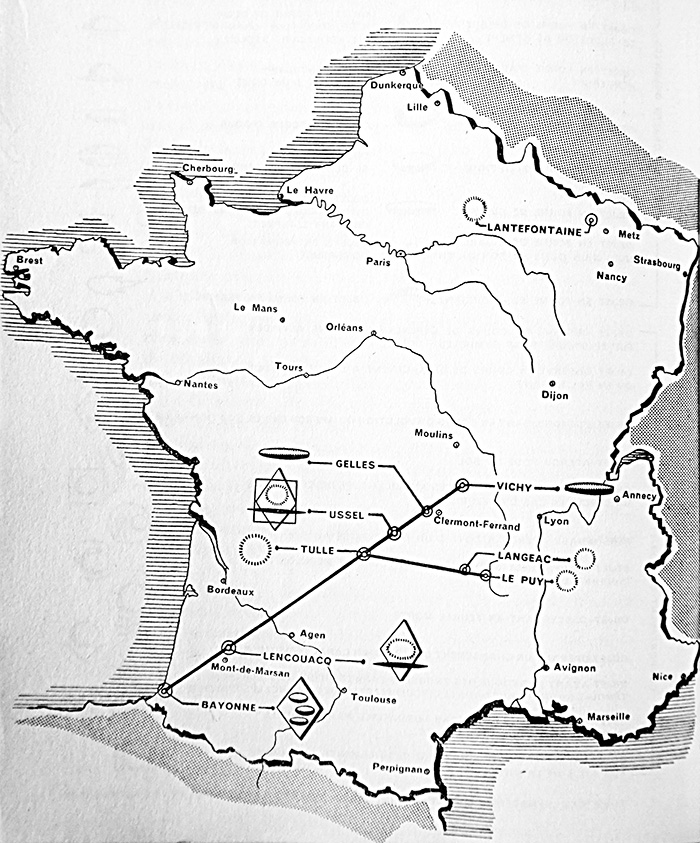
    “And doing so I found rather surprising things. For example, on September 24, 1954 there were… nine observations which had been reported to me, which I had found in the press or which had been sent to me by correspondents. These nine observations were located respectively at Lantefontaine in Lorraine, at Langeac, at Le Puy in the Massif Central and then at Vichy, at Gelles, at Ussel, at Tulle, at Lencouacq and at Bayonne. All this in the southwest quarter of France. Yet …one realises that out of nine there are… six which are strictly aligned… and when I say ‘aligned’ it must not be assumed that it is an approximate alignment, not at all, it is something extraordinarily precise.”

    The Bayonne-Vichy orthotenic alignment. Extracted from the 1958 first edition of Michel’s book Mystérieux Objets Célestes published by the respected publishing house Arthaud. Drawing by Jean Latappy.

    He reported all his discoveries in his second book on UFOs, Mystérieux Objets Célestes (Flying Saucers and the Straight-Line Mystery, Criterion Books, NY), published in 1958, which deals exclusively with the big French UFO wave of 1954. The word, “orthotenic,” coined by Michel, is derived from the Greek adjective “orthos,” meaning straight. Following Cocteau’s line of thought, he had indeed brought to light the tendency of UFO sightings to fall in several straight lines over a period of about 24 hours. The book included beautiful maps (some unfoldable) detailing the daily crisscrossing patterns of lines. Regularly where those orthotenic lines crossed, a big vertical cigar-shaped UFO, some would say a “mother ship,” was observed.

    Ufologists of today cannot imagine the revolution it was, not only in France but all over the world. At last one started to find some “order” out of this festival of absurdity… The laws of orthoteny were born and every ufologist would have his map in his bedroom trying to find new “alignments” or to confirm those already discovered like the famous 24 September 1954 Bayonne-Vichy line (BAVIC) with its 6 observations.

    Then a few years later came the dream-breakers. It was the computer scientist and ufologist Jacques Vallee who first began to undermine the theory of his “friend” Aimé Michel. From analysis using computers, he concluded that “among the proposed alignments, the great majority, if not all, must be attributed to pure chance.” (Vallee, Challenge to Science, Henry Regnery Co., Chicago, 1966). Then another fellow countryman, the ufologist Jean Sider, years later, in his book The 1954 File and The Rationalist Imposture (ed. Ramuel), put the last nail on the coffin, suggesting that Michel had some of his dates wrong.

    In his 2000 book, UFOs: The Mechanisms of Disinformation (Ovni: Les mécanismes d’une désinformation, ed. Albin Michel) a friend of Michel, the great professional astronomer and astrophysicist Pierre Guérin (1926–2000), who advocated an extra-terrestrial origin for UFOs, wrote this:

    “To say that Aimé Michel took with good heart the failure of the orthoteny [concept], which was his discovery and about which he had fully committed himself, would be a lie. He accepted it only with reluctance and bitterness. It was a subject he did not like to speak about. But, nevertheless, a deserved tribute must be paid to this thinker for having tried an impersonal scientific approach of the UFO problem.”

    Illustration of the 1952 Oloron and Gaillac, France, sightings in Michel’s Lueurs sur les soucoupes volantes (ed. Mame, 1954). Drawing by Jean Latappy.

    Among the other contributions to Ufology, Michel was the first one to discuss many now “classic” cases such as the famous Oloron and Gaillac “flying saucer-angel hair” sightings from 1952, or, in the same year, the Marignane Airport case, the first landing case reported in France.

    As far as I am concerned, I remember him as being the first person to be interested and publish the UFO photos taken near Lake Chauvet, right in the centre of France.

    This remarkable observation was made by an electrical engineer, André Frégnale, on 18 July 1952, at 6:10 p.m. While looking southward, he noticed in the sky a disc-shape object coming from the west. The trajectory was “horizontal and rectilinear,” the linear speed “uniform” and the regularity of pace “impressive.” The object moved in absolute silence. Frégnale seized the camera he had with him, a 24 x 36 Zeiss Ikon equipped with a 45mm objective, and took four photos. When the “mysterious machine” was too far away to be photographed, he took his binoculars to follow the object which was travelling away, and saw it disappear, almost immediately, as if it had vanished on the spot.

    All in all, the observation lasted not much more than one minute. In 1954, two of the four photos were published for the first time in Aimé Michel’s book The Truth About Flying Saucers. Over the years these four photos were carefully analysed, notably by Pierre Guérin in his book UFO: The Mechanisms of Disinformation, who had definitively excluded the hypothesis of a model or of a craft of terrestrial origin. So, to this day, the object remains unidentified. 

    Illustration of the 1952 Marignane Airport case in Michel’s Lueurs sur les soucoupes volantes (ed. Mame, 1954). Drawing by Jean Latappy.

    Disappointed by the reaction of the ufological community and probably weary of several back-stabbings, Aimé Michel would later focus less on the UFO enigma. He wrote mostly about animal life, philosophy and mysticism, and I should say Catholic mysticism, for instance in many articles for the magazine France Catholique. We can feel in these articles the influence of his friend Jean Cocteau. Each article is written with great style, nearing somewhat the poetic style. Aimé Michel was above all a poet writing in prose. I would define his book Flying Saucers and the Straight-Line Mystery as a work of a poet using scientific tools – a work of a man “radiating intelligence,” as Jean Cocteau said about him in a letter, who “always goes farther than the farthest and this without the slightest vagueness.” That’s why his UFO books, and Flying Saucers and the Straight-Line Mystery in particular, will not die; you can read it for the style of the writing, for the subtle poetry that permeates it, as well as for the clarity allied with the depth of the ideas expressed.

    His third and final book dealing with UFOs came out in 1969, Pour ou contre les soucoupes volantes (For or Against the Flying Saucers). This book, published by the editions Berger-Levrault, was co-authored. Michel wrote the 77-pages of the “For” part, and the aeronautical engineer Georges Lehr, playing the role of sceptic, the 75-pages of the “Against” part.

    Aimé Michel died at 73 years of age in his small village of Saint-Vincent-les-Forts at the feet of the Alps, where he was born and had lived most of the time. Nature and mountain lover, his very first book in 1953, Heroic Mountains, was actually a history of mountaineering and of its heroes. The “flying saucers” had not yet entered his life.   

    The author thanks Warren P Aston for editing this article. 

    [alert type=”general” dismiss=”no”]This article was published in New Dawn Special Issue Vol 12 No 2.[/alert]

    [alert type=”success” dismiss=”no”]If you appreciate this article, please consider subscribing to help maintain this website.[/alert]

    © New Dawn Magazine and the respective author.
    For our reproduction notice, click here.
  • Menticide: Don’t Fall Victim to Mind Control Technologies & Techniques

    Menticide: Don’t Fall Victim to Mind Control Technologies & Techniques

    From New Dawn 183 (Nov-Dec 2020)

    In my new book, The War on You, I document how corporate and state elites use information, money, law, and psychology in an effort to control your thoughts and behaviours for their own ends. Most of the psychological warfare documented in the book is a result of living in a fragmented, for-profit culture over which the individual has little control. 

    In case these unconscious structures fail to keep people in their place, the military, secret services, governments, and corporations have developed an impressive array of deliberate mind-control technologies and behavioural analysis firms targeted towards the individual. 

    Brain Chips

    The US Central Intelligence Agency’s (CIA) mind control experiments, dating back to the 1950s, are well-known. Their MK-ULTRA experiments in sensory deprivation continue to be used on Guantánamo Bay captives. But until Ian Cobain’s book Cruel Britannia, few people knew that British psychologists had pioneered the use of sensory deprivation for mind control. 

    During WWII, Lord Swinton “pressed the Home Office for permission to open an MI5 interrogation centre,” codenamed Camp 020. Brightly lit for 24 hours, a resident doctor reportedly said that the Camp induced “mental atrophy and extreme loquacity” in its victims. A resident medical officer named Harold Dearden “dreamed up the regimes of starvation and of sleep and sensory deprivation.” The Camp was one of a number, including the MI19-run Combined Services Detailed Interrogation Centre, later renamed A19. 

    After the War, several individuals convened to share intelligence on mind control. They represented the Defence Research Policy Committee, the Joint Intelligence Bureau, the Canadian Defence Research Board, the CIA’s Research and Development Board, and the Psychology Unit at McGill University (Montreal). The latter was led by Donald Hebb. 

    The scientists referred to their psychological devastation techniques as “menticide.” Hebb subjected terrier puppies to prolonged isolation before trying it on consenting postgraduate students. The British and American governments and the CIA funded Hebb’s successors, including his former student Dr Maitland Baldwin. Baldwin found “that sensory deprivation would almost certainly cause irreparable psychological damage” in humans. 

    The CIA’s Kubark Counterintelligence Interrogation Manual (1963) was based on MK-ULTRA. One of the MK-ULTRA psychiatrists was McGill University’s Dr Ewen Cameron, a colleague of Hebb. Cameron “subjected hundreds of psychiatric patients to large doses of electroshock and total sensory isolation, and drugged them with LSD and PCP,” writes journalist Naomi Klein. In 1960, Cameron lectured to the Brooks Air Force Base, stating that sensory deprivation “produces the primary symptoms of schizophrenia.”

    Tulane University was allegedly involved in the operations, using the services of a state-hospital, as well as funding by a CIA front company called the Commonwealth Fund, to conduct research. The Washington Post reports that the “quest to turn humans into robot-like assassins via electrodes planted in their brains” led to a number of lawsuits, in which several ex-servicemen claim to have been unwitting human test subjects. Plaintiff Bruce Price claims that in 1966, he was ordered into a building full of lab animals in which he was strapped to a gurney. Price kept waking up with bruised arms and covered in blood. A later CT scan, obtained by Price’s lawyer, appears to show that he had been implanted with a mind control device.

    Beyond Freedom & Dignity

    In the 1950s, the psychologist B.F. Skinner utilised the Russian (and later Soviet) scientist Ivan Pavlov’s conditioning techniques to falsely argue that that is how human beings learn. Geneticists pointed out that the potential for knowledge actually comes from innate brain structures, not solely from repetitive learning. But Skinner was correct in that people can be conditioned, if the conditioning is maintained, to behave in certain ways and under certain conditions. 

    Skinner’s work culminated in the publication of his book Beyond Freedom and Dignity (1971), in which he argued that humanity should be scientifically controlled via a blend of Orwellian and Huxleyan social architecture designed to end both human freedom and dignity. 

    Skinner failed to persuade elites to impose a blanket control system. But such a system is gradually creeping in, based on these kinds of ideas. In his work on “nudging,” Barack Obama’s former advisor Cass Sunstein argues that, like rats in a maze, people should be given the illusion of choice in what he and co-authors call choice architecture. Conspiracy forums should be “cognitively infiltrated,” he says, and the supposed rationalism of the official line inserted into chat-rooms. More ominously, he says behavioural science teams should be expanded to control public opinion, for benign reasons, like “nudging” smokers to quit. However, since Brexit in the UK and the British government’s response to coronavirus, we’ve seen the darker sides of “nudging” techniques.

    Nudge Units

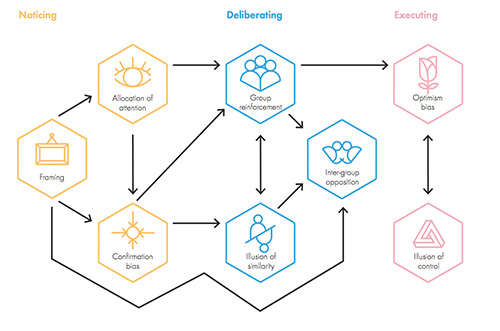
    The Behavioural Insights Team (BIT) was founded by the UK’s Tory-Liberal coalition government in 2010. The Cabinet Office said: “The Behavioural Insights Team, often called the ‘Nudge Unit’, draws on insights from academic research in behavioural economics and psychology, to apply them to public policymaking.” The professed aims of the BIT may sound innocent enough: to use insights in human behaviour from the fields of neuroscience and cognitive psychology to influence behaviour (hence the “nudge”) in positive directions, such as helping people to eat more healthily, keep appointments, and pick up litter. 

    Flow chart by the UK’s Behavioural Insights Team. Nudge Units have appeared in dozens of countries across the world including Australia.

    The first thing to be said about the BIT is the moral question of using subconscious ploys to consciously manipulate human behaviour. This takes away agency and thus autonomy from the individual. That is called manipulation. In fact, policymakers are so interested in the subject of how to use psychology, as opposed to force, to control people that there is even The Persuasion Handbook (2002, SAGE). 

    The second issue is consent. In clinical and psychological trials, the consent of the subject is required. Who consents to be manipulated by the government? But putting aside the moral issues, the third problem is that of context. 

    The government only cares about your health when it affects government spending. As it defunds and privatises, the British government doesn’t want people draining the National Health Service with smoking- and obesity-related complaints. It is cheaper to use manipulation techniques as a kind of preventative medicine than it is to properly fund services that everyone can enjoy. The same applies to the British government’s handling of COVID-19. Rather than spending money on testing, tracking, and tracing, the government used “nudge” units to contain the virus on the cheap by social distancing and clapping every Thursday at 8pm for the National Health Service.

    The fourth problem with the BIT is mission creep. As is standard practice in our Western kleptocracies, the public paid for the foundation and research of the BIT until it was profitable enough to be part-privatised. The BIT now operates in several countries and produces reports on everything from policing to labour productivity; all in the interests of humanity, of course. 

    Joint Threat Research Intelligence Group

    By 2010, the British government’s spy agency, GCHQ and the US agency the NSA, were working together on JTRIG: the Joint Threat Research Intelligence Group. The organisation was secret until Edward Snowden leaked some of the organisation’s files. Many of the files were published by the journalist Glenn Greenwald in The Intercept. One document from 2011 is worth quoting at length. It says that “JTRIG targets a range of individual, group and state actors across the globe who pose criminal, security and defence threats.” JTRIG operations also targeted the online “hacktivist” group Anonymous.

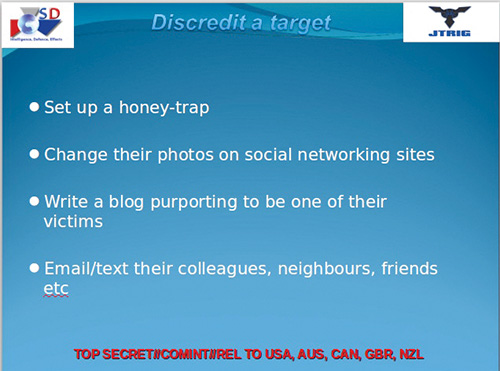
    “JTRIG staff use a range of techniques to, for example, discredit, disrupt, delay, deny, degrade, and deter.” Both established and up-and-coming political analysts, journalists, pundits, personalities and other influential people who challenge the British state may find their websites and social media accounts hacked or incriminating evidence planted on their computers. 

    Pages from top secret documents of the JTRIG program. The scope of JTRIG’s mission includes using “dirty tricks” to “destroy, deny, degrade [and] disrupt” enemies by “discrediting” them, planting misinformation and shutting down their communications. According to Edward Snowden, these influence programs became a “major part” of GCHQ’s operations by 2010 – the same year the UK government established its Behavioural Insights Team.

    The techniques include: uploading YouTube videos containing persuasive messages; establishing online aliases with Facebook and Twitter accounts, blogs and forum memberships for conducting HUMINT [human intelligence] or encouraging discussion on specific issues; sending spoof emails and text messages as well as providing spoof online resources; and setting up spoof trade sites. 

    The document goes on to note that “JTRIG provides most of GCHQ’s cyber effects and online HUMINT capability.” GCHQ’s mandate is huge: the whole of Europe, and likely well beyond. It is difficult, therefore, to grasp the potential scope of JTRIG. Above, we noted the civilian government’s use of behavioural science to manipulate society. The JTRIG documents confirm that operatives also study and employ techniques from the human sciences: 

    HUMINT operations can be grounded in scientific theory and evidence from social psychology (i.e., social cognition, attitudes, persuasive communications, conformity, obedience, interpersonal relationships, trust and distrust, and psychological profiling), including its applications to advertising and marketing, and from criminology (i.e., crime prevention).

    The document’s Annex reveals some of the books in the JTRIG library: The Handbook of Trust Research, Influence: Science and Practice, Hacking the Human: Social Engineering Techniques and Security and Countermeasures. JTRIG lists as, and advises using, the following for propaganda operations: “Using stereotypes; Substituting names/labels for neutral ones; Censorship or systematic selection of information; Repetition; Assertions without arguments; [and] Presenting a message for and against a subject.”

    Meet the Artificial You 

    The Boston Globe reports that the US communications giant Verizon has a Wireless Precision Markets Insights programme that combines GPS, user app downloads and visited webpages to market products to individuals. Yves-Alexandre de Montjoye, a mathematician at MIT’s Media Laboratory, “hopes it will be possible someday to run psychological tests on entire cities or countries, simply by analysing the citizens’ phone records.” The newspaper goes on to explain how the Media Lab’s co-developed Sense Networks use cell phone GPS trails “to track where users go in daily routines – to the supermarket, the mall, nightclubs, museums, or movie theatres.” The programme “aggregates the data to create customized market segments” for people keen on music, sports, etc. Media Lab’s Nathan Eagle says that by studying cell phone records, analysts “get a real-time lens into how the aggregate population is actually behaving… That’s useful for anything from urban planning to public health.” 

    We come full circle with Sentient World Simulation (SWS), a programme that pools all the intelligence collected about you. SWS uses that information to simulate and predict how you would behave under certain social conditions, such as civil unrest, economic shocks or environmental catastrophe. 

    But it goes much deeper. The SWS was developed with military money at Purdue University. It creates a digital mirror-image of the real world, including you and me: our streets, towns and even the weather. In order to anticipate how we would react in real life, programmers do things to the digital us: cut our power supplies, simulate weather disasters, crash the economy, etc. This is useful for counterinsurgency planning and market prediction. 

    Technology researcher Mark Baard writes that the US Joint Forces Command (JFCOM-J9) is “capable of running real-time simulations for up to 62 nations, including Iraq, Afghanistan, and China. The simulations gobble up breaking news, census data, economic indicators, and climactic events in the real world, along with proprietary information such as military intelligence.” Based on the behavioural economics theories of Daniel Kahneman, SWS enables “Military and intel officials [to] introduce fictitious agents into the simulations (such as a spike in unemployment, for example) to gauge their destabilising effects on a population.”

    Solutions: Getting Back to Nature

    Self-empowerment is key to winning the psychological war. 

    Modern socio-economic systems isolate humans, simultaneously forcing us to compete. But humans evolved in cooperative, social networks, not within our current, curious blend of isolation and competition. 

    Researchers Apicella et al. studied the behaviours of Tanzanian Hadza, one of the few surviving hunter-gatherer peoples. They conclude that human social cooperation probably stems from similar societies that existed at the beginning of our species. Contrary to the anti-“communist” propaganda positing that communism and socialism encourage laziness, communal societies like the Hadza enjoy mutual reciprocity. Researchers Shirado et al. note that in such societies, “humans are influenced to cooperate by peer pressure.” So-called capitalist propaganda tries to deny us our instinct for cooperation and self-determination. Likewise, dictatorships like Mao’s and Stalin’s used the appeal of authentic communism to justify their centralised tyrannies.

    Living in worker and community cooperatives is one solution to the crisis of social loneliness. Umberson and Montez write: “Social isolation of otherwise healthy, well-functioning individuals eventually results in psychological and physical disintegration, and even death.” They add that “social scientists have gone beyond evidence of extreme social deprivation to demonstrate a clear link between social relationships and health in the general population.” The authors note that, on average, people with better social networks tend to live healthier and longer lives than their relatively isolated counterparts. 

    Life in so-called primitive societies necessitates time outdoors: growing, hunting, and foraging for food; building and maintaining shelter; travelling to trade with neighbours; and travelling to and from homes and community centres for meetings. Researchers Coon et al. note the “promising effects on self-reported mental wellbeing immediately following exercise in nature which are not seen following the same exercise indoors.” 

    Briki and Majed exposed participants to different virtual reality backgrounds, including red, white and green during exercise in laboratory conditions. The authors attributed enhanced wellbeing, particularly increased relaxation, to the green virtual environment. In terms of real-world benefits, think of how little green exists in our concrete jungles. 

    It’s not just being outside that helps the mind. The physical interaction with natural objects is important. Gladwell et al. note: “people’s connectedness to nature appears to be changing and this has important implications as to how humans are now interacting with nature.” They add that “[b]arriers exist, and it is important that these are considered when discussing how to make exercise in the outdoors accessible and beneficial for all.”

    Conclusion: The Joy of Self-Reliance

    The self-sufficiency of stitching, building, maintaining and growing shelter, clothing and food is also psychologically beneficial. Part of today’s widespread mental malaise can be traced to the lack of process. We buy clothes that have already been made. Purchased food has been grown, picked, packaged and delivered by others. We buy or rent prefabricated houses and pay handypeople to maintain them. Dr Kelly Lambert “found that hands-on work satisfies our primal need to make things and could also be an antidote for our cultural malaise.” Psychology Today notes that “[t]oo much time on technological devices and the fact that we buy almost all of what we need rather than having to make it has deprived us of processes that provide pleasure, meaning and pride.” 

    In addition to its structures, the activities of the sovereign community benefit the human mind and enhance affective wellbeing. Our modern, urbanised living takes us ever further from nature. But human-environmental interactions are important for wellbeing. For example, land reform gives people the chance to grow their own food. Researchers Leake et al. cite the “[c]ompelling evidence of major health benefits of fruit and vegetable consumption, physical activity, and outdoor interaction with ‘greenspace’” that has emerged since the millennium. The physiological benefits include improved cardiovascular function, reduced osteoporosis, increased muscle tones, and exposure to light. Nutritional benefits from the kind of brassicas easy to grow independently (e.g., broccoli, cabbage, cauliflower and kale), include folic and ascorbic acids and cancer preventing nutrients. The mental health benefits of communal gardening include increased serotonin from sunlight exposure, which helps reduce depression; feelings of achievement; self-sufficiency; and integrating into a community and social network. 

    A more recent meta-analysis confirms: “gardening increases individual’s life satisfaction, vigour, psychological wellbeing, positive affect, sense of community, and cognitive function.” It is called “horticultural therapy.”

     Dr. Tim Coles’s new book The War on You can be obtained from online booksellers & www.amazon.com/exec/obidos/ASIN/B08HB68N97.

    [alert type=”general” dismiss=”no”]This article was published in New Dawn 183.[/alert]

    [alert type=”success” dismiss=”no”]If you appreciate this article, please consider subscribing to help maintain this website.[/alert]

    Footnotes

    1. Ian Cobain (2012), Cruel Britannia: A Secret History of Torture, Portobello Books
    2. Quoted and cited in ibid. 
    3. Naomi Klein (2007), ‘The US psychological torture system is finally on trial’, Guardian, www.theguardian.com/commentisfree/2007/feb/23/comment.terrorism
    4. Jeff Stein (2010), ‘CIA brain experiments pursued in veterans’ suit’, Washington Post, http://voices.washingtonpost.com/spy-talk/2010/11/cia_brain_experiments_pursued.html
    5. Richard Thaler and Cass Sunstein (2008) Nudge: Improving Decisions about Health, Wealth, and Happiness, Yale University Press
    6. Cass R. Sunstein and Adrian Vermeule (2008) ‘Conspiracy Theories’, John M. Olin Program in Law and Economics, Working Paper No. 387, https://chicagounbound.uchicago.edu/cgi/viewcontent.cgi?article=1118&context=law_and_economics
    7. Cabinet Office (2012), The Behavioural Insights Team, https://web.archive.org/web/20130320014509/https://www.gov.uk/government/organisations/behavioural-insights-team
    8. Sonia Sodha (2020), ‘Nudge theory is a poor substitute for hard science in matters of life or death’, International Science Council and International Network for Government Advice on Science, www.ingsa.org/covidtag/covid-19-commentary/sodha-nudge/
    9. See the company’s website, www.bi.team/
    10. Mandeep K. Dhami (2011), Behavioural Science Support for JTRIG’s (Joint Threat Research and Intelligence Group’s) Effects and Online HUMINT Operations, Cheltenham: GCHQ, www.statewatch.org/news/2015/jun/behavioural-science-support-for-jtrigs-effects.pdf
    11. Glenn Greenwald (2014), ‘How covert agents infiltrate the internet to manipulate, deceive, and destroy reputations’, The Intercept, https://theintercept.com/2014/02/24/jtrig-manipulation/
    12. Dhami, op cit. 
    13. Ibid.
    14. Ibid.
    15. Mark Baard (2007), ‘Sentient world: war games on the grandest scale’, The Register, www.theregister.co.uk/2007/06/23/sentient_worlds/. Part 2 here www.theregister.co.uk/2007/06/23/sentient_worlds/?page=2 and part 3 here www.theregister.co.uk/2007/06/23/sentient_worlds/?page=3
    16. C.L. Apicella, F.W. Marlowe and N.A. Christakis (2012), ‘Social networks and cooperation in hunter-gatherers’, Nature, 25(7382): 497-501
    17. H. Shirado, F. Fu, J.H. Fowler and N.A. Christakis (2013), ‘Quality versus quantity of social ties in experimental cooperative networks’, Nature Communications, 4: 2814
    18. Debra Umberson and Jennifer Karas Montez (2011), ‘Social Relationships and Health: A Flashpoint for Health Policy’, Journal of Health and Social Behavior, 51: 54-66
    19. J. Thompson Coon, K. Boddy, K. Stein, R. Whear, J. Barton and M.H. Depledge (2011), ‘Does participating in physical activity in outdoor natural environments have a greater effect on hysical and mental wellbeing than physical activity indoors? A systematic review’, Environment Science and Technology 45(5): 1761-72
    20. Walid Briki and Lina Majed (2019), ‘Adaptive Effects of Seeing Green Environment on Psychophysiological Parameters When Walking or Running’, Frontiers in Psychology, 10: 252
    21. Valerie F. Gladwell, Daniel K. Brown, Carly Wood, Gavin R. Sandercock and Jo L. Barton (2013), ‘The great outdoors: how a green exercise environment can benefit all’, Extreme Physiology and Medicine, 2: 3
    22. Carrie Barron (2012), ‘Creativity, Happiness and Your Own Two Hands’, Psychology Today, www.psychologytoday.com/gb/blog/the-creativity-cure/201205/creativity-happiness-and-your-own-two-hands
    23. Jonathan R. Leake, Andrew Adam-Bradford and Janette E. Rigby (2009), ‘Health benefits of “grow your own” food in urban areas: implications for contaminated land risk assessment and risk management?’, Environmental Health, 8(1): S6
    24. Masashi Soga, Kevin J.Gaston and Yuichi Yamaura (2017), ‘Gardening is beneficial for health: A meta-analysis’, Preventive Medicine Report, 5: 92-99

    © New Dawn Magazine and the respective author.
    For our reproduction notice, click here.
  • Bubbles of Hate: How Social Media Keeps Users Addicted, Alone, & Ill-Informed

    Bubbles of Hate: How Social Media Keeps Users Addicted, Alone, & Ill-Informed

    From New Dawn Special Issue Vol 14 No 6 (Dec 2020)

    Internet communication has gone from emails, messaging boards, and chatrooms, to sophisticated, all-pervasive networking. Social media companies build addictiveness into their products. The longer you spend on their sites and apps, the more data they generate. The more data, the more accurately they anticipate what you’ll do next and for how long. The better their predictions, the more money they make by selling your attention to advertisers. 

    Depressed and insecure about their value as human beings, the younger generations grow up knowing only digital imprisonment. Older users are trapped in polarised bubbles of political hate. As usual, the rich and powerful are the beneficiaries. 

    Masters of Manipulation

    Humans are social animals. But big business wants us isolated, distracted, and susceptible to marketing. Using techniques based on classical conditioning, social media programmers bridge the gap between corporate profits and our need to communicate by keeping us simultaneously isolated and networked.

    The Russian psychologist, Ivan Pavlov (1849–1936), pioneered research into conditioned reflexes, arguing that behaviour is rooted in the environment. His work was followed by the Americans John B. Watson (1878–1958) and B.F. Skinner (1904–90). Their often cruel conditioning experiments, conducted on animals and infants, laid the basis for gambling and advertising design. As early as the 1900s, slot machines were designed to make noises, like bell sounds, to elicit conditioned responses to keep the gambler fixed on the machine: just as Pavlov used a bell to condition his dogs to salivate. By the 1980s, slot machines had incorporated electronics to advantage particular symbols whilst giving the gambler the impression that they are near victory. “Stop buttons” gave the gambler the illusion of control. Sandy Parakilas, former Platform Operations Manager at Facebook, says: “Social media is very similar to a slot machine.”

    Psychologist Watson’s experiments “set into motion industry-wide change” in TV, radio, billboard, and print advertising “that continued to develop until the present,” says historian Abby Bartholomew. Topics included emotional arousal in audiences (e.g., sexy actress → buy the product), brand loyalty (e.g., Disney is your family), and motivational studies (e.g., buy the product → look as good as this guy). 

    Many of these techniques involve stimulating so-called “feel good” chemicals like dopamine, endorphins, oxytocin, and serotonin. These are released when eating, exercising, having sex, and engaging in positive social interactions. Software designers learned that their release can be triggered by simple and unexpected things, like getting an email, being “friended,” seeing a retweet, and getting a like. The billionaire co-founder of Facebook and Napster, Sean Parker, said that the aim is to “give you a little dopamine hit every once in a while because someone liked or commented on a photo or a post.” But Parker also said of his company: “God only knows what it’s doing to our children’s brains.” 

    Facebook’s former Vice President of User Growth, Chamath Palihapitiya, doesn’t allow his children to use Facebook and says “we have created tools that are ripping apart the social fabric.” Tim Cook, the CEO of the world’s first trillion-dollar company Apple, on whose iPhones the addictions mainly occur, bluntly said of his young relatives: “I don’t want them on a social network.”

    With the understanding that “the biggest companies in Silicon Valley have been in the business of selling their users” (technology investor, Roger McNamee), social media designers built upon the history of behaviourism and game addiction to keep users hooked. For example: In the good ol’ days, sites including the BBC and YouTube had page numbers (“pagination”), which gave users a sense of where they were in their search for an article or video. If the search results were poor, the user knew to skip to the last page and work backwards. But pages were phased out and replaced with “infinite scroll,” a feature designed in 2006 by Aza Raskin of Jawbone and Mozilla. Pagination, for instance, gives the user a stopping cue. Designers have systematically removed stopping cues. Likening infinite scroll to “behavioural cocaine,” Raskin said: “If you don’t give your brain time to catch up with your impulses, you just keep scrolling.” 

    How They Do It & How It Hurts

    Users think that they have control over their social media habits and the information being fed to them, including news and suggested webpages, are coming to them organically. But, unbeknownst to them, the framework is calculated. The US Deep State, for instance, helped to develop social networks. Sergey Brin and Larry Page developed their web crawling software, which they later turned into Google, with money from the US Defense Research Projects Agency. Referring to the Massive Digital Data Systems, the CIA-funded Dr Bhavani Thuraisingham confirmed that “[t]he intelligence community’s MDDS program essentially provided Brin seed-funding.”

    Consider how the technologies were commercialised. “Growth” means advertising money accrued from sites visited, content browsed, links clicked, pages shared, etc. “Growth hackers” are described by former Google design ethicist Tristan Harris as “engineers whose job is to hack people’s psychology so they can get more growth.” Designers build applications into software that manipulate users’ unconscious behavioural cues to lead them in certain directions. 

    To give an example: The feel-good chemical oxytocin is released during positive social interactions. It is likely stimulated when social media companies send an email alert that family have shared a new photo. Other human foibles include novelty-seeking (for potential rewards) and temptation (fear of missing out or FOMO). These are linked to the feel-good chemical dopamine. Rather than including the new family photo in the email, the email is designed with a URL feature to tempt the user to click the link which directs them to the social media site in order to see the new photo. The chemical-reward response chain is as follows: family (oxytocin) → novelty/new photo (dopamine), temptation to click/FOMO → reward from positive social interaction after clicking and seeing the new photo (oxytocin-dopamine stimulation). 

    This convoluted chain of events is designed to sell the user’s attention to advertisers. The more time spent doing these things, the more adverts can be directed at the user and the more money for the social media company. Harris says “you are being programmed at a deeper level.” 

    In addition, tailored psychological profiles of users are secretly built, bought from, and sold to data brokers, like Experian. User behavioural patterns feed deep learning programmes which aim to predict the user’s next online move according to their personal tastes and previous browsing patterns. The more accurate the prediction, the more likely their attention is drawn to an advert and the more money social media firms accrue. Says former Mozilla’s Raskin: “They’re competing for your attention.” He asks: “How much of your life can we get you to give to us?”

    Instagram was developed in 2010 by Facebook as a photo and video sharing service. It is used by a billion people globally and, unlike the teen-loving Snapchat, is used mainly by 18-44-year-olds. Instagram falls into the so-called “painkiller app” category. One designer explains that such apps “typically generate a stimulus, which usually revolves around negative emotions such as loneliness or boredom.”

    Snapchat is a messaging app designed in 2011 that stores pictures (“Snaps”) for a short period of time. The app is used by 240 million people per day. Unlike YouTube, most of whose users are male, the majority of Snapchat users are female. Only 17 per cent of users are over 35. Its model is Snapstreak: a tracker that counts the days since the user replied to the Snap. Designers built FOMO (noted above) into Snapchat. The longer the user’s non-reply, the greater their credit score decline. This can lead to addiction because, unlike Facebook, Snapchat tags are “strong ties” (e.g., close friends, family), so the pressure to reply is greater.

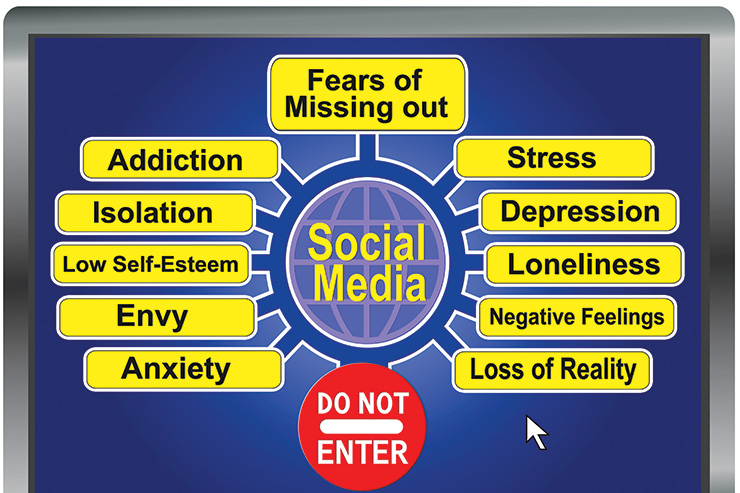
    In addition to the harmful content of social media – sexualised children, impossible and ever-changing beauty standards, cyberbullying, gaming addiction, loss of sleep, etc. – the very design of social media hurts young users. We all need to love ourselves and to feel loved by a small circle of others: friends, family, and partners. Young people are particularly susceptible to self-loathing and questioning whether someone loves them. 

    The introduction of social media has been devastating. A third of all teens who spend at least two hours a day on social media, i.e., the majority, have at least one suicide risk factor. The percentage increases to nearly half for those who spend five hours or more. A study of 14-year-olds found that those with fewer social media likes than their peers experienced depressive symptoms. Teens who are already victimised at school or within their peer-group were the worst-affected.

    Divided & Conquered

    Another feature built into social media is the polarisation of users along political lines; a phenomenon that mainly concerns people of voting age. One of the many human foibles exploited by social media designers is homophily: our love of things and people similar and familiar to us. Homophily makes us feel safe, understood, validated, and positively reinforced. It stimulates feel-good chemicals and, in social media contexts, is exploited to keep us inside an echo-chamber so that our biases are constantly reinforced, and we stay online for longer. But is this healthy?

    Referring to Usenet group discussions, the lawyer Mike Godwin formulated the Rule of Hitler Analogies (or Godwin’s Law), which correctly posits that the longer an online discussion, the higher the probability that a user will compare others to Hitler. The formula was a reflection of users’ lack of tolerance toward the views of others. 

    A projection published in 2008 asked if people will be more tolerant due to the internet. Nearly six in 10 participants disagreed, compared to just three in 10 who agreed. In many ways, the industry specialists were fatalistic. Internet architect, Fred Baker of Cisco Systems, said: “Human nature will not have changed. There will be wider understanding of viewpoints, but tolerance of fundamental disagreement will not have improved.” Philip Lu of Wells Fargo Bank Internet Services said: “Just as social networking has allowed people to become more interconnected, this will also allow those with extreme views… to connect to their ‘kindred’ spirits.” Dan Larson of the PKD Foundation said: “The more open and free people are to pass on their inner feelings about things/people, especially under the anonymity of the Internet – will only foster more and more vitriol and bigotry.”

    Users can artificially inflate their importance and the strength of their arguments by creating multiple accounts with different names (“sock puppets”). Some websites sell “followers” to boost users’ profiles. It is estimated that half of the Twitter followers of celebrities and politicians are bots. Gibberish-spewing algorithms have been programmed to write fake reviews on Amazon to hurt competitors’ sales. In at least one case, a pro-Israeli troll was unmasked posing as an anti-Semite in order to give the impression that anti-Semitism is rampant online and thus users should have more sympathy with Israel. Content creators increasingly find themselves de-platformed because of their political views while others’ social media accounts are suppressed by design (“shadow-banning”). 

    In the age of COVID, disinformation on both sides is spread: the severity of the disease, efficacy of vaccines, necessity of lockdowns, etc. As with US politics, Brexit, climate change, etc. neither side wants to talk rationally and open-mindedly with the other. The very designs of social media make this very difficult. 

    It should be emphasised that some social media are designed to create echo-chambers, and others are not. Cinelli et al. studied conversations about emotive subjects – abortion and vaccines – and found that while Facebook and Twitter show clear evidence of the echo-chamber effect, Reddit and Gab do not. Sasahara et al. demonstrate that due to users’ need for validation, when likes and friendships are withdrawn the network tends to descend into an echo-chamber. 

    Conclusion: What Can We Do?

    Noted above is Google’s seed-funding from the Deep State. More recently, the ex-NSA contractor Edward Snowden revealed that Apple, Facebook, Google, Microsoft, and others were passing user data onto his former employer. Government and big tech became “the left hand and the right hand of the same body.” In the UK, the NSA worked with Government Communications Headquarters on the Joint Threat Research Intelligence Group. Leaks revealed an unprecedented, real-time surveillance and disruption operation that included hacking users’ social media accounts, posting content in their name, deleting their accounts, luring them into honey-traps, planting incriminating evidence on them, and more. 

    To beat the antisocial social network, we need to remember who we are and what real communication is. We need to protect the young from the all-pervasive clutches of “social media” and to realise that we are being sold. 

    Ask yourself: Do you use social media solely to organise protests, alert friends to alternative healing products, and spread anti-war messages? Or do you use it to send irrelevant information about your day-to-day habits in anticipation that an emoji or “like” will appear? 

    Taking a step back can allow us to see outside and indeed prick the bubble of digital hatred in which the Deep State and corporate sectors have imprisoned us. 

    Dr Tim Coles’s new book The War on You can be obtained from online booksellers & www.amazon.com/exec/obidos/ASIN/B08HB68N97

    [alert type=”general” dismiss=”no”]This article was published in New Dawn Special Issue Vol 14 No 6.[/alert]

    [alert type=”success” dismiss=”no”]If you appreciate this article, please consider subscribing to help maintain this website.[/alert]

    Footnotes

    1. Roger Collier (2008) Canadian Medical Association Journal, 179(1): 23-24
    2. Quoted in Hilary Andersson, BBC Panorama, 3 July 2018, www.bbc.co.uk/news/technology-44640959
    3. Abby Bartholomew (2013) University of Nebraska, https://digitalcommons.unl.edu/cgi/viewcontent.cgi?article=1042&context=journalismdiss
    4. Quoted in Mike Allen, Axios, 9 November 2017, www.axios.com/sean-parker-unloads-on-facebook-god-only-knows-what-its-doing-to-our-childrens-brains-1513306792-f855e7b4-4e99-4d60-8d51-2775559c2671.html
    5. Quoted in James Vincent, The Verge, 11 December 2017, www.theverge.com/2017/12/11/16761016/former-facebook-exec-ripping-apart-society
    6. Quoted in Samuel Gibbs, Guardian, 19 January 2018, www.theguardian.com/technology/2018/jan/19/tim-cook-i-dont-want-my-nephew-on-a-social-network
    7. Interviewed in The Social Dilemma (2020), Netflix. 
    8. Adam Alter (2017) Irresistible, London: Penguin
    9. Quoted in Sean Keane, CNet, 4 July 2018, www.cnet.com/news/facebook-twitter-are-designed-to-be-like-behavioural-cocaine-for-users-insiders/
    10. Quoted in Nafeez Ahmed, Insurge Intelligence, 22 January 2015, https://medium.com/insurge-intelligence/how-the-cia-made-google-e836451a959e
    11. Interviewed in The Social Dilemma (2020), Netflix
    12. Ibid. 
    13. Ibid. 
    14. J. Clement, Statista, 29 October 2020, www.statista.com/statistics/325587/instagram-global-age-group/
    15. Quoted in Hannah Schwär & Qayyah Moynihan, Business Insider, 5 April 2020, www.businessinsider.com/facebook-has-been-deliberately-designed-to-mimic-addictive-painkillers-2018-12
    16. J. Clement, Statista, 21 October 2020, www.statista.com/statistics/545967/snapchat-app-dau/
    17. J. Clement, Statista, 29 October 2020, www.statista.com/statistics/933948/snapchat-global-user-age-distribution/
    18. Sara Fischer, Axios, 17 October 2017, www.axios.com/teens-are-addicted-to-snapchat-1513306234-2b836b56-97c9-4b50-af8e-391fe68681ff.html
    19. Leah Shafer, Usable Knowledge (Harvard), 15 December 2017, www.gse.harvard.edu/news/uk/17/12/social-media-and-teen-anxiety
    20. Hae Yeon Lee et al. (2020) Child Development: DOI: 10.1111/cdev.13422
    21. Rebecca Moore (2018) Nova Religio, 22(2): 145-54
    22. All quoted in Janna Quitney Anderson and Lee Rainie, The Future of the Internet III, Pew Internet and American Life Project, 14 December 2008, pp. 38-46, www.pewresearch.org/internet/wp-content/uploads/sites/9/media/Files/Reports/2008/PIP_FutureInternet3.pdf
    23. Caroline Forsey, HubSpot, 18 October 2020, https://blog.hubspot.com/marketing/buy-instagram-followers
    24. Rand Fishkin, SparkToro, 9 October 2018, https://sparktoro.com/blog/we-analyzed-every-twitter-account-following-donald-trump-61-are-bots-spam-inactive-or-propaganda/
    25. See my CounterPunch article, 4 October 2019, www.counterpunch.org/2019/10/04/robot-trolls-on-amazon-how-fake-reviews-could-undermine-progressive-politics/
    26. Lance Tapley, Common Dreams, 20 August 2014, https://www.commondreams.org/hambaconeggs
    27. Caroline Forsey, HubSpot, 27 August 2019, https://blog.hubspot.com/marketing/instagram-shadowban
    28. Matteo Cinelli (2020) “Echo Chambers on Social Media: A comparative analysis,” arXiv:2004.09603
    29. Kazutoshi Sasahara et al. (2020) Journal of Computational Social Science: https://link.springer.com/content/pdf/10.1007/s42001-020-00084-7.pdf
    30. Quoted in Katie Collins, CNet, 4 November 2019, www.cnet.com/news/edward-snowden-says-facebook-amazon-and-google-engage-in-abuse/
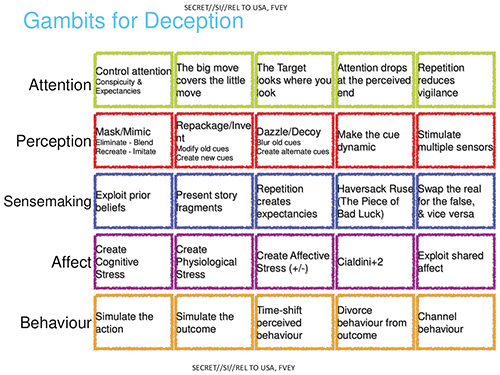
    21. JTRIG (2014) The Art of Deception: Training for a New Generation of Online Covert Operations, https://assets.documentcloud.org/documents/1021430/the-art-of-deception-training-for-a-new.pdf

    © New Dawn Magazine and the respective author.
    For our reproduction notice, click here.
  • Hermes Trismegistus & the Consciousness Revolution of the Renaissance

    Hermes Trismegistus & the Consciousness Revolution of the Renaissance

    From New Dawn Special Issue Vol 14 No 4 (Aug 2020)

    The Hermetic revival in the Renaissance was inspired by a belief that humanity could remake its own destiny. Was this promethean arrogance, or the recognition of powers that we need to acknowledge?

    The philosopher Jean Gebser argued that a profound shift in human consciousness took place in 1336 when the Italian Renaissance poet Francesco Petrarch made his ascent of Mt. Ventoux in France.1 This, Gebser said, was the first time someone had bothered to climb a mountain in order to see the view. Men had, of course, encountered mountains before, but always as obstacles. Petrarch made his climb on purpose.

    Gebser relates Petrarch’s climb to the rise of perspective in European painting, and to a “new, realistic, individualistic, and rational understanding of nature.” No longer “fixed” in place, one creature among others, as their medieval ancestors were, human beings could now “rise above their station,” survey the vast landscape of creation and map out their destiny.

    Gebser, I believe, is correct. And I would argue that perhaps some of the greatest exponents of this new consciousness were the Hermeticists of the Italian Renaissance. 

    In her classic work Giordano Bruno and the Hermetic Tradition, the British scholar Frances Yates writes that “The great forward movements of the Renaissance all derive their vigour, their emotional impulse, from looking backwards.”2 That the Renaissance was a time of rediscovery, of the resurrection of classical learning, is a truism. But what is not so well known is that it was also a return to the ancient teachings of the most famous magician of all time, Hermes Trismegistus, “thrice-greatest Hermes.” The writings that came to be known as “Hermetic” – including the Emerald Tablet, perhaps the most famous magical text in history – were considered by the Renaissance to be of profound antiquity. They were believed to have been set down in a distant Golden Age when men and gods still walked and talked together. For Hermeticists like Marsilio Ficino (1433–1499), Giovanni Pico della Mirandola (1463–1494), and Giordano Bruno (1548–1600), the rediscovery of the Hermetic books meant that the way back to an original divine state, to mankind’s true heritage, had been given to them.

    A 15th-century edition of the Corpus Hermeticum (translated by Marsilio Ficino).

    As the Greek god of writing, learning, language, and speech, Hermes held tremendous importance for Renaissance man, whose consciousness was profoundly attuned to the text. It is difficult for us to grasp just how central he was. In 1460, when the humanist patron Cosimo de’ Medici received a Greek copy of the Corpus Hermeticum, a collection of magical texts believed to be authored by Hermes, he ordered his scribe, Marsilio Ficino, to break off translating Plato in order to start work immediately on the Hermetic texts. Even Plato, to whom all of Western philosophy is said to be a “footnote,” must step aside for the thrice-greatest one, presumably so that Cosimo could read him before he died.3

    The Renaissance desire to drink the waters of wisdom at their source dictated this urge. For the Renaissance mind, Hermes Trismegistus was identified with the Egyptian god Thoth and his profound knowledge of occult mysteries; hence he was far older than Plato and was, in fact, the source of the divine Plato’s mystical philosophy. As Yates writes, “Renaissance respect for the old, the primary, the far-away, as nearest to the divine truth, demanded that the Corpus Hermeticum should be translated before Plato’s Republic or Symposium.”4

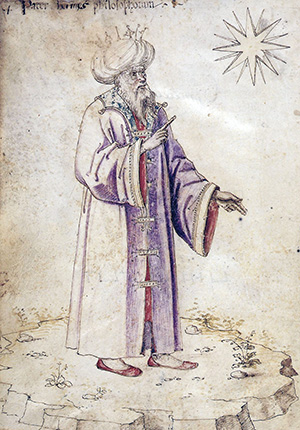
    Hermes Trismegistus portrayed as an ancient sage with turban and royal crown in an alchemical manuscript, c.1475.

    Yet as Yates points out, this Renaissance reverence for a Golden Age of Hermetic wisdom, however pious, was misguided. The works which inspired the Renaissance magician, and which he believed to be of ancient, primordial pedigree, are now thought to have been written in the early centuries of the Christian era, c.200-300 CE, products of the gnostic syncretism that characterised the decline of Greek philosophy.

    Far from being contemporary with Moses, farther still from the pristine rays of the original Egyptian sun, the Hermetic texts that ousted Plato were written not in the ancient past by a philosopher god, but by unknown scribes a little more than a millennium earlier. Nevertheless, the “historical truth” about the author of the Emerald Tablet, Picatrix, and the Divine Pimander seems less important than the influence he and the works attributed to him had on a pivotal time in the evolution of Western consciousness.

    The Hermetic message of knowledge, symbolised in Hermes’ role as guide and scribe, offers the central contrast with the medieval image of man as a sinful creature whose only chance of salvation lies in the consciousness of his imperfections: Knowledge is power for Hermetic man – power over nature, himself, and his destiny. As Virgil (who resembles Hermes in his role of psychopomp) guided Dante through the darkness of the nether realms, so Hermes Trismegistus, fount of wisdom and source of the prisca theologia – the ancient wisdom behind the religions of the world – guided Renaissance man through the shadows of his lower nature and the snares of the astral demons to his true heritage as magus, master of the world. 

    Escape from the Stars

    For Renaissance man, the universe was a living intelligence, a hierarchy of powers whose influence was felt through the emanations of the stars. We who read our daily horoscopes half tongue-in-cheek, half eager for instruction, can barely grasp the fascination of astrology for the Renaissance mind. The untutored endured their destiny, solaced only, if at all, by the thought that their misfortunes were the result of their fallen nature. 

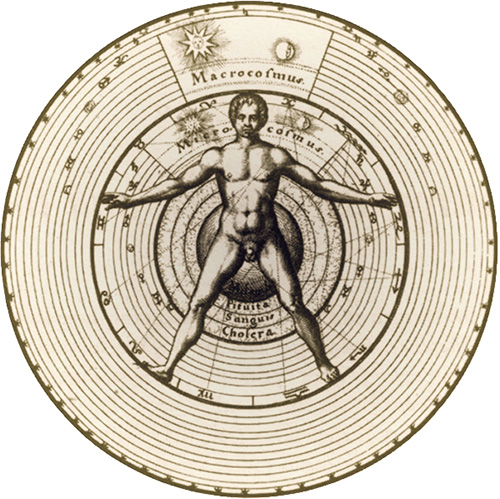
    Hermetic knowledge meant that Renaissance man was no longer wholly subject to this astral influence; he now had it in his power to modify, even master, his fate. Knowing the correspondences between microcosm and macrocosm, the Hermeticist could create a magical “strange attractor,” drawing or repelling what astral influence he chose. Understanding the links among the various symbols, scents, colours, metals, numbers, dates, times, places, states of mind, and astral influences, the Renaissance Hermeticist had gained a power his medieval brother lacked – or avoided, as such knowledge was considered demonic. To challenge fate was a mark of hubris, rejection of divine providence, and alliance with the Evil One. The hurdle facing the Renaissance Hermeticist was to show that the wisdom of the thrice-greatest one was not antithetical to the received Christian doctrine. Some, like Giordano Bruno, were not successful. Others, like Marsilio Ficino, were.

    Ficino’s Natural Magic

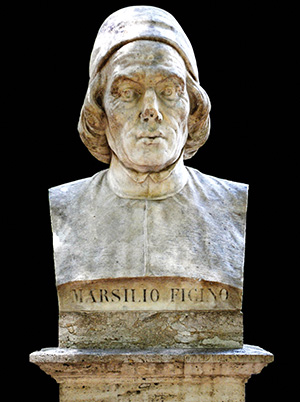
    Bust of Marsilio Ficino

    The world of Marsilio Ficino’s magic has a strange, melancholy atmosphere, an eerily familiar landscape of anxiety and dread. As in Kafka’s fictions, the sense of an over­arching power whose ebb and flow determines our fate pervades his Hermetic investigations. Author of the influential Commentaries on Plato’s Symposium (1469), Ficino was subject, he believed, to the restrictive influence of Saturn, a complaint common to students and scholars. He sought to escape its melancholic emanations by surrounding himself with the symbols of more beneficent solar, jovial, and venereal powers. For James Hillman and the school of archetypal psychology, Ficino’s magic represents an attempt to “consider all events in terms of their meaning and their value for soul.”5

    Yates, writing some years earlier than Hillman, had ironically previsioned Ficino’s value for psychotherapy. Commenting on his prescriptions for a non-Saturnian environment, she remarks, “We might be in the consulting room of a rather expensive psychiatrist who knows that his patients can afford plenty of gold and holidays in the country.”6 Ficino’s Hermetic antidotes to devitalising Saturn are collected in his treatise on medicine, Libri de vita, first published in 1489. 

    It was not unusual for a Renaissance medical text to offer astrological advice; assumptions about the relation between different zodiacal signs and parts of the body and the influence of the planets on temperament were as fundamental then as our ideas about genetics are now. What was daring about Ficino’s prescriptions were his use of magical talismans, a practice condemned by the Church Fathers. 

    In Ficino’s time it was still possible to advocate a “good,” “natural” magic that employed the beneficent forces of the anima mundi, or “soul of the world,” rather than the demonic energies of the stellar spirits. But time was running out on this tolerance. Hedging his advocacy of the Hermetic art with detailed qualifications, Ficino suggested that the use of talismanic magic was a natural outcome of the Platonic wisdom that ran parallel to religious dogma. The basic idea behind his “astral magic” – and behind Hermeticism in general – is that correspondences exist between the world of the Divine Intellect (Plato’s Ideal realm) and the created world. The magician’s own imagination is the bridge linking the two.

    Intermediary between these is the “soul of the world,” an idea prominent in Plotinus and the Neoplatonists of late antiquity. This “soul” was found in images which, in true Platonic fashion, were not mere signs but symbols, potent vessels retaining an element of the original, supersensible Idea. For the Renaissance Hermeticist, the images found in the Hermetic texts, close to the fundamental source, had exceptional power. 

    One aspect of this magic was a kind of “reparation” of the sensible world, which, through its distance from the divine source, was subject to deterioration. By refashioning images of the external world in his imagination, the Renaissance magus could channel the divine influence into the imperfect world of the senses. By thus employing the talismanic devices fashioned through his knowledge of the Hermetic books, Ficino had delivered to Renaissance man the means of becoming co-creator with God. This was a far cry from the humble, sinful creature of the Middle Ages.

    Pico Della Mirandola and the Dignity of Man

    With Giovanni Pico della Mirandola, the hesitancy that characterises Ficino’s magic disappears and the new-found confidence in man as a spiritual power arrives in full force. Where Ficino was content to open the natural forces of the anima mundi to the philosopher-magus, Pico is determined to bring human consciousness to the very source of being itself. In the technical magical sense, this means mastering the arcane secrets of Cabala, the ancient Hebrew mystical tradition of deciphering the divine import, the hidden logos, locked in numbers and the alphabet. In the broader sense of humankind’s consciousness of itself, it means a new awareness of our powers and strengths, our “dignity,” a term hardly applicable to medieval man.

    The influence of Hermes on Pico is evident in the opening paragraph of his most famous work, Oration on the Dignity of Man, which he delivered in Rome in 1486, at the hoary age of 24. He begins by remarking that the esteemed Abdala the Saracen, when asked what in the world was most worthy of wonder, had answered “man.” Pico supports this conclusion by quoting Hermes. “What a great miracle is man,” the thrice-greatest one remarks in the Hermetic text known as Asclepius. Pico sets off his rhetorical fireworks in order to state this case as persuasively as possible. 

    Pico’s Cabalistic investigations opened doors for Christian variants on an adamantly Jewish tradition. It made possible the kind of Cabalistic magic associated with modern Hermetic societies such as the Hermetic Order of the Golden Dawn, whose membership included luminaries like W.B. Yeats and dark stars like Aleister Crowley. Critical of Ficino’s merely “natural” magic, Pico argued that for magic to be effective, it must reach beyond the stars, into the higher, supercelestial spheres. Pico’s Cabalistic magic tapped the forces that lay behind the sensible world: angels, archangels, the ten sefirot or powers of God of the Cabalistic Tree of Life, even God himself – as aspiration the cautious Ficino would never openly avow.

    Instead of merely manipulating astral effluvia, knowledge of the secret import of numbers and the Hebrew alphabet meant the Cabalist magus could refashion the very matrix of being. But Pico’s Hermetic message is not limited to this specific magical practice. His basic argument is that man is a god who, as a contemporary writer put it, “has forgotten his heritage and come to accept that he is a beggar.”7 It is Pico’s mission to remind us of our roots.

    Central to Pico’s message is that unlike all other created beings, man has no fixed nature. “The Supreme Maker decreed,” he states in the Oration, that man “should have a share in the particular endowment of every other creature…. We have given you, O Adam, no visage proper to yourself”8 – a belief echoed centuries later by Jean-Paul Sartre, who argued that man had existence but not essence. Thus man is protean, able to participate in all dimensions and spheres of reality.

    The microcosm is the macrocosm, at least potentially. “We have made you a creature neither of heaven nor of earth, neither mortal nor immortal, in order that you may, as the free and proud shaper of your own being, fashion yourself in the form you may prefer”9 – a Hermetic proposition if there ever was one. No longer secure in his medieval slot, man now can make of himself what he will. He can “descend to the lower, brutish forms of life,” or ‘’rise again to the superior orders whose life is divine… Whichever of these a man should cultivate, the same will mature and bear fruit in him.”10 With the works of Plato, the Gospels, the writings of the Church Fathers and, above all, the books of the incomparable Hermes Trismegistus at his disposal, Pico goes for the alchemical gold, opts for the life divine, and strives to actualise his high inheritance. 

    This supreme self-confidence is a sign of the hubris that for some is the most pervasive gift our Renaissance forefathers have left us. Yet, as Yates writes, ‘’The profound significance of Pico della Mirandola in the history of humanity can hardly be overestimated.”11 After him, European man had the confidence to act upon the world and to control his destiny through knowledge. Unfortunately, Pico himself did not long enjoy his newly won status, dying of fever at the age of 31. His incendiary rhetoric suggests a bright but short-lived flame. 

    Robert Fludd’s famous illustration of man as the microcosm within the universal macrocosm, inspired by the Hermetic axiom, “As above, so below.”

    Bruno and the Egyptian Revival 

    Speaking of flames in the context of Giordano Bruno brings other images to mind. Bruno is remembered as a martyr for the Copernican heliocentric solar system: he was burned at the stake by the Catholic Church in 1600 for his heresies. Yet the picture of Bruno as a champion of a “modern” cosmology is inaccurate. The godless, meaningless universe of big bangs and black holes that grew out of the Copernican revolution would have been as repellent to Bruno as his own Hermetic aspirations were to the churchmen who immolated him. 

    Bruno did not burn because he favoured a cosmos reduced to mere energy and matter, drained of its magical, spiritual character. Bruno took Pico’s challenge to reclaim our divine heritage so seriously that he attempted to revive the ancient Egyptian, Hermetic religion – an injudicious if heroic project. Bruno wished to break the hold of the Church over men and to erect in its place the pantheon of mankind’s true spiritual guides, the gods of ancient Egypt. It is for this, and not for his place in the standard histories of “the warfare between science and religion,” that he should be remembered.

    Bruno’s contribution to the Hermetic Renaissance is central and cannot be adequately reviewed here. But two aspects of his work stand out: his proposed Egyptian revival and his mastery of the Art of Memory. 

    Yates has written at length on this ancient art, and the interested reader can get a definitive account of it in her book The Art of Memory. Known to the rhetoricians of antiquity, revived by Renaissance scholars, and used in magical practices by modern esotericists, “magical memory,” as Bruno’s mnemonic discipline is known, is a sine qua non of the true magus. A central theme in Bruno’s Hermetic magic was the reflection of the universe in the mind of the magus. 

    In The Mind to Hermes, book XI of the Corpus Hermeticum, the mens, or Divine Mind, addresses Hermes about this discipline. “Unless you make yourself equal to God, you cannot understand God,” the Divine Mind advises the thrice-greatest one. “Like is not intelligible save to like. Make yourself grow to a greatness beyond measure, by a bound free yourself from the body; raise yourself above all time, become Eternity; then you will understand God.”12

    One way in which Bruno strove to accomplish this end was by engraving on his consciousness the divine images, the celestial archetypes, which, as the title of his early work De umbris idearum (1582) suggests, were the shadows of the Platonic Ideas. He used a method familiar to rhetoricians of antiquity. The ancient Roman orators would memorise a series of places in an imaginary building and attach to these places images to remind them of the points of their speech. As they gave the speech, they mentally “walked” through the building, prompted by the memorised images. If we think of a virtual reality tour of an architectural site or a trip through a castle in a video game, we have a fair idea of the process, except that the practitioners of the art used nothing but their own powers of imagination. As Yates points out, it is difficult for us to imagine a memory capable of the complex, vivid detail achieved by the ancient mnemotechnicians. 

    Reviving this practice, Bruno adapted it to his magical projects. Taking the divine images from the Hermetic books, the Renaissance magus fixed these in his imagination, thus furnishing his inner world with a blueprint of the universe. In the process, he acquired magical powers enabling him to act upon the world.

    By thus reflecting the universe in his mind, the Renaissance magus became a co-creator with God, fulfilling Pico’s injunction that man must embody the highest and greatest good, a privilege vouchsafed to him alone. The magical images were arranged in the mnemonic system with images of the terrestrial world – plants, animals, minerals – and with the sum of human knowledge symbolised by the images of great thinkers and inventors. The possessor of this system thus stood above space and time, reflecting within his consciousness the entire universe of nature and man. He thus met the Hermetic challenge of “becoming Eternity.” 

    In practising this magical memory, Bruno hoped to break through the dense matter of the terrestrial world and to return to his true stature as an agent of the divine mind. This gnostic heresy – that man is not a mere creature but embodies the archetypal energies behind the world of appearances – is a radical development of Ficino’s more subtle “astral magic.” It is a move away from manipulating natural forces toward actualising the divine powers dormant within us. 

    Bruno’s “Egyptian revival,” in which he hoped to bring back the ancient Hermetic religion with its appreciation of man as magus, was powered by his profound antipathy to the image of man promulgated by the Church. A central part of the Asclepius is the lament over the decline of the ancient teachings, the darkening of mankind’s spiritual light, and the fall into forgetfulness of its divine heritage.

    Hermes Trismegistus was identified with the Egyptian god Thoth, depicted here in this artwork by Jean-François Champollion, 1823 (on display in the Brooklyn Museum).

    For Bruno, the Christian church was one of the agents responsible for this decline. Like Pico, Bruno considered it his mission to awaken men to their true place in the cosmos. In the Spaccio della bestia trionfante (1584), Bruno glorifies the magical, Hermetic religion of the Egyptians, and throws Ficinian caution to the wind by declaring that the return of that religion is nigh. There are no half-measures here: Bruno’s reformation begins with a cleansing of the zodiac by the divine Sophia, Isis, and Momus, archetypal powers of the Hermetic doctrine. Not only man’s life on earth, but the entire cosmos, must regain its magical heritage. 

    In the Cena de le ceneri (1584), a satire on the academic pedants who reject his Hermetic wisdom, Bruno proclaims the new Copernican theory of a heliocentric solar system as evidence that the Hermetic revival has come. His use of Copernicus, coupled with the bombastic, aggressive personality often found in men of genius and spirit, led to his death. After years of bitter struggle against the papal forces, the avatar of the new Hermetic age was burned alive at the hands of the Inquisition in 1600 on the Campo de’ Fiori in Rome. 

    In recent years a critical attitude toward the Renaissance magicians has grown up among some “anti-modern” thinkers. The eco-feminist Charlene Spretnak, recognising that the “core concept of the Ancient Wisdom is that man is a terrestrial god who can shape his own destiny and control nature,” sees the Renaissance magicians as ultimately “triumphal self­proclaimed titans, desperately denying the existence of a larger reality… of which human intelligence is only a part.”13 Their patriarchal, egocentric world views are out of touch with the more feminine, “nature-friendly” sensibilities that Spretnak advocates. 

    That our contemporary abuse of nature has its roots in the rise of modern science, associated with the Renaissance, is, I think, true. Yet the urge to “put man in his place” exhibited by “ecologically correct” thinkers carries some dangers of its own, not the least of which is a dampening of self-belief and a nurturing of cosmic laziness. As the eighteenth-century theosopher Louis Claude de Saint-­Martin wrote of the men of his time, “They have believed themselves to be obeying the dictates of humility when they have denied that the earth and all that the universe contains only exists on man’s account, on the ground that the admission of such an idea would be only conceit. But they have not been afraid of the laziness and cowardice which are the inevitable result of this affected modesty…. Where is the pilot that will guide us between these hidden reefs of conceit and false humility?”14

    Nearly three centuries later, we are still faced with Saint-Martin’s question. Humility, acceptance of fate, and knowing our station in the scheme of things may make for a more secure cosmos. Yet having once glimpsed our powers, it would be inauthentic, not humble, to turn away from them. We are still faced with the choice given to Renaissance man: to actualise our godlike potentials or to ignore them. Extravagance, passion, fierce individualism: our modern consciousness has its roots in these Renaissance virtues. Our task is to refine, not deny them.

    This article was originally published in GNOSIS #40 (Summer 1996) under the title ‘The Renaissance of Hermetic Man’ and later incorporated into Gary Lachman’s book The Quest for Hermes Trismegistus (Floris Books 2011). 

    [alert type=”general” dismiss=”no”]This article was published in New Dawn Special Issue Vol 14 No 4.[/alert]

    [alert type=”success” dismiss=”no”]If you appreciate this article, please consider subscribing to help maintain this website.[/alert]

    Footnotes

    1. Jean Gebser, The Ever-Present Origin (Athens, Ohio: Ohio University Press, 1985), 15
    2. Frances Yates, Giordano Bruno and the Hermetic Tradition (New York: Vintage Books, 1964), 1
    3. Ibid., 13
    4. Ibid., 13-14
    5. James Hillman, Loose Ends (Dallas, Texas: Spring Publications, 1986), 155
    6. Yates, 63
    7. Colin Wilson, The Occult (London: Hodder & Stoughton, 1971), 320
    8. Giovanni Pico della Mirandola, Oration on the Dignity of Man (Chicago, ID.: Gateway Editions, 1956), 6-7
    9. Ibid.
    10. Ibid., 8
    11. Yates, 116
    12. Ibid., 198
    13. Charlene Spretnak, States of Grace: The Recovery of Meaning in the Postmodern Age (San Francisco: HarperSanFrancisco, 1991), 197, 202
    14. Quoted in Wilson, 318-19

    © New Dawn Magazine and the respective author.
    For our reproduction notice, click here.