New Dawn – World's Most Unusual Magazine

Category: Articles

  • Secret State Uncovered: The Monitoring of Australia

    Secret State Uncovered: The Monitoring of Australia

    From New Dawn 177 (Nov-Dec 2019)

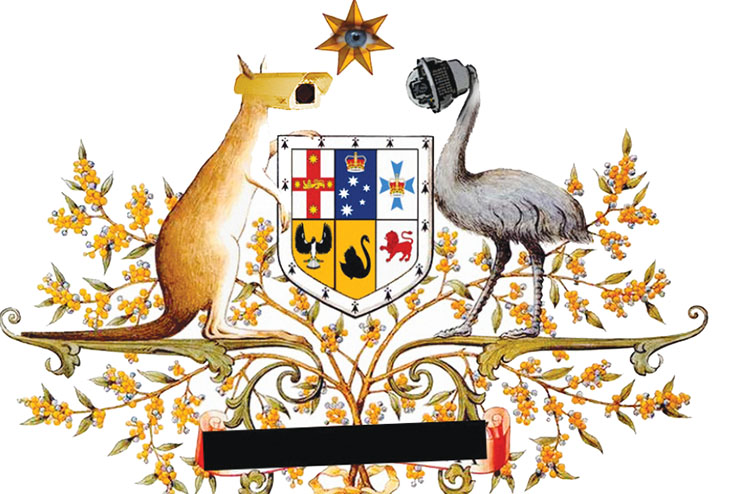
    Australia has ushered in a host of ‘pre-crime’ surveillance measures over the last decade that permit the state to closely monitor society and restrain individuals based on ‘anticipated future harm’ rather than past or present wrongdoing.

    An unprecedented raft of legislation has whittled away freedoms and expanded spying by secretive police and intelligence networks in Australia. The absence of a national bill or charter of rights, warns ETHAN NASH, further imperils individual freedom.

    In the years since the events of 11 September 2001, Australia experienced significant shifts in traditional legal frameworks. The federal government’s ‘hyper-legislative’ response to the ‘war on terror’ has proven to be only the beginning of that shift. 

    Through the interplay between law and order policy platforms in the states, territories and courts, Australia witnessed a multi-dimensional normalisation of mass surveillance in new contexts. 

    Once a novel and exceptional measure, this system has now been implemented in every state and territory. This worrying development has unfolded parallel to the proscribing of organisations as criminal or terrorist and the use of secret evidence in judicial proceedings.

    Even the process by which new powers are enacted, particularly the rhetoric supporting the rapid passage of many provisions, has been replicated across jurisdictions. 

    The ‘war on terror’ has become a war on freedom.

    These activities are all maintained by a network of hidden government intelligence elements. 

    While the daily activities of Australians are overseen by federal agencies such as police and government departments, unbeknown to most, the country has six primary intelligence organisations that exist in a realm of secrecy beyond the scope of scrutiny.

    These organisations include Australian Security Intelligence Organisation (ASIO), Australian Secret Intelligence Service (ASIS), Office of National Assessments (ONA), Australian Geospatial-Intelligence Organisation (AGIO), Defence Intelligence Organisation (DIO) and the Australian Signals Directorate (ASD).

    These organisations regularly engage in domestic and international intelligence operations and enjoy unfettered reach when conducting surveillance activities in Australia.

    For example, unlike the Central Intelligence Agency (CIA), US National Security Agency (NSA) and Federal Bureau of Investigation (FBI), as well as other overseas entities, ASIO is exempt from Freedom of Information requests from the public.1

    This networkhas established a spider web of operations, with disclosures over the years revealing major spy programs in multiple facilities across the country.

    This list includes the US-Australian Joint Defence Facility at Pine Gap, the Shoal Bay Receiving Station near Darwin, the Australian Defence Satellite Communications Facility at Geraldton and the Naval Communications Station HMAS Harman in Canberra. 

    Pine Gap, approximately 18 kilometres south-west of Alice Springs, is partly run by the CIA, NSA and the US National Reconnaissance Office (NRO). The facilities at the base consist of a massive computer complex with 38 radomes protecting radio dishes and over 800 employees.

    A long-term NSA employee at Pine Gap, David Rosenberg, revealed in his book Inside Pine Gap: The Spy who Came in from the Desert, that the chief of the facility was a senior CIA officer. 

    This group of agencies continues to grow in size and power each year that passes.

    Intelligence Reach

    “We’ve already taken some pretty dangerous steps in this country towards the surveillance state, and not that many of us are either interested or aware that it’s going on, including people like me who should know better… Our friend and ally the United States is transitioning quite rapidly into an authoritarian state.”
    –  Scott Ludlam, speaking when he was a Senator in 2012

    From beginnings as spies in the Cold War, Australia’s intelligence community developed over the last century to become a behemoth with technical capabilities rivalling their international counterparts.

    Since 2005, the size and workforce of ASIO increased by 62%. ASIO grew from a $60 million organisation in 2001 to a budget of $533 million today. From 12 employees in 1949, ASIO has grown to 1,980 professional spies as of 2017/2018, and based in a new $630 million headquarters.2 

    ASIO’s special powers, under warrant, allow the Organisation “to enter and search premises, intercept and examine items in the mail, install and monitor surveillance devices, monitor telecommunications, and remotely access computers.”3 Citizens can be legally detained up to seven days for questioning by an ASIO officer.4

    In 2013, Edward Snowden leaked the most significant archive of classified intelligence documents in US history since the Pentagon Papers. 

    Amongst the revelations of spying and ‘Orwellian’ surveillance overreach, the documents revealed that Pine Gap, amongst three other locations in Australia and one in New Zealand, contribute to the NSA’s global interception and collection of internet and telephone communications. Journalist Brian Toohey, an expert on intelligence and national security matters, and author of the new book Secret: The Making of Australia’s Security State, states that Pine Gap intercepts electronic communications from Australian citizens including phone calls, emails and faxes as a consequence of the technology it uses.

    “It’s a reasonable deduction that the DSD [now the Australian Signals Directorate, called Defence Signals Directorate until 2013] is doing exactly the same thing as the NSA because of the bilateral relationship we’ve got,” said Clinton Fernandes, an intelligence analyst and professor of international and political studies at the University of New South Wales.

    “You can assume based on the NSA leaks that they have access to all the metadata of your phone calls and your emails as well as the context of your phone calls and your email, who rang you, where you were, where they were, where you went next, who else you talked to, which coffee shop you went to…”5

    As a result of this obsession with spying, on a per capita basis, Australian law enforcement agencies are 20 times more likely to intercept telephone calls than in the United States.6 Even before metadata laws were enacted (see below), Victoria Police sought access to people’s phone and internet data at an astonishing 1,200 times a week.7 ACT Policing admitted this year it had unlawfully accessed citizens’ metadata a total of 3,365 times – the tip of an iceberg of unauthorised spying on the general population.

    ‘Counter-Terrorism’ & Hyper-Legislation

    The Australian parliament has responded to the threat of ‘terrorism’ by enacting dozens of new laws that give intelligence organisations greater powers.

    In 2011, University of Toronto Professor Kent Roach famously described Australia’s kneejerk response as one of “hyper-legislation.” Another expert, UNSW Professor George Williams, calculated that between 9/11 and the end of the Howard federal government in 2007, a new ‘anti-terror’ law was enacted on average every 6.7 weeks.8

    The scale and pace of the enactment of laws and the impact of these measures on our legal system has realigned our whole approach due to the extensive new powers granted to government and the subsequent deterioration of fundamental freedoms.

    More National Security Legislation

    Starting in 2014, existing powers were overhauled and expanded in three tranches of legislation, allowing the state to further violate personal freedoms and liberties in the pursuit of broadened ‘safety’ and ‘security’.

    The first instalment of legislation introduced in 2014 gives ASIO officers greater power to access computers, computer systems and computer networks. There is no limit on the number of computers that can be accessed if a warrant is issued. Legal experts warned this extremely broad power could theoretically permit ASIO to monitor the entire internet.9

    The National Security Legislation Amendment Act (No 1) 2014 also allows ASIO to define any activity as a ‘Special Intelligence Operation’. This means any operation conducted under the definition exempts ASIO officers from civil and criminal liability.10

    Furthermore, the bill introduced prison penalties for journalists if they report on ‘Special Intelligence Operations’.11 And not just journalists, but any person who shares or republishes this material. In addition, harsher penalties were put in place for intelligence whistleblowers who take documents or records and disclose them. This clause has left national security reporting stagnant across the country.

    According to Brian Toohey: “No major party seems bothered by the use of new surveillance technology that allows governments to detect contact between journalists and their sources, effectively denying whistleblowers the opportunity to reveal abuses of power and criminal behaviour.”
    Pre-Emptive Detention

    This second bill expanded the 2005 Howard-era preventive detention and control order regime. These are highly controversial because they allow people to be subject to police restrictions or detention without charge and with limited judicial oversight.

    This legislation introduced a new offence of “advocating terrorism.” A person violates the new law if they “intentionally counsel, promote, encourage or urge the doing of a terrorist act or the commission of a terrorism offence.”

    The amendment broadened the range of circumstances where control orders can be sought, including restricting the movement or associations of people by enforcing a 12-hour curfew period that forces people to stay in a given location for a maximum of 12 hours in every 24 hours.

    The bill also enables the prosecution of people who intentionally enter a “declared area” in a foreign state when the Australian government has determined they “are engaging in hostile activities.”

    Metadata Retention

    The third major reform that caused the most outrage required all telecommunications providers operating in Australia to retain users’ data for up to two years.

    Such data retention schemes have been subjected to much debate, with civil liberties groups saying it is the first step in the systematic erosion of privacy online.

    In the 2013-2014 financial year, there were over half a million disclosures of metadata to various agencies including Centrelink, the Tax Office, Australia Post and traditional policing agencies. Australia’s data retention regime is one of the most comprehensive and intrusive collection schemes in the Western world.

    Since the overhaul, metadata from our phone calls, text messages, emails and internet activity is now tracked by the government and accessible by intelligence and law enforcement agencies.

    Metadata – or data about data – can be highly revealing and provide a comprehensive depiction of our daily activities, communications and movements.

    Most Australians would be unaware that numerous organisations other than federal, state and territory police and security agencies such as ASIO can get access to this information, including agencies that collect government revenue, for example, the RSPCA, the Australian Crime Commission, the Australian Tax Office, Centrelink, Medicare, Australia Post, the Australian Fisheries Management Authority, local councils and foreign law enforcement agencies.12

    Highly concerning is the fact that more than 100 federal, state and local government agencies are known to be accessing metadata despite not being among the list of enforcement agencies included in the data retention legislation.

    Industry group Communications Alliance said it had identified 81 government organisations accessing the metadata of Australian citizens, and that in the first few months of 2019 the organisation had identified 27 further “non-authorised entities” seeking metadata from telecommunications carriers.13

    Metadata is broad in scope and tells more about us than the actual content of our communications. Any claims that data retention laws do not seriously compromise our privacy should be considered naïve, ill-informed or dishonest.

    The Draconian Wave

    In the five years since the passing of these bills, 19 more anti-terrorism laws have come into effect. That brings the total number enacted by parliament to 82 since 11 September 2001 – with further bills either currently before parliament or about to be introduced. This staggering number of laws far exceeds the volume in the United Kingdom, Canada and even the United States.

    New anti-encryption legislation also recently passed compels communications providers to grant spy agencies access to encrypted information. Analysts say this will have broad implications for digital privacy.

    Following consultations with a range of international and domestic companies about the proposed reforms, the Telecommunications and Other Legislation Amendment (Assistance and Access) Bill 2018 passed despite much criticism from privacy advocates and technology experts all over the world.

    Under the new law, companies can be forced to reveal technical characteristics of digital systems that could help intelligence agencies exploit weaknesses that have not been patched.14

    The legislation empowers law enforcement and spy agencies to compel companies to a long list of potential requirements including: removing one or more forms of electronic protection, providing technical information, facilitating access to services and equipment, installing software, modifying technology, and concealing that the company has done any of the above.15

    The new measures force communications providers to work closely with government agencies so they can gain access to a target’s data. Internet Service Providers and alike are compelled to create new interception capabilities so all communications data – including encrypted data – is accessible to law enforcement and intelligence agencies.

    For all intents and purposes, providers are coerced into building backdoors into their encryption platforms, despite authorities continuing to deny this is the case.

    Experts assert there is no way a backdoor can be built to access encrypted communication that doesn’t result in “systemic weakness.”

    Moving Forward

    The above developments underline the shift in Australia from constitutional values to draconian legislative incursion. Without protections for liberty in the Constitution, which only guarantees a handful of rights, we rely on the state’s respect of implied freedoms based on common law. 

    Privacy groups have repeatedly warned against the dangers, arbitrariness and abuses of these laws by governments to stifle freedom of expression. In many instances, the legitimate exercise of freedom of speech has been criminalised.

    In the broader context, the Australian experience now serves as a cautionary tale for the rest of the world, with the potential for measures to lead to new extremes within a relatively short period.

    Australians must stand up against those forces which continue to push for more legislation that erodes our long-recognised freedoms and rights to speech and liberty.

    [alert type=”general” dismiss=”no”]This article was published in New Dawn 177.[/alert]

    [alert type=”success” dismiss=”no”]If you appreciate this article, please consider subscribing to help maintain this website.[/alert]

    Footnotes

    1. www.naa.gov.au/collection/fact-sheets/fs53.aspx
    2. https://en.wikipedia.org/wiki/Australian_Security_Intelligence_Organisation
    3. www.asio.gov.au/special-powers.html
    4. http://fair.org.au/your-rights/what-are-your-rights/
    5. www.abc.net.au/news/2013-06-28/brissenden-data-practice/4786782
    6. www.aph.gov.au/Parliamentary_Business/Bills_Legislation/bd/bd0304/04bd044
    7. www.smh.com.au/politics/federal/police-access-phone-and-internet-data-1200-times-a-week-20150113-12nga3.html
    8. www.sbs.com.au/news/a-new-law-every-6-7-weeks-australia-has-enacted-82-anti-terror-laws-since-2001
    9. www.smh.com.au/technology/new-laws-could-give-asio-a-warrant-for-the-entire-internet-jail-journalists-and-whistleblowers-20140923-10kzjz.html
    10. www.smh.com.au/politics/federal/australias-new-security-laws-explained-20140926-10mh6d.html
    11. www.theguardian.com/commentisfree/2014/sep/26/journalists-and-whistleblowers-will-go-to-jail-under-new-national-security-laws
    12. https://en.wikipedia.org/wiki/Mass_surveillance_in_Australia
    13. www.computerworld.com.au/article/664085/dozens-more-government-agencies-accessing-metadata/
    14. www.aph.gov.au/Parliamentary_Business/Bills_Legislation/Bills_Search_Results/Result?bId=r6195
    15. www.theguardian.com/technology/2018/dec/08/australias-war-on-encryption-the-sweeping-new-powers-rushed-into-law

    © New Dawn Magazine and the respective author.
    For our reproduction notice, click here.
  • Esoteric Symbolism & Memes: Strategies of Control

    Esoteric Symbolism & Memes: Strategies of Control

    From New Dawn Special Issue Vol 12 No 3 (June 2018)

    The world is governed by very different personages from what is imagined by those who are not behind the scenes.
    – Benjamin Disraeli

    We like to believe we are rational, in control of our lives and making our own decisions. We pride ourselves on our independence and take offence if someone suggests we are being irrational or that our decisions are somehow influenced by someone else. Sadly, free will is not as credible an idea as it first seems. Years of psychological research reveals the immense influence of genetics, culture and the environment on how we behave. While we may justify our decisions by supposedly rational reasoning, these are usually always the result of our emotions responding to unconscious factors.

    Meme Theory

    The best way to understand this mechanism of control is via meme theory. A meme, according to the Merriam-Webster dictionary, is an “idea, behaviour, style or usage that spreads from person to person within a culture.” The concept was first proposed by Richard Dawkins in his 1976 book The Selfish Gene. While we may disagree with Dawkins’ extreme materialism and reductionist Darwinism, his understanding of memes is a great model to explain how symbols, ideas and images can be used to manipulate behaviour. 

    Just as the mechanism of physical evolution works via the gene desiring to reproduce at all costs, within the world of the unconscious the meme reproduces by moving from mind to mind. While genes reproduce by the paroxysm of pleasure, the meme uses whatever primal emotional hook it can latch onto – more often than not this is lust, aggression, violence or fear. 

    There are ‘positive’ memes, but sadly the baser human emotions work better to pass on a given idea or system of ideas (a memeplex). Nightmares, urban legends and tales of ghosts, ghouls and murderers pass from generation to generation with ease. In recent times it is easy to locate memes within urban legends about escaped killers, murderers or supernatural monsters of the night. For example, the ‘Tall Man’ or ‘Slender Man’ began as an Internet meme created by Eric Knudson in 2009. It triggered a flood of Internet fiction and YouTube movies about a strange character with a blank and featureless face wearing a black suit who hunts children. Unfortunately, this meme became all too real when in Wisconsin in 2014 two twelve-year-old girls lured another to a secluded place and stabbed her 19 times to impress the ‘Slender Man’.

    Semiotics and Meme Theory

    Semiotics is the study of how symbols and signs are used to create meaning. When combined with meme theory we can come to an understanding of how symbols, signs, images, pieces of music and related factors can be used to anchor complex ideas and manipulate individuals, groups and even whole populations on an unconscious level.

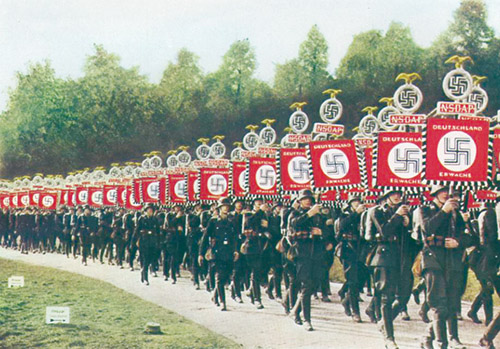
    In National Socialist Germany, soldiers carry banners with their borrowed symbol of power: the Swastika.

    Let’s examine some examples. The most obvious is the Swastika. Originally an Indo-European symbol for luck – the whirling spirals of the sun have a long and veritable history as perhaps the most sacred of esoteric symbols – it was taken by the National Socialists and transformed into a symbol of German ascendancy. While it is still found today throughout India, Tibet and many other countries, it triggers a shiver down the spine of most Westerners. The use of it by Nazism was deliberate. They attempted to harness the whole ‘memetic’ heritage of the image and bring it under the command of a new vision of Aryanism as promoted by Germany. The use of the symbol was highly successful as it evoked, on an unconscious level, a wide range of associations from race theory to total obedience to the state, without any forethought. Emotions were swayed, and the German population reacted unconsciously to the Swastika, backed up with complex ritualised parades and rallies, iconography and uniforms. The Germans felt they were rationally choosing a leader who would take them out of the post-First World War depression era when there was nothing rational about it at all.

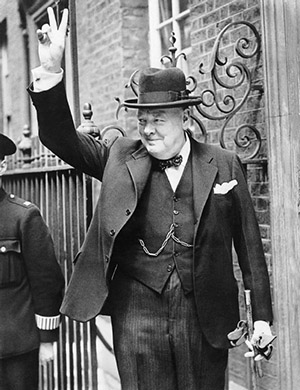
    Winston Churchill makes the V for Victory sign. 

    Another example is Winston Churchill’s use of the V for Victory sign. There is evidence the occultist and spy Aleister Crowley took what was a Greco-Roman sign for victory and, during his work for Britain’s MI5, recommended the sign to Churchill as a foil against the use of the Swastika by Hitler. It was also remarkably successful, even expressed in music using a form of Morse code as a call to arms throughout the war. Once again, the symbol triggered a whole population to react unconsciously and rally to fight.

    There are many other examples such as the symbol of the cross which has transformed from the sacred tree to the Ankh of Egypt to the crucifix of Christianity. Each culture adapted and used the image in its own way. Sadly, with Christianity, it came to be used as a symbol of the forced conversion of other cultures. As Emperor Constantine said, “in hoc signo vinces” – in this sign you will conquer. Of course, the debate continues regarding the Sixties peace sign. While it was composed of the letters N and D for nuclear disarmament, others claim it is a broken crucifix. The history of the cross would take a whole book to explore as would the Swastika. Both are complex symbols with long histories and innumerable variations.

    Cinematic Motifs

    Cinema uses symbols, signs and images to create unconscious reactions. Early German Expressionist cinema, for example ‘Nosferatu’ made in 1922, uses strange angles, manipulation of shadows and occult symbols, to evoke a sense of fear. Albion Grau designed the sets for this film at Prana Studios (Prana is the Hindu term for life force) and was also a leading member of Fraternatis Saturni, a significant occult order of the period. We see the same trend in the psychedelic films of the Sixties where images, symbols and signs are used to unconsciously transmit a message. In 1973, ‘The Holy Mountain’ by Alejandro Jodorowsky took Cannes by storm with its surreal journey through the planets based on the esotericism of Georges Ivanovich Gurdjieff.

    While esoteric themes can be used to create a good ghost, horror or surreal film, they can just as easily be used to manipulate the viewer’s opinion. There are works which are clear propaganda. Such works are far less dangerous than the more subtle forms of cultural manipulation because they are so obvious the filter of the conscious mind tends to ignore their message. A range of motifs in modern cinema appear on a regular basis. Now if these are considered as ‘signs’ representing a deeper meaning, which those behind the movie studios wish to imprint on the collective unconscious, then we can begin to decode how the power elite is manipulating the populace at large.

    The development of the zombie film began with the ‘White Zombie’ in 1932 and was followed by a trickle of films until the literal explosion of these films and TV shows today. The motif of the small threatened population trying to fight off an infected menace (read foreign) as the world self-destructs and falls into mayhem. Unconsciously, the call is for law and order and more government to avoid such a catastrophe. As the films become more violent, brutal and confronting they bring in fears of unknown plagues and uncontrollable viruses that can only be contained by tighter controls on immigration and bigger government. Wherever you stand on the immigration debate, this unconscious manipulation of the fears of the populace is obvious.

    Reality TV – Life as a Simulation

    The craze that’s taken over most programming on television is so-called Reality TV. This ranges from the tawdry ‘Big Brother’ to music and cooking shows and even couples fighting to be the best designers of a home in ‘The Block’. In such programs we live our lives vicariously through the characters on screen – they do the things we would never think of doing and we therefore transfer our emotions onto them. They cook, make music and design so much better than us. We seek to be a little like them through imitation. We can watch ‘MasterChef’, get the recipes online, become better consumers at home and bring a little bit of glamour to the tea table. Such programs as ‘Big Brother’ offers the right combination of nudity, sex, emotional cruelty and interpersonal friction to keep viewers hooked. 

    Through such shows we forget our own lives and our own journeys. Instead of facing ourselves, and what is happening in the world, we are reduced to passive consumers. Retail companies pay for their products to be placed in the shows, for us to buy and possess to mimic the characters. Of course, we cannot be like them – they are artificial simulations created by TV producers – but we continue to watch, consume and mould ourselves into role models that are nothing but shadows and marketing ploys.

    The Cult of Celebrity

    Celebrity is another example of the simulacrum, the image or representation of someone or something. These individuals are made to seem real but are actually artificially moulded by the media and publicity companies. They are memes in the flesh and cannot be seen as real but as representing that what is behind them. When we experience a celebrity we are experiencing a simulacrum, a walking simulation or holographic meme created to trigger certain responses from those they interact with. In many ways celebrities are caricatures – they are not people but carefully engineered memeplexes created by publicity companies to manipulate and trigger specific reactions on an unconscious level. This may seem harsh but unless we see them this way we cannot see through them and begin to appreciate just how conditioned we are and the way in which symbols and signs are used to mould and create what we perceive to be reality.

    Diversionary Memetics 

    A second level technique known as ‘Diversionary Memetics’ captures those who do start to ask the important questions, but it leads them to dead ends. 

    Many thinking people spend large amounts of time running around investigating ‘micro conspiracies’, government corruption, information spread on the Internet, etc. The original source of many diversionary memes are often obscure. They are engineered to spread like wildfire, the Internet being a particularly effective way to quickly proliferate a meme designed to get us angry and wanting to do ‘something’. Of course most people simply spread the meme to other people, and ultimately feel quite disempowered when they realise nothing really changes. The memes (political, economic & social problems) keep coming at us in a never-ending stream.

    Studying and exposing all the small conspiracies is certainly an important service but unless we look behind the scenes to decode the overall system of control, then real change becomes impossible. We never see the big picture.

    What we need to appreciate is that the world is controlled by memes. The media and the entertainment industry reinforce the values that those at the top want us to hold. We are passive consumers who, on the whole, do not question – we believe what we are told. 

    Conclusion

    For practical purposes, too, it is very important to recognise the instruments of the occult war, namely the means employed by the secret forces of global subversion to conceal their action, prevent their opponents’ action, and continue to exercise their influence.
    – Julius Evola

    There is no doubt symbols and signs are used to create systems of control. Our reality is manipulated by encoded images with the help of celebrities who are more representational than real. Political Correctness defines our thinking by manipulating how we speak because the language of a people reflects their soul. When we are more concerned with the language of technology and social networking than personal communication, we have a real problem. When we cannot speak our mind because someone, somewhere may be offended, then self-censorship limits our ability to think beyond certain predefined boundaries.

    Chaos and upheavals are changing the world at a rapid pace, but we are dancing, singing and partying. Unless we come to see our chains we cannot set ourselves free. The first step in this process is decoding the layers of symbolism, programming, memes and brainwashing that are conditioning us every minute of every day. We believe we are free agents and can think for ourselves. But look at the media, television, films, entertainment (not to mention computer games), and you can begin to appreciate how our beliefs about ourselves, who we are and our role in the world, are totally artificial, totally conditioned, and represent what the power elite want us to think. It is time to take the Red Pill.

    [alert type=”general” dismiss=”no”]This article was published in New Dawn Special Issue Vol 12 No 3.[/alert]

    [alert type=”success” dismiss=”no”]If you appreciate this article, please consider subscribing to help maintain this website.[/alert]

    © New Dawn Magazine and the respective author.
    For our reproduction notice, click here.
  • Giordano Bruno: Forgotten Genius & Hermetic Martyr

    Giordano Bruno: Forgotten Genius & Hermetic Martyr

    From New Dawn 130 (Jan-Feb 2012)

    In our last New Dawn article we listed the great pioneering discoveries of science that – unacknowledged by science historians – were directly inspired by the ancient Egyptian ideas as set out in the Hermetic texts which were ascribed to the demi-god Hermes Trismesgistus. These landmark breakthroughs were either drawn directly from the cosmology of the Hermetica – the most important being Copernicus’ heliocentric theory – or indirectly by applying their principles to different areas (as did Isaac Newton, to crack the code of gravity).

    But most of the discoveries on our list involved a figure who, although not an experimental scientist himself, should be remembered as being equally important as Copernicus and Newton, but who until recently was virtually erased from history. This towering genius and truly extraordinary man was Giordano Bruno (1548-1600), the foremost Hermetic philosopher of his age whose influence over the scientific revolution has been scandalously downplayed. There’s even more to him than his intellectual and philosophical genius: he also applied the Hermetic principles to social, political and religious questions. And he presented such a serious challenge to the supremacy of the Church that for a time he even threatened to undermine it. But it also, with a sickening inevitability, lead to a date with a flaming pyre in Rome…

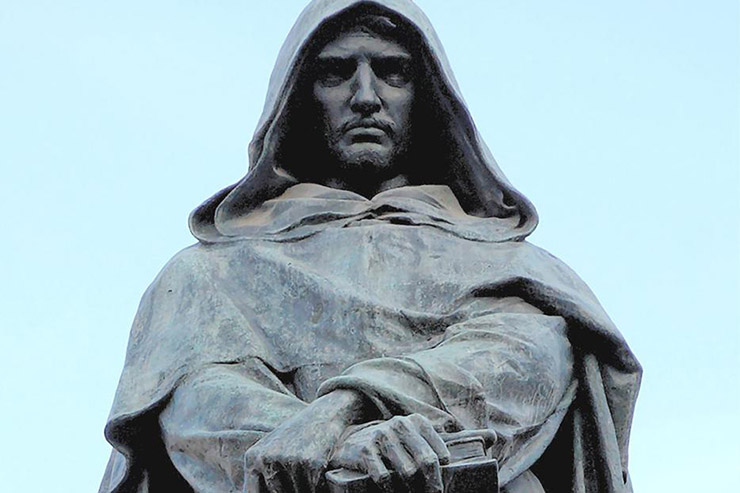
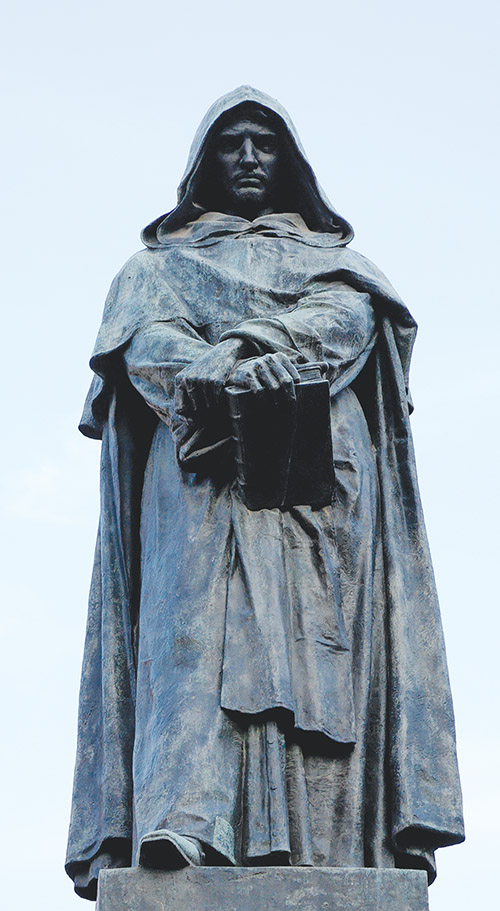
    In recent years Bruno has begun to be rediscovered and appreciated, although still the truth is often distorted in order to crowbar him into the accepted history of science. Because of his remarkably advanced ideas he tends to be regarded as a martyr for scientific rationalism, victim of even greater Church persecution than Galileo (on whom he was hugely influential). Bruno has become a hero for freethinkers and, particularly ironically, atheists, who gather annually at the site of his execution in Rome’s Campo de’ Fiori – marked by a statue erected in the late nineteenth century – to honour his memory and sacrifice. But this is missing the point in a big way. Far from being an arch materialist-rationalist, in fact everything Bruno did was inspired by his passionate belief in magic and the esoteric. 

    He is also being introduced to a wider audience through the historical thrillers of S.J. Parris (the pseudonym of British writer Stephanie Merritt), Heresy (2010) and Prophecy (2011). Although mainly concerned with Bruno as a kind of late Renaissance Hercule Poirot, she paints an authentic picture of Bruno as a dedicated and campaigning Hermeticist.

    Privy Secrets

    Ironically, Bruno began as a Dominican monk, a member of the same Order that gave rise to his nemesis, the Inquisition. He was born in 1548 in the small town of Nola – hence his nickname of ‘the Nolan’ – in the then huge Kingdom of Naples in Italy, which was under Spanish rule. Although he was christened Filippo, he took the name Giordano – from the River Jordan – on entering the Dominican monastery in Naples at the age of sixteen. In those days becoming a monk was the only way for a bright lad – and Bruno had already exhibited a prodigious intellect – from a humble background to get a good education.

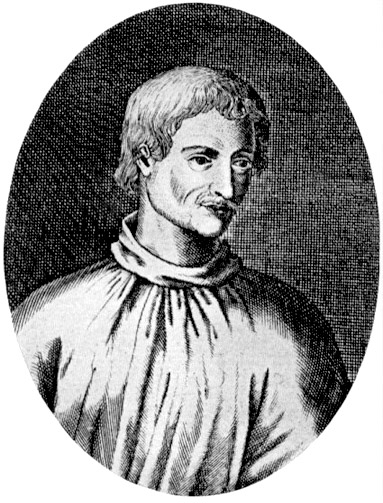
     The only known portrait of Bruno, published in 1715 in Germany, more than a century after his death.

    The young monk soon distinguished himself with his extraordinary mastery of memory-training – even being summoned to Rome to demonstrate the ability to the Pope. The classical art of memory, based on the manipulation of mental images, had a magical counterpart which employed talismanic principles to induce, rather than simply recall, information. Clearly this possessed a heady allure to someone so hungry for knowledge as Bruno. 

    As he grew in ability, exploring the powers of the mind through magic and psychology, Bruno became a powerfully confident man. Although never lacking in self-belief, he always respected those who deserved respect. On the other hand, he was disinclined to suffer fools gladly – indeed, at all. And he always, without fail, believed in his own mission… 

    A side of this self-belief that was hardly welcome in a monk was his refusal to allow others to dictate what he could read or even think. Not only were monks’ studies tightly circumscribed by their very nature, but at that time the Catholic Church was desperately trying to combat the rise of Protestantism, so departing even marginally from the conventional line attracted great suspicion. Even listening to the arguments of those deemed heretics, or reading their works, was a crime for a monk – even if you disagreed with them. 

    On the other hand, as the Dominicans were tasked with fighting heresy, they had easy access to banned books – much to the ever-curious Bruno’s delight. When his superiors discovered he had been secretly reading them in the monastery toilet he fled from Naples.

    For five years he wandered round the intellectual centres of northern Italy, southern France and Switzerland – Padua, Milan, Geneva and Toulouse among other places, with frequent gaps in his biography. By the time he reappears fully, in Paris in 1581, he had become a hardcore believer in the Renaissance occult philosophy with Hermeticism at its heart. Quite how he developed this interest is unknown, but it fundamentally underpinned everything he did for the rest of his life.

    Like everyone inspired by the Hermetic books since their rediscovery in Europe just over a century before (see our last article in New Dawn 129), Bruno was fired up with their vision of humans as glorious, miraculous beings of limitless potential – the polar opposite of what all Catholics were taught. To them, humans were little better than worms, only achieving a tiny bit of God’s grace through the intercession of the Church, and even that often depended on how much you were prepared to pay the priesthood to be let off a few years in purgatory. 

    The more he studied, the more Bruno considered everything – every level of life and understanding of our place within the cosmos – could be illuminated by the principles of Hermeticism.

    In Paris he gained the patronage of the French king, Henri III – a Catholic, but who still had a deep interest in the esoteric and was tolerant towards the French Protestants, the Huguenots. After two years Bruno moved to London, accompanying Henri’s new ambassador to Queen Elizabeth I’s court. Clearly he had Henri’s backing for whatever his mission might have been – probably establishing contact with English magi centred around John Dee. During his two-year stay in London he made friends with such luminaries as Sir Philip Sidney, and wrote some of his most important books. As we will see, Bruno left a rich intellectual legacy that influenced some of the great minds of the late-flowering English Renaissance. Many consider that the character of Berowne in Shakespeare’s Love’s Labours Lost was based on Bruno.

    It was while in London that Bruno produced his major works on cosmology that were to inspire enormous scientific advances.

    The Hermetic Key

    To Bruno the Hermetic philosophy and cosmology was the great key to unlocking the secrets of nature and the cosmos. Having already seen the Hermetica inspire Copernicus to develop his heliocentric theory, he applied himself to scientific questions using the Hermetic principles. And very fruitful it proved, too…

    A passage in Treatise X of the Corpus Hermeticum states that “the spirit, passing through the veins and arteries, moves the living thing.”1 Bruno realised the image suggests that the blood also moves, a concept that also reflected Hermetic ideas of man as a microcosm of the greater cosmos.2 Bruno’s interpretation was picked up by fellow Hermeticist Robert Fludd, who – writing in the late 1610s – inspired Charles I’s physician William Harvey with the idea of testing it. Harvey became the first person to demonstrate the circulation of the blood experimentally, “one of the greatest achievements of the Scientific Revolution.”3

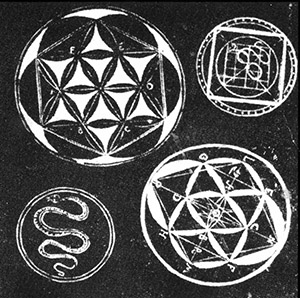
    Woodcut illustrations from Giordano Bruno, Prague 1588. Upper left cut contains a version of the “Flower of Life” pattern.

    Bruno’s Hermetic influence also extended to Elizabeth I’s physician William Gilbert’s 1600 masterwork, On the Magnet, Magnetic Bodies and the Great Magnet of the Earth, in which he proposed that magnets work because the Earth itself generates magnetic force – another landmark discovery. Without Bruno’s work, Gilbert would never have got there.4

    In our bullet-point list of Hermetic-inspired discoveries in our last article we included “the basic principles of computer science and information theory.” At first glance this may seem rather unlikely but this, too, can be traced back to Bruno’s application of Hermetic principles. This time the seed he planted flowered in Gottfried Wilhelm Leibniz (1646-1716), the German genius whose life and career paralleled those of Isaac Newton. A great polymath, Leibniz is chiefly known today for inventing infinitesimal calculus, at about the same time as Newton – although Leibniz’s system was the one that caught on – and for the basic principles of information theory, including the binary system.

    Yet even Leibniz was no hard-line materialist-rationalist. Like Newton, he was deeply versed in esotericism – almost certainly a Rosicrucian and certainly a scholar of the Cabala and, predictably, the Hermetica. Equally predictably, he owed an enormous debt to the works of Giordano Bruno.

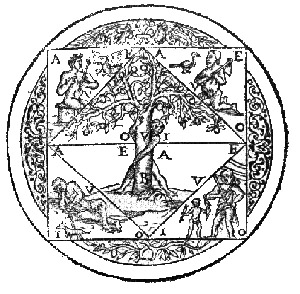
    Woodcut illustration of one of Giordano Bruno’s less complex mnemonic (memory) devices. He planted this drawing – which acts as a portal – in his mind to recall massive amounts of information from memory.

    Information theory was really just a by-product of a much more ambitious scheme. Leibniz believed it should be possible to devise a set of symbols – which he called characteristica universalis – to represent all the fundamentals of knowledge, and by manipulating them to make new discoveries (a process he described as ‘innocent magia’). He developed this idea from Bruno’s works, especially those on the magical art of memory and the manipulation of the imagination to produce desired results.

    Although Leibniz was never to achieve the full dream of the characteristica universalis, his work developed into the idea of mathematical modelling, at first using pen-and-paper equations (which is where calculus came in) and later computer modelling. His pioneering computer work also saw him designing some of the first calculating machines.

    But although Bruno can never be described as a scientist in his own right (he seems never to have undertaken a single experiment) basing his reasoning on the Hermetic principles led him to make some truly remarkable insights. (And given that he practised magical techniques to acquire information directly, we can be forgiven for wondering just how successful they were.)

    In London in 1584 Bruno wrote and published On the Infinite Universe and Worlds in which he put forward some extraordinarily advanced – and for the time deeply shocking – propositions.

    Shock and Awe

    Bruno was a leading champion of Copernicus’ heliocentric theory which, although published five years before he was born, was still regarded as new and unproven, scholarly opinion being split over whether he was right, wrong or somewhere in between. Copernicus had merely proposed that the sun was at the centre of creation; he still stuck with the traditional model that the entire cosmos consists solely of the sun, moon and planets which move within an outer ‘shell’, the sphere of the fixed stars. In other words, the stars are simply fixed points of light of varying intensity, all stuck on the same crystalline sphere and therefore equidistant from Earth. 

    But, as the title of his book implies, Bruno went further, arguing that the stars are really suns like our own, but immensely far away, and at varying distances. He rejected the concept of the sphere of the fixed stars entirely, proposing that the universe was in fact infinite. 

    Bruno also took the next logical step: if stars are really suns, then at least some must have their own system of planets. And some of those planets must be like our own.

    He wrote in On the Infinite Universe and Worlds:

    There is a single general space, a single vast immensity which we may freely call Void; in it are innumerable and infinite globes like this on which we live and grow. This space we declare to be infinite, since neither reason, convenience, possibility, sense-perception or nature assign to it a limit. In it are an infinity of worlds of the same kind as our own… Beyond the imaginary convex circumference of the universe is Time.5

    And making the final logical leap, Bruno concluded it was impossible to imagine that “these innumerable worlds, manifest as like to our own or even more magnificent, should be destitute of similar or even superior inhabitants.”6

    Of course, time and telescopes have proven Bruno right about the scale of the universe and the existence of other solar systems – and, even if it has yet to be proven, few scientists also doubt that extraterrestrial life is a reality.

    These were deeply shocking conclusions to the Church – and indeed they were high on the list of indictable offences for which Bruno was condemned to death 16 years later. Whereas Copernicus had shifted the physical centre to the sun, the focus of creation was still the Earth and human beings, which fitted the basic biblical model where God made the world as a unique place, and humans ‘in his own image’. Bruno was proposing that there was no centre, and that humans were no more or less important than other beings on other planets – and indeed, that some of the extraterrestrial races are superior to human beings. 

    This was to mark the beginning of the Vatican’s antipathy towards heliocentricity that was to climax in its persecution of Galileo.

    Where did Bruno get this radical notion? His immediate inspiration seems to have been the English mathematician Thomas Digges, a protégé and ward of John Dee, and England’s major champion of Copernican theory. Digges had argued that space is infinite in his defence of heliocentricity published in 1576, seven years before Bruno arrived in London. As they shared both interests and friends it is unlikely that Bruno and Digges never met during the former’s London years. But in any case Digges derived his idea from a section of the Hermetic treatise known as Asclepius.7

    Bruno may have reached the same conclusion independently from his own study of Asclepius, but he added the concept of other inhabited worlds, which came from his contemplation of another key Hermetic principle: that the cosmos is imbued with life.

    Bruno also showed remarkable insights into other areas of science. He understood that the body is perpetually being renewed, bit by bit, so it effectively becomes totally new over time. The current understanding is that our bodies are completely ‘replaced’, cell by cell, every seven to ten years.

    In other writings he put forward basic ideas about relativity, and some academic writers regard some of his notions about the structure of matter as effectively laying the foundations for later atomic theory.8

    So in the face of this astonishing catalogue of achievements and insights, it seems nothing short of an outright scandal that Giordano Bruno is so little known today. 

    Bronze statue of Giordano Bruno by Ettore Ferrari, Campo de’ Fiori, Rome.

    No Insignificant Ambition

    Bruno’s hugely influential ideas about the workings of the universe were only part of the picture. It was his view of the religious significance of the Hermetic tradition that inspired his most radical message – and led to his downfall.

    Another of the major works Bruno produced in London was Expulsion of the Triumphant Beast (1584). Modelled on a key Hermetic text, Kore Kosmou (Virgin of the World), and dedicated to Sir Philip Sidney, the book describes a gathering of the Egyptian and Greek deities – the goddesses Isis and Sophia taking the lead – in order to organise a great reform in the heavens. On the principle invoked in the celebrated Hermetic adage ‘as above, so below/as below, so above’, this would cause equally great changes on Earth.

    Clearly it is the earthly transformation that interested Bruno most pressingly – and for which he called so passionately. How would that manifest? In Expulsion of the Triumphant Beast, Bruno reproduces in its entirety a key section from Asclepius – a celebrated passage known as the Lament – in which Hermes Trismegistus mourns the decline of the Egyptian religion, which has been eclipsed by foreign gods, Egypt’s own having abandoned the land. But it also predicts that they will return and the religion will be restored. 

    Bruno believed this prophecy referred to his own time, and saw the religious turmoil then engulfing Europe as a sign that at least in its present form Christianity had run its course. The return of the magical religion of Egypt was imminent. 

    Since the rediscovery of the Corpus Hermeticum in the 1460s it had been universally accepted – by Hermeticism’s enthusiasts and opponents alike – that the texts contained the wisdom of the high point of ancient Egyptian, then considered the oldest civilisation. (As we showed previously, in fact there is good evidence to support the Hermetica’s ancient Egyptian origins.) Many – Bruno among them – believed therefore that they preserved the original religious revelation to mankind.

    But characteristically Bruno went further. He believed that the magical religion of ancient Egypt had been corrupted, first by the Jews and then by the Christians. (Bruno thought that Jesus had been sent to restore the Jewish religion to its true, Egyptian roots. From our own research into the origins of Christianity, detailed in our 2008 book The Masks of Christ, we would broadly agree. Without the benefit of recent historical discoveries, how did Bruno know this?)

    Bruno wanted nothing less than a root-and-branch reform of the whole of society based on the Hermetic principles, or rather, as he saw it, the religion of ancient Egypt. His ultimate aim was the creation of a spiritually unified Europe in which the religious tension between and within nations – which if unchecked would inevitably lead to a Europe-wide cataclysmic war – would be swept away.

    Bruno manifestly saw the authoritarian and dogmatically inflexible Catholic Church, rather than the Protestants, as the big stumbling block to his great reform. Indeed, although he explained the ‘triumphant beast’ of his title as a metaphor for human vices, many (including the Inquisition) took it as a not-very-thinly-veiled allusion to the Pope. This was not a good turn of events.

    The Predictable Unhappy Ending

    The worry for the Inquisition was that Giordano Bruno was not just an easily-dismissed eccentric, but an energetic and charismatic campaigner with a sharp mind who, as we have seen, enjoyed considerable influence over the likes of Henri III of France, Elizabeth I and the Holy Roman Emperor Rudolph II. Put simply, he was an Inquisition magnet and his death by fire was only a matter of time.

    Towards the end of 1585 Bruno returned to France, but found it descending into civil war as staunchly Catholic nobles challenged Henri III (who was soon to be assassinated). He then left France and for the next five years travelled the university towns of Protestant Germany preaching an increasingly hard-line message of the danger posed by the Catholic Church.

    In 1591 he made a somewhat unwise return to Italian soil, accepting an invitation from a wealthy admirer to visit the Republic of Venice. There, in May 1592, he was denounced to the Inquisition, arrested and sent to Rome. After languishing in prison for eight years he was sent to the stake on 17 February 1600 – with his tongue tied so he couldn’t address the crowds.

    Regarded as a diabolically-inspired magician who sought the destruction of God’s own Holy Church, it isn’t surprising that Bruno’s memory faded in the Catholic lands. What is less forgivable is that his great intellectual legacy was also allowed to fall by the wayside by the science historians. They seek to downplay – if not completely erase – the influence of the Hermetic tradition on science’s origins, and, whereas with the likes of Newton it was possible to pretend that their ‘occult’ interests were of no great consequence, it was utterly impossible to ignore the role of Hermeticism in Bruno’s work. Far easier just to forget him.

    Bruno’s story was by no means over. During his last travels, fearing a Catholic onslaught that would bring Europe back under its domination, he had made plans for the underground continuation of his Hermetic reform movement. He formed a secret society, or more accurately a network of secret societies, based in the universities of Germany and in the Republic of Venice, which would outlive him. Known as the Giordanisti, after his death this clandestine group would have its own key part to play in the development of the Western esotericism…

    [alert type=”general” dismiss=”no”]This article was published in New Dawn 130.[/alert]

    [alert type=”success” dismiss=”no”]If you appreciate this article, please consider subscribing to help maintain this website.[/alert]

    Footnotes

    1. Brian P. Copenhaver, Hermetica: The Greek Corpus Hermeticum and the Latin Asclepius in a New English Translation (Cambridge University Press, 1992), 33.

    2. Walter Pagel, ‘Giordano Bruno: The Philosophy of Circles and the Circular Movement of the Blood’, Journal of the History of Medicine, vol. VI, 1951.

    3. Allen G. Debus, ‘Robert Fludd and the Circulation of the Blood’, Journal of the History of Medicine, vol. XVI, no. 4, 374.

    4. Hilary Gatti, Giordano Bruno and Renaissance Science (Cornell University Press, 1999), 80-5.

    5. Translated by Dorothea Waley Singer in Giordano Bruno: His Life and Thought (Henry Shuman, 1950), 363.

    6. Singer, 323.

    7. Robert S. Westman and J.E. McGuire, Hermeticism and the Scientific Revolution (William Andrews Clark Library, 1977),24.

    8. See Ksenija Atanasijevic’s introduction to her The Metaphysical and Geometrical Doctrine of Bruno (Warren H. Green, 1972).

    © New Dawn Magazine and the respective author.
    For our reproduction notice, click here.
  • Prophecy: Does it Work?

    Prophecy: Does it Work?

    From New Dawn 100 (Jan-Feb 2007)

    Elie Wiesel, in his sombre memoir Night, describes a poignant incident from his time in a Nazi concentration camp. Amidst unimaginable suffering and despair, an inmate named Akiba Drumer “had discovered a verse from the Bible, which, translated into numbers, made it possible for him to predict Redemption in the weeks to come.”

    There have been countless Akiba Drumers over the last 2,000 years. Confronting dismal memories of the past and the bleak actualities of the present, they have turned to the future for hope and solace.

    The trend is not necessarily as old as humanity itself. While traditional mythologies ranging from those of the Hindus to those of the ancient Germans spoke of the rising and passing of ages in cycles, the Abrahamic religions – Judaism, Christianity, and Islam – have tended to see history as aimed toward a final destination point, an end of time in which the ledger books of justice will be balanced and all of humanity will be marched off to either salvation or perdition. This is sometimes called the Apocalypse, and literature devoted to it is called apocalyptic.

    What exactly is prophecy? Can we trust it?

    The esoteric tradition – the body of knowledge that underlies all the great spiritual traditions of humanity – teaches that the future is, at least in principle, knowable. There are several theories to account for such events (and they are not mutually exclusive). One of these holds that there exists a realm of images and forms, which has many names in many traditions. The Kabbalists call it the world of Yetzirah, or “formation”; quite possibly it is what Australian aborigines call the Dreaming and what some Western occultists refer to as the astral realm. This realm of images does not exist in any physical sense, but all the same it has a reality of its own. If you think of a light bulb, say, that image in your mind has some reality, even some substance, although not physically.

    Esotericism also teaches that this world of images is prior to the physical world: events and things manifest in this realm before they appear in palpable reality. Consequently, someone with reasonably clear access to this dimension – deliberately, through divination or prophetic contemplation, or spontaneously, through dreams or hunches or intuitions – should be able to see the future.

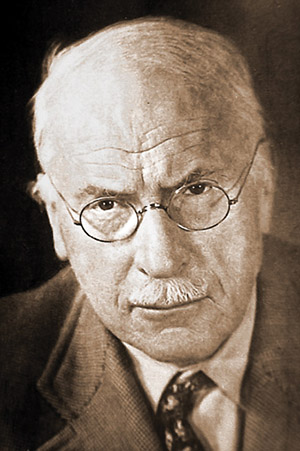
    Some readers may wonder what this theory may have to do with synchronicity, a concept that is often invoked when people attempt to understand such forms of divination as the Tarot or the I Ching. Synchronicity in this sense is a coinage of the Swiss psychologist C.G. Jung, who defines it as an “acausal connecting principle.” Jung gives a case in point: “The wife of one of my patients, a man in his fifties, once told me in conversation that, at the deaths of her mother and her grandmother, a number of birds gathered outside the windows of the death-chamber.” Such incidents are common: I can tell similar stories from my own family. For Jung, the connection between these events – the deaths and the appearance of the birds – is not causal; that is, the impending death didn’t cause the birds to come or vice versa. But they are related by what he calls a “meaningful cross-connection.”

    Swiss psychologist C.G. Jung defined synchronicity as an “acausal connecting principle.”

    Jung’s attempt to characterise synchronicity as “acausal” appears misguided. He seems to be veering toward a connection that is not acausal in the strict sense; rather it implies a hidden factor lying outside the physical dimension that, so to speak, “caused” both the death and the appearances of the birds. Jung locates this hidden cause in the realm of the archetypes, the psychic forces that underlie the human mind and possibly reality itself. For Jung, “meaningful coincidences… seem to have an archetypal foundation.”

    Granting this much, we are left with a theory very close to the esoteric doctrine sketched out above. Jung’s archetypal world is more or less identical to the realm of Yetzirah, of forms and images. As such it can give rise to two phenomena that have no obvious causal relation (such as a death and the sudden appearance of a flock of birds) and yet seem to be meaningfully connected. Jung made much of being scientific, and to a great degree he was – but his conclusions in many respects resemble those of the old occultists.

    Another esoteric theory about seeing the future is based on the highly relative nature of time. Time, as Immanuel Kant argued, is one of the basic structural components of our experience, but it is a construct that our minds have imposed on reality. As hard as it may be to imagine, time has no absolute reality in itself (a conclusion to which contemporary physics may also point). If so, it may be possible to step past the portals of our own experiential framework and take some measure of events in the future.

    Many spiritual traditions speak of a higher Self, a part of our being that stands over and above our selves as we customarily experience them. The names for this Self are countless. The ancient Greeks called it the daimon; the ancient Romans, the genius; to esoteric Christians, it is the kingdom of heaven or the Christ within. This Self stands outside the personality, the conscious self, and outside the categories of conscious experience, including time. It perceives our lives, not as a sequence of events and experiences that span several decades, but as a whole. It can see a lifetime as we can see a snapshot.

    A famous instance of the workings of this Self appears in the Crito of Plato. Socrates, under sentence of execution, is urged to escape by his rich friend Crito, who assures him that he has bribed the guards and can furnish the necessary getaway. Socrates refuses, saying he has had a dream in which a beautiful woman dressed in white appeared to him and recited a line from the Iliad: “On the third day to the fertile land of Phthia thou shalt come.” Socrates takes this as a message from his daimon, the guiding spirit that has directed him all throughout his life, that he will be executed in three days, and that he should not try to escape. One way of understanding such episodes is that the daimon, the Self, can see the whole of one’s life from start to finish, apart from the linearity of time, and can give appropriate guidance. 

    Note, however, that, as in Socrates’ case, these glimpses usually have to do with one’s deeper destiny. It’s not a question of picking next week’s lottery number or finding hot stocks. While these are in principle no more unknowable than anything else, one soon discovers that the higher Self is not terribly interested in them – and anyway, how helpful would the knowledge really be? I know directly of only one case where someone got this kind of information. A friend of my father’s once told me he had been awakened in the middle of the night by the image of some numbers that flashed in his mind. It struck him that they might be lottery numbers and that he should buy a ticket using them, but he never got around to it. Of course they were the winning numbers that week.

    If these visions of the future are ultimately personal in nature – that is, they are meant to give guidance or inspiration to an individual at crucial junctures in his or her life – what then of prophecy in a grander sense, the prophecy that purports to open a window onto the fates of nations and peoples, and of humanity itself?

    As a whole, the record of prophecy in predicting the future on a large scale is not good. We can see this as far back as the start of the apocalyptic genre in Palestine in the second century B.C.E. At the time the Jewish nation was living under the rule of the Hellenistic Seleucid monarchs, who were heirs to a portion of the empire of Alexander the Great. In 167 B.C.E., one of these rulers, Antiochus IV Ephiphanes, embarked on a program of forced Hellenisation of the Jews. He set up an altar, and perhaps an image, of Olympian Zeus in the Temple in Jerusalem.

    The Jews’ outrage is reflected in the Book of Daniel, one of the earliest apocalyptic writings and the only one to make its way into the Hebrew Bible. Written during the ensuing revolt against the Seleucids, this book sets up Daniel, a legendary sage of the sixth century B.C.E., as the mouthpiece of a prophecy that would “foretell” events 400 years after his time. (The technical term for this practice is vaticinium ex eventu, “prediction after the event.”) Daniel refers to “a vile person” – Antiochus – who will “pollute the sanctuary of strength, and shall take away the daily sacrifice, and… shall place the abomination that maketh desolate” (Dan. 11:21, 31) – that is, the idol in the Temple (cf. 1 Macc. 1:54). The archangel Michael will come to Israel’s rescue; the dead will be raised, “some to everlasting life, and some to shame and everlasting contempt.” Antiochus “shall come to his end, and none shall help him” (Dan. 11:45, 12:1-2).

    What happened in fact was that the Jews rose up under the priestly clan of the Maccabees and won back their religious liberties as well as a measure of political autonomy, but this obviously did not begin the end of time. Antiochus did not perish as a result of any obvious divine wrath: he died of natural causes.

    Despite its failure as a prophecy, the Book of Daniel established the basic structure of the apocalyptic genre. Arising during some crisis, such texts predict that this event is the harbinger of the imminent Day of Judgment, when justice will be done and evildoers will receive their due. The Book of Revelation at the end of the New Testament follows this pattern. Most scholars agree that it is a response to the Roman persecution of Christians in the first century C.E. Here, too, the prophecy, taken as literal truth, is not accurate. The book seems to foretell the end of the Roman Empire and the coming of a millennial kingdom, but this did not happen. The Roman Empire did come to an end (close to 400 years after Revelation was written), but it did not usher in the reign of God on Earth. Rather it initiated a period of collapse and chaos that came to be known as the Dark Ages.

    Even the prophecies of Jesus as related in the Gospels do not seem trustworthy. If we are to read what scholars call his Apocalyptic Discourse literally (three versions of it appear in Matthew 24, Mark 13, and Luke 21), we would conclude that he was predicting the destruction of the Temple by the Romans, to be followed by the return of the Son of God. This did not happen either. The Romans did sack the Temple, in 70 C.E., about a generation after Jesus’s lifetime, but Jesus did not return and did not establish a millennial kingdom. Things went on much as they had (except for the Jews, who were expelled from Palestine).

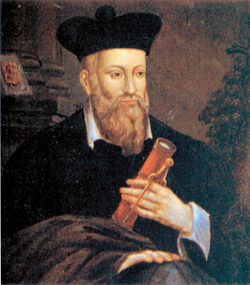
    Michel de Nostra-dame (1503-1556), better known as Nostradamus.

    I’m using instances from the Bible as it is by far the best-known work of prophecy, but if we were to look at prophecies from other sources, they would not look much better. The American trance medium Edgar Cayce foretold that much of California would be under water by 1972. Nostradamus predicted some kind of great manifestation in the sky for the seventh month of 1999, but the year 1999 had very little that was remarkable, much less cataclysmic, either in the seventh or in any other month. (For more on Nostradamus’s prophecies, see my new book The Essential Nostradamus.)

    How, then, can we reconcile the abysmal performance of prophecy as a whole with the esoteric theory that I’ve sketched out above? If we can know the future, why don’t we?

    The astral realm is a sea of images. We can think of it as containing every image and idea that every human being has ever thought and possibly will ever think. No sooner do we say this than we realise that this dimension must contain an enormous amount of psychic rubbish – the fears, dreads, and anxieties of humanity, most of which have nothing to do with reality past or present. This dimension is described most clearly in the spiritual text known as A Course in Miracles:

    The circle of fear lies just below the level the body sees, and seems to be the whole foundation on which the world is based. Here are all the illusions, all the twisted thoughts, all the insane attacks, the fury, the vengeance and betrayal that were made to keep the guilt in place, so that the world could rise from it and keep it hidden. Its shadow rises to the surface, enough to hold its most external manifestations in darkness, and to bring despair and loneliness to it and keep it joyless.

    Without going into the elaborate psychological system of the Course, I will simply point to the notion of the “circle of fear” – a zone of fears, hatreds, and anxieties that lie just below the surface of consciousness. This circle of fear is universal: each of us participates in its creation. Probably only the most enlightened human beings are entirely free from its effects. For the rest of us, it sits underneath our experience of reality like a water table. We all tap into it in our own ways.

    This fear is not “about” anything particular; it is not necessarily connected to anything real or substantial; it is simply a nameless, objectless anxiety that can attach itself to anything. It holds tremendous power over each of us precisely because we are usually unconscious of it. We imagine that our fears and anxieties are about something real and justified, but there is something suspect about this belief: no sooner does one anxiety disappear than another pops up to take its place. For many people, this anxiety can manifest in fears about their personal future or about society or humanity or the Earth; for others, it is displaced onto a fear of an imminent end of the world.

    Some say fear is a healthy and normal emotion, that without it we could not function in the world. So it may be under certain circumstances. If a man finds himself facing a wild animal, his fear will make him run away. But the kind of fear I am talking about is not healthy. It does not increase our chances for survival; instead it is weakening and debilitating. Much of mental dysfunction no doubt stems from too close a contact with this kind of fear.

    Saying this much explains the horrific imagery of so many prophecies, but what about the nice part? What about the beautiful dreams of a utopian future that is always just around the horizon? The explanation is the same. The Yetziratic or astral realm is known to esotericists as the zone of illusion. We can think of it as literally a bandwidth of fantasies and illusions that surround us on a psychic level. While many of these fantasies are negative, there are also many that are positive; they are the flip side of the circle of fear. The power of wishful thinking – which is very strong – can easily lead someone to put all these images together into a picture of the future that involves both terrible calamities (usually visited on one’s enemies) and ultimate salvation (for oneself and one’s own sect). Akiba Drumer’s prophecy in the concentration camp most likely falls into this category.

    Our age imagines itself to be more sophisticated than its predecessors, and yet the contemporary mind falls prey to many of the temptations of the past. Cataclysmic and millennialistic thinking is as much with us as ever. The religious-minded cast it in biblical images. The secular mindset translates it into visions of nuclear or environmental disaster. The problems posed by both nuclear power and environmental contamination are very great and should not be dismissed out of hand, but it is also well to separate them from unconscious apocalyptic expectations, which can erupt from the minds of supposedly rational scientists just as easily as they can from men wearing sandwich boards on streetcorners.

    Having said this much, we might want to compare prophecy with prediction of a more conventional kind, which has evolved into an academic discipline (or pseudodiscipline) known as futurology. Futurology makes no supernatural assumptions. It is based entirely on what is currently known. It takes current statistics – about population, economic growth, political trends, resource capacity – and extrapolates them into the future. That is its strength but also its weakness. Futurology can only make predictions on the basis of current trends, but one thing we know is that current trends never continue. There are shocks, dislocations, cataclysms. Conventional forecasters cannot predict these; their unpredictability is at the root of their nature.

    The apocalyptic prophet faces no such restrictions. He has no incentive to predict more of the same; who would pay attention to him then? So he is entirely happy to foretell all kinds of upheavals, natural and supernatural: the submerging of continents; the manifestation of extraterrestrials; the shifting of the Earth’s pole; the return of Jesus Christ. In a sense, he is right. Cataclysms do occur. But somehow they never occur in the way they were predicted.

    In the end, I personally would not base my plans for the future on any prophetic claims from any source. I can’t say that none of these prophecies will be fulfilled – that would be making a prophecy of my own – but to my mind they haven’t been proved reliable enough in the past to merit any serious attention now. Conventional futurology may offer some insights, but frequently it, too, better represents the analyst’s preconceptions than any reality that is likely to come.

    All this still leaves us with the possibility of a knowable future, whose seeds are present in the astral realm amidst all the fears and fantasies. How can we have contact with it? Trying to glimpse the future on a collective level is extremely tricky, often because it is something into which we as individuals are not supposed to stick our noses. Recently a friend of mine used the divinatory technique of horary astrology to ask a question about a national issue. Horary astrology, though not practiced or understood even by most astrologers, can produce quite striking insights for one who knows how to use it. In my friend’s case, the answer was quite sharp: “None of your business.”

    When we come to the personal future, the situation is different. I myself have often found that when I needed to be told of something that was going to happen to me, I was informed of it, usually through some form of inner perception, bidden or unbidden. I have not found divination methods like the Tarot or the I Ching to be particularly useful. Astrology, on the other hand, can have remarkable predictive value – provided one knows the system well enough to understand what the stars are saying.

    These are my conclusions from my own experience. Others may have different results; these matters are more individual than popular books like to let on. In the end, for me nothing has proved to be of as much value as a clear-sighted determination to see what was going on both inside and outside myself, to look upon my own hopes and fears and wishes, and to bring them face to face to what Freud called “the reality principle.” A.R. Orage, a pupil of the great spiritual teacher G.I. Gurdjieff, defined conscience in a rather unusual way as “the simultaneous experience of all one’s emotions.” If one can do this with a naked and even remorseless honesty (and it is considerably harder than it may first seem), one is far more likely to have an accurate basis for future action than if one follows the advice of any number of psychics or prophets. 

    [alert type=”general” dismiss=”no”]This article was published in New Dawn 100.[/alert]

    [alert type=”success” dismiss=”no”]If you appreciate this article, please consider subscribing to help maintain this website.[/alert]

    © New Dawn Magazine and the respective author.
    For our reproduction notice, click here.
  • The Post West World: How China & Russia Are Shaping Tomorrow

    The Post West World: How China & Russia Are Shaping Tomorrow

    From New Dawn Special Issue Vol 12 No 1 (Feb 2018)

    In 1904 the British geographer Halford Mackinder addressed the Royal Geographical Society in London.1 He advanced a geopolitical theory that is now known as the “Heartland Theory.” Mackinder divided the world into three major regions: the “World Island” comprising the continents of Africa, Asia and Europe; the “Offshore Islands,” which included the UK and Japan; and the “Outlying Islands” which included the North and South American continents and Australia.

    At the centre of the World Island was an entity he described as the “Heartland”; an arc stretching from the Volga (in modern Russia) to the Yangtze in China. That is the region we now describe as Eurasia. After World War I, Mackinder summarised his theory in these terms:

    Who rules East Europe commands the Heartland.

    Who rules the Heartland commands the World Island

    Who rules the World Island commands the world.2

    The world was a very different place in 1904. Russia was a feudal monarchy; China was weakened by colonial occupation and exploitation; most of Africa was ruled by European colonial powers; and the US was yet to emerge as a significant military and geopolitical force.

    The hundred years following Mackinder’s presentation to the Royal Society saw unprecedented change in the world’s geopolitical structure. Two world wars, the Bolshevik Revolution, the decolonisation of Africa and Asia, the relative collapse of European colonial imperial power and the rise of an aggressively expansionist United States, saw a fundamental shift of power in the period from 1914 to 1990. As will be argued, the explanatory power of Mackinder’s vision is an effective tool for understanding contemporary geopolitical structures and the likely course of future events.

    The seeds of US foreign policy, which dominated the past several decades, were planted in the 19th century. In 1853 a US naval convoy under the command of Commodore Matthew Perry sailed into Tokyo Harbour. On behalf of the US government, Perry demanded a treaty with Japan that would allow trade between Japan and the United States. Japan had no navy and was forced to acquiesce to the American demands. A treaty was duly signed permitting trade and opening Japanese ports to US merchant shipping.

    A similar exercise in gunboat diplomacy occurred in 1866 when the USS General Sherman steamed up the Taedong River in an attempt to open up Korea to trade by force. The attempt was repelled, but a US flotilla returned five years later and attacked Korean forts. Although the Americans withdrew after inflicting heavy losses, traditional Korean society was weakened, and within a few years Korea had been forced into unequal treaties with Japan, the US, Britain, Russia and other countries.3 

    World War II wrought devastating losses on the two powers that might have been able to challenge American post-war hegemony – Russia and China. They each lost between 25 and 30 million people fighting off the German and Japanese invasions respectively.

    The scale of these losses is scarcely acknowledged in the Western popular media. Countless films, books and TV programs inculcate images of a heroic British empire fighting alone until Pearl Harbor in December 1941 brought the Americans into the war. The British element of the war was then fought in a long slog across North Africa, Italy, and then with the Americans in Italy and the D Day landings of June 1944. The Americans fought the Japanese across the Pacific, island by island.

    Total British casualties in World War II (civilian and military) were 451,000. American losses, primarily military, were 419,000. Total Canadian, Australian and New Zealand casualties were 106,000. To put those numbers into perspective, Russia had 1.1 million casualties in the Battle of Stalingrad (July 1942 to January 1943) alone.

    China’s war with Japan began in 1937 and continued until August 1945. Accurate statistics are hard to come by, but the number of civilian deaths is variously placed at between 10 and 25 million, and up to four million military deaths.4 Clearly, once again, these deaths dwarf Western-allied casualties, but there is even less acknowledgment in the Western media than is the case with Russia.

    These figures are mentioned because the scale of those casualties has exerted a dominant influence over Russian and Chinese strategic thinking ever since. It is impossible to understand modern geopolitical structures without appreciating how both governments are driven to avoiding being placed in that position again.

    Full Spectrum Dominance

    The end of World War II did not see the end of military action by the West. The US, in particular, has sought to exercise a level of control over nations around the world that is best encapsulated in the doctrine of “full spectrum dominance.”5 By this, it was intended that the US would be without military parallel at sea, on the land, in the air, and in cyberspace. 

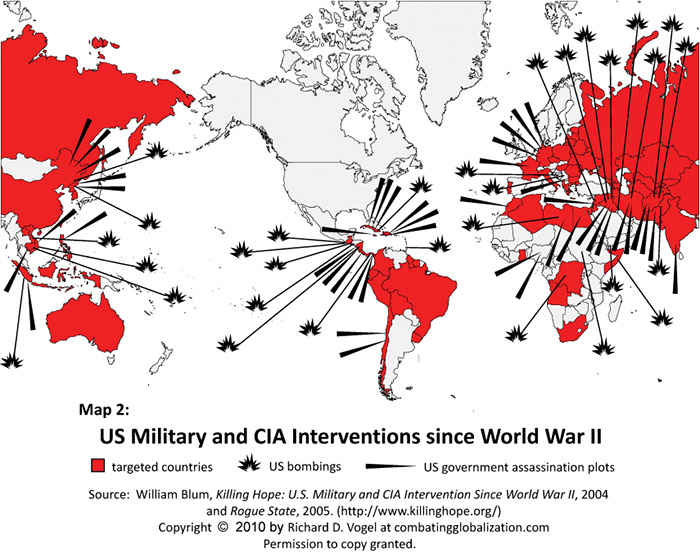
    In pursuit of that doctrine, the US has since World War II invaded, occupied, bombed and/or overthrown the governments of 70 nations, killing between 30 and 40 million people in the process.6

    Its troops currently occupy or are fighting in, either directly or through proxies, Afghanistan, Iraq, Somalia, Sudan, Syria and Yemen. None of these wars have any legitimacy in international law, the defiance of which is a dominant characteristic of US foreign policy.7 In addition to direct military intervention, the US is a major sponsor of hybrid warfare on every continent.8

    The experiences of Russia and China have been very different. After World War II, the Soviet Union occupied those Eastern European countries it had captured from German occupation or who were part of the Axis coalition during the war. Western propaganda persistently portrayed that occupation as evidence of a Soviet desire to conquer the world. It is more accurately viewed as the creation of buffer states to insulate Russia from further Western invasions. That invasion history did not begin with the German invasion in July 1941.9

    The agreement between Presidents Mikhail Gorbachev and Bush the Elder that allowed the reunification of the two parts of Germany had been accompanied by a pledge by the Americans that NATO would “not advance one inch further east.”10 The subsequent history of Eastern Europe is a perfect illustration of why American assurances are not to be trusted. 

    Despite there now being foreign troops stationed on Russia’s borders, the installation of missile systems directed at Russia, and the regular carrying out of large-scale military exercises, again clearly aimed at Russia, it is Russia that is portrayed in the Western media as being aggressive. It is this capacity for hypocrisy and doublethink that again is a prominent feature of Western policy.

    In 1990 the Soviet Union collapsed. That collapse was followed by a disastrous decade under Yeltsin when Russia’s resources were plundered by homegrown oligarchs and Western corporations. Life expectancy fell and living standards plummeted. Yeltsin was succeeded by Vladimir Putin who has achieved a miraculous turnaround in Russia’s fortunes.11 It is this, more than any other single factor, which probably explains the constant demonisation of Putin by the American media.12

    China’s Experience

    China’s post-war history was also disruptive. After the Japanese had been defeated, the civil war resumed, concluding with victory under Mao in 1949. The Korean War commenced the following year, and it was US General McArthur’s threat to cross the Yalu River that brought China into that war. We now know that the Americans seriously considered the use nuclear weapons on China.13

    That war was barely concluded when Mao embarked on his Great Leap Forward (da yue jin) program (1958–1962). Although intended to transform China from an agrarian to an industrial society, it was in many respects a disaster. Widespread famine was one consequence. Internal party criticism of Mao by people such as Deng Xiaoping led to Mao’s marginalisation within the Party. The Cultural Revolution (1966–1976) was aimed at restoring Mao’s control, but it had disastrous consequences on China’s economy and society. It was Deng Xiaoping, who led China from 1978 until 1989 with his “four Modernisations” first proposed by Zhou Enlai in 1963, that began the transformation of China into its current status. Those four pillars of modernisation were agriculture, industry, defence, and science and technology.

    Ever since China has sustained a level of development unparalleled anywhere in the world. More than half a billion people have been lifted out of poverty into the middle class. Huge infrastructure developments including more high-speed rail than the rest of the world combined, and the development of centres of technological excellence as in the transformation of Shenzhen from a small fishing village to a world-class centre of excellence in less than 40 years. Shenzhen is one of China’s Special Economic Zones where investment strategies owe more to entrepreneurial capitalism than they do to the outmoded depiction of China as a communist nation.

    On the basis of parity purchasing power, China’s economy is now larger than that of the United States, and the disparity grows wider every day. The United States did not have anything as dramatic as the collapse of the Soviet Union or the transformation of China, but it did have a geopolitical event, the consequences of which have profoundly affected the direction of US policy, and contributed to a rebalancing of the world’s geopolitical structure.

    The Geopolitical Event of 9/11

    That event was the attacks within the United States of 11 September 2001 (‘9/11’). These attacks were attributed to 19 Muslim hijackers directed by Osama bin Laden from his cave in Afghanistan. It is outside the scope of this article to discuss those events and the official explanation that rapidly emerged and was reinforced by the Report of the 9/11 Commission.14 Suffice to say for present purposes that the US government’s version of events is completely unsupported by the scientific evidence, as has been conclusively demonstrated in a number of excellent studies.15

    The significance of 9/11 for present purposes is that it provided the springboard for a sustained attack by the US and its coalition allies, including Australia, upon a number of countries. Afghanistan was the first victim; falsely attributed with harbouring the alleged mastermind of 9/11, bin Laden, and refusing to hand him over for “justice.”16 We now know, for example, that the decision to invade Afghanistan was made in July 2001. The real motives had nothing to do with bin Laden.17 

    Afghanistan was followed by Iraq in 2003, Libya in 2011 and Syria in 2014, among many other targets. They all had a common theme. All were based upon lies of one sort or another, and none of them had any basis in international law. All were justified in the name of being part of a “war on terror” which, apart from being singularly ironic coming as it does from the world’s greatest perpetrator of terror by a considerable margin,18 provided a perfect smokescreen for the erosion of civil liberties,19 the exploitation of foreign resources,20 the massive expansion of the military budget, and a continued expansion of what was already a worldwide network of bases.21

    The invasions of Afghanistan and Iraq may have seemed successful at first, but the longer the occupation continued (now 16 and 14 years respectively) the greater the destruction of those societies and the greater the internal resistance. On the positive side, there has been a growing realisation, including in Australia, that there has to be a better alternative to the relentless destruction and plundering that has marked the “American century.”

    What has transpired, especially in the past 16 years, is a geopolitical realignment that has given fresh impetus to Mackinder’s prescient view of the emergence of the “Heartland,” that is, Eurasia, as the focus and dynamic centre for the 21st century.

    A Coming Together in the Heartland

    To facilitate this development a number of organisations and agreements were established. Most of these, until very recently, have flown under the radar of the Western media. The first, chronologically, was the Eurasian Economic Community, a grouping of six former members of the Soviet Union, with Russia the largest and most economically and politically important member. This evolved into the Eurasian Economic Union (EAEU) in 2010 and currently incorporates the six original members. Its focus is on interregional trade and investment and moving toward a common currency zone.

    More recently, the EAEU has begun forming links outside the original six with other trading groups and also individual countries. Of these, the most significant is Turkey, which in 2017 began negotiating a free trade deal with the EAEU and talking about possible future membership. This is significant as it marks the final disenchantment of Turkey with the European Union with whom it has been holding negotiations for the past 30 years without obvious progress.

    Turkey is also a member of NATO and its reorientation to the East has further ramifications. Turkey recently signed a multibillion-dollar deal with Russia to be supplied with the Russian S400 antimissile defence system, much to the consternation of the Americans whose own missile defence system is inferior to the Russian version, but who have always seen NATO as providing a captive market for its own military sales.

    In March 2017 the prime ministers of Iran and the six EAEU member states signed cooperation agreements, and further integration is anticipated. Russia has also sold its S400 system to Iran and Iran has provided an airbase for the Russian military at Hamadan, located 47 km from the city of the same name.

    Iran is also a key link in the North South Transportation Corridor (NSTC) that links India with Russia via Iran and Azerbaijan. To facilitate the NSTC and the other developments discussed below, Iran is investing in major infrastructure projects with the financial and technical assistance of Russia and China. This notably includes upgraded rail linkages.

    Iran also made a recent agreement with Qatar to jointly develop the huge natural gas resources in the Persian Gulf, known as the South Pars field in Iran and the North Dome field in Qatar. This agreement was a major factor in the recent threats, demands and economic moves against Qatar made by Saudi Arabia, from which the Saudis have largely resiled.

    Another important factor in the Saudi-Qatar dispute was the decision by Qatar to sell $50 billion of natural gas to China, the key fact being that the deal was not denominated in US dollars. It was an important milestone in the disappearance of the petrodollar,22 a fact of more significance to the US on whose behalf Saudi Arabia was undoubtedly acting.

    Another grouping is BRICS, an acronym coined in 2001 by Jim O’Neill, chairman of Goldman Sachs, with the initials representing the (original) four countries of Brazil, Russia, India and China. The ‘S’ represents South Africa that did not join until 2010. The first meeting of the BRIC nations was in 2006 at Foreign Minister level with the first full-scale conference in Yekaterinburg, Russia, in June 2009.

    BRICS is significant not only for its membership, representing as it does a significant percentage of the world’s population and GDP, and not only its geographical spread, but also that it is taking increasing steps to separate itself from the US and European dominated World Bank and IMF by setting up its own development bank. It is also instrumental in setting up CHIPS, an alternative to SWIFT, the interbank trading system that has been used as a tool in imposing financial sanctions on, among others, Iran and Russia. Those sanctions have been a form of financial imperialism.

    Arguably the most important grouping, however, is the Shanghai Cooperation Organisation (SCO), the details and significance of which is almost entirely absent from most Western media analysis. The SCO was formed in 2001 and initially comprised China and Russia, plus Kazakhstan, Kyrgyzstan, Tajikistan and Uzbekistan. It had six Observer States and six Dialogue Partners.

    Iran is an Observer State and has applied for full membership, with the strong backing of Russia. It is likely to become a full member in 2018.

    Two other Observer States that achieved full membership in July 2017 were India and Pakistan. Egypt and Syria have applied for Observer State status, and another Observer State, Turkey, has applied for full membership. Afghanistan is another Observer State, although its attempts to have a fuller level of cooperation with other SCO members and benefit from infrastructure investment have been blocked by the US. President Trump has openly stated that Afghanistan’s significant natural resources, estimated by the US geological survey in 2012 at up to $3 trillion, should be exploited by the US.23 Significantly, that resource includes more than one million tonnes of rare earth elements, a key component of modern technology.24

    The US is unlikely to relinquish its role in Afghanistan any time soon as, apart from its mineral wealth, it provides 93% of the world’s heroin25 of which the US is a significant beneficiary,26 and has military bases designed to form part of its containment policy of China. [As of April 2021, the US announced it was finally going to withdraw from Afghanistan. We are yet to learn the exact details of what that really means including how many US private contractors stay on and how many troops remain to protect military bases.]

    The US has also, since at least Operation Cyclone in the 1970s, used Afghanistan as a springboard for the infiltration of Muslim extremists into Iran, China and Central Asia as part of its hybrid warfare role in the destabilisation of those countries.27

    Perhaps, needless to add, none of these facts form part of the Western narrative with regard to Afghanistan, particularly in Australia, that prefers to perpetuate its myth of being there in a “training and advisory role.”28 A role that after 16 years has been spectacularly unsuccessful in achieving anything approaching positive results.

    Since 2004 the SCO has also had a security cooperation component (CSTO) aimed at coordinating responses by SCO members to security (including terrorist) threats to member states. Other areas of focus include combatting drug trafficking, organised crime and religious extremism. Unlike NATO, SCO does not need an external enemy to justify its existence. Covering a quarter of the world’s population and three-fifths of the Eurasian landmass, it again provides an alternative model for tackling common problems, many of which are generated outside its borders.

    The reader will have noted that BRICS, the EAEU, the NSTC and the SCO have considerable overlapping memberships. While that is not without its problems, as with the recent confrontation of India and China over the Donglang region of the China-Bhutan border and elsewhere on their common frontier, these problems have thus far been resolved without resort to war. Dialogue has been the key, a factor notably lacking with the US in, for example, Afghanistan and Korea.29

    One Belt One Road: Will Australia Ruin its Continued Prosperity?

    Towering over all these developments, however, is a project that is transforming Eurasia in its scope and ambition. It is the world’s largest infrastructure project by a significant margin. Publicly announced by China’s President Xi Jinping in 2014, it’s been variously described as the New Silk Roads, One Belt One Road (Yi dai Yi lu) (Xi’s original description) and its current nomenclature, the Belt and Road Initiative (BRI). I have previously discussed this project in New Dawn30 and will not repeat that here.

    As may be seen from the various graphic representations, the BRI has both land and maritime components, linking Eurasia with Africa and South America. Its land component is a combination of road, high-speed rail and fibre optic communications. One illustration is the China-Pakistan Economic Corridor (CPEC), itself a $50 billion project linking China with the Pakistan port of Gwadar.

    Among its many virtues, CPEC bypasses the narrow Strait of Malacca through which more than 80% of China’s oil imports currently pass. Australia regularly joins with the US in an exercise, Operation Talisman Sabre, that practices blockading the Malacca Strait. Unsurprisingly, this is seen as an unfriendly act by China. Australian governments seem not to appreciate that the countries (now more than 60) that have joined the BRI also produce the same commodities that Australia has grown rich on selling to China over the past 50 years. If Australia persists in its unfriendly acts towards China, for example by joining with the Americans in hostility toward China over Korea and the South China Sea, then the day will surely come when China switches its preferred suppliers from Australia to friendlier nations reachable by high speed rail.31

    Looked at from a broader perspective, American military misadventures since the 2001 invasion of Afghanistan may be seen as symptomatic of the disintegration and collapse of the American empire. Ironically, this has been recognised by the Pentagon itself, as detailed in a recent study.32 Their proposed “solution,” however, is more of the same policies that led to America’s decline in the first place: more surveillance; more strategic manipulation of perception (i.e. propaganda); and more military interventions. The contrast with President Xi’s “win-win” philosophy and his geopolitical analysis outlined in Switzerland in 201733 could not be greater.

    How likely is it that the US empire will collapse and be replaced by, at the very least, a multi-polar alternative world? The American historian Alfred McCoy in his latest book34 sees the decline in the US’s ability to retain global hegemony as attributable to a number of factors. One important factor is the decline in US educational standards resulting from years of underinvestment as crucial spending was subsumed to the needs of an ever more bloated military establishment. The F35 debacle is a classic metaphor for all that is wrong with military investment and an inability to produce a quality product.

    Another factor that McCoy identifies is the dollar’s disappearance as the world’s sole reserve currency; a status that has enabled the US to live beyond its means for decades. The de-dollarisation of the world is growing rapidly, not least as noted above in the Eurasian trading blocs and separate deals (e.g. Qatar) outside those blocs. Trading is increasingly in local currencies like the Ruble or Yuan, or through constructs such as Special Drawing Rights or gold based convertible notes.35 China’s increasing economic dominance will accelerate that trend.

    The new world order that is emerging is fulfilling Mackinder’s vision of 114 years ago. For the reasons set out above, Russia and China are central to that realignment. Ironically, the Russophobia of America’s Deep State and their fundamental inability to grasp the nature and the consequences of the re-emergence of Chinese power has expedited the strategic relationship between these two powers.

    The US will undoubtedly continue to strive to undermine the Eurasian partnership through a range of manoeuvres. Its provocative conduct in the South China Sea; its bellicosity to North Korea; its trouble making between China and India; its conduct in Ukraine and elsewhere in Eastern Europe; and its continuing addiction to hybrid warfare show no signs of abating.

    The fundamental fact of the 21st century is that the US no longer has the power to impose its will as it was largely able to do from 1945 to 2000. A new model, centred on the World Island Heartland is taking shape, with China and Russia as its major drivers. 

    [alert type=”general” dismiss=”no”]This article was published in New Dawn Special Issue Vol 12 No 1.[/alert]

    [alert type=”success” dismiss=”no”]If you appreciate this article, please consider subscribing to help maintain this website.[/alert]

    Footnotes

    1. H. Mackinder, The Geographical Journal, April 1904 

    2. Mackinder, Democratic Ideals and Reality: A Study in the Politics of Reconstruction(1919)

    3. P. Duus, The Abacus and the Sword: the Japanese Penetration of Korea, University of California Press (1998); Y-L Chung, Korea Under Siege 1876-1945, OUP (2005)

    4. R Rummel, China’s Bloody Century, Transaction (1991)

    5. US Department of Defence, Joint vision 2020 (2000)

    6. W. Blum, Killing Hope (2008); Blum, America’s Deadliest Export: Democracy (2014); Blum, Rogue State (rev.ed) (2016)

    7. C. Doebbler, American Hypocrisy in International Law, www.counterpunch.org, 6 March 2014

    8. A. Korybko, Hybrid Wars, www.orientalreview.org August 2015

    9. D. Stone, A Military History of Russia, Greenwood Publishing (2006)

    10. U. Klussmann et al, Did the West Break its Promise to Moscow, www.spiegel.de 26 November 2009

    11. S. Djankov, Russia’s Economy Under Putin, www.piie.com, September 2015

    12. S. Cohen, Stop the Pointless Demonization of Putin, www.thenation.com, 7 May 2012

    13. C. Posey, How the Korean War almost Went Nuclear, www.airspacemag.com July 2015; B. Guertzman, US Papers Tell of 1953 Policy to A-Bomb Korea, www.nytimes.com, 8 June 1984

    14. The 9/11 Commission Report, July 2004

    15. D. Griffin, Bush and Cheney: How they Ruined America and the World, Olive Branch Press, 2017

    16. Ibid.

    17. J. O’Neill, Trump and Afghanistan: A Hidden Agenda, www.journal-neo.org, 25 August 2017

    18. Blum, op cit. N6

    19. T. Stephens, Civil Liberties After September 11, www.
    counterpunch.org, 11 July 2003

    20. M. Chossudovsky, The War is Worth Waging: Afghanistan’s Vast Reserves of Minerals & Natural Gas, www.globalresearch.ca, 22 August 2017

    21. D. Vine, The US Probably has more Bases than any Other People, Nation or empire in History, www.thenation.com, 14 September 2015

    22. J. O’Neill, The Demise of the Petrodollar and the New Multipolar World, www.independentaustralia.net, 4 July 2017

    23. M. Landler & J. Risen, Trump finds Reason for the US to Remain in Afghanistan: Minerals, www.nytimes.com, 25 July 2017

    24. www.newsecuritybeat.org, 27 July 2017

    25. UN Office of Drugs and Crime, World Drug Report 2016

    26. P. Scott, Drugs, Oil and War: The US in Afghanistan, Colombia and Indochina, Rowman & Littlefield (2004)

    27. Z. Brzezinski, The Grand Chessboard, Basic Books (1998); S. Coll, Ghost Wars, Penguin (2004)

    28. J. O’Neill, Myths, Legends and Lies: Australia’s Policy in Afghanistan, www.gumshoenews.com, 26 July 2017

    29. US Skips Out on Afghan-Taliban Conference in Moscow, www.dw.com, 14 April 2017

    30. J. O’Neill, The New Silk Roads: The Quiet Revolution, New Dawn155 (Mar-Apr 2016)

    31. B. Habib & V. Faulkner, The Belt and Road Initiative, www.theconversation.com, 17 May 2017

    32. US Army War College, At Our Own Peril (2017)

    33. President Xi’s Opening Plenary Speech at Davos, www.
    weforum.org, 17 January 2017.

    34. A. McCoy, In the Shadow of the American Century: The Rise and Decline of US Global Power, Haymarket Books (2017)

    35. K. Rapoza, Much to the Dismay of China Haters the Yuan Goes Global on October 1, www.forbes.com, 30 September 2016; JN. Willie, Gold Trade Note sighted, www.goldseekers.com, 16 February 2017

    © New Dawn Magazine and the respective author.
    For our reproduction notice, click here.