New Dawn – World's Most Unusual Magazine

Category: Articles

  • Spiritual Powers & Teachings of Precious Stones: The Missing Link

    Spiritual Powers & Teachings of Precious Stones: The Missing Link

    From New Dawn 161 (Mar-Apr 2017)

    The mineral kingdom has fascinated humankind since its earliest days. Archaeological evidence suggests that early man used stone tools and revered unusual rocks and minerals, sometimes even adorning themselves with it. The lives of humankind, both ancient and modern, are inextricably linked with the mineral kingdom; we live on a planet comprised of hard rock and stone, and many a modern convenience makes use of the gifts of rocks and minerals in order to support comfort, health, and innovation. Apart from the utilitarian applications of mineral substances, we continue to use crystals, minerals, and gemstones for adornment and to confer spiritual gifts as well.

    These spiritual powers embodied by stones are owed to the innate perfection of minerals. Minerals are defined as highly ordered, solid substances with regular compositions of inorganic origins. All minerals are innately crystalline, thanks to their high degrees of order and symmetry. Rocks, on the other hand, are aggregates of one or more minerals, and are thusly crystalline on one level or another. (There are notable exceptions to this crystallinity. Materials such as opal and obsidian lack the order required to be crystals; they are thus referred to as mineraloids.) Although ancient people may not have been able to effectively analyse the structure, composition, and other characteristics of precious stones, they still knew them to be special, if not somehow sacred. 

    Through the ages different cultures employed rocks, gems, and crystals as tools for healing, talismans to draw positive influences into their lives, and as material embodiments of Divine Law. The messages embodied in the crystal kingdom resonate with us at a very primal level, and the modern art of crystal healing is carrying on this deep attraction to crystals even today. The average book on crystals and gemstones will enumerate the properties of stones, perhaps even hundreds of stones, but they seldom dig deep enough to really show how and why crystals work. This missing link has always been what drives me forward in my research.

    Archetypal Roles of Rocks

    Aztec mirror fashioned from obsidian and used by English alchemist John Dee. 

    Wherever humankind encountered precious and common gems alike, these sacred stones are usually described with startlingly similar themes. For example, obsidian, a natural glass formed when lava cools too quickly for crystals to grow, is found in regions worldwide where there has been volcanic activity. Ancient people prized this mysterious stone for its predisposition to break into sharp edges, as well as for its characteristic reflective properties. As a result, no matter where or when obsidian has been used by ancient people, the same archetypal roles are evidenced in the archaeological record. Cutting edges, such as knives, spear points, and arrowheads abound, while obsidian mirrors have been unearthed in locations as far apart as the Anatolian peninsula and Central America.
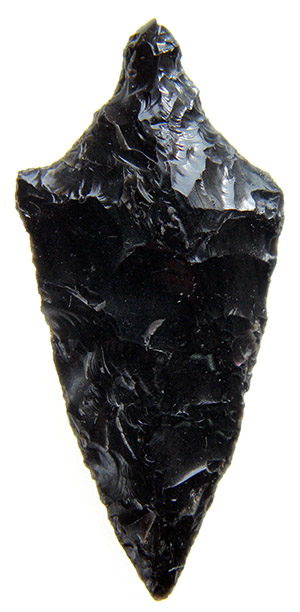
    Obsidian spear point.

    The widespread, cross-cultural uses of gemstones hint at their spiritual teachings and healing qualities. Continuing with the example of obsidian, its sharp, incisive quality translates to being very protective; it is an ideal stone for the spiritual warrior. More importantly, it helps the mind to become as deft as the sharpest blade, for it engenders the ability to cut through illusion, fear, and doubt. The reflective nature of the obsidian mirror reminds spiritual seekers that we must confront the world for what it truly is. This can mean honestly looking into the recesses of the mind where the shadow self lies in wait. The obsidian mirror also awakens the inner vision to look beyond material reality. In doing so we are brought closer to the threshold between ordinary consciousness and the abode of all things spiritual. At this liminal zone is where we receive spiritual initiation; only then can we cross the boundary between worlds.

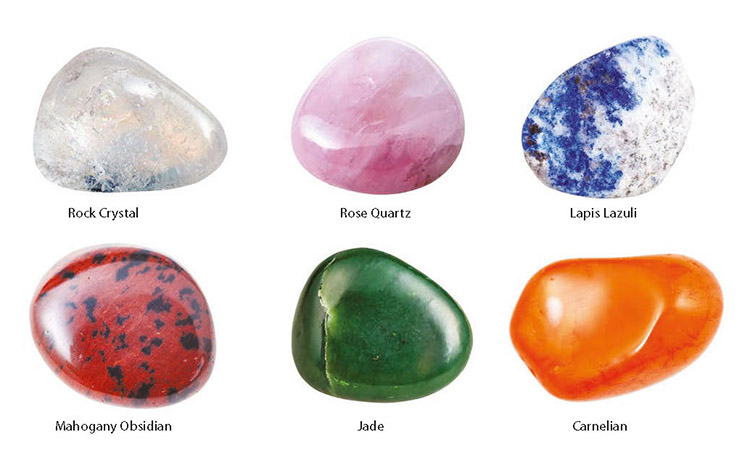
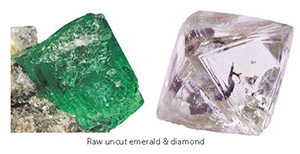
    Obsidian confers these teachings through the symbolic language of form and application through the aeons that it has co-created with humanity. In a similar fashion, many crystals relay their teachings throughout the world’s history. It would be difficult to overlook the common themes that disparate cultures attributed to stones such as rock crystal, jade, carnelian, diamond, or emerald. The mineral kingdom speaks a language so fundamental that it transcends the boundaries of language, age, and culture. Only by cross-examining the same stone from many perspectives can we really see just how universal its gifts truly are.

    Our ancestors learned to speak the language of stone through trial-and-error. The curative powers of gems may have been reliant upon the doctrine of signatures, wherein the appearance or other quality of a substance bears a resemblance to a condition or body part that it is thought to heal. Myths surrounding rocks and minerals also provide much insight into the lessons and healing qualities embodied within the mineral kingdom. Today we can take the best and most consistent of these messages and apply them to our personal relationship with our most beloved crystals.
    How Crystals Work

    The world in which we live is awash in vibration. Living tissue, inanimate rocks, and everything in-between produces its own signature energy field. These fields are comprised of electromagnetism, and they expand in all directions at once at the speed of light. Some of these energy fields are well documented by science, including the electric and magnetic fields produced by the heart and brain (which are the primary measurable elements of the human aura), as well as the deleterious energy fields produced by some electronics and other modern conveniences. However, every single substance, action, or thought has its own energy field. These fields are carriers of information, and they interact with one another whenever they meet.

    Crystals are special among material substances because of their high degrees of order, symmetry, and coherency. A crystal is defined as a solid substance with regular composition and a symmetrical arrangement of its constituent molecules, atoms, or ions. This internal framework is known as a crystal lattice. The lattice, and therefore its components, is responsible for the physical, chemical, and optical properties of a crystal. The subtle energies are naturally determined by the crystal lattice, too.

    Crystals of all sorts are capable of reflecting, refracting, transducing (or translating), storing/retrieving, receiving, transmitting, amplifying, and cohering energy or information. Each of these is a function of the crystal’s inner, geometrical arrangement. Because crystalline materials, such as rocks and gemstones, exhibit such high degrees of perfection, they produce orderly energy fields. This means that rocks and minerals function as solid-state oscillators, as their crystalline structure and unique compositions enable them to resonate at an exact range of frequencies, thereby broadcasting this energy wherever they are placed.
    The human energy field is subject to change according to mood, diet, environment, mental and emotional habits, and even the people around you. Our energies fluctuate measurable, and I would wager that our subtle energies – those that cannot yet be measured by science – change even more readily. This means that our state of being can be easily influenced by all those factors to which you are exposed. Crystals, however, only ever broadcast their fundamental signals. For this reason, they can entrain our own energy fields through the regularity and consistency of their own energies.

    This means that wearing, carrying, or even being near your favourite crystals promotes positive changes at the immaterial, energetic level. These changes can first be experienced as subtle shifts in mood, perception, or as changes on the spiritual or intuitive level of our makeup. Wherever there are positive changes at these levels, there are also shifts in our biochemistry. Positive psychological states rely upon different hormones than negative ones; changes in our biochemistry have demonstrable effects on our physiological process, too. Thus, crystals and gemstones offer help on virtually every level of our being.

    In order to understand the depth of a stone’s gifts, one would need to learn how to interpret its composition, morphology, formation process, and other properties. These properties often run much deeper than others, such as colour, which accounts for only a small fraction of a stone’s net effects. In sifting through these properties, you’ll find that silica has an expansive quality, where iron is grounding; you will also experience chrome-bearing gems as uplifting to the heart, while manganese-rich minerals might soothe emotional trauma. Minerals belonging to the cubic crystal system are earthy and stabilising, whereas triclinic crystals can help you reinvent yourself and see from an entirely new perspective.

    Although few crystal teachers, healers, and writers have explored this topic at any great length to date, you can look for connections as you experience the energy of crystals firsthand. In my college years, I spent several years working at an earth science museum; it housed an impressive mineral collection, and the director allowed me unprecedented access to its specimens for personal study. At that stage in my life, I had been collecting rocks and minerals for over a decade, but my primary interest in them was spiritual. Although I’ve always been a science fan, this opportunity granted me a deeper understanding of mineral science.

    I began to notice that when I read books on crystal healing, authors from radically different backgrounds would often describe gemstones with similar structures or compositions with strikingly similar language. I noticed trends among these decidedly unscientific works, and it helped me uncover that there are patterns presented by the composition, geometry, and other properties intrinsic to each stone. Even when we look into the distant past, ancient people often attribute properties to stones that can be explained by these scientific properties, even though they had no way of determining where the stones were from or what their crystal system might have looked like.
    Moving Towards a Deeper Relationship with Stones

    Although there is a rich history of using gemstones and a model to explain the mechanisms for their use based on their scientific properties, the honest truth is that there is no one-size-fits-all list of crystal properties. Even two specimens of the same mineral species will have minor variations on a microscopic level, just as no two snowflakes are alike. The same holds true for human beings. We are all undergoing our own growth processes, each one complete with its own obstacles, lessons, and rewards. It is simply unrealistic to expect that you will have identical results from using lapis lazuli as I will. Although there are outcomes that are more or less universal, we may experience these gifts in radically different ways. Even though the overall energy of lapis remains unchanged, our energy field may implement the positive changes catalysed by this gemstone in unique ways.

    At the end of the day, the very best way to learn about what your stones offer is to sit back in a quiet place and explore them. Get to know them visually as you inspect them from every angle. Feel their surfaces and sense the weight of the stone in your hands. Close your eyes and tune in to the energy of your chosen crystal, and you may be surprised at what you find. Perhaps your inner awareness will speak to you in visual symbols that can be translated to understand the gifts your stone offers. Maybe you’ll be subtly guided to place the stone somewhere on your body. Whatever comes, don’t judge it; simply allow it to unfold.

    Only by getting to know your stones on a personal level can you really grow and benefit from the mysterious energies they emit. For this reason, when I wrote The Seven Archetypal Stones, I chose to focus on a select few gemstones. As I spent time getting to know those seven rocks and minerals, I allowed the spiritual experiences I had with them guide and shape my research into their archetypal roles and teachings. The stones themselves inspired the exercises contained within the book; each one helps you apply the stone’s energy in order to ground the spiritual lessons in a practical way.

    Ultimately, all spiritual practice should have a practical outcome. Crystal healing should be no different. Only by forging a deeper relationship with these crystalline beings can we truly apply the lessons that they have in store for us. Learning that herderite supports your spiritual evolution or that chrysoprase heals a broken heart might point you towards finding the right stone for your life. However, unless you can truly learn to appreciate the stone’s effects and apply them in a pragmatic way, they are nothing more than idealised definitions. By forging a relationship with your crystals you invite them to revitalise and reorganise your very being. By connecting more deeply to the mineral kingdom, we allow the stones of the earth to change the fabric of our lives for the better.

    Nicholas Pearson’s The Seven Archetypal Stones: Their Spiritual Powers and Teachings is available from all good bookstores.

    [alert type=”general” dismiss=”no”]This article was published in New Dawn 161.[/alert]

    [alert type=”success” dismiss=”no”]If you appreciate this article, please consider subscribing to help maintain this website.[/alert]

    © New Dawn Magazine and the respective author.
    For our reproduction notice, click here.
  • Biopower in the Age of the Great Reset

    Biopower in the Age of the Great Reset

    From New Dawn 183 (Nov-Dec 2020)

    A reconfiguration of power has been in process for some time and is now rapidly emerging as part of a medical-political-economic institutionalised complex that I will refer to as biopower. 

    The current lockdowns and quarantine travel measures are only a foretaste of what is to come once new regimes of biopower become fully established. Biopower is now knocking on our doors and gaining entry and dominion over the whole domain of personal sovereignty. 

    What we are seeing unfold – after the ‘trigger’ of COVID-19 was pulled – is a radical alteration of legal and power narratives that control and categorise life and death. With the “pandemic landscape” now being formed,1 we are witness to a post-sovereign world where biopolitics legitimises a network of socialising regimes from biocapitalism to biosecurity. 

    The World Economic Forum’s Klaus Schwab says these “COVID times” are “our defining moment” and that “we will be dealing with its fallout for years, and many things will change forever.” In the pages of his book The Great Reset, he brazenly declares the coming “economic disruption of monumental proportions, creating a dangerous and volatile period on multiple fronts – politically, socially, geopolitically – raising deep concerns about the environment and also extending the reach of technology into our lives.” We are told that life for many of us is “unravelling at alarming speed.”2 

    I contend that we shall see newly defined, and pervasively employed, forms of biopower in the age of this ‘Great Reset’.

    A Post-Sovereign Era

    The French philosopher and social theorist Michel Foucault is credited with coining the term biopower in his work in the mid-to-late 1970s. Foucault traced the development and application of power to the rise of “disciplinary” measures and institutions set up by governments to regulate populations in the eighteenth, nineteenth, and early twentieth centuries.

    An array of “corrective institutions” started spreading across the social field – asylums, prisons, factories, schools, hospitals, universities, etc. – each serving to inculcate a mode of human conduct and consciousness. 

    Above these socialising institutions stood the Sovereign (the Monarch) which later became the State. According to Foucault, the classical privilege of sovereign power is the “right to take life or let live.” It was the model codified in classical politics and remained essentially unaltered during the transition from traditional sovereign power (monarchical) to modern State power. 

    “For Foucault, biopower is a technology of power for managing humans in large groups; the distinctive quality of this political technology is that it allows for the control of entire populations,” notes the scholar Mark Kelly.3 

    Foucault’s description of disciplinary power as exercised by institutions is again relevant to what is happening now. We see a pervasive, fluid, almost free-floating, administration of power – on the State and global levels – to control societies in the post-sovereign era. Welcome to a new age of biopower.

    Producing what Foucault called “docile bodies” (the masses of people) – the basic unit of disciplinary power – is now the purview of modern States. The modern human condition is such that the individual is not the object but rather the subject of biopower. 

    Biopower

    Within the context of a biological threat, the subsequent ‘pandemic’ is establishing a social-political engineered construct – the ‘new normal’ – for human society. This overly hyped ‘new normal’ is being enacted by a series of measures granting biopower authority over the individual and the collective body. In short, biopower exercises control over the administration of life.

    Biopower over the human body means the State has the legal right to place individuals under surveillance and punish by incarceration. We have seen this in numerous cases as in the 28-year-old Perth woman who broke the Western Australian quarantine rules and was handed a six-month prison sentence.4 The form of biopower exercised under the pandemic ‘state of emergency’ is concerned with mapping all of life – social, political, and economic. 

    Biopower has come into existence today via the response to the COVID-19 pandemic. It utilises a language of ‘health risks’ for intervention and intrusion in private lives. This includes jurisdiction to enter a person’s house without permission to forcibly remove people either considered a health risk or who are failing to ‘obey’ quarantine measures. 

    Dr Michael Ryan, Executive Director of the World Health Organization (WHO) Health Emergencies Program, on 30 March 2020 stated that authorities might have to enter people’s homes to remove suspected family members to an “isolated designated facility.” Such measures have now been enacted into law. For example, under the New Zealand state of emergency, police officers now have the power to enter homes to enforce self-isolation rules.5 In a similar move, the Australian State of Victoria deployed 2,000 military personnel to enforce what they refer to as “virus-control measures.”6 

    In an ironic twist, citizens opposing such draconian measures are negatively labelled “sovereign citizens.” The term sovereign individual used to mean the moral or natural right of a person to have bodily integrity and maintain exclusive control of their own body and life. Here we see a deliberate twisting of language to support and enforce the regimes of biopower. 

    Biopower refers to a range of strategies backed by “specialised medical knowledge” and adopted by the State along with a supporting network of institutions, agencies, and non-State actors. One disturbing trend is the empowerment of private military actors and ‘authorised officers’ to enforce new public health directions.7 In the future, these officers might be given police-level powers to impose State directives such as searching homes and cars without a warrant (for example, such officers could detain and imprison someone they believe represents a health ‘threat’). This emerging state of affairs has already led to many reports of overreach and overzealous policing (especially in the State of Victoria, Australia). 

    Continuous localised lockdowns, track-and-trace impositions, constant surveillance, the loss of the right to protest, and other such measures are now becoming established in the ‘new normal’ regime of biopower exercised by States across the world. These forms of control and regulation are without precedent and serve to increasingly affect the psychological well-being of citizens. 

    Biopower is also seen in the regulation of social life (mask-wearing, social distancing, ‘dobbing in’ and reporting violations of rules, etc.), and the self-policing of the mental landscape (right thinking, self-censorship). 

    Severe financial penalties are yet another way biopower will intrude into everyday life, for example, the new coronavirus rules enacted in the Australian State of Victoria in early October. ‘Illegal gatherings’ such as bringing people into a household above the limit set by the State, or more than five people meeting in a local park (even from the same family), can attract a $5,000 fine per breach. 

    Biopolitics

    The new field of biopolitics binds the individual and the collective into a strengthening mix of the technological, the political, the legal, and the financial. Modern biopolitics ties into the global restructuring of power (‘The Great Reset’ – covered in New Dawn Special Issue Vol 14 No 5) and new regimes rendered into existence in response to the pandemic emergency. 

    We are being lined up for a twenty-first century medical totalitarianism. Biopower and biopolitics, along with biocapital and biosecurity, combining to create a totalised and singular form of power. 

    In terms of collective humanity, the biopoliticising of the human race is developing new forms of population management. To be clear, the biopolitical agenda is the control of societies and the rendering of human life as “docile bodies” that do not resist intervention. To frame human life under a regime of total biopolitical power, State authorities seek to render conscious life under its rule. What we ‘think’ and who we are in the physical sense is being brought under State jurisdiction. The State automatically assumes the power to dictate our thinking from birth. 

    From this perspective, we see why the current regime of censorship (in particular, across the internet where information can freely circulate across the globe) and curtailing of free speech has been so dominant and heavy-handed. Total power requires total domination – external control over an individual’s body and their thought processes – mental (conditioning, programming) and biological (health treatment, vaccination). 

    The biopolitical agenda incorporates non-State bodies to enact strategies – most notably philanthropic organisations, social pressure groups, NGOs, and assorted globalist organisations. This field extends from annual health check-ups, health insurance, and preventive medicine to incorporate pandemic measures of random testing, forced isolation, and vaccination. 

    All human life is ‘biopoliticised’. There is no refuge from its reach when both the exterior and interior life of an individual falls under the jurisdiction of total State control. A person’s body, health, and happiness – even their right as an ‘individual sovereign self’ – is to be subsumed into the realm of authoritarian biopower. 

    Biopower and biopolitics is a dangerous mix of narratives based upon a monopoly of so-called ‘scientific knowledge’. In this sense, biopolitics harnesses ‘science’ and an array of ‘experts’ to formulate ‘evidence’ that justifies policymaking. 

    Biocapitalism

    Non-State bodies play a key role in the biopolitical agenda, especially with the rise of the pharmaceutical industry, global healthcare strategies, and tech giants. The field of biocapitalism covers the strategies and policies that develop and maximise profits for pharmaceutical markets and other healthcare interventions. 

    With COVID-19, the administration of biocapital policies upon the majority of the world’s population is technologically feasible in ways not possible in the past. This should give every thinking person cause for concern. It is now urgent that we develop conceptual tools for critically analysing how biopolitics will play out in relation to biocapital. This is the merger of health (and health economics) with the data of surveillance capitalism. 

    With the accelerating expansion of datasets – data tracing and tracking – we see a burgeoning rise of surveillance capitalism.8 Contact-tracing applications developed by the likes of Google and Apple are gathering colossal amounts of new data, adding to the escalating data supply chains. Healthcare and biomedical data collection is doubling every 12-14 months. Back in 2012, a Ponemon Institute study found that the healthcare industry utilised 30% of all the digital data storage in the world.9 Imagine how much that figure has increased in the intervening years. The move to digital has been rapid over the past decade; for example, Electronic Healthcare Records (EHR) adoption rates for US hospitals rose from 10 to 90% in that time.10 The range of medical wearables on the market is extensive and growing. It is now possible to monitor most aspects of an individual’s health. It is estimated that remote patient monitoring and health trackers will generate $20 billion annually by 2023.11 

    Analysis of digital healthcare data and its use for predictive analytics is profoundly changing the way patients are managed as health wearables are part of patients’ treatment plans. Patient health data will heavily influence the business models of the biocapital market. This data will only increase from the track & trace apps that most governments are pushing upon their populations. 

    Biocapitalism is firmly embedded in the portfolio expansion of the tech giants. A cursory glance at the list of projects owned or invested in by the FAMGA (Facebook, Amazon, Microsoft, Google and Apple) tech giants reveals an unsettling array of healthcare projects – medical patient databases, hospital research data, pharmacy retail collaborations, AI research facilities, and insurance. In autumn 2018, Google’s parent company Alphabet invested $375 million in Oscar Health, a ‘next-generation’ health insurance company.12 According to CEO Oscar Health, it aims to manage people’s health care from a reinvented and rebuilt technological perspective.13

    Biocapitalism is wedded to biopolitics. In March 2020, the UK government’s Secretary of State for Health and Social Care, Matt Hancock, signed an agreement to provide legal backing for the National Health Service (NHS) which sets aside its duty of confidentiality in data-sharing arrangements. The so-called ‘Covid-19 Purpose’ is a new data-sharing agreement for NHS organisations and general medical practitioners (GPs) to share patient data with any organisation they choose, as long as it’s for the purpose of “fighting the coronavirus outbreak.”14

    The pharmaceutical industry is also clearly at the forefront of biocapitalism. Big Pharma will make huge profits from the current pandemic situation, especially from vaccination. Big Pharma’s warning to governments that they need substantial upfront funding – if vaccines and testing are to be rolled out faster – has been heeded.15 Most COVID-19 vaccine manufacturing costs are expected to be offset by government funding. One example is pharmaceutical giant AstraZeneca which reached agreement with Europe’s Inclusive Vaccines Alliance (IVA) to supply up to 400 million doses of their COVID-19 vaccine. AstraZeneca also completed similar agreements with the UK, US, the Coalition for Epidemic Preparedness Innovations, and Gavi the Vaccine Alliance, for 700 million doses. The Australian government, which is aiming for a 95% vaccination rate, has secured 85 million doses of a vaccine (34 million from AstraZeneca and 51 million from CSL, Queensland), although only having a population of 25 million. AstraZeneca has agreed on a license with the Serum Institute of India for the supply of an additional one billion doses. This is one company out of many, and this is likely the first vaccine out of many more to come. 

    In a 2020 report,16 public ‘health expert’ Tony Fauci and epidemiologist David Morens claimed that humanity has “entered a pandemic era.” The report states that the current pandemic is only the first of more to come and we are likely to see an accelerating rate of future outbreaks in the years ahead.17 What this indicates is that the future of vaccine rollouts must be secured alongside a continuation of emergency powers. 

    A consequence of lockdowns is the huge economic bombshell for struggling business. Many businesses, particularly in the middle-to-small scale, are on the cusp of collapse, or have folded. Larger players are likely to seek State financial intervention. Some major corporate enterprises – especially if they are seen as providing critical supplies or services – might come under the control of the State. A trajectory that mimics China’s State control of the commercial sector. 

    The changing biopolitical arena of the 21st century, with its biocapitalist economic agenda, implies a rising need for biosecurity.

    Biosecurity

    It is no surprise that State institutions are determined to preserve a monopoly over the use of force to ensure biosecurity of the population. 

    On 18March 2020, the Governor-General of Australia declared that a ‘human biosecurity emergency’ existed. This declaration gave the Minister for Health unprecedented power to issue any requirement or direction under the Biosecurity Act 2015. 

    For example, during the human biosecurity emergency period, the Health Minister may issue any direction to any person and determine any requirement the State considers is necessary to prevent or control the spread of COVID-19 in Australia. Each and all individuals must comply with the emergency requirements. Any person found engaging in conduct that “contravenes a requirement or a direction” can face a maximum penalty of imprisonment for five years and/or a fine of 300 penalty units ($63,000).18 

    These new powers under the Biosecurity Act 2015 were quickly put into effect. In July, 3,000 people living in public housing tower blocks in Melbourne were confined to a police-guard lockdown without prior warning. Food parcels were left on doorsteps for the most vulnerable tenants. 

    In the new biosecurity regime, no-one is granted liberty unless they succumb to the new rules of ‘immunity’ jurisdiction, likely to include an ‘immunity passport’. This will create reconfigured spaces of mobility and access in which travel, public and social events, and State services, may be closed to those who, without verified biosecure immunity, are persona non grata. 

    Travel within nations and across international boundaries will become possible only through a highly regulated architecture of surveillance and on-body tracking. If a person does not submit live bio-data, travel is likely to be disallowed or highly curtailed. The early signs of this exercise of biosecurity is already emerging in States such as Singapore which is tagging citizens for bio-surveillance.19

    The danger is these draconian strategies silence and stifle life for people, including basic rights to free speech and protest. The threat and fear of being ‘cut off’ or punished for noncompliance place us on course for an unhealthy relationship with power. Biosecurity measures become the instruments of a biopowered authoritarian dictatorship operating through the façade of health and safety. Human biological life is merged with the physical-digital structures of State biopower.

    What is a Human Life? 

    We move perilously toward a future in which, in the words of one CEO, “Humans are biohazards, machines are not.”20 The citizen is subjected to external authority in ways never before possible. Humans are targeted as objects – or ‘units’ – to be controlled, both our bodies and minds – the new colonies to be conquered. 

    Does this mean that the only way to escape is renouncing one’s citizenship – to be a ‘non-citizen’? Could stateless places exist in the contemporary world? Will this trigger the rise of new people’s ‘republics’? In light of recent events, we are compelled to ask – what is an authentic human? Is it possible to live authentically when subjected to the external power regimes of authority that deny a person individual sovereignty? 

    We should recognise there exists the ‘biopower’ of the human collective that stands in opposition to top-down State control. As individuals, we have our very real human power. 

    Biopolitics is fast being used to turn us into the “docile bodies” for the ‘Great Reset’ agenda and its technocratic future. It is not an overstatement that the future of humanity is on the table. How the next years unfold will determine not only the direction of our human future but also, importantly, the physical and mental environment of thathuman future.

    It seems many have forgotten the Hippocratic oath that states: “Neither will I administer a poison to anybody when asked to do so, nor will I suggest such a course.” The politics of life (and death) are being usurped by an agenda that shows little, if no, human compassion and fellowship. 

    State biopower is concerned with power over life rather than life itself. The World Economic Forum’s envisioned ‘Great Reset’ speaks of renewal and recalibration, but this technology-dominated era is voiding the core qualities of being human in a living, organic world. We face the central question: What does being human mean to me? Hopefully from the answer to this question we can each find our own source of power and inner strength. 

    [alert type=”general” dismiss=”no”]This article was published in New Dawn 183.[/alert]

    [alert type=”success” dismiss=”no”]If you appreciate this article, please consider subscribing to help maintain this website.[/alert]

    Footnotes

    1. See my article “Post-Pandemic Landscapes” in New Dawn 182
    2. See www.weforum.org/agenda/2020/07/covid19-this-is-how-to-get-the-great-reset-right & COVID-19: The Great Reset by Klaus Schwab & Thierry Malleret
    3. https://iep.utm.edu/fouc-pol/
    4. www.abc.net.au/news/2020-08-25/woman-who-snuck-into-wa-on-truck-handed-six-month-jail-sentence/12592832
    5. www.stuff.co.nz/national/health/coronavirus/120577868/coronavirus-police-can-now-enter-homes-to-look-for-people-gathering
    6. www.telegraph.co.uk/news/2020/08/04/australian-state-impose-hefty-fines-compel-covid-19-isolation/
    7. www.theguardian.com/australia-news/2020/sep/21/overreach-and-overzealous-concerns-over-victorias-proposed-new-police-powers
    8. For a detailed description, see The Age of Surveillance Capitalism by Shoshana Zuboff.
    9. www.forbes.com/sites/stewartsouthey/2019/06/30/medical-wearables-surveillance-capitalism-and-global-health/ 
    10. Ibid
    11. Ibid
    12. Oscar Health was founded in 2012 by Joshua Kushner, the brother of Jared Kushner, President Trump’s son-in-law.
    13. https://money.cnn.com/2018/08/14/technology/google-oscar-health-insurance/index.html
    14. www.computerweekly.com/feature/Surveillance-capitalism-in-the-age-of-Covid-19
    15. www.ft.com/content/000a129e-780e-11ea-bd25-7fd923850377
    16. www.cell.com/cell/fulltext/S0092-8674(20)31012-6#%20
    17. www.buzzfeednews.com/article/danvergano/more-coronavirus-pandemics-warning
    18. www.harrisonpublications.org/covid-19-plandemic-profit-fallout.html
    19. https://21stcenturywire.com/2020/09/23/bio-surveillance-singapore-issuing-bluetooth-tracking-tag-for-citizens/20. See my article “Post-Pandemic Landscapes” in New Dawn 182
    20. https://theintercept.com/2020/05/08/andrew-cuomo-eric-schmidt-coronavirus-tech-shock-doctrine/

    © New Dawn Magazine and the respective author.
    For our reproduction notice, click here.
  • Greatest Fake News Stories of All-Time

    Greatest Fake News Stories of All-Time

    From New Dawn 161 (Mar-Apr 2017)

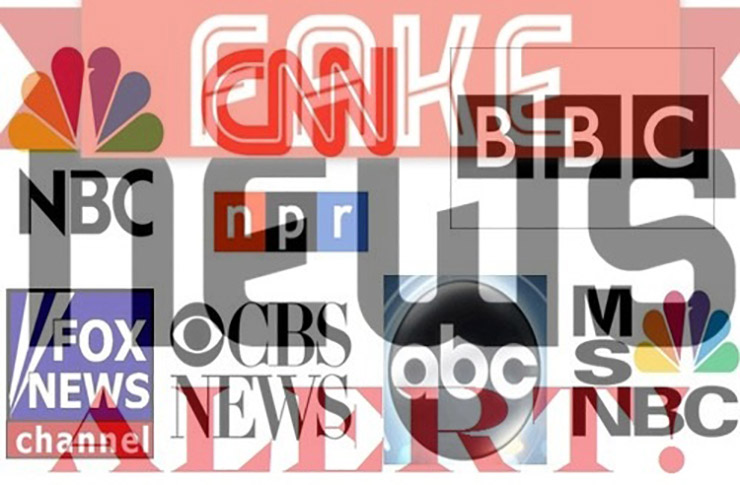
    Make no mistake about it: for decades, the government-media complex has been waging information warfare against the public and on behalf of powerful transnational corporate interests. 

    The latest fake news crisis is just another campaign in the information war. By throwing a variety of websites into one big basket and labelling everything with the derogatory term ‘fake news’, the political class and mainstream media are attempting to discredit alternative sources of information to regain some of the audience traffic they have lost over the last 15 years. They want to turn back the clock to a time when the establishment enjoyed a complete monopoly over news and information, and if there’s one thing that history proves time and time again – absolute power corrupts absolutely. 

    Here are a few examples of some of the greatest fake news scandals of all-time – brought to you by the mainstream media…

    In the winter of 1898, a terrible incident befell America when one of its flagship naval vessels, the USS Maine, sunk following an unexplained explosion in Havana harbour, Cuba. Afterwards some leading US newspapers took advantage of the confusion and emotive nature of the story. William Randolph Hearst’s New York Journal and its racy sister publication, the Evening Journal, as well as Joseph Pulitzer’s New York World, blamed the incident on Spanish saboteurs. Shortly afterwards, the US entered the Spanish-American War in order to capture Cuba, Puerto Rico, Guam and the Philippines. 

    The practice of over-reporting and embellishing a story to stir public outrage became known as yellow journalism – a badge proudly worn by Hearst at the time. Hearst was ahead of his time in believing media outlets should insert themselves into events in order to affect political outcomes on behalf of the government. One year earlier, in 1897, Hearst’s New York World opined the doctrine of “journalism of action” which meant a newspaper should inject itself into public life in order to “fitly render any public service within its power.”1 Are things really much different today?

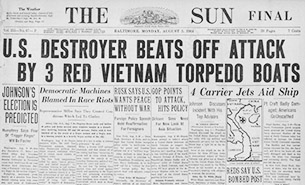
    On 4 August 1964, a joint US Navy patrol ran into bad weather off the coast of Vietnam, causing problems with US radar and sonar. This happened at a time of heightened tensions in the region with US national security on red alert. Amid the confusion, some US agent or official – either in the CIA, the NSA or the Pentagon national security structure – circulated a false report that US Navy vessels and planes were under attack from North Vietnamese patrol attack boats in international waters in the Gulf of Tonkin. The next day, US President Lyndon B. Johnson appeared on national television to announce his intent to retaliate against North Vietnamese targets, stating: “Repeated acts of violence against the armed forces of the United States must be met not only with alert defense, but with positive reply. The reply is being given as I speak to you tonight.”2 The infamous event came to be known as the ‘Gulf of Tonkin Incident’. Despite the fact of obvious discrepancies in the government’s account of events, the mainstream media accepted the government’s fake story without question. With the media providing public relations backing, Washington took the next step and declared war on Vietnam, albeit on false pretences. This was the beginning a 10 year-long bloody conflict which saw 55,000 US servicemen killed, 250,000 injured and maimed, along with over 1 million Vietnamese killed.

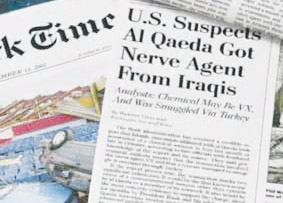
    In March 2003, on the eve of the Iraq War, US and UK government officials managed to convince their respective mainstream media cadres that Iraq’s Saddam Hussein was concealing massive stockpiles of chemical weapons which came to be known as “Weapons of Mass Destruction.” Despite repeated assurances by UN weapons inspectors and on-the-ground US weapons experts that these WMDs were nowhere to be found, both US President George W. Bush and UK Prime Minister Tony Blair had made up their minds Saddam was hiding vast stores of deadly munitions, and therefore a US-led invasion was a fait accompli. With no proof or actual evidence, the press went along with it all because they were “very confident” about the “intelligence.” The White House dispatched Secretary of State Colin Powell to the United Nations where he regurgitated a made-up story about Saddam Hussein’s deadly mobile anthrax labs, aka “The Winnebagos of Death.”3 Yes, it sounded completely crazy to millions of intelligent, normal people at the time, and yet it was good enough for the mainstream media circa 2002-2003. Aside from CNN, ABC, and NBC’s complete allegiance to the government’s fraudulent war effort, America’s alleged ‘papers of record’, The New York Times and The Washington Post, helped by republishing government-issued fictional accounts. One ‘journalist’ in particular, Judith Miller from The New York Times, managed to dupe the public by citing ‘sources’ like disgraced Iraqi dissident Ahmed Chalabi, who fed the US intelligence community false information about Iraq’s supposed stockpiles of WMDs. The Times later admitted that many of Miller’s stories were false. Still, the damage was already done. The result of this government-media campaign of actual fake news was 1 million dead Iraqis, thousands of dead US servicemen, tens of thousands wounded and maimed, along with trillions of US taxpayer funds spent – an open bill which continues to this day.

    In 2011, after working behind the scenes helping to organise, arm and equip militant Jihadi fighters and rebel operatives in Libya, the Obama Administration led by then Secretary of State Hillary Clinton desperately needed an excuse to ground the Libyan Air Force in order that NATO-backed Jihadi fighters on the ground could successfully overthrow the government of Colonel Muammar Qadhafi. The most direct route to achieve air superiority would be to implement a No Fly Zone over Libya. But with the public relations scars still fresh from the Iraq debacle, Barack Obama and France’s Nicolas Sarkozy knew that a No Fly Zone needed broad international support and therefore had to be authorised by the United Nations. In order to get the global public behind the campaign, a series of fake news stories were concocted by the US State Department and the mainstream media. The first one was the popular talking point that Qadhafi was using military fighter jets to “gun down peaceful protesters in the streets.” Despite no proof or evidence this actually happened, the media ran with it anyway. It became the keystone of the No Fly Zone campaign. Another outlandish tale had Qadhafi issuing Viagra to his troops so they could go out and commit “mass rape” against the women of Libya. This invented story was originally disseminated by Qatari government media outlet Al Jazeera,4 and specifically designed to help generate liberal/Left sympathy for a ‘humanitarian intervention’ by NATO. The key emissary to deliver this fake news to the public and give it credibility was none other than Obama’s former US ambassador to the UN, Susan Rice.5 As a result of these and other unfounded ‘human rights’ abuses trumpeted by the mainstream media, on 17 March 2011 UN Resolution 1973 was passed by the UN Security Council and the No Fly Zone was immediately transformed into a US-led mass-bombing campaign of Libya by NATO. It is estimated that 30,000 Libyans were killed through ‘rebel’ ground fighting, artillery and relentless NATO bombing which toppled the Libyan government, turning the country into a permanent failed state and terrorist haven. Looking back, it’s hard to believe so few questioned the made-up stories, but like Iraq and so many other wars, the media played their role in propelling the fake news. 

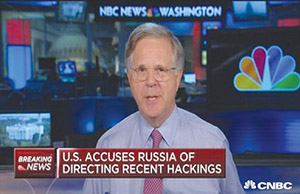
    In the heat of the 2016 US presidential election, a near repeat of the Iraq WMD scam unfolded, only this time the Obama Administration and the same ‘intelligence community’ generated an official conspiracy theory that Russia had somehow hacked into the US election systems, the Democratic National Committee (DNC), and Clinton campaign manager John Podesta’s emails. Backed by the Obama White House, Democratic candidate Hillary Clinton and the mainstream media pressed ahead on blaming Russia – not just for DNC leaks but also for hacking into US election systems in Arizona – despite the fact there was no evidence other than innuendo and pure speculation. The media’s coverage on this issue was deceptive from the onset. In a leading news release entitled “Russian hackers targeted Arizona election system,”6 we can see how after the cock-sure headline the first paragraph would sound definitive: “Hackers targeted voter registration systems in Illinois and Arizona, and the FBI alerted Arizona officials in June that Russians were behind the assault on the election system in that state.” Later in the article you can see the media walking back the charge to cover themselves for future inquiry: “It turned out that the hackers had not compromised the state system or even any county system. They had, however, stolen the username and password of a single election official in Gila County.” Here we see how the media and the ruling party use emotive headlines to sell an idea, even though there is nothing in the story at all. The ‘Russian Hack’ story was then expanded by the White House and the Democratic Party to claim that Russia actually intervened in the presidential election on behalf of Donald Trump, thus helping him defeat the odds-on favourite Hillary Clinton. To date, no actual evidence has been produced by the US government to back-up this incredible conspiracy theory. Interestingly, just as in 2003 with Iraq, the establishment enlisted the help of some of the same media operatives to advance the mainstream’s fake news story. This story has unnecessarily set back US-Russian relations to the Cold War era. In December 2016, a month after the election, Judith Miller (now with FOX News) suddenly appeared on the scene to give support to the White House and CIA’s shaky ‘Russian Hack’ narrative. “As Sen. McCain said, it’s pretty clear that the Russians did something,” said Miller. “And it’s pretty clear – according to 17 US intelligence agencies – what they did helped Donald Trump.”7 Another case of mainstream media déjà vu. 

    These are a few examples demonstrating what can, and will go wrong when the press blindly accepts the government narrative as gospel, allowing the mainstream media to push out and validate government-approved fake news to an unsuspecting public. 

    [alert type=”general” dismiss=”no”]This article was published in New Dawn 161.[/alert]

    [alert type=”success” dismiss=”no”]If you appreciate this article, please consider subscribing to help maintain this website.[/alert]

    Footnotes

    1.‘New Pulitzer Biography: An Opportunity Missed’ by W. Joseph Campbell, https://mediamythalert.wordpress.com/2010/01/25/new-pulitzer-biography-an-opportunity-missed/

    2. ‘The Truth About Tonkin’ by Lt Commander Pat Paterson, Naval History Magazine, Feb 2008, www.usni.org/magazines/naval
    history/2008-02/truth-about-tonkin

    3. ‘Winnebagos of Death’ by William Rivers Pitt, http://truth-out.org/archive/component/k2/item/58516:winnebagos-of-death

    4. ‘Rape used “as a weapon” in Libya’, Al Jazeera, 28 Mar 2011

    5. ‘Gaddafi “supplies troops with Viagra to encourage mass rape”, claims diplomat’ by Ewen MacAskill, 20 Apr 2011, The Guardian

    6. ‘Russian hackers targeted Arizona election system’ by Ellen Nakashima, 29 Aug 2016, The Washington Post

    7. ‘Fox contributor Judy Miller calls investigation of Russian hacking Obama’s “tar baby” gift to Trump’ by David Ferguson, 11 Dec 2016, www.rawstory.com

    © New Dawn Magazine and the respective author.
    For our reproduction notice, click here.
  • Rupert Sheldrake, the Most Controversial Scientist on Earth, Speaks Out

    Rupert Sheldrake, the Most Controversial Scientist on Earth, Speaks Out

    From New Dawn 169 (Jul-Aug 2018)

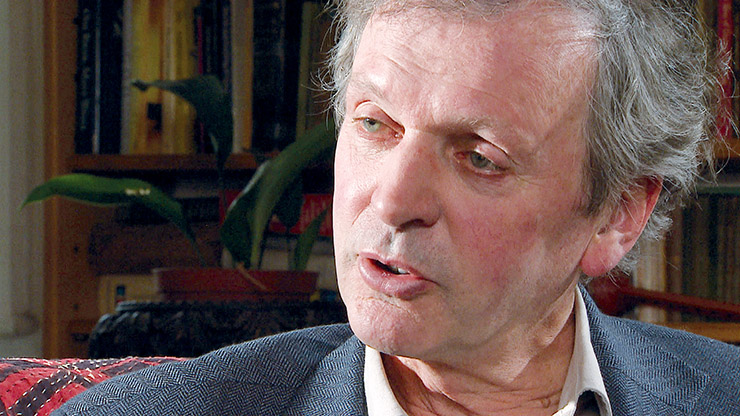
    Author and biologist Rupert Sheldrake has courted considerable controversy during his long career. Perhaps best known for his hypothesis of morphic resonance (that the so-called laws of nature are more like habits subject to change – see ‘What is Morphic Resonance’ in this issue of New Dawn), his tussles with the scientific establishment reveal a great deal about the dogmatism of mainstream science. Beginning with A New Science of Life – published in 1981 – his many books about science also include Dogs That Know When Their Owners Are Coming Home, The Sense of Being Stared At, and The Science Delusion, a powerful and compelling response to Richard Dawkins’ The God Delusion and materialist reductionist thinking in general. 

    Sheldrake’s work often explores what he refers to as ‘the extended mind’, the idea that the mind is more than just the brain and that it has the power to affect both the body, and by extension, the external environment. There is also evidence to suggest that one mind can affect another and that all minds are somehow linked. Our individual minds may even be individuated, seemingly-isolated nodes of a much greater mind, or overmind. We are the rain and the overmind is the sea.

    These ideas, far from being new, are in fact ancient and reflected in many belief systems, worldviews, and cosmologies whose origins reach into high antiquity, and perhaps beyond. Sheldrake is among a pioneering group of researchers from many fields and diverse disciplines working doggedly to deepen our understanding of the world around us and account for the many phenomena of both our inner and outer world which science alone simply cannot explain. 

    The response from mainstream science and mainstream media has thus far been, for the most part, wearily predictable. Derision and condescension have been combined with censorship and ad hominem attacks, although as already suggested, such tactics tell their own story, not least that the work of so-called ‘mavericks’ such as Sheldrake is becoming increasingly difficult to ridicule or ignore. 

    The scientific thought police famously blew a gasket and showed their true colours when Sheldrake addressed an event organised by TED spin-off TEDx. Recorded in 2013, Sheldrake’s talk – simply entitled The Science Delusion – proved enormously popular with viewers when the video was posted online. TED’s administrators quickly pulled the video1 from their official outlets claiming that Sheldrake’s presentation “crossed the line into pseudoscience,” contained “serious factual errors” and made “many misleading statements.” The ensuing public backlash, however, was swift and severe and TED found itself charged with attempting to shut-down freedom of speech.

    At the root of the problem here is a tendency or desire – perhaps even a need – among many mainstream scientists to deny their own subjective experience and inner life, the source of some of most profound human experiences possible with widely ignored implications. Despite the fact that many scientists claim to be religious, especially in the US, the official stance is that scientists should effectively all be materialist atheists – dispassionate, detached and thoroughly objective observers of a mechanistic and meaningless universe.

    “There are two or three different issues here,” says Sheldrake. “One is that of course scientists are people, but since the 19th century they’ve tried to pretend, at least in their writing style, that they’re not people. That’s why there was a fashion for a long time of the passive voice. Instead of saying, ‘I took a test tube’ they’d write ‘A test tube was taken’, as if all these things were just unfolding in front of the scientist who was a detached observer. I think now there’s the sociology of science, the philosophy of science, and science and technology studies have all shown what’s obvious, that scientists are people. They have prejudices, they have emotions, they have ambitions, they have fears, they have rivalries, and so on. So that’s just saying scientists are human, which is of course obvious. But it does rather dent this idea that scientists are completely objective, like automata, just simply registering facts. They’re not. They have ideas, they have hypotheses, they want things to be true, they tend to notice things that fit their beliefs more than those that don’t. And recently it’s turned out that a great deal of the scientific literature, at least half of published papers in those subjects, turn out not to be replicable because what scientists do is publish their best results which fit their theory best and tend to ignore the results that don’t.

    “All of this leads to a very subjective element to science,” explains Sheldrake. “But the point that I’m more concerned with in The Science Delusion is the kind of dogmatic framework which is not just in individual scientists, it’s institutionalised. The official doctrine of science at the moment is the materialist worldview. The doctrine that the only reality is matter, and that matter’s unconscious. So the universe is made up of unconscious matter which has no purpose or direction, and evolution is just blind chance and necessity. And this worldview, the materialist worldview, is not something that’s proved by science, it’s something assumed. It’s part of the standard paradigm or assumption on which science is currently based. A lot of scientists don’t actually believe it, but they usually have to pretend to believe it when they’re at work just to fit in and to make sure they get their career advancement and grants and that kind of thing.”

    The Dawkins Delusion

    Although Sheldrake has met self-styled nemesis Richard Dawkins several times (on one occasion Dawkins even visited Sheldrake’s home accompanied by a film crew), the pair have never really moved beyond superficial skirmishes to engage in a serious dialogue about the actual science of their respective worldviews.

    “Richard Dawkins personifies this kind of particularly dogmatic materialist atheist view,” says Sheldrake. “I know a lot of atheists and many of them are good people. So the problem isn’t that he’s an atheist, the problem is that he thinks other scientists ought to be atheists too, and that isn’t science, it’s his personal opinion. He is also a so-called sceptic. I would say a dogmatic sceptic. Scepticism is a good thing, but dogmatic scepticism is the intent to dismiss anything that doesn’t fit with your view of the world. And he has a view of the world, the materialist view, that the mind is nothing but the brain, it’s inside the head, and is nothing but the activity of the brain. Therefore things like telepathy, psychic phenomena, are impossible because if your mind is nothing but something happening in your brain then your thoughts can’t possibly affect someone hundreds of miles away as they seem to in telepathy.

    “[Dawkins] asked to come and interview me, or at least a TV company asked to come and interview me about my research on telepathy, particularly telephone telepathy on which I had done many experiments which show that people really can tell when someone’s about to ring them. In our tests they have four potential callers, one of them selected at random, and each test they have to guess who’s calling, and they score well above the chance level of 25%. Anyway, the TV company asked if they could come and interview me about this research. I had seen his previous Channel 4 programme called The Root of All Evil?2 which was against religion. It was extremely polemical, completely one-sided, and so I said to them, ‘No, I don’t really want to take part in another of his debunking programmes. It’s completely polemical, it’s one-sided. Why would I want to be part of that?’ And so they said, ‘Oh, well he’s changed, he’s really interested in the evidence. He wants to discuss the evidence with you’. I said, ‘Well, if that’s the case, he really wants to talk about evidence, then put that in writing, and I’ll agree to see him’. They put it in writing, came to see me and when he arrived it turned out he wasn’t in the slightest interested in the evidence. He wanted to trap me into saying something silly so he could put it on his programme and debunk me in my research. When I said to him, ‘Let’s just look at the evidence, that’s what we’ve met to do’, he said, ‘No, that’s not what we’re here for. I don’t want to discuss the evidence’. I said, ‘Well why not?’ He said, ‘It’s too difficult’ and I said, ‘Well most people can understand it’. He said, ‘It’d take too long’ and I said, ‘A few minutes’ and he said, ‘Anyway, it’s not what this programme’s about’. The director said ‘Cut!’ and the cameras stopped. I said, ‘Well what is it about? I made it very clear I didn’t want to be part of another low-grade debunking programme’, and he said, ‘It’s not a low-grade debunking programme, it’s a high-grade debunking programme’.

    “It turned out it was another of his polemics and I’d been severely misled. I had only agreed to see him on the grounds it was a discussion of evidence. And when he told me he wasn’t interested in the evidence, which I think is a very unscientific attitude, I said, ‘Well, then in that case you’re here under false pretences’, so I had to ask him and the TV crew to leave. It was a shame in a way. I’d be very happy to have a proper discussion with Richard Dawkins about evidence, but on the few occasions we’ve met and the possibility has been there, he’s refused to do it. I think in this example you see someone for whom science is a matter of prejudice and dogma, and that’s not the way science ought to be. It’s particularly bad in the sense that he was Professor for the Public Understanding of Science at Oxford. He was not a professor of biology. And I think this dogmatism gives completely the wrong view about science. It’s counterproductive.”

    Science and the Spiritual

    If we choose to oppose the religious, we should not become too religious in our opposition. Sheldrake’s latest book Science and Spiritual Practices: Reconnecting through Direct Experience explores the extent to which science itself can actually help validate the efficacy of various spiritual practices including meditation, rituals, singing and chanting, pilgrimage, and reconnecting with nature. Such practices generally make people happier and healthier, and the possible science behind this is now being researched as never before, despite mainstream antipathy. 

    We live in a world where stress, anxiety, and depression are on the increase, particularly in modern industrial nations, so any insights that can help us become more balanced and fulfilled, individually and collectively, are to be welcomed. 

    “If we have a worldview that says the universe is unconscious, meaningless, and when we die that’s it and there’s nothing beyond, and that all legends, all spiritual paths are pointless and illusory, it’s a deeply depressing point of view,” says Sheldrake. “It’s not surprising that in modern societies, which have become very secularised and influenced by this materialist worldview, that depression is the commonest form of mental illness. It’s endemic. And it’s an isolating view. We’re all isolated in the privacy of our skulls, we’re separated from each other. It’s a deeply depressing worldview that often goes hand in hand with a progressive worldview, the idea that we’re a part of progress driven by science and technology, which gives a somewhat more optimistic tinge to the whole thing. But I think without a sense of purpose and meaning in life, without a sense of connection to something bigger than ourselves, it’s difficult for humans to thrive. And that’s exactly why I think spiritual practices are so important.”

    Since the wholesale exportation of Eastern philosophies to the West began in earnest with the emergence of spiritual teachers and gurus such as Alan Watts, there have been many attempts at restoring balance in industrial societies suffering serious side-effects from the secularisation of almost every aspect of life. Many of the billions chasing happiness and fulfilment in hedonistic consumerism find only fleeting pleasure, discovering to their cost that the best things in life aren’t things. From Zen to the power of positive thinking, the response has varied from the re-introduction of religion by the back door to the re-branding of religious practices in pop-science books about everything from psychology to quantum physics.

    “Positive thinking is really a form of secularised prayer,” says Sheldrake. “In prayer – which I don’t discuss in this book, I discuss meditation which is a separate activity – in most religious traditions the prayer is, if it’s praying for something, petitionary prayer, and then it’s put in the context of the greater good. In the prototypic Christian prayer it says, ‘Thy kingdom come, Thy will be done’, and then it goes on to other things. But it’s put in the context of the kingdom of God coming first, the reign of peace, brotherhood and love. But positive thinking is mostly about getting something for yourself, success in love and business. It’s not based on the idea the power is coming from God, it’s coming from one’s own mind. So in that sense it’s a reduced form of prayer. I think that it can work, it can have effects. We know that the mind affects the body, and this is the basis of the placebo effect. In the chapter in my book on pilgrimage, I talk about some of the benefits, the healing effects of pilgrimage. For example, at Lourdes in France where the famous healing shrine and healing well are, a lot of people go there and some of them are cured of severe diseases in a way that appears miraculous. Now the sceptics say, ‘Well that’s nothing but the placebo effect’. But really the point is, what’s the difference? The placebo effect happens when somebody hopes they’re going to get better, they believe they’re doing something that will make them get better, and when they’re surrounded by supportive people who want them to get better. Those are the conditions under which the placebo effect happens in clinical trials. The placebo effect means that our attitudes and our expectations can affect our health and the healing process.”

    Separation from Nature

    One particularly egregious side-effect of the Western industrial lifestyle which Science and Spiritual Practices directly addresses is our separation from nature. Combined with our growing separation from each other and ultimately from ourselves, it does much to explain the mounting destruction and degradation we witness all around us. Events in the wider world simply reflect our inner world. They are a projection of collective consciousness.

    “Our whole culture is split,” says Sheldrake. “There’s a sense in which many of us have connections with nature as children. This is a theme that the romantic poet William Wordsworth wrote about in his famous poem Ode: Intimations of Immortality from Recollections of Early Childhood, the sense of connection with nature, of being part of something much bigger than ourselves. Then we become more and more separated from it. And our scientific worldview is imparted to people in the course of their education, that nature’s nothing but inanimate mechanisms made up of unconscious matter – the official worldview of our whole civilisation at school, at university, in work, in industry, in business, in the media, in politics. Nature’s just there as raw materials for us to exploit for economic growth and human progress. And there are now lots of children who hardly ever go outdoors because they’re on screens all the time.

    “Most people go along with the mechanistic worldview because that’s the official orthodoxy and that’s what business and education are all about. But especially at weekends and in the evenings and on holidays people revert to a completely different view of nature, seeing it as alive and themselves connected with it, the more romantic view of nature. Which is why the great cities of the Western world are clogged with cars on Friday evenings as millions of people try to get back to nature in a car. A lot of people who spend their lives exploiting nature trying to get rich don’t want to get rich because they hate nature, they want to get rich because they love nature. They think if they make enough money they can buy a little place in the country away from it all and go on retreats to a beautiful cottage in an unspoiled village with their family and friends. It’s a kind of crisis in our civilisation.”

    Sheldrake continues: “I think losing connection with spiritual practices impoverishes life, and regaining that connection conversely enriches life, and as I show in my book, it’s quite easy to do. And most of these practices cost nothing. I feel that all our lives can become better, more satisfying. And through feeling more connected we can also do more for other people. It makes us feel more generous if we feel ourselves to be more connected. And the common feature of all these practices – meditation, gratitude, connecting with more-than-human nature, relating to plants, singing and chanting, ritual, and pilgrimage – they’re all about creating a greater sense of connection with that which is greater than ourselves, and with each other. That is something that makes us happier and healthier and more able to help other people.”

    And that, ultimately, is the message of Science and Spiritual Practices – restore balance, heal yourself, help others, renew the world. Science relating to neuroplasticity and Sheldrake’s morphic resonance shows that our minds are malleable, even at the physical level. So-called ‘human nature’ appears more like a work in progress. This is not a road of no return; the future is what we make it. From timeless spiritual teachings to cutting-edge science, it is clear – or at least very strongly suggested – that everyone and everything is interconnected, interdependent, and from a single source. The implications of this are vast and cannot be ignored. When we change the way we look at things, the things we look at change.

    [alert type=”general” dismiss=”no”]This article was published in New Dawn 169.[/alert]

    [alert type=”success” dismiss=”no”]If you appreciate this article, please consider subscribing to help maintain this website.[/alert]

    Footnotes

    1. See the full talk here: www.youtube.com/watch?v=hO4p3xeTtUA. A TEDx talk by Graham Hancock entitled ‘The War on Consciousness’was also removed and caught up in the ensuing controversy.
    2. Later re-titled The God Delusion.

    © New Dawn Magazine and the respective author.
    For our reproduction notice, click here.

  • Harmony of  Nonconformity

    Harmony of Nonconformity

    From New Dawn 167 (Mar-Apr 2018)

    In a linear world, the external order dictates an artificial way of life to the individual, creating a conformist society and forcing us to relinquish our power to a machine that is unnatural and devoid of life. This passive conformity can be traced back to the origins of the Vedic Hindu caste system and the feudal system under medieval Western Christianity. When a settled agrarian culture such as these is born, it tends to build towns, not only to protect people from outside influences but also to develop a mental framework based on rules and regulations. 

    The complexity of agrarian culture leads to a division of labour and a division of function. From this division, the ancient Hindus (the Vedic civilisation of Dravidians and Aryans) developed a caste system. The Hindu caste system is made up of the Brahmins (priesthood), Kshatriyas (nobility), Vaishyas (merchants and farmers), and the Shudras (labourers). A direct parallel to the Hindu caste system can be found in medieval Christian society, where we see the priesthood and the church, feudal lords and nobility, farmers and merchants of the commons, and the serfs. 

    Although we no longer have a caste system, this underlying pattern is still with us today. When we are born into this world, we come out of our mother’s womb (nature) and are taught to submit to the rules of society and culture according to our socioeconomic status. This is the crucifixion of the individual; it is the sacrifice we all make. According to the tyranny of the machine, this crucifixion is for the “common good” or “greater good.” But there is a stark difference between the Hindu and Christian societies of ancient times. 

    First of all, the function of the Vedic caste system was an act of surrender to Brahman (ultimate reality/godhead). Individuals would crucify their egos and their desires in favour of the lives they had been given by nature. This means they would not seek another path or to try and control their lives according to their interests. Instead, they would abide by the order of society, which helped them diminish their egos so that they could feel the presence of Brahman within themselves. This is dharma as social duty. 

    The second difference is that, once Hindus have fulfilled their social duties in this life, they are allowed to break away from caste and become renunciate sages in the forest, a practice and title known as vanaprastha in Sanskrit. (This possibility is loathed by Christian society because one is thought of as useless if one does not contribute to the social order.) This breakaway from caste is viewed as a return back to nature and could be thought of as a resurrection. A sage is not part of society and does not conform to its rules. Jesus was a sage in this mould. This is why he was not thought of as a particularly good member of society, and he was actually put to death (if we take the story of Jesus to be real). 

    Those who submit invariably lose their natural innocence. Conformity is the result of force. When individuals are forced by society and culture into life situations that are against their will, they give away their natural sovereignty in exchange for comfort and servitude and are psychologically reduced to sheep. We developed this sheeplike behaviour as a result of the belief that the morals and ethics forced upon us by society are avenues to success and freedom. This notion is absurd inasmuch as the success and freedom of our world are unnatural. These goals are gauged only by finances. But obviously this is not true success or freedom, as money is empty and void of meaning, and it provides no happiness other than that of acquisition. Happiness cannot be contained in anything that we need to force to happen. 

    As human life is forced into a sheeplike way of being, happiness is reduced to momentary stimulants of excitement. In such a life we can never express our natural divinity, li, because we are following the model of someone else’s idea of life. Yet conforming to anything other than one’s own innate world destroys us physically, mentally, and spiritually, as te, the virtue of Tao, cannot come through the organic pattern of the individual, li. Anxiety, depression and stress are so prevalent in this day and age partly because we are forced to live such lives. Wars and social unrest then reflect the individual’s anxiety. 

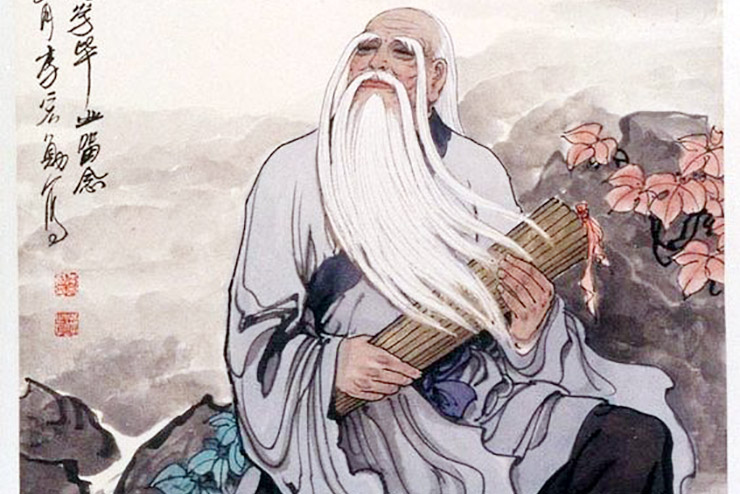
    Liberated individuals are in alignment with their own nature and with the Tao. They do not benefit the accepted social order and are regarded as useless in the eyes of institutional and organisational power. [Taoist sages] Lao-tzu and Chuang-tzu were treated this way because they could see the unnaturalness of an artificial society. The Buddha and Jesus of Nazareth were two other such sages who could see through the hypnotic veil. A liberated sage understands that anyone who continues to act out the unnatural patterns of conditioning is contributing to chaos and destruction, either consciously or unconsciously. One who is liberated, on the other hand, begins the yoking process until a crystal-clear perception of the Tao in reality can be experienced. In Richard Wilhelm’s translation of the I Ching, he states:

    Not every man has an obligation to mingle in the affairs of the world. There are some who are developed to such a degree that they are justified in letting the world go its own way and in refusing to enter public life with a view of reforming it. But this does not imply a right to remain idle or to sit back and merely criticise. Such withdrawal is justified only when we strive to realise in ourselves the higher aims of mankind. For although the sage remains distant from the turmoil of daily life, he creates incomparable human values for the future. (The I Ching or Book of Changes)

    Evidence for these “incomparable human values” can be found in the legacy that a sage leaves behind. Lao-tzu is a good example. It has been over 2,500 years since he lived, and yet his wisdom still reverberates within our consciousness today. This is the power of te. 

    The virtue of te is only available to those who do not seek power, control, or force. Governments, politics, banking, religions, and commerce, on the other hand, are constantly striving for control by forcing the population to their will. This poses a significant hurdle for humanity to overcome. What would it take to bring the individual and the collective back into harmony with the Tao?

    The above is an exclusive extract from Jason Gregory’s book Effortless Living: Wu-Wei and the Spontaneous State of Natural Harmony. Gregory outlines the Taoist practice of wu-wei, revealing that when we release our ego and allow life to unfold as it will, we align ourselves more closely with our goals and cultivate skill and mastery along the way. The book is available from all good bookstores.

    [alert type=”general” dismiss=”no”]This article was published in New Dawn 167.[/alert]

    [alert type=”success” dismiss=”no”]If you appreciate this article, please consider subscribing to help maintain this website.[/alert]

    © New Dawn Magazine and the respective author.
    For our reproduction notice, click here.