New Dawn – World's Most Unusual Magazine

Category: Articles

  • Life, Death & Gnosis: The Gnostics on the Afterlife

    Life, Death & Gnosis: The Gnostics on the Afterlife

    From New Dawn 109 (Jul-Aug 2008)

    The possibilities for life after death come down to a mere three:
    1. There is no life after death. Death is the total extinction of consciousness. 2. Life after death continues on earth (through reincarnation). 3. Life continues after death on another plane than that of earthly reality (such as in heaven or hell).

    If we’re going to talk about this subject at all, we can rule out the first option categorically, especially since practically every culture and religion teaches that there is some form of life after death. There are many discussions of the evidence for the afterlife, and while this is a fascinating subject, it’s out of the scope of this article.

    Which, then, of the two remaining options is most likely? Usually these are simplistically conceived. You reincarnate: depending on your karma, you come back down to earth to live again as a sage or a stockbroker. Or you are judged before the heavenly throne and are sent up to heaven or down to hell once and for all.

    The Gnostics, the mysterious esoteric teachers of the early centuries of the Common Era, had their own perspective on the afterlife. Although their teachings have been all but lost, enough material remains so that we can reconstruct them. If we do, we will reach some valuable insights not only about some elements of the later Western occult traditions but about the project of spiritual liberation.

    The Gnostic texts speak very little about reincarnation. We do, however, find some references to this concept in the Corpus Hermeticum (“Hermetic body” of writings). Probably written in the first to third centuries CE, they largely consist of dialogues between a divine figure named Hermes Trismegistus and his son Tat (or Thoth, the Egyptian god that most resembled the Greek Hermes). Their origin is suggested by the title of the leading treatise: Poimandres (from which I’ll quote below). This is a Grecization of p-eime-n-re, “illumined mind” in Egyptian. The Hermetic texts were descriptions of ancient Egyptian esoteric knowledge recast in the language and thought of the Greeks, who were culturally dominant in the Mediterranean world of that time. The Hermetic texts aren’t usually considered to be Gnostic per se, although their ideas were extremely similar to those of the Gnostics and can be taken as part of the same milieu.1

    The Hermetic texts speak of reincarnation, but not in the sense familiar from New Age versions of the doctrine. The Hermetic writings generally portray reincarnation as a punishment. One treatise tells us that a person who dies childless “is sentenced to a body that has neither a man’s nature nor a woman’s – a thing accursed under the sun.” And a text known as the Asclepius says that “those who live faithfully under god” will ascend to become divine beings, but “for the unfaithful it goes differently: return to heaven is denied them, and a vile migration unworthy of a holy soul puts them in other bodies.”2

    Both the Hermeticists and the Gnostics were much more interested in the spirit’s ascent after death. In order to understand their views, we have to set aside one background assumption that we may have received from conventional Christianity: that heaven is all good, that, as it were, all the evil is down below. As a matter of fact, the Gnostics say little about hell as such. To them the dangers encountered by the spirit after death took a very different form.

    Meet the Archons

    If you read even a small amount about Gnosticism, you will come across references to the archons, whose name comes from a Greek word meaning “rulers.” Malign spiritual powers, they stand in the celestial realms interposed between us and the true, good God far above. Who are these archons?

    Although it’s sometimes forgotten, the Gnostics took much of their inspiration from the apostle Paul. One key verse appears in Ephesians (an epistle that, most scholars today agree, was not actually written by Paul, although it was attributed to him): “For we wrestle not against flesh and blood, but against principalities, against powers, against the rulers of the darkness of this world, against spiritual wickedness in high places” (Eph. 6:12).3 Although the verse does not use the word archons (in the Greek New Testament, this word usually refers to human rulers; cf. Luke 12:58, John 3:1), the word translated as “principalities” is arkhas, which comes from the same root. The writer of Ephesians is saying that these “rulers of the darkness of this world” are in the celestial spheres that are interposed between the earth and the realms of the true heaven far above. For the Gnostics, this meant that there are two heavens: one a sinister, intermediary realm of the archons, the other the realm of the true, good God above. To reach the true heaven (sometimes called the Pleroma or “fullness”) after death, the spirit has to pass through the spheres of the archons.

    There were many Gnostic systems, and their critics sometimes complained that they changed their teachings every day. But in essence both Gnosticism and Hermeticism envisaged the journey of the spirit in the afterlife as an ascent through the realms of the concentric spheres surrounding the earth. Often these were associated with the seven planets as understood by the ancients: the moon, Mercury, Venus, the sun, Mars, Jupiter, and Saturn (in that order), each of which had its own ruler or archon. The clearest and most concise description of this process appears in the Poimandres, which describes the bad qualities the spirit must shed after death in each planetary zone:

    Thence the human being rushes up through the cosmic framework, at the first zone [the moon] surrendering the energy of increase and decrease; at the second [Mercury] evil machination, a device now inactive; at the third [Venus] the illusion of longing, now inactive; at the fourth [the sun] the ruler’s arrogance, now freed from excess; at the fifth [Mars] unholy presumption and daring recklessness; at the sixth [Jupiter] the evil impulses that come from wealth, now inactive; and at the seventh zone [Saturn] the deceit that lies in ambush. And then, stripped of the effects of the cosmic framework, the human enters the region of the ogdoad [the spiritual realm]; he has his own proper power, and along with the blessed he hymns the father.4

    Another portrait of the soul’s ascent appears in Contra Celsum (“Against Celsus”), a polemical work written by the Church Father Origen (c.185–c.254 CE). Origen at one point describes the teachings of a Gnostic sect called the Ophites. Not much is known about them, but they were so called from the Greek word ophis (“serpent”). Unlike orthodox Christianity, they regarded the serpent of Genesis as a positive figure, bringing Adam and Eve gnosis or knowledge.
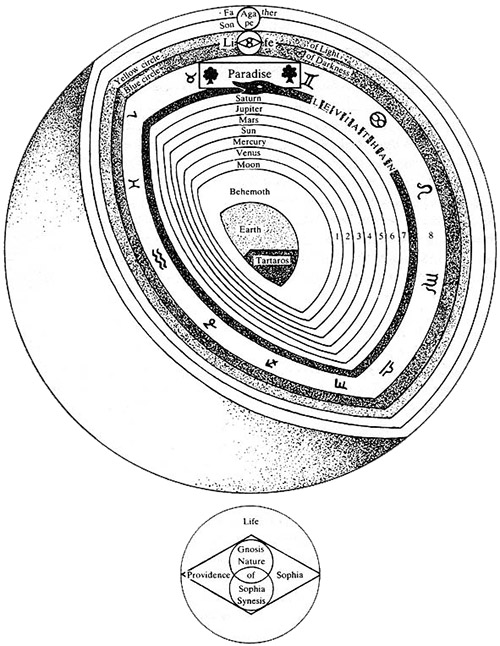
    Ophite Gnostic cosmology symbolising the structure of Reality.
    The world serpent Leviathan encircles the planetary realm, with Saturn on the boundary. After death the soul/spirit attempts to ascend through the spheres of the archons that are identified with the planets.

    The Ophites, Origen tells us, believe that after death the soul has to pass through a “barrier of evil.” Then it has to confront a series of archons, who are associated with the planets. In ascending order from the earth, they are:

    • 1. Moon: Horaeus
    • 2. Mercury: Ailoaeus or Eloaeus
    • 3. Venus: Astaipheus
    • 4. Sun: Adonai
    • 5. Mars: Sabaoth
    • 6. Jupiter: Iao
    • 7. Saturn: Ialdabaoth

    (Note that the order is the same as in the Poimandres.) In order to pass through these spheres, the Gnostic initiate was taught what to say to the archons and which symbol to present to them as a kind of passkey. To Ialdabaoth, for example, one is supposed to say:

    And thou, Ialdabaoth, first and seventh, born to have power with boldness, being ruling Word of a pure mind, a perfect work for Son and Father, I bear a symbol marked with a picture of life, and having opened to the world the gate which thou didst close for thine eternity, I pass by thy power free again. May grace be with me, father, let it be with me.5

    Irenaeus of Lyons, the second-century Church Father whose work Against the Heresies is one of our chief primary sources about Gnosticism, describes another view of this process. Speaking of one school of Gnostics, he writes:

    These hold that the knowledge of the unspeakable Greatness is itself perfect redemption. For since both defect and passion flowed from ignorance, the whole substance of what was thus formed is destroyed by knowledge; and therefore knowledge is the redemption of the inner man. This, however, is not of a corporeal nature, for the body is corruptible; nor is it animal, since the animal soul is the fruit of a defect, and is, as it were, the abode of the spirit. The redemption must therefore be of a spiritual nature; for they affirm that the inner and spiritual man is redeemed by means of knowledge, and that they, having acquired the knowledge of all things, stand thenceforth in need of nothing else. This, then, is the true redemption.6

    Soul, Spirit & the Afterlife

    Irenaeus indicates that the Gnostics believed in a tripartite division of the human entity: the physical body, the soul (what Irenaeus calls the “animal soul”), and the spirit. Orthodox Christianity originally had the same teaching, although it would be lost over the centuries. Today you will have great difficulty finding a churchman of any denomination who can explain to you the difference between the soul and the spirit.7 But the Gnostics thought these two things were very different indeed, and this fact provides the key to their views of the afterlife.

    When you read a standard version of the New Testament and come across the word “soul,” it is almost always translating the Greek word psyche. That’s what “soul” originally meant. It is the psyche – the constellation of thoughts and feelings, conscious and unconscious, that constitute your inner life. It also includes the vital principle, or life force (the “animal soul”). As the passage from Irenaeus suggests, the Gnostics knew that this soul was not immortal and was not meant to be.
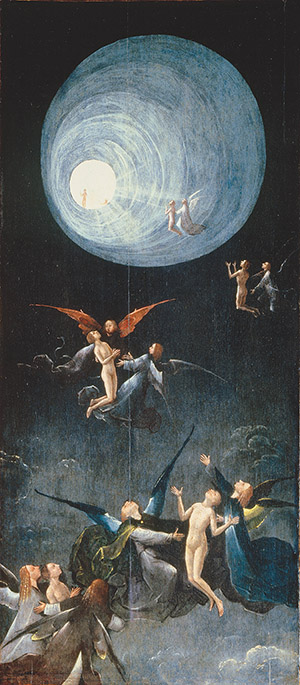
    ‘The Ascent into the Empyrean or Highest Heaven’ by Hieronymus Bosch

    The spirit is another matter. It is that in you which, at the deepest level, says “I.” It is the principle of pure consciousness that looks out of your body and psyche as through a telescope. There are many names for it: Atman, the Self, the kingdom of heaven, ruach in Hebrew and pneuma in Greek. This principle is immortal and indestructible; it will remain long after both body and soul have disintegrated. 

    In fact the soul is supposed to disintegrate. It is made up of planetary influences (hence it is sometimes given the name “astral body”), which are as temporary and transitory as the combinations of molecules that make up the physical body. The Gnostics conceived of incarnation as a descent from the supernal realms through the spheres of the seven planets down to earth. As the spirit made its way through these spheres, it takes on the colouration of each of these planets. Conversely, at the time of death, the spirit ascends and (at least ideally) shakes off the influence of each planet in turn, since these influences are the shackles that bind the soul to materiality. That’s why the Hermetic text quoted above tells us that “the human being rushes up through the cosmic framework, at the first zone [the moon] surrendering the energy of increase and decrease” and so on. Some of the Gnostics, such as the Ophites, thought it was necessary to know the occult names of each of the archons guarding these tiers as a way of getting through (in ancient magic, to know the name of something is to have power over it). Others, like the ones described by Irenaeus, apparently believed that the mere knowledge of the situation was enough for liberation.

    For individuals who do not have access to this salvific knowledge in one form or another, “it goes differently,” as we read in the Hermetic text quoted above: “return to heaven is denied them, and a vile migration unworthy of a holy soul puts them in other bodies.”
    Reincarnation Undesirable

    Reincarnation today is an increasingly popular belief. Surveys show that about 20–25% of the population of the Western countries (and as many as a third of the people in Russia) believe in it. It has the advantage of being more reassuring than the conventional Christian view that you could fry in hell for an infinite amount of time as punishment for sins committed for an extremely finite amount of time on earth. And there is a considerable body of work attesting to past-life memories (Ian Stevenson is a pioneer in this field), so that reincarnation is far better-validated than scientistic materialism would have us believe.

    Nonetheless, practically all the traditions that teach reincarnation view it as undesirable. We can come back, but if we do, it is the result of a problem or a mistake on our part. The ideal fate for an individual in Hinduism is moksha or liberation from the chain of incarnation; nirvana has the same position in Buddhism. The celebrated Tibetan Book of the Dead consists of step-by-step instructions for the newly deceased in how to avoid reincarnating. The Gnostics and Hermeticists portrayed this liberation as the ascent of the spirit through the realm of the hostile archons into the Pleroma. 

    Even the position of reincarnation in conventional Christianity is not quite what you might expect. Astonishingly, the doctrine of reincarnation has never been explicitly repudiated by the Catholic Church, even though most of its theologians have dismissed or derided it. Today some people claim that the doctrine was rejected either by the First Council of Nicaea in 325 CE or by the Second Council of Constantinople in 553, but as a matter of fact neither of these dealt with the topic; instead they were concerned with the nature of Christ. One source of this misconception is Shirley MacLaine, the actress and New Age author, who introduced these ideas in her highly popular books, adding further to the confusion by mixing up the two councils.8

    At any rate, reincarnation sits ambiguously on the edge of the Christian tradition. Valentin Tomberg (1900-73), a Baltic German convert to Roman Catholicism whose Meditations on the Tarot, published anonymously, remains one of the great modern classics of esoteric Christianity, observes:

    The Church was hostile to the doctrine of reincarnation, although the fact of repeated incarnations was known – and could not remain unknown – to a large number of people faithful to the Church with authentic spiritual experience. The deeper reason is the danger of reincarnation by way of the ghost, where one avoids the path of purification (in purgatory), illumination and celestial union. For humanity could succumb to the temptation of preparing for a future terrestrial life, instead of preparing for purgatory and heaven, in earthly life.9

    If you set aside the Catholic term of “purgatory” in this passage, you end up with a view very much like that of the Gnostics. The spirit is purified and illumined in its ascent, and eventually enters the realm of the Father. The “ghost” of which Tomberg speaks is a soul – that is, an astral body – that has not properly disintegrated. It either lurks around the earth, causing ghostly phenomena, or becomes entrapped in yet another physical body. 

    Curiously, the Gnostic teachings also survived in Eastern Orthodoxy, which owes more to Gnosticism than it cares to admit. Orthodox Christianity uses the quaint but vivid metaphor of “aerial tollhouses” to speak of the spirit’s perilous ascent after death. The number of these tollhouses is usually said to be twenty. Here is one account, attributed to Taxiotes, a soldier in antiquity who had a near-death experience:

    When I was dying, I saw Ethiopians who appeared before me. Their appearance was very frightful; my soul beholding them was disturbed. Then I saw two splendid youths, and my soul leaped out into their arms. We began slowly to ascend in the air to the heights, as if flying, and we reached the toll-houses that guard the ascent and detain the soul of each man. Each toll-house tested a special form of sin: one lying, another envy, another pride; each sin has its own testers in the air. And I saw that the angels held all my good deeds in a little chest; taking them out, they would compare them with my evil deeds. Thus we passed by all the toll-houses. And when, reaching the gates of the heavens, we came to the toll-house of fornication, those who guard the way there detained me and presented to me all my fleshly deeds of fornication, committed from my childhood up to now. The angels who were leading said to me, “All the bodily sins which you committed in the city, God has forgiven, because you repented of them.” To this my adversaries said to me, “But when you left the city, in the village you committed adultery with a farmer’s wife.” The angels, hearing this and finding no good deed which could be measured out for my sin, left me and went away. Then the evil spirits seized me, and overwhelming me with blows, led me down to earth. The earth opened, and I was let down by narrow and foul-smelling descents into the underground prison of hell.10

    It’s easy to find resemblances in this passage to the Gnostic and Hermetic texts we’ve already examined. The basic process is the same: the soul ascends through the aerial region toward heaven but encounters sentinels that bar its way. The Gnostic texts saw the way through in esoteric terms: it was necessary to know the name of the archon guarding each one and to know how to address him, or at any rate to understand the truth of the situation. Here, in an Orthodox Christian context, it is a matter of purity from sin. (As a matter of fact, the seven planets are associated with the seven deadly sins: the moon, with envy; Mercury, with sloth; Venus, lust; the sun, pride; Mars; anger; Jupiter, gluttony. The seventh, covetousness, is associated with the earth, but as we can see from the Poimandres, the seventh is sometimes taken to be deceit, and is associated with Saturn.) Like the Gnostics, the Orthodox regard these aerial tollkeepers as evil spirits. Their leader is the Devil, “the prince of the power of the air, the spirit that now worketh in the children of disobedience” (Eph. 2:2). 

    Echoes of Gnostic ideas resonate in other forms of esotericism. Here is one passage from the Zohar, the central text of the Kabbalah, the mystical tradition of Judaism. A rabbi tells of his encounter with some “children of the East” and their books of sacred wisdom, which, he says, resemble the teachings of the Jewish Torah. These books from the East said that:

    It is by his acts, by his words, and by his fervency and devotion that [the worshipper] can draw to himself that spirit from on high. They further said that if a man follows a certain direction in this world, he will be led further in the same direction when he departs this world; as that to which he attaches himself in this world, so is that to which he will find himself attached in the other world; if holy, holy, and if defiled, defiled. If he cleaves to holiness he will on high be drawn to that side and be made a servant to minister before the Holy One among the angels…. Similarly if he clings here to uncleanness, he will be drawn there towards that side and be made one of the unclean company and be attached to them. These are called “pests of mankind,” and when a man leaves this world they take him up and cast him down into Gehinnom [i.e., hell].11

    The rabbi also says that these books also have “rites and ceremonies pertaining to the worship of the stars, with the requisite formulas and the directions for concentrating the thoughts upon them, so as to draw them near the worshipper.” These would seem to resemble the Gnostic formulas and directions for encountering and passing through the gates of the archons, who are associated with the planets. But the rabbi discourages this kind of practice, saying that Jews are to worship the Holy One alone.

    It would be possible to trace the threads of these Gnostic ideas in many more directions, certainly in the Kabbalah. Gershom Scholem, the greatest twentieth-century scholar of the Kabbalah, emphasised that “it was Gnosticism, one of the last great manifestations of mythology in religious thought… which lent figures of speech to the Jewish mystic.”12

    Such is the view of the scholar. He sees affinities and resemblances between texts and traditions, and naturally assumes that the earlier ones must have influenced the later ones. But someone who wants to transcend the limits of mere academic scholarship has to ask another question: are these similarities the result of influence in a conventional sense, or is it rather that these mystics and illuminates of different traditions saw the same reality and tried to express it in terms of their own language and thought? I myself suspect that both of these things are true.

    What, then, is the mystical reality to which all these teachings point? I would suggest that it is something like this: The psyche, the soul, is made up not only of planetary influences (which is why the natal horoscope is believed to give the key to your character) but of the concepts and conditioning that were attached to it over the course of an incarnation. The Tibetan Book of the Dead, which describes this process in Tibetan Buddhist terms, calls this complex “the thought-body of propensities.”13 The ascent through the realms of the archons or the aerial tollhouses represent the stripping away of these influences, including concepts and conditioning of a religious nature. If the break is more or less complete, the unconditioned spirit can make its way to the “true heaven” – that is, other realms of existence where it will continue to be perfected. If not, it is thrown back down to earth (or perhaps to still darker realms) for another round. The Tibetan Book of the Dead says that the way to penetrate through the bardos (the Tibetan equivalent of the tollhouses) is to “know these apparitions to be thine own thought-forms.”14

    What practical conclusions can we draw from all this? Personally I would point back to the passage from the Zohar quoted just above: “If a man follows a certain direction in this world, he will be led further in the same direction when he departs this world.” The future of the divine monad, the spark of pure consciousness that lies at the centre of our being like a jewel in a lotus and whose refinement and perfection is perhaps the sole purpose of human existence, will be determined by how we cultivate it in this life. For all of the archons and celestial tollkeepers that may appear to face us after death, the responsibility for our evolution – or, if you like, salvation – continues to rest with ourselves.

    [alert type=”general” dismiss=”no”]This article was published in New Dawn 109.[/alert]

    [alert type=”success” dismiss=”no”]If you appreciate this article, please consider subscribing to help maintain this website.[/alert]

    Footnotes

    1. For further discussion of this topic, see my Forbidden Faith, 32–35.
    2. Asclepius 12, in Brian P. Copenhaver, ed. and trans., Hermetica: The Greek Corpus Hermeticum and the Latin Asclepius in a New English Translation, with Notes and an Introduction (Cambridge: Cambridge University Press, 1992), 74; Corpus Hermeticum II, 17, in Copenhaver, 12.
    3. Biblical quotations are from the Authorised (King James) Version.
    4. Corpus Hermeticum I, 25–26; in Copenhaver, 6.
    5. Origen, Contra Celsum, 6.31; in Henry Chadwick, ed. and trans., Contra Celsum, rev. ed. (Cambridge: Cambridge University Press, 1965), 347.
    6. Irenaeus, 1.21.4; www.ccel.org/ccel/schaff/anf01.ix.ii.xxii.html; May 24, 2008.
    7. For more on this subject, see my article “Christianity: The Ultimate Secret,” New Dawn No. 84 (May-June 2004), 27–32; also my Inner Christianity, 19–20, 70–71 et passim.
    8. See Wouter J. Hanegraaff, New Age Religion and Western Culture (Albany: State University of New York Press, 1998), 321-22.
    9. Meditations on the Tarot: A Journey into Christian Hermeticism, trans. Robert A. Powell (Warwick, N.Y.: Amity House, 1985), 361. Emphasis in the original.
    10. Quoted in Seraphim Rose, The Soul after Death (Platina, Calif.: St. Herman of Alaska Brotherhood, 1980), 84.
    11. Zohar 1, 99b; in The Zohar, Harry Sperling and Maurice Simon (London: Soncino, 1934), vol. 1, 324–25.
    12. Gershom Scholem, Major Trends in Jewish Mysticism, 3d ed. (New York: Schocken, 1961), 35.
    13. The Tibetan Book of the Dead, W.Y. Evans-Wentz, ed. and trans., 3d ed. (New York: Oxford University Press, 1957), 104.
    14. Ibid.

    © New Dawn Magazine and the respective author.
    For our reproduction notice, click here.
  • COVID Consciousness: A Contagion of Awakening or a Consensus Reality?

    COVID Consciousness: A Contagion of Awakening or a Consensus Reality?

    From New Dawn 181 (Jul-Aug 2020)

    Many of us are asking – is reality broken? This is the question I posed at the beginning of my ‘Year Ahead 2020’ piece published in New Dawn 178 (Jan-Feb 2020). In my review of the year ahead, which I titled ‘Consensus Reality Meltdown,’ I wrote: 

    What we have come to regard as ‘reality’ will officially become intangible and fluid, leading to the rise of adverse ideologies… We are increasingly losing our bearings, our fixed moorings, and this is likely to lead to further anxiety as people try to cling to invested beliefs. My sense is that throughout 2020 many of us will experience discomfort in one form or another. 

    The fluidity and changeability of reality that I suspected would emerge came suddenly, and not in a trickle but with the bursting of the dam. 

    In my review of the consensus reality meltdown, I noted that a certain rootlessness would creep into the world – a rootlessness of frantic uncertainty mixed with desperate tech-salvation. Things would become increasingly more liquid-like as older, established social forms dissolved faster than new ones could replace them. As the full COVID-19 pandemic began to arrive upon our shores, I wondered whether during the consensus reality meltdown there would be a reshuffling, allowing each person to take this time to listen to themselves. In the reshuffling, I considered that new pathways of connection could be forged. In a follow-up essay, I wrote: 

    After the consensus reality meltdown – after the reset button has been pressed – life will not be the same again. We will begin a new historical era. People across the world will climb out of their quarantined cocoons into a new time. Today as I write these words it is the day of the Spring Equinox – it is when a new year begins. The reset button was pressed before this Spring Equinox. Afterwards, there will be no Anno Domini, no Common Era. It shall be a New Era (N.E.).

    It now appears evident that a rising confusion is entering into the world ‘reality-bubble’. Our social and political systems seem so full of abstract madness partly because they have lost their relation to anything tangible or remotely truthful. The writer Elias Canetti recognised this situation when he wrote: 

    A tormenting thought: as of a certain point, history was no longer “real.” Without noticing it, all mankind suddenly left reality; everything happening since then was supposedly not true; but we supposedly didn’t notice.

    We are now beginning that gradual climb out of our quarantined cocoons and seeing the world anew. What now faces us is the question of how we accept, or allow, our collective future to unfold. The ‘COVID Consciousness’ that has infected us globally, through the entire human species, can have the effect of awakening us into a stimulated frame of mind, with new perceptions triggered – or it can force us into accepting a new consensus reality (the ‘new normal’) for the foreseeable future. Do we come out of our cocoons with a butterfly consciousness, or do we retain the caterpillar’s mind?

    We are presently not out of our ‘cocooned lockdown’ – not fully yet. And this, I feel, is a good thing as many of us still have time for a reconsideration of where we are, what we are doing, and where we wish to go. This is not a story about viruses or dead infectious parasites – this is a tale of contagious sentient life. 

    Global ‘Stop’ Exercise

    What I see is that human life has been radically halted – the brakes applied – as if being placed under a microscope of our own viewing. We have been compelled to view and to see ourselves in a way that has never been done before. We have entered into humanity’s largest experiment, and we are the test cases. Before we can take our further steps into what will become the most significant era for humanity’s future – into a phase of rapid evolutionary acceleration – we first need to take a ‘stop’ and to examine ourselves. 

    This forced stoppage reminds me of a physical-psychological exercise used by the Greek-Armenian mystic G.I. Gurdjieff. He named this his ‘stop’ exercise. According to Gurdjieff’s own words:

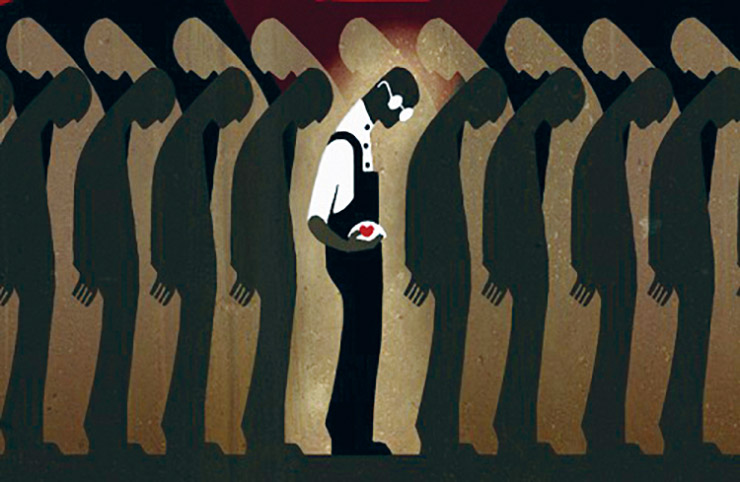
    …at the command “stop,” or at a previously arranged signal, every student must instantly stop all movement, wherever he may be and whatever he may be doing… while he is in this state of arrested movement, the student must also arrest the flow of his thoughts, not admitting any new thoughts whatever… this is simply a movement interrupted at the moment of passage from one posture to another… generally we pass from one posture to another so rapidly that we do not notice the attitudes we take in passing. The “stop” exercise gives us the possibility of seeing and feeling our own body in postures and attitudes which are entirely unaccustomed and unnatural to it… the style of the movements and postures of every epoch, every race and every class is indissolubly connected with distinctive forms of thought and of feeling. And they are so closely bound together that a man can change neither the form of his thought nor the form of his feeling without having changed his repertory of postures…

    This extract illustrates that its function was to give the ‘student’ a necessary moment for unhindered self-observation. A person, remarked Gurdjieff, is generally not aware as they pass from one posture to another – we are ‘entirely unaccustomed’ to this point of observation to the extent that it is unnatural to us. The only way to enforce this is through an externally produced state of arrested movement. Interestingly, Gurdjieff states that every epoch, race, and class have their distinctive forms of thought which are so tightly bound to their ‘posture’ that they cannot be changed. Later in this description it is remarked that, 

    psychological analysis and the study of the psychomotor functions, applied in a certain manner, demonstrate that each of our movements, voluntary or involuntary, is an unconscious transition from one automatically fixed posture to another, equally automatic…

    If we now consider this at the larger scale, it implies that people are culturally bound to particular ‘postures’ of thought (aka, social conditioning); and that these thoughts and feelings are automatic (programmed). Gurdjieff’s method of breaking down these automatisms so that they could be observed was through imposing an external command of ‘stop’ that had to be obeyed. Now, what if we are to apply this to the current global social quarantines and the halt on global trade and business. Have we not just experienced a ‘stop’ command enforced upon us by an external impact in response to the 2020 pandemic?

    For the first time in our known history, human civilisation in most of its forms came to a halt. We were stopped in mid-posture – a state of arrested movement – and placed in a space we are totally unaccustomed to. Time now, is it not, to ‘arrest the flow of thoughts’ – i.e., our regular social programming – in order to enter into a period of self-observation? What are we likely to find in this moment of ‘frozen’ introspection? What are the implications of the reset button being pressed?

    Similarly, we may consider this as an act of force majeure, whereby humanity is now free from its prior commitments to a way of life it had contracted itself into. If we are free from our past contract, then whilst the world’s politicians are speaking of a ‘Second Wave’ of the virus, perhaps we should be considering this as allowing a ‘Second Wave’ for our human experiment – to begin a new trajectory, a new timeline for a human-planetary future. The past contract that humanity got itself involved in came to represent dysfunctional systems, damaging ideals and beliefs, and a ruinous path to a destructive future. If there was ever a time to break with this contract and to agree upon a new manner of collaboration and reciprocal maintenance, then this force majeure offers us a unique opportunity.

    We entered a ‘stop’ phase upon an individual, community, and global level. Never before has this occurred, nor has it been possible. For most of humanity’s evolution, we existed as localised aspects of psyche and consciousness. We participated in the ‘mental life’ of those around us, the community; and later, the country. Only within a relatively short span of time has our species gained a global perspective. Whilst a collective unconscious species mind has existed, this lay beneath the conscious awareness of most people. This has now ‘flipped over’ into a physical presence in that so many more people are currently aware of psychical fluctuations across the world. We are presently experiencing these fluctuations during the 2020 pandemic. This was not possible before, even at the time of the ‘Spanish Flu’ of 1918–20. Why does this matter? It matters because the effects of consciousness, although seemingly intangible, are just as important as those tangible, physical effects we are generally more aware of. 

    Contagions of Consciousness

    Consciousness is just as contagious as any biological virus. Perhaps more so, as it is not bound by physical parameters of movement. Consciousness is an open arena – and it spreads like ripples across fluid and intangible, interconnected fields. Each person, too, creates these ripples, which are then strengthened by the larger community and national consciousness fields. Similar to what Gurdjieff spoke of, we are creating thought postures that belong to collectives of human thought. As many people are aware, like things attract and resonate with like things. It is the same with thought. This is the reason why so many ‘like-minded’ people group together. They share a common bond in their thinking. At the same time, these physical groupings create collective fields of consciousness. These fields can become powerful and very influential. They have operated throughout extreme cases, such as warfare, where people behaved against their ‘better judgement’. Likewise, they have operated during moments of mob violence and mob psychosis. Such collectives of thought are easy to be caught up within – that’s why they are contagious. And now, as our species’ collective psyche is growing and developing, such ‘contagions of consciousness’ are extremely powerful. 

    Generally, as a person becomes ‘socially programmed’ by layers of conditioning, they are absorbed into the ‘national psyche’ of their respective country. This has always operated as a useful function of social management. As a person learns to de-condition themselves, and to throw off these layers of their psychological conditioning, they create more expansive states of awareness by having access to a broader range of consciousness fields. We are each of us affected by the ‘consciousness ripples’ emanating from others. It is how the ecology of consciousness operates. And since it is an interconnected ecology, individual awakening – or expansion of awareness – does not just remain at the individual level. As transpersonal researcher Chris Bache puts it, the ecology of consciousness is an inherently collective ecology. What we feed into our localised fields of consciousness will then go on to form part of a larger body or consciousness field. And this, ultimately, will form part of a grander resonating field of collective consciousness – at the community, national, and global level. Therefore, what and how we think is indeed part of our responsibility. 

    What we are experiencing now is not only a biological pandemic but also a psychological one. How we feed into this, and what is fed into this, will establish the tone of an overall psychic resonance. And this overall field of resonance can be coherent or dissonant, and many other degrees in-between. That is, if a psychological environment of fear, panic, and anxiety is created through thousands, or even millions, of individualised fields of consciousness, these will ripple out to congeal into a grander collective field of increased psychic density. The resonance of disturbance will be on a scale far exceeding the individual level. Similarly, if localised ripples of coherence, hope, trust, and empowerment are transmitted, these will not only influence local and community environments at the psychological level but also the larger global psyche. This is not voodoo or magical thinking – it reflects how the intangible realm of thoughts and human consciousness operates. Psychologically, we are not alone. Each person lives as a part of the world, and not apart from it. Each person has a responsibility to manage their thoughts – what they receive and process as well as what they transmit. 

    This present moment of a global ‘stop’ phase should give us time for reflection and consideration. Our automated movements and our automatic thinking patterns have been put on hold. We should take advantage of this unique opportunity. It may never happen again. It is likely we shall receive external impacts in our lives that momentarily make us pause as individuals – yet global ones are a very, very rare occurrence. In this exceptional moment, we should consider carefully. We will have questions now that are of great importance. It is crucial that people do not fall back into a heightened state of cultural programming swayed by external agents/systems that compete for increased control and social management. The ‘COVID Consciousness’ is an opportunity for a contagion of awakening, or it can be used as a strategy for managing a controlled consensus reality. It is now very much a question of our human freedom.

    Human freedom, with genuine conscious awareness, also recognises the need for the social community, but not as an unconscious community. The human community needs to come together with at least a minimum of psychological insight. When communities and individuals lack psychological insight, they are open and vulnerable to the impulses of the unconscious from within as without. That is, manifestations of the unconscious do not just occur within an individual’s mind but also within the mass psyche of the collective. Unawareness of such forces can bring about emotional, mental, and physical instability. It is a psychological trait that when our minds recognise a repressed force within ourselves, a corresponding expression manifests in our outer, physical world. The source for so many ills resides within us. This is because the psychic or soul reality is real. We are conditioned into thinking that ‘psychic’ elements or things of the spirit are inferior to the physical things of life because they are non-material. The images we have within us, however, can be just as powerful as those without. It is a necessity that human civilisation returns to the fundamental recognition of the person as a human being; also, as a being with psychical force. We need to get back to ourselves in so many ways.

    In the gnostic Gospel of Thomas, it is written that Jesus pronounced: “If you bring forth what is within you, what you bring forth will save you. If you do not bring forth what is within you, what you do not bring forth will destroy you.” The inner resources each person has within them can bring insight, conscious awareness, and experiential knowing onto contemporary issues and their distress. It is essential to bring the inner world to bear onto the physical, material world. Both realms must participate and be in congruence. In order to achieve genuine solutions, each of us must be prepared to change and transform from within, and not just by changing our ideas. Each person has a responsibility not only to the outer world but also to their individual inner life. 

    Resist Conditioned Conventions of Mass Mind

    A person cannot live by the conventions of society alone, or from the impacts and influences of everyday life. We need sustenance from a source that is beyond all social institutions, and from beyond the distractions and attractions of physical life. It is necessary to create a distance from the tirades that life brings us. Ironically, the newly imposed rules of social distancing may assist indirectly by triggering an awareness of a form of distancing in terms of unhealthy energetic attachment and identification. In this, perhaps, a more acute state of self-awareness can develop as an antidote to the general state of social unconsciousness. Of importance now is how to resist the conditioned conventions of the mass mind by cultivating new faculties of perception. It is a question of personal freedom of thought and perspective. Our choice is thus twofold: between recognising the unconscious forces of the mass mind; and aiming for the personal development of our awareness to act as individuals. 

    What humanity is largely experiencing today is the moral uncertainty that precedes a new understanding as the old morality enters its death phase. As long as the majority of people expect all problems to be solved outside of themselves then our societies will continue to be dominated by unruly forces. The question of human freedom from these forces depends upon people willing to assume the responsibility of conscious awareness. 

    The great perennial task of humanity has always been the same: to become what we have always been and to show others the way by our own individual presence and behaviour. When we are finally able to heal ourselves from within then, and only then, can we heal others and the world without. The power for change begins and ends with us, the individual – not from the hand of a minority elite. 

    The question of human responsibility is to resist the forces of dehumanisation. If we do not awaken to our potentials during this space of ‘COVID consciousness,’ then we are vulnerable to the encroaching forces of dehumanising social-technological control, as I shall explore in the second part of this essay in the next issue of New Dawn.

    [alert type=”general” dismiss=”no”]This article was published in New Dawn 181.[/alert]

    [alert type=”success” dismiss=”no”]If you appreciate this article, please consider subscribing to help maintain this website.[/alert]

    Footnotes

    1. https://kingsleydennis.com/the-reset-button/
    2. Taken from his collection of personal writings from 1942 to 1972 called The Human Province.
    3. Taken from ‘Talks with Gurdjieff’ – various online sources.

    © New Dawn Magazine and the respective author.
    For our reproduction notice, click here.
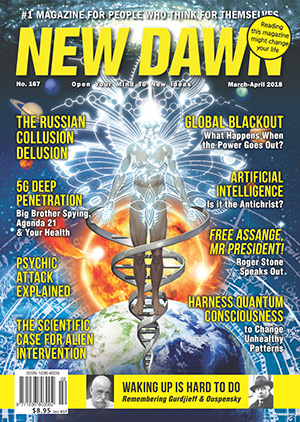
  • Waking Up is Hard To Do: Remembering Gurdjieff & Ouspensky

    Waking Up is Hard To Do: Remembering Gurdjieff & Ouspensky

    From New Dawn 167 (Mar-Apr 2018)

    In the spring of 1915 the writer and journalist Peter Demianovich Ouspensky, a familiar name in Russian Theosophical circles, gave a series of lectures in Moscow about his recent “search for the miraculous” in Egypt, Ceylon, and India. Ouspensky, a popular author on occult themes, had gone East in search of “schools,” teachers from whom he could learn a knowledge “unlike anything known or used by us” – the modern, scientific West that is.1 Such knowledge, he believed, was the only thing that could offer a way out of the “labyrinth of contradictions” that make up modern life. Ouspensky was convinced that through this knowledge the “thin film of false reality” – of money, prestige, and the pursuit of power – that we take to be real, could be dissolved and another reality, that of the “miraculous,” could be revealed.2 

    Ouspensky did not find what he was looking for in the East. He met many interesting people and travelled to many sacred places, but in the end he had to admit that the miraculous had eluded him. But the miraculous was not to be balked. It was waiting for Ouspensky, and if he could not find it, it would come to him. 

    Peter Demianovich Ouspensky (1878–1947) went in search of the miraculous and found the enigmatic Armenian esoteric teacher George Ivanovitch Gurdjieff. 

    Apparently, it was much closer than he thought. In fact, it appeared one afternoon in small café in a busy Moscow side street in the form of a “certain G., a Caucasian Greek,” whom Ouspensky remembered was the author of a strange ballet, “The Struggle of the Magicians,” a notice for which he had recently seen in a newspaper. He had agreed to this meeting only after one of G’s students, who had attended his lectures, had persisted in inviting him. Ouspensky had finally said yes to his requests just to stop his pestering. Ouspensky had had his fill of gurus and had returned from the East not a little disillusioned. His interest in Theosophy and other occult ideas was more than a little bruised, and he was sure all that would come from this encounter was more confirmation of his scepticism. But what he learned from this “certain G.” changed all that.

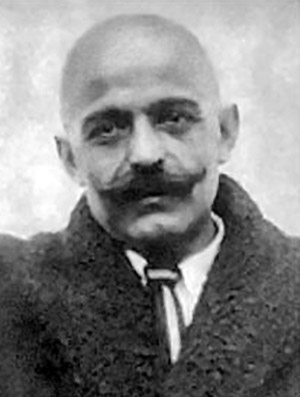
    Ouspensky’s “certain G.” was the enigmatic Armenian esoteric teacher George Ivanovitch Gurdjieff. Together the two were responsible for introducing to the West a startlingly new and often brutally demanding system of self-development, what Ouspensky later dubbed “the psychology of man’s possible evolution.” Today it’s widely known as the Fourth Way – to differentiate it from those of the fakir, yogi, or monk – or, more familiarly, “the work.” Gurdjieff had already been working with groups of students in Moscow for a few years before stage managing this meeting and had purposefully set out to attract Ouspensky, whom he wanted to secure as a Plato to his Socrates, that is, as a good interpreter and expositor of his ideas. He had his students read Ouspensky’s books – the most impressive of which, Tertium Organum, about higher dimensions and mystical states of consciousness, had made his name – and then sent them out to ensnare the philosopher. If Gurdjieff’s students had not been successful in getting a wary Ouspensky to this café, there is every chance that “the work” might not have survived the historical eruptions – World War I, the Bolshevik Revolution and Russian civil war – that were the backdrop to Ouspensky’s true encounters with the miraculous.

    George Ivanovitch Gurdjieff (1866–1949)

    Ouspensky was immediately impressed by Gurdjieff as a man who knows, a man, that is, who possessed the kind of knowledge that he had sought in the East. But although it soon became clear through their conversation that Gurdjieff was as well versed in religious, spiritual, and mystical traditions as he was, and was equally if not better travelled – indeed, he had been to places that Ouspensky had only wished to visit – there was something more. Gurdjieff himself had a strange undeniable presence. This man “of an oriental type” with a “black moustache and piercing eyes” astonished Ouspensky because he seemed to be purposefully poorly disguised. His face, which reminded Ouspensky of “an Indian raja or Arab sheik,” did not suit the black overcoat and bowler hat he wore, as did the many small businessmen that frequented the place. But his disguise was obvious, and Ouspensky was not a little disconcerted to feel that while he knew this certain G. was in disguise, he also knew that he had to pretend that he wasn’t, and that he had to carry on their conversation as if all was perfectly normal. This was Ouspensky’s first experience of the kind of psychodrama and “role-playing” that Gurdjieff performed with his students and which, in the end, would drive him away.

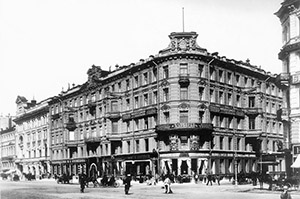
    Nevsky Prospect, St Petersburg, circa 1900. After first meeting Gurdjieff in Moscow in 1915, P.D. Ouspensky returned to St Petersburg and joined Gurdjieff’s core six-member St Petersburg group.

    But that was in the future. From that meeting until the summer of 1918, while Russia exploded into chaos, Ouspensky submitted himself to Gurdjieff’s tutelage and began to learn the “system,” a story he tells in his posthumous masterpiece, In Search of the Miraculous. And if Gurdjieff himself impressed with an aura of strength and knowledge, the system he began to unfold to an increasingly ensnared Ouspensky made an even greater impact. It was logical, consistent, based on experience and observation and free of the kind of wishful thinking that Ouspensky had found in many other mystic teachings. In fact, it was almost specifically designed to attract a rigorous, critical intellect that had recently shorn itself of much of its romanticism. Whether this was so or not, in Ouspensky’s case it’s exactly what happened.

    The Teachings

    What was Gurdjieff’s teaching? When Ouspensky remarked on how life in big cities like London, where he had just been, was becoming more mechanical and increasingly turning people into machines, Gurdjieff corrected him. They already are machines, he said, and would be whether they lived in the city or not. “This must be understood,” Gurdjieff impressed on Ouspensky. “All the people you see, all the people you know, all the people you may get to know, are machines, actual machines working solely under the power of external influences.” Ouspensky was already concerned about the increasing mechanisation of modern life, but he believed that some things, the most important ones – thought, art, poetry – could stand against it. Gurdjieff told him he was wrong. These, too, can be and regularly are performed mechanically. He put up a fight, but it was not long before Ouspensky, himself a novelist and short story writer – witness Strange Life of Ivan Osokin and Talks With the Devil, respectively – agreed.

    The most important question Ouspensky asked Gurdjieff was whether it was possible to stop being a machine? It was, Gurdjieff told him, but it was difficult and demanded much knowledge and effort. The problem is that man is asleep. What we take to be our waking consciousness is really just another kind of sleep; true wakefulness is something different. There are many reasons for this sleep. One is that human beings possess different minds or “centres,” each responsible for certain actions and behaviours. We have an intellectual, an emotional, a moving, and an instinctive centre, and also two “higher centres” from which we are cut off by our mechanicalness. When these work properly, all is good, but in modern man the centres are all confused, with one doing the work of another or stealing energy from other centres in order to do its own work. What is important for wakefulness is that each centre do its own work with its own energy and that all are in balance. It is then that the insights of “higher centres” can reach us. Such balancing is what Gurdjieff taught and his aim was to produce the “harmonious development of man.” 

    Another hurdle to wakefulness is that while we believe we possess a single “I,” a stable, reliable ego, the truth is that “we are legion,” as the man possessed by devils tells Jesus in Mark 5:9. We are not one but many. Our “I’s” shift with every mood. We decide to get up early tomorrow; when the alarm bell rings we turn it off and stay in bed. We decide to start a diet; when dinner time arrives we conveniently forget this. Our “I’s” shift because we are subject to a kind of hypnosis Gurdjieff called “identifying.” We lose our identity, our “I-ness” by giving it over to practically everything around us. Some of these disparate “I’s” can congeal into what is known as “false personality,” a picture of ourselves that allows us to ignore the contradictions that run rife through our lives but which are obvious to others. 

    Personality – let alone a false one – is itself an obstacle. Gurdjieff taught that we are made of two parts, what he called “essence” and “personality.” Essence is our own, it is what we are born with and is through essence that we can grow. But around essence accumulates our “personality.” This is what we learn or imitate from others and is the face we turn towards “life.” The problem is that personality becomes too rich, obscuring essence, rather like a bad orange whose thick rind covers a small bit of fruit. The aim of Gurdjieff’s system was to break down personality, to dismantle it and through the suffering that this entails, enable essence to grow.

    Self-Remembering

    What impressed Ouspensky most was what Gurdjieff had to say about a strange third state of consciousness he called “self-remembering.” There are four states or levels of consciousness. First there is sleep, which we pass through each night. Then there is what we normally call “waking consciousness,” but which is really another layer of sleep. This is our usual mechanical state of consciousness, which we falsely believe to be true consciousness. True consciousness, “self-consciousness,” only comes in the third level, what Gurdjieff called “self-remembering.” Normally our attention is directed outwards, toward the external world. Because we usually “identify” with things outside us, we “forget” about our own inner world. We forget that it is “I” – “you” – who is conscious and is actually in this moment engaged in the act of perceiving the world. Gurdjieff knew, as did Edmund Husserl, the founder of phenomenology, the philosophical method that gave birth to existentialism, that perception is intentional. He also knew that the less intentional and more passive we remain, the deeper our forgetfulness becomes. 

    Self-remembering is having the awareness of your own self, the observer and what you are observing, simultaneously. It is essentially a vivid sense of your own being, the fact that “you” exist, here and now. It can come to us out of the blue, and many examples of self-remembering can be found in literature; the episode of the madeleine in Proust’s Remembrance of Things Past is a classic example, although, of course, Proust doesn’t use the term “self-remembering.” In this sense, Gurdjieff shares much with the existential philosopher Martin Heidegger, who also believed that man’s greatest problem is what he called “forgetfulness of being,” loss of the sense of our own existence. Gurdjieff and Heidegger also arrive at the same remedy for this. Our forgetfulness or sleep in the face of being can be broken by a vivid grasp of the reality of our own finitude – our death – a medicine Heidegger prescribes in Being and Time and with which Gurdjieff agreed in his own perplexing jawbreaker of an esoteric masterpiece, Beelzebub’s Tales to His Grandson.

    There is a fourth state of consciousness, “objective” or “cosmic consciousness,” in which we perceive reality as it truly is, and not obscured by our subjective perspectives. It is then that certain laws, the Law of Three and the Law of Seven, and an understanding of Gurdjieff’s version of the Great Chain of Being, the Ray of Creation, among other otherwise incomprehensible things, seem obvious. But this is far beyond us at present and actually useless to us unless we can maintain “self-remembering” for more than brief flashes. 

    Ouspensky’s Breakthrough

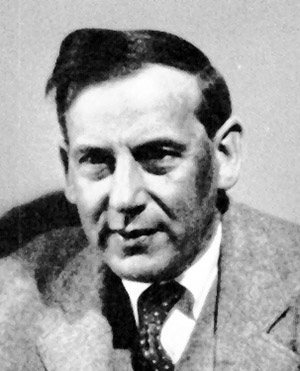
    A. R. Orage (1873–1934)

    These and other ideas first became widely known when Lady Rothermere, wife of a powerful British newspaper baron, rescued Ouspensky from White Russian refugee status in Constantinople by inviting him to London all expenses paid. An English translation of Tertium Organum – which Ouspensky knew nothing about – had become a surprise best-seller in America and England; one of its most devoted readers was Lady Rothermere, and a handsome royalty check accompanied her invitation. In September 1921 Ouspensky found himself in Lady Rothermere’s luxurious St. John’s Wood salon, addressing an audience that included T. S. Eliot, Aldous Huxley, Algernon Blackwood, Gerald Heard among other London literary luminaries. Also among his listeners were A. R. Orage, editor of the leading journal of ideas The New Age, and Maurice Nicoll, a successful Harley Street physician and C. G. Jung’s main disciple in Great Britain. By the end of Ouspensky’s lecture on the system he had learned from G. – which surprised all and disappointed some who had come to hear something more along the lines of Tertium Organum – both Orage and Nicoll would become his students.

    Ouspensky’s tutelage of Orage was short-lived. In February 1922, Gurdjieff himself arrived in London. As always, the appearance of this remarkable man caused disruption. Ouspensky had already impressed with his intellect and seriousness. But Gurdjieff was something else. The same solidity and sheer being that had convinced Ouspensky that Gurdjieff knew now bowled over Ouspensky’s students. And when Gurdjieff announced that he was establishing his Institute for the Harmonious Development of Man in Fontainebleau, just outside Paris, many who had metaphorically sat at Ouspensky’s feet – he really was an unlikely guru – now were eager to make their way across the English Channel. The New Age lost an editor and Jung an apostle. But while Orage remained with Gurdjieff until his own break with him not long before his death in 1934, Nicoll studied with Gurdjieff for a year, and then returned to London to work with Ouspensky.

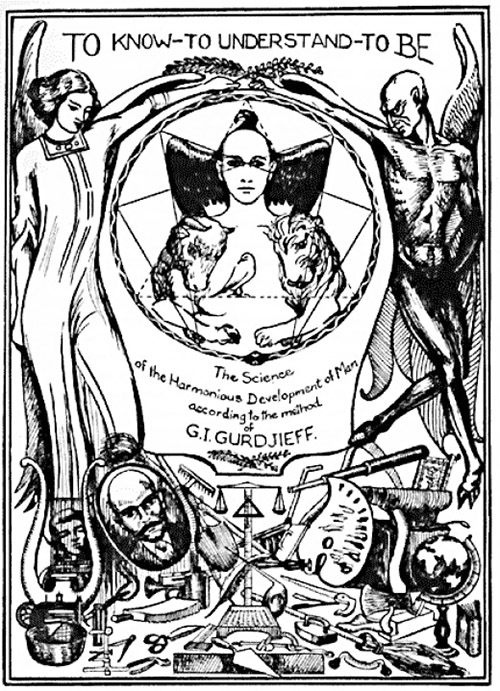
    Representation of a design for Gurdjieff’s Institute for the Harmonious Development of Man, 1923 (from Teachings of Gurdjieff by C.S. Nott).

    By this time Ouspensky had already ended his schooling with Gurdjieff and had set out to teach the system on his own, always giving Gurdjieff credit for it. Or at least for bringing it to the West. Gurdjieff said he had learned it during his time with the Sarmoung Brotherhood, a Central Asian version of Madame Blavatsky’s Tibetan masters, a story he tells in Meetings with Remarkable Men, the most immediately readable of his writings. But at other times Gurdjieff spoke of the system as “his,” so it is unclear how much belonged to him and how much he was “transmitting” from what he called the “inner circle of humanity.” Either way, Ouspensky had come to the conclusion that while he believed the system offered the sole method of “waking up,” he felt that he could no longer work with Gurdjieff himself. 

    Two Very Different Teachers

    During their time together, Gurdjieff taught in a more or less traditional way, through lectures, relating ideas and various exercises or methods of fighting “sleep.” This, along with Ouspensky’s clarity and rigour as a writer and thinker, makes In Search of the Miraculous still the best introduction to “the work.” Ouspensky believed that somewhere along the line, Gurdjieff changed and that his methods and aims were no longer the same as when he first began to learn from him. They had become, as mentioned, more geared toward a kind of psychodrama or role-playing and had also become more focused on the kind of “shock tactics” familiar to one branch of “the work.” The “movements,” incredibly difficult postures and “sacred dances,” designed to outwit our mechanicalness and awaken slumbering parts of ourselves, were part of this. It also entailed making more and more of what Gurdjieff called “super-efforts,” pushing oneself beyond one’s usual limits. When Orage, a portly man and heavy smoker, arrived at Fontainebleau, he was given a shovel and told to dig. He did until his body ached and he sobbed with pain. When he felt he could no longer go on, a sudden influx of energy hit him; he had broken through his mechanical limits. Gurdjieff also made outlandish claims about the success of his Institutes in other cities, most, if not all untrue. Gurdjieff was much more of a “crazy guru” than Ouspensky, a more traditional serious philosopher. And to make things worse, in 1924, a year after it opened, except for a small group, Gurdjieff turned away practically all of his students, said the Institute was closing down, and furthermore, that hewas breaking off all relations with Ouspensky.

    Exactly why teacher and student fell out remains unclear, although in my book In Search of P.D. Ouspensky, I take a stab at answering this question, the essential one in the psychohistory of “the work.” Probably the most likely reason is that they were two very different men and that whatever his faults – I don’t spare them in my book – Ouspensky had a genius of his own, as many of his readers know. However remarkable a teacher Gurdjieff was, Ouspensky could not have remained a student for very long. The strange thing is that he continued to teach the system – to which he added his own ideas about time, as spelled out in his magnum opus A New Model of the Universe – while having many troubling doubts about his teacher. One concern was reports of Gurdjieff enjoying the intimate favours of some of his students. At first Ouspensky dismissed these as gossip; later he wondered about their veracity. Gurdjieff, he knew, was no angel. Indeed, some who encountered him painted him as quite the devil. In any case, he kept everyone on their toes and Ouspensky had had enough of it.

    Ouspensky taught the system in London and, during World War II, in New York and New Jersey, for some twenty-five years. Then, in a series of lectures held in London in 1947, a few months before his death, Ouspensky rejected it, telling his audience they had to think for themselves and start again from the beginning. Exactly what this meant remains one of the mysteries in the psychohistory of “the work.” Some think it was an expression of searing honesty by a man who realised he had made a mistake. Others see it as a grand “work” strategy, a “shock” sent to force people to wake up. Perhaps we will never know. Gurdjieff spent some time in New York in the 1930s, but his main base of operation, following the closing of his Institute, was Paris. There, in his small flat in the rue des Colonels-Renard, which he maintained during the Nazi occupation, he gathered his many students for enormous dinners that would last for hours, and during which he would get them drunk on vodka and pierce their personality to get to their essence. He died in 1949.

    A simple way to see the difference between the two is this. Ouspensky’s approach was to create a method that could be applied by anyone with the will and determination to master it, independently of the personal power or baraka of the teacher, rather as Husserl’s phenomenological method can be learned by anyone with the necessary patience and persistence. But no one could learn how to be like Gurdjieff, although somehow his presence, which so impressed Ouspensky, was in some way able to help others to be like themselves, perhaps for the first time. We might say that Ouspensky’s was the way of knowledge, whereas Gurdjieff taught through being. And, of course, he knew some things too.

    If that is the case, then we are lucky that Ouspensky laboured to capture what he learned from Gurdjieff and to present it in such a brilliant, vivid, and gripping way, as this is what remains for us today. We may not be able to benefit from Gurdjieff’s presence, but we may be able, through his and Ouspensky’s efforts, to make something of our own.

    [alert type=”general” dismiss=”no”]This article was published in New Dawn 167.[/alert]

    [alert type=”success” dismiss=”no”]If you appreciate this article, please consider subscribing to help maintain this website.[/alert]

    Footnotes

    1. P. D. Ouspensky, In Search of the Miraculous, Harcourt Brace and Co. 1949, 3
    2. Ibid.

    © New Dawn Magazine and the respective author.
    For our reproduction notice, click here.
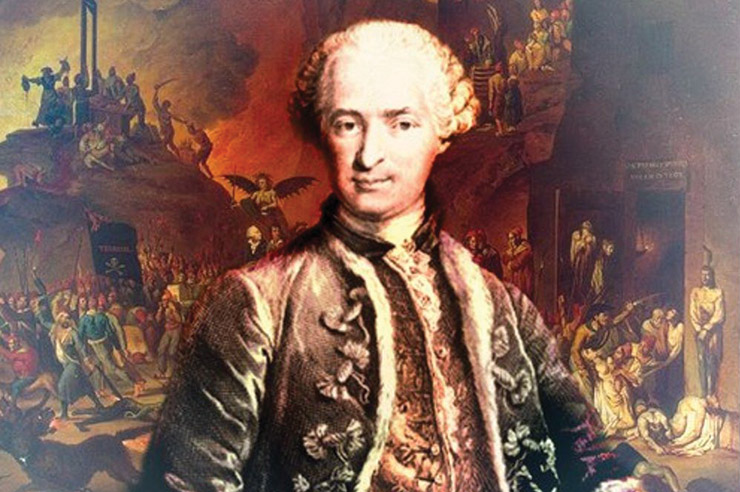
  • The Timeless Mystery of the Count de Saint-Germain

    The Timeless Mystery of the Count de Saint-Germain

    From New Dawn Special Issue Vol 11 No 3 (June 2017)

    While historical records prove that the man known as the Count de Saint-Germain actually existed, his life seems to defy common sense and appears almost magical. Was he a genius or charlatan?

    While the exact date of Saint-Germain’s birth remains unknown, he himself stated (and the known facts support his contention) that he was the son of Franz-Leopold, Prince Ragoczy of Transylvania, and Princess Charlotte Amalia of Hesse-Wahnfried, who were married in 1694. After his brothers had been taken prisoner by the Austrians and his parents had died, he was brought up by the executors of his father’s will – the Duc de Bourbon, the Duc de Maine, and the Count of Charlerie and Toulouse – and through them was introduced to the courts of Europe as someone of princely blood and almost royal descent.

    According to the historical work Illustri Italiani by Caesare Cantu, librarian of the great library in Milan, when this particular embodiment of Saint-Germain came of age, he was educated at the university of Sienna, travelled a lot in Italy and Spain, was greatly protected by the last Grand Duke of Tuscany, and eventually inherited his father’s considerable legacy, which may be why he never seemed to need money. 

    Little else was known about him until 1740, when he began turning up in various historical records as a man who appeared to be in his early thirties, moved in fashionable Viennese circles, and was renowned for his unusually sombre clothing, paradoxical fondness for spectacular diamonds, and penchant for telling extraordinary tales about his past life, including his claim that he had known the Holy Family (Jesus, Mary & Joseph) intimately; been present at the marriage feast at Cana; been a good friend of Anne, mother of the Virgin Mary; personally proposed her canonisation at the Council of Nicaea in CE 325; and prophesied that Christ would come to a bad end.

    The Saint-Germain of those days was widely spoken of as an enigmatic and remarkable figure who practised alchemy, was an expert jeweller, had travelled widely in Europe, Africa, India, China and Persia, was known to speak many languages fluently, including Chinese, Hindu and Persian, composed music and played the violin. (Pieces of music, dated 1745 and 1760, supposedly composed by, and certainly signed by, Saint-Germain, are to be found in the British Museum in London.) He also had a reputation as a ‘magical’ healer, was reported to be deeply involved in numerous esoteric orders, including the Rosicrucians and Templars, and was rumoured to be able to turn base metal into gold. He frequently described machines that bore remarkable similarities to locomotives and steamships (which had not been invented at the time) and there were suggestions he possessed the Alchemist’s Stone, had drunk from the Fountain of Eternal Youth, and was approximately 4,000 years old.

    With regard to Saint-Germain’s frequent talk of futuristic machines, the library in Troyes, France, is in possession of a document signed by him, in which he describes an experience that seems remarkably similar to modern space travel: 

    We moved through space at a speed that can be compared with nothing but itself… Within a fraction of a second the plains below us were out of sight, and the earth had become a faint nebula. I was carried up, and I travelled through the empyrean for an incalculable time at an immeasurable height. Heavenly bodies revolved, and worlds vanished beneath me… (La Très Sainte Trinosophie)

    There were many who believed Saint-Germain was a confidence trickster, but just as many who took him seriously – not least the governments of the major European countries, since the Count, apart from being talked about as a remarkable man, also had the reputation as someone involved, rather shadily, in politics. On the one hand accused by the French police of being a Prussian spy, he was, on the other, suspected by the Prussians of being a Russian agent. To complicate matters further, in November 1745, in a London obsessed with Jacobite plotters and their French sympathisers, he was arrested by the English authorities, accused of having pro-Stuart letters in his possession. He claimed indignantly that the letters had been planted on him, and was eventually released.

    Commenting on the case in a letter to Sir Horace Mann, dated 9 December 1745, Horace Walpole, the famous British art historian and esteemed man of letters, wrote the following odd description: “He [Saint-Germain] has been here these two years, and will not tell who he is or whence, but professes that he does not go by his right name.” He also wrote that Saint-Germain “sings and plays the violin wonderfully” but added that he was “mad and not very sensible.”

    A Surprisingly Youthful Saint-Germain

    The even more bewildering and legendary aspects of the original Saint-Germain began shortly after the Count had, according to the French Marshal de Belle Isle, cured him of a serious illness and was rewarded by being taken to Paris, where the grateful Marshal set him up with apartments and a laboratory for his alchemical experiments. According to Touchard la Fosse, in his Chroniques de l’Oeil de Bœuf, shortly after Saint-Germain’s arrival in Paris he attended a soirée given by the aged Countess von Georgy, wife of the deceased ambassador to Venice, who remembered meeting someone with the same name as, and similar appearance to, Saint-Germain in Venice in the 1670s. When the surprisingly youthful Saint-Germain confirmed to the ageing Countess that the man she had met all those years ago had been himself, she could scarcely believe it, since this would have made him nearly a hundred years old. However, Saint-Germain insisted he was that same man and that he was in fact very old. But then, when the stunned Countess said he must be “a devil,” Saint-Germain “trembled violently,” told her not to use such terms, and fled from the room.

    A possible substantiation for Saint-Germain’s claim that he was the man known to the much younger Countess von Georgy in the 1670s was recorded by Baron Charles Henry de Gleichen, a Danish diplomat. In his published memoirs, Baron Gleichen stated that the composer Philippe Rameau and a relative of the French ambassador to Venice had both assured him they had known Monsieur de Saint-Germain in the early 1700s when, according to them, he appeared to be a man of about fifty. The Baron also confirmed that Saint-Germain had a fondness for unusual diamonds when, in the same memoirs, he wrote: “He showed me some remarkable things – a great number of coloured brilliants and other stones of unusual size and perfection. I thought I was seeing the treasures of the fabled Cave of Jewels…”

    Could these unusual diamonds have been the products of alchemical experiments? Certainly it was believed at the time Saint-Germain was an alchemist who could turn base metal into gold, or glass into diamonds, and whose obsession with alchemy might also have led to his discovery of the elixir of life. This was thought to explain why many people remembered him from years previously and why he seemed relatively ageless. This latter aspect of his personality was heightened by his oft repeated claims that he never ate – and certainly he was never seen eating or drinking in public.

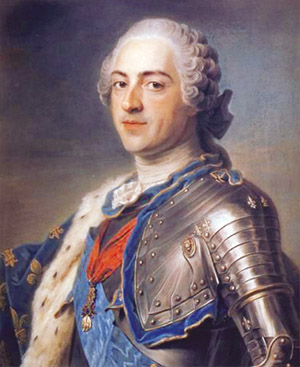
    Portrait of Louis XV, King of France. In 1758,
    Saint-Germain was presented to Louis XV.

    In 1758, while still in Paris, Saint-Germain was presented to Louis XV by Marshal de Belle Isle in the saloon of Louis’ mistress, Madame de Pompadour. He seems to have charmed both of them, since two years later, in 1760, he was sent by Louis XV to the Hague as his personal representative, to help settle the peace treaty between Prussia and Austria. While in Holland, he fell out with his former friend, the notorious philanderer Casanova, who then tried to discredit him. This may have encouraged the enmity of Louis’ Foreign Minister, the Duc de Choiseul, who convinced Louis that Saint-Germain had betrayed him and should be thrown into the Bastille. To save his neck, Saint-Germain fled to England. 

    Subsequently, a London Chronicle article of 3 January 1760, which was mainly concerned with Saint-Germain’s then widely reported ‘eternal youth’, stated: “No one now doubts it, although at first it was thought to be pure fantasy. In fact, everyone believes that, among other things, he knows of a panacea for all diseases and is able to overcome old age.”

    What this proves so far is that Saint-Germain definitely existed, that he was very odd indeed – a musician and composer, an astonishing linguist, an authority on world history, a magician and alchemist rumoured to be 4,000 years old – and who, at least according to historical records, did live a remarkably long time.

    However, from this point on, the recorded facts make his life much more concrete.

    Saint-Germain: A Legend Built from a Real Life

    In 1762 he took part in the deposition of Peter III of Russia and in bringing Catherine the Great to the throne. A year later, he was known to be carrying out further alchemical experiments in his laboratory in the Renaissance château at Chambord, south-west of Orléans, which Louis XV had put at his disposal in 1758. (Other guests in the château at the time included the Princess of Anhalt-Zerbst, mother of Catherine II of Russia; the Marquise d’Urfe; Baron de Gleichen, and Madame de Genlis, all of whom mentioned Saint-Germain’s experiments in their letters and memoirs.) The following year he was living in Holland under the name of Count Surmount, where he established another laboratory in which he made paint and dyes, as well as continuing his alchemical experiments. After disappearing from Holland with about 100,000 guilders, he materialised in Belgium, this time calling himself the Marquis de Monferret – and there, in Tournai, he set up another alchemical laboratory.

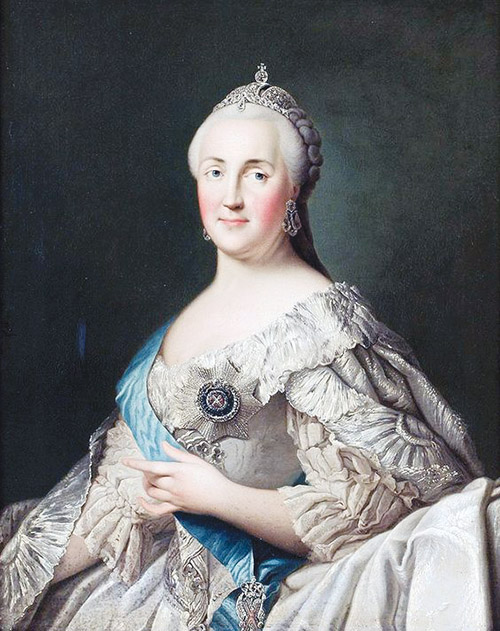
    In 1768, Saint-Germain turned up in Russia in the court of Catherine the Great (above), whom he had previously helped bring to the throne. 

    In 1768 he turned up in Russia in the court of Catherine the Great, whom he had previously helped bring to the throne. According to Count Alexei Orlov, then head of the Russian Imperial Forces, he was an invaluable diplomat and palace advisor during the Russian-Turkish war of 1768-70. As a reward, he was made a high-ranking officer in the Russian Army – a position he took under the ironic English alias of General Welldone – but instead of reaping the benefits of his prestigious position at the end of the war, he chose instead to leave Russia and go to Germany where, with his friend and pupil, Prince Charles of Hesse-Cassel, he carried out more alchemical experiments, as well as studying Freemasonry and Rosicrucianism.

    Voltaire (above) described Saint-Germain as “a man who knows everything and never dies.” 

    A decade before this, on 15 April 1758, Voltaire, the famous French historian and philosopher, in one of his many letters to Frederick the Great, had described Saint-Germain as “a man who knows everything and never dies.” He then added: “I think it quite probable that this man will visit you within the next fifty years.” While this visit never came to pass, in 1779, Princess Amalie of Prussia, the sister of Frederick the Great, met Saint-Germain and became interested in him. However, when a letter from Saint-Germain to Frederick the Great, begging for patronage, was ignored (possibly because of Frederick’s embarrassment over widely circulated reports that Saint-Germain had worked for him as a double-agent during his period in the French court) Saint-Germain returned that same year to Eckernforde, in Schleswig, Germany, where he lived, and reportedly died, in the castle of his old friend, Prince Charles of Hesse-Cassel.

    The parish records in the Catholic church of Eckernforde say that Saint-Germain died on 27 February 1784, and was buried locally. If this was true – and assuming that Saint-Germain was about fifty years old in 1701 – it makes him (at a time when thirty-five was old age) over 130 years old when he died.

    Assuming that he did die in Eckernforde. 

    Post-‘Death’ Appearances of Saint-Germain

    Although Saint-Germain’s burial is recorded in the records of the parish church in Eckernforde, a great deal of mystery surrounds his death. For a start, he was reported to have died when his good friend and disciple, Prince Charles, the Landgrave of Hesse-Cassel, was absent from home, and with only two nameless women in attendance. To deepen the mystery, Prince Charles then burned all of Saint-Germain’s supposedly invaluable papers – in his own words, “Lest they be misinterpreted.” Almost immediately, rumours that Saint-Germain was still alive spread like wildfire.

    In 1785, an important congress of Freemasons was held in Paris and attended by Rosicrucians, Kabbalists, Illuminati and members of other secret societies. According to the Masonic archives, the guests included the famous magician, mystic and alchemist, Count Cagliostro, the philosopher Louis Claude de St. Martin, the renowned physician and hypnotist, Franz Mesmer, and… the Count de Saint-Germain, who is also recorded as having addressed the meeting. 

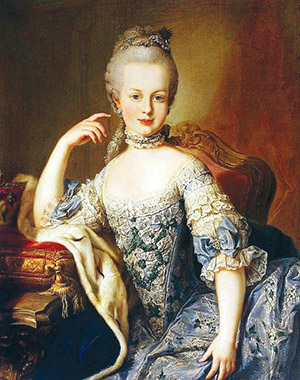
    Reportedly, Saint-Germain appeared to Marie Antoinette (above) in prison, warning her of the date and time of her execution. 

    This was not his only post-death appearance. It was recorded by the diarist Mademoiselle d’Adhemar that he visited her five times over a period of many years, beginning in 1789, when he also visited Sweden’s King Gustavus III to warn him of danger, and ending in 1820, the night before the infamous murder of the Duc de Berri. Even stranger is that in her own diaries, Marie Antoinette expressed regret that she didn’t take note of Saint-Germain’s earlier warning about the forthcoming outbreak of the French Revolution. Reportedly, Saint-Germain also appeared to Marie Antoinette in prison, to warn her of the date and time of her execution. 

    Nor does it end there… Twenty-eight years later, in 1821, the noted educationalist, Madame de Genlis, mentioned in her memoirs a conversation she had with Saint-Germain during the Vienna peace talks; and in the same year the French ambassador, the Count de Chalon, claimed to have spoken to him in St. Mark’s Square in Venice. By 1842, Saint-Germain’s name was being mentioned in connection with Lord Lytton, whom he was said to have helped develop supernatural powers. In 1867 a meeting of the Grand Lodge of Freemasons in Milan, Italy, was reportedly attended by Saint-Germain; and in 1896, when, according to the evidence, he would have been approximately 245 years old, the famed Theosophist Annie Besant wrote that she had recently met him.

    The noted Theosophist Annie Besant (far left) wrote that she met Saint-Germain in 1896 – this was the last confirmed sighting of the mystery man who would have been 245 years old at that time. 

    Sceptics argue the known history and longevity of Saint-Germain is some kind of elaborate hoax, but it would be impossible for any individual, or organisation for that matter, to extend such a hoax over such a long period of time, as well as keeping it alive in so many different countries and cultures. Sceptics also ask why, given that Saint-Germain was supposed to have led such an extraordinary and active life, the historical records on him are so thin – but this may have been deliberate on Saint-Germain’s part. For instance, Napoleon III was so intrigued by the stories about Saint-Germain that he set up a special council to investigate him. However, the commission’s findings were destroyed in a fire that consumed the Hotel de Ville in Paris in 1871 – and few were willing to ascribe that disaster to coincidence. Similar obstructions to the sources of information, and the mysterious destruction of discovered rare material evidence, have occurred throughout the years since Saint-Germain’s final recorded materialisation in 1896, when Annie Besant noted her meeting with him. 

    Did HE Discover the Elixir of Life?

    Saint-Germain was obsessed with alchemy and the possibilities of alchemical transformation. One of the purposes of alchemy is to find a means of purifying humanity as well as Nature and applying that purification to material objects, the cosmos, or man. The changing of metal into gold is only a small part of alchemy – the unimportant part. Its major purpose is to find the ultimate purification – the panacea, the cure for all ailments, the elixir of life, the Hermetic secret that gives one immortality. Because of this, many believe Saint-Germain did not die in Eckernforde in 1784, but that he simply moved on – either in the flesh or in the spirit – and possibly commanded Prince Charles, his faithful friend and disciple, to fake his death… as it had been faked many times before.

    In the register of the Nicolai church in Eckernforde, Germany, the following words are inscribed:

    Deceased on February 27th, buried on March 2nd, 1784.
    The so-called Comte de St Germain and Weldon.
    Further information not known. 

    That use of the phrase ‘so-called’ only deepens the mystery.

    [alert type=”general” dismiss=”no”]This article was published in New Dawn Special Issue Vol 11 No 3.[/alert]

    [alert type=”success” dismiss=”no”]If you appreciate this article, please consider subscribing to help maintain this website.[/alert]

    © New Dawn Magazine and the respective author.
    For our reproduction notice, click here.
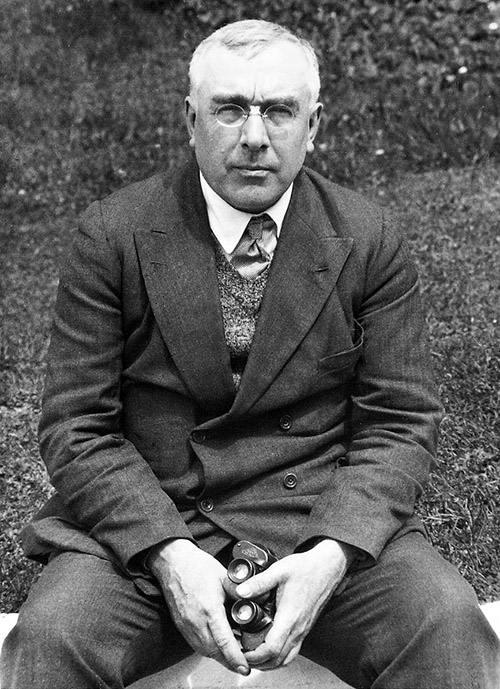
  • Typhon Rising: The Magical Legacy of Kenneth Grant

    Typhon Rising: The Magical Legacy of Kenneth Grant

    From New Dawn 156 (May-June 2016)

    Five years on from the death of British author, occultist and poet Kenneth Grant (1924–2011), we are only just now beginning to see the first attempts at assessing the impact and legacy of the man who was the last-ever student and secretary of the notorious Aleister Crowley, and thought by many to be his natural successor. 

    Grant was also a close friend to the magical artist Austin Osman Spare, supporting him in his final years, counted the godfather of Wicca, Gerald Gardner, as a colleague and sometimes rival, and during his time with Crowley met New Age Priestess, Dion Fortune. As such, Grant had direct contact with four of the most influential figures of the Magical and Mystical Revival of the mid-twentieth century. 

    Regarding his own work, the nine volumes of Grant’s three ‘Typhonian Trilogies’ written across the three decades from 1972 to 2003 – as well as several volumes of occult-themed fiction, and memoirs of the magical personalities he encountered – range across Alchemy, Cabala, Dream Control, Egyptology, H. P. Lovecraft’s Cthulhu Mythos, Left Hand Path, Sex-Magick, Surrealism, Tantra, Thelema, Tibetan Buddhism, UFOlogy, Witchcraft, Voodoo, and back again, and are a unique portrait of the Modern Occult Revival, as well as arguably one of its most creative currents.

    So, just who exactly was Kenneth Grant?

    Born 23rd May 1924, very little is known of Grant’s background or actual biography. He was an intensely private man, who despite – or perhaps even because of? – the nature of his work and the notoriety of his mentor, Aleister Crowley, nonetheless pursued a rigid policy of non-disclosure, akin to the erasing of personal history advocated in the books of Carlos Castaneda. 

    Portrait of Steffi and Kenneth Grant by Austin Osman Spare

    By his own admission something of a bookish, dreamy youth, fascinated by magic and mysticism, the young Grant had experienced astral projection and, at the age of 15, what he felt were spontaneous contacts from a being calling itself Aushik or Aossic, which he would later identify as his Holy Guardian Angel. Grant had come across Magick In Theory and Practice by ‘The Master Therion’ (a pen-name of Crowley’s) in the Charing Cross Road bookshop, Zwemmer’s, and, feeling here might be a key to understanding – or even controlling – his experiences, had prevailed upon Michael Houghton, proprietor of The Atlantis Bookshop, to put him in touch with the author. Houghton declined, however – the reasons for which are unclear – but what is a matter of record is that Grant, after first writing, finally met with Crowley. It was December 1945, and as they shook hands for the first time the song Shine On Harvest Moon was playing on the radio in the background.

    So it was that the young Kenneth Grant became, for a while, an informal assistant-cum-secretary to the aged Magus upon forsaking Blitz-battered London for the peace and quiet and relative safety of a lodging-house on the South Coast. It was at ‘Netherwood’ in Hastings, where The Great Beast ended his days just three short years later, that Grant would become apprenticed to Crowley’s Magick in earnest, be initiated into his Ordo Templi Orientis, meet the likes of Dion Fortune, Gerald Gardner, and Lady Frieda Harris, the gifted artist who illustrated Crowley’s superlative Book of Thoth Tarot-deck. He also became aware of Crowley’s still-extensive network of correspondence with occultists overseas – such as Karl Germer and Eugen Grosche in Germany, and Jane Wolfe, W. T. Smith, and Jack Parsons in America. For a while it even seems that the ageing Beast was grooming young Grant to be a possible successor, referring to him as a “Gift from the Gods,” and noting in his diary:

    …value of Grant. If I die or go to the USA, there must be a trained man to take care of the English OTO.

    But even at this early stage, Grant’s propensity for daydreaming and otherworldliness bewildered and frustrated the older man, who – after all – was looking for practical, day-to-day assistance first, and to train as heir, second. Eventually it all became too much – particularly for Grant, who was missing his fiancée Steffi – and Crowley let him go, but not before initiating Grant into the IXO O.T.O. and furnishing him with a Charter to set up an encampment of the Order.

    Shortly before Crowley’s death, Grant also met a man who would later prove to be almost as much of an influence on him as The Great Beast: albeit more in the form of an éminence grise, who influenced Grant from behind the scenes. He provided an initiation and inspiration that had a definitive impact on Grant’s reformulation of Thelema, the purpose and rituals of the branch of the O.T.O. he founded, and much of the focus of his Typhonian Trilogies. His name was David Curwen.

    A practicing Alchemist and student of Tantra, who had taken the step of devotion to an Indian Guru – unusual for a Westerner at the time – David Curwen was first mentioned in Grant’s 1991 memoir, Remembering Aleister Crowley:

    David Curwen was first mentioned in Crowley’s diaries on 2.9.1944. When I met him, shortly before Crowley’s death, he was a member of the IX° O.T.O. His passion for Alchemy was all-consuming; so much so that he had nearly died after imbibing liquid gold. His knowledge of Tantra was considerable. It was through Curwen that I received, eventually, full initiation into a highly recondite formula of the Tantric vama marg.

    In discussing Crowley’s attempted formulation of an ‘elixir’ as part of his sex-magickal workings, Grant mentions a detail of key relevance to his later weaving of Tantra and Thelema, which would be essential to his own journey of initiation:

    There exists a document relative to this formula compiled by Curwen’s erstwhile guru, a South Indian tantric. It is in the form of an extensive commentary on an ancient text of the Kaula School. Curwen lent Crowley a copy of it.

    The document in question was a copy of the Anandalahari, or ‘Wave of Bliss’, annotated by Curwen’s South Indian Guru and with a Commentary explaining the physiological – and explicitly sexual – symbolism. This provided Grant with a key to unlocking the hidden mysteries of the Sanskrit Sacred Texts, from which he was able to develop – with Curwen’s help – a deeper insight into Tantra than his former mentor had ever achieved:

    In the instructions which accompany the higher degrees of the O.T.O., there is no comprehensive account of the critical role of the kalas, or psycho-sexual emanations of the woman chosen for the magical rites. The commentary was an eye-opener for Crowley, and it explained some of his preoccupations during my stay at ‘Netherwood’. These involved a formula of rejuvenation. The O.T.O. lacked some vital keys to the real secret of magick which Crowley claimed to have incorporated into the higher degrees. Curwen undoubtedly knew more about these matters than did Crowley, and Crowley was piqued.

    Despite his outsider credentials as an occultist and sometimes transgressive attitudes as a drug-taker and promiscuous bisexual, Aleister Crowley was still in many respects a product of his time: he may not have been an out-and-out misogynist, but he suffered from a male chauvinism all-too-typical of his Victorian, privileged, white male background. He also had little-or-no knowledge of authentic Tantra from original sources, whereas when I exchanged letters and briefly met with Kenneth Grant in 1981, he made it clear that despite his lifelong dedication to Crowley and the Law of Thelema, really his “first love,” spiritually speaking, was Advaita Vedanta. This ancient Hindu philosophy of non-duality asserts that Atman, or the True Self, is essentially no different from the Highest Universal Principle, or Brahman. Grant would become for a while in the 1950s a follower of the Sage of Arunachala, Bhagavan Sri Ramana Maharshi, and saw his essential meditation “Who am I?” as equated to Thelema’s pursuit of realising one’s True Will, writing:

    The natural spirit of the East, in its deeper rootage, is in complete accord with the doctrine of Thelema. That this is so may be proved by comparing the basic tenets of Thelema with the Chinese Way of the Tao, the Vedantic doctrine of Advaita, and the pivotal philosophy of Hindu and Buddhist Tantricism.

    A number of articles that Grant wrote for Anglo-Indian journals were later gathered together and published as At the Feet of the Guru.

    After a period of association with Gerald Gardner – who was also a member of the O.T.O., likewise with a charter to set up an encampment (although there is no evidence that he ever put it to use) – Grant would set up a Working Group of his own, “evolved… for purposes of traffic with the Outer Ones,” of which he wrote:

    Between the years 1955-1962, I was involved with an occult Order known as New Isis Lodge. It functioned as a branch of the Ordo Templi Orientis (O.T.O.), with headquarters in London. I founded the Lodge to channel transmissions from transplutonic sources… The body of these transmissions forms the basis of the Typhonian Trilogies.

    This caused a falling out with Karl Germer, nominal Head of the O.T.O. upon Crowley’s death, who felt that Grant had exceeded his authority. There were also personality clashes because New Isis Lodge had issued a manifesto in conjunction with the former Grandmaster of the German Fraternitas Saturni, Eugen Grosche, with whom Germer had fallen out previously – the net result being Grant’s expulsion from the Order. This Grant disregarded, however, considering his authorisation to have come from Crowley himself, and also his own ‘Inner Planes’ contacts. Thus began the parting of the ways between Grant’s Typhonian Order and the so-called ‘Caliphate’ O.T.O. reformulated in America by Grady McMurtry.

    A key to understanding the notion of ‘Typhonian Gnosis’ is Kenneth Grant’s emphatic identification of Typhon – a monstrous entity from Greek mythology, leader of the Titans, who make war against the gods of Olympus, and decidedly male – as the Mother of Set. Grant does not hesitate to appropriate this gigantic, multi-winged and snake-limbed chthonian monster, Primal Typhon, as an avatar of The Great Mother, i.e. ‘Mother Nature’ Herself, and boldly asserts:

    She typified the first parent at a time when the role of the male in procreation was unsuspected. Because she had no consort she was considered to be a goddess without a god, and her son – Set – being fatherless was also godless and was therefore the first ‘devil’, the prototype of the Satan of later legends. 

    With regard to Set – a dark, primal figure of raw potency from aboriginal, pre-Dynastic Egypt, later cast as the killer of the god-king Osiris and thereafter prototype of the “God against the Gods” – Grant wrote in the Foreword to the 1990 edition of what had originally been his first book, The Magical Revival:

    “For us, who have the inner knowledge, inherited or won, it remains to restore the true rites of Attis, Adonis, Osiris, of Set, Serapis, Mithras, and Abel.”

    These words of Aleister Crowley inspired me as a youth, and, imagining myself as one of those to whom they were addressed, I soon discovered that for some reason I have not been able to fathom it was the god Set I was being called upon to honour. I accordingly took it upon myself to penetrate the Mysteries of this, the most ancient of deities, and to trace the history of his rites from an indefinite antiquity to the present day. 

    Kenneth Grant (1983)

    The Egyptian Mysteries very much form the core of the Western Magical Tradition, and were certainly the basis for the mythos and rituals of the Hermetic Order of the Golden Dawn, where Crowley had learned most of what he needed for his later development. Ancient Egypt as a source of supernatural power sanctioned his role as Prophet, and as much as Grant built on Crowley’s Aeon of Horus and The Book of the Law, the primary source for his Typhonian Gnosis was the controversial work of self-taught Esoteric Egyptologist, Gerald Massey. 

    In monumental works such as Natural Genesis and Ancient Egypt: The Light of the World, Massey set out in no uncertain terms what he claimed was the Afrocentric and physiological basis of Gnosis: “The oldest symbols and religions originate in Africa.” He conceived of Typhon as equivalent to the Egyptian Tauret, or Ta-Urt, the hippopotamus “Mistress of the Birth-House.” She was the Goddess of the Seven Stars of the North, and Her son was the Dog Star, Sothis or Sirius (equated with Set), whose heliacal rising appeared above the horizon just before the inundation of the Nile. ‘Typhonian’ referred to those who worshipped this Primal Goddess, and members of Her Stellar Cult had fled East, taking their wisdom with them, when the Solar worshippers gained the ascendancy. In many ways, Kenneth Grant’s major innovation was in linking this Typhonian Tradition to Modern Occultism.

    While Grant built extensively on the works of other occultists that had gone before him – Blavatsky, Crowley, Fortune, Grosche, Spare – and cited academics and scholars, from pioneering sexologist Havelock Ellis to ‘Egyptosophist’ Gerald Massey, he also had the curious habit of referencing works of fiction with the same apparent seriousness. Thus, discussions of the Stellar Wisdom and survival of pre-Dynastic worship from earliest Egypt may include, as well as references to archaeological sources, also speculative material drawn from the Akashic Record. Comparisons with writings on Tantra and Voodoo are all mixed together with the horror stories of Bram Stoker, the pulp novels of Sax Rohmer, supernatural fiction of Arthur Machen, and the ‘Weird Tales’ of H. P. Lovecraft. 

    Grant had a special affection for Lovecraft (pictured left), apparently believing that he was “onto something” – that his dread grimoire, The Necronomicon, in fact existed on the astral plane, and that HPL had apprehended this through his dreams, but was unable to accept the ‘truth’ of what he had discerned – that he was, in effect, an unconscious magician. To add to the apparent confusion, in a number of works Grant has given accounts – allegedly from the Annals of his New Isis Lodge – that read like something from the purple prose of supernatural horror writers, and talked about fictional characters as if they were “real” – and then in his supposedly fictional works he has drawn on presumably biographical elements from his own life, also ‘real’ characters and locations.

    To my mind, this over-literal examination of certain writings, such as Grant – or even Carlos Castaneda, with whom he has sometimes been compared – can miss the point. Whether or not Don Juan ‘really’ turned Castaneda into a crow, or that they jumped off the mountain together – or whether Crowley ‘really’ asked Kenneth Grant if they were distantly related via a shared cousin in an extended clan, who just happen to have been in possession of a family heirloom in the form of a grimoire documenting their generations-long traffic with otherworldly intelligences – is neither here nor there. What Grant is trying to stress – what he was an undoubted Master of – is the use of fiction or literature as a form of magical Glamour. 

    Words can weave worlds, words can conjure ghosts – words can transport and transform, and alter consciousness – the only limit being imagination. It is to be remembered that imagination is concerned with creating images, in which respect it is directly related to the Ancient Egyptian Heka: a word that meant both ‘Magic’ and “the making of images.” The roll-call of writers who were also magicians – or alternatively, occultists who employ fiction as a means of expressing magical concepts – is a long and distinguished one. 

    Grant himself follows in the footsteps of Aleister Crowley and Dion Fortune, both of whom had a background in the Golden Dawn and its offshoots, as did Algernon Blackwood, J. W. Brodie-Innes, Arthur Machen, Sax Rohmer, Bram Stoker, and A. E. Waite. Grant saw the occult implications in the work of such writers as being not that dissimilar to his own:

    Machen, Blackwood, Crowley, Lovecraft, Fortune, and others, frequently used as a theme for their writings the influx of extra-terrestrial powers which have been moulding the history of our planet since time began…

    As well as other Decadent and Symbolist poets and writers such as Baudelaire, Huysmans, Lautréamont and Rimbaud, Surrealist painters like Salvador Dali, Paul Delvaux, Max Ernst and Yves Tanguy come in for special appreciation. Dali in particular was praised as “One of the foremost magicians of our time” – with Grant going on to make the comparison with Spare explicit:

    Spare had already succeeded in isolating and concentrating desire in a symbol which became sentient and therefore potentially creative through the lightnings of the magnetised will. Dali, it seems, has taken the process a step further. His formula of ‘paranoiac-critical activity’ is a development of the primal (African) concept of the fetish, and it is instructive to compare Spare’s theory of ‘visualised sensation’ with Dali’s definition of painting as ‘hand done colour photography of concrete irrationality’. Sensation is essentially irrational, and its delineation in graphic form (‘hand done colour photography’) is identical with Spare’s method of ‘visualised sensation’.

    The emphasis on the use of such creativity, charged with magical Intent and directed by the trained Will, is a key concept of the Typhonian Gnosis:

    Dion Fortune emphasised the importance of the consciously controlled day-dream. Basing her practices on aspects of the Spiritual Exercises of St Ignatius of Loyola, she demonstrated the magical value of “dreaming true,” an expression derived from George du Maurier’s novel, Peter Ibbetson. The theory is that if one weaves a day-dream with sufficient intensity it induces so total an abstraction of the senses that the dreamer merges into a waking dream, wherein he is the creator and master of his own fantasies. If powerfully formulated, these concretise, reify, and assume a reality equal in degree – and often more so – to that which is experienced in ordinary wakeful consciousness. The advantages of being able to induce such a state are evident…

    Perhaps more than any other modern occult writer, Grant stressed the importance, potential and power of such creativity, writing in Aleister Crowley & The Hidden God that, “Great art is always simple… true art expresses Eternity.” From the beginning, Art by the likes of Austin Osman Spare and Grant’s wife, Steffi, is essential to the function of the Typhonian Trilogies – the text illustrates the pictures as much as the pictures illustrate the text. Later, in Outside the Circles of Time, Grant writes regarding artists such as Dali, Sidney Sime, Spare, and Tanguy: 

    These artists accomplished a leap into other dimensions and – this is the important point – returned to record their extra-dimensional experiences… Art, in the true and vital sense, is an instrument, a magical machine, a means of occult exploration which can project the seer into the realm of the Unseen, and launch the waking mind into the seas of the subconsciousness.

    As much as Kenneth Grant’s works can stand as invaluable documents of the evolution of contemporary occultism – as well as records of the contribution of many of the pioneering figures that he had personal contact with – it is to be hoped that the greater contribution of his books will be as magical catalysts for the reader who is prepared to approach them in the same light. As Grant’s former protégé, Priestess of Maat Magick, Nema, wrote: “These aren’t just books about Magick; they’re books that are Magick.” 

    Used as portals to the Nightside, the nine volumes of the Typhonian Trilogies – as well as Grant’s various other books – can ultimately serve as guides to that place of exploration and inspiration beyond such distinctions as ‘fact’ and ‘fiction’ that he liked to call “the Mauve Zone.” 

    The Typhonian Trilogies – available from www.starfirepublishing.co.uk

    As such they can serve as launch-pads or even vehicles to that place which each of us needs to find for ourselves: the place where the Magick happens.

    Finally, in closing, I know that a picture of Grant is often painted as autocratic, even ‘Old School’ authoritarian, which may well have been so – several people have lead me to believe that he was actually easier to get on with if you weren’t a member of his Typhonian Order! – but there is no doubting his obvious dedication to the Daemonic Feminine. The Fellowship of Isis, whom Grant supported, have asserted he was “totally for the Goddess.” His championing of the work of Dion Fortune, of Marjorie Cameron – at a time when most people, if they were aware of her at all, just thought of her as “Jack Parsons’ widow” – his active encouragement of successive generations of strong women occultists such as Janice Ayers, Jan Bailey, Linda Falorio, Margaret Ingalls (the aforementioned Nema), Mishlen Linden, and Caroline Wise – as well as his life-long devotion to his wife, the artist Steffi Grant, whose works vividly complement and illustrate his books – all attest to this.

    The last living link to Aleister Crowley, Gerald Gardner, Eugen Grosche, and Austin Osman Spare, Kenneth Grant’s legacy is yet to be fully assessed and we shall not see his like again.

    [alert type=”general” dismiss=”no”]This article was published in New Dawn 156.[/alert]

    [alert type=”success” dismiss=”no”]If you appreciate this article, please consider subscribing to help maintain this website.[/alert]

    Further Reading

    The Works of Kenneth Grant have appeared via a number of publishers down the years. Long out-of-print First Editions are quite rare, and prices on the Collector’s Market tend to reflect this. All of the following titles – unless otherwise indicated – are still available in relatively recently reprinted editions from Starfire Publishing, who are committed to ensuring the continuing availability of Grant’s Work.
    The Typhonian Trilogies: The Magical Revival [1972]; Aleister Crowley & the Hidden God [1973]; Cults of the Shadow [1975]; Nightside of Eden [1977]; Outside the Circles of Time [1981]; Hecate’s Fountain [1992]; Outer Gateways [1994]; Beyond the Mauve Zone [1999; reprint forthcoming]; The Ninth Arch [2002; reprint forthcoming]
    Starfire can be contacted via their website www.starfirepublishing.co.uk, or at: Starfire Publishing Ltd, BCM Starfire, London WC1N 3XX, United Kingdom.
    Also: Images & Oracles of Austin Osman Spare [1975; re-issued Fulgur, 2003]; Remembering Aleister Crowley [Skoob, 1991]; Zos Speaks! Encounters with Austin Osman Spare [with Steffi Grant; Fulgur, 1998]
    In addition, there are several volumes of Grant’s fiction, including Grist To Whose Mill?, a semi-fictionalised “Nightside Narrative” from the mid-1950s, featuring intriguing portraits of a number of occultists Grant was associated with, such as Aleister Crowley, Gerald Gardner, and Austin Osman Spare.
    As yet, the study of Grant and his work is in its early stages, but two interesting and quite diverse starting points are Dave Evans’ The History of British Magick After Crowley [Hidden, 2007] – which contains several chapters relating to Grant and the influence of his Work – and Peter Levenda’s The Dark Lord: H. P. Lovecraft, Kenneth Grant and the Typhonian Tradition in Magic [Ibis, 2013].

    © New Dawn Magazine and the respective author.
    For our reproduction notice, click here.