New Dawn – World's Most Unusual Magazine

Category: Articles

  • Cleverman: The Paranormal Powers of the First Australians

    Cleverman: The Paranormal Powers of the First Australians

    From New Dawn 159 (Nov-Dec 2016)

    The Aboriginal people of Australia are the longest surviving culture on earth with over 60,000 years of stories known as The Dreaming. The Dreaming is the spiritual realm that binds the past, present and future together. It is inhabited by incredible creatures and spirits. At the head of this realm is the Cleverman, a powerful man who is the conduit between The Dreaming and the real world. 
    – Introduction to the TV series Cleverman

    In June and July 2016 the Australian Broadcasting Service (ABC) premiered an original new drama series titled Cleverman. The title refers to the shamanic medicine man of Aboriginal culture who is the conduit between the material world in which we live and The Dreaming – or spirit world – which is the domain of supernatural creatures. 

    The television series is set in a dystopian future Australia where mythical beings from The Dreaming – known as Hairies* – reside alongside the human populace. They are a race of sub-humans who exhibit super-human strength and psychic abilities, however these skills are not enough to rescue them from a life of apartheid and an ever-dimming future in the internment camp known as The Zone. As events play out, we are introduced to Uncle Jimmy, a Cleverman, as he prepares to pass the mantle to a new, unwitting initiate named Koen. But will the new Cleverman be able to restore balance between the worlds and make things right again?

    * The Hairy – also known as Yowie (Yuri) – is generally accepted to be non-human but may share a common ancestral heritage to Aboriginal Australians as well as deep respect of, and connection to, the land. Some researchers link the Yowie and the Yeti, Sasquatch, etc., but tradition strongly suggests it normally resides in the spiritual realm of The Dreaming. Data from British researcher Mark Evans defends a new position: Yeti stories, passed down orally through generations, may in fact be based on narratives of factual, pre-historic, sub-human races (such as the Denisovans). Proof is the EPAS-1 gene – a high-altitude mutation attributed to the Denisovan race – passed down to some Himalayan human races by way of interbreeding thousands of years ago. This theory might also apply to the Yowies of Aboriginal mythology.

    The parallel between treatment of the Hairies and real life Aboriginal Australians is painfully obvious. TV series creator Ryan Griffen says this portrayal “is a way to teach people about… how we treat other people.”1 Their future depends on a special person – a super hero – to fight against the odds and bring both worlds into balance. Although he may be an unlikely hero, the Cleverman is a leader, a lawgiver, a healer and a magician who exists beyond the barriers of time and space and is, in many ways, immortal. However, to understand the people’s hero, first we need to look into the history of the First Australians and why the Cleverman is so important.
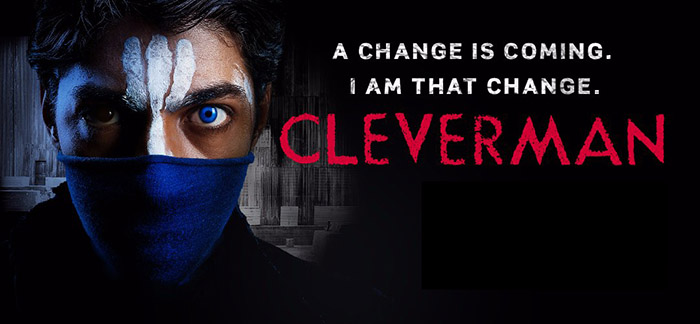
    Promotional graphic for the TV program Cleverman

    Sources of Ancient Occult Knowledge

    Early twentieth century anthropologists perpetuated the colonial view that the Aborigines were a dying race and Australia was “a museum of left-overs from the evolutionary past”2 which “comes from the whole notion of terra nullius… where the lore as much as the law did not matter.”3 According to Nevill Drury and Gregory Tillett in their influential 1980 book Other Temples, Other Gods: The Occult in Australia, researchers attempted to decipher the mysteries of Aboriginal spirituality, the “sources of ancient occult knowledge, preserved in their secret rituals and teachings.”4 

    These theorists, including the eminent Australian anthropologist Prof. A. P. Elkin, realised that two important principles underlie Aboriginal Dreaming mythology: (1) the shapes of things today are primarily due to their formulation during events in the Dream-Time, and (2) living man must “follow-up the Dreaming”5 by remembering “his communion with those original events by (demonstrating) acts which signify and symbolise what happened then and what continues to happens.”6 The importance of this definition cannot be over-emphasised: The Dreaming is eternal, ‘everywhen’, and represents a conjunction of past, present and future; it is separate from the physical realm and in the sense we understand and experience time. Aboriginal men are obliged to retain a link to the realm of The Dreaming – and the possibility of encountering its protean, shape-shifting supernatural beings. Out of this obligation grew the role of the Cleverman, or shaman, to bridge the gap between the spiritual and material worlds.

    It is vitally important we also consider the Wandjina* of Aboriginal creation myths. Often used as supporting evidence for the ‘Ancient Astronaut Theory’, the Wandjina are regarded as beings of a celestial nature, creators of the landscape and its inhabitants, also acknowledged as lawgivers and educators. They are white in appearance, often depicted with staring black eyes with no mouths. Tradition indicates they are connected to fertility rites and are characterised as contradictory or even spiteful in their actions. This description brings to mind images of grey alien beings or the old Celtic legends of the Faery Folk of Britain and Europe. As we will see, these beings fit into the intriguing story of the Cleverman.

    * Descriptions of Wandjina are strikingly similar to those of the mythical Kachina, a race of spirit-people who taught the Hopi and Zuni tribes of North America, and whose appearance is akin to classic images of Wandjina, particularly those with slit eyes, small triangular mouths and feathers radiating from their heads. These characteristics are reflected in the manufacture of Kachina Dolls – a Hopi tradition employed to ensure future generations would not be scared of the Kachinas when they return, as prophesied. 

    Who is the Cleverman?

    Before going any further behind the scenes to explore the role of the Cleverman, first we need to acknowledge that the protection of secrets is of paramount concern to the caretakers of this land. As with the social and cultural importance of the medicine man, there are other specially selected candidates with equally significant roles in Aboriginal communities, such as those who ‘protect’ the myriad stories, acting for the traditional ‘copyright’ owners.

    For Ryan Griffen to convey the storyline of his Cleverman series, he first needed permission to relate stories from The Dreaming because these stories belong to various storytellers. The stories were not Ryan’s to tell, even though he may have grown up with them. Without the required permissions there is every indication he could have been exiled from his ‘mob’ to become persona non grata to his elders, or worse. 

    Mistruth and misinformation is rife when researching the intricacies and power of the Australian shaman. By his very nature, the Cleverman is secretive – he preserves wisdom and powerful techniques that could be harmful in the wrong hands and minds. Strategies are in place to protect against Western superficialities, negative attitudes, cultural exploitation, pillage and plagiarism – which plagued great Aboriginal Australians like David Unaipon and Albert Namatjira. Therefore, it must be pointed out that this introduction to the Cleverman is not intended to take power away from the true owners of the Cleverman’s stories. Nobody questions the fact that the secrets of Freemasonry may be eluded to, but not fully disclosed, and it is not for us to question. While Griffen’s re-imagining of the Cleverman as a paranormal super hero allowed him to bypass some of the more secretive elements of the Cleverman – and there are many such secrets that cannot be discussed in public – there is much we can discuss outside the circle of initiates, and “men of high degree.” So, with great respect, we begin our look at the man and the magic of the Cleverman.7

    The Cleverman is the Original Australian medicine man (or shaman) and is a chosen maleinitiate. “He is a man to be respected,”8 who is “called” to his position. The calling can take one of a few forms, all of which are recognised as legitimate from the spiritual perspective. Firstly, he may exhibit the potential skills of the role from an early age – this might include demonstrating certain abilities, a stronger than normal connection to his elders, aptitude towards the shamanic arts or – particularly – acknowledgement as part of the continually reincarnating line of great Clevermen. Secondly, there may be inheritance of the position: normally the role is not fulfilled via nepotism but through spiritual destiny demonstrated by certain behaviour patterns. Finally, the aspirant may have an overwhelming inner desire, experience psychic or paranormal occurrences, or “hear the calling” in a way that can be confirmed by a medicine man in as much as the candidate may be deemed genuine and worthy of teaching.

    The mechanics behind the calling do not appear to be a function of our mundane world, and it also appears that the initiation process depends on having one proverbial foot planted firmly in The Dreaming.

    The Making of the Cleverman (Initiation)
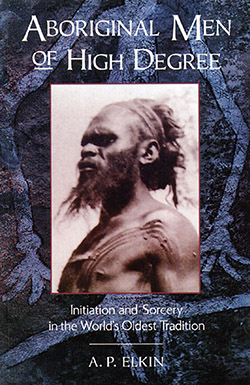
    A veil of secrecy hangs over the initiation rituals for a potential Cleverman. There are also regional differences in the performance of these rituals, dependent on the individual characteristics exhibited by the candidate. However, of significance to Aboriginal spirituality, according to anthropologist A.P. Elkin, was “pre-existence of the soul and of reincarnation.”9 It was believed spirits were created in the Dream-Time by the action of some Being, and waited in sacred places “until a suitable mother was found for them.”10 Many observers would draw comparisons with Indian and Tibetan occult teachings, citing a possible link in the remote past between Australia and Asia. One might expect that a spirit Being incarnating as a Cleverman would have no conscious knowledge of his real abilities until he started experiencing minor miracles or paranormal phenomena during his ‘amnesiac’ period.

    The process of ‘making’ a Cleverman resembles a spiritual-alchemical transmutation: an intriguing ritual in the initiation of the medicine man sees the ‘removal’ of his ‘insides’ and subsequent replacement with madan11 – quartz crystals, bones and spirit-snakes. This replacement of anatomical organs for magical talismans is said to be performed by the ghost of an outstanding (deceased) person, the spirit of a culture hero or agent of ‘The Great Spirit’. During the preliminary stages, the Cleverman-in-making might be required to sleep on the grave of a special individual whose ghost performs the surgical duties.

    The candidate must symbolically die and be reborn – echoing the rituals of esoteric and spiritual orders worldwide, including Masonry and Christianity – but in this case, upon rebirth, he awakens with psychic and supernatural powers. This process of reincarnation12 might be symbolic but, with his newly replaced innards, it’s a concept reminiscent of enlightened Buddhist monks who are purported to be able to produce rare gemstones from their bodies (and retrievable from the body after death). 

    The Abilities of the Cleverman

    The supernatural abilities attributed to an Aboriginal medicine man include clairvoyance, future divination, telepathy, the skill to send messages over long distances and to ascertain facts without prior knowledge at a distance (this process is termed telesthesia), and reading a person’s mind. He can appear at more than one place at any one time or disappear and re-appear in different locations. This skill of ‘omnipresence’ has been demonstrated on a number of occasions to non-Aboriginal researchers, producing dismayed reactions in the witnesses and provoking further, serious scientific enquiry.

    By use of these powers, the Cleverman creates illusions to trick enemy raiders and combatants into seeing things that are not really there, or cloaking people (or things) in a veil of invisibility – these are truly superhuman traits, in the comic book sense, and would be one source of inspiration for Ryan Griffen. This skill has been performed for thousands of years and, as mind-bending as it might seem, has been recorded on numerous occasions. 

    It must be remembered the Cleverman is a force of good for his community – not in the sense of which we are accustomed in the modern age with images of police enforcement for our own good or military personnel protecting civilians. He has the power to heal at will but the flipside is that he can also kill at will; his mastership in balancing the forces of light and darkness proves that absolute power does not need to corrupt absolutely.

    The act of harming another person – called ‘pointing the bone’ – is only used in extreme circumstances as punishment for unforgiveable acts. This kind of magic is not exclusive to the Australian shaman: it was once common in Europe, the Mediterranean, India, throughout Asia, and in territories that practice voodoo and black magic. In fact, this type of ‘malevolence’ exists universally wherever there is a tradition of magic. As with voodoo, it is often explained as a psychosomatic process whereby the magic power comes into effect once the recipient gains awareness of the hex or malediction placed upon them. In the case of the Aboriginal shaman, it needs to be clarified that ‘pointing the bone’ is not used for petty, personal gains because this invokes stronger paranormal forces against the user and is not the behaviour of a genuine Cleverman.

    Researchers have reported that ‘familiars’ – spiritual entities – seem to be involved in the act of placing curses. Familiars are also employed when a Cleverman needs to obtain information, however, to do this he must first be in the correct state of awareness to receive such information. This would be in the form of a trance-like state or a dream-sleep which enables him access to other worlds – a technique reminding us of modern day practices to journey out-of-body. 

    According to the Wiradjeri people, “he would have to ‘hum’ or ‘think’ his spirit out” of his body and onto the ethereal plane.13 As to whether this process refers to his spirit in the sense of an external entity symbiotically connected to his essence, or whether his own internal spirit is somehow manifested into an externalised existence by internal vibrational forces, is not defined. The ability of the shaman to “fly through space and see what is occurring elsewhere”14 demonstrates the spiritual power and skills of the Cleverman for out-of-body journeying. To differentiate between the different aspects of the shaman’s out-of-body experiences, Elkin points out that in some cases, “The spirit-familiar was an externalisation of the man’s spirit.”15

    As reported in The Sun newspaper in 1969,16 blood transfusions were part of the medicinal responsibilities of the Kimberley shaman, the barnmunji. The extraction process was allegedly made possible by use of a thin, hollow reed inserted into a vein of the middle or inner arm. Transfusions were performed only in extreme circumstances or to transfer the blood of the young to an elder who required revitalisation or sustenance. The knowledge to do this precludes an understanding of blood types and donor selection, direction and flow of blood, and an awareness of the functions of the various bodily organs, as well as hygiene. Research has shown that transference of blood could also occur orally. The general knowledge of transfusions in Aboriginal society pre-dated the 17th century Western discovery of transfusion by thousands of years!17

    As previously mentioned, the Wandjina appear to be involved in the Cleverman’s pursuits but it is unclear if they are merely available through metaphysical correspondence as sources of information or do they play a role in supernatural activities. As to whether the Wandjina – the spiritual agents of a greater power – take part in the actual mechanics of paranormal events or conform to roles as overseers or regulators, is a fact we may never know. However, it has been surmised the Cleverman does not work alone, that his partners reside in The Dreaming, and assist only those humans who are initiated and have attained the highest levels of spiritual awareness.

    The Future

    We have explored the role and abilities of the Cleverman but what of his future? 

    Australia today is a nation of unbalance with political chaos, divided loyalties, vocal extremism and cultural malaise. While steps are being made to officially recognise its Original peoples in the Constitution, it is high time Australia pauses to assess who we are as a nation of many different peoples. Recognising the rich cultural heritage of this land and its Original inhabitants is unifying for all Australians – and there is much for us to learn and experience that can bring us closer together. 

    The importance of the Cleverman remains undiminished in his community, and his enigma continues to spread by way of culture, spirituality and of course storytelling. He has survived the white man’s tyranny, and massive social and cultural upheaval. His survival is made possible because he performs his duties in plain sight, donning the costume of the everyman in the everywhen. He is non-descript, normal, with no banner, cape, brand or entourage to herald his arrival. 

    First and foremost, “he is a man to be respected,”18 and we should be proud of him and the fact that we are part of his people’s culture and traditions, if only we cared to open our eyes.

    The side articles that accompanying this article on the Cleverman’s tools and the inhabitants of the Dreaming can be read when you purchase the digital version of this magazine.

    [alert type=”general” dismiss=”no”]This article was published in New Dawn 159.[/alert]

    [alert type=”success” dismiss=”no”]If you appreciate this article, please consider subscribing to help maintain this website.[/alert]

    Footnotes

    1. Ryan Griffen, Cleverman TV series creator, interviewed on Moral Compass, ABC-TV, 19 June 2016
    2. Nevill Drury and Gregory Tillett, Other Temples, Other Gods: The Occult in Australia, Methuen Australia, 1980, 11-12
    3. Stan Grant, broadcaster and journalist, interviewed on Moral Compass, ABC-TV, 19June 2016
    4. Other Temples, Other Gods, 11-12
    5. Ibid.
    6. Ibid.
    7. The First Australians should not be categorised as one specific people. They are a number of different peoples (250 nations) sharing a common genetic background, with a similar system of beliefs. Names given to the Cleverman are region-specific and include: Kuldukke (south of the Murray River, Encounter Bay region), Karadji (coastal New South Wales), Walmera (west of New South Wales), Barnmunji (Kimberley region), to name but a few.
    8. Ryan Griffen, ABC-TV, 19 June 2016
    9. Other Temples, Other Gods, 11-12
    10. Ibid.
    11. The magical substance, madan, is also known under different regional names including maban, mabain, etc
    12. Reincarnation is a belief of many ancient cultures including (but not limited) to those of India, Tibet and (ancient) Egypt, and in the spiritual traditions of Buddhism, the Lebanese Druze, Sufis and Native North Americans.
    13. A.P. Elkin, Aboriginal Men of High Degree [1945], 1977, University of Queensland Press; published by Inner Traditions, 1993, 49
    14. Ibid., 48
    15. Ibid., 49
    16. Cited in Andrew Tomas, We Are Not The First, Souvenir Press, 1971, 70; original source: The Sun (Sydney), 9 Aug 1969
    17. Another intriguing concept is that of oral contraceptives used for hundreds – if not thousands – of years during periods of “impending drought or other calamity with the menace of food shortages,” and formulated by rolling plant resin into pills. (Cited by Andrew Tomas, We Are Not The First.)
    18. Ryan Griffen, ABC-TV, 19 June 2016
    19. A.P. Elkin, Aboriginal Men of High Degree, 94
    20. W. E. “Bill” Harney, Grief, Gaiety and Aborigines, Seal Books/Rigby Limited, 1961, 69
    21. Ibid.
    22. Ibid., 70
    23. Ibid.
    24. Ibid. 
    25. Ibid., 72

    © New Dawn Magazine and the respective author.
    For our reproduction notice, click here.
  • ‘As Above, So Below’: Are Cosmic Forces at Work on Earth?

    ‘As Above, So Below’: Are Cosmic Forces at Work on Earth?

    From New Dawn Special Issue Vol 12 No 3 (June 2018)

    When we think of wars, revolutions, populist uprisings, outbreaks of mass hysteria and other sudden social and political eruptions – even a popstar’s popularity or the latest fashion trend – we usually believe that at bottom there is some logical, rational explanation for them, even if we do not yet possess it. We are confident that we can understand these things through economics, psychology, race relations, religion, or as a reaction to ‘modernity’ or to some other factor that we can reason about, analyse, come to decisions on and take steps to alter and improve. 

    Although the evidence sadly seems to suggest otherwise, we believe that ultimately we can learn how to control the factors that lead to these explosions. We can, if not eliminate the more catastrophic events like wars, at least minimise the disruptions they cause. In short, we believe we control our fate – or will be able to sometime soon. That is the whole modern project: man applying his intellect and will in order to make a better world, working to control events rather than be controlled by them, and steering history toward progress. We are not there yet, but it is just a matter of time.

    But what if there are factors at work in these massive human events that are beyond our control? What if they are not a product of solely rational, calculable forces but are triggered by natural causes, even cosmic ones? What if the power behind these upheavals doesn’t come from the earth below but from up above, in outer space, from the moon, the stars, the planets and the sun?

    We know that for a great part of human history that is exactly what many people believed. Until the advent of what we know as science in the early seventeenth century, the belief that the stars ordered our destiny was commonly accepted. Astrology, the art of foreseeing the turn of events on earth by charting the movements of the stars in the heavens, had for millennia guided emperors and kings the world over. In ancient China, India, and the Middle East, in classical Greece and Rome and throughout Europe in the Middle Ages and the Renaissance, the belief that “everything in the… cosmos was inextricably connected to everything else, no matter how great or how small” was as much common knowledge as the supposed Big Bang is today.1 And that this arrangement was hierarchical, with changes in the heavens portending those on earth, was also accepted. It was generally agreed that the earth and everything on it was open to forces coming from beyond and that the wise men of antiquity understood these forces and benefited by them.

    All this changed some four centuries ago when what we know as science began to disabuse Western man of such ‘nonsense’ – notwithstanding that millions of people around the globe still accept it.2 The irony here is that some of the most significant figures in the rise of the modern scientific view of the world were well-steeped in the very ‘nonsense’ they were ostensibly freeing us from. 

    Hermeticism & Astrology

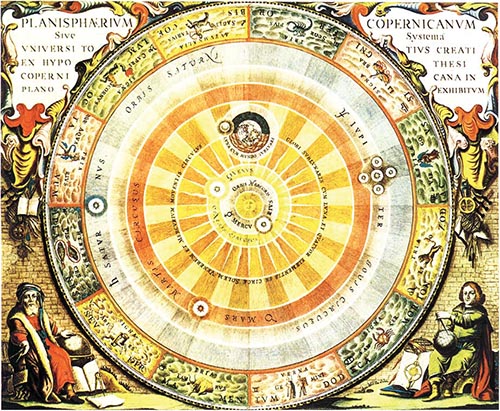
    Copernican Planisphere, engraving by Andreas Cellarius, 1660

    The inauguration of the modern worldview is generally credited to the Polish astronomer Nicolai Copernicus. In On The Revolutions of the Heavenly Spheres (1543) Copernicus argued – reluctantly it seems – that, as we all accept today, the sun did not orbit the earth, but the earth the sun.3 It, not ourselves, was at the centre of things, or at least that of our solar system. 

    Although Copernicus was a timid agent provocateur – and a mean-spirited one – his work nevertheless sparked a revolution among the heavenly spheres and our earthly one.4 Yet the idea that the sun was at the heart of things did not arrive in Copernicus’ mind fully formed. As the historian Frances Yates argued some years ago – and as has been echoed more recently by others – Copernicus was an attentive reader of the Hermetic texts in which the sun plays a dominant, we might even say, central role.5 

    Western astrology is one of the Hermetic sciences. It has its roots in the teachings of the great sage Hermes Trismegistus, father of magic and science and initiate of the perennial philosophy, collected in the Corpus Hermeticum and other texts, circa 200 CE. In Book XVI of the Corpus Hermeticum, Hermes calls the sun the “craftsman,” Plato’s name for the demi-urge, creator of the universe. In the Asclepius – a Hermetic text not in the Corpus Hermeticum – Hermes speaks of the sun’s “divinity and holiness” and calls it a “second god.” 

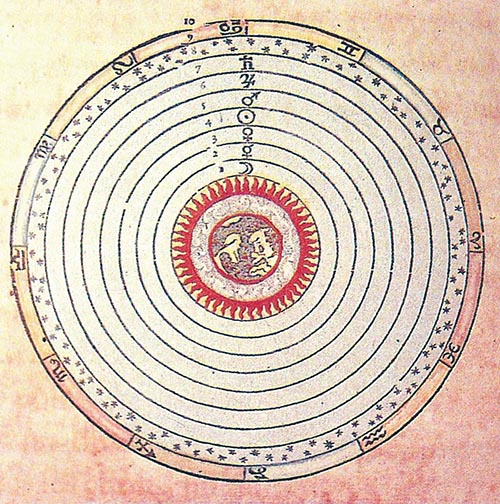
    In the Corpus Hermeticum, the earth was seen as the manifest physical realm at the centre of a series of concentric spheres which represented the planets, stars and higher levels in the Divine hierarchy of Being. The Ptolemaic model – which was official theory in Europe until after the Copernican revolution – had the earth in a stationary position at the centre of the universe.

    In the introduction to his work, Copernicus enlists two previous sages in support of his theory, both of whom find places in the Aurea Catena, or Golden Chain of Adepts, by whom the Hermetic wisdom, or prisca theologia, has been handed down through the ages, at least according to the Renaissance Hermeticist Marsilio Ficino. These are Pythagoras (who, we know, heard the ‘music of the spheres’) and his follower, the teacher of Plato, Philolaus. Copernicus even refers directly to the sun as a “visible god,” just as the Asclepius does. The fact that in the Hermetic cosmology the sun’s position differs from its place in the Ptolemaic system that Copernicus was ‘improving’, suggests that it was an important influence on those improvements.

    Copernicus wasn’t the only one to help shape our modern universe while retaining a good amount of the ancient one. The seventeenth-century German astronomer Johannes Kepler, who discovered the laws of planetary motion, devoted much time to astrology and forecast more than one dignitary’s fortune, although he was not always happy about it. He was also for a time a guest of Rudolf II, the Hermetic Holy Roman Emperor, a patron and student of astrologers.6 “That the sky does something to man is obvious,” Kepler said, “but what it does specifically remains hidden.”7 Kepler recognised that much astrology was moonshine – at least that was true of his competition. But he also knew that the genuine baby should not be thrown out with the phony bathwater. 

    Perhaps the biggest surprise is that Sir Isaac Newton, whose view of the cosmos was dominant until the advent of Einstein, wrote more about alchemy – a Hermetic science directly linked to astrology – than he did about gravity. And as astrology is also known as an ‘occult science’ – ‘occult’ meaning ‘unseen’ – then Newton was a Hermeticist even when he did write about gravity which is also unseen. As with Copernicus, there is much debate today over how much Newton’s Hermetic ideas informed the Principia (1687), the blueprint for the modern, Newtonian view of the cosmos, which, ironically, ousted the earlier, more ‘magical’ one.8

    Nevertheless, even with this esteemed company, astrology suffered the same fate as the other Hermetic sciences and was relegated with other forms of ‘rejected knowledge’ to the great dustbin of ideas – and also, since the 1930s, to daily appearances in most major newspapers. But it didn’t go down without a fight. As late as 1768, the German physician Franz Anton Mesmer, soon to add a word to our vocabulary, earned his doctorate with his dissertation on ‘The Influence of the Planets on the Human Body’. Mesmer did not consider himself an astrologer or occultist. He was a scientist who had discovered the medium through which the planets and the entire cosmos influence life on earth. Yet he could not escape astrology altogether. The very word ‘influence’ itself comes from astrology. It is the name Marsilio Ficino gave to the stellar fluid that flows from the stars down to earth and informs what happens here.

    The medium Mesmer had discovered – to his satisfaction and that of many of his patients, if not the authorities – was what he called ‘animal magnetism’ – ‘animal’ meaning ‘animated’, not ‘beastly’. This was, like the astral influence, a fluid permeating the universe, like the nineteenth-century ‘ether’, linking everything to everything else, its cosmic flow keeping all in balance. In living things it was the source of health and vitality, and Mesmer believed he had mastered a method of guiding and encouraging its movement in his patients, many of whom agreed. 

    A side-effect of the ‘magnetic passes’ that Mesmer and the mesmerists that received his training made over patients was what became known as the ‘magnetic trance’. It was a student of Mesmer, the Marquis de Puységur, who in 1785 stumbled on to what was really at work.9 The ‘trance’ was not magnetic, animal or otherwise, but hypnotic – the term was coined by the Scot James Braid in 1842. When today we say someone is ‘mesmerised’ we mean they are ‘hypnotised’, not that animal magnetism is at work. 

    While Mesmer might not have grasped the phenomenon of hypnosis, he may not have been as wrong about magnetism as the members of the French Academy of Sciences, who in 1784 declared his work a fraud, believed. 

    Gauquelin’s Breakthrough Survey

    The French psychologist and statistician Michel Gauquelin and his wife Françoise. His scientific analysis of astrological correspondences, which were later confirmed by fellow scientist and staunch sceptic Hans Eysenck, revealed they did play a role in human life.

    Astrology held on in the popular mind, along with other Hermetic ideas, but as the modern age progressed science continued to dismiss it. Then in the mid-twentieth century science, of all things, seemed to come to its aid. In 1955 Michel Gauquelin, a French psychologist and statistician with degrees from the Sorbonne, published a book L’influence des astres (‘The Influence of the Stars’) based on years of research that seemed to support some of astrology’s fundamental ideas. This work, as well as the English editions of his other books – The Cosmic Clocks (1967), Astrology and Science (1970), Cosmic Influences on Human Behaviour (1974) – made Gauquelin astrology’s most persuasive scientific defender, although, like Mesmer, he did not see himself as an astrologer. Gauquelin and his collaborator, his wife Françoise, said they simply wanted to answer a basic question: does one’s birthday have any effect on one’s future? 

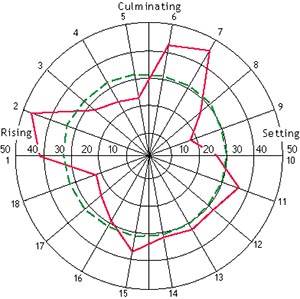
    After submitting the 27,000 + birthdates they had gathered to statistical analysis, the initial results were disappointing. There seemed to be no substantial correspondence between one’s ‘sun sign’ (Capricorn, Aries, Pisces, etc.) – the constellation the sun is ‘in’ at the time of one’s birth – and one’s destiny. But the Gauquelins seemed to have discovered something else. There was a strong correlation between one’s future profession and the time of birth, not because of the sun, but because of the planets. The Gauquelins discovered that more famous doctors were born just after the rise or culmination of Mars or Saturn – planets related to that vocation – than chance should have allowed. Top-ranking military leaders were born just after the rise or culmination of Mars or Jupiter; again the astrological correspondence held. Professions which in traditional astrological lore were associated with the other inner planets – Mercury and Venus – showed similar correlations. As Guy Lyon Playfair and Scott Hill say in The Cycles of Heaven, “In some cases, there was only one chance in five million that such clusterings were due to chance alone.”10 

    And there was another odd fact: these significant results were true only of people who were highly successful at their work. The Gauquelins saw that large numbers of scientists, doctors, athletes, artists, writers and others, who were competent but not above average, fell outside their select group. It was as if the smaller number received the planetary influence – whatever it was – direct and absorbed it all, leaving very little for the stragglers. Gauquelin’s findings have come to be known as ‘the Mars Effect’.

    ‘The Mars Effect’ (red) illustrated on this chart.

    Gauquelin’s results were examined by the psychologist and statistician Hans Eysenck. Eysenck, a tough-minded sceptic, had to admit that he was convinced. And when Eysenck and his colleagues examined some other astrological givens – that people born under ‘water’ signs tend to be emotional, that those born under ‘odd’ numbered signs tend to be extroverted while those born under ‘even’ ones are introverted – he and his team were surprised to find the evidence strongly in favour of them.11

    The question remained of exactly how the planets and other cosmic bodies can affect earthly ones? Some people working in the earlier part of the last century, and in another part of the world, thought they might have a clue.

    The Role of the Moon

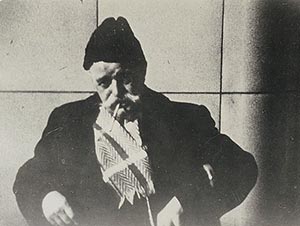
    Whether astrology can account for it or not – I don’t have the statistics on hand – it nevertheless seems that investigating the role of cosmic forces on human life is a peculiarly Russian pursuit. At least in researching this article I came across more Russians than chance may have allowed. For example, the Greek-Armenian esoteric teacher G. I. Gurdjieff may not have been Russian – his exact nationality has always been uncertain – but he certainly started his career in Russia.12 In 1914, with the First World War erupting, the Russian philosopher P.D. Ouspensky, Gurdjieff’s most famous pupil, asked him if such catastrophes could be avoided. They could, Gurdjieff told Ouspensky, but what was necessary was to understand why they start. 

    The moon is the chief… motive force of all that takes place in organic life on earth. All movements, actions, and manifestations of people… depend on the moon and are controlled by the moon. – Georges Ivanovich Gurdjieff

    “What is war?,” Gurdjieff asked Ouspensky. “It is the result of planetary influences. Somewhere up there two or three planets have approached too near to each other; tension results… For them it lasts, perhaps, a second or two. But here, on the earth, people begin to slaughter one another, and they go on slaughtering maybe for several years.” The people involved feel they have perfectly good reasons for fighting – for king, country, national honour, lebensraum or to pre-empt an attack by a hostile neighbour. But “they fail to realise to what extent they are mere pawns in the game.”13 

    Gurdjieff also spoke to Ouspensky about the moon. Bookshelves are full of accounts of how the full moon affects some people; our terms ‘lunacy’, ‘lunatic’, ‘looney’, ‘moonshine’ are evidence of the popular acceptance of something that is still ‘officially’ dismissed. Gurdjieff took it a bit further. “The moon,” he said, “is the chief… motive force of all that takes place in organic life on earth. All movements, actions, and manifestations of people… depend on the moon and are controlled by the moon.”14 Perhaps the strangest thing was Gurdjieff’s insistence that the moon is a living being and that it is growing, and that its nourishment comes from the souls of ‘sleeping’ people who are not working to attain the true ‘waking’ state of consciousness.15 

    When one recognises that in the weeks surrounding the November 2016 US presidential election the moon entered a ‘perigee full moon’ or ‘supermoon’ – when it was both full and closer to the earth than it had been for nearly seventy years – one wonders if Gurdjieff knew things denied more conventional political analysts.16

    Gurdjieff said that he gained his cosmic knowledge during his time with the mysterious Sarmoung Brotherhood in Central Asia.17 One wonders if he had more local sources. Helena Petrovna Blavatsky, one of the founders of the Theosophical Society, was, like Ouspensky, a full-blooded Russian. In Isis Unveiled (1877) she writes that “certain planetary aspects may imply disturbances in the ether of our planet, and certain others rest and harmony.” At times this influence promotes periods of withdrawal, of “monasticism and anchoritism”; at others frenzied action and “utopian schemes.” And where Gurdjieff speaks of the “harmony of reciprocal maintenance” operating throughout the cosmos, Blavatsky speaks of the “reciprocal relations between the planetary bodies.”18

    Blavatsky got her knowledge from her Masters in Tibet. Did anyone in Russia have it too? Oddly, around the same time that Gurdjieff was enlightening Ouspensky about our place in the cosmos, it seemed someone did. But in his case, the sun, not the moon, pulled the strings.

    The Role of the Sun

    In June 1915, the eighteen-year-old prodigy Aleksandr Chizhevsky – scientist, musician, painter, poet – noticed something. He had become fascinated with the study of sun-spots – huge dark bodies that pass across the surface of the sun – and it struck him that at the same time as a large group of spots crossed the sun’s central meridian, certain events transpired on earth. The aurora borealis that month was unusually strong, and the magnetic storms making up the spots had disrupted more radio and telephone communication than usual. But there was something else. The fiercest battles of the war coincided with the spots. Was that a coincidence? 

    In 1916, when he was fighting with the Russian army on the Galician front, Chizhevsky saw that the battles intensified when solar flares and geomagnetic storms were most active. In 1917, when the Bolsheviks took power, there was, he saw, another unusual burst of solar activity. Checking the records, Chizhevsky saw that there had also been one in 1905, at the time of an aborted uprising. 

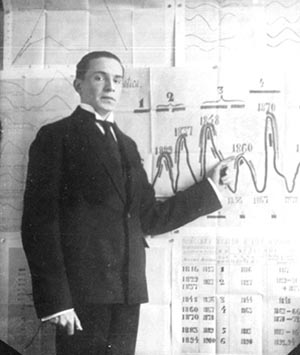
    The young Soviet scientist Aleksandr Chizhevsky correlated the sun-spot cycle with major upheavals in human history. He is photographed here pointing to one of his charts. 

    By 1922 Chizhevsky had made a chart showing, he claimed, 2,400 years of “mass movements”: wars, major battles, revolutions, uprisings, migrations, from across the globe. These, he argued, came in regular cycles which coincided almost exactly with the eleven-year sun-spot cycle. (In 1843, the German astronomer Heinrich Schwabe observed that sun-spots went through a ten-year cycle; the idea was later refined by Rudolf Wolf and Alexander Humboldt and established at eleven years.)

    Chizhevsky believed he had discovered a “universal cycle of historical events,” with the sun, or whatever was behind its spots, at the wheel.19 Every major outbreak in recent history, from the French Revolution to the start of World War I, was precipitated by solar excitement. Chizhevsky was even able to predict when such things would occur. In 1926, guided by the sun-spot cycle, Chizhevky predicted important flare-ups from 1927 to ’29. What happened then? Salazar’s dictatorship began in Portugal. Chiang Kai-shek captured Peking. Mussolini was on the rise as was Hitler, and Stalin consolidated his power by exiling Trotsky. And Wall Street suffered a collapse triggering the Great Depression.

    Chizhevsky’s work impressed many people, like the economist Edward Dewey, who used his ideas in his own work on economic cycles. Others, like Stalin, were not so impressed. In 1942, when he realised that for Chizhevsky sun-spots and not the irresistible march of the Marxist class war were responsible for the Soviet Union, he ordered him to retract his work. By this time Chizhevsky was a prestigious scientist, with many degrees and honours. Alongside Nicolai Fedorov, Konstantin Tsilokovsky, and V. I. Vernadsky, he was one of what is known as the ‘Cosmist’ school. Chizhevsky refused and Stalin sent him to a gulag for eight years, with eight years ‘rehabilitation’ after that. He was released during the Khrushchev ‘thaw’ following Stalin’s death and today is revered as the ‘father of heliobiology’, the study of the sun’s influence on life on earth. Other Russians who were influenced by his work or shared his belief in cosmic forces affecting the earth, were Vladimir Vernadsky, mentioned above, who popularised the ideas of the ‘biosphere’ and ‘noosphere’, and the historian Lev Gumilev, whose ideas about ‘ethnoi’ and ‘passionarity’ as agents of civilisation, also depend on cosmic forces affecting human beings.20

    Chizhevsky believed that what was behind the intensified agitation during high sun-spot activity was an increase in negative ions in the atmosphere. The solar flares erupting from the sun during the intense magnetic storms making up the spots affected the earth’s own magnetic field, which in turn ‘ionised’ the air. Positive ions, he believed, had a ‘negative’ effect, making people dull, lethargic, and irritable. Negative ions did the opposite. They worked as stimulants; hence the effect of a ‘breathe of fresh air’ after a rainstorm. The ionisation too went through cycles and at the highest concentration of negative ions, things start jumping.21 Mesmer was not as wrong as his critics believed. Magnetism did have something to do with it. 

    Chizhevsky died in 1964. One odd fact that he missed but others, like Edward Dewey, noticed was that often things on earth occurred slightly ahead of the sun-spot cycle, as if effect preceded cause – or as if events on earth triggered the spots. If this was the case, then something else must be responsible or at least precede both. In 1949 John Nelson, an RCA engineer who had been studying the sun to ‘predict’ when its spots would interfere with communications, hit upon an answer. Somehow, the planets had a hand in it. Although most astronomers would laugh at the idea of a planet’s weak magnetic field having any effect on the sun, this is exactly the conclusion Nelson came to, and which enabled him to predict and avoid blackouts.22 The odd thing was that the planets’ effect on the sun coincided with traditional astrological notions of ‘opposition’ and ‘conjunction’. When planets were in such an arrangement with the sun and the earth, things tended to go haywire. Otherwise, things were fine.

    Some contemporary thinkers see in Chizhevky’s work an argument against free will. In The Bond, Lynne McTaggart states that “if we are essentially at the mercy of the slightest move of the sun and its activity,” then Chizhevsky’s work stands “as a gigantic refutation of our misguided belief in ourselves as masters of the universe – or even of ourselves.”23 This is a not uncommon reflection on human hubris.But it goes against what Chizhevsky himself believed: that the sun does not compel us to do anything in particular, only to do something. It acts as a stimulant; what we do when stimulated is up to us. There may be increased belligerence during intense sun-spot activity, but there are always pacifists, conscientious objectors, and quiet people at home, sitting out the riots.

    As astrological lore has it, ‘the stars incline, they do not compel’. This was something Gurdjieff knew when he told Ouspensky that one could choose which influences one fell under.24 Man could escape being ‘food for the moon’ by working on himself and, in his interior planetary system – spelled out in fascinating detail by Rodney Collin, a student of Ouspensky, in The Theory of Celestial Influence – could become an ‘inner sun’, under a minimum of cosmic laws.25 As its students know, this too was an aim of Hermeticism.26 The stars in their courses may spark events here on earth, but we still have the responsibility of steering our way through them.

    [alert type=”general” dismiss=”no”]This article was published in From New Dawn Special Issue Vol 12 No 3.[/alert]

    [alert type=”success” dismiss=”no”]If you appreciate this article, please consider subscribing to help maintain this website.[/alert]

    Footnotes

    1. Nicholas Campion, The Great Year: Astrology, Millenarianism and History in the Western Tradition, Arkana, 1994, 76
    2. Peter Marshall, World Astrology, Macmillan, 2004
    3. Arthur Koestler, The Sleepwalkers, Penguin Books, 1979, 121
    4. Colin Wilson, Starseekers, Hodder & Stoughton, 1980, 86
    5. Frances Yates, Giordano Bruno and the Hermetic Tradition, Routledge and Kegan Paul, 1971; Lynn Picknett and Clive Prince, The Forbidden Universe, Constable, 2011; Gary Lachman, The Quest for Hermes Trismegistus, Floris Books, 2011
    6. Peter Marshall, The Theatre of the World, Harvill Secker, 2006
    7. Quoted in Guy Lyon Playfair and Scott Hill, The Cycles of Heaven, Souvenir Press, 1978, 256
    8. Sean Martin, Alchemy and Alchemists, Pocket Essentials, 2006, 76
    9. Henri F. Ellenberger, The Discovery of the Unconscious, Fontana Press, 1994, 7-74
    10. Playfair and Hill, 257
    11. Colin Wilson, Mysteries, Watkins, 2006, 582-83. ‘Water’ signs are Cancer, Scorpio, Pisces. ‘Odd’ signs are Aries, Gemini, Leo, Libra, Sagittarius, Aquarius, ‘even’ ones Taurus, Cancer, Virgo, Scorpio, Capricorn, Pisces.
    12. As his biographer James Webb wrote, “Georgei Ivanovitch Gurdjieff was born… and here all pretentions to accuracy stop.” (The Harmonious Circle, G.P. Putnam’s Sons, 1980, 25)
    13. P.D. Ouspensky, In Search of the Miraculous, Harcourt, Brace, and Company, 1949, 24
    14. Ibid., 85
    15. It may have been with this in mind that Colin Wilson made the moon the base of operations of the psychic vampires in his novel The Mind Parasites (Monkfish Book Publishing Company, 2005). This edition has a preface by me.
    16. https://edition.cnn.com/2016/11/02/world/supermoon-november-14-2016/index.html 
    17. G.I. Gurdjieff, Meeting with Remarkable Men, Penguin Classics, 2015. This edition has an Introduction by me.
    18. G.I. Gurdjieff, Beelzebub’ s Tales to His Grandson, First Book, E.P. Dutton, 1978, 81; Helena Petrovna Blavatsky, Isis Unveiled Vol. 1, Theosophical Publishing House, 1972, 274
    19. Playfair and Hill, 277
    20. Charles Clover, Black Wind, White Snow: The Rise of Russia’s New Nationalism, Yale University Press, 2016, 125
    21. The ‘passionarity’ that Lev Gumilev believed was the driving force behind human activity may be Chizhevsky’s sensitivity to negative ions.
    22. Playfair and Scott, 46
    23. Lynne McTaggart, The Bond, Hay House, 2011, 60
    24. Ouspensky, 25
    25. Rodney Collin, The Theory of Celestial Influence, Watkins Publishing, 1980. Collin, too, hits on planetary magnetism as the agent at work. For him, it directly affects the body’s glandular system which he sees as arranged in parallel order to planets’ positions vis-a-vis the sun. 
    26. Gary Lachman, The Quest for Hermes Trismegistus, Floris Books, 2011, 135-37

    © New Dawn Magazine and the respective author.
    For our reproduction notice, click here.
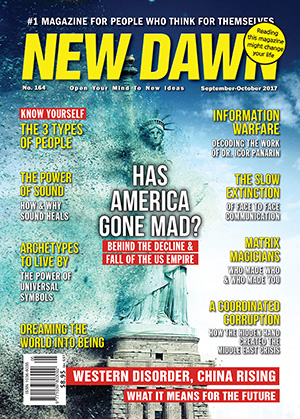
  • From Information Warfare to the Break-Up of the USA…  Decoding the Work of Dr. Igor Panarin

    From Information Warfare to the Break-Up of the USA… Decoding the Work of Dr. Igor Panarin

    From New Dawn 164 (Sept-Oct 2017)

    Igor Nikolaevich Panarin (b. 1958), dean of the Russian Foreign Ministry’s school for future diplomats, is a geopolitical analyst, political scientist and media commentator, with significant influence on Russian thinking. An examination of his views and public pronouncements is therefore important in discerning the outlook of Russia’s leading academic and political circles, as well as considering what influences are shaping Russian national consciousness. Panarin is a former officer of the KGB. In 1991 he reached the rank of colonel in the Federal Agency of Government Communications and Information, then the Russian equivalent of the US National Security Agency.

    Dr. Panarin outlines two eras of US psycho-war against Russia. The first was during the Cold War. The second era, that continues today, is the period after Vladimir Putin became president of Russia. Psychological warfare is Panarin’s specialty, about which he wrote his doctoral thesis. As a strategist, his methodology is based on five stages of response: Forecasting and planning; Organisation and stimulation; Feedback; Operation adjustment; and Performance control. In response to US belligerence, Panarin proposes a centrally controlled information warfare campaign using propaganda, intelligence, analysis, secret agents, and the news media, in defence of Russia’s sovereignty and identity. 

    Dr. Panarin believes Russia’s destiny is Eurasia. He proposed his own version of the Eurasian Economic Union, ‘Eurasia-Rus’, an interstate formation modelled after the European Union. Panarin has called attention to the messianic legacy of Russia as the ‘Third Rome’, the centre of a new civilisation based on a sacred mission that is an inherent part of the Russian soul. This is an attitude one can discern in much of what Vladimir Putin says. The United States’ opposition to a revived Russia can thus be understood as part of a clash of world outlooks. 

    USA: Centre of World Revolution

    This messianic outlook endures in Russia regardless of the outward mode of political expression. It is the ‘eternal Russia’ articulated in various forms by novelist Fyodor Dostoyevsky, an array of writers, thinkers and artists of the late 19th century, and the present-day advocates of ‘Eurasia’ such as Alexander Dugin and Igor Panarin. Panarin discerns the contours of ‘eternal Russia’ even under what was nominally called ‘Bolshevism’, but which owed little to Marxism after the purging of Leon Trotsky and others from 1928 onward.1 Panarin explained this dichotomy as a struggle between the world outlooks of international Marxism, under Trotsky, and what has been called ‘National Bolshevism’, under the auspices of Joseph Stalin. He points out: 

    On 3 July 1941 when Stalin addressed the Soviet people as “Brothers and sisters,” this doctrine became the dominant geopolitical idea of the USSR-Rus and replaced Lenin-Trotsky’s idea of world revolution which was an external (imported) geopolitical project. The Pan-Eurasian nationalism of Trubetzkoy, fused with the “Moscow–Third Rome” idea realised in the conditions of the Soviet order, yielded a result – the USSR won a victory in the global skirmish with Fascism. And the Trotskyist ideas were victorious at the end of the 20th century in the USA, vividly manifested in the ideology of the liberal globalism of the contemporary American political elite.2

    Dr. Panarin’s analysis shows a depth of understanding one cannot readily find in the West’s political and scholarly circles. Although it continued using Marxist rhetoric and symbolism, after the elimination of Trotsky the Union of Soviet Socialist Republics (USSR) transfigured the doctrine of ‘world revolution’ into the old Russian messianic mission. Soviet officials and ideologues, even under the guise of ‘Bolshevism’, evoked Mother Russia, which included an end to the persecution of the Orthodox Church, much to the outrage of Trotsky and his followers in the West. 

    Of particular note, Panarin sees the United States as the custodian of Trotskyite ‘world revolution’. This will perplex superficial observers, especially the banal academics of the West who understand little of history’s depth. The so-called ‘neocons’, or ‘neoconservatives’, are either ‘former’ Trotskyites or the intellectual heirs of those Trotskyites who took over US foreign policy. Such was their hatred of Joseph Stalin that Trotskyism would eventually metamorphose into a primary ingredient of US foreign policy doctrine – resolute opposition to the Soviet Union.

    Founded in 1949 by the CIA, the Congress for Cultural Freedom was a major ideological instrument opposing and undermining the Soviet Union. Its positions were filled with Trotskyites and their apologists. Trotsky’s widow, Natalia Sedova, publicly broke with the Trotskyite Fourth International, charging that her late husband would have supported the United States against the USSR. She stated it was the Soviet Union, not the USA, which was the primary obstacle to “world revolution.”3 Leading Trotskyite ideologue Max Shachtman became another ‘Cold Warrior’ for the USA. After the Congress for Cultural Freedom had been thoroughly exposed as a CIA front, a ‘Shachtmanite’ leader of the American Federation of Labor, Tom Kahn, was instrumental in getting the US Congress to fund the National Endowment for Democracy (NED) in 1983. The NED remains the primary centre for world revolution as a leading sponsor of the so-called “colour revolutions.”4 

    Gorbachev, ‘Velvet Revolution’ & the ‘Information War’

    The ‘colour revolutions’ including the ‘Arab Spring’ and those in the former Soviet bloc states are recognised by Panarin as having been fostered by Washington. He has labelled the Soviet Union’s last leader, Mikhail Gorbachev, the “Antihero of Russia” for his pivotal role in the destruction of the USSR. 

    Gorbachev is feted among the globalist elite for bringing the Soviet bloc to ruin. He was given a gala celebration on his 80th birthday, at London’s Royal Albert Hall in 2011, where he was lauded by Israeli Prime Minister Shimon Peres, among others, as having “ended the Cold War.” Like every good retired head of state in the service of globalism, he has established his own foundation. On the occasion of his birthday celebration Gorbachev publicly threatened Vladimir Putin that should he stand for a third presidential term he might face a revolution.

    Igor Panarin is acutely aware of the methods used by the United States to bring down reticent nation-states that do not comply with globalist diktats. Among these are the ‘colour’ or ‘velvet’ revolutions. 

    It is ironic or, better said, hypocritical, that the US ‘Deep State’ is vociferous in its allegations of Russia having ‘interfered’ in the American presidential election, although evidence is elusive. The United States has been interfering in the political processes of nations for generations. When subversion and political manipulation do not work, mass bombing as in Yugoslavia, Iraq and Libya is the final resort. 

    Dr. Paranin’s perception of the USA as the leader of a “neo-Trotskyist world revolution” makes him an astute political observer. He has defined precisely the character of a world struggle between two antithetical outlooks, both messianic, and both having their own world-missions: Russia, the katechon, holding back the Antichrist with an enduring self-perception of its holy mission, as expressed by such writers as Dostoyevsky; and the USA, the Great Whore, heralding the system of the Antichrist. Whether interpreted literally or symbolically, this is the reality of the world-conflict between Russia and the USA. With Europe and Australasia acting as the dupes of the USA, in the name of a ‘West’ that lost any inner meaning centuries ago. 

    Hence Panarin sees the ‘velvet revolution’ in Czechoslovakia (1989), and the ‘colour revolutions’ in other former Soviet bloc states, along with the ‘Arab Spring’, as manifestations of American geopolitical strategy. A primary element of this subversion is the ‘information war’, in which he specialises. Panarin lists eight different components of information operations. 

    The first two are “social control” and “social maneuvering” which revolve around “influencing society” to achieve “intentional control of the public aimed at gaining certain benefits.” “Disinformation,” “fabrication of information,” and “information manipulation” all relate to supporting information operations through leveraging incorrect information.5 

    These tactics are clearly seen in operation against Russia, including the propaganda offensive to undermine Russia’s role in Syria. 

    The way information war unfolds was first noted in Czechoslovakia in 1971. A nihilistic, no-talent music group called ‘Plastic People of the Universe’ was established, and became a cause célèbre, lauded by The New York Times, Voice of America, etc. From this milieu Charter 77, a key initiative of the ‘velvet revolution’, was founded. Liaising with the Solidarity movement in Poland, these groups received sponsorship from globalist foundations in the US. Vaclav Havel was chosen by the globalists as the first president of a post-Soviet Czech state.6 Like Gorbachev, he was feted by the globalists, awarded the NED’s medal for service, and served on the board of George Soros’ Drug Policy Alliance, among others. 

    The Soviet geopolitical bloc, once the primary bulwark against globalist hegemony, was brought down by cultural subversion and political agitation sponsored first by the US Congress for Cultural Freedom, then by NED. Later, billionaire financier George Soros and a myriad of other Western-funded NGOs spread the pernicious values of globalism in the emerging nation-states of the former Soviet bloc.

    That today Russia is accused of waging ‘information war’ – directed, no less, by Dr. Panarin – is hard to beat for pure chutzpah, even by the standards of US hypocrisy and cant. Historically, the United States sponsored information and culture war of colossal proportions in the name of spreading ‘freedom’. This was described by American geopolitical strategist Major Ralph Peters as nothing short of a contagion designed to undermine the traditional fabric of states reticent about entering the brave new world.7 What Peters called “constant conflict” is tantamount to what Trotsky called “permanent revolution.” 

    Igor Panarin Targeted

    Bret Perry in his well-researched but antagonistic article, states of Dr. Panarin: 

    Although not officially confirmed, it is believed that the Russian government worked with Panarin to set up an office managed by a presidential special adviser “to oversee an international network of NGOs, information agencies and training institutions” for coordinating Russia’s whole-of-government information operations.8

    An article by Matthew Sussex (National Security College, Crawford School of Public Policy, College of Asia and the Pacific, Australian National University) for the Lowy Institute’s The Interpreter, focuses on the measures of ideological counter-insurgency that Russia is allegedly taking under the direction of Dr. Panarin. Sussex comments: “The West is understandably reluctant to openly engage in similar behaviour. One of the main constraints of deliberately manipulating information is that it is deceitful and dishonest.”9 To claim such moral rectitude for the “West” enters the realm of tragicomedy.

    It would be naïve to assume that Russia would not respond to an information war waged against it. It is difficult to discern that Russia has anything approaching the network of NGOs, information agencies and training institutions operated by the globalist Russophobes and their dupes around the world, with vast funding from the NED, the George Soros network and a multiplicity of others. One should readily see Putin’s expulsion of this NGO network from Russia as an obvious requirement in the interests of Russia, despite the squeals about ‘democracy’ from the Machiavellian subversives who were given the boot. 

    Panarin’s view is that Russia needs to respond to the information war for her own “protection.” Russophobia has escalated in recent years, especially after Russia acted to defend her interests in the Ukraine, where US interference was blatant. In a 2015 interview, Panarin explained in regard to the creation of a “Russian internet” that it “is not censorship and regulation, but ‘protection’.” This was condemned as an encroachment on ‘freedom’, but the United States has long used such ‘freedom’ to propagandise and agitate. Panarin’s concern is that ‘colour revolution’ is planned for Russia. It was social media that played a pivotal role, with sponsorship from globalist interests, in the fomenting of ‘colour revolutions’ in the former Soviet bloc states and across North Africa. Russian paranoia? Not at all.

    In 2008, with the backing of globalist corporations, an organisation was founded to specifically utilise social media to agitate youth. The Alliance of Youth Movements or Movements.org10 was co-founded by Jason Liebman of Howcast. This group worked with the US State Department and Defense Department. Among its corporate sponsors were: Google, Music TV, Pepsi, CBS News, Mobile Accord, Youtube, Facebook, MSN/NBC, National Geographic, Omnicom Group, Access 360 Media, and Gen Next. The ‘public partnerships’ were with Columbia Law School and the US State Department. Now its partners include the National Endowment for Democracy and Free Russia Foundation (FRF). This is how the Free Russia Foundation is described: 

    ‘The Free Russia Foundation is a nonprofit, nonpartisan, nongovernmental US-based organization, led by Russians abroad that seeks to be a voice for those who can’t speak under the repression of the current Russian leadership. Free Russia represents and coordinates the Russian diaspora and is focused on developing a strategic vision of a free and democratic Russia and a concrete program for the transition period.11

    The Washington-based SAIS Center for Transatlantic Relations is another ‘partner’, acting as a nexus between the US government, NGOs and corporations. It “engages international scholars and students directly with government officials, journalists, business executives, and other opinion leaders from both sides of the Atlantic on issues facing Europe and North America. The goal of the Center is to strengthen and reorient transatlantic relations to the dynamics of the globalizing world.”12 

    The Free Russian Foundation openly states: “We are focused on developing a strategic vision of Russia ‘After Putin’ and ‘Without Putinism’ and concrete programs for the transition period.” The administrators include those who have worked with the International Republican Institute, Chatham House, US Defense Department, Council on Foreign Relations and the Pentagon.13 The FRF sponsors so-called “civil society”14 which involves so-called ‘activists’ destabilising Russia. 

    Regardless of what one thinks of Vladimir Putin, the fact remains that Igor Panarin and others are accurate in stating there is a vast network directed against Russia, with sponsorship by the US government. What type of Russia is sought “After Putin” can be discerned from FRF partner the Committee for Russian Economic Freedom (CREF), an organisation comprised of lawyers founded in 2009 to promote ‘free market’ ideology.15 The chairman and founder of CREF, Pavel Ivlev, was “long time legal counsel for YUKOS,” an oil company that Putin nationalised, and its CEO Mikhail Khodorkovsky16 is one of the primary oligarchs Putin purged from Russia’s economic life. 

    Perhaps now the reader clearly understands the actual aims behind the rhetoric about ‘democracy’ and ‘human rights’ in Russia?

    According to America’s apologists such as Australian academic Matthew Sussex, the ‘West’ would not consider such nefarious activities as interfering in the internal politics of a country. Rather, we are told, it is unscrupulous Russians such as Igor Panarin who have the audacity to advocate countermeasures that intrude on ‘democracy’, including the freedom of oligarchs to pillage Russia. 

    Balkanisation of the USA

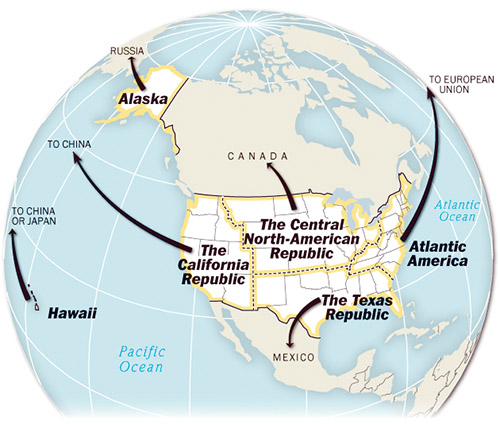
    In 2010 Dr. Panarin predicted the USA would balkanise, amidst social conflict, and split into separate states. Certainly the proposition of a ‘United States’ based on constitutionalism rests on weak foundations and has nothing of an organic character about it. There is no defining feature of an American ‘ethnos’, and no basis for a positive symbiotic relationship enduring between the sundry ethnicities. Panarin claims the United States is on course to balkanise due to the stressors of its huge debt, deficit and social protests. “The overlapping financial, economic and social challenges may eventually cause the world’s strongest superpower of the 20th century to collapse,” notes Panarin.17

    Map illustrating Dr. Panarin’s predicted breakup of the USA.

    Far from being a fanciful scenario, the US military recently addressed the same problems emerging from rapid urbanisation in ‘megacities’.

    The US military regards ‘megacities’ (populations of 10,000,000 or more) as an approaching problem of instability. The US Army comments that megacities are a unique environment that they do not fully understand.18 One of their reports gives a picture of proliferating criminal networks and underground economies, natural disasters and the inability of decaying infrastructures to withstand stressors. A predicted feature is the breakdown of civic order through ethnic and religious conflict among diverse groups that are forced together to share diminishing resources and utilities. 

    As resources become constrained, illicit networks could potentially fill the gap left by over-extended and undercapitalized governments. The risk of natural disasters compounded by geography, climate change, unregulated growth and substandard infrastructure will magnify the challenges of humanitarian relief. As inequality between rich and poor increases, historically antagonistic religions and ethnicities will be brought into close proximity in cities. Stagnation will coexist with unprecedented development, as slums and shanty towns rapidly expand alongside modern high-rises. This is the urban future.19 

    The report comments on the increasingly heterogeneous populations inherent in a megacity as potentially “explosive.” 

    One of the hallmarks of megacities is rapid hetero and homogeneous population growth that outstrips city governance capability. Many emerging megacities are ill-prepared to accommodate the kind of explosive growth they are experiencing.20 

    Radical income disparity, and racial, ethnic and sub cultural separation are major drivers of instability in megacities. As these divisions become more pronounced they create delicate tensions, which if allowed to fester, may build over time, mobilize segments of the population, and erupt as triggers of instability.21 

    The US Army analysis accords with the 2010 analysis of Dr. Igor Panarin. The time has indeed come to seriously consider Panarin’s unique insights into the geopolitics of today’s world and his predictions for the years ahead.

    [alert type=”general” dismiss=”no”]This article was published in New Dawn 164.[/alert]

    [alert type=”success” dismiss=”no”]If you appreciate this article, please consider subscribing to help maintain this website.[/alert]

    Footnotes

    1. K. R. Bolton, Stalin: The Enduring Legacy, Black House Publishing, 2012
    2. Ivor Panarin, ‘From united Russia to Eurasian Rus’, Cyril and Methodius, 12 January 2006 
    3. Natalia Sedova Trotsky, letter to the Socialist Workers Party, 9 May 1951, Labour Action (17 June, 1951). See Bolton, Stalin: The Enduring Legacy, 114-119 
    4. Bolton, Stalin: The Enduring Legacy, 121-124
    5. Jolanta Darczewska, ‘The Anatomy of Russian Information Warfare: The Crimean Operation, A Case Study’ (Warsaw, Poland: Ośrodek Studiów Wschodnich im. Marka Karpia, Centre for Eastern Studies, May, 2014); quoted by Bret Perry, ‘Non-Linear Warfare in the Ukraine: The Critical Role of Information Operations and Special Operations’, Small Wars Journal, 14 August 2015
    6. C. Gershman, ‘Giving Solidarity to the World’, Georgetown University, Washington, D.C.’, 19 May 2009
    7. Ralph Peters, ‘Constant Conflict’, Parameters, Summer 1997, 4-14: US Army War College, www.informationclearinghouse.info/article3011.htm
    8. Bret Perry, op. cit. 
    9. Matthew Sussex, ‘Trump, Putin and Information Warfare’, The Interpreter, Lowy Institute, 27 July 2016
    10. Tony Cartalucci, ‘Google’s Revolution Factory – Alliance of Youth Movements: Color Revolution 2.0’, Global Research, 23 February 2011, www.globalresearch.ca/index.php?context=va&aid=23283; www.movements.org
    11. www.movements.org/en/movements/our-partners/
    12. Ibid. 
    13. ‘About Free Russia’, www.4freerussia.org/about/
    14. ‘Programs’, www.4freerussia.org/about/
    15. ‘About CREF’, www.russianeconomicfreedom.org/about/
    16. ‘Experts’, www.russianeconomicfreedom.org/experts/
    17. Igor Panarin, ‘U.S. Break-up: Myth or Reality?, Russia Times, 27 October 2011; www.rt.com/politics/panarin-usa-collapse-economy-905/
    18. Colonel Marc Harris, et al., Megacities and the United States Army: Preparing for a Complex and Uncertain Future, Chief of Staff of the Army, US Army Strategic Studies Group, June 2014, 4, www.army.mil/e2/c/downloads/351235.pdf
    19. Ibid.
    20. Ibid.
    21. Ibid.

    © New Dawn Magazine and the respective author.
    For our reproduction notice, click here.
  • A Link in the Golden Chain: The Life & Times of Vyvyan Deacon, Australia’s Pioneer  Metaphysical Teacher

    A Link in the Golden Chain: The Life & Times of Vyvyan Deacon, Australia’s Pioneer Metaphysical Teacher

    From New Dawn 161 (Mar-Apr 2017)

    Early twentieth century Australia saw a flowering of alternative spirituality when a number of communities, particularly in Sydney and Melbourne, embraced the influx of occult and spiritualistic practices from Victorian England. 

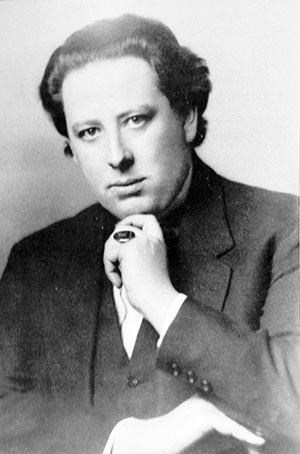
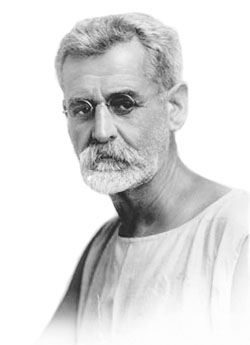
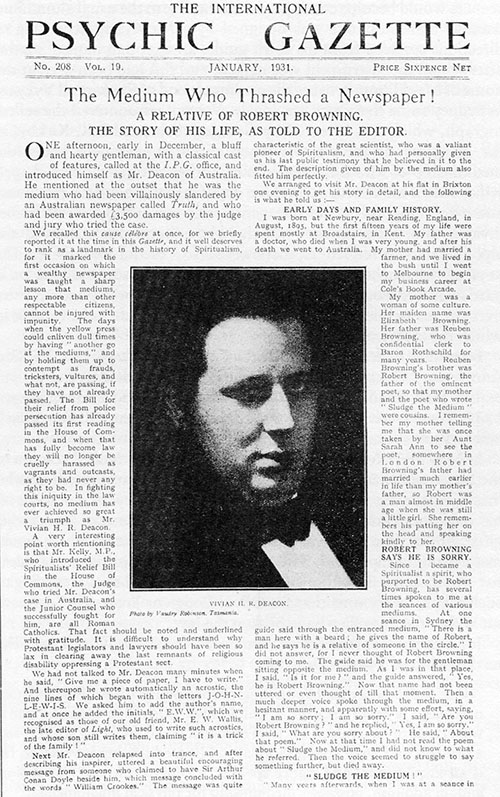
    A central figure linking many of the well-known characters and societies of the era was the young Vivian (later Vyvyan) Deacon (1895–1938), a medium, herbalist and respected public speaker. Among his circle of associates were Aleister Crowley, Krishnamurti, Annie Besant and Charles Webster Leadbeater, the author and spiritualist Sir Arthur Conan Doyle, and the artist Norman Lindsay. Deacon’s affiliations, that started out with the Order of the Star of the East, would go on to include Theosophy, Gnosticism, the Golden Dawn, Crowley’s OTO, and his own Christian Mystics of the Rosy Cross.

    Vyvyan Deacon (1895–1938)

    Certain recurring themes in Vyvyan’s life were established during his boyhood in England where he grew up, before setting out for Australia via India at the age of seventeen. From his father Cornelius he took on, probably at a subconscious level, the pattern of an itinerant healer, dispensing unconventional remedies to a needy public. ‘Corrie’, as he was affectionately known, came and went from the family home until, eventually, he just never came back. Although little Vyvyan was led to believe his father had died, Corrie lived on and was briefly reunited with his son before his actual death at Christmas in 1930. His passion for herbalism and alternative therapies passed on to Vyvyan, woven into the rich tapestry of his life and guiding his purpose. His absence was also to impress itself on the psyche of his offspring, resulting in Vyvyan’s own inability to settle down, with frequent separations from his future wife and family.

    As a boy Vyvyan was frail and sensitive, given to bouts of ill health and often needing care. In place of formal schooling he received his education largely from Sunday schools, drama lessons and some home tutoring. Like many youngsters deprived of paternal attention, he was drawn to older father figures from an early age. At first these were clergymen and teachers, such as his local vicar Rev. Horsfall and drama teacher Rev. Mills, then on his arrival in Australia in 1912 he was taken under the wing of middle aged actor Roy Redgrave. In Sydney, he made the acquaintance of Theosophist Charles W. Leadbeater who, no doubt, also had appeal as a father figure. 

    C.W. Leadbeater c. 1916

    The predominant driving force pulsing through his veins, however, came from his mother Elizabeth, an intriguing personality who projected her own spiritual aura. Elizabeth Deacon, nee Browning, was the cousin of Robert Browning who, with his family’s claimed Rosicrucian lineage, introduced her to a wealth of colourful characters, including Oscar Wilde, who would become the Deacons’ next-door neighbour. Elizabeth was close to Oscar’s wife Constance, sharing her interest in the occult, with the pair attending séances together. In fact, Vyvyan’s name was a copy of Wilde’s own son’s name and, although the Deacons originally used the spelling ‘Vivian’ to differentiate them, he was to later change the spelling himself, noting a mystical significance in the letter ‘Y’. The Browning’s referrals also included W.B. Yeats who, in turn, opened the doors for Elizabeth to eminent members of the Golden Dawn. It was in 1895, the year of Vyvyan’s birth, that she made the acquaintance of a young James Ingall Wedgwood – a regular correspondent of Robert Browning – who would one day become one of Vyvyan’s teachers.

    James Ingall Wedgwood, 1925

    The trait that was to place Vyvyan in the ranks of Charles W. Leadbeater, Annie Besant and Aleister Crowley was that he, like they, did not simply follow and uphold traditional beliefs and philosophies. They claimed to actually communicate directly with otherworldly beings and, at times, act as vehicles in transmitting their messages to the Earthly realm. 

    Vyvyan first realised this ability when he was only eight years old. The occasion was an open-air Sunday school service where the regular preacher failed to show up. As the service was about to be cancelled, Vyvyan arose, walked to the dais and spontaneously began preaching. While this impressed the congregation, he himself was left feeling bewildered, especially in the face of some adults present who accused him of being demonically possessed. One kindly woman, however, comforted him by explaining that he had the rare and special gift of being used by those who dwelt on a higher plane. The event was publicised by the Daily Mirror, which hailed him as the ‘Boy Preacher’.

    A Meeting of Minds in Australia

    Sister Veni Cooper-Mathieson

    Vyvyan had met Eunice Mary Lew Tong, who was five years his junior, when he first arrived in Melbourne, and was besotted with her right from the start. In early 1916 he decided that a move to Sydney was in order and, not wanting to leave fifteen-year-old Eunice behind, they successfully sought permission from her recently widowed mother to marry and travel interstate together. It was his friend Veni Cooper-Mathieson, herself a Sydney-sider, who persuaded them that her city offered a more appropriate environment in which Vyvyan could establish himself as a healer, psychic medium and speaker. Sister Veni, as she called herself, was the voice of the New Thought movement and knew that their mutual acquaintance Charles W. Leadbeater, a member of the Theosophical Society (TS) and the Liberal Catholic Church (LCC), would open a whole new avenue for Vyvyan.

    The Deacons lived rough when they first arrived in Sydney, moving accommodation from one spot to another, and it was only with the assistance of Theosophists Frank Bennett and James Wedgwood that they were able to set up a small herbal dispensary in Junction St, North Sydney. Bennett was said to be Aleister Crowley’s appointed representative in Australia for the Ordo Templi Orientis (OTO)1 and Vyvyan immersed himself in the activities of this group as well as the TS and their Esoteric Section, before going on to found his own society in 1917 called Christian Mystics of the Rosy Cross (CMRC).

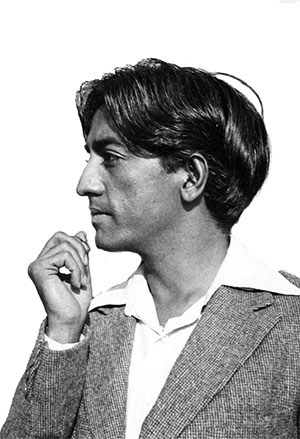
    Vyvyan had already befriended Krishnamurti, who was the same age, and on Sundays would often attend his meetings of the Order of the Star of the East, after having first participated in the Liberal Catholic Church service and then, later in the evening, going on to deliver his own lectures in public halls.

    All these activities naturally kept him away from Eunice, often for days at a time, and she was left feeling lonely and depressed. Like her mother-in-law before her, Eunice had to adjust to the continual comings and goings. Notwithstanding the absences, the couple eventually had two daughters, Sybil, born 1918, then Vivienne in 1922, who would go on in adult life to write an in-depth account of her father’s life. 

    Krishnamurti

    Concerning the scandal around Leadbeater’s relationship with Krishnamurti and other young men, she writes: “Vyvyan and Krishnamurti were born within a few months of each other and each received training from Leadbeater. It would be logical to surmise that their treatment by Leadbeater was similar. Vyvyan certainly admitted that Leadbeater had regressed him to previous incarnations. […] We know from his past that Vyvyan was particularly susceptible to the influence of older men, father figures that filled the void left by his own father’s disappearance from his early childhood. My own recollection of Leadbeater is of his being rather creepy, in contrast with the attractive Wedgwood.”2

    Along with practicing hypnotism as a means to achieving higher levels of consciousness, Vyvyan, as a herbalist, had access to mind-altering drugs with which he experimented together with Frank Bennett and another friend, Vincent Pantin. He often stayed out overnight with them rather than at home with his wife. There were several occasions when a shortage of funds forced Vyvyan to seek labouring work and one such time was mid-1918, when he and Pantin went off fruit picking for a couple of months in Wyalong, in country New South Wales. Eunice busied herself in his absence, acting as his proxy in filling medicinal scripts for patients back in Sydney.

    William Chidley

    Vyvyan remained close to Leadbeater during 1919 while they studied the ‘Egyptian Rite of the Ancient Mysteries’ together. This was the year the scandal broke around Leadbeater’s involvement with young men, so the Deacons thought it prudent to distance themselves for a while by moving into a commune that had been founded by the late renowned naturist and sex-reformer William Chidley. 

    Early the following year, when ardent Spiritualist Sir Arthur Conan Doyle was preparing to tour Australasia, Vyvyan was approached by a prominent New Zealand Spiritualist group to visit them and pave the way for the events there. Knowing he already had a good reputation in that country, he eagerly set off for Christchurch in May 1920 for what was to become a two year stay. His daughter would later write about the spiritual atmosphere at the time and the flavour of his lecture material which blended Theosophy, Fabianism and New Thought together with Marx, Freud and Darwin, plus more than a hint of the New Testament. From a lecture in January 1921, she quotes a passage that underlines how he viewed the “constitution of man,” in what is now accepted by modern-day psycho-spirituality as the “triune nature” of humankind:

    Man’s consciousness can be divided into three. The conscious mind corresponds to the economic world, the object world, and is the mind one always used in the present. Man’s subconscious mind corresponds to the subject world and from the depth of the subconsciousness come the demands for those things that are termed ‘the rights of the people’. […] Man’s super-conscious mind corresponds to the ideal world and holds within it all the desires and possibilities of the future. Intuitions from the super-conscious mind might be said to emanate from the spirit of man – the highest part of him.3

    Shortly after moving on to Wellington, Vyvyan was joined by his mother Elizabeth, who had already followed him out from England to Australia, then soon afterwards Eunice also sailed to New Zealand to be with him when he fell ill. All the while he managed to earn sufficient income but when they all returned to Sydney in Easter 1922, to coincide with the arrival of Theosophical Society leader Annie Besant, the only means of earning a living was to conduct séances. He enhanced his reputation through the novelty of using aluminium trumpets as the passive recipients of sounds created on the psychic plane. The number of sitters he allowed to attend his “direct voice séances” was high, frequently twenty-three to twenty-eight people per session, as he needed to make each meeting pay as much as possible. It came as no surprise to Eunice then that, after receiving a letter from the Melbourne Spiritualist Society offering him a contract for steady work as a lecturer and medium, he quickly packed and set off, leaving her behind once again.

    Public Lectures and Bad Press

    It was 1924 and Vyvyan’s residence in the inner Melbourne suburb of West Richmond became known as ‘The Abbey’. Although Eunice and their two young daughters were soon reunited with him there, the relationship proceeded in an intermittent fashion, with them often living separately and Vyvyan engaging in a number of affairs. During such times Eunice tried to remain philosophical and console herself with prayer. She frowned on his increasing consumption of alcohol and would keep her distance from him when he drank. When they did share residence together, it was often with Eunice and her two daughters sleeping in one room and her husband in another. This was a repetitive pattern that continued right to the end.

    The press published articles about Vyvyan from time to time, some of them expressing genuine interest in his work, while others were not so flattering. It was a defamatory piece in the Melbourne Truth in October 1928, under the headline “Vyvyan Deacon is a Fraud,” that set off a chain of life-changing consequences. The story accused him of being a parasitic charlatan who extorted money from his followers, describing him as a “Humbug churchman who is subject to two spiritual influences, ethereal and bottled.”4

    Vyvyan engaged a solicitor and instigated a case of libel against the paper. In spite of the Truth engaging the legal services of the up-and-coming lawyer Robert Gordon Menzies – later to become Australia’s longest serving prime minister – the following year a jury ruled in Vyvyan’s favour, awarding him a record amount of 3,500 pounds. Naturally the Truth appealed the decision and it would be a year later in mid-1930 before they finally settled out of court. 

    Vyvyan Deacon’s successful defamation suit against the Melbourne Truth is celebrated in the International Psychic Gazette, 1931

    In the meantime Vyvyan had already decided to do a series of lectures in Tasmania, where Spiritualism and New Thought had gained wide popularity. His initial trip to Launceston was well received and covered favourably in the press. An overall view of his teachings can be gleaned from talks he delivered in early November 1929, as reported by The Examiner.

    In the first of these, in the city’s Kings Hall on 1 November titled “Spiritual Science,” he revealed his underlying belief in the priority of spirit over matter, saying:

    [T]he spiritual world warned mankind many years ago of the coming world war, and it could be shown that many recent discoveries in the scientific world were foretold from the spirit world years before the verification ultimately transpired. Spiritualism contended that the world had never been without adequate spiritual guidance at any time; that to every age and clime had just so much of the divine been made manifest as was suited to the proper growth of that particular age and clime.5

    On the following Sunday night in his lecture “What Happens after Death” he decried the fact that Christendom was unable to provide positive knowledge about the afterlife. From The Examiner’s report we read:

    As a matter of fact there are, broadly speaking, two ways whereby actual knowledge may be gained as to the fate awaiting our dear ones who have passed through the portal of death into the larger and fuller life of the spiritual world. The first way is accessible to all, without very much trouble being necessary. It is the way whereby knowledge is given to a person through some outside agency or at mediumship. The second way, the more satisfactory way, is that entailing some years of training and hard work, nevertheless truly worth-while, whereby one develops one’s own psychic faculties and observes the facts for oneself. Men like Sir William Crookes, Alfred Russell Wallace, and Sir Oliver Lodge are pioneers of the first way, and Andrew Jackson Davis, Rev. Stanton Moses, M.A. and Dr. Rudolf Steiner are pioneers of the second way.6

    A week later he gave a talk on “Personal Magnetism” at the Mechanic’s Hall. This theme continues to be topical in its present-day form as ‘The Law of Attraction’. Vyvyan’s angle provided insight and guidance to his attentive audience. 

    Once we understood the nature of mental currents, we would learn that we each were a mental storage battery pregnant with potency. […] The saying in the Scriptures: To him that hath, shall be given, and from him that hath not, shall be taken away, even the little that he hath, could only be intelligible to the person who understood magnetic force. […] Desire in all forms is a mental current charged with power, and recognition of this fact and the utilisation of the power contained in desire by refusing to gratify each desire, thus extracting its power for one’s use, is the secret of personal magnetism. A certain restraint in thought, feeling, and word, is the insulation of magnetic power.7

    Vyvyan Deacon in costume

    It is hard to discern whether his ideas on this subject may have been influenced by contemporary American New Thought exponents like Wallace Wattles and Napoleon Hill. Of course, by this time the fifth Solvay conference had taken place in Brussels where Einstein, Plank, Heisenberg and Bohr had acknowledged the existence of ‘mind over matter’.8 The practical element of this work was famously revisited with the release of Rhonda Byrne’s The Secret in 2006, putting personal magnetism and ‘The Law of Attraction’ back in vogue.

    The Final Years

    Being flush with funds from the defamation settlement, Vyvyan found himself yearning to return to England and, in late 1930, bought tickets for Eunice, Sybil, Vivienne and himself for the voyage from Melbourne to Southampton on the SS Jervis Bay. He would never set foot on Australian soil again.

    Vyvyan Deacon passed away at the age of 42 on 19 Febuary 1938. On 15 April 1938 Aleister Crowley (above) wrote in his diary: “Vyvyan Deacon came in about 7 am. Taller, thinner, paler than in life. Dressed in white suit of ‘flannels’. Seemed to want to speak, but I heard nothing.”

    Although Vyvyan shared mutual acquaintances with Aleister Crowley, the pair did not actually meet until 1931. Crowley particularly admired his new friend’s skill in filing lawsuits against defamation and used the same tactic successfully himself. While their relationship essentially revolved around occult matters, Vyvyan did find himself constantly called upon to help scrape together enough cash to keep Crowley solvent. They remained close over the next seven years as Vyvyan supported himself by conducting séances, demonstrating hypnotism on-stage, performing psychic services and delivering lectures – one of the last ever being a joint presentation with Alice Bailey in late 1937 titled ‘The Cosmic Christ’. 

    A few months prior to that he had collapsed in the street, sustaining a skull fracture that was never properly treated and then, following a second fall and hospitalisation shortly afterwards, he passed away peacefully on 19 February 1938. He was 42 years of age.

    Thus, the curtain fell on one of our most gifted proponents of psychic mediumship – one who formed a pivotal link in the golden chain of Australia’s esoteric legacy.

    [alert type=”general” dismiss=”no”]This article was published in New Dawn 161.[/alert]

    [alert type=”success” dismiss=”no”]If you appreciate this article, please consider subscribing to help maintain this website.[/alert]

    Footnotes

    1. For OTO reference on Bennett see: www.collective777.com/#!oto–thelema/c1kx2 
    2. The Uncommon Medium by Vivienne Browning, 1993, Skoob Books Publishing Ltd, London, 46
    3. Ibid., 77
    4. Ibid., 123
    5. National Library of Australia, http://trove.nla.gov.au/newspaper/
    article/51629162
    6. National Library of Australia, http://trove.nla.gov.au/newspaper/
    article/51629583
    7. National Library of Australia, http://trove.nla.gov.au/newspaper/
    article/51630954
    8. For more on the mind-over-matter debate see websites such as www.newthoughtwisdom.com/quantum-communication-mind-science-
    consciousness.html

    © New Dawn Magazine and the respective author.
    For our reproduction notice, click here.
  • René Guénon &  Counterinitiation: Are Things Getting Better or Worse?

    René Guénon & Counterinitiation: Are Things Getting Better or Worse?

    From New Dawn Special Issue Vol 10 No 3 (June 2016)

    A question nags at everyone today: are things getting better or worse? The answer depends on the criteria you’re using. In terms of material comfort, it seems clear that life is better and easier for most people – certainly most people in the West – than they were a century ago.

    Yet somehow this is not reassuring. The very forces that have created these comforts threaten to destroy us. And in any case the complexities of advanced civilisation have by no means enabled us to feel that we, individually or collectively, have any meaningful place in the universe. Indeed there would seem to be powers that are trying to thwart this sense of meaning and to stamp it out whenever it raises its head. The works of René Guénon (1886–1951) attempt to deal with this problem.

    Guénon is still little-known even among the mainstream intelligentsia. But his critique of the modern world – set out particularly in his books East and West, The Crisis of the Modern World, and The Reign of Quantity and the Signs of the Times – has become increasingly influential both in the West and in the Islamic world (Guénon, a convert to Islam, moved to Cairo in 1930 and lived there for the rest of his life).

    Guénon starts with the concept of the yugas, the world ages as conceived in traditional Hindu metaphysics. The first and best is the Satya Yuga; next is the Treta Yuga; third is the Dvapara Yuga; the last, shortest, and worst is the Kali Yuga, the age of darkness. This is the age we are in. It began in 3102 BCE, with the end of the great war described in the epic known as The Mahabharata. Most Hindu sources say that the Kali Yuga will last 432,000 years – in short, we are nowhere near the end of it. Guénon sees the matter otherwise. In The Crisis of the Modern World he writes: “We have in fact entered upon the last phase of the Kali-Yuga, the darkest period of the ‘dark age’, the state of dissolution from which it is impossible to emerge otherwise than by a cataclysm.”

    The reasons for Guénon’s belief are complex, but they have to do with his view of the ages as a gradual movement (and decline) from a pure and direct contact with the primordial source of Tradition, which he associates with prehistoric polar civilisation known as Hyperborea. Over the millennia, contact with this Tradition has become more and more occluded so that in our time we are almost entirely cut off from it. (For more about this, see my article “Waiting for the End of the World: René Guénon and the Kali Yuga” in New Dawn 122.)

    The modern West is thus, for Guénon, not the summit of progress. It is at the tail end of a long decline. Although Guénon does not specify when this age will end, he seems to think it will be comparatively soon – a few decades from the time he is writing in the early to mid-twentieth century.

    René Guénon (1886–1951), Cairo, Egypt.

    For Guénon, this decline is cyclical and thus inevitable. At the same time, despite his claims of holding himself above the fray, he displays a strong animus against the era. One senses a dissociation here. If materialism and the “reign of quantity” are omnipresent, surely it is a result of the cycle; things could hardly be different in the late stages of the Kali Yuga. In that case, why be upset about it?

    Years ago I had a discussion with the philosopher Jacob Needleman in which I made this complaint about the Traditionalists. “It’s as if they’re mad because it’s November,” I said. (I am speaking from a northern-hemisphere perspective.) “No,” Needleman replied. “They’re mad because people are going around saying, ‘It’s May’.”

    Needleman was right. Guénon’s time, the early twentieth century, was the high-water mark of Western triumphalism. Guénon felt a powerful need to fight this attitude as well as what he considered a deluded belief in “progress” and “evolution.” Indeed the very things that the West has trumpeted as signs of progress were, for Guénon, the sign of the very opposite: “Have we not arrived at that terrible age, announced in the Sacred Books of India, ‘when the castes shall be mingled, when even the family shall no longer exist’?” Most modern people would say that the decline of the caste system is a good thing.

    Besides, Guénon did not think the woes of modernity could be blamed completely on a cyclical entropy. There were conscious factors at work as well. In The Reign of Quantity, he writes, “Since all effective action necessarily presupposes agents, anti-traditional action is like all other kinds of action, so that it cannot be a sort of spontaneous or ‘fortuitous’ production, and, since it is exercised particularly in the human domain, it must of necessity involve the intervention of human agents.”

    This action comes in two stages. The first is one of “quantification and mechanisation.” Quantification is the warping of the modern mind so that it only perceives things in terms of number. Statistics are one example of this trend, and Guénon has an insightful chapter in The Reign of Quantity entitled “The Illusion of Statistics.” Also, the use of quantification in industry – as opposed to the “crafts” that flourished in traditional civilisations – “had the effect of attaching men more and more completely to purely material realisations. Man ‘mechanised’ everything and ended at last by mechanising himself, falling little by little into the condition of numerical units, parodying unity, yet lost in the uniformity and indistinction of the ‘mass’.” The result? Man loses practically all contact with higher realms. He is so focused on materiality that he believes nothing else exists.

    A second phase ensues: “dissolution.” Guénon explains: “After having enclosed the corporeal world as completely as possible, it was necessary, while guarding against the re-establishment of any communication with superior domains, to open it up again from below, so as to allow the dissolving and destructive forces of the inferior subtle domain to penetrate into it. It is the ‘unleashing’ of these forces, so to speak, and the setting of them to work to complete the deviation of our world and effectively to bring it towards final dissolution, which constitutes the second part or second phase referred to.” 

    Guénon calls the sum total of these forces – who are, as he has emphasised, human – the “counter-initiation.” Now it is not merely a matter of being passively unaware of Tradition, but of forces that actively seek to block and divert this awareness.

    Mark Sedgwick, author of Against the Modern World, an important study of Guénon and Traditionalism, observes: “Traditionalists are those who… recognise that one of the most important aspects of modernity is inversion – that the world sees the valuable as worthless and the worthless as valuable, the good as bad and bad as good. Guénon never saw a punk, but it would have made a lot of sense to him. And with that comes ‘counter-initiation’ – religious movements that are actually irreligious, that actually lead away from what religion is meant to lead to.”

    Two of the most prominent “counter-initiatic” movements, in Guénon’s view, were Theosophy and Spiritualism. This is why he devoted two books to denouncing them. Theosophy was pernicious because it presented a loathsome parody of the genuine Traditional teachings of Hinduism. Moreover, in teaching the idea of the soul’s evolution – a word that was anathema to Guénon – it was presenting dangerous modern ideas in esoteric form.

    Actually it is difficult to tease out the differences between Guénon’s views of the ascent of the Self through multiple states of being from the Theosophical model, which describes a very similar process. (One difference is that Theosophy posits multiple incarnations on earth, whereas Guénon denies it.) But he saw the very similarity of these views as yet another sign of the diabolical cleverness of the counter-initiation. Spiritualism too, with its séances, was stirring up “inferior forces.”

    For a Traditionalist, practically every modern movement or school of thought can be – and is – seen as an example of “counter-initiation” at work. Psychoanalysis, for example, involves an excursion into the lower depths of the psyche from which the subject may well never return. “In the ‘fall into the mire’,” as Guénon characterises it, “the inferior possibilities take possession of him, dominate him, and end by submerging him completely.” Guénon makes a similar argument about the revivals of shamanism and “sorcery.” Eventually, he predicts, “counter-initiation” will lead to a “counter-tradition” – a grotesque and evil imitation of true Tradition.

    Another symptom of the present crisis is syncretism: the random mixture of teachings and images from any number of traditions. For Guénon, this is radically different from synthesis, by which common themes and symbols are seen to be reflections of one universal Tradition. Someone might object that from the exterior, synthesis and syncretism are hard to tell apart. Guénon would say that is the point: from the exterior, one does not have knowledge to integrate these themes properly. It is only intellectual intuition – the possession of true knowledge – that makes this a possibility for initiates.

    It does not take much imagination to see how many present-day trends fit into Guénon’s model. Mark Sedgwick mentions punk, but Guénon would have found every other form of popular music just as abominable. Similarly with the visual arts: he would have seen transgressive works such as the photography of Robert Mapplethorpe or Andres Serrano’s notorious Piss Christ as extreme examples of such degeneration – in the unlikely event that he deigned to take notice of them at all. 

    He may even have a point about the penetration of “the dissolving and destructive forces of the inferior subtle domain” into world. In his 1936 essay “Wotan,” psychiatrist C.G. Jung writes about the Germany of that time: “What is more than curious… is that an ancient god of storm and frenzy, the long quiescent Wotan, should awake, like an extinct volcano, to new activity, in a civilised country that had long been supposed to have outgrown the Middle Ages.” For Jung, much like Guénon, the terrible forces of the twentieth century were eruptions from the unconscious.

    Guénon may even have been right about the deliberate evocation of such forces. Occultist Donald Tyson writes that the magus Aleister Crowley, a contemporary of Guénon’s, “firmly believed that he was the herald of a new age of strife and destruction that would sweep across the world. He called this the Aeon of Horus, after the Egyptian god of war.” [See article in this issue, ‘Enochian Apocalypse’ by Donald Tyson, page 43.] In 1909 Crowley conducted some magical workings to accomplish this end by opening “the four great Watchtowers that stand guard against chaos at the extremities of our universe.” Tyson writes:

    Let us suppose for the sake of argument that… Crowley’s Enochian evocations of 1909… pried the doors of the Watchtowers open a crack – enough to allow a foul wind to blow through the common mind of the human race. This would explain the senseless slaughter of the First World War and the unspeakable horror of the Nazi Holocaust during the Second World War. It would explain the decline of organised religions and why the soulless cult of science has gained supremacy. It would explain the moral and ethical bankruptcy of modern times and the increase in senseless violence.

    Whether or not Crowley really did open up the cosmic Watchtowers, he no doubt would have liked to think he did. In any case, this description sounds very much like what Guénon is talking about.

    To go back to Guénon, no one can lay out such a comprehensive denunciation of a civilisation without offering some positive alternative. He evidently hoped that his works would inspire a nucleus of Western illuminates to gain access to, and perpetuate, the Traditional knowledge, either to reverse the decline of the modern world, or, more likely, to serve as an ark for the preservation of the sacred knowledge for a better future time.

    To a small extent, his hopes have been realised. London’s Temenos Academy, for example, founded in 1990 by the poet Kathleen Raine and associates including the Traditionalist Philip Sherrard, is committed to perpetuating the “perennial philosophy” – another name for Guénon’s Tradition. The Prince of Wales is among its patrons. Indeed, as Angel Millar points out in his recent book The Compass and the Crescent: Islam, Freemasonry, Esotericism, and Revolution in the Modern Age, Prince Charles is very likely a Traditionalist himself, and his ideas and programs cannot be understood without reference to Traditionalism.

    The number of people sympathetic to Traditionalism, of course, remains infinitesimal. But Guénon did not believe that mere numbers were necessary to influence the course of civilisation. Numbers, after all, are merely another manifestation of the reign of quantity. He believed that certain awakened individuals, even if only a few, could extend a powerful and beneficent influence on civilisation.

    Was he right? We are certainly far from anything like a “reign of quality.” But history has a way of reversing course, and the prospects for a civilisation that incorporates a sense of the sacred may not be so dismal after all.

    [alert type=”general” dismiss=”no”]This article was published in New Dawn Special Issue Vol 10 No 3.[/alert]

    [alert type=”success” dismiss=”no”]If you appreciate this article, please consider subscribing to help maintain this website.[/alert]

    Sources

    René Guénon, The Crisis of the Modern World, Translated by Arthur Osborne et al. Sophia Perennis et Universalis, 2004 [1942]
    René Guénon, East and West, Translated by Martin Lings, Sophia Perennis et Universalis, 1994 [1941]
    René Guénon, The Reign of Quantity and the Signs of the Times, Translated by Lord Northbourne, Penguin, 1972 [1953]
    C.G. Jung, “Wotan.” www.philosopher.eu/others-writings/essay-on-wotan-w-
    nietzsche-c-g-jung/; accessed April 3, 2016
    Jean-François Mayer, “Traditionalism: René Guénon’s Legacy Today: An Interview with Mark Sedgwick,” ReligioScope, 2004; http://religion.info/english/interviews/article_53.shtml; accessed April 3, 2016.
    Angel Millar, The Compass and the Crescent: Islam, Freemasonry, Esotericism, and Revolution in the Modern Age, Numen Books, 2015
    Mark Sedgwick, Against the Modern World: Traditionalism and the Secret Intellectual History of the Twentieth Century, Oxford University Press, 2004
    Donald Tyson, “The Enochian Apocalypse,” Gnosis 40 (summer 1996), 56–62

    © New Dawn Magazine and the respective author.
    For our reproduction notice, click here.