New Dawn – World's Most Unusual Magazine

Category: Articles

  • Twisting the Threads: The Ageless Wisdom of the Western Mystery Tradition

    Twisting the Threads: The Ageless Wisdom of the Western Mystery Tradition

    This article was published in New Dawn Special Issue 5 (Winter 2008)

    Once upon a time, every religion was Janus-faced. It had its exoteric or outward side, serving or exploiting the majority of believers, and its esoteric or inward side, reserved for a few. Christianity had its esoteric side in theosophy, the science of the knowledge of God; Judaism in Kabbalah; Islam in Sufism; Hinduism in the various yogas; Paganism in its Mysteries. These esoterisms were for those with sufficient interest, motivation, and capacity to benefit from them. Entry was through initiation, whereupon, under expert guidance, the elect might embark on the lifelong and demanding quest for reality. That, at least, was the principle, however imperfect it may have been in practice. 

    It is different today. There is a widespread thirst for a deeper dimension to life than the consumer society can provide, and for a better explanation of its enigmas than exoteric religion or materialistic science has to offer. This thirst accounts for the popular success of books and films that feature Gnostic and occult themes, and of conspiracy theories that claim that things are ordered quite differently – for good or ill – than the public is led to believe. If anyone wants to learn more, the secrets once imparted only to initiates are there on the bookshelves, or the Internet. The doors of the sanctuary are agape, but where are the hierophants, adepts, and sages whom one hoped to find there? Most of us seem to be thrown back on our own resources, lonely travellers among the ruined monuments of ancient mysteries.

    The Golden Thread is one such traveller’s offering, and this article is a sampling of it. The book stems from a series of fourteen articles in the New York-based magazine, Lapis: The Inner Meaning of Contemporary Life. Its editor, Ralph White, suggested treating the Western mystery traditions in such a way as to make them not merely historical curiosities, but relevant to his readers. These were typically people with a secure footing in contemporary life, but feeling the call of that “inner meaning” that money and status cannot buy. So I had a dual task: to give them a quick and easy course in the main episodes of Western esoterism, and to show what these have to teach us today. 

    From the start, I wanted to shake the readers up a bit. In the first article, on The Chaldaean Oracles of Zoroaster, I seized on a hint that the Oracles contained an idea of bodily transmutation as a means towards immortality. Yea, yea, says the modern reader, a typically superstitious belief. But wait: what if there were something to it? 

    As testified in the Bible, Enoch, Elijah, and Jesus left no physical body behind after their deaths. The same was believed of the Virgin Mary from the fifth century onward, and in 1950 the Catholic Church proclaimed it dogma. Although always skeptical when told what I must believe, I have no difficulty in principle with this concept. It seems quite feasible that a person’s physical body might be so transformed during life that it becomes indistinguishable from the subtle “radiant body.” The soul then takes the body with it, wherever it goes after leaving earth.

    There is reliable evidence that this has happened in modern times in the case of Tibetan adepts. Eyewitness accounts support the tradition that adepts may achieve the “diamond body” during life. Then, within days after death, their physical body just disappears, leaving behind only the “vegetable” elements of hair and nails. A lesser phenomenon, well attested in Christendom, is that of saints’ bodies that remain uncorrupted, sometimes for centuries. Evidently there is a whole science here, studied in ancient Egypt and Tibet but temporarily in abeyance because of the limits of the Western imagination. Theoretical physics, with its concepts of matter, energy, and mind, might someday provide a framework within which such phenomena can be intelligently discussed.

    The Nature of Metaphysics

    In thirty years of writing, I have consistently tried to bridge the gulf between the academic and what, for want of a better word, I’ll call the metaphysical. It was only in the past century that the academic world virtually banned psychical research, and decreed that a materialistic philosophy was the only permissible base assumption. You can’t entirely blame them. Nowadays there’s such a fear of religion – the exoteric kind – infecting research and throwing its weight around in society as a whole, that the metaphysical baby has been thrown out with the religious bathwater. Yet the higher reaches of physics are already metaphysical. There, the rigid separation of mind from matter is a thing of the past, and things no less strange than the “diamond body” of Tibetan tradition are everyday currency. 

    Here’s another instance in which science is invited to loosen up the boundaries of the possible. It comes in a discussion of alchemy, one of the corner-stones of Western esoterism, which is sometimes interpreted as proto-chemistry, sometimes as proto-psychoanalysis, and sometimes as theosophical allegory. Each interpreter tends to take only one point of view, but I think this a mistake. 

    The proponents of the different kinds of alchemy are different psychological types, and as such are unlikely to favour each other’s methods. Those who work with physical substances do so because it suits them, but it is just as well that the process of human transmutation can go forward without the expense of a well-equipped laboratory. Otherwise poor Jacob Boehme would not have got far. However, if we can believe what we read, is it not extraordinary that, when interpreted one way, chemical recipes deriving from Alexandrian Egypt work in the laboratory, and in another way, provide reliable guidance on the theosophic path? How could these two such different fields be connected?

    Yes, it is extraordinary to the modern mind, so brilliant in physics and chemistry, so ignorant of the inner and the imaginal world. It is almost touching, this childlike faith that the world of matter is the only real one, and all the rest epiphenomena of it. But what if we were to turn the tables and suggest that the inner world is prior to the outer? That the imagination precedes rather than follows the event? That the only reason we see the stars is that we share, for that moment, in their perpetual creation? Then it would be mental and imaginal states that are primary, and the chemical procedures that are secondary to them. As normal, undeveloped people, we are only able to live in a normal, undeveloped world, which is the world known to science. But once supernormal conscious states had been mastered, then one might live in a supernormal world with laws different from those of classical physics. This, incidentally, would explain the miracles of healing attributed to Christ and others, and even the turning of lead into gold.

    Obviously I am not speaking from experience of such “supernormal conscious states,” but only from a position that does not deny their possibility. Likewise, I have no personal knowledge of the Tibetan practices that make the physical body vanish three days after death, but confidence in the veracity of reports. I won’t say that I “believe” in these things, but I won’t disbelieve in them either. That is as far as I claim to have gone beyond the common mind, which snaps shut as soon as it encounters notions of this kind. 

    It is similar with the mentalist doctrine to which the above quotation alludes. I don’t experience the world around me as created by my mind, any more than I perceive the earth beneath my feet as spinning round on its axis, but I am as certain of the former as I am of the latter. In their respective fields, they seem to be the working hypotheses that best “save the phenomena.” However, all human explanations are no more than that. As that immortal American philosopher, Charles Fort, wrote: “I conceive of nothing, in religion, science, or philosophy, that is more than the proper thing to wear, for a while.” This can lead to pessimistic conclusions, but not necessarily depressing ones:

    Efforts to fit the universe into rational systems and schemata are doomed to provinciality, none agreeing with any other. At the present stage of human intelligence, we have no more chance of success than an ant with a theory about human society. 

    The great benefit of a sense of history is that it puts things into perspective, especially science and philosophy. Ideas and theories change with the centuries, and yesterday’s certainties are today’s quaint, archaic notions. One thing is a sure bet: that some of today’s scientific and moral certainties are going to be tomorrow’s quaint, archaic notions. The “touching, childlike faith” in the materialist explanation, mentioned above, is likely to be one of them.

    The certainties encountered in those “supernormal conscious states” are different in kind, and do not change with time and progress. At the peak of gnosis or philosophical mysticism, there seems to be agreement between the sages of all times and races. This is the “Ageless Wisdom” of my subtitle: the gnosis that is always and everywhere the same because it is the birthright of humanity, whether realised or not. However, it is of limited effectiveness in daily life, and communicating it is well-nigh impossible. The preceding quotation continues:

    When the rational mind is bypassed by gnosis, the result is “ineffable” (inexpressible in words), and paradoxically most certain; but that has nothing to do with categories of thought, molded as those are by genetics, language, and the senses.

    The mystery traditions were designed to bring people closer to the gnostic state, but even there, its formulations are contradictory. For example, the mysteries of Orpheus, Mithras, and the Egyptian teachings preserved in Hermetism emphasise preparations for the life after death, picturing the initiate as then deified or at least enjoying the company of the god(s). On the other hand alchemy, Kabbalistic meditation, Rosicrucianism, and occult Freemasonry all focus on transmutation in the here and now. The Greek tradition of philosophical mysticism – Pythagoras, Plato, and the Neoplatonists – combines both, teaching contemplative methods of detachment from earthly concerns that are a preparation for the inevitable detachment of death. 

    As for the religions, they cannot agree about such basic issues as whether there is one god, or many, because they are incapable of the shifting standpoints familiar to the philosophic mind. Given those, the matter is not difficult to resolve.

    The subtle intelligence of Indian, Egyptian, and Greek philosophers easily grasped the truth of monotheism: that there can be only one ultimate source of all things. But the ordinary worshipper, in every religion, takes comfort not from metaphysics but from faith, and draws spiritual sustenance from a personal relationship with a god or goddess. A polytheistic culture like ancient Rome or modern India recognises that there are many worthy objects for such devotion, and allows everyone his or her divinity of choice. Its philosophers keep their understanding to themselves, and do not interfere in people’s religious customs by saying: “You should throw down the idols of Jupiter (Shiva, Isis, etc.) and worship the ineffable One!” Not so the monotheists. The scriptures of Judaism, Christianity, and Islam insist that there is only one God, and in a sense they are right. But what they call God is no longer the One of the philosophers. He is a masculine entity with attributes of a far lower order, such as tribal chauvinism, the desire for love, response to prayers and bribery, and intervention in human affairs. He is no better than the gods of Olympus, yet he is supposed to be the source of all. And as he acts, with bitter enmity to the worshippers of other gods, so do his followers – as if the One could care!

    Some current books on the Western esoteric tradition are factual, scholarly accounts that add to one’s bank of learning. Others are inspirational, written out of enthusiasm for one or another stream, such as Christian theosophy or the divine feminine. The Golden Thread has something of both intentions, but even more, it encourages the reader to face some difficult questions. There is no lack of people eager to supply answers to them, but I see a greater virtue in leaving the questions open and admitting that one simply doesn’t know. This is the Socratic principle of facing one’s own ignorance, which Socrates and Plato taught as a superior philosophical stage to that of most of humanity, who live in a miasma of opinions and beliefs that they mistake for knowledge.

    [alert type=”success” dismiss=”no”]If you appreciate this article, please consider subscribing to help maintain this website.[/alert]

    The Philosopher’s Dilemma

    The following questions arise in the context of what I call “The Philosopher’s Dilemma” (meaning by “philosopher” the person drawn to esoteric studies). 

    The philosopher’s dilemma is the choice between these two fields of action, the political and the personal. It may be phrased thus: Can the state of humanity as a whole be remedied, or is it in such a parlous case that remedy is only possible on the individual level?

    One does not have to be excessively wise to be troubled by this question, but to answer it requires a sounding of one’s deepest convictions about human nature and the place of man on earth. For example, does one believe that life on earth is merely a prelude to a much more important life that begins after death? If so, the social conditions of this vale of tears are a secondary matter, even a distraction. Does one believe, with most Christians, that everyone has an individual and immortal soul, or, with some pagans, that personal immortality is won only by titanic efforts? Is there a clear distinction between material and spiritual existence, or are body and soul both part of a continuum that is split by our misperception? Should I concern myself with humanity as a whole, or with my own salvation, leaving the rest to Divine Providence or the goddess Fortuna? Am I a separate unit with my own spiritual history, a stranger or even exile on this earth (the Gnostic point of view), or do I belong to a tribe, race, or species with a macrohistory of past and future evolution? 

    In studying esoteric and mystery traditions, one cannot avoid coming up against the occult. The term “occultism” is a coinage of the nineteenth century, when it served as a counter-balance to growing materialism, but there have always been “occult sciences” that deal with that which is hidden from the senses. These include astrology, alchemy, the many forms of divination including palmistry, geomancy, cartomancy, and the interpretation of omens, natural magic or the manipulation of the hidden forces of nature, sexual magic, ceremonial magic including demonic and angelic invocations, the science of correspondences, and the study of the beings intermediate in the hierarchy between the gods (or God) and man.

    I see no reason to exclude these from esoteric studies, because the two have so often gone hand in hand. They are part of the practical side, without which book-learning is incomplete; yet the person who dabbles in the occult sciences without a philosophical grounding is worse off still. In The Golden Thread, I acknowledge the reality of the occult domain, and try to bring some sense to it. One concept in particular seems to me worth consideration: that of the “egregore,” explained in the chapter on the mysteries of the Roman empire.

    There is an occult concept of the “egregore,” a term derived from the Greek word for “watcher.” It is used for an immaterial entity that “watches” or presides over some earthly affair or collectivity. The important point is that an egregore is augmented by human belief, ritual, and especially by sacrifice. If it is sufficiently nourished by such energies, the egregore can take on a life of its own and appear to be an independent, personal divinity, with a limited power on behalf of its devotees and an unlimited appetite for their further devotion. It is then believed to be an immortal god or goddess, an angel, or a daimon. 

    One may deoccultise the theory of the egregore by imagining these entities to be mere energy-patterns reinforced by use, analogous to the way in which patterns of neurons in the brain are reinforced and strengthened by use and mental effort. The formation of language is one example of how such a pattern may come to form the dominant matrix for our entire human experience. On the collective level, then, I suggest that the old Roman gods and goddesses did have a certain limited reality, and that they were kept alive by the beliefs of the people, the rituals of the priests and priestesses, and psychic energy released and directed in a myriad of animal sacrifices. So long as this compact continued, the egregores watched over the city, which flourished under their protection. 

    The alert reader cannot avoid wondering what manner of egregores are being formed and might be active today. 

    Just as my philosophical attitude has been influenced by Charles Fort as well as by Plato, so I cannot fail to notice some modern equivalents to ancient occult ideas. One of these, which may have a connection to the egregore concept, is the “science fiction scenario” of Gnosticism, in which a malevolent god, the Demiurge, manipulates humanity. There is a good reason not to dismiss it lightly.

    There are scientists today who believe and even hope that the human race will eventually take over other planets and exploit their environments, with any life forms that may be found there, for human advantage. Give us a million more years and we might become an evil Demiurge ourselves, enslaving the inhabitants of some hapless planetary system, perhaps even without their knowledge. In an era of genetic manipulations, it is no longer frivolous to wonder whether our own earth, and our bodies, might have suffered some such intervention by beings cleverer than ourselves. In view of the continuing inability of materialistic science to explain the origins of humanity, it seems worth collecting material bearing on this hypothesis. There are several separate hypotheses to be considered: 1. That the mutation which brought homo sapiens into being was deliberately introduced by an entity or entities unknown. 2. That early man was educated by superior beings from elsewhere, later commemorated as “gods.” 3. That the motivation of such beings may not have been in mankind’s best interests. 4. That they are still engaged with us, perhaps as the “unknown superiors” of occult groups, perhaps as the aliens who perform abductions.

    The popular literature abounds in claims for all four hypotheses, boldly presented as fact and exemplifying the anti-Socratic method of pretending to knowledge that one doesn’t possess. I tabulate and offer them here in a Fortean spirit, hoping that the reader will agree with me that the cosmos is a strange and complex place, and that there is much we do not know about it.

    In this article I have emphasised the questioning and unsettling nature of The Golden Thread at the expense of its other functions. One of these is to give readers a short but solid outline of the main currents within Western esotericism. Another is to provide, in the notes, a guide to further readings ranging from scholarly studies in several languages to popular works. A third purpose is a personal one. Ever since I chanced, nearly half a century ago, upon Carl Jung’s Flying Saucers: A Modern Myth of Things Seen in the Skies and William Q. Judge’s The Ocean of Theosophy, these matters have fascinated me, and it seems time to draw up a temporary balance-sheet and see where I stand in relation to them. If I am none the wiser, I am certainly the richer for the experience, and readers may sense something of the joy and excitement of it.

    The Golden Thread: The Ageless Wisdom of the Western Mystery Traditions by Joscelyn Godwin, Foreword by Richard Smoley, published by Quest Books, is available from Dominion Press including a collector’s edition clothbound in red and gold with the author’s calligraphic cover design. To order, go to http://dominionpress.net/titles/the-golden-thread/

    [alert type=”general” dismiss=”no”]This article was published in New Dawn Special Issue 5.[/alert]

    [alert type=”success” dismiss=”no”]If you appreciate this article, please consider subscribing to help maintain this website.[/alert]

    © New Dawn Magazine and the respective author.
    For our reproduction notice, click here.
  • Sacred Geometry: A New Spin

    Sacred Geometry: A New Spin

    This article was published in New Dawn 136 (Jan-Feb 2013)

    I had trouble with calculus in college. The concept of mathematics describing geometric shapes just did not resonate in my brain. Yes, I knew the formula for the circumference of a circle, and some Pythagorean stuff about triangles, but I never realised it could all get so complicated. Over the course of the semester, the basic premise slowly penetrated, and I began to speculate that perhaps God is simply a great mathematician. 

    Maybe all He really had to do to create the universe was to invent some formulas and everything then fell into place. Space, suns, planets, black holes, cosmic dust, vegetation, animals, humans, non-humans – all just tumbled out of His mind as He rapidly generated long strings of calculus formulas. While this is, of course, a fanciful view of the act of Creation, there may be at least a germ of truth in the premise. 

    As we learn more and more about the concept of Sacred Geometry, it begins to appear that life really is all about numbers. The term “Sacred Geometry” has been bandied about for years as though it had a very specific meaning. But, in fact, it means different things to different people, and has really been an amorphous concept. Now that we are able to view the universe through powerful telescopes, and the minutiae of life through equally powerful microscopes, it has become apparent that the entire physical realm displays elegant geometric proportion. This being the case, we are awestruck and led to the conclusion that such orderliness can only be the product of a Divine Mind. Hence we view it as proof of Creation as opposed to the disorderly and random Darwinian Evolution. 

    And so, the word “sacred” has been appended to this universal “geometry” to imply that it was all created by God. We find these types of definitions from various researchers on the subject. For example, according to Charles Gilchrist on his website (www.charlesgilchrist.com), “Sacred Geometry is literally The Architecture of the Universe…. Sacred Geometry is pure universal truth springing directly from God Mind. Worlds turn in Sacred Geometry, and the galaxies spin because of it.” He says further, “Studying the natural unfolding of the geometric archetypes aligns our human consciousness to the infinite and the eternal. In these studies and meditations we begin to see the way of things… the true nature of the universe.” 

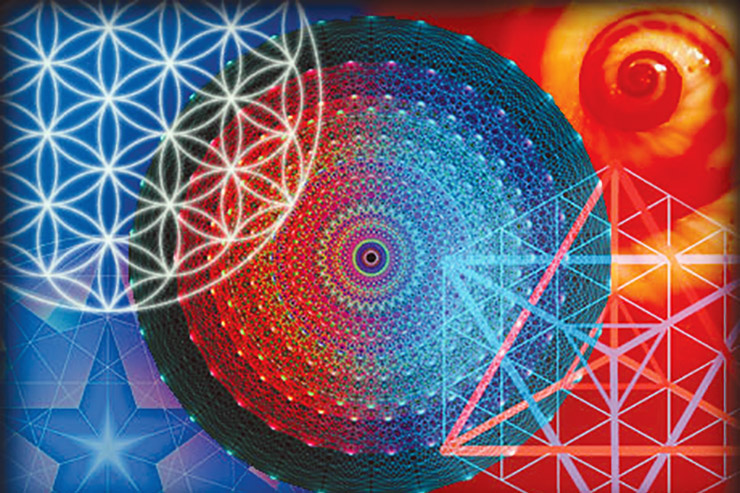
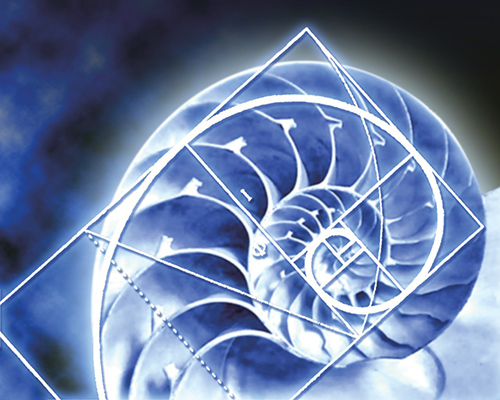
    The golden ratio, also known as the divine proportion, golden mean, or golden section, is found throughout nature. When it is applied to constructing a particular geometric form (see overlay above), a “golden spiral” can be drawn. This is best exemplified in the design of the nautilus sea-shell (above).

    The Golden Ratio

    As scientists discovered the deep mathematical principals underlying all forms, they took it as proof of the workings of a Great Mind. In this regard, a breakthrough was the discovery of “the golden ratio.” This ratio, usually denoted by the Greek letter φ (phi), expresses the relationship between two numbers where the sum of the two is to the larger, as the larger is to the smaller. That is, where “a” is the larger, “a+b” is to “a” as “a” is to “b.” Solving this equation algebraically, the only solution is the irrational number 1.618033989. Like Pi, the decimal string goes on infinitely. 

    Geometric forms conforming to, or incorporating, the golden ratio are abundant in nature. The number of petals on flowers conforms to the phi ratio, and it is the way the human body grows, finger to hand, hand to forearm. The golden ratio defines human beauty and consequently plastic surgeons use it for facial measurements. When applied architecturally it results in buildings that are strangely appealing to the human eye and to the spiritual imagination. To the ancient Greeks the Golden Section embodied philosophy and wisdom. Thus it was appropriate to incorporate the golden ratio in a building dedicated to a god. 

    When the phi proportion is used to construct a triangular form it becomes a “golden triangle,” and a “golden spiral” gets wider by a factor of φ every quarter-turn it makes, which means it gets wider by a factor of φ4 (about 6.854) every full turn. The nautilus sea-shell exemplifies a golden spiral. 

    Energy & Geometry

    In order to clear up the cloudiness around the term “Sacred Geometry,” and to better understand how it has been, and may be, used in healing, inspiration, spiritual advancement, art, design, architecture, Feng Shui and crop circles, we decided it was necessary to consult an expert. 

    Very impressed by his presentation at the recent Crop Circle Conference in Tempe, Arizona, and after experiencing a definite energetic influx while sitting under one of his unique, spinning metallic forms, we chose Gregory Hoag for our interview. Hoag is an artist, scientist and entrepreneur who has been working with form energy for over 40 years. For the past 27 years, he has lectured on Sacred Geometry on radio, TV and at conferences. His vision is to bring the archetypes of form to life for all to experience and benefit. He has been involved in various spiritual practices since the 1970’s. 

    It was in the 70’s that maverick New Age author and inventor Patrick Flanagan discovered and became a proponent of “pyramid power,” which he promoted through books, lectures and seminars. Influenced by Flanagan’s research, Hoag began building pyramidal forms and sleeping in them. 

    In 1982, he claims to have had “a very strong kundalini experience which was catalysed by a large pyramid filled with crystals.” Subsequently he began to “see” geometric energy patterns before they turned into physical matter. He decided to try to build those forms out of various metals, and found that people reacted strongly to his creations “both aesthetically and especially in an energetic sense. They said that they felt energy coming from the forms.” As a result, he started to manufacture the metallic objects which he calls “Metaforms.” 

    In his literature he says, “They are precisely composed, 3-dimensional sculptures that radiate an energetic field which can positively influence your environment and help create a sacred space.” He says further, “the entire structure of the Universe is based on the eternal laws of creation, which are mathematical and geometric in nature. Metaforms are designed to bring these archetypal laws into tangible experience in your life. “

    In our conversation with Hoag, we found his definition and explanation of Sacred Geometry to be logical and enlightening. He says, “We are higher dimensional beings. Our souls are rooted at the Causal level. All energy springs from that world. We have chosen to come down many levels into this dimension, this level of density… to learn and grow.” He explains further, “The universe wants to expand through us.” Consequently, it is necessary to “build a bridge, a conduit to the higher realms so that energy can flow into this dimension through us… giving us the opportunity for the highest, most rapid expansion.” 

    As the higher energy flows from the out Source through each dimension, it wants to make each dimension like itself – to create resonance with itself. Each dimension has a language of its own that relates to the out Source. In the physical realm, that language is geometry. Sacred geometrical forms are those that directly incarnate and express the higher energies. Hoag elaborates on this concept eloquently on his website, “There is a language that translates universally and is the true nature of ‘above’, which reflects in the substance of this physical reality ‘below’. That language is number, used by science to describe interactions in all realms of the physical and energetic universe. When number moves from the mental and theoretical into the physical it becomes pattern, rhythm, cycle and geometry. Thus, we see the language of God expressed everywhere in our universe. The Above is the archetype, the blueprint, so to speak.”

    The subtle power of pyramids have been attested by numerous investigators and experiencers over the years. They claim that model pyramids can preserve and energise food and water, sharpen or maintain the sharpness of razor blades, and improve the health of some people. It is also said pyramids – especially in the act of sitting inside one – can function as thought-form incubators, enhance meditative states, and even trigger sexual urges!

    [alert type=”success” dismiss=”no”]If you appreciate this article, please consider subscribing to help maintain this website.[/alert]

    The Human Factor

    While sacred geometry is apparent in nature without human intervention, humans have the power to consciously bring down the higher energies and deliberately impress these energies into matter. This capability was demonstrated dramatically by Japanese scientist Dr. Masaru Emoto in his now famous “water experiments.” He asked his subjects to deliberately imagine flasks of water to be impregnated with love, joy and peace. When this water was frozen, snowflakes were produced, each flake exhibiting a spark of free-will expression through a unique geometric design. He then asked another group of subjects to impress water with hate, anger and other negative emotions. This water produced no snowflakes when frozen – just blobs of ice. Hoag says this demonstrates that, “we can be a conduit for higher consciousness. In human beings, our own negative emotions block the flow of higher energy. Whereas, when things (human or otherwise) are connected to the higher dimension, they exhibit a pattern or a rhythm that reflects the order of the dimension of the source.” The fact that humans can actively channel and therefore have the ability to absorb these higher energies, is what makes us potentially god-like. 

    With regard to architecture, Hoag says, “…particular energies are attracted to particular shapes. They are further reinforced into a coherent presence by that shape. Thus the energy is made palpable and available to the individual by using Sacred Geometry as an antenna to both attract resonant energies and to coalesce and reconfigure ambient energies.” Then further, “When we create our structures so that they reflect this pattern, there can be a resonance with, or a reflection of, the higher. Many ancient structures were built to mimic the pattern of the higher order, and thus people could experience that higher energy. That’s where the term ‘sacred geometry’ comes from. The more we mimic the divine order, the more sacred the form becomes.” 

    Hoag claims that the Atlanteans understood this principle very well, and utilised it extensively. Some of this carried over to Greece and Egypt and other ancient civilisations. We now understand that the Great Pyramid at Giza, Egypt, focuses intense energy in the King’s Chamber. Some of these architectural principles became carefully guarded secrets in the Middle Ages, primarily by Freemasons and the Guilds, and were used in the design of Gothic Cathedrals. Hoag says that modern civilisation is spiralling downward into a place of separation. Modern architecture is based more upon human ego factors, and modern technology loads toxins and electromagnetic pollution into our environment, which blocks the flow of higher subtle energy. 

    Hoag’s view of crop circles is unique. He claims that higher entities are constantly working to bring higher energies down to this dimension to assist in the spiritual transformation of the human race. In order to accomplish this, the energies must be grounded in this three-dimensional world so that they may flow freely from the Causal to the Physical. The crop circles are evidence of the intensification of this effort in recent times. The circles form geometric patterns on the earth resonating with the divine energies that are being grounded. They are attracted to that particular section of the English countryside because the vibrations of that area are compatible with the energies. So basically, the crop circles are simply by-products of the ongoing process of the inculcation of higher energies needed to raise the consciousness of the planet. The beautiful designs are inspiring examples of Sacred Geometry, and hint at the beauty and power of their source at the Causal level. 

    Spinning Metaforms, E.Pendants & I.Connect

    Hoag’s basic purpose is to educate people about the deliberate, intelligent use of higher energies through understanding Sacred Geometry. He believes that this process is becoming more and more critical as we sink deeper and deeper into a chaotic energetic mire all over the planet, and it will be necessary to become proactive just to maintain the status quo, to say nothing of facilitating spiritual transformation. 

    Hoag frequently makes reference to channelled readings by Evalena Rose, who claims to communicate with “The Council of Twelve.” From a reading given by her on 2 August 2002, the Council says, “The energetics are changing so fast on the planet these days, that people need support in holding a field of energy around them that allows them to stay centred in their own radiance. To not be tossed about on the waves of change and the waves of chaos created by those who would obfuscate through things like promoting a war on terrorism.” 

    The Metaforms can be a potent aid in holding and building the energy body. They are designed to be suspended overhead and spin slowly while meditating or simply sitting quietly. Hoag says, “They can create awareness and empower you in making appropriate choices. Their beauty and perfection can bring peace to your heart and mind. This positive amplification of safe, subtle energy can activate creativity, healing, dreaming, meditation, and relationships.” Popular, prolific New Age author Carolyn Myss says, “Metaforms are extraordinary tools which enhance health and inner awareness by working with subtle energies. I highly recommend them as a part of one’s daily health maintenance regimen.”

    Perhaps more potent as an agent for energetic renewal are Hoag’s “e. Pendants.” Designed to be worn around the neck, the pendants are fiberglass disks about the size of a large wristwatch. The fiberglass acts as an insulator to “antenna systems” consisting of metallic sacred geometric designs bonded to both surfaces. The metal patterns are made of copper bonded to the disk, and plated with nickel and gold. The outer ring is layered with 100 mils of gold, titanium or chrome (which is up to ten times the industry standard), over sterling silver. This combination is referred to as vermeil. Each surface is then adorned with embedded gemstones like rubies, sapphires and emeralds based on the particular designs and the customisations requested or needed by the client. 

    Each side of the pendant has a different purpose. Hoag says, “Each face of the double-sided Pendant has a distinct energy when pointed toward the body. Choose the Star Face for an active, external and higher mental experience. The Earth Face is more receptive, grounding and heart centred in nature.” Hoag makes some extraordinary claims about the efficacy of the pendants. He says that they are “capable of transducing and focusing energy from the highest levels of consciousness.” He claims further, “most people feel the energy coursing through it and discover it to be unlike any other energetic tool that they have ever experienced… Changes in the body are immediately felt… the pendant has a balancing effect on whatever major chakra disturbance is happening in the person at that time. The pendant energy moves on further to begin opening areas of blockage, which… occurs simultaneously with soothing areas of stress. This is a tool of major transformation.” Wearers become “directly linked to the energies of creation, which may facilitate healing, balancing and higher consciousness. This is a channel of life force energy for physical and spiritual transformation. It enhances your ability to understand and manifest your soul.” 

    Metaforms is now focusing on their newest product, the I.Connect. This is an amazing small tool (that slips into the pocket) with a huge purpose: connection. It demonstrates advanced technology that expands awareness, increases energy and activates purpose. Hoag says, “We have been conducting scientific research with this piece with amazing results. In terms of Sacred Geometry the I.Connect utilises a new discovery that I made: Every three-dimensional form has three axis of perfect symmetry. When these three two-dimensional patterns are grouped together in a triad within a circle, a two-dimensional analogue of the three dimensional form is created that is capable of transducing the same energies as the three-dimensional form. This has opened up a new field of study that demonstrates that many of the basic beliefs in modern sacred geometry are wrong. Much of this new information will be available on our website: Iconnect2all.com.”

    While these may perhaps be extravagant claims, Hoag’s basic arguments seem applicable to these times. We do seem to have strayed far from the principles of harmony and beauty appreciated by the Egyptians and Greeks, and to have embraced ugliness on a major scale. If Hoag is right, this is symptomatic of a disconnection with the divine energies and the principles of Sacred Geometry. Hoag is clearly a pioneer in helping to lead us back to a re-connection which could transform the planet, and allow each of us to find a renewed inner harmony, and get onto a higher spiritual path. 

    You can obtain more information on the work of Gregory Hoag and Metaforms here: www.IConnect2all.com, www.metaforms.net, www.facebook.com/IConnect2all.

    [alert type=”general” dismiss=”no”]This article was published in New Dawn 136.[/alert]

    [alert type=”success” dismiss=”no”]If you appreciate this article, please consider subscribing to help maintain this website.[/alert]

    © New Dawn Magazine and the respective author.
    For our reproduction notice, click here.
  • 5G: The Final Assault

    5G: The Final Assault

    The following article, published in New Dawn 173 (May-June 2019), presents important information on the 5G networks currently being erected across urban landscapes in Australia, Britain, Europe, the USA, Asia, and eventually everywhere.

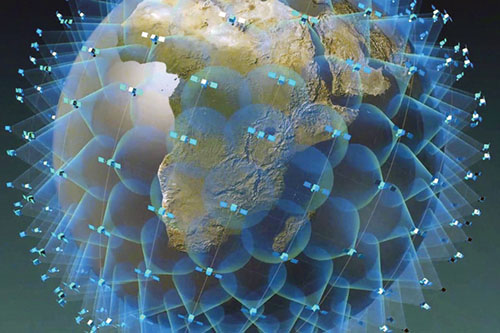
    In November last year (2018), the United States Federal Communications Commission (FCC) authorised the rocket company SpaceX, owned by the entrepreneur Elon Musk, to launch a fleet of 7,518 satellites to complete SpaceX’s ambitious scheme to provide global satellite broadband services to every corner of the Earth. The satellites will operate at a height of approximately 210 miles, and irradiate the Earth with extremely high frequencies between 37.5 GHz and 42 GHz. This fleet will be in addition to a smaller SpaceX fleet of 4,425 satellites, already authorised earlier last year by the FCC, which will orbit the Earth at a height of approximately 750 miles and is set to bathe us in frequencies between 12 GHz and 30 GHz. The grand total of SpaceX satellites is thus projected to reach just under 12,000. 

    Figure 1: Conceptual view of SpaceX’s plan for thousands of satellites, irradiating the entire planet with EHFs to beam 5G everywhere, even in remote deserts and rainforests.

    There are at present approximately 2,000 fully functioning satellites orbiting the Earth. Some beam down commercial GPS (or ‘SatNav’), some provide TV, some provide mobile phone services, and some bounce radar back and forth to produce images for meteorologists and military surveillance. The Earth is thus already comprehensively irradiated from outer space. But the new SpaceX fleets will constitute a massive increase in the number of satellites in the skies above us, and a correspondingly massive increase in the radiation reaching the Earth from them. The SpaceX satellite fleet is, however, just one of several that are due to be launched in the next few years, all serving the same purpose of providing global broadband services. Other companies, including Boeing, One Web and Spire Global are each launching their own smaller fleets, bringing the total number of projected new broadband satellites to around 20,000 – every one of them dedicated to irradiating the Earth at similar frequencies (figure 1). 

    Why this sudden flurry of activity? The new satellite fleets are contributing to a concerted global effort to ‘upgrade’ the electromagnetic environment of the Earth. The upgrade is commonly referred to as 5G, or fifth generation wireless network. It has become customary in tech circles to talk about the introduction of 5G as involving the creation of a new global “electronic ecosystem.” It amounts to geo-engineering on a scale never before attempted. While this is being sold to the public as an enhancement of the quality of video streaming for media and entertainment, what is really driving it is the creation of the conditions within which electronic or “artificial” intelligence will be able to assume an ever-greater presence in our lives. 

    The introduction of 5G will also require hundreds of thousands of new mini mobile phone masts (also referred to as “micro-cells” or “base stations”) in urban centres throughout Australia, and literally millions of new masts in cities throughout the rest of the world, all emitting radiation at frequencies and at power levels far higher than those to which we are presently subjected. These new masts are much smaller than the masts we currently see beside highways and on top of buildings. They will be discreetly attached to the side of shops and offices or secured to lampposts. The 20,000 satellites are a necessary supplement to this land-based effort, for they will guarantee that rural areas, lakes, mountains, forests, oceans and wildernesses, where there are neither buildings nor lampposts, will all be incorporated into the new electronic infrastructure. Not one inch of the globe will be free of radiation.

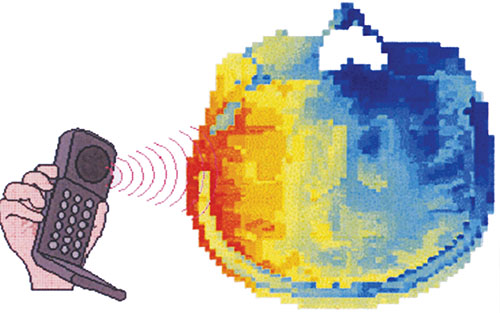
    Figure 2: The colours indicate the Specific Absorption Rate (SAR) of mobile phone radiation. The SAR is the amount of power absorbed by tissue, measured in watts per kilogram, shown here with red as the highest value, blue the lowest.2

    Given the scale of the project, it is surprising how few people are aware of the enormity of what is now just beginning to unfold all around us. Very few people have even heard about the 20,000 new satellites that are due to transform the planet into a so-called “smart planet,” irradiating us night and day. In the national media, we do not hear voices questioning the wisdom, let alone the ethics, of geo-engineering a new global electromagnetic environment. Instead, there is a blithe acceptance that technology must continue to progress, and the presence in our lives of increasingly “smart” machines and gadgets that each year become cleverer and more capable is an inevitable part of this progress. And who doesn’t want progress? Almost everyone loves their sleek and seductively designed phones, iPads and virtual assistants, and regards them as an indispensable part of their lives. 

    The question we should ask is whether we also want increasingly intense exposure of the natural environment and all living creatures, including ourselves, to more and more electromagnetic radiation. Is it likely that this does not entail any adverse health consequences, as both government and industry claim? If the electromagnetic waves that connect our smartphones to the Internet travel through brick, stone and cement, then what happens when these same waves encounter our bodies? Be assured that they do not just bounce off us! They travel into the human body. The degree to which they are absorbed can be precisely measured in what is called the Specific Absorption Rate, expressed in Watts per kilogram of biological tissue. When we fill our houses with WiFi, we are irradiating our bodies continuously. When we hold a smartphone to our ear, electromagnetic waves irradiate our brains (figure 2). Do we really believe this could be completely harmless? 

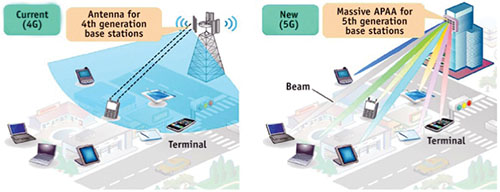
    Figure 3: The new 5G Active Phased Array Antennas (APAA) will concentrate energy in narrow, steerable high power beams.

    Waves and Frequencies

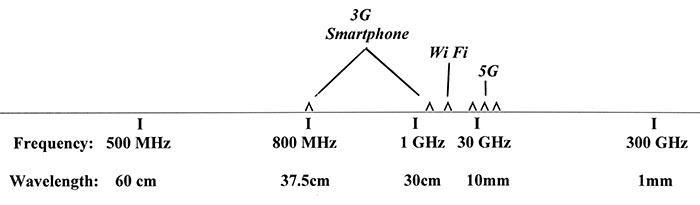
    At present, mobile phones, smartphones, tablets, WiFi and so on all operate at under 3 GHz in what is called the “microwave” region of the electromagnetic spectrum. If you could see and measure their wavelengths, you would find that they are many centimetres (or inches) long. A smartphone operating at 800 MHz, for example, sends and receives signals with wavelengths of 37.5 centimetres (just under 15 inches). Operating at 1.9 GHz, the wavelengths are 16 centimetres (just over 6 inches). WiFi uses the 2.4 GHz frequency band with 12 centimetre wavelengths (just under 5 inches long). 

    The introduction of 5G will entail the use of considerably higher frequencies than these, with correspondingly shorter wavelengths. Above 30 GHz, wavelengths are just millimetres rather than centimetres long. The millimetre waveband (from 30 GHz to 300 GHz) is referred to as Extremely High Frequency, and its wavelengths are between 10 millimetres and 1 millimetre in length.3 Up to the present time, Extremely High Frequency electromagnetic radiation has not been widely propagated, and its introduction marks a significant step change in the kind of electromagnetic energy that will become present in the natural environment (figure 4). 

    Figure 4: Frequencies and wavelengths of smartphone, Wi Fi and 5G.

    The reason why millimetre waves are to be used for 5G is that much larger bands of spectrum are available in the Extremely High Frequencies than at lower frequencies. This means that there can be much broader “bandwidth.” Broader bandwidth means that larger quantities of data can be transferred and the speed of transfer of the data will be significantly faster. One of the effects of this is that it reduces what is called “latency,” or time-lag, in the system, improving the quality of video streaming. But in so doing, it also enables a greater seamlessness between the data accessible from virtual sources and our perceptions of objects in the real world, as is required, for example, in Augmented Reality applications. Greater seamlessness means that we more effortlessly inhabit the natural and the electronic worlds as if they were a single reality. 

    One of the technical problems of using frequencies in the millimetre region of the spectrum is that because the waves carrying the data are so tiny, being only millimetres long, they are less able to pass through physical barriers, like walls and trees, than are the longer waves of lower frequencies. This is why it is necessary to have so many more new “micro-cells” or “base stations.” They will need to be spaced at 100 metres apart in cities because beyond this distance their signals weaken and are therefore less able to penetrate buildings and connect with the devices inside. As well as being more closely spaced, the 5G micro-cells will operate at much higher power than current phone masts in order to ensure that the signals are sufficiently strong. 

    Because the wavelengths are so much smaller, the antennas transmitting and receiving them will also be much smaller than those of current phone masts and electronic devices. A single 5G transmitter/receiver will have a large number of tiny antennas, grouped together in one unit. An array of just over a thousand such antennas measures only four square inches, so will easily fit into a small base station on a lamppost, while the smartphone in your pocket will probably have sixteen (figure 5). 

    Figure 5: Qualcomm’s millimetre wave antenna array module for a 5G smartphone. It has four antennas that can accurately point towards the nearest 5G base station. Phones will have four of these modules, i.e. sixteen antennas.4

    Both 5G satellites and 5G land-based masts will use a system called the “phased array.” In phased array, groups of antennas are co-ordinated to radiate pulses in a specific direction and in a specified time sequence. This allows a concentrated beam of radio waves to be exactly aimed at designated targets, to enable signals to be sent or received. Because the beams are concentrated in this way, this adds to their power, which means they are able more easily to penetrate buildings. But it also means that any living creature that gets in the way of such a concentrated beam will be subjected to a powerful dose of extremely high frequency radiant electricity. 

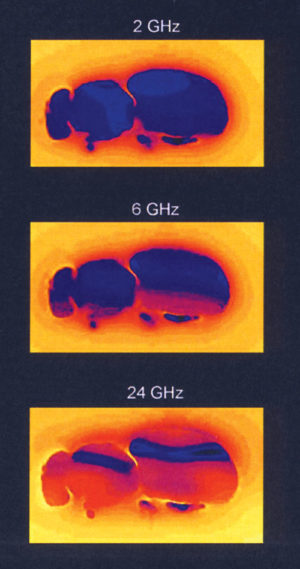
    A study published earlier this year demonstrated that certain insects, because of their small body-size, are particularly vulnerable to the millimetre waves of the higher frequencies to be utilised by 5G (figure 6).5 Other studies have shown that bacteria and plants are vulnerable, and so also (as one might expect) are the skin and the eyes of animals including, of course, human beings.6

    Figure 6: Illustration of the absorption of Radio Frequency electromagnetic radiation in the Honey Bee. At currently used frequencies between 2 GHz (top) and 6 GHz (middle), the wavelength is relatively large compared to the insect. But at 24 GHz, (bottom) the wavelength is closer to the insect’s size and the radiation penetrates further.7

    As well as its ability to concentrate power in focused beams, phased array technology has a further complicating factor. Either side of the main beam, the time intervals between the pulses are different from the time intervals between those of the main beam, but they may overlap each other in such a way as to produce extremely rapid changes in the electromagnetic field. This can have a particularly detrimental effect on living organisms, because instead of the radiation decaying when it is absorbed into living tissue, it can be re-radiated within the body. The moving charges streaming into the body effectively become antennas that re-radiate the electromagnetic field and send it deeper into the organism. These re-radiated waves are known as Brillouin precursors, named after the French physicist Leon Brillouin, who first described them in 1914. Research suggests that they can have a significant and highly detrimental impact on living cells.8 

    The Un-reassuring Assurances of Government and Industry

    The government body charged with advising on the health effects of electromagnetic radiation, the Australian Radiation Protection and Nuclear Safety Agency (ARPANSA), seeks to reassure us that there is no established evidence that Radio Frequency radiation (which radio, television, mobile phones, smartphones and 5G all use) has any adverse health effects on either adults or children.9 ARPANSA’s advice is largely based on findings derived from the supposedly independent AGNIR (Advisory Group on Non-Ionising Radiation), which advises the UK Health Department.10 AGNIR’s report, published in 2012, on the safety of Radio Frequency radiation stated that there was a lack of “convincing” and “conclusive” evidence for any adverse health effects. It was like giving a blank cheque to the telecommunications industry to move into the higher frequencies without any heed for the consequences.11 

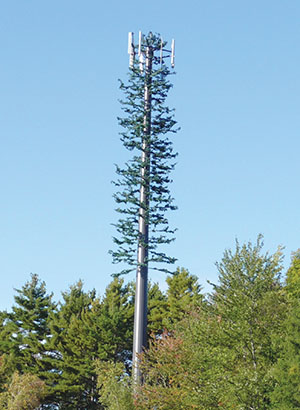
    Figure 7: Cell tower disguised as a tree.

    It turns out that far from being independent, AGNIR has a high proportion of members with blatant conflicts of interests, and their report distorted or simply left out of account evidence that should have compelled them to reach the opposite conclusion to the one they arrived at. In a forensic analysis of the report, the environmental health researcher Sarah Starkey makes it clear that only a wilful disregard of the available scientific evidence could explain its internal contradictions and apparent incompetence.12 Yet it is, it seems, not only the basis of current UK government policy but also Australian government policy, allowing the roll out of 5G without so much as even a nod towards the need for a prior health and safety assessment.13 Health and safety simply do not feature in government thinking, despite a veritable mountain of literally thousands of research papers demonstrating adverse health effects which continues to grow at the rate of roughly 350 per year, on average practically one every day.14

    One of the reasons for ignoring this evidence in the hell-for-leather dash to create the 5G electronic ecosystem is the conviction in government circles that unless we introduce it immediately, we will be “left behind” and our economic growth and competitiveness will be put at risk. There is simply no time to consider the possible health consequences. The rewards of the “connected future” are to be measured in billions of dollars worth of revenue. The mind-boggling amounts involved are well exemplified in a recent estimate that the global media industry alone stands to gain $1.3 trillion from 5G by 2025, not least because 5G will “unlock the potential of augmented reality (AR) and virtual reality (VR).”15 The irony that the “connected” future is one in which dizzying profits stand to be made from technologies that disconnect us more and more from the real world is entirely missed.

    The sums involved are sufficient to explain why the telecoms industry has for the last 25 years done its utmost to ensure that research into the health effects of wireless technologies produce negative or inconclusive results. Since 1993, the industry has financed a large number of studies, saving governments a great deal of expense and at the same time preserving the convenient illusion that the jury is still out on whether exposure to Radio Frequency radiation causes harm. 

    Earlier this year, The Guardian published an article citing research which showed that while 67% of independently funded studies found a biological effect of exposure to Radio Frequency radiation, only 28% of industry-funded studies did. Industry-funded studies are almost two and a half times less likely than independent studies to find health effects.16 The authors of the Guardian article explain that the telecoms industry doesn’t need to win the scientific argument about safety, but simply keep the argument running indefinitely by producing studies with results that fail to verify, or even better contradict, the research that does find adverse health effects. 

    One of the most notorious is the mammoth, industry-funded “Interphone Study,” which managed to conclude that holding a mobile phone to the head actually protects the user from brain tumours! This study, which is full of contradictions and suffers from grievous design flaws, is often quoted as the most authoritative to date, while it has in fact been thoroughly discredited.17 Nevertheless, the impression is maintained that there is no scientific consensus, and so there are not sufficient grounds for action to be taken. Needless to say, this suits government just as much as it suits industry. 

    [alert type=”success” dismiss=”no”]If you appreciate this article, please consider subscribing to help maintain this website.[/alert]

    The Path to Total Immersion

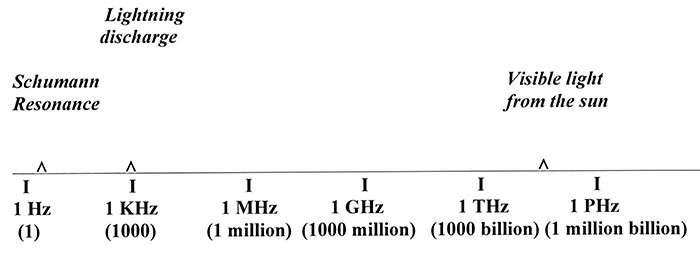
    Beyond the health effects there is another level altogether of what the roll out of 5G actually entails. To gain a perspective on this, we should remember that it was not so long ago that the Earth’s electromagnetic field was undisturbed by human-generated electromagnetic frequencies. Before the 1880s, there were only two main causes of electromagnetism, both of them natural: the lightning of thunderstorms, which also set in motion the very weak, low frequency resonances known as Schumann Resonances, and sunlight. Lightning and sunlight produce effects in specific, and very limited, parts of the electromagnetic spectrum. The very idea that such a thing as “electromagnetism” and an “electromagnetic spectrum” existed was not even entertained before the nineteenth century. And, from the point of view of the pre-electrical age, the truth of the situation was that they indeed did not exist as a factor of experience. Beyond lightning and sunlight, the energies of the electromagnetic spectrum did not impact on human life, for they were entirely dormant (figure 8). 

    Figure 8: Natural background electromagnetic radiation, showing frequencies in cycles per second.

    In that pre-electrical world, both lightning and sunlight were regarded with a certain degree of awe, as natural phenomena expressive of powers greater than anything human beings could muster. In antiquity both were associated with gods – lightning with violent storm gods invariably with Underworld associations, like Seth, Baal and Zeus; and sunlight with sublime solar deities like Ra, Shamash and Apollo. In the later Judaeo-Christian era, the widespread sense that these phenomena had a spiritual source persisted, with lightning regarded as expressive of the divine wrath, and light as the garment of the cosmic Logos. We touch here a deeply felt relationship to nature that has been largely eroded in the centuries since the Scientific Revolution. In the course of the eighteenth and nineteenth centuries, both lightning and light were stripped of their spiritual numinosity, clearing the way for an entirely materialistic explanation of light, and an entirely technological approach to electricity.

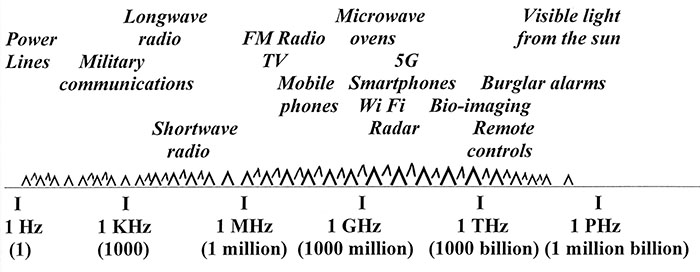
    In the early days, the frequencies utilised were at the lower end of the electromagnetic spectrum. In the 1890s, the power lines that delivered the new mains electricity to factories and houses were standardised at either 50 or 60 Hz (or cycles per second). When public radio broadcasts began in the 1920s, they were mostly in the longwave frequencies under 500 KHz (thousands of cycles per second). As the century wore on, the frequencies used by new and improved technologies became higher and higher. In the 1930s and ‘40s, medium and shortwave frequencies (between 500 KHz and 1700 KHz) were utilised, while in the 1950s the Very High Frequencies (VHF) of 30 – 300 MHz (or millions of cycles per second) were employed for both radio and TV broadcasting. 

    During World War II, a method was discovered for generating even higher frequencies, between 3 and 30 GHz (thousands of millions of cycles per second), which became the basis for radar. With each escalation in frequency, more power was required to transmit the radio waves. The advent of mobile phones, smartphones and WiFi, brought into widespread use the Ultra High Frequency (UHF) part of the spectrum (300 MHz – 3 GHz) for signal transmission. Transmission in these frequencies demands more than ten times the power needed for VHF transmission. 

    Today, poised at the threshold of the new era of an Extremely High Frequency “electronic ecosystem,” with frequencies of up to 70 GHz envisaged, yet more power will be required for effective transmission of its millimetre waves.18 Then the natural environment will be fully saturated with an invisible fog of radiation (figure 9). 

    Figure 9: Human induced electromagnetic radiation, showing frequencies in cycles per second.

    In this brief historical sketch, we see higher and higher frequencies forming the basis of each new technological innovation. As each one of the new technologies was introduced, human beings became a little more disassociated from the natural world. Consider how this happened. From the 1890s onwards, the supply of mains electricity to homes, schools, hospitals and factories caused a revolution in living standards, liberating humanity from subservience to nature’s cycles of day and night, summer and winter, by giving access to a new source of light, warmth and power. Then, in the 1920s, radio enabled people to communicate over vast distances, and brought the voices of kings and politicians, singers and poets into our living rooms, even though they were not physically present. 

    In the 1950s, television intensified the experience of an absent yet present world, conveyed by the moving image. I remember as a child the addictive quality of television: one is drawn out of oneself and away from awareness of one’s immediate surroundings into the fascinating world of images on the screen. 

    With the advent of the smartphone, the trend towards addictiveness was greatly strengthened, partly because the screen became a portable interface with the Internet, and partly because of the deliberately exploitative policies of Facebook, Google and others to hook people into an addictive relationship to their devices.19 Smartphone addiction both dislocates users from their own inner centre of stillness, and at the same time disconnects them from the natural environment. 

    5G will further accentuate this tendency for people to lose themselves, and it will weaken even more their relationship to nature, for it promises to make advanced immersive Virtual Reality accessible to all. While VR headsets have been commercially available for some time now, VR is still in its infancy. The next development in VR technology is to supplement the headset with a “haptic suit,” which enables the wearer to experience sensations of touch – pressure, warmth, hardness, softness, moisture and dryness – in virtual reality. Such opportunities for “total immersion” in virtual reality will lead to an increasing confusion as to which world we really belong: the electronically generated or the natural world. The use of Augmented Reality, made possible through special helmets, electronic glasses, or contact lenses, that overlay virtual content onto the experience of the physical world, will add to the confusion, as the virtual is increasingly integrated within the real world.20 

    People will become adjusted to regarding the virtual world as having as great a claim on their attention, their emotions and thoughts, as the natural world. The temptation will be to give their loyalty to that which not only undermines their relatedness to nature but also, through its assault on the imagination, has a corrosive effect on the inner life of the soul. The confusion will only be exacerbated by a huge increase in the use of 3D holographics that will give virtual entities the ability to incarnate electronically in the physical environment. This is what the saturation of the world with extremely high frequency millimetre waves will enable. The waves themselves are only part of the issue: it is the technologies that ride on the backs of the waves, and their impact on our inner life, that should also concern us.

    Figure 10: 5G antennas installed along a street in a US town.

    The Formation of the Global Electronic Brain

    But if 5G promises to radically alter the experiential world we inhabit in these ways, there is something further that we must understand if we are to grasp what is really being prepared. At the same time as increasingly sophisticated technologies increasingly disconnect human beings from the natural world, a network of electronic “intelligence,” global in extent, gradually emerged. At first it was under close human supervision, but it has steadily grown more autonomous. Consider the difference between radio broadcasting and the Internet: the former is under tight human control and serves a very specific purpose, whereas the latter has established itself as a permanent, constantly available electronic infrastructure of undefined scope and reach. What has been happening over recent decades is the increasing co-ordination of intelligence-endowed machines, so that they operate without need of human supervision. 

    The efforts now underway to create a 5G electronic ecosystem are the necessary precondition for developing and perfecting a global Artificial Intelligence network which feeds on the very fast transfer of large amounts of information. This global electronic “brain,” innocuously called the “Internet of Things,” is already impacting on our lives. 

    Through the Internet of Things, more and more things will be linked to the Internet and made “smart” by being given the ability to function autonomously. On smart motorways your car will drive itself while you, wearing your VR headset and haptic vest, play interactive computer games in the back seat; and in your smart house your fridge will autonomously order more eggs, milk and cheese for you via a wireless connection with a supplier. 

    But the reality is that the Internet of Things is itself the precursor to what has been called the “Internet of Thinking,” in which human beings will find themselves having to live in relationship to the vast global electronic intelligence. It will be active everywhere in our environment and we shall be obliged to interact with it in order to accomplish the simplest of tasks.21 In the Internet of Thinking it is not hard to see the lineaments of an electronically supercharged totalitarian state, with unprecedented control over the minutiae of individuals’ lives. The possibility of this happening will only be increased by the thousands of new mini phone masts and satellites irradiating every inch of the planet with millimetre waves. For this is what 5G means: it means putting in place not just an improved telecommunications system, but rather a new “system of systems” – the infrastructure of electronic totalitarianism.22 

    A Curtain Drawn Against the Light 

    As our world is increasingly smothered by a fog of radio waves, microwaves and millimetre waves, it may seem that the gods of the Underworld have taken hold of humanity in an ever-tightening grip, drawing us towards the false lights – the illusory lights of the hell-beings and hungry ghosts that the Tibetan Book of the Dead long ago warned against. The electromagnetic energies that we have summoned, and which promised to give us new powers, now appear to be overpowering us, carrying us down into an Underworld realm of hellish entertainment and distraction, of illusion and disconnection from the reality that really matters – the reality of nature and the spiritual order that infuses nature, the reality of fellow creatures with whom we share our world, living in soil and sky and walking the Earth beside us. 

    We must ask: Does the Earth need an electronic ecosystem? Is it going to benefit in any way from being irradiated with millimetre waves? Is there actually any need at all for 5G? Can we even remotely conceive that 5G is the answer to any of the pressing ecological, social and spiritual problems that face us today? We stand at a dreadful threshold, and yet surrender to despair cannot be the right response. What can we do?

    First of all, we can protest! There are campaigns against 5G that we can join, there are petitions to sign, letters to write, and legal actions to support. The best place to begin is the “International Appeal to Stop 5G on Earth and in Space,” which has now gathered over 40,000 signatures, including those of many health professionals, environmentalists and other scientists.23 But as well as protest there is something further that needs to be done, and that is to bring spiritually informed understanding to the deeper significance of the global electronic brain whose emergence 5G will hasten. 

    To this end, we need to develop a clear perception of the moral quality of electricity, and to recognise the kind of spiritual entity or entities that it serves. This will empower us to break the spell that electricity and electronic technologies have cast over us, and enable us to form a more appropriate relationship to them. One of Rudolf Steiner’s most helpful insights into electricity was his observation that it is light in a fallen, degraded state – light that has fallen beneath nature into the sub-natural realm – and that is why we must actively guard against an ever-increasing dependence on it, for it threatens to drag us down.24 

    This points to a third thing we can do, which is really the foundation of everything else. It is to rebuild our relationship to the light, which in its selfless benevolence and purity greets us every morning, and which, unlike the false and illusory electronic lights that would lead us into the Underworld, beckons us in a quite different direction, towards our essential humanity. 

    Through a deepened meditative relationship to the light, practised through the hours of the day and the seasons of the year, we can nurture a relationship to the inner light that is the source of all that is creative and good in the world. This inner light the Christian tradition knows as the cosmic Logos. 

    As the curtain of electrosmog is drawn across our world, we are presented with a sacred task that, come what may, we attend to all that the light has to give, for therein lies the divine Saving Power. 

    The above article originally appeared in New View magazine (Jan-Feb 2019), and has been modified by the author with information relevant to the Australian situation.

    [alert type=”general” dismiss=”no”]This article was published in New Dawn 173.[/alert]

    [alert type=”success” dismiss=”no”]If you appreciate this article, please consider subscribing to help maintain this website.[/alert]

    Footnotes

    1. One of the best sources for this information is the website of the Global Union Against Radiation Deployment from Space (GUARDS) at www.stopglobalwifi.org, and the related Cellular Phone Task Force website at www.cellphonetaskforce.org. Both organisations are informed and inspired by the tireless research and campaigning of Arthur Firstenberg, to whom this article is greatly indebted.
    2. Source: ISEE/ISEA Conference: Environmental Epidemiology and Exposure, Paris, 5/9/2006
    3. The rule is, the higher the frequency at which the wave oscillates, the shorter the wavelength will be.
    4. Source: Qualcomm, July 2018
    5. Arno Thielens et al., “Exposure of Insects to Radio-Frequency Electromagnetic Fields from 2 to 120 GHz”, Nature, 8: 3924 (2018): “The insects show a maximum in absorbed radio frequency power at wavelengths that are comparable to their body size… The studied insects that are smaller than 1cm show a peak in absorption at frequencies (above 6 GHz), which are currently not often used for telecommunication, but are planned to be used in the next generation of wireless communication systems.”
    6. Cindy Russell, “A 5G Wireless Future,” The Bulletin (January/February, 2017), pp.20-23, reviews the research, and lists a large number of adverse health effects of millimetre wave electromagnetic radiation including arrythmia, antibiotic resistance, cataracts, compromised immune system, etc.
    7. Source: Arno Thielens et al., Nature, 8: 3924 (2018), fig.4
    8. Kurt Oughstun, interview on “Brillouin Precursors,” Microwave News, 22, 2 (2002), p.10. According to Oughstun, a professor of electrical engineering and mathematics at the University of Vermont, “A single Brillouin precursor can open small channels through the cell membrane because, as it passes through the membrane, it can induce a significant change in electrostatic potential across that membrane.” See also Arthur Firstenberg, “5G – From Blankets to Bullets,” January 17, 2018, at www.cellphonetaskforce.org.
    9. For example, in the ARPANSA fact sheet on “Wi-fi and Health” (“There is no established evidence that the low exposure to RF EME from Wi-fi adversely affects the health of children or the general population”) and on “Mobile Phones and Health” (“There is no established evidence that the use of mobile phones causes any health effects”), for which see www.arpansa.gov.au. Given the vast amount of evidence indicating adverse health effects, one wonders what it takes for this evidence to be “established.”
    10. ARPANSA TSR-164 Report, Review of Radiofrequency Health Effects Research – Scientific Literature 200-2012 (2014). This report has been critiqued by Victor Leach and Steven Weller of the Oceania Radiofrequency Scientific Advisory Association (ORSAA) in Radio Frequency Exposure Risk Assessment and Communication: Critique of ARPANSA TRS-164 Report: Do We Have a Problem? (2017), available at www.orsaa.org. Leach and Weller point out the derivative nature of the ARPANSA report, as well as serious flaws in its assessment of the evidence, which simply does not support the conclusions reached. 
    11. Report of the Advisory Group on Non-Ionising Radiation, Health Effects from Radiofrequency Electromagnetic Fields (2012)
    12. Sarah J. Starkey, “Inaccurate official assessment of radiofrequency safety by the Advisory Group on Non-ionising Radiation,” Review of Environmental Health, 31:4 (2016), pp.493-503
    13. The Australian Government Department of Communication and the Arts, October 2017 strategic report on the roll out of 5G, “5G – Enabling the Future Economy,” does not mention health and safety precautions. 
    14. One of the best sources for this mountain of research is The BioInitiative Report (2012), which helpfully gathers it into manageable sections, and is regularly updated. It can be accessed online at www.bioinitiative.org. According to the Report, between 2007 and 2012 approximately 1,800 new studies demonstrated adverse health effects, i.e. on average 350 per year. 
    15. Ovum, “5G Economics of Entertainment Report” (October, 2018). The report was commissioned by Intel, and a summary is available at www.newsroom.intel.com
    16. Mark Hertsgaard and Mark Dowie, “The inconvenient truth about cancer and mobile phones,” The Guardian, 14 July 2018. The blatant funding bias was first exposed in 2006 by Louis Slesin, “‘Radiation Research’ and the Cult of Negative Results,” Microwave News, 26.4 (July, 2006), pp.1-5. A good summary of the problem is given in “Bias and Confounding in EMF Science,” on the Powerwatch website: www.powerwatch.org.uk/science/bias.asp
    17. The Interphone Study is devastatingly critiqued in L. Lloyd Morgan et al., Cellphones and Brain Tumors: 15 Reasons for Concern (2009), available online at www.electromagnetichealth.org
    18. Ofcom, Enabling 5G in the UK (March, 2018), pp.3-4
    19. Jacqui Goddard, “Facebook exploits human weakness, admits former boss Sean Parker,” The Times, 10 November 2017
    20. Ovum, “5G Economics of Entertainment Report,” see note 14 above
    21. Maynard Williams, “Welcome to the Internet of Thinking,” The Telegraph, 8 May 2018
    22. Nokia White Paper, “5G – a System of Systems” (www.Nokia.com)
    23. The appeal can be accessed at www.5gspaceappeal.org
    24. Rudolf Steiner, Anthroposophical Leading Thoughts, Rudolf Steiner Press, 2007, p.218

    © New Dawn Magazine and the respective author.
    For our reproduction notice, click here.
  • The Secret World of Pamela Travers

    The Secret World of Pamela Travers

    This article was published in New Dawn 170 (Sept-Oct 2018)

    The masterfully told stories of a magical nanny that held adults and children alike spellbound for decades might incline readers to think that Australian author Pamela (P.L.) Travers merely had an over-active imagination. The truth is that her talent blossomed out of a fertile garden of occult teachings and paranormal experiences, nurtured and inspired by some real-life, exceptionally gifted personalities. 

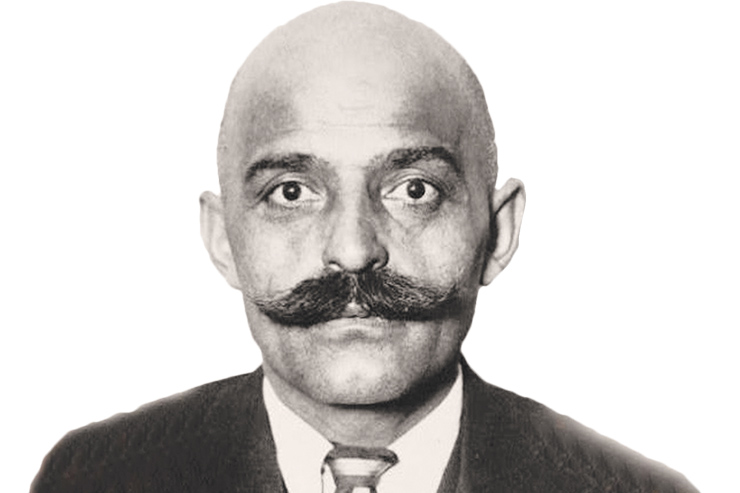
    The movie Saving Mr Banks and the documentary The Real Mary Poppins treated the public to insights into her relationship with her father, the influence of the Auntie she called Sass, and her tumultuous association with Walt Disney. Of equal gravity was her lifelong attraction to mystical pursuits and the guidance of the philosopher and mystic George (G.I.) Gurdjieff.

    Travers was born in Maryborough, Queensland, as Helen Lyndon Goff in 1899. Her father, Travers Robert Goff, whom she adored, moved the family to the small community of Allora on the Darling Downs in 1905, where he died of tuberculosis at the age of 43. It was then that Christina Saraset, or Aunt Sass as she liked to be called, came on the scene to help out, and Pamela and her family moved once again, this time to Bowral in New South Wales. 

    It is now common knowledge that the character of Mr Banks in her novels was based on her father, Travers Goff, while Aunt Sass, who ‘flew in from the east’, would serve as the model for Mary Poppins herself, who famously blew in from the east with her parrot umbrella and magical carpetbag. The real-life Aunt Sass was a strong, no-nonsense presence in her niece’s life, as well as her work. Travers described her as a “bulldog with a ferocious exterior” but with a “heart tender to the point of sentimentality.”

    Pamela Travers has been described by some observers as “mysterious and prickly,” and one could form the opinion, based on Emma Thompson’s portrayal of her – as praiseworthy as it was from an artistic point of view – that the writer was full of herself, close-minded and perhaps even emotionally cold. And this notion might be further reinforced by the fact that she never married, bore children of her own or formed a family unit in the conventional sense. Yet such an impression would be completely false.

    P.L. Travers in the role of Titania in a production of A Midsummer Night’s Dream, c. 1924

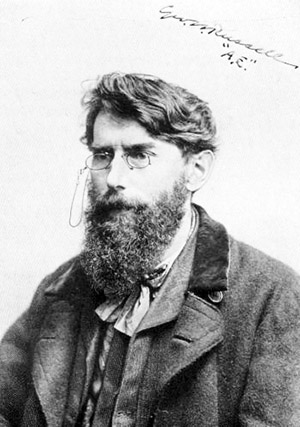
    As a young woman Helen Goff was an actress, dancer and a poet before turning her hand to journalism. She toured Australia and New Zealand as a member of Allan Wilkie’s Shakespearean Company, adopting the stage name Pamela Lyndon Travers. At the age of twenty-four she travelled to Ireland, where the Irish poet and mystic George (A.E.) Russell became her mentor. As editor of the Irish Statesman, Russell, whose kindness towards younger writers was legendary, initially accepted some of her poems for publication. From 1925 onward she was introduced to Theosophical thought and literary figures familiar with the Theosophical Society, including T.S. Eliot, Oliver St. John Gogarty and William Butler Yeats, the latter being one of the leaders of the Golden Dawn.

    Gurdjieff, Mysticism & Spirituality

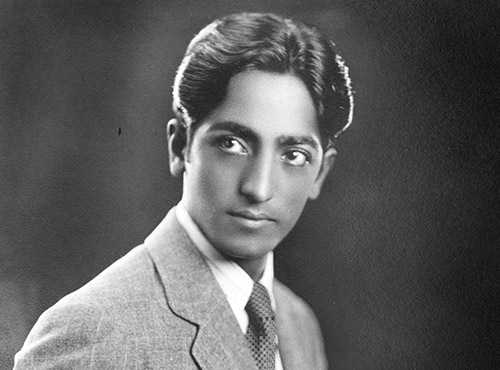
    Travers studied the Gurdjieff system under Jane Heap, and in March 1936, with the help of Jessie Orage (widow of The New Age editor Alfred Richard Orage), she met the mystic George Gurdjieff, who in turn introduced her to the paths of Sufism and Zen. He encouraged her to explore Eastern religion and, during her thirties and forties, she delved into Buddhism, later gravitating to Jiddu Krishnamurti.

    The successful writer travelled to New York City during World War II while working for the British Ministry of Information. At the invitation of her friend, the US Commissioner of Indian Affairs, John Collier, Travers spent two summers living among the Navajo, Hopi and Pueblo Indians, studying their mythology and folklore.1 Episodes such as these reveal something of Pamela Travers’ true character and her perpetual thirst for occult knowledge. She had no qualms about lodging at a reservation and formed a close bond with the Navajo people in Arizona who did the honour of bestowing an Indian name on her, although it was one that she always kept secret.2 After the war, she remained in the USA and became Writer-in-Residence at Radcliffe College and Smith College, Massachusetts. 

    Journalist and critic Jerry Griswold, in an essay tribute to Pamela Travers after her death, asserted that she had “lived for several years” with the Navajos and, during another period, had “studied for several years” in Kyoto under a Zen master,3 although in his recollections he probably exaggerated the time spans somewhat. After her American sojourn, she returned to England, making only one brief visit to Sydney in 1960 while on her way to Japan to study Zen mysticism.

    Jiddu Krishnamurti, c. 1920s

    Arcane Influences & Didactic Writings

    The question arises as to what degree the writings of Pamela Travers were influenced, guided or even manipulated by her spiritual masters? She met George Gurdjieff some years after the first edition of Mary Poppins had been published (in 1934), followed by the equally well-received Mary Poppins Comes Back (1935). Any direct influence by Gurdjieff is more likely to be found in the later Mary Poppins books, particularly Mary Poppins Opens the Door (1944) and Mary Poppins in the Park (1952).

    In 1970 Pamela Travers authored a contribution on Gurdjieff for Richard Cavendish’s encyclopedia Man, Myth & Magic (see page 48), then went on to publish an insightful ten-page booklet George Ivanovich Gurdjieff three years later. In that tract she reflects on the various traditions that were woven into Gurdjieff’s work and, by extension, her own thought and philosophy: 

    What was the source of his teaching? True to his role, Gurdjieff never openly disclosed it. By examining his writings and the numerous commentaries upon them it might be possible to discover parallels in various traditions: Tantric Buddhism, Hinduism, Sufism, Greek Orthodoxy – possible, but hardly profitable. For the fundamental features of his method cannot be traced to any one source. Ouspensky quotes him as admitting, I will say that, if you like, this is esoteric Christianity. There seems no reason to reject this when one remembers that Christianity, as Gurdjieff knew it, was the heir of the ages and must have drawn to itself elements from very early pre-Christian traditions, Hittite, Assyrian, Phrygian, Persian; and there is nothing so explosive as old ideas restated in contemporary terms as the Western world was to discover when Gurdjieff burst upon it.4

    In the same publication she lists several celebrated editors and writers of the day who socialised with Gurdjieff:

    Great feasts where, under the influence of good food, vodka and the watchful eye of the Master, opportunities were provided, for those who had the courage, to come face to face with themselves. The hardiest among them, those who could rise to the level of being serious, were allowed to transmit something of the teaching to newer pupils.5

    This issue of the transmission of the teachings poses the further question as to whether the novels penned by Travers carried veiled arcane messages intended only for the more astute, esoterically inclined among her audience. We should, nevertheless, resist the temptation to read too much of Gurdjieff into the Mary Poppins’ stories. In an interview which appeared in the Paris Review in 1982, the interviewers asked Travers whether “Mary Poppins’ teaching – if one can call it that – resemble that of Christ in his parables.”6 Travers replied: “My Zen master, because I’ve studied Zen for a long time, told me that every one (and all the stories weren’t written then) of the Mary Poppins stories is in essence a Zen story. And someone else, who is a bit of a Don Juan, told me that every one of the stories is a moment of tremendous sexual passion, because it begins with such tension and then it is reconciled and resolved in a way that is gloriously sensual.” The answer is clarified by the following question (posed by the interviewer): “So people can read anything and everything into the stories?” Travers’ response: “Indeed.”

    In Man, Myth & Magic, Pamela Travers wanted to make it clear that the work of her Master in no way constituted Black Magic. She wrote: 

    It is clear from Gurdjieff’s writings that hypnotism, mesmerism and various arcane methods of expanding consciousness must have played a large part in the studies of the Seekers of Truth. None of these processes, however, is to be thought of as having any bearing on what is called Black Magic, which, according to Gurdjieff, “has always one definite characteristic. It is the tendency to use people for some, even the best of aims, without their knowledge and understanding, either by producing in them faith and infatuation or by acting upon them through fear. There is, in fact, neither red, green nor yellow magic. There is ‘doing’. Only ‘doing’ is magic.” Properly to realise the scale of what Gurdjieff meant by magic, one has to remember his continually repeated aphorism, “Only he who can be can do,” and its corollary that, without “being” nothing is “done,” things simply “happen.”7

    Travers insisted that the Mary Poppins stories had not come from herself but that there are “ideas floating around that pick on certain people.” She believed that her books were gifts of God, “given” to her, and quoted C. S. Lewis saying, “There is only one Creator, we merely mix the ingredients He gives us.”8 She declared that she was not a creator, simply a vessel, and never wrote specifically for children but was “grateful that children have included my books in their treasure trove.”

    [alert type=”success” dismiss=”no”]If you appreciate this article, please consider subscribing to help maintain this website.[/alert]

    What the Bee Knows

    The Irish poet and mystic George (A.E.) Russell.

    In addition to her well-known collection of novels, Pamela Travers wrote numerous non-fiction essays and books, especially in her later years. What The Bee Knows is a collection of spiritual essays. The back of the book describes it as “a honeycomb of essays pointing to the truth-of-things handed down in the great popular stories of cultures around the world.” And that is just what it is, a labyrinth of brief dissertations covering a range of esoteric, myth-based and biographical themes. She shares tales of her friendships with literary figures such as W.B. Yeats and A.E. Russell, of her studies among many religions of the world, of her early experience with fairy tale and folklore which shaped her character.

    The Sphinx, the Pyramids, the stone temples are, all of them, ultimately, as flimsy as London Bridge; our cities but tents set up in the cosmos. We pass. But What The Bee Knows, the wisdom that sustains our passing life – however much we deny or ignore it – that for ever remains.9

    Why did Pamela Travers choose the Bee as her metaphor? She wrote: 

    I thought of Kerenyi – “Mythology occupies a higher position in the bios, the Existence, of a people in which it is still alive than poetry, storytelling or any other art.” And of Malinowski – “Myth is not merely a story told, but a reality lived.” And, along with those, the word “Pollen,” the most pervasive substance in the world, kept knocking at my ear. Or rather, not knocking, but humming. What hums? What buzzes? What travels the world? Suddenly I found what I sought. “What the bee knows,” I told myself. “That is what I’m after.”

    But even as I patted my back, I found myself cursing, and not for the first time, the artful trickiness of words, their capriciousness, their lack of conscience. Betray them and they will betray you. Be true to them and, without compunction, they will also betray you, foxily turning all the tables, thumbing syntactical noses. For – note bene! – if you speak or write about What The Bee Knows, what the listener, or the reader, will get – indeed, cannot help but get – is Myth, Symbol, and Tradition! You see the paradox? The words, by their very perfidy – which is also their honourable intention – have brought us to where we need to be. For, to stand in the presence of paradox, to be spiked on the horns of dilemma, between what is small and what is great, microcosm and macrocosm, or, if you like, the two ends of the stick, is the only posture we can assume in front of this ancient knowledge – one could even say everlasting knowledge.”10

    An Esoteric and Occult Bequest

    Toward the end of her life Travers became increasingly interested in Sufism, a form of Islamic mysticism, particularly the Persian branch of it, through meetings with members of the fraternity and their publications in Britain. We can assume that she continued her search for life’s meaning among the world’s mystical and spiritual traditions right until the end. Perhaps she never felt she had reached the ultimate aim of Gurdjieff’s Work or ‘Fourth Way’, which held the goal of shattering one’s pretensions and ego, the stripping away of the personality and awakening to a higher consciousness.

    It is no secret that the great success of author J.K. Rowling with that other fictional champion of magic in book and film, Harry Potter, owes something to Pamela Travers. Rowling was an admirer of Travers and adopted both her enigmatic disguise in initialling her first names and also her theme of flight, just as Travers had herself been inspired by J.M. Barrie’s ‘Peter Pan’. Rowling now ranks highly in the tradition of authors of youth fantasy classics, joining C.S. Lewis, J.R.R. Tolkien, J.M. Barrie and, of course, P.L. Travers. She also borrowed the name when she created the character of the Death-Eater wizard called Travers in her novels, portrayed by actor Tav MacDougall in the film adaptation of Harry Potter and the Order of the Phoenix.

    In 1977 Pamela Travers was made an Officer of the Order of the British Empire and in 1978 received an honorary degree from Chatham College, Pittsburgh, USA. She would spend the final years of her life in London’s Chelsea district, dying from the effects of an epileptic seizure, on 23 April 1996 at the age of ninety-six. What she contributed to literature is now legendary. What she bequeathed us in the way of mystical knowledge ought not be underestimated either. Her lifelong pursuit of spiritual wisdom significantly enriched the storehouse of esoteric teachings available to all those she called the ‘Seekers of Truth’.

    [alert type=”general” dismiss=”no”]This article was published in New Dawn 170.[/alert]

    [alert type=”success” dismiss=”no”]If you appreciate this article, please consider subscribing to help maintain this website.[/alert]

    Footnotes

    1. https://en.wikipedia.org/wiki/P._L._Travers
    2. www.biography.com/people/pl-travers-21358293
    3. Revealing Herself to Herself: REMEMBRANCES by Jerry Griswold, Los Angeles Times, 16 June 1996
    4. www.gurdjieff.org/travers1.htm
    5. Ibid.
    6. As quoted by Massimo Introvigne at: www.academia.edu/29792559/Mary_Poppins_goes_to_Hell_Pamela_Travers_Gurdjieff_and_the_Rhetorics_of_Fundamentalism
    7. “Gurdjieff” in Man, Myth and Magic: Encyclopedia of the Supernatural (1970)
    8. www.independent.co.uk/news/people/obituary-p-l-travers-1306698.html
    9. What the Bee Knows: Reflections on Myth, Symbol, and Story by P.L. Travers (1989)
    10. “What the Bee Knows” in Parabola: The Magazine of Myth and Tradition, Vol. VI, No. 1 (February 1981); later published in What the Bee Knows: Reflections on Myth, Symbol, and Story (1989)

    © New Dawn Magazine and the respective author.
    For our reproduction notice, click here.

  • The Way of the Sly Man: The Teachings of G.I. Gurdjieff

    The Way of the Sly Man: The Teachings of G.I. Gurdjieff

    This article was published in New Dawn 131 (Mar-Apr 2012)

    It has happened to everyone. You go into a room only to find you have no recollection of why you went; someone reminds you of a promise you made but have completely forgotten; or you realise you’ve set down your keys but can’t remember where. Nor are such cases always matters of failure: sometimes you discover that you have done a perfectly good job of making coffee or writing a cheque even though you have no memory of it.

    We usually take these harmless instances of forgetting for granted; it’s hard to believe that they can tell us anything important. But according to George Ivanovich Gurdjieff (1866?-1949), they point to the heart of the human predicament.

    Long before the twentieth century’s discovery of the unconscious, people knew that there were unseen parts to themselves. “I cannot totally grasp all that I am,” wrote St. Augustine in the fifth century CE. “For that darkness is lamentable in which the possibilities in me are hidden from myself: so that my mind, questioning itself upon its own powers, feels that it cannot rightly trust its own report.”

    Gurdjieff would have agreed. Indeed he insisted that we are not awake even in the so-called waking state, but go about our lives in a hypnotic stupor. “It may surprise you,” he said, “if I say that the chief feature of a modern man’s being which explains everything else that is lacking in him is sleep. A modern man lives in sleep, in sleep he is born and in sleep he dies” (emphasis here and in other quotes is in the original). 

    This sleep, Gurdjieff contended, is universal, or nearly so. Today some contend that the mass of humanity is being manipulated by a small and sinister elite who are keeping people in the dark in order to maintain their own power and position. This is not Gurdjieff’s view. According to him, the world’s leaders are in the same position as the rest of us. During World War I, Gurdjieff said, “Neither Emperor Wilhelm [of Germany], nor generals, nor ministers, nor parliaments, signify anything or can do anything.” Nor is it a matter of a secret cabal pulling the strings behind the scenes. Instead “everything that happens on a big scale is governed from outside, and governed either by accidental combinations of influences or by general cosmic laws.”

    George Ivanovich Gurdjieff (1866?-1949)

    In 1915 in St. Petersburg, Gurdjieff met his most famous student, the man who, more than Gurdjieff himself, would become the most widely read exponent of his teaching: Piotr Demianovich Ouspensky (1878–1947). Ouspensky’s account of his experiences appears in what is perhaps the best and most famous book about Gurdjieff’s teaching: In Search of the Miraculous: Fragments of a Forgotten Teaching, which Gurdjieff himself endorsed as an accurate picture of his views. It presents an intricate and fantastic esoteric system. One theme is the “sleep” of ordinary life. Another is the disunity of the human being. Gurdjieff says:

    Man such as we know him… cannot have a permanent and single I. His I changes as quickly as his thoughts, feelings, and moods, and he makes a profound mistake in considering himself always one and the same person; in reality he is always a different person, not the one he was a moment ago….

    Each minute, each moment, man is saying or thinking “I.” And each time his I is different. Just now it was a thought, now it is a desire, now a sensation, now another thought, and so on, endlessly. Man is a plurality. Man’s name is legion.

    Gurdjieff is here alluding to an ancient view of the human mind, which regards human beings as essentially tripartite, consisting of the intellect, the emotions, and the instinctive and motor functions of the body.

    These three “centres,” as Gurdjieff called them, “instead of fusing inwardly in the normal way to produce common outer manifestations, have become, especially of late, quite independent outward functions…. [Man] cannot be master of himself, for not only does he not control these centres, which ought to function in complete subordination to his consciousness, but he does not even know which of his centres governs them all.”

    This disjunction would be bad enough on its own, but it is compounded by “sleep,” the hypnotic trance in which we habitually live. Gurdjieff links this “sleep” to the concept of kundalini.

    The spread of Eastern teachings over the past generation has made kundalini a comparatively familiar term. Most esotericists use this Sanskrit word to refer to the “serpent fire” at the base of the spine. This subtle energy is said to lie dormant in most people but can be awakened through meditation or yogic practices. Travelling up the spine, it brings about illumination when it reaches the head.

    Gurdjieff thought this view of kundalini was completely wrong. “In reality Kundalini is the power of imagination, the power of fantasy, which takes the place of a real function. When a man dreams instead of acting, when his dreams take the place of reality,… it is the force of Kundalini acting in him. Kundalini can act in all centres and with its help all the centres can be satisfied with the imaginary instead of the real.”

    In his immense and difficult magnum opus, Beelzebub’s Tales to His Grandson, Gurdjieff speaks of “the crystallised consequences of the properties of the organ kundabuffer.” Kundabuffer, a coinage of Gurdjieff’s, is a portmanteau word formed from “kundalini” and “buffer”; “buffers” were what he called those psychic mechanisms that keep the different “I” ’s from confronting each other. (The idea resembles the modern psychological concept of dissociation.)

    But what Gurdjieff calls “the terror of the situation” is still worse. It might not matter if we lived our lives in sleep; perhaps we would not achieve all we could, but that almost inevitably happens anyway. According to conventional religion, if we are good, we will still go to heaven (or obtain a favourable rebirth) when we die.

    Gurdjieff does not subscribe to conventional views of immortality. For Gurdjieff, we possess the possibility of having immortal souls, or what he calls “higher being-bodies,” but we almost never attain them because we live in sleep. And for undeveloped human beings, there is no immortality. “The ‘man-machine’… who is now one, the next moment another, the next moment a third, has no future of any kind; he is buried and that is all.”

    This bleak view of human fate is reminiscent of the gloomier Gnostic cosmologies, and to many who have read In Search of the Miraculous, Gurdjieff sounds like a Gnostic. “Kundalini is a force put into men in order to keep them in their present state,” he asserts. “One would think that there are forces for whom it is useful and profitable to keep man in a hypnotic state.”

    Figure 1. Gurdjieff’s Ray of Creation. From P.D. Ouspensky, In Search of the Miraculous.

    There is some truth to the idea that Gurdjieff is a kind of Gnostic, but only some. To understand it fully, we need to grasp something of his intricate cosmology. It can be best seen in a diagram known as the Ray of Creation (Figure 1). Gurdjieff did not claim to have originated it but said it “belongs to ancient knowledge.” Many other esoteric systems are, he adds, distorted or incomplete versions of this system.

    As one can see from the diagram, the Ray of Creation rather resembles the way children sometimes address envelopes: after listing the street, city, and state, they will add “USA, North America, Planet Earth, the Solar System, the Milky Way, the Universe.” It also resembles the levels of manifestation seen in other systems, like the Kabbalistic Tree of Life. But Gurdjieff depicts the cosmic levels in terms of scale. The Absolute, or God, is all-encompassing. The next level is that of “all worlds,” that is, all galaxies (and perhaps all universes) taken as one. The next stage is that of “all suns” in our own galaxy, and so on. Each level, as it descends, is subject to a new set of cosmic laws of its own in addition to those of all the levels above it.

    In contrast to the higher realms, where there is comparative freedom, we on Earth are subject to many cosmic laws. In fact we are very nearly at the bottom rung of the ladder – but not at the absolute bottom, for that rung is occupied by the Moon. Contrary to the prevailing scientific views both of his time and of our own, Gurdjieff held that the Moon is not cold and dead but is rather “an unborn planet, one that is, so to speak, being born. It is becoming warm gradually and in time (given a favourable development of the Ray of Creation) it will become like the Earth and have a satellite of its own.”

    “Food for the Moon”

    The growing Moon needs to be fed by certain cosmic energies. What Gurdjieff calls “a huge accumulator” exists on Earth to accomplish this end. This “accumulator” is organic life in all its forms: “Everything living sets free at its death a certain amount of the energy that has ‘animated’ it: this energy, or the ‘souls’ of everything living – plants, animals, people – is attracted to the Moon as though by a huge electromagnet.” Human beings, like the rest of life on Earth, are thus merely “food for the Moon.”

    Such is the view set out in In Search of the Miraculous. Because this book is much more readable than Gurdjieff’s own magnum opus Beelzebub’s Tales to His Grandson, many take it as the final word. But Beelzebub amends this picture in an important way. For while Gurdjieff here reiterates that humanity was indeed designed as “food for the Moon,” he adds that we have a choice of how to serve this end.

    Buried toward the end of Beelzebub, in a convoluted passage on war, Gurdjieff makes an important and often overlooked disclosure: that the energy needed to “feed the Moon” is precisely the same as that given off by people “forming and perfecting… their higher bodies by means of conscious labours and intentional sufferings.” If people do not serve the purposes of “Great Nature” by inner work, this energy will be extracted from them on a massive scale by means of wars and epidemics.

    Gurdjieff’s picture of the universe, stated so baldly, seems improbable. What are we to make of “higher being-bodies,” “kundabuffer,” and the idea that we are “food for the Moon”? Does he mean these things literally? There was always a touch of the rogue about Gurdjieff, and the reader is sometimes struck by his writing in the same way that some people were struck by him in life: he seems to be staring at you with a penetrating gaze and asking you to decide whether or not he is kidding.

    Yet there is nothing in Gurdjieff’s life and work to indicate that he did not mean what he said. He despised conventional wisdom, and indeed one of the main themes interwoven throughout Beelzebub’s 1,200 pages is that modern people are so stuffed with absurdities that they have lost sight of cosmic truths. So Gurdjieff would hardly be concerned that today’s scientists and psychologists might differ with many points of his teaching.

    At the same time there is an elegance and sublimity to Gurdjieff’s vision. He is telling us not only that we are here for a purpose, but that the universe is benign and intricately constructed: if we fulfil its designs, we will be rewarded with immortality.

    [alert type=”success” dismiss=”no”]If you appreciate this article, please consider subscribing to help maintain this website.[/alert]

    “The Fourth Way”

    To rescue us from our plight, Gurdjieff brought what he called “the Fourth Way.” He contrasts his approach with three more familiar ways: (1) the way of the fakir, who masters his body to the point where he can stand “motionless in the same position for hours, days, months, or years”; (2) the way of the monk, who, by prayer and devotion to God, masters the emotions; (3) the way of the yogi, the one who gains control over the mind.

    Unlike these paths, the Fourth Way, “the way of the sly man,” does not require withdrawal from the world, but can and should be pursued in the course of everyday life; and instead of working with the mind, the body, or the emotions alone, it works with all three. It is, Gurdjieff claimed, faster and more efficient than the other three ways. “The ‘sly man’ knows the secret,” said Gurdjieff, “and with its help outstrips the fakir, the monk, and the yogi.”

    What is the sly man’s “secret”? It is a higher force, an energy that is able to penetrate the being of man and create unity in his centres where there was none before. This energy must come from above, but it will not come by itself; Gurdjieff does not preach quietism but advocates “conscious labours and intentional suffering.” (Indeed Gurdjieff’s disciples refer to his teaching as “the Work”; those attempting to follow it are said to be “in the Work.”) For a long time these “labours” and “sufferings” will consist, not in some sophisticated form of masochism, but in striving to overcome the slumber of daily life and see oneself as one really is.

    A central practice of the Fourth Way is self-remembering. “You do not remember yourselves,” Gurdjieff chides Ouspensky’s Petersburg group. “You do not feel yourselves; you are not conscious of yourselves. With you, ‘it observes’ just as ‘it speaks,’ ‘it thinks,’ ‘it laughs.’ You do not feel: I observe, I notice, I see.”

    Anyone who has read even a little in the literature of contemporary spirituality will find familiar resonances here, for many books emphasise the need for mindfulness. Gurdjieff’s teaching goes still further, for it puts this effort at the centre of the spiritual search. It also gives many more specific practices for “self-remembering”: people in the Work often receive instructions about being consciously present at certain moments of the day or during particular tasks.

    Many who have read about – or even practiced – Gurdjieff’s teaching seem to fall into the trap of seeing “self-remembering” as a completely cerebral practice; trying to carry it out, they end up simply being self-conscious in the ordinary sense. They miss an essential part of the practice: that self-remembering entails a conscious effort of sensing the body.

    Self-remembering begins with the body because, as the French Gurdjieffian Jean Vaysse puts it, the body “is solid and concrete, with an apparently stable form which can… be relied on to some degree. It is the instrument through which we perceive and our means of action. It can stay still voluntarily and thus is easier than the other parts for us to observe. It is relatively obedient, and we have a certain amount of control over it (in any case more than over our other parts). In addition, it is the one solid material base in us.”

    Hence a Gurdjieffian reading this article might attempt to read while giving some attention to the sensation of some part of the body, the foot or hand, say, or even the body as a whole. This may sound simple, but if you try it, you’ll find it isn’t. If you’re lucky, you may be able to keep this “divided attention” for a few seconds before you lose it again. For a long time the Work involves returning to this sensation of the body over and over again no matter what you’re doing. Such attempts are known as “efforts.” They are meant to counteract the sleep of everyday life. Those who persist in this practice find that some of the “maleficent consequences of the properties of the organ kundabuffer” are, if not destroyed, at least interrupted, for these efforts help to dissipate daydreaming, absentmindedness, and the hazy stupor in which we stumble through our lives.

    These efforts of attention tie into other aspects of the teaching as well. Gurdjieff defined attention as “the direction of the thinking centre’s activity.” Self-remembering, at least in the early stages, directs the “thinking centre” toward the body, which is governed by the “moving-instinctive centre.” Self-remembering brings these two centres closer together. When the mind is paying attention to the body, they are working a bit more in harmony, and the practitioner is slightly closer to becoming a unified being. (See the accompanying article on page 27 for further discussion – purchase a copy of the magazine to read it.)

    Gurdjieff further explains that “making a conscious effort at the moment an impression is received” enables the organism to absorb more of certain subtle energies than it ordinarily does. These energies are used to create “higher being-bodies” that can withstand the shock of death. Thus self-remembering, a practice as rich and multileveled as meditation itself, is meant not only to counteract the sleep and disunity of man, but to help one attain the immortality that, Gurdjieff says, usually exists for us as nothing more than a possibility.

    The Ancient Greek aphorism “Know thyself”, Latin: nosce te ipsum, was inscribed in the forecourt of the Temple of Apollo at Delphi.

    A second, closely related practice is self-observation, whereby one tries to see as much as possible of one’s own immediate state – thoughts, moods, emotions, reactions, and physical postures. Self-observation attempts to fulfil the injunction of the ancient oracle at Delphi: “Know thyself.” All true teachings must work toward this goal in some way. The Gurdjieffian technique is to observe ourselves in the course of daily life, to see ourselves as others see us, in all our moments of awkwardness, irrationality, and sleep.

    This process not only helps students accumulate material for understanding themselves better, including the subtle organism of the “centres,” but it enacts certain changes in its own right. “Many psychic processes can take place only in the dark,” says Gurdjieff. “Even a feeble light of consciousness is enough to change completely the character of a process, while it makes many of them altogether impossible.”

    Today most Gurdjieffian groups focus on the practices of self-remembering and self-observation; people also take part in various forms of physical labour and craftwork as a means of seeing different aspects of themselves. There are even some who continue an interesting facet of his teaching known as the Gurdjieff Movements.

    The origins of the Movements form part of Gurdjieff’s legend, for most people in the Work connect them with the “sacred dances” he learned in his explorations in Central Asia during his youth. These dances, which Gurdjieff claims are over 4,500 years old, “correspond precisely to our books. Just as is now done on paper, so, once, certain information about long past events was recorded in dances and transmitted from century to century to people of subsequent generations.” Each posture forms a letter in an alphabet of gestures; understanding this code, you can read the information therein.

    The “sacred dances” known as the Gurdjieff Movements.

    Although the Movements, accompanied by music written by Gurdjieff and his pupil, the composer Thomas de Hartmann, are still taught in some Gurdjieffian schools, it is not clear that the means of “reading” them has been passed down as well. If Gurdjieff did impart the secret to some of his pupils, it has been well hidden. It is rarely possible even to see a performance of the Movements; the best way of glimpsing them is in the 1977 film Meetings with Remarkable Men, directed by Peter Brook under the supervision of Gurdjieff’s pupil Jeanne de Salzmann, which shows the performance of some of these dances toward the end.

    Anyone who does see the Movements can understand how they fit in with Gurdjieff’s teaching. They require the performer to maintain two or three different rhythms with different parts of the body, say, the head, arms, and feet, often while executing complicated dance steps. The difficulty of these “sacred dances” is obvious, but they accord with Gurdjieff’s goal of integrating the “three centres” so that a new, higher “I” can be created. As for the difficulty, Gurdjieff insisted that “only super-efforts count.”

    What possibilities does the Work offer for the seeker today? Its hardships rarely take the peculiar forms they did under Gurdjieff himself, but much of the master’s rigor remains. It is not a path for those who crave conviviality or emotional warmth; many who encounter the Work complain of its coldness. On the other hand, this very characteristic tends to weed out dilettantes, so the calibre of people one encounters is probably higher than in many traditions. There are of course dubious entities that lay claim to Gurdjieff’s heritage, but most of them can be avoided if one keeps clear of groups that aggressively proselytise or demand exorbitant sums of money.

    For a sense of the possibilities offered by the Gurdjieff Work, one might take a clue from Beelzebub, whose hero at one point remarks that of all the creatures in our solar system, “personally I liked best of all the three-brained beings breeding on the planet bearing the name Saturn.” Traditional astrology portrays Saturn as the cold, remote planet that creeps slowly through the sky. As such, it has always been associated with slow, unstinting labour (which is why in the old rhyme “Saturday’s child works hard for a living”) as well as with authority and depth. Hence the “super-efforts” required by the Work may seem to lack glamour and fun, but they may also confer knowledge that cannot be won by easier means.

    [alert type=”general” dismiss=”no”]This article was published in New Dawn 131.[/alert]

    [alert type=”success” dismiss=”no”]If you appreciate this article, please consider subscribing to help maintain this website.[/alert]

    © New Dawn Magazine and the respective author.
    For our reproduction notice, click here.