New Dawn – World's Most Unusual Magazine

Category: Articles

  • Michel de Nostradamus: Fraud or a True Prophetic Savant?

    Michel de Nostradamus: Fraud or a True Prophetic Savant?

    The 16th-century French doctor Michel de Nostradamus, and his obscure yet hypnotic prophecies, have cast their spell on the world over the last four-and-a-half centuries. He has become a wellspring for wisdom and waggishness for a broad range of diverse historical figures and colourful characters. He was a brunt of jokes by Jay Leno of NBC’s Tonight Show and the theatrical device of a cigar-waving Orson Welles, giving one of his better melodramatic performances as the host in a documentary, uttering facts, fables, and smoke rings as captivating and cloudy as Nostradamus’ own writings.

    Nostradamus has been the inspiration for something as benign and silly as the Nostra Doormouse of holiday cards, while others exploited his prophecies for deadlier purposes. Josef Goebbels used the prophecies of Nostradamus as a Nazi propaganda weapon during World War II, while Britain’s legendary prime minister Winston Churchill retaliated with his own platoon of interpreters, until even Louis B. Mayer, the movie mogul of MGM Studios, put Nostradamus on the silver screen in his film shorts to boost American morale.

    Today, many dismiss Nostradamus as a freak of urban legends and reject his interpreters and avid students as victims of another reconstituted alluvium of New Age sewage. Nonetheless, he has had (and still has) millions of admirers and defenders. Some of them were kings and queens of France, including such rulers as Henry IV, Louis XIII, Louis XIV, and Emperor Napoleon’s wife – the Empress Josephine. Respected literary giants such as Victor Hugo have tried to decipher him. World leaders have invoked his name to change destiny.

    Nostradamus and his prophecies just won’t go away. At the moment when it seems as if the tangle of biographical fact and myth about the man and the chaos of his cryptic prophecies should drive one away, lightning bolts of what appear to be prescient genius cut through his nebulous narrative of tomorrow.

    Was Nostradamus a fraud or a true prophetic savant?

    One thing is certain: it is safe to say that the man who launched the Nostradamian phenomenon has made good on at least one of his 1,500 or more predictions – that greater and lingering fame would come after his death. Indeed, after his passing in 1566, his ‘afterlife’ has made his name far more famous and enduring than when he was alive. It cannot be denied, even by his greatest debunkers, that Nostradamus is one of the best-known historical figures of the past millennium.

    When we, and the controversy of Nostradamus, entered a new millennium, many interpreters and dilettantes of Nostradamus mistakenly believed his prophecies foretold the end of the world – a strangely popular but patently unqualified myth, since Nostradamus had dated the end of the world 1,797 years ahead in the year 3797. Nevertheless, a peaceful turning of New Year’s Day 2000 exposed Nostradamus in the minds of many believers and sceptics as a prophetic failure and charlatan.

    Then on 11 September 2001, the debate about this man and myth came back before global scrutiny. No sooner had the twin towers of the World Trade Center collapsed into billowing, apocalyptic clouds of debris, than Reuters News Agency broadcast across the planet a prophecy attributed to Nostradamus about “hollow mountains” falling in the “City of York.” The lines of the purported prophecy – much like what we know about the man Nostradamus – were a blend of myth and fact. Fake lines like “the city of York” drew people in, yet these were sewn together with stolen lines of two actual Nostradamus prophecies – the same prophecies that for decades many interpreters, including this author, believed forecast a future nuclear or terrorist attack on New York’s lower Manhattan financial district.

    A prophetic hoax about an attack on the “City of York” rode on the back of these real quatrain (four-line) prophecies about what many believe is an attack on New York:

    At forty-five degrees latitude,
    the sky will burn,

    Fire approaches the great
    new city.

    Immediately a huge, scattered flame leaps up,

    When they want verification from the Normans [the French].


    Garden of the world near the
    new city,

    In the path of the hollow
    mountains:

    It will be seized and plunged
    into a boiling cauldron,

    Drinking by force the waters
    poisoned by sulfur.

    (Quatrain 97, Century 6 and Quatrain 49, Century 10, The Prophecies of M. Michel de Nostradamus)

    When you have two prescient-sounding yet general provocations that include images like “fire approaching” a “new city” at “forty-five degrees latitude” in the “path” of “hollow mountains” near a “garden of the word,” the hackles can rise – especially if you apply present-day facts to conveniently join together the dots of a 450-year-old prophetic rant to see what you want to see.

    Does one brush it all off as a coincidence that the city of “new” York is near latitude 45 degrees, or that the first Boeing 757 hijacked by terrorists cut into the North Tower of the World Trade Center in “a huge, scattered flame” at a 45-degree angle? Is it just the law of chance fooling a prophetically sympathetic mind when the second hijacked airliner passed over New Jersey (also known as the “Garden” state) and swerved at high speed toward the South Tower of the “world” Trade Center building exactly over the “Path” subway tunnel before slamming into the second man-made peak of “hollow mountains”? And when Nostradamus describes his vision of “hollow mountains” being “seized and plunged” into a “boiling cauldron,” are we conned yet again by a new generation of sycophants tagging events of their time on to cryptic ravings; or, is it more than a coincidence that each tower as it fell looked as if it were seized by the hand of an invisible force and plunged into the boiling cauldron of its own debris cloud? Are the “Normans” some retroactive allusion to the people of Normandy, or is this, as Nostradamian scholars believe, a code name for the French, whose intelligence agents on 10 September were indeed frantically warning their opposites in Washington D.C. that a terrorist attack on America was imminent?

    Do we have a 16th-century charlatan catching us in our projections when the multiple meanings of Renaissance French can satisfy what we want to see? The word Nostradamus uses for “cauldron” is cuue (spelled cuve in Modern French). It can mean a number of things beyond “cauldron” such as “tank” or “tub.” Is the sceptic right when he brushes off any application of this word to the fall of the twin towers? Is the sceptic right to suggest waggishly that we might as well say Nostradamus is predicting some future disaster in a jacuzzi; or, is it not a little disturbing to one’s flippant reason to discover that the World Trade Center was built on a huge, rectangular cement box of watertight floor and walls known as “the tub”?

    Welcome to the debate.

    It could be said that Nostradamus the man planted the seed of Nostradamus the Myth in April of 1554 (on Friday the Thirteenth, no less) when it is believed his secretary began transcribing his bizarre history of the future. The Myth was born 12 years later, in 1566, when family and friends lay his lifeless body behind the wall of his favourite chapel outside of town.

    Ever since that day, Nostradamus has enjoyed an afterlife.

    In life, he painstakingly manufactured a literary chaos that would turn the cloudy quatrains and half-page-long sentences of his prophetic prose narratives into a tabula rasa upon which each generation of interpreters could project their hopes, fears, and expectations. Moreover, for centuries now, biographers, blind believers, debunkers, and “prophegandists” have helped it along, with accurate and inaccurate dissemination of his prophetic legacy.

    In the process the man and his life has all but disappeared in the giant shadow cast by his own controversial prophecies.

    So just who was Nostradamus?

    The new millennium and the “9/11” attacks sparked the greatest debate yet about the efficacy of this man and his prophecies.

    [alert type=”general” dismiss=”no”]The above, reprinted with permission, is the Introduction to John Hogue’s book Nostradamus: A Life and Myth. The book is the first complete and full-bodied biography and historical reassessment of Nostradamus in over sixty years. Available as an ebook from Amazon, Nook, Kindle, iTunes, and print edition from Amazon.com. Copyright © 2013 by HogueProphecy Publishing, eTablet Edition. All rights reserved.[/alert]

    [alert type=”general” dismiss=”no”]This article was published in New Dawn Special Issue Vol 11 No 3.[/alert]

    [alert type=”success” dismiss=”no”]If you appreciate this article, please consider subscribing to help maintain this website.[/alert]

    © New Dawn Magazine and the respective author.
    For our reproduction notice, click here.

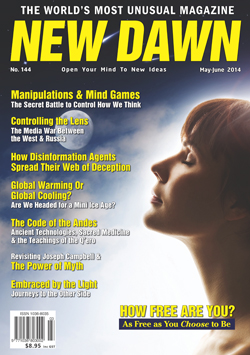
  • Revisiting Joseph Campbell: The Power of Myth

    Revisiting Joseph Campbell: The Power of Myth

    From New Dawn 144 (May-June 2014)

    Perhaps myth first arose out of the answers parents give to their children’s questions. Many of these are unanswerable: Why is water wet? Why is fire hot? Where does everything come from? Who is God? Because people like to tell stories, it makes sense that parents would make up tales, far-fetched, elaborate, but sometimes beautiful, to satisfy this curiosity. The best of these would be passed down from generation to generation to form the body of worldwide myth.

    Even so, this explanation does not tell us why myths are so powerful. Why should these stories have continued to be told for thousands of years? What meaning do they have and what role do they play in our lives?

    The modern study of myth, and its close cousin, religion, began around the Enlightenment, when polymaths began to compile the traditions of non-Western peoples. They also tried to find common elements in these traditions. Most of their answers today look naïve and simplistic.

    The mid-nineteenth-century British author Hargrave Jennings, for example, saw the origins of all the world’s religions in “phallicism,” a worship of the sexual force as well as of the sun and fire. J.G. Frazer, author of The Golden Bough and revered as one of the founders of the discipline of anthropology, said that myths, particularly of the death-and-resurrection variety, were merely recapitulations of the yearly vegetative cycle of growth, death, and renewal (a view known to, and derided by, Plutarch in the first century CE).

    In the twentieth century, Émile Durkheim, one of the founding fathers of sociology, held that religion was nothing more than a primitive abstraction and internalisation of social forces: “Society in general, simply by its effect on men’s minds, undoubtedly has all that is required to arouse the sensation of the divine. A society is to its members what a god is to its faithful.” For the Swiss psychiatrist C.G. Jung, myth and religion expressed a deep layer of the mind that he called the collective unconscious.

    All these views are true. There are many sexual motifs in myths and religion. Societies do unite themselves by means of common myths. There are underlying patterns of myth that seem universal, even among peoples who are far-flung and isolated. But these are only partial truths.

    One of the most comprehensive – and best-known – discussions of myth appears in the writings of the American scholar Joseph Campbell (1904-87). Campbell’s view, expressed in books such as The Hero with a Thousand Faces and the Masks of God series, and in a famous series of televised interviews with the journalist Bill Moyers entitled The Power of Myth, is probably the most influential of all twentieth-century attempts. In many ways it is also the most wide-ranging and comprehensive.

    Unlike his predecessors, who tended to see myth in one-dimensional terms (the product of social pressures, the expression of the collective unconscious, and so on), Campbell acknowledged that myth filled all of these functions. In Creative Mythology, the last volume of his Masks of God series, he writes:

    The first function of a mythology is to reconcile waking consciousness to the mysterium tremendum et fascinans [the terrifying and fascinating mystery] of this universe as it is: the second being to render an interpretative total image of the same, as known to contemporary consciousness. Shakespeare’s definition of the function of his art, “to hold, as ’twere, the mirror up to nature,” is thus equally a definition of mythology. It is the revelation to waking consciousness of the powers of its own sustaining source.

    A third function, however, is the enforcement of a moral order, the shaping of the individual to the requirements of his geographically and historically conditioned social group. [Emphasis here and in other quotes is in the original.]

    These sentences summarise the mythological theories up to Campbell’s time, but they do not complete the picture. He goes on: “The fourth, and most vital, most critical function of a mythology… is to foster the centring and unfolding of the individual in integrity, in accord with d) himself (the microcosm), c) his culture (the mesocosm), b) the universe (macrocosm), and a) that awesome ultimate mystery which is both beyond and within himself and all things.” For Campbell, this fostering of individual potential is the most important function of myth. It is also the one to which he devotes the greatest part of his work.

    The Hero

    Following C.G. Jung, Campbell closely links dream and myth, emphasising how mythic themes appear in the dreams of ordinary people, even those who have never heard the original tales. Every man is a hero, living out these themes in the trials of daily life. “The latest incarnation of Oedipus, the continued romance of Beauty and the Beast, stand this afternoon on the corner of Forty-second Street and Fifth Avenue, waiting for the light to change.”

    This quotation comes from The Hero with a Thousand Faces, published in 1949 and certainly the most influential of Campbell’s works. Its outline of the hero’s journey, drawing upon myths and lore from around the world, has inspired any number of books and films, including George Lucas’s Star Wars series. Broadly sketched, the journey proceeds thus: A person, usually an ordinary and undistinguished individual, is roused from the routine of his or her daily life by a call. This call may take the form of a dream, an animal, a god, or even a predicament: the journey in Dante’s Divine Comedy begins when the narrator, wakened from a stupor, finds himself in a dark wood from which he must escape.

    The hero has free will, however, and may refuse the call. The punishment is an ossification of the self, sometimes symbolised by turning to stone: as Campbell writes, “Lot’s wife became a pillar of salt for looking back, when she had been summoned forth from her city by Jehovah.” In psychological terms this means fixation, which represents “an impotence to put off the infantile ego, with its sphere of emotional relationships.” We can see examples of this all around us: the eternal momma’s boy; the student who cannot leave university, taking degree after degree; the high-school football hero who dwells forever on a few moments of vanished glory on the field.

    For those who accept the call, some kind of supernatural aid appears. In the Inferno, Dante, lost in the dark wood, is saved from wolves by a greyhound (a medieval symbol of Christ) and then meets with Vergil, for Dante’s age the greatest poet of classical antiquity. Thus this spirit guide can be masculine or feminine, animal or fairy. Among the American Indians of the Southwest one favourite figure is Spider Woman, and in many Christian myths the Virgin appears as this helper. In the hero’s journey of everyday life, the help may come in a subtler form: the appearance of a teacher or master, or even a book that serves as the perfect guide for this precise juncture.

    Armed with this help, the hero is ready to cross the first threshold, the boundary between the known and the unknown, the everyday world and the underworld. The shadowy realms of this underworld are, Campbell tells us, “free fields of the projection of unconscious content.” They can be populated by demons, ogres, or other menacing creatures; the hero may also encounter alluring figures that will tempt him to destruction, like Circe or the Sirens in the Odyssey. If he fails to kill the ogre or master his desire for the voluptuous spectre, he is annihilated.

    If he succeeds and goes past this threshold into what Campbell calls “the belly of the whale,” he is annihilated nonetheless. But here the annihilation is the very point of the endeavour. The image of the belly of the whale comes from the biblical book of Jonah, in which the protagonist flees his destiny as a prophet only to be swallowed by a “great fish,” in whose belly he stays for three days. During this time Jonah prays to the Lord and agrees to accept his mission: “I will pay that that I have vowed” (Jonah 2:9). The fish then vomits him up onto dry land.

    Death & Resurrection

    Campbell, like many commentators, underscores the death-and-resurrection motif in this part of the journey. The prophet dies to his old identity and is reborn with a new one. Quoting the esotericist Ananda K. Coomaraswamy, Campbell writes, “No creature can attain a higher grade of nature without ceasing to exist.” The same holds true for the most famous death-and-resurrection myth of them all – that of Christ. The Gospels stress that Christ is to go up to Jerusalem for the specific purpose of being crucified so that he may die and rise again. In this myth, Jerusalem, supposedly the spiritual pinnacle of humanity, is the underworld, and the ogres are the priests and scribes and Pilate. Christ is put to death in an excruciating and humiliating way, but after three days he rises again.

    Before the hero can be resurrected, however, he usually has to undergo a series of trials in the underworld – tasks to be performed, some monster that must be overcome. In Christian myth, this corresponds to the “harrowing of hell,” in which Christ before his resurrection descends to the nether world and defeats Satan, liberating the righteous souls imprisoned there.

    The hero does not always win this conflict, but either way he cannot lose. Even if he dies, he is restored to life in a new and glorified form.

    Once the ordeals have been passed, the hero encounters the Goddess. This is not a desirable fate for those who are unprepared. Campbell recalls the Greek myth of Actaeon, a hunter who stumbles upon a glade where he sees the goddess Diana bathing naked. Because this is an accidental encounter, Actaeon must pay the price: Diana changes him into a stag, and he is torn to pieces by his own hounds.

    This tale highlights two aspects of this part of the hero’s journey: the need for purification from his flaws (including his desires) and the dual nature of the Goddess. She is beautiful, she is infinitely tender, but she is also baleful. The hero cannot encounter one aspect without the other. Campbell recounts a vision of the nineteenth-century Hindu saint Ramakrishna, in which he sees a beautiful pregnant woman arising from the Ganges. She gives birth, but as soon as she does, she turns into a monster, seizes the baby in her jaws, crushes it, and chews it. The Goddess gives birth to all, but having given birth she will take it back again.

    Once the hero faces and accepts this ambiguous and awesome nature of the Goddess, he marries her in a hieros gamos or sacred wedding, signifying the unification of the ambisexual nature that exists in every man and woman.

    Having assimilated the force of the Goddess, the hero must undergo atonement with the father. Campbell expresses it thus:

    The problem of the hero going to meet the father is to open his soul beyond terror to such a degree that he will be ripe to understand how the sickening and insane tragedies of this vast and ruthless cosmos are completely validated in the majesty of Being. The hero transcends life with its particular blind spot and for a moment rises to a glimpse of the source. He beholds the face of the father, understands – and the two are atoned.

    As the quintessential example of this encounter, Campbell cites the book of Job. Job, a “simple and upright man, and fearing God, and avoiding evil,” is nonetheless plunged – for reasons he does not understand – into a maelstrom of suffering in which his fortune, his home, and his children are all annihilated. Most of this book consists of a poetic dialogue between Job, who insists upon his own righteousness, and his so-called comforters, who keep trying to persuade him that he must have done wrong to merit such treatment from the Lord. In the end the Lord himself appears to answer Job “out of the whirlwind,” demanding that he explain the inscrutable workings of the universe: “Where wast thou when I laid the foundations of the earth? declare, if thou hast understanding” (Job 38:4). Job cannot answer; in the end he can only say, “I repent in dust and ashes” (Job 42:6).

    The book of Job remains to this day perhaps the most profound exploration of theodicy, the question of divine justice. But it is still an enigmatic and perplexing work. Jung, in his Answer to Job, saw the manifestation of the Lord as a kind of appeal to power – divine might makes right – but Campbell, as the passage above suggests, views this issue in a deeper and more nuanced way. There is no answer to this question in any conventional sense. The source of which Campbell speaks gives rise both to justice and injustice, as it says elsewhere in the Bible: “I form the light and create darkness: I make peace and create evil: I the Lord do all these things” (Isaiah 45:7). The Old Testament God is frequently mocked – as he is by Jung – for being childish and temperamental, but the Hebrew Bible is great in part because it acknowledges the unfathomable truth that good and evil both arise out of the One. Hence, too, the dual benign and maleficent nature of the Goddess.

    Having faced and overcome these challenges, the aspirant becomes a master, with the power to move between the worlds of magic and of ordinary life. He then undergoes the process of return. And when he does return, he comes bearing the elixir – the boon that can bring healing to the world.

    How the World Works

    More could be said about the hero’s journey, as well as many other forms of myth that Campbell explores in his work. But it may be best to move on to some reflections. To begin with, Campbell is in his way a more profound, or at any rate a less ambivalent, thinker than his predecessor Jung. Jung, a conventionally trained psychiatrist, tended to stop short when he had to face the metaphysical implications of his thought. He was willing to say that his archetype of the Self – the psyche in a whole and integrated form – was an image of God, but he was reluctant to move on and say whether God did or did not exist outside of the psyche. Campbell is less equivocal:

    The mythological figures that have come down to us… are not only symptoms of the unconscious… but also controlled and intended statements of certain spiritual principles, which have remained as constant throughout the course of human history as the form and nervous structure of the human physique itself. Briefly formulated, the universal doctrine teaches that all the visible structures of the world – all things and beings – are the effects of a ubiquitous power out of which they rise, which supports and fills them during the period of their manifestation, and back into which they must ultimately dissolve.

    It would be hard to formulate a clearer or more concise summation of the spiritual teachings of humanity than this. Campbell is telling us these myths do not speak only to our psyches; they are also telling us how the world works.

    This consideration brings up a perplexing issue. Because myth has cosmic implications, it must incorporate a vision beyond a person’s own narrow interests if it is to have any genuine meaning. It is easy to see how the hero’s journey corresponds to the trials of different phases of life. But if there is no more, then the journey speaks to the individual only. That is not enough. As the myths tell us, in the end the hero has to bring some boon to society. His journey has to have collective, if not universal, meaning and value.

    While Campbell acknowledges this fact, at times it sounds as if he still prizes the individual vision above the collective.

    Today, more fortunately, it is everywhere the collective mythology itself that is going to pieces, leaving even the non-individual (sauve qui peut!) to be a light unto himself. It is true that the madhouses are full; psychoanalysts, millionaires. Yet anyone sensible enough to have looked around somewhat outside his fallen church will have seen standing everywhere on the cleared, still clearing, world stage a company of mighty individuals: the great order of those who in the past found, and in the present too are finding, in themselves all the guidance needed.

    But in fact Campbell is aware of the problem: “In the fateful, epoch-announcing words of Nietzsche’s Zarathustra: ‘Dead are all the gods’.” We are in a late phase of Christian civilisation, when the central myth of the faith has lost much of its power and many can no longer believe in it literally. While the passion of Christ mirrors the journey of the hero, it is not so easy to believe that it really happened as recorded. The Gospels offer many problems if taken as straight historical texts, and none of them (or any other surviving Christian text) was written by people who knew Jesus personally. The problem becomes still more acute when we turn to the myth of Genesis.

    We are thus thrown back upon ourselves, as Campbell acknowledged: “In the absence of an effective general mythology, each of us has his private, unrecognised, rudimentary, yet secretly potent pantheon of dream.” The hero’s journey is not something that contemporary society can undergo collectively, as it did with the old mystery religions. Because of this isolation, “one does not know toward what one moves. One does not know by what one is propelled. The lines of communication between the conscious and unconscious zones of the human psyche have all been cut, and we are split in two.”

    Campbell argues that we will need to unearth a new set of symbols to enact this reintegration. Moreover, “this is not a work that consciousness itself can achieve… The whole thing is being worked out on another level, through what is bound to be a long and very frightening process.”

    Up to this point Campbell is right, but in a way he does not go far enough. The best way to see this is by taking another look at the word “myth.” Campbell does not use it as a term of disparagement: he does not, as a rule, say things like “The Genesis story is a mere myth” as opposed to something that is true. In fact “myth” does have this dual meaning. It goes back to the ancient Greeks, from whom we got the word and who frequently used it in a disparaging sense: “Myths [mythoi] deceive, embroidered by elaborate lies,” as the poet Pindar wrote in the early fifth century BCE.

    This is a striking fact, and it reflects and influences our usage to this day. Whether employed by Jung or Campbell or anyone else, “myth” is never applied to anything that is believed to be factually true. When the Greeks and Romans started to think of their stories as myths, it meant they had ceased to believe in them. When we regard the Christian myth in the same way, it means the same thing. The modern rediscoverers of myth do not try to persuade us that it tells us how the world works physically, even if they regard it is true psychologically or metaphysically.

    Thus the renovation of myth to which Campbell points cannot merely involve another set of symbolic images. We have catalogued the great mythic images of world culture, and we will probably not be able to add much that is new. Instead this symbolic renascence must also encompass a worldview in which we genuinely believe, much as a Christian of the year 1300 believed that the Earth really was the centre of the universe, surrounded by the spheres of the planets and stars. This was not a myth to that individual; it was the way things are.

    Our myth today, though few dare call it such, is the scientific worldview. The Big Bang, the limitless expanses of galaxies, the evolution of species – this is how we believe things are in reality. Here we confront a problem. While this grandiose new scientific knowledge has furnished us with an unprecedented degree of technical mastery, it offers no sense of meaningful purpose. Quite the opposite: it seems remorselessly bent on proving the utter futility and triviality of human life. It tramples on any suggestion that anything could possibly exist that is not made of tiny particles moving about in some determinate yet curiously arbitrary pattern.

    Hence the split between the conscious and the unconscious zones of the Western psyche. The conscious mind, educated in a precise but narrow framework, can accept this materialistic worldview; many people cannot accept anything else. But the unconscious revolts at the loss of meaning and will not stand for it. Common consequences include anomie and drug addiction as well as pathological greed and a mania for power.

    This need for meaning and purpose, and for a connection to a reality that is larger than the sum total of material phenomena, indicates this reality exists. You would never feel thirst if there were no such thing as water. But at the same time we still feel the need to connect this higher reality with the universe that we know from sensory experience. We need a worldview that not only discovers distant galaxies but remind us of what Campbell calls the “ubiquitous power” out of which these galaxies arise. Such a worldview, if it can be found, will command the allegiance of humanity for a long time to come. Those who bring it will be the next generation of heroes. They may not have been born yet.

    [alert type=”general” dismiss=”no”]This article was published in New Dawn 144.[/alert]

    [alert type=”success” dismiss=”no”]If you appreciate this article, please consider subscribing to help maintain this website.[/alert]

    Sources

    Joseph Campbell, The Hero with a Thousand Faces, 2d ed., Princeton University Press, 1968.
    Joseph Campbell,  The Masks of God: Creative Mythology, Viking, 1968.
    Émile Durkheim, The Elementary Forms of Religious Life, Translated by Karen E. Fields, Free Press, 1995.

    © New Dawn Magazine and the respective author.
    For our reproduction notice, click here.
  • God’s Forgotten Wife

    God’s Forgotten Wife

    From New Dawn 123 (Nov-Dec 2010)

    Is God a man or a woman? Put baldly, this question seems ridiculous. And yet over the centuries it has proved almost impossible to keep from imagining the Supreme Being in a human form, and a human form immediately implies gender.

    Most pantheons have had no trouble accommodating male and female deities. Or, like the Chinese, they have envisaged the masculine and the feminine principles, the yang and the yin, as the warp and woof of the universe. But the Abrahamic faiths – Judaism, Christianity, and Islam – offer us a weird paradox. God is unique and supreme – and God is male. While theologians equivocate about this fact, and the subtler of them remind us that this is only a metaphor, it has proved a powerful one.

    And yet the Hebrew Bible, the source and origin of all three of these faiths, is not quite so clear about this point. Genesis 1:27 is frequently quoted: “God created man in his own image,” but the second part of this verse is usually left out: “In the image of God created he him; male and female created he them.” An androgynous God may not be as alien to the religion of the Hebrew Bible as we may think.

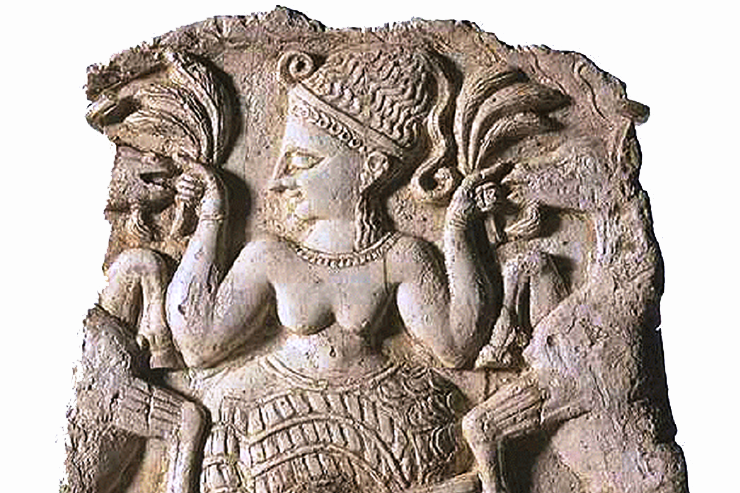
    Indeed the iconography of the God of ancient Israel is in its way androgynous as well. Descriptions of the First Temple (c.940-586 BCE) in Jerusalem say that its innermost chamber, the Holy of Holies, contained two cherubim (–im is the masculine plural ending in Hebrew) made of olive wood overlaid with gold, and each of them “ten cubits high” (1 Kings 7:23). In the ancient Near East, cherubim were not fat little babies but fully grown winged human figures, often with the body of a lion. While there are no remnants of Solomon’s Temple left, the surviving image that comes closest in time and place is taken from the palace of King Ahab in Samaria (see the previous article, “The Bible: Myth or History?”). It is made of ivory and, characteristically, shows winged female figures.

    The cherubim in the actual Temple may have been, like the God described in Genesis, both male and female. And while the biblical account describes these cherubim as chastely touching their wings, some rabbinical traditions say they were locked in embrace. One Talmudic sage, Rabbi Qetina, who lived in the late third and early fourth centuries CE, said, “When Israel used to make the pilgrimage, they [i.e., the priests] would roll up for them the Parokhet [the Veil separating the Holy from the Holy of Holies], and show them the Cherubim which were intertwined with one another, and say to them: ‘Behold! your love before God is like the love of male and female!’”1 Flavius Josephus, a Jewish historian of the first century CE, gives an eyewitness picture of the Second Temple (destroyed by the Romans in 70 CE) but is rather equivocal in describing the Holy of Holies. In some passages he insists that it contained nothing at all, but in others he says that what was in it “we are not at liberty to reveal to other nations.”2

    But the story of the feminine face of the Hebrew God is even more intricate than this. Archaeological findings and extrabiblical texts again show a reality that is at variance with the theology of the Hebrew Scriptures. And again, this reality was rooted in the religion of the Canaanites, Israel’s neighbours and relatives.

    Yahweh’s Consort?

    The supreme high god in the Canaanite pantheon is named El. This is a proper name, although in later Hebrew usage the word came to mean “god” in a generic sense. Like many pagan gods, El had a wife, a female consort, whose name was Asherah. Her name is probably derived from a phrase from the Ugaritic language spoken in Syria in biblical times: atirat–yammi, “she who treads upon Sea,” “Sea” being a personified chaos monster.3 Her role in the ancient Hebrew religion is a nebulous and controversial one.

    As we have seen already, some scholars believe that Yahweh was originally a manifestation of El, and rarely in the Hebrew Bible is a radical distinction drawn between the two; sometimes they are explicitly identified.4 And contrary to what the Bible would have us believe, archaeological remains indicate that Asherah was sometimes viewed as Yahweh’s consort as well. A number of artefacts have been found that link the two: one inscription, dating from the eighth or ninth century BCE, reads, “I [b]lessed you by (or ‘to’) Yahweh of Samaria and by his Asherah.” Another inscription reads, “To [Y]ahweh of Teiman (Yemen) and to his Ashera[h].”5 Teiman, or Teman, is interesting here because some Bible texts portray Yahweh as being revealed in this region, the southern part of the Transjordan (also connected with Midian): “God came out of Teman” (Habakkuk 3:3). If so, Asherah might have been with him from the beginning.

    These texts are puzzling, partly because of the reference to “his Asherah.” In Hebrew, possession is indicated by a suffix (-hu) added to the word for the thing possessed, and some scholars insist that this is not grammatically possible for a proper name. They would say that “Asherah” is not to be read here as the proper name of a goddess, but as kind of a manifestation of Yahweh.

    This argument is hard to sustain, because it presupposes a theological sophistication that a folk religion in the first millennium BCE is unlikely to have had. But it is true that asherah, in the Hebrew of the Bible, can serve either as a proper name for the goddess or as a common noun for a cult object representing the goddess, possibly a wooden image. One ancient Jewish tradition says that the asherah was either a tree or a tree with a cult object beneath it. Hence translators have rendered asherah variously as “tree” and “grove.” The Bible invariably characterises these “trees” or “groves” as abominations. In the Deuteronomic account, the priests in the Temple discover a lost scroll of the Law of Moses and read it to the young King Josiah (2 Kings 22:8–11). Shocked by his nation’s infidelity, Josiah orders a purge of the Temple artefacts. He “commanded Hilkiah the high priest, and the priests of the second order, and the keepers of the door, to bring forth out of the temple of the Lord all the vessels that were made for Baal, and for the grove, and for all the host of heaven: and he burned them without Jerusalem in the fields of Kidron” (2 Kings 23:4).

    The “grove” here was almost certainly an image of Asherah. Certainly she was connected with a tree motif. The biblical archaeologist William G. Dever contends that this was partly because (especially in a semiarid climate) a tree is a symbol of life. But he also points out that some images portray Asherah with a tree growing out of her pubic triangle. Hence Asherah and the tree symbolise life in this sense too.6

    What was her connection with Yahweh in the Hebrew religion of the First Temple? Raphael Patai, whose book The Hebrew Goddess is one of the most important works on this subject, sums up the picture from the Bible’s point of view: “It appears that, of the 370 years during which the Solomonic Temple stood in Jerusalem, for no less than 236 years (or almost two-thirds of the time) the statue of Asherah was present in the Temple, and her worship was a part of the legitimate religion approved and led by the king, the court, and the priesthood and opposed by only a few prophetic voices crying out against it at relatively long intervals.”7 Saul M. Olyan, a professor at Brown University in the US, writes that Asherah “was an acceptable and legitimate part of Yahweh’s cult in non-deuteronomistic circles. The association of the asherah and the cult of Yahweh suggests that Asherah was the consort of Yahweh in circles both in the north and the south.”8

    Rise of the “Yahweh Alone” Movement

    Where, then, did the opposition to Asherah arise? The remarks by the scholars quoted above tell us: Asherah’s foes were the prophets and the Deuteronomic circle, which eventually produced the long historical saga that comprises Deuteronomy, Joshua, Judges, 1 and 2 Samuel, and 1 and 2 Kings. Where did this Deuteronomic history come from? Remember that Josiah initiated his purge of the Temple after hearing a rediscovered scroll of the Law read by the priests. The standard view today is that this scroll was an early version of the book of Deuteronomy, and that it was not rediscovered but had been written specifically for the occasion: it was forged by the priests to prove to Josiah that their version of monotheism went back to Moses. And Deuteronomy condemns Asherah worship. This is how it tells the children of Israel to deal with the Canaanites: “Ye shall destroy their altars, and break down their images, and cut down their groves, and burn their graven images with fire” (Deuteronomy 7:5; emphasis added). The “groves,” again, are asherim, images of Asherah. But, as we see in 1 and 2 Kings, even the Deuteronomist has to admit that Asherah was welcome in the Temple throughout most of the period of the monarchy (c.1000-586 BCE).

    Distilling all this evidence, biblical and nonbiblical, into a comprehensive picture, we come up with something like this. The worship of Asherah in Canaan goes back far beyond the arrival of Israel on the historical scene in the thirteenth century BCE. And in Israel and Judah up to the end of the monarchy in 586 BCE, Asherah was worshipped alongside Yahweh, often as his consort, both in the popular religion and for the most part in the Temple itself. At some point in the history of Israel – and we do not know exactly what this point was – there arose a “Yahweh alone” movement, as some biblical historians have dubbed it: Yahweh was to be worshipped as the sole god, the lord of the universe – without a consort. This “Yahweh alone” movement was associated with the prophets in particular. It is the prophet Elijah who condemns the worship of foreign gods at Ahab’s capital in Samaria. It is prophets such as Amos, Hosea, and Micah that shape the theology that was later to be codified in the Deuteronomic history.

    The kings were more equivocal. The rulers of the northern kingdom of Israel apparently had little use for the “Yahweh alone” movement; that is why, according to the Deuteronomist, every last one of them “did evil in the eyes of the Lord.” Indeed the prophets said that the northern kingdom was destroyed because it had abandoned the true worship of Yahweh. The rulers of the smaller southern kingdom of Judah were more sympathetic to the nascent monotheism: some of them, notably Hezekiah and (as we have seen) Josiah, tried to purge these supposedly alien elements from Yahweh’s cult, with uneven success.

    As for the priests, who administered the sacred cult of Yahweh at the Jerusalem Temple, they too were not quite so firmly on the side of Yahwistic monotheism as we might believe. As Raphael Patai has shown, the images of Asherah were worshipped in the First Temple for about two-thirds of its lifespan, so the priests of this period could not have had too much difficulty with her. It is only around the time of Josiah in the late seventh century BCE that the picture changes. The priesthood becomes dominated by the monotheistic Yahwists, who write up a scroll of the Law and convince Josiah to purge the Temple.

    Josiah died in 609 BCE, and the Temple was sacked by the Babylonians only a couple of decades later, in 586 BCE, so the worship of the goddess probably did not return in the meantime. The book of Jeremiah has an interesting passage on this score. After the Temple’s destruction, people who “had burned incense to other gods” tell Jeremiah: “We will certainly do whatsoever thing goeth forth out of our own mouth, to burn incense to the queen of heaven and to pour out drink offerings unto her, as we have done, we, and our fathers, our kings, and our princes, in the cities of Judah, and in the streets of Jerusalem: for then had we plenty of victuals, and were well, and saw no evil. But since we left off to burn incense to the queen of heaven, and to pour out drink offerings unto her, we have wanted all things, and have been consumed by the sword and by the famine” (Jeremiah 44:17-18). This passage indicates that some, perhaps many, in Judah believed that the Temple was destroyed not because it had been profaned by the worship of the goddess (as Jeremiah said) but because her worship had been abandoned.9 The “queen of heaven” may in fact be Astarte, another Canaanite goddess, who was worshipped as well as Asherah – but then the two were sometimes conflated even by the worshippers themselves.

    Get the issue this article appears in

    The subsequent history was written by the monotheists. When the Jews returned from exile in Babylonia and rebuilt the Temple (after 539 BCE), the priests and the prophets were now all the “Yahweh alone” party. It was they who were responsible, not only for completing the Deuteronomic history, but for editing and compiling previous sources to create the books of the Pentateuch as well as the writings of the prophets. This is the core of the Hebrew Bible as we now know it, and it explains why we see biblical history the way we do.

    But the goddess was not completely expunged from the Jewish faith. Later parts of the Bible, such as the book of Proverbs, as well as apocryphal works mention a personified figure of “Wisdom,” who has a female form. (The Hebrew word for wisdom, hokhmah, is grammatically feminine.) Still later, the mystics of Judaism speak of the Shekhinah, the “presence” of God. In the Bible, this word does not seem to mean much more than its face value, but in later Judaism, the Shekhinah herself is personified as a kind of feminine aspect of God, and she is spoken of almost as a separate being. The medieval Kabbalists spoke of the Matronit (a name derived from the Latin matrona, “matron”), a divine feminine figure who resembles not only the Virgin Mary as conceived by the Catholics, but the now-forgotten goddesses of the Near East. The divine feminine has long survived the demise of Asherah – just as Christianity adopted the doctrine of Mary as “Mother of God” almost immediately after the pagan temples were closed. No matter how much the authorities and the scriptures insist on their concept of the Supreme Being as a male, there is something in the human mind and heart that refuses to assent completely.

    Current times have seen a resurgent fascination with the divine feminine both in Judaism and Christianity, and there is a widespread sense that these long-forgotten archetypes are reappearing to claim their rightful place in the spiritual consciousness of humanity. That may be the case, but it is more likely that they had never really gone away.

    [alert type=”general” dismiss=”no”]This article was published in New Dawn 123.[/alert]

    [alert type=”success” dismiss=”no”]If you appreciate this article, please consider subscribing to help maintain this website.[/alert]

    Sources

    Margaret Barker, The Great Angel: A Study of Israel’s Second God, Louisville, Kentucky: Westminster John Knox Press, 1992.

    Frank Moore Cross, Canaanite Myth and Hebrew Epic: Essays in the History of Religion of Israel, Cambridge, Massachusetts: Harvard University Press, 1973.

    William G. Dever, Did God Have a Wife? Archaeology and Folk Religion in Ancient Israel, Grand Rapids, Michigan: Eerdmans, 2005.

    Leah Novick, On the Wings of Shekhinah: Rediscovering Judaism’s Divine Feminine, Wheaton, Illinois: Quest, 2008.

    Raphael Patai, The Hebrew Goddess, 3d ed., Detroit, Michigan: Wayne State University Press, 1990.

    Footnotes

    1. This is from the Talmudic treatise B. Yoma 54a, quoted in Patai, 84. Bracketed insertions are Patai’s.
    2. Flavius Josephus, Against Apion, 2:7, 8. Quoted in Patai, 82.
    3. Cross, 15, 37, 66–67.
    4. Cross, 44.
    5. Dever, Did God Have a Wife?, 162. Bracketed insertions are Dever’s.
    6. Dever, Did God Have a Wife?, 225–28.
    7. Patai, 50.
    8. Quoted in Dever, Did God Have a Wife?, 201.
    9. Barker, 51.

    © New Dawn Magazine and the respective author.
    For our reproduction notice, click here.
  • Entangled Minds: Telepathically Entering Another Person’s Lucid Dreams

    Entangled Minds: Telepathically Entering Another Person’s Lucid Dreams

    From New Dawn 149 (Mar-Apr 2015)

    In the late 1970s I read the research on dream telepathy conducted at Maimonides Medical Center’s Dream Laboratory in New York.1 I was fascinated with how a person could send pictures into the minds of sleeping subjects during dream sleep, also called Rapid Eye Movement or REM sleep. The sleeping subjects would incorporate aspects of a sent picture into their dream motifs or dream stories.

    In one target picture there were two men in a boxing match, the sender or agent also had on display in his office “a genuine dark-brown leather boxing glove.”2 The picture and the physical object on display enhanced the telepathic transfer more significantly than the picture alone.

    This research got me interested in dreamwork and a year later I began studying methods on how to control my dreams.3 At the time I was having an unusual recurring dream and thought dream control would help me explore it. However, this endeavour fell short of what I expected. I continued working on dream control, and added to my dream retinue Freudian and Jungian dream interpretation. I also discovered dream control was the antecedent to experiencing lucid dreams.

    By the mid-1980s more research into the nature of lucid dreaming had accumulated accompanied with new methods on how to experience a lucid dream.4 Now somewhat successful with controlling my dreams, I decided to try one of the new techniques, and it worked; I was becoming more consciously aware in my dream states. But remembering and staying conscious in my dreams was a constant struggle. I began noticing that on nights I did not smoke marijuana, I could recall my dreams, they were more vivid, and I was more consciously aware of them and as a result. I curtailed my marijuana use.

    During this period Joe, a long time friend, and I were studying rituals from the Hermetic Order of the Golden Dawn. He and I had a close friendship, and according to the studies on dream telepathy to be successful, there needed to be an “agent-subject rapport,”5 which is what we had. We decided to experiment with the directional symbols from the Golden Dawn: the dagger, wand, chalice and pentacle. The pictures of these symbols were all in black and white, and copied from Israel Regardie’s book The Golden Dawn.6 Joe was a night owl, so while I slept he attempted to send these symbols into my dreams randomly, one symbol per night. After several months without success we stopped the experiment.

    Shortly thereafter I began teaching a course at the University of Cincinnati, ‘Dreams: The Night Theatre’. By the seventh week of class I noticed some of the students began sharing aspects of each other’s dreams. Each time I taught the course this phenomenon would occur. I finally concluded these students unconsciously were telepathically transferring dream information into each other’s dreams, changing the dream motifs. Eventually I discovered research into this phenomenon called shared dreaming or mutual dreaming.7

    If these students could telepathically send information into each other’s dreams, then why was my earlier experiment with Joe not successful? I decide to restructure the experiment with another friend, Mike, who was deeply interested in the mystical, and like Joe, we had a deep rapport. In the new experiment, we used black and white standard ESP card symbols as the targets. We decided to send these symbols into each other’s dreams telepathically. If that worked then we would attempt to enter each other’s dream motifs, a shared dream experience. Each night we randomly selected one of the ESP symbols and then telepathically focused on sending that symbol into each other’s dreams. We alternated nights, one night I would be the sender and the next night would be Mike’s turn. After a year with no successes we stopped the experiment.

    A few years later I became friends with Aaron who was in the counselling profession like myself and had a deep interest in parapsychology. I presented the research on dream telepathy, lucid dreaming and shared dreaming, and he was fascinated with the idea of sharing a dream story. Rather than trying to send symbols into each other’s dreams, we instead used a different approach. Aaron would try to send his image telepathically into my dreams, and over the next year we experimented with this shared dreaming technique without success. With these experimental failures, I sat the entire project aside.

    Entangling Minds

    Hector (pronounced Ector) and I had known each other for four years and we had discussions on various topics. The topic of choice was always the afterlife and the supernatural. Being from Mexico, Hector had a very different perspective on reality because in his culture the supernatural is a part of everyday life. One topic that kept cropping up was how everything that exists is interconnected or entangled with everything else. The concept of entanglement comes from quantum physics in which particles created at the same time become entangled with each other. What is done to one particle instantly happens to the other particle, no matter how far apart they are. Studying entanglement, I stumbled upon Dean Radin’s (2006) concept of entangled minds.8 Radin used entangled minds to explain ESP phenomena, and his theoretical explanations gave me a scientific basis for how everything is interconnected, especially our minds.

    Figure 1: Zener cards are commonly used to conduct experiments for extrasensory perception (ESP). The cards were used in author Gary Duncan’s dream experiment with Mexican colleague Hector.

    Hector could not wrap his head around the entanglement concept. I would tell him, he and I are a part of each other, we are a part of everything that exists and everything is entangled with everything else including our minds; we are all one. In talking to him about how we are all interconnected and entangled with each other, I began thinking about my previous failed experiments with dream telepathy and shared dreaming and why those experiments didn’t work. A successful telepathic experiment would convince Hector we are all interconnected and our minds are indeed entangled.

    Now that I had piqued Hector’s interest, I decided to approach him about conducting an experiment that would test the entanglement idea, and he was interested. How would I go about the experiment? What would I do different this time that I didn’t do before? I finally came to a simple experimental protocol. I would again use standard ESP symbols but this time they would be in colour. Hector would be the sender/agent and I would be the receiver/subject. My reasoning for this decision was Hector spoke English with a deep accent, many words he had problems pronouncing, but he understood more than he could speak. I thought his language issues and his cultural background might be an asset because he was unsullied by the rational materialistic culture of the United States.

    If Hector was able to send me an ESP symbol telepathically and if I received the image, that would indicate we are entangled in some way. But if the experiment failed then my argument would fall apart. I presented the experimental protocol and he was ready and excited to begin. I, on the other hand, was a bit anxious because of the previous failures, but decided the experiment might work because we had a deep rapport with each other and our cultural backgrounds were so different.

    I gave Hector the coloured ESP symbols (see Figure 1) and instructed him to choose one each week at random. Once chosen, throughout the day he pictured me in his mind and visualised the ESP symbol going from his mind into my mind. At week’s end I would call him and tell him what symbol came into my mind. He would confirm if I hit or missed the symbol. The first three days of the first week I missed the target completely and then started to get hits off and on throughout the day. Over the next two weeks, I got hits every day and a few misses, but more hits than misses. He was impressed with our experimental results and so was I.

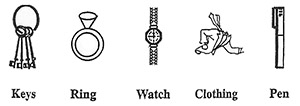
    I decided to change the targets from ESP colour symbols to pictures of black and white physical objects (see Figure 2, above). Hector continued with the same experimental protocol and I did not get a single hit. What was it about the ESP colour symbols that were easier for Hector to transmit telepathically? And why was I able to receive the ESP coloured symbols and not the black and white pictures of physical objects? Did it have to do with how he culturally perceived these symbols and objects as he telepathically transmitted them to me? Did it have to do with the fact that the black and white pictures were more detailed than the ESP coloured symbols? I was at a loss to explain these results. After a week and a half of nothing but misses, we decided to take four months off and then resume with the ESP colour symbols to see if there were any changes.

    We resumed the experiment for a four-week period and every day, throughout the day, I got hits. I soon discovered that when Hector sent the ESP symbols telepathically he focused mostly on the colour that made up the symbol. In the experiments it appeared the colour of the symbol was the salient factor for successful telepathic transmission. I realised Hector is a visual learner, so cognitively the colour of an object might carry more visual weight than black and white objects.

    Hector was amazed with our results but could not understand how it all worked. I tried to explain it the best I could by simplifying Dean Radin’s theoretical perspective, but fell short because of our language barrier. It became obvious we were now more than ever interested in continuing our research into entangled minds, but where would we go from here? Out of three previous attempts with three different people, Hector is the first experimental colleague to be able to telepathically send ESP symbols into my mind.

    Entering Dreamscapes

    With the success of our telepathic experiments we decided to take the next step into the world of dreams. I knew dream telepathy was true, lucid dreaming was true, shared dreaming was also true, but could Hector telepathically transmit his animated image into my dream stories? If so, how could it be done? Over the next few months I put together all I knew about dream research, especially lucid and shared dreaming, telepathy, remote viewing, clairvoyance, and various behavioural and Neuro-Linguistic Programming techniques to develop a sound experimental protocol. I also added a lucid dream supplement, galantamine, to enhance the lucidity and vividness of my dreams.

    I shared all the information accumulated with Hector and a protocol for how we would conduct the experiment. Since Hector was an excellent sender/agent and I was an excellent receiver/subject, we would keep that structure intact because of the positive results of our previous experiment. Not only that, but our minds were now significantly entangled.

    Since Hector is the manager of a restaurant, he is up late at night giving him the opportunity to telepathically send his image into my mind while I sleep. He sent his image into my mind between the hours of 12:30 a.m. and 6:00 a.m., and somewhere during this period I was dreaming. Without an EEG hook-up monitoring my sleep stages, his telepathic projections were hit or miss. In addition, before going to sleep, I took galantamine on alternate nights excluding weekends.

    Over the next several months Hector and I experimented to see if he could project his image into my dreams. Nothing happened for several weeks, but when I woke up to use the bathroom during one night the first image to pop into my mind was Hector. Slowly, over the next several weeks, this experience went through subtle changes. One significant change was when Hector’s image popped into my mind accompanied with intense feelings of his presence. Then, one night, I suddenly awoke almost in a startle and Hector’s presence was all around. I couldn’t see him, but it was as though he was in the room with me. Throughout the next day his presence remained, and I could feel him intensely. The following day I called him and he told me he and his lady-friend had a deep intense discussion about an article I had written on helping stuck souls go into the light.9 Their intense discussion about the article’s details telepathically transferred Hector’s spiritual energetic presence to me.

    Now that I could feel Hector’s presence, we decided to create a specific place in my dream world where he could project his image. This special place is called an egregore. According to Gaetan Delaforge10 egregores are “created when people consciously come together for a common purpose. Whenever people gather together to do something an egregore is formed….” Hector’s native tongue is Spanish, so he would be the one creating the egregore because it would be easier for him to describe to me where the dream would take place rather than for me to describe it to him in English. It took a week for Hector to come up with an egregore, which was a soccer field.

    Since I don’t play sports and have no idea what a soccer field looks like, I immediately went to the Internet, found several pictures and committed them to memory. Hector taught me how soccer is played and he telepathically met me in my dreams on the soccer field. Throughout the day I would focus on him and me meeting on the soccer field and playing the game. This focusing ritual that I performed throughout the day is called dream incubation. I also added two other components to the dream incubation ritual – a command statement and dream enhancing technique. The command statement, “Tonight, Hector will enter my dreams,” is an invitation for him to enter my dream stories.

    The dream enhancing technique was one I used years earlier in a psychotherapeutic setting to gain insights into my client’s issues, and it worked. In this technique I placed the signature of the client I desired to dream about under my pillow at night, which resulted in me dreaming about the client.11 However, for our experiment I augmented this technique. I placed under my pillow a signed photograph of Hector, placed in an envelope with the command statement written on the back of the envelope. Throughout the day I repeated the command statement while visualising me and Hector playing soccer. At night I placed the envelope under my pillow and recited the command statement repeatedly while going to sleep. Another valuable tool I used was a dream journal. With this experiment the journal became a valuable asset. After several weeks of preparation we were ready to execute the experiment.

    The first several weeks were all failures in the sense Hector did not appear in any of my dreams, nor was there a soccer field, but with galantamine my dreams were vivid and lucid. Although I dreamed, Hector was not in any of them, however when I awoke I felt his presence all around me. This continued for several weeks and then I had a dream of several Mexicans, none of them I knew. A few nights later I dreamed I was talking to a friend about Hector. Then it finally happened; I was dreaming and suddenly Hector was in the background watching the dream story – he said nothing, just stood and observed. This was the first breakthrough with him in my dreams.

    A few nights later, still taking galantamine, Hector was in my dream story. Rather than a soccer field, the egregore setting was a restaurant and Hector was gambling, an activity he doesn’t do. In the second part of the dream he went to another restaurant where a party was going on; I followed him and enjoyed the party. A few nights later he was in another dream with a different motif in which we were driving to another city talking about him opening a Mexican restaurant, but still no soccer field.

    Over the years I have experimented with a variety of lucid dream supplements, and found galantamine works. I also discovered another dream supplement, African Dream Root (Silene Capensis), which received many positive reviews regarding vividness in lucid dreaming. Based on these reviews, I decided African Dream Root might be a better supplement to allow Hector and me to create the soccer field egregore. I took three weeks off galantamine and substituted African Dream Root.

    After taking the supplement for a few days there were radical changes in my dreaming. African Dream Root did not do what I expected; my dreams were chaotic and violent, with poor dream recall. But Hector was in one dream in the background, observing the chaotic and violent dream story, and there was no soccer field egregore. I stopped taking African Dream Root and resumed taking galantamine.

    Over the next several dreams Hector was in the motifs and they were all in places where one eats, a restaurant and a kitchen. There was a dream in which I was talking about Hector’s restaurant to someone else. In another dream Hector served food and taught me how to drink Margaritas with salt. In a later dream we were at my house at the kitchen table talking and his mother was present in a pale blue dress. Hector and I were so close; I could smell his body fragrance which was a sweet subtle smell, not offensive at all. In studying my dreams throughout the years, this was the first time my olfactory (smell) sense was activated to this level of sensitivity.

    Conclusion

    In reviewing the details of the first part of our telepathy-dream experiment, there is a combination of factors contributing to Hector being a very good sender/agent. It is evident, since Hector has a visual learning style, that the colour ESP targets were more effective than the black and white targets. Also, his cultural background lends itself to the supernatural and his language issues allowed him to successfully telepathically transmit the colour targets to me. I, on the other hand, am a good subject/receiver because I have had many altered state of consciousness experiences throughout my life. These experiences have opened me up to receive information from a variety of spiritual or imaginal domains as well as the earlier experiments with telepathy and shared dreaming.

    The reason Hector could not transmit the soccer field egregore was because he manages a restaurant and that scene is ever-present in his mind. He works in this environment six days a week, absorbing all the details of the restaurant into his mind. In the restaurant money is the primary re-enforcer, creating a strong mental image of that environment. On the other hand, he plays soccer occasionally and the re-enforcer is having fun, which is not as strong as a monetary re-enforcer. Moreover, when he tried projecting the soccer field, the stronger re-enforcer associated with the eating environment is what was unconsciously transmitted. As a result, we decided an eating environment would be our dream egregore.

    The use of the lucid dream enhancer galantamine allowed my dreams to become more vivid and lucid. By being more vivid and lucid, I was more consciously aware in each dream motif. Within the lucid dream structure my intent was not to change the dream story but to become more aware of dream details.

    The use of the programmed command statement and the signed photo in the envelope as part of the incubation process allowed my protective barriers to become more relaxed and invited Hector’s visual presence to enter my dreams. Eventually Hector became an active part of the dream stories. Although one aspect of the incubation process did not materialise as planned – creating the soccer field egregore – but a more viable result occurred, the eating environments.

    This experiment has broad implications for how we understand and perceive our reality. The fact that Hector and I were able to connect telepathically indicates we broke down major psychic and protective barriers between us. The ESP component of this experiment allowed our minds to become entangled. This entanglement allowed Hector to project his image, essence or presence into my dream motifs.

    The Next Step

    With the success of this telepathy-dream experiment, which took a year and a half to unfold, Hector and I are moving on to the next phase. Over the next several months Hector will telepathically enter my dreams and he and I will attempt to change the dream story at will – he transmitting from the outside world and me within the dream world. As this experiment has unfolded there are broader implications for Hector and I. Hector can use his telepathic abilities to continue helping me explore the dream world, or he can explore other dimensions of the imaginal realm, or he can be taught how to refine and focus these sacred abilities to heal others. Whichever route he chooses, Hector will find great satisfaction in experiencing other realities or knowing he is helping others to heal.

    I, on the other hand, will continue exploring the phenomenon of entangled minds, the dream world, and other terrains of the vast imaginal realm. The results of this experiment are shifting my professional focus toward what is possible with human potential. Lastly, what we have accomplished in this experiment is far greater than I ever expected.

    [alert type=”general” dismiss=”no”]This article was published in New Dawn 149.[/alert]

    [alert type=”success” dismiss=”no”]If you appreciate this article, please consider subscribing to help maintain this website.[/alert]

    Footnotes

    1. Montague Ullman & Stanley Krippner, Dream Telepathy: Experiments in Nocturnal ESP, Penguin, 1974
    2. Ibid., 121
    3. Patricia L. Garfield, Creative Dreaming, Simon & Schuster, 1975 & 1995 (updated edition)
    4. Stephen LaBerge, Lucid Dreaming, Ballantine, 1985
    5. Ullman and Krippner, 1974, 212
    6. Israel Regardie, The Golden Dawn, Aries Press, 1937-40, 398
    7. Linda Lane Magallon, Mutual Dreaming, Pocket Books, 1997; Barbara Shor, ‘The Promise of Shared Dreaming’, Gnosis Magazine, Winter, 1992, 36-42
    8. Dean Radin, Entangled Minds: Extrasensory Experiences in a Quantum Reality, Paraview, 2006
    9. Gary W. Duncan, ‘Helping Stuck Souls Crossover’, New Dawn 143 (March-April 2014), 65-70.
    10. Gaetan Delaforge, ‘The Templar Tradition Yesterday and Today’, Gnosis Magazine, No. 6, Winter, 1988, 8-13
    11. Magallon, 1997; Robert Moss, Conscious Dreaming, Crown, 1996.

    © New Dawn Magazine and the respective author.
    For our reproduction notice, click here.
  • Robert Monroe & the Science of Astral Travel

    Robert Monroe & the Science of Astral Travel

    From New Dawn 145 (Jul-Aug 2014)

    For nearly half a century, Robert Monroe has been the “out-of-body” man, the man who took the subject of astral travel out of the realm of religious or occultist dogma and plopped it right in the middle of mainstream America, and eventually the world.

    His books describing his experiences were world-wide best-sellers. But his contribution ranged far beyond writing books. He perfected a technology that made it possible for others to learn to experience altered states at will; invented a stripped-down, de-mystified language to describe these states; and created an institute to conduct residential programs to give people practical experience.

    Nineteen years after his death, his influence continues to spread. Odd, then, how little attention people give to his later conclusions. It isn’t that he recanted, but that he reformulated. And that reformulation moves “out-of-body” from curiosity to entry-point.

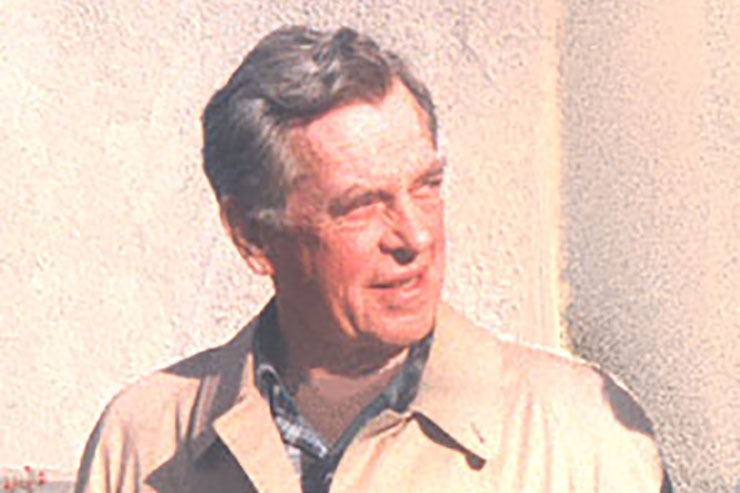
    Bob Monroe

    Bob Monroe (1915–1995)

    Monroe’s capsule biography would read something like this: Born in 1915 into a middle-class, midwestern American family, he dropped out of college, moved to New York, began writing (and eventually selling) radio scripts, became a producer of successful radio shows, married a couple of times and had a daughter, and, by the time he turned 40, was living the life of the well-to-do businessman in suburban New York, a life that included sailing boats and flying airplanes. Then – as we’ll describe shortly – he began having inexplicable out-of-body experiences which grew in importance to him until they came to dominate the last third of his life.

    His first book, Journeys Out of the Body (1971), was his initial, relatively unemotional summary of his experiences. Shortly after the book’s publication, his experiences changed radically, as described in Far Journeys (1985). In the years between the appearance of his first and second books, he began creating ways to help others have the same kinds of experiences. He created Hemi-Sync®, The Monroe Institute, and what we might call Monroe-speak. His third book, his grand summing-up, Ultimate Journey, appeared in 1994, not long before he died on St. Patrick’s Day, 1995. An interesting, successful life. A life that started to become important to the world one Sunday afternoon in 1958, when he was 42 years old.

    Out-of-Body Experience

    As he describes it in his first book, Journeys Out of the Body, he had lain down for a nap when

    …a beam or ray seemed to come out of the sky to the north at about a 30-degree angle from the horizon. It was like being struck by a warm light.… I thought it was sunlight at first, although this was impossible on the north side of the house. The effect when the beam struck my entire body was to cause it to shake violently or ‘vibrate’. I was utterly powerless to move. It was as if I were being held in a vise.

    After a few seconds, he forced himself to move, and the vibrations slowly faded.

    (Oddly enough, few people who write about Monroe’s experiences seem to have noticed this beam that “seemed to come out of the sky.” We will come back to it.)

    That was not an out-of-body experience, but it was the beginning. Although the beam was a one-time thing, the vibrations and the temporary paralysis happened nine more times in the following six weeks. He had a physician friend examine him for physical or mental abnormalities, but the doctor merely suggested he had been working too hard, which was reassuring, but not helpful. If this phenomenon was not a symptom of something going wrong, what was it?

    Remember, this was the 1950s. The concept – the very terminology – of out-of-body travel was unknown to mainstream culture. As he put it in Far Journeys, his early investigations took him

    …beyond conventional scientific circles (total rejection), religions (‘It’s the work of the devil’), parapsychology (‘Interesting. Sorry, no data available’), and Eastern disciplines (‘Come study at our ashram in northern India for ten years’).

    He was on his own. So far as he knew, nobody else had ever experienced what he was going through. But he was stubborn, in his quiet way. As time went on and the experiences persisted, and then deepened, so did his desire to understand what it all meant. He said later that it took a full year and 40 trips out-of-body before he accepted the reality of out-of-body experience.

    So what was he going through?

    Monroe, in Far Journeys, defined an out-of-body experience as

    …a condition where you find yourself outside of your physical body, fully conscious and able to perceive and act as if you were functioning physically – with several exceptions. You can move through space (and time?) slowly or apparently beyond the speed of light. You can observe, participate in events, make wilful decisions based upon what you perceive and do. You can move through physical matter such as walls, steel plates, concrete, earth, oceans, air, even atomic radiation without effort or effect. You can go into an adjoining room without bothering to open the door. You can visit a friend three thousand miles away. You can explore the moon, the solar system, and the galaxy if these interest you. Or – you can enter other reality systems only dimly perceived and theorised by our time/space consciousness.

    But by the time he wrote that he had been doing it for many years. For a long time, all he knew was that he could somehow detach from his physical body, and roam around his bedroom, or around the house or even the neighbourhood. After a while he found that he could think himself elsewhere, apparently regardless of distance. He made some experiments to verify or disprove what he was perceiving, but, as he wrote, after a while such experiments became oddly boring.

    (By the way, it is a common assumption that out-of-body exploration naturally leads to voyeurism, but this mistakes the nature of the experience, which is less like watching a movie than like vivid imagination. The word “imagination” can be misleading: In this case it refers not to fantasy, but to what might be called imagination as a tool of perception.)

    Locale II

    In retrospect, until Journeys Out of the Body was published Monroe’s life had only begun moving into uncharted waters. So that first book’s descriptions are not his last word. For instance, he separated his experiences into Locale I, II, and III. Locale I was physical reality, as we experience it. The realm he called Locale III, I’m not going to discuss here, because I think he came to see this earlier idea as misleading, and the later books make no mention of it.

    Let’s concentrate on Locale II. He called it the natural home of the second body – the part of ourselves that could journey beyond the physical. That body, he said, was very responsive to Locale II, where apparently thought powers everything. He concluded that those who had once lived in the physical world had created what he experienced as solid matter in Locale II, either automatically (because they still thought that way) or deliberately (for pleasure or comfort). Such simulations, he concluded, were also created by higher beings for the benefit of those just emerging from the physical world.

    Locale II was inhabited “by entities with various degrees of intelligence with whom communication is possible.” Monroe said that, “In this vastness lie all of the aspects we attribute to heaven and hell.” And, during these early excursions, he began to learn how to contact the dead, a development that would grow to great importance.

    But if Locale II was real, where was it, and how was it that we could contact it? In Journeys Out of the Body he gave us the key: He said his theory depended on

    the wave-vibration concept, which presumes the existence of an infinity of worlds all operating at different frequencies, one of which is this physical world. Just as various wave frequencies in the electromagnetic spectrum can simultaneously occupy space, with a minimum of interaction, so might the world or worlds of Locale II be interspersed in our physical-matter world. Except for rare or unusual conditions, our ‘natural’ senses and our instruments which are extensions thereof are completely unable to perceive and report this potential. If we consider this premise, the ‘where’ is answered neatly. ‘Where’ is ‘here’.

    In other words, our experience is determined by what we tune into. If our receiver is set only to the here-and-now world, that’s all we will receive. If, accidentally or by training, we start picking up other wave-lengths, we are going to be living at least to some extent in a different world. Something shifted the knob on Monroe’s tuner, and he began to pick up other programs, and then he learned to shift the knob himself. That is the basis of all that followed.

    Meanwhile he was moving from being a lone explorer into an organiser of expeditions, on two fronts. First came the ‘Explorers’, then the ‘Gateway Voyages’ and other residential programs.

    Beyond the Personal

    Journeys Out of the Body, published in 1971, brought him thousands of letters, including “many hundreds” from people writing to thank him for assurance they weren’t crazy. By the time he published Far Journeys in 1985, he was no longer working on his own. He had begun to create what became The Monroe Institute (TMI), he had put together Explorer teams, he had invented the Hemi-Sync technique, and he had begun offering the Gateway program, teaching others to do what the culture at large still didn’t dream possible.

    I often say Monroe gave the world three gifts: a technology, a language, and an environment.

    The technology was hemispheric synchronisation, or Hemi-Sync. Simply put, this consisted of feeding sound of one frequency into one ear, and sound of a somewhat different frequency into the other ear. This forced the two halves of the brain to work together to make sense of the input; it also allowed him to input specific combinations of frequencies to facilitate desired brain states, and hence, it was hoped, mental states. Thousands of hours of experimentation discovered certain particularly useful combinations, which he noted and named.

    And that nomenclature was the second of his gifts, a value-neutral language to use to describe various mental states, so that they could be examined and employed with fewer emotional overtones. He numbered them as Focus 3, 10, 12, 15, and 21 through 27. This stripped-down language became a means of structuring and re-thinking the experience, and quickly became familiar not only to the explorers with whom he discovered and developed them, but to participants in the residential programs he developed.

    These residential programs, with the institute supporting them, are the third part of his legacy, a supportive environment combining individual experience of the various focus levels with group debriefings and interpersonal discussion. Taken together, the three tools helped thousands of people to carry on Monroe’s explorations in their own way, finding their own answers to their own questions. (“I don’t know,” he used to respond when asked to define things. “You go find out and come back and tell me and then we’ll both know.”) But before the residential programs came the Explorers.

    Explorers, Gateway & Beyond

    Before there was an institute, there was a group of unpaid volunteers, drawn by curiosity. Lying on a waterbed in a darkened, silenced room, wired to instruments that were monitored during the entire experience, they received Hemi-Sync signals and other communications from their monitor through headsets, and could speak to the monitor (and a tape recorder) through a microphone.

    In order to help them get into a borderland sleep state, Monroe employed the Frequency Following Response he had discovered. “We could tell easily from the instrument readout when they were and when they were not in Focus 10. It could not be imagined or faked…” Then he inserted higher-frequency beta signals to “enhance perceiving by means other than the five physical senses,” and the subjects began to experience light and colour patterns, voices and music, and “sometimes loud explosions that startled the subject completely out of Focus 10 – something that has still to be explained.”

    Monroe described in Far Journeys how one Explorer, having “developed a very close relationship with what appeared to be some four or five beings, one of whom acted as spokesman,” allowed them to experiment in using her body as a sort of “transmitting set between dimensions.” She let them experiment with talking through her vocal cords, which, after a lapse of about three and a half minutes, they did. And this was the beginning of acquisition of a vast amount of material, from her and from others. As he put it, “the Explorer Material is a combination of fascinating, baffling, awe-inspiring, thought-provoking, sometimes boring data that is certainly much in conflict with many of the belief systems that we have within our culture and civilisation.”

    The Gateway program, initially weekend programs held “at motels, conference centres, and special meeting facilities throughout the United States,” developed into a residential course given from Saturday afternoon to Friday morning at TMI, half an hour south of Charlottesville, Virginia. The program was carefully designed to lead people from normal C1 consciousness to other, less usual, states. It’s all done a little at a time, and the net effect is to dissolve what Monroe called the Fear Barrier and unleash the formidable power of individual curiosity. In Gateway, many people learn for the first time by personal experience that they are more than their physical body.

    Over the years, additional programs were developed, a process that continues today. By my rough count, the Institute currently offers nearly two dozen programs of one kind or another. All use Hemi-Sync or the newly developed Spatial Angle Modulation (SAM) technology, and, in all cases, the group energy is an important part of the process, as it combines irreplaceable first-hand experience with nearly equally valuable second-hand reports of other people’s experience of the same exercise at the same time.

    Later Views

    The biggest changes in Monroe’s life after publication of Journeys Out of the Body were in the nature of his journeys. In 1972 he told himself that rather than his conscious self, his ego, determining what to do while he was out-of-body, “the decision to do is to be made by my entire self.” As he put it, “The presumption I made was that my Greater Self (soul?) always knew what it was doing.” And this brought him from local traffic onto the Interstate – the open highway. From this point on his reports centre on the Second State, the reality beyond the world our senses report, which he had initially described as Locale II.

    In Ultimate Journey he says the Institute, “moved away from seeking materialistic explanations to look at the other end of the spectrum.” They discovered that much of what appeared to him to be out-of-body activity had been explained away as dream activity.

    Most important, the mind-consciousness present in the out-of-body state is significantly different from that in physical wakefulness. Initially, intellectual and analytical focus do not seem to be present, at least not in terms we understand. However, the insertion of physical consciousness changes this. Conversely, the emotional extremes of the symbolic right brain are often totally absent and are usually more difficult to activate.

    As always, Monroe defines a Belief – as opposed to a Known – as anything that cannot be fully understood or identified.

    So it must be said: the Different Overview you are beginning to consider can at most be a belief until you begin to test it for validity within your own ongoing experience during your life as an active Human Mind. As small beliefs convert to Knowns, perhaps larger Different Overview beliefs will follow the same path – until you are free.

    What Does it Mean?

    Monroe’s life is almost a textbook case of a man following where he was led, not dreaming that what seemed simply a personal preoccupation would broaden and meet response and lead his life in an entirely unanticipated direction. He let his total Self drive and open up his life unimaginably. His ideas changed. By the end of his life he was no longer talking about going “out-of-body”; instead he would talk of moving “out-of-phase.” Remember his description of many frequencies operating in the same space, overlapping but not interfering? Remember the analogy of changing the tuning on our radio receiver? By the end of his life, he had concluded that this is what he had been doing. He hadn’t gone “out-of-body” in the sense of leaving an empty shell behind; he had changed his focus of attention – had gone “out-of-phase” with the physical – and then had gotten back into phase to report, and carry on his life.

    Oh, and remember the beam that “seemed to come out of the sky,” which started it all? Years later, I asked my own guidance about it, and was told that right from the beginning Monroe was being put on notice that this was not a strictly material manifestation; that the beam was not necessary to produce the effects, but it did serve to loosen his mental bonds. Perhaps so. That still leaves more questions unanswered than answered, but that seems to be the nature of life.

    From “out-of-body” to “out-of-phase” is a long step, and a productive one. When you realise we are more than our physical bodies; that our consciousness inhabits many worlds at once; that it isn’t a question of leaving your body vacant but of redirecting your attention, you begin to understand that learning to go out-of-body is not the goal, but the doorway.

    [alert type=”general” dismiss=”no”]The Monroe Institute in the United States offers an extensive range of programs and products. Find out more by visiting their website www.monroeinstitute.org, email: info@monroeinstitute.org[/alert]

    [alert type=”general” dismiss=”no”]This article was published in New Dawn 145.[/alert]

    [alert type=”success” dismiss=”no”]If you appreciate this article, please consider subscribing to help maintain this website.[/alert]

    © New Dawn Magazine and the respective author.
    For our reproduction notice, click here.