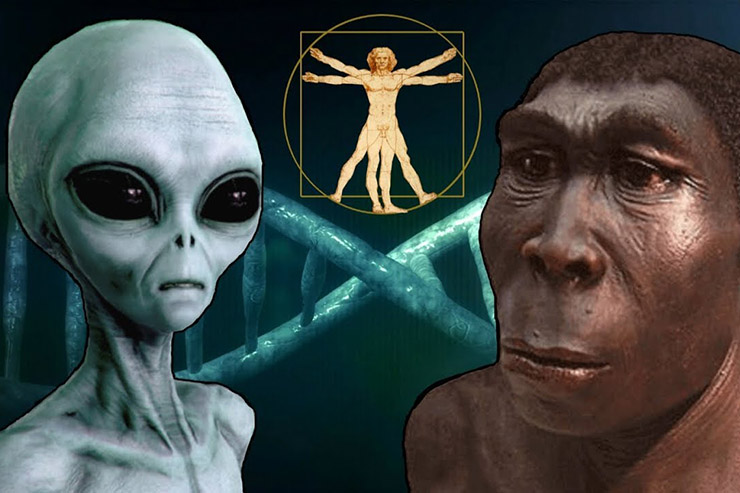
An amazing transformation has occurred in modern science. It has been slow in coming and is one that many scientists avoid discussing: there is a point where science and religion coincide. The frightening truth about this agreement is that it isn’t about new age physics, the nature of God or the transcendent union of science and religion – it concerns the nature of man, or rather, the problem of man.
For many years, under the influence of liberalism and humanism, science tended to favour the logic of the ‘Noble Savage’. Violence and evil were human problems, probably caused by the conflict between our intellect and natural instincts. Nature was great, instincts were marvellous and sex was fun. This logic was buttressed with romantic notions about the innocence of animals, the moral purity of instinct, and the marketable icon of the harmless, playful, innocent ape. However, as science progressed, these notions fell like a house of cards.
During the 1970s science began to refine its interpretation of Darwin’s theory of evolution. This refinement became known as sociobiology – the inclusive fitness theory – or in journalistic terms, ‘the selfish gene’. It was popularised by Richard Dawkins’s book The Selfish Gene. This discovery, which is now conventional scientific wisdom, holds that the ultimate driving force for evolution is the genes, the molecular unit of heredity of a living organism. The maximisation of genetic successes to assure the passing on of certain genes to subsequent generations. This principle, however terrifying in its ramifications, is the state of present evolutionary theory.
When this is combined with our new understanding of the nature of animal behaviour, a darker and more reflective scientific paradigm arises, one that has more in common with Gnosticism, a stream of thought that extends from the early followers of Christ.
A Man & a Chimp
Our relationship to apes has always been a matter of conjecture. We need to abandon the theories and debates about origins and consider the state of humanity at present. There are many ways to consider evolution: Whether we accept Darwinian evolution or a modification thereof, or that evolution was manipulated by ETs, God(s), or even if we consider we are part of a stage of a larger evolutionary cycle (Theosophy, Anthroposophy etc.), the fact remains that our present genetic inheritance indicates something about our present condition.
Science places modern man (Homo sapiens sapiens) in the centre of the ape kingdom. It says humans are part of the same lineage as orangutans, gorillas, chimpanzees, and bonobos. The standard view of this great-ape ‘family tree’ is that humans and chimps are more similar to each other than either is to the gorilla – because chimps and humans diverged more recently. But with the publication of the sequence of the full gorilla genome in 2012, this theory has been overthrown. Scientists realised that much of the human genome more closely resembles the gorilla than it does the chimpanzee genome.
While they may seem affectionate and lovable at first appearance, extensive study in the wild has shown a far darker side to ape behaviour. Apes murder, rape and torture. They will defend their territory and intrude on any surrounding territories using guerrilla warfare, literally! In various studies of ape behaviour, it is estimated that at least forty per cent of all cases of copulation involves elements of violence, which would be interpreted as rape. Apes have short-term memories when it comes to companions. If an ape leaves one pack to join another, he becomes an instant enemy. Raids on other packs are frequent, bloody and brutal and involve ambush, torture and death. Apes behave differently from many other animal species and their aggressiveness seems very similar to human behaviour. It’s frighteningly clear that our genetic heritage is directly related to the ape kingdom. This invokes some fascinating questions and quandaries.
Why Intellect?
Apes and related kin are excellent reproducers. They create many offspring and continually reinforce their genetic heritage by territorialism and brute force. Researchers in this field raise the question: why would the ‘genetic program’ create what we understand as the conscious mind?
Many argue that intelligence developed as the result of enhanced hand-eye coordination by using tools. However, many other species use tools, including apes. Apes are quick learners, and use whatever they can find to open that nut, get that fruit, or crush that skull. But apes did not develop a high level of intelligence – only the offshoot of Homo sapiens sapiens. This argument sheds light on a fascinating possibility – was human nature tweaked? Did genetic engineering take place that modified available genetic substances to create modern humans? Such writers as Zecharia Sitchin and Erich von Daniken use this sort of reasoning extensively.
The darker side of this theory is why would an alien life form modify genetic substance without adequately balancing the social effects of the inherent flaws within the original substance? If an alien species, a deity or whatever was capable of manipulating genetic materials, then surely it would be aware of the destructive power within the primate form it was transforming. If we consider there was some manipulation of our genetic structure, then was this accomplished by a somewhat primitive and ignorant entity (which is unlikely considering the required technology)? An entity or force that was malefic and unsympathetic to the resulting human condition?
This may seem too much to grasp at first, yet if we consider the myths and legends that abound within humanity’s history, they all seem to include such tales of genetic interference.
The Gnostics believed that a false creator (Demiurge) formed Matter (the physical world), and humans were moulded out of fallen substance in an effort to trap particles of Light (preexistent Souls). Sitchin argued that an alien race (the Anunnaki) genetically engineered humanity as a slave species, but the early humans rebelled and developed consciousness. Numerous myths, stories and legends suggest someone or something interfered with the ape to create man, and all tend to see this creation as negative. While most religions insist that Matter is good and ‘God’ is the creator, other more esoteric approaches from the Vedas to the Gnostic suggest that Matter is at best dangerous, at worst malefic, and our creation was the result of either a miscalculation or error – or a deliberate destructive act.
This view posits that apes were engineered as a mechanism to trap Souls which existed in the ‘first estate’ (the spiritual worlds). Many Gnostic sects believed that the fallen creator, in his attempt to wrest control of the universe, first created Matter to encapsulate and control the Light. He then evolved the physical form of mankind to capture the preexistent Light forms and turn them into automations under his control. While we may debate details, it is certainly true there is a dichotomy between our genetic programming and mind (which is the gate for one’s true spiritual self). Even if we have trouble accepting the more flamboyant aspects of this theory, the split within humanity and the violent traits of our innate genetic programming cannot be ignored.
[alert type=”success” dismiss=”no”]If you appreciate this article, please consider subscribing to help maintain this website.[/alert]
The Role of the Mind
The role of the mind in human development has been ambivalent to say the least. From one perspective it is our saving grace, from another it keeps us enslaved. According to Sitchin, the mind was genetically engineered through modifications to the brain so that a slave race could be created. Apes were difficult to command, so a brain/mind complex (however originally limited) was created. Through the dichotomy between the brain/mind and the instincts, mind control was achieved. Continuing from this argument, early religions and social structures would have worked as ‘control mechanisms’ to keep the slaves in their preordained roles. As time went on, however, the mechanism of control became the tool of liberation. Even the most limited mind/brain complex began to develop thoughts outside the ‘control spectrum’, and one thought led to another and ultimately rebellion. Whether we accept this paradigm or not, we can see that intellect has a contradictory role: it exists as an affront to what science understands as the normal evolutionary process and can work to enslave or liberate.
In this extraterrestrial cosmology, we deduce there are diverse alien species – some wish to help humans, while many desire to keep us enslaved. Accordingly, some early cultures worked to liberate humanity’s intellect, while some cultures, if not the same ones over time, regressed their culture back into slavery by the same means.
It is interesting to note that many early Gnostic groups had a similar view of human nature. In one Mandean account, we read of demons copulating together and their progeny being man’s body and mind. Man’s physical and mental forms are in direct opposition to his spiritual essence. In other Gnostic traditions, our mind is a mixture of light and darkness which offers the opportunity to ascend beyond limitation through its redemption.
Sigmund Freud argues that civilisation exists only in as much as it suppresses instinct, and in many ways we are now returning to his understanding. While pleasure may be the veneer that we accept as justification for our behaviour, not far under the surface is a pit of uncontrolled violence. The major contradiction in our culture is the desire for individualism – the more we demand freedom, the more restraints removed, the more we return to the unfettered ape-like creature we once were. As moral codes are loosened and as we gain more supposed freedom, crime, rape, murder and social disorder arises. As culture fails, the apes return.
Light Emissaries
If we contemplate the adversarial view of prehistory with evil alien forms controlling humanity for their own purposes, we can perceive it in different ways. Gnostics and some Christians may interpret this on a more spiritual level, with dominions and principalities, demos and demi-gods replacing the ‘little green men’. For the scientifically-minded researcher, we could replace aliens and demons with complexes and unconscious social control mechanisms (memes).Ultimately the symbol system is irrelevant. This model could be extended to explain the role of such figures as Zoroaster, Krishna, Jesus, Gautama (Buddha) and so on.
As humanity’s consciousness began to expand, it rejected the ‘social control religions’ and tried to make it on its own. However, humanity was unaware that the forces which created these paradigms of control also started the human mind on a journey of development. An immense conflict evolved. When man rejects tyranny, his instincts take over and a new tyranny, one of ape violence, comes into effect. He is caught in a vicious cycle.
The forces of Light, which exist beyond the contamination of Matter, decided to intervene. Over many millions of years, they sent emissaries to explain to man his real constitution and the conflicting nature of his being. Each avatar taught that man is a hybrid, a mixture of fallen Matter and Light ‘stuff’. Man is a split being – Animal, Intellect and Spirit – each with its own agenda and programming. The physical organism is made of fallen Matter and its programming is that of an ape ruled by the ‘selfish gene’. It is innately violent and destructive. In some sense it has its own consciousness, we could perhaps call it the ‘GE’ (genetic entity).
The mind is another problem. It was created as a modification to the brain but evolved into something more. It has facets (such as the brain stem) which hark back to its original nature, and yet has advanced nodes that offer interface to the spirit. It is a collection of false I’s, sub-identities and personas. It craves domination and works best under control, whether by a cult or ism or by TV and computer games. Its liberation is painful, yet necessary. The emissaries of Light have been giving man ‘wake-up’ calls for thousands of years, yet man does not listen. As soon as the emissaries die, sometimes even before, their messages are distorted and become part of the ‘social control mechanism’.
Aliens, DNA & Beyond
Ultimately it does not matter how we perceive our masters, whether we believe the extraterrestrial theory of our origins or see them in more religious, psychological or scientific terms. The point of reference for all these paradigms is spiritual: if the aliens created slaves, it was under the influence and control of greater and more malefic spiritual powers and dominions. The Gnostics said that Matter is fallen, nature is a trap, and man’s real self is locked in an eternal game.
As we move further and further into the Kali Yuga, the age of blood and iron, the game becomes more and more vicious. The ‘selfish gene’ is far more malleable than we care to realise, since it is an intrusion from a spiritual reality: it can transform and change according to new challenges. In the distant past the ‘selfish gene’ program realised man could not be controlled by the genetic entity alone, so it evolved new gene-like structures to control the mind like Memes. A Meme is a virus of the mind.
Meme: (pron. ‘meem’) A contagious idea that replicates like a virus, passed on from mind to mind. Memes function the same way genes and viruses do, propagating through communication networks and face-to-face contact between people. – David S. Bennahum
Memes mould consciousness to fulfil the directive of the original DNA program. Memes transform meaningful social movements into bureaucracies, and take ideals and turn them into commodities. They take transformational technologies and turn them into mechanisms of control. TV, computer games and sport are means to stop us using our mind to any spiritual end by keeping it absorbed and controlled. Our entire culture is based on this premise: all thought must be controlled, albeit covertly, so that freedom is impossible. Democracy is simply the choice between different paradigms of control. Isms, cults and ologies offer further mechanisms of control. Many appear to be outside of the structure, but are really part of it.
Where Science Meets Religion
We have arrived in the new millennium, and science meets religion at last, yet in a way neither would have expected. By understanding the ‘selfish gene’, and the split nature of humanity, we have uncovered the reasons behind the constant tension and violent behaviour of modern man. Illusions are washed away when we truly comprehend the hybrid composition of human nature.
“The East has said that when the Banner of Shambhala encircles the world, verily the New Dawn will follow.” – Nicholas Roerich
Late in the summer of 1934, a peculiar sage-looking European appeared in Manchuria and then proceeded to Chinese Mongolia. Plump with a round face and a short neatly trimmed beard, this strange man moved around like a high dignitary and spoke English with a heavy Slavic accent. He announced to local officials that he was on a special mission sent by the United States Department of Agriculture to collect drought-resistant plants. Yet, the behaviour of this “botanist” (who in reality was a painter) raised the eyebrows of Japanese intelligence – the entire north-eastern portion of China was occupied by Japan in 1931.
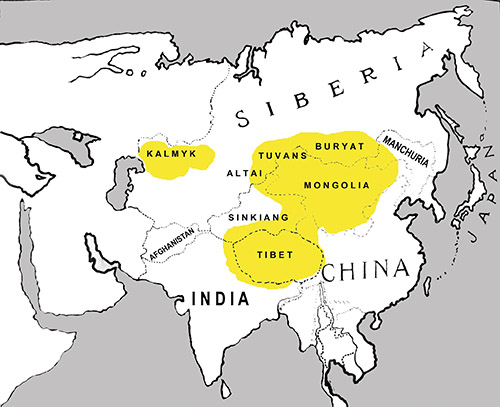
The head of the botanical expedition was not so interested in herbs. Rather he became involved in exploring the political situation and in studying local religious prophecies. He was especially concerned with a Buddhist prophecy called Shambhala. Very popular in the Mongol-Tibetan world, Shambhala was viewed as a legendary land of spiritual bliss – a Tibetan Buddhist paradise – that the faithful believed would arrive after a world-wide battle between the forces of light, the proponents of the “true” Buddhist faith, and the forces of darkness (lalo), the people of alien beliefs. The legend, which emerged in the early Middle Ages when Buddhists had to fight Muslim advances into northern India, eventually became a potent spiritual force in the Tibetan-Mongol world. The name of the man who tried to step into the world of this prophecy was Nicholas Roerich, a Russian émigré painter from New York City. The person who commissioned him to embark on this strange expedition was Henry Wallace, then President Franklin Delano Roosevelt’s secretary of agriculture and subsequently his vice president.
Recent research into this and Roerich’s other Asian ventures in the 1920s and the 1930s1uncovered that his ultimate plan was to establish what he called the Sacred Union of the East, uniting the people of the Mongol-Tibetan world and Siberia. Shambhala and related Inner Asia prophecies would be used to rally the people in all these areas. Roerich contemplated the Sacred Union of the East as an ideal state with cooperatives as its economic foundation and with a universal religion based on reformed Tibetan Buddhism and his version of Theosophy. In his correspondence and in the circle of his acolytes this project was also referred to as ‘Kansas’, the ‘New Country’, or simply as the ‘Great Plan’.
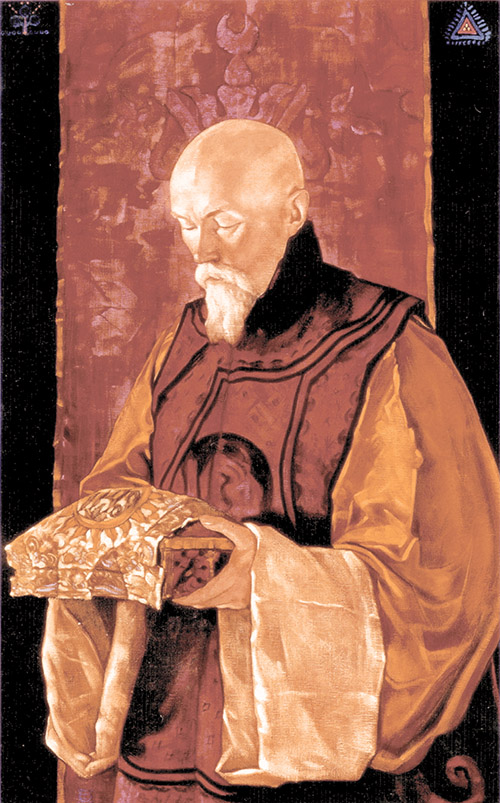
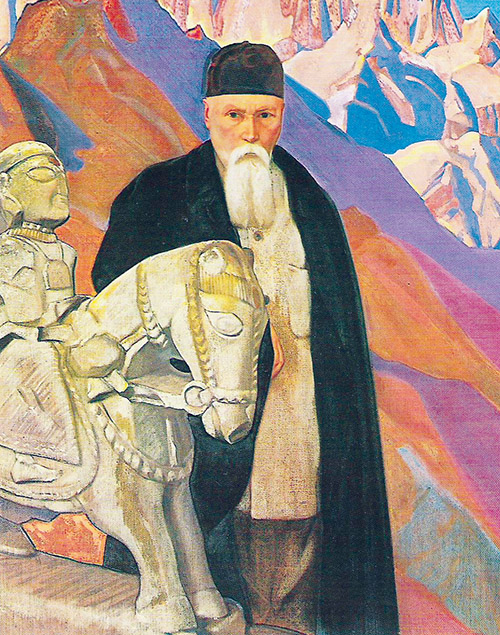
Portrait of Nicholas Roerich holding a chest with the sacred Chintamani stone.
It appears the Shambhala prophecy caught Roerich’s attention as early as 1909 when a group of Tibetan Buddhists living in Russia and headed by Agvan Dorzhiev, a Buryat Buddhist monk and the envoy of the Dalai Lama to the Russian court, received Tsar Nicholas II’s blessing to erect a Tibetan Buddhist Kalachakra temple in St Petersburg. Roerich, who helped to design stained glasses for the temple, became fascinated with Dorzhiev’s stories about Shambhala. No less captivating was the Buryat lama’s dream of bringing all Tibetan Buddhist people together in a united state under the protection of the Russian tsar, whom Dorzhiev declared a reincarnation of the Shambhala king.2 The knowledge received from the learned lama sank deeply in Roerich’s mind, and the painter eventually came to the conclusion that, along with his wife Helena, he was destined to bring the knowledge of the legendary kingdom to humankind.
Simultaneously, Nicholas and Helena Roerich read Helena Blavatsky’s works, frequented occult and Spiritualist salons, and finally set up their own offshoot of Theosophy – Agni Yoga (Fire Yoga). A year before the 1917 Bolshevik Revolution, they left Russia for Europe and eventually settled in the United States, where they acquired a number of loyal followers. By the early 1920s Nicholas and Helena came to believe that the Great White Brotherhood, the hidden masters of Shambhala, acting through their virtual teacher Master Morya, chose them to speed up human spiritual evolution by establishing a great Buddhist theocracy in the heart of Asia.3
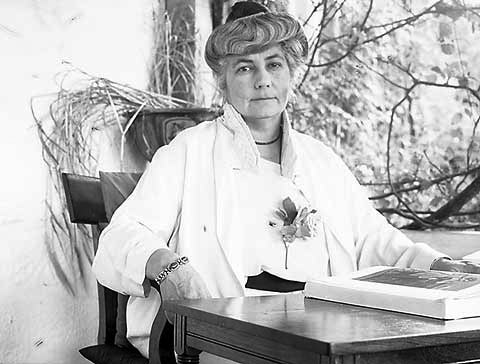
Helena Ivanovna Roerich (1879-1955) was in her own right an accomplished philosopher, writer and public figure. She created, in cooperation with Teachers of the East, a philosophic teaching of living ethics called Agni Yoga.
Between 1924 and 1928, they had already made a first abortive attempt to use the Shambhala prophecy to jump-start the Sacred Union of the East by trying to penetrate Tibet and dislodge the 13th Dalai Lama by using the conflict between His Holiness and the Panchen Lama, the spiritual leader of Tibet. In pursuit of their goal of the Sacred Union of the East, they attempted to solicit the support of Red Russia, which at that time was interested in spreading the gospel of communism to Asia. Nicholas and Helena journeyed to Moscow, where they met several Bolshevik dignitaries, including foreign intelligence chief Meer Trilisser, and commissar for foreign affairs, Georgy Chicherin, who promised some logistic support to the Roerich’s expedition in exchange for gathering information about Tibet. But they refused to give direct back-up.4 Despite this, with a group of friends and relatives, Roerich boldly ventured to Tibet, where he was blocked by the Dalai Lama and a local British spy master, Colonel Frederick Bailey. Bailey was worried about the throngs of Red pilgrims pouring into the forbidden kingdom from Red Mongolia. Roerich, whose expedition was held up for several months in freezing mountain weather, promptly denounced the Lhasa ruler as the “Yellow Pope” who betrayed the noble truth of original Buddhism and indulged instead into dark shamanic superstitions.5
Cultivating Henry Wallace
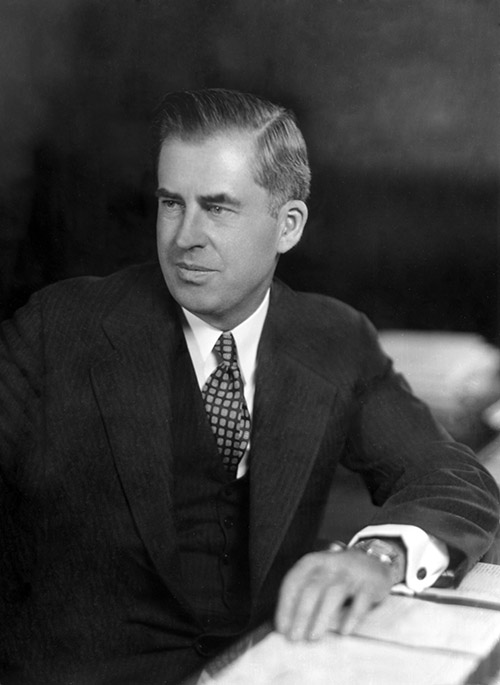
The stubborn Roerichs did not give up. From their headquarters in New York City, they continued searching for a powerful sponsor. In fact, they already had one named Louis Horch, a currency speculator, who agreed to throw his money into Roerich’s projects. Marked by a horrible facial trauma, this man and his wife were in a deep emotional crisis and found spiritual comfort in the Roerich circle. The Roerichs tried to acquire political back up, befriending senators, congressmen, and governmental officials. Their biggest coup was making friends with Henry Wallace, a rising politician from Iowa, the secretary of agriculture and later vice president in Franklin D. Roosevelt’s administration.6 Wallace entered the political spotlight during the Great Depression. Like many on the FDR team, the Iowa politician was disgusted with the free market. Yet unlike his comrades, Wallace looked beyond social and economic change, contemplating a spiritual transformation of mankind. A deeply spiritual man, he attributed many social evils to the materialism of Western civilisation. Thus, he joined the growing tribe of Europeans and Americans who searched for redemption in Native American, Oriental, and Western esoteric traditions.
This quest drew him to Indian shamans and Theosophy, and led him to explore cosmic influences on Iowa cereal crops. In the early 1930s, Wallace was still looking for his spiritual niche. Dmitri Borodin, a plant physiologist from Columbia University, who acted as Roerich’s liaison with the Bolsheviks,7helped the seeker find the ‘correct’ path. Sharing with Wallace a common interest in drought-resistant plants, this shady character with possible links to Red Russia’s intelligence services had courted the future secretary of agriculture since the end of the 1920s. Having learned about Wallace’s spiritual side, Borodin revealed that in New York City there lived a man who would be able to quench his spiritual thirst. Thus, Wallace was drawn into Roerich’s circle.
Nicholas Roerich immediately saw that Henry Wallace could be very useful for his plan and began gently cultivating this valuable contact. Massaging Wallace’s ego, Roerich prophesised that the Iowan was destined to become the next US president. Soon Wallace was admitted into the inner circle, receiving a ring and the esoteric name ‘Galahad’ – a reference to the legendary hero who, along with Parsifal, took the Holy Grail to the Orient. Fascinated with Roerich’s stories about travels to Buddhist areas, Wallace withdrew from the mainstream Theosophical Society and took up the Roerichs’ cause. Through Wallace, Nicholas and Helena were able to reach out to US President Roosevelt, who already knew about the painter through his mother Sara, a woman with occult leanings.
Official photo of Henry A. Wallace, as Vice President of the United States (1941-1945).
Soon Helena corresponded directly with the president, sending FDR her “fiery messages” peppered with advice about domestic and international politics. In February 1935, she finally felt comfortable enough to reveal to the chief executive the details of the Great Plan, hinting that the United States might help this noble project: “Thus, the time for reconstruction in the East has come, and let us have friends of the Orient in America. The Union of Asian peoples is envisioned. The unification of the tribes and nationalities will proceed gradually. They will have their own federation. Mongolia, China, and the Kalmyk will counterbalance Japan. Mr. President, in this project of unification we need your good will.”8
[alert type=”success” dismiss=”no”]If you appreciate this article, please consider subscribing to help maintain this website.[/alert]
“Now we have reached the future!”
Meanwhile, rubbing shoulders with Wallace, Roerich suddenly saw an opportunity to use this friendship for his occult geopolitics. In the wake of the horrible drought that hit America’s Central Plains, the US Department of Agriculture started looking for drought-resistant grasses and cereals, sending out its people to various parts of the globe, including Central and Inner Asia. When Roerich discovered this, he was quick to offer himself as an expert on Asian plant life. According to the painter’s occult calendar, it was a good time for him to step out of the shadows and attempt to launch again the Sacred Union of the East. On 17 December 1933, the 13th Dalai Lama died. To his circle of the elect, Roerich announced, “Now we have reached the future!”9
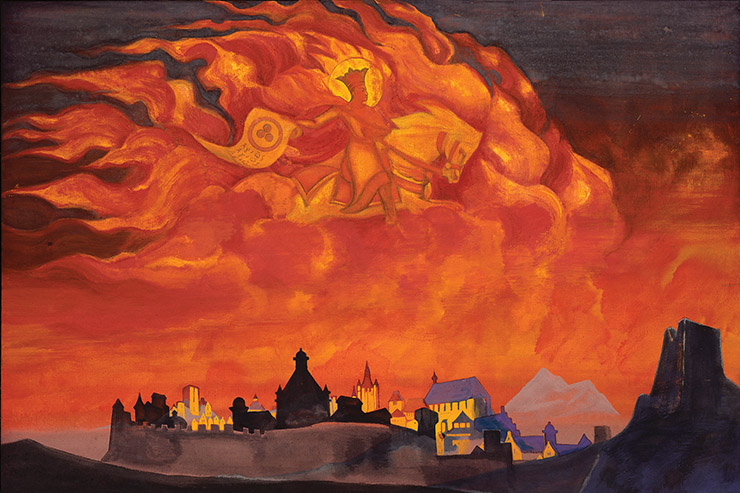
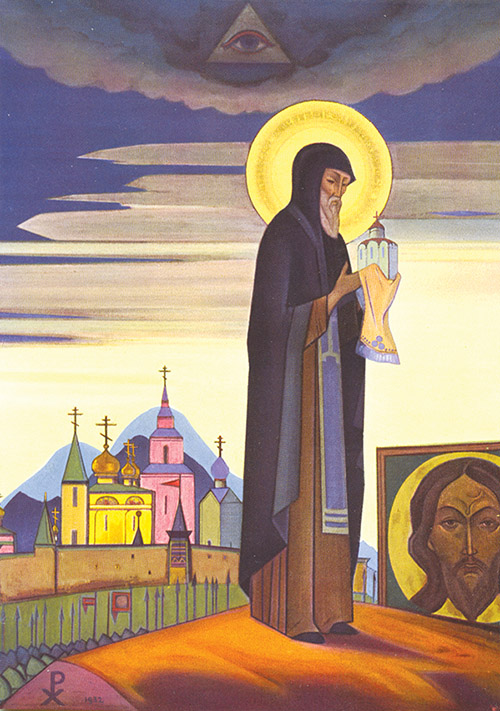
On the eve of the “botanical expedition” Nicholas Roerich painted an image of himself as St. Sergius (the patron saint of the Russian military) in charge of a mighty army and under protection of the all-seeing eye of his otherworldly spiritual guide Master Morya. Graphic courtesy of Andrei Znamenski
By the end of December, Wallace was already in Roosevelt’s office, trying to sell his boss on the idea of an Asian botanical expedition that would include Roerich and his son George. The president, who took a personal interest in Roerich’s cause, liked the project and gave permission to proceed. At the same time, Wallace indirectly tried to prepare FDR for something bigger than simply a botanical venture, vaguely hinting that the political situation in Asia was always quite intriguing because of various ancient prophecies and legends. Yet, instead of going to Tibet and Western China, the areas that earlier were so dear to Roerich’s heart, the painter now rushed to north-eastern China: Manchuria and Inner Mongolia. Why such a sudden change of itinerary?
Although the death of the Dalai Lama was surely an important occult sign, bringing instability to Lhasa, Tibet was not in revolt. In contrast, Manchuria, Chinese (Inner) Mongolia, and Red Mongolia were all on fire. In 1931, Japan, a rising imperialist giant, suddenly invaded China and occupied her north-eastern part (Manchuria). From there, imperial Japan now threatened the Soviet Far East, Mongolia, and Central China. During the same year, Mongol shepherds and lamas revolted against communism and linked their hopes to the advancing Japanese troops, which they viewed as the army of legendary Shambhala that would deliver them from Russian and Chinese oppressors.10
Map of Tibetan-Buddhist areas of Inner Asia. Graphic courtesy of Andrei Znamenski
This was the explosive situation Roerich craved to step into. It was time to set in motion his great plan. With fire in his eyes, the painter exclaimed, “Imagine, suddenly an invincible Mongolian army shows up and begins to win and to act – amazing!”11
Moreover, Roerich imagined himself as the head of the future Shambhala army. On one of his canvases he portrayed himself as St. Sergius, an Orthodox military patron saint, with Mongol features surrounded by an army of warriors with spears ready for an attack. Helena fed her husband’s geopolitical ambitions by constantly declaring that theirs was a time for assertive politicians. She pointed out that all over Asia, Europe, and even in the United States, people were opting for strong-willed leaders.
Yet, troubles pursued the Shambhala warrior from the very beginning. In August 1934, on their way to Manchuria, the painter and his son stopped in Japan. There, without any official credentials, Nicholas began to act as a high American dignitary, meeting the Japanese secretary of war and praising him for the job the Japanese occupation army was doing in China. Three years earlier, the United States had condemned Japan for invading China, and Roerich’s behaviour now looked very embarrassing.
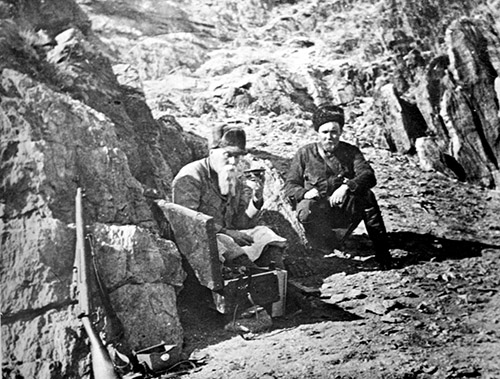
As soon as the “botanical expedition” stepped on Chinese soil, George Roerich got in touch with a representative of the Panchen Lama. But, surrounded by a tight ring of intelligence agents from various countries, the spiritual leader of Tibet exercised extreme caution and refused to get involved in any grand scheme. Accompanied by several armed guards recruited from the ranks of Russian émigrés, the Roerichs then made a blitz visit to the Manchurian Mongols, mingling with local princes and lamas. From Manchuria, Roerich and his son drove to Inner Mongolia, where they met Teh Wang, leader of the Mongol national liberation movement against the Chinese, promising him American support – another reckless step that further raised the eyebrows of US diplomats in China and Japan.
Nicholas and his son George Roerich during their “botanical expedition” into parts of Inner Asia. This photo taken near Manchuria, Inner Mongolia, 1934-35. Photo courtesy of Andrei Znamenski
En route, George kept a detailed diary, which resembles more of a military journal than travel notes. He carefully scanned the topography of places they visited, measured hills and distances between various sites and towns, noted major intersections, and provided detailed information about the Japanese military transportation system. In short, this was a blueprint for developing future defensive and offensive plans.12
Who was to benefit from this intelligence? Roerich with his Sacred Union of the East project or somebody else as well?
Smears & Intrigues Beset Roerich
Concerned about Roerich’s suspicious movements, Japanese intelligence unleashed a smear campaign against him in the press. The press wrote that Roerich was a Freemason, which was not true, who sought to establish a great Siberian state – which did contain elements of truth. Several newspapers drew attention to his brief romance with the Bolsheviks in 1926, wondering if it was still going on. Meanwhile, the American press raised hell, speculating about some hidden US government agenda linked to the Roerich Manchurian expedition. The painter was caught in the crossfire of diplomatic, espionage, and media games.
Still worse, the US State Department informed Roerich’s patron Wallace that the Soviets had sent a confidential protest to the American government, complaining that the dangerous émigré Roerich was wandering along the borders of Red Mongolia. The Bolsheviks were worried that “the armed party is now making their way toward the Soviet Union ostensibly as a scientific expedition but actually to rally former White elements and discontented Mongols.”13To the last moment, Wallace backed up Roerich and dismissed all insinuations against his “botanist.” Only when he realised the painter was a diplomatic embarrassment and that his own career was now on the line did the secretary of agriculture call off the expedition, cutting funding and terminating all his contacts with his former guru. Eventually, along with Louis Horch, another sponsor who dropped Roerich, Wallace turned against the painter, initiating a tax-evasion lawsuit against him and seizing his properties in the United States. FDR, embarrassed by the whole situation, personally intervened, promising Horch and Wallace to call the judge who handled the case in order to guarantee the “correct” verdict. Sure enough, Roerich, who trusted Horch to handle his finances, was indicted. Betrayed and humiliated by his partners, Roerich never returned to the United States, wisely choosing to settle in India.
The artist and mystic Nicholas Roerich. Self portrait (1937). Courtesy of Nicholas Roerich Museum, New York, www.roerich.org
Red Russia & Boris Roerich
What went unnoticed at the time was that in January 1933 in Leningrad, right on the eve of the Manchurian expedition, Boris Roerich, a brother of the painter who remained in Red Russia, was suddenly released by the Bolshevik secret police (OGPU). In May 1931, the secret police had set up and then arrested Boris. There is an interesting twist here. Boris’ two-year sentence seems more a house arrest. An architect by profession, he was confined to work at the secret technical bureau, designing the Big House, which headquartered the Leningrad branch of the secret police. Here Nicholas Roerich’s brother worked under Nikolai Lansere, the Soviet architectural star who received a similar sentence.14
From Boris’ recently declassified secret police file, it is clear that OGPU was using him as a tool in some sophisticated game that most certainly involved Nicholas Roerich. As early as February 1929, the secret police searched Boris’ apartment, trying to find materials that might implicate him in espionage. Two months later, he was recruited by OGPU and began working as a secret informer. Yet, as mentioned above, two years later, OGPU suddenly framed and arrested him for smuggling, sentencing him to three years in a concentration camp. However, hardly had two months passed before this draconian sentence was miraculously waived and replaced by benevolent confinement in the golden cage of the secret technical bureau.15 But this strange story does not end here. From 1936 to 1937, now in Moscow and again with Lansere, Boris Roerich began working on the monumental project of the All-Union Institute of Experimental Medicine (VIEM), a notorious “new age” Stalinist research centre. What followed was even more stunning. From 1937 to 1939, during the period of The Great Purge, Boris continued his career as if nothing happened and even improved his material conditions by moving from Leningrad to an elite neighbourhood in Moscow, where he quietly died a natural death in 1945.16
The facts of Boris Roerich’s biography are revealing. Even without having such a “dangerous” brother, Boris, simply as a former White officer who fought against the Bolsheviks during the Civil War, was a prime candidate if not for execution then at least for a twenty-five-year sentence in a concentration camp. Still, by some providential force, the Bolsheviks’ vengeance never reached him. How to explain this miracle? What was the magic shield that protected Boris Roerich? The most obvious answer is that this magic guardian was his adventurous brother. Remembering that the use of relatives to guarantee the cooperation of victims and the loyalty of OGPU agents was standard practice for Stalin’s secret police, all pieces of the puzzle fall in place.
It is quite possible that Boris was a bargaining chip in some devious and sophisticated spy game that involved Nicholas Roerich. I will not repeat here the far-fetched argument made by Moscow writer Oleg Shishkin17 that after 1919 or 1920 the painter was always a paid Bolshevik spy and that his Master School in New York City at 310 Riverside Drive was a cover for a Soviet spy ring. There is simply no credible evidence to support such a statement. At the same time, one cannot totally exclude the possibility that at some point Roerich was simply blackmailed by the Soviet secret police and forced to perform occasional clandestine assignments, especially during his Manchurian venture. These assignments might not have necessarily contradicted his Sacred Union of the East project. They could include monitoring Japanese military activities near Red Mongolia’s border, the location of their troops and military hardware, the status of Manchuria as a puppet state, and the general geopolitical situation in the area, a major concern for the Soviet Union in the 1930s. Bolshevik intelligence threw a tremendous amount of resources and workers into the Far East, recruiting hundreds of unemployed White émigrés to spy on the Japanese. Besides, restraining the possible Soviet agent of influence who worked to unite White Russians and Mongols in a sacred crusade against communism was not a bad idea. Viewed from this angle, the protest quietly delivered by the Soviets to the United States in 1935 regarding Roerich’s “armed and dangerous party” might have simply been a good smokescreen to smooth the mission of the reluctant agent. As long as Boris remained in the hands of the Soviet secret police, the painter’s cooperation could be safely solicited anytime.
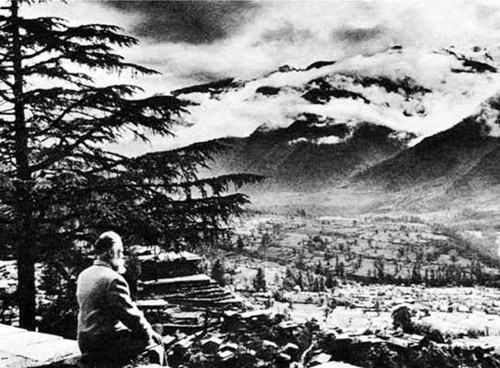
After his second attempt to launch the Sacred Union of the East from Manchuria failed and after Horch seized his Master Building in New York City, Nicholas and Helena along with their two sons settled in India in the picturesque Kulu Valley, right next door to Tibet. Immersing himself in painting local landscapes and entertaining occasional visitors, Roerich finally laid to rest his grand dream. In Kulu, the painter peacefully died in 1947 from prostate cancer. His wife followed him eight years later.
Nicholas and Helena along with their two sons eventually settled in India in the picturesque Kulu Valley, right next door to Tibet. In Kulu, the painter peacefully died in 1947 from prostate cancer. His wife followed him eight years later.
Before he died, during the Second World War when Nazi Germany attacked Russia, Roerich suddenly became openly pro-Soviet and patriotic. Moreover, after the war ended, he approached the Soviet government, asking permission to return to Russia. Did the old man expect some special treatment from Stalin for occasional services he might have provided to the Bolshevik regime? Or was he simply an old, naïve idealist who felt nostalgia for his motherland? Who knows? Fortunately for him, Red Russia refused to issue such permission. Roerich, who did not know anything about real life in the Bolshevik utopia, was certainly unaware how lucky he was. What could await him in Stalinist Russia in case he returned? The atmosphere of total suspicion, suffocating propaganda, and possibly a prison sentence more likely.
In 1957, after the death of Stalin, following in his father’s footsteps, George Roerich, a linguist and Tibetan scholar who was always part of his parents’ Sacred Union of the East project, asked and did receive permission to immigrate to the Soviet Union. The Soviets not only let him in but also awarded him a prestigious job as a senior research fellow at the Moscow Institute of Oriental Studies. Three years later he died from natural causes. The younger son, Svetoslav, an architect, lived a long life and died in 1993 at his estate in Bangalore, India.
For a detailed examination of the subjects discussed in the above article, read Andrei Znamenski’s 2012 book Red Shambhala: Magic, Prophecy, and Geopolitics in the Heart of Asia.
[alert type=”success” dismiss=”no”]If you appreciate this article, please consider subscribing to help maintain this website.[/alert]
Footnotes
1. The two-volume biography of Roerich by Rosov (2002, 2004) is the most comprehensive and complete account of his life: Rosov, Vladimir. Nikolai Rerikh vestnik Zvenigoroda [Nicholas Roerich: Messenger of Zvenigorod], vol. 1. St. Petersburg: Aleteiia, 2002; Rosov, Vladimir. Nikolai Rerikh vestnik Zvenigoroda [Nicholas Roerich: Messenger of Zvenigorod], vol. 2. Moscow: Ariavarta-Press, 2004, 79-80; also Andreev, Alexandre, Gimalaiskoe bratstvo: teosofskii mif i ego tvortsy [Himalayan Brotherhood: Theosophical Myth and its Creators]. St. Petersburg: iz-vo St. Petersburgskogo universiteta, 2008. For a good general overview of Roerich’s activities, see: McCannon, John. “By the Shores of White Waters: The Altai and Its Place in the Spiritual Geopolitics of Nicholas Roerich,” Sibirica: Journal of Siberian Studies 2, no. 3 (2002): 166–89; Spence, Richard. “Red Star over Shambhala: Soviet, British and American Intelligence & the Search for Lost Civilization in Central Asia,” New Dawn 109, July-August (2008); Osterrieder, Markus. “From Synarchy to Shambhala: The Role of Political Occultism and Social Messianism in the Activities of Nicholas Roerich,” in The New Age of Russia: Occult and Esoteric Dimensions, eds. Birgit Menzel, Michael Hagemeister, Bernice Rosenthal. Munchen and Berlin: Kuban & Sagner, 2011.
2. Meyer, Karl Ernest and Shareen Blair Brysac. Tournament of Shadows: The Great Game and the Race for Empire in Central Asia. New York: Basic Books, 2006, 454.
3. Roerich, Nicholas. Shambhala. New York: Frederick A. Stokes Company, 1930, 11; Roerich, Helena, Vysokii put’ [High Path], vol. 1 (1920–1928). Moscow: Sfera, 2006, 45, 51, 65.
4. Fosdick, Zinaida. Moi uchitelia: vstrechi s Rerikhami (po stranitsam dnevnika, 1922–1934) [My Teachers: Meetings with the Roeriches (Pages from the 1922-1934 Journal)]. Moscow: Sfera, 1998, 206 265; Brachev, Viktor. Okkultisty sovetskoi epokhi [Occultists of the Soviet Age]. Moscow: Bystrov, 2007, 234-35; Rosov, Vladimir. Nikolai Rerikh vestnik Zvenigoroda [Nicholas Roerich: Messenger of Zvenigorod], vol. 1. St. Petersburg: Aleteiia, 2002, 180.
5. Roerich, 1930, 5, 47, 61.
6. For more about relationships between Roerich and Wallace, see Meyer and Brysac 1999: 474–91;Williams, Robert C. Russian Art and American Money, 1900–1940 (Cambridge, MA: Harvard University Press, 1980, 136-43;Culver, John C. and John Hyde. American Dreamer: The Life and Times of Henry A. Wallace. New York: Norton, 2000.
10. Bowden, C.R. Modern History of Mongolia. New York: Praeger, 1968, 205.
11. Fosdick, 1998, 659.
12. Rosov, 2004, 79-80.
13. Meyer, Karl Ernest and Shareen Blair Brysac, 2006, 488.
14. Rosov, Vladimir. “Arkhitekhtor B. K. Rerikh: Rassekrechennoe arkhivnoe delo N. 2538 [Architectural Designer B. K. Roerich: Declassified File No. 2538],” Vestnik Ariavarty [Messenger of Aryavarta] 10 2008, 43.
15. Rosov, 2008, 46.
16. Yudin, Andrei. Tainy Bol’shogo doma [Secrets of the Big House]. Moscow: Astrel, 2007, 15.
17. Shishkin, Oleg. Bitva za Gimalaii: NKVD, magiia i shpionazh [Fight for the Himalayas: NKVD, Magic, and Espionage]. Moskva: Olma-Press, 1999, 27-40, 51-63, 72-75, 105-123.
It is a pity that no researcher, while there was still time, ever spoke to the friends and relations who had known Julius Evola (1898–1974) in his youth. Like some other occult philosophers (Blavatsky and Gurdjieff come to mind), Evola covered his tracks, putting his apprentice years out of reach of the curious, then constructing an idealized biography.1 After his crippling injury in World War II he became an obscure and private figure, of little interest to the world in general, so that no one was prompted to go to Sicily, for instance, to try to find some cousins or to establish the status of the title “Baron” to which he sometimes answered. His few disciples, for their part, would never have had the bad manners to poke into the Master’s past, or to search out his aging school-fellows for insights into a level of his personality which he affected to despise.
Like his early hero Nietzsche, Giulio seems never to have been a child, but to have come into the world fully-formed and ready for his life’s mission. We know that he completed university studies in engineering, but disdained to receive a diploma, as being too bourgeois an ambition.2 He served in World War I as an artillery officer, without seeing any serious action. His first public appearance was at the age of twenty-one, exhibiting 54 abstract paintings (now avidly collected, and some of them in public collections) and participating in the Dadaist movement. After abruptly quitting that phase, he reappeared as commentator and translator of the Tao Te Ching. By his mid-twenties, at a time when most young men are still finding themselves, he had completed a series of essays on Magical Idealism, a scholarly study of Tantra, and an 800-page treatise which he sent to the most eminent Italian philosopher of the time, Benedetto Croce. With typical hauteur, Evola explained that:
For some years I have tried to organize my philosophical views into a system, mainly contained in an unpublished work entitled Theory of the Absolute Individual… I will release this volume, which has cost me several years of work, without any remuneration… For a number of reasons that I cannot go into here, the publication of the principal work represents something quite important to me, since, in the discipline I have followed, it is the opportunity to address freely and without reserve those for whom the general effect of my doctrine, expounded theoretically, is not merely an abstract scheme.3
Croce recommended publication. The publisher divided it into two volumes, Teoria dell’Individuo Assoluto (“Theory of the Absolute Individual”) and Fenomenologia dell’Individuo Assoluto (“Phenomenology of the Absolute Individual”). Evola’s premises had been anticipated by some German Romantics, but are generally quite foreign to Western philosophy. They are more familiar to readers of the Taoist, Tantric, alchemical, and magical texts that Evola was simultaneously studying. The Absolute Individual is the Self, seen as identical to the source of all being. Like the philosophy of Plotinus and other Neoplatonists, and even more like the philosophic writings of India and China, Evola’s doctrine includes, but also transcends, the dimensions of religious experience and mysticism. His twin volumes contain a history of subjective idealism, and a practical philosophy of life, based on the assumption that the Absolute Individual is the ultimate object of human aspiration and attainment. Evola, at least, must have been familiar with the experiences about which he was writing; apart from the authoritative tone of his “phenomenology,” there is the evidence of an entire life lived most rigorously in the spirit of this philosophy. It is a question for specialists whether his youthful experiences of the Absolute, some of which he admits were drug-induced, were temporary samadhis (to use the language of Yoga) that confirmed him in the truth of his intellectual convictions, or whether they effected a permanent change in his being, leaving him, no matter what his outer activities and circumstances, in the simultaneous awareness of absolute consciousness.
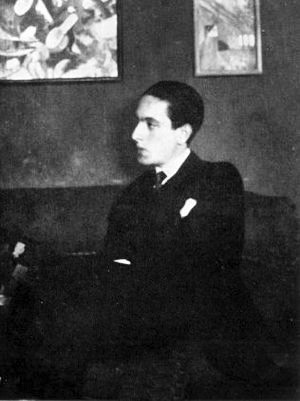
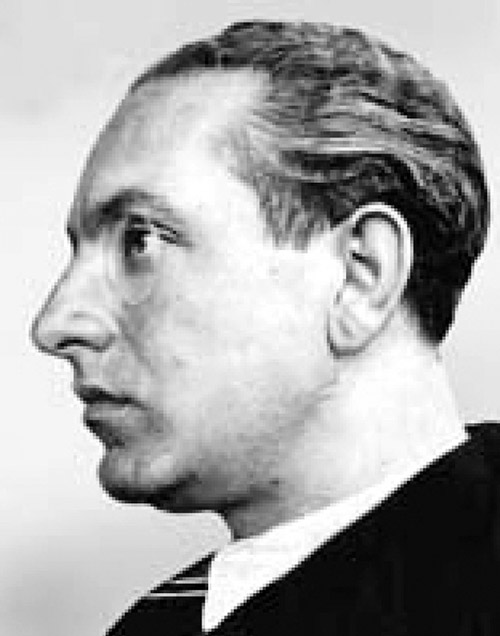
A young Julius Evola
Evola’s concept of the Absolute Individual is inseparable from the other theme which he treated in this early period: that of Magical Idealism. “Magic” would remain his blanket-term for the methods taught in East and West that aim at the realization of the Absolute Individual. Questions such as whether magic is an irrational belief-system, or a reaction against modern science, would have been totally irrelevant to him. In his world, magic and the order of things classified as occult were the object of direct, intuitional knowledge. By stripping them of their superstitious associations and their Christian-Kabbalistic accretions, he reduced them to a form in which they could be sensibly and even scientifically discussed.
There are two reasons why Evola’s Magical Idealism is a landmark in the history of modern occultism (another inevitable blanket-term). First, he raises questions that have scarcely ever been addressed to practitioners or answered by theoreticians of the occult sciences, concerning the ultimate motivation and validity of the latter. The answers that one could expect from most occultists are either of a very lowly order, aiming at personal power, knowledge, wealth, etc., or else, in more serious figures such as Eliphas Lévi and A. E. Waite, they give way to dogma, making magic a handmaid to Judeo-Christian mysticism. The second reason is that Evola was not content to stay within the Western streams of magic, philosophy, or mysticism, but needed for the completion of his experiential system the input of the East. In both respects, his philosophical journey resembles that of Aleister Crowley, who, for all the differences in their “personal equations,”4 would probably not have disagreed with many of Evola’s principles. These did for magic what the Theosophists had done for the theoretical study of esotericism: opened it to the whole world.
By this time, Evola had been introduced by the Futurist painter Giacomo Balla to Arturo Reghini (1878–1946), a mathematics teacher active in many esoteric and fringe-masonic groups. Reghini performed two important services for the younger man. By his own example as a kind of Pythagorean nationalist, he convinced Evola – hitherto a student more of German Idealism and of the East – of the value of his native Italian heritage; and he introduced him to the writings of René Guénon (1886–1951), proponent of the “integral tradition.”
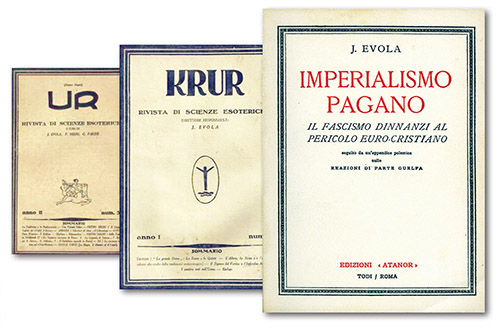
At the beginning of 1927 Evola and Reghini founded an esoteric group called the “Gruppo di Ur.” Its members included a number of Reghini’s previous collaborators, and had connections in Roman high society. The group produced a monthly journal which treated the whole spectrum of theoretical and practical magic, including classic texts from East and West, translations, and commentaries on their applicability to modern times. Some of the members worked alone; others formed “chains” for group work. Some of them wrote candidly of their own experiences, good or bad. Their magic was not of a superstitious kind but more in the practical mode of Rudolf Steiner’s “spiritual science,” for the group included some of Italy’s leading Anthroposophists. While the group itself was small, the fact that Ur was published in an edition of about 2,000 copies testifies to an astonishing level of interest in the Italy of those days.
One consequence of the friendship with Reghini was the theme of Evola’s next book, Imperialismo pagano (“Pagan Imperialism”), which was so violently anti-Catholic that it later became an embarrassment to him, and was never reissued during his lifetime. It is subtitled “Fascism facing the Euro-Christian peril,” and argues, as Reghini had been doing since the end of World War I, for the restoration of the Roman pagan tradition as the proper spiritual foundation for the new Italy. Mussolini, more alive to political necessities than swayed by “traditional” spirituality, dealt the death-blow to these pagan dreams in 1929 with his Concordat with the Roman Church. The Duce remained a reader of Evola and his protector, up to a point, despite the philosopher’s fearless criticisms of Fascism.
The insistence, henceforth in Evola’s work, on “Tradition” is the legacy of Guénon, whose early writings had propounded the idea of a single primordial tradition from which the various religions were offshoots, and which contained in symbolic form the basic metaphysical truths about the universe and man’s self-realization. The Absolute Individual that Evola had found in Taoism and Tantra, Guénon had expounded as the Supreme Identity of the Vedanta. It seemed clear to both of them that the same ultimate truths and teachings were to be found at the deepest layer of every authentic tradition.
Unlike Guénon, Evola was unsympathetic to exoteric religion and dubious about the Judeo-Christian tradition, which was so displeasing to him on a political and aesthetic level. He preferred other strands that had kept the authentic tradition alive in the West, foremost among which was alchemy. His contributions to Ur and Krur included many essays on this subject that he later gathered and expanded into a book on the Hermetic Tradition. In the history of alchemy in the twentieth century, Evola’s work represents a third stream, distinct from the practical, laboratory alchemy of Fulcanelli, Eugène Canseliet, Frater Albertus, Jean Dubuis, and their disciples, and equally distinct from the psychologized alchemy of Herbert Silberer or Carl Jung. Evola’s Hermetic Tradition is instead a cosmology, combined with a method for self-realization, in which sulphur and mercury, conjunction, transmutation, etc., are the names of otherwise undefinable states of mind and soul. Although it is not made explicit in the text, Evola’s alchemical method, like much else in occult practice, centres on the deliberate separation of consciousness from the body and on operations performed in the “astral world” or the world of the Imagination (taking this term in the sense used by William Blake or Henry Corbin), which require more than the usual degree of concentration and courage.
[alert type=”success” dismiss=”no”]If you appreciate this article, please consider subscribing to help maintain this website.[/alert]
The more one mentions things of this kind, the greater is the tendency to associate Evola with other modern occultists, in the broad sense of the term. But his next book drew the line firmly between himself and them, being a denunciation of the “Mask and True Face of Contemporary Spiritualism.” It was based on articles he had already published critical of Spiritualism, Psychoanalysis, Theosophy, Anthroposophy, the French occultists, etc., and it served the same purpose as Guénon’s earlier works against Theosophy and Spiritualism: it defined the field, the sources, and the individuals that were unacceptable to “traditionalists.” With Pagan Imperialism, this book established a dualist, even Manichean trend, always latent in Evola’s character, but which in his earlier works had not yet become the source of his creative energy. Now it was not enough to speak of the various royal paths by which the “superior man” (to use the I Ching’s expression) becomes the Absolute Individual: the machinations of inferior men (and women) had to be laid bare, and war had to be declared against them.
Just as Evola’s early explorations in art, philosophy, psychedelics and magic had found their expression in the Theory of the Absolute Individual, so now he gathered his paganism, his sense of tradition, his political consciousness, and his contempt for most of the human race into definitive form and his most important and representative work: Rivolta contro il mondo moderno (“Revolt Against the Modern World”). This revolt was urged in the name of a primordial tradition whose metaphysical and cosmological principles occupy the first half of the book, while the other half is concerned with the process that led to the modern aberration. The fundamental assumption, without which Revolt makes no sense whatever, is the cyclical principle of history that is most fully developed in the Hindu system of four Yugas or world-ages (Satya, Treta, Dvapara and Kali Yuga), and also known to the Greeks as the Ages of Gold, Silver, Bronze and Iron. Evola accepts this, just as Guénon did, with the corollary that modernity is a phenomenon of the last part of the Kali Yuga or Age of Iron – after whose cataclysmic ending a new Golden Age will dawn, as certainly as the sun rises every morning.5
Guénon and Evola both believed in a previous Golden Age with a perfectly ordered primordial tradition, situated in the Arctic if not positively at the North Pole. For Evola, at least, there seemed to be tangible proof in Herman Wirth’s collection of prehistoric symbols from the circumpolar regions. But the greatest value of Revolt may be as an epic work of the imagination, which like all epics offers an escape into a world more comprehensible than our own, if no less tragic. Evola’s exposition of the orderly cosmos of Tradition and its fall, if not historically verifiable, is a creative enterprise on a Wagnerian scale that, like a great opera, does not have to be “true” in order to be an inspiration and an enrichment to its audience.
If the Traditionalist concept of cyclical history is correct, the modern world is the inevitable consequence of the tail-end of the cycle. What else could one expect from the Dark Age, the Age of Iron, or the Kali Yuga? It is as inevitable as night, winter, or natural death. Yet Evola and the other Traditionalists rage against its secularism, its social organizations, its confusion of gender-roles, its materialism and vulgarity, its racial and spiritual degradation. Above all, there is Evola’s pervasive theme, apparently derived from his early reading of the Swiss anthropologist Bachofen, of the spiritual superiority of the masculine over the feminine, contrasting the virile, primordial, Arctic, “Uranian” and “Olympian” way with the Southern, orgiastic, sentimental, Dionysian way of the Mother-goddess. The former, one gathers, is the path to the Absolute Individual, while the latter leads only to extinction on the wheel of the Eternal Return.
Baron Julius Cesare Evola (19 May 1898 – 11 June 1974)
Only in modern times could someone have thought and written as Evola did, rejecting his native environment (whether one thinks of this as Italian Catholicism or as the rootless materialism of the Western world) and deliberately choosing an invented, or at least a foreign (because fundamentally Eastern) mode of thought. The critic of modernity is an essentially modern phenomenon, and his cultural pessimism, as it is generally known today, a natural reaction to events in Europe which none could ignore, least of all one of Evola’s warrior disposition. For all the lapidary certainties of his writing, Evola was looking for something to hold on to during the 1930s. He had been disappointed as Fascism cosied up to the Church and compromised itself with the bourgeois and proletarian world, even though he never found it so degraded as the rival systems of American capitalism or Soviet communism. During this decade his glance wandered continually to Germany, hoping to find there a political realization closer to his ideals. Fluent in German, he made several semi-official visits to Germany and Austria between 1934 and 1941 to give lectures and to meet dignitaries of the Schützstaffel (the “SS”). But these encounters also left a residue of mutual disillusionment: his hosts found him too unworldly and idealistic; he found National Socialism too narrowly Pangermanist; and the Italian regime became so uneasy about his activities that in 1942 it temporarily withdrew his passport.
Two themes dominated Evola’s thought after the completion of Revolt Against the Modern World. One of them had been present incidentally in that book: the theme of race, and in particular the connection of the primordial tradition with a pure Hyperborean race that had interbred, after the destruction of its Arctic homeland, with the inferior races of the South. After Hitler’s rise to power, Mussolini’s German allies began to exert pressure on a Fascist system that had been quite innocent of anti-Semitism and racism, at least until the Abyssinian Campaign. Evola now became a self-appointed authority on this topic. With obsessive diligence he addressed both theory and practice in numerous articles and two full-length books, Il mito del sangue (“The Myth of Blood”), and Sintesi della dottrina della razza (“Synthesis of Racial Doctrine”). Both books were illustrated with photographs, some taken from anthropological sources, others being of contemporary figures including Rudolf Steiner. Evola also addressed “Three Aspects of the Jewish problem: in the Spiritual World, in the Cultural World, in the Socio-Economic World.” With this project, he attempted to give Fascism its own racial philosophy, distinct from that of the National Socialists, and in 1943 it was accepted, in principle, by Mussolini. The core of Evola’s theory was that race is of three kinds. One of these is the sense in which the term is generally used, to indicate physical and genetic types: this he calls the “race of the body.” The second is the “race of the soul,” which is expressed in art and culture; the third, the “race of the spirit,” expressed in religion, philosophy and initiation. Evola’s fundamental disagreement with the National Socialists was that, like cattle-breeders, they considered only people’s biological or bodily race: in his view, the least significant of the three. It is no wonder that the SS found him unworldly.
The American-Italian scholar Dana Lloyd Thomas has found that this theory, as found in Evola’s books, is quite far removed from the polemical and often crude racism of his journalism. Thomas concludes that Evola’s studies, though presented as objective and historical, served two purposes: they made racism a respectable area of study, and all the examples he gave came to the same conclusion, affirming the superiority (spiritual as well as physical) of the “Nordic race” that was effectively equated with the Germans.6 Thomas’s project, stemming from honest moral conviction, needs to be balanced by the recent account of Evola’s war years, traced almost day-by-day through unprecedented archival research (see note 2). The author, Gianfranco De Turris, who has been writing about Evola for over forty years, is equally motivated by a desire for justice towards a philosopher who has been vilified like none other, and gifted with insight into circumstances that were very different from those of today.
The other theme that occupied Evola in the pre-war years also reflected his Germanophilia: he developed an admiration for the high Middle Ages that resulted in a book on the “Mystery of the Grail.” For whatever reason,7 his historical allegiances had now changed, and it was no longer ancient Rome, from Romulus to Augustus, that seemed to him to incarnate the last worthy manifestation of the tradition, but the “Holy Roman Empire of the German People” inaugurated by Charlemagne’s consecration in the year 800. In his book, Evola connects the Grail myths on the one hand with the prehistoric Hyperborean tradition, and on the other with the resurgence of the imperial and knightly spirit in the Middle Ages: no matter that Charlemagne was the pitiless suppressor of Nordic paganism, or that the Holy Roman Empire derived its authority from the church that Evola had so reviled in Pagan Imperialism. This medievalism, exacerbated by Evola’s later indulgence towards extreme reactionary Catholics, continues to puzzle those who would have thought that the Renaissance Neoplatonists were closer to his ideals. Instead, he lumped the Renaissance together with the Reformation, the Enlightenment, Socialism, Communism, and modernity as part of the degenerative process.
[alert type=”success” dismiss=”no”]If you appreciate this article, please consider subscribing to help maintain this website.[/alert]
During the first years of World War II, Evola turned to yet another tradition, that of Buddhism, and wrote one of his best books: The Doctrine of Awakening: A Study on the Buddhist Ascesis. Just as with his early work on Tantra, Evola had to base his study on translations by English, German, and Italian scholars. Yet his insights into the human condition that Buddhism addresses, and the calm spiritual height from which it speaks, transcend mere erudition. The temporary habitation of Oriental modes of thought seems to have enabled him to forget the politics and the polemics which the modern West so easily provoked from him. At the same time, the work is revisionistic in its preference for Theravada (or Hinayana) Buddhism. The Western impression of Buddhism, abetted by nineteenth-century incomprehension and by Theosophical influence, has always been condescending to the primitive Hinayana (the word means “lesser vehicle”) in comparison with the “greater vehicle” of Mahayana Buddhism, to which belong the schools of Japan and Tibet that have been more successful exports. To Evola, the contrary was true: the Mahayana was a late and decadent development, sullying the original purity of Buddha’s philosophy with its sentimental and religious accretions (just the sort of thing Westerners would prefer!), while the uncompromising Hinayana was the original teaching, fit only for Aryas, i.e. the elite, in terms of their spiritual race. For a long time The Doctrine of Awakening was the only work of Evola’s available in English. It appeared from Luzac, a London Oriental publisher, uniformly with a number of René Guénon’s works, thus giving many (including myself) their first taste of the Traditionalist school.8 De Turris’s book, cited above, tells of Evola’s correspondence with the young translator Herbert Musson: a patrician Englishman who ended his life as a Theravada Buddhist monk.9
The trauma of Evola’s war-injury on 21 January 1945 and the years-long search for a cure left him permanently disabled. This is how he described his condition in a letter to a fellow philosopher: “The last war made me the gift of a lesion in the spinal cord, which has deprived me almost entirely of the use of my legs: a contingency, however, to which I do not attach much importance.” After almost six years of treatment in Austrian, Hungarian, and Italian hospitals, he returned to the apartment at 197 Corso Vittorio Emanuele II which he shared with his mother until her death in 1956, and whose owner, an aristocratic admirer, allowed him a free lease for life.
The postwar climate was not favorable to Evola, who bore the stigma of having backed the losing side. Now that “fascism” had become a term of abuse, it was applied to him, who had never joined the Fascist or any other party, indeed who had risked much with his criticisms of the government.10 It was difficult for him to resume the career as a journalist which had supported him before the War. He first returned to print with a thorough recasting of his early book on Tantra. Then he was rediscovered by some who were still faithful to the principles of the Right, and for them he wrote the booklet Orientamenti (“Orientations”).
Evola paid dearly for this act of idealism. A week after his return to his Roman residence on May 18, 1951, he was arrested and accused of being the “master,” the “inspirer,” with his “nebulous theories,” of a group of young men, who were accused in their turn of having hatched organizations for clandestine struggle and attempted to reconstitute the dissolved Fascist party.11 Evola, confined to his wheelchair, was held in the Regina Coeli prison until the trial, which lasted from early October until 20 November 1951, when he was acquitted.12
In the early 1950s Evola was still hoping for some counter-revolutionary movement, somewhat in the spirit of the “Conservative Revolution” of post-World War I Germany, that would restore the Right to power. Gli uomini e le rovine (literally, “The Men and the Ruins”), a book largely about public, social and political matters, addresses the potential leaders of such a movement. It is an analysis of the postwar world, somewhat like an updating of Revolt Against the Modern World, that ends with an outline of what would be needed for the healing of Europe: a Europe that would no longer be the playground and victim of the rivalry between the USA and the USSR Evola hoped – but knowing that it was probably beyond hope – for a resurgence of the Imperial ideal, which would endow the separate nations with a spiritual unity, but not with a forced, political one. His description of how Europe should not become united is an uncanny anticipation of what would, in fact, transpire. For example, he writes: “Democracy, on the one hand, and a European parliament that reproduces on a larger scale the depressing and pathetic sight of the European parliamentary systems on the other hand: all this would bring ridicule on the idea of a united Europe.”13 In the end, he puts his faith in the foundation of an Order, if among the ruins there are sufficient men left to stand up and constitute one.
Evola published no more books for five years after Men Among the Ruins. That his thought did develop is clear. The next time he addressed the elite, he no longer envisaged any possibility or desirability of changing the world itself: it was too far gone on the road to perdition and the conclusion of its cycle. The only place for revolution was now inside oneself. The title of the work in question, Ride the Tiger, refers to a Taoist emblem of how the superior man behaves towards a chaotic world: following the principles of “actionless action” and of “doing that which is to be done,” he uses it to fortify his own higher individuality. In contrast to the public themes of Men Among the Ruins, Ride the Tiger treats more private domains such as existential philosophy, belief and non-belief, sex, music, drugs, and death, always in the spirit of Tradition and from the point of view of their use for the man in quest of his Absolute Individual.
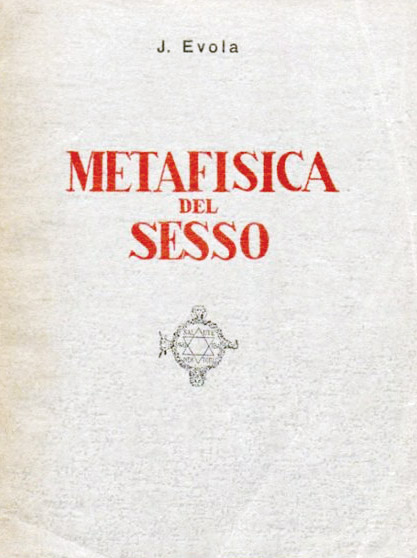
Metafisica Del Sesso (The Metaphysics of Sex) by Julius Evola
The sexist language used here is deliberate, for Evola does not seem to have considered woman as a likely candidate for the quest. He had ample heterosexual experience, especially in his earlier years, but his anti-bourgeois principles caused him never to marry or have children. His book of 1958, The Metaphysics of Sex, anticipated the sexual revolution of the 1960s with its assumption that sex was not primarily given us for reproduction. It has always been one of the secret weapons in the magician’s cabinet; but Evola was the first, and to date the only writer to treat sex from the point of view of “traditional” metaphysics, so as to explain why it has this function.
Most of Evola’s remaining titles are anthologies of his earlier articles and journalistic essays on various subjects – genres to which he contributed prolifically up to his death.14 Only two more original books appeared: an autobiography, The Path of Cinnabar, and the provocatively titled Fascism, Seen from the Right:15 his verdict on the Fascism and National Socialism that had been, and will always be, the first thing with which his critics associate him. More importantly, he returned to the Ur and Krur materials which he had been working on since the war years, and gave them definitive form in 1971 as the three-volume Introduzione alla Magia (“Introduction to Magic”). This monumental collection, with its contributions from a dozen authors beside Evola, shows that the Italian strain in modern esotericism was in no way inferior to the French Martinist and occultist strain, or to the much-studied Order of the Golden Dawn. It remains for the other leading lights, notably Giuliano Kremmerz and Arturo Reghini, to gain equal recognition for their stature as thinkers and movers.
The fact that so much of Evola’s enormous output of books and articles has been reprinted bears witness to a stratum of readership to which there is no parallel in the Anglophone world, and whose influence as a ferment within political, cultural and academic circles, especially in Italy, cannot be ignored. In the first version of this essay I concluded that, “Evola is currently the only esoteric and magical philosopher to have any impact whatever on the ‘real world’.” That was after centennial conferences in Milan and Rome (1998) and a wave of other commemorations and publications had brought Evola into the public eye, synchronously with the rise of right-wing political parties such as the National Alliance and the Northern League. Whether anything came of it is for historians to judge.
Now there are rumors of Evolian influences at the highest level of government in both Russia and the United States. One agent named is Alexander Dugin, a known admirer of the Traditionalists, whose Eurasian theories and possible influence on President Vladimir Putin’s policies have often been mentioned in this magazine. The other is Stephen K. Bannon, strategist and assistant to US President Donald Trump. In 2014, addressing a Vatican conference via Skype, Bannon mentioned that Putin has an adviser “who harkens back to Julius Evola and different writers of the early 20th century who are really the supporters of what’s called the traditionalist movement, which really kind of eventually metastasized into Italian fascism.”16 Some of his Roman listeners may have gasped at this off-the-cuff revision of history, but three years later it sent the journalists googling the unfamiliar name, and to Evola’s posthumous “fifteen minutes of fame” through exposures in the New York Times and other unlikely venues.17
A lot of dots would need to be connected before any causal link could emerge between Evola’s political and spiritual philosophy and the presidency of Donald J. Trump. First, Bannon was speaking about Putin’s advisor, not Trump’s, and hardly with approval, since in the same speech he stated that Putin ran a kleptocracy and was intent on expanding the Russian empire. Second, that the Traditionalists “inspired Fascism” is doubly inaccurate: the Fascist movement was underway while Guénon was unknown in Italy and Evola still dabbling in Dadaism. When Evola did turn to political journalism after the Gruppo di Ur had dissolved, it was to criticize the Mussolini regime’s deviance from the principles of the true Right. For him this meant a monarchic, organic state, rather than one based on competing parties (as in democracy) or on class warfare (as in communism). Third, any serious student of Evola knows that in his riper and wiser years he adopted the position of apoliteia (detachment from politics). In Ride the Tiger he reflected on the futility of the “rectifying, political action” that had still seemed a possibility in Men Among the Ruins. The context was now, in 1961, the Cold War, and while admitting that life was more comfortable on the capitalist side of the wall, the conflict mattered little to the differentiated man, whose “inner imperative” could only be to retire from the public arena. As for the latter, Evola now said with devastating scorn that “even if leaders worthy of the name were to appear today – men who appealed to forces and interests of a different type, who did not promise material advantages, who demanded and imposed a severe discipline on everyone, and who did not prostitute and degrade themselves just to ensure a personal, ephemeral, revocable, and formless power – they would have almost no hold on present society” (pp. 173-74). Perhaps this introduction will help to clear the air and indicate where the true value of Evola’s work lies, encouraging some readers to explore it first hand.
An earlier version of this article appeared in TYR: Myth—Culture—Tradition, vol. 1 (2002), pp. 127-142, titled “Julius Evola: A Philosopher for the Age of the Titans.” It is adapted by kind permission of the Editors of TYR, on which more information can be found at Dominion Press.
English translations of Evola’s principal works, published by Inner Traditions in Rochester, Vermont, USA unless otherwise indicated: The Doctrine of Awakening, Eros and the Mysteries of Love(formerly The Metaphysics of Sex), The Hermetic Tradition, Introduction to Magic(by Evola and members of the Gruppo di UR), Meditations on the Peaks, Men Among the Ruins, The Mystery of the Grail, The Path of Cinnabar (Integral Tradition Publishing), Revolt Against the Modern World, Ride the Tiger, The Yoga of Power.
[alert type=”general” dismiss=”no”]This article was published in New Dawn 162.[/alert]
[alert type=”success” dismiss=”no”]If you appreciate this article, please consider subscribing to help maintain this website.[/alert]
Footnotes
1. See end for a list of Evola’s major works available in English. The original version of this article contained a full documentation of sources, both original and translated, and other notes, omitted here. Much information, complementary to the present article, can be found in Gwendolyn Toynton, “Mercury Rising: The Life and Writings of Julius Evola,” New Dawn 111 (2008): 63-68.
2. Yet after World War II he was commonly addressed as “Dr.” or even “Prof.” The false identity he assumed in Austria was that of a Graf [Count] von Bracorens. See Gianfranco de Turris, Julius Evola: Un filosofo in guerra 1933-1945 (“Julius Evola: A Philosopher in Wartime 1933-1945,” Milan: Ugo Mursia editore, 2016), 96, 202, 214.
3. Evola, letter to Croce, 13 April 1925, quoted in Piero di Vona’s introduction to Teoria dell’Individuo Assoluto (Rome: Edizioni Mediterranee, 1998), 7-8.
4. A favorite metaphor of Evola’s: each of us enters the world with a more or less difficult “equation” which it is our life’s project to “solve.”
5. For more on this subject, see J. Godwin, “When Does the Kali Yuga End?” New Dawn 138 (2013): 63-68.
6. Thomas’s book, Julius Evola e la tentazione razzista: L’inganno del pangermanesimo in Italia (“Julius Evola and the Racist Temptation: The Deception of Pangermanism in Italy,” Mesagne: Giordano editore, 2006) has not appeared in English. The foregoing passage quotes from my combined review of that book and of Evola’s autobiography in TYR, vol. 4 (2014): 329-42.
7. The reasons were analyzed by Piero Fenili in a series of articles in the periodical Politica Romana. These, too, are only accessible in Italian. I have summarized their arguments in an article “Politica Romana pro and contra Julius Evola,” in Arthur Versluis, Lee Irwin, and Melinda Phillips, eds., Esotericism, Religion, and Politics (Minneapolis: Association for the Study of Esotericism, 2012): 41-58.
8. For a balanced evaluation, see J. Godwin, “Understanding the Traditionalists,” New Dawn 147 (2014): 63-69.
9. See Musson’s biography at http://obo.genaud.net/backmatter/gallery/nanavira.htm
10. In this as in many other regards, Evola resembles the anti-Nazi novelist Ernst Jünger.
11. How reminiscent of the accusations against Socrates: misleading the young, and not believing in the gods of the city but in other, strange gods!
12. See J. Evola, Self-Defence, published as an Appendix to Men Among the Ruins (see list of works).
13. Men Among the Ruins, 278.
14. Meditations on the Peaks (see list of works) is one such collection.
15. Il fascismo, saggio di una analisi critica dal punto da vista della Destra (“Fascism, Essay of Critical Analysis from the Point of View of the Right.” Rome: Volpe, 1964). The second edition (1970) is enlarged with Note sul Terzo Reich (“Notes on the Third Reich”).
16. Quoted from the website www.buzzfeed.com/lesterfeder/this-is-how-steve-bannon-sees-the-entire-world and the audio recording linked thereto.
17. See Jason Horowitz, “Steve Bannon Cited Italian Thinker Who Inspired Fascists,” New York Times, Feb. 10, 2017.
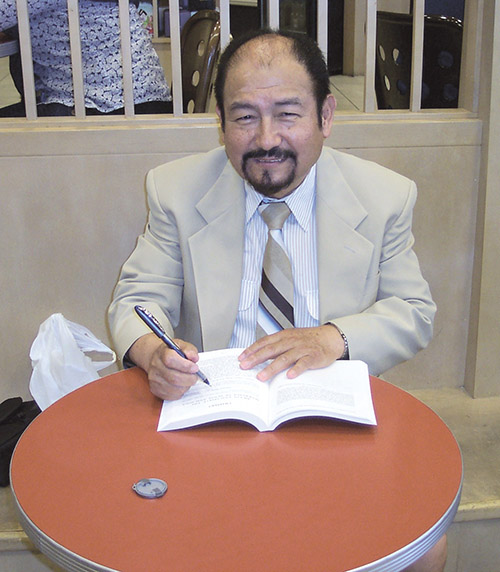
I first became aware of Dr. Albert Amao’s groundbreaking work in consciousness development when I booked him to speak at a Theosophical Society meeting in the US state of Minnesota. The occasion allowed a number of us to spend some time with Dr. Amao and hear him personally describe his work.
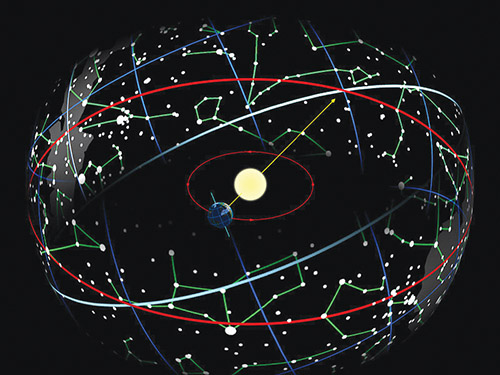
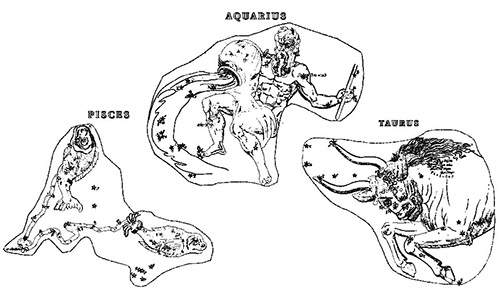
Dr. Amao’s latest book, The Birth of a New Consciousness and the Cycles of Time, examines the development of human consciousness on the eve of the new Aquarian age and the ‘God’ image that changes throughout the cycles of time.
A graduate of San Marcos University in Lima, Peru, Albert Amao holds a Ph.D. in sociology and has written extensively on metaphysics and New Thought. The author of several books, his Healing without Medicine: From Pioneers to Modern Medicine, published in 2014, was the basis of an article he wrote for New Dawn 144 (May-June 2014).
I asked Dr. Amao to explain the ideas in his new book. These are his responses.
Dr Albert Amao
VON BRASCHLER (VB): What do you mean by the concept of cosmosociology?
ALBERT AMAO (AA): The concept of cosmosociology refers to the study of the evolution of human consciousness through the zodiacal ages. It considers that there is a meaningful coincidence between the zodiacal glyphs and mass consciousness. There is a resonance between the cosmic rhythms of an age and the behaviours of social groups at large. Cosmosociologyis a theoretical framework to discuss human evolution based on cosmic cycles, which in turn are based on the precession of the equinoxes. The anchor point for cosmosociology and the zodiacal ages is the ecliptic, not the constellations.
The mathematical and geometrical models on which cosmosociology rests are based on the principle that the length of the ecliptic is 360° (degrees), which is then divided into 12 equal sectors of 30° of arc (called zodiacal signs). On the other hand, the sizes of the individual constellations vary and do not cover exactly 30 degrees of the zodiacal band. Some constellations are smaller, while others are larger than 30 degrees. Nevertheless, some astrologers measure the cosmic ages based on the actual constellations. This can be complicated, because the constellations are not of equal size. Some constellations are larger than others. For instance, the constellations Pisces and Virgo are much larger than Aries and Cancer. In this case, since Pisces is greater than 30° in length, the Age of Pisces would stretch out 600 years longer than the Age of Aries. Likewise, the constellation Virgo span a much larger space (47°) in the ecliptic circle than does the constellation of Cancer (17°). To complicate matters further, astronomers do not universally agree about where the constellations start or end.
Furthermore, there is another constellation named Ophiuchus (the Serpent Bearer), located between Scorpio and Sagittarius, making thirteen in total. In the year 1930, the International Astronomical Union (IAU) revised the boundaries of the constellations and adjusted to the real number of constellations. According to it, the path of the ecliptic now officially passes through thirteen constellations – the twelve traditional constellations plus Ophiuchus.
The word cosmosociology also can be understood as world astrology, applied to the study of the evolution of collective consciousness through the zodiacal ages.
The science of cosmosociology is based on the astronomical fact of the precession of the equinoxes. As the earth moves in an orbit around the sun, it appears from the perspective of the earth that the sun is moving along the ecliptic (red) on the celestial dome. Over thousands of years the sun moves slightly in relationship to the constellations of the zodiac (on the celestial dome). Image credit: Wikipedia/Tau’olungA
VB: What are the purposes of your book? What do you want to demonstrate?
AA: The goals that I want to cover can be summarised as follows: (a) To set an approximate date for the ending of the Age of the Fishes and the beginning of the Water-Carrier Age, (b) To define the transitional period from the Age of the Fishes to the Water-Carrier Age, (c) To clarify and differentiate between the concepts of cosmic cycles based on the constellations and those based on the zodiacal ages, (d) To delineate the sociological and religious characteristics of the Age of Fishes and the Water-Bearer Era, and (e) To outline the unfolding of a new God-image – the Water-Carrier archetype.
Religious ideas reflect the predominant symbolism inherent in each zodiacal age. For example, the era of Taurus (approximately 4430 BCE–2270 BCE) exhibited bull symbolism in religious imagery. During the following Age of Aries, Ram symbolism became prevalent. For the Piscean Age, fish featured in early Christian symbolism.
VB: Has human consciousness evolved through history?
AA: Since simple unicellular organisms evolve into multicellular colonies, consciousness has been evolving parallel to human evolution. The fundamental idea to understand this process is thatconsciousness creates the means to express itself in the physical realm. Consciousness has created humans with brains able to manipulate physical reality. Materialistic science has taken this concept upside down, considering that the brain creates consciousness. The reverse is true; the brain is the epiphenomenon of consciousness. The Life-force or universal consciousness has been evolving since the beginning of creation. We live in a purposeful universe.
[alert type=”success” dismiss=”no”]If you appreciate this article, please consider subscribing to help maintain this website.[/alert]
VB: How will human consciousness expand in this coming age? In what direction? Is this development necessary?
AA: The cosmic vibrations of the upcoming zodiacal age propel human consciousness to expand through awareness of internal and external realities. The expansion of consciousness is reached through steady meditation and inner awareness, while the latter is accomplished through scientific exploration of the external world. The expansion and evolution of consciousness is always toward the realisation of the oneness of humankind. Depth psychology has demonstrated that the personal psyche is connected to the World Soul or anima mundi. In short, our understanding of the nature of reality has dramatically shifted toward a new consciousness – a cosmic consciousness.
VB: What is the relationship between the zodiacal ages and the development of consciousness?
AA: The development of consciousness parallels the changes of zodiacal ages. This book attempts to explain the transformations of consciousness and the God-image of the predominant religions of the world, according to the changing of the zodiacal ages. The primary hypothesis is that the evolution of consciousness is expressed in the psychological development of religious ideas according to the predominant symbol of each zodiacal age. Moreover, the symbolism of the prevalent zodiacal age is manifested in religious and sociocultural ideas in the leading civilisations of the world. In other words, one can explain the transformations of the God-images of the major religions by the changing of the zodiacal ages.
VB: What are zodiacal ages and what is their importance?
AA: Ever since the great Greek philosopher Plato articulated the concept of the cosmic age commonly known as the Platonic year (consisting of 26,000 years), there has been much speculation about this subject. Religious historians, astronomers, astrologers, philosophers, and other scholars have written about it; but there has never been a clear conception about the cosmic ages, their lengths in time (i.e., their starting and ending points), or their individual characteristics, etc. The zodiacal signs set the “spirit of the time” of each epoch.
The fundamental concept in establishing the dawning of the Water-Carrier Age is the precession of the equinoxes. The language of the zodiacal signs and the planetary system provides the dates of past cosmic events with accuracy, as they are not subject to human manipulation.
VB: Many authors have predicted different dates for the coming of the Aquarius (or Water-Carrier) Age. Which one is correct?
AA: You are absolutely right that many different dates have been proposed for the upcoming age. There is wide agreement that humankind is approaching this New Age; however, there is no agreement about the date of its commencement. Some authors say that the Age of Aquarius started in the year 2000. Others, including the occult lodges known as the Hermetic Order of the Golden Dawn and the Builders of the Adytum, believe this era began in 1781, when the planet Uranus was discovered. Jung suggested that the Aquarian Age would begin either in 1997 or 2154. Esoteric writer Edward Carpenter proposed 1936, Serge Raynaud de la Ferrière, founder of the Great Universal Brotherhood, advanced March 21, 1948. French astrologer Paul Le Cour asserted that the Age of the Water-Carrier would start in 2160. The American sleeping prophet, Edgar Cayce, predicted the beginning of the New Age would take place in 1998, and Mme. Blavatsky, 2156. In short, the dates suggested range from 1781 to 2160. Determining which one is the correct was one of the goals of the book.
VB: You describe entry into a transitional period from the Age of Fishes (Pisces) to the Water-Bearer (Aquarian) Age. How soon will these coming changes be realised?
AA: Humankind hasstepped into a transitional period from the Age of the Fishes (Pisces) to the Age of the Water-Carrier (Aquarius)beginning with the spring equinoxof 2010.The transitional period proposed assigns two degrees’ leeway for each adjoining zodiacal sign from the point of intersection of the two zodiacal signs. The current transition thus comprises two degrees of the first part of the Fishes (Pisces) and two degrees of the end the Water-Carrier (Aquarius). Hence, the transitional period covers the last two degrees of the Fishes (28 and 29 degrees) and the first two degrees of the Water-Carrier (0 and 1 degrees). This is because the precession pointer (vernal equinox) runs backward on the cosmic clock.
Two degrees leeway for the ending of one zodiacal sign, along with two degrees of the upcoming sign, result in a total of 144 years for each zodiacal sign. Thus, the total years of a transitional period would be 288 years. Consequently, if we agree on the timetable proposed in this book for the zodiacal ages, the Water-Carrier Age will “officially” start in the year2154, with a transitional period that encompasses the years from 2010(2154 – 144) to 2298 (2154 + 144).
During the transitional period, a combination of events that belong to both zodiacal signs is expressed in the world. This is the period of great transmutations and adjustments in all levels of human activity. We are fortunate to be witnessing one of the greatest sociopolitical and religious transformations that planet Earth has ever undergone. It is vital for modern man to understand this fact, so he can be mentally and spiritually prepared to confront the upheavals entailed by these changes of cosmic dimensions.
VB: Your book describes how people must be prepared to confront the upheaval that entails the shift in ages. Could you describe these psychological upheavals?
AA: During a transitional period many radical changes are likely to come. The mind has the power to create whatever it believes and conceives. As a result, unfounded predictions have wider consequences than are sometimes imagined. Susceptible and uninformed people believe they are true. They are then inspired to subconsciously create unfavourable situations in their lives that have ripple effects on their families and on society in general. And a group mind is an even more powerful device for materialising ideas.
This work is a stride toward the acceleration of a new reality – a consciousness of the oneness and solidarity of humankind. As these ideas start sinking into the collective psyche, individuals will create this reality accordingly. Consequently, humans as a whole will experience a leap in consciousness, as they become aware of the true nature of the world and of our role in this world. They will realise that humans need to be conscious participatory agents in the development of their history. Prayer, meditation, fasting, and contemplation will help people to maintain peace of mind.
VB: You indicated that the God image of this coming age will be different? How so?
AA: Jung discovered the existence of a central “archetype of wholeness” that dwells in the collective unconscious. This archetype of wholeness can be identified with the life force energy, expressed in human terms as a deity or God-image. The God-image is a symbolic conceptualisation of the collective self, which is different from God per se. God is unknowable and undefinable. By contrast, God-images are symbolic mental representations of central archetypes of the collective subconscious. Usually linked to myths, legends, and religious symbols, they have played an active role in the evolution of human thought since the dawn of civilisation. The new God-image is the acknowledgement of the inner self, the manifestation of the Divine Spark that dwells in every human being.
The social and psychological crisis that modern man is confronting is caused by the lack of a central myth that can provide meaning and purpose at both the individual and collective level. The myth of the Age of the Fishes – in the Western world, the Judeo-Christian religion – has lost power and influence as a source of spiritual inspiration. Thus, it is extremely important to redefine the concepts of God, man, and the universe.
VB: What are the tell-tale signs of the advent of this coming new age?
AA: The radical changes occurring as we enter into a new dispensation (Age) have been taken by some as signs of the end of the world. Something similar happened with the end of the Long Count of the Mayan calendar on December 21, 2012, which received a great deal of attention before it occurred. However, this date only represents the closing of an epoch and the beginning of a new chapter in history.
The current planetary crisis amounts to a series of signs that we are entering into a transitional period – the ending of the Age of the Fishes and the slow dawning of the Water-Carrier Age. Currently, humankind is witnessing one of the greatest sociopolitical and religious transformations that planet Earth has ever undergone. I attempt to demonstrate that the present challenging situation of the world is part of a natural cycle in human history. Political, socioeconomic, and religious upheavals are necessary adjustments for the entrance into a new worldwide order of social and economic justice, which will be based on a higher level of international understanding and knowledge.
VB: What role will organised religion have in this coming age?
AA: There is an ancient Rosicrucian aphorism that states, “There is no God but man, and man is the son of God.” The whole philosophical discussion about religions is based on that statement. The God-image we are used to is an old, white-bearded deity seated on a golden throne somewhere in the infinite surrounded by his angels, and giving them orders to manage human affairs.
The fundamental purpose of this new dispensation is to change the paradigm from one of the relationship between a far-distant God to one of an indwelling God principle. The era of organised religion as an intermediary between God and man – and as a means of social control – is coming to an end. Instead, we will witness the direct spiritual connection of each individual with his or her divine self.
[alert type=”success” dismiss=”no”]If you appreciate this article, please consider subscribing to help maintain this website.[/alert]
The Birth of a New Consciousness and the Cycles of Time (AuthorHouse, 2016) is available in book or electronic format online from Amazon, Barnes & Noble and other outlets. Dr. Albert Amao is available for lectures upon request. Email: stgermain777@gmail.com
On 13 December 1974, just over forty years ago, a 77-year-old Englishman died unexpectedly, after digging a flower garden, on the grounds of Sherborne House, an impressive mansion in the Cotswalds of England. Formerly a private school, it was now the headquarters of the International Academy for Continuous Education. For years he had made demands on himself that would have exhausted most people half his age within weeks.
A scientist by profession, he brought aspects of the experimental method to bear on spiritual technique and attempted a philosophical union of science and esotericism. He spoke many languages (eighteen, according to one count, including Italian, French, German, Russian, Turkish, modern and ancient Greek, Sanskrit, Pali, Persian and Indonesian) and had travelled widely, particularly in the Near East. His facility with languages allowed him access to Sufi teachers in a way that was difficult for Westerners of the period.
Several inches above six foot tall, with a distinctively English, slightly equine face, the stray wisps of white hair only marginally wilder than his eyes, dressed in tweed and checks and corduroys, in clashing shirts and woollen ties, John Godolphin Bennett was one of the great spiritual explorers of the twentieth century. Probably best known as a pupil of the spiritual teacher G.I. Gurdjieff, he was an extraordinary, if largely forgotten, teacher in his own right. In terms of energy and creativity, he was second to none. By his final years he had developed compassion and wisdom too.
Born in 1897 in Wimbledon to a middle class family, Bennett spent four years of his childhood in Italy, helping to lay the foundations of his linguistic ability. His father was a widely-travelled and rakish Englishman, his mother a puritanical, yet hardworking, American. Little is known publicly about his very early life. Bennett states in his autobiography Witness that his childhood seemed irrelevant in terms of the book as his boyhood was no different to any others.
Out-of-Body Experience
Bennett felt that in many ways his life truly began on 21 March 1918 when he was wounded by machine gun fire in the First World War on the western front. He woke up outside his body looking down on the beds of the army hospital. When he was taken to the operating theatre he heard medical staff commenting they would have to use coarse thread for his stitches as there was no fine thread left. After he had woken a nurse examining his stitches remarked they should have used fine thread, to which Bennett was able to explain there had been none left. The nurse was very surprised as there should have been no way that he would have known this as he had been in a coma for six days. This out-of-body near-death experience became a touchstone for Bennett’s understanding and he would later have similar experiences.
After the war Bennett undertook an intensive course in the Turkish language and was posted to Constantinople, where he held a sensitive position in Anglo-Turkish relations. Rapidly acquiring fluency in a very difficult language, he found himself being consulted as an expert in international diplomacy at a young age. He was able to visit dervish communities before the new Turkish government suppressed them. It was in 1920 and 1921 that he first made contact with G.I Gurdjieff and P.D. Ouspensky, each of whom had fled the Russian Revolution with both temporarily living in Constantinople. He had been impressed with some of the dervishes but found in the teachings of the Armenian Gurdjieff’s, also explicated by the Russian Ouspensky, a weight and clarity he had not experienced elsewhere. The Gurdjieff Work cannot be summarised in a couple of sentences but includes practices of self-observation, self-remembering, work with sensation, sacred movements and other exercises, supported by an extensive psychological system and a cosmology.
In 1923 he spent several weeks at Gurdjieff’s Institute for the Harmonious Development of Man at the Château Le Prieuré in Fontainebleau-Avon near Paris. Bennett is unusual in describing some of his many extraordinary inner and visionary experiences. Although there were expositions of Gurdjieff’s system and impromptu teaching by Gurdjieff, much of the time those at the Prieuré were involved in physical work, on various building projects or cleaning and cooking and other community needs.
Bennett suffered from dysentery but forced himself to work in the summer heat digging ditches for an irrigation system. Day after day Bennett willed himself out of bed when he should have been resting and threw himself into demanding physical labour. One day Gurdjieff put his pupils through a particularly arduous session of his movements or sacred dances after the day’s work. Bennett was one of the few who kept going through increasingly complicated exercises. He promised himself he would stop at the next break but became aware of Gurdjieff paying particular attention to him. He persevered and found himself filled with an energy so limitless that he went on to do another hour of intense digging which would have been far beyond his capacity had he been healthy. Gurdjieff later found Bennett working in the forest and told him that he had tapped into a great reservoir or accumulator of energy that few people were able to reach. Despite an offer by Gurdjieff to take him further into the teachings, Bennett left the Prieuré, feeling he had to attend to his own affairs first (and he was obviously physically exhausted). He would not see Gurdjieff again until 1948, 25 years later.
Bennett enthusiastically explored many spiritual teachings and followed a number of guides throughout his life, but it was the Gurdjieff Work he always returned to, and which most informed his own teachings.
After his political consultancy and intelligence work, Bennett was involved in a series of somewhat dodgy business enterprises, including an unsuccessful attempt to claim the inheritance of dispossessed Turkish nobles. This culminated in a period of imprisonment in a Greek jail until he was acquitted. Bennett found a more respectable career as a scientist in coal research, at the time the most important fuel source in the world. Although he attended a good school, Bennett never went to university and it is remarkable he could advance so much in mathematics, science and linguistics with little formal training.
He became part of Ouspensky’s groups in England, but had a chequered history with the brilliant, though somewhat authoritarian, Russian writer. Bennett hosted his own work groups which were acknowledged, if reluctantly, as being within Ouspensky’s orbit. In retrospect, Bennett seems not to have felt that he developed greatly during this period until he met Gurdjieff again in 1948. Ouspensky eventually banned Bennett from any contact with his groups on the basis of what seems to have been inaccurate gossip.
Bennett was never a stranger to spiritual effort and discipline, to a degree unimaginable to most of us. For instance, on 1 January 1931 he started a 1,000 day regime with the purpose of obtaining inner freedom. For most people, the regime would have lasted as long as a New Year’s resolution. Bennett kept it up but found himself strangely frustrated by the lack of genuine transformation. For a period of two or three years he practised the prayer of the heart, a technique central to Eastern Orthodox hesychasm, continually repeating the Lord’s Prayer internally between 300 to 1,000 times a day.
The return to Gurdjieff in Paris after the Second World War opened up an entirely new vista of spiritual techniques and teaching. Bennett’s diaries at the time have been published, along with his future wife’s, as Idiots in Paris (Samuel Weiser, 1991). They capture some of the contradictory aspects of his character, revealing the extraordinary efforts he made that were matched by similarly extraordinary states of consciousness. Yet they also paint a rather unpleasant picture of a man obsessed by his own salvation. He undoubtedly must have been very irritating at times. Later in his life he became considerably more understanding and compassionate.
Coombe Springs & Subud
In 1946 Bennett purchased a seven-acre estate at Coombe Springs in Surrey, England that developed into a community where people did practical work, movements and held meetings, with Bennett frequently demonstrating his brilliant lecturing ability. The first half of the 1950s saw Bennett travelling widely in Turkey, Syria, Jordan, Persia, and Iraq, meeting with various Sufis, many of whom struck him as very developed. In turn, he was often told by them that he had a major spiritual role to fulfil.
John G. Bennett with Muhammad (Pak) Subuh, the Subud movement’s
In 1956 Bennett was initiated into the latihan, the central technique of the Subud movement. This opened a flow of purifying energy described as a kind of instant mysticism but which was often accompanied in recipients by all sorts of spontaneous reactions, from bliss to horrifying emotional states and violent thrashing about. Bennett experienced what he described as a purgatorial state of conscience, vividly perceiving the affect he had on others, his many affairs with women, his fear of women, his unreliability and untruthfulness, his insensitivity, self-will, and on and on for a whole fortnight.
Bennett had a naturally remarkable intellect that he developed through hard work, and he had trained his body to be strong and resilient. Yet he felt it had taken Subud to finally open his heart. He put aside the disciplines of the Gurdjieff Work, which seemed unnecessary in comparison to the efficacy of the latihan, and turned Coombe Springs over to the promotion of Subud, becoming a somewhat messianic spokesperson for the movement, which attracted much media attention.
His enthusiasm for Subud eventually waned and by the early 1960s Bennett had once again performed an about turn, resumed Gurdjieff-style exercises and experimentation, and started work with a young group of brilliant scientific men on the final two volumes of The Dramatic Universe.
The Dramatic Universe
His magnum opus, The Dramatic Universe, was published in four volumes between 1956 and 1966, but Bennett had been working on the material for it since the 1940s. Bennett intended it as a synthesis of what he termed fact and value: fact being the province of science and value that of religion, philosophy, and esotericism. The Dramatic Universe is a work of serious philosophy by a genuine scientist who is the master of his materials, based on the principles of esoteric spirituality that he practised in his daily life. It is full of insights and extraordinary viewpoints. It is also very difficult reading. A selection of chapter titles from the first volume illustrate the difficulty: “The Existential Tract and the Cosmodesic,” “Pencils of Skew-Parallels,” “The Higher Gradations of Thinghood,” “Quinquepotence–Viruses” not to forget “Septempotence–Organism,” and so on.
The combination of esoteric teaching, formal philosophical language and scientific rigour constituted a recipe for being ignored, and the proof is in the pudding. Few Gurdjieffans, and even many of those involved in the Gurdjieff-Bennett Work, let alone the general public, have read the entire Dramatic Universe (and I have to include myself in this category.) It is, however, a mine of possibilities where gems await determined diggers.
The discipline of systematics is foundational to The Dramatic Universe. This is a method developed by Bennett of using number to describe “systems” and their progression. Gurdjieff’s Law of Three and Law of Seven offer important ways of understanding the Universe on all scales. The Law of Three describes how a triad of forces is necessary for every phenomenon to occur, while the Law of Seven, or law of octaves, using the musical scale, describes how any process changes through time and requires help from outside at certain places, known as intervals, to keep progressing in the original direction.
Bennett saw that it was arbitrary to limit discussion to only these numbers and incorporated Gurdjieff’s laws of three and seven into the general scheme. A system with a single term has a unity in which there can be no development. Two-term systems are usually polar, containing opposition. When there are three terms, a system largely matches Gurdjieff’s triads with their active, passive and neutralising forces. Four term systems form a tetrad that has stability. These number systems use the natural properties of whole numbers. Different number-systems have different properties that seem contradictory but may be integrated into a grand scheme.
As a tool of analysis, systematics allows the user to examine the elements of a situation and understand the relationships between them. As an esoteric technique, it also has the potential of explicating elements of sacred geometry and Pythagorean numerology. The application of systematics has gone beyond esotericism to management and industry.
Spiritual Smorgasbord
Just as his adoption of Subud had alienated a large number of people who practised the Gurdjieff Work, Bennett’s return to the latter alienated those who had become Subud enthusiasts. Never one to allow his spiritual smorgasbord to get too stodgy or lack variety, in the 1960s Bennett visited a Nepalese teacher named Shivapuri Baba and converted to the Roman Catholic faith. Bennett had had visions of Christ at various times in his life. He also held a correspondence with leading physicist David Bohm, who would later work with Krishnamurti.
To cap it all, Bennett was approached by Idries Shah, the Western populariser of Sufism. Shah presented himself as a living representative of the same esoteric source as Gurdjieff. He persuaded Bennett to hand over Coombe Springs entirely to his own work, including the deeds of the property, with no conditions. Bennett and his close followers were eventually forbidden to enter the property and it was sold off for a considerable price. This event is a litmus test for one’s attitude to Bennett. Many see Shah as perpetrating a dishonest scam which the naive Bennett fell for. Yet Bennett seems to have been genuinely liberated by the experience and felt that Shah had given him the opportunity of moving forward.
In 1969 Bennett had another near-death experience due to uric acid poisoning, during which for around 20 hours he was close to death or permanent brain damage. He experienced a continual joyful awareness which convinced him that he could survive both the loss of his body and mind yet retain a self. He mentions other out-of-body states, including one when he was reading for Gurdjieff in Paris, for which Gurdjieff scolded him and told him if he hadn’t been there Bennett might not have got back into his body.
In 1971 he began the final phase of his life, setting up the Academy for Continuous Education at Sherborne House in the Cotswolds. Five experimental courses each of ten months duration were hosted at Sherborne House. These were mostly attended by people in their twenties, a large proportion of them American. (Bennett had attended the Isle of Wight Festival and was impressed by the energy of the counterculture.) The courses attempted to give a taste of the spiritual life and work on oneself to help orient people for the rest of their lives. True to form, other teachers visited the academy including Hasan Shushud, a Sufi, and Bhante, a Cambodian monk, who taught a form of meditation based on colour using coloured crepe paper and a lightbulb. Around 500 people experienced the courses over a period of five years, Bennett dying near the beginning of the fourth course. The teaching was founded on Bennett’s development of the Gurdjieff Work, including movements and work on sensation, as well as all sorts of techniques from the Sufi zikr repetition and latifa work (somewhat similar to chakras), to meditation and that old standby of digging the garden.
Critics see Bennett as a butterfly, abandoning the Gurdjieff Work for Subud, Subud for Catholicism and Shivapuri Baba, then submitting Idries Shah, and so on, with dashes of contact with traditional Sufis drizzled regularly over the stew. At times it seemed a crazy pebbledash of mixed teachings. Those broadly sympathetic to Bennett – and I am one – may see these rather as correctives to the limitations of each tradition or influence. The instant mysticism of the latihan compensated for the exceedingly hard-won fruits of the Gurdjieff Work. The Sufis offered a connection to an ancient but living tradition that was most likely one of Gurdjieff’s sources. When Bennett became a Catholic it was likely he filled a gap in his overall spiritual and emotional make up, one that his native Anglicanism did not fill.
Although The Dramatic Universe is a notably indigestible read, the dozens of other works published in Bennett’s name are quite approachable, even easy reading. Many of these are based on transcriptions of talks to his pupils. Audio recordings show his delivery to have been slow and measured, delivered in a melodious piping tenor in a particularly refined English accent. Deeper Man (Bennett Books, 1995) is perhaps a good place to begin, informally yet systematically laying out much of Bennett’s own teaching, drawing on Gurdjieff, Sufism and other sources, yet very much Bennett’s own.
John G. Bennett with Sufi master Hasan Lutfi Shushud
Bennett’s legacy perseveres in a variety of groups and individuals. Claymont Court in West Virginia, USA, purchased shortly before Bennett died, remains open as a centre for spiritual activity. George and Ben Bennett, J.G.’s sons, continue the Gurdjieff-Bennett work, now under the umbrella of the J.G. Bennett Foundation (www.jgbennett.org), holding occasional extended practical courses. They and other pupils of Bennett and those interested in his work meet for various international gatherings, which manage to bring together the various strands of Bennett’s heritage.
Anthony Blake has held the flame of Bennett’s experimental approach and his principle of integration without rejection and gone on to develop several techniques in partnership with a variety of other seekers. Robert Fripp, guitarist and leader of the progressive rock band King Crimson, attended the final Sherborne course, the first after Bennett died, and went on to develop Guitar Craft, which uses guitar playing as a vehicle for development. Yet outside these small circles Bennett’s legacy waits to be rediscovered.
Meals in Bennett’s groups at Coombe Springs and Sherborne were typically consumed in silence, but they began with a grace composed by Bennett that could serve comfortably as an epitaph:
All Life is One, and everything that lives is holy.
Plants, animals, and men, all must eat to live and nourish one another.
We bless the lives which have died to give us our food.
Let us eat consciously,
Resolving by our work to pay the debt of our existence.
[alert type=”general” dismiss=”no”]Read all the sidebars to this article, which appeared in New Dawn 149, by purchasing a copy.[/alert]
[alert type=”success” dismiss=”no”]If you appreciate this article, please consider subscribing to help maintain this website.[/alert]