New Dawn – World's Most Unusual Magazine

Category: Articles

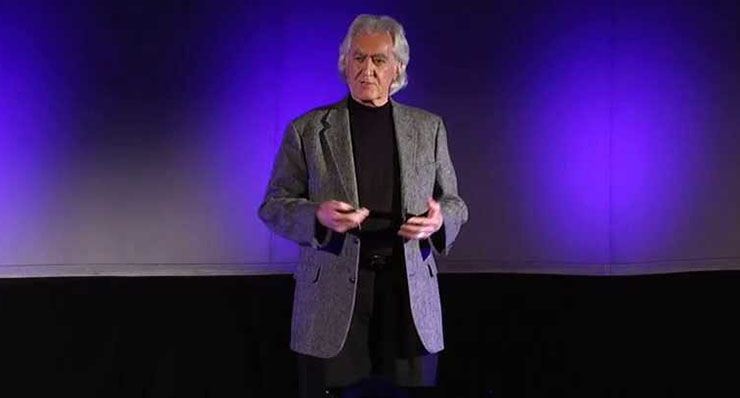
  • The Power of Premonitions: An Interview with Larry Dossey, MD

    The Power of Premonitions: An Interview with Larry Dossey, MD

    When Larry Dossey was in his first year of medical practice, he experienced a week of premonitions about patients, all of which came true. He later became intrigued by patients who were blessed with “miracle cures,” remissions that clinical medicine could not scientifically explain.

    Searching for an understanding of the interaction between mind, body and spirit, Larry Dossey embarked on a life-long study of religion, philosophy, meditation, oriental literature, parapsychology and quantum physics.

    Today, he is a respected leader in bringing scientific understanding to spirituality and an internationally influential advocate of the role of spirituality in healthcare and wellness.

    During his distinguished career as a practitioner of integrative medicine, he helped establish the Dallas Diagnostic Association and served as Chief of Staff of Medical City Dallas Hospital. The author of eleven books, including the New York Times bestseller Healing Words, he is executive editor of Explore: The Journal of Science and Healing.

    Dr. Dossey has lectured all over world and at major medical schools and hospitals in the United States – Harvard, Johns Hopkins, Cornell, and the Mayo Clinic, among others. A native Texan, he lives in Santa Fe, New Mexico.

    In the following interview, Dr. Dossey introduces his latest book The Power of Premonitions: How Knowing the Future Can Shape Our Lives, taking readers through documented cases of premonitions, an examination of recent science, and practical techniques for inviting premonitions.


    What’s your book about?

    Larry Dossey (LD): Premonitions – knowing what’s about to happen.

    What’s a premonition?

    LD: “Premonition” literally means “forewarning.” Premonitions are a heads-up about something just around the corner, something that is usually unpleasant. It may be a health crisis, a death in the family, or a national disaster.

    But premonitions come in all flavours. Sometimes they provide information about positive, pleasant happenings that lie ahead – a job promotion, where the last remaining parking place is, or, in some instances, the winning lottery numbers.

    A favourite example of yours?

    LD: Amanda, a young mother in Washington State, was awakened one night by a horrible dream. She dreamed that the chandelier in the next room had fallen from the ceiling onto her sleeping infant’s crib and crushed the baby. In the dream she saw a clock in the baby’s room that read 4:35, and that wind and rain were hammering the windows. Extremely upset, she awakened her husband and told him her dream. He said it was silly and to go back to sleep. But the dream was so frightening that Amanda went into the baby’s room and brought it back to bed with her. Soon she was awakened by a loud crash in the baby’s room. She rushed in to see that the chandelier had fallen and crushed the crib – and that the clock in the room read 4:35, and that wind and rain were howling outside. Her dream premonition was camera-like in detail, including the specific event, the precise time, and even a change in the weather.

    Why are premonitions about unpleasant things? Why don’t we have premonitions about winning the lottery, the right stocks to pick, or when to bail out of the stock market?

    LD: Most researchers believe premonitions are trying to do us a favour. They are mainly about survival. If you know that something life-threatening is approaching, you have a chance to avoid it. This would increase your chance of staying alive and reproducing – our evolutionary imperative. That’s probably why premonitions are often about threats to our existence, why they have become built into our biology, and why probably everyone has a premonition sense to some degree.

    Why did you write this book?

    LD: I actually tried not to write it. I largely ignored this stuff for years, but this didn’t work very well. My own experiences of premonitions grabbed me and wouldn’t let go.

    During my first year in medical practice as an internist, I had a dream premonition that shook me up and made me realise the world worked differently than I had been taught.

    Briefly, I dreamed about a detailed event in the life of the young son of one of my physician colleagues. It turned out to be so accurate it scared me. There was no way I could have known about the event ahead of time.

    Then patients of mine began telling me about their own premonitions. Even my physician colleagues would occasionally open up and share their premonitions with me. So I decided this was a well-kept secret in medicine that needed telling.

    The time is right for this book because science has come onto the premonitions scene. There are now hundreds of experiments that confirm premonitions, which have been replicated by researchers all over the world.

    So there’s a new story to tell. It’s no longer only about people’s experiences, but it’s also about science. Many people still think this stuff is just mumbo-jumbo and that there’s no science to back it up. It’s the “everybody knows” argument – “everybody knows” you can’t see the future, so proof of premonitions cannot possibly exist.

    That’s wrong. We now know we can see the future, because that’s what careful scientific studies show.

    If people can see the future, why don’t they get rich playing the stockmarket?

    LD: Some do. Bill Gates says, “Sometimes, you have to rely on intuition.” Oprah Winfrey says, “My business skills have come from being guided by my inner self – my intuition.” Donald Trump says in The America We Deserve, “I’ve built a multibillion empire by using my intuition.”

    George Soros, the billionaire investor, has all sorts of theories to back up his decisions. But according to his son, “At least half of this is bull… [T]he reason he changes his position on the market or whatever is because his back starts killing him. He literally goes into a spasm, and it’s this early warning sign.”

    Researchers have tested CEOs of successful corporations for their ability to see the future, such as predicting a string of numbers they will be shown later. The CEOs who are good at this are usually those who are also highly successful in running their corporations. In other words, their precognitive ability correlates with their corporate success. CEOs who did not have this ability tend to have mediocre success rates in their corporations. So business success and premonition ability seem to go hand in hand.

    In one study, experimenters were able to predict in advance the most successful corporate balance sheets by how well the CEOs did on tests that measured their ability to predict the future, such as a string of numbers they’d be shown later.

    This ability was not dependent on reason or logic or inference. You can’t “reason” and “analyse” what a randomly chosen string of numbers is going to be.

    Interestingly, these CEOs were shy about owning their premonition sense. They didn’t call their abilities premonitions, but good “business sense.” The polite word for premonitions in business is “business intuition.” There’s a growth industry in teaching business intuition. Google “business intuition” and you’ll come up with nearly a half million hits.

    Do premonitions work for people in business who are not CEOs?

    LD: Yes. I discuss several experiments in which people used their premonitions to make large sums of money in the silver futures market. One of these experiments was featured on the front page of the Wall Street Journal.

    So what keeps people from getting rich?

    LD: The limiting factor seems to be greed. When the subjects focused on making modest sums of money, the experiments worked; when they got greedy and tried to break the bank, the experiments flopped.

    This reminds us of what happened on Wall Street beginning in the fall of 2008. Nearly all the pundits say the primary underlying reason for the crash was unbridled greed.

    You talk about “evidence” for premonitions. But isn’t the evidence just anecdotes and people’s stories?

    LD: This field used to be only about stories, but that’s changed. There’s now a science of premonitions. For the first time in history, we can now use “premonition” and “science” in the same sentence.

    Take the “presentiment” experiments that have been pioneered by consciousness researcher Dean Radin. Briefly, a person sits in front of a computer, which will make a random selection from a large collection of images that are of two types – calming or violent. Calming images may be a lovely scene from nature; violent images deal with death, carnage, grisly autopsies, and so on. The subject has some physiological function being measured, such as the electrical conductivity of the skin or the diameter of the pupil. The bodily function begins to change several seconds before the image is randomly selected by the computer and shown on the screen. Here’s the shocker: the physiological change occurs to a greater degree if the image to be shown is violent in nature. How is this possible? How does the body know which image is going to be shown in the future?

    Dozens of these studies have been done by various researchers. They show that we have a built-in, unconscious ability to know the future. Somehow the body knows before our awareness kicks in.

    There’s a charming quotation in the book The Secret Life of Bees that captures this. Fourteen-year-old Lilly says, “The body knows things a long time before the mind catches up to them.”

    Another type of experiment is called “remote viewing,” in which people can consciously know highly detailed information up to a week before it happens. These studies were pioneered at Stanford Research Institute and have been replicated at Princeton University and elsewhere.

    How can we know when to take a premonition seriously?

    LD: If the premonition is about your health or if it involves images of death, it’s wise to take it seriously. You might not get a second chance.

    A patient of mine had a dream premonition of “three little white spots” on her left ovary. She feared this meant she had ovarian cancer. We checked it out. Her sonogram showed she was accurate; she indeed had three little “white spots” on her left ovary, but they were benign ovarian cysts, not cancerous. She did the right thing; she had a health-related premonition, and she checked it out.

    If the premonition is extremely vivid – if it seems “realer than real” – take it seriously.

    A cardiologist I know had a vivid dream that a patient of his had a stroke while he was doing a cardiac catheterisation, which was scheduled for the next day. He wondered whether he should cancel the study, but he told himself that dreams mean nothing and pressed ahead. The next day, while actually doing the catheterisation, his patient had a stroke in precisely the same pattern he dreamed. It shook him up and completely shifted his attitude about premonitions. Now he takes them seriously.

    People can become very skilled in knowing when to take a premonition seriously. They develop a refined sense over time. Practice makes perfect.

    What do your colleagues in medicine think about your book?

    LD: Nearly all of them are supportive. I’ve discussed premonitions with hundreds of physicians in lectures at medical schools and hospitals all over the country. I was hesitant at first, thinking they’d all probably get up and walk out. The opposite happens. They open up and share their own stories.

    Following a lecture at a Harvard-sponsored conference, one female internist told me, “I see numbers in my dreams – the actual lab values of my patients’ tests – before I even order them.”

    Dr. Larry Kincheloe, an OB-GYN in Oklahoma City, knows ahead of time when his patients are going to deliver because he gets strange feelings in his chest when the time is near. It’s like an alarm goes off. This is so reliable that the OB nurses caring for his patients have learned to ask him how his chest feels, as a guide to when a patient will deliver.

    This is like the presentiment experiments, in which the body knows something is going to happen and starts reacting before awareness kicks in. It’s a premonition in the form of physical symptoms.

    Nurses have been very supportive of my ideas. They are more open to premonitions than just about anyone. They spend more time at the bedside than doctors do. Over the years, nurses often become very precognitive. Many of them say they “just know” when a stable patient is going to have trouble, such as a cardiac arrest.

    The subtitle of your book is “how knowing the future can shape our lives.” How can it?

    LD: Knowing the future can help you have a future. Premonitions are often about survival. They warn us of future dangers – health problems, impending accidents, disasters, and so on.

    For example, research shows that people often avoid riding on trains the day they crash, compared to normal days. On days of the crash, the vacancy rate on the train is unusually high.

    This type of premonition is usually unconscious. People don’t say, “The train is going to crash. I’m cancelling my reservation.” They usually report a vague sense that something is wrong or doesn’t feel right, and they find some reason to change their plans.

    People may avoid doomed planes as well. The vacancy rate on the four planes that crashed on 9-11 was 79 percent. This suggests that lots of people found some reason not to travel on those planes that day. (We don’t know for certain what this means, however, because the airlines won’t release vacancy rates for travel on the same flights for the preceding months, so there’s no way to know for sure how unusual these high vacancy rates actually were.)

    But perhaps the main way premonitions affect our lives is by giving us a different way of thinking about our own consciousness, our own mind.

    I discuss experiments in which consciousness can operate both into the future and into the past. This suggests that time does not limit what our consciousness can do.

    This raises the possibility that our consciousness is timeless. This opens up the possibility of immortality and the survival of some aspect of our consciousness following death.

    Can we learn to have premonitions? Can we cultivate them?

    LD: Yes. The main thing is not to try too hard. Premonitions usually come unbidden. They largely “do” us; we don’t “do” them. So the trick is to invite them, not compel them, into your life.

    First, simply realise that these experiences are extremely common, and that it’s likely that you will experience them.

    Second, keep a dream journal, because premonitions occur most frequently during dreams. Record your dreams as soon as possible on waking. Most people find that premonitions become more frequent when they do this.

    Third, learn to quiet your body and mind. Sit down, shut up, be quiet, and pay attention. Some people call this meditation; others simply call it “getting quiet.” Research shows that skilled meditators perform better on premonition experiments than just about anyone. Meditation opens a door to premonitions and helps us notice them when they occur.

    Fourth, read about premonitions. What are they like for other people? This will help you recognise your own premonitions, and when to take them seriously.

    You say that most premonitions are unconscious?

    LD: Yes. Most premonitions occur in dreams. Dreams by definition are unconscious. And many experiments show that people’s bodies react to future events even before they happen, without their being aware of it.

    But if premonitions are largely unconscious, how can we make use of them?

    LD: Premonitions don’t have to be a detailed snapshot of the future, of which we’re fully aware, to be helpful. They can be just a hunch or a gut feeling that we act on without consciously knowing why.

    Some researchers believe unconscious premonitions are the most valuable kind.

    If we unconsciously know something is going to happen, we can react without processing this information by thinking about it. Thinking takes time. In dangerous situations we need to act quickly, immediately, without wasting time through reason and intellectual analysis.

    As a battalion surgeon in Vietnam, I knew many soldiers who swore they had some sixth sense that kept them alive by alerting them to danger. They’d react instantly without thinking, as if “on automatic.” I suggest they were using premonitions.

    I discuss an event in which an entire group of church members were late for choir practice one weekday night at a little church in Beatrice, Nebraska. The church exploded, and would almost certainly have killed them had they been there. The odd thing is that none of them had any conscious premonition that the explosion would occur, but they stayed away nonetheless. Being late was an unconscious behaviour, and it saved their life.

    This sort of behaviour is very common among mothers. They often have “just a feeling” their baby is headed for trouble, and they act on this impression without knowing why. The term “mother wit,” once very common, captured this idea.

    Is there a downside to premonitions?

    LD: Yes. Anything can be taken to extremes. I’ve known a few individuals who won’t make major decisions without consulting a psychic. They become slaves to somebody else’s premonitions about the future.

    Premonitions can be false. The mind plays tricks – sometimes dirty tricks. Hallucinations happen. Just like we can have false memories of the past, we can have false impressions of the future.

    So how can we avoid being misled by premonitions?

    LD: It’s pretty simple. Premonitions are a single way of knowing the future, not the only way. Whenever possible – in non-emergencies – we should rely on multiple sources of information – logic, reason, and analysis, plus intuition, hunches, and premonitions. Multiple strands of information help guard against bad decisions. When we rely on only one source of knowing, we can get into trouble. This is common sense: Don’t put all your eggs in one basket.

    Skeptics say we can’t know the future. When we appear to do so, it’s just a chance happening. What about this?

    LD: The skeptics have a point. No doubt some premonitions that seem to come true are nothing more than chance happenings or lucky hits.

    But to say that all the billions of people throughout human history who have experienced premonitions that turned out to be valid are deluded seems highly unlikely.

    Skeptics often single out examples of premonitions that are silly or nutty, then generalise to condemn all premonitions. This is irrational. Or they say that people have selective memories. They only remember the premonitions that come true, and forget those that don’t. This is simply not true; people often recall premonitions that don’t pan out.

    But even if valid premonitions are statistically unlikely, as the skeptics claim, that doesn’t necessarily mean they are false. Many things that are rare are nonetheless real. It is extremely unlikely that any particular individual can run a four-minute mile. But a few people can. It’s unfair to use statistics to dismiss rare events.

    Most skeptics are poorly informed. They simply ignore the experiments showing that people can sense the future, because these studies create huge holes in their arguments. Many skeptics will not be persuaded that premonitions are real, no matter how compelling the evidence is. Personal experience is probably the best argument against the skeptics of premonitions.

    I give several examples in which a skeptical spouse profoundly disagreed about whether or not his or her partner’s premonition should be taken seriously. But when the premonition came true, the skeptical spouse came around to a different way of thinking. An example is Amanda’s precognitive dream that a falling chandelier would crush their baby in its crib. The husband dismissed it as silly. But when she removed the baby from the crib and the chandelier actually fell and demolished the crib, precisely as she had dreamed, her doubting husband changed his tune.

    Cases like this suggest that the best evidence for premonitions is not argument or even experimental evidence, but personal experience.

    OK, so there’s evidence that premonitions are real. It’s still mind-boggling. How could these things possibly happen?

    LD: I agree that premonitions seem impossible – but only if we hold onto our common-sense beliefs about how the world works.

    Most people believe that our minds are confined to the present and to the brain and body. To make a place for premonitions, we have to go beyond these core beliefs. True, it seems as if we’re locked into our individual brains and bodies and the present, but the evidence from hundreds of experiments shows that this is an illusion.

    Scientists don’t really know what time is. We assume it flows in one direction, which prohibits premonitions. But no experiment in the history of science has ever shown that time flows in one direction, or that it flows at all. Alternative views of time are downright cordial to premonitions.

    For example, physicists talk about “closed time-like loops” that can carry information from the future into the present. This is one way premonitions might work.

    Others suggest that the future is already present, already laid out, in what is called a “block universe.” During premonitions, we might gain access to this already-present information.

    Other researchers suggest that the mind is nonlocal, which is a fancy word for infinite. According to this idea, consciousness is present everywhere in space and time. This means that we have access to all the information that has ever existed or will exist – past, present, and future. This opens the door for premonitions.

    These are all hypotheses, of course. The main point is that our common-sense ideas about time, space, matter, and our own minds are flawed. The universe works differently than we supposed.

    In view of our ignorance, we need to stay open to the evidence for premonitions and not fall back into our prejudices, as when skeptics say, “Everybody knows premonitions are impossible.”

    Often in science and medicine we know that something happens before we understand how it happens. Explanations sometimes come much later. So it may be with premonitions.

    If I can see the future, doesn’t that mean it is already in place and is fixed? Don’t premonitions do away with free will and freedom of choice?

    LD: No. Just because you glimpse how the future is likely to unfold does not mean you can’t act to change it. When Amanda dreamed that the chandelier fell and crushed her sleeping infant, she removed the baby from the crib. The chandelier did fall, but the baby’s life was saved. She exercised her freedom of choice, and it made a life-and-death difference. There are thousands of similar examples.

    Philosophers often argue against premonitions because they say premonitions destroy freedom of choice. But people who have premonitions usually don’t see it that way. Like Amanda, their personal experiences with premonitions say they do have a choice. They can act, and they do, to change the future they’ve glimpsed.

    I agree with the idea that the future is probable, not fixed. According to this view, the future is fluid and subject to change. So a premonition is not inevitable.

    Probability varies, of course. This means that some futures may be easier to change than others. It was easier for Amanda to act on her premonition and remove her baby from danger than for an individual to prevent an earthquake she dreamed about. Some futures may be so probable they will happen; others, perhaps most, are malleable.

    What’s the Big Lesson from premonitions?

    LD: Premonitions are an incredible gift. Although they are an aid to our physical survival, their main contribution is in providing us with an expanded vision of who we are and what our destiny may be. They show that we’re more than a physical brain and body. Brains can’t operate outside the present or beyond the body. But our consciousness can, as premonitions show.

    Premonitions reveal that we’re not slaves to the body or to the present. We can operate outside of time; something about us is timeless. The implications are quite wonderful, because they imply immortality. Not a small contribution.

    Dr. Larry Dossey’s website is www.dosseydossey.com. The Power of Premonitions: How Knowing the Future Can Shape Our Lives is available from all good bookstores.
    [alert type=”general” dismiss=”no”]This article was published in New Dawn Special Issue 9.[/alert]

    [alert type=”success” dismiss=”no”]If you appreciate this article, please consider a contribution to help maintain this website.[/alert]

    © New Dawn Magazine and the respective author.
    For our reproduction notice, click here.
  • The Psychics Who Predicted Fatima

    The Psychics Who Predicted Fatima

    This article was published in New Dawn Special Issue 9 (Sept 2009)

    It is a little known fact that, prior to their occurrence, the Fatima apparitions were predicted on the pages of at least four of Portugal’s most prominent daily newspapers. In the Lisbon newspaper, Diario de Noticias (Daily News), they were predicted on March 10th, two months prior to the first apparition on May 13, 1917. In Porto’s most important newspaper of that time, O Primeiro de Janeiro (The First of January), a front-page story dated two days before the occurrence of the apparitions was published on May 13th. In addition, it has been confirmed that bulletins published on May 13th in two more Porto newspapers, Jornal de Noticias (News Journal) and Liberdade (Liberty), announced that something “big” would be happening on that date.

    There are those who have pronounced these peculiar press releases to be part of a massive hoax, one perpetrated by the very parties that would ultimately benefit from the apparitions, presumably the hierarchy of the Catholic Church and devout adherents to the faith. We find this conclusion to be as unsatisfactory as it is trite. It simply makes no sense that a mystification of this nature, and on such a scale, would be announced in such a manner, in several daily newspapers.

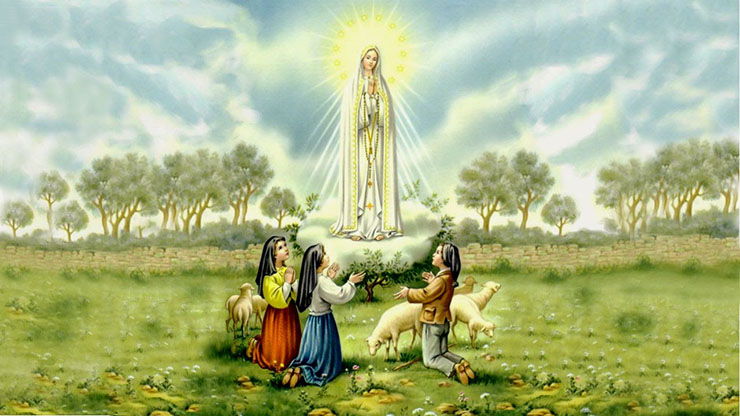
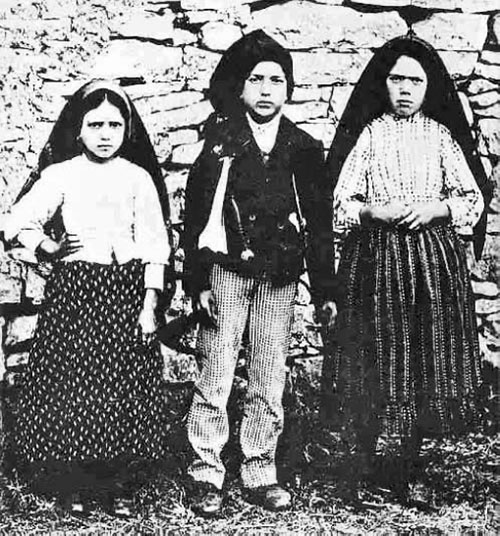
    The three child witnesses of the Fatima apparitions of May 13, 1917. From left, Jacinta Marto (age 7), Francisco (age 9), and Lucia Santos (age 10). Fatima, Portugal.

    An investigation into the origins and the content of these announcements suggests that they were what they appear to be, the work of two different self-described “spiritualist” groups of psychic individuals, located in the cities of Lisbon and Porto, both of which predicted that an event of historic significance would take place on that date. In one case, the prediction was made over three months before the events happened.

    Both groups felt so strongly about their premonitions that they decided to document them (so as to later prove their accuracy) by publishing their statements in the national news. There is no evidence linking these two groups of psychics with the events of the apparitions themselves. No connection has been found between these psychic groups, who were from the cities, and the rural child witnesses of the Fatima apparitions. Nor, for that matter, is there any trace of involvement by any other organised “cabal” in relation to the actual events witnessed by the three young shepherds.

    One of the only things absolutely clear about the mysterious apparitions of Fatima is that the unconventional, “psychic” methods by which these predictions about them were obtained are utterly offensive to conventional sensibilities. Atheists and devout Catholics alike disdain all things “psychic.” This stance lies at the heart of the confusion and controversy surrounding these curious news dispatches; it explains why the remarkable fact of the existence of these published predictions has languished in the twilight of neglect and obscurity for almost a century.

    We are talking about separate predictions of an “impressive event” that would occur on May 13, 1917, published in the national press of Portugal. The existence of these published announcements is not a matter of religious faith. Though relating to Scripture and interpretations thereof, the fact that these predictions appeared in print remains incontrovertible, however inconvenient and uncomfortable this may be for many people to accept. Whether or not one believes in the Fatima apparitions, the truth remains that these events were prognosticated in the newspapers, and can be easily verified today.

    The First Prediction

    I felt a heat throughout my arm, up to my shoulder… I had the impression that they were trying to get my attention. Without knowing why, I picked up a nearby pencil and piece of paper. My hand began to write in a script that was not my own.
    – Madame Keech

    The description above refers to a particular extra-sensory or “psi” phenomenon, well known to devotees of the occult as “automatic writing.” But what is astonishing is that Madame Keech’s hand had achieved a truly remarkable feat that evening. She wrote the words of the message that she dictated from right to left and inverted, so that they could only be read by placing the note in front of a mirror. Wait a minute, when and with who did this happen?

    In his booklet A Ray of Light on Fatima, published in 1974, Filipe Furtado de Mendonça describes the scene of this extraordinary event. He writes that on February 7th, a group of “spiritualists” was engaged in one of its regular meetings. This group included Carlos Calderon, a trance medium famous in Lisbon at the time. According to the tract, on this particular evening, one of the members of the group received a “message” by way of “automatic writing.” In the transcript, reproduced by Furtado de Mendonça together with facsimiles of the original pages of backwards script, we read that “one of the assistants (presumably that of Carlos Calderon) asked for paper and pencil and wrote automatically, from right to left, a message that could not be read unless it was placed in front of a mirror or bright light so that it could be read through the page.”

    It was by this unconventional means that this group of psychics received three months’ notice that something transcendental, with far reaching implications, was to occur on the coming 13th of May. But the content and the concrete significance of this message were rather inscrutable. It read:

    Judge ye not. He who would judge you would not be pleased with your prejudice. Have ye faith and be ye patient. It is not our custom to predict the future. The mystery of the future is impenetrable, though at times God permits a corner of the veil to be lifted over that which it covers. Have ye confidence in our prophecy. The day of May 13th will be one of great happiness for the good souls of the world. Have ye faith and be ye good. Ego Sum Charitas (“I am Love”). Always at your side shall ye have your friends, who will guide your steps and who will assist ye in your work. Ego Sum Charitas. The brilliant light of the Morning Star will illuminate the path. – Stella Matutina

    As can be seen in the photocopy of the original script published by Furtado de Mendonça, most of the message was written by the same hand, from right to left, and backwards. The message is for the most part transcribed in Portuguese, except for two repeated expressions, “Ego Sum Charitas,” as well as the signature, “Stella Matutina,” both of which appear in Latin. The last phrase and the signature, however, appear to be written normally, requiring no need for a mirror in order to be read. In addition, it should be noted that apparently this last phrase was written in different handwriting.

    It is no leap of faith to accept that this “automatic writing” session was in some way connected to the apparition events at Fatima, which, as predicted by the script itself, began on May 13th of that year. There is no other event in the history of that time and place that could be considered relevant or extraordinary enough to be identified as the occurrence that the gathering of psychics’ “revelation” referred to.

    Furthermore, this group was motivated to put notices in the press about their experience, and well in advance of the events of May 13th. An examination of the script shows that this is not an anonymous message from an unidentified, disembodied “dead guy.” The signature, “Stella Matutina,” is actually quite pompous. Who is Stella Matutina? Over the centuries, the “Morning Star,” or “Stella Matutina” in Latin, has referred to Venus, as well as to the Virgin Mary.

    In his book, Fatima, Antero de Figueiredo, unfamiliar with the “automatic writing” message described above, referred to Our Lady as “the Morning Star.” The alchemist Fulcanelli affirms, “the Celestial Virgin is still called Stella Matutina, the morning star,” because “it is c1ear to see in Her the splendour of a divine signal.”

    For the millions of people around the world who believe that it was Our Lady, Mary, the mother of Jesus Christ, who physically appeared at Cova da Iria on May 13th, we cannot help but wonder how the undeniably miraculous existence of the published predictions of these historic apparitions has remained completely below radar. Why has there been no apologetic book, nor any ecclesiastical sermon, nor any Episcopal document, to take up an argument either for or against this circumstance? Is it because the hierarchy of the Catholic Church and the dominant culture characterise spiritism as a “pseudoreligious practice”? Would Our Lady use a means of communication refuted by the very religious hierarchy that venerates her? All of these questions are quite perplexing; they touch on so many suppositions that have been accepted during the almost nine decades since the Fatima incident occurred.

    According to Furtado de Mendonça, “in order for there to be no doubt as to the veracity of the occurrence,” the group of psychics determined to set it down in the minutes of the meeting. It was also decided that a small announcement about the event should be published in the Diario de Noticias. If one views a copy of this newspaper from March 10, 1917, the announcement appears on page 4, column 13, with the headline “135917,” which indicates “13 May 1917.” As we all now know, it would transpire on that day that an apparition of a “Lady,” reportedly about three-and-a-half feet in height and appearing to be 15 years of age, would initiate the most important series of Marian apparitions of the 20th century.

    The Message Received In Porto

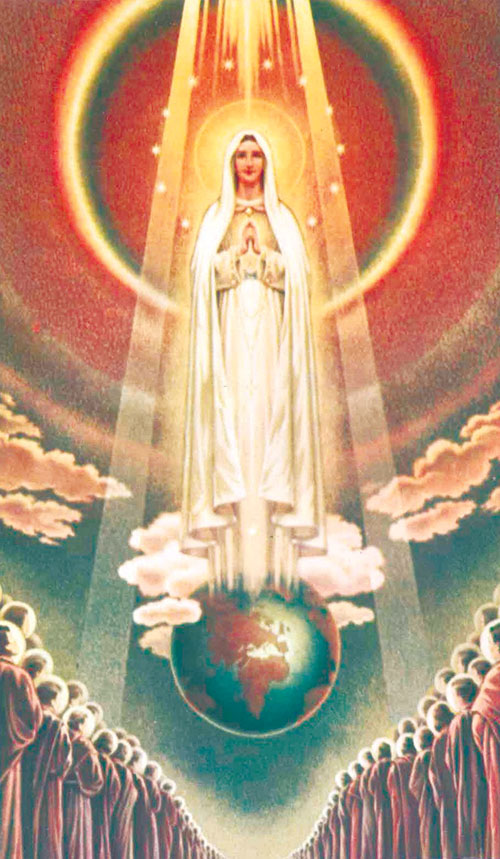
    The Fatima apparitions of 1917 led to a whole ’industry’ devoted to the Virgin Mary that is still going strong today.

    The announcement in the March 19, 1917 edition of the Lisbon daily newspaper, Diario de Noticias, is by no means the only historic proof of a precognition of the phenomena that would visit Fatima. As it turns out, another group of psychics in Porto also received the same distinct foreknowledge that “something transcendental” was about to occur on the 13th day of May.

    In fact, this prediction was not revealed in unimportant newspapers with small circulations, but in the editions of the major dailies of that city and, indeed, throughout Portugal – including O Primeiro de Janeiro (which at that time had the largest circulation in Northern Portugal), the Jornal de Noticias, and Liberdade – on May 13, 1917. On that day, these three newspapers (perhaps there were others) published a text dated two days previously, signed by a psychic named Antonio, a resident of Porto. The essence of his prediction was: “On the 13th of this month, there will occur an event, with respect to the war, that will strongly impress all the world.”

    In the Jornal de Noticias, the treatment is that of a “Sensational Revelation,” written in bold black letters, with text relating the events of the world war to events occurring on the “Spiritual Plane.” In the other newspapers, the journalists make humorous commentaries. (As can be seen, psychic prophets were as unacceptable to the mainstream pundits of that era as they are to today’s professional skeptics).

    In the newspaper Liberdade, it was said, with a tone of mockery, that on the 13th of May, something important “with respect to the war, of great transcendence and great consequences, would occur. If this does not take place, then the psychics and their material incarnation will be discredited!” The unsuspecting journalist had inadvertently read more into the posting than he professed. In addition, he revealed himself to be a prophet, in his own right, by adding his own words, “great transcendence and great consequences” to the posting, which is, in actuality, what did come to pass in the apparitions of Fatima!

    A well-known journalist of the time, Guedes de Oliveira, who wrote for O Primeiro de Janeiro, commented in depth on the content of Antonio’s posting. In this newspaper, the revelation comes on the front page, under the headline, “Spiritualism.” It is an in-depth feature article, eerily commensurate with the magnitude of what eventually came to pass.

    Guedes de Oliveira (Henrique Antonio, 1865-1932) is a personage whose biography can be read in the Grande Enciclopédia Portuguesa e Brasileira (Great Encyclopedia of Portugal and Brazil). An anticlerical Republican during the time of the monarchy, he was a dramatic writer, an award-winning and internationally acclaimed photographer, and the Director of the School of Fine Arts in Porto. He had a degree in architecture, and a house that he built still stands, inhabited by his descendants, in the town of Rio Tinto, where both a street and an alley were named after him.

    After publishing the bulletin, as transcribed previously from the Jornal de Noticias, preceded by the words, “I have just received the sensational information,” the renowned journalist gave shape to the ideas that follow. We have taken an extract of his words and italicised certain portions, to highlight the strangeness of certain words, which appear to transcend the significance of the received message:

    Today is the 13th and I do not know if, as of yet, our readers have set their compassionate eyes upon the words of the spiritualist, Mr. Antonio. The predicted event will have taken place and all of us will be so deeply impressed, as if an abyss had opened up beneath our feet. The intervention by those who exist beyond matter, in that which over the crust of the Earth is now occurring, cannot be of no consequence to us, and it is with true alarm that I receive this information from a zealous promoter of the truth. I never thought that we could be in such close communication with beings from another world.

    Guedes de Oliveira confirms that he had received the magazine, Luz nas Trevas (Light in the Darkness), edited by a spiritualist group. Take note that the journalist never refers to the world war, as written in the news bulletin, but always to another event. He emphasises:

    But now with the letter from Mr. Antonio, I confess that all I lack is the announced event, in order to also create a light in the darkness of my soul. What mysterious forces would these be who act upon terrestrial things, with their inexplicable influence? How are they able, for example, to levitate a cast iron table, without any physical contact?

    Later on, in a postcard, Guedes de Oliveira expresses ideas, which are, at the very least, curious, and which we would judge improbable for someone with anti-clerical leanings to have written:

    Is it not an accepted truism that the end justifies the means? Who tells me that this principle, so German in nature, waited until the 13th, which is today to manifest, as announced by Antonio, in a manner that will strongly impress all the world? What kind of table will we see raising itself?

    Almost a century later, we see that the events of Fatima continue to “strongly impress all the world,” regardless of what belief or interpretation we project on them. “What kind of table will we see raising itself?” he asks. In the end, we did not see a table raise itself, although de Oliveira uses the term “table” in a figurative sense, preceded by the expression “kind of.” But on this day, in an obscure little village, we did, indeed, see an altar of world renown raise itself, “The Altar of the World,” as Fatima is popularly known.

    Could this web of circumstances be the product of mere chance? Independent from the conjectures about the origins of the phenomena – and of the supposed and implied “agents” involved – could one possibly consider that this chain of events corresponded to a logic, which was ultimately informed and programmed, down to the tiniest details, by non-human “beings,” distinct from cultural representations of “disincarnate spirits” or the Marian model of Catholic thought?

    We reflect on all of this – but always keep in mind our own “bias.” In any case, we feel comfortable conceding victory to the Lisbon psychics, who “channelled” a prediction of the events of May 13th. Their victory is of a kind that transcends simple acceptance or rejection, regardless of their subjective beliefs – and regardless of our feelings about their beliefs.

    Adapted from Chapter 1 of Celestial Secrets: The Hidden History of the Fatima Cover-up by Joaquim Fernandes and Fina d’Armada.

    [alert type=”success” dismiss=”no”]If you appreciate this article, please consider subscribing to help maintain this website.[/alert]

    © New Dawn Magazine and the respective author.
    For our reproduction notice, click here.
  • Human Devolution: Ascended Apes or Fallen Angels?

    Human Devolution: Ascended Apes or Fallen Angels?

    “By next Friday evening they will all be convinced that they are monkeys,” wrote Thomas Henry Huxley to his wife Henrietta. The year was 1860, and on June 30, Huxley would confront Samuel Wilberforce, Bishop of Oxford, in one of history’s most famous debates. The topic was Charles Darwin’s theory of evolution.

    Samuel Wilberforce despised Darwin’s theory, published the previous year in The Origin of Species, and he was determined to demonstrate its shortcomings. Although a bishop of the Church of England, Wilberforce knew something of science. He was a lifelong student of natural history, and he served as a vice president of the British Association for the Advancement of Science. He had also been on the governing council of the Geological Society of London, and he knew well several leading scientists of his day, such as geologist Charles Lyell, one of Darwin’s chief supporters, and biologist Richard Owen, one of Darwin’s chief opponents.

    At the invitation of the editor of the influential Quarterly Review, Wilberforce had written a negative critique of The Origin of Species. It was not printed until after the Huxley-Wilberforce debate, but when it finally did appear, Darwin himself called it “uncommonly clever.”

    In his review, Wilberforce (1860) first attacked Darwin on scientific grounds. In The Origin of Species, Darwin had argued that living things tend to vary slightly in the course of reproduction. After giving examples from bird and animal breeding, Darwin contended that over vast periods of time, aided by natural selection, such variation could lead to the origin of new species. But Wilberforce noted that the variations obtained in breeding pigeons, dogs, and horses were not changes in the basic physical structure of these creatures, such as required for the production of new kinds of organisms. Pigeons remained pigeons, dogs remained dogs, and horses remained horses. Turning to metaphysics, Wilberforce argued that such human qualities as free will and reason were “equally and utterly irreconcilable with the degrading notion of the brute origin of him who was created in the image of God.”

    Huxley’s Triumph

    On June 30, at the British Association for the Advancement of Science meeting in Oxford, Dr. J. W. Draper of New York read a paper titled “Intellectual Development of Europe Considered with Reference to the Views of Mr. Darwin.” Expecting fireworks, seven hundred attentive hearers had packed the lecture hall. After Draper finished his talk, several persons offered comments. Finally, Wilberforce spoke, attacking Darwin’s theory. His confident words mirrored those that would later appear in his Quarterly Review article on The Origin of Species. Attempting to draw a laugh, he wondered “if any one were willing to trace his descent through an ape as his grandfather, would he be willing to trace his descent similarly on the side of his grandmother?”

    Huxley leaned toward one of his companions and said, “The Lord hath delivered him into my hands.” When he was called to speak, Huxley delivered his famous retort, quoted in many books about evolution. Declaring that he felt no shame in having an ape for an ancestor, he added, “If there were an ancestor whom I should feel shame in recalling, it would rather be a man – a man of restless and versatile intellect – who, not content with success in his own sphere of activity, plunges into scientific questions with which he has no real acquaintance, only to obscure them by an aimless rhetoric, and distract the attention of his hearers from the real point at issue by eloquent digressions and skilled appeals to religious prejudice.” The audience, won over by Huxley, broke into loud applause. In their opening skirmish, the apes had prevailed over the angels.

    On the Side of the Angels

    The angels, however, still had some highly placed advocates. On November 25, 1864, Benjamin Disraeli, then chancellor of the exchequer and soon to be prime minister, said at a speech at the Sheldon Theatre in Oxford: “The question is this – Is man an ape or an angel? My Lord, I am on the side of the angels. I repudiate with indignation and abhorrence the contrary view, which is, I believe, foreign to the conscience of humanity: more than that, even in the strictest intellectual point of view, I believe the severest metaphysical analysis is opposed to such a conclusion. But what does the Church teach us? What is its interpretation of the highest nature? It teaches us that man is made in the image of his Creator – a source of inspiration and of solace from which only can flow every right principle and every Divine truth… It is between these two contending interpretations of the nature of man [ape or angel], and their consequences, that society will have to decide.” But Oxford University had already decided. Disraeli’s remarks, especially the one about being on the side of the angels, met with loud disapproving laughter which today still echoes with increased volume in the halls of academia.

    Disraeli’s unsympathetic university audience had two components. First, there were theologians who had given up a literal reading of the Bible.
    Second, there were scientists who were also rejecting biblical literalism, from the standpoint of Darwinism. They both reacted with dislike to Disraeli’s talk of angels. Indeed, it was the unwitting alliance between these two groups that insured the relatively quick triumph of Darwinism over the Wilberforces and Disraelis of Victorian England. Within a few decades, most of the educated persons of England, and the world, whatever their religious or cultural heritages, would accept that human bodies were not direct creations of God in His image but were instead the modified bodies of apes. Disraeli’s statement that he was “on the side of the angels” is often inserted, as an amusement, into books on evolution, and so is a satirical Punch cartoon of Disraeli dressed as an angel.

    But what exactly did Disraeli mean when he spoke of being on the side of the angels? Was this merely a metaphor, pointing to some vague involvement of God in the origin of the human species? Given the intellectual climate of his times, one is tempted to answer the question positively. For most intellectuals, God had already retreated from the visible universe, taking the role of a detached clockmaker who set a strictly material machine in motion and left it running. But a deeper study of Disraeli’s writings lends support to a more literal reading of his remarks.

    In Lord George Bentinck: A Political Biography, Disraeli spoke fondly of “the early ages of the world, when the relations of the Creator with the created were more intimate than in these days, when angels visited the earth, and God Himself even spoke with man.”

    Similar passages can be found in Disraeli’s novels, which were fairly transparent vehicles for his own political, philosophical, and spiritual convictions. In Tancred, published in 1847, his visionary hero, a young Victorian aristocrat, has the following exchange with a bishop of the Church of England.

    “‘The Church represents God upon earth’, said the bishop.

    “‘But the Church no longer governs man’, replied Tancred.

    “‘There is a great spirit rising in the Church’, observed the bishop with thoughtful solemnity…. ‘We shall soon see a bishop at Manchester’.

    “‘But I want to see an angel at Manchester’.

    “‘An angel!’

    “‘Why not? Why should there not be heavenly messengers, when heavenly messages are most wanted?’”

    Tancred then proceeds on a spiritual quest to Jerusalem. While in Palestine, he ascends Mt. Sinai by night and is visited by an angel “vast as the surrounding hills.” After identifying himself as “the angel of Arabia,” the angel says, “The relations between Jehovah and his creatures can be neither too numerous nor too near. In the increased distance between God and man have grown up all those developments that have made life mournful.”

    Eventually, Tancred forms a plan to revitalise Europe by first restoring the spiritual purity of Asia. “When the East has resumed its indigenous intelligence, when angels and prophets shall again mingle with humanity, the sacred quarter of the globe will recover its primeval and divine supremacy; it will act upon the modern empires, and the faint-hearted faith of Europe, which is but the shadow of a shade, will become as vigorous as befits men who are in sustained communication with the Creator.” Disraeli’s vision of a Creator and his angels constantly interfering with the world is far less compatible with Darwinism than the vision of a Creator who keeps his angels in heaven and his hands off the world.

    Given his mystical tendency, it is not surprising that Disraeli disliked materialistic evolutionary theories. Tancred appeared before Darwin’s The Origin of Species, but in it Disraeli satirised Robert Chambers’s Vestiges of Creation, which also expressed evolutionary ideas.

    Before setting off to the East, Tancred developed a temporary affection for beautiful young Lady Constance, whom Tancred regarded as his spiritual guide. One evening Lady Constance spoke to him with effusive praise about a book titled, presciently, The Revelations of Chaos.

    “‘To judge from the title, the subject is rather obscure’, said Tancred.

    “‘No longer so’, said Lady Constance. ‘It is treated scientifically; everything is explained by geology and astronomy, and in that way. It shows you exactly how a star is formed; nothing can be so pretty! A cluster of vapour, the cream of the milky way, a sort of celestial cheese, churned into light, you must read it, ’tis charming’.

    “‘Nobody ever saw a star formed’, said Tancred.

    “‘Perhaps not. You must read the Revelations; it is all explained. But what is most interesting, is the way in which man has been developed. You know, all is development. The principle is perpetually going on. First, there was nothing, then there was something; then, I forget the next, I think there were shells, then fishes; then we came, let me see, did we come next? Never mind that; we came at last. And the next change there will be something very superior to us, something with wings. Ah! that’s it; we were fishes, and I believe we shall be crows. But you must read it’.

    “‘I do not believe I ever was a fish’, said Tancred.

    “‘Oh, but it is all proved; you must not argue on my rapid sketch; read the book. It is impossible to contradict anything in it. You understand, it is all science; it is not like those books in which one says one thing and another the contrary, and both may be wrong. Everything is proved: by geology, you know. You see exactly how everything is made; how many worlds there have been; how long they lasted; what went before, what comes next. We are a link in the chain, as inferior animals were that preceded us: we in turn shall be inferior; all that will remain of us will be some relics in a new red sandstone. This is development. We had fins; we may have wings…’

    “‘I was a fish, and I shall be a crow’, said Tancred to himself, when the hall door closed on him. ‘What a spiritual mistress! And yesterday, for a moment, I almost dreamed of kneeling with her at the Holy Sepulchre! I must get out of this city as quickly as possible.’”

    Lady Constance presents the perfect picture of someone barely hanging on to “the faint-hearted faith of Europe, which is but the shadow of a shade,” all too ready to be swept aside by the new prophets of evolution. The unfriendly reception Disraeli got from the dons at Sheldon Theatre in Oxford is proof of that. A world in which God, angels, and miracles have retreated beyond the most distant borders of material reality was ripe for rapid conquest by Huxley and Darwin.

    But while in Syria, Tancred encountered a lady whose faith was anything but insipid; indeed, she manifested a faith in things too intensely mystical for even himself. The lady was Astarte, Queen of the Ansareys. Astarte took Tancred into a secret sanctuary cut out of solid rock in an isolated ravine. There he saw an “elegant hierarchy” composed of “goddess and god, genius, and nymph, and faun.” Tancred thought them to be the gods of the Greeks, but Astarte called them the gods of her own people, who once ruled from ancient Antioch. The chief goddess was Astarte, her own namesake.

    “When all was over,” said the Queen, “when the people refused to sacrifice, and the gods, indignant quitted earth, I hope not for ever, the faithful few fled to these mountains with the sacred images, and we have cherished them.” She expressed a lofty hope that “mankind will return again to those gods who made the earth beautiful and happy; and that they, in their celestial mercy, may revisit that world which, without them, has become a howling wilderness.” If Disraeli’s vision of an active God and angels, voiced directly by himself and indirectly through characters like Tancred, is hostile to Darwinian evolution, how much more so the vision of Astarte.

    Yet Astarte’s vision of a cosmos permeated with gods and goddesses once ruled Europe. These gods and goddesses were intimately involved in a temporal process of bringing into being other creatures within the universe. The universe was like a living mystical factory filled with subtle machinery, operated by subtle beings, who cooperated in the production of plants, humans and animals. Then came Christianity. At first, Christianity simply replaced the pagan gods and goddesses with angels. But by gradually deemphasising the role of angels, Christianity depopulated the cosmos. The visible universe became a lifeless clocklike machine that a distant creator God mysteriously built and set in motion. As far as living things were concerned, they were also machines. Mechanistic science took the final step of removing the mystery of their manufacture. They were not the instantaneous ex nihilo creations of the distant clockmaker, but part of a temporal material process running within the machine of the universe itself. That temporal process was evolution, guided by natural selection. In the universal scheme of life, the great clockmaker became a barely tolerated supernumerary, useful only for maintaining social order and public morality.

    So man was ape, not angel. Nevertheless, there are still a great many people who take Disraeli’s side of the great question. For example, on July 13, 1994, Naomi Albright, author of several books about her contacts with angels, related to me this encounter: “I had entered into a state of consciousness that I call ‘living vision’. A living vision is not like something imagined. It is perfectly clear to you that you are there live and in person. In this state, an angelic being appeared before me. He said I should call him ‘Lighter than Light’, as his real name would be unpronounceable by me. After identifying himself as an angel, he told me that I should accept the fact that I had been one of them, an angel, since the Beginning, but that I had come down to the human form, and had been reincarnating on this level for a long time.” Experiences such as this point back to the cosmos of Disraeli, with its God and angels, its gods and goddesses, all somehow linked to human origins and destinies.

    Altered States of Consciousness

    Cultural anthropologists might call Albright’s “living vision” and angel encounter “an altered state of consciousness” (ASC). Such ASC reports are widespread. Anthropologist E. Bourguignon surveyed 488 world cultures and found that 90 percent of them have well-developed experiences of such altered states. These would include, for example, the experiences reported by shamans, who regularly contact spirit beings in their trances. Albright’s angel-contact testimony shows, however, that ASCs are not confined to tribal peoples. Modern accounts of contacts with alien beings in connection with UFO experiences provide another example of ASCs from advanced cultures.

    Many cultural anthropologists and clinical psychologists studying ASCs in non-Western cultures classify them as psychopathological – as neurotic or psychotic departures from normal consciousness, as defined by Western psychology. A more charitable approach dispenses with Western psychopathological interpretations and evaluates ASCs as normal or abnormal according to the standards of the culture in which the states occur.

    In modern civilised societies, persons claiming to be in contact with a spirit being, and acting as if this were so, would be labelled psychotic. But in many other societies such claims and behaviour would be considered normal, perhaps even prestigious. Nevertheless, most psychologists and anthropologists, although dispensing with negative descriptive language, would not normally regard contact with an angel, spirit, or UFO entity as real, in the sense of the human subject actually contacting another existing personality. At most, those taking a Jungian point of view would say that there is contact with a real archetype from the human subconscious.

    But some anthropologists are now considering a different approach. Katherine P. Ewing, a professor of cultural anthropology at Duke University, has raised the issue of positive belief as a valid stance for an anthropologist to take in relation to reports of paranormal phenomena. While engaged in researching Sufism in Pakistan, Ewing met a Sufi saint. This saint told her that he would come to her while she was sleeping. When this in fact occurred, in what Ewing took to be a dream, she felt someone touch her. The sensation was so real that, startled, she awoke sitting upright on her bed. In order to maintain her self-image as a professional anthropologist, she resisted what she called “the temptation to believe.” She found herself instinctively “placing the phenomenon immediately within a psychological interpretive scheme in which dreams come only from the dreamer’s internal states.” In other words, she convinced herself that the saint had not actually come to her in the dream. But she noted, “To rule out the possibility of belief in another’s reality is to encapsulate that reality and thus, to impose the hegemony of one’s own view of the world.” A better approach to experiences that challenge the worldview of Western science would be, she contends, to “take them seriously and allow them to play a role in shaping what are ultimate realities we share as participants in a global human community.”

    When this step is taken, we find ourselves confronted with a wealth of empirical evidence that tends to support the worldviews of traditional cultures. When this evidence is taken into account, it would appear that human beings are not modified apes who arose on this planet by a process of physical evolution. Instead we are fallen angels, beings who came to this planet by a process of devolution from spiritual forms that preexisted in another dimension of reality.

    As Lord Krishna says in the Bhagavad Gita (15.7), “The living entities in this conditioned world are My eternal fragmental parts. Due to conditioned life, they are struggling very hard with the six senses, which include the mind.” God is an eternally conscious person, and the living entities are also eternally conscious persons. In their original state, the deathless living entities exercise their free will to act in connection with God, in the pleasure-filled realm of pure spiritual energy. Some of the living entities, however, misuse their free will to act independently of God. Attracted by the material energy, they become covered by bodies composed of mind and matter. In this state, their natural freedom is constrained by the conditions imposed upon them by their bodies, with which they struggle to enjoy the material energy, in a cycle of repeated births and deaths. It is possible, however, for such living entities to regain their deathless and blissful spiritual state.

    Reprinted with permission from Michael Cremo’s book Human Devolution: A Vedic Alternative to Darwin’s Theory (Torchlight Publishing, 2003).
    [alert type=”general” dismiss=”no”]This article was published in New Dawn Special Issue 8.[/alert]

    [alert type=”success” dismiss=”no”]If you appreciate this article, please consider a contribution to help maintain this website.[/alert]

    © New Dawn Magazine and the respective author.
    For our reproduction notice, click here.
  • The Vedic Literature of Ancient India and Its Many Secrets

    The Vedic Literature of Ancient India and Its Many Secrets

    This article was published in New Dawn Special Issue 8 (June 2009)

    Secrets of ancient humanity and lost civilisations can be found all over the world. Yet they are perhaps most common in India, where even today the spiritual practices of the ancient world continue with its characteristic regard for the sacred. The same type of temples with similar forms of ritual worship that were known in ancient Egypt, Babylonia, or Greece thousand of years ago still occur throughout India today from Badrinath in the Himalayas to the north to Kanyakumari in the south. Indeed, it seems that the ancient world never ended in India but has continually maintained and, at times, reinvented itself.

    Spiritual and occult arts such as abounded in the ancient world – including Yoga, Vedic astrology, Ayurvedic medicine and the use of rituals (Yajnas) to improve all aspects of our lives – remain commonly used and are honoured by the culture of India as a whole. We could say that India is a living museum of the ancient world and its lost civilisations.

    To understand the ancient world, it may be better to visit the holy places of India where the ancient traditions are still unbroken, rather than try to interpret ancient ruins through bricks and pottery shards, which scholars today usually do so according to their own modern mindsets, not recognising the all-pervasive regard for the sacred that was the basis of ancient life and culture.

    Most notably, ancient India presents us with by far the largest literature that has survived from the ancient world. The Vedic literature of India, by all accounts dating from well before the time of the Buddha (500 BCE) and by traditional accounts extending back well over five thousand years (3100 BCE), covers several thousand pages. This is with the four Vedas (Rig, Yajur, Sama and Atharva), their various Brahmanas, Aranyakas and Upanishads.

    The Vedas contain many ancient poems, commentaries, dialogues and teachings, of which the famous Upanishads and Bhagavad Gita – the bedrock of Indian philosophy and Yoga – represent only the last layer or a late summation. There is no comparable ancient literature remaining from any other country, much less an ongoing tradition of its interpretation and application according to both ritual and meditation.

    The Vedas are not directly concerned with history or with the mundane aspects of culture. Yet a mentioning of these does occur in a peripheral way in the texts. In the Vedas, we can find references to the names of peoples, places and to certain events. Beside the deep spiritual knowledge, there are indications of astronomical, mathematical and medical knowledge of a profound order. There are also indications of natural disasters like floods, earthquakes, the melting of glaciers and the shifting of rivers, with a cataclysmic sense of life based upon a long experience of Nature’s changes.

    Yet, even by way of understanding their spiritual side, it requires a deeper vision to appreciate the Vedas. The Vedas are composed in a cryptic ‘mantric code’ that cannot be understood without the proper orientation and right keys. Vedic mantras were said to have been cognised by great yogis and seers from the cosmic mind. They reflect a different type of language in which the higher truth is deliberately hidden in a veil of symbols, sacred sounds and correspondences. What may appear outwardly as a seeking of cows and horses, for example, can inwardly refer to a development of higher powers of the senses (cows) and pranas or vital energies (horses). In fact, Vedic words have many layers of meaning, of which the surface appearance can be misleading, particularly to the modern mind not used to such a multidimensional language. This is also a phenomenon that we find throughout the ancient world. The ‘Egyptian Book of the Dead’, for example, abounds in similar symbols that unless we can grasp the spiritual meaning, which few may be willing to look for, can appear quite superstitious.

    The Vedas say, “The Gods prefer the cryptic and dislike the obvious.” The higher powers speak in symbols, riddles, paradoxes or conundrums. The Vedas speak of four levels of speech, of which ordinary human beings only know and speak with one (Rig Veda I. 164.45). They refer to a Divine Word or imperishable syllable on which they are based (Rig Veda I. 164.39). They reflect a pattern of cosmic sound that underlies all the laws of the universe and has its counterparts on all levels of both individual and cosmic manifestation. For this reason, the Veda was called the Shruti, or ‘revelation’ behind the Hindu tradition.

    The Vedas speak of secret meanings to their mantras that were veiled to protect the teaching from its application by the spiritually immature. To receive the key to the Vedic mantras required years of work of ascetic practices, mantras, yoga, meditation, special initiations and the special favour of a teacher who knows the tradition and has realised the teaching in his own deeper consciousness. We cannot expect such cryptic mantras to unlock their secrets to a casual reading, particularly done in limited or bad translations in a language and mindset quite alien to the Vedic or ancient world view.

    Modern scholars, particularly from the West, have not been able to decipher this Vedic code. Most have not even recognised that it exists. This is not surprising because scholars have largely failed to understand the deeper meaning of the symbols of ancient Egypt, Sumeria, Mexico and other ancient cultures.

    Ancient cultures like India and Egypt were carrying on great traditions of spiritual and occult knowledge, not just the rudiments of technology, trade or empire building.1 Since modern scholars have little background in that spiritual knowledge, with its recognition of higher states of consciousness extending into the Infinite and Eternal, naturally they cannot find it in symbols in which it is specially encrypted.

    Scholars look upon the Vedas, just like the Egyptian religion, as little more than primitive nature worship, though the nature symbols like Fire in the Vedas have a vast cosmic symbolism and connect to the fire of the breath, the fire of the mind, the fire of consciousness and the Cosmic Fire through which the entire universe exists.2

    This failure to understand the ancient literature is often related to a failure to understand ancient archaeological ruins and their implications. Ancient sites abound in artefacts that reflect the same type of spiritual symbolism of the ancient literature. These are usually dismissed as fetishes rather than looking for any deeper meaning.

    Once we have decoded the mantric and symbolic nature of the Vedic language, Vedic literature can help us understand the ancient world and the ancient mind, its symbols, rituals and aspirations, as well as the legacy and heritage that it has left for us. But it requires that we approach the ancient teachings with an honouring of the sacred, a respect for our elders and gurus, a regard for our ancient human spiritual heritage and a devotion to the cosmic powers of the greater Conscious Universe.

    The Living Vedic Tradition

    The Vedic tradition remains alive and many great modern yogis have given their comments on the Vedas and have revealed some of the Vedic secrets in the modern world. Sri Aurobindo (1872-1950), perhaps modern India’s greatest philosopher, among his voluminous writings wrote several books on the Vedas and translated many Vedic hymns according to an inner yogic meaning.3 Many of his disciples like Kapali Shastri, M.P. Pandit and R.L. Kashyap have expanded this work.

    Ganapati Muni (1878-1936), the chief disciple of the great Indian guru Ramana Maharshi, left a number of important Sanskrit works on the Vedas, as did his disciple Brahmarshi Daivarata.

    Swami Dayananda (1828-1886), founder of the Arya Samaj, the largest modern Hindu sect, based his entire movement on a return to the Vedas and a recognition of a deeper spiritual and scientific knowledge in Vedic texts, a task which many of his disciples have expanded in a number of books, teachings, research and schools.

    Maharishi Mahesh Yogi (founder of the Transcendental Meditation or TM movement), based his work on the Vedic mantras and through them promoted a renaissance of all the Vedic sciences including Ayurveda, Vedic astrology and Vastu.

    Other great modern Yogis like Paramahansa Yogananda, author of Autobiography of a Yogi, have spoken of the greatness of the Vedas, their antiquity and the Vedic culture as the one of the main sources for ancient civilisation and world spirituality, though they have not written specifically on the Vedic texts themselves.

    The Theosophical Society, also, particularly in the writings of H.P. Blavatsky, similarly affirmed the deeper meaning of the Vedas. She wrote of the Vedas as having been composed by the rishis mainly when they resided by the Manasarovar Lake by Mount Kailas in Tibet.

    Such a view of the Vedas as a great spiritual treasure house of great antiquity remains at odds with dominant academic views that regard the Vedas as a primitive product of invading nomads into India around 1500 BCE, the so-called ‘Aryan Invasion theory’. This theory proposed the Vedic people, whom they called Aryans, were a white skinned racial group from Central Asia who invaded and destroyed the native cultures of India, bringing in the Vedic literature along with them. Though this theory has never been proved or linked to any conclusive evidence on the ground, it has not been abandoned by textbooks either. It has been reduced from an invasion to a migration and now to largely only a language change but still seems to persist in one form or another.

    This theory of the Vedic culture as originally based outside of India was first proposed by western scholarship a few centuries ago to explain connections between languages of India and Europe, the Indo-European family of languages that show many connections of grammar and etymology. An equally valid theory, however – and one which agrees more with both the literary and archaeological data – would have such linguistic influences derive from India and its nearby regions.4 But during the colonial era, when the Aryan Invasion idea was formed, India as a source of western culture or languages was not such an appealing idea!

    The Vedic tradition, we should note, has its own view of history. While the Vedas themselves as religious works do not contain specific or complete historical accounts, the Puranas, another set of ancient Indian literature, has a list of over a hundred kings going back before the time of the Buddha and a delineation of many dynasties from throughout greater India going back to Manu, the primal king at the time of a great flood.

    More importantly, Vedic and Puranic literature speaks of previous world ages called yugas and kalpas, extending back many tens of thousands of years and connected to astronomical cycles of various types going back millions of years. They hold that our current civilisation is neither the first, nor the highest. In fact, they regard it as a fallen materialistic culture of low spiritual development. Vedas and Puranas also speak of contact with beings of other worlds, both in subtle realms and other physical planets, regarding true human civilisation as linked to the greater universe. Such ideas of human history as determined by cosmic time cycles are shared by many other ancient cultures like Egypt, Babylonia, Greece and Mexico and are characteristic of ancient thought as a whole.

    Sri Yukteswar, guru of Paramahansa Yogananda, in his Holy Science relates the fifth and last Manu or founder of Indian civilisation to a period that ended around 6700 BCE. This information is similar to what the Greeks found in India at the time of Alexander circa 300 BCE. Megasthenes in his Indika, still available in fragments, recorded a tradition of 153 kings in India going back over 6,400 years, to a date around 6700 BCE. The king lists of Egypt are not as long as these.

    This Vedic view of the Yugas or world ages, particularly the 24,000 Great Year, such as Yukteswar describes, is important for understanding Vedic thought and its antiquity, as well as its outlook for the future.5 It tells us that we cannot put the Vedas in an historical time line of three thousand years as scholars would still like to do.6

    My Work as a Vedic Scholar and Vedic Practitioner

    In my personal work, I have spent more than thirty years studying, translating and writing on the Vedas and connected Vedic sciences including Yoga, Ayurveda and Vedic astrology. I have written several books on the Vedic view of ancient history as well as translated over a hundred of the Vedic hymns. This has resulted in more than thirty books and over a hundred articles on these topics.

    I learned traditional Vedic Sanskrit and have gone through the Vedic texts repeatedly in the original language with recourse to Sanskrit commentaries and the works of modern yogis like Ganapati Muni. I approached the Vedas according to an inner vision born of poetry, study of symbolism and a practice of Yoga and meditation. I received a training in the Vedic tradition itself, studying with gurus, pandits and yogis in India. For this reason my views of the Vedas can be different than those of scholars writing on the subject from training outside of the Vedic tradition and usually unaware of its views.

    My views, therefore, will be from ‘inside the tradition’, noting also such ancient traditions still have their own voices. Hopefully, they will at least provide a good alternative to the outside the tradition and non-spiritual approach to Vedic texts which is what is usually presented in universities today. Early on in my studies it was obvious to me that what we find in existing historical accounts and translations only touch the surface of the Vedic teachings.

    Vedas and Ancient Yogic and Occult Knowledge

    The Vedas contain spiritual, occult and cosmic secrets that we are just beginning to become aware of. The great India based religions of Hinduism, Buddhism, Jainism and Sikhism may represent only later aspects of ancient enlightenment traditions that were probably more common during the Vedic era. The Vedas represent the remains of these early traditions, of which there were no doubt many more.

    Vedic literature portrays an ancient solar religion of Yoga and enlightenment, such as was once common throughout the entire world. The Sun is a symbol of the higher Self, the Atman or Purusha of yogic thought. This Vedic religion of light is a religion of consciousness, which is the supreme form of light.7

    The Vedic teaching centres on a worship of the sacred fire, called Agni, through which we can connect to the cosmic powers. It details many yajnas or ‘fire sacrifices’ that can help attune us to the blessings of the universe and which remain the foundation of yogic and Hindu rituals to the present day.8

    The Vedic teaching used special sacred plants, called Somas. These were powerful plants and plant preparations to help promote longevity, counter disease, aid in rejuvenation and help us access higher states of consciousness. Vedic doctors are mentioned in Vedic texts along with special herbs, oils (ghees), and Soma mixtures of great power.

    Yet Soma was not just an outer plant but also an inner practice. The Vedic science of Soma included ways of accessing our own sacred plant or inner set of energies through the spine, brain and nervous system. Indeed the original Soma was not a single plant but an entire science of inner and outer healing, with outer Soma plants having their correspondence in the inner yogic Somas of mantra, Pranayama and meditation. Such yogic Somas are more important than the plant Somas and more crucial for not only accessing but remaining in higher states of awareness.9

    Outer Vedic ritualistic practices mirror inner Yoga practices balancing the fire and water, Agni and Soma within us. Vedic literature contains the secrets of the practice of Yoga, including the ascending of the Kundalini-fire force and the descent of the Soma nectar that open all the chakras. The practice of Yoga itself arose from the inner Vedic sacrifice in which speech, mind and prana were offered to the immortal Divine Fire present within our own hearts.10 Vedic deities reflect a profound psychological and spiritual symbolism relative to the practice of Yoga and meditation, not just outer ritualistic concerns.

    The Vedas may hold in their mantras the keys to the yogic and shamanic secrets of ancient humanity. The Vedic rishis describe in their hymns various higher states of consciousness including Self-realisation, like the great sage Vamadeva (Rig Veda IX.26.1) who proclaims “I was Manu and I am the Sun,” a statement quoted in the Upanishads (Brihadaranyaka Upanishad I. 4.10) relative to the realisation of Brahman or the Absolute.

    Vedic mantras have been described as a kind of universal language. Classical Sanskrit, which evolved out of Vedic Sanskrit, remains the most scientific language in the world. The Vedic language is the oldest of all Indo-European languages and the best preserved language that we have from the ancient world. As language itself is the best repository of culture, the Vedic language is perhaps our best key not only to ancient culture but to the ancient mind, which is very different in its world view and orientation than the modern mind.

    Mathematical secrets of the universe are mentioned in the Vedas like a time cycle of 4,320,000,000 years and names for numbers from one to ten, to ten followed by twelve zeroes (1,000,000,000,000,000). The zodiacal number 360 and its divisions and derivatives are common in Vedic texts. Vedic mantras are said to be inherent in the rays of the Sun. Noted Vedic scholar Subhash Kak has found a planetary code in the numbering of the books of the Rig Veda.11

    Vedic astrology contains an extensive knowledge not only of the planets, signs and houses but of the 27 Nakshatras or lunar constellations going back to the Vedas.12 The Vedas relate the Nakshatras to various deities and rishis and states that after death the soul can travel to the star it is most connected to in life. The mythology of the Nakshatras is quite profound and helps us understand the ancient star lore of many cultures.

    Vedic astrology divides the lunar month of twenty nine and a half solar days into thirty equal lunar days or tithis. This amounts to 371 tithis in a solar year of 365 days. The number of deities in the Rig Veda are 3339, or 371 X the mystic number 9, reflecting the importance of the influence of the Moon. The Vedas were oriented to astronomical influences of a profound order and at perhaps a much earlier date than that of Babylonia.13

    Vedic Vastu, its architectural and directional science, shows how the great forces of the universe impact us through the orientation of our rooms, houses, building and the direction that we face. Ayurvedic medicine preserves many Vedic secrets of herbs, foods, subtle physiology and keys to rejuvenation. It is still widely practiced in India and becoming recognised worldwide.

    Vedic mantras themselves have a tremendous power to change the psyche and bring in higher cosmic influences into our minds and hearts. Vedic mantras like Gayatri (Rig Veda III.62.10) to the Sun God are still practiced by millions in India and now being taken up by many in the West as well.

    Ancient History and the Vedas

    Besides the knowledge side of the Vedas, there are also important historical implications of the Vedic literature. Vedic literature along with the current state of archaeology and genetics suggests a much longer history for the Vedas in India, perhaps extending into the Ice Age Period. It suggests that the Vedic idea of previous cycles of civilisation may indeed reflect Ice Age cultures. For example, the Puranas regard agriculture the creation of Manu Chakshusha, the fourth Manu, before the fifth Manu Vivasvan of the flood. We do note that agriculture began already in the late Ice Age period more than ten thousand years ago.

    Many of these points have been mentioned in Underworld: Flooded Kingdoms of the Ice Age, where Graham Hancock quotes my work and that of other Vedic scholars like N.S. Rajaram on several issues, particularly on his sections relative to India.

    Ancient India of the third millennium BCE presents us with the largest urban civilisation of the ancient world and the most uniform, with hundred of sites from Afghanistan in the northwest to across the Ganga in the north east, to the coast of Iran in the southwest and nearly to Mumbai in the southeast. This civilisation is usually called the Indus Valley civilisation, as the main initial sites were found by this river or the Harappan civilisation after its major site.14

    Mohenjodaro and Harappa are the two most famous and best excavated of the Harappan sites. Today there are five sites larger in size than Mohenjodaro and Harappa, though not as well excavated, and over two thousand smaller sites, the largest being Rakhigari in the Kurukshetra region west of Delhi. The Harappan or Indus Civilisation is the largest in size and the greatest in uniformity of all ancient civilisations, and India at the time, as India today, hosted a much larger population than the arid regions of the Near East.

    However, modern scholars portray this Harappan culture as a civilisation without a literature, a mysterious civilisation that arose and disappeared with little connection to the later history and peoples of India. Meanwhile the Vedas, which as we have already noted represent the largest literature from the ancient world, are portrayed by scholars as a literature without a civilisation. In other words, the largest urban civilisation of the ancient world is portrayed as civilisation without a literary record, while the largest literary record of the ancient world is regarded as a literature without a civilisation, though both come from the same part of the world and are traditionally linked together.

    If we simply combine these two, the Harappan ruins and the Vedic literature, we end the mystery on both sides. Both the Harappan ruins and Vedic literature speak of the same region and reflect many of the same artefacts and practices. For example, the most common symbol found in Harappan ruins is the swastika, which is the most sacred symbol of Hindu and Buddhist thought. Indus sites also contain fire altars, sacred water tanks, images of figures seated in meditation (proto-Shiva) or performing Yoga postures, such as Vedic and Hindu thought has always given prominence to.

    Moreover, the so-called Indus Valley civilisation is not located on the banks of the Indus River. The great majority of ancient urban ruins in ancient India have been discovered on the dried banks of the river traditionally called the Sarasvati, that flowed to the east of the Indus, which Landsat satellite photography reveals as having been a huge river system, up to five miles wide, in northwest India, east of the Yamuna River, that dried up around 2000 BCE.

    Vedic literature is also placed on the Sarasvati River, the most revered of all the Vedic rivers and the great mother of the Vedic people. The Sarasvati, not only in the Vedas but in later literature is located east of the Yamuna as the Vedic River hymn that starts with the rivers as Ganga, Yamuna, Sarasvati and then other rivers to the West. The sacred land of the Vedic people in Vedic literature (Rig Veda III.23.4) and Manu Samhita is placed between the two Divine rivers Sarasvati and Drishadvati in the Kurukshetra region west of Delhi where the Mahabharata War was fought at the time of Krishna. Both Sarasvati and Drishadvati were great rivers in ancient times before largely disappearing around four thousand years ago except as occasional run off streams. That the Vedas speak of these rivers as their immemorial homeland is strong evidence of their antiquity.

    Moreover, the Rig Veda speaks of the Sarasvati as the largest river of the region, pure in its course from the mountains to the sea (Rig Veda VII.95.2). Later texts like the Mahabharata speak of the Sarasvati as a broken stream drying up in a series of lakes in what are now Rajasthan and Haryana.15 In other words, the stages of the drying up of the river are mentioned. Disasters along nearby rivers like the Shutudri (Sutlej) are mentioned in the Mahabharata, with the river breaking into a hundred streams, reflecting such changing of rivers in the region.

    The Vedas as a lost civilisation rest upon these lost rivers. After the Ice Age ended, the melting of glaciers kept the river flows in north India much higher, until the bulk of the glaciers melted.

    Most notably, to date there is no archaeological evidence of any Aryan invasion or migration into India. No one has ever been able to locate the so-called Aryans in the archaeological records. The attempts to do so, like that of Mortimer Wheeler and his proposed massacre at Mohenjodaro, have proven erroneous and are no longer accepted. There are no Aryan skeletons, no Aryan horses or chariot remains, no Aryan encampments or any identifiable special Aryan artefacts, no cities found destroyed by the Aryans, and no memory or literary records of any such invasion in the history of India, whether in the Vedas, Puranas or Buddhist and Jain literature. In other words, apart from linguistic speculation, which itself has many variant opinions, there is nothing in the archaeological record to show any incoming Aryans at all.16

    The whole idea of an Aryan race has been discredited, along with most nineteenth century views it was connected to. The Aryan race idea was a product of European nationalism anyway, not of Vedic thought for which Aryan was a term of nobility only, not ethnicity. It is much like the swastika, which is a Hindu and Buddhist symbol of the wheel of dharma, that was perverted by the German Nazis.

    The Indus or Harappan culture came to an end owing to geological and climate changes along with the drying up of the Sarasvati River. The decline of the river began by 3000 BCE before ending around 1700 BCE. But the same peoples remained and continued the same types of arts, crafts and customs until the next urban phase began on the Ganga a few centuries later.

    Relative to natural history and genetics, it is now known that the people of India are more than fifty thousand years old in their own country. They have endured there with its subtropical climate throughout the Ice Ages, unlike Europe and Central Asia, which became largely uninhabitable through the Ice Age glaciations. There is to date no genetic record of any incoming Aryans. The main genetic markers are of a movement of peoples outside of Southeast Asia after the Ice Age ended and displaced the populations there. The so-called incoming Aryans have failed to turn up in the genetic record as well. Rather we see the continuity of the same peoples in India going back into the Ice Age period.17

    Curiously the Vedic and Puranic view is that the Vedic people hailed from the south of India after a great flood. The Puranas relate Vedic Manu the great yogi as having come from Kerala (Malaya) in the south (Matsya Purana I.13-14). Vedic rishis and sages like Vasishta and Agastya are connected to the south. In fact, the Bhrigus, one of the two main families of Vedic rishis, are descendants of Varuna, the God of the ocean. The Rig Veda itself has over 150 references to the ocean (samudra) as well as to ocean travel and crossing oceans and rivers, though western scholars claim it is a product of land locked nomads from Central Asia! The Vedic people likely came from the south of India, perhaps connected to the fabled Kanya Kumari continent that was once said to have existed before the waters rose at the end of the Ice Age submerging it.

    Implications

    If the Vedas do contain such spiritual and yogic secrets, this affirms the idea found in Vedic literature and throughout the ancient world that in early times people were more spiritually evolved than today. We find such a myth of a primordial spiritual Golden Age in the Taoist literature of China, Greek and Babylonian ideas of earlier ages, Hopi literature, Maya literature and so on. What this would mean is that the Vedas could preserve for us a direct record from such sages.

    If Vedic civilisation is indigenous to India, then we would need to rewrite world history, particularly the history of the Europeans. We would find that the Indo-European groups of Europe, which includes Greeks, Romans, Celts, Germans, Slavs and others, must have had a great cultural affinity with India prior to their connections to the Near East or their dispersal throughout Europe.18 This would be just one aspect of connecting ancient cultures with yet older cultures extending perhaps back into the Ice Age.

    Clearly there are many secrets of lost civilisations and in seeking these out we cannot forget the role of India where the ancient world still lives. The history and literature of India, reflecting a knowledge of lost civilisations, should be given greater attention, not only the Vedas but also the Puranas and various yogic texts.

    Conclusion

    Finally, I want to conclude not with the idea that the Vedas are the origins of everything, though they are certainly much more important than our current historical accounts indicate. Probably, all the main ancient cultures in the world are much older, more evolved and more spiritually based than what modern history has afforded them. Similarly, ancient populations and languages may be much older in the lands that we find them in than current estimates indicate. This would include the Proto-Europeans and the Persians, also regarded as products of nomadic invasions from the north and east.

    Our current human history of 5,000 years makes little sense if our species is over 150,000 years as current science estimates. The destructive effects of the end of the Ice Age, which saw huge land masses and coastlines submerged, the influence of long periods of time, and the lack of attention by modern scholars used to a brief historical time line may explain why such ancient and pre-Ice Age cultures have not been better discovered or recognised, even though in the case of India, they are still alive among us.19

    True history, not as mere technology, but as the development of enlightened cultures likely goes back tens of thousands of years on all the continents. The great civilisations of the early ancient world that we find like the Sumerians, Egyptians, Mayas or ancient Hindus are more likely the remnants or survivors of yet earlier great cultures that our history has so far failed to uncover. Indeed, all the great ancient cultures that we find at the beginning of history do not present themselves as the founders of something new but as connected to earlier cultures going back into the Ice Age and before.

    To go forward as a species into a real planetary age, we need to reclaim this spiritual and yogic heritage of ancient humanity. It provides much of the wisdom we need to help us deal with our global challenges. Our great gurus, elders and ancestors can still be called upon. A few remain. Their voices can be heard. Their words have been recorded. But unless we approach them with respect and seek to uncover the deeper meanings behind their mantras, symbols and myths, we will not be able to access their wisdom or gain their blessings, and the blessings of the greater universe that they carry.20

    [alert type=”success” dismiss=”no”]If you appreciate this article, please consider subscribing to help maintain this website.[/alert]

    Footnotes

    1. David Frawley article, ‘The Vedas and Ancient Egypt’.
    2. For the role of Fire in ancient religions and as a cosmic symbol, see David Frawley, Yoga and the Sacred Fire: Self-Realization and Planetary Transformation.
    3. Notably Secret of the Veda and Hymns to the Mystic Fire.
    4. David Frawley article, ‘Sanskritization: A New Model of Language Development’.
    5. ‘Secrets of the Yugas or World-Ages’ from the book Astrology of the Seers by David Frawley.
    6. Relative to the Vedic view of the Yugas, I would agree with the views of Yukteswar who places us in the early stages of an ascending Dwapara (Bronze) age of 2,400 years, which has given humanity knowledge of and control over subtle forces of electricity and nuclear energy. According to this view, we will not get out of the darker phase of this beginning cycle until around 2100 CE. See article ‘Keys to the Yugas or Cycles of the Ages’ by David Frawley at www.vedanet.com.
    7. For a discussion of Vedic deities and their meaning see David Frawley, Wisdom of the Ancient Seers.
    8. For the role of Fire in ancient religions and as a cosmic symbol, see David Frawley, Yoga and the Sacred Fire: Self-Realization and Planetary Transformation.
    9. David Frawley article, ‘The Secret of the Soma Plant’.
    10. David Frawley article, ‘Vedic Yoga, the Oldest Form of Yoga’; see also Frawley book Yoga, the Greater Tradition.
    11. Subhash Kak article, ‘Knowledge of the Planets in the Third Millennium BCE’. See also book In Search of the Cradle of Civilization (Feuerstein, Kak and Frawley).
    12. David Frawley, Astrology of the Seers.
    13. David Frawley article, ‘Vedic Origins of the Zodiac: the Hymns of Dirghatamas in the Rig Veda’.
    14. Feuerstein, Kak and Frawley, In Search of the Cradle of Civilization.
    15. David Frawley, Gods, Sages and Kings; see Part I, Chapter 2 for a discussion of the Sarasvati River and Vedic references to it.
    16. David Frawley, Myth of the Aryan Invasion of India.
    17. N.S. Rajaram article, ‘History in Our Genes: the Situation in Ancient India’.
    18. David Frawley article, ‘Vedic Origins of the Europeans: The Children of Danu’.
    19. For a good discussion of these issues, read Frawley and Rajaram’s book Hidden Horizons: Unearthing 10,000 Years of Indian Culture. Note also the displaces at the Swami Narayan temples (www.swaminarayan.org), particularly the London Neasden Temple and the Delhi Akshardham and Ten Minute Boat ride down the Sarasvati River.
    20. David Frawley, Yoga and the Sacred Fire, Part IV, A Call for a New Sacred Fire.

    © New Dawn Magazine and the respective author.
    For our reproduction notice, click here.
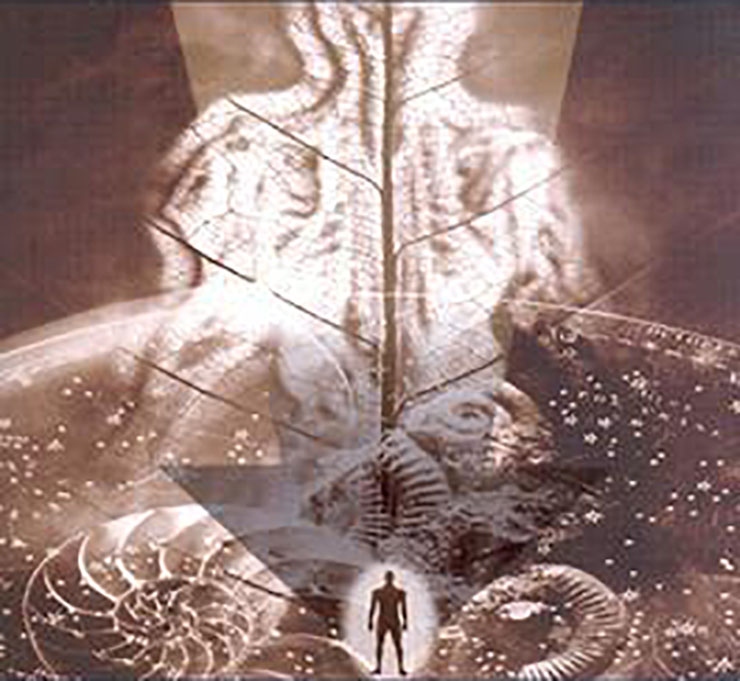
  • Sacred Geometry of Crop Circles

    Sacred Geometry of Crop Circles

    From New Dawn Special Issue 5 (May 2008)

    Know, oh, brother…, that the study of sensible geometry leads to skill in all practical arts, while the study of intelligible geometry leads to skill in the intellectual arts because this science is one of the gates through which we move to the knowledge of the essence of the soul, and that is the root of all knowledge.
    – from the Rasa’il by the Brotherhood of Purity, translated by S.H. Nasr

    Our experience and our reaction to all things beautiful is made possible by our unique ability to subconsciously recognise geometric order from transitory chaos. At this level, the perfection inherent in a Greek temple or a painting by Da Vinci is not simply because it is made of a particular material or hue but because the harmonic proportions contained in their design are bound by the laws of sacred geometry, which is itself the embodiment of harmonic waves of energy, melody and universal proportion. What our senses respond to is the geometrical and proportional harmonies and wave forms created through the application of sacred geometry.

    As stated in Islam, and echoed in all Abrahamic and Hindu religions, sacred geometry provides the means to see the vestiges of God and Its multiplicity in the universal order of things. Remarkably, Islam still contains at its core one of the last unadulterated vestiges of primordial truth. Its mosques and art forms, as well as its latter-day architecture still incorporate many of the keys to the structure of the cosmos, symbols of the archetypal world as a creation of God.

    Indeed, intellectual Islam is to be commended for the way in which it has preserved a mathematical philosophy “akin to the Pythagorean-Platonic tradition of antiquity but in a totally sacred universe free of the nationalism and rationalism which finally stifled and destroyed the esoteric traditions of Greek intellectuality.” Therefore it is not by accident that we see in Islamic art the very symbols which reflect the heart of matter.

    As the last of the universal revelations – or religions – it is important to note that Islam has served as the curator of sacred geometry rather than its originator. It’s not certain where the terrestrial origins of this knowledge stems from but its forms are evident throughout the yantras and mandalas of Hindu, Tibetan and Buddhist art, Celtic carvings and book adornment, even in native North American sand paintings.

    Principle elements of sacred geometry. A: Circle B: Vesica Piscis C: Equilateral triangle D: Pentagon E: Pentagram F: Hexagon G & H: The seven days of Creation I: The Seed of Life J: The Tree of Life K: The Egg of Life L: The Flower of Life M: The Fruit of Life N: Metatron’s Cube. Image courtesy of Freddy Silva.

    The earliest known proprietors of sacred geometry were the Egyptians who embedded its secrets in the ground plans of their temples, their frescoes and, most blatantly, in the Giza pyramid which single-handedly contains most of the fundamental universal laws that many a tortured schoolchild now attributes to Pythagoras. Although these enlightened people used geometry for all manner of terrestrial applications – hence the word ’geo-metry’ or ’measure of the earth’ – the aim was metaphysical in nature.

    Because sacred geometry reflected the universe, its pure forms and dynamic equilibriums shared a higher purpose: the attainment of spiritual wholeness through self-reflection, thereby giving structural insight into the workings of the inner self. In other words, a way for the intuitive mind to find a reason for its existence: by journeying inwards, away from the three-dimensional world and towards fewer and more comprehensive ideas and principles.

    As the renowned geometer Robert Lawlor observes, “the implicit goal of this education was to enable the mind to become a channel through which the ’earth’ (the level of manifested form) could receive the abstract, cosmic life of the heavens. The practice of geometry was an approach to the way in which the universe is ordered and sustained. Geometric diagrams can be contemplated as still moments revealing a continuous, timeless, universal action generally hidden from our sensory perception. Thus a seemingly common mathematical activity can become a discipline for intellectual and spiritual insight.”

    As a mirror of the heavens sacred geometry was liberally applied across the Egyptian landscape for millennia as a way to bestow universal order on Earth, as reflected in their Hermetic maxim ’As Above, So Below’.

    Consequently the practice of maintaining concrete records of this knowledge for posterity was reenacted throughout Europe in fabulous structures such as Chartres cathedral, one of the most impressive hymns to sacred geometry, and whose dissection alone has filled entire books.

    That this knowledge made its way as far north as the British Isles can be clearly seen in the ground plans and blueprints of megalithic monuments, mediaeval cathedrals, and the plethora of stone circles. It is clear, therefore, that whatever lies behind sacred geometry was important enough for scholars to go to enormous lengths to preserve it for future generations.

    With the advent of X-ray photography science has discovered that the physical structure of elements are governed by a patterned array of intervals surrounding a central node. The general assumption that the nature of matter is fundamentally composed of particles is rapidly giving way to the concept that the underlying patterns of the material world are geometric wave forms. The irony here is that by choosing to examine reality through geometry many ancient cultures find themselves close to the stance now adopted by modern science, and vice versa.

    Little wonder, then, that sacred geometry was so important to the temple builders. And since the universe was created by God it theoretically followed that to embed physical structures with the ratios of creation the universe could be mirrored. In so doing, temples became doorways into the inner workings of the physical world and the inner world of consciousness. This interface would enable anyone so predisposed to integrate oneself with the gods.

    Sadly, as these temples have fallen by the wayside so too has our wonder of the unseen and our connection to it, presumably why the very fabric of our present society lies rudderless and bankrupt.

    There are several major events which have led us to this sad reversal of thought. As Robert Lawlor understands it, “modern thought has difficult access to the concept of the archetypal because European languages require that verbs or action words be associated with nouns. We therefore have no linguistic forms with which to imagine a process or activity that has no material carrier.”

    The Renaissance saw the last great works based on sacred geometry which had been kept alive via Plato, and philosophies that survived suppression by the emerging Catholic Church. With the implementation of the Inquisition, the rise in secularism and a general move toward a rational and analytical view of the world, connections to holistic and metaphysical practices were severed. By the time Newton and the scientific secularism of the 17th century prevailed rational logic had gained such a dominance that all esoteric knowledge was inevitably condemned as occult (literal meaning, ’that which is hidden’).

    Whiteparish crop circle, 1987 (in yellow) with hexagonal/circular alignment. Using sacred geometry, this circle illustrated harmonic ratios of music and incorporated elements of a Sri Yantra, also known as the Mandala of Creation since Vedic times. Image courtesy of Freddy Silva.


    Connecting Sacred Geometry & Crop Circles

    It is significant that as our alienation from all forms of spiritual and universal wonder increases, symbols bearing the hallmarks of an ancient, harmonious philosophy have suddenly begun manifesting in cereal crop.

    Even to the hardened sceptic crop circle designs reveal a facility by their makers of creating a visual harmony that is pleasing to the eye, much like an ancient temple or a classical painting. The proportions are balanced, the shapes rhythmic, their outlying elements forming part of an unseen whole. Upon close scrutiny even the small ’grapeshot’ circles that flank certain formations lie at their given remote locations not by fluke but by engineered and premeditated design, markers and clues for the observer to follow and uncover. Not surprising, then, to find sacred geometry lying at the heart of the fundamental blueprints of many formations, sometimes blatantly, sometimes veiled like a secret waiting to be uncovered only by the most persistent of minds.

    But just as with sacred geometry and other esoteric principles, crop circles have been marginalised by practically the entire scientific community since they challenge the current worldview simply because science is at odds to explain them.

    Vesica Piscis in 1996 with triangular geometry. Image courtesy of Freddy Silva.

    According to science, crop circles don’t exist.

    Yet, as these examples demonstrate, crop circles, through their complicated geometric structure, are worthy of being ranked alongside the greatest creations of mankind. Perhaps even higher.

    When analysing crop circle forms through the precise and unalterable practice of sacred geometry one cannot help but appreciate that a mind of scholarly intelligence is involved, just as the great masters of Islamic and Egyptian art, as Keith Critchlow remarked, “were motivated by and versed in spiritual disciplines that gave content and meaning to their work and placed it in the tradition of aiding the viewer to raising his or her spiritual understanding.”

    That these symbols are occurring primarily in wheat, the very symbol of the Earth Mother, is significant in itself. Perhaps they are here to draw us as a race together by this interaction with our symbol of life? Maybe their geometric symbolism acts as a mandala which like its Buddhist counterpart contains the very vibrations that aid one in achieving inner transformation at this most vulnerable moment in our history?

    If neither of these apply then what we have strewn in fields across the world is nothing more than the highest form of cosmic art. Perhaps all of the above are true, and perhaps other explanations remain elusive. But one thing is certain – it is a lot of trouble for a bunch of individuals to go to, turning out during every night of the English summer for a quarter of a century, wading through muddy fields, and working with a brittle and imprecise canvas just to show the world they simply remained conscious throughout geometry lessons!

    In the selected range of crop circle designs we see recurring themes that are for the most part generated from within a circular form and continue, through proportional expansion, to develop well beyond the boundaries of the design. This is consistent with the principle of sacred geometry where the circle is the principal element since it lies at the heart of the creative principle. It’s the representation of cosmic life, from the smallest atom to the largest planet. All things are divided from within itself so, paradoxically, all things are contained within it. It is therefore the symbol of the unknowable, of spirit and of heaven.

    The symbolic opposite of the circle is the square which is considered material and of the earth. Both forms, when given equal areas and superimposed, become a symbol of the fusion between humanity and the universe, of spirit and matter. It is the first symbol and the one on whose proportions whole cosmological cities were founded.

    The division of the circle into two equal size circles, with the centres of their respective circumferences touching each other, gives birth to an overlapping figure of profound symbolism: the vesica piscis. It is from within its vagina-like centre that the symbols of sacred geometry are born.

    From the vesica we can create the simplest of polygons, the equilateral triangle. The two triangles contained in this ’womb’ are themselves symbolic of the world above and the world below, just as the left circle can represent spirit and the right one matter. It is symbolic to Christianity as representational of Jesus Christ and the Piscean age; as the Holy of Holies it carries the number 2368 in gematria, the number also equated with Jesus Christ.

    Encoded geometry of the Winterbourne Bassett crop circle, 1997. Image courtesy of Freddy Silva.

    The overlapping of both triangles produces the hexagon, also referred to as the Star of David. The characteristics and symbolism behind this figure are immense. It is also through the natural division of a circle into six parts which allows six circles to fit exactly around the circumference of an equal seventh. John Michell has studied the implications of the hexagon at length and further adds that it is “symbolic of the order of the universe in the fact that twelve equal spheres can be placed around a thirteenth so that each touches the nucleus and four of its neighbours, producing the geometer’s image of twelve disciples grouped around the master. Christ, Osiris and Mohammed are among those who are represented as a central sphere with twelve retainers.” It is also a common symbol in Islamic geometry, and its qualities are rational and solar, as evidenced by its 6×60-degree triangles which reflect the solar number 666.

    Another symbol of great fascination to ancient and modern geometers is the golden mean since it gives rise to a spiral form which occurs in many natural forms and patterns of plant growth which, as Michell points out, “gives support to the tenet of traditional philosophy that number preceded creation and determined its development.”

    It is from the golden mean that we also extrapolate the pentagon and the five-pointed star, and with it the association with humanity since the human figure with outstretched limbs is similar to the pentagram. This was the symbol of the Pythagorean’s humanistic science and consequently worn as a talisman of good health. Its symbolism frequently pervades native American philosophy, just as Christians associated the pentagram with Jesus. The pentagon is lunar and psychic; the angle between two sides of a pentagon is 108 degrees, 1080 being the characteristic lunar number.

    Get the issue this article appears in

    These primary geometric forms, along with their 3-dimensional counterparts, the Platonic solids, were thus observed by many ancient cultures to be the crystallisations of the creative thoughts of God as they emerge from the circular Unity. As a metaphor of universal order, sacred geometry is pervasive in imagery throughout history, from circular mandalas to sacred temples. And now, crop circles.

    It is interesting that today we find ourselves at the final crossroads in our evolution. Since that day when we decided to abandon our faith in the universal way and follow the mechanical codes of science our consciousness has shifted from one of reverence for all things sacred to the worship of abstract materialism. Consequently, our change of attitude has endangered our living, breathing celestial sphere and it’s perhaps why crop circles, with their foundations based squarely upon sacred geometry, have chosen to appear at this particular point in time, reminding us that if only we observe the fundamental laws of the universe we may still be in time to discover the secrets of universal harmony and salvage our very own symbol of eternal life, the Earth.

    Excerpted with permission from Freddy Silva’s book Secrets in the Fields.

    [alert type=”general” dismiss=”no”]This article was published in New Dawn Special Issue 5.[/alert]

    [alert type=”success” dismiss=”no”]If you appreciate this article, please consider subscribing to help maintain this website.[/alert]

    © New Dawn Magazine and the respective author.
    For our reproduction notice, click here.