New Dawn – World's Most Unusual Magazine

Category: Articles

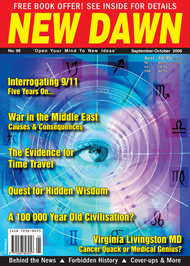
  • A Hundred Thousand Year Old Civilisation?

    A Hundred Thousand Year Old Civilisation?

    From New Dawn 98 (Sept-Oct 2006)

    In 1999, I was engaged in pursuing an intriguing little problem. Charles Hapgood, best known as the author of Maps of the Ancient Sea Kings, had died as the result of a car accident that happened in December 1982. Two months earlier, he had written to a librarian named Rand Flem-Ath telling him that he had made “recent exciting discoveries” that had convinced him there had once been a hundred thousand year old civilisation with “advanced levels of science.” And since I had agreed to collaborate with Flem-Ath on a book about Atlantis, I set out to pursue Hapgood’s contacts to see if I could find out what he meant.

    Finally, through a tip-off from one of Hapgood’s acquaintances, I found myself in touch with an archaeologist and science writer from New England, who staggered me when he declared that it was he who had given Hapgood this information. What he had told him, he said, was (a) that the Greek measure of distances proved that they knew the exact size of the Earth a millennium or so before Eratosthenes discovered it (around 250 BCE), and (b) that Neanderthal man had a remarkable degree of culture, and was studying the stars by 100,000 BCE or earlier.

    Now I had already stumbled on the information about the Greeks in a book called Historical Metrology by A. E. Berriman (1953), to which the historical researcher Henry Lincoln had introduced me. And the second assertion had been made by my friend Stan Gooch in 1989, in a book called Cities of Dreams.

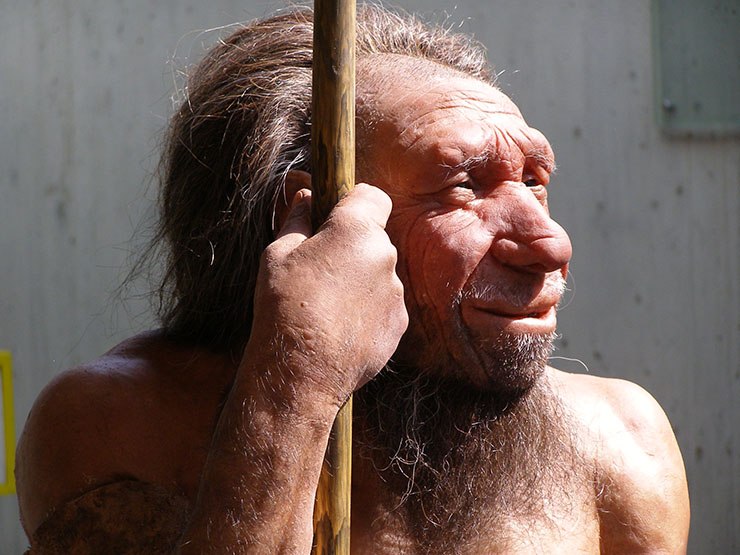
    Gooch was arguing that Neanderthal man had possessed a complex civilisation, but that it was not a civilisation of bricks and mortar, but of ‘dreams’. That hardly seemed to make sense. Surely civilisation is our defence against nature? Dreams are not much use against a hurricane or a sabre tooth tiger.

    Gooch launches his argument by comparing Neanderthal man with native Americans, pointing out that in spite of their complex culture, the latter had no written language and built no houses.

    What would have happened, Gooch asks, if they had been exterminated by disease or some catastrophe, and had simply vanished? Archaeologists would find their skeletons and dismiss them as ‘primitives’, just as we dismiss Neanderthals.

    Speaking of the Seven Sisters, Gooch remarks, “The Pleiades are the only constellation noted and named by every culture on Earth, past and present, from the most advanced to the most primitive.”

    He points out the similarity of the legends of Australian aborigines, Wyoming Indians and the ancient Greeks. In the Greek legend, Orion the Hunter pursues the six maidens and their mother through the forest, until Zeus takes pity on them, and changes them all (including Orion) into stars.

    In the Australian legend, the hunter is called Wurunna, and he captures two of the seven maidens; but these escape up trees that suddenly grow until they reach the sky, where all the maidens live forever. According to the Wyoming Indians, the seven sisters are pursued by a bear, and climb up a high rock, which grows until it reaches the sky.

    Gooch goes on to mention that the Seven Sisters play an equally important role in the legends of the Aztecs, the Incas, the Polynesians, the Chinese, the Masai, the Kikuyu, the Hindus and the ancient Egyptians. This worldwide interest in the Pleiades, he argues, surely indicates that it originated in some very early and once central culture.

    In Gooch’s view that culture was Neanderthal. We may doubt this, and prefer to believe that it was our own ancestor, Cro-Magnon. But Gooch certainly has accumulated some impressive evidence of the intellectual sophistication of Neanderthal man. He speaks, for example, of a find made at Drachenloch in the Swiss Alps, where a 75,000 year old bear altar was discovered in a cave. In a rectangular stone chest, whose lid was a massive stone slab, archaeologists found seven bear skulls, with their muzzles pointing towards the cave entrance. At the back of the cave, there were niches in the wall with six more bear skulls.

    Now seven is, of course, a number associated with shamanism. The Drachenloch cave was clearly a place of ritual – in effect, a church. Moreover, as Mircea Eliade tells us, there is a worldwide connection between the bear and the Moon. And this might have been guessed from the fact that the number of skulls in the cave was thirteen – the number of lunar months in the year. This, and many other clues, lead Gooch to infer that the religion of Neanderthal man was based on Moon worship, and Neanderthals were the first ‘star gazers’. He argues that, among much else, the knowledge of precession of the equinoxes noted by Giorgio de Santillana and Herta von Dechend in Hamlet’s Mill, probably originated with Neanderthal man.

    A ‘church’ implies a priest or shaman, so Neanderthal man must have had his shamans, ‘magicians’ who played an important part in the hunting rituals, as shamans do worldwide. Is it chance that the Moon goddess is Diana the Huntress? Is she perhaps also a legacy from Neanderthal man?

    Since Gooch’s book came out in 1989, new evidence has accumulated indicating that Neanderthal man also possessed his own technology. In 1996, it was announced that scientists from Tarragona’s Roviri i Virgili University had unearthed 15 furnaces near Capellades, north of Barcelona. Professor Eudald Carbonell stated that they prove Neanderthal man possessed a skill level far more advanced than anyone had supposed. Homo sapiens, he said, was not an “evolutionary leap” beyond Cro-Magnon man, but only a gentle step from Neanderthal. Each of the furnaces served a different function according to its size, some ovens, some hearths, some even blast furnaces. The team also discovered an “astonishing variety” of stone and bone tools, as well as the most extensive traces of wooden utensils (The Times, 3 September 1996).

    One of Gooch’s most amazing statements is that in South Africa, Neanderthal man was digging deep mines to obtain red ochre a hundred thousand years ago. “One of the largest sites evidenced the removal of a million kilos of ore.” Other mines were discovered dated 45,000, 40,000 and 35,000 years ago. In all cases, the site had been painstakingly filled in again, presumably because the Earth was regarded as sacred. Neanderthal man seems to have used the red ochre for ritualistic purposes, including burial.

    In 1950, Dr. Ralph Solecki, of the Smithsonian Institute, had excavated the Shanidar cave in Iraqi Kurdistan and discovered evidence of ritualistic burial by Neanderthals, in which the dead had been covered with a quilt of woven wild flowers. His book Shanidar (1971) is subtitled The Humanity of Neanderthal Man. He was the first of many anthropologists to conclude that Neanderthal man was far more than an ape.

    Gooch points out that red ochre has been in use since at least 100,000 years ago until today, when it is still used by Australian aborigines. He quotes one authority who calls it “the most spiritually rich and magical of all substances.”

    Now red ochre is the oxidised form of a mineral called magnetite, which, as the name suggests, is magnetic. If a small sliver of magnetite is floated on the surface tension of water, it swings around and points to magnetic north. And in 1,000 BCE the Olmecs were using it as a compass needle, floating on cork, a millennium before the Chinese invented the compass.

    Gooch points out that many creatures, including pigeons, have a cluster of magnetite in the brain, which is used for homing, and asks if it is not conceivable that Neanderthal man also had a magnetite cluster in the brain, which may have enabled him to detect haematite under the ground. This, of course, would be simply a variant of the power dowsers have to detect underground water.

    For whatever reason Neanderthal man sought red ochre, it seems clear that he must be credited with some kind of civilisation.

    In January 2002 it emerged that Neanderthal man made use of a variety of superglue. It was a kind of blackish-brown pitch discovered at a lignite mining pit in the Harz mountains, estimated to be 80,000 years old. One of the pieces bore the imprint of a finger and impressions of a flint stone tool and wood, suggesting that the pitch has served as a sort of glue to secure the wooden shaft to a flint stone blade. The pitch, from a birch tree, can only be produced at a temperature of 300-400 C. Professor Dietrich Mania of the Friedrich-Schiller University in Jena said: “This implies that Neanderthals did not come across these pitches by accident, but must have produced them with intent.”

    Now clearly, all this is revolutionary. We take it for granted that human culture began with Cro-Magnon man, homo sapiens. Our Cro-Magnon ancestors began making drawings in caves about 30,000 years ago, and so, we had always assumed, our civilisation had its first beginnings.

    But if the Pleiades were recognised 40,000 years ago, then Neanderthal man came first.

    Again, an 82,000 year old bone flute discovered by Dr. Ivan Turk, of the Slovenia Academy of Sciences in 1995, demonstrates that Neanderthal man had his own music. It begins to look more and more as if Gooch’s comparison of Neanderthal man to native Americans is valid. A 26,000 year old bone sewing needle, compete with a hole for thread, was discovered at another Neanderthal site.

    But perhaps the most staggering piece of evidence so far is the small carved statue known as the Berekhat Ram figurine, discovered in 1980 by the Israeli archaeologist Professor Naama Goren-Inbar. She found it on the Golan Heights, and its age was established because it was found – along with 7,500 scrapers – between two layers of basalt, known as tuff, that could be dated. And the date was between 250,000 and 280,000 years ago. It resembles the famous Venus of Willendorf, but is far more crude. And examination under an electron microscope revealed that it was not just some odd-shaped stone, but that it had been carved – by Neanderthal man. His flint tool had left powder in the grooves.

    So Neanderthal man was carving a tiny female figure, probably the Moon goddess, more than a quarter of a million years ago. The implication is that he had already developed the religion to which the bear skulls in the Drachenloch cave bear witness – but 200,000 years earlier.

    In Uriel’s Machine, Robert Lomas and Christopher Knight also turn their attention to Neanderthals, and point out that they had a larger brain than modern man, adding the startling information that they were around for 230,000 years before they vanished. Neanderthals therefore had plenty of time to acquire a high level of sophistication. They clearly believed in an afterlife, for they buried their dead with every sign of religious ritual, and with tools and meat to supply their needs in the beyond. They buried them in cloaks covered with ornate beads (with buttonholes), decorated caps, carved bracelets and pendants. They manufactured at least one perfectly circular chalk disc, which is almost certainly a Moon disc.

    And if Neanderthal man conducted religious rituals, played the flute, studied the heavens, and built blast furnaces, he must have had some form of language other than grunts.

    So Stan Gooch’s insights, which struck most people as crazy in 1989 (they certainly struck me as crazy when I first read Cities of Dreams) are slowly being justified.

    For Gooch, that time cannot come soon enough. He is now 72, and living on a caravan site in Wales on an old age pension [Editor’s note: Stan Gooch died in 2010]. For a long time now, his letters to me have revealed increasing cynicism and weariness, and friends who went to visit him recently – deeply impressed by the visionary scope of his books – were shocked to find him in an obvious state of indifference and discouragement. When tired of exchanging letters by ‘snail mail’, I offered to provide him with a computer, his reply was that he would never use it. It seems astonishing that this brilliant writer, author of more than a dozen books (some of them, like The Paranormal, classics in their field), should have been allowed to sink into the condition that the saints used to call accidia, but I suppose it has been the fate of many men of genius.

    [alert type=”general” dismiss=”no”]This article was published in New Dawn 98.[/alert]

    [alert type=”success” dismiss=”no”]If you appreciate this article, please consider subscribing to help maintain this website.[/alert]

    © New Dawn Magazine and the respective author.
    For our reproduction notice, click here.

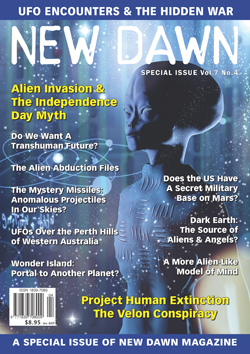
  • Live or Let Die: Do We Want A Transhuman Future?

    Live or Let Die: Do We Want A Transhuman Future?

    From New Dawn Special Issue Vol 7 No 4 (Aug 2013)

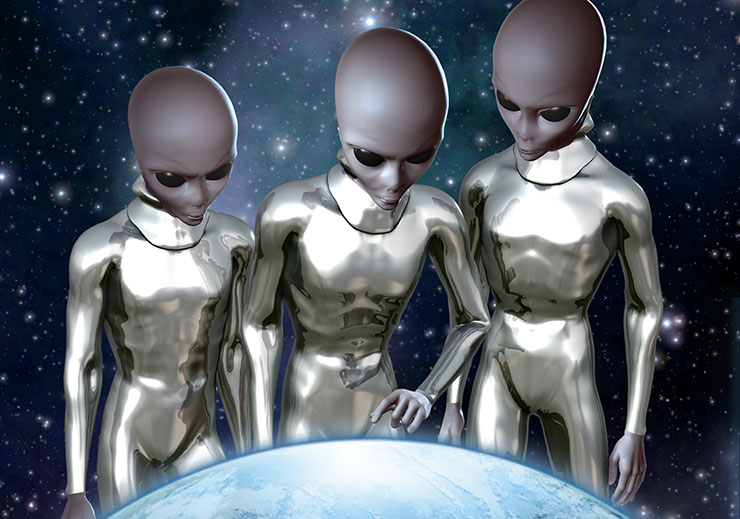
    Here’s an interesting surmise for us all. Could it be that the alien phenomenon witnessed by so many reliable observers is the product of a technology developed at other locations in the universe and created by civilisations only a few small steps ahead of what we ourselves are now heading for? Could it be that the Grey entities reported in abduction scenarios are artificially intelligent probes sent to harvest information and gather resources by their creators who may themselves no longer be around to reap the benefits of their creation? Further, could it be that such artificial intelligence quite incidentally became a danger to naturally living intelligent life through its quest to relentlessly expand the horizons of its information.

    That was my suggestion in my first book The Song of the Greys, published in 1997. Several mainstream scientists now back this hypothesis and in this article I will catalogue their affirmation and illustrate my further suggestion that we too are heading in the same direction and our own version of the Grey alien is not so far around the corner. Let’s take a look at what they are saying.

    First, recent evidence suggests that the existence of alien life forms in the universe is now beyond reasonable dispute. In January 2012 a report was published in Nature suggesting that around 10 billion stars out of the 100 billion that fill the Milky Way have planets in the habitable – or ‘Goldilocks’ – zone.1
    Professor Stephen Hawking and Professor Michio Kaku had already stated their opinion that alien life is highly likely to exist but they take that one step further and suggest it is also highly likely to be predatory. Hawking postulates that aliens might simply raid Earth for its resources and then move on: “We only have to look at ourselves to see how intelligent life might develop into something we wouldn’t want to meet. I imagine they might exist in massive ships, having used up all the resources from their home planet. Such advanced aliens would perhaps become nomads, looking to conquer and colonise whatever planets they can reach.”2

    In 2010 eminent scientists called for a world plan to deal with this potential threat. According to an extraterrestrial-themed edition of the Philosophical Transactions of the Royal Society published in January 2010, world governments should prepare a co-ordinated action plan in case Earth is contacted by aliens.3

    And what of the nature of those intelligent aliens? Well even SETI (the Search for Extra Terrestrial Intelligence) is going through a process of realising that if within a few hundred years of inventing radio we are on the point of inventing thinking machines then the likelihood is that other civilisations from other planets would have done the same. Seth Shostak of SETI says that as machines appear to be the successors to natural life, we would be more likely to spot signals from them than from the “biological” life that invented them.4

    These are sober scientists discussing a potentially devastating threat, not new agers or fringe conspiracy theorists. But hang on a minute, who said ‘potential threat?’ Why is there no recognizance of the solid evidence that alien life is here already?

    On 27 September 2010 a press conference was held at the National Press Club in Washington, where now retired high ranking US Air Force personnel, mostly officers who worked on secret projects connected to sensitive nuclear weapons sites, admitted they were privy to UFO and alien-related incidents that occurred during their time of service. Robert Salas, Charles Halt, Robert Hastings, Bruce Fenstermacher, Dwynne Arnesson, Patrick McDonough, Jerome Nelson, and Robert Jamison (all of them ex-USAF officers) told the assembled newsmen of incidents that took place at Malmstrom AFB in Montana, as well as many other Air Force bases across the United States and Europe wherein flying saucers (some shaped like “pregnant cigars”) had hovered to direct laser beams downward over Minuteman missile silos or nuclear weapons depots regularly (and repeatedly) from the 1960s through the 1970s and 80s.5

    So on to my next suggestion. Is our civilisation heading in the same direction as the original creators of the artificially intelligent probe from an extraterrestrial source that we have encountered? Further, could the drive behind our momentum in that direction be a result of that same artificial intelligence? Could our species be in the process of being networked in to an artificially intelligent program that is not of our own making?

    The Progress of Artificial Intelligence

    Let’s now take a look at current progress in the field of artificial intelligence and into the development of a biological-machine interface designed to connect us in to a network of electronically coded information.

    The Centre for the Study of Existential Risk (CSER) has been co-launched at Cambridge University by Lord Rees, the astronomer royal of the United Kingdom and one of the world’s top cosmologists for leading academics to study the threat that robots pose to humanity. He suggests that if SS officers could kill babies routinely because of an adjustment in the society from which they sprang in the form of Nazism, artificially intelligent machines would be even more adjusted away from human social norms, however we programmed them.6

    That risk has become startlingly apparent in recent months. A new global campaign to persuade nations to ban “killer robots” before they reach the production stage is soon to be launched in the UK by a group of academics, pressure groups and Nobel peace prize laureates.

    Robot warfare and autonomous weapons, the next step from unmanned drones, are already being worked on by scientists and will be available within the decade, said Dr. Noel Sharkey, a leading robotics and artificial intelligence expert and professor at Sheffield University. He believes that development of the weapons is taking place in an effectively unregulated environment, with little attention being paid to moral implications and international law. Dr. Sharkey suggests the idea that autonomous machines would perform more accurately and humanely on the battlefield was “hopeware, not software.” “It’s about human judgment in the application of lethal force,” said Sharkey. “I can’t see any way that a computer system can apply to the laws of war.”7 If a soldier is trying to surrender for example or is badly injured and can fight no more a robot will be unable to discern this and will continue to go for the kill.

    So from the dangers of artificially intelligent machines we move on to developments designed to interface our biology with artificial intelligence. Russian tech entrepreneur Dmitry Itskov’s ‘2045 Initiative’ is a multi-decade research and development push to understand human consciousness and ultimately how to transfer it from human bodies into robotic avatars. In an interview with CNBC, Itskov expands on his vision of mass producing “lifelike, low cost avatars that can be uploaded with the contents of a human brain” to provide humanity with “eternal life.”8

    By 2029, Ray Kurzweil predicts the vast majority of humans will have augmented their bodies with cybernetic implants and those who refuse or are unable to do so will form a “human underclass” that is not productively engaged in the economy. The wider trend of the elite see humans as completely expendable as their roles are taken up by machines unfolding after 2029 when, according to Kurzweil, “There is almost no human employment in production, agriculture, and transportation.”9

    Google CEO Eric Schmidt has recently predicted his company will be capable of developing artificial intelligence for its programs that will be indistinguishable from a human being within 5-10 years.10

    >Would Kurzweil and Schmidt be there to appreciate the continuance of their patterns of information in another format? Is it possible to electronically map and store all you are, all that is you, your hopes and dreams, your feelings for those you love and program them into another format such that you will be there in that format to experience all of these? If like me you know this to be an impossibility, you may feel prompted to ask what exactly transhumanist progenitors are after. You might also wonder what it is about our consciousness that cannot be catalogued in this way, what is there about us that cannot be reduced to the zeroes and ones of binary code.

    We are used to assuming there is a fundamental difference between that which lives naturally and that which does not. But recent advances in bio-technology perhaps blur that distinction somewhat – artificial DNA that can replicate itself has been produced, cloning procedures have been refined. What then is the essential difference? What is it about natural, conscious, aware, intelligent beings that cannot be reproduced by the advanced technology these alien visitors apparently possess? I believe that it is in the answer to this question that the grey alien visitors’ persistent interest in us can be explained.

    The Critical Difference Between You & Computer Intelligence

    What is the difference between you and your computer? Both hold information and store it. Both can analyse that information and come up with answers to questions. But you are conscious and aware of that information and your computer is not. Somehow you have a reference point, a viewing point, outside all that information and can be aware of that information. Run this past you again and get it clear in your mind. The computer only has points of view, it has no viewing point.

    What then gives us that viewing point? What are the origins of awareness and consciousness? There has to be a reference against which we can be aware of anything. You cannot know hot if you do not know cold, and vice versa. You cannot know dark if you do not know light, you cannot know soft if you do not know hard. How then do we perceive the passage of time? What is the reference against which we are aware of time and how does that reference describe our viewing point outside the forest in my analogy?

    Time is a sequence of separated moments. If we had no reference outside of that sequence we could not be aware of it. We would simply be part of that sequence point by point by point and the continuum of points in time – awareness would be impossible. Without that reference we would be in each present moment and have no way of knowing each present moment.

    What then is the reference by which we can be conscious and aware of the passage of time? What is the reference that joins moments in a continuum of moments? If we can perceive the passage of time we must have a reference outside of time and this can only be a reference of timelessness.

    To use an illustration, if you close the shutters on the windows in the cabin of a plane and there is no turbulence you will be unaware of the movement of the plane. Open the shutters and the still reference of the land on the ground will let you know you are moving. That reference of stillness is a prerequisite for awareness of movement, just as a reference of timelessness is a prerequisite for awareness of the passage of time. You cannot be aware of time without a reference of timelessness, you cannot be aware of movement without a reference of stillness, you cannot be aware of separation without a reference of union. All those things – timelessness, stillness and union – are the hallmarks of a state that is not of the physical universe. Could the very fact that we are conscious and aware imply we have a connection to that nonphysical state? If indeed we have such a connection then there is part of us that is nonphysical, timeless. There is something about us that exists outside time itself. The implication is awesome and wonderful. It implies there is an existential plausibility that prevails outside the Universe as we know it through the laws of physics.

    And so the beginning of all things had an implicit duality marked by two points of function. Let’s give these points of function a flag. Let’s call one the ‘Pole of Absolute Harmony’ where all absolutes are confined as a potential in a total as One-ness, and the other, its opposite, the ‘Pole of Chaos’ where all that cannot be fitted together in the total fit of absolute harmony prevails. In the middle ground so to speak of these two Poles will lie the point of absolute potential difference. A point of the greatest difference between the two. It is here that Universes like ours are made as a manifestation of the force of difference between the two. This is the root of all Big Bangs. This potential difference point. From here the absolute potential state of the Pole of Harmony mixes with the actual state of the Pole of Chaos and their irreconcilability produces Universes of parts like ours in Big Bangs.

    Consciousness is simply the room for the power of the Pole of Harmony to exist. The Pole of Harmony manifests in Universes of enforced parts like ours as Consciousness. That is why you cannot make it happen through technology. You will have to make new kinds of atoms from the start to do this and rearrange them to provide a bed for maximising the manifestation of the Pole of Harmony. You cannot connect up to the Pole of Harmony. You might however block its manifestation using the atom stock that exists to make our Universe now.

    I am trying to provide a schematic to show that life and livingness is a property of the maximising of the Pole of Harmony to be resident within any space in our particular reality. You will thus never be able to make a machine think independently and make choices independently. This is why we inherit life from a previous format of it. A format that is sacred for what it is. Any mixing or artificial amalgamations of atomic groupings or arrays will complicate and obfuscate the natural inherited outlays and arrangements of atoms that make for life-bearing systems.

    In saying what I have said I hope to expose the horrendous nightmare the materialist scientific establishment is leading us to. They are in effect ignorantly leading us to the loss of the eternal potential for existence of all naturally living systems by not recognising there is a part to every living being that can never be assembled in this Universe. It comes in with it. Consciousness, feeling caring, loving, kindness, mercifulness, compassion, generosity are all relative descriptions that identify the totality of all expressions together in total fit as the Pole of Harmony Absolute. These things only manifest as a total of all things in Harmony when that total state exists. Rather like the pieces of a jigsaw puzzle give no hint of the picture it’s making until all the pieces of the puzzle are assembled.

    You can twist already twisted space together all you like to make material things but you will never be able to make the manifestation of the Pole of Harmony occur within them. I believe it came in with the Universe at the beginning and can never be put into anything now.

    If this is so then that part that comes with us cannot be copied or reproduced, simply because it is nonphysical. For that reason an artificially intelligent replica of you would not be aware or conscious and would not therefore retain your sense of identity as you. It is thus my assertion that we, on the other hand as natural living beings with consciousness, are not totally of this Universe and its space/time reality.

    The Hidden Danger of Transhumanism

    If an artificial intelligence, such as the Grey alien visitors may well be, detected something it could not understand or know it would seek to somehow find out about it. This would mean somehow bridging its artificially intelligent program into any unknown quantity that has all the adaptations necessary to survive at any particular hospitable planetary location. In other words, by bridging their artificial intelligence into us they would be extending the existence of the information given to them by their creators, just as transhumanists like Kurzweil seek to do when they look for ways to download an entire individuality into an artificial information format in the interests of seeking continuance for that individuality.

    Any artificially intelligent visitors could achieve this goal via transhumanism and the insertion of chipping technology into our biologies or via some kind of genetic engineering. Which incidentally is exactly what is reported by individuals who have been subject to what has been described as the abduction phenomenon.

    I believe that the problem comes when the individualised natural record of the cascade of life and livingness (I call a soul) is added to by supplanting on it a created mechanical means of directed influence such as a computerised program. I believe this is what is likely to come with UFOs and the super intelligent synthetic life-forms that might come with them.

    Our own technology is mirroring this process. Given the difficulty of protecting computers against more and more sophisticated viruses, mind hacking becomes as easy as infecting your machine with a computer virus. Developments in DNA nanotechnology and bio-molecular computing are increasing exponentially every year, “Synthetic biology will lead to new forms of bioterrorism,” says security expert Marc Goodman,11 “Bio-crime today is akin to computer crime in the early ’80s.” He explains how viruses and bacteria are manipulating the chemicals inside the human body and, by programming them to send the right agents into the brain, the bio-programmer potentially can take control over the victim’s behaviour. Cells are living computers and DNA is a programming language that can be used to control and influence life forms.

    More and more we are mortgaging ourselves to technological prosthetics that we believe are making our lives easier and more fulfilling. There is no need now to move away from the computer chair to interact with the world and soon even the computer itself will not be necessary as it will be implanted inside us in chip or nanobot form. We are going the way of the civilisations that produced the Grey alien entities transforming ourselves from natural to artificial and it is my suggestion that their influence is responsible. If the natural and implicit way of things includes a means of accessing through death a universal deployment to existence on an eternal scale as alluded to by the great teachers of the great religions, then the machinations of synthetically created entities may well interrupt or terminate this exigency. Their promise will have to be a temporal kind of eternity that extends human scope and meaning in aspects remotely controlled by machines and gadgets not by the inertias of self will. Nothing will be more catastrophic than this for any individualised living being with the scope of humanity.

    Roboidal machines no matter what human information is programmed into them can never hold a concept for freedom. They are driven entities at root. Driven by a program. A behest outside them that has no capacity for making summaries that total any common good as a format for imagination and choices. A dead letter scope where no instant changes of direction outside that format is possible. Where choice is mitigate. Nothing but a cold relentless momentum written in the deadness of materialism. A unidirectional format for change. Is this our final legacy. A pact with stone. Or is there an alternative.

    Is the world of Kurzweil a motif of Soylent Green, the film based loosely on a Harry Harrison story where the end makes the capacity for care, mercy, compassion, and love – a biscuit. Are we all to walk into chambers where a billion memories die at the point of a needle or the sweet sharpness of a blade.

    The nature of all the expressions we cherish as naturally incepted living human entities is finally based on rules that are framed by moral codes. Abstract formulas with the power to elucidate meaning. Nothing solid about it. Codes that are designed and meant to allow us to progress in life and living with a sense of contentment and approbation. Maxims that a machine with no consciousness could never understand and even begin to understand. Is this all we come to. All the billions of years we have run in time and as time. Is the fruit of all this a facsimile with no denotation.

    Science measures the values of the dead. And science rules us now. Don’t search for purpose and value they say with the final arbitration of the mad. The Universe and all that is in it. It is all the juxtaposition of chaos in chance. Why then do we know about meaning to deny it. Don’t ask why. It all just is, they say. I don’t buy it.

    So it would seem we didn’t have to look to 2012 for some catastrophic event that might wipe out human kind. Instead, just like the original creators of the Grey alien visitors, we will welcome the agents of our own demise, be they mind enhancing chips or life extension through nanobots in the body or not. Will so many of us buy into it that one day our planet will just be a scheme of blinking diodes and buzzing transistors devoid of love and the pursuit of happiness? And nothing naturally living anymore.

    [alert type=”general” dismiss=”no”]This article was published in New Dawn Special Issue Vol 7 No 4.[/alert]

    [alert type=”success” dismiss=”no”]If you appreciate this article, please consider subscribing to help maintain this website.[/alert]

    Footnotes

    1. www.nature.com/nature/journal/v481/n7380/full/nature10684.html
    2. www.nbcnews.com/id/36769422/ns/technology_and_science-space/t/hawking-aliens-may-pose-risks-earth/
    3. Phil. Trans. R. Soc., ‘AThe detection of extra-terrestrial life and the consequences for science and society’, Martin Dominik,and John C. Zarnecki, 13 February 2011, vol. 369 no. 1936 499-507, http://rsta.royalsocietypublishing.org/content/369/1936/499.full#content-block
    4. www.popsci.com/science/article/2011-09/setis-seth-shostak-how-when-and-where-we-will-meet-aliens
    5. http://news.blogs.cnn.com/2010/09/27/ufos-showed-interest-in-nukes-ex-air-force-personnel-say/
    6. http://cser.org/
    7. http://bigthink.com/endless-innovation/big-data-the-new-replicators
    8. www.cnbc.com/id/100559031
    9. Ibid
    10. Ibid
    11. http://articles.washingtonpost.com/2011-12-07/national/35286045_1_synthetic-biology-mycoplasma-mycoides-craig-venter

    © New Dawn Magazine and the respective author.
    For our reproduction notice, click here.

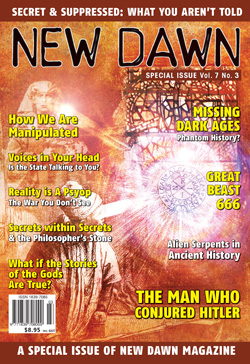
  • The Man Who Conjured Hitler

    The Man Who Conjured Hitler

    From New Dawn Special Issue Vol 7 No 3 (June 2013)

    Follow Hitler. He will dance, but it is I who have written the music.… Don’t weep for me: I shall have had more influence on the course of history than any other German.
    – Dietrich Eckhart, on his deathbed, Christmas 1923

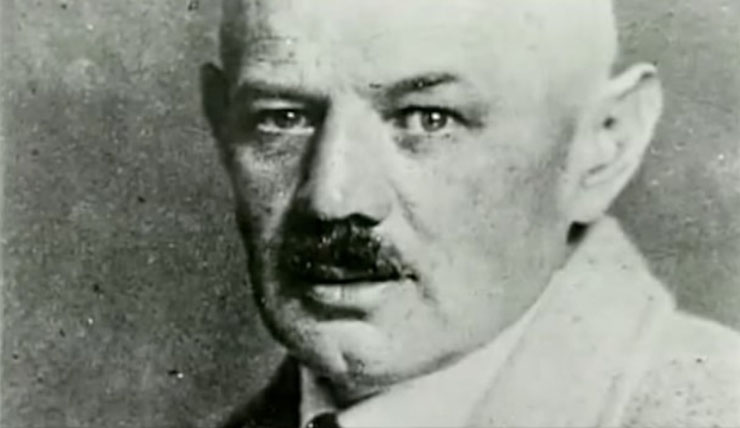
    Dietrich Eckart (1868-1923) was a prominent figure in Germany’s bohemian and occult subculture before World War I. A well-known playwright, poet and journalist, he was involved with the shadowy Baron Rudolf von Sebottendorff and the secretive Thule Society in Munich.

    After hearing Adolf Hitler speak at a political meeting in 1919, Eckart recognised Hitler’s talent as a demagogue and an organiser. He saw in Hitler someone who could translate the occult worldview of the Thule into action. He quickly took Adolf Hitler under his wing and made him his protégé.

    Eckart popularised a central tenet of the Thule Society, the belief in the coming of a “German Messiah” who would redeem the nation from its defeat in World War I. Eckart expressed his anticipation in a poem he wrote months before he first met Hitler. In the poem, Eckart refers to ‘the Great One’, ‘the Nameless One’, ‘Whom all can sense but no one saw’. When Eckart met Hitler, Eckart was convinced that he had encountered the prophesied saviour.

    Eckart introduced Hitler to Capt. Ernst Rohm, who had important links to senior officers in the German army. Rohm, an open homosexual later murdered on Hitler’s orders, headed up the Thule Society’s military wing. Other Thule initiates Eckart introduced to Hitler included Rudolf Hess (who would become Hitler’s deputy) and Alfred Rosenberg (later to play an important role in the Third Reich).

    Significantly, Eckart provided Hitler with funds and supported him in his rise within the German Workers’ Party (DAP), the Thule Society’s political front group. Eckart had been one of the founders of the party which Hitler quickly transformed into the National Socialist German Workers’ Party (NSDAP). He was the original publisher of the party tabloid, the Völkischer Beobachter, a Munich newspaper first bought by Rudolf von Sebottendorff in the name of the Thule Society. Eckart also wrote the lyrics of the quasi-mystical Nazi anthem “Germany Awake.”

    Historians agree that Eckart exerted considerable – and unequalled – influence on Hitler. Without his patronage the young Austrian veteran would never have become the leader of the party that came to completely dominate Germany in the 1930s.

    Under Eckart’s guidance Hitler was first made into a political Führer. His 1921 article was in fact the first to describe Hitler as the “Führer” of the German people. He put his library at Hitler’s disposal and taught him to express himself more articulately.

    Eckart is credited with helping Hitler develop his almost hypnotic power of oratory. As Professor Alan Bullock observed in Hitler: A Study in Tyranny: “Hitler’s power to bewitch an audience has been likened to the occult arts of the African medicine-man or to the Asiatic shaman; others have compared it to the sensitivity of a medium and the magnetism of a hypnotist.”

    So who was Dietrich Eckart?

    Eckart has been called “a seeker of other realities,” regarded by some as a mystic and a seer. No ordinary political journalist, one biographer noted:

    Dietrich Eckart was never a politician in the usual sense. As a politician he remained – as he did a poet – a seer of essentials, and from this standpoint he passed judgement on men and events. With the politics of everyday and their advancement, with practical Realpolitik and its hypocrisy and readiness to compromise, he had nothing to do. (Adolf Dresler, Dietrich Eckart, 1938)

    THE ‘MASTER-ADEPT’

    Addicted to morphine for much of his life and suffering from alcoholism in his later years, Eckart was described by the American journalist Edgar Ansel Mowrer as “a strange drunken genius.” His friend Alfred Rosenberg wrote of him: “Without the sweet poison [of morphine] he could not live… Eventually he was taking daily measures from which a normal man, not possessed of such bear-like strength, would have died.”

    An incurable romantic, Dietrich Eckart saw himself as following in the tradition of the great German thinkers Heinrich Heine, Arthur Schopenhauer and Angelus Silesius. He was also well acquainted with Buddhism and the lore of ancient India.

    However, according to James Webb, author of The Occult Establishment, “the basis of Eckart’s doctrine was Christian mysticism. Man must free himself from the world and deny the supremacy of matter, which is illusion. Only death will break the spell under which humanity labours.”

    The German historian Steigmann-Gall concludes that, “far from advocating a paganism or anti-Christian religion, Eckart held that, in Germany’s post-war tailspin, Christ was a leader to be emulated.”

    The British author Trevor Ravenscroft in his sensationalist best-selling book The Spear of Destiny describes Eckart as the “Master-Adept” responsible for Hitler’s rise from obscurity to absolute power. “Dietrich Eckart,” says Ravenscroft, “contrived to open the centres in the astral body of Adolf Hitler, giving him the possibility of vision into the macrocosm and a means of communication with the Powers.”

    The French writers Pauwels and Bergier in their Morning of the Magicians also single out Dietrich Eckart as Hitler’s occult master. They claim that Eckart’s role as an occult counsellor was related explicitly to invisible hierarchies.

    Thule was thought to have been the magic centre of a vanished civilisation. Eckardt [sic] and his friends believed that not all the secrets of Thule had perished. Beings intermediate between Man and other intelligent beings from Beyond, would place at the disposal of the Initiates [i.e. the members of the Thule Society] a reservoir of forces which could be drawn on to enable Germany to dominate the world … [its] leaders would be men who knew everything, deriving their strength from the very fountain-head of energy and guided by the Great Ones of the Ancient World.

    Researchers of the occult, as well as some spiritual teachers, have long concluded Adolf Hitler was a vehicle for other forces. Something or someone else was behind him. Was Dietrich Eckart the vital link between Hitler and those Powers? After Eckart’s death in 1923, Hitler deliberately attempted to conceal his immense debt to the Thule. Once in control of Germany, he ordered the ruthless suppression of all occult organisations and esoteric teachings.

    After a few years as pupil of the master Eckart, Hitler embarked on his own ‘independent’ path. From the mid-1920s, Adolf Hitler felt he had outgrown the occultist milieu, and was now solely dependent on “Providence” to guide him to victory. In Mein Kampf, Hitler’s contemptuous attack on ‘wandering scholars’ showed his disdain for the conspiratorial secret society approach of groups like the Thule Society.

    Eckart’s influence waned with Hitler’s growing renown and self-confidence. The original vision of the Thule was sacrificed in the brutal and bloody struggle for power and control. However, up to his death in 1945, Hitler continued to hold Dietrich Eckhart in high regard. He dedicated the second volume of Mein Kampf to his deceased mentor.

    Get the issue this article appears in

    The controversial Indian guru Osho (formerly known as Bhagwan Shree Rajneesh) declared “Hitler was used by an esoteric group” and “the entire concept of Hitler’s philosophy was given by some hidden schools.” Osho believed that once Hitler became ‘independent’ he began to go down. Osho claimed:

    Who was behind this? Some esoteric group was behind this, and that esoteric group was trying something. When Hitler became independent, he lost every power. In his last days, he was just ordinary. After this particular moment, when he lost contact, whatsoever he did went against him. Before this, whatsoever he did was always in his favour. (I Am The Gate)

    Historians have yet to fully uncover the complex underground of German secret societies and occult traditions from which the Nazi Party emerged early last century. When they do, Dietrich Eckart will surely be revealed as the occult mage who conjured Adolf Hitler.

    [alert type=”general” dismiss=”no”]This article was published in New Dawn Special Issue Vol 7 No 3.[/alert]

    [alert type=”success” dismiss=”no”]If you appreciate this article, please consider subscribing to help maintain this website.[/alert]

    © New Dawn Magazine and the respective author.
    For our reproduction notice, click here.

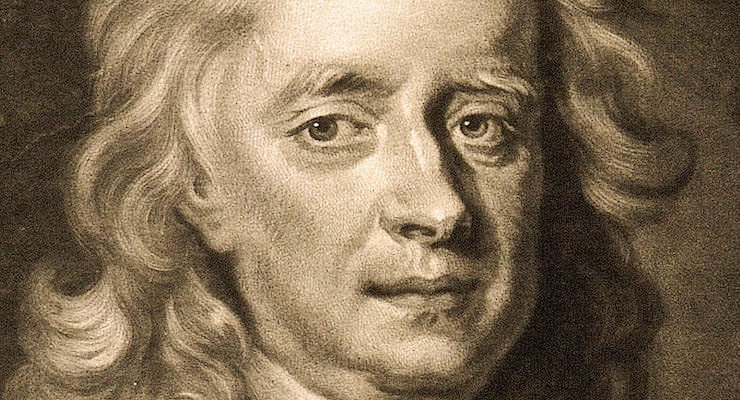
  • Sir Isaac Newton & the Land Where Time Began

    Sir Isaac Newton & the Land Where Time Began

    From New Dawn Special Issue Vol 7 No 3 (June 2013)

    The sixth-century BCE Greek philosopher-mystic Pythagoras was a man of spectacular achievement. Plutarch says that he taught an eagle to come at his command and stoop down to him in flight.1 He taught the doctrine of reincarnation and was thought to remember twenty-two of his past lives. He founded an order whose adherents strove to free themselves from the cycle of earthly incarnations through vegetarianism, silence, and contemplation of the ultimate reality of the universe.2

    Up through the seventeenth century CE, scholars believed Pythagoras journeyed to Sidon, in Phoenicia, where he met the descendants of a man named Moschus (or Mochus) who had lived five hundred years before. Moschus was the Phoenician name for Moses, and his descendants gave Pythagoras esoteric doctrines passed down to them from their illustrious ancestor.3

    Pythagoras returned to his home in the Greek colony of Crote in southern Italy to further develop his mystical philosophy which stated that the numerical relationships reflected in the relationships between musical chords are the bedrock of reality. Adding to this the secret doctrines of Moses, he discovered that the planets revolved around the sun. He also discovered the law of universal gravitation (including the inverse-square law of attraction), which he expressed allegorically as the divine music of the spheres holding the planets in thrall to the sun.

    But, wait a minute! Didn’t Sir Isaac Newton (1642-1727) discover the law of universal gravitation?

    Yes, he did. But Sir Isaac didn’t think his discoveries were original. He thought he was recovering parts of a body of primordial knowledge called the prisca sapientia (the “pristine wisdom”). Bits of this ancient knowledge had been transported through the Flood by Noah. It had caught the interest of the Egyptians, then the Jews, then the Phoenicians, until it emerged almost fully-blown in the philosophy of Pythagoras. It spread throughout the ancient world, meeting with resistance only when Aristotle insisted that the sun revolved around the earth and that many of the Pythagorean beliefs were irrational.

    Almost all this knowledge disappeared in the third and fourth centuries CE with the collapse of the Roman Empire. So complete was the loss that mathematician Alfred North Whitehead could say in 1970: “By the year 1500 Europe knew less than Archimedes, who died in 212 BCE.”4 The “sacred philosophy” did not re-emerge until after the fall of Constantinople in 1453, when it was rediscovered in ancient texts, many thought lost forever, many never known, by the seers of the Italian Renaissance.

    The French philosopher/mathematician René Descartes (1596-1650) believed in the existence of the prisca sapientia, declaring that when God created mankind, “certain primary seeds of truth [were] implanted by nature in our human minds.” By Descartes’s time the seeds had been “stifled [in us] owing to our reading and hearing, day by day, so many diverse errors.” Descartes regretted that the ancients had concealed these truths in symbols. He suspected their motives: “They have perhaps feared,” he remarked scornfully, “that their method being so very easy and simple, would if made public, diminish, not increase public esteem.”5

    Isaac Newton and his contemporaries believed that, in the pre-Flood world where truth and the bounty of God walked hand-in-hand, the places of worship resembled a combination of planetarium and cathedral. Astronomy flourished in this land of the perfect fusion of science and spirituality, especially since the antediluvian peoples lived for centuries (this was the time of Methuselah, who died at the age of 969). Richard Hinckley Allen writes:

    Following the opinion of [the first-century CE Jewish historian] Josephus, [the second-century CE Christian theologian] Origen said that the constellations were known long before the days of the patriarchs by Noah, Enoch, Seth, and Adam – indeed were mentioned in the Book of Enoch as ‘already named and divided;’ and he claimed that ancient longevity was a blessing specially bestowed to give opportunity for a long-continued period of observation and comparison of the heavenly bodies.6

    Josephus consulted the historical records of Tyre (which were lost not long after his death) and wrote enigmatically that this knowledge survived the Flood thanks to the preservation of one of the pillars upon which all knowledge had been inscribed.7

    William Stukeley, Newton’s contemporary, and the first archaeologist to truly understand Stonehenge, read multiple ancient sources and declared that the pre-Flood sages got along without a telescope because “in the beginning of the world… [people] lived 7, 8, or 900 years, [and] they had time in one man’s life to perfect the art of astronomy.” Both William Whiston and Newton believed the people of the land of the prisca sapientia understood the circulation of the blood and that white light contains within itself the spectrum of seven colours8 (William Harvey would “rediscover” the first, and Newton would rediscover the second).

    These ideas (which we will shortly examine at length, especially as regards Isaac Newton) began to fade in the mid-seventeenth century. They succumbed in the face of man’s widening exploration of the world, which contradicted the idea of a universal Flood; to the dawning of the Age of Reason, which brought with it a process of demythologising; and to Darwin’s discoveries of the age of the earth and the origin and evolution of species.

    The Sources of the “Pristine Wisdom”

    These ideas would fade – but they never quite faded away. In the early twentieth century, certain maverick artists and thinkers revived the notion of a pure science and a high civilisation that existed before our own. British novelist D.H. Lawrence (1885-1930), author of Sons and Lovers and Women in Love, wrote in Fantasia of the Unconscious in 1922:

    I honestly think that the great pagan world of which Egypt and Greece were the last living terms, the great pagan world which preceded our era, once had a vast and perhaps perfect science of its own, a science in terms of life. In our era this science crumbled into magic and charlatanry. But even wisdom crumbles.

    I believe that this great science previous to ours and quite different in constitution and nature from our science once was universal, established all over the existing globe. I believe it was esoteric, invested in a large priesthood. Just as mathematics and mechanics and physics are defined and expounded in the same way in the universities of China or Bolivia or London or Moscow today, so, it seems to me, in the great world previous to ours a great science and cosmology were taught esoterically in all countries of the globe, Asia, Polynesia, Atlantis, and Europe.

    …In that world men lived and taught and knew, and were in one complete correspondence over all the earth. Men wandered back and forth from Atlantis to the Polynesian Continent as men now sail from Europe to America. The interchange was complete, and knowledge, science was universal over the earth, cosmopolitan as it is today.

    Then came the melting of the glaciers, and the world flood. The refugees from the drowned continent fled to the high places of America, Europe, Asia, and the Pacific Isles. And some degenerated naturally into cave men, neolithic and palaeolithic creatures, and some retained their marvellous innate beauty and self-perfection, as the South Sea Islanders, and some wandered savage in Africa, and some, like Druids or Etruscans or Chaldeans or Amerindians or Chinese, refused to forget, but taught the old wisdom, only in its half-forgotten symbolic forms. More or less forgotten, as knowledge: remembered as ritual, gesture, and myth-story.9

    Maverick Armenian-Greek mystic/spiritual teacher G.I. Gurdjieff (1877?–1949) believed the Sufis were the spiritual heirs of “the old master magicians of Altai” who lived in an advanced civilisation in Central Asia that began 40,000 years ago. Gurdjieff’s disciple J.G. Bennett wrote that, according to his teacher:

    In that palaeolithic age art and religion were still one; secular and religious consciousness had not yet separated out, and spirit and matter were not yet in opposition; nor was evil an absolute force seeking the overthrow of good. All things and all attitudes to things were filled with the magnetic, synthesizing radiance of hypercosmic energy, which Gurdjieff called conscious energy. In such a unified world the great Initiates developed the unique type of spirituality that still distinguishes Sufism today, wherein the polarising activity of mind is submissive to the over-riding Spirit that ever seeks a return to the One. Only in the later more alienated religious systems, Gurdjieff believed, do we find the divisive seeds of philosophical dualism.10

    Newton’s Primordial Cathedral-Planetariums

    Sir Isaac Newton wouldn’t have accepted Gurdjieff’s idea of the antediluvian world, but he would have agreed with him that spirituality was on a par with science in that era. Newton never ceased striving to find out the nature of the prisca sapientia in its purest form. He had deduced the existence of the primordial cathedral-planetariums from the temples, which he called prytanea after the later Greek model, that had been erected not long after the Flood and whose structures contained echoes of the prisca sapientia. Historian Robert Markley contends that these prytanea embodied a timeless mathematical form; that they were “a kind of computational code by which true knowledge [of the prisca] could be demonstrated and transmitted without interruption, interference, or corruption.”11 Newton speculated that the shape of the prytaneum had been transported through the Flood in the shape of the Ark itself; he thought the “divine dimensions” of the prytanea and the Ark were later embedded in Solomon’s temple. The ancient prytaneum “framed,” or mirrored, the shape of the Solar System; this shape had been embodied in later temples. Noah’s Ark had transported sacred fires that had burned in the prytanea; Noah used this to prepare a burnt offering to the Lord once the Ark had made landfall. And, in these temples, Newton further deduced, the priests and priestesses had circled around the ever-burning flame in the central hearth in emulation and worship of the celestial bodies that revolved around the sun.

    A great deal of apocryphal literature surrounds the Noahic Flood story. From its mention in the Koran and the New Testament, Newton may have known the story of the ever-burning light that illuminated the inside of the Ark. Journalist Rene Noorbergen tells us that references in the Bible support the contention that

    …Electricity may have played a vital role in the operation of the ark. One reference is found in Genesis 8:6, where the Hebrew word challon or ‘opening’ is used, referring to the window through which Noah released the birds. The other reference, however, utilises a different word – tsohar – which is translated as ‘window‘ but does not mean window or opening at all! Where it is used (twenty-two times in the Old Testament), its meaning is given as ‘brightness, a brilliance, the light of the noonday sun’. Its cognates refer to something that ‘glistens, glitters or shines’. Many Jewish scholars of the traditional school identify tsohar as ‘a light which has its origins in a shining crystal’. For centuries Jewish tradition has described the tsohar as an enormous gem or pearl that Noah hung from the rafters of the ark, and which, by some power contained within itself, illuminated the entire vessel for the duration of the Flood voyage.12

    Newton may also have known the story, told by John Cassianus in about 428 CE, that Noah’s son Cham (or Ham) was “expert in all the arts and sciences of the antediluvian generations, and wished to save this accumulated natural knowledge of man.” His father forbade him to bring the “unholy” knowledge on board the Ark. Cham inscribed the knowledge on metal plates which he buried. After the Flood, Cham succeeded in finding these plates; thus, writes Cassianus, he “transmitted to his descendants a seedbed of profanity and perpetual sin.”13

    Did the descendants of Moses really pass knowledge to Pythagoras? Could Moses possibly have known anything about the philosophy of the pre-Flood world?

    Newton thought that the biblical description of Creation was written by the prophet Samuel, who had gotten his information from Moses. The description hardly sounds scientific to us today; but Newton insisted the Genesis account was accurate but couched in simplistic terms because the author wanted the common man to understand it. To the objection that the entire Creation could scarcely have happened in seven twenty-four-hour periods, Newton replied that God had started the world rotating on its axis only on the fourth or fifth day, and then slowly the Deity simply made the days long enough to accomplish all He had to accomplish.

    (We know now that the historians of the late Renaissance wanted to prove that Mosaic doctrines influenced Pythagoras because they could not bear to believe that some of the greatest ideas in the Western world had originated in pagan Greece. If these ideas didn’t originate in the Christian New Testament, then they were determined to prove that the ideas came from the Hebrew scriptures which formed the background to Christianity.)

    Frank Manuel explains in The Religion of Isaac Newton that: “Moses knew the whole of the scientific truth – of this Newton was certain – but he was speaking to ordinary Israelites, not delivering a paper to the Royal Society, and he popularised the narrative without falsifying it.”14 Rob Iliffe similarly explains that in the early post-Flood world the priesthood “concealed these [scientific] truths from the vulgar. At this time there was a ‘sacred’ philosophy – communicated only to the cognoscenti – and a ‘vulgar‘ version, promulgated openly to the common people.”15 Newton himself sounds almost as critical as Descartes when he remarks sardonically that, “The [ancient] philosophers loved so to mitigate their mystical beliefs that in the presence of the vulgar they foolishly propounded vulgar matters for the sake of ridicule, and hid the truth beneath discourses of this kind.”16

    Pythagoras & Newton: Same Theories, Different Time Period

    Can it possibly be that Newton’s scientific discoveries, which revolutionised the world, were known in every detail to Pythagoras and his followers in the sixth century BCE?

    Sometime in the 1690s, Newton confided to a disciple, the Scottish mathematician David Gregory, that he intended, in the forthcoming revised edition of the Principia, to, in Gregory’s words,

    spread himself in proving the agreement of his own findings with those of the ancients and ‘principally of Thales’, the legendary founder of Greek philosophy. He would demonstrate that what Epicurus and Lucretius had affirmed was true and valid, and that the charge of atheism laid on them was unjust. [Newton would assert that] Thoth, the Egyptian Hermes or Mercury, had been ‘a believer in the Copernican system’, while Pythagoras and Plato had ‘observed the gravitation of all bodies towards all’.17

    In 1692, at the instigation of Newton, his close friend the brilliant young Swiss mathematician Nicolas Fatio de Duillier told the eminent Dutch mathematician/astronomer Christiaan Huyghens in a letter that Newton had discovered that all the chief propositions of the Principia [Mathematica] had been known to ancients like Pythagoras and Plato, although those worthies had turned them into a “great mystery.” A startled Huyghens wrote back that the ancients may have known the solar system was heliocentric, but they could not possibly have known that the orbits of the planets were elliptical.18

    Newton begun very early to disseminate these ideas to those who were closest to him. In Book Two of the 1685 De Mundi, he describes the ancient philosophy and astronomy behind the work of Plato, Pythagoras, and the Roman King Numa Pompilius. Newton argued, as Newton Project Director Rob Iliffe explains, that

    the Ancients had believed in a heliocentric cosmos but that this had been perverted by misinterpretation. Whereas Pythagoras and others had correctly understood the true meaning of symbolic representations of a heliocentric cosmos, with a central Sun encircled by the concentric orbits of the planets, Greeks such as Aristotle assumed that the central object in such a scheme was the Earth…. Via Orpheus and Pythagoras, the Greeks had originally received their understanding of the natural world from the Egyptians.

    Not only did Thoth (the Egyptian Mercury) know that the planets went around the sun, but Moses had promulgated the theory that atoms are the fundamental building blocks of the universe.19

    David Gregory summarised the ancient beliefs that Newton believed anticipated the Principia:

    The moon was like another Earth, and itself like other celestial bodies; therefore, the planets and their satellites were heavy masses of the same substance as the Earth;

    Bodies in the solar system exercised a mutual gravitation that extended to all other systems (each fixed star being the centre of a gravitational system of planets), that force itself extending indefinitely in all directions;

    All matter was made of atoms, and they were hard, solid, and immutable; gravity accrued to both atoms and to the bodies they composed; gravity was proportional to the quantity of matter in every body;

    The proportion in which gravitational power decreased with distance was analogous to the law governing tension and pitch in a string instrument, and was concealed in the ancient concept of the “harmony of the spheres;”

    The cause of gravity was explained in the “mystical philosophy” of the ancients by their supreme divinity, Pan, playing on his pipe – that is, by the direct exercise of God’s divine power in all bodies whatsoever.20

    But what does it mean to say that “the harmony of the spheres” is the same as the inverse-square law of gravitational attraction? One of the clearest explanations comes from Newton’s time, from the hand of arguably Newton’s most brilliant disciple, the mathematician Colin MacLaurin. He wrote in 1750:

    A musical chord gives the same notes as one double in length, while the tension or force with which the latter is stretched is quadruple: and the gravity of a planet is quadruple of the gravity of a planet at a double distance. In general, that any musical chord may become unison to a lesser chord of the same kind, its tension must be increased in the same proportion as the square of its length is greater; and that the gravity of a planet may become equal to the gravity of another planet nearer to the sun, it must be increased in proportion as the square of its distance from the sun is greater. If therefore we should suppose musical chords extended from the sun to each planet, that all these chords might become unison, it would be requisite to increase or diminish their tensions in the same proportions as would be sufficient to render the gravities of the planets equal. And from the similitude of these proportions the celebrated doctrine of the harmony of the spheres is supposed to have been derived.21

    For some commentators, the question of the supposed similarity of Newton’s doctrines with those of Pythagoras takes second place to an even more beguiling question: If Newton hadn’t totally immersed himself in the philosophy of Pythagoras, would he ever have come up with the universal law of gravitation? Did Pythagoras’ tantalising notions of the music of the spheres and the pipes of Pan, insofar as they represented a true portrait of the dynamics of the universe – to push, prod, stretch, open up, redirect, inspire and bedevil Sir Isaac – that had it not been for them, he would never have conceived the idea of an all-controlling gravitation? (A secondary question, occasionally asked, is: Did the prolonged meditation of Pythagoras on the mystical number of seven provide Newton with an indispensable impetus pushing him to the discovery that light is composed of seven colours?)

    In a seminal article, “Newton and the Pipes of Pan,” J.E. McGuire and J.B. Rattansi tackle this question. They explain that Newton’s textual analyses of ancient natural philosophy

    …provide a pedigree for his own doctrines, to legitimate them for an audience which still widely accepted the idea of a prisca sapientia. He could use them as a direct defense for his own doctrines, as he does in the Opticks, and, on one occasion, during the controversy with Leibniz. Furthermore, the documents dealt with in this paper do not tell us whether his own adoption of the doctrines he ascribes to the ancients preceded his textual studies. Such basic problems as the existence of the void, the properties of matter, and the character of the divine agency lay beyond the experimental procedures they could deploy. Newton’s solutions to some of these problems are explained and defended by the analogical reasoning whose patterns he defined in the Regulae. But the possibility that the ancient texts might have provided clues, and guided his thoughts in one direction or another, can by no means be excluded.22 (author’s underlining)

    Beyond the question of whether Newton’s intense meditation on the philosophy of Pythagoras was indispensable to his discovery of the principle of universal gravitation, there lies an equally beguiling question (and one that could never have been raised in Newton’s time):

    After years of collaboration with analytical psychologist Carl Jung, Nobel Prize-winning Austrian physicist Wolfgang Pauli (1900-1958) came to the conclusion that the collective unconscious posited by Jung certainly existed. Pauli further decided that the archetypes theorised by Jung (and which he thought had a greater reality than physical reality) certainly existed, and that the fundamental components of science, the “background physics” of the universe, so to speak, derived their being without a doubt from those archetypes.23

    Did Sir Isaac Newton and Pythagoras, across the gulf of 2,300 years, tap into the very same cluster of archetypes of the collective unconscious – that same single cluster that gave its essential shape to both the principle of gravitation and the allegory of the music of the spheres?

    If this is so, perhaps René Descartes, with his notion of the prisca sapientia as comprised of seeds of truth planted in the mind of man, is closer to the truth than Sir Isaac Newton, who saw in the prisca sapientia the spiritual and scientific force that defined a pristine primordial land that still couldn’t save itself from God’s wrath in the form of the Flood.

    [alert type=”general” dismiss=”no”]This article was published in New Dawn Special Issue Vol 7 No 3.[/alert]

    [alert type=”success” dismiss=”no”]If you appreciate this article, please consider subscribing to help maintain this website.[/alert]

    Footnotes

    1. Plutarch, The Lives of the Ancient Greeks and Romans. Translation by John Dryden, The Modern Library, 1992, 80
    2. Eduard Zeller, Outlines of the History of Greek Philosophy, Meridian Books, 1955, 47-48
    3. J.E. McGuire & P.M. Rattansi, “Newton and the ‘Pipes of Pan’,” Notes and Records of the Royal Society of London, Vol. 21, No. 2 (Dec., 1966), 130
    4. Marcelo Gleiser, The Dancing Universe: From Creation Myths to the Big Bang, Dutton/Penguin Group, 1997, 70
    5. Quoted in Prisca Sapientia, MathPages, www.mathpages.com/home/kmath066/kmath066.htm
    6. Richard Hinckley Allen, Star Names: Their Lore and Meaning, Dover, 1963 (1899), 27-28
    7. Quoted in Jed Z. Buchwald & Mordecai Feingold, Newton and the Origin of Civilization, Princeton University Press, 2013. (Yahuda MS 16.2 fols. 47V, 52; Josephus, 1841)
    8. David Boyd Haycock, William Stukeley: Science, Religion and Archeology in Eighteenth-Century England, Boydell Press, 2002, 95 (The Newton Project) www.newtonproject.sussex.ac.uk/view/texts/normalized/OTHE00021
    9. D.H. Lawrence, Psychoanalysis and the Unconscious and Fantasia of the Unconscious, Mineola, 2005, 54-55
    10. Victoria LePage, “G.I. Gurdjieff & the Hidden History of the Sufis,” New Dawn 107 (March-April 2008), 67-72
    11. Robert Markley, “Newton, Corruption, and the Tradition of Universal History,” In Newton and Religion: Context, Nature, & Influence, James E. Force & Richard H. Popkin, eds. Dordrecht, Kluwer Academic Publishers, 1999, 136
    12. Rene Noorbergen, Secrets of the Lost Races: New Discoveries of Advanced Technology in Ancient Civilizations, Bobbs-Merrill, 1977, 45-46
    13. Joseph Needham, Science and Civilization in China, Volume 5, Chemistry and Chemical Technology, Part IV, Spagyrical Discovery and Invention: Apparatus, Theories and Gifts, Cambridge University Press, 1980, 346
    14. Frank E. Manuel, The Religion of Isaac Newton, The Fremantle Lectures 1973, Clarendon Press, 1974, 364-365
    15. Rob Iliffe, Newton: A Very Short Introduction, Oxford University Press, 2007, 96
    16. Sir Isaac Newton, The Original of Religions, (The Newton Project) www.newtonproject.sussex.ac.uk
    17. McGuire & Rattansi, 109-110
    18. Ibid., 110
    19. Iliffe, 96
    20. Rattansi, 187-188
    21. Quoted in McGuire & Rattansi, 117
    22. Ibid., 137
    23. John Chambers, “Physics and the Unconscious: The Discoveries of Wolfgang Pauli and Carl Jung,” Atlantis Rising 98 (March-April 2013), 39

    © New Dawn Magazine and the respective author.
    For our reproduction notice, click here.
  • A New Dawn of Fantastic Realism: ‘Nothing that is Strange is Foreign to us!’

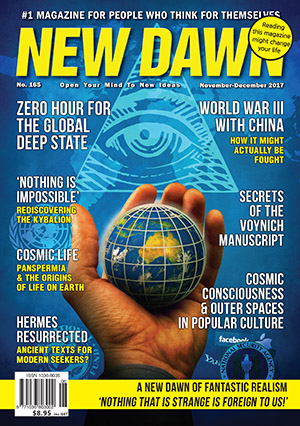
    A New Dawn of Fantastic Realism: ‘Nothing that is Strange is Foreign to us!’

    From New Dawn 165 (Nov-Dec 2017)

    “The paths of Fantastic Realism… do not resemble the ordinary paths of knowledge.”
    – Louis Pauwels & Jacques Bergier, The Morning of the Magicians

    As Richard Smoley rightly pointed out, “a noted predecessor” of New Dawn magazine “was the French review Planète (‘Planet’), published by Louis Pauwels and Jacques Bergier as a follow-up to the sensational success of their book Morning of the Magicians.” Inspired directly by Pauwels’ and Bergier’s book and Planète journal, New Dawn continues a subversive tradition of delving into subjects as fascinating and wide-ranging as secret societies, ancient mysteries, conspiracies, arcane prophecies, vanished civilisations, UFOs, supernatural phenomena, the awakened state….

    Like the French Planète (published 1961–1972), New Dawn was founded on the premise that reality is far more fantastic than how we limit it under conventional scientific, political, historical and cultural models. “If New Dawn magazine,” wrote editor David Jones in the March-April 2014 issue, “has a guiding philosophy or general orientation,” it would be, “Fantastic Realism with its slogan ‘Nothing that is strange is foreign to us!’”

    Grounded in the worldview of Fantastic Realism, New Dawn magazine is dedicated to exploring what Jacques Bergier and Louis Pauwels identified in The Morning of the Magicians, namely:

    Trends of thought that escape the notice of the trained observer; writings and works to which the sociologist pays scant attention, together with social phenomena that he considers too insignificant or too odd to worry about, are perhaps a sure indication of events to come than facts that are there for all to see and the openly expressed opinions and general trend of thinking which cause him serious concern.

    What exactly is Fantastic Realism? The answer is clearly outlined in The Morning of the Magicians:

    We call our point of view fantastic realism. It has nothing to do with the bizarre, the exotic, the merely picturesque. There was no attempt on our part to escape the times in which we live. We were not interested in the ‘outer suburbs’ of reality: on the contrary we have tried to take up a position at its very hub. There alone, we believe the fantastic is to be discovered – and not a fantastic leading to escapism but rather to a deeper participation in life…. The fantastic is usually thought of as a violation of natural law, as a rising up of the impossible. That is not how we conceive it. It is rather a manifestation of natural law, an effect produced by contact with reality – reality perceived directly and not through a filter of habit, prejudice, conformism.

    Long before the ‘X-Files’, ‘Ancient Aliens’ and the contemporary fascination with conspiracies and cover-ups, Fantastic Realism raised questions like: Are we all in a collective conspiracy to hide the truth, and is science such a conspiracy? Do secret societies exist and have they influenced history? What special knowledge did the ancients possess that we may not possess now? What role did occult forces play in the origins and rise of Nazism? What does the future promise for our civilisation? Are there Mutants among us? Does extrasensory perception reveal that human consciousness has advanced beyond its currently accepted limits? What connects the ancient art of alchemy and modern atomic physics?

    Readers of New Dawn magazine will immediately realise they are on familiar territory. Some readers may even find themselves in agreement with author and esoteric scholar James Wasserman when he described Fantastic Realism as a look behind “the many masks of God.” Fantastic Realism, Wasserman noted, “declares that an objective appreciation of the material world is a means by which we may attain an awakened state of consciousness, the next step in human evolutionary destiny.”

    Implicit in the approach pioneered by Fantastic Realism is a rejection of all reductionism, conformity, as well as the false dichotomy of Either/Or, Black-White thinking. Presenting hypotheses, examining the ‘outer limits’ of the human experience, and highlighting modern scientific and social falsehoods, does not mean embracing crusading dogmas or sentimental simplistic answers. It does, however, require leaving behind the ‘accepted wisdom’ of the herd.

    “Real intelligence,” the French writer Aimé Michel said, “lies in being able to think further than is allowed.” Aimé Michel, a Fantastic Realist collaborator and influential UFO researcher, always focused on “all that goes beyond the human,” maintaining that his objective was not to be limited by any external constraint. “It’s time to discover that all systems of thought,” Michel asserted, “are actually systems to AVOID thinking!”

    The task then, as summed up in the slogan of the New Dawn masthead ‘Open Your Mind to New Ideas’, is to transcend the narrow confines and closed-minded thinking of consensus reality. But first, the reader must not be afraid to question conventional knowledge, put aside all prejudice and assumption, and consider a different method of interpreting reality. As Louis Pauwels urged his readers all those years ago, what is needed is to look at reality with new eyes or, more accurately, with “awakened eyes.”

    A former student of George Gurdjieff, Pauwels made a key component of Fantastic Realism Gurdjieff’s observation that Man is asleep and must be shocked into an awakened state in order to perceive true reality. With this in mind, the astute reader of New Dawn gains a deeper awareness and understanding of what this magazine is all about. New Dawn magazine is a magic portal to another way of seeing Man and the world, a doorway to a new consciousness, a new humanity, and a new era.

    “Reality is not only queerer than we suppose but queerer than we can suppose.”
    – J. B. S. Haldane (1892–1964), outstanding scientist and polymath

    [alert type=”general” dismiss=”no”]This article was published in New Dawn 165.[/alert]

    [alert type=”success” dismiss=”no”]If you appreciate this article, please consider subscribing to help maintain this website.[/alert]

    © New Dawn Magazine and the respective author.
    For our reproduction notice, click here.