New Dawn – World's Most Unusual Magazine

Category: Articles

  • The Kali Yuga: Dicing with Death

    The Kali Yuga: Dicing with Death

    One of the most well-known cultural imports from India that has exerted an influence on Western thought is that of the Kali Yuga. This topic has been particularly dwelt upon by the Perennialist School, which includes authors such as René Guénon and Alain Daniélou. The reason for the popularity of this subject in the West is two-fold: Firstly, the Kali Yuga can be used to explain a number of political, economic, and environmental problems which currently face humanity. Secondly, the Kali Yuga and whole concept of cyclic time is not entirely foreign. The theory of time as non-linear and not always ‘progressive’ is a very ancient one, rooted in our own past. A similar cycle of Ages is present in Greek history, notably within the works of Hesiod, where he speaks of a fall from a Golden Age towards an apex of decline in the Iron Age. This cycle is also found in the Voluspá of the Poetic Edda which outlines Ragnarök and a Wolf Age (the equivalent of the Kali Yuga/Iron Age).

    The four Yugas (Satya, Treta, Dvapara, and Kali) have two standards of measurement, the chronological and the ethical. The chronological approach is based on astronomical positions and mathematical calculations. The stars and planetary positions have long been thought of as capable of influencing human behaviour via astrology, so from this viewpoint the cosmos itself would be the cause of the Yugas. Joscelyn Godwin brings the astronomical perspective to the fore when he states that “one of the recurrent themes of the Golden Age is that during it the earth’s axis was perpendicular to the ecliptic… If this were so there would be no seasons, but equal day and night throughout the year.”1 The influence on time would therefore be direct and visible. The symbolism used to portray the Golden Age often implies an alteration to time, as major planetary conjunctions are said to occur at the end of the Kali Yuga – and they are permanent conjunctions, which strongly implies time itself ceases.

    However, the majority of issues which arise in the Kali Yuga can also be attributed to a decline in human morality and ethics, so many of the problems could be entirely man-made. The imagery of time, the ultimate horror for all sapient life, could simply have been added as a metaphor for a more psychologically healthy state, wherein man no longer feels enslaved by others ‘from the cradle to the grave’, enjoying the spontaneous nature of life in a seemingly endless Golden Age.

    The Yuga itself is governed by the forces of ṛṭa, dharma, and karma. The first, ṛṭa (the cosmic law), is eternal and cannot be broken down. The second function, dharma (through ṛṭa) develops into a notion of individual human and social actions in relationship with the overarching cosmic order. It is dharma, the code of ethics which governs human society that erodes. Dharma decreases as the material aspect of existence (tamas) increases, and at certain points when the dharma is severely weakened, a new Yuga commences.

    Not only do the Yugas differ in the quality of dharma, they also differ in duration, for as the author René Guénon notes, the Yugas themselves have “decreasing lengths of the respective durations of the four Yugas that together make up a Manvantāra.”2 The duration of the Yugas decrease proportionally with a ratio of 4:3:2:1.3 Guénon elaborates on the different lengths of the Yugas explaining that “it can therefore be said not only that time compresses space, but also that time is itself subject to a progressive contraction, appearing in the proportionate shortening of the four Yugas, with all that this implies, not excepting the corresponding diminution in the length of human life.”4 Guénon provides an example of this explaining that if “the duration of the Manvantāra is 4,320, those of the four Yugas will respectively be 1,728, 1,296, 864, and 432.”5 Jean Robin highlights a flaw here though. Commenting on Guénon’s chronology, Robin states that Guénon’s calculations mean that the Kali Yuga would have ended in 1999: “The beginning of the Kali Yuga would thus be in the year 4481 BCE (3761 + 720), and its end would have to come 6,480 years later, i.e. in the year 1999 (6480–4481).”6

    The Kali Behind the Yuga’s Name

    It is a common misconception that the Kali Yuga is named after the Goddess Kālī. Instead it takes its name from an extremely powerful male demon. This mistake occurs due to errors in English translations of the name Kali – in Sanskrit the Goddess is named Kālī (with long vowels) – the name of the demon is spelt Kali (with short vowels). The demonic Kali takes his name from the Sanskrit root kad which means to “suffer, grieve, hurt, confound, or confuse.” Kali is the archenemy of Kalki, the 10th avatar of the God Viṣṇu. When Viṣṇu incarnates as an avatar, so does Kali – in the Mahābhārata he is said to be Duryodhana, and in the Rāmāyaṇa he is Rāvaṇa. Kali is the great-great-grandson of Lord Brahmā, as well as Adharma who was originally created from Lord Brahmā’s back as a Maleen Pataka (a sinful object). This is found in the Śrī Kalki Purāṇa where it says that, “After the annihilation, the secondary creator of the universe, Lord Brahmā, the grandfather of everyone, who was born on the universal lotus flower, created Sin personified, having a black complexion, from his back.”7 An alternate version of Kali’s origin states that he was born from the left-over poison that was drunk by Lord Śiva during the churning of the ocean of milk.
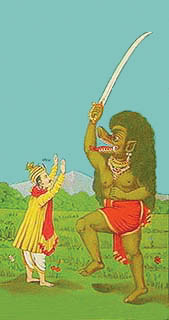
    Kali as dark-skinned monster with sword, From “The Cow with 84 Deities”, c. 1912, Ravi Varma Press

    Depictions of Kali portray him as both revolting and terrifying. The Kalki Purāṇa describes Kali as huge and the colour of “soot,” with a long tongue and a terrible stench. He carries a bone and has an abdomen that is said to be like that of a crow. Kali is always portrayed holding his genitals in his left hand and he has a dark complexion, like black ointment that has been mixed with oil.8 The Bhāgavata Purāṇa also describes him as a śūdra wearing the garments of a king. Kali’s symbol is an owl and he rides a donkey instead of a horse. Kali is very fond of gambling, drinking wine, enjoying the company of prostitutes, and associating with merchants – his whole persona exudes an aura of extreme excess, gluttony, and greed. Kali is also presumed to be responsible for all evil scriptures and badly composed religious texts. The favourite residences of Kali are

    the playgrounds of ghosts, foxes, and jackals. These places were permeated with the foul odour of decaying beef, and they were infested with crows and owls. Kali’s domain can be found wherever there is gambling and intoxication, as well as where women constantly quarrel.9

    In sum his domains are those which are deemed impure by Hinduism, and are found wherever people lose their rationality, generating strife and conflict. It is the influence of Kali that distorts the perception of humanity and lures them from the dharma. Kali’s association with negative human emotions and antagonism towards the dharma is symbolised by the names of his destructive progeny.

    Kali’s sister was Durukti (Harsh Speech). From Durukti’s womb Kali begot a son named Bhaya (Fear), and a daughter named Mṛtyu (Death). Bhaya begot a son named Niraya (Hell) from the womb of Mṛtyu, and Niraya begot ten thousand sons in the womb of his sister, Yatana (Excessive Pain). Thus I have described the destructive progeny of Kali, who were all blasphemers of genuine religious principles.10

    Kali’s reign, the Kali Yuga, commences within the Mahābhārata and this book is a pivotal text for understanding both the demon and the Yuga. The end of the Mahābhārata is traditionally believed to herald the dawn of the Kali Yuga, and it begins when Kṛṣṇa, the avatar of the God Viṣṇu, departs. Based on the astronomical observations of Parāśara, a date of c.1350 BCE can be provided for the Mahābhārata.11

    Kali’s presence in the text is subtle, and for the most part revealed only through symbolism. Hints of the infernal origin of Duryodhana are hidden within the Mahābhārata. Vidura issues warnings of the inauspicious symbols which surround Duryodhana and link him to Kali, saying,

    Listen to me, sire, even if my words are bitter, like medicine to a dying man. When Duryodhana was born he cried like a jackal. He will destroy us all. A jackal stalks our palace. Order Arjuna to kill him. Sacrifice a crow to get peacocks, sire; sell a jackal to buy tigers.12

    Jackals are one of the animals traditionally associated with both Kali and bad omens. In a different translation of the Mahābhārata, Kali’s presence is clearly stated.

    Know that Pāṇḍu of unfading glory and distinguished above all others, sprung from the Maruts. Kṣattri and Yudhiṣṭhira are both portions of the deity of Righteousness. Know that Duryodhana was Kali, and Śakuni was Dvāpara.13

    Just as the other main characters within the Mahābhārata are avatars of deities, so too is Duryodhana the avatar of Kali. The identity of Kali as the villain of the Mahābhārata also sheds much light on the actions of Krṣṇa, the avatar of Viṣṇu, and the role he plays in teaching Arjuna the kṣatriya dharma. Kali also appears as Nala in the Mahābhārata, who he possesses via the dice game (a form of gambling). During the dice game, Nala loses everything and is forced into exile. Kali’s possession of Nala ends when the Nāga Karkoṭaka bites him and the venom turns Nala into an ugly dwarf named Bāhuka, who eventually masters the dice game. Learning this enables Nala to exorcise the demon and he vomits Kali from his mouth. The story of Nala is a micro-version of the Mahābhārata itself – Duryodhana also lures Yudhiṣṭhira into playing the dice game, unaware that Duryodhana, aided by another demon Dvāpara (who has incarnated as Śakuni) is manipulating the dice so he can take over the kingdom.

    “Challenged, I never retreat,” replied Yudhiṣṭhira. “We are pawns in the hand of fate. Let us begin. Who plays against me?” “I will supply the stakes,” Duryodhana said. “My uncle Śakuni will play.”14

    Yudhiṣṭhira loses the kingdom, his brothers, himself, and even his wife. The dice game is also of further importance because the Yugas were originally named after the four throws of dice – Krita, Trita, Dvita, and Kali – Krita being the best throw and Kali the worst. Therefore, Kali is not only winning the dice game, he is winning the Yuga and declaring it, albeit symbolically, as his reign and preparing to engage in conflict with his traditional enemy, Viṣṇu, who incarnates as Krṣṇa in the Bhagavad-Gītā section of the Mahābhārata. Despite the defeat of Kali/Duryodhana in the epic, the end of the Mahābhārata is the beginning of the Kali Yuga, because it is believed that the very moment Krṣṇa left the earth, Kali became active in the world.

    Kali will not leave the world again until his nemesis Viṣṇu incarnates as Kalki. The Kalki Purāṇa is set at the end of the Kali Yuga and narrates the battle between the final avatar of Viṣṇu and Kali, who is defeated one-third of the way through the text. As Kali’s connection to the Kali Yuga is much more explicit in the Kalki Purāṇa, the manner in which he influences humanity and the dharma is also more obvious. The problems of the Kali Yuga are both moral and ethical, and the central issue of the Kalki Purāṇa is that society rejects the dharma and Vedic teachings. This is portrayed in Kalki’s role vis á vis the mleccha. The mlecchas are understood to be

    those who do not follow the Vedic principles. In former days, the mlecchas were fewer, and Visvāmitra Muni cursed his sons to become mlecchas. But in the present age, [the] Kali Yuga, there is no need of cursing, for people are automatically mlecchas. This is only the beginning of [the] Kali Yuga, but at the end of [the] Kali Yuga the entire population will consist of mlecchas because no one will follow the Vedic principles. At that time the incarnation Kalki will appear.15

    It is also stated that,

    the pious Brāhmaṇa have left this country (India), having been chastised by the powerful Kali, who is envious of saintly persons, and who destroys the practice of religious principles.16

    In addition to the mlecchas multiplying and the Brāhmaṇas departing, the caste system also breaks down into a fifth caste that is a result of the other four intermingling, as stated in the Mahānirvāna Tantra: “In the Kali Age, however, there are five castes – namely, Brāhmaṇa, Kṣatriya, Vaishya, Śūda, and Sāmānya.”17 The effect of the lack of dharma in the Kali Yuga can therefore be interpreted as the collapse of traditional law and the negation of all things ethical, moral, or spiritual. The goal of Kalki is not to simply slay Kali, but also to restore the dharma and to reinstate Vedic Traditions. Kali, on the other hand, spreads adharma by perverting religious discourse and creating unscrupulous scriptures. This is undoubtedly what Guénon has in mind when he speaks of the “counter-tradition” in the context of the Kali Yuga.

    The reign of the ‘counter-tradition’ is in fact precisely what is known as the ‘reign of the Antichrist’, and the Antichrist, independently of all possible preconceptions, is in any case that which will concentrate and synthesize in itself for this task all the powers of the ‘counter-initiation’, whether it be conceived as an individual or as a collectivity.18

    The adharmic counter-tradition of the Kali Yuga is also identified with rigid dogma and out of date fundamentalist thinking, notes Alain Daniélou, who writes that, “Visually symbols – that is, the various forms of writing – only begin to be used to fix certain elements of tradition when the evolution of the cycle announces the decline of knowledge.”19 He elaborates further on this stating that,

    writing is an urban phenomenon, characteristic of the Kali Yuga. To freeze the teachings of “prophets” in books regarded as sacred is to paralyse the spirit of research; it fixes so-called established truths and tends to create blind faith instead of the search for knowledge.20

    This is very much in line with depictions of Kali (metaphorically) possessing the minds of men to compose scriptures with ‘evil intent’. One only needs to read the daily news to see how ‘cherry-picked’ religious passages can be used to attack ethnic groups, sexes, and sexual orientations. The most obvious modern example would be Daesh deliberately distorting Islamic teachings to perpetuate political violence in both Europe and the Middle East. But it is only when all spiritual teachings have been eradicated that Kalki will be born, for the Śrīmad Bhāgavatam says that, “At the end of [the] Kali Yuga, when there exist no topics on the subject of God, even at the residences of so-called saints and respectable gentlemen of the three higher varṇas and when nothing is known of the techniques of sacrifice, even by word, at that time the Lord will appear as the supreme chastiser.”21 It is by restoring the dharma, the moral and spiritual essence of society, that Kalki is able to end the Kali Yuga. Kalki says this himself when he announces that, “I will then again establish Satya Yuga, and thus reinstate the principles of religion as they were before.”22

    Events to Occur in the Kali Yuga

    Alain Daniélou provides numerous examples of events that will occur in the Kali Yuga from the Liṅga Purāṇa and the Viṣṇu Purāṇa. The vast majority of these events are disasters which arise from human actions. All of the issues cited here by Daniélou arise from socio-cultural problems such as greed, lust, pride, arrogance, and political corruption which are the end result of the negation of dharma. As the dharma decreases, the vice and evil in humanity increases. The predictions for the Kali Yuga include the following:

    They will be surrounded by pretentious, false philosophers.

    There will be many beggars and unemployed people.

    Rapes will be frequent.

    Unqualified people will pass as experts in matters of morals and religion.

    Women of good birth will abandon themselves to the desires of the basest of men and perform obscene acts.

    Men will devote themselves to earning money; the richest will hold power.

    Through the fault of the public authorities, many children will die.

    People will accept theories promulgated by anyone as articles of faith.

    In the Kali Yuga men will be without virtues, purity, or a sense of decency, and will know great hardship.23

    The Mahānirvāna Tantra also states that, “Those born in the Kali Age are by their nature weak in intellect, and their minds are distracted by lust,” implying that the character of people is what causes them to adopt practices which are essentially harmful to both themselves and others.24 Due to the growing influence of materialism, greed will also become a source of admiration, and only those who are wealthy will be deemed worthy of respect. The Kalki Purāṇa states that,

    In [the] Kali Yuga, a person with a lot of money will naturally be respected as a great soul. If a twice-born person earns his livelihood by lending money on interest, he will be considered a pillar of society.25

    Other human created disasters associated with the Kali Yuga are clearly the result of bad governments. Taxes will increase and political figures will be self-serving rather than protectors of the people. There will also be mass migrations – something that is currently happening as people leave the Middle East for more prosperous and stable countries. These events found in the Kali Yuga are located in the discourse by Mārkaṇḍeya in the Mahābhārata where it is written that,

    Rulers will become unreasonable: they will levy taxes unfairly.

    Rulers will no longer see it as their duty to promote spirituality, or to protect their subjects: they will become a danger to the world.

    People will start migrating, seeking countries where wheat and barley form the staple food source.

    Not all of the events of the Kali Yuga will be purely caused by the immoral activities of humans though, for there will also be natural disasters at the close of the Yuga.

    The God of the clouds will be inconsistent with the rains.

    There will be many children born whose life expectancy is no more than sixteen years.

    People who live for a hundred years will be few.

    Water will be lacking, and in many regions people will watch the sky, hoping for rain.26

    In light of recent warnings about climate change and critical levels of pollution in China, these events could also be interpreted as man-made, via neglect and the wanton use of natural resources that harm the environment. Regardless of whether the cause is natural or caused by people, these passages indicate severe climatic instability that afflicts the population and shortens the human life span. However, there is one disastrous event in the Kali Yuga which is definitely not man-made. There is a poignant description of a mass extinction event in the form of an under-water volcano.

    Fire from the mouth of an underground serpent will burn the lower worlds, then the surface of the earth, and will set the atmosphere ablaze […] Surrounded by these circles of fire, all animate and inanimate beings will be destroyed.27 Huge ash clouds then cover earth […] Then, by means of interminable downpour, they will flood the whole earth with water. This torrential rain will swamp the earth for twelve years, and humanity shall be destroyed.28

    It is worth mentioning that the Ring of Fire is currently very active, and that large earthquakes have become more frequent in recent years. Violent earthquakes have been particularly prolific in Japan and New Zealand – close to the site of what is a developing super-volcano growing on the ocean floor. Science predicts that this new super-volcano will be strong enough to eradicate most life in the Southern Hemisphere, and cover the world with ash clouds powerful enough to ruin the climate globally. Currently it is believed that the volcano will take at least thousands of years to form, despite the fact that Daniélou calculates the end of the Kali Yuga to be 2,442,29 a date which if correct places us very close to a catastrophic disaster.

    All is not lost however. Although dharma is set to collapse according to these texts, some Traditions rewrote their teachings in order to adapt to the changing current of the Kali Yuga. The most well-known of these are the esoteric branches of Hinduism collectively referred to as Tantra. The Mahānirvāna Tantra says that, “when the Kali Age is in full sway for all castes, commencing with the Brāhmaṇas, Tāntrika rites are alone appropriate.”30 Daniélou repeats this sentiment stating that, “Only Tantric Yoga methods are efficacious in this age in which values are lost; the rites, asceticism and virtues of other ages are ineffective.”31 He also believes that the “teachings of Lakuliśa expose the principles of the Darśana (the paths of knowledge) in a simple and popular form full of imagery, and suggest patterns of behaviour suitable for the final stages of the Kali Yuga.”32 The most simple and effective method of resisting the influence of the Kali Yuga, however, is actually very easy and can be practiced by anyone, for the Mahānirvāna Tantra says that,

    in the Kali Age alms are efficacious in the accomplishment of all things. The proper objects of such alms are the poor devoted to meritorious acts.33

    Thus the humble act of charity can counter the woe, greed, and cruelty of the Kali Yuga. If anything can save humanity from the disastrous effects of the Kali Yuga, then it must be human action, performed in accordance with dharma. Even if this assumption is incorrect, it may still be enough to make the world a slighter brighter place in this, the darkest of all ages, and forestall the apocalypse for just a little while longer.
    [alert type=”general” dismiss=”no”]This article was published in New Dawn Special Issue Vol 10 No 2.[/alert]
    [alert type=”success” dismiss=”no”]If you appreciate this article, please consider a contribution to help maintain this website.[/alert]

    Footnotes

    1. J. Godwin, ‘Decoding the Cycles of Time: When Does the Kali Yuga End?’, New Dawn 138 (May-June, 2013), 64
    2. R. Guénon, The Reign of Quantity & Signs of the Times, Sophia Perennis, 2004, 42
    3. B. G. Sidharth, The Celestial Key to the Vedas, Inner Traditions International, 1999, 60
    4. R. Guénon, The Reign of Quantity & Signs of the Times, 159
    5. R. Guénon, Traditional Forms & Cosmic Cycles, Sophia Perennis, 2004, 6
    6. J. Godwin, New Dawn 138, 65
    7. Śrī Kalki Purāṇa, trans. Bhumipati Das, B., ed. Das, P., (Tai Nitai Press), 5
    8. Śrī Kalki Purāṇa, 5
    9. Śrī Kalki Purāṇa, 5
    10. Śrī Kalki Purāṇa, 6
    11. B. G. Sidharth, 118
    12. Vyāsa, The Mahābhārata of Vyasa, trans. Lal, P., Vikas Publishing House, 1980, 129
    13. Vyāsa, The Mahābhārata of Krṣṇa-Dvaipāyana Vyāsa, trans. Kisari Mohan Ganguli, K. M., (c. 1883–1896), section XXXI
    14. Vyāsa, The Mahābhārata of Vyasa, trans. Lal, P., 128
    15. Śrīmad Bhāgavatam, 9:16:33
    16. Kalki Purāṇa, 2.45
    17. A. Avalon, The Tantra of the Great Liberation, Dover Publications, 1972
    18. R. Guénon, The Reign of Quantity & Signs of the Times, 270
    19. A. Daniélou, Shiva and the Primordial Tradition: From the Tantras to the Science of Dreams, Inner Traditions International Ltd., 2003, 103
    20. A. Daniélou, While the Gods Play, Inner Traditions International Ltd., 1987, 87
    21. Śrīmad Bhāgavatam, 2.7
    22. Śrī Kalki Purāṇa, 16
    23. While the Gods Play, 212-215
    24. The Tantra of the Great Liberation
    25. Śrī Kalki Purāṇa, 8-10
    26. While the Gods Play, 212-215
    27. Viṣṇu Purāṇa 1.8.18-31
    28. While the Gods Play, 218
    29. While the Gods Play, 197
    30. The Tantra of the Great Liberation
    31. A. Daniélou, Gods of Love and Ecstasy: The Traditions of Shiva and Dionysus, Inner Traditions International Ltd., 1992, 235
    32. While the Gods Play, 120
    33. The Tantra of the Great Liberation

    © New Dawn Magazine and the respective author.
    For our reproduction notice, click here.
  • The Cathars & Their Modern Day Revival

    The Cathars & Their Modern Day Revival

    From New Dawn Special Issue Vol 10 No 2 (Apr 2016)

    Most forms of spirituality or religion look back to the past in some way. The past is a source of origin, tradition, revelation, and inspiration. For the medieval Cathars the most distant past was, as it is for most religions, the time in which the mythic foundation of the world was established. More recent developments, such as the coming of Jesus, brought the story forward to a new chapter. The Cathars believed that their initiation rite, the consolamentum, was the result of an unbroken tradition stretching back to Jesus himself.

    Aspiring modern Cathars look back to the myths of the original spiritual realm, the fall of Satan and the angels, and the creation of the material world in which souls reincarnate until they can escape. They also look back to the historical groups and individuals who were involved with the development of this worldview in the first place. Modern esoteric lineages typically derive not from antiquity but from revivals that occurred in the eighteenth, nineteenth and twentieth centuries. Thus when exploring movements like the Gnostics of antiquity or the Cathars of the Middle Ages, the modern spiritual seeker is often presented with a melange of spiritually-unsympathetic popular history, obtuse scholarly research, and a revivalist esoteric tradition that often has little to do with critical history.

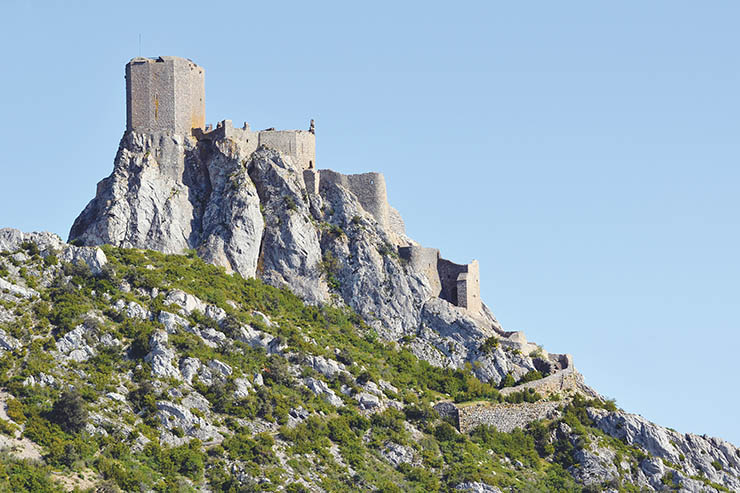
    The Cathars are best known not for what they did but for what was done to them. The Albigensian Crusade, launched in 1209 on the authority of Pope Innocent III, laid waste to the Languedoc in the south of France. The Inquisition was subsequently founded to root out and eradicate what remained of the Cathar heresy. Books on the Cathars focus on the relentless march of the crusading army as it moves from castle to castle, siege to siege, atrocity to atrocity. Or historians weigh up the influence of the Inquisition, a ruthless bureaucracy that survived into the nineteenth century. Tourists visit the Languedoc, now branded as Cathar country, for the fairytale citadel of Carcassonne, restored in the nineteenth century, for the wild ruins of medieval castles on challenging hilltops, and for the relaxed locals, good weather, cheap food and wine.

    The reader of a history of the Cathars encounters a list of atrocities so numbingly extensive she is at risk of experiencing compassion fatigue. After the crusaders ended the siege of the city of Bram, 99 men had their noses and upper lips cut off, were blinded, and were tied together with another one-eyed man at their head to lead them. This is perhaps the most colourfully brutal event of the crusade but it is merely one example and certainly did not have the highest body count. The Inquisition mopped up the survivors.

    The contrast between the Cathars themselves, with their high ethical standards, kindness and deep spirituality, and the crusaders and Inquisitors, reminds me of P.D. Ouspensky’s view of esotericism and history. The history we know, the history of war and temporal power, is the history of crime. But there is another history, the history of esotericism. It is that other history that interests me. Fragments of Cathar beliefs can be dug out of the writings of the Catholic intellectuals who opposed them, like shards of tile that make up a buried mosaic. We cannot reconstruct the inner lives of the Cathars by scholarship, yet knowledge of their beliefs and practices suggest to us by analogy what their inner experiences may have been.

    Although the Cathars were typically principled, enlightened and simple people, they by no means uniformly lived up to their high standards. The Italian Cathars were embroiled in turf wars and denominational disputes. William Bélibaste, the last Cathar Perfect in the Languedoc, was a murderer who bedded many women in violation of his vows and tried to cover up his shortcomings.

    To the Cathars, the material world was intrinsically evil, fashioned by the devil, the god of this world. The heavenly realm of the true God existed in spirit only. Catharism really was an esoteric religion. In a pattern still demonstrated by many of the minority religions of the Middle East, such as Mandaeans, Yazidis, Alawites, and Druze, a large community of lay people support the inner circle of priests or clerics or Perfect. The rite of the consolamentum dedicated the aspirant to the austere restrictions and responsibility of the Cathar Perfect. When the spirit is said to descend on the participant during the consolamentum or when the spirit is so much part of the Cathar myth, I cannot believe this was not accompanied by some sort of transcendent mystical experience.

    To some extent the Cathars have been treated by esotericists as a blank canvas onto which many different patterns are painted. Many of the extravagant claims of neo-Cathars have little to do with the remnants of the Cathars that history bequeaths us. I found myself in sympathy with these romantic esotericists but wanting to test their more fantastic claims.

    The Neo-Cathars

    The three most influential neo-Cathars of the twentieth century would be Antonin Gadal and Deodat Roché, both born in 1877 and from the Languedoc, and the German Otto Rahn. Both Gadal and Roché had eccentric opinions of the Cathars’ history. Gadal, in particular, became fascinated by the idea that cave systems in the Languedoc had been used as initiatory centres by the Cathars. Historically speaking, it is unlikely. But a whole system of ritual initiation was recreated and practised in the caves. To this day there are esoteric groups who use the caves for this purpose. Roché was a more reliable scholar, yet he believed the caves had connections with Mithraism. Roché lived into his 90s and was greatly respected by both esotericists and the local population.

    Otto Rahn is nearly as famous as the Cathars themselves. Often billed the real ‘Indiana Jones’, Rahn was a romantic and idealistic young German who came to the Languedoc in the 1930s. He is particularly associated with connecting the Cathars with the Holy Grail. Rahn’s classic Crusade Against the Grail is neither the most original nor the most well-researched book on the Cathars. Yet somehow it epitomises the essence of romantic esotericism. As does Rahn’s life. Fleeing the Languedoc in debt, having associated himself with several dubious characters, he found himself invited to an interview with an admirer of his recently published book. That person was Heinrich Himmler and Rahn found himself invited to join the SS, an offer he could not refuse.

    Rahn appreciated the resources set before him, facilitated by Himmler’s fascination with myth and the occult. He could now travel to ancient sites with a substantial budget at his disposal. Yet the impractical, romantic, raffish, homosexual Rahn was a poor fit for the SS. In 1939 he travelled to Austria, walked up a peak in the Tyrel Mountains, took sleeping pills and died of exposure.

    Another influential Cathar revivalist was Maurice Magre, a well-known French novelist who became convinced the Cathars represented a form of Buddhism. The French philosopher Simone Weil (pronounced ‘Vay’) is perhaps the most admirable figure of the Cathar revival. A superb writer who lived a short and difficult yet highly principled life, she found in the Cathars an example of how to live authentically. But her historical knowledge of them was no better than that of the Languedoc neo-Cathars such as Antonin Gadal and Déodat Roché with whom she had corresponded.

    Among all these eccentrics and romantics, Weil stands out in particular for the quality of her work. She was born into a middle-class secular Jewish family and attended the Sorbonne where she was in the same class as Simone de Beauvoir. Weil was a pacifist and trade unionist, fighting on the Republican side of the Spanish Civil War, with an anarchist militia in 1936. She worked in factories to experience the life of the working class, to the detriment of her health and her income. Often referred to as a Christian neoplatonist, Weil was in effect a Perennialist, believing that the ancients essentially shared a single esoteric tradition, Plato being its finest expression. She died in London in 1943 of turberculosis, though many considered her death an imitation of the Cathar endura, a fast to the end.

    Arthur Guirdham & the Transmigration of Souls

    It may surprise many people to discover that the medieval Cathars really did believe in reincarnation, and more specifically in the transmigration of souls from creature to creature, including animals as well as humans. One of the most charming stories surrounding this concerns a Cathar Perfect who remembered being a horse in a previous life, and was able to find the horseshoe that he had once shed. The Cathar understanding of reincarnation or transmigration is intimately connected with their myth of a fall from Heaven. Each spirit has fallen into the material world and is reincarnated constantly until it finds its way into a human who becomes a Cathar Perfect and, by following the Cathar path, is liberated at death and returns to the heavenly realm.

    Not only did the medieval Cathars believe in reincarnation, but there are many modern people who believe or feel they were Cathars in previous lifetimes. The granddaddy of modern Cathar reincarnation was Arthur Guirdham (1905–92), Senior Consultant Psychiatrist for the clinical area of Bath, UK, for over twenty years. Highly considered by his associates and friends, his legacy was not to be in the area of psychiatry but in a series of books detailing the past life knowledge of a patient known only as Mrs Smith, who he met in the 1960s. Later another local woman known as Miss Mills also became involved. Eventually an entire group of people emerged who had reincarnated together with Guirdham into different eras.

    Guirdham’s group reincarnation is commonly described as one of the most convincing cases. Yet does it survive closer scrutiny? In none of his books does Guirdham tell his story in a very methodical way. He is often very careful to state what is accurate in the past life memories and what isn’t, to reveal what facts were already known to him, and so on. But he can be so rambling in his accounts that the reader is left none the wiser.

    Mrs Smith, in her Cathar incarnation, was a Catholic named Puerilia. Guirdham was Roger de Grissolles, a Cathar. The two had been lovers in the thirteenth century. Puerilia was eventually condemned and burnt as a heretic herself. Mrs Smith’s memories of this past life were dramatic and seemingly accurate in strange details. She recalled, “I didn’t know when you were burnt to death you’d bleed. I thought the blood would all dry up in the terrible heat. But I was bleeding heavily. The blood was dripping and hissing in the flames. I wished I had enough blood to put the flames out. The worst part was my eyes. I hate the thought of going blind… I tried to close my eyelids but I couldn’t. They must have been burnt off, and now those flames were going to pluck my eyes out with their evil fingers.” (The Cathars and Reincarnation by Arthur Guirdham)

    Events developed rapidly as the scope of the reincarnations expanded. Miss Mills’ friend Jocelyn S. subsequently died and communicated to the group from beyond the grave as Braïda de Montserver. The group reincarnation expanded to 19, nearly all of whom were friends or relatives of Miss Mills. It is an extraordinary story.

    Objective evidence for previous lives can only be assessed by comparison with historical and archaeological information. The very nature of historical evidence itself muddies the waters. If a particular facet of history has been documented and published, anyone who subsequently claims to remember this from a previous life may actually have acquired the information from a book. And yet details not backed up by historical or archaeological evidence are of no help in determining authenticity.

    There is therefore a very narrow band of evidence that could constitute objective evidence (though not even proof) for reincarnation. As the stories given to Guirdham by the two women became more complex there were suggestions of fraud or that published information was being used. Yet there is an early example of evidence that might satisfy the criteria.

    Mrs Smith insisted the Cathars she saw in her dreams wore dark green and dark blue robes. This was inconsistent with published information on Catharism. French scholar Jean Duvernoy discovered in the Fournier Inquisition registers that during the time of the Inquisition some Perfect wore these dark colours rather than black. It seems these colours were adopted as a compromise between the traditional black and the need to disguise their status. Duvernoy only published this information in 1965, and only in French. This tiny detail suggests authenticity.

    Guirdham was a professional man of high standing. Although obviously intoxicated by the ‘far memories’ of Mrs Smith and Miss Mills, he was careful in his comparison of their statements with historical data. But it seems Guirdham was never able to successfully meet any of the reincarnation circle aside from Mrs Smith, Miss Mills and Miss Mills’ very ill father. Miss Mills, and then Guirdham, eventually channelled teachings from disembodied Cathar spirits. How convincing are these when compared to what we know historically about the Cathars? Did Guirdham have the wool pulled over his eyes, or did he knowingly suspend disbelief? If he was mistaken about the veracity of these past life memories, did this really matter if the entire process proved to be spiritually enlivening for him? Or was this strange fabric of experience, history and wool-gathering more or less what Guirdham claimed it was – the far memories of a group reincarnation?

    A worldview is different from history, yet esoteric or alternative worldviews often make historical claims. These are in tension with each other. I always have mixed feelings about these claims. As something of a romantic myself, I admire and somewhat envy those who can take the ball and run with it. On the other hand, claims which are insisted on as historical should be verifiable. Esotericism is often based on the scholarship of the time. When that scholarship makes further discoveries or changes the basic understanding of an historical phenomenon, the esoteric worldview based upon it often stays crystallised in its original form.

    Spirituality should be based on experience rather than on pure flights of fancy. Yet the historically fantastic has often been a better cocoon of the spiritual butterfly than the historically sound. In Lost Teachings of the Cathars I examine the teachings and the histories of both the Cathars and their aspiring modern successors.

    For more on the Cathars and its modern day revival, read Andrew Phillip Smith’s book Lost Teachings of the Cathars: Their Beliefs and Practices (Watkins 2016), available from all good bookstores & online retailers.

    [alert type=”general” dismiss=”no”]This article was published in New Dawn Special Issue Vol 10 No 2.[/alert]

    [alert type=”success” dismiss=”no”]If you appreciate this article, please consider subscribing to help maintain this website.[/alert]

    © New Dawn Magazine and the respective author.
    For our reproduction notice, click here.
  • What Are Humans Made Of?

    What Are Humans Made Of?

    The figure seems to hover around 95 percent. That’s the proportion of the universe that consists of dark matter and dark energy – entities that are only dimly and indirectly perceived by scientific apparatus.

    This fact has gotten wide attention lately, but one implication has gone unnoticed: if this is the case for the physical universe, it must also be the case for our own bodies. Therefore 95 percent of your body is made up of matter and energy about which nearly nothing is known.

    This makes the ancient dictum “Know thyself” somewhat harder to satisfy than one might have thought.

    What, then, is the body made of? It is a question that conventional thought cannot answer and for the most part cannot contemplate. This leads us to consider views of the body in the world’s esoteric traditions. As in most areas, they don’t agree on all points, but the similarities are more striking than the differences.

    The first thing we have to acknowledge is that the body, taken as a purely physical entity, has no structure or coherence whatsoever. This is a strange claim to make, but we can see the truth of it simply by contemplating the difference between a living body and a corpse. The living body has coherence; it is capable of motion and activity, and can sustain itself for several decades. The corpse lacks all such features. It will rot to pieces in a very short time.

    There must, then, be an organising structure that holds the physical body together during earthly life. One common name for this, which comes out of early twentieth-century Theosophy, is the etheric body, sometimes known as the etheric double. (I will be mostly using Theosophical terms in this article not because they are necessarily any better, but because they are the most commonly used ones in New Age contexts.)

    Thus, for our discussion, we have to redefine the word body. From an esoteric point of view, a body can be described as a vehicle for structuring experience at a particular level of existence.

    So what is this etheric body? Here is a firsthand observation. The American writer Rosanne Daryl Thomas describes the death of her cat:

    He was leaving us. I held him. He pushed his head under my arm, purring as I stroked him and spoke softly, wanting to fill him with love. And then suddenly his face grew sharper and thinner. His life had gone. I faced his death with grief and unexpected wonder. What I saw was this: that the life force, the spirit, is a thing unto itself, and when it leaves, when it left old Ruffy, his form lost his fullness. Something had clearly gone. What was left once held his old beloved self, but the self which had been present one moment had departed as if on a breeze. I understood what a soul was. It was this self. And I understood that, if energy never dies, that bit of self that was not in him was now elsewhere: where, I could not say, but I had seen it, and seen it go.

    This passage suggests that this organising principle, this “bit of self,” inheres not only in humans but in animals as well.

    Very likely this etheric body is no more immortal than the physical body. One common tradition holds that the etheric body survives for three days or so after physical death. This seems reasonable: it would explain why most encounters with dead loved ones occur a few days after the loved one’s death. The number drops off greatly after that point.

    The etheric body is made up of energy, though of an extremely subtle kind. This energy is known variously as prana, chi or qi, or simply the life force. (Note that Rosanne Thomas uses the phrase life force in the passage above.) The etheric body has its own structure, although this differs radically from the physical object that is studied in anatomy classes. Nevertheless, many traditions describe the patterns of this body, as we see with the meridians of traditional Chinese medicine and the chakras of Hinduism.

    The etheric body is not the whole story. There is also what is called the astral body, a term that can be traced back to the Neoplatonic philosopher Proclus, who lived in the fifth century CE. Man, he said, was composed of an okhēma, literally “vehicle,” made of starry or “astral” material. According to esoteric theory, it is affected and shaped by the configurations of the stars and especially the planets. This idea may explain an ancient Orphic verse, which instructs the recently deceased person to say, “I am the child of earthy and starry heaven.” This astral body is thought to be made up of a subtle, starry stuff sometimes called the astral light. Subjectively, the astral body corresponds to the congeries of thoughts, emotions, and images that surround an individual.

    Why call this a body? Because it is, as said above, a vehicle for structuring experience – in this case, at what we may call the psychological level. This vehicle does not resemble the physical entity – at least not in any detail – but it possesses its own consistency and organisation. Through their clairvoyant investigations, the Theosophists Annie Besant and C.W. Leadbeater described the astral bodies of various individuals and the colours and shapes associated with certain emotions and desires.

    Proclus believed this astral vehicle was immortal, but this is not a universal view. Some say the astral body survives the death of the physical body for around forty days. This would explain why, for example, the Eastern Orthodox tradition says prayers particularly intensely for an individual for the first forty days after his death, and why the period stipulated for reading for the deceased in The Tibetan Book of the Dead is forty-nine days.

    Beyond the astral level, there seems to be less agreement among the traditions, no doubt because these are increasingly remote from earthly experience. The Theosophists posit a mental body, as Kurt Leland observes in his interview, which in this case would consist of the structure of ideas and thoughts that surround the individual. But it is also possible to view the astral (emotional) and mental bodies as essentially the same entity.

    One curious feature of Theosophy is its concept of permanent atoms. As we’ve seen, all of these subtle bodies disintegrate after death. Given this and given the fact that Theosophy teaches reincarnation, we could ask, what reincarnates? The Theosophical answer is that literally one atom (obviously not an atom of the sort known to science) remains of each of the bodies: etheric, astral, and mental. These atoms are linked to the reincarnating Self and are the vehicles of karma: they are where your karma is stored.

    I don’t know of any other traditions that speak of permanent atoms per se, but the idea resembles the concept of the luz in the Kabbalah. Luz, in Hebrew, means “almond.” The French esotericist René Guénon writes that luz is “the name given to a specific, indestructible body, symbolically represented by an extremely hard bone, to which the body, after death, remains attached until its resurrection. As the kernel contains the germ and the bone contains the marrow, so luz contains those elements necessary for a restoration of an individual being.” (Guénon did not believe in reincarnation, so he spoke instead of resurrection.)

    Beyond the astral body are levels that are immortal, or relatively so. The Theosophists speak of a causal body that persists between incarnations, as well as progressively higher levels that are extremely different to picture through the lens of earthly experience.

    All this said, what knowledge can we have of these subtle bodies? Those who can see them clairvoyantly are rare, and, more often than not, have had this ability since birth.

    To experience your own etheric body, the key is proprioception: the subjective, conscious attention to the sensations of the body. This practice is found as a type of meditation both in the Work of G.I. Gurdjieff and Buddhist vipassana meditation. Kum Nye, a Tibetan movement practice taught by the lama Tarthang Tulku, works with it as well. With sufficient practice, you will eventually come to experience sensations as a kind of flow of currents of energy within the body. I would suspect these currents have some relation to the meridians of Chinese medicine and other anatomies of subtle energy.

    To have a sense of the astral body, you may find it helpful to sit or lie quietly and imagine yourself surrounded by light. Allow yourself to choose the colour of light that is most satisfying to you. You may have some preconceptions of certain colours as “higher” or “more spiritual” than others, but set these ideas aside as much as possible and focus on exactly which colour or colours feel the most appropriate, and then focus on visualising these. Pay attention to whatever feelings these colours arouse in you. If they produce some discomfort or irritation, it may be best to find another colour.

    As for sensing the subtle bodies in others, as I’ve said, clairvoyant vision of auras can and does occur (I have sometimes seen them myself), but the majority of people are more aware of these presences kinaesthetically rather than visually. That is, you go into a room and suddenly feel a chilly dread, or, on the other hand, it gives you a feeling of well-being inside. The same holds true when we encounter certain people.

    These kinaesthetic perceptions are, I believe, much more useful avenues of exploration of the subtle realms than attempts at clairvoyance per se. So if you want to cultivate your awareness of these levels, the best way is to focus on what you are feeling rather than on what you might see.

    Causal, mental, astral, etheric bodies – how absurdly mystical they sound! At least to some ears. And yet when we look at these new concepts of dark matter and dark energy, we can legitimately ask if these have something to do with the subtle bodies that have been spoken of for so long and so universally. Could it be that our subtle senses – known under such names as telepathy and clairvoyance – are perceiving these unknown substances? And could it be that science has scoffed at such things because its instruments have been too primitive to detect them?
    [alert type=”general” dismiss=”no”]This article was published in New Dawn Special Issue Vol 10 No 3.[/alert]
    [alert type=”success” dismiss=”no”]If you appreciate this article, please consider a contribution to help maintain this website.[/alert]

    Sources

    René Guénon, The Lord of the World, Translated by Carolyn Shaffer et al., Coombe Springs Press, 1983

    Philip S. Harris, ed., Theosophical Encyclopedia, Theosophical Publishing House, 2006

    Daryl Thomas Rosanne, Beeing: Life, Motherhood, and 180,000 Honeybees, Globe Pequot Press, 2002

    Tulku Tarthang, Kum Nye Relaxation, Two volumes, Dharma Publishing, 1978

    © New Dawn Magazine and the respective author.
    For our reproduction notice, click here.

  • Control 101: Creating Consensus Reality

    Control 101: Creating Consensus Reality

    From New Dawn 156 (May-June 2016)

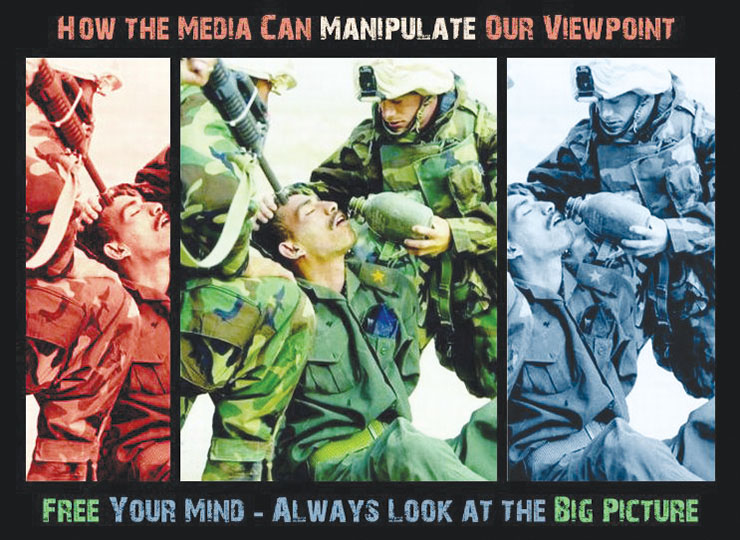
    By carefully controlling mainstream media and educational institutions, elite social engineers are able to control the flow of public discourse in order to serve their own goals and interests. By doing this, they create something akin to ‘consensus reality’. In other words, by controlling the perception of public consensus on any particular issue or event, you effectively control the prevailing reality.

    A leading example of this social engineering phenomenon today is in the relentless promotion of war and global conflict throughout the media and education systems. Their carefully coordinated efforts can be boiled down to a simple concept: establishing legitimation and delegitimation in relation to the state or state institutions.

    In today’s formative education, school textbooks and assigned reading material are powerful tools used to shape students’ views. Often what is imprinted in one’s memory is not particular details and facts but rather an atmosphere, an impression, or a tone.1 It can be argued this impression may be more influential in forming a pupil’s contextual world or nationalist view.

    Professor of Education Dr. Michael H. Romanowski, explains: “The authority of textbooks coupled with the ‘objectivity’ of the technical knowledge that they communicate encourages students to accept unquestionably the impressions and worldview created by the language of textbooks.”

    “Although textbooks claim rhetorically not to promote a particular understanding of history and to be objective, they advance a value-laden perspective of reality. Because the selection and structure of knowledge affect our perception of the world, the language and context used to articulate knowledge are crucial. Textbook authors select particular language that creates impressions in the minds of students. These impressions have power and authority because they are presented in the printed and bound textbook with its aura of an authority that is beyond question and criticism. Although textbooks are used in many different ways, they are still dominant and powerful educational tools that shape students’ views.”

    In his study Romanowski goes on to describe how through the careful use of language, US school textbooks depicted Japanese internment camps in the United States during World War II in a manner that marginalised Japanese-Americans, while subtly mitigating any real criticism of the US government’s actions. Some might call this indoctrination, while others may call it brainwashing.

    Much of the ideological instruction for educational institutions is provided through the global governance system run and funded by multilateral institutions like the United Nations and the World Bank. The global management and cultural continuity of this European and North American-led ‘soviet’ is run by a myriad of Non-Governmental Organisations (NGOs), specifically through the UN’s “Agenda 2030”, a set of global directives for the next two decades. Previously these were the UN “Millennium Goals” which have since been overhauled and upgraded by the self-appointed culture experts and social engineers in New York City and Geneva. Through this globalised system, social engineers are able to streamline language and political thought internationally, while simultaneously preparing the next generation to accept a new sanitised political reality.

    In the last two decades, the corporate mainstream media’s efforts to spin endless war narratives on behalf of the state and its defence industry have become more pronounced. Despite numerous critiques and thousands of online articles and activist campaigns, the Establishment is simply doubling-down on their positions.

    Australian journalist and filmmaker John Pilger has emerged as one of the leading voices in recent generations exposing institutional Western war propaganda. He is also one of the few members of the media to challenge the carefully crafted “man of peace” US President Barack Obama.

    Pilger writes: “In 2009, President Obama stood before an adoring crowd in the centre of Prague, in the heart of Europe. He pledged himself to make ‘the world free from nuclear weapons’. People cheered and some cried. A torrent of platitudes flowed from the media. Obama was subsequently awarded the Nobel Peace Prize. It was all fake. He was lying. The Obama administration has built more nuclear weapons, more nuclear warheads, more nuclear delivery systems, more nuclear factories. Nuclear warhead spending alone rose higher under Obama than under any American president. The cost over thirty years is more than $1 trillion.”2

    Regarding the lack of due diligence and complicity by the mainstream media, Pilger adds: “Had journalists and broadcasters done their job and questioned the propaganda that Saddam Hussein possessed weapons of mass destruction; had the lies of George W. Bush and Tony Blair not been amplified and echoed by journalists, the 2003 invasion of Iraq might not have happened, and hundreds of thousands of men, women and children would be alive today.”

    From these examples, it’s easy to see how the state, the education system, and the media all compliment each other to manufacture Western public consent for the business of global military adventurism.

    Today, much less visible new means of control are being perfected. Digital monopolies are run by mega-corporations like Google whose vast informational and ‘smart’ data networks allow a relative handful of people to exert enormous influence over billions of people – without them ever knowing what is happening behind the curtain.

    From a social engineering perspective, this could be described as a form of mass mind control. By employing various strategies designed to manipulate search engines and their results, any cabal can influence public opinion on a range of subjects and issues – which in turn help determine which policies are implemented, political outcomes, and even what laws are passed. Once again, by controlling consensus reality, elites create the reality of their choosing.

    Writer Robert Epstein provides some insight into how something as simple as searching for information has been commoditised and modelled by the digital overlords at Google. He explains:

    “The Google search engine is so good and so popular that the company’s name is now a commonly used verb in languages around the world. To ‘Google’ something is to look it up on the Google search engine, and that, in fact, is how most computer users worldwide get most of their information about just about everything these days. They Google it. Google has become the main gateway to virtually all knowledge, mainly because the search engine is so good at giving us exactly the information we are looking for, almost instantly and almost always in the first position of the list it shows us after we launch our search – the list of ‘search results’.”3

    Another disturbing trend is the state’s increasing role in administrating intellectual tyranny in the 21st century. This idea goes much deeper than just state snooping on its own citizens when you consider the consequences of people becoming afraid or overly self-conscious about which web pages to visit or which search terms they input into Google.

    What happens when our private lives become public property? In the world’s premier police state, the UK, Home Secretary Theresa May recently announced a new bill, known as the “Snooper’s Charter,” which gives Orwellian powers to the state and its security services for tracking UK citizens’ Internet use and web browsing history dating back two years – without the need for any judicial check. Similar invasive measures have already been passed in Australia.

    Technocrat May was accused of rushing the new surveillance laws into place in order to avoid more public scrutiny from critics and civil liberties groups.

    When asked, one anonymous government source provided The Independent newspaper with the standard party line: “Terrorists and criminals are operating online and we need to ensure the police and security services can keep pace with the modern world and continue to protect the British public from the many serious threats we face.”4

    This sounds like a line straight out of Terry Gilliam’s film, Brazil.

    Scottish comedian Frankie Boyle tries to make light of this situation: “No more drunken Googling: all it takes is a misspelled search for ‘bong-making’ and suddenly you’ll be in an orange jumpsuit getting beaten with a pillowcase full of bibles.”

    He continues: “This law will create lots of new jobs, as the person charged with reading all our communications (who will see more unsolicited erections than customer services at Skype) will regularly feed their screaming face into a meatgrinder.”5

    Once again, governments continue to recycle the same tired old talking point by insisting the only people who need worry are those who have something to hide. If that’s the case, shouldn’t we be allowed to snoop on the state? They really shouldn’t mind. It is every citizen’s duty to know everything the state and its corporate partners are up to.

    [alert type=”general” dismiss=”no”]This article was published in New Dawn 156.[/alert]

    [alert type=”success” dismiss=”no”]If you appreciate this article, please consider subscribing to help maintain this website.[/alert]

    Footnotes

    1. ‘Problems of Bias in History Textbooks’ by Michael H. Romanowski, www.socialstudies.org/system/files/publications/se/6003/600310.html
    2. ‘A World War Has Begun’, http://21stcenturywire.com/2016/03/23/pilger-a-world-war-has-begun-now-break-the-silence/
    3. ‘The New Mind Control. “Subliminal Stimulation”, Controlling People without Their Knowledge’ by Robert Epstein, https://aeon.co/essays/how-the-internet-flips-elections-and-alters-our-thoughts
    4. ‘Snooper’s charter: Theresa May to present revised Investigatory Powers Bill with tougher privacy protections’ by Nigel Morris, The Independent, 1 Mar 2016
    5. ‘The snooper’s charter: one misspelled Google search for “bong-making” and you’ll be in an orange jumpsuit’ by Frankie Boyle, The Guardian, 11 Nov 2015

    © New Dawn Magazine and the respective author.
    For our reproduction notice, click here.
  • Is the Brain Really Necessary? The Answer Seems to be a No-Brainer

    Is the Brain Really Necessary? The Answer Seems to be a No-Brainer

    This article was published in New Dawn Special Issue Vol 10 No 4 (Aug 2016)

    This is what we’re told: Your brain is where your mind, consciousness and personality reside. “Reductionism,” noted the English writer & philosopher Colin Wilson, is the “simple theory that tries to explain the mind in terms of physical mechanisms.” Thus, consciousness “is a mechanism of the brain and nervous system.”1

    Put another way: Our mind, our consciousness, our awareness and our personality all come from the brain’s chemical and electrical machinery. When the brain works our ‘mind’ is its product. And when the brain stops working we simple cease to be. That’s the standard scientific presentation.

    The opposing view is we have a ‘soul’, a conscious self-awareness that uses the body and brain to gather and process information. When the brain stops working the ‘soul’ leaves the body to continue its existence in a so-called ‘afterworld’.

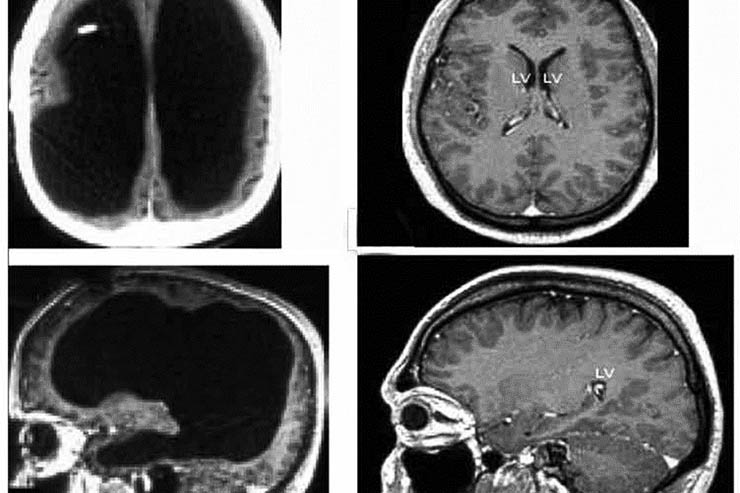
    Thanks to modern CAT scans, scientists can see inside people’s heads and view their brains, with some surprising results. The results don’t prove we have a ‘soul’ but certainly reveals there is something very wrong with the mechanistic theory that “mind is a function of brain.”

    There are people with 9/10ths of their brain cells replaced with water, and they still function normally. Refer to the images above. On the left, the dark area in the CAT scan is water (cerebrospinal fluid) and on the right is a normal brain. The horrifying photo to the right shows mother and her child with hydrocephalus. In babies, who have a soft skull, excess water in the brain can result in hugely inflated skulls. In adults the same process results in a brain that is squashed against the side of the rigid skull (as in the CAT scan). In some cases less than 10% of brain remains, yet these people often continue to function normally.

    We are told or presume this is impossible because the image (on page 37 of the print magazine) shows the areas in which various functions of the mind take place. The second image illustrates the way electrical and chemical impulses turn the brain into our mind allowing us to think, to have memories and to function in our daily lives. But it appears there is something wrong with this concept… Well, maybe not wrong but inadequate.

    The CAT scan image of the water filled skull belongs to 44-year-old French civil servant (proving, I guess the old adage, that civil servants are often brainless) who is married, has two children and lives a normal life. Another case often cited in the literature is of a man with a brain weight of between 50 and 150 grams – normal brain weight is 1,500 grams – who has a first class honours degree in mathematics and a tested IQ of 126. This man was documented by neurologist Dr. John Lorber who ran the spinal bifida unit at Sheffield Hospital. He studied 600 people who had this condition. Some had ‘only’ between 50 and 70% of their brains replaced by fluid, some between 70 and 90% replaced fluid, and there were 60 people who had 95% of their brains replaced by fluid. Of the last group, half had an IQ of over 100 (which is considered the mean average for intelligence).

    There are enough cases of, for all intents and purposes, average people who have their head filled with water not normal ‘grey cells’. This is a challenge to the accepted theory that mind, personality and consciousness are the result of chemical and electrical activity between ‘grey matter’ in the brain.

    Perhaps the idea that our personality rests in our heart or liver has something going for it? Aristotle believed the brain just served to cool the blood.

    How does the medical and psychology establishment explain the ‘inconvenient’ fact there are a considerable number of people who can function without a brain? Simply by distorting or ignoring the data available from CAT scans.

    Here are a few quotes:

    Scores of similar accounts litter the medical literature and they go back a long way,” observes Patrick Wall, professor of anatomy, University College London. He adds, “To talk of redundancy is a cop-out to get around something you don’t understand. How can we explain it?2

    There is a tendency in the medical community and elsewhere to marginalise anomalous observed phenomenon, to shove such troubling stuff into a closet where it can be safely ignored”3

    We live in a definition based reality, with a peer review ensuring that definitions are maintained.4

    If the facts in a discussion are against you, ignore them or change them.5

    And here are the two common explanations:

    We use such a small percentage of our brains anyway – perhaps as little as 10%.

    …there is such a high level of redundancy of function in the normal brain that what little remains is able to learn to deputize for the missing material.6

    Here is a further thought by a neurologist:

    [The discussion] reminds us of the mystery of memory. At first it was thought that memory would have some physical substrate in the brain, like the memory chips in a PC. But extensive investigation of the brain has turned up the surprising fact that memory is not located in any one area or in a specific substrate. As one eminent neurologist put it, ‘memory is everywhere in the brain and nowhere’. But if the brain is not a mechanism for classifying and storing experiences and analysing them to enable us to live our lives then what on earth is the brain for? And where is the seat of human intelligence? Where is the mind?”

    “One of the few biologists to propose a radically novel approach to these questions is Dr. Rupert Sheldrake. In his book A New Science of Life Sheldrake rejected the idea that the brain is a warehouse for memories and suggested it is more like a radio receiver for tuning into the past. Memory is not a recording process in which a medium is altered to store records, but a journey that the mind makes into the past via the process of morphic resonance. Such a ‘radio’ receiver would require far fewer and less complex structures than a warehouse capable of storing and retrieving a lifetime of data.7

    My position is close to that of Sheldrake. As a way of finding a solution to the metaphysical riddle of ‘do we have souls’, I postulate that the body and the brain are actually antennas that pick up limited wavelengths of information [see main article ‘Antenna Theory of Consciousness’ in New Dawn Special Issue Vol 10 No 4]. My concept also takes into account the ‘spine brain’, with its associational cerebellum. I consider this the seat of the ‘Monkey Mind’ – the Body Mind we use for everyday worldly functioning. (Note that in the CAT scans the cerebellum area of the brain remains intact). The skull brain I consider a link to the cosmic whole, what in some literature is referred to as the ‘Higher Self’.

    My Antenna Theory of human consciousness has much to recommend as an explanation of the ‘brainless’ phenomena. I suggest that the people involved are missing only one aspect of their consciousness – their connection to the stela cosmos – but retain the use of their spine brain and cerebellum to continue to lead their daily lives.

    To check if my hypothesis has value, it would be interesting to see if the severely affected have a spiritual awareness and creative ability. What are their dreams and sleep patterns? Can any electrical activity in their brains be found and assessed? The fact that this research apparently hasn’t been done may be simply because, as quoted above, “There is a tendency in the medical community and elsewhere to marginalise anomalous observed phenomenon, to shove such troubling stuff into a closet where it can be safely ignored.”
    [alert type=”general” dismiss=”no”]This article was published in New Dawn Special Issue Vol 10 No 4.[/alert]
    [alert type=”success” dismiss=”no”]If you appreciate this article, please consider subscribing to help maintain this website.[/alert]

    Footnotes

    1. Colin Wilson, Rudolf Steiner: The man and His Vision, Aquarian Press, 1985, 78
    2. http://flatrock.org.nz/topics/science/is_the_brain_really_necessary.htm
    3. A forgotten source.
    4. Personal communication with a Jesuit priest.
    5. Jesuit priest describing how to win an argument.
    6. www.supernoetics.com/who-needs-a-brain-1/
    7. www.rense.com/general63/brain.htm

    © New Dawn Magazine and the respective author.
    For our reproduction notice, click here.