New Dawn – World's Most Unusual Magazine

Category: Articles

  • Science of the Whole: Integrating Matter & Spirit

    Science of the Whole: Integrating Matter & Spirit

    From New Dawn Special Issue Vol 9 No 3 (June 2015)

    Science today is a double-edged sword. On the one hand, it points towards a greater reality. On the other hand, it unwittingly blocks our direct experience of that greater reality. This needs a little explanation.

    Ever since Fritjof Capra’s The Tao of Physics in the 1970s, there have been books that draw striking parallels between the reality described by the new physics and the reality described by mystics. Both speak about interconnectedness, wholeness, the “dance of energy” and the critical role of consciousness. At the same time, science tends to block out certain types of reality because it limits itself to knowledge of the physical. It observes and studies only the physical aspects of the world and the human being.

    Although some scientists have tried to take science beyond reductionism and into holism, science remains firmly rooted in the physical. It continues to claim that physical reality is the only possible reality. I suspect that this is at the root of our big limiting beliefs, for example that the universe began for no apparent reason, that life evolved by chance on this planet, and that we have no existence before conception and after death.

    If, however, we were to extend the range of human faculties that we use in the pursuit of knowledge, knowledge itself would extend accordingly. If this happened, our beliefs about the nature of the universe and humanity would be transformed. This is significant because it is our beliefs that determine our lives – our economics, our politics, our education, our science, our culture, our relationships, our lifestyles, and much more. Change your fundamental beliefs, and your thinking and behaviour change. Meanwhile, let us examine why science today is effectively “science of the physical.”

    Science of the Physical

    Modern science was born when it became possible to observe and measure things much more accurately than ever before. The telescope and microscope played central roles, but just as important were accurate clocks, thermometers and weighing machines. Being able to do this brought many benefits, and science has changed our lives in important ways. But there was a price to be paid. It was only a short step from being better able to observe and quantify physical things to believing that if something was not physically observable or quantifiable, it was not really important, or might not even exist. At a stroke, a whole range of human experience was pushed to the margins.

    Over time, science increasingly became science of the physical, because the knowledge that it generated was about the physical aspects of the universe, the physical aspects of our home planet and the physical aspects of the human being, to the virtual exclusion of all other aspects. Now, there is nothing inherently wrong with this. The problem arises only because most scientists – and, to be fair, much of the world – appear to believe that science is exploring all possible aspects of the universe, the world and the human being.

    Although science undoubtedly tells us much that is useful about the world and ourselves, it does not and cannot give us the whole picture. It is “science of the part.” There are two reasons for this. The first is that scientific knowledge is always changing. Despite the claims of some that we are close to producing a “theory of everything” or to “knowing the mind of God,” it is helpful to remind ourselves that the history of science is littered with the corpses of “hard facts” that have had to give way to newer “hard facts” as we make new discoveries. This is well illustrated by our understanding of the nature of matter.

    At one time we were convinced that matter consisted of tiny solid things that we decided to call “atoms,” because we thought there could be nothing smaller. This is what the word “atom” implies. This belief eventually had to give way when we discovered that atoms consisted of even smaller things that we decided to call “protons,” “neutrons” and “electrons.” For some time this was the scientific “truth” until it was replaced by yet another “truth,” that protons and neutrons are themselves constructed of even smaller things, which may not be things at all, but “probabilities” or “tendencies to exist.”

    This process, of facts being replaced by newer facts, is unlikely to stop, and there is no reason to suppose that the facts of the early 21st century are more sacrosanct than those of any other period. If they were, we would eventually reach the point at which there is no more for us to discover and learn. That would be the ultimate stasis, the ultimate boredom. Quite apart from anything else, it just does not ring true, and it sits ill beside the daily diet of human affairs. If as a species we cannot even live in peace and harmony with each other and the planet, claims that we shall soon know nearly everything about almost everything sound hollow indeed. The likelihood is that what we currently know is greatly outweighed by what we do not yet know.

    The second reason why science is a partial form of knowledge is because, as with all other forms of knowledge, science is the product of the means of acquiring it. And it is we who are the means! It is we who do the acquiring. Now, if we were to apply the whole of ourselves to acquiring knowledge in the pursuit of science, then science would reflect this. It would be science of the whole. However, if we apply only part of ourselves, then scientific knowledge will be correspondingly limited. It will be science of the part. Since we have applied, almost exclusively, only the physical and intellectual parts of ourselves to the pursuit of scientific knowledge, science reflects this. It is knowledge of the physical and the rational. If, however, we were to use parts of ourselves that are almost never used these days – such as other forms of consciousness – our understanding of who we are and what the universe is would change out of all recognition. Before I say something about this, it is worth dwelling for a moment on how influential science has become.

    The Dominant Worldview

    In theory, science does not have a worldview because it is supposed to be based on evidence only. In practice, it is fair to say that the core beliefs of science today are:

    • The universe and everything in it, ourselves included, is physical, and only physical. Scientists may talk about a universe that consists only of “energy,” but they leave little doubt that they believe this energy to be physical.
    • The universe, and everything in it, can usefully be thought of as a machine.
    • The universe has no intrinsic meaning or purpose. A lot of things just happen by chance.
    • Matter is primary, and consciousness is secondary.
    • Causation is upwards – in the sense that the “primary reality” is believed to be at the level of the smallest things, such as waves and particles.

    This set of beliefs has become so influential that all metaphysical, religious and philosophical claims that contradict it tend to be rejected. The fact is these beliefs persist despite discoveries in physics and biology that suggest the universe is anything but a machine, that “chance” may lie only in the eye of the beholder, and that the universe is rich in intrinsic meaning. Yet if, as science continues to insist, the universe began suddenly for no reason (the “Big Bang”) and life on this planet emerged by chance, then the world that science wants us to believe in must be totally meaningless.

    These beliefs are causing all kinds of problems. For example, they have pushed spiritual experience and the paranormal into a box labelled: “Interesting, but strange. I can probably ignore it.” However, what we believe strongly determines what we value. If our core beliefs are that the universe is little more than a highly complex machine, that it consists entirely of physicality, and that we, too, are little more than complex machines, then our values will reflect these beliefs. They will be mechanistic/material values, and this means that we will tend to give high priority to material things and technology. It can surely be no accident that shopping and new technologies are now the world’s main activities, and that financial pundits and technology experts are the new high priests.

    I have used the term “physical” as if its meaning is self-evident. But perhaps some explanation is required.

    The Physical

    Something is physical if it can be perceived by one or more of our five physical senses (sight, hearing etc.) The thing might not be able to be perceived directly, because it is very far away (a distant galaxy), or very small (a microbe), or very subtle (a radio wave). However, we have created technological extension to our senses, to overcome this. We can perceive the very distant with telescopes, the very small with microscopes, and the very subtle with radar, radio and other devices. The point to note is that at least one of our five senses has to be involved if something is to count as physical. By definition, then, the non-physical is anything that can never be perceived by any of our five senses, with or without the aid of technology. I hope the distinction is clear.

    It is because most scientists, and many others, do not normally admit to the existence of modes of perception other than the physical senses that they do not admit the possibility of other forms of reality, which can be generalised as “non-physical.” They continue to believe that the physical universe is one and the same as the whole universe. The mistake they make is to use their narrowly based “map” to interpret a world that not only far transcends the limitations of this map, but also far transcends the comprehension of any one of us.

    Scientists have come to rely exclusively on one form of perception – their physical senses and extensions to these senses – to explore the world. Perhaps we need to remind ourselves that if we use only one form of perception – the physical one – to view the world, the world will respond accordingly, by appearing to be physical, and nothing else. If we had used another form of perception, the world would seem different. This is analogous to viewing the world through different coloured lenses. If we look through a red lens, the world seems to be red. If we look through a blue one, it seems to be blue. Reality changes according to the “lens” we use to view it.

    There can be little doubt that the physical “lens” has become the lens of almost universal preference in the modern world. I say “almost” because there are a few people who are able to use other “lenses,” in addition to the physical one. In other words, they have access to other forms of consciousness. The world they experience is richer and more extensive, because they experience the non-physical as well as the physical. But we have to ask why the physical “lens” has become the lens of universal preference today. I believe it is because, for the vast majority of people, the non-physical “lens” has become dormant, through lack of use over millennia. And I believe there are good reasons for this, but that is beyond the scope of this article. The fact is most people today probably do not know that such a “lens” even exists. However, what many people do have is the occasional fleeting glimpse of what it would be like to have the use of their non-physical “lens.” This happens when they have particular types of “extraordinary experience.”

    Most of us have extraordinary experiences from time to time. It could be a vivid dream, or a powerful sense of being totally connected to the whole of creation, or a feeling of absolute certainty that we have just met the love of our life. Although each of these counts as extraordinary, they are not all that extraordinary, in the sense that they do not pose a threat to the prevailing worldview, the worldview of science. Science does not discount these experiences. On the other hand, there are very different kinds of experiences that many people have at least once in their lives. These include telepathy, precognition, distant healing, clairvoyance, a near death experience, or an out of the body experience. These cannot be explained by science. But it goes further than this. Science actively rejects them because it believes they are impossible, but also because they threaten the prevailing worldview. They are indeed impossible from the point of view of science, but that is only because science has become a restricted form of knowledge. It is because science today is the world viewed through the physical “lens.”

    The Non-Physical

    If we want to experience and understand the non-physical aspects of ourselves and the world, we first have to develop the means to do so. In practice, this involves developing and using forms of consciousness that are dormant in the great majority of people. The actual process of awakening and training this “additional consciousness” is not easy. There is a lot to it. It is as much a general character training as it is a specific training in being able to experience at will what we may have experienced only haphazardly and infrequently, in the form of an extraordinary experience. If we did go though such a training, the range of our perception would extend considerably, and I believe our lives would change as a consequence. I think it is worth trying to imagine some of the changes.

    First, extraordinary experiences – such as telepathy and clairvoyance – would become a normal, accepted part of our daily lives. That alone would change much that we believe to be true and possible. And that, in turn, would almost certainly lead to changes in our behaviour and our lifestyles.

    Second, we would learn about aspects of the universe and the human being that we are completely unaware of. What we think of today as indisputable scientific facts will turn out to be the product of restricted (physical) consciousness. That would change our understanding of who we are, as human beings, why we are here, and what we are capable of.

    Third, we would have something very different to be serious about. What do I mean by this? At present, by far the biggest source of seriousness in the world is worrying about, or trying to solve, the huge problems that we keep creating for ourselves. Just think about the amount of time, money and energy devoted these days to trying to solve problems. The fact that a lot of people appear to derive their sense of meaning from having problems to deal with suggests there is a widespread, albeit unconscious, vested interest in having a reliable supply of problems to deal with for the foreseeable future. This must surely act against any serious attempts to solve our problems once and for all. If, however, we had the use of our inner senses, we would see there are very different things to be serious about, very different sources of meaning and purpose, which have nothing to do with problems. I believe that we would then cease to be a problem-creating race, and become a life-enhancing race.

    Esoteric Knowledge

    I should like to say a few words about “esoteric knowledge” because I believe that it will have an important role in a “science of the whole.” In essence, esoteric knowledge is a coherent description of the non-physical aspects of humanity and the world, with some guidelines on how to behave and develop on the basis of this description. Arguably the best known modern works are Occult Science by Rudolf Steiner, A Treatise on Cosmic Fire by Alice Bailey, and the works of Helena Blavatsky. There are others from other cultures, mainly India, Egypt and Tibet, but they are packed with metaphors and symbolism, whereas the three writers I mention attempt to describe the non-physical in modern concepts and language.

    There is much that is useful to draw on in esoteric knowledge and the world’s spiritual traditions. But we need to take a fresh look at these. We need to be surer of our ground. We need to know which facts within these traditions are true, which are partly true and which are false. This implies that we need to find ways of ascertaining this directly for ourselves – hence the need to awaken and train our “inner senses.” When we do this, we will then be able to add to the body of non-physical (spiritual) knowledge, just as our body of physical knowledge (science today) is constantly growing. By doing this, that which science currently regards as non-measurable, or even impossible, will eventually be seen as measurable and possible.

    A Science of the Whole

    Although it is impossible to know exactly how a science of the whole will develop, it is possible to say something about its main “building blocks.” In my opinion, they will be:

    • Being open to the possibility that the universe and human beings have non-physical aspects, as well as physical ones.
    • Being open to the possibility that all of us have dormant “inner senses” that, when awakened and trained, will give us direct access to the non-physical aspects of ourselves and the universe.
    • Being open to the possibility that esoteric knowledge – in the form of modern books (e.g. Steiner) and ancient traditions – describes and explains some features of the non-physical.
    • The willingness and ability to see connections between modern science (e.g. some insights in physics) and esoteric knowledge. Capra’s seminal work has been mentioned, but there has already been much exploration in this area.
    • New, wider concepts, which will be able to accommodate new, different forms of knowledge. For example, we will need to expand the meaning of “energy,” “universe,” “life” and “spirit,” to name but a few.
    Get the issue this article appears in

    Conclusion

    If we are to fill the spiritual vacuum created by what science has become, we need to evolve a quite different knowledge base – one in which ethics, values, human development and spiritual growth are central components. That said, it is important to state that science, despite the loss of its spiritual roots, remains a useful attempt to discover new facts and to authenticate existing ones. However, just as the scientists of today have evolved the tools to penetrate the secrets of the physical, so scientists of the future will evolve the tools to penetrate beyond the physical. This will mean developing as yet unused forms of perception – effectively, our “inner senses” – to the point at which they, too, will be as useful in the search for knowledge and understanding as our familiar five physical senses.

    It is also important to acknowledge that neither physical science nor esoteric knowledge can on their own give us the whole picture. Each is a partial form of knowledge. But since they are both talking ultimately about the same universe and the same human being, albeit from very different perspectives and using different forms of perception, they are, by definition, complementary to each other. They therefore have the potential to enrich and enhance each other.

    None of this is likely to happen soon. People do not easily give up the beliefs and habits of a lifetime, particularly if these are sources of status, income and security. That said, the conditions needed for the development and acceptance of a science of the whole are already beginning to emerge. They include:

    • Large numbers of people are reacting to the gross materialism of our time, and are looking for ways to live more spiritually and ecologically.
    • Personal development, in all its forms, is constantly growing in popularity. Many people engaged in this realise that it goes far beyond “success” or “life goals.” Personal development is ultimately about developing the whole of you, your whole potential, and this surely includes parts of you that you have not yet discovered, such as the non-physical parts.
    • For all its many achievements, science is unable to answer the big questions and provide deeper meaning. Many people feel this, and are searching for ways to go beyond the limits of science.

    Although I cannot predict when a science of the whole will emerge, I am certain that it will emerge one day. When it does, our understanding of who we are, where we came from, and where we are going will all change fundamentally. And when that happens, life for all of us will be very different and much richer.

    Chris Thomson’s book Full Spectrum Intelligence: A Practical Course on Behaving Wisely and Well is available from all good bookstores and online retailers.

    [alert type=”general” dismiss=”no”]This article was published in New Dawn Special Issue Vol 9 No 3.[/alert]

    [alert type=”success” dismiss=”no”]If you appreciate this article, please consider subscribing to help maintain this website.[/alert]

    © New Dawn Magazine and the respective author.
    For our reproduction notice, click here.
  • Are You Sleeping in a Safe Place? The Hidden Danger of Geopathic Stress

    Are You Sleeping in a Safe Place? The Hidden Danger of Geopathic Stress

    From New Dawn 150 (May-June 2015)

    The Earth has a natural background frequency of 7.83Hz, known as the Schumann Resonance, which corresponds to alpha brain waves in humans. When this frequency is thrown out of balance by other energies (either natural or manmade) we can also go out of balance. Our immune systems can weaken, thus inviting any number of illnesses to enter. NASA had to develop Earth Pulse Generators to mimic this natural frequency in spacecraft after finding astronauts lost tone and body mass living without the background 7.83Hz frequency.

    I have worked for nearly 20 years in the fields of energy healing and geomancy (Earth energies) and have found that in most cases of illness geopathic stress can be found in the home. When these energies become harmonised again in the environment, the human body has the best chance of healing itself, regardless of the type of illness.

    Back in 1929, Gustav Freiherr von Pohl, a German scientist, found that all cases of cancer in the town of Vilsbiburg corresponded with people who slept over areas of high geopathic stress. Many other researchers have found similar results, with Dr. E. Hartman MD theorising that cancer is a disease of location caused by geopathic stress.

    In my own experience I have always found where there is high levels of geopathic stress there is illness. Research and personal experience also shows that when geopathic stress is balanced, illness can vanish. The human body is an amazing healer and self-corrector when in harmony with the environment.

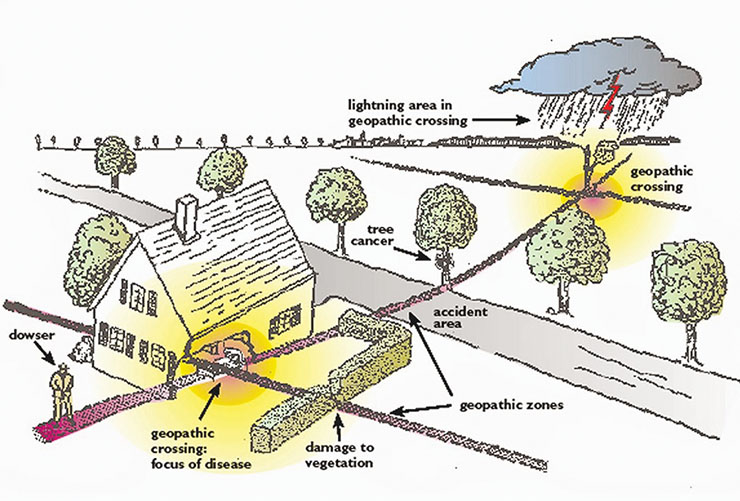
    Geopathic stress comes in many forms, such as electromagnetic lines of the Earth, bad water lines, fault lines or ley lines. When unbalanced they upset the Schumann Resonance and therefore our own frequencies. When two or more unbalanced natural energies cross, they can cause high levels of geopathic stress.

    Added to this is the manmade electromagnetic pollution of radio waves, microwaves, WiFi etc. This electromagnetic pollution alone has a negative effect on the body (see the articles on the dangers of mobile phones & WiFi in New Dawn 149), but when combined with geopathic stress the results multiply.

    Fifteen years ago I could always find the geopathic stress in a home related to illness, but nowadays the illnesses seem to be of higher intensity. Once a cancer patient may have been given three years to live, now it’s more like three months. I believe this has to do with the vast amount of electromagnetic pollution we are now exposed to everywhere we go, at home, work, school, shopping centres, hospitals etc. In von Pohl’s day the cancer patients in his experiment slept over areas of high geopathic stress for a number of years, but did not have the added factor of electromagnetic pollution that we are constantly bombarded with today.

    In relation to illness, the bed is still the most important area, as it’s where we spend most of our time in one place and where our bodies are supposed to be rejuvenating. Research has found that the part of the body affected by illness is where lines of geopathic stress cross the bed.

    About 15 years ago I worked on a house that was in sight of large overhead power lines. The client called me in to look at the energy of the house as their two children were constantly sick and displayed ratty behaviour regularly. I found an unbalanced water line running from the direction of the power lines through the children’s bedroom. Water lines can be deep underground, but their energy vibrates up vertically high above the ground; they have been detected at the top of high-rise buildings. To make matters worse, the children were sleeping in bunks made of tubular metal. The bed frame was attracting and enhancing the negative energy from the water line and power lines. No wonder these kids were ‘ratty’ – they were being zapped constantly and not getting a rejuvenating sleep. Their bodies had no time to heal. I balanced the water line on the property and advised a better suited sleeping space and to get rid of the metal bed frame.

    Metal springs in a bed mattress can change the background frequency and enhance negative energy. British geobiologist Roy Riggs found an energy anomaly coming from the metal springs of a mattress belonging to a two year old with brain cancer. After changing to a non-spring mattress the child started to respond positively to treatment.

    To get a good night’s sleep, it is advisable to move all electrical equipment as far away from the bed as possible, including clock radios and mobile phones. The electrical wiring running through the wall behind your head can also be a problem. Remember to check behind the wall where your head lies as a computer, fridge or smart meter could be blasting you through the wall. Shielding products are available to lessen electromagnetic pollution if you can’t move away from it.

    If you have a serious illness, I suggest you move your bed or sleep in any other room for a while to avoid possible geopathic stress. Or you could learn to dowse to find the negative energies yourself. Do not swap sides with your partner to ‘test’ if they get sick too! You need to spend a lot of time in areas of geopathic stress for your immune system to weaken, such as sleeping or at your desk at work (but as suggested earlier, things seem to be speeding up due to the vast amount of electronics invading our lives).

    I believe that many childhood illnesses, allergies, mental focus and emotional issues can be helped by moving the child’s bed. Our kids are being blasted at school with WiFi (which is banned in many European schools), carrying mobile phones and working with computers on their laps. They are continually connected to the electrical grid. Children can also absorb higher levels of electromagnetic radiation as their skulls are thinner and they are still growing.

    When working on a house I can usually pick the bed of the child having problems at school or who is more susceptible to illness than their siblings. They are the ones sleeping in areas of geopathic stress. Geopathic stress or electromagnetic pollution on their own can cause problems to the body, however the effect is heightened when the two are combined. So if your child has chronic illness, get the electrics out of the room and move the bed. Being able to sleep and let the body rejuvenate naturally is the best first step to recovery.

    Geopathic stress can happen at any time. Natural lines that have been in the land for many years can become unbalanced by pollutants and changes to the area, such as mining and building. Some can extend across continents, while others are localised to a smaller area. About 10 years ago I balanced the energies of a house belonging to a couple in their 50s. There was a long line of geopathic stress running on the property next door, but nothing in the couple’s bedroom. I was surprised to hear two years ago that the woman had died of cancer. I went back to test the area and found that the negative energy line that previously ran through the neighbour’s property now ran through the couple’s bedroom. In the parkland behind the property two large gum trees had been cut down the year before. I believe this is what caused the line of geopathic stress to move.

    Animals can often detect geopathic stress. Cats will be attracted to unbalanced energies, while dogs will actively avoid it. So, if your cat has a favourite spot on your bed, try moving the bed and see what happens.

    Beds (and any physical item) can store energy. Often this energy, good or bad, has been built up over a number of years through intense emotion, not necessarily from geopathic stress. One client who already had three children was having trouble conceiving a fourth. The couple had had no problems the first three times. When I tested the bed, I found that the old wooden bed head and frame was storing negative energy but the new mattress was not. The couple had recently inherited the bed from an aunt who had been infertile. The aunt’s sadness at not being able to have children had seeped into the bed frame over many years. Once this energy was cleared the couple conceived the following month.

    Just a side note on new beds: a friend was having trouble breathing after buying a new mattress. I couldn’t find any geopathic stress or stored energy in the bed, but my dowsing rods detected something wrong with the mattress. Airing out the mattress for a few days, to release the chemicals used in curing the foam, and installing a salt lamp, fixed the breathing problems. So, acute illness isn’t always caused by geopathic stress or electromagnetic pollution, but I’ve found they are usually the culprits in chronic pain and illness.

    Ley lines are lines of energy that carry communication of some sort and are usually ‘sent’ by people. There are large ley lines that are intentionally laid out across countries connecting sacred sites or have an altar placed on them to energetically communicate the church’s message to the community. The leys I most frequently encounter are personal leys sent unconsciously from one person to another. These leys can be full of emotion and tend to hit the bed and stove, thus depleting the person of nourishment and rejuvenation. Over time these can have a debilitating effect on the body, depending on the intensity of the emotion attached to it. One client in her 30s developed a severe case of arthritis. After three months of trying different remedies nothing had helped. I found a ley line hitting her bed and stove. It was being unconsciously sent by a lady whose cat had been put down at the vet. My client was the vet nurse who carried the cat away and thus became the focal point of the cat owner’s grief. Together we sent loving energy back down the ley to the cat owner, thus closing the ley. The next morning the arthritis was gone, never to return.

    Energy may be unseen but it is definitely felt and absorbed by the body. So, if you suffer from chronic pain, illness or restless sleep, geopathic stress in some form is most likely a contributing factor. Make your bedroom as harmonious as possible to bring the Schumann Resonance back into balance. Use visualisation, nice music, harmonious colours, crystals, loving energy, etc. and if you still feel bad – move the bed.

    [alert type=”general” dismiss=”no”]This article was published in New Dawn 150.[/alert]

    [alert type=”success” dismiss=”no”]If you appreciate this article, please consider subscribing to help maintain this website.[/alert]

    References

    G.F. Von Pohl, Earth Currents: Causative Factors of Cancer and Other Diseases, Frech-Verlag, 1993
    www.geomancygroup.org
    ‘Geopathic Stress: A Definition And Overview’ by Richard Creightmore, www.landandspirit.net/html/geopathic_stress.html
    Roy Rigg case studies: www.landandspirit.net/html/more_case_histories.html

    © New Dawn Magazine and the respective author.
    For our reproduction notice, click here.

  • From the Many to the One:  A Short Guide to Complete Awakening

    From the Many to the One: A Short Guide to Complete Awakening

    From New Dawn Special Issue Vol 8 No 2 (Apr 2014)

    Complete awakening happens on all levels. This includes the realisation there are some very serious enemies to personal/spiritual liberty who will work against you. They might say they are looking out for your best interest, or that of the greater good, but it is really always about control.

    Thanks to archaeology and anthropology, we have been given some very clear information of the characteristics of each age of human societal development. For thousands of years, the glue that held societies together was conformity as well as the judgment that ensues when this conformity was not met. Conformity to accepted cultural, religious, racial, and economic norms held together the collective identity pretty well. This worked just fine as long as populations were relatively small and homogeneous. If wealth is concentrated and accessible only to the very smallest portion of such a society, then dependence is a natural survival instinct that proves successful in most cases. If the group is small and each member procures food, shelter, and clothing in the same way, then the instinct of perceived fairness aids in the preservation of justice. In these societies positions of power are usually inherited by birth or military skill.

    As a nation grows in size, population, and wealth however, new ways to relate and understand each other are needed. The old glue of conformity is just not flexible or elastic enough to hold together groups of individuals with widely differing views on almost every issue. Our sense of fairness that we developed in our early stages of evolution actually starts working against us. The very things that would actually create more wealth and leisure time can seem as a threat to our perception of fairness, such as specialisation, contractual agreements, as well as the risks inherent in a marketplace.

    Our palaeo-brains are hardwired to think that in order for one person to have, another must go without. In a free-market society, this is not necessarily so. The pie is not limited. Due to profit motive that rewards risk taking and competitive pricing, the entrepreneur is free to add to the pie rather then just redistribute a fixed portion of it.

    The new glue must be independence. This glue takes longer to set, yet it is much stronger. It relies not upon conformity, but upon respect, love, and the potential loss of sovereignty for those who would thwart the rights of others.

    Communism/Statism/Progressivism is a re-emergence of outdated stone age communal instincts wrapped in the garments of post structuralism (discipline and therefore structure is essential to liberty; the anti-structuralist is a peddler of the worst kind of lies and superstitions as he is promising the ignorant person an impossibility) and political correctness, defended from any real scrutiny by the professed pure intentions of the enviro-marxist-radical.

    I am a MAN and I will not COMPLY

    The collectivists/Statists don’t like to be challenged. They demonise their opponents because the truth about their plans would expose them as the radical enemies of liberty they know themselves to be. People should speak up and defend positions as long as they genuinely believe them. It is when we begin defending ourselves rather then debating ideas that who is right no longer matters as much as who is left. This degeneration puts us back.

    The collectivists want the revolution of one so called class against another, rather then the transmutation of the entire culture. Positive societal evolution happens best when it arises from within people as an entire cultural shift, not as a protest group or one class against another. Equal justice first requires the acknowledgement of all being equal before it, otherwise it’s just another empty phrase.

    Every single mass murder has been produced by people using the government to enforce their will upon others. The government, especially in a society that has become as complacent about REAL civil liberties as ours, can do these things and has done these things in the past. The inquisition was big government, as was the holocaust perpetrated by Nazi Germany, the Native American tragedy, the Soviet murders and planned starvation, the Taliban, Iran, etc.

    The foundation of future civilisations will rely upon the supreme sovereignty of the individual. The defence of the rights of humankind must be the only occupation of the state, any other function being a siren calling the ship of culture to ruin.

    The ethic of liberty is a royal ethic, its morality is that of enlightened self-interest and non-interference. “Do what thou wilt shall be the whole of the Law.” And also “Love is the law, love under will.” These must become the essential core ingredients of society’s new glue if we are to continue to grow and advance the well-being of the race.

    What must we learn?

    In birth a human being arrives to this world with no knowledge or understanding. He possesses nothing; not even that which he will some day come to call “himself.” The newborn is, if anything, a mass of tendencies. His plight would be completely hopeless if among these tendencies were not also the capacity for growth. Our ability to learn, to mature, and to change is truly the strongest of our natural gifts. Yet, even this great virtue of our race, unguided by the star of inspiration can produce terrible and destructive engines that perpetuate darkness, dependency, and tyranny.

    Our lives are terribly brief. The truth is that what we believe ourselves to be as natural beings will spend almost eternity in death. We might want to imagine that it may be otherwise, or that there may be a spiritual existence where we may partake in permanence. According to what stares us in the face day after day, however, these desires are at best a convenient way of coping with the brutality of impermanence, and at worst a gorgon knot of unresolved infantile psychological complexes.

    Of course, you may have heard about or even studied the writings and sayings of the great sages and saints who teach about transcendence, salvation, deliverance, cessation or some other equivalent suitable to the culture in which their respective ideologies emerged. But unless you have experienced the states of consciousness or heavenly realms they claim to have attained or visited, this knowledge will, if you are lucky, do little more than comfort you. If you are unlucky then you will be haunted by guilt, inadequacy, or a host of other side effects that come with the dissonance produced by what you perceive directly and the message of authority not lining up very well.

    So what is the answer to life’s uncertainty, its impermanence, its sheer lack of meaning? Is there a way up the mountain of being that will give us a better view?

    The Mystery Tradition offers us a technology for healing the wounds sustained by the infinite universe limiting itself to the consciousness of a finite, disconnected, and impulsive vehicle. The goal is union with one’s own Holy Guardian Angel, a concept similar to what has been called Christ, Buddha, or Atman. One way of achieving this union is by seeking the transcendental in every single thing we do.

    The Mystic Path

    We must learn how to unite ourselves with everything. At first our untrained minds will only acquiesce to union with ideas or phenomenon that it considers pleasurable. This must eventually be overcome before we move unto the real work, but in the early stages it will help you stick to the practice. Try to make it easier on yourself by focusing on something with little or no emotional value to you. A button, stone, or some other harmless inanimate object will do just fine. Avoiding excitement will help you get the results that cause a lasting shift and evolution of the mind. This is how we may come to the direct perception of Truth, that is, the agreement of knowledge with experience (agreement without premeditation). This direct line will not come easily.

    Our tendencies are inherited by parents, society, or maybe even past incarnations (if you believe these exist, your deductions concerning them will affect you. If not, then your lack of such a belief will also affect you). Starting at the ground floor, the seeker must reconstruct his mechanism for sensing and interacting with the world around him.

    Mind Control

    Perfect union is produced by the interaction of perfect opposites. The operative word here is “perfect.” We unite parts of ourselves with ideas all the time. Every thought we have is, in this way, an act of Union. Putting this general definition aside, the Mystic Path is that of gaining the kind of control over the mind that will allow us to unite it in every sense to that one idea that will come to encompass the totality of existence.

    Our mind, like all things, is made up of a substance proper to its healthy functioning. The stuff of our minds, the Hindu yogis call Chitta, which literally means “mental stuff” (at this point it should be pretty obvious that the terms used in true spiritual practice are utilitarian and must be as simple as language may allow; there is enough confusion inherent in the dismantling and reordering of one’s self without needing any help from mysterious words or concepts). The sum total of our minds includes various functions such as discrimination, desire, or our sense of self.

    In controlling these mental faculties and contents, we take direct command of our own perceptions and therefore happiness. Everything a person thinks or encounters is done so through the medium of the nervous system. When we are successful in our subjugation of mental activity and function, uniting all thoughts into a singular one that may then be extinguished, we experience the bliss of total freedom. Freedom from fear, from doubt, from sorrow, yes, but also freedom from the fleeting emotional ups that accompany superficial distractions from their less desirable counterparts.

    The Magical Path

    It will not be long until you begin to realise that your own mental state can influence what most have been taught to regard as the “outer world.” You focus the mind on a certain thing, and a phenomenon – which corresponds with the nature of that thing – begins to occur. Now, it must be stated that what you should do is ignore these happenings. You should stick to your meditation. But you won’t. You can’t. Because although you are striving to become the unconditioned, un-manifested ONE, you still need to do things like pay bills, clean dishes, and ask that attractive co-worker out to dinner and a movie. In short, you are a real person who cannot rest in inaction, but must live a very active and exciting life!

    Where most would see the above as an obstacle, the aspirant to the Invisible College sees another opportunity for growth. What if you could make every act an invocation of the Most High? Just as we seek to bring our minds under complete control by first mastering a few basic exercises, so may we begin to train ourselves in the complete transformation of our lives by understanding and performing the elementary rituals of Magick.

    Magick is the Science and Art of causing Change to occur in conformity with Will.
    – Aleister Crowley

    In the practice of Magick, you will begin to learn about how thoughts, words, and deeds channel the will to create your reality. You will encounter things that are so profoundly wonderful and terrible that they will evade all attempts at description. Ultimately, what you are doing is sanctifying your entire existence. Every act becomes a holy service and not a moment goes by in which you are not focused entirely on the transcendental.

    This process is made possible by the theory of correspondence so elegantly communicated to us by the Qabalah. The student begins to understand that when he sees a house that he is witnessing a manifestation of the Hebrew letter Beth, which corresponds to the planet Mercury, and the Lord of Magick. The Entrance to the house is its door, literally Daleth in Hebrew, a letter corresponding to Love. By way of his training he can see in a simple house that the path into true magical power and mystery is love, or union. Crowley taught this principle as the central tenet of his spiritual system, “Do what thou wilt shall be the whole of the Law.” “Love is the law, love under will.”

    Introducing Yourself to Your SELF

    One of the greatest delusions at the heart of human suffering is the belief that we are our minds. Yes, our minds are part of the complex blend of forces, drives, tendencies, and materials that we call “I.” But, ultimately, we are none of these things. What we truly are is beyond description. Many have learned of this label and gone on in endless metaphysical speculation about whether or not there is a self, soul, or God.

    This, in my opinion, completely misses the point and is a colossal waste of time. Our lives are brief. In the path of unification, it does not matter what you think or believe about a thing, because all thoughts must be melted down to the one essence. However, when you find your mind in regards to these ideas, there is no need to change them, only to unite them to every other thought through the practice of concentration.

    When the mind is well controlled, then this Truth can fully manifest. This state is not truly a state, but the true form of ourselves, the “I am that I am.” Whenever the mind is not focused and unified, our understanding of truth is bent and twisted, like light reflecting off a dirty, broken mirror.

    The matter of consciousness, like all matter, is subject to changes. These can be pleasurable or painful, but at their root, they are all undesirable if we believe they have some meaning or importance. This is a great superstition that is very easy to fall into. We feel something unpleasant, and so this is “bad” while other more pleasant experiences are labelled “good.” The whole cycle of experience, label, and judge is based on the belief that our meaning and purpose can be derived from the right combination or manifestation of these changes.

    This is why materialism is generally acknowledged as an unskilful value system, as most can agree that material things are not where one should derive self-worth. A more unorthodox view would also say that spiritualism, emotionalism, or any other “ism” where we look to a set of circumstances for importance would all be equally inadequate in satiating our thirst for the supreme state of being.

    The universe does not suffer as we do. It is what it is. It creates and destroys itself without tremor, it is cold and hot, light and dark, containing all opposites and yet transcending them completely. Existence is the reality of nature just as non-existence is. They do not compete nor are they estranged. Galaxies whirl about in both harmony and violence. Stars collide, rivers flow and crash, and lovers dance. It is almost as though our own mental state is really the problem. The stories we believe become our religion, and our fundamentalism has robbed us of our royal place in the greatest party ever thrown.

    [alert type=”general” dismiss=”no”]This article was published in New Dawn Special Issue Vol 8 No 2.[/alert]

    [alert type=”success” dismiss=”no”]If you appreciate this article, please consider subscribing to help maintain this website.[/alert]

    © New Dawn Magazine and the respective author.
    For our reproduction notice, click here.
  • Free Your Mind from Mainstream Media Brainwashing

    Free Your Mind from Mainstream Media Brainwashing

    From New Dawn 162 (May-June 2017)

    Starting with Gutenberg’s printing press, then Thomas Edison’s motion picture camera and the introduction of celluloid and the silver screen, and later the cathode ray tube – a select few media institutions, and the men behind them, have enjoyed monolithic monopoly over the information we see and hear.

    Their machine is awesome and seemingly unstoppable, and reaches anywhere, anytime and into the minds of all it targets.

    How does one navigate, let alone make sense, of this 21st century matrix?

    If this transformation were truly an organic process, then most critical minds would be able to rationally deal with our total immersion in media. But the evolution of technology and how we interact with it is not so easy to articulate. As platforms and choice continue to proliferate, the situation is becoming more attuned to Chaos Theory than Darwinian Theory. The media and its modern marketing arms tell us it’s all progress. By now, their role is well defined – as the initial express vehicle on which all new ideas and advancements are delivered into the mainstream. In most cases, one could say the public are now fully preconditioned to accept new media on arrival.

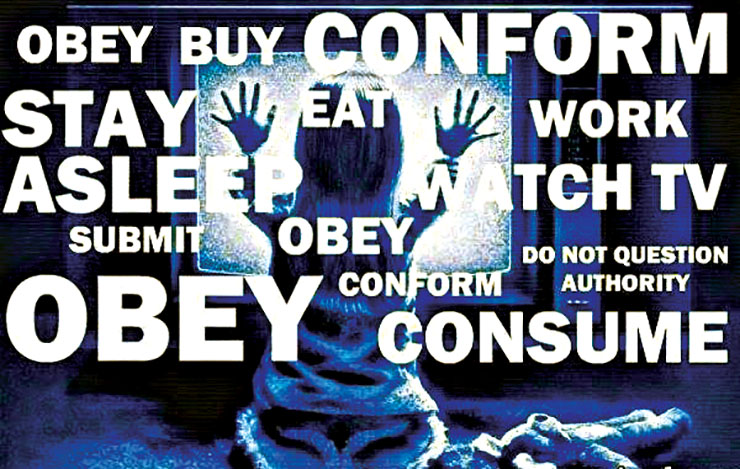
    Whether we care to admit it or not, there are varying degrees of brainwashing and behavioural conditioning with films and TV. That’s why they call it programming. How many of us find ourselves automatically using quotes from popular films or TV shows? And how many of us emulate the fashion or hairstyles of those we see on the screen?

    It happens much more than most people care to admit. Most of us are completely unaware of how much we mimic what we see, and repeat what we hear.

    In the 1976 classic, The Network, the film’s main character, a television prophet named Howard Beale, delivers an unforgettable sermon to his studio audience, perfectly describing the raw nature of mass media in a societal context:

    And why is that woe to us? Because you people and sixty-two million other Americans are listening to me right now. Because less than three percent of you people read books. Because less than fifteen percent of you read newspapers. Because the only truth you know is what you get over this tube. Right now, there is a whole, an entire generation that never knew anything that didn’t come out of this tube. This tube is the Gospel. The ultimate revelation! This tube can make or break Presidents, Popes, Prime Ministers. This tube is the most awesome, god-damn force in the whole godless world. And woe is us if it ever falls into the hands of the wrong people.

    Beale must have known it had already fallen into the hands of the wrong people, namely organised crime, the CIA, the Military Industrial Complex and the transnational global elite.

    The reality is that studio and record executives, and their media producers, are responsible for much of society’s behaviour, as well as the popular cultural archetypes that people adopt. For sure, this is a tremendous amount of power, and don’t think for a moment that executives do not know this. The same can be said for their CIA and Pentagon ‘advisors’ too.

    When in high gear, this culture machine commands any of the following behaviours en masse; foul language, profanity, sexual promiscuity, pre- and extra-marital affairs, drug use and abuse, dysfunctional relationships and families, racial tension, violence, defacing religious symbols, Satanic ritualism, undermining authority figures like fathers, teachers, clergy, and even the worship of the Orwellian security state. It’s all fair game for the media and entertainment industry.

    How is anyone expected to survive this psychological and spiritual onslaught?

    Media Survival 101

    The average person living in a technologically advanced first world society will watch an average of three hours of television per day, as well as another two to three hours spent on computerised electronic devices. If we want to survive with our minds and souls intact, at some point in our lives we have to muster the courage to turn off, and tune-out.

    The sheer volume of content now available means each person must be judicious about how they spend their time. The old binary option for ‘Generation X’, when you said to yourself, “Alright, I have three hours to myself. How am I going to spend that time? Do I watch TV, or do I read a book?” – may no longer apply.

    For Millennials (and others too), it’s more like, “Do I watch TV, YouTube, hangout on Periscope, Instagram, Facebook, or do I stream Hulu, Amazon Prime, iTunes or Roku, or do I read online, with my Kindle, or my Nook, or who knows, maybe a book?”

    The term binge watching also comes to mind. Seven seasons with 10 episodes each, with a continuous interconnected cliffhanger plot line – enough suspense and intrigue to trigger endorphins in the brain to keep you awake all night, enough to watch an entire season of 24… in 24 hours.

    If things are really that bad, or you are feeling anxious over an obsession with keeping up with content, then there is a high probability you are under some degree of media-driven mind control.

    The first step in liberation from the machine is to become a more active consumer of information and content, as opposed to being a passive sieve. That’s not to say you cannot enjoy a movie, or watch a good ball game now and again – everyone needs to step off the hampster wheel and indulge in entertainment from time to time.

    To defeat the linear, force-feeding tube of information and social conditioning by Hollywood and mainstream media… simply read more. Read whatever you can get your hands on – books, print journals, magazines, online articles, and newspapers. Your knowledge retention rate will be higher, and the experience of reading will hone your mental focus, self-reflection and clarity of thought.

    Rather than waste hours watching TV or sitting through a sub-par Hollywood cinema production that you know will be disappointing in the end, instead try listening to radio shows, or podcasts. Instead of drifting down rabbit holes on YouTube, visit websites like Soundcloud instead, and get immersed in their vast audio jungle.

    Another useful practice in liberating your mind from groupthink and staying less susceptible to mainstream brainwashing is to make a concerted effort to occasionally read, watch or listen to content from media outlets or sources that you do not like, or generally do not agree with. This is important for a number of reasons. If you are truly confident in your political beliefs, your worldview or your grasp of current and historical events, then it shouldn’t bother you to hear what ‘the other side’ has to say. If you really want to successfully defend your position, opinion, or ideology, or your side of the political spectrum – then it helps to know the contrarian arguments, and you should want to analyse them as much as possible. This type of open-minded information consumerism is exactly what the establishment culture-makers and matrix operatives do not want you to be involved with – because a confident, well-informed and objective voice is antithetical to the prevailing divide and rule, bipolar political paradigm program that social engineers are currently running on Western society.

    Also, should you ever find yourself growing tired of reading about it, then go and experience it.

    Learn How to Learn

    The American poet Robert Frost famously said, “We all proceed with insufficient knowledge.”

    In the education of the mind, everyone must submit (at least once a day) to the fact that no matter how smart or knowledgeable you think you are on any given topic or event, you actually know very little. You may know more than the person next to you, and you might even be an expert on one layer of a lattice, but more than likely would only have above average knowledge of one corner of the galaxy that is your area of expertise.

    Unfortunately, as far as social media is concerned, it remains a crude platform for human interaction and learning. Your 13.5 inch laptop screen doesn’t always deliver when it comes to human stimulation and speed of exchange that you’ll get through human conversation. The solution to this problem is a simple one – we need to talk more. Talk more, and talk about anything. The most powerful microprocessor on the planet is not in the basement of the NSA in Provo, Utah, or in Jeff Bezos’ server yards in Colorado – it’s between your ears.

    Also, rather than preaching to the choir, try and strike up conversations with people who are smarter or more experienced than you. This is one of the fastest ways to increase your knowledge base and gain valuable insights which you will never get from the mainstream media, or even find in the annals of the Ministry of Truth (Wikipedia).

    Remember: you’re not a robot, so stop acting like one.

    There’s a big world out there – and it’s much bigger than anything inside your TV or smart phone.

    [alert type=”general” dismiss=”no”]This article was published in New Dawn 162.[/alert]

    [alert type=”success” dismiss=”no”]If you appreciate this article, please consider subscribing to help maintain this website.[/alert]

    © New Dawn Magazine and the respective author.
    For our reproduction notice, click here.
  • The Masters of Gary Renard

    The Masters of Gary Renard

    Around Christmas of 1992, a man named Gary Renard, living in the remote backwoods of Maine in the northeastern corner of the US, came out of a meditation to find two stylish, good-looking people, a man and a woman apparently in their thirties, sitting on his couch. He had never seen them before and had no idea of where they had come from.

    “There was nothing threatening about them,” Renard would later recall; “in fact, they looked extraordinary peaceful, which I found reassuring. Looking back on the event I would wonder why I had not been more fearful, given that these very solid-looking people had apparently manifested out of nowhere. Still, this first appearance by my soon-to-be friends was so surreal that fear somehow didn’t seem appropriate.”

    The man and woman called themselves Arten and Pursah. They said they were ascended masters who had come to teach Renard some lessons about life, the universe, and Jesus Christ.

    So began a strange series of episodes that would continue off and on for the next nine years and would culminate in Renard’s first book, The Disappearance of the Universe, published in 2003. The story would grow stranger. Arten and Pursah soon identified themselves as later incarnations of the two disciples of Jesus that we know as Thaddeus and Thomas respectively. They began to tell Renard about the true nature of the teaching of Jesus, whom they call ‘J.’

    The portrait of ‘J’ and his times as drawn by Arten and Pursah will be more or less familiar to readers who have some familiarity with the historical Jesus as unveiled by scholarship over the past 200 years. The Gospels were not written by Jesus’ disciples or indeed by anyone who knew him personally (the one exception, Arten and Pursah say, is Mark, who met the master as a small child). The Gospels, composed some forty to eighty years after Jesus’ time, contained some authentic sayings and deeds of his as well as many admixtures and alterations to suit the developing Christian theology. “Don’t you find it a little strange that not one complete original copy of J’s own words in his own language survived the rise of Christianity?” Pursah asks.1 “Do you really think that was an accident?”

    Pursah is of course right. There are traditions of early collections of Jesus’ sayings compiled in his native Aramaic, including Q (a lost source hypothetically used by Matthew and Luke), but none of these works have survived. The Gospels in the New Testament were all written in Greek. “Incredibly,” adds Pursah, “even the later Gospels were changed over the next few centuries. The ending of Mark was completely changed” – a fact that a reader can verify by looking in practically any contemporary version of the New Testament. The authentic text breaks off extremely abruptly at Mark 16:8. There are several alternate endings, none of which is believed to be authentic. The fact that Mark is regarded as the oldest and historically most reliable Gospel – and that this lost ending must have dealt with what Jesus did and said after his resurrection – makes this realisation all the more disturbing.

    What, then, of the famous Gospel that is attributed to Thomas himself – the cryptic collection of sayings that first surfaced in complete form in 1945 as part of the Nag Hammadi scriptures? “You haven’t really read it, have you?” Pursah chides Renard. “Except for that time you browsed it in a bookstore – when you spent half your time looking at that beautiful woman down the aisle.” (This kind of banter characterises the dialogue between Renard and the masters, the result, they tell him, of his own sardonic sense of humour. “When you don’t need it, then we’ll no longer need it in order to get through to you,” Pursah says at one point.) According to Pursah, the Gospel of Thomas as we have it today is authentic, although it was left unfinished by Thomas himself, who was martyred in India, and it was supplemented later on. “What I will affectionately refer to from now on as Thomas is a Jewish-Christian Sayings Gospel that predated Gnosticism,” Pursah adds.

    The reference to Gnosticism is significant because Thomas is generally regarded as a Gnostic Gospel, a text representing a movement of early Christians who believed that gnosis, or enlightenment, is the key to salvation. Thomas is not a Gnostic work, says Pursah. “Gnosticism was a combination of many earlier philosophies mixed in with some of the things J said or that people thought he said. Yes, you could certainly say that J had what might be described as Gnostic tendencies, but they were not all new. Some of them go back to archaic forms of Jewish mysticism.”

    God “Did Not Create the World”

    One of the chief points of similarity between J’s teaching as presented by Renard’s masters and that of the Gnostics is “that the world is very much like a dream and God did not create it…. God did not create duality and He did not create the world,” Pursah says. “If He did He would be the author of ‘a tale told by an idiot’, to borrow Shakespeare’s description of life.”

    This is an uncomfortable idea even for the comparatively enlightened. A few days before writing this article, I was at a conference chatting with a woman who is extremely (and deservedly) well-known and admired in New Age circles. I remarked that I didn’t find this world particularly engaging and didn’t want to come back to it after this lifetime. “Come on!” she said. “What about the beauty and complexity of the universe?”

    I said nothing, but Arten might have replied as he did to Renard: “As for the so-called beauty and complexity of the universe, it’s as though you painted a picture with a defective canvas and inferior paint, and then as soon as you were finished the painting started to crack and the images in it began to decay and fall apart. The human body appears to be an amazing accomplishment – until something goes wrong.”

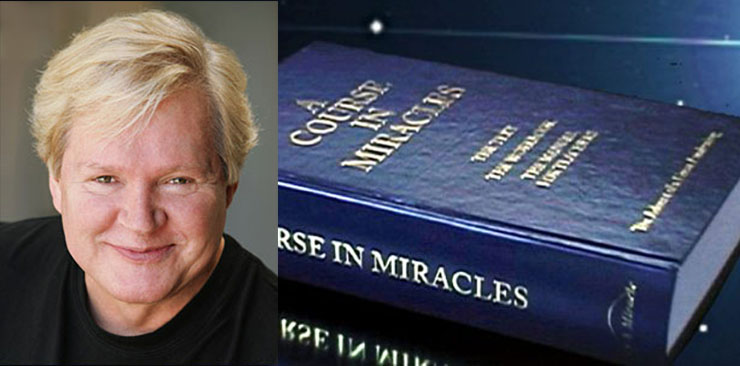
    The notion of a defective, unreal cosmos – what Pursah calls “psycho planet” – created by someone or something other than the true, good God, should be familiar to anyone who has explored Gnostic thought. But the ideas of Arten and Pursah also bear more than a faint resemblance to those in A Course in Miracles, and in fact the pair urge their pupil to obtain a copy of this work and study it seriously.

    A Course in Miracles

    A Course in Miracles, while familiar to many students of esotericism, remains a mysterious and elusive document. Its story is by now comparatively well-known. It was begun in 1965 when a New York psychologist named Helen Schucman heard an inner voice telling her it would dictate “a course in miracles” and that she should take notes. She complied (with some reluctance), and over the next several years took down material that would amount to some 1,200 printed pages, including a Text, a Workbook containing 365 daily lessons, and a Manual for Teachers.

    With the help of her colleague, Bill Thetford, and an editor named Kenneth Wapnick, Schucman prepared the Course for publication. It first appeared in 1975, and since then has sold more than a million and a half copies. Despite this grassroots success, the Course has been given short shrift by conventional theologians. But then the circumstances of its transmission make it unlikely that the Course would be accepted in conventional circles, since the voice that dictated the material to Helen Schucman claimed to be that of Jesus Christ, correcting 2,000 years of misrepresentation of his teaching. Arten and Pursah say that the Course is genuinely the work of Jesus, and most of The Disappearance of the Universe consists of their attempt to explain the central concepts and practices of the Course.

    To begin with, the Course asserts, the world is not real because it was not created by God: “There is no world! This is the central thought the course attempts to teach.” The world we see, the physical world of suffering and loss and change, is the result of a primordial separation from God – or rather, a belief that separation from God is possible. The Course says, “Into eternity, where all is one, there crept a tiny, mad idea, at which the Son of God remembered not to laugh. In his forgetting did the thought become a serious idea, and possible of both accomplishment and real effects.”

    Pursah expresses the same idea in this way: “For just an instant, for just one, inconsequential fraction of a nanosecond, a very small aspect of Christ appears to have an idea that is not shared by God. It’s kind of a ‘What if’ idea…. the question, if it could be put into words was, ‘What would it be like if I were to go off and play on my own?’ Like a naïve child playing with matches who burns down the house, you would have been much happier not to find out the answer to that question,” because it would mean that our primordial innocence would be “seemingly replaced by a state of fear and the erroneous, vicious defenses that this condition appears to require.”

    Here the Course diverges from classical Gnosticism. For the Gnostics, this world was fashioned by an inferior, arrogant pseudo-god whom they called the Demiurge (from the Greek word for ‘craftsman’ or ‘creator’). For the Course, the world began with a ‘tiny, mad idea’, which is the ego – the stance the fallen Son of God (which is each of us) takes in his deluded belief that he can exist apart from the Father. The apparently “real effects” include the physical world and the body itself, the “hero of the dream.”

    According to the Course, the world is not fashioned by a Demiurge or a second-rate creator God (sometimes identified with the God of the Old Testament) who exists ‘out there’ in the metaphysical stratosphere. It arises out of the ego, out of what is apparently the most intimate, personal aspect of the self. Some of the Gnostic texts characterise the Demiurge in a similar way. The Apocryphon of John says of him: “And he is impious in his madness which is in him. For he said, ‘I am God and there is no other God beside me’, for he is ignorant of his strength, the place from which he had come.”

    There is a curious and elusive crux here. Many investigators of Gnostic thought, including the psychologist C.G. Jung, have taken its mythology at face value: they have thought that the Gnostics believed their own myths. But it is possible that the Gnostics were not so naïve, that they were expressing truths about the human condition, but were doing so in mythological language. This would mean that the Gnostic texts are not to be taken at face value. They express certain spiritual and psychological insights that are not explicitly spelled out but which the Gnostic masters understood and explained to their pupils much as Arten and Pursah do with Gary Renard. This is a highly speculative conclusion, but we see a similar approach with contemporary Tibetan masters, who often teach by expounding highly compressed and cryptic texts to their hearers.

    In this case, the Demiurge is not merely an improbable conception of God but a sharp and accurate portrait of the principle of egotism in ourselves. The ego, like the Demiurge, says “I am God, and there is no other.” Paradoxically, this very assertion shows that it is “ignorant” of its strength, “the place from which it had come” – the divine reality.2 This interpretation would bring the import of the Gnostic texts far closer to the Course.

    If God did not create the meaningless world we see, if there is no ultimate reality to the ego or to its chief creation, the body, then the only appropriate response is to look past these illusions. It’s no coincidence that the Course speaks of laughing at the “tiny, mad idea” of separation.

    The Course also teaches that the only sane response to any form of madness in the world is to forgive it. The Course thus takes one of the chief precepts of the Gospels – forgiveness – and elevates it to a status that it does not have and cannot have in mainstream Christianity. If, as the latter teaches, the world does have a genuine ontological reality, then the evil in it is also real. Forgiveness then becomes a kind of favour bestowed upon the unworthy – an attitude that the Course calls “forgiveness-to-destroy.” By contrast, the Course teaches the undoing of the illusory phenomenal world by literally overlooking it, by seeing past its appearances to what the Course calls the “real world” underneath. This “real world” does not exist in some millennial future; it is present now, in the “holy instant.”

    This is the central idea that Arten and Pursah try to teach their pupil. Forgiveness undoes the ego by undercutting its foundation – the belief in this reality of separation and isolation. Renard’s masters stress that only what God has created is real. Since God did not create this world, it is not real. Nor, for that matter, is the body; it is utterly insignificant. The crucifixion and resurrection of Christ himself were originally intended to illustrate this very point. Consequently, everything from minor gaffes to the most apparently heinous atrocities are to be greeted with one response: forgiveness.

    Entwined with forgiveness is the need for a total and complete release from fear. Fear, according to the Course, is a delusion creation by the ego. Having imagined that it is separate from God (which is impossible in reality), it incurs an enormous sense of fear for having rejected God, and we identify with this fear. As Pursah expresses it:

    ‘Don’t you know what you’ve done?’ – the ego asks in our metaphysical story – ‘You’ve separated yourself from God! You’ve sinned against Him big time. You’re in for it now. You’ve taken paradise – everything He gave you – and thrown it right in His face and said, “Who the hell needs you?” You’ve attacked Him! You’re dead!’

    But since none of this happened in actuality, God is not angry at us and there is no reason to fear. Fortunately, the instant that the “tiny, mad idea” of separation occurred, God produced an answer: the Holy Spirit. The Holy Spirit is, in the Course’s theology, the aspect of God that is aware both of the divine reality and of the world of suffering and separation in which we think we live. To heal our minds, individually and collectively, we must turn them over to the Holy Spirit and let him guide them completely. One of the chief ways to do this is to apply forgiveness in any and all situations, not as a gesture of condescension or noblesse oblige, but as a result of a profound recognition that none of this ever really happened. Forgiveness is justified because there is no sin and no guilt and no reason to fear. We are like a child who is suffering a nightmare of horror although it remains safely in bed under the care of a loving parent. The fact that we can begin to hear the voice of the Holy Spirit – the call to forgiveness – is a sign we are awakening.

    This, at any rate, is a brief sketch of the Course as presented in The Disappearance of the Universe. It raises any number of questions, the most obvious being the nature of this strange revelation. Are we to take it at face value? Are we to believe that these beings, entities who were once disciples of Christ, materialised on someone’s couch somewhere in the Maine woods? The story becomes still harder to credit when we learn that Renard himself is both Thomas and Pursah: he was Thomas in a previous life (which he does not remember) and Pursah is his own last incarnation who will come in the future. Because time is part of the delusory fabric woven by the ego, it has no reality and can be elided or transcended.

    The most evident fact about these claims is that they are impossible for us to verify. There is no way of either proving or disproving that Gary Renard experienced such visitations from alternate realities. The skeptic may deny this possibility, but he could only do so on the basis of common-sense reality, and we know (even if we did not have the Course to remind us) that common-sense reality is a great deal less substantial and consistent than we like to pretend. Renard taped the sessions with Arten and Pursah, but he destroyed the tapes after writing the book. Even if he hadn’t, all we would have would be recordings of Renard conversing with a man and a woman, which would prove nothing to doubters.

    What, then, about the factual accuracy of what the masters say? Their conversations with Renard extend far beyond the Course. They claim, for example, that Mary Magdalene was the wife of Jesus. Arten points out: “By Jewish law at that time a person’s dead body could only be anointed by their family members, and if you look in your New Testament you’ll find that even though J’s body was no longer there, Mary Mag’dalene [sic] was allowed to go to the tomb in order to anoint it. What should that tell you?” We also learn that Edward de Vere, the Earl of Oxford, was the real author of Shakespeare’s works and that the world came close to nuclear holocaust on September 25, 1983, when Russian computers mistook the glints of light reflected off some clouds for attacking American missiles. A counterattack was launched and failed to occur only because an otherwise unknown officer named Colonel Petrov decided it was a mistake and called it off.

    Curiously, the only one of these particular claims that it’s possible to verify is the last. Lieutenant Colonel Stanislav Petrov was monitoring incoming satellite data on September 26, 1983 (not September 25, as Renard’s book has it) when he received signals indicating that the Americans were launching a nuclear attack. “I had a funny feeling in my gut,” Petrov later recalled. Correctly betting that the signal was a computer error, he made a historic decision not to inform his superiors. As The Daily Mail wrote, “Had Petrov cracked and triggered a response, Soviet missiles would have rained down on US cities. In turn, that would have brought a devastating response from the Pentagon.” Instead of treating Petrov as a hero, his superiors interrogated him relentlessly and retired him on a pension that later became almost worthless.3

    Other claims are far more tenuous. The Earl of Oxford has been put forward as the true author of Shakespeare’s works, but most scholars are not convinced. As for Mary Magdalene, various sources have claimed that she was Jesus’ wife, but again the evidence (despite The Da Vinci Code) is highly questionable. But if such assertions cannot be proved, they cannot exactly be refuted either.

    One thing, however, can be stated more or less conclusively. The ideas in The Disappearance of the Universe, whether they were generated by Gary Renard or by his masters or by someone else, reveal a profound and highly accurate knowledge of A Course in Miracles. Indeed this book was apparently intended as a correction for the many misinterpretations of the Course that have often been put forward even by its admirers.

    As a matter of fact, the Course has not been well served by its popularisers, who have tended to present it as a bland update of the American gospel of positive thinking rather than as a rigorous, difficult, but highly powerful means of spiritual development. This point, made mildly in The Disappearance of the Universe, is stressed much more sharply in its 2006 sequel, Your Immortal Reality, where Arten tells Renard, “Including yourself, you could count on two fingers the number of people who are out there on the road accurately teaching this message.” (The other is Kenneth Wapnick.) This rather harsh assessment has provoked a certain amount of hostility to Renard among a number of prominent American teachers of the Course – who are not always as pacific as one might imagine – but there is some truth in the claim.

    We then face the question of whether the Course itself is authentic. Whether or not Jesus dictated it to Helen Schucman is impossible to determine. How could we evaluate the origins of an inner voice inside the head of a woman who has been dead for over twenty-five years? (Schucman died in 1981.) Nor can we make much headway by comparing the Course to conventional Christianity or for that matter the Gospels. Even the most conscientious scholars have admitted that there is an immense chasm separating Christ from Christianity and that the Gospels themselves are highly questionable as historical sources.

    Despite these ambiguities, the Course remains a remarkably powerful and sophisticated (though not exactly flawless) tool for awakening the consciousness. As D. Patrick Miller, the publisher of the first edition of The Disappearance of the Universe, remarks, “The authenticity of the Course has been verified for me because it works, creating positive and dramatic change in my life and the lives of many others whom I’ve met and interviewed – but not because it purports to have a divine source.”

    In cases like these, I have found it helpful to remember an esoteric maxim: Neither accept nor reject. If we can free our minds even from the dichotomy of truth and falsehood, we may be able to open them to dimensions that surpass the yesses and nos of the world we know. This may be partly what Arten and Pursah mean when they tell us the reality of the universe is nondual.
    [alert type=”general” dismiss=”no”]This article was published in New Dawn 107.[/alert]
    [alert type=”success” dismiss=”no”]If you appreciate this article, please consider a contribution to help maintain this website.[/alert]

    Further Reading & Study

    The website for Gary Renard: http://www.garyrenard.com

    The Course in Miracles

    Forbidden Faith: The Secret History of Gnosticism by Richard Smoley

    Inner Christianity: A Guide to the Esoteric Tradition by Richard Smoley

    Secrets Of The Immortal: Advanced Teachings from A Course in Miracles by Gary Renard

    Footnotes

    1. Emphasis here and in other quotations is from the original.
    2. For further discussion of affinities between the Course and Gnosticism, see my book Forbidden Faith: The Secret History of Gnosticism.
    3. See David Hoffman, “I Had a Funny Feeling in My Gut,” The Washington Post, Feb. 10, 1999, www.washingtonpost.com/wp-srv/inatl/longterm/coldwar/shatter021099b.htm; Dec. 4, 2007. I am indebted to D. Patrick Miller for drawing my attention to this fact.


    Bibliography

    A Course in Miracles. Three volumes. Tiburon, Calif.: Foundation for Inner Peace, 1975.

    Gary R. Renard, The Disappearance of the Universe. Berkeley, Calif.: Fearless Books, 2003.

    Gary R. Renard, Your Immortal Reality: How to Break the Cycle of Birth and Death. Carlsbad, Calif.: Hay House, 2006.

    © New Dawn Magazine and the respective author.
    For our reproduction notice, click here.