New Dawn – World's Most Unusual Magazine

Category: Articles

  • Crop Circles: Messages from Another World?

    Crop Circles: Messages from Another World?

    From New Dawn 155 (Mar-Apr 2016)

    If there were a hazard meter capable of measuring the precariousness of human survival on planet Earth, the needle would surely be pointing deep into the red zone. James Lovelock, father of the Gaia hypothesis, predicts that within the next hundred years 80% of humanity will have been wiped out. The unstoppable juggernaut of global warming and its concomitant catastrophes, he says, will utterly decimate our species. Moreover, effective interventions are no longer feasible, and what is now inevitable cannot be undone. Hopefully, Lovelock concludes, the small portion that survives “Armageddon” will have finally learned to live in harmony with nature and the environment. It will be a new beginning: a species that will have re-modelled itself, not so much through technology as through severe pain, loss and hardship.

    Assuming that Lovelock may be right on this one, are there currently alien forms of life observing us and monitoring our perilous situation? Are there, as some appear to believe, aliens now living in our midst, collaborating with covert military and governmental agencies, perhaps even darkly precipitating these events? Or are there, conversely, communications softly whispered to us from inter-dimensional entities attempting to assist us, even at this late hour? Or again, is this all just in our heads, nothing but the froth and fantasy of human delusion?

    To attempt to answer seriously the burning question of human-alien interaction, we need first to consider whence the word alien originates, and how language, as substrate and vehicle of human consciousness, can as easily give rise to phantoms and fears as insight and understanding. The word itself derives from the Latin word alienus, which signifies something (or someone) strange, foreign and fundamentally other. In the United States, the intermediate status between an illegal immigrant and a full-fledged citizen is termed resident alien. Such an individual has the right to work and reside in the country but not to vote. The resident alien is given a “green card.” It always struck me that there must be something in the American psyche linking green cards with little green men.

    What we deem to be alien is, unconsciously, seen by us as foreign, impenetrable, untrustworthy, thus capable of betrayal. What is truly dangerous, however, is our habit of casting other human beings as truly other than us. Whenever the word alien is uttered, there is always a shadow of fear and potential violence. At the same time, history has taught us that other human beings, and that includes ourselves, are not to be trusted. Why, therefore, would we not be deeply fearful of real aliens?

    The concept of the Grays and Reptilians of alien origin masquerading as humans, deviously operating from seats of power behind the scenes, has gripped certain sections of the popular imagination, but this is nothing more than pulp fiction playing on deep-seated, infantile fears. Such phobias within the population actually are highly useful to the shadowy forces within the Deep State that cleverly employ the subterfuge of malign alien presences and strange UFO incursions in order to deflect attention away from secretive, super hi-tech, and highly classified military experiments.

    Those who control the reins of fear control history and world events. Certainly, the twentieth century’s dark history of disenfranchisement, from the internment of Japanese Americans during World War II to the current, very real threat of summarily corralling hundreds of thousands of Muslim Americans en masse and placing them in FEMA camps, demonstrates the interplay of racially driven fears, totalitarian reflexes and connotations surrounding the concept of the alien.

    One could also say that the Native American population, and similarly the indigenous Australian peoples (amongst others), were historically targeted for destruction or exploitation by conquering military or corporate invaders. The original inhabitants were seen as irredeemably alien, if not sub-human. The entire global history of colonisation, missionary zeal, enslavement and genocide, as famously depicted in Conrad’s novel, Heart of Darkness, revolves around the perception of the racially other as fundamentally alien, inferior and requiring redemption. This was obviously the rationale behind Hitler’s “Final Solution.”

    Before we probe further into etymology and the interweaving of language, history, psychology and geopolitics, let’s rewind the spool and time-travel backwards into the mists of prehistory. Aeons ago, wide-eyed and tremulous, our pre-hominid forebears emerged from thick tangles of jungle under whose cover they’d swung or timidly crept, dimly aware there existed vaster worlds beyond the familiar forest canopy. They then stumbled upon a stone strewn wilderness of dancing grasses littered with new dangers and opportunities. Propelled by an irrepressible inner destiny, which scholars would later call “evolution,” as early man stepped out tentatively on to the scorched savannahs, he encountered night as never before, wide-open and naked, as though for the first time. Used to seeing the glowing eyes of nocturnal predators within the thick drapery of vines and foliage, here, with the shock of the new, he would see, unclothed in all its awesome enormity and strangeness, the full moon and the firmament replete with innumerable watchful presences each moving with a precise, coordinated logic utterly different from the movements of animals, winds, water or other things of this earth. Here was the crucible of an ineffably superior order, of a slowly nascent conception of astrological powers and later on of astronomy, of man’s hauntingly nostalgic sense of his own lost extraterrestrial origins.

    Above him unfurled windswept swathes and rising gulfs of air, driving him to seek refuge in caves. But what refuge could he possibly find from these great lanternous gyres? The mysterious turnings in the deep blue-blackness stirred the contemplative mind of our ancestors, stimulating the explosive growth of the cerebral cortex. For we urgently required more thinking capacity to examine this new, hieroglyphic nature of reality. Man’s symbol-making mind was being birthed beneath the stars. And these stars helped him navigate, not just on earthly pathways, as a nomadic tribal being, but also inwardly, as a traveller of the mental dimensions, and as a seeker. The night gave rise to terrors, but also to the sublime, the ethereal, the intellectual and, most importantly, as far as we are here concerned, to the feeling that we humans are not alone: there exists a bridge between the higher and the lower realms.

    All this would be articulated in the ziggurats of the early Mesopotamian people, the raised promontories of the Mayans and, somewhat later, the tall thin spires of Gothic cathedrals; later still, in the ensuing scientific age, super-sensitive antennae perched atop questing satellites and far-flung space probes.

    The Vatican Checking for Aliens?

    Today, even the Vatican owns, and runs, a private astronomical observatory. Why would the Holy See construct a sky-scouring facility in the Arizona desert? The Vatican Observatory, overseen by Brother Guy Consolmagno, direct appointee of Pope Francis himself, incorporates the so-called Vatican Advanced Technology Telescope. In the director’s own words, the purpose is to joyfully study the glory of the stars, crown jewels of the Lord’s creation:

    All the science we do, and all the outreach we do, reflects a quality that motivates everything we do in astronomy: a sense of joy. The stars are glorious, and it’s a treat to be engaged in their study. Their glory proclaims the Glory of their Creator!

    That, at least, is the official version. But the Vatican has centuries of strategic survival instinct to draw on, and would not want to be caught with its “pants down.” For if advanced alien life forms were detected, or suddenly communicated with us on planet Earth, the viability of any religious ideology would rely on it being able to seamlessly assimilate this new “exo-biblical” factor. The Vatican Observatory surely shows just how seriously the Catholic Church is taking the idea of imminent human-alien interaction.

    Many writers and scholars have proposed extraterrestrial links to very early human civilisations whose prowess, in many respects, far surpasses our own, despite, or perhaps because of no extant evidence of what we would term technological tools. This begs the question as to whether more advanced techniques, impervious to our current knowledge, were employed. When, for example, university research projects in Peru attempted to replicate the precise stone-cutting of pre-Inca builders, their results proved to be embarrassing failures, even with the use of modern power tools and advanced computer software.

    Today we have convinced ourselves that modern humans can 3-D print just about anything we wish, yet we ourselves have not the faintest clue as to how the stones for ancient megalithic constructions were cut and fitted, let alone transported to their final destination sites. The sarsen stones of Stonehenge along with other sacred megalithic constructions remain impenetrable enigmas. There must be something very irritating here for the scientific mind – which too easily degrades itself into the arrogant scientistic mind – that these riddles have not yet been solved. For those outside the mainstream, a preferred explanation tends to be there was help “from above”; that is, extraterrestrials sojourning on Earth collaborated or advised in the construction and development of early human civilisations.

    Today there are multiple bursting files of “evidence” and sworn affidavits by persons highly ranked within the military as to interactions with alien spacecraft and/or alien beings. The so-called Disclosure Project was designed to collate and integrate as much of this evidence as possible. Yet the attempt to persuade the general public always gets stymied by officialdom itself. Thus, hearsay, conspiracy theory, claims and counterclaims end up inducing a paradoxical mix of credulity and disbelief in the average Joe. This, we must understand, is very much to the benefit of whoever is trying to control public opinion.

    What is actually going on? Is there any way of penetrating all the manipulated projections and mind control without falling prey to irrational speculation?

    The Crop Circle Connection

    Whilst there seems to be a very dark and militaristic aspect to human-alien interaction, to my mind, one of the most intriguing and compelling arenas of human-alien communication has been crop circles. The almost spontaneous delivery of these ciphers, or cryptograms, as much as the actual content they encode, gives one the sense of a downstreaming of intelligent communication from another dimension. The ugly attempts to ridicule them as hoaxes perpetrated by pranksters is utterly unconvincing when one compares the refined geometric elegance of a genuine circle with a known fraudulent one. The deliberate disinformation from official sources has been exposed in the writings of longtime researchers such as Freddy Silva in his book Secrets in the Fields.1

    With crop circles we are not necessarily dealing with three dimensional alien beings residing far away on exoplanets. Such mainstream, rational versions of alien life aboard sister earthships are quite conventional and are naively based upon the premise that other regions of the cosmos, due to purely mathematical probability, would have allowed for the emergence of exotic yet fundamentally comparable versions of ourselves. Here, instead, we seem to be dealing with invisible, intangible fields of intelligence, capable of creating extraordinary ciphers and delivering them to us by altering the molecular and electromagnetic structure of stalks of wheat. The sense we have been getting, for over three decades, is of someone trying to tell us something, or show us something, or, perhaps, remind us of something. Most importantly of all, the impetus to communicate, the sense of urgency is coming from them, not from us. What are “they” trying to tell us?
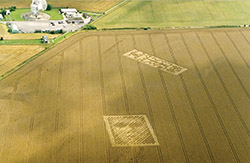
    The two Chilbolton formations appeared in August 2011 near the Chilbolton Observatory in Hampshire, UK. Are extraterrestrials trying to tell us something or show us something? Photo Copyright: Lucy Pringle, www.lucypringle.co.uk

    2001 was the year, we are often reminded, that our world irrevocably changed when the Twin Towers came crashing down on that fateful September 11th day in New York. But it was also the year that, near Chilbolton Observatory in Hampshire, UK, two astonishing crop circles, or rather, crop rectangles, appeared. What is even more interesting is that these were first sighted on the morning of Tuesday, August 21st, exactly three weeks before the mega-attack in Manhattan occurred. Is this a coincidence, or is there some synchronicity involved?

    The two Chilbolton formations consisted of, on the one hand, a section of binary code reminiscent of a computer chip and, on the other, a blurry humanoid face within a rectangular frame measuring 44m by 57m. The wheat stalks composing the face were bent in such a way as to make the image appear pixilated with heavily overhung brows, deep sockets, and an inscrutable demeanour. The Chilbolton face is, above all, emotionless. Looking back at it now, would it be off the mark to suggest that it conjures up a spectral reflection of what we have today become beneath the thin veneer of our civilisation, in a world racked by incessant wars, internecine conflicts, drone attacks and desensitised acts of extreme brutality?

    Or is it a kind of identikit portrait, sent for our perusal, of an actual alien race from a far-off galactic zone?

    As for the “computer chip” segment, it contained a message. This message was decoded by Paul Vigay, a computer expert who back-linked it to a coded signal originally sent out by SETI on November 16th, 1974, from the Arecibo Observatory in Puerto Rico. SETI had aimed its coded message at a star cluster known as M13 in the Hercules constellation. The purpose of the outgoing message was to deliver technical information about life in our Solar System to intelligent aliens who, it was hypothesised, if they existed, would most likely be capable of decoding it. The Arecibo radio signal had been delivered in binary code with a total of 1679 pulses.

    The returning signal, if authentic, appeared to provide reciprocal information about the alien species within M13, including its population (21.3 billion) and the high prevalence of silicon in its periodic table, suggesting to some interpreters that these aliens sending us back their own encoded messages may be cyborgs or robots.

    Alien “portrait” at Sparsholt
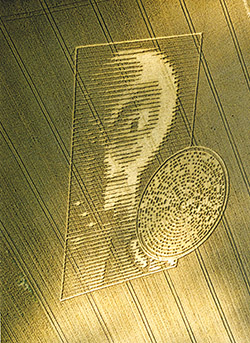
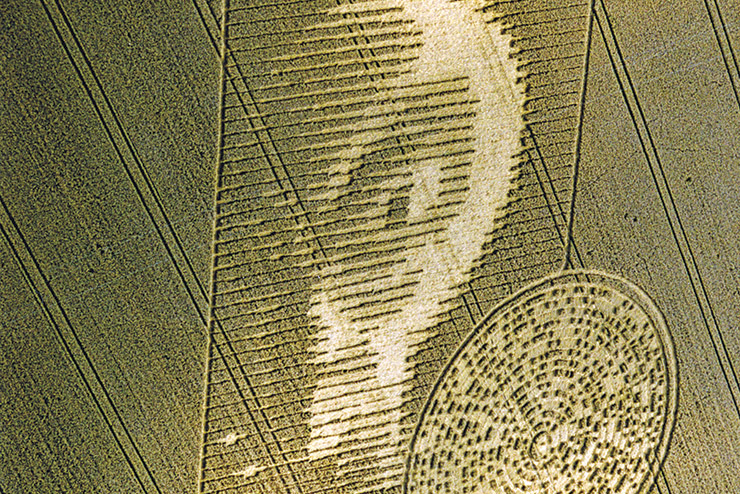
    The impressive 2002 Sparsholt formation, a rendition of our common projection of an alien, ET or Gray. Copyright: Lucy Pringle, www.lucypringle.co.uk

    Hardly another year had passed before yet another formation, again in Hampshire but this time at Sparsholt near the town of Winchester, appeared. It consisted of a “portrait” within an even larger rectangle, about 120m in length.2 The huge rectangle framed a clear rendition of our common cultural projection of an alien, ET or Gray. Looking at it gives one the distinct feeling this is a highly intelligent and refined, also deeply ironic, form of communication. Unlike the Chilbolton “portrait,” instead of a pixilated image, the Sparsholt “portrait” evokes an image on an old cathode ray TV screen. For, when viewed from above, the figure we see in the field is composed of clearly delineated horizontal lines.

    Thus the Sparsholt portrait is clearly intended to be interpreted as a projection from an undetectable alien source. This projection has itself been projected as if it were a TV image. Not only that but this small screen image suggests the producers are thoroughly aware of how we humans project outwards from our culturally manipulated unconscious, clichéd visual renditions of what aliens are “supposed” to look like. All of these factors lead one to suspect that whoever produced this crop rectangle at Sparsholt knows far more about us than we could possibly imagine. And that this knowledge “they” have of us is not limited to the type of information encoded in the original SETI radio signals which focused on external data such as Earth’s global population back in 1974, the atomic numbers for elements constituting the basic constituents of organic life in our Solar System, the composition of the DNA molecule, the height of the average human, and the Arecibo telescope itself from which the original, outgoing message was dispatched. No, the Sparsholt formation appears to show us that the emitters can read our minds, can penetrate our unconscious imaginal codes, not merely our rational, science-based ones. At Sparsholt, we may be presented with evidence of extraterrestrial insight into human psychic functioning, relayed back to us as a riddle to be solved. To put it most unequivocally, this Hollywood head-and-shoulder rendition of an ET in the rectangular frame does not attempt to represent what distant aliens look like; on the contrary, it reveals to us how we ourselves project names and forms outwardly from our own unenlightened understanding and semi-superstitious modes of perception, exactly as did the chained prisoners in the story of Plato’s Cave.

    But there is more: offset from the huge rectangular framed portrait at Sparsholt and perched on the ET’s left shoulder in such a way that it literally breaks through the lateral perimeter of the frame, is a wide disc encrypted with bits of binary coded information. When the experts finally deciphered the contents of this disc, what messages did they find? Paul Vigay, already mentioned in a previous paragraph, set about the work of deciphering the disc with an open, inquisitive mind. It struck him at first that the binary disc reminded him of the notched metal plates inside old Victorian music boxes, then of cymatics and later of planetary grid systems. Very soon, however, Vigay came to discern a semantic content encrypted into the disc. By invoking the “bits per byte” methods of notation commonly used by computer programmers, Vigay was quickly able to translate the disc’s outwardly spiralling sequence of raised and flattened tufts of wheat into text. What emerged was the following:

    Beware the bearers of FALSE gifts and their BROKEN PROMISES. Much PAIN but still time. (Damaged word.) There is GOOD out there. We OPpose DECEPTION. Conduit closing (BELL SOUND).3

    What can we conclude from these enigmatic words? I suggest this message is a cryptic call to that part of humanity that remains capable of hearing what the Greeks called the Music of the Spheres; almost a command, although delivered as a whisper, just as the Music of the Spheres was not so much a sound as an inner harmony between parts. Nonetheless, a call to arms, on the level of the heart and the mind, a reminder of our individual spiritual responsibility. If there is a side to human interaction with aliens which, whether real or imagined, focuses on predation, abduction, conquest and exploitation, there is also this gentle voice exhorting us to stay vigilant, lucid and receptive; to retain our grip on the wheel of reality by staying true to a deeper vision.
    Archons & Ahriman

    The entire alien-interaction theme brings to mind the Gnostic concept of archons, and in particular Ahriman, that master meddler and deceiver. It maybe that the contrasts between light and dark, inspiration and terror streaming out of the extraterrestrial sphere articulate the esoteric Manichean tensions between good and evil entities, and the effects of forces which are inimical to our spiritual and existential growth. One could perhaps say that these forces are not truly situated somewhere else but reside within the human heart, and that the human heart, with its potentially limitless scope of understanding, encompasses both opposing extremes.

    Rudolf Steiner, in one of his lectures on Lucifer and Ahriman, has this to say on the subject:

    If the right stand is to be taken to Ahriman’s future incarnations, people must become far more objective where their own impulses are concerned, and far, far more subjective where the external world is concerned – not by introducing pictures in fantasy but by bringing interest, alert attention, and devotion to the things of immediate life.4

    Since we first ventured out, many millions of years ago through that verdant curtain at the forest’s edge, we humans have stumbled, and occasionally swaggered through trials, challenges, conquests, epiphanies and corruption, searching endlessly for our own peculiar destiny. Indeed, it is only recently we have become aware that the very stars above us must, like us, perish, they too have their share of conflicts and will eventually be extinguished, transforming into red giants or white dwarfs, or collapsing into limitless, hyperdense black holes of forgetting and nothingness. In our hearts we carry both love and hatred, both the Christ impulse and the Ahriman or Luciferian impulse.

    The innumerable snowflakes that have fallen around us since that first intrepid and fateful venturing out on to the open plain have threatened our survival with the promise of terminal cold, but they have also delivered tiny, inimitable packets of cosmic perfection, of which the mysterious crop circles are fantastic elaborations. We ourselves are nothing but extraterrestrials stranded on a distant planet. We shall find our longed for origins in the sky only by rediscovering that way back home here on Earth.

    [alert type=”general” dismiss=”no”]This article was published in New Dawn 155.[/alert]

    [alert type=”success” dismiss=”no”]If you appreciate this article, please consider subscribing to help maintain this website.[/alert]

    Footnotes

    1. Freddy Silva, Secrets In The Fields, Hampton Roads Publishing, 2002
    2. Bob Rickard & John Michell, Unexplained Phenomena, 2nd Edition, Rough Guides Ltd., 2007, page 229
    3. www.cropcircleresearch.com/articles/alienface.html
    4. Rudolf Steiner, The Influences of Lucifer and Ahriman, Anthroposophic Press, 1993, page 35

    © New Dawn Magazine and the respective author.
    For our reproduction notice, click here.

  • Toxic Prayer: Be Careful What You Ask For…

    Toxic Prayer: Be Careful What You Ask For…

    From New Dawn 114 (May-June 2009)

    You might be under the impression that authors choose the titles of their own books. That isn’t true – at least not always. If the publishers don’t like the title, they will change it.

    Such was the fate of a book published in 1997 by the noted mind-body researcher Larry Dossey, M.D., author of Healing Words and Prayer Is Good Medicine. Dossey had written on a provocative subject: if thoughts and prayers have the power to heal, do they also have the power to harm? He called his book Toxic Prayer, but the publishers, Harper San Francisco (now Harper One), were extremely uncomfortable with this title. They feared a backlash from fundamentalist Christians, who, they imagined, would take up arms against the idea that any kind of prayer could ever be harmful. After an anxious discussion that went all the way to the top of the company’s hierarchy, another, safer, though more flavourless title was chosen: Be Careful What You Pray For…You Might Just Get It.

    Whether the decision was a wise one or not (controversy sells books, after all), the whole story raises an awkward issue: is prayer a morally ambiguous force? Can it be used to curse as well as bless? If so, how?

    Of course it depends upon what you mean by prayer. In the conventional monotheistic view, prayer is addressed to the one true God (or sometimes his subordinates, such as Mary or the saints or the angels). Since God is all-good, he will either grant this request if it is beneficial or ignore it if it isn’t.

    This belief, although engagingly simple and clear, begins to erode if we also accept the idea that thoughts have power in and of themselves. By this view, a thought, whether positive or negative or neutral, has effects that can be felt in the psychic dimension and sometimes physically as well. This perspective, which takes us out of the sphere of religion per se and into that of magic, provides a far more equivocal picture of prayer.

    Magic and Invocation

    Magic, wrote the notorious twentieth-century occultist Aleister Crowley, is “the Science and Art of causing Change to occur in conformity with Will.” This definition, while correct up to a point, is too general to be entirely adequate. If I move a coffee cup around my table with my hand, I am effecting change in conformity with will, but no one would claim that that is magic as such. Magic has to do with effecting change by occult means – that is, by means invisible to ordinary sight and inadmissible by ordinary consciousness. If I were to move the same coffee cup around the table without touching it, this would start to look like magic, since the cause of the movement, whatever it is, cannot be seen.

    There are many forms of magic, ranging from sleight-of-hand (that is, using the standard tricks of stage magicians) to suggestion to more genuinely paranormal means. The boundaries between these categories – like the boundary between prayer and magic – are fluid and permeable, but generally we can say that occult magic is believed to work through two principal methods.

    The first has to do with spirits. Most occultists believe that there are unseen creatures inhabiting dimensions of reality that intersect with our own: these beings are variously known as spirits, elementals, angels, demons, devas – the lore has countless names for them. According to the magical world view, it’s possible to engage with these creatures. The magicians of the Renaissance, for example, evoked certain spirits using occult rites. If these spirits were approached the right way (through seals, signs, rituals, invocations, and so on), it was believed that they could be beseeched or, more often, forced to obey the magician’s will. The moral status of these spirits was ambiguous – they were often thought to be demons – but that could prove an advantage when there was dirty work to be done.

    Here is one invocation, of a spirit called Mirael. Taken from a fifteenth-century manuscript of necromancy found in Munich, it is designed to make someone lose his mind: “May Mirael enter into your brain and dissolve and destroy all wisdom, sense, discretion, and thought. I conjure you, Mirael, by all the princes and elders, and by all that you wish to do, that for as long as it pleases me you will flow through the person I look upon and daze him, and that he lose everything that he does not recognise. Otherwise I shall cast you into the depths of the sea so that you shall not escape for eternity.”

    As unsavoury as these practices may sound, they are universal or practically so. Here is another example, this one from the other end of the world. Max Freedom Long, the redoubtable investigator of the Hawaiian form of shamanism known as huna, discusses the death prayer as practiced by the shamans or kahunas: “To become able to use the ‘death prayer’ a kahuna had to inherit from another kahuna one or more ghostly subconscious spirits. (Or he might, if sufficiently psychic, locate subconscious spirit or ghosts, and use hypnotic suggestion to enslave or capture them.)”

    Once a kahuna had some of these spirits under his will, he would offer them food and drink so as to imbue them with mana or vital force and then give them very specific instructions about what to do with this energy. They might, for example, be told to find a given person and enter his body or attach themselves to it. Once they had done this, they would suck up the victim’s vital force. When the victim died, the spirits would return to their master, further strengthened by having absorbed the dead person’s mana.

    Spirits thus require an infusion of energy or life force. There are a number of ways of supplying it. In ancient times the method of choice was blood sacrifice; as the victim’s blood spilled, the vital force would, as it were, evaporate so that the spirits could consume it.

    Homer’s Odysseus describes a sacrifice he has made: “When I had prayed sufficiently to the dead, I cut the throats of the two sheep and let the blood run into the trench, whereon the ghosts came trooping up from Erebus – brides, young bachelors, old men worn out with toil, maids who had been crossed in love, and brave men who had been killed in battle, with their armour still smirched with blood; they came from every quarter and flitted round the trench with a strange kind of screaming sound that made me turn pale with fear.”

    How The Death Prayer Works

    While blood sacrifice is much less common today than it was in antiquity, it is still used, for example, in Santería, Voudun, and other religions of African origin that are practiced in the Caribbean Islands and South America.

    To show how the death prayer works, Long tells of a young Irishman who went to Honolulu and worked as a taxi driver. He became involved with a Hawaiian girl, who then ended her engagement with a Hawaiian boy. The girl’s grandmother, not trusting the young Irishman’s intentions, tried to break up the affair, but without success.

    One day, writes Long, the Irishman’s feet “went to sleep.” The pricking numbness that afflicted his feet gradually crept up his body, making him unable to move. The young man did not believe in magic or death prayers or any such nonsense, so he called in conventional American doctors. They were unable to help him. The numbness had spread to his waist by the time an old doctor who had practiced in the islands for many years was summoned. He recognised the symptoms of the death prayer, and making inquiries of the patient, soon learned about the girl and her grandmother. The doctor paid a visit on the grandmother, who said, “Well, I know nothing about the matter and I am no kahuna – as you know. But I think that if the man would promise to take the next ship for America and never return or even write back, he might recover.”

    The doctor tried to explain the situation to the still-unbelieving Irishman. Although he resisted at first, finally the patient was persuaded to take the grandmother’s advice. The same day he was able to walk again, and that evening he caught a Japanese ship headed for the West Coast of the US.

    How do the kahunas themselves see this whole process? Kahana, a Hawaiian ana’ana priest (priest of the dark forces), explained in an interview: “You are releasing the spirit from this encasement so it can go and get cleansed and purified and come back. It’s time to take it out.”

    One detail in Long’s story raises an issue that has long been disputed: does the victim have to believe in these powers in order to be susceptible to them? Dossey cites one researcher who contends that in such cases, “the victim, family members, and all acquaintances must accept the ability and power of the hexer to induce death. This belief must be commonly held with no exceptions.”

    Long’s story contradicts this claim. The victim did not believe in such things and continued to scoff at them even as he was dying; moreover, nobody even told him that the death prayer had been aimed at him. Attempting to write off such effects purely as a matter of suggestion would then be inaccurate (although it is easier for scientists to accept, since they feel obliged to dismiss actual occult causes from the outset). Indeed Michael Harner, the noted scholar of shamanism, observed that the Jivaro shamans of South America prefer the victim to be unaware of the psychic attack, because then he would take no measures to counter it. “Distant hexing is a security measure,” he told Dossey in conversation.

    [alert type=”info” dismiss=”no”]If you appreciate this article, please consider a subscription to New Dawn magazine.[/alert]

    Creating Thought Forms

    Working with spirits is one time-honoured way to cause harm; another way is closely related to it. This second approach involves sending not spirits but thought forms – mental images infused with vital energy that can thus make their effects felt in the physical world. The difference between the two methods is in the tools: a spirit is usually regarded as a living, more or less conscious entity, whereas a thought form is the creation of a human mind and has no independent existence.

    Admittedly, the line between these two types of magic can be a thin and wavering one. In his Meditations on the Tarot, a contemporary classic of Christian esotericism, Valentin Tomberg writes that this method of creating a thought form is precisely how you create a demon.

    As with all generation, that of demons is the result of the cooperation of the male principle and the female principle, i.e., the will and the imagination, in the case of generation through the psychic life of an individual. A desire that is perverse or contrary to nature, followed by the corresponding imagination, together constitute the act of generation of a demon.

    A term used in the occult literature for such entities is egregor or egregore, a term supposedly derived from the Greek gregoreuein (“to watch, to stay awake”). One famous instance of the creation of an egregor is related by Alexandra David-Neel, a Frenchwoman of the early twentieth century who penetrated the then-forbidden country of Tibet to learn its occult practices. By dint of intense meditation, she was able to generate the form of a monk that took on a quasi-autonomous existence and even made its presence felt to other people. When the entity started to make a nuisance of itself, David-Neel had to devote another several months of intense meditation to destroying it.

    Harming by means of thought forms does not necessarily require the generation of quasi-autonomous psychic entities. Dossey mentions the case of a patient of his, a woman afflicted with chronic fatigue syndrome. The woman was domineering and manipulative while her husband was extremely unassertive. He had always resented his wife; after she fell ill, he started to hate her.

    One night, after a bitter argument, the husband stormed out of the house; when he returned, he found his wife dead. The man was overcome with guilt, convinced that his hatred had killed his wife. He refused to enter psychotherapy and instead joined an extremely conservative fundamentalist church, where he was able to assuage his conscience by believing that her death was the will of a wrathful God.

    Psychologists sometimes employ the term magical thinking. This involves the belief that an inner wish or emotion somehow caused an effect that later happened in reality. A four-year-old child, for example, may hate his brother and wishes he were dead. The brother then dies; the child then believes that somehow he was the cause of the death. It is a version of the old logical fallacy Post hoc, ergo propter hoc: “After this, therefore because of this.”

    Clearly not every case of misfortune can be traced to someone else’s negative thoughts, even if that person really did have those thoughts. Nor is it absolutely clear what the determining factor might be, but it very likely includes the intensity of the desire. A passing irritation that leads a person to say, “I wish he were dead!” probably does not have much effect in most cases. But when the thought is fed and nurtured with intense emotional energy, even unintentionally, it can begin to gain power. The man who thought he had killed his wife had probably directed a huge amount of hatred at her.

    I once had a curious experience in this regard myself. A number of years ago I lived next to neighbours who were causing me a great deal of disturbance with their noise. I had spoken to them about it, but it did no good except to change the source of the noise: their rock band practicing in the garage was supplanted by dogs who got on their roof and barked obnoxiously at everything. I felt the negative energy accumulating in myself, and although I intended no harm to them – I merely wanted them to stop disturbing me – a strange thing happened one day. I put a letter in their mailbox asking them yet again to deal with these issues; it was the only time I ever did that. Then I drove to work as usual and was gone for the rest of the day, only getting back late in the evening. The next morning I noticed something strange: a tall tree that had been directly next to their mailbox was gone. Neighbours later told me that a truck had hit the tree that day, and it had to be taken down.

    There is, of course, no way that I could prove that my thoughts had this entirely unintended effect, but I had never put anything in their mailbox before and never did again. The coincidence was disturbing, and I had the uncanny feeling of being at psychic war with these neighbours; moreover I began to feel an intense psychic charge around my house. A few months later, not wanting the situation to escalate any further, I solved the problem by moving away.

    Thus thought forms, in order to have power, need not have energy directed consciously at them; they can receive this force even when it arises spontaneously and unintentionally. But like spirits, these thought forms do require some energy or vital force in order to operate.

    The Dangers Posed by Toxic Prayer

    Having briefly surveyed some powerful though unsavoury occult practices, what practical lessons can we draw? In the first place, wishing for harm to someone else is remarkably common; one poll indicated that 5 percent of American surveyed had done it (and we have to assume that this is a low figure, since it only accounts for those who were willing to admit as much). In the second place, it is remarkably dangerous. Indeed magical practices of any kind are dangerous, even when one’s intention is reasonably pure; almost invariably something goes awry, producing results that are not exactly what you might have wanted. Occult magic is rather like trying to sculpt something out of nitroglycerin – a sloppy but also highly explosive material.

    The problem is compounded when one is working with an intent to harm. It is extremely difficult, perhaps impossible, to create a thought form or invoke a spirit and remain totally disconnected from it. Thus if you are creating something negative, you can be sure that it will return to you in some form or another, just as in huna the spirits return to the kahuna after they have consumed a victim’s energy. And they are not always easy to control when they are aroused, even by their supposed master.

    To illustrate this point, Max Freedom Long tells another story, which happened to his mentor and informant about huna, an American scientist named William Tufts Brigham. During a trip to the Mauna Loa volcano to collect native plants, Brigham found that one of his servants, a twenty-year-old boy, started to fall ill. Although there was ostensibly nothing wrong with him, he began to waste away and, like the Irishman, lost feeling in his legs. The boy believed that he was being prayed to death, and Brigham’s servants, who regarded him as a great kahuna, begged him to send the spirits back to the one who had launched them.

    “This is perhaps the easiest thing an amateur magician could be called upon to do,” said Brigham. “The spell had been initiated and the trained spirits sent out. All I had to do was to put up the usual big arguments to talk the brainless things over to my side…. I stood over the boy and began to advance arguments to the spirits. I was smoother than a politician. I praised them and told them what fine fellows they were…. Little by little I worked around to tell them how sad it was that they had been made slaves by a kahuna instead of being allowed to go on to the beautiful heaven that awaited.”

    Finally, mustering a supreme concentration of power and will, Brigham let out a tremendous roar. Soon the suffering boy felt better, and in an hour he was up and eating. Later Brigham learned that the kahuna who had sent the curse had neglected to cover himself with the usual occult protection, and by the next morning he was dead.

    Much the same is true with thought forms of the more impersonal variety. To begin with, the thought form, in order to have any effect upon the recipient, must find some resonance in him or her.

    The Theosophists Annie Besant and C.W. Leadbeater write: “In cases in which good or evil thoughts are projected at individuals, those thoughts, if they are to fulfil directly their mission, must find, in the aura of the object to whom they are sent, materials capable of responding sympathetically to their vibrations.” Otherwise the thought form will bounce off. “That is why it is said that a pure heart and mind are the best protectors against inimical assaults…. If an evil thought, projected with malefic intent, strikes such a body, it can only rebound from it, and it is flung back with all its own energy; it then flies backward along the magnetic line of least resistance, that which it has just traversed, and strikes its projector; he… suffers the destructive effects he had intended to cause to another.”

    The Best Protection

    These observations go far toward answering the final and perhaps most pressing question connected with toxic prayer: how do you protect yourself against it? A positive mindset is a good start, so purging thoughts of hatred, judgment and violence from your mind is a necessity. It’s also helpful to clear away negative thoughts that are aimed at yourself: recognise that thoughts of your own weakness, inferiority, vulnerability and sickness are poisons and rid yourself of them. If this kind of thinking has been a lifetime habit, it may prove difficult to break, but even the smallest efforts can bring results and will also create a momentum that gradually builds.

    For those with some ability at visualisation, some of the standard forms of occult protection can be useful. The most common is probably envisaging yourself as surrounded by a sphere or ovoid form of white light. But the exact technique you use is probably less important than the clarity and power you bring to the thought, so you will probably do best by experimenting which methods work for you. Conventional prayers can also be employed, such as the Lord’s Prayer, which after all includes the petition “Deliver us from evil.” Again, the specific form of the prayer is not as important as whether it arouses a powerful and positive emotional response in yourself.

    Perhaps the chief thing to remember is not to fear. Fear is a negative emotion and weakens you far more than it strengthens you, and it is probably no coincidence that the cultures in which psychic attack is most common are those pervaded by fears of black magic. For this reason, a healthy, grounded, common-sense mindset may be the best protection of all.

    [alert type=”general” dismiss=”no”]This article was published in New Dawn 114.[/alert]

    [alert type=”success” dismiss=”no”]If you appreciate this article, please consider subscribing to help maintain this website.[/alert]

    Sources

    Anonymous [Valentin Tomberg], Meditations on the Tarot: A Journey into Christian Hermeticism, Translated by Robert A. Powell, Warwick, N.Y.: Amity House, 1985

    Annie Besant and C.W. Leadbeater, Thought Forms, Adyar, Madras, India: Theosophical Publishing House, 1978 [1901]

    Aleister Crowley, Magick in Theory and Practice, New York: Castle, n.d.

    Alexandra David-Neel, Magic and Mystery in Tibet, New York: Dover, 1971

    Larry Dossey, Be Careful What You Pray For…You Might Just Get It, San Francisco: Harper San Francisco, 1997

    S.E. Hertel, “Kahuna Ana’Ana: The One Who Walks in Darkness”, Gnosis 14 (winter 1990), 30-33

    Homer, The Odyssey, Translated by Samuel Butler, http://classics.mit.edu/Homer/odyssey.html; March 10, 2009.

    Richard Kieckhefer, Forbidden Rites: A Necromancer’s Manual of the Fifteenth Century, University Park, Pa.: Penn State Press, 1997

    Max Freedom Long, The Secret Science Behind Miracles, Santa Monica, Calif.: DeVorss, 1948

    Richard Smoley, “Man as God and Creator”, Gnosis 28 (summer 1993), 56-60

    © New Dawn Magazine and the respective author.
    For our reproduction notice, click here.
  • Who Are The Controllers?

    Who Are The Controllers?

    From New Dawn 156 (May-June 2016)

    In the West, we’ve all been spoon fed the idea that we are free citizens of sovereign countries, where our democratically elected governments rule according to the peoples’ wishes. If that’s not achieved, it’s usually explained as being due to misfortunes such as crises, security threats or wars, or the stupidity of our governments. The few people that doubt these explanations, or even suspect hidden hands behind the occurrences of our time or the official narrative of our history, are easily dismissed as conspiracy nuts.

    Our Rulers in Ancient Times

    For sure, there were no hidden hands when humanity was in its “pre-history,” predating our “real history” as seen by most. For about 200,000 years our ancestors lived in small nomadic communities, sharing the food obtained by hunting and gathering. Problems, plans and rules were settled in probably long discussions, where the opinions were usually harmonised until a consensus was reached. Our pre-historic world was ruled by highly sovereign people.

    Things started to change about 10,000 years ago with the revolutionary innovations of crop and livestock farming. Many communities became sedentary and small villages grew bigger. The makers of tools, clothes, pottery or art had to barter with the people producing food. At some point, money such as shells or clay tablets came in as a handy substitute for bartering. Then silver and gold coins appeared, and inevitably, some people became poorer and others richer. Next, people with a surplus started to lend their money to people in need of it. At times as a favour, but usually against interest.

    It was then discovered that even a small percentage of interest applied over a few years would quickly double a debt, e.g. 10% over seven years. Thus, the treacherous power of usury revealed itself, capable of destroying the fabric of any egalitarian society. The ancient knowledge of the wreckage caused by usury led to its prohibition in the three Abrahamic religions: Christianity, Islam and Judaism. Today, it’s still forbidden in Islam.

    Through usury, the first bankers of Babylon became so wealthy and powerful that they controlled kings and priests. Commercial laws were drawn up that protected the elite and even gave them the right to treat conquered people as a commodity: Big Slavery, in multi-colour, became a key business. After the fall of Babylon, other empires like the Persian, the Phoenician and the Roman came and went. In all, the question “who rules the world” was easy to answer.

    Fast Forward to the Middle Ages

    In the Middle Ages, Europe was overtly ruled by a landed aristocracy that kept rural people in feudal serfdom, obliging them to deliver part of their harvest in exchange for protection. The dominating religion was Catholicism, which forbade usury. Yet, there was a high demand for money lending, and only Jews were permitted to do so (however, they were religiously forbidden to lend money to other Jews). They were among the few people skilled in writing and accounting, and through their networks large amounts of money could be lent to high-placed debtors. Lending was a very lucrative business, but also risky as guarantees were often feeble. Taxing of subordinates was commonly used to solve the problem. This unpopular task was often left to the lenders, and such tax-farming activities caused them to be hated by the people. After earlier expulsions elsewhere, the Inquisition threw the Jews out of Spain in 1492 and out of Portugal in 1496. Because of their capital and international networks, they were welcomed in Holland and Venice.

    In the early 1600s, Holland was a rising star, while Venice – the richest, oldest and probably most perfidious European empire – was struggling to recover from an extermination attempt by the Cambrai league of European forces. Using a new shipping route around Africa, the Portuguese were taking over part of their lucrative Asia trade. Besides, Venice was not well located for business with the newly discovered and already booming (via stolen gold and silver) Americas. Hence, an endeavour was started to develop a new and larger empire, with safer and better located bases on the Atlantic coast in Holland and England. These Protestant lands were usury-friendly, and thus promising grounds for the development of a novel, less risky lending system. The participants were the ambitious Giovani faction of Venetian oligarchs (as empire specialists), rich Sephardic Jews expelled from Spain and Portugal (as financial specialists), and opportunistic Anglo-Dutch Protestant nobility and aristocracy (as puppets and profiteers).

    The ground for this tripartite project had been prepared from the early 1500s when the Venetian oligarchy’s divide-and-rule policy supported the Protestant revolution in Northern Europe.1 Venice also aided the new Protestant Dutch Republic in its long struggle with Catholic Spain (1568–1648), and later had a heavy hand in the instigation of the disastrous 30-year war between European Protestants and Catholics (1618–48).2

    Venetian and Sephardic capital and knowledge was an important driver behind the British and Dutch East India companies (established around 1600), with Venetian banking experience transferred to the Dutch Venice as the Bank of Amsterdam (1609). Stock of these and other companies was traded at the Amsterdam and London stock exchanges. Amsterdam even offered call and put options, which led to the tremendous collapse of the Tulip bubble in 1637. With a little Sephardic-Venetian help, the tiny Dutch Republic was catapulted into global empire and its Golden Century. In the meantime, Britain was being prepared for its future role as a much greater and safer base. Both countries took over the Venetian trade in slaves, silver and gold bullion, and drugs, and were also active in piracy and the colonisation of faraway lands – yes, to spread Christianity, no moral dilemmas here!

    Later, in the 17th century, Venetian-Sephardic sponsoring enabled the take-over of Britain by Oliver Cromwell. They also financially backed an expensive invasion army led by Dutch puppet William III of Orange that led to the overthrow of King James II of England, known to history as the 1688 Glorious Revolution. Six years later, the Bank of England was established as a private bank with a monopoly on the emission of money as interest-bearing debt. Very quickly, the war-eager William got the State highly indebted to the new bank. At the same time, tax laws were installed to guarantee repayment by the State and eliminate risk for the bankers. Of course, the State could have produced its own money without having to pay any interest or taxing its people, but that was clearly not part of the deal made by corrupt governors. The outcome was the heavy but hidden golden crown on the tripartite endeavour that had started almost two centuries before. The bankers were the new rulers of the world, but for the first time in history they were invisible to the people: hereafter, usury was extended covertly and gradually to all citizens, including to those without bank loans.

    Aided by Dutch finance capital, Britain soon became the dominant world power, and the channel for widespread international usury systems, both overt and covert. The only exception were some Muslim countries (one reason why they are being destroyed since 9/11). The great deceptive and controlling power of the money masters behind the scenes is best illustrated by the incredible fact that until very recently, almost nobody ever questioned this system: neither economists, governments or investigative journalists, nor political parties, not even die-hard socialists or Marxists!

    [alert type=”info” dismiss=”no”]If you appreciate this article, please consider a subscription to New Dawn magazine.[/alert]

    Project for a New World Order (NWO)

    During the 19th century, one family became the controller of finance capitalism, both overtly in the British Empire and Europe, and covertly in the USA via their fronts, the Morgan and Kuhn-Loeb banks. From their headquarters in The City of London, the Rothschilds accumulated probably half of the world’s wealth, not only via hidden usury, but also from open usury on loans to kings, countries and corporations. It was only a matter of time before the Rothschild banking family teamed up with the American Rockefellers and their Big Oil companies.5

    In the early 20th century, the Rothschilds, Rockefellers and their global corporations and networks were more powerful than any country on earth. According to then US President Woodrow Wilson: “Some of the biggest men in the United States are afraid of something. They know there is a power somewhere, so organised, so subtle, so watchful, so interlocked, so complete, so pervasive that they had better not speak above their breath when they speak in condemnation of it.” That power bribed politicians (including Wilson and subsequent US presidents), infiltrated opposition and media, corrupted governments, and hijacked science. To join their games, you had to sell your soul to the devil, and suddenly doors or markets opened, careers or stocks soared, and you made loads of money!

    Moreover, banker shrewdness got most of the dirty work done through subordinates and the raw power of money: empires, their armies and secret services; the mafia; the military and industry; and even idealistic or revolutionary movements. And it even worked on the small people, as our decisions often favour money and not life. These elites financed wars and political assassination, often manufacturing events (i.e. false flags attacks) to provoke conflict in their favour. This power was utilised extensively last century – over 140 million deaths – as part of a strategy to guarantee their position at the top.

    The step-by-step multi-generation NWO project has been masterly outlined by Richard K. Moore in his article A Brief History of the New World Order.

    “WWI was the epochal event that began an identifiable program toward a new world order, a single global hierarchy… under the control of elite financiers… Britain was no longer the obvious choice, as the base for a global power grab. So the decision was made to shift hegemony from London to Washington… WWI was the making of America, as a world power… While Europeans and Brits were being slaughtered in their millions, Americans were experiencing boom times, leading into its golden age of the roaring 1920s… allies were encumbered by astronomical debt to the American Treasury and to the banking elite…

    “We could say that America won WWI, and all of Europe lost – and lost big. The Europeans were bound to pay America huge sums for the privilege of having devastated one another… Britain had won the battle for Europe, for a while; America had won the battle for strongest nation, for a longer while – but it was the banking elite who won the war – for discretionary power over the future course of world affairs.”6

    The once secret story of the staging of WWI is told in Hidden History: The Secret Origins of the First World War by Jim Macgregor and Gerry Doherty.7 A secret elite of the British empire prepared the operation. Should the Sarajevo trigger have failed, a backup scenario was in place – the sudden discovery of German weapons they’d smuggled to Ireland. The Rothschild and Rockefeller-controlled oil companies could have shut off Germany and its war machine at once, but that never happened. When, in 1915, a food shortage threatened to stop Germany fighting, the banksters quickly guaranteed them a massive supply through the fake Belgium Relief Commission, led by their agent and ‘philanthropist’ Herbert Hoover – later to become US president. Thus, the genocide could go on, resulting in 17 million deaths and 20 million wounded, often severely mutilated.8

    Naturally, the Machiavellian banksters “never let a good crisis go to waste.” With the same chutzpah, they helped instigate other important NWO projects under the cover of WWI such as the Bolshevik Revolution in Russia, the League of Nations (precursor for the United Nations) and the Balfour Declaration, the opening move for the Zionist Israel project. After the war, thousands of agents were used in a massive cover-up operation, again directed by Herbert Hoover who filled his new Institution at Stanford University with shiploads of documents from all corners of Europe. In the early 1920s he was involved in another ‘humanitarian effort’ to save the Soviet Union from starvation – while at the same time preserving a future ‘arch enemy’.

    After four pointless – for the people – years of war, the Germans were forced to take all blame. At the Versailles ‘Peace’ Conference, the bankers guaranteed debt repayment and the conditions for their next NWO project, WWII. In excerpts from the same article by Richard Moore:

    “WWI had been such a successful project that planning began immediately for a grander sequel, another giant step toward a new world order. In the early 1920s, still in the days of the Weimar Republic, a team of Krupp engineers were secretly tasked with a project: come up with designs for a line of military equipment suitable for a war twenty years from now. Thus were conceived the advanced weapons that served the Reich so well when the time came. Even though Germany was destitute, and treaty-bound not to rearm, someone knew, and told Krupp, that all this would change – and within the designated timeframe…. Hitler was a project of the Anglo-American bankers. His charismatic brilliance was noticed early… and immense profits were made by investing in the German rearmament process… [see Conjuring Hitler by Guido Preparata] The WWII project achieved all of its objectives admirably. While having fought only marginally, and suffered negligible casualties – in comparison with the other major combatants – the US emerged with an intact infrastructure, 40% of the world’s wealth and industrial capacity, control of the seven seas, a monopoly on atomic weapons, strategic footholds in the Middle East oil sheikdoms, and general popular acclaim as the heroic champion of democracy. Quite naturally, the world’s eyes turned to Washington for leadership in shaping the postwar world.

    “And America was ready with a blueprint. The bankers had selected a committee, from their Council on Foreign Relations, and sent it over to the White House to design the postwar architecture. America was now secured as a hegemonic base of operations, more viable for that role than Britain had been, and it was time to move forward with the next phase of the new-world-order project. Thus were launched, promptly after the war ended, the Bretton Woods globalist institutions – the UN, IMF, and World Bank – the early foundation stones for an eventual one-world government.”

    The Power to Turn Truth on Its Head

    The banksters’ unimaginable power of deceit turned the truth upside down, making into heroes the very instigators of these destructive wars. How on earth did they manage that? Through control of the mainstream media, science and academia (in particular history and economics), the education system and the entertainment industry. That’s how they shape our perception of the present and the past, and that’s how the majority of people are kept in ignorance of these machinations. When the truth is finally heard, it’s difficult to grasp because the lies are so big, the scope so vast, and the real events of history so different to what we’ve been told. To wake up and accept the truth about the situation, and acknowledge we’ve been duped, most people go through the painful process of cognitive dissonance,9 which is like losing part of your identity.

    Today, much disinformation comes via the Internet, false and dead-end paths to keep you distracted and away from the truth: the conspiracy for world domination has variously been linked to the Jesuits, the Jews, the Illuminati, the British, the Zionists, the Nazis, the Freemasons, etc. These groups have indeed been involved but always as pawns and dupes of the banksters. History reveals the banksters hold no loyalty to any race, nation, group or religion. They are their own gods, all others their slaves, either classified as useful fools or useless eaters to be reduced in numbers.

    The next enemy project had been long on the waiting list: Islamic extremism! ‘Court’ scientist Samuel Huntington prepared the public with his The Clash of Civilizations, its message spread by more than a hundred think tanks. Then came 9/11, the war on terror, and the erosion of civil rights in all so-called Western democracies. Ever since, under the guise of bringing ‘democracy’ to former dictatorships, the playing field for their New World Order is being levelled by the removal of the last few independent countries.10

    What Can We Do?

    The future, as designed by the masters of this ‘global plantation’, would look like Huxley’s Brave New World or Orwell’s 1984.11 If we know who rules the world, the big question then becomes: what we can do to protect our already weakened freedoms? My answer is anything that empowers the people and their nations, favours life and not money, and makes us less dependent on the Big Banks and Big Corporations:

    • Strive for prohibition of war, because wars in modern times are bankster-designed wars.
    • Return sovereignty to our nations, with proper international relations and leagues for peace and collaboration, as US president John F Kennedy and Gandhi wanted.
    • Spread the true story of our world and its wars, which should be included in our education systems, media and the science of history.
    • Less corporate and bank control: no cashless societies or predatory corporate trade agreements like TPP or TTIP (these are about “power” not trade).12 Stop projects to give all poor people in developing countries a bank account or a microcredit. Get out of debt to banks as soon as possible, also an important safety measure in a troubled future.
    • Set up interest-free money systems as proposed by Margrit Kennedy and her successors, e.g. Positive Money, www.positivemoney.org.
    • Oppose more loss of privacy by SMART-meters, the Internet-of-Things, human microchip implants (RFIDs), laws to increase the surveillance powers of authorities, etc.
    • Turn off the controlled mainstream media and inform yourself through independent journalists, writers, and magazines.
    • Go organic and/or grow your own: not only healthy for you and the environment but also independent of Big Agriculture, dangerous GMOs, and oil-derived pesticides and fertilizers.13
    • Support local initiatives like renewable energy generation, food markets, health services, and insurance schemes.
    • Keep a healthy lifestyle and avoid Big Pharma solutions whenever you can.14

    A massive wake-up by “we, the people” is urgently required if we are to end this wicked game. Spread the word and engage in peaceful action!

    [alert type=”general” dismiss=”no”]This article was published in New Dawn 156.[/alert]

    [alert type=”success” dismiss=”no”]If you appreciate this article, please consider subscribing to help maintain this website.[/alert]

    Footnotes

    1. Through the handling of Luther by Venetian-trained Spalatin, and by Francesco Zorzi of Venice who advised Henry VIII in England to abolish Catholicism and also bringing novel ship building techniques to England.
    2. See also Webster Tarpley’s Against Oligarchism, http://tarpley.net/online-books/against-oligarchy/
    3. According to the Positive Money website www.positivemoney.org, “Positive Money is a movement to democratise money and banking so that it works for society and not against it. Our current financial system has left us with the highest personal debt in history, unaffordable housing, worsening inequality, high unemployment and banks that are subsidised and underwritten with taxpayers’ money. We believe that these problems have a common root: money.”
    4. See www.margritkennedy.de and Dr. Margrit Kennedy’s article ‘If money rules the world, who rules money?’ at www.margritkennedy.de/media/art_forum_csr_international_1_2008_28.pdf
    5. See James Corbett’s video www.corbettreport.com/how-big-oil-conquered-the-world/
    6. ‘A Brief History of the New World Order’ by Richard K. Moore, www.serendipity.li/capitalism/new_world_order.htm
    7. See also their blog www.firstworldwarhiddenhistory.wordpress.com & ‘The Secret Origins of the First World War’ by Gerry Docherty & Jim Macgregor in New Dawn Special Issue Vol 9 No 1.
    8. See The Iboga Visions by Jim Macgregor.
    9. The dictionary definition of cognitive dissonance: “the state of having inconsistent thoughts, beliefs, or attitudes, especially as relating to behavioural decisions and attitude change.”
    10. See Richard Moore’s Full Spectrum Dominance, www.serendipity.li/capitalism/full_spectrum_dominance.htm
    11. See also Richard Moore’s The Elite Plan, www.serendipity.li/capitalism/prognosis_2012.htm
    12. ‘The Predators Behind the TPP (14 Oct. 2015)’, www.karelvanwolferen.com/49-the-predators-behind-the-tpp-14-oct-2015/
    13. The hijacking of world agriculture is covered in Seeds of Destruction by F. William Engdahl.
    14. See Peter Gotzsche’s book Deadly Medicine and Organized Crime and read Eustace Mullins’ Murder by Injection, www.whale.to/x/Murder by Injection.Eustace Mullins.pdf

    © New Dawn Magazine and the respective author.
    For our reproduction notice, click here.
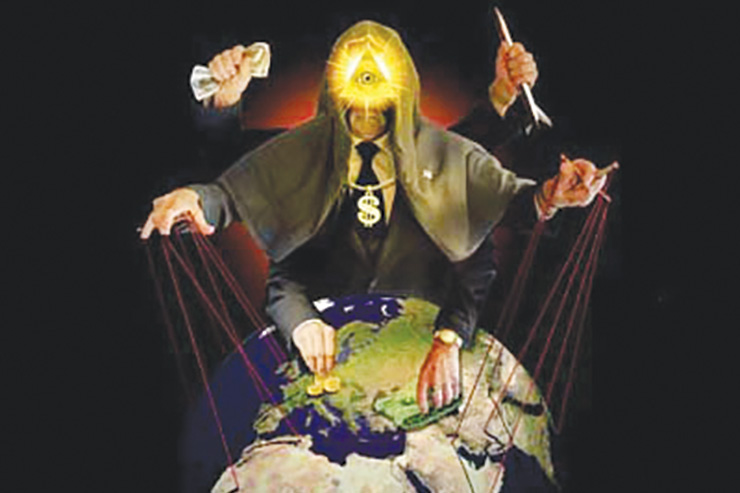
  • Do Psychopaths Run the World?

    Do Psychopaths Run the World?

    From New Dawn 152 (Sept-Oct 2015)

    Our society is run by insane people for insane objectives. I think we’re being run by maniacs for maniacal ends and I think I’m liable to be put away as insane for expressing that. That’s what’s insane about it.
    – John Lennon (1940-1980), English singer and songwriter

    Lennon and others externalise the apparent paranoia that wells up inside us. “The world has gone mad!” More often than not we partition this voice off, content to view the world as others prescribe it. But who are these others, and what do they want?

    The term psychopath is often criminally misjudged, thanks largely to unhelpful portrayals of sick, twisted and violent psycho-character types in the popular media. This has led, by way of public ignorance, to the common belief that the psychopath has no function, role or place in open society. A swift offload that allows us, the apparent sane majority, to circumvent our worst fears.

    Any notion that the psychopath is incapable of functioning in open society is, according to M.E. Thomas1 – a self-confessed sociopath – flawed. The question is not the capacity to function, but rather what capacity or form that function takes. As Thomas says, psychopaths and sociopaths share an intertwined clinical history; both can function, they just do so differently. And though we are left to muse on what mask that function may take, in many social situations they excel.

    Competition Wins Out

    Jean-Baptiste de Lamarck was a French biologist who advocated a theory of evolution widely rebuked in establishment circles. Lamarck’s major work was published in the same year Charles Darwin was born – who would go on to supplant Lamarck’s theory 50 years later. In Lamarck’s world cooperation prevailed over Darwinian competition as the driving mechanism of evolution.

    According to authors G. Greenberg and M.M. Haraway,2 it was Darwin’s view that served to reflect and sustain a Victorian society tied to free market, capitalist and imperial values. His model supported a dog-eat-dog, life is hard, code of practice; the scientific valediction of the natural world as played out on a brutal, cold and insensitive landscape. Arguably the perfect environment for the aspiring modern day psychopath, and a prevailing view that the poet Tennyson described as nature, red in tooth and claw.

    Snakes & Ladders

    Although diagnosing definitive psychopathy in individuals remains somewhat of a grey area, attempts have been made to categorise psychological traits that set psychopathic personalities apart. Most prominent is the diagnostic check-list devised by renowned Canadian psychologist Robert Hare that is used to determine a categorical diagnosis of clinical psychopathy, or at best a category score.

    According to Hare’s list, psychopaths display superficial charm, unbridled ego, and pathological lying and cold, calculated cunning to entrance their prey. They are often impulsive and irresponsible, and exhibit an absence of empathy and remorseless lack of guilt. These and other attributes, such as criminal versatility and a marked capacity to manipulate, deceive and control, mark them out as dangerous. These are traits that enable psychopaths to move into high-ranking positions of power and influence.

    “We know much less about corporate psychopathy and its implications,” explains New York psychologist Paul Babiak, “in large part because of the difficulty in obtaining the active cooperation of business organisations for our research.”3 A dilemma that Hare disclosed to Jon Ronson, author of The Psychopath Test. “Prisoners are easy,” states Hare. “They like meeting researchers. It breaks up the monotony of their day. But CEOs, politicians…”4 According to Hare, these sharks are a different kettle of fish.

    A rare study on psychopathy in the workplace conducted by Babiak, Neumann and Hare5 suggests that 1 in 25, or 4 per cent, of corporate executives display significant personality traits typical of psychopathy – an incidence four times that estimated in the general population. The study supports the claim that psychopaths can and in fact do achieve high ranking corporate status. We are left to speculate, but Hare concedes Wall Street may harbour 1 in 10 attracted to lucrative watering holes that are poorly regulated.6 Factor this in and it’s not hard to see how the very lifeblood and identity of corporations and financial institutions can often run cold.

    Arguably most startling, the study indicates that despite being classed as substandard managers, team players and attracting poor performance appraisals, executives that met the clinical threshold of psychopath were valued by their immediate superiors as creative and innovative, as good communicators and strategic thinkers.

    In short, they may not always fly under the radar. Despite the blips, it is clear to American psychiatrist Hervey Cleckley7 that psychopaths possess the communication, persuasion and interpersonal skills to override any negative impacts on their career. A finding supported by the Babiak study: “some companies viewed psychopathic executives as having leadership potential, despite negative performance reviews and low ratings on leadership and management by subordinates.”8 According to the authors, this shows a proficiency to manipulate decision makers, a point made by psychologist Dennis Doren who observed in institutions the psychopath’s unerring ability to seek out and foster relationships with those of highest authority and demonstrate tremendous skill at influencing them.9

    In many instances the chameleon-like ability of the psychopath to mimic its surroundings by reading and influencing colleagues through the art of deception, be it through self promotion or subtle persuasion, allows the snake charmer to hide his true skin and pass unchecked through social customs. Studies suggest psychopathy, in body or by proxy, can entrench itself at the top, but is this phenomenon relatively isolated, or has this scenario over the course of human history always prevailed?

    As Above, So Below

    As vice president and director of Governance Studies at the Brookings Institution, Darrell West analyses business and law school curricula, specifically, according to West “because business and law schools train the leaders of tomorrow.”10 In the course of his research West reviews course syllabi and conducts interviews with faculty members. He has also surveyed data on business and law school student perceptions. What he found was troubling.

    “The social responsibility of business is to increase its profits,” states West, taking his lead from the title of a 1970 New York Times magazine article written by the highly-influential American economist and statistician, Milton Friedman. The article was unequivocal: according to Friedman, maximising shareholder value was a company’s sole responsibility.11

    “Many schools do not require stand alone courses that provide broad conceptions on the purpose of the corporation in society,” says West. Of those that do, “many focus on the purpose of the corporation, with emphasis on how to maximise shareholder value, especially in law schools.”12 Instruction therefore is key, notes West, and will colour a student’s view of the world. In fact, West concludes, “business school surveys show that after completing school, students are more likely to see shareholder value as the most important goal of the corporation.”13

    It was not that Friedman was a prophet. In hindsight, according to West, he helped shape the outlook of numerous business leaders, academics, and thought-leaders that ultimately served to affect America’s modern sense of purpose of the corporation. An inherent identity that helps shape the way business and law school students view their, often times, lack of responsibility to society even today.

    In the real world, inevitable coldly-calculated equations play out on the one side to maximise profit and on the other to minimise loss. And like most mathematical equations they make little or no sense to the layman.

    “Can you buy what you already own?” This was the equation facing all concerned when Canadian-based Nautilus Minerals Inc. purchased the licence in 2011 from the “Independent State of Papua New Guinea” (PNG) to mine deep-sea vent fields in sovereign waters off the country’s coastline. The answer, morally, of course, is no.

    According to Sir Julias Chan, current Governor of New Ireland province in PNG, ethics are an intangible commodity, and unlike cold hard currency rarely stack up. “First, the state cedes exploration and production rights to foreign companies for next to nothing,” says Chan. In the case of PNG 10,000 kina, equivalent to US$4,000. “For this pittance, the foreign developer gets full control of all the wealth that can be taken from the ground.”14

    “The next step is for the state to seek equity in the project, usually 30 percent in a mining project and 22.5 per cent in an oil or gas project,” explains Chan. “The state has ‘given away’ the entire resource to a foreign company, and now returns to buy what was already legally its own property, for a 30 percent interest in the project.” To PNG this meant 300 million kina, or US$118 million. “And, to do so, the state usually takes out a commercial loan rate that puts the country further into debt at high interest.”15 Today a common event whereby the state acts to castrate itself and its people to high finance.

    Joel Bakan is a professor of law at the University of British Columbia, Canada. While those that run corporations are for the most part, good, moral people, says Bakan, the duty of the corporate executive is to the corporation’s business interests first and foremost. “The money they manage is not theirs,” explains Bakan. “They can no sooner use it to heal the sick… or buy a villa in Tuscany.” In the corporate world, good people are encouraged to behave badly. In fact, the sum of corporate parts are “singularly self interested and unable to feel genuine concern for others in any context. The corporation, like the psychopathic personality it resembles, is programmed to exploit others for profit.”16

    Under such terms it is not difficult to envisage how a system can soon come to value and mimic its most deviant parts. Equally, how the parts over time can come to be shaped by the whole.

    [alert type=”info” dismiss=”no”]If you appreciate this article, please consider a subscription to New Dawn magazine.[/alert]

    It’s Behind You

    According to philosopher and author Aaron James, while the psychopath feigns moral action as a tool to manipulate others, the arsehole could well be a butt of equal contention. Unlike the prototypical psychopath, says James, the arsehole “traffics in and is moved by moral justification,” which leads to an “entrenched sense of special entitlement.”17

    The perfect example, according to James, is Apple founder Steve Jobs who saw his sole obligation to society as implicitly tied to producing the products his consumers desired. James notes what Jobs’s best friend, Jony Ive, once told Business Insider: “when he’s frustrated… his way to achieve catharsis is to hurt somebody. And I think he feels he has a liberty and license to do that,” said Ive. “The normal rules of social engagement, he feels, don’t apply to him.”18

    Worryingly, James says, “the arsehole’s reasoning is shaped by the moral justification his surrounding culture makes available to him.”19 For instance, according to Hare, many white-collar criminals are psychopaths. “They flourish because the characteristics that define the disorder are actually valued,” asserts Hare. “When they get caught, what happens? A slap on the wrist, a six-month ban from trading, [oh] and don’t give us the $100 million back.”20

    Accordingly, not only does corporate culture control net arsehole production, but the quality of butt-heads produced. And, depending on the culture, says James, “an arsehole can be better or worse behaved than a psychopath.”21 A consoling thought.

    Arguably it is no more comforting to know that the psychopath you had fingered all along is really an arsehole nurtured by a system that is, by way of inherent nature, socially deviant. If the reasoning of a typical arsehole is moved by moral justification, taken from his surrounding environment, then the ability of a psychopathic culture and/or system to shape its own governing class is implied.

    They Gave Us Their Mind

    The enduring strength of psychopathy lies in its ability to manipulate how others perceive it. But the innate ability of the psychopath or the system to shape our perceptions is not, in itself, entirely the reserve of the clinical psychopath.

    We all play our part in the masquerade. Many of us partake in cosmetic enhancements and props that support our ego’s waltz through this porcelain world. Whatever the score, the Hare check-list has a number picked out for us all. In its pursuit of ultimate control, this is the greatest achievement of psychopathy; after all, what better way to predict by response a person or group, than to give them your mind?

    The competitor’s urge to win at all cost is certainly pervasive. So, too, the trend of irresponsibility, most evident in the compensation culture that has crept into the social mindset, thanks to laws that restrict a person’s capacity to develop by way of ethics and moral concepts of right and wrong. How can you take responsibility for thoughts and concepts that are not your own? In the broad, rules and regulations teach us to hand over our power, a transaction that re-enforces itself in society according to Thomas. She says that given the choice between having power and giving it up to a ‘trusted’ entity, people often choose to give it up rather than take the responsibility that comes with it.22

    In its apparent, endless quest to reinvent society in its own image, psychopathy perhaps has more than one expression. Recent research into social media habits throws up disturbing correlations between heavy Facebook use and socially aggressive narcissism. In one study users that scored highly on a Narcissistic Personality Inventory questionnaire, reports Damien Pearse, “had more friends on Facebook, tagged themselves more often and updated their news-feeds more regularly.” The research, the report states, “comes amid mounting evidence that young people are becoming increasingly narcissistic, and obsessed with self-image and shallow friendships.”23

    In the same breath the media have ‘jokingly’ jumped on those abstaining from Facebook as highly suspicious and suspect – they could have something to hide. Facebook use is, of course, prevalent and ‘normal’.

    An infinite number of media streams exist that entice us to see our reflection, drawing us into powerful undercurrents, and buffeting us from one bank to the next. We surface only to take breath, disorientated and confused, disconnected from our natural cues. But perhaps that’s the idea. Certainly it is the innate need to control and the power to wield it, at whatever cost, and without care, that fractures the pathological mind from the rest of us.

    The God Complex

    Those who rise to power in the corporatocracy, are control freaks, addicted to the buzz of power over other human beings.
    – Bruce Levine, social critic & psychologist

    In a competitive world there will always be those who actively seek out, justify or embrace traits of psychopathy as a route to success. For a surgeon, a cold detachment and cool head has its place. But glorifying the psychopath is a perilous path to tread. According to psychologist Linda Mealey, competition only serves to increase the use of antisocial and Machiavellian strategies and counteracts any increase in pro-social behaviour after success.

    Spiralling societal separation, and re-enforcing detachment, sets a dangerous precedent, what James refers to as a sense of “entitlement born of cosmic grandiosity.”24 He cites oil baron John D. Rockefeller who viewed his wealth not in some Wild West American capitalist context that gave him free rein, but unapologetically, by divine right: “God gave me my money,”25 said Rockefeller.

    This sense of divine entitlement, being chosen, as apart from society, has deeply disturbing parallels to contemporary wealth.

    Jeff Greene is a multi-billionaire property investor and entrepreneur, and owns reportedly America’s most expensive home. Greene, who made his fortune betting on sub-prime mortgages, says Americans need to have “less things”: “America’s lifestyle expectations are far too high and need to be adjusted, so we have less things and a smaller, better existence,” lectured the 60-year old, who lets out the $195 million palatial estate in Beverly Hills to royal families and international dignitaries for hundreds of thousands of dollars a month.26

    At its heart, assuming it had one, departments within the system, be they political, corporate or financial, select by lineage this mind; one willing to create, support and maintain it. “Figures such as J.P. Morgan, Randolph Hearst, and Mayer Rothschild,” argues author Stefan Verstappen, “are professional psychopaths that reach the pinnacle of the financial stage where they cause no less misery and destruction as their political counterparts.”27

    As a result, examples of psychopathic conduct in high office are commonplace. Robert Kirkconnell is a decorated US Air Force combat veteran of 27 years, and an outspoken critic of the US government MK-ULTRA program that conducted a battery of callous psychological or ‘mind control’ tests on its own citizens. In American Heart of Darkness, Kirkconnell charges the presidential Rockefeller Commission, set up to investigate the CIA’s activities, which he says funded the program. Kirkconnell no longer sees his home as a constitutional republic, but as a pathocracy run by psychopaths.

    Contagious Psychopathic Worldviews?

    I had to win at all costs, sometimes allowing the costs to flow unchecked, just to see the volume of my power.
    – M.E. Thomas

    “Power is all I have ever really cared about in my life,” states Thomas. “Physical power, the power of being desired or admired, destructive power, knowledge, invisible influence. I like people enough that I want to touch them, mould them, ruin them,” says Thomas. “I want to exercise my power.”28 It’s nothing personal. It’s dietary. The idea of ruining people, she says, is simply delicious.

    Thomas is not unique. The psychopath invariably plays with its food. In the process actively seeking to visit misfortune or suffering on others. Thomas regards herself as a white tiger – a beautiful and exotic pet but inherently dangerous. And whilst in her own words she considers herself tamed, inside she continues to grapple with a primal urge to destroy.

    This mindset is not lost on society. In fact, it is a worldview captured succinctly in Michael Ellner’s personal state of the world address: “Just look at us,” he asks. “Everything is backwards, everything is upside down. Doctors destroy health, lawyers destroy justice, psychiatrists destroy minds, scientists destroy truth, major media destroys information, religions destroy spirituality and governments destroy freedom.” You can see his point. But to what extent does this world talked of by Ellner stem solely from blind pursuit of power and profit?

    Is there a hidden systemic malevolence that creates fear and uncertainty; the chaos to warrant this chase? Is the malevolent mist, that evil intent we ascribe to heinous acts and misdeeds, illusory, an epiphenomena, a by-product of the psychopath brain? Or is it real, autonomous, and guiding the program? And does this distinction matter? Does it help us interpret, say, the rise in chronic illness, its origins and how the healing profession has become, as critics claim, a public relations buzz-term; managing symptoms for profit?

    The world of Kirkconnell swings into focus. Are we all victims of systemic programming; of disorientation; an imbalance the predator incites in us to maintain and enforce its position and status?

    Like a god, so much of what psychopathy is and does hides in plain sight. The psychopath appeals to its prey’s sense of empathy and faith in humanity. He is the blank slate onto which people project their hopes and ideals.

    This realisation must dawn if we are to expose systemic psychopathy and confront wildly sinister possibilities, not least the darker identities and underlying motives upon which it is based.

    Darwin Dorr is the director of research into psychopathology at Wichita State University, Kansas. “The majority of paedophiles are psychopathic,” says Dorr, “or at least manifest to a significant degree the psychological characteristics of psychopathy.”29

    Such ties that bind power to its perversions are historic, endemic and persist to this day. Investigations surrounding an elite Sydney paedophile ring are only the tip of a cold and callous iceberg that threatens to sink a titanic raft of untruths. In the UK, the reputation of once respected DJ, television presenter, and establishment confidante, Jimmy Savile, sank when his penchant for children, dead bodies, and satanic rituals and foreplay was disclosed to a shocked population.

    Questions are now being asked outside UK Home Office circles and its curious taste for celebrity trash cans. All of a sudden the term psychopath seems no longer sufficient. Are such people, the system they represent, and the entities they mimic and worship, beyond a check-list? Certainly UK and wider establishment attempts to stymie the truth only serve to disclose further the covert means and amoral control by which psychopathy operates as an integral part of the system.

    [alert type=”general” dismiss=”no”]This article was published in New Dawn 152.[/alert]

    [alert type=”success” dismiss=”no”]If you appreciate this article, please consider subscribing to help maintain this website.[/alert]

    Footnotes

    1. M.E. Thomas, Confessions of a Sociopath: A Life Spent Hiding In Plain Sight, Crown Publishing Group, 2013
    2. G. Greenberg, M.M. Haraway, Comparative Psychology: A Handbook, Garland Reference Library of Social Science, Routledge, 1998
    3. P. Babiak, C.S. Neumann, R.D. Hare, “Corporate psychopathy: Talking the walk,” Behavioural Sciences and the Law, at http://web.natur.cuni.cz/~houdek3/papers/Babiak et al 2010.pdf
    4. J. Ronson, The Psychopath Test: A Journey Through the Madness Industry, Picador, 2011
    5. P. Babiak, C.S. Neumann, R.D. Hare, op. cit.
    6. R. Hare, www.hare.org/comments/comment2.html
    7. H.M. Cleckley, The Mask of Sanity: An Attempt to Clarify Some Issues About the So Called Psychopathic Personality, Mosby, 1976
    8. P. Babiak, C.S. Neumann, R.D. Hare, op. cit.
    9. B.J. Board, K. Fritzon, “Disordered personalities at work,” Psychology, Crime and Law, Vol. 11(1), 17-32, with reference to D. Doren, Understanding and Treating the Psychopath, Wile, 1987
    10. D. West, “The purpose of the corporation in business and law school curricula,” Governance Studies at Brookings, www.brookings.edu/~/media/research/files/papers/2011/7/19 corporation west/0719_corporation_west.pdf
    11. M. Friedman, “The Social Responsibility of Business is to Increase its Profits,” New York Times Magazine, 13 September 1970
    12. D. West, op. cit.
    13. D. West, op. cit.
    14. “PNG Leadership has been poor steward of resources,” The National, 20 April 2011, www.roland-seib.de/05/Seib-Pressespiegel-1.5.11.pdf
    15. Ibid.
    16. J. Bakan, The Corporation: The Pathological Pursuit of Profit and Power, Free Press, 2004
    17. A. James, “Ass-holes: a theory,” Nicholas Brealey Publishing, 2013
    18. D. Love, “16 Examples of Steve Jobs being a jerk,” Business Insider, 25 October 2011, www.businessinsider.com/steve-jobs-jerk-2011-10
    19. A. James, op. cit.
    20. R. Hercz, “Psychopaths among us,” www.hare.org/links/saturday.html
    21. A. James, op. cit.
    22. M.E. Thomas, op. cit.
    23. D. Pearse, “Facebook’s dark side: study finds link to socially aggressive narcissism,” The Guardian, 17 March 2012, www.theguardian.com/technology/2012/mar/17/facebook-dark-side-study-aggressive-narcissism
    24. A. James, op. cit.
    25. www.bartleby.com/73/1207.html
    26. J. Christie, “Multi-billionaire who gave a lecture about American’s ‘needing to have less things and live a smaller existence’ owns a staggering FIVE mansions…”, Daily Mail, 24 January 2015
    27. S. Verstappen, Defense Against the Psychopath: A Brief Introduction to Human Predators, Woodbridge Press, 2011
    28. M.E. Thomas, op. cit.
    29. D. Dorr, “The pedophile as psychopath,” 1998, in T. Millon, E. Simonsen, & M. Birket-Smith (Eds.), Psychopathy: Antisocial, Violent, and Criminal Behavior, 304-320, Guilford Press
    30. P. Gilbert, “An introduction to the theory and practice of compassion-focused therapy and compassionate mind training for shame based difficulties,” The Compassionate Mind Foundation, www.compassionatemind.co.uk/downloads/training_materials/1.Workbook_2010.pdf
    31. P. Gilbert, op. cit.

    © New Dawn Magazine and the respective author.
    For our reproduction notice, click here.
  • How Long Do You Choose to Live? The Truth About Longevity

    How Long Do You Choose to Live? The Truth About Longevity

    Recently my wife and I were driving back from Seattle to the island of San Juan where we live. To reach the island you must take a ferry from the small port town of Anacortes, some two hours north of Seattle, once the famed capital of Grunge. Now the stomping ground of Yahoo, Google, Amazon and Microsoft, this new Seattle is in constant motion… but not the motion of people walking about, conversing and interacting.

    As in so many places around the world today, Seattlites’ gaze is increasingly dug into their smart phones, a ceaseless thumb twirling, the last vestige of the bodily urge to move. Except, that is, for the hordes of Lance Armstrong lookalikes speeding by on their bicycles, the same look in their eyes, the same expression on their faces.

    Around this digitised social mass there is only an inexorable motion upwards: everywhere you look you see scaffolding rising to support the mutating species of tech-humans required to run this ultimate software machine. Glisteningly boring architecture wraps its soulless coils around the tree-lined communities with their famed water views, slowly asphyxiating them as might a giant python its prey. This brave new world emanates a distinct whiff of Singularity as technology continues its phallic and parabolic rise against the dwindling forces of nature.

    Or perhaps not. Nature is also uprising, with an unstoppable force of its own. As TS Eliot once wrote, the centre no longer holds. From the relative calm at the eye of the storm, we are now being spun out into the concentric rings of tempest that surround it. The centre is collapsing as the outer rings unleash the hounds of chaos.

    A perfect storm? Loss of faith in government, in religion, in financial regulation, in science, in our humanity; even loss of trust in our species capacity to prevail against self-administered adversity. Shadows are building around the glib optimism spouted by governments with their sycophantic media vomit and cherry-picking disregard for scientific consistency.

    As we shall see, this entropy at the centre need not always mean death and destruction. It could mean exactly the opposite. In fact, it is this very same dynamic (implosion at the centre, explosive growth at the periphery) that allowed larrea tridentate – humble creosote bush and longest living species of plant yet discovered – to endure for over eleven thousand years, outliving all the multicoloured empires man has sought to erect on this Earth.

    Elsewhere, in the deeps, swim arctic whales in whose flesh lie embedded ivory tips of harpoons aimed at their flanks by whalers of the early nineteenth century. Deeper still, close by the vents on ocean floors through which rise intense heat from beneath the planetary crust, delicate tube worms called lamellibrachia stack upwards like surreal, futuristic skyscrapers of the forgotten depths. These subluminous creatures can easily live out a quarter of a millennium. And if we go deeper still, under the very bottom of the basins of the great oceans, we encounter the largest biomass on Earth, that composed by archaea – tiny, ancient, unicellular creatures not to be confused with their later evolutionary relatives, the bacteria. We know that archaea metabolise time far more slowly than we do. How long can one of them survive? It has been posited that the answer may lie well north of one million years.

    And strange as all that may sound, it is not the strangest of all. That prize must go to turritopsis nutricola, the so-called immortal jellyfish. But we’ll get to him, or her, a little later.

    Longevity in a World Gone Mad

    Let me return for a moment to our drive back from Seattle. The whole day there had been a misty pall hanging over the entire region, giving it a sort of milky humidity through which the sun could not penetrate. By evening, as we drove in towards the harbour, the sun had broken through and hung above the horizon, a vermilion acrobat of astonishingly beautiful elegance, in slow motion descent. Just beneath it, waves of scorched yellows and ochres etched themselves between the far horizon and the lowest hanging cloud, suggesting that above the entire Pacific Ocean a great fire was raging. We drove slowly in our car, mesmerised by the bizarre beauty. From the CD player, tracks from Laurie Anderson’s album, Bright Red, played out softly:

    and when you think you’re swimming to the surface,

    you’re swimming right down,

    down to the bottom, all the way to the bottom…

    The entire landscape had become a dreamscape. There was a simple reason for this: fire. Five of the westernmost states of the US had caught flame: California, Idaho, Oregon, Montana and now eastern Washington. At this time of writing, the fires are officially “out of control.” Unable to quell them even after bringing in the army, the US government has requested the assistance of special crews from Down Under. Trained forest firefighters from Australia and New Zealand are due to land in Boise, Idaho.

    At around this same moment, a foiled terrorist attack has just taken place in Europe aboard the Arras-to-Paris train. A Moroccan man, naked to the waist, wielding an AK 47 and carrying nine magazines, a hand gun and a boxcutter knife is wrestled down by three Americans and a Briton just before he is able to unleash multiple rounds from a temporarily jammed barrel. That fire was stopped, just.

    Fear of death by fire, fear of death by water. These terrors lurk within the recesses of our unconscious, and for good reason they are now welling up. Just as parts of the rapidly desiccating land masses are catching flame and the ocean levels growing taller, and more menacing.

    So here we get to my point, or my $64,000 question: does it make sense for us to talk about longevity in a world that has become so precarious? Is it not rather like planning for retirement when we all know that the shadows of deflation and hyperinflation stalk the countries we inhabit, and especially those of the West, which are functionally bankrupt? When we see that the dying fiat currencies are being kept alive on inhalers called QE, the stock markets pumped full of steroids swollen anabolically by corporate buybacks to distract the eye from dwindling price-to-earnings ratios, the militarisation of police forces and all the other aggressive control reactions the authorities are throwing at a global situation they sense is fundamentally spinning out of central control? Is there a place amongst these madding crowds to hunker down and cultivate a long, happy and healthy life?

    How Long to You Choose to Live

    About ten years ago I read a book entitled How Long Do You Choose to Live? The name of the author is Peter Ragnar. Known for his unbridled pursuit of physical immortality and record beating feats of physical strength, Ragnar is also a successful businessman and New Age guru. Is it a sign of mental illness to believe that one can live forever? Not necessarily, although it might be a sign of mental illness to want to live forever. But we will get into that later. For now, let’s look at Ragnar’s basic premises, and then let’s see what he is doing to remain “forever young.”

    Ragnar notes that the Bible speaks about individuals living to immense ages. Noah was the last of the batch of early patriarchs who lived to be a thousand years (Noah himself died a little prematurely at age 950). After Noah, lifespan shortened dramatically. Less than three hundred years after Noah’s passing, Moses would only live to be 120, although most people today would agree that, with all that Moses had to live through, he went through a great deal of what we would now call stress, both personal and professional. Even back then, stress can’t have been good for you.

    In China and in India too, there are tales, whether fiction or fact, of tremendous longevity. Taoism in particular developed an esoteric cult of longevity which aimed at transcending death altogether. This was by dint of becoming a Taoist Immortal, or Cloud Wanderer. Such a path entailed diligent self-cultivation practices, and not only at a physical level of health. The fundamental concept is alchemical: which is to say that it is possible not only to slow down the processes of cellular decline and live a long life, but also in-so-doing to gradually spiritualise the body’s core energies in such a way as to build a sort of special energy vehicle (or capsule) for the self to survive intact in the worlds to come.

    Ragnar’s interest is not focused on that, however. It is purely focused on extending his physical life indefinitely. Or at least, he suggests, giving it a good try. Seeing whether it is in fact possible. One of Ragnar’s favourite texts is As A Man Thinketh by James Allen. Here is one sentence from Allen’s famous book:

    You are today where your thoughts have brought you;

    you will be tomorrow where your thoughts take you.

    Taking this literally, we are presented with a simple but radical notion: our thoughts precede our material circumstances. Is it possible to infer from this that if we change the way we think about aging (and dying) we can literally control the rate at which we physically decline; even, in theory, postpone death by refusing to accept the inevitable arrival of that cloaked and hooded figure with his sickle (the Ultimate Terrorist)? Is this an outrageous act of stupidity, or at least of hubris? Or does it merit closer attention? Ragnar, to his credit, is giving it a go and doing pretty well so far.

    Longevity & States of Mind

    Let’s switch gear to a recent study. A paper just published in JAMA in February 2015 describes a twelve-year study conducted by researchers at the University of London on a group of 6,489 people. What the research team was trying to find out was whether perceived age has any influence on mortality. In other words, say you are aged 60 but in your mind you perceive yourself to be 50, could that conceivably affect your lifespan? The research team concluded very clearly that it does. Those people who perceived themselves to be younger than their actual age lived longer (or died later) than those people whose self perceived age was identical to their biological age. People whose perceived age was greater than their biological age died the soonest. Mortality rates were 24.6% in the last group and only 14.3% in the first, almost double. Well, well, well. Perhaps there is something to this after all.

    In my previous article on longevity for New Dawn (see Nov-Dec 2014 issue), I mentioned how in some cultures you aren’t expected to behave like an adult until well into middle life. These cultures (I was referring to the people of the South Caucasus) lived typically into what we would today call extreme old age (120+).

    Are there any examples currently of people who have attained an extraordinary age, and also managed to remain vital and healthy? If so, how important is mental attitude in all this, and what other factors may be involved?

    Officially, the two oldest living persons in China and possibly the world are both Uyghurs from Xinjiang province. Alimihan is 127 and can still thread a needle without glasses. Her blood pressure and appetite are those of person one-third her age. Yakup is 120 and looks like a very fit 60 year old. He bends and squats without no obvious signs of arthritis or weakness. He walks around all day long tending to his five sheep and helping to feed the family’s other animals. His son in law attributes Yakup’s longevity to the fact that “he never stops moving.”

    Okay, so we know exercise is good and if you don’t use it you lose it. But, surely there would have to be some special water, herbs, diet (or perhaps esoteric spiritual practice) that has kept Yakup supple, strong and vital all these years. No: corn naan (a kind of flat bread) and tea are the only things he consumes each and everyday. No proteins, no antioxidants, no alkaline water, no blue-green algae, no super-raw-food diet, no human growth hormone, no special anything. Just corn bread and tea.

    If you check out those centenarians from the Greek island of Ikaria from my previous New Dawn article, you will see that most of them are not too politically correct when it comes to diet. Smoking, drinking copious amounts of wine, even Coca Cola are mentioned by numerous 100 year-old residents as daily pleasures which enhance their wellbeing and thus their longevity. On the other hand, they consume a diet rich in local greens, herbs, fruits and vegetables, little meat, and very little if any WiFi. Instead of sitting (as I am at this moment) glued in front of a computer, they are clambering over the windblown cliffs on their way to visit a neighbour or friend, and perhaps share a glass or two, or maybe even three. Women from Spain are, after the Japanese, the second longest living women in the world. Why? No doubt similar reasons apply as do in Greece. These Spanish women live more communally, are more expressive, more spontaneous, less pent up than many of their Anglo-Saxon counterparts, and do not refrain from drinking some wine with their meals, but not in a way that exhibits immoderation or alcoholic tendencies.

    But let’s get back to what Peter Ragnar recommends in his book How Long Do You Choose To Live?

    I would say he breaks things down to the following factors:

    1) Make sure you get regular, direct exposure to sunshine

    2) Actively focus your powers of positive belief, keep your mind open, and tap into limitless potential

    3) Keep your body fluids running clear and clean like a mountain stream so that your cells do not accumulate toxins and thus degrade

    4) Avoid three things like the plague: Stress, Drugs and Doctors

    5) Learn how to breathe deeply. Always oxygenate yourself well with fresh air and detox thoroughly with powerful exhalations

    6) Learn how to do “electric breathing” practices (that is, Qigong or Pranayama)

    7) Avoid noise pollution as much as possible (including the silent noise within from negative states of mind)

    8) Avoid electromagnetic pollution as best you can (including radio towers, WiFi and the proximity of smart phones)

    9) Drink only clear, clean, energised water and keep your PH alkaline

    10) Become a vegetarian. Eat raw food

    11) Exercise diligently and keep your muscles strong and primed

    12) Use hydrotherapy and dry skin brushing regularly: take hot/cold baths or showers

    These suggestions, simple as they might seem, are not so easy to put into practice as we all know. Not all of us can retire to a mountain retreat, have access to (or afford) garden-fresh organic produce, or drink vibrationally charged, purified water let alone breathe in uncontaminated air. By contrast, most of us are submerged in thickening seas of electrosmog. Before too long there will likely be class action suits about a slew of deaths caused by this invisible electrical pollution, just as there have been huge class action suits about deaths from smoking tobacco.
    [alert type=”info” dismiss=”no”]If you appreciate this article, please consider a subscription to New Dawn magazine.[/alert]

    How Can I Minimise the Damage?

    Realistically speaking, most of us tend to think: “How can I minimise the damage?” rather than “How can I maximise my potential?” We are playing catch up. The big irony is that the mainstream keeps assuring us people’s lives are manifestly getting longer. This is true, at least in developed parts of the world. But people’s bodies (and minds) are also growing weaker, fatter, slower and disturbingly disconnected. Our DNA is degrading, our robustness and vitality diminishing.

    Chronic degenerative disease is the new normal. And it is happening by stealth: no-one in a position of authority is willing to admit what is going on. The human being is morphing into a defenseless blob. Health, without the “QE” of more and more drugs and prosthetic interventions, is sliding on a downward trajectory. But this situation is actually perfect for big business interests. And perfecter still for those who want to fast-forward us into a post-Singularity world: a world where human and machine have finally fused. The ultimate makeover. The ultimate transgender wet dream fantasy: conquest of death by technology.

    On 18 August, scientists at Ohio State University announced they had grown a human brain in the lab. Their miniature brain, about the size of a pencil eraser, is not conscious and supposedly resembles that of a five-week old fetus. It has been engineered from adult skin cells. Interestingly, the research work and its fruit (if that is the right word) were presented to the Military Health System Research Symposium in Fort Lauderdale, Florida.

    The research team claims their brain is connected to a spinal cord, and even a retina. This work was accomplished by turning initial adult stem cells into pluripotent cells, which were then programmed to become central nervous system cells in the lab grown brain.

    What the heck are pluripotent cells, you may well ask? Actually, they are a kind of stem cell that can develop any which way. That’s why they are called pluripotent cells: they have plural powers, archetypal, magical powers of transformation and metamorphosis. And we are full of them. Nor are these cells only responsive to secretive scientists working on semi-classified projects. One of the most powerful remedies I use in my clinic is made from the aloe arborescens leaf. This leaf contains multiple factors including special sugars (polysaccharides) which can dramatically transform macrophages (human white blood cells) into pluripotent cells. There is an interesting documented case about a young girl who was born without an esophagus. After being given a preparation of the aloe formula, her body was able to grow one. Conclusion: nature still has the upper hand when it comes to technology.

    The Immortal Jellyfish

    Let’s get back to our friend turritopsis nutricola, the Immortal Jellyfish. How does this bizarre creature manage to defeat Father Time? It’s by a process known as transdifferentiation. When the adult, medusa shaped jellyfish senses danger, it has the option of floating back up to the surface of the ocean and simply reverting back into a blob. That is, its cells go backwards in time, from highly differentiated adult ones to cells which are essentially primitive stem cells. It hangs close to the surface until the danger has past. Then it re-morphs back into a medusa with tendrils, stomach, sense organs and so on. Of course, whilst in the blob state it could always get eaten. This is a risk it has to take. But if it escapes the marauding jaw of a fish, it returns to its fully fledged form as though nothing had ever happened. Thus, it does not age, it simply regroups, refreshed and revitalised. And it isn’t homo sapiens with all his superior intellect and technological prowess. It’s just a “stupid” jellyfish. Conclusion: when the going gets tough, simplify. Get rid of what you don’t need. Hang for a while and cling only to the essentials. Bide your time and then return, stronger than ever.

    Nature shows us many other examples of great intelligence and adaptability in supposedly primitive micro-organisms such as amoeba, which move around by means of limbs called pseudopods that they can sort of “haul in” and compress back into their blob-like core as they move fluently through pond water or through the extracellular fluids of your body. My own longevity system, which is called the Infinite Body SystemTM, was developed by studying creatures such as the amoeba proteus, and in fact by studying the precise movements of many diverse things in the universe, from nebulae to single molecules of water. We should remind ourselves that since the planet first began to sustain forms of life, there have been multiple extinctions and those species that found themselves over-specialised in a rapidly changing environment were the first to go. There is a lesson in that.

    Longevity & Reincarnation

    But we have one more twist of the puzzle to ponder over. When we speak of longevity, are we assuming that we live only once?

    In Old Souls by Tom Schroder, the author sets out to explore whether there is any hard evidence for reincarnation. He is a sceptic for whom lack of convincing proof would mean that the idea of rebirth is pure fantasy. A seasoned journalist, Schroder is allowed to accompany physician and psychiatrist Dr. Ian Stevenson on his field work in search of proof of reincarnation.

    Stevenson’s field work spans three continents, three cultures and three languages: Lebanon, India, and the USA. By the end of his travels with Stevenson, Schroder’s scepticism has been shaken to the core. It has become conviction, so mind-blowing is the evidence: concrete, compelling recollections of past life by children. These detailed accounts are not hazy. They consist of precision-sharp references to life information (inner and outer) of biographically identifiable individuals whose deaths occurred only months, weeks and, in some instances, just hours prior to the birth of the child in whom they “re-incarnate.”

    The documentation in Schroder’s book is of paramount importance to our interest in longevity. Why? Because if we only live once, then it makes sense to approach life as a private business: a precious, personal stretch of time. It is “our” time” and “our” life to live out as we see fit. If we wish to burn the candle at both ends, so be it. If we wish to “stretch” our bit of fabric so as to live a little bit longer, we will need to practice longevity. If we follow Ray Kurzweil and the other prophets of Singularity, we can go down that synthetic yellow brick road. But what if we live more than once? Does it still make sense to focus so much on longevity, or are we missing the point?

    I am sure that New Dawn readers from Australia all remember Kerry Packer, that brash, outspoken entrepreneur of the late twentieth century. In terms of personality, Kerry Packer had more than a few things in common with Donald Trump and Rupert Murdoch, another Australian! In 1990, Kerry suffered one of his four major heart attacks whilst playing polo. The attack left him clinically dead for a total of six minutes. Later on at a press conference he referred to this experience: “I’ve been to the other side and let me tell you, son, there’s f*cking nothing there… there’s no one waiting there for you, there’s no one to judge you so you can do what you bloody well like.”

    Packer’s conviction that “there’s nothing f*cking there” on the other side and that thus you can (and should) do what you like has to be one of the best tools we possess for understanding the way the world works today. The so-called elites, with their protective fatty membrane of politicians, media sycophants and rigged judiciaries, operate from the same belief system as Packer: we only live once, the world is up for grabs and may the best man (or rather, the worst man) win. There’s nothing to worry about except winning and holding on to what you’ve got. The rest is just empty background space, cannon fodder and raw materials to be exploited.

    They are convinced that they are right in this. They feel superior to everyone else in understanding the basic facts better and therein lies their right to the winnings. To remain undisturbed in their hegemony, they airbrush over their nihilistic beliefs, hiring legions of liars (politicians and media) to spread illusions of ethical governance to conceal the boundless predation and depredation in which they are so invested.

    The world we inhabit today is increasingly unstable. Geopolitical tensions between nation blocs are intensifying. Conflicts in the Middle East and elsewhere are threatening to spill out into the greater, perhaps even global, arena. War is now being increasingly spoken about in alternative media as a deliberate tactic to distract Western populations from the financial crimes of banks, corporations and corrupted government. The general awareness today, albeit a semi-conscious one, is of an Orwellian drift in government.

    At the same time we are witnessing an unravelling of natural balances involving weather patterns, symbiotic relationships between plants and insects, magnetic currents and polar fluctuations, sudden decreases in solar activity and so on. The spirit of our times is far from one of calm and predictability.

    So what to do? I’d like to suggest there is a way to consider the pursuit of longevity that is more real – and more meaningful – than simply trying to live for a very long time, and stay healthy. That way of thinking seems almost narcissistic unless, that is, our goals are greater and deeper than that. I would like to point out that often people who have a strong sense of integrity and truth live longer, healthier lives than their less awakened contemporaries. Their very strength of character seems to sustain their bodies and keep them vital.

    I will end this article by stressing that, as I see it, longevity in our times must involve both courage and generosity of spirit. Now more than ever we see how all life is profoundly interwoven and interconnected. Decades ago, Einstein pointed out that if bees suddenly vanished, we too would be gone in a few short years. A sobering thought back then. How much more so today? Our longevity as a species is utterly dependent upon the longevity of other species, just as our longevity as an individual is utterly dependent upon the fellowship and support of our companions. We cannot allow the threads of life to unravel. Living in support of ethical and spiritual values invites a powerful life force into the human heart. Living from the heart with steadiness and courage may be the best recipe for longevity there is. In the end, it is not the quantity of years that count, it is the quality of experience and how your life was lived, no matter what the circumstances.

    [alert type=”general” dismiss=”no”]This article was published in New Dawn 153.[/alert]

    [alert type=”success” dismiss=”no”]If you appreciate this article, please consider subscribing to help maintain this website.[/alert]

    © New Dawn Magazine and the respective author.
    For our reproduction notice, click here.