In modern times, the term ‘genius’ has been thrown about far too often for it to be meaningful. From celebrities to politicians, the standard of the genius has dropped so low that we can no longer take the word seriously.
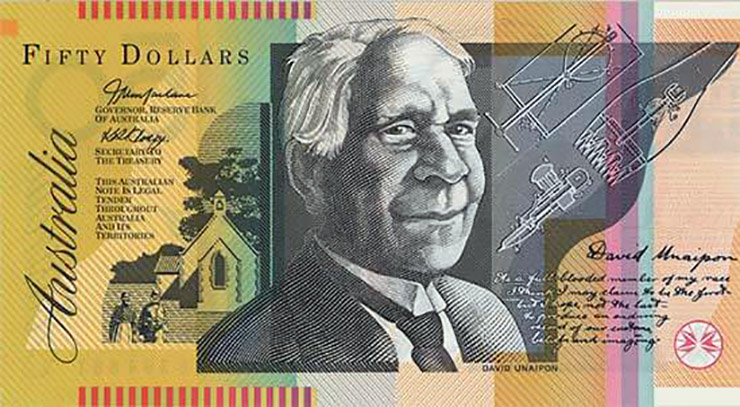
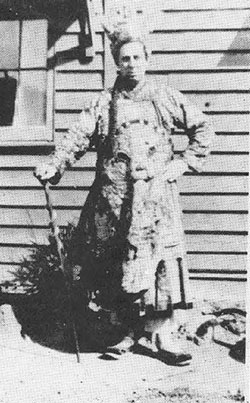
However, if indeed there was true genius to speak of, the name David Unaipon would certainly fit the bill in a number of ways. His name might not immediately be recognised by every Australian – which is a sad indictment of our cultural heritage – but his face is a face we encounter on a daily basis when shopping or paying one of the many bills that account for expenditure in this once-lucky country. His unassuming smile greets us on one side of the Australian $50 note. History tells us that he was a prolific writer, deep philosopher and scholar, accomplished linguist, cross-denominational preacher and inventor of the highest degree – an Australian genius if ever there was one!
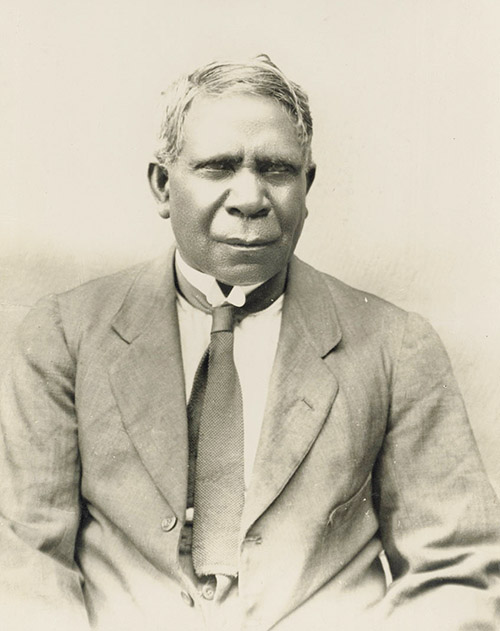
David Unaipon (1872–1967) born David Ngunaitponi
What made David Unaipon all the more special was the fact that he was an activist, bringing to light the plight of Australian Aboriginals of his day at a time when the Aborigines were relegated to the classification of Flora and Fauna by the Australian Government, considered a dying race. He was articulate, knowledgeable, well-read, able to apply complex scientific concepts to diagrams of his inventions, and envisioned a brighter future for all people despite the prejudices he faced. His selfless pursuits were for the betterment of all Australians but, unfortunately, he became victim to the scourge of white government plagiarism, publishing royalty scams and the baggage of well-meaning do-gooders…
And, yet, he managed to shine as a high achiever and truly great man despite all obstacles.
During his early schooling at Point McLeay Mission in South Australia’s Coorong region, a 7-year old David impressed one senior who stated that, “I only wish the majority of white boys were as bright, intelligent, well-instructed and well-mannered, as the little fellow I am now taking charge of.” (G. Jenkin, Conquest of the Ngarrindjeri, Rigby 1979, 185). This “little fellow” gravitated towards the sciences but also had a passion for philosophy and music. His father, James Ngunaitponi, was an evangelist and his insights into Christianity obviously had a moral and ethical bearing on his son, a future Holy Man.
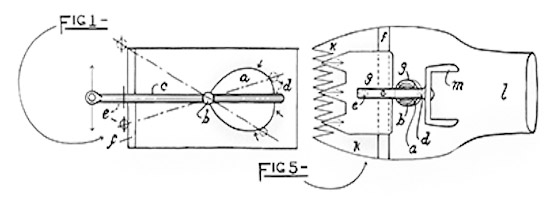
David Unaipon’s sketch of an “Improved mechanical motion device” which was the basis of modern mechanical sheep shears.
Unaipon invented a number of items and designed many more. His provisional patent 15,624 for an “Improved mechanical motion device” was the basis of modern mechanical sheep shears – a tool that propped up Australia’s multi-million dollar wool industry for decades and an achievement for which he never received any formal creative credit or financial reward. (An image from the design of these shears is included in the artwork of the $50 note). Pre-dating World War One, Unaipon utilised the aerodynamic characteristics inherent in an ancient Aboriginal weapon – the boomerang – thus creating drawings of what would later be recognised as the helicopter. He also explored the effects and applications for the polarisation of light and broke new ground in other fields of scientific research. His importance as an inventor inspired those in the know to celebrate his genius with terms such as “Australia’s Leonardo da Vinci.” What other description could come close?
He spent much of his adult life researching solutions to the problems of creating a perpetual-motion device – something that eluded him and continues to elude the greatest scientific minds of our time. It could be argued he would have made further steps towards his goal if only he had the proper financial support. However, if he was successfully able to transmute his ideas into a feasible working model, the employment of his device would inevitably have been adopted for military purposes, directly conflicting with his high morals and religious beliefs. One can only wonder what other incredible achievements David Unaipon might have conceived if he was afforded the opportunities of the white ruling class.
As a side note, the use of David’s image on the Australian $50 note is surrounded in controversy: institutional copyright infringement has resulted in the legal challenge of the Reserve Bank of Australia’s utilisation of his image without his family’s permission.
[alert type=”general” dismiss=”no”]This article was published in New Dawn 160.[/alert]
[alert type=”success” dismiss=”no”]If you appreciate this article, please consider subscribing to help maintain this website.[/alert]
Early twentieth century Australia saw a flowering of alternative spirituality when a number of communities, particularly in Sydney and Melbourne, embraced the influx of occult and spiritualistic practices from Victorian England.
A central figure linking many of the well-known characters and societies of the era was the young Vivian (later Vyvyan) Deacon (1895–1938), a medium, herbalist and respected public speaker. Among his circle of associates were Aleister Crowley, Krishnamurti, Annie Besant and Charles Webster Leadbeater, the author and spiritualist Sir Arthur Conan Doyle, and the artist Norman Lindsay. Deacon’s affiliations, that started out with the Order of the Star of the East, would go on to include Theosophy, Gnosticism, the Golden Dawn, Crowley’s OTO, and his own Christian Mystics of the Rosy Cross.
Vyvyan Deacon (1895–1938)
Certain recurring themes in Vyvyan’s life were established during his boyhood in England where he grew up, before setting out for Australia via India at the age of seventeen. From his father Cornelius he took on, probably at a subconscious level, the pattern of an itinerant healer, dispensing unconventional remedies to a needy public. ‘Corrie’, as he was affectionately known, came and went from the family home until, eventually, he just never came back. Although little Vyvyan was led to believe his father had died, Corrie lived on and was briefly reunited with his son before his actual death at Christmas in 1930. His passion for herbalism and alternative therapies passed on to Vyvyan, woven into the rich tapestry of his life and guiding his purpose. His absence was also to impress itself on the psyche of his offspring, resulting in Vyvyan’s own inability to settle down, with frequent separations from his future wife and family.
As a boy Vyvyan was frail and sensitive, given to bouts of ill health and often needing care. In place of formal schooling he received his education largely from Sunday schools, drama lessons and some home tutoring. Like many youngsters deprived of paternal attention, he was drawn to older father figures from an early age. At first these were clergymen and teachers, such as his local vicar Rev. Horsfall and drama teacher Rev. Mills, then on his arrival in Australia in 1912 he was taken under the wing of middle aged actor Roy Redgrave. In Sydney, he made the acquaintance of Theosophist Charles W. Leadbeater who, no doubt, also had appeal as a father figure.
C.W. Leadbeater c. 1916
The predominant driving force pulsing through his veins, however, came from his mother Elizabeth, an intriguing personality who projected her own spiritual aura. Elizabeth Deacon, nee Browning, was the cousin of Robert Browning who, with his family’s claimed Rosicrucian lineage, introduced her to a wealth of colourful characters, including Oscar Wilde, who would become the Deacons’ next-door neighbour. Elizabeth was close to Oscar’s wife Constance, sharing her interest in the occult, with the pair attending séances together. In fact, Vyvyan’s name was a copy of Wilde’s own son’s name and, although the Deacons originally used the spelling ‘Vivian’ to differentiate them, he was to later change the spelling himself, noting a mystical significance in the letter ‘Y’. The Browning’s referrals also included W.B. Yeats who, in turn, opened the doors for Elizabeth to eminent members of the Golden Dawn. It was in 1895, the year of Vyvyan’s birth, that she made the acquaintance of a young James Ingall Wedgwood – a regular correspondent of Robert Browning – who would one day become one of Vyvyan’s teachers.
James Ingall Wedgwood, 1925
The trait that was to place Vyvyan in the ranks of Charles W. Leadbeater, Annie Besant and Aleister Crowley was that he, like they, did not simply follow and uphold traditional beliefs and philosophies. They claimed to actually communicate directly with otherworldly beings and, at times, act as vehicles in transmitting their messages to the Earthly realm.
Vyvyan first realised this ability when he was only eight years old. The occasion was an open-air Sunday school service where the regular preacher failed to show up. As the service was about to be cancelled, Vyvyan arose, walked to the dais and spontaneously began preaching. While this impressed the congregation, he himself was left feeling bewildered, especially in the face of some adults present who accused him of being demonically possessed. One kindly woman, however, comforted him by explaining that he had the rare and special gift of being used by those who dwelt on a higher plane. The event was publicised by the Daily Mirror, which hailed him as the ‘Boy Preacher’.
A Meeting of Minds in Australia
Sister Veni Cooper-Mathieson
Vyvyan had met Eunice Mary Lew Tong, who was five years his junior, when he first arrived in Melbourne, and was besotted with her right from the start. In early 1916 he decided that a move to Sydney was in order and, not wanting to leave fifteen-year-old Eunice behind, they successfully sought permission from her recently widowed mother to marry and travel interstate together. It was his friend Veni Cooper-Mathieson, herself a Sydney-sider, who persuaded them that her city offered a more appropriate environment in which Vyvyan could establish himself as a healer, psychic medium and speaker. Sister Veni, as she called herself, was the voice of the New Thought movement and knew that their mutual acquaintance Charles W. Leadbeater, a member of the Theosophical Society (TS) and the Liberal Catholic Church (LCC), would open a whole new avenue for Vyvyan.
The Deacons lived rough when they first arrived in Sydney, moving accommodation from one spot to another, and it was only with the assistance of Theosophists Frank Bennett and James Wedgwood that they were able to set up a small herbal dispensary in Junction St, North Sydney. Bennett was said to be Aleister Crowley’s appointed representative in Australia for the Ordo Templi Orientis (OTO)1 and Vyvyan immersed himself in the activities of this group as well as the TS and their Esoteric Section, before going on to found his own society in 1917 called Christian Mystics of the Rosy Cross (CMRC).
Vyvyan had already befriended Krishnamurti, who was the same age, and on Sundays would often attend his meetings of the Order of the Star of the East, after having first participated in the Liberal Catholic Church service and then, later in the evening, going on to deliver his own lectures in public halls.
All these activities naturally kept him away from Eunice, often for days at a time, and she was left feeling lonely and depressed. Like her mother-in-law before her, Eunice had to adjust to the continual comings and goings. Notwithstanding the absences, the couple eventually had two daughters, Sybil, born 1918, then Vivienne in 1922, who would go on in adult life to write an in-depth account of her father’s life.
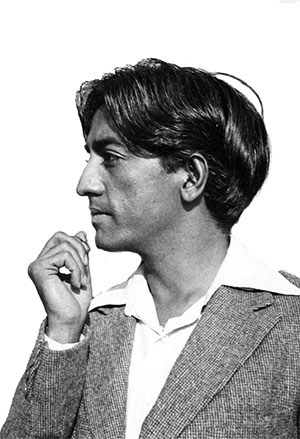
Krishnamurti
Concerning the scandal around Leadbeater’s relationship with Krishnamurti and other young men, she writes: “Vyvyan and Krishnamurti were born within a few months of each other and each received training from Leadbeater. It would be logical to surmise that their treatment by Leadbeater was similar. Vyvyan certainly admitted that Leadbeater had regressed him to previous incarnations. […] We know from his past that Vyvyan was particularly susceptible to the influence of older men, father figures that filled the void left by his own father’s disappearance from his early childhood. My own recollection of Leadbeater is of his being rather creepy, in contrast with the attractive Wedgwood.”2
Along with practicing hypnotism as a means to achieving higher levels of consciousness, Vyvyan, as a herbalist, had access to mind-altering drugs with which he experimented together with Frank Bennett and another friend, Vincent Pantin. He often stayed out overnight with them rather than at home with his wife. There were several occasions when a shortage of funds forced Vyvyan to seek labouring work and one such time was mid-1918, when he and Pantin went off fruit picking for a couple of months in Wyalong, in country New South Wales. Eunice busied herself in his absence, acting as his proxy in filling medicinal scripts for patients back in Sydney.
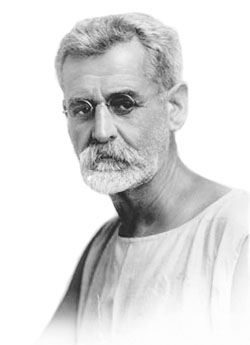
William Chidley
Vyvyan remained close to Leadbeater during 1919 while they studied the ‘Egyptian Rite of the Ancient Mysteries’ together. This was the year the scandal broke around Leadbeater’s involvement with young men, so the Deacons thought it prudent to distance themselves for a while by moving into a commune that had been founded by the late renowned naturist and sex-reformer William Chidley.
Early the following year, when ardent Spiritualist Sir Arthur Conan Doyle was preparing to tour Australasia, Vyvyan was approached by a prominent New Zealand Spiritualist group to visit them and pave the way for the events there. Knowing he already had a good reputation in that country, he eagerly set off for Christchurch in May 1920 for what was to become a two year stay. His daughter would later write about the spiritual atmosphere at the time and the flavour of his lecture material which blended Theosophy, Fabianism and New Thought together with Marx, Freud and Darwin, plus more than a hint of the New Testament. From a lecture in January 1921, she quotes a passage that underlines how he viewed the “constitution of man,” in what is now accepted by modern-day psycho-spirituality as the “triune nature” of humankind:
Man’s consciousness can be divided into three. The conscious mind corresponds to the economic world, the object world, and is the mind one always used in the present. Man’s subconscious mind corresponds to the subject world and from the depth of the subconsciousness come the demands for those things that are termed ‘the rights of the people’. […] Man’s super-conscious mind corresponds to the ideal world and holds within it all the desires and possibilities of the future. Intuitions from the super-conscious mind might be said to emanate from the spirit of man – the highest part of him.3
Shortly after moving on to Wellington, Vyvyan was joined by his mother Elizabeth, who had already followed him out from England to Australia, then soon afterwards Eunice also sailed to New Zealand to be with him when he fell ill. All the while he managed to earn sufficient income but when they all returned to Sydney in Easter 1922, to coincide with the arrival of Theosophical Society leader Annie Besant, the only means of earning a living was to conduct séances. He enhanced his reputation through the novelty of using aluminium trumpets as the passive recipients of sounds created on the psychic plane. The number of sitters he allowed to attend his “direct voice séances” was high, frequently twenty-three to twenty-eight people per session, as he needed to make each meeting pay as much as possible. It came as no surprise to Eunice then that, after receiving a letter from the Melbourne Spiritualist Society offering him a contract for steady work as a lecturer and medium, he quickly packed and set off, leaving her behind once again.
It was 1924 and Vyvyan’s residence in the inner Melbourne suburb of West Richmond became known as ‘The Abbey’. Although Eunice and their two young daughters were soon reunited with him there, the relationship proceeded in an intermittent fashion, with them often living separately and Vyvyan engaging in a number of affairs. During such times Eunice tried to remain philosophical and console herself with prayer. She frowned on his increasing consumption of alcohol and would keep her distance from him when he drank. When they did share residence together, it was often with Eunice and her two daughters sleeping in one room and her husband in another. This was a repetitive pattern that continued right to the end.
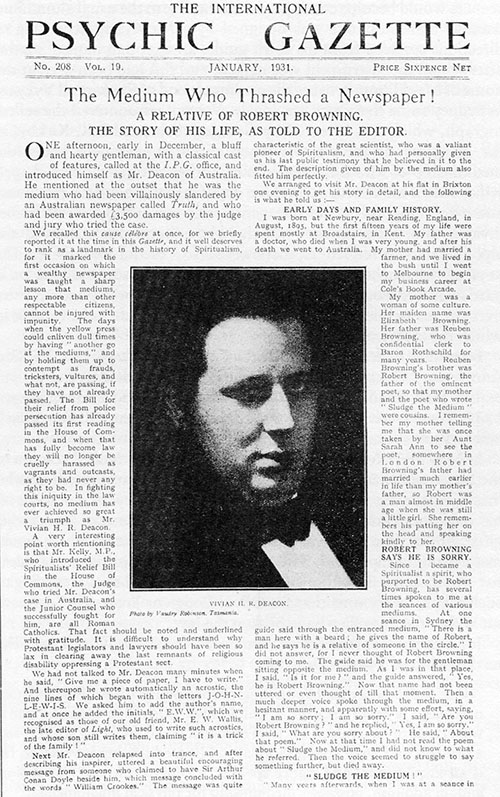
The press published articles about Vyvyan from time to time, some of them expressing genuine interest in his work, while others were not so flattering. It was a defamatory piece in the Melbourne Truth in October 1928, under the headline “Vyvyan Deacon is a Fraud,” that set off a chain of life-changing consequences. The story accused him of being a parasitic charlatan who extorted money from his followers, describing him as a “Humbug churchman who is subject to two spiritual influences, ethereal and bottled.”4
Vyvyan engaged a solicitor and instigated a case of libel against the paper. In spite of the Truth engaging the legal services of the up-and-coming lawyer Robert Gordon Menzies – later to become Australia’s longest serving prime minister – the following year a jury ruled in Vyvyan’s favour, awarding him a record amount of 3,500 pounds. Naturally the Truth appealed the decision and it would be a year later in mid-1930 before they finally settled out of court.
Vyvyan Deacon’s successful defamation suit against the Melbourne Truth is celebrated in the International Psychic Gazette, 1931
In the meantime Vyvyan had already decided to do a series of lectures in Tasmania, where Spiritualism and New Thought had gained wide popularity. His initial trip to Launceston was well received and covered favourably in the press. An overall view of his teachings can be gleaned from talks he delivered in early November 1929, as reported by The Examiner.
In the first of these, in the city’s Kings Hall on 1 November titled “Spiritual Science,” he revealed his underlying belief in the priority of spirit over matter, saying:
[T]he spiritual world warned mankind many years ago of the coming world war, and it could be shown that many recent discoveries in the scientific world were foretold from the spirit world years before the verification ultimately transpired. Spiritualism contended that the world had never been without adequate spiritual guidance at any time; that to every age and clime had just so much of the divine been made manifest as was suited to the proper growth of that particular age and clime.5
On the following Sunday night in his lecture “What Happens after Death” he decried the fact that Christendom was unable to provide positive knowledge about the afterlife. From The Examiner’s report we read:
As a matter of fact there are, broadly speaking, two ways whereby actual knowledge may be gained as to the fate awaiting our dear ones who have passed through the portal of death into the larger and fuller life of the spiritual world. The first way is accessible to all, without very much trouble being necessary. It is the way whereby knowledge is given to a person through some outside agency or at mediumship. The second way, the more satisfactory way, is that entailing some years of training and hard work, nevertheless truly worth-while, whereby one develops one’s own psychic faculties and observes the facts for oneself. Men like Sir William Crookes, Alfred Russell Wallace, and Sir Oliver Lodge are pioneers of the first way, and Andrew Jackson Davis, Rev. Stanton Moses, M.A. and Dr. Rudolf Steiner are pioneers of the second way.6
A week later he gave a talk on “Personal Magnetism” at the Mechanic’s Hall. This theme continues to be topical in its present-day form as ‘The Law of Attraction’. Vyvyan’s angle provided insight and guidance to his attentive audience.
Once we understood the nature of mental currents, we would learn that we each were a mental storage battery pregnant with potency. […] The saying in the Scriptures: To him that hath, shall be given, and from him that hath not, shall be taken away, even the little that he hath, could only be intelligible to the person who understood magnetic force. […] Desire in all forms is a mental current charged with power, and recognition of this fact and the utilisation of the power contained in desire by refusing to gratify each desire, thus extracting its power for one’s use, is the secret of personal magnetism. A certain restraint in thought, feeling, and word, is the insulation of magnetic power.7
Vyvyan Deacon in costume
It is hard to discern whether his ideas on this subject may have been influenced by contemporary American New Thought exponents like Wallace Wattles and Napoleon Hill. Of course, by this time the fifth Solvay conference had taken place in Brussels where Einstein, Plank, Heisenberg and Bohr had acknowledged the existence of ‘mind over matter’.8 The practical element of this work was famously revisited with the release of Rhonda Byrne’s The Secret in 2006, putting personal magnetism and ‘The Law of Attraction’ back in vogue.
The Final Years
Being flush with funds from the defamation settlement, Vyvyan found himself yearning to return to England and, in late 1930, bought tickets for Eunice, Sybil, Vivienne and himself for the voyage from Melbourne to Southampton on the SS Jervis Bay. He would never set foot on Australian soil again.
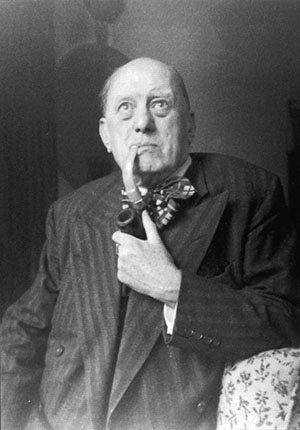
Vyvyan Deacon passed away at the age of 42 on 19 Febuary 1938. On 15 April 1938 Aleister Crowley (above) wrote in his diary: “Vyvyan Deacon came in about 7 am. Taller, thinner, paler than in life. Dressed in white suit of ‘flannels’. Seemed to want to speak, but I heard nothing.”
Although Vyvyan shared mutual acquaintances with Aleister Crowley, the pair did not actually meet until 1931. Crowley particularly admired his new friend’s skill in filing lawsuits against defamation and used the same tactic successfully himself. While their relationship essentially revolved around occult matters, Vyvyan did find himself constantly called upon to help scrape together enough cash to keep Crowley solvent. They remained close over the next seven years as Vyvyan supported himself by conducting séances, demonstrating hypnotism on-stage, performing psychic services and delivering lectures – one of the last ever being a joint presentation with Alice Bailey in late 1937 titled ‘The Cosmic Christ’.
A few months prior to that he had collapsed in the street, sustaining a skull fracture that was never properly treated and then, following a second fall and hospitalisation shortly afterwards, he passed away peacefully on 19 February 1938. He was 42 years of age.
Thus, the curtain fell on one of our most gifted proponents of psychic mediumship – one who formed a pivotal link in the golden chain of Australia’s esoteric legacy.
[alert type=”general” dismiss=”no”]This article was published in New Dawn 161.[/alert]
[alert type=”success” dismiss=”no”]If you appreciate this article, please consider subscribing to help maintain this website.[/alert]
Footnotes
1. For OTO reference on Bennett see: www.collective777.com/#!oto–thelema/c1kx2
2. The Uncommon Medium by Vivienne Browning, 1993, Skoob Books Publishing Ltd, London, 46
3. Ibid., 77
4. Ibid., 123
5. National Library of Australia, http://trove.nla.gov.au/newspaper/ article/51629162
6. National Library of Australia, http://trove.nla.gov.au/newspaper/ article/51629583
7. National Library of Australia, http://trove.nla.gov.au/newspaper/ article/51630954
8. For more on the mind-over-matter debate see websites such as www.newthoughtwisdom.com/quantum-communication-mind-science- consciousness.html
It is a little known fact that an actual doctrine lies at the heart of the counterculture of the Haight Ashbury in San Francisco that emerged in 1967.
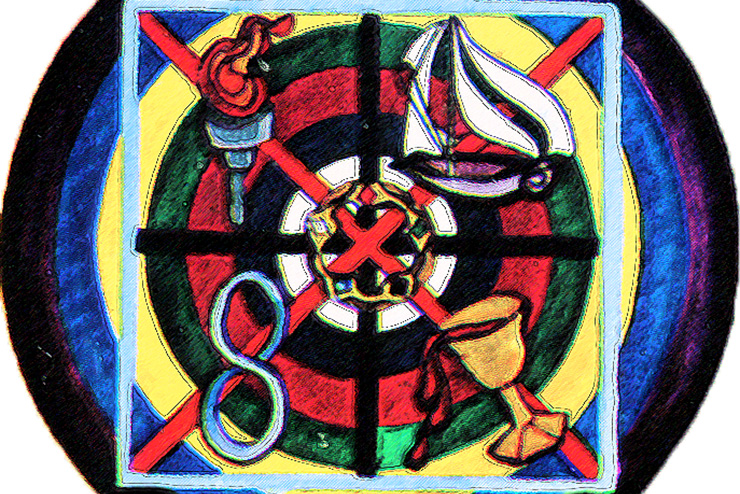
This doctrine expresses a new consciousness – One Consciousness – illustrated by 22 new (or reversed) tarot images. These 22 “Books of T” – known as the Word of One Tarot – were communicated through the Ouija board in 1962 and 1963 by an entity naming itself “ONE.”
This is the story of that doctrine which, like a buried talisman, has remained concealed since those times. It is also the story of “the great crippled wizard” (as Timothy Leary termed him), who not only was instrumental in bringing these images through the Ouija board and painting them, but also in publishing them during the fabled Summer of Love.
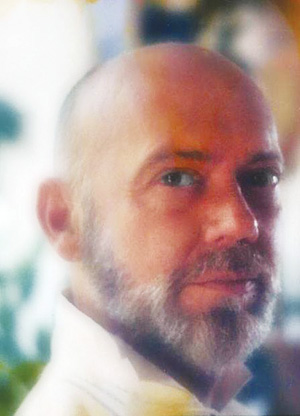
John Starr Cooke, 1965 (Courtesy of the estate of John Starr Cooke)
John Starr Cooke was a descendant of Dr. Comfort Starr, who came to New England, USA in 1635. He was a great patron and benefactor to Harvard College, which began in 1639 on the site of his former house. Another of Cooke’s notable early American ancestors is Revolutionary War hero Joseph Platt Cooke, who was one of George Washington’s generals and was in Danbury the night the British razed the town in 1776.
Cooke’s great-grandparents Amos Starr Cooke and Juliette Montague arrived at the (then) Sandwich Isles in 1838 as missionaries. They established the Royal School where all five final monarchs of Hawaii were educated, including the final ruler Queen Liliokulana. Juliette spoke fluent Hawaiian and had a particular gift for music. Hawaiian-style music, which endures to this day, is said to have stemmed from her work.
The Cookes left missionary work in 1850 and went into business, establishing Castle and Cooke, a farm supply enterprise, with another ex-missionary family. They met with swift and great success.
The good fortune of the Cooke family continued as they diversified into sugar, pineapples, irrigation, railroads, shipping and banking. John Cooke’s grandparents Charles Montague and Anna Rice Cooke (also a daughter of missionaries), travelled widely, particularly to the Far East, where they indulged their passion for collecting fine art.
The strict puritan ethic established by Amos and Juliette saw a separation between the family and the islanders. This separation was less evident by the time John Starr Cooke was born in 1920. His Hawaiian nursemaid took him to secret shamanistic ceremonies from the age of three or four. These involved chanting and dancing all night, and John became a very young initiate.
The women in his family were immersed in Theosophical ideas, Madame Blavatsky, Swami Vivekananda, G.I. Gurdjieff, Annie Besant and Krishnamurti. On his mother Lily Love’s side, the Love family were bakers. It was often said in John Cookes family that the Loves had come to the islands to cook, and that the Cookes had come to the islands to love.
Anna Rice Cooke left a great legacy to the world in the Honolulu Museum of Art. She donated land, the building, her personal art collection and enough money to run the museum in perpetuity. At the opening in 1927, no doubt attended by John Starr Cooke, the traditional Hawaiian blessing was most likely performed by David “Big Daddy” Bray, a lifelong friend of John.
Tarot Cards & Ouija
On one of his many visits to San Francisco, Cooke, aged nine, was at a hotel and felt ill. Deciding to play some solitaire, he went downstairs to purchase playing cards. However – to his horror! – he bought something altogether more strange: Tarot cards. He considered the images to be evil and threw the cards out the window. According to his sister Alice, on a different occasion curiosity got the better of John and he bought a second pack, only to again throw the cards out the window. Incredibly, he repeated the whole process a third time!
John’s mother Lily died in 1933, and his father took him on a long cruise soon afterwards. John later recalled that on this trip he met Cole Porter, and that Porter wrote the song ‘Begin the Beguine’ for him. This is part of the reason John produced the photograph of himself, with the inscription “BEGIN.” After the death of their mother, Alice became a mother-figure to the young John.
By the age of fifteen, he was a seasoned traveller, with numerous trips to San Francisco. With his sister Alice, John started using the Ouija board at 19.
In 1943, Cooke was married, on the advice of the Ouija board, to Wilma Dorothy Vermilyea, who became known as Millen Cooke. Millen Cooke was a poet, occultist and Science Fiction author, most prolific between May 1946 and May 1950. She was published in such magazines as Amazing Stories, Fantastic Fiction and Other Worlds Science Stories. She was also a chela of a Tibetan Mahayana Buddhist monk, and had a deep understanding of kundalini yoga. John’s father Clarence Hyde Cooke died in 1944.
John Cooke and Millen Cooke on their wedding day in 1943
John and Millen Cooke travelled around Europe, with John studying medieval tarot decks and tracking down various holy men. They spent a lot of time in London. During this period, Millen dictated, while in a dream state, a set of Tarot images which John subsequently drew. These were issued in 1992 as the Atlantean tarot, part of the Word of One Tarot boxed set.
John had encountered Meher Baba briefly in Europe in the mid-40s. In 1948 he was able to assist the followers in California to purchase a mountain property in the Ojai Valley in California, known as Sulfur Mountain and subsequently as Mehermount.
Dianetics by L. Ron Hubbard was released in mid-1950, an instant bestseller. When Millen Cooke read Dianetics later that year, she was so enthused that she immediately went alone to New York to explore this new work with serious practitioners. John followed Millen to New York, where he joined the Dianetics practitioners.
Mary Oser had come to New York from Basel, Switzerland on a mission. Her husband Peter Oser was fantastically rich but terribly unhappy. Nothing Mary could do would bring him out of his torpor until she encountered Dianetics, and had some success. She needed to find a competent practitioner of Dianetics so she went to the centre of Dianetics activity in New York. She found John Cooke and realised she had found the right person. Cooke returned to Basel with her.
In Basel, Cooke ran the household along Dianetics principles. This seemed to work for Peter Oser, and he became a blind follower of Cooke. On one occasion, Peter was driving and asked where to turn. John said “right here,” indicating a crossroad some distance ahead. Peter followed John’s word so closely that without even a moment’s hesitation, he turned right, and straight into a ditch.
Millen and John were divorced in 1951, and she was briefly married to John’s friend and associate William Belknap Jr. The Belknaps were both into Dianetics. Millen later married Brinsley Le Poer Trench, with whom she co-authored some seminal works on flying saucers.
The Oser household in Basel, Switzerland, was under John’s direction and also under the direction of the Ouija board. One day the board indicated they should travel at once to Central Africa. Within three hours they had packed up and left, with John convincing Peter to buy an aeroplane at the airport.
Tangier & the Naqshbandi Order
John Cooke lived in North Africa for the next six years, mostly in Tangier. He became associated with a Sufi sect, the Naqshbandi Order, and among them he was known as Sufi Rashid. He went deeply into their system of initiation, and danced to their drumming with his own whirling dervish style. The group came to look upon him as a great healer and the reincarnation of Hassan, a blue-eyed Muslim from nine centuries earlier. He never considered himself Muslim, although travelling with the Naqshbandi Order meant that Muslims assumed that he was. Thus he set foot in a certain holy Muslim city, the first non-Muslim to do so in over a thousand years.
In 1952, John and Mary married. In 1954 they became associated with Brion Gysin and his famous restaurant, The 1001 Nights. Gysin later described the Cookes as looking like very rich hippies with “veils and spangles and bangles,” ten years before their time.
Brion Gysin in 1956 at John and Mary Cooke’s home in Algeria
In early 1956 they travelled to London. John Cooke was about to purchase a Tarot deck, which had belonged to Aleister Crowley, and was annotated in Crowley’s hand. At the home of Alexis Lykiard, Cooke was warned against buying these cards by Lykiard’s father. Lykiard Sr predicted dire consequences should Cooke proceed; Cooke bought the cards and returned to Tangier.
Mary purchased a wing of an old colonial-era palace near Algiers and renovated it. The time came to move there to live. She was about 7 months pregnant when, in August 1956, John made arrangements to leave Tangier and join her in Algeria.
However, the Naqshbandi had no intention of letting John Cooke leave Tangier. Membership was a lifetime affair. If he was to leave, he must pay the penalty. At the railway station, where he went to buy his ticket to leave, a cleaner said “Oh you’re leaving?” “Yes, I am” said John. “Oh, you really think so?” At the bank soon afterwards, as he entered, a white shawl was placed on his shoulders by a person known to him. As he left the bank, he suddenly tore it off and collapsed, feeling a sudden burning sensation, as if he had been stung by a scorpion, consonant with a feeling of being hit hard at the base of the spine. He was paralysed from the waist down.
Mary paid Brion Gysin to close down The 1001 Nights and to come to Algiers and look after John. Gysin became the godson of their child.
After some unsuccessful attempts at treatment, John Cooke returned to the US, and never walked again. John was interested in a total miracle, or nothing else, according to his sister Alice. Told he would be able to walk again with the aid of crutches, he refused to become an object of pity, preferring the dignity of the wheelchair.
Cooke, the Wizard
An apparently miraculous new mystical technique was announced to the press in November 1957 by actress Eva Bartok. She claimed to have been cured of cancer by the methods of Subud. At this time, John took an interest in Subud. He helped finance Pak Subuh to come to the US, who was welcomed by John and Alice on arrival.
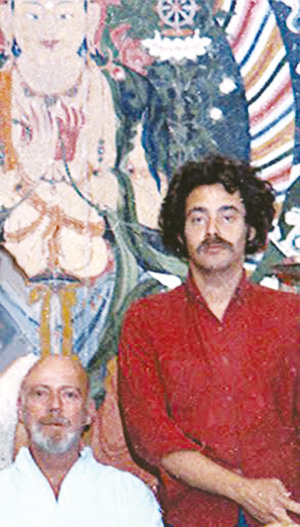
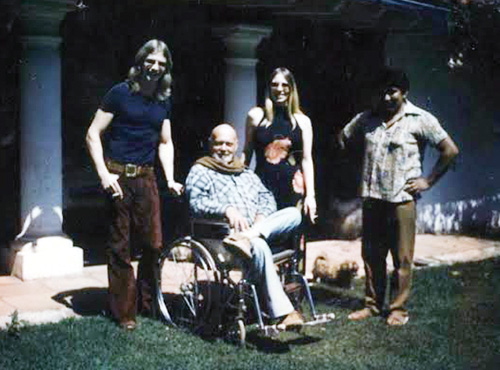
John Starr Cooke & Michael Bowen (Courtesy of the estate of Michael Bowen)
From 1958 the Subud group became a meditation group centred around John. He moved to a clifftop mansion at Carmel, California, and his reputation as a “real wizard” grew among the Beat community of San Francisco’s North Beach area.
One of those attracted was Michael Bowen. He walked in to John’s living room, where John sat at a coffee table, with a plain envelope in front of him. “Those are Aleister Crowley’s Tarot cards,” said Bowen. According to Bowen, those cards, inside that envelope, had Crowley’s very small and neat handwriting all over them.
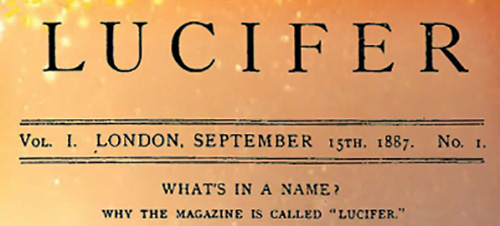
Crowley had predicted a new aeon, and many now point to the 60s as evidence of Crowley’s Aeon of Horus. Although Crowley’s Thoth deck filled out the existing imagery of the cards with the symbolism of Thelema, the archetypes themselves remained largely unchanged. Would a new aeon require a new tarot? According to John Cooke, there was a prediction made by Madame Blavatsky in the Theosophical Society magazine Lucifer that a new Tarot would emerge in the latter part of the twentieth century.
And now begins our story, that of the emergence of the Word of One Tarot, and its place in history.
Madame Blavatsky, co-founder of the Theosophical Society, is said to have predicted in her Lucifer magazine that a new tarot would be revealed in the latter half of the 20th century.
Word of One Tarot
On 17 August 1962, four people met at John Starr Cooke’s cliff top home in Carmel, California. They had been meditating regularly since 5 February, when a seven-planet conjunction in Aquarius had occurred. The group expected this conjunction to bring some kind of a consciousness shift that would affect all of mankind.
Discussion this night turned to John Cooke’s use of the Ouija board for the last twenty-three years and as a result, an impromptu Ouija session was held. Cooke drew the letters of the alphabet on a large piece of paper, and for a planchette (the moveable pointer), used a silver dollar. He tried one person, then another as co-operators, without success, until he teamed up with Bill Eaton, whereupon the planchette moved swiftly around the board. They were in communication with an entity that later identified itself as “ONE.”
The group conducted another session twelve days later, and continued to do so every week or two for the next fifteen months, totalling over one hundred sessions.
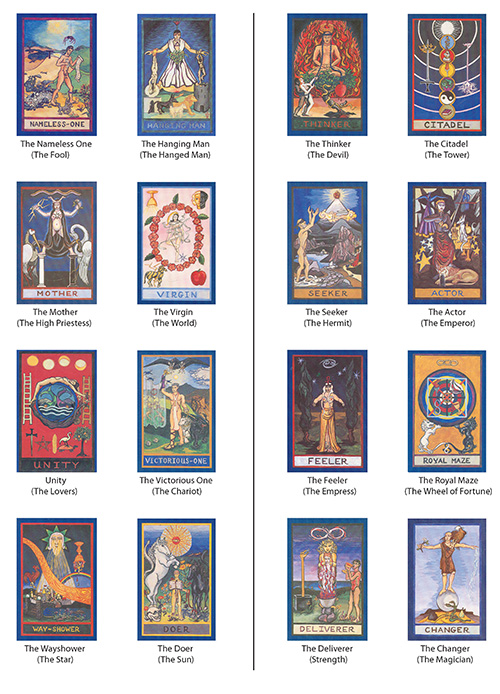
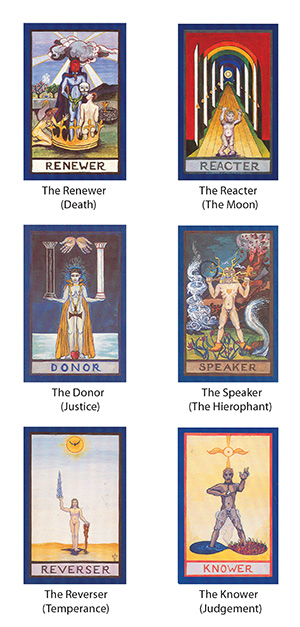
During the seventh session, Cooke asked a question about the tarot. The response was that revisions would be forthcoming, and in that session new names were given for the Fool (Nameless One) and Hanged Man (Hanging Man).
Between October 1962 and May 1963, the ONE described the complete 22 New Tarot cards and John Cooke painted the images as the instructions came through. Below are the 22 new Books of T with the old Tarot trump names.
The New Tarot images can be viewed in full here: www.tarot.one.The New Tarot images can be viewed in full here: www.tarot.one.
The sessions stopped altogether in November 1963, when Cooke moved to Mexico. He was soon followed by his chief disciple Michael Bowen. They had already discussed staging a great event aimed at reversing society’s thought processes, as outlined by ONE, an event which would be historically recorded and serve as a reference point for the future. In Mexico, they continued to formulate what would become “Reversal USA.”
LSD & Timothy Leary
In the midst of the reception of the Books of T, John Cooke and the group held an LSD session. LSD was at that time a legal substance, but there was no certainty as to its proper place – whether it was in the church, the psychoanalyst’s office, or to be freely available.
Cooke understood the Books of T (also known as the New Tarot, or the Reverse Tarot) to represent a change in man’s unconscious in the present time-period. His recent experience with LSD showed him how this consciousness could be experienced; how unity could be known. He saw LSD, like the Books of T, as a tool for understanding love as the basis of reality, for understanding the unity of all things as the ultimate truth. To this end, Cooke was in favour of the sacramental use of LSD.
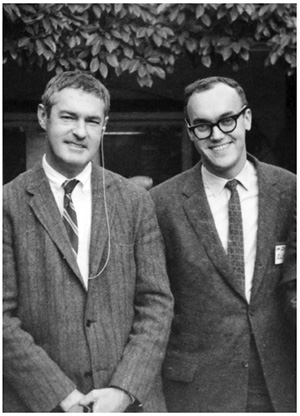
Professor Timothy Leary was in the news at that time, achieving his initial infamy. His LSD experiments led to his being sacked by Harvard and deported from Mexico, where he had established an LSD colony. By late 1963, however, Leary, with Dr. Richard Alpert and Dr. Ralph Metzner had been offered a large estate near Millbrook in upstate New York, where they continued their work.
Dr. Timothy Leary and Dr. Richard Alpert (later known as Ram Dass), Harvard, 1961
Cooke wanted to find out whether Leary and his colleagues were for good or ill in the psychedelic movement, and he wanted to bring the Books of T to their attention.
John Starr Cooke had put his fortune to spiritual ends several times already. Meher Baba, the Naqshbandi Sufi order and Subud had all been recipients of his generosity. Now, once again, he bankrolled a new spiritual philosophy – only this time it was his own doctrine of One Consciousness. Michael Bowen was his means of achieving this.
After some months in Mexico, and after Bowen had been initiated under Cooke’s supervision, Cooke sent Bowen on his way. For the next few years, he provided Bowen with funds and guidance from time to time. Bowen’s mission was to find, befriend and evaluate Leary. The aim was for Leary to join them in their work on the reversal of society.
Bowen and certain others became known as Psychedelic Rangers, roaming protagonists for LSD. The Rangers were loosely under Cooke’s control and undertook various psychedelic revolutionary activities.
And Bowen is going on. He has no choice. The forces behind his symbols are relentless. He is a pawn as well as an artist and would be overtaken if he slowed. So, by observing his work we may glimpse our own energies. It is a breathtaking trip. Look, reflect, and see yourself. – John Starr Cooke, letter to Rosalind Sharpe
Michael Bowen moved to New York and in 1965 made his way to Millbrook to meet Leary and his associates for the first of several visits. Bowen had brought with him reproductions of the paintings Cooke had made of the Books of T. Ralph Metzner was impressed with the images, later writing:
When I first encountered the images of the “Reverse tarot” here described and presented I was immediately struck by their evocative force. Unlike the images of the old Tarot deck, which (to me) had appeared lifeless, these had a kind of direct electric-emotional “charge,” and some of them were strongly reminiscent of images found in dreams or under the effects of certain chemicals.
However, these “certain chemicals” were under legislative attack. In April 1966 Millbrook was raided by the FBI. Michael Bowen, who was present at the raid, soon left for San Francisco, at John Cooke’s suggestion.
Bowen had introduced Leary to the idea of a new religion, the League for Spiritual Discovery, whose sacrament was LSD. The League was to be cellular, with no central management. The central tenet was that LSD taken in private, on private property, was a private concern. It had been obvious for some time that it was only a matter of time before LSD became illegal. The League was an attempt to provide an appropriate setting for the drug before such legislation was enacted. Leary announced the League in September 1966.
In San Francisco, Bowen joined Allen Cohen on the staff of the Oracle, the main counter-culture newspaper of the Haight Ashbury district. For the past couple of years, the Haight Ashbury had grown as a hip centre, aided by the availability of LSD on the streets since early 1965.
However, LSD was to become illegal on 6 October 1966. Bowen and Cohen understood the futility of angry protest, and instead organised “a celebration to demonstrate opposition to legislative repression of chemical mysticism.” The Love Pageant Rally, as it was named, was promoted in the first issue of the Oracle in late September 1966.
Bowen wrote a Prophecy of a Declaration of Independence, which posited the expansion of consciousness as an inalienable right, and this was also included in the Oracle’s first issue.
Be-In poster by Michael Bowen & Stanley Mouse
At 2pm on 6 October, the Prophecy was read out at the Love Pageant Rally and those hundreds assembled broke a brand-new law in unison. The point being made was that Americans were free under their Bill of Rights and their Constitution to alter their consciousness. It is a personal matter, and not the province of government.
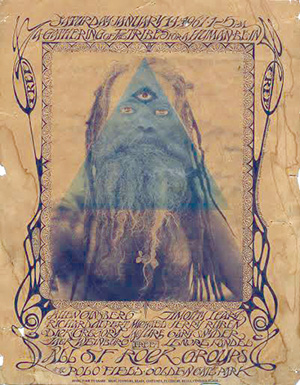
The Love Pageant Rally was such a success that it led to the creation of a similar event, but on a much larger scale. This was the Human Be-In on 14 January 1967.
When Bowen was at Millbrook, he stood on a bridge over the lake. He thought about the great event he and Cooke had discussed as he dropped pebbles into the lake and watched the ripples spread. It occurred to him that for the ripples to reach the furthest shore, a big splash was required. With some effort, he dropped a boulder into the lake – watching, satisfied as the ripples reached the far shores.
The big-splash event which Bowen had envisaged was the First Human Be-In. Many people contributed to the creation of this grand event, but Bowen was the driving force behind it. 30,000 people came to the Be-In in Golden Gate Park, San Francisco. The Be-In was designed with no particular stars of the show, the speakers all limited to three minutes each. There were bands, but none were promoted. It was an event designed specifically for people – even the people on the stage – to just being with each other. This allowed an authentic sense of One-ness to occur.
The poster by Michael Bowen for the Human Be-In is a snapshot of a moment in American spiritual history. It marks the moment when the first apostles of One Consciousness created an American spiritual event which allowed a mass mystical experience of unity.
According to Michael Bowen and many others, for about six months after the Be-In, the sense of One-ness persisted in Haight Ashbury. There was a psychic harmony, a telepathic connection at a day-to-day level.
Michael Bowen was actively involved in the Haight Ashbury community. At the press conference for the Council for a Summer of Love in April 1967, alongside the other forces in the community, he was the representative of the Church of One.
History records that the Summer of Love came to pass. Estimates of the numbers of young people who descended on Haight Ashbury in the summer of 1967 usually begin at 100,000 and go up to about 300,000. It was a significant time in history, and the whole world seemed to suddenly switch from black and white to colour.
Bowen had some of the images of the Books of T reproduced as large meditation posters, published by East Totem West the Haight Ashbury early in 1967, and then in August 1967 came what John Starr Cooke termed “the perfect jewel in its perfect setting.”
The Books of T
To Cooke, the Books of T were the perfect jewel; the perfect setting was the Oracle in the Haight Ashbury during the Summer of Love. This publication of the Books of T stands, in a way, as an acknowledgement that One Consciousness had thrived in the Haight Ashbury since the Be-In.
However, the pageant was now over and a mass exodus from the Haight began.
The magical act had been accomplished. The new doctrine had been documented at a particular point in history, that point itself influenced by the said doctrine. Michael Bowen now left the Haight Ashbury and joined John Cooke in Mexico.
In October 1967 Bowen wrote a letter to the Oracle, exhorting the V-for-Victory hand signal be adopted by “ALL” as the next step of Reversal USA. It was swiftly taken up and became known as the hippie peace sign.
In 1968, John Cooke and Rosalind Sharpe published T: The New Tarot. In early 1969, Ralph Metzner added an introduction. Preparations were made to finally release the Books of T as a deck of cards.
At this time, Cooke mailed William S Burroughs the new edition of T: The New Tarot, of which Burroughs did a cut-up, and they began a correspondence which lasted about three years. Burroughs ordered a set of the cards, although he was mainly seeking Scientology secrets, which John, never being a Scientologist, did not have.
A final ONE Ouija session took place, which included Ralph Metzner.
In May 1969, The Process was published by John’s old friend in Tangier, Brion Gysin. The novel was based upon a series of adventures Gysin and Cooke had shared in the mid-1950s. Cooke is characterised as Thay Himmer, “Bishop of the Far-Out Isles.” On page 122 he enters the narrative: “He was funny, hilarious even, to look at but he looked, also, very very rich in his regulation threads of camel, cashmere, vicuna and Thai silk.”
Many of the incidents in The Process are taken from real life and give a sense of what Cooke was like. In a letter to Burroughs, Cooke says he wished Gysin had included more real events, like the time he was chased by wolves while skiing in Norway!
By the end of 1969 the Books of T had been published as a tarot deck – the New Tarot for the Aquarian Age. As well as Burroughs, Ken Kesey was another underground luminary who ordered a set. But the Books of T were and remained an obscurity to all but a devoted few.
Jordan Rivers corresponded with John Cooke after buying the New Tarot, and visited him in Mexico in 1972. Rivers says: “John told me that the Hippie/Love movement started in his living room in 1962. I didn’t understand what he meant by that for many years.”
Jordan Rivers, John Starr Cooke, Brita Corrae & Pablo, Tepotzlan, 1972 (Courtesy of Jordan Rivers)
In 1975, John and Rosalind Wall published The Word of One, the edited transcripts of the ONE Ouija sessions. In 1976, John appeared in the short film ‘Prophecy of the Royal Maze’, before dying in August 1976.
A new edition of the Word of One Tarot was released by the Cooke family in 1992, and these are once again available (click here to purchase a pack).
The Books of T do not proclaim a new way. Rather, they indicate the breakthrough of the way in our time, and the time to come. – John Starr Cooke
John Starr Cooke and Michael Bowen worked to their program of “Reversal USA” to bring the Books of T into the light of day. It was a magical working, the intention being to embed this new mystical doctrine deep in the heart of a new society, a doctrine which reflected their society at that transformational time. According to Michael Bowen, it was all about creating a future humanity firmly established upon the consciousness of ONE.
The Haight Ashbury is still with us. Right now you can get the latest Rolling Stone magazine, or drop in to Govindas for a vegetarian meal, or pick up some produce at the organic food cooperative, or at the health food store, or maybe something to read at the new age bookshop on your way to Yoga class after which you might go to a psychedelic rock show. All of this stuff flourished for the first time in the Haight.
The hippie movement had its day and faded; however, the Word of ONE remains. It is a foundation stone of the new Aeon and a foretaste of the zodiacal precession from Pisces into Aquarius.
There is One only. You are that One. One is being. One is in motion. That motion – that being – is love.
All New Tarot images are copyright Catalyst Enterprises, and are reproduced here with permission. The Process by Brion Gysin is still in print. A website devoted to John Starr Cooke’s legacy and the New Tarot is www.royalmaze.com. The short film ‘Prophecy of the Royal Maze’ can be viewed here.
[alert type=”general” dismiss=”no”]This article was published in New Dawn 145.[/alert]
[alert type=”success” dismiss=”no”]If you appreciate this article, please consider subscribing to help maintain this website.[/alert]
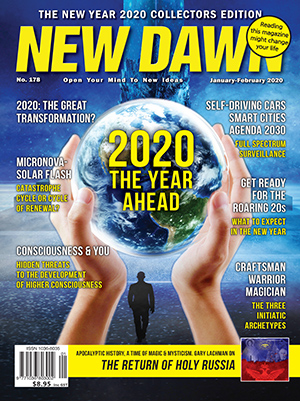
The following is excerpted from the Introduction to my book The Return Of Holy Russia: Apocalyptic History, Mystical Awakening, and the Struggle for the Soul of the World (published in May 2020).
In it I point out one of the reasons for writing the book, specifically the idea that Russian President Vladimir Putin is very keen on revitalising the notion of Russia as the last bastion of the true faith, the bearer of the true Word in an age of unholy godlessness, a mantle it last wore in the nineteenth century.
Why would Putin want to do this? Is his belief and defence of “traditional values” genuine, or merely a means of providing Russia with an identity, something that seems to have slipped away from it through the years of turbulence and chaos following the breakup of the Soviet Union?
Yet it is no secret that except for the brief seventy years of Soviet rule, Russia was the most mystical of Western nations – if indeed it is a “Western” nation at all. As the reader will see here, and as I spell out in greater detail in the book, Russia’s history has always been informed by mystical, spiritual ideas and powerful religious feelings. And it has always been a nation with an ineradicable sense that history was leading somewhere. To where, exactly? Well, that would be telling, but as I say, Russians have not given lip service to the apocalypse. For better or for worse, the Russian soul has never had the end times too far from its thoughts. What might that mean for us today? That is another question I devote more than a few pages to in the book. – Gary Lachman
Welcome to the Silver Age: A Time of Magic and Mysticism
Another idea that [Russian President Vladimir] Putin is taking seriously is that of Russia as a nation of “traditional values.” It is along these lines that commentators are beginning to speak of a new cold war opening up between Russia and the West. Skirmishes here are not triggered by ideological clashes between capitalism and communism, but by different moral, ethical, and religious worldviews. To think of Russia, home of gangland politics and ostentatious oligarchs, as more morally sensitive than the West may seem counterintuitive. But in Putin’s Russia, the extreme liberalism and permissiveness that characterize Western society – its “anything goes” sensibility – smacks of little more than decadence, and our commercialization of practically everything reeks of selfishness and ego gratification. Nothing seems to resist the spread of the “me” economy, in which everything is yielding and negotiable, even reality. Compared to this, Putin’s Russia upholds more “traditional” standards, and its attitude toward sex, family, and gender roles seems to the “progressive” West highly conservative, if not repressive.
Russian President Vladimir Putin
Putin finds his traditional values in his Orthodox belief, and it is in this role of defender of the true faith that, along with Eurasia and the thinkers of the Silver Age, the idea of Holy Russia seems to be making a comeback. This was an identity that Russia and her “God-bearing people” embraced practically from the start, from their earliest adoption of Orthodox Christianity, to the attempt at a theocratic rule during the Muscovite empire of the late Middle Ages, and to the idea of its being a “Third Rome,” after the downfall of the first one and the capture of Constantinople by the Turks in 1453. And it is here, perhaps, that we can find the roots of the notion that Russia has a “mission,” that special destiny that informs the different versions of the “Russian idea.”
Although many fine points of doctrine and dogma separate the Eastern Orthodox Church from Roman Catholicism and Protestantism, one thing that does set Russian Orthodoxy apart from its Western counterparts is its attitude toward the end-time, the Apocalypse, and the Second Coming. While these are indeed part of the Western Church, it has generally damped down any millenarian zeal, and focused more on dealing with the crises and challenges of everyday life. “Repent ye sinner for the end is nigh,” is left to street-corner prophets and Jehovah’s Witnesses. The Western Church has been more this-worldly, and its interest in worldly power is one of the criticisms that its eastern counterpart has made against it.
The end days, however, have always been of great importance to the Eastern Church, which has always been more open to mysticism and esoteric knowledge. Its focus has been more eschatological than the West, and this anticipation of the Second Coming and the establishment of the Kingdom of Heaven on Earth was something that the Russian people embraced wholeheartedly when they accepted Eastern Orthodoxy as their religion. They took the idea of rebirth very seriously; this is why Easter is a much more important holy day in the Orthodox calendar than Christmas. Resurrection was of the essence. They did not give lip service to the Apocalypse.
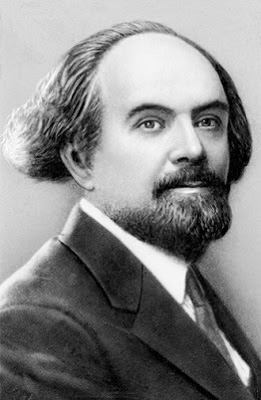
Russian religious philosopher Nikolai Berdyaev (1874–1948)
This belief that the world was moving toward some event after which everything would be different became a part of the Russian soul. As [the Russian religious philosopher Nikolai] Berdyaev said, Russians are either “apocalyptists” or “nihilists,” that is, for them it is a case of everything or nothing, either the millennium and Heaven on Earth or the void.
But the mystical, spiritual character of the Russian soul seemed to be in place even before its contact with Orthodoxy and its embrace of the true faith. The Russian people had a rich pagan tradition full of gods and goddesses, elemental forces, and nature spirits. As with other pagan people converted to Christianity – of whom the Russians were one of the last – this tradition did not die out but was maintained alongside the new Christian belief, an arrangement known as dvoeverie, “double faith,” an example, perhaps, of the ability of the Russian soul to hold contradictory ideas simultaneously, and of the tensions at work in doing so.
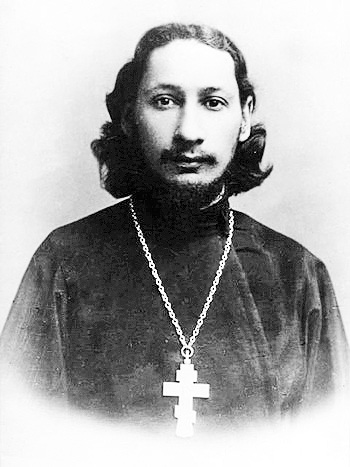
Father Pavel Florensky (1882–1937)
With the aid of mystically potent icons – “windows on another world” as they were called by Father Pavel Florensky, an important figure of the Silver Age – this native paganism helped the spread of Orthodoxy within Russia. During the centuries of the “Mongol yoke,” the influence of shamanism and other magical practices reached the courts of the vassal Russian princes, and when that yoke had been broken, in the days of the Muscovite empire, alchemists, Hermeticists, Kabbalists, and other savants of the occult sciences were welcomed and their counsel sought.
Esoteric ideas even made their way to Tsar Alexander I, the savior of Europe in the Napoleonic wars and leader of the Holy Alliance, who was believed to have faked his own death in order to retire from power to spend his last days in spiritual contemplation. That the last days of the Romanovs were filled with mystical and apocalyptic expectation is well known. Rasputin is the most notorious figure here, but he was not the only mystical character giving advice to the doomed dynasty. And in the years of Soviet rule, ideas of an occult, mystical, and magical character continued to influence the commissars and comrades of the great Bolshevik experiment, with God-seekers becoming God-builders. More than one historian has noted that the millenarian trend in Russia thought made it more receptive to the Marxist vision of a coming classless utopia.
With Putin’s interest in notions such as Eurasia, in the philosophers of the Silver Age, and his gestures toward Holy Russia, this Russian interest in things mystical and apocalyptic seems to be continuing.
This article was published in New Dawn 99 (Nov-Dec 2006)
Visionaries, luminaries, and spiritual pioneers Nicholas and Helena Roerich were two of Russia’s most outstanding people. High initiates, they devoted their lives to helping the advancement of humanity. And as is often the way with many great spiritual leaders, their path was liberally strewn with hardship and adversity: revolutions, captivity, spy charges, deception and deceit; testing the Roerichs constantly on their shared belief that it was these very obstacles that would allow them to grow.
Yet, despite the fact that the couple were once barred from entering the United States and their teachings prevented from circulating freely throughout Russia, the Roerichs’ ideas are today reaching an ever-expanding group of people around the world.
Perhaps it is an attempt to bring balance and harmony to our world of unrest, pain and strife that is causing the massive desire to know more of Nicholas, the painter and mystic, and his wife Helena, the co-author of the Agni Yoga series of metaphysics and deep spirituality.
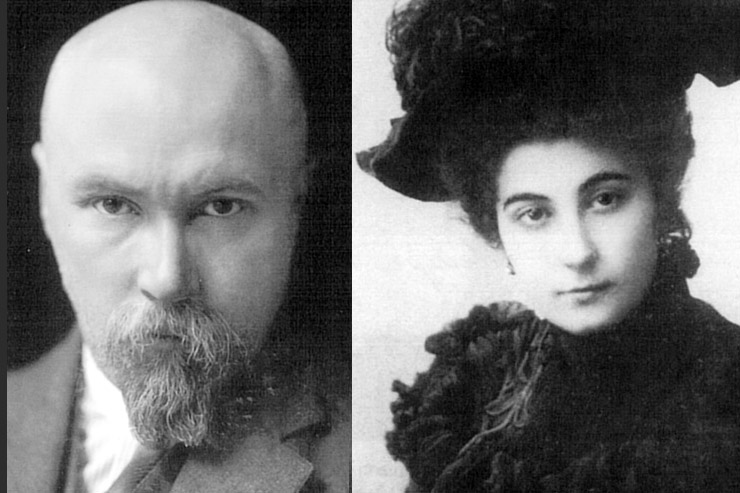
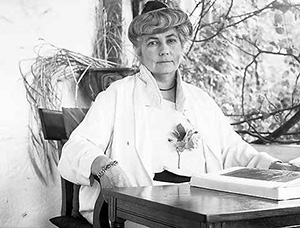
Internationally acclaimed artist, author, explorer, archaeologist, humanitarian, conservationist and peacemaker Nicholas Konstantinovich Roerich (1847–1947) was born in St. Petersburg, Russia. He met his beloved wife and life partner Helena Ivanovna (1879–1955) on his way to excavate in the eastern part of Russia, and they married in 1901.
She was a gifted musician and healer who had been studying the ancient spiritual writings of India and the East for years; in time, she became an inspired writer and teacher. He eagerly shared her pursuits for wisdom and knowledge. Together, they explored the teachings of Rama Krishna, the Buddha and also studied Madame Helena Blavatsky’s writings and philosophies. Once safely out of Russia and the civil war that raged following the 1917 Russian Revolution, they used their time in exile to test and experiment with the Theosophical teachings. It was at this time that they met Master Morya, their spiritual teacher. Since her childhood, the Masters (members of the Brotherhood of Light) had been working with Helena in her dream world but now the work took an additional form as page after page of expansive, astonishing information was dictated to them.
After leaving Russia, the Roerichs and their two sons had first gone to Scandinavia, then made their way to England, eventually arriving on the shores of America. But the United States was not their ultimate destination. Their actual goal was India. For some years after 1917, India – the Raj – was closely maintained by the British who were constantly on guard against infiltration by Russian Bolsheviks bringing their inflammatory thoughts of revolution. The Roerichs were clearly on the list of those not wanted. In time, the way did open for them to enter India and although they never knew it, they were continually kept under surveillance. This fact accounts for many of their hardships.
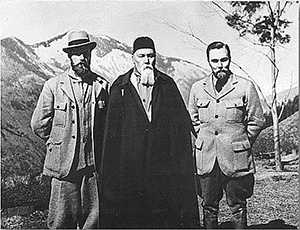
Nicholas Roerich (middle) with his two sons.
The Roerich family arrived in New York City in the fall of 1920. Within the next three years they had gathered about them a little circle of the perfect people to accomplish all of their goals: the formation of an idealistic artist’s society called Cor Ardens, to encourage artists to push themselves to greater heights of artistic ability; the Master School of United Arts where all of the arts where taught under one roof and students were encouraged to express themselves in various media – thereby giving them the opportunity to become more rounded individuals. And Corona Mundi, an international art museum, founded to display artistic treasures from Central Asia and other areas of the world. Roerich’s paintings were exhibited in 26 US states and he and Helena toured much of the country – meeting and exchanging ideas with the most open-minded, progressive people in the arts and humanities.
Central Asian Expeditions
In 1924, they left New York for Europe which was the last stop before going to India and beginning their four-year Central Asian expedition. The history of Central Asia of the late 1800s and early 1900s is sprinkled with daunting accounts of fearless explorers and adventurers; men and women such as Helena Blavatsky, Alexandra David-Neel, Sir Aurel Stein, Sven Hedin, and Russian born Col. Nikolai Przhevalsky, who discovered a breed of horse that was named in his honour. But none of those were artists and to the best of my knowledge, none were on a mission to Shambhala. The couple were both past fifty years old when they undertook the gruelling journey to traverse Central Asia for four years on foot, camel, horse and yak enduring the brutal heat of the lowest desert elevations and laboring over the highest mountains ranges on the planet.
What is it that stirs people to leave the comfort of their home and set off for the unknown? Gold? Religious freedom? The quest for a better life? For the Roerichs, the reasons were many. Nicholas was interested in proving the migration routes of the early tribes that encircled the globe. He wanted to be the first Westerner to paint and document the vast mountain ranges of India, Tibet and Central Asia and search for and uncover treasures long-hidden by the desert sands.
Through fourteen years of researching, thinking and writing about the Roerichs, I could not help but question the real purpose of the Roerichs’ Central Asian expedition. Unbeknownst to me, a Russian scholar by the name of Vladimir Rosov, was quietly helping. Just as I had began my work by living a short time in India and meeting with Svetoslav Roerich, reading through Madame Roerich’s journals and some personal correspondence, searching through the files kept in the Library of Congress and the Freedom of Information Act; researching old micro-fiche, newspapers, and the British Secret Files for facts regarding the Roerichs’ years in America, Rosov had been studying and sifting through all the Roerich documents which had been unavailable to researchers before Gorbachev’s Perestroika restructured the country. The results of his work can be read (in Russian) in his two volumes, whose name in English translates to Nicholas Roerich, The Messenger of Zvenigorod.
In the first volume, he relates a startling story which answered all my questions and astonished the world of Roerich followers. Since it was already in print, I was able to use it, thereby becoming the first person to tell (in English) the real story of the Roerichs’ four-year expedition. Rosov’s account also provided a new basis for understanding the Roerich’s second trip – during which the United States sent Roerich and his son George, back to Central Asia in search of drought resistant grasses to help prevent a reoccurrence of the disastrous “dust bowl” of 1934. It was this expedition which broke Roerichs’ friendship with Henry A. Wallace, US Secretary of Agriculture during Franklin D. Roosevelt’s administration, and led to Roerich being barred from returning to the United States.
Shambhala
For years various authors have written about Shambhala. Though many people are familiar with the term, a far greater number of people have no idea what it refers to. Those “in the know” think that the search for Shambhala was the purpose of the Roerichs’ four year expedition. And they are both right – and wrong.
Shambhala is a Sanskrit word meaning “place of peace, tranquillity and happiness.” It is considered a mystical place – both visible and invisible – where the higher world connects with the realm of Earth. The earliest references to Shambhala are found in the more than three hundred volumes of Kanjur and Tangyur, the most sacred books of Tibetan Buddhism. The books say it is a hidden kingdom, located somewhere north of Bodh Gaya, the Buddhist shrine in northern India. Shambhala is thought to be an oasis, completely ringed by high, snowy mountains that glisten with ice. Some lamas were said to hold the opinion that it has peaks which are perpetually hidden in the mists, while others believe it is visible but too remote for anyone to get close enough to see. And then there are the stories of people who tried to find Shambhala and were never seen nor heard of again.
Many Tibetans were said to regard Shambhala as a heaven of the gods or a special paradise, meant only for those on their way to Nirvana. Possibly the Roerichs first heard the term while reading one of Madame Blavatsky’s books on Theosophy or if not then, it might have been in 1912 when a famous Buddhist lama was in St. Petersburg helping with the construction of a Buddhist temple. However, when the lama spoke of it, he was not speaking of a destination; he was speaking of a famous Buddhist prophecy.
The prophecy involved the Panchen Lama, who held a position the Dalai Lama had created several hundred years earlier in order to share the leadership of Tibet. The Dalai Lama was the temporal leader of the country and the Panchen Lama was the spiritual leader. The prophecy predicted that one day the Panchen Lama would leave Tibet. Once this happened, a great army would arise to destroy the forces of evil and usher in a golden age, a thousand years of peace and harmony. In order for that to occur, however, the Panchen Lama would have to die. When he was reborn, he would be named Rigden Jypo and be the Maitreya, The Coming One, the king of Shambhala, the abode of the mystical Buddhist learning and the symbol of the Great Future. Shambhala was the guiding principle of the coming Kalpa, or cosmic age, and at the sound of that powerful name, certainly something awoke in the Roerichs’ hearts as it does in the hearts of all people who yearn for peace.
However, when the Roerichs’ spiritual teacher, Master Morya, spoke of Shambhala, he gave the name an additional meaning for it was how he referred to the new country that he wanted the Roerichs to create. Morya envisioned a new Buddhist spiritual country to be established on the borders of Mongolia, the Gobi and Siberia. This country was to be governed jointly by the Panchen Lama and Roerich.
Therefore, the two major purposes for the expedition – which were kept private and confidential – were so that the Roerichs could prepare the ground for the new country and the commerce necessary for it to be financially sound; and to find the Panchen Lama so that they could parlay with him, present this startling (and naive) idea, and convince him it was possible and viable. Considering, however, that all of the land involved was already occupied and within the boundaries and domain of other governments, the fulfilment of this plan was highly improbable. One country attempting to take land from another is what wars have been fought about throughout time. When the first expedition was aborted after the Tibetans (and British) kept the Roerich Central Asian expedition freezing in captivity for four months on the border of Tibet and then sent them straight back to India, it looked as if all plans were foiled.
Then, Henry A. Wallace offered Roerich a second chance and sent him back to Central Asia. But, with China and Japan on the brink of war, it was a very dangerous and volatile time. This trip Helena Roerich stayed behind and Nicholas, an artist – not a diplomat, blundered about until Wallace ordered him to return to India and stay there – and not leave again.1 Years later, looking back on the entire event, Madame Roerich wrote in her journal that both the Panchen Lama and her husband were too old at the time to accomplish this feat. Perhaps the Roerichs were laying down the lines of light necessary for it to become a reality in the future.
Helena Roerich
Considering that during the entire four year expedition Roerich’s travel plans were continually thwarted by visa and passport difficulties, it is surprising that Nicholas and Helena even attempted to accomplish the establishment of a new country. To me it seems a demonstration of their loyalty and dedication to work with their teacher.
Art, Beauty and Unity
Roerich loved the concept of unity. He believed that “beauty is the force that can bring nations together.” He hated borders and boundaries and thought that since all the people of the world belonged to one family, they should be able to roam and travel freely throughout it.
Nicholas and Helena Roerich had very expanded consciousnesses. They believed “that knowledge and beauty are the real cornerstones of evolution, the gates to a world community.” They taught that a synthesis of knowledge from all fields of human endeavours was needed to form a fully developed being. Nicholas wrote nearly thirty books and created over 7,000 paintings and theatre designs depicting scenes from ancient Slavic myths, the Himalayan Mountains, and spiritual themes from the world’s religions.
People who see his art for the first time are often speechless at the inspirational use of colour and the spiritual power it evokes – especially his later work, completed during and after the four years of expedition. Roerich’s paintings portray spiritual development, culture and its role in human evolution and possibilities for peace in a troubled world. A broader and more metaphysical understanding is added to the paintings once the viewer penetrates Helena’s deeply spiritual writings. In addition to the Agni Yoga series, which she wrote in conjunction with Master Morya, she wrote On Eastern Crossroads under the name of Josephine Saint-Hilaire.
Daring explorers, the couple investigated the remote and dangerous regions of China, Mongolia and the Gobi Desert where few Westerners had previous ventured. They were seeking ancient manuscripts hidden in subterranean crypts and caves, the treasures to be found in burial mounds, and the wealth of statues, artifacts and wall paintings left behind in caves by the artistic Buddhists.
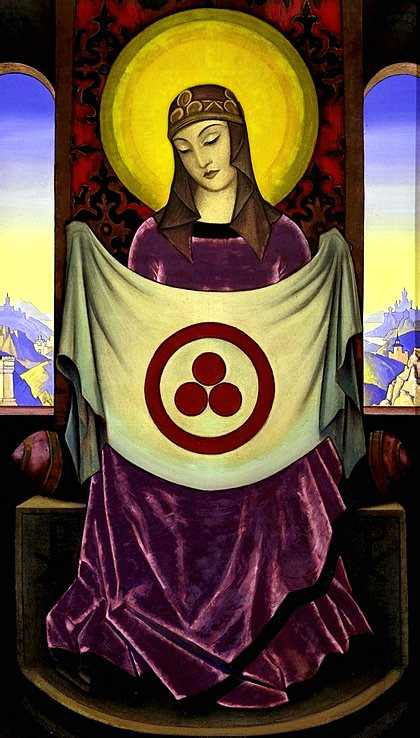
In 1929 Nicholas Roerich was nominated for the Nobel Peace Prize for his work in creating the Banner of Peace and the Roerich Peace Pact, designed to preserve the world’s treasures from being destroyed in time of war. Franklin Roosevelt and twenty-six world leaders met in Washington, D.C. to ratify the agreement. The Roerichs were friends and advisors to heads of state, scientists, artists, writers and poets. Roerich’s work won praise from Albert Einstein, Leo Tolstoy, George Bernard Shaw, Jawaharlal Nehru, Rabindranath Tagore, and many others.
Madonna Oriflamma, the original Roerich painting where the Banner of Peace flag appears for the first time (courtesy Nicholas Roerich Museum, New York)
Now, over fifty years later, many of their key ideas have found a place in the human soul: the equality of the feminine and the masculine principles, the wisdom of the heart and the striving for the common good and brotherhood. The eternal truths the Roerichs demonstrated on Earth are echoing through time, awakening humanity to beauty and unity. “Beneath the sign of beauty we will walk joyfully,” wrote Nicholas Roerich. “With beauty we conquer. Through beauty we pray. In beauty we are united.”
To the Roerichs, culture was the highest expression of the Light – the “cult” of Ur (Light). They considered that beauty and art speak an international language understood by all and that focusing on the beautiful in life would lead us to world peace.
Nicholas Roerich wrote:
If you shall be asked, of what kind of country and of what constitution you dream, you can answer in full dignity: the country of Great Culture. You shall know that in that country peace and knowledge and beauty will be revered…. You may say: life is hard. How can I think of knowledge and beauty if we have nothing to live on? Or: We are far away from knowledge and art; we have important business to attend to first. But I say: You are right, but you are wrong. Knowledge and art are not luxuries. Knowledge and art are not idleness. They are the prayer and work of the spirit. Men pray in the moments of great difficulty. So too, is this prayer of the spirit most needful, when one’s whole being is shaken and in want of support, and when it seeks a wise solution.
An arduous trial awaits the whole world: the trial by the assimilation of truth. After the medieval trials by fire, water and iron, now comes the trial by assimilation of truth. But if the power of the spirit upheld men against fire and iron, then will that same power not also raise them up the steps of knowledge and Beauty?
Throughout the world, in Israel, India, Mexico, Germany and many other countries, schools, civic organisations, and ordinary citizens are flying the Banner of Peace, proclaiming Peace through Culture. Do you want to join in this effort? If each person who reads this article would take the time to research, create, and fly the Banner of Peace – a white flag with three magenta balls in the middle – over their home, place of business, he or she will be contributing to the cause of Peace.
Let’s all do it now! Dedicate ourselves to the cause of peace and align ourselves with the hundreds and thousands of people around the world who are using Nicholas and Helena Roerichs’ legacy and memory for inspiration.
Please visit www.roerich.org to see Roerich’s wonderful paintings and learn more of this fascinating couple.
[alert type=”general” dismiss=”no”]This article was published in New Dawn 99.[/alert]
[alert type=”success” dismiss=”no”]If you appreciate this article, please consider subscribing to help maintain this website.[/alert]
Footnote
1. For the full and complete account of this event, see my book Nicholas & Helena Roerich, The Spiritual Journey of Two Great Artists and Peacemakers.